Cambridge IGCSE Travel and Tourism 0471 — 2018 Oct/Nov Paper 1 · Variant 1
0471/11/O/N/18 · 100 marks · ≈113 min
The question paper and its mark scheme, free to read here and free to download. This is Cambridge’s own paper, exactly as it was sat.
Question paper12 pages
Mark scheme10 pages
Answers below. Sit the paper first if you are practising.
Paper as text
Question paper, page 1
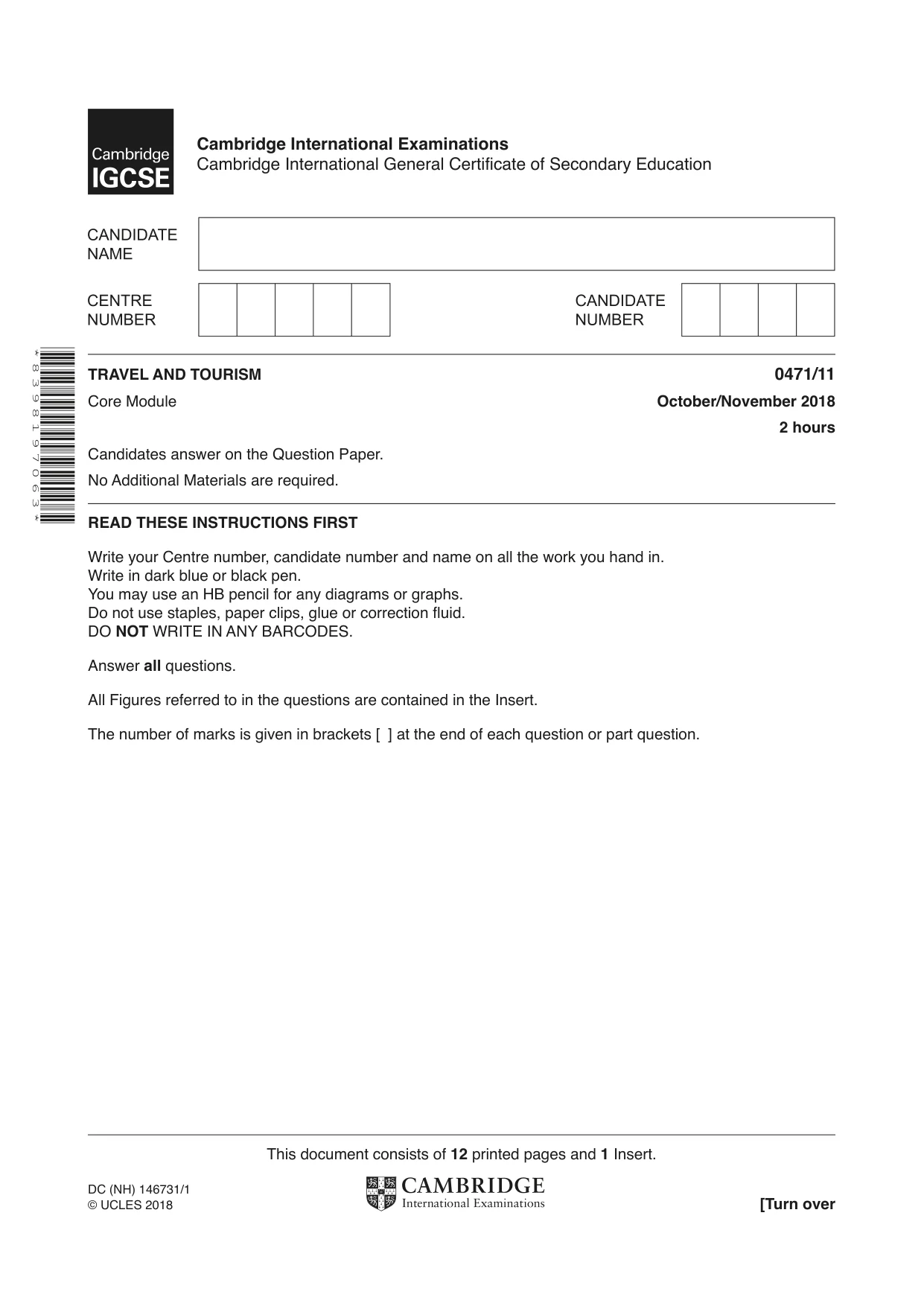
This document consists of 12 printed pages and 1 Insert. DC (NH) 146731/1 © UCLES 2018 [Turn over * 8 3 9 8 1 9 7 0 6 3 * TRAVEL AND TOURISM 0471/11 Core Module October/November 2018 2 hours Candidates answer on the Question Paper. No Additional Materials are required. READ THESE INSTRUCTIONS FIRST Write your Centre number, candidate number and name on all the work you hand in. Write in dark blue or black pen. You may use an HB pencil for any diagrams or graphs. Do not use staples, paper clips, glue or correction fluid. DO NOT WRITE IN ANY BARCODES. Answer all questions. All Figures referred to in the questions are contained in the Insert. The number of marks is given in brackets [ ] at the end of each question or part question. Cambridge International Examinations Cambridge International General Certificate of Secondary Education
Question paper, page 2
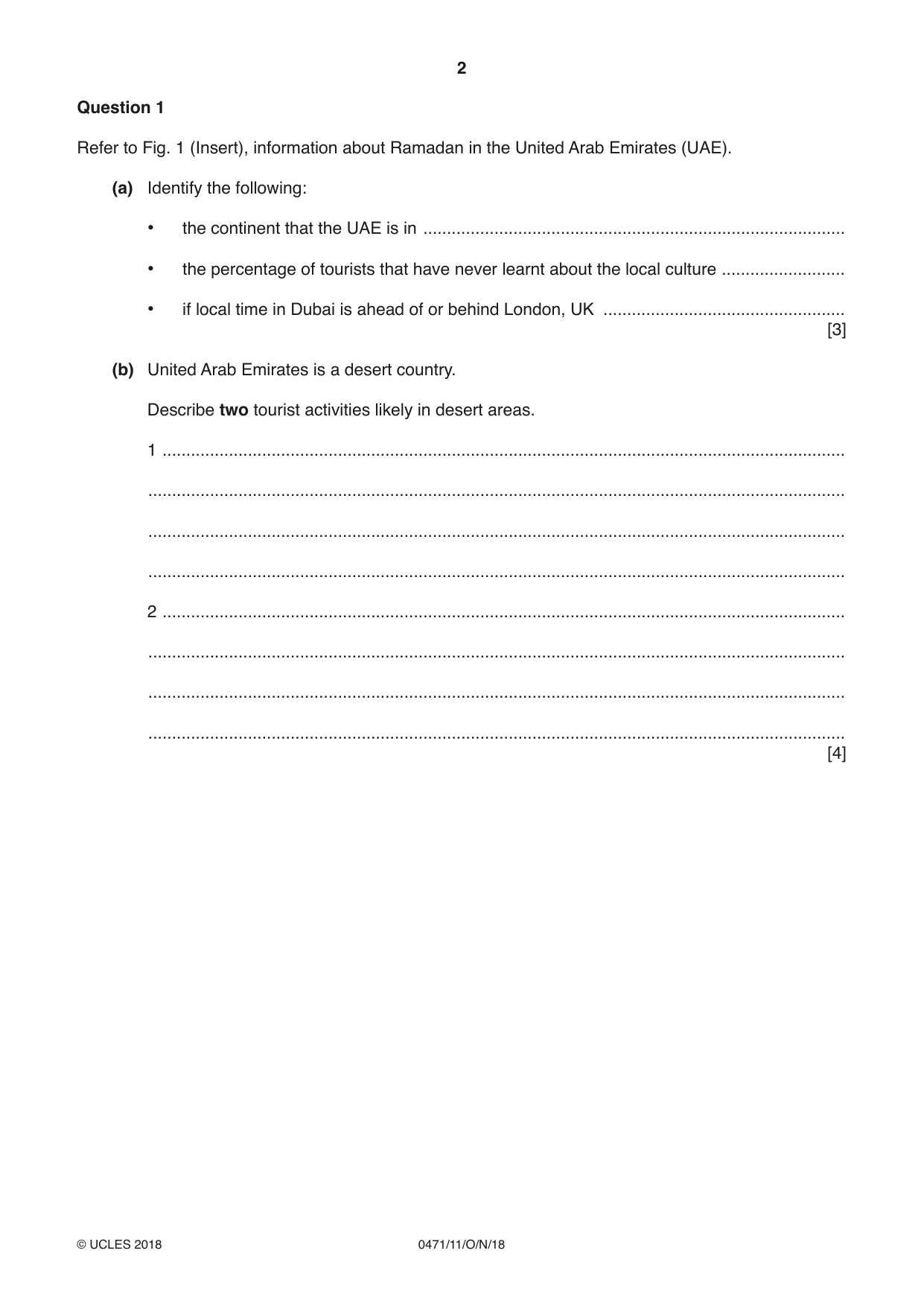
2 0471/11/O/N/18 © UCLES 2018 Question 1 Refer to Fig. 1 (Insert), information about Ramadan in the United Arab Emirates (UAE). (a) Identify the following: • the continent that the UAE is in … • the percentage of tourists that have never learnt about the local culture … • if local time in Dubai is ahead of or behind London, UK … [3] (b) United Arab Emirates is a desert country. Describe two tourist activities likely in desert areas. 1 … … … … 2 … … … … [4]
Question paper, page 3
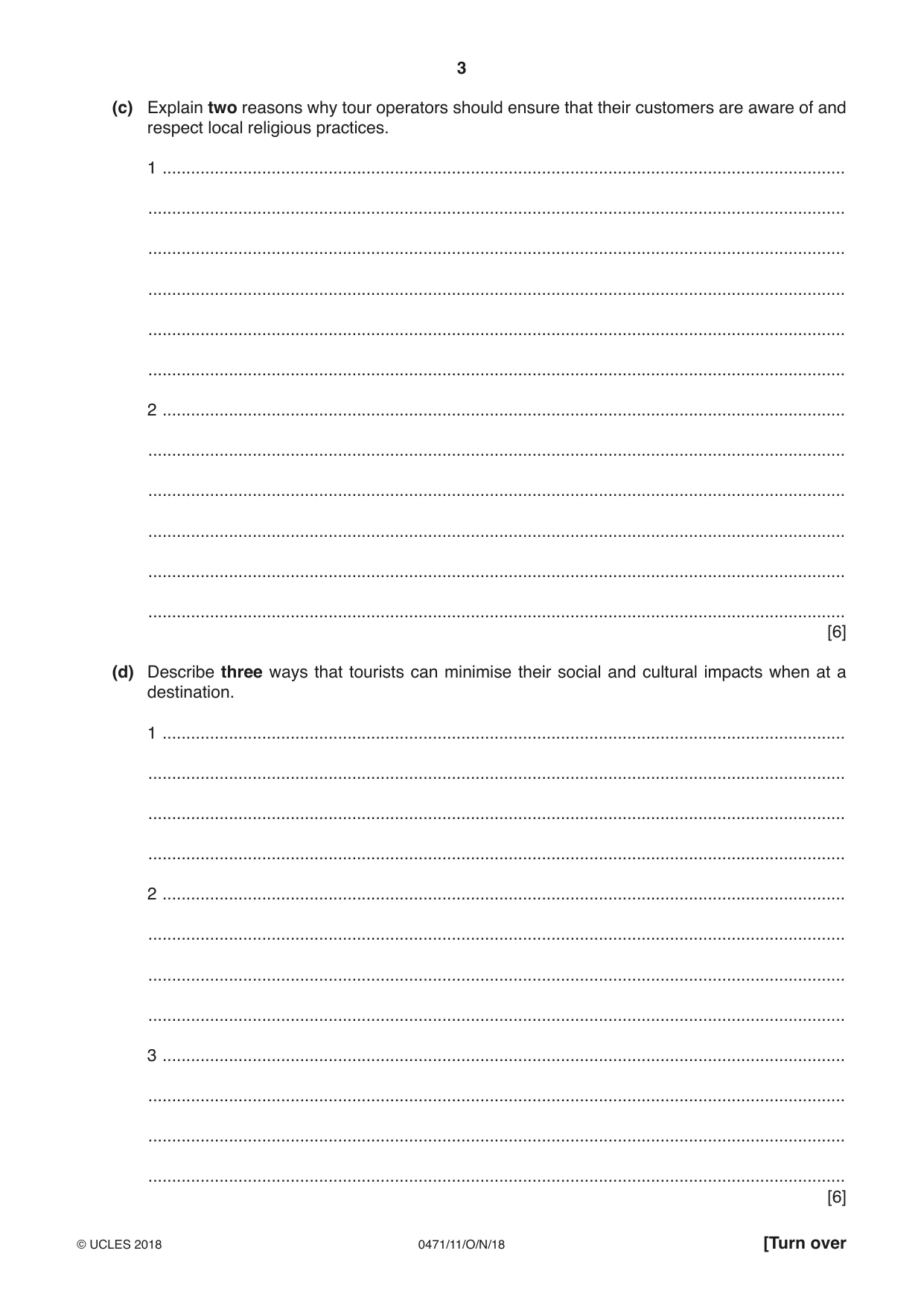
3 0471/11/O/N/18 © UCLES 2018 [Turn over (c) Explain two reasons why tour operators should ensure that their customers are aware of and respect local religious practices. 1 … … … … … … 2 … … … … … … [6] (d) Describe three ways that tourists can minimise their social and cultural impacts when at a destination. 1 … … … … 2 … … … … 3 … … … … [6]
Question paper, page 4
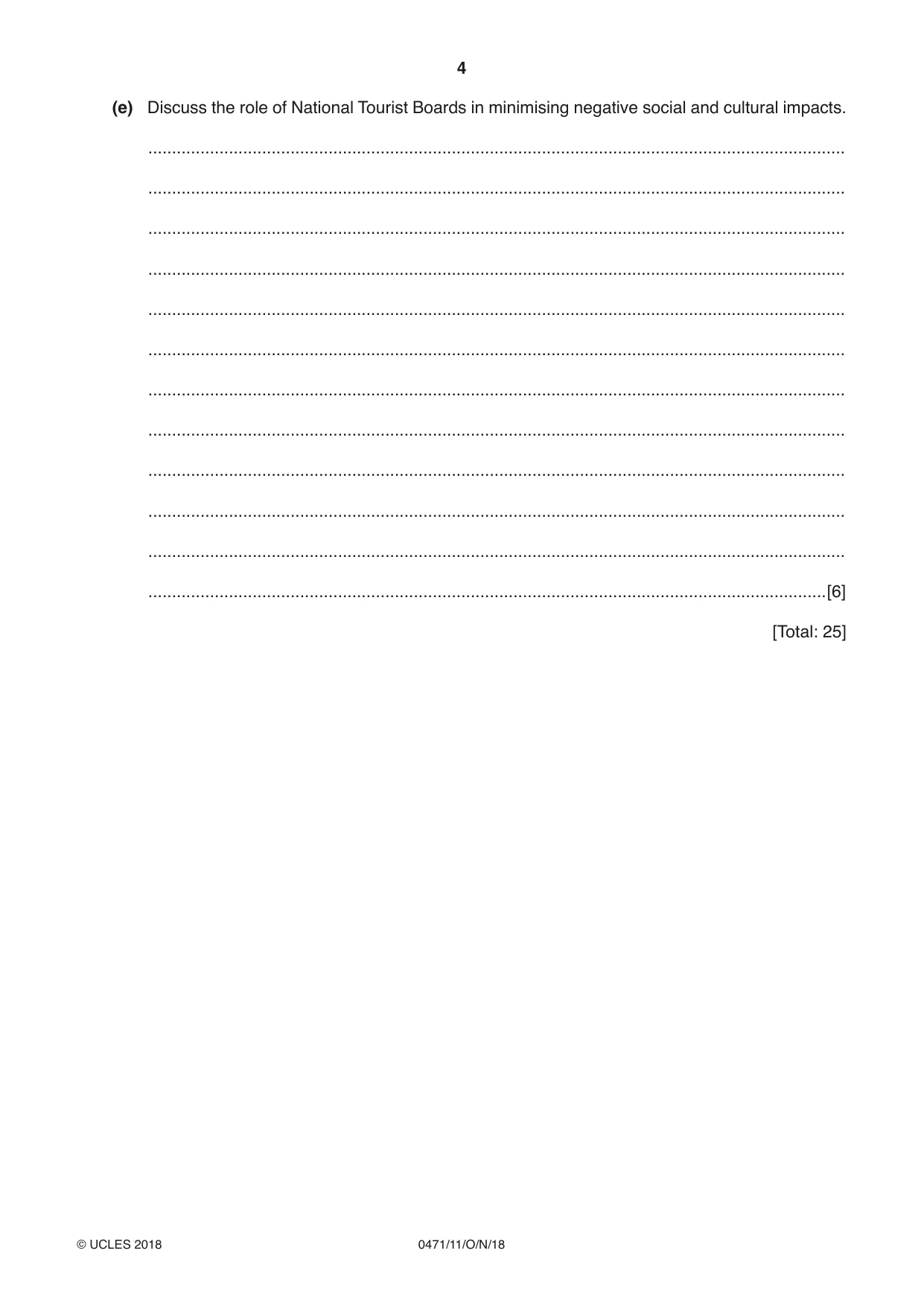
4 0471/11/O/N/18 © UCLES 2018 (e) Discuss the role of National Tourist Boards in minimising negative social and cultural impacts. … … … … … … … … … … … …[6] [Total: 25]
Question paper, page 5
5 0471/11/O/N/18 © UCLES 2018 [Turn over Question 2 Refer to photograph A (Insert), a couple arriving at an island resort by seaplane. (a) Identify three ways that the staff shown in photograph A are welcoming the tourists. 1 … … 2 … … 3 … … [3] (b) Explain two reasons why island resorts are likely to be all-inclusive. 1 … … … … 2 … … … … [4]
Question paper, page 6
6 0471/11/O/N/18 © UCLES 2018 (c) Explain three likely reasons why some island resorts use seaplanes to transport their customers rather than boats. 1 … … … … 2 … … … … 3 … … … … [6] (d) The staff in photograph A are dressed in uniforms. Explain three reasons why staff in resorts wear uniforms. 1 … … … … 2 … … … … 3 … … … … [6]
Question paper, page 7
7 0471/11/O/N/18 © UCLES 2018 [Turn over (e) Discuss what is meant by the phrase “tourist destinations are amalgams”. … … … … … … … … … … … …[6] [Total: 25]
Question paper, page 8
8 0471/11/O/N/18 © UCLES 2018 Question 3 Refer to Fig. 2 (Insert), information about holiday planning. (a) Identify the following: • the percentage of adults that are concerned about terror attacks when on holiday … • the percentage of tourists that would postpone their holiday in the event of a terror incident … • the percentage of tourists that book their holiday online … [3] (b) State four factors, other than terrorism, that are likely to influence a tourist’s choice of destination. 1 … 2 … 3 … 4 … [4] (c) Terrorism as well as political and global events may cause a drop in tourist numbers. Describe three negative economic impacts that are likely in the event of a drop in tourist numbers. 1 … … … … 2 … … … … 3 … … … … [6]
Question paper, page 9
9 0471/11/O/N/18 © UCLES 2018 [Turn over (d) Explain three ways that tourists can research the safety of destinations. 1 … … … … 2 … … … … 3 … … … … [6] (e) Discuss how terrorism has affected global travel trends. … … … … … … … … … … … …[6] [Total: 25]
Question paper, page 10
10 0471/11/O/N/18 © UCLES 2018 Question 4 Refer to Photograph B (Insert), tourists watching local wildlife whilst on a canoe tour of the Zambezi River, Zambia. (a) State three likely sporting activities available for tourists in natural environments. 1 … 2 … 3 … [3] (b) Sports tourism is an example of specialised tourism. State two other types of specialised tourism. 1 … 2 … [2] (c) Explain two reasons why camping may appeal to tourists. 1 … … … … 2 … … … … [4]
Question paper, page 11
11 0471/11/O/N/18 © UCLES 2018 [Turn over (d) Tourists are often given rules to follow to protect the natural environment that they are visiting. Explain three likely rules for tourists to follow to minimise their environmental impact. 1 … … … … 2 … … … … 3 … … … … [6] (e) Sport tourists may use public transport to move between areas. Explain one advantage and one disadvantage for a sport tourist of using public transport. advantage … … … … disadvantage … … … … [4]
Question paper, page 12
12 0471/11/O/N/18 © UCLES 2018 Permission to reproduce items where third-party owned material protected by copyright is included has been sought and cleared where possible. Every reasonable effort has been made by the publisher (UCLES) to trace copyright holders, but if any items requiring clearance have unwittingly been included, the publisher will be pleased to make amends at the earliest possible opportunity. To avoid the issue of disclosure of answer-related information to candidates, all copyright acknowledgements are reproduced online in the Cambridge International Examinations Copyright Acknowledgements Booklet. This is produced for each series of examinations and is freely available to download at www.cie.org.uk after the live examination series. Cambridge International Examinations is part of the Cambridge Assessment Group. Cambridge Assessment is the brand name of University of Cambridge Local Examinations Syndicate (UCLES), which is itself a department of the University of Cambridge. (f) Assess the likely positive environmental impacts of tourism in natural environments. … … … … … … … … … … … …[6] [Total: 25]
Mark scheme, page 1
This document consists of 10 printed pages. © UCLES 2018 [Turn over Cambridge Assessment International Education Cambridge International General Certificate of Secondary Education SUBJECT 0471/11 Paper 1 October/November 2018 MARK SCHEME Maximum Mark: 100 Published This mark scheme is published as an aid to teachers and candidates, to indicate the requirements of the examination. It shows the basis on which Examiners were instructed to award marks. It does not indicate the details of the discussions that took place at an Examiners’ meeting before marking began, which would have considered the acceptability of alternative answers. Mark schemes should be read in conjunction with the question paper and the Principal Examiner Report for Teachers. Cambridge International will not enter into discussions about these mark schemes. Cambridge International is publishing the mark schemes for the October/November 2018 series for most Cambridge IGCSE™, Cambridge International A and AS Level components and some Cambridge O Level components.
Mark scheme, page 2
0471/11 Cambridge IGCSE – Mark Scheme PUBLISHED October/November 2018 © UCLES 2018 Page 2 of 10 Generic Marking Principles These general marking principles must be applied by all examiners when marking candidate answers. They should be applied alongside the specific content of the mark scheme or generic level descriptors for a question. Each question paper and mark scheme will also comply with these marking principles. GENERIC MARKING PRINCIPLE 1: Marks must be awarded in line with: • the specific content of the mark scheme or the generic level descriptors for the question • the specific skills defined in the mark scheme or in the generic level descriptors for the question • the standard of response required by a candidate as exemplified by the standardisation scripts. GENERIC MARKING PRINCIPLE 2: Marks awarded are always whole marks (not half marks, or other fractions). GENERIC MARKING PRINCIPLE 3: Marks must be awarded positively: • marks are awarded for correct/valid answers, as defined in the mark scheme. However, credit is given for valid answers which go beyond the scope of the syllabus and mark scheme, referring to your Team Leader as appropriate • marks are awarded when candidates clearly demonstrate what they know and can do • marks are not deducted for errors • marks are not deducted for omissions • answers should only be judged on the quality of spelling, punctuation and grammar when these features are specifically assessed by the question as indicated by the mark scheme. The meaning, however, should be unambiguous. GENERIC MARKING PRINCIPLE 4: Rules must be applied consistently e.g. in situations where candidates have not followed instructions or in the application of generic level descriptors. GENERIC MARKING PRINCIPLE 5: Marks should be awarded using the full range of marks defined in the mark scheme for the question (however; the use of the full mark range may be limited according to the quality of the candidate responses seen). GENERIC MARKING PRINCIPLE 6: Marks awarded are based solely on the requirements as defined in the mark scheme. Marks should not be awarded with grade thresholds or grade descriptors in mind.
Mark scheme, page 3
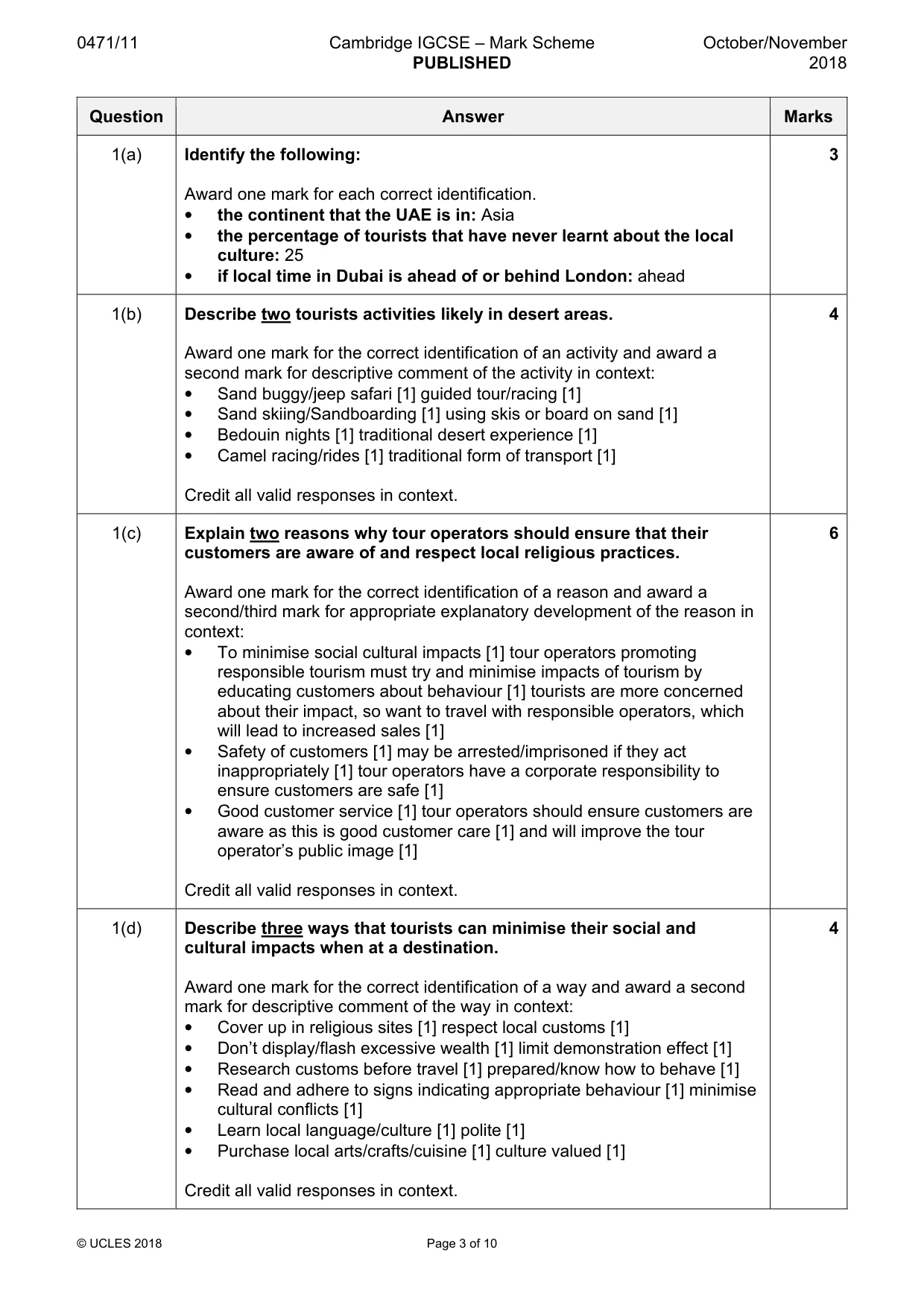
0471/11 Cambridge IGCSE – Mark Scheme PUBLISHED October/November 2018 © UCLES 2018 Page 3 of 10 Question Answer Marks 1(a) Identify the following: Award one mark for each correct identification. • the continent that the UAE is in: Asia • the percentage of tourists that have never learnt about the local culture: 25 • if local time in Dubai is ahead of or behind London: ahead 3 1(b) Describe two tourists activities likely in desert areas. Award one mark for the correct identification of an activity and award a second mark for descriptive comment of the activity in context: • Sand buggy/jeep safari [1] guided tour/racing [1] • Sand skiing/Sandboarding [1] using skis or board on sand [1] • Bedouin nights [1] traditional desert experience [1] • Camel racing/rides [1] traditional form of transport [1] Credit all valid responses in context. 4 1(c) Explain two reasons why tour operators should ensure that their customers are aware of and respect local religious practices. Award one mark for the correct identification of a reason and award a second/third mark for appropriate explanatory development of the reason in context: • To minimise social cultural impacts [1] tour operators promoting responsible tourism must try and minimise impacts of tourism by educating customers about behaviour [1] tourists are more concerned about their impact, so want to travel with responsible operators, which will lead to increased sales [1] • Safety of customers [1] may be arrested/imprisoned if they act inappropriately [1] tour operators have a corporate responsibility to ensure customers are safe [1] • Good customer service [1] tour operators should ensure customers are aware as this is good customer care [1] and will improve the tour operator’s public image [1] Credit all valid responses in context. 6 1(d) Describe three ways that tourists can minimise their social and cultural impacts when at a destination. Award one mark for the correct identification of a way and award a second mark for descriptive comment of the way in context: • Cover up in religious sites [1] respect local customs [1] • Don’t display/flash excessive wealth [1] limit demonstration effect [1] • Research customs before travel [1] prepared/know how to behave [1] • Read and adhere to signs indicating appropriate behaviour [1] minimise cultural conflicts [1] • Learn local language/culture [1] polite [1] • Purchase local arts/crafts/cuisine [1] culture valued [1] Credit all valid responses in context. 4
Mark scheme, page 4
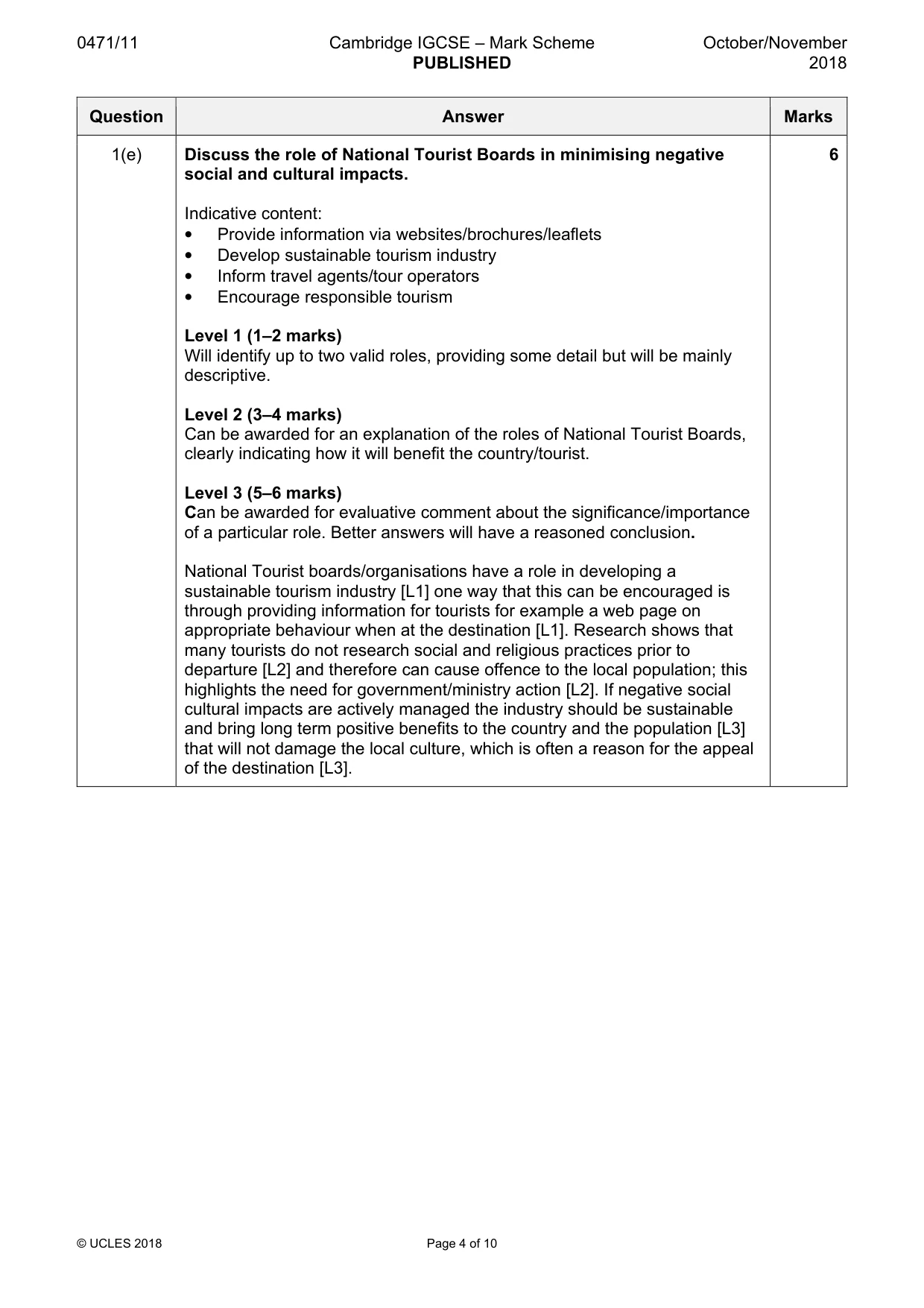
0471/11 Cambridge IGCSE – Mark Scheme PUBLISHED October/November 2018 © UCLES 2018 Page 4 of 10 Question Answer Marks 1(e) Discuss the role of National Tourist Boards in minimising negative social and cultural impacts. Indicative content: • Provide information via websites/brochures/leaflets • Develop sustainable tourism industry • Inform travel agents/tour operators • Encourage responsible tourism Level 1 (1–2 marks) Will identify up to two valid roles, providing some detail but will be mainly descriptive. Level 2 (3–4 marks) Can be awarded for an explanation of the roles of National Tourist Boards, clearly indicating how it will benefit the country/tourist. Level 3 (5–6 marks) Can be awarded for evaluative comment about the significance/importance of a particular role. Better answers will have a reasoned conclusion. National Tourist boards/organisations have a role in developing a sustainable tourism industry [L1] one way that this can be encouraged is through providing information for tourists for example a web page on appropriate behaviour when at the destination [L1]. Research shows that many tourists do not research social and religious practices prior to departure [L2] and therefore can cause offence to the local population; this highlights the need for government/ministry action [L2]. If negative social cultural impacts are actively managed the industry should be sustainable and bring long term positive benefits to the country and the population [L3] that will not damage the local culture, which is often a reason for the appeal of the destination [L3]. 6
Mark scheme, page 5
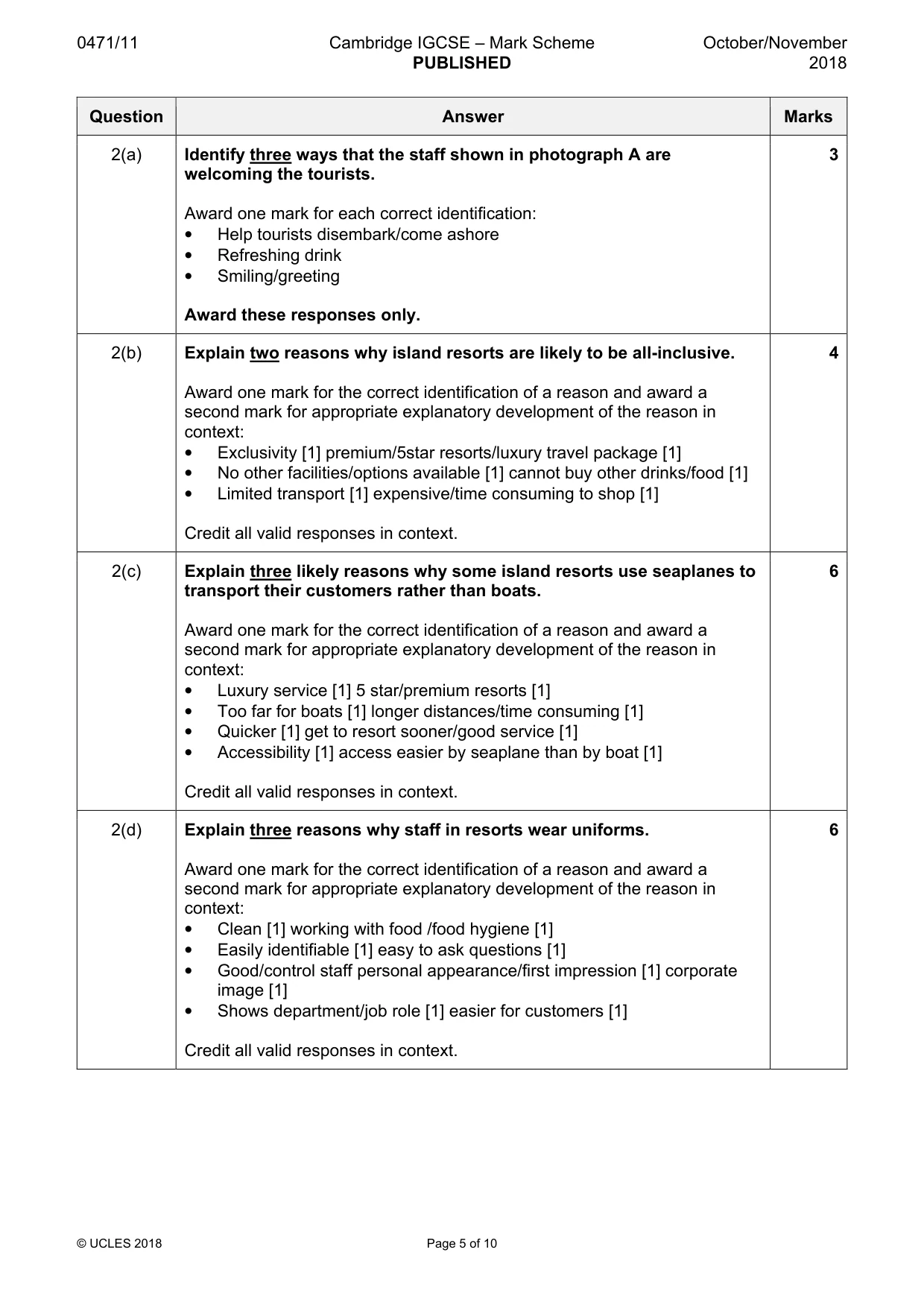
0471/11 Cambridge IGCSE – Mark Scheme PUBLISHED October/November 2018 © UCLES 2018 Page 5 of 10 Question Answer Marks 2(a) Identify three ways that the staff shown in photograph A are welcoming the tourists. Award one mark for each correct identification: • Help tourists disembark/come ashore • Refreshing drink • Smiling/greeting Award these responses only. 3 2(b) Explain two reasons why island resorts are likely to be all-inclusive. Award one mark for the correct identification of a reason and award a second mark for appropriate explanatory development of the reason in context: • Exclusivity [1] premium/5star resorts/luxury travel package [1] • No other facilities/options available [1] cannot buy other drinks/food [1] • Limited transport [1] expensive/time consuming to shop [1] Credit all valid responses in context. 4 2(c) Explain three likely reasons why some island resorts use seaplanes to transport their customers rather than boats. Award one mark for the correct identification of a reason and award a second mark for appropriate explanatory development of the reason in context: • Luxury service [1] 5 star/premium resorts [1] • Too far for boats [1] longer distances/time consuming [1] • Quicker [1] get to resort sooner/good service [1] • Accessibility [1] access easier by seaplane than by boat [1] Credit all valid responses in context. 6 2(d) Explain three reasons why staff in resorts wear uniforms. Award one mark for the correct identification of a reason and award a second mark for appropriate explanatory development of the reason in context: • Clean [1] working with food /food hygiene [1] • Easily identifiable [1] easy to ask questions [1] • Good/control staff personal appearance/first impression [1] corporate image [1] • Shows department/job role [1] easier for customers [1] Credit all valid responses in context. 6
Mark scheme, page 6
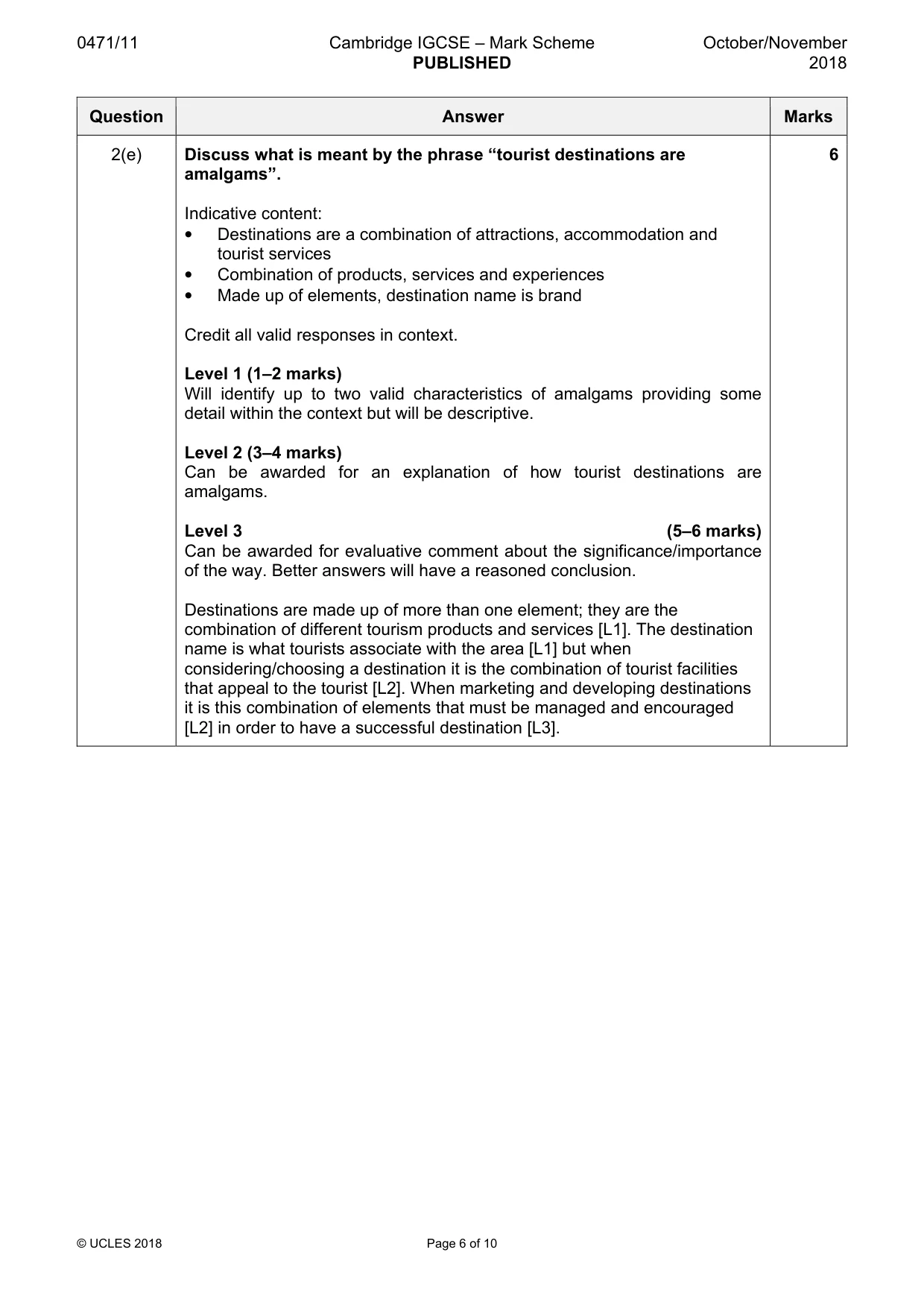
0471/11 Cambridge IGCSE – Mark Scheme PUBLISHED October/November 2018 © UCLES 2018 Page 6 of 10 Question Answer Marks 2(e) Discuss what is meant by the phrase “tourist destinations are amalgams”. Indicative content: • Destinations are a combination of attractions, accommodation and tourist services • Combination of products, services and experiences • Made up of elements, destination name is brand Credit all valid responses in context. Level 1 (1–2 marks) Will identify up to two valid characteristics of amalgams providing some detail within the context but will be descriptive. Level 2 (3–4 marks) Can be awarded for an explanation of how tourist destinations are amalgams. Level 3 (5–6 marks) Can be awarded for evaluative comment about the significance/importance of the way. Better answers will have a reasoned conclusion. Destinations are made up of more than one element; they are the combination of different tourism products and services [L1]. The destination name is what tourists associate with the area [L1] but when considering/choosing a destination it is the combination of tourist facilities that appeal to the tourist [L2]. When marketing and developing destinations it is this combination of elements that must be managed and encouraged [L2] in order to have a successful destination [L3]. 6
Mark scheme, page 7
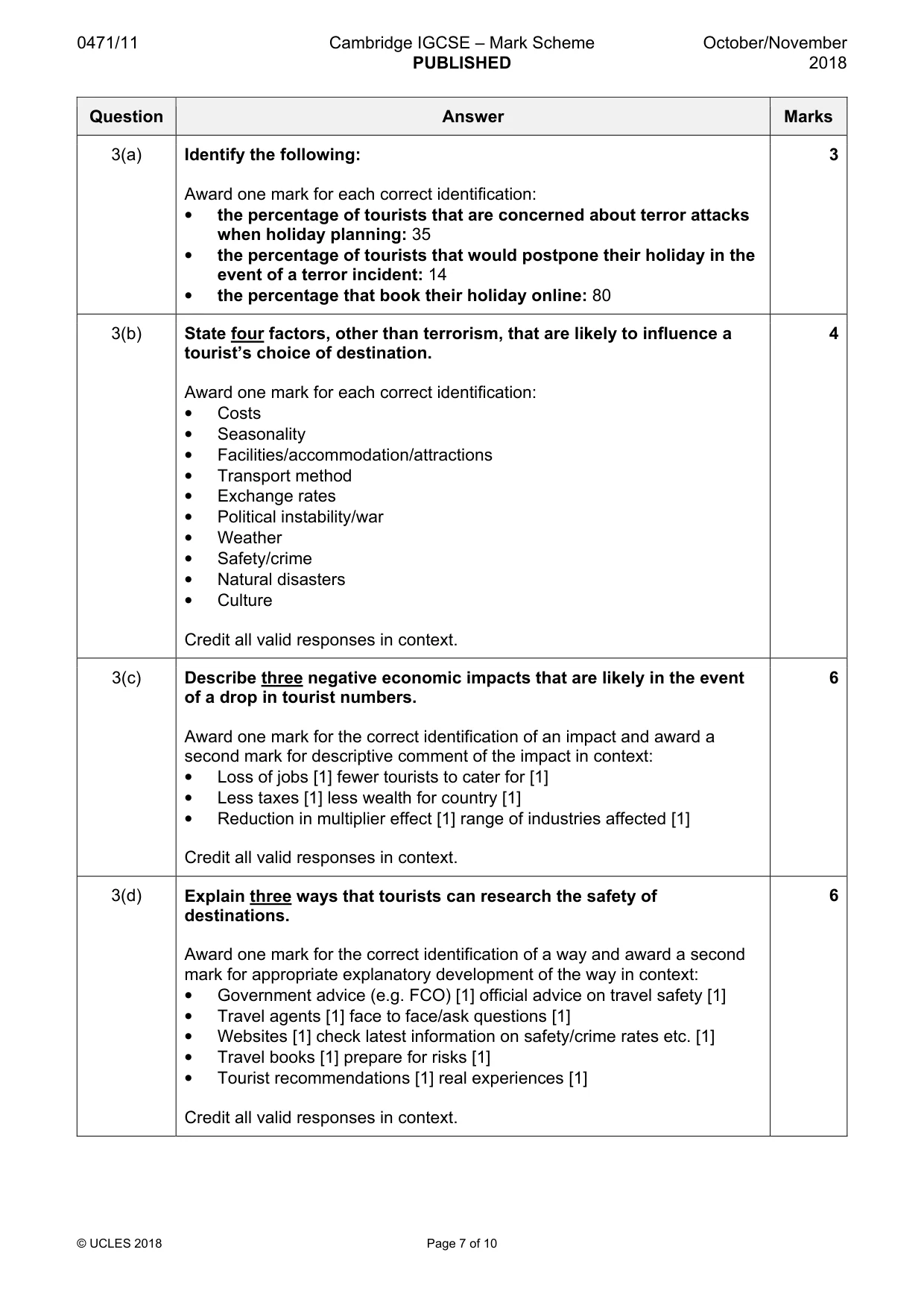
0471/11 Cambridge IGCSE – Mark Scheme PUBLISHED October/November 2018 © UCLES 2018 Page 7 of 10 Question Answer Marks 3(a) Identify the following: Award one mark for each correct identification: • the percentage of tourists that are concerned about terror attacks when holiday planning: 35 • the percentage of tourists that would postpone their holiday in the event of a terror incident: 14 • the percentage that book their holiday online: 80 3 3(b) State four factors, other than terrorism, that are likely to influence a tourist’s choice of destination. Award one mark for each correct identification: • Costs • Seasonality • Facilities/accommodation/attractions • Transport method • Exchange rates • Political instability/war • Weather • Safety/crime • Natural disasters • Culture Credit all valid responses in context. 4 3(c) Describe three negative economic impacts that are likely in the event of a drop in tourist numbers. Award one mark for the correct identification of an impact and award a second mark for descriptive comment of the impact in context: • Loss of jobs [1] fewer tourists to cater for [1] • Less taxes [1] less wealth for country [1] • Reduction in multiplier effect [1] range of industries affected [1] Credit all valid responses in context. 6 3(d) Explain three ways that tourists can research the safety of destinations. Award one mark for the correct identification of a way and award a second mark for appropriate explanatory development of the way in context: • Government advice (e.g. FCO) [1] official advice on travel safety [1] • Travel agents [1] face to face/ask questions [1] • Websites [1] check latest information on safety/crime rates etc. [1] • Travel books [1] prepare for risks [1] • Tourist recommendations [1] real experiences [1] Credit all valid responses in context. 6
Mark scheme, page 8
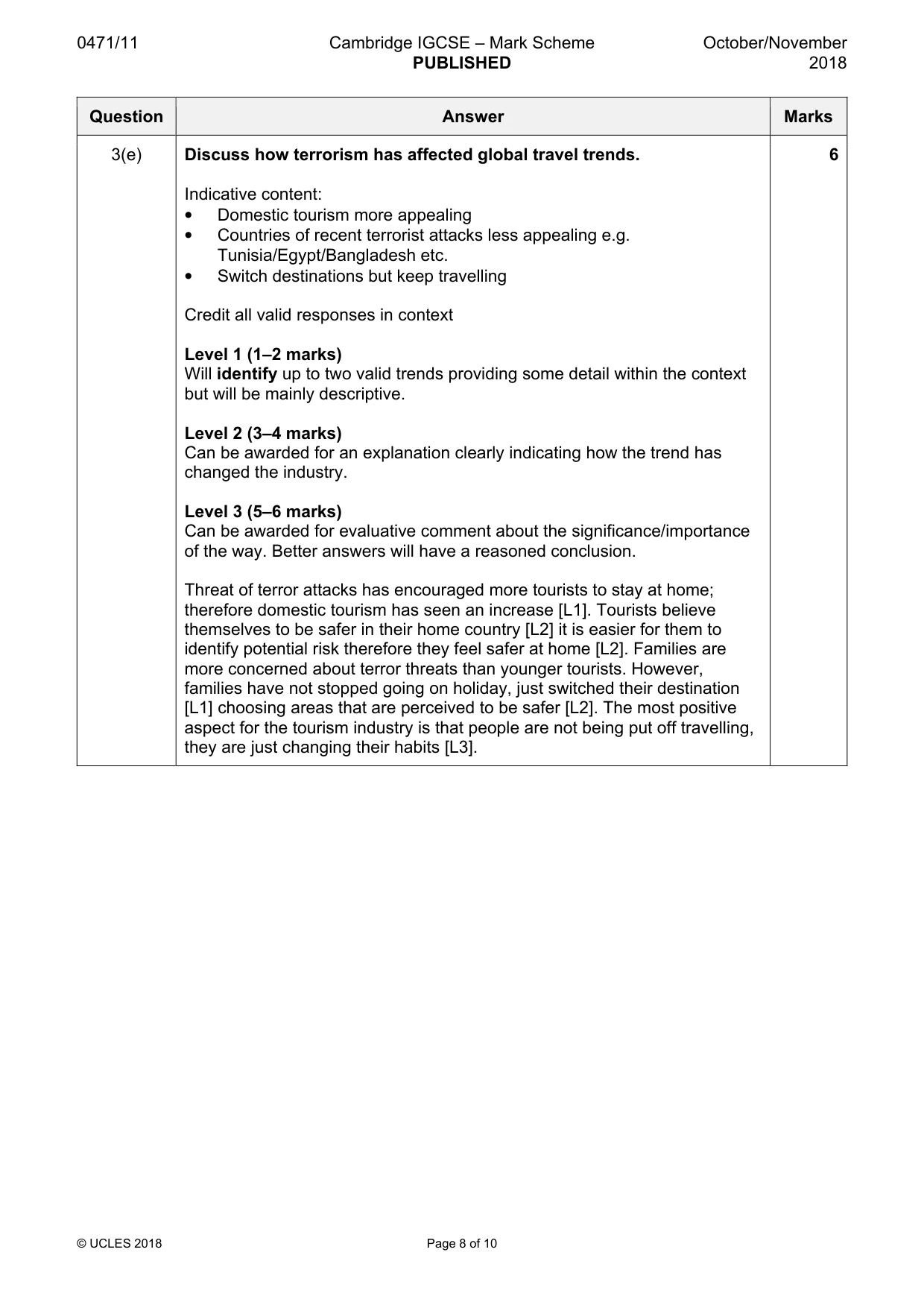
0471/11 Cambridge IGCSE – Mark Scheme PUBLISHED October/November 2018 © UCLES 2018 Page 8 of 10 Question Answer Marks 3(e) Discuss how terrorism has affected global travel trends. Indicative content: • Domestic tourism more appealing • Countries of recent terrorist attacks less appealing e.g. Tunisia/Egypt/Bangladesh etc. • Switch destinations but keep travelling Credit all valid responses in context Level 1 (1–2 marks) Will identify up to two valid trends providing some detail within the context but will be mainly descriptive. Level 2 (3–4 marks) Can be awarded for an explanation clearly indicating how the trend has changed the industry. Level 3 (5–6 marks) Can be awarded for evaluative comment about the significance/importance of the way. Better answers will have a reasoned conclusion. Threat of terror attacks has encouraged more tourists to stay at home; therefore domestic tourism has seen an increase [L1]. Tourists believe themselves to be safer in their home country [L2] it is easier for them to identify potential risk therefore they feel safer at home [L2]. Families are more concerned about terror threats than younger tourists. However, families have not stopped going on holiday, just switched their destination [L1] choosing areas that are perceived to be safer [L2]. The most positive aspect for the tourism industry is that people are not being put off travelling, they are just changing their habits [L3]. 6
Mark scheme, page 9
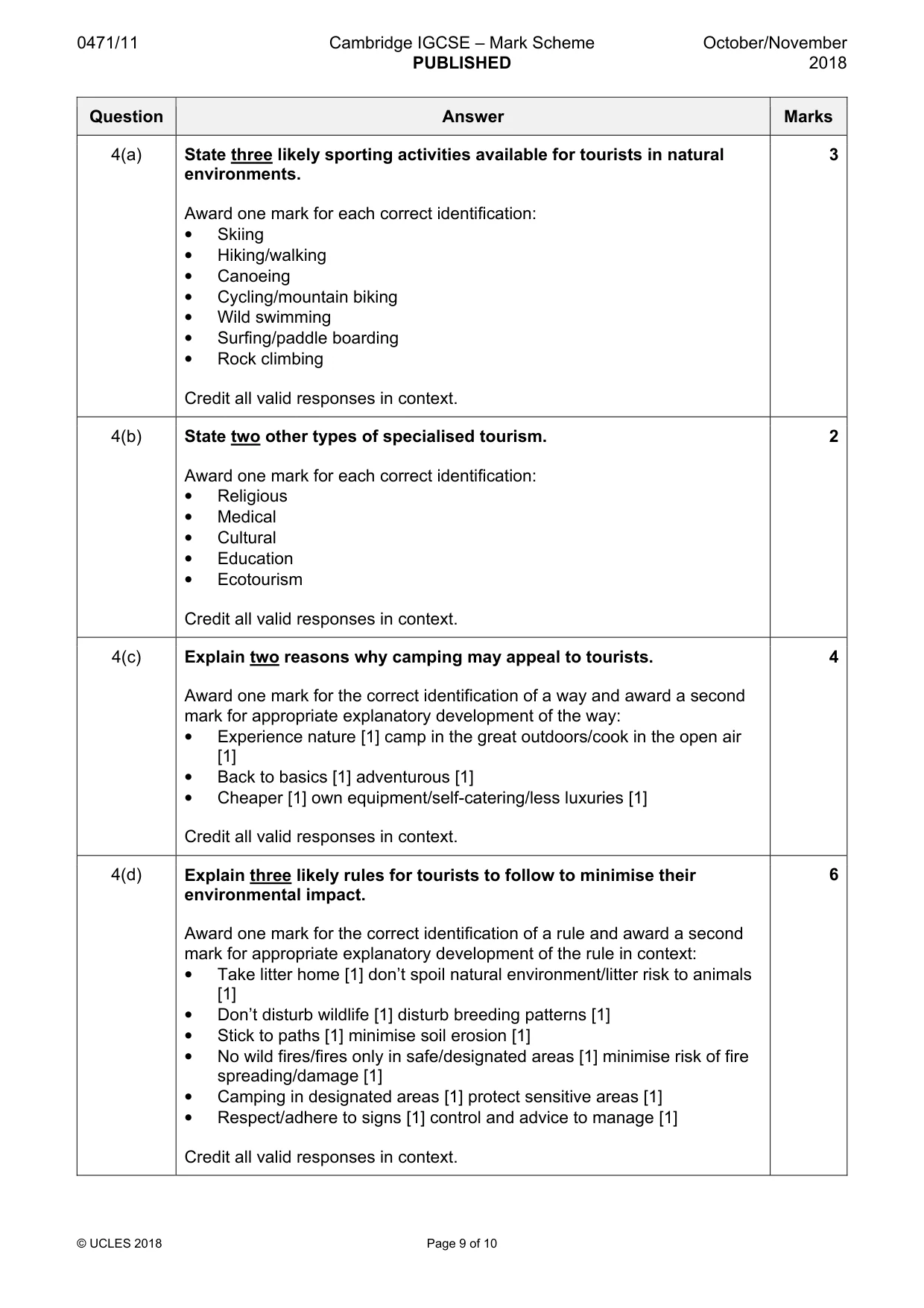
0471/11 Cambridge IGCSE – Mark Scheme PUBLISHED October/November 2018 © UCLES 2018 Page 9 of 10 Question Answer Marks 4(a) State three likely sporting activities available for tourists in natural environments. Award one mark for each correct identification: • Skiing • Hiking/walking • Canoeing • Cycling/mountain biking • Wild swimming • Surfing/paddle boarding • Rock climbing Credit all valid responses in context. 3 4(b) State two other types of specialised tourism. Award one mark for each correct identification: • Religious • Medical • Cultural • Education • Ecotourism Credit all valid responses in context. 2 4(c) Explain two reasons why camping may appeal to tourists. Award one mark for the correct identification of a way and award a second mark for appropriate explanatory development of the way: • Experience nature [1] camp in the great outdoors/cook in the open air [1] • Back to basics [1] adventurous [1] • Cheaper [1] own equipment/self-catering/less luxuries [1] Credit all valid responses in context. 4 4(d) Explain three likely rules for tourists to follow to minimise their environmental impact. Award one mark for the correct identification of a rule and award a second mark for appropriate explanatory development of the rule in context: • Take litter home [1] don’t spoil natural environment/litter risk to animals [1] • Don’t disturb wildlife [1] disturb breeding patterns [1] • Stick to paths [1] minimise soil erosion [1] • No wild fires/fires only in safe/designated areas [1] minimise risk of fire spreading/damage [1] • Camping in designated areas [1] protect sensitive areas [1] • Respect/adhere to signs [1] control and advice to manage [1] Credit all valid responses in context. 6
Mark scheme, page 10
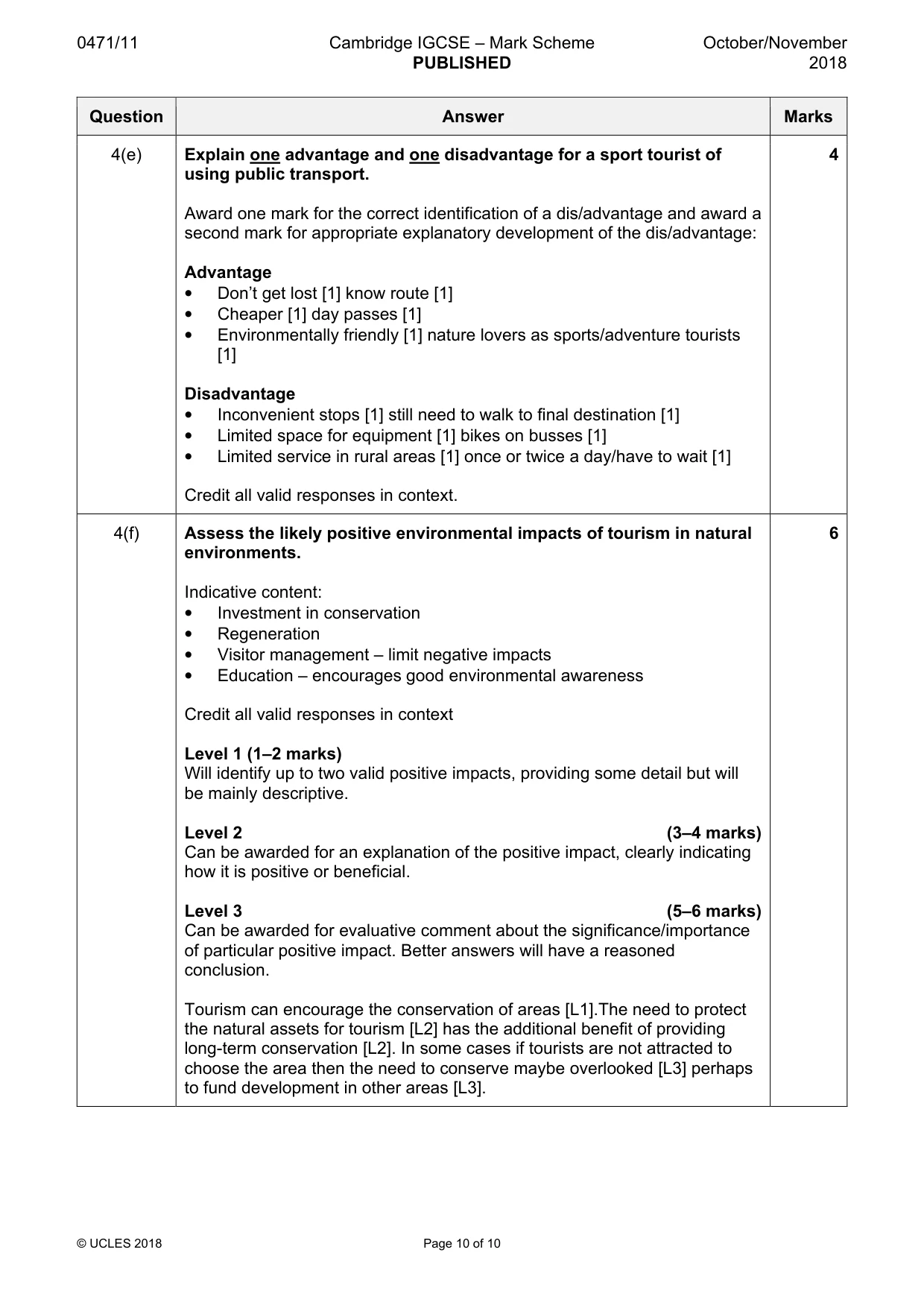
0471/11 Cambridge IGCSE – Mark Scheme PUBLISHED October/November 2018 © UCLES 2018 Page 10 of 10 Question Answer Marks 4(e) Explain one advantage and one disadvantage for a sport tourist of using public transport. Award one mark for the correct identification of a dis/advantage and award a second mark for appropriate explanatory development of the dis/advantage: Advantage • Don’t get lost [1] know route [1] • Cheaper [1] day passes [1] • Environmentally friendly [1] nature lovers as sports/adventure tourists [1] Disadvantage • Inconvenient stops [1] still need to walk to final destination [1] • Limited space for equipment [1] bikes on busses [1] • Limited service in rural areas [1] once or twice a day/have to wait [1] Credit all valid responses in context. 4 4(f) Assess the likely positive environmental impacts of tourism in natural environments. Indicative content: • Investment in conservation • Regeneration • Visitor management – limit negative impacts • Education – encourages good environmental awareness Credit all valid responses in context Level 1 (1–2 marks) Will identify up to two valid positive impacts, providing some detail but will be mainly descriptive. Level 2 (3–4 marks) Can be awarded for an explanation of the positive impact, clearly indicating how it is positive or beneficial. Level 3 (5–6 marks) Can be awarded for evaluative comment about the significance/importance of particular positive impact. Better answers will have a reasoned conclusion. Tourism can encourage the conservation of areas [L1].The need to protect the natural assets for tourism [L2] has the additional benefit of providing long-term conservation [L2]. In some cases if tourists are not attracted to choose the area then the need to conserve maybe overlooked [L3] perhaps to fund development in other areas [L3]. 6
What you needed in this session
Cambridge’s own grade thresholds for 2018 Oct/Nov, Paper 1 · Variant 1. A higher threshold means an easier paper — the bar moves with how the cohort did.