Cambridge IGCSE Travel and Tourism 0471 — 2018 Oct/Nov Paper 1 · Variant 3
0471/13/O/N/18 · 100 marks · ≈113 min
The question paper and its mark scheme, free to read here and free to download. This is Cambridge’s own paper, exactly as it was sat.
Question paper12 pages
Mark scheme10 pages
Answers below. Sit the paper first if you are practising.
Paper as text
Question paper, page 1
* 5 2 7 3 2 3 5 3 2 9 * This document consists of 12 printed pages and 1 Insert. DC (ST) 146712/2 © UCLES 2018 [Turn over TRAVEL AND TOURISM 0471/13 Core Module October/November 2018 2 hours Candidates answer on the Question Paper. No Additional Materials are required. READ THESE INSTRUCTIONS FIRST Write your Centre number, candidate number and name on all the work you hand in. Write in dark blue or black pen. You may use an HB pencil for any diagrams or graphs. Do not use staples, paper clips, glue or correction fluid. DO NOT WRITE IN ANY BARCODES. Answer all questions. All Figures referred to in the questions are contained in the Insert. The number of marks is given in brackets [ ] at the end of each question or part question. Cambridge International Examinations Cambridge International General Certificate of Secondary Education
Question paper, page 2
2 0471/13/O/N/18 © UCLES 2018 Question 1 Refer to Fig. 1 (Insert), information about the island of Koh Tachai, in Thailand. (a) Identify the following: • the carrying capacity of Koh Tachai … • the months that almost all Thai Marine National Parks close … • the name of the National Park … [3] (b) State two transport methods that tourists can use to travel to remote islands. Describe the appeal for each method of transport. Transport method … Appeal … … … Transport method … Appeal … … … [4] (c) Fig. 1 (Insert) shows a photograph of one of the many entrances to the National Park. Explain two ways that the entrance shown in Fig. 1 is meeting tourists’ needs. 1 … … … … 2 … … … … [4]
Question paper, page 3
3 0471/13/O/N/18 © UCLES 2018 [Turn over (d) Explain three negative environmental impacts of diving as a popular tourist activity. 1 … … … … 2 … … … … 3 … … … … [6] (e) Suggest one reason why some dive sites have been allowed to stay open. … … … …[2]
Question paper, page 4
4 0471/13/O/N/18 © UCLES 2018 (f) Assess the visitor management techniques that could be used to minimise environmental damage to popular natural areas such as Koh Tachai. … … … … … … … … … … … …[6] [Total: 25]
Question paper, page 5
5 0471/13/O/N/18 © UCLES 2018 [Turn over Question 2 Refer to Photograph A (Insert), tourists waiting to board a cable car. (a) State three methods of transport, other than a cable car, that tourists might use when at a destination. 1 … 2 … 3 … [3] (b) Explain three reasons for the appeal of cable cars. 1 … … … … 2 … … … … 3 … … … … [6]
Question paper, page 6
6 0471/13/O/N/18 © UCLES 2018 (c) Describe three support facilities likely to be provided for tourists at cable car stations. 1 … … … … 2 … … … … 3 … … … … [6] (d) Tourists are likely to be issued with receipts when purchasing tickets for transport. Explain two ways that receipts may be issued to tourists. 1 … … … … 2 … … … … [4]
Question paper, page 7
7 0471/13/O/N/18 © UCLES 2018 [Turn over (e) Discuss the ways that transport infrastructure, such as cable cars, can contribute towards extending tourist seasons. … … … … … … … … … … … …[6] [Total: 25]
Question paper, page 8
8 0471/13/O/N/18 © UCLES 2018 Question 3 Refer to Photograph B (Insert), tourists arriving at the Harwich International Cruise Terminal in the UK. (a) State three security checks that may be carried out on tourists before boarding an international cruise ship. 1 … … 2 … … 3 … … [3] (b) Explain three ways that cruise ships can cater for group travellers when onboard. 1 … … … … 2 … … … … 3 … … … … [6]
Question paper, page 9
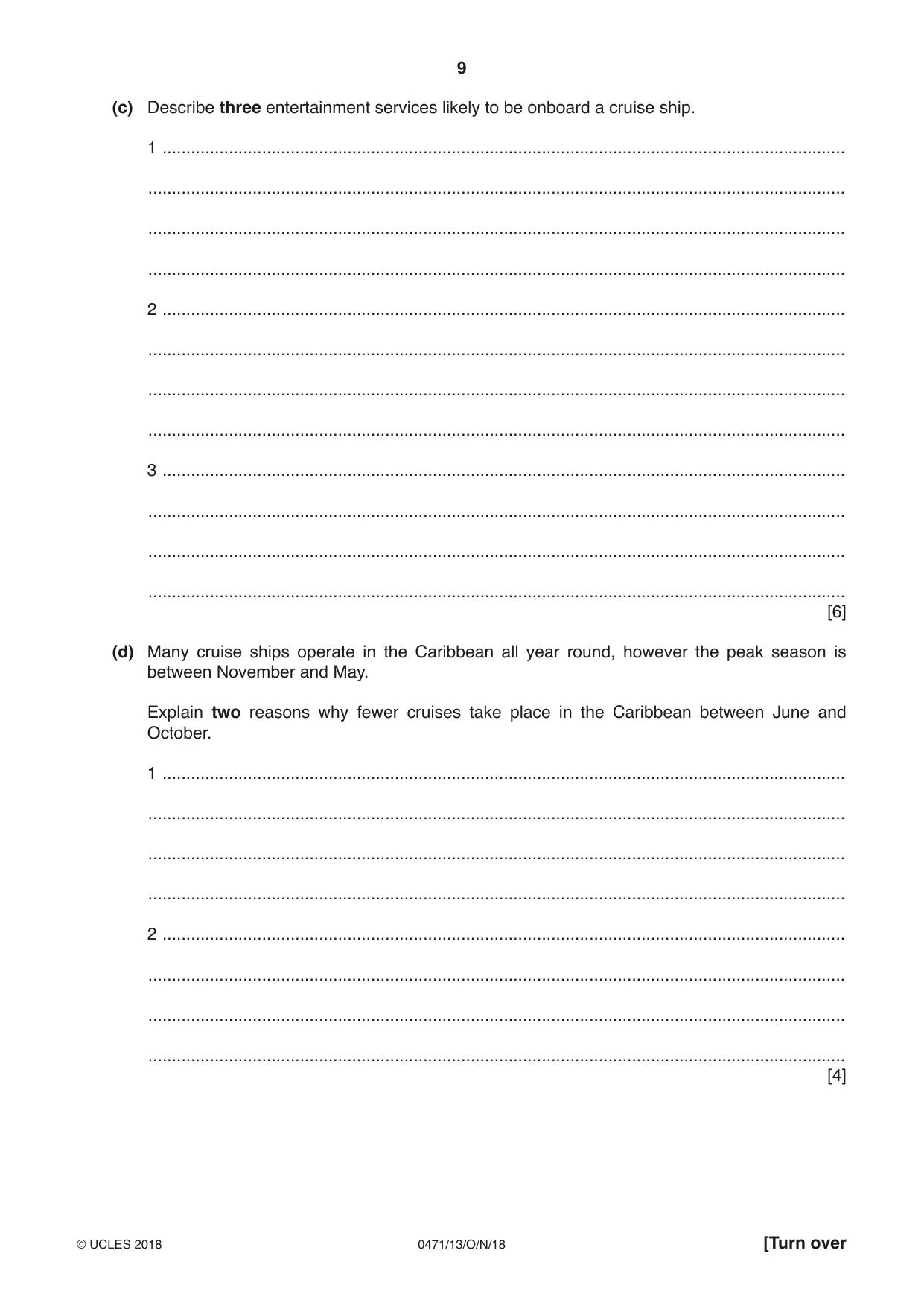
9 0471/13/O/N/18 © UCLES 2018 [Turn over (c) Describe three entertainment services likely to be onboard a cruise ship. 1 … … … … 2 … … … … 3 … … … … [6] (d) Many cruise ships operate in the Caribbean all year round, however the peak season is between November and May. Explain two reasons why fewer cruises take place in the Caribbean between June and October. 1 … … … … 2 … … … … [4]
Question paper, page 10
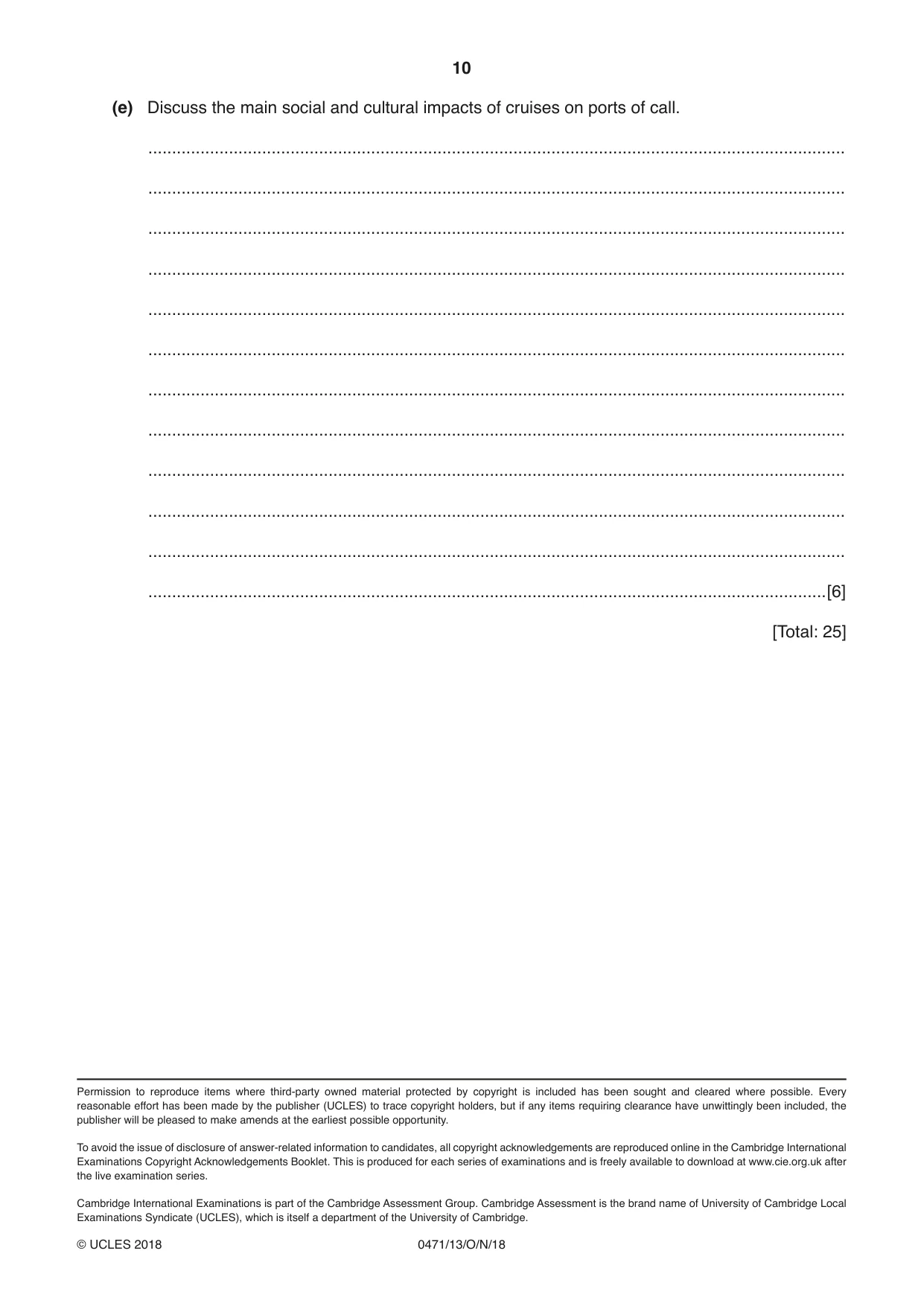
10 0471/13/O/N/18 © UCLES 2018 (e) Discuss the main social and cultural impacts of cruises on ports of call. … … … … … … … … … … … …[6] [Total: 25] Permission to reproduce items where third-party owned material protected by copyright is included has been sought and cleared where possible. Every reasonable effort has been made by the publisher (UCLES) to trace copyright holders, but if any items requiring clearance have unwittingly been included, the publisher will be pleased to make amends at the earliest possible opportunity. To avoid the issue of disclosure of answer-related information to candidates, all copyright acknowledgements are reproduced online in the Cambridge International Examinations Copyright Acknowledgements Booklet. This is produced for each series of examinations and is freely available to download at www.cie.org.uk after the live examination series. Cambridge International Examinations is part of the Cambridge Assessment Group. Cambridge Assessment is the brand name of University of Cambridge Local Examinations Syndicate (UCLES), which is itself a department of the University of Cambridge.
Question paper, page 11
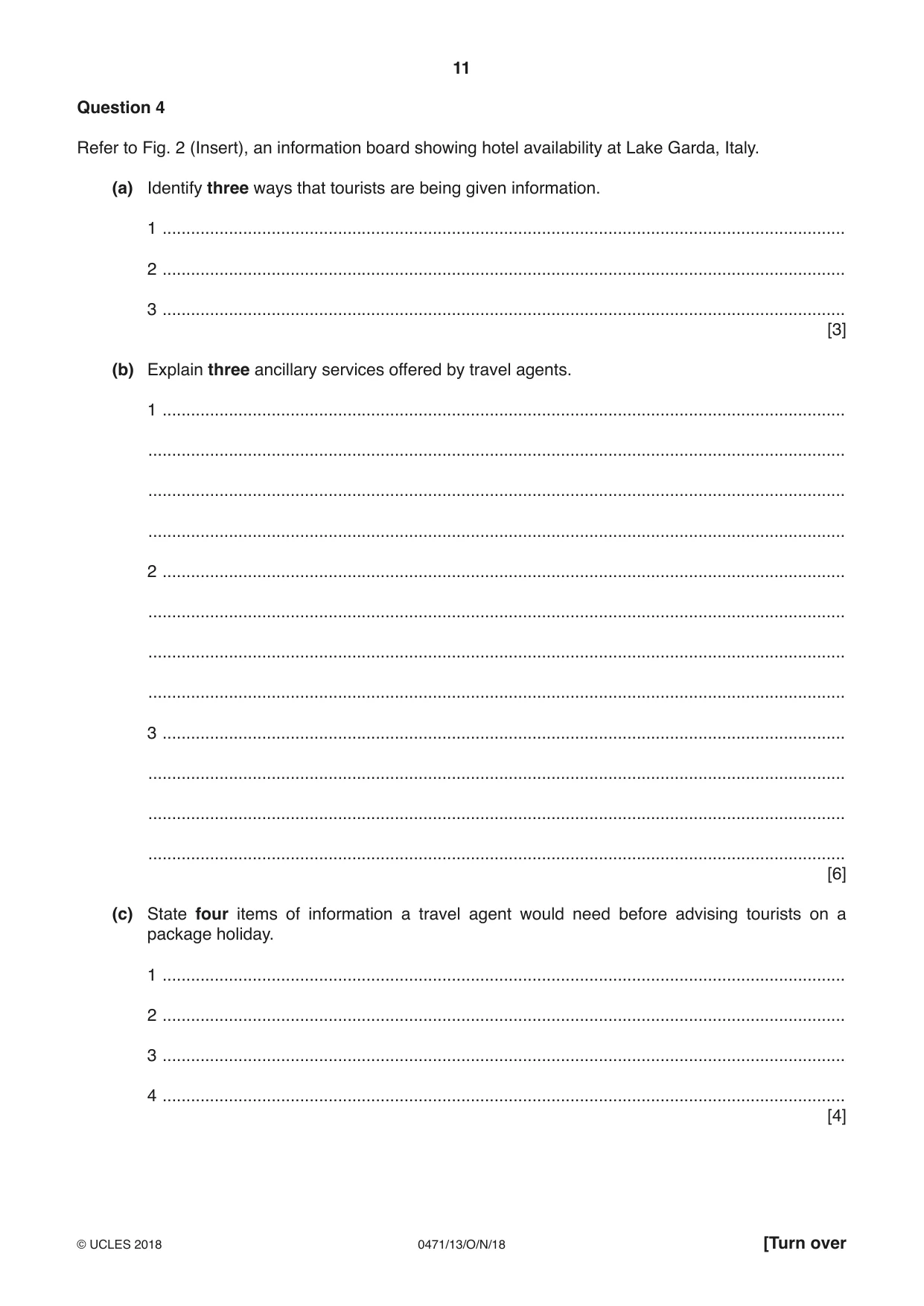
11 0471/13/O/N/18 © UCLES 2018 [Turn over Question 4 Refer to Fig. 2 (Insert), an information board showing hotel availability at Lake Garda, Italy. (a) Identify three ways that tourists are being given information. 1 … 2 … 3 … [3] (b) Explain three ancillary services offered by travel agents. 1 … … … … 2 … … … … 3 … … … … [6] (c) State four items of information a travel agent would need before advising tourists on a package holiday. 1 … 2 … 3 … 4 … [4]
Question paper, page 12
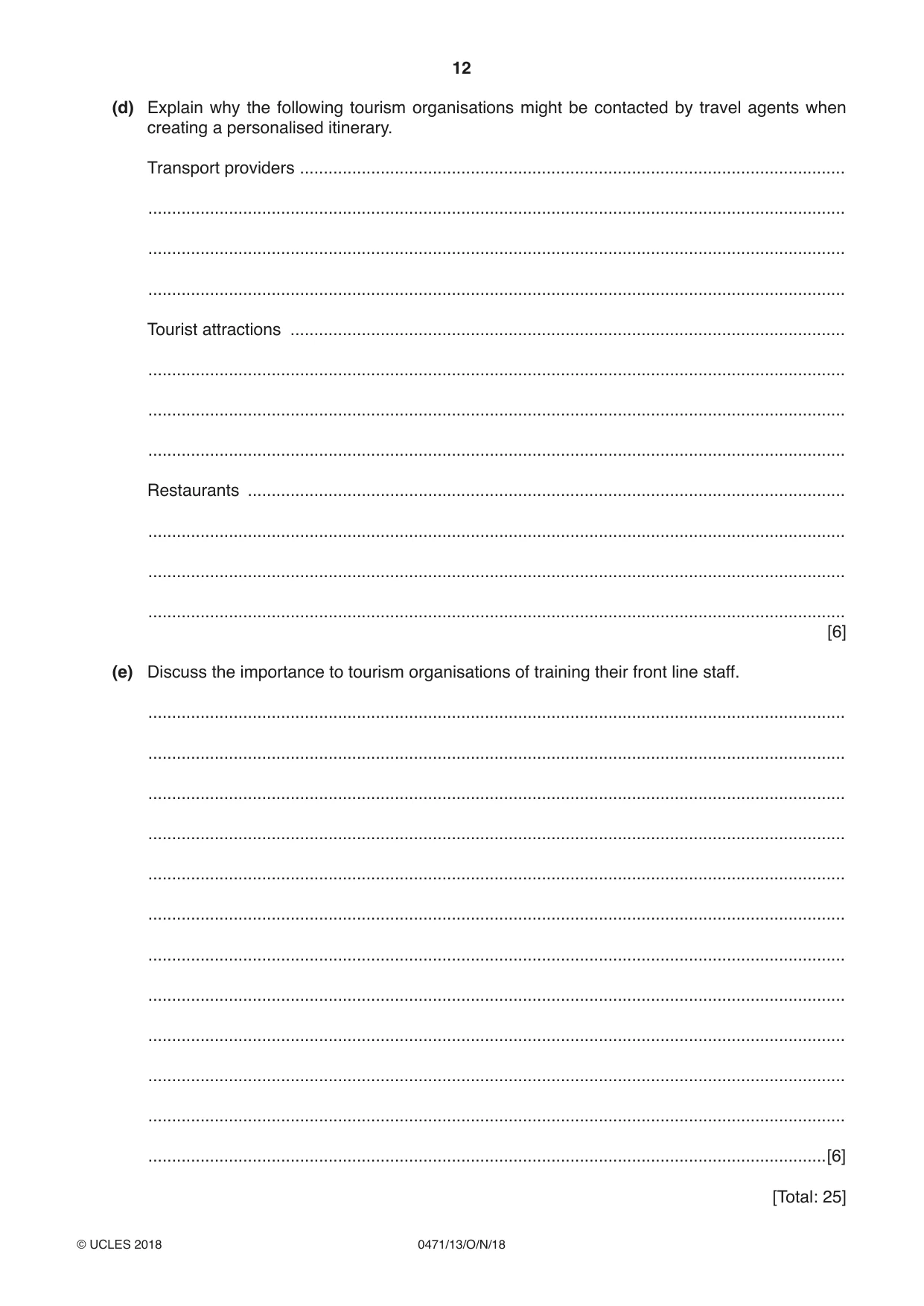
12 0471/13/O/N/18 © UCLES 2018 (d) Explain why the following tourism organisations might be contacted by travel agents when creating a personalised itinerary. Transport providers … … … … Tourist attractions … … … … Restaurants … … … … [6] (e) Discuss the importance to tourism organisations of training their front line staff. … … … … … … … … … … … …[6] [Total: 25]
Mark scheme, page 1
This document consists of 10 printed pages. © UCLES 2018 [Turn over Cambridge Assessment International Education Cambridge International General Certificate of Secondary Education TRAVEL AND TOURISM 0471/13 Paper 1 Core Paper October/November 2018 MARK SCHEME Maximum Mark: 100 Published This mark scheme is published as an aid to teachers and candidates, to indicate the requirements of the examination. It shows the basis on which Examiners were instructed to award marks. It does not indicate the details of the discussions that took place at an Examiners’ meeting before marking began, which would have considered the acceptability of alternative answers. Mark schemes should be read in conjunction with the question paper and the Principal Examiner Report for Teachers. Cambridge International will not enter into discussions about these mark schemes. Cambridge International is publishing the mark schemes for the October/November 2018 series for most Cambridge IGCSE™, Cambridge International A and AS Level components and some Cambridge O Level components.
Mark scheme, page 2
0471/13 Cambridge IGCSE – Mark Scheme PUBLISHED October/November 2018 © UCLES 2018 Page 2 of 10 Generic Marking Principles These general marking principles must be applied by all examiners when marking candidate answers. They should be applied alongside the specific content of the mark scheme or generic level descriptors for a question. Each question paper and mark scheme will also comply with these marking principles. GENERIC MARKING PRINCIPLE 1: Marks must be awarded in line with: • the specific content of the mark scheme or the generic level descriptors for the question • the specific skills defined in the mark scheme or in the generic level descriptors for the question • the standard of response required by a candidate as exemplified by the standardisation scripts. GENERIC MARKING PRINCIPLE 2: Marks awarded are always whole marks (not half marks, or other fractions). GENERIC MARKING PRINCIPLE 3: Marks must be awarded positively: • marks are awarded for correct/valid answers, as defined in the mark scheme. However, credit is given for valid answers which go beyond the scope of the syllabus and mark scheme, referring to your Team Leader as appropriate • marks are awarded when candidates clearly demonstrate what they know and can do • marks are not deducted for errors • marks are not deducted for omissions • answers should only be judged on the quality of spelling, punctuation and grammar when these features are specifically assessed by the question as indicated by the mark scheme. The meaning, however, should be unambiguous. GENERIC MARKING PRINCIPLE 4: Rules must be applied consistently e.g. in situations where candidates have not followed instructions or in the application of generic level descriptors. GENERIC MARKING PRINCIPLE 5: Marks should be awarded using the full range of marks defined in the mark scheme for the question (however; the use of the full mark range may be limited according to the quality of the candidate responses seen). GENERIC MARKING PRINCIPLE 6: Marks awarded are based solely on the requirements as defined in the mark scheme. Marks should not be awarded with grade thresholds or grade descriptors in mind.
Mark scheme, page 3
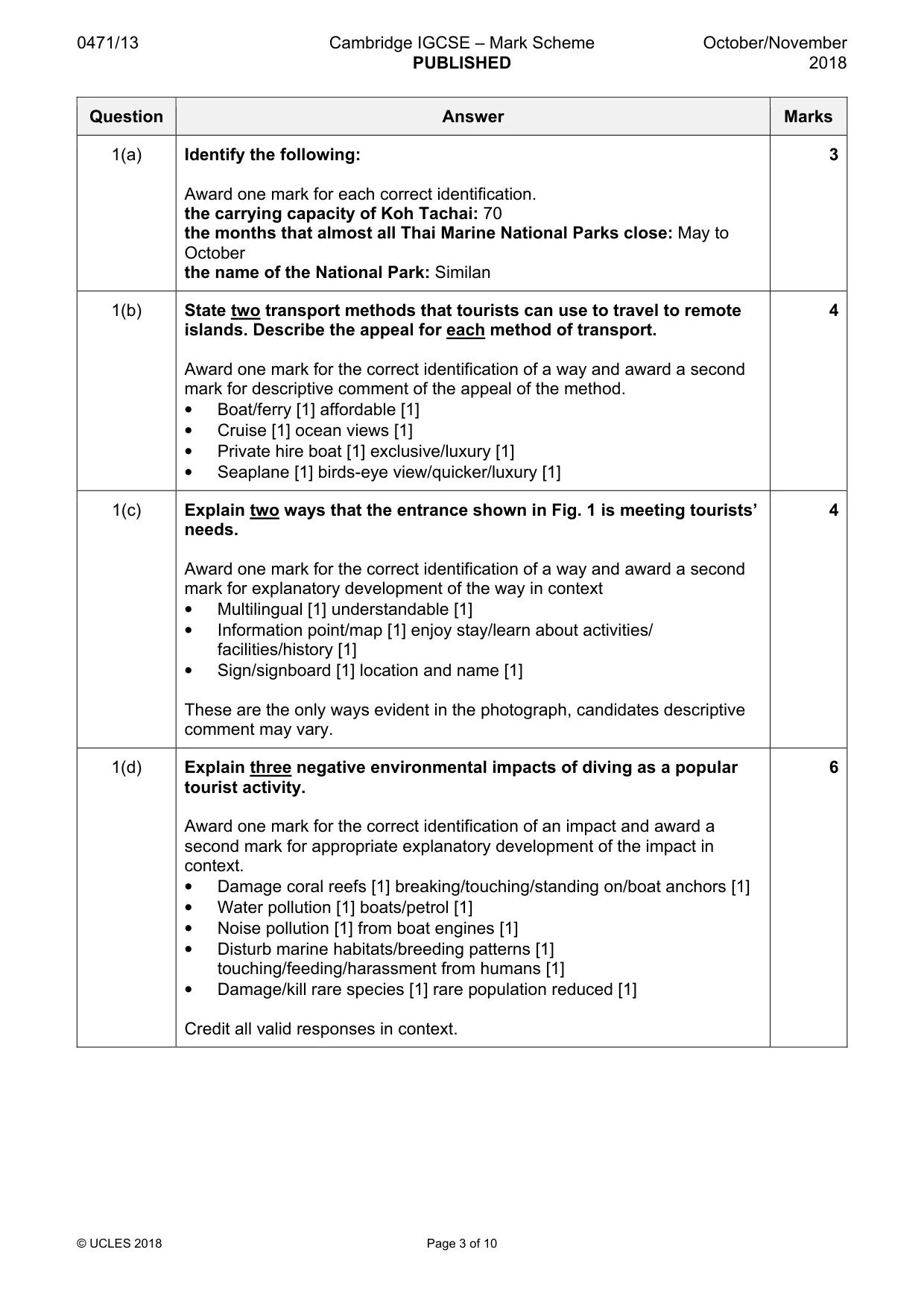
0471/13 Cambridge IGCSE – Mark Scheme PUBLISHED October/November 2018 © UCLES 2018 Page 3 of 10 Question Answer Marks 1(a) Identify the following: Award one mark for each correct identification. the carrying capacity of Koh Tachai: 70 the months that almost all Thai Marine National Parks close: May to October the name of the National Park: Similan 3 1(b) State two transport methods that tourists can use to travel to remote islands. Describe the appeal for each method of transport. Award one mark for the correct identification of a way and award a second mark for descriptive comment of the appeal of the method. • Boat/ferry [1] affordable [1] • Cruise [1] ocean views [1] • Private hire boat [1] exclusive/luxury [1] • Seaplane [1] birds-eye view/quicker/luxury [1] 4 1(c) Explain two ways that the entrance shown in Fig. 1 is meeting tourists’ needs. Award one mark for the correct identification of a way and award a second mark for explanatory development of the way in context • Multilingual [1] understandable [1] • Information point/map [1] enjoy stay/learn about activities/ facilities/history [1] • Sign/signboard [1] location and name [1] These are the only ways evident in the photograph, candidates descriptive comment may vary. 4 1(d) Explain three negative environmental impacts of diving as a popular tourist activity. Award one mark for the correct identification of an impact and award a second mark for appropriate explanatory development of the impact in context. • Damage coral reefs [1] breaking/touching/standing on/boat anchors [1] • Water pollution [1] boats/petrol [1] • Noise pollution [1] from boat engines [1] • Disturb marine habitats/breeding patterns [1] touching/feeding/harassment from humans [1] • Damage/kill rare species [1] rare population reduced [1] Credit all valid responses in context. 6
Mark scheme, page 4
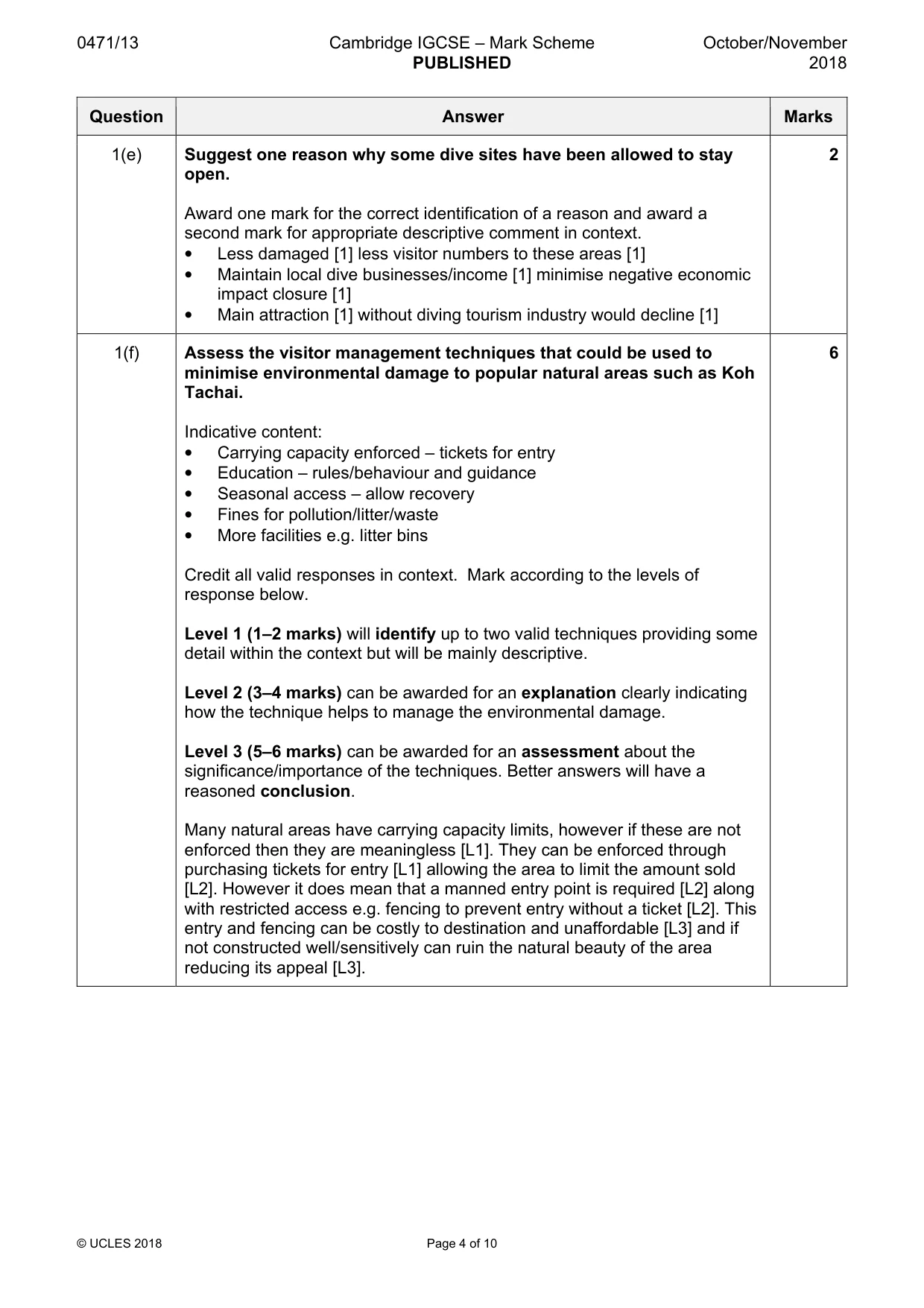
0471/13 Cambridge IGCSE – Mark Scheme PUBLISHED October/November 2018 © UCLES 2018 Page 4 of 10 Question Answer Marks 1(e) Suggest one reason why some dive sites have been allowed to stay open. Award one mark for the correct identification of a reason and award a second mark for appropriate descriptive comment in context. • Less damaged [1] less visitor numbers to these areas [1] • Maintain local dive businesses/income [1] minimise negative economic impact closure [1] • Main attraction [1] without diving tourism industry would decline [1] 2 1(f) Assess the visitor management techniques that could be used to minimise environmental damage to popular natural areas such as Koh Tachai. Indicative content: • Carrying capacity enforced – tickets for entry • Education – rules/behaviour and guidance • Seasonal access – allow recovery • Fines for pollution/litter/waste • More facilities e.g. litter bins Credit all valid responses in context. Mark according to the levels of response below. Level 1 (1–2 marks) will identify up to two valid techniques providing some detail within the context but will be mainly descriptive. Level 2 (3–4 marks) can be awarded for an explanation clearly indicating how the technique helps to manage the environmental damage. Level 3 (5–6 marks) can be awarded for an assessment about the significance/importance of the techniques. Better answers will have a reasoned conclusion. Many natural areas have carrying capacity limits, however if these are not enforced then they are meaningless [L1]. They can be enforced through purchasing tickets for entry [L1] allowing the area to limit the amount sold [L2]. However it does mean that a manned entry point is required [L2] along with restricted access e.g. fencing to prevent entry without a ticket [L2]. This entry and fencing can be costly to destination and unaffordable [L3] and if not constructed well/sensitively can ruin the natural beauty of the area reducing its appeal [L3]. 6
Mark scheme, page 5
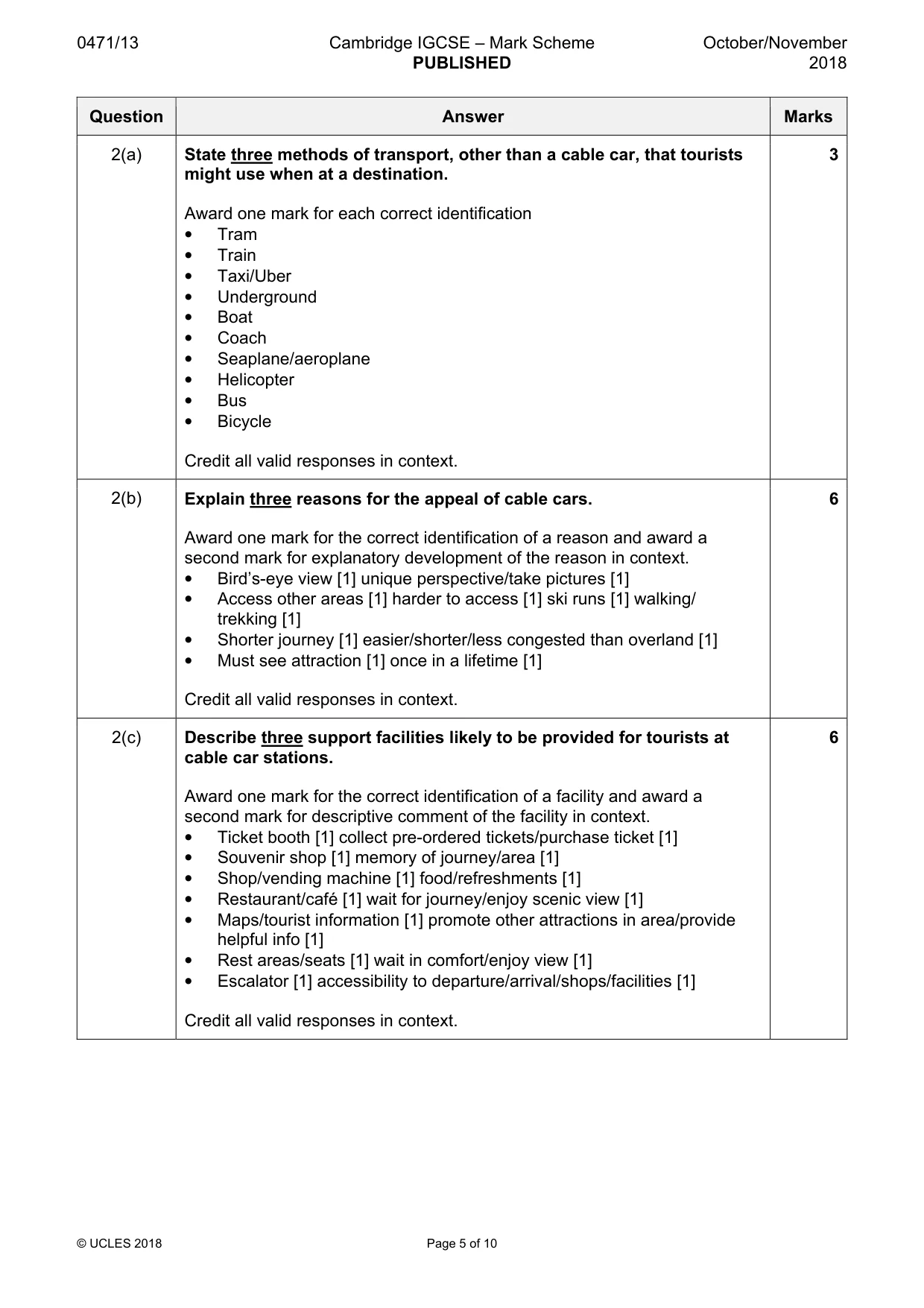
0471/13 Cambridge IGCSE – Mark Scheme PUBLISHED October/November 2018 © UCLES 2018 Page 5 of 10 Question Answer Marks 2(a) State three methods of transport, other than a cable car, that tourists might use when at a destination. Award one mark for each correct identification • Tram • Train • Taxi/Uber • Underground • Boat • Coach • Seaplane/aeroplane • Helicopter • Bus • Bicycle Credit all valid responses in context. 3 2(b) Explain three reasons for the appeal of cable cars. Award one mark for the correct identification of a reason and award a second mark for explanatory development of the reason in context. • Bird’s-eye view [1] unique perspective/take pictures [1] • Access other areas [1] harder to access [1] ski runs [1] walking/ trekking [1] • Shorter journey [1] easier/shorter/less congested than overland [1] • Must see attraction [1] once in a lifetime [1] Credit all valid responses in context. 6 2(c) Describe three support facilities likely to be provided for tourists at cable car stations. Award one mark for the correct identification of a facility and award a second mark for descriptive comment of the facility in context. • Ticket booth [1] collect pre-ordered tickets/purchase ticket [1] • Souvenir shop [1] memory of journey/area [1] • Shop/vending machine [1] food/refreshments [1] • Restaurant/café [1] wait for journey/enjoy scenic view [1] • Maps/tourist information [1] promote other attractions in area/provide helpful info [1] • Rest areas/seats [1] wait in comfort/enjoy view [1] • Escalator [1] accessibility to departure/arrival/shops/facilities [1] Credit all valid responses in context. 6
Mark scheme, page 6
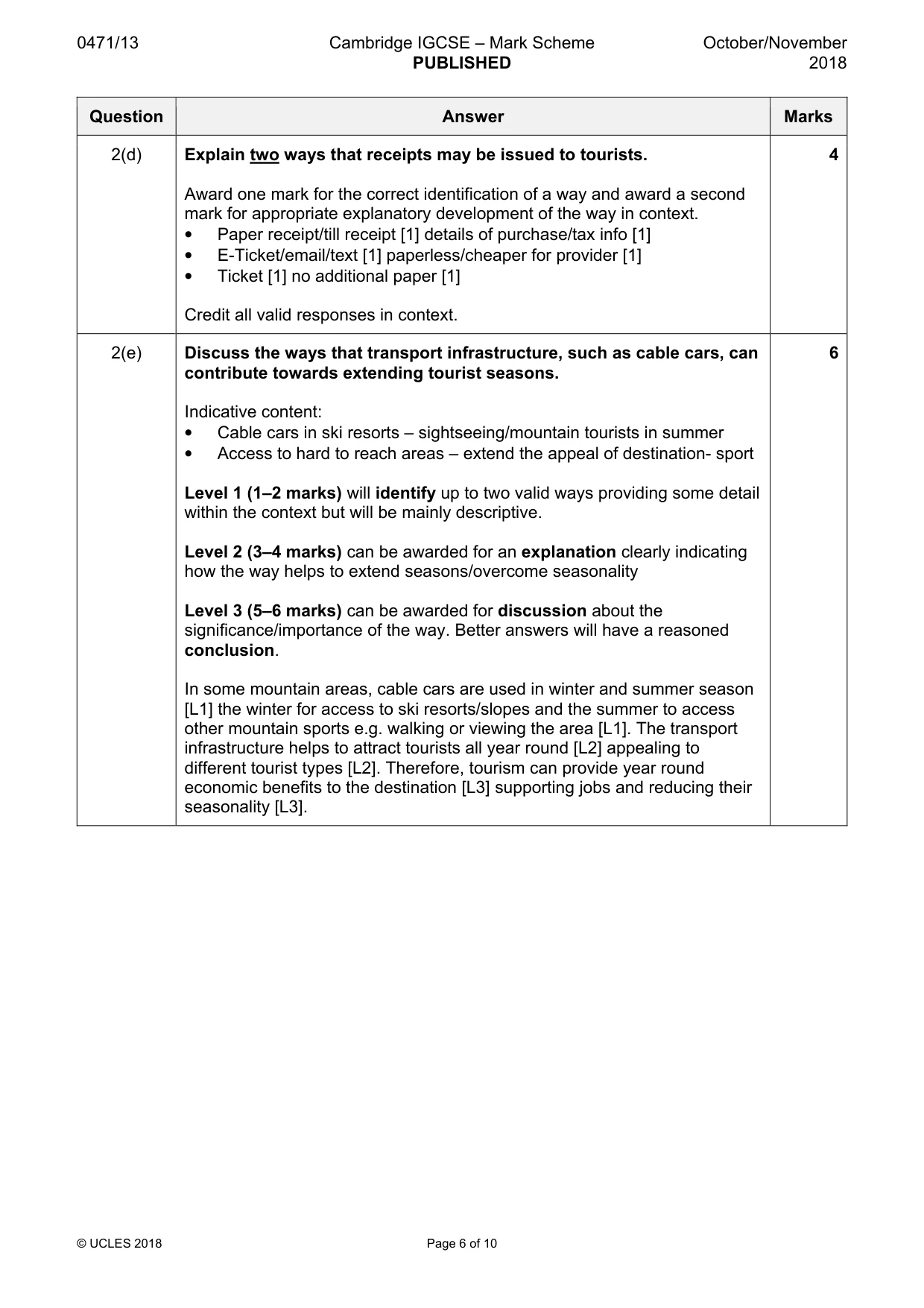
0471/13 Cambridge IGCSE – Mark Scheme PUBLISHED October/November 2018 © UCLES 2018 Page 6 of 10 Question Answer Marks 2(d) Explain two ways that receipts may be issued to tourists. Award one mark for the correct identification of a way and award a second mark for appropriate explanatory development of the way in context. • Paper receipt/till receipt [1] details of purchase/tax info [1] • E-Ticket/email/text [1] paperless/cheaper for provider [1] • Ticket [1] no additional paper [1] Credit all valid responses in context. 4 2(e) Discuss the ways that transport infrastructure, such as cable cars, can contribute towards extending tourist seasons. Indicative content: • Cable cars in ski resorts – sightseeing/mountain tourists in summer • Access to hard to reach areas – extend the appeal of destination- sport Level 1 (1–2 marks) will identify up to two valid ways providing some detail within the context but will be mainly descriptive. Level 2 (3–4 marks) can be awarded for an explanation clearly indicating how the way helps to extend seasons/overcome seasonality Level 3 (5–6 marks) can be awarded for discussion about the significance/importance of the way. Better answers will have a reasoned conclusion. In some mountain areas, cable cars are used in winter and summer season [L1] the winter for access to ski resorts/slopes and the summer to access other mountain sports e.g. walking or viewing the area [L1]. The transport infrastructure helps to attract tourists all year round [L2] appealing to different tourist types [L2]. Therefore, tourism can provide year round economic benefits to the destination [L3] supporting jobs and reducing their seasonality [L3]. 6
Mark scheme, page 7
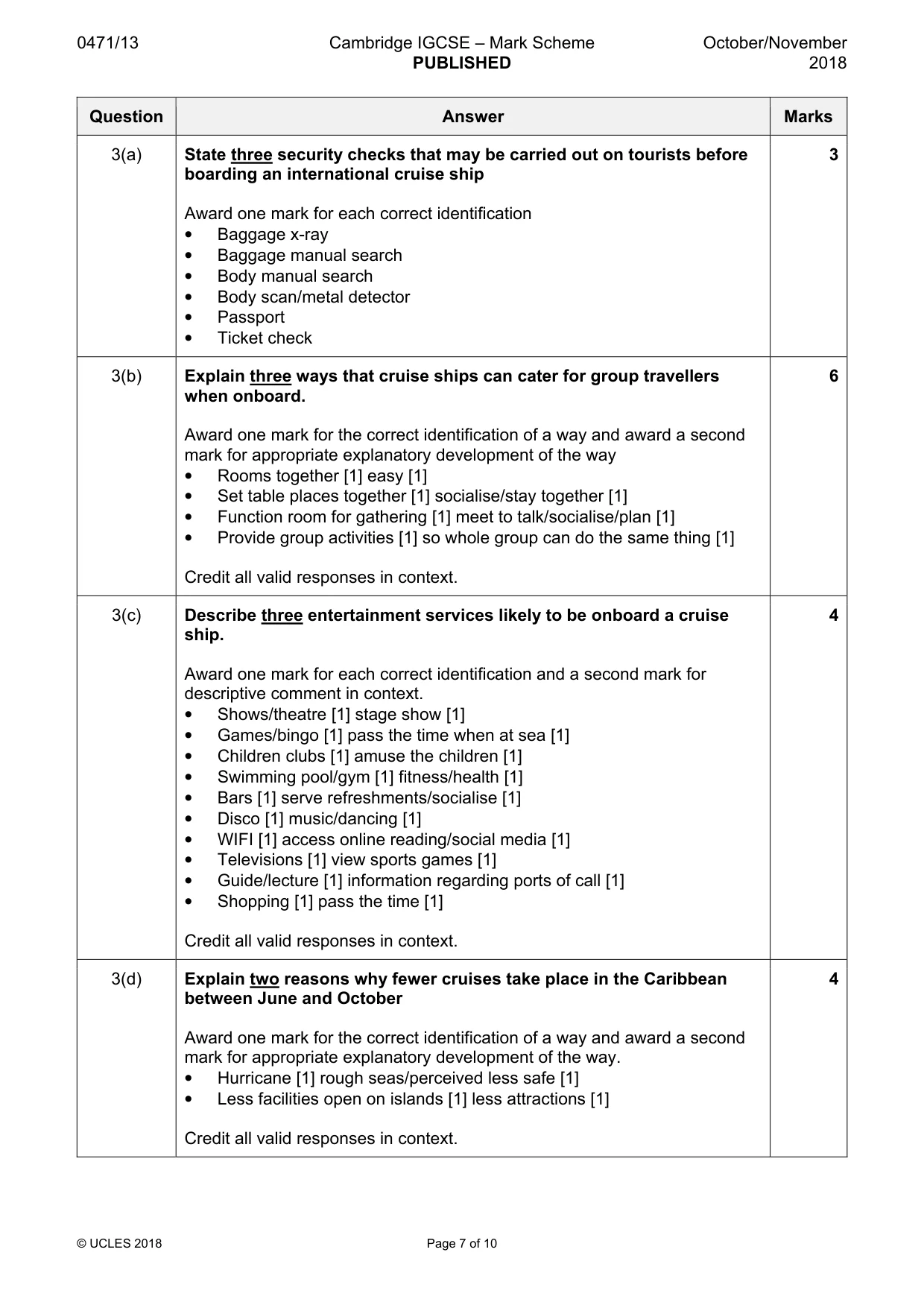
0471/13 Cambridge IGCSE – Mark Scheme PUBLISHED October/November 2018 © UCLES 2018 Page 7 of 10 Question Answer Marks 3(a) State three security checks that may be carried out on tourists before boarding an international cruise ship Award one mark for each correct identification • Baggage x-ray • Baggage manual search • Body manual search • Body scan/metal detector • Passport • Ticket check 3 3(b) Explain three ways that cruise ships can cater for group travellers when onboard. Award one mark for the correct identification of a way and award a second mark for appropriate explanatory development of the way • Rooms together [1] easy [1] • Set table places together [1] socialise/stay together [1] • Function room for gathering [1] meet to talk/socialise/plan [1] • Provide group activities [1] so whole group can do the same thing [1] Credit all valid responses in context. 6 3(c) Describe three entertainment services likely to be onboard a cruise ship. Award one mark for each correct identification and a second mark for descriptive comment in context. • Shows/theatre [1] stage show [1] • Games/bingo [1] pass the time when at sea [1] • Children clubs [1] amuse the children [1] • Swimming pool/gym [1] fitness/health [1] • Bars [1] serve refreshments/socialise [1] • Disco [1] music/dancing [1] • WIFI [1] access online reading/social media [1] • Televisions [1] view sports games [1] • Guide/lecture [1] information regarding ports of call [1] • Shopping [1] pass the time [1] Credit all valid responses in context. 4 3(d) Explain two reasons why fewer cruises take place in the Caribbean between June and October Award one mark for the correct identification of a way and award a second mark for appropriate explanatory development of the way. • Hurricane [1] rough seas/perceived less safe [1] • Less facilities open on islands [1] less attractions [1] Credit all valid responses in context. 4
Mark scheme, page 8
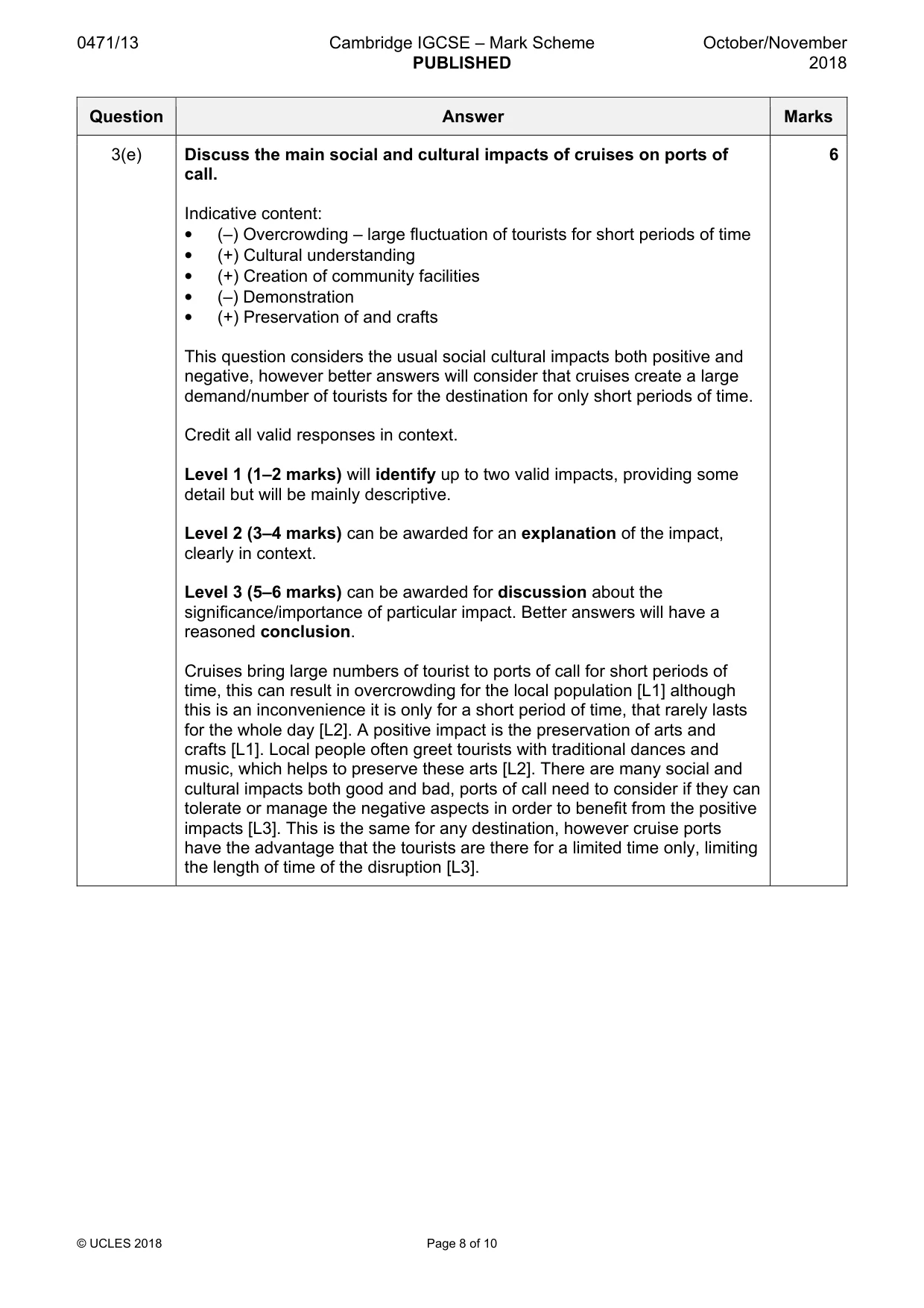
0471/13 Cambridge IGCSE – Mark Scheme PUBLISHED October/November 2018 © UCLES 2018 Page 8 of 10 Question Answer Marks 3(e) Discuss the main social and cultural impacts of cruises on ports of call. Indicative content: • (–) Overcrowding – large fluctuation of tourists for short periods of time • (+) Cultural understanding • (+) Creation of community facilities • (–) Demonstration • (+) Preservation of and crafts This question considers the usual social cultural impacts both positive and negative, however better answers will consider that cruises create a large demand/number of tourists for the destination for only short periods of time. Credit all valid responses in context. Level 1 (1–2 marks) will identify up to two valid impacts, providing some detail but will be mainly descriptive. Level 2 (3–4 marks) can be awarded for an explanation of the impact, clearly in context. Level 3 (5–6 marks) can be awarded for discussion about the significance/importance of particular impact. Better answers will have a reasoned conclusion. Cruises bring large numbers of tourist to ports of call for short periods of time, this can result in overcrowding for the local population [L1] although this is an inconvenience it is only for a short period of time, that rarely lasts for the whole day [L2]. A positive impact is the preservation of arts and crafts [L1]. Local people often greet tourists with traditional dances and music, which helps to preserve these arts [L2]. There are many social and cultural impacts both good and bad, ports of call need to consider if they can tolerate or manage the negative aspects in order to benefit from the positive impacts [L3]. This is the same for any destination, however cruise ports have the advantage that the tourists are there for a limited time only, limiting the length of time of the disruption [L3]. 6
Mark scheme, page 9
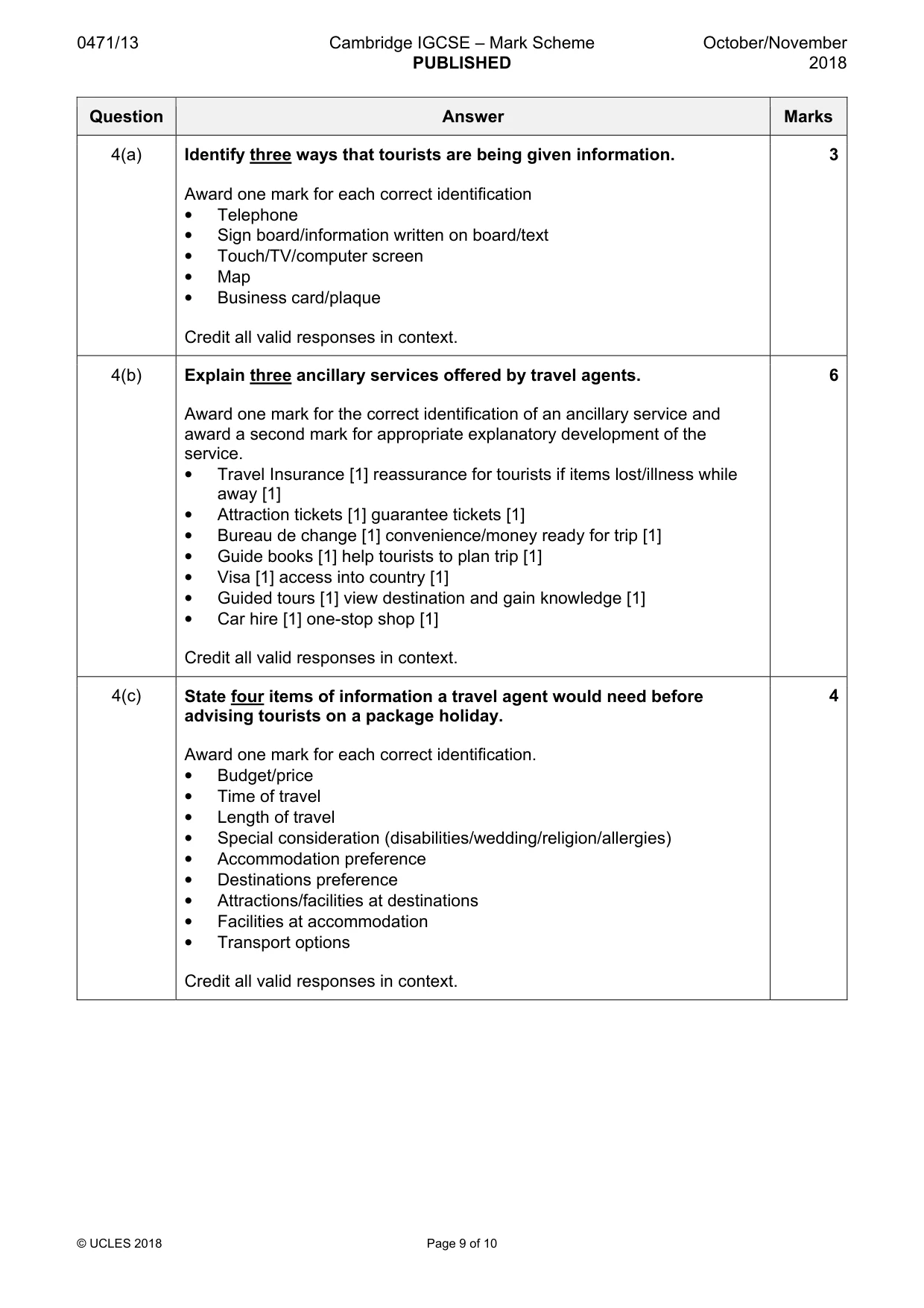
0471/13 Cambridge IGCSE – Mark Scheme PUBLISHED October/November 2018 © UCLES 2018 Page 9 of 10 Question Answer Marks 4(a) Identify three ways that tourists are being given information. Award one mark for each correct identification • Telephone • Sign board/information written on board/text • Touch/TV/computer screen • Map • Business card/plaque Credit all valid responses in context. 3 4(b) Explain three ancillary services offered by travel agents. Award one mark for the correct identification of an ancillary service and award a second mark for appropriate explanatory development of the service. • Travel Insurance [1] reassurance for tourists if items lost/illness while away [1] • Attraction tickets [1] guarantee tickets [1] • Bureau de change [1] convenience/money ready for trip [1] • Guide books [1] help tourists to plan trip [1] • Visa [1] access into country [1] • Guided tours [1] view destination and gain knowledge [1] • Car hire [1] one-stop shop [1] Credit all valid responses in context. 6 4(c) State four items of information a travel agent would need before advising tourists on a package holiday. Award one mark for each correct identification. • Budget/price • Time of travel • Length of travel • Special consideration (disabilities/wedding/religion/allergies) • Accommodation preference • Destinations preference • Attractions/facilities at destinations • Facilities at accommodation • Transport options Credit all valid responses in context. 4
Mark scheme, page 10
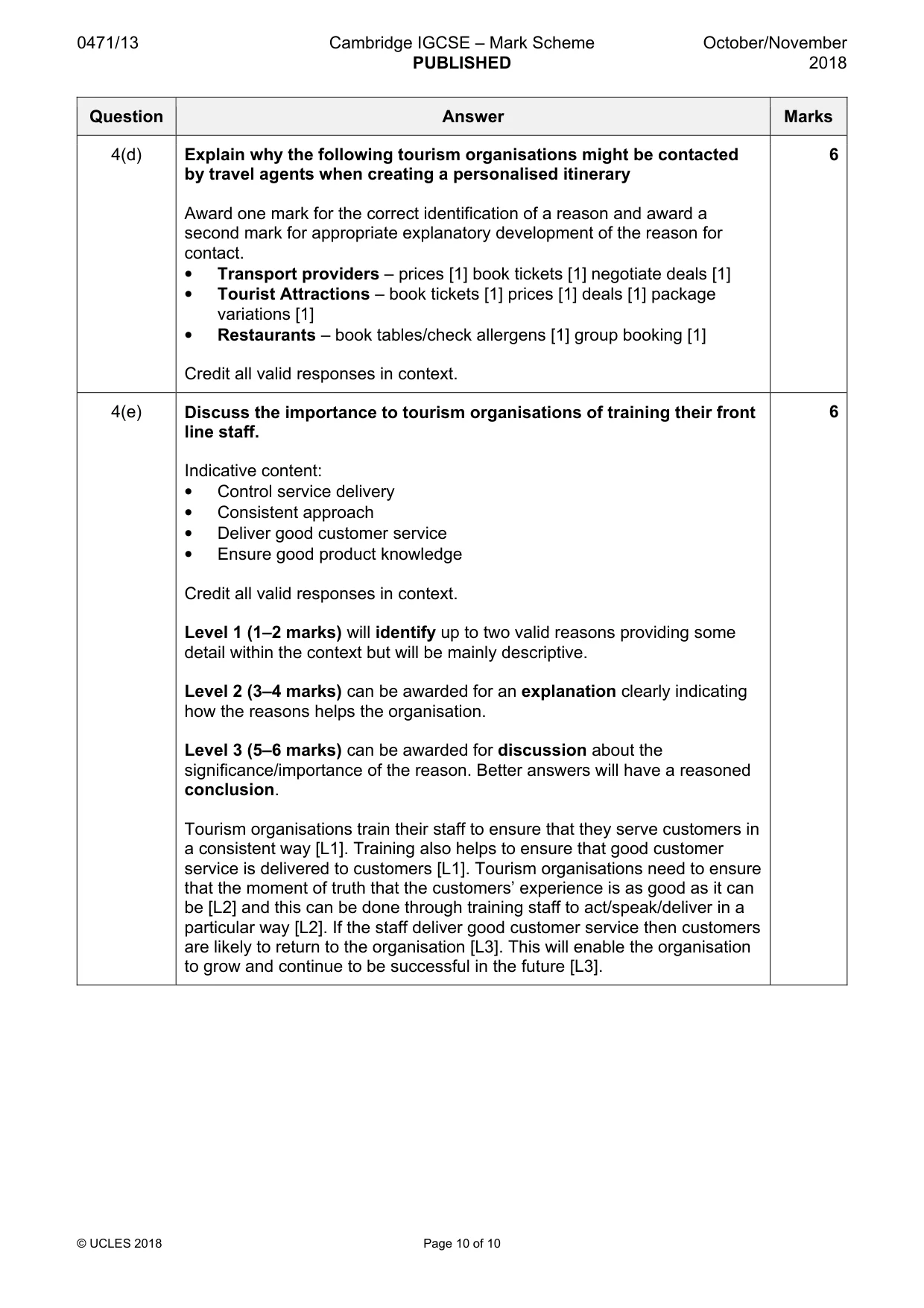
0471/13 Cambridge IGCSE – Mark Scheme PUBLISHED October/November 2018 © UCLES 2018 Page 10 of 10 Question Answer Marks 4(d) Explain why the following tourism organisations might be contacted by travel agents when creating a personalised itinerary Award one mark for the correct identification of a reason and award a second mark for appropriate explanatory development of the reason for contact. • Transport providers – prices [1] book tickets [1] negotiate deals [1] • Tourist Attractions – book tickets [1] prices [1] deals [1] package variations [1] • Restaurants – book tables/check allergens [1] group booking [1] Credit all valid responses in context. 6 4(e) Discuss the importance to tourism organisations of training their front line staff. Indicative content: • Control service delivery • Consistent approach • Deliver good customer service • Ensure good product knowledge Credit all valid responses in context. Level 1 (1–2 marks) will identify up to two valid reasons providing some detail within the context but will be mainly descriptive. Level 2 (3–4 marks) can be awarded for an explanation clearly indicating how the reasons helps the organisation. Level 3 (5–6 marks) can be awarded for discussion about the significance/importance of the reason. Better answers will have a reasoned conclusion. Tourism organisations train their staff to ensure that they serve customers in a consistent way [L1]. Training also helps to ensure that good customer service is delivered to customers [L1]. Tourism organisations need to ensure that the moment of truth that the customers’ experience is as good as it can be [L2] and this can be done through training staff to act/speak/deliver in a particular way [L2]. If the staff deliver good customer service then customers are likely to return to the organisation [L3]. This will enable the organisation to grow and continue to be successful in the future [L3]. 6
What you needed in this session
Cambridge’s own grade thresholds for 2018 Oct/Nov, Paper 1 · Variant 3. A higher threshold means an easier paper — the bar moves with how the cohort did.