Cambridge IGCSE Travel and Tourism 0471 — 2018 May/June Paper 2 · Variant 2
0471/22/M/J/18 · 100 marks · ≈113 min
The question paper and its mark scheme, free to read here and free to download. This is Cambridge’s own paper, exactly as it was sat.
Question paper16 pages


Mark scheme10 pages
Answers below. Sit the paper first if you are practising.
Paper as text
Question paper, page 1
* 9 7 5 7 6 7 4 9 2 8 * This document consists of 14 printed pages, 2 blank pages and 1 insert. DC (SC) 152420/1 © UCLES 2018 [Turn over Cambridge International Examinations Cambridge International General Certificate of Secondary Education TRAVEL AND TOURISM 0471/22 Alternative to Coursework May/June 2018 2 hours 30 minutes Candidates answer on the Question Paper. No Additional Materials are required. READ THESE INSTRUCTIONS FIRST Write your Centre number, candidate number and name on all the work you hand in. Write in dark blue or black pen. You may use an HB pencil for any diagrams or graphs. Do not use staples, paper clips, glue or correction fluid. DO NOT WRITE IN ANY BARCODES. Answer all questions. All the Figures referred to in the questions are contained in the Insert. At the end of the examination, fasten all your work securely together. The number of marks is given in brackets [ ] at the end of each question or part question.
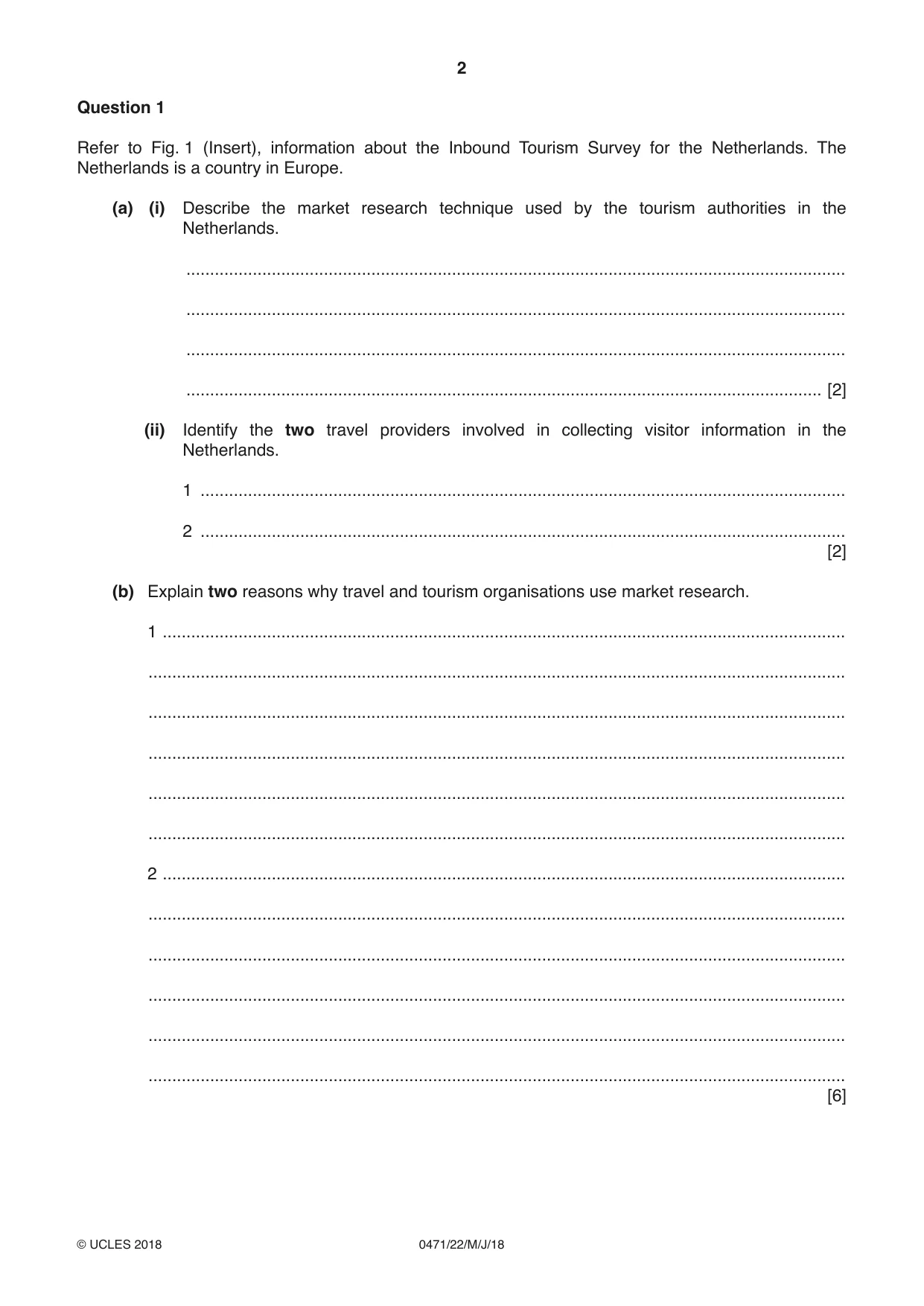
Question paper, page 2
2 0471/22/M/J/18 © UCLES 2018 Question 1 Refer to Fig. 1 (Insert), information about the Inbound Tourism Survey for the Netherlands. The Netherlands is a country in Europe. (a) (i) Describe the market research technique used by the tourism authorities in the Netherlands. … … … … [2] (ii) Identify the two travel providers involved in collecting visitor information in the Netherlands. 1 … 2 … [2] (b) Explain two reasons why travel and tourism organisations use market research. 1 … … … … … … 2 … … … … … … [6]
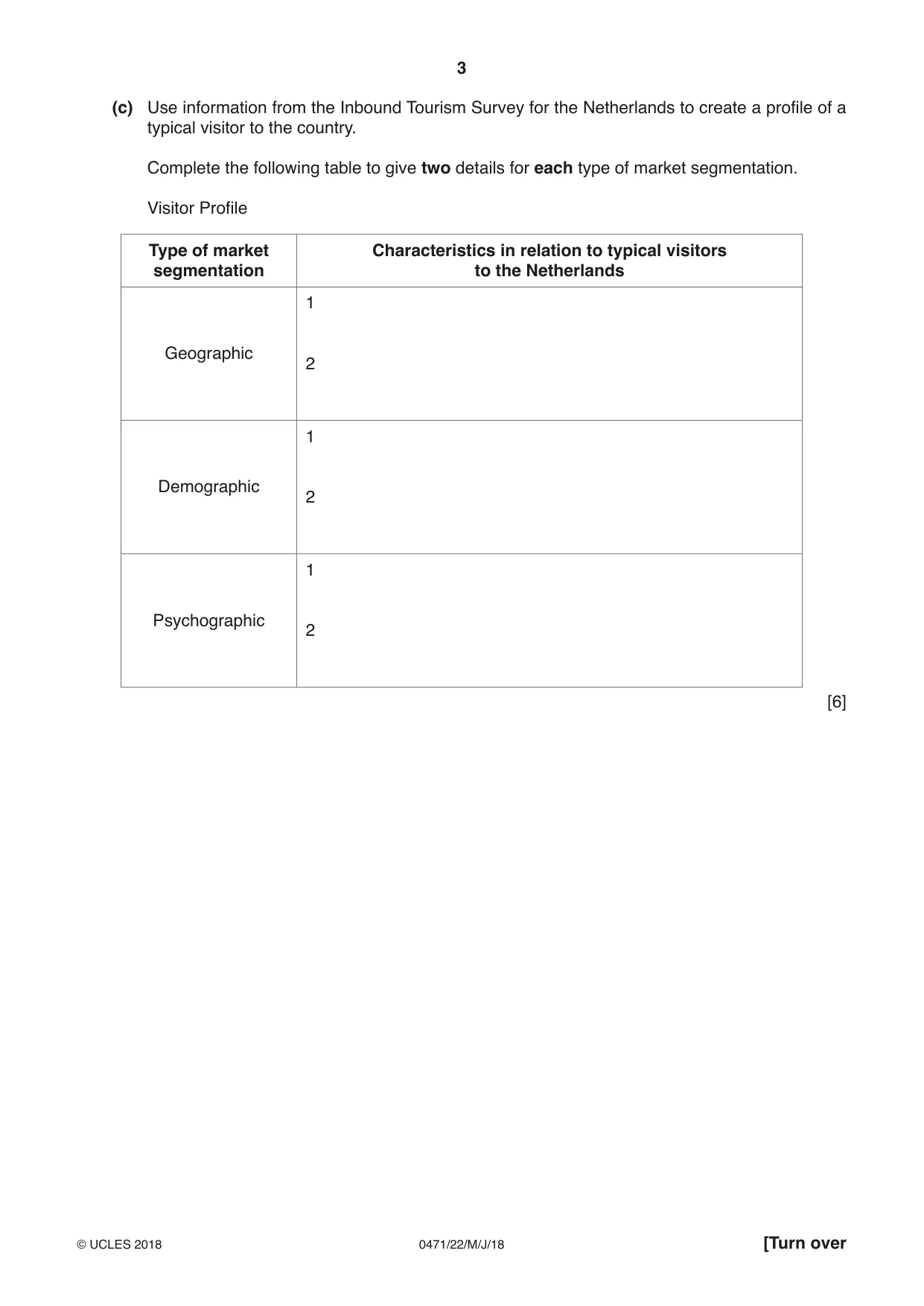
Question paper, page 3
3 0471/22/M/J/18 © UCLES 2018 [Turn over (c) Use information from the Inbound Tourism Survey for the Netherlands to create a profile of a typical visitor to the country. Complete the following table to give two details for each type of market segmentation. Visitor Profile Type of market segmentation Characteristics in relation to typical visitors to the Netherlands Geographic 1 2 Demographic 1 2 Psychographic 1 2 [6]
Question paper, page 4
4 0471/22/M/J/18 © UCLES 2018 (d) Discuss how travel and tourism providers in the Netherlands might develop products and services to cater specifically for the profiled visitor from 1(c). … … … … … … … … … … … … … … … … [9] [Total: 25]
Question paper, page 5
5 0471/22/M/J/18 © UCLES 2018 [Turn over Question 2 Refer to Fig. 2 (Insert), an advertisement for Bermuda Tours. Bermuda is an island destination in the North Atlantic Ocean. (a) (i) Identify one product and one service included in the tour. Product … Service … [2] (ii) Places on the tour are perishable. Explain what the term perishable means for travel and tourism products and services. … … … … [2] (b) Bermuda Tours uses price bundling for its tours. Explain three advantages of price bundling as a pricing strategy for customers. 1 … … … … 2 … … … … 3 … … … … [6]
Question paper, page 6
6 0471/22/M/J/18 © UCLES 2018 (c) Explain how the following two factors may affect pricing decisions for Bermuda Tours: profitability … … … … … … economic factors … … … … … … [6]
Question paper, page 7
7 0471/22/M/J/18 © UCLES 2018 [Turn over (d) Discuss the benefits to both the tour operator and the customer of offering fully customised tours. … … … … … … … … … … … … … … … … … … [9] [Total: 25]
Question paper, page 8
8 0471/22/M/J/18 © UCLES 2018 Question 3 Refer to Fig. 3 (Insert), a press release about tourism in Ladakh, located in the north Indian state of Jammu and Kashmir. (a) Use information given in the press release to carry out a situation analysis of tourism in Ladakh. Describe each of the following: one threat to tourism in Ladakh … … … … … one social influence of tourism in Ladakh … … … … … [4]
Question paper, page 9
9 0471/22/M/J/18 © UCLES 2018 [Turn over (b) A press release is an example of public relations. Explain three advantages to the tourism authorities in Ladakh of using public relations as a method of promotion. 1 … … … … 2 … … … … 3 … … … … [6]
Question paper, page 10
10 0471/22/M/J/18 © UCLES 2018 (c) Ladakh Tourism is planning to run a promotional campaign to attract more customers to the region. Explain how the tourism authority should manage the following two stages of the promotional campaign: choosing an audience … … … … … … establishing the message … … … … … … [6]
Question paper, page 11
11 0471/22/M/J/18 © UCLES 2018 [Turn over (d) Discuss the benefits to Ladakh Tourism of working with a number of inbound tour operators to attract more visitors to the area. … … … … … … … … … … … … … … … … … … [9] [Total: 25]
Question paper, page 12
12 0471/22/M/J/18 © UCLES 2018 Question 4 Refer to Fig. 4 (Insert), information about a business tourism facility in Bulawayo. Bulawayo is a city in Zimbabwe, a southern African country. (a) (i) The Sanganai Tourism Expo is an example of a trade fair. Trade fairs are a form of trade promotions. Explain the purpose of a trade promotion in the travel and tourism industry. … … … … [2] (ii) The Sanganai Tourism Expo attracts business tourists. Describe one likely need of a business tourist. … … … … [2] (b) Explain how the following factors may have influenced the location of the Zimbabwe International Exhibition Centre in Bulawayo: accessibility … … … … … … adjacent facilities … … … … … … [6]
Question paper, page 13
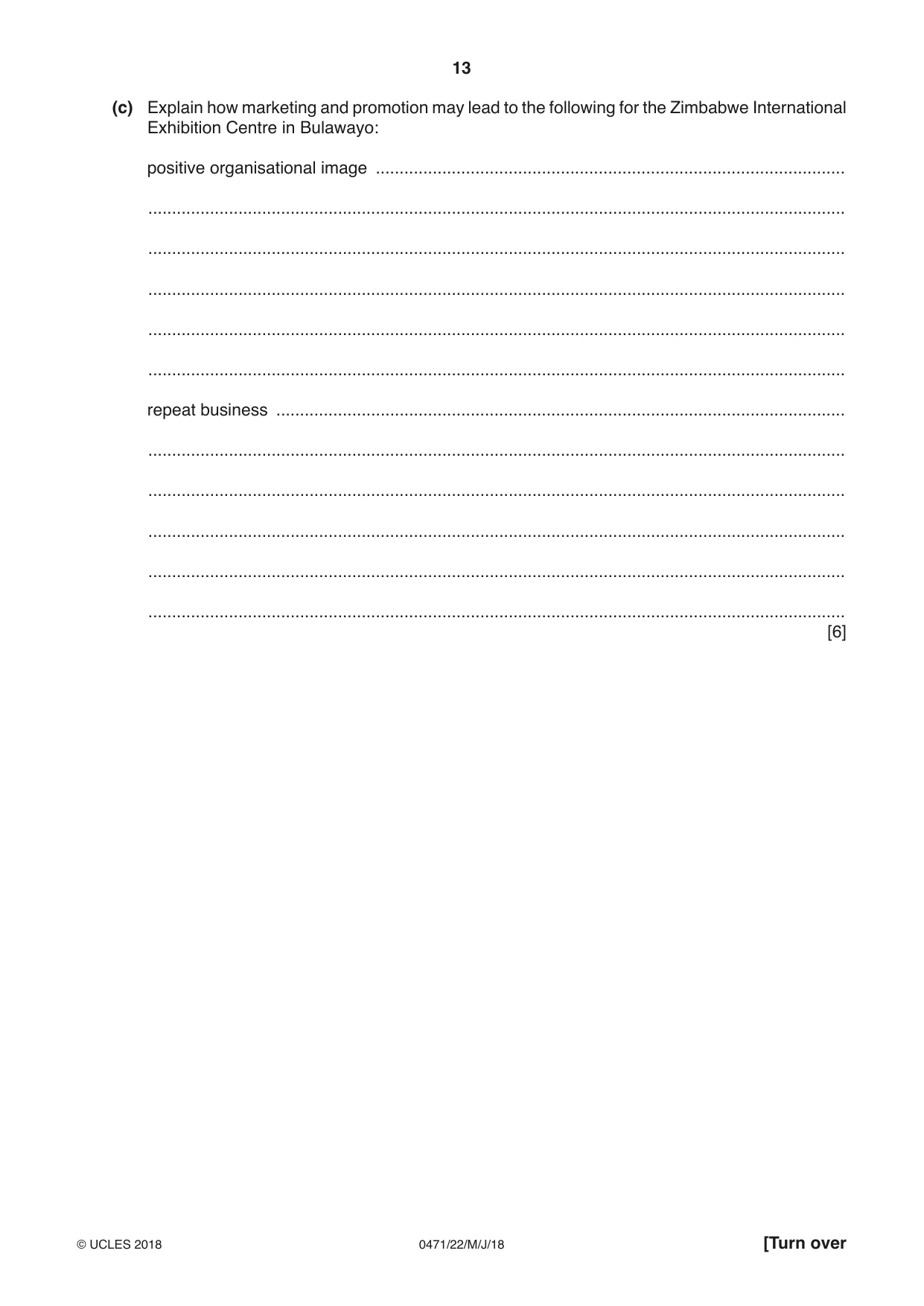
13 0471/22/M/J/18 © UCLES 2018 [Turn over (c) Explain how marketing and promotion may lead to the following for the Zimbabwe International Exhibition Centre in Bulawayo: positive organisational image … … … … … … repeat business … … … … … … [6]
Question paper, page 14
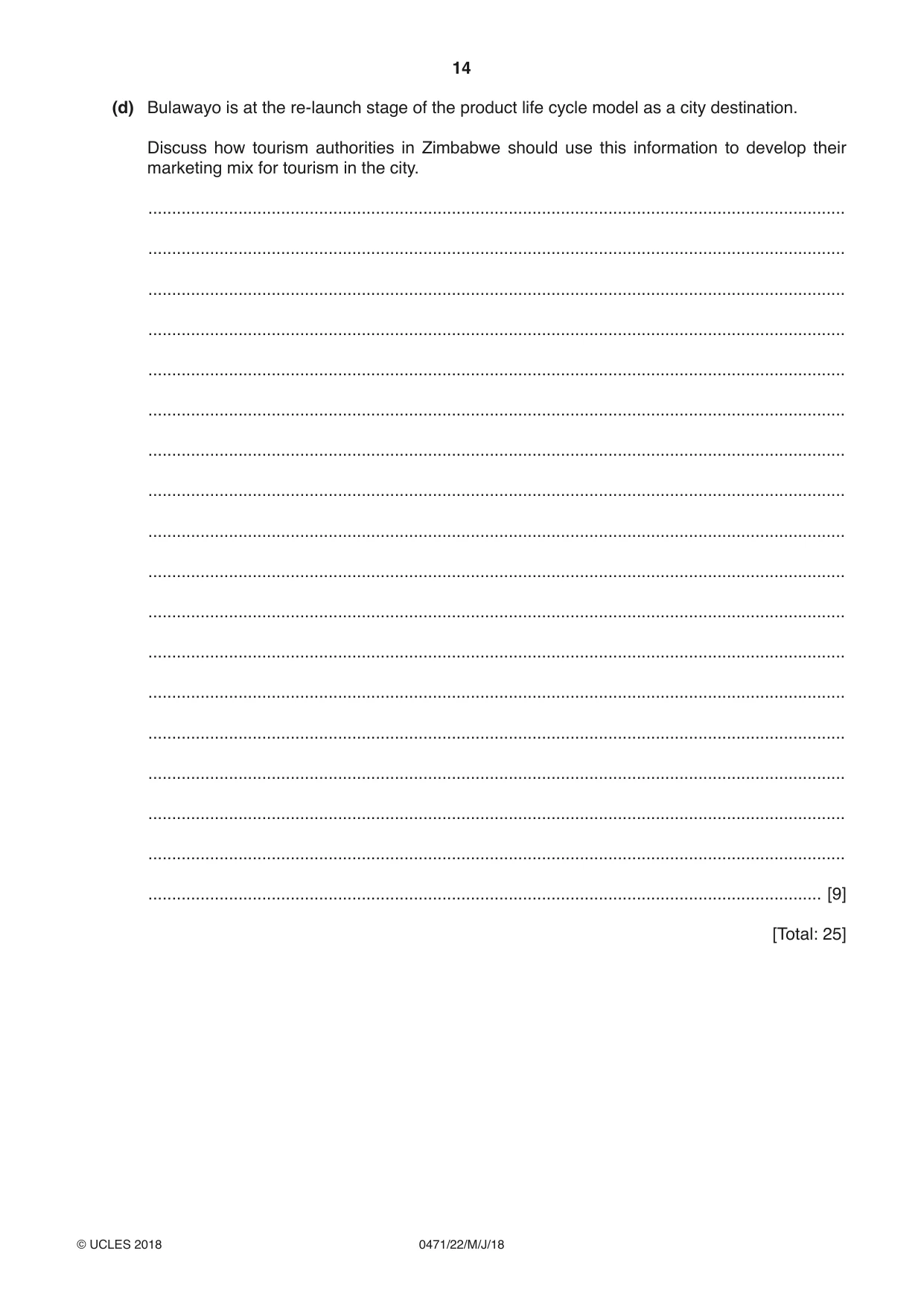
14 0471/22/M/J/18 © UCLES 2018 (d) Bulawayo is at the re-launch stage of the product life cycle model as a city destination. Discuss how tourism authorities in Zimbabwe should use this information to develop their marketing mix for tourism in the city. … … … … … … … … … … … … … … … … … … [9] [Total: 25]
Question paper, page 15
15 0471/22/M/J/18 © UCLES 2018 BLANK PAGE
Question paper, page 16
16 0471/22/M/J/18 © UCLES 2018 Permission to reproduce items where third-party owned material protected by copyright is included has been sought and cleared where possible. Every reasonable effort has been made by the publisher (UCLES) to trace copyright holders, but if any items requiring clearance have unwittingly been included, the publisher will be pleased to make amends at the earliest possible opportunity. To avoid the issue of disclosure of answer-related information to candidates, all copyright acknowledgements are reproduced online in the Cambridge International Examinations Copyright Acknowledgements Booklet. This is produced for each series of examinations and is freely available to download at www.cie.org.uk after the live examination series. Cambridge International Examinations is part of the Cambridge Assessment Group. Cambridge Assessment is the brand name of University of Cambridge Local Examinations Syndicate (UCLES), which is itself a department of the University of Cambridge. BLANK PAGE
Mark scheme, page 1
IGCSE™ is a registered trademark. This document consists of 10 printed pages. © UCLES 2018 [Turn over Cambridge Assessment International Education Cambridge International General Certificate of Secondary Education TRAVEL & TOURISM 0471/22 Paper 2 May/June 2018 MARK SCHEME Maximum Mark: 100 Published This mark scheme is published as an aid to teachers and candidates, to indicate the requirements of the examination. It shows the basis on which Examiners were instructed to award marks. It does not indicate the details of the discussions that took place at an Examiners’ meeting before marking began, which would have considered the acceptability of alternative answers. Mark schemes should be read in conjunction with the question paper and the Principal Examiner Report for Teachers. Cambridge International will not enter into discussions about these mark schemes. Cambridge International is publishing the mark schemes for the May/June 2018 series for most Cambridge IGCSE™, Cambridge International A and AS Level and Cambridge Pre-U components, and some Cambridge O Level components.
Mark scheme, page 2
0471/22 Cambridge IGCSE – Mark Scheme PUBLISHED May/June 2018 © UCLES 2018 Page 2 of 10 Generic Marking Principles These general marking principles must be applied by all examiners when marking candidate answers. They should be applied alongside the specific content of the mark scheme or generic level descriptors for a question. Each question paper and mark scheme will also comply with these marking principles. GENERIC MARKING PRINCIPLE 1: Marks must be awarded in line with: • the specific content of the mark scheme or the generic level descriptors for the question • the specific skills defined in the mark scheme or in the generic level descriptors for the question • the standard of response required by a candidate as exemplified by the standardisation scripts. GENERIC MARKING PRINCIPLE 2: Marks awarded are always whole marks (not half marks, or other fractions). GENERIC MARKING PRINCIPLE 3: Marks must be awarded positively: • marks are awarded for correct/valid answers, as defined in the mark scheme. However, credit is given for valid answers which go beyond the scope of the syllabus and mark scheme, referring to your Team Leader as appropriate • marks are awarded when candidates clearly demonstrate what they know and can do • marks are not deducted for errors • marks are not deducted for omissions • answers should only be judged on the quality of spelling, punctuation and grammar when these features are specifically assessed by the question as indicated by the mark scheme. The meaning, however, should be unambiguous. GENERIC MARKING PRINCIPLE 4: Rules must be applied consistently e.g. in situations where candidates have not followed instructions or in the application of generic level descriptors. GENERIC MARKING PRINCIPLE 5: Marks should be awarded using the full range of marks defined in the mark scheme for the question (however; the use of the full mark range may be limited according to the quality of the candidate responses seen). GENERIC MARKING PRINCIPLE 6: Marks awarded are based solely on the requirements as defined in the mark scheme. Marks should not be awarded with grade thresholds or grade descriptors in mind.
Mark scheme, page 3
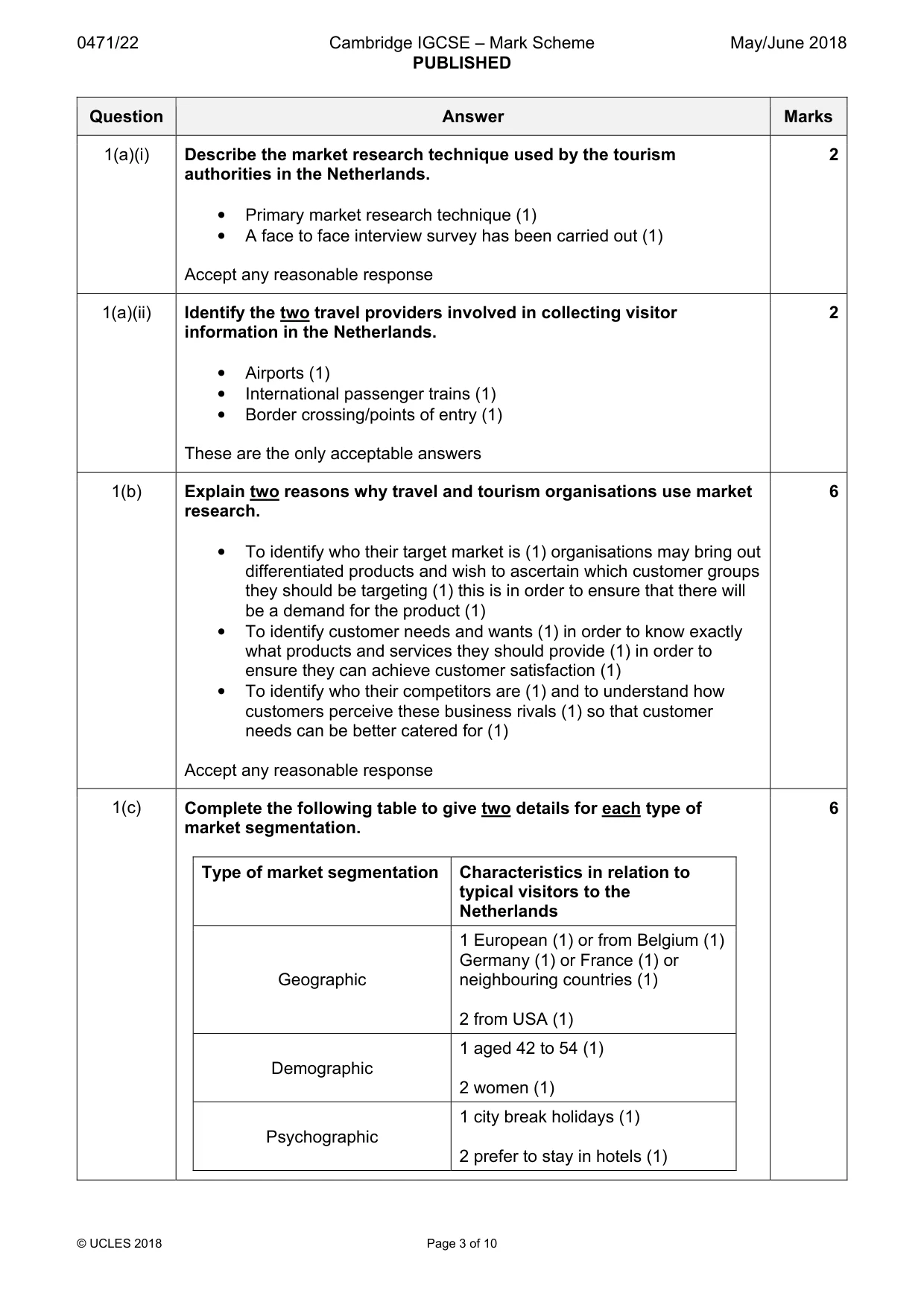
0471/22 Cambridge IGCSE – Mark Scheme PUBLISHED May/June 2018 © UCLES 2018 Page 3 of 10 Question Answer Marks 1(a)(i) Describe the market research technique used by the tourism authorities in the Netherlands. • Primary market research technique (1) • A face to face interview survey has been carried out (1) Accept any reasonable response 2 1(a)(ii) Identify the two travel providers involved in collecting visitor information in the Netherlands. • Airports (1) • International passenger trains (1) • Border crossing/points of entry (1) These are the only acceptable answers 2 1(b) Explain two reasons why travel and tourism organisations use market research. • To identify who their target market is (1) organisations may bring out differentiated products and wish to ascertain which customer groups they should be targeting (1) this is in order to ensure that there will be a demand for the product (1) • To identify customer needs and wants (1) in order to know exactly what products and services they should provide (1) in order to ensure they can achieve customer satisfaction (1) • To identify who their competitors are (1) and to understand how customers perceive these business rivals (1) so that customer needs can be better catered for (1) Accept any reasonable response 6 1(c) Complete the following table to give two details for each type of market segmentation. Type of market segmentation Characteristics in relation to typical visitors to the Netherlands Geographic 1 European (1) or from Belgium (1) Germany (1) or France (1) or neighbouring countries (1) 2 from USA (1) Demographic 1 aged 42 to 54 (1) 2 women (1) Psychographic 1 city break holidays (1) 2 prefer to stay in hotels (1) 6
Mark scheme, page 4
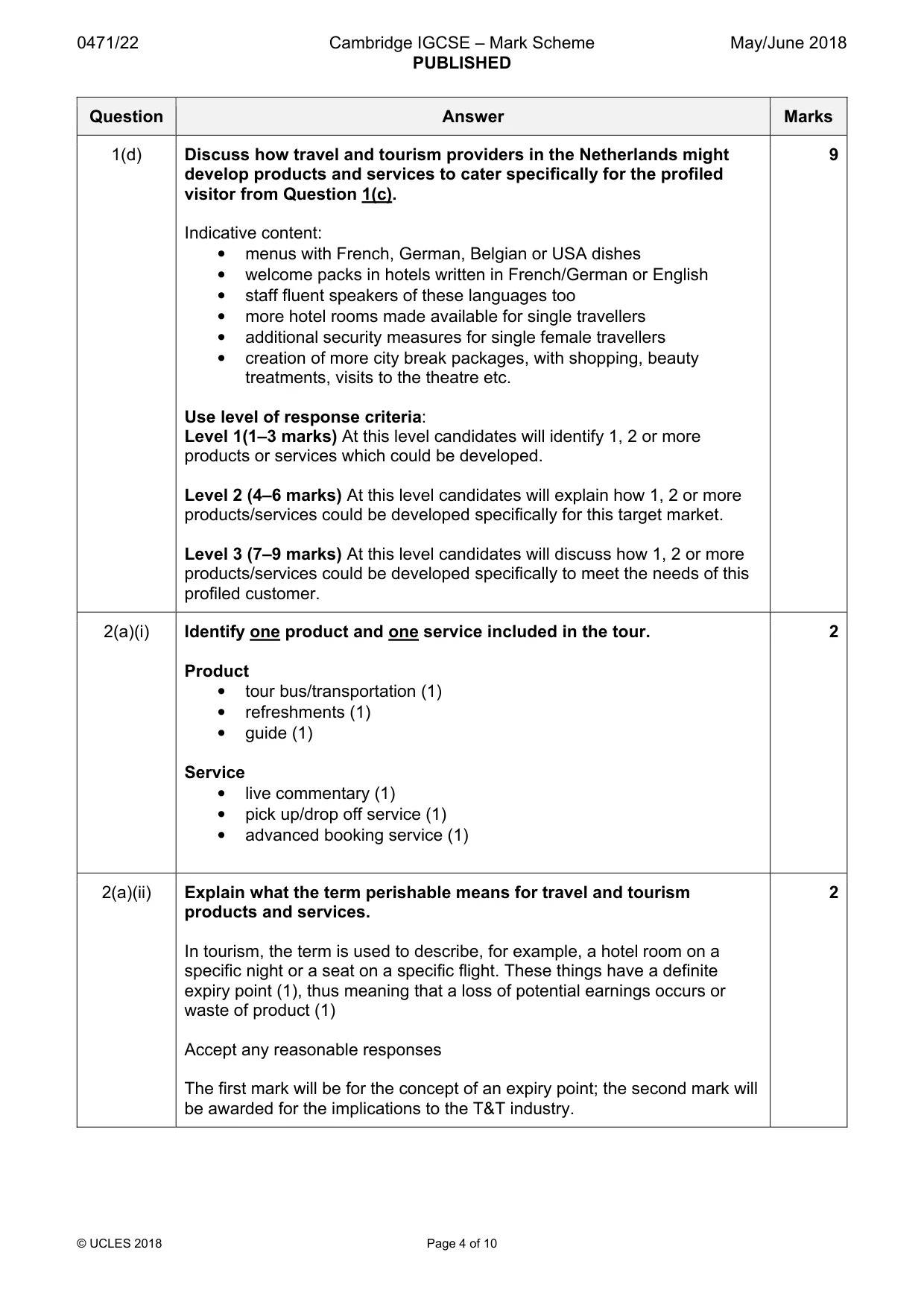
0471/22 Cambridge IGCSE – Mark Scheme PUBLISHED May/June 2018 © UCLES 2018 Page 4 of 10 Question Answer Marks 1(d) Discuss how travel and tourism providers in the Netherlands might develop products and services to cater specifically for the profiled visitor from Question 1(c). Indicative content: • menus with French, German, Belgian or USA dishes • welcome packs in hotels written in French/German or English • staff fluent speakers of these languages too • more hotel rooms made available for single travellers • additional security measures for single female travellers • creation of more city break packages, with shopping, beauty treatments, visits to the theatre etc. Use level of response criteria: Level 1(1–3 marks) At this level candidates will identify 1, 2 or more products or services which could be developed. Level 2 (4–6 marks) At this level candidates will explain how 1, 2 or more products/services could be developed specifically for this target market. Level 3 (7–9 marks) At this level candidates will discuss how 1, 2 or more products/services could be developed specifically to meet the needs of this profiled customer. 9 2(a)(i) Identify one product and one service included in the tour. Product • tour bus/transportation (1) • refreshments (1) • guide (1) Service • live commentary (1) • pick up/drop off service (1) • advanced booking service (1) 2 2(a)(ii) Explain what the term perishable means for travel and tourism products and services. In tourism, the term is used to describe, for example, a hotel room on a specific night or a seat on a specific flight. These things have a definite expiry point (1), thus meaning that a loss of potential earnings occurs or waste of product (1) Accept any reasonable responses The first mark will be for the concept of an expiry point; the second mark will be awarded for the implications to the T&T industry. 2
Mark scheme, page 5
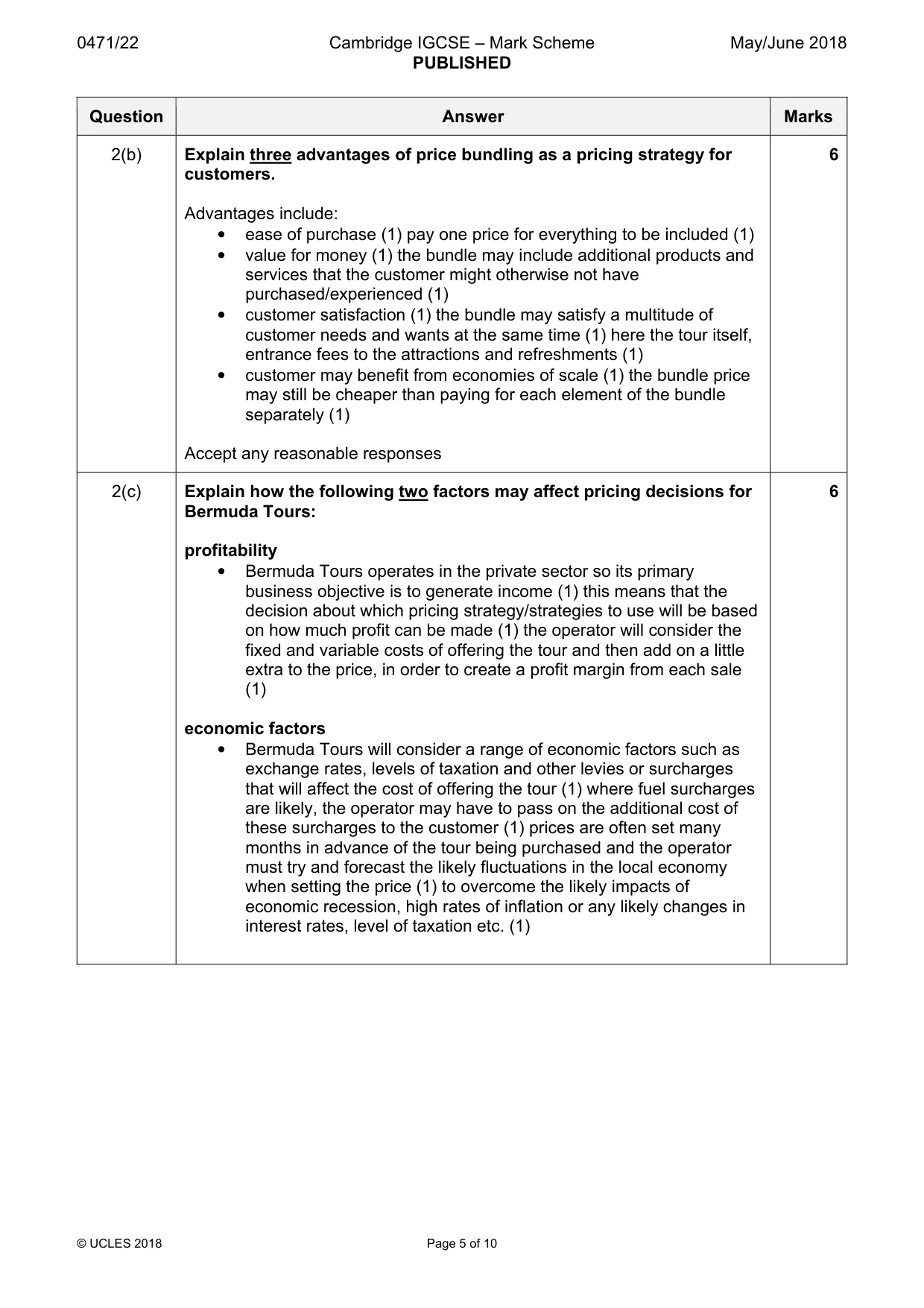
0471/22 Cambridge IGCSE – Mark Scheme PUBLISHED May/June 2018 © UCLES 2018 Page 5 of 10 Question Answer Marks 2(b) Explain three advantages of price bundling as a pricing strategy for customers. Advantages include: • ease of purchase (1) pay one price for everything to be included (1) • value for money (1) the bundle may include additional products and services that the customer might otherwise not have purchased/experienced (1) • customer satisfaction (1) the bundle may satisfy a multitude of customer needs and wants at the same time (1) here the tour itself, entrance fees to the attractions and refreshments (1) • customer may benefit from economies of scale (1) the bundle price may still be cheaper than paying for each element of the bundle separately (1) Accept any reasonable responses 6 2(c) Explain how the following two factors may affect pricing decisions for Bermuda Tours: profitability • Bermuda Tours operates in the private sector so its primary business objective is to generate income (1) this means that the decision about which pricing strategy/strategies to use will be based on how much profit can be made (1) the operator will consider the fixed and variable costs of offering the tour and then add on a little extra to the price, in order to create a profit margin from each sale (1) economic factors • Bermuda Tours will consider a range of economic factors such as exchange rates, levels of taxation and other levies or surcharges that will affect the cost of offering the tour (1) where fuel surcharges are likely, the operator may have to pass on the additional cost of these surcharges to the customer (1) prices are often set many months in advance of the tour being purchased and the operator must try and forecast the likely fluctuations in the local economy when setting the price (1) to overcome the likely impacts of economic recession, high rates of inflation or any likely changes in interest rates, level of taxation etc. (1) 6
Mark scheme, page 6
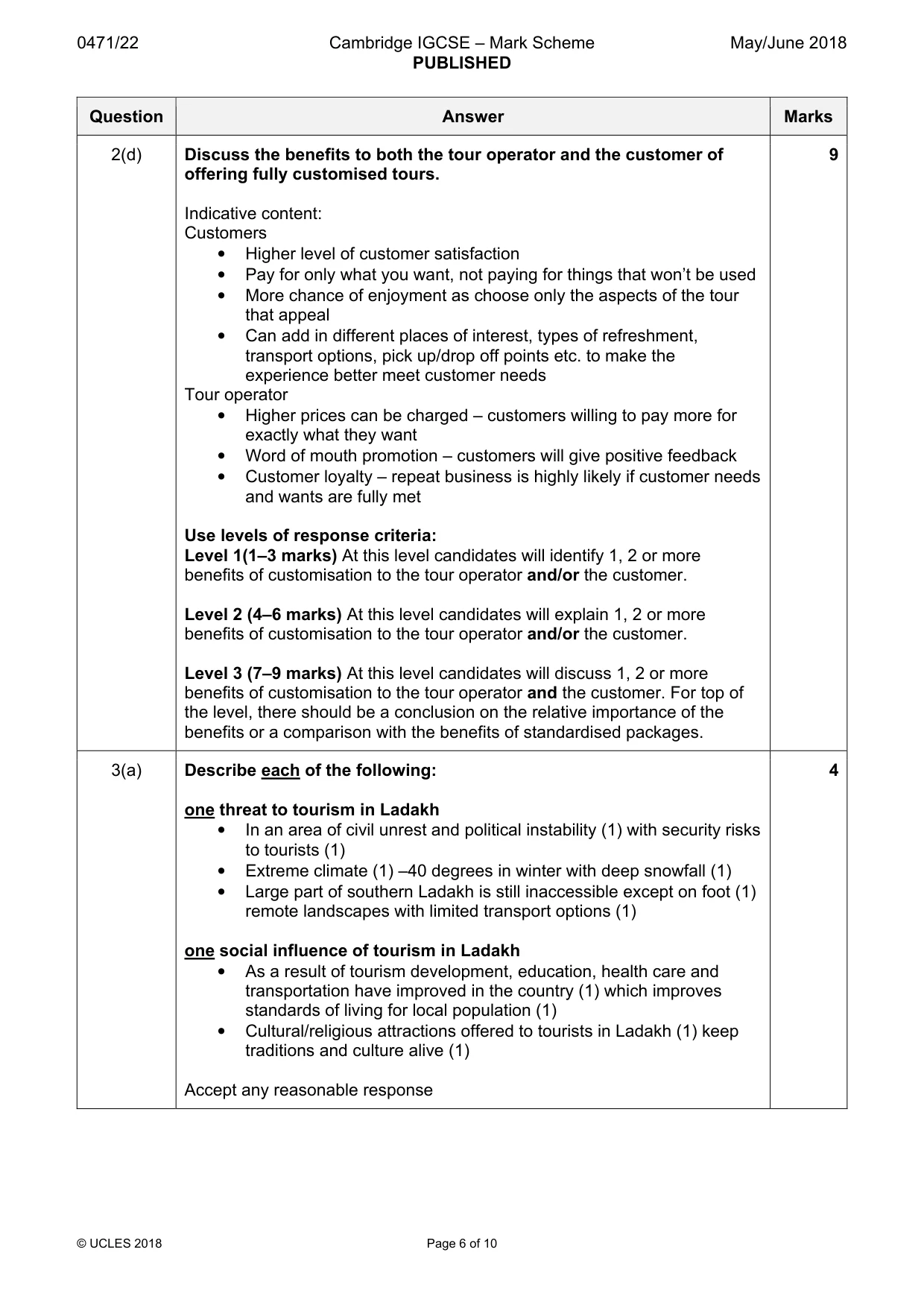
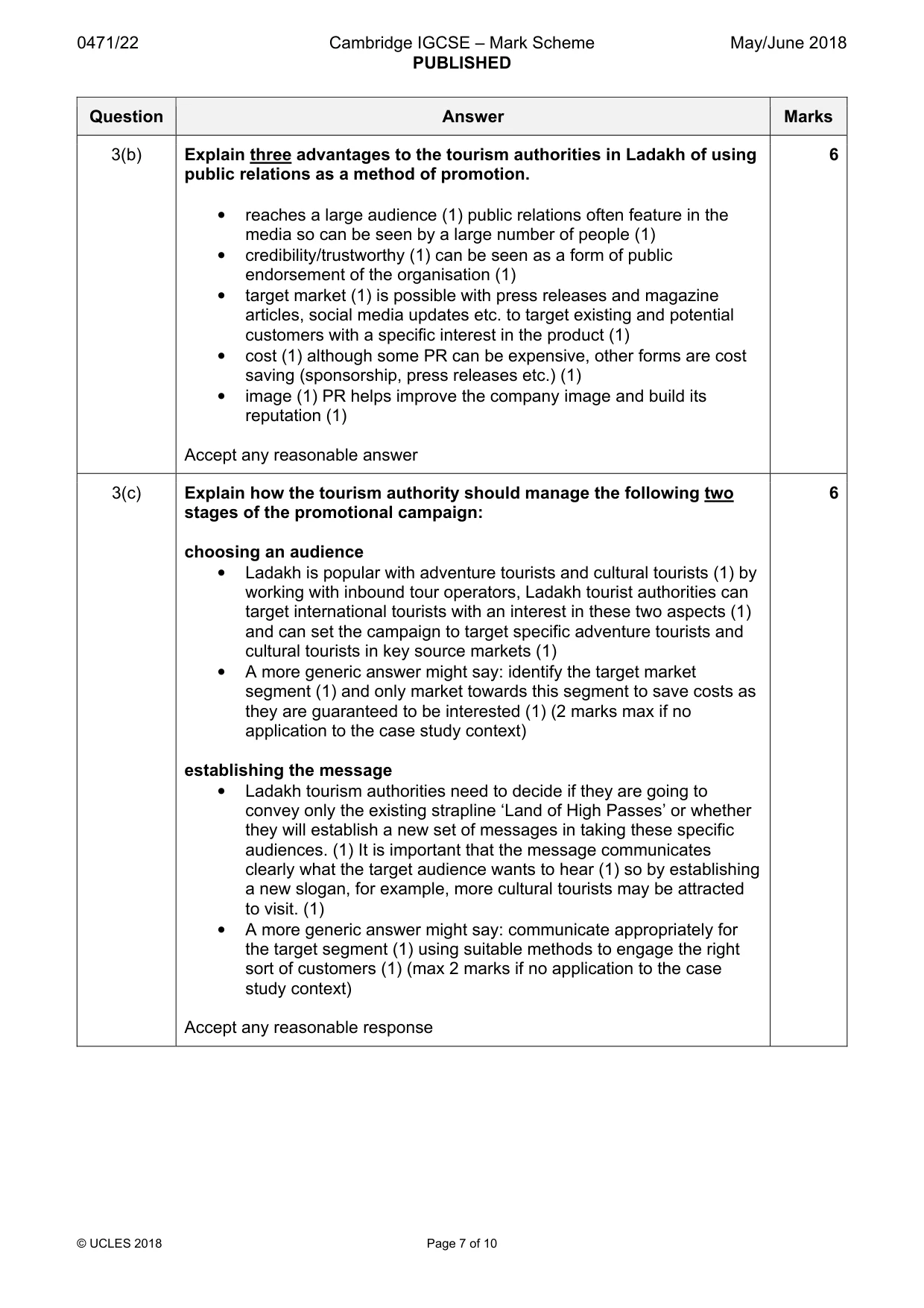
0471/22 Cambridge IGCSE – Mark Scheme PUBLISHED May/June 2018 © UCLES 2018 Page 6 of 10 Question Answer Marks 2(d) Discuss the benefits to both the tour operator and the customer of offering fully customised tours. Indicative content: Customers • Higher level of customer satisfaction • Pay for only what you want, not paying for things that won’t be used • More chance of enjoyment as choose only the aspects of the tour that appeal • Can add in different places of interest, types of refreshment, transport options, pick up/drop off points etc. to make the experience better meet customer needs Tour operator • Higher prices can be charged – customers willing to pay more for exactly what they want • Word of mouth promotion – customers will give positive feedback • Customer loyalty – repeat business is highly likely if customer needs and wants are fully met Use levels of response criteria: Level 1(1–3 marks) At this level candidates will identify 1, 2 or more benefits of customisation to the tour operator and/or the customer. Level 2 (4–6 marks) At this level candidates will explain 1, 2 or more benefits of customisation to the tour operator and/or the customer. Level 3 (7–9 marks) At this level candidates will discuss 1, 2 or more benefits of customisation to the tour operator and the customer. For top of the level, there should be a conclusion on the relative importance of the benefits or a comparison with the benefits of standardised packages. 9 3(a) Describe each of the following: one threat to tourism in Ladakh • In an area of civil unrest and political instability (1) with security risks to tourists (1) • Extreme climate (1) –40 degrees in winter with deep snowfall (1) • Large part of southern Ladakh is still inaccessible except on foot (1) remote landscapes with limited transport options (1) one social influence of tourism in Ladakh • As a result of tourism development, education, health care and transportation have improved in the country (1) which improves standards of living for local population (1) • Cultural/religious attractions offered to tourists in Ladakh (1) keep traditions and culture alive (1) Accept any reasonable response 4
Mark scheme, page 7
0471/22 Cambridge IGCSE – Mark Scheme PUBLISHED May/June 2018 © UCLES 2018 Page 7 of 10 Question Answer Marks 3(b) Explain three advantages to the tourism authorities in Ladakh of using public relations as a method of promotion. • reaches a large audience (1) public relations often feature in the media so can be seen by a large number of people (1) • credibility/trustworthy (1) can be seen as a form of public endorsement of the organisation (1) • target market (1) is possible with press releases and magazine articles, social media updates etc. to target existing and potential customers with a specific interest in the product (1) • cost (1) although some PR can be expensive, other forms are cost saving (sponsorship, press releases etc.) (1) • image (1) PR helps improve the company image and build its reputation (1) Accept any reasonable answer 6 3(c) Explain how the tourism authority should manage the following two stages of the promotional campaign: choosing an audience • Ladakh is popular with adventure tourists and cultural tourists (1) by working with inbound tour operators, Ladakh tourist authorities can target international tourists with an interest in these two aspects (1) and can set the campaign to target specific adventure tourists and cultural tourists in key source markets (1) • A more generic answer might say: identify the target market segment (1) and only market towards this segment to save costs as they are guaranteed to be interested (1) (2 marks max if no application to the case study context) establishing the message • Ladakh tourism authorities need to decide if they are going to convey only the existing strapline ‘Land of High Passes’ or whether they will establish a new set of messages in taking these specific audiences. (1) It is important that the message communicates clearly what the target audience wants to hear (1) so by establishing a new slogan, for example, more cultural tourists may be attracted to visit. (1) • A more generic answer might say: communicate appropriately for the target segment (1) using suitable methods to engage the right sort of customers (1) (max 2 marks if no application to the case study context) Accept any reasonable response 6
Mark scheme, page 8
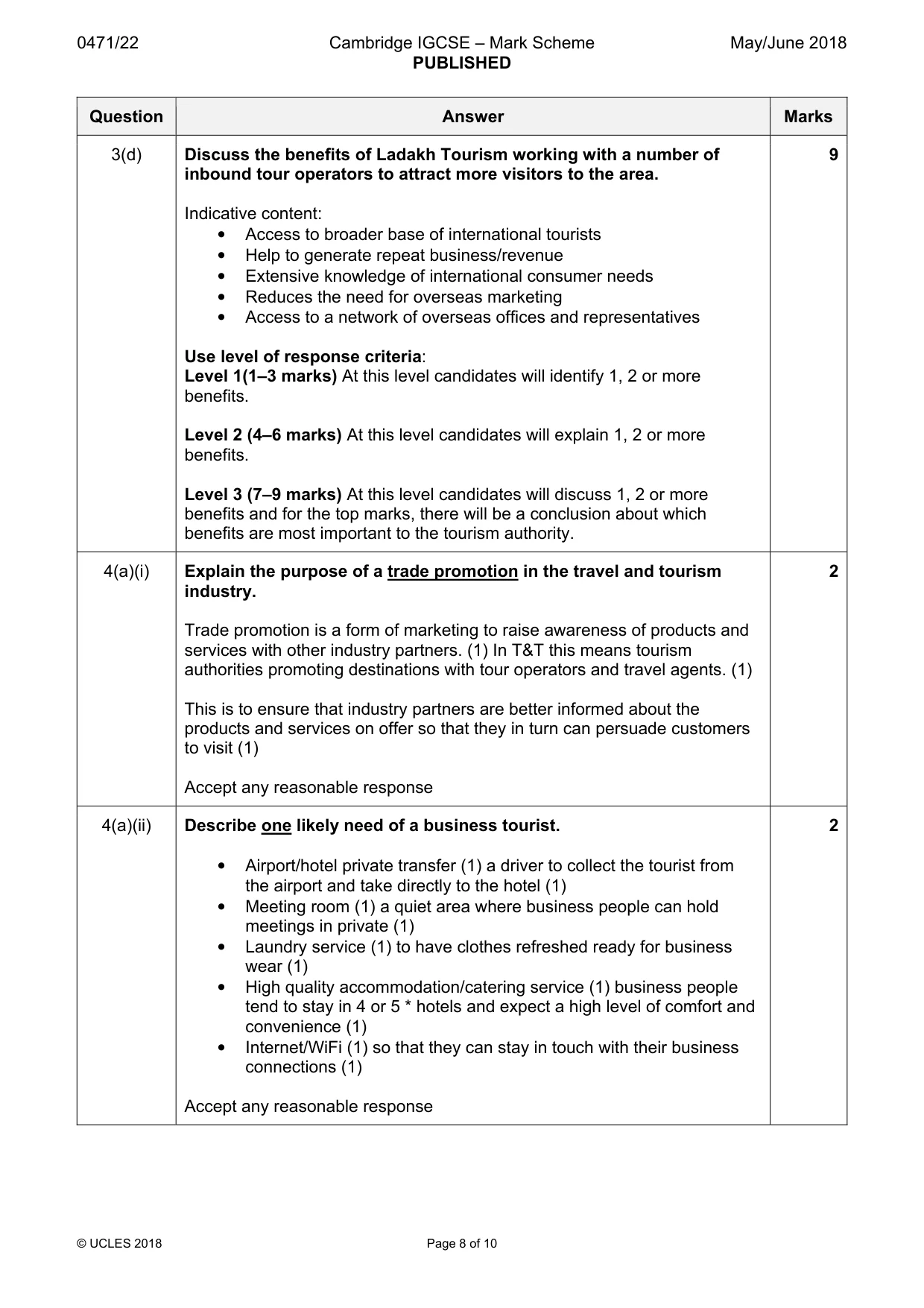
0471/22 Cambridge IGCSE – Mark Scheme PUBLISHED May/June 2018 © UCLES 2018 Page 8 of 10 Question Answer Marks 3(d) Discuss the benefits of Ladakh Tourism working with a number of inbound tour operators to attract more visitors to the area. Indicative content: • Access to broader base of international tourists • Help to generate repeat business/revenue • Extensive knowledge of international consumer needs • Reduces the need for overseas marketing • Access to a network of overseas offices and representatives Use level of response criteria: Level 1(1–3 marks) At this level candidates will identify 1, 2 or more benefits. Level 2 (4–6 marks) At this level candidates will explain 1, 2 or more benefits. Level 3 (7–9 marks) At this level candidates will discuss 1, 2 or more benefits and for the top marks, there will be a conclusion about which benefits are most important to the tourism authority. 9 4(a)(i) Explain the purpose of a trade promotion in the travel and tourism industry. Trade promotion is a form of marketing to raise awareness of products and services with other industry partners. (1) In T&T this means tourism authorities promoting destinations with tour operators and travel agents. (1) This is to ensure that industry partners are better informed about the products and services on offer so that they in turn can persuade customers to visit (1) Accept any reasonable response 2 4(a)(ii) Describe one likely need of a business tourist. • Airport/hotel private transfer (1) a driver to collect the tourist from the airport and take directly to the hotel (1) • Meeting room (1) a quiet area where business people can hold meetings in private (1) • Laundry service (1) to have clothes refreshed ready for business wear (1) • High quality accommodation/catering service (1) business people tend to stay in 4 or 5 * hotels and expect a high level of comfort and convenience (1) • Internet/WiFi (1) so that they can stay in touch with their business connections (1) Accept any reasonable response 2
Mark scheme, page 9
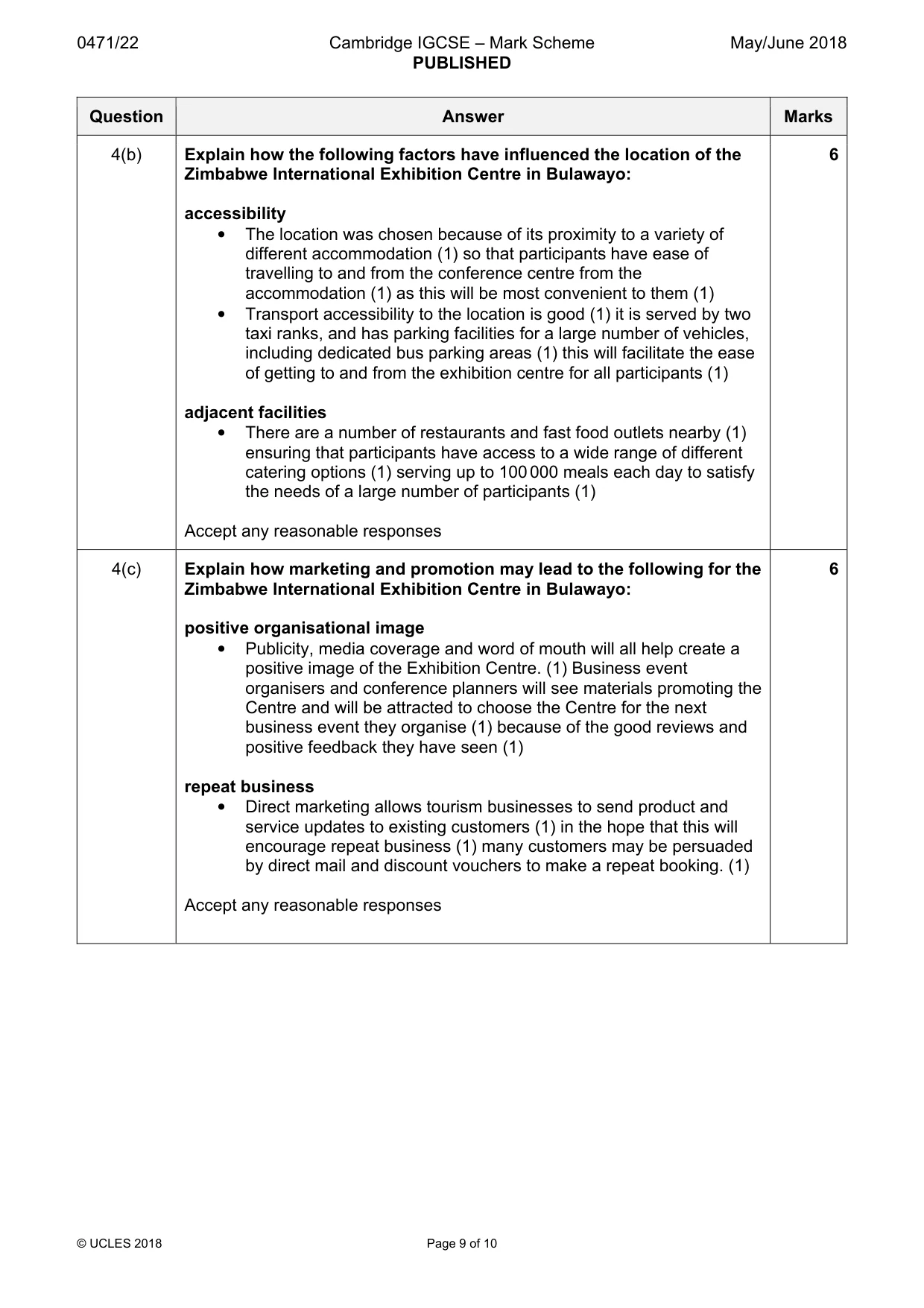
0471/22 Cambridge IGCSE – Mark Scheme PUBLISHED May/June 2018 © UCLES 2018 Page 9 of 10 Question Answer Marks 4(b) Explain how the following factors have influenced the location of the Zimbabwe International Exhibition Centre in Bulawayo: accessibility • The location was chosen because of its proximity to a variety of different accommodation (1) so that participants have ease of travelling to and from the conference centre from the accommodation (1) as this will be most convenient to them (1) • Transport accessibility to the location is good (1) it is served by two taxi ranks, and has parking facilities for a large number of vehicles, including dedicated bus parking areas (1) this will facilitate the ease of getting to and from the exhibition centre for all participants (1) adjacent facilities • There are a number of restaurants and fast food outlets nearby (1) ensuring that participants have access to a wide range of different catering options (1) serving up to 100 000 meals each day to satisfy the needs of a large number of participants (1) Accept any reasonable responses 6 4(c) Explain how marketing and promotion may lead to the following for the Zimbabwe International Exhibition Centre in Bulawayo: positive organisational image • Publicity, media coverage and word of mouth will all help create a positive image of the Exhibition Centre. (1) Business event organisers and conference planners will see materials promoting the Centre and will be attracted to choose the Centre for the next business event they organise (1) because of the good reviews and positive feedback they have seen (1) repeat business • Direct marketing allows tourism businesses to send product and service updates to existing customers (1) in the hope that this will encourage repeat business (1) many customers may be persuaded by direct mail and discount vouchers to make a repeat booking. (1) Accept any reasonable responses 6
Mark scheme, page 10
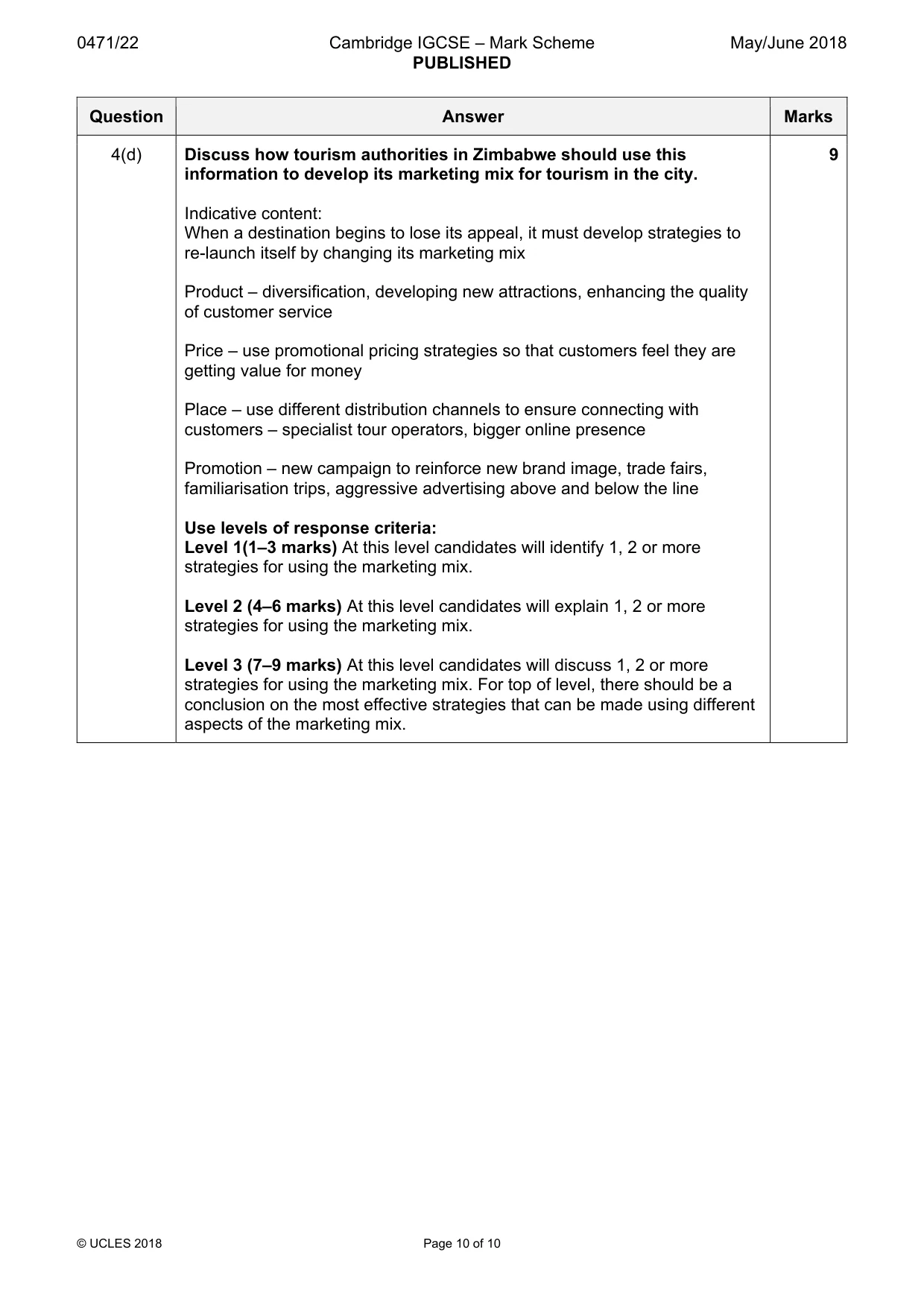
0471/22 Cambridge IGCSE – Mark Scheme PUBLISHED May/June 2018 © UCLES 2018 Page 10 of 10 Question Answer Marks 4(d) Discuss how tourism authorities in Zimbabwe should use this information to develop its marketing mix for tourism in the city. Indicative content: When a destination begins to lose its appeal, it must develop strategies to re-launch itself by changing its marketing mix Product – diversification, developing new attractions, enhancing the quality of customer service Price – use promotional pricing strategies so that customers feel they are getting value for money Place – use different distribution channels to ensure connecting with customers – specialist tour operators, bigger online presence Promotion – new campaign to reinforce new brand image, trade fairs, familiarisation trips, aggressive advertising above and below the line Use levels of response criteria: Level 1(1–3 marks) At this level candidates will identify 1, 2 or more strategies for using the marketing mix. Level 2 (4–6 marks) At this level candidates will explain 1, 2 or more strategies for using the marketing mix. Level 3 (7–9 marks) At this level candidates will discuss 1, 2 or more strategies for using the marketing mix. For top of level, there should be a conclusion on the most effective strategies that can be made using different aspects of the marketing mix. 9
What you needed in this session
Cambridge’s own grade thresholds for 2018 May/June, Paper 2 · Variant 2. A higher threshold means an easier paper — the bar moves with how the cohort did.