Cambridge IGCSE Travel and Tourism 0471 — 2013 Oct/Nov Paper 1 · Variant 1
0471/11/O/N/13 · 100 marks · ≈113 min
The question paper and its mark scheme, free to read here and free to download. This is Cambridge’s own paper, exactly as it was sat.
Question paper12 pages


Mark scheme10 pages
Answers below. Sit the paper first if you are practising.
Paper as text
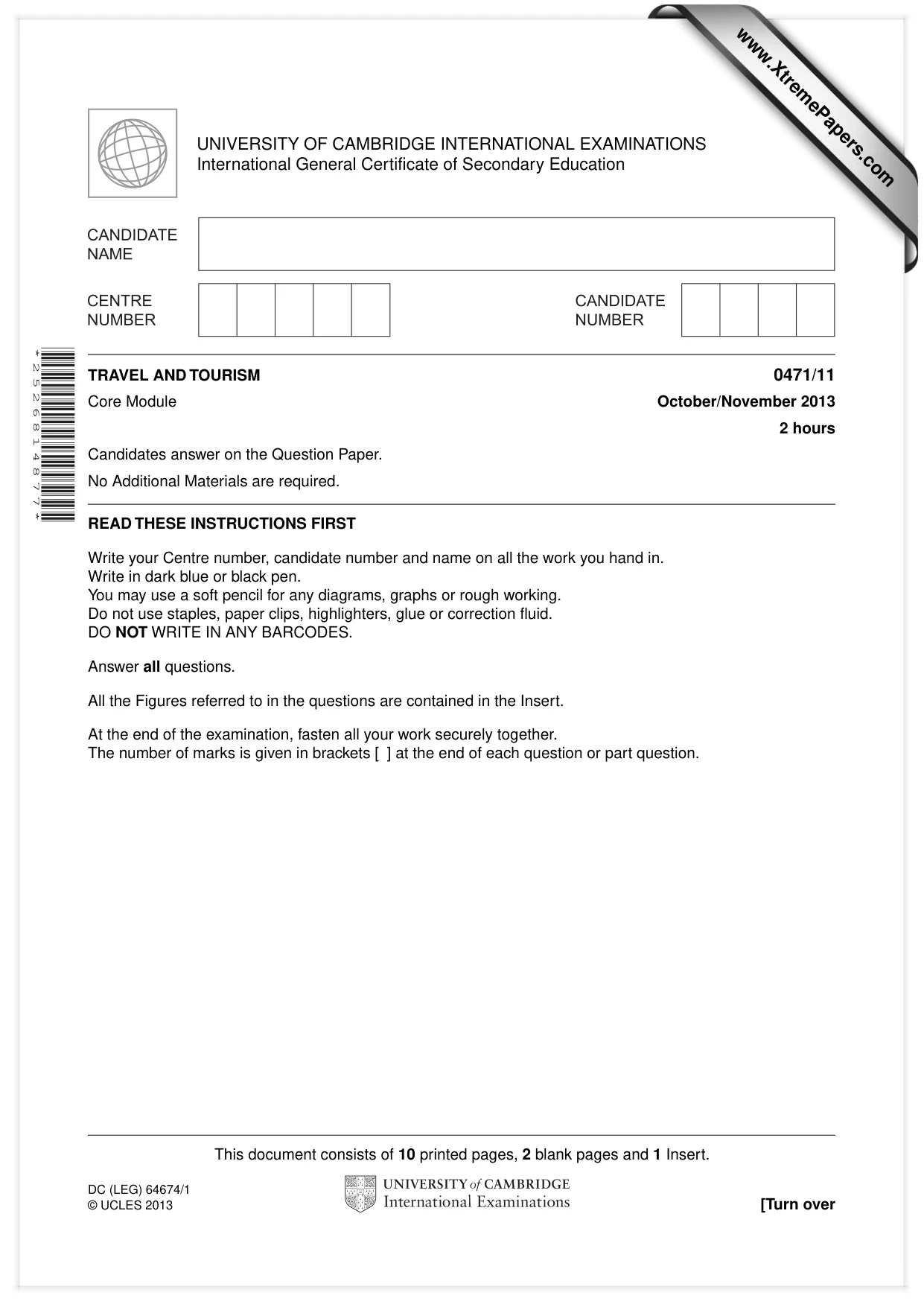
Question paper, page 1
This document consists of 10 printed pages, 2 blank pages and 1 Insert. DC (LEG) 64674/1 © UCLES 2013 [Turn over UNIVERSITY OF CAMBRIDGE INTERNATIONAL EXAMINATIONS International General Certificate of Secondary Education * 2 5 2 6 8 1 4 8 7 7 * TRAVEL AND TOURISM 0471/11 Core Module October/November 2013 2 hours Candidates answer on the Question Paper. No Additional Materials are required. READ THESE INSTRUCTIONS FIRST Write your Centre number, candidate number and name on all the work you hand in. Write in dark blue or black pen. You may use a soft pencil for any diagrams, graphs or rough working. Do not use staples, paper clips, highlighters, glue or correction fluid. DO NOT WRITE IN ANY BARCODES. Answer all questions. All the Figures referred to in the questions are contained in the Insert. At the end of the examination, fasten all your work securely together. The number of marks is given in brackets [ ] at the end of each question or part question. www.XtremePapers.com
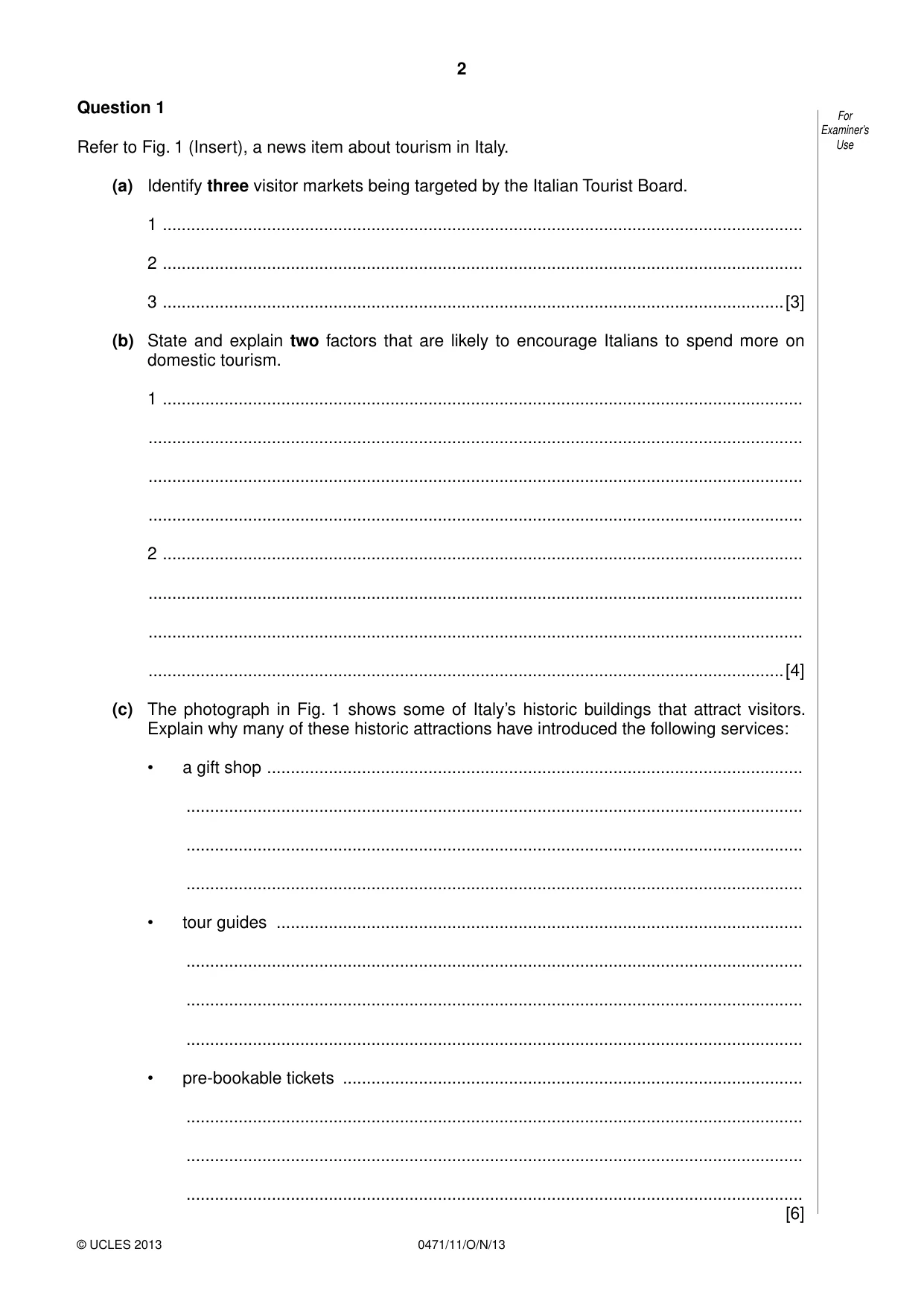
Question paper, page 2
2 0471/11/O/N/13 © UCLES 2013 For Examiner’s Use Question 1 Refer to Fig. 1 (Insert), a news item about tourism in Italy. (a) Identify three visitor markets being targeted by the Italian Tourist Board. 1 … 2 … 3 …[3] (b) State and explain two factors that are likely to encourage Italians to spend more on domestic tourism. 1 … … … … 2 … … … …[4] (c) The photograph in Fig. 1 shows some of Italy’s historic buildings that attract visitors. Explain why many of these historic attractions have introduced the following services: • a gift shop … … … … • tour guides … … … … • pre-bookable tickets … … … … [6]
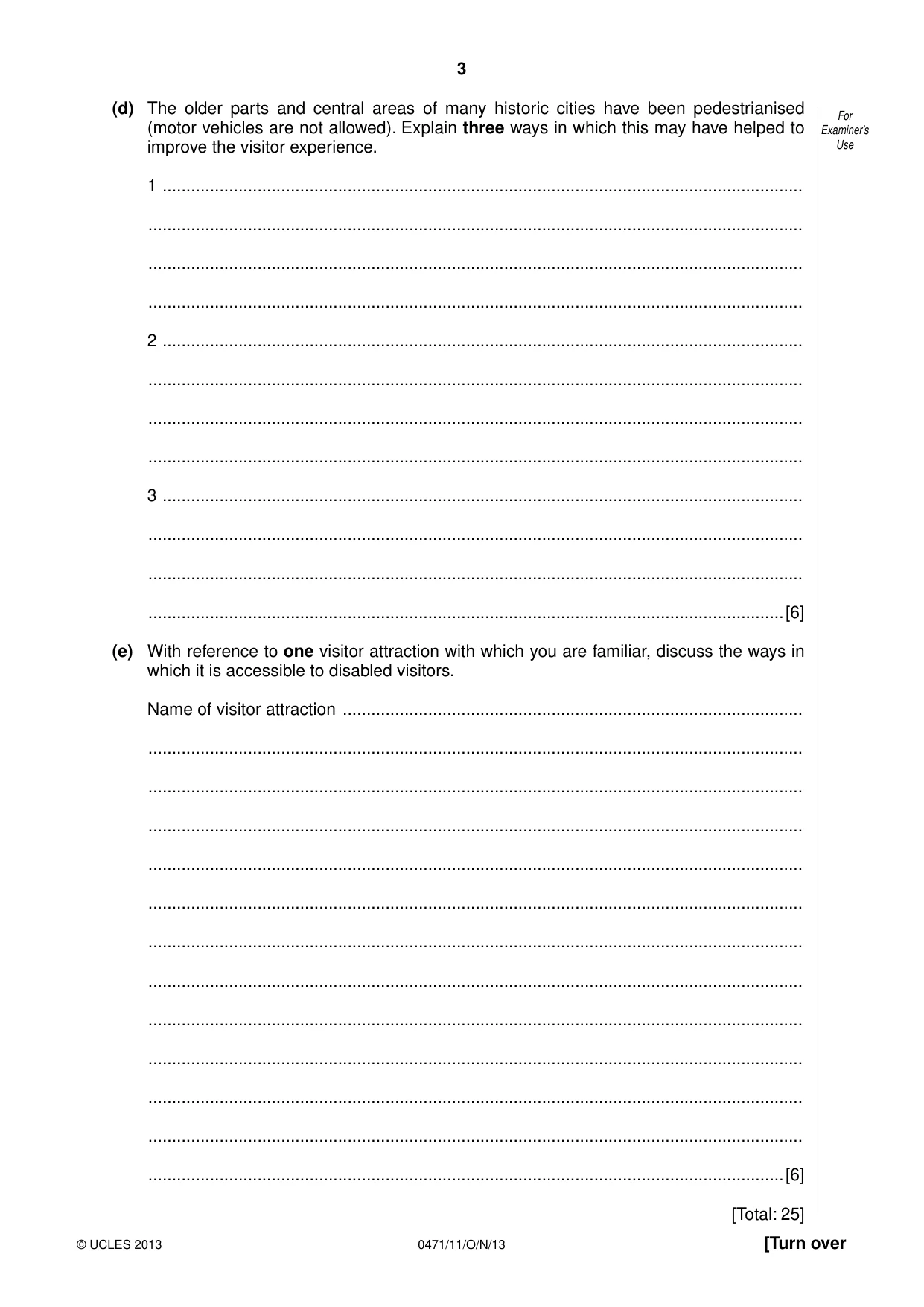
Question paper, page 3
3 0471/11/O/N/13 © UCLES 2013 [Turn over For Examiner’s Use (d) The older parts and central areas of many historic cities have been pedestrianised (motor vehicles are not allowed). Explain three ways in which this may have helped to improve the visitor experience. 1 … … … … 2 … … … … 3 … … … …[6] (e) With reference to one visitor attraction with which you are familiar, discuss the ways in which it is accessible to disabled visitors. Name of visitor attraction … … … … … … … … … … … … …[6] [Total: 25]
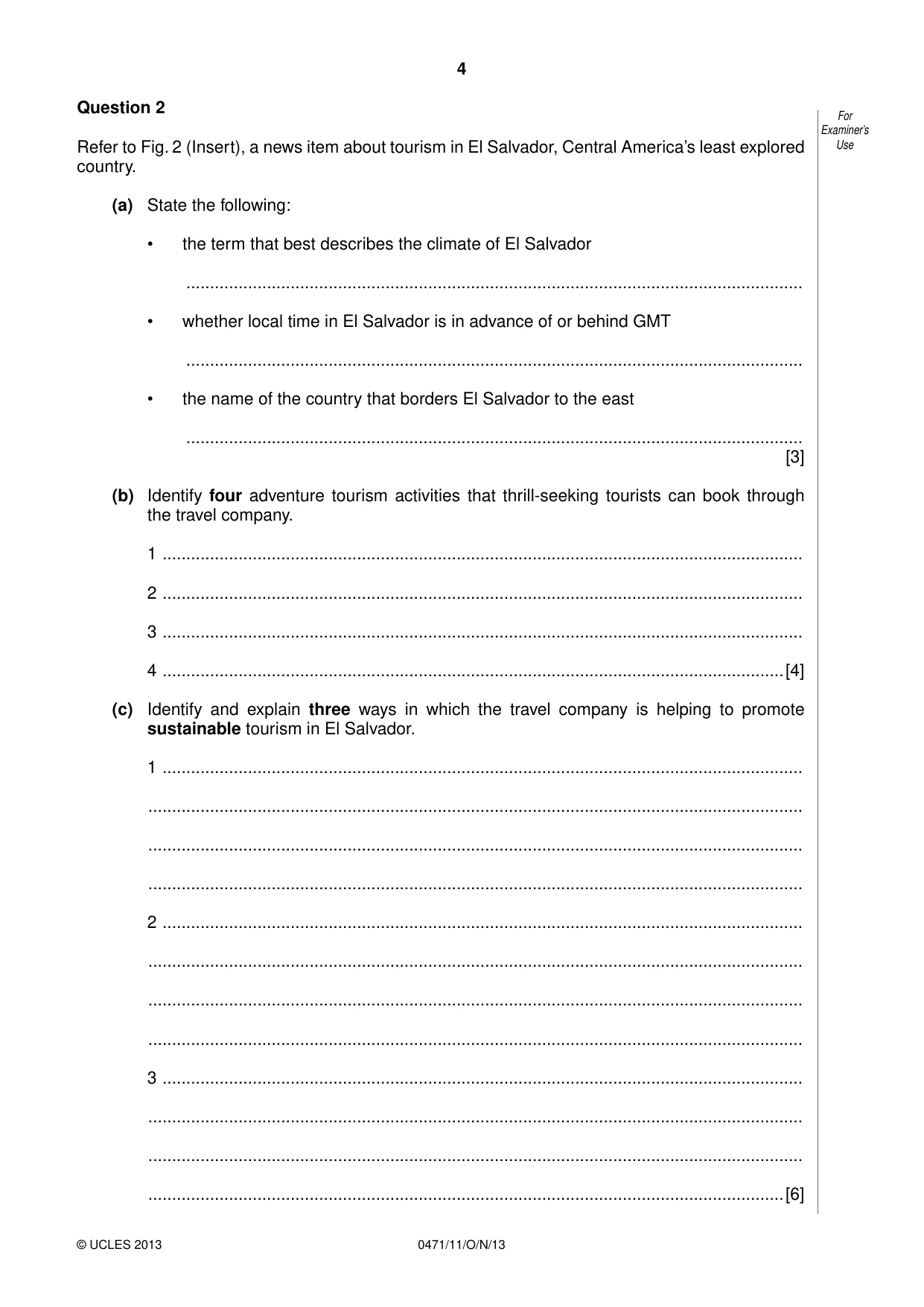
Question paper, page 4
4 0471/11/O/N/13 © UCLES 2013 For Examiner’s Use Question 2 Refer to Fig. 2 (Insert), a news item about tourism in El Salvador, Central America’s least explored country. (a) State the following: • the term that best describes the climate of El Salvador … • whether local time in El Salvador is in advance of or behind GMT … • the name of the country that borders El Salvador to the east … [3] (b) Identify four adventure tourism activities that thrill-seeking tourists can book through the travel company. 1 … 2 … 3 … 4 …[4] (c) Identify and explain three ways in which the travel company is helping to promote sustainable tourism in El Salvador. 1 … … … … 2 … … … … 3 … … … …[6]
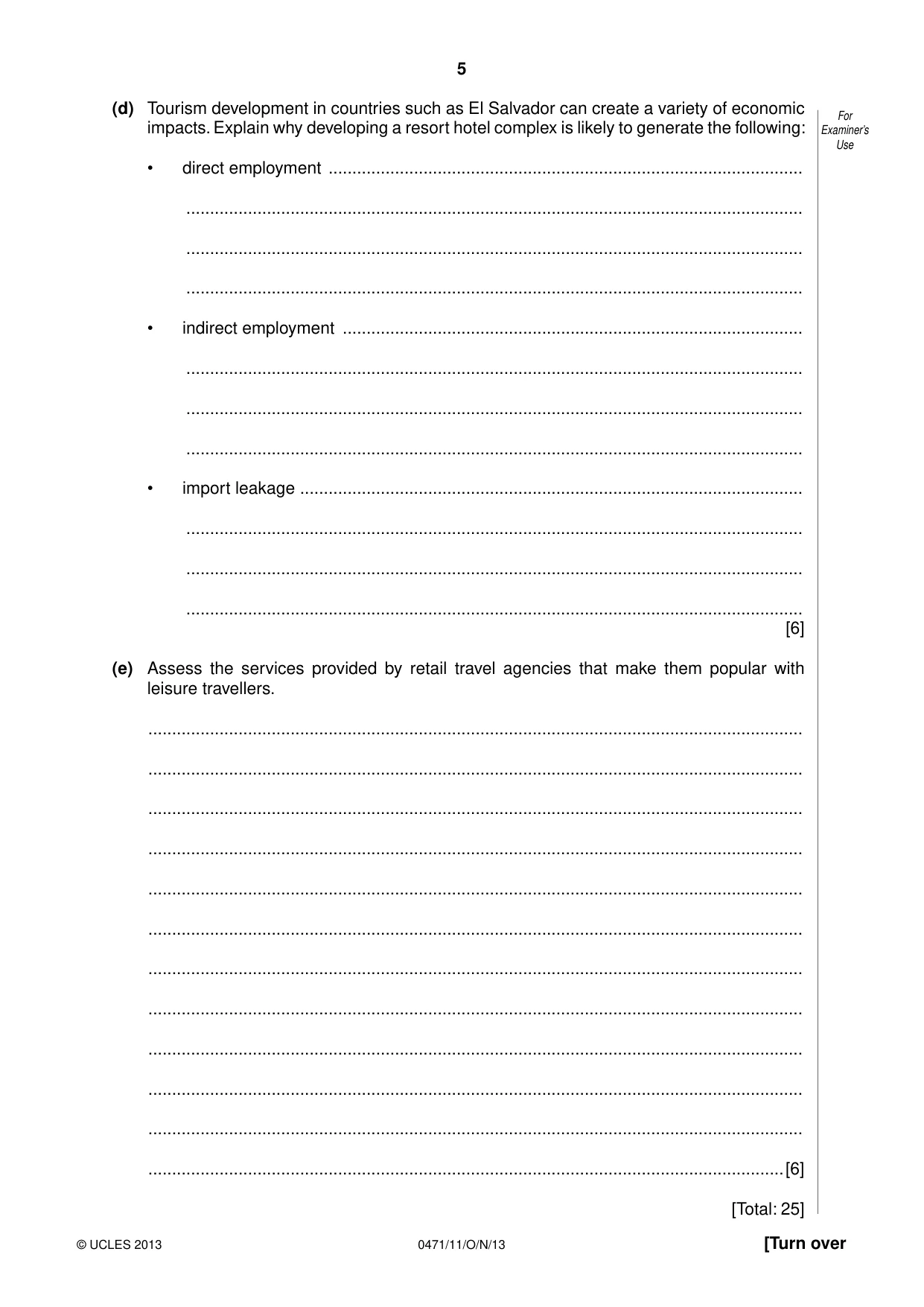
Question paper, page 5
5 0471/11/O/N/13 © UCLES 2013 [Turn over For Examiner’s Use (d) Tourism development in countries such as El Salvador can create a variety of economic impacts. Explain why developing a resort hotel complex is likely to generate the following: • direct employment … … … … • indirect employment … … … … • import leakage … … … … [6] (e) Assess the services provided by retail travel agencies that make them popular with leisure travellers. … … … … … … … … … … … …[6] [Total: 25]
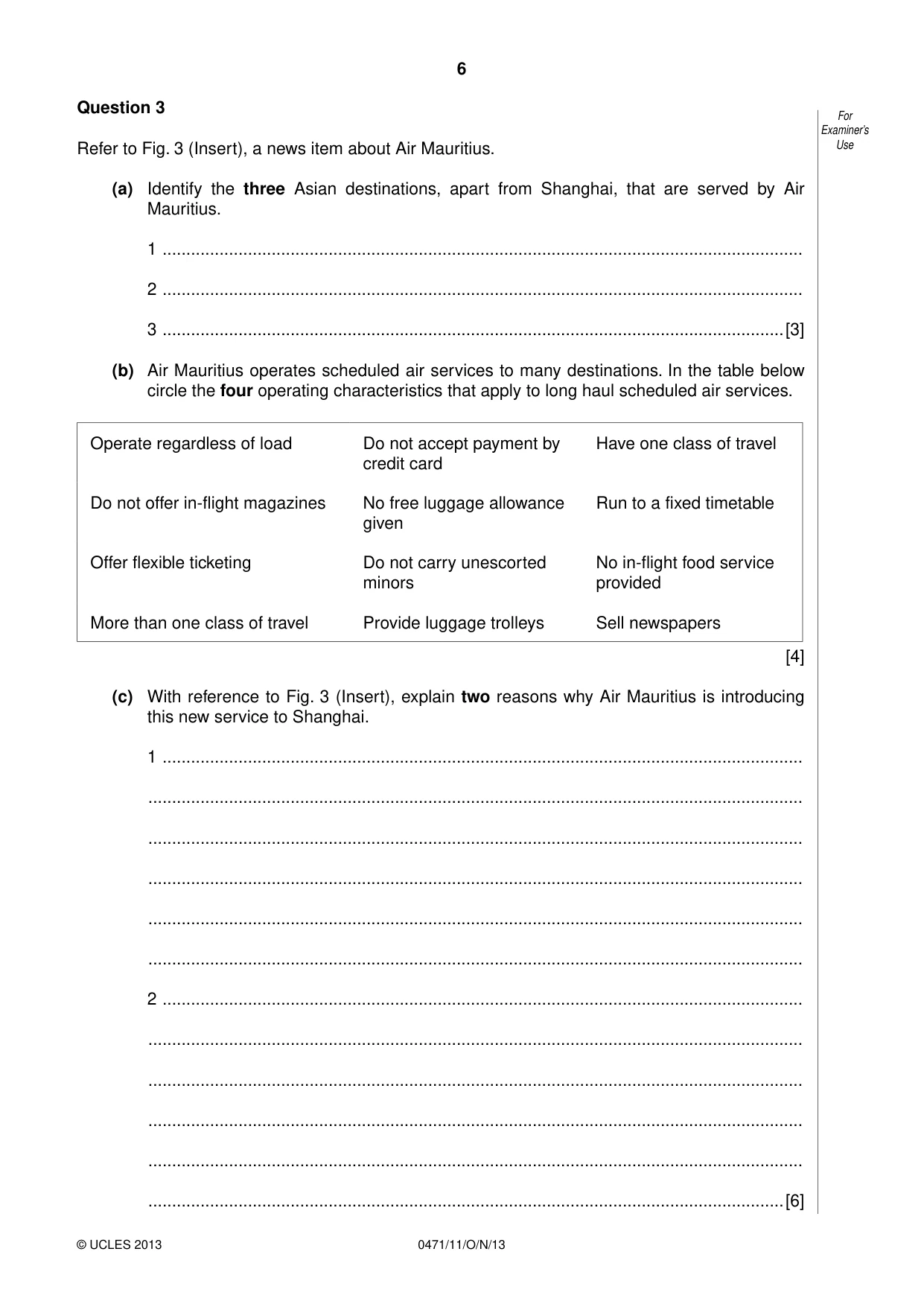
Question paper, page 6
6 0471/11/O/N/13 © UCLES 2013 For Examiner’s Use Question 3 Refer to Fig. 3 (Insert), a news item about Air Mauritius. (a) Identify the three Asian destinations, apart from Shanghai, that are served by Air Mauritius. 1 … 2 … 3 …[3] (b) Air Mauritius operates scheduled air services to many destinations. In the table below circle the four operating characteristics that apply to long haul scheduled air services. Operate regardless of load Do not accept payment by credit card Have one class of travel Do not offer in-flight magazines No free luggage allowance given Run to a fixed timetable Offer flexible ticketing Do not carry unescorted minors No in-flight food service provided More than one class of travel Provide luggage trolleys Sell newspapers [4] (c) With reference to Fig. 3 (Insert), explain two reasons why Air Mauritius is introducing this new service to Shanghai. 1 … … … … … … 2 … … … … … …[6]
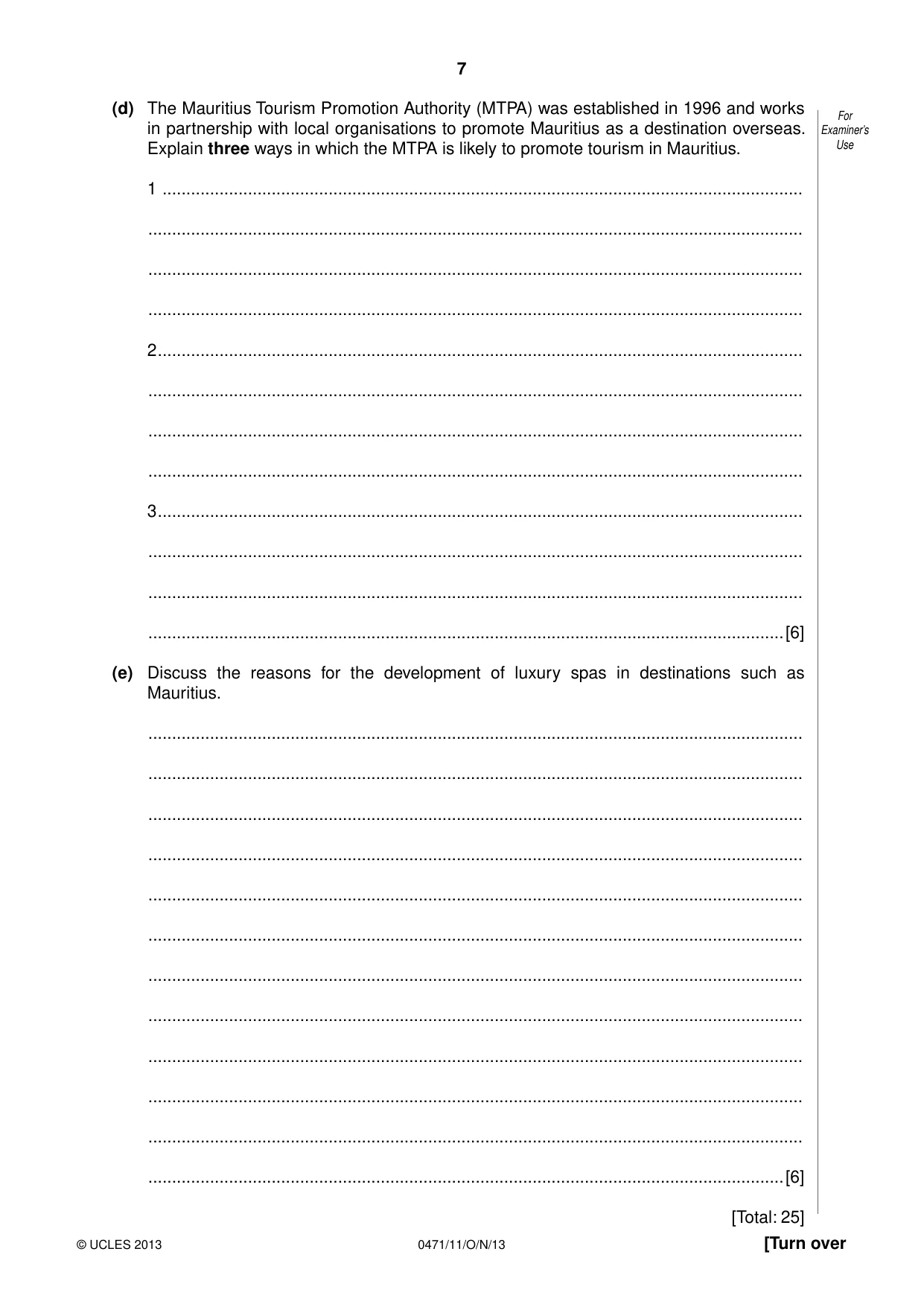
Question paper, page 7
7 0471/11/O/N/13 © UCLES 2013 [Turn over For Examiner’s Use (d) The Mauritius Tourism Promotion Authority (MTPA) was established in 1996 and works in partnership with local organisations to promote Mauritius as a destination overseas. Explain three ways in which the MTPA is likely to promote tourism in Mauritius. 1 … … … … 2 … … … … 3 … … … …[6] (e) Discuss the reasons for the development of luxury spas in destinations such as Mauritius. … … … … … … … … … … … …[6] [Total: 25]
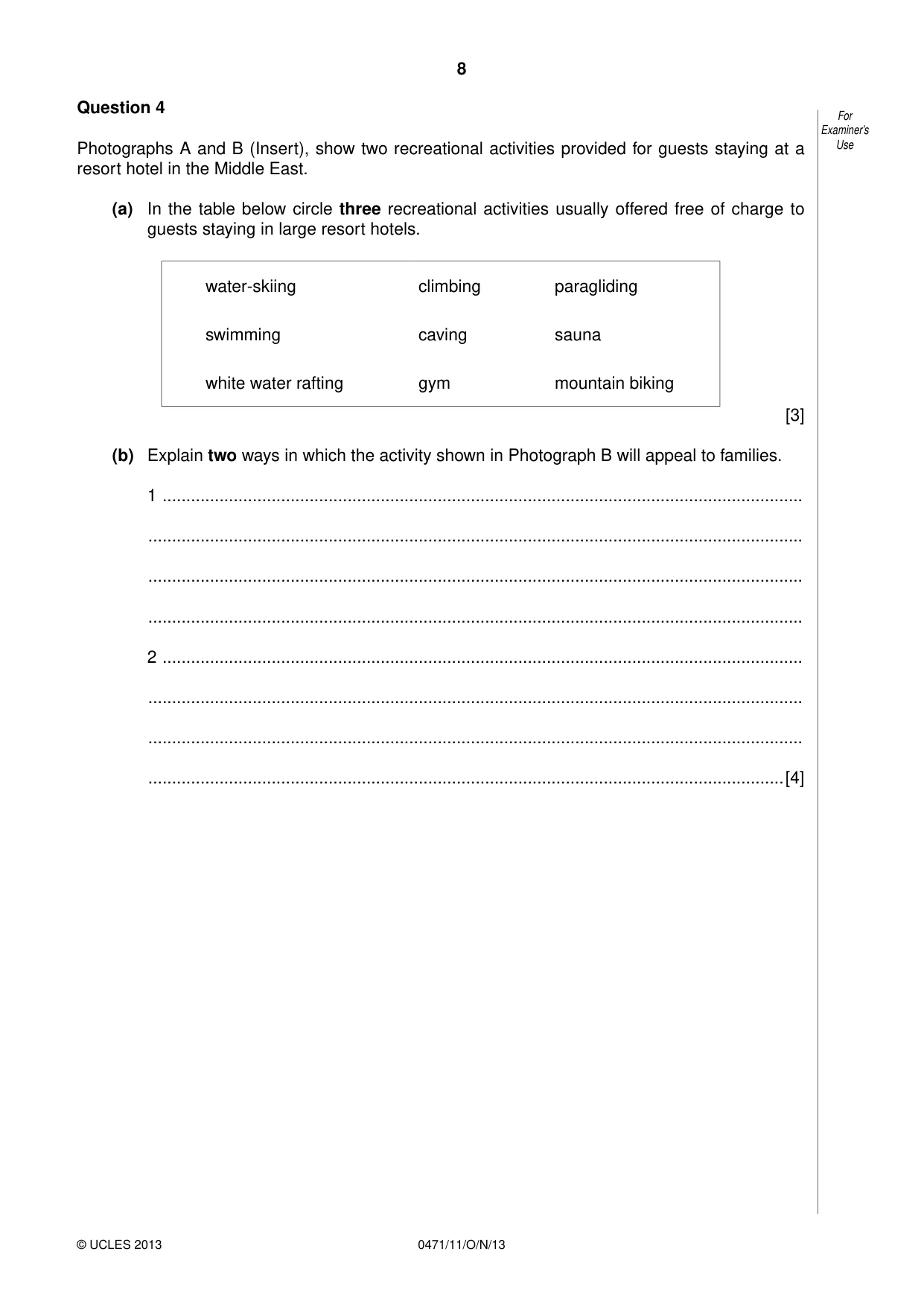
Question paper, page 8
8 0471/11/O/N/13 © UCLES 2013 For Examiner’s Use Question 4 Photographs A and B (Insert), show two recreational activities provided for guests staying at a resort hotel in the Middle East. (a) In the table below circle three recreational activities usually offered free of charge to guests staying in large resort hotels. water-skiing climbing paragliding swimming caving sauna white water rafting gym mountain biking [3] (b) Explain two ways in which the activity shown in Photograph B will appeal to families. 1 … … … … 2 … … … …[4]
Question paper, page 9
9 0471/11/O/N/13 © UCLES 2013 [Turn over For Examiner’s Use (c) Explain two types of customer service training that the member of staff in Photograph A is likely to have undertaken. 1 … … … … … … 2 … … … … … …[6] (d) Large resort hotels will sometimes be used as a venue for private functions, such as anniversary parties. Explain three services usually provided by hotels for the convenience of clients hosting these types of function. 1 … … … … 2 … … … … 3 … … … …[6]
Question paper, page 10
10 0471/11/O/N/13 © UCLES 2013 For Examiner’s Use (e) Discuss the reasons why hotels monitor their occupancy rates. … … … … … … … … … … … …[6] [Total: 25]
Question paper, page 11
11 0471/11/O/N/13 © UCLES 2013 BLANK PAGE
Question paper, page 12
12 0471/11/O/N/13 © UCLES 2013 Permission to reproduce items where third-party owned material protected by copyright is included has been sought and cleared where possible. Every reasonable effort has been made by the publisher (UCLES) to trace copyright holders, but if any items requiring clearance have unwittingly been included, the publisher will be pleased to make amends at the earliest possible opportunity. University of Cambridge International Examinations is part of the Cambridge Assessment Group. Cambridge Assessment is the brand name of University of Cambridge Local Examinations Syndicate (UCLES), which is itself a department of the University of Cambridge. BLANK PAGE
Mark scheme, page 1
CAMBRIDGE INTERNATIONAL EXAMINATIONS International General Certificate of Secondary Education MARK SCHEME for the October/November 2013 series 0471 TRAVEL AND TOURISM 0471/11 Paper 1 (Written Paper), maximum raw mark 100 This mark scheme is published as an aid to teachers and candidates, to indicate the requirements of the examination. It shows the basis on which Examiners were instructed to award marks. It does not indicate the details of the discussions that took place at an Examiners’ meeting before marking began, which would have considered the acceptability of alternative answers. Mark schemes should be read in conjunction with the question paper and the Principal Examiner Report for Teachers. Cambridge will not enter into discussions about these mark schemes. Cambridge is publishing the mark schemes for the October/November 2013 series for most IGCSE, GCE Advanced Level and Advanced Subsidiary Level components and some Ordinary Level components. www.XtremePapers.com
Mark scheme, page 2
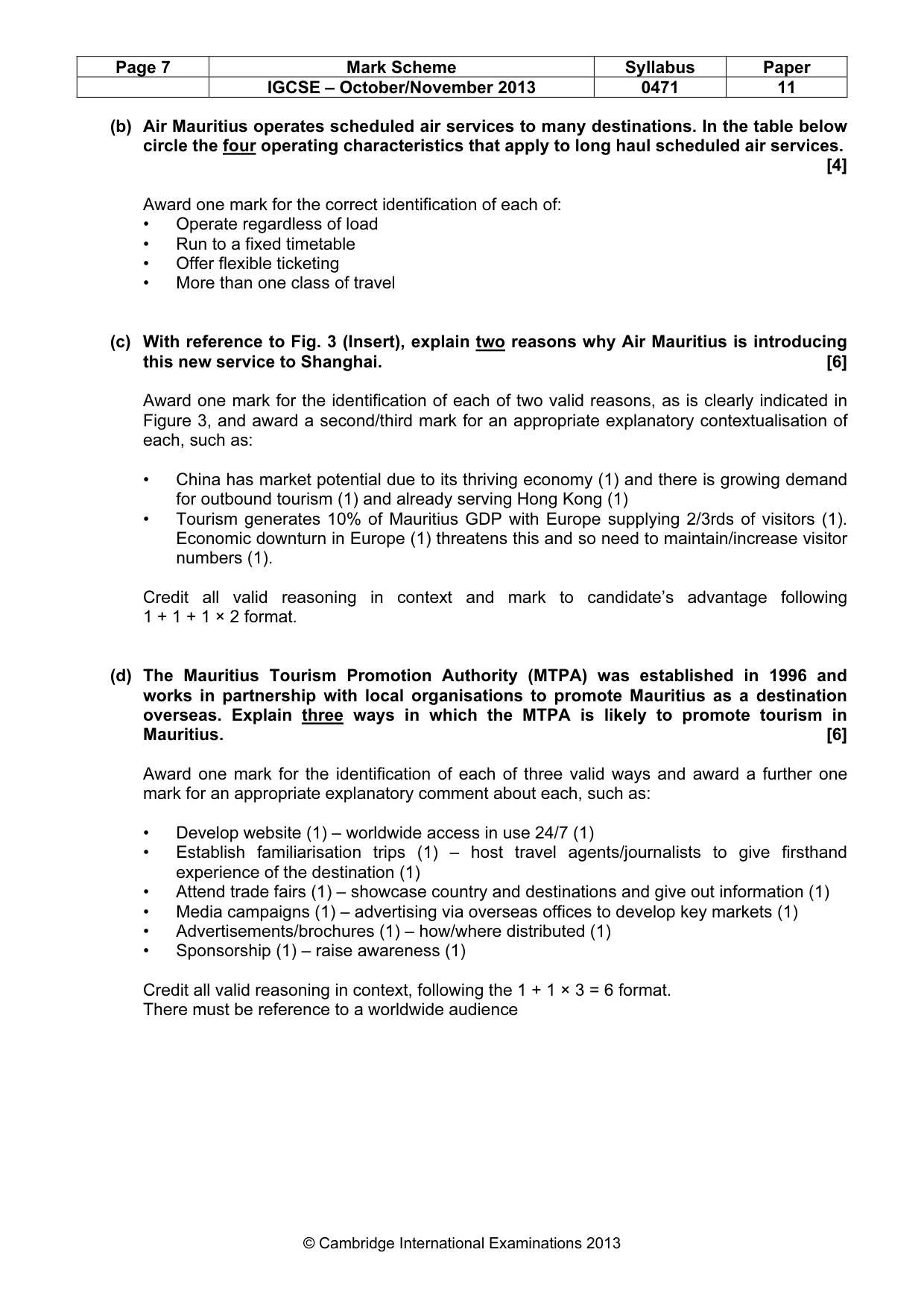
Page 2 Mark Scheme Syllabus Paper IGCSE – October/November 2013 0471 11 © Cambridge International Examinations 2013 1 (a) Identify three visitor markets being targeted by the Italian Tourist Board. [3] Award one mark for the correct identification of each of three from: • Russia • Brazil • Poland • China • India (b) State and explain two factors that are likely to encourage Italians to spend more on domestic tourism. [4] Award one mark for the identification of each of two valid factors and then award a second mark for an appropriate explanatory comment about each. Correct ideas include: • Economic recession (1) – limited disposable incomes for overseas travel (1) • Disposable income (1) – can only afford to stay in Italy (1) • Increasing costs (1) – due to fall in value of Euro (1) • Higher unemployment (1) – fall in demand (1) • Unrest in nearby destinations (1) – safer at home (1) • Marketing/promotional campaign (1) – encourage Italians to stay (1) Credit all valid reasoning in context, following the 1 + 1 × 2 = 4 format. Must consider what the factor is and why does that make domestic tourism more likely. (c) The photograph in Fig. 1 shows some of Italy’s historic buildings that attract visitors. Explain why many of these historic attractions have introduced the following services: • a gift shop • tour guides • pre-bookable tickets [6] For each service, award one mark for a descriptive statement about the service and a second mark for explanation of how this service meets the attraction’s objectives. Gift shop • Demand for souvenirs • Increase revenues • Themed merchandise is promotional • Attract more customers/compete/market share Tour guides • Control/manage visitors • Avoid sensitive areas • Increase revenues Pre-bookable tickets • Prevents queues • Reduces congestion • Better customer service Credit all valid explanatory comments.
Mark scheme, page 3
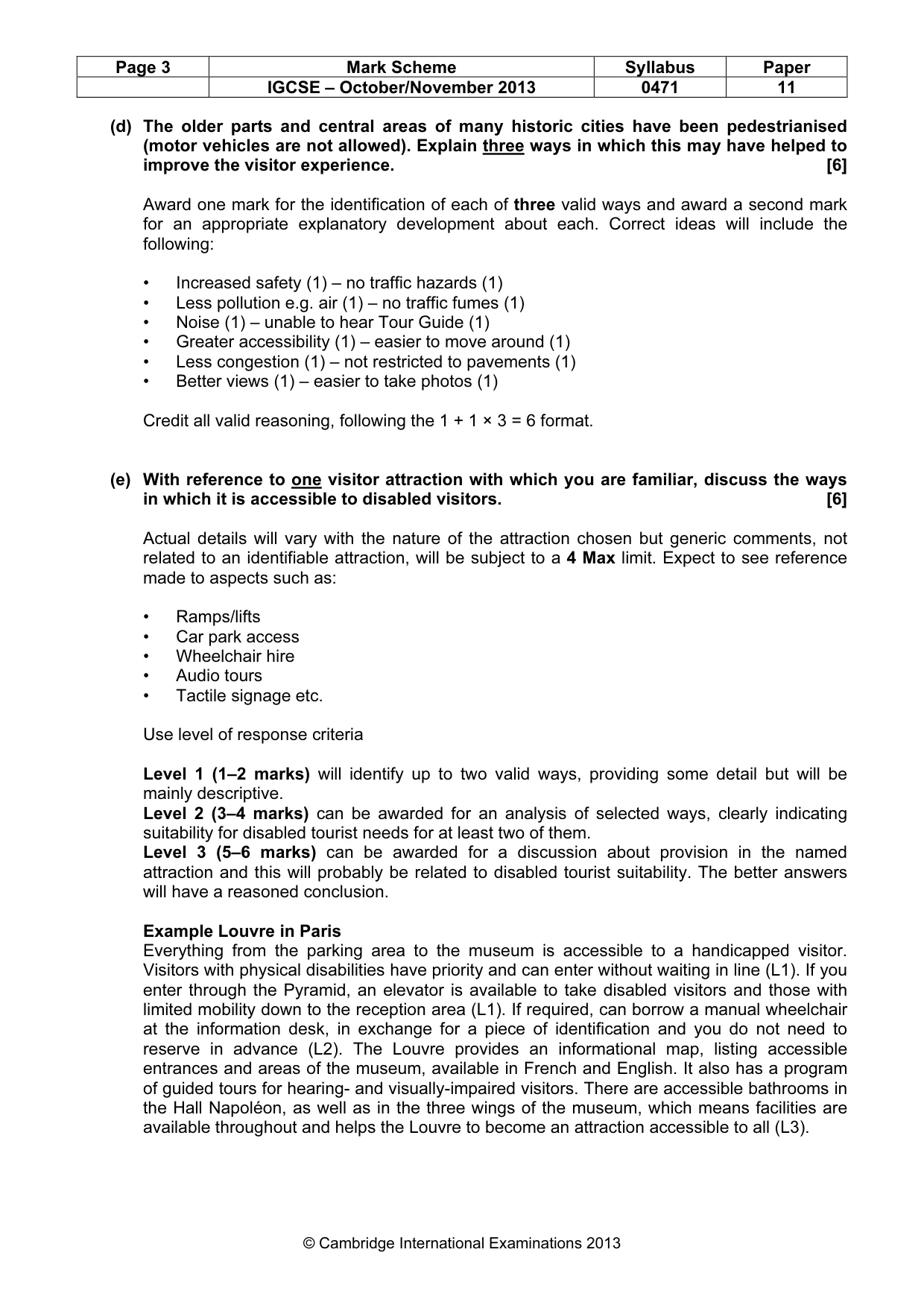
Page 3 Mark Scheme Syllabus Paper IGCSE – October/November 2013 0471 11 © Cambridge International Examinations 2013 (d) The older parts and central areas of many historic cities have been pedestrianised (motor vehicles are not allowed). Explain three ways in which this may have helped to improve the visitor experience. [6] Award one mark for the identification of each of three valid ways and award a second mark for an appropriate explanatory development about each. Correct ideas will include the following: • Increased safety (1) – no traffic hazards (1) • Less pollution e.g. air (1) – no traffic fumes (1) • Noise (1) – unable to hear Tour Guide (1) • Greater accessibility (1) – easier to move around (1) • Less congestion (1) – not restricted to pavements (1) • Better views (1) – easier to take photos (1) Credit all valid reasoning, following the 1 + 1 × 3 = 6 format. (e) With reference to one visitor attraction with which you are familiar, discuss the ways in which it is accessible to disabled visitors. [6] Actual details will vary with the nature of the attraction chosen but generic comments, not related to an identifiable attraction, will be subject to a 4 Max limit. Expect to see reference made to aspects such as: • Ramps/lifts • Car park access • Wheelchair hire • Audio tours • Tactile signage etc. Use level of response criteria Level 1 (1–2 marks) will identify up to two valid ways, providing some detail but will be mainly descriptive. Level 2 (3–4 marks) can be awarded for an analysis of selected ways, clearly indicating suitability for disabled tourist needs for at least two of them. Level 3 (5–6 marks) can be awarded for a discussion about provision in the named attraction and this will probably be related to disabled tourist suitability. The better answers will have a reasoned conclusion. Example Louvre in Paris Everything from the parking area to the museum is accessible to a handicapped visitor. Visitors with physical disabilities have priority and can enter without waiting in line (L1). If you enter through the Pyramid, an elevator is available to take disabled visitors and those with limited mobility down to the reception area (L1). If required, can borrow a manual wheelchair at the information desk, in exchange for a piece of identification and you do not need to reserve in advance (L2). The Louvre provides an informational map, listing accessible entrances and areas of the museum, available in French and English. It also has a program of guided tours for hearing- and visually-impaired visitors. There are accessible bathrooms in the Hall Napoléon, as well as in the three wings of the museum, which means facilities are available throughout and helps the Louvre to become an attraction accessible to all (L3).
Mark scheme, page 4
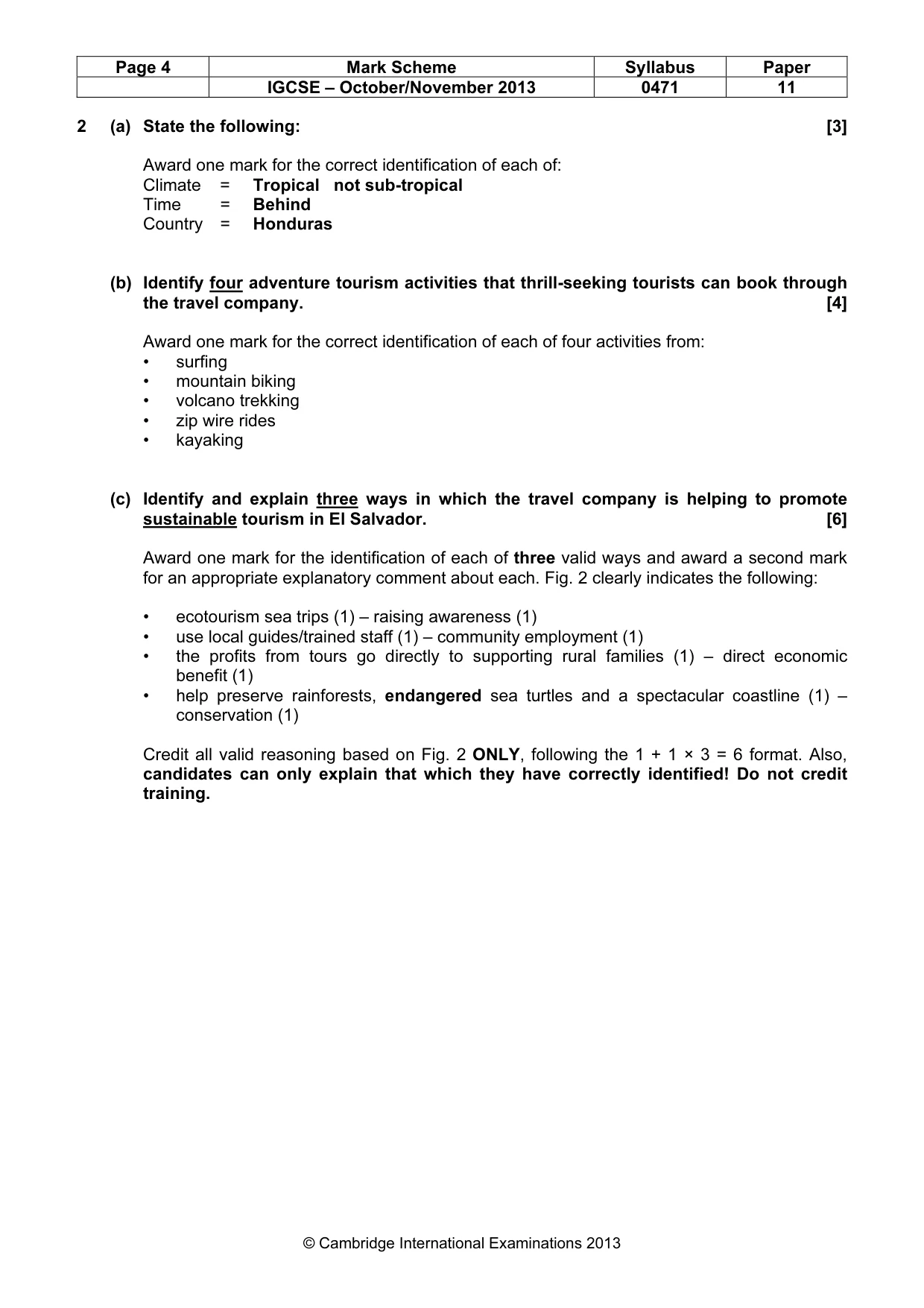
Page 4 Mark Scheme Syllabus Paper IGCSE – October/November 2013 0471 11 © Cambridge International Examinations 2013 2 (a) State the following: [3] Award one mark for the correct identification of each of: Climate = Tropical not sub-tropical Time = Behind Country = Honduras (b) Identify four adventure tourism activities that thrill-seeking tourists can book through the travel company. [4] Award one mark for the correct identification of each of four activities from: • surfing • mountain biking • volcano trekking • zip wire rides • kayaking (c) Identify and explain three ways in which the travel company is helping to promote sustainable tourism in El Salvador. [6] Award one mark for the identification of each of three valid ways and award a second mark for an appropriate explanatory comment about each. Fig. 2 clearly indicates the following: • ecotourism sea trips (1) – raising awareness (1) • use local guides/trained staff (1) – community employment (1) • the profits from tours go directly to supporting rural families (1) – direct economic benefit (1) • help preserve rainforests, endangered sea turtles and a spectacular coastline (1) – conservation (1) Credit all valid reasoning based on Fig. 2 ONLY, following the 1 + 1 × 3 = 6 format. Also, candidates can only explain that which they have correctly identified! Do not credit training.
Mark scheme, page 5
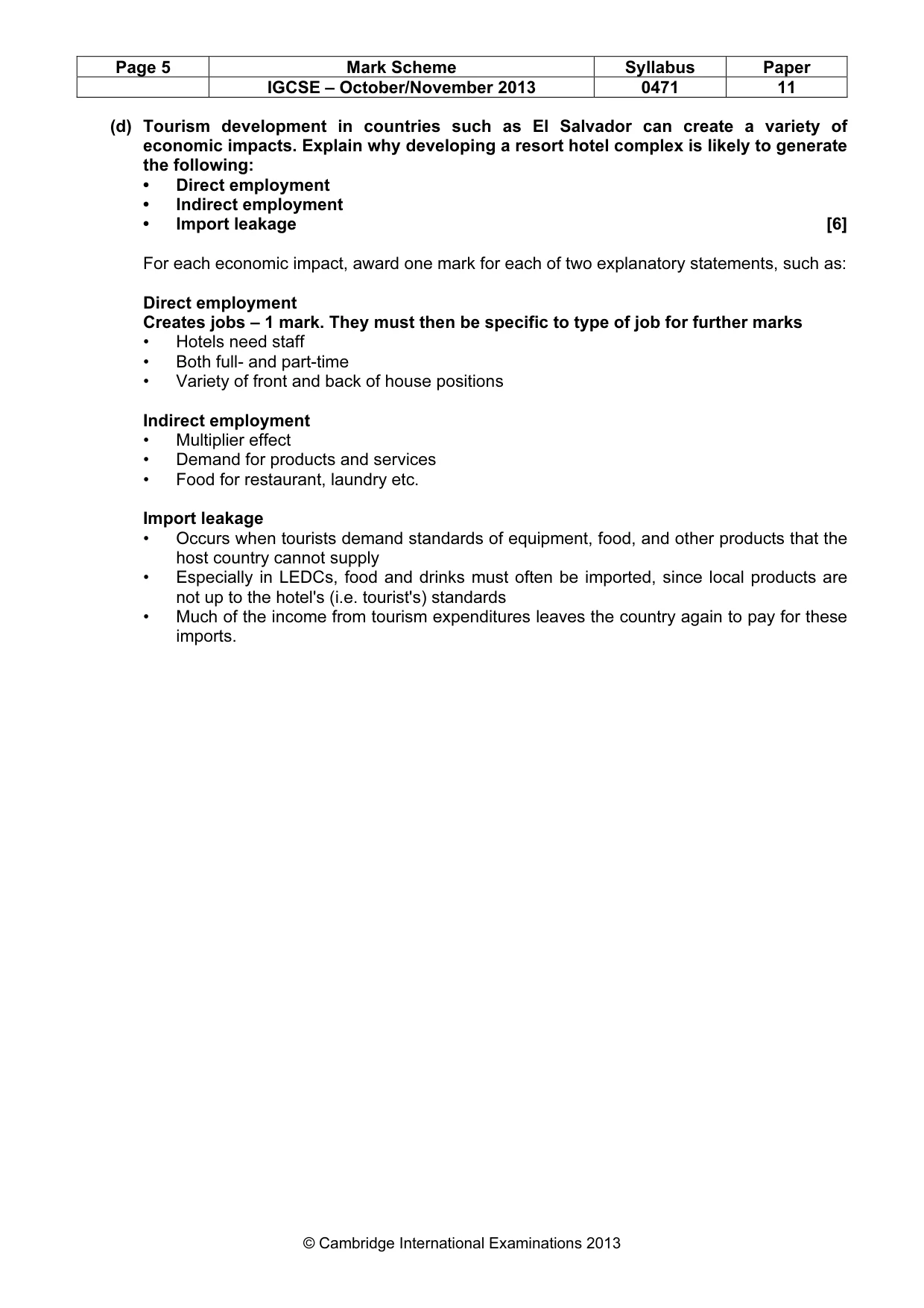
Page 5 Mark Scheme Syllabus Paper IGCSE – October/November 2013 0471 11 © Cambridge International Examinations 2013 (d) Tourism development in countries such as El Salvador can create a variety of economic impacts. Explain why developing a resort hotel complex is likely to generate the following: • Direct employment • Indirect employment • Import leakage [6] For each economic impact, award one mark for each of two explanatory statements, such as: Direct employment Creates jobs – 1 mark. They must then be specific to type of job for further marks • Hotels need staff • Both full- and part-time • Variety of front and back of house positions Indirect employment • Multiplier effect • Demand for products and services • Food for restaurant, laundry etc. Import leakage • Occurs when tourists demand standards of equipment, food, and other products that the host country cannot supply • Especially in LEDCs, food and drinks must often be imported, since local products are not up to the hotel's (i.e. tourist's) standards • Much of the income from tourism expenditures leaves the country again to pay for these imports.
Mark scheme, page 6
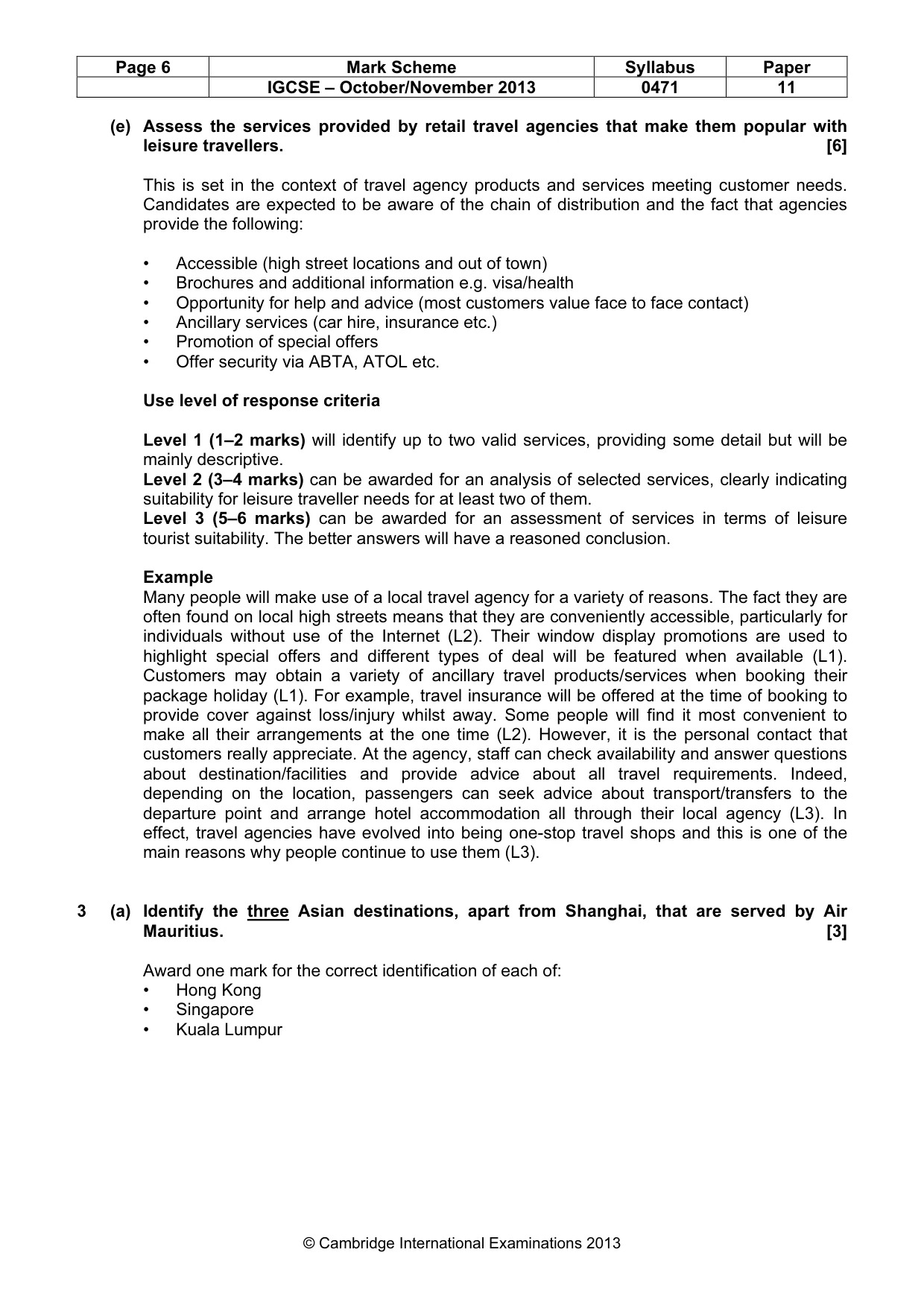
Page 6 Mark Scheme Syllabus Paper IGCSE – October/November 2013 0471 11 © Cambridge International Examinations 2013 (e) Assess the services provided by retail travel agencies that make them popular with leisure travellers. [6] This is set in the context of travel agency products and services meeting customer needs. Candidates are expected to be aware of the chain of distribution and the fact that agencies provide the following: • Accessible (high street locations and out of town) • Brochures and additional information e.g. visa/health • Opportunity for help and advice (most customers value face to face contact) • Ancillary services (car hire, insurance etc.) • Promotion of special offers • Offer security via ABTA, ATOL etc. Use level of response criteria Level 1 (1–2 marks) will identify up to two valid services, providing some detail but will be mainly descriptive. Level 2 (3–4 marks) can be awarded for an analysis of selected services, clearly indicating suitability for leisure traveller needs for at least two of them. Level 3 (5–6 marks) can be awarded for an assessment of services in terms of leisure tourist suitability. The better answers will have a reasoned conclusion. Example Many people will make use of a local travel agency for a variety of reasons. The fact they are often found on local high streets means that they are conveniently accessible, particularly for individuals without use of the Internet (L2). Their window display promotions are used to highlight special offers and different types of deal will be featured when available (L1). Customers may obtain a variety of ancillary travel products/services when booking their package holiday (L1). For example, travel insurance will be offered at the time of booking to provide cover against loss/injury whilst away. Some people will find it most convenient to make all their arrangements at the one time (L2). However, it is the personal contact that customers really appreciate. At the agency, staff can check availability and answer questions about destination/facilities and provide advice about all travel requirements. Indeed, depending on the location, passengers can seek advice about transport/transfers to the departure point and arrange hotel accommodation all through their local agency (L3). In effect, travel agencies have evolved into being one-stop travel shops and this is one of the main reasons why people continue to use them (L3). 3 (a) Identify the three Asian destinations, apart from Shanghai, that are served by Air Mauritius. [3] Award one mark for the correct identification of each of: • Hong Kong • Singapore • Kuala Lumpur
Mark scheme, page 7
Page 7 Mark Scheme Syllabus Paper IGCSE – October/November 2013 0471 11 © Cambridge International Examinations 2013 (b) Air Mauritius operates scheduled air services to many destinations. In the table below circle the four operating characteristics that apply to long haul scheduled air services. [4] Award one mark for the correct identification of each of: • Operate regardless of load • Run to a fixed timetable • Offer flexible ticketing • More than one class of travel (c) With reference to Fig. 3 (Insert), explain two reasons why Air Mauritius is introducing this new service to Shanghai. [6] Award one mark for the identification of each of two valid reasons, as is clearly indicated in Figure 3, and award a second/third mark for an appropriate explanatory contextualisation of each, such as: • China has market potential due to its thriving economy (1) and there is growing demand for outbound tourism (1) and already serving Hong Kong (1) • Tourism generates 10% of Mauritius GDP with Europe supplying 2/3rds of visitors (1). Economic downturn in Europe (1) threatens this and so need to maintain/increase visitor numbers (1). Credit all valid reasoning in context and mark to candidate’s advantage following 1 + 1 + 1 × 2 format. (d) The Mauritius Tourism Promotion Authority (MTPA) was established in 1996 and works in partnership with local organisations to promote Mauritius as a destination overseas. Explain three ways in which the MTPA is likely to promote tourism in Mauritius. [6] Award one mark for the identification of each of three valid ways and award a further one mark for an appropriate explanatory comment about each, such as: • Develop website (1) – worldwide access in use 24/7 (1) • Establish familiarisation trips (1) – host travel agents/journalists to give firsthand experience of the destination (1) • Attend trade fairs (1) – showcase country and destinations and give out information (1) • Media campaigns (1) – advertising via overseas offices to develop key markets (1) • Advertisements/brochures (1) – how/where distributed (1) • Sponsorship (1) – raise awareness (1) Credit all valid reasoning in context, following the 1 + 1 × 3 = 6 format. There must be reference to a worldwide audience
Mark scheme, page 8
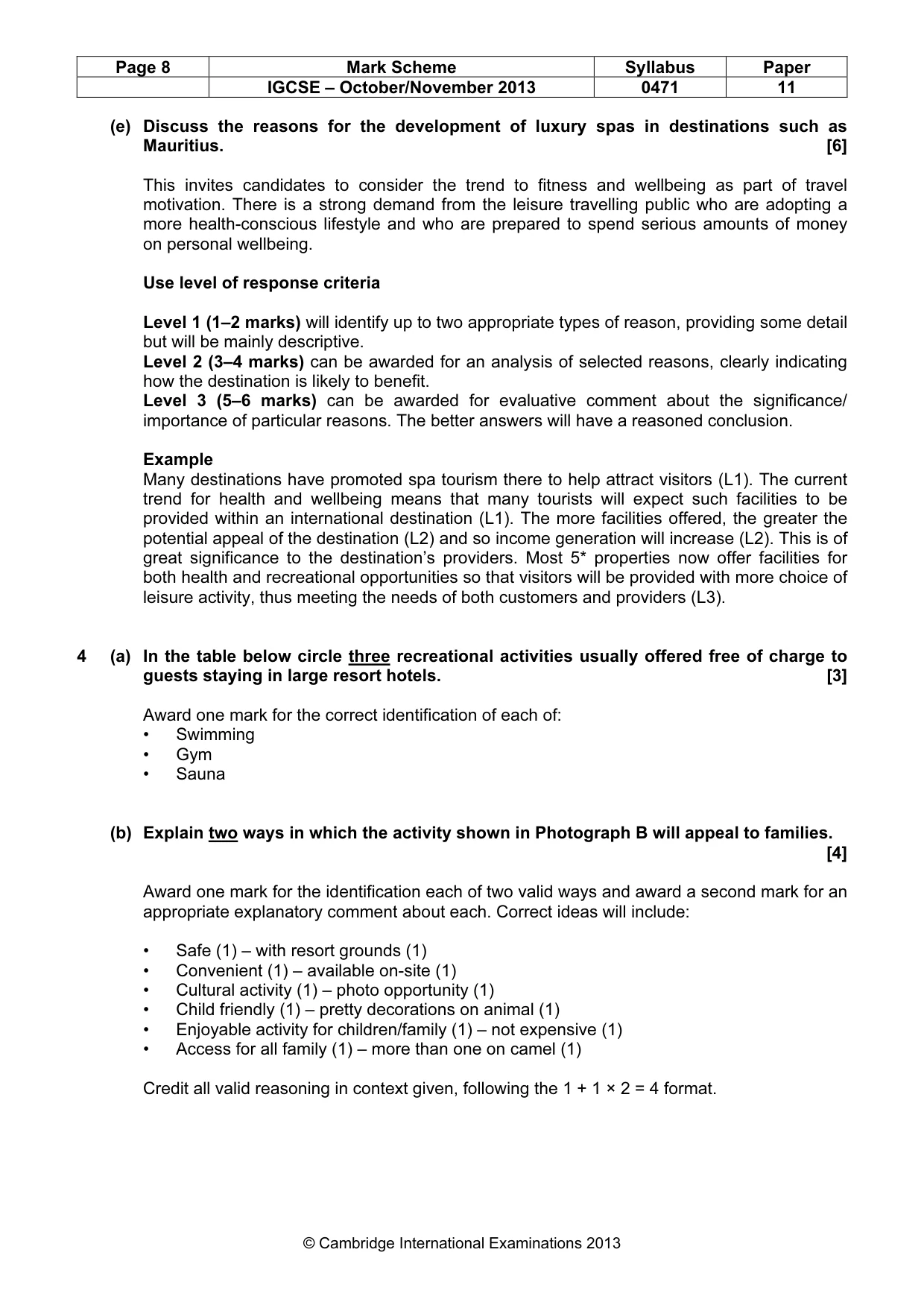
Page 8 Mark Scheme Syllabus Paper IGCSE – October/November 2013 0471 11 © Cambridge International Examinations 2013 (e) Discuss the reasons for the development of luxury spas in destinations such as Mauritius. [6] This invites candidates to consider the trend to fitness and wellbeing as part of travel motivation. There is a strong demand from the leisure travelling public who are adopting a more health-conscious lifestyle and who are prepared to spend serious amounts of money on personal wellbeing. Use level of response criteria Level 1 (1–2 marks) will identify up to two appropriate types of reason, providing some detail but will be mainly descriptive. Level 2 (3–4 marks) can be awarded for an analysis of selected reasons, clearly indicating how the destination is likely to benefit. Level 3 (5–6 marks) can be awarded for evaluative comment about the significance/ importance of particular reasons. The better answers will have a reasoned conclusion. Example Many destinations have promoted spa tourism there to help attract visitors (L1). The current trend for health and wellbeing means that many tourists will expect such facilities to be provided within an international destination (L1). The more facilities offered, the greater the potential appeal of the destination (L2) and so income generation will increase (L2). This is of great significance to the destination’s providers. Most 5* properties now offer facilities for both health and recreational opportunities so that visitors will be provided with more choice of leisure activity, thus meeting the needs of both customers and providers (L3). 4 (a) In the table below circle three recreational activities usually offered free of charge to guests staying in large resort hotels. [3] Award one mark for the correct identification of each of: • Swimming • Gym • Sauna (b) Explain two ways in which the activity shown in Photograph B will appeal to families. [4] Award one mark for the identification each of two valid ways and award a second mark for an appropriate explanatory comment about each. Correct ideas will include: • Safe (1) – with resort grounds (1) • Convenient (1) – available on-site (1) • Cultural activity (1) – photo opportunity (1) • Child friendly (1) – pretty decorations on animal (1) • Enjoyable activity for children/family (1) – not expensive (1) • Access for all family (1) – more than one on camel (1) Credit all valid reasoning in context given, following the 1 + 1 × 2 = 4 format.
Mark scheme, page 9
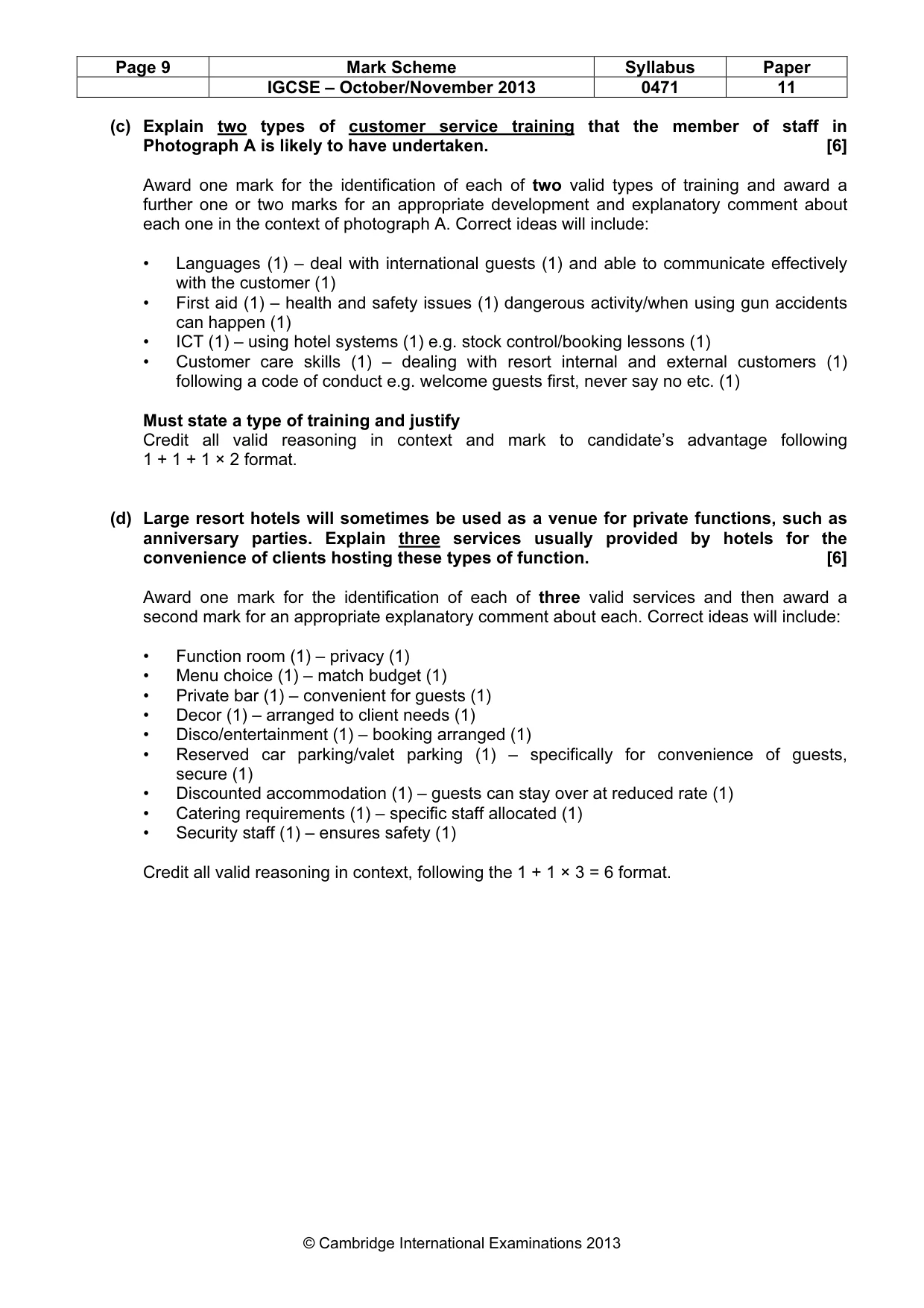
Page 9 Mark Scheme Syllabus Paper IGCSE – October/November 2013 0471 11 © Cambridge International Examinations 2013 (c) Explain two types of customer service training that the member of staff in Photograph A is likely to have undertaken. [6] Award one mark for the identification of each of two valid types of training and award a further one or two marks for an appropriate development and explanatory comment about each one in the context of photograph A. Correct ideas will include: • Languages (1) – deal with international guests (1) and able to communicate effectively with the customer (1) • First aid (1) – health and safety issues (1) dangerous activity/when using gun accidents can happen (1) • ICT (1) – using hotel systems (1) e.g. stock control/booking lessons (1) • Customer care skills (1) – dealing with resort internal and external customers (1) following a code of conduct e.g. welcome guests first, never say no etc. (1) Must state a type of training and justify Credit all valid reasoning in context and mark to candidate’s advantage following 1 + 1 + 1 × 2 format. (d) Large resort hotels will sometimes be used as a venue for private functions, such as anniversary parties. Explain three services usually provided by hotels for the convenience of clients hosting these types of function. [6] Award one mark for the identification of each of three valid services and then award a second mark for an appropriate explanatory comment about each. Correct ideas will include: • Function room (1) – privacy (1) • Menu choice (1) – match budget (1) • Private bar (1) – convenient for guests (1) • Decor (1) – arranged to client needs (1) • Disco/entertainment (1) – booking arranged (1) • Reserved car parking/valet parking (1) – specifically for convenience of guests, secure (1) • Discounted accommodation (1) – guests can stay over at reduced rate (1) • Catering requirements (1) – specific staff allocated (1) • Security staff (1) – ensures safety (1) Credit all valid reasoning in context, following the 1 + 1 × 3 = 6 format.
Mark scheme, page 10
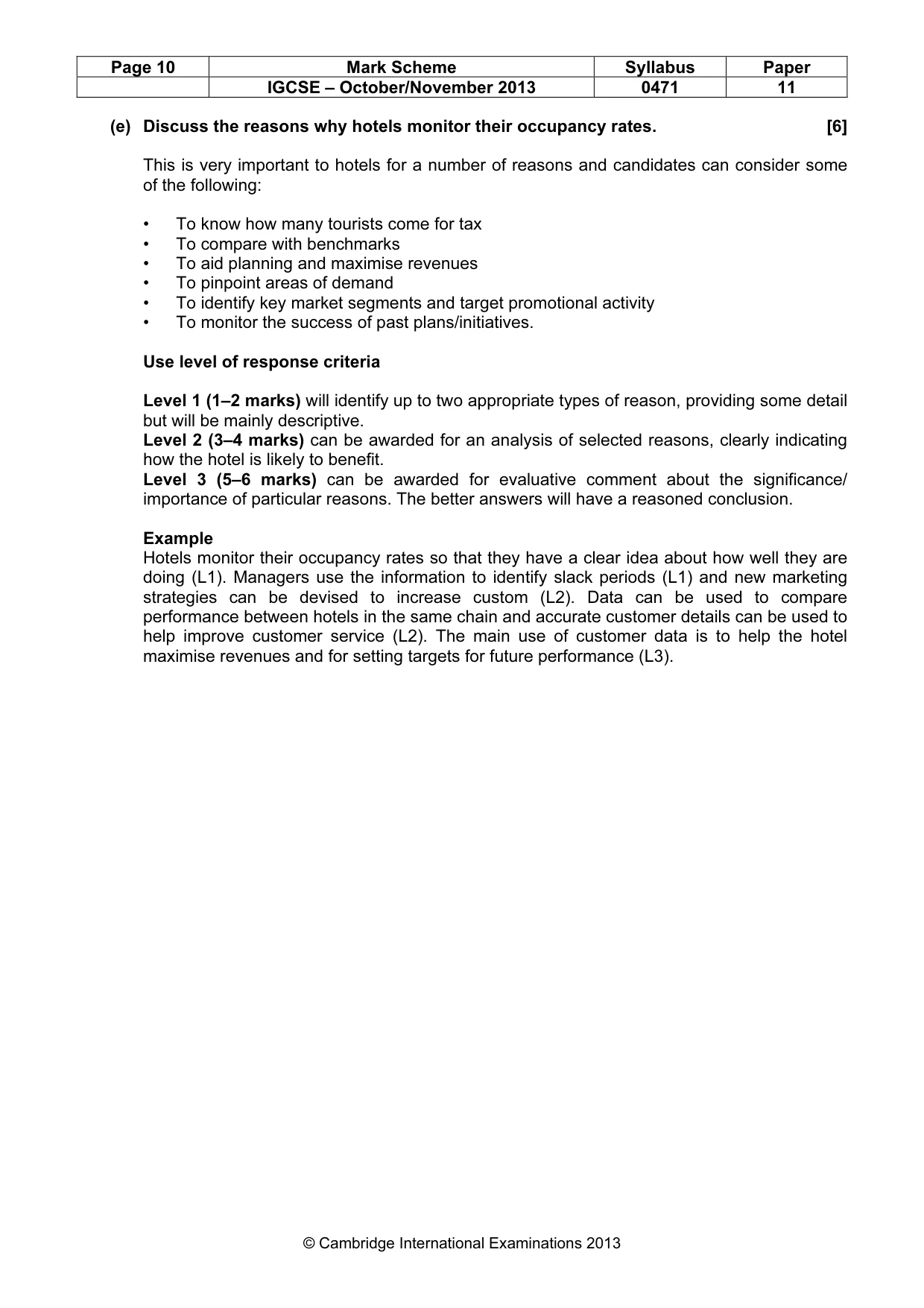
Page 10 Mark Scheme Syllabus Paper IGCSE – October/November 2013 0471 11 © Cambridge International Examinations 2013 (e) Discuss the reasons why hotels monitor their occupancy rates. [6] This is very important to hotels for a number of reasons and candidates can consider some of the following: • To know how many tourists come for tax • To compare with benchmarks • To aid planning and maximise revenues • To pinpoint areas of demand • To identify key market segments and target promotional activity • To monitor the success of past plans/initiatives. Use level of response criteria Level 1 (1–2 marks) will identify up to two appropriate types of reason, providing some detail but will be mainly descriptive. Level 2 (3–4 marks) can be awarded for an analysis of selected reasons, clearly indicating how the hotel is likely to benefit. Level 3 (5–6 marks) can be awarded for evaluative comment about the significance/ importance of particular reasons. The better answers will have a reasoned conclusion. Example Hotels monitor their occupancy rates so that they have a clear idea about how well they are doing (L1). Managers use the information to identify slack periods (L1) and new marketing strategies can be devised to increase custom (L2). Data can be used to compare performance between hotels in the same chain and accurate customer details can be used to help improve customer service (L2). The main use of customer data is to help the hotel maximise revenues and for setting targets for future performance (L3).
What you needed in this session
Cambridge’s own grade thresholds for 2013 Oct/Nov, Paper 1 · Variant 1. A higher threshold means an easier paper — the bar moves with how the cohort did.