Cambridge IGCSE Travel and Tourism 0471 — 2013 Oct/Nov Paper 1 · Variant 3
0471/13/O/N/13 · 100 marks · ≈113 min
The question paper and its mark scheme, free to read here and free to download. This is Cambridge’s own paper, exactly as it was sat.
Question paper16 pages
Mark scheme9 pages
Answers below. Sit the paper first if you are practising.
Paper as text
Question paper, page 1
This document consists of 16 printed pages and 1 Insert. DC (NH) 64680/3 © UCLES 2013 [Turn over UNIVERSITY OF CAMBRIDGE INTERNATIONAL EXAMINATIONS International General Certificate of Secondary Education * 6 2 5 9 7 6 6 8 3 2 * TRAVEL AND TOURISM 0471/13 Core Module October/November 2013 2 hours Candidates answer on the Question Paper. No Additional Materials are required. READ THESE INSTRUCTIONS FIRST Write your Centre number, candidate number and name on all the work you hand in. Write in dark blue or black pen. You may use a soft pencil for any diagrams, graphs or rough working. Do not use staples, paper clips, highlighters, glue or correction fluid. DO NOT WRITE IN ANY BARCODES. Answer all questions. All Figures referred to in the questions are contained in the Insert. The number of marks is given in brackets [ ] at the end of each question or part question. www.XtremePapers.com
Question paper, page 2
2 0471/13/O/N/13 © UCLES 2013 For Examiner’s Use Question 1 Refer to Photographs A, B and C (Insert), taken by leisure tourists visiting three different destinations. (a) Complete the following table to identify the destination in which each photograph was most likely to have been taken. Destination Photograph The Swiss Alps Dubai Kruger National Park, South Africa [3] (b) Fig. 1 (Insert), shows world international tourist arrivals (millions) by region. Describe the increases in international tourist arrivals as shown in Fig. 1 (Insert). … … … … … … … …[4]
Question paper, page 3
3 0471/13/O/N/13 © UCLES 2013 [Turn over For Examiner’s Use (c) Fig. 1 (Insert), shows that destinations in the Middle East, such as Dubai, Abu Dhabi and Doha, are experiencing rapid growth in international tourist arrivals. Explain three negative socio-cultural impacts that can occur in destinations experiencing such rapid growth. 1 … … … … 2 … … … … 3 … … … …[6]
Question paper, page 4
4 0471/13/O/N/13 © UCLES 2013 For Examiner’s Use (d) Explain three ways in which major attractions attempt to improve the visitor experience of foreign tourists. 1 … … … … 2 … … … … 3 … … … …[6]
Question paper, page 5
5 0471/13/O/N/13 © UCLES 2013 [Turn over For Examiner’s Use (e) Many destinations attract a variety of tourists. With reference to one destination with which you are familiar, discuss how different travel and tourism providers meet the needs of budget travellers with limited disposable income. Name of destination … … … … … … … … … … … … …[6] [Total: 25]
Question paper, page 6
6 0471/13/O/N/13 © UCLES 2013 For Examiner’s Use Question 2 Refer to Fig. 2 (Insert), a news item about tourism in the Dominican Republic, a popular tropical destination in the Caribbean. (a) Identify the following: • the percentage increase in visitor numbers between 2010 and 2011 … • the increase in the number of South American visitors in 2011 … • the name of Santo Domingo’s airport … [3] (b) Describe what is meant by the following: • leisure tourism … … … … • ecotourism … … … … [4]
Question paper, page 7
7 0471/13/O/N/13 © UCLES 2013 [Turn over For Examiner’s Use (c) The Punta Cana coastal region is the Dominican Republic’s most popular destination. Explain three negative environmental impacts that frequently occur when coastal areas are developed for tourism. 1 … … … … 2 … … … … 3 … … … …[6]
Question paper, page 8
8 0471/13/O/N/13 © UCLES 2013 For Examiner’s Use (d) Many destinations in the Caribbean act as ports of call for cruise ships. Describe how cruise ship arrivals may benefit the following aspects of the destination: • local businesses … … … … • employment opportunities … … … … • foreign exchange receipts … … … … [6]
Question paper, page 9
9 0471/13/O/N/13 © UCLES 2013 [Turn over For Examiner’s Use (e) Discuss the ways in which modern cruise ships appeal to a variety of passenger types. … … … … … … … … … … … …[6] [Total: 25]
Question paper, page 10
10 0471/13/O/N/13 © UCLES 2013 For Examiner’s Use Question 3 Refer to Fig. 3 (Insert), pictures showing ten different aspects of hotel customer service. (a) Complete the table by stating whether the listed aspects of customer service are likely to involve direct contact with the hotel’s guests: Aspect of hotel customer service picture number Direct guest contact Yes or No? 1 6 8 [3] (b) With reference to Fig. 3 (Insert), identify and explain three ways through which hotel staff are likely to receive training. 1 … … … … 2 … … … … 3 … … … …[6]
Question paper, page 11
11 0471/13/O/N/13 © UCLES 2013 [Turn over For Examiner’s Use (c) Many hotel guests will want to go shopping during their stay. Explain two ways in which hotel staff may be of help to these guests. 1 … … … … 2 … … … …[4] (d) Many destinations have large shopping malls that attract large numbers of visitors. Explain three ways in which large malls have been made accessible to visitors. 1 … … … … 2 … … … … 3 … … … …[6]
Question paper, page 12
12 0471/13/O/N/13 © UCLES 2013 For Examiner’s Use (e) With reference to one destination with which you are familiar, discuss the sightseeing tours that are available to meet the needs of different types of visitor. Name of destination … … … … … … … … … … … … …[6] [Total: 25]
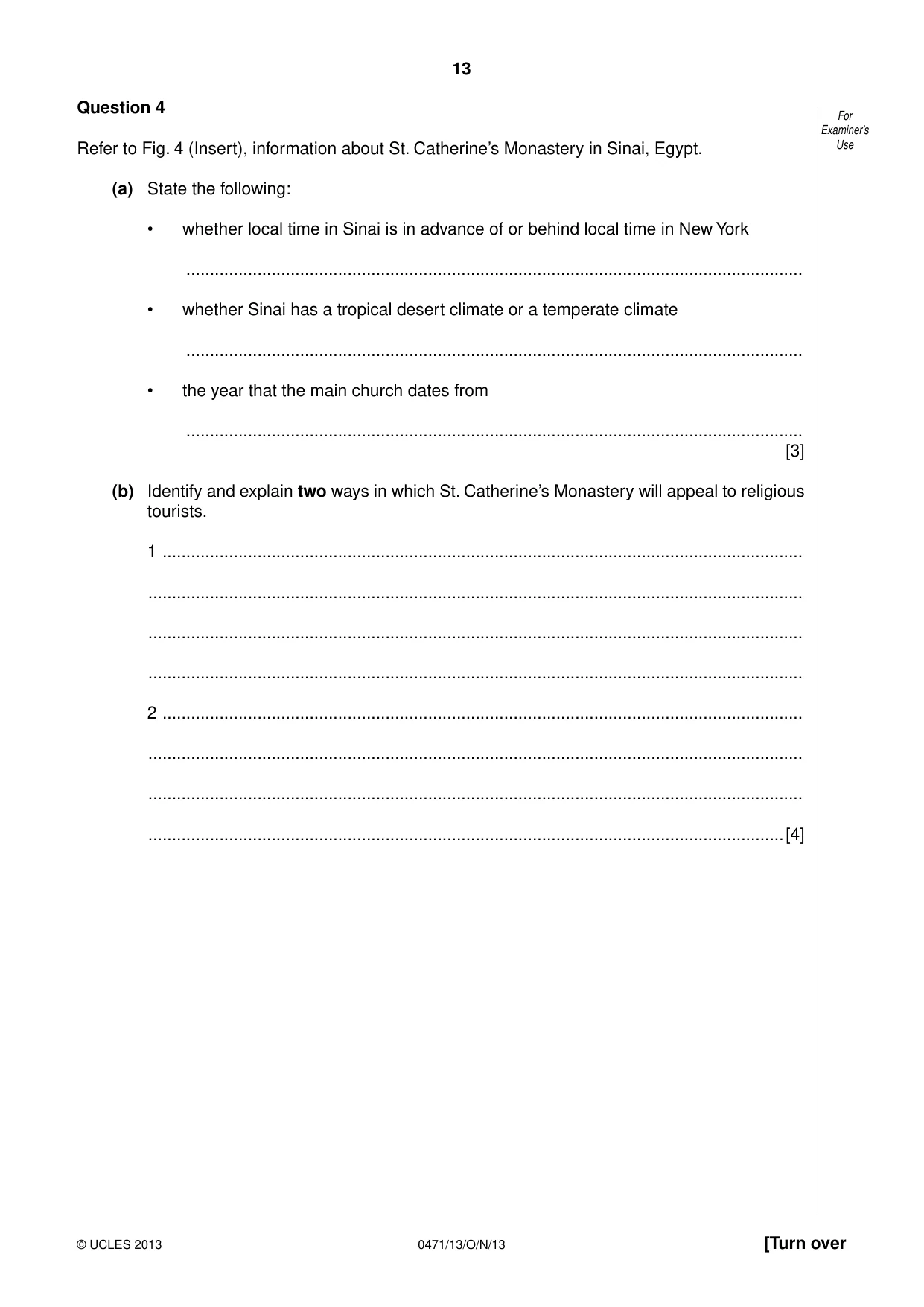
Question paper, page 13
13 0471/13/O/N/13 © UCLES 2013 [Turn over For Examiner’s Use Question 4 Refer to Fig. 4 (Insert), information about St. Catherine’s Monastery in Sinai, Egypt. (a) State the following: • whether local time in Sinai is in advance of or behind local time in New York … • whether Sinai has a tropical desert climate or a temperate climate … • the year that the main church dates from … [3] (b) Identify and explain two ways in which St. Catherine’s Monastery will appeal to religious tourists. 1 … … … … 2 … … … …[4]
Question paper, page 14
14 0471/13/O/N/13 © UCLES 2013 For Examiner’s Use (c) Many visitors to St. Catherine’s Monastery will be leisure tourists taking part in an organised excursion run by a local tour operator. Explain three ways in which local tour operators are likely to promote such excursions to tourists in Egypt. 1 … … … … 2 … … … … 3 … … … …[6]
Question paper, page 15
15 0471/13/O/N/13 © UCLES 2013 [Turn over For Examiner’s Use (d) Many destinations in the Middle East are considered unsafe for foreign tourists. Explain why many governments now advise travellers to do all of the following: • carry a photocopy of the personal details page from your passport at all times … … … … • keep wallets, money and valuables out of sight … … … … • avoid political gatherings and demonstrations … … … … [6]
Question paper, page 16
16 0471/13/O/N/13 © UCLES 2013 For Examiner’s Use (e) Discuss the ways in which visiting tourists might support the traditional culture of a destination. … … … … … … … … … … … …[6] [Total: 25] Permission to reproduce items where third-party owned material protected by copyright is included has been sought and cleared where possible. Every reasonable effort has been made by the publisher (UCLES) to trace copyright holders, but if any items requiring clearance have unwittingly been included, the publisher will be pleased to make amends at the earliest possible opportunity. University of Cambridge International Examinations is part of the Cambridge Assessment Group. Cambridge Assessment is the brand name of University of Cambridge Local Examinations Syndicate (UCLES), which is itself a department of the University of Cambridge.
Mark scheme, page 1
CAMBRIDGE INTERNATIONAL EXAMINATIONS International General Certificate of Secondary Education MARK SCHEME for the October/November 2013 series 0471 TRAVEL AND TOURISM 0471/13 Paper 1 (Written Paper), maximum raw mark 100 This mark scheme is published as an aid to teachers and candidates, to indicate the requirements of the examination. It shows the basis on which Examiners were instructed to award marks. It does not indicate the details of the discussions that took place at an Examiners’ meeting before marking began, which would have considered the acceptability of alternative answers. Mark schemes should be read in conjunction with the question paper and the Principal Examiner Report for Teachers. Cambridge will not enter into discussions about these mark schemes. Cambridge is publishing the mark schemes for the October/November 2013 series for most IGCSE, GCE Advanced Level and Advanced Subsidiary Level components and some Ordinary Level components. www.XtremePapers.com
Mark scheme, page 2
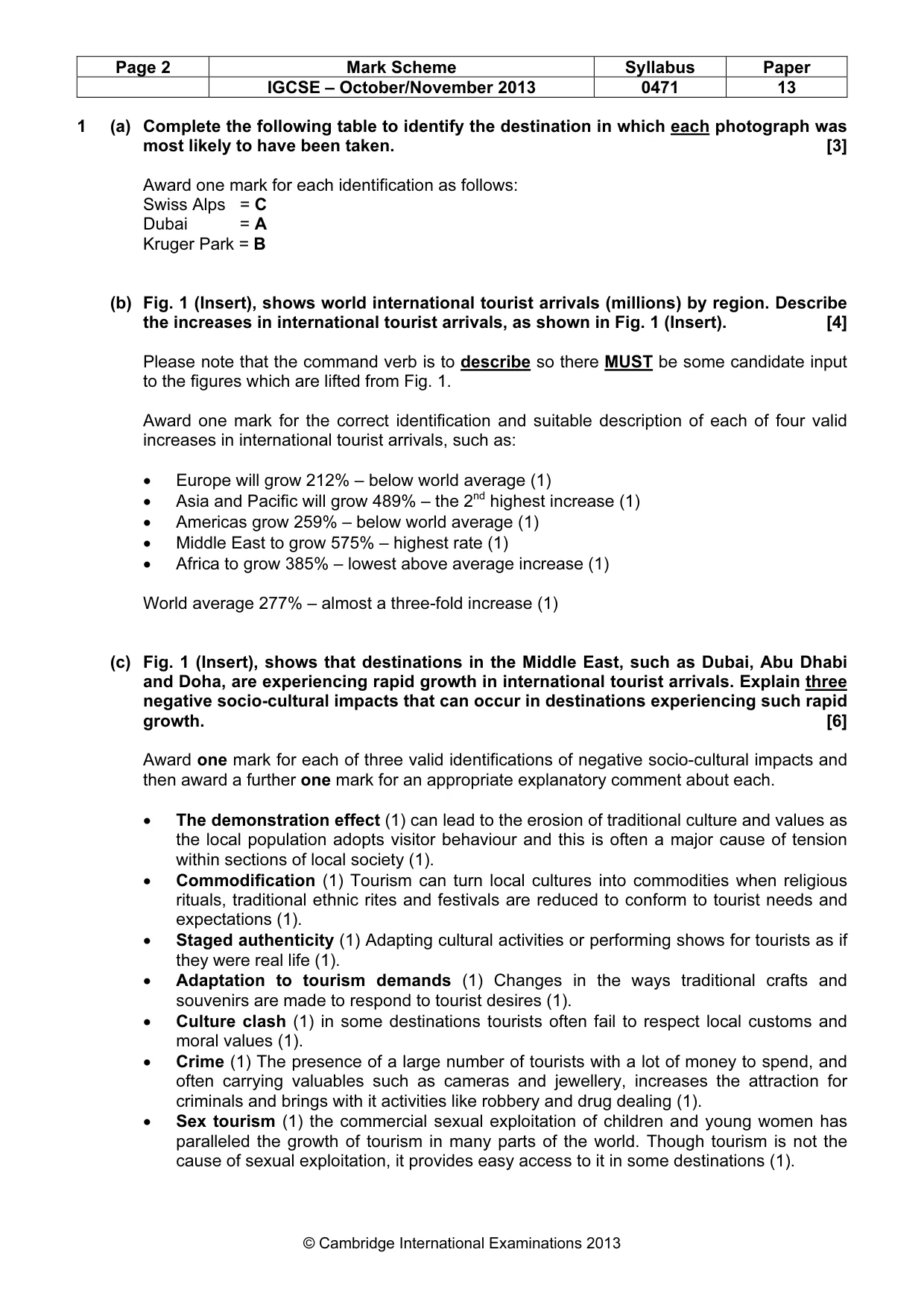
Page 2 Mark Scheme Syllabus Paper IGCSE – October/November 2013 0471 13 © Cambridge International Examinations 2013 1 (a) Complete the following table to identify the destination in which each photograph was most likely to have been taken. [3] Award one mark for each identification as follows: Swiss Alps = C Dubai = A Kruger Park = B (b) Fig. 1 (Insert), shows world international tourist arrivals (millions) by region. Describe the increases in international tourist arrivals, as shown in Fig. 1 (Insert). [4] Please note that the command verb is to describe so there MUST be some candidate input to the figures which are lifted from Fig. 1. Award one mark for the correct identification and suitable description of each of four valid increases in international tourist arrivals, such as: • Europe will grow 212% – below world average (1) • Asia and Pacific will grow 489% – the 2nd highest increase (1) • Americas grow 259% – below world average (1) • Middle East to grow 575% – highest rate (1) • Africa to grow 385% – lowest above average increase (1) World average 277% – almost a three-fold increase (1) (c) Fig. 1 (Insert), shows that destinations in the Middle East, such as Dubai, Abu Dhabi and Doha, are experiencing rapid growth in international tourist arrivals. Explain three negative socio-cultural impacts that can occur in destinations experiencing such rapid growth. [6] Award one mark for each of three valid identifications of negative socio-cultural impacts and then award a further one mark for an appropriate explanatory comment about each. • The demonstration effect (1) can lead to the erosion of traditional culture and values as the local population adopts visitor behaviour and this is often a major cause of tension within sections of local society (1). • Commodification (1) Tourism can turn local cultures into commodities when religious rituals, traditional ethnic rites and festivals are reduced to conform to tourist needs and expectations (1). • Staged authenticity (1) Adapting cultural activities or performing shows for tourists as if they were real life (1). • Adaptation to tourism demands (1) Changes in the ways traditional crafts and souvenirs are made to respond to tourist desires (1). • Culture clash (1) in some destinations tourists often fail to respect local customs and moral values (1). • Crime (1) The presence of a large number of tourists with a lot of money to spend, and often carrying valuables such as cameras and jewellery, increases the attraction for criminals and brings with it activities like robbery and drug dealing (1). • Sex tourism (1) the commercial sexual exploitation of children and young women has paralleled the growth of tourism in many parts of the world. Though tourism is not the cause of sexual exploitation, it provides easy access to it in some destinations (1).
Mark scheme, page 3
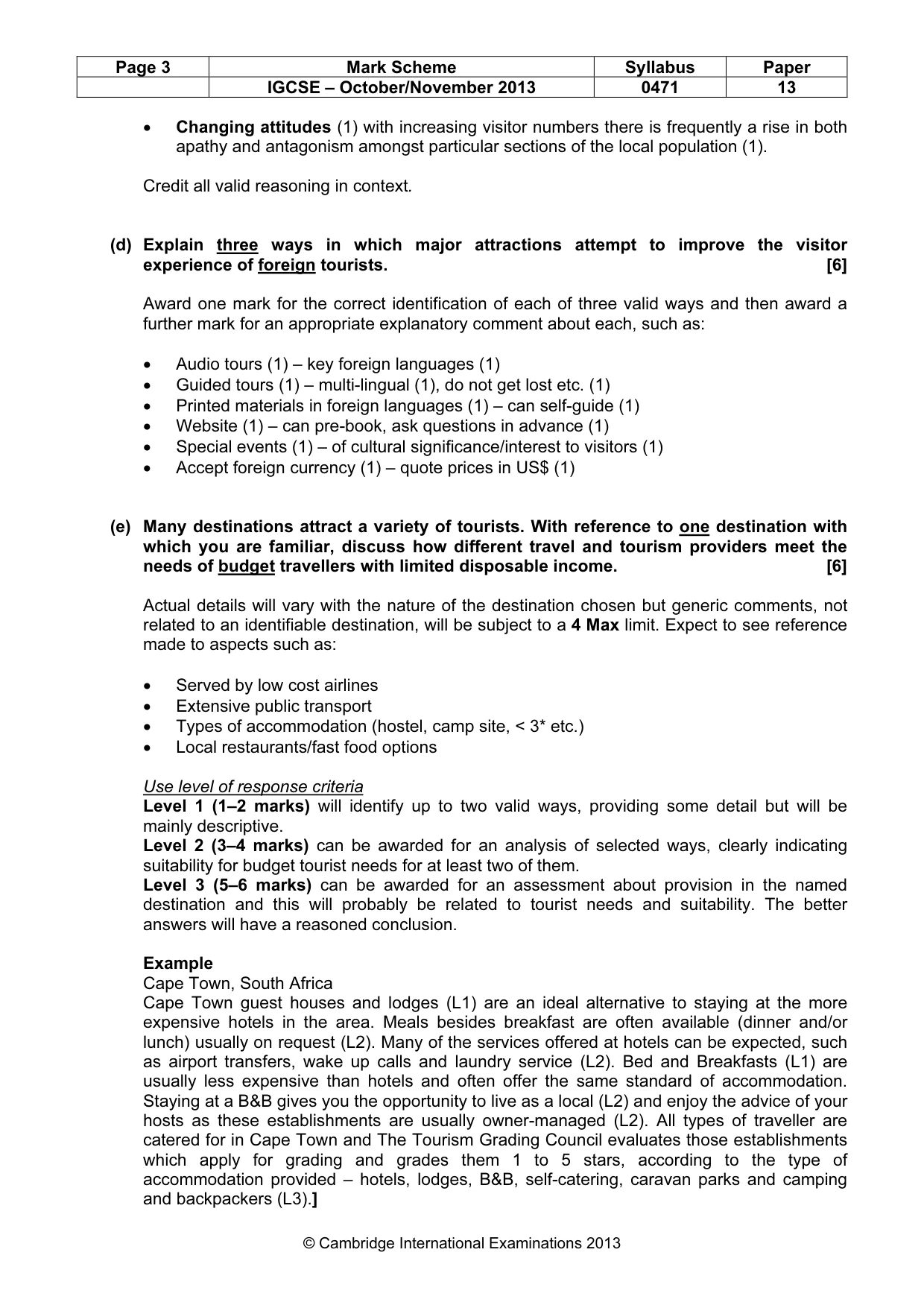
Page 3 Mark Scheme Syllabus Paper IGCSE – October/November 2013 0471 13 © Cambridge International Examinations 2013 • Changing attitudes (1) with increasing visitor numbers there is frequently a rise in both apathy and antagonism amongst particular sections of the local population (1). Credit all valid reasoning in context. (d) Explain three ways in which major attractions attempt to improve the visitor experience of foreign tourists. [6] Award one mark for the correct identification of each of three valid ways and then award a further mark for an appropriate explanatory comment about each, such as: • Audio tours (1) – key foreign languages (1) • Guided tours (1) – multi-lingual (1), do not get lost etc. (1) • Printed materials in foreign languages (1) – can self-guide (1) • Website (1) – can pre-book, ask questions in advance (1) • Special events (1) – of cultural significance/interest to visitors (1) • Accept foreign currency (1) – quote prices in US$ (1) (e) Many destinations attract a variety of tourists. With reference to one destination with which you are familiar, discuss how different travel and tourism providers meet the needs of budget travellers with limited disposable income. [6] Actual details will vary with the nature of the destination chosen but generic comments, not related to an identifiable destination, will be subject to a 4 Max limit. Expect to see reference made to aspects such as: • Served by low cost airlines • Extensive public transport • Types of accommodation (hostel, camp site, < 3* etc.) • Local restaurants/fast food options Use level of response criteria Level 1 (1–2 marks) will identify up to two valid ways, providing some detail but will be mainly descriptive. Level 2 (3–4 marks) can be awarded for an analysis of selected ways, clearly indicating suitability for budget tourist needs for at least two of them. Level 3 (5–6 marks) can be awarded for an assessment about provision in the named destination and this will probably be related to tourist needs and suitability. The better answers will have a reasoned conclusion. Example Cape Town, South Africa Cape Town guest houses and lodges (L1) are an ideal alternative to staying at the more expensive hotels in the area. Meals besides breakfast are often available (dinner and/or lunch) usually on request (L2). Many of the services offered at hotels can be expected, such as airport transfers, wake up calls and laundry service (L2). Bed and Breakfasts (L1) are usually less expensive than hotels and often offer the same standard of accommodation. Staying at a B&B gives you the opportunity to live as a local (L2) and enjoy the advice of your hosts as these establishments are usually owner-managed (L2). All types of traveller are catered for in Cape Town and The Tourism Grading Council evaluates those establishments which apply for grading and grades them 1 to 5 stars, according to the type of accommodation provided – hotels, lodges, B&B, self-catering, caravan parks and camping and backpackers (L3).]
Mark scheme, page 4
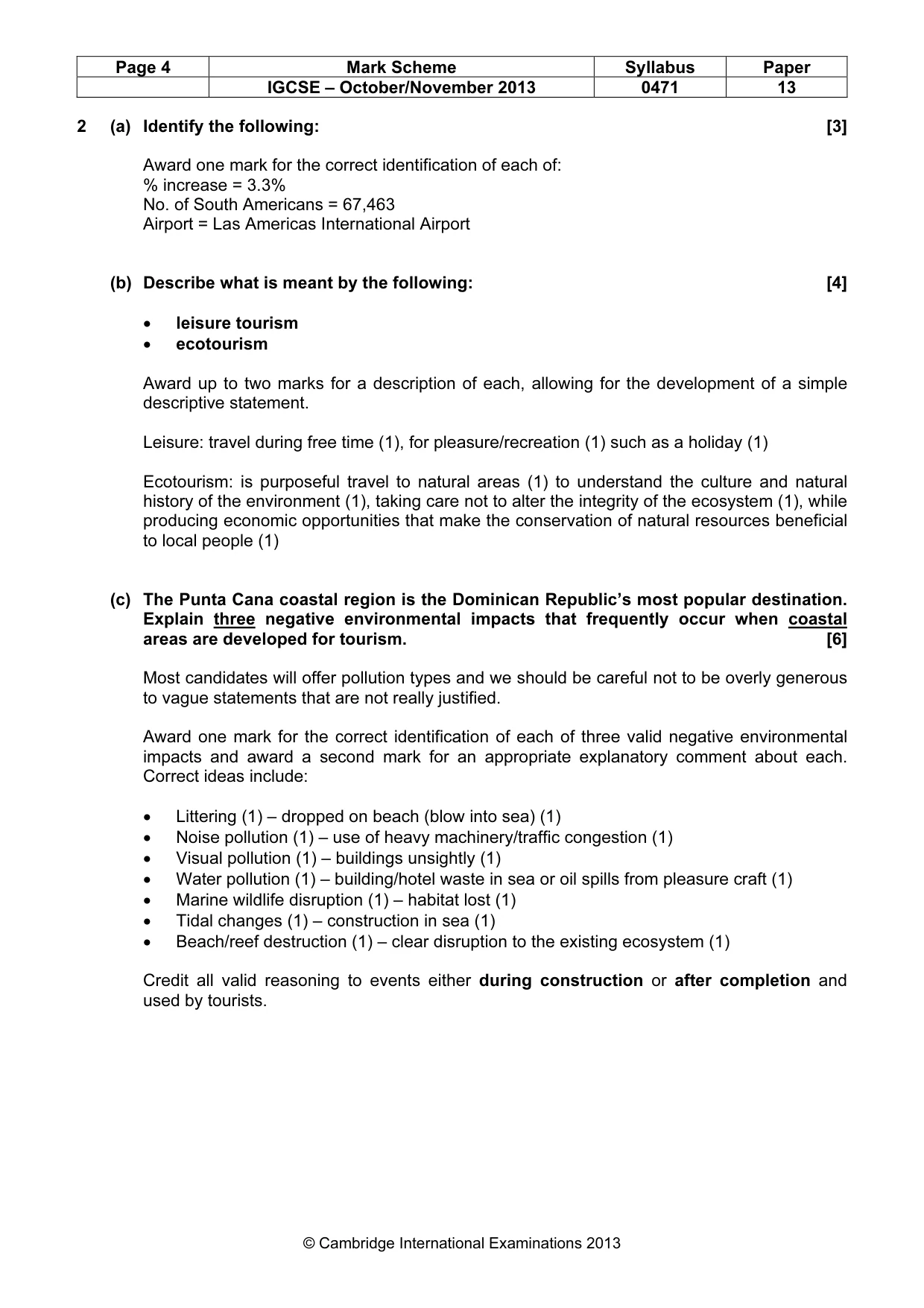
Page 4 Mark Scheme Syllabus Paper IGCSE – October/November 2013 0471 13 © Cambridge International Examinations 2013 2 (a) Identify the following: [3] Award one mark for the correct identification of each of: % increase = 3.3% No. of South Americans = 67,463 Airport = Las Americas International Airport (b) Describe what is meant by the following: [4] • leisure tourism • ecotourism Award up to two marks for a description of each, allowing for the development of a simple descriptive statement. Leisure: travel during free time (1), for pleasure/recreation (1) such as a holiday (1) Ecotourism: is purposeful travel to natural areas (1) to understand the culture and natural history of the environment (1), taking care not to alter the integrity of the ecosystem (1), while producing economic opportunities that make the conservation of natural resources beneficial to local people (1) (c) The Punta Cana coastal region is the Dominican Republic’s most popular destination. Explain three negative environmental impacts that frequently occur when coastal areas are developed for tourism. [6] Most candidates will offer pollution types and we should be careful not to be overly generous to vague statements that are not really justified. Award one mark for the correct identification of each of three valid negative environmental impacts and award a second mark for an appropriate explanatory comment about each. Correct ideas include: • Littering (1) – dropped on beach (blow into sea) (1) • Noise pollution (1) – use of heavy machinery/traffic congestion (1) • Visual pollution (1) – buildings unsightly (1) • Water pollution (1) – building/hotel waste in sea or oil spills from pleasure craft (1) • Marine wildlife disruption (1) – habitat lost (1) • Tidal changes (1) – construction in sea (1) • Beach/reef destruction (1) – clear disruption to the existing ecosystem (1) Credit all valid reasoning to events either during construction or after completion and used by tourists.
Mark scheme, page 5
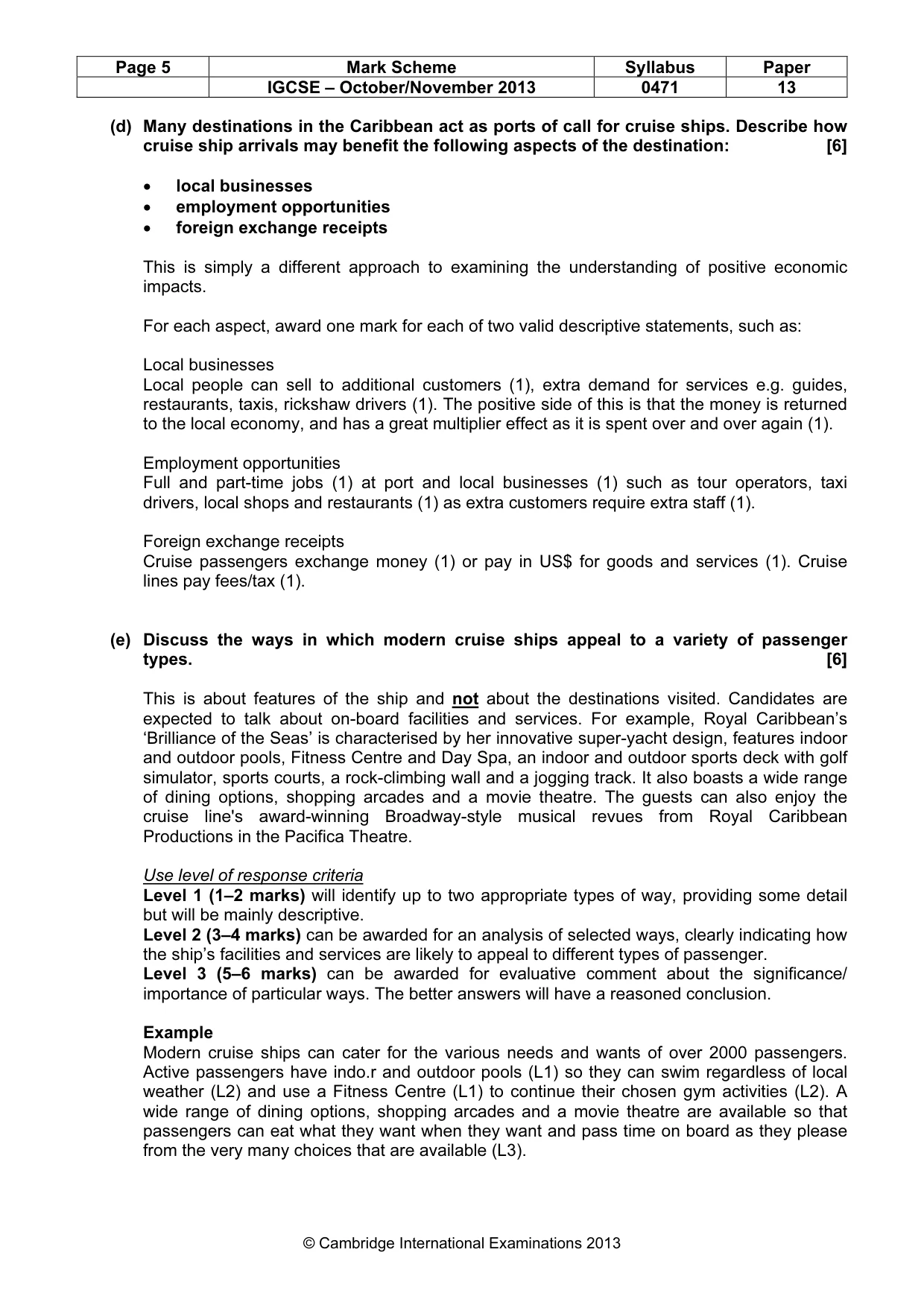
Page 5 Mark Scheme Syllabus Paper IGCSE – October/November 2013 0471 13 © Cambridge International Examinations 2013 (d) Many destinations in the Caribbean act as ports of call for cruise ships. Describe how cruise ship arrivals may benefit the following aspects of the destination: [6] • local businesses • employment opportunities • foreign exchange receipts This is simply a different approach to examining the understanding of positive economic impacts. For each aspect, award one mark for each of two valid descriptive statements, such as: Local businesses Local people can sell to additional customers (1), extra demand for services e.g. guides, restaurants, taxis, rickshaw drivers (1). The positive side of this is that the money is returned to the local economy, and has a great multiplier effect as it is spent over and over again (1). Employment opportunities Full and part-time jobs (1) at port and local businesses (1) such as tour operators, taxi drivers, local shops and restaurants (1) as extra customers require extra staff (1). Foreign exchange receipts Cruise passengers exchange money (1) or pay in US$ for goods and services (1). Cruise lines pay fees/tax (1). (e) Discuss the ways in which modern cruise ships appeal to a variety of passenger types. [6] This is about features of the ship and not about the destinations visited. Candidates are expected to talk about on-board facilities and services. For example, Royal Caribbean’s ‘Brilliance of the Seas’ is characterised by her innovative super-yacht design, features indoor and outdoor pools, Fitness Centre and Day Spa, an indoor and outdoor sports deck with golf simulator, sports courts, a rock-climbing wall and a jogging track. It also boasts a wide range of dining options, shopping arcades and a movie theatre. The guests can also enjoy the cruise line's award-winning Broadway-style musical revues from Royal Caribbean Productions in the Pacifica Theatre. Use level of response criteria Level 1 (1–2 marks) will identify up to two appropriate types of way, providing some detail but will be mainly descriptive. Level 2 (3–4 marks) can be awarded for an analysis of selected ways, clearly indicating how the ship’s facilities and services are likely to appeal to different types of passenger. Level 3 (5–6 marks) can be awarded for evaluative comment about the significance/ importance of particular ways. The better answers will have a reasoned conclusion. Example Modern cruise ships can cater for the various needs and wants of over 2000 passengers. Active passengers have indo.r and outdoor pools (L1) so they can swim regardless of local weather (L2) and use a Fitness Centre (L1) to continue their chosen gym activities (L2). A wide range of dining options, shopping arcades and a movie theatre are available so that passengers can eat what they want when they want and pass time on board as they please from the very many choices that are available (L3).
Mark scheme, page 6
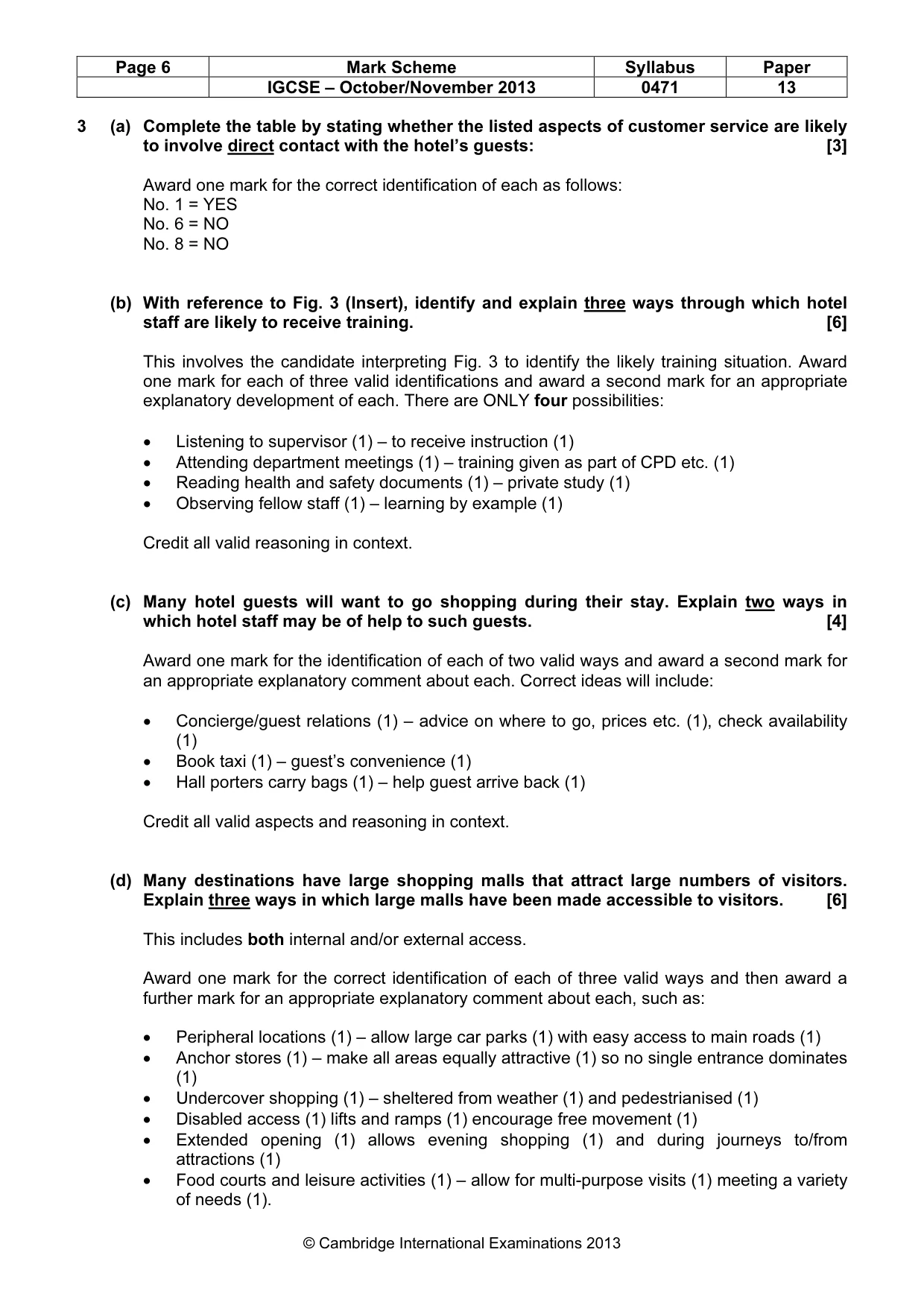
Page 6 Mark Scheme Syllabus Paper IGCSE – October/November 2013 0471 13 © Cambridge International Examinations 2013 3 (a) Complete the table by stating whether the listed aspects of customer service are likely to involve direct contact with the hotel’s guests: [3] Award one mark for the correct identification of each as follows: No. 1 = YES No. 6 = NO No. 8 = NO (b) With reference to Fig. 3 (Insert), identify and explain three ways through which hotel staff are likely to receive training. [6] This involves the candidate interpreting Fig. 3 to identify the likely training situation. Award one mark for each of three valid identifications and award a second mark for an appropriate explanatory development of each. There are ONLY four possibilities: • Listening to supervisor (1) – to receive instruction (1) • Attending department meetings (1) – training given as part of CPD etc. (1) • Reading health and safety documents (1) – private study (1) • Observing fellow staff (1) – learning by example (1) Credit all valid reasoning in context. (c) Many hotel guests will want to go shopping during their stay. Explain two ways in which hotel staff may be of help to such guests. [4] Award one mark for the identification of each of two valid ways and award a second mark for an appropriate explanatory comment about each. Correct ideas will include: • Concierge/guest relations (1) – advice on where to go, prices etc. (1), check availability (1) • Book taxi (1) – guest’s convenience (1) • Hall porters carry bags (1) – help guest arrive back (1) Credit all valid aspects and reasoning in context. (d) Many destinations have large shopping malls that attract large numbers of visitors. Explain three ways in which large malls have been made accessible to visitors. [6] This includes both internal and/or external access. Award one mark for the correct identification of each of three valid ways and then award a further mark for an appropriate explanatory comment about each, such as: • Peripheral locations (1) – allow large car parks (1) with easy access to main roads (1) • Anchor stores (1) – make all areas equally attractive (1) so no single entrance dominates (1) • Undercover shopping (1) – sheltered from weather (1) and pedestrianised (1) • Disabled access (1) lifts and ramps (1) encourage free movement (1) • Extended opening (1) allows evening shopping (1) and during journeys to/from attractions (1) • Food courts and leisure activities (1) – allow for multi-purpose visits (1) meeting a variety of needs (1).
Mark scheme, page 7
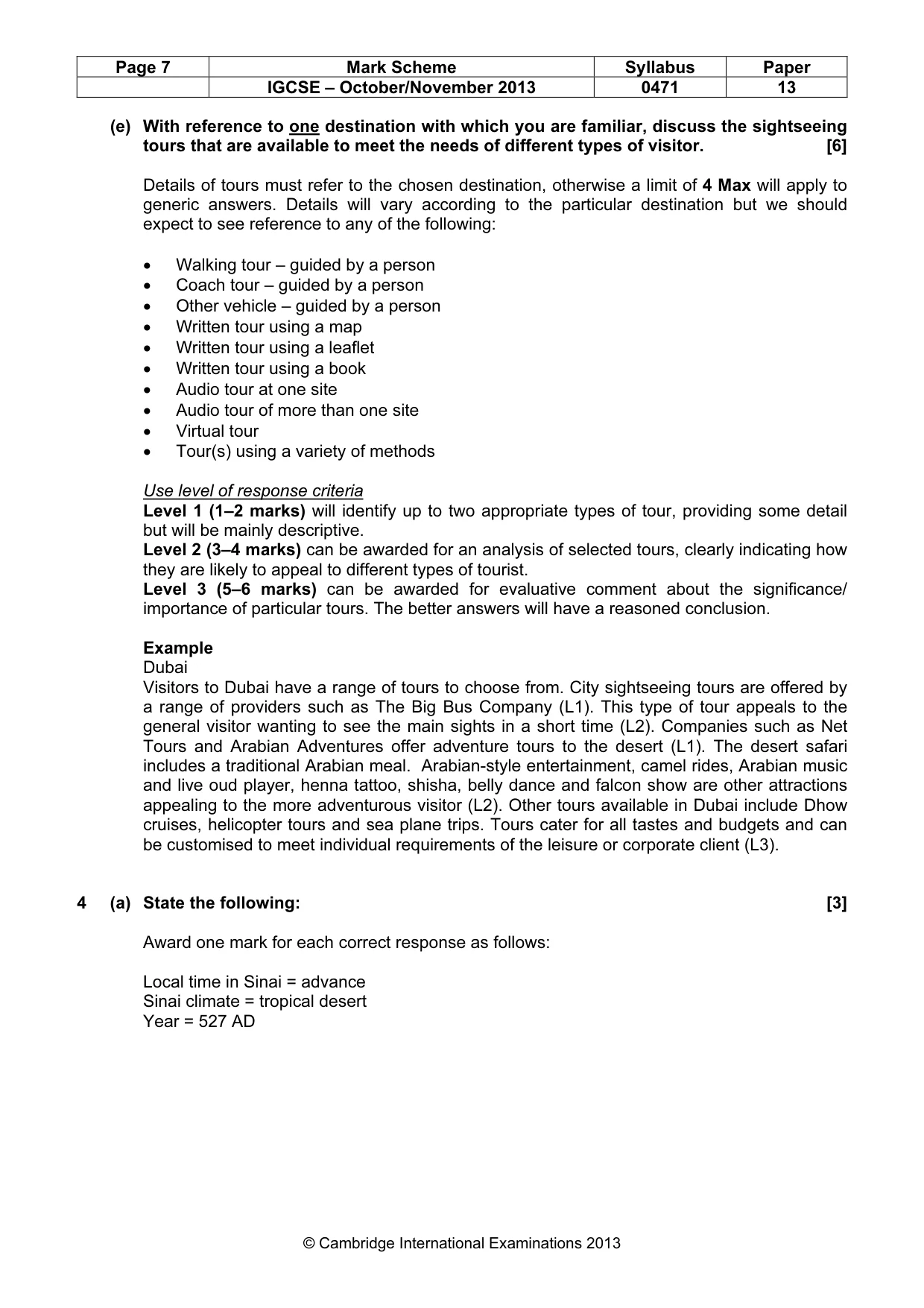
Page 7 Mark Scheme Syllabus Paper IGCSE – October/November 2013 0471 13 © Cambridge International Examinations 2013 (e) With reference to one destination with which you are familiar, discuss the sightseeing tours that are available to meet the needs of different types of visitor. [6] Details of tours must refer to the chosen destination, otherwise a limit of 4 Max will apply to generic answers. Details will vary according to the particular destination but we should expect to see reference to any of the following: • Walking tour – guided by a person • Coach tour – guided by a person • Other vehicle – guided by a person • Written tour using a map • Written tour using a leaflet • Written tour using a book • Audio tour at one site • Audio tour of more than one site • Virtual tour • Tour(s) using a variety of methods Use level of response criteria Level 1 (1–2 marks) will identify up to two appropriate types of tour, providing some detail but will be mainly descriptive. Level 2 (3–4 marks) can be awarded for an analysis of selected tours, clearly indicating how they are likely to appeal to different types of tourist. Level 3 (5–6 marks) can be awarded for evaluative comment about the significance/ importance of particular tours. The better answers will have a reasoned conclusion. Example Dubai Visitors to Dubai have a range of tours to choose from. City sightseeing tours are offered by a range of providers such as The Big Bus Company (L1). This type of tour appeals to the general visitor wanting to see the main sights in a short time (L2). Companies such as Net Tours and Arabian Adventures offer adventure tours to the desert (L1). The desert safari includes a traditional Arabian meal. Arabian-style entertainment, camel rides, Arabian music and live oud player, henna tattoo, shisha, belly dance and falcon show are other attractions appealing to the more adventurous visitor (L2). Other tours available in Dubai include Dhow cruises, helicopter tours and sea plane trips. Tours cater for all tastes and budgets and can be customised to meet individual requirements of the leisure or corporate client (L3). 4 (a) State the following: [3] Award one mark for each correct response as follows: Local time in Sinai = advance Sinai climate = tropical desert Year = 527 AD
Mark scheme, page 8
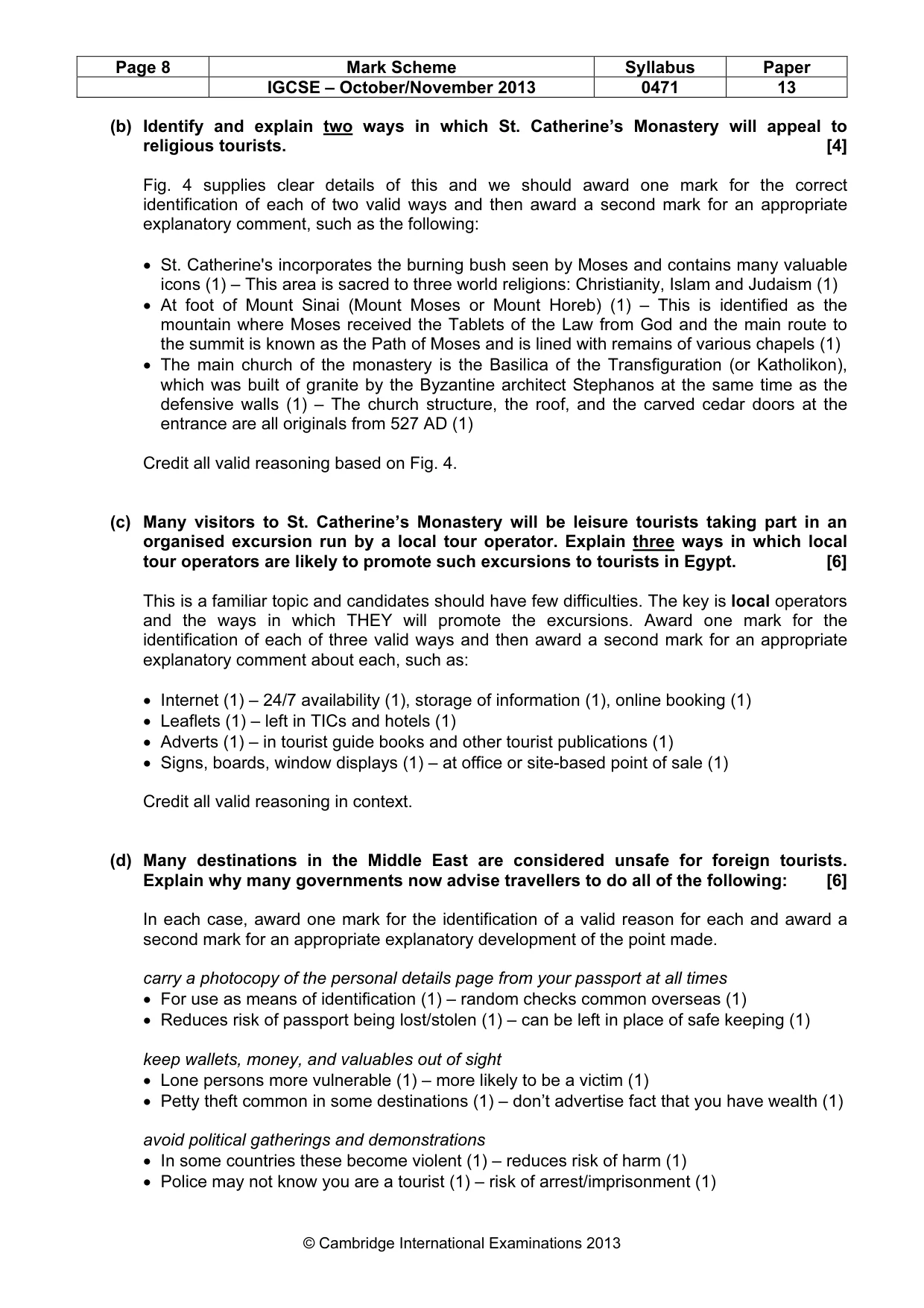
Page 8 Mark Scheme Syllabus Paper IGCSE – October/November 2013 0471 13 © Cambridge International Examinations 2013 (b) Identify and explain two ways in which St. Catherine’s Monastery will appeal to religious tourists. [4] Fig. 4 supplies clear details of this and we should award one mark for the correct identification of each of two valid ways and then award a second mark for an appropriate explanatory comment, such as the following: • St. Catherine's incorporates the burning bush seen by Moses and contains many valuable icons (1) – This area is sacred to three world religions: Christianity, Islam and Judaism (1) • At foot of Mount Sinai (Mount Moses or Mount Horeb) (1) – This is identified as the mountain where Moses received the Tablets of the Law from God and the main route to the summit is known as the Path of Moses and is lined with remains of various chapels (1) • The main church of the monastery is the Basilica of the Transfiguration (or Katholikon), which was built of granite by the Byzantine architect Stephanos at the same time as the defensive walls (1) – The church structure, the roof, and the carved cedar doors at the entrance are all originals from 527 AD (1) Credit all valid reasoning based on Fig. 4. (c) Many visitors to St. Catherine’s Monastery will be leisure tourists taking part in an organised excursion run by a local tour operator. Explain three ways in which local tour operators are likely to promote such excursions to tourists in Egypt. [6] This is a familiar topic and candidates should have few difficulties. The key is local operators and the ways in which THEY will promote the excursions. Award one mark for the identification of each of three valid ways and then award a second mark for an appropriate explanatory comment about each, such as: • Internet (1) – 24/7 availability (1), storage of information (1), online booking (1) • Leaflets (1) – left in TICs and hotels (1) • Adverts (1) – in tourist guide books and other tourist publications (1) • Signs, boards, window displays (1) – at office or site-based point of sale (1) Credit all valid reasoning in context. (d) Many destinations in the Middle East are considered unsafe for foreign tourists. Explain why many governments now advise travellers to do all of the following: [6] In each case, award one mark for the identification of a valid reason for each and award a second mark for an appropriate explanatory development of the point made. carry a photocopy of the personal details page from your passport at all times • For use as means of identification (1) – random checks common overseas (1) • Reduces risk of passport being lost/stolen (1) – can be left in place of safe keeping (1) keep wallets, money, and valuables out of sight • Lone persons more vulnerable (1) – more likely to be a victim (1) • Petty theft common in some destinations (1) – don’t advertise fact that you have wealth (1) avoid political gatherings and demonstrations • In some countries these become violent (1) – reduces risk of harm (1) • Police may not know you are a tourist (1) – risk of arrest/imprisonment (1)
Mark scheme, page 9
Page 9 Mark Scheme Syllabus Paper IGCSE – October/November 2013 0471 13 © Cambridge International Examinations 2013 (e) Discuss the ways in which visiting tourists might support the traditional culture of a destination. [6] Tourism can boost the preservation and transmission of cultural and historical traditions, and a renaissance of indigenous cultures, cultural arts and crafts. Candidates can validly consider any of these aspects without restriction. Use level of response criteria Level 1 (1–2 marks) will identify up to two appropriate types of cultural activity, providing some detail but will be mainly descriptive. Level 2 (3–4 marks) can be awarded for an analysis of selected ways, clearly indicating how they are likely to appeal to different types of tourist. Level 3 (5–6 marks) can be awarded for evaluative comment about the significance/ importance of particular cultural aspects. The better answers will have a reasoned conclusion. Example New Zealand’s Maori tourism experience Tourists visiting New Zealand have many opportunities to experience Maori cultural tourism. This ranges from the teaching of woodcraft, woodcarving demonstrations and the sale of art and craftwork to visting cultural and historic sites (L1). Many destinations offer an interpretation of Maori history via information boards, visitor centre displays, cultural displays and Maori language sessions (L1). To meet demand several towns and cities have reconstructed Maori villages where it is possible to see how they once lived but also to share in ceremonies and culture that continue today (L2). The national museum in the capital city, Wellington, is Te Papa Tongarewa, meaning ‘Our Place’ and is one of the largest national museums in the world. It houses the national art collection as well as many Maori artefacts and treasures (L2). In Christchurch the Maori tourist attraction, Ko Tane, is linked to a wildlife reserve to widen participation and understanding of today’s resources (L3). The Ko Tane Living Maori Village at Willowbank Wildlife Reserve, Christchurch, is where Maori culture and conservation meet to give visitors a unique glimpse into the way of life of the South Island Ngai Tahu Maori people before the arrival of the Europeans (L3).
What you needed in this session
Cambridge’s own grade thresholds for 2013 Oct/Nov, Paper 1 · Variant 3. A higher threshold means an easier paper — the bar moves with how the cohort did.