Cambridge IGCSE Sciences - Co-ordinated (Double) 0654 — 2017 May/June Paper 5 · Variant 1
0654/51/M/J/17 · 3 questions · 45 marks · ≈51 min
The question paper and its mark scheme, free to read here and free to download. This is Cambridge’s own paper, exactly as it was sat.
Question paper12 pages


Mark scheme5 pages
Answers below. Sit the paper first if you are practising.
Questions as text
Q1 · You are going to investigate the nutrient content of banana, chickpea and egg white
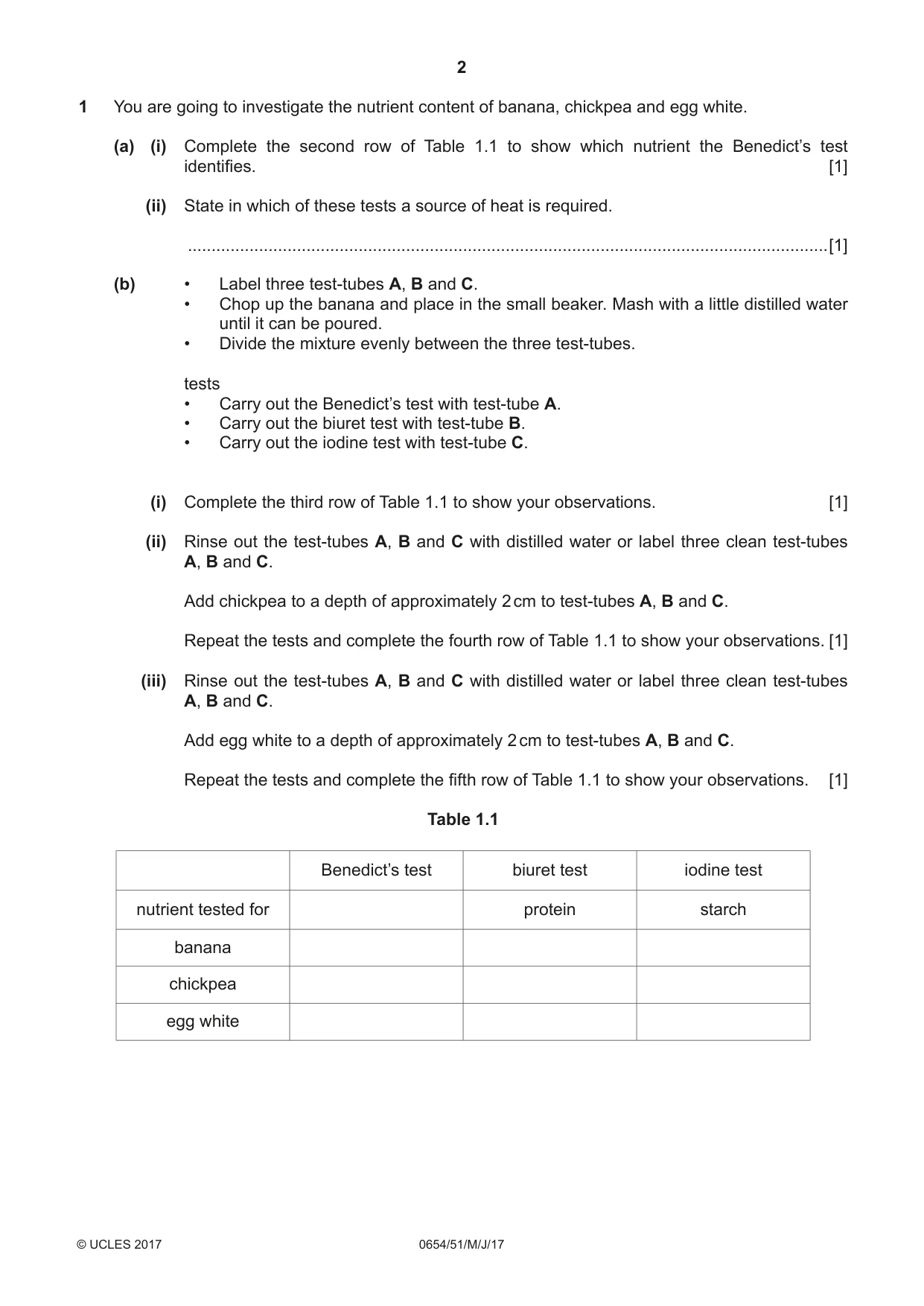
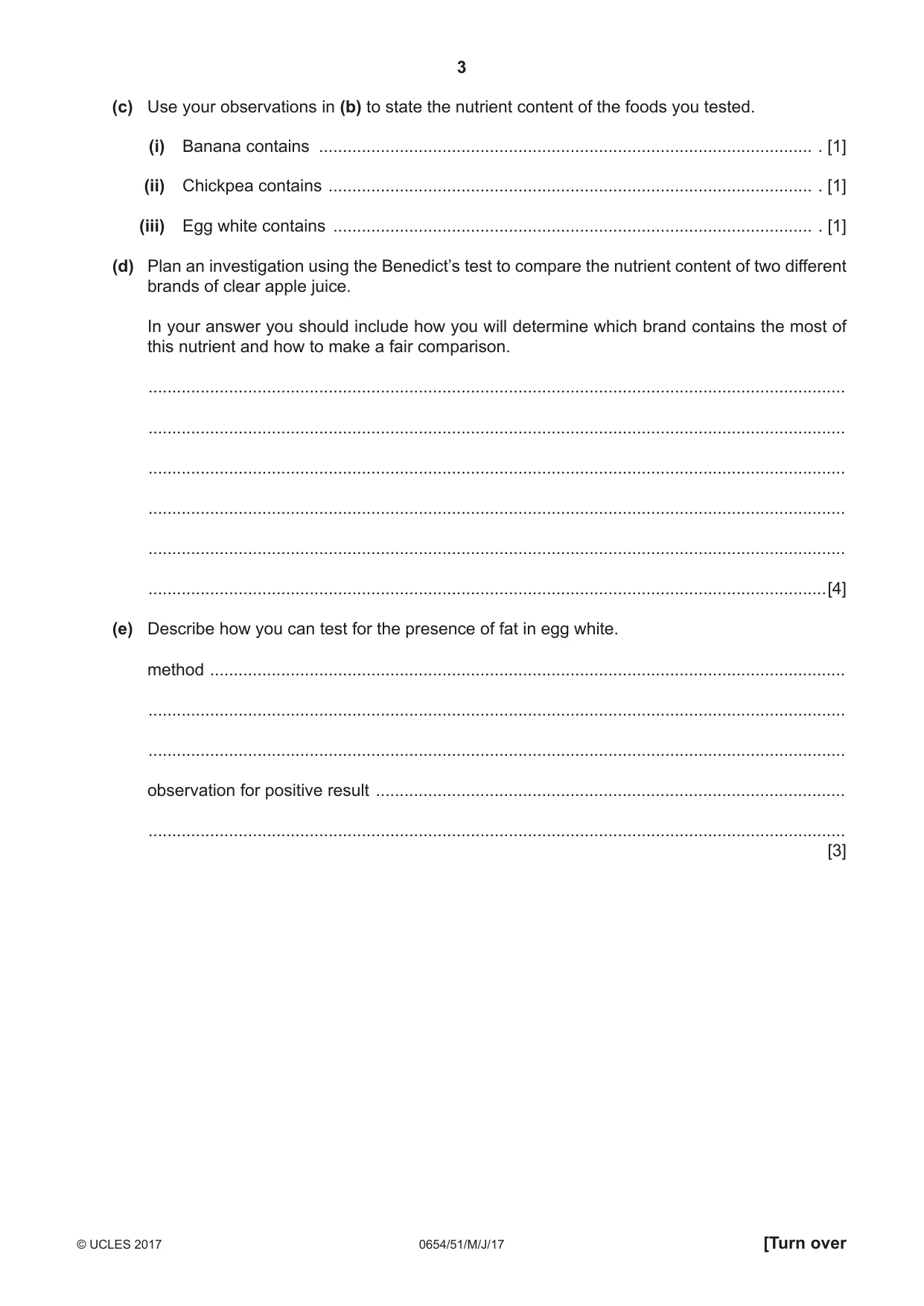
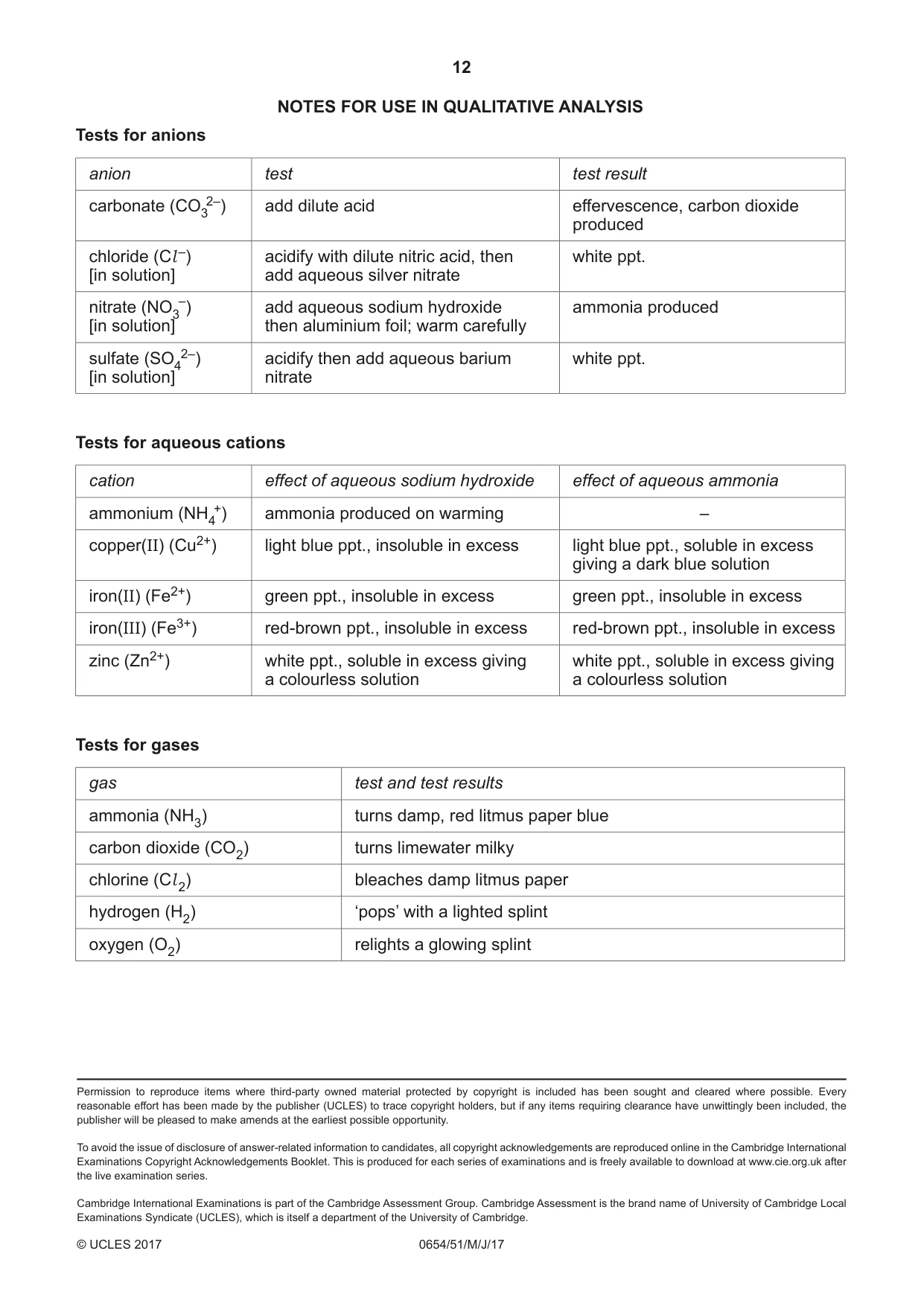
1 You are going to investigate the nutrient content of banana, chickpea and egg white. (a) (i) Complete the second row of Table 1.1 to show which nutrient the Benedict’s test identifies. [1] (ii) State in which of these tests a source of heat is required. .......................................................................................................................................[1] (b) • Label three test-tubes A, B and C. • Chop up the banana and place in the small beaker. Mash with a little distilled water until it can be poured. • Divide the mixture evenly between the three test-tubes. tests • Carry out the Benedict’s test with test-tube A. • Carry out the biuret test with test-tube B. • Carry out the iodine test with test-tube C. (i) Complete the third row of Table 1.1 to show your observations. [1] (ii) Rinse out the test-tubes A, B and C with distilled water or label three clean test-tubes A, B and C. Add chickpea to a depth of approximately 2 cm to test-tubes A, B and C. Repeat the tests and complete the fourth row of Table 1.1 to show your observations. [1] (iii) Rinse out the test-tubes A, B and C with distilled water or label three clean test-tubes A, B and C. Add egg white to a depth of approximately 2 cm to test-tubes A, B and C. Repeat the tests and complete the fifth row of Table 1.1 to show your observations. [1] Table 1.1 Benedict’s test biuret test iodine test nutrient tested for protein starch banana chickpea egg white (c) Use your observations in (b) to state the nutrient content of the foods you tested. (i) Banana contains ........................................................................................................ . [1] (ii) Chickpea contains ...................................................................................................... . [1] (iii) Egg white contains ..................................................................................................... . [1] (d) Plan an investigation using the Benedict’s test to compare the nutrient content of two different brands of clear apple juice. In your answer you should include how you will determine which brand contains the most of this nutrient and how to make a fair comparison. ................................................................................................................................................... ................................................................................................................................................... ................................................................................................................................................... ................................................................................................................................................... ................................................................................................................................................... ...............................................................................................................................................[4] (e) Describe how you can test for the presence of fat in egg white. method ...................................................................................................................................... ................................................................................................................................................... ................................................................................................................................................... observation for positive result ................................................................................................... ................................................................................................................................................... [3]
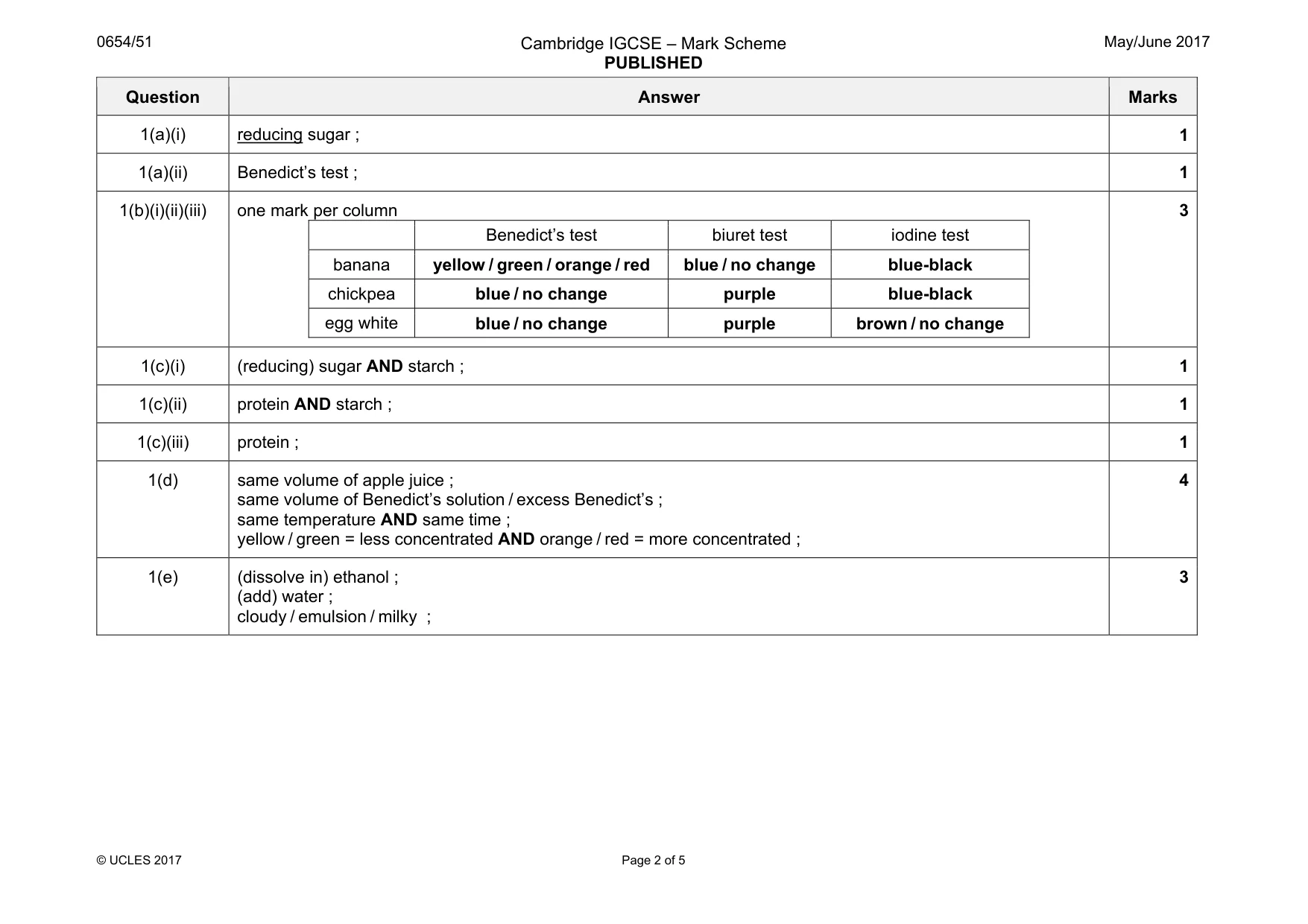
Mark scheme: 1(a)(i) reducing sugar ; 1 1(a)(ii) Benedict’s test ; 1 1(b)(i)(ii)(iii) one mark per column Benedict’s test biuret test iodine test banana yellow / green / orange / red blue / no change blue-black chickpea blue / no change purple blue-black egg white blue / no change purple brown / no change 3 1(c)(i) (reducing) sugar AND starch ; 1 1(c)(ii) protein AND starch ; 1 1(c)(iii) protein ; 1 1(d) same volume of apple juice ; same volume of Benedict’s solution / excess Benedict’s ; same temperature AND same time ; yellow / green = less concentrated AND orange / red = more concentrated ; 4 1(e) (dissolve in) ethanol ; (add) water ; cloudy / emulsion / milky ; 3
Q2 · Notes for Use in Qualitative Analysis for this question are printed on page 12
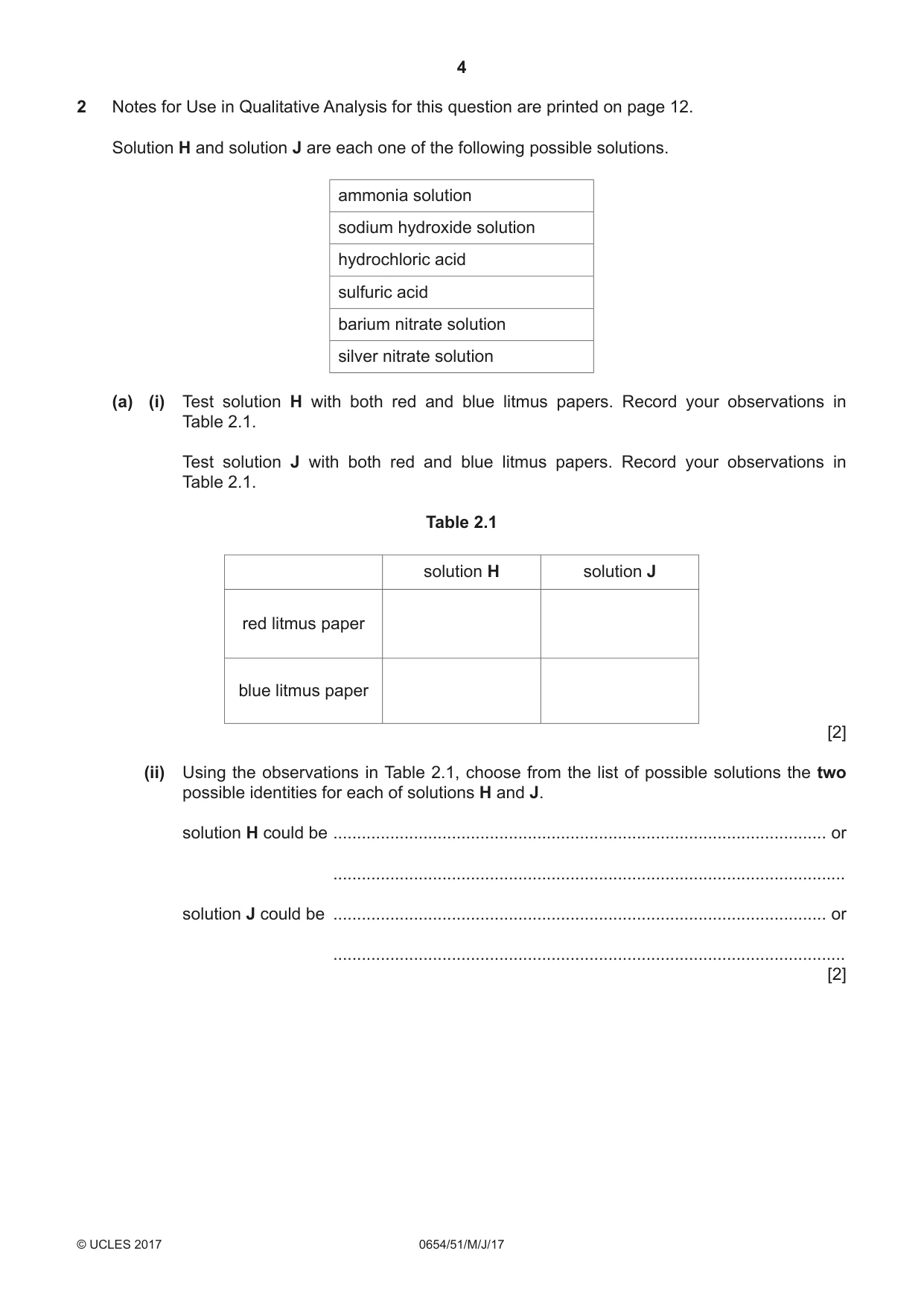
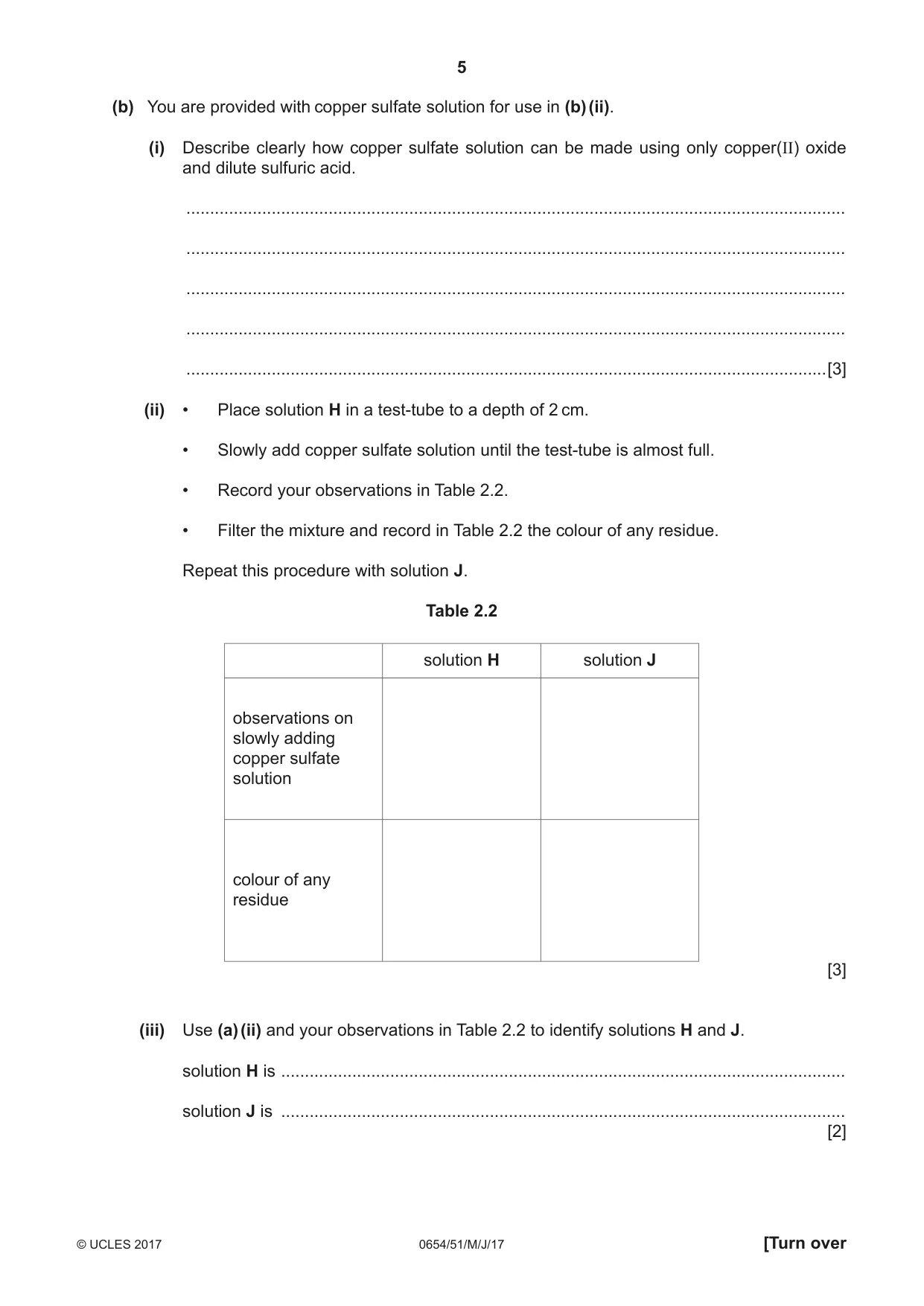
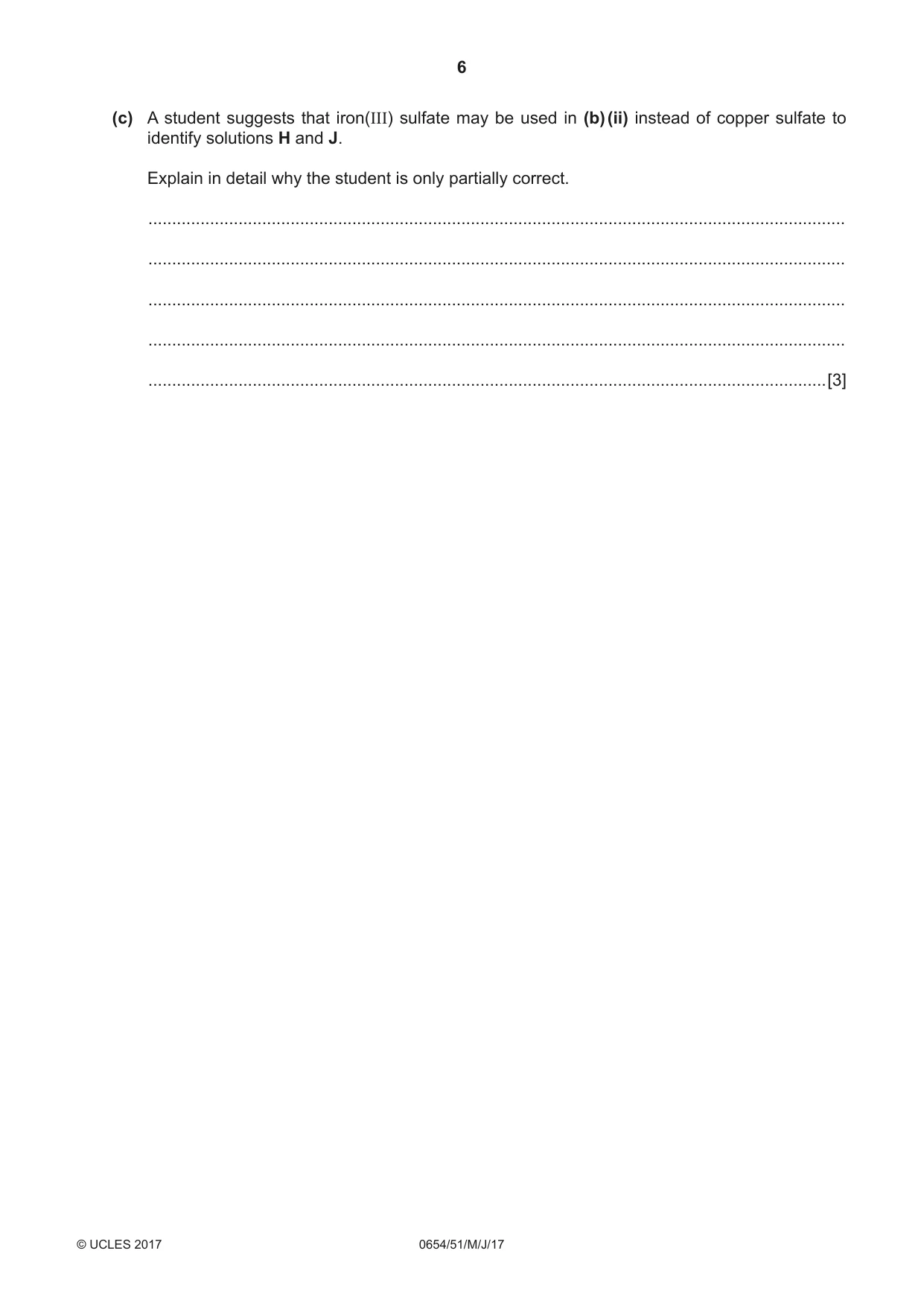
2 Notes for Use in Qualitative Analysis for this question are printed on page 12. Solution H and solution J are each one of the following possible solutions. ammonia solution sodium hydroxide solution hydrochloric acid sulfuric acid barium nitrate solution silver nitrate solution (a) (i) Test solution H with both red and blue litmus papers. Record your observations in Table 2.1. Test solution J with both red and blue litmus papers. Record your observations in Table 2.1. Table 2.1 solution H solution J red litmus paper blue litmus paper [2] (ii) Using the observations in Table 2.1, choose from the list of possible solutions the two possible identities for each of solutions H and J. solution H could be ........................................................................................................ or ............................................................................................................ solution J could be ........................................................................................................ or ............................................................................................................ [2] (b) You are provided with copper sulfate solution for use in (b) (ii). (i) Describe clearly how copper sulfate solution can be made using only copper(II) oxide and dilute sulfuric acid. ........................................................................................................................................... ........................................................................................................................................... ........................................................................................................................................... ........................................................................................................................................... .......................................................................................................................................[3] (ii) • Place solution H in a test-tube to a depth of 2 cm. • Slowly add copper sulfate solution until the test-tube is almost full. • Record your observations in Table 2.2. • Filter the mixture and record in Table 2.2 the colour of any residue. Repeat this procedure with solution J. Table 2.2 solution H solution J observations on slowly adding copper sulfate solution colour of any residue [3] (iii) Use (a) (ii) and your observations in Table 2.2 to identify solutions H and J. solution H is ....................................................................................................................... solution J is ....................................................................................................................... [2] (c) A student suggests that iron(III) sulfate may be used in (b) (ii) instead of copper sulfate to identify solutions H and J. Explain in detail why the student is only partially correct. ................................................................................................................................................... ................................................................................................................................................... ................................................................................................................................................... ................................................................................................................................................... ...............................................................................................................................................[3] Please turn over for Question 3.
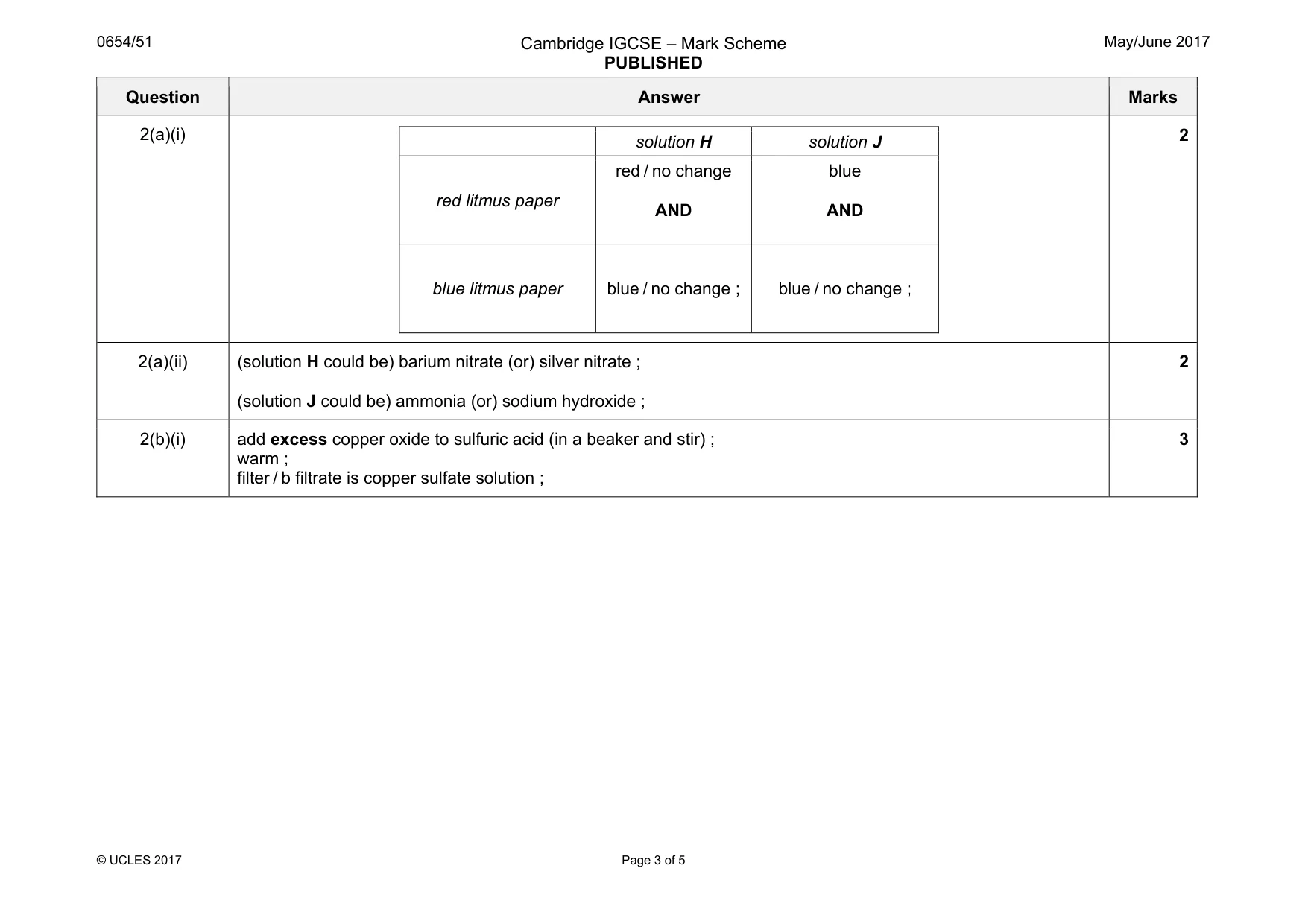
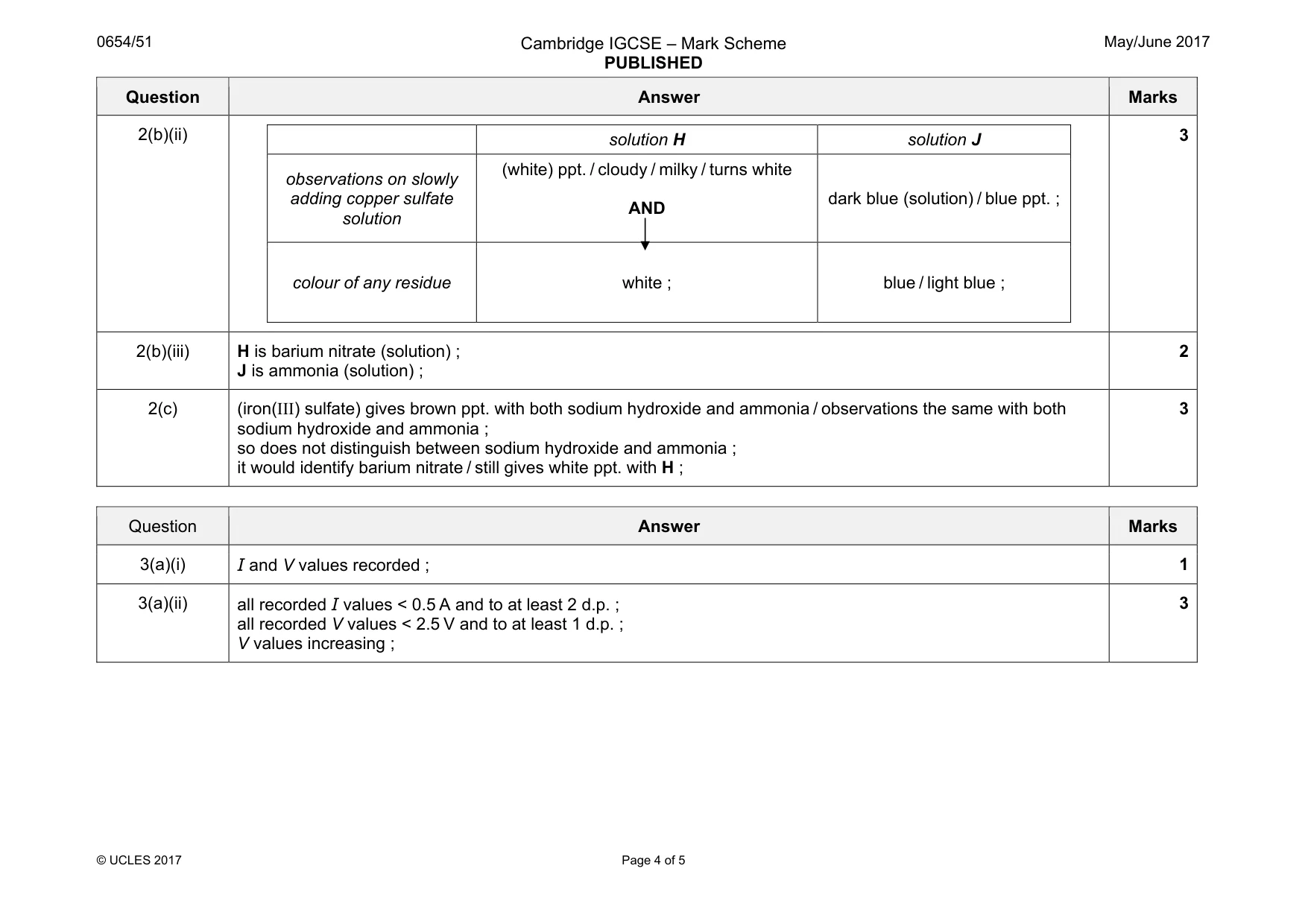
Mark scheme: 2(a)(i) solution H solution J red litmus paper red / no change AND blue AND blue litmus paper blue / no change ; blue / no change ; 2 2(a)(ii) (solution H could be) barium nitrate (or) silver nitrate ; (solution J could be) ammonia (or) sodium hydroxide ; 2 2(b)(i) add excess copper oxide to sulfuric acid (in a beaker and stir) ; warm ; filter / b filtrate is copper sulfate solution ; 3 Question Answer Marks 2(b)(ii) solution H solution J observations on slowly adding copper sulfate solution (white) ppt. / cloudy / milky / turns white AND dark blue (solution) / blue ppt. ; colour of any residue white ; blue / light blue ; 3 2(b)(iii) H is barium nitrate (solution) ; J is ammonia (solution) ; 2 2(c) (iron(III) sulfate) gives brown ppt. with both sodium hydroxide and ammonia / observations the same with both sodium hydroxide and ammonia ; so does not distinguish between sodium hydroxide and ammonia ; it would identify barium nitrate / still gives white ppt. with H ; 3
Q3 · You are going to investigate how the resistance of a metal wire depends upon its length
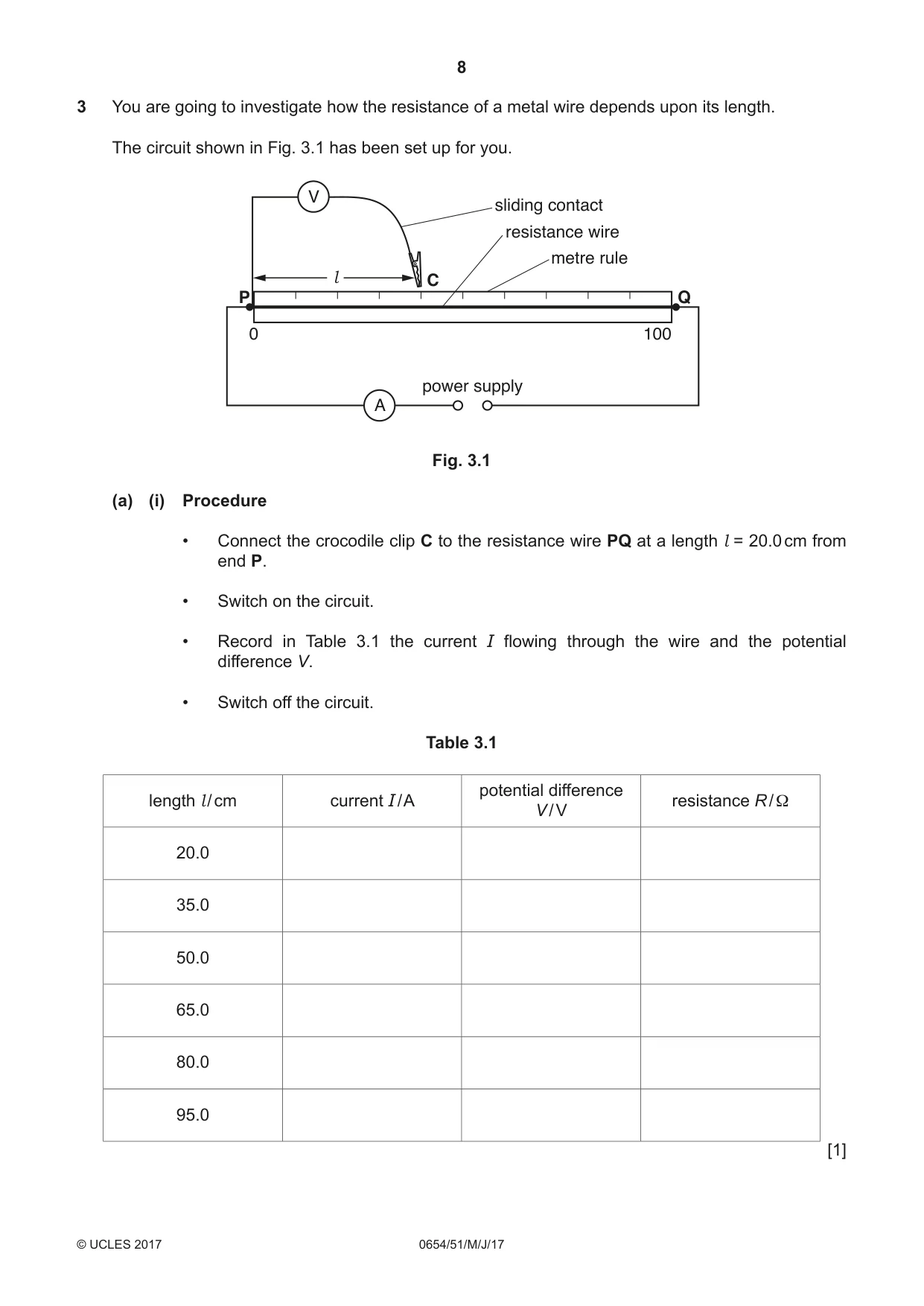
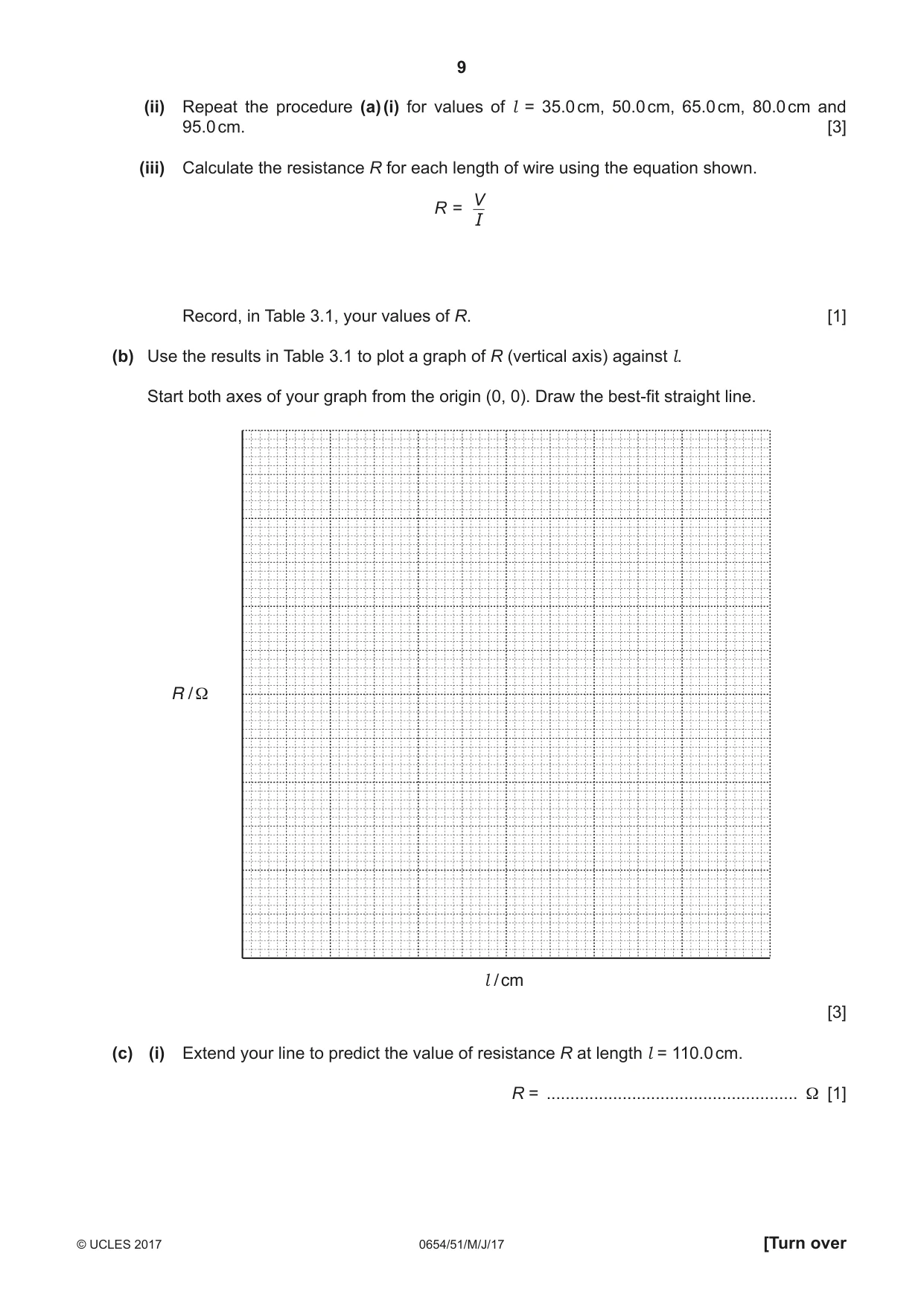
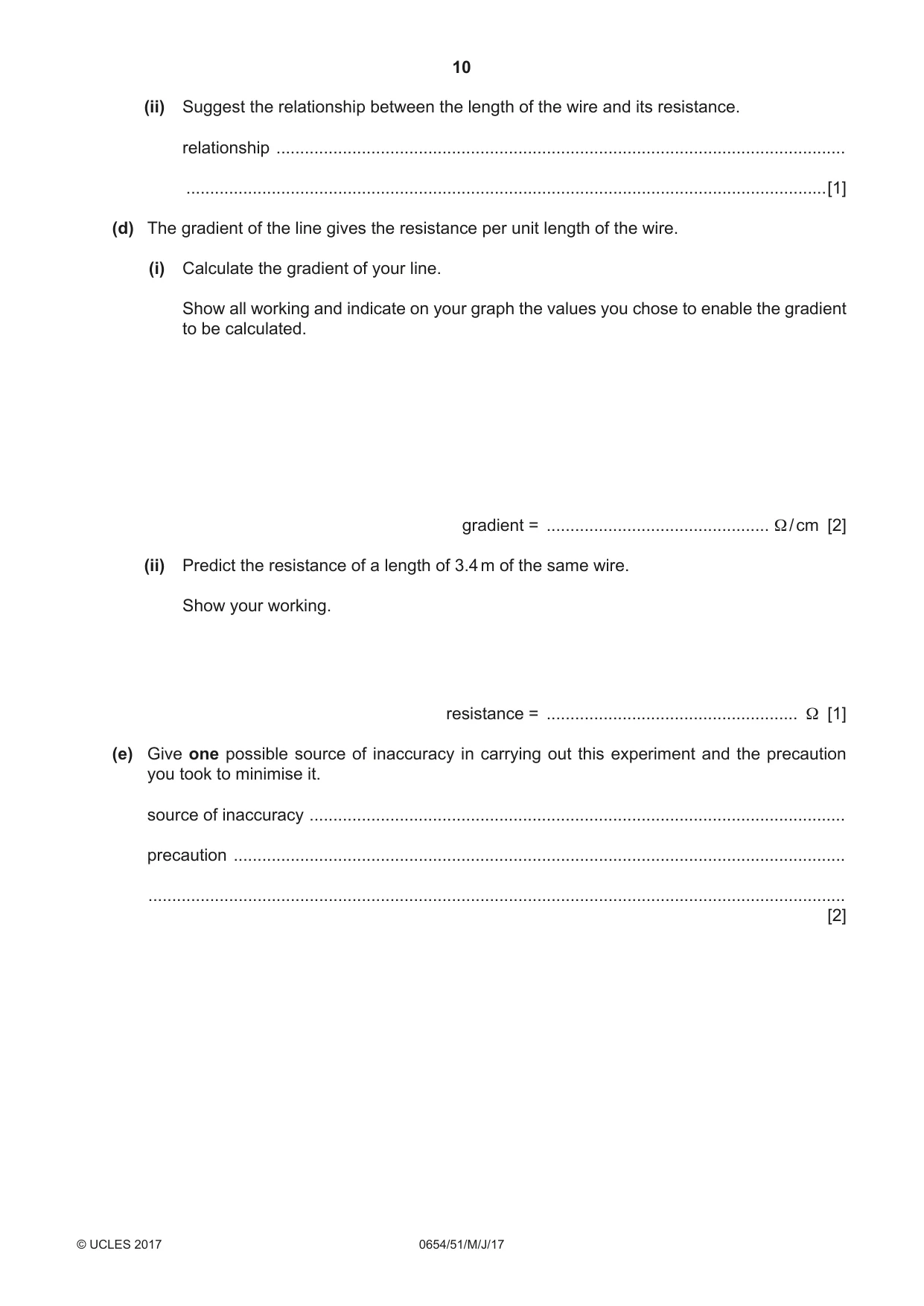
3 You are going to investigate how the resistance of a metal wire depends upon its length. The circuit shown in Fig. 3.1 has been set up for you. V sliding contact resistance wire metre rule l C P Q 0 100 power supply A Fig. 3.1 (a) (i) Procedure • Connect the crocodile clip C to the resistance wire PQ at a length l = 20.0 cm from end P. • Switch on the circuit. • Record in Table 3.1 the current I flowing through the wire and the potential difference V. • Switch off the circuit. Table 3.1 potential difference length l / cm current I / A resistance R / Ω V / V 20.0 35.0 50.0 65.0 80.0 95.0 [1] (ii) Repeat the procedure (a) (i) for values of l = 35.0 cm, 50.0 cm, 65.0 cm, 80.0 cm and 95.0 cm. [3] (iii) Calculate the resistance R for each length of wire using the equation shown. V R = I Record, in Table 3.1, your values of R. [1] (b) Use the results in Table 3.1 to plot a graph of R (vertical axis) against l. Start both axes of your graph from the origin (0, 0). Draw the best-fit straight line. R / Ω l / cm [3] (c) (i) Extend your line to predict the value of resistance R at length l = 110.0 cm. R = ..................................................... Ω [1] (ii) Suggest the relationship between the length of the wire and its resistance. relationship ........................................................................................................................ .......................................................................................................................................[1] (d) The gradient of the line gives the resistance per unit length of the wire. (i) Calculate the gradient of your line. Show all working and indicate on your graph the values you chose to enable the gradient to be calculated. gradient = ............................................... Ω / cm [2] (ii) Predict the resistance of a length of 3.4 m of the same wire. Show your working. resistance = ..................................................... Ω [1] (e) Give one possible source of inaccuracy in carrying out this experiment and the precaution you took to minimise it. source of inaccuracy ................................................................................................................. precaution ................................................................................................................................. ................................................................................................................................................... [2]
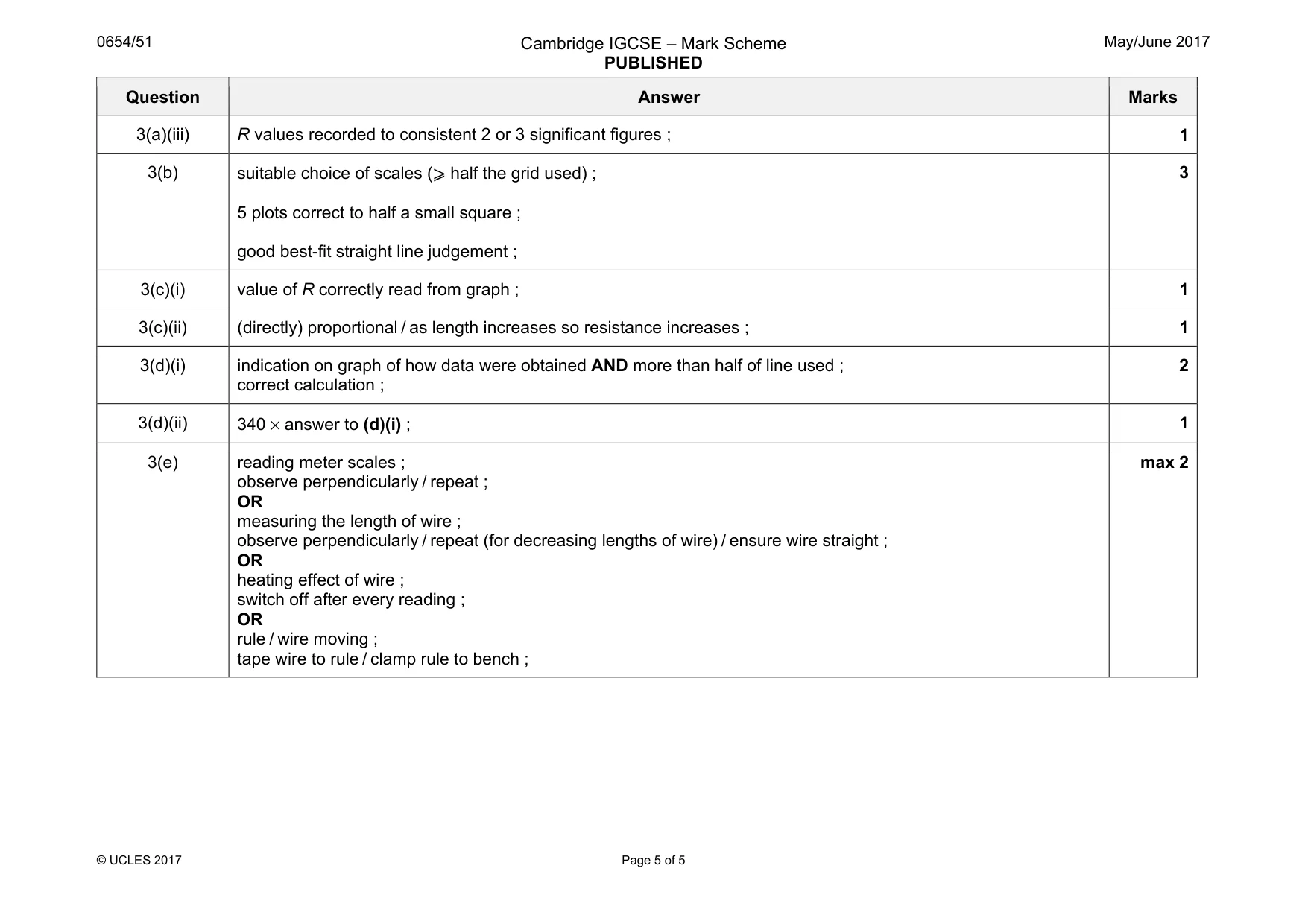
Mark scheme: 3(a)(i) 1 3(a)(ii) all recorded I values < 0.5 A and to at least 2 d.p. ; all recorded V values < 2.5 V and to at least 1 d.p. ; V values increasing ; 3 Question Answer Marks 3(a)(iii) R values recorded to consistent 2 or 3 significant figures ; 1 3(b) suitable choice of scales (⩾ half the grid used) ; 5 plots correct to half a small square ; good best-fit straight line judgement ; 3 3(c)(i) value of R correctly read from graph ; 1 3(c)(ii) (directly) proportional / as length increases so resistance increases ; 1 3(d)(i) indication on graph of how data were obtained AND more than half of line used ; correct calculation ; 2 3(d)(ii) 340 × answer to (d)(i) ; 1 3(e) reading meter scales ; observe perpendicularly / repeat ; OR measuring the length of wire ; observe perpendicularly / repeat (for decreasing lengths of wire) / ensure wire straight ; OR heating effect of wire ; switch off after every reading ; OR rule / wire moving ; tape wire to rule / clamp rule to bench ; max 2
What was in this paper
The subtopics covered by these 3 questions, and how many questions each got. Open one in a new tab to see every Cambridge question on it.
What you needed in this session
Cambridge’s own grade thresholds for 2017 May/June, Paper 5 · Variant 1. A higher threshold means an easier paper — the bar moves with how the cohort did.