Cambridge IGCSE Sciences - Co-ordinated (Double) 0654 — 2012 May/June Paper 6 · Variant 1
0654/61/M/J/12 · 60 marks · ≈68 min
The question paper and its mark scheme, free to read here and free to download. This is Cambridge’s own paper, exactly as it was sat.
Question paper24 pages

Mark scheme4 pages
Answers below. Sit the paper first if you are practising.
Paper as text
Question paper, page 1
This document consists of 21 printed pages and 3 blank pages. IB12 06_0654_61/FP © UCLES 2012 [Turn over *0677040343* For Examiner's Use 1 2 3 4 5 6 Total UNIVERSITY OF CAMBRIDGE INTERNATIONAL EXAMINATIONS International General Certificate of Secondary Education CO-ORDINATED SCIENCES 0654/61 Paper 6 Alternative to Practical May/June 2012 1 hour Candidates answer on the Question paper No Additional Materials are required. READ THESE INSTRUCTIONS FIRST Write your Centre number, candidate number and name on all the work you hand in. Write in dark blue or black pen. You may use a soft pencil for any diagrams, graphs, tables or rough working. Do not use staples, paper clips, highlighters, glue or correction fluid. DO NOT WRITE IN ANY BARCODES. Answer all questions. At the end of the examination, fasten all your work securely together. The number of marks is given in brackets [ ] at the end of each question or part question. www.XtremePapers.com
Question paper, page 2
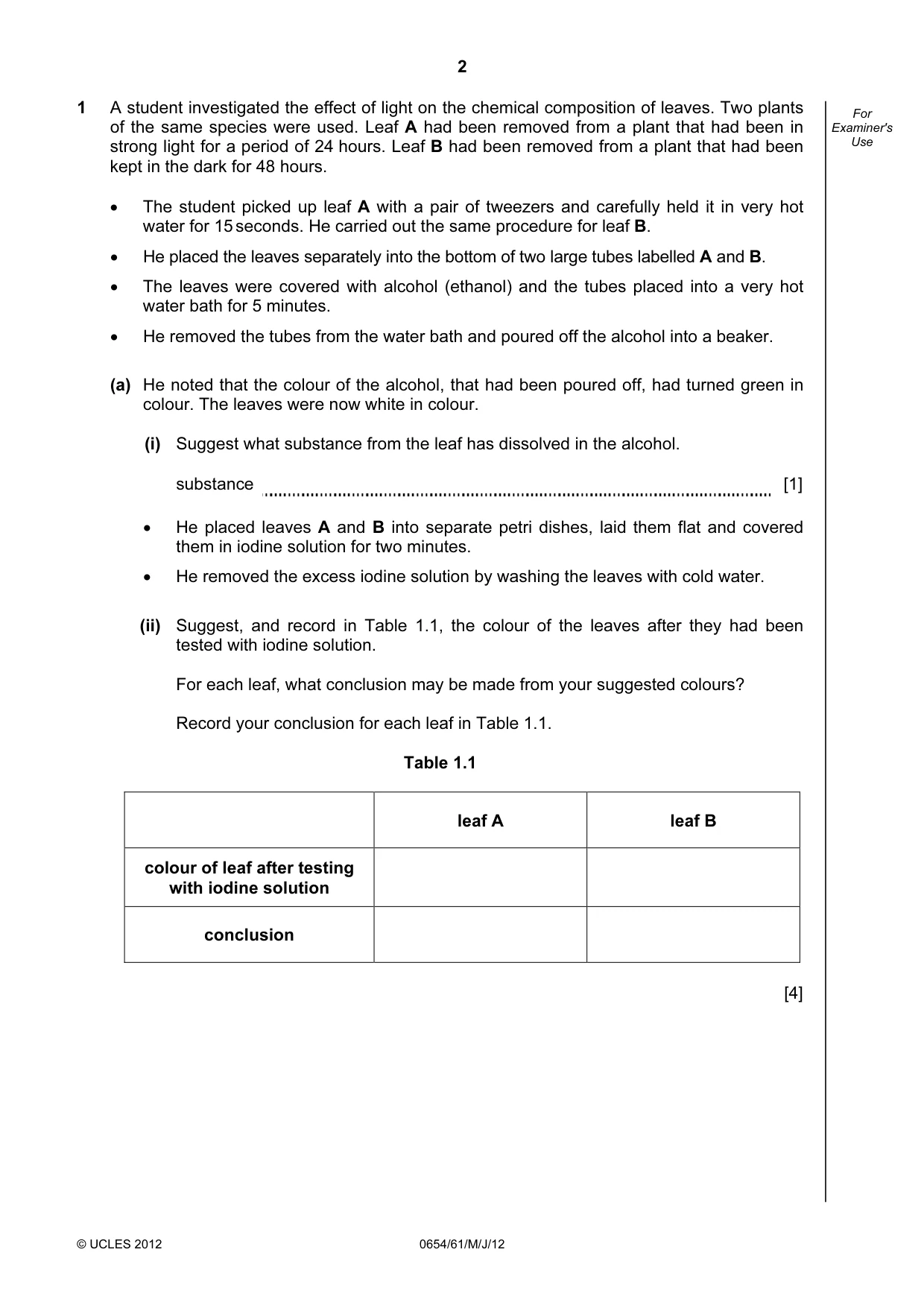
2 © UCLES 2012 0654/61/M/J/12 For Examiner's Use 1 A student investigated the effect of light on the chemical composition of leaves. Two plants of the same species were used. Leaf A had been removed from a plant that had been in strong light for a period of 24 hours. Leaf B had been removed from a plant that had been kept in the dark for 48 hours. • The student picked up leaf A with a pair of tweezers and carefully held it in very hot water for 15 seconds. He carried out the same procedure for leaf B. • He placed the leaves separately into the bottom of two large tubes labelled A and B. • The leaves were covered with alcohol (ethanol) and the tubes placed into a very hot water bath for 5 minutes. • He removed the tubes from the water bath and poured off the alcohol into a beaker. (a) He noted that the colour of the alcohol, that had been poured off, had turned green in colour. The leaves were now white in colour. (i) Suggest what substance from the leaf has dissolved in the alcohol. substance [1] • He placed leaves A and B into separate petri dishes, laid them flat and covered them in iodine solution for two minutes. • He removed the excess iodine solution by washing the leaves with cold water. (ii) Suggest, and record in Table 1.1, the colour of the leaves after they had been tested with iodine solution. For each leaf, what conclusion may be made from your suggested colours? Record your conclusion for each leaf in Table 1.1. Table 1.1 leaf A leaf B colour of leaf after testing with iodine solution conclusion [4]
Question paper, page 3
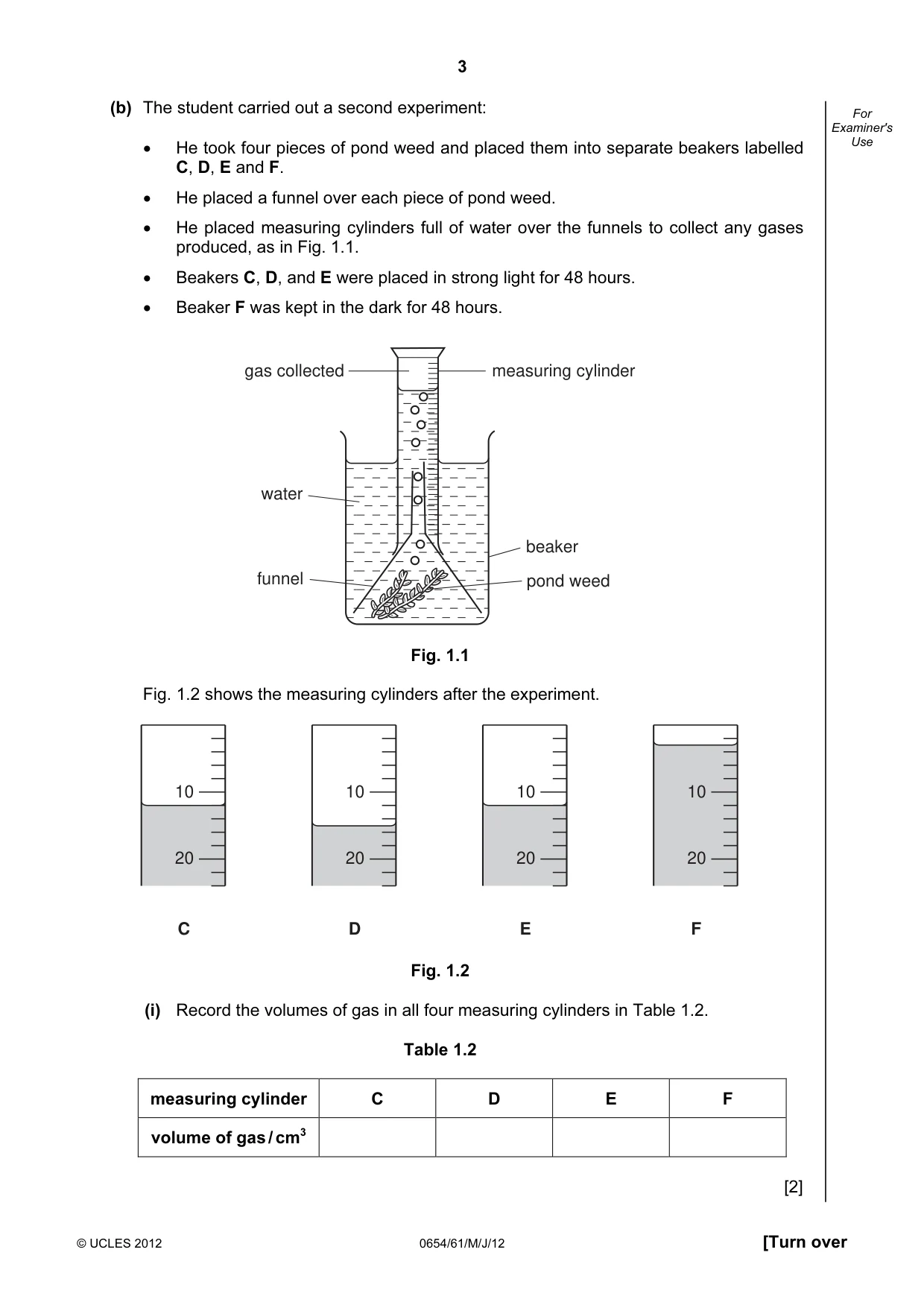
3 © UCLES 2012 0654/61/M/J/12 [Turn over For Examiner's Use (b) The student carried out a second experiment: • He took four pieces of pond weed and placed them into separate beakers labelled C, D, E and F. • He placed a funnel over each piece of pond weed. • He placed measuring cylinders full of water over the funnels to collect any gases produced, as in Fig. 1.1. • Beakers C, D, and E were placed in strong light for 48 hours. • Beaker F was kept in the dark for 48 hours. gas collected measuring cylinder funnel water pond weed beaker Fig. 1.1 Fig. 1.2 shows the measuring cylinders after the experiment. 10 20 C 10 20 D 10 20 E 10 20 F Fig. 1.2 (i) Record the volumes of gas in all four measuring cylinders in Table 1.2. Table 1.2 measuring cylinder C D E F volume of gas / cm3 [2]
Question paper, page 4
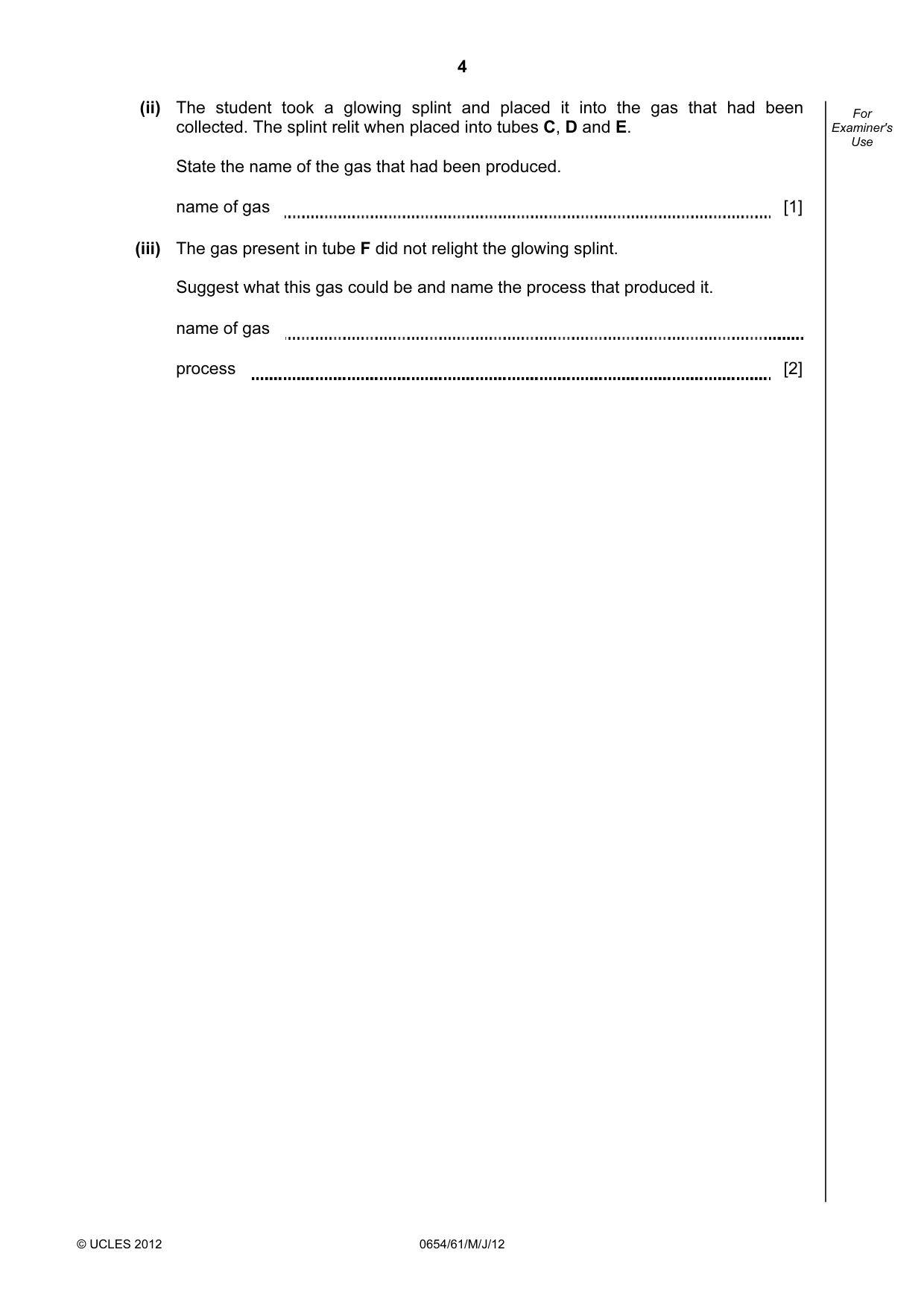
4 © UCLES 2012 0654/61/M/J/12 For Examiner's Use (ii) The student took a glowing splint and placed it into the gas that had been collected. The splint relit when placed into tubes C, D and E. State the name of the gas that had been produced. name of gas [1] (iii) The gas present in tube F did not relight the glowing splint. Suggest what this gas could be and name the process that produced it. name of gas process [2]
Question paper, page 5
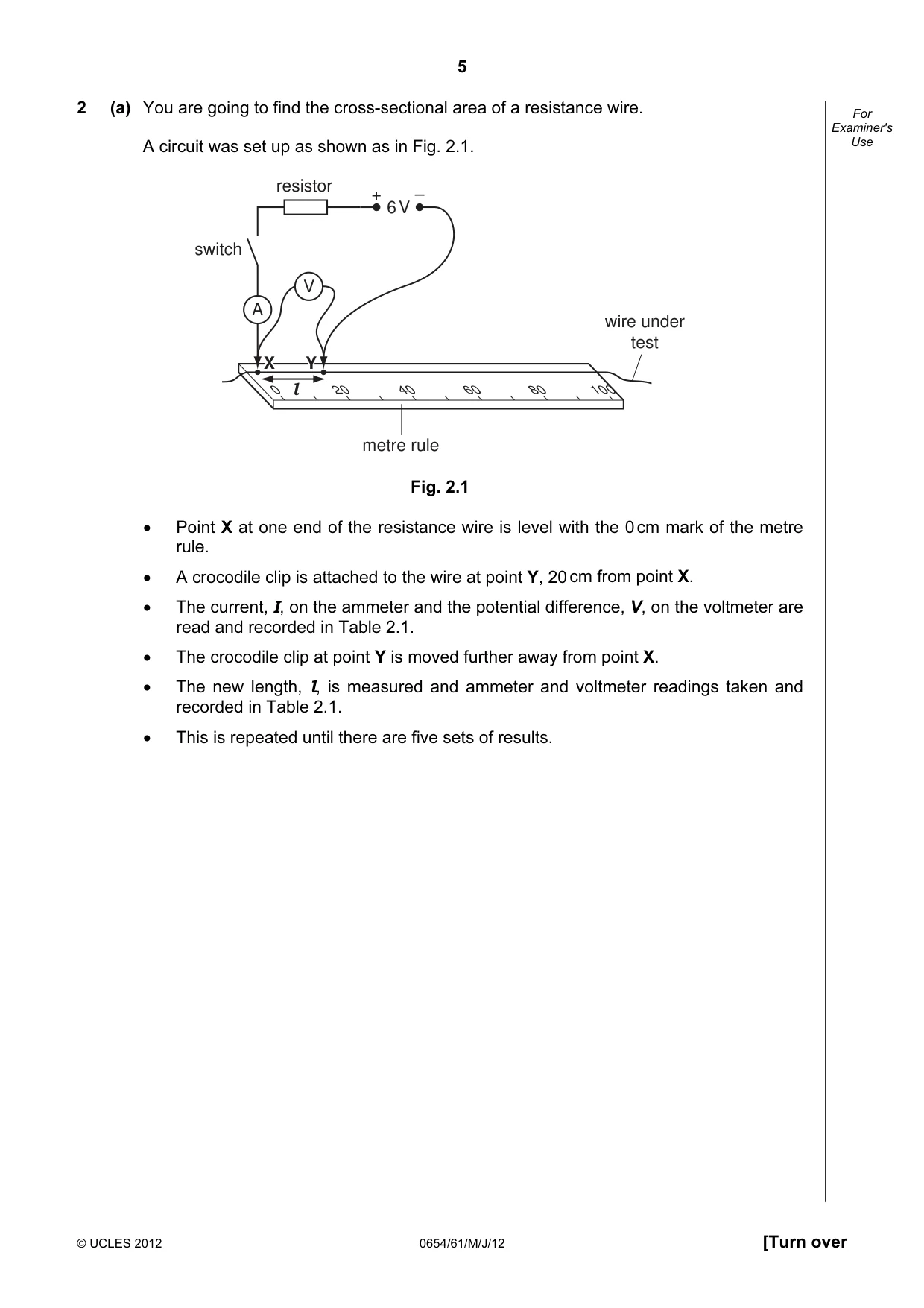
5 © UCLES 2012 0654/61/M/J/12 [Turn over For Examiner's Use 2 (a) You are going to find the cross-sectional area of a resistance wire. A circuit was set up as shown as in Fig. 2.1. X X Y Y 0 100 80 60 40 20 wire under test metre rule X Y A V resistor switch l 6 V + – Fig. 2.1 • Point X at one end of the resistance wire is level with the 0 cm mark of the metre rule. • A crocodile clip is attached to the wire at point Y, 20 cm from point X. • The current, I, on the ammeter and the potential difference, V, on the voltmeter are read and recorded in Table 2.1. • The crocodile clip at point Y is moved further away from point X. • The new length, l, is measured and ammeter and voltmeter readings taken and recorded in Table 2.1. • This is repeated until there are five sets of results.
Question paper, page 6
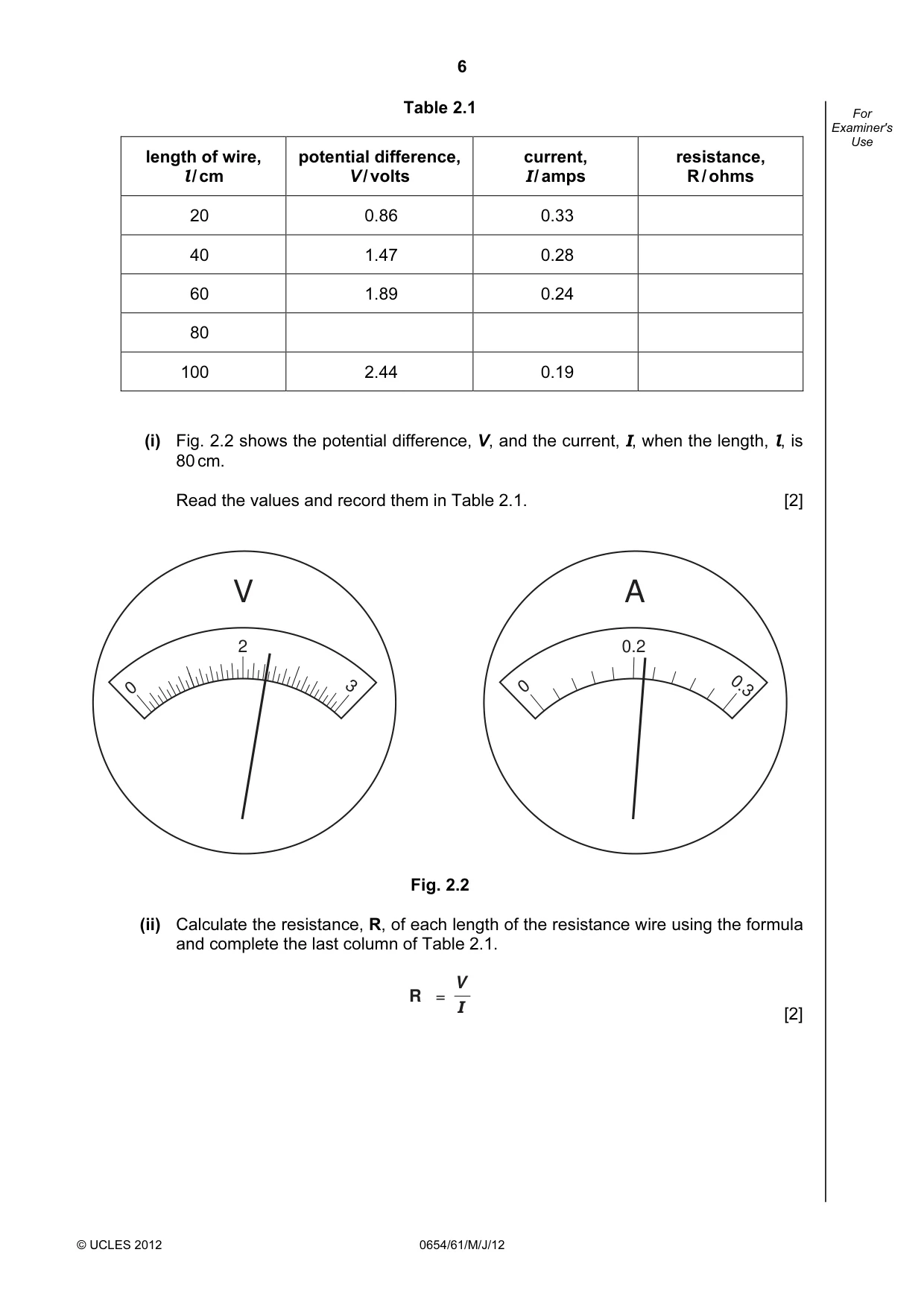
6 © UCLES 2012 0654/61/M/J/12 For Examiner's Use Table 2.1 length of wire, l / cm potential difference, V / volts current, I / amps resistance, R / ohms 20 0.86 0.33 40 1.47 0.28 60 1.89 0.24 80 100 2.44 0.19 (i) Fig. 2.2 shows the potential difference, V, and the current, I, when the length, l, is 80 cm. Read the values and record them in Table 2.1. [2] 3 0 V A 2 0.3 0 0.2 Fig. 2.2 (ii) Calculate the resistance, R, of each length of the resistance wire using the formula and complete the last column of Table 2.1. V I R = [2]
Question paper, page 7
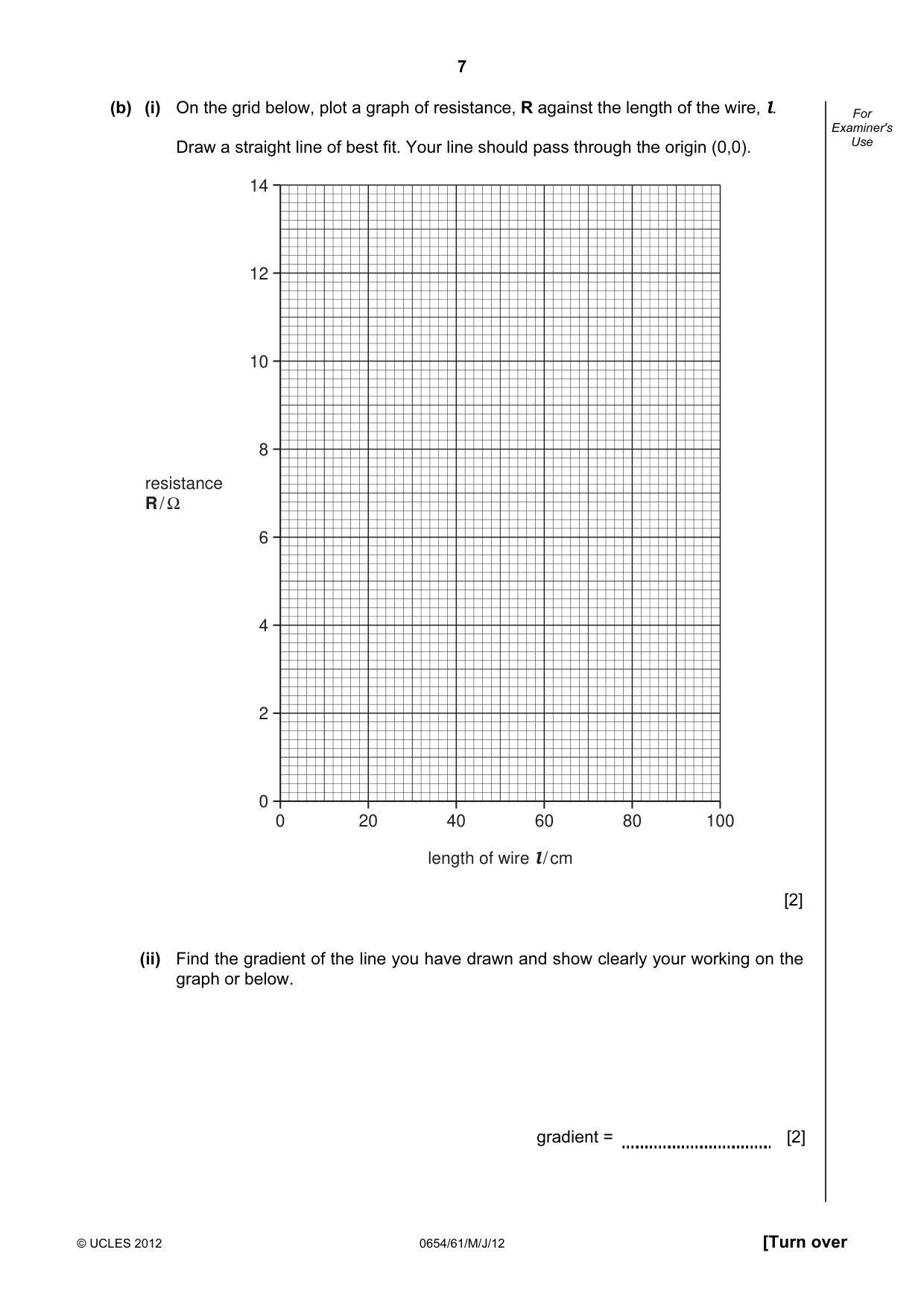
7 © UCLES 2012 0654/61/M/J/12 [Turn over For Examiner's Use (b) (i) On the grid below, plot a graph of resistance, R against the length of the wire, l. Draw a straight line of best fit. Your line should pass through the origin (0,0). 0 20 40 length of wire l / cm resistance R / Ω 60 80 100 14 12 10 8 6 4 2 0 [2] (ii) Find the gradient of the line you have drawn and show clearly your working on the graph or below. gradient = [2]
Question paper, page 8
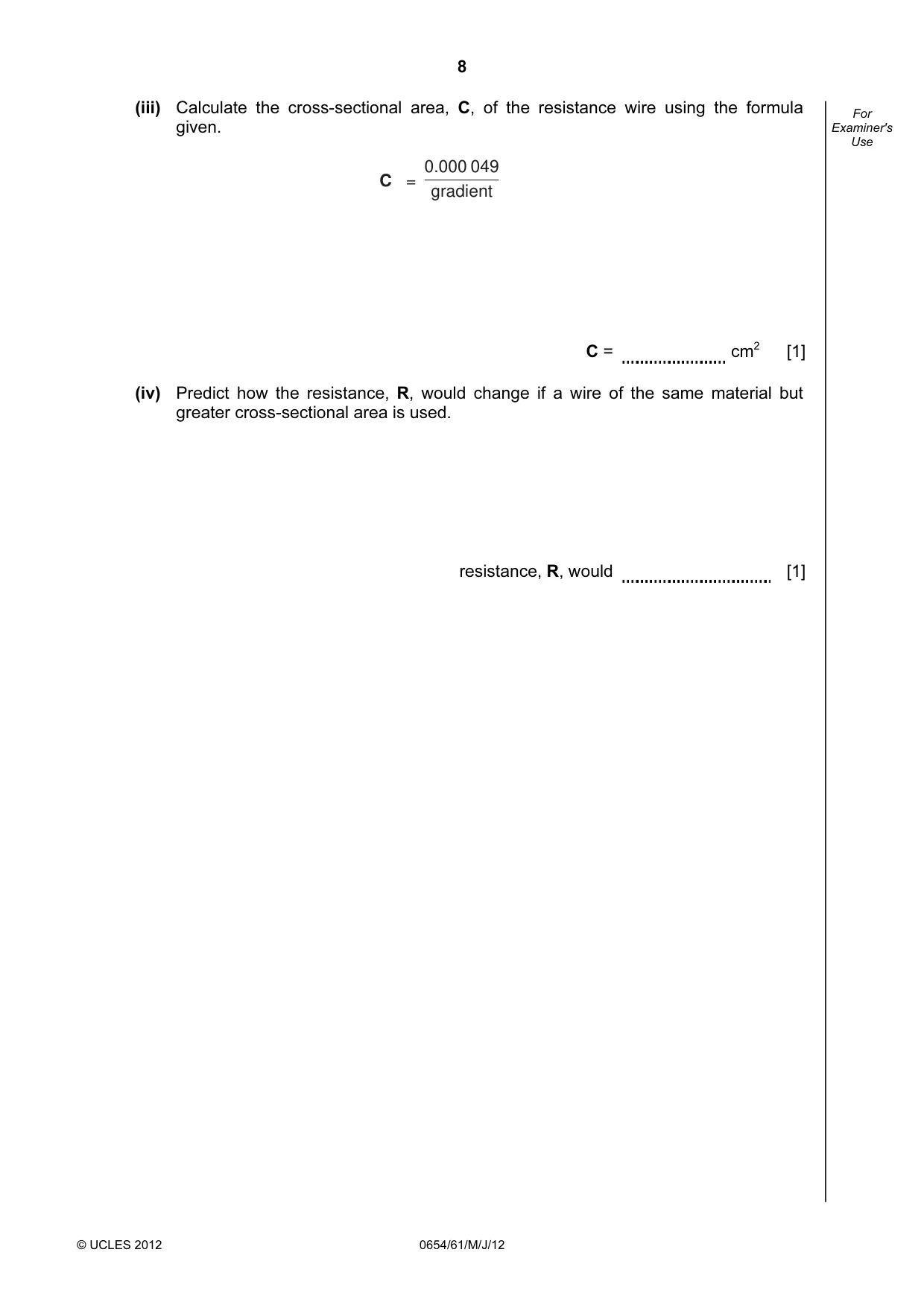
8 © UCLES 2012 0654/61/M/J/12 For Examiner's Use (iii) Calculate the cross-sectional area, C, of the resistance wire using the formula given. 0.000 049 gradient C = C = cm2 [1] (iv) Predict how the resistance, R, would change if a wire of the same material but greater cross-sectional area is used. resistance, R, would [1]
Question paper, page 9
9 © UCLES 2012 0654/61/M/J/12 [Turn over BLANK PAGE Please turn over for Question 3.
Question paper, page 10
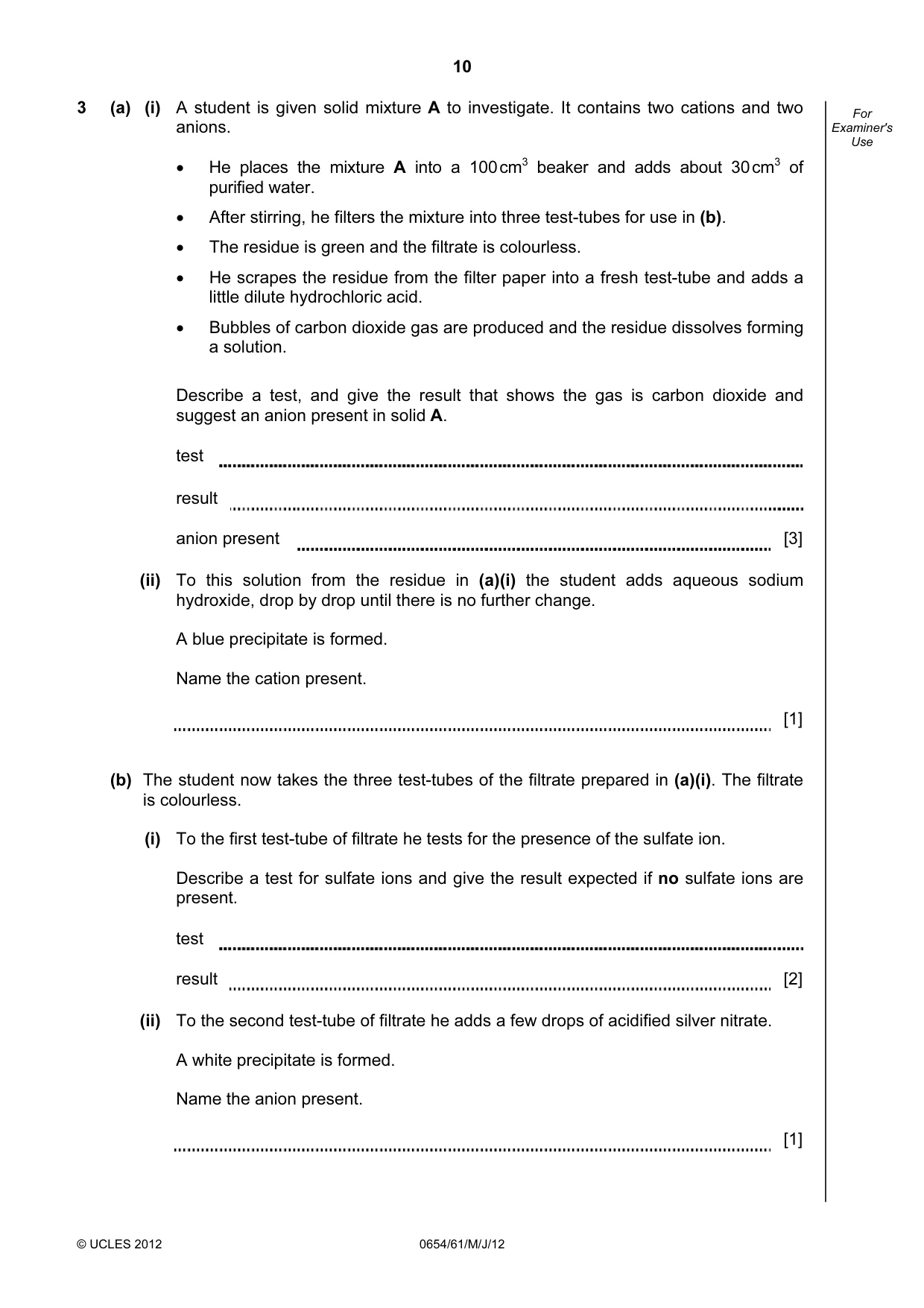
10 © UCLES 2012 0654/61/M/J/12 For Examiner's Use 3 (a) (i) A student is given solid mixture A to investigate. It contains two cations and two anions. • He places the mixture A into a 100 cm3 beaker and adds about 30 cm3 of purified water. • After stirring, he filters the mixture into three test-tubes for use in (b). • The residue is green and the filtrate is colourless. • He scrapes the residue from the filter paper into a fresh test-tube and adds a little dilute hydrochloric acid. • Bubbles of carbon dioxide gas are produced and the residue dissolves forming a solution. Describe a test, and give the result that shows the gas is carbon dioxide and suggest an anion present in solid A. test result anion present [3] (ii) To this solution from the residue in (a)(i) the student adds aqueous sodium hydroxide, drop by drop until there is no further change. A blue precipitate is formed. Name the cation present. [1] (b) The student now takes the three test-tubes of the filtrate prepared in (a)(i). The filtrate is colourless. (i) To the first test-tube of filtrate he tests for the presence of the sulfate ion. Describe a test for sulfate ions and give the result expected if no sulfate ions are present. test result [2] (ii) To the second test-tube of filtrate he adds a few drops of acidified silver nitrate. A white precipitate is formed. Name the anion present. [1]
Question paper, page 11
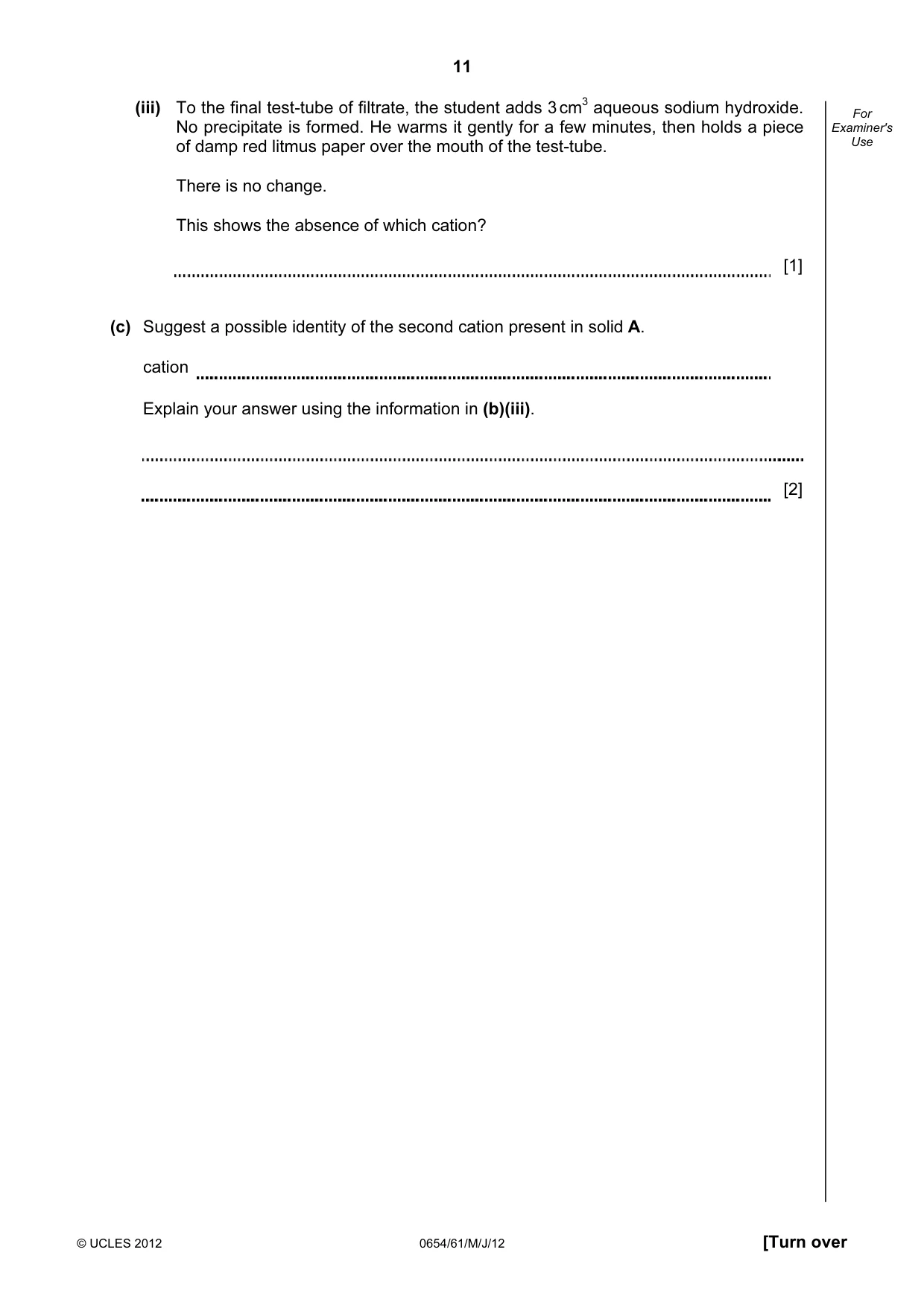
11 © UCLES 2012 0654/61/M/J/12 [Turn over For Examiner's Use (iii) To the final test-tube of filtrate, the student adds 3 cm3 aqueous sodium hydroxide. No precipitate is formed. He warms it gently for a few minutes, then holds a piece of damp red litmus paper over the mouth of the test-tube. There is no change. This shows the absence of which cation? [1] (c) Suggest a possible identity of the second cation present in solid A. cation Explain your answer using the information in (b)(iii). [2]
Question paper, page 12
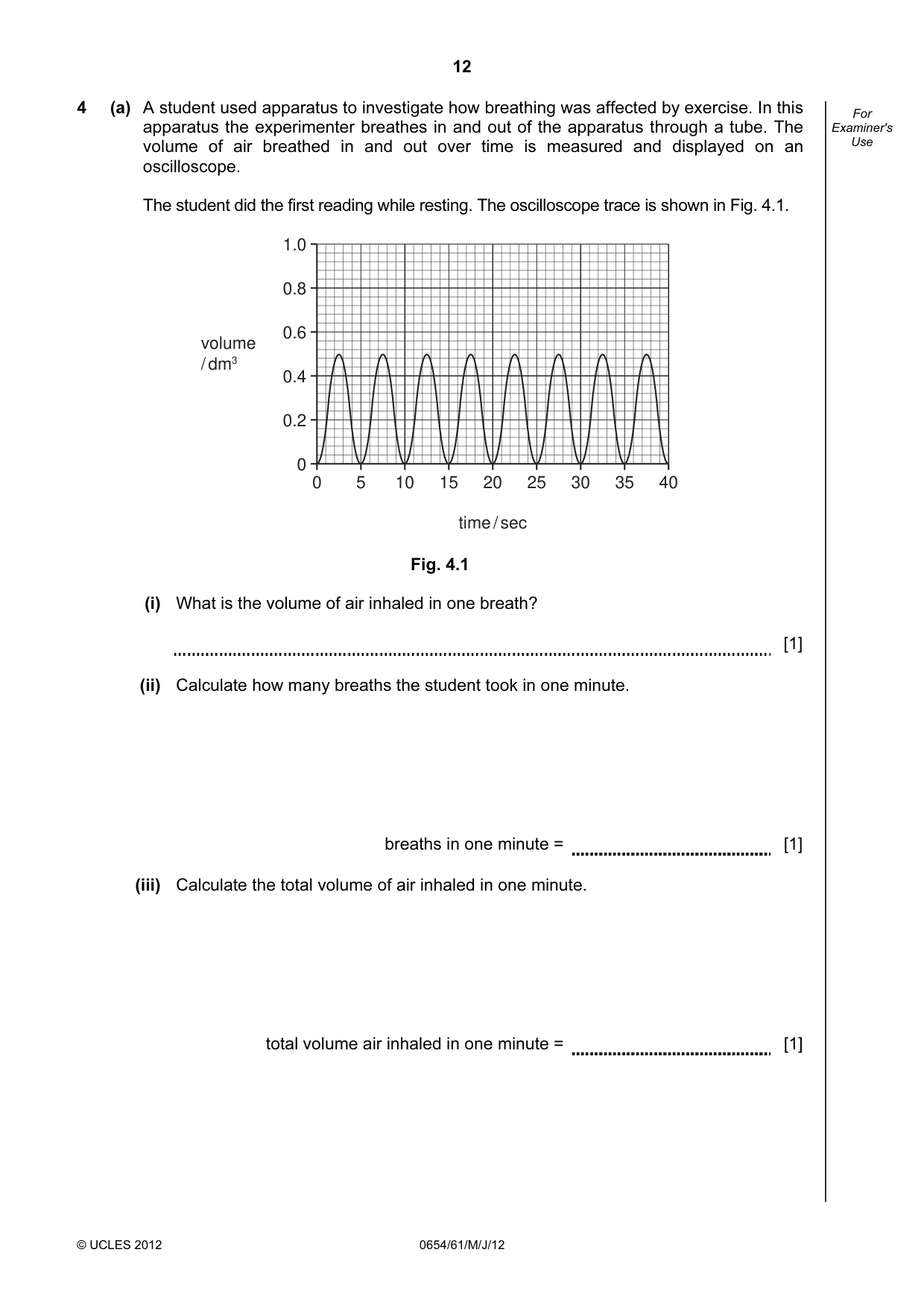
12 © UCLES 2012 0654/61/M/J/12 For Examiner's Use 4 (a) A student used apparatus to investigate how breathing was affected by exercise. In this apparatus the experimenter breathes in and out of the apparatus through a tube. The volume of air breathed in and out over time is measured and displayed on an oscilloscope. The student did the first reading while resting. The oscilloscope trace is shown in Fig. 4.1. 0 5 10 15 20 time / sec 25 30 35 40 volume / dm3 1.0 0.8 0.6 0.4 0.2 0 Fig. 4.1 (i) What is the volume of air inhaled in one breath? [1] (ii) Calculate how many breaths the student took in one minute. breaths in one minute = [1] (iii) Calculate the total volume of air inhaled in one minute. total volume air inhaled in one minute = [1]
Question paper, page 13
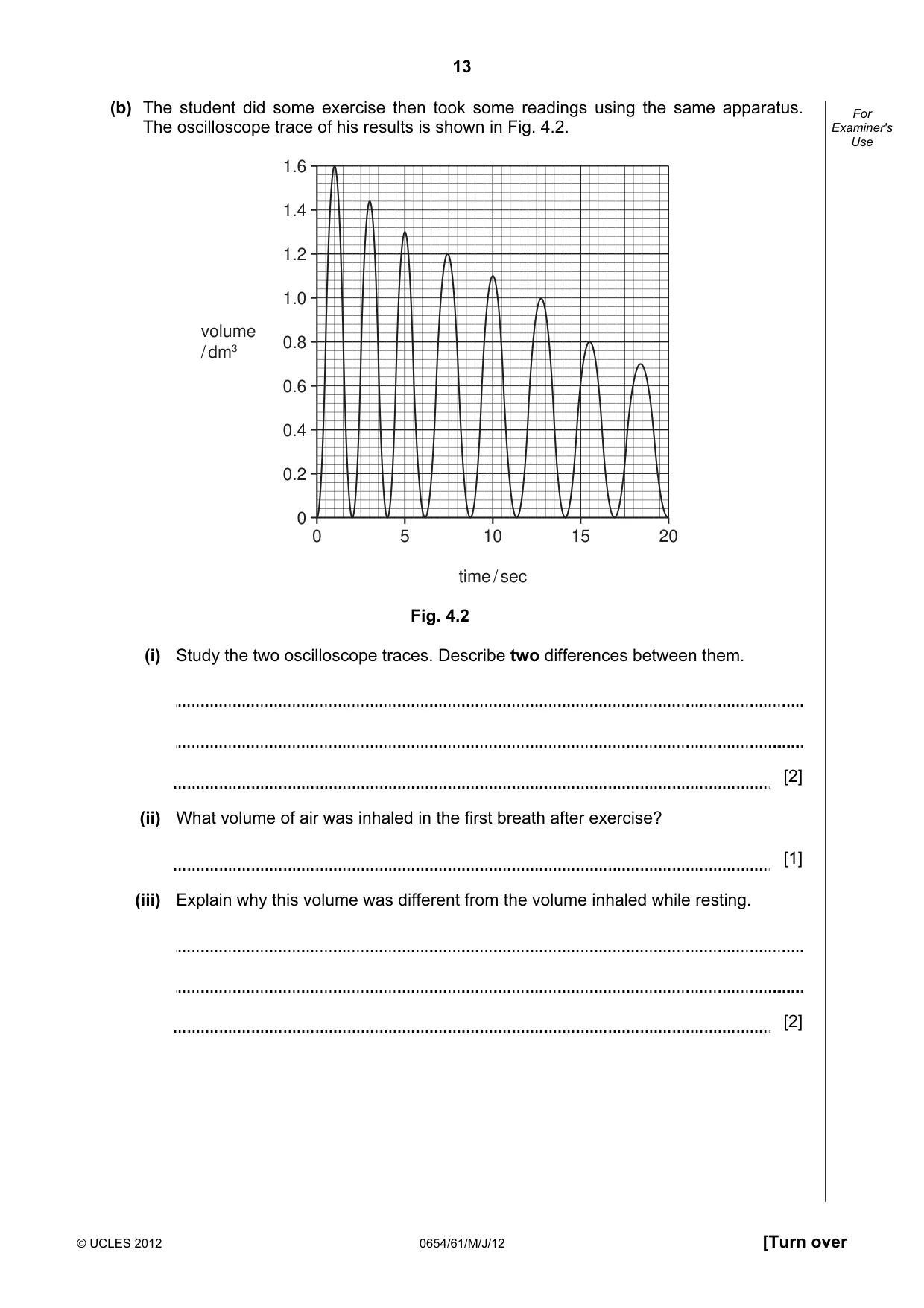
13 © UCLES 2012 0654/61/M/J/12 [Turn over For Examiner's Use (b) The student did some exercise then took some readings using the same apparatus. The oscilloscope trace of his results is shown in Fig. 4.2. 0 5 10 time / sec 15 20 volume / dm3 1.6 1.4 1.2 1.0 0.8 0.6 0.4 0.2 0 Fig. 4.2 (i) Study the two oscilloscope traces. Describe two differences between them. [2] (ii) What volume of air was inhaled in the first breath after exercise? [1] (iii) Explain why this volume was different from the volume inhaled while resting. [2]
Question paper, page 14
14 © UCLES 2012 0654/61/M/J/12 For Examiner's Use (c) In the apparatus the exhaled air is not breathed back in again during the experiment. Give two reasons why it would be undesirable to breathe the exhaled air back in. [2]
Question paper, page 15
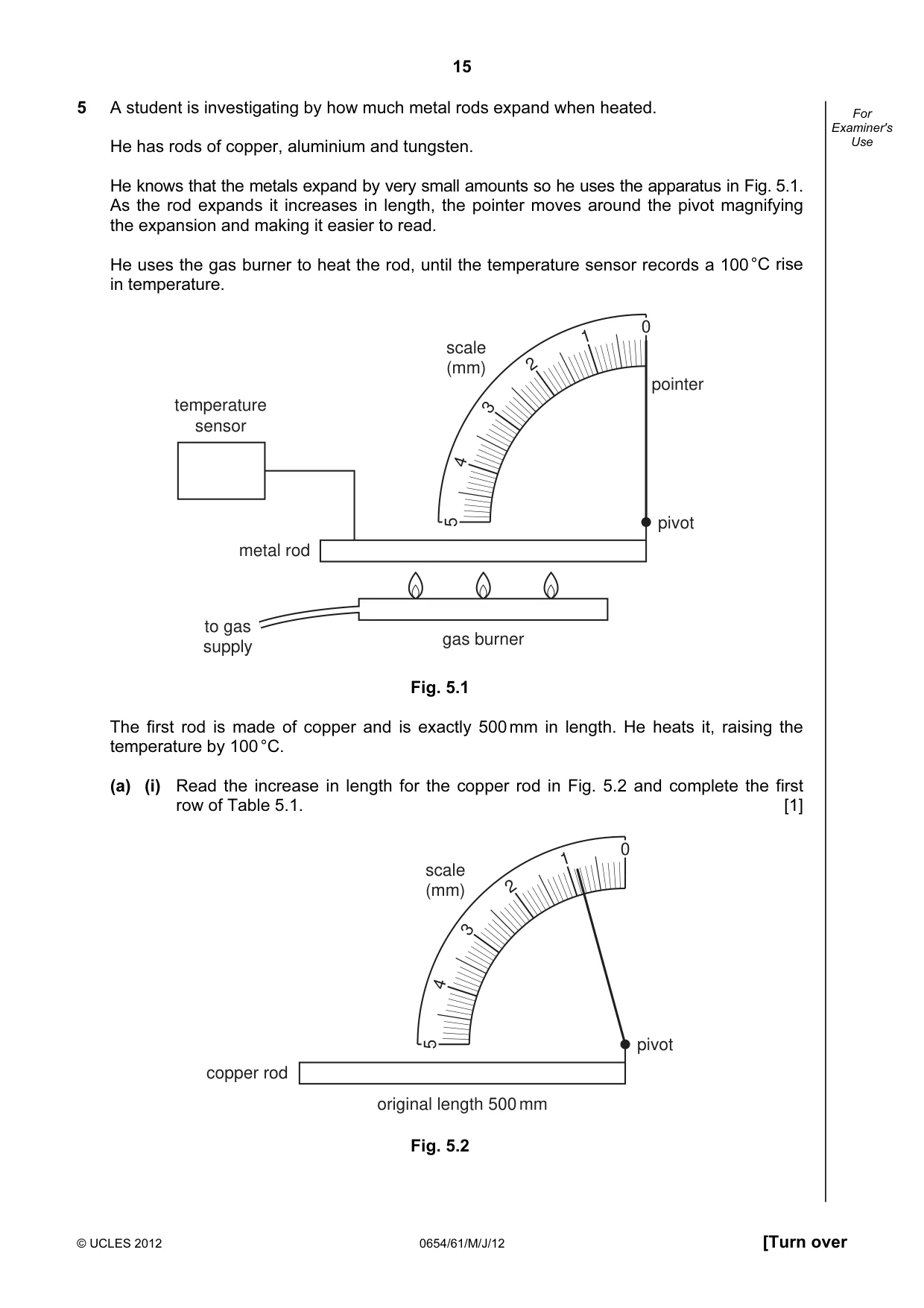
15 © UCLES 2012 0654/61/M/J/12 [Turn over For Examiner's Use 5 A student is investigating by how much metal rods expand when heated. He has rods of copper, aluminium and tungsten. He knows that the metals expand by very small amounts so he uses the apparatus in Fig. 5.1. As the rod expands it increases in length, the pointer moves around the pivot magnifying the expansion and making it easier to read. He uses the gas burner to heat the rod, until the temperature sensor records a 100 °C rise in temperature. pivot pointer scale (mm) metal rod temperature sensor gas burner to gas supply 0 01 02 03 04 5 Fig. 5.1 The first rod is made of copper and is exactly 500 mm in length. He heats it, raising the temperature by 100 °C. (a) (i) Read the increase in length for the copper rod in Fig. 5.2 and complete the first row of Table 5.1. [1] scale (mm) copper rod original length 500 mm pivot 0 01 02 03 04 5 Fig. 5.2
Question paper, page 16
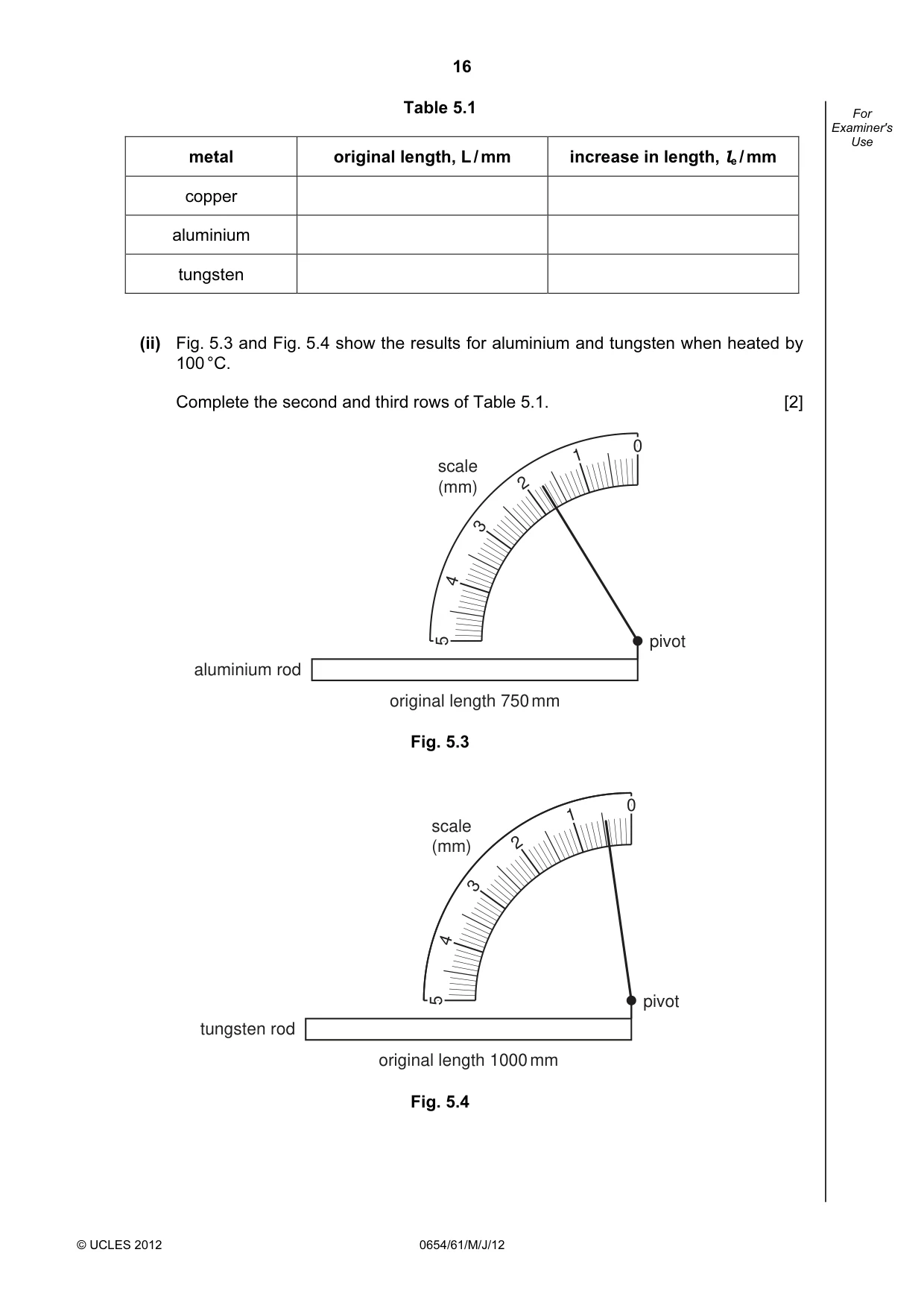
16 © UCLES 2012 0654/61/M/J/12 For Examiner's Use Table 5.1 metal original length, L / mm increase in length, le / mm copper aluminium tungsten (ii) Fig. 5.3 and Fig. 5.4 show the results for aluminium and tungsten when heated by 100 °C. Complete the second and third rows of Table 5.1. [2] 0 01 02 03 04 5 pivot scale (mm) aluminium rod original length 750 mm Fig. 5.3 0 01 02 03 04 5 pivot scale (mm) tungsten rod original length 1000 mm Fig. 5.4
Question paper, page 17
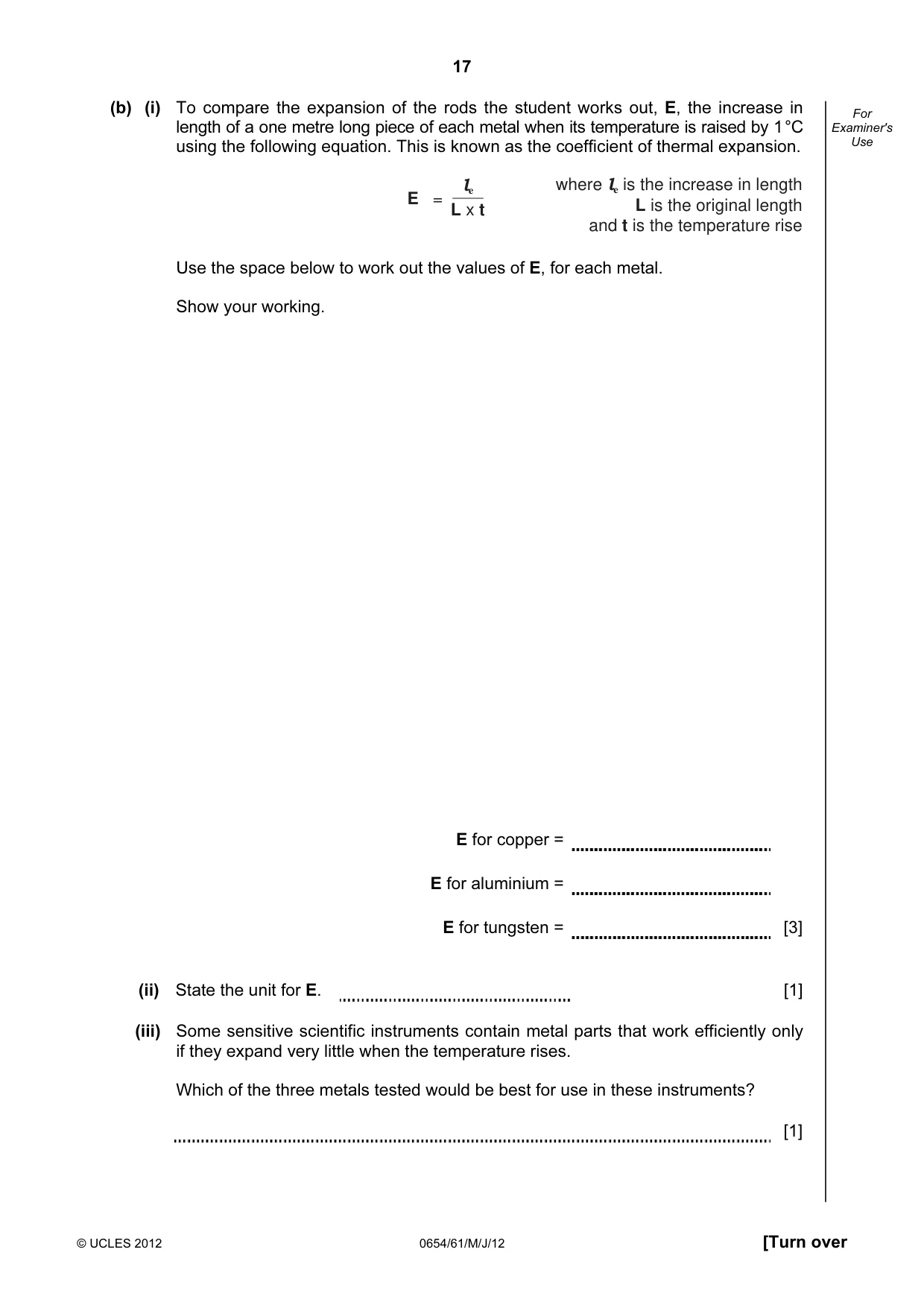
17 © UCLES 2012 0654/61/M/J/12 [Turn over For Examiner's Use (b) (i) To compare the expansion of the rods the student works out, E, the increase in length of a one metre long piece of each metal when its temperature is raised by 1 °C using the following equation. This is known as the coefficient of thermal expansion. le L x t E = where le is the increase in length L is the original length and t is the temperature rise Use the space below to work out the values of E, for each metal. Show your working. E for copper = E for aluminium = E for tungsten = [3] (ii) State the unit for E. [1] (iii) Some sensitive scientific instruments contain metal parts that work efficiently only if they expand very little when the temperature rises. Which of the three metals tested would be best for use in these instruments? [1]
Question paper, page 18
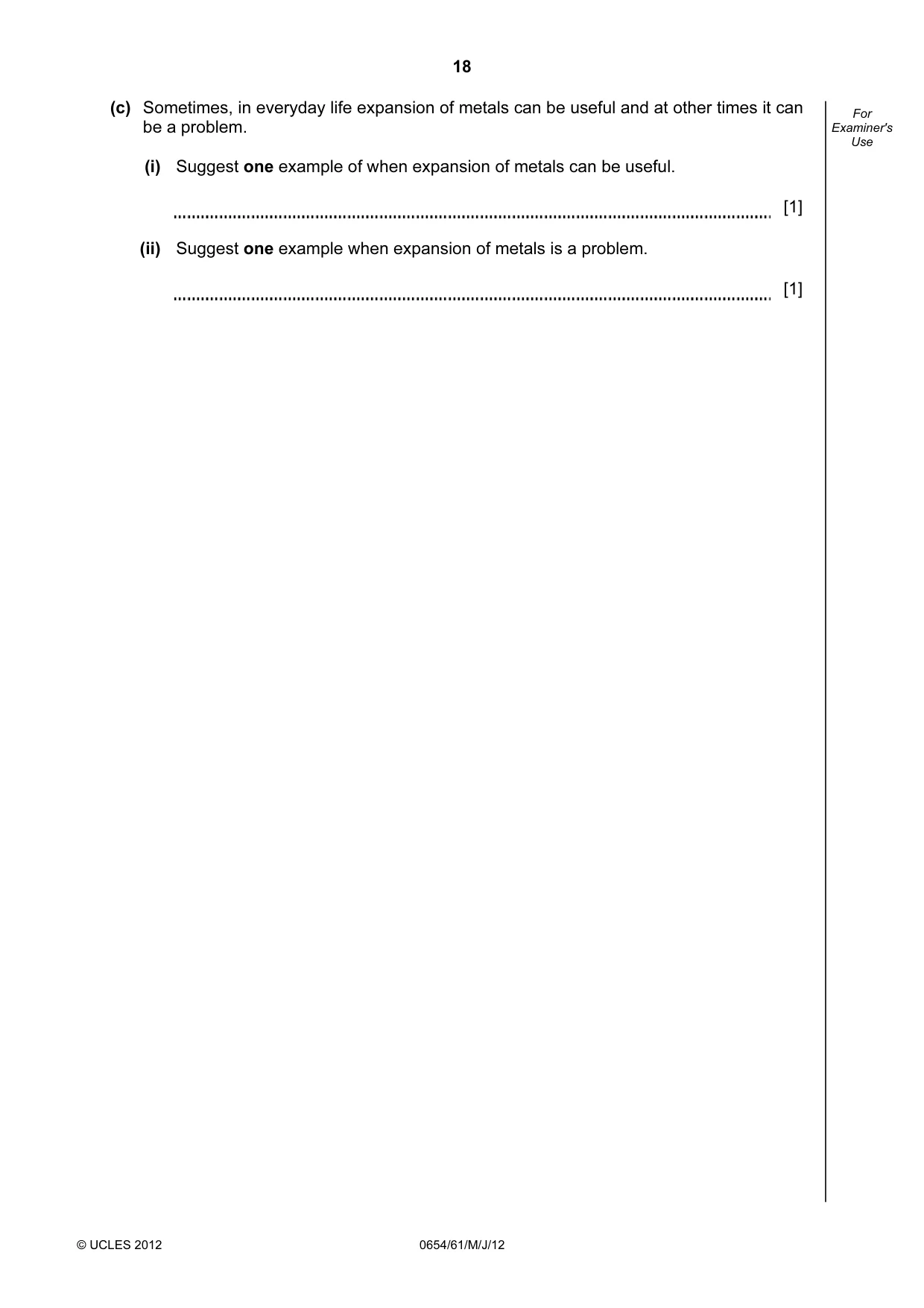
18 © UCLES 2012 0654/61/M/J/12 For Examiner's Use (c) Sometimes, in everyday life expansion of metals can be useful and at other times it can be a problem. (i) Suggest one example of when expansion of metals can be useful. [1] (ii) Suggest one example when expansion of metals is a problem. [1]
Question paper, page 19
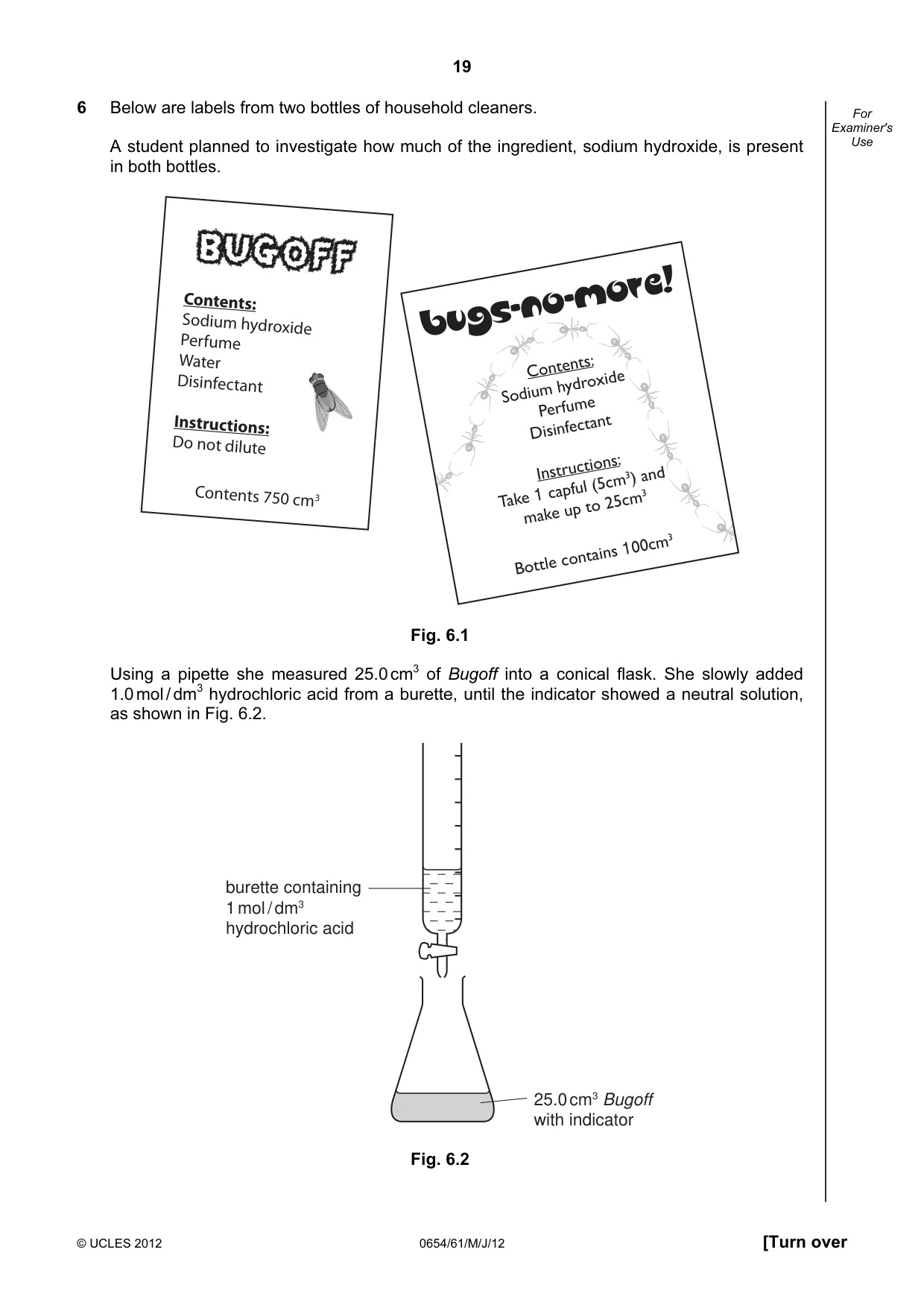
19 © UCLES 2012 0654/61/M/J/12 [Turn over For Examiner's Use 6 Below are labels from two bottles of household cleaners. A student planned to investigate how much of the ingredient, sodium hydroxide, is present in both bottles. BUGOFF Contents 750 cm3 Contents: Sodium hydroxide Perfume Water Disinfectant Instructions: Do not dilute bugs-no-more! Bottle contains 100cm3 Contents: Sodium hydroxide Perfume Disinfectant Instructions: Take 1 capful (5cm3) and make up to 25cm3 Fig. 6.1 Using a pipette she measured 25.0 cm3 of Bugoff into a conical flask. She slowly added 1.0 mol / dm3 hydrochloric acid from a burette, until the indicator showed a neutral solution, as shown in Fig. 6.2. burette containing 1 mol / dm3 hydrochloric acid 25.0 cm3 Bugoff with indicator Fig. 6.2
Question paper, page 20
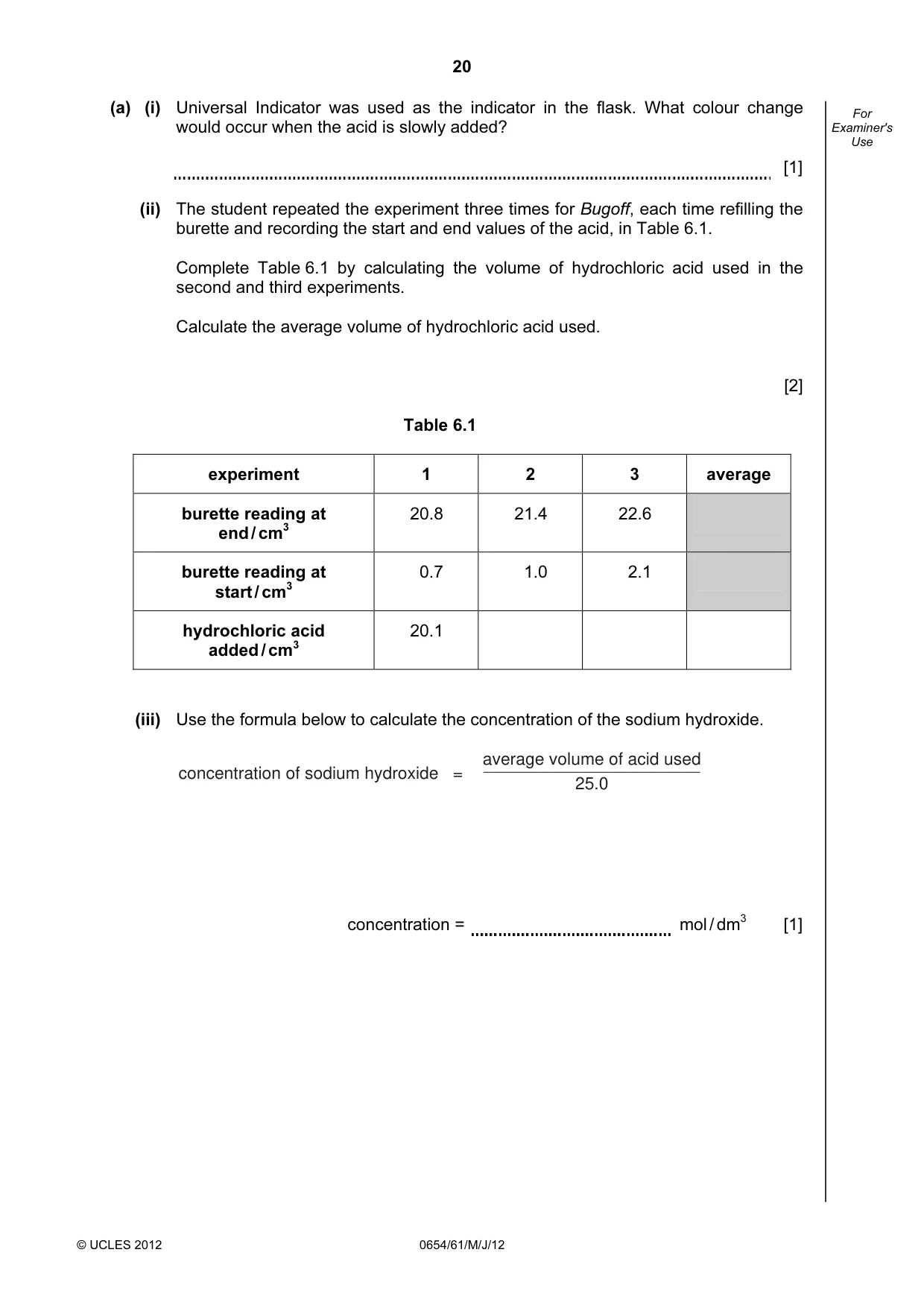
20 © UCLES 2012 0654/61/M/J/12 For Examiner's Use (a) (i) Universal Indicator was used as the indicator in the flask. What colour change would occur when the acid is slowly added? [1] (ii) The student repeated the experiment three times for Bugoff, each time refilling the burette and recording the start and end values of the acid, in Table 6.1. Complete Table 6.1 by calculating the volume of hydrochloric acid used in the second and third experiments. Calculate the average volume of hydrochloric acid used. [2] Table 6.1 experiment 1 2 3 average burette reading at end / cm3 20.8 21.4 22.6 burette reading at start / cm3 0.7 1.0 2.1 hydrochloric acid added / cm3 20.1 (iii) Use the formula below to calculate the concentration of the sodium hydroxide. concentration of sodium hydroxide = average volume of acid used 25.0 concentration = mol / dm3 [1]
Question paper, page 21
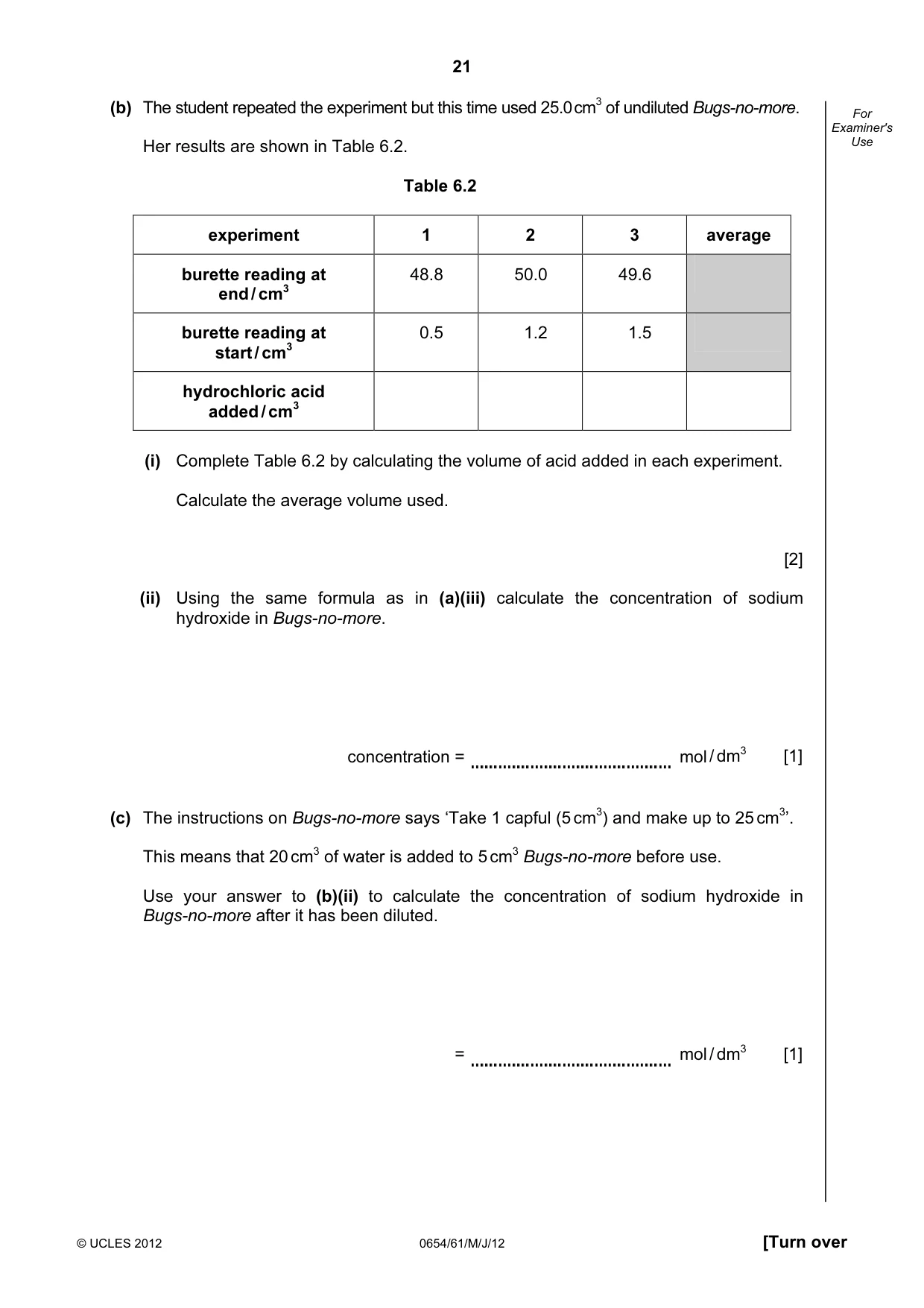
21 © UCLES 2012 0654/61/M/J/12 [Turn over For Examiner's Use (b) The student repeated the experiment but this time used 25.0 cm3 of undiluted Bugs-no-more. Her results are shown in Table 6.2. Table 6.2 experiment 1 2 3 average burette reading at end / cm3 48.8 50.0 49.6 burette reading at start / cm3 0.5 1.2 1.5 hydrochloric acid added / cm3 (i) Complete Table 6.2 by calculating the volume of acid added in each experiment. Calculate the average volume used. [2] (ii) Using the same formula as in (a)(iii) calculate the concentration of sodium hydroxide in Bugs-no-more. concentration = mol / dm3 [1] (c) The instructions on Bugs-no-more says ‘Take 1 capful (5 cm3) and make up to 25 cm3’. This means that 20 cm3 of water is added to 5 cm3 Bugs-no-more before use. Use your answer to (b)(ii) to calculate the concentration of sodium hydroxide in Bugs-no-more after it has been diluted. = mol / dm3 [1]
Question paper, page 22
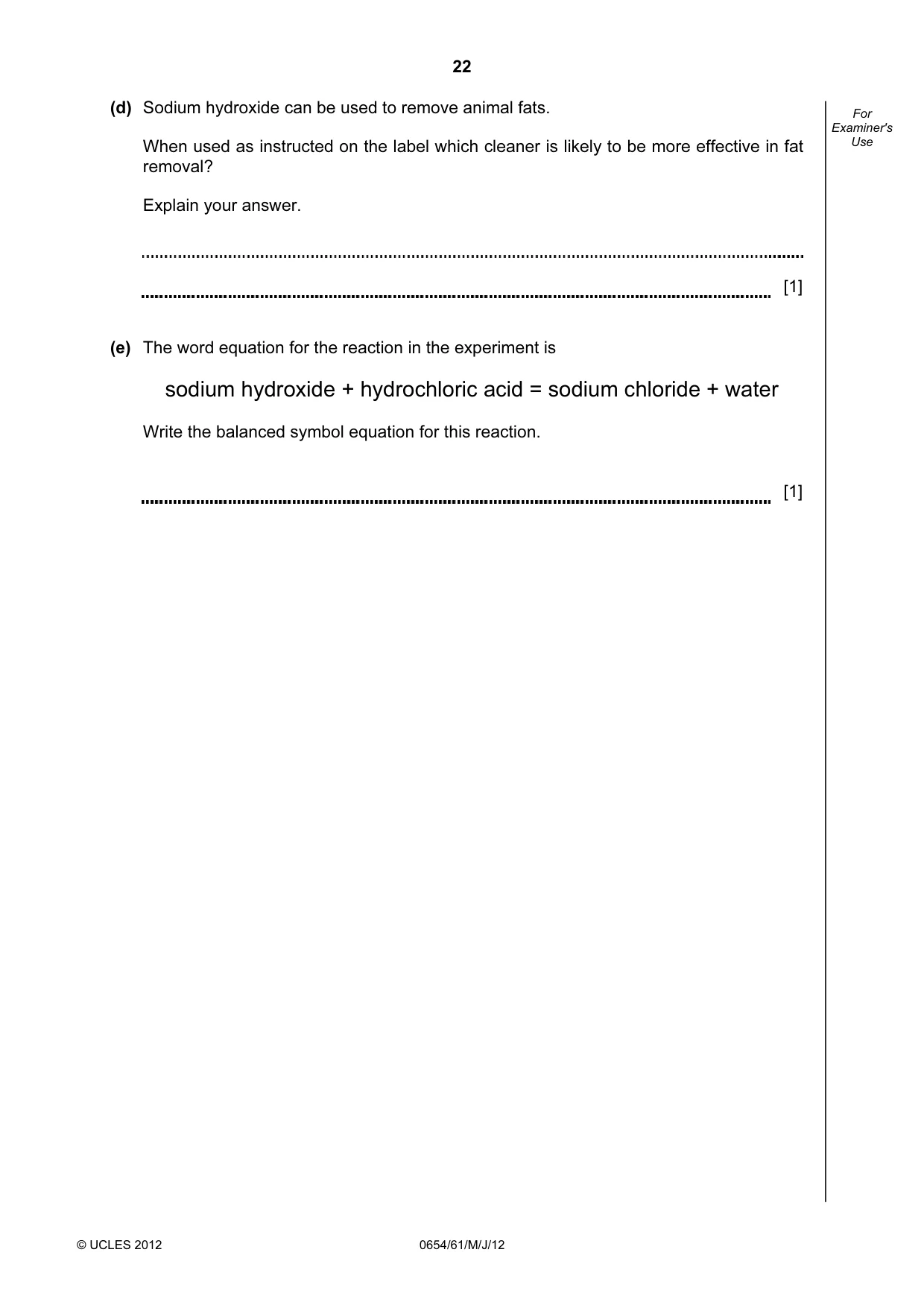
22 © UCLES 2012 0654/61/M/J/12 For Examiner's Use (d) Sodium hydroxide can be used to remove animal fats. When used as instructed on the label which cleaner is likely to be more effective in fat removal? Explain your answer. [1] (e) The word equation for the reaction in the experiment is sodium hydroxide + hydrochloric acid = sodium chloride + water Write the balanced symbol equation for this reaction. [1]
Question paper, page 23
23 © UCLES 2012 0654/61/M/J/12 BLANK PAGE
Question paper, page 24
24 Permission to reproduce items where third-party owned material protected by copyright is included has been sought and cleared where possible. Every reasonable effort has been made by the publisher (UCLES) to trace copyright holders, but if any items requiring clearance have unwittingly been included, the publisher will be pleased to make amends at the earliest possible opportunity. University of Cambridge International Examinations is part of the Cambridge Assessment Group. Cambridge Assessment is the brand name of University of Cambridge Local Examinations Syndicate (UCLES), which is itself a department of the University of Cambridge. © UCLES 2012 0654/61/M/J/12 BLANK PAGE
Mark scheme, page 1
UNIVERSITY OF CAMBRIDGE INTERNATIONAL EXAMINATIONS International General Certificate of Secondary Education MARK SCHEME for the May/June 2012 question paper for the guidance of teachers 0654 CO-ORDINATED SCIENCES 0654/61 Paper 6 (Alternative to Practical), maximum raw mark 60 This mark scheme is published as an aid to teachers and candidates, to indicate the requirements of the examination. It shows the basis on which Examiners were instructed to award marks. It does not indicate the details of the discussions that took place at an Examiners’ meeting before marking began, which would have considered the acceptability of alternative answers. Mark schemes must be read in conjunction with the question papers and the report on the examination. • Cambridge will not enter into discussions or correspondence in connection with these mark schemes. Cambridge is publishing the mark schemes for the May/June 2012 question papers for most IGCSE, GCE Advanced Level and Advanced Subsidiary Level syllabuses and some Ordinary Level syllabuses. www.XtremePapers.com
Mark scheme, page 2
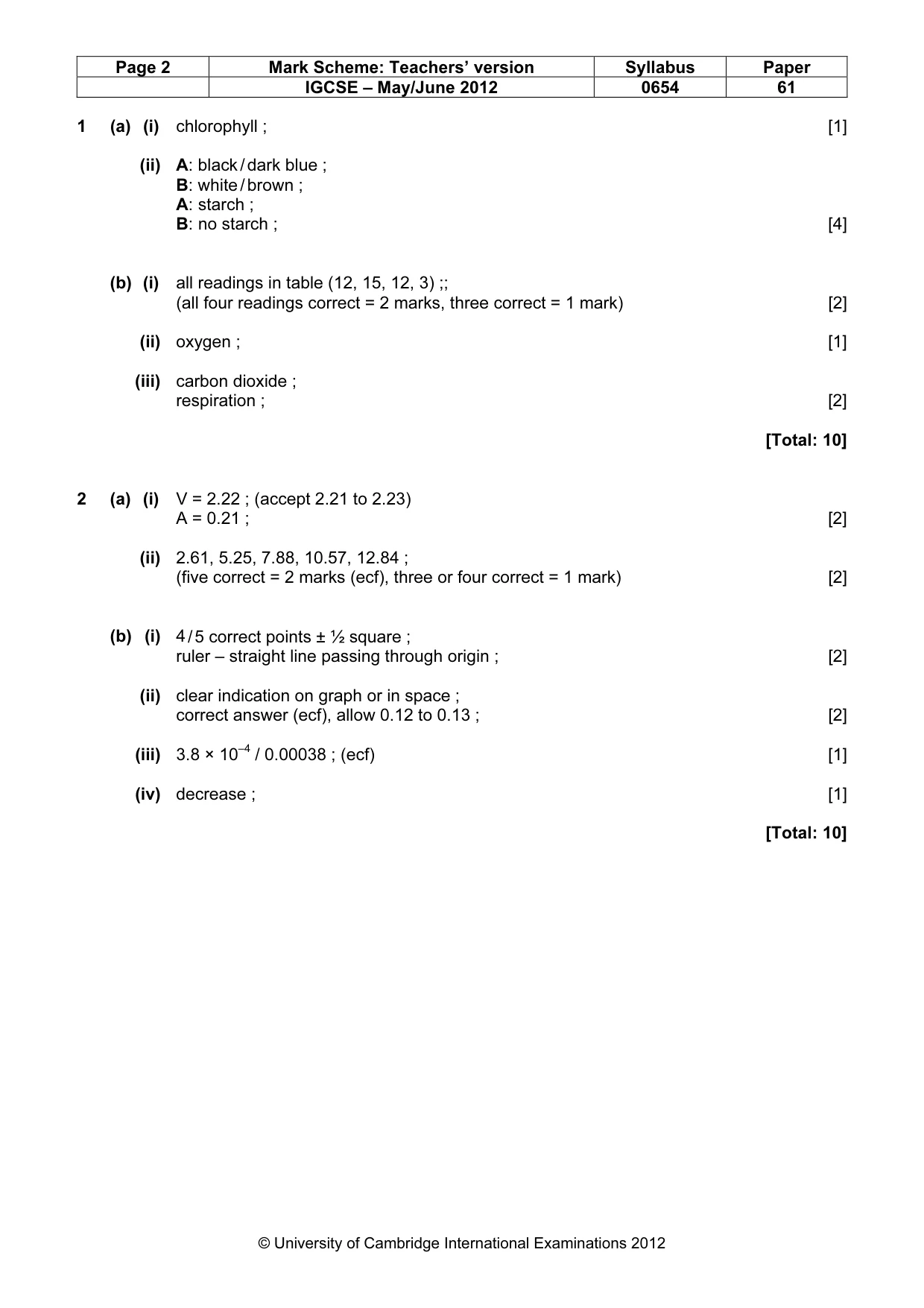
Page 2 Mark Scheme: Teachers’ version Syllabus Paper IGCSE – May/June 2012 0654 61 © University of Cambridge International Examinations 2012 1 (a) (i) chlorophyll ; [1] (ii) A: black / dark blue ; B: white / brown ; A: starch ; B: no starch ; [4] (b) (i) all readings in table (12, 15, 12, 3) ;; (all four readings correct = 2 marks, three correct = 1 mark) [2] (ii) oxygen ; [1] (iii) carbon dioxide ; respiration ; [2] [Total: 10] 2 (a) (i) V = 2.22 ; (accept 2.21 to 2.23) A = 0.21 ; [2] (ii) 2.61, 5.25, 7.88, 10.57, 12.84 ; (five correct = 2 marks (ecf), three or four correct = 1 mark) [2] (b) (i) 4 / 5 correct points ± ½ square ; ruler – straight line passing through origin ; [2] (ii) clear indication on graph or in space ; correct answer (ecf), allow 0.12 to 0.13 ; [2] (iii) 3.8 × 10⁻⁴ / 0.00038 ; (ecf) [1] (iv) decrease ; [1] [Total: 10]
Mark scheme, page 3
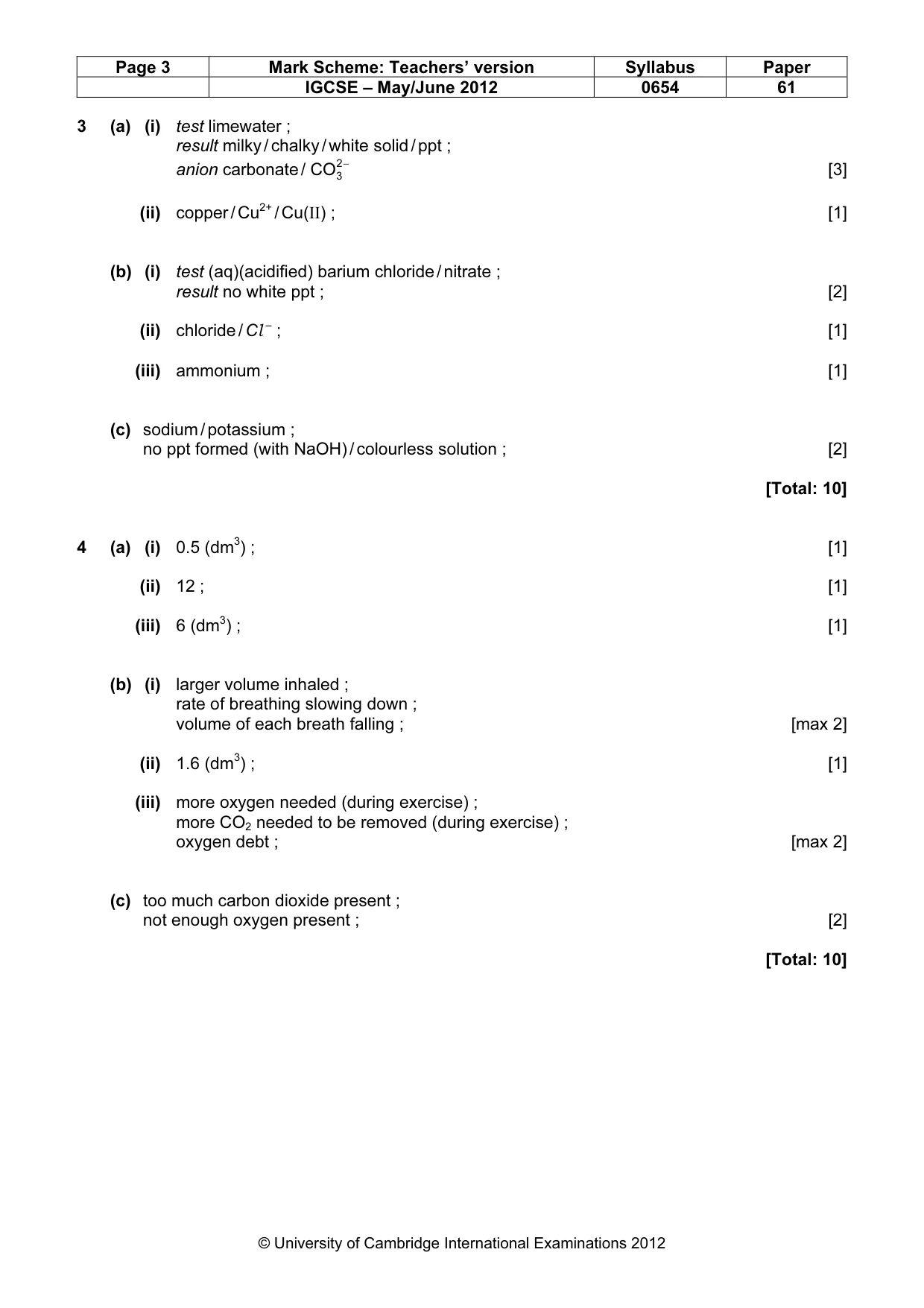
Page 3 Mark Scheme: Teachers’ version Syllabus Paper IGCSE – May/June 2012 0654 61 © University of Cambridge International Examinations 2012 3 (a) (i) test limewater ; result milky / chalky / white solid / ppt ; anion carbonate / − 2 3 CO [3] (ii) copper / Cu2+ / Cu(II) ; [1] (b) (i) test (aq)(acidified) barium chloride / nitrate ; result no white ppt ; [2] (ii) chloride / Cl – ; [1] (iii) ammonium ; [1] (c) sodium / potassium ; no ppt formed (with NaOH) / colourless solution ; [2] [Total: 10] 4 (a) (i) 0.5 (dm3) ; [1] (ii) 12 ; [1] (iii) 6 (dm3) ; [1] (b) (i) larger volume inhaled ; rate of breathing slowing down ; volume of each breath falling ; [max 2] (ii) 1.6 (dm3) ; [1] (iii) more oxygen needed (during exercise) ; more CO2 needed to be removed (during exercise) ; oxygen debt ; [max 2] (c) too much carbon dioxide present ; not enough oxygen present ; [2] [Total: 10]
Mark scheme, page 4
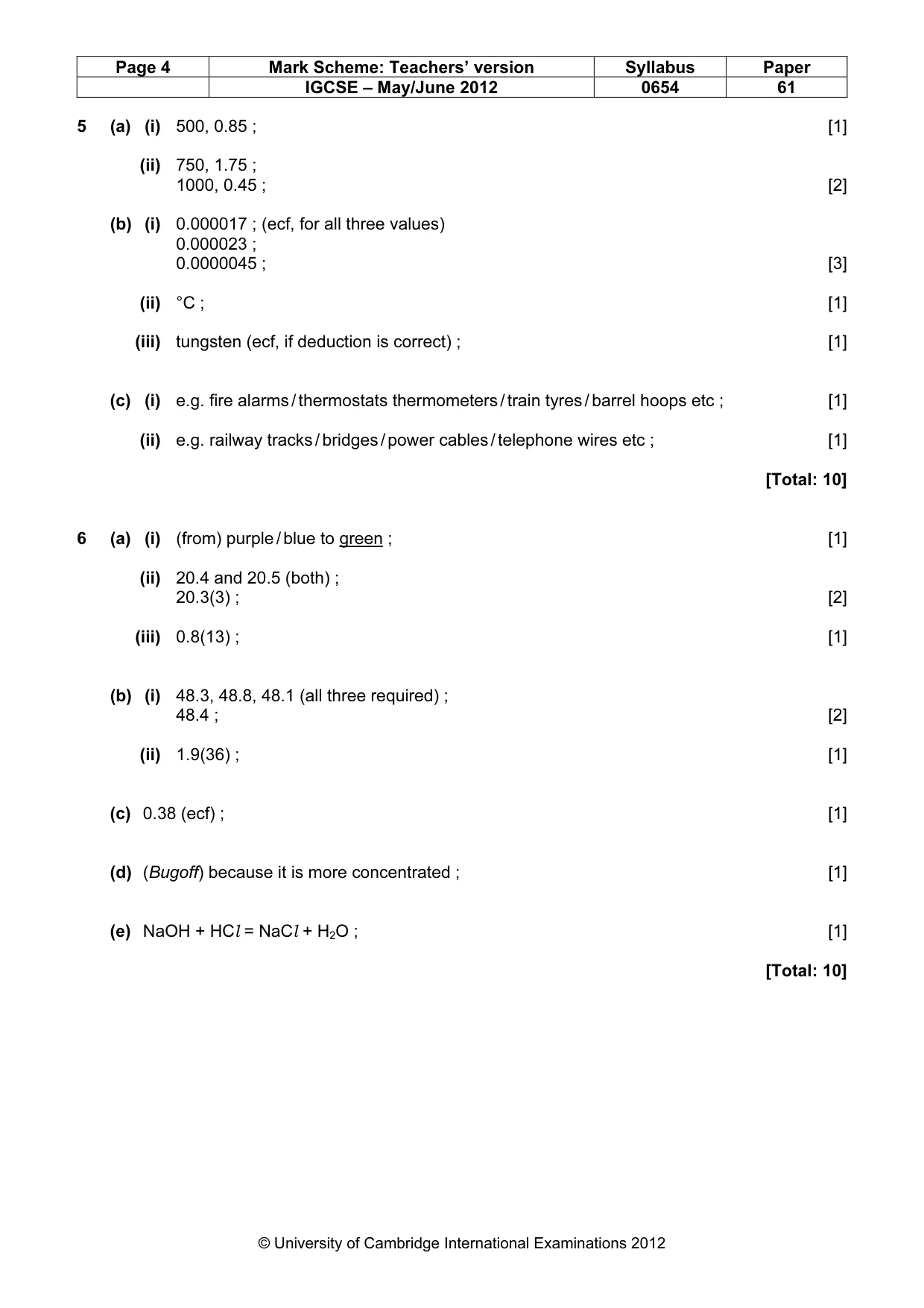
Page 4 Mark Scheme: Teachers’ version Syllabus Paper IGCSE – May/June 2012 0654 61 © University of Cambridge International Examinations 2012 5 (a) (i) 500, 0.85 ; [1] (ii) 750, 1.75 ; 1000, 0.45 ; [2] (b) (i) 0.000017 ; (ecf, for all three values) 0.000023 ; 0.0000045 ; [3] (ii) °C ; [1] (iii) tungsten (ecf, if deduction is correct) ; [1] (c) (i) e.g. fire alarms / thermostats thermometers / train tyres / barrel hoops etc ; [1] (ii) e.g. railway tracks / bridges / power cables / telephone wires etc ; [1] [Total: 10] 6 (a) (i) (from) purple / blue to green ; [1] (ii) 20.4 and 20.5 (both) ; 20.3(3) ; [2] (iii) 0.8(13) ; [1] (b) (i) 48.3, 48.8, 48.1 (all three required) ; 48.4 ; [2] (ii) 1.9(36) ; [1] (c) 0.38 (ecf) ; [1] (d) (Bugoff) because it is more concentrated ; [1] (e) NaOH + HCl = NaCl + H2O ; [1] [Total: 10]
What you needed in this session
Cambridge’s own grade thresholds for 2012 May/June, Paper 6 · Variant 1. A higher threshold means an easier paper — the bar moves with how the cohort did.