Cambridge IGCSE Sciences - Co-ordinated (Double) 0654 — 2011 May/June Paper 5 · Variant 2
0654/52/M/J/11 · 45 marks · ≈51 min
The question paper and its mark scheme, free to read here and free to download. This is Cambridge’s own paper, exactly as it was sat.
Question paper12 pages

Mark scheme4 pages
Answers below. Sit the paper first if you are practising.
Paper as text
Question paper, page 1
This document consists of 11 printed pages and 1 blank page. IB11 06_0654_52/6RP © UCLES 2011 [Turn over *1444211402* For Examiner's Use 1 2 3 Total UNIVERSITY OF CAMBRIDGE INTERNATIONAL EXAMINATIONS International General Certificate of Secondary Education CO-ORDINATED SCIENCES 0654/52 Paper 5 Practical Test May/June 2011 2 hours Candidates answer on the Question Paper. Additional Materials: As listed in Instructions to Supervisors READ THESE INSTRUCTIONS FIRST Write your Centre number, candidate number and name on all the work you hand in. Write in dark blue or black pen. You may use a pencil for any diagrams, graphs or rough working. Do not use staples, paper clips, highlighters, glue or correction fluid. DO NOT WRITE IN ANY BARCODES. Answer all questions. Chemistry practical notes for this paper are printed on page 12. At the end of the examination, fasten all your work securely together. The number of marks is given in brackets [ ] at the end of each question or part question. www.XtremePapers.com
Question paper, page 2
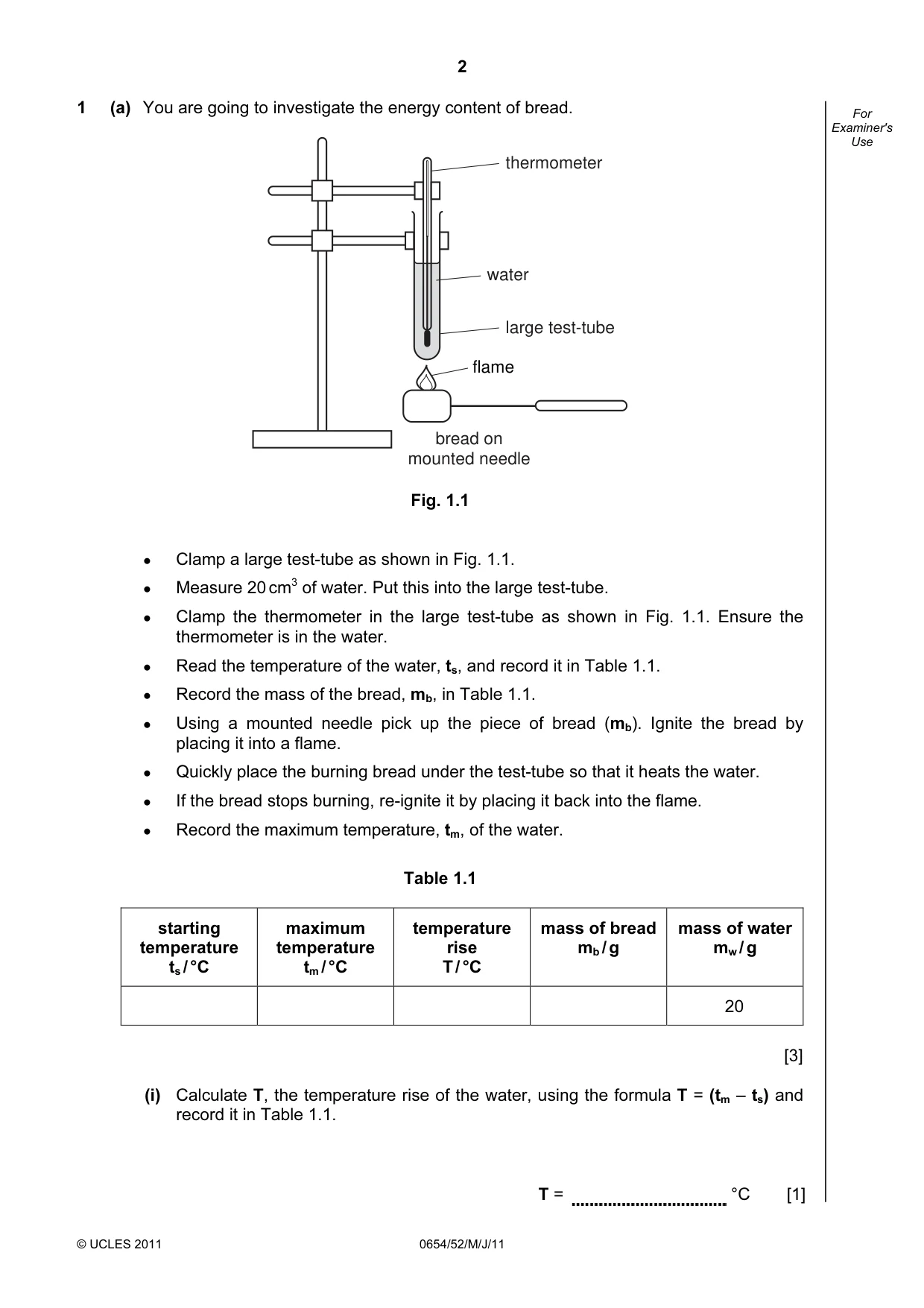
2 © UCLES 2011 0654/52/M/J/11 For Examiner's Use 1 (a) You are going to investigate the energy content of bread. large test-tube water thermometer bread on mounted needle flame Fig. 1.1 ● Clamp a large test-tube as shown in Fig. 1.1. ● Measure 20 cm3 of water. Put this into the large test-tube. ● Clamp the thermometer in the large test-tube as shown in Fig. 1.1. Ensure the thermometer is in the water. ● Read the temperature of the water, ts, and record it in Table 1.1. ● Record the mass of the bread, mb, in Table 1.1. ● Using a mounted needle pick up the piece of bread (mb). Ignite the bread by placing it into a flame. ● Quickly place the burning bread under the test-tube so that it heats the water. ● If the bread stops burning, re-ignite it by placing it back into the flame. ● Record the maximum temperature, tm, of the water. Table 1.1 starting temperature ts / °C maximum temperature tm / °C temperature rise T / °C mass of bread mb / g mass of water mw / g 20 [3] (i) Calculate T, the temperature rise of the water, using the formula T = (tm – ts) and record it in Table 1.1. T = °C [1]
Question paper, page 3
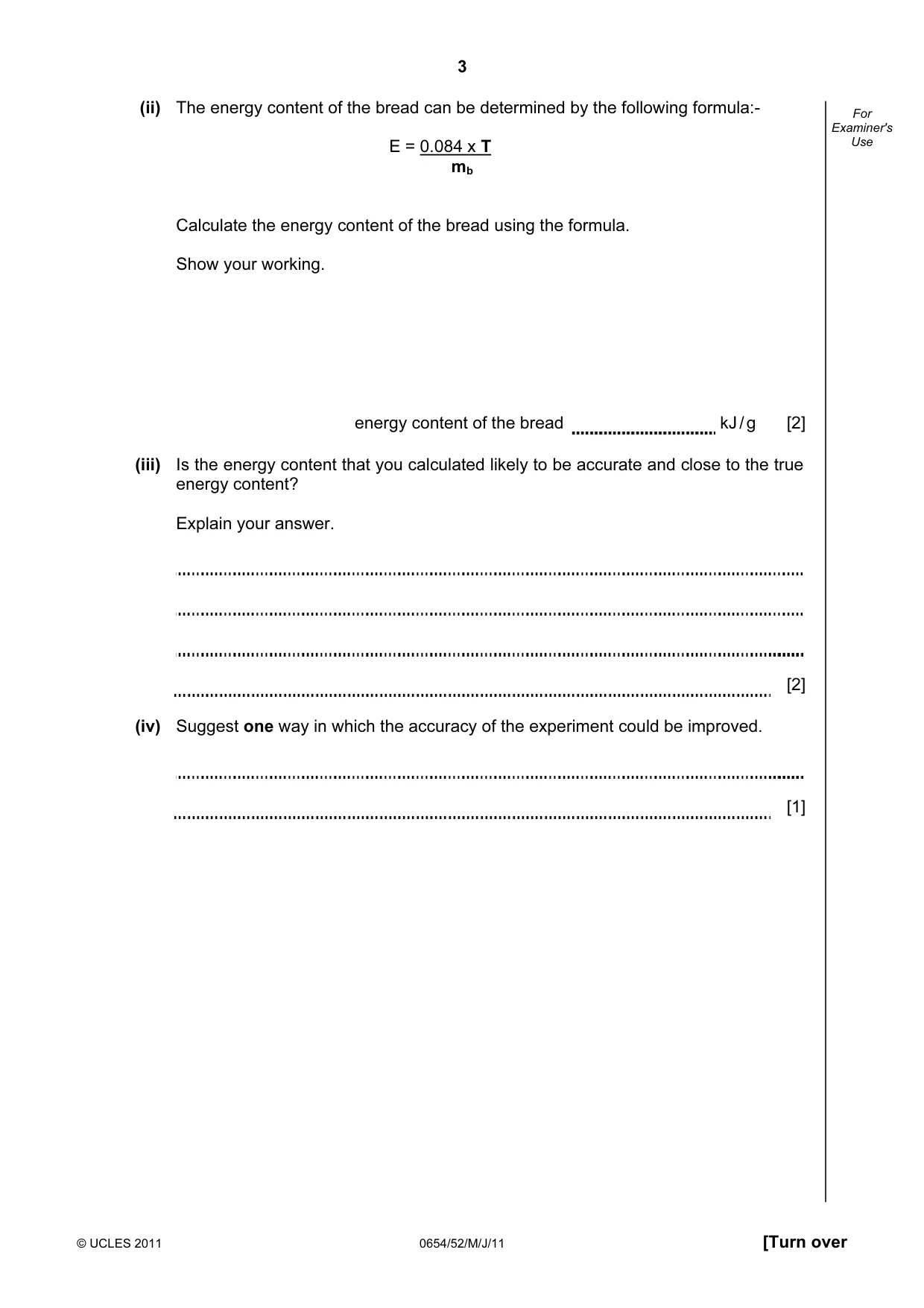
3 © UCLES 2011 0654/52/M/J/11 [Turn over For Examiner's Use (ii) The energy content of the bread can be determined by the following formula:- E = 0.084 x T mb Calculate the energy content of the bread using the formula. Show your working. energy content of the bread kJ / g [2] (iii) Is the energy content that you calculated likely to be accurate and close to the true energy content? Explain your answer. [2] (iv) Suggest one way in which the accuracy of the experiment could be improved. [1]
Question paper, page 4
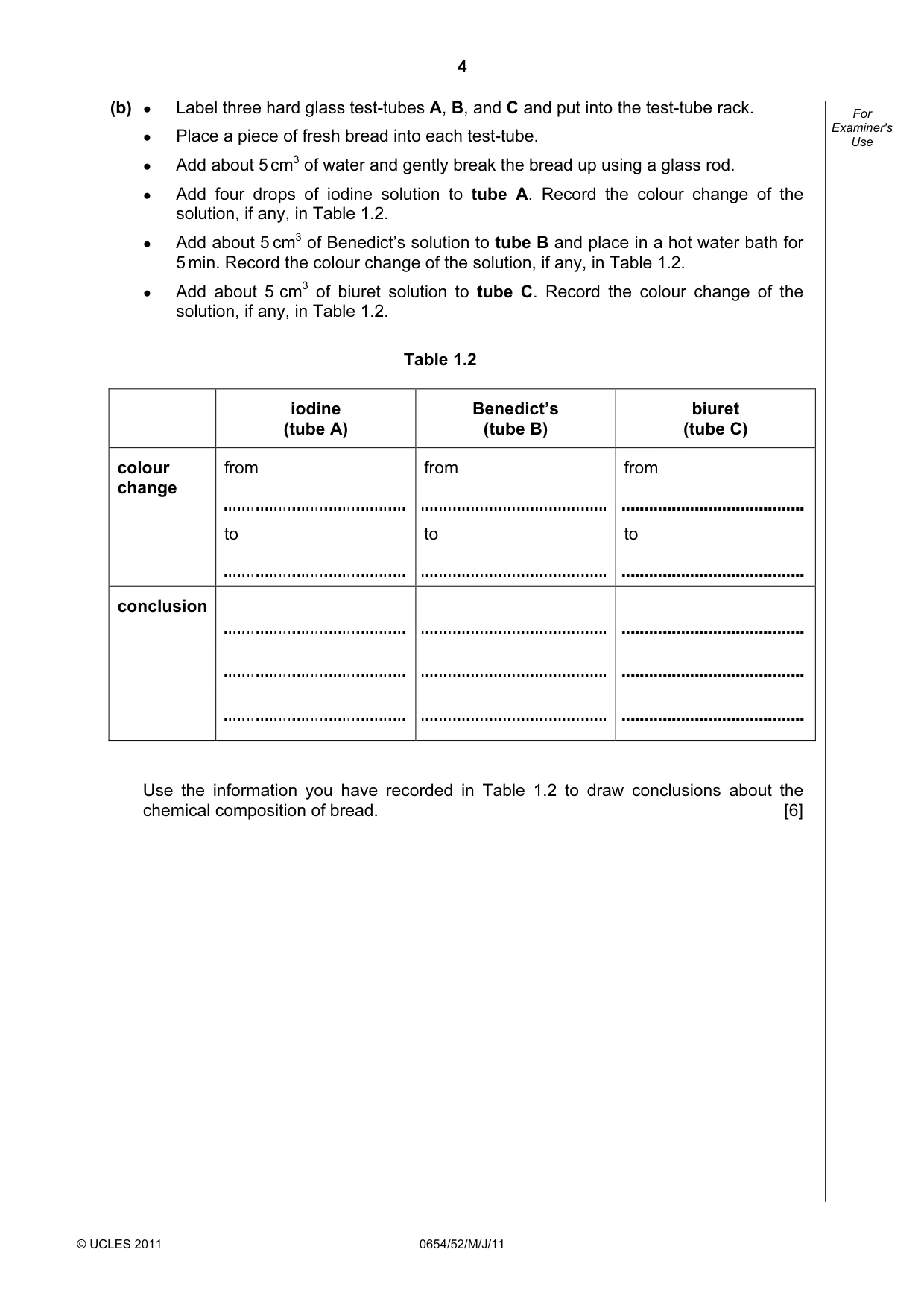
4 © UCLES 2011 0654/52/M/J/11 For Examiner's Use (b) ● Label three hard glass test-tubes A, B, and C and put into the test-tube rack. ● Place a piece of fresh bread into each test-tube. ● Add about 5 cm3 of water and gently break the bread up using a glass rod. ● Add four drops of iodine solution to tube A. Record the colour change of the solution, if any, in Table 1.2. ● Add about 5 cm3 of Benedict’s solution to tube B and place in a hot water bath for 5 min. Record the colour change of the solution, if any, in Table 1.2. ● Add about 5 cm3 of biuret solution to tube C. Record the colour change of the solution, if any, in Table 1.2. Table 1.2 iodine (tube A) Benedict’s (tube B) biuret (tube C) colour change from to from to from to conclusion Use the information you have recorded in Table 1.2 to draw conclusions about the chemical composition of bread. [6]
Question paper, page 5
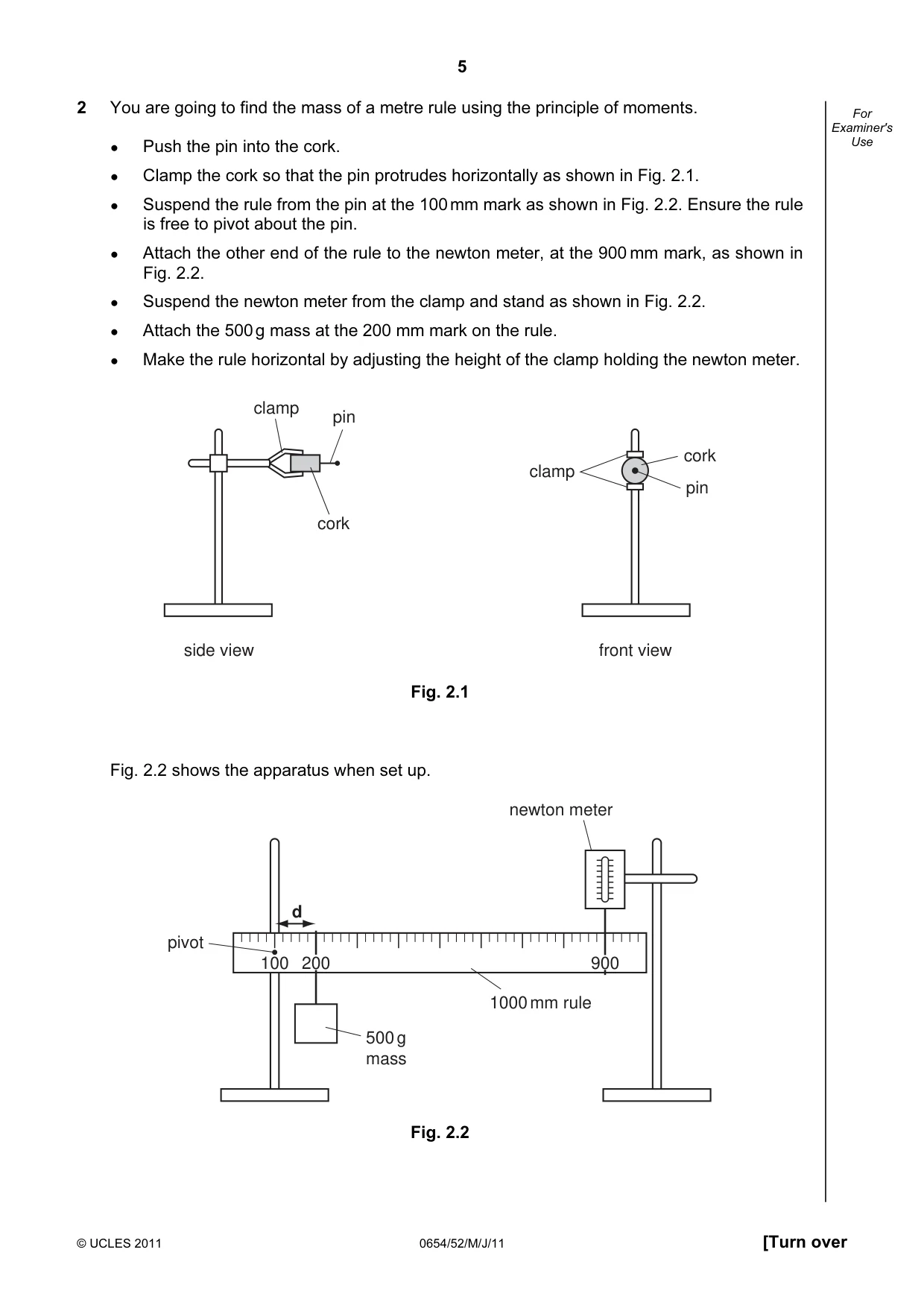
5 © UCLES 2011 0654/52/M/J/11 [Turn over For Examiner's Use 2 You are going to find the mass of a metre rule using the principle of moments. ● Push the pin into the cork. ● Clamp the cork so that the pin protrudes horizontally as shown in Fig. 2.1. ● Suspend the rule from the pin at the 100 mm mark as shown in Fig. 2.2. Ensure the rule is free to pivot about the pin. ● Attach the other end of the rule to the newton meter, at the 900 mm mark, as shown in Fig. 2.2. ● Suspend the newton meter from the clamp and stand as shown in Fig. 2.2. ● Attach the 500 g mass at the 200 mm mark on the rule. ● Make the rule horizontal by adjusting the height of the clamp holding the newton meter. side view cork cork pin pin clamp clamp front view Fig. 2.1 Fig. 2.2 shows the apparatus when set up. 100 500 g mass 200 900 pivot newton meter d 1000 mm rule Fig. 2.2
Question paper, page 6
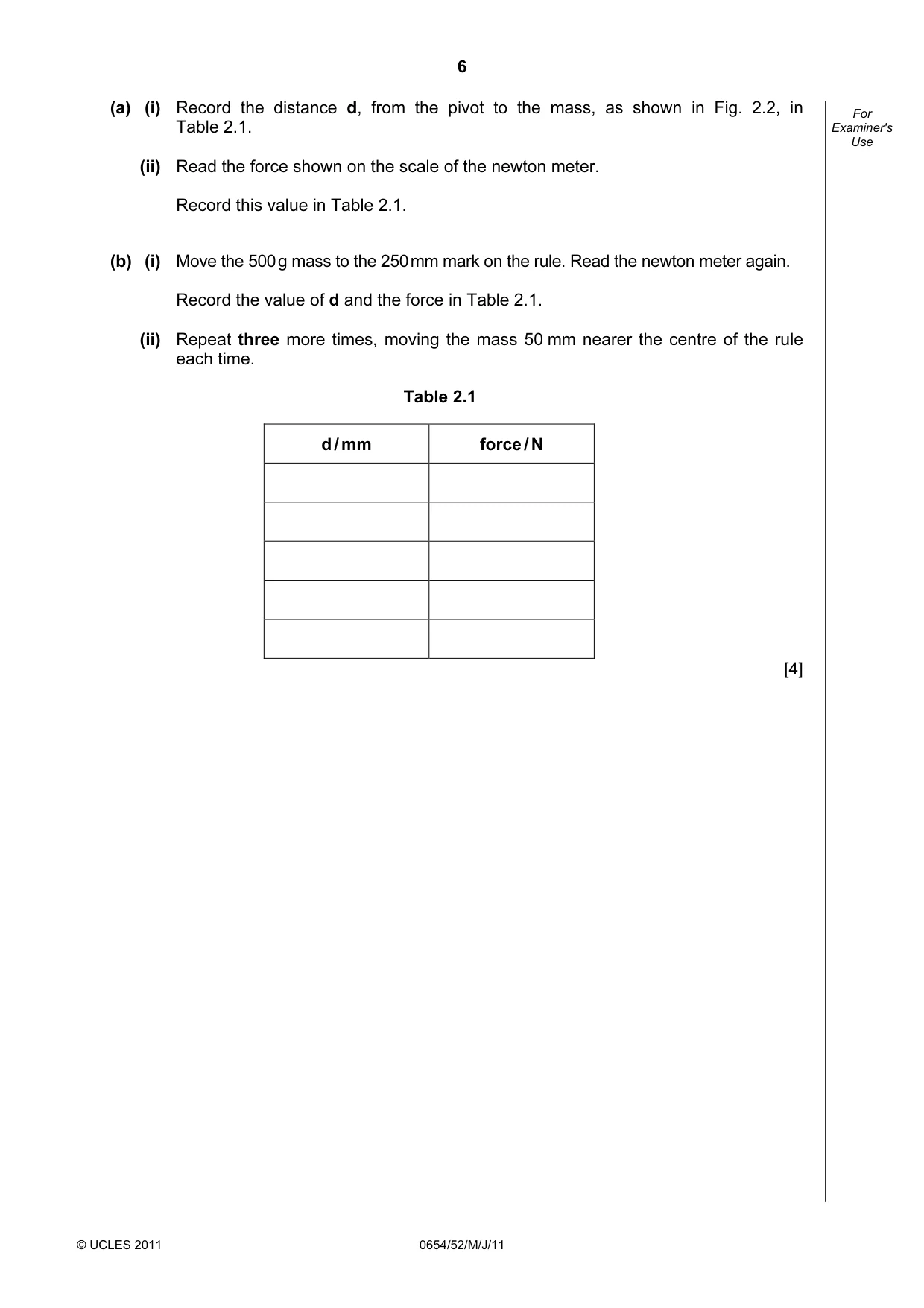
6 © UCLES 2011 0654/52/M/J/11 For Examiner's Use (a) (i) Record the distance d, from the pivot to the mass, as shown in Fig. 2.2, in Table 2.1. (ii) Read the force shown on the scale of the newton meter. Record this value in Table 2.1. (b) (i) Move the 500 g mass to the 250 mm mark on the rule. Read the newton meter again. Record the value of d and the force in Table 2.1. (ii) Repeat three more times, moving the mass 50 mm nearer the centre of the rule each time. Table 2.1 d / mm force / N [4]
Question paper, page 7
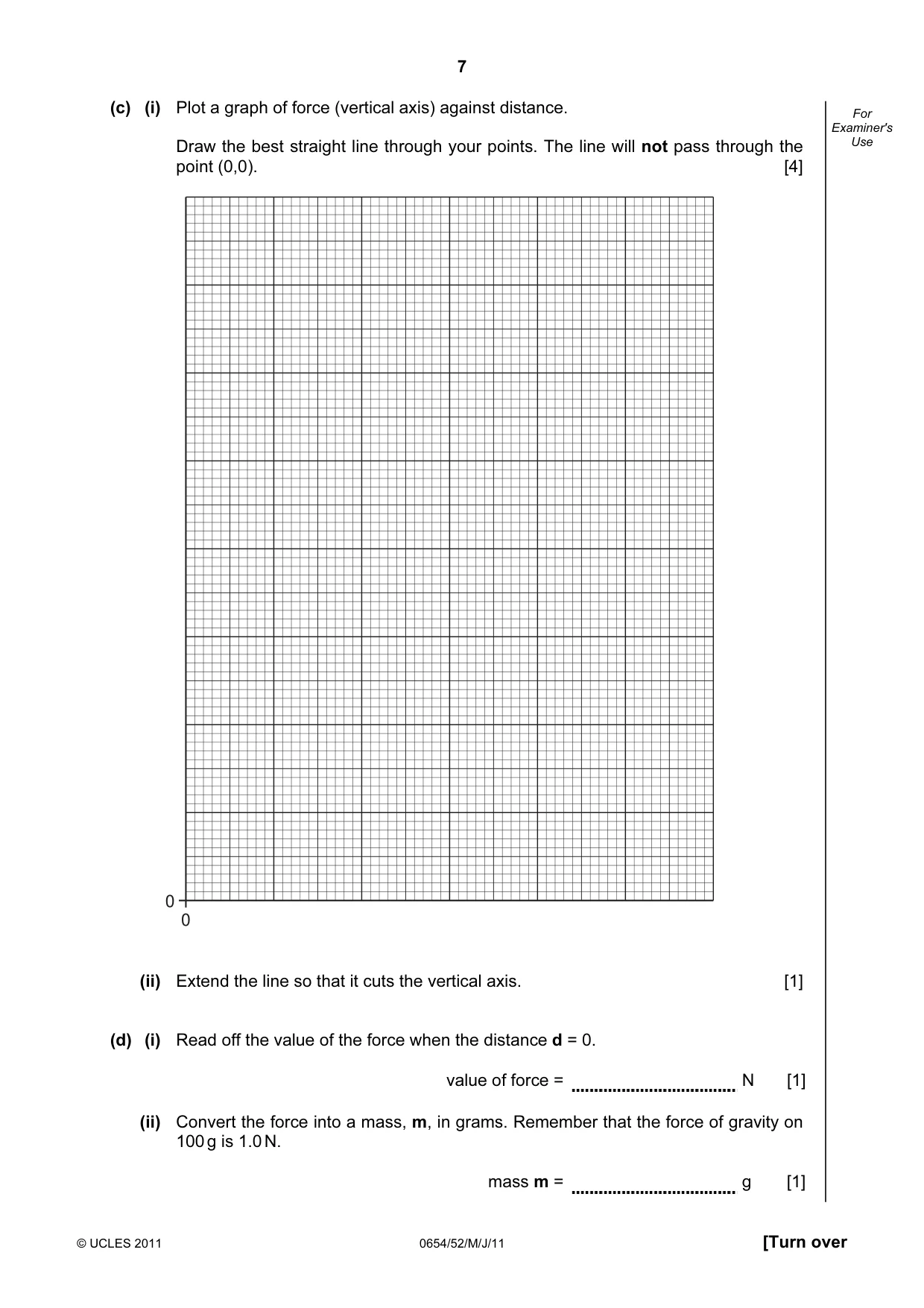
7 © UCLES 2011 0654/52/M/J/11 [Turn over For Examiner's Use (c) (i) Plot a graph of force (vertical axis) against distance. Draw the best straight line through your points. The line will not pass through the point (0,0). [4] 0 0 (ii) Extend the line so that it cuts the vertical axis. [1] (d) (i) Read off the value of the force when the distance d = 0. value of force = N [1] (ii) Convert the force into a mass, m, in grams. Remember that the force of gravity on 100 g is 1.0 N. mass m = g [1]
Question paper, page 8
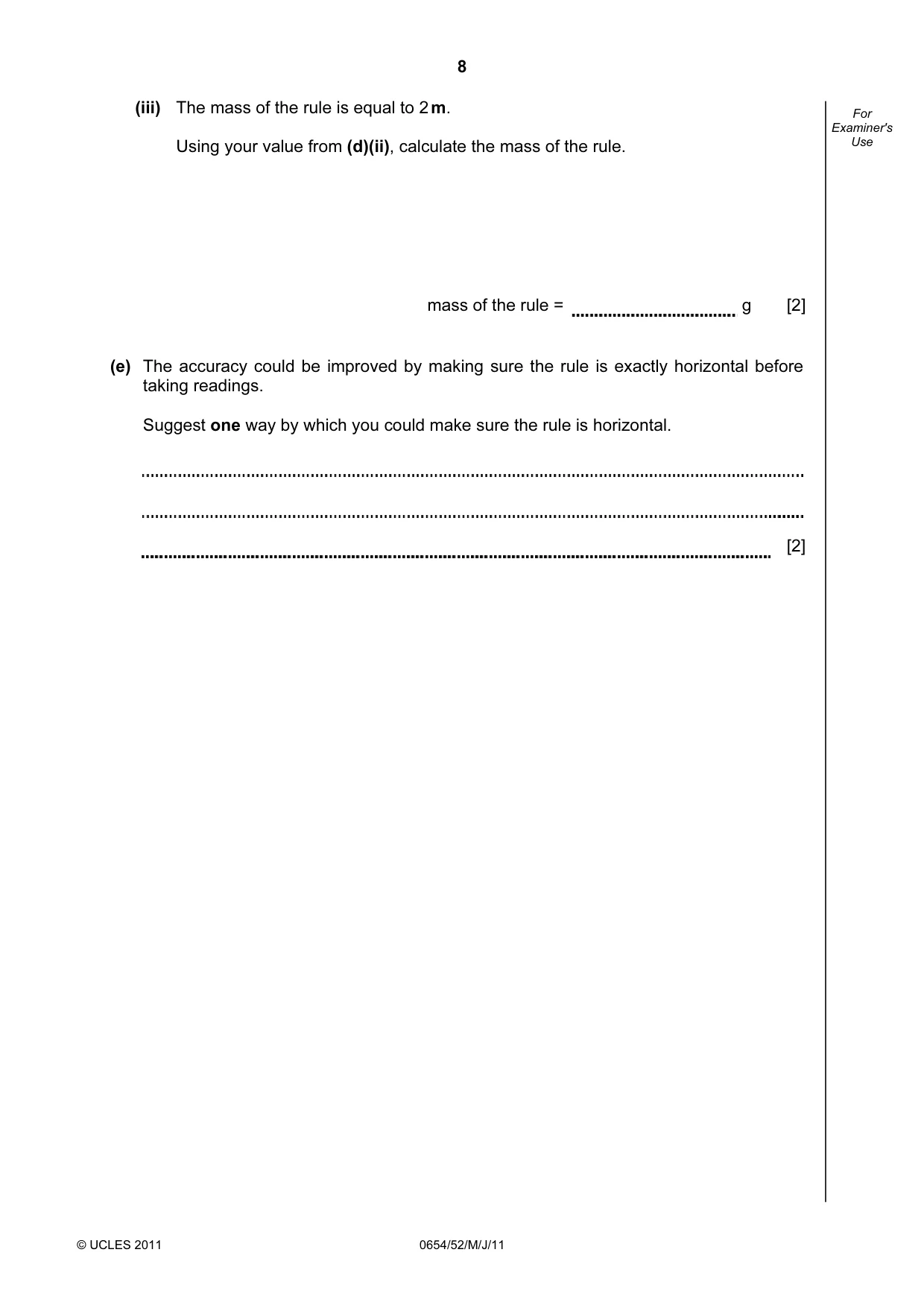
8 © UCLES 2011 0654/52/M/J/11 For Examiner's Use (iii) The mass of the rule is equal to 2 m. Using your value from (d)(ii), calculate the mass of the rule. mass of the rule = g [2] (e) The accuracy could be improved by making sure the rule is exactly horizontal before taking readings. Suggest one way by which you could make sure the rule is horizontal. [2]
Question paper, page 9
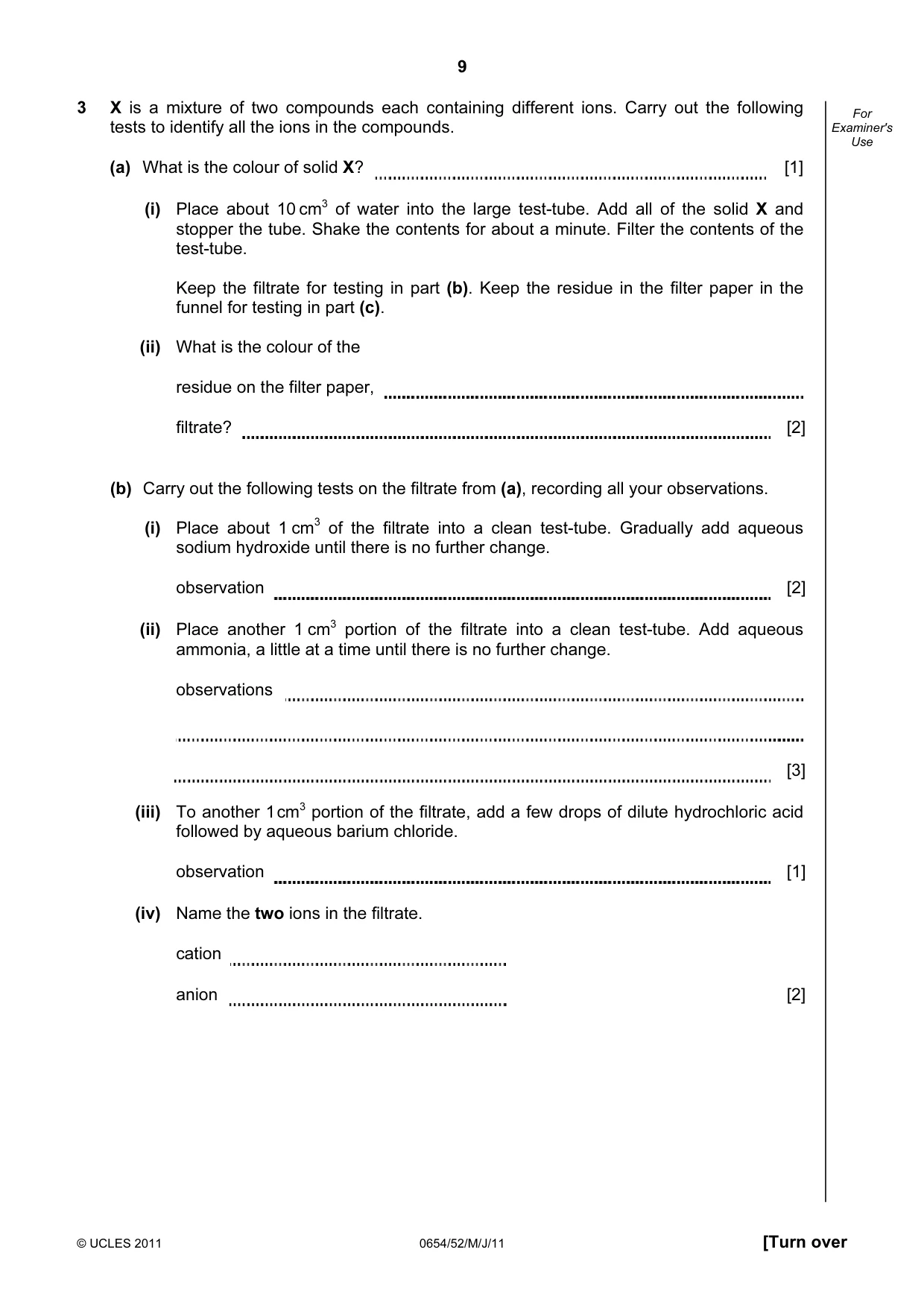
9 © UCLES 2011 0654/52/M/J/11 [Turn over For Examiner's Use 3 X is a mixture of two compounds each containing different ions. Carry out the following tests to identify all the ions in the compounds. (a) What is the colour of solid X? [1] (i) Place about 10 cm3 of water into the large test-tube. Add all of the solid X and stopper the tube. Shake the contents for about a minute. Filter the contents of the test-tube. Keep the filtrate for testing in part (b). Keep the residue in the filter paper in the funnel for testing in part (c). (ii) What is the colour of the residue on the filter paper, filtrate? [2] (b) Carry out the following tests on the filtrate from (a), recording all your observations. (i) Place about 1 cm3 of the filtrate into a clean test-tube. Gradually add aqueous sodium hydroxide until there is no further change. observation [2] (ii) Place another 1 cm3 portion of the filtrate into a clean test-tube. Add aqueous ammonia, a little at a time until there is no further change. observations [3] (iii) To another 1 cm3 portion of the filtrate, add a few drops of dilute hydrochloric acid followed by aqueous barium chloride. observation [1] (iv) Name the two ions in the filtrate. cation anion [2]
Question paper, page 10
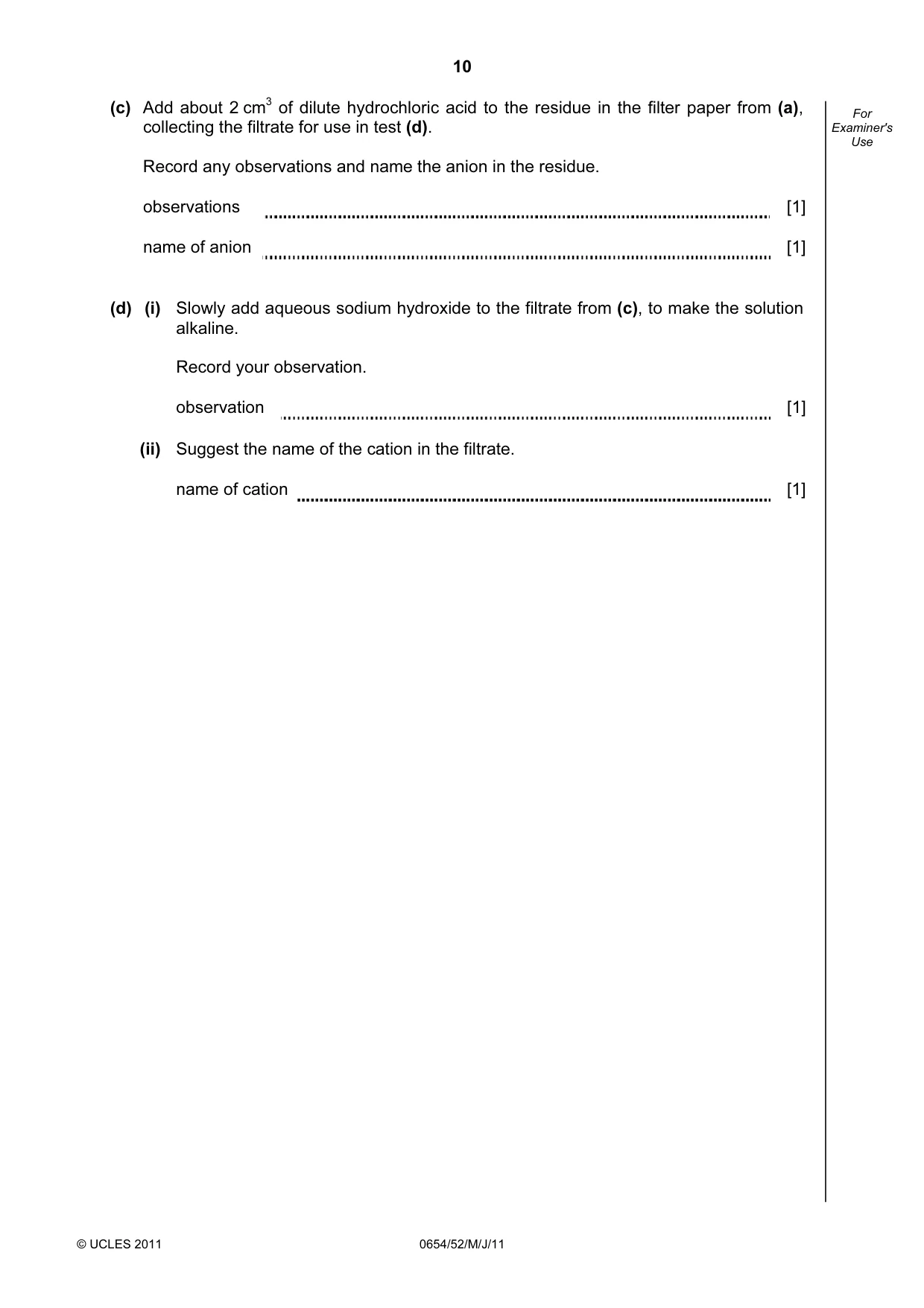
10 © UCLES 2011 0654/52/M/J/11 For Examiner's Use (c) Add about 2 cm3 of dilute hydrochloric acid to the residue in the filter paper from (a), collecting the filtrate for use in test (d). Record any observations and name the anion in the residue. observations [1] name of anion [1] (d) (i) Slowly add aqueous sodium hydroxide to the filtrate from (c), to make the solution alkaline. Record your observation. observation [1] (ii) Suggest the name of the cation in the filtrate. name of cation [1]
Question paper, page 11
11 © UCLES 2011 0654/52/M/J/11 BLANK PAGE
Question paper, page 12
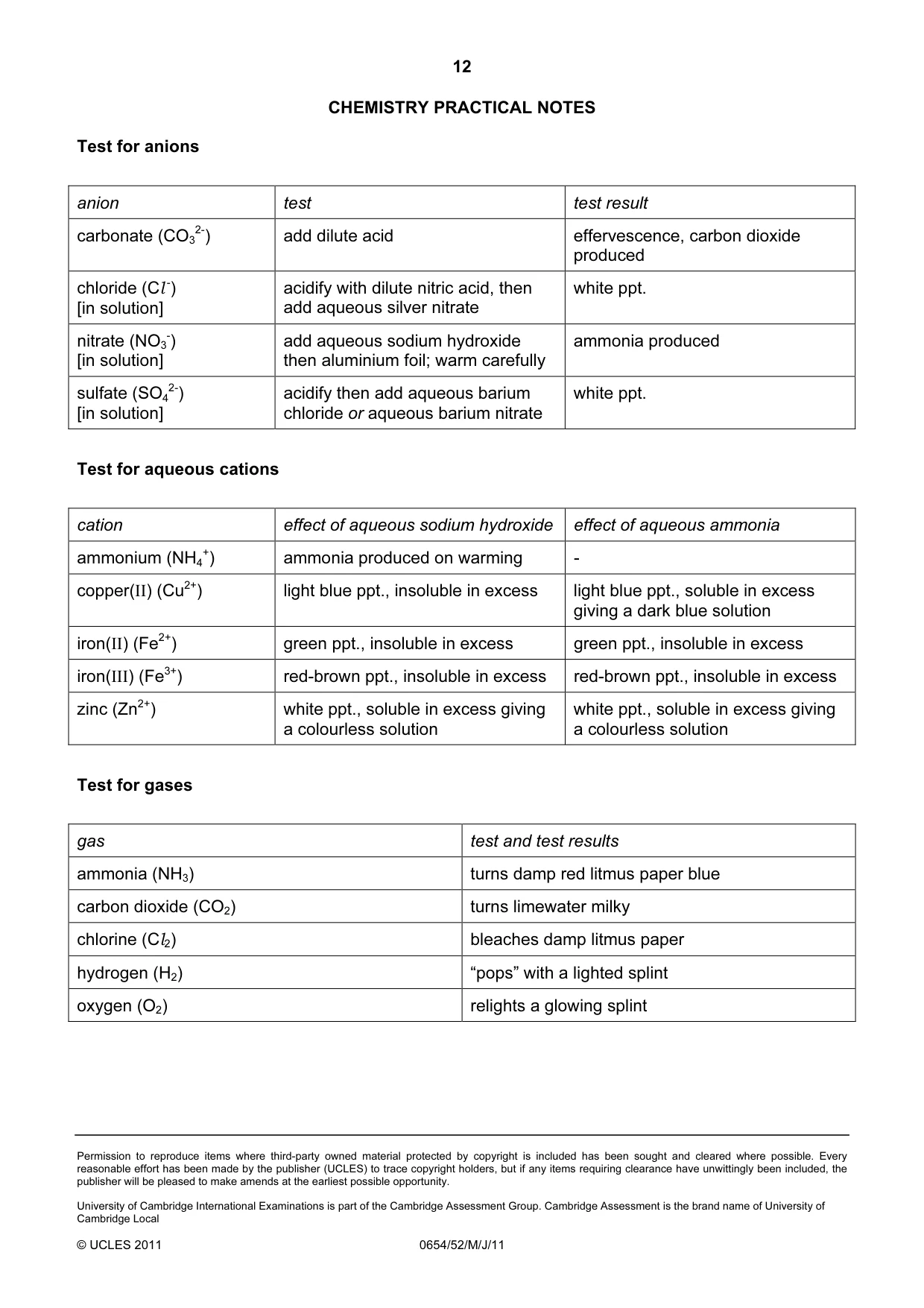
12 Permission to reproduce items where third-party owned material protected by copyright is included has been sought and cleared where possible. Every reasonable effort has been made by the publisher (UCLES) to trace copyright holders, but if any items requiring clearance have unwittingly been included, the publisher will be pleased to make amends at the earliest possible opportunity. University of Cambridge International Examinations is part of the Cambridge Assessment Group. Cambridge Assessment is the brand name of University of Cambridge Local © UCLES 2011 0654/52/M/J/11 CHEMISTRY PRACTICAL NOTES Test for anions anion test test result carbonate (CO3 2-) add dilute acid effervescence, carbon dioxide produced chloride (Cl -) [in solution] acidify with dilute nitric acid, then add aqueous silver nitrate white ppt. nitrate (NO3 -) [in solution] add aqueous sodium hydroxide then aluminium foil; warm carefully ammonia produced sulfate (SO4 2-) [in solution] acidify then add aqueous barium chloride or aqueous barium nitrate white ppt. Test for aqueous cations cation effect of aqueous sodium hydroxide effect of aqueous ammonia ammonium (NH4 +) ammonia produced on warming - copper(II) (Cu2+) light blue ppt., insoluble in excess light blue ppt., soluble in excess giving a dark blue solution iron(II) (Fe2+) green ppt., insoluble in excess green ppt., insoluble in excess iron(III) (Fe3+) red-brown ppt., insoluble in excess red-brown ppt., insoluble in excess zinc (Zn2+) white ppt., soluble in excess giving a colourless solution white ppt., soluble in excess giving a colourless solution Test for gases gas test and test results ammonia (NH3) turns damp red litmus paper blue carbon dioxide (CO2) turns limewater milky chlorine (Cl2) bleaches damp litmus paper hydrogen (H2) “pops” with a lighted splint oxygen (O2) relights a glowing splint
Mark scheme, page 1
UNIVERSITY OF CAMBRIDGE INTERNATIONAL EXAMINATIONS International General Certificate of Secondary Education MARK SCHEME for the May/June 2011 question paper for the guidance of teachers 0654 CO-ORDINATED SCIENCES 0654/52 Paper 5 (Practical), maximum raw mark 45 This mark scheme is published as an aid to teachers and candidates, to indicate the requirements of the examination. It shows the basis on which Examiners were instructed to award marks. It does not indicate the details of the discussions that took place at an Examiners’ meeting before marking began, which would have considered the acceptability of alternative answers. Mark schemes must be read in conjunction with the question papers and the report on the examination. • Cambridge will not enter into discussions or correspondence in connection with these mark schemes. Cambridge is publishing the mark schemes for the May/June 2011 question papers for most IGCSE, GCE Advanced Level and Advanced Subsidiary Level syllabuses and some Ordinary Level syllabuses. www.XtremePapers.com
Mark scheme, page 2
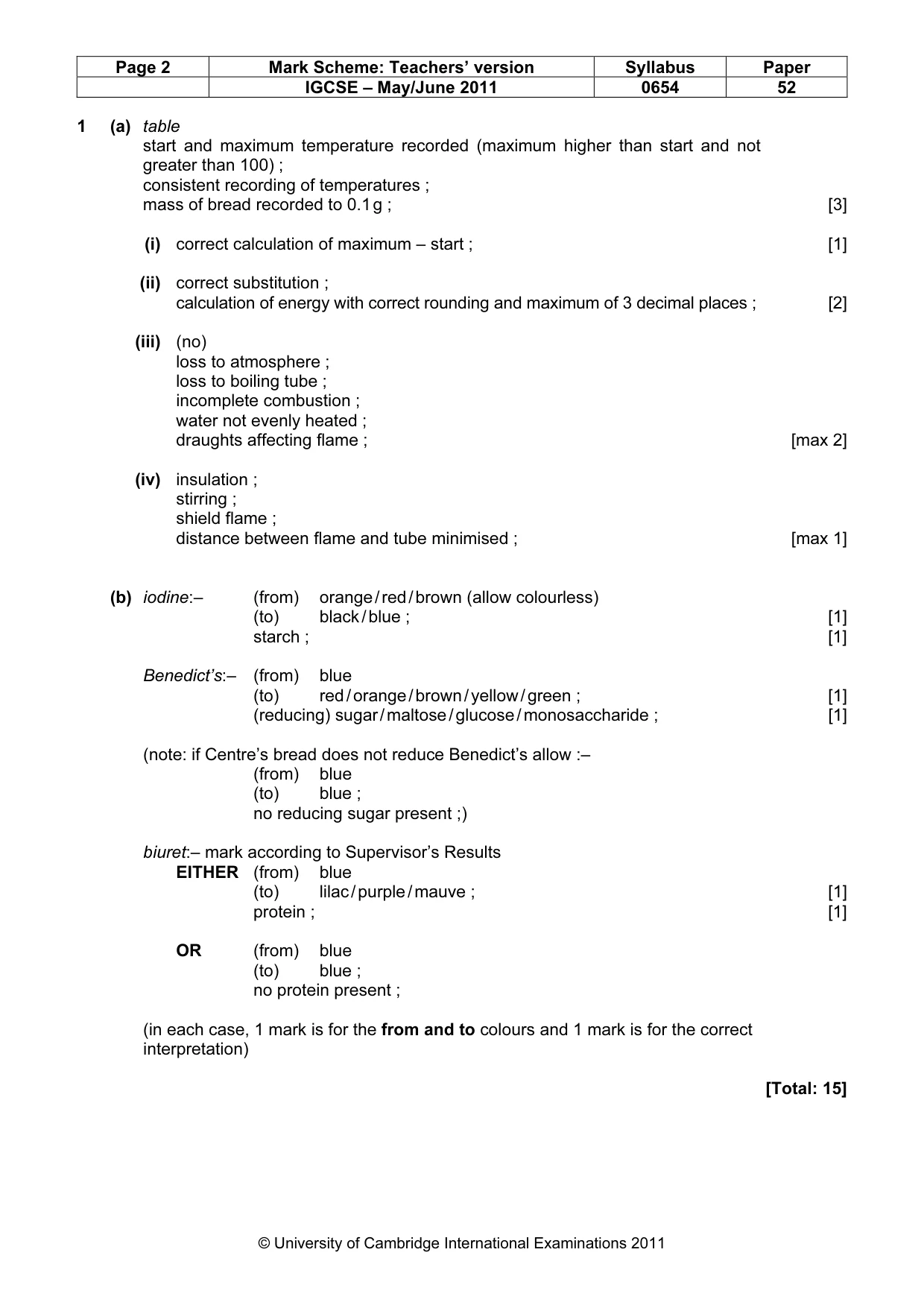
Page 2 Mark Scheme: Teachers’ version Syllabus Paper IGCSE – May/June 2011 0654 52 © University of Cambridge International Examinations 2011 1 (a) table start and maximum temperature recorded (maximum higher than start and not greater than 100) ; consistent recording of temperatures ; mass of bread recorded to 0.1 g ; [3] (i) correct calculation of maximum – start ; [1] (ii) correct substitution ; calculation of energy with correct rounding and maximum of 3 decimal places ; [2] (iii) (no) loss to atmosphere ; loss to boiling tube ; incomplete combustion ; water not evenly heated ; draughts affecting flame ; [max 2] (iv) insulation ; stirring ; shield flame ; distance between flame and tube minimised ; [max 1] (b) iodine:– (from) orange / red / brown (allow colourless) (to) black / blue ; [1] starch ; [1] Benedict’s:– (from) blue (to) red / orange / brown / yellow / green ; [1] (reducing) sugar / maltose / glucose / monosaccharide ; [1] (note: if Centre’s bread does not reduce Benedict’s allow :– (from) blue (to) blue ; no reducing sugar present ;) biuret:– mark according to Supervisor’s Results EITHER (from) blue (to) lilac / purple / mauve ; [1] protein ; [1] OR (from) blue (to) blue ; no protein present ; (in each case, 1 mark is for the from and to colours and 1 mark is for the correct interpretation) [Total: 15]
Mark scheme, page 3
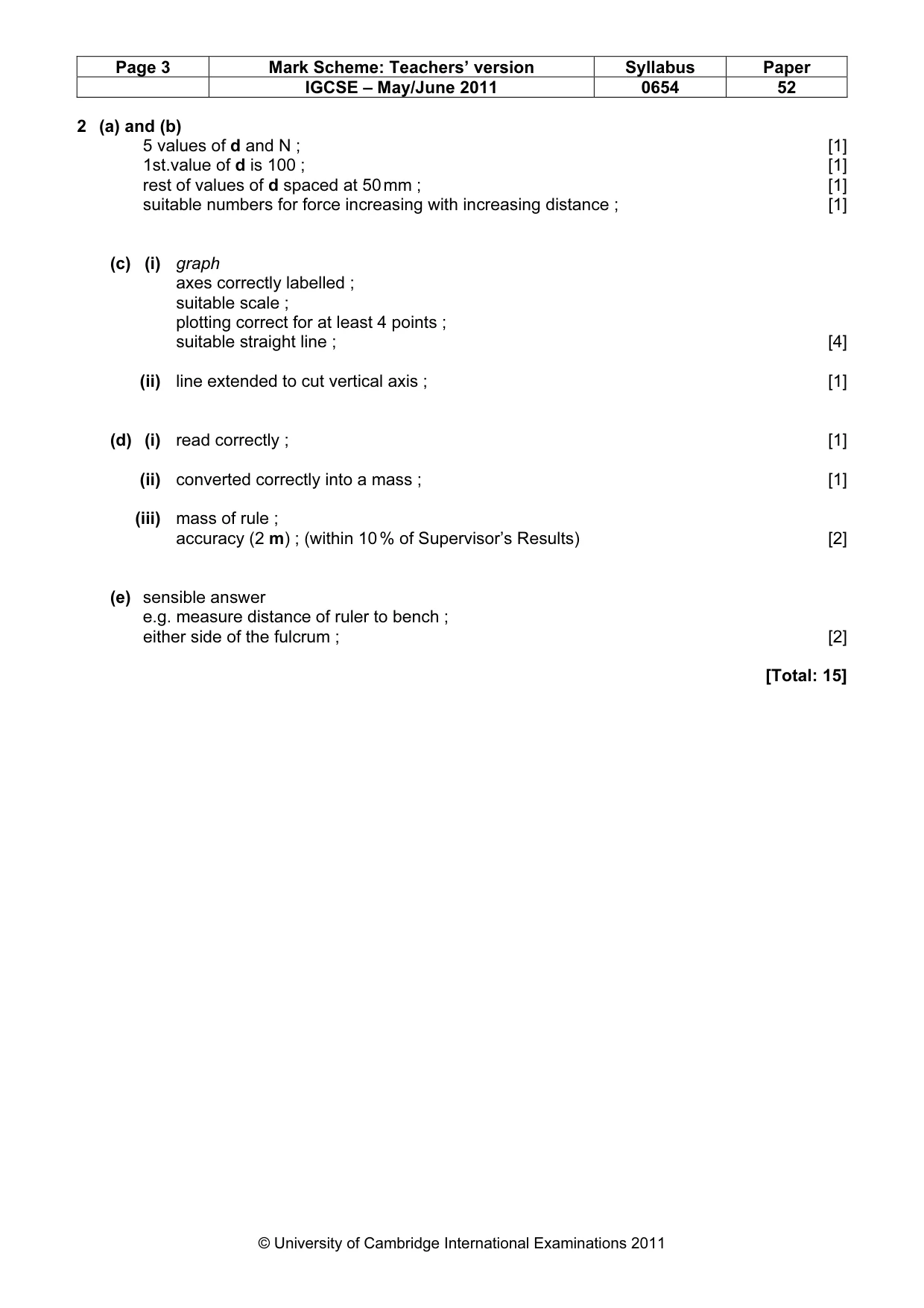
Page 3 Mark Scheme: Teachers’ version Syllabus Paper IGCSE – May/June 2011 0654 52 © University of Cambridge International Examinations 2011 2 (a) and (b) 5 values of d and N ; [1] 1st.value of d is 100 ; [1] rest of values of d spaced at 50 mm ; [1] suitable numbers for force increasing with increasing distance ; [1] (c) (i) graph axes correctly labelled ; suitable scale ; plotting correct for at least 4 points ; suitable straight line ; [4] (ii) line extended to cut vertical axis ; [1] (d) (i) read correctly ; [1] (ii) converted correctly into a mass ; [1] (iii) mass of rule ; accuracy (2 m) ; (within 10 % of Supervisor’s Results) [2] (e) sensible answer e.g. measure distance of ruler to bench ; either side of the fulcrum ; [2] [Total: 15]
Mark scheme, page 4
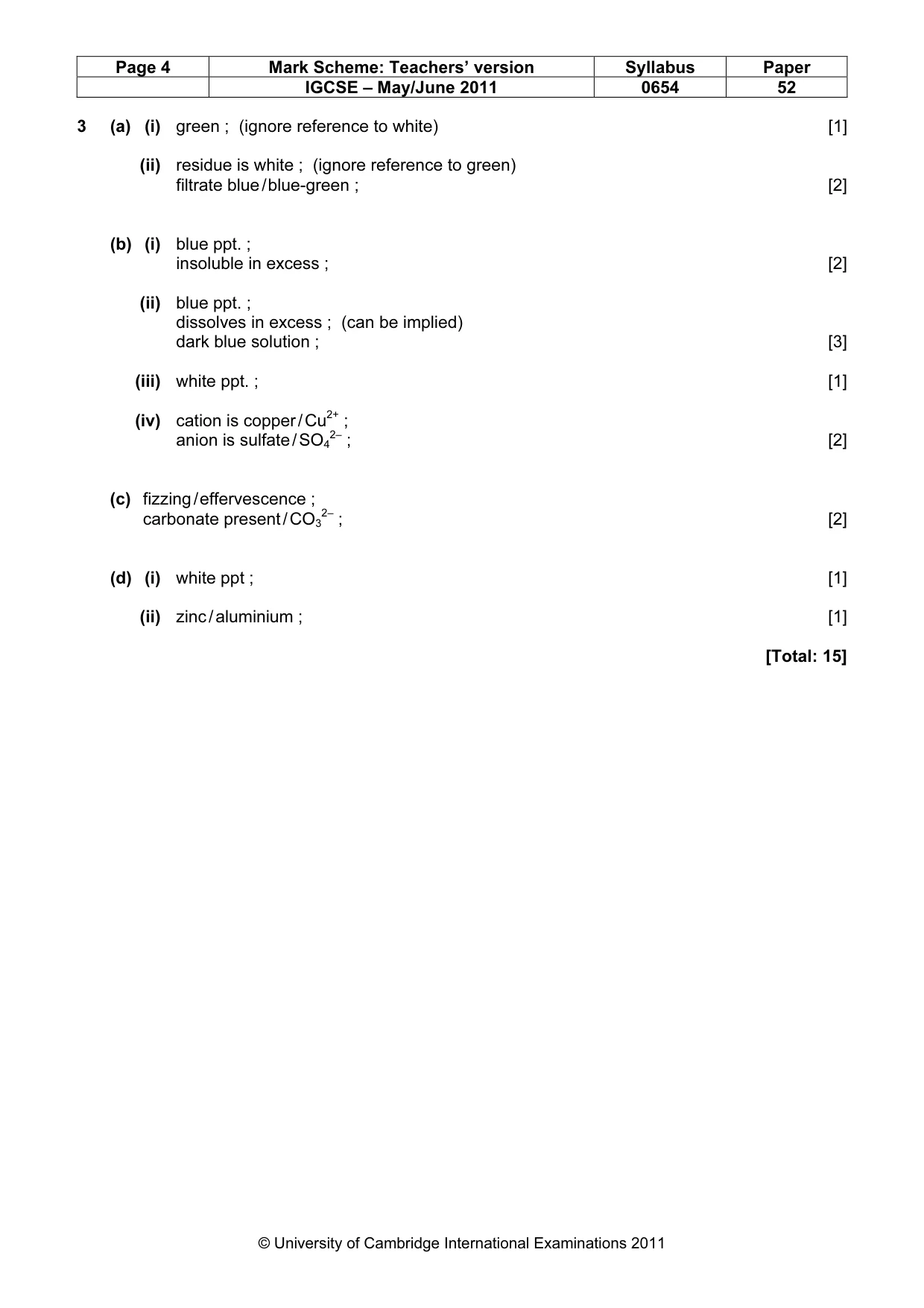
Page 4 Mark Scheme: Teachers’ version Syllabus Paper IGCSE – May/June 2011 0654 52 © University of Cambridge International Examinations 2011 3 (a) (i) green ; (ignore reference to white) [1] (ii) residue is white ; (ignore reference to green) filtrate blue / blue-green ; [2] (b) (i) blue ppt. ; insoluble in excess ; [2] (ii) blue ppt. ; dissolves in excess ; (can be implied) dark blue solution ; [3] (iii) white ppt. ; [1] (iv) cation is copper / Cu2+ ; anion is sulfate / SO4 2– ; [2] (c) fizzing / effervescence ; carbonate present / CO3 2– ; [2] (d) (i) white ppt ; [1] (ii) zinc / aluminium ; [1] [Total: 15]
What you needed in this session
Cambridge’s own grade thresholds for 2011 May/June, Paper 5 · Variant 2. A higher threshold means an easier paper — the bar moves with how the cohort did.