Cambridge IGCSE Sciences - Co-ordinated (Double) 0654 — 2011 May/June Paper 5 · Variant 1
0654/51/M/J/11 · 45 marks · ≈51 min
The question paper and its mark scheme, free to read here and free to download. This is Cambridge’s own paper, exactly as it was sat.
Question paper12 pages
Mark scheme3 pages
Answers below. Sit the paper first if you are practising.
Paper as text
Question paper, page 1
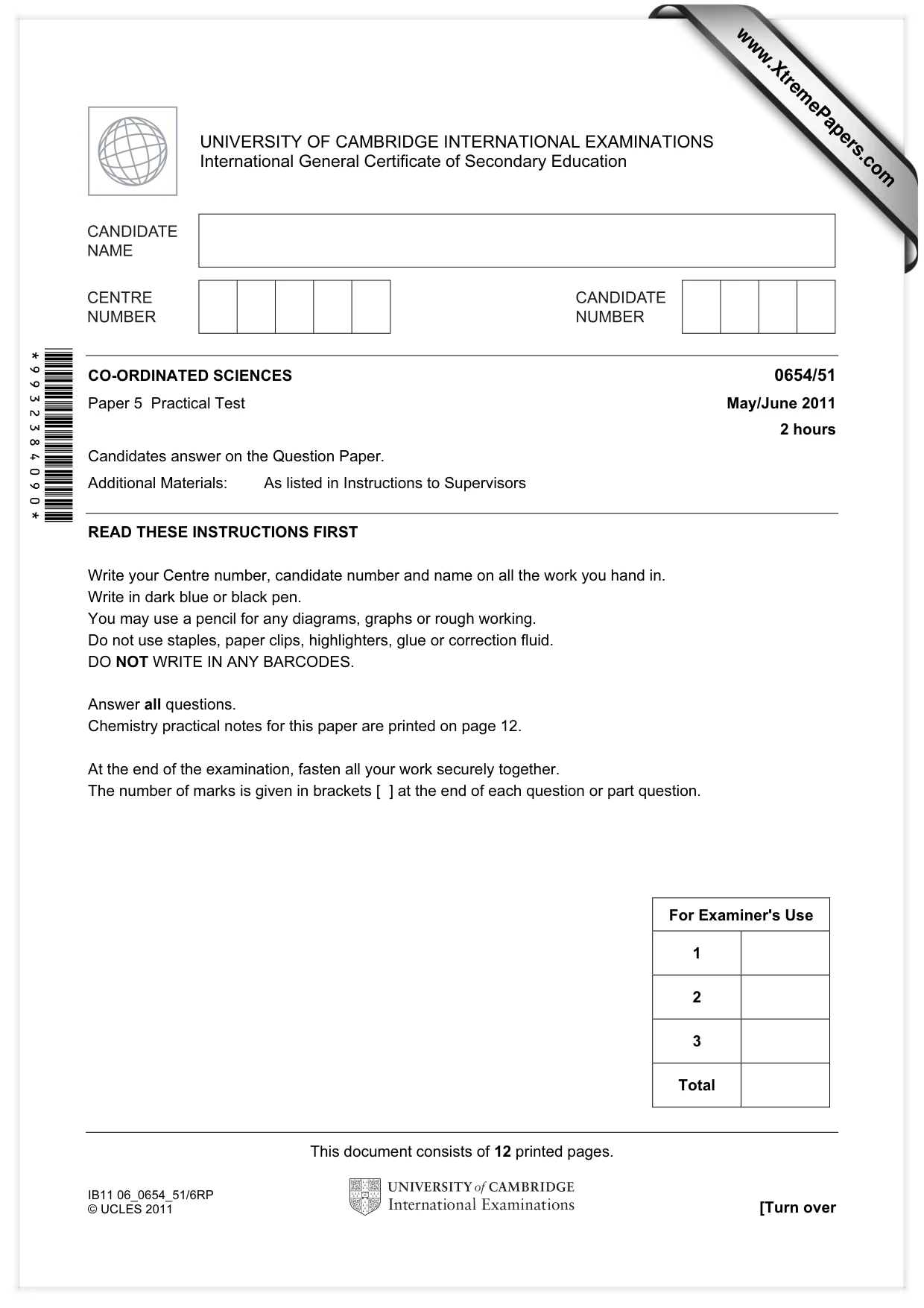
This document consists of 12 printed pages. IB11 06_0654_51/6RP © UCLES 2011 [Turn over *9932384090* For Examiner's Use 1 2 3 Total UNIVERSITY OF CAMBRIDGE INTERNATIONAL EXAMINATIONS International General Certificate of Secondary Education CO-ORDINATED SCIENCES 0654/51 Paper 5 Practical Test May/June 2011 2 hours Candidates answer on the Question Paper. Additional Materials: As listed in Instructions to Supervisors READ THESE INSTRUCTIONS FIRST Write your Centre number, candidate number and name on all the work you hand in. Write in dark blue or black pen. You may use a pencil for any diagrams, graphs or rough working. Do not use staples, paper clips, highlighters, glue or correction fluid. DO NOT WRITE IN ANY BARCODES. Answer all questions. Chemistry practical notes for this paper are printed on page 12. At the end of the examination, fasten all your work securely together. The number of marks is given in brackets [ ] at the end of each question or part question. www.XtremePapers.com
Question paper, page 2
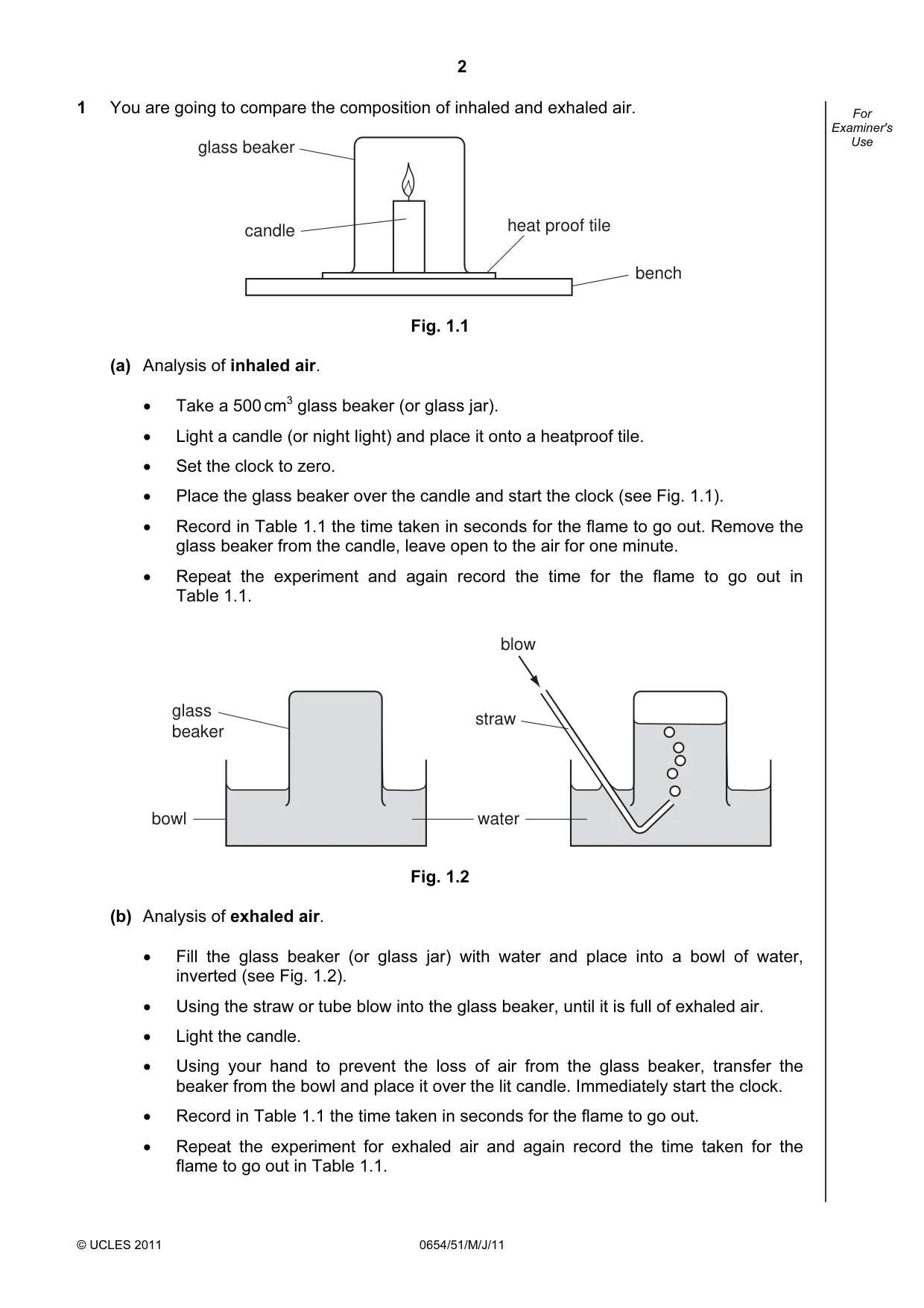
2 © UCLES 2011 0654/51/M/J/11 For Examiner's Use 1 You are going to compare the composition of inhaled and exhaled air. glass beaker candle heat proof tile bench Fig. 1.1 (a) Analysis of inhaled air. • Take a 500 cm3 glass beaker (or glass jar). • Light a candle (or night light) and place it onto a heatproof tile. • Set the clock to zero. • Place the glass beaker over the candle and start the clock (see Fig. 1.1). • Record in Table 1.1 the time taken in seconds for the flame to go out. Remove the glass beaker from the candle, leave open to the air for one minute. • Repeat the experiment and again record the time for the flame to go out in Table 1.1. blow straw glass beaker bowl water Fig. 1.2 (b) Analysis of exhaled air. • Fill the glass beaker (or glass jar) with water and place into a bowl of water, inverted (see Fig. 1.2). • Using the straw or tube blow into the glass beaker, until it is full of exhaled air. • Light the candle. • Using your hand to prevent the loss of air from the glass beaker, transfer the beaker from the bowl and place it over the lit candle. Immediately start the clock. • Record in Table 1.1 the time taken in seconds for the flame to go out. • Repeat the experiment for exhaled air and again record the time taken for the flame to go out in Table 1.1.
Question paper, page 3
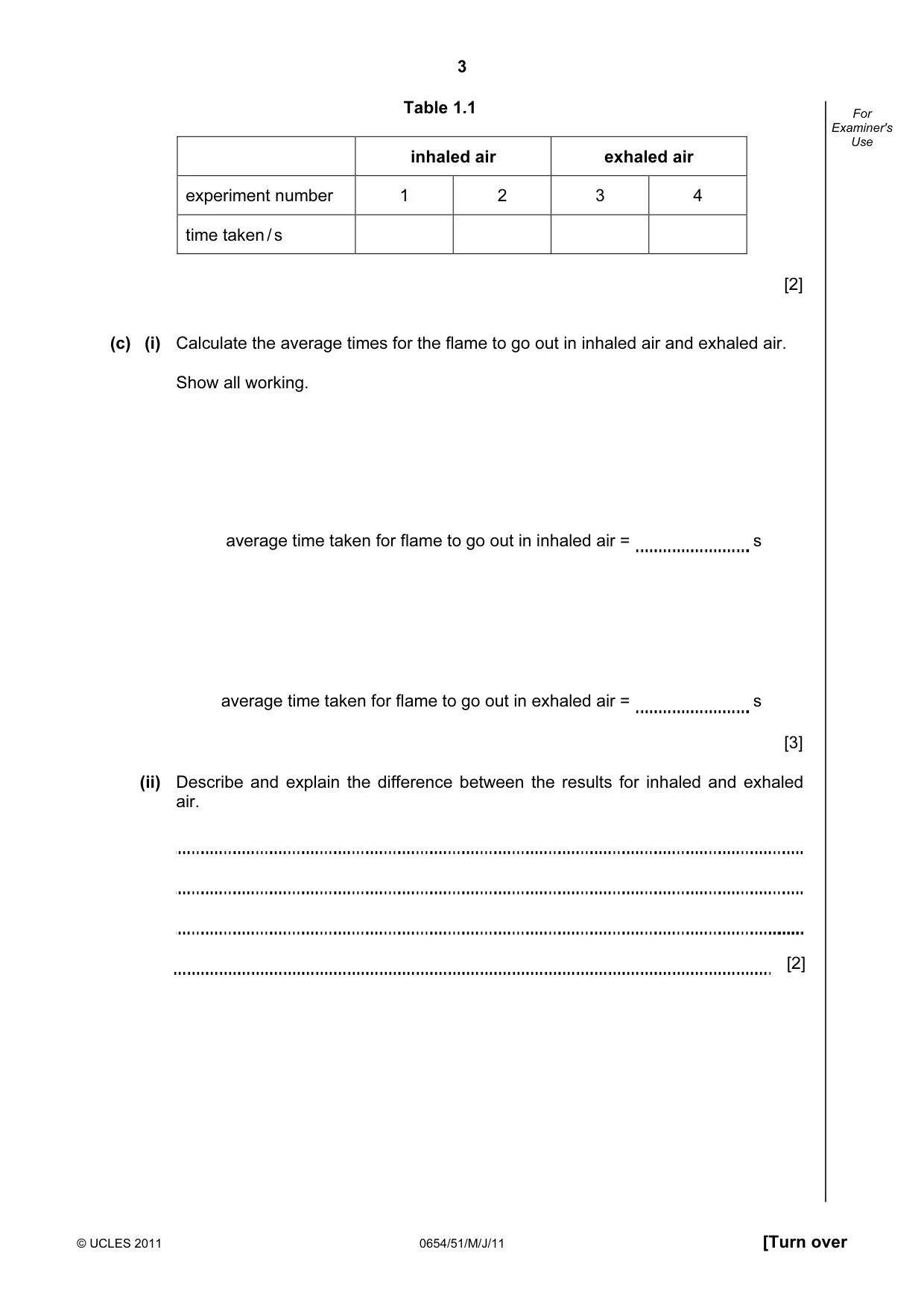
3 © UCLES 2011 0654/51/M/J/11 [Turn over For Examiner's Use Table 1.1 inhaled air exhaled air experiment number 1 2 3 4 time taken / s [2] (c) (i) Calculate the average times for the flame to go out in inhaled air and exhaled air. Show all working. average time taken for flame to go out in inhaled air = s average time taken for flame to go out in exhaled air = s [3] (ii) Describe and explain the difference between the results for inhaled and exhaled air. [2]
Question paper, page 4
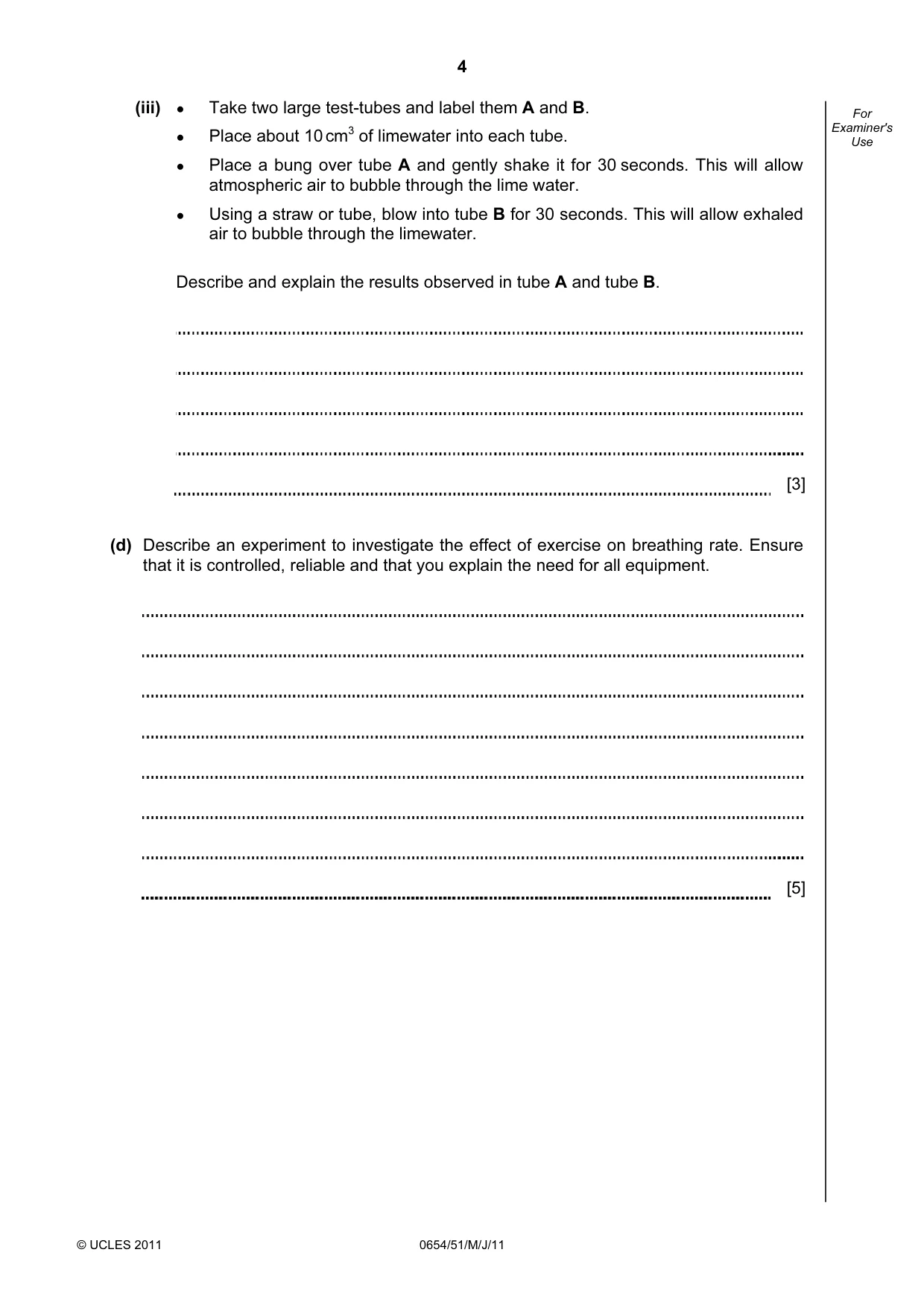
4 © UCLES 2011 0654/51/M/J/11 For Examiner's Use (iii) ● Take two large test-tubes and label them A and B. ● Place about 10 cm3 of limewater into each tube. ● Place a bung over tube A and gently shake it for 30 seconds. This will allow atmospheric air to bubble through the lime water. ● Using a straw or tube, blow into tube B for 30 seconds. This will allow exhaled air to bubble through the limewater. Describe and explain the results observed in tube A and tube B. [3] (d) Describe an experiment to investigate the effect of exercise on breathing rate. Ensure that it is controlled, reliable and that you explain the need for all equipment. [5]
Question paper, page 5
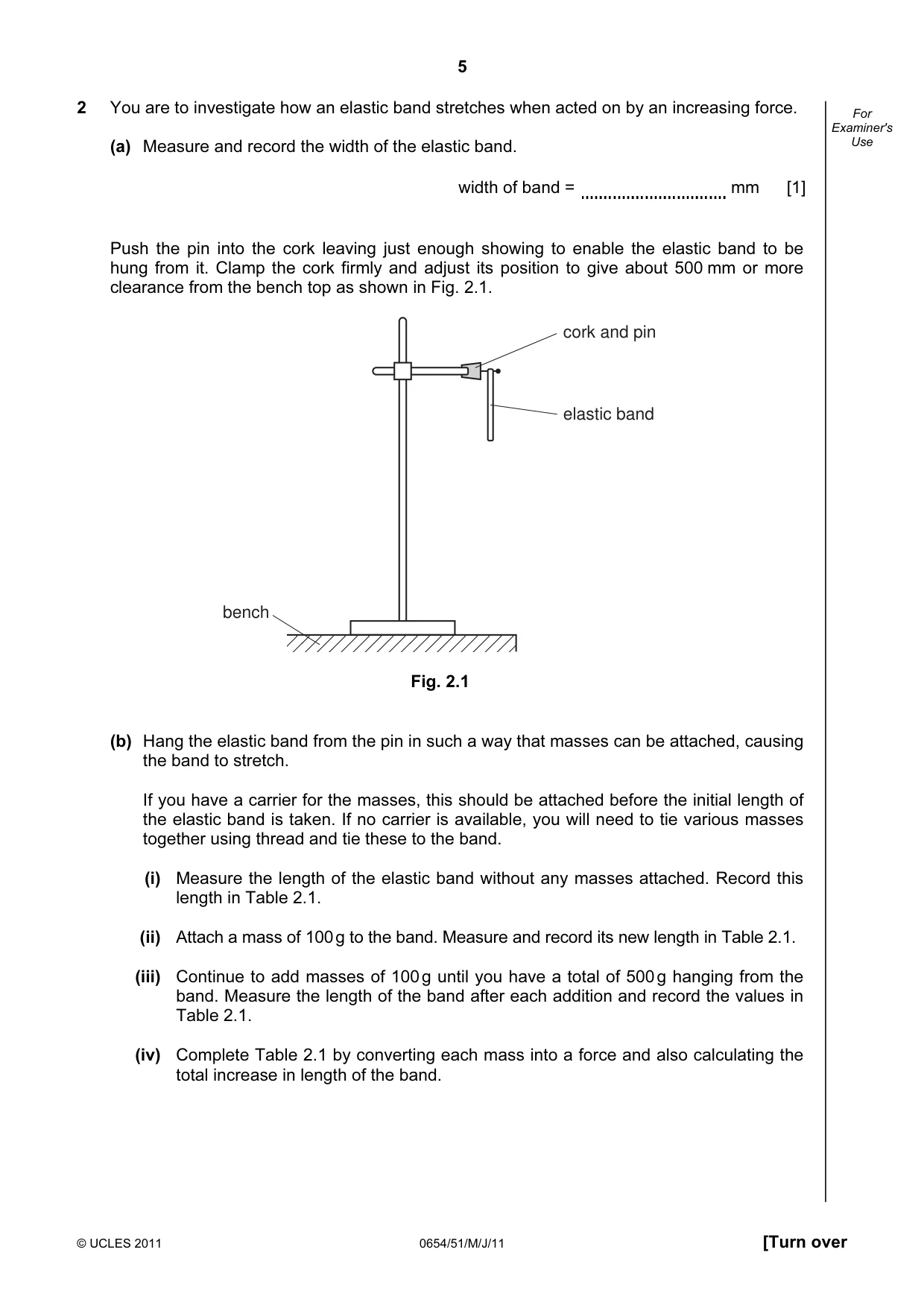
5 © UCLES 2011 0654/51/M/J/11 [Turn over For Examiner's Use 2 You are to investigate how an elastic band stretches when acted on by an increasing force. (a) Measure and record the width of the elastic band. width of band = mm [1] Push the pin into the cork leaving just enough showing to enable the elastic band to be hung from it. Clamp the cork firmly and adjust its position to give about 500 mm or more clearance from the bench top as shown in Fig. 2.1. cork and pin elastic band bench Fig. 2.1 (b) Hang the elastic band from the pin in such a way that masses can be attached, causing the band to stretch. If you have a carrier for the masses, this should be attached before the initial length of the elastic band is taken. If no carrier is available, you will need to tie various masses together using thread and tie these to the band. (i) Measure the length of the elastic band without any masses attached. Record this length in Table 2.1. (ii) Attach a mass of 100 g to the band. Measure and record its new length in Table 2.1. (iii) Continue to add masses of 100 g until you have a total of 500 g hanging from the band. Measure the length of the band after each addition and record the values in Table 2.1. (iv) Complete Table 2.1 by converting each mass into a force and also calculating the total increase in length of the band.
Question paper, page 6
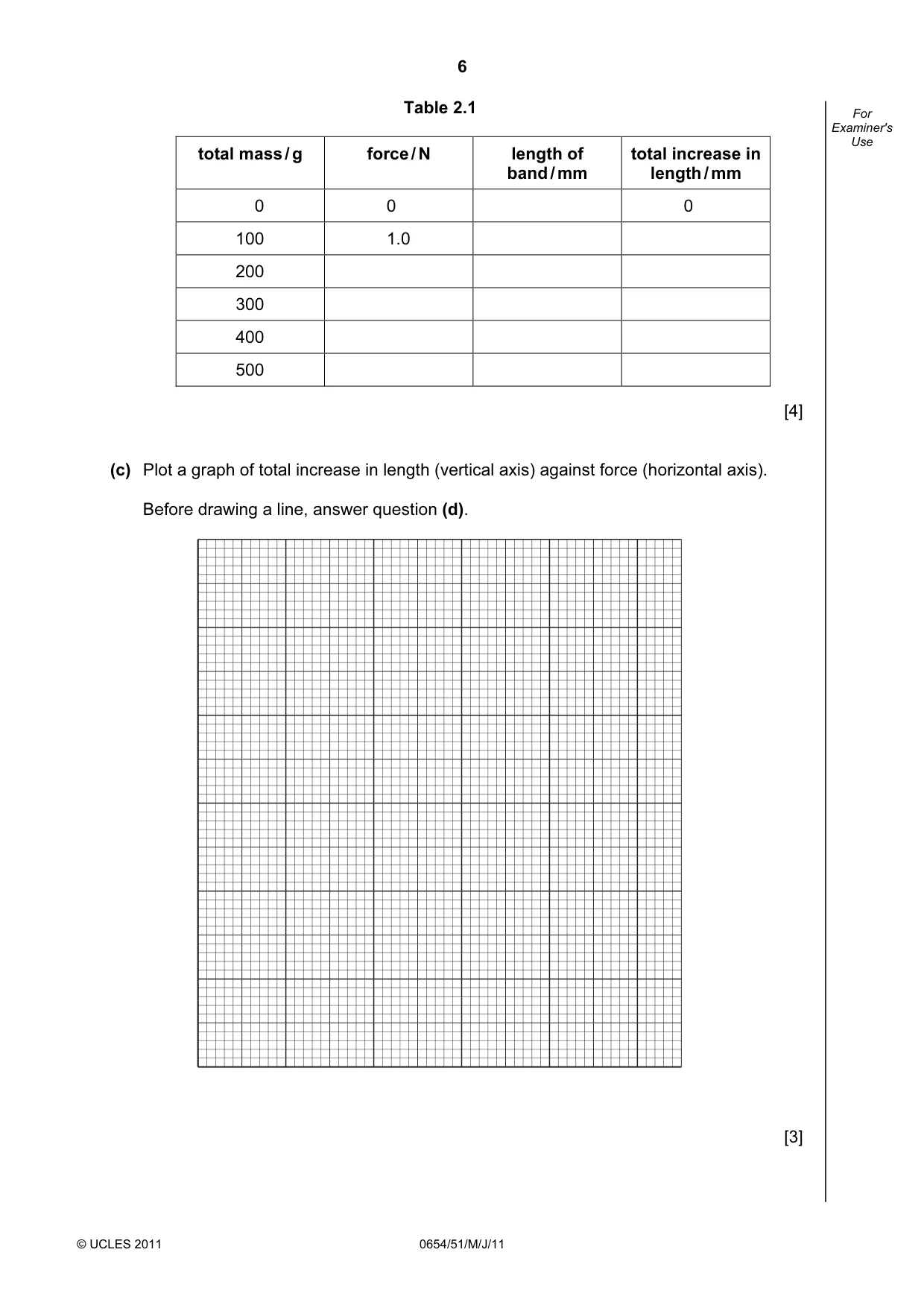
6 © UCLES 2011 0654/51/M/J/11 For Examiner's Use Table 2.1 total mass / g force / N length of band / mm total increase in length / mm 0 0 0 100 1.0 200 300 400 500 [4] (c) Plot a graph of total increase in length (vertical axis) against force (horizontal axis). Before drawing a line, answer question (d). [3]
Question paper, page 7
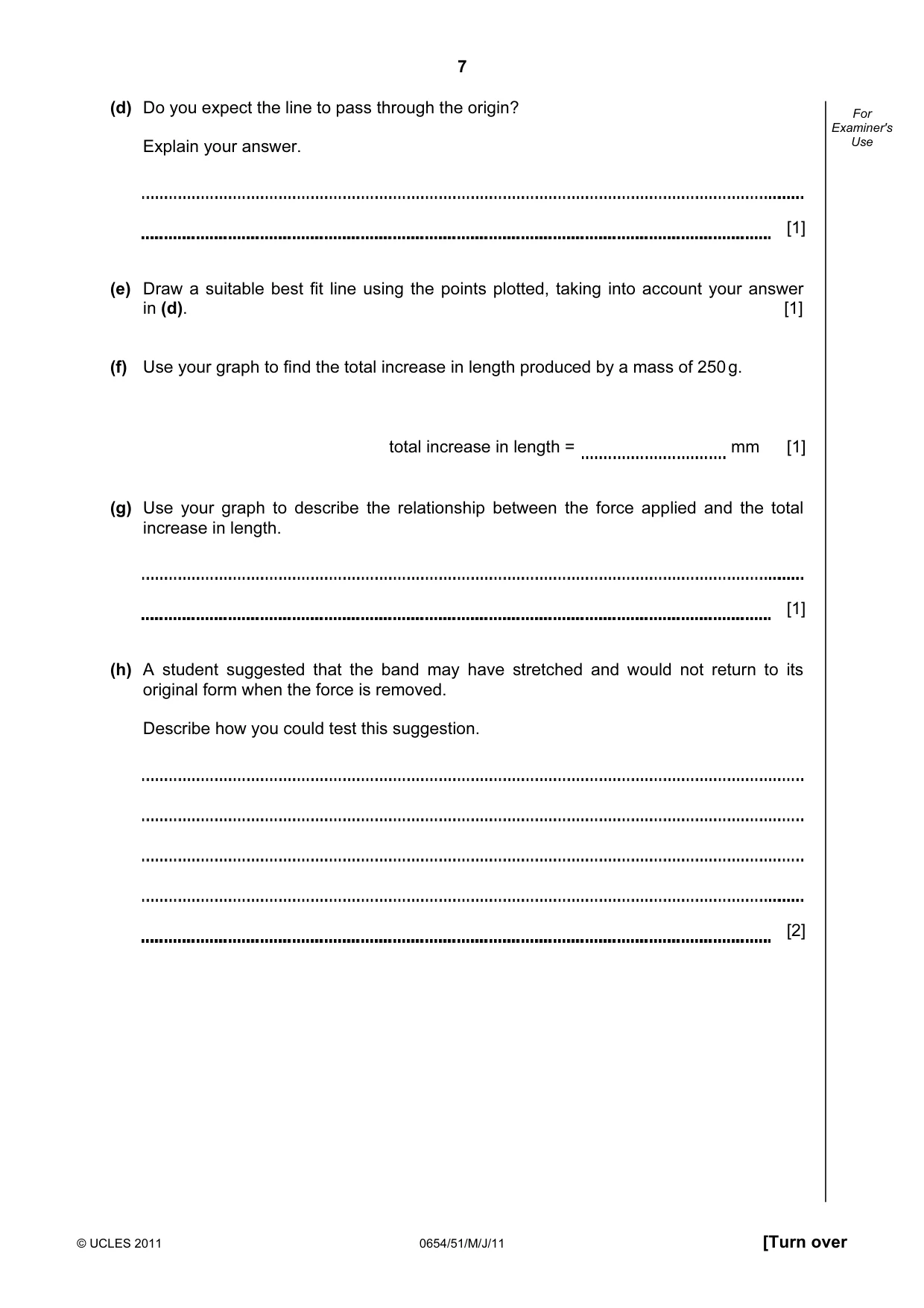
7 © UCLES 2011 0654/51/M/J/11 [Turn over For Examiner's Use (d) Do you expect the line to pass through the origin? Explain your answer. [1] (e) Draw a suitable best fit line using the points plotted, taking into account your answer in (d). [1] (f) Use your graph to find the total increase in length produced by a mass of 250 g. total increase in length = mm [1] (g) Use your graph to describe the relationship between the force applied and the total increase in length. [1] (h) A student suggested that the band may have stretched and would not return to its original form when the force is removed. Describe how you could test this suggestion. [2]
Question paper, page 8
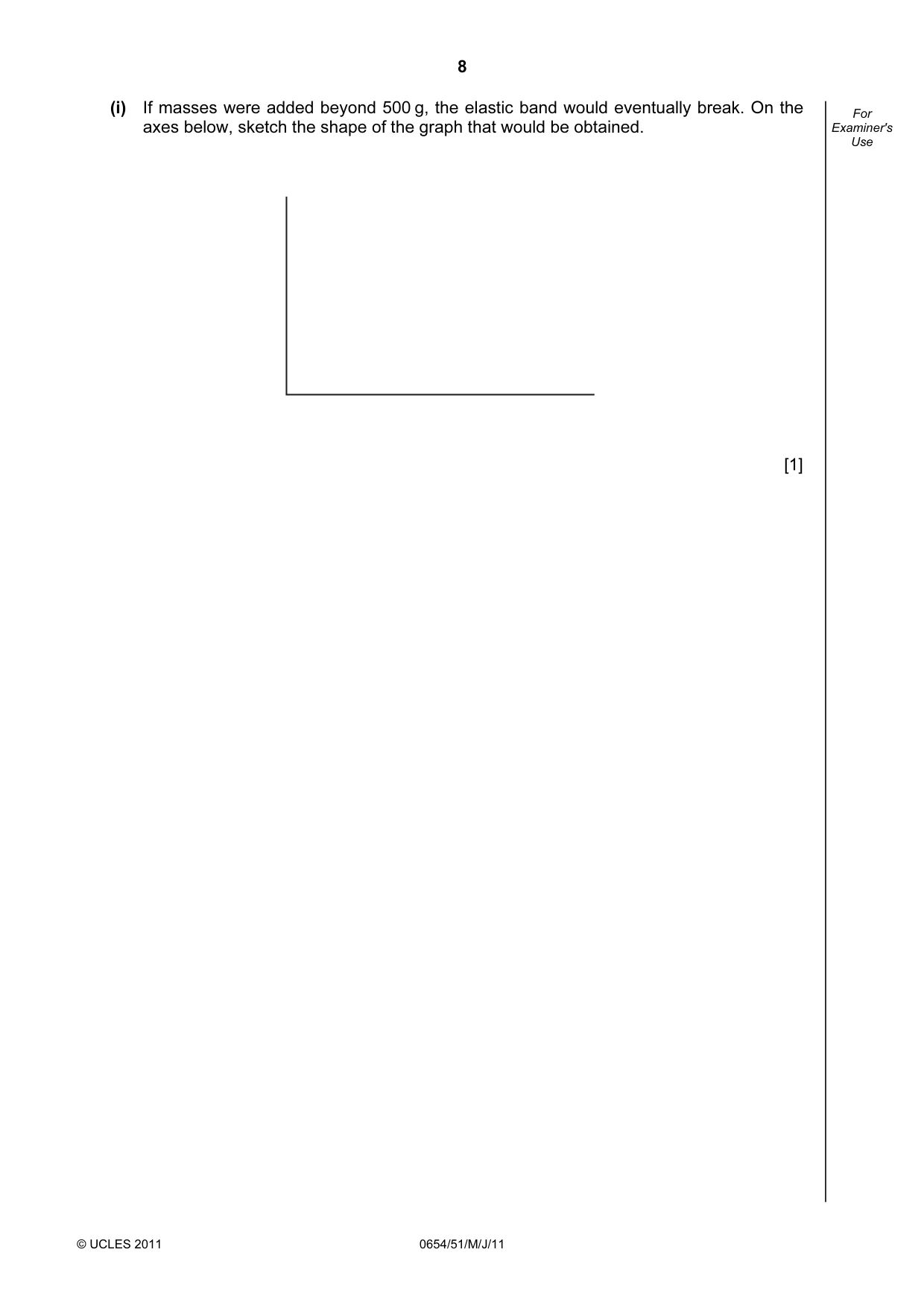
8 © UCLES 2011 0654/51/M/J/11 For Examiner's Use (i) If masses were added beyond 500 g, the elastic band would eventually break. On the axes below, sketch the shape of the graph that would be obtained. [1]
Question paper, page 9
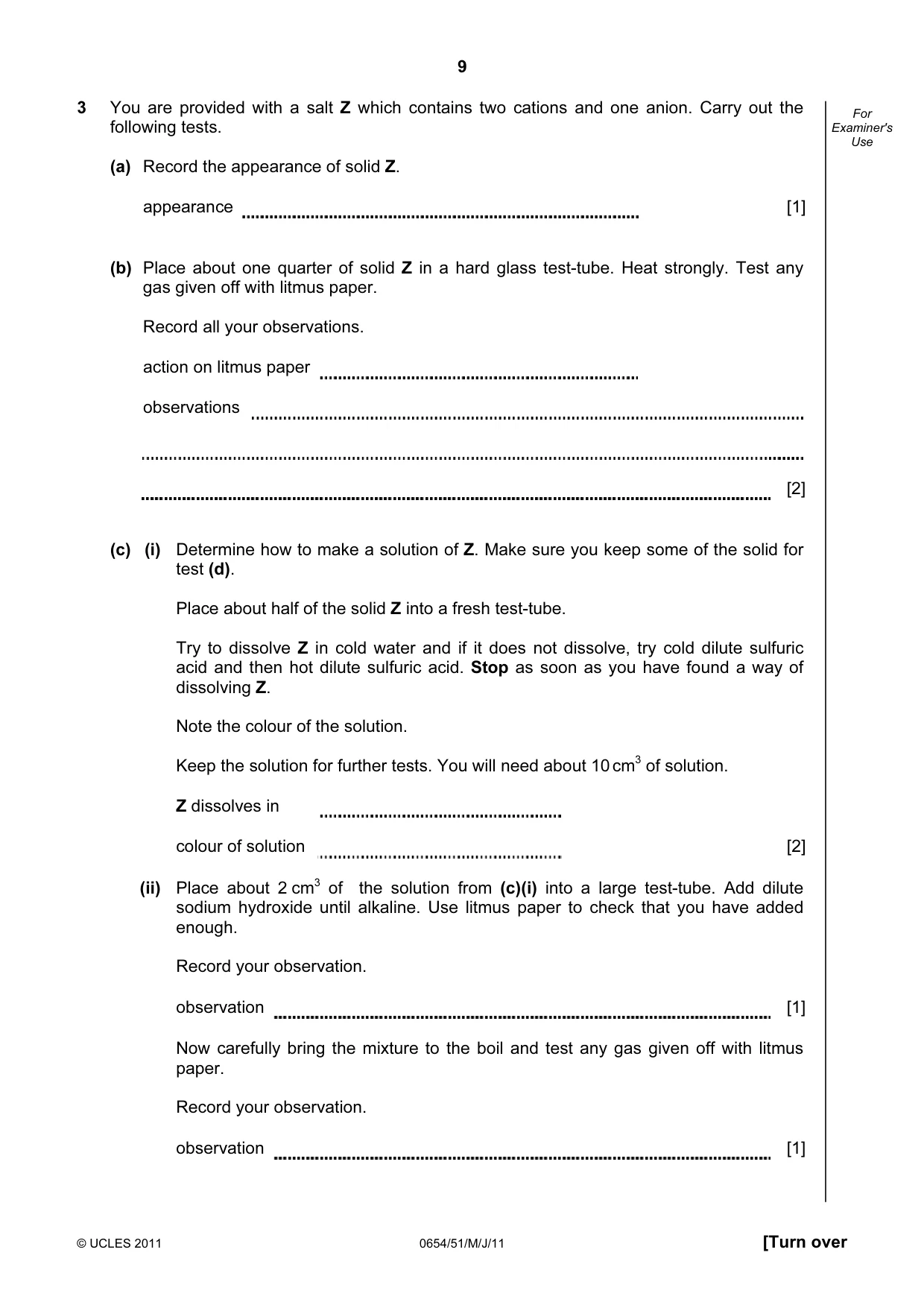
9 © UCLES 2011 0654/51/M/J/11 [Turn over For Examiner's Use 3 You are provided with a salt Z which contains two cations and one anion. Carry out the following tests. (a) Record the appearance of solid Z. appearance [1] (b) Place about one quarter of solid Z in a hard glass test-tube. Heat strongly. Test any gas given off with litmus paper. Record all your observations. action on litmus paper observations [2] (c) (i) Determine how to make a solution of Z. Make sure you keep some of the solid for test (d). Place about half of the solid Z into a fresh test-tube. Try to dissolve Z in cold water and if it does not dissolve, try cold dilute sulfuric acid and then hot dilute sulfuric acid. Stop as soon as you have found a way of dissolving Z. Note the colour of the solution. Keep the solution for further tests. You will need about 10 cm3 of solution. Z dissolves in colour of solution [2] (ii) Place about 2 cm3 of the solution from (c)(i) into a large test-tube. Add dilute sodium hydroxide until alkaline. Use litmus paper to check that you have added enough. Record your observation. observation [1] Now carefully bring the mixture to the boil and test any gas given off with litmus paper. Record your observation. observation [1]
Question paper, page 10
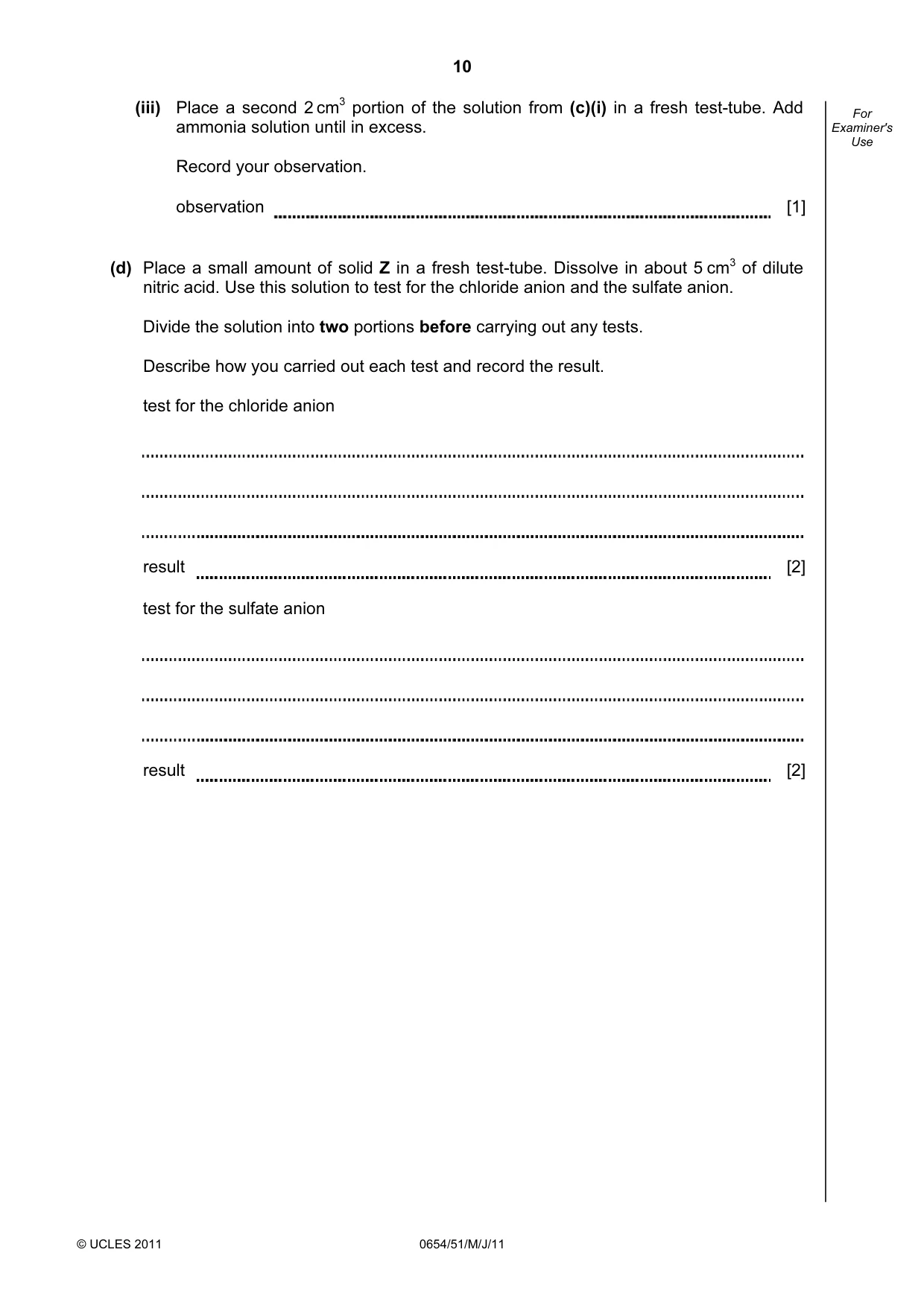
10 © UCLES 2011 0654/51/M/J/11 For Examiner's Use (iii) Place a second 2 cm3 portion of the solution from (c)(i) in a fresh test-tube. Add ammonia solution until in excess. Record your observation. observation [1] (d) Place a small amount of solid Z in a fresh test-tube. Dissolve in about 5 cm3 of dilute nitric acid. Use this solution to test for the chloride anion and the sulfate anion. Divide the solution into two portions before carrying out any tests. Describe how you carried out each test and record the result. test for the chloride anion result [2] test for the sulfate anion result [2]
Question paper, page 11
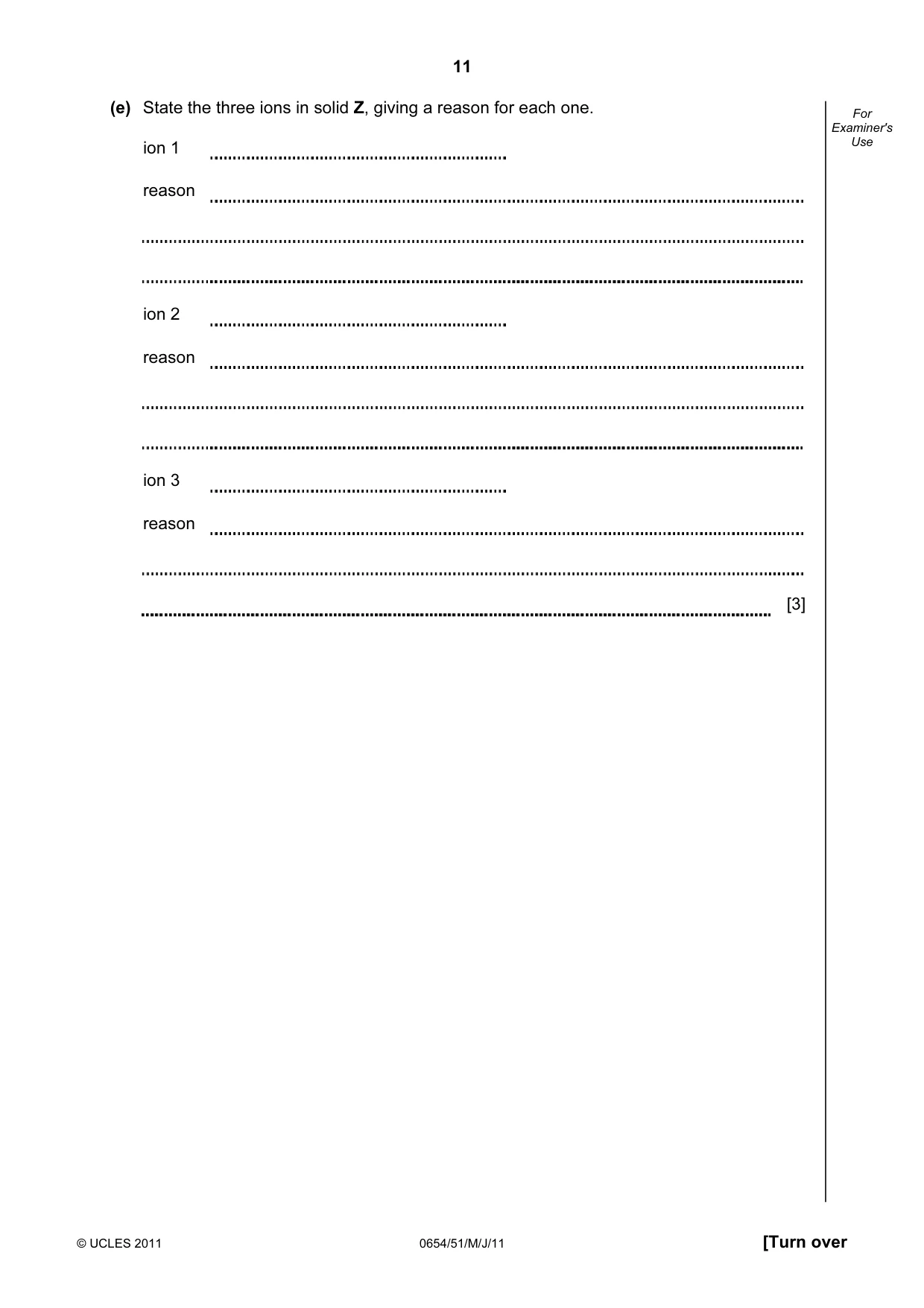
11 © UCLES 2011 0654/51/M/J/11 [Turn over For Examiner's Use (e) State the three ions in solid Z, giving a reason for each one. ion 1 reason ion 2 reason ion 3 reason [3]
Question paper, page 12
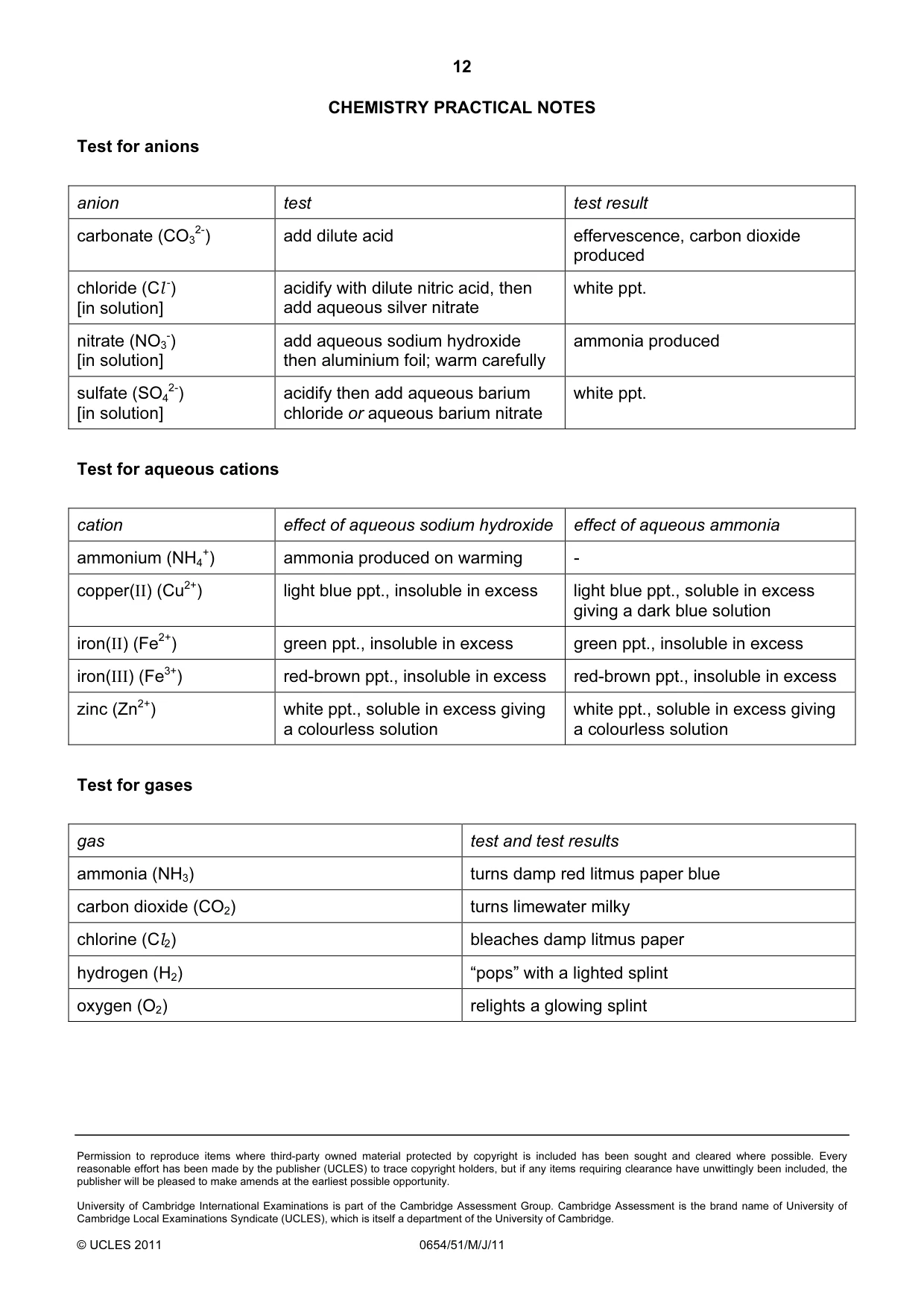
12 Permission to reproduce items where third-party owned material protected by copyright is included has been sought and cleared where possible. Every reasonable effort has been made by the publisher (UCLES) to trace copyright holders, but if any items requiring clearance have unwittingly been included, the publisher will be pleased to make amends at the earliest possible opportunity. University of Cambridge International Examinations is part of the Cambridge Assessment Group. Cambridge Assessment is the brand name of University of Cambridge Local Examinations Syndicate (UCLES), which is itself a department of the University of Cambridge. © UCLES 2011 0654/51/M/J/11 CHEMISTRY PRACTICAL NOTES Test for anions anion test test result carbonate (CO3 2-) add dilute acid effervescence, carbon dioxide produced chloride (Cl -) [in solution] acidify with dilute nitric acid, then add aqueous silver nitrate white ppt. nitrate (NO3 -) [in solution] add aqueous sodium hydroxide then aluminium foil; warm carefully ammonia produced sulfate (SO4 2-) [in solution] acidify then add aqueous barium chloride or aqueous barium nitrate white ppt. Test for aqueous cations cation effect of aqueous sodium hydroxide effect of aqueous ammonia ammonium (NH4 +) ammonia produced on warming - copper(II) (Cu2+) light blue ppt., insoluble in excess light blue ppt., soluble in excess giving a dark blue solution iron(II) (Fe2+) green ppt., insoluble in excess green ppt., insoluble in excess iron(III) (Fe3+) red-brown ppt., insoluble in excess red-brown ppt., insoluble in excess zinc (Zn2+) white ppt., soluble in excess giving a colourless solution white ppt., soluble in excess giving a colourless solution Test for gases gas test and test results ammonia (NH3) turns damp red litmus paper blue carbon dioxide (CO2) turns limewater milky chlorine (Cl2) bleaches damp litmus paper hydrogen (H2) “pops” with a lighted splint oxygen (O2) relights a glowing splint
Mark scheme, page 1
UNIVERSITY OF CAMBRIDGE INTERNATIONAL EXAMINATIONS International General Certificate of Secondary Education MARK SCHEME for the May/June 2011 question paper for the guidance of teachers 0654 CO-ORDINATED SCIENCES 0654/51 Paper 5 (Practical), maximum raw mark 45 This mark scheme is published as an aid to teachers and candidates, to indicate the requirements of the examination. It shows the basis on which Examiners were instructed to award marks. It does not indicate the details of the discussions that took place at an Examiners’ meeting before marking began, which would have considered the acceptability of alternative answers. Mark schemes must be read in conjunction with the question papers and the report on the examination. • Cambridge will not enter into discussions or correspondence in connection with these mark schemes. Cambridge is publishing the mark schemes for the May/June 2011 question papers for most IGCSE, GCE Advanced Level and Advanced Subsidiary Level syllabuses and some Ordinary Level syllabuses. www.XtremePapers.com
Mark scheme, page 2
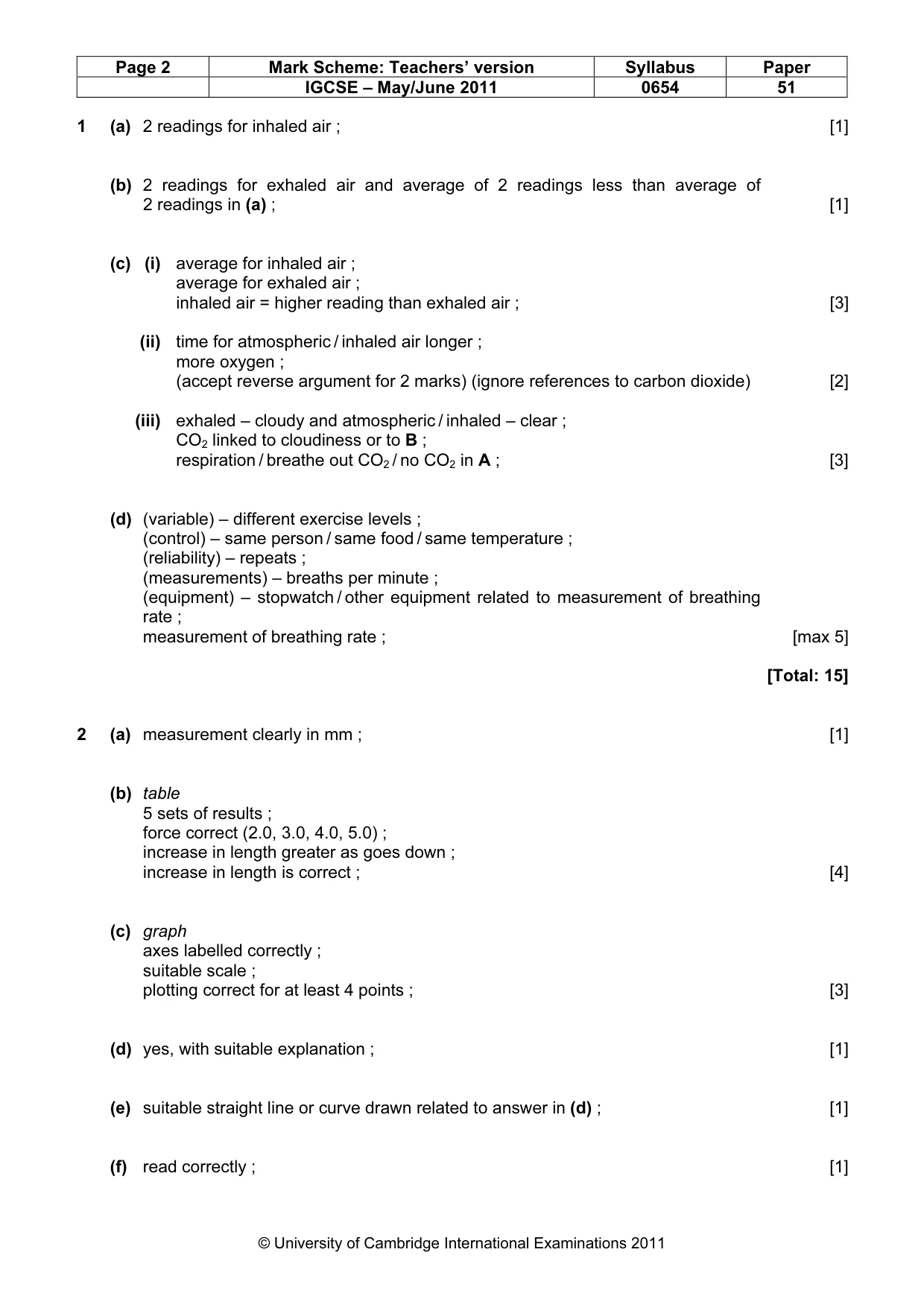
Page 2 Mark Scheme: Teachers’ version Syllabus Paper IGCSE – May/June 2011 0654 51 © University of Cambridge International Examinations 2011 1 (a) 2 readings for inhaled air ; [1] (b) 2 readings for exhaled air and average of 2 readings less than average of 2 readings in (a) ; [1] (c) (i) average for inhaled air ; average for exhaled air ; inhaled air = higher reading than exhaled air ; [3] (ii) time for atmospheric / inhaled air longer ; more oxygen ; (accept reverse argument for 2 marks) (ignore references to carbon dioxide) [2] (iii) exhaled – cloudy and atmospheric / inhaled – clear ; CO2 linked to cloudiness or to B ; respiration / breathe out CO2 / no CO2 in A ; [3] (d) (variable) – different exercise levels ; (control) – same person / same food / same temperature ; (reliability) – repeats ; (measurements) – breaths per minute ; (equipment) – stopwatch / other equipment related to measurement of breathing rate ; measurement of breathing rate ; [max 5] [Total: 15] 2 (a) measurement clearly in mm ; [1] (b) table 5 sets of results ; force correct (2.0, 3.0, 4.0, 5.0) ; increase in length greater as goes down ; increase in length is correct ; [4] (c) graph axes labelled correctly ; suitable scale ; plotting correct for at least 4 points ; [3] (d) yes, with suitable explanation ; [1] (e) suitable straight line or curve drawn related to answer in (d) ; [1] (f) read correctly ; [1]
Mark scheme, page 3
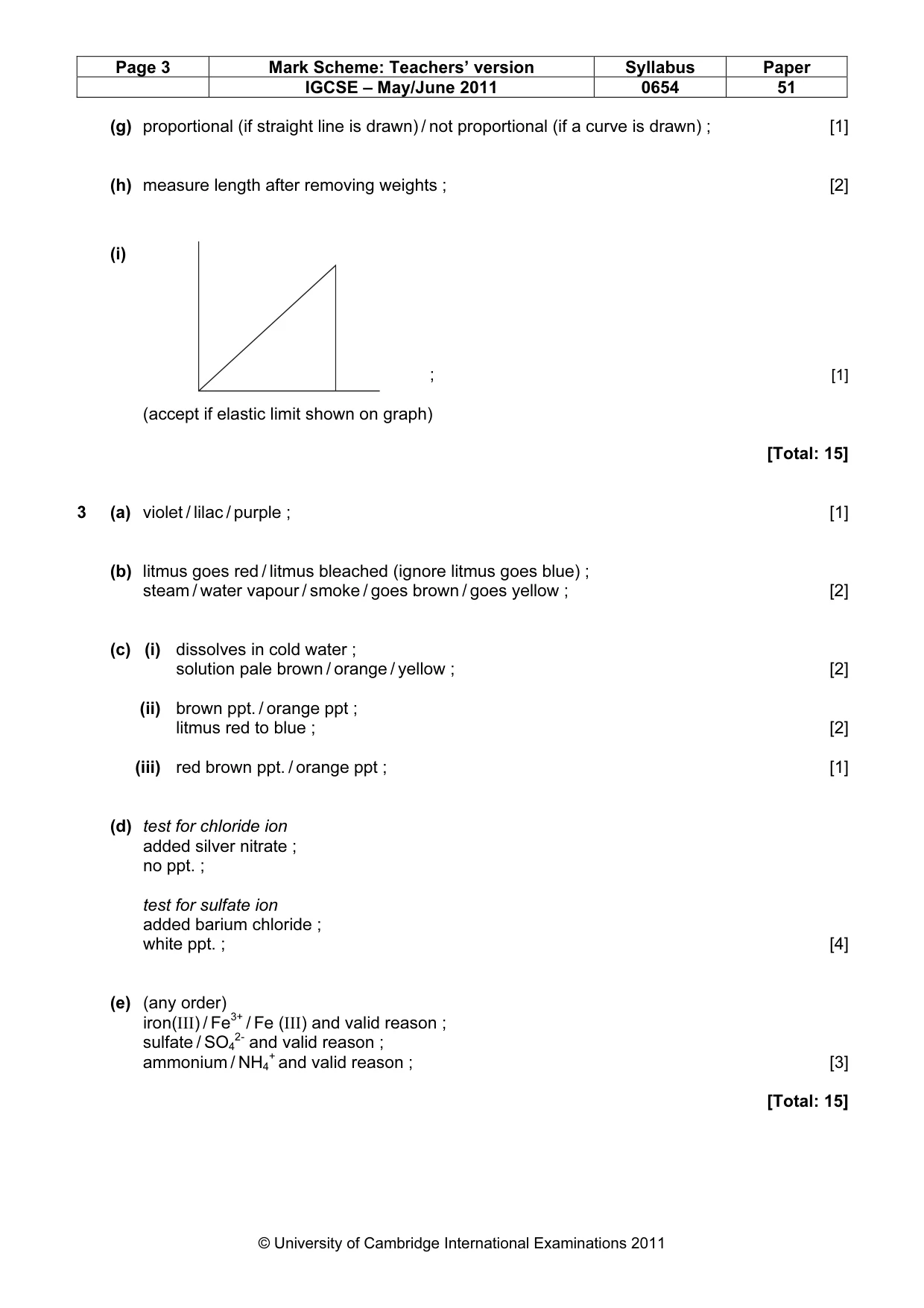
Page 3 Mark Scheme: Teachers’ version Syllabus Paper IGCSE – May/June 2011 0654 51 © University of Cambridge International Examinations 2011 (g) proportional (if straight line is drawn) / not proportional (if a curve is drawn) ; [1] (h) measure length after removing weights ; [2] (i) ; [1] (accept if elastic limit shown on graph) [Total: 15] 3 (a) violet / lilac / purple ; [1] (b) litmus goes red / litmus bleached (ignore litmus goes blue) ; steam / water vapour / smoke / goes brown / goes yellow ; [2] (c) (i) dissolves in cold water ; solution pale brown / orange / yellow ; [2] (ii) brown ppt. / orange ppt ; litmus red to blue ; [2] (iii) red brown ppt. / orange ppt ; [1] (d) test for chloride ion added silver nitrate ; no ppt. ; test for sulfate ion added barium chloride ; white ppt. ; [4] (e) (any order) iron(III) / Fe3+ / Fe (III) and valid reason ; sulfate / SO4 2- and valid reason ; ammonium / NH4 + and valid reason ; [3] [Total: 15]
What you needed in this session
Cambridge’s own grade thresholds for 2011 May/June, Paper 5 · Variant 1. A higher threshold means an easier paper — the bar moves with how the cohort did.