Cambridge IGCSE Sciences - Co-ordinated (Double) 0654 — 2007 May/June Paper 6 · Variant 1
0654/61/M/J/07 · 60 marks · ≈68 min
The question paper and its mark scheme, free to read here and free to download. This is Cambridge’s own paper, exactly as it was sat.
Question paper20 pages


Mark scheme5 pages
Answers below. Sit the paper first if you are practising.
Paper as text
Question paper, page 1
This document consists of 16 printed pages and 4 blank pages. IB07 06_0653_06/3RP © UCLES 2007 [Turn over *9902135538* For Examiner's Use 1 2 3 4 5 6 Total UNIVERSITY OF CAMBRIDGE INTERNATIONAL EXAMINATIONS International General Certificate of Secondary Education COMBINED SCIENCE 0653/06 CO-ORDINATED SCIENCES 0654/06 Paper 6 Alternative to Practical May/June 2007 1 hour Candidates answer on the Question Paper. No Additional Materials are required. READ THESE INSTRUCTIONS FIRST Write your Centre number, candidate number and name on all the work you hand in. Write in dark blue or black pen. You may use a soft pencil for any diagrams, graphs, tables or rough working. Do not use staples, paper clips, highlighters, glue or correction fluid. DO NOT WRITE IN ANY BARCODES. Answer all questions. At the end of the examination, fasten all your work securely together. The number of marks is given in brackets [ ] at the end of each question or part question. www.XtremePapers.com
Question paper, page 3
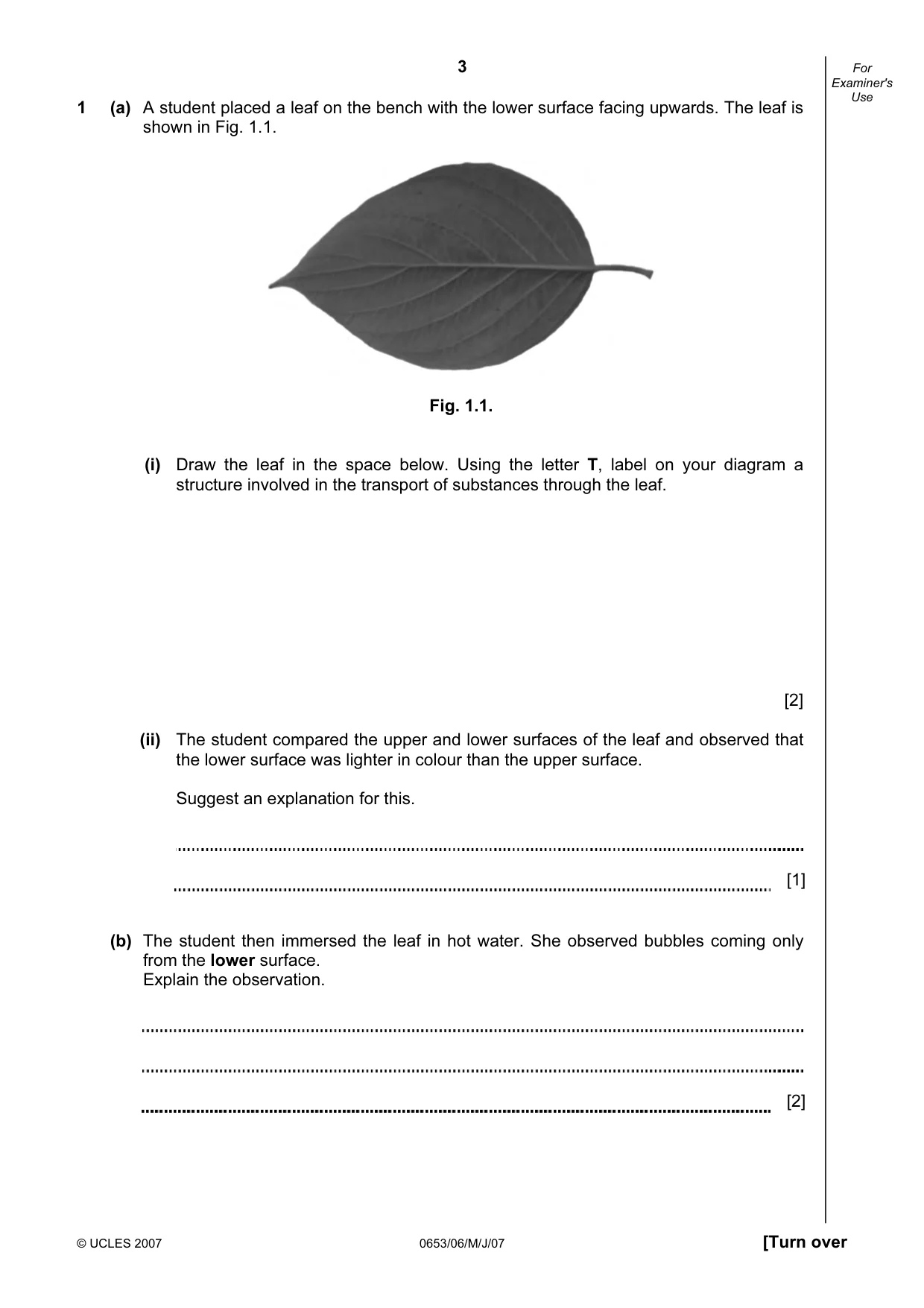
3 © UCLES 2007 0653/06/M/J/07 [Turn over For Examiner's Use 1 (a) A student placed a leaf on the bench with the lower surface facing upwards. The leaf is shown in Fig. 1.1. Fig. 1.1. (i) Draw the leaf in the space below. Using the letter T, label on your diagram a structure involved in the transport of substances through the leaf. [2] (ii) The student compared the upper and lower surfaces of the leaf and observed that the lower surface was lighter in colour than the upper surface. Suggest an explanation for this. [1] (b) The student then immersed the leaf in hot water. She observed bubbles coming only from the lower surface. Explain the observation. [2]
Question paper, page 4
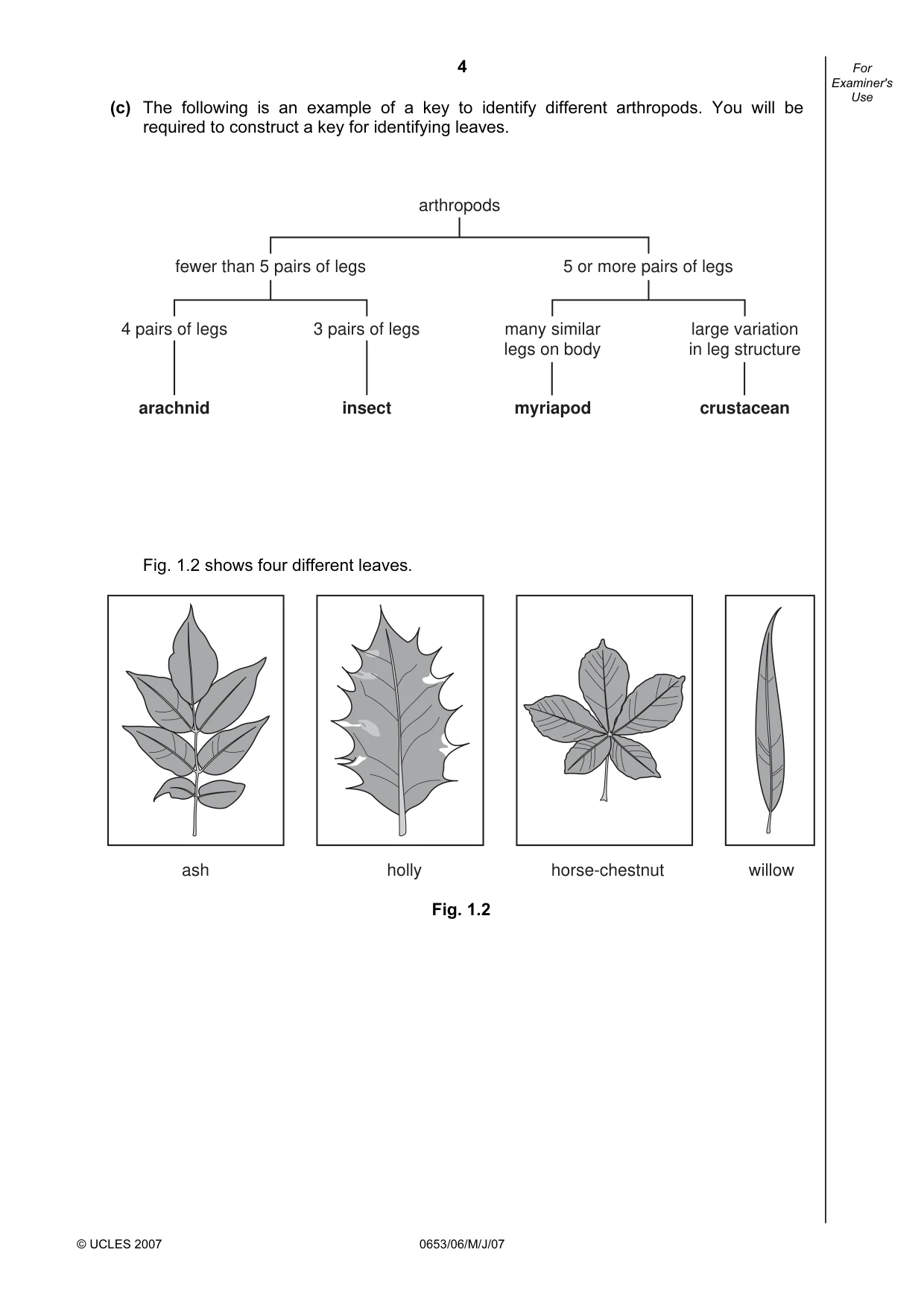
4 © UCLES 2007 0653/06/M/J/07 For Examiner's Use (c) The following is an example of a key to identify different arthropods. You will be required to construct a key for identifying leaves. arthropods fewer than 5 pairs of legs 4 pairs of legs 3 pairs of legs many similar legs on body large variation in leg structure arachnid insect myriapod crustacean 5 or more pairs of legs Fig. 1.2 shows four different leaves. ash holly horse-chestnut willow Fig. 1.2
Question paper, page 5
5 © UCLES 2007 0653/06/M/J/07 [Turn over For Examiner's Use Using visible features construct a key for the leaves. Use the example of a key given opposite to help you. Check that the key would enable all of the leaves to be identified correctly. [6]
Question paper, page 6
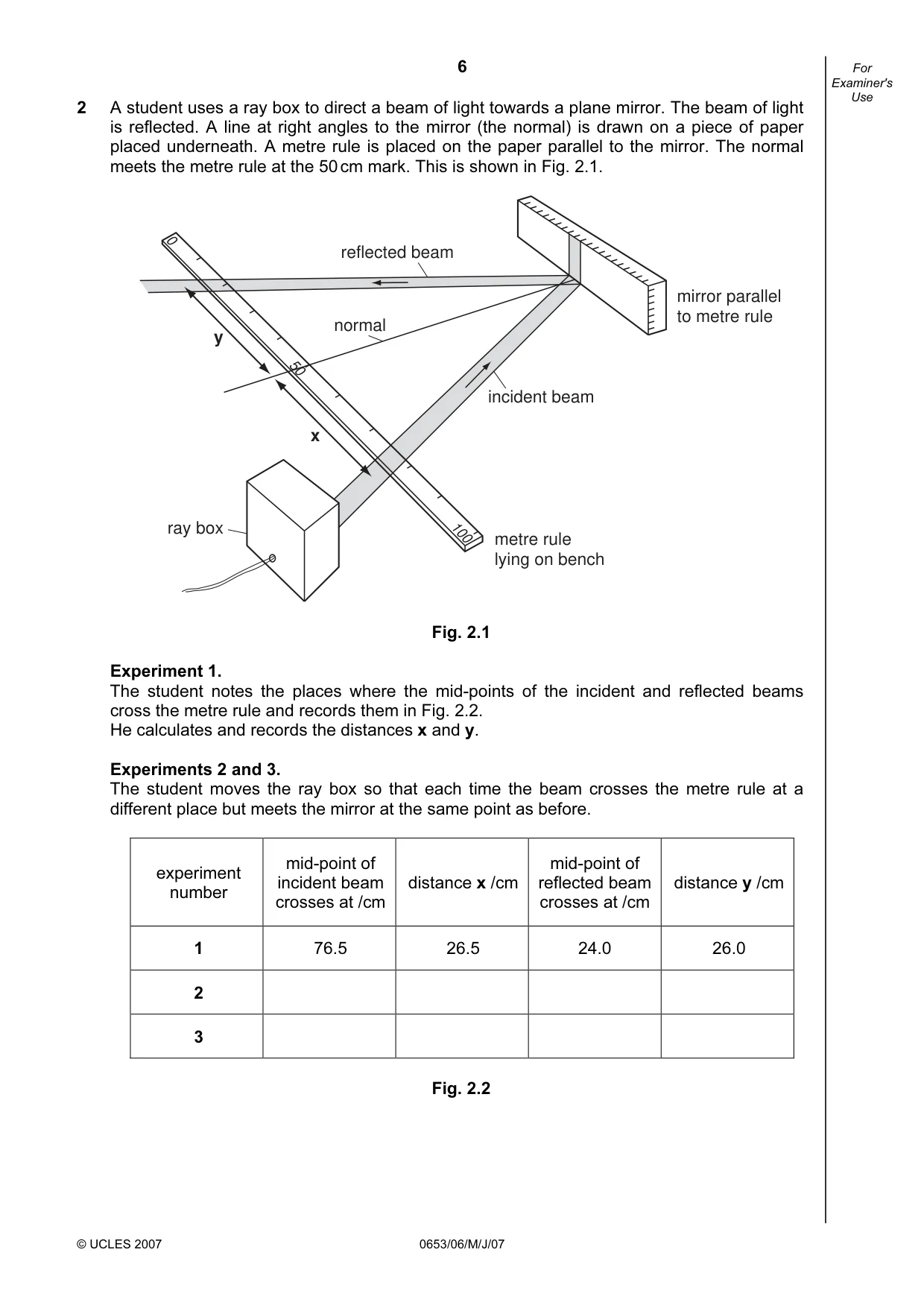
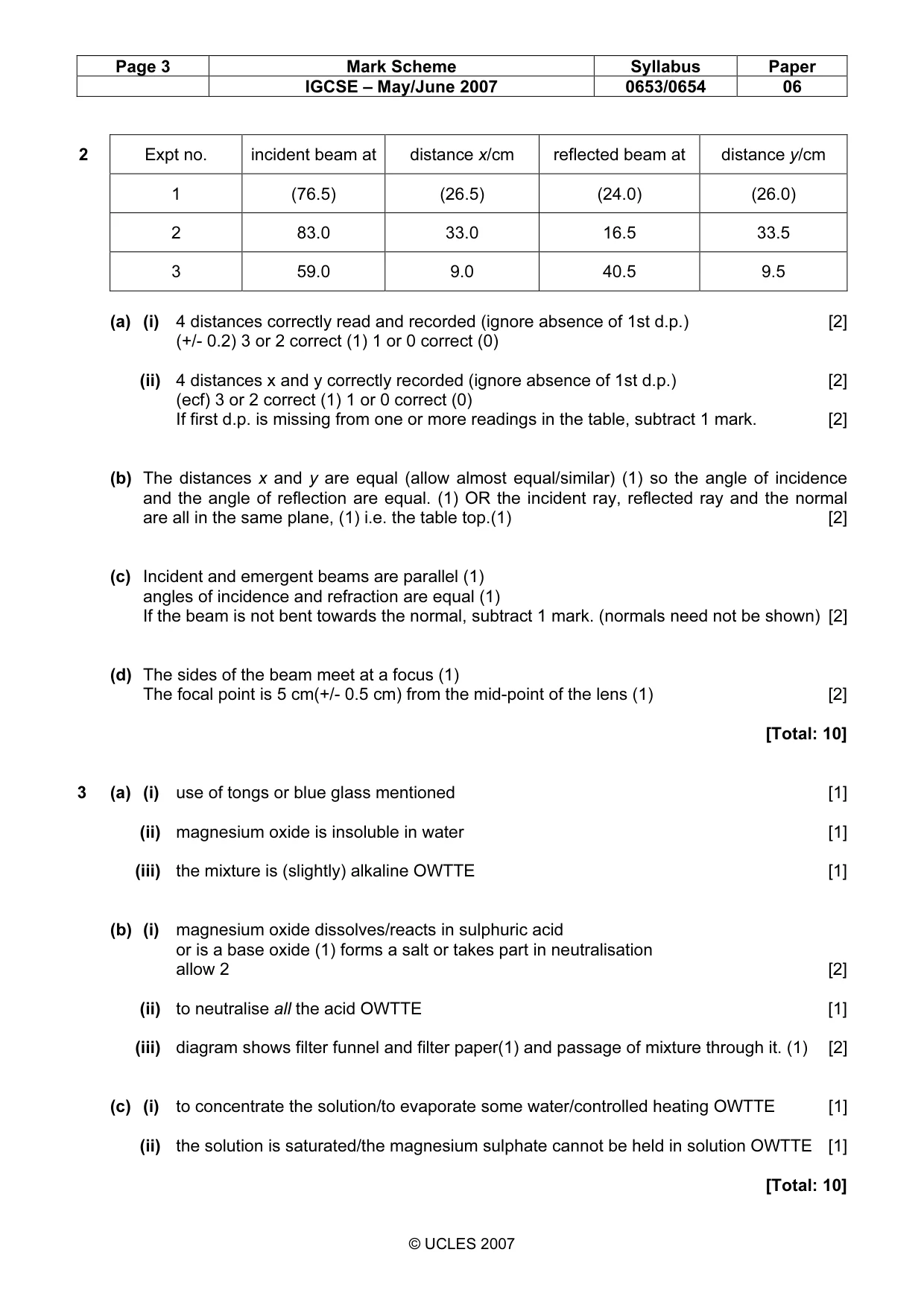
6 © UCLES 2007 0653/06/M/J/07 For Examiner's Use 2 A student uses a ray box to direct a beam of light towards a plane mirror. The beam of light is reflected. A line at right angles to the mirror (the normal) is drawn on a piece of paper placed underneath. A metre rule is placed on the paper parallel to the mirror. The normal meets the metre rule at the 50 cm mark. This is shown in Fig. 2.1. y x normal incident beam reflected beam ray box 100 50 0 metre rule lying on bench mirror parallel to metre rule Fig. 2.1 Experiment 1. The student notes the places where the mid-points of the incident and reflected beams cross the metre rule and records them in Fig. 2.2. He calculates and records the distances x and y. Experiments 2 and 3. The student moves the ray box so that each time the beam crosses the metre rule at a different place but meets the mirror at the same point as before. experiment number mid-point of incident beam crosses at /cm distance x /cm mid-point of reflected beam crosses at /cm distance y /cm 1 76.5 26.5 24.0 26.0 2 3 Fig. 2.2
Question paper, page 7
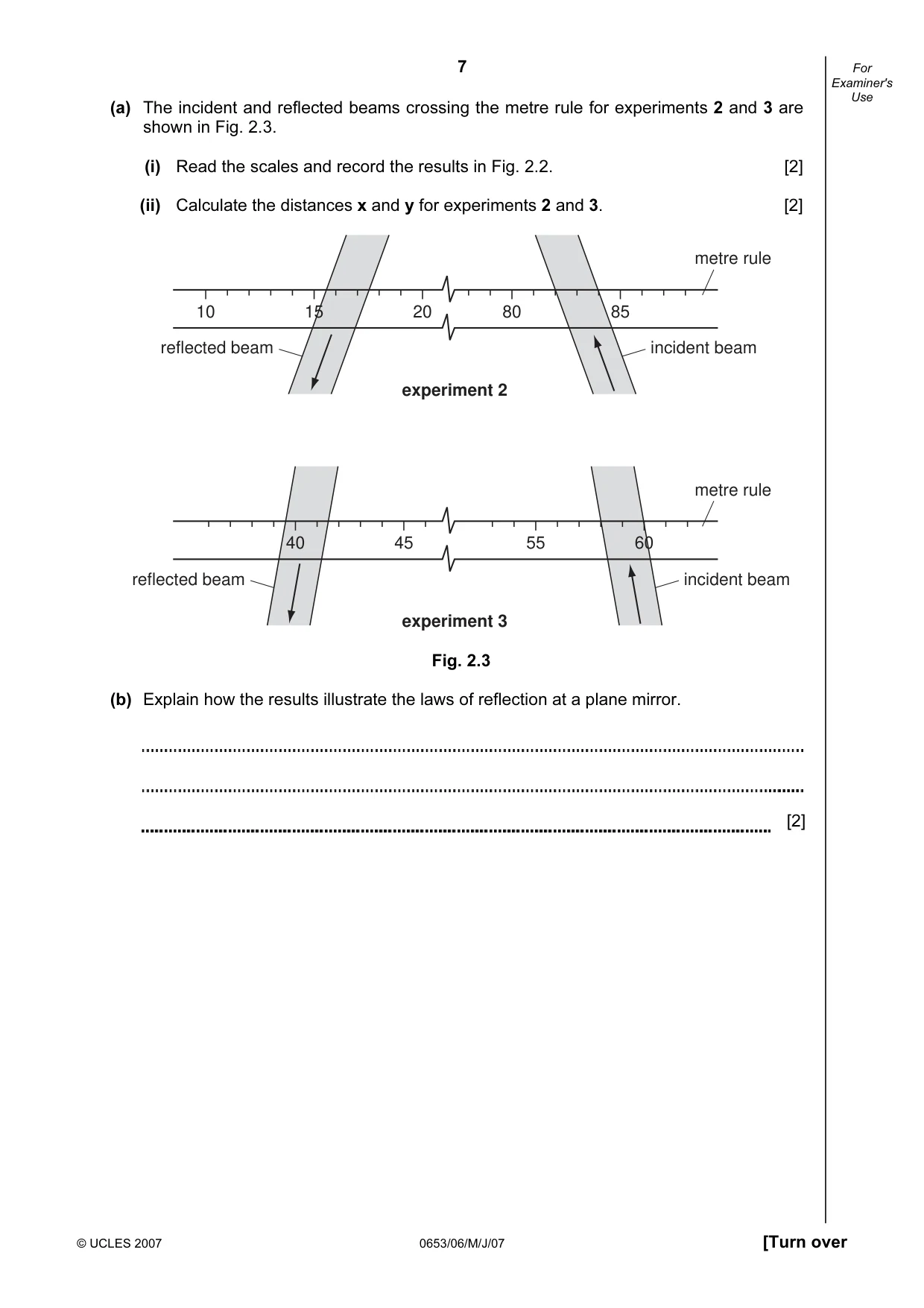
7 © UCLES 2007 0653/06/M/J/07 [Turn over For Examiner's Use (a) The incident and reflected beams crossing the metre rule for experiments 2 and 3 are shown in Fig. 2.3. (i) Read the scales and record the results in Fig. 2.2. [2] (ii) Calculate the distances x and y for experiments 2 and 3. [2] 10 15 20 80 85 incident beam reflected beam experiment 2 metre rule 40 45 55 60 incident beam reflected beam experiment 3 metre rule Fig. 2.3 (b) Explain how the results illustrate the laws of reflection at a plane mirror. [2]
Question paper, page 8
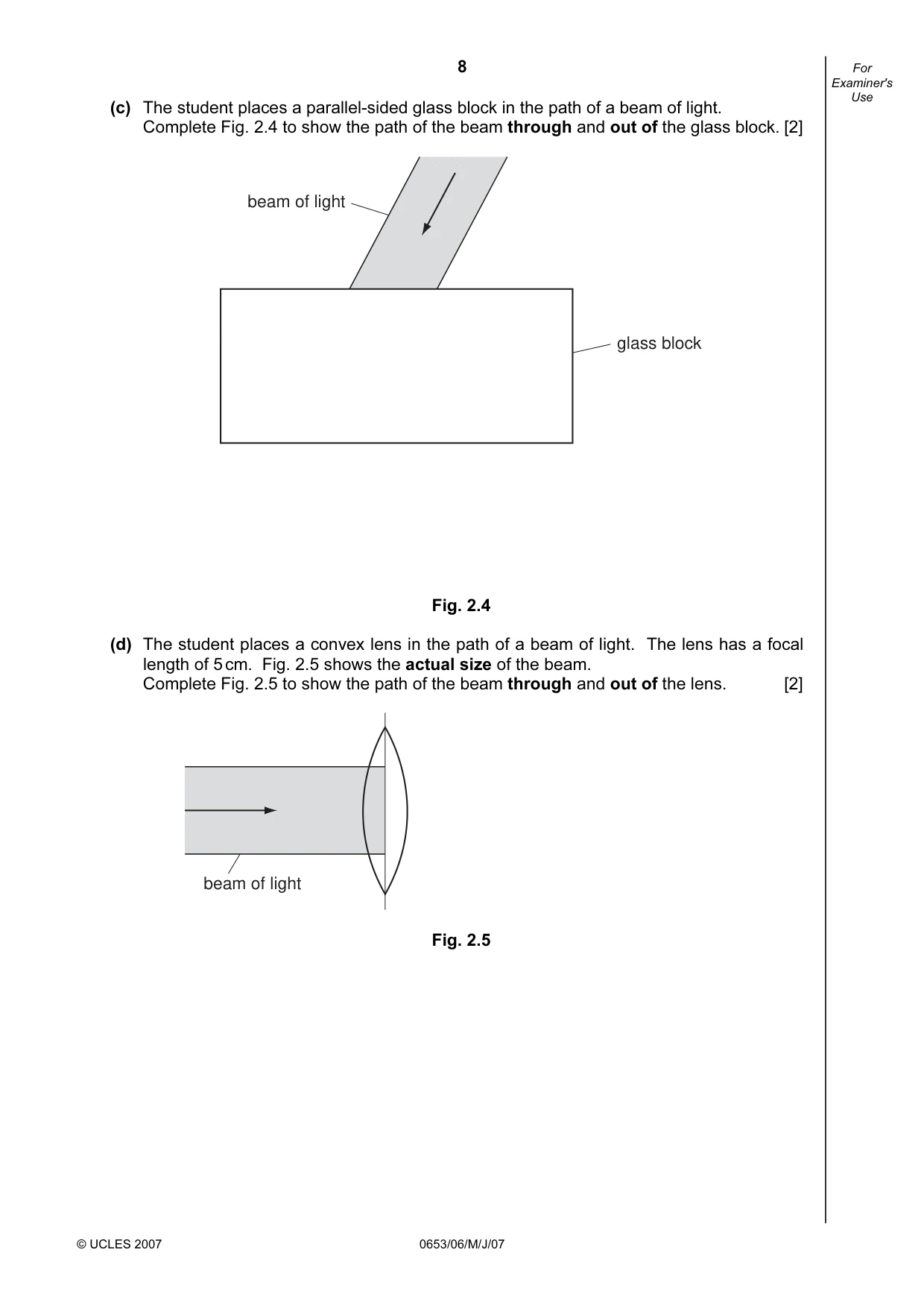
8 © UCLES 2007 0653/06/M/J/07 For Examiner's Use (c) The student places a parallel-sided glass block in the path of a beam of light. Complete Fig. 2.4 to show the path of the beam through and out of the glass block. [2] glass block beam of light Fig. 2.4 (d) The student places a convex lens in the path of a beam of light. The lens has a focal length of 5 cm. Fig. 2.5 shows the actual size of the beam. Complete Fig. 2.5 to show the path of the beam through and out of the lens. [2] beam of light Fig. 2.5
Question paper, page 9
9 0653/06/M/J/07 [Turn over BLANK PAGE Turn to page 10 for Question 3
Question paper, page 10
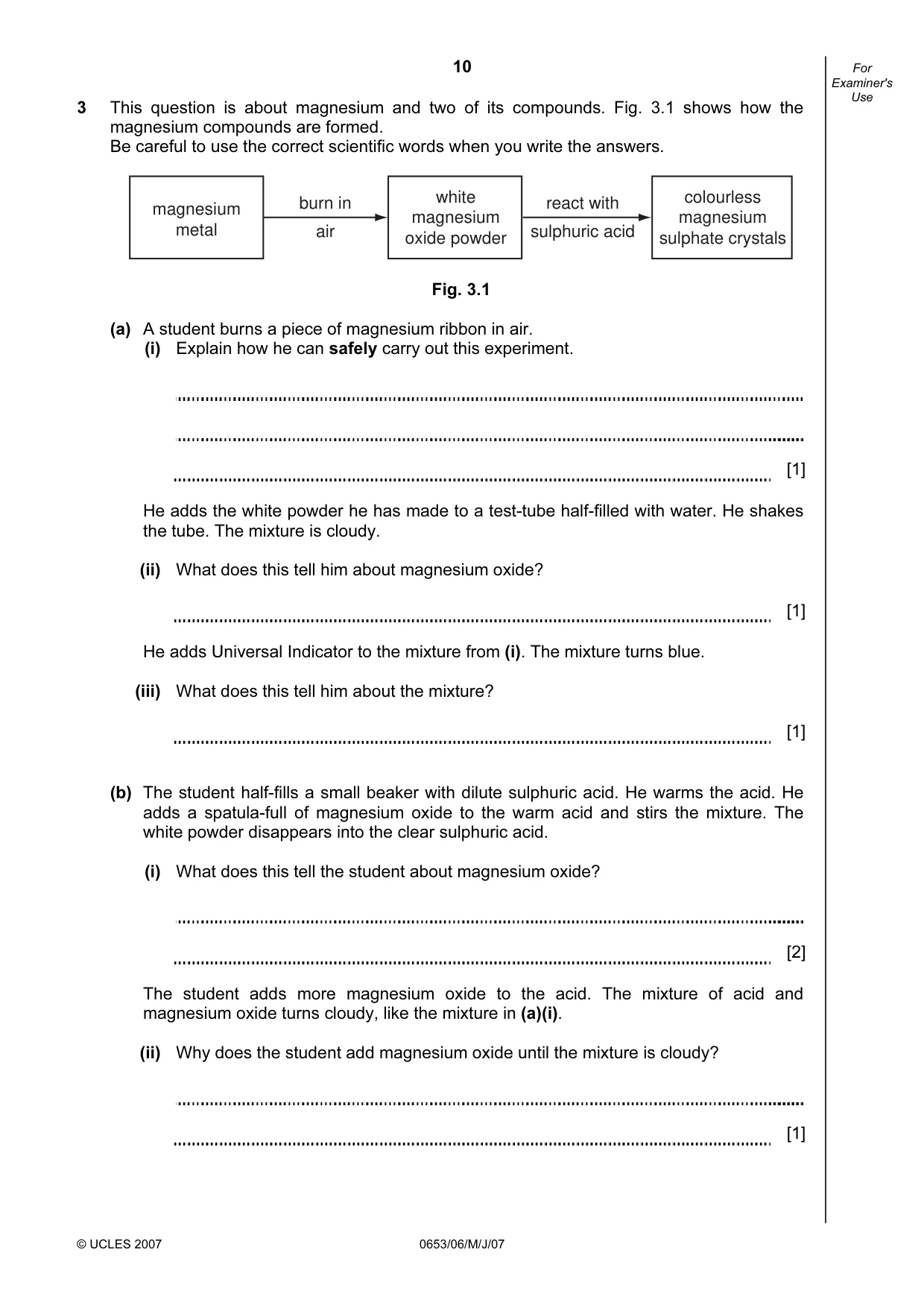
10 © UCLES 2007 0653/06/M/J/07 For Examiner's Use 3 This question is about magnesium and two of its compounds. Fig. 3.1 shows how the magnesium compounds are formed. Be careful to use the correct scientific words when you write the answers. magnesium metal white magnesium oxide powder colourless magnesium sulphate crystals burn in air react with sulphuric acid Fig. 3.1 (a) A student burns a piece of magnesium ribbon in air. (i) Explain how he can safely carry out this experiment. [1] He adds the white powder he has made to a test-tube half-filled with water. He shakes the tube. The mixture is cloudy. (ii) What does this tell him about magnesium oxide? [1] He adds Universal Indicator to the mixture from (i). The mixture turns blue. (iii) What does this tell him about the mixture? [1] (b) The student half-fills a small beaker with dilute sulphuric acid. He warms the acid. He adds a spatula-full of magnesium oxide to the warm acid and stirs the mixture. The white powder disappears into the clear sulphuric acid. (i) What does this tell the student about magnesium oxide? [2] The student adds more magnesium oxide to the acid. The mixture of acid and magnesium oxide turns cloudy, like the mixture in (a)(i). (ii) Why does the student add magnesium oxide until the mixture is cloudy? [1]
Question paper, page 11
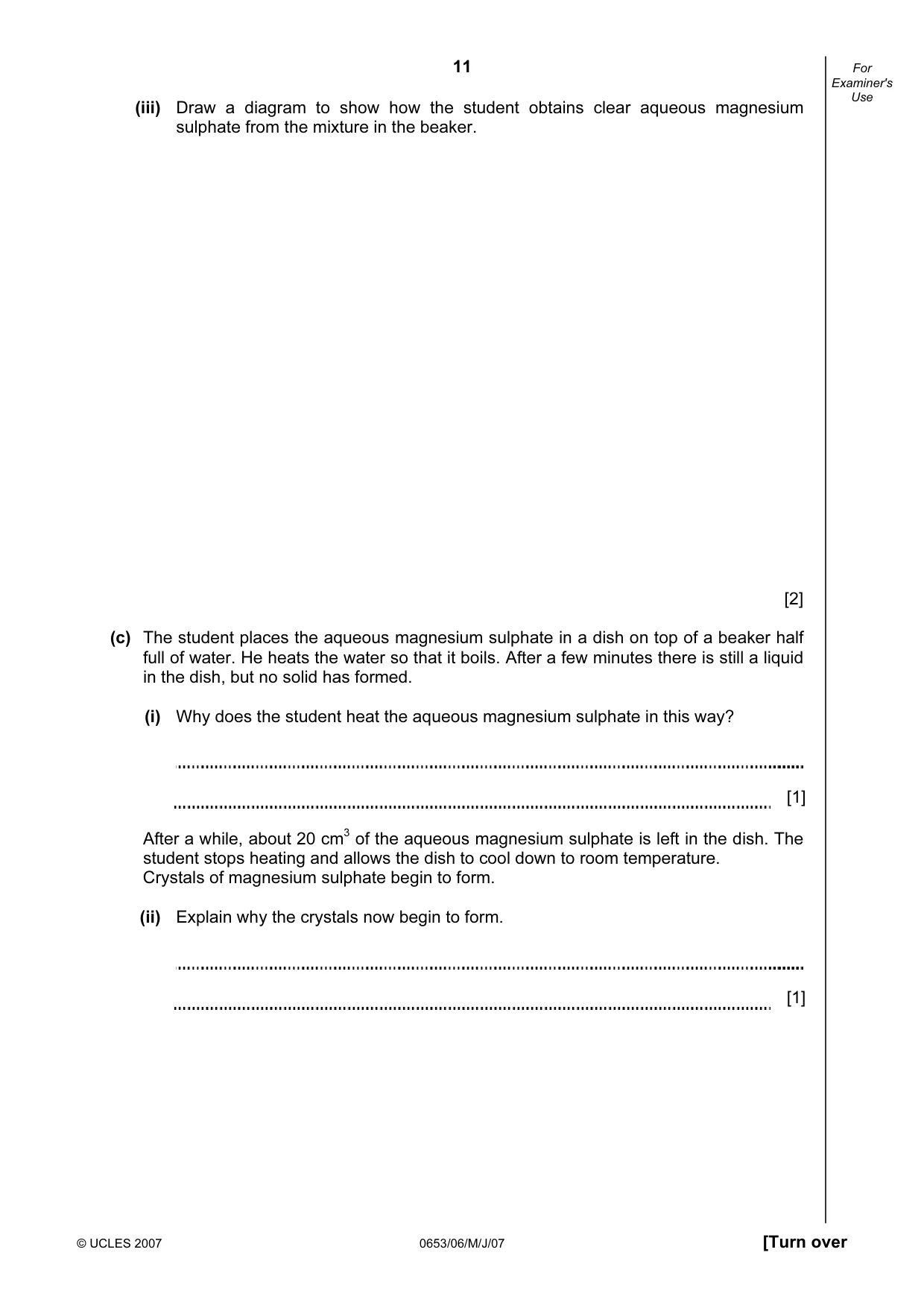
11 © UCLES 2007 0653/06/M/J/07 [Turn over For Examiner's Use (iii) Draw a diagram to show how the student obtains clear aqueous magnesium sulphate from the mixture in the beaker. [2] (c) The student places the aqueous magnesium sulphate in a dish on top of a beaker half full of water. He heats the water so that it boils. After a few minutes there is still a liquid in the dish, but no solid has formed. (i) Why does the student heat the aqueous magnesium sulphate in this way? [1] After a while, about 20 cm3 of the aqueous magnesium sulphate is left in the dish. The student stops heating and allows the dish to cool down to room temperature. Crystals of magnesium sulphate begin to form. (ii) Explain why the crystals now begin to form. [1]
Question paper, page 12
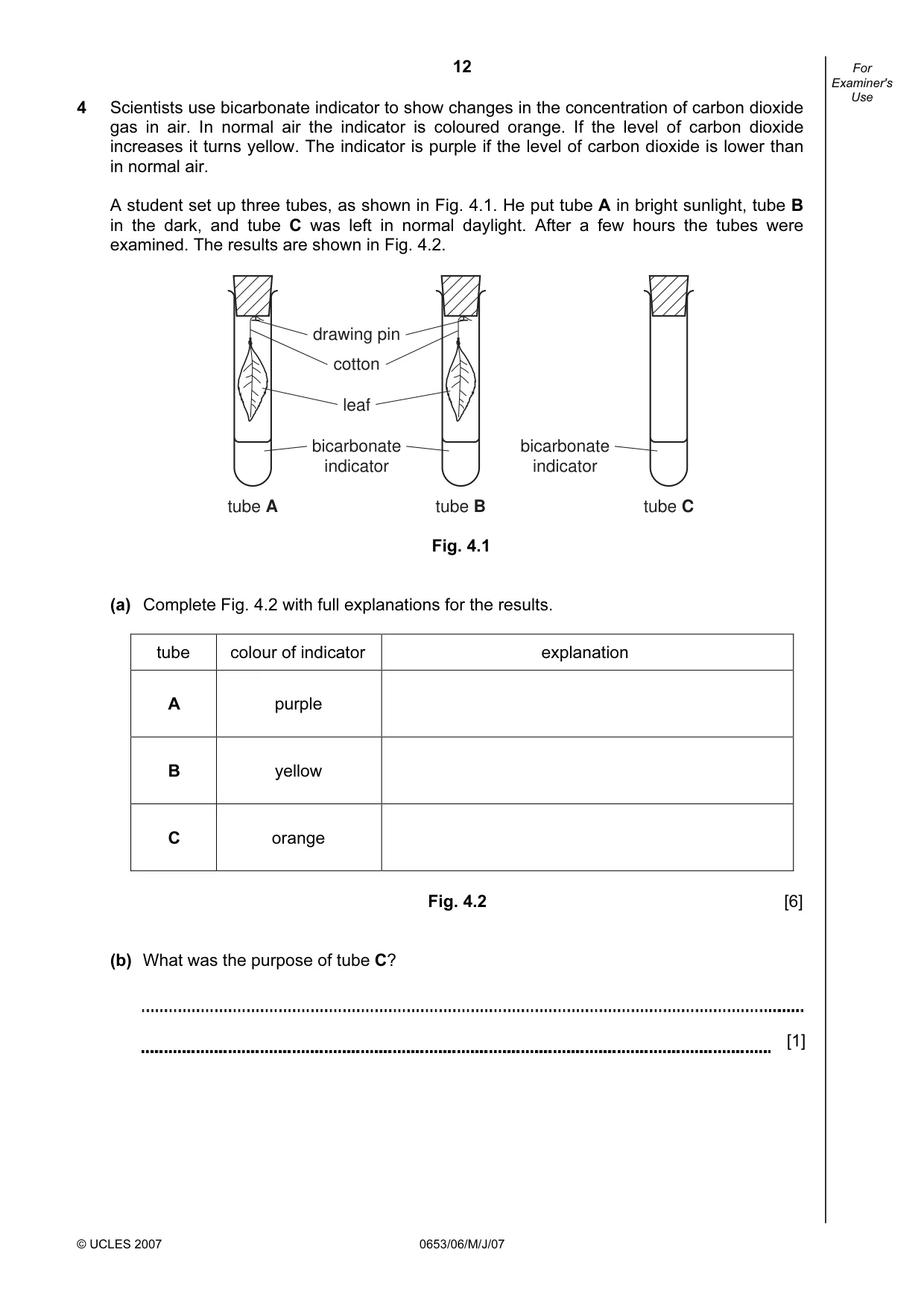
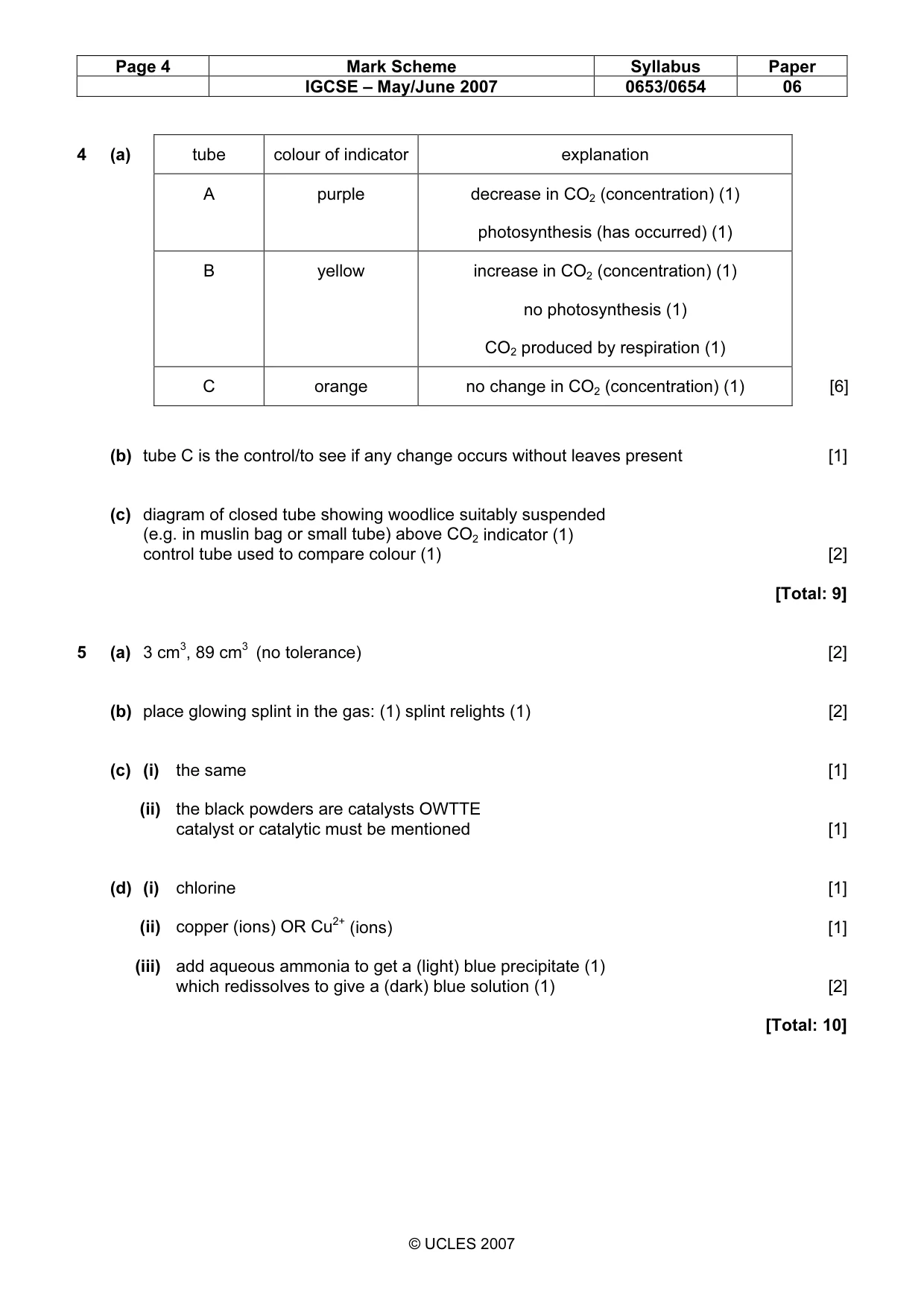
12 © UCLES 2007 0653/06/M/J/07 For Examiner's Use 4 Scientists use bicarbonate indicator to show changes in the concentration of carbon dioxide gas in air. In normal air the indicator is coloured orange. If the level of carbon dioxide increases it turns yellow. The indicator is purple if the level of carbon dioxide is lower than in normal air. A student set up three tubes, as shown in Fig. 4.1. He put tube A in bright sunlight, tube B in the dark, and tube C was left in normal daylight. After a few hours the tubes were examined. The results are shown in Fig. 4.2. tube A tube B tube C drawing pin cotton leaf bicarbonate indicator bicarbonate indicator Fig. 4.1 (a) Complete Fig. 4.2 with full explanations for the results. tube colour of indicator explanation A purple B yellow C orange Fig. 4.2 [6] (b) What was the purpose of tube C? [1]
Question paper, page 13
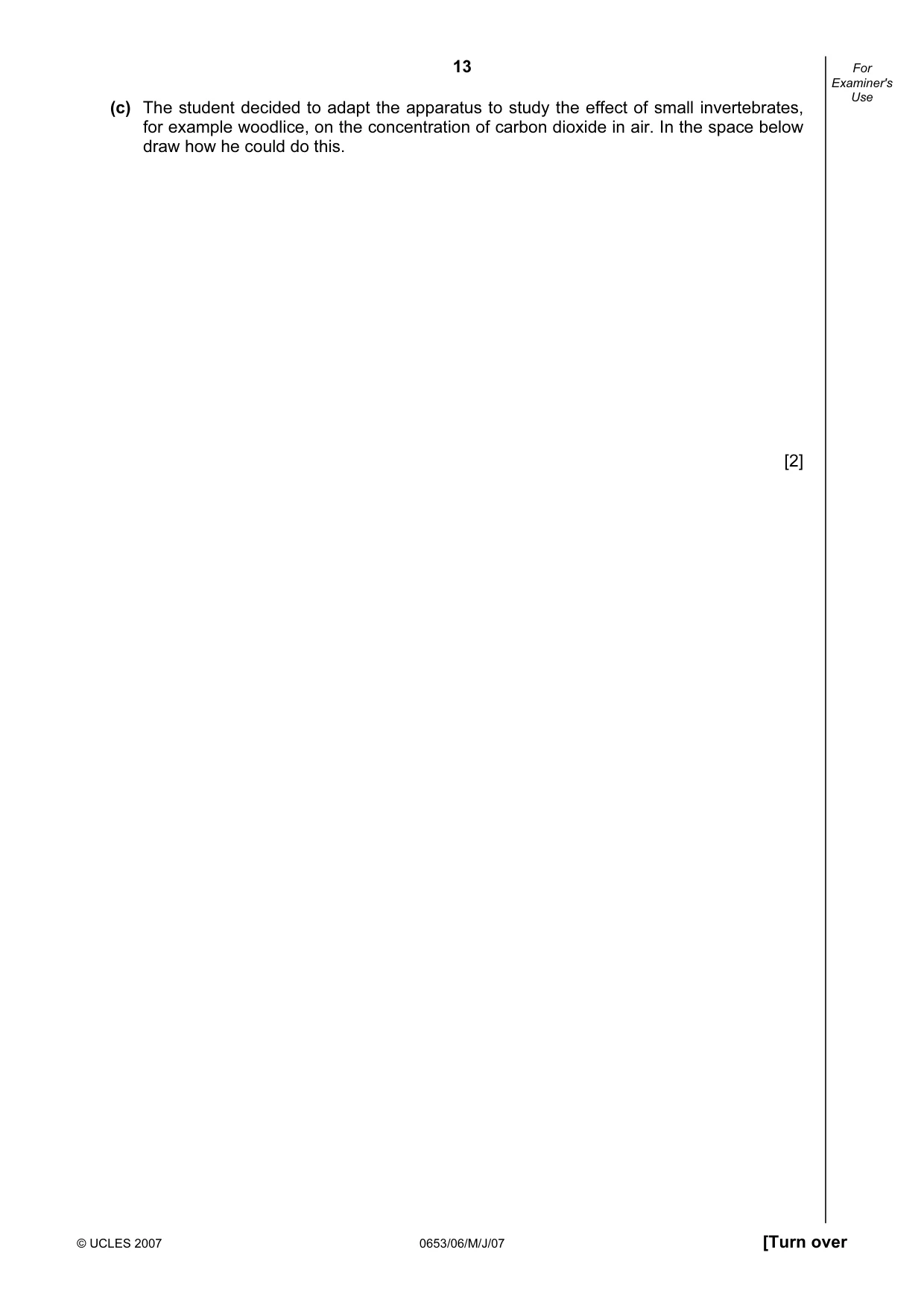
13 © UCLES 2007 0653/06/M/J/07 [Turn over For Examiner's Use (c) The student decided to adapt the apparatus to study the effect of small invertebrates, for example woodlice, on the concentration of carbon dioxide in air. In the space below draw how he could do this. [2]
Question paper, page 14
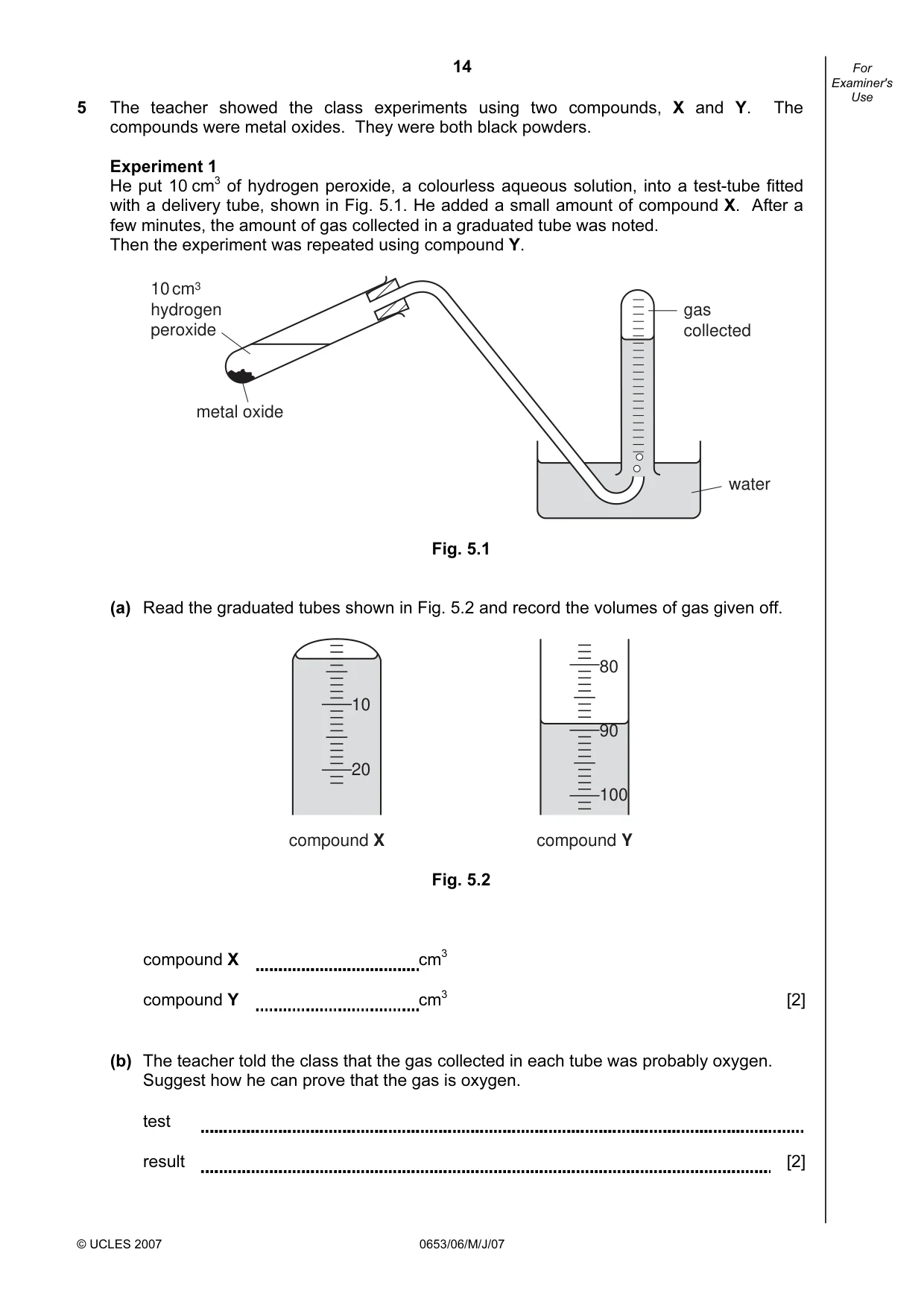
14 © UCLES 2007 0653/06/M/J/07 For Examiner's Use 5 The teacher showed the class experiments using two compounds, X and Y. The compounds were metal oxides. They were both black powders. Experiment 1 He put 10 cm3 of hydrogen peroxide, a colourless aqueous solution, into a test-tube fitted with a delivery tube, shown in Fig. 5.1. He added a small amount of compound X. After a few minutes, the amount of gas collected in a graduated tube was noted. Then the experiment was repeated using compound Y. water gas collected 10 cm3 hydrogen peroxide metal oxide Fig. 5.1 (a) Read the graduated tubes shown in Fig. 5.2 and record the volumes of gas given off. 80 90 100 compound Y 10 20 compound X Fig. 5.2 compound X cm3 compound Y cm3 [2] (b) The teacher told the class that the gas collected in each tube was probably oxygen. Suggest how he can prove that the gas is oxygen. test result [2]
Question paper, page 15
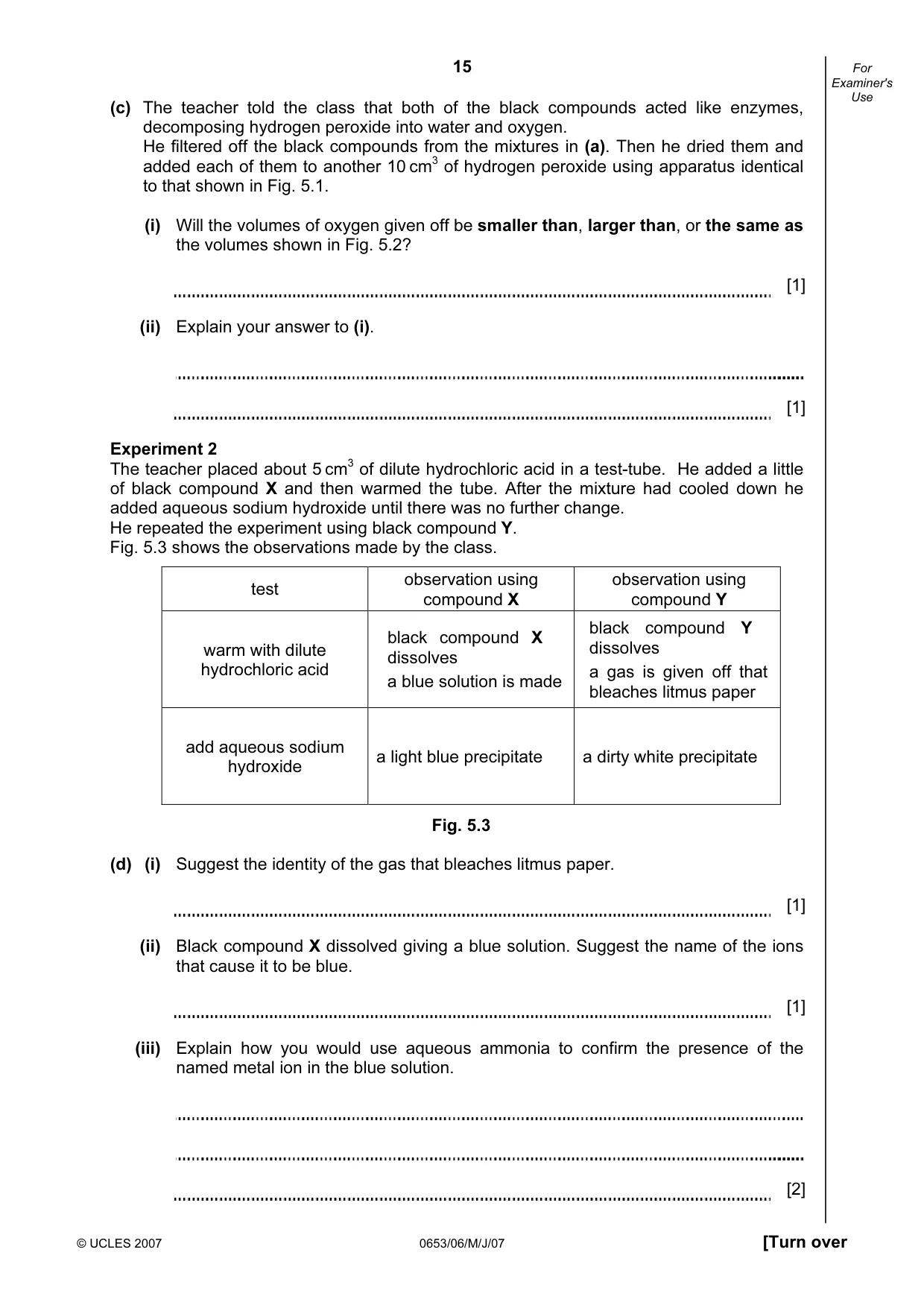
15 © UCLES 2007 0653/06/M/J/07 [Turn over For Examiner's Use (c) The teacher told the class that both of the black compounds acted like enzymes, decomposing hydrogen peroxide into water and oxygen. He filtered off the black compounds from the mixtures in (a). Then he dried them and added each of them to another 10 cm3 of hydrogen peroxide using apparatus identical to that shown in Fig. 5.1. (i) Will the volumes of oxygen given off be smaller than, larger than, or the same as the volumes shown in Fig. 5.2? [1] (ii) Explain your answer to (i). [1] Experiment 2 The teacher placed about 5 cm3 of dilute hydrochloric acid in a test-tube. He added a little of black compound X and then warmed the tube. After the mixture had cooled down he added aqueous sodium hydroxide until there was no further change. He repeated the experiment using black compound Y. Fig. 5.3 shows the observations made by the class. test observation using compound X observation using compound Y warm with dilute hydrochloric acid black compound X dissolves a blue solution is made black compound Y dissolves a gas is given off that bleaches litmus paper add aqueous sodium hydroxide a light blue precipitate a dirty white precipitate Fig. 5.3 (d) (i) Suggest the identity of the gas that bleaches litmus paper. [1] (ii) Black compound X dissolved giving a blue solution. Suggest the name of the ions that cause it to be blue. [1] (iii) Explain how you would use aqueous ammonia to confirm the presence of the named metal ion in the blue solution. [2]
Question paper, page 16
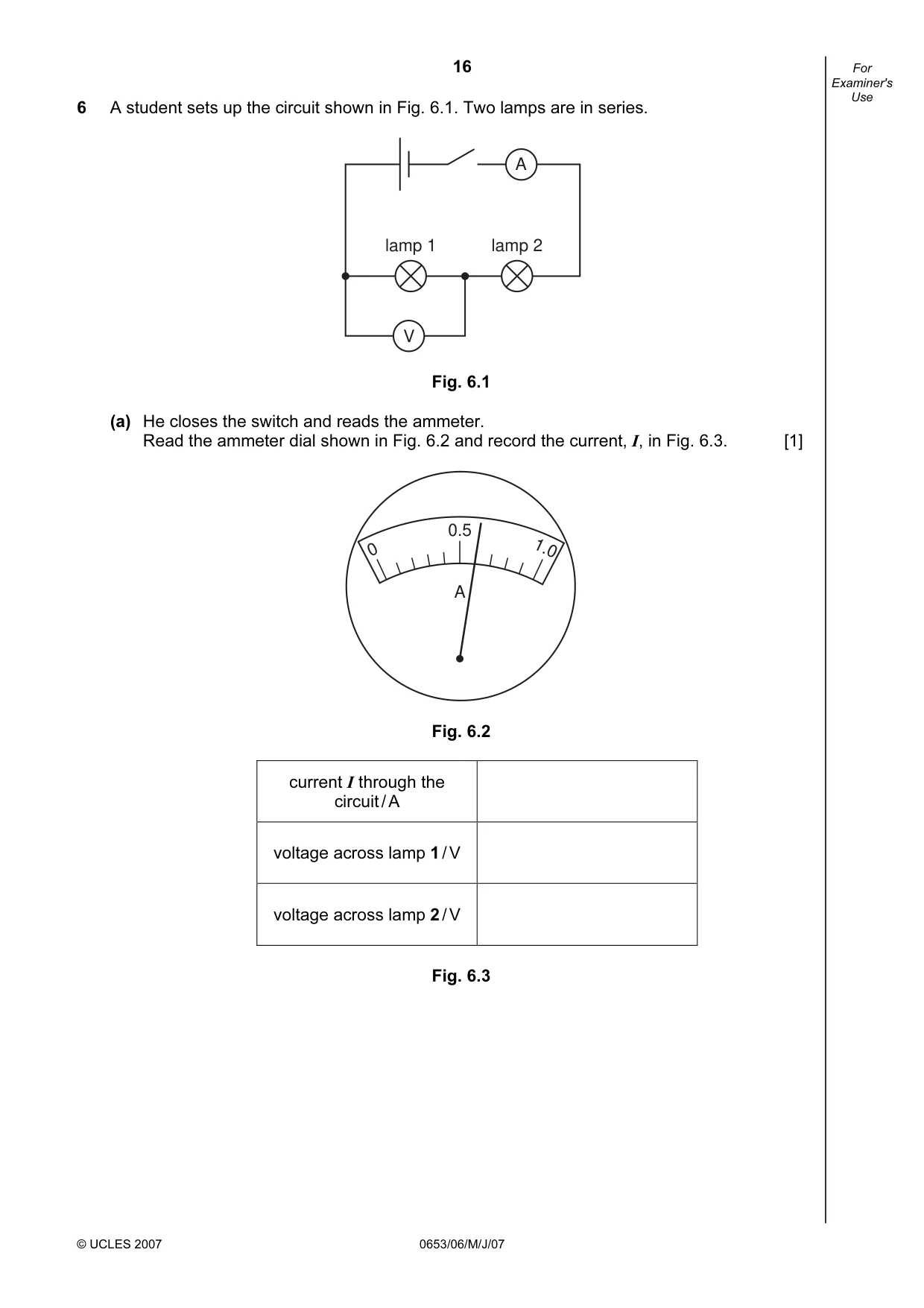
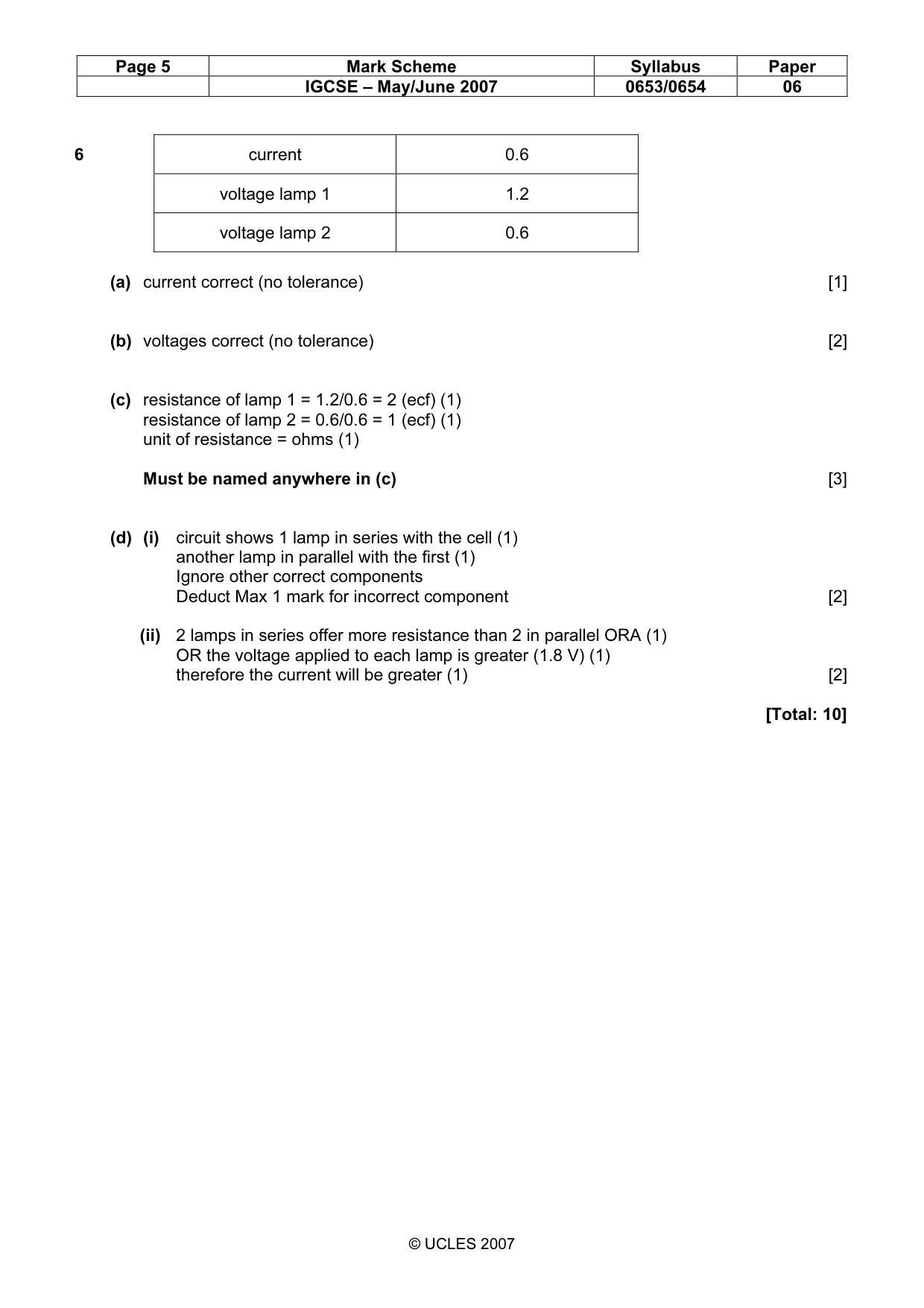
16 © UCLES 2007 0653/06/M/J/07 For Examiner's Use 6 A student sets up the circuit shown in Fig. 6.1. Two lamps are in series. A lamp 1 lamp 2 V Fig. 6.1 (a) He closes the switch and reads the ammeter. Read the ammeter dial shown in Fig. 6.2 and record the current, I, in Fig. 6.3. [1] 0.5 1.0 0 A Fig. 6.2 current I through the circuit / A voltage across lamp 1 / V voltage across lamp 2 / V Fig. 6.3
Question paper, page 17
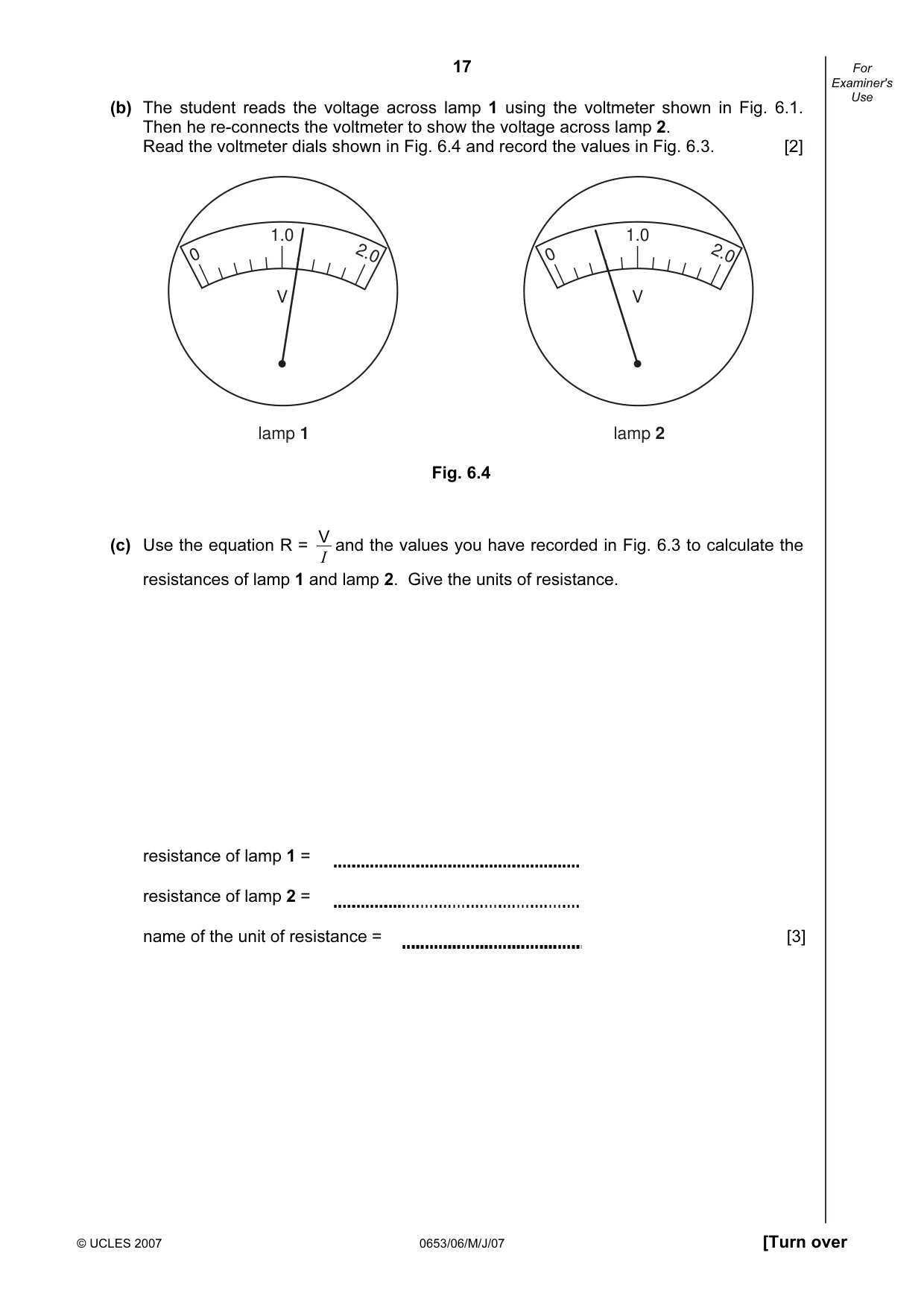
17 © UCLES 2007 0653/06/M/J/07 [Turn over For Examiner's Use (b) The student reads the voltage across lamp 1 using the voltmeter shown in Fig. 6.1. Then he re-connects the voltmeter to show the voltage across lamp 2. Read the voltmeter dials shown in Fig. 6.4 and record the values in Fig. 6.3. [2] 1.0 2.0 0 V lamp 1 1.0 2.0 0 V lamp 2 Fig. 6.4 (c) Use the equation R = I V and the values you have recorded in Fig. 6.3 to calculate the resistances of lamp 1 and lamp 2. Give the units of resistance. resistance of lamp 1 = resistance of lamp 2 = name of the unit of resistance = [3]
Question paper, page 18
18 © UCLES 2007 0653/06/M/J/07 For Examiner's Use (d) The student thought it was possible to increase the brightness of both the lamps by rearranging the circuit shown in Fig. 6.1. (i) Draw a circuit diagram to show how this might be done. Do not include the voltmeter in your circuit. [2] (ii) Explain why the lamps would be brighter using the circuit you have drawn. [2]
Question paper, page 20
20 Permission to reproduce items where third-party owned material protected by copyright is included has been sought and cleared where possible. Every reasonable effort has been made by the publisher (UCLES) to trace copyright holders, but if any items requiring clearance have unwittingly been included, the publisher will be pleased to make amends at the earliest possible opportunity. University of Cambridge International Examinations is part of the Cambridge Assessment Group. Cambridge Assessment is the brand name of University of Cambridge Local Examinations Syndicate (UCLES), which is itself a department of the University of Cambridge. 0653/06/M/J/07 BLANK PAGE
Mark scheme, page 1
UNIVERSITY OF CAMBRIDGE INTERNATIONAL EXAMINATIONS International General Certificate of Secondary Education MARK SCHEME for the May/June 2007 question paper 0653 and 0654 COMBINED SCIENCE 0653/06 and 0654/06 Paper 6 (Alternative to Practical), maximum raw mark 60 This mark scheme is published as an aid to teachers and candidates, to indicate the requirements of the examination. It shows the basis on which Examiners were instructed to award marks. It does not indicate the details of the discussions that took place at an Examiners’ meeting before marking began. All Examiners are instructed that alternative correct answers and unexpected approaches in candidates’ scripts must be given marks that fairly reflect the relevant knowledge and skills demonstrated. Mark schemes must be read in conjunction with the question papers and the report on the examination. • CIE will not enter into discussions or correspondence in connection with these mark schemes. CIE is publishing the mark schemes for the May/June 2007 question papers for most IGCSE, GCE Advanced Level and Advanced Subsidiary Level syllabuses and some Ordinary Level syllabuses. www.XtremePapers.com
Mark scheme, page 2
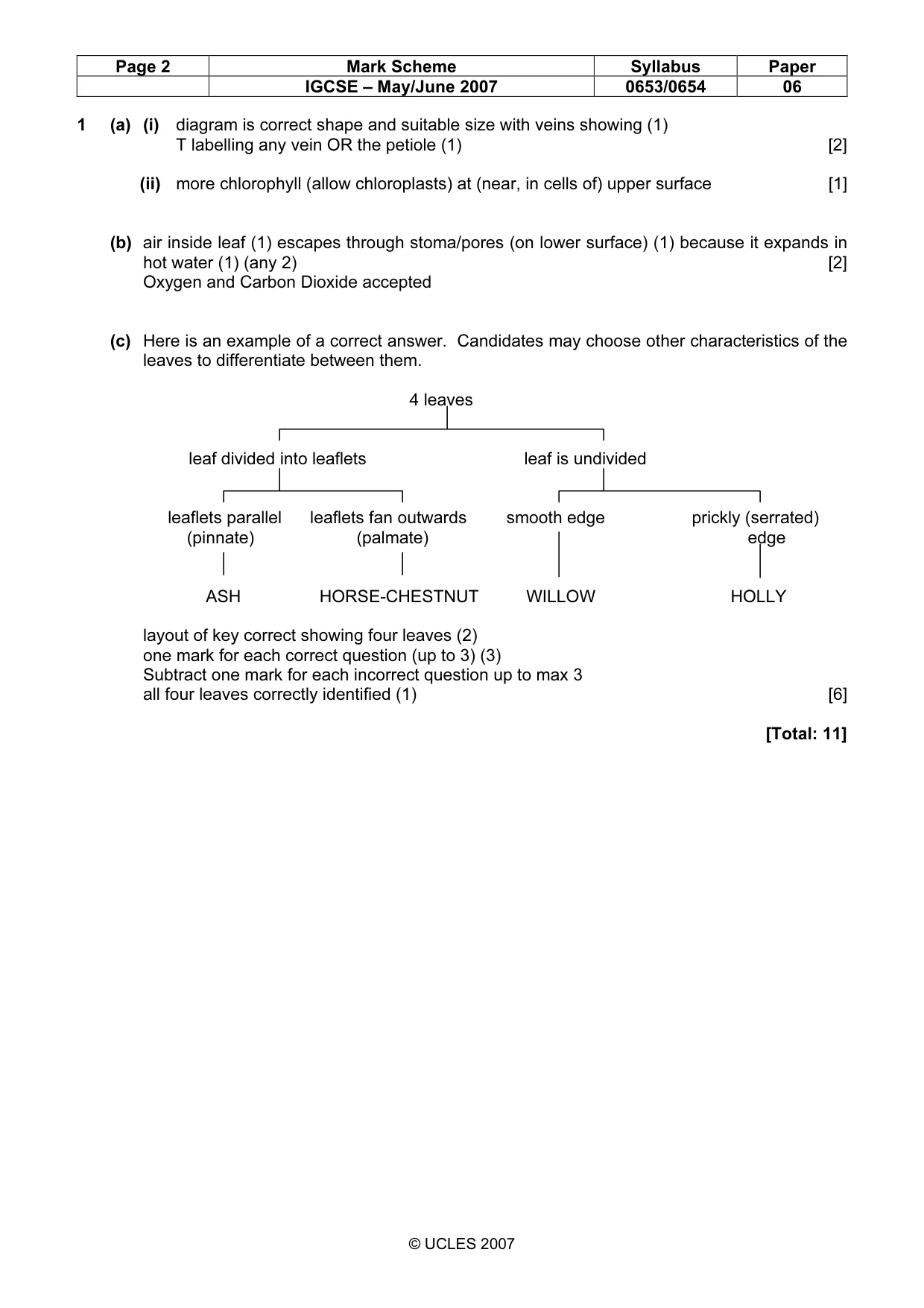
Page 2 Mark Scheme Syllabus Paper IGCSE – May/June 2007 0653/0654 06 © UCLES 2007 1 (a) (i) diagram is correct shape and suitable size with veins showing (1) T labelling any vein OR the petiole (1) [2] (ii) more chlorophyll (allow chloroplasts) at (near, in cells of) upper surface [1] (b) air inside leaf (1) escapes through stoma/pores (on lower surface) (1) because it expands in hot water (1) (any 2) [2] Oxygen and Carbon Dioxide accepted (c) Here is an example of a correct answer. Candidates may choose other characteristics of the leaves to differentiate between them. 4 leaves leaf divided into leaflets leaf is undivided leaflets parallel leaflets fan outwards smooth edge prickly (serrated) (pinnate) (palmate) edge ASH HORSE-CHESTNUT WILLOW HOLLY layout of key correct showing four leaves (2) one mark for each correct question (up to 3) (3) Subtract one mark for each incorrect question up to max 3 all four leaves correctly identified (1) [6] [Total: 11]
Mark scheme, page 3
Page 3 Mark Scheme Syllabus Paper IGCSE – May/June 2007 0653/0654 06 © UCLES 2007 2 Expt no. incident beam at distance x/cm reflected beam at distance y/cm 1 (76.5) (26.5) (24.0) (26.0) 2 83.0 33.0 16.5 33.5 3 59.0 9.0 40.5 9.5 (a) (i) 4 distances correctly read and recorded (ignore absence of 1st d.p.) [2] (+/- 0.2) 3 or 2 correct (1) 1 or 0 correct (0) (ii) 4 distances x and y correctly recorded (ignore absence of 1st d.p.) [2] (ecf) 3 or 2 correct (1) 1 or 0 correct (0) If first d.p. is missing from one or more readings in the table, subtract 1 mark. [2] (b) The distances x and y are equal (allow almost equal/similar) (1) so the angle of incidence and the angle of reflection are equal. (1) OR the incident ray, reflected ray and the normal are all in the same plane, (1) i.e. the table top.(1) [2] (c) Incident and emergent beams are parallel (1) angles of incidence and refraction are equal (1) If the beam is not bent towards the normal, subtract 1 mark. (normals need not be shown) [2] (d) The sides of the beam meet at a focus (1) The focal point is 5 cm(+/- 0.5 cm) from the mid-point of the lens (1) [2] [Total: 10] 3 (a) (i) use of tongs or blue glass mentioned [1] (ii) magnesium oxide is insoluble in water [1] (iii) the mixture is (slightly) alkaline OWTTE [1] (b) (i) magnesium oxide dissolves/reacts in sulphuric acid or is a base oxide (1) forms a salt or takes part in neutralisation allow 2 [2] (ii) to neutralise all the acid OWTTE [1] (iii) diagram shows filter funnel and filter paper(1) and passage of mixture through it. (1) [2] (c) (i) to concentrate the solution/to evaporate some water/controlled heating OWTTE [1] (ii) the solution is saturated/the magnesium sulphate cannot be held in solution OWTTE [1] [Total: 10]
Mark scheme, page 4
Page 4 Mark Scheme Syllabus Paper IGCSE – May/June 2007 0653/0654 06 © UCLES 2007 4 (a) tube colour of indicator explanation A purple decrease in CO2 (concentration) (1) photosynthesis (has occurred) (1) B yellow increase in CO2 (concentration) (1) no photosynthesis (1) CO2 produced by respiration (1) C orange no change in CO2 (concentration) (1) [6] (b) tube C is the control/to see if any change occurs without leaves present [1] (c) diagram of closed tube showing woodlice suitably suspended (e.g. in muslin bag or small tube) above CO2 indicator (1) control tube used to compare colour (1) [2] [Total: 9] 5 (a) 3 cm3, 89 cm3 (no tolerance) [2] (b) place glowing splint in the gas: (1) splint relights (1) [2] (c) (i) the same [1] (ii) the black powders are catalysts OWTTE catalyst or catalytic must be mentioned [1] (d) (i) chlorine [1] (ii) copper (ions) OR Cu2+ (ions) [1] (iii) add aqueous ammonia to get a (light) blue precipitate (1) which redissolves to give a (dark) blue solution (1) [2] [Total: 10]
Mark scheme, page 5
Page 5 Mark Scheme Syllabus Paper IGCSE – May/June 2007 0653/0654 06 © UCLES 2007 6 current 0.6 voltage lamp 1 1.2 voltage lamp 2 0.6 (a) current correct (no tolerance) [1] (b) voltages correct (no tolerance) [2] (c) resistance of lamp 1 = 1.2/0.6 = 2 (ecf) (1) resistance of lamp 2 = 0.6/0.6 = 1 (ecf) (1) unit of resistance = ohms (1) Must be named anywhere in (c) [3] (d) (i) circuit shows 1 lamp in series with the cell (1) another lamp in parallel with the first (1) Ignore other correct components Deduct Max 1 mark for incorrect component [2] (ii) 2 lamps in series offer more resistance than 2 in parallel ORA (1) OR the voltage applied to each lamp is greater (1.8 V) (1) therefore the current will be greater (1) [2] [Total: 10]
What you needed in this session
Cambridge’s own grade thresholds for 2007 May/June, Paper 6 · Variant 1. A higher threshold means an easier paper — the bar moves with how the cohort did.