Cambridge IGCSE Sciences - Co-ordinated (Double) 0654 — 2005 Oct/Nov Paper 6 · Variant 1
0654/61/O/N/05
The question paper and its mark scheme, free to read here and free to download. This is Cambridge’s own paper, exactly as it was sat.
Question paper16 pages


Mark scheme4 pages
Answers below. Sit the paper first if you are practising.
Paper as text
Question paper, page 1
Centre Number Candidate Number Name UNIVERSITY OF CAMBRIDGE INTERNATIONAL EXAMINATIONS International General Certificate of Secondary Education COMBINED SCIENCE 0653/06 CO-ORDINATED SCIENCES 0654/06 Paper 6 Alternative to Practical October/November 2005 1 hour Candidates answer on the Question Paper. No Additional Materials required. READ THESE INSTRUCTIONS FIRST Write your Centre number, candidate number and name on all the work you hand in. Write in dark blue or black pen in the spaces provided on the Question Paper. You may use a soft pencil for any diagrams, graphs or rough working. Do not use staples, paper clips, highlighters, glue or correction fluid. Answer all questions. The number of marks is given in brackets [ ] at the end of each question or part question. For Examiner’s Use 1 2 3 4 5 6 Total This document consists of 13 printed pages and 3 blank pages. IB05 11_0653_06/3RP UCLES 2005 [Turn over If you have been given a label, look at the details. If any details are incorrect or missing, please fill in your correct details in the space given at the top of this page. Stick your personal label here, if provided. www.XtremePapers.com
Question paper, page 3
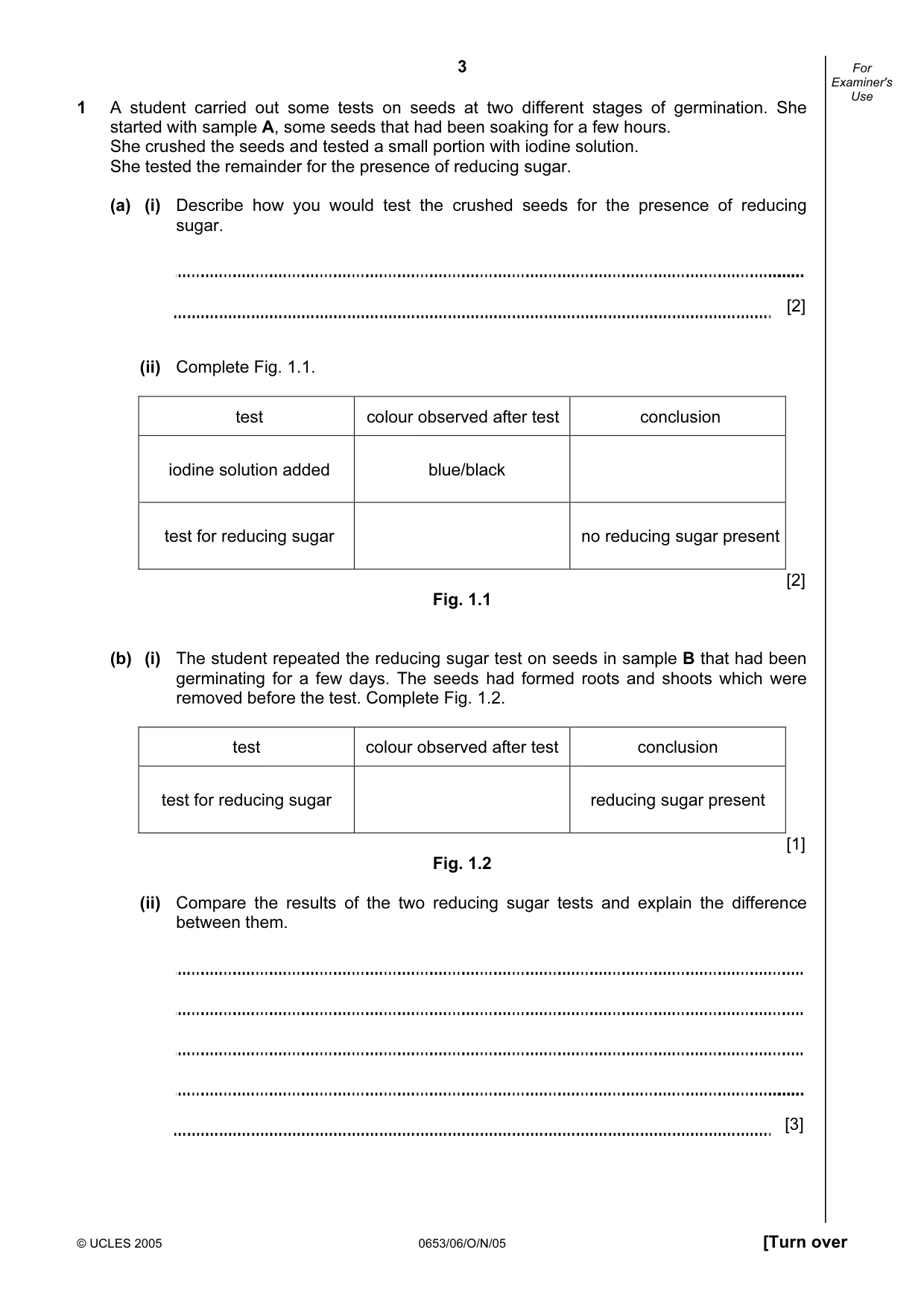
3 © UCLES 2005 0653/06/O/N/05 [Turn over For Examiner's Use 1 A student carried out some tests on seeds at two different stages of germination. She started with sample A, some seeds that had been soaking for a few hours. She crushed the seeds and tested a small portion with iodine solution. She tested the remainder for the presence of reducing sugar. (a) (i) Describe how you would test the crushed seeds for the presence of reducing sugar. [2] (ii) Complete Fig. 1.1. test colour observed after test conclusion iodine solution added blue/black test for reducing sugar no reducing sugar present [2] Fig. 1.1 (b) (i) The student repeated the reducing sugar test on seeds in sample B that had been germinating for a few days. The seeds had formed roots and shoots which were removed before the test. Complete Fig. 1.2. test colour observed after test conclusion test for reducing sugar reducing sugar present [1] Fig. 1.2 (ii) Compare the results of the two reducing sugar tests and explain the difference between them. [3]
Question paper, page 4
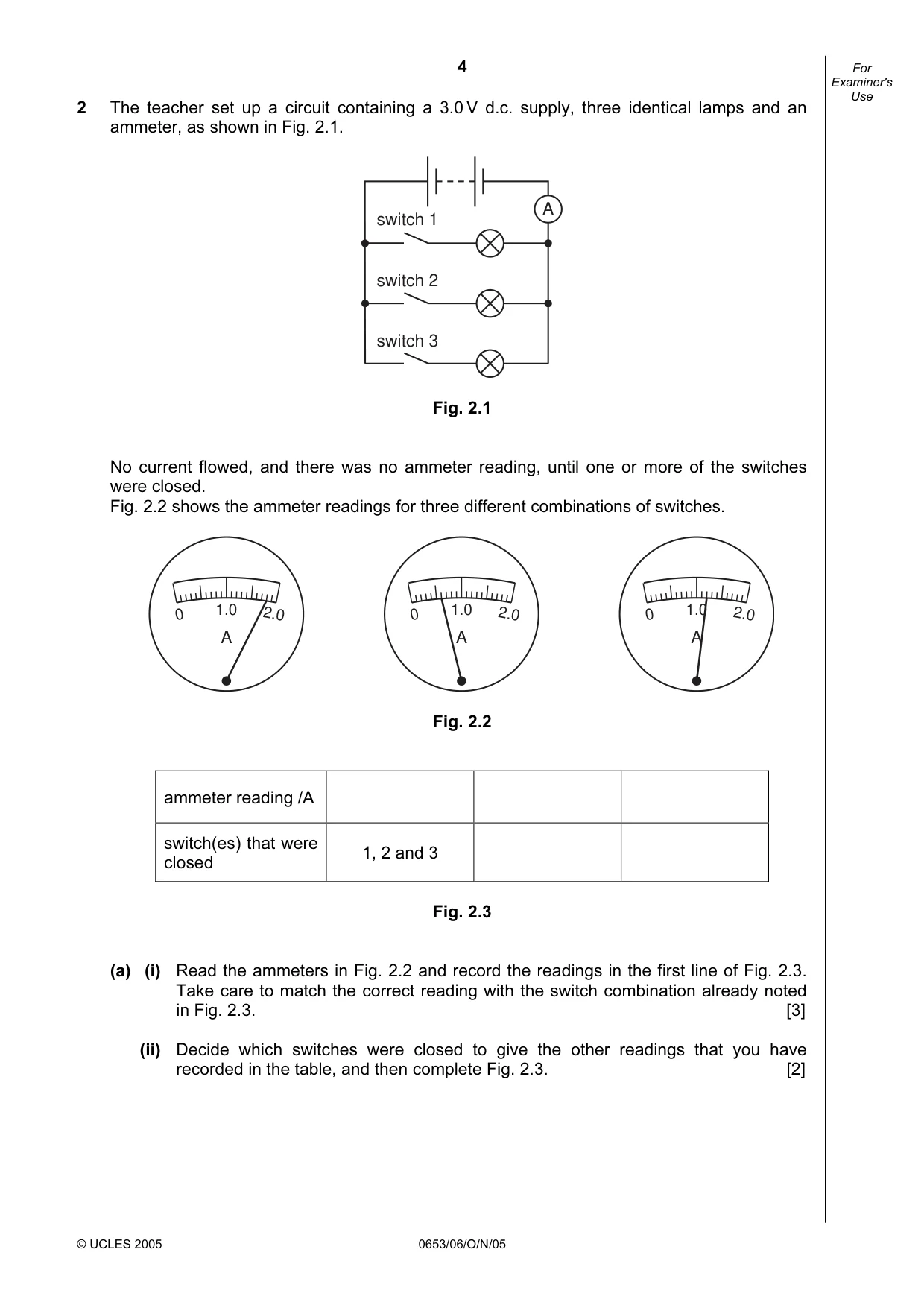
4 © UCLES 2005 0653/06/O/N/05 For Examiner's Use 2 The teacher set up a circuit containing a 3.0 V d.c. supply, three identical lamps and an ammeter, as shown in Fig. 2.1. switch 1 switch 2 switch 3 A Fig. 2.1 No current flowed, and there was no ammeter reading, until one or more of the switches were closed. Fig. 2.2 shows the ammeter readings for three different combinations of switches. A 0 1.0 2.0 A 0 1.0 2.0 A 0 1.0 2.0 Fig. 2.2 ammeter reading /A switch(es) that were closed 1, 2 and 3 Fig. 2.3 (a) (i) Read the ammeters in Fig. 2.2 and record the readings in the first line of Fig. 2.3. Take care to match the correct reading with the switch combination already noted in Fig. 2.3. [3] (ii) Decide which switches were closed to give the other readings that you have recorded in the table, and then complete Fig. 2.3. [2]
Question paper, page 5
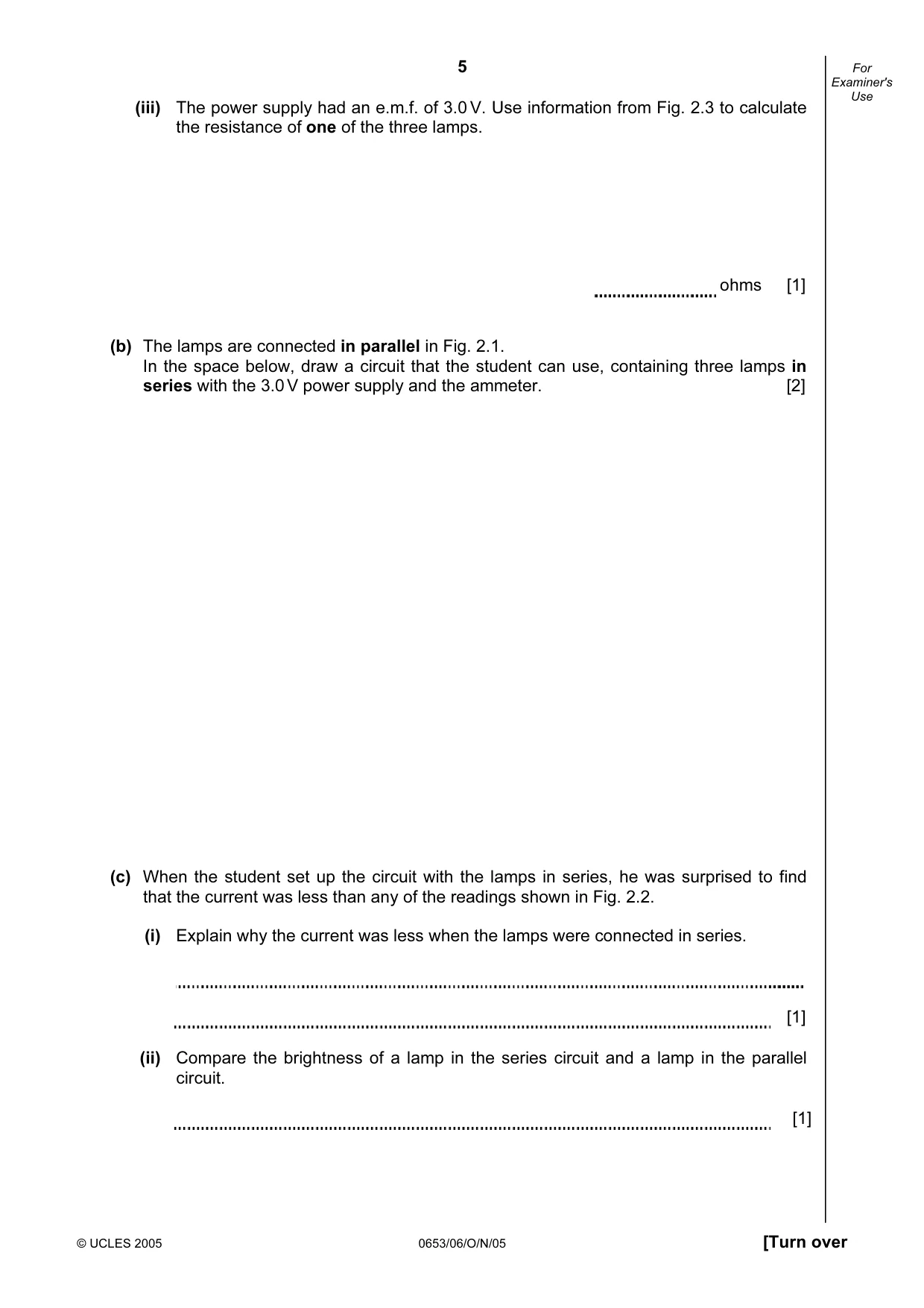
5 © UCLES 2005 0653/06/O/N/05 [Turn over For Examiner's Use (iii) The power supply had an e.m.f. of 3.0 V. Use information from Fig. 2.3 to calculate the resistance of one of the three lamps. ohms [1] (b) The lamps are connected in parallel in Fig. 2.1. In the space below, draw a circuit that the student can use, containing three lamps in series with the 3.0 V power supply and the ammeter. [2] (c) When the student set up the circuit with the lamps in series, he was surprised to find that the current was less than any of the readings shown in Fig. 2.2. (i) Explain why the current was less when the lamps were connected in series. [1] (ii) Compare the brightness of a lamp in the series circuit and a lamp in the parallel circuit. [1]
Question paper, page 6
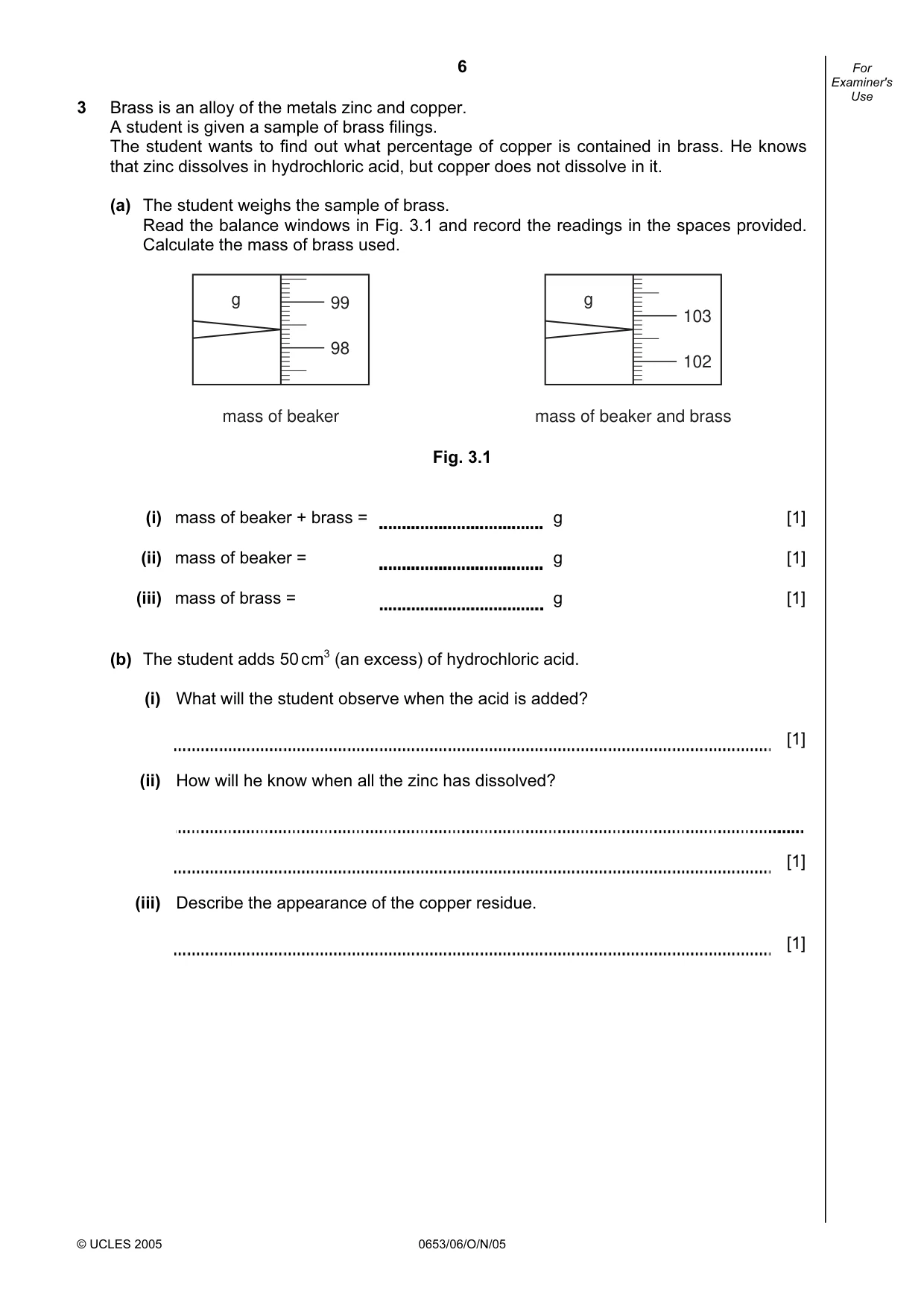
6 © UCLES 2005 0653/06/O/N/05 For Examiner's Use 3 Brass is an alloy of the metals zinc and copper. A student is given a sample of brass filings. The student wants to find out what percentage of copper is contained in brass. He knows that zinc dissolves in hydrochloric acid, but copper does not dissolve in it. (a) The student weighs the sample of brass. Read the balance windows in Fig. 3.1 and record the readings in the spaces provided. Calculate the mass of brass used. 99 98 103 102 mass of beaker g mass of beaker and brass g Fig. 3.1 (i) mass of beaker + brass = g [1] (ii) mass of beaker = g [1] (iii) mass of brass = g [1] (b) The student adds 50 cm3 (an excess) of hydrochloric acid. (i) What will the student observe when the acid is added? [1] (ii) How will he know when all the zinc has dissolved? [1] (iii) Describe the appearance of the copper residue. [1]
Question paper, page 7
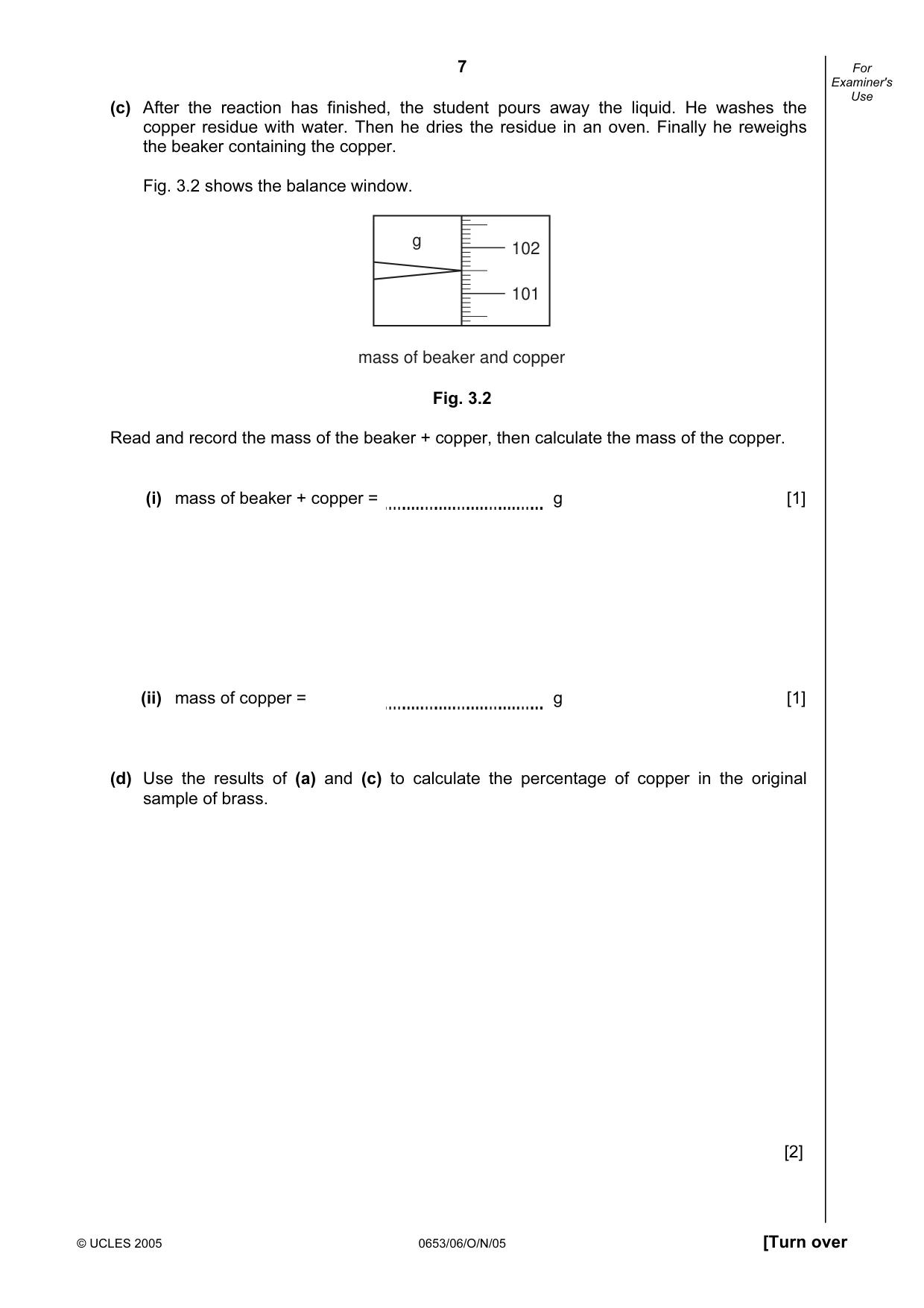
7 © UCLES 2005 0653/06/O/N/05 [Turn over For Examiner's Use (c) After the reaction has finished, the student pours away the liquid. He washes the copper residue with water. Then he dries the residue in an oven. Finally he reweighs the beaker containing the copper. Fig. 3.2 shows the balance window. 102 101 mass of beaker and copper g Fig. 3.2 Read and record the mass of the beaker + copper, then calculate the mass of the copper. (i) mass of beaker + copper = g [1] (ii) mass of copper = g [1] (d) Use the results of (a) and (c) to calculate the percentage of copper in the original sample of brass. [2]
Question paper, page 8
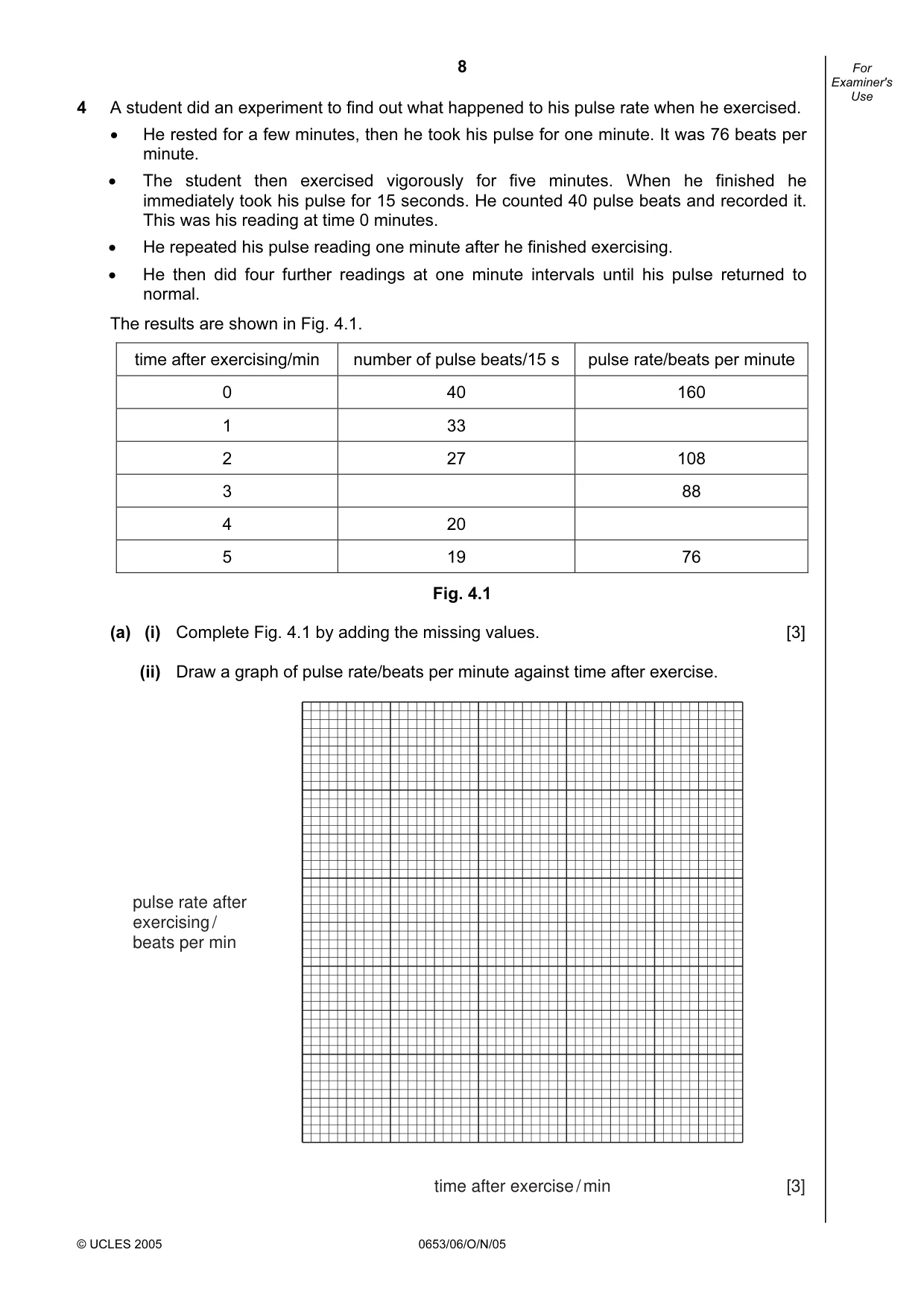
8 © UCLES 2005 0653/06/O/N/05 For Examiner's Use 4 A student did an experiment to find out what happened to his pulse rate when he exercised. • He rested for a few minutes, then he took his pulse for one minute. It was 76 beats per minute. • The student then exercised vigorously for five minutes. When he finished he immediately took his pulse for 15 seconds. He counted 40 pulse beats and recorded it. This was his reading at time 0 minutes. • He repeated his pulse reading one minute after he finished exercising. • He then did four further readings at one minute intervals until his pulse returned to normal. The results are shown in Fig. 4.1. time after exercising/min number of pulse beats/15 s pulse rate/beats per minute 0 40 160 1 33 2 27 108 3 88 4 20 5 19 76 Fig. 4.1 (a) (i) Complete Fig. 4.1 by adding the missing values. [3] (ii) Draw a graph of pulse rate/beats per minute against time after exercise. time after exercise / min [3] pulse rate after exercising / beats per min
Question paper, page 9
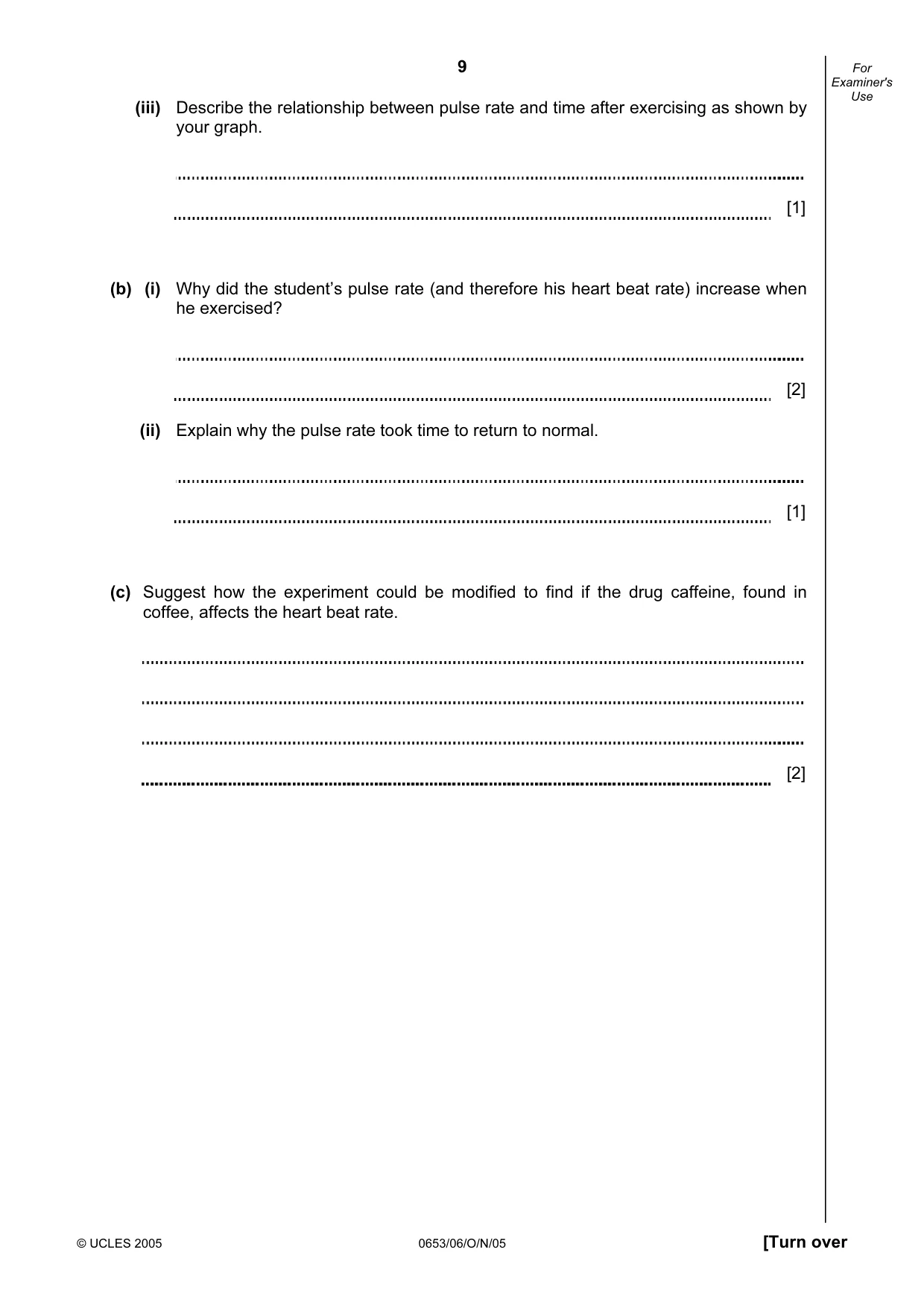
9 © UCLES 2005 0653/06/O/N/05 [Turn over For Examiner's Use (iii) Describe the relationship between pulse rate and time after exercising as shown by your graph. [1] (b) (i) Why did the student’s pulse rate (and therefore his heart beat rate) increase when he exercised? [2] (ii) Explain why the pulse rate took time to return to normal. [1] (c) Suggest how the experiment could be modified to find if the drug caffeine, found in coffee, affects the heart beat rate. [2]
Question paper, page 10
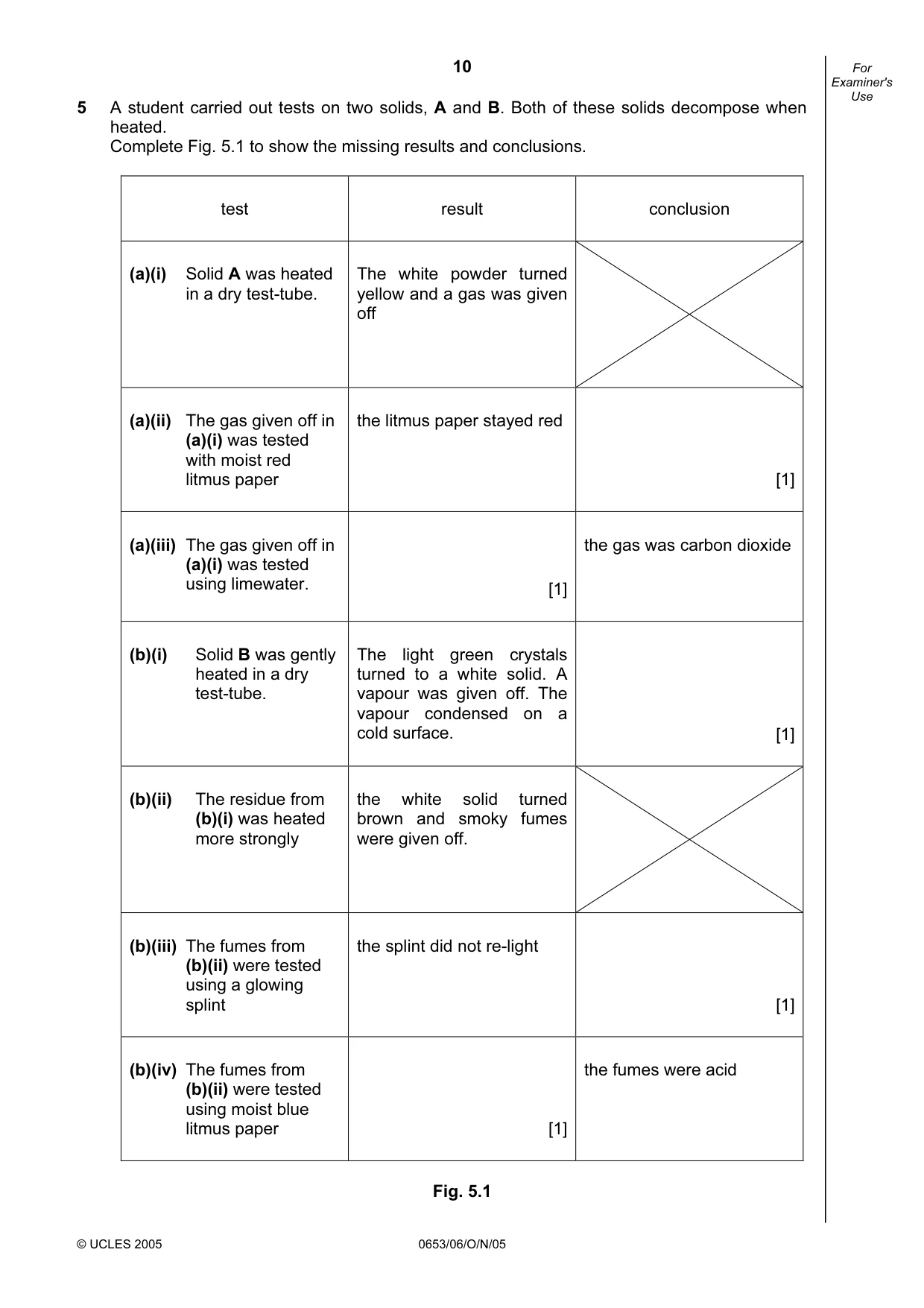
10 © UCLES 2005 0653/06/O/N/05 For Examiner's Use 5 A student carried out tests on two solids, A and B. Both of these solids decompose when heated. Complete Fig. 5.1 to show the missing results and conclusions. test result conclusion (a)(i) Solid A was heated in a dry test-tube. The white powder turned yellow and a gas was given off (a)(ii) The gas given off in (a)(i) was tested with moist red litmus paper the litmus paper stayed red [1] (a)(iii) The gas given off in (a)(i) was tested using limewater. [1] the gas was carbon dioxide (b)(i) Solid B was gently heated in a dry test-tube. The light green crystals turned to a white solid. A vapour was given off. The vapour condensed on a cold surface. [1] (b)(ii) The residue from (b)(i) was heated more strongly the white solid turned brown and smoky fumes were given off. (b)(iii) The fumes from (b)(ii) were tested using a glowing splint the splint did not re-light [1] (b)(iv) The fumes from (b)(ii) were tested using moist blue litmus paper [1] the fumes were acid Fig. 5.1
Question paper, page 11
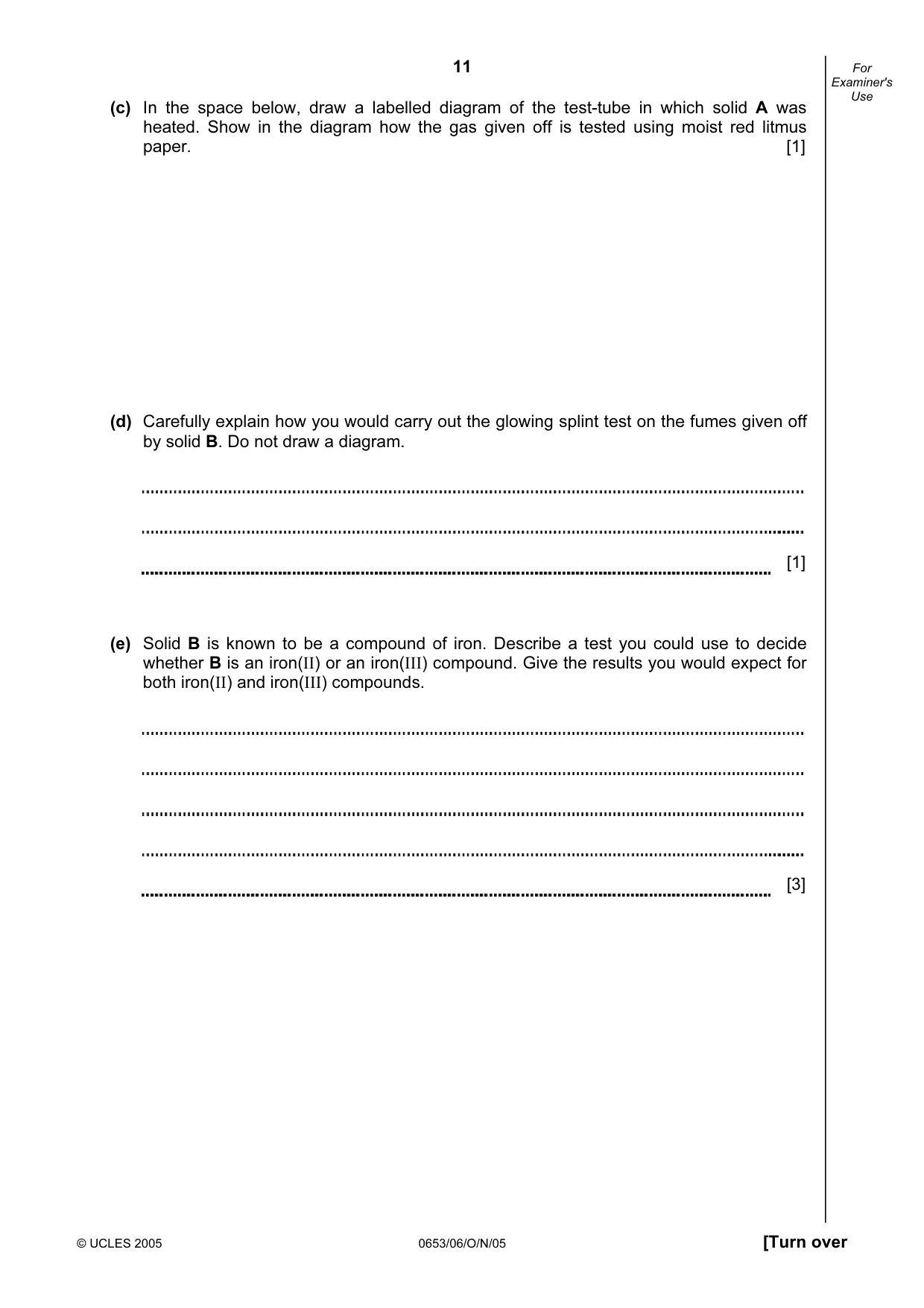
11 © UCLES 2005 0653/06/O/N/05 [Turn over For Examiner's Use (c) In the space below, draw a labelled diagram of the test-tube in which solid A was heated. Show in the diagram how the gas given off is tested using moist red litmus paper. [1] (d) Carefully explain how you would carry out the glowing splint test on the fumes given off by solid B. Do not draw a diagram. [1] (e) Solid B is known to be a compound of iron. Describe a test you could use to decide whether B is an iron(II) or an iron(III) compound. Give the results you would expect for both iron(II) and iron(III) compounds. [3]
Question paper, page 12
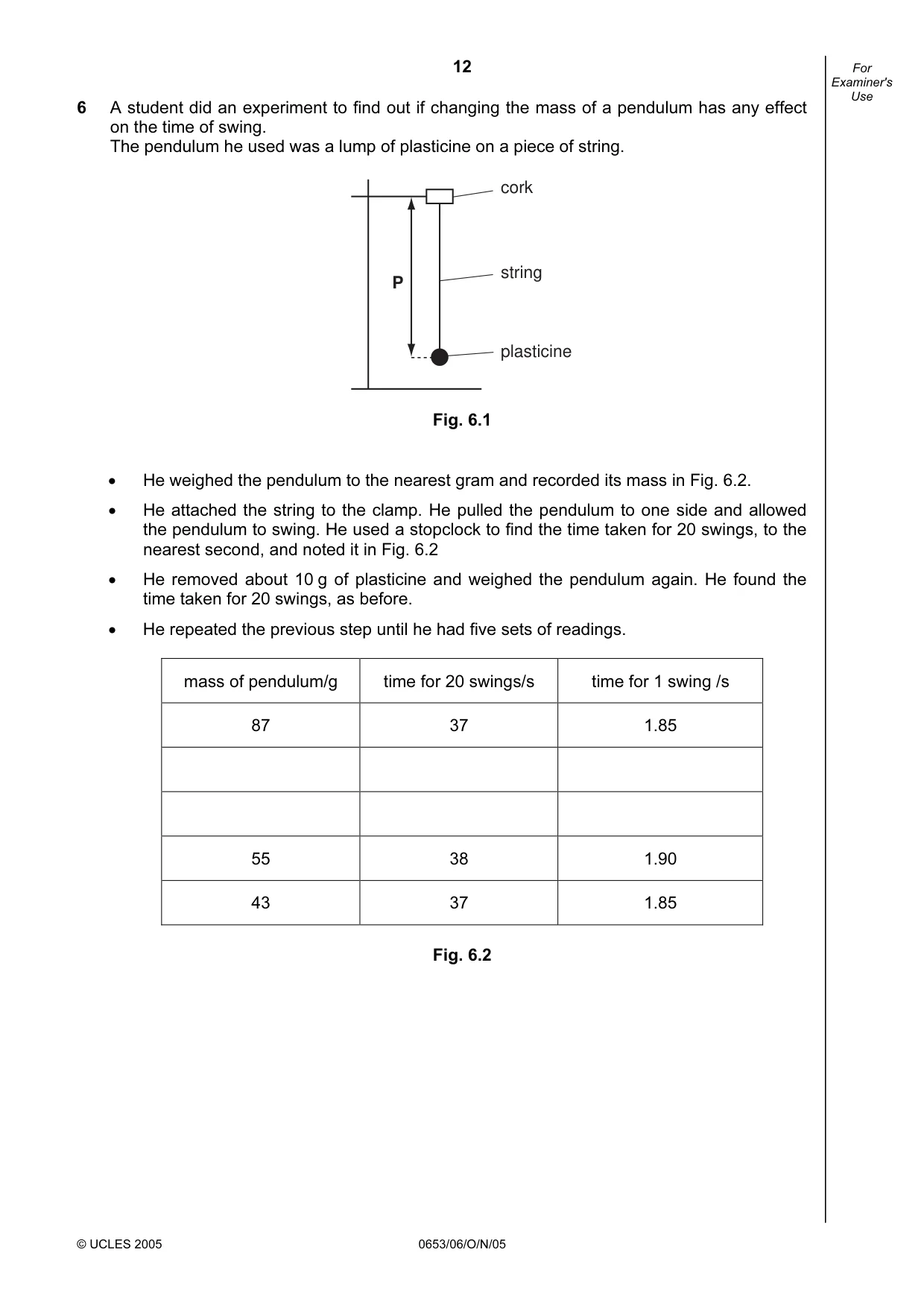
12 © UCLES 2005 0653/06/O/N/05 For Examiner's Use 6 A student did an experiment to find out if changing the mass of a pendulum has any effect on the time of swing. The pendulum he used was a lump of plasticine on a piece of string. P cork string plasticine Fig. 6.1 • He weighed the pendulum to the nearest gram and recorded its mass in Fig. 6.2. • He attached the string to the clamp. He pulled the pendulum to one side and allowed the pendulum to swing. He used a stopclock to find the time taken for 20 swings, to the nearest second, and noted it in Fig. 6.2 • He removed about 10 g of plasticine and weighed the pendulum again. He found the time taken for 20 swings, as before. • He repeated the previous step until he had five sets of readings. mass of pendulum/g time for 20 swings/s time for 1 swing /s 87 37 1.85 55 38 1.90 43 37 1.85 Fig. 6.2
Question paper, page 13
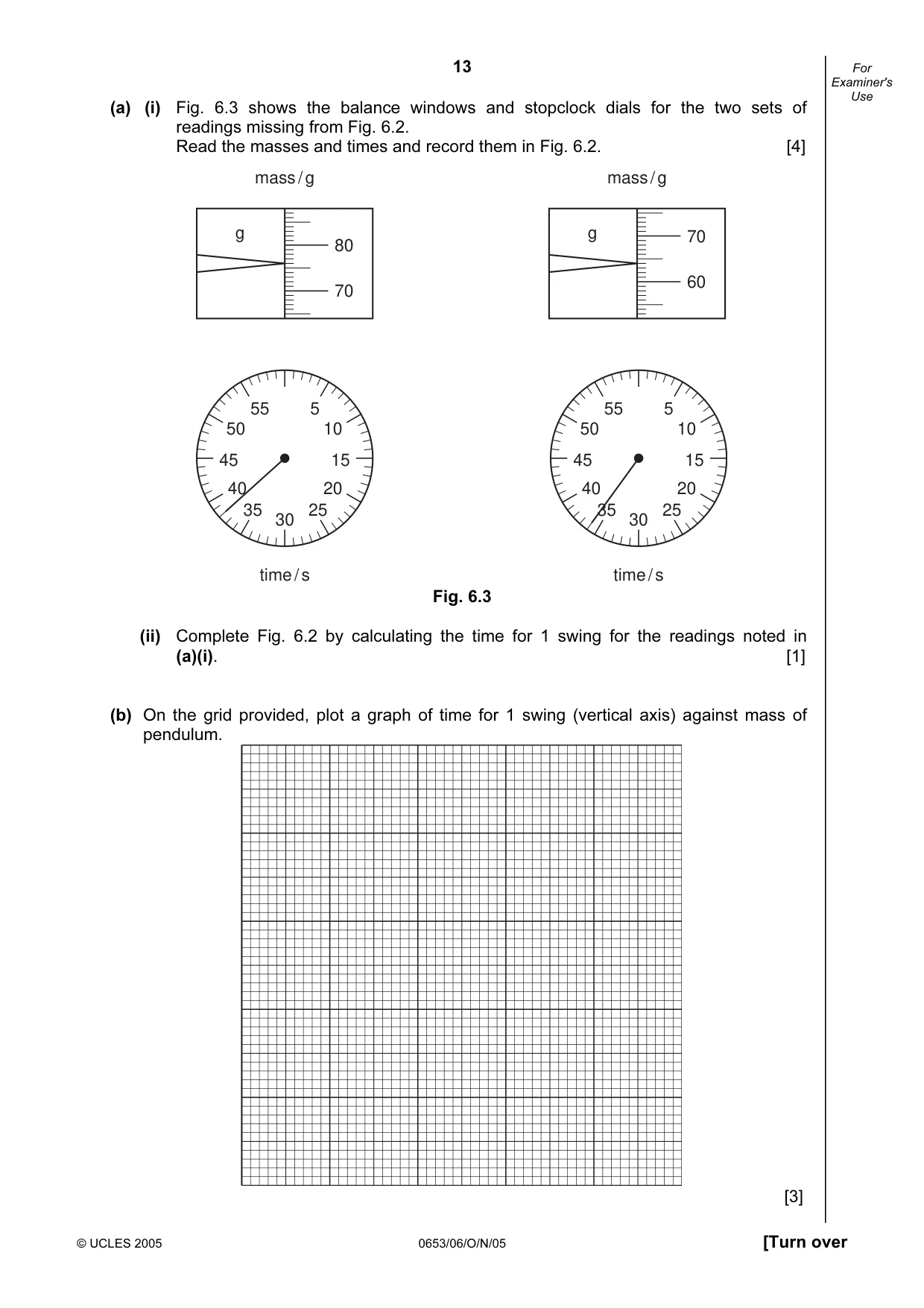
13 © UCLES 2005 0653/06/O/N/05 [Turn over For Examiner's Use (a) (i) Fig. 6.3 shows the balance windows and stopclock dials for the two sets of readings missing from Fig. 6.2. Read the masses and times and record them in Fig. 6.2. [4] 80 70 70 60 mass / g time / s g mass / g g 5 55 10 50 20 40 15 45 25 35 30 time / s 5 55 10 50 20 40 15 45 25 35 30 Fig. 6.3 (ii) Complete Fig. 6.2 by calculating the time for 1 swing for the readings noted in (a)(i). [1] (b) On the grid provided, plot a graph of time for 1 swing (vertical axis) against mass of pendulum. [3]
Question paper, page 14
14 © UCLES 2005 0653/06/O/N/05 For Examiner's Use (c) What does the graph show about the effect of changing the mass of the pendulum on the time of swing? [1] (d) Suggest a factor that might have an effect on the time taken for 1 swing of the pendulum. [1]
Question paper, page 16
16 Permission to reproduce items where third-party owned material protected by copyright is included has been sought and cleared where possible. Every reasonable effort has been made by the publisher (UCLES) to trace copyright holders, but if any items requiring clearance have unwittingly been included, the publisher will be pleased to make amends at the earliest possible opportunity. University of Cambridge International Examinations is part of the University of Cambridge Local Examinations Syndicate (UCLES), which is itself a department of the University of Cambridge. 0653/06/O/N/05 BLANK PAGE
Mark scheme, page 1
UNIVERSITY OF CAMBRIDGE INTERNATIONAL EXAMINATIONS International General Certificate of Secondary Education MARK SCHEME for the November 2005 question paper 0653/0654 COMBINED SCIENCE/CO-ORDINATED SCIENCES 0653/06, 0654/06 Paper 6 (Alternative to Practical), maximum raw mark 60 This mark scheme is published as an aid to teachers and students, to indicate the requirements of the examination. It shows the basis on which Examiners were initially instructed to award marks. It does not indicate the details of the discussions that took place at an Examiners’ meeting before marking began. Any substantial changes to the mark scheme that arose from these discussions will be recorded in the published Report on the Examination. All Examiners are instructed that alternative correct answers and unexpected approaches in candidates’ scripts must be given marks that fairly reflect the relevant knowledge and skills demonstrated. Mark schemes must be read in conjunction with the question papers and the Report on the Examination. • CIE will not enter into discussion or correspondence in connection with these mark schemes. The minimum marks in these components needed for various grades were previously published with these mark schemes, but are now instead included in the Report on the Examination for this session. CIE is publishing the mark schemes for the June 2005 question papers for most IGCSE and GCE Advanced Level and Advanced Subsidiary Level syllabuses and some Ordinary Level syllabuses. www.XtremePapers.com
Mark scheme, page 2
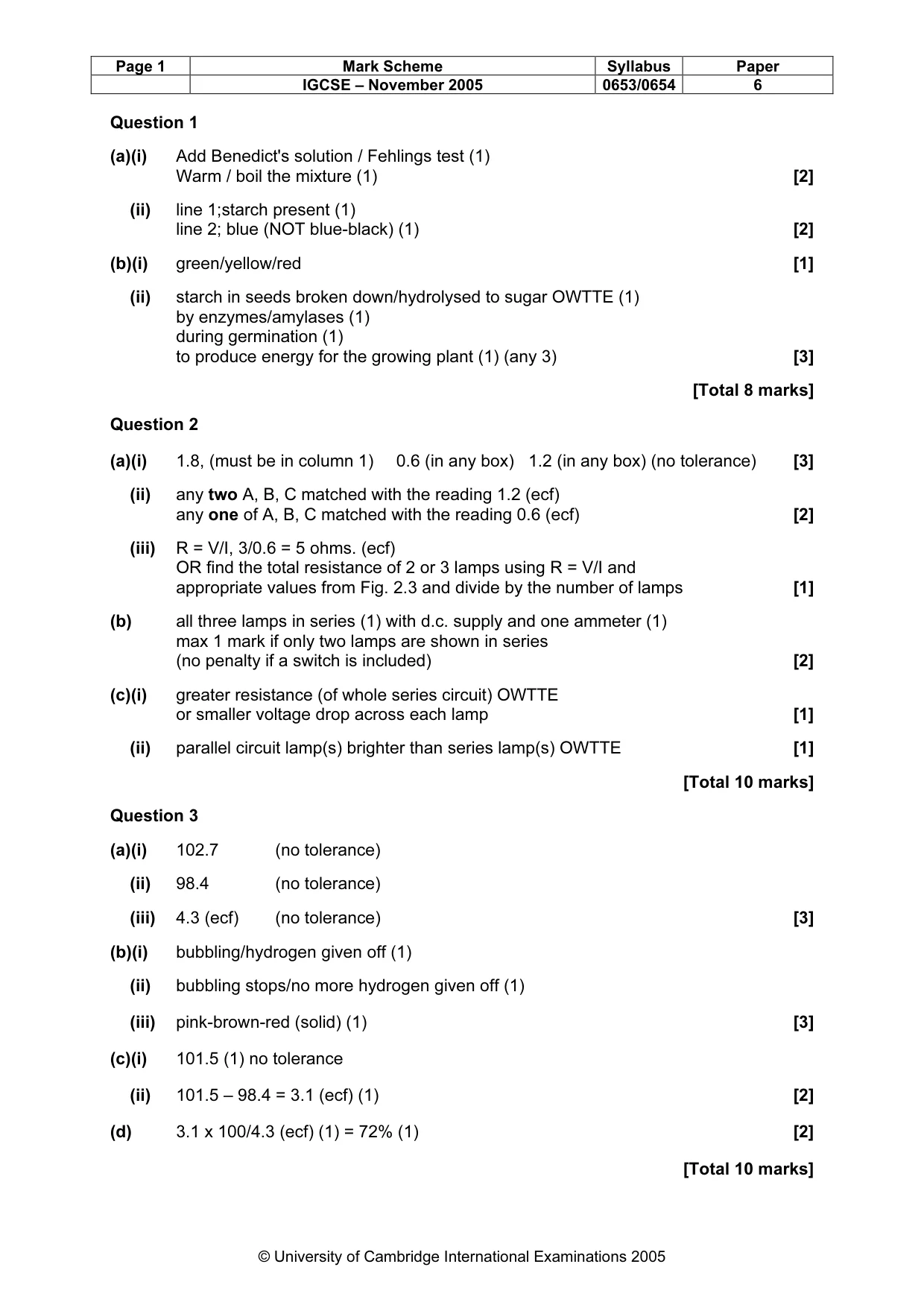
Page 1 Mark Scheme Syllabus Paper IGCSE – November 2005 0653/0654 6 © University of Cambridge International Examinations 2005 Question 1 (a)(i) Add Benedict's solution / Fehlings test (1) Warm / boil the mixture (1) [2] (ii) line 1;starch present (1) line 2; blue (NOT blue-black) (1) [2] (b)(i) green/yellow/red [1] (ii) starch in seeds broken down/hydrolysed to sugar OWTTE (1) by enzymes/amylases (1) during germination (1) to produce energy for the growing plant (1) (any 3) [3] [Total 8 marks] Question 2 (a)(i) 1.8, (must be in column 1) 0.6 (in any box) 1.2 (in any box) (no tolerance) [3] (ii) any two A, B, C matched with the reading 1.2 (ecf) any one of A, B, C matched with the reading 0.6 (ecf) [2] (iii) R = V/I, 3/0.6 = 5 ohms. (ecf) OR find the total resistance of 2 or 3 lamps using R = V/I and appropriate values from Fig. 2.3 and divide by the number of lamps [1] (b) all three lamps in series (1) with d.c. supply and one ammeter (1) max 1 mark if only two lamps are shown in series (no penalty if a switch is included) [2] (c)(i) greater resistance (of whole series circuit) OWTTE or smaller voltage drop across each lamp [1] (ii) parallel circuit lamp(s) brighter than series lamp(s) OWTTE [1] [Total 10 marks] Question 3 (a)(i) 102.7 (no tolerance) (ii) 98.4 (no tolerance) (iii) 4.3 (ecf) (no tolerance) [3] (b)(i) bubbling/hydrogen given off (1) (ii) bubbling stops/no more hydrogen given off (1) (iii) pink-brown-red (solid) (1) [3] (c)(i) 101.5 (1) no tolerance (ii) 101.5 – 98.4 = 3.1 (ecf) (1) [2] (d) 3.1 x 100/4.3 (ecf) (1) = 72% (1) [2] [Total 10 marks]
Mark scheme, page 3
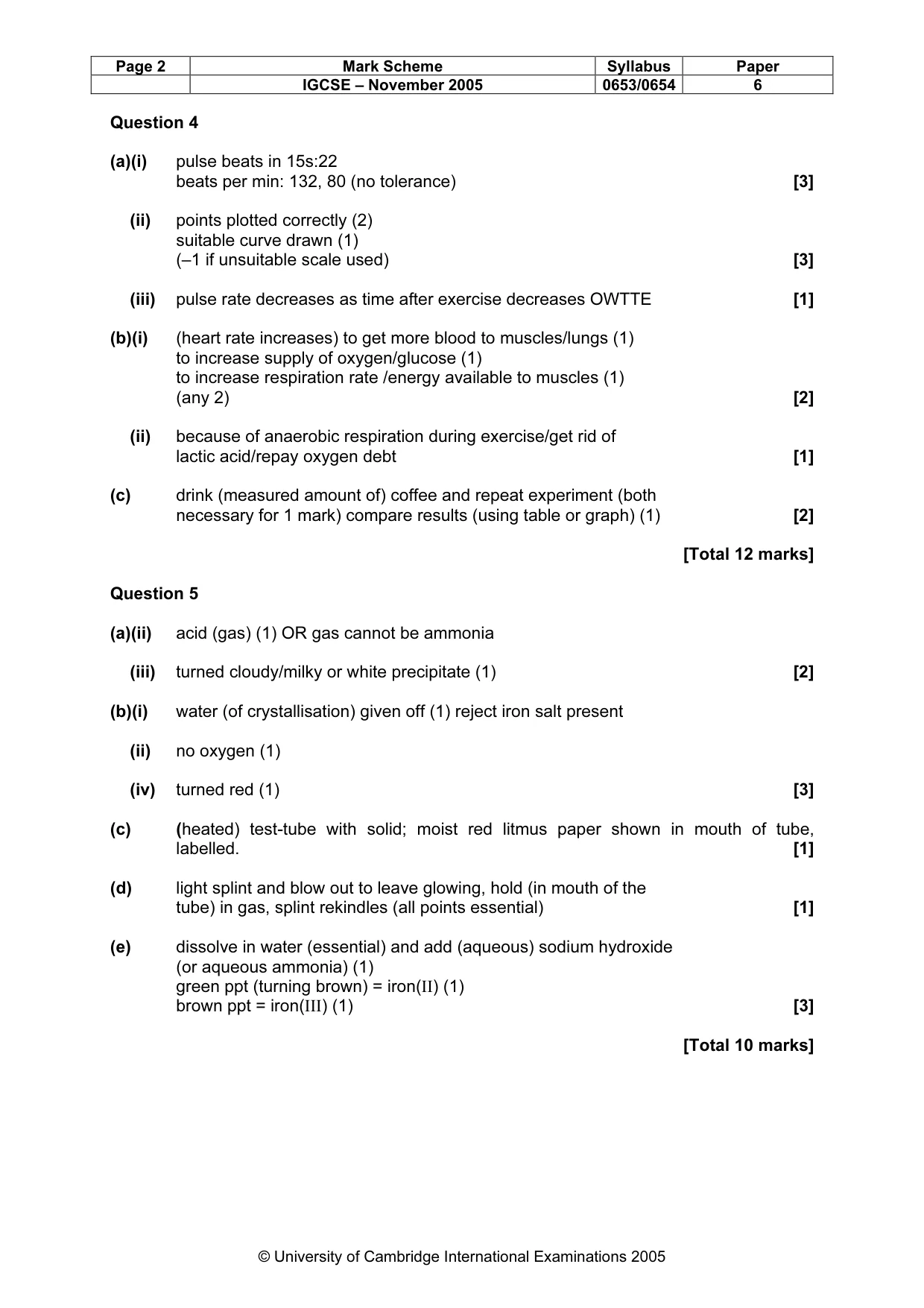
Page 2 Mark Scheme Syllabus Paper IGCSE – November 2005 0653/0654 6 © University of Cambridge International Examinations 2005 Question 4 (a)(i) pulse beats in 15s:22 beats per min: 132, 80 (no tolerance) [3] (ii) points plotted correctly (2) suitable curve drawn (1) (–1 if unsuitable scale used) [3] (iii) pulse rate decreases as time after exercise decreases OWTTE [1] (b)(i) (heart rate increases) to get more blood to muscles/lungs (1) to increase supply of oxygen/glucose (1) to increase respiration rate /energy available to muscles (1) (any 2) [2] (ii) because of anaerobic respiration during exercise/get rid of lactic acid/repay oxygen debt [1] (c) drink (measured amount of) coffee and repeat experiment (both necessary for 1 mark) compare results (using table or graph) (1) [2] [Total 12 marks] Question 5 (a)(ii) acid (gas) (1) OR gas cannot be ammonia (iii) turned cloudy/milky or white precipitate (1) [2] (b)(i) water (of crystallisation) given off (1) reject iron salt present (ii) no oxygen (1) (iv) turned red (1) [3] (c) (heated) test-tube with solid; moist red litmus paper shown in mouth of tube, labelled. [1] (d) light splint and blow out to leave glowing, hold (in mouth of the tube) in gas, splint rekindles (all points essential) [1] (e) dissolve in water (essential) and add (aqueous) sodium hydroxide (or aqueous ammonia) (1) green ppt (turning brown) = iron(II) (1) brown ppt = iron(III) (1) [3] [Total 10 marks]
Mark scheme, page 4
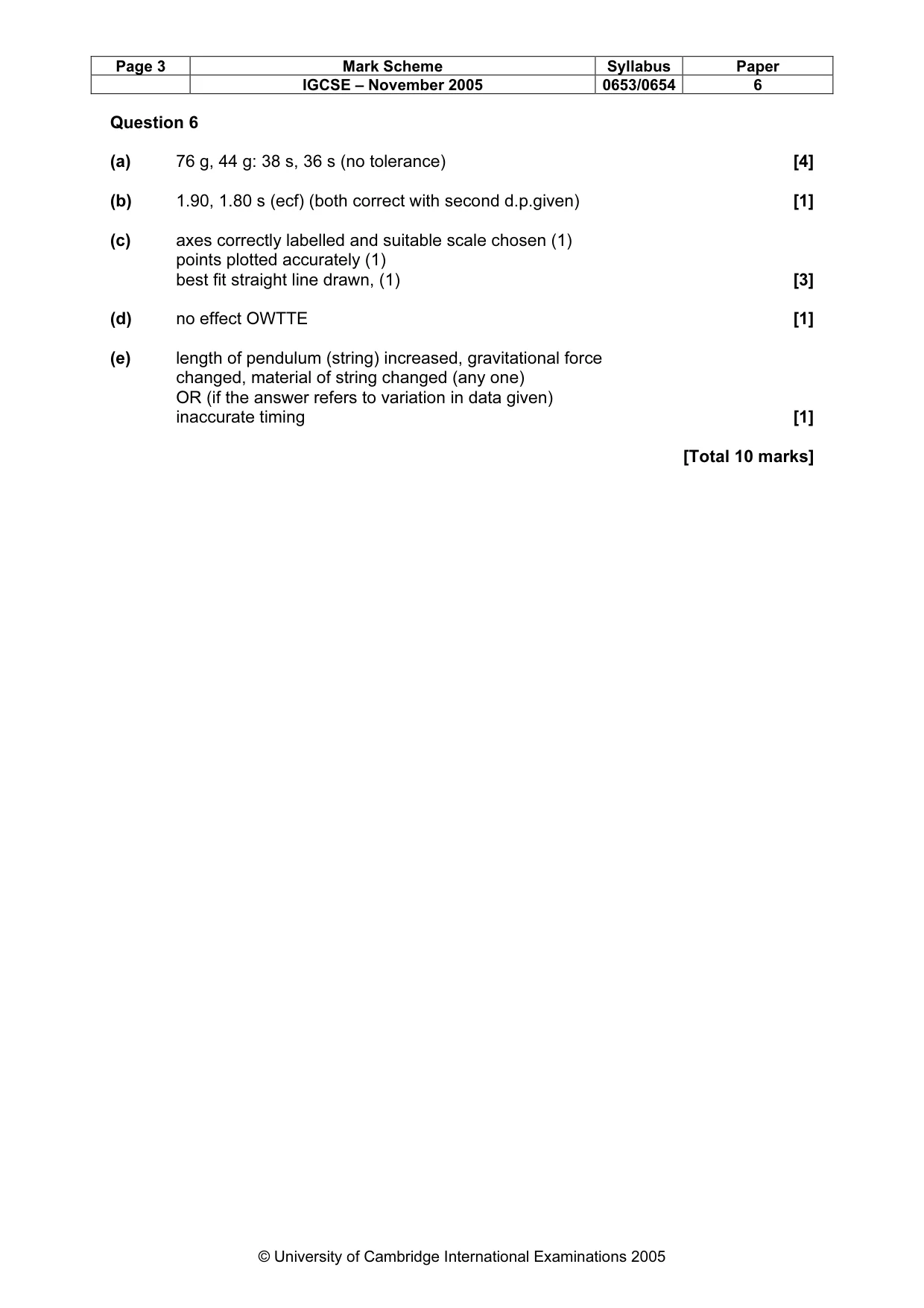
Page 3 Mark Scheme Syllabus Paper IGCSE – November 2005 0653/0654 6 © University of Cambridge International Examinations 2005 Question 6 (a) 76 g, 44 g: 38 s, 36 s (no tolerance) [4] (b) 1.90, 1.80 s (ecf) (both correct with second d.p.given) [1] (c) axes correctly labelled and suitable scale chosen (1) points plotted accurately (1) best fit straight line drawn, (1) [3] (d) no effect OWTTE [1] (e) length of pendulum (string) increased, gravitational force changed, material of string changed (any one) OR (if the answer refers to variation in data given) inaccurate timing [1] [Total 10 marks]