Cambridge IGCSE Sciences - Co-ordinated (Double) 0654 — 2005 May/June Paper 6 · Variant 1
0654/61/M/J/05
The question paper and its mark scheme, free to read here and free to download. This is Cambridge’s own paper, exactly as it was sat.
Question paper16 pages
Mark scheme6 pages
Answers below. Sit the paper first if you are practising.
Paper as text
Question paper, page 1
Centre Number Candidate Number Name UNIVERSITY OF CAMBRIDGE INTERNATIONAL EXAMINATIONS International General Certificate of Secondary Education COMBINED SCIENCE 0653/06 CO-ORDINATED SCIENCES 0654/06 Paper 6 Alternative to Practical May/June 2005 1 hour Candidates answer on the Question Paper. No Additional Materials are required. READ THESE INSTRUCTIONS FIRST Write your Centre number, candidate number and name on all the work you hand in. Write in dark blue or black pen in the spaces provided on the Question Paper. You may use a soft pencil for any diagrams, graphs or rough working. Do not use staples, paper clips, highlighters, glue or correction fluid. Answer all questions. The number of marks is given in brackets [ ] at the end of each question or part question. For Examiner’s Use 1 2 3 4 5 6 Total This document consists of 14 printed pages and 2 blank pages. IB05 06_0653_06/2RP © UCLES 2005 [Turn over If you have been given a label, look at the details. If any details are incorrect or missing, please fill in your correct details in the space given at the top of this page. Stick your personal label here, if provided. www.XtremePapers.com
Question paper, page 2
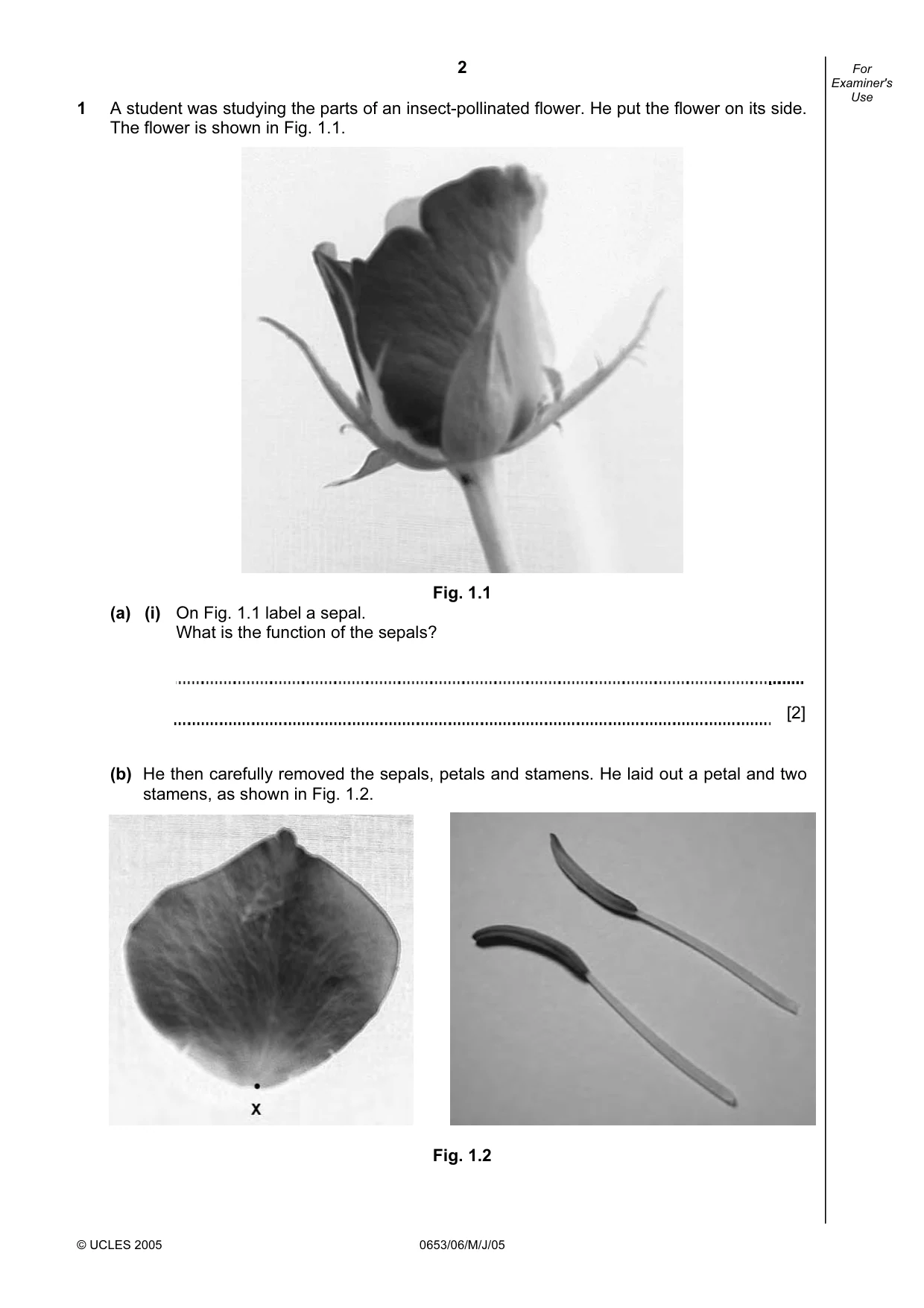
2 © UCLES 2005 0653/06/M/J/05 For Examiner's Use 1 A student was studying the parts of an insect-pollinated flower. He put the flower on its side. The flower is shown in Fig. 1.1. Fig. 1.1 (a) (i) On Fig. 1.1 label a sepal. What is the function of the sepals? [2] (b) He then carefully removed the sepals, petals and stamens. He laid out a petal and two stamens, as shown in Fig. 1.2. Fig. 1.2
Question paper, page 3
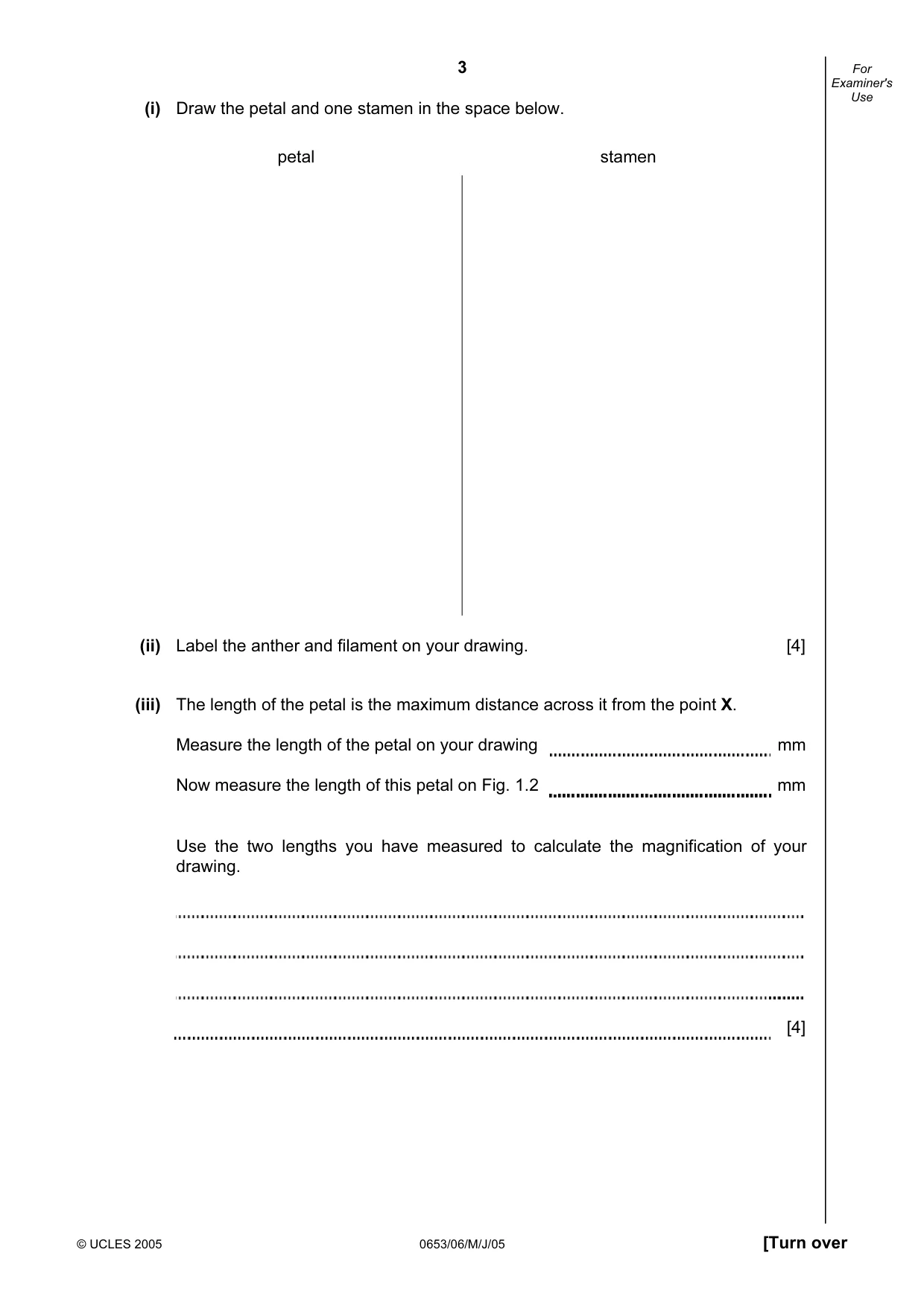
3 © UCLES 2005 0653/06/M/J/05 [Turn over For Examiner's Use (i) Draw the petal and one stamen in the space below. petal stamen (ii) Label the anther and filament on your drawing. [4] (iii) The length of the petal is the maximum distance across it from the point X. Measure the length of the petal on your drawing mm Now measure the length of this petal on Fig. 1.2 mm Use the two lengths you have measured to calculate the magnification of your drawing. [4]
Question paper, page 4
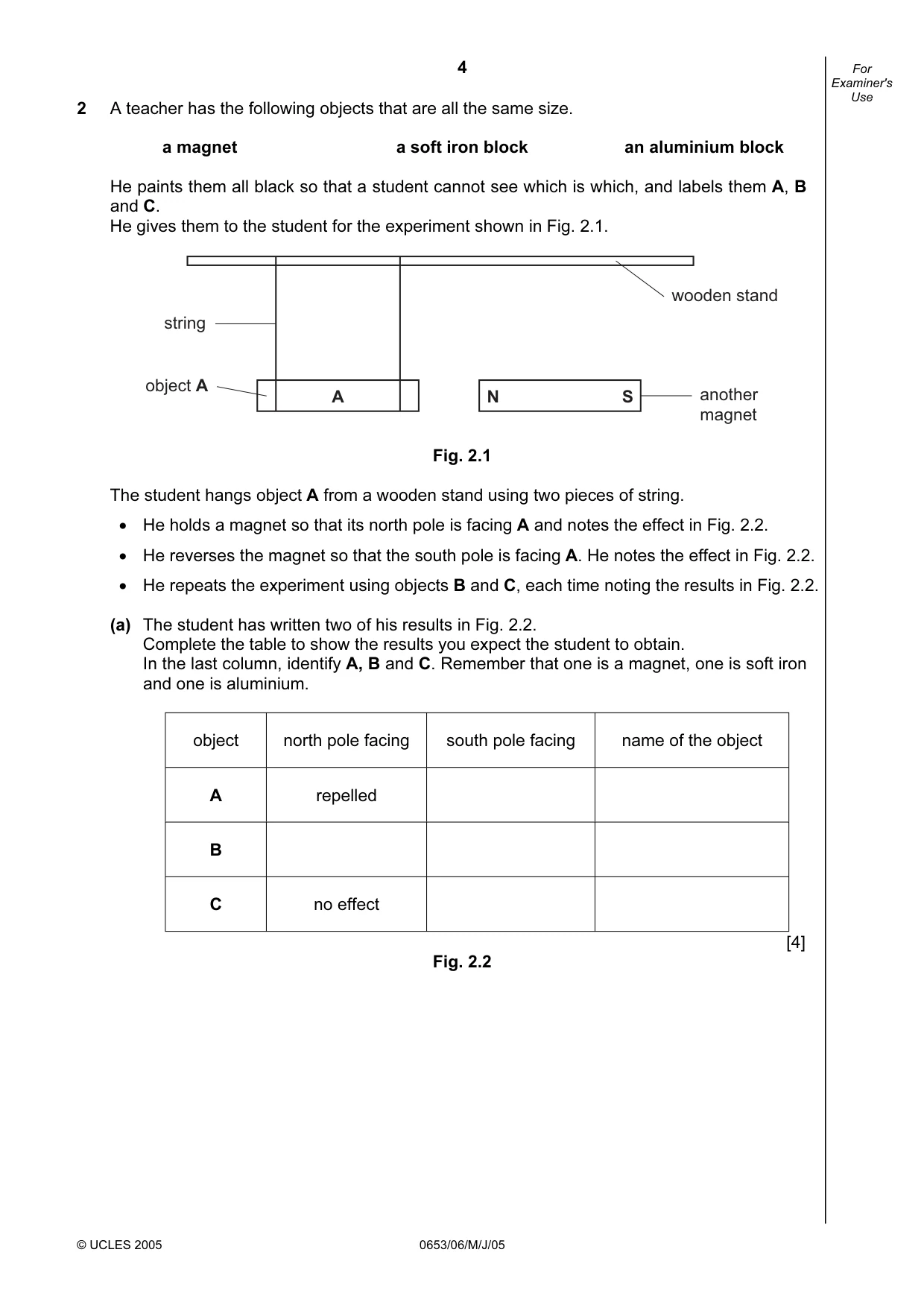
4 © UCLES 2005 0653/06/M/J/05 For Examiner's Use 2 A teacher has the following objects that are all the same size. a magnet a soft iron block an aluminium block He paints them all black so that a student cannot see which is which, and labels them A, B and C. He gives them to the student for the experiment shown in Fig. 2.1. wooden stand N S object A string another magnet A Fig. 2.1 The student hangs object A from a wooden stand using two pieces of string. • He holds a magnet so that its north pole is facing A and notes the effect in Fig. 2.2. • He reverses the magnet so that the south pole is facing A. He notes the effect in Fig. 2.2. • He repeats the experiment using objects B and C, each time noting the results in Fig. 2.2. (a) The student has written two of his results in Fig. 2.2. Complete the table to show the results you expect the student to obtain. In the last column, identify A, B and C. Remember that one is a magnet, one is soft iron and one is aluminium. object north pole facing south pole facing name of the object A repelled B C no effect [4] Fig. 2.2
Question paper, page 5
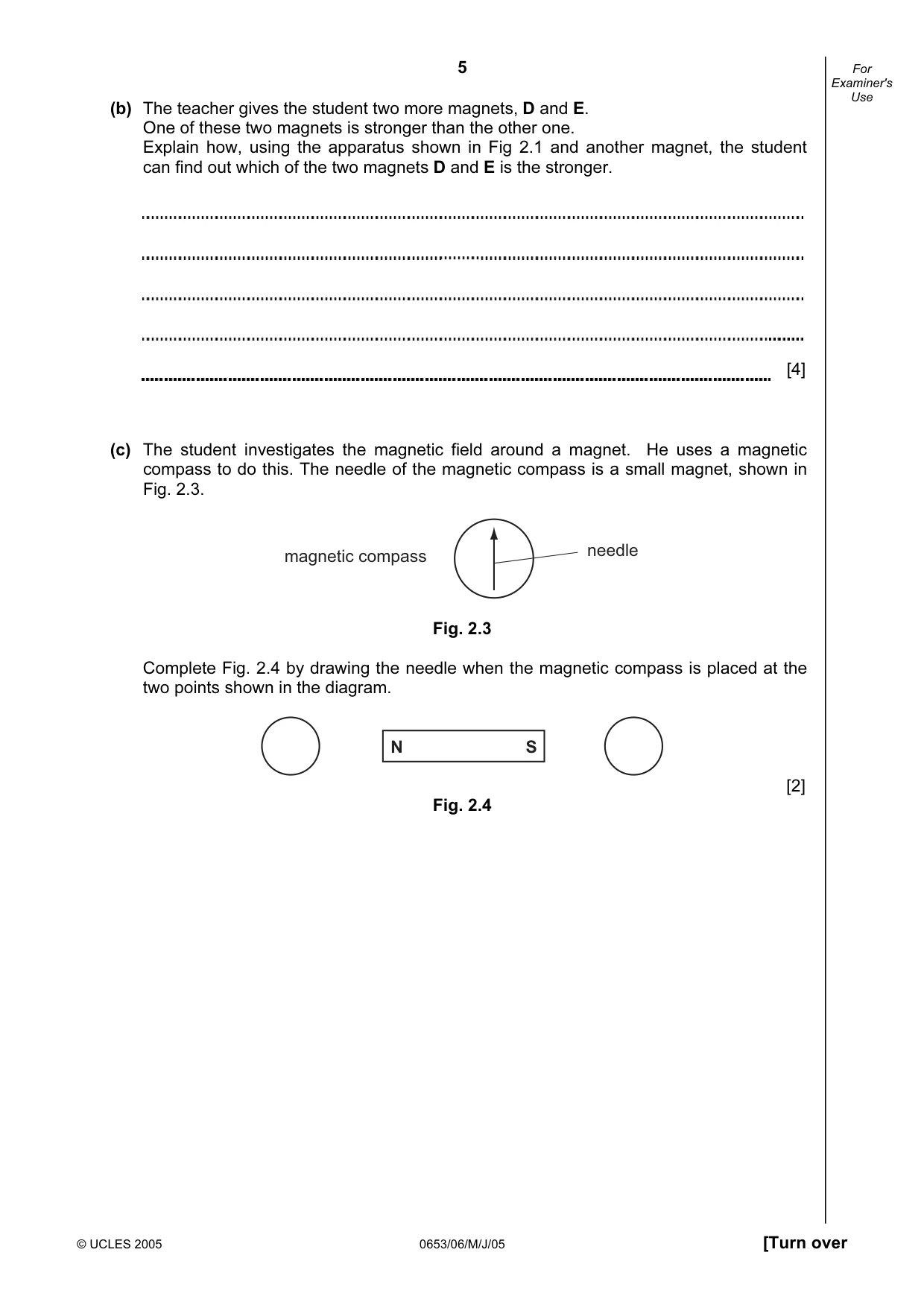
5 © UCLES 2005 0653/06/M/J/05 [Turn over For Examiner's Use (b) The teacher gives the student two more magnets, D and E. One of these two magnets is stronger than the other one. Explain how, using the apparatus shown in Fig 2.1 and another magnet, the student can find out which of the two magnets D and E is the stronger. [4] (c) The student investigates the magnetic field around a magnet. He uses a magnetic compass to do this. The needle of the magnetic compass is a small magnet, shown in Fig. 2.3. magnetic compass needle Fig. 2.3 Complete Fig. 2.4 by drawing the needle when the magnetic compass is placed at the two points shown in the diagram. N S [2] Fig. 2.4
Question paper, page 6
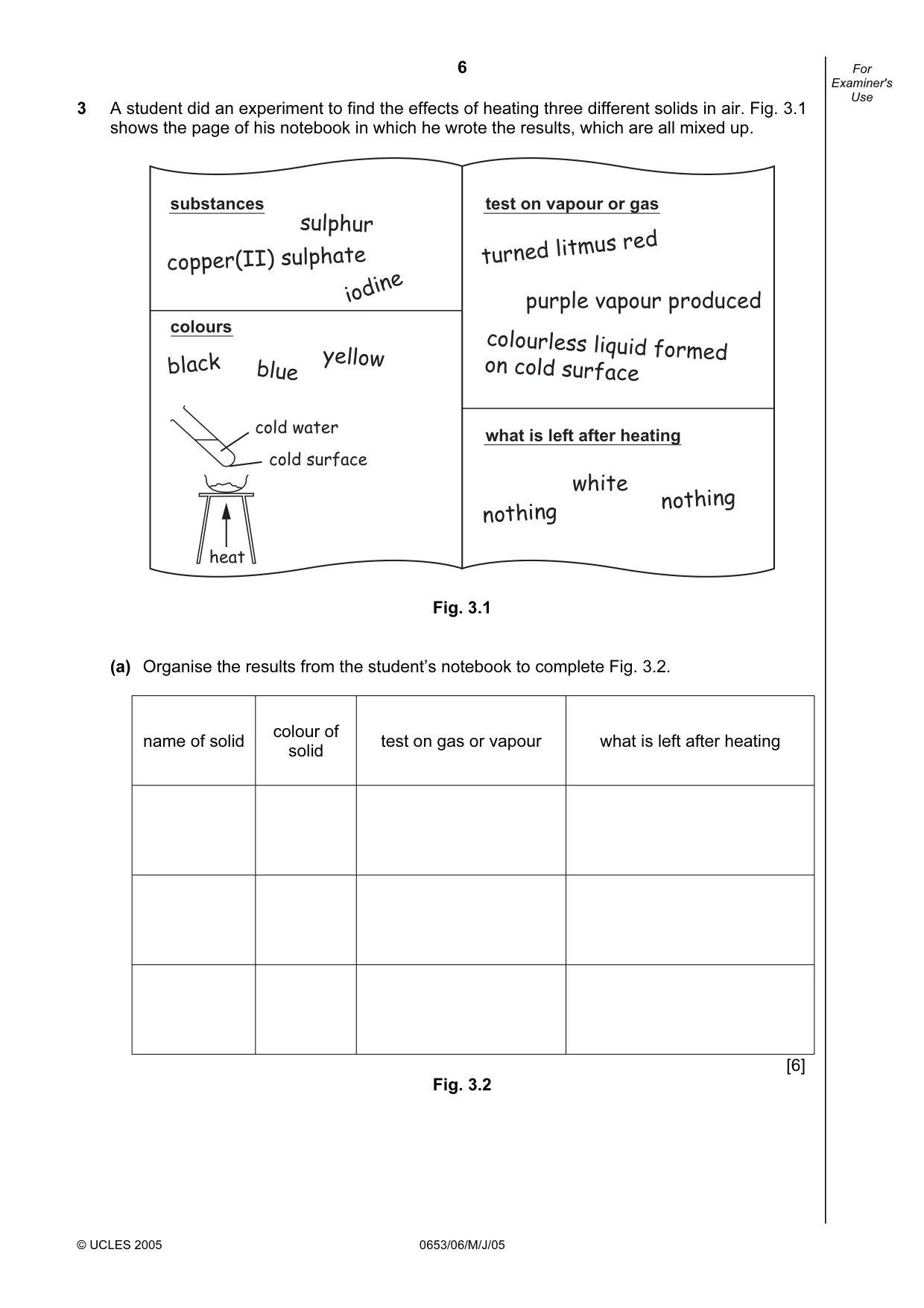
6 © UCLES 2005 0653/06/M/J/05 For Examiner's Use 3 A student did an experiment to find the effects of heating three different solids in air. Fig. 3.1 shows the page of his notebook in which he wrote the results, which are all mixed up. substances colours test on vapour or gas what is left after heating sulphur copper(II) sulphate iodine blue yellow black turned litmus red purple vapour produced colourless liquid formed on cold surface white nothing nothing heat cold water cold surface Fig. 3.1 (a) Organise the results from the student’s notebook to complete Fig. 3.2. name of solid colour of solid test on gas or vapour what is left after heating [6] Fig. 3.2
Question paper, page 7
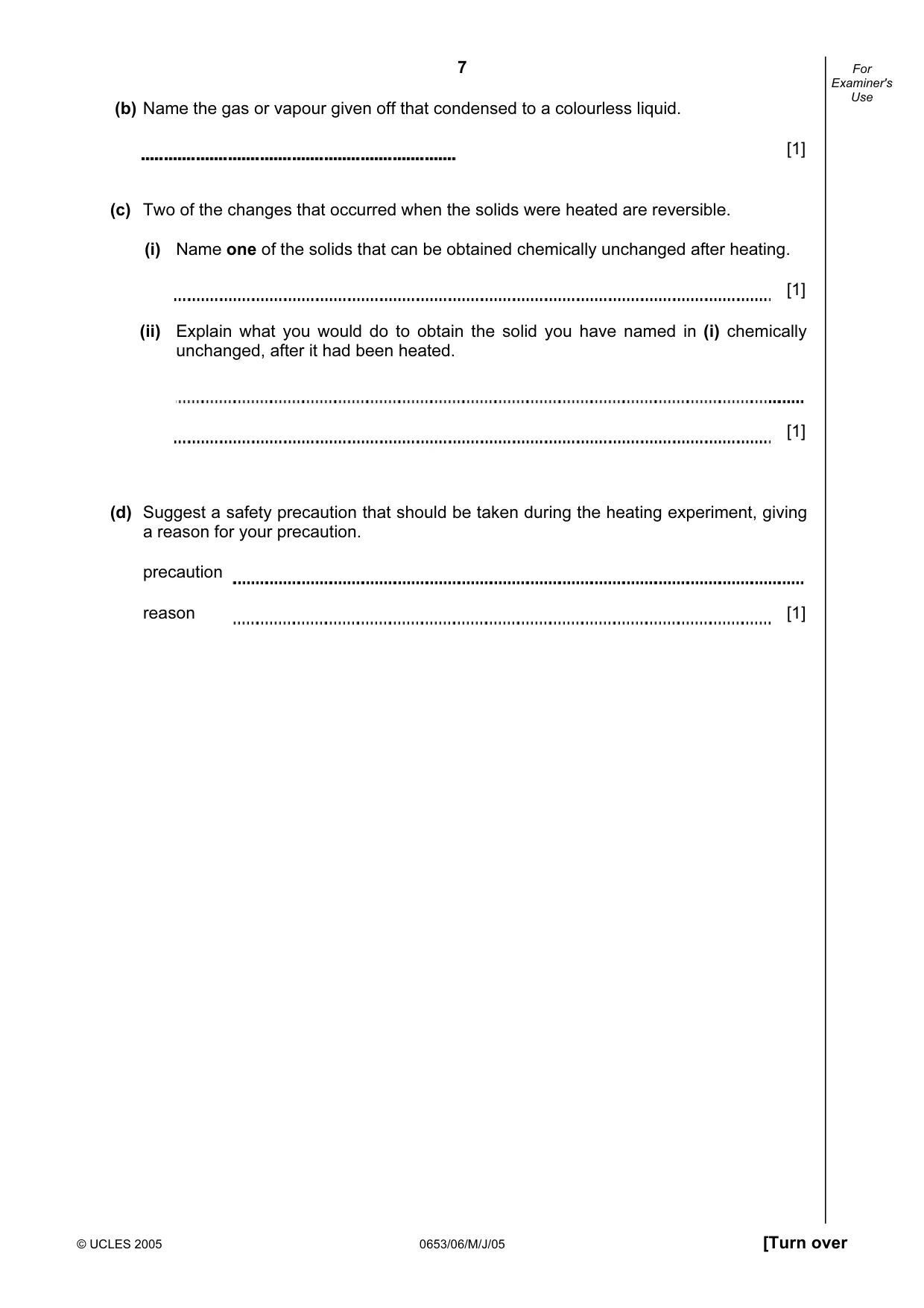
7 © UCLES 2005 0653/06/M/J/05 [Turn over For Examiner's Use (b) Name the gas or vapour given off that condensed to a colourless liquid. [1] (c) Two of the changes that occurred when the solids were heated are reversible. (i) Name one of the solids that can be obtained chemically unchanged after heating. [1] (ii) Explain what you would do to obtain the solid you have named in (i) chemically unchanged, after it had been heated. [1] (d) Suggest a safety precaution that should be taken during the heating experiment, giving a reason for your precaution. precaution reason [1]
Question paper, page 8
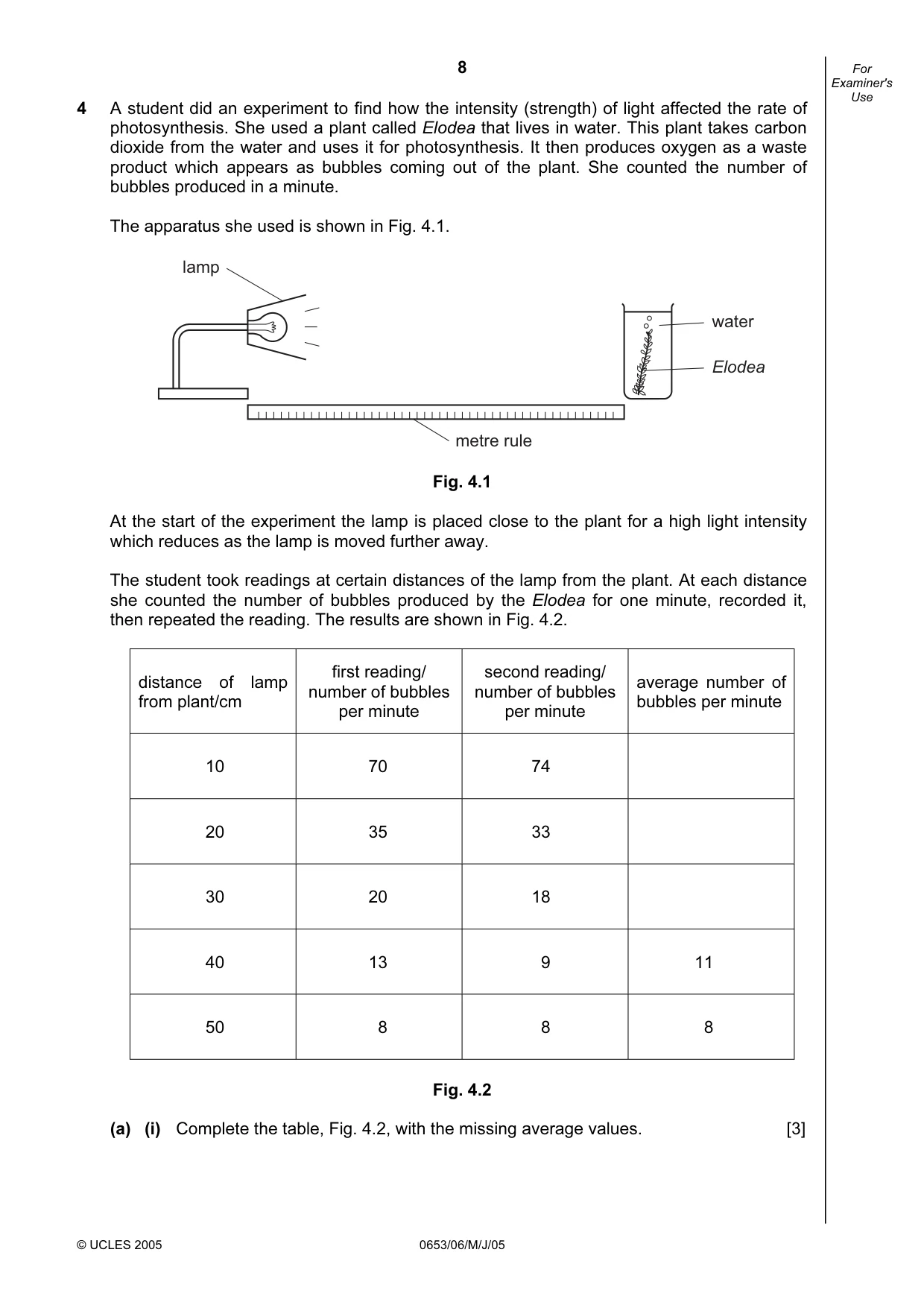
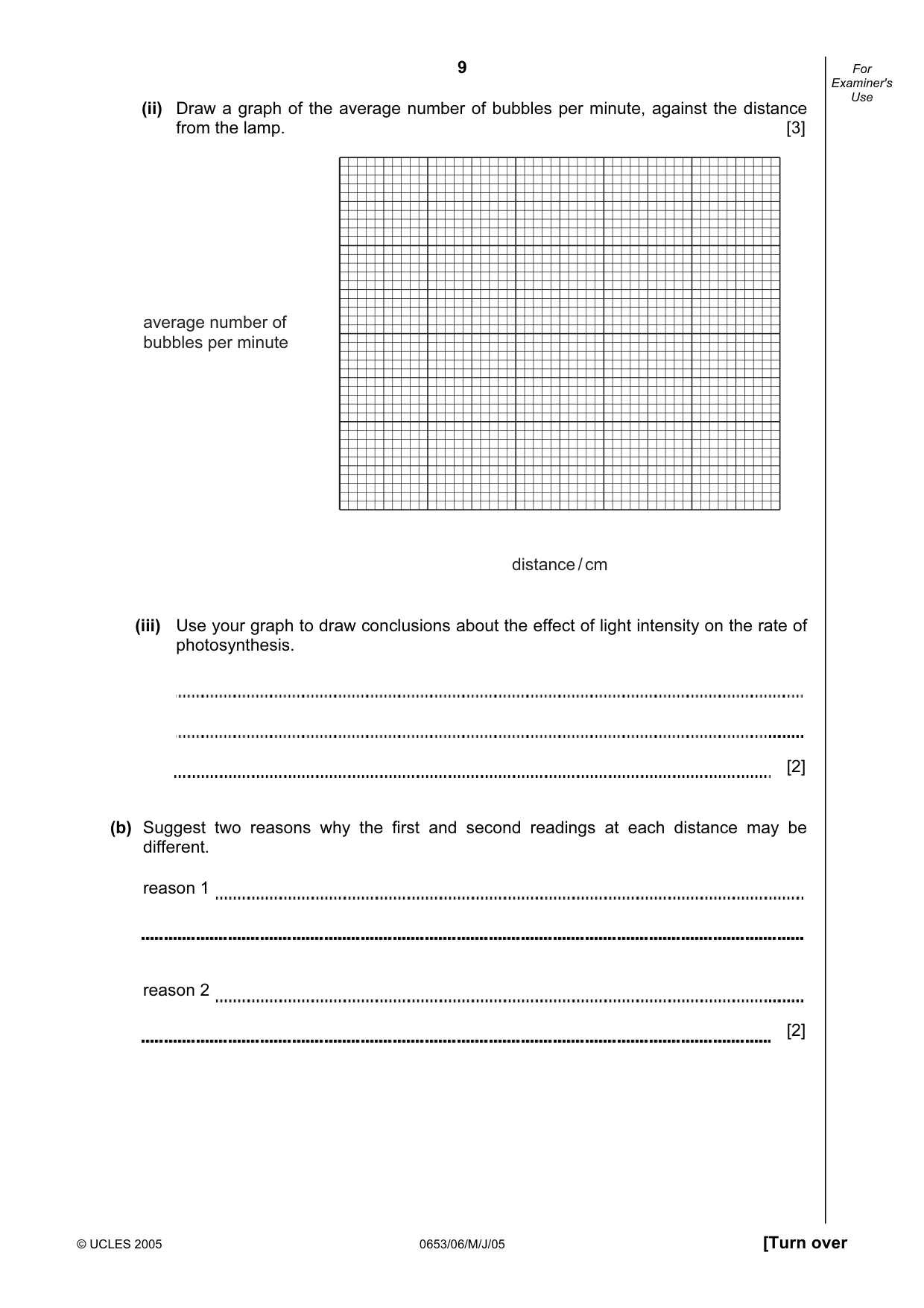
8 © UCLES 2005 0653/06/M/J/05 For Examiner's Use 4 A student did an experiment to find how the intensity (strength) of light affected the rate of photosynthesis. She used a plant called Elodea that lives in water. This plant takes carbon dioxide from the water and uses it for photosynthesis. It then produces oxygen as a waste product which appears as bubbles coming out of the plant. She counted the number of bubbles produced in a minute. The apparatus she used is shown in Fig. 4.1. lamp water Elodea metre rule Fig. 4.1 At the start of the experiment the lamp is placed close to the plant for a high light intensity which reduces as the lamp is moved further away. The student took readings at certain distances of the lamp from the plant. At each distance she counted the number of bubbles produced by the Elodea for one minute, recorded it, then repeated the reading. The results are shown in Fig. 4.2. distance of lamp from plant/cm first reading/ number of bubbles per minute second reading/ number of bubbles per minute average number of bubbles per minute 10 70 74 20 35 33 30 20 18 40 13 9 11 50 8 8 8 Fig. 4.2 (a) (i) Complete the table, Fig. 4.2, with the missing average values. [3]
Question paper, page 9
9 © UCLES 2005 0653/06/M/J/05 [Turn over For Examiner's Use (ii) Draw a graph of the average number of bubbles per minute, against the distance from the lamp. [3] average number of bubbles per minute distance/cm (iii) Use your graph to draw conclusions about the effect of light intensity on the rate of photosynthesis. [2] (b) Suggest two reasons why the first and second readings at each distance may be different. reason 1 reason 2 [2]
Question paper, page 11
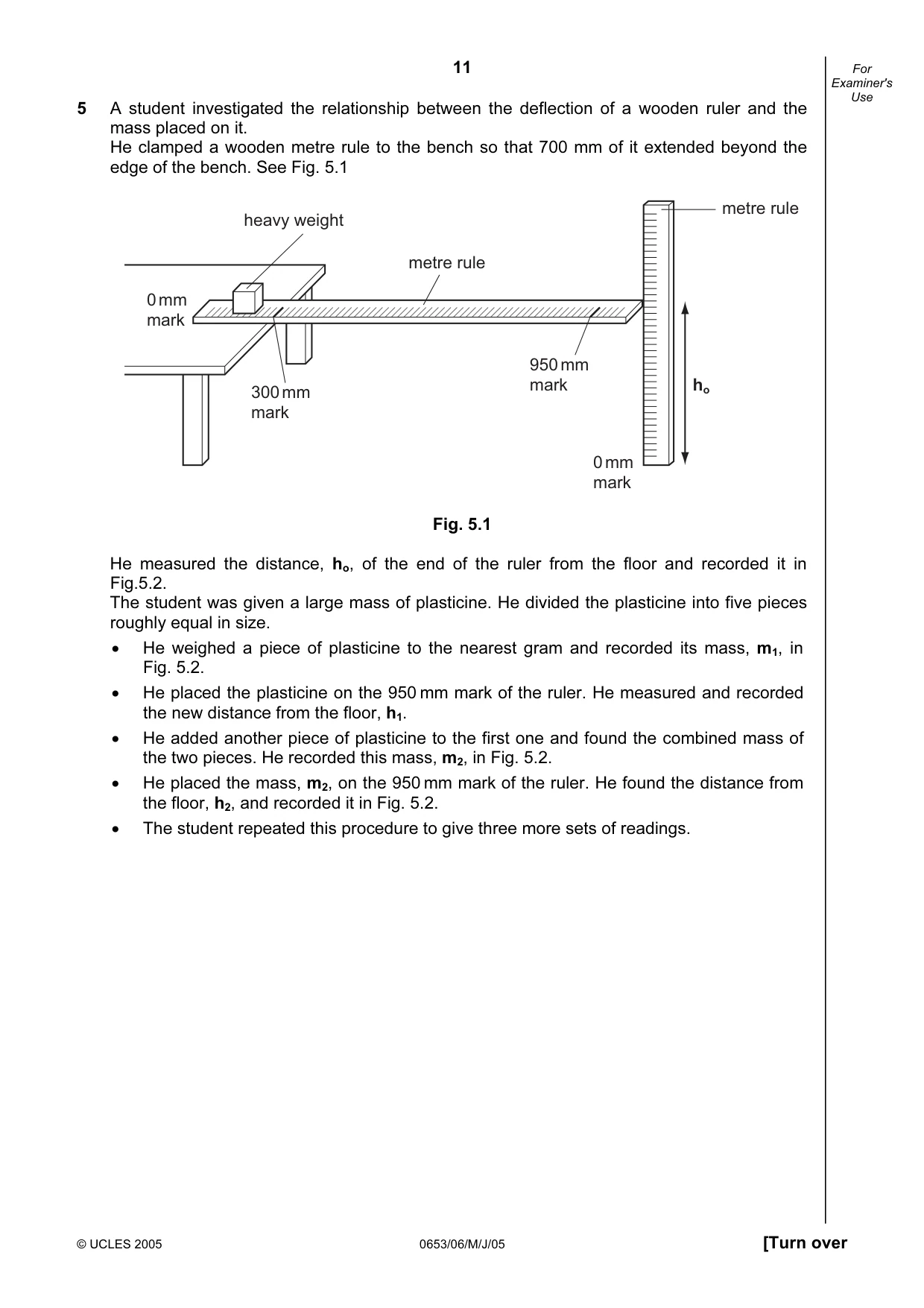
11 © UCLES 2005 0653/06/M/J/05 [Turn over For Examiner's Use 5 A student investigated the relationship between the deflection of a wooden ruler and the mass placed on it. He clamped a wooden metre rule to the bench so that 700 mm of it extended beyond the edge of the bench. See Fig. 5.1 heavy weight metre rule metre rule 300mm mark 950mm mark 0mm mark 0mm mark ho Fig. 5.1 He measured the distance, ho, of the end of the ruler from the floor and recorded it in Fig.5.2. The student was given a large mass of plasticine. He divided the plasticine into five pieces roughly equal in size. • He weighed a piece of plasticine to the nearest gram and recorded its mass, m1, in Fig. 5.2. • He placed the plasticine on the 950 mm mark of the ruler. He measured and recorded the new distance from the floor, h1. • He added another piece of plasticine to the first one and found the combined mass of the two pieces. He recorded this mass, m2, in Fig. 5.2. • He placed the mass, m2, on the 950 mm mark of the ruler. He found the distance from the floor, h2, and recorded it in Fig. 5.2. • The student repeated this procedure to give three more sets of readings.
Question paper, page 12
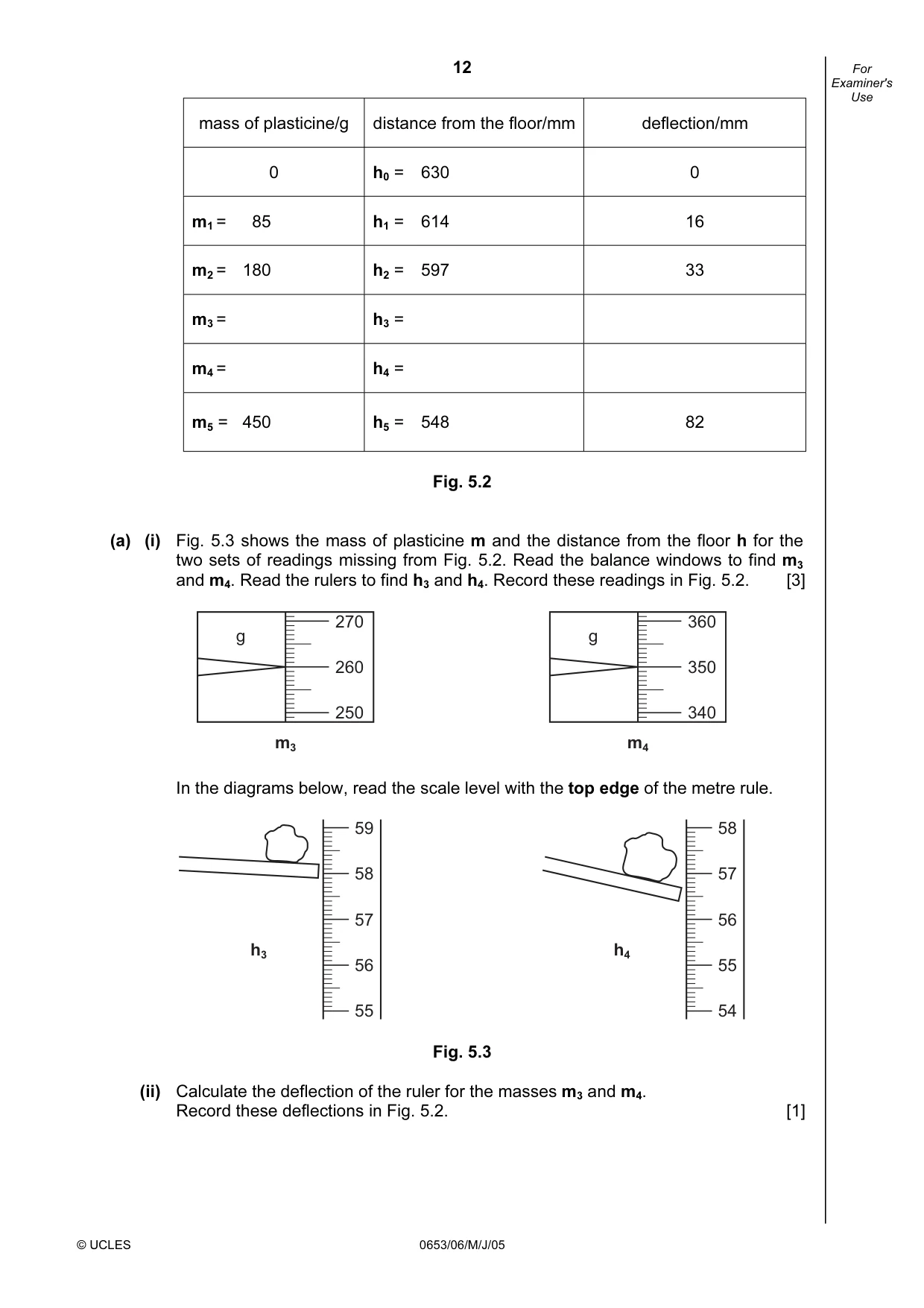
12 © UCLES 0653/06/M/J/05 For Examiner's Use mass of plasticine/g distance from the floor/mm deflection/mm 0 h0 = 630 0 m1 = 85 h1 = 614 16 m2 = 180 h2 = 597 33 m3 = h3 = m4 = h4 = m5 = 450 h5 = 548 82 Fig. 5.2 (a) (i) Fig. 5.3 shows the mass of plasticine m and the distance from the floor h for the two sets of readings missing from Fig. 5.2. Read the balance windows to find m3 and m4. Read the rulers to find h3 and h4. Record these readings in Fig. 5.2. [3] 270 260 250 m3 g 360 350 340 m4 g In the diagrams below, read the scale level with the top edge of the metre rule. 59 58 57 56 55 h3 58 57 56 55 54 h4 Fig. 5.3 (ii) Calculate the deflection of the ruler for the masses m3 and m4. Record these deflections in Fig. 5.2. [1]
Question paper, page 13
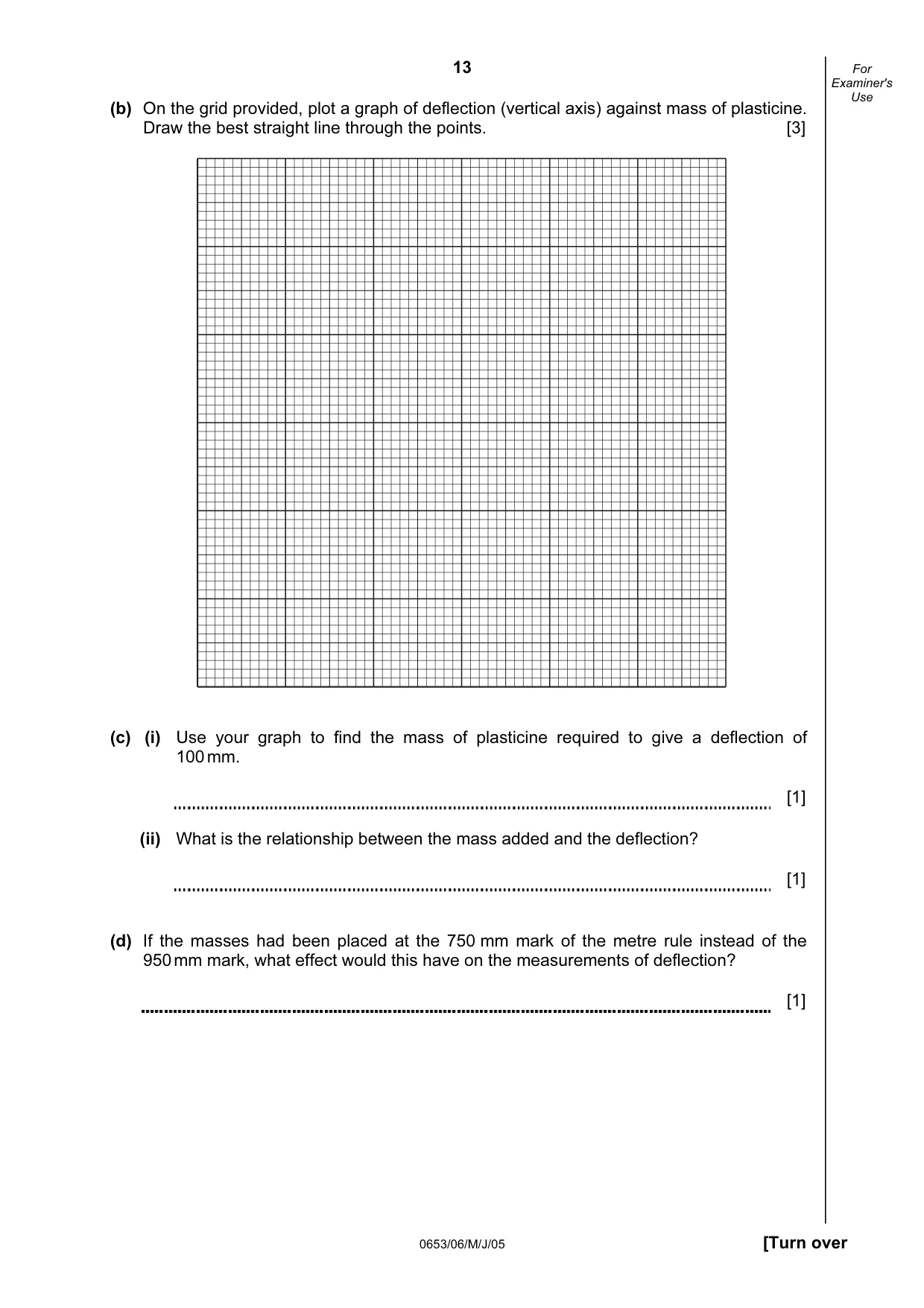
13 0653/06/M/J/05 [Turn over For Examiner's Use (b) On the grid provided, plot a graph of deflection (vertical axis) against mass of plasticine. Draw the best straight line through the points. [3] (c) (i) Use your graph to find the mass of plasticine required to give a deflection of 100mm. [1] (ii) What is the relationship between the mass added and the deflection? [1] (d) If the masses had been placed at the 750 mm mark of the metre rule instead of the 950mm mark, what effect would this have on the measurements of deflection? [1]
Question paper, page 14
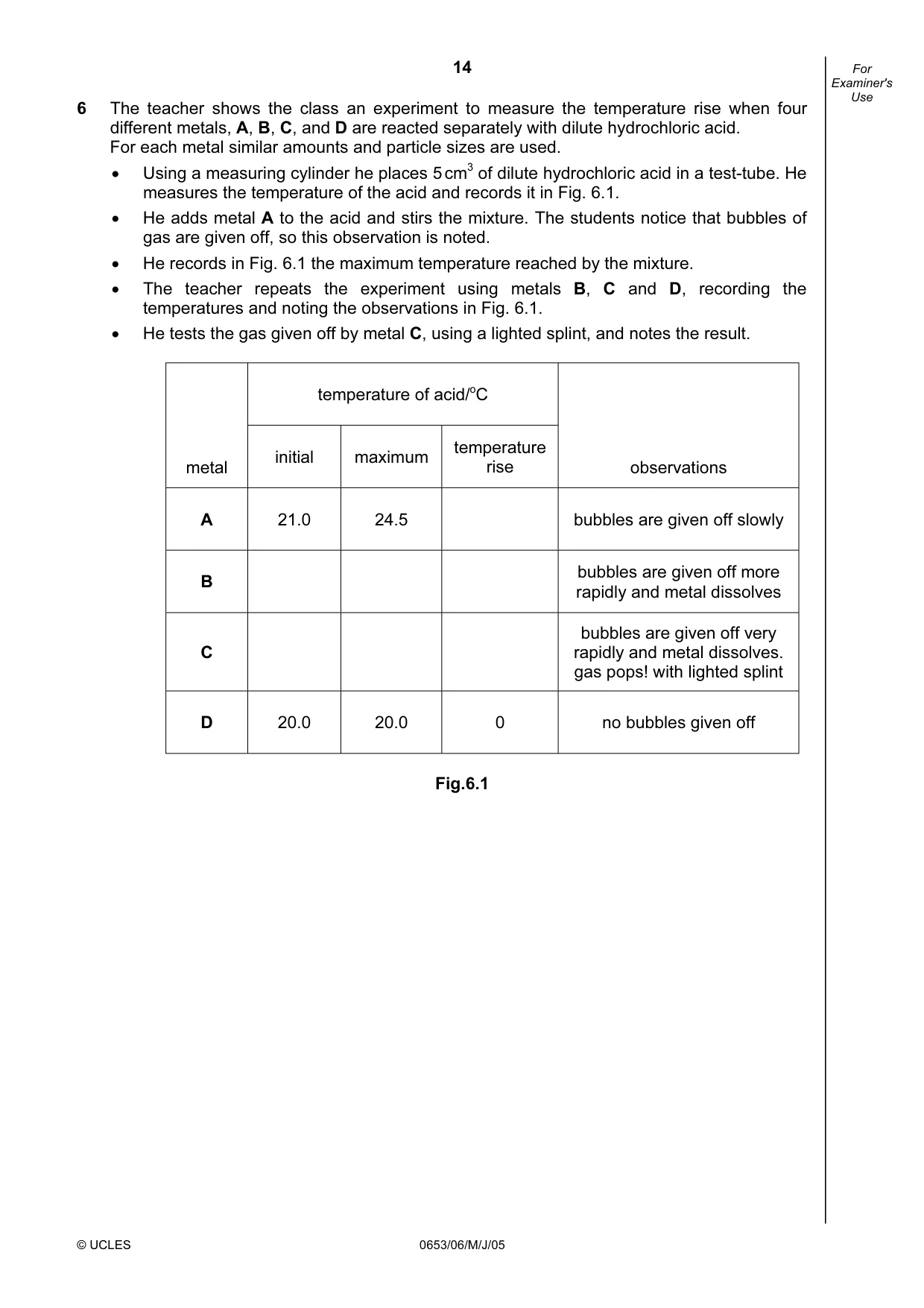
14 © UCLES 0653/06/M/J/05 For Examiner's Use 6 The teacher shows the class an experiment to measure the temperature rise when four different metals, A, B, C, and D are reacted separately with dilute hydrochloric acid. For each metal similar amounts and particle sizes are used. • Using a measuring cylinder he places 5cm3 of dilute hydrochloric acid in a test-tube. He measures the temperature of the acid and records it in Fig. 6.1. • He adds metal A to the acid and stirs the mixture. The students notice that bubbles of gas are given off, so this observation is noted. • He records in Fig. 6.1 the maximum temperature reached by the mixture. • The teacher repeats the experiment using metals B, C and D, recording the temperatures and noting the observations in Fig. 6.1. • He tests the gas given off by metal C, using a lighted splint, and notes the result. temperature of acid/oC metal initial maximum temperature rise observations A 21.0 24.5 bubbles are given off slowly B bubbles are given off more rapidly and metal dissolves C bubbles are given off very rapidly and metal dissolves. gas pops! with lighted splint D 20.0 20.0 0 no bubbles given off Fig.6.1
Question paper, page 15
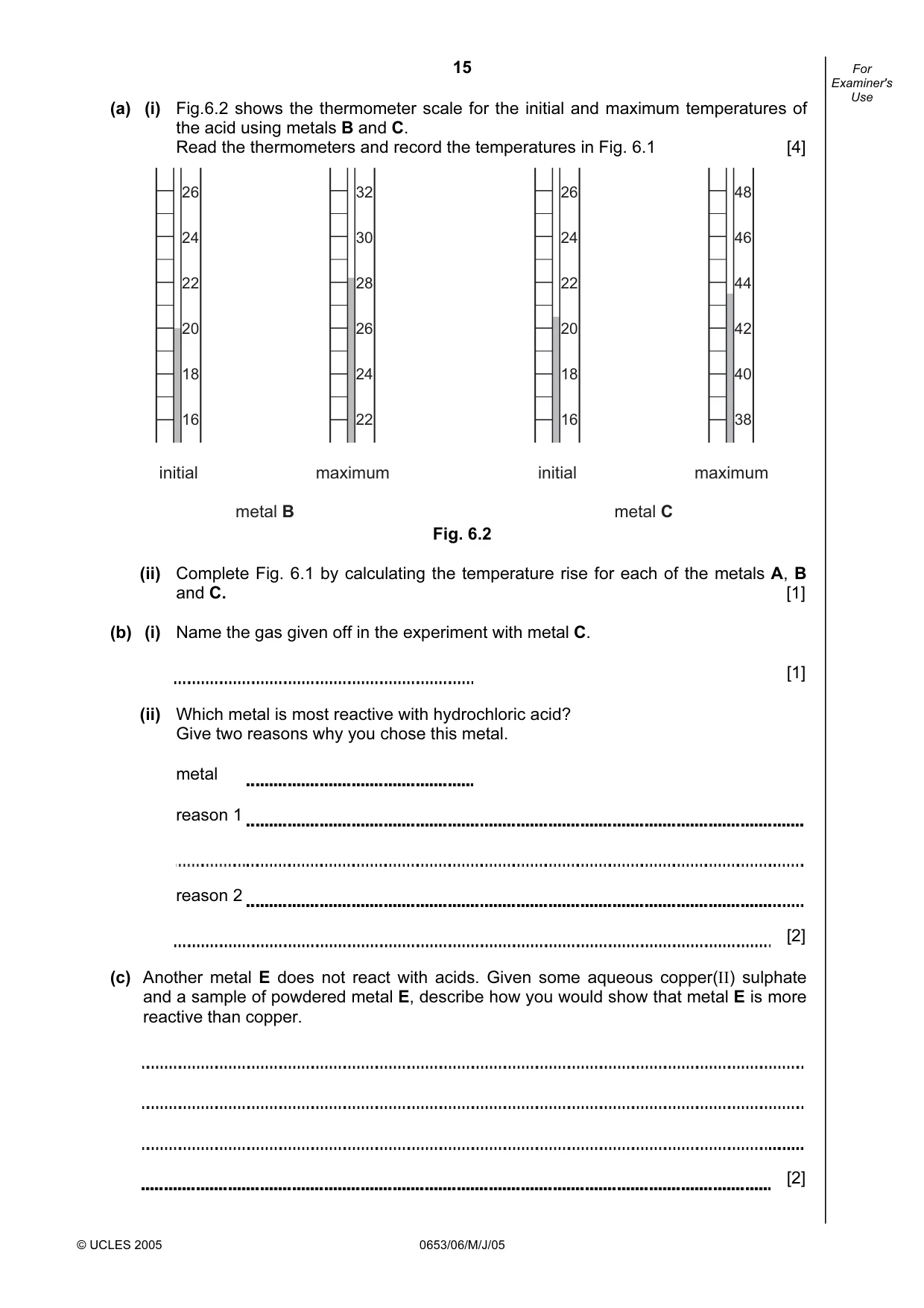
15 © UCLES 2005 0653/06/M/J/05 For Examiner's Use (a) (i) Fig.6.2 shows the thermometer scale for the initial and maximum temperatures of the acid using metals B and C. Read the thermometers and record the temperatures in Fig. 6.1 [4] 26 24 22 20 18 16 initial 32 30 28 26 24 22 maximum metal B 26 24 22 20 18 16 initial 48 46 44 42 40 38 maximum metal C Fig. 6.2 (ii) Complete Fig. 6.1 by calculating the temperature rise for each of the metals A, B and C. [1] (b) (i) Name the gas given off in the experiment with metal C. [1] (ii) Which metal is most reactive with hydrochloric acid? Give two reasons why you chose this metal. metal reason 1 reason 2 [2] (c) Another metal E does not react with acids. Given some aqueous copper(II) sulphate and a sample of powdered metal E, describe how you would show that metal E is more reactive than copper. [2]
Question paper, page 16
16 Permission to reproduce items where third-party owned material protected by copyright is included has been sought and cleared where possible. Every reasonable effort has been made by the publisher (UCLES) to trace copyright holders, but if any items requiring clearance have unwittingly been included, the publisher will be pleased to make amends at the earliest possible opportunity. University of Cambridge International Examinations is part of the University of Cambridge Local Examinations Syndicate (UCLES), which is itself a department of the University of Cambridge. 0653/06/M/J/05 BLANK PAGE
Mark scheme, page 1
UNIVERSITY OF CAMBRIDGE INTERNATIONAL EXAMINATIONS International General Certificate of Secondary Education MARK SCHEME for the June 2005 question paper 0653/0654 COMBINED SCIENCE/CO-ORDINATED SCIENCES 0653/06, 0654/06 Paper 6 (Alternative to Practical), maximum raw mark 60 This mark scheme is published as an aid to teachers and students, to indicate the requirements of the examination. It shows the basis on which Examiners were initially instructed to award marks. It does not indicate the details of the discussions that took place at an Examiners’ meeting before marking began. Any substantial changes to the mark scheme that arose from these discussions will be recorded in the published Report on the Examination. All Examiners are instructed that alternative correct answers and unexpected approaches in candidates’ scripts must be given marks that fairly reflect the relevant knowledge and skills demonstrated. Mark schemes must be read in conjunction with the question papers and the Report on the Examination. • CIE will not enter into discussion or correspondence in connection with these mark schemes. CIE is publishing the mark schemes for the June 2005 question papers for most IGCSE and GCE Advanced Level and Advanced Subsidiary Level syllabuses and some Ordinary Level syllabuses. www.XtremePapers.com
Mark scheme, page 2
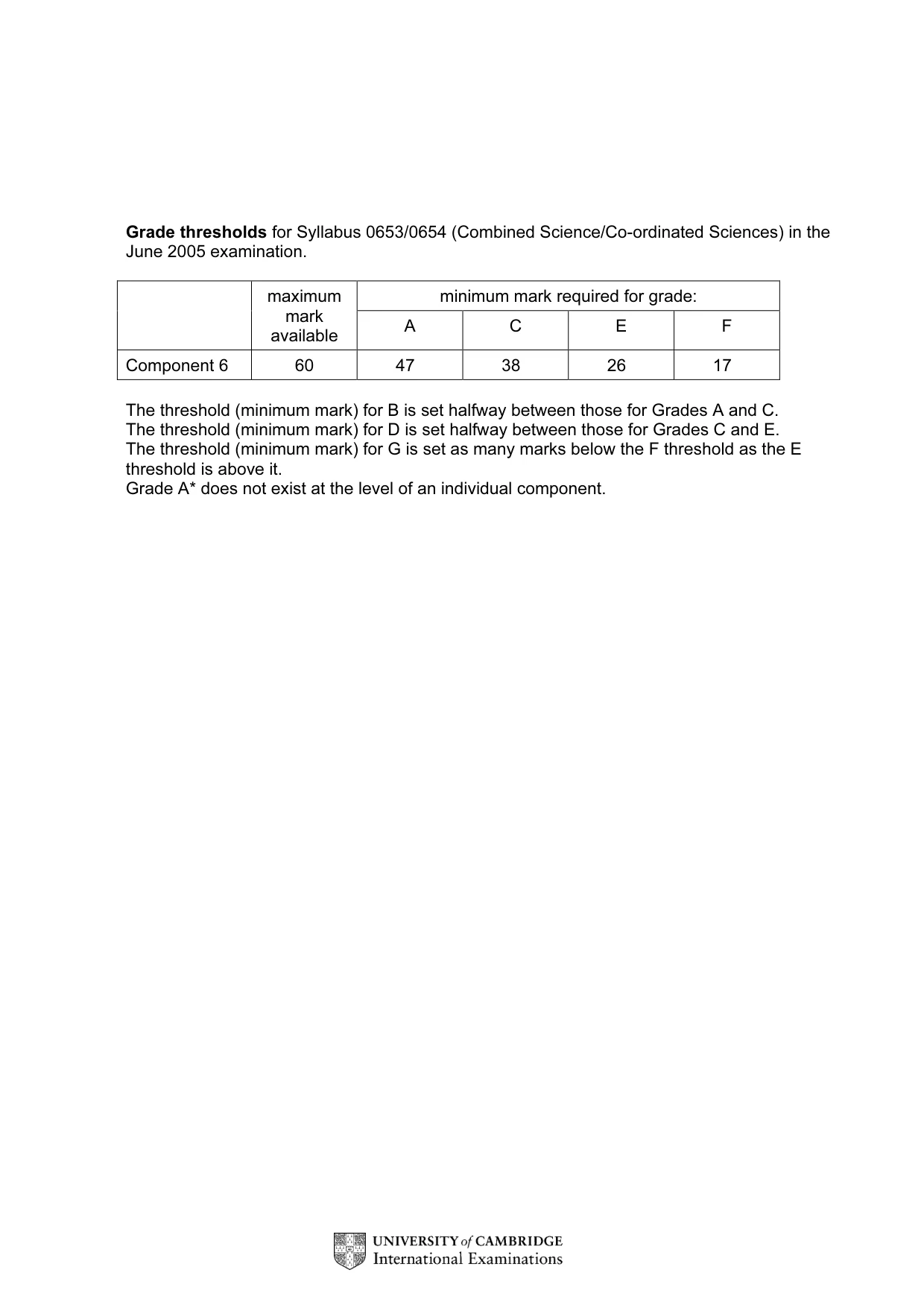
Grade thresholds for Syllabus 0653/0654 (Combined Science/Co-ordinated Sciences) in the June 2005 examination. minimum mark required for grade: maximum mark available A C E F Component 6 60 47 38 26 17 The threshold (minimum mark) for B is set halfway between those for Grades A and C. The threshold (minimum mark) for D is set halfway between those for Grades C and E. The threshold (minimum mark) for G is set as many marks below the F threshold as the E threshold is above it. Grade A* does not exist at the level of an individual component.
Mark scheme, page 3
June 2005 IGCSE MARK SCHEME MAXIMUM MARK: 60 SYLLABUS/COMPONENT: 0653/06, 0654/06 COMBINED SCIENCE/CO-ORDINATED SCIENCES Paper 6 (Alternative to Practical)
Mark scheme, page 4
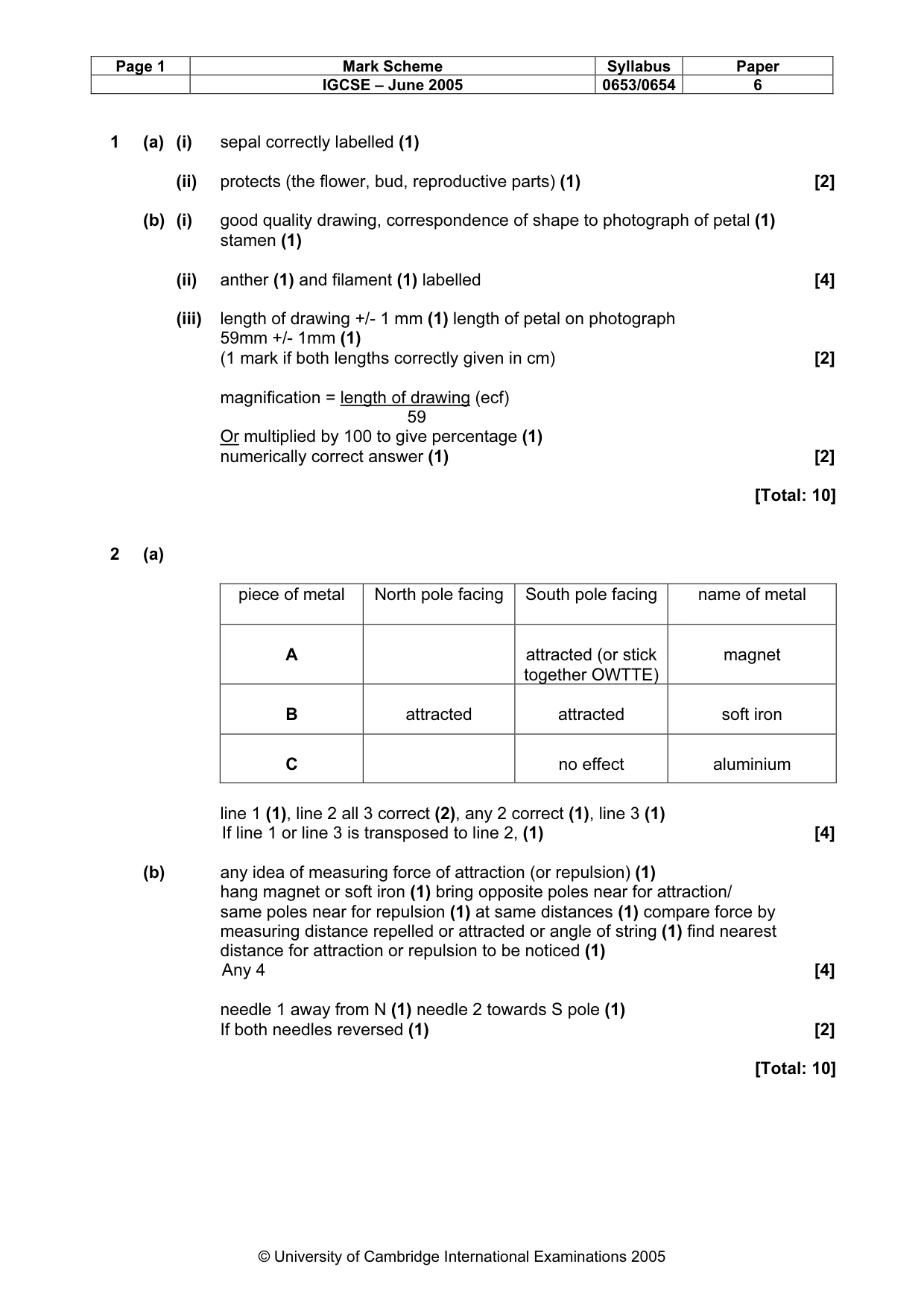
Page 1 Mark Scheme Syllabus Paper IGCSE – June 2005 0653/0654 6 © University of Cambridge International Examinations 2005 1 (a) (i) sepal correctly labelled (1) (ii) protects (the flower, bud, reproductive parts) (1) [2] (b) (i) good quality drawing, correspondence of shape to photograph of petal (1) stamen (1) (ii) anther (1) and filament (1) labelled [4] (iii) length of drawing +/- 1 mm (1) length of petal on photograph 59mm +/- 1mm (1) (1 mark if both lengths correctly given in cm) [2] magnification = length of drawing (ecf) 59 Or multiplied by 100 to give percentage (1) numerically correct answer (1) [2] [Total: 10] 2 (a) piece of metal North pole facing South pole facing name of metal A attracted (or stick together OWTTE) magnet B attracted attracted soft iron C no effect aluminium line 1 (1), line 2 all 3 correct (2), any 2 correct (1), line 3 (1) If line 1 or line 3 is transposed to line 2, (1) [4] (b) any idea of measuring force of attraction (or repulsion) (1) hang magnet or soft iron (1) bring opposite poles near for attraction/ same poles near for repulsion (1) at same distances (1) compare force by measuring distance repelled or attracted or angle of string (1) find nearest distance for attraction or repulsion to be noticed (1) Any 4 [4] needle 1 away from N (1) needle 2 towards S pole (1) If both needles reversed (1) [2] [Total: 10]
Mark scheme, page 5
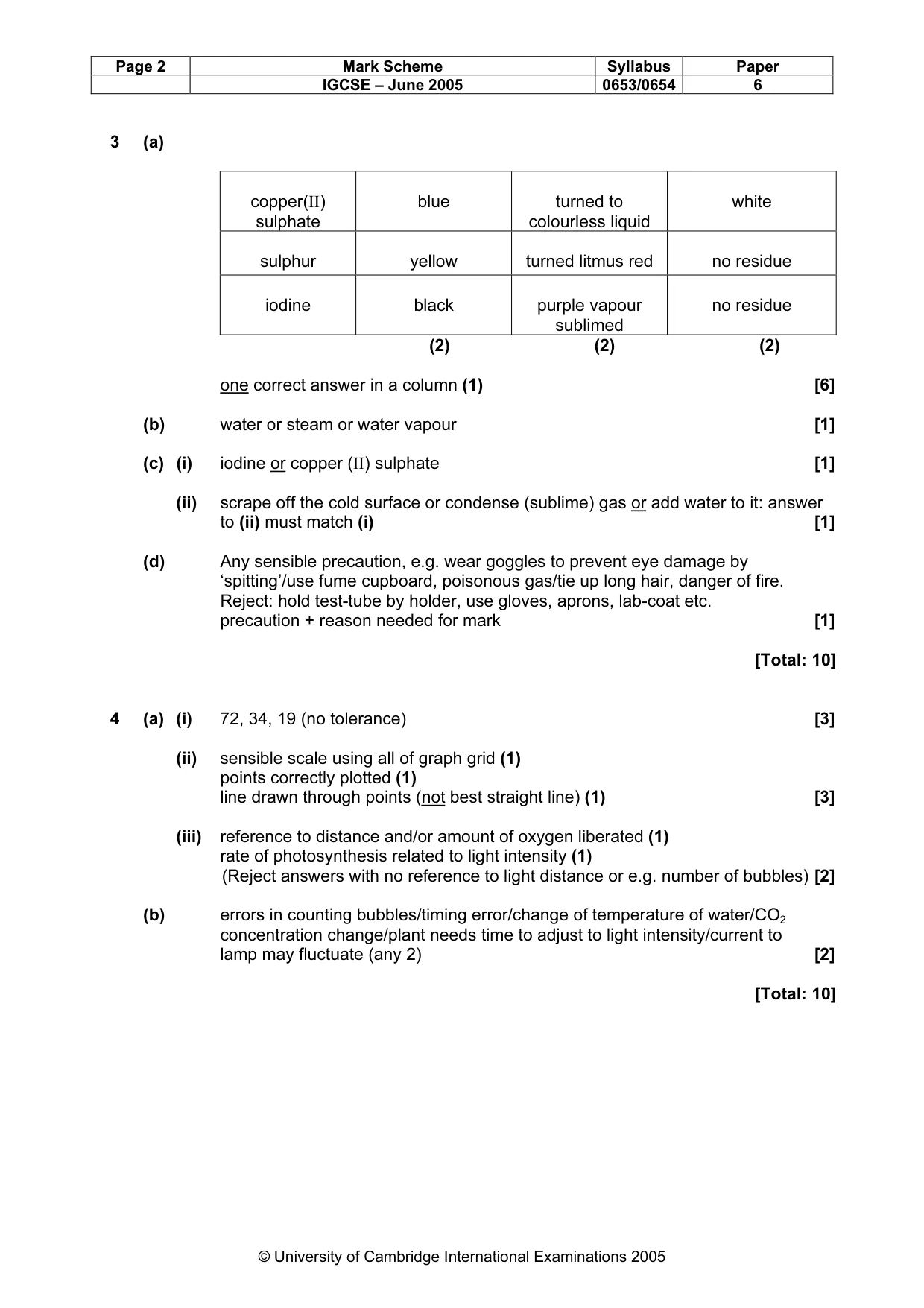
Page 2 Mark Scheme Syllabus Paper IGCSE – June 2005 0653/0654 6 © University of Cambridge International Examinations 2005 3 (a) copper(II) sulphate blue turned to colourless liquid white sulphur yellow turned litmus red no residue iodine black purple vapour sublimed no residue (2) (2) (2) one correct answer in a column (1) [6] (b) water or steam or water vapour [1] (c) (i) iodine or copper (II) sulphate [1] (ii) scrape off the cold surface or condense (sublime) gas or add water to it: answer to (ii) must match (i) [1] (d) Any sensible precaution, e.g. wear goggles to prevent eye damage by ‘spitting’/use fume cupboard, poisonous gas/tie up long hair, danger of fire. Reject: hold test-tube by holder, use gloves, aprons, lab-coat etc. precaution + reason needed for mark [1] [Total: 10] 4 (a) (i) 72, 34, 19 (no tolerance) [3] (ii) sensible scale using all of graph grid (1) points correctly plotted (1) line drawn through points (not best straight line) (1) [3] (iii) reference to distance and/or amount of oxygen liberated (1) rate of photosynthesis related to light intensity (1) (Reject answers with no reference to light distance or e.g. number of bubbles) [2] (b) errors in counting bubbles/timing error/change of temperature of water/CO2 concentration change/plant needs time to adjust to light intensity/current to lamp may fluctuate (any 2) [2] [Total: 10]
Mark scheme, page 6
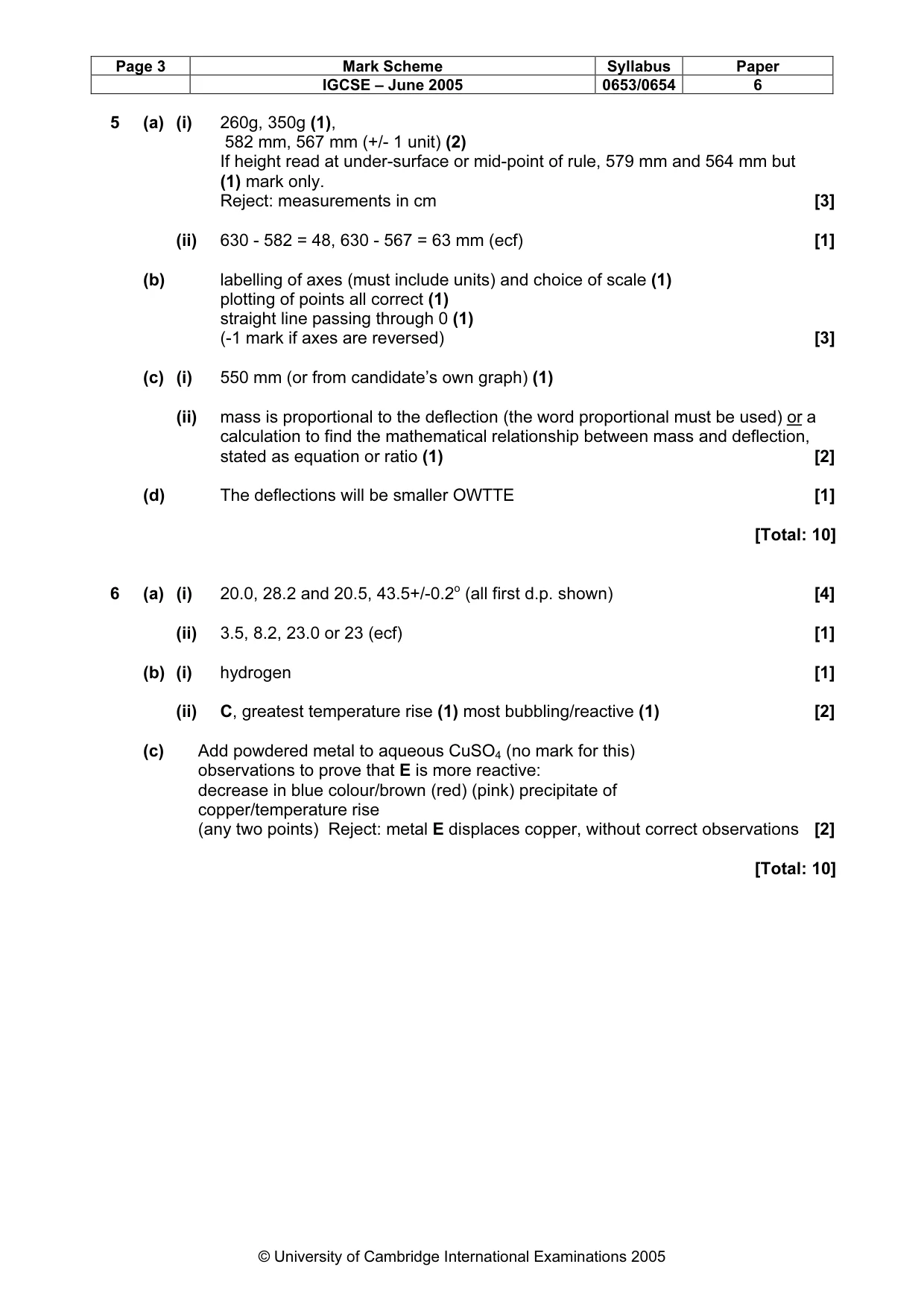
Page 3 Mark Scheme Syllabus Paper IGCSE – June 2005 0653/0654 6 © University of Cambridge International Examinations 2005 5 (a) (i) 260g, 350g (1), 582 mm, 567 mm (+/- 1 unit) (2) If height read at under-surface or mid-point of rule, 579 mm and 564 mm but (1) mark only. Reject: measurements in cm [3] (ii) 630 - 582 = 48, 630 - 567 = 63 mm (ecf) [1] (b) labelling of axes (must include units) and choice of scale (1) plotting of points all correct (1) straight line passing through 0 (1) (-1 mark if axes are reversed) [3] (c) (i) 550 mm (or from candidate’s own graph) (1) (ii) mass is proportional to the deflection (the word proportional must be used) or a calculation to find the mathematical relationship between mass and deflection, stated as equation or ratio (1) [2] (d) The deflections will be smaller OWTTE [1] [Total: 10] 6 (a) (i) 20.0, 28.2 and 20.5, 43.5+/-0.2o (all first d.p. shown) [4] (ii) 3.5, 8.2, 23.0 or 23 (ecf) [1] (b) (i) hydrogen [1] (ii) C, greatest temperature rise (1) most bubbling/reactive (1) [2] (c) Add powdered metal to aqueous CuSO4 (no mark for this) observations to prove that E is more reactive: decrease in blue colour/brown (red) (pink) precipitate of copper/temperature rise (any two points) Reject: metal E displaces copper, without correct observations [2] [Total: 10]