Cambridge IGCSE Sciences - Co-ordinated (Double) 0654 — 2002 Oct/Nov Paper 6 · Variant 1
0654/61/O/N/02
The question paper and its mark scheme, free to read here and free to download. This is Cambridge’s own paper, exactly as it was sat.
Question paper12 pages
Mark scheme4 pages
Answers below. Sit the paper first if you are practising.
Paper as text
Question paper, page 1
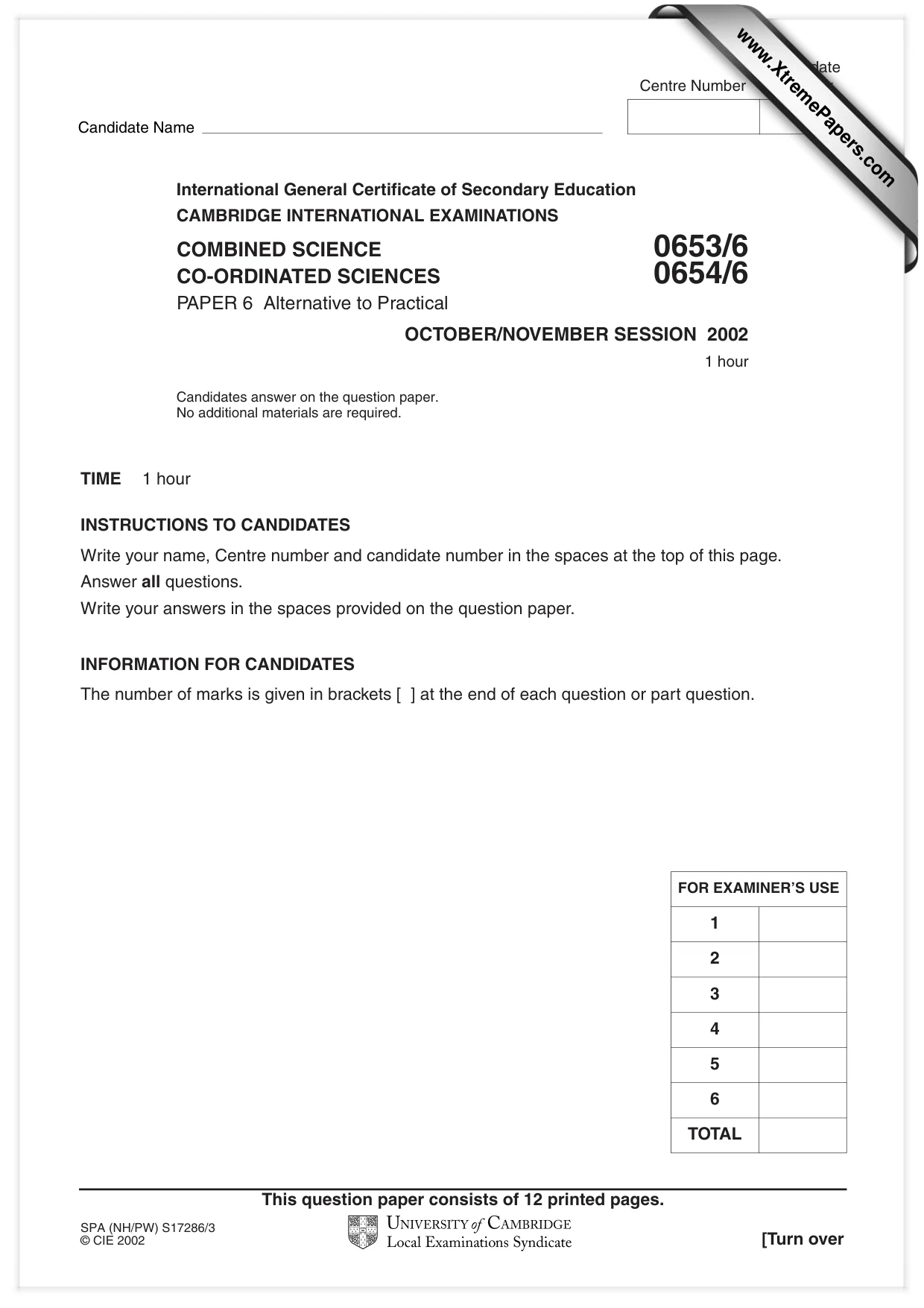
TIME 1 hour INSTRUCTIONS TO CANDIDATES Write your name, Centre number and candidate number in the spaces at the top of this page. Answer all questions. Write your answers in the spaces provided on the question paper. INFORMATION FOR CANDIDATES The number of marks is given in brackets [ ] at the end of each question or part question. International General Certificate of Secondary Education CAMBRIDGE INTERNATIONAL EXAMINATIONS COMBINED SCIENCE 0653/6 CO-ORDINATED SCIENCES 0654/6 PAPER 6 Alternative to Practical OCTOBER/NOVEMBER SESSION 2002 1 hour Candidates answer on the question paper. No additional materials are required. This question paper consists of 12 printed pages. SPA (NH/PW) S17286/3 © CIE 2002 [Turn over Candidate Centre Number Number Candidate Name FOR EXAMINER’S USE 3 2 1 4 TOTAL 6 5 www.XtremePapers.com
Question paper, page 2
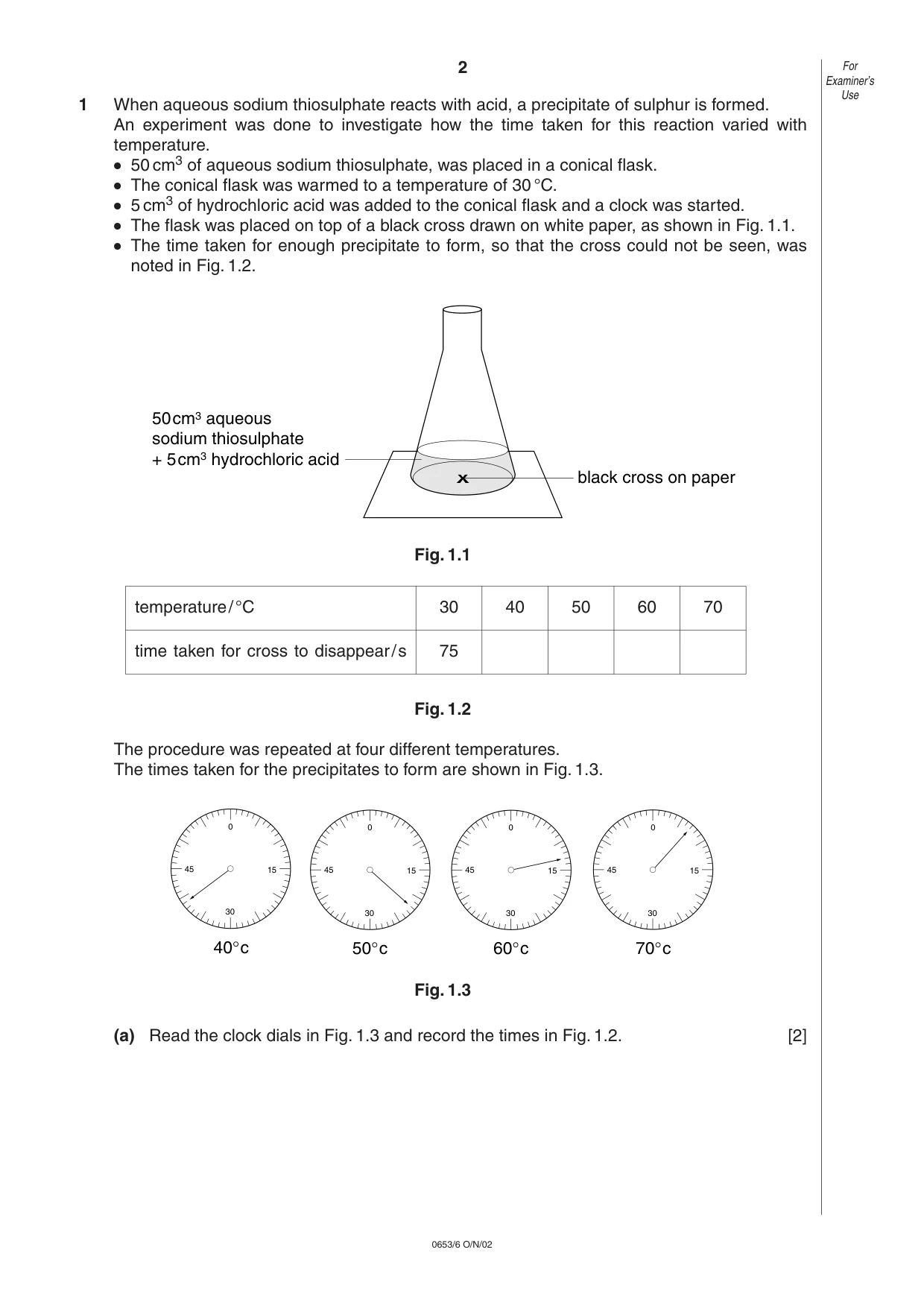
2 0653/6 O/N/02 1 When aqueous sodium thiosulphate reacts with acid, a precipitate of sulphur is formed. An experiment was done to investigate how the time taken for this reaction varied with temperature. • 50 cm3 of aqueous sodium thiosulphate, was placed in a conical flask. • The conical flask was warmed to a temperature of 30 °C. • 5 cm3 of hydrochloric acid was added to the conical flask and a clock was started. • The flask was placed on top of a black cross drawn on white paper, as shown in Fig. 1.1. • The time taken for enough precipitate to form, so that the cross could not be seen, was noted in Fig. 1.2. Fig. 1.1 Fig. 1.2 The procedure was repeated at four different temperatures. The times taken for the precipitates to form are shown in Fig. 1.3. Fig. 1.3 (a) Read the clock dials in Fig. 1.3 and record the times in Fig. 1.2. [2] 15 30 45 0 15 30 45 0 15 30 45 15 30 45 40°c 50°c 60°c 70°c 0 0 black cross on paper 50cm3 aqueous sodium thiosulphate + 5cm3 hydrochloric acid For Examiner’s Use temperature/°C 30 75 40 50 60 70 time taken for cross to disappear/s
Question paper, page 3
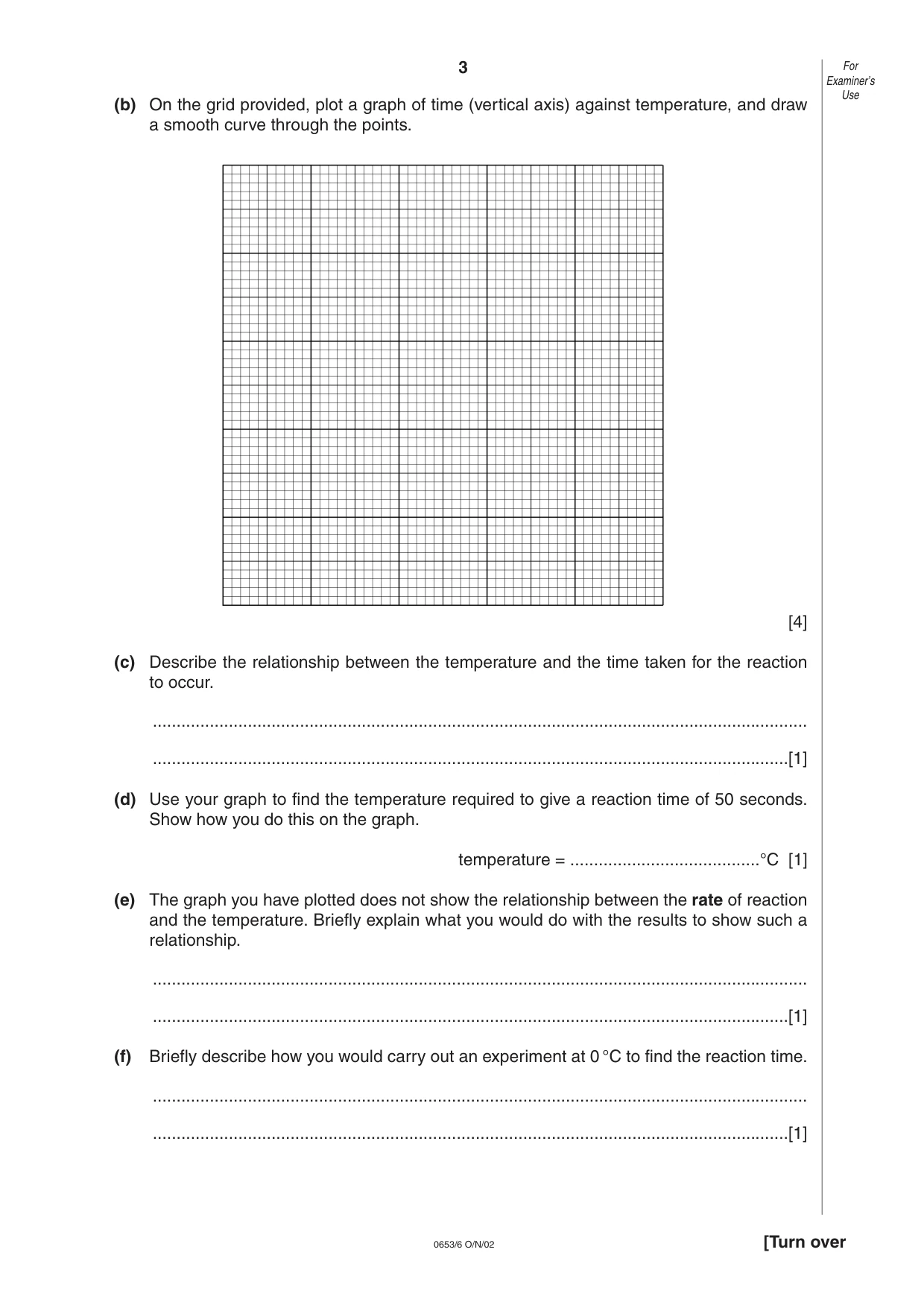
3 0653/6 O/N/02 [Turn over (b) On the grid provided, plot a graph of time (vertical axis) against temperature, and draw a smooth curve through the points. [4] (c) Describe the relationship between the temperature and the time taken for the reaction to occur. … …[1] (d) Use your graph to find the temperature required to give a reaction time of 50 seconds. Show how you do this on the graph. temperature = …°C [1] (e) The graph you have plotted does not show the relationship between the rate of reaction and the temperature. Briefly explain what you would do with the results to show such a relationship. … …[1] (f) Briefly describe how you would carry out an experiment at 0 °C to find the reaction time. … …[1] For Examiner’s Use
Question paper, page 4
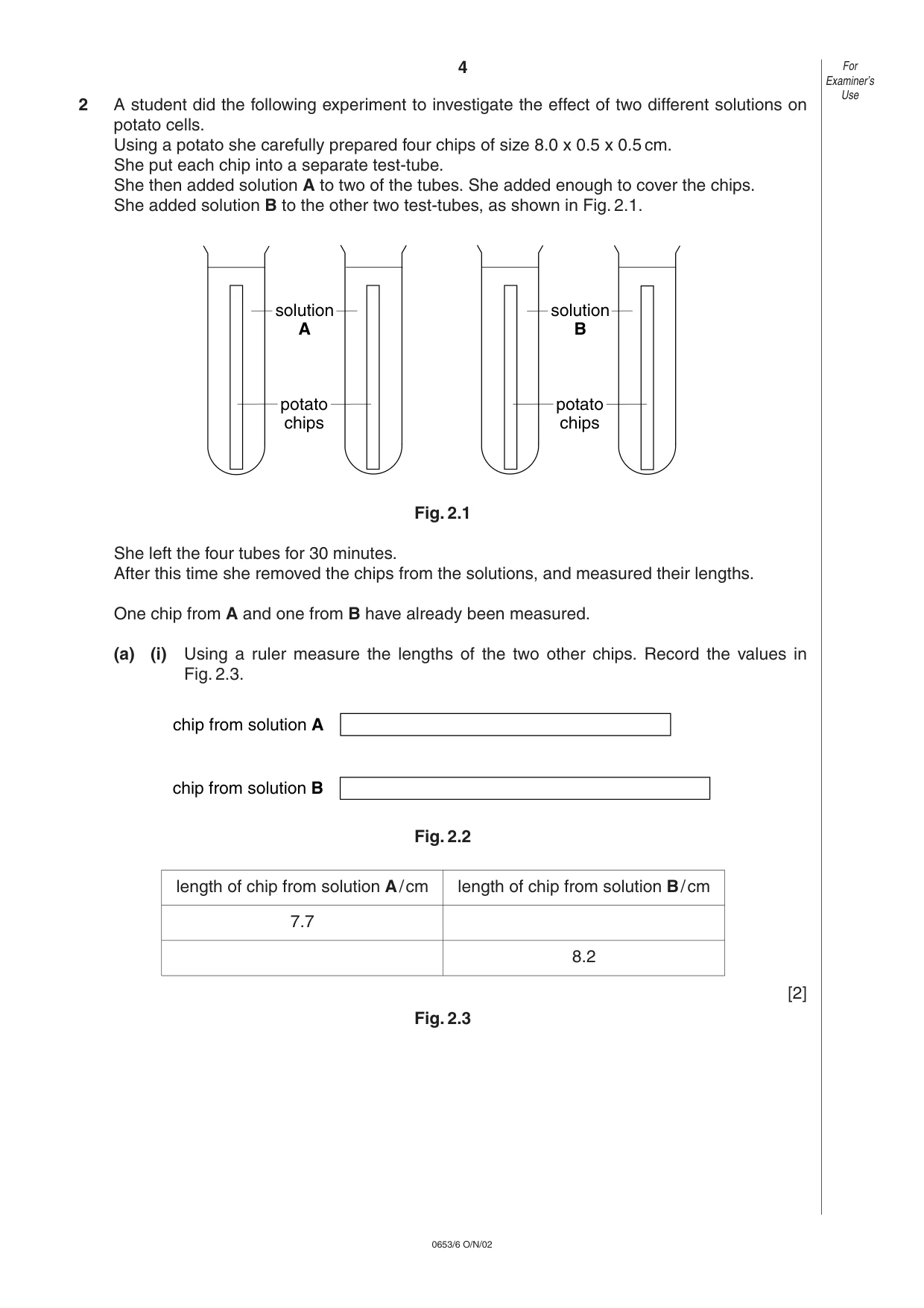
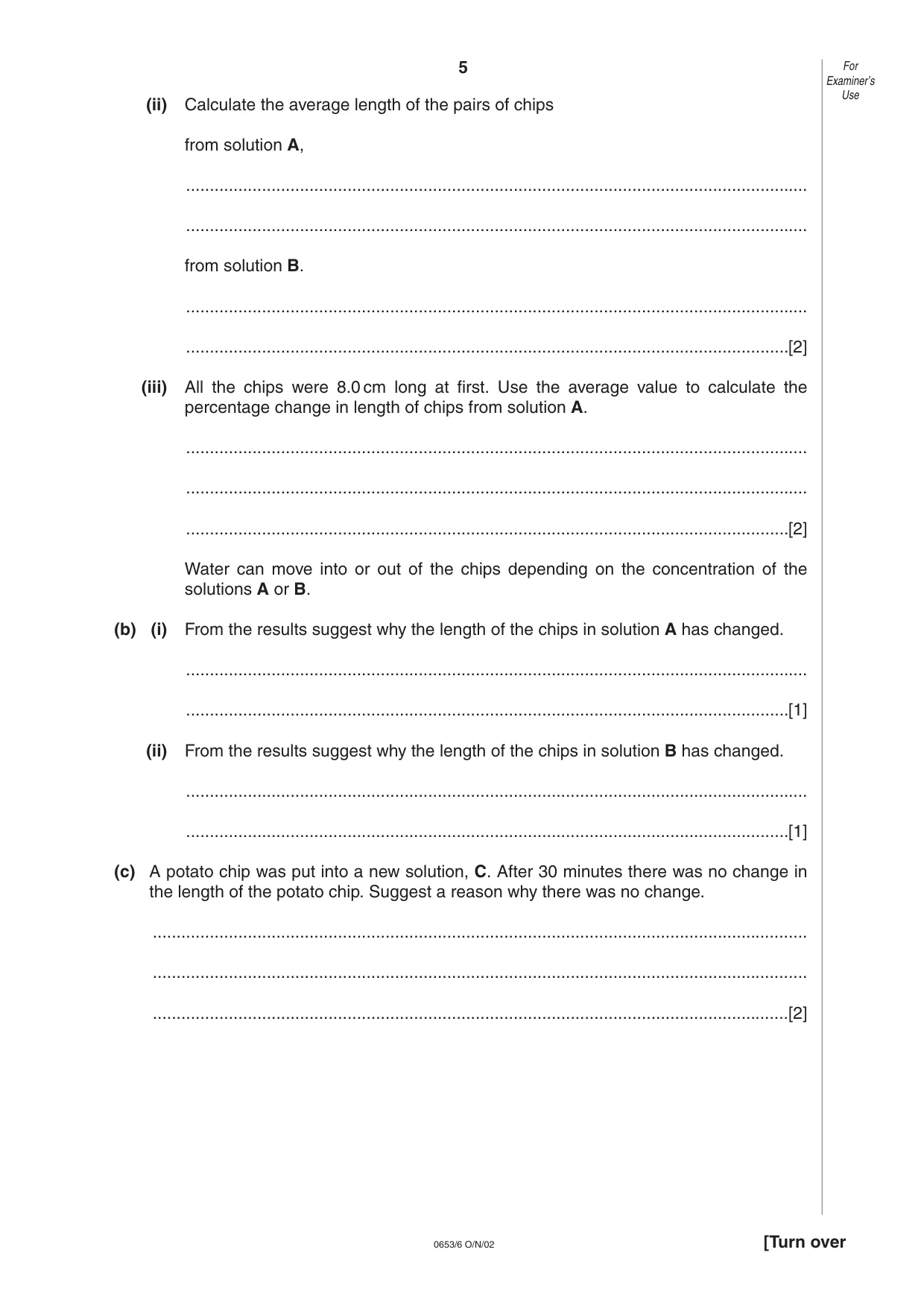
4 0653/6 O/N/02 2 A student did the following experiment to investigate the effect of two different solutions on potato cells. Using a potato she carefully prepared four chips of size 8.0 x 0.5 x 0.5 cm. She put each chip into a separate test-tube. She then added solution A to two of the tubes. She added enough to cover the chips. She added solution B to the other two test-tubes, as shown in Fig. 2.1. Fig. 2.1 She left the four tubes for 30 minutes. After this time she removed the chips from the solutions, and measured their lengths. One chip from A and one from B have already been measured. (a) (i) Using a ruler measure the lengths of the two other chips. Record the values in Fig. 2.3. Fig. 2.2 [2] Fig. 2.3 chip from solution A chip from solution B potato chips solution A potato chips solution B For Examiner’s Use length of chip from solution A/cm 7.7 length of chip from solution B/cm 8.2
Question paper, page 5
5 0653/6 O/N/02 [Turn over (ii) Calculate the average length of the pairs of chips from solution A, … … from solution B. … …[2] (iii) All the chips were 8.0 cm long at first. Use the average value to calculate the percentage change in length of chips from solution A. … … …[2] Water can move into or out of the chips depending on the concentration of the solutions A or B. (b) (i) From the results suggest why the length of the chips in solution A has changed. … …[1] (ii) From the results suggest why the length of the chips in solution B has changed. … …[1] (c) A potato chip was put into a new solution, C. After 30 minutes there was no change in the length of the potato chip. Suggest a reason why there was no change. … … …[2] For Examiner’s Use
Question paper, page 6
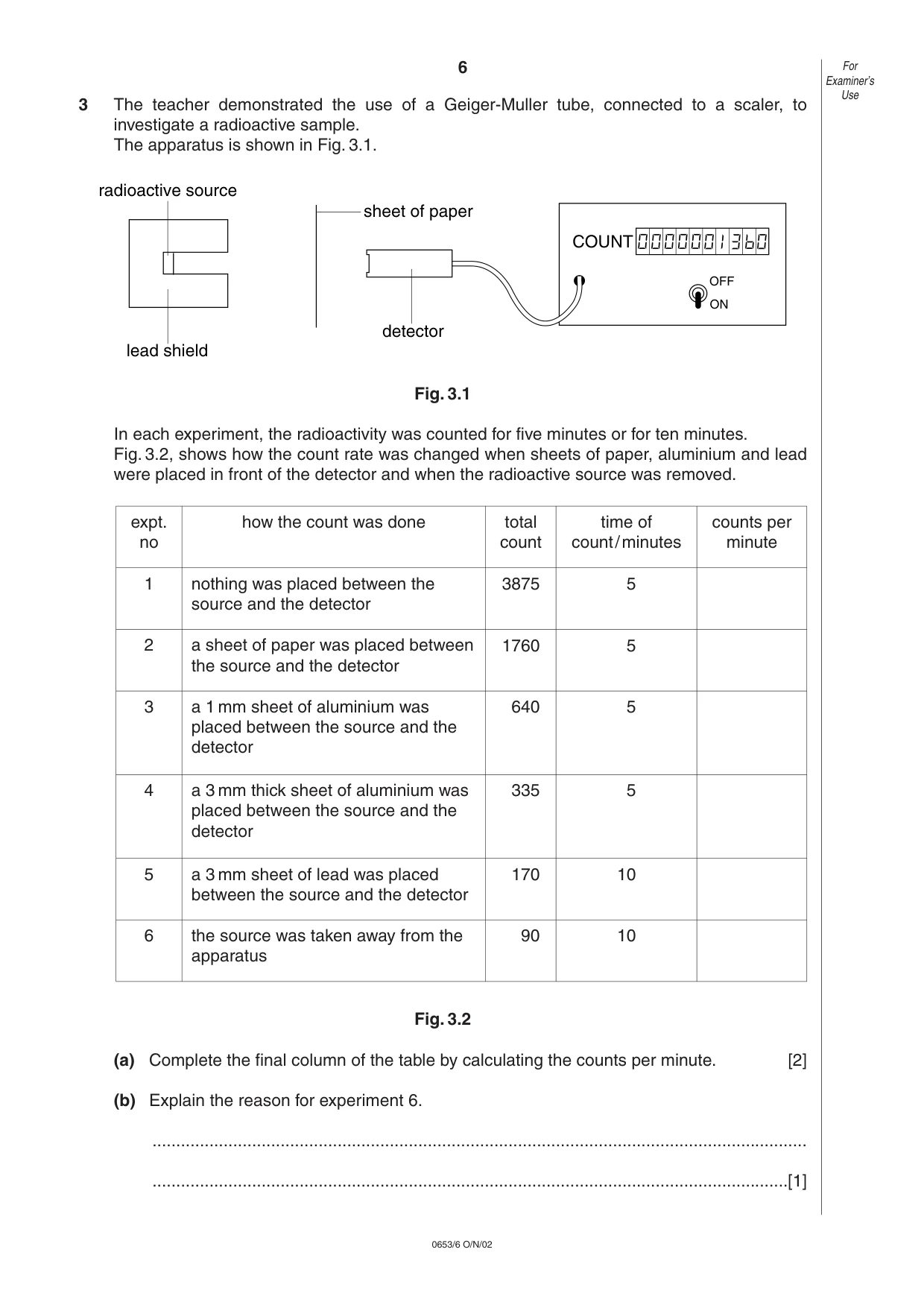
6 0653/6 O/N/02 3 The teacher demonstrated the use of a Geiger-Muller tube, connected to a scaler, to investigate a radioactive sample. The apparatus is shown in Fig. 3.1. Fig. 3.1 In each experiment, the radioactivity was counted for five minutes or for ten minutes. Fig. 3.2, shows how the count rate was changed when sheets of paper, aluminium and lead were placed in front of the detector and when the radioactive source was removed. Fig. 3.2 (a) Complete the final column of the table by calculating the counts per minute. [2] (b) Explain the reason for experiment 6. … …[1] ON OFF COUNT radioactive source lead shield sheet of paper detector For Examiner’s Use expt. no 1 2 3 4 5 6 nothing was placed between the source and the detector a sheet of paper was placed between the source and the detector a 1 mm sheet of aluminium was placed between the source and the detector a 3 mm thick sheet of aluminium was placed between the source and the detector a 3 mm sheet of lead was placed between the source and the detector the source was taken away from the apparatus how the count was done total count 3875 1760 640 335 170 90 time of count/minutes 5 5 5 5 10 10 counts per minute
Question paper, page 7
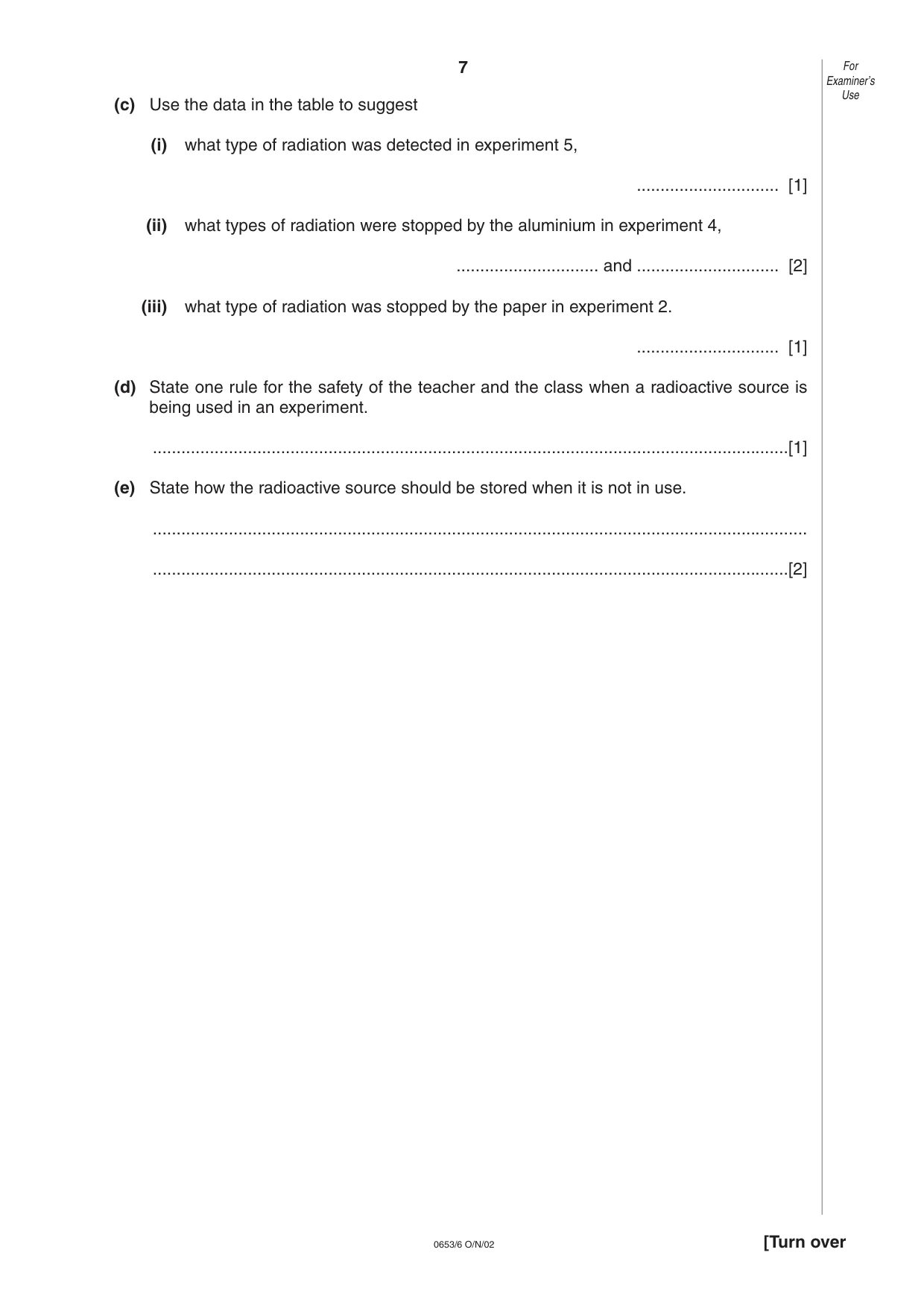
7 0653/6 O/N/02 [Turn over (c) Use the data in the table to suggest (i) what type of radiation was detected in experiment 5, … [1] (ii) what types of radiation were stopped by the aluminium in experiment 4, … and … [2] (iii) what type of radiation was stopped by the paper in experiment 2. … [1] (d) State one rule for the safety of the teacher and the class when a radioactive source is being used in an experiment. …[1] (e) State how the radioactive source should be stored when it is not in use. … …[2] For Examiner’s Use
Question paper, page 8
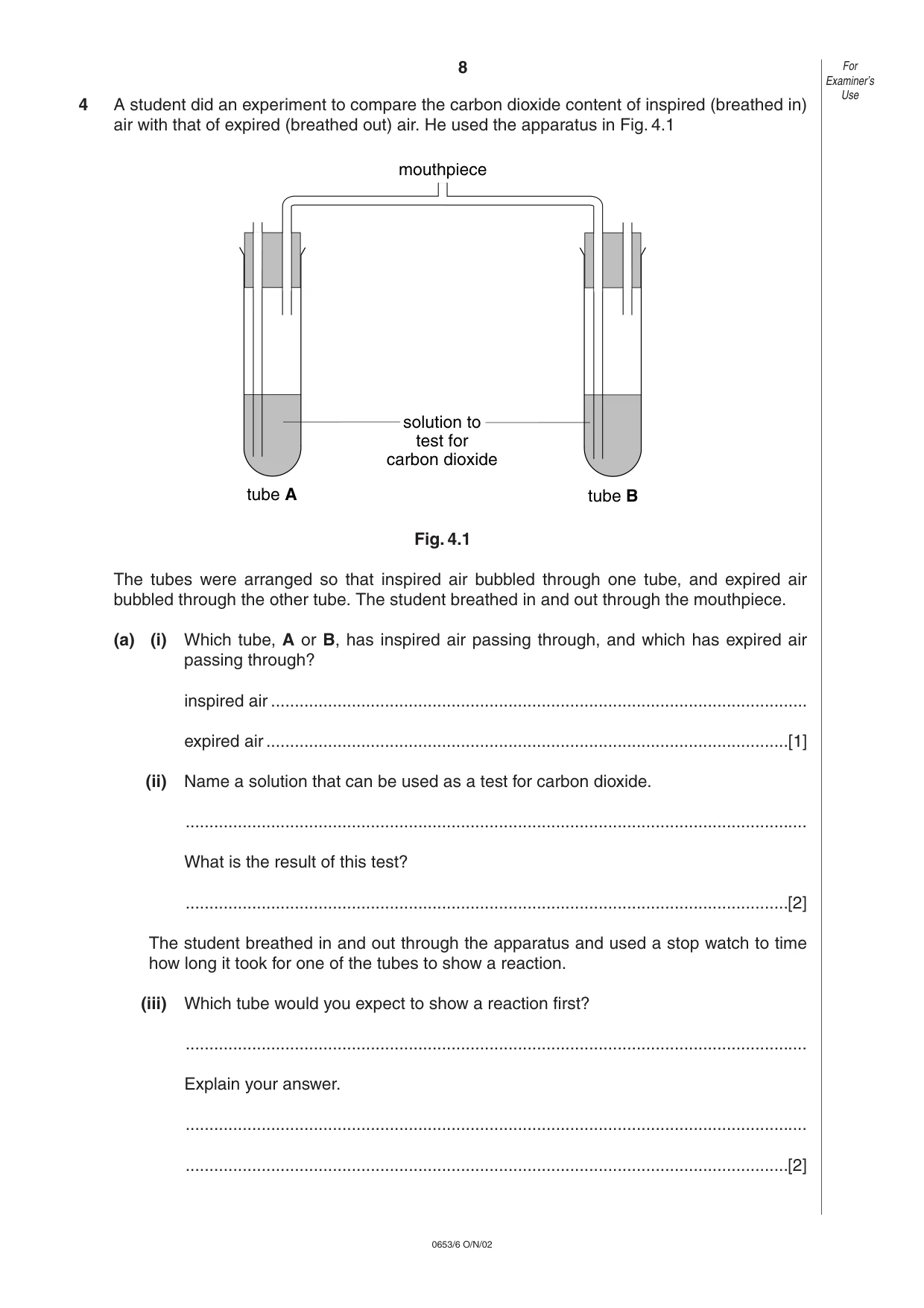
8 0653/6 O/N/02 4 A student did an experiment to compare the carbon dioxide content of inspired (breathed in) air with that of expired (breathed out) air. He used the apparatus in Fig. 4.1 Fig. 4.1 The tubes were arranged so that inspired air bubbled through one tube, and expired air bubbled through the other tube. The student breathed in and out through the mouthpiece. (a) (i) Which tube, A or B, has inspired air passing through, and which has expired air passing through? inspired air … expired air …[1] (ii) Name a solution that can be used as a test for carbon dioxide. … What is the result of this test? …[2] The student breathed in and out through the apparatus and used a stop watch to time how long it took for one of the tubes to show a reaction. (iii) Which tube would you expect to show a reaction first? … Explain your answer. … …[2] solution to test for carbon dioxide mouthpiece tube A tube B For Examiner’s Use
Question paper, page 9
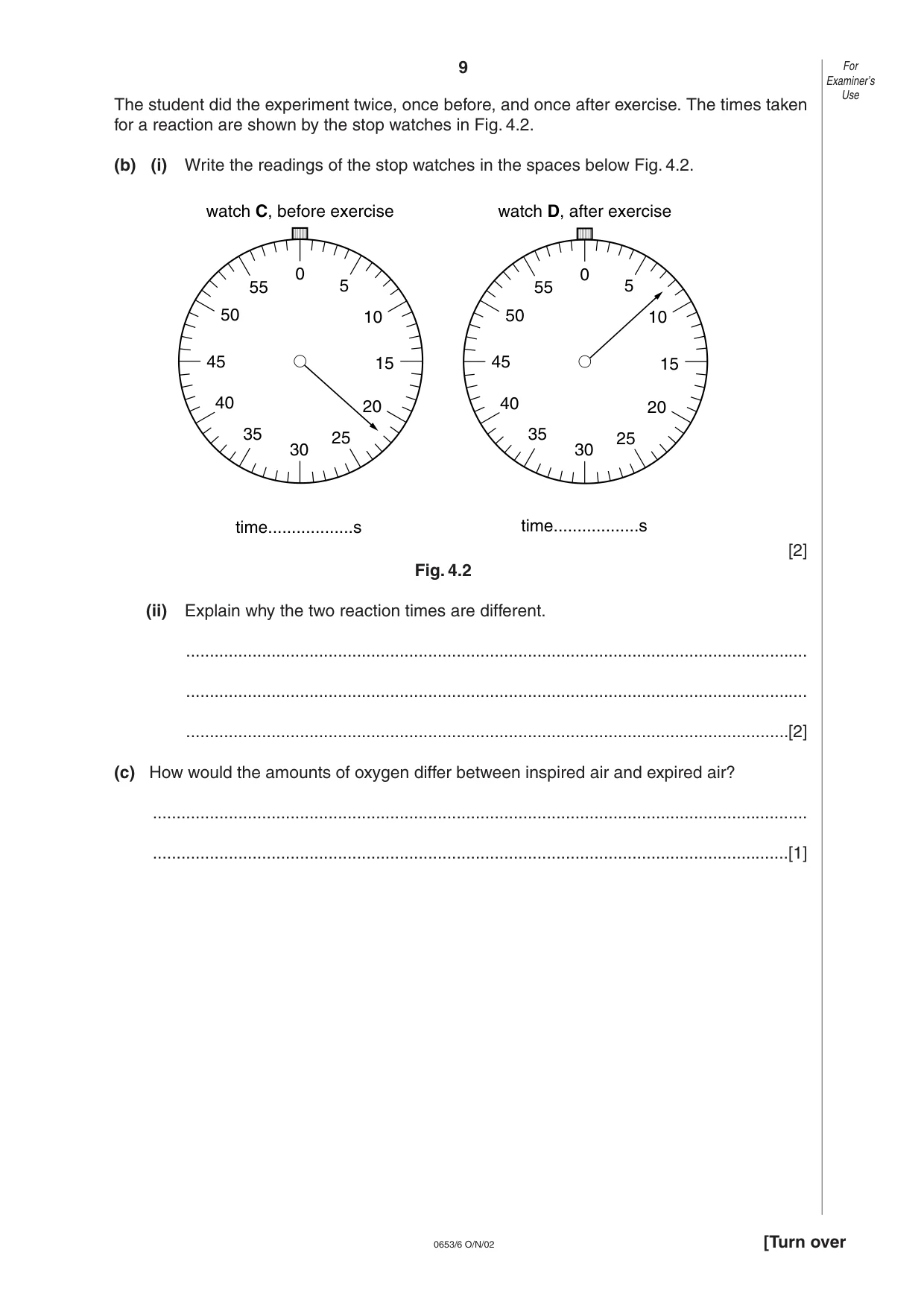
9 0653/6 O/N/02 [Turn over The student did the experiment twice, once before, and once after exercise. The times taken for a reaction are shown by the stop watches in Fig. 4.2. (b) (i) Write the readings of the stop watches in the spaces below Fig. 4.2. [2] Fig. 4.2 (ii) Explain why the two reaction times are different. … … …[2] (c) How would the amounts of oxygen differ between inspired air and expired air? … …[1] 0 5 10 15 20 25 30 35 40 45 50 55 watch C, before exercise 0 5 10 15 20 25 30 35 40 45 50 55 watch D, after exercise time…s time…s For Examiner’s Use
Question paper, page 10
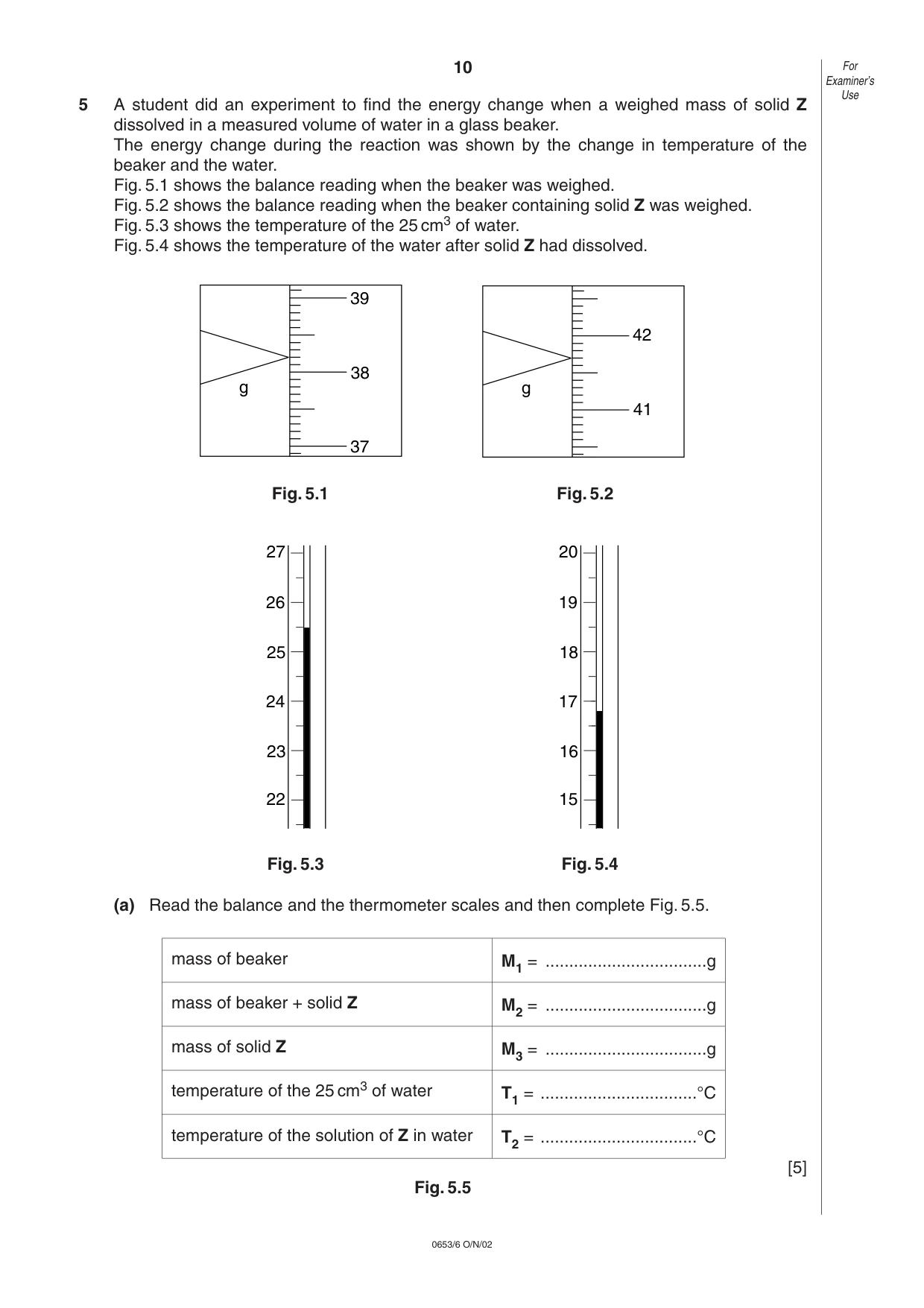
10 0653/6 O/N/02 5 A student did an experiment to find the energy change when a weighed mass of solid Z dissolved in a measured volume of water in a glass beaker. The energy change during the reaction was shown by the change in temperature of the beaker and the water. Fig. 5.1 shows the balance reading when the beaker was weighed. Fig. 5.2 shows the balance reading when the beaker containing solid Z was weighed. Fig. 5.3 shows the temperature of the 25 cm3 of water. Fig. 5.4 shows the temperature of the water after solid Z had dissolved. Fig. 5.1 Fig. 5.2 Fig. 5.3 Fig. 5.4 (a) Read the balance and the thermometer scales and then complete Fig. 5.5. [5] Fig. 5.5 20 19 18 17 15 16 27 26 25 24 22 23 42 41 g 39 38 37 g For Examiner’s Use mass of beaker mass of beaker + solid Z mass of solid Z temperature of the 25 cm3 of water temperature of the solution of Z in water M1 = …g M2 = …g M3 = …g T1 = …°C T2 = …°C
Question paper, page 11
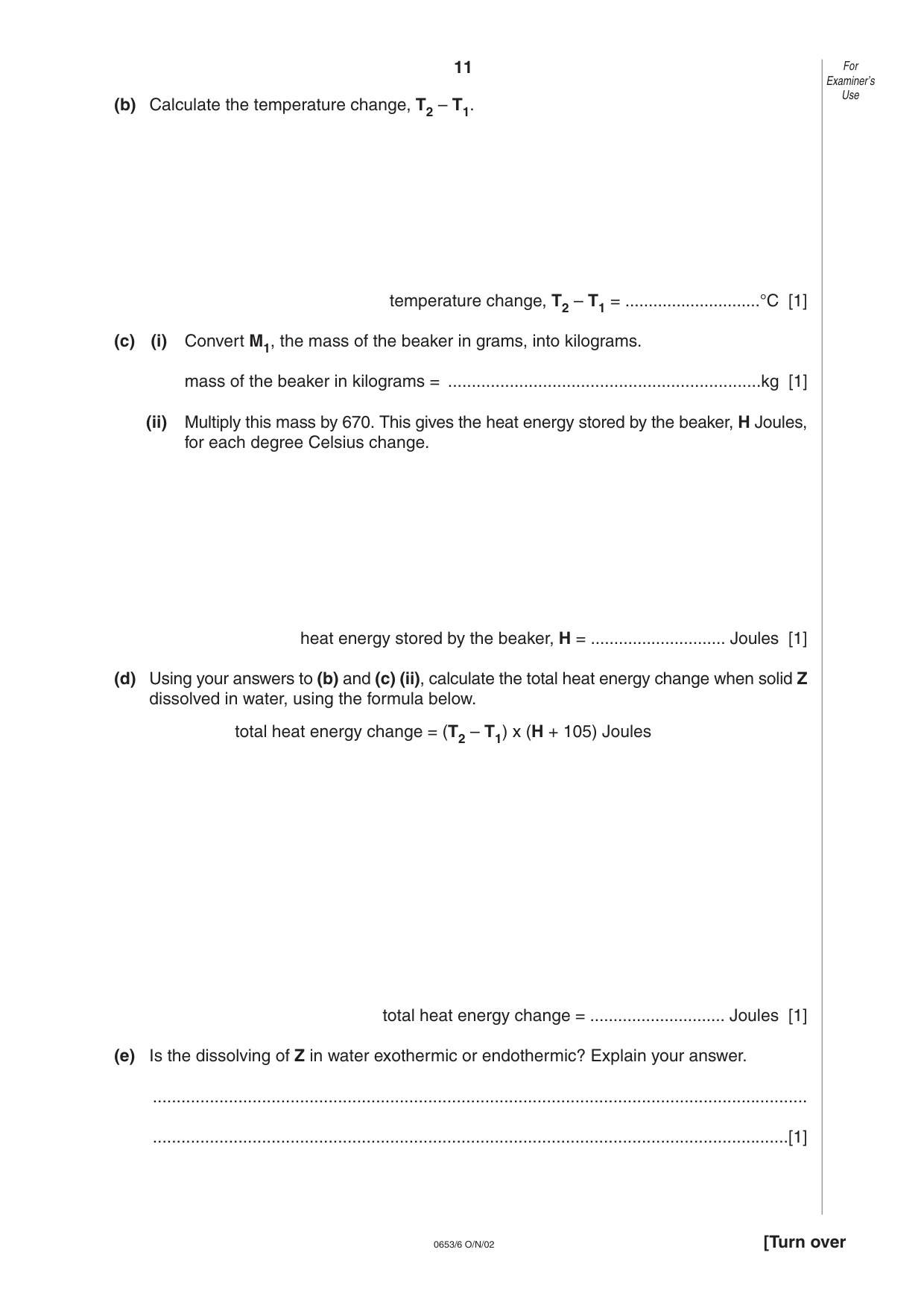
11 0653/6 O/N/02 [Turn over (b) Calculate the temperature change, T2 – T1. temperature change, T2 – T1 = …°C [1] (c) (i) Convert M1, the mass of the beaker in grams, into kilograms. mass of the beaker in kilograms = …kg [1] (ii) Multiply this mass by 670. This gives the heat energy stored by the beaker, H Joules, for each degree Celsius change. heat energy stored by the beaker, H = … Joules [1] (d) Using your answers to (b) and (c) (ii), calculate the total heat energy change when solid Z dissolved in water, using the formula below. total heat energy change = (T2 – T1) x (H + 105) Joules total heat energy change = … Joules [1] (e) Is the dissolving of Z in water exothermic or endothermic? Explain your answer. … …[1] For Examiner’s Use
Question paper, page 12
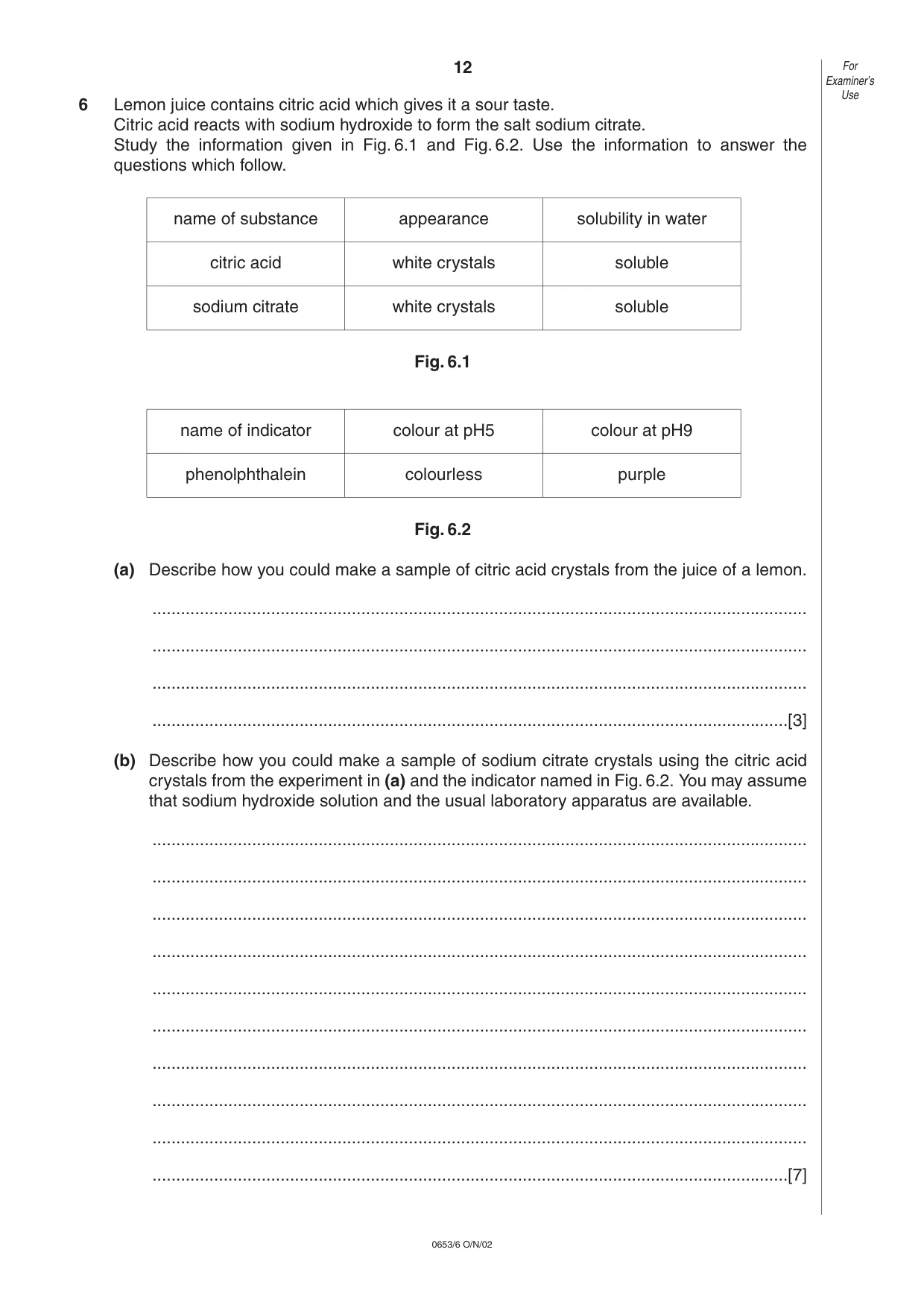
12 0653/6 O/N/02 6 Lemon juice contains citric acid which gives it a sour taste. Citric acid reacts with sodium hydroxide to form the salt sodium citrate. Study the information given in Fig. 6.1 and Fig. 6.2. Use the information to answer the questions which follow. Fig. 6.1 Fig. 6.2 (a) Describe how you could make a sample of citric acid crystals from the juice of a lemon. … … … …[3] (b) Describe how you could make a sample of sodium citrate crystals using the citric acid crystals from the experiment in (a) and the indicator named in Fig. 6.2. You may assume that sodium hydroxide solution and the usual laboratory apparatus are available. … … … … … … … … … …[7] For Examiner’s Use name of substance citric acid sodium citrate appearance white crystals white crystals solubility in water soluble soluble name of indicator phenolphthalein colour at pH5 colour at pH9 purple colourless
Mark scheme, page 1
CAMBRIDGE Se INTERNATIONAL EXAMINATIONS NOVEMBER 2002 INTERNATIONAL GCSE eS UNIVERSITY of CAMBRIDGE Local Examinations Syndicate
Mark scheme, page 2
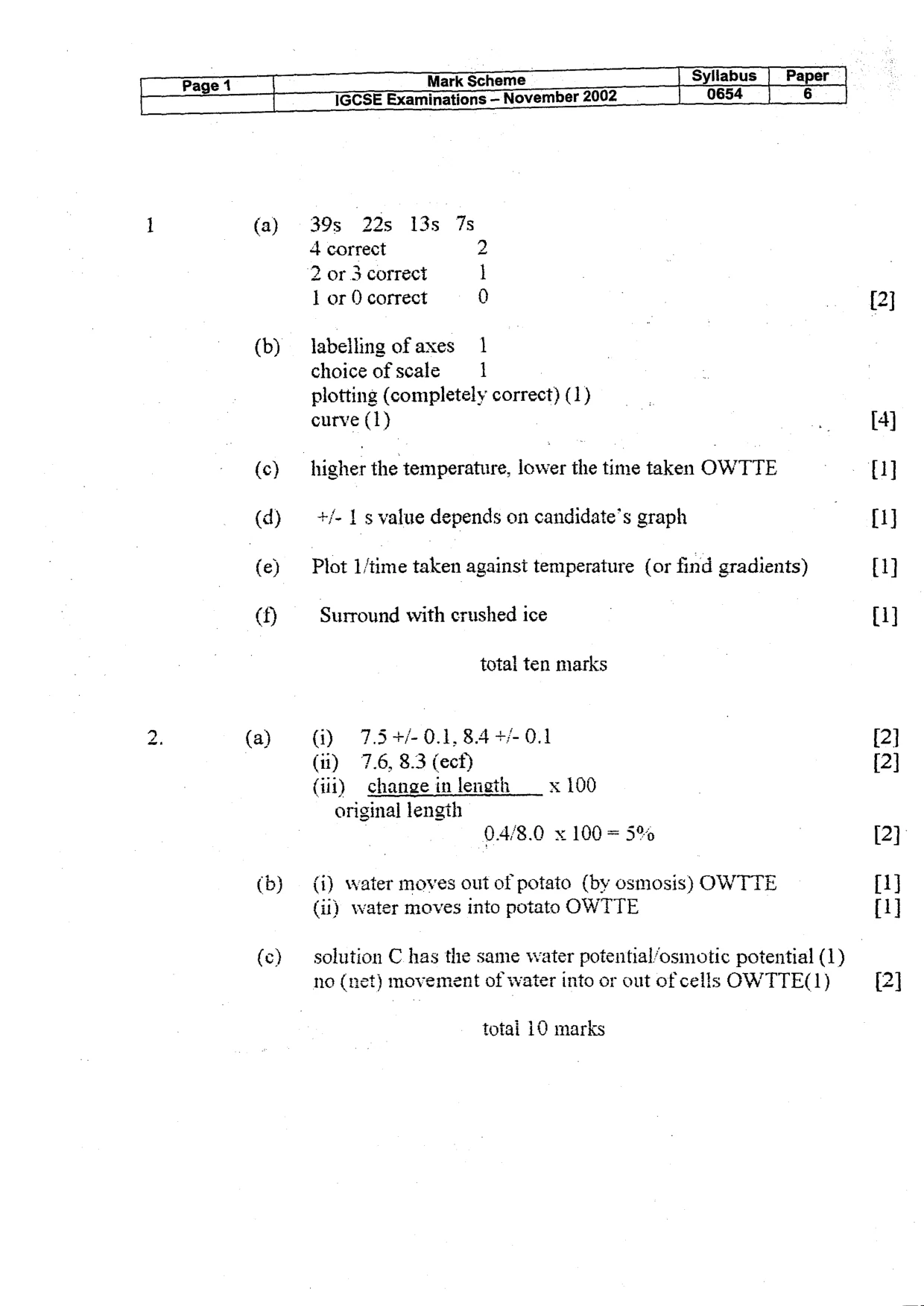
Page 1 Mark Scheme Syllabus | Paper | IGCSE Examinations — November 2002 0654 6 | 1 (a) 39s 22s 13s 7s 4 correct 2 2 or 3 correct 1 J or 0 correct 0 (b) labelling ofaxes 1 choice of scale 1 plotting (completely correct) (1) curve (1) (c) higher the temperature, lower the time taken OWTTE (d) +/+ 1 s value depends on candidate’s graph (e) Plot 1/time taken against temperature (or find gradients) (f) Surround with crushed ice total ten marks 2. (a) @ 7.5+/-0.1,84+-01 (i) 7.6, 8.3 (ect) (iii) change in length x 100 original length 0.4/8.0 x 100 = 5% (b) (i) water moves out of potato (by osmosis) OWTTE (ii) water moves into potato OWTTE (c) — solution C has the same water potential/osmotic potential (1) no (net) movement of water into or out of cells OWTTE(1) totai 10 marks [2] [4] 0] 1] 0) {1] [2] [2] [2] 0) 0] 2]
Mark scheme, page 3
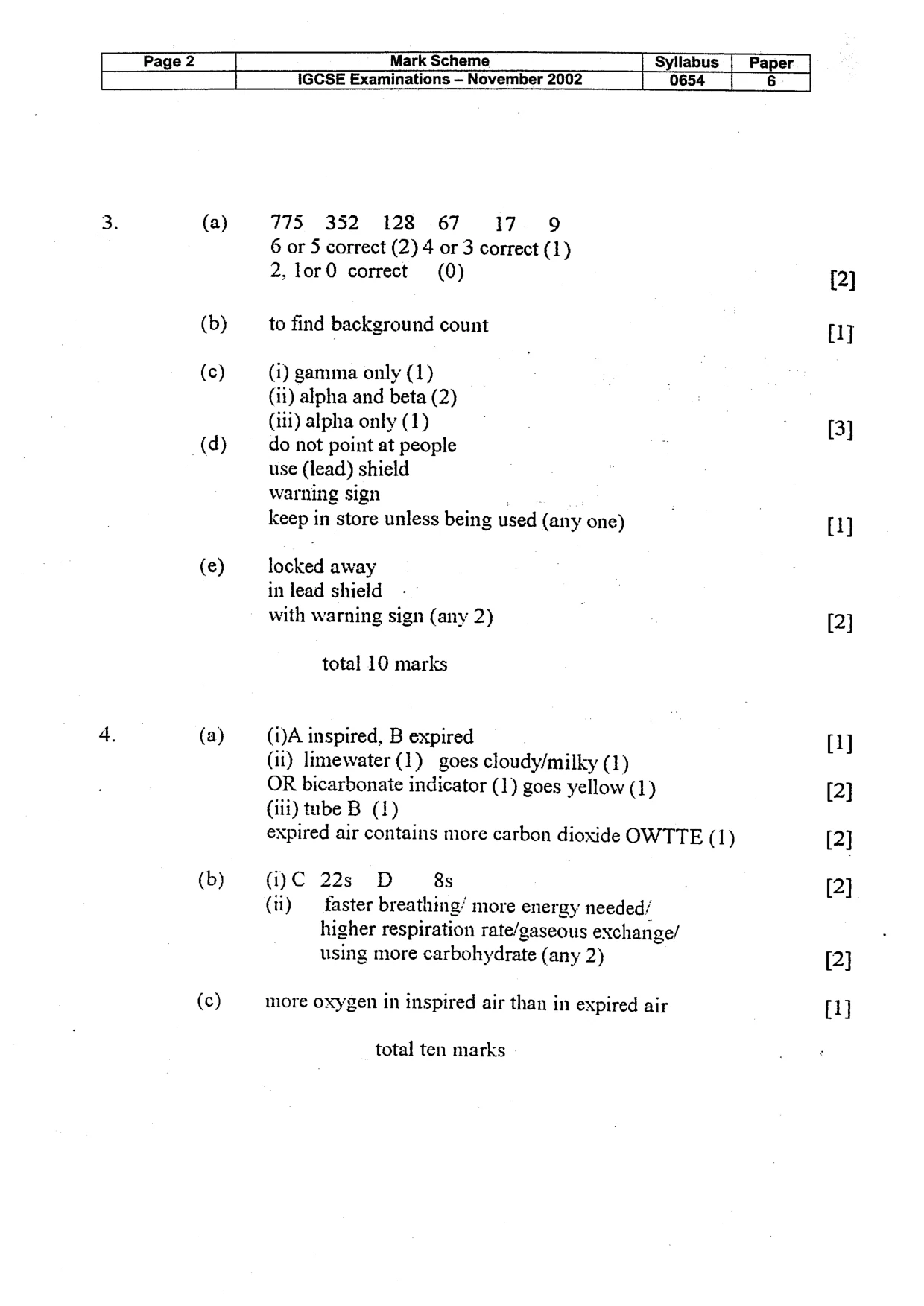
Page 2 Mark Scheme [Syllabus [Paper | IGCSE Examinations — November 2002 [0654 6 | (a) 7715 352 128 67 #17. «9 6 or 5 correct (2) 4 or 3 correct (1) 2, lor0 correct (0) (b) to find background count (c) (i) gamma only (1) (ii) alpha and beta (2) (iti) alpha only (1) (d) do not point at people use (lead) shield warning sign keep in store unless being used (any one) (e) locked away in lead shield with warning sign (any 2) total 10 marks (a) (i)A inspired, B expired (ii) limewater (1) goes cloudy/milky (1) OR bicarbonate indicator (1) goes yellow (1) (iii) tube B (1) expired air contains more carbon dioxide OWTTE (1) (b) G)C 22s D 8s (ii) faster breathing’ more energy needed/ higher respiration rate/gaseous exchange/ using more carbohydrate (any 2) (c) more oxygen in inspired air than in expired air total ten marks [2] {1} [3] 0] [2] (1) [2] [2] [2] [2] (1)
Mark scheme, page 4
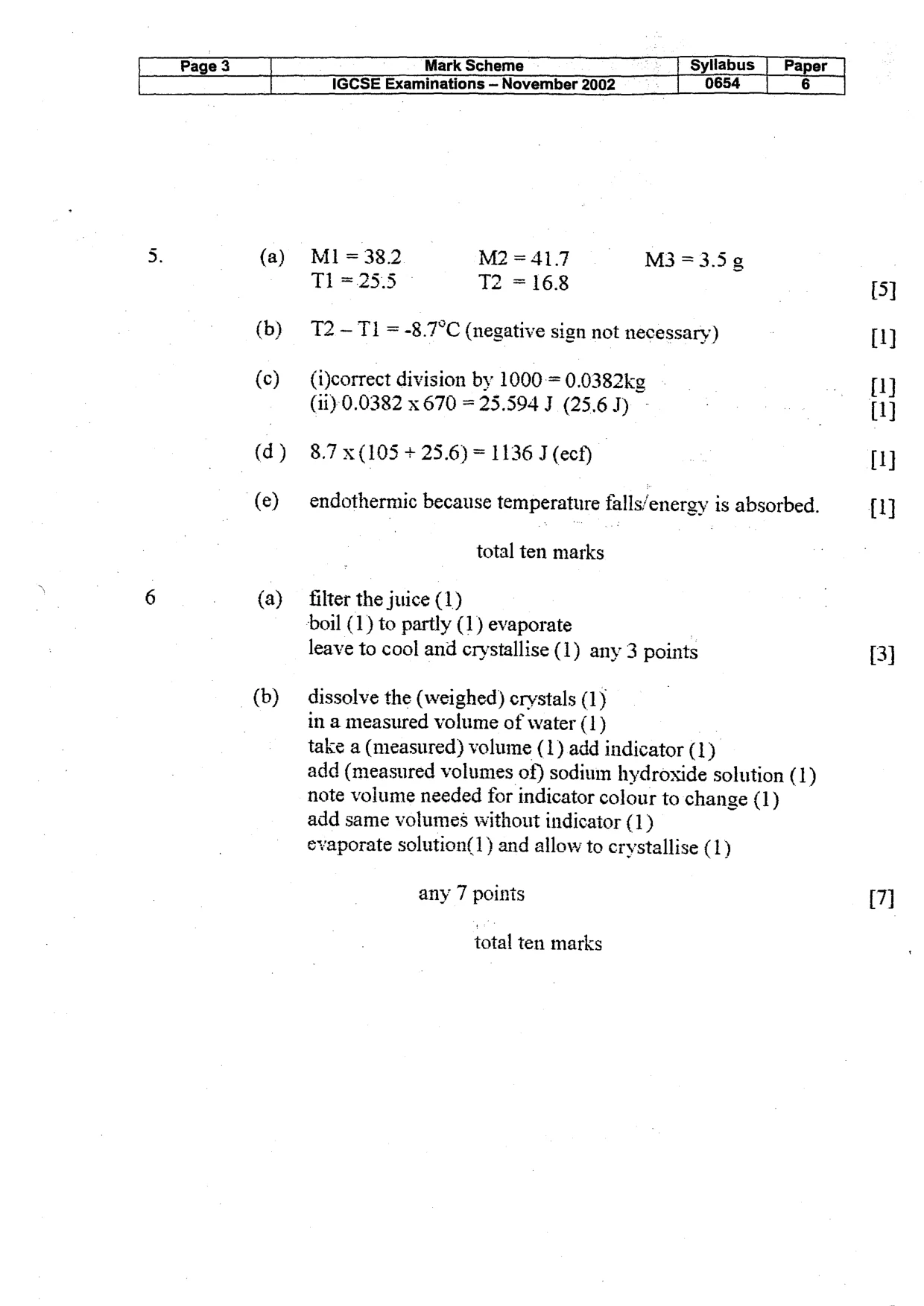
Mark Sch Syllabus | Paper rege IGCSE Examinations = November 2002 0654 | 6 5. (a) M1l=38.2 M2=41.7 M3 =3.5¢ TI = 25.5 T2 =168 [3] (b) T2-—T1 =-8.7°C (negative sign not necessary) (y (c) (i)correct division by 1000 = 0.0382kg (1) (ii)-0.0382 x 670 = 25.594 J (25.6 J) - : (1) (d) 8.7 x(105 + 25.6) = 1136 J (ecf) [1] (e) endothermic because temperature falls/energy is absorbed. {1] total ten marks 6 (a) filter the juice (1) boil (1) to partly (1) evaporate leave to cool and crystallise (1) any 3 points [3] (b) dissolve the (weighed) crystals (1) in a measured volume of water (1) take a (measured) volume (1) add indicator (1) add (measured volumes of) sodium hydroxide solution (1) note volume needed for indicator colour to change (1) add same volumes without indicator (1) evaporate solution(1) and allow to crystallise (1) any 7 points [7] total ten marks