Questions as text
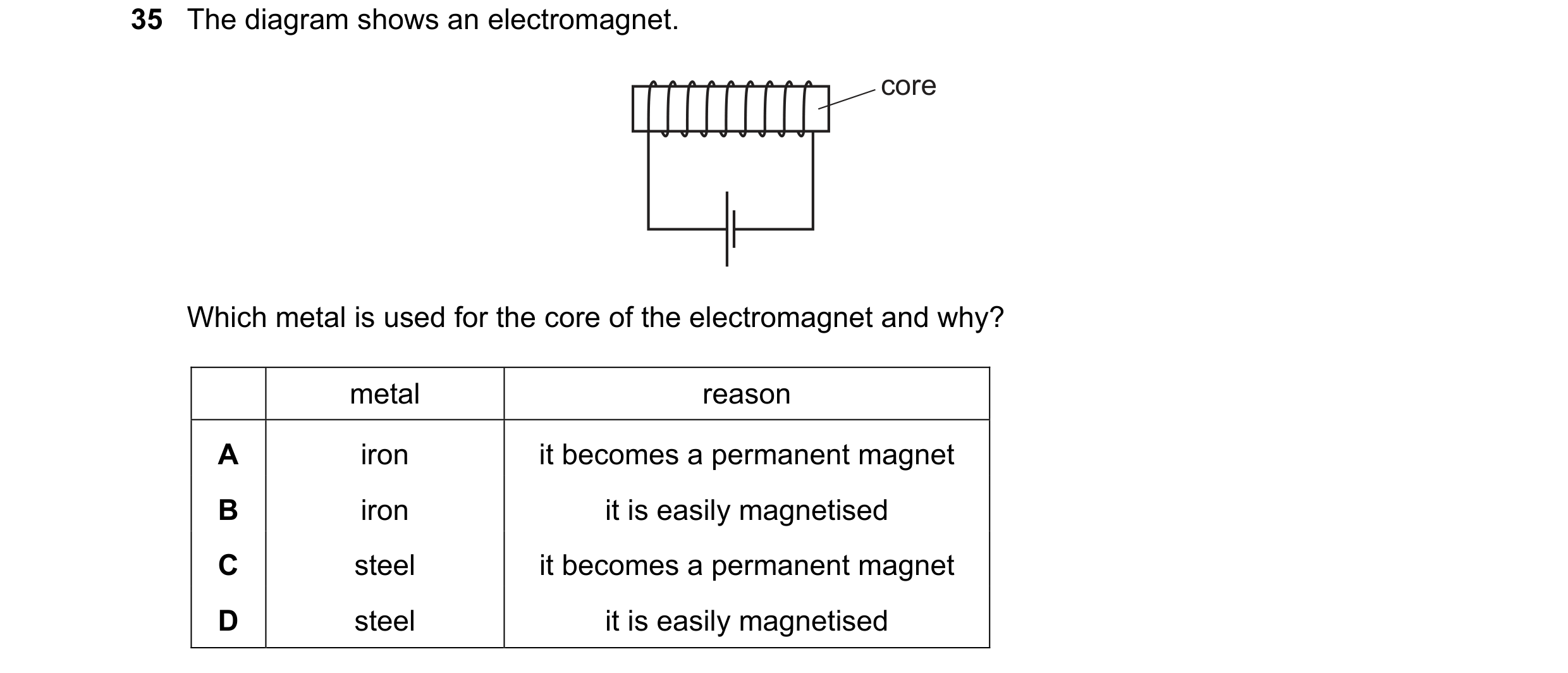
Q1 · The diagram shows an electromagnet 0973/11 May/June 2019
35 The diagram shows an electromagnet. core Which metal is used for the core of the electromagnet and why? metal reason A iron it becomes a permanent magnet B iron it is easily magnetised C steel it becomes a permanent magnet D steel it is easily magnetised
1 marks
Answer: B
This question in 0973/11 May/June 2019
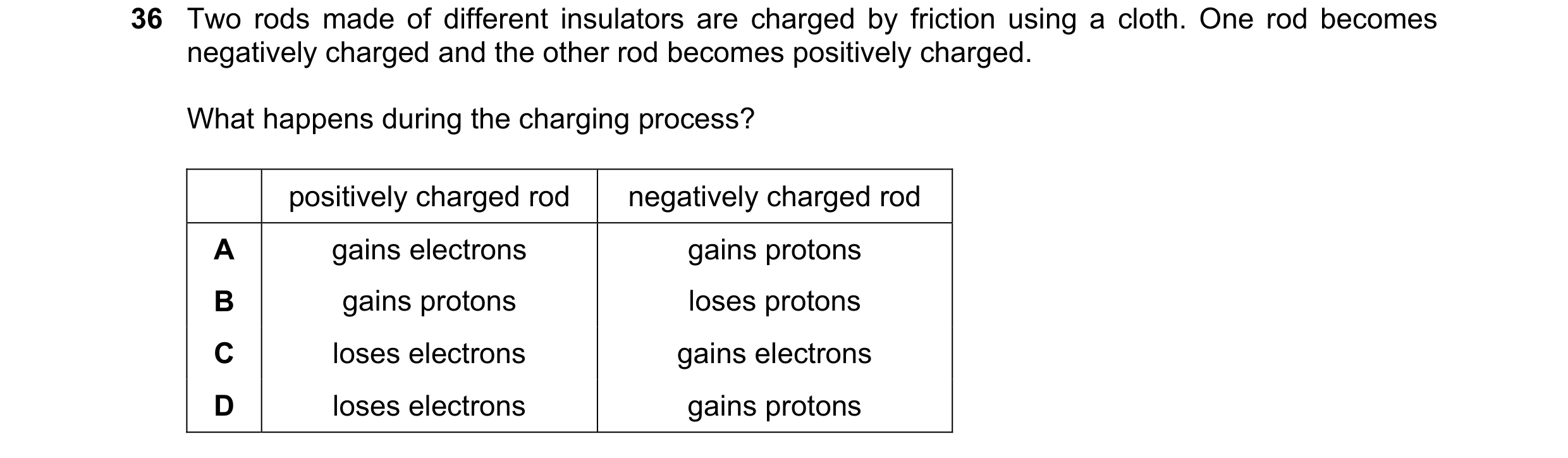
Q2 · Two rods made of different insulators are charged by friction using a cloth 0973/12 May/June 2020
36 Two rods made of different insulators are charged by friction using a cloth. One rod becomes negatively charged and the other rod becomes positively charged. What happens during the charging process? positively charged rod negatively charged rod A gains electrons gains protons B gains protons loses protons C loses electrons gains electrons D loses electrons gains protons
1 marks
Answer: C
This question in 0973/12 May/June 2020
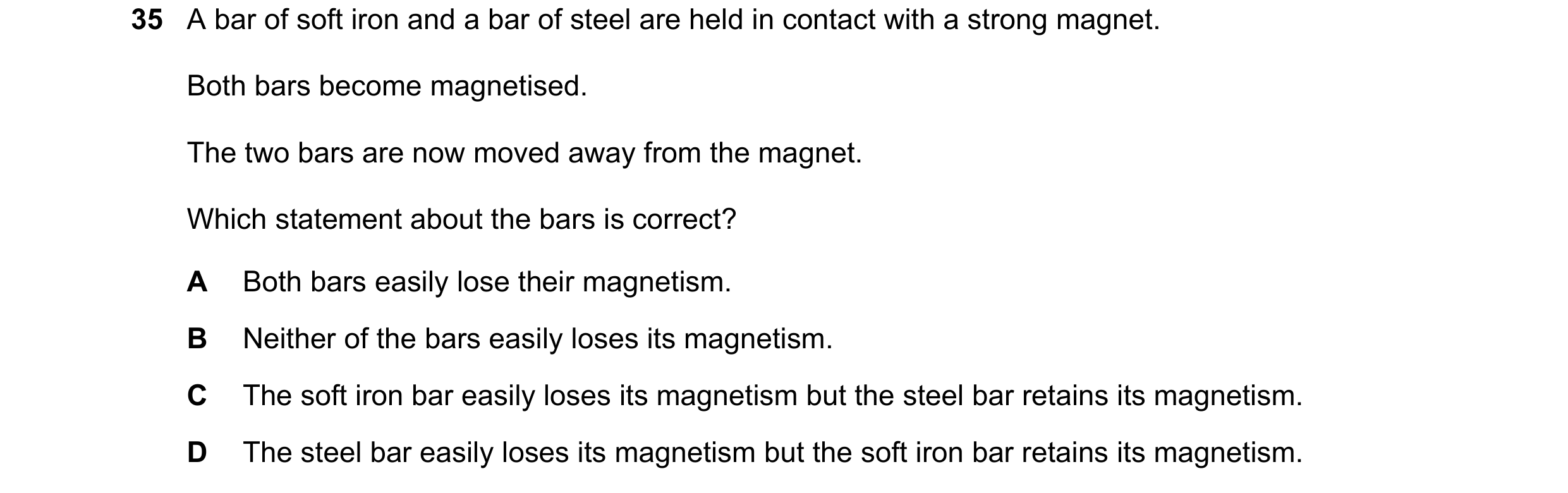
Q3 · A bar of soft iron and a bar of steel are held in contact with a strong magnet 0973/11 Oct/Nov 2020
35 A bar of soft iron and a bar of steel are held in contact with a strong magnet. Both bars become magnetised. The two bars are now moved away from the magnet. Which statement about the bars is correct? A Both bars easily lose their magnetism. B Neither of the bars easily loses its magnetism. C The soft iron bar easily loses its magnetism but the steel bar retains its magnetism. D The steel bar easily loses its magnetism but the soft iron bar retains its magnetism.
1 marks
Answer: C
This question in 0973/11 Oct/Nov 2020
Q4 · A rod is rubbed with a dry piece of cloth 0973/11 Oct/Nov 2021
36 A rod is rubbed with a dry piece of cloth. A scientist holds the rod in her hand and brings it close to a negatively charged plastic strip. The strip is suspended by an insulating thread. As the rod approaches the plastic strip, the strip moves towards the rod. insulating thread charged plastic – – – – – –– strip – – – – – – – – – – – – strip moves – towards rod hand rod Which statement is correct? A The rod is a negatively charged electrical conductor. B The rod is a negatively charged electrical insulator. C The rod is a positively charged electrical conductor. D The rod is a positively charged electrical insulator.
1 marks
Answer: D
This question in 0973/11 Oct/Nov 2021
Q5 · A plastic rod is rubbed with a cloth and the rod becomes positively charged 0973/11 May/June 2022
36 A plastic rod is rubbed with a cloth and the rod becomes positively charged. Why does this happen? A Electrons move from the cloth to the rod. B Electrons move from the rod to the cloth. C Protons move from the cloth to the rod. D Protons move from the rod to the cloth.
1 marks
Answer: B
This question in 0973/11 May/June 2022
Q6 · Which type of magnet can be switched on and off many times per second? 0973/11 Oct/Nov 2022
36 Which type of magnet can be switched on and off many times per second? A an electromagnet only B a permanent magnet only C both electromagnets and permanent magnets D neither electromagnets or permanent magnets
1 marks
Answer: A
This question in 0973/11 Oct/Nov 2022
Q7 · Two insulators are charged by rubbing them with a cloth 0973/11 May/June 2023
36 Two insulators are charged by rubbing them with a cloth. After this, the charged insulators repel each other. Which statement is a possible description of how the insulators become charged? A One gained electrons and the other gained protons. B One gained electrons and the other lost electrons. C They both lost electrons. D They both lost protons.
1 marks
Answer: C
This question in 0973/11 May/June 2023
Q8 · Which material is used for the core of an electromagnet? 0973/12 May/June 2023
36 Which material is used for the core of an electromagnet? A aluminium B copper C iron D steel
1 marks
Answer: C
This question in 0973/12 May/June 2023
Q9 · Three charged balls P, Q and R are suspended by insulating threads 0973/11 Oct/Nov 2023
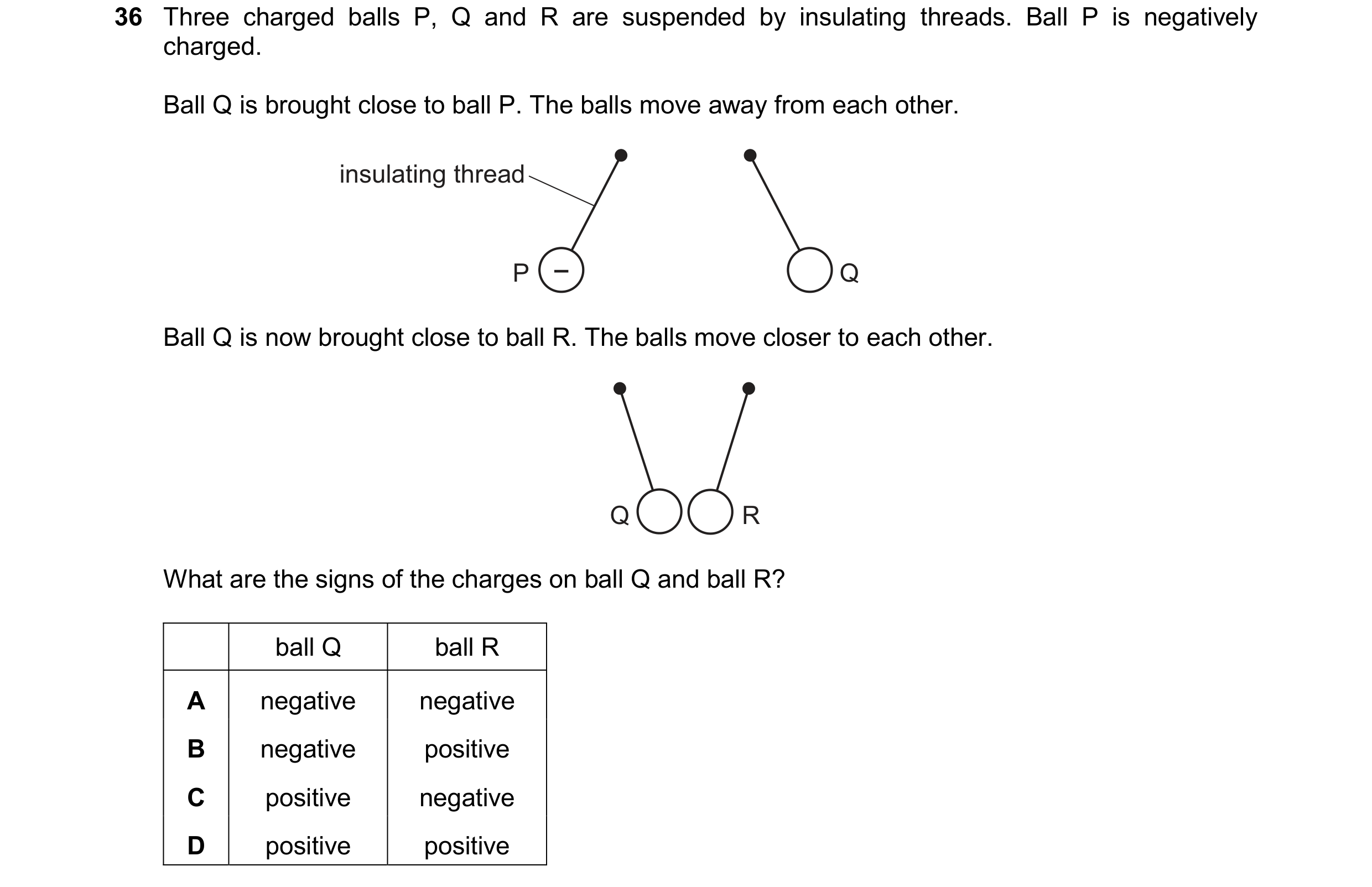
36 Three charged balls P, Q and R are suspended by insulating threads. Ball P is negatively charged. Ball Q is brought close to ball P. The balls move away from each other. insulating thread P – Q Ball Q is now brought close to ball R. The balls move closer to each other. Q R What are the signs of the charges on ball Q and ball R? ball Q ball R A negative negative B negative positive C positive negative D positive positive
1 marks
Answer: B
This question in 0973/11 Oct/Nov 2023
Q10 · A current-carrying wire passes through a flat card 0973/11 May/June 2024
39 A current-carrying wire passes through a flat card. The arrow on the wire shows the direction of the current. Which diagram shows the pattern of the magnetic field on the card and the direction of the magnetic field lines? A B wire wire current current card card C D wire wire current current card card
1 marks
Answer: D
This question in 0973/11 May/June 2024
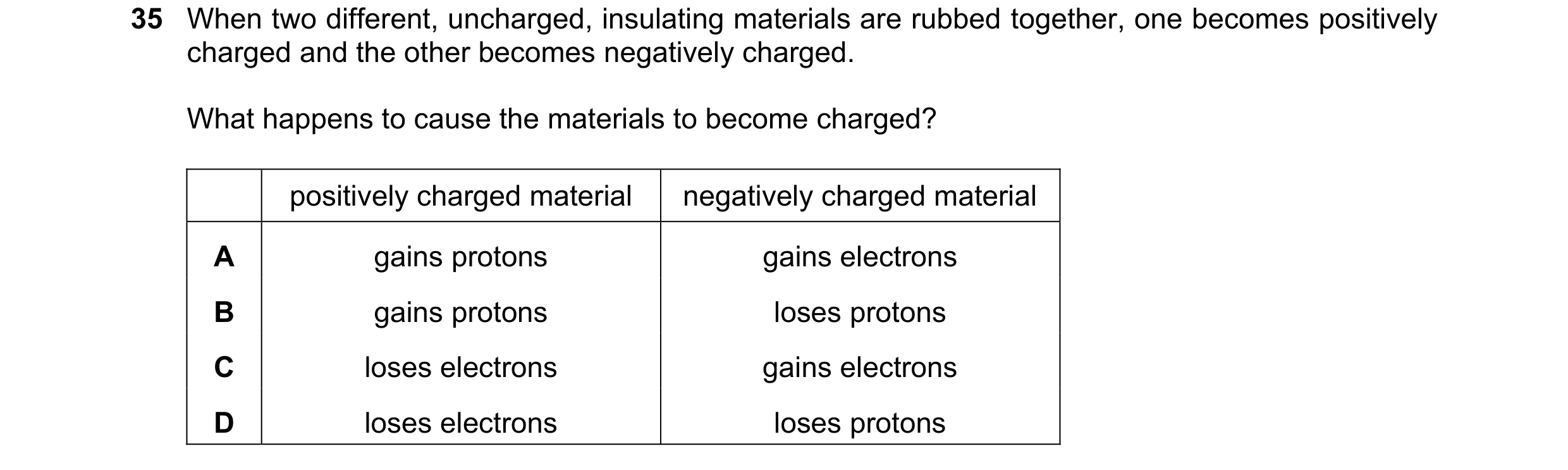
Q11 · When two different, uncharged, insulating materials are rubbed together, one becomes… 0973/12 May/June 2024
35 When two different, uncharged, insulating materials are rubbed together, one becomes positively charged and the other becomes negatively charged. What happens to cause the materials to become charged? positively charged material negatively charged material A gains protons gains electrons B gains protons loses protons C loses electrons gains electrons D loses electrons loses protons
1 marks
Answer: C
This question in 0973/12 May/June 2024
Q12 · Object P is positively charged and object Q is negatively charged 0973/11 Oct/Nov 2024
35 Object P is positively charged and object Q is negatively charged. Which row describes the force between P and Q and explains how they became charged? force between charge on P charge on Q P and Q caused by caused by A attractive gaining electrons losing electrons B attractive losing electrons gaining electrons C repulsive gaining electrons losing electrons D repulsive losing electrons gaining electrons
1 marks
Answer: B
This question in 0973/11 Oct/Nov 2024
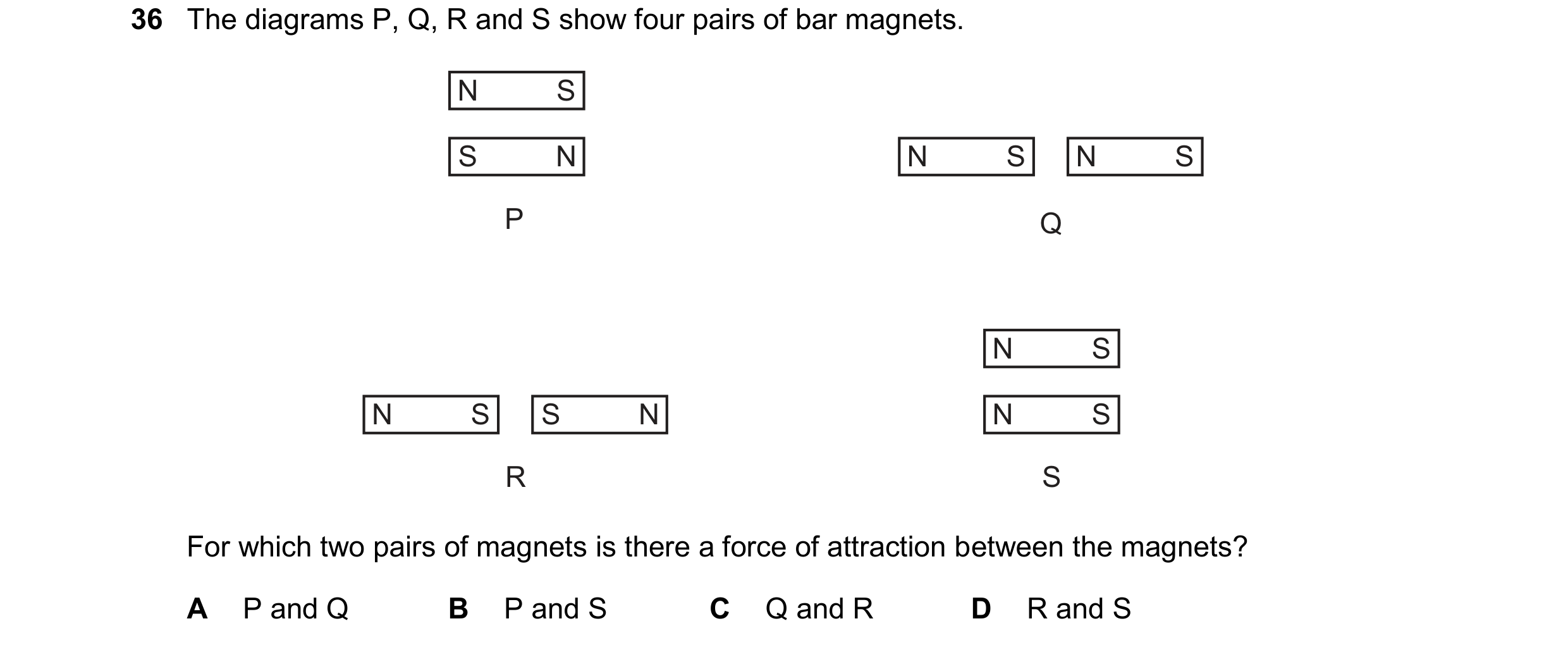
Q13 · The diagrams P, Q, R and S show four pairs of bar magnets 0973/11 Oct/Nov 2025
36 The diagrams P, Q, R and S show four pairs of bar magnets. N S S N N S N S P Q N S N S S N N S R S For which two pairs of magnets is there a force of attraction between the magnets? A P and Q B P and S C Q and R D R and S
1 marks
Answer: A
This question in 0973/11 Oct/Nov 2025
 1 / 5
1 / 5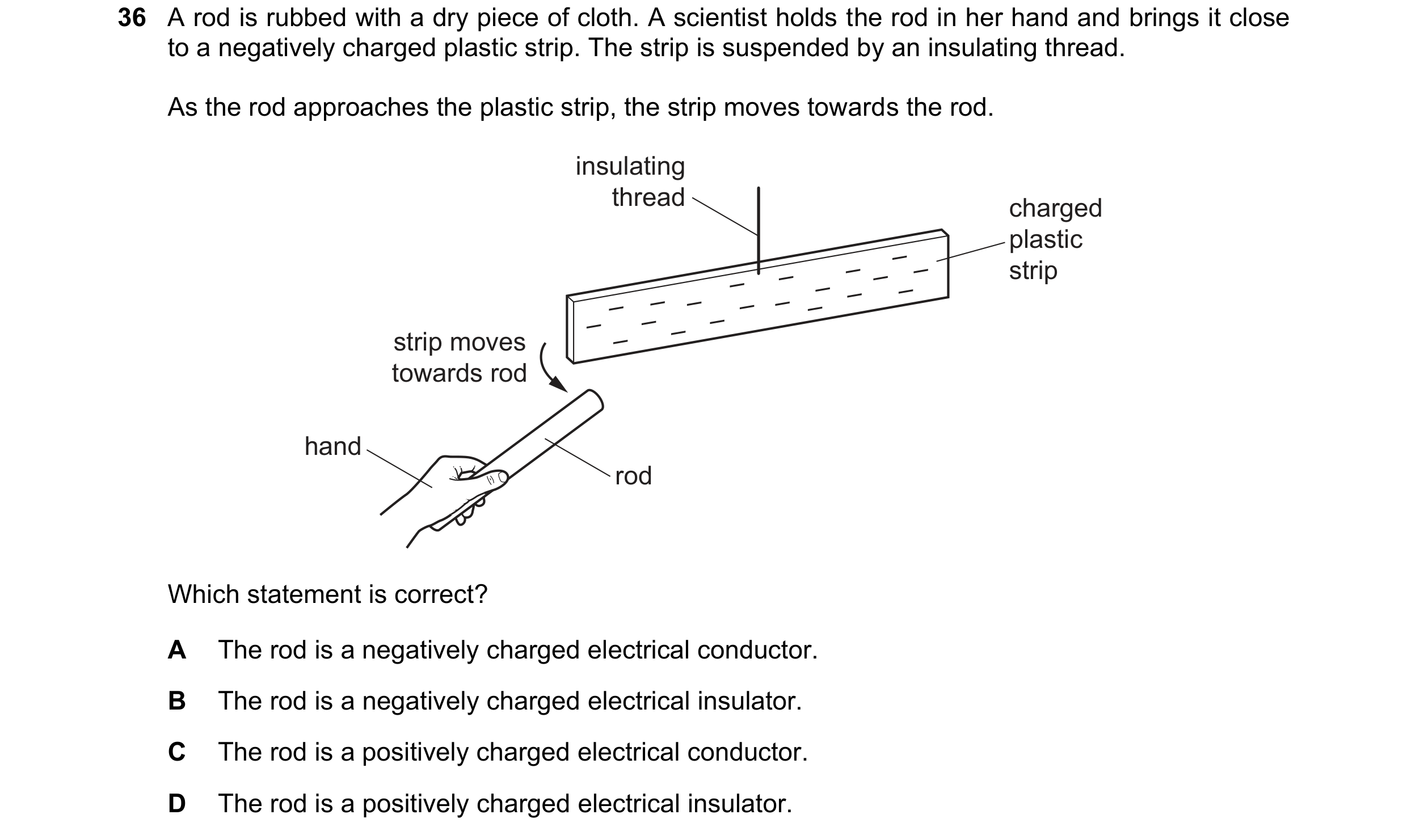

 2 / 5
2 / 5
 3 / 5
3 / 5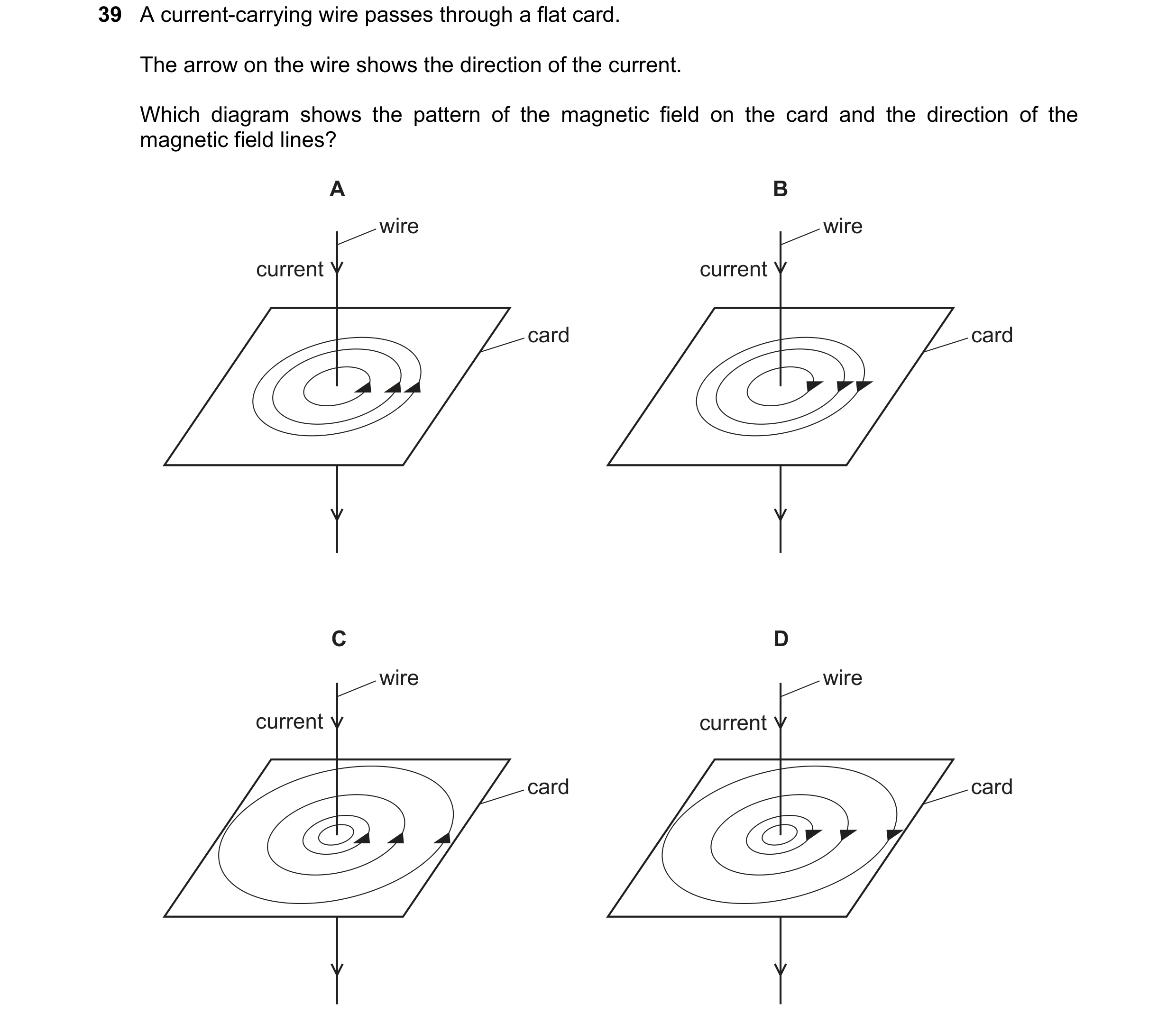
 4 / 5
4 / 5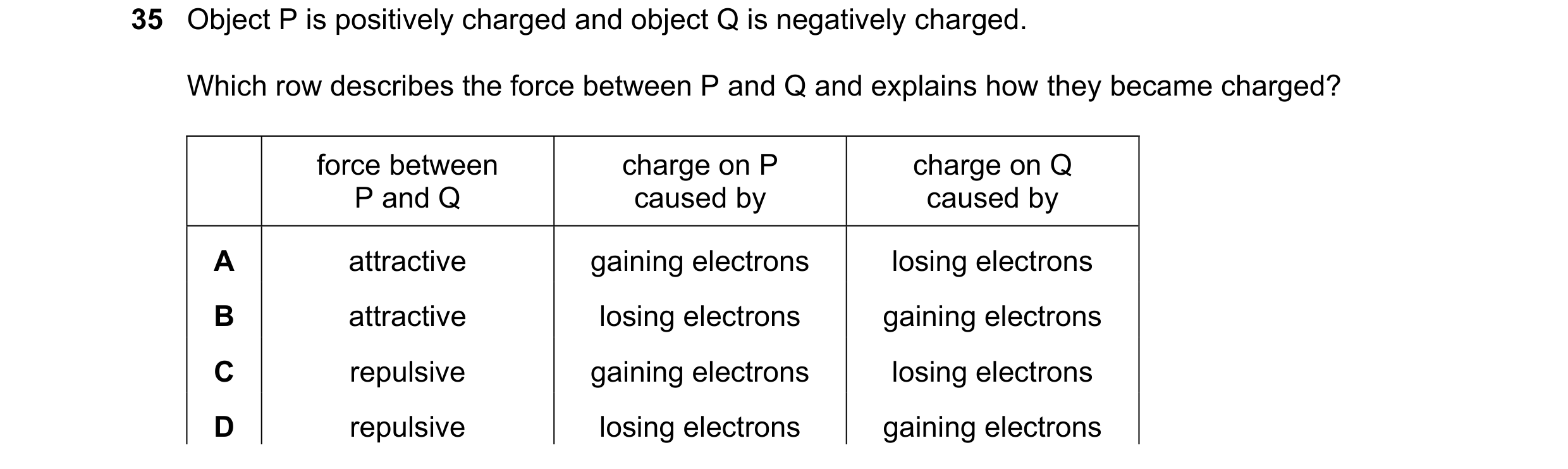
 5 / 5
5 / 5