Questions as text
Q1 · An acid is added to an alkali until the final solution is just neutral 0973/11 May/June 2019
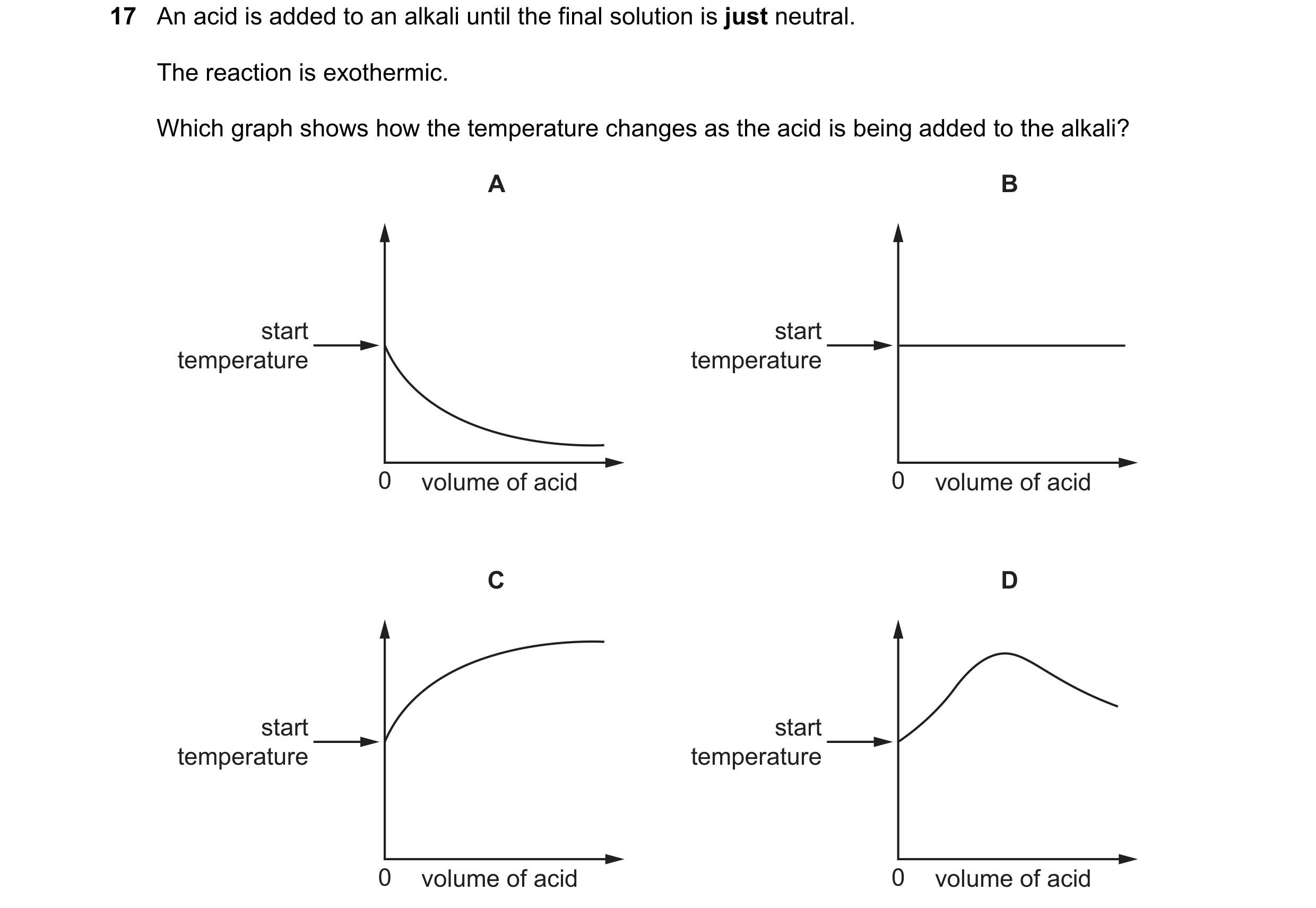
17 An acid is added to an alkali until the final solution is just neutral. The reaction is exothermic. Which graph shows how the temperature changes as the acid is being added to the alkali? A B start start temperature temperature 0 volume of acid 0 volume of acid C D start start temperature temperature 0 volume of acid 0 volume of acid
1 marks
Answer: C
This question in 0973/11 May/June 2019
Q2 · A student investigates temperature changes in four chemical reactions, as shown 0973/11 May/June 2020
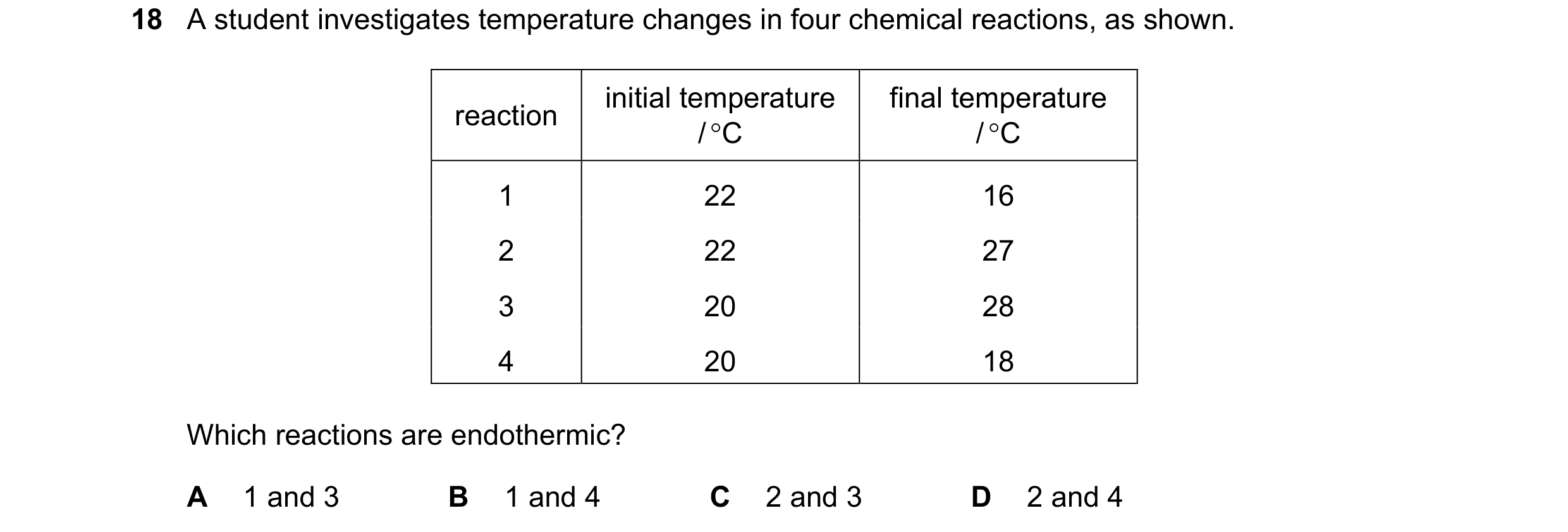
18 A student investigates temperature changes in four chemical reactions, as shown. initial temperature final temperature reaction / °C / °C 1 22 16 2 22 27 3 20 28 4 20 18 Which reactions are endothermic? A 1 and 3 B 1 and 4 C 2 and 3 D 2 and 4
1 marks
Answer: B
This question in 0973/11 May/June 2020
Q3 · Equal amounts of four different substances are added to equal volumes of the same acid of… 0973/12 May/June 2020
18 Equal amounts of four different substances are added to equal volumes of the same acid of the same concentration in reactions W, X, Y and Z. The initial temperature of the acid before each reaction is 21 °C. The final temperatures of the mixtures are measured. The results are shown. reaction W X Y Z final temperature / °C 28 19 26 17 Which row is correct? most endothermic most exothermic reaction reaction A W Z B Z W C X Y D Y X
1 marks
Answer: B
This question in 0973/12 May/June 2020
Q4 · Which statement describes the meaning of exothermic? 0973/11 Oct/Nov 2020
18 Which statement describes the meaning of exothermic? A Heat energy is given out. B Heat energy is taken in. C Oxygen is given out. D Oxygen is taken in.
1 marks
Answer: A
This question in 0973/11 Oct/Nov 2020
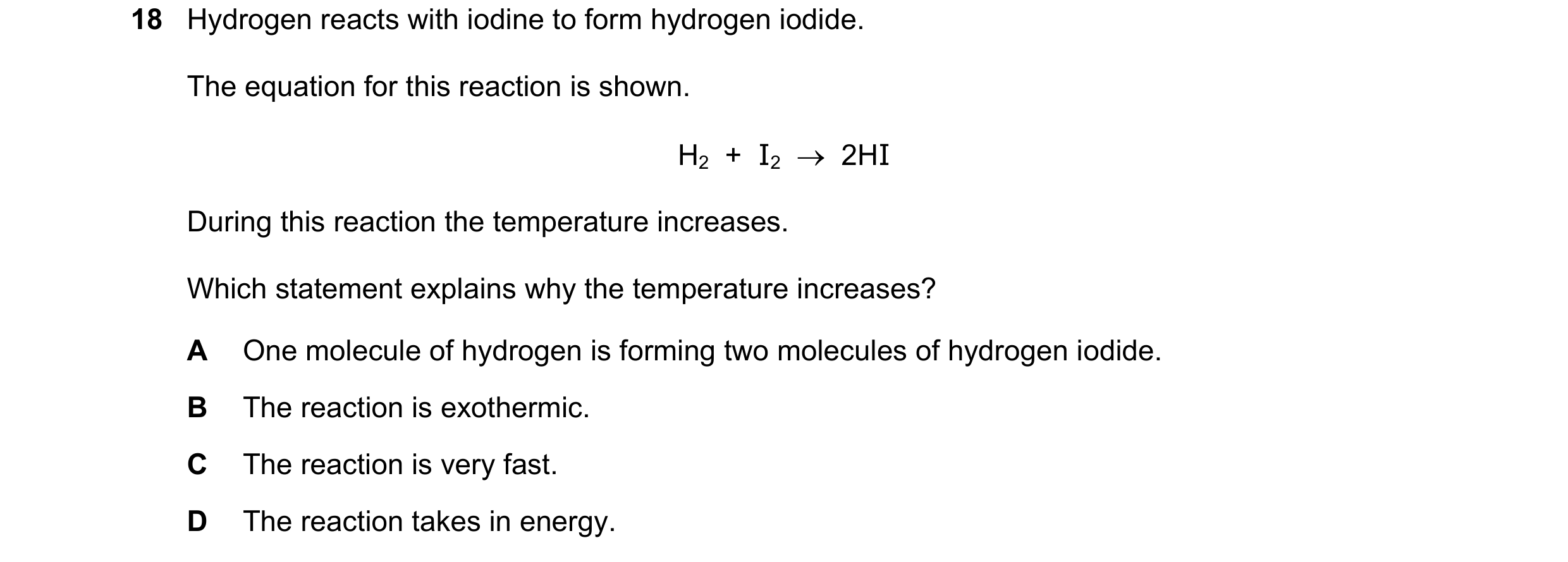
Q5 · Hydrogen reacts with iodine to form hydrogen iodide 0973/12 May/June 2021
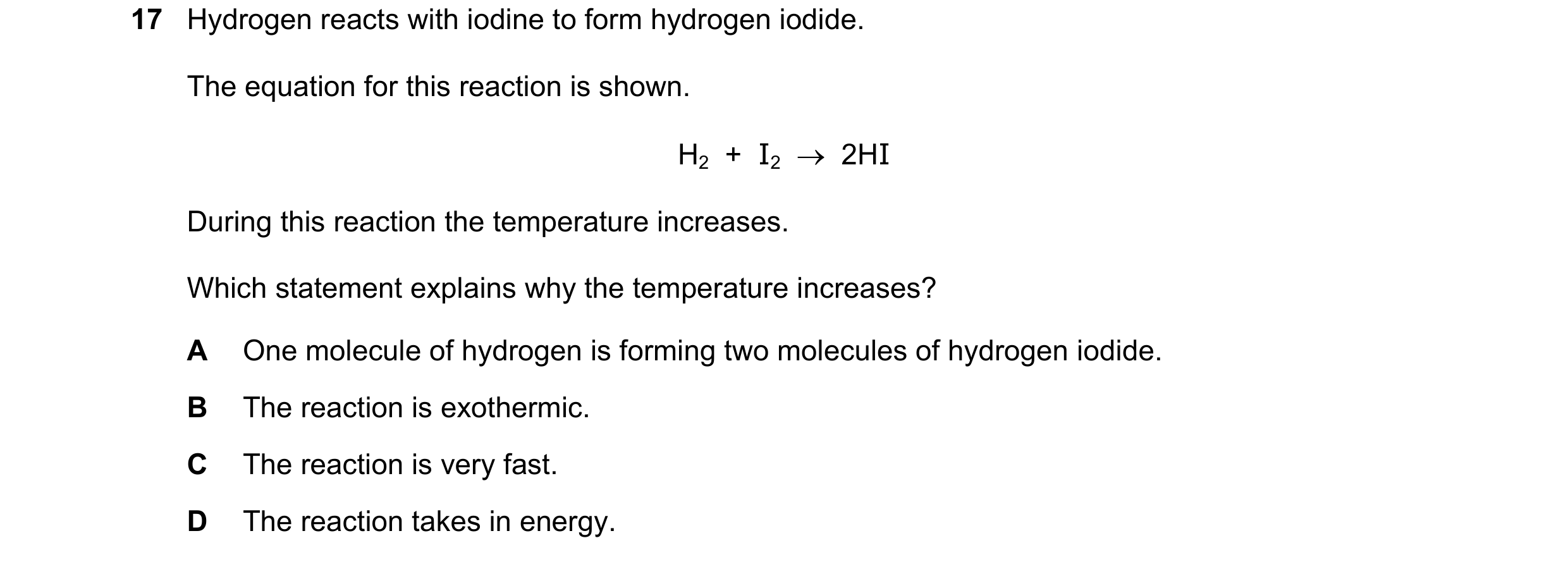
17 Hydrogen reacts with iodine to form hydrogen iodide. The equation for this reaction is shown. H2 + I2 2HI During this reaction the temperature increases. Which statement explains why the temperature increases? A One molecule of hydrogen is forming two molecules of hydrogen iodide. B The reaction is exothermic. C The reaction is very fast. D The reaction takes in energy.
1 marks
Answer: B
This question in 0973/12 May/June 2021
Q6 · The initial and final temperatures of four different experiments are measured 0973/11 Oct/Nov 2021
18 The initial and final temperatures of four different experiments are measured. The results are shown. Which experiment is the most endothermic? initial final temperature temperature / C / C A 22 17 B 21 25 C 20 27 D 20 18
1 marks
Answer: A
This question in 0973/11 Oct/Nov 2021
Q7 · Hydrogen reacts with iodine to form hydrogen iodide 0973/11 May/June 2022
18 Hydrogen reacts with iodine to form hydrogen iodide. The equation for this reaction is shown. H2 + I2 2HI During this reaction the temperature increases. Which statement explains why the temperature increases? A One molecule of hydrogen is forming two molecules of hydrogen iodide. B The reaction is exothermic. C The reaction is very fast. D The reaction takes in energy.
1 marks
Answer: B
This question in 0973/11 May/June 2022
Q8 · Which word describes reactions that give out heat energy? 0973/12 May/June 2022
18 Which word describes reactions that give out heat energy? A endothermic B exothermic C oxidation D reduction
1 marks
Answer: B
This question in 0973/12 May/June 2022
Q9 · Equal amounts of substances W, X, Y and Z are reacted separately with equal amounts of… 0973/11 Oct/Nov 2022
18 Equal amounts of substances W, X, Y and Z are reacted separately with equal amounts of dilute acid. The following temperature changes are recorded. substance temperature change / C W increases by 8 X decreases by 6 Y increases by 9 Z decreases by 4 Which substances produce the most exothermic and the least endothermic reactions? most least exothermic endothermic A W X B W Z C X Y D Y Z
1 marks
Answer: D
This question in 0973/11 Oct/Nov 2022
Q10 · Which statement about exothermic and endothermic reactions is correct? 0973/11 May/June 2023
19 Which statement about exothermic and endothermic reactions is correct? A An endothermic reaction involves heat energy being taken in by the reactants. B An exothermic reaction involves heat energy being taken in by the products. C In an endothermic reaction, the temperature of the reaction mixture increases. D In an exothermic reaction, the temperature of the reaction mixture decreases.
1 marks
Answer: A
This question in 0973/11 May/June 2023
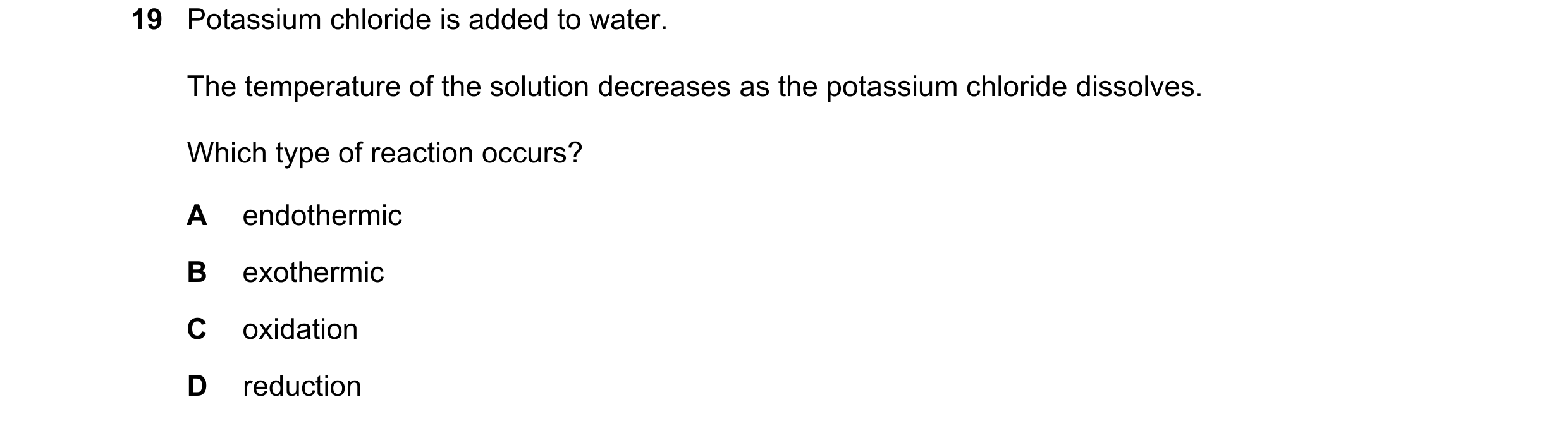
Q11 · Potassium chloride is added to water 0973/12 May/June 2023
19 Potassium chloride is added to water. The temperature of the solution decreases as the potassium chloride dissolves. Which type of reaction occurs? A endothermic B exothermic C oxidation D reduction
1 marks
Answer: A
This question in 0973/12 May/June 2023
Q12 · When aqueous sodium hydroxide reacts with dilute hydrochloric acid, the temperature of… 0973/11 May/June 2024
19 When aqueous sodium hydroxide reacts with dilute hydrochloric acid, the temperature of the reaction mixture increases. Ice cubes take in energy when they melt. Which row is correct? sodium hydroxide + melting ice cubes hydrochloric acid A endothermic exothermic B exothermic endothermic C endothermic endothermic D exothermic exothermic
1 marks
Answer: B
This question in 0973/11 May/June 2024
Q13 · Four different substances are added to the same acid of the same concentration in… 0973/11 Oct/Nov 2024
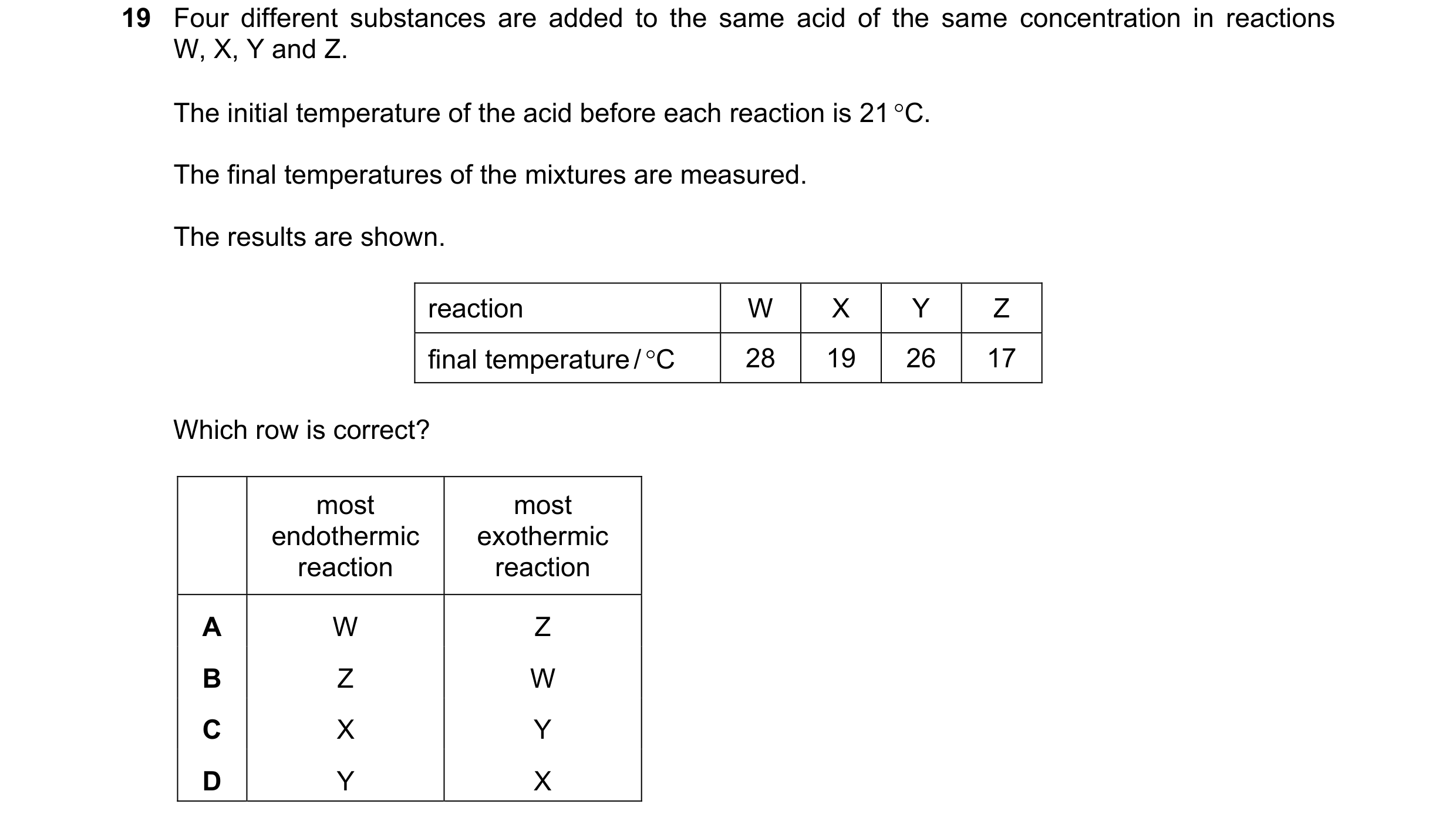
19 Four different substances are added to the same acid of the same concentration in reactions W, X, Y and Z. The initial temperature of the acid before each reaction is 21 C. The final temperatures of the mixtures are measured. The results are shown. reaction W X Y Z final temperature / C 28 19 26 17 Which row is correct? most most endothermic exothermic reaction reaction A W Z B Z W C X Y D Y X
1 marks
Answer: B
This question in 0973/11 Oct/Nov 2024
Q14 · Equal masses of four substances are added separately to different samples of 10 cm3 of… 0973/11 May/June 2025
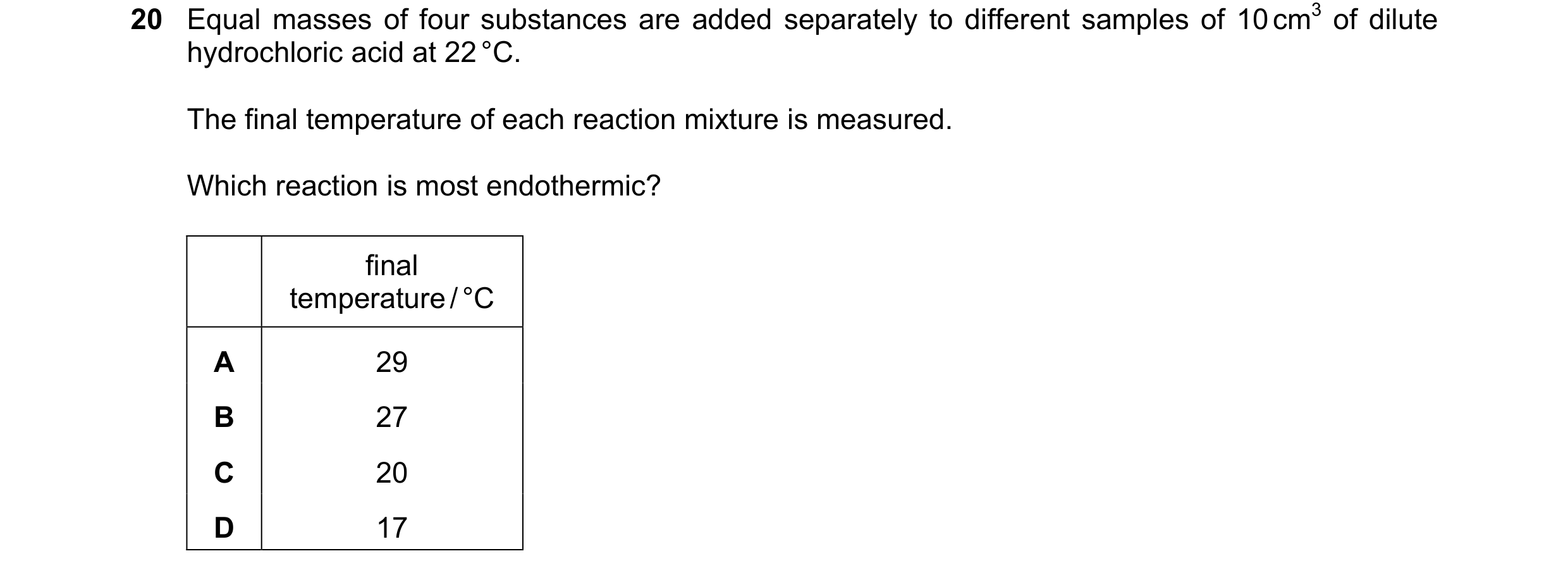
20 Equal masses of four substances are added separately to different samples of 10 cm3 of dilute hydrochloric acid at 22 °C. The final temperature of each reaction mixture is measured. Which reaction is most endothermic? final temperature / °C A 29 B 27 C 20 D 17
1 marks
Answer: D
This question in 0973/11 May/June 2025
Q15 · Which statements about endothermic reactions are correct? 0973/12 May/June 2025
17 Which statements about endothermic reactions are correct? 1 Thermal energy is taken in from the surroundings. 2 Thermal energy is released to the surroundings. 3 The temperature of the reaction mixture decreases. 4 The temperature of the reaction mixture increases. A 1 and 3 B 1 and 4 C 2 and 3 D 2 and 4
1 marks
Answer: A
This question in 0973/12 May/June 2025
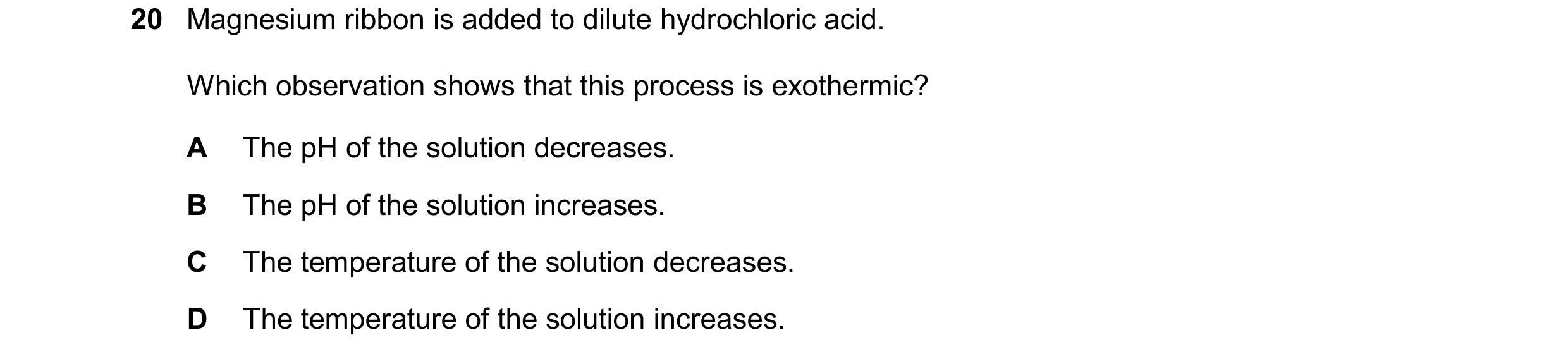
Q16 · Magnesium ribbon is added to dilute hydrochloric acid 0973/11 Oct/Nov 2025
20 Magnesium ribbon is added to dilute hydrochloric acid. Which observation shows that this process is exothermic? A The pH of the solution decreases. B The pH of the solution increases. C The temperature of the solution decreases. D The temperature of the solution increases.
1 marks
Answer: D
This question in 0973/11 Oct/Nov 2025
 1 / 6
1 / 6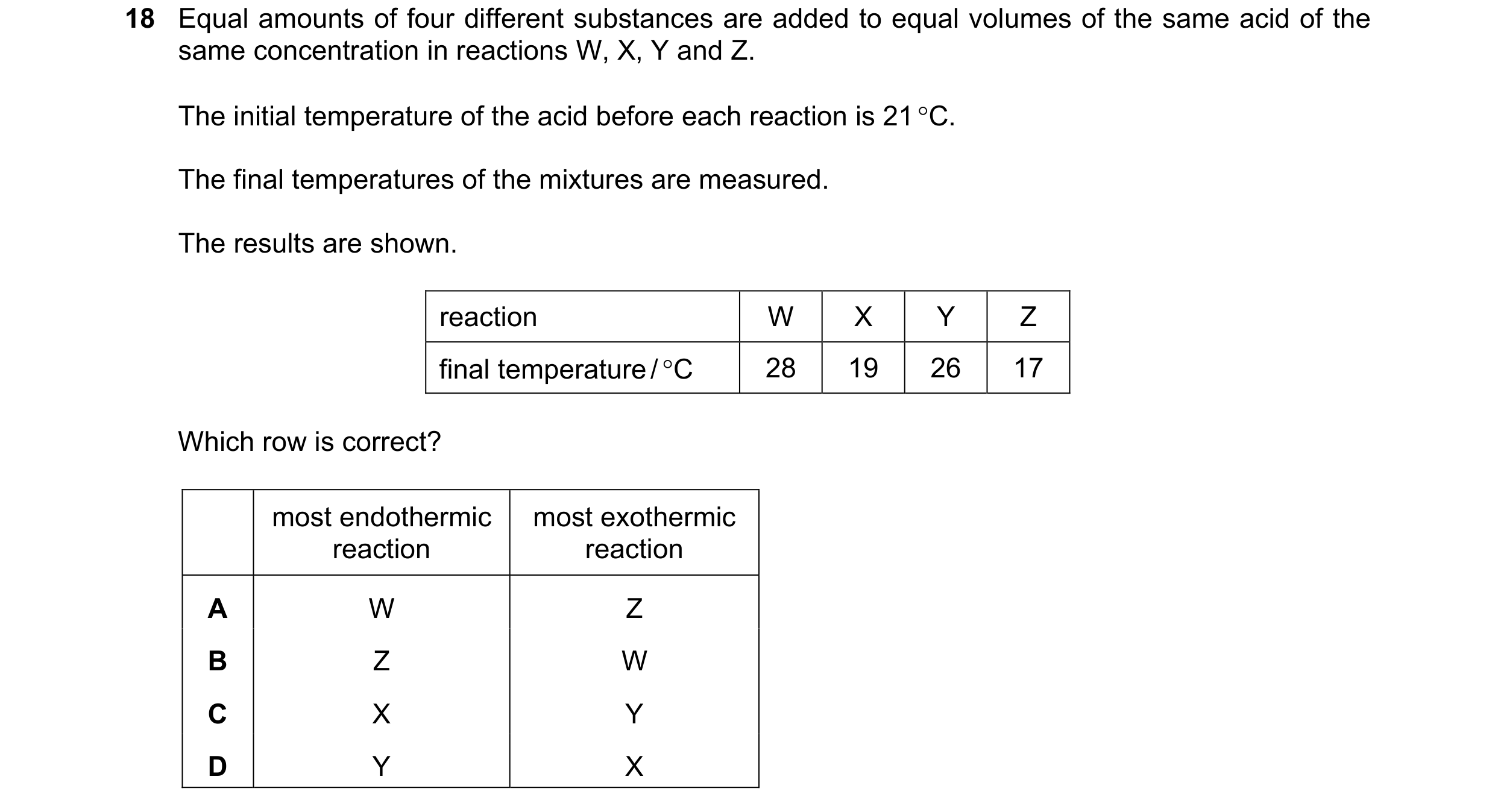

 2 / 6
2 / 6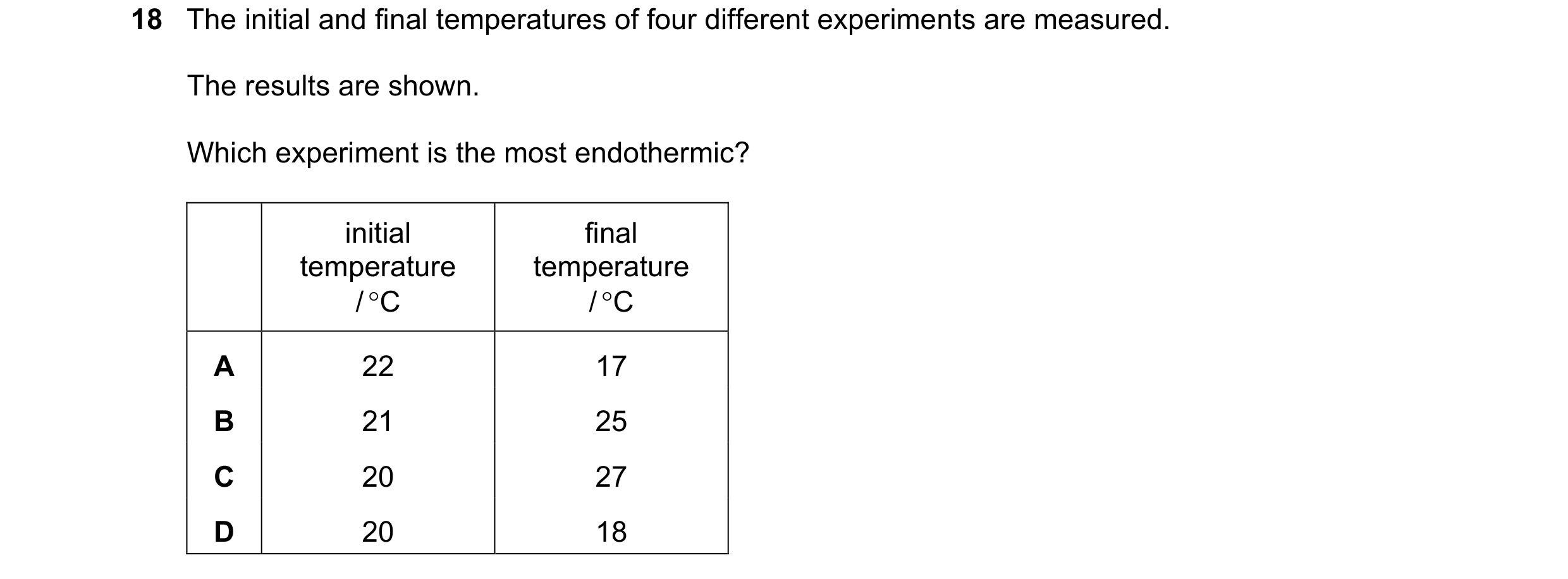
 3 / 6
3 / 6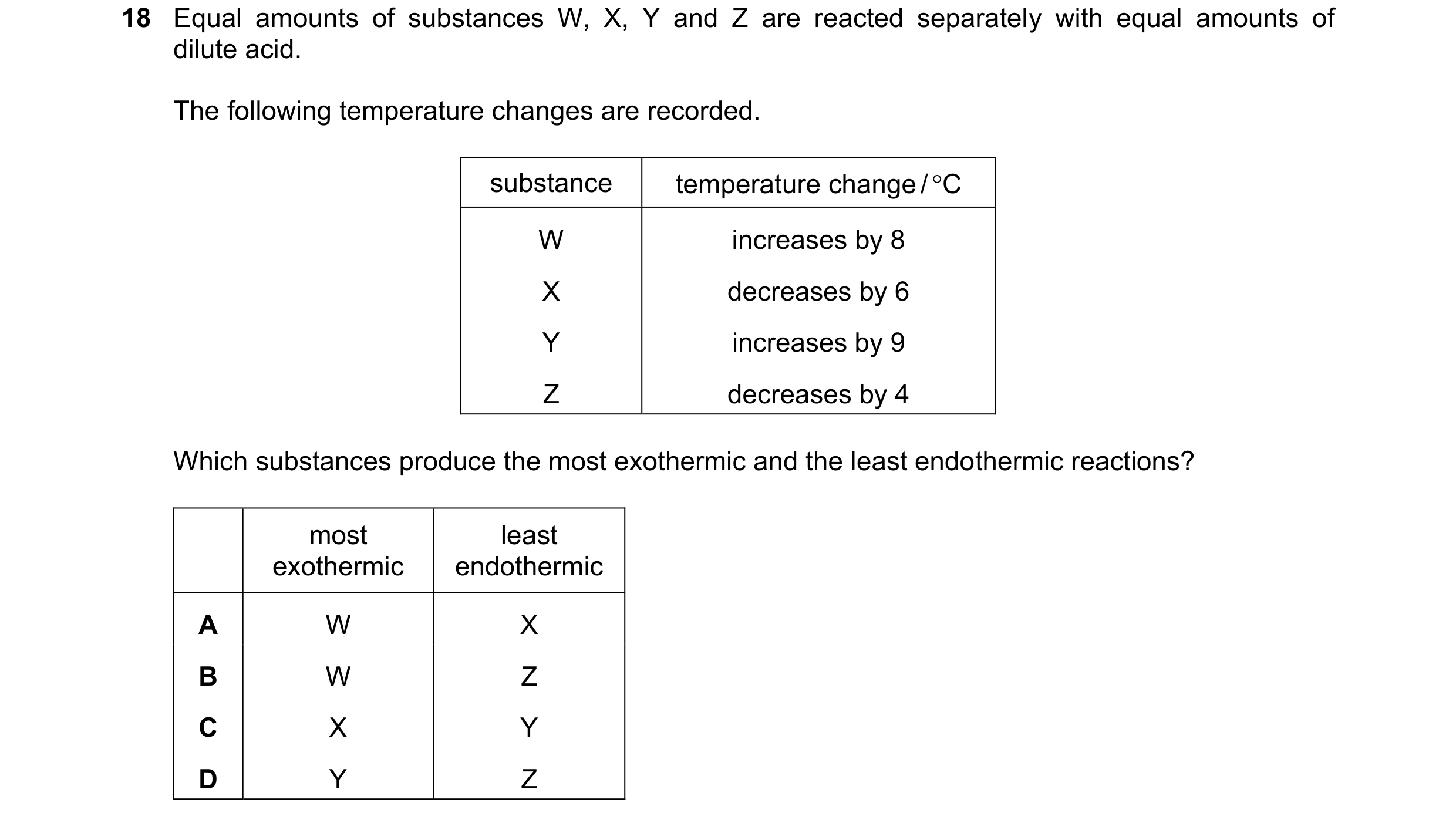

 4 / 6
4 / 6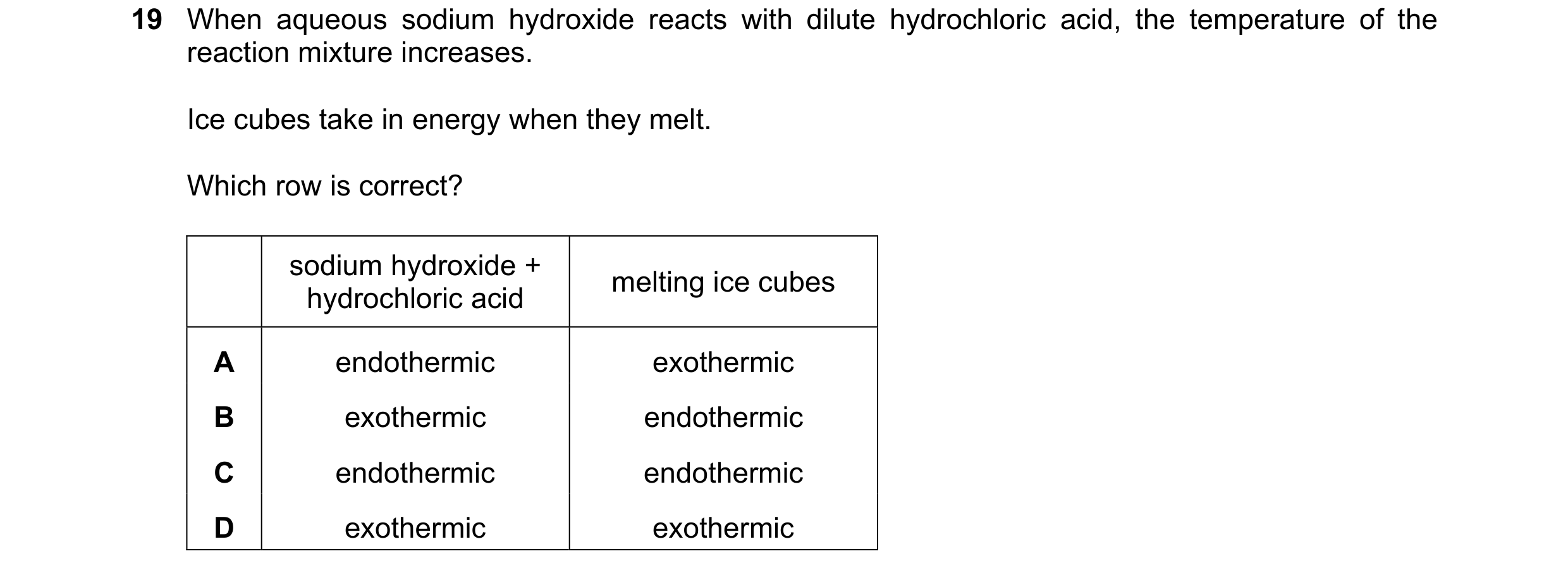
 5 / 6
5 / 6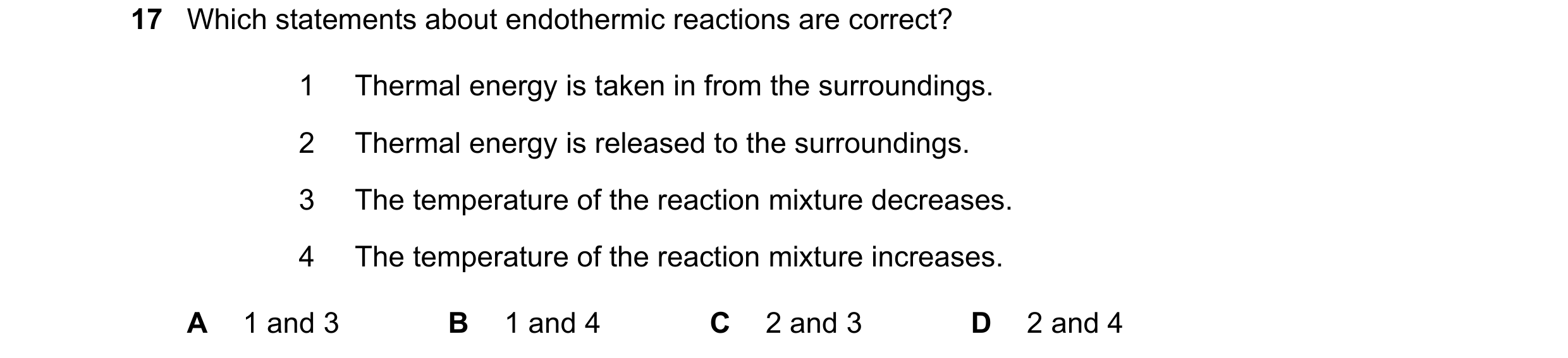
 6 / 6
6 / 6