Questions as text
Q1 · Which gas turns damp red litmus paper blue? 0973/11 May/June 2020
21 Which gas turns damp red litmus paper blue? A ammonia B carbon dioxide C chlorine D hydrogen
1 marks
Answer: A
This question in 0973/11 May/June 2020
Q2 · Some students investigated aerobic respiration in woodlice 0973/12 May/June 2020
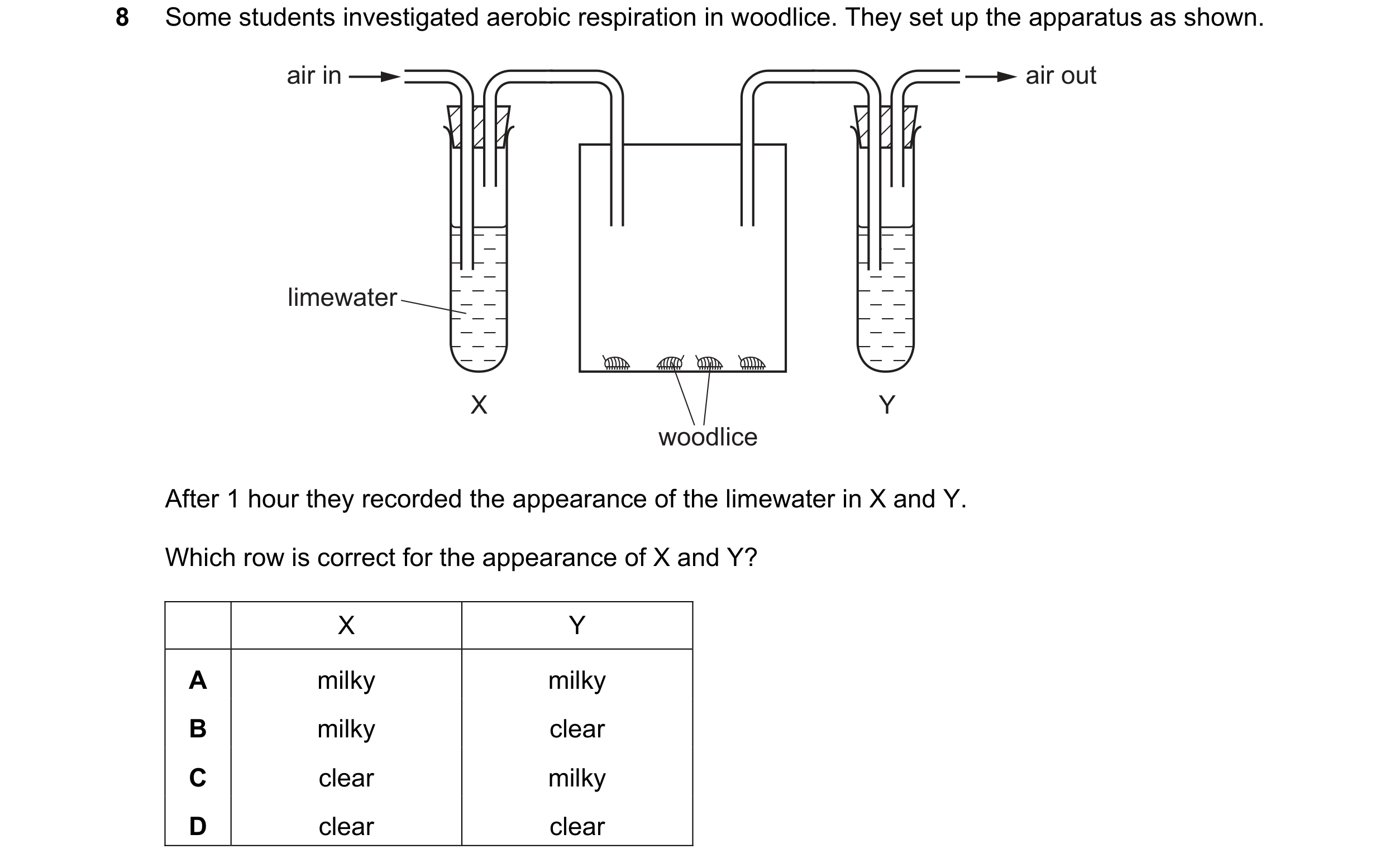
8 Some students investigated aerobic respiration in woodlice. They set up the apparatus as shown. air in air out limewater X Y woodlice After 1 hour they recorded the appearance of the limewater in X and Y. Which row is correct for the appearance of X and Y? X Y A milky milky B milky clear C clear milky D clear clear
1 marks
Answer: C
This question in 0973/12 May/June 2020
Q3 · Which test is used to identify sulfate ions? 0973/12 May/June 2020
21 Which test is used to identify sulfate ions? A aqueous barium ions under acidic conditions B aqueous silver nitrate under acidic conditions C dilute acid and then limewater D reduction with aluminium
1 marks
Answer: A
This question in 0973/12 May/June 2020
Q4 · Which chemical test does not produce a precipitate? 0973/11 Oct/Nov 2020
20 Which chemical test does not produce a precipitate? A carbon dioxide and limewater B carbonate ions and dilute hydrochloric acid C chloride ions and aqueous silver nitrate D copper(II) ions and aqueous sodium hydroxide
1 marks
Answer: B
This question in 0973/11 Oct/Nov 2020
Q5 · Three different tests are carried out on an aqueous solution of substance X 0973/11 May/June 2021
19 Three different tests are carried out on an aqueous solution of substance X. The results are shown. test result add a few drops of aqueous sodium hydroxide blue precipitate add acidified aqueous silver nitrate no precipitate add acidified aqueous barium nitrate white precipitate What is X? A copper(II) chloride B copper(II) sulfate C iron(II) chloride D iron(II) sulfate
1 marks
Answer: B
This question in 0973/11 May/June 2021
Q6 · The apparatus used to investigate the combustion of ethanol is shown 0973/11 May/June 2021
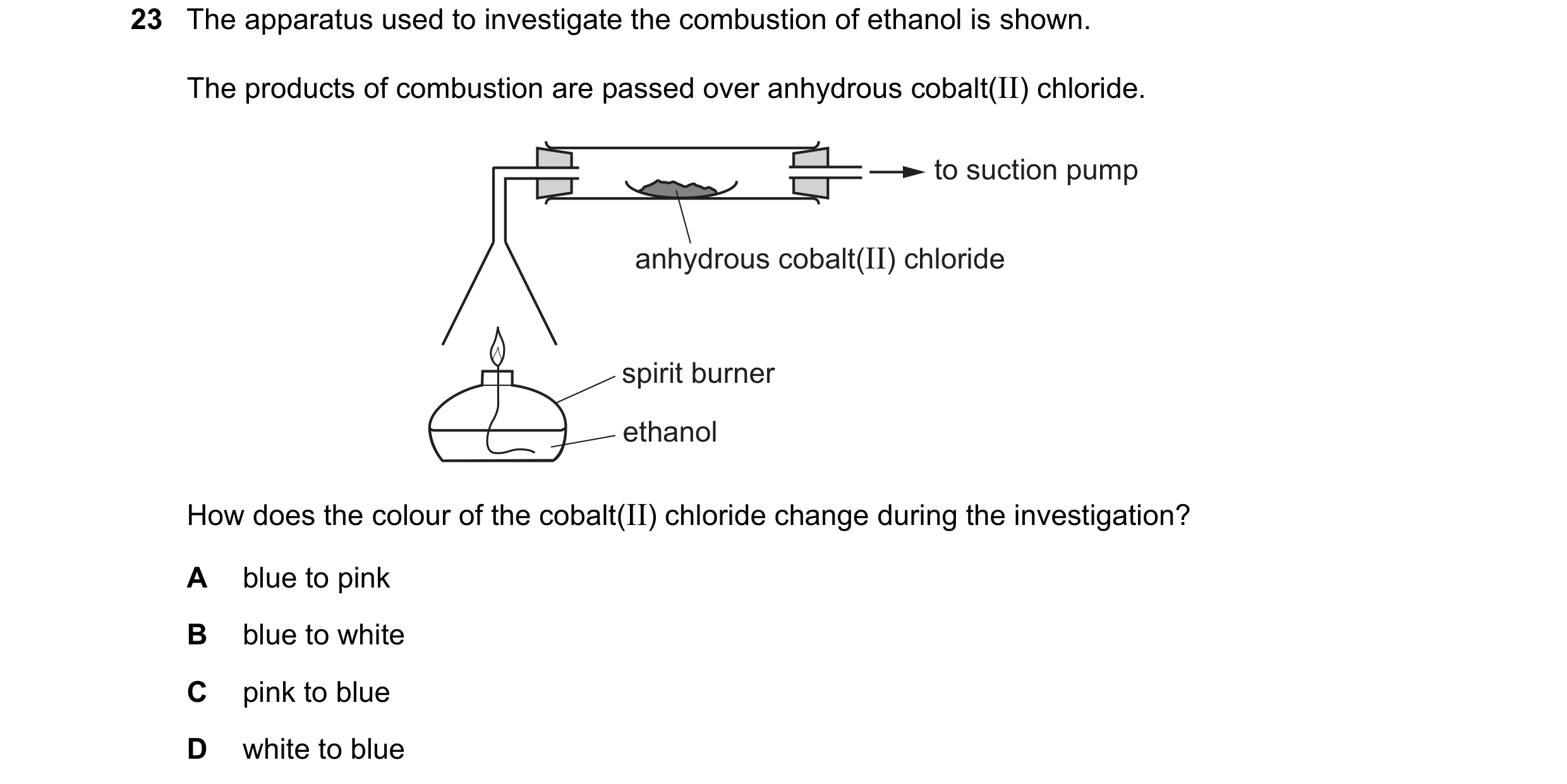
23 The apparatus used to investigate the combustion of ethanol is shown. The products of combustion are passed over anhydrous cobalt(II) chloride. to suction pump anhydrous cobalt(II) chloride spirit burner ethanol How does the colour of the cobalt(II) chloride change during the investigation? A blue to pink B blue to white C pink to blue D white to blue
1 marks
Answer: A
This question in 0973/11 May/June 2021
Q7 · The results of two tests on substance X are listed 0973/12 May/June 2021
19 The results of two tests on substance X are listed. 1 A lilac flame is produced in a flame test. 2 A gas which turns damp red litmus blue is produced when X is heated with aluminium powder and aqueous sodium hydroxide. What is X? A potassium nitrate B potassium sulfate C sodium nitrate D sodium sulfate
1 marks
Answer: A
This question in 0973/12 May/June 2021
Q8 · A student investigated the effect of pH on an enzyme that digests starch 0973/11 Oct/Nov 2021
4 A student investigated the effect of pH on an enzyme that digests starch. Which chemical will be needed to determine if any starch has been digested? A Benedict’s solution B biuret solution C iodine solution D ethanol
1 marks
Answer: A
This question in 0973/11 Oct/Nov 2021
Q9 · What is the colour of cobalt(II) chloride after water is added to it? 0973/11 Oct/Nov 2021
23 What is the colour of cobalt(II) chloride after water is added to it? A blue B pink C white D green
1 marks
Answer: B
This question in 0973/11 Oct/Nov 2021
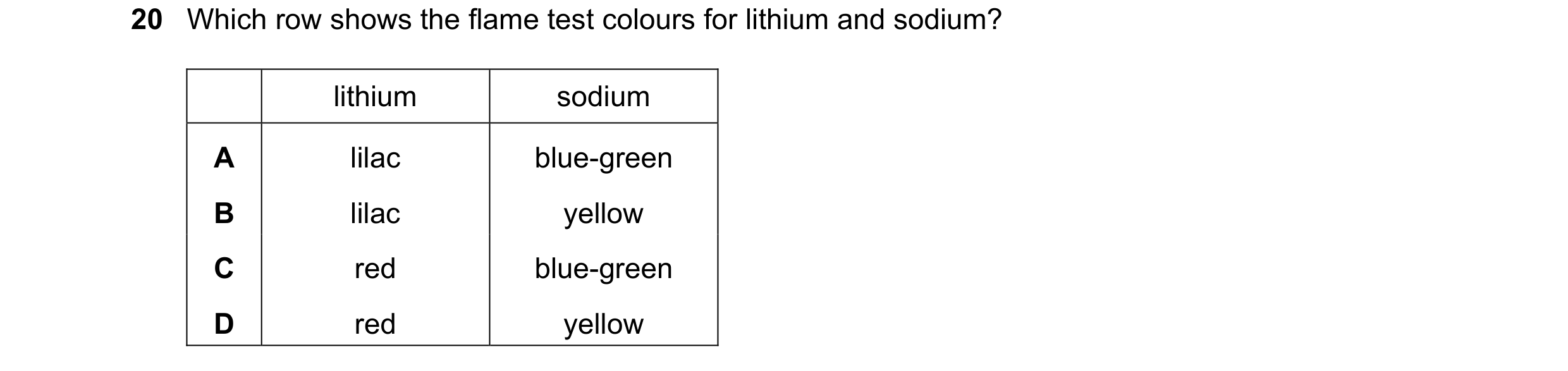
Q10 · Which row shows the flame test colours for lithium and sodium? 0973/11 May/June 2022
20 Which row shows the flame test colours for lithium and sodium? lithium sodium A lilac blue-green B lilac yellow C red blue-green D red yellow
1 marks
Answer: D
This question in 0973/11 May/June 2022
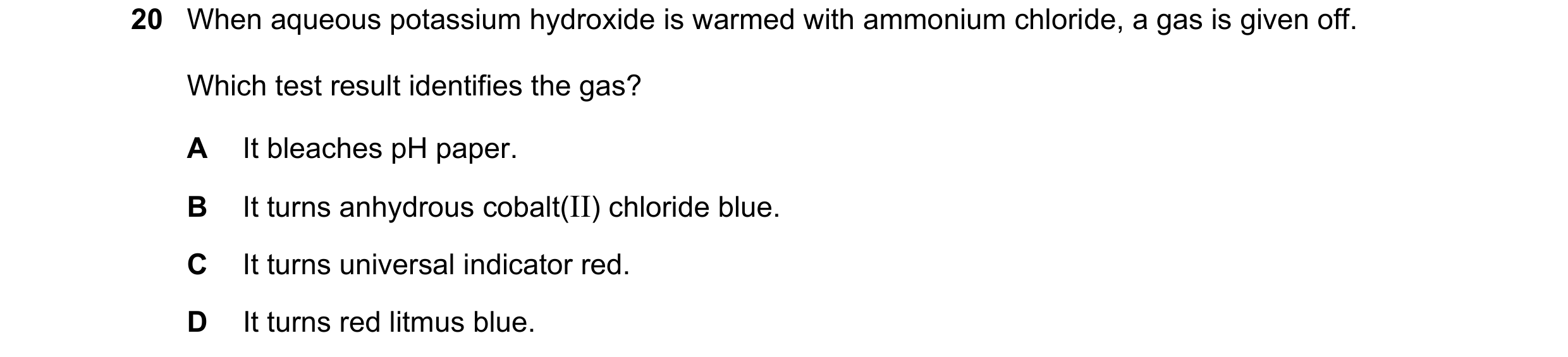
Q11 · When aqueous potassium hydroxide is warmed with ammonium chloride, a gas is given off 0973/12 May/June 2022
20 When aqueous potassium hydroxide is warmed with ammonium chloride, a gas is given off. Which test result identifies the gas? A It bleaches pH paper. B It turns anhydrous cobalt(II) chloride blue. C It turns universal indicator red. D It turns red litmus blue.
1 marks
Answer: D
This question in 0973/12 May/June 2022
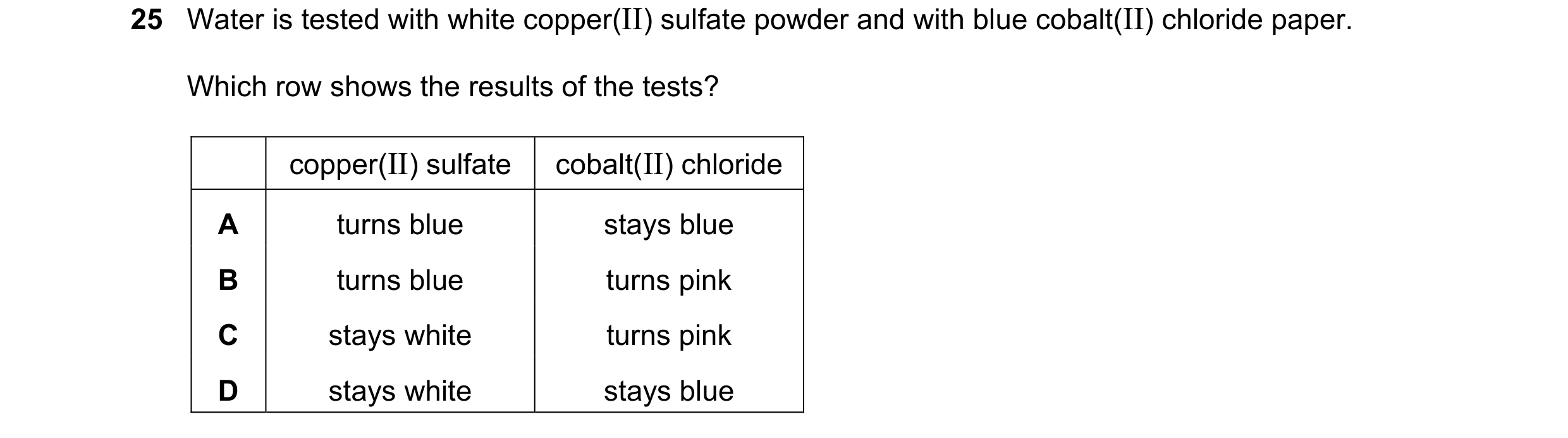
Q12 · Water is tested with white copper(II) sulfate powder and with blue cobalt(II) chloride… 0973/11 Oct/Nov 2022
25 Water is tested with white copper(II) sulfate powder and with blue cobalt(II) chloride paper. Which row shows the results of the tests? copper(II) sulfate cobalt(II) chloride A turns blue stays blue B turns blue turns pink C stays white turns pink D stays white stays blue
1 marks
Answer: B
This question in 0973/11 Oct/Nov 2022
Q13 · Which statement describes a chemical test for water? 0973/11 May/June 2023
23 Which statement describes a chemical test for water? A Add blue cobalt(II) chloride. B Add blue copper(II) sulfate. C Measure the boiling point. D Use universal indicator.
1 marks
Answer: A
This question in 0973/11 May/June 2023
Q14 · Substance X is mixed with aqueous sodium hydroxide 0973/11 Oct/Nov 2023
21 Substance X is mixed with aqueous sodium hydroxide. A green precipitate is produced. Which metal ion is present in X? A Cu2+ B Fe2+ C Fe3+ D Zn2+
1 marks
Answer: B
This question in 0973/11 Oct/Nov 2023
Q15 · White solid X reacts with dilute hydrochloric acid 0973/12 May/June 2024
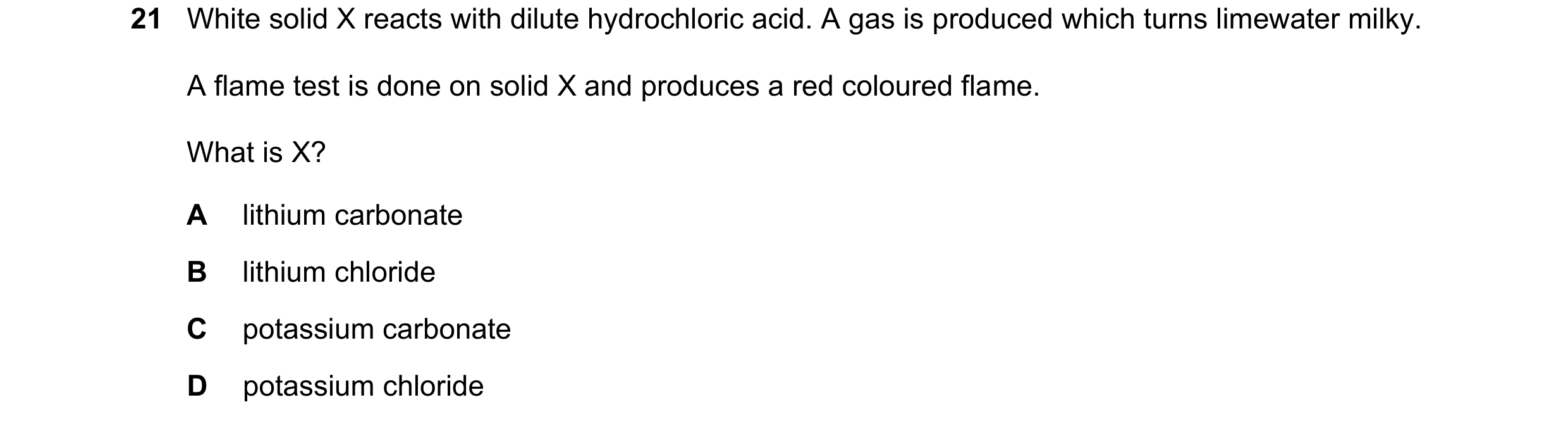
21 White solid X reacts with dilute hydrochloric acid. A gas is produced which turns limewater milky. A flame test is done on solid X and produces a red coloured flame. What is X? A lithium carbonate B lithium chloride C potassium carbonate D potassium chloride
1 marks
Answer: A
This question in 0973/12 May/June 2024
Q16 · The results of two tests on compound P are shown 0973/11 Oct/Nov 2024
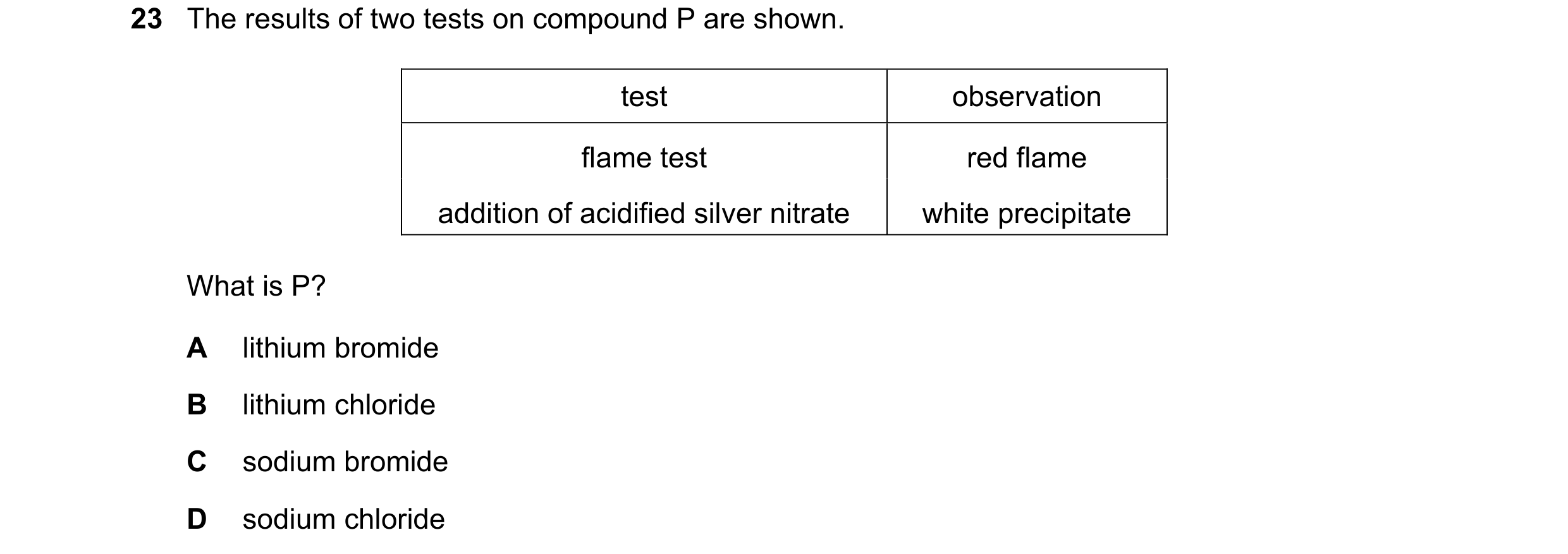
23 The results of two tests on compound P are shown. test observation flame test red flame addition of acidified silver nitrate white precipitate What is P? A lithium bromide B lithium chloride C sodium bromide D sodium chloride
1 marks
Answer: B
This question in 0973/11 Oct/Nov 2024
Q17 · A colourless liquid is tested with blue cobalt(II) chloride paper 0973/11 Oct/Nov 2024
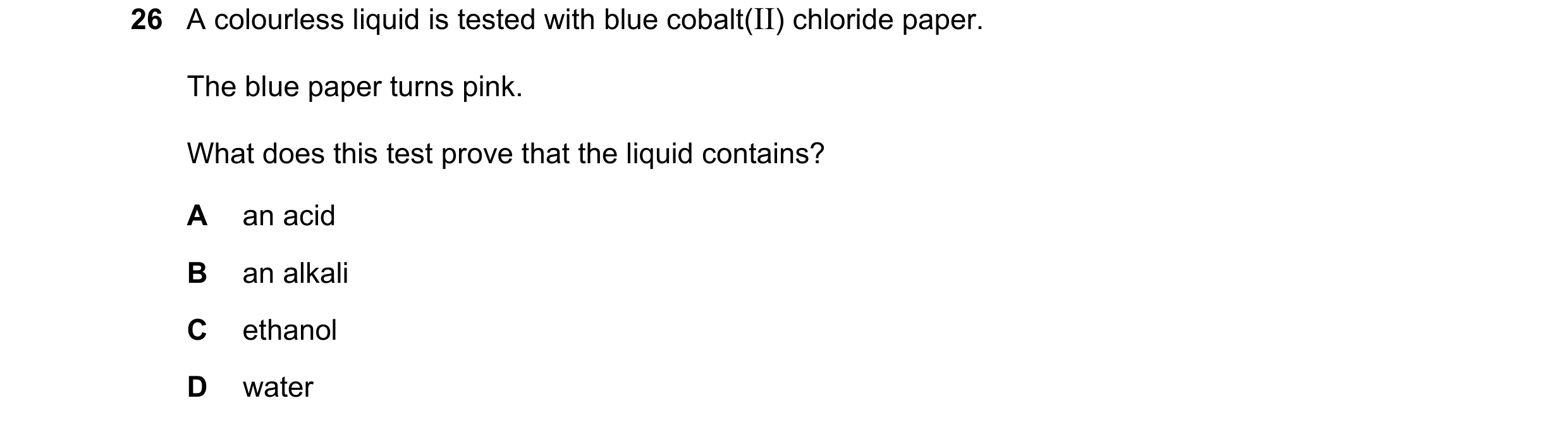
26 A colourless liquid is tested with blue cobalt(II) chloride paper. The blue paper turns pink. What does this test prove that the liquid contains? A an acid B an alkali C ethanol D water
1 marks
Answer: D
This question in 0973/11 Oct/Nov 2024
Q18 · Aqueous ammonia is separately added dropwise and then in excess to four different aqueous… 0973/11 May/June 2025
27 Aqueous ammonia is separately added dropwise and then in excess to four different aqueous cations. Which cations give a precipitate that then dissolves? 1 Ca2+ 2 Cu2+ 3 Fe2+ 4 Zn2+ A 1 and 3 B 1 and 4 C 2 and 3 D 2 and 4
1 marks
Answer: D
This question in 0973/11 May/June 2025
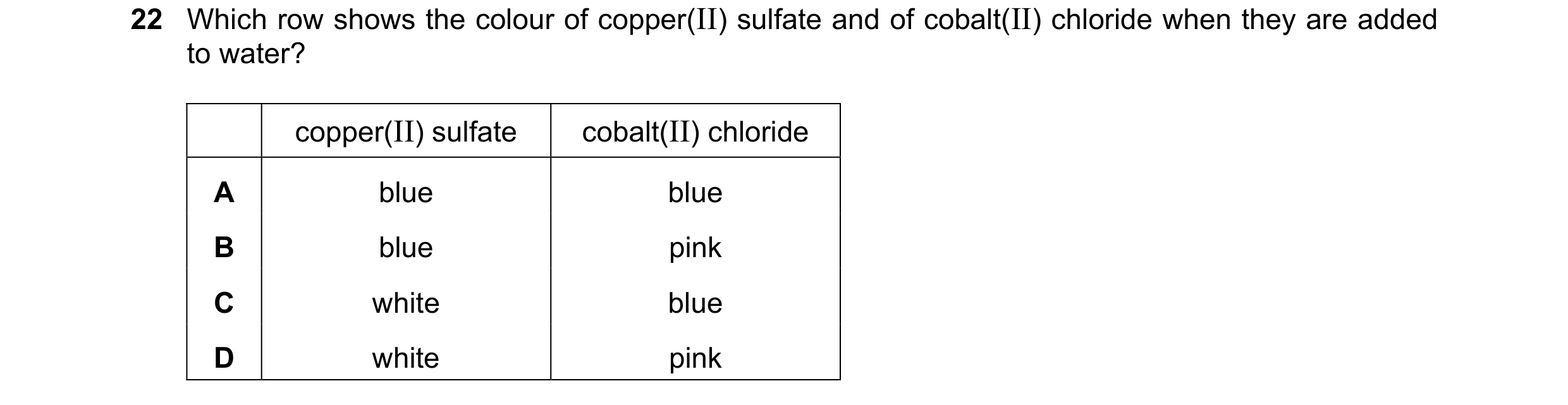
Q19 · Which row shows the colour of copper(II) sulfate and of cobalt(II) chloride when they are… 0973/12 May/June 2025
22 Which row shows the colour of copper(II) sulfate and of cobalt(II) chloride when they are added to water? copper(II) sulfate cobalt(II) chloride A blue blue B blue pink C white blue D white pink
1 marks
Answer: B
This question in 0973/12 May/June 2025
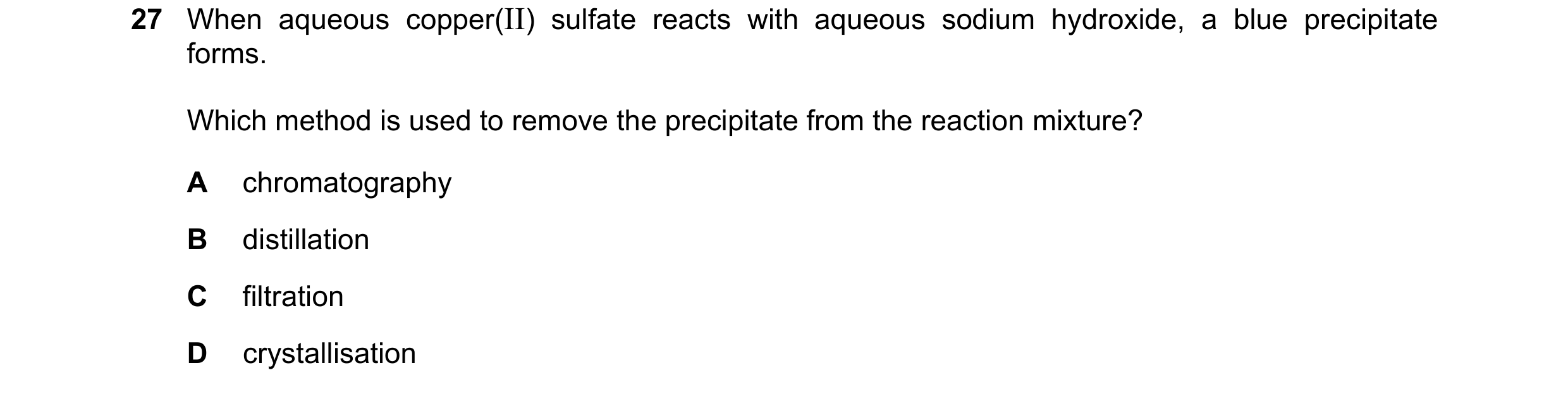
Q20 · When aqueous copper(II) sulfate reacts with aqueous sodium hydroxide, a blue precipitate… 0973/12 May/June 2025
27 When aqueous copper(II) sulfate reacts with aqueous sodium hydroxide, a blue precipitate forms. Which method is used to remove the precipitate from the reaction mixture? A chromatography B distillation C filtration D crystallisation
1 marks
Answer: C
This question in 0973/12 May/June 2025
Q21 · What is the colour of the flame produced by sodium in the flame test? 0973/11 Oct/Nov 2025
27 What is the colour of the flame produced by sodium in the flame test? A blue-green B red C lilac D yellow
1 marks
Answer: D
This question in 0973/11 Oct/Nov 2025


 1 / 5
1 / 5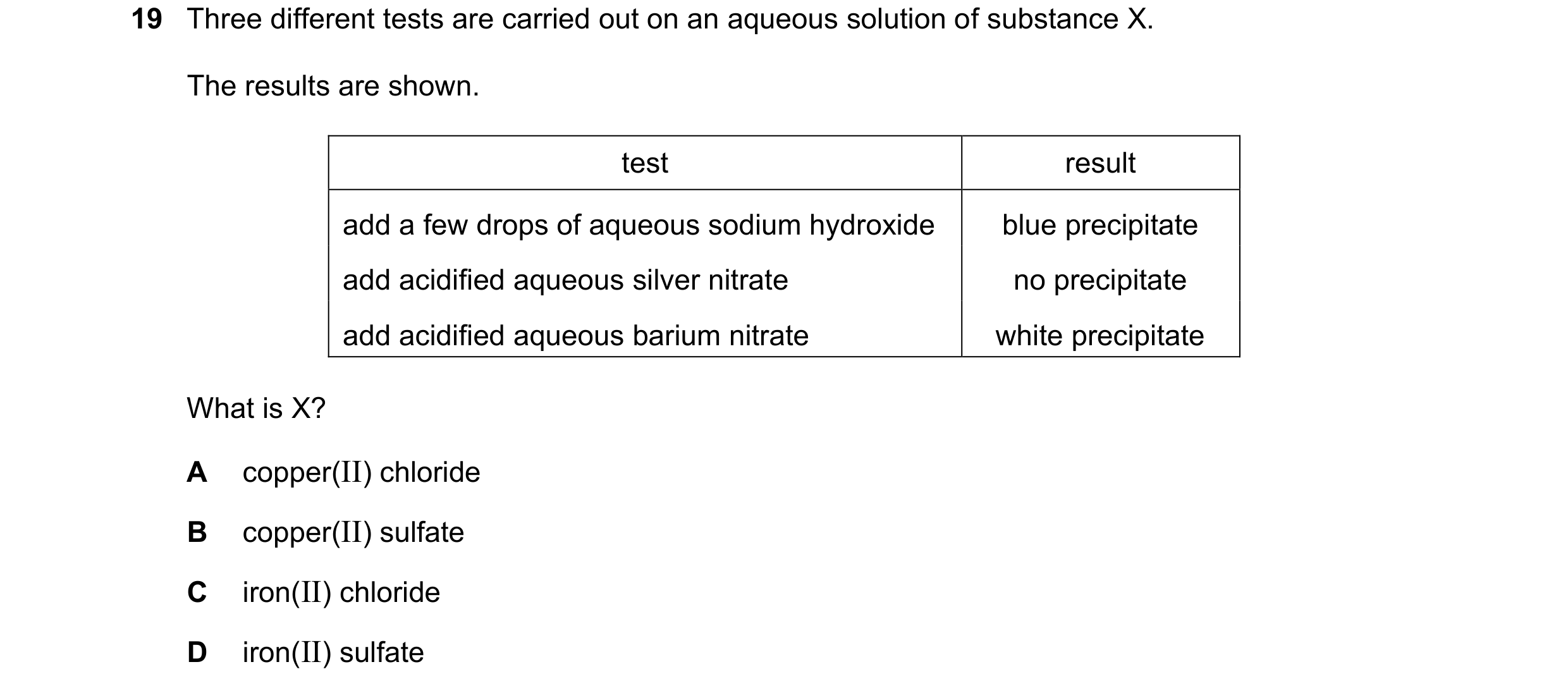
 2 / 5
2 / 5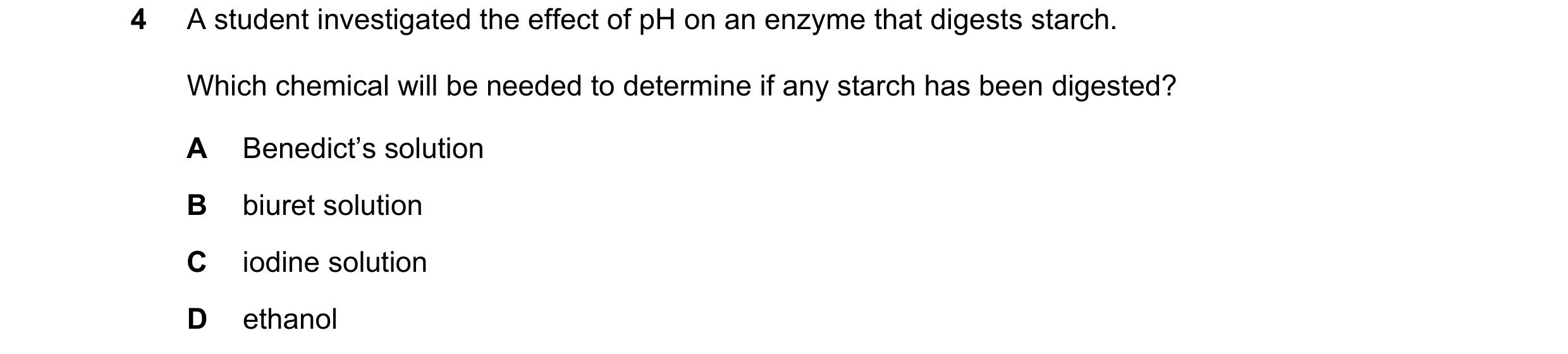

 3 / 5
3 / 5

 4 / 5
4 / 5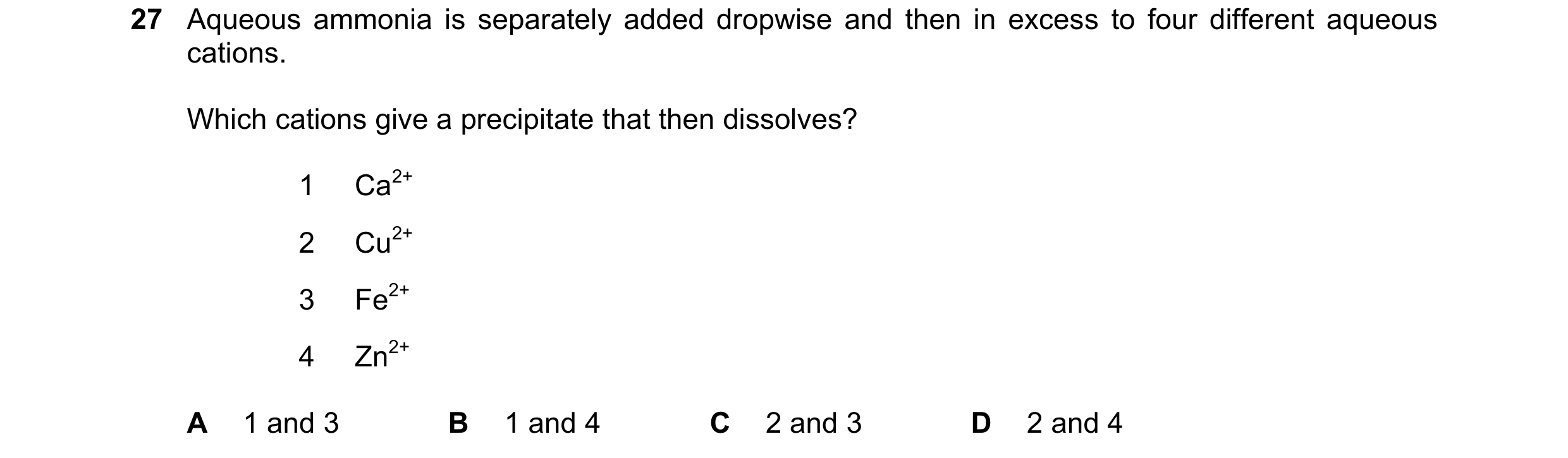
 5 / 5
5 / 5