Questions as text
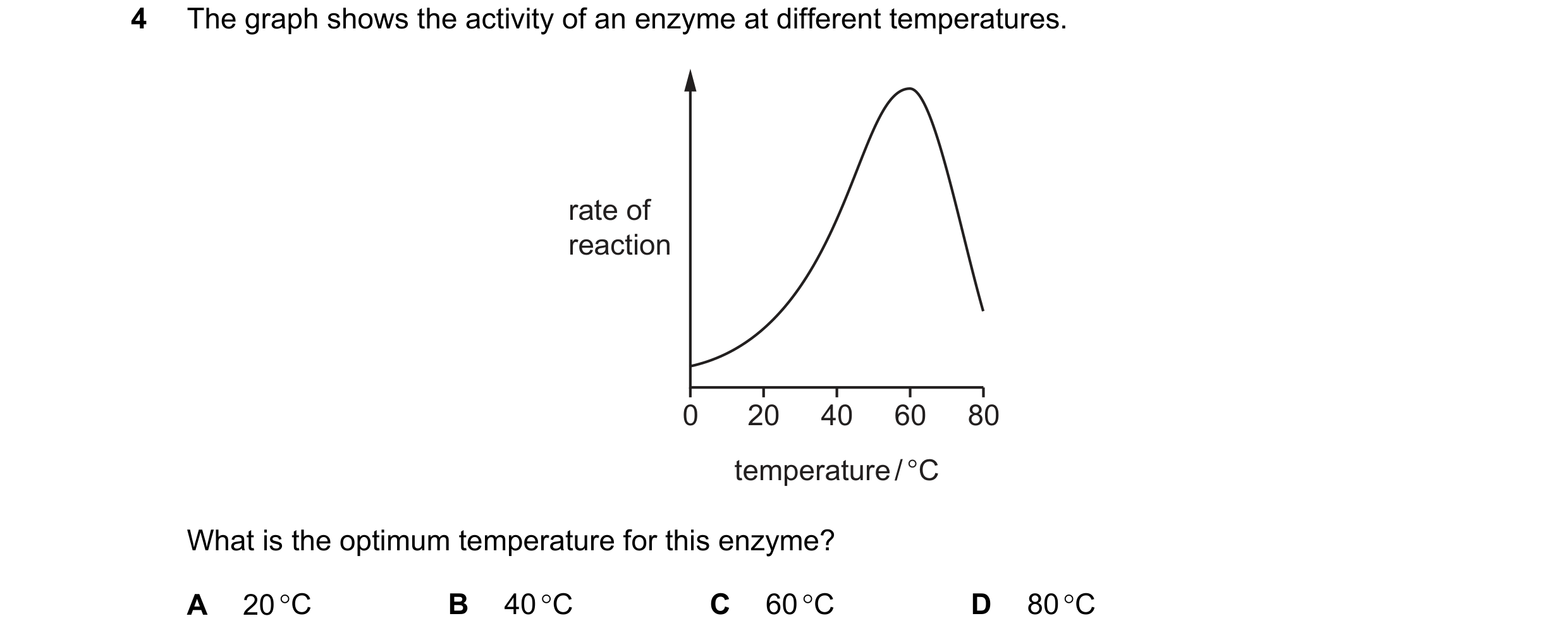
Q1 · The graph shows the activity of an enzyme at different temperatures 0973/11 May/June 2019
4 The graph shows the activity of an enzyme at different temperatures. rate of reaction 0 20 40 60 80 temperature / °C What is the optimum temperature for this enzyme? A 20 °C B 40 °C C 60 °C D 80 °C
1 marks
Answer: C
This question in 0973/11 May/June 2019
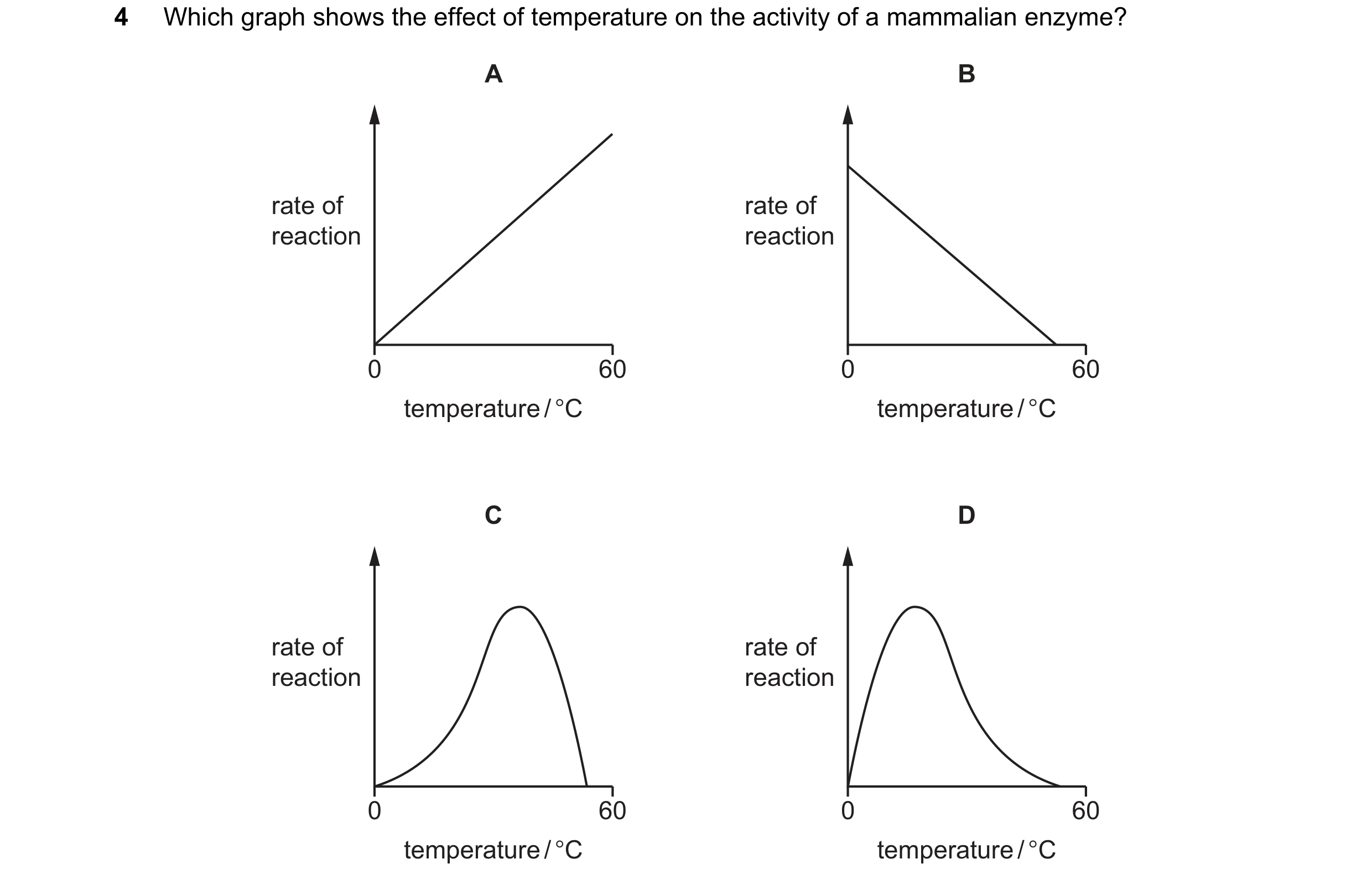
Q2 · Which graph shows the effect of temperature on the activity of a mammalian enzyme? 0973/11 May/June 2020
4 Which graph shows the effect of temperature on the activity of a mammalian enzyme? A B rate of rate of reaction reaction 0 60 0 60 temperature / °C temperature / °C C D rate of rate of reaction reaction 0 60 0 60 temperature / °C temperature / °C
1 marks
Answer: C
This question in 0973/11 May/June 2020
Q3 · Which smaller molecules make up enzymes? 0973/12 May/June 2020
4 Which smaller molecules make up enzymes? A amino acids B fatty acids C glucose D glycerol
1 marks
Answer: A
This question in 0973/12 May/June 2020
Q4 · A mixture of starch and saliva was set up at four different temperatures 0973/11 Oct/Nov 2020
4 A mixture of starch and saliva was set up at four different temperatures. Each mixture was tested with iodine solution after 15 minutes and again after 30 minutes. The results are shown in the table. temperature colour with iodine solution / C 15 minutes 30 minutes 0 blue-black blue-black 15 blue-black brown 35 brown brown 95 blue-black blue-black What do the results suggest? A The enzyme in saliva is inactive at 95 C. B The enzyme in saliva is slow to work at 35 C. C The enzyme in saliva works equally well at 15 C and 35 C. D The enzyme in saliva works faster at higher temperatures.
1 marks
Answer: A
This question in 0973/11 Oct/Nov 2020
Q5 · What is an enzyme? 0973/11 May/June 2021
4 What is an enzyme? A a carbohydrate that speeds up the rate of a reaction B a carbohydrate that alters the activity of a target organ C a protein that alters the activity of a target organ D a protein that speeds up the rate of a reaction
1 marks
Answer: D
This question in 0973/11 May/June 2021
Q6 · Which type of molecule are enzymes? 0973/12 May/June 2021
4 Which type of molecule are enzymes? A fat B carbohydrate C protein D DNA
1 marks
Answer: C
This question in 0973/12 May/June 2021
Q7 · A student investigated the effect of pH on an enzyme that digests starch 0973/11 Oct/Nov 2021
4 A student investigated the effect of pH on an enzyme that digests starch. Which chemical will be needed to determine if any starch has been digested? A Benedict’s solution B biuret solution C iodine solution D ethanol
1 marks
Answer: A
This question in 0973/11 Oct/Nov 2021
Q8 · Fungus can live at the base of human hair where the activity of one of its enzymes can… 0973/11 May/June 2022
4 Fungus can live at the base of human hair where the activity of one of its enzymes can cause dry skin. The graph shows the action of the fungal enzyme at different pH values. rate of reaction 0 1 2 3 4 5 6 7 8 9 pH Different shampoos have different pH values. Which shampoo causes the greatest amount of dry skin? A pH 3 B pH 5 C pH 7 D pH 9
1 marks
Answer: B
This question in 0973/11 May/June 2022
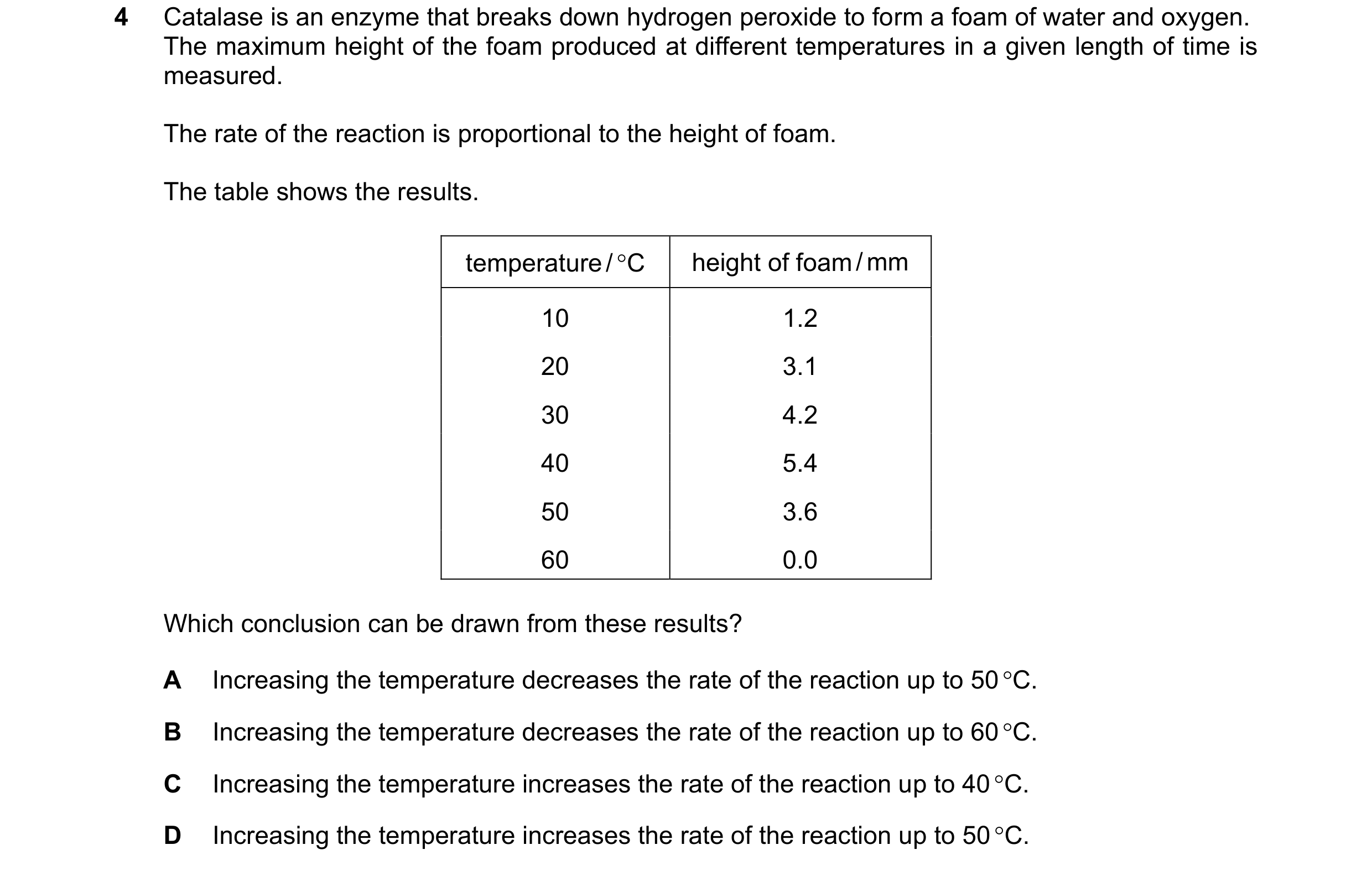
Q9 · Catalase is an enzyme that breaks down hydrogen peroxide to form a foam of water and… 0973/12 May/June 2022
4 Catalase is an enzyme that breaks down hydrogen peroxide to form a foam of water and oxygen. The maximum height of the foam produced at different temperatures in a given length of time is measured. The rate of the reaction is proportional to the height of foam. The table shows the results. temperature / C height of foam / mm 10 1.2 20 3.1 30 4.2 40 5.4 50 3.6 60 0.0 Which conclusion can be drawn from these results? A Increasing the temperature decreases the rate of the reaction up to 50 C. B Increasing the temperature decreases the rate of the reaction up to 60 C. C Increasing the temperature increases the rate of the reaction up to 40 C. D Increasing the temperature increases the rate of the reaction up to 50 C.
1 marks
Answer: C
This question in 0973/12 May/June 2022
Q10 · Which elements can be found in an enzyme molecule? 0973/11 Oct/Nov 2022
4 Which elements can be found in an enzyme molecule? 1 carbon 2 nitrogen 3 oxygen A 1, 2 and 3 B 1 and 3 only C 1 only D 2 only
1 marks
Answer: A
This question in 0973/11 Oct/Nov 2022
Q11 · Which type of molecule are enzymes? 0973/11 May/June 2023
4 Which type of molecule are enzymes? A amino acids B carbohydrates C fats D proteins
1 marks
Answer: D
This question in 0973/11 May/June 2023
Q12 · Which type of molecules speed up chemical digestion? 0973/12 May/June 2023
4 Which type of molecules speed up chemical digestion? A carbohydrates B enzymes C hormones D fatty acids
1 marks
Answer: B
This question in 0973/12 May/June 2023
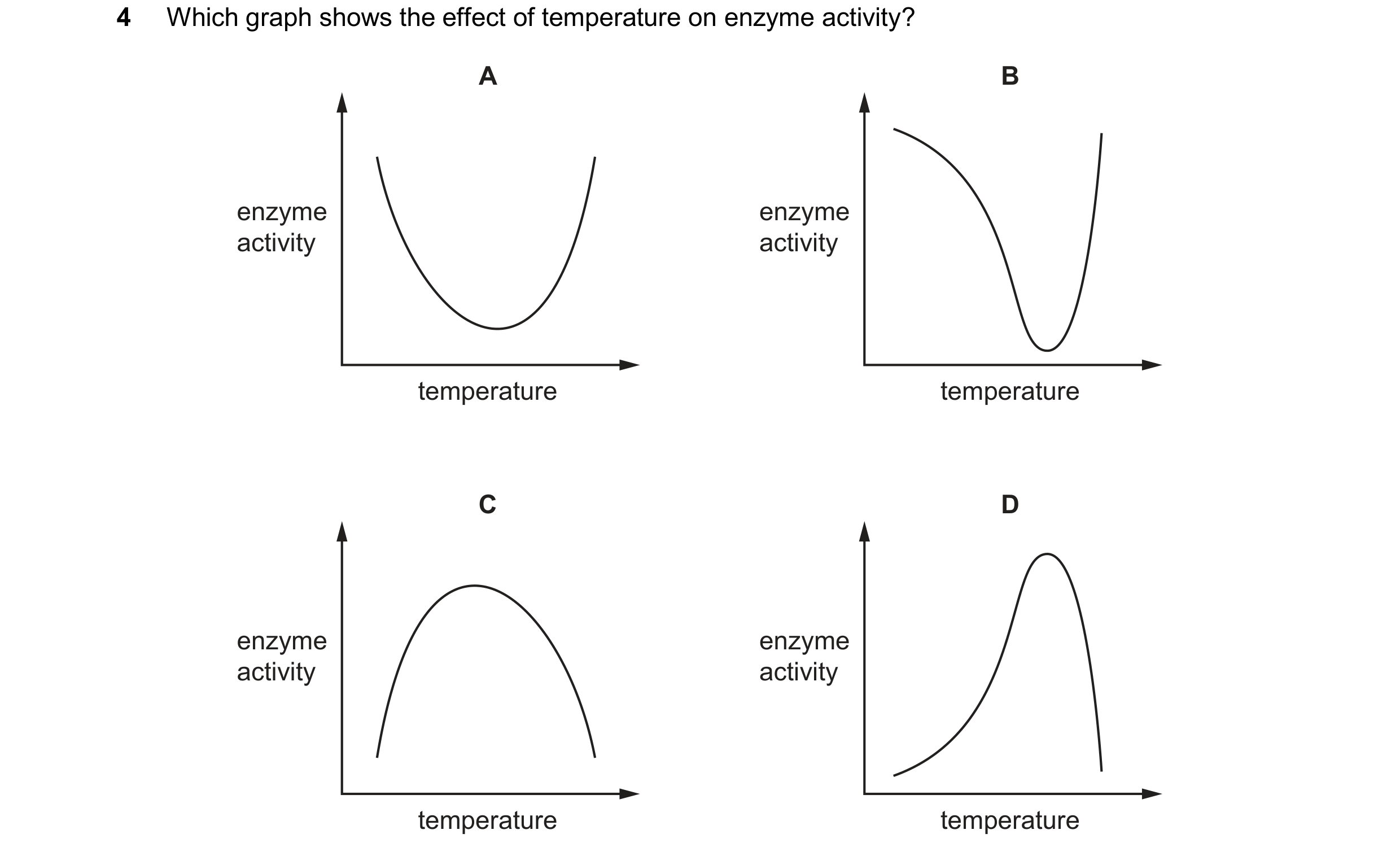
Q13 · Which graph shows the effect of temperature on enzyme activity? 0973/11 Oct/Nov 2023
4 Which graph shows the effect of temperature on enzyme activity? A B enzyme enzyme activity activity temperature temperature C D enzyme enzyme activity activity temperature temperature
1 marks
Answer: D
This question in 0973/11 Oct/Nov 2023
Q14 · Which type of molecules are enzymes? 0973/11 May/June 2024
4 Which type of molecules are enzymes? A carbohydrates B fats C oils D proteins
1 marks
Answer: D
This question in 0973/11 May/June 2024
Q15 · One method of preventing food spoilage is to store it at 4 C in a refrigerator 0973/11 Oct/Nov 2024
4 One method of preventing food spoilage is to store it at 4 C in a refrigerator. Why does storing food at low temperatures help to prevent food spoilage? A It decreases enzyme activity. B It denatures enzymes. C It increases enzyme production. D It kills cells.
1 marks
Answer: A
This question in 0973/11 Oct/Nov 2024
Q16 · Which type of molecules are enzymes? 0973/11 May/June 2025
5 Which type of molecules are enzymes? A carbohydrates B fats C hormones D proteins
1 marks
Answer: D
This question in 0973/11 May/June 2025
Q17 · Which statements about enzymes are correct? 0973/12 May/June 2025
4 Which statements about enzymes are correct? 1 Enzymes are biological catalysts. 2 Enzymes are made of fat. 3 Enzymes are made of protein. A 1 and 2 B 1 and 3 C 1 only D 3 only
1 marks
Answer: B
This question in 0973/12 May/June 2025
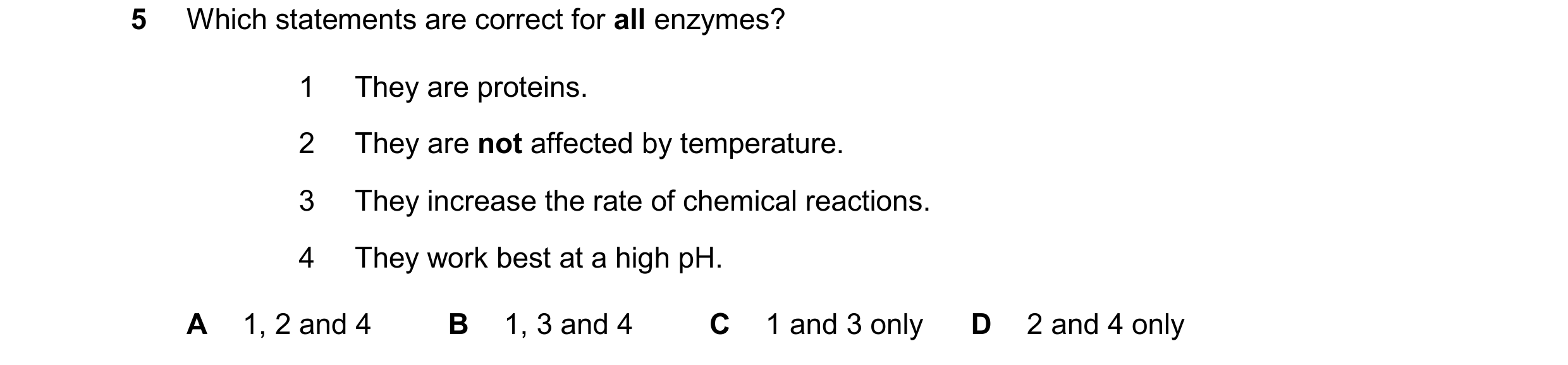
Q18 · Which statements are correct for all enzymes? 0973/11 Oct/Nov 2025
5 Which statements are correct for all enzymes? 1 They are proteins. 2 They are not affected by temperature. 3 They increase the rate of chemical reactions. 4 They work best at a high pH. A 1, 2 and 4 B 1, 3 and 4 C 1 and 3 only D 2 and 4 only
1 marks
Answer: C
This question in 0973/11 Oct/Nov 2025
 1 / 5
1 / 5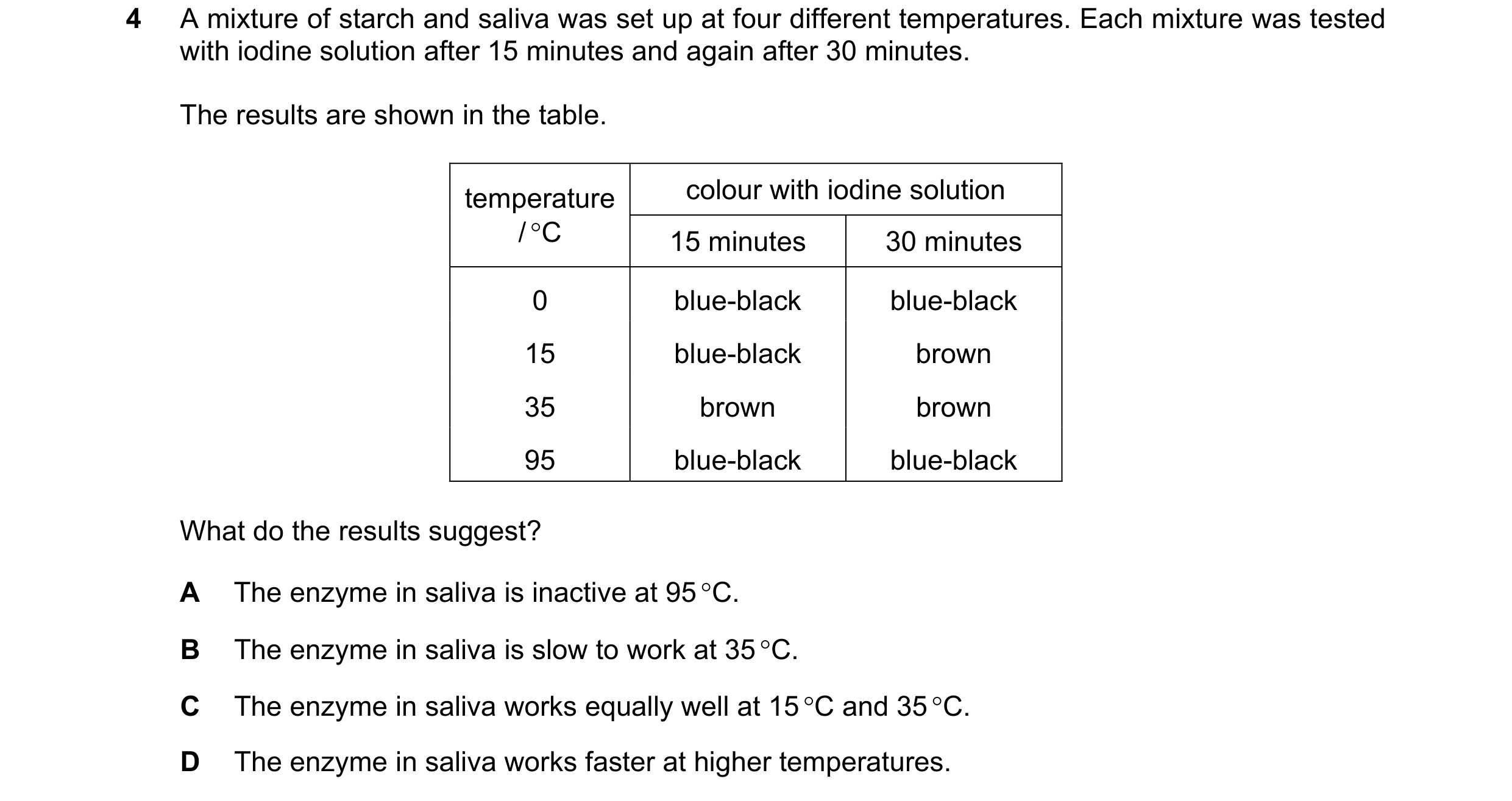


 2 / 5
2 / 5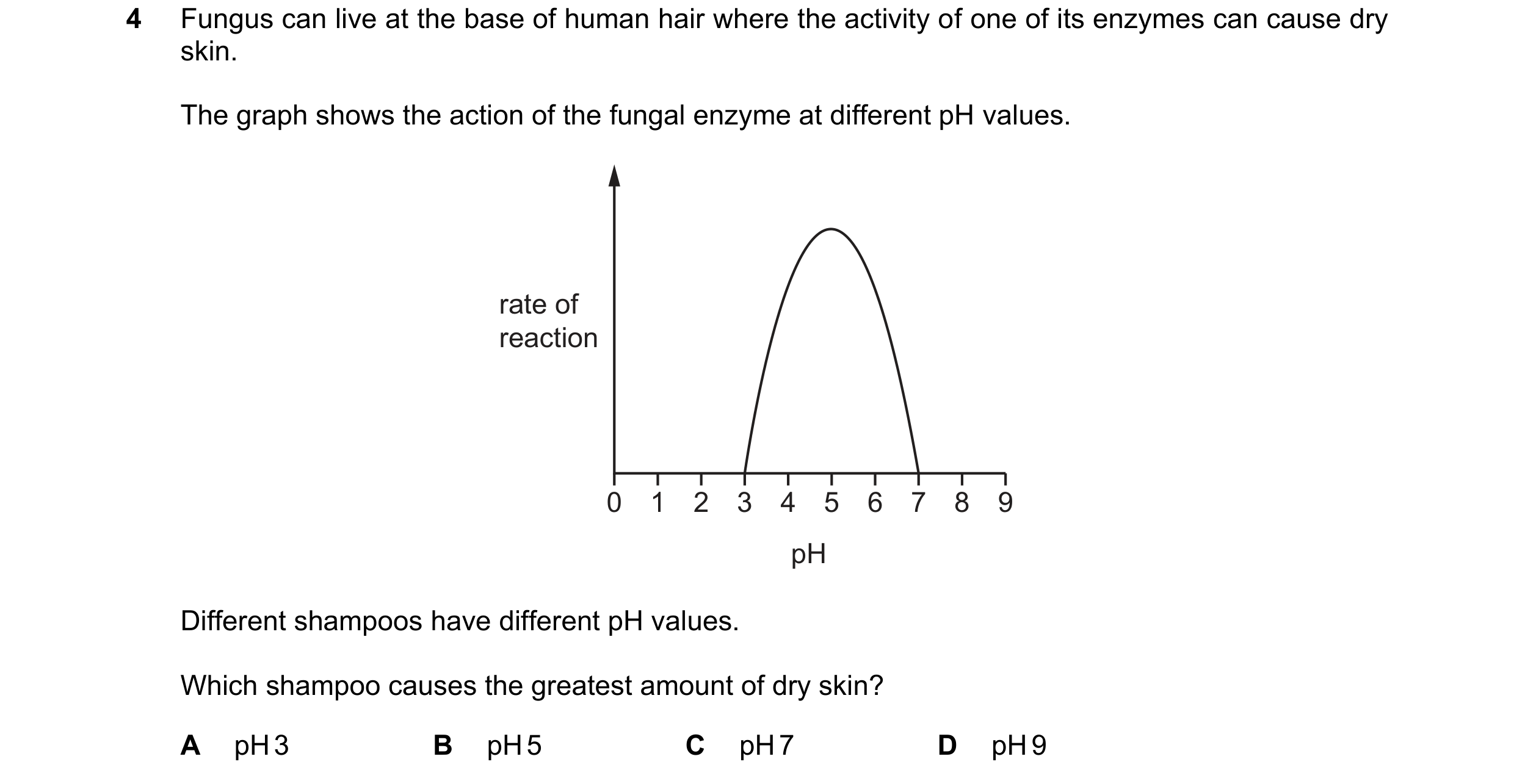
 3 / 5
3 / 5

 4 / 5
4 / 5


 5 / 5
5 / 5