Cambridge IGCSE Science - Combined 0653 — 2022 May/June Paper 5 · Variant 2
0653/52/M/J/22 · 4 questions · 40 marks · ≈45 min
The question paper and its mark scheme, free to read here and free to download. This is Cambridge’s own paper, exactly as it was sat.
Question paper16 pages



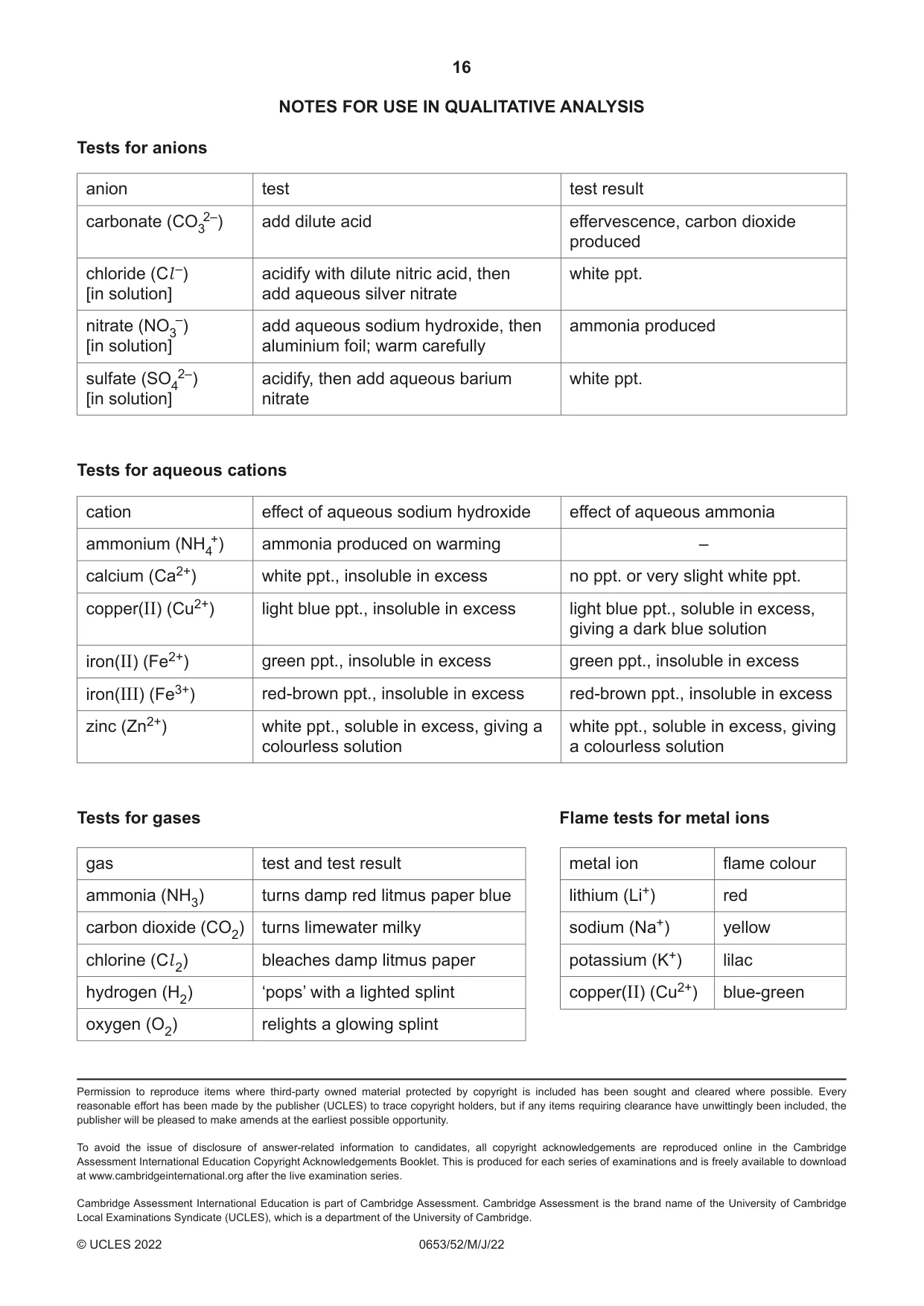
Mark scheme8 pages
Answers below. Sit the paper first if you are practising.
Questions as text
Q1 · Water moves into a cell by osmosis
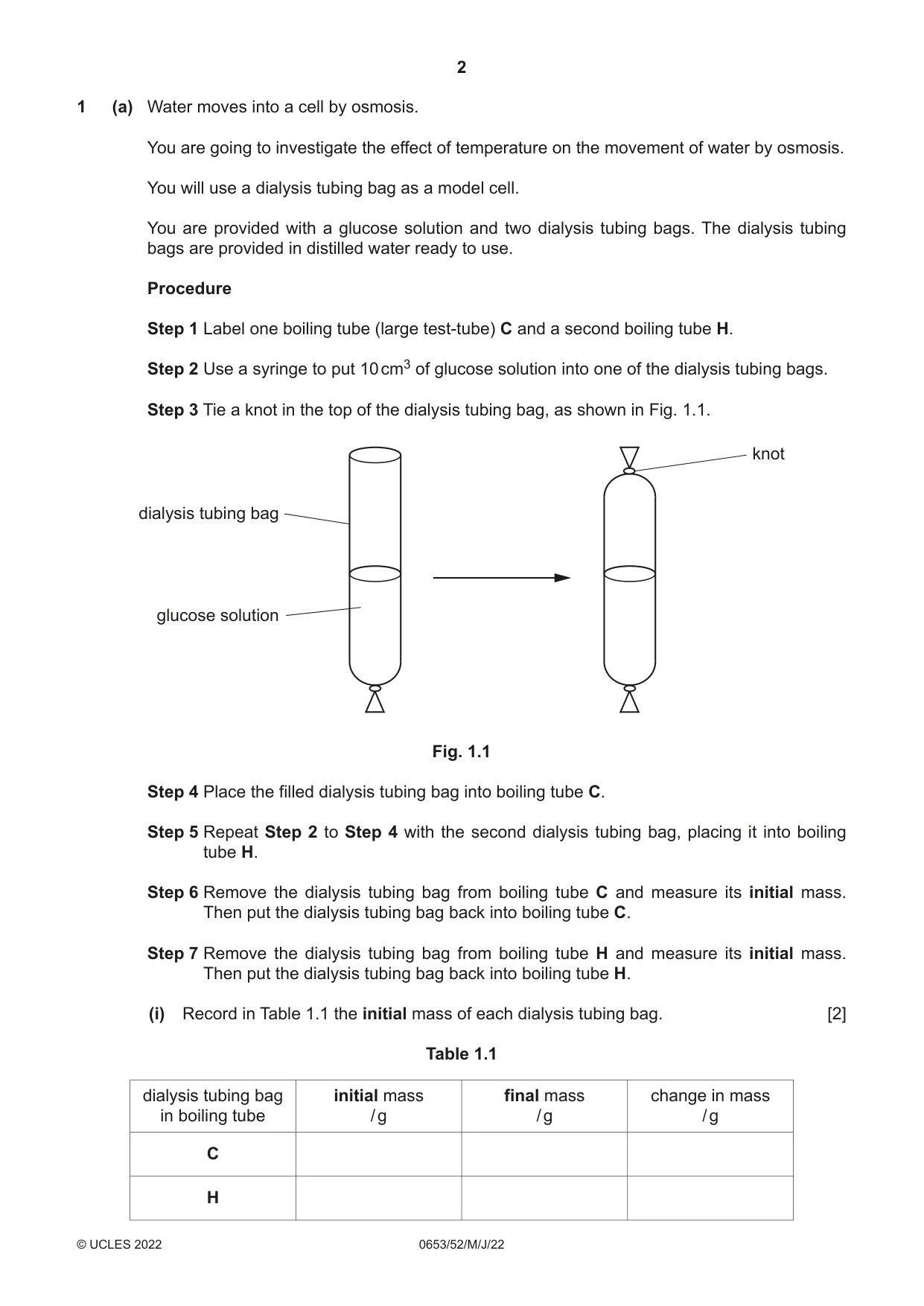
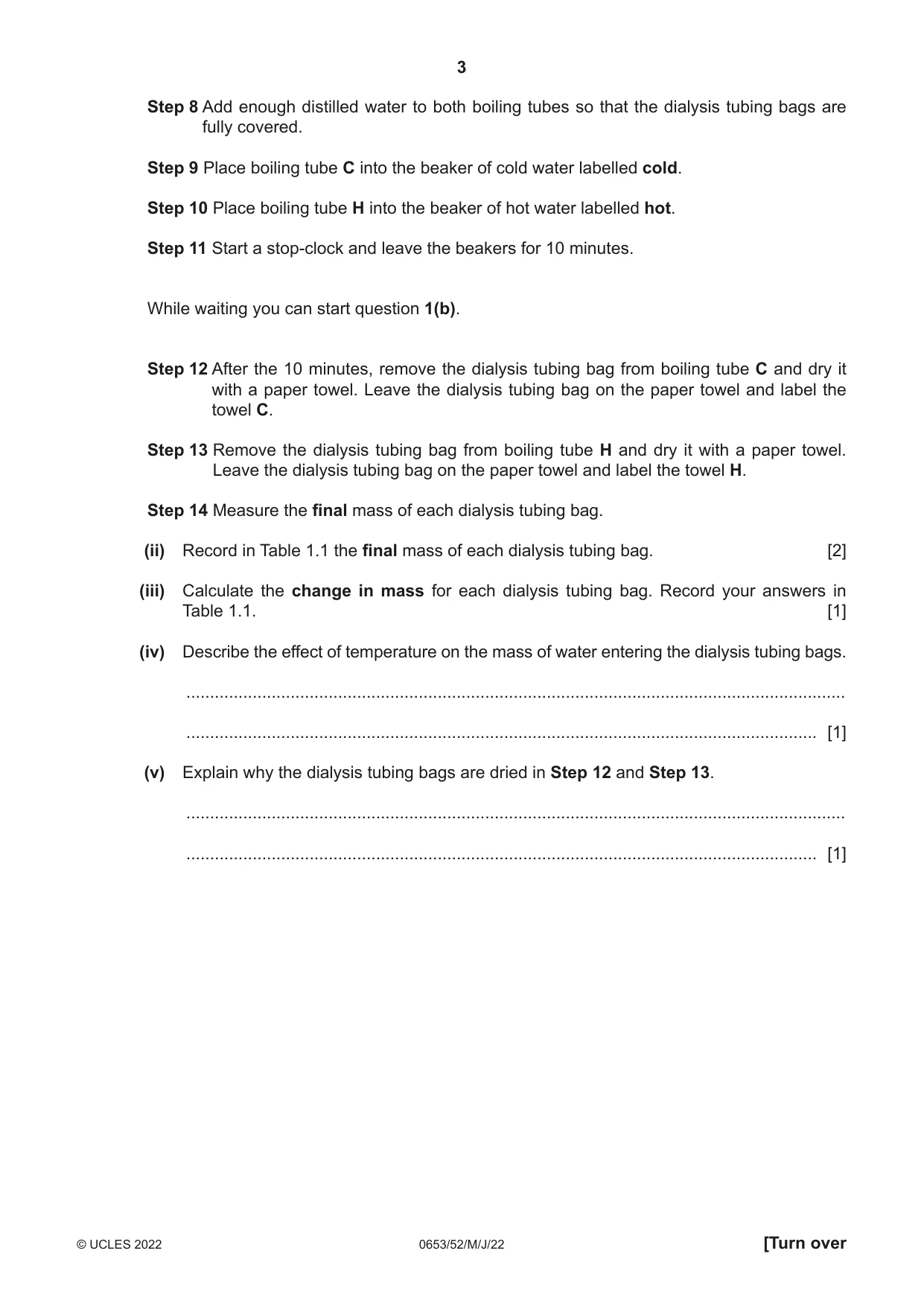
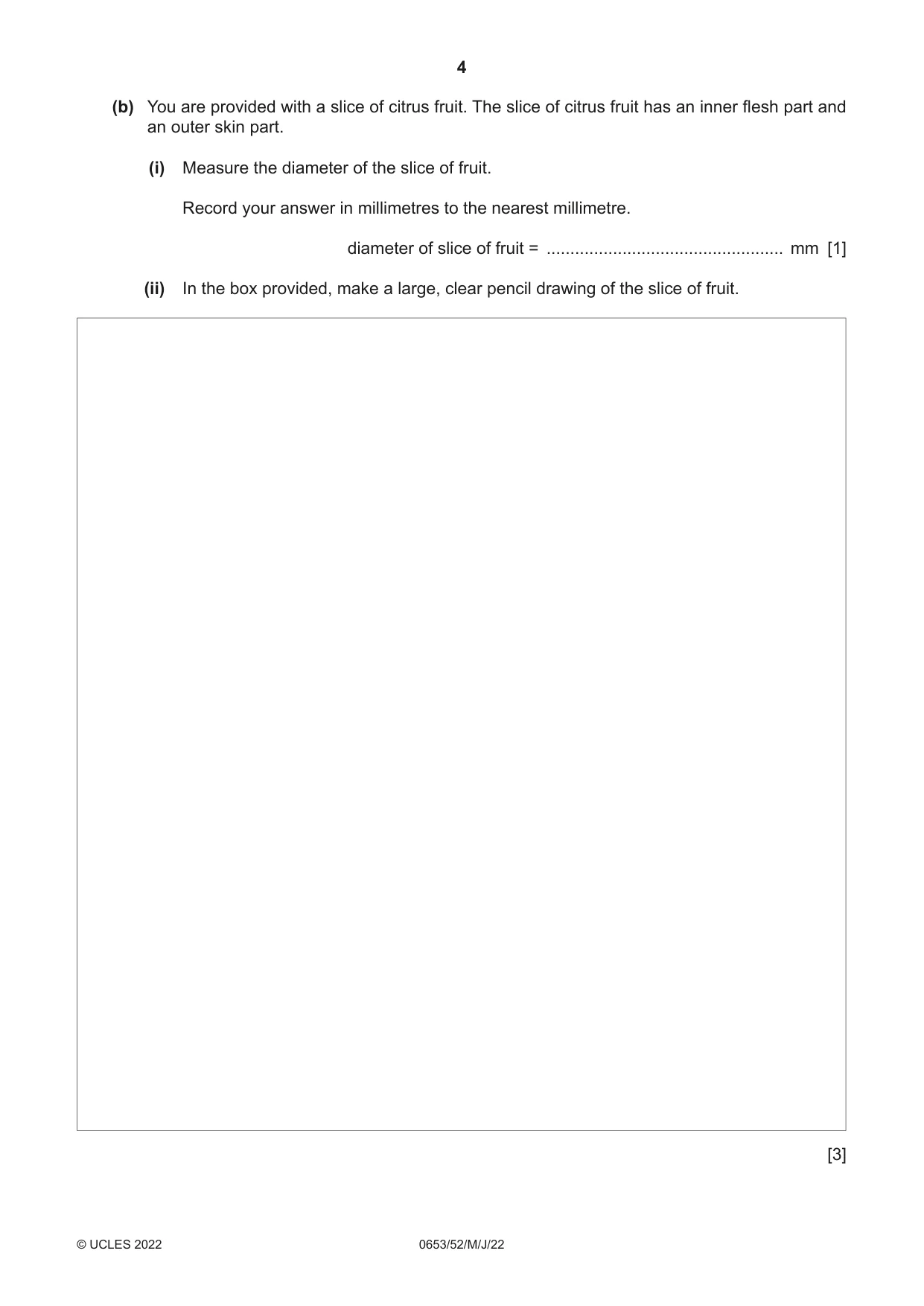
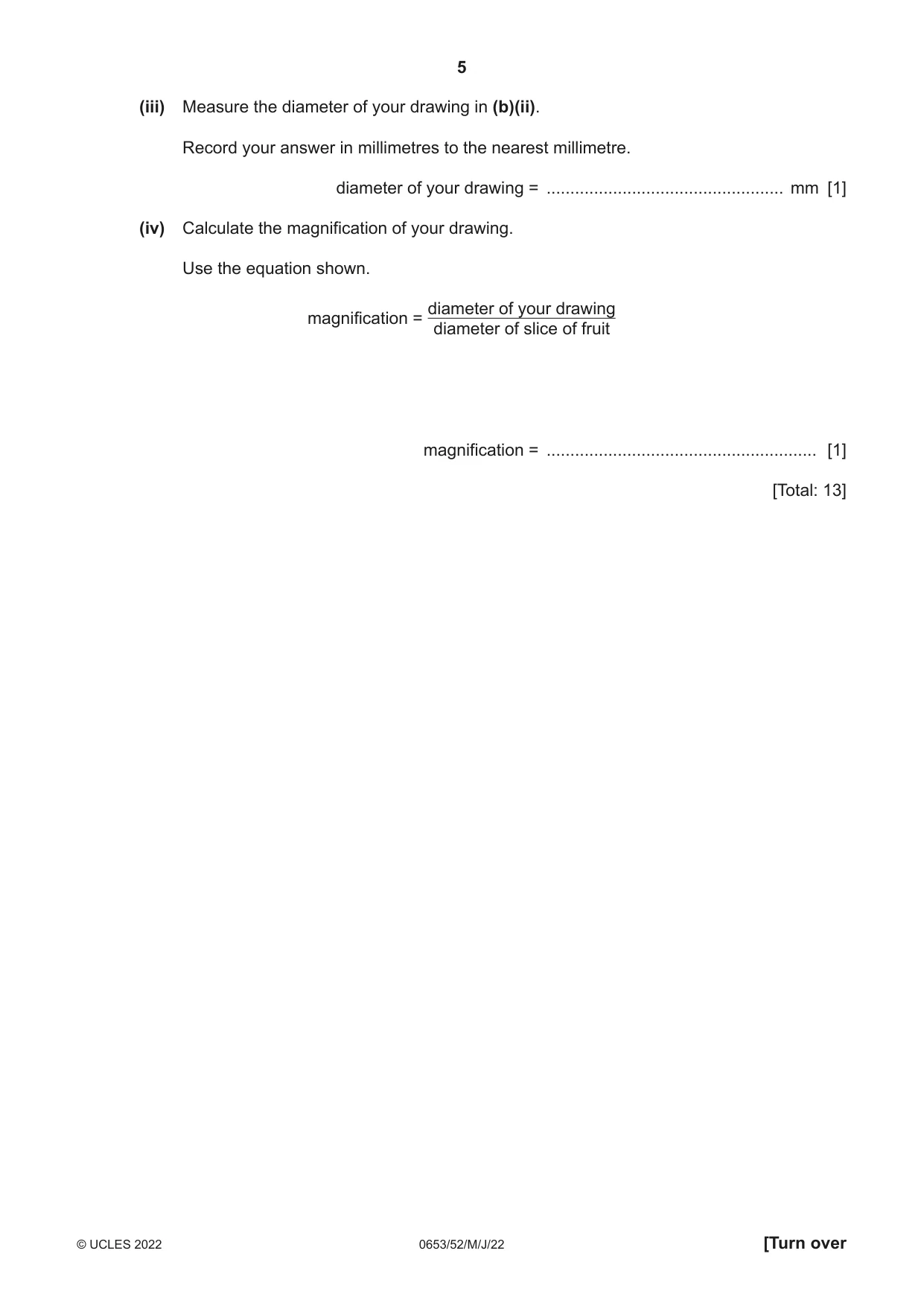
1 (a) Water moves into a cell by osmosis. You are going to investigate the effect of temperature on the movement of water by osmosis. You will use a dialysis tubing bag as a model cell. You are provided with a glucose solution and two dialysis tubing bags. The dialysis tubing bags are provided in distilled water ready to use. Procedure Step 1 Label one boiling tube (large test-tube) C and a second boiling tube H. Step 2 Use a syringe to put 10 cm3 of glucose solution into one of the dialysis tubing bags. Step 3 Tie a knot in the top of the dialysis tubing bag, as shown in Fig. 1.1. knot dialysis tubing bag glucose solution Fig. 1.1 Step 4 Place the filled dialysis tubing bag into boiling tube C. Step 5 Repeat Step 2 to Step 4 with the second dialysis tubing bag, placing it into boiling tube H. Step 6 Remove the dialysis tubing bag from boiling tube C and measure its initial mass. Then put the dialysis tubing bag back into boiling tube C. Step 7 Remove the dialysis tubing bag from boiling tube H and measure its initial mass. Then put the dialysis tubing bag back into boiling tube H. (i) Record in Table 1.1 the initial mass of each dialysis tubing bag. [2] Table 1.1 dialysis tubing bag initial mass final mass change in mass in boiling tube / g / g / g C H Step 8 Add enough distilled water to both boiling tubes so that the dialysis tubing bags are fully covered. Step 9 Place boiling tube C into the beaker of cold water labelled cold. Step 10 Place boiling tube H into the beaker of hot water labelled hot. Step 11 Start a stop-clock and leave the beakers for 10 minutes. While waiting you can start question 1(b). Step 12 After the 10 minutes, remove the dialysis tubing bag from boiling tube C and dry it with a paper towel. Leave the dialysis tubing bag on the paper towel and label the towel C. Step 13 Remove the dialysis tubing bag from boiling tube H and dry it with a paper towel. Leave the dialysis tubing bag on the paper towel and label the towel H. Step 14 Measure the final mass of each dialysis tubing bag. (ii) Record in Table 1.1 the final mass of each dialysis tubing bag. [2] (iii) Calculate the change in mass for each dialysis tubing bag. Record your answers in Table 1.1. [1] (iv) Describe the effect of temperature on the mass of water entering the dialysis tubing bags. ........................................................................................................................................... ..................................................................................................................................... [1] (v) Explain why the dialysis tubing bags are dried in Step 12 and Step 13. ........................................................................................................................................... ..................................................................................................................................... [1] (b) You are provided with a slice of citrus fruit. The slice of citrus fruit has an inner flesh part and an outer skin part. (i) Measure the diameter of the slice of fruit. Record your answer in millimetres to the nearest millimetre. diameter of slice of fruit = .................................................. mm [1] (ii) In the box provided, make a large, clear pencil drawing of the slice of fruit. [3] (iii) Measure the diameter of your drawing in (b)(ii). Record your answer in millimetres to the nearest millimetre. diameter of your drawing = .................................................. mm [1] (iv) Calculate the magnification of your drawing. Use the equation shown. diameter of your drawing magnification = diameter of slice of fruit magnification = ......................................................... [1] [Total: 13]
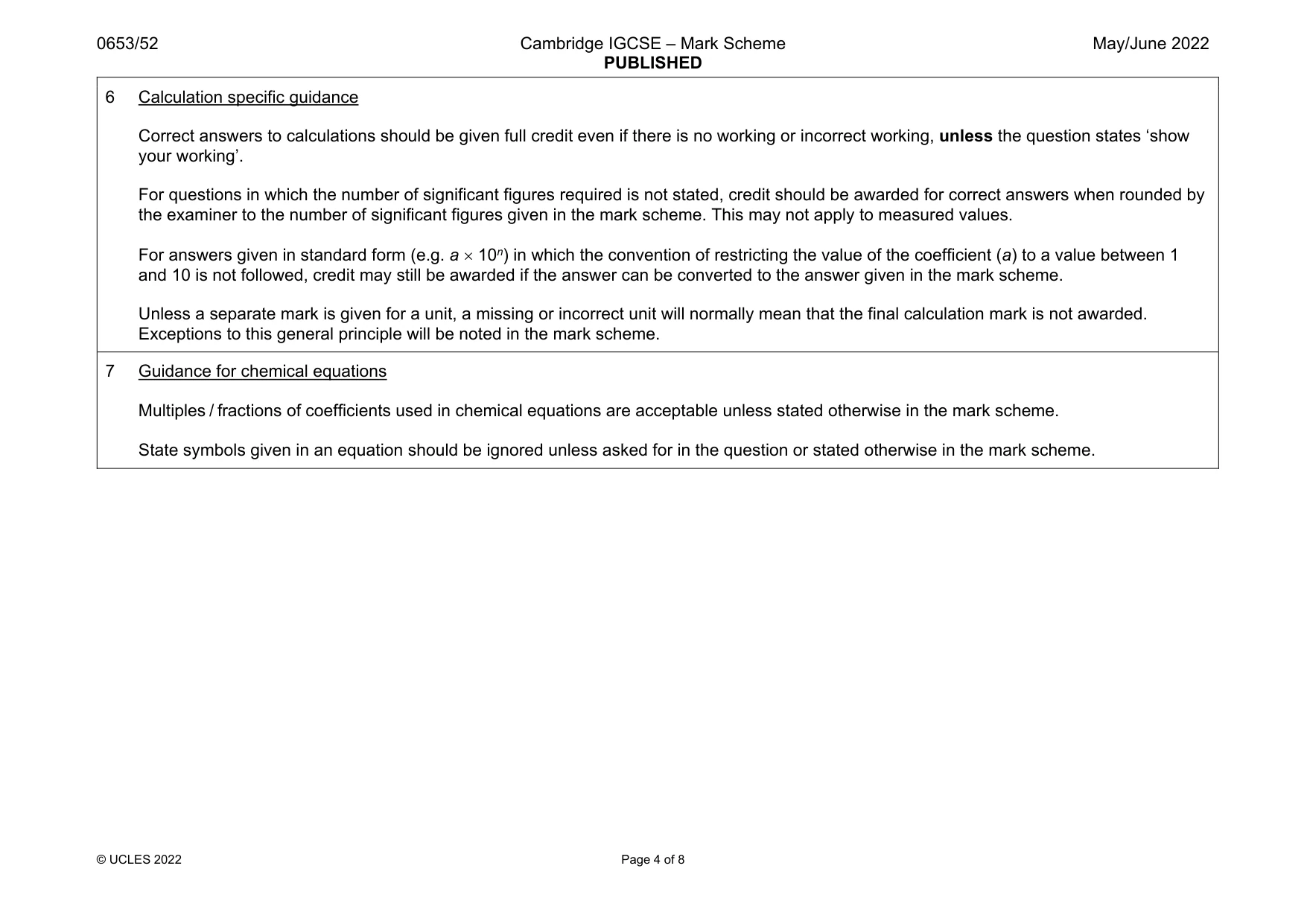
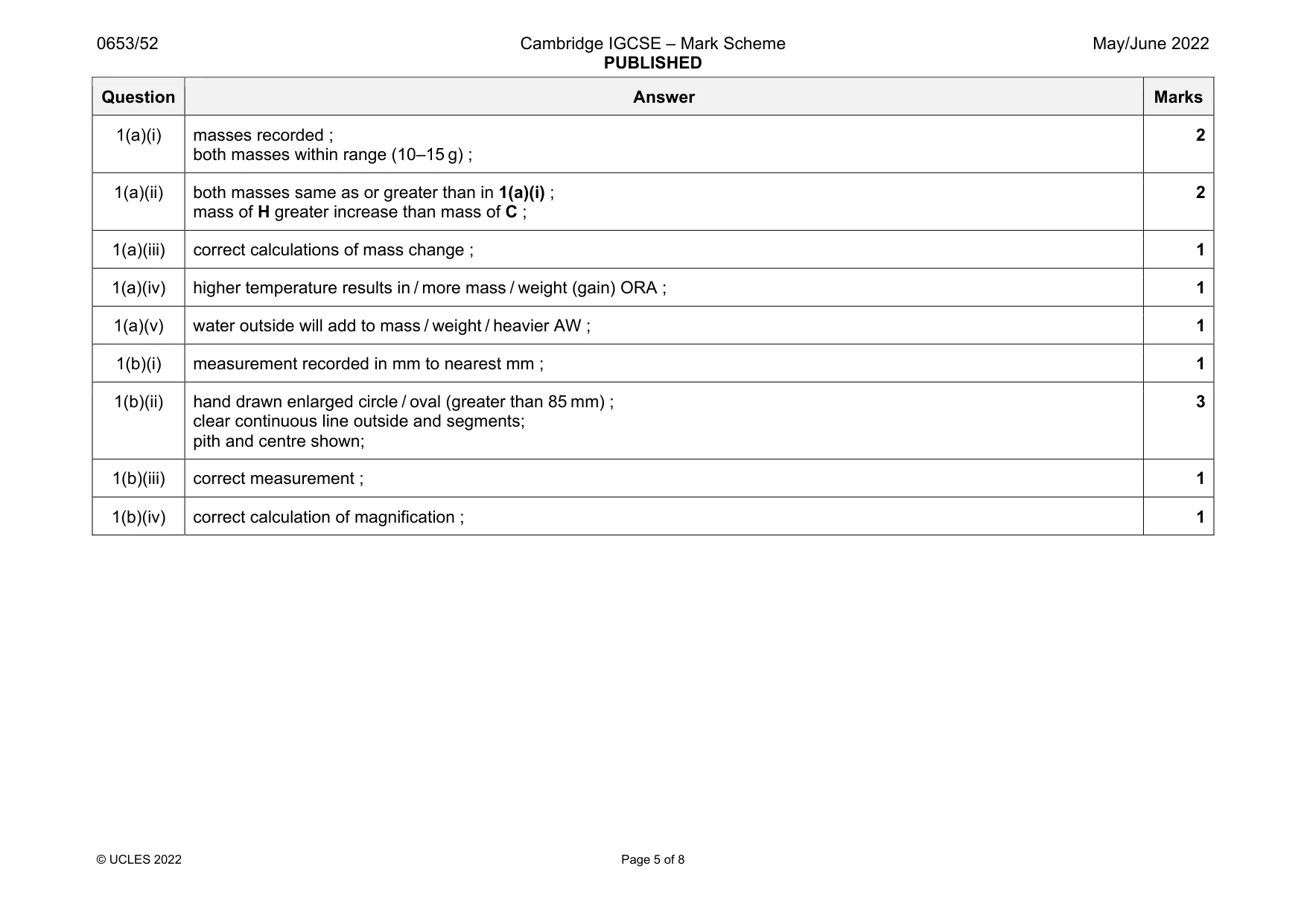
Mark scheme: 1(a)(i) masses recorded ; both masses within range (10–15 g) ; 2 1(a)(ii) both masses same as or greater than in 1(a)(i) ; mass of H greater increase than mass of C ; 2 1(a)(iii) correct calculations of mass change ; 1 1(a)(iv) higher temperature results in / more mass / weight (gain) ORA ; 1 1(a)(v) water outside will add to mass / weight / heavier AW ; 1 1(b)(i) measurement recorded in mm to nearest mm ; 1 1(b)(ii) hand drawn enlarged circle / oval (greater than 85 mm) ; clear continuous line outside and segments; pith and centre shown; 3 1(b)(iii) correct measurement ; 1 1(b)(iv) correct calculation of magnification ; 1
Q2 · You are going to investigate the solubility in water of five substances, L, M, N, P and Q
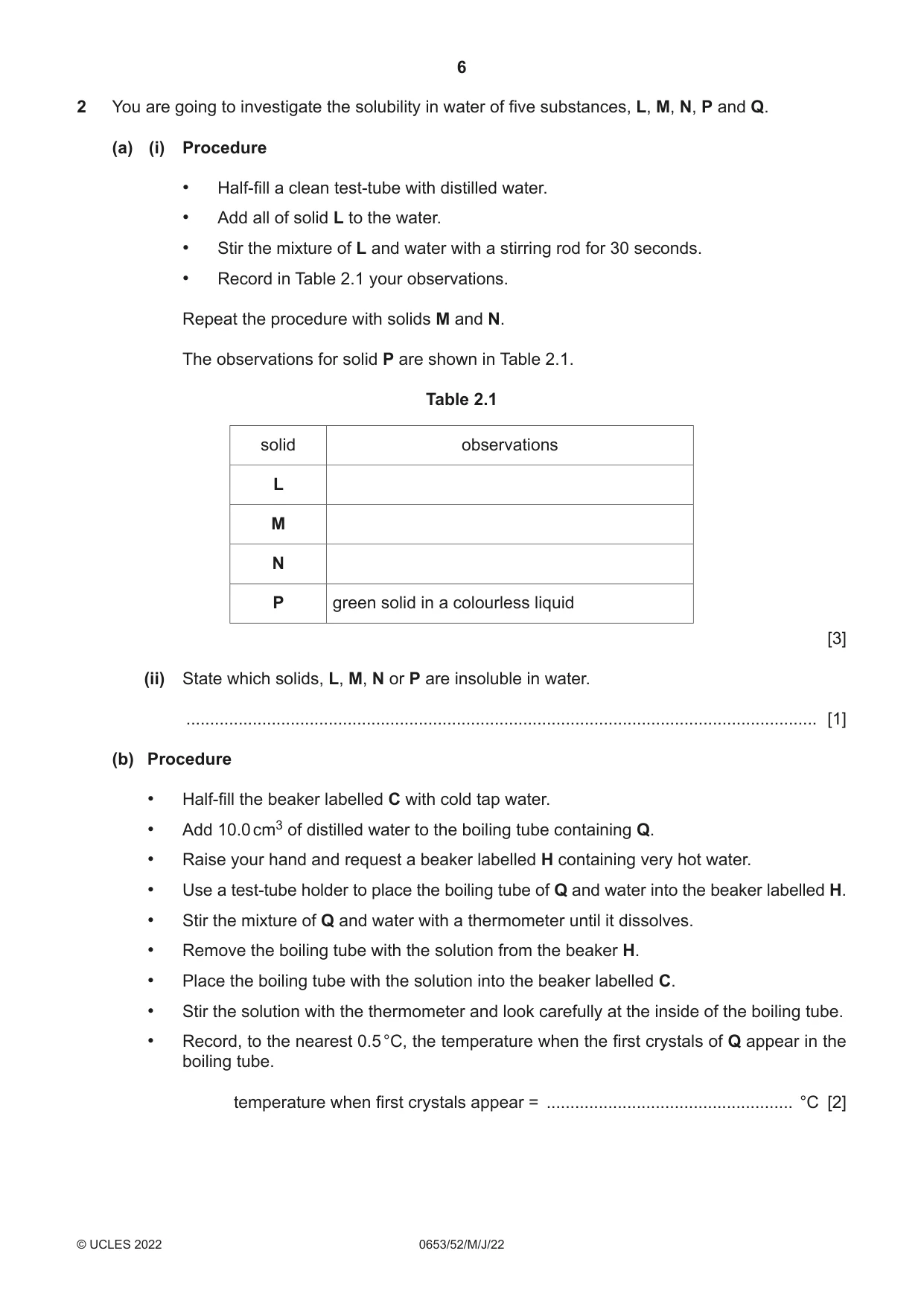
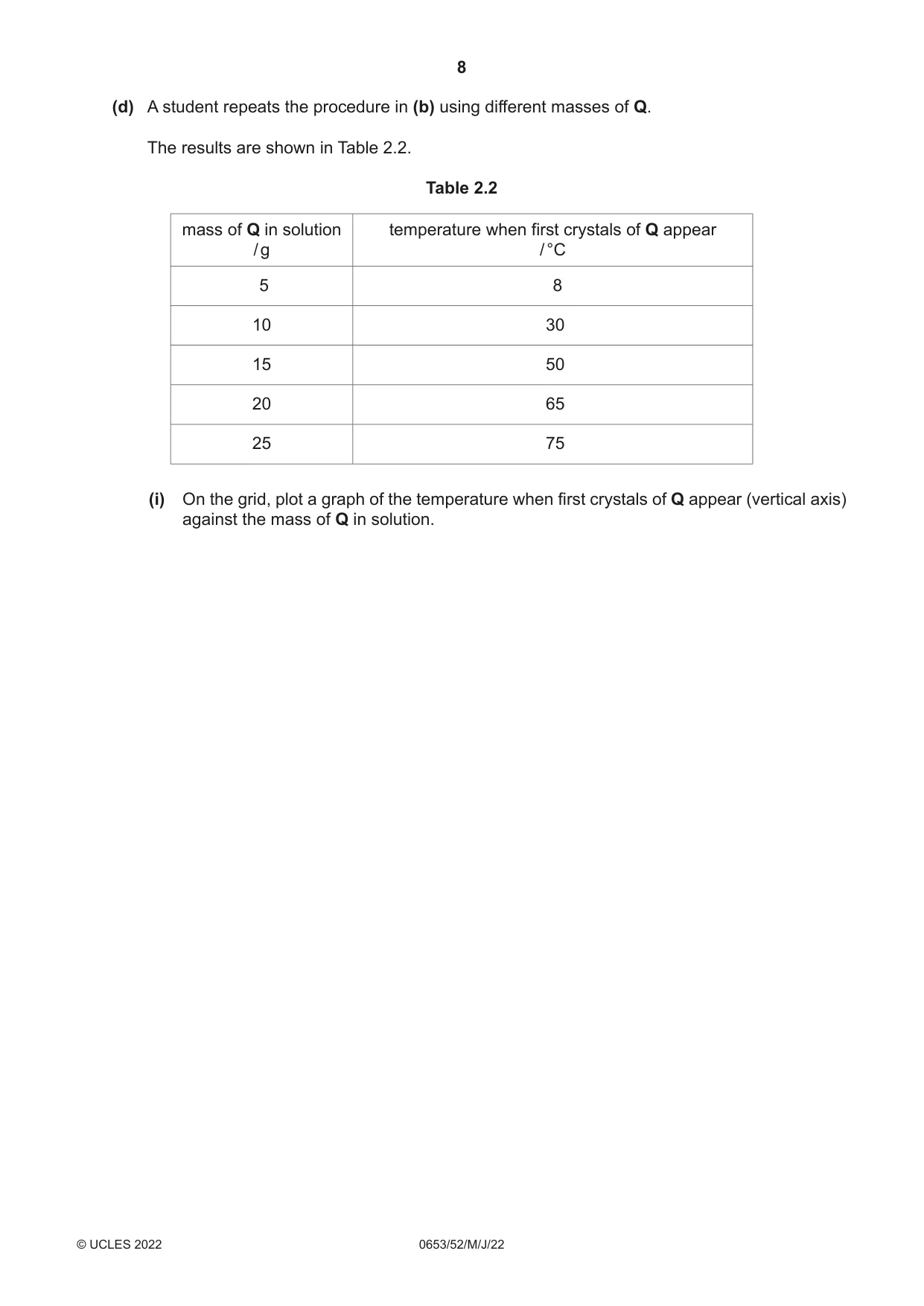
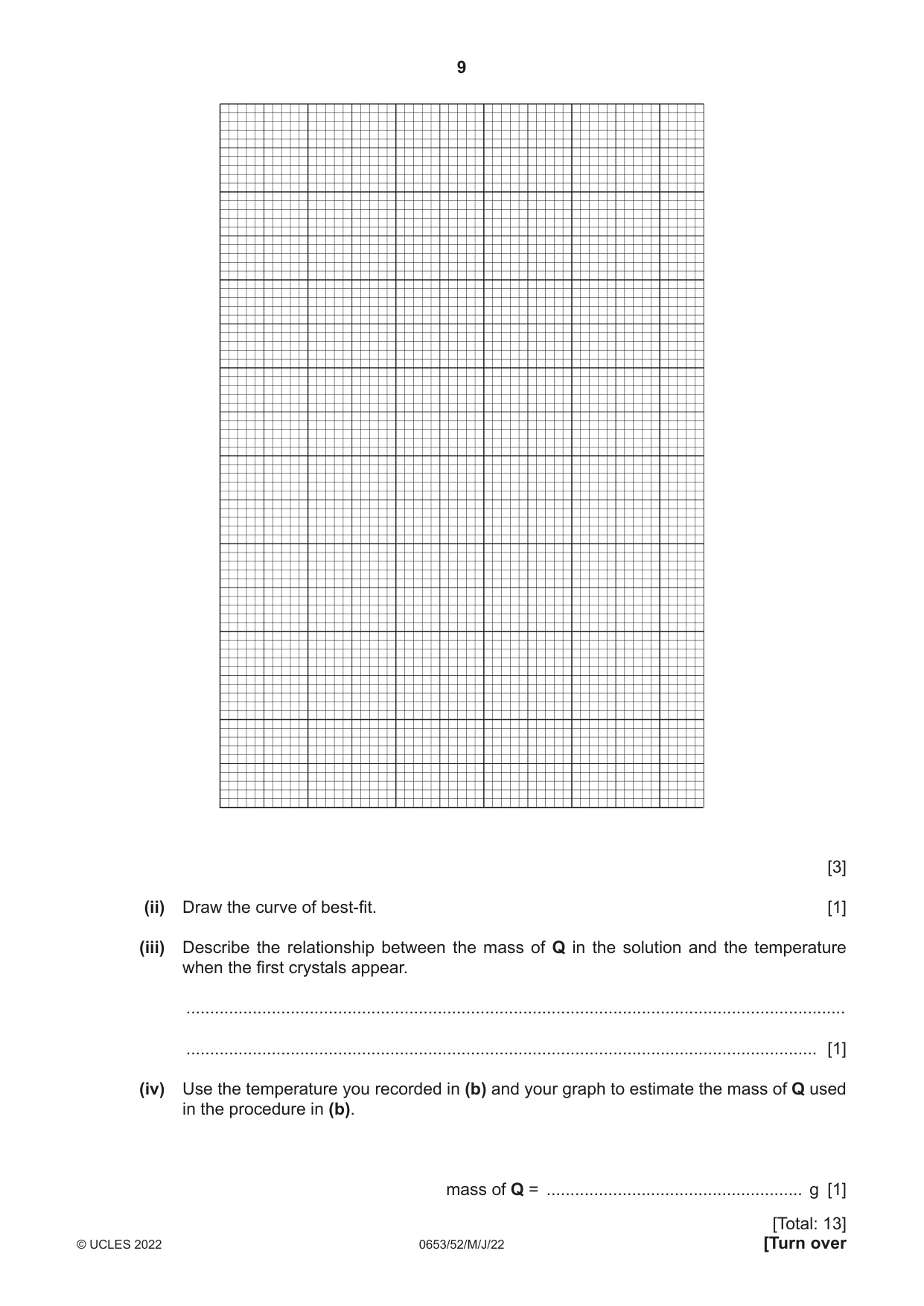
2 You are going to investigate the solubility in water of five substances, L, M, N, P and Q. (a) (i) Procedure • Half-fill a clean test-tube with distilled water. • Add all of solid L to the water. • Stir the mixture of L and water with a stirring rod for 30 seconds. • Record in Table 2.1 your observations. Repeat the procedure with solids M and N. The observations for solid P are shown in Table 2.1. Table 2.1 solid observations L M N P green solid in a colourless liquid [3] (ii) State which solids, L, M, N or P are insoluble in water. ..................................................................................................................................... [1] (b) Procedure • Half-fill the beaker labelled C with cold tap water. • Add 10.0 cm3 of distilled water to the boiling tube containing Q. • Raise your hand and request a beaker labelled H containing very hot water. • Use a test-tube holder to place the boiling tube of Q and water into the beaker labelled H. • Stir the mixture of Q and water with a thermometer until it dissolves. • Remove the boiling tube with the solution from the beaker H. • Place the boiling tube with the solution into the beaker labelled C. • Stir the solution with the thermometer and look carefully at the inside of the boiling tube. • Record, to the nearest 0.5 °C, the temperature when the first crystals of Q appear in the boiling tube. temperature when first crystals appear = .................................................... °C [2] (c) A student repeats the procedure in (b) but cools the boiling tube with the solution in air instead of in cold water. Suggest why cooling the solution in air will give a more accurate temperature for when the first crystals appear. ................................................................................................................................................... ............................................................................................................................................. [1] (d) A student repeats the procedure in (b) using different masses of Q. The results are shown in Table 2.2. Table 2.2 mass of Q in solution temperature when first crystals of Q appear / g / °C 5 8 10 30 15 50 20 65 25 75 (i) On the grid, plot a graph of the temperature when first crystals of Q appear (vertical axis) against the mass of Q in solution. [3] (ii) Draw the curve of best-fit. [1] (iii) Describe the relationship between the mass of Q in the solution and the temperature when the first crystals appear. ........................................................................................................................................... ..................................................................................................................................... [1] (iv) Use the temperature you recorded in (b) and your graph to estimate the mass of Q used in the procedure in (b). mass of Q = ...................................................... g [1]
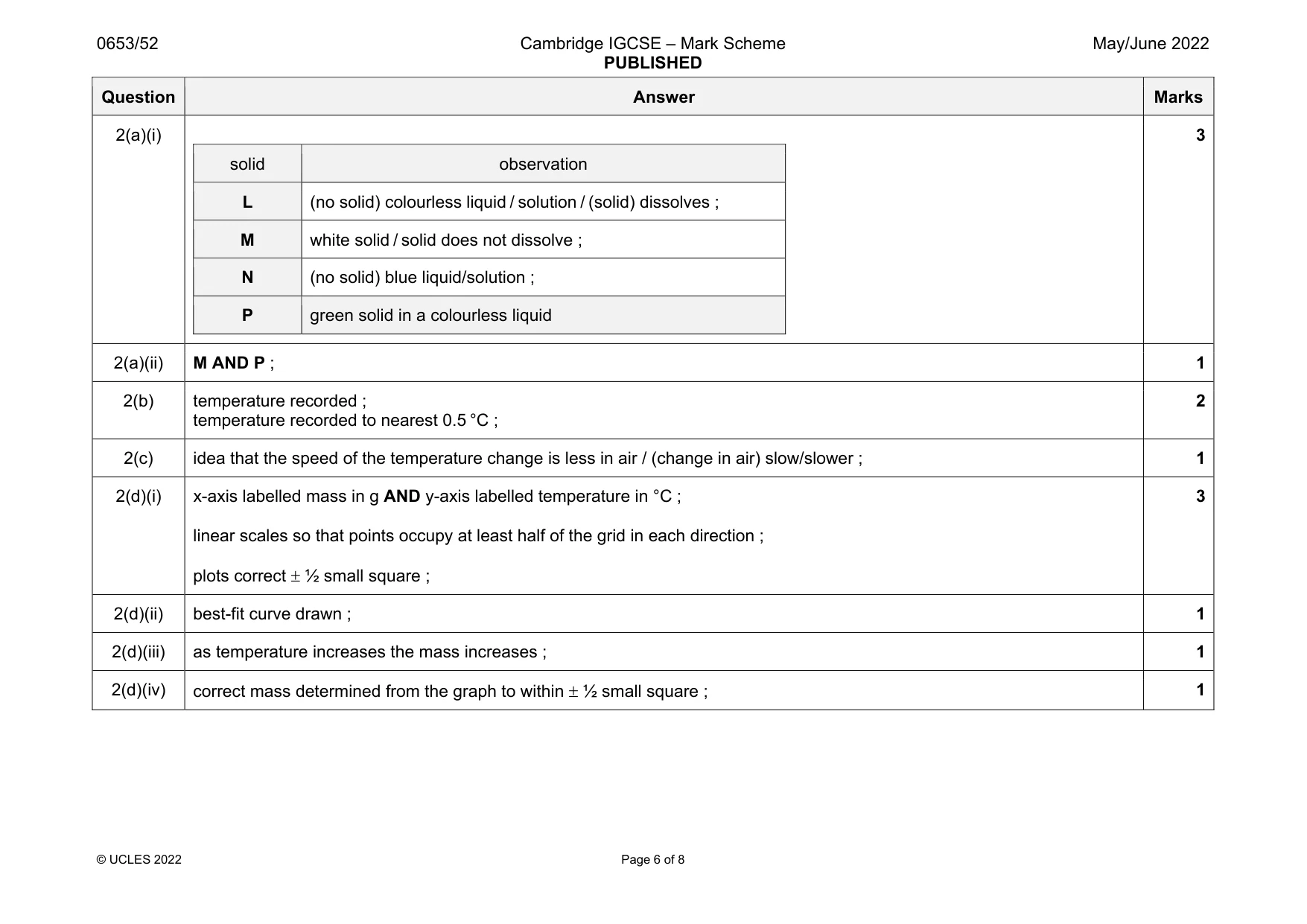
Mark scheme: 2(a)(i) solid observation L (no solid) colourless liquid / solution / (solid) dissolves ; M white solid / solid does not dissolve ; N (no solid) blue liquid/solution ; P green solid in a colourless liquid 3 2(a)(ii) M AND P ; 1 2(b) temperature recorded ; temperature recorded to nearest 0.5 °C ; 2 2(c) idea that the speed of the temperature change is less in air / (change in air) slow/slower ; 1 2(d)(i) x-axis labelled mass in g AND y-axis labelled temperature in °C ; linear scales so that points occupy at least half of the grid in each direction ; plots correct ½ small square ; 3 2(d)(ii) best-fit curve drawn ; 1 2(d)(iii) as temperature increases the mass increases ; 1 2(d)(iv) correct mass determined from the graph to within ½ small square ; 1
Q3 · You are going to investigate thermal energy changes in water
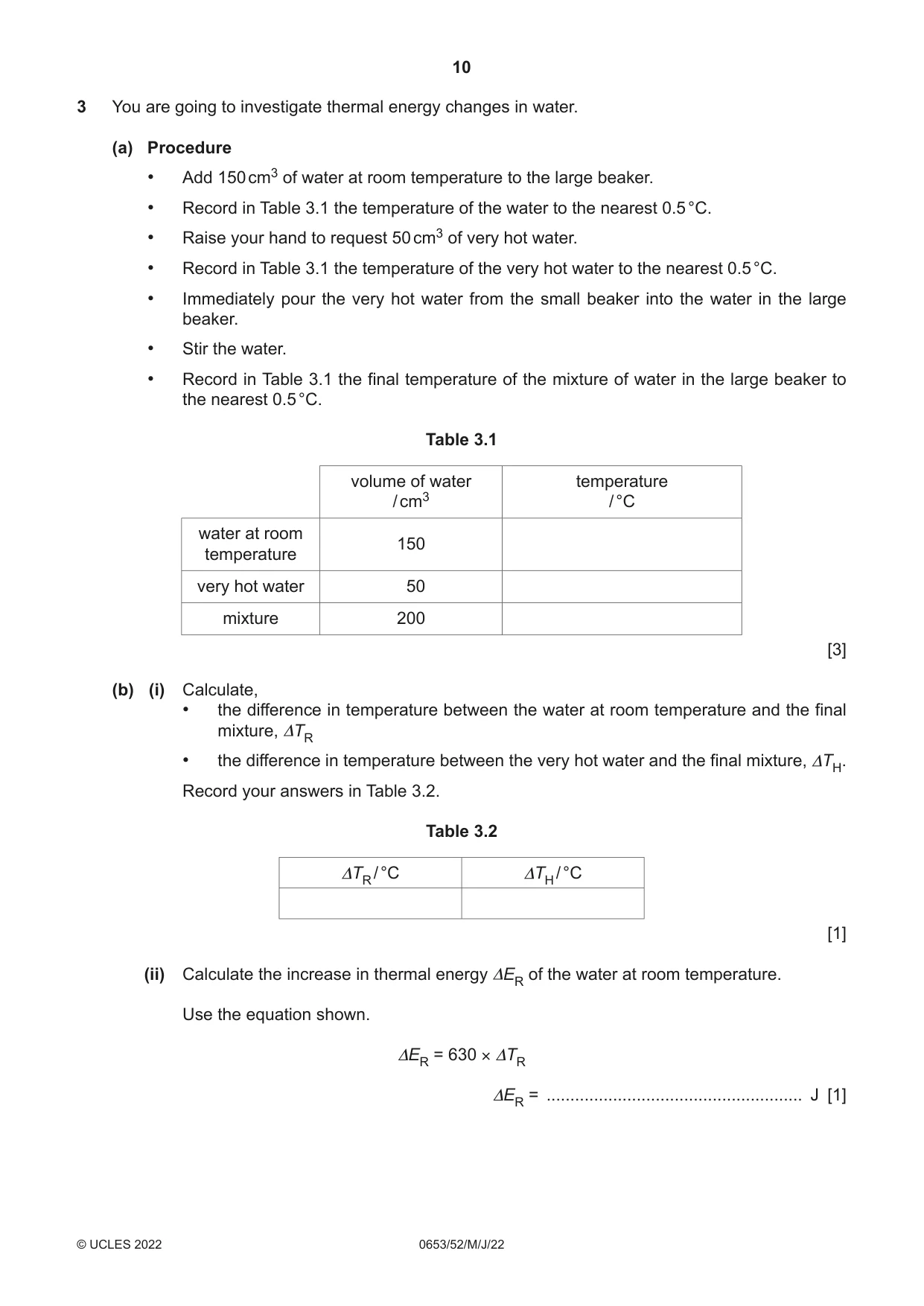
3 You are going to investigate thermal energy changes in water. (a) Procedure • Add 150 cm3 of water at room temperature to the large beaker. • Record in Table 3.1 the temperature of the water to the nearest 0.5 °C. • Raise your hand to request 50 cm3 of very hot water. • Record in Table 3.1 the temperature of the very hot water to the nearest 0.5 °C. • Immediately pour the very hot water from the small beaker into the water in the large beaker. • Stir the water. • Record in Table 3.1 the final temperature of the mixture of water in the large beaker to the nearest 0.5 °C. Table 3.1 volume of water temperature / cm3 / °C water at room 150 temperature very hot water 50 mixture 200 [3] (b) (i) Calculate, • the difference in temperature between the water at room temperature and the final mixture, ΔTR • the difference in temperature between the very hot water and the final mixture, ΔTH. Record your answers in Table 3.2. Table 3.2 ΔTR / °C ΔTH / °C [1] (ii) Calculate the increase in thermal energy ΔER of the water at room temperature. Use the equation shown. ΔER = 630 × ΔTR ΔER = ...................................................... J [1] (iii) Calculate the decrease in thermal energy ΔEH of the very hot water. Use the equation shown. Give your answer to two significant figures. ΔEH = 210 × ΔTH ΔEH = ...................................................... J [1] (c) A student suggests that the increase in thermal energy ΔER of the water at room temperature should be equal to the decrease in thermal energy ΔEH of the very hot water. Suggest one reason why your answers to (b)(ii) and (b)(iii) are not equal. ................................................................................................................................................... ............................................................................................................................................. [1] [Total: 7]
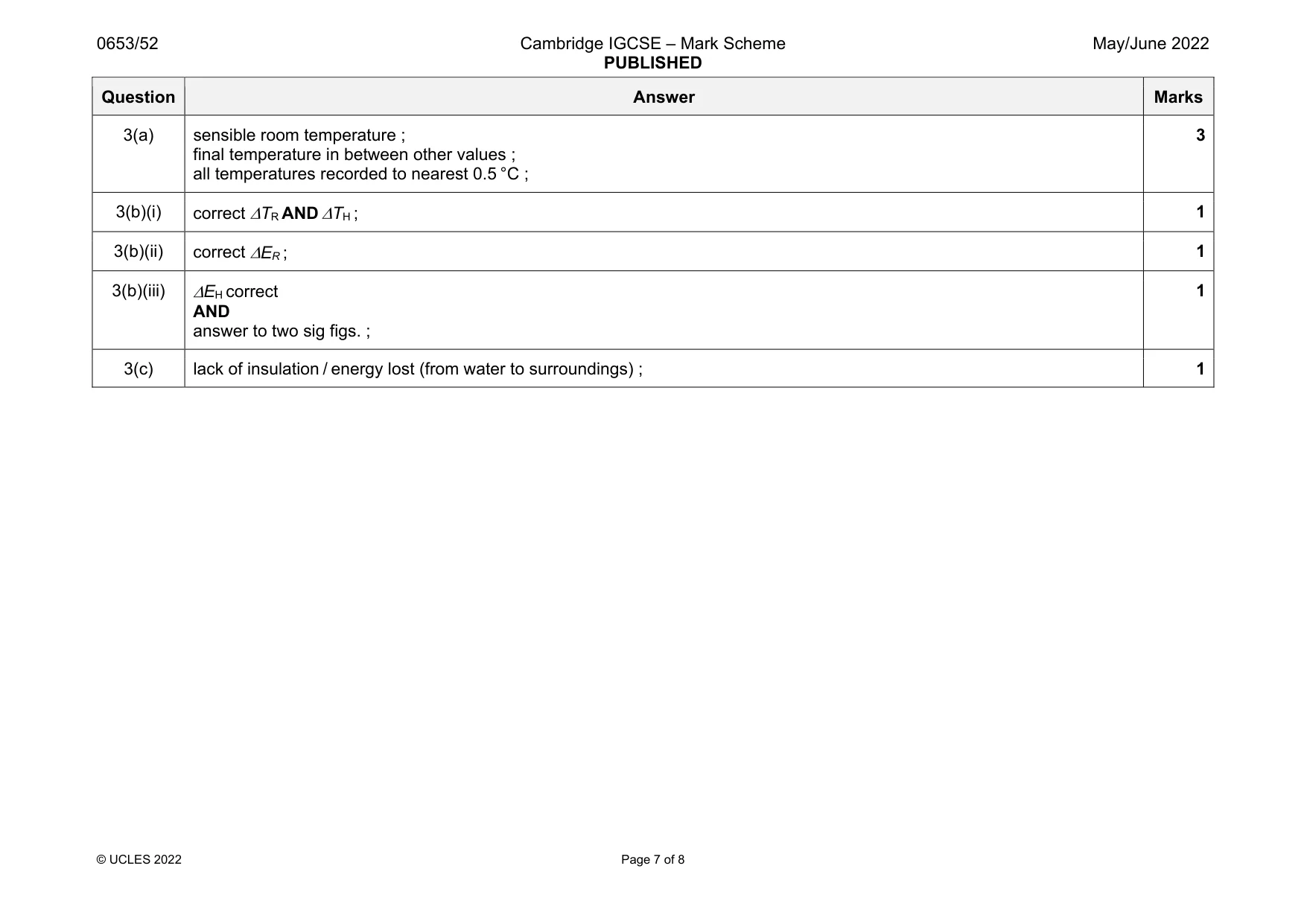
Mark scheme: 3(a) sensible room temperature ; final temperature in between other values ; all temperatures recorded to nearest 0.5 °C ; 3 3(b)(i) correct TR AND TH ; 1 3(b)(ii) correct ER ; 1 3(b)(iii) EH correct AND answer to two sig figs. ; 1 3(c) lack of insulation / energy lost (from water to surroundings) ; 1
Q4 · A door, hinged at one side
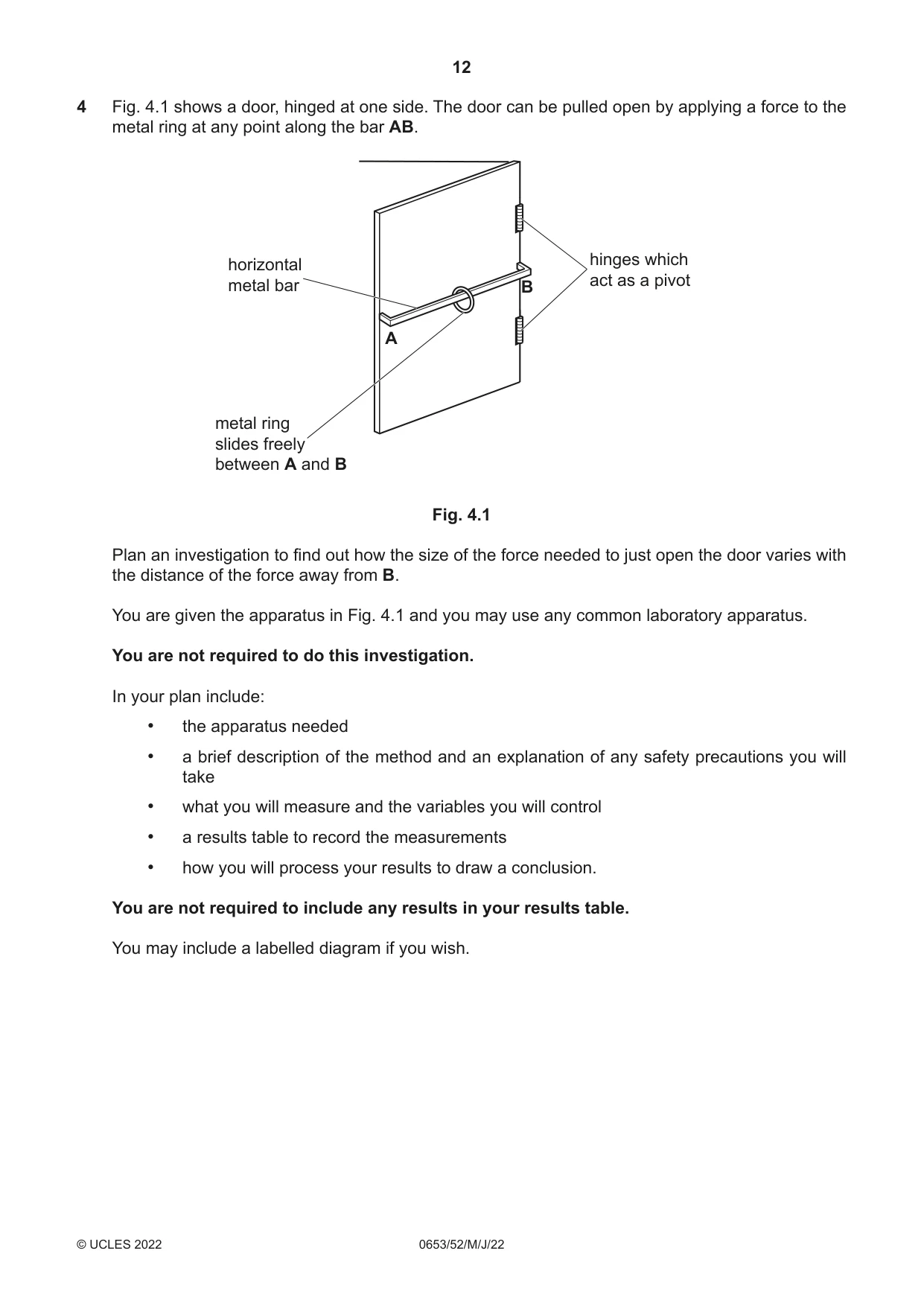
4 Fig. 4.1 shows a door, hinged at one side. The door can be pulled open by applying a force to the metal ring at any point along the bar AB. hinges which horizontal act as a pivot metal bar B A metal ring slides freely between A and B Fig. 4.1 Plan an investigation to find out how the size of the force needed to just open the door varies with the distance of the force away from B. You are given the apparatus in Fig. 4.1 and you may use any common laboratory apparatus. You are not required to do this investigation. In your plan include: • the apparatus needed • a brief description of the method and an explanation of any safety precautions you will take • what you will measure and the variables you will control • a results table to record the measurements • how you will process your results to draw a conclusion. You are not required to include any results in your results table. You may include a labelled diagram if you wish. .......................................................................................................................................................... .......................................................................................................................................................... .......................................................................................................................................................... .......................................................................................................................................................... .......................................................................................................................................................... .......................................................................................................................................................... .......................................................................................................................................................... .......................................................................................................................................................... .......................................................................................................................................................... .......................................................................................................................................................... .......................................................................................................................................................... .......................................................................................................................................................... .......................................................................................................................................................... .................................................................................................................................................... [7]
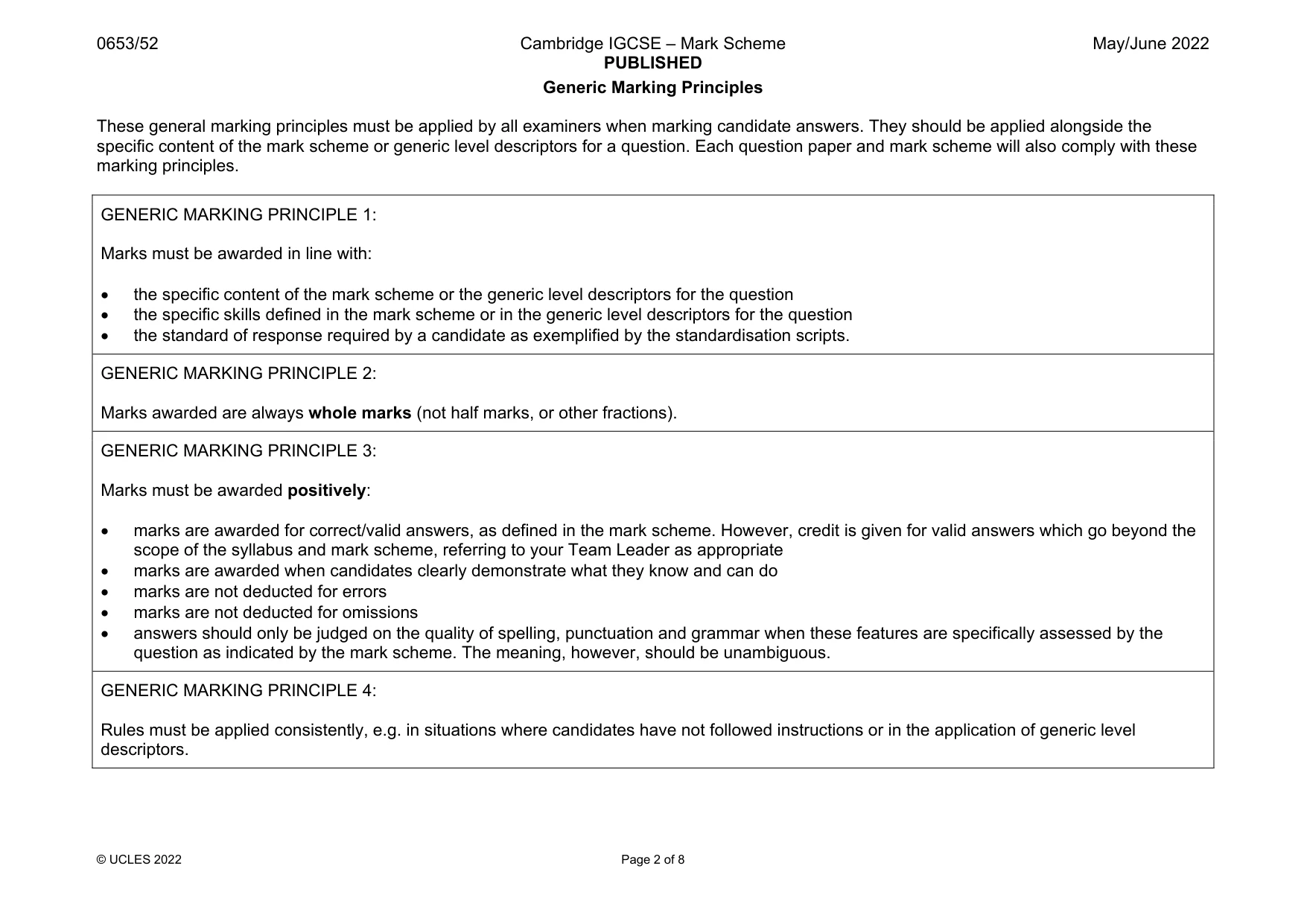
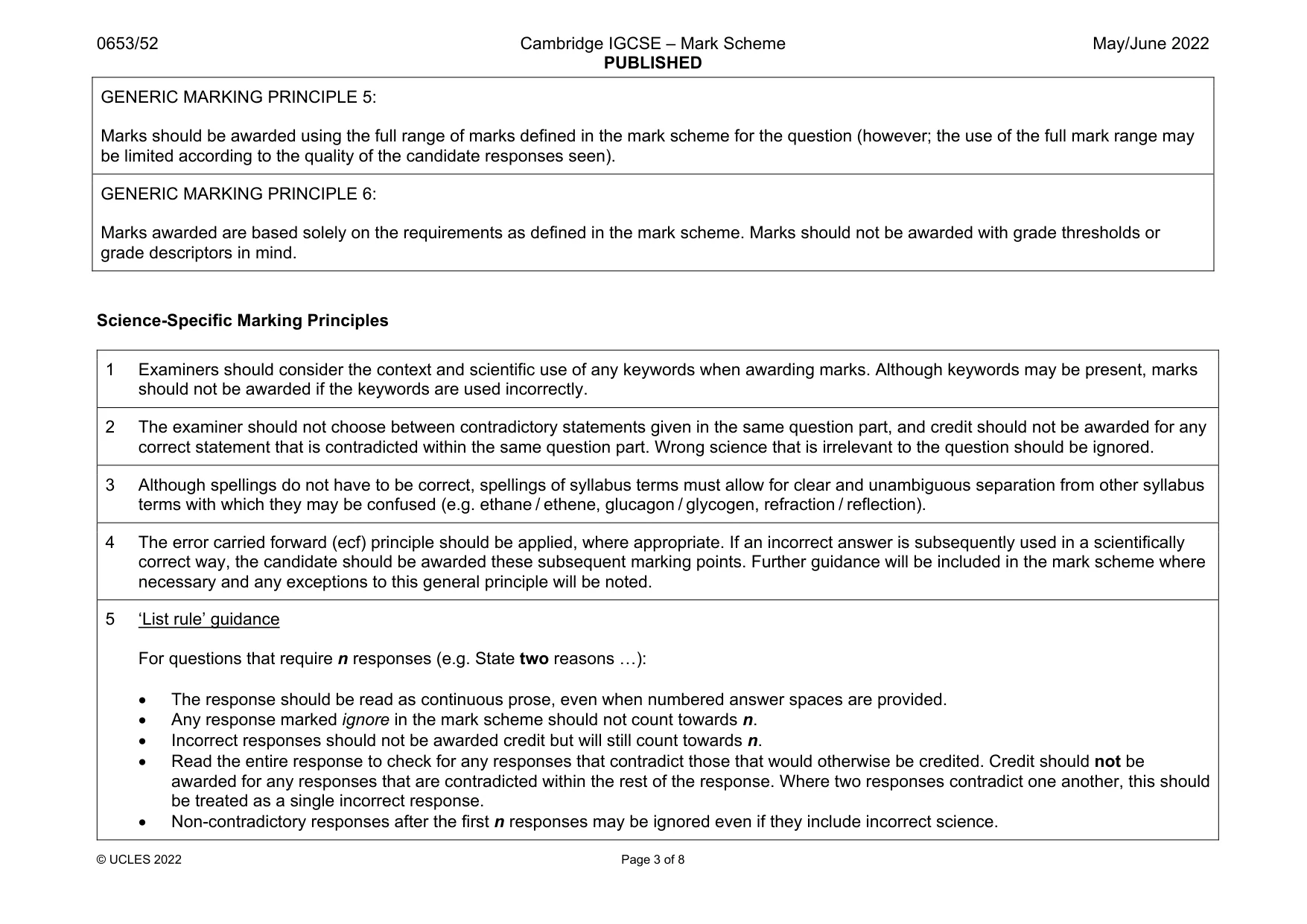
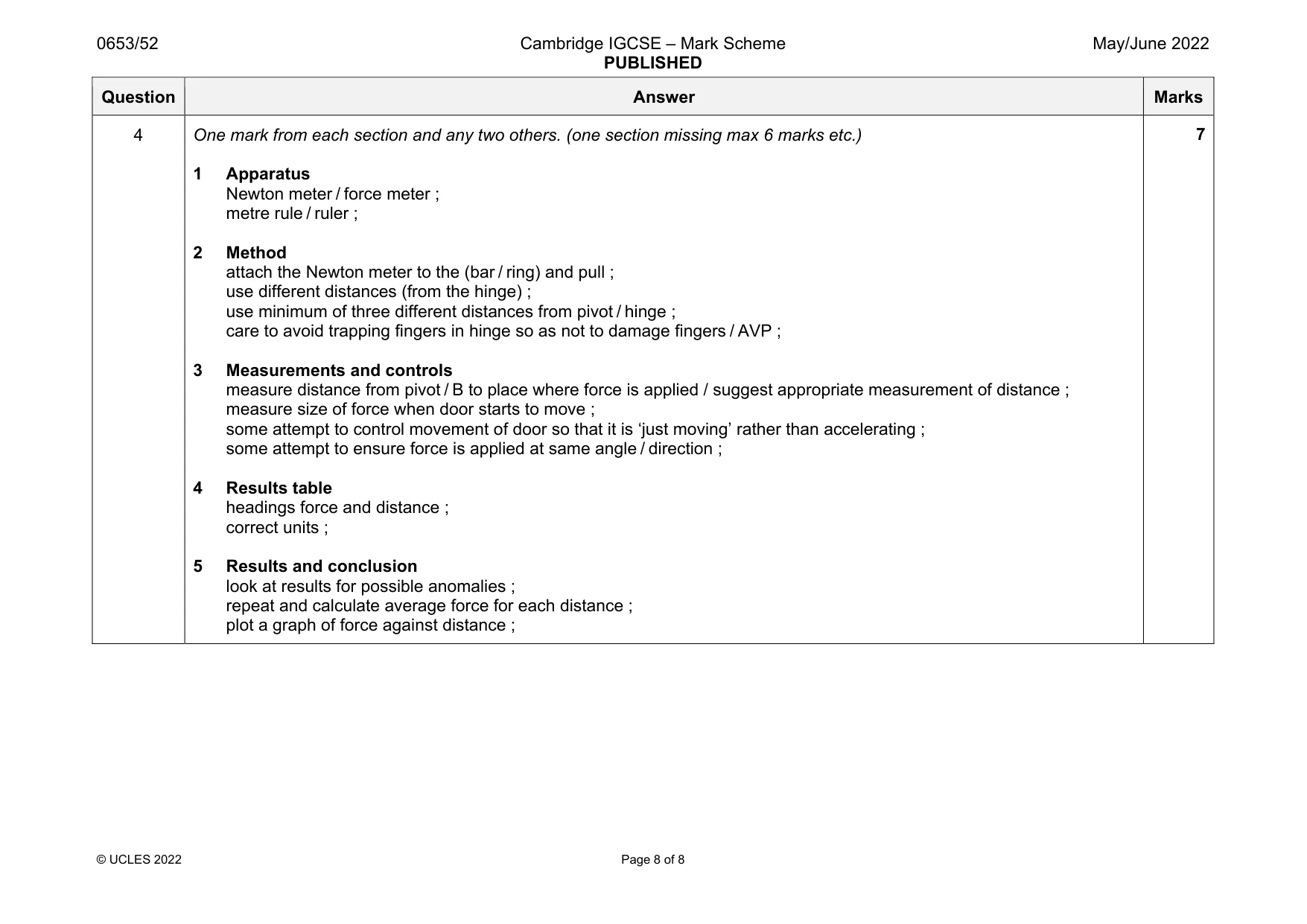
Mark scheme: 4 One mark from each section and any two others. (one section missing max 6 marks etc.) 1 Apparatus Newton meter / force meter ; metre rule / ruler ; 2 Method attach the Newton meter to the (bar / ring) and pull ; use different distances (from the hinge) ; use minimum of three different distances from pivot / hinge ; care to avoid trapping fingers in hinge so as not to damage fingers / AVP ; 3 Measurements and controls measure distance from pivot / B to place where force is applied / suggest appropriate measurement of distance ; measure size of force when door starts to move ; some attempt to control movement of door so that it is ‘just moving’ rather than accelerating ; some attempt to ensure force is applied at same angle / direction ; 4 Results table headings force and distance ; correct units ; 5 Results and conclusion look at results for possible anomalies ; repeat and calculate average force for each distance ; plot a graph of force against distance ;
What was in this paper
The subtopics covered by these 4 questions, and how many questions each got. Open one in a new tab to see every Cambridge question on it.
What you needed in this session
Cambridge’s own grade thresholds for 2022 May/June, Paper 5 · Variant 2. A higher threshold means an easier paper — the bar moves with how the cohort did.