Cambridge IGCSE Science - Combined 0653 — 2022 Feb/March Paper 5 · Variant 2
0653/52/F/M/22 · 4 questions · 40 marks · ≈45 min
The question paper and its mark scheme, free to read here and free to download. This is Cambridge’s own paper, exactly as it was sat.
Question paper16 pages




Mark scheme
No mark scheme is in the library for this paper.
Questions as text
Q1 · You are going to investigate the rate of an enzyme-catalysed reaction
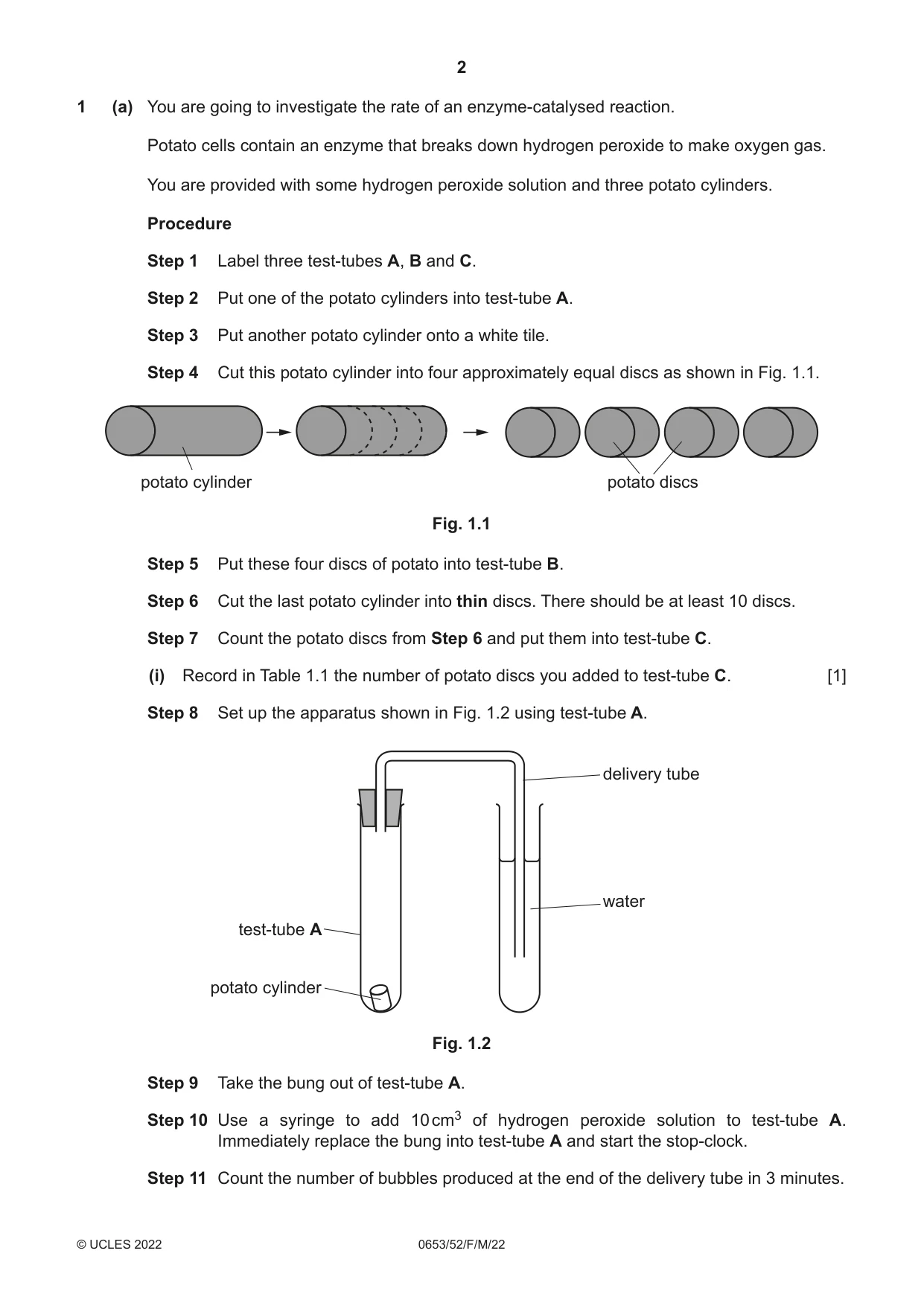
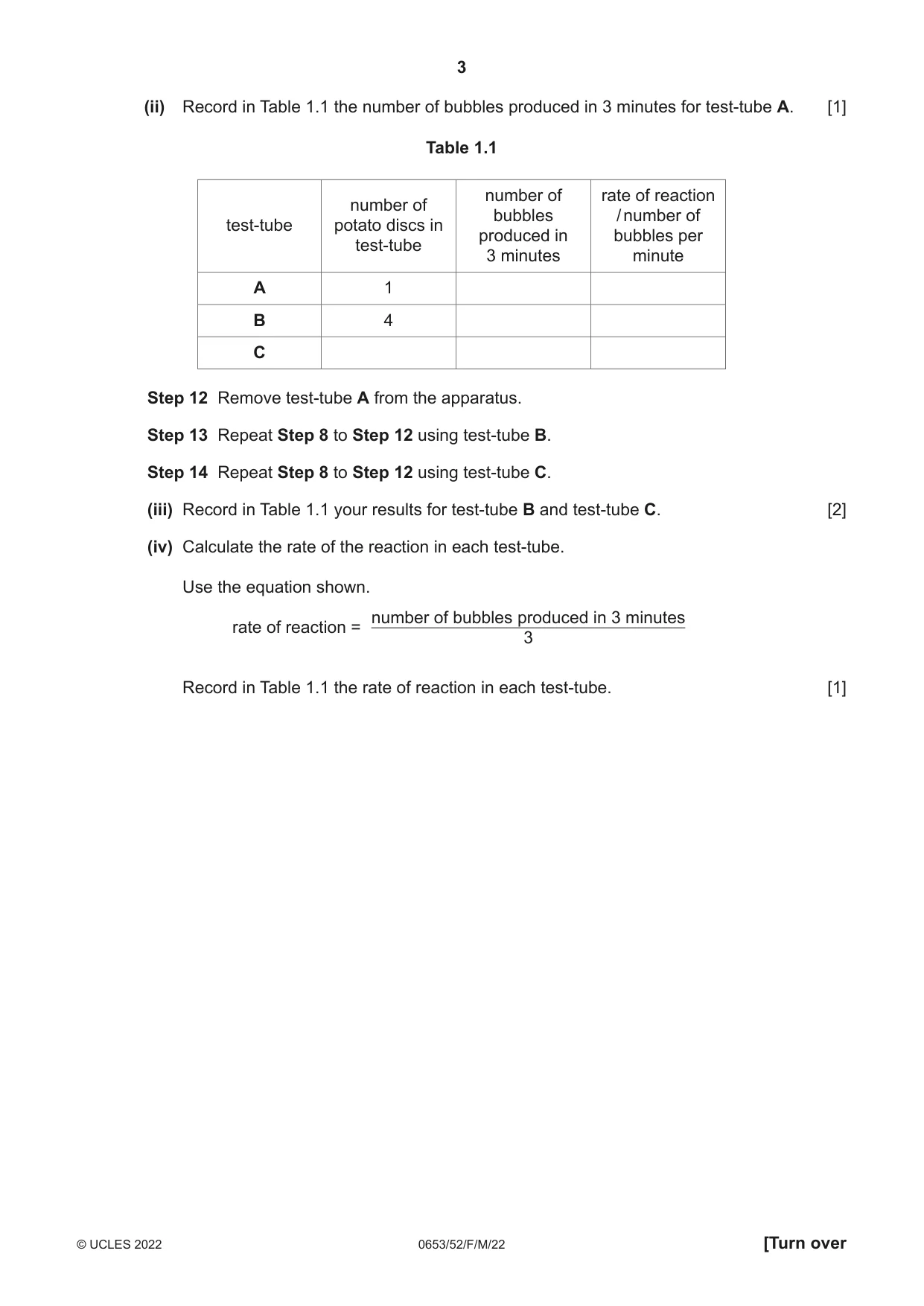
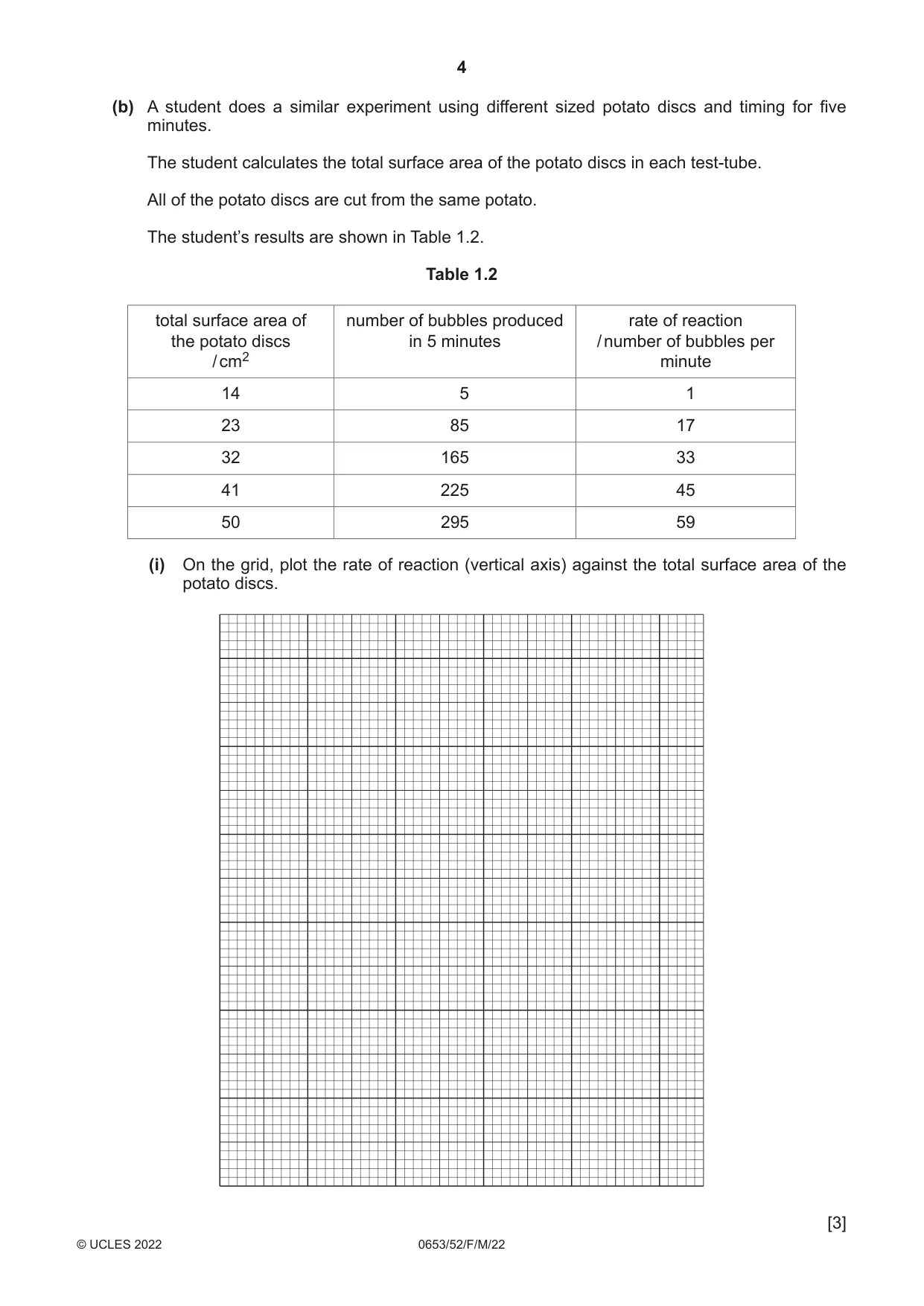
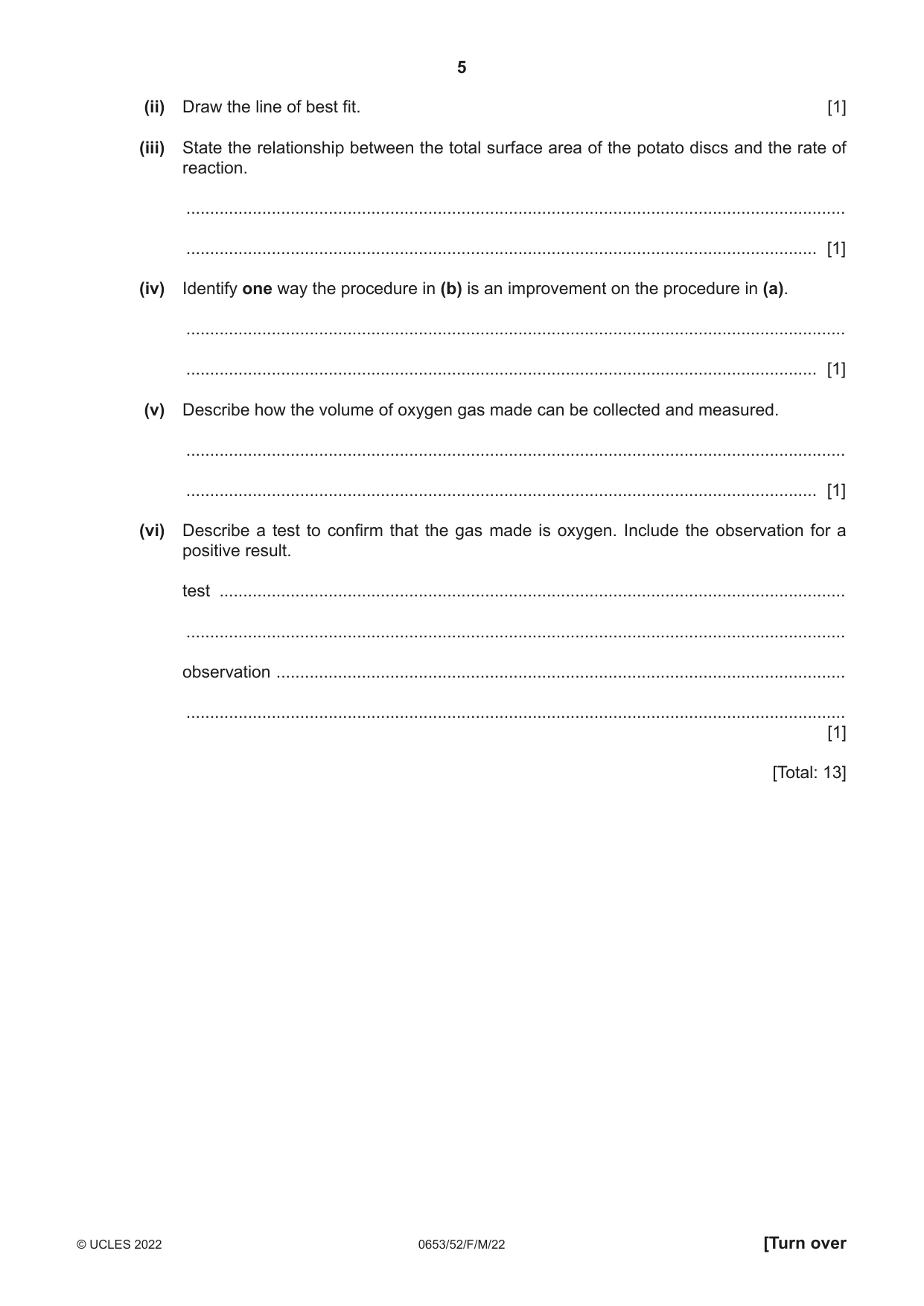
1 (a) You are going to investigate the rate of an enzyme-catalysed reaction. Potato cells contain an enzyme that breaks down hydrogen peroxide to make oxygen gas. You are provided with some hydrogen peroxide solution and three potato cylinders. Procedure Step 1 Label three test-tubes A, B and C. Step 2 Put one of the potato cylinders into test-tube A. Step 3 Put another potato cylinder onto a white tile. Step 4 Cut this potato cylinder into four approximately equal discs as shown in Fig. 1.1. potato cylinder potato discs Fig. 1.1 Step 5 Put these four discs of potato into test-tube B. Step 6 Cut the last potato cylinder into thin discs. There should be at least 10 discs. Step 7 Count the potato discs from Step 6 and put them into test-tube C. (i) Record in Table 1.1 the number of potato discs you added to test-tube C. [1] Step 8 Set up the apparatus shown in Fig. 1.2 using test-tube A. delivery tube water test-tube A potato cylinder Fig. 1.2 Step 9 Take the bung out of test-tube A. Step 10 Use a syringe to add 10 cm3 of hydrogen peroxide solution to test-tube A. Immediately replace the bung into test-tube A and start the stop-clock. Step 11 Count the number of bubbles produced at the end of the delivery tube in 3 minutes. (ii) Record in Table 1.1 the number of bubbles produced in 3 minutes for test-tube A. [1] Table 1.1 number of rate of reaction number of bubbles / number of test-tube potato discs in produced in bubbles per test-tube 3 minutes minute A 1 B 4 C Step 12 Remove test-tube A from the apparatus. Step 13 Repeat Step 8 to Step 12 using test-tube B. Step 14 Repeat Step 8 to Step 12 using test-tube C. (iii) Record in Table 1.1 your results for test-tube B and test-tube C. [2] (iv) Calculate the rate of the reaction in each test-tube. Use the equation shown. number of bubbles produced in 3 minutes rate of reaction = 3 Record in Table 1.1 the rate of reaction in each test-tube. [1] (b) A student does a similar experiment using different sized potato discs and timing for five minutes. The student calculates the total surface area of the potato discs in each test-tube. All of the potato discs are cut from the same potato. The student’s results are shown in Table 1.2. Table 1.2 total surface area of number of bubbles produced rate of reaction the potato discs in 5 minutes / number of bubbles per / cm2 minute 14 5 1 23 85 17 32 165 33 41 225 45 50 295 59 (i) On the grid, plot the rate of reaction (vertical axis) against the total surface area of the potato discs. [3] (ii) Draw the line of best fit. [1] (iii) State the relationship between the total surface area of the potato discs and the rate of reaction. ........................................................................................................................................... ..................................................................................................................................... [1] (iv) Identify one way the procedure in (b) is an improvement on the procedure in (a). ........................................................................................................................................... ..................................................................................................................................... [1] (v) Describe how the volume of oxygen gas made can be collected and measured. ........................................................................................................................................... ..................................................................................................................................... [1] (vi) Describe a test to confirm that the gas made is oxygen. Include the observation for a positive result. test .................................................................................................................................... ........................................................................................................................................... observation ........................................................................................................................ ........................................................................................................................................... [1] [Total: 13]
Q2 · You are going to investigate some properties of solid H
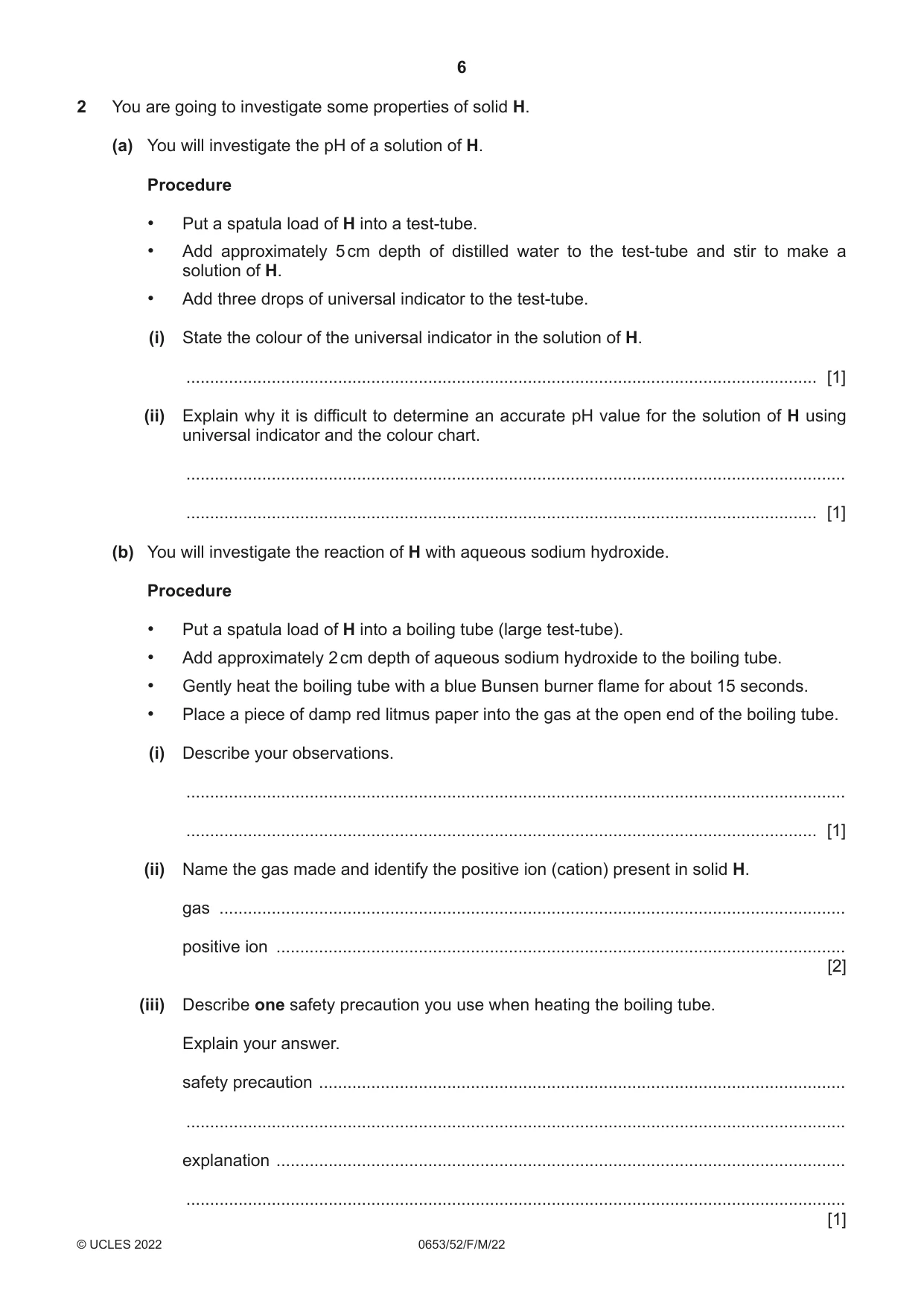
2 You are going to investigate some properties of solid H. (a) You will investigate the pH of a solution of H. Procedure • Put a spatula load of H into a test-tube. • Add approximately 5 cm depth of distilled water to the test-tube and stir to make a solution of H. • Add three drops of universal indicator to the test-tube. (i) State the colour of the universal indicator in the solution of H. ..................................................................................................................................... [1] (ii) Explain why it is difficult to determine an accurate pH value for the solution of H using universal indicator and the colour chart. ........................................................................................................................................... ..................................................................................................................................... [1] (b) You will investigate the reaction of H with aqueous sodium hydroxide. Procedure • Put a spatula load of H into a boiling tube (large test-tube). • Add approximately 2 cm depth of aqueous sodium hydroxide to the boiling tube. • Gently heat the boiling tube with a blue Bunsen burner flame for about 15 seconds. • Place a piece of damp red litmus paper into the gas at the open end of the boiling tube. (i) Describe your observations. ........................................................................................................................................... ..................................................................................................................................... [1] (ii) Name the gas made and identify the positive ion (cation) present in solid H. gas .................................................................................................................................... positive ion ........................................................................................................................ [2] (iii) Describe one safety precaution you use when heating the boiling tube. Explain your answer. safety precaution ............................................................................................................... ........................................................................................................................................... explanation ........................................................................................................................ ........................................................................................................................................... [1] (c) You will investigate the reaction of H with dilute hydrochloric acid. Procedure • Put a spatula load of H into a test-tube. • Add approximately 3 cm depth of dilute hydrochloric acid to the test-tube. Describe your observations. ................................................................................................................................................... ............................................................................................................................................. [1] [Total: 7]
Q3 · Magnesium carbonate is a white solid that decomposes when heated
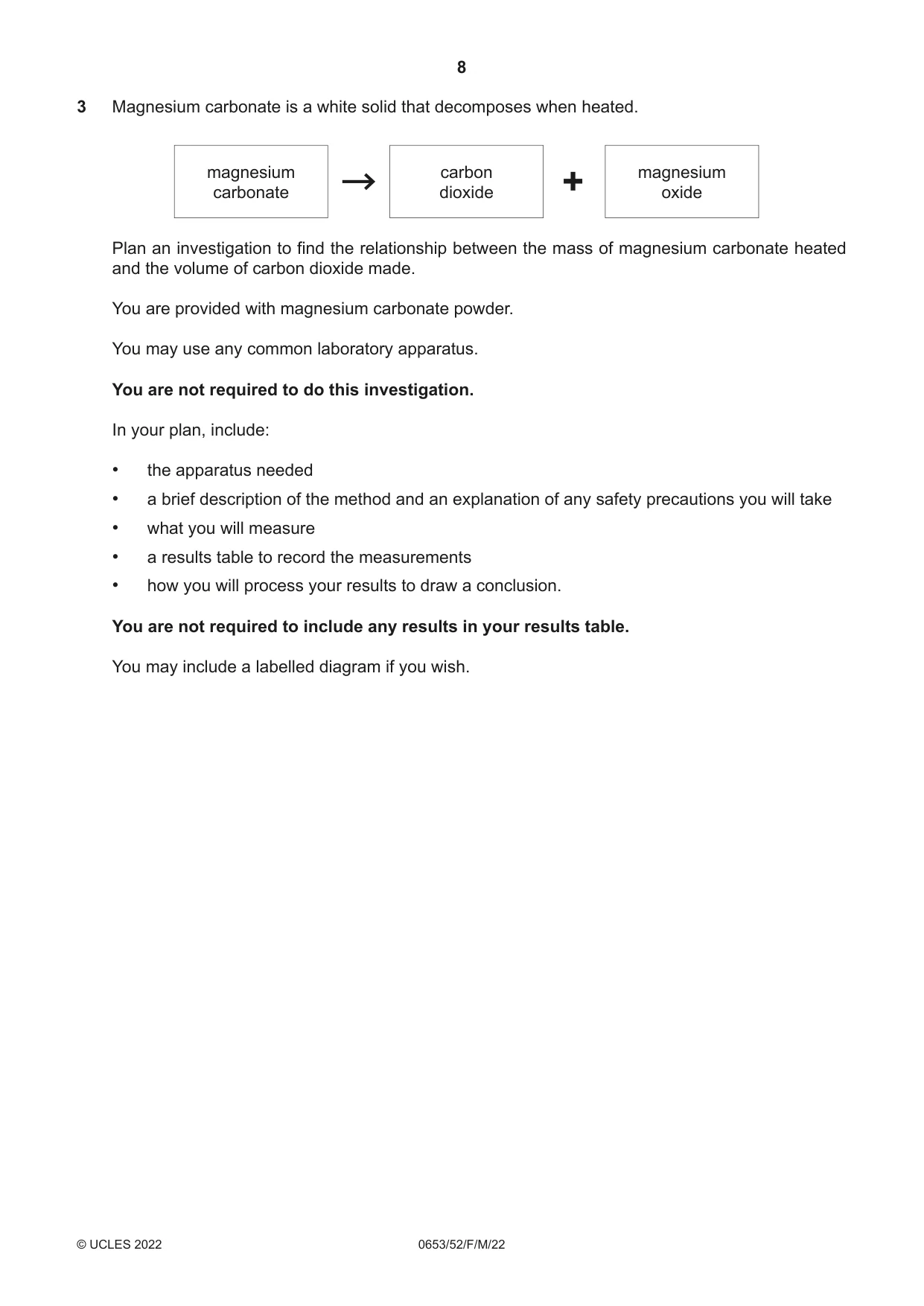
3 Magnesium carbonate is a white solid that decomposes when heated. magnesium carbon magnesium carbonate dioxide oxide + Plan an investigation to find the relationship between the mass of magnesium carbonate heated and the volume of carbon dioxide made. You are provided with magnesium carbonate powder. You may use any common laboratory apparatus. You are not required to do this investigation. In your plan, include: • the apparatus needed • a brief description of the method and an explanation of any safety precautions you will take • what you will measure • a results table to record the measurements • how you will process your results to draw a conclusion. You are not required to include any results in your results table. You may include a labelled diagram if you wish. .......................................................................................................................................................... .......................................................................................................................................................... .......................................................................................................................................................... .......................................................................................................................................................... .......................................................................................................................................................... .......................................................................................................................................................... .......................................................................................................................................................... .......................................................................................................................................................... .......................................................................................................................................................... .......................................................................................................................................................... .......................................................................................................................................................... .......................................................................................................................................................... .......................................................................................................................................................... .................................................................................................................................................... [7]
Q4 · You are going to calculate the work done when an object slides from the top of a ramp to…
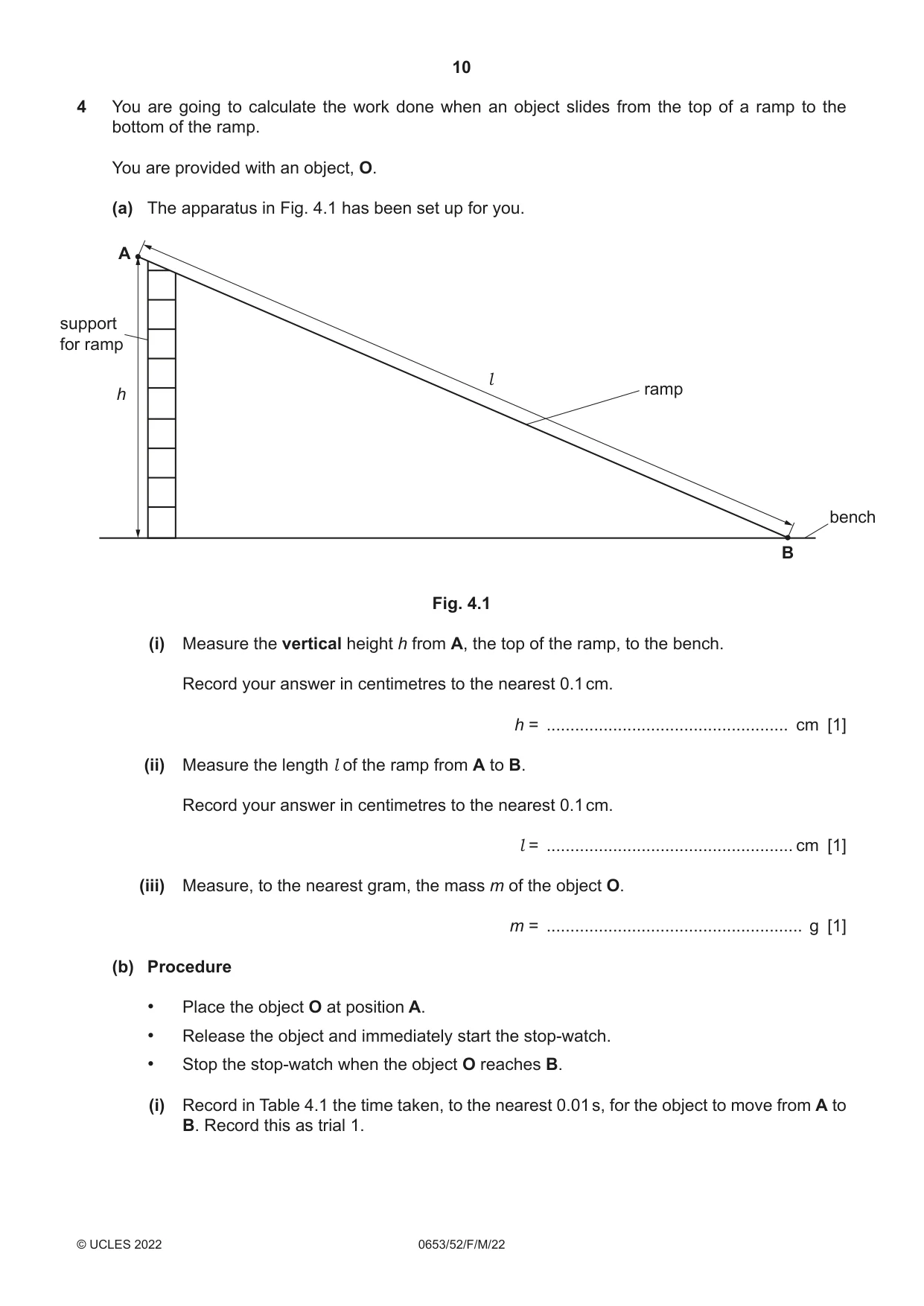
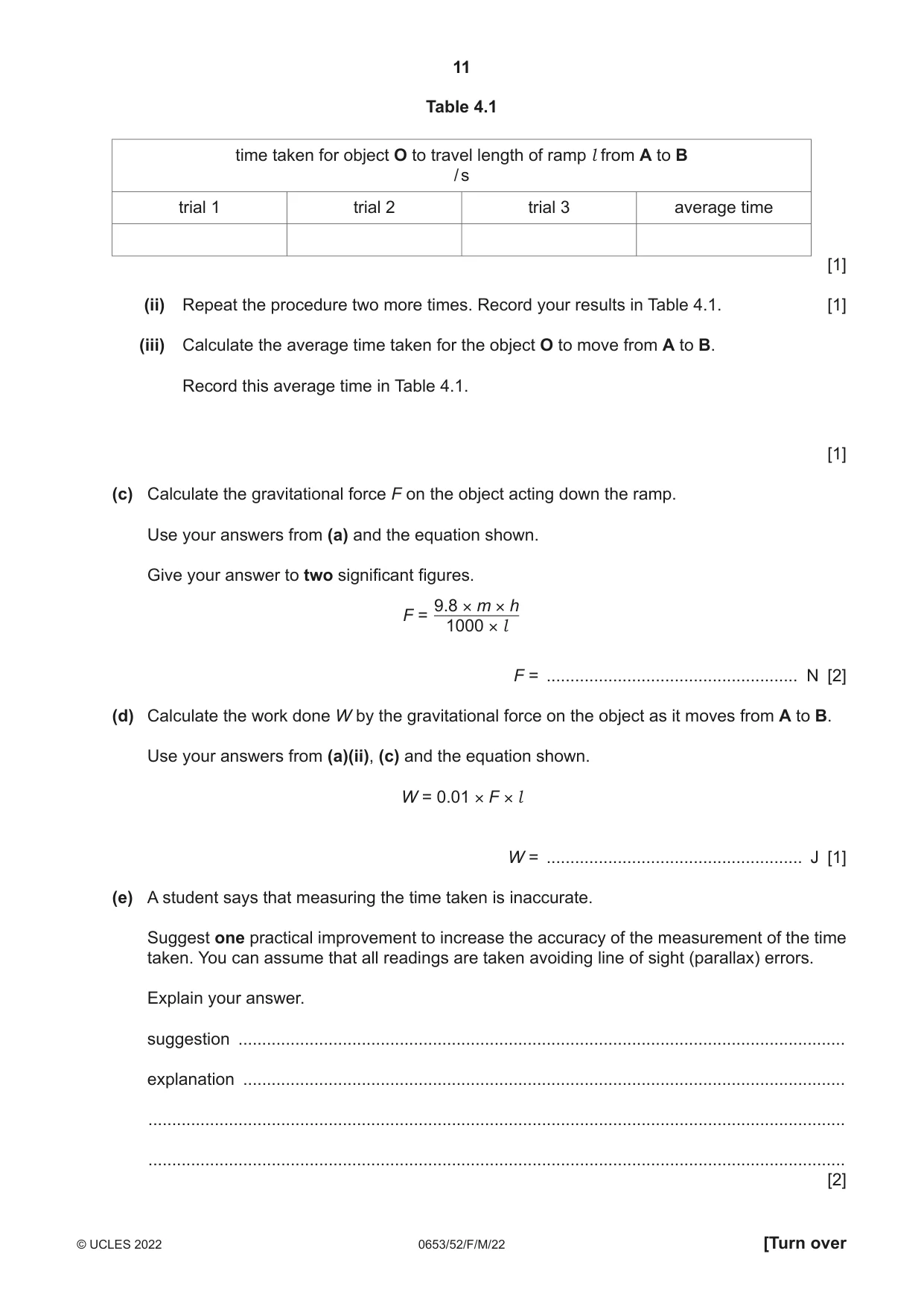
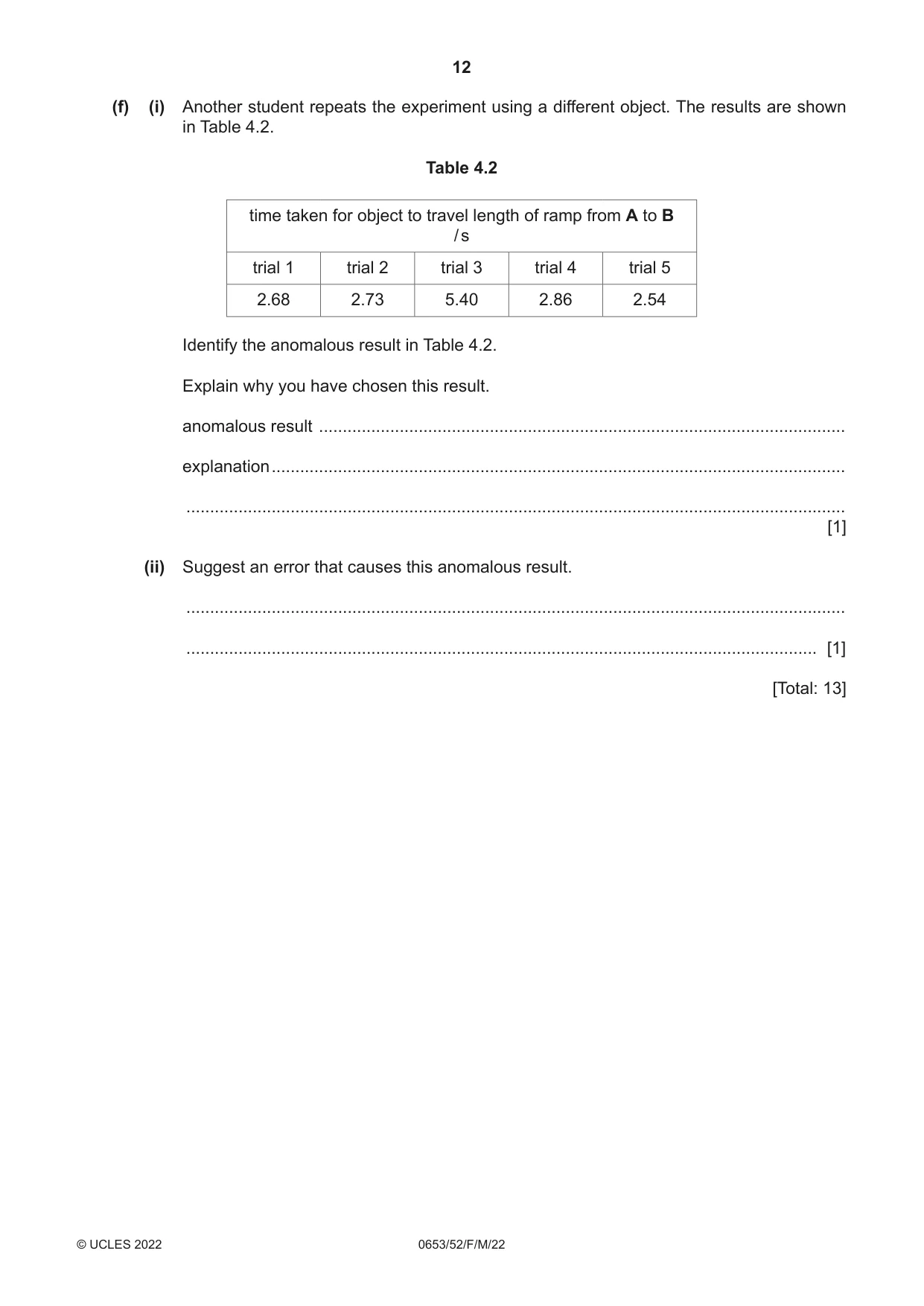
4 You are going to calculate the work done when an object slides from the top of a ramp to the bottom of the ramp. You are provided with an object, O. (a) The apparatus in Fig. 4.1 has been set up for you. A support for ramp l ramp h bench B Fig. 4.1 (i) Measure the vertical height h from A, the top of the ramp, to the bench. Record your answer in centimetres to the nearest 0.1 cm. h = ................................................... cm [1] (ii) Measure the length l of the ramp from A to B. Record your answer in centimetres to the nearest 0.1 cm. l = .................................................... cm [1] (iii) Measure, to the nearest gram, the mass m of the object O. m = ...................................................... g [1] (b) Procedure • Place the object O at position A. • Release the object and immediately start the stop-watch. • Stop the stop-watch when the object O reaches B. (i) Record in Table 4.1 the time taken, to the nearest 0.01 s, for the object to move from A to B. Record this as trial 1. Table 4.1 time taken for object O to travel length of ramp l from A to B / s trial 1 trial 2 trial 3 average time [1] (ii) Repeat the procedure two more times. Record your results in Table 4.1. [1] (iii) Calculate the average time taken for the object O to move from A to B. Record this average time in Table 4.1. [1] (c) Calculate the gravitational force F on the object acting down the ramp. Use your answers from (a) and the equation shown. Give your answer to two significant figures. 9.8 × m × h F = 1000 × l F = ..................................................... N [2] (d) Calculate the work done W by the gravitational force on the object as it moves from A to B. Use your answers from (a)(ii), (c) and the equation shown. W = 0.01 × F × l W = ...................................................... J [1] (e) A student says that measuring the time taken is inaccurate. Suggest one practical improvement to increase the accuracy of the measurement of the time taken. You can assume that all readings are taken avoiding line of sight (parallax) errors. Explain your answer. suggestion ................................................................................................................................ explanation ............................................................................................................................... ................................................................................................................................................... ................................................................................................................................................... [2] (f) (i) Another student repeats the experiment using a different object. The results are shown in Table 4.2. Table 4.2 time taken for object to travel length of ramp from A to B / s trial 1 trial 2 trial 3 trial 4 trial 5 2.68 2.73 5.40 2.86 2.54 Identify the anomalous result in Table 4.2. Explain why you have chosen this result. anomalous result ............................................................................................................... explanation ......................................................................................................................... ........................................................................................................................................... [1] (ii) Suggest an error that causes this anomalous result. ........................................................................................................................................... ..................................................................................................................................... [1] [Total: 13]
More questions on Physical quantities and measurement techniques
What was in this paper
The subtopics covered by these 4 questions, and how many questions each got. Open one in a new tab to see every Cambridge question on it.