Cambridge IGCSE Science - Combined 0653 — 2017 Feb/March Paper 5 · Variant 2
0653/52/F/M/17 · 3 questions · 30 marks · ≈34 min
The question paper and its mark scheme, free to read here and free to download. This is Cambridge’s own paper, exactly as it was sat.
Question paper12 pages




Mark scheme4 pages
Answers below. Sit the paper first if you are practising.
Questions as text
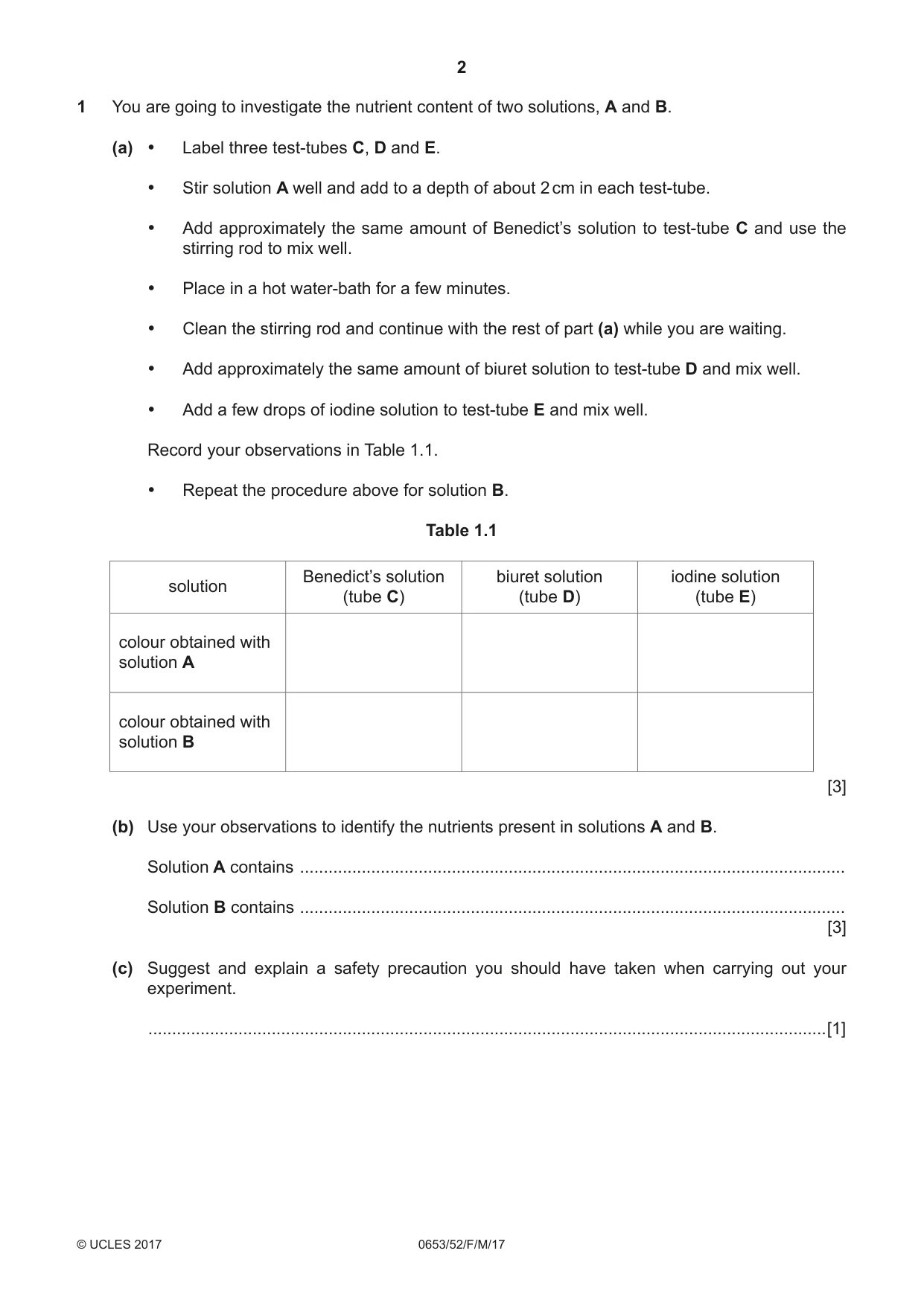
Q1 · You are going to investigate the nutrient content of two solutions, A and B
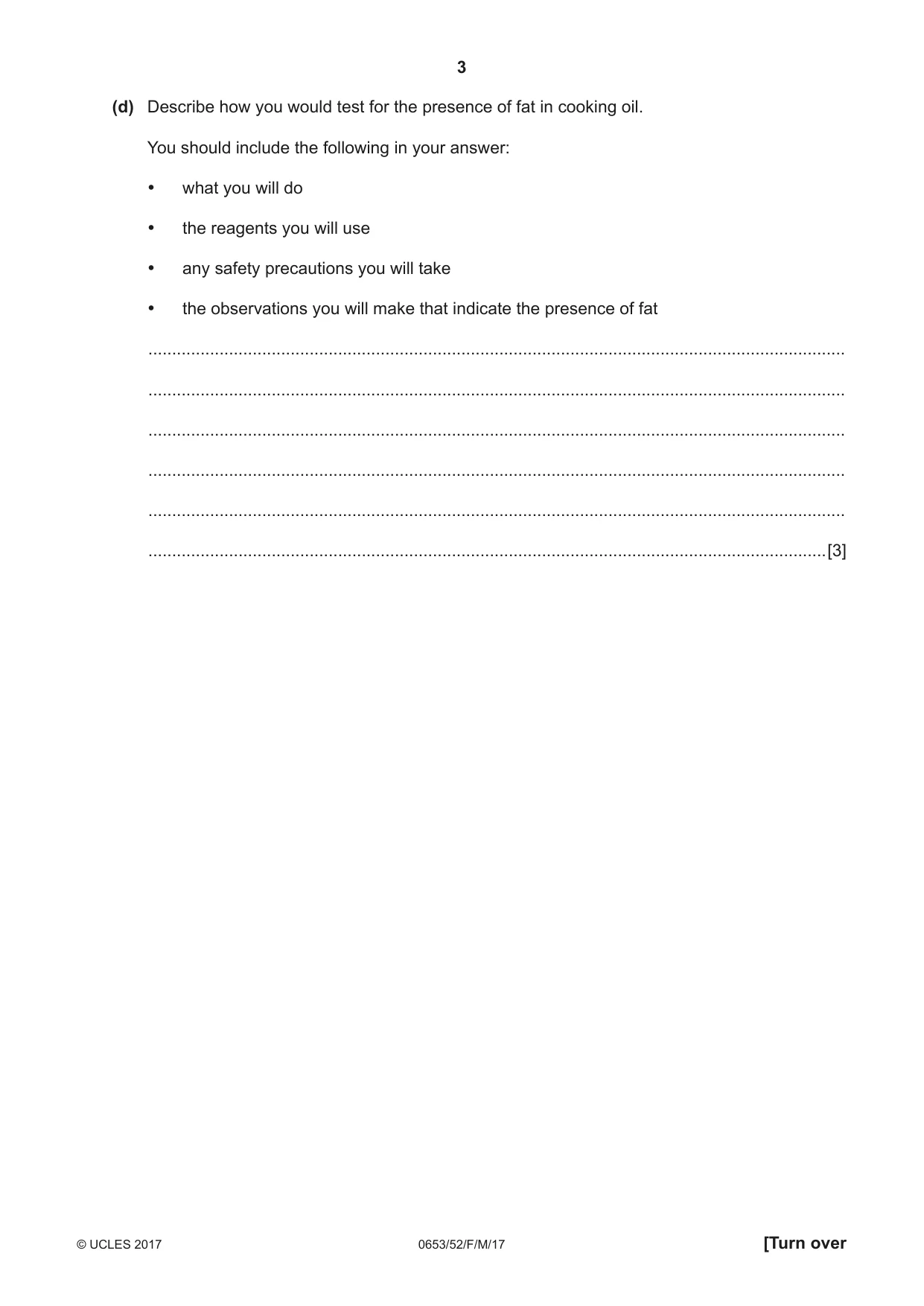
1 You are going to investigate the nutrient content of two solutions, A and B. (a) • Label three test-tubes C, D and E. • Stir solution A well and add to a depth of about 2 cm in each test-tube. • Add approximately the same amount of Benedict’s solution to test-tube C and use the stirring rod to mix well. • Place in a hot water-bath for a few minutes. • Clean the stirring rod and continue with the rest of part (a) while you are waiting. • Add approximately the same amount of biuret solution to test-tube D and mix well. • Add a few drops of iodine solution to test-tube E and mix well. Record your observations in Table 1.1. • Repeat the procedure above for solution B. Table 1.1 Benedict’s solution biuret solution iodine solution solution (tube C) (tube D) (tube E) colour obtained with solution A colour obtained with solution B [3] (b) Use your observations to identify the nutrients present in solutions A and B. Solution A contains ................................................................................................................... Solution B contains ................................................................................................................... [3] (c) Suggest and explain a safety precaution you should have taken when carrying out your experiment. ...............................................................................................................................................[1] (d) Describe how you would test for the presence of fat in cooking oil. You should include the following in your answer: • what you will do • the reagents you will use • any safety precautions you will take • the observations you will make that indicate the presence of fat ................................................................................................................................................... ................................................................................................................................................... ................................................................................................................................................... ................................................................................................................................................... ...................................................................................................................................................
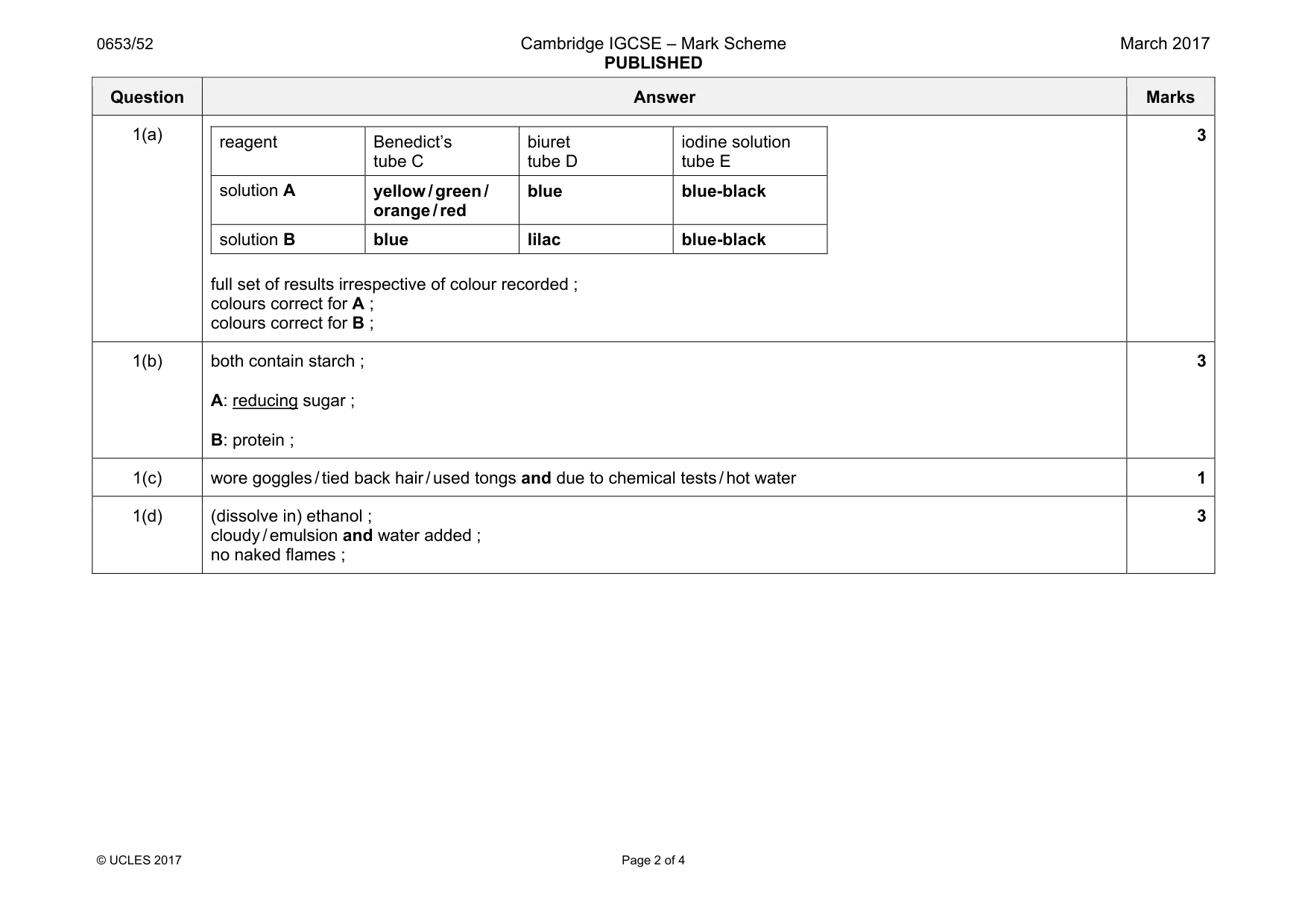
Mark scheme: 1(a) reagent Benedict’s tube C biuret tube D iodine solution tube E solution A yellow / green / orange / red blue blue-black solution B blue lilac blue-black full set of results irrespective of colour recorded ; colours correct for A ; colours correct for B ; 3 1(b) both contain starch ; A: reducing sugar ; B: protein ; 3 1(c) wore goggles / tied back hair / used tongs and due to chemical tests / hot water 1 1(d) (dissolve in) ethanol ; cloudy / emulsion and water added ; no naked flames ; 3
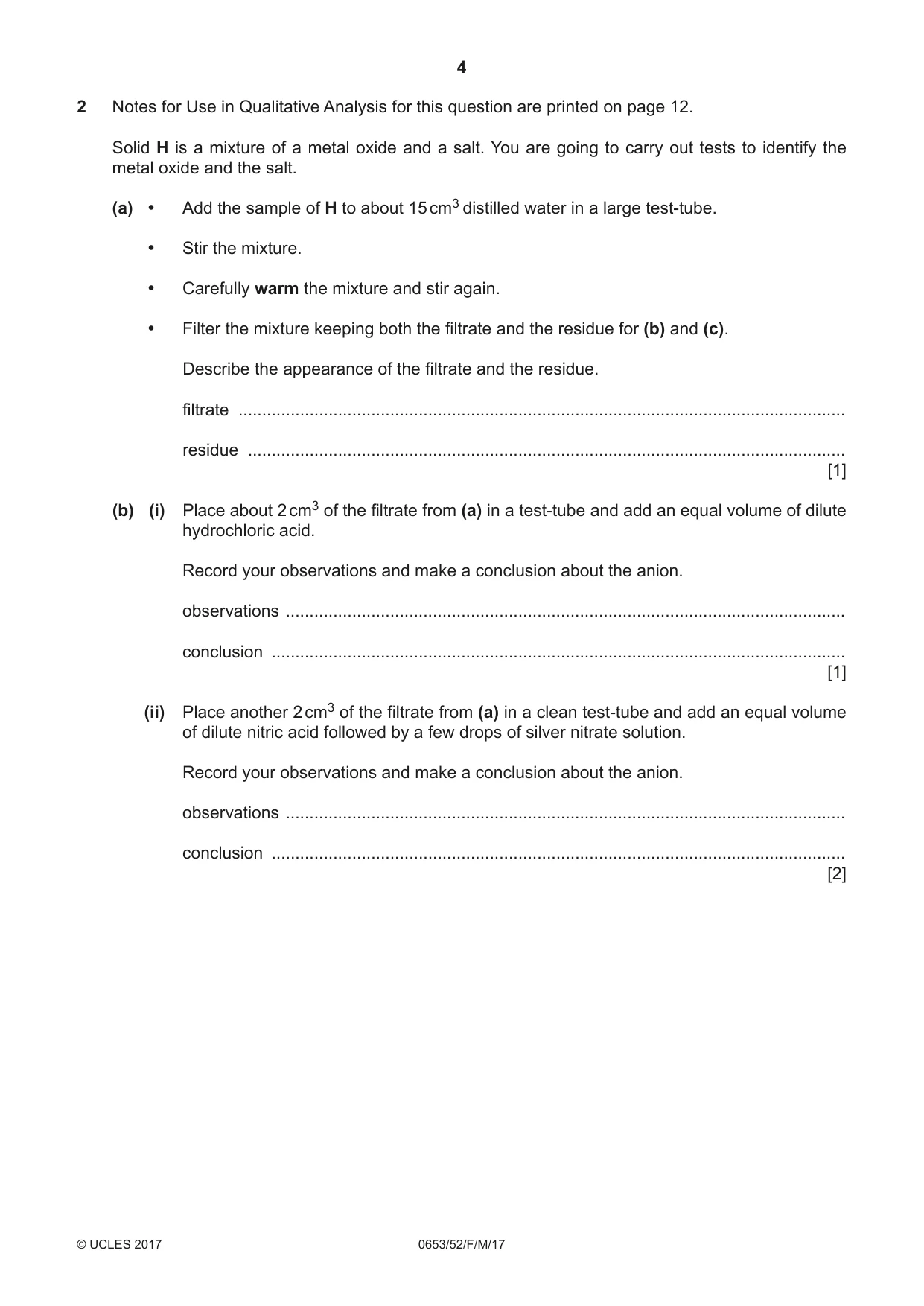
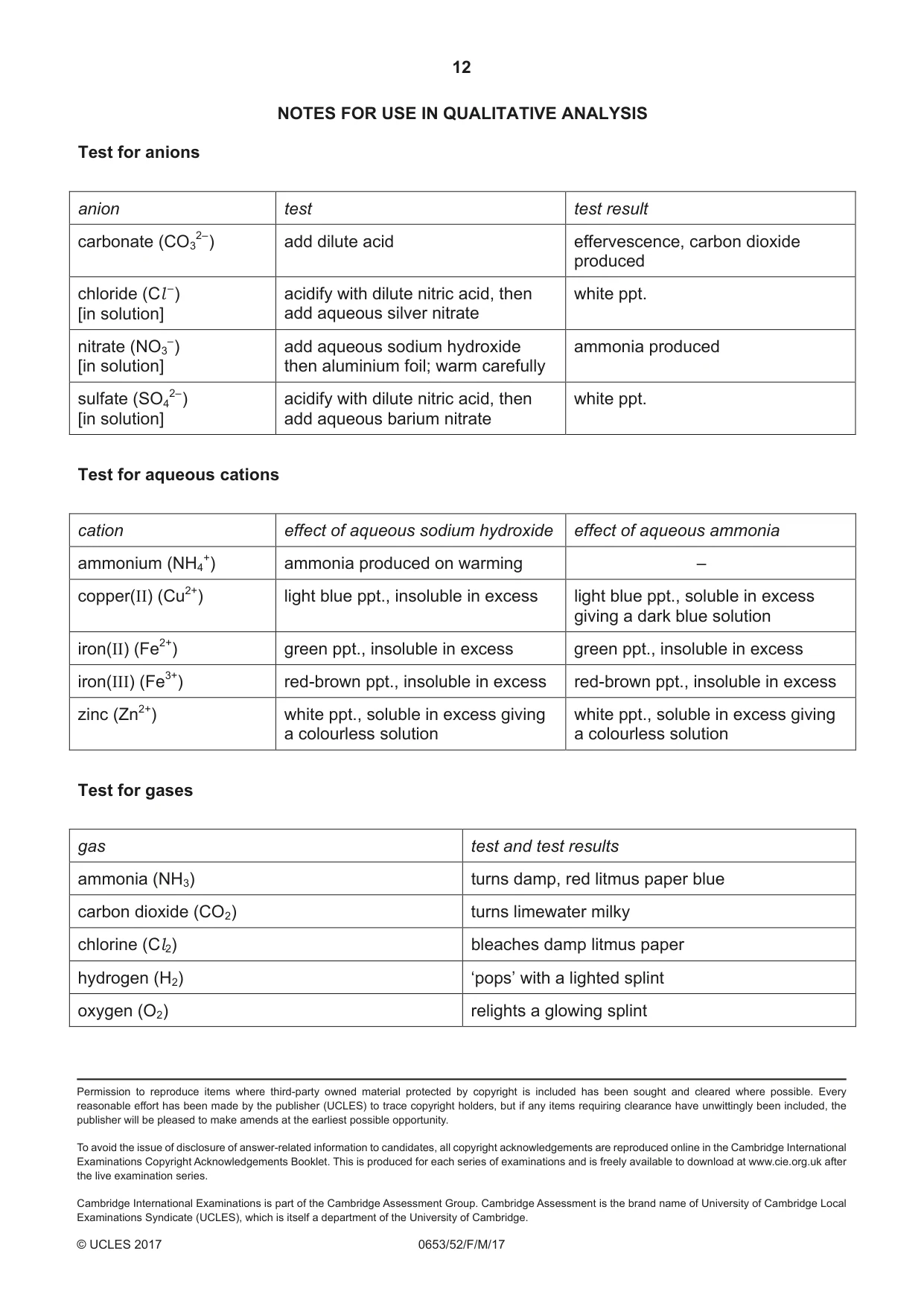
Q2 · Notes for Use in Qualitative Analysis for this question are printed on page 12
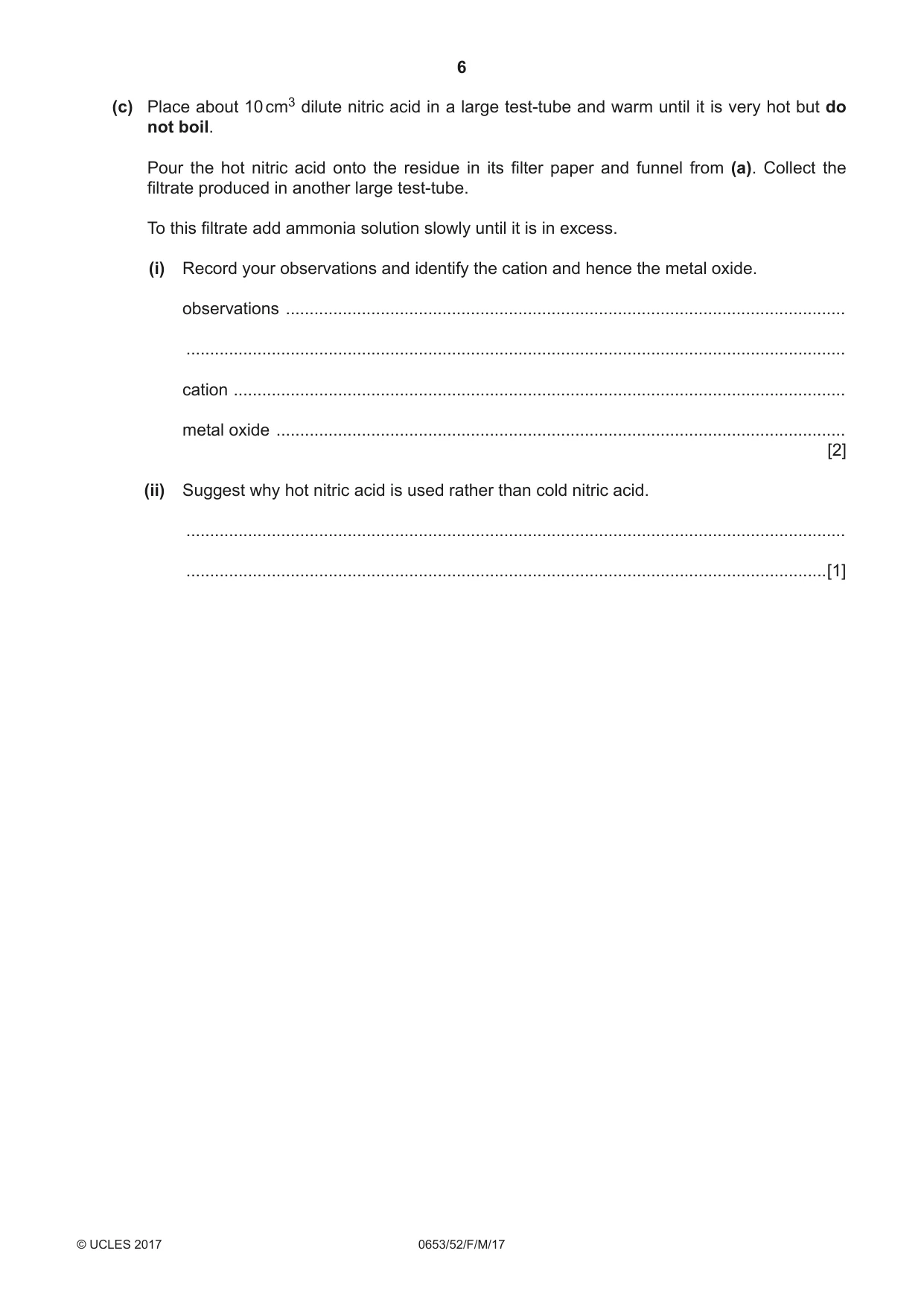
2 Notes for Use in Qualitative Analysis for this question are printed on page 12. Solid H is a mixture of a metal oxide and a salt. You are going to carry out tests to identify the metal oxide and the salt. (a) • Add the sample of H to about 15 cm3 distilled water in a large test-tube. • Stir the mixture. • Carefully warm the mixture and stir again. • Filter the mixture keeping both the filtrate and the residue for (b) and (c). Describe the appearance of the filtrate and the residue. filtrate ................................................................................................................................. residue ............................................................................................................................... [1] (b) (i) Place about 2 cm3 of the filtrate from (a) in a test-tube and add an equal volume of dilute hydrochloric acid. Record your observations and make a conclusion about the anion. observations ...................................................................................................................... conclusion .......................................................................................................................... [1] (ii) Place another 2 cm3 of the filtrate from (a) in a clean test-tube and add an equal volume of dilute nitric acid followed by a few drops of silver nitrate solution. Record your observations and make a conclusion about the anion. observations ...................................................................................................................... conclusion .......................................................................................................................... [2] (iii) Using the remainder of the filtrate from (a), plan and carry out tests to identify the cation in the filtrate. Record in Table 2.1 your tests, observations and identity of the cation. You do not have to use all of the boxes in the table. Table 2.1 test observations identity of cation [3] (c) Place about 10 cm3 dilute nitric acid in a large test-tube and warm until it is very hot but do not boil. Pour the hot nitric acid onto the residue in its filter paper and funnel from (a). Collect the filtrate produced in another large test-tube. To this filtrate add ammonia solution slowly until it is in excess. (i) Record your observations and identify the cation and hence the metal oxide. observations ...................................................................................................................... ............................................................................................................................................ cation ................................................................................................................................. metal oxide ........................................................................................................................ [2] (ii) Suggest why hot nitric acid is used rather than cold nitric acid. ............................................................................................................................................ ........................................................................................................................................[1] Please turn over for Question 3.
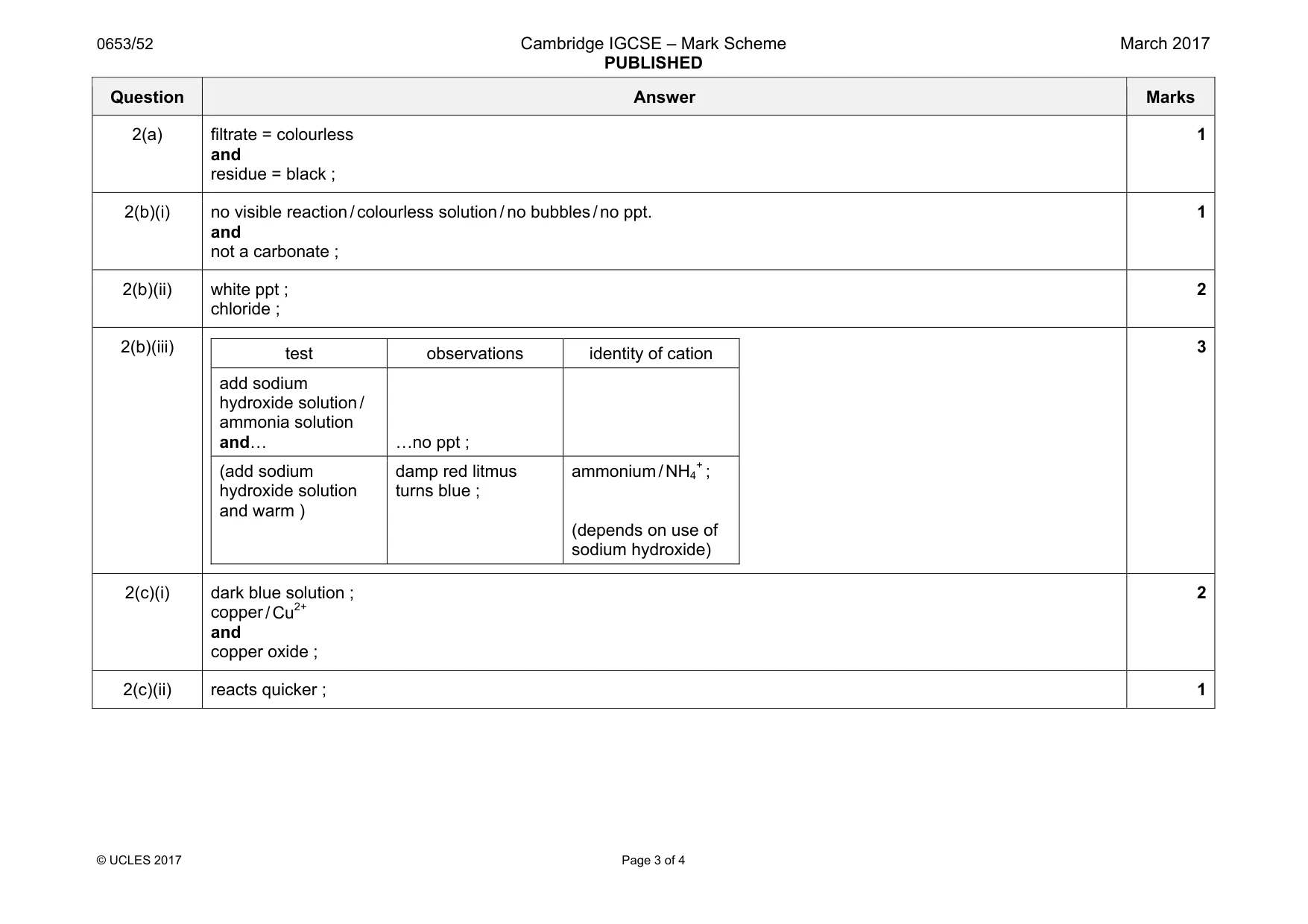
Mark scheme: 2(a) filtrate = colourless and residue = black ; 1 2(b)(i) no visible reaction / colourless solution / no bubbles / no ppt. and not a carbonate ; 1 2(b)(ii) white ppt ; chloride ; 2 2(b)(iii) test observations identity of cation add sodium hydroxide solution / ammonia solution and« «no ppt ; (add sodium hydroxide solution and warm ) damp red litmus turns blue ; ammonium / NH4 + ; (depends on use of sodium hydroxide) 3 2(c)(i) dark blue solution ; copper / Cu2+ and copper oxide ; 2 2(c)(ii) reacts quicker ; 1
Q3 · You are going to investigate the resistance of lamps connected in series and in parallel
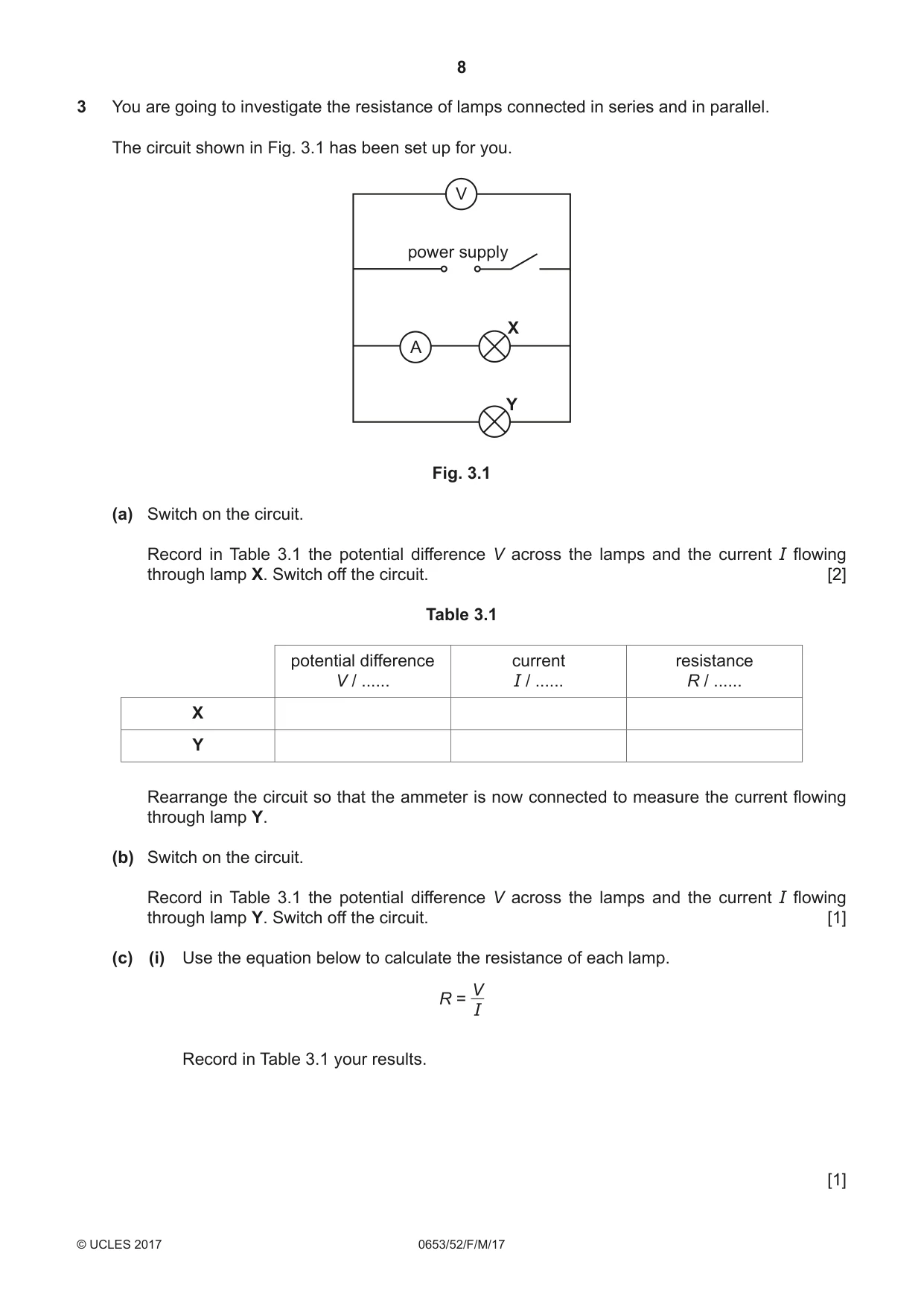
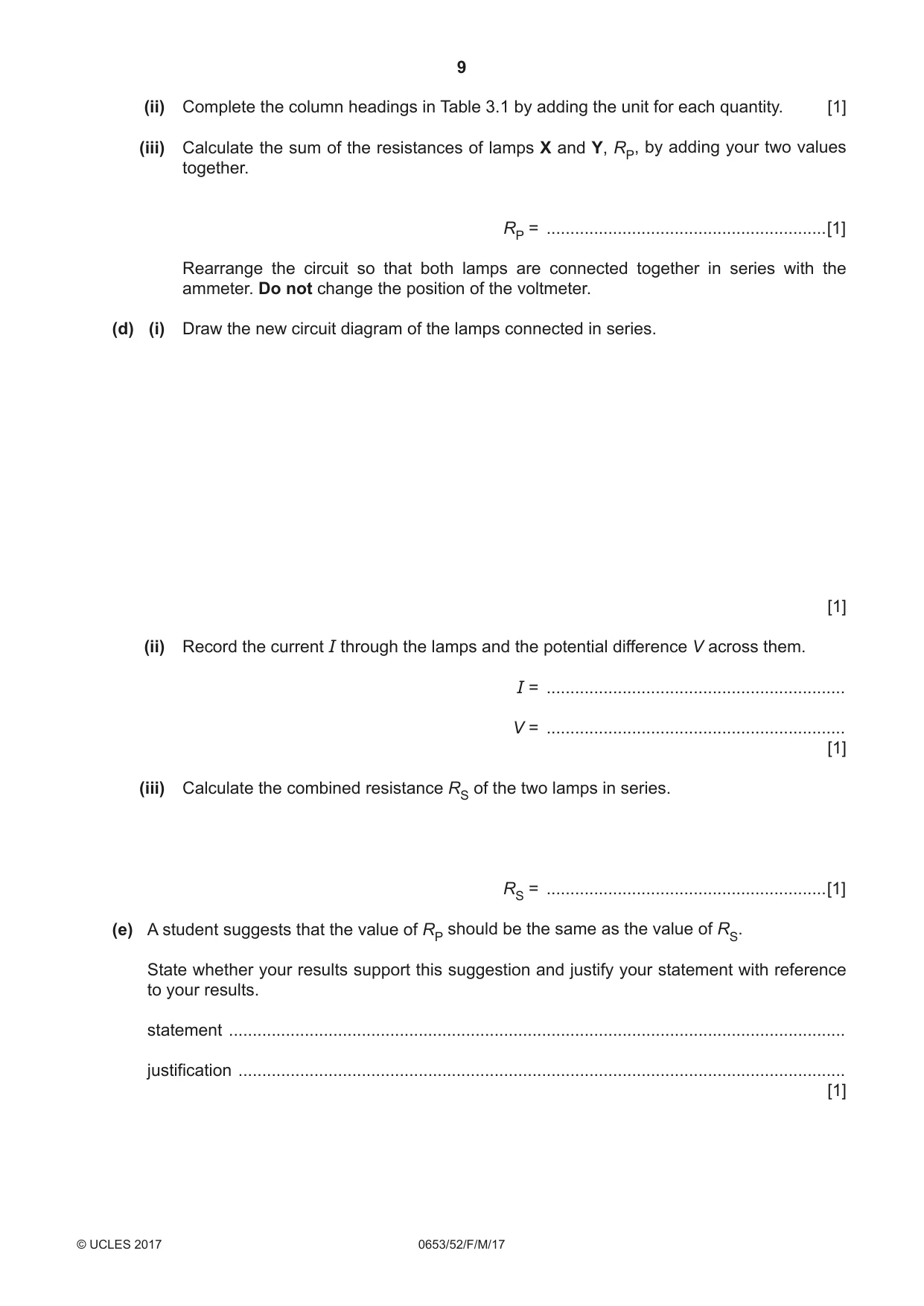
3 You are going to investigate the resistance of lamps connected in series and in parallel. The circuit shown in Fig. 3.1 has been set up for you. V power supply X A Y Fig. 3.1 (a) Switch on the circuit. Record in Table 3.1 the potential difference V across the lamps and the current I flowing through lamp X. Switch off the circuit. [2] Table 3.1 potential difference current resistance V / ...... I / ...... R / ...... X Y Rearrange the circuit so that the ammeter is now connected to measure the current flowing through lamp Y. (b) Switch on the circuit. Record in Table 3.1 the potential difference V across the lamps and the current I flowing through lamp Y. Switch off the circuit. [1] (c) (i) Use the equation below to calculate the resistance of each lamp. V R = I Record in Table 3.1 your results. [1] (ii) Complete the column headings in Table 3.1 by adding the unit for each quantity. [1] (iii) Calculate the sum of the resistances of lamps X and Y, RP, by adding your two values together. RP = ............................................................[1] Rearrange the circuit so that both lamps are connected together in series with the ammeter. Do not change the position of the voltmeter. (d) (i) Draw the new circuit diagram of the lamps connected in series. [1] (ii) Record the current I through the lamps and the potential difference V across them. I = ................................................................ V = ................................................................ [1] (iii) Calculate the combined resistance RS of the two lamps in series. RS = ............................................................[1] (e) A student suggests that the value of RP should be the same as the value of RS. State whether your results support this suggestion and justify your statement with reference to your results. statement .................................................................................................................................. justification ................................................................................................................................ [1]
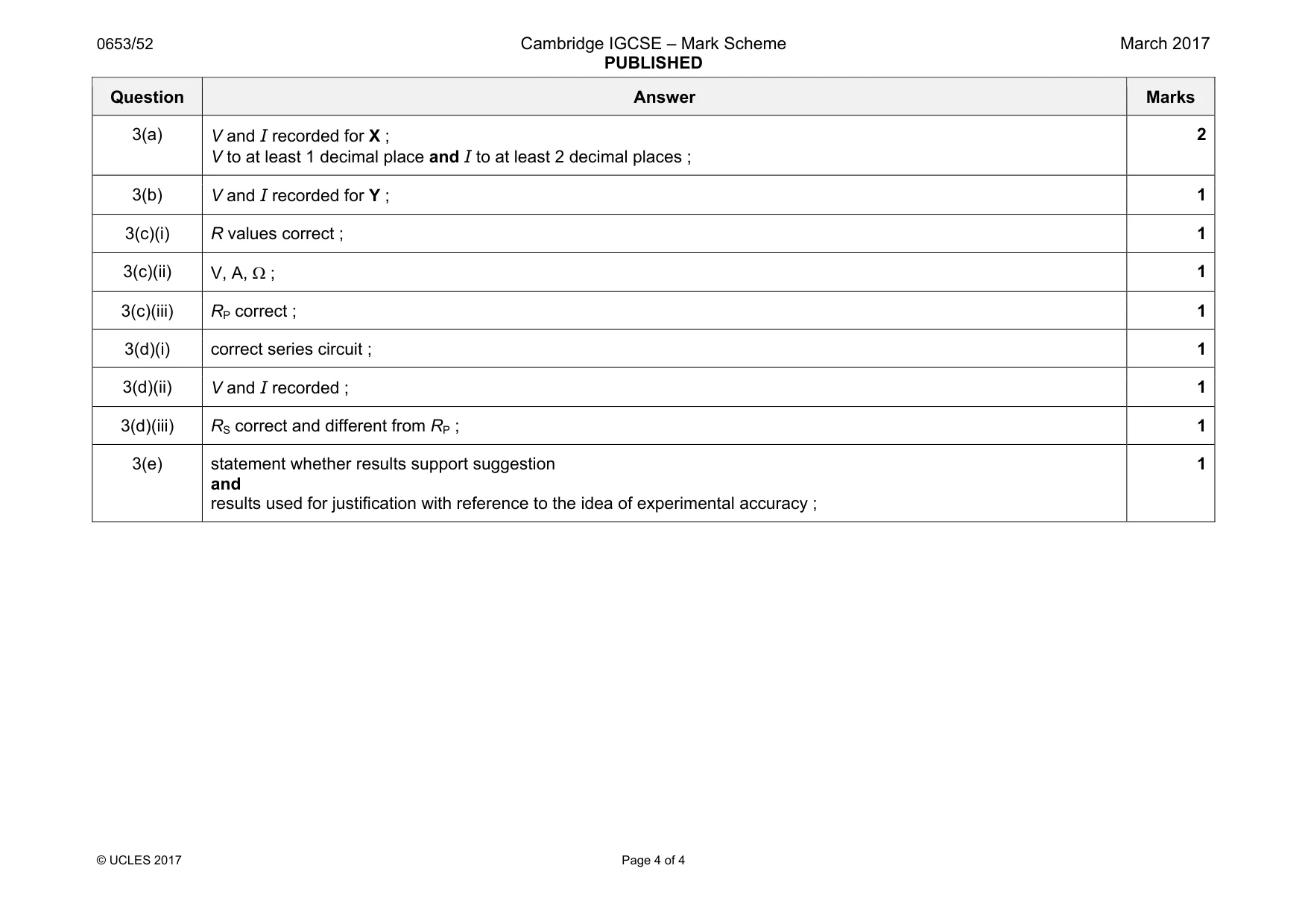
Mark scheme: 3(a) V to at least 1 decimal place and I to at least 2 decimal places ; 2 3(b) V and I recorded for Y ; 1 3(c)(i) R values correct ; 1 3(c)(ii) V, A, Ω ; 1 3(c)(iii) RP correct ; 1 3(d)(i) correct series circuit ; 1 3(d)(ii) V and I recorded ; 1 3(d)(iii) RS correct and different from RP ; 1 3(e) statement whether results support suggestion and results used for justification with reference to the idea of experimental accuracy ; 1
What was in this paper
The subtopics covered by these 3 questions, and how many questions each got. Open one in a new tab to see every Cambridge question on it.
What you needed in this session
Cambridge’s own grade thresholds for 2017 Feb/March, Paper 5 · Variant 2. A higher threshold means an easier paper — the bar moves with how the cohort did.