Cambridge IGCSE Religious Studies 0490 — 2010 Oct/Nov Paper 2 · Variant 1
0490/21/O/N/10 · 75 marks · ≈84 min
The question paper and its mark scheme, free to read here and free to download. This is Cambridge’s own paper, exactly as it was sat.
Question paper2 pages
Mark scheme7 pages
Answers below. Sit the paper first if you are practising.
Paper as text
Question paper, page 1
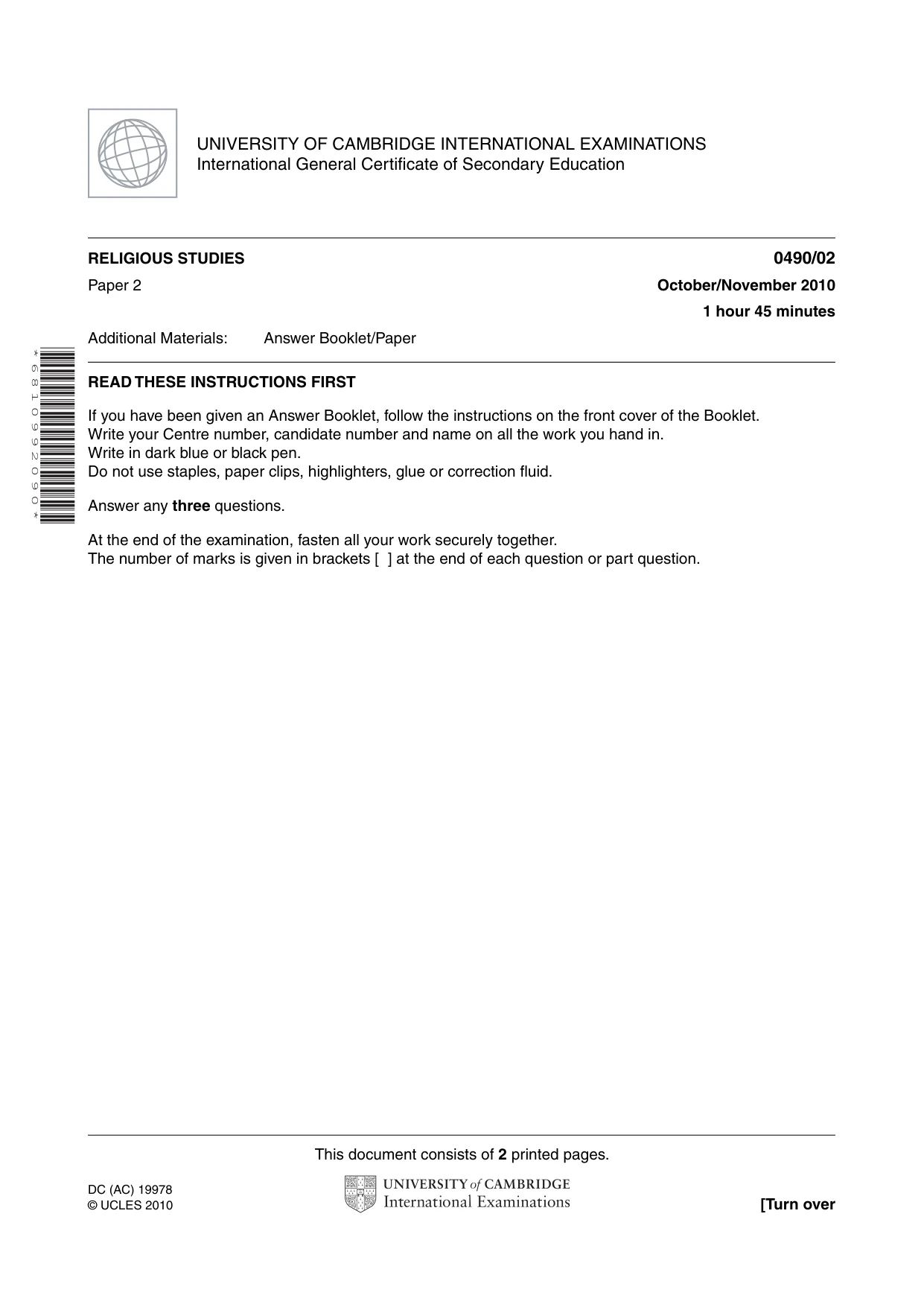
This document consists of 2 printed pages. DC (AC) 19978 © UCLES 2010 [Turn over UNIVERSITY OF CAMBRIDGE INTERNATIONAL EXAMINATIONS International General Certificate of Secondary Education READ THESE INSTRUCTIONS FIRST If you have been given an Answer Booklet, follow the instructions on the front cover of the Booklet. Write your Centre number, candidate number and name on all the work you hand in. Write in dark blue or black pen. Do not use staples, paper clips, highlighters, glue or correction fluid. Answer any three questions. At the end of the examination, fasten all your work securely together. The number of marks is given in brackets [ ] at the end of each question or part question. * 6 8 1 0 9 9 2 0 9 0 * RELIGIOUS STUDIES 0490/02 Paper 2 October/November 2010 1 hour 45 minutes Additional Materials: Answer Booklet/Paper
Question paper, page 2
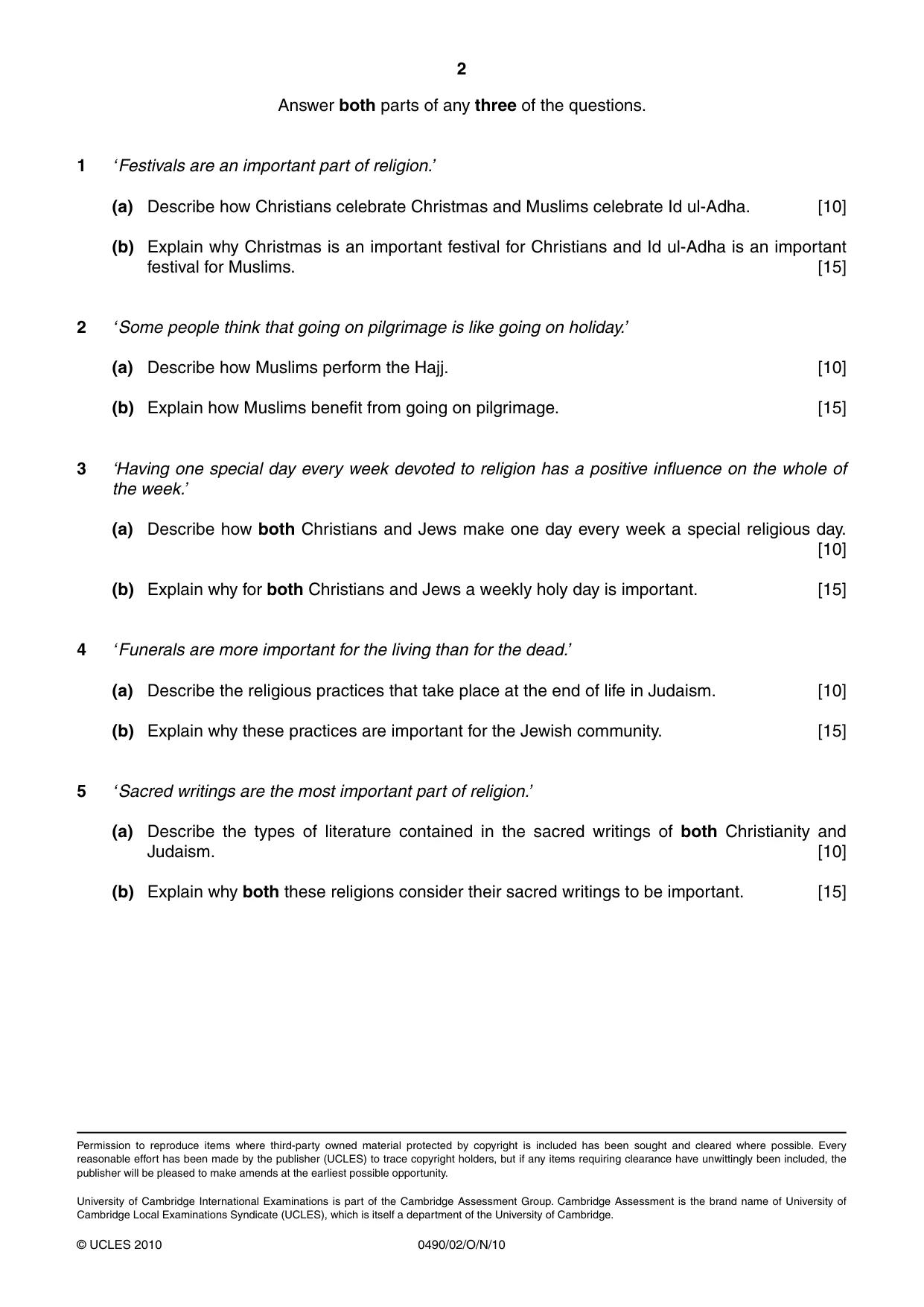
2 0490/02/O/N/10 © UCLES 2010 Answer both parts of any three of the questions. 1 ‘ Festivals are an important part of religion.’ (a) Describe how Christians celebrate Christmas and Muslims celebrate Id ul-Adha. [10] (b) Explain why Christmas is an important festival for Christians and Id ul-Adha is an important festival for Muslims. [15] 2 ‘ Some people think that going on pilgrimage is like going on holiday.’ (a) Describe how Muslims perform the Hajj. [10] (b) Explain how Muslims benefit from going on pilgrimage. [15] 3 ‘Having one special day every week devoted to religion has a positive influence on the whole of the week.’ (a) Describe how both Christians and Jews make one day every week a special religious day. [10] (b) Explain why for both Christians and Jews a weekly holy day is important. [15] 4 ‘ Funerals are more important for the living than for the dead.’ (a) Describe the religious practices that take place at the end of life in Judaism. [10] (b) Explain why these practices are important for the Jewish community. [15] 5 ‘ Sacred writings are the most important part of religion.’ (a) Describe the types of literature contained in the sacred writings of both Christianity and Judaism. [10] (b) Explain why both these religions consider their sacred writings to be important. [15] Permission to reproduce items where third-party owned material protected by copyright is included has been sought and cleared where possible. Every reasonable effort has been made by the publisher (UCLES) to trace copyright holders, but if any items requiring clearance have unwittingly been included, the publisher will be pleased to make amends at the earliest possible opportunity. University of Cambridge International Examinations is part of the Cambridge Assessment Group. Cambridge Assessment is the brand name of University of Cambridge Local Examinations Syndicate (UCLES), which is itself a department of the University of Cambridge.
Mark scheme, page 1
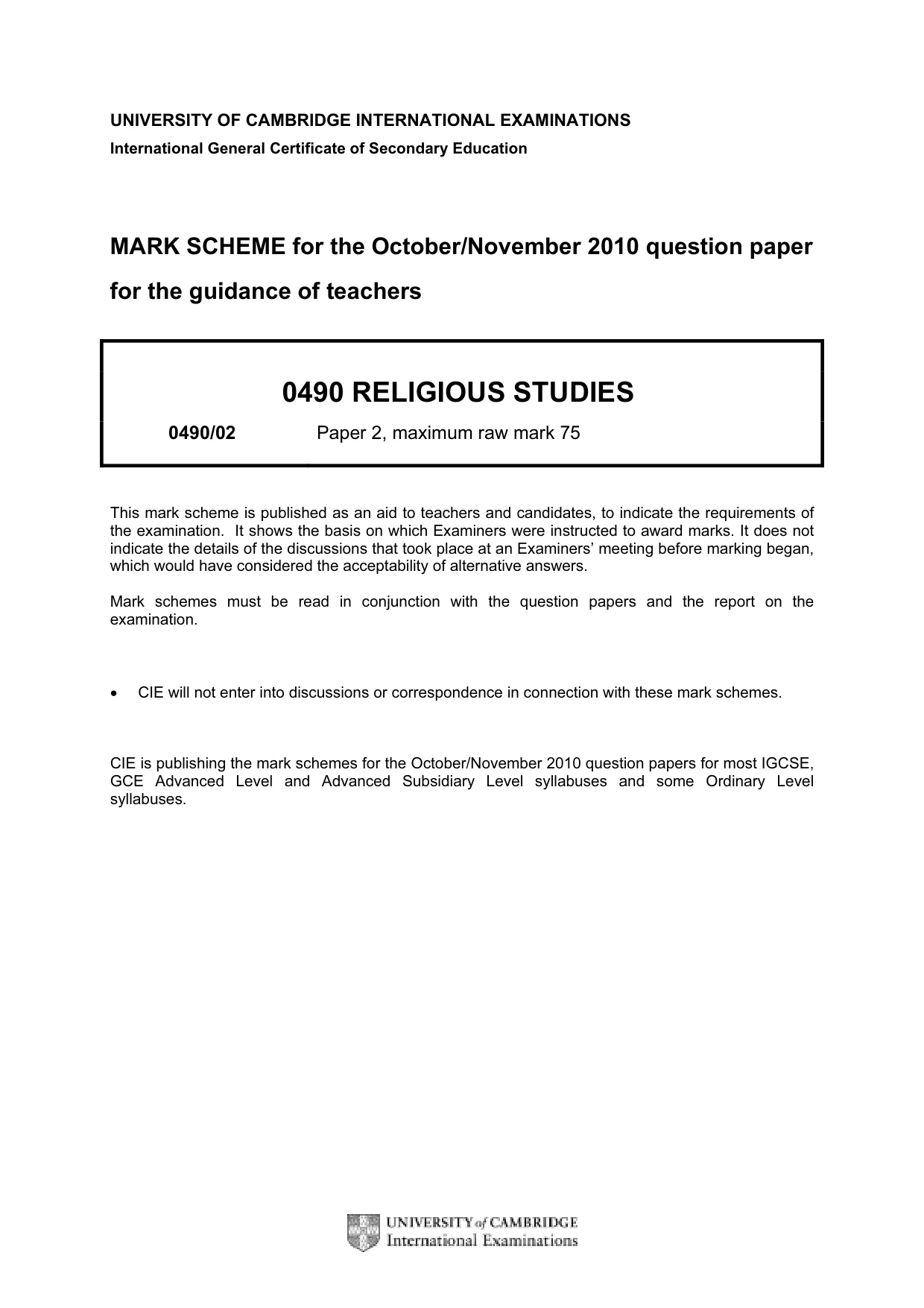
UNIVERSITY OF CAMBRIDGE INTERNATIONAL EXAMINATIONS International General Certificate of Secondary Education MARK SCHEME for the October/November 2010 question paper for the guidance of teachers 0490 RELIGIOUS STUDIES 0490/02 Paper 2, maximum raw mark 75 This mark scheme is published as an aid to teachers and candidates, to indicate the requirements of the examination. It shows the basis on which Examiners were instructed to award marks. It does not indicate the details of the discussions that took place at an Examiners’ meeting before marking began, which would have considered the acceptability of alternative answers. Mark schemes must be read in conjunction with the question papers and the report on the examination. • CIE will not enter into discussions or correspondence in connection with these mark schemes. CIE is publishing the mark schemes for the October/November 2010 question papers for most IGCSE, GCE Advanced Level and Advanced Subsidiary Level syllabuses and some Ordinary Level syllabuses.
Mark scheme, page 2
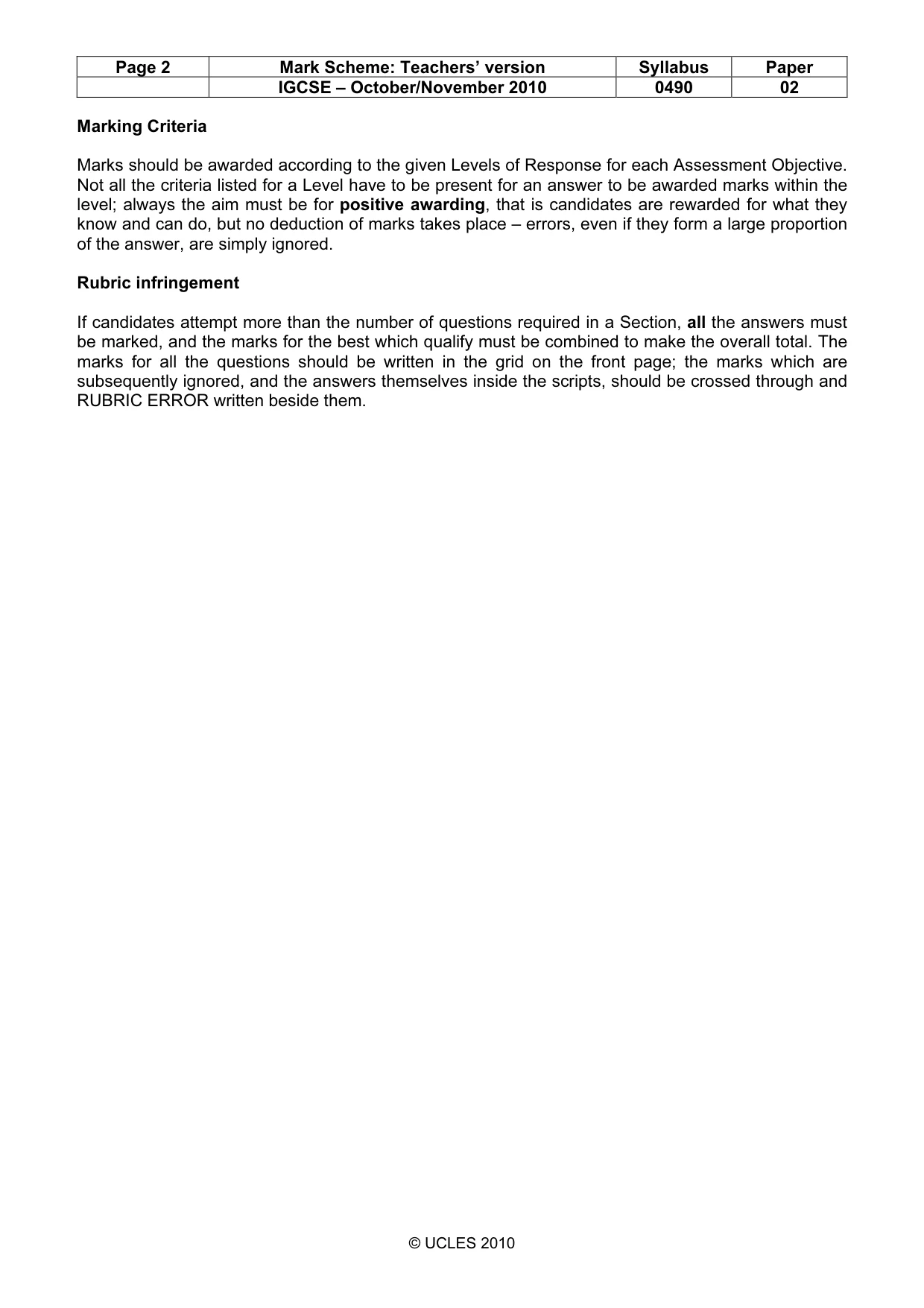
Page 2 Mark Scheme: Teachers’ version Syllabus Paper IGCSE – October/November 2010 0490 02 © UCLES 2010 Marking Criteria Marks should be awarded according to the given Levels of Response for each Assessment Objective. Not all the criteria listed for a Level have to be present for an answer to be awarded marks within the level; always the aim must be for positive awarding, that is candidates are rewarded for what they know and can do, but no deduction of marks takes place – errors, even if they form a large proportion of the answer, are simply ignored. Rubric infringement If candidates attempt more than the number of questions required in a Section, all the answers must be marked, and the marks for the best which qualify must be combined to make the overall total. The marks for all the questions should be written in the grid on the front page; the marks which are subsequently ignored, and the answers themselves inside the scripts, should be crossed through and RUBRIC ERROR written beside them.
Mark scheme, page 3
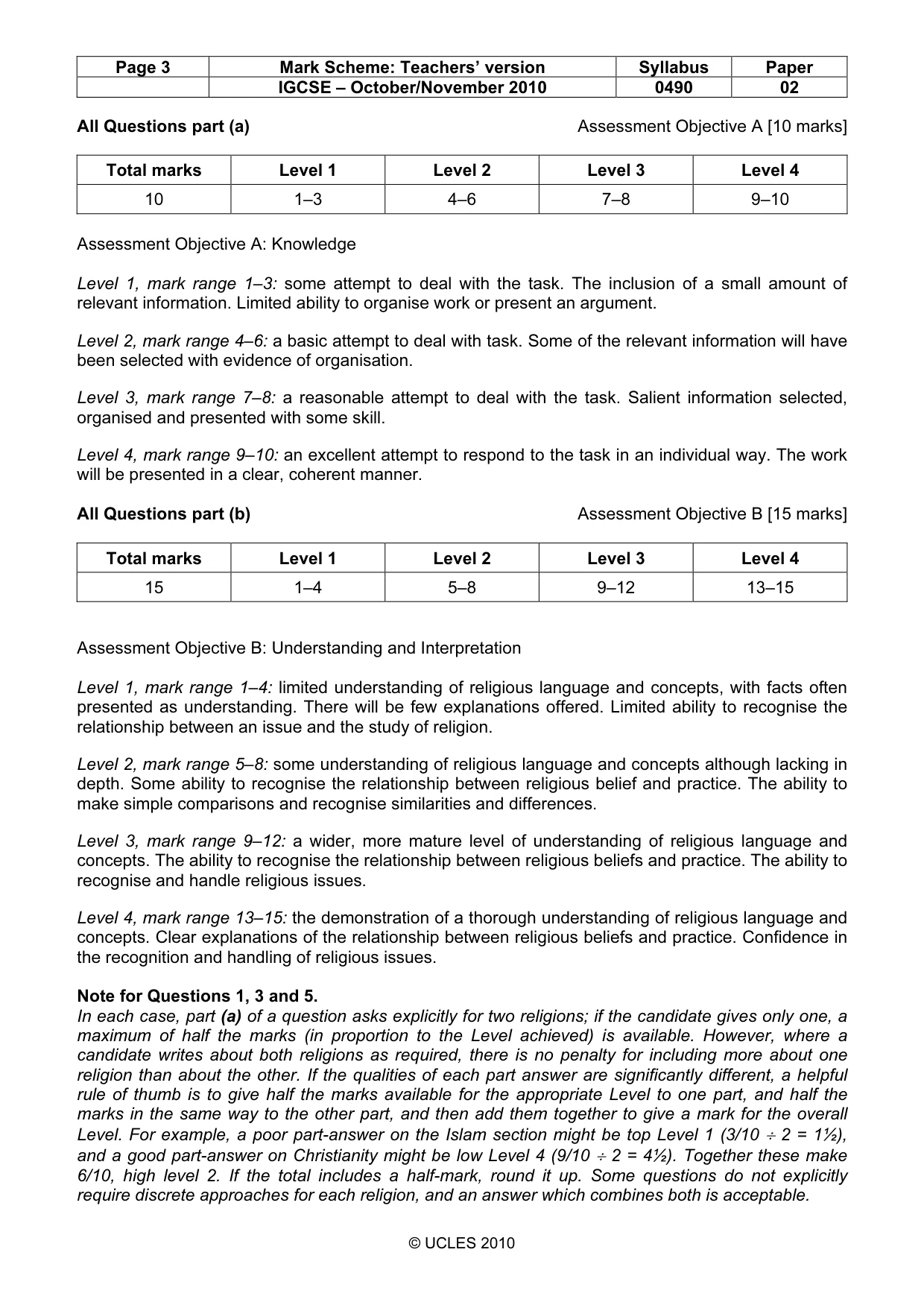
Page 3 Mark Scheme: Teachers’ version Syllabus Paper IGCSE – October/November 2010 0490 02 © UCLES 2010 All Questions part (a) Assessment Objective A [10 marks] Total marks Level 1 Level 2 Level 3 Level 4 10 1–3 4–6 7–8 9–10 Assessment Objective A: Knowledge Level 1, mark range 1–3: some attempt to deal with the task. The inclusion of a small amount of relevant information. Limited ability to organise work or present an argument. Level 2, mark range 4–6: a basic attempt to deal with task. Some of the relevant information will have been selected with evidence of organisation. Level 3, mark range 7–8: a reasonable attempt to deal with the task. Salient information selected, organised and presented with some skill. Level 4, mark range 9–10: an excellent attempt to respond to the task in an individual way. The work will be presented in a clear, coherent manner. All Questions part (b) Assessment Objective B [15 marks] Total marks Level 1 Level 2 Level 3 Level 4 15 1–4 5–8 9–12 13–15 Assessment Objective B: Understanding and Interpretation Level 1, mark range 1–4: limited understanding of religious language and concepts, with facts often presented as understanding. There will be few explanations offered. Limited ability to recognise the relationship between an issue and the study of religion. Level 2, mark range 5–8: some understanding of religious language and concepts although lacking in depth. Some ability to recognise the relationship between religious belief and practice. The ability to make simple comparisons and recognise similarities and differences. Level 3, mark range 9–12: a wider, more mature level of understanding of religious language and concepts. The ability to recognise the relationship between religious beliefs and practice. The ability to recognise and handle religious issues. Level 4, mark range 13–15: the demonstration of a thorough understanding of religious language and concepts. Clear explanations of the relationship between religious beliefs and practice. Confidence in the recognition and handling of religious issues. Note for Questions 1, 3 and 5. In each case, part (a) of a question asks explicitly for two religions; if the candidate gives only one, a maximum of half the marks (in proportion to the Level achieved) is available. However, where a candidate writes about both religions as required, there is no penalty for including more about one religion than about the other. If the qualities of each part answer are significantly different, a helpful rule of thumb is to give half the marks available for the appropriate Level to one part, and half the marks in the same way to the other part, and then add them together to give a mark for the overall Level. For example, a poor part-answer on the Islam section might be top Level 1 (3/10 ÷ 2 = 1½), and a good part-answer on Christianity might be low Level 4 (9/10 ÷ 2 = 4½). Together these make 6/10, high level 2. If the total includes a half-mark, round it up. Some questions do not explicitly require discrete approaches for each religion, and an answer which combines both is acceptable.
Mark scheme, page 4
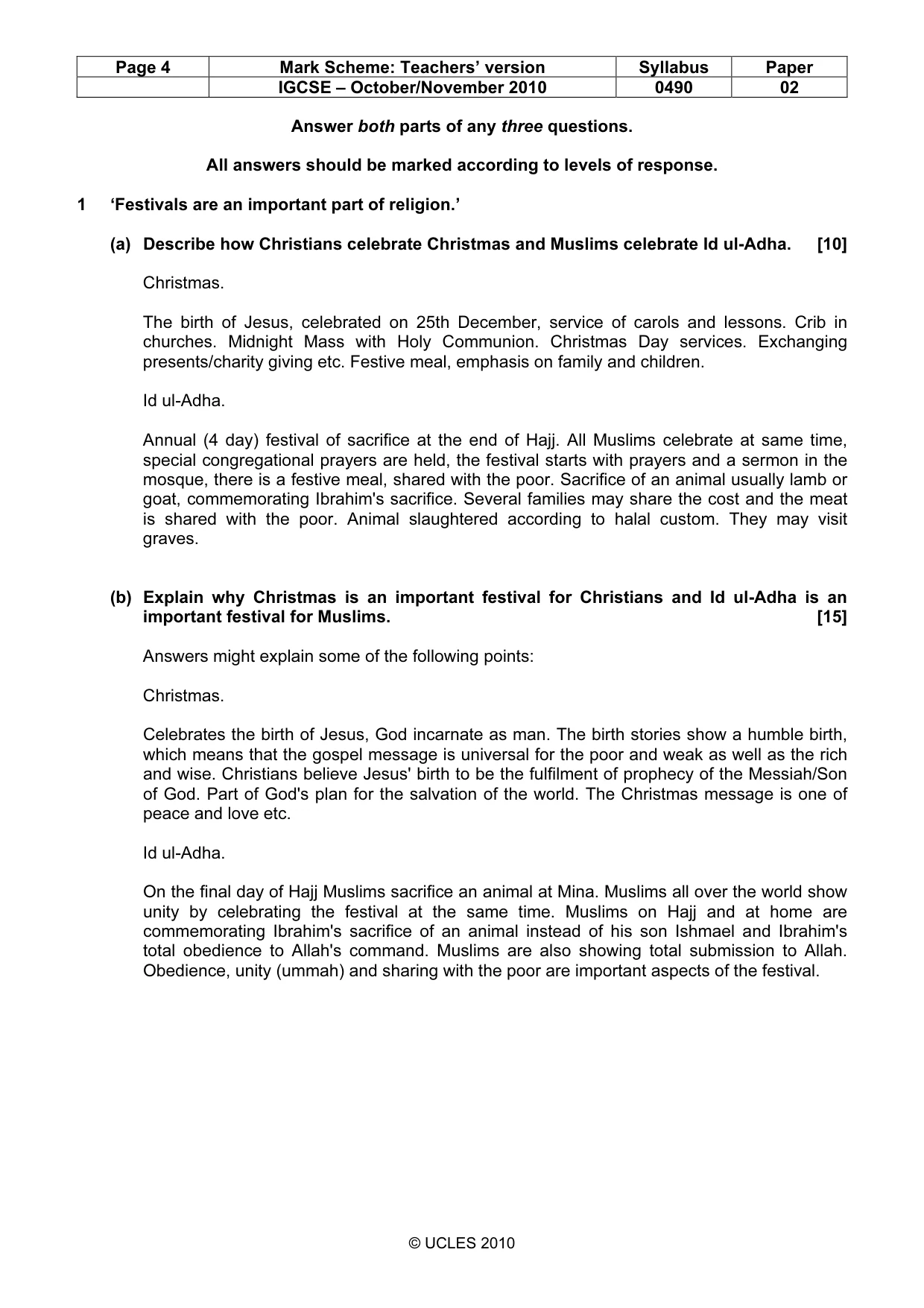
Page 4 Mark Scheme: Teachers’ version Syllabus Paper IGCSE – October/November 2010 0490 02 © UCLES 2010 Answer both parts of any three questions. All answers should be marked according to levels of response. 1 ‘Festivals are an important part of religion.’ (a) Describe how Christians celebrate Christmas and Muslims celebrate Id ul-Adha. [10] Christmas. The birth of Jesus, celebrated on 25th December, service of carols and lessons. Crib in churches. Midnight Mass with Holy Communion. Christmas Day services. Exchanging presents/charity giving etc. Festive meal, emphasis on family and children. Id ul-Adha. Annual (4 day) festival of sacrifice at the end of Hajj. All Muslims celebrate at same time, special congregational prayers are held, the festival starts with prayers and a sermon in the mosque, there is a festive meal, shared with the poor. Sacrifice of an animal usually lamb or goat, commemorating Ibrahim's sacrifice. Several families may share the cost and the meat is shared with the poor. Animal slaughtered according to halal custom. They may visit graves. (b) Explain why Christmas is an important festival for Christians and Id ul-Adha is an important festival for Muslims. [15] Answers might explain some of the following points: Christmas. Celebrates the birth of Jesus, God incarnate as man. The birth stories show a humble birth, which means that the gospel message is universal for the poor and weak as well as the rich and wise. Christians believe Jesus' birth to be the fulfilment of prophecy of the Messiah/Son of God. Part of God's plan for the salvation of the world. The Christmas message is one of peace and love etc. Id ul-Adha. On the final day of Hajj Muslims sacrifice an animal at Mina. Muslims all over the world show unity by celebrating the festival at the same time. Muslims on Hajj and at home are commemorating Ibrahim's sacrifice of an animal instead of his son Ishmael and Ibrahim's total obedience to Allah's command. Muslims are also showing total submission to Allah. Obedience, unity (ummah) and sharing with the poor are important aspects of the festival.
Mark scheme, page 5
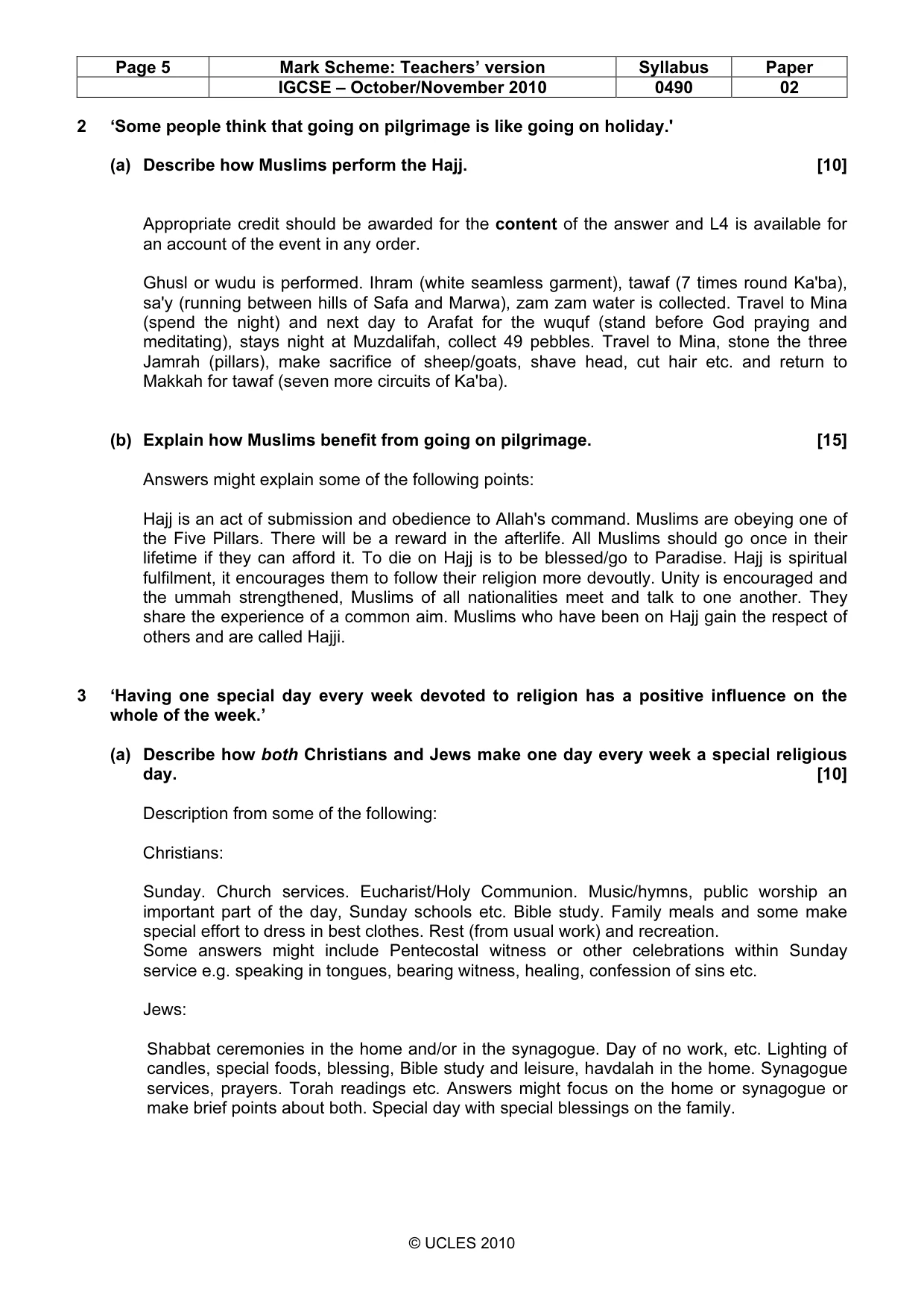
Page 5 Mark Scheme: Teachers’ version Syllabus Paper IGCSE – October/November 2010 0490 02 © UCLES 2010 2 ‘Some people think that going on pilgrimage is like going on holiday.' (a) Describe how Muslims perform the Hajj. [10] Appropriate credit should be awarded for the content of the answer and L4 is available for an account of the event in any order. Ghusl or wudu is performed. Ihram (white seamless garment), tawaf (7 times round Ka'ba), sa'y (running between hills of Safa and Marwa), zam zam water is collected. Travel to Mina (spend the night) and next day to Arafat for the wuquf (stand before God praying and meditating), stays night at Muzdalifah, collect 49 pebbles. Travel to Mina, stone the three Jamrah (pillars), make sacrifice of sheep/goats, shave head, cut hair etc. and return to Makkah for tawaf (seven more circuits of Ka'ba). (b) Explain how Muslims benefit from going on pilgrimage. [15] Answers might explain some of the following points: Hajj is an act of submission and obedience to Allah's command. Muslims are obeying one of the Five Pillars. There will be a reward in the afterlife. All Muslims should go once in their lifetime if they can afford it. To die on Hajj is to be blessed/go to Paradise. Hajj is spiritual fulfilment, it encourages them to follow their religion more devoutly. Unity is encouraged and the ummah strengthened, Muslims of all nationalities meet and talk to one another. They share the experience of a common aim. Muslims who have been on Hajj gain the respect of others and are called Hajji. 3 ‘Having one special day every week devoted to religion has a positive influence on the whole of the week.’ (a) Describe how both Christians and Jews make one day every week a special religious day. [10] Description from some of the following: Christians: Sunday. Church services. Eucharist/Holy Communion. Music/hymns, public worship an important part of the day, Sunday schools etc. Bible study. Family meals and some make special effort to dress in best clothes. Rest (from usual work) and recreation. Some answers might include Pentecostal witness or other celebrations within Sunday service e.g. speaking in tongues, bearing witness, healing, confession of sins etc. Jews: Shabbat ceremonies in the home and/or in the synagogue. Day of no work, etc. Lighting of candles, special foods, blessing, Bible study and leisure, havdalah in the home. Synagogue services, prayers. Torah readings etc. Answers might focus on the home or synagogue or make brief points about both. Special day with special blessings on the family.
Mark scheme, page 6
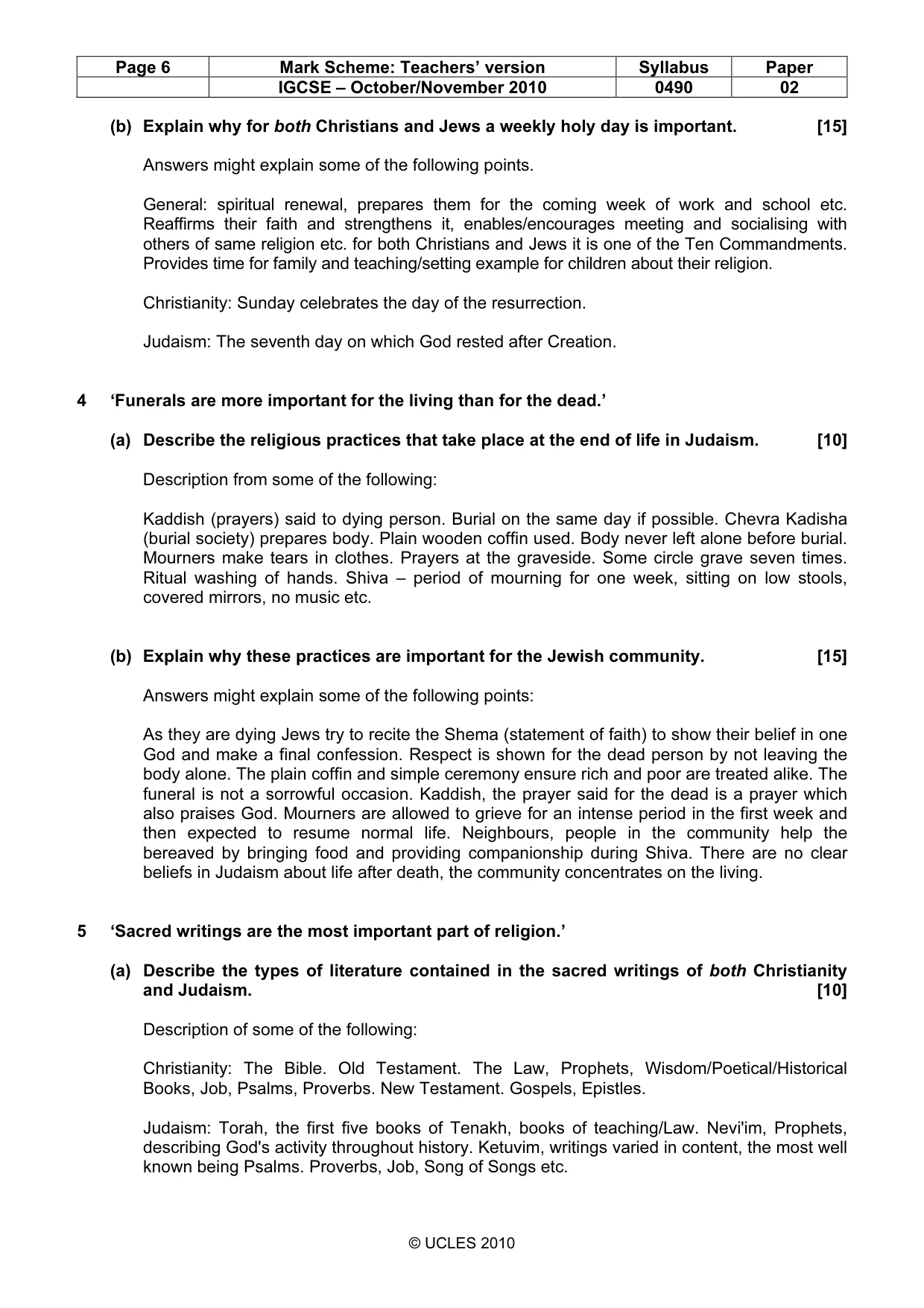
Page 6 Mark Scheme: Teachers’ version Syllabus Paper IGCSE – October/November 2010 0490 02 © UCLES 2010 (b) Explain why for both Christians and Jews a weekly holy day is important. [15] Answers might explain some of the following points. General: spiritual renewal, prepares them for the coming week of work and school etc. Reaffirms their faith and strengthens it, enables/encourages meeting and socialising with others of same religion etc. for both Christians and Jews it is one of the Ten Commandments. Provides time for family and teaching/setting example for children about their religion. Christianity: Sunday celebrates the day of the resurrection. Judaism: The seventh day on which God rested after Creation. 4 ‘Funerals are more important for the living than for the dead.’ (a) Describe the religious practices that take place at the end of life in Judaism. [10] Description from some of the following: Kaddish (prayers) said to dying person. Burial on the same day if possible. Chevra Kadisha (burial society) prepares body. Plain wooden coffin used. Body never left alone before burial. Mourners make tears in clothes. Prayers at the graveside. Some circle grave seven times. Ritual washing of hands. Shiva – period of mourning for one week, sitting on low stools, covered mirrors, no music etc. (b) Explain why these practices are important for the Jewish community. [15] Answers might explain some of the following points: As they are dying Jews try to recite the Shema (statement of faith) to show their belief in one God and make a final confession. Respect is shown for the dead person by not leaving the body alone. The plain coffin and simple ceremony ensure rich and poor are treated alike. The funeral is not a sorrowful occasion. Kaddish, the prayer said for the dead is a prayer which also praises God. Mourners are allowed to grieve for an intense period in the first week and then expected to resume normal life. Neighbours, people in the community help the bereaved by bringing food and providing companionship during Shiva. There are no clear beliefs in Judaism about life after death, the community concentrates on the living. 5 ‘Sacred writings are the most important part of religion.’ (a) Describe the types of literature contained in the sacred writings of both Christianity and Judaism. [10] Description of some of the following: Christianity: The Bible. Old Testament. The Law, Prophets, Wisdom/Poetical/Historical Books, Job, Psalms, Proverbs. New Testament. Gospels, Epistles. Judaism: Torah, the first five books of Tenakh, books of teaching/Law. Nevi'im, Prophets, describing God's activity throughout history. Ketuvim, writings varied in content, the most well known being Psalms. Proverbs, Job, Song of Songs etc.
Mark scheme, page 7
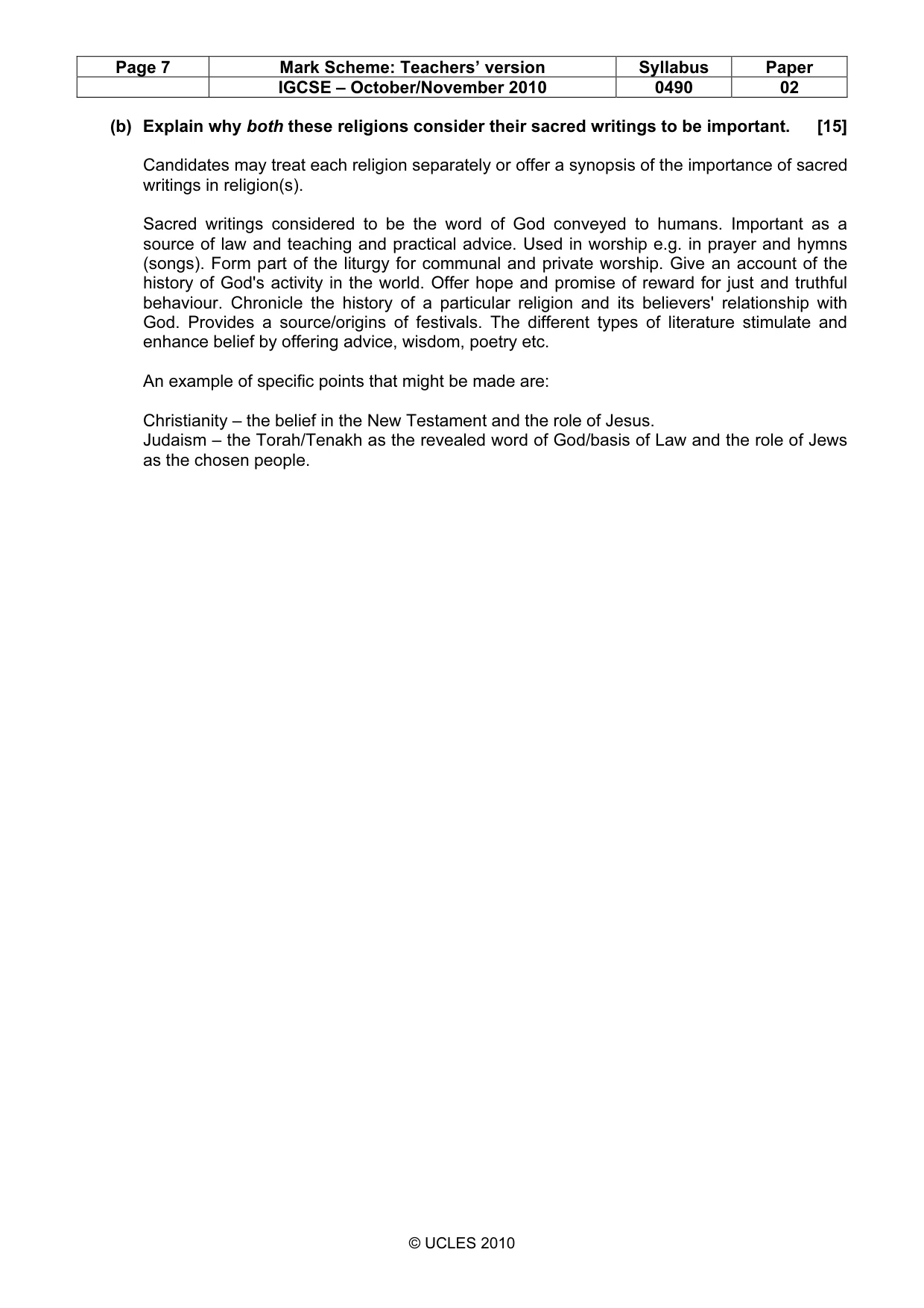
Page 7 Mark Scheme: Teachers’ version Syllabus Paper IGCSE – October/November 2010 0490 02 © UCLES 2010 (b) Explain why both these religions consider their sacred writings to be important. [15] Candidates may treat each religion separately or offer a synopsis of the importance of sacred writings in religion(s). Sacred writings considered to be the word of God conveyed to humans. Important as a source of law and teaching and practical advice. Used in worship e.g. in prayer and hymns (songs). Form part of the liturgy for communal and private worship. Give an account of the history of God's activity in the world. Offer hope and promise of reward for just and truthful behaviour. Chronicle the history of a particular religion and its believers' relationship with God. Provides a source/origins of festivals. The different types of literature stimulate and enhance belief by offering advice, wisdom, poetry etc. An example of specific points that might be made are: Christianity – the belief in the New Testament and the role of Jesus. Judaism – the Torah/Tenakh as the revealed word of God/basis of Law and the role of Jews as the chosen people.
What you needed in this session
Cambridge’s own grade thresholds for 2010 Oct/Nov, Paper 2 · Variant 1. A higher threshold means an easier paper — the bar moves with how the cohort did.