Cambridge IGCSE Religious Studies 0490 — 2016 Oct/Nov Paper 2 · Variant 1
0490/21/O/N/16 · 80 marks · ≈90 min
The question paper and its mark scheme, free to read here and free to download. This is Cambridge’s own paper, exactly as it was sat.
Question paper4 pages
Mark scheme17 pages
Answers below. Sit the paper first if you are practising.
Paper as text
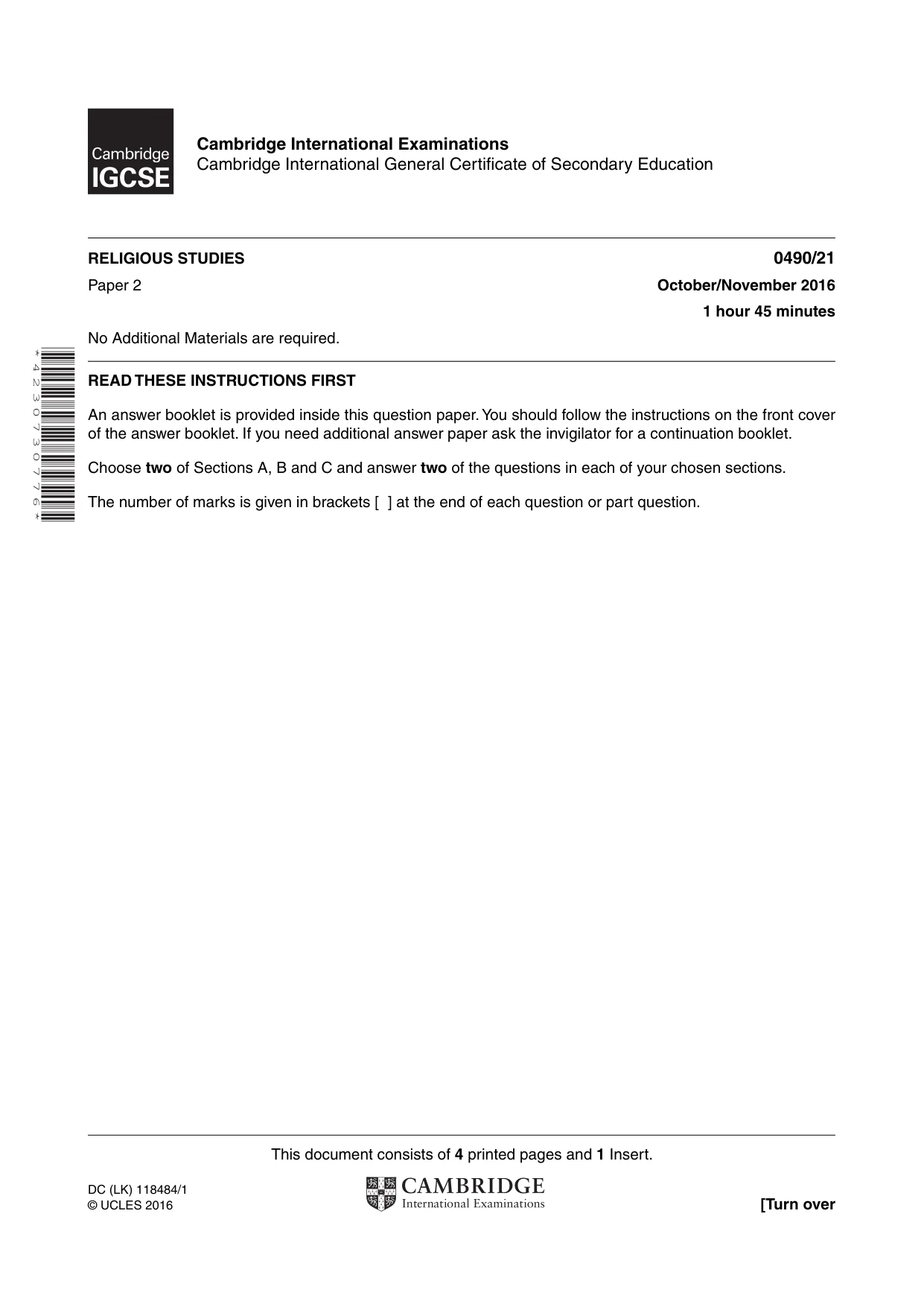
Question paper, page 1
This document consists of 4 printed pages and 1 Insert. DC (LK) 118484/1 © UCLES 2016 [Turn over Cambridge International Examinations Cambridge International General Certificate of Secondary Education * 4 2 3 0 7 3 0 7 7 6 * RELIGIOUS STUDIES 0490/21 Paper 2 October/November 2016 1 hour 45 minutes No Additional Materials are required. READ THESE INSTRUCTIONS FIRST An answer booklet is provided inside this question paper. You should follow the instructions on the front cover of the answer booklet. If you need additional answer paper ask the invigilator for a continuation booklet. Choose two of Sections A, B and C and answer two of the questions in each of your chosen sections. The number of marks is given in brackets [ ] at the end of each question or part question.
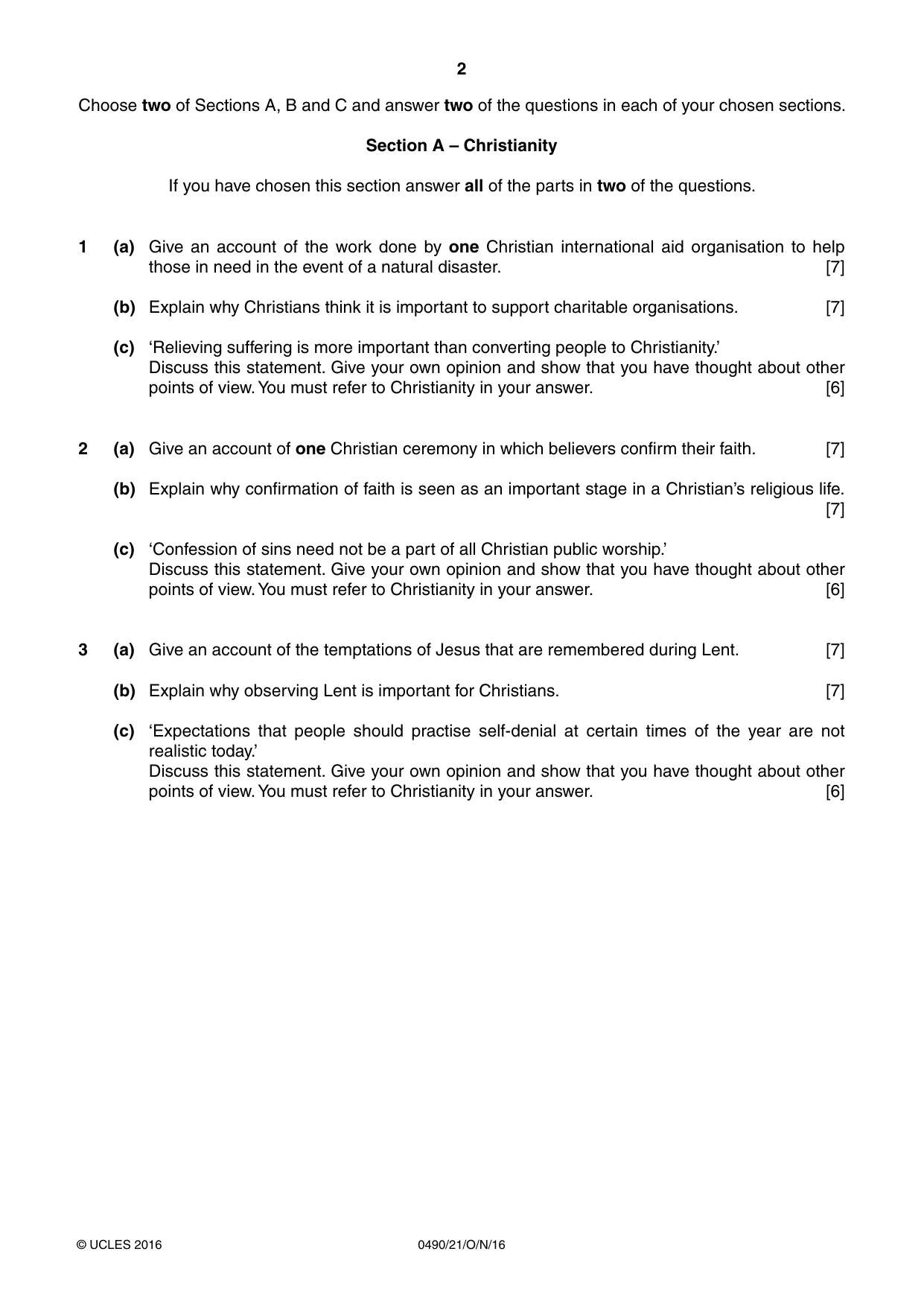
Question paper, page 2
2 0490/21/O/N/16 © UCLES 2016 Choose two of Sections A, B and C and answer two of the questions in each of your chosen sections. Section A – Christianity If you have chosen this section answer all of the parts in two of the questions. 1 (a) Give an account of the work done by one Christian international aid organisation to help those in need in the event of a natural disaster. [7] (b) Explain why Christians think it is important to support charitable organisations. [7] (c) ‘Relieving suffering is more important than converting people to Christianity.’ Discuss this statement. Give your own opinion and show that you have thought about other points of view. You must refer to Christianity in your answer. [6] 2 (a) Give an account of one Christian ceremony in which believers confirm their faith. [7] (b) Explain why confirmation of faith is seen as an important stage in a Christian’s religious life. [7] (c) ‘Confession of sins need not be a part of all Christian public worship.’ Discuss this statement. Give your own opinion and show that you have thought about other points of view. You must refer to Christianity in your answer. [6] 3 (a) Give an account of the temptations of Jesus that are remembered during Lent. [7] (b) Explain why observing Lent is important for Christians. [7] (c) ‘Expectations that people should practise self-denial at certain times of the year are not realistic today.’ Discuss this statement. Give your own opinion and show that you have thought about other points of view. You must refer to Christianity in your answer. [6]
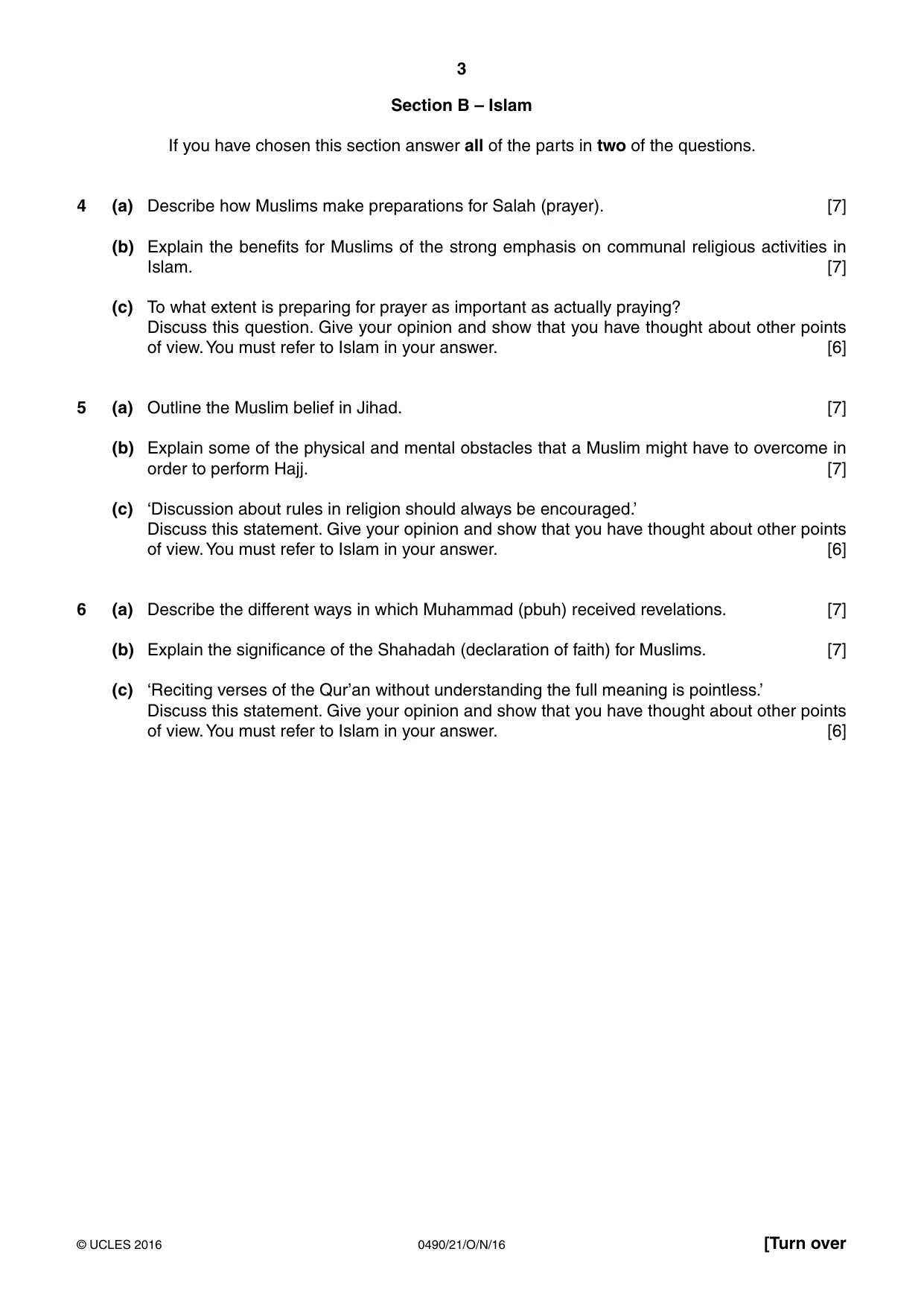
Question paper, page 3
3 0490/21/O/N/16 © UCLES 2016 [Turn over Section B – Islam If you have chosen this section answer all of the parts in two of the questions. 4 (a) Describe how Muslims make preparations for Salah (prayer). [7] (b) Explain the benefits for Muslims of the strong emphasis on communal religious activities in Islam. [7] (c) To what extent is preparing for prayer as important as actually praying? Discuss this question. Give your opinion and show that you have thought about other points of view. You must refer to Islam in your answer. [6] 5 (a) Outline the Muslim belief in Jihad. [7] (b) Explain some of the physical and mental obstacles that a Muslim might have to overcome in order to perform Hajj. [7] (c) ‘Discussion about rules in religion should always be encouraged.’ Discuss this statement. Give your opinion and show that you have thought about other points of view. You must refer to Islam in your answer. [6] 6 (a) Describe the different ways in which Muhammad (pbuh) received revelations. [7] (b) Explain the significance of the Shahadah (declaration of faith) for Muslims. [7] (c) ‘Reciting verses of the Qur’an without understanding the full meaning is pointless.’ Discuss this statement. Give your opinion and show that you have thought about other points of view. You must refer to Islam in your answer. [6]
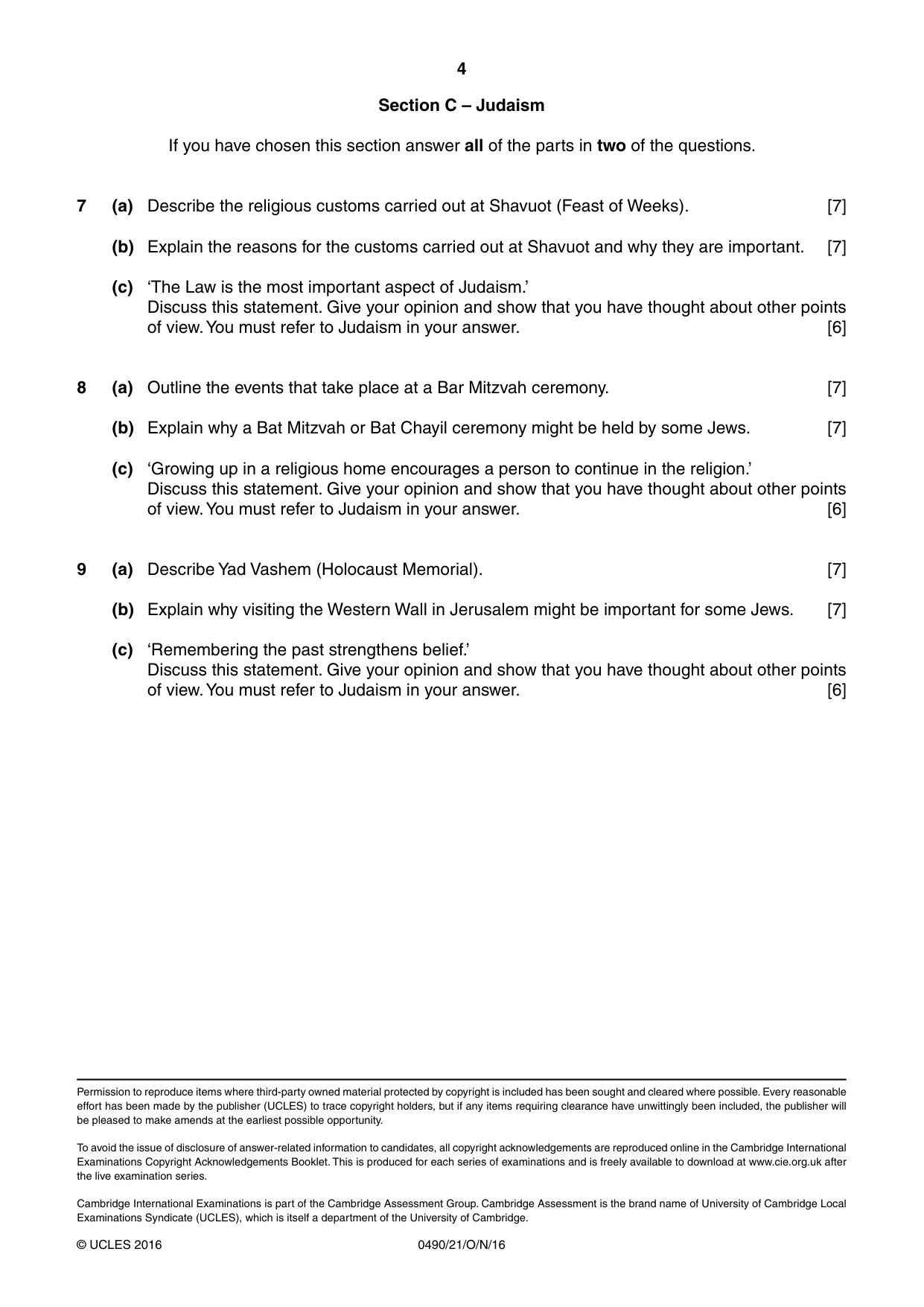
Question paper, page 4
4 0490/21/O/N/16 © UCLES 2016 Section C – Judaism If you have chosen this section answer all of the parts in two of the questions. 7 (a) Describe the religious customs carried out at Shavuot (Feast of Weeks). [7] (b) Explain the reasons for the customs carried out at Shavuot and why they are important. [7] (c) ‘The Law is the most important aspect of Judaism.’ Discuss this statement. Give your opinion and show that you have thought about other points of view. You must refer to Judaism in your answer. [6] 8 (a) Outline the events that take place at a Bar Mitzvah ceremony. [7] (b) Explain why a Bat Mitzvah or Bat Chayil ceremony might be held by some Jews. [7] (c) ‘Growing up in a religious home encourages a person to continue in the religion.’ Discuss this statement. Give your opinion and show that you have thought about other points of view. You must refer to Judaism in your answer. [6] 9 (a) Describe Yad Vashem (Holocaust Memorial). [7] (b) Explain why visiting the Western Wall in Jerusalem might be important for some Jews. [7] (c) ‘Remembering the past strengthens belief.’ Discuss this statement. Give your opinion and show that you have thought about other points of view. You must refer to Judaism in your answer. [6] Permission to reproduce items where third-party owned material protected by copyright is included has been sought and cleared where possible. Every reasonable effort has been made by the publisher (UCLES) to trace copyright holders, but if any items requiring clearance have unwittingly been included, the publisher will be pleased to make amends at the earliest possible opportunity. To avoid the issue of disclosure of answer-related information to candidates, all copyright acknowledgements are reproduced online in the Cambridge International Examinations Copyright Acknowledgements Booklet. This is produced for each series of examinations and is freely available to download at www.cie.org.uk after the live examination series. Cambridge International Examinations is part of the Cambridge Assessment Group. Cambridge Assessment is the brand name of University of Cambridge Local Examinations Syndicate (UCLES), which is itself a department of the University of Cambridge.
Mark scheme, page 1
® IGCSE is the registered trademark of Cambridge International Examinations. This document consists of 17 printed pages. © UCLES 2016 [Turn over Cambridge International Examinations Cambridge International General Certificate of Secondary Education RELIGIOUS STUDIES 0490/21 Paper 2 October/November 2016 MARK SCHEME Maximum Mark: 80 Published This mark scheme is published as an aid to teachers and candidates, to indicate the requirements of the examination. It shows the basis on which Examiners were instructed to award marks. It does not indicate the details of the discussions that took place at an Examiners’ meeting before marking began, which would have considered the acceptability of alternative answers. Mark schemes should be read in conjunction with the question paper and the Principal Examiner Report for Teachers. Cambridge will not enter into discussions about these mark schemes. Cambridge is publishing the mark schemes for the October/November 2016 series for most Cambridge IGCSE®, Cambridge International A and AS Level components and some Cambridge O Level components.
Mark scheme, page 2
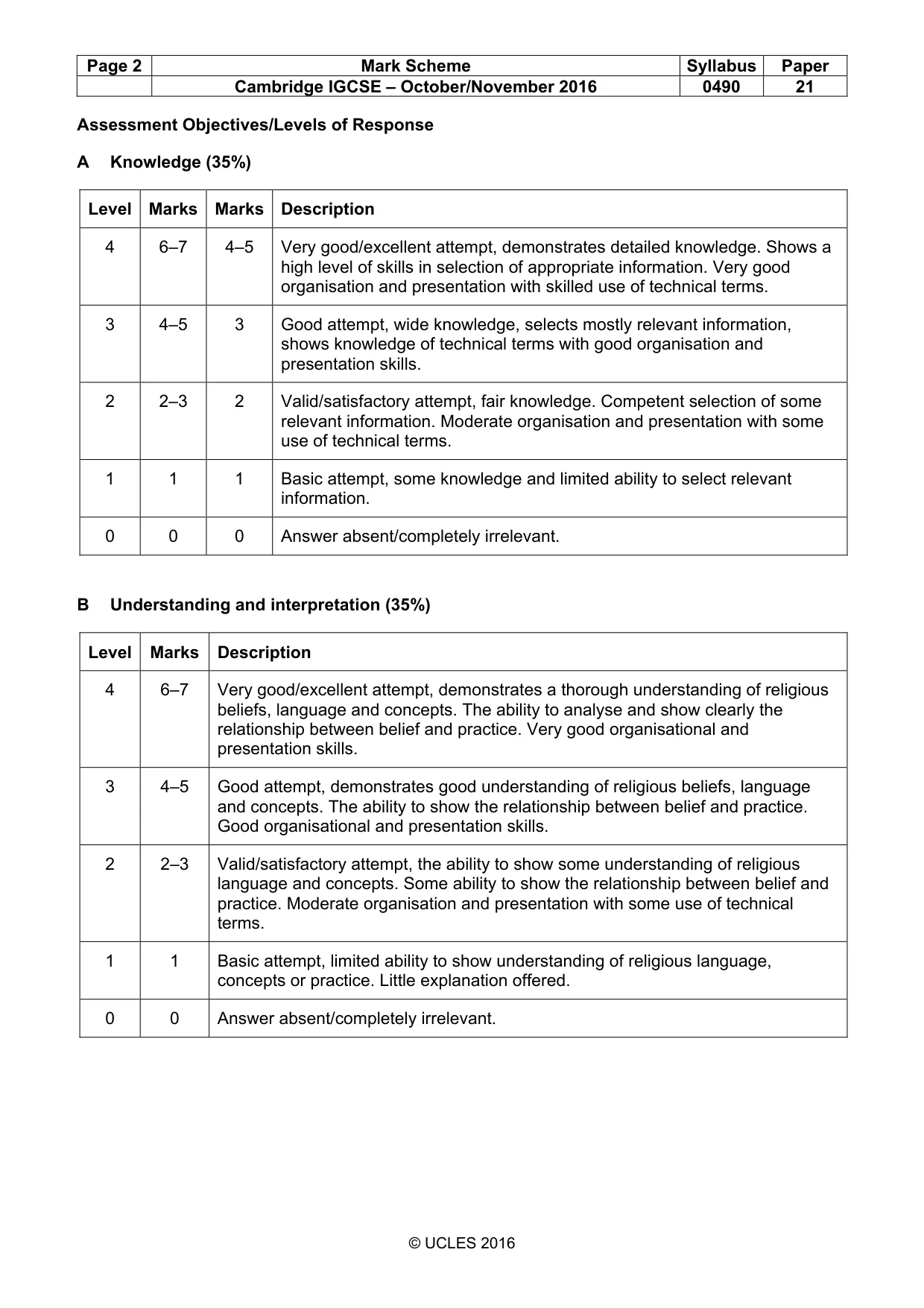
Page 2 Mark Scheme Syllabus Paper Cambridge IGCSE – October/November 2016 0490 21 © UCLES 2016 Assessment Objectives/Levels of Response A Knowledge (35%) Level Marks Marks Description 4 6–7 4–5 Very good/excellent attempt, demonstrates detailed knowledge. Shows a high level of skills in selection of appropriate information. Very good organisation and presentation with skilled use of technical terms. 3 4–5 3 Good attempt, wide knowledge, selects mostly relevant information, shows knowledge of technical terms with good organisation and presentation skills. 2 2–3 2 Valid/satisfactory attempt, fair knowledge. Competent selection of some relevant information. Moderate organisation and presentation with some use of technical terms. 1 1 1 Basic attempt, some knowledge and limited ability to select relevant information. 0 0 0 Answer absent/completely irrelevant. B Understanding and interpretation (35%) Level Marks Description 4 6–7 Very good/excellent attempt, demonstrates a thorough understanding of religious beliefs, language and concepts. The ability to analyse and show clearly the relationship between belief and practice. Very good organisational and presentation skills. 3 4–5 Good attempt, demonstrates good understanding of religious beliefs, language and concepts. The ability to show the relationship between belief and practice. Good organisational and presentation skills. 2 2–3 Valid/satisfactory attempt, the ability to show some understanding of religious language and concepts. Some ability to show the relationship between belief and practice. Moderate organisation and presentation with some use of technical terms. 1 1 Basic attempt, limited ability to show understanding of religious language, concepts or practice. Little explanation offered. 0 0 Answer absent/completely irrelevant.
Mark scheme, page 3
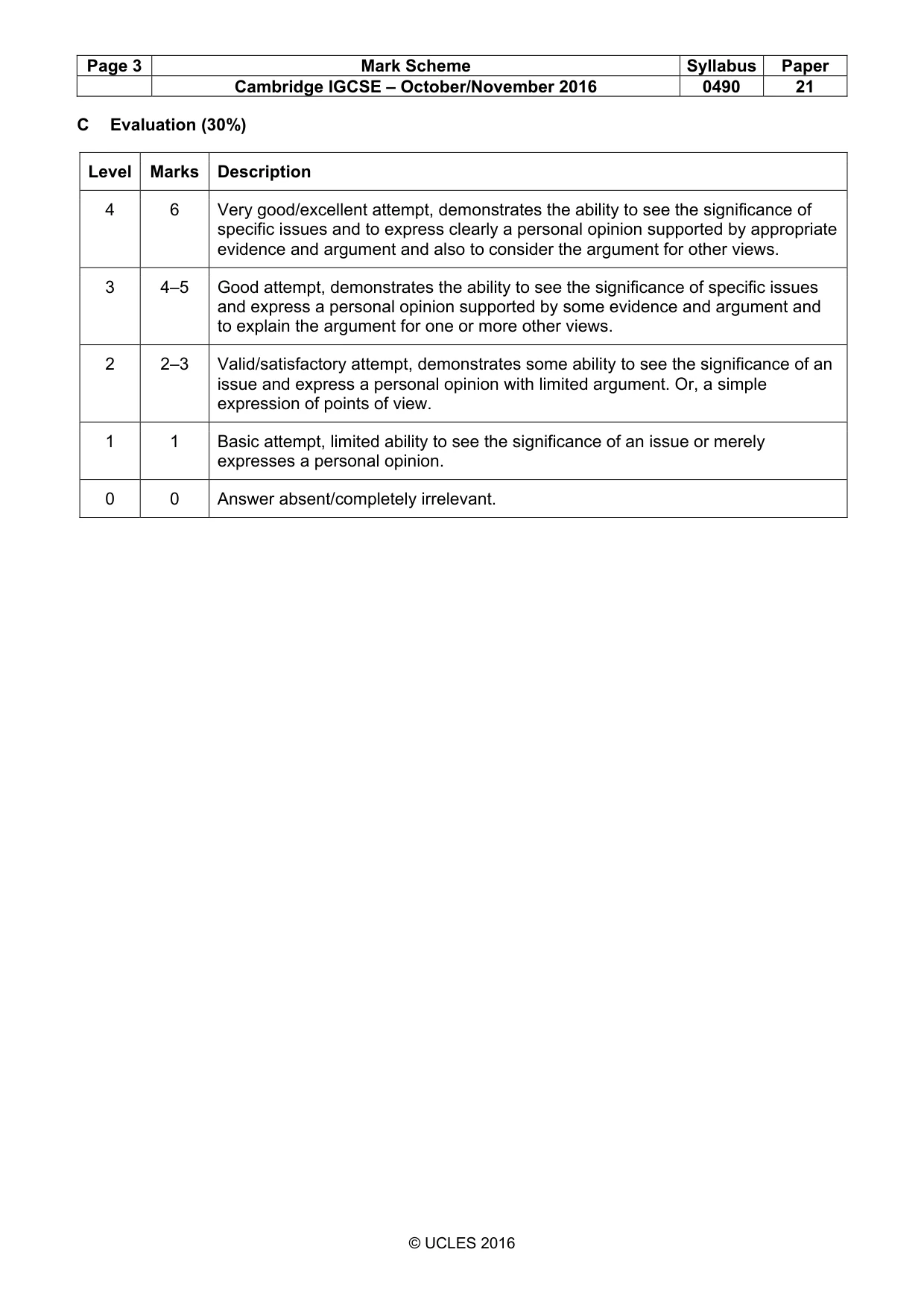
Page 3 Mark Scheme Syllabus Paper Cambridge IGCSE – October/November 2016 0490 21 © UCLES 2016 C Evaluation (30%) Level Marks Description 4 6 Very good/excellent attempt, demonstrates the ability to see the significance of specific issues and to express clearly a personal opinion supported by appropriate evidence and argument and also to consider the argument for other views. 3 4–5 Good attempt, demonstrates the ability to see the significance of specific issues and express a personal opinion supported by some evidence and argument and to explain the argument for one or more other views. 2 2–3 Valid/satisfactory attempt, demonstrates some ability to see the significance of an issue and express a personal opinion with limited argument. Or, a simple expression of points of view. 1 1 Basic attempt, limited ability to see the significance of an issue or merely expresses a personal opinion. 0 0 Answer absent/completely irrelevant.
Mark scheme, page 4
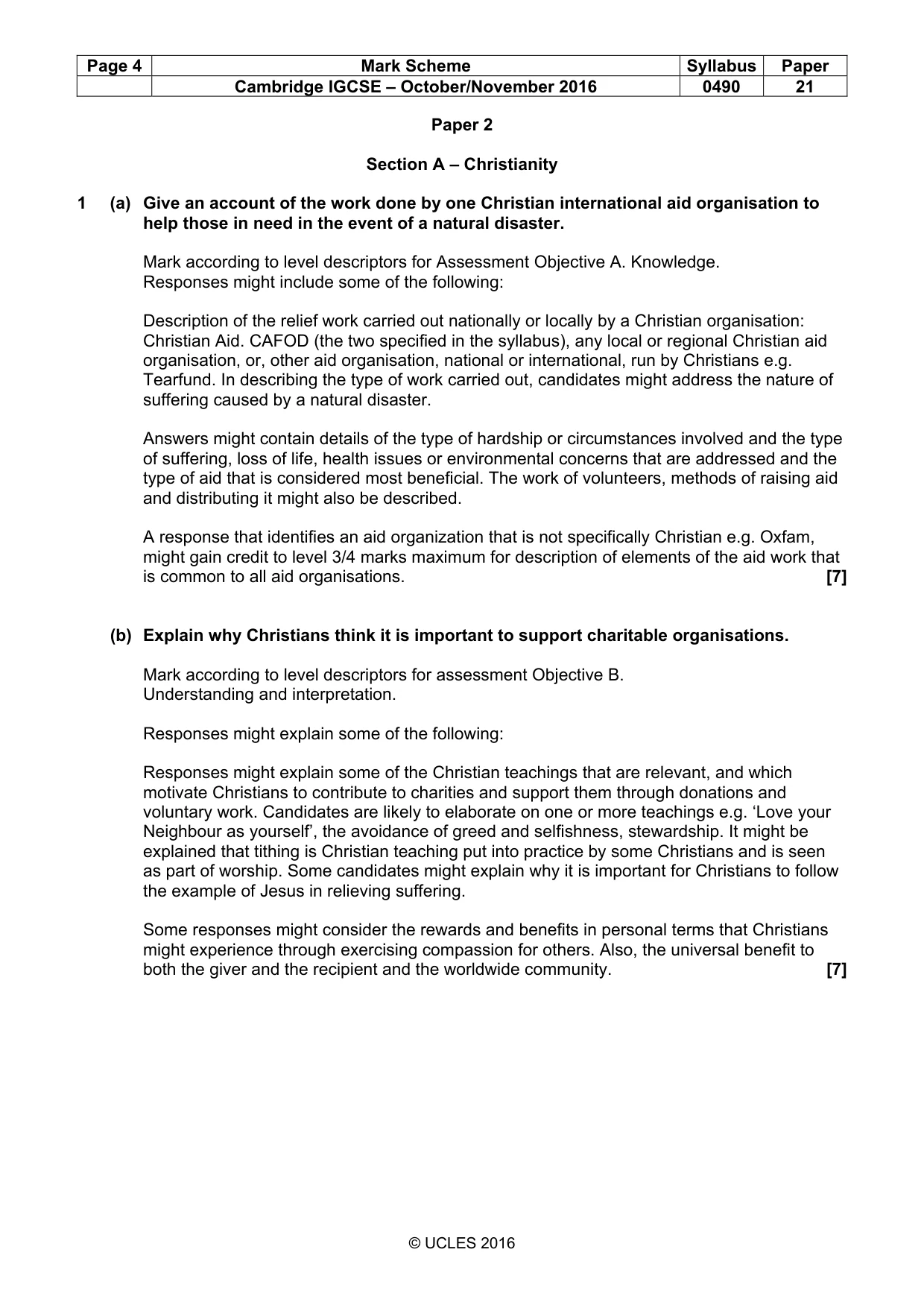
Page 4 Mark Scheme Syllabus Paper Cambridge IGCSE – October/November 2016 0490 21 © UCLES 2016 Paper 2 Section A – Christianity 1 (a) Give an account of the work done by one Christian international aid organisation to help those in need in the event of a natural disaster. Mark according to level descriptors for Assessment Objective A. Knowledge. Responses might include some of the following: Description of the relief work carried out nationally or locally by a Christian organisation: Christian Aid. CAFOD (the two specified in the syllabus), any local or regional Christian aid organisation, or, other aid organisation, national or international, run by Christians e.g. Tearfund. In describing the type of work carried out, candidates might address the nature of suffering caused by a natural disaster. Answers might contain details of the type of hardship or circumstances involved and the type of suffering, loss of life, health issues or environmental concerns that are addressed and the type of aid that is considered most beneficial. The work of volunteers, methods of raising aid and distributing it might also be described. A response that identifies an aid organization that is not specifically Christian e.g. Oxfam, might gain credit to level 3/4 marks maximum for description of elements of the aid work that is common to all aid organisations. [7] (b) Explain why Christians think it is important to support charitable organisations. Mark according to level descriptors for assessment Objective B. Understanding and interpretation. Responses might explain some of the following: Responses might explain some of the Christian teachings that are relevant, and which motivate Christians to contribute to charities and support them through donations and voluntary work. Candidates are likely to elaborate on one or more teachings e.g. ‘Love your Neighbour as yourself’, the avoidance of greed and selfishness, stewardship. It might be explained that tithing is Christian teaching put into practice by some Christians and is seen as part of worship. Some candidates might explain why it is important for Christians to follow the example of Jesus in relieving suffering. Some responses might consider the rewards and benefits in personal terms that Christians might experience through exercising compassion for others. Also, the universal benefit to both the giver and the recipient and the worldwide community. [7]
Mark scheme, page 5
Page 5 Mark Scheme Syllabus Paper Cambridge IGCSE – October/November 2016 0490 21 © UCLES 2016 (c) ‘Relieving suffering is more important than converting people to Christianity.’ Discuss this statement. Give your own opinion and show that you have thought about other points of view. You must refer to Christianity in your answer. Mark according to level descriptors for Assessment Objective C. Evaluation. Responses might consider some of the following: Candidates might agree with the statement and evaluate that the relief of suffering should come before any religious considerations such as whether the recipient is a Christian or not. No conditions should be placed on the exercising of compassion. Reasons and evidence might be used to support this view e.g. Jesus helped gentiles and outcasts as well as Jews and human suffering is the same, whether a person is a Christian or not. A balanced assessment might consider the view that, traditionally, much of Christian aid work is carried out by believers (e.g. missionaries) who also believe that they have a duty to bring people to the Christian faith. Gaining faith and putting Christian teaching into practice will help to ease the suffering of individuals and communities. Examples might be given. It might be argued that when suffering is relieved by Christians who are motivated by faith, then the example set might be one that others wish to follow. Conversions are often voluntary. [6] 2 (a) Give an account of one Christian ceremony in which believers confirm their faith. Mark according to level descriptors for Assessment Objective A. Knowledge. Responses might include some of the following: Believer’s Baptism: a ceremony where there is full immersion in water. Candidates might describe where the immersion takes place e.g. water/pool river, the people present e.g. candidate for baptism, witnesses, minister and what is said and done during the ceremony e.g. confession/vows/words of witness, prayers and blessings, hymns. Confirmation: a ceremony where there is anointing with oil and the laying on of hands. Candidates might identify the place where the service is carried out e.g. in a church, cathedral, in front of the altar, in the open air. The people present e.g. confirmation candidates, Bishop, minister, congregation and what is said and done during the ceremony e.g. vows/blessings/prayers/hymns. It is likely that there will be denominational and traditional variations in the nature and order of the events described e.g. First Communion. Credit should always be given where appropriate. [7]
Mark scheme, page 6
Page 6 Mark Scheme Syllabus Paper Cambridge IGCSE – October/November 2016 0490 21 © UCLES 2016 (b) Explain why confirmation of faith is seen as an important stage in a Christian’s religious life. Mark according to level descriptors for assessment Objective B. Understanding and interpretation. Responses might explain some of the following: The confirmation of faith is a significant rite of passage/ sacrament, the ceremony marks an important stage in religious life. Candidates may choose to explain the symbolism of the specific ceremony described in the answer to (a). Or, provide a more general response explaining the symbolism of confirming one’s faith and receiving the gift of the Holy Spirit. In Believer’s Baptism, the full immersion in water symbolises the washing away of old life and rising to new life and receiving the Holy Spirit. Some believers see themselves as ‘born again’ into a Christian life. In a Confirmation service, the anointing with oil and laying on of hands symbolizes the giving of the Holy Spirit. A person who has been baptized as an infant, takes it upon themselves to make and keep the vows made by Godparents. On these occasions, the gift of the Holy Spirit is given, just like the Holy Spirit was given to the disciples at Pentecost. In public, the believer makes an act of witness – to accept the Christian faith and make a full commitment to living a Christian life in the power of the Holy Spirit. [7] (c) ‘Confession of sins need not be a part of all Christian public worship.’ Discuss this statement. Give your own opinion and show that you have thought about other points of view. You must refer to Christianity in your answer. Mark according to level descriptors for Assessment Objective C. Evaluation. Responses might consider some of the following: Arguments in support of the statement might be that the confession of sins should be private and many people will not wish to confess to their sins in public, preferring private prayer. Reasons and examples might be given. Some might argue that the meaning of confession of sins is lost if people are encouraged to ‘boast’ or make a show of sinfulness in public (as in the Pharisee and the tax collector). Another view might be that prayers for the public confession of sins are already a part of many services e.g. Eucharist and reasons given why this is an important practice e.g. in preparation for receiving Holy Communion or another sacrament. Having such prayers in public worship teaches believers to know how to ask for forgiveness and the importance of doing so. It is also possible to contemplate and confess sins silently and privately even in public worship. Some responses might consider that there is a case for confession of sins to be both public and private. [6]
Mark scheme, page 7
Page 7 Mark Scheme Syllabus Paper Cambridge IGCSE – October/November 2016 0490 21 © UCLES 2016 3 (a) Give an account of the temptations of Jesus that are remembered during Lent. Mark according to level descriptors for Assessment Objective A. Knowledge. Responses might include some of the following: After his baptism in the river Jordan by John the Baptist, Jesus went into the desert for 40 days and 40 nights. He suffered and rejected three temptations by the devil. (As the order of the three temptations differs in the gospel accounts any order of the three events will be acceptable and any paraphrase or version quoted). To turn stones into bread to feed his hunger. Rejected – as man cannot live on bread alone - the word of God is important. To throw himself from the highest point of the Temple to see if God would save him. Rejected – because it is wrong to test God. To aspire to rule the Kingdoms of the World and to worship the Devil. Rejected – only God is to be worshipped. [7] (b) Explain why the observing Lent is important for Christians. Mark according to level descriptors for assessment Objective B. Understanding and interpretation. Responses might explain some of the following: For Christians, the main reason for observing Lent is to remember Jesus’ self-denial, fasting for forty days and nights in preparation for his ministry. The nature of the temptations and his refusal to be tempted by the devil is seen to be an indication of his true identity as the Son of God. When Christians remember this – they take stock of their own lives and see the season of Lent as a spiritual preparation for Easter. For some, reflection, prayer, fasting and self-denial are part of that preparation. They hope the discipline of lent will help them to be less selfish and greedy and more compassionate and charitable towards the needy. Self-denial, in the form of fasting or the denial of luxuries, is seen by Christians as not only an opportunity to ‘give up’ things but also to do positive activities. Special Lenten services and Bible study classes help Christians to reflect on and understand the meaning of the last week of Jesus’ life. There is an opportunity to spend extra time in prayer and strengthen faith. [7]
Mark scheme, page 8
Page 8 Mark Scheme Syllabus Paper Cambridge IGCSE – October/November 2016 0490 21 © UCLES 2016 (c) ‘Expectations that people should practise self-denial at certain times of the year are not realistic today.’ Discuss this statement. Give your own opinion and show that you have thought about other points of view. You must refer to Christianity in your answer. Mark according to level descriptors for Assessment Objective C. Evaluation. Responses might consider some of the following: Candidates might argue that the tradition of self-denial and fasting is an unrealistic practice for some people today. To expect Christians to go against the trend in society for self-gratification and indulging in luxuries is asking too much. Work and lifestyles are very different now than in the past. Some candidates might argue that only believers who are fully dedicated to a religious life (e.g. monks) should be keeping these traditions. Another view might be that the expectation is realistic because many Christians do not consider it necessary to observe Lent as e.g. the traditional strict fast involving total abstinence from meat and fats. There are many different ways that Christians can demonstrate self-denial – and even children can be involved. Candidates may give some examples, as evidence to support this view. Some may argue that the expectation is realistic just because it only occurs at certain times of the year and is limited to these times. [6]
Mark scheme, page 9
Page 9 Mark Scheme Syllabus Paper Cambridge IGCSE – October/November 2016 0490 21 © UCLES 2016 Section B – Islam 4 (a) Describe how Muslims make preparations for Salah (Prayer). Mark according to level descriptors for Assessment Objective A. Knowledge. Responses might include some of the following: Muslims should be appropriate and modestly dressed and clothes should be clean. The place of prayer should be clean. Shoes should be removed. Ritual purification, wudu, should be carried out. If water is not available for this symbolic washing, tayammum, can be done. The worshipper should face the direction of the Ka’ba,(qiblah), in Makkah. The mind should be cleared to focus on prayer. If in the mosque, stand up when the announcement of prayer, iquamah, is made and stand in straight lines. Declaration of the intent to pray, niyyat, should be said. [7] (b) Explain the benefits for Muslims of the strong emphasis on communal religious activities in Islam. Mark according to level descriptors for assessment Objective B. Understanding and interpretation. Responses might explain some of the following: For Muslims, communal activities provide a strong bond of brotherhood. The Ummah is created because all Muslims carry out the same religious rituals and observances at the same time. This creates a worldwide community that transcends barriers of race, tribe or caste. The benefits of a worldwide Ummah are that everyone is equal in their love of God and in their submission to his commands. Candidates may give examples of communal religious activities that illustrate their understanding of this e.g. prayer, fasting, charity pilgrimage. Muslims support and encourage each other to strive to fulfill their religious obligations and to care for all members of society through all stages of life from birth to death. [7] (c) To what extent is preparing for prayer as important as actually praying? Discuss this question. Give your opinion and show that you have thought about other points of view. You must refer to Islam in your answer. Mark according to level descriptors for Assessment Objective C. Evaluation. Responses might consider some of the following: Candidates might evaluate that the importance of ritual preparation for prayer lies in ensuring that the worshipper begins prayer with the right mindset and with sincerity. Some candidates might point out that ritual purification is commanded in the Qur’an and the Prophet (pbuh) said ‘Allah does not accept any prayer that was not performed while in a state of purity’.
Mark scheme, page 10
Page 10 Mark Scheme Syllabus Paper Cambridge IGCSE – October/November 2016 0490 21 © UCLES 2016 Responses are also likely to explore arguments that it is the act of prayer, Salah, which is one of the Five Pillars and the commandment from God. The first act a Muslim will be accountable for on the Day of Judgement will be his prayer. Muslim and non-Muslims might also argue that prayer or supplication (asking for God’s aid) might be a spontaneous act for many reasons e.g. at times of suffering. Another view might be that wudu (purity) is an essential and important element of performing prayer, however, Islam allows Muslims to substitute or limit the preparations, according to circumstances, so as to ensure that actual act of prayer can take place at the appointed time. [6] 5 (a) Outline the Muslim belief in Jihad. Mark according to level descriptors for Assessment Objective A. Knowledge. Responses might include some of the following: The meaning of Jihad is exertion or striving – the maximum effort or struggle towards a goal. For Muslims this means ‘to strive in the way of Allah’. This striving is considered to be one of the most meritorious acts in Islam. Greater Jihad is the deliberate effort made by each Muslim to serve God to the best of his/her ability through a life of devotion, self-sacrifice and love and compassion for others. It is the personal struggle of every Muslim to follow the teachings of Islam and to resist evil. The aim of Jihad is to establish truth and righteousness and the Islamic way of life to fulfill the will of God to gain blessings. The term Lesser Jihad is sometimes used when speaking of a military situation when Muslims are called upon to physically fight/strive against evil such as tyranny or to preserve their faith. However, Islam is primarily a peace-loving religion and such actions should only be in defence of the religion, in order to restore peace and freedom of worship. Women and children, the old and sick, trees, animals (for meat) and placed of worship are protected. [7] (b) Explain some of the physical and mental obstacles that a Muslim might have to overcome in order to perform Hajj. Mark according to level descriptors for assessment Objective B. Understanding and interpretation. Responses might explain some of the following: Before setting out on Hajj, Muslims must make sure that they can afford the journey and can provide for the maintenance of their family. Many Muslims have to save for a considerable time to go on Hajj – the money to make the journey cannot be borrowed and it must not have been gained through immoral means. All debts must be settled. Some Muslims live far from Saudi Arabia and travel arrangements can be complicated and costly. Women who go on Hajj must have a male guardian who can be a relative or an Imam. Sometimes group arrangements can be made for single women to facilitate this.
Mark scheme, page 11
Page 11 Mark Scheme Syllabus Paper Cambridge IGCSE – October/November 2016 0490 21 © UCLES 2016 Physical effort and stamina is needed to complete all the stages of Hajj and the conditions are harsh, involving spending nights in the open air and walking/standing for long periods in the heat. The intention and mindset for setting out on Hajj must be meaningful. Muslims must make amends for their own wrongdoing and endeavor to forgive others. Muslims prepare mentally and spiritually by attending special Hajj lessons. The pilgrim must be certain that they are doing Hajj for the right reasons – for the glory of God – not for the glory of the person making the journey. [7] (c) ‘Discussion about rules in religion should always be encouraged.’ Discuss this statement. Give your opinion and show that you have thought about other points of view. You must refer to Islam in your answer. Mark according to level descriptors for Assessment Objective C. Evaluation. Responses might consider some of the following: Candidates might consider views in support of the statement – that discussion and debate in religion is always meaningful and usually leads to better interpretation and understanding of why religious obligations and laws should be followed. In return, understanding encourages observance. However, the questioning of rules might be seen by some believers to be indications of lack of faith and so not to be encouraged. Some arguments here might involve how far some Muslims and others see religious rules as God given and therefore not to be questioned or interpreted. Candidates might be expected to arrive at a balanced conclusion. [6] 6 (a) Describe the different ways in which Muhammad (pbuh) received revelations. Mark according to level descriptors for Assessment Objective A. Knowledge. Responses might include some of the following: The Angel Gabriel appeared – sometimes as himself, sometimes in the form of a man. The angel spoke to Muhammad (pbuh). Muhammad was afraid and shivered with fear. The experience was painful and agonizing for the Prophet. He suffered extreme temperatures. Afterwards he had to be covered by a blanket. Sometimes the revelation was like the ringing of a bell that passed off only after the inspiration had been grasped. Revelations happened unexpectedly when the Prophet (pbuh) was walking, sitting, riding, praying, delivering a sermon. Visible sensory reactions were witnessed by those around him when he was in the state of revelation: his face would brighten, parts of his body would become heavy. (Note: Candidates will have studied the first revelation in detail. Answers which describe only the event in Cave Hira will have some elements of the above and should be credited for these – but other ways of revelation are also expected, as outlined above.) [7]
Mark scheme, page 12
Page 12 Mark Scheme Syllabus Paper Cambridge IGCSE – October/November 2016 0490 21 © UCLES 2016 (b) Explain the significance of the Shahadah (declaration of faith) for Muslims. Mark according to level descriptors for assessment Objective B. Understanding and interpretation. Responses might explain some of the following: Belief in Shahadah is one of the Five Pillars. It is obligatory. Without this first pillar, the others are meaningless. Shahadah means ‘I declare’ or ‘I bear witness’. It is a short, dramatic statement. ‘I believe that there is no God but Allah and Muhammad (pbuh) is the Messenger of God.’ It is a declaration that there is only one true, supreme being (Tawhid) and Muhammad (pbuh) was his genuine messenger. Muslims believe that their whole life should support this belief. They recognise that their life belongs to God. When a person makes this declaration and truly believes it, they become a Muslim. Muslims repeat the Shahadah first thing on waking and last thing before sleeping. These are the first words whispered into the ears of a newborn baby and, if possible, the last words said to the dying. [7] (c) ‘Reciting verses of the Qur’an without understanding the full meaning is pointless.’ Discuss this statement. Give your opinion and show that you have thought about other points of view. You must refer to Islam in your answer. Mark according to level descriptors for Assessment Objective C. Evaluation. Responses might consider some of the following: Responses might agree with the statement and provide arguments to justify it. The Qur’an should be read with understanding and its teachings reflected upon, not recited ‘blindly’ by rote. The words of the Qur’an are seen as a direct communication from God to humans. In the Qur’an, God says he has made the Qur’an easy to understand. Another view might be that reciting from the Qur’an is part of everyday practice. There are reasons why reciting the Qur’an, without a full understanding, might occur, in some circumstances. Some of these might be unavoidable e.g. when Arabic is not the first language. However, this should be overcome through education. It is imperative to understand the teachings in the Qur’an, as it is the complete guide to every aspect of Muslim life (religious, social and moral). [6]
Mark scheme, page 13
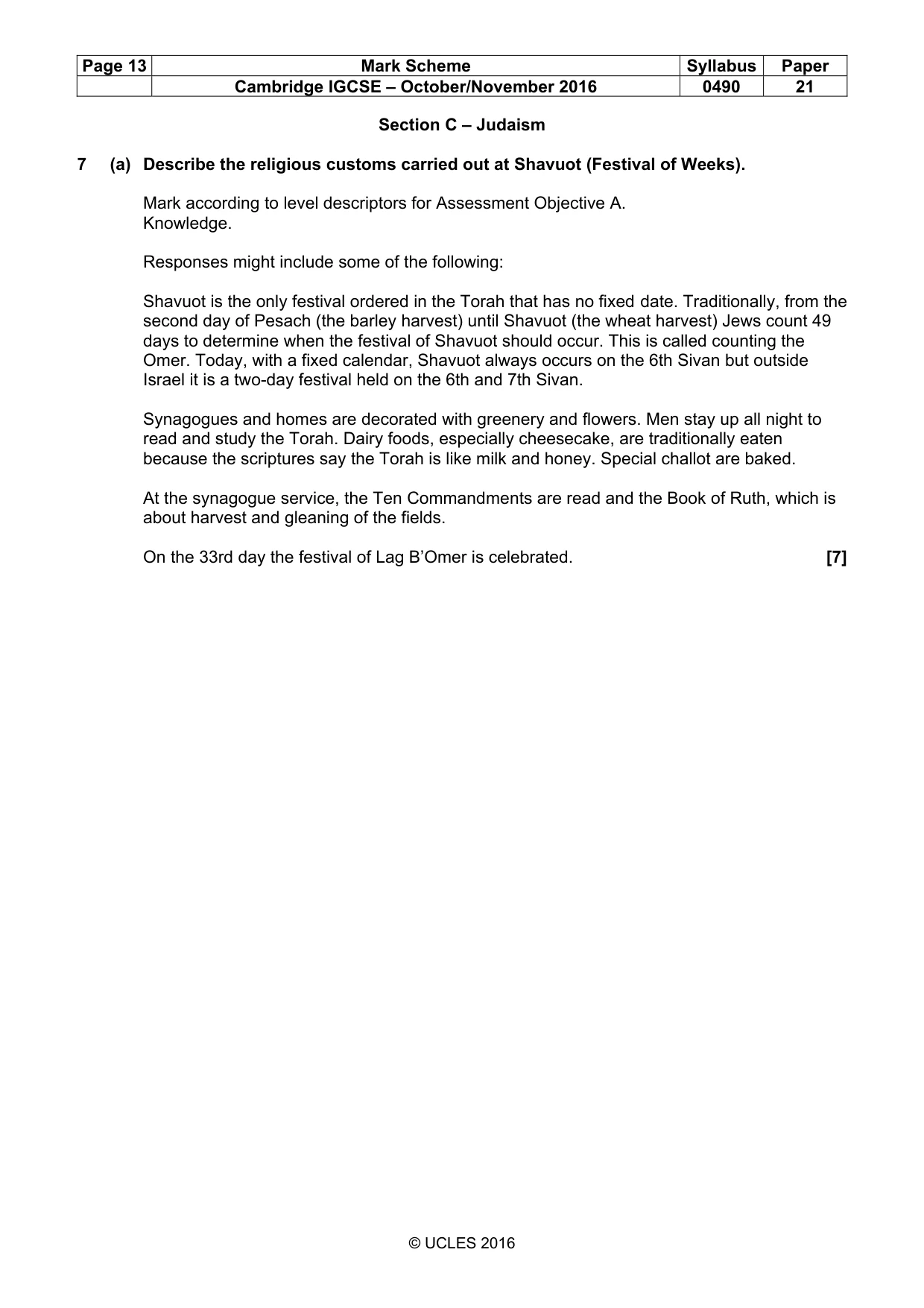
Page 13 Mark Scheme Syllabus Paper Cambridge IGCSE – October/November 2016 0490 21 © UCLES 2016 Section C – Judaism 7 (a) Describe the religious customs carried out at Shavuot (Festival of Weeks). Mark according to level descriptors for Assessment Objective A. Knowledge. Responses might include some of the following: Shavuot is the only festival ordered in the Torah that has no fixed date. Traditionally, from the second day of Pesach (the barley harvest) until Shavuot (the wheat harvest) Jews count 49 days to determine when the festival of Shavuot should occur. This is called counting the Omer. Today, with a fixed calendar, Shavuot always occurs on the 6th Sivan but outside Israel it is a two-day festival held on the 6th and 7th Sivan. Synagogues and homes are decorated with greenery and flowers. Men stay up all night to read and study the Torah. Dairy foods, especially cheesecake, are traditionally eaten because the scriptures say the Torah is like milk and honey. Special challot are baked. At the synagogue service, the Ten Commandments are read and the Book of Ruth, which is about harvest and gleaning of the fields. On the 33rd day the festival of Lag B’Omer is celebrated. [7]
Mark scheme, page 14
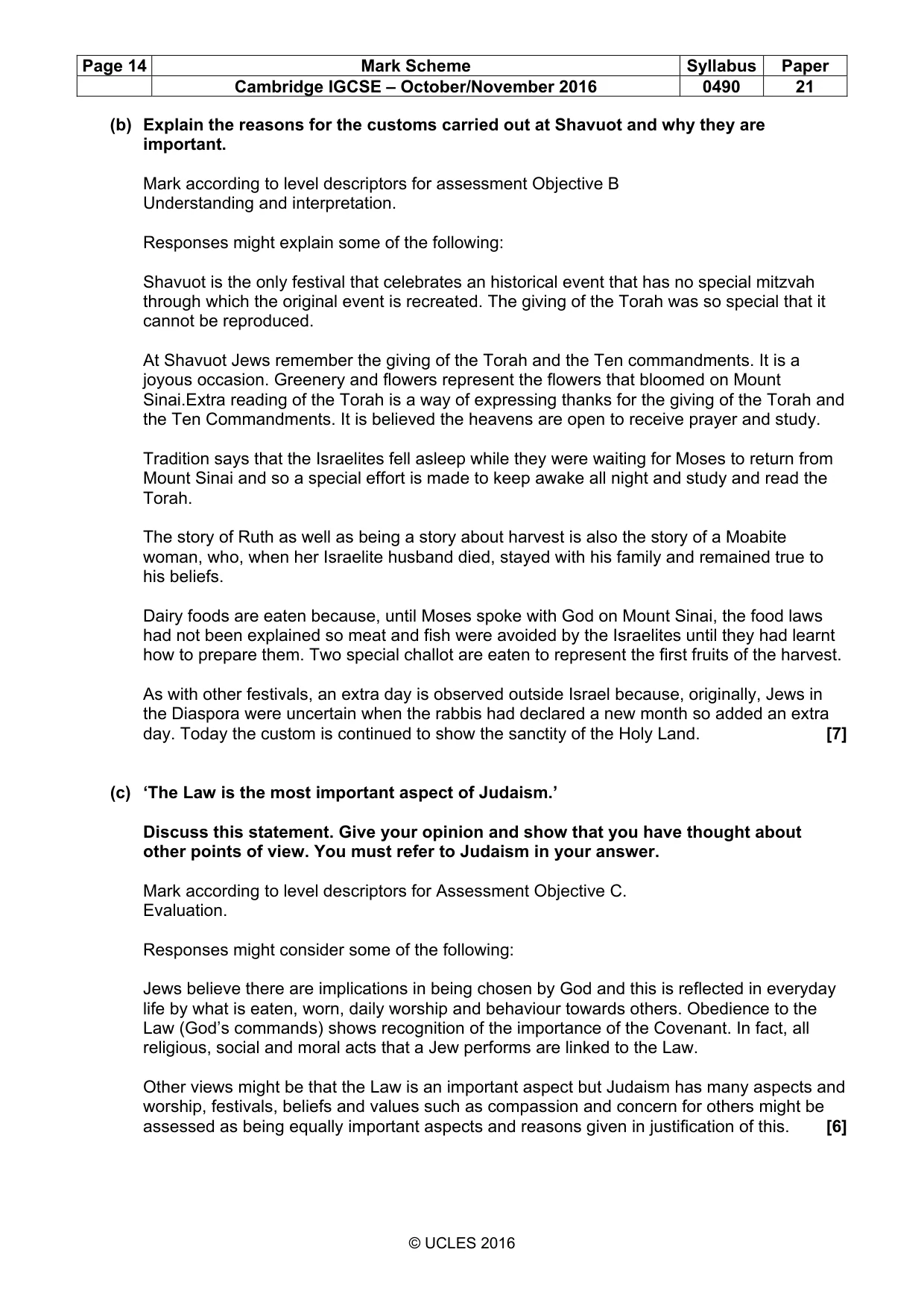
Page 14 Mark Scheme Syllabus Paper Cambridge IGCSE – October/November 2016 0490 21 © UCLES 2016 (b) Explain the reasons for the customs carried out at Shavuot and why they are important. Mark according to level descriptors for assessment Objective B Understanding and interpretation. Responses might explain some of the following: Shavuot is the only festival that celebrates an historical event that has no special mitzvah through which the original event is recreated. The giving of the Torah was so special that it cannot be reproduced. At Shavuot Jews remember the giving of the Torah and the Ten commandments. It is a joyous occasion. Greenery and flowers represent the flowers that bloomed on Mount Sinai.Extra reading of the Torah is a way of expressing thanks for the giving of the Torah and the Ten Commandments. It is believed the heavens are open to receive prayer and study. Tradition says that the Israelites fell asleep while they were waiting for Moses to return from Mount Sinai and so a special effort is made to keep awake all night and study and read the Torah. The story of Ruth as well as being a story about harvest is also the story of a Moabite woman, who, when her Israelite husband died, stayed with his family and remained true to his beliefs. Dairy foods are eaten because, until Moses spoke with God on Mount Sinai, the food laws had not been explained so meat and fish were avoided by the Israelites until they had learnt how to prepare them. Two special challot are eaten to represent the first fruits of the harvest. As with other festivals, an extra day is observed outside Israel because, originally, Jews in the Diaspora were uncertain when the rabbis had declared a new month so added an extra day. Today the custom is continued to show the sanctity of the Holy Land. [7] (c) ‘The Law is the most important aspect of Judaism.’ Discuss this statement. Give your opinion and show that you have thought about other points of view. You must refer to Judaism in your answer. Mark according to level descriptors for Assessment Objective C. Evaluation. Responses might consider some of the following: Jews believe there are implications in being chosen by God and this is reflected in everyday life by what is eaten, worn, daily worship and behaviour towards others. Obedience to the Law (God’s commands) shows recognition of the importance of the Covenant. In fact, all religious, social and moral acts that a Jew performs are linked to the Law. Other views might be that the Law is an important aspect but Judaism has many aspects and worship, festivals, beliefs and values such as compassion and concern for others might be assessed as being equally important aspects and reasons given in justification of this. [6]
Mark scheme, page 15
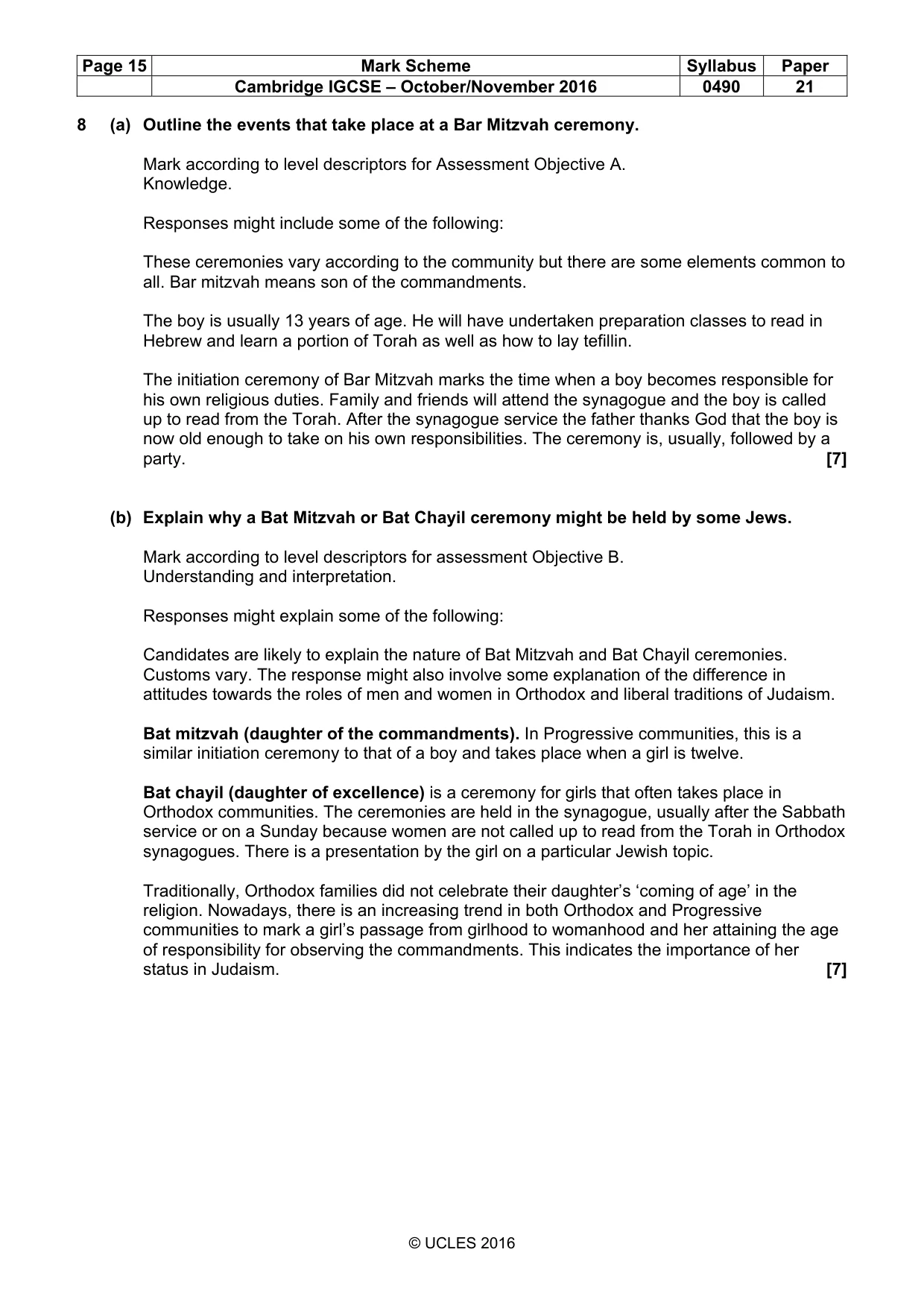
Page 15 Mark Scheme Syllabus Paper Cambridge IGCSE – October/November 2016 0490 21 © UCLES 2016 8 (a) Outline the events that take place at a Bar Mitzvah ceremony. Mark according to level descriptors for Assessment Objective A. Knowledge. Responses might include some of the following: These ceremonies vary according to the community but there are some elements common to all. Bar mitzvah means son of the commandments. The boy is usually 13 years of age. He will have undertaken preparation classes to read in Hebrew and learn a portion of Torah as well as how to lay tefillin. The initiation ceremony of Bar Mitzvah marks the time when a boy becomes responsible for his own religious duties. Family and friends will attend the synagogue and the boy is called up to read from the Torah. After the synagogue service the father thanks God that the boy is now old enough to take on his own responsibilities. The ceremony is, usually, followed by a party. [7] (b) Explain why a Bat Mitzvah or Bat Chayil ceremony might be held by some Jews. Mark according to level descriptors for assessment Objective B. Understanding and interpretation. Responses might explain some of the following: Candidates are likely to explain the nature of Bat Mitzvah and Bat Chayil ceremonies. Customs vary. The response might also involve some explanation of the difference in attitudes towards the roles of men and women in Orthodox and liberal traditions of Judaism. Bat mitzvah (daughter of the commandments). In Progressive communities, this is a similar initiation ceremony to that of a boy and takes place when a girl is twelve. Bat chayil (daughter of excellence) is a ceremony for girls that often takes place in Orthodox communities. The ceremonies are held in the synagogue, usually after the Sabbath service or on a Sunday because women are not called up to read from the Torah in Orthodox synagogues. There is a presentation by the girl on a particular Jewish topic. Traditionally, Orthodox families did not celebrate their daughter’s ‘coming of age’ in the religion. Nowadays, there is an increasing trend in both Orthodox and Progressive communities to mark a girl’s passage from girlhood to womanhood and her attaining the age of responsibility for observing the commandments. This indicates the importance of her status in Judaism. [7]
Mark scheme, page 16
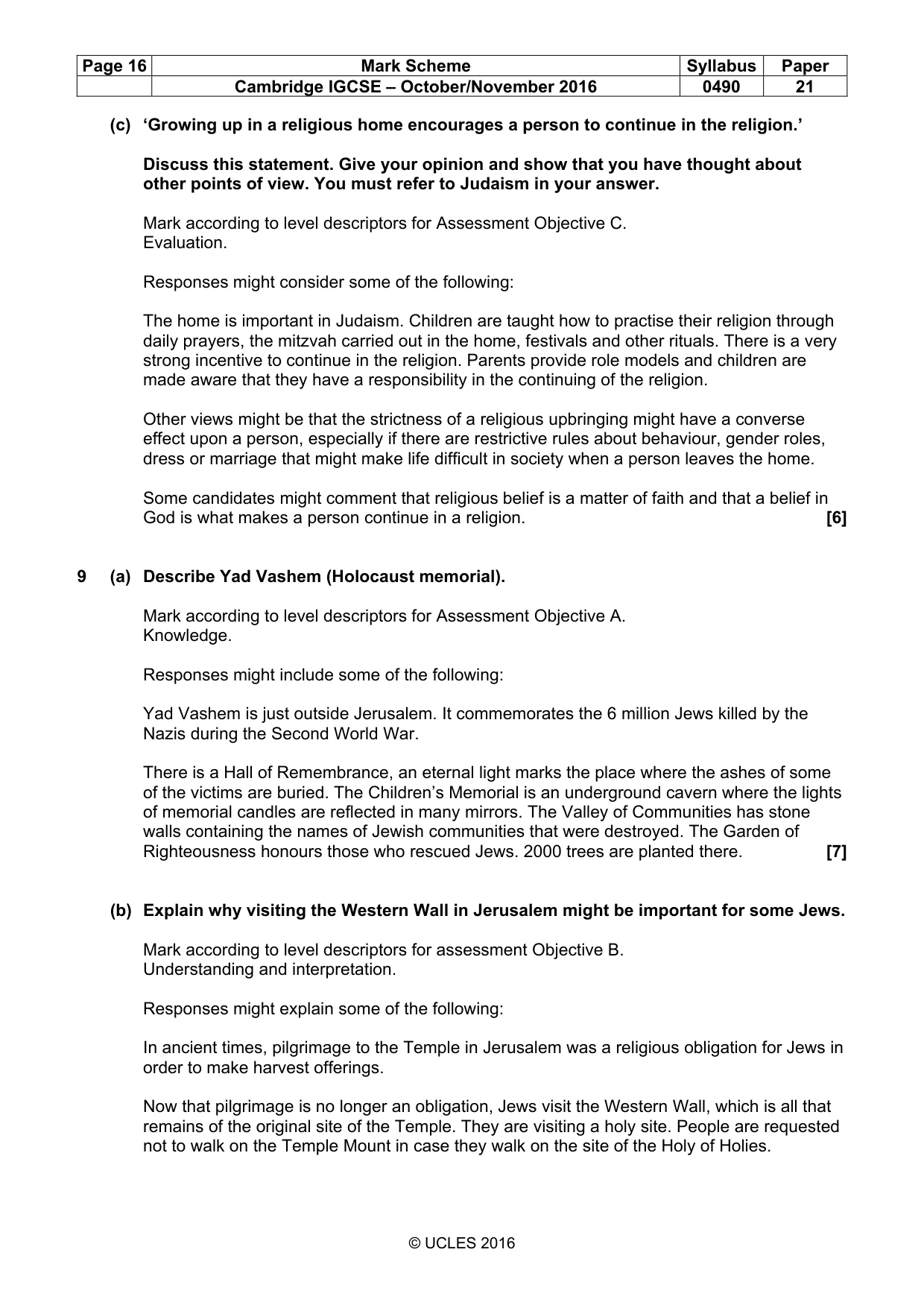
Page 16 Mark Scheme Syllabus Paper Cambridge IGCSE – October/November 2016 0490 21 © UCLES 2016 (c) ‘Growing up in a religious home encourages a person to continue in the religion.’ Discuss this statement. Give your opinion and show that you have thought about other points of view. You must refer to Judaism in your answer. Mark according to level descriptors for Assessment Objective C. Evaluation. Responses might consider some of the following: The home is important in Judaism. Children are taught how to practise their religion through daily prayers, the mitzvah carried out in the home, festivals and other rituals. There is a very strong incentive to continue in the religion. Parents provide role models and children are made aware that they have a responsibility in the continuing of the religion. Other views might be that the strictness of a religious upbringing might have a converse effect upon a person, especially if there are restrictive rules about behaviour, gender roles, dress or marriage that might make life difficult in society when a person leaves the home. Some candidates might comment that religious belief is a matter of faith and that a belief in God is what makes a person continue in a religion. [6] 9 (a) Describe Yad Vashem (Holocaust memorial). Mark according to level descriptors for Assessment Objective A. Knowledge. Responses might include some of the following: Yad Vashem is just outside Jerusalem. It commemorates the 6 million Jews killed by the Nazis during the Second World War. There is a Hall of Remembrance, an eternal light marks the place where the ashes of some of the victims are buried. The Children’s Memorial is an underground cavern where the lights of memorial candles are reflected in many mirrors. The Valley of Communities has stone walls containing the names of Jewish communities that were destroyed. The Garden of Righteousness honours those who rescued Jews. 2000 trees are planted there. [7] (b) Explain why visiting the Western Wall in Jerusalem might be important for some Jews. Mark according to level descriptors for assessment Objective B. Understanding and interpretation. Responses might explain some of the following: In ancient times, pilgrimage to the Temple in Jerusalem was a religious obligation for Jews in order to make harvest offerings. Now that pilgrimage is no longer an obligation, Jews visit the Western Wall, which is all that remains of the original site of the Temple. They are visiting a holy site. People are requested not to walk on the Temple Mount in case they walk on the site of the Holy of Holies.
Mark scheme, page 17
Page 17 Mark Scheme Syllabus Paper Cambridge IGCSE – October/November 2016 0490 21 © UCLES 2016 Most Jews live in the diaspora but they are aware that they are visiting a place, which is at the very centre of the history of their religion. Every Pesach, a vow is made to visit Jerusalem. Many Jews go to the Western Wall to pray as it is as near as they can get to the original Temple. People place prayers written on folded piece of papers into the cracks of the wall. The Rabbis said that the divine presence never departs from the Western Wall. Many boys are brought to the wall to celebrate their Bar Mitzvah to make it more memorable and spiritually fulfilling and to emphasize the importance of their religious obligations and the long tradition of their religion. [7] (c) ‘Remembering the past strengthens belief.’ Discuss this statement. Give your opinion and show that you have thought about other points of view. You must refer to Judaism in your answer. Mark according to level descriptors for Assessment Objective C. Evaluation. Responses might consider some of the following: Candidates might consider that there are lessons to be learned from what has happened in a religion’s past and this can make the faith stronger. Rituals and festivals are often based on historical events and Judaism, particularly, has survived a lot of adversity. So, it is important to remember and respect the memories/struggles of the ancestors and to ensure that the religion thrives/grows in the future. Some responses might consider the view that the future survival of a religion is more important than what happened in the past and too much emphasis on the past (as in remembering persecution and suffering) can stop people in a religion moving forward. Another view might be that strength can be gained from remembering God’s power and how he has demonstrated his love for his people throughout history. It is remembering God’s love for them that makes Jews stronger. [6]
What you needed in this session
Cambridge’s own grade thresholds for 2016 Oct/Nov, Paper 2 · Variant 1. A higher threshold means an easier paper — the bar moves with how the cohort did.