Cambridge IGCSE Religious Studies 0490 — 2017 Oct/Nov Paper 2 · Variant 1
0490/21/O/N/17 · 80 marks · ≈90 min
The question paper and its mark scheme, free to read here and free to download. This is Cambridge’s own paper, exactly as it was sat.
Question paper4 pages
Mark scheme23 pages
Answers below. Sit the paper first if you are practising.
Paper as text
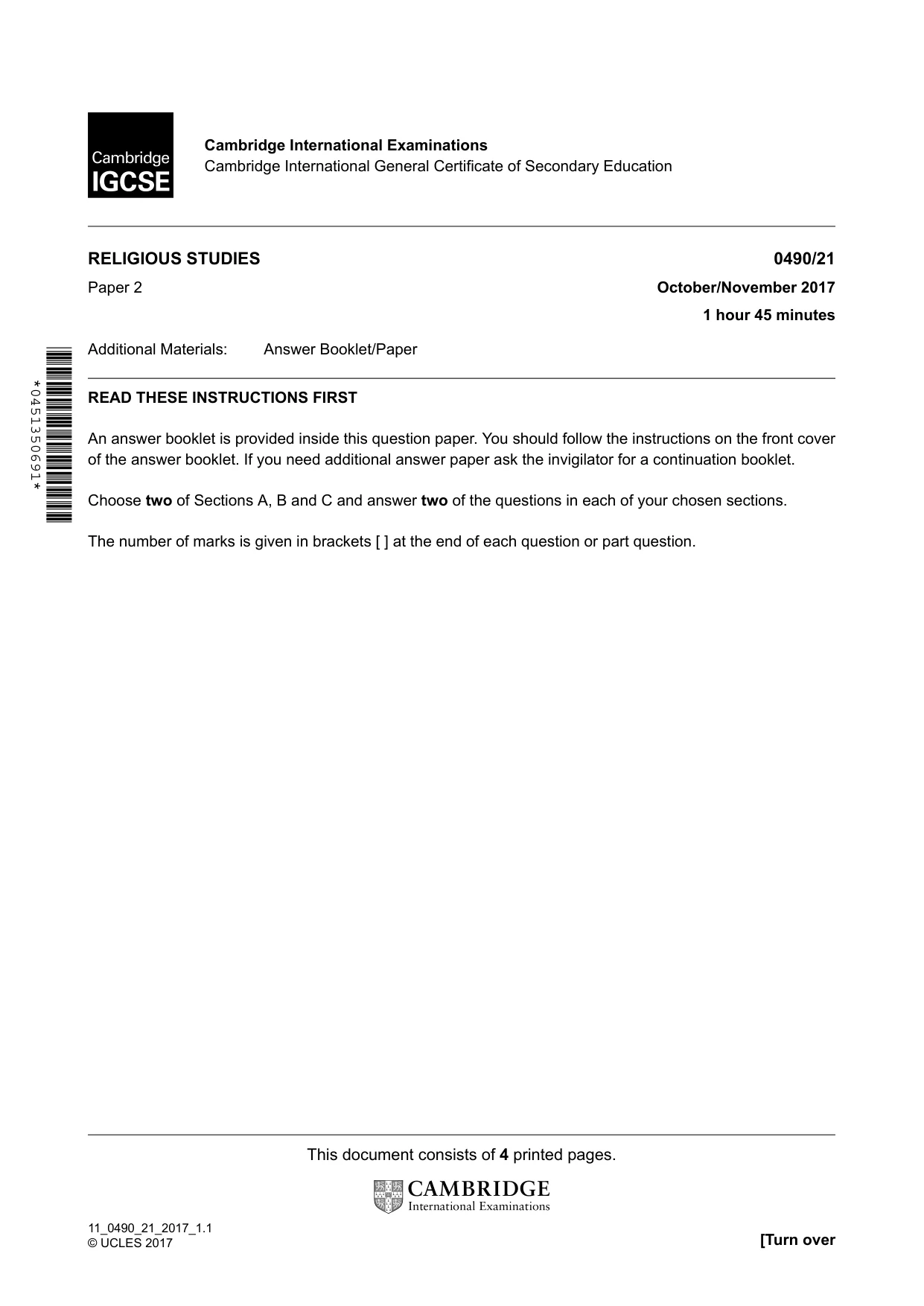
Question paper, page 1
Cambridge International Examinations Cambridge International General Certificate of Secondary Education 0490/21 October/November 2017 1 hour 45 minutes RELIGIOUS STUDIES Paper 2 Additional Materials: Answer Booklet/Paper READ THESE INSTRUCTIONS FIRST An answer booklet is provided inside this question paper. You should follow the instructions on the front cover of the answer booklet. If you need additional answer paper ask the invigilator for a continuation booklet. Choose two of Sections A, B and C and answer two of the questions in each of your chosen sections. The number of marks is given in brackets [ ] at the end of each question or part question. This document consists of 4 printed pages. [Turn over 11_0490_21_2017_1.1 © UCLES 2017 *0451350691*
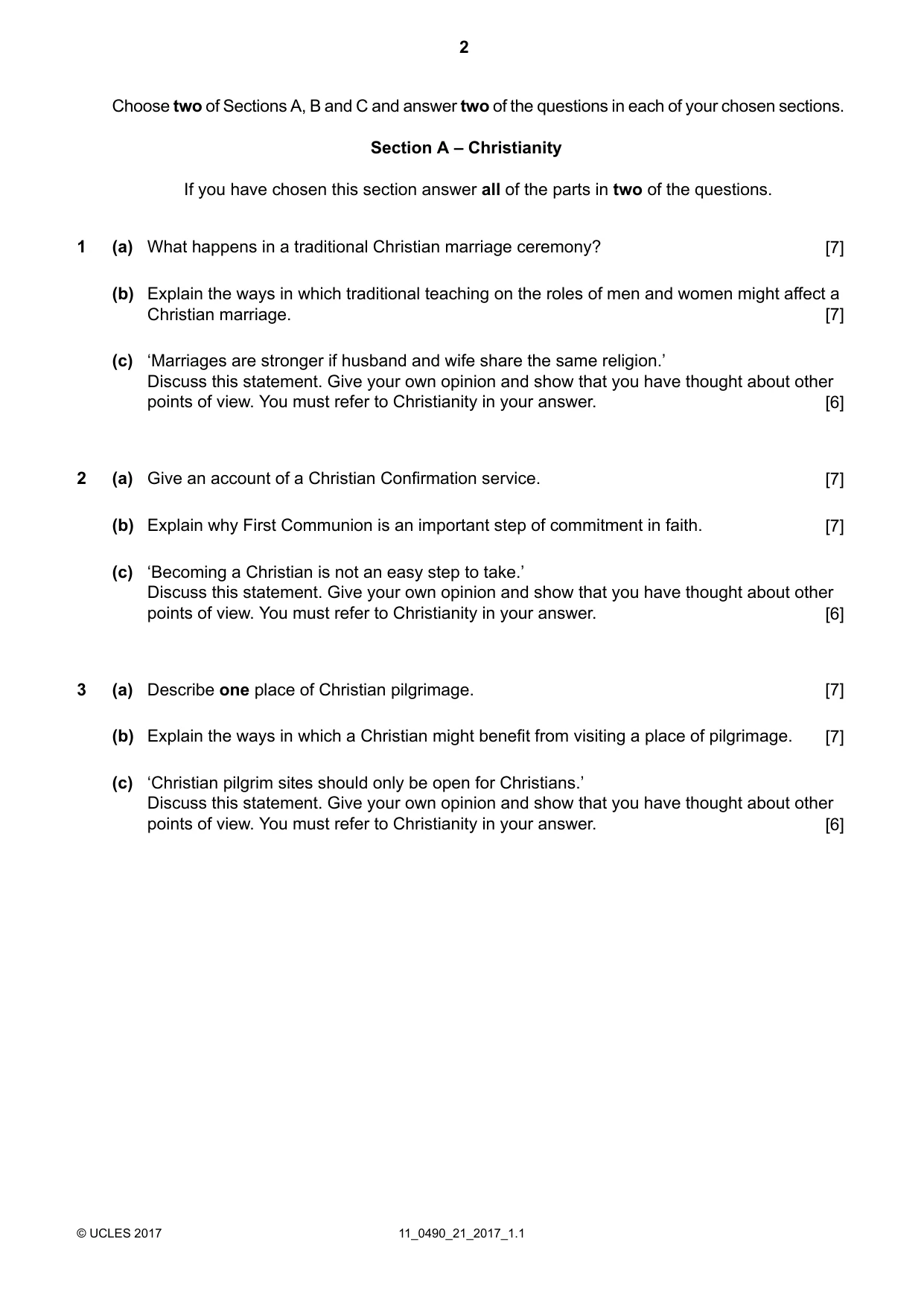
Question paper, page 2
Choose two of Sections A, B and C and answer two of the questions in each of your chosen sections. Section A – Christianity If you have chosen this section answer all of the parts in two of the questions. What happens in a traditional Christian marriage ceremony? [7] (a) 1 Explain the ways in which traditional teaching on the roles of men and women might affect a Christian marriage. [7] (b) ‘Marriages are stronger if husband and wife share the same religion.’ Discuss this statement. Give your own opinion and show that you have thought about other points of view. You must refer to Christianity in your answer. [6] (c) Give an account of a Christian Confirmation service. [7] (a) 2 Explain why First Communion is an important step of commitment in faith. [7] (b) ‘Becoming a Christian is not an easy step to take.’ Discuss this statement. Give your own opinion and show that you have thought about other points of view. You must refer to Christianity in your answer. [6] (c) Describe one place of Christian pilgrimage. [7] (a) 3 Explain the ways in which a Christian might benefit from visiting a place of pilgrimage. [7] (b) ‘Christian pilgrim sites should only be open for Christians.’ Discuss this statement. Give your own opinion and show that you have thought about other points of view. You must refer to Christianity in your answer. [6] (c) 11_0490_21_2017_1.1 © UCLES 2017 2
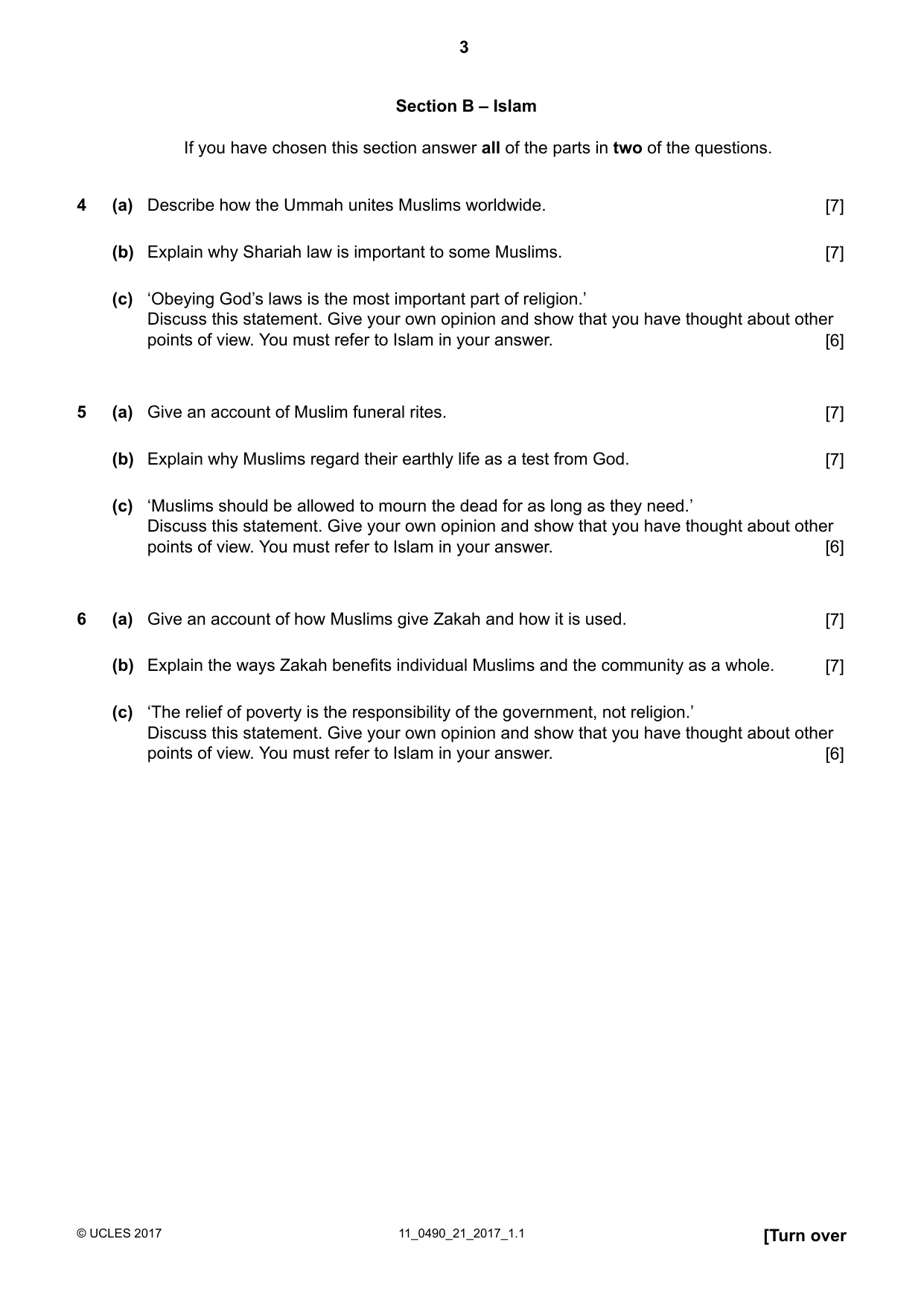
Question paper, page 3
Section B – Islam If you have chosen this section answer all of the parts in two of the questions. Describe how the Ummah unites Muslims worldwide. [7] (a) 4 Explain why Shariah law is important to some Muslims. [7] (b) ‘Obeying God’s laws is the most important part of religion.’ Discuss this statement. Give your own opinion and show that you have thought about other points of view. You must refer to Islam in your answer. [6] (c) Give an account of Muslim funeral rites. [7] (a) 5 Explain why Muslims regard their earthly life as a test from God. [7] (b) ‘Muslims should be allowed to mourn the dead for as long as they need.’ Discuss this statement. Give your own opinion and show that you have thought about other points of view. You must refer to Islam in your answer. [6] (c) Give an account of how Muslims give Zakah and how it is used. [7] (a) 6 Explain the ways Zakah benefits individual Muslims and the community as a whole. [7] (b) ‘The relief of poverty is the responsibility of the government, not religion.’ Discuss this statement. Give your own opinion and show that you have thought about other points of view. You must refer to Islam in your answer. [6] (c) [Turn over 11_0490_21_2017_1.1 © UCLES 2017 3
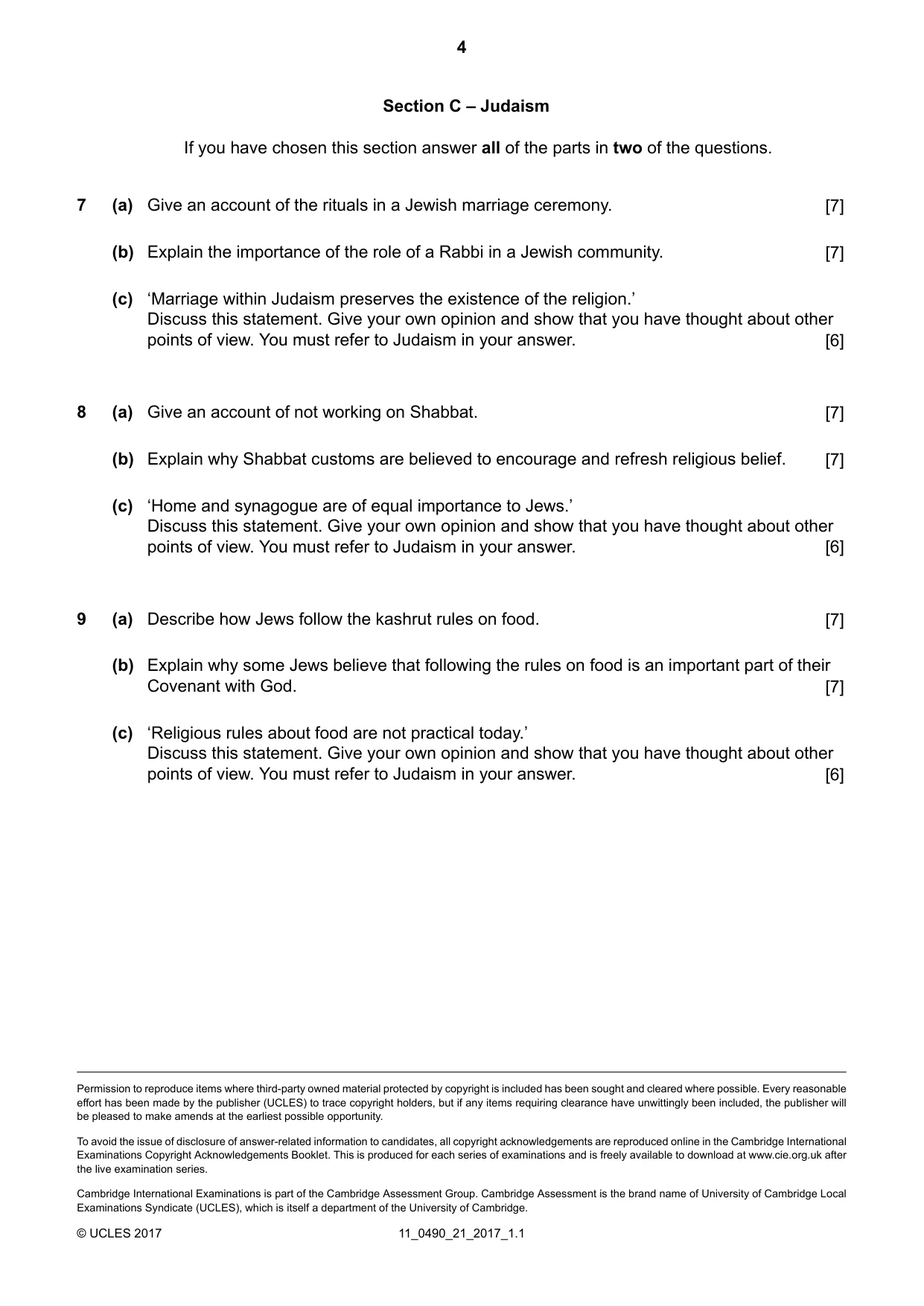
Question paper, page 4
Section C – Judaism If you have chosen this section answer all of the parts in two of the questions. Give an account of the rituals in a Jewish marriage ceremony. [7] (a) 7 Explain the importance of the role of a Rabbi in a Jewish community. [7] (b) ‘Marriage within Judaism preserves the existence of the religion.’ Discuss this statement. Give your own opinion and show that you have thought about other points of view. You must refer to Judaism in your answer. [6] (c) Give an account of not working on Shabbat. [7] (a) 8 Explain why Shabbat customs are believed to encourage and refresh religious belief. [7] (b) ‘Home and synagogue are of equal importance to Jews.’ Discuss this statement. Give your own opinion and show that you have thought about other points of view. You must refer to Judaism in your answer. [6] (c) Describe how Jews follow the kashrut rules on food. [7] (a) 9 Explain why some Jews believe that following the rules on food is an important part of their Covenant with God. [7] (b) ‘Religious rules about food are not practical today.’ Discuss this statement. Give your own opinion and show that you have thought about other points of view. You must refer to Judaism in your answer. [6] (c) Permission to reproduce items where third-party owned material protected by copyright is included has been sought and cleared where possible. Every reasonable effort has been made by the publisher (UCLES) to trace copyright holders, but if any items requiring clearance have unwittingly been included, the publisher will be pleased to make amends at the earliest possible opportunity. To avoid the issue of disclosure of answer-related information to candidates, all copyright acknowledgements are reproduced online in the Cambridge International Examinations Copyright Acknowledgements Booklet. This is produced for each series of examinations and is freely available to download at www.cie.org.uk after the live examination series. Cambridge International Examinations is part of the Cambridge Assessment Group. Cambridge Assessment is the brand name of University of Cambridge Local Examinations Syndicate (UCLES), which is itself a department of the University of Cambridge. 11_0490_21_2017_1.1 © UCLES 2017 4
Mark scheme, page 1
® IGCSE is a registered trademark. This document consists of 23 printed pages. © UCLES 2017 [Turn over Cambridge Assessment International Education Cambridge International General Certificate of Secondary Education RELIGIOUS STUDIES 0490/21 Paper 2 October/November 2017 MARK SCHEME Maximum Mark: 80 Published This mark scheme is published as an aid to teachers and candidates, to indicate the requirements of the examination. It shows the basis on which Examiners were instructed to award marks. It does not indicate the details of the discussions that took place at an Examiners’ meeting before marking began, which would have considered the acceptability of alternative answers. Mark schemes should be read in conjunction with the question paper and the Principal Examiner Report for Teachers. Cambridge International will not enter into discussions about these mark schemes. Cambridge International is publishing the mark schemes for the October/November 2017 series for most Cambridge IGCSE®, Cambridge International A and AS Level components and some Cambridge O Level components.
Mark scheme, page 2
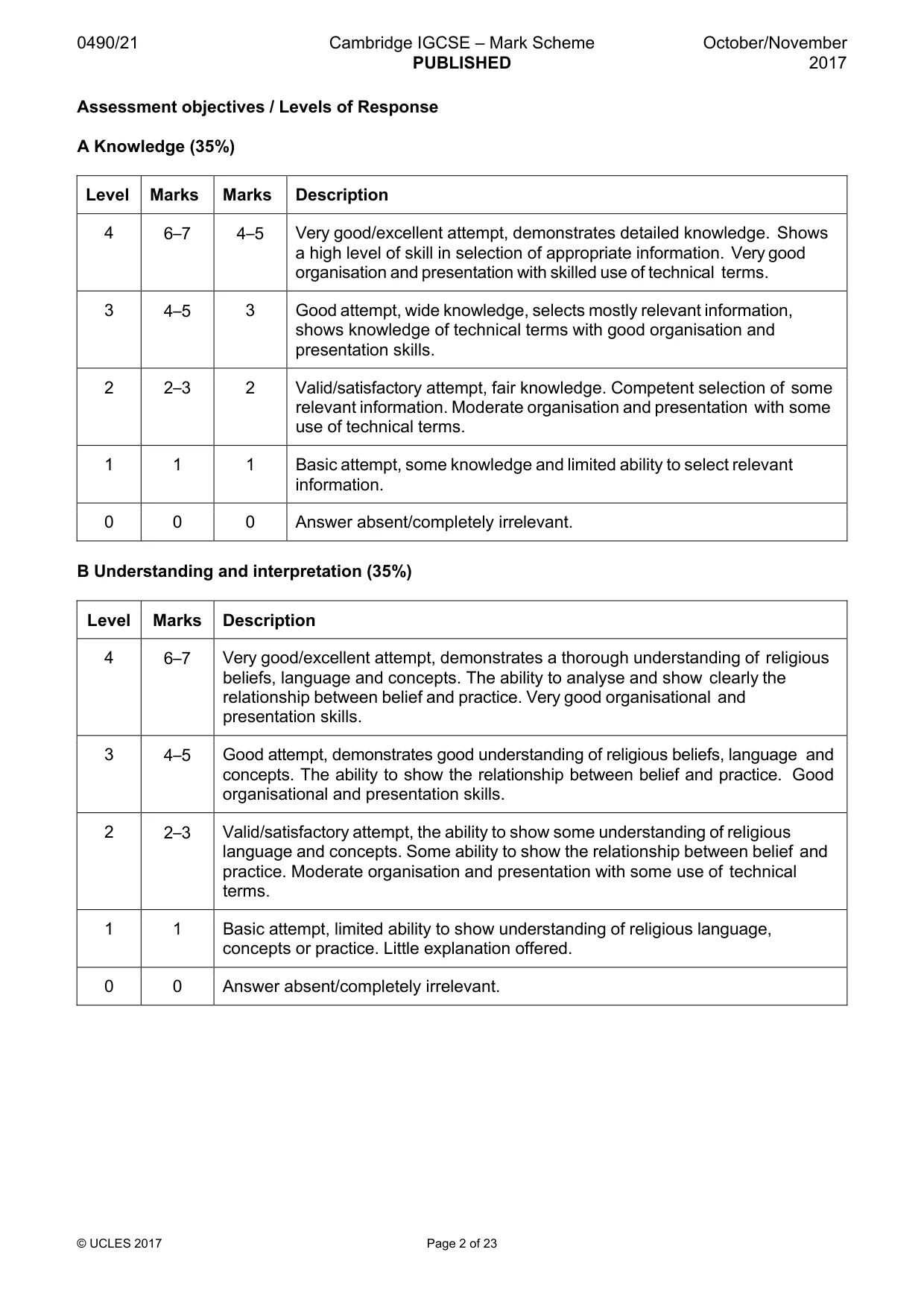
0490/21 Cambridge IGCSE – Mark Scheme PUBLISHED October/November 2017 © UCLES 2017 Page 2 of 23 Assessment objectives / Levels of Response A Knowledge (35%) Level Marks Marks Description 4 6–7 4–5 Very good/excellent attempt, demonstrates detailed knowledge. Shows a high level of skill in selection of appropriate information. Very good organisation and presentation with skilled use of technical terms. 3 4–5 3 Good attempt, wide knowledge, selects mostly relevant information, shows knowledge of technical terms with good organisation and presentation skills. 2 2–3 2 Valid/satisfactory attempt, fair knowledge. Competent selection of some relevant information. Moderate organisation and presentation with some use of technical terms. 1 1 1 Basic attempt, some knowledge and limited ability to select relevant information. 0 0 0 Answer absent/completely irrelevant. B Understanding and interpretation (35%) Level Marks Description 4 6–7 Very good/excellent attempt, demonstrates a thorough understanding of religious beliefs, language and concepts. The ability to analyse and show clearly the relationship between belief and practice. Very good organisational and presentation skills. 3 4–5 Good attempt, demonstrates good understanding of religious beliefs, language and concepts. The ability to show the relationship between belief and practice. Good organisational and presentation skills. 2 2–3 Valid/satisfactory attempt, the ability to show some understanding of religious language and concepts. Some ability to show the relationship between belief and practice. Moderate organisation and presentation with some use of technical terms. 1 1 Basic attempt, limited ability to show understanding of religious language, concepts or practice. Little explanation offered. 0 0 Answer absent/completely irrelevant.
Mark scheme, page 3
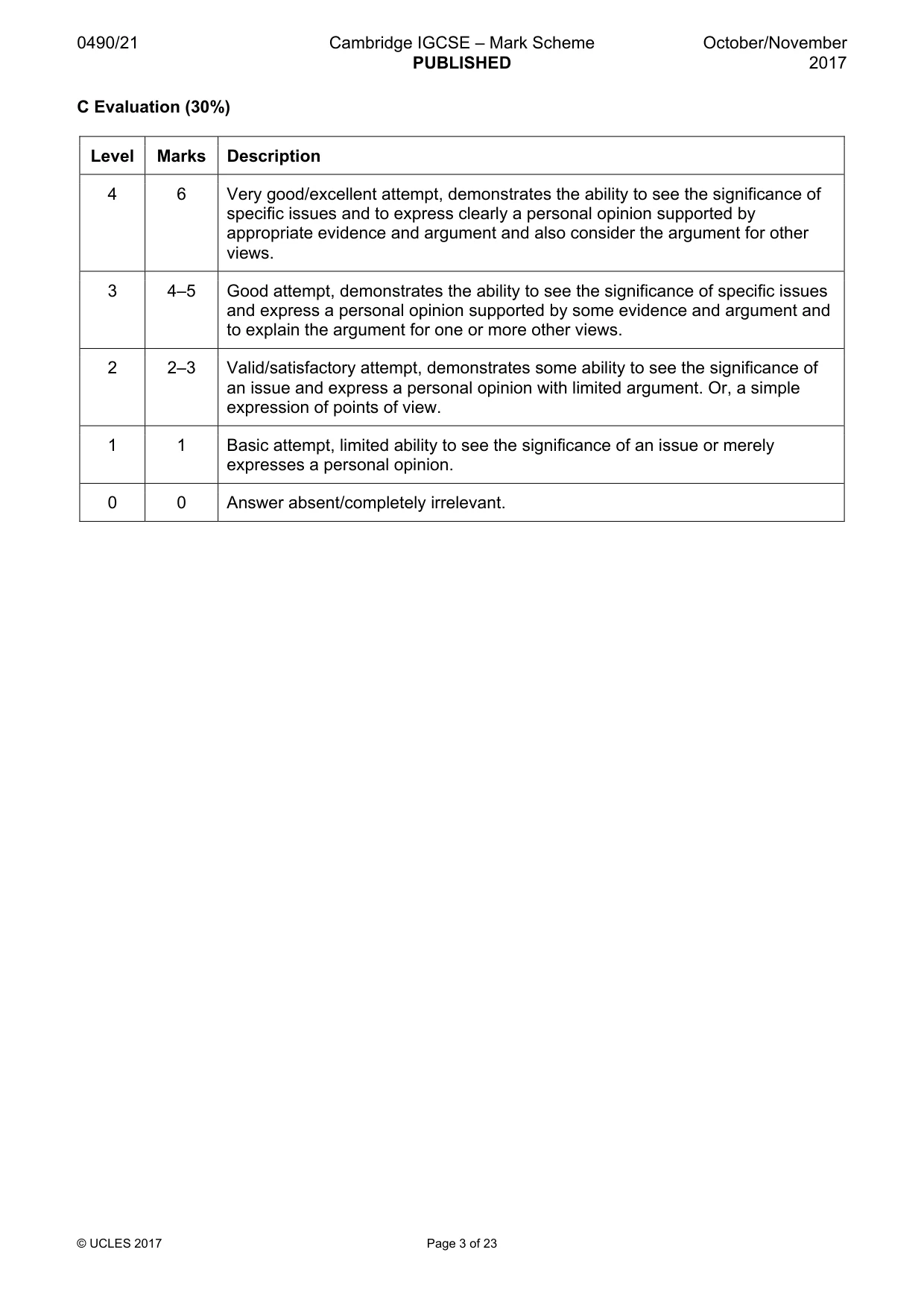
0490/21 Cambridge IGCSE – Mark Scheme PUBLISHED October/November 2017 © UCLES 2017 Page 3 of 23 C Evaluation (30%) Level Marks Description 4 6 Very good/excellent attempt, demonstrates the ability to see the significance of specific issues and to express clearly a personal opinion supported by appropriate evidence and argument and also consider the argument for other views. 3 4–5 Good attempt, demonstrates the ability to see the significance of specific issues and express a personal opinion supported by some evidence and argument and to explain the argument for one or more other views. 2 2–3 Valid/satisfactory attempt, demonstrates some ability to see the significance of an issue and express a personal opinion with limited argument. Or, a simple expression of points of view. 1 1 Basic attempt, limited ability to see the significance of an issue or merely expresses a personal opinion. 0 0 Answer absent/completely irrelevant.
Mark scheme, page 4
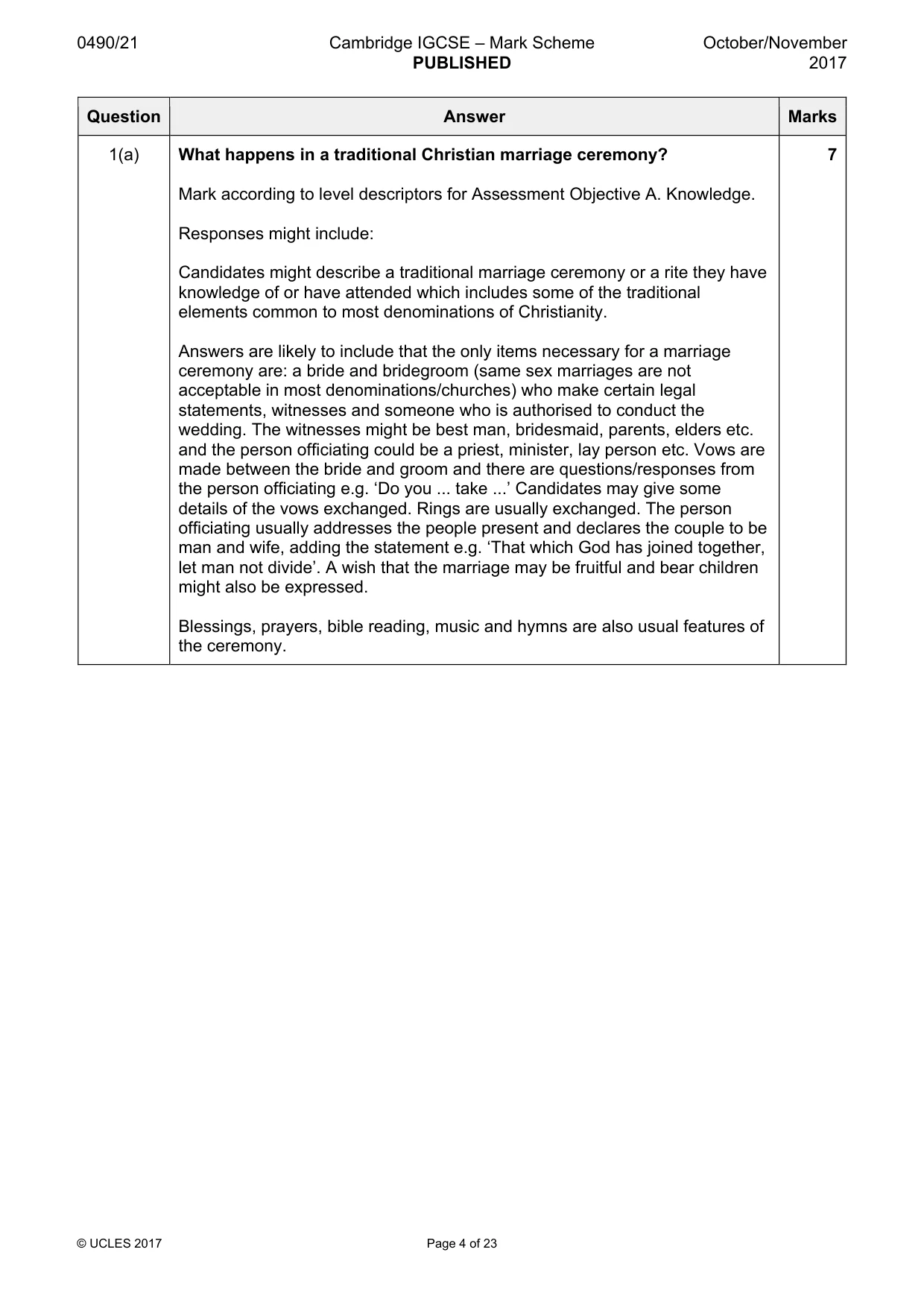
0490/21 Cambridge IGCSE – Mark Scheme PUBLISHED October/November 2017 © UCLES 2017 Page 4 of 23 Question Answer Marks 1(a) What happens in a traditional Christian marriage ceremony? Mark according to level descriptors for Assessment Objective A. Knowledge. Responses might include: Candidates might describe a traditional marriage ceremony or a rite they have knowledge of or have attended which includes some of the traditional elements common to most denominations of Christianity. Answers are likely to include that the only items necessary for a marriage ceremony are: a bride and bridegroom (same sex marriages are not acceptable in most denominations/churches) who make certain legal statements, witnesses and someone who is authorised to conduct the wedding. The witnesses might be best man, bridesmaid, parents, elders etc. and the person officiating could be a priest, minister, lay person etc. Vows are made between the bride and groom and there are questions/responses from the person officiating e.g. ‘Do you ... take ...’ Candidates may give some details of the vows exchanged. Rings are usually exchanged. The person officiating usually addresses the people present and declares the couple to be man and wife, adding the statement e.g. ‘That which God has joined together, let man not divide’. A wish that the marriage may be fruitful and bear children might also be expressed. Blessings, prayers, bible reading, music and hymns are also usual features of the ceremony. 7
Mark scheme, page 5
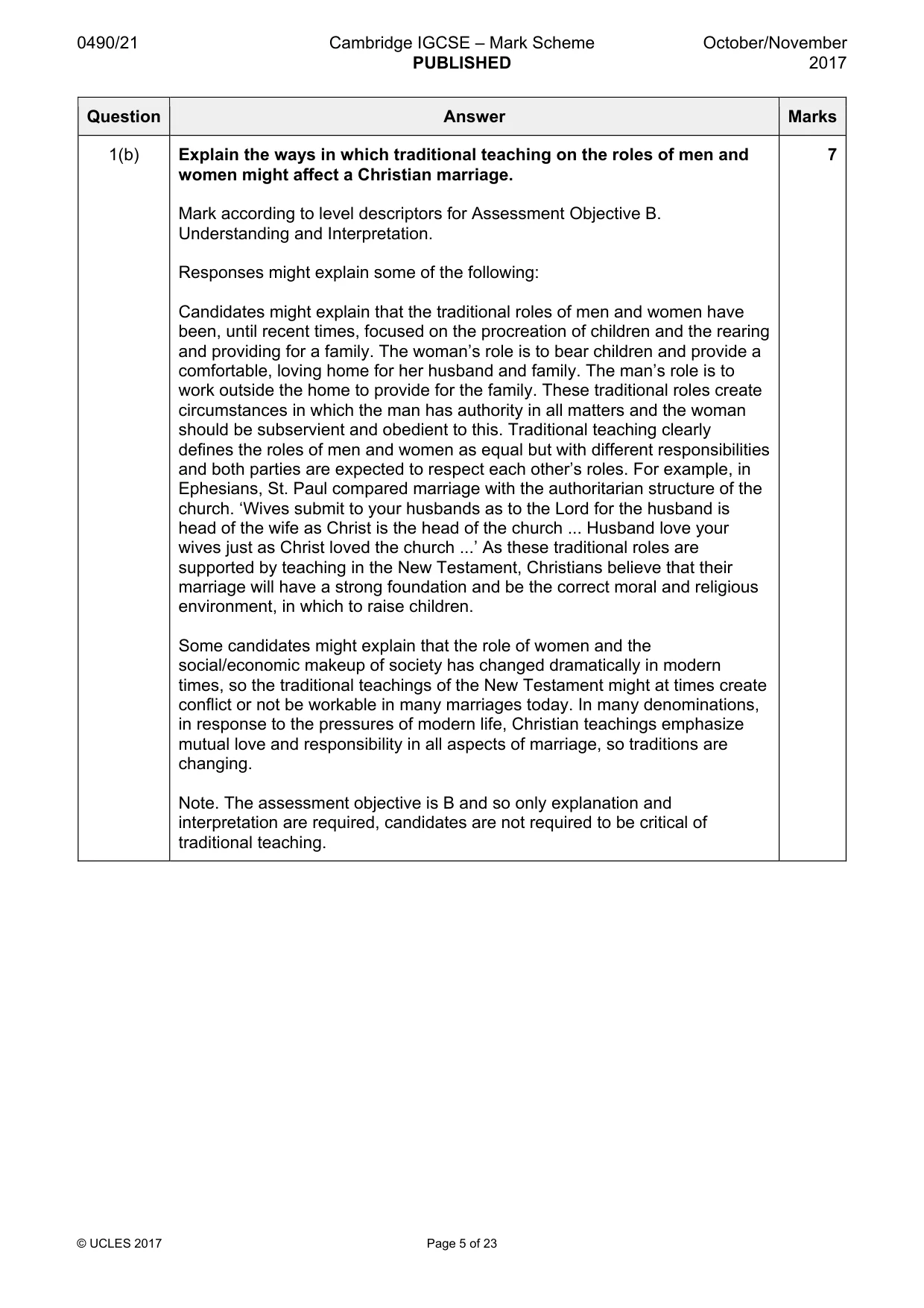
0490/21 Cambridge IGCSE – Mark Scheme PUBLISHED October/November 2017 © UCLES 2017 Page 5 of 23 Question Answer Marks 1(b) Explain the ways in which traditional teaching on the roles of men and women might affect a Christian marriage. Mark according to level descriptors for Assessment Objective B. Understanding and Interpretation. Responses might explain some of the following: Candidates might explain that the traditional roles of men and women have been, until recent times, focused on the procreation of children and the rearing and providing for a family. The woman’s role is to bear children and provide a comfortable, loving home for her husband and family. The man’s role is to work outside the home to provide for the family. These traditional roles create circumstances in which the man has authority in all matters and the woman should be subservient and obedient to this. Traditional teaching clearly defines the roles of men and women as equal but with different responsibilities and both parties are expected to respect each other’s roles. For example, in Ephesians, St. Paul compared marriage with the authoritarian structure of the church. ‘Wives submit to your husbands as to the Lord for the husband is head of the wife as Christ is the head of the church ... Husband love your wives just as Christ loved the church ...’ As these traditional roles are supported by teaching in the New Testament, Christians believe that their marriage will have a strong foundation and be the correct moral and religious environment, in which to raise children. Some candidates might explain that the role of women and the social/economic makeup of society has changed dramatically in modern times, so the traditional teachings of the New Testament might at times create conflict or not be workable in many marriages today. In many denominations, in response to the pressures of modern life, Christian teachings emphasize mutual love and responsibility in all aspects of marriage, so traditions are changing. Note. The assessment objective is B and so only explanation and interpretation are required, candidates are not required to be critical of traditional teaching. 7
Mark scheme, page 6
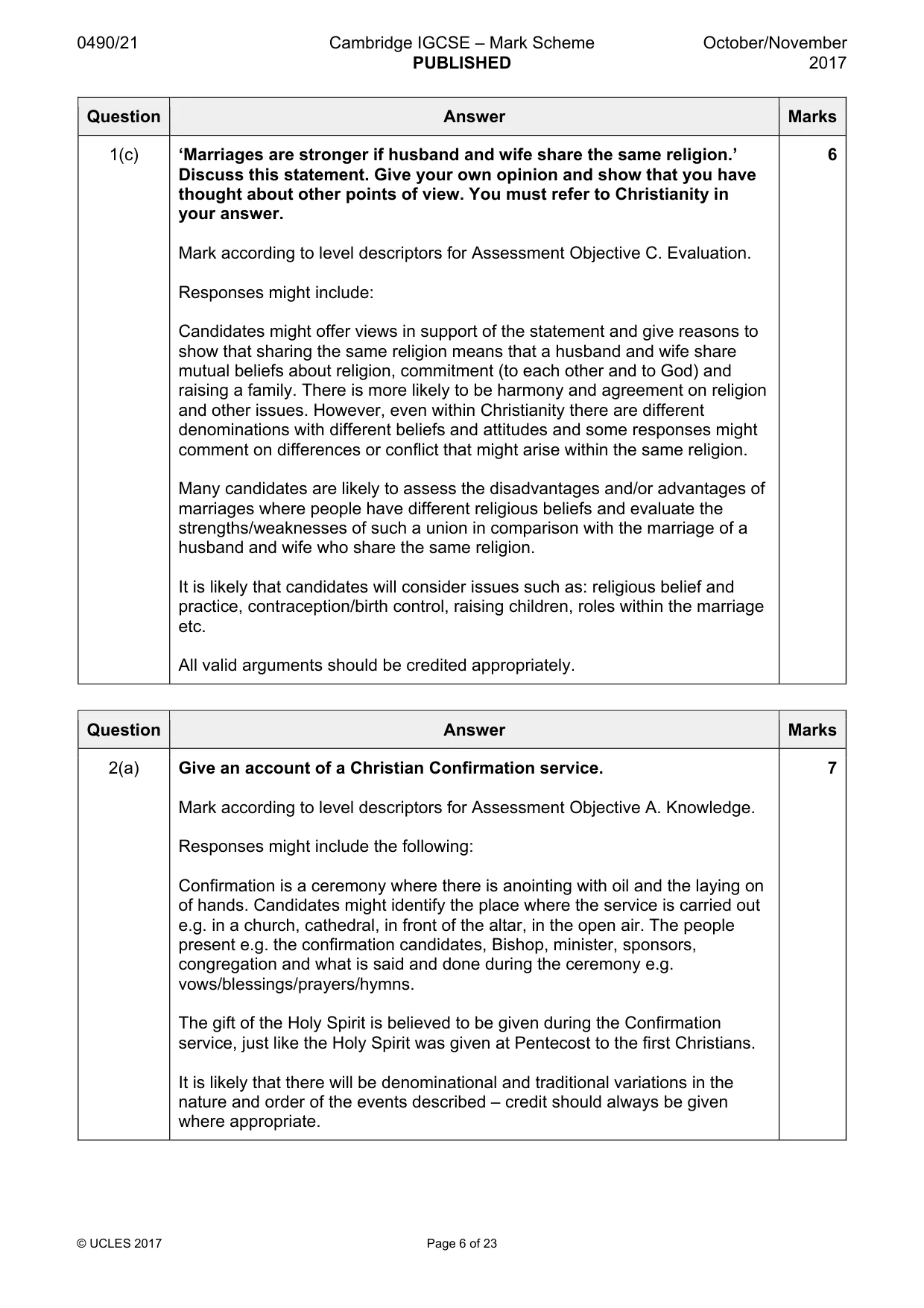
0490/21 Cambridge IGCSE – Mark Scheme PUBLISHED October/November 2017 © UCLES 2017 Page 6 of 23 Question Answer Marks 1(c) ‘Marriages are stronger if husband and wife share the same religion.’ Discuss this statement. Give your own opinion and show that you have thought about other points of view. You must refer to Christianity in your answer. Mark according to level descriptors for Assessment Objective C. Evaluation. Responses might include: Candidates might offer views in support of the statement and give reasons to show that sharing the same religion means that a husband and wife share mutual beliefs about religion, commitment (to each other and to God) and raising a family. There is more likely to be harmony and agreement on religion and other issues. However, even within Christianity there are different denominations with different beliefs and attitudes and some responses might comment on differences or conflict that might arise within the same religion. Many candidates are likely to assess the disadvantages and/or advantages of marriages where people have different religious beliefs and evaluate the strengths/weaknesses of such a union in comparison with the marriage of a husband and wife who share the same religion. It is likely that candidates will consider issues such as: religious belief and practice, contraception/birth control, raising children, roles within the marriage etc. All valid arguments should be credited appropriately. 6 Question Answer Marks 2(a) Give an account of a Christian Confirmation service. Mark according to level descriptors for Assessment Objective A. Knowledge. Responses might include the following: Confirmation is a ceremony where there is anointing with oil and the laying on of hands. Candidates might identify the place where the service is carried out e.g. in a church, cathedral, in front of the altar, in the open air. The people present e.g. the confirmation candidates, Bishop, minister, sponsors, congregation and what is said and done during the ceremony e.g. vows/blessings/prayers/hymns. The gift of the Holy Spirit is believed to be given during the Confirmation service, just like the Holy Spirit was given at Pentecost to the first Christians. It is likely that there will be denominational and traditional variations in the nature and order of the events described – credit should always be given where appropriate. 7
Mark scheme, page 7
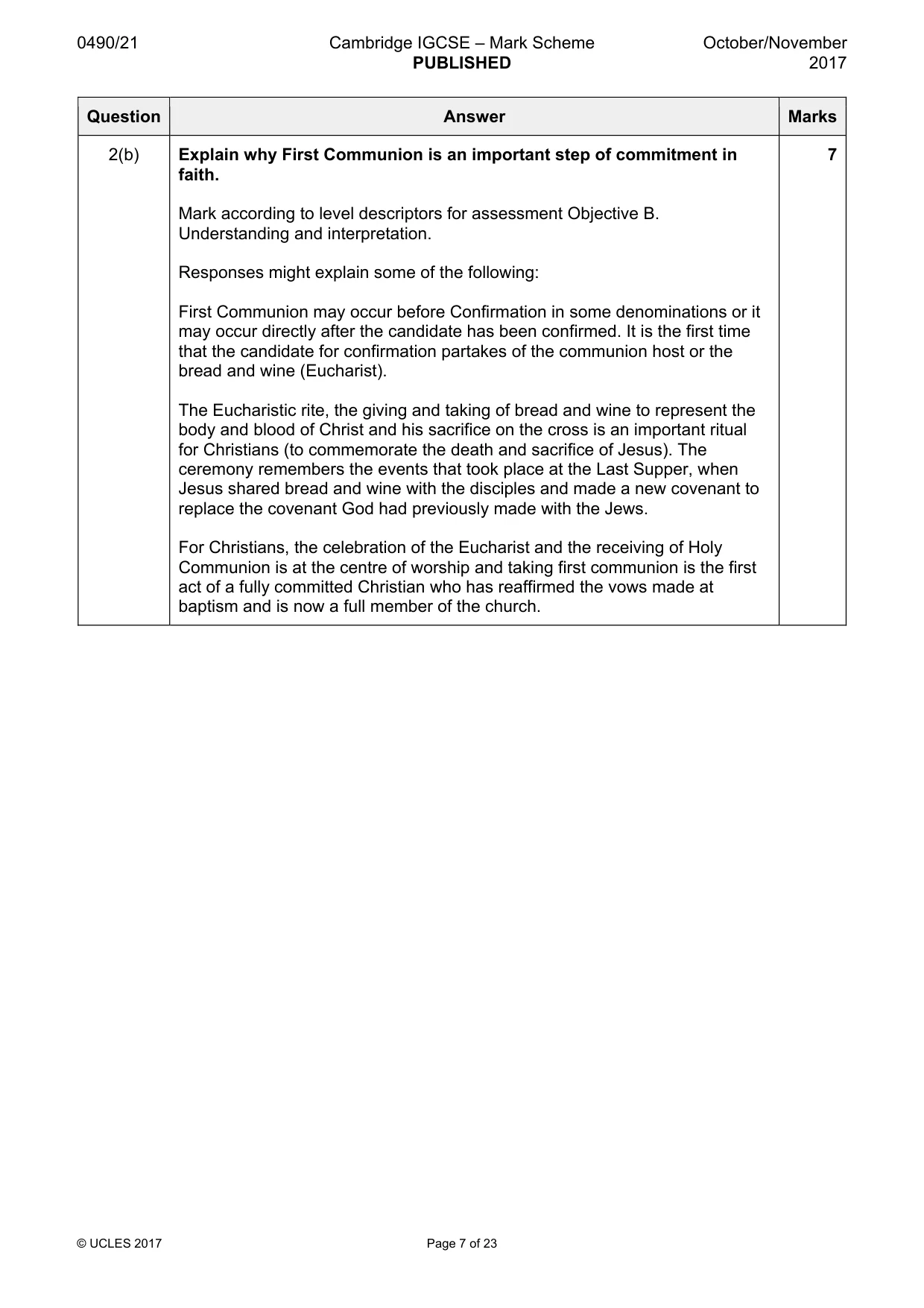
0490/21 Cambridge IGCSE – Mark Scheme PUBLISHED October/November 2017 © UCLES 2017 Page 7 of 23 Question Answer Marks 2(b) Explain why First Communion is an important step of commitment in faith. Mark according to level descriptors for assessment Objective B. Understanding and interpretation. Responses might explain some of the following: First Communion may occur before Confirmation in some denominations or it may occur directly after the candidate has been confirmed. It is the first time that the candidate for confirmation partakes of the communion host or the bread and wine (Eucharist). The Eucharistic rite, the giving and taking of bread and wine to represent the body and blood of Christ and his sacrifice on the cross is an important ritual for Christians (to commemorate the death and sacrifice of Jesus). The ceremony remembers the events that took place at the Last Supper, when Jesus shared bread and wine with the disciples and made a new covenant to replace the covenant God had previously made with the Jews. For Christians, the celebration of the Eucharist and the receiving of Holy Communion is at the centre of worship and taking first communion is the first act of a fully committed Christian who has reaffirmed the vows made at baptism and is now a full member of the church. 7
Mark scheme, page 8
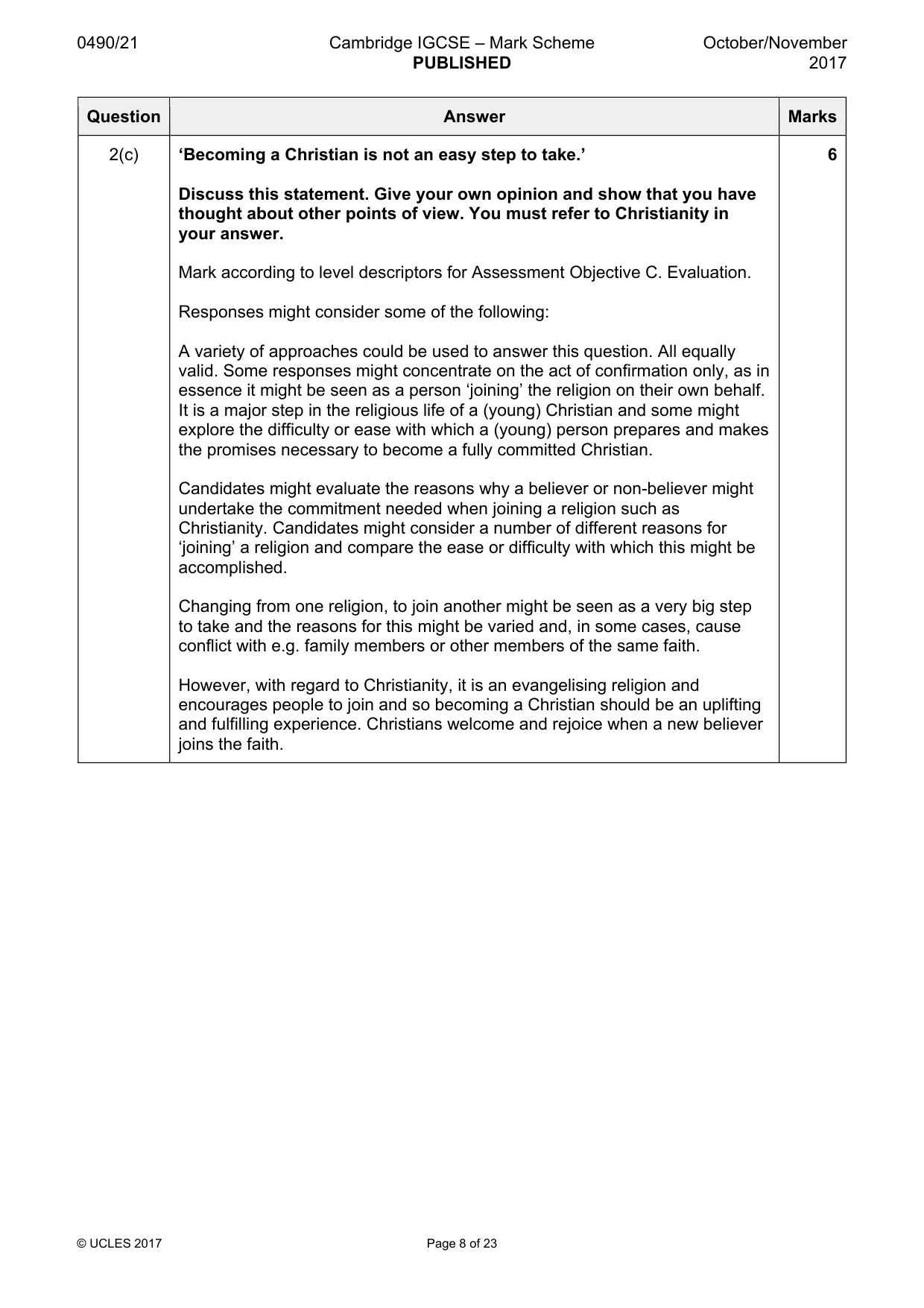
0490/21 Cambridge IGCSE – Mark Scheme PUBLISHED October/November 2017 © UCLES 2017 Page 8 of 23 Question Answer Marks 2(c) ‘Becoming a Christian is not an easy step to take.’ Discuss this statement. Give your own opinion and show that you have thought about other points of view. You must refer to Christianity in your answer. Mark according to level descriptors for Assessment Objective C. Evaluation. Responses might consider some of the following: A variety of approaches could be used to answer this question. All equally valid. Some responses might concentrate on the act of confirmation only, as in essence it might be seen as a person ‘joining’ the religion on their own behalf. It is a major step in the religious life of a (young) Christian and some might explore the difficulty or ease with which a (young) person prepares and makes the promises necessary to become a fully committed Christian. Candidates might evaluate the reasons why a believer or non-believer might undertake the commitment needed when joining a religion such as Christianity. Candidates might consider a number of different reasons for ‘joining’ a religion and compare the ease or difficulty with which this might be accomplished. Changing from one religion, to join another might be seen as a very big step to take and the reasons for this might be varied and, in some cases, cause conflict with e.g. family members or other members of the same faith. However, with regard to Christianity, it is an evangelising religion and encourages people to join and so becoming a Christian should be an uplifting and fulfilling experience. Christians welcome and rejoice when a new believer joins the faith. 6
Mark scheme, page 9
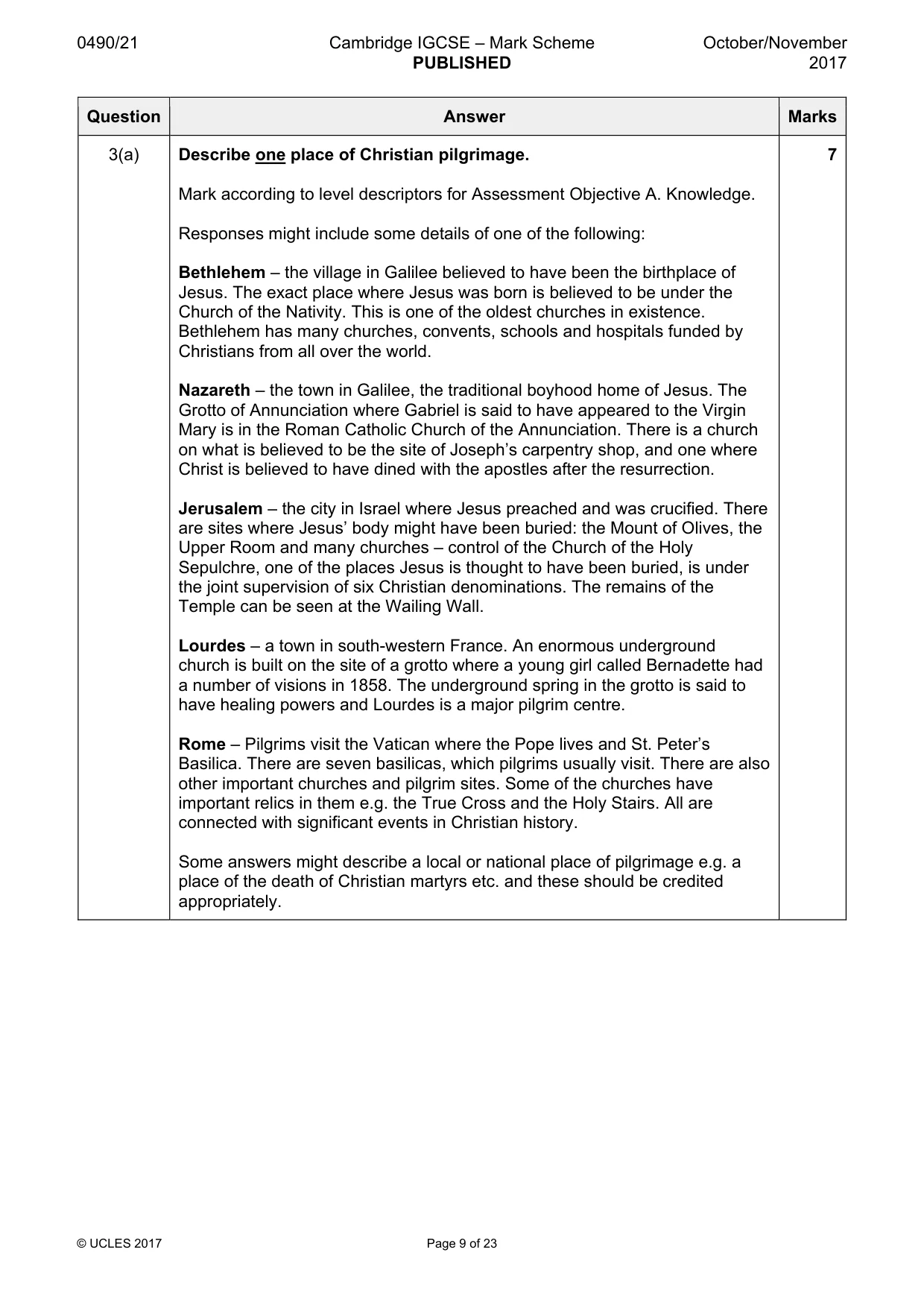
0490/21 Cambridge IGCSE – Mark Scheme PUBLISHED October/November 2017 © UCLES 2017 Page 9 of 23 Question Answer Marks 3(a) Describe one place of Christian pilgrimage. Mark according to level descriptors for Assessment Objective A. Knowledge. Responses might include some details of one of the following: Bethlehem – the village in Galilee believed to have been the birthplace of Jesus. The exact place where Jesus was born is believed to be under the Church of the Nativity. This is one of the oldest churches in existence. Bethlehem has many churches, convents, schools and hospitals funded by Christians from all over the world. Nazareth – the town in Galilee, the traditional boyhood home of Jesus. The Grotto of Annunciation where Gabriel is said to have appeared to the Virgin Mary is in the Roman Catholic Church of the Annunciation. There is a church on what is believed to be the site of Joseph’s carpentry shop, and one where Christ is believed to have dined with the apostles after the resurrection. Jerusalem – the city in Israel where Jesus preached and was crucified. There are sites where Jesus’ body might have been buried: the Mount of Olives, the Upper Room and many churches – control of the Church of the Holy Sepulchre, one of the places Jesus is thought to have been buried, is under the joint supervision of six Christian denominations. The remains of the Temple can be seen at the Wailing Wall. Lourdes – a town in south-western France. An enormous underground church is built on the site of a grotto where a young girl called Bernadette had a number of visions in 1858. The underground spring in the grotto is said to have healing powers and Lourdes is a major pilgrim centre. Rome – Pilgrims visit the Vatican where the Pope lives and St. Peter’s Basilica. There are seven basilicas, which pilgrims usually visit. There are also other important churches and pilgrim sites. Some of the churches have important relics in them e.g. the True Cross and the Holy Stairs. All are connected with significant events in Christian history. Some answers might describe a local or national place of pilgrimage e.g. a place of the death of Christian martyrs etc. and these should be credited appropriately. 7
Mark scheme, page 10
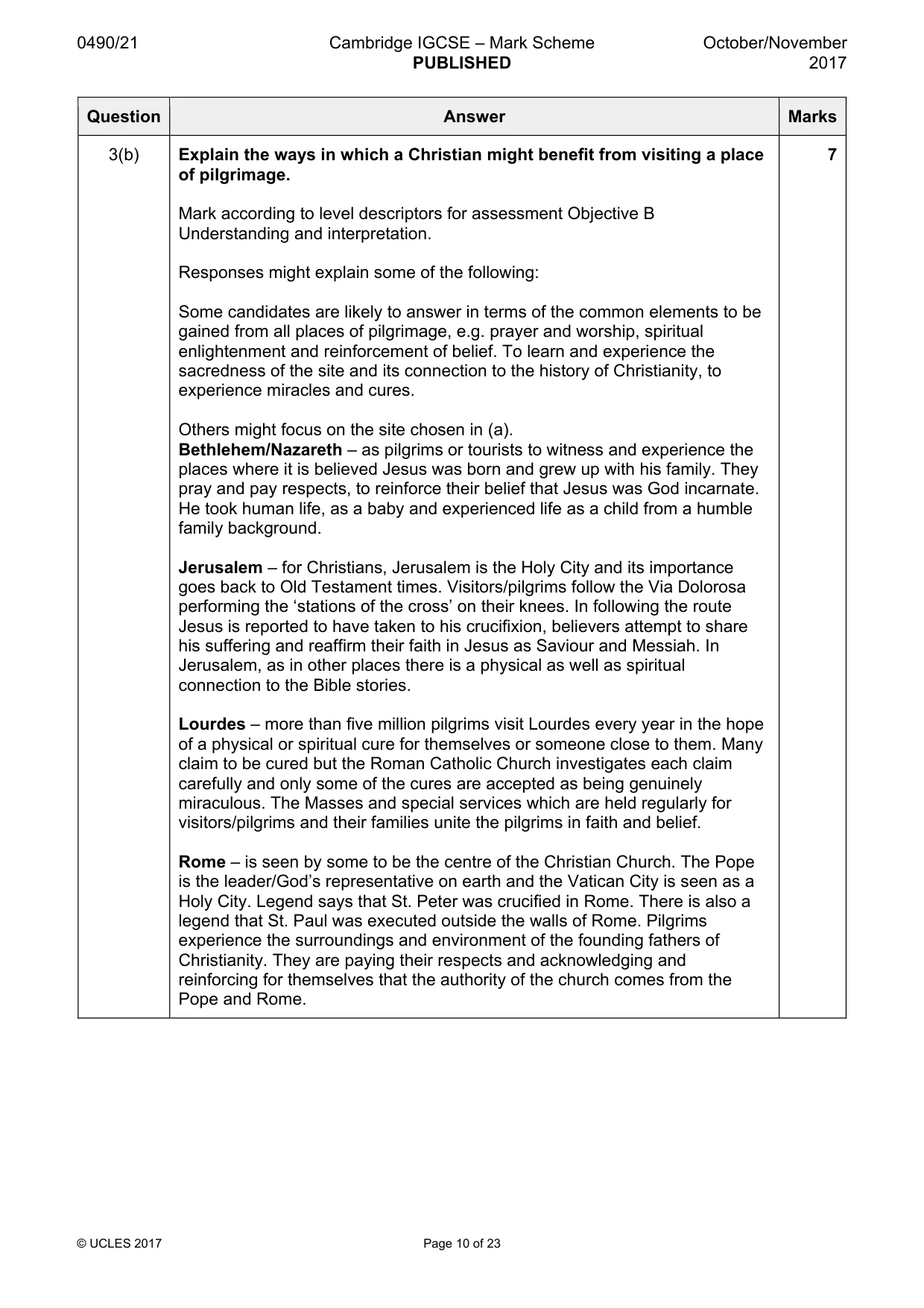
0490/21 Cambridge IGCSE – Mark Scheme PUBLISHED October/November 2017 © UCLES 2017 Page 10 of 23 Question Answer Marks 3(b) Explain the ways in which a Christian might benefit from visiting a place of pilgrimage. Mark according to level descriptors for assessment Objective B Understanding and interpretation. Responses might explain some of the following: Some candidates are likely to answer in terms of the common elements to be gained from all places of pilgrimage, e.g. prayer and worship, spiritual enlightenment and reinforcement of belief. To learn and experience the sacredness of the site and its connection to the history of Christianity, to experience miracles and cures. Others might focus on the site chosen in (a). Bethlehem/Nazareth – as pilgrims or tourists to witness and experience the places where it is believed Jesus was born and grew up with his family. They pray and pay respects, to reinforce their belief that Jesus was God incarnate. He took human life, as a baby and experienced life as a child from a humble family background. Jerusalem – for Christians, Jerusalem is the Holy City and its importance goes back to Old Testament times. Visitors/pilgrims follow the Via Dolorosa performing the ‘stations of the cross’ on their knees. In following the route Jesus is reported to have taken to his crucifixion, believers attempt to share his suffering and reaffirm their faith in Jesus as Saviour and Messiah. In Jerusalem, as in other places there is a physical as well as spiritual connection to the Bible stories. Lourdes – more than five million pilgrims visit Lourdes every year in the hope of a physical or spiritual cure for themselves or someone close to them. Many claim to be cured but the Roman Catholic Church investigates each claim carefully and only some of the cures are accepted as being genuinely miraculous. The Masses and special services which are held regularly for visitors/pilgrims and their families unite the pilgrims in faith and belief. Rome – is seen by some to be the centre of the Christian Church. The Pope is the leader/God’s representative on earth and the Vatican City is seen as a Holy City. Legend says that St. Peter was crucified in Rome. There is also a legend that St. Paul was executed outside the walls of Rome. Pilgrims experience the surroundings and environment of the founding fathers of Christianity. They are paying their respects and acknowledging and reinforcing for themselves that the authority of the church comes from the Pope and Rome. 7
Mark scheme, page 11
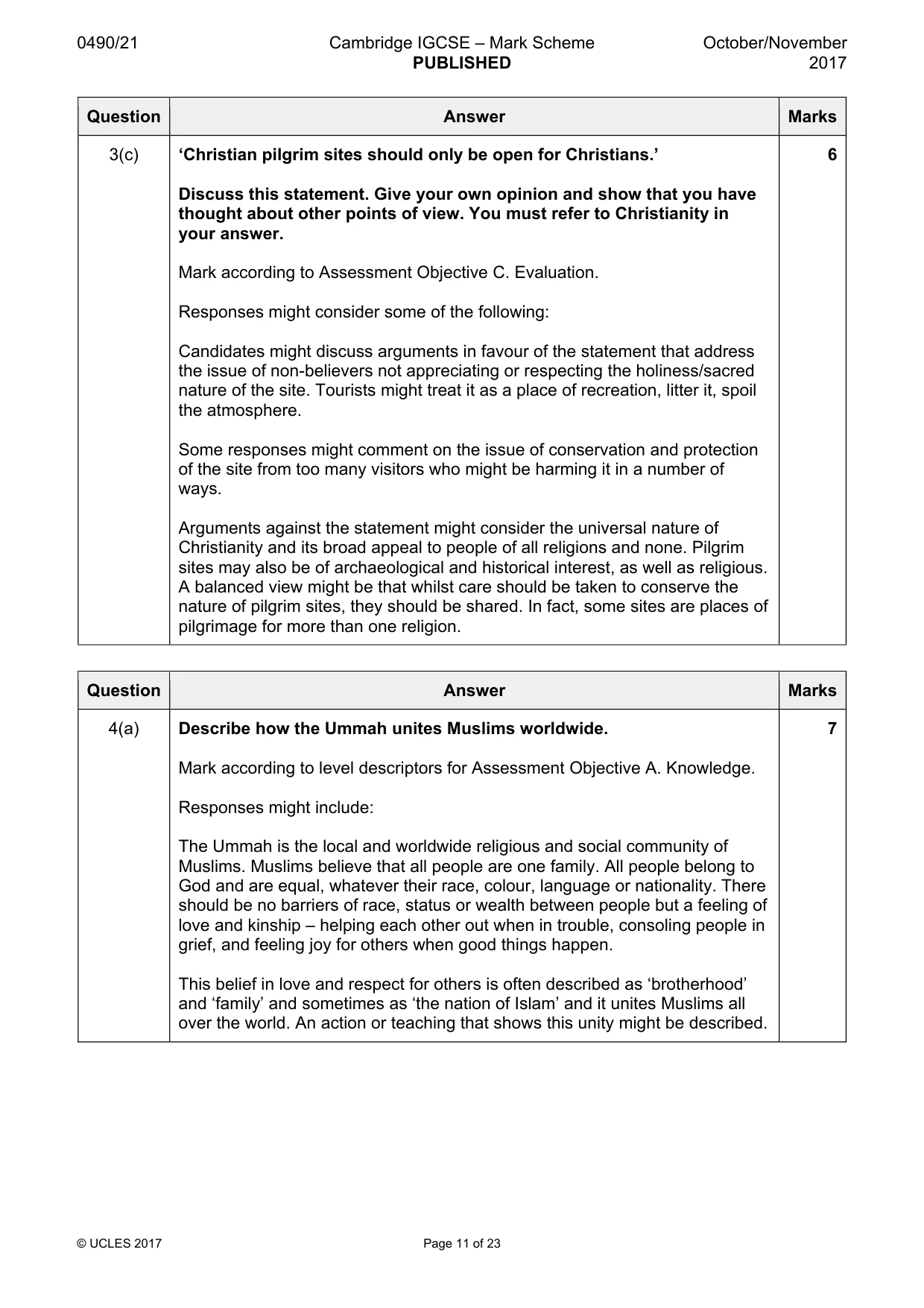
0490/21 Cambridge IGCSE – Mark Scheme PUBLISHED October/November 2017 © UCLES 2017 Page 11 of 23 Question Answer Marks 3(c) ‘Christian pilgrim sites should only be open for Christians.’ Discuss this statement. Give your own opinion and show that you have thought about other points of view. You must refer to Christianity in your answer. Mark according to Assessment Objective C. Evaluation. Responses might consider some of the following: Candidates might discuss arguments in favour of the statement that address the issue of non-believers not appreciating or respecting the holiness/sacred nature of the site. Tourists might treat it as a place of recreation, litter it, spoil the atmosphere. Some responses might comment on the issue of conservation and protection of the site from too many visitors who might be harming it in a number of ways. Arguments against the statement might consider the universal nature of Christianity and its broad appeal to people of all religions and none. Pilgrim sites may also be of archaeological and historical interest, as well as religious. A balanced view might be that whilst care should be taken to conserve the nature of pilgrim sites, they should be shared. In fact, some sites are places of pilgrimage for more than one religion. 6 Question Answer Marks 4(a) Describe how the Ummah unites Muslims worldwide. Mark according to level descriptors for Assessment Objective A. Knowledge. Responses might include: The Ummah is the local and worldwide religious and social community of Muslims. Muslims believe that all people are one family. All people belong to God and are equal, whatever their race, colour, language or nationality. There should be no barriers of race, status or wealth between people but a feeling of love and kinship – helping each other out when in trouble, consoling people in grief, and feeling joy for others when good things happen. This belief in love and respect for others is often described as ‘brotherhood’ and ‘family’ and sometimes as ‘the nation of Islam’ and it unites Muslims all over the world. An action or teaching that shows this unity might be described. 7
Mark scheme, page 12
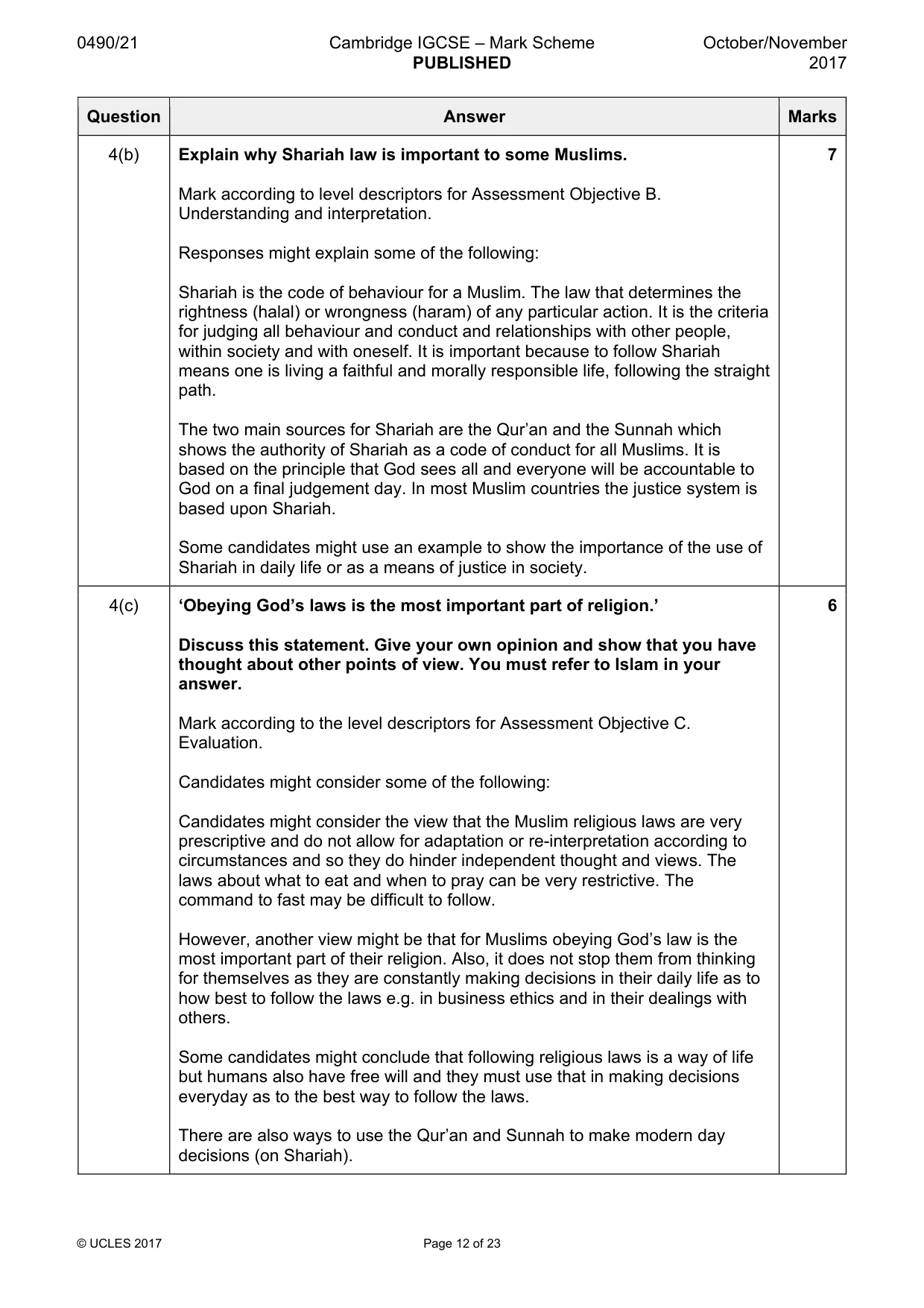
0490/21 Cambridge IGCSE – Mark Scheme PUBLISHED October/November 2017 © UCLES 2017 Page 12 of 23 Question Answer Marks 4(b) Explain why Shariah law is important to some Muslims. Mark according to level descriptors for Assessment Objective B. Understanding and interpretation. Responses might explain some of the following: Shariah is the code of behaviour for a Muslim. The law that determines the rightness (halal) or wrongness (haram) of any particular action. It is the criteria for judging all behaviour and conduct and relationships with other people, within society and with oneself. It is important because to follow Shariah means one is living a faithful and morally responsible life, following the straight path. The two main sources for Shariah are the Qur’an and the Sunnah which shows the authority of Shariah as a code of conduct for all Muslims. It is based on the principle that God sees all and everyone will be accountable to God on a final judgement day. In most Muslim countries the justice system is based upon Shariah. Some candidates might use an example to show the importance of the use of Shariah in daily life or as a means of justice in society. 7 4(c) ‘Obeying God’s laws is the most important part of religion.’ Discuss this statement. Give your own opinion and show that you have thought about other points of view. You must refer to Islam in your answer. Mark according to the level descriptors for Assessment Objective C. Evaluation. Candidates might consider some of the following: Candidates might consider the view that the Muslim religious laws are very prescriptive and do not allow for adaptation or re-interpretation according to circumstances and so they do hinder independent thought and views. The laws about what to eat and when to pray can be very restrictive. The command to fast may be difficult to follow. However, another view might be that for Muslims obeying God’s law is the most important part of their religion. Also, it does not stop them from thinking for themselves as they are constantly making decisions in their daily life as to how best to follow the laws e.g. in business ethics and in their dealings with others. Some candidates might conclude that following religious laws is a way of life but humans also have free will and they must use that in making decisions everyday as to the best way to follow the laws. There are also ways to use the Qur’an and Sunnah to make modern day decisions (on Shariah). 6
Mark scheme, page 13
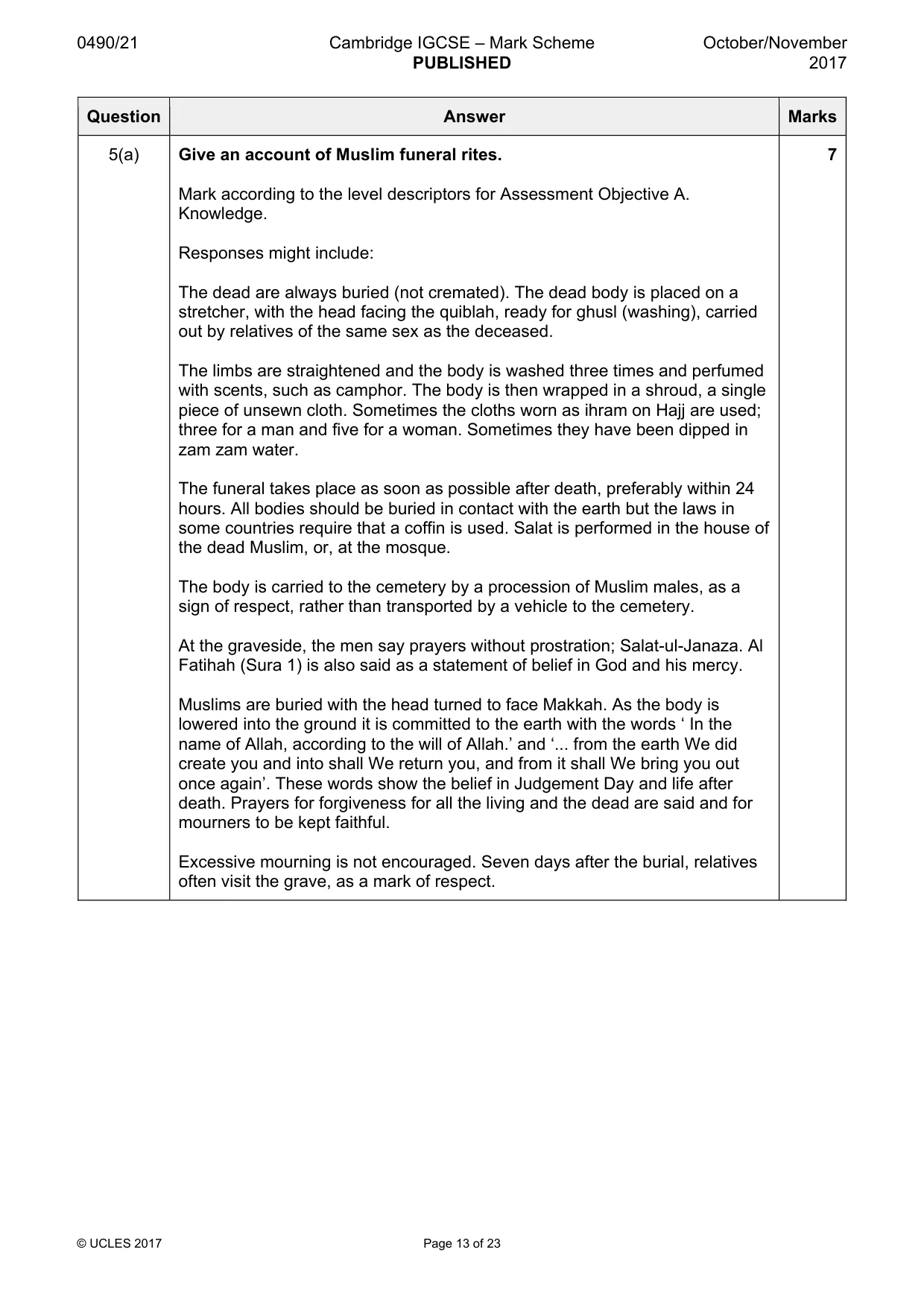
0490/21 Cambridge IGCSE – Mark Scheme PUBLISHED October/November 2017 © UCLES 2017 Page 13 of 23 Question Answer Marks 5(a) Give an account of Muslim funeral rites. Mark according to the level descriptors for Assessment Objective A. Knowledge. Responses might include: The dead are always buried (not cremated). The dead body is placed on a stretcher, with the head facing the quiblah, ready for ghusl (washing), carried out by relatives of the same sex as the deceased. The limbs are straightened and the body is washed three times and perfumed with scents, such as camphor. The body is then wrapped in a shroud, a single piece of unsewn cloth. Sometimes the cloths worn as ihram on Hajj are used; three for a man and five for a woman. Sometimes they have been dipped in zam zam water. The funeral takes place as soon as possible after death, preferably within 24 hours. All bodies should be buried in contact with the earth but the laws in some countries require that a coffin is used. Salat is performed in the house of the dead Muslim, or, at the mosque. The body is carried to the cemetery by a procession of Muslim males, as a sign of respect, rather than transported by a vehicle to the cemetery. At the graveside, the men say prayers without prostration; Salat-ul-Janaza. Al Fatihah (Sura 1) is also said as a statement of belief in God and his mercy. Muslims are buried with the head turned to face Makkah. As the body is lowered into the ground it is committed to the earth with the words ‘ In the name of Allah, according to the will of Allah.’ and ‘... from the earth We did create you and into shall We return you, and from it shall We bring you out once again’. These words show the belief in Judgement Day and life after death. Prayers for forgiveness for all the living and the dead are said and for mourners to be kept faithful. Excessive mourning is not encouraged. Seven days after the burial, relatives often visit the grave, as a mark of respect. 7
Mark scheme, page 14
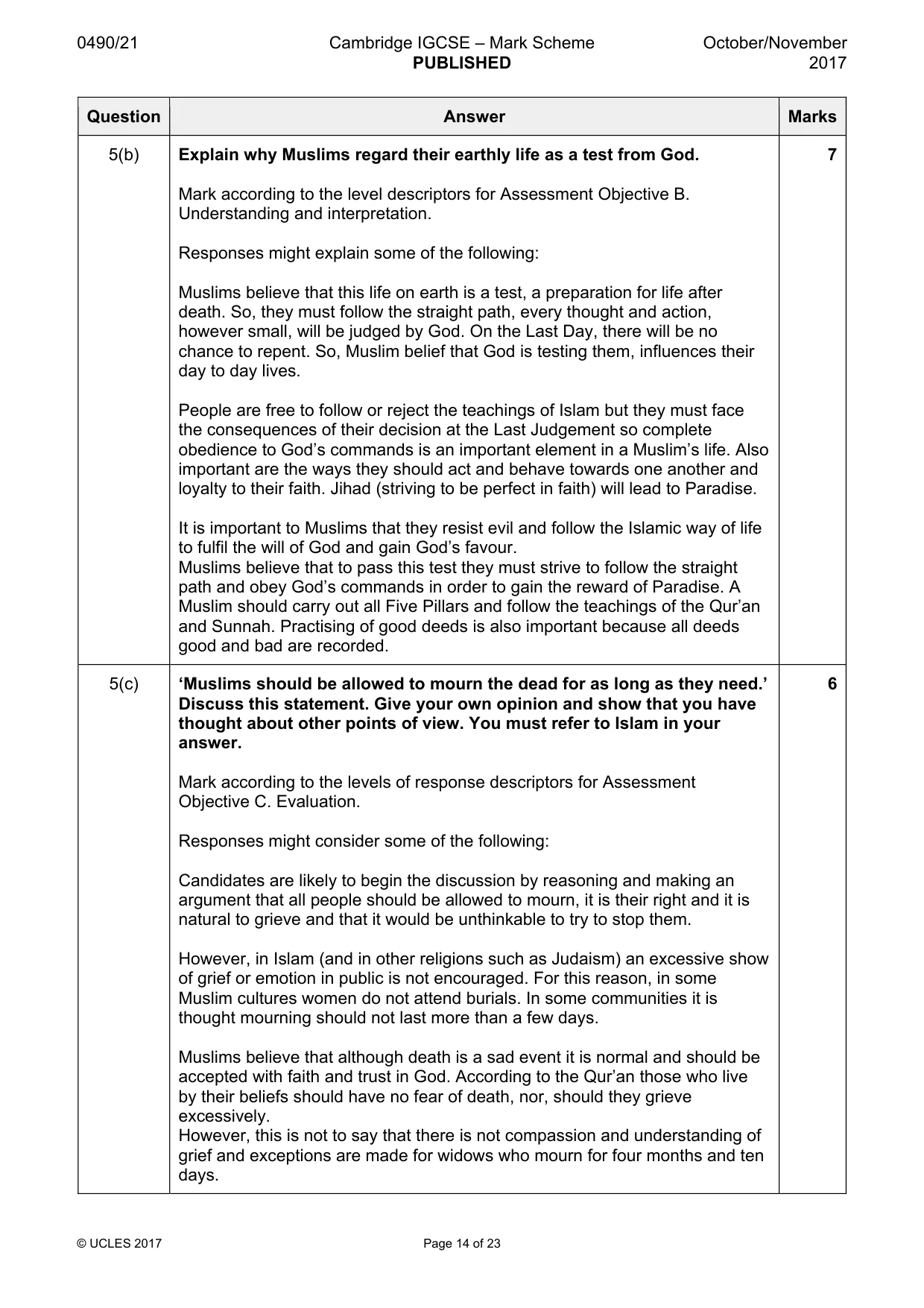
0490/21 Cambridge IGCSE – Mark Scheme PUBLISHED October/November 2017 © UCLES 2017 Page 14 of 23 Question Answer Marks 5(b) Explain why Muslims regard their earthly life as a test from God. Mark according to the level descriptors for Assessment Objective B. Understanding and interpretation. Responses might explain some of the following: Muslims believe that this life on earth is a test, a preparation for life after death. So, they must follow the straight path, every thought and action, however small, will be judged by God. On the Last Day, there will be no chance to repent. So, Muslim belief that God is testing them, influences their day to day lives. People are free to follow or reject the teachings of Islam but they must face the consequences of their decision at the Last Judgement so complete obedience to God’s commands is an important element in a Muslim’s life. Also important are the ways they should act and behave towards one another and loyalty to their faith. Jihad (striving to be perfect in faith) will lead to Paradise. It is important to Muslims that they resist evil and follow the Islamic way of life to fulfil the will of God and gain God’s favour. Muslims believe that to pass this test they must strive to follow the straight path and obey God’s commands in order to gain the reward of Paradise. A Muslim should carry out all Five Pillars and follow the teachings of the Qur’an and Sunnah. Practising of good deeds is also important because all deeds good and bad are recorded. 7 5(c) ‘Muslims should be allowed to mourn the dead for as long as they need.’ Discuss this statement. Give your own opinion and show that you have thought about other points of view. You must refer to Islam in your answer. Mark according to the levels of response descriptors for Assessment Objective C. Evaluation. Responses might consider some of the following: Candidates are likely to begin the discussion by reasoning and making an argument that all people should be allowed to mourn, it is their right and it is natural to grieve and that it would be unthinkable to try to stop them. However, in Islam (and in other religions such as Judaism) an excessive show of grief or emotion in public is not encouraged. For this reason, in some Muslim cultures women do not attend burials. In some communities it is thought mourning should not last more than a few days. Muslims believe that although death is a sad event it is normal and should be accepted with faith and trust in God. According to the Qur’an those who live by their beliefs should have no fear of death, nor, should they grieve excessively. However, this is not to say that there is not compassion and understanding of grief and exceptions are made for widows who mourn for four months and ten days. 6
Mark scheme, page 15
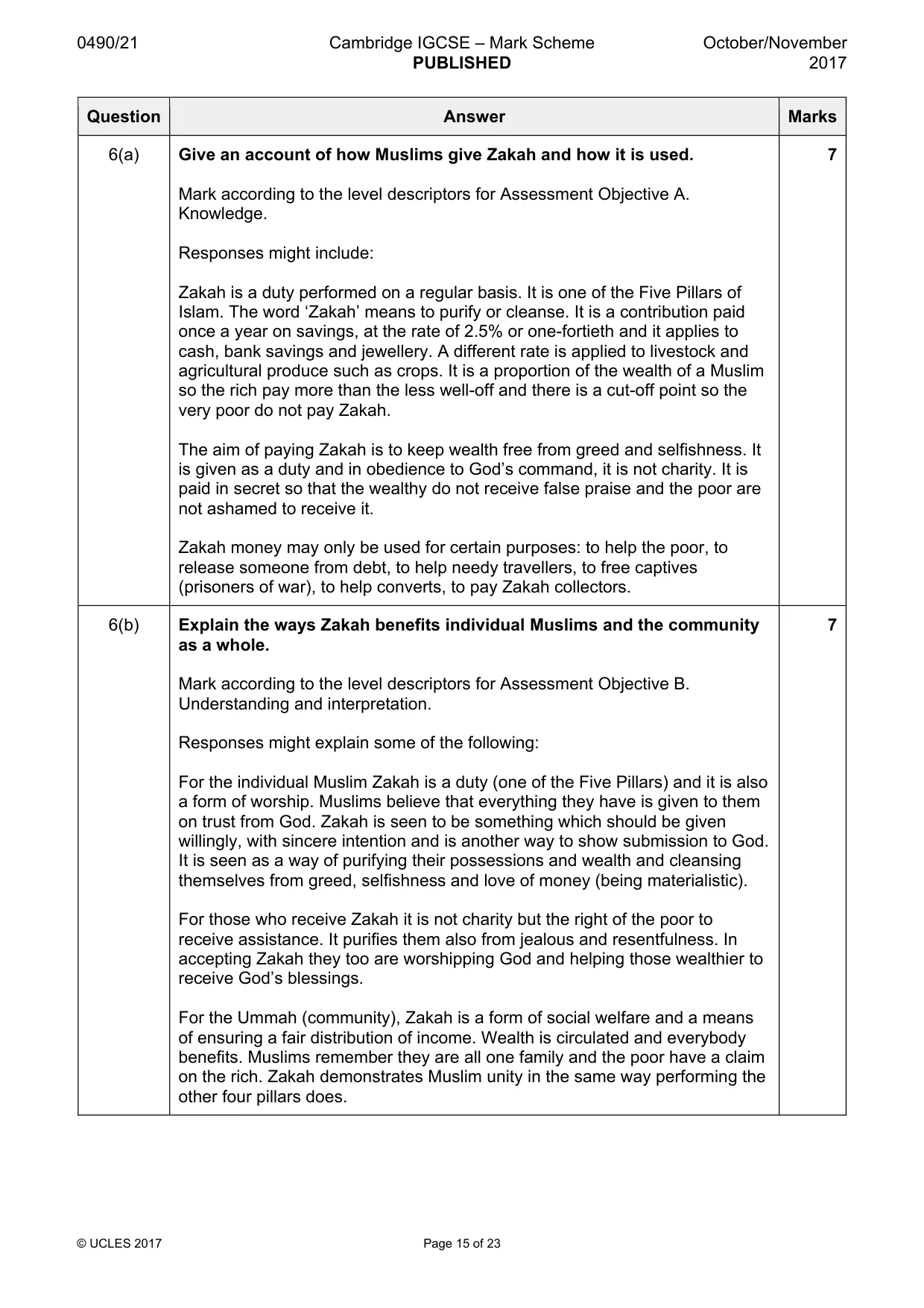
0490/21 Cambridge IGCSE – Mark Scheme PUBLISHED October/November 2017 © UCLES 2017 Page 15 of 23 Question Answer Marks 6(a) Give an account of how Muslims give Zakah and how it is used. Mark according to the level descriptors for Assessment Objective A. Knowledge. Responses might include: Zakah is a duty performed on a regular basis. It is one of the Five Pillars of Islam. The word ‘Zakah’ means to purify or cleanse. It is a contribution paid once a year on savings, at the rate of 2.5% or one-fortieth and it applies to cash, bank savings and jewellery. A different rate is applied to livestock and agricultural produce such as crops. It is a proportion of the wealth of a Muslim so the rich pay more than the less well-off and there is a cut-off point so the very poor do not pay Zakah. The aim of paying Zakah is to keep wealth free from greed and selfishness. It is given as a duty and in obedience to God’s command, it is not charity. It is paid in secret so that the wealthy do not receive false praise and the poor are not ashamed to receive it. Zakah money may only be used for certain purposes: to help the poor, to release someone from debt, to help needy travellers, to free captives (prisoners of war), to help converts, to pay Zakah collectors. 7 6(b) Explain the ways Zakah benefits individual Muslims and the community as a whole. Mark according to the level descriptors for Assessment Objective B. Understanding and interpretation. Responses might explain some of the following: For the individual Muslim Zakah is a duty (one of the Five Pillars) and it is also a form of worship. Muslims believe that everything they have is given to them on trust from God. Zakah is seen to be something which should be given willingly, with sincere intention and is another way to show submission to God. It is seen as a way of purifying their possessions and wealth and cleansing themselves from greed, selfishness and love of money (being materialistic). For those who receive Zakah it is not charity but the right of the poor to receive assistance. It purifies them also from jealous and resentfulness. In accepting Zakah they too are worshipping God and helping those wealthier to receive God’s blessings. For the Ummah (community), Zakah is a form of social welfare and a means of ensuring a fair distribution of income. Wealth is circulated and everybody benefits. Muslims remember they are all one family and the poor have a claim on the rich. Zakah demonstrates Muslim unity in the same way performing the other four pillars does. 7
Mark scheme, page 16
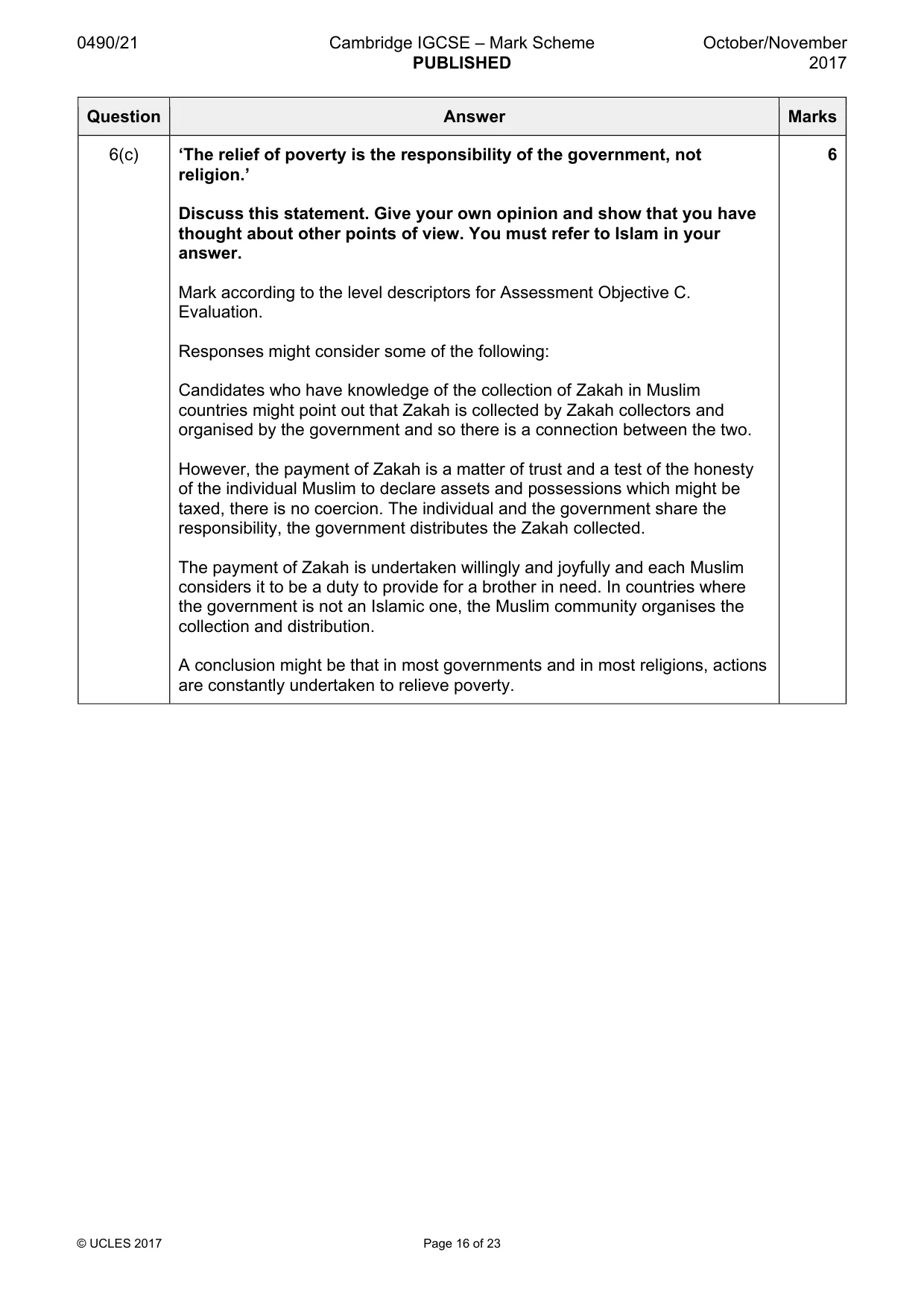
0490/21 Cambridge IGCSE – Mark Scheme PUBLISHED October/November 2017 © UCLES 2017 Page 16 of 23 Question Answer Marks 6(c) ‘The relief of poverty is the responsibility of the government, not religion.’ Discuss this statement. Give your own opinion and show that you have thought about other points of view. You must refer to Islam in your answer. Mark according to the level descriptors for Assessment Objective C. Evaluation. Responses might consider some of the following: Candidates who have knowledge of the collection of Zakah in Muslim countries might point out that Zakah is collected by Zakah collectors and organised by the government and so there is a connection between the two. However, the payment of Zakah is a matter of trust and a test of the honesty of the individual Muslim to declare assets and possessions which might be taxed, there is no coercion. The individual and the government share the responsibility, the government distributes the Zakah collected. The payment of Zakah is undertaken willingly and joyfully and each Muslim considers it to be a duty to provide for a brother in need. In countries where the government is not an Islamic one, the Muslim community organises the collection and distribution. A conclusion might be that in most governments and in most religions, actions are constantly undertaken to relieve poverty. 6
Mark scheme, page 17
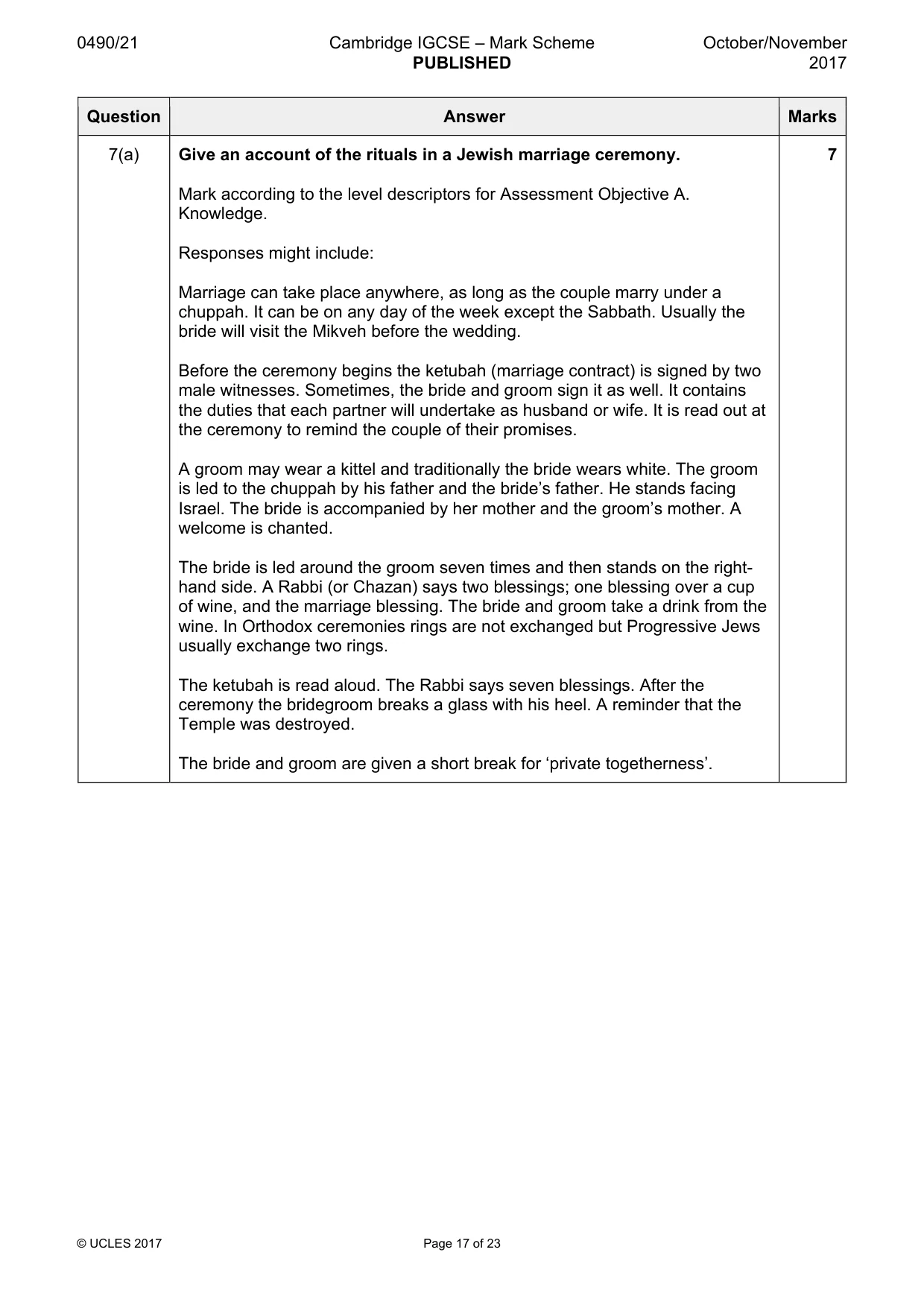
0490/21 Cambridge IGCSE – Mark Scheme PUBLISHED October/November 2017 © UCLES 2017 Page 17 of 23 Question Answer Marks 7(a) Give an account of the rituals in a Jewish marriage ceremony. Mark according to the level descriptors for Assessment Objective A. Knowledge. Responses might include: Marriage can take place anywhere, as long as the couple marry under a chuppah. It can be on any day of the week except the Sabbath. Usually the bride will visit the Mikveh before the wedding. Before the ceremony begins the ketubah (marriage contract) is signed by two male witnesses. Sometimes, the bride and groom sign it as well. It contains the duties that each partner will undertake as husband or wife. It is read out at the ceremony to remind the couple of their promises. A groom may wear a kittel and traditionally the bride wears white. The groom is led to the chuppah by his father and the bride’s father. He stands facing Israel. The bride is accompanied by her mother and the groom’s mother. A welcome is chanted. The bride is led around the groom seven times and then stands on the right- hand side. A Rabbi (or Chazan) says two blessings; one blessing over a cup of wine, and the marriage blessing. The bride and groom take a drink from the wine. In Orthodox ceremonies rings are not exchanged but Progressive Jews usually exchange two rings. The ketubah is read aloud. The Rabbi says seven blessings. After the ceremony the bridegroom breaks a glass with his heel. A reminder that the Temple was destroyed. The bride and groom are given a short break for ‘private togetherness’. 7
Mark scheme, page 18
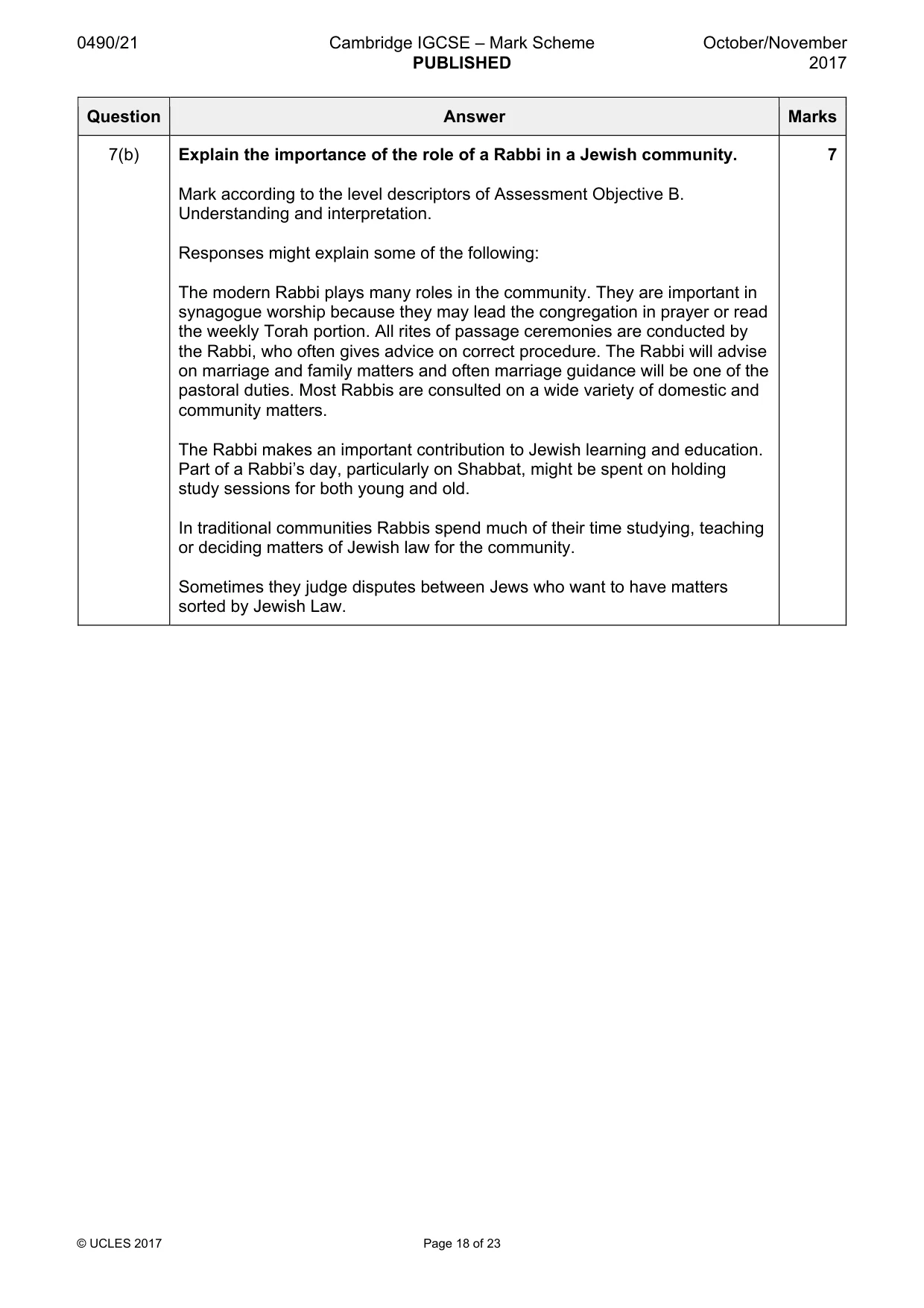
0490/21 Cambridge IGCSE – Mark Scheme PUBLISHED October/November 2017 © UCLES 2017 Page 18 of 23 Question Answer Marks 7(b) Explain the importance of the role of a Rabbi in a Jewish community. Mark according to the level descriptors of Assessment Objective B. Understanding and interpretation. Responses might explain some of the following: The modern Rabbi plays many roles in the community. They are important in synagogue worship because they may lead the congregation in prayer or read the weekly Torah portion. All rites of passage ceremonies are conducted by the Rabbi, who often gives advice on correct procedure. The Rabbi will advise on marriage and family matters and often marriage guidance will be one of the pastoral duties. Most Rabbis are consulted on a wide variety of domestic and community matters. The Rabbi makes an important contribution to Jewish learning and education. Part of a Rabbi’s day, particularly on Shabbat, might be spent on holding study sessions for both young and old. In traditional communities Rabbis spend much of their time studying, teaching or deciding matters of Jewish law for the community. Sometimes they judge disputes between Jews who want to have matters sorted by Jewish Law. 7
Mark scheme, page 19
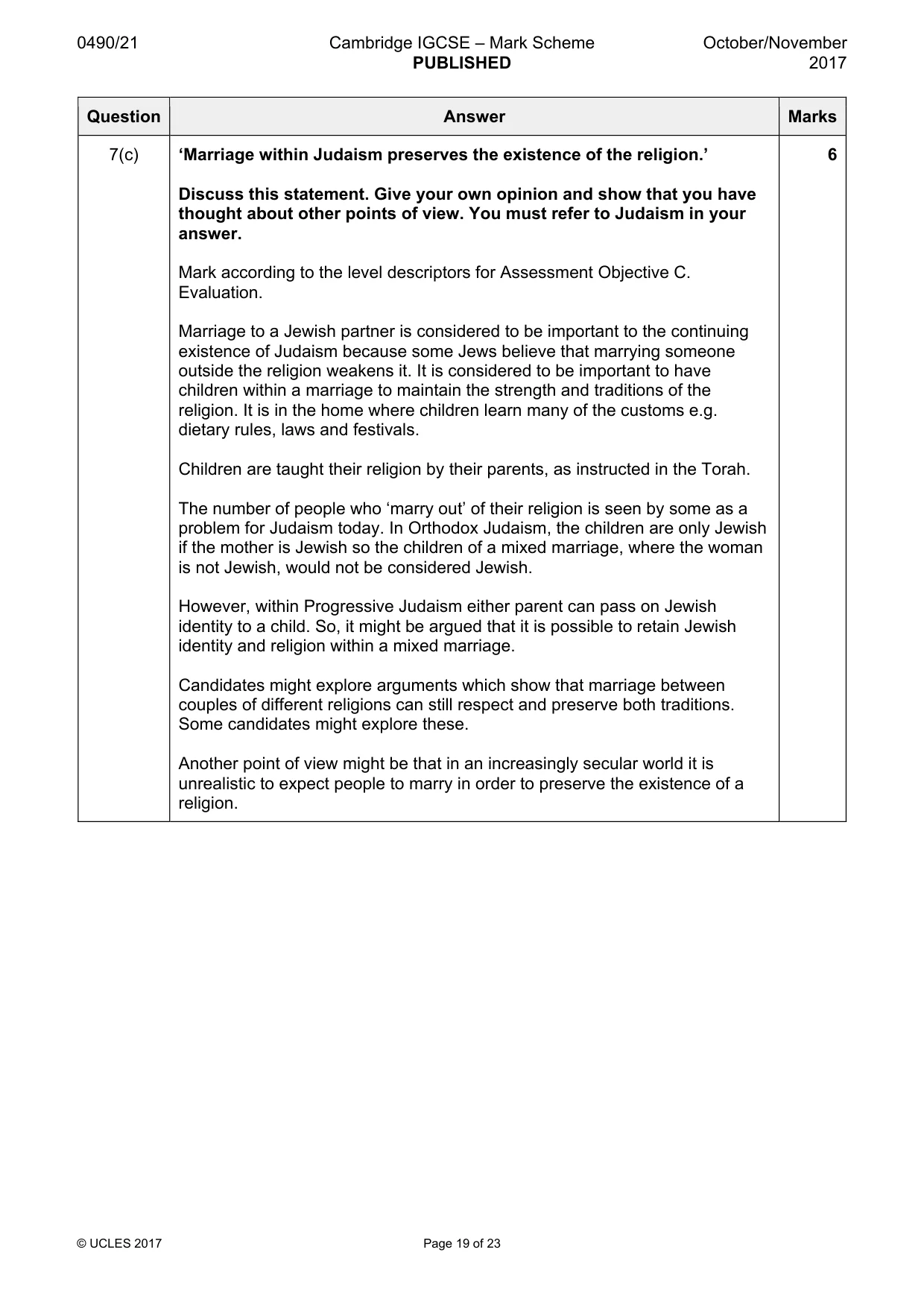
0490/21 Cambridge IGCSE – Mark Scheme PUBLISHED October/November 2017 © UCLES 2017 Page 19 of 23 Question Answer Marks 7(c) ‘Marriage within Judaism preserves the existence of the religion.’ Discuss this statement. Give your own opinion and show that you have thought about other points of view. You must refer to Judaism in your answer. Mark according to the level descriptors for Assessment Objective C. Evaluation. Marriage to a Jewish partner is considered to be important to the continuing existence of Judaism because some Jews believe that marrying someone outside the religion weakens it. It is considered to be important to have children within a marriage to maintain the strength and traditions of the religion. It is in the home where children learn many of the customs e.g. dietary rules, laws and festivals. Children are taught their religion by their parents, as instructed in the Torah. The number of people who ‘marry out’ of their religion is seen by some as a problem for Judaism today. In Orthodox Judaism, the children are only Jewish if the mother is Jewish so the children of a mixed marriage, where the woman is not Jewish, would not be considered Jewish. However, within Progressive Judaism either parent can pass on Jewish identity to a child. So, it might be argued that it is possible to retain Jewish identity and religion within a mixed marriage. Candidates might explore arguments which show that marriage between couples of different religions can still respect and preserve both traditions. Some candidates might explore these. Another point of view might be that in an increasingly secular world it is unrealistic to expect people to marry in order to preserve the existence of a religion. 6
Mark scheme, page 20
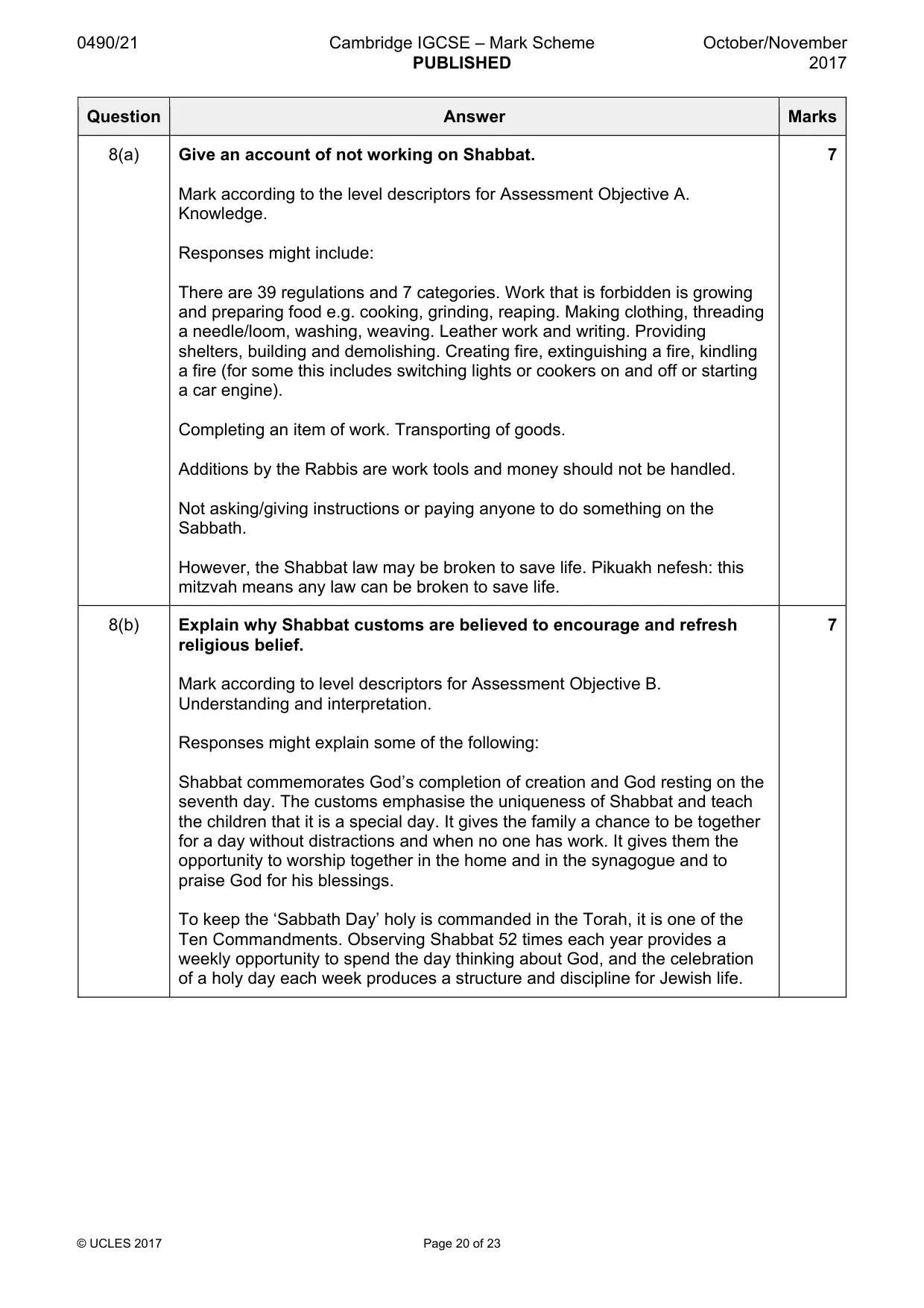
0490/21 Cambridge IGCSE – Mark Scheme PUBLISHED October/November 2017 © UCLES 2017 Page 20 of 23 Question Answer Marks 8(a) Give an account of not working on Shabbat. Mark according to the level descriptors for Assessment Objective A. Knowledge. Responses might include: There are 39 regulations and 7 categories. Work that is forbidden is growing and preparing food e.g. cooking, grinding, reaping. Making clothing, threading a needle/loom, washing, weaving. Leather work and writing. Providing shelters, building and demolishing. Creating fire, extinguishing a fire, kindling a fire (for some this includes switching lights or cookers on and off or starting a car engine). Completing an item of work. Transporting of goods. Additions by the Rabbis are work tools and money should not be handled. Not asking/giving instructions or paying anyone to do something on the Sabbath. However, the Shabbat law may be broken to save life. Pikuakh nefesh: this mitzvah means any law can be broken to save life. 7 8(b) Explain why Shabbat customs are believed to encourage and refresh religious belief. Mark according to level descriptors for Assessment Objective B. Understanding and interpretation. Responses might explain some of the following: Shabbat commemorates God’s completion of creation and God resting on the seventh day. The customs emphasise the uniqueness of Shabbat and teach the children that it is a special day. It gives the family a chance to be together for a day without distractions and when no one has work. It gives them the opportunity to worship together in the home and in the synagogue and to praise God for his blessings. To keep the ‘Sabbath Day’ holy is commanded in the Torah, it is one of the Ten Commandments. Observing Shabbat 52 times each year provides a weekly opportunity to spend the day thinking about God, and the celebration of a holy day each week produces a structure and discipline for Jewish life. 7
Mark scheme, page 21
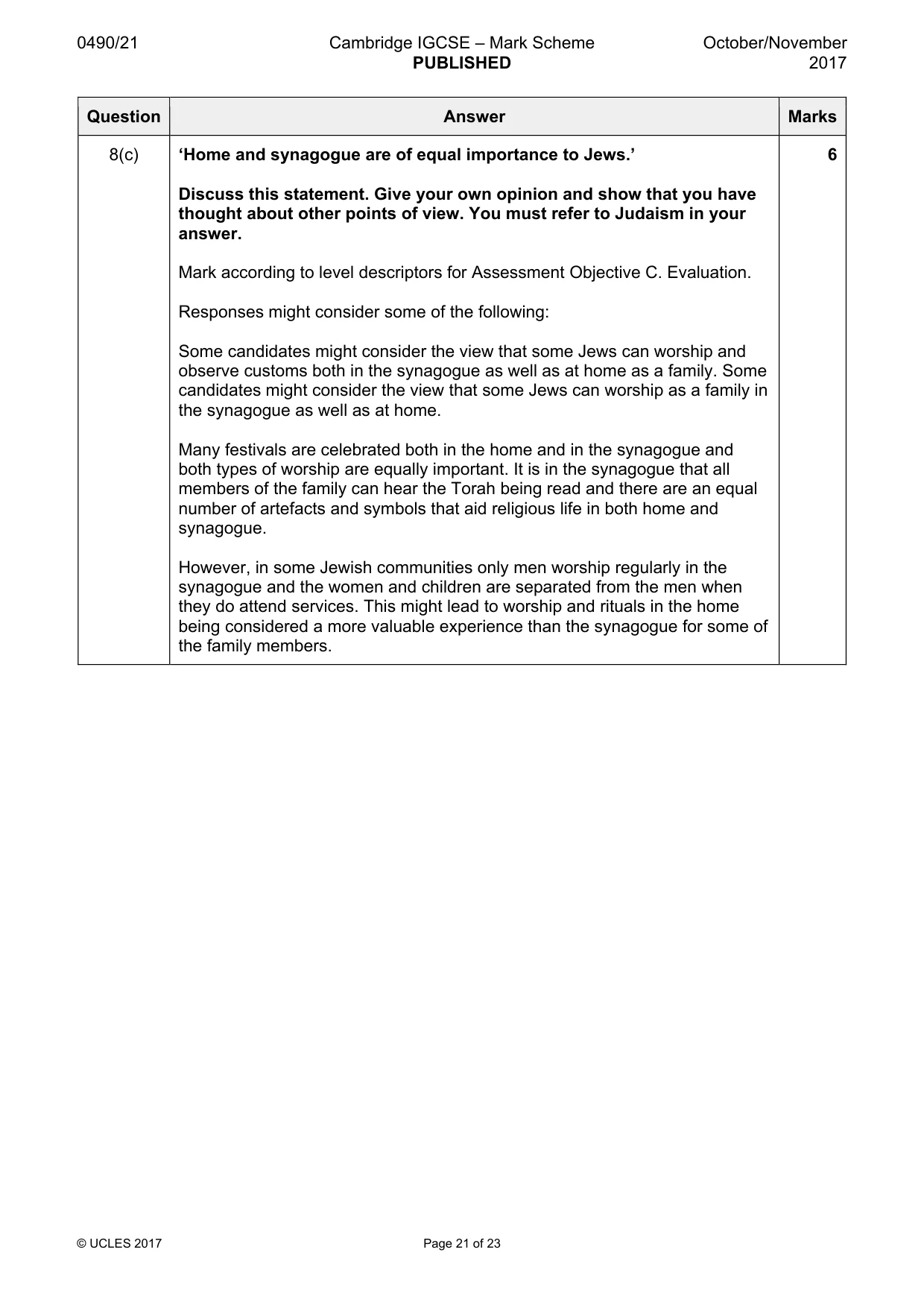
0490/21 Cambridge IGCSE – Mark Scheme PUBLISHED October/November 2017 © UCLES 2017 Page 21 of 23 Question Answer Marks 8(c) ‘Home and synagogue are of equal importance to Jews.’ Discuss this statement. Give your own opinion and show that you have thought about other points of view. You must refer to Judaism in your answer. Mark according to level descriptors for Assessment Objective C. Evaluation. Responses might consider some of the following: Some candidates might consider the view that some Jews can worship and observe customs both in the synagogue as well as at home as a family. Some candidates might consider the view that some Jews can worship as a family in the synagogue as well as at home. Many festivals are celebrated both in the home and in the synagogue and both types of worship are equally important. It is in the synagogue that all members of the family can hear the Torah being read and there are an equal number of artefacts and symbols that aid religious life in both home and synagogue. However, in some Jewish communities only men worship regularly in the synagogue and the women and children are separated from the men when they do attend services. This might lead to worship and rituals in the home being considered a more valuable experience than the synagogue for some of the family members. 6
Mark scheme, page 22
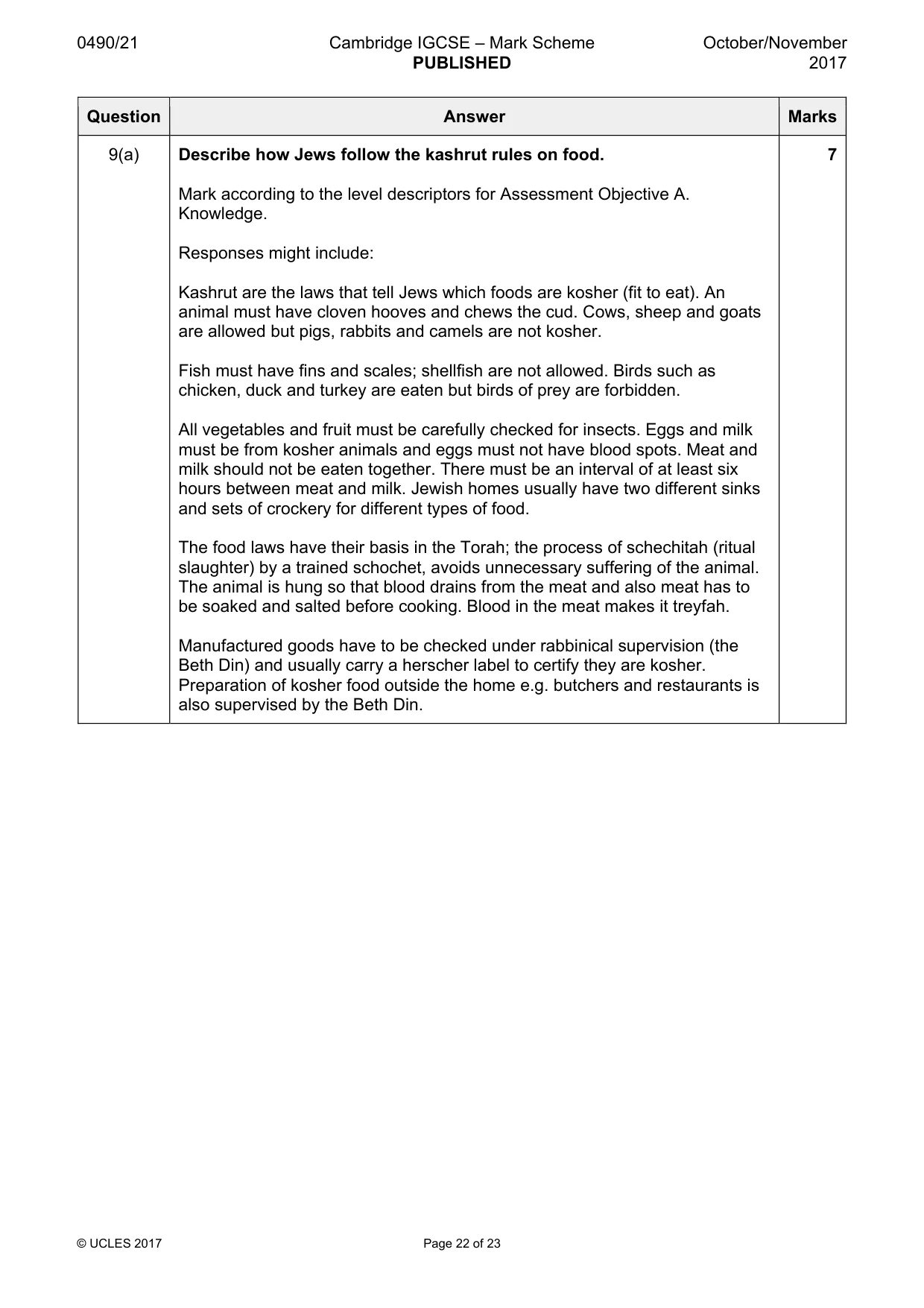
0490/21 Cambridge IGCSE – Mark Scheme PUBLISHED October/November 2017 © UCLES 2017 Page 22 of 23 Question Answer Marks 9(a) Describe how Jews follow the kashrut rules on food. Mark according to the level descriptors for Assessment Objective A. Knowledge. Responses might include: Kashrut are the laws that tell Jews which foods are kosher (fit to eat). An animal must have cloven hooves and chews the cud. Cows, sheep and goats are allowed but pigs, rabbits and camels are not kosher. Fish must have fins and scales; shellfish are not allowed. Birds such as chicken, duck and turkey are eaten but birds of prey are forbidden. All vegetables and fruit must be carefully checked for insects. Eggs and milk must be from kosher animals and eggs must not have blood spots. Meat and milk should not be eaten together. There must be an interval of at least six hours between meat and milk. Jewish homes usually have two different sinks and sets of crockery for different types of food. The food laws have their basis in the Torah; the process of schechitah (ritual slaughter) by a trained schochet, avoids unnecessary suffering of the animal. The animal is hung so that blood drains from the meat and also meat has to be soaked and salted before cooking. Blood in the meat makes it treyfah. Manufactured goods have to be checked under rabbinical supervision (the Beth Din) and usually carry a herscher label to certify they are kosher. Preparation of kosher food outside the home e.g. butchers and restaurants is also supervised by the Beth Din. 7
Mark scheme, page 23
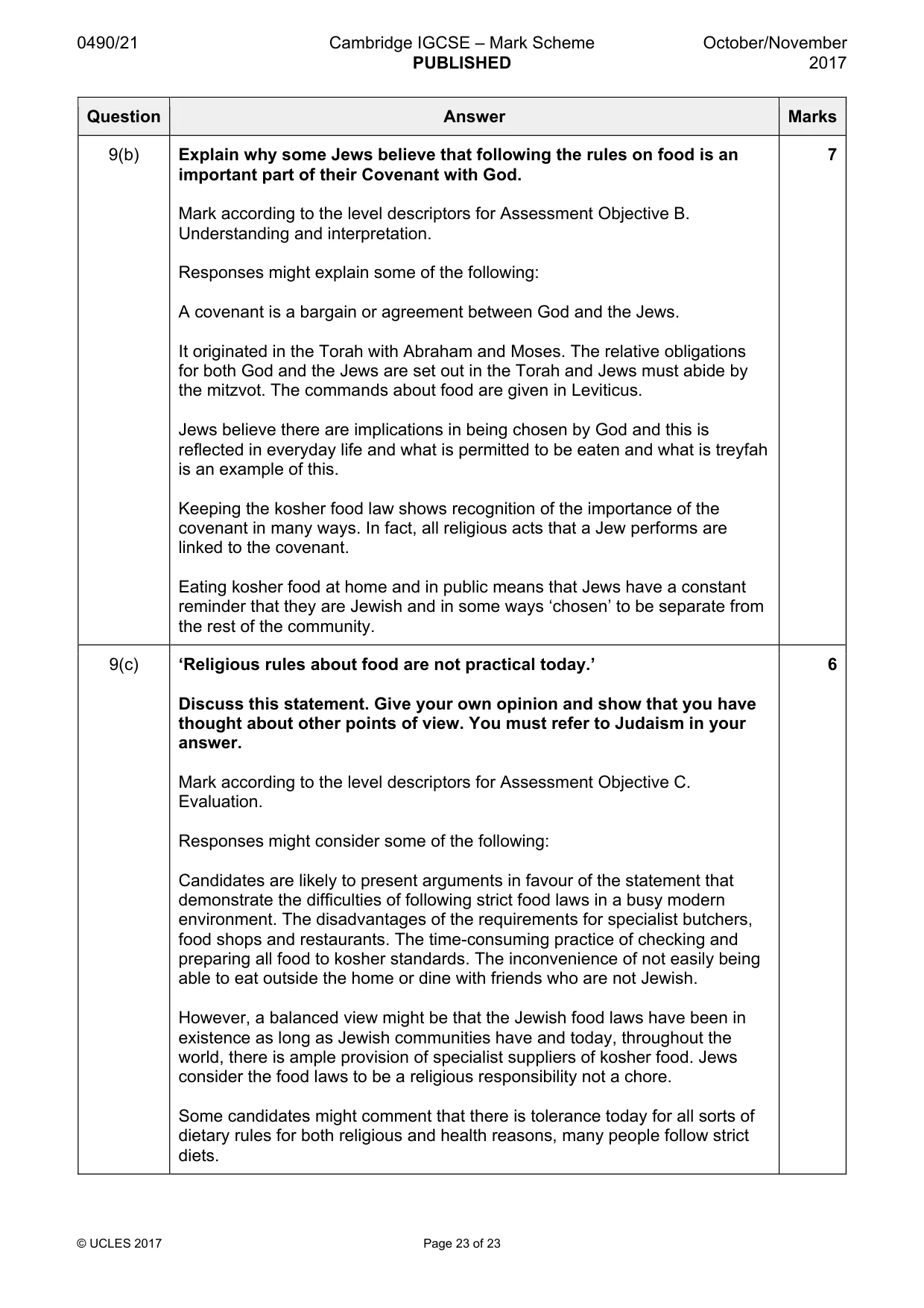
0490/21 Cambridge IGCSE – Mark Scheme PUBLISHED October/November 2017 © UCLES 2017 Page 23 of 23 Question Answer Marks 9(b) Explain why some Jews believe that following the rules on food is an important part of their Covenant with God. Mark according to the level descriptors for Assessment Objective B. Understanding and interpretation. Responses might explain some of the following: A covenant is a bargain or agreement between God and the Jews. It originated in the Torah with Abraham and Moses. The relative obligations for both God and the Jews are set out in the Torah and Jews must abide by the mitzvot. The commands about food are given in Leviticus. Jews believe there are implications in being chosen by God and this is reflected in everyday life and what is permitted to be eaten and what is treyfah is an example of this. Keeping the kosher food law shows recognition of the importance of the covenant in many ways. In fact, all religious acts that a Jew performs are linked to the covenant. Eating kosher food at home and in public means that Jews have a constant reminder that they are Jewish and in some ways ‘chosen’ to be separate from the rest of the community. 7 9(c) ‘Religious rules about food are not practical today.’ Discuss this statement. Give your own opinion and show that you have thought about other points of view. You must refer to Judaism in your answer. Mark according to the level descriptors for Assessment Objective C. Evaluation. Responses might consider some of the following: Candidates are likely to present arguments in favour of the statement that demonstrate the difficulties of following strict food laws in a busy modern environment. The disadvantages of the requirements for specialist butchers, food shops and restaurants. The time-consuming practice of checking and preparing all food to kosher standards. The inconvenience of not easily being able to eat outside the home or dine with friends who are not Jewish. However, a balanced view might be that the Jewish food laws have been in existence as long as Jewish communities have and today, throughout the world, there is ample provision of specialist suppliers of kosher food. Jews consider the food laws to be a religious responsibility not a chore. Some candidates might comment that there is tolerance today for all sorts of dietary rules for both religious and health reasons, many people follow strict diets. 6
What you needed in this session
Cambridge’s own grade thresholds for 2017 Oct/Nov, Paper 2 · Variant 1. A higher threshold means an easier paper — the bar moves with how the cohort did.