Cambridge IGCSE Religious Studies 0490 — 2009 Oct/Nov Paper 2 · Variant 1
0490/21/O/N/09 · 75 marks · ≈84 min
The question paper and its mark scheme, free to read here and free to download. This is Cambridge’s own paper, exactly as it was sat.
Question paper2 pages
Mark scheme4 pages
Answers below. Sit the paper first if you are practising.
Paper as text
Question paper, page 1
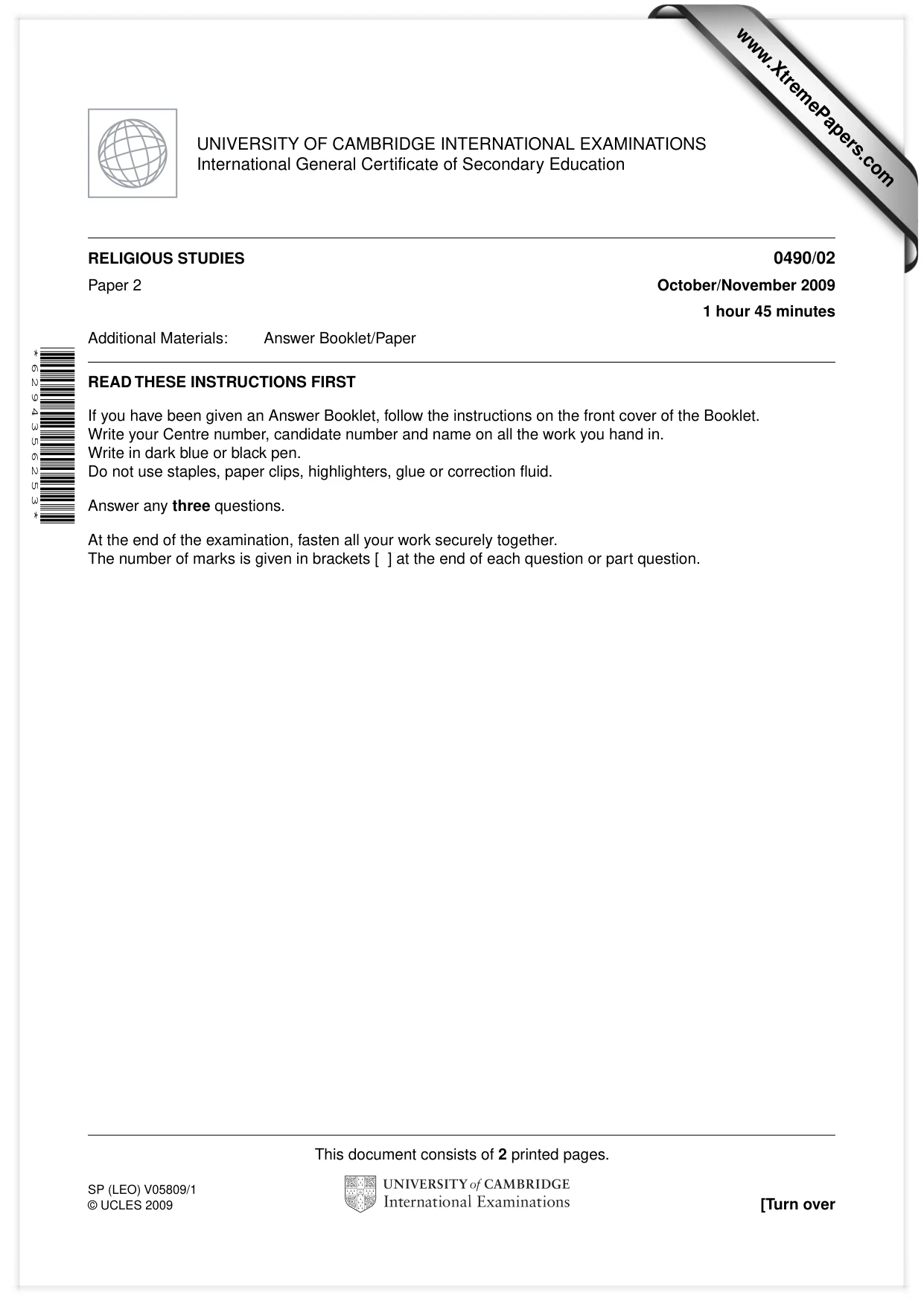
This document consists of 2 printed pages. SP (LEO) V05809/1 © UCLES 2009 [Turn over UNIVERSITY OF CAMBRIDGE INTERNATIONAL EXAMINATIONS International General Certificate of Secondary Education READ THESE INSTRUCTIONS FIRST If you have been given an Answer Booklet, follow the instructions on the front cover of the Booklet. Write your Centre number, candidate number and name on all the work you hand in. Write in dark blue or black pen. Do not use staples, paper clips, highlighters, glue or correction fluid. Answer any three questions. At the end of the examination, fasten all your work securely together. The number of marks is given in brackets [ ] at the end of each question or part question. * 6 2 9 4 3 5 6 2 5 3 * RELIGIOUS STUDIES 0490/02 Paper 2 October/November 2009 1 hour 45 minutes Additional Materials: Answer Booklet/Paper www.XtremePapers.com
Question paper, page 2
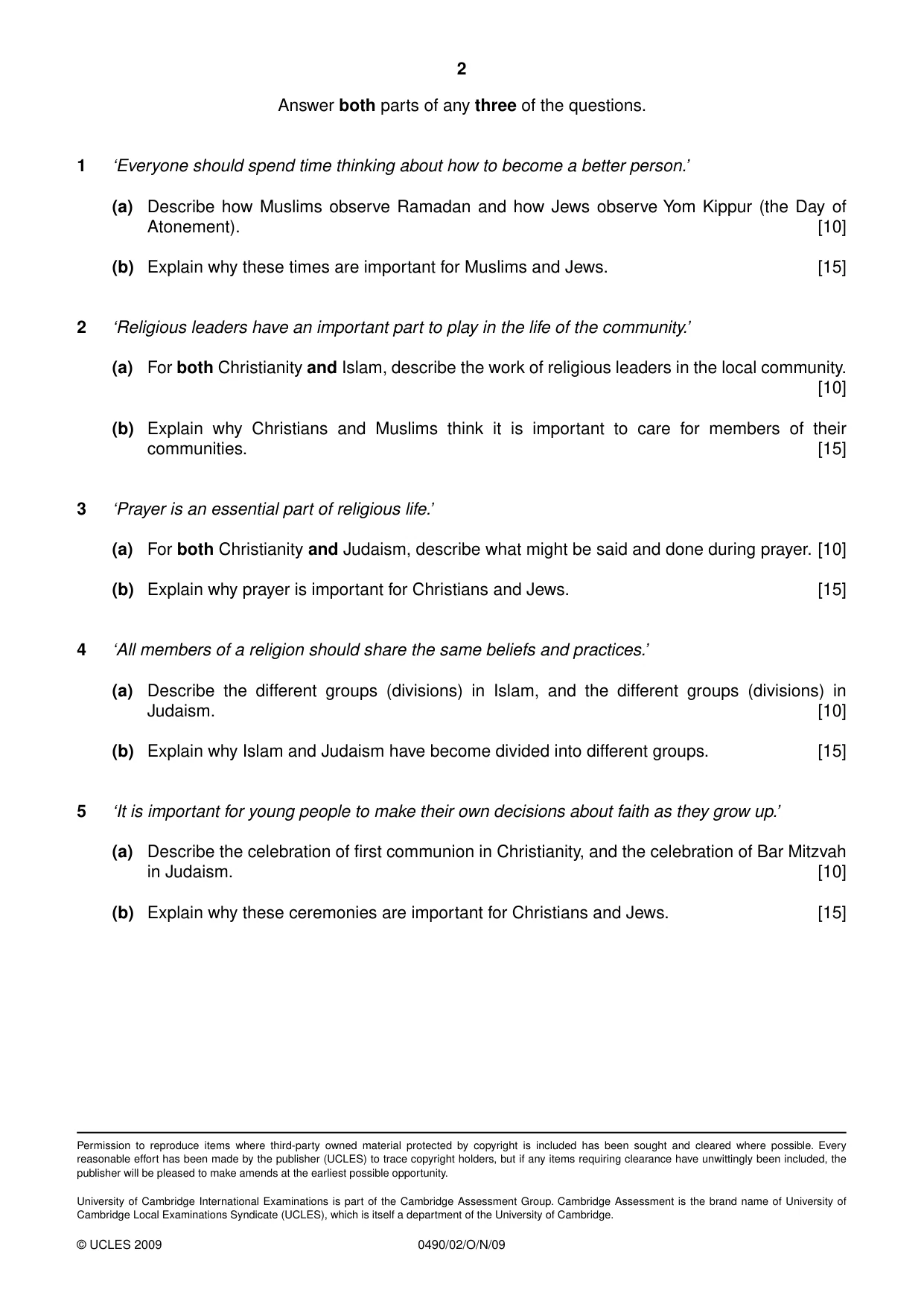
2 0490/02/O/N/09 © UCLES 2009 Answer both parts of any three of the questions. 1 ‘Everyone should spend time thinking about how to become a better person.’ (a) Describe how Muslims observe Ramadan and how Jews observe Yom Kippur (the Day of Atonement). [10] (b) Explain why these times are important for Muslims and Jews. [15] 2 ‘Religious leaders have an important part to play in the life of the community.’ (a) For both Christianity and Islam, describe the work of religious leaders in the local community. [10] (b) Explain why Christians and Muslims think it is important to care for members of their communities. [15] 3 ‘Prayer is an essential part of religious life.’ (a) For both Christianity and Judaism, describe what might be said and done during prayer. [10] (b) Explain why prayer is important for Christians and Jews. [15] 4 ‘All members of a religion should share the same beliefs and practices.’ (a) Describe the different groups (divisions) in Islam, and the different groups (divisions) in Judaism. [10] (b) Explain why Islam and Judaism have become divided into different groups. [15] 5 ‘It is important for young people to make their own decisions about faith as they grow up.’ (a) Describe the celebration of first communion in Christianity, and the celebration of Bar Mitzvah in Judaism. [10] (b) Explain why these ceremonies are important for Christians and Jews. [15] Permission to reproduce items where third-party owned material protected by copyright is included has been sought and cleared where possible. Every reasonable effort has been made by the publisher (UCLES) to trace copyright holders, but if any items requiring clearance have unwittingly been included, the publisher will be pleased to make amends at the earliest possible opportunity. University of Cambridge International Examinations is part of the Cambridge Assessment Group. Cambridge Assessment is the brand name of University of Cambridge Local Examinations Syndicate (UCLES), which is itself a department of the University of Cambridge.
Mark scheme, page 1
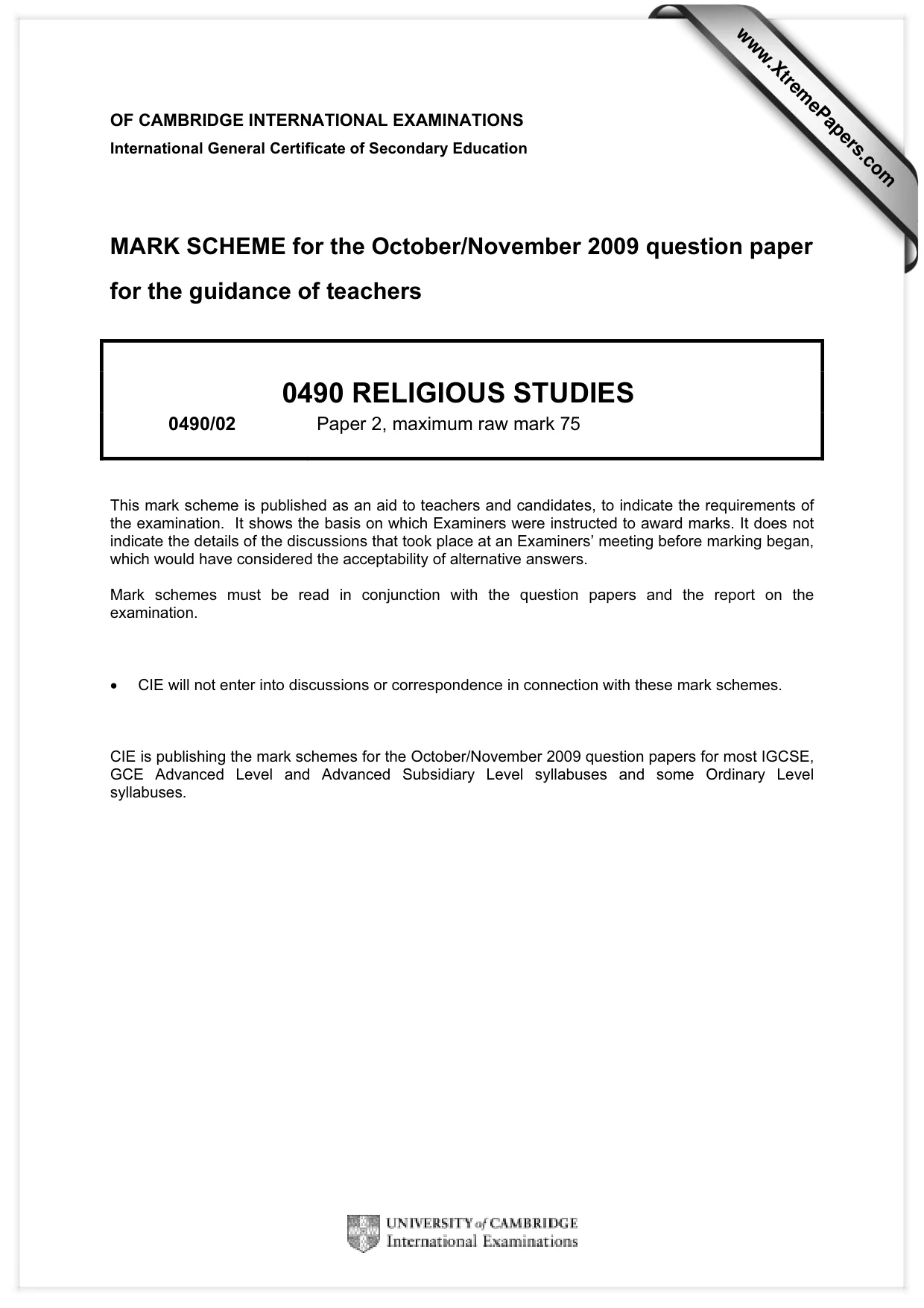
OF CAMBRIDGE INTERNATIONAL EXAMINATIONS International General Certificate of Secondary Education MARK SCHEME for the October/November 2009 question paper for the guidance of teachers 0490 RELIGIOUS STUDIES 0490/02 Paper 2, maximum raw mark 75 This mark scheme is published as an aid to teachers and candidates, to indicate the requirements of the examination. It shows the basis on which Examiners were instructed to award marks. It does not indicate the details of the discussions that took place at an Examiners’ meeting before marking began, which would have considered the acceptability of alternative answers. Mark schemes must be read in conjunction with the question papers and the report on the examination. • CIE will not enter into discussions or correspondence in connection with these mark schemes. CIE is publishing the mark schemes for the October/November 2009 question papers for most IGCSE, GCE Advanced Level and Advanced Subsidiary Level syllabuses and some Ordinary Level syllabuses. www.XtremePapers.com
Mark scheme, page 2
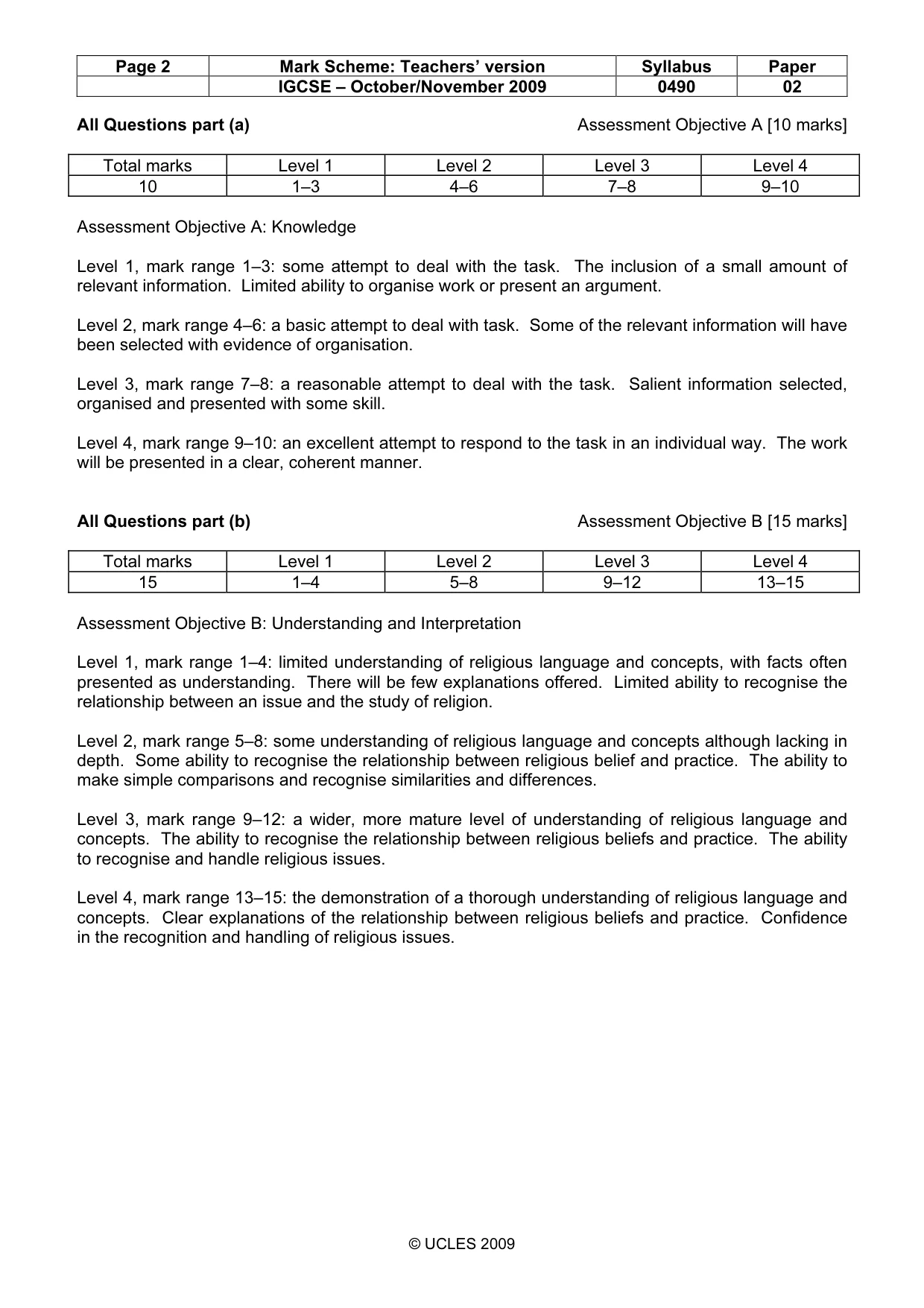
Page 2 Mark Scheme: Teachers’ version Syllabus Paper IGCSE – October/November 2009 0490 02 © UCLES 2009 All Questions part (a) Assessment Objective A [10 marks] Total marks Level 1 Level 2 Level 3 Level 4 10 1–3 4–6 7–8 9–10 Assessment Objective A: Knowledge Level 1, mark range 1–3: some attempt to deal with the task. The inclusion of a small amount of relevant information. Limited ability to organise work or present an argument. Level 2, mark range 4–6: a basic attempt to deal with task. Some of the relevant information will have been selected with evidence of organisation. Level 3, mark range 7–8: a reasonable attempt to deal with the task. Salient information selected, organised and presented with some skill. Level 4, mark range 9–10: an excellent attempt to respond to the task in an individual way. The work will be presented in a clear, coherent manner. All Questions part (b) Assessment Objective B [15 marks] Total marks Level 1 Level 2 Level 3 Level 4 15 1–4 5–8 9–12 13–15 Assessment Objective B: Understanding and Interpretation Level 1, mark range 1–4: limited understanding of religious language and concepts, with facts often presented as understanding. There will be few explanations offered. Limited ability to recognise the relationship between an issue and the study of religion. Level 2, mark range 5–8: some understanding of religious language and concepts although lacking in depth. Some ability to recognise the relationship between religious belief and practice. The ability to make simple comparisons and recognise similarities and differences. Level 3, mark range 9–12: a wider, more mature level of understanding of religious language and concepts. The ability to recognise the relationship between religious beliefs and practice. The ability to recognise and handle religious issues. Level 4, mark range 13–15: the demonstration of a thorough understanding of religious language and concepts. Clear explanations of the relationship between religious beliefs and practice. Confidence in the recognition and handling of religious issues.
Mark scheme, page 3
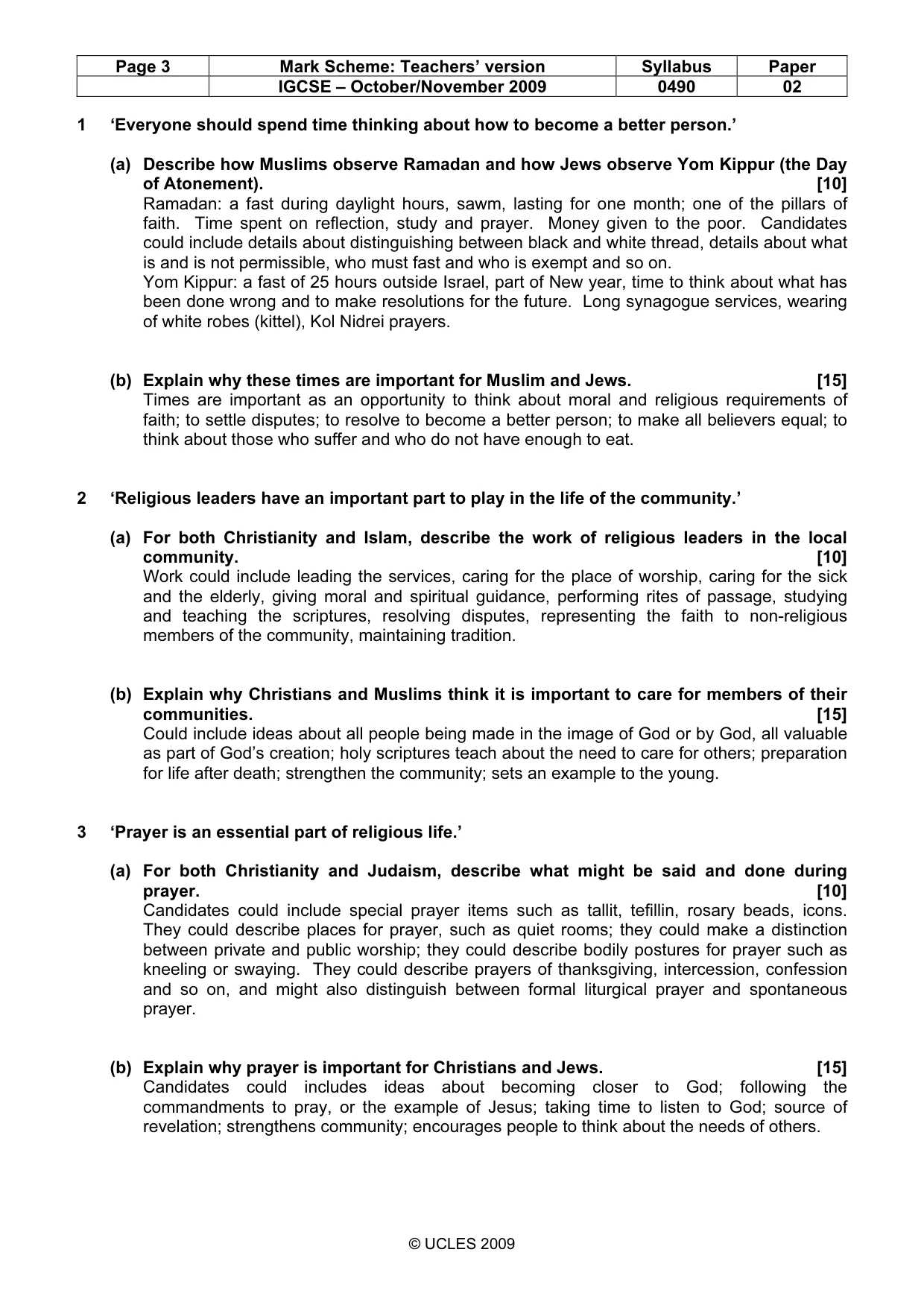
Page 3 Mark Scheme: Teachers’ version Syllabus Paper IGCSE – October/November 2009 0490 02 © UCLES 2009 1 ‘Everyone should spend time thinking about how to become a better person.’ (a) Describe how Muslims observe Ramadan and how Jews observe Yom Kippur (the Day of Atonement). [10] Ramadan: a fast during daylight hours, sawm, lasting for one month; one of the pillars of faith. Time spent on reflection, study and prayer. Money given to the poor. Candidates could include details about distinguishing between black and white thread, details about what is and is not permissible, who must fast and who is exempt and so on. Yom Kippur: a fast of 25 hours outside Israel, part of New year, time to think about what has been done wrong and to make resolutions for the future. Long synagogue services, wearing of white robes (kittel), Kol Nidrei prayers. (b) Explain why these times are important for Muslim and Jews. [15] Times are important as an opportunity to think about moral and religious requirements of faith; to settle disputes; to resolve to become a better person; to make all believers equal; to think about those who suffer and who do not have enough to eat. 2 ‘Religious leaders have an important part to play in the life of the community.’ (a) For both Christianity and Islam, describe the work of religious leaders in the local community. [10] Work could include leading the services, caring for the place of worship, caring for the sick and the elderly, giving moral and spiritual guidance, performing rites of passage, studying and teaching the scriptures, resolving disputes, representing the faith to non-religious members of the community, maintaining tradition. (b) Explain why Christians and Muslims think it is important to care for members of their communities. [15] Could include ideas about all people being made in the image of God or by God, all valuable as part of God’s creation; holy scriptures teach about the need to care for others; preparation for life after death; strengthen the community; sets an example to the young. 3 ‘Prayer is an essential part of religious life.’ (a) For both Christianity and Judaism, describe what might be said and done during prayer. [10] Candidates could include special prayer items such as tallit, tefillin, rosary beads, icons. They could describe places for prayer, such as quiet rooms; they could make a distinction between private and public worship; they could describe bodily postures for prayer such as kneeling or swaying. They could describe prayers of thanksgiving, intercession, confession and so on, and might also distinguish between formal liturgical prayer and spontaneous prayer. (b) Explain why prayer is important for Christians and Jews. [15] Candidates could includes ideas about becoming closer to God; following the commandments to pray, or the example of Jesus; taking time to listen to God; source of revelation; strengthens community; encourages people to think about the needs of others.
Mark scheme, page 4
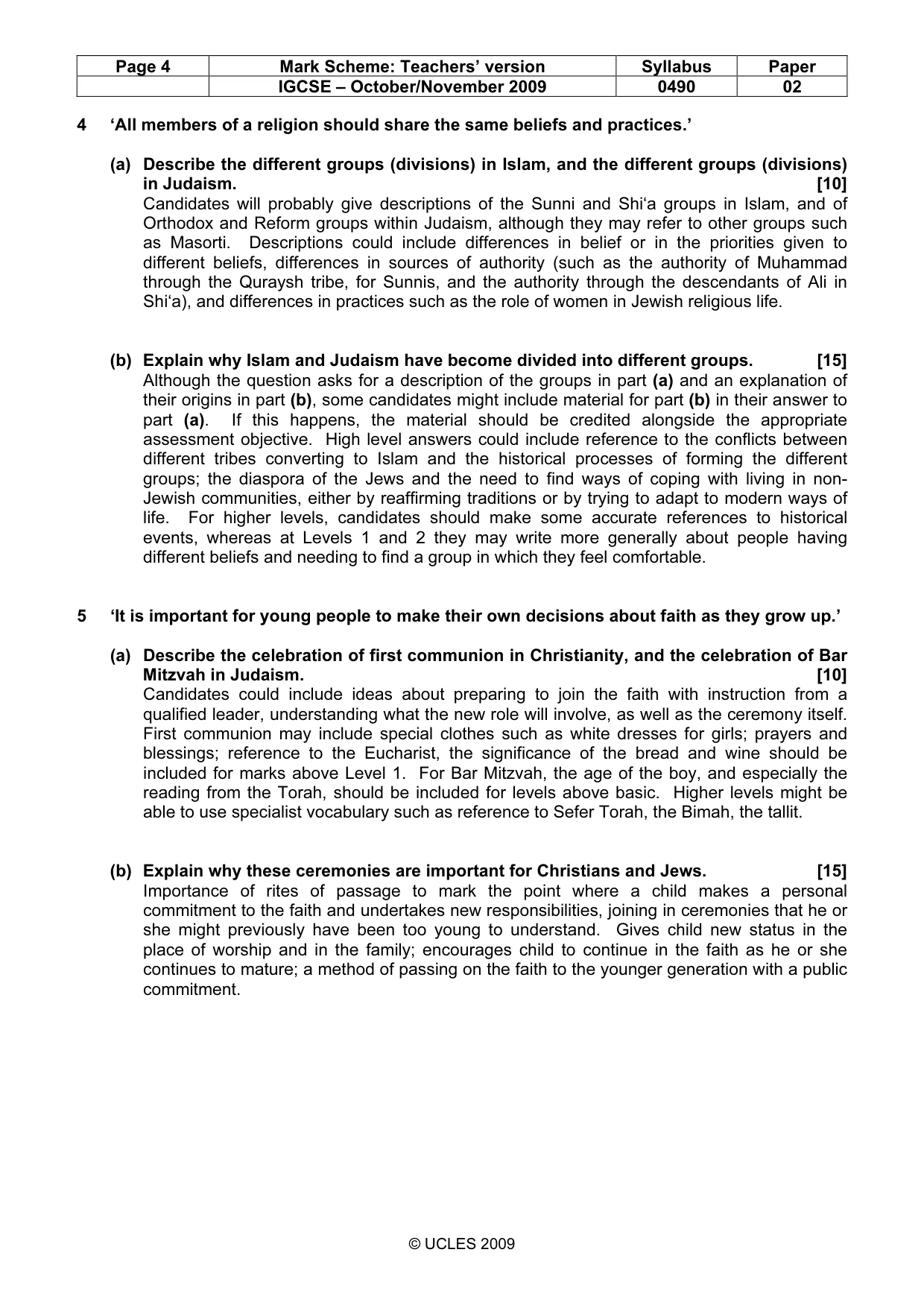
Page 4 Mark Scheme: Teachers’ version Syllabus Paper IGCSE – October/November 2009 0490 02 © UCLES 2009 4 ‘All members of a religion should share the same beliefs and practices.’ (a) Describe the different groups (divisions) in Islam, and the different groups (divisions) in Judaism. [10] Candidates will probably give descriptions of the Sunni and Shi‘a groups in Islam, and of Orthodox and Reform groups within Judaism, although they may refer to other groups such as Masorti. Descriptions could include differences in belief or in the priorities given to different beliefs, differences in sources of authority (such as the authority of Muhammad through the Quraysh tribe, for Sunnis, and the authority through the descendants of Ali in Shi‘a), and differences in practices such as the role of women in Jewish religious life. (b) Explain why Islam and Judaism have become divided into different groups. [15] Although the question asks for a description of the groups in part (a) and an explanation of their origins in part (b), some candidates might include material for part (b) in their answer to part (a). If this happens, the material should be credited alongside the appropriate assessment objective. High level answers could include reference to the conflicts between different tribes converting to Islam and the historical processes of forming the different groups; the diaspora of the Jews and the need to find ways of coping with living in non- Jewish communities, either by reaffirming traditions or by trying to adapt to modern ways of life. For higher levels, candidates should make some accurate references to historical events, whereas at Levels 1 and 2 they may write more generally about people having different beliefs and needing to find a group in which they feel comfortable. 5 ‘It is important for young people to make their own decisions about faith as they grow up.’ (a) Describe the celebration of first communion in Christianity, and the celebration of Bar Mitzvah in Judaism. [10] Candidates could include ideas about preparing to join the faith with instruction from a qualified leader, understanding what the new role will involve, as well as the ceremony itself. First communion may include special clothes such as white dresses for girls; prayers and blessings; reference to the Eucharist, the significance of the bread and wine should be included for marks above Level 1. For Bar Mitzvah, the age of the boy, and especially the reading from the Torah, should be included for levels above basic. Higher levels might be able to use specialist vocabulary such as reference to Sefer Torah, the Bimah, the tallit. (b) Explain why these ceremonies are important for Christians and Jews. [15] Importance of rites of passage to mark the point where a child makes a personal commitment to the faith and undertakes new responsibilities, joining in ceremonies that he or she might previously have been too young to understand. Gives child new status in the place of worship and in the family; encourages child to continue in the faith as he or she continues to mature; a method of passing on the faith to the younger generation with a public commitment.
What you needed in this session
Cambridge’s own grade thresholds for 2009 Oct/Nov, Paper 2 · Variant 1. A higher threshold means an easier paper — the bar moves with how the cohort did.