Cambridge IGCSE Portuguese - Foreign Language 0540 — 2009 May/June Paper 4 · Variant 1
0540/41/M/J/09 · 50 marks · ≈56 min
The question paper and its mark scheme, free to read here and free to download. This is Cambridge’s own paper, exactly as it was sat.
Question paper4 pages
Mark scheme13 pages
Answers below. Sit the paper first if you are practising.
Paper as text
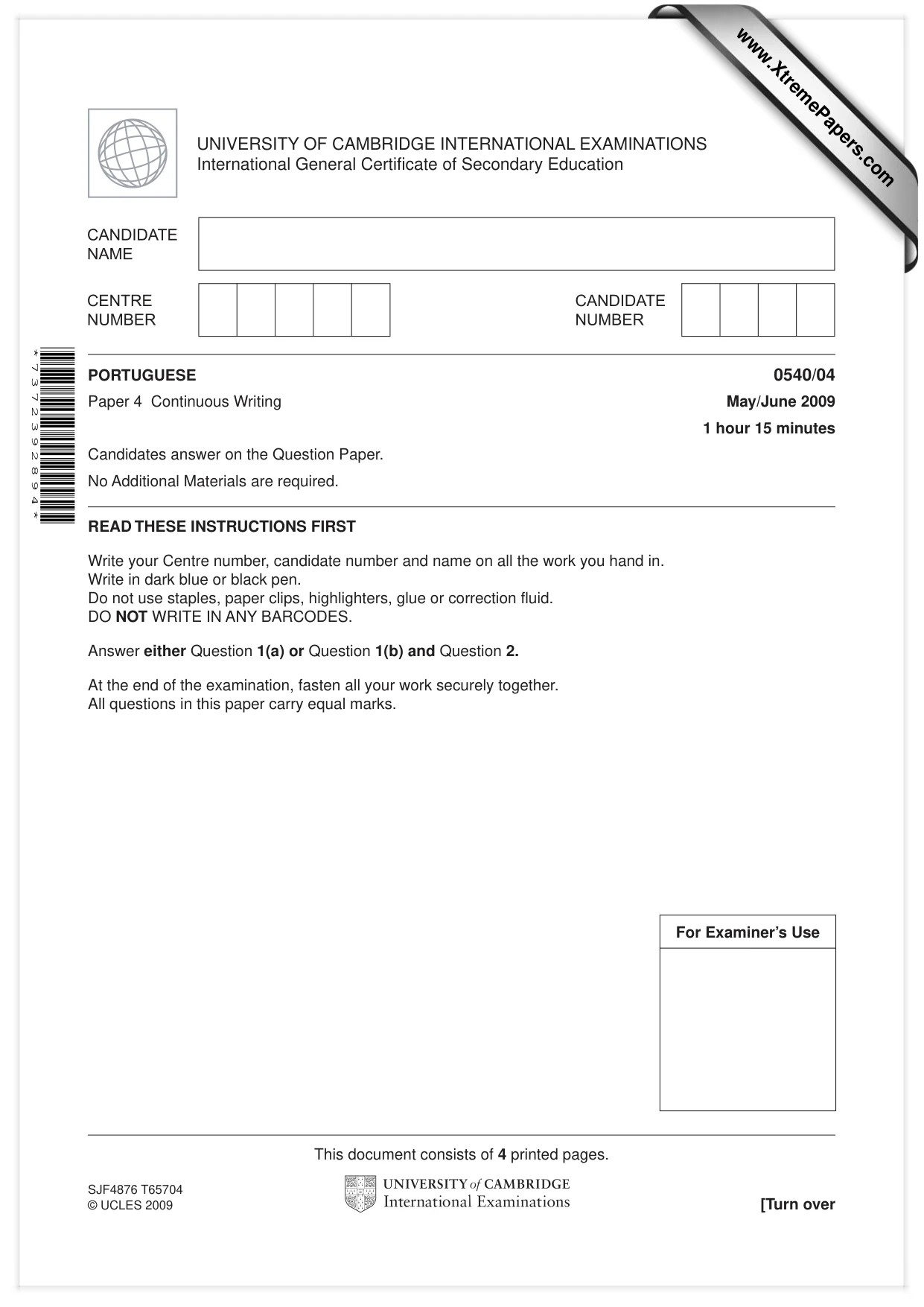
Question paper, page 1
This document consists of 4 printed pages. SJF4876 T65704 © UCLES 2009 [Turn over UNIVERSITY OF CAMBRIDGE INTERNATIONAL EXAMINATIONS International General Certificate of Secondary Education READ THESE INSTRUCTIONS FIRST Write your Centre number, candidate number and name on all the work you hand in. Write in dark blue or black pen. Do not use staples, paper clips, highlighters, glue or correction fluid. DO NOT WRITE IN ANY BARCODES. Answer either Question 1(a) or Question 1(b) and Question 2. At the end of the examination, fasten all your work securely together. All questions in this paper carry equal marks. * 7 3 7 2 3 9 2 8 9 4 * PORTUGUESE 0540/04 Paper 4 Continuous Writing May/June 2009 1 hour 15 minutes Candidates answer on the Question Paper. No Additional Materials are required. For Examiner’s Use www.XtremePapers.com
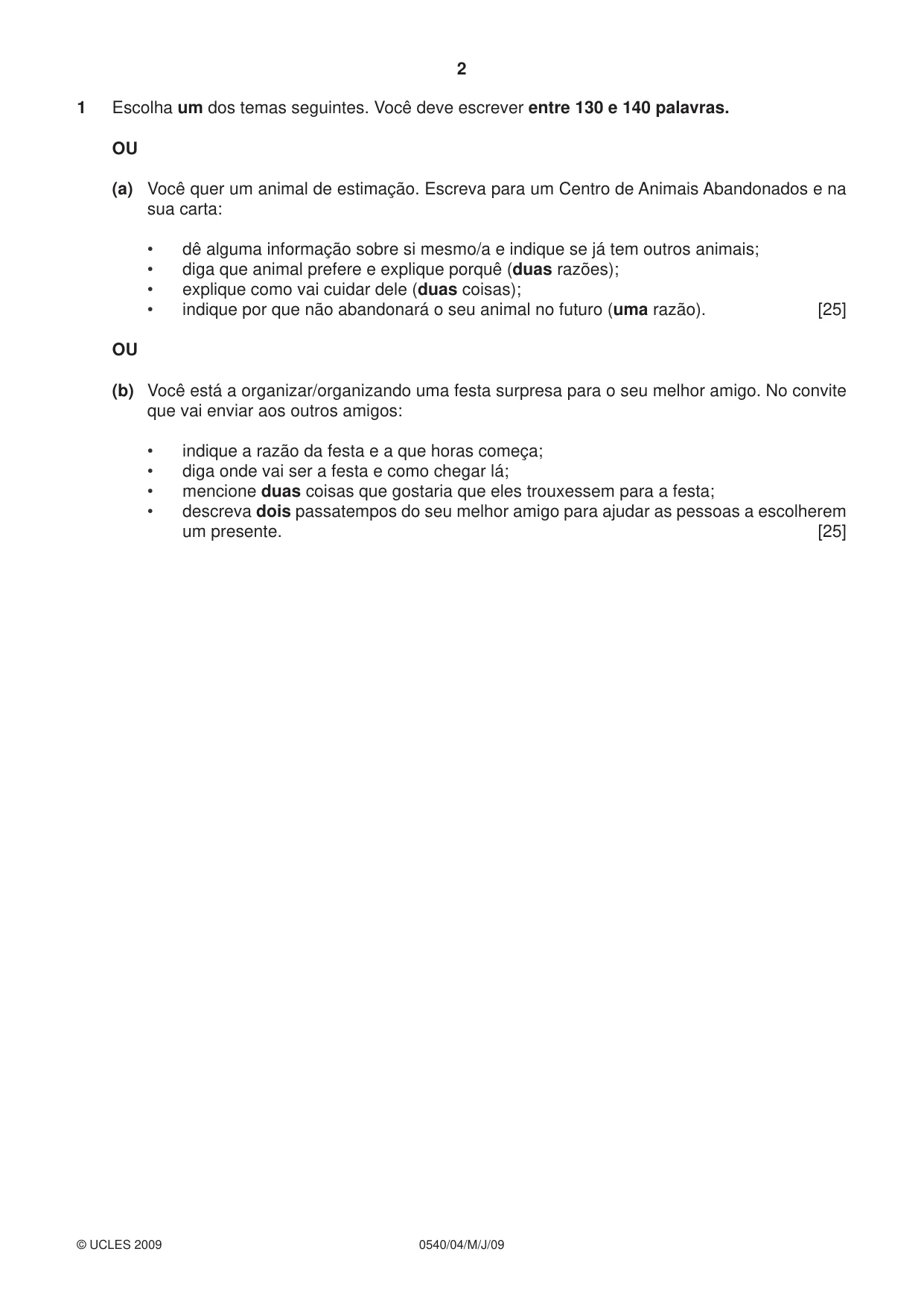
Question paper, page 2
2 0540/04/M/J/09 © UCLES 2009 1 Escolha um dos temas seguintes. Você deve escrever entre 130 e 140 palavras. OU (a) Você quer um animal de estimação. Escreva para um Centro de Animais Abandonados e na sua carta: • dê alguma informação sobre si mesmo/a e indique se já tem outros animais; • diga que animal prefere e explique porquê (duas razões); • explique como vai cuidar dele (duas coisas); • indique por que não abandonará o seu animal no futuro (uma razão). [25] OU (b) Você está a organizar/organizando uma festa surpresa para o seu melhor amigo. No convite que vai enviar aos outros amigos: • indique a razão da festa e a que horas começa; • diga onde vai ser a festa e como chegar lá; • mencione duas coisas que gostaria que eles trouxessem para a festa; • descreva dois passatempos do seu melhor amigo para ajudar as pessoas a escolherem um presente. [25]
Question paper, page 3
3 0540/04/M/J/09 © UCLES 2009 [Turn over For Examiner’s Use ESCREVA SOBRE O TEMA DA SUA ESCOLHA AQUI … … … … … … … … … … … … … … … … … … … … … … … … … … …
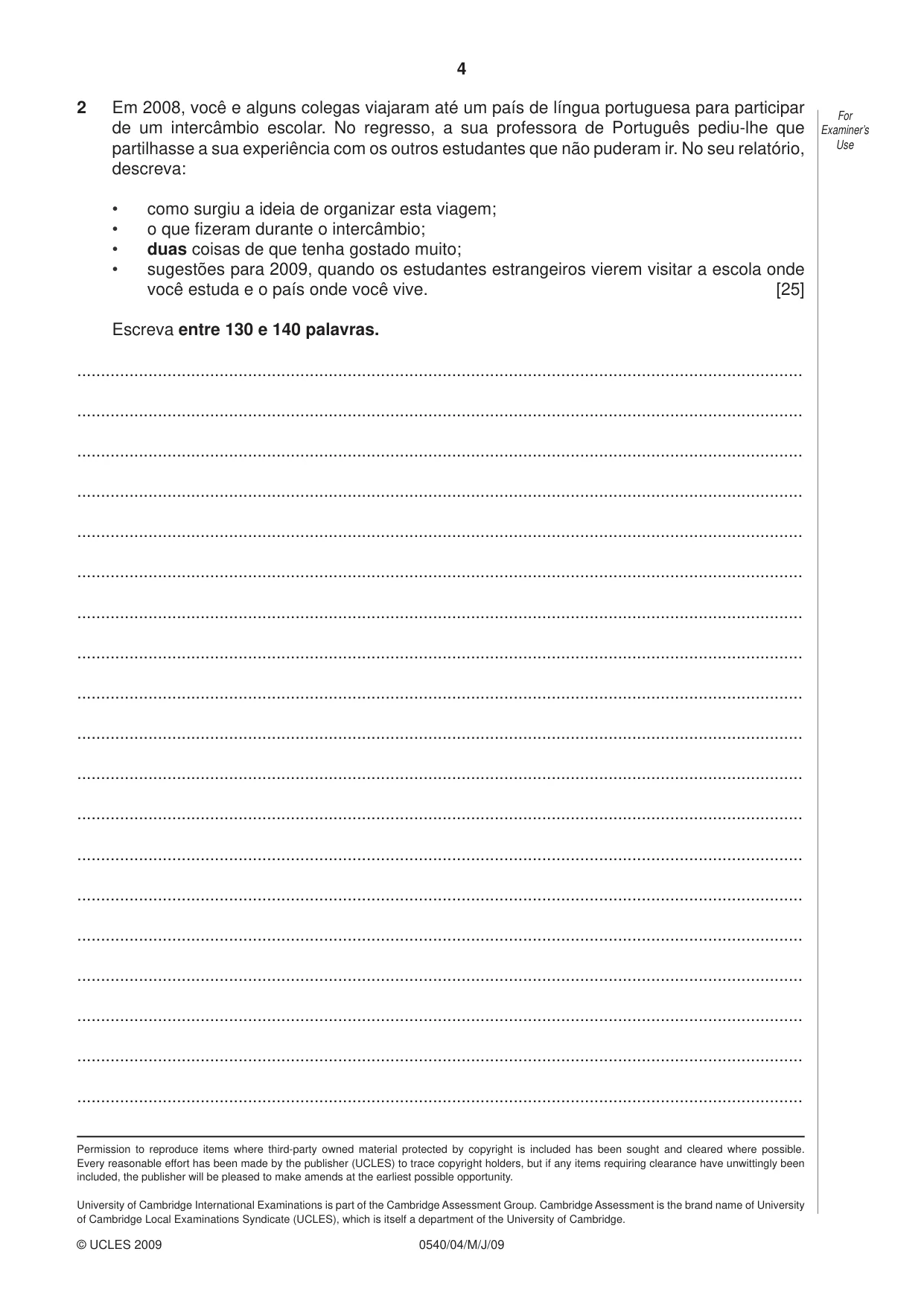
Question paper, page 4
4 0540/04/M/J/09 © UCLES 2009 For Examiner’s Use 2 Em 2008, você e alguns colegas viajaram até um país de língua portuguesa para participar de um intercâmbio escolar. No regresso, a sua professora de Português pediu-lhe que partilhasse a sua experiência com os outros estudantes que não puderam ir. No seu relatório, descreva: • como surgiu a ideia de organizar esta viagem; • o que fizeram durante o intercâmbio; • duas coisas de que tenha gostado muito; • sugestões para 2009, quando os estudantes estrangeiros vierem visitar a escola onde você estuda e o país onde você vive. [25] Escreva entre 130 e 140 palavras. … … … … … … … … … … … … … … … … … … … Permission to reproduce items where third-party owned material protected by copyright is included has been sought and cleared where possible. Every reasonable effort has been made by the publisher (UCLES) to trace copyright holders, but if any items requiring clearance have unwittingly been included, the publisher will be pleased to make amends at the earliest possible opportunity. University of Cambridge International Examinations is part of the Cambridge Assessment Group. Cambridge Assessment is the brand name of University of Cambridge Local Examinations Syndicate (UCLES), which is itself a department of the University of Cambridge.
Mark scheme, page 1
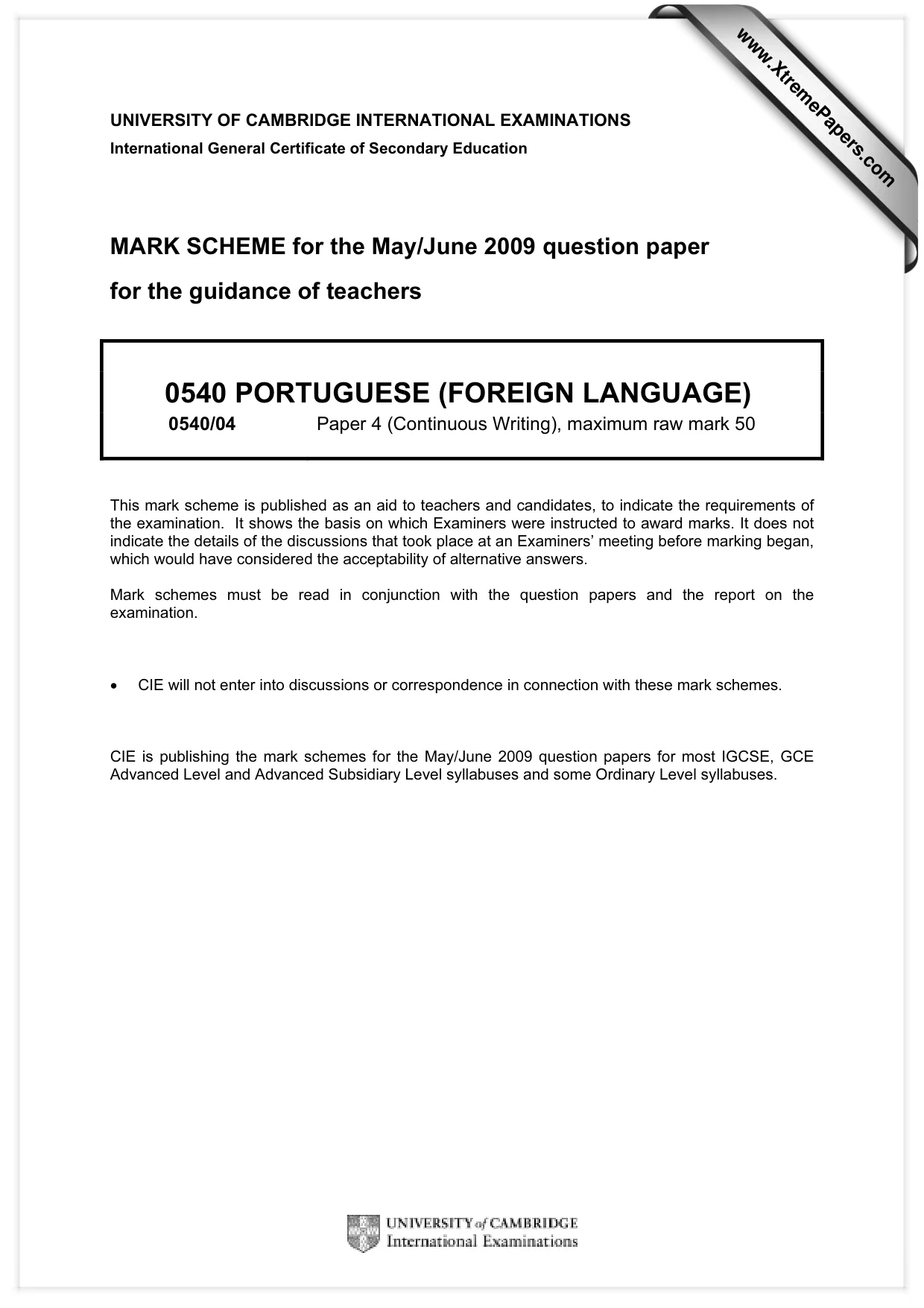
UNIVERSITY OF CAMBRIDGE INTERNATIONAL EXAMINATIONS International General Certificate of Secondary Education MARK SCHEME for the May/June 2009 question paper for the guidance of teachers 0540 PORTUGUESE (FOREIGN LANGUAGE) 0540/04 Paper 4 (Continuous Writing), maximum raw mark 50 This mark scheme is published as an aid to teachers and candidates, to indicate the requirements of the examination. It shows the basis on which Examiners were instructed to award marks. It does not indicate the details of the discussions that took place at an Examiners’ meeting before marking began, which would have considered the acceptability of alternative answers. Mark schemes must be read in conjunction with the question papers and the report on the examination. • CIE will not enter into discussions or correspondence in connection with these mark schemes. CIE is publishing the mark schemes for the May/June 2009 question papers for most IGCSE, GCE Advanced Level and Advanced Subsidiary Level syllabuses and some Ordinary Level syllabuses. www.XtremePapers.com
Mark scheme, page 2
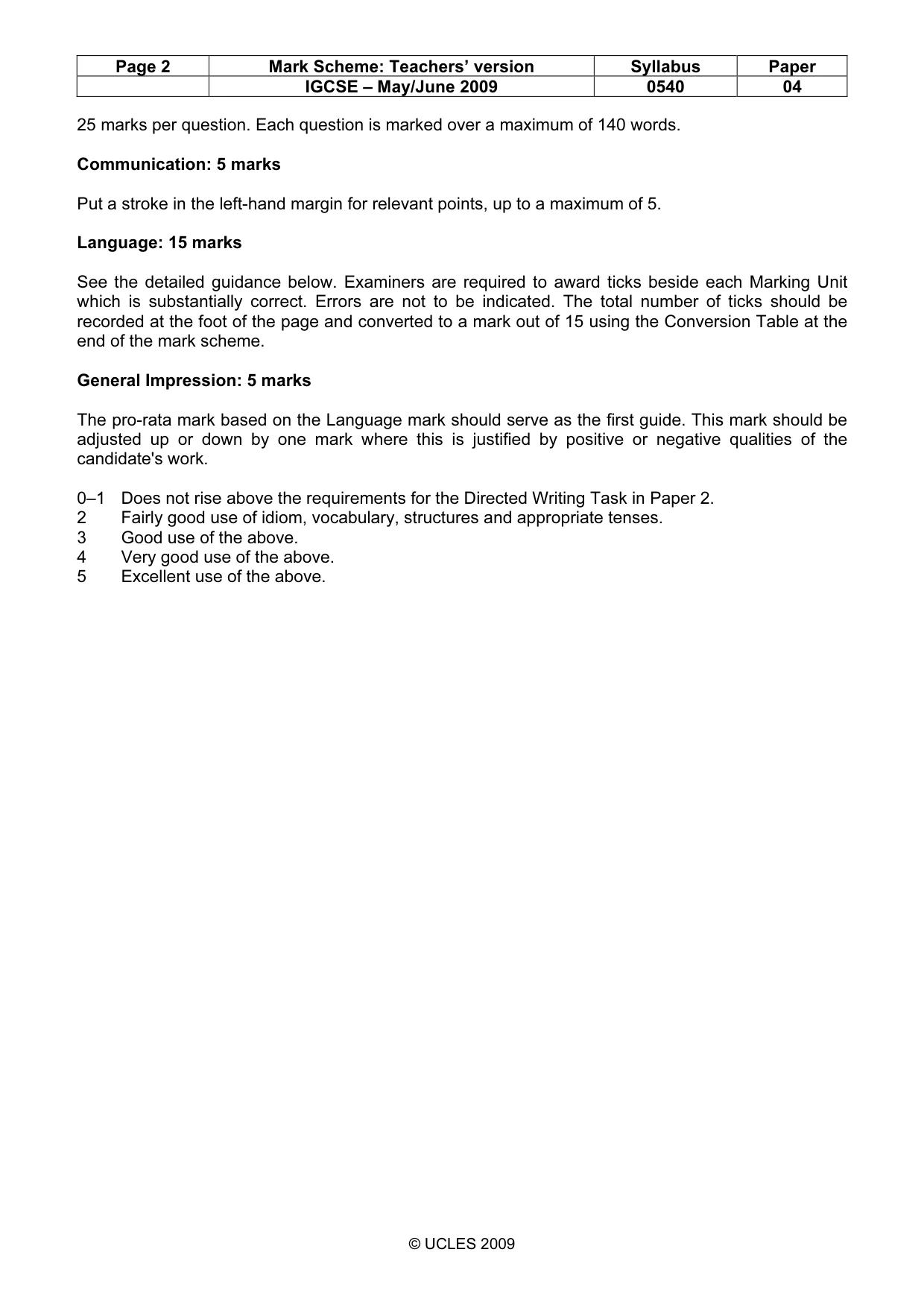
Page 2 Mark Scheme: Teachers’ version Syllabus Paper IGCSE – May/June 2009 0540 04 © UCLES 2009 25 marks per question. Each question is marked over a maximum of 140 words. Communication: 5 marks Put a stroke in the left-hand margin for relevant points, up to a maximum of 5. Language: 15 marks See the detailed guidance below. Examiners are required to award ticks beside each Marking Unit which is substantially correct. Errors are not to be indicated. The total number of ticks should be recorded at the foot of the page and converted to a mark out of 15 using the Conversion Table at the end of the mark scheme. General Impression: 5 marks The pro-rata mark based on the Language mark should serve as the first guide. This mark should be adjusted up or down by one mark where this is justified by positive or negative qualities of the candidate's work. 0–1 Does not rise above the requirements for the Directed Writing Task in Paper 2. 2 Fairly good use of idiom, vocabulary, structures and appropriate tenses. 3 Good use of the above. 4 Very good use of the above. 5 Excellent use of the above.
Mark scheme, page 3
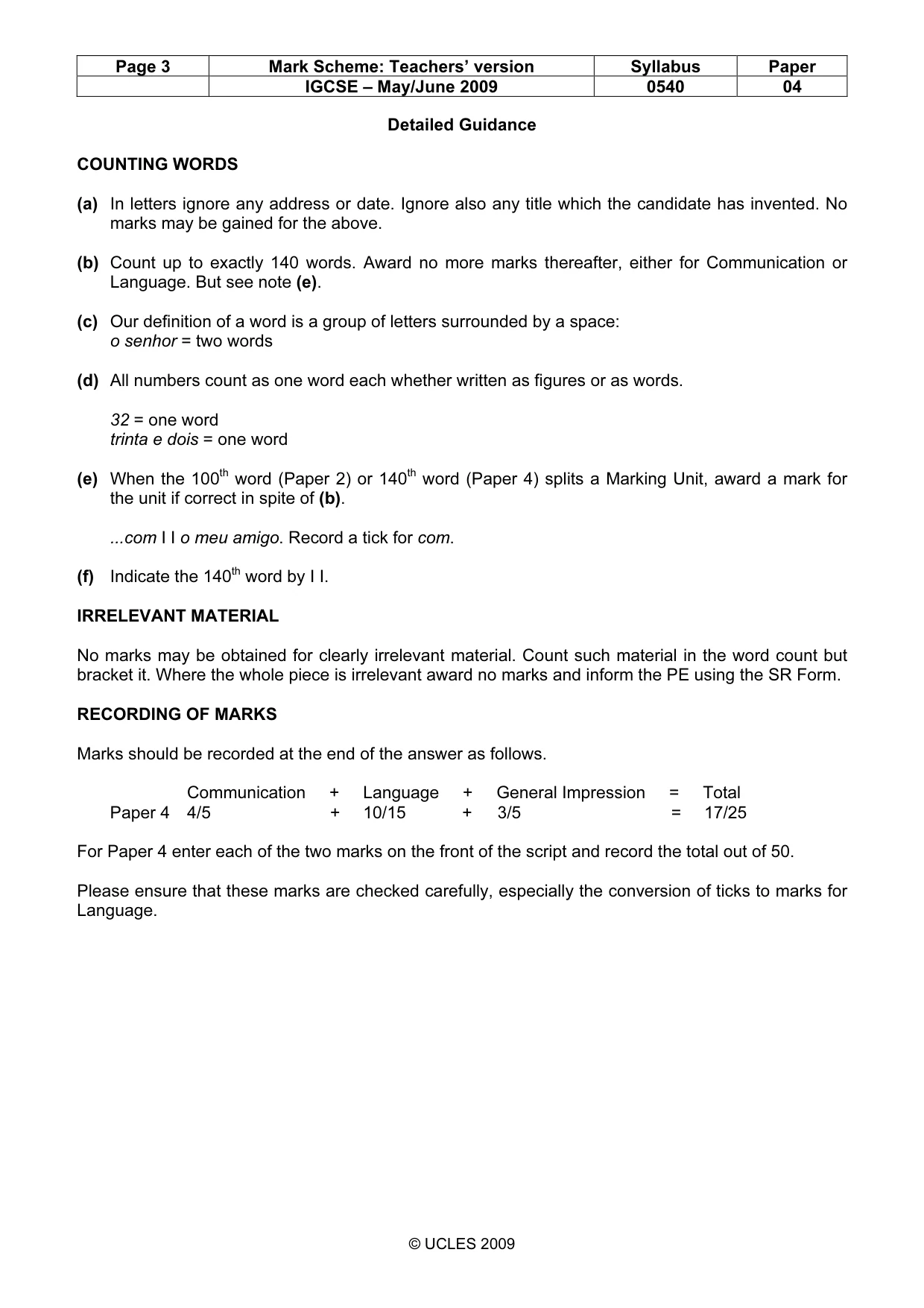
Page 3 Mark Scheme: Teachers’ version Syllabus Paper IGCSE – May/June 2009 0540 04 © UCLES 2009 Detailed Guidance COUNTING WORDS (a) In letters ignore any address or date. Ignore also any title which the candidate has invented. No marks may be gained for the above. (b) Count up to exactly 140 words. Award no more marks thereafter, either for Communication or Language. But see note (e). (c) Our definition of a word is a group of letters surrounded by a space: o senhor = two words (d) All numbers count as one word each whether written as figures or as words. 32 = one word trinta e dois = one word (e) When the 100th word (Paper 2) or 140th word (Paper 4) splits a Marking Unit, award a mark for the unit if correct in spite of (b). ...com I I o meu amigo. Record a tick for com. (f) Indicate the 140th word by I I. IRRELEVANT MATERIAL No marks may be obtained for clearly irrelevant material. Count such material in the word count but bracket it. Where the whole piece is irrelevant award no marks and inform the PE using the SR Form. RECORDING OF MARKS Marks should be recorded at the end of the answer as follows. Communication + Language + General Impression = Total Paper 4 4/5 + 10/15 + 3/5 = 17/25 For Paper 4 enter each of the two marks on the front of the script and record the total out of 50. Please ensure that these marks are checked carefully, especially the conversion of ticks to marks for Language.
Mark scheme, page 4
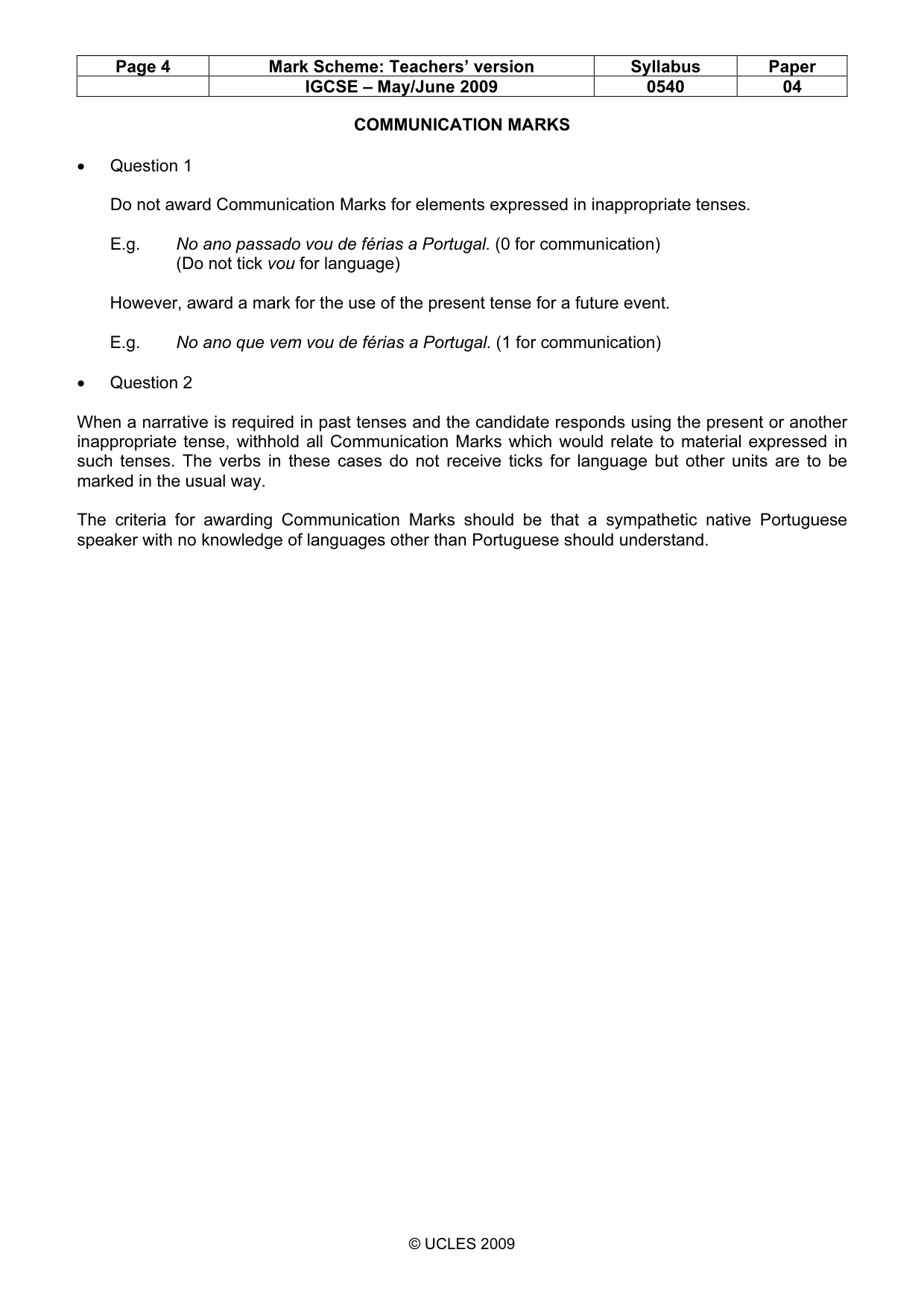
Page 4 Mark Scheme: Teachers’ version Syllabus Paper IGCSE – May/June 2009 0540 04 © UCLES 2009 COMMUNICATION MARKS • Question 1 Do not award Communication Marks for elements expressed in inappropriate tenses. E.g. No ano passado vou de férias a Portugal. (0 for communication) (Do not tick vou for language) However, award a mark for the use of the present tense for a future event. E.g. No ano que vem vou de férias a Portugal. (1 for communication) • Question 2 When a narrative is required in past tenses and the candidate responds using the present or another inappropriate tense, withhold all Communication Marks which would relate to material expressed in such tenses. The verbs in these cases do not receive ticks for language but other units are to be marked in the usual way. The criteria for awarding Communication Marks should be that a sympathetic native Portuguese speaker with no knowledge of languages other than Portuguese should understand.
Mark scheme, page 5
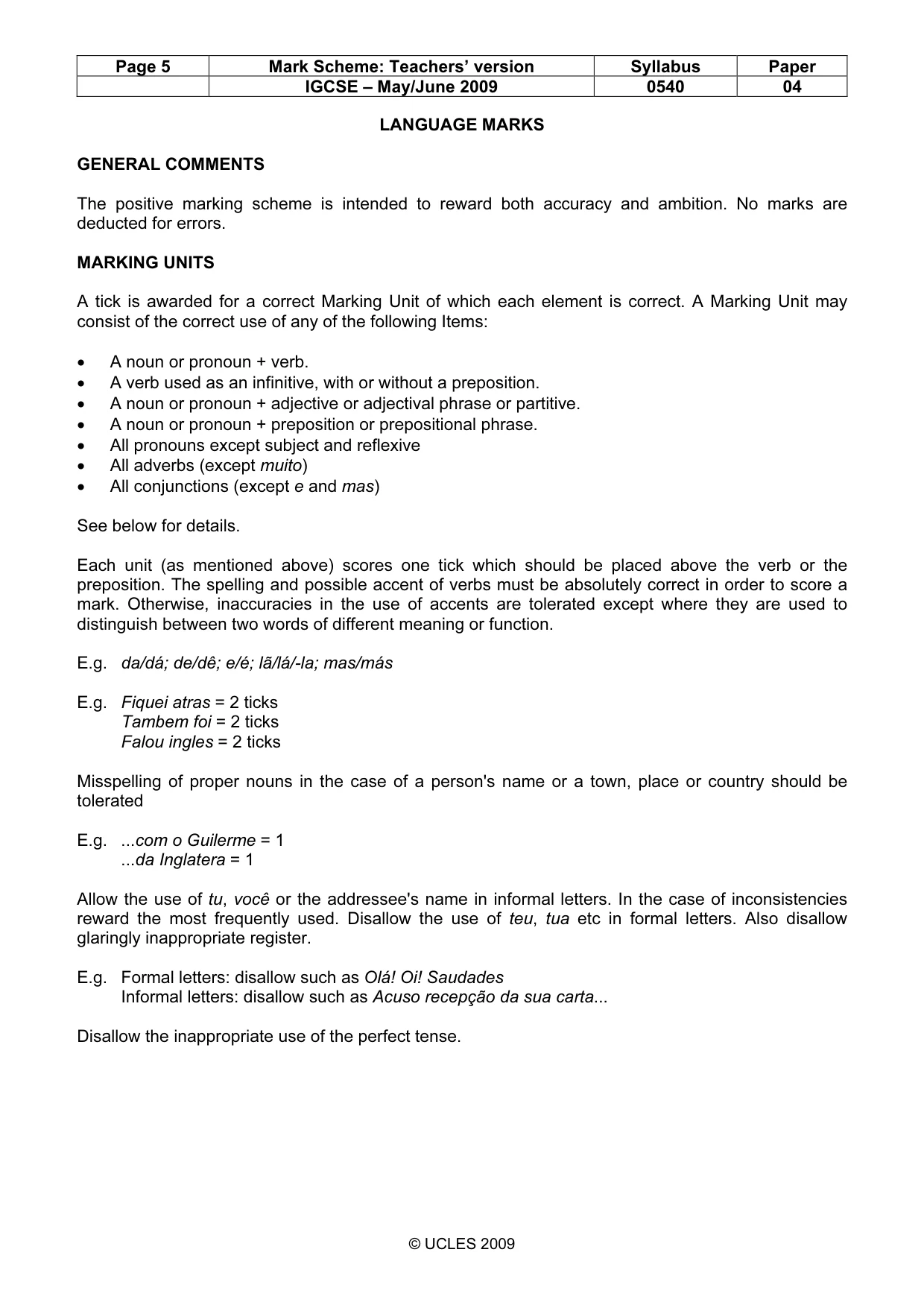
Page 5 Mark Scheme: Teachers’ version Syllabus Paper IGCSE – May/June 2009 0540 04 © UCLES 2009 LANGUAGE MARKS GENERAL COMMENTS The positive marking scheme is intended to reward both accuracy and ambition. No marks are deducted for errors. MARKING UNITS A tick is awarded for a correct Marking Unit of which each element is correct. A Marking Unit may consist of the correct use of any of the following Items: • A noun or pronoun + verb. • A verb used as an infinitive, with or without a preposition. • A noun or pronoun + adjective or adjectival phrase or partitive. • A noun or pronoun + preposition or prepositional phrase. • All pronouns except subject and reflexive • All adverbs (except muito) • All conjunctions (except e and mas) See below for details. Each unit (as mentioned above) scores one tick which should be placed above the verb or the preposition. The spelling and possible accent of verbs must be absolutely correct in order to score a mark. Otherwise, inaccuracies in the use of accents are tolerated except where they are used to distinguish between two words of different meaning or function. E.g. da/dá; de/dê; e/é; lã/lá/-la; mas/más E.g. Fiquei atras = 2 ticks Tambem foi = 2 ticks Falou ingles = 2 ticks Misspelling of proper nouns in the case of a person's name or a town, place or country should be tolerated E.g. ...com o Guilerme = 1 ...da Inglatera = 1 Allow the use of tu, você or the addressee's name in informal letters. In the case of inconsistencies reward the most frequently used. Disallow the use of teu, tua etc in formal letters. Also disallow glaringly inappropriate register. E.g. Formal letters: disallow such as Olá! Oi! Saudades Informal letters: disallow such as Acuso recepção da sua carta... Disallow the inappropriate use of the perfect tense.
Mark scheme, page 6
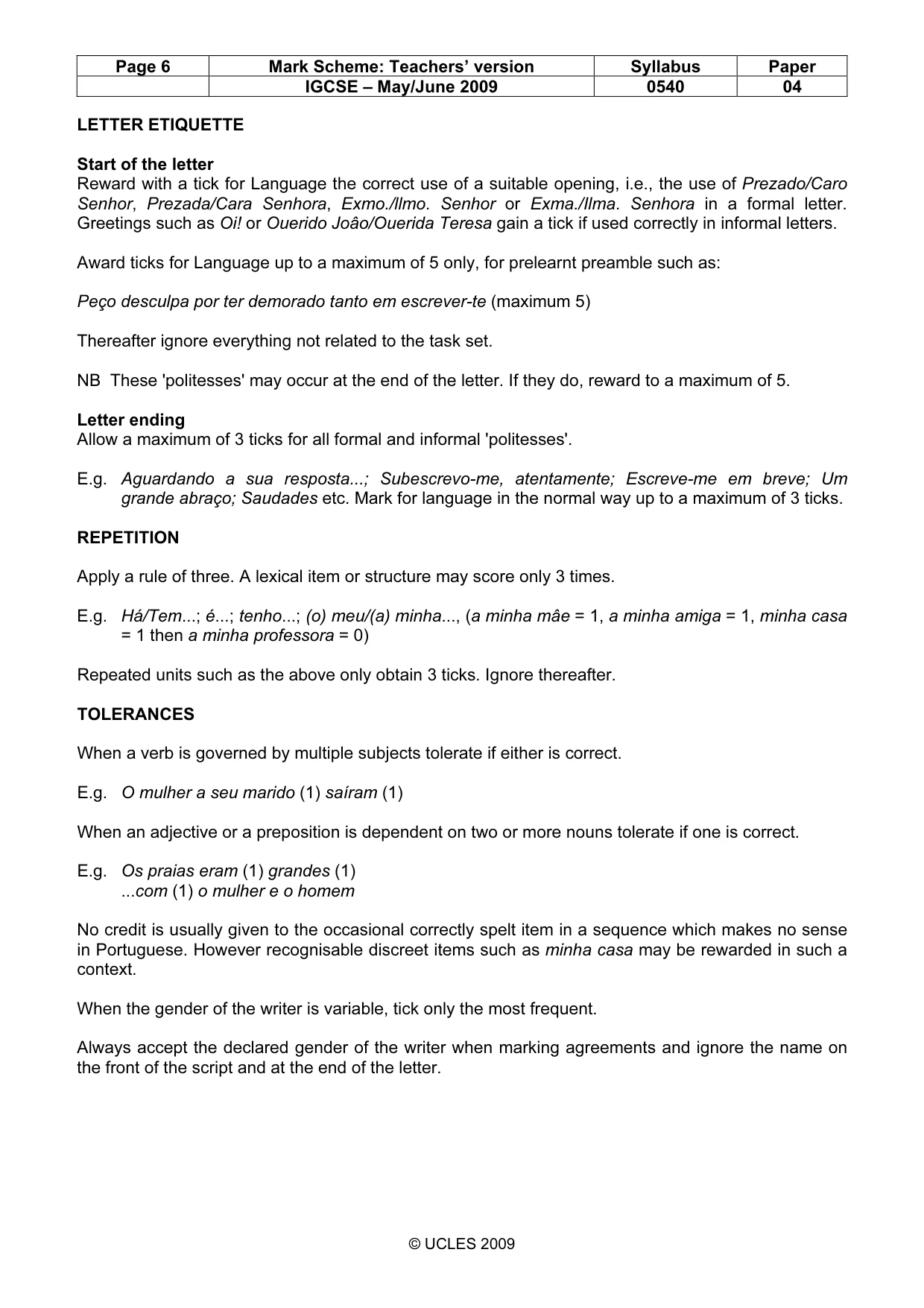
Page 6 Mark Scheme: Teachers’ version Syllabus Paper IGCSE – May/June 2009 0540 04 © UCLES 2009 LETTER ETIQUETTE Start of the letter Reward with a tick for Language the correct use of a suitable opening, i.e., the use of Prezado/Caro Senhor, Prezada/Cara Senhora, Exmo./llmo. Senhor or Exma./Ilma. Senhora in a formal letter. Greetings such as Oi! or Ouerido Joâo/Ouerida Teresa gain a tick if used correctly in informal letters. Award ticks for Language up to a maximum of 5 only, for prelearnt preamble such as: Peço desculpa por ter demorado tanto em escrever-te (maximum 5) Thereafter ignore everything not related to the task set. NB These 'politesses' may occur at the end of the letter. If they do, reward to a maximum of 5. Letter ending Allow a maximum of 3 ticks for all formal and informal 'politesses'. E.g. Aguardando a sua resposta...; Subescrevo-me, atentamente; Escreve-me em breve; Um grande abraço; Saudades etc. Mark for language in the normal way up to a maximum of 3 ticks. REPETITION Apply a rule of three. A lexical item or structure may score only 3 times. E.g. Há/Tem...; é...; tenho...; (o) meu/(a) minha..., (a minha mâe = 1, a minha amiga = 1, minha casa = 1 then a minha professora = 0) Repeated units such as the above only obtain 3 ticks. Ignore thereafter. TOLERANCES When a verb is governed by multiple subjects tolerate if either is correct. E.g. O mulher a seu marido (1) saíram (1) When an adjective or a preposition is dependent on two or more nouns tolerate if one is correct. E.g. Os praias eram (1) grandes (1) ...com (1) o mulher e o homem No credit is usually given to the occasional correctly spelt item in a sequence which makes no sense in Portuguese. However recognisable discreet items such as minha casa may be rewarded in such a context. When the gender of the writer is variable, tick only the most frequent. Always accept the declared gender of the writer when marking agreements and ignore the name on the front of the script and at the end of the letter.
Mark scheme, page 7
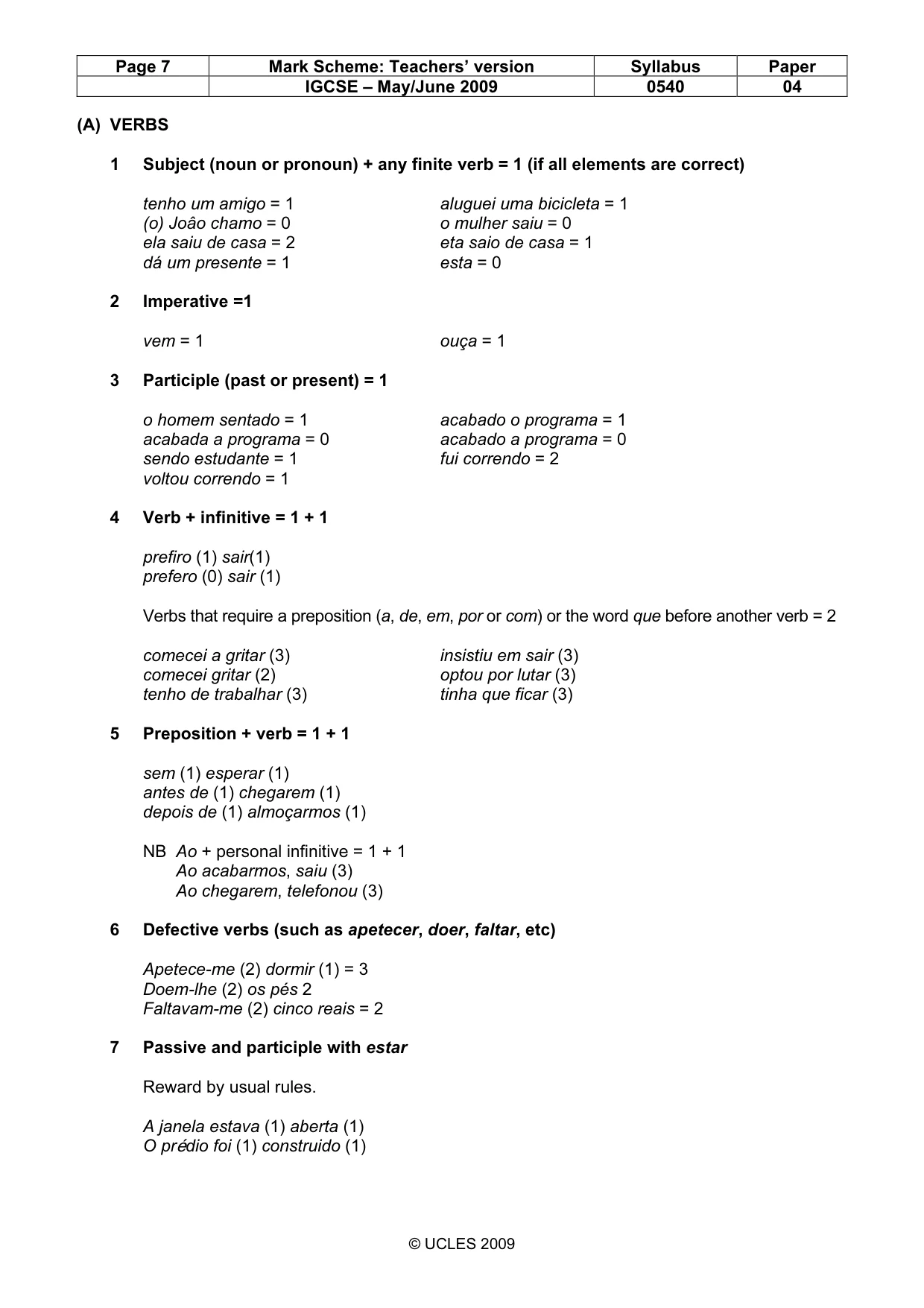
Page 7 Mark Scheme: Teachers’ version Syllabus Paper IGCSE – May/June 2009 0540 04 © UCLES 2009 (A) VERBS 1 Subject (noun or pronoun) + any finite verb = 1 (if all elements are correct) tenho um amigo = 1 aluguei uma bicicleta = 1 (o) Joâo chamo = 0 o mulher saiu = 0 ela saiu de casa = 2 eta saio de casa = 1 dá um presente = 1 esta = 0 2 Imperative =1 vem = 1 ouça = 1 3 Participle (past or present) = 1 o homem sentado = 1 acabado o programa = 1 acabada a programa = 0 acabado a programa = 0 sendo estudante = 1 fui correndo = 2 voltou correndo = 1 4 Verb + infinitive = 1 + 1 prefiro (1) sair(1) prefero (0) sair (1) Verbs that require a preposition (a, de, em, por or com) or the word que before another verb = 2 comecei a gritar (3) insistiu em sair (3) comecei gritar (2) optou por lutar (3) tenho de trabalhar (3) tinha que ficar (3) 5 Preposition + verb = 1 + 1 sem (1) esperar (1) antes de (1) chegarem (1) depois de (1) almoçarmos (1) NB Ao + personal infinitive = 1 + 1 Ao acabarmos, saiu (3) Ao chegarem, telefonou (3) 6 Defective verbs (such as apetecer, doer, faltar, etc) Apetece-me (2) dormir (1) = 3 Doem-lhe (2) os pés 2 Faltavam-me (2) cinco reais = 2 7 Passive and participle with estar Reward by usual rules. A janela estava (1) aberta (1) O prédio foi (1) construido (1)
Mark scheme, page 8
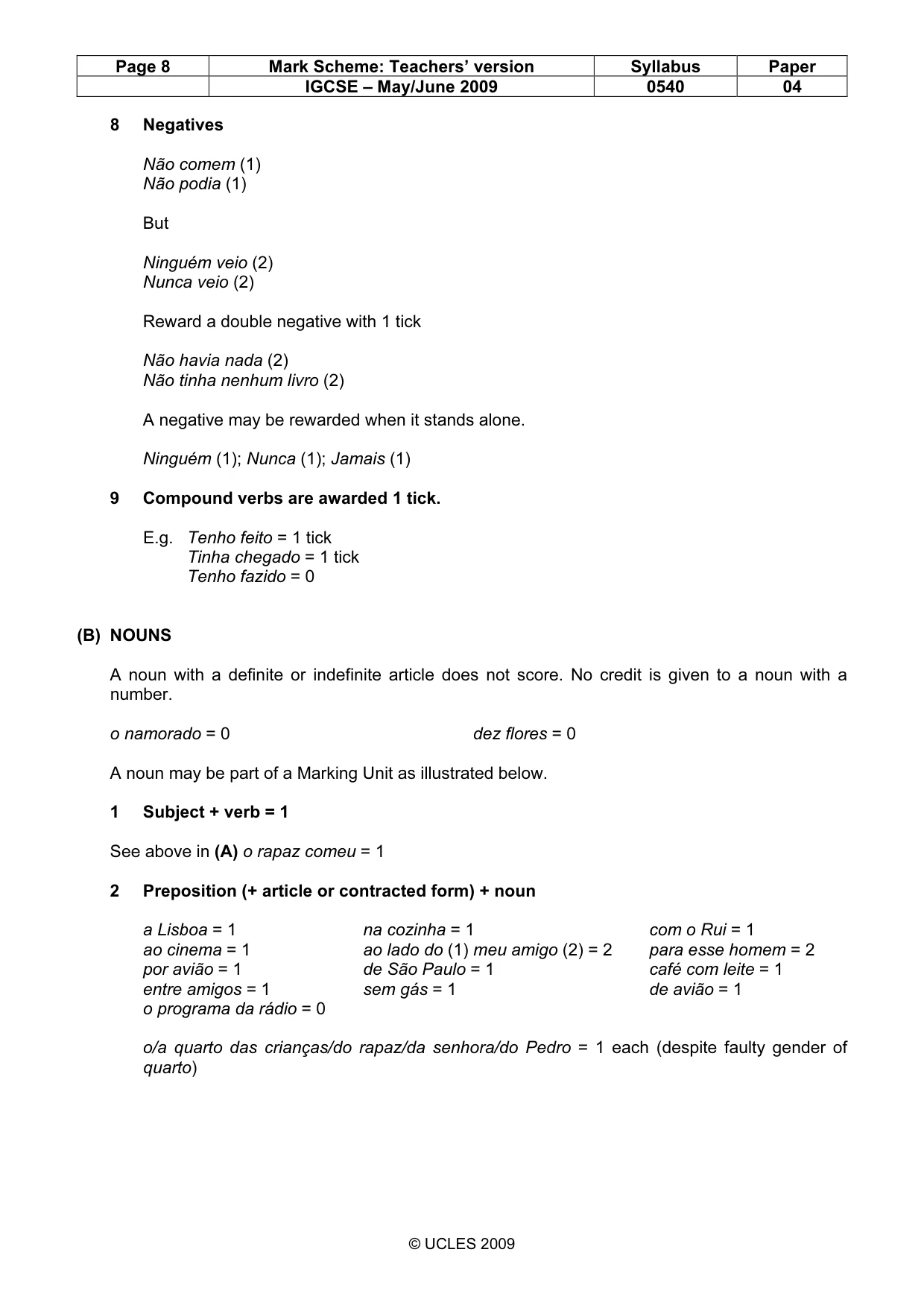
Page 8 Mark Scheme: Teachers’ version Syllabus Paper IGCSE – May/June 2009 0540 04 © UCLES 2009 8 Negatives Não comem (1) Não podia (1) But Ninguém veio (2) Nunca veio (2) Reward a double negative with 1 tick Não havia nada (2) Não tinha nenhum livro (2) A negative may be rewarded when it stands alone. Ninguém (1); Nunca (1); Jamais (1) 9 Compound verbs are awarded 1 tick. E.g. Tenho feito = 1 tick Tinha chegado = 1 tick Tenho fazido = 0 (B) NOUNS A noun with a definite or indefinite article does not score. No credit is given to a noun with a number. o namorado = 0 dez flores = 0 A noun may be part of a Marking Unit as illustrated below. 1 Subject + verb = 1 See above in (A) o rapaz comeu = 1 2 Preposition (+ article or contracted form) + noun a Lisboa = 1 na cozinha = 1 com o Rui = 1 ao cinema = 1 ao lado do (1) meu amigo (2) = 2 para esse homem = 2 por avião = 1 de São Paulo = 1 café com leite = 1 entre amigos = 1 sem gás = 1 de avião = 1 o programa da rádio = 0 o/a quarto das crianças/do rapaz/da senhora/do Pedro = 1 each (despite faulty gender of quarto)
Mark scheme, page 9
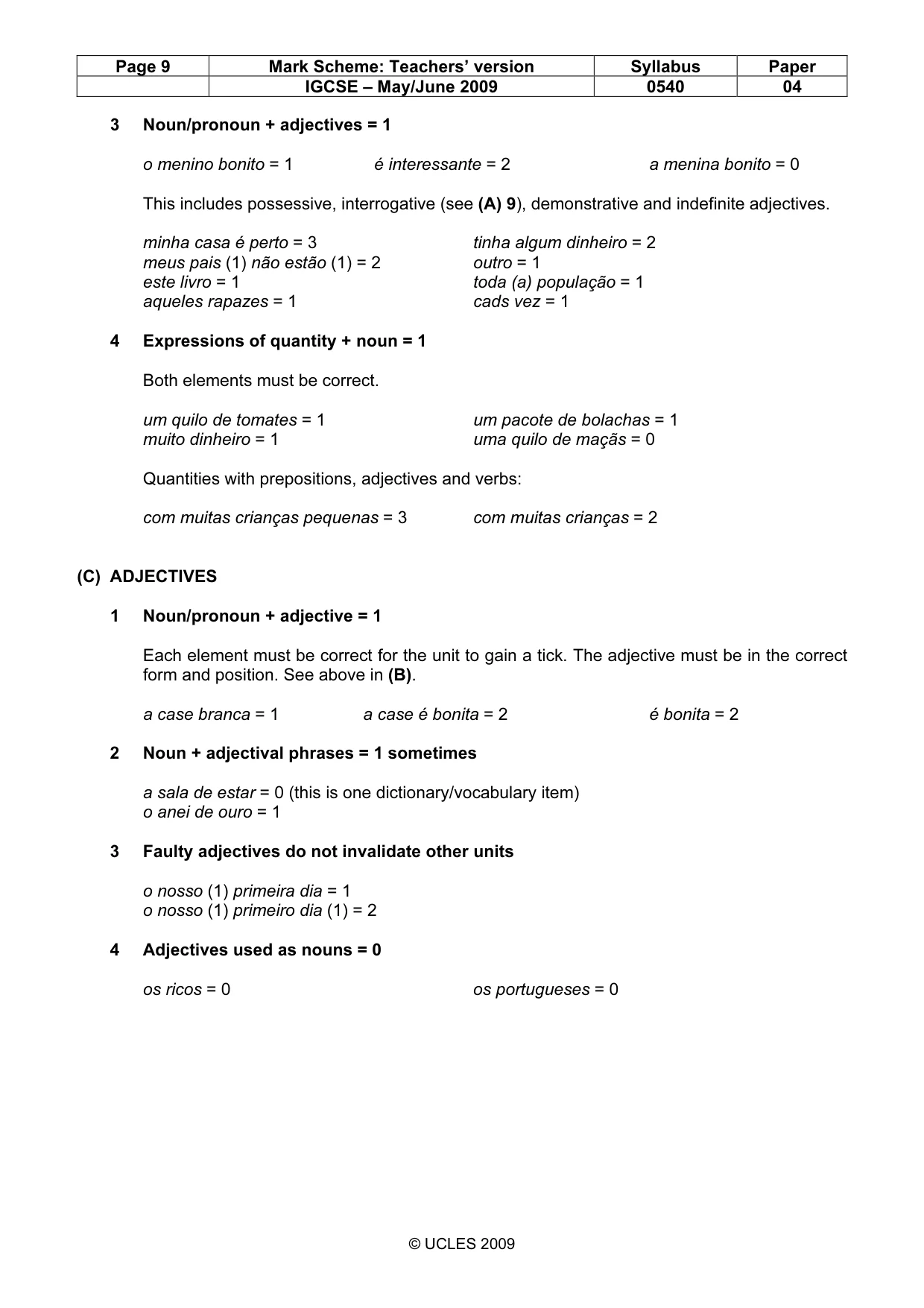
Page 9 Mark Scheme: Teachers’ version Syllabus Paper IGCSE – May/June 2009 0540 04 © UCLES 2009 3 Noun/pronoun + adjectives = 1 o menino bonito = 1 é interessante = 2 a menina bonito = 0 This includes possessive, interrogative (see (A) 9), demonstrative and indefinite adjectives. minha casa é perto = 3 tinha algum dinheiro = 2 meus pais (1) não estão (1) = 2 outro = 1 este livro = 1 toda (a) população = 1 aqueles rapazes = 1 cads vez = 1 4 Expressions of quantity + noun = 1 Both elements must be correct. um quilo de tomates = 1 um pacote de bolachas = 1 muito dinheiro = 1 uma quilo de maçãs = 0 Quantities with prepositions, adjectives and verbs: com muitas crianças pequenas = 3 com muitas crianças = 2 (C) ADJECTIVES 1 Noun/pronoun + adjective = 1 Each element must be correct for the unit to gain a tick. The adjective must be in the correct form and position. See above in (B). a case branca = 1 a case é bonita = 2 é bonita = 2 2 Noun + adjectival phrases = 1 sometimes a sala de estar = 0 (this is one dictionary/vocabulary item) o anei de ouro = 1 3 Faulty adjectives do not invalidate other units o nosso (1) primeira dia = 1 o nosso (1) primeiro dia (1) = 2 4 Adjectives used as nouns = 0 os ricos = 0 os portugueses = 0
Mark scheme, page 10
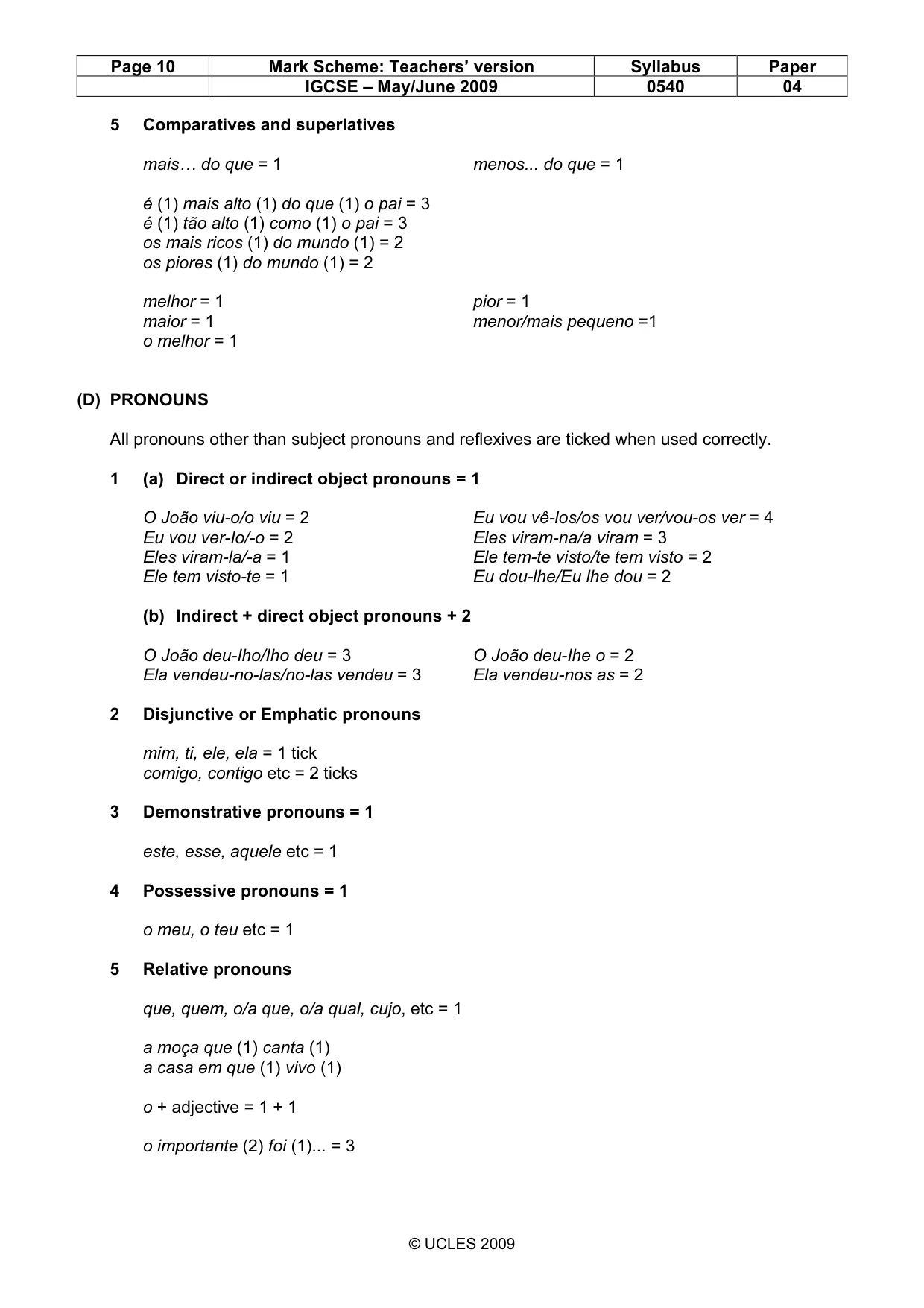
Page 10 Mark Scheme: Teachers’ version Syllabus Paper IGCSE – May/June 2009 0540 04 © UCLES 2009 5 Comparatives and superlatives mais… do que = 1 menos... do que = 1 é (1) mais alto (1) do que (1) o pai = 3 é (1) tão alto (1) como (1) o pai = 3 os mais ricos (1) do mundo (1) = 2 os piores (1) do mundo (1) = 2 melhor = 1 pior = 1 maior = 1 menor/mais pequeno =1 o melhor = 1 (D) PRONOUNS All pronouns other than subject pronouns and reflexives are ticked when used correctly. 1 (a) Direct or indirect object pronouns = 1 O João viu-o/o viu = 2 Eu vou vê-los/os vou ver/vou-os ver = 4 Eu vou ver-Io/-o = 2 Eles viram-na/a viram = 3 Eles viram-la/-a = 1 Ele tem-te visto/te tem visto = 2 Ele tem visto-te = 1 Eu dou-lhe/Eu lhe dou = 2 (b) Indirect + direct object pronouns + 2 O João deu-Iho/Iho deu = 3 O João deu-Ihe o = 2 Ela vendeu-no-las/no-las vendeu = 3 Ela vendeu-nos as = 2 2 Disjunctive or Emphatic pronouns mim, ti, ele, ela = 1 tick comigo, contigo etc = 2 ticks 3 Demonstrative pronouns = 1 este, esse, aquele etc = 1 4 Possessive pronouns = 1 o meu, o teu etc = 1 5 Relative pronouns que, quem, o/a que, o/a qual, cujo, etc = 1 a moça que (1) canta (1) a casa em que (1) vivo (1) o + adjective = 1 + 1 o importante (2) foi (1)... = 3
Mark scheme, page 11
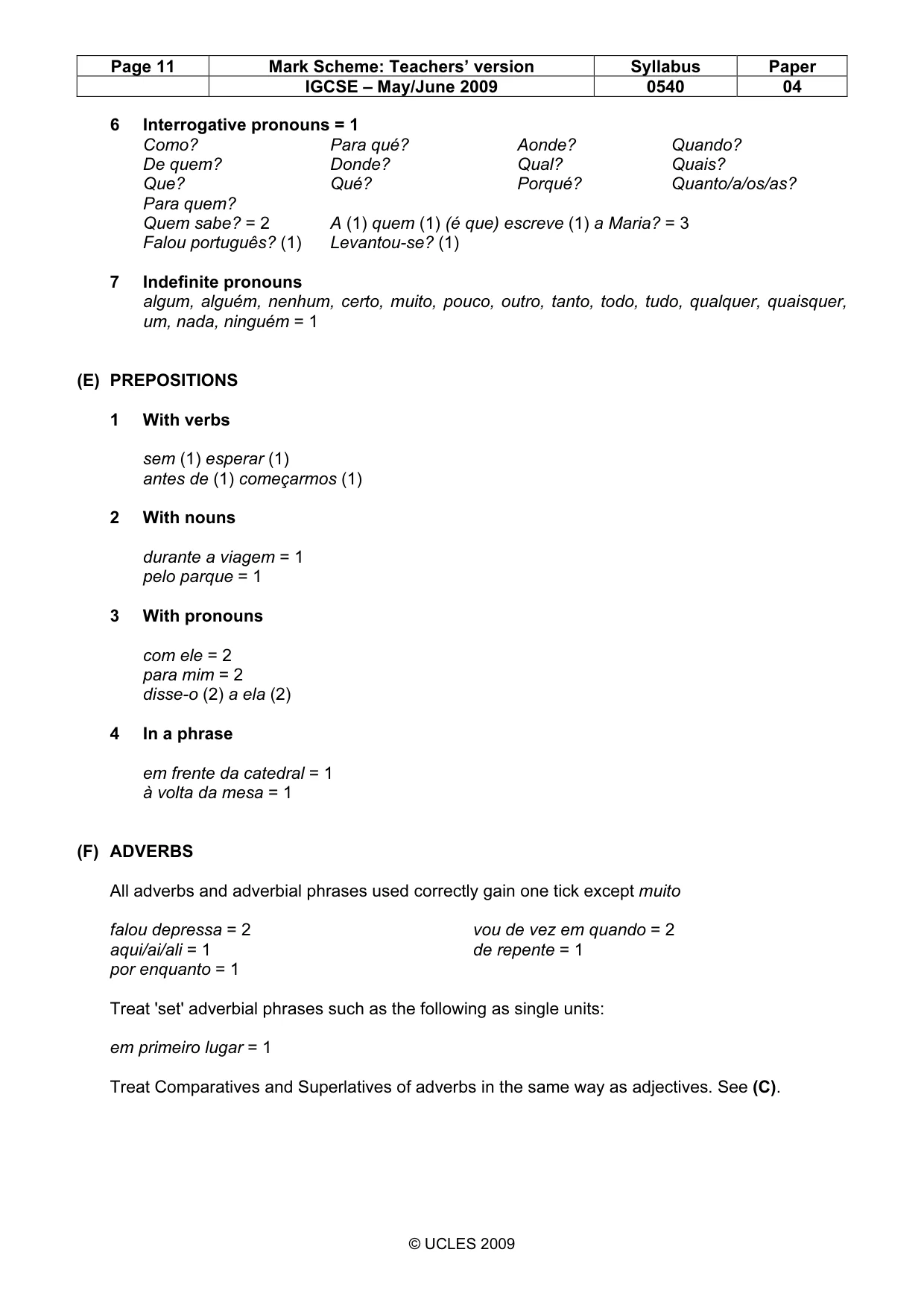
Page 11 Mark Scheme: Teachers’ version Syllabus Paper IGCSE – May/June 2009 0540 04 © UCLES 2009 6 Interrogative pronouns = 1 Como? Para qué? Aonde? Quando? De quem? Donde? Qual? Quais? Que? Qué? Porqué? Quanto/a/os/as? Para quem? Quem sabe? = 2 A (1) quem (1) (é que) escreve (1) a Maria? = 3 Falou português? (1) Levantou-se? (1) 7 Indefinite pronouns algum, alguém, nenhum, certo, muito, pouco, outro, tanto, todo, tudo, qualquer, quaisquer, um, nada, ninguém = 1 (E) PREPOSITIONS 1 With verbs sem (1) esperar (1) antes de (1) começarmos (1) 2 With nouns durante a viagem = 1 pelo parque = 1 3 With pronouns com ele = 2 para mim = 2 disse-o (2) a ela (2) 4 In a phrase em frente da catedral = 1 à volta da mesa = 1 (F) ADVERBS All adverbs and adverbial phrases used correctly gain one tick except muito falou depressa = 2 vou de vez em quando = 2 aqui/ai/ali = 1 de repente = 1 por enquanto = 1 Treat 'set' adverbial phrases such as the following as single units: em primeiro lugar = 1 Treat Comparatives and Superlatives of adverbs in the same way as adjectives. See (C).
Mark scheme, page 12
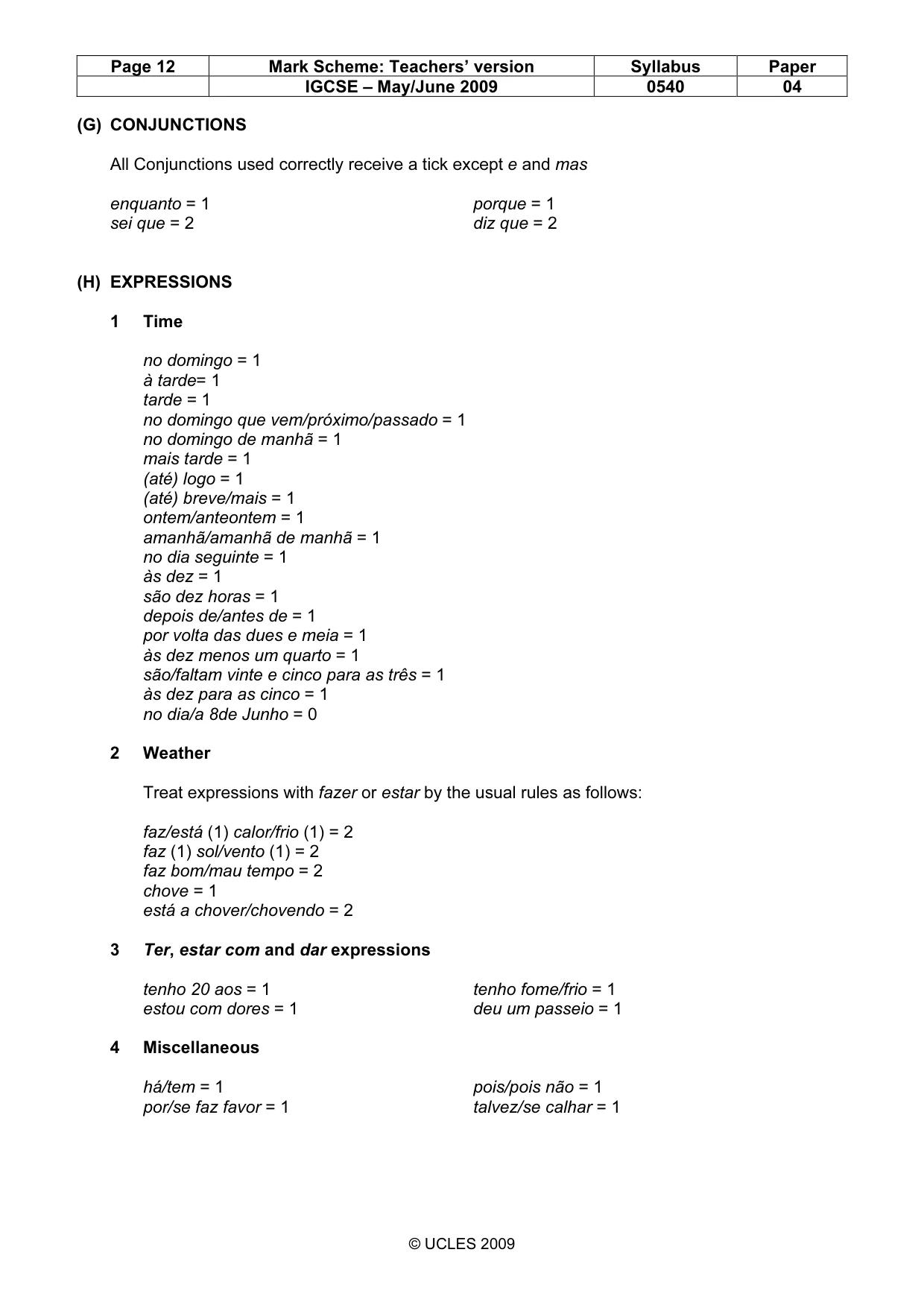
Page 12 Mark Scheme: Teachers’ version Syllabus Paper IGCSE – May/June 2009 0540 04 © UCLES 2009 (G) CONJUNCTIONS All Conjunctions used correctly receive a tick except e and mas enquanto = 1 porque = 1 sei que = 2 diz que = 2 (H) EXPRESSIONS 1 Time no domingo = 1 à tarde= 1 tarde = 1 no domingo que vem/próximo/passado = 1 no domingo de manhã = 1 mais tarde = 1 (até) logo = 1 (até) breve/mais = 1 ontem/anteontem = 1 amanhã/amanhã de manhã = 1 no dia seguinte = 1 às dez = 1 são dez horas = 1 depois de/antes de = 1 por volta das dues e meia = 1 às dez menos um quarto = 1 são/faltam vinte e cinco para as três = 1 às dez para as cinco = 1 no dia/a 8de Junho = 0 2 Weather Treat expressions with fazer or estar by the usual rules as follows: faz/está (1) calor/frio (1) = 2 faz (1) sol/vento (1) = 2 faz bom/mau tempo = 2 chove = 1 está a chover/chovendo = 2 3 Ter, estar com and dar expressions tenho 20 aos = 1 tenho fome/frio = 1 estou com dores = 1 deu um passeio = 1 4 Miscellaneous há/tem = 1 pois/pois não = 1 por/se faz favor = 1 talvez/se calhar = 1
Mark scheme, page 13
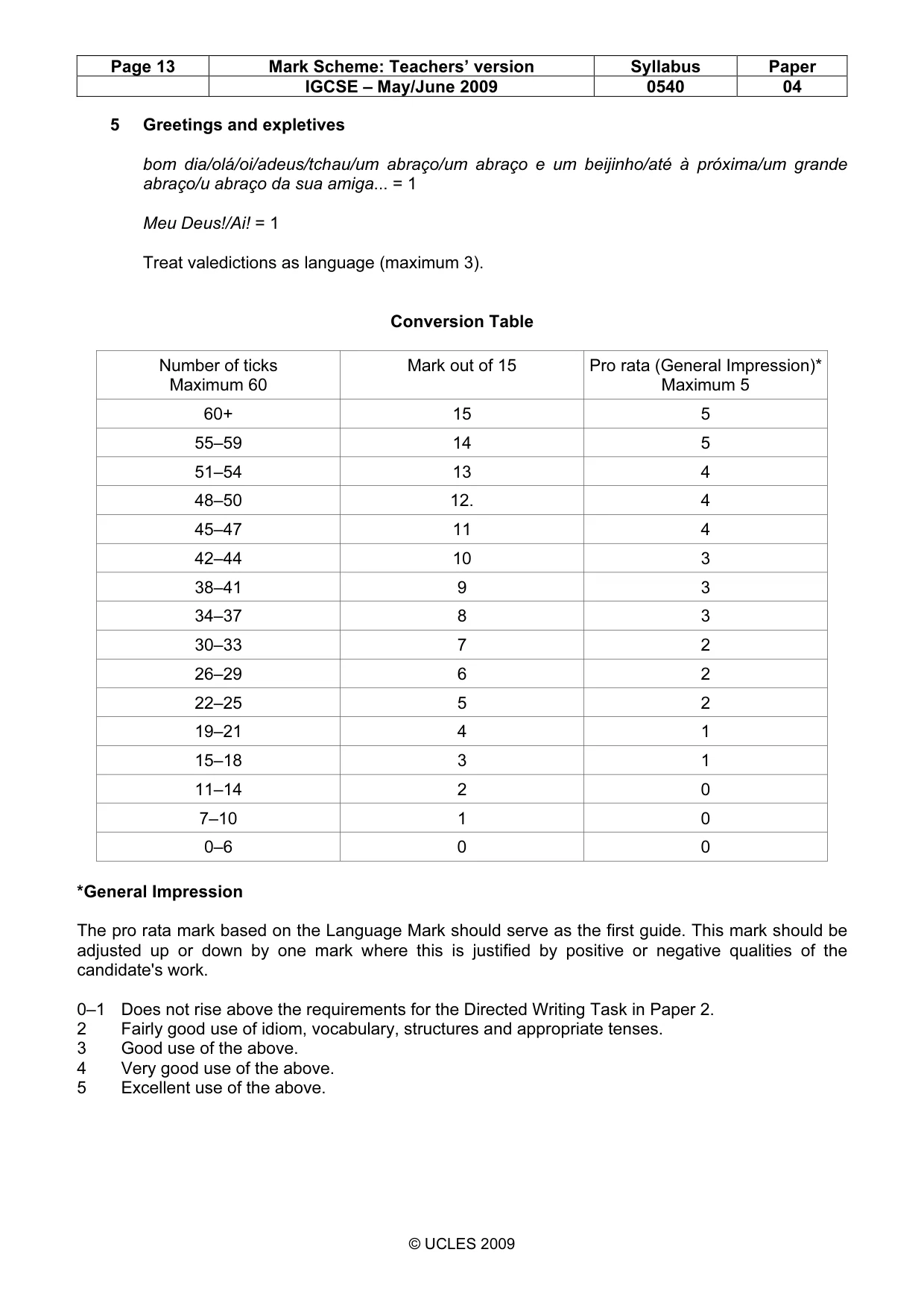
Page 13 Mark Scheme: Teachers’ version Syllabus Paper IGCSE – May/June 2009 0540 04 © UCLES 2009 5 Greetings and expletives bom dia/olá/oi/adeus/tchau/um abraço/um abraço e um beijinho/até à próxima/um grande abraço/u abraço da sua amiga... = 1 Meu Deus!/Ai! = 1 Treat valedictions as language (maximum 3). Conversion Table Number of ticks Maximum 60 Mark out of 15 Pro rata (General Impression)* Maximum 5 60+ 15 5 55–59 14 5 51–54 13 4 48–50 12. 4 45–47 11 4 42–44 10 3 38–41 9 3 34–37 8 3 30–33 7 2 26–29 6 2 22–25 5 2 19–21 4 1 15–18 3 1 11–14 2 0 7–10 1 0 0–6 0 0 *General Impression The pro rata mark based on the Language Mark should serve as the first guide. This mark should be adjusted up or down by one mark where this is justified by positive or negative qualities of the candidate's work. 0–1 Does not rise above the requirements for the Directed Writing Task in Paper 2. 2 Fairly good use of idiom, vocabulary, structures and appropriate tenses. 3 Good use of the above. 4 Very good use of the above. 5 Excellent use of the above.
What you needed in this session
Cambridge’s own grade thresholds for 2009 May/June, Paper 4 · Variant 1. A higher threshold means an easier paper — the bar moves with how the cohort did.