Cambridge IGCSE Portuguese - Foreign Language 0540 — 2017 May/June Paper 4 · Variant 1
0540/41/M/J/17 · 50 marks · ≈56 min
The question paper and its mark scheme, free to read here and free to download. This is Cambridge’s own paper, exactly as it was sat.
Question paper8 pages

Mark scheme28 pages
Answers below. Sit the paper first if you are practising.
Paper as text
Question paper, page 1
This document consists of 5 printed pages and 3 blank pages. DC (NF/SG) 131699/2 © UCLES 2017 [Turn over Cambridge International Examinations Cambridge International General Certificate of Secondary Education * 7 7 6 2 3 4 3 9 1 5 * PORTUGUESE 0540/04 Paper 4 Writing May/June 2017 1 hour Candidates answer on the Question Paper. No Additional Materials are required. READ THESE INSTRUCTIONS FIRST Write your Centre number, candidate number and name in the spaces at the top of this page. Write in dark blue or black pen. Do not use staples, paper clips, glue or correction fluid. DO NOT WRITE IN ANY BARCODES. Answer three questions: Question 1, Question 2 and Question 3(a) or Question 3(b) or Question 3(c). The number of marks is given in brackets [ ] at the end of each question or part question.
Question paper, page 2
2 0540/04/M/J/17 © UCLES 2017 BLANK PAGE
Question paper, page 3
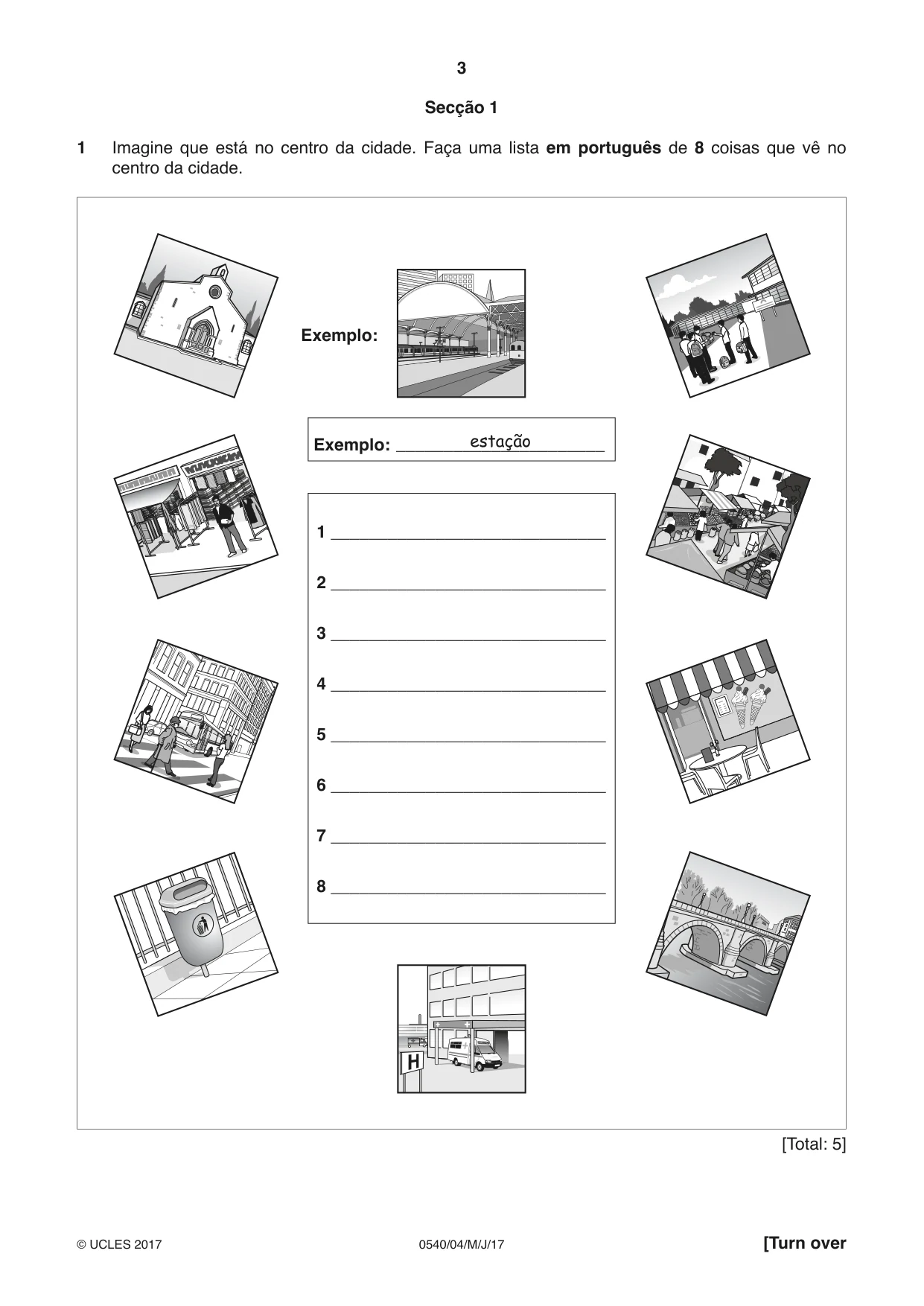
3 0540/04/M/J/17 © UCLES 2017 [Turn over Secção 1 1 Imagine que está no centro da cidade. Faça uma lista em português de 8 coisas que vê no centro da cidade. Exemplo: Exemplo: estação ______________________ 1 _____________________________ 2 _____________________________ 3 _____________________________ 4 _____________________________ 5 _____________________________ 6 _____________________________ 7 _____________________________ 8 _____________________________ [Total: 5]
Question paper, page 4
4 0540/04/M/J/17 © UCLES 2017 2 A vida na minha casa. • Descreva a sua casa ou apartamento. • Quem mora na sua casa? • Você ajuda com as tarefas domésticas, por exemplo cozinhar e limpar? • O que gostaria de mudar na sua casa? Por quê? Escreva 80–90 palavras em português. … … … … … … … … … … … … … … … [Total: 15]
Question paper, page 5
5 0540/04/M/J/17 © UCLES 2017 [Turn over BLANK PAGE
Question paper, page 6
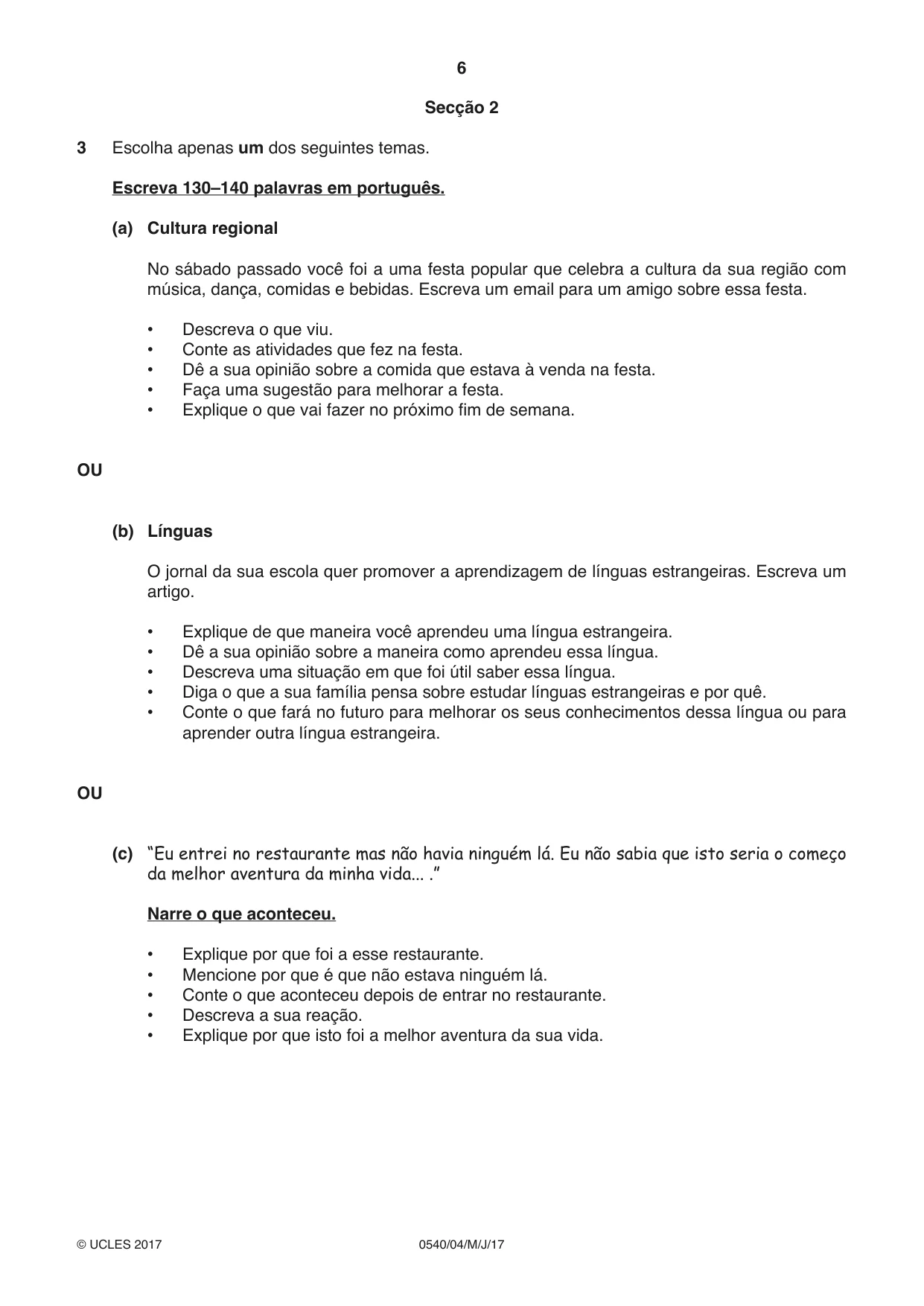
6 0540/04/M/J/17 © UCLES 2017 Secção 2 3 Escolha apenas um dos seguintes temas. Escreva 130–140 palavras em português. (a) Cultura regional No sábado passado você foi a uma festa popular que celebra a cultura da sua região com música, dança, comidas e bebidas. Escreva um email para um amigo sobre essa festa. • Descreva o que viu. • Conte as atividades que fez na festa. • Dê a sua opinião sobre a comida que estava à venda na festa. • Faça uma sugestão para melhorar a festa. • Explique o que vai fazer no próximo fim de semana. OU (b) Línguas O jornal da sua escola quer promover a aprendizagem de línguas estrangeiras. Escreva um artigo. • Explique de que maneira você aprendeu uma língua estrangeira. • Dê a sua opinião sobre a maneira como aprendeu essa língua. • Descreva uma situação em que foi útil saber essa língua. • Diga o que a sua família pensa sobre estudar línguas estrangeiras e por quê. • Conte o que fará no futuro para melhorar os seus conhecimentos dessa língua ou para aprender outra língua estrangeira. OU (c) “Eu entrei no restaurante mas não havia ninguém lá. Eu não sabia que isto seria o começo da melhor aventura da minha vida... .” Narre o que aconteceu. • Explique por que foi a esse restaurante. • Mencione por que é que não estava ninguém lá. • Conte o que aconteceu depois de entrar no restaurante. • Descreva a sua reação. • Explique por que isto foi a melhor aventura da sua vida.
Question paper, page 7
7 0540/04/M/J/17 © UCLES 2017 ESCREVA SOBRE O TEMA DA SUA ESCOLHA AQUI … … … … … … … … … … … … … … … … … … … … … … … … … … … [Total: 30]
Question paper, page 8
8 0540/04/M/J/17 © UCLES 2017 BLANK PAGE Permission to reproduce items where third-party owned material protected by copyright is included has been sought and cleared where possible. Every reasonable effort has been made by the publisher (UCLES) to trace copyright holders, but if any items requiring clearance have unwittingly been included, the publisher will be pleased to make amends at the earliest possible opportunity. To avoid the issue of disclosure of answer-related information to candidates, all copyright acknowledgements are reproduced online in the Cambridge International Examinations Copyright Acknowledgements Booklet. This is produced for each series of examinations and is freely available to download at www.cie.org.uk after the live examination series. Cambridge International Examinations is part of the Cambridge Assessment Group. Cambridge Assessment is the brand name of University of Cambridge Local Examinations Syndicate (UCLES), which is itself a department of the University of Cambridge.
Mark scheme, page 1
® IGCSE is a registered trademark. This document consists of 28 printed pages. © UCLES 2017 [Turn over Cambridge International Examinations Cambridge International General Certificate of Secondary Education PORTUGUESE 0540/04 Paper 4 Writing May/June 2017 MARK SCHEME Maximum Mark: 50 Published This mark scheme is published as an aid to teachers and candidates, to indicate the requirements of the examination. It shows the basis on which Examiners were instructed to award marks. It does not indicate the details of the discussions that took place at an Examiners’ meeting before marking began, which would have considered the acceptability of alternative answers. Mark schemes should be read in conjunction with the question paper and the Principal Examiner Report for Teachers. Cambridge will not enter into discussions about these mark schemes. Cambridge is publishing the mark schemes for the May/June 2017 series for most Cambridge IGCSE®, Cambridge International A and AS Level and Cambridge Pre-U components, and some Cambridge O Level components.
Mark scheme, page 2
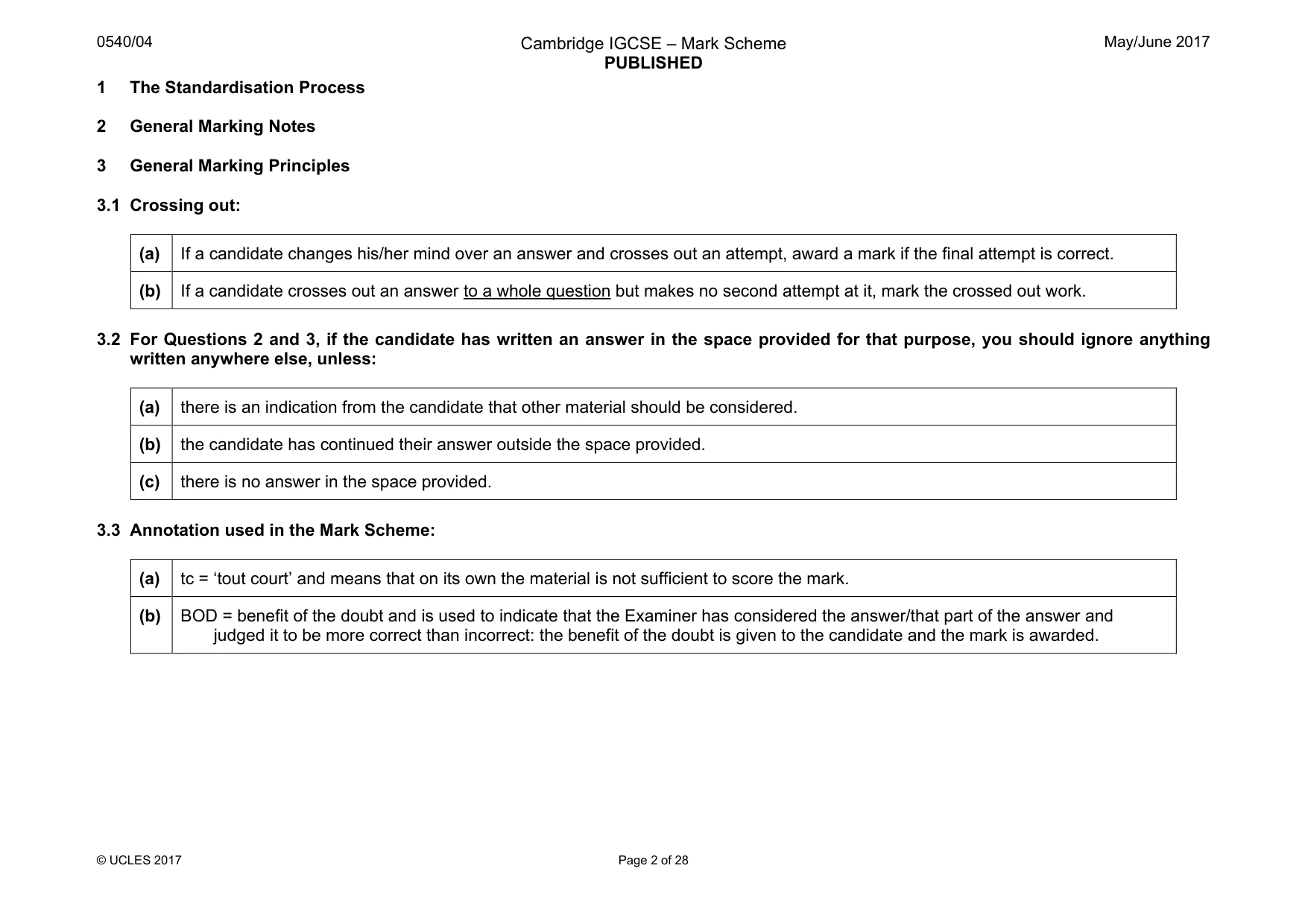
0540/04 Cambridge IGCSE – Mark Scheme PUBLISHED May/June 2017 © UCLES 2017 Page 2 of 28 1 The Standardisation Process 2 General Marking Notes 3 General Marking Principles 3.1 Crossing out: (a) If a candidate changes his/her mind over an answer and crosses out an attempt, award a mark if the final attempt is correct. (b) If a candidate crosses out an answer to a whole question but makes no second attempt at it, mark the crossed out work. 3.2 For Questions 2 and 3, if the candidate has written an answer in the space provided for that purpose, you should ignore anything written anywhere else, unless: (a) there is an indication from the candidate that other material should be considered. (b) the candidate has continued their answer outside the space provided. (c) there is no answer in the space provided. 3.3 Annotation used in the Mark Scheme: (a) tc = ‘tout court’ and means that on its own the material is not sufficient to score the mark. (b) BOD = benefit of the doubt and is used to indicate that the Examiner has considered the answer/that part of the answer and judged it to be more correct than incorrect: the benefit of the doubt is given to the candidate and the mark is awarded.
Mark scheme, page 3
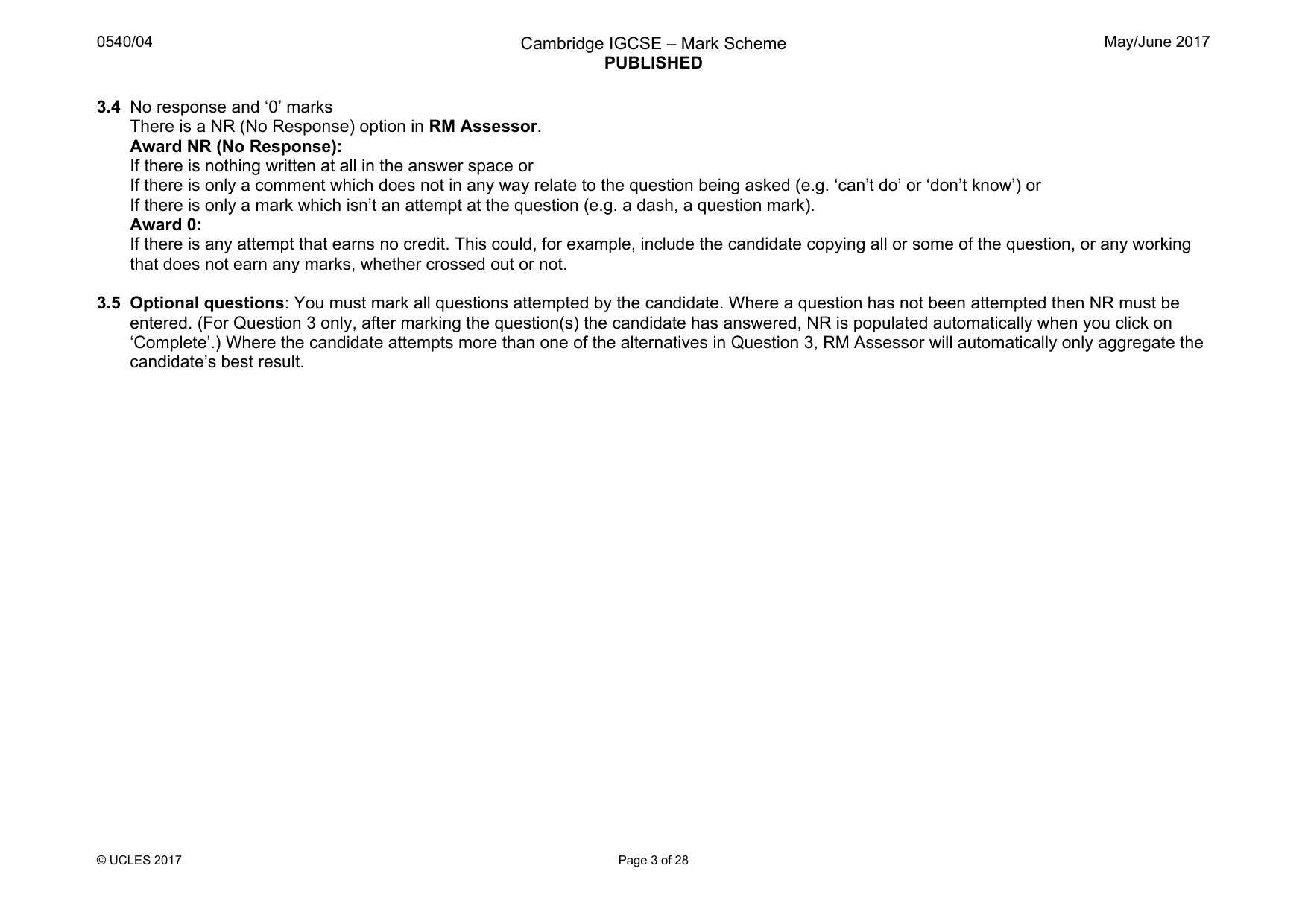
0540/04 Cambridge IGCSE – Mark Scheme PUBLISHED May/June 2017 © UCLES 2017 Page 3 of 28 3.4 No response and ‘0’ marks There is a NR (No Response) option in RM Assessor. Award NR (No Response): If there is nothing written at all in the answer space or If there is only a comment which does not in any way relate to the question being asked (e.g. ‘can’t do’ or ‘don’t know’) or If there is only a mark which isn’t an attempt at the question (e.g. a dash, a question mark). Award 0: If there is any attempt that earns no credit. This could, for example, include the candidate copying all or some of the question, or any working that does not earn any marks, whether crossed out or not. 3.5 Optional questions: You must mark all questions attempted by the candidate. Where a question has not been attempted then NR must be entered. (For Question 3 only, after marking the question(s) the candidate has answered, NR is populated automatically when you click on ‘Complete’.) Where the candidate attempts more than one of the alternatives in Question 3, RM Assessor will automatically only aggregate the candidate’s best result.
Mark scheme, page 4
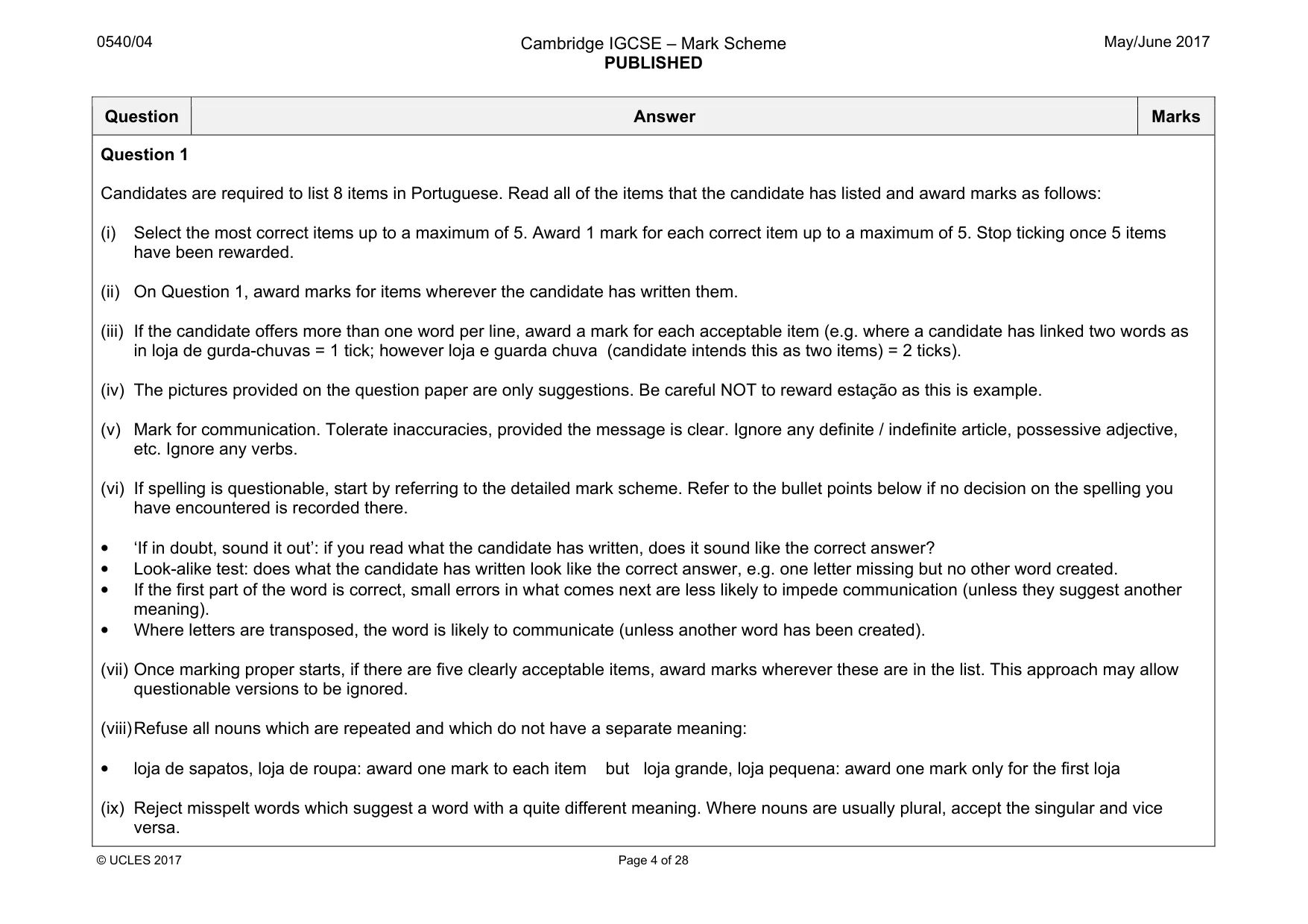
0540/04 Cambridge IGCSE – Mark Scheme PUBLISHED May/June 2017 © UCLES 2017 Page 4 of 28 Question Answer Marks Question 1 Candidates are required to list 8 items in Portuguese. Read all of the items that the candidate has listed and award marks as follows: (i) Select the most correct items up to a maximum of 5. Award 1 mark for each correct item up to a maximum of 5. Stop ticking once 5 items have been rewarded. (ii) On Question 1, award marks for items wherever the candidate has written them. (iii) If the candidate offers more than one word per line, award a mark for each acceptable item (e.g. where a candidate has linked two words as in loja de gurda-chuvas = 1 tick; however loja e guarda chuva (candidate intends this as two items) = 2 ticks). (iv) The pictures provided on the question paper are only suggestions. Be careful NOT to reward estação as this is example. (v) Mark for communication. Tolerate inaccuracies, provided the message is clear. Ignore any definite / indefinite article, possessive adjective, etc. Ignore any verbs. (vi) If spelling is questionable, start by referring to the detailed mark scheme. Refer to the bullet points below if no decision on the spelling you have encountered is recorded there. • ‘If in doubt, sound it out’: if you read what the candidate has written, does it sound like the correct answer? • Look-alike test: does what the candidate has written look like the correct answer, e.g. one letter missing but no other word created. • If the first part of the word is correct, small errors in what comes next are less likely to impede communication (unless they suggest another meaning). • Where letters are transposed, the word is likely to communicate (unless another word has been created). (vii) Once marking proper starts, if there are five clearly acceptable items, award marks wherever these are in the list. This approach may allow questionable versions to be ignored. (viii) Refuse all nouns which are repeated and which do not have a separate meaning: • loja de sapatos, loja de roupa: award one mark to each item but loja grande, loja pequena: award one mark only for the first loja (ix) Reject misspelt words which suggest a word with a quite different meaning. Where nouns are usually plural, accept the singular and vice versa.
Mark scheme, page 5
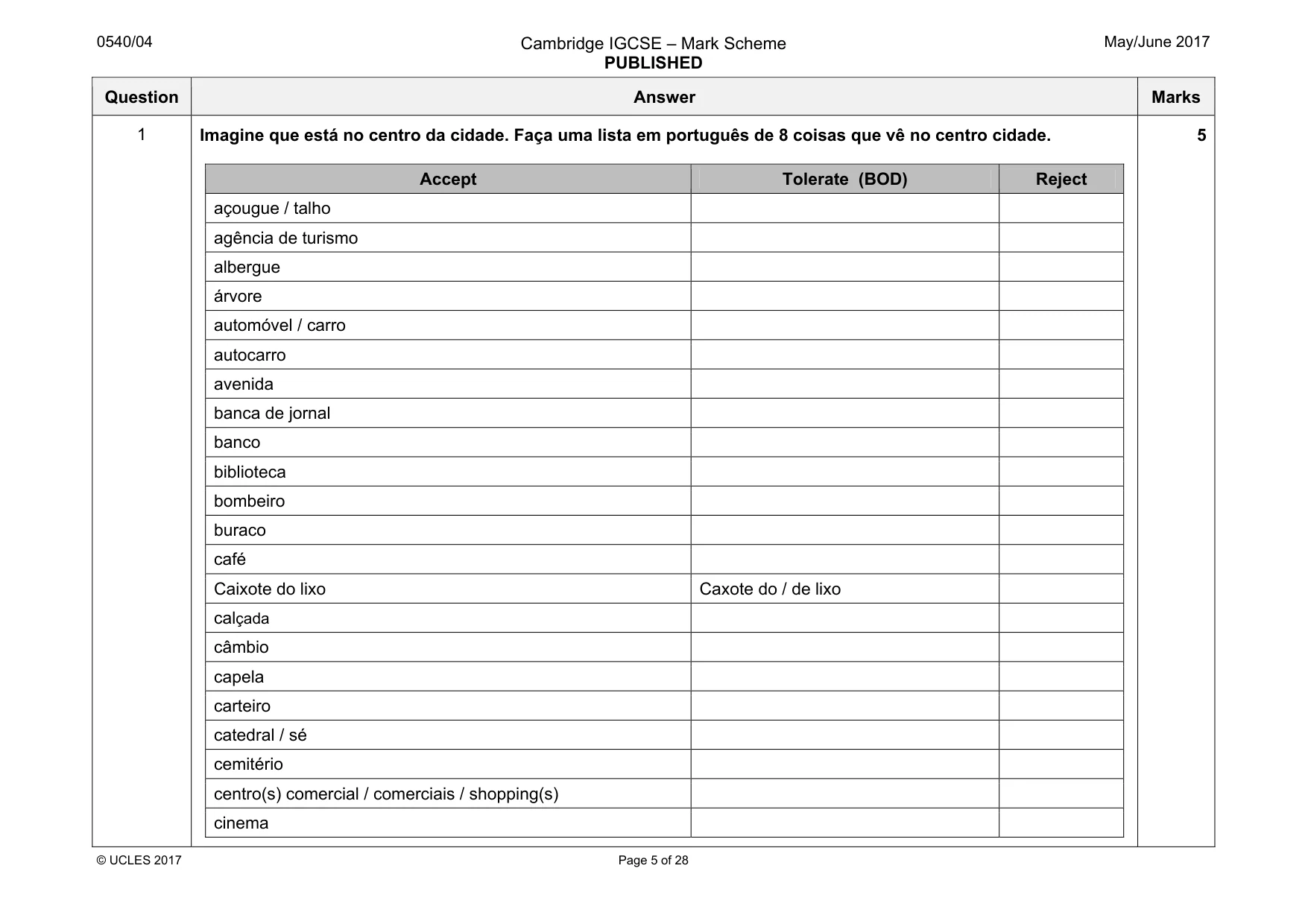
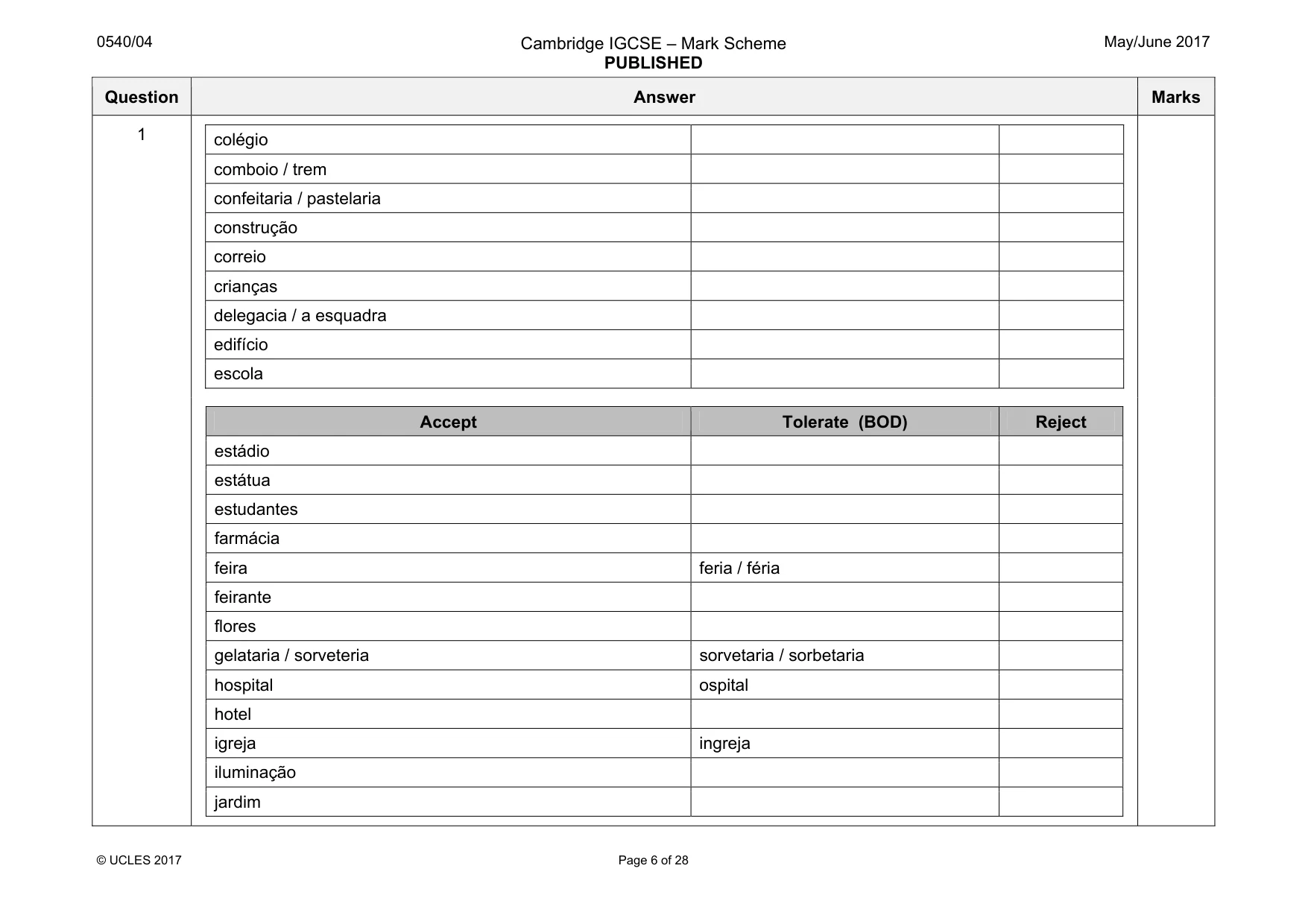
0540/04 Cambridge IGCSE – Mark Scheme PUBLISHED May/June 2017 © UCLES 2017 Page 5 of 28 Question Answer Marks 1 Imagine que está no centro da cidade. Faça uma lista em português de 8 coisas que vê no centro cidade. Accept Tolerate (BOD) Reject açougue / talho agência de turismo albergue árvore automóvel / carro autocarro avenida banca de jornal banco biblioteca bombeiro buraco café Caixote do lixo Caxote do / de lixo calçada câmbio capela carteiro catedral / sé cemitério centro(s) comercial / comerciais / shopping(s) cinema 5
Mark scheme, page 6
0540/04 Cambridge IGCSE – Mark Scheme PUBLISHED May/June 2017 © UCLES 2017 Page 6 of 28 Question Answer Marks 1 colégio comboio / trem confeitaria / pastelaria construção correio crianças delegacia / a esquadra edifício escola Accept Tolerate (BOD) Reject estádio estátua estudantes farmácia feira feria / féria feirante flores gelataria / sorveteria sorvetaria / sorbetaria hospital ospital hotel igreja ingreja iluminação jardim
Mark scheme, page 7
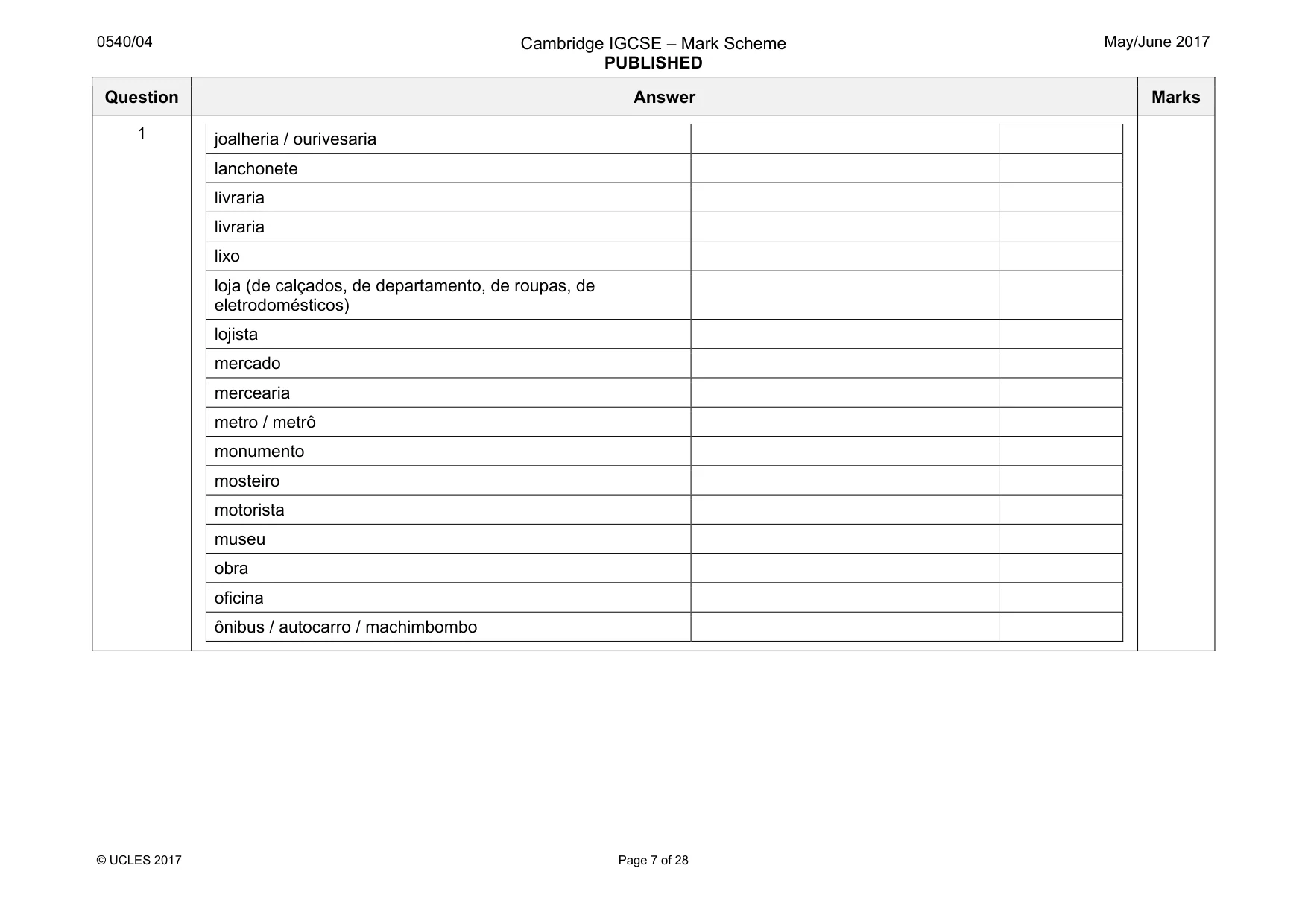
0540/04 Cambridge IGCSE – Mark Scheme PUBLISHED May/June 2017 © UCLES 2017 Page 7 of 28 Question Answer Marks 1 joalheria / ourivesaria lanchonete livraria livraria lixo loja (de calçados, de departamento, de roupas, de eletrodomésticos) lojista mercado mercearia metro / metrô monumento mosteiro motorista museu obra oficina ônibus / autocarro / machimbombo
Mark scheme, page 8
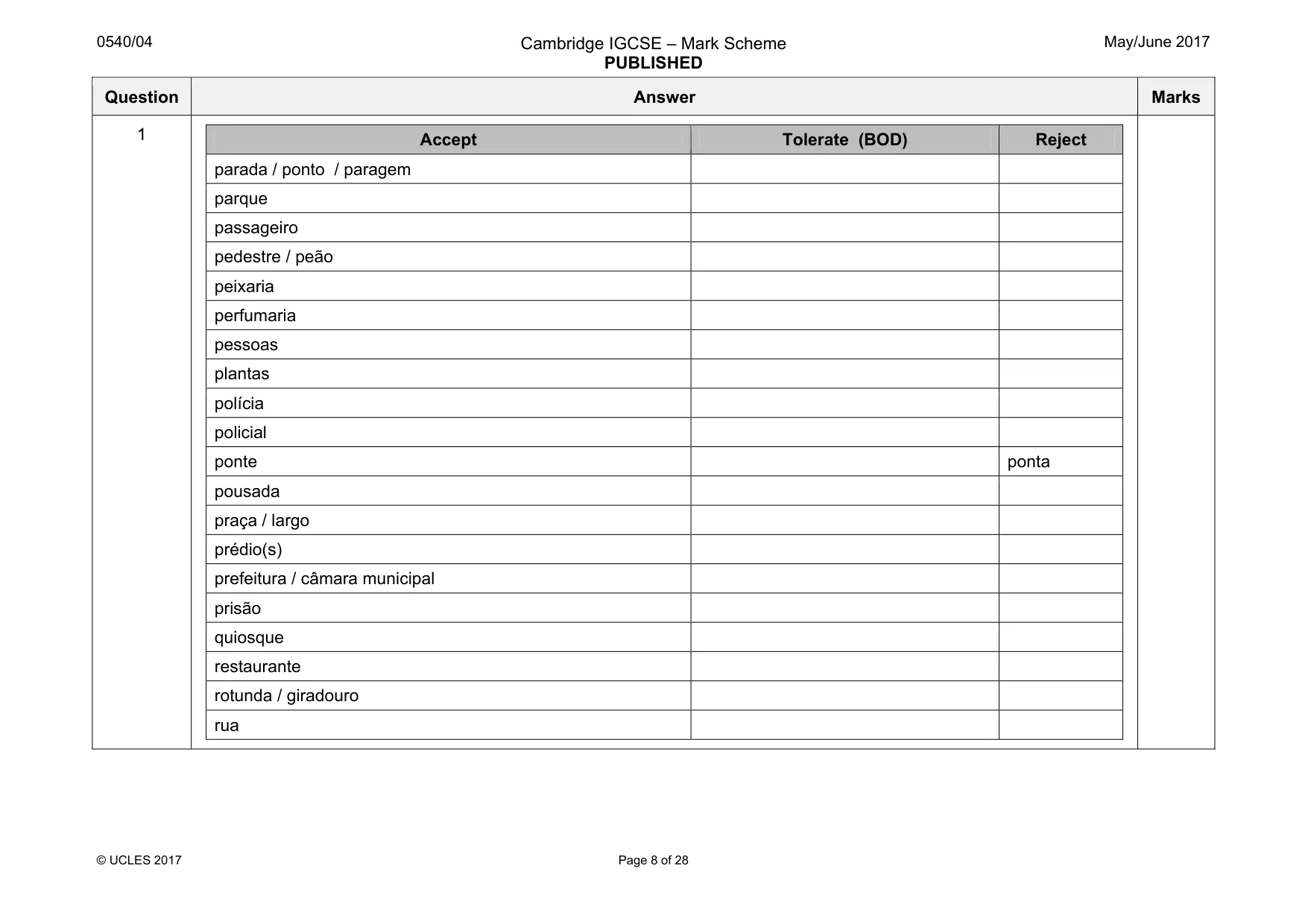
0540/04 Cambridge IGCSE – Mark Scheme PUBLISHED May/June 2017 © UCLES 2017 Page 8 of 28 Question Answer Marks 1 Accept Tolerate (BOD) Reject parada / ponto / paragem parque passageiro pedestre / peão peixaria perfumaria pessoas plantas polícia policial ponte ponta pousada praça / largo prédio(s) prefeitura / câmara municipal prisão quiosque restaurante rotunda / giradouro rua
Mark scheme, page 9
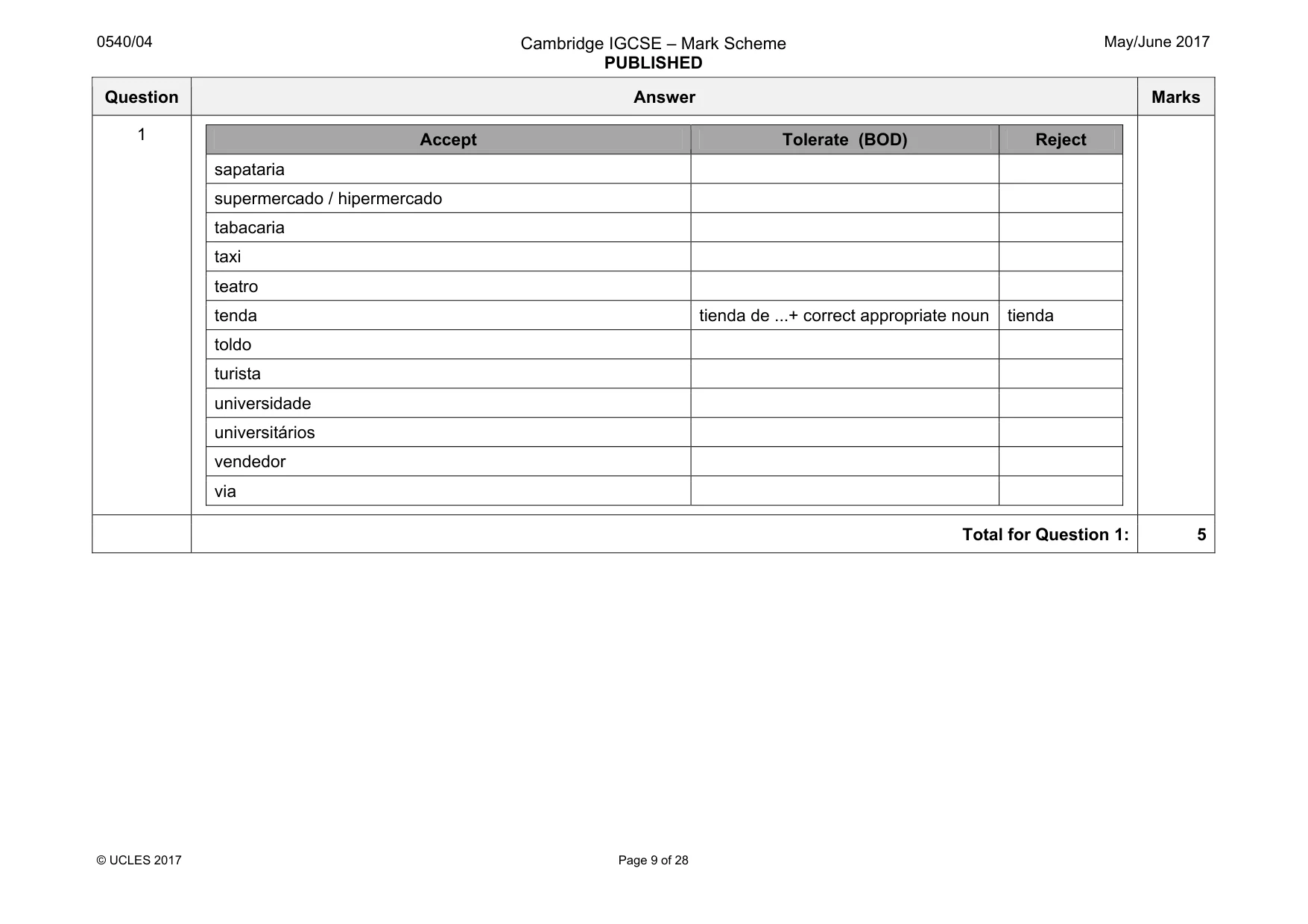
0540/04 Cambridge IGCSE – Mark Scheme PUBLISHED May/June 2017 © UCLES 2017 Page 9 of 28 Question Answer Marks 1 Accept Tolerate (BOD) Reject sapataria supermercado / hipermercado tabacaria taxi teatro tenda tienda de ...+ correct appropriate noun tienda toldo turista universidade universitários vendedor via Total for Question 1: 5
Mark scheme, page 10
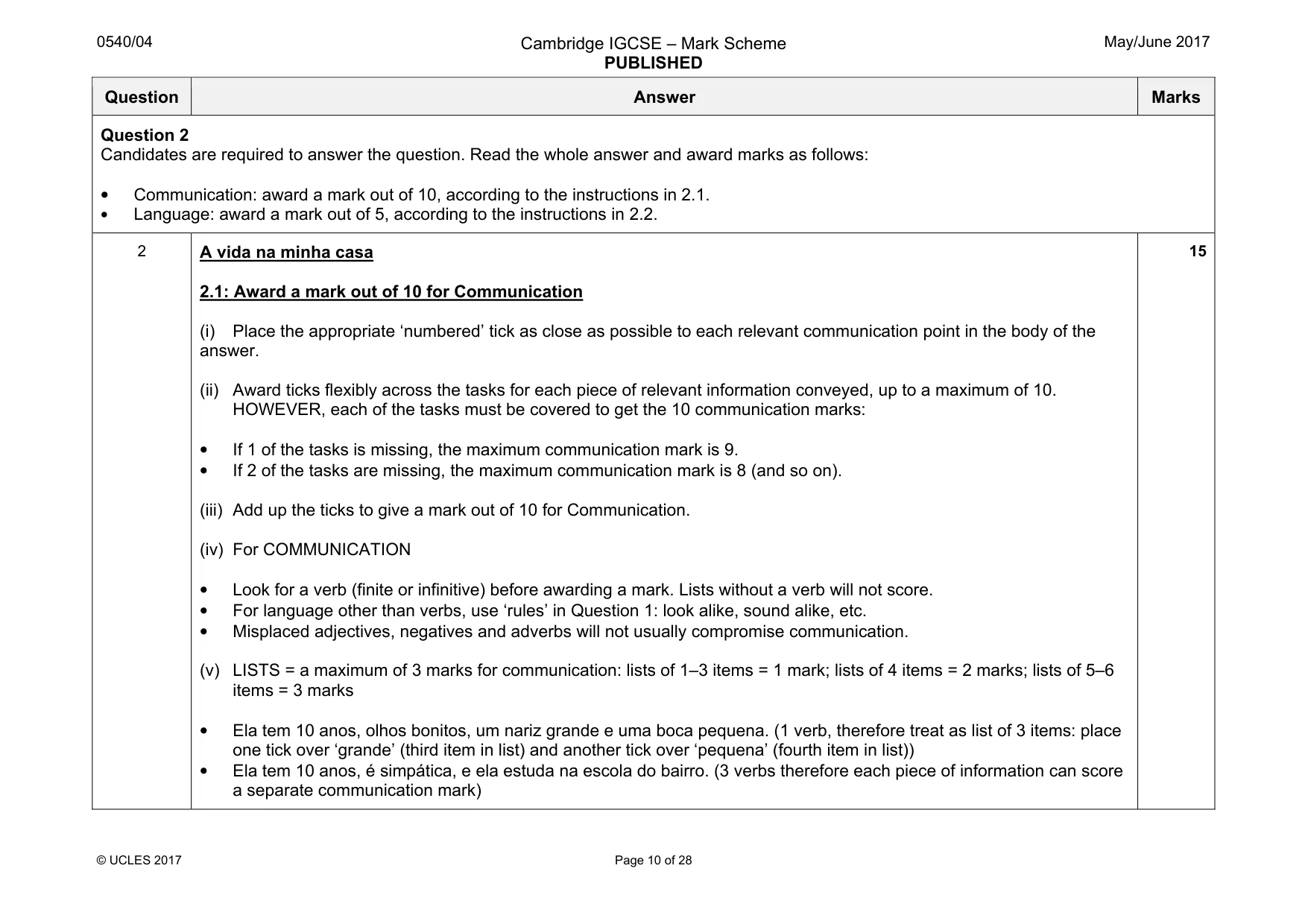
0540/04 Cambridge IGCSE – Mark Scheme PUBLISHED May/June 2017 © UCLES 2017 Page 10 of 28 Question Answer Marks Question 2 Candidates are required to answer the question. Read the whole answer and award marks as follows: • Communication: award a mark out of 10, according to the instructions in 2.1. • Language: award a mark out of 5, according to the instructions in 2.2. 2 A vida na minha casa 2.1: Award a mark out of 10 for Communication (i) Place the appropriate ‘numbered’ tick as close as possible to each relevant communication point in the body of the answer. (ii) Award ticks flexibly across the tasks for each piece of relevant information conveyed, up to a maximum of 10. HOWEVER, each of the tasks must be covered to get the 10 communication marks: • If 1 of the tasks is missing, the maximum communication mark is 9. • If 2 of the tasks are missing, the maximum communication mark is 8 (and so on). (iii) Add up the ticks to give a mark out of 10 for Communication. (iv) For COMMUNICATION • Look for a verb (finite or infinitive) before awarding a mark. Lists without a verb will not score. • For language other than verbs, use ‘rules’ in Question 1: look alike, sound alike, etc. • Misplaced adjectives, negatives and adverbs will not usually compromise communication. (v) LISTS = a maximum of 3 marks for communication: lists of 1–3 items = 1 mark; lists of 4 items = 2 marks; lists of 5–6 items = 3 marks • Ela tem 10 anos, olhos bonitos, um nariz grande e uma boca pequena. (1 verb, therefore treat as list of 3 items: place one tick over ‘grande’ (third item in list) and another tick over ‘pequena’ (fourth item in list)) • Ela tem 10 anos, é simpática, e ela estuda na escola do bairro. (3 verbs therefore each piece of information can score a separate communication mark) 15
Mark scheme, page 11
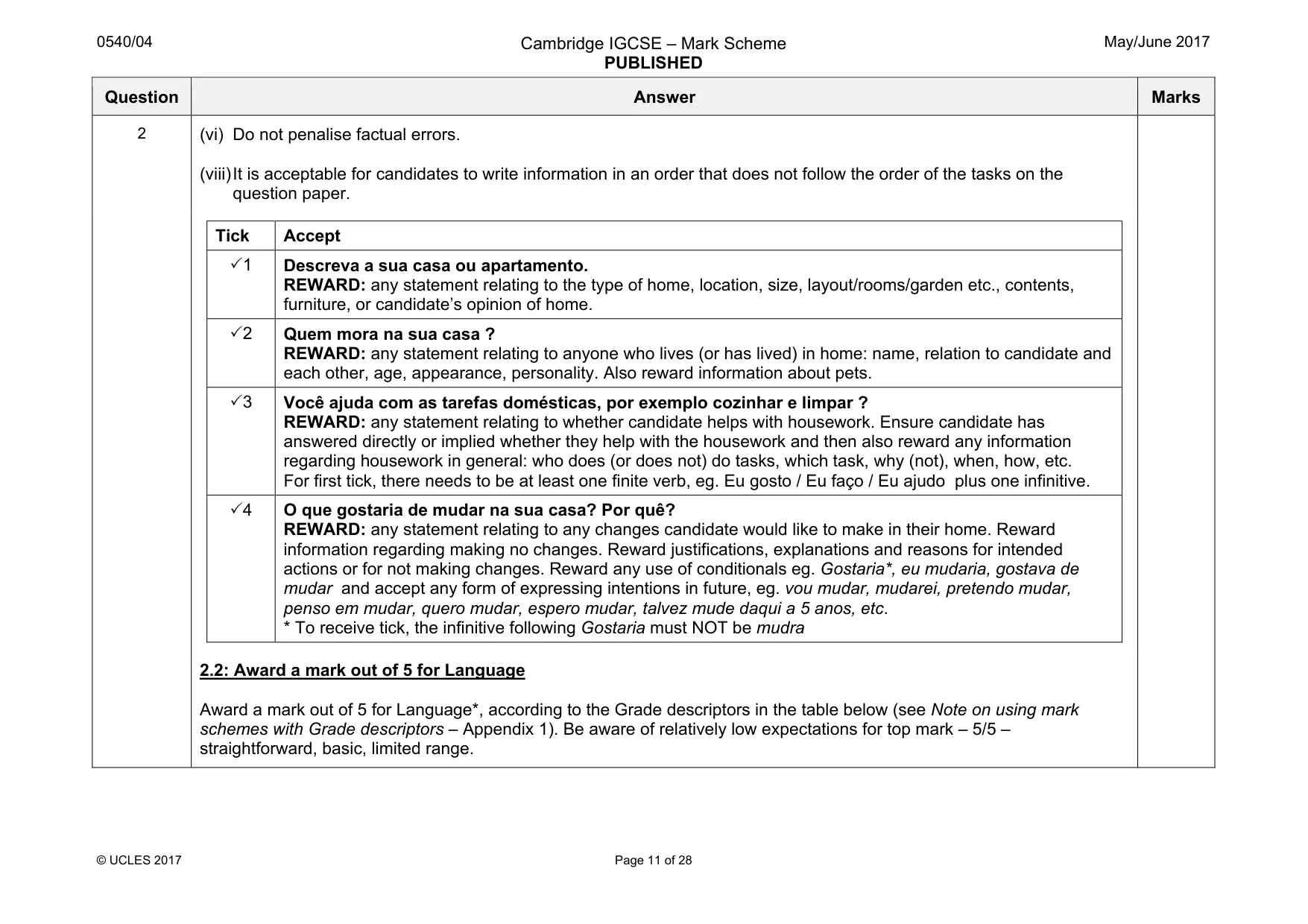
0540/04 Cambridge IGCSE – Mark Scheme PUBLISHED May/June 2017 © UCLES 2017 Page 11 of 28 Question Answer Marks 2 (vi) Do not penalise factual errors. (viii) It is acceptable for candidates to write information in an order that does not follow the order of the tasks on the question paper. Tick Accept 31 Descreva a sua casa ou apartamento. REWARD: any statement relating to the type of home, location, size, layout/rooms/garden etc., contents, furniture, or candidate’s opinion of home. 32 Quem mora na sua casa ? REWARD: any statement relating to anyone who lives (or has lived) in home: name, relation to candidate and each other, age, appearance, personality. Also reward information about pets. 33 Você ajuda com as tarefas domésticas, por exemplo cozinhar e limpar ? REWARD: any statement relating to whether candidate helps with housework. Ensure candidate has answered directly or implied whether they help with the housework and then also reward any information regarding housework in general: who does (or does not) do tasks, which task, why (not), when, how, etc. For first tick, there needs to be at least one finite verb, eg. Eu gosto / Eu faço / Eu ajudo plus one infinitive. 34 O que gostaria de mudar na sua casa? Por quê? REWARD: any statement relating to any changes candidate would like to make in their home. Reward information regarding making no changes. Reward justifications, explanations and reasons for intended actions or for not making changes. Reward any use of conditionals eg. Gostaria*, eu mudaria, gostava de mudar and accept any form of expressing intentions in future, eg. vou mudar, mudarei, pretendo mudar, penso em mudar, quero mudar, espero mudar, talvez mude daqui a 5 anos, etc. * To receive tick, the infinitive following Gostaria must NOT be mudra 2.2: Award a mark out of 5 for Language Award a mark out of 5 for Language*, according to the Grade descriptors in the table below (see Note on using mark schemes with Grade descriptors – Appendix 1). Be aware of relatively low expectations for top mark – 5/5 – straightforward, basic, limited range.
Mark scheme, page 12
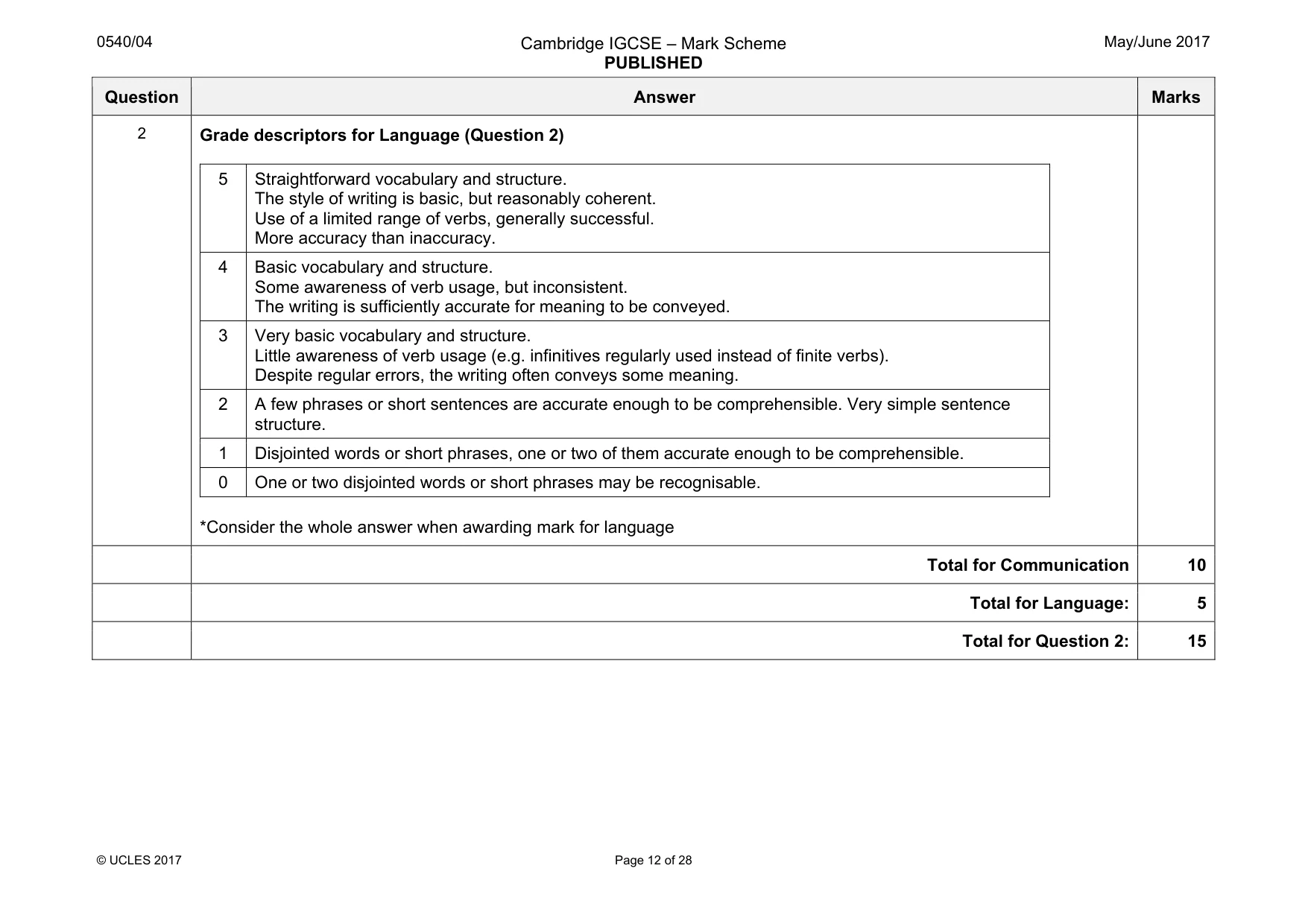
0540/04 Cambridge IGCSE – Mark Scheme PUBLISHED May/June 2017 © UCLES 2017 Page 12 of 28 Question Answer Marks 2 Grade descriptors for Language (Question 2) 5 Straightforward vocabulary and structure. The style of writing is basic, but reasonably coherent. Use of a limited range of verbs, generally successful. More accuracy than inaccuracy. 4 Basic vocabulary and structure. Some awareness of verb usage, but inconsistent. The writing is sufficiently accurate for meaning to be conveyed. 3 Very basic vocabulary and structure. Little awareness of verb usage (e.g. infinitives regularly used instead of finite verbs). Despite regular errors, the writing often conveys some meaning. 2 A few phrases or short sentences are accurate enough to be comprehensible. Very simple sentence structure. 1 Disjointed words or short phrases, one or two of them accurate enough to be comprehensible. 0 One or two disjointed words or short phrases may be recognisable. *Consider the whole answer when awarding mark for language Total for Communication 10 Total for Language: 5 Total for Question 2: 15
Mark scheme, page 13
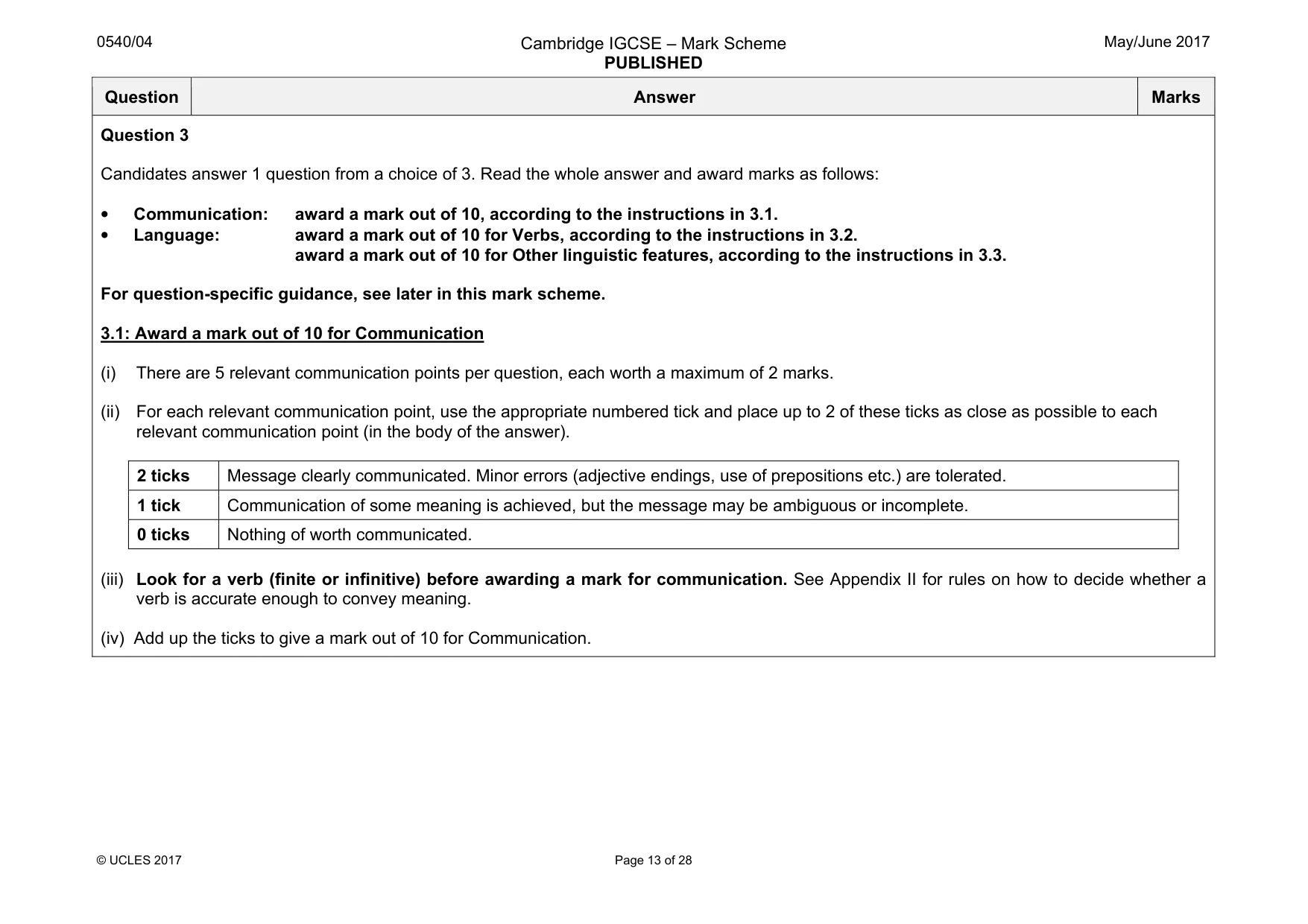
0540/04 Cambridge IGCSE – Mark Scheme PUBLISHED May/June 2017 © UCLES 2017 Page 13 of 28 Question Answer Marks Question 3 Candidates answer 1 question from a choice of 3. Read the whole answer and award marks as follows: • Communication: award a mark out of 10, according to the instructions in 3.1. • Language: award a mark out of 10 for Verbs, according to the instructions in 3.2. award a mark out of 10 for Other linguistic features, according to the instructions in 3.3. For question-specific guidance, see later in this mark scheme. 3.1: Award a mark out of 10 for Communication (i) There are 5 relevant communication points per question, each worth a maximum of 2 marks. (ii) For each relevant communication point, use the appropriate numbered tick and place up to 2 of these ticks as close as possible to each relevant communication point (in the body of the answer). 2 ticks Message clearly communicated. Minor errors (adjective endings, use of prepositions etc.) are tolerated. 1 tick Communication of some meaning is achieved, but the message may be ambiguous or incomplete. 0 ticks Nothing of worth communicated. (iii) Look for a verb (finite or infinitive) before awarding a mark for communication. See Appendix II for rules on how to decide whether a verb is accurate enough to convey meaning. (iv) Add up the ticks to give a mark out of 10 for Communication.
Mark scheme, page 14
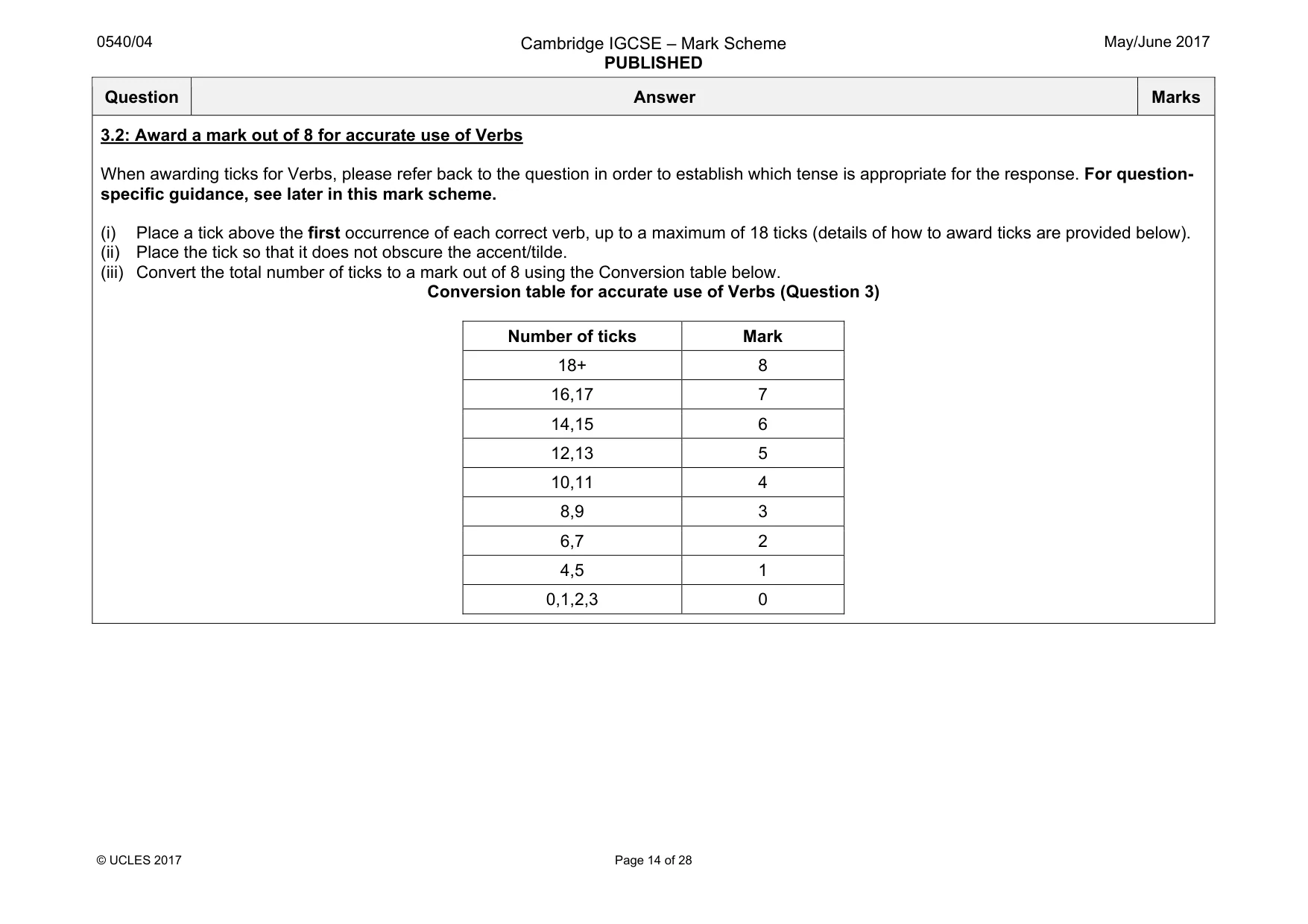
0540/04 Cambridge IGCSE – Mark Scheme PUBLISHED May/June 2017 © UCLES 2017 Page 14 of 28 Question Answer Marks 3.2: Award a mark out of 8 for accurate use of Verbs When awarding ticks for Verbs, please refer back to the question in order to establish which tense is appropriate for the response. For question- specific guidance, see later in this mark scheme. (i) Place a tick above the first occurrence of each correct verb, up to a maximum of 18 ticks (details of how to award ticks are provided below). (ii) Place the tick so that it does not obscure the accent/tilde. (iii) Convert the total number of ticks to a mark out of 8 using the Conversion table below. Conversion table for accurate use of Verbs (Question 3) Number of ticks Mark 18+ 8 16,17 7 14,15 6 12,13 5 10,11 4 8,9 3 6,7 2 4,5 1 0,1,2,3 0
Mark scheme, page 15
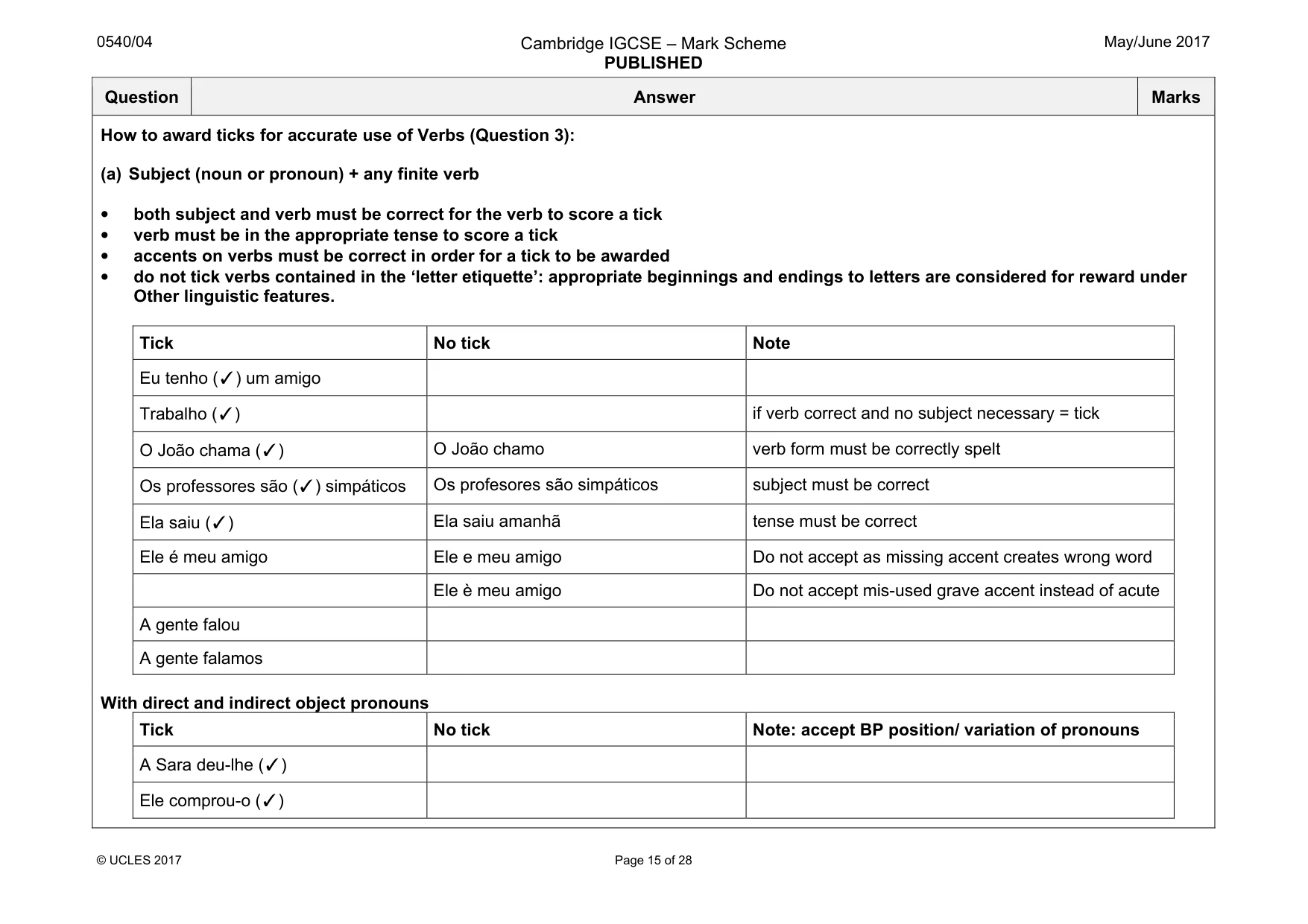
0540/04 Cambridge IGCSE – Mark Scheme PUBLISHED May/June 2017 © UCLES 2017 Page 15 of 28 Question Answer Marks How to award ticks for accurate use of Verbs (Question 3): (a) Subject (noun or pronoun) + any finite verb • both subject and verb must be correct for the verb to score a tick • verb must be in the appropriate tense to score a tick • accents on verbs must be correct in order for a tick to be awarded • do not tick verbs contained in the ‘letter etiquette’: appropriate beginnings and endings to letters are considered for reward under Other linguistic features. Tick No tick Note Eu tenho (✓) um amigo Trabalho (✓) if verb correct and no subject necessary = tick O João chama (✓) O João chamo verb form must be correctly spelt Os professores são (✓) simpáticos Os profesores são simpáticos subject must be correct Ela saiu (✓) Ela saiu amanhã tense must be correct Ele é meu amigo Ele e meu amigo Do not accept as missing accent creates wrong word Ele è meu amigo Do not accept mis-used grave accent instead of acute A gente falou A gente falamos With direct and indirect object pronouns Tick No tick Note: accept BP position/ variation of pronouns A Sara deu-lhe (✓) Ele comprou-o (✓)
Mark scheme, page 16
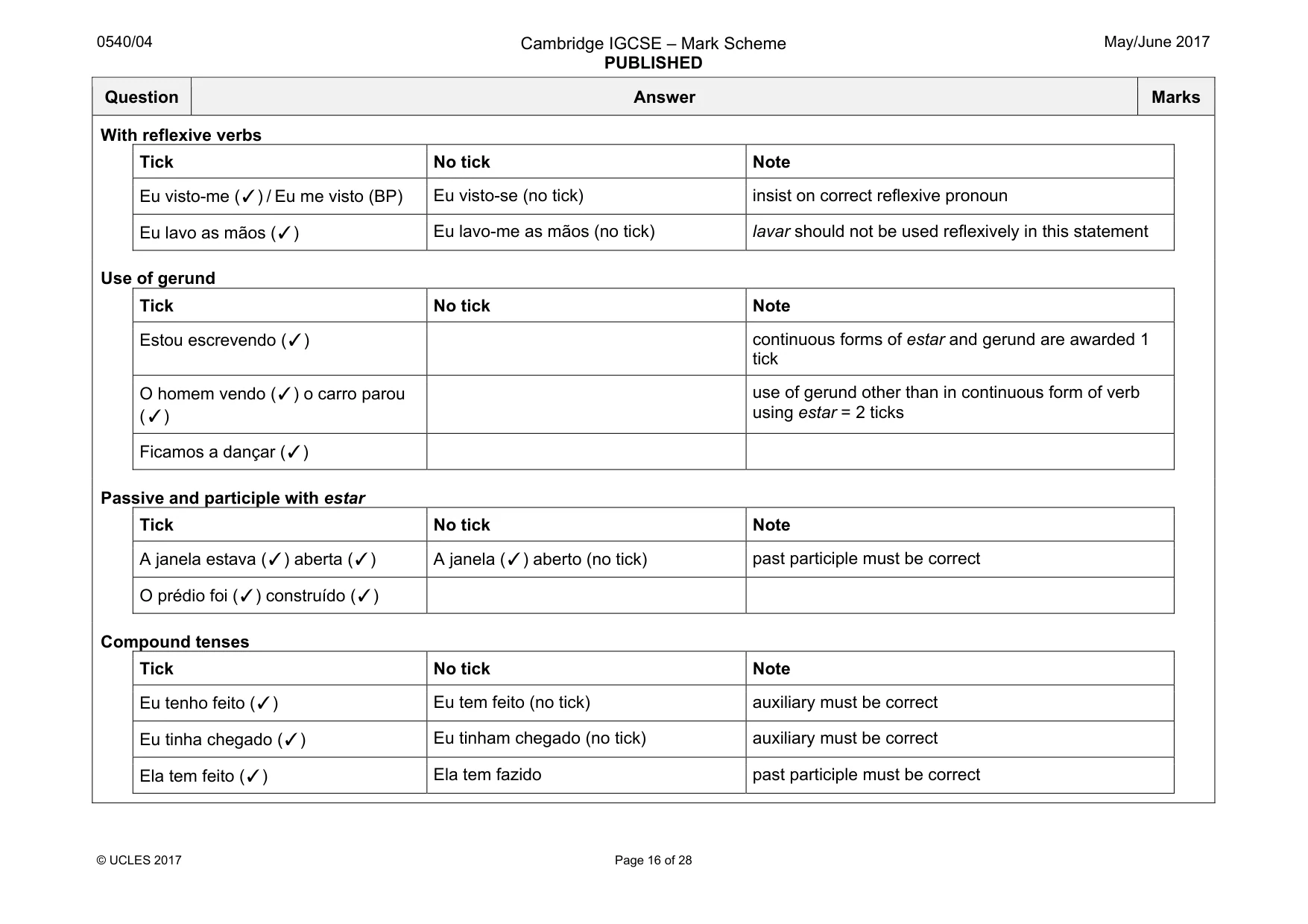
0540/04 Cambridge IGCSE – Mark Scheme PUBLISHED May/June 2017 © UCLES 2017 Page 16 of 28 Question Answer Marks With reflexive verbs Tick No tick Note Eu visto-me (✓) / Eu me visto (BP) Eu visto-se (no tick) insist on correct reflexive pronoun Eu lavo as mãos (✓) Eu lavo-me as mãos (no tick) lavar should not be used reflexively in this statement Use of gerund Tick No tick Note Estou escrevendo (✓) continuous forms of estar and gerund are awarded 1 tick O homem vendo (✓) o carro parou ( ✓) use of gerund other than in continuous form of verb using estar = 2 ticks Ficamos a dançar (✓) Passive and participle with estar Tick No tick Note A janela estava (✓) aberta (✓) A janela (✓) aberto (no tick) past participle must be correct O prédio foi (✓) construído (✓) Compound tenses Tick No tick Note Eu tenho feito (✓) Eu tem feito (no tick) auxiliary must be correct Eu tinha chegado (✓) Eu tinham chegado (no tick) auxiliary must be correct Ela tem feito (✓) Ela tem fazido past participle must be correct
Mark scheme, page 17
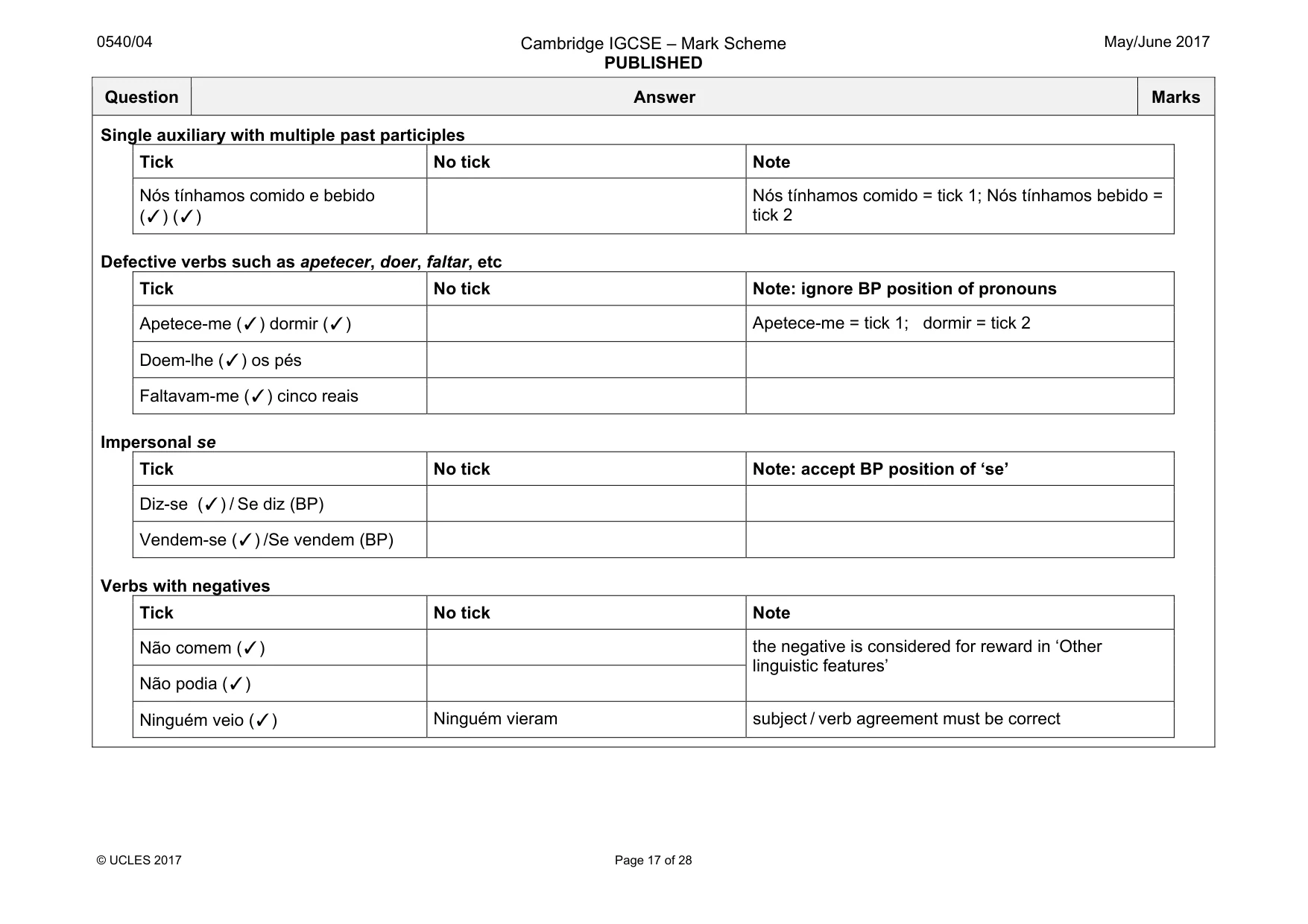
0540/04 Cambridge IGCSE – Mark Scheme PUBLISHED May/June 2017 © UCLES 2017 Page 17 of 28 Question Answer Marks Single auxiliary with multiple past participles Tick No tick Note Nós tínhamos comido e bebido (✓) (✓) Nós tínhamos comido = tick 1; Nós tínhamos bebido = tick 2 Defective verbs such as apetecer, doer, faltar, etc Tick No tick Note: ignore BP position of pronouns Apetece-me (✓) dormir (✓) Apetece-me = tick 1; dormir = tick 2 Doem-lhe (✓) os pés Faltavam-me (✓) cinco reais Impersonal se Tick No tick Note: accept BP position of ‘se’ Diz-se (✓) / Se diz (BP) Vendem-se (✓) /Se vendem (BP) Verbs with negatives Tick No tick Note Não comem (✓) the negative is considered for reward in ‘Other linguistic features’ Não podia (✓) Ninguém veio (✓) Ninguém vieram subject / verb agreement must be correct
Mark scheme, page 18
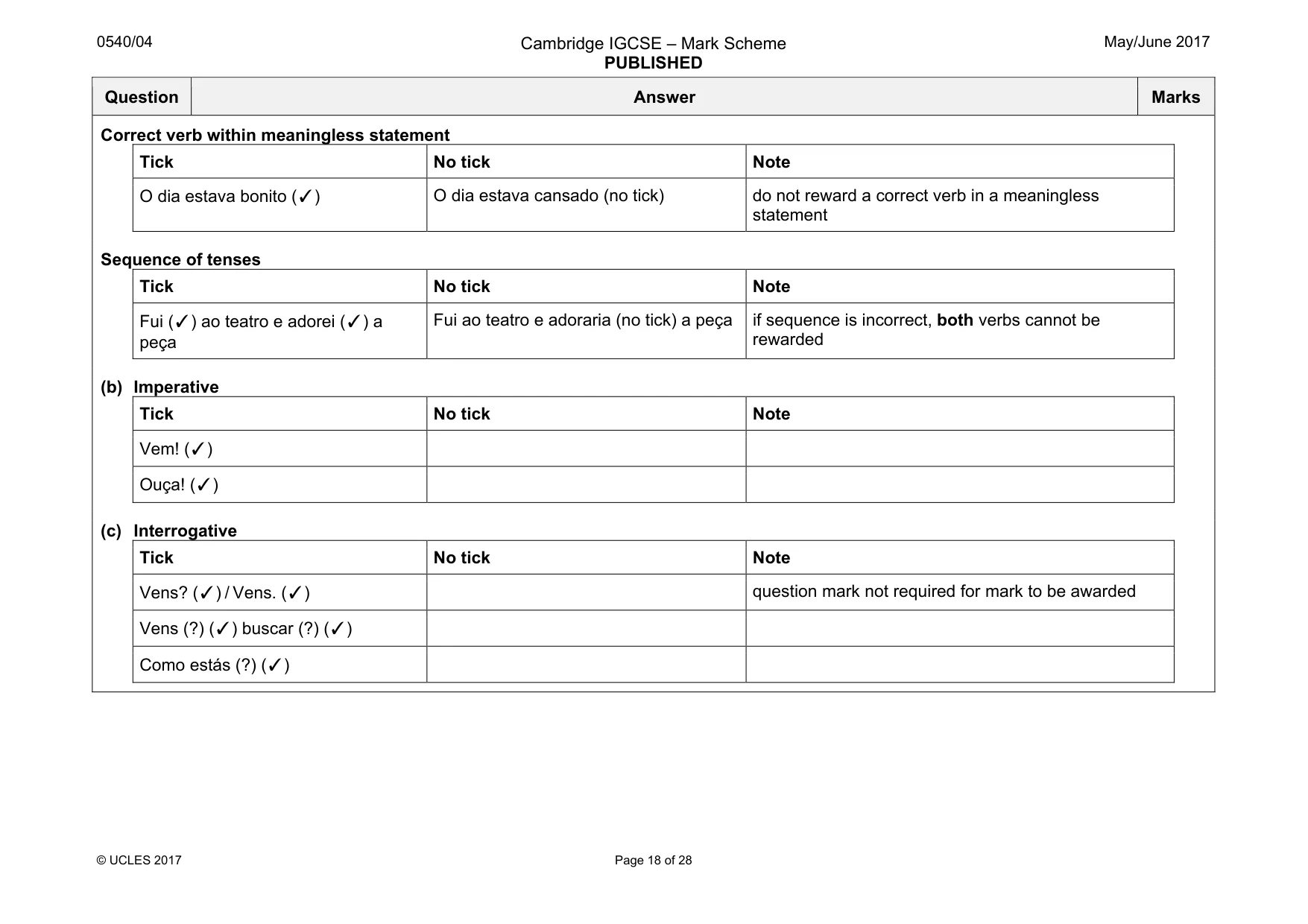
0540/04 Cambridge IGCSE – Mark Scheme PUBLISHED May/June 2017 © UCLES 2017 Page 18 of 28 Question Answer Marks Correct verb within meaningless statement Tick No tick Note O dia estava bonito (✓) O dia estava cansado (no tick) do not reward a correct verb in a meaningless statement Sequence of tenses Tick No tick Note Fui (✓) ao teatro e adorei (✓) a peça Fui ao teatro e adoraria (no tick) a peça if sequence is incorrect, both verbs cannot be rewarded (b) Imperative Tick No tick Note Vem! (✓) Ouça! (✓) (c) Interrogative Tick No tick Note Vens? (✓) / Vens. (✓) question mark not required for mark to be awarded Vens (?) (✓) buscar (?) (✓) Como estás (?) (✓)
Mark scheme, page 19
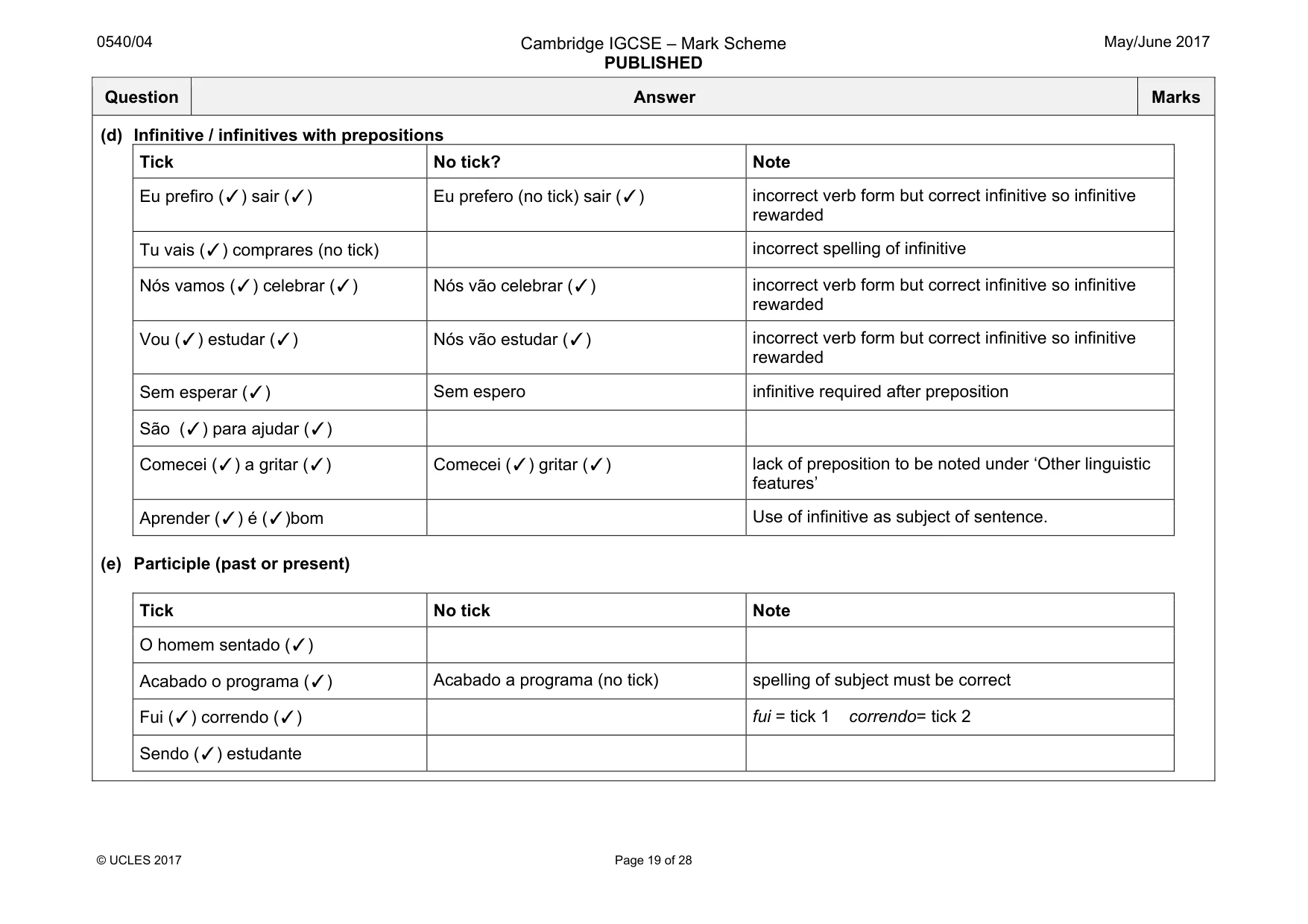
0540/04 Cambridge IGCSE – Mark Scheme PUBLISHED May/June 2017 © UCLES 2017 Page 19 of 28 Question Answer Marks (d) Infinitive / infinitives with prepositions Tick No tick? Note Eu prefiro (✓) sair (✓) Eu prefero (no tick) sair (✓) incorrect verb form but correct infinitive so infinitive rewarded Tu vais (✓) comprares (no tick) incorrect spelling of infinitive Nós vamos (✓) celebrar (✓) Nós vão celebrar (✓) incorrect verb form but correct infinitive so infinitive rewarded Vou (✓) estudar (✓) Nós vão estudar (✓) incorrect verb form but correct infinitive so infinitive rewarded Sem esperar (✓) Sem espero infinitive required after preposition São (✓) para ajudar (✓) Comecei (✓) a gritar (✓) Comecei (✓) gritar (✓) lack of preposition to be noted under ‘Other linguistic features’ Aprender (✓) é (✓)bom Use of infinitive as subject of sentence. (e) Participle (past or present) Tick No tick Note O homem sentado (✓) Acabado o programa (✓) Acabado a programa (no tick) spelling of subject must be correct Fui (✓) correndo (✓) fui = tick 1 correndo= tick 2 Sendo (✓) estudante
Mark scheme, page 20
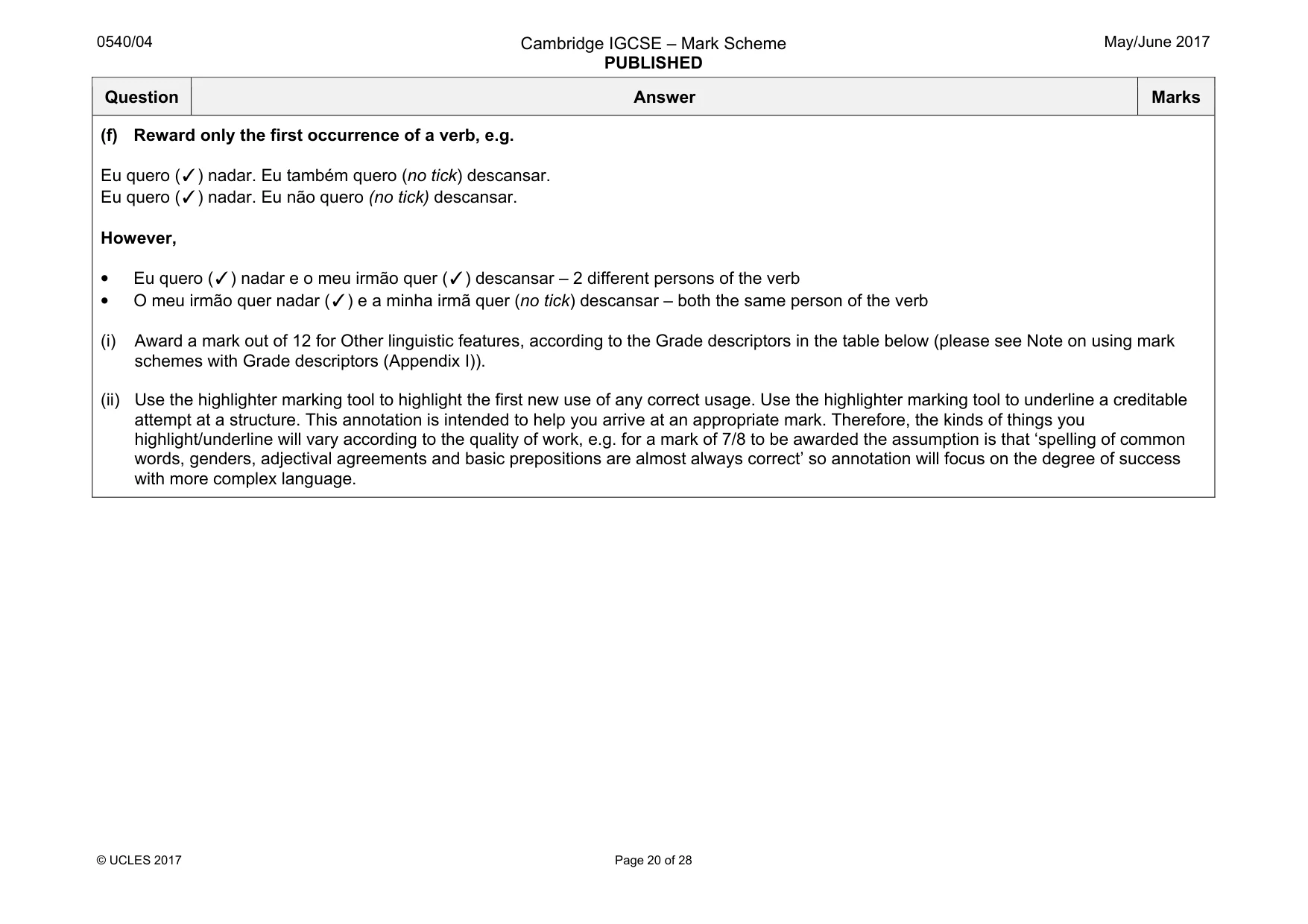
0540/04 Cambridge IGCSE – Mark Scheme PUBLISHED May/June 2017 © UCLES 2017 Page 20 of 28 Question Answer Marks (f) Reward only the first occurrence of a verb, e.g. Eu quero (✓) nadar. Eu também quero (no tick) descansar. Eu quero (✓) nadar. Eu não quero (no tick) descansar. However, • Eu quero (✓) nadar e o meu irmão quer (✓) descansar – 2 different persons of the verb • O meu irmão quer nadar (✓) e a minha irmã quer (no tick) descansar – both the same person of the verb (i) Award a mark out of 12 for Other linguistic features, according to the Grade descriptors in the table below (please see Note on using mark schemes with Grade descriptors (Appendix I)). (ii) Use the highlighter marking tool to highlight the first new use of any correct usage. Use the highlighter marking tool to underline a creditable attempt at a structure. This annotation is intended to help you arrive at an appropriate mark. Therefore, the kinds of things you highlight/underline will vary according to the quality of work, e.g. for a mark of 7/8 to be awarded the assumption is that ‘spelling of common words, genders, adjectival agreements and basic prepositions are almost always correct’ so annotation will focus on the degree of success with more complex language.
Mark scheme, page 21
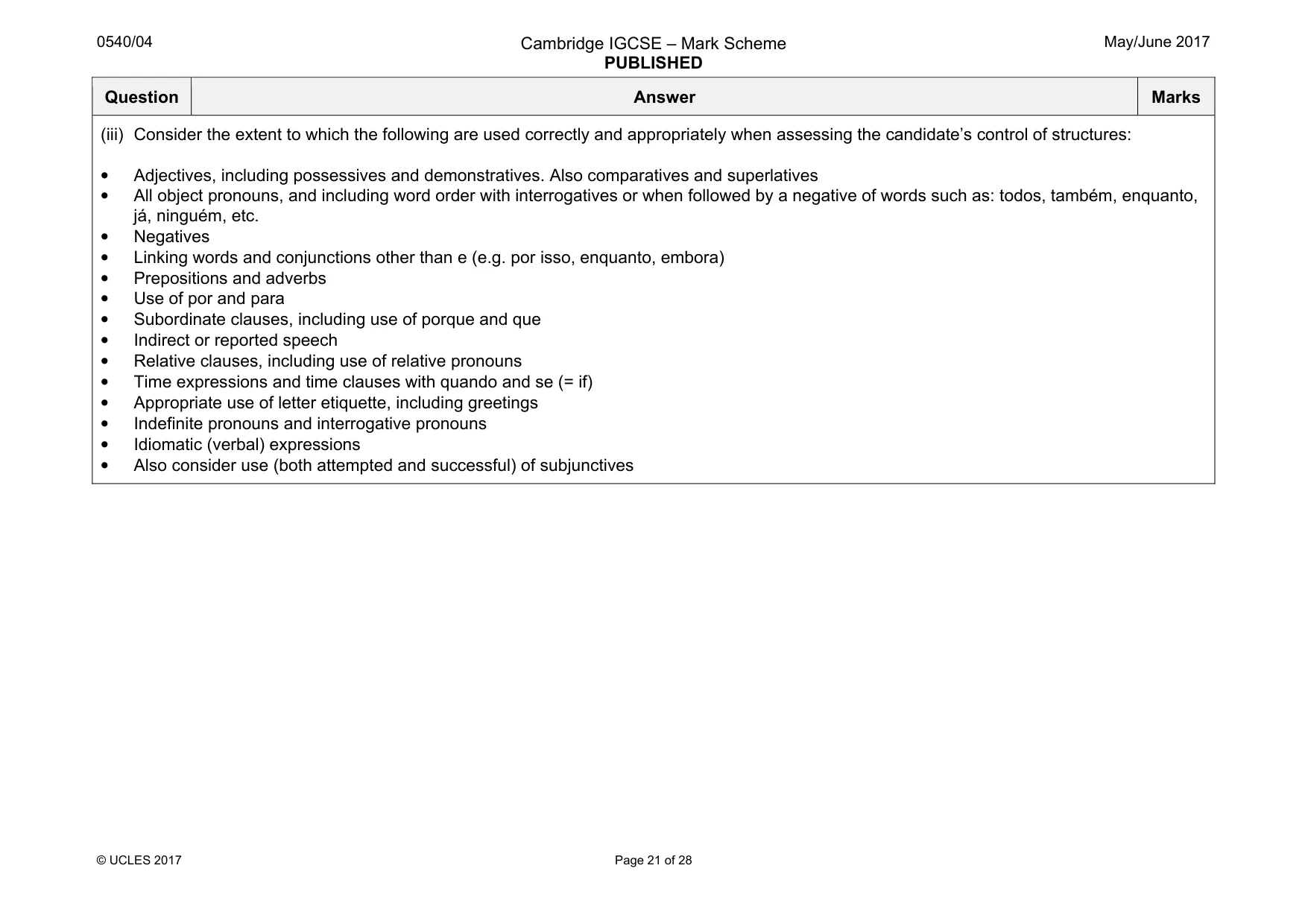
0540/04 Cambridge IGCSE – Mark Scheme PUBLISHED May/June 2017 © UCLES 2017 Page 21 of 28 Question Answer Marks (iii) Consider the extent to which the following are used correctly and appropriately when assessing the candidate’s control of structures: • Adjectives, including possessives and demonstratives. Also comparatives and superlatives • All object pronouns, and including word order with interrogatives or when followed by a negative of words such as: todos, também, enquanto, já, ninguém, etc. • Negatives • Linking words and conjunctions other than e (e.g. por isso, enquanto, embora) • Prepositions and adverbs • Use of por and para • Subordinate clauses, including use of porque and que • Indirect or reported speech • Relative clauses, including use of relative pronouns • Time expressions and time clauses with quando and se (= if) • Appropriate use of letter etiquette, including greetings • Indefinite pronouns and interrogative pronouns • Idiomatic (verbal) expressions • Also consider use (both attempted and successful) of subjunctives
Mark scheme, page 22
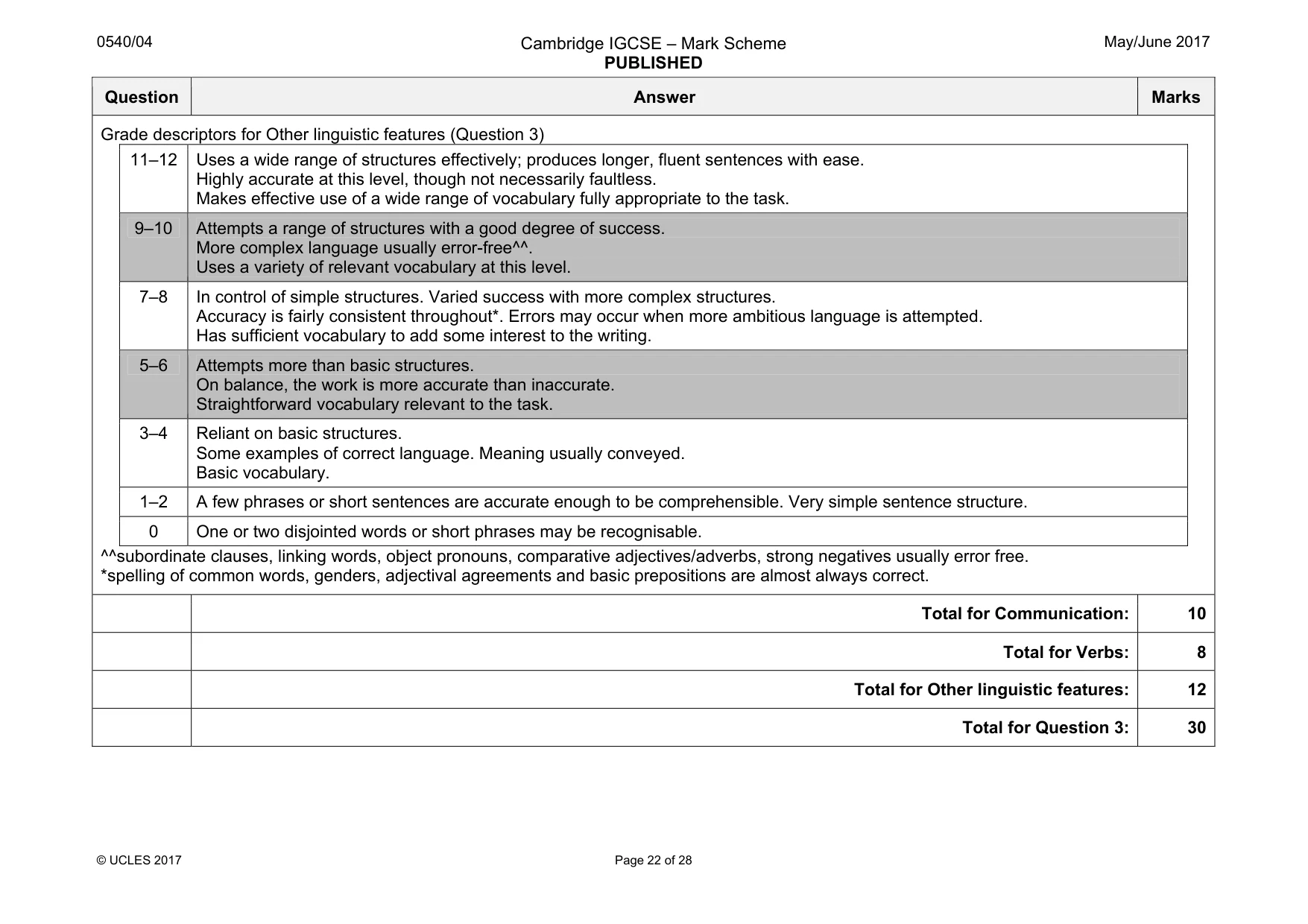
0540/04 Cambridge IGCSE – Mark Scheme PUBLISHED May/June 2017 © UCLES 2017 Page 22 of 28 Question Answer Marks Grade descriptors for Other linguistic features (Question 3) 11–12 Uses a wide range of structures effectively; produces longer, fluent sentences with ease. Highly accurate at this level, though not necessarily faultless. Makes effective use of a wide range of vocabulary fully appropriate to the task. 9–10 Attempts a range of structures with a good degree of success. More complex language usually error-free^^. Uses a variety of relevant vocabulary at this level. 7–8 In control of simple structures. Varied success with more complex structures. Accuracy is fairly consistent throughout*. Errors may occur when more ambitious language is attempted. Has sufficient vocabulary to add some interest to the writing. 5–6 Attempts more than basic structures. On balance, the work is more accurate than inaccurate. Straightforward vocabulary relevant to the task. 3–4 Reliant on basic structures. Some examples of correct language. Meaning usually conveyed. Basic vocabulary. 1–2 A few phrases or short sentences are accurate enough to be comprehensible. Very simple sentence structure. 0 One or two disjointed words or short phrases may be recognisable. ^^subordinate clauses, linking words, object pronouns, comparative adjectives/adverbs, strong negatives usually error free. *spelling of common words, genders, adjectival agreements and basic prepositions are almost always correct. Total for Communication: 10 Total for Verbs: 8 Total for Other linguistic features: 12 Total for Question 3: 30
Mark scheme, page 23
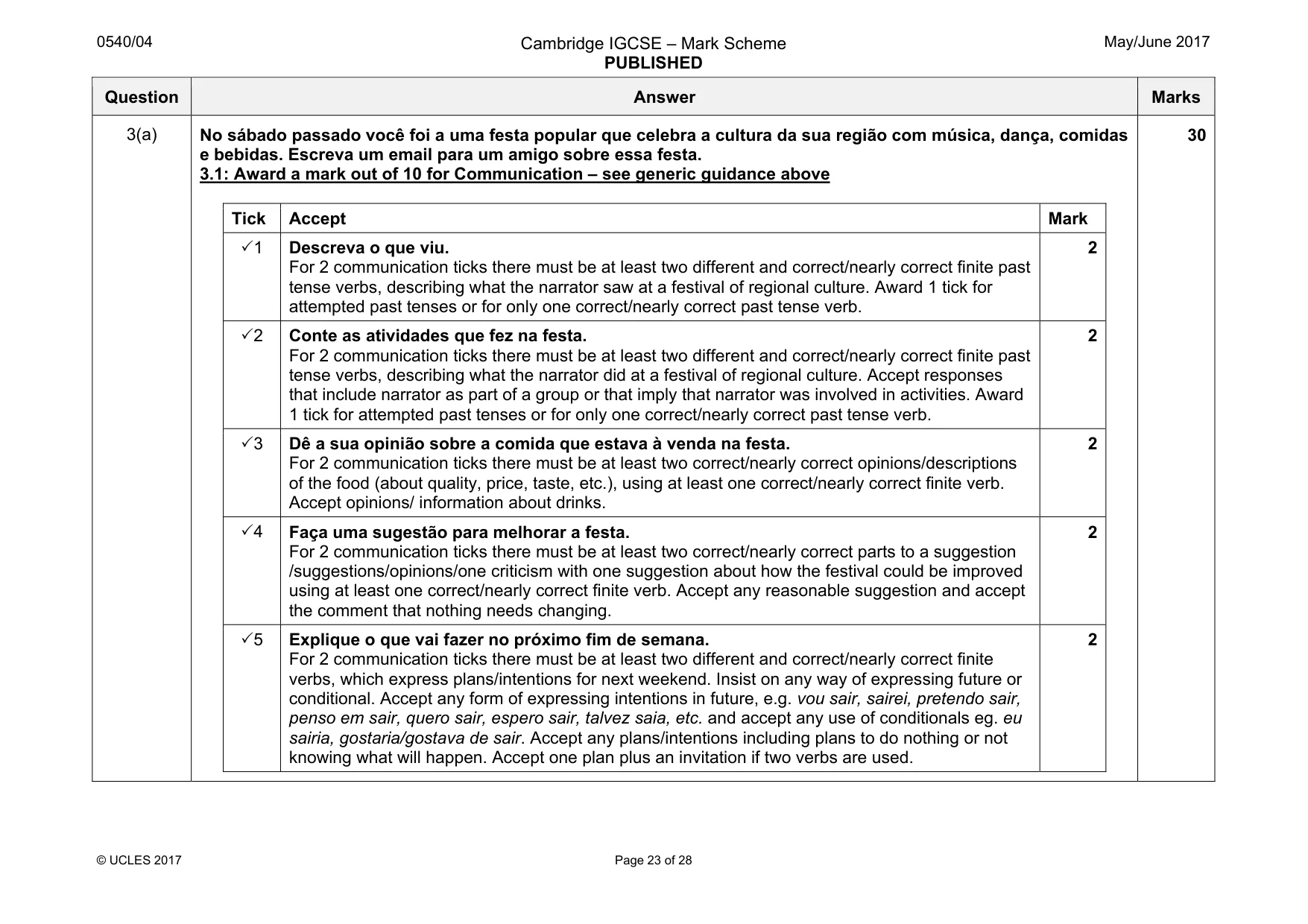
0540/04 Cambridge IGCSE – Mark Scheme PUBLISHED May/June 2017 © UCLES 2017 Page 23 of 28 Question Answer Marks 3(a) No sábado passado você foi a uma festa popular que celebra a cultura da sua região com música, dança, comidas e bebidas. Escreva um email para um amigo sobre essa festa. 3.1: Award a mark out of 10 for Communication – see generic guidance above Tick Accept Mark 31 Descreva o que viu. For 2 communication ticks there must be at least two different and correct/nearly correct finite past tense verbs, describing what the narrator saw at a festival of regional culture. Award 1 tick for attempted past tenses or for only one correct/nearly correct past tense verb. 2 32 Conte as atividades que fez na festa. For 2 communication ticks there must be at least two different and correct/nearly correct finite past tense verbs, describing what the narrator did at a festival of regional culture. Accept responses that include narrator as part of a group or that imply that narrator was involved in activities. Award 1 tick for attempted past tenses or for only one correct/nearly correct past tense verb. 2 33 Dê a sua opinião sobre a comida que estava à venda na festa. For 2 communication ticks there must be at least two correct/nearly correct opinions/descriptions of the food (about quality, price, taste, etc.), using at least one correct/nearly correct finite verb. Accept opinions/ information about drinks. 2 34 Faça uma sugestão para melhorar a festa. For 2 communication ticks there must be at least two correct/nearly correct parts to a suggestion /suggestions/opinions/one criticism with one suggestion about how the festival could be improved using at least one correct/nearly correct finite verb. Accept any reasonable suggestion and accept the comment that nothing needs changing. 2 35 Explique o que vai fazer no próximo fim de semana. For 2 communication ticks there must be at least two different and correct/nearly correct finite verbs, which express plans/intentions for next weekend. Insist on any way of expressing future or conditional. Accept any form of expressing intentions in future, e.g. vou sair, sairei, pretendo sair, penso em sair, quero sair, espero sair, talvez saia, etc. and accept any use of conditionals eg. eu sairia, gostaria/gostava de sair. Accept any plans/intentions including plans to do nothing or not knowing what will happen. Accept one plan plus an invitation if two verbs are used. 2 30
Mark scheme, page 24
0540/04 Cambridge IGCSE – Mark Scheme PUBLISHED May/June 2017 © UCLES 2017 Page 24 of 28 Question Answer Marks 3(a) 3.2: Award a mark out of 8 for accurate use of Verbs – see generic guidance above 3.3: Award a mark out of 12 for Other linguistic features – see generic guidance above
Mark scheme, page 25
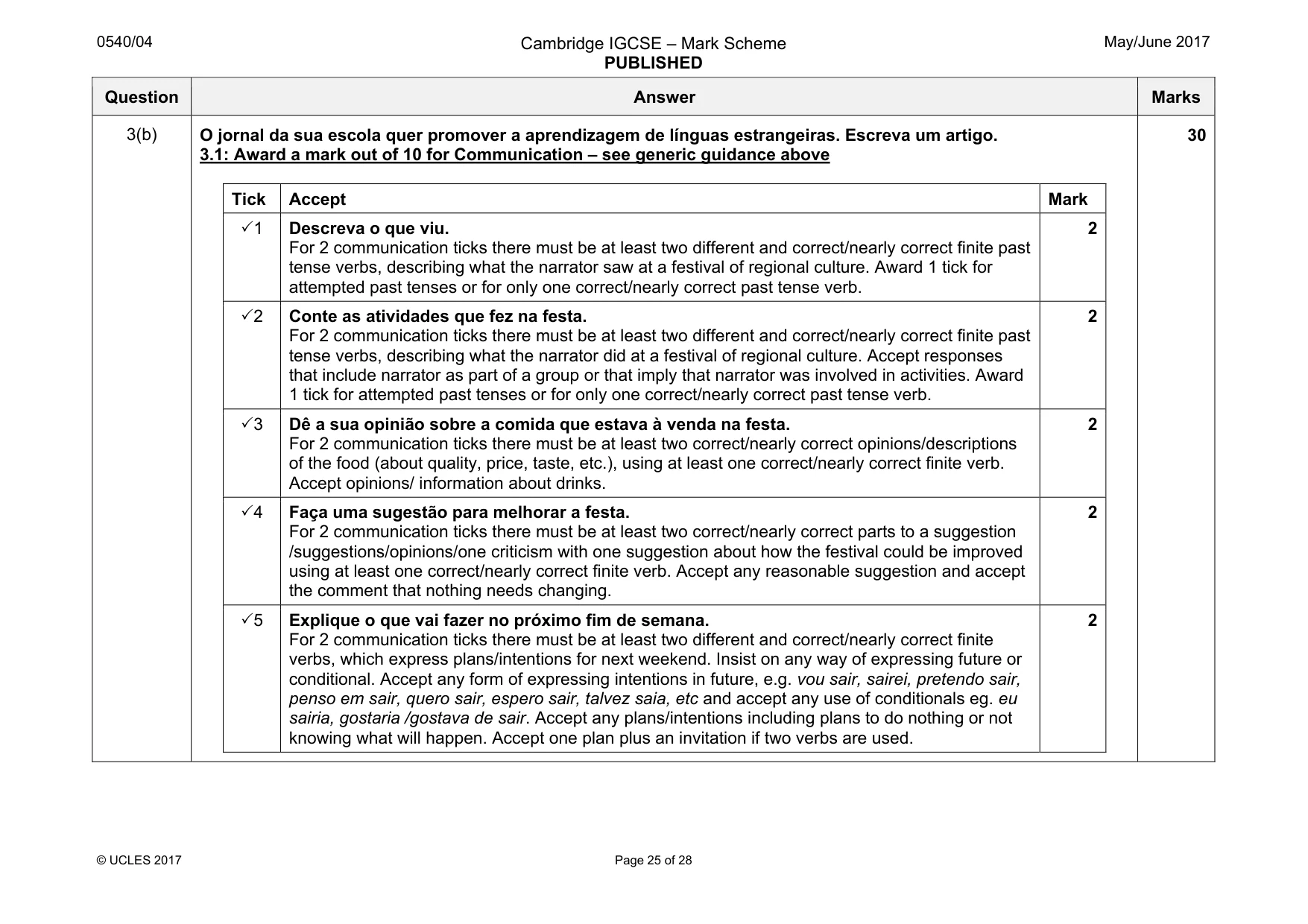
0540/04 Cambridge IGCSE – Mark Scheme PUBLISHED May/June 2017 © UCLES 2017 Page 25 of 28 Question Answer Marks 3(b) O jornal da sua escola quer promover a aprendizagem de línguas estrangeiras. Escreva um artigo. 3.1: Award a mark out of 10 for Communication – see generic guidance above Tick Accept Mark 31 Descreva o que viu. For 2 communication ticks there must be at least two different and correct/nearly correct finite past tense verbs, describing what the narrator saw at a festival of regional culture. Award 1 tick for attempted past tenses or for only one correct/nearly correct past tense verb. 2 32 Conte as atividades que fez na festa. For 2 communication ticks there must be at least two different and correct/nearly correct finite past tense verbs, describing what the narrator did at a festival of regional culture. Accept responses that include narrator as part of a group or that imply that narrator was involved in activities. Award 1 tick for attempted past tenses or for only one correct/nearly correct past tense verb. 2 33 Dê a sua opinião sobre a comida que estava à venda na festa. For 2 communication ticks there must be at least two correct/nearly correct opinions/descriptions of the food (about quality, price, taste, etc.), using at least one correct/nearly correct finite verb. Accept opinions/ information about drinks. 2 34 Faça uma sugestão para melhorar a festa. For 2 communication ticks there must be at least two correct/nearly correct parts to a suggestion /suggestions/opinions/one criticism with one suggestion about how the festival could be improved using at least one correct/nearly correct finite verb. Accept any reasonable suggestion and accept the comment that nothing needs changing. 2 35 Explique o que vai fazer no próximo fim de semana. For 2 communication ticks there must be at least two different and correct/nearly correct finite verbs, which express plans/intentions for next weekend. Insist on any way of expressing future or conditional. Accept any form of expressing intentions in future, e.g. vou sair, sairei, pretendo sair, penso em sair, quero sair, espero sair, talvez saia, etc and accept any use of conditionals eg. eu sairia, gostaria /gostava de sair. Accept any plans/intentions including plans to do nothing or not knowing what will happen. Accept one plan plus an invitation if two verbs are used. 2 30
Mark scheme, page 26
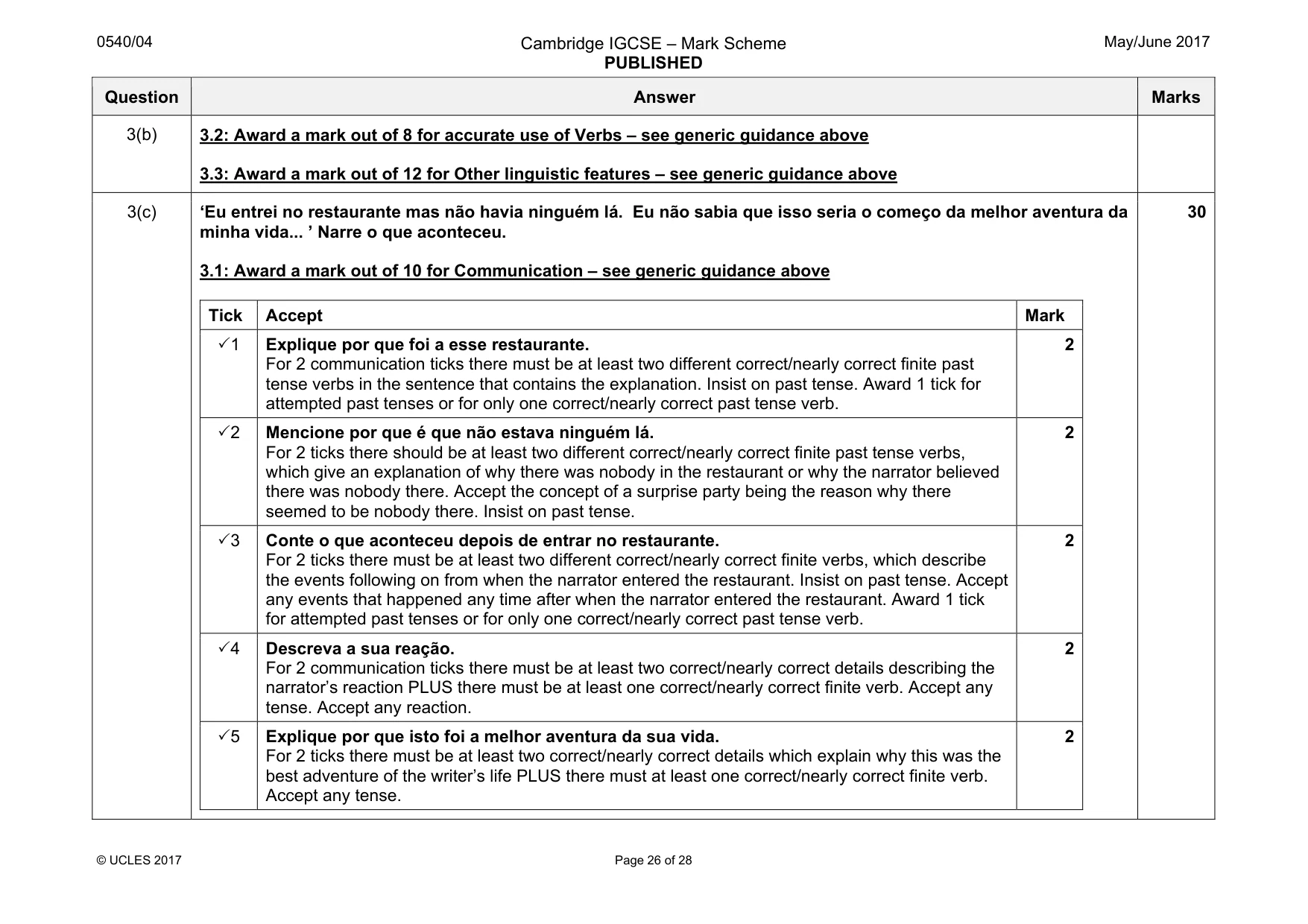
0540/04 Cambridge IGCSE – Mark Scheme PUBLISHED May/June 2017 © UCLES 2017 Page 26 of 28 Question Answer Marks 3(b) 3.2: Award a mark out of 8 for accurate use of Verbs – see generic guidance above 3.3: Award a mark out of 12 for Other linguistic features – see generic guidance above 3(c) ‘Eu entrei no restaurante mas não havia ninguém lá. Eu não sabia que isso seria o começo da melhor aventura da minha vida... ’ Narre o que aconteceu. 3.1: Award a mark out of 10 for Communication – see generic guidance above Tick Accept Mark 31 Explique por que foi a esse restaurante. For 2 communication ticks there must be at least two different correct/nearly correct finite past tense verbs in the sentence that contains the explanation. Insist on past tense. Award 1 tick for attempted past tenses or for only one correct/nearly correct past tense verb. 2 32 Mencione por que é que não estava ninguém lá. For 2 ticks there should be at least two different correct/nearly correct finite past tense verbs, which give an explanation of why there was nobody in the restaurant or why the narrator believed there was nobody there. Accept the concept of a surprise party being the reason why there seemed to be nobody there. Insist on past tense. 2 33 Conte o que aconteceu depois de entrar no restaurante. For 2 ticks there must be at least two different correct/nearly correct finite verbs, which describe the events following on from when the narrator entered the restaurant. Insist on past tense. Accept any events that happened any time after when the narrator entered the restaurant. Award 1 tick for attempted past tenses or for only one correct/nearly correct past tense verb. 2 34 Descreva a sua reação. For 2 communication ticks there must be at least two correct/nearly correct details describing the narrator’s reaction PLUS there must be at least one correct/nearly correct finite verb. Accept any tense. Accept any reaction. 2 35 Explique por que isto foi a melhor aventura da sua vida. For 2 ticks there must be at least two correct/nearly correct details which explain why this was the best adventure of the writer’s life PLUS there must at least one correct/nearly correct finite verb. Accept any tense. 2 30
Mark scheme, page 27
0540/04 Cambridge IGCSE – Mark Scheme PUBLISHED May/June 2017 © UCLES 2017 Page 27 of 28 Question Answer Marks 3(c) 3.2: Award a mark out of 8 for accurate use of Verbs – see generic guidance above 3.3: Award a mark out of 12 for Other linguistic features – see generic guidance above
Mark scheme, page 28
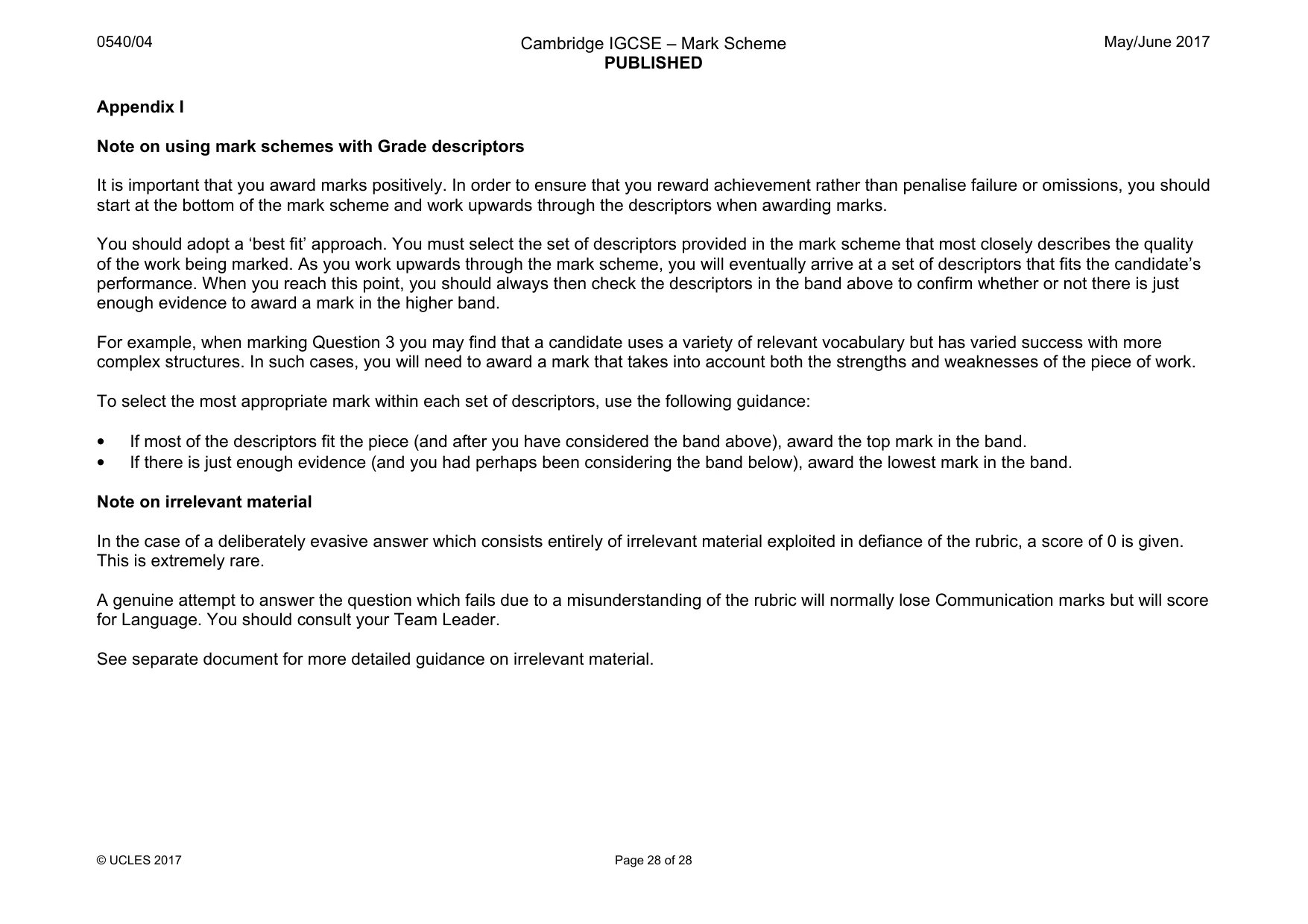
0540/04 Cambridge IGCSE – Mark Scheme PUBLISHED May/June 2017 © UCLES 2017 Page 28 of 28 Appendix I Note on using mark schemes with Grade descriptors It is important that you award marks positively. In order to ensure that you reward achievement rather than penalise failure or omissions, you should start at the bottom of the mark scheme and work upwards through the descriptors when awarding marks. You should adopt a ‘best fit’ approach. You must select the set of descriptors provided in the mark scheme that most closely describes the quality of the work being marked. As you work upwards through the mark scheme, you will eventually arrive at a set of descriptors that fits the candidate’s performance. When you reach this point, you should always then check the descriptors in the band above to confirm whether or not there is just enough evidence to award a mark in the higher band. For example, when marking Question 3 you may find that a candidate uses a variety of relevant vocabulary but has varied success with more complex structures. In such cases, you will need to award a mark that takes into account both the strengths and weaknesses of the piece of work. To select the most appropriate mark within each set of descriptors, use the following guidance: • If most of the descriptors fit the piece (and after you have considered the band above), award the top mark in the band. • If there is just enough evidence (and you had perhaps been considering the band below), award the lowest mark in the band. Note on irrelevant material In the case of a deliberately evasive answer which consists entirely of irrelevant material exploited in defiance of the rubric, a score of 0 is given. This is extremely rare. A genuine attempt to answer the question which fails due to a misunderstanding of the rubric will normally lose Communication marks but will score for Language. You should consult your Team Leader. See separate document for more detailed guidance on irrelevant material.
What you needed in this session
Cambridge’s own grade thresholds for 2017 May/June, Paper 4 · Variant 1. A higher threshold means an easier paper — the bar moves with how the cohort did.