Cambridge IGCSE Physics (9-1) 0972 — 2020 Oct/Nov Paper 4 · Variant 1
0972/41/O/N/20 · 10 questions · 80 marks · ≈90 min
The question paper and its mark scheme, free to read here and free to download. This is Cambridge’s own paper, exactly as it was sat.
Question paper20 pages
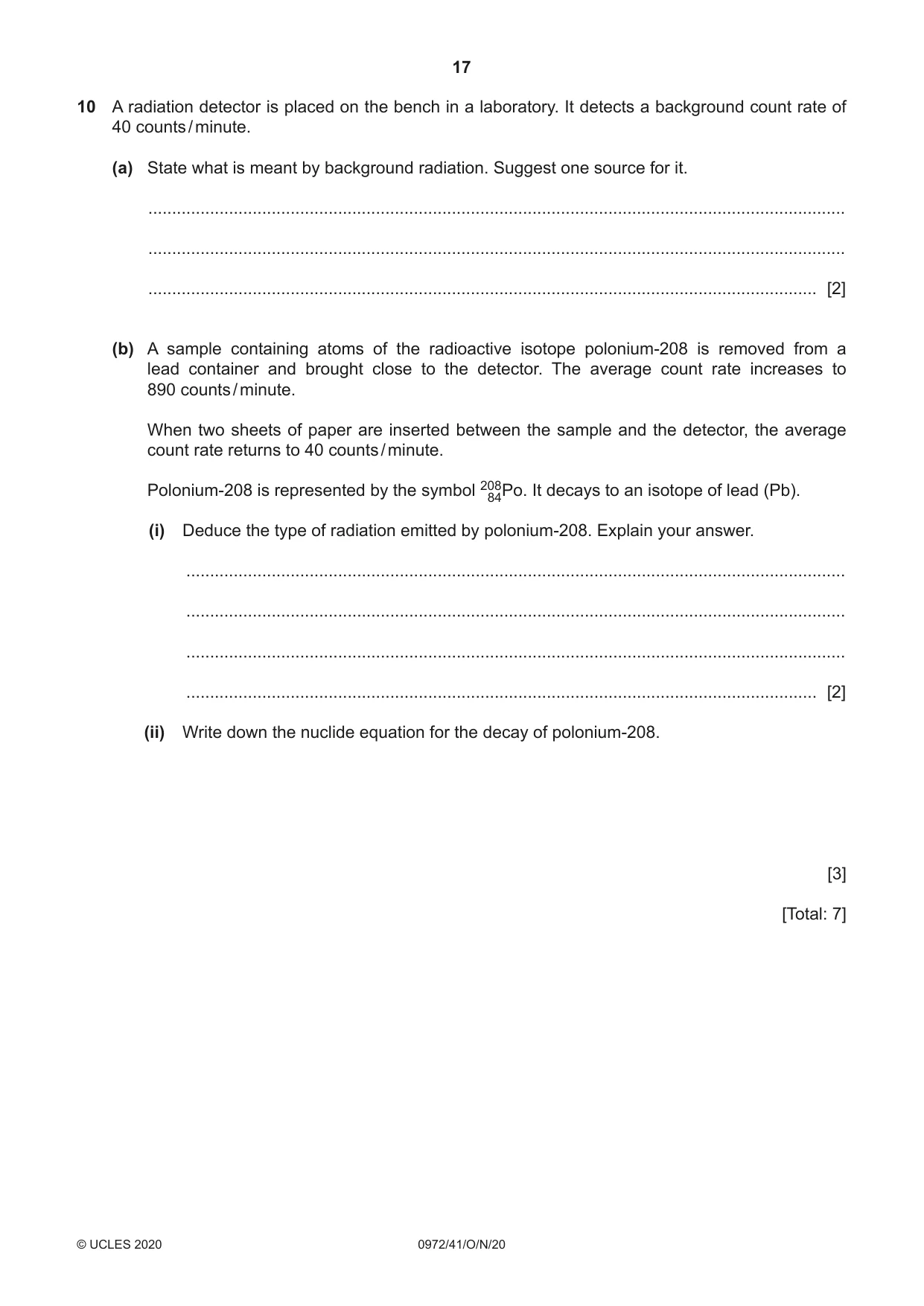


Mark scheme17 pages
Answers below. Sit the paper first if you are practising.
Questions as text
Q1 · An ice-hockey player moving on ice
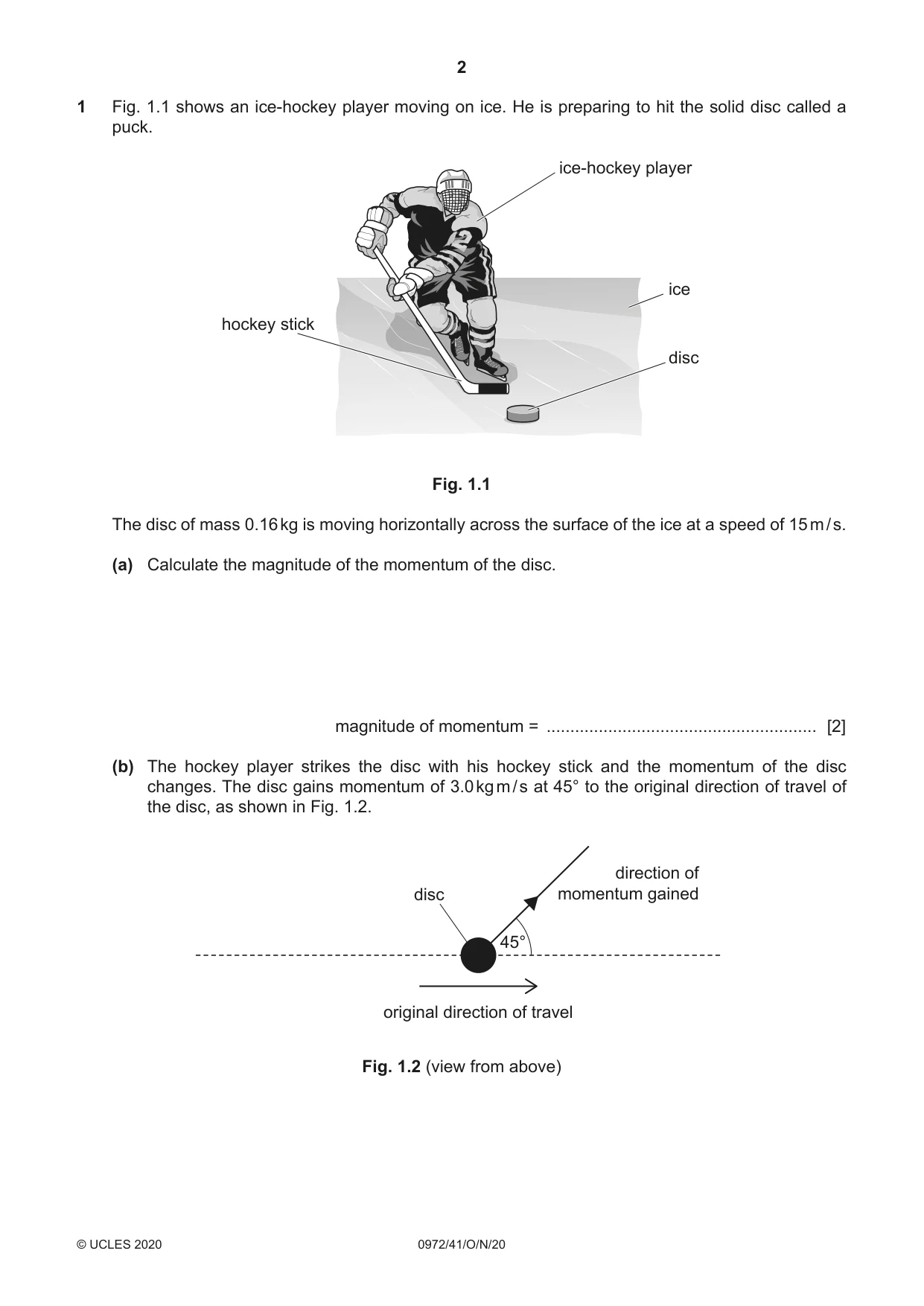
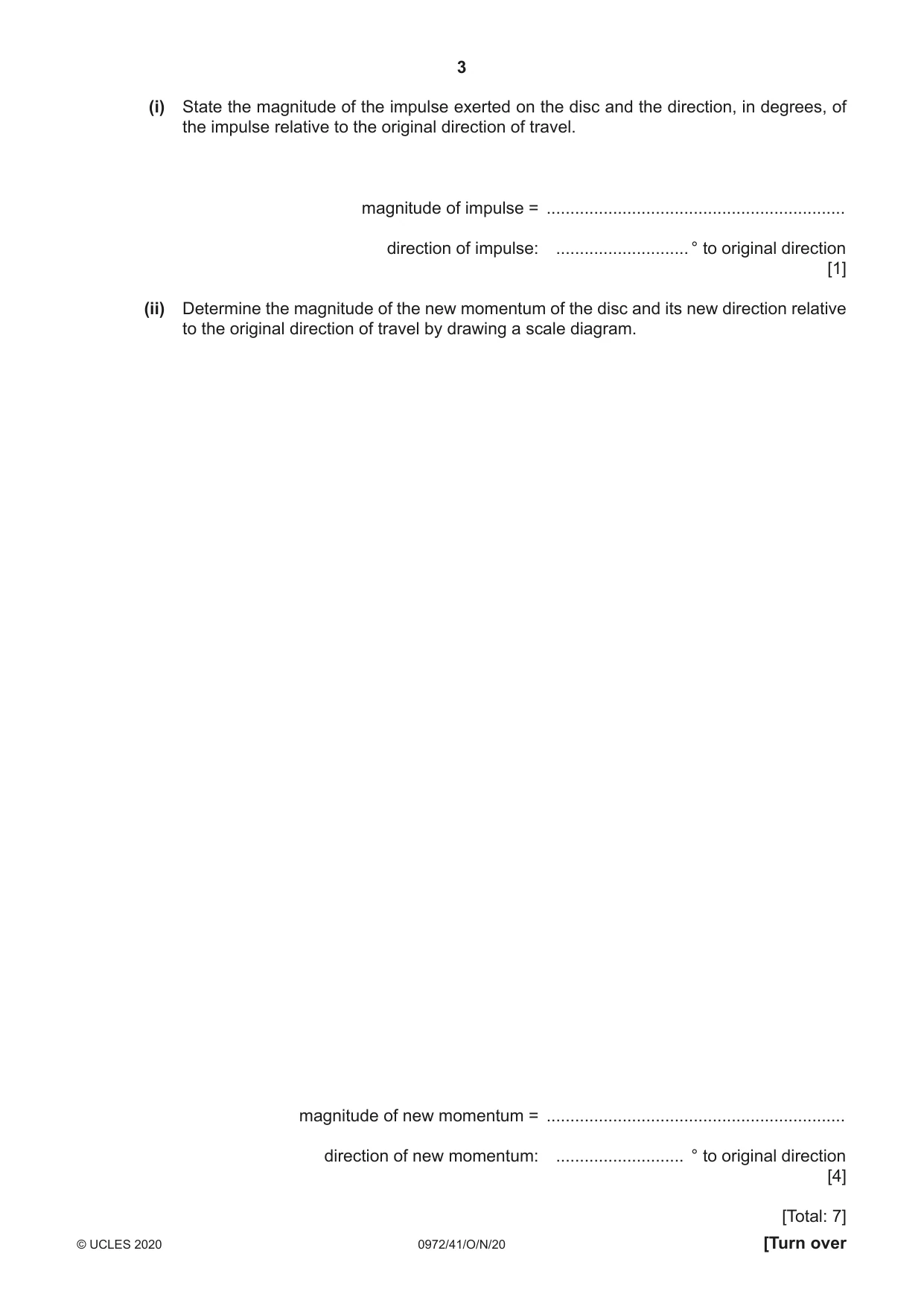
1 Fig. 1.1 shows an ice-hockey player moving on ice. He is preparing to hit the solid disc called a puck. ice-hockey player ice hockey stick disc Fig. 1.1 The disc of mass 0.16 kg is moving horizontally across the surface of the ice at a speed of 15 m / s. (a) Calculate the magnitude of the momentum of the disc. magnitude of momentum = ......................................................... [2] (b) The hockey player strikes the disc with his hockey stick and the momentum of the disc changes. The disc gains momentum of 3.0 kg m / s at 45° to the original direction of travel of the disc, as shown in Fig. 1.2. direction of disc momentum gained 45° original direction of travel Fig. 1.2 (view from above) (i) State the magnitude of the impulse exerted on the disc and the direction, in degrees, of the impulse relative to the original direction of travel. magnitude of impulse = ............................................................... direction of impulse: ............................ ° to original direction [1] (ii) Determine the magnitude of the new momentum of the disc and its new direction relative to the original direction of travel by drawing a scale diagram. magnitude of new momentum = ............................................................... direction of new momentum: ........................... ° to original direction [4] [Total: 7]
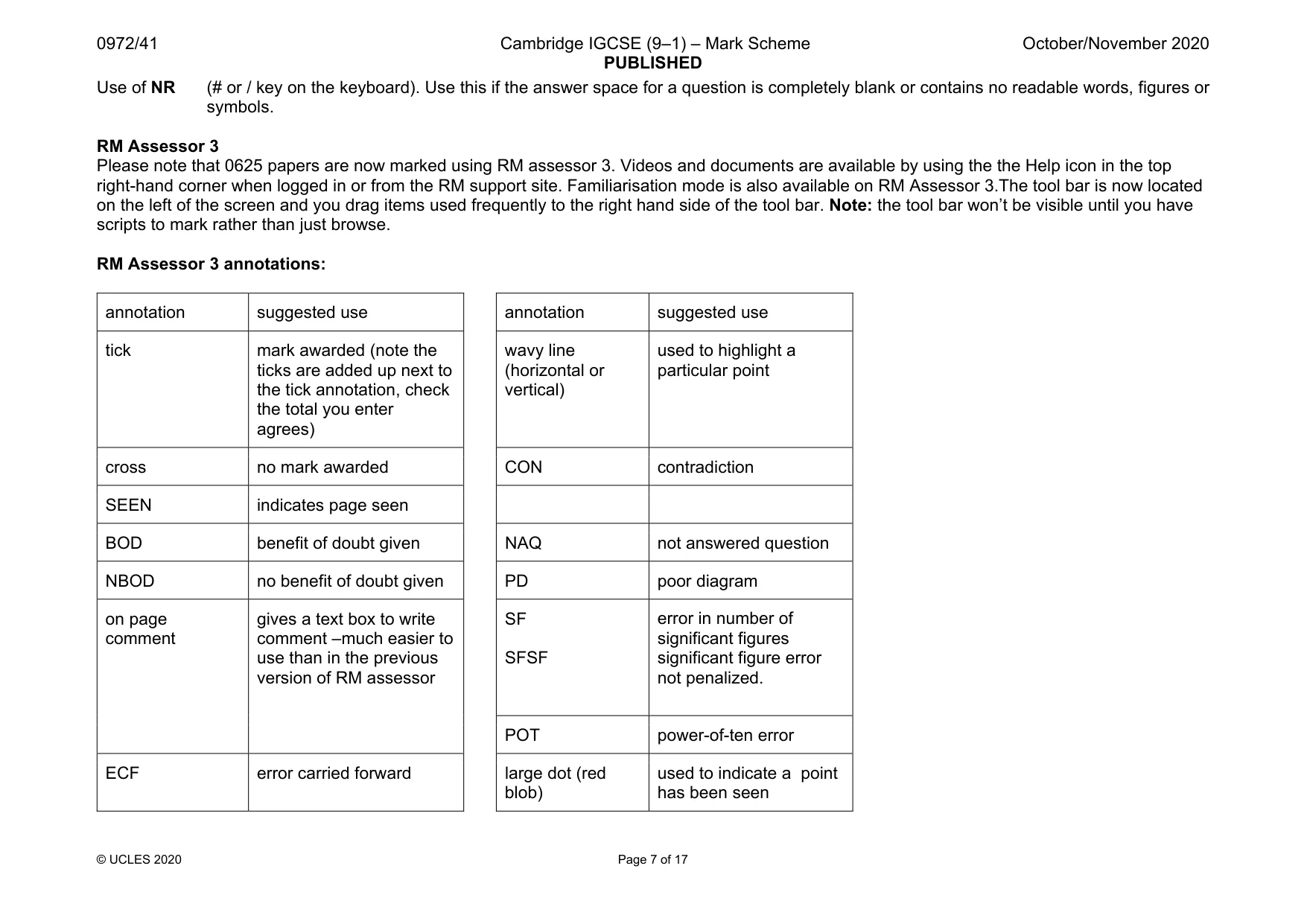
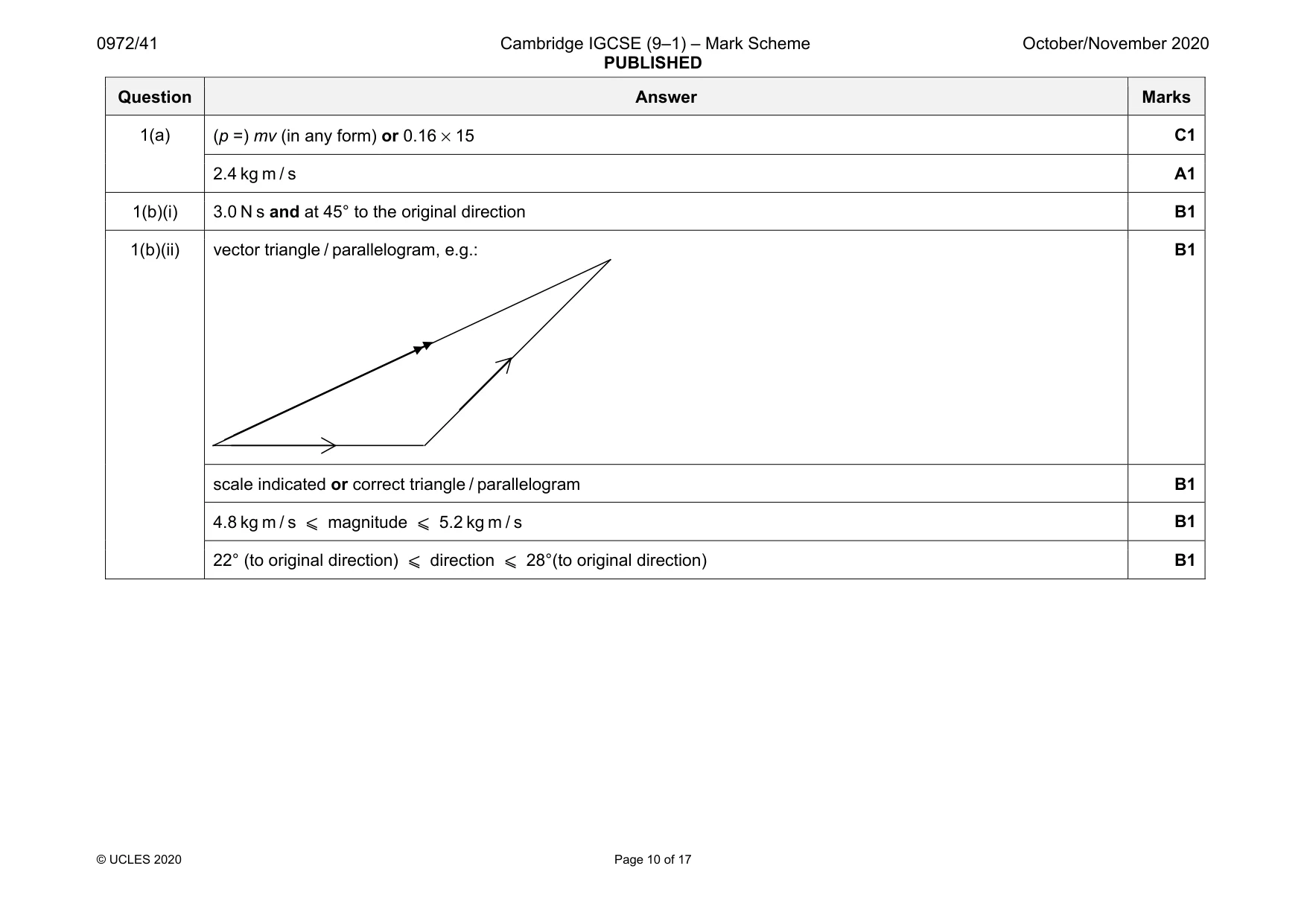
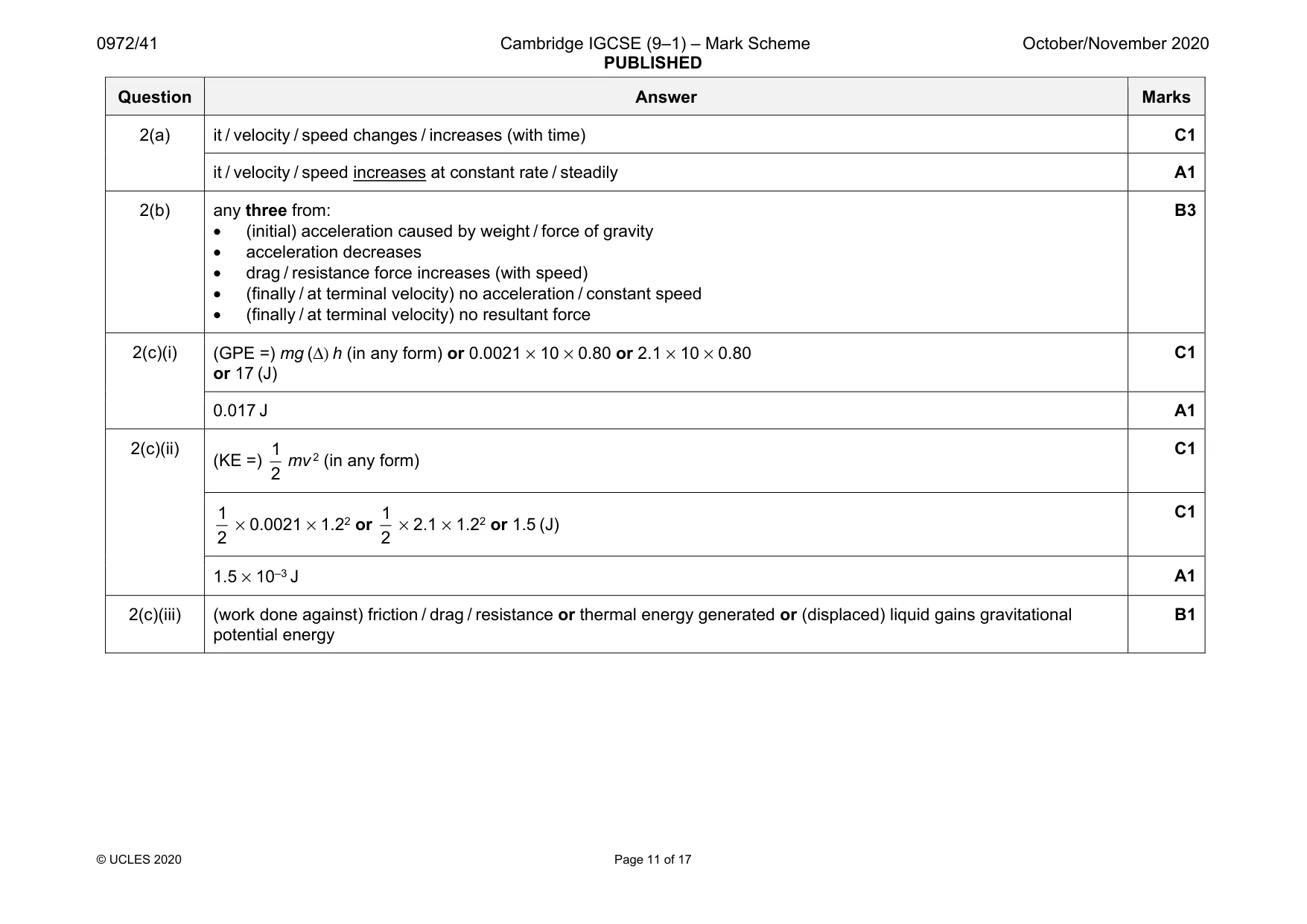
Mark scheme: 1(a) (p =) mv (in any form) or 0.16 × 15 C1 2.4 kg m / s A1 1(b)(i) 3.0 N s and at 45° to the original direction B1 1(b)(ii) vector triangle / parallelogram, e.g.: B1 scale indicated or correct triangle / parallelogram B1 4.8 kg m / s ⩽ magnitude ⩽ 5.2 kg m / s B1 22° (to original direction) ⩽ direction ⩽ 28°(to original direction) B1
Q2 · A vertical tube contains a liquid
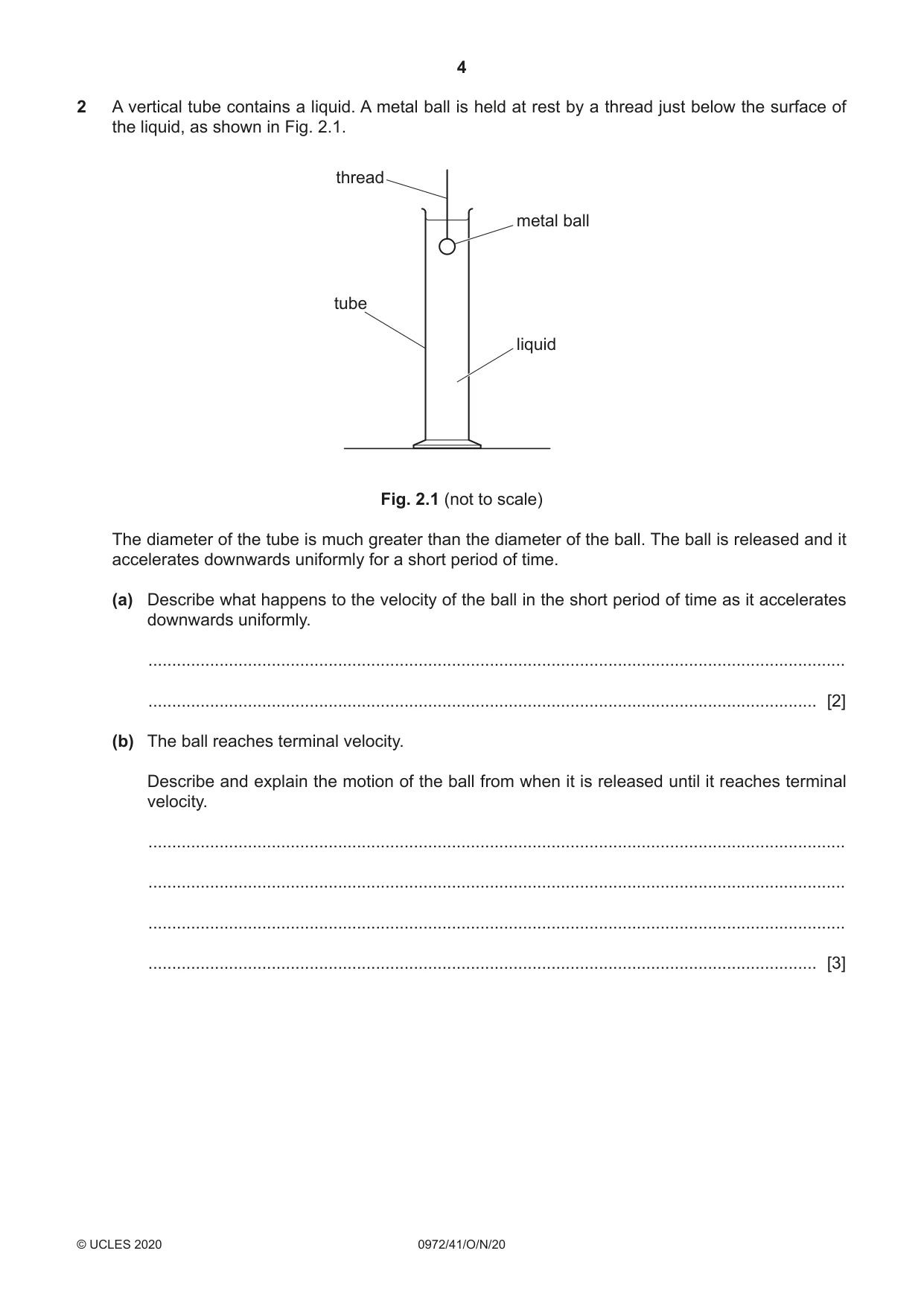
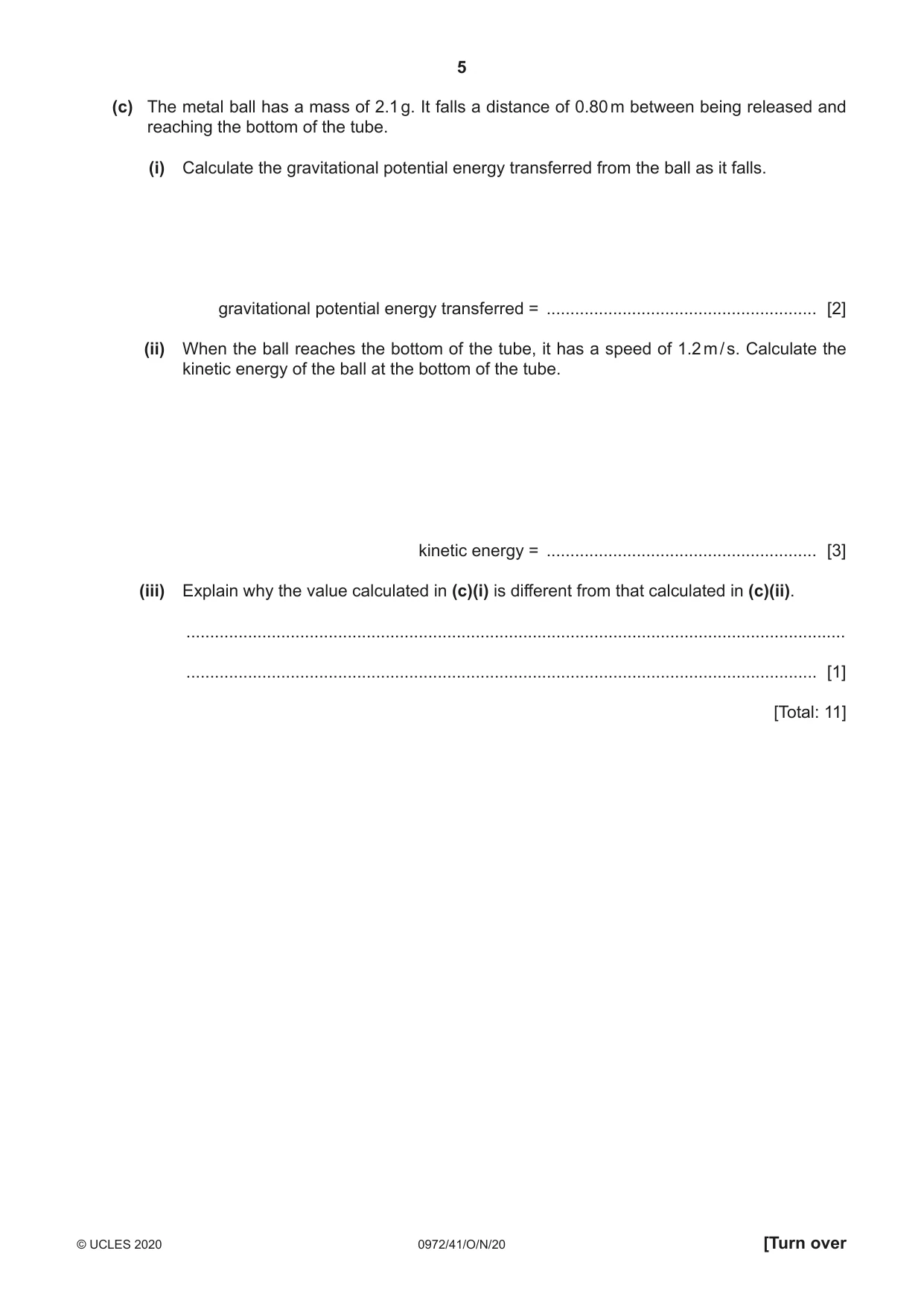
2 A vertical tube contains a liquid. A metal ball is held at rest by a thread just below the surface of the liquid, as shown in Fig. 2.1. thread metal ball tube liquid Fig. 2.1 (not to scale) The diameter of the tube is much greater than the diameter of the ball. The ball is released and it accelerates downwards uniformly for a short period of time. (a) Describe what happens to the velocity of the ball in the short period of time as it accelerates downwards uniformly. ................................................................................................................................................... ............................................................................................................................................. [2] (b) The ball reaches terminal velocity. Describe and explain the motion of the ball from when it is released until it reaches terminal velocity. ................................................................................................................................................... ................................................................................................................................................... ................................................................................................................................................... ............................................................................................................................................. [3] (c) The metal ball has a mass of 2.1 g. It falls a distance of 0.80 m between being released and reaching the bottom of the tube. (i) Calculate the gravitational potential energy transferred from the ball as it falls. gravitational potential energy transferred = ......................................................... [2] (ii) When the ball reaches the bottom of the tube, it has a speed of 1.2 m / s. Calculate the kinetic energy of the ball at the bottom of the tube. kinetic energy = ......................................................... [3] (iii) Explain why the value calculated in (c)(i) is different from that calculated in (c)(ii). ........................................................................................................................................... ..................................................................................................................................... [1] [Total: 11]
Mark scheme: 2(a) it / velocity / speed changes / increases (with time) C1 it / velocity / speed increases at constant rate / steadily A1 2(b) any three from: • (initial) acceleration caused by weight / force of gravity • acceleration decreases • drag / resistance force increases (with speed) • (finally / at terminal velocity) no acceleration / constant speed • (finally / at terminal velocity) no resultant force B3 2(c)(i) (GPE =) mg (Δ) h (in any form) or 0.0021 × 10 × 0.80 or 2.1 × 10 × 0.80 or 17 (J) C1 0.017 J A1 2(c)(ii) (KE =) 1 2 mv 2 (in any form) C1 1 2 × 0.0021 × 1.22 or 1 2 × 2.1 × 1.22 or 1.5 (J) C1 1.5 × 10⁻³ J A1 2(c)(iii) (work done against) friction / drag / resistance or thermal energy generated or (displaced) liquid gains gravitational potential energy B1
Q3 · A U-shaped tube of constant cross-sectional area contains water of density 1000 kg / m3
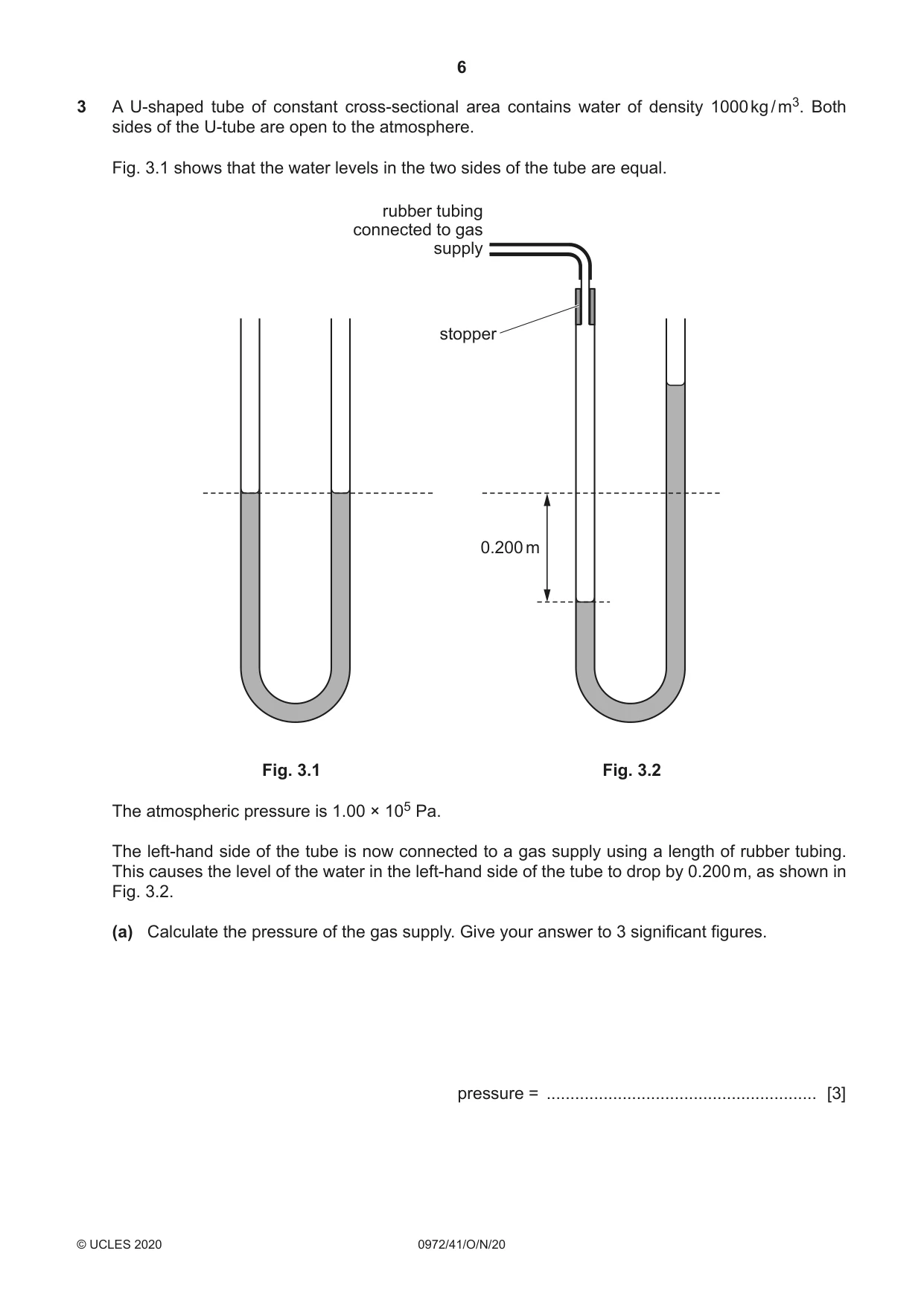
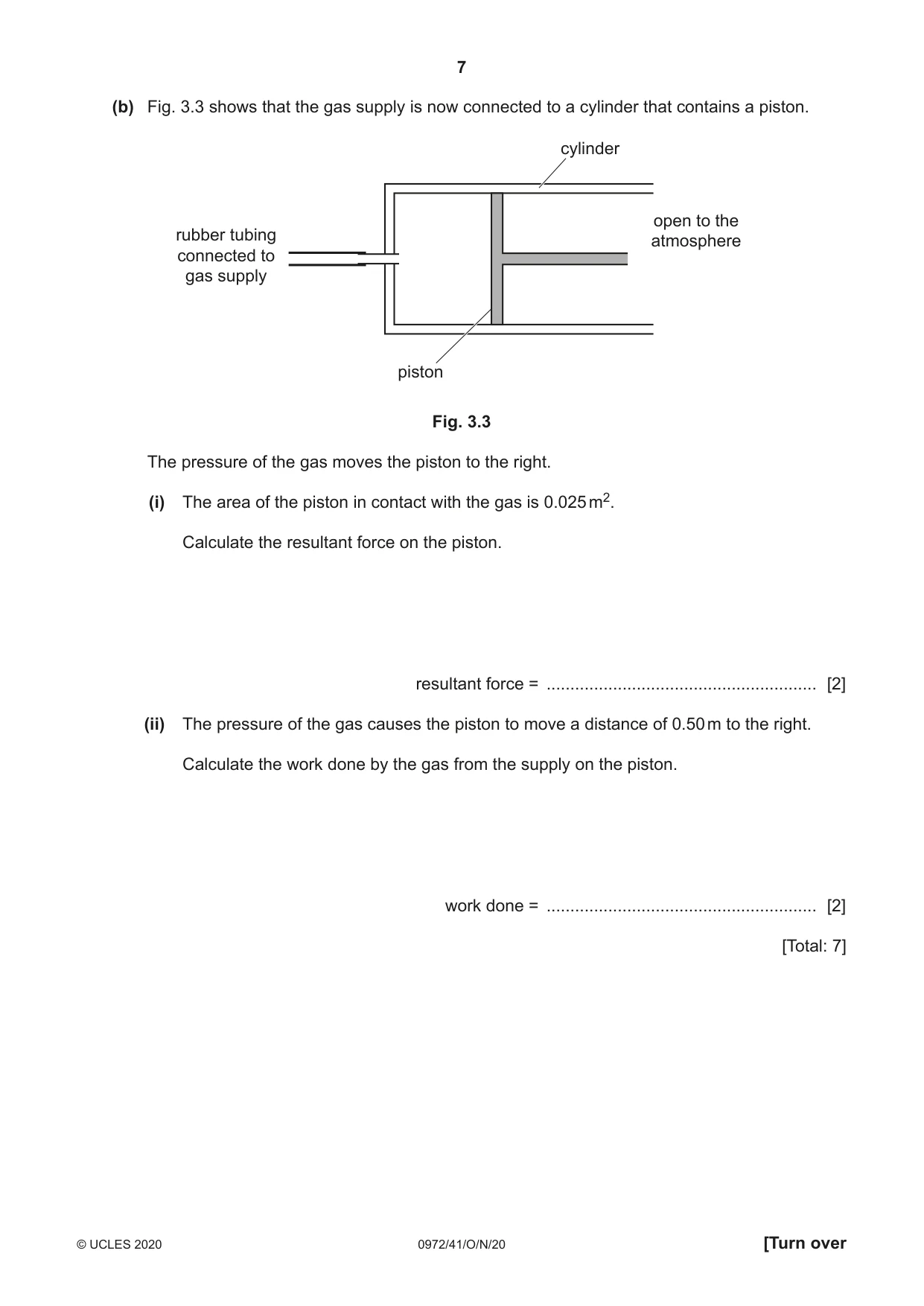
3 A U-shaped tube of constant cross-sectional area contains water of density 1000 kg / m3. Both sides of the U-tube are open to the atmosphere. Fig. 3.1 shows that the water levels in the two sides of the tube are equal. rubber tubing connected to gas supply stopper 0.200 m Fig. 3.1 Fig. 3.2 The atmospheric pressure is 1.00 × 10⁵ Pa. The left-hand side of the tube is now connected to a gas supply using a length of rubber tubing. This causes the level of the water in the left-hand side of the tube to drop by 0.200 m, as shown in Fig. 3.2. (a) Calculate the pressure of the gas supply. Give your answer to 3 significant figures. pressure = ......................................................... [3] (b) Fig. 3.3 shows that the gas supply is now connected to a cylinder that contains a piston. cylinder open to the rubber tubing atmosphere connected to gas supply piston Fig. 3.3 The pressure of the gas moves the piston to the right. (i) The area of the piston in contact with the gas is 0.025 m2. Calculate the resultant force on the piston. resultant force = ......................................................... [2] (ii) The pressure of the gas causes the piston to move a distance of 0.50 m to the right. Calculate the work done by the gas from the supply on the piston. work done = ......................................................... [2] [Total: 7]
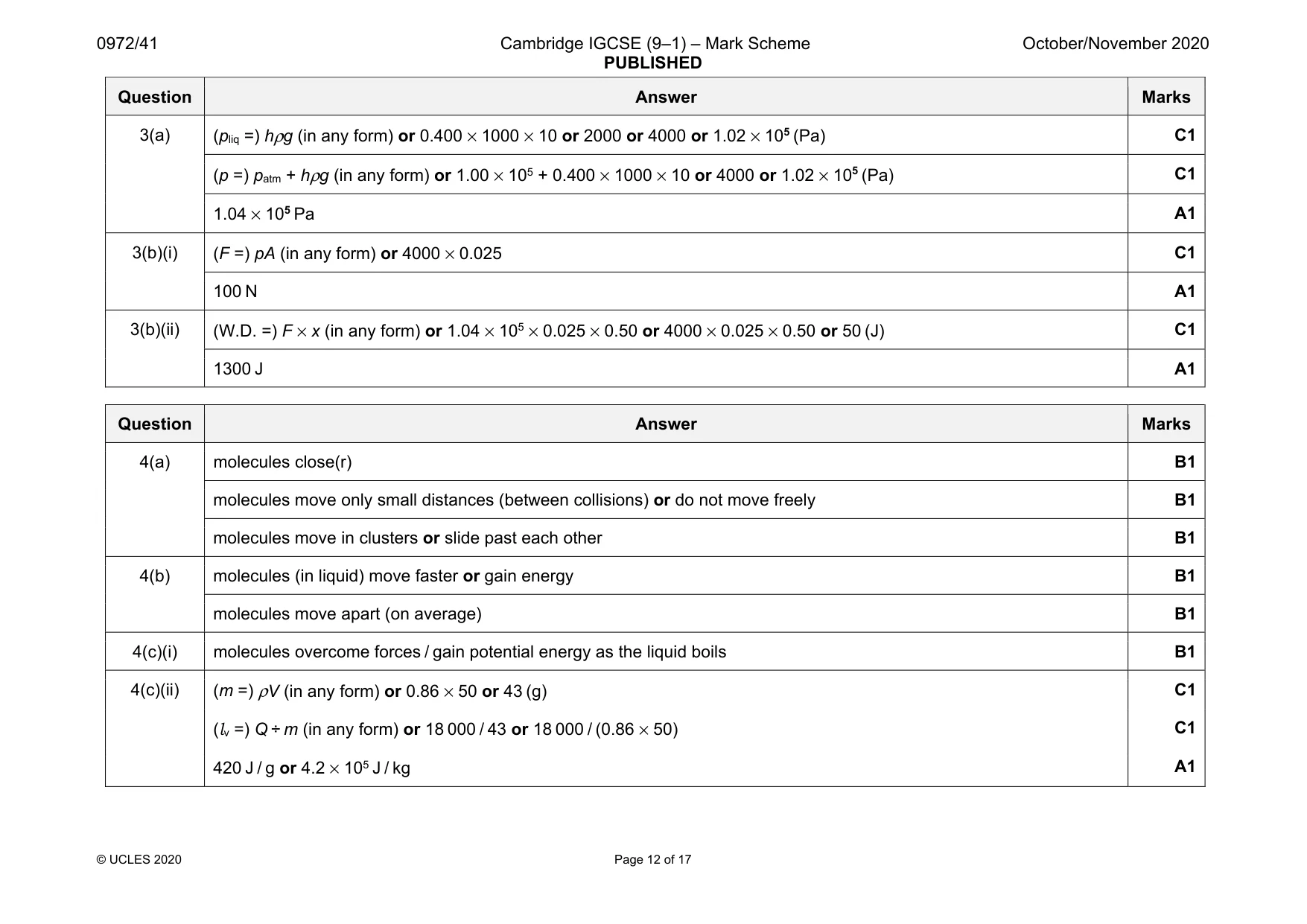
Mark scheme: 3(a) (pliq =) hρg (in any form) or 0.400 × 1000 × 10 or 2000 or 4000 or 1.02 × 10⁵ (Pa) C1 (p =) patm + hρg (in any form) or 1.00 × 10⁵ + 0.400 × 1000 × 10 or 4000 or 1.02 × 10⁵ (Pa) C1 1.04 × 10⁵ Pa A1 3(b)(i) (F =) pA (in any form) or 4000 × 0.025 C1 100 N A1 3(b)(ii) (W.D. =) F × x (in any form) or 1.04 × 105 × 0.025 × 0.50 or 4000 × 0.025 × 0.50 or 50 (J) C1 1300 J A1
Q4 · A large test-tube contains a liquid at room temperature
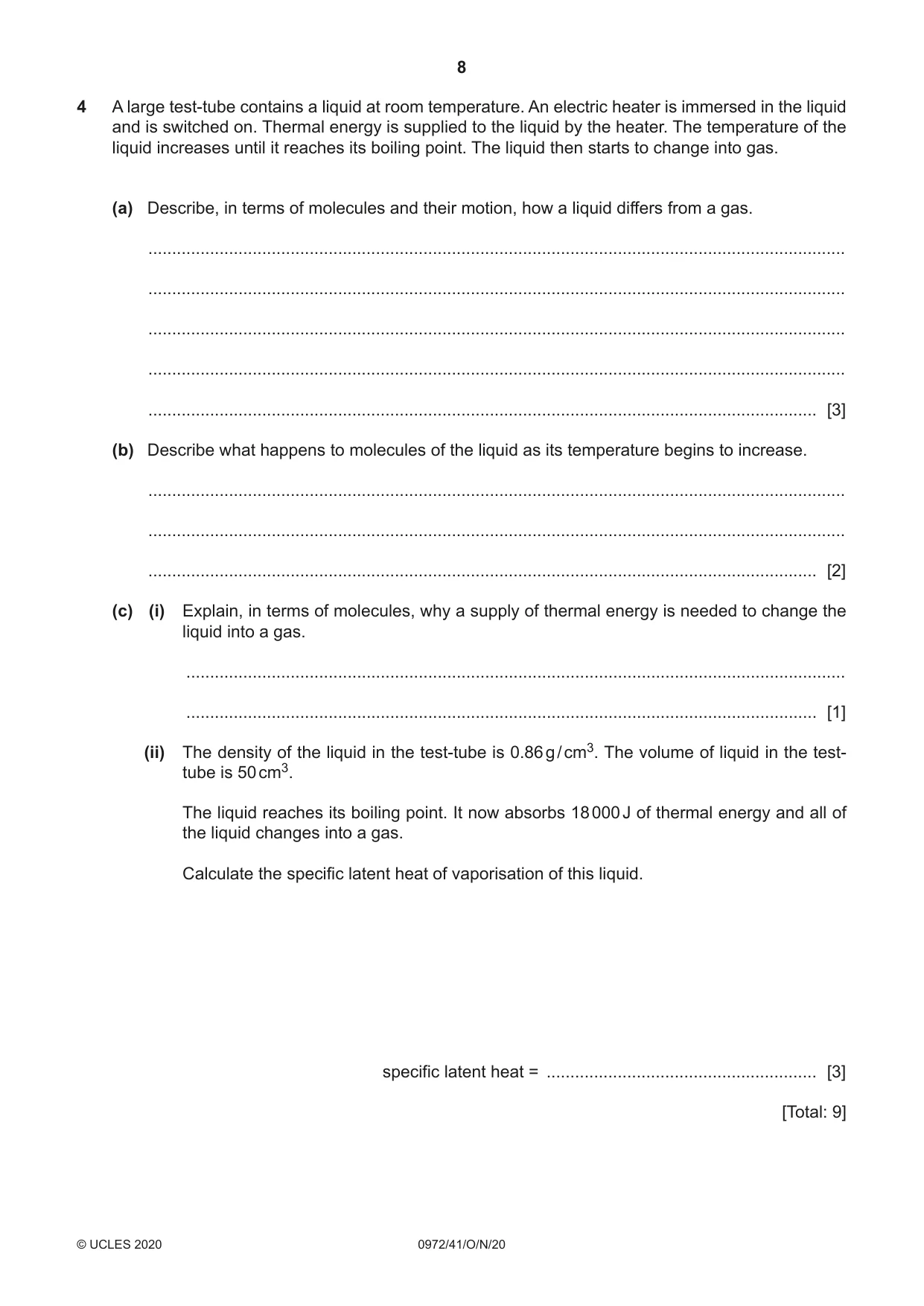
4 A large test-tube contains a liquid at room temperature. An electric heater is immersed in the liquid and is switched on. Thermal energy is supplied to the liquid by the heater. The temperature of the liquid increases until it reaches its boiling point. The liquid then starts to change into gas. (a) Describe, in terms of molecules and their motion, how a liquid differs from a gas. ................................................................................................................................................... ................................................................................................................................................... ................................................................................................................................................... ................................................................................................................................................... ............................................................................................................................................. [3] (b) Describe what happens to molecules of the liquid as its temperature begins to increase. ................................................................................................................................................... ................................................................................................................................................... ............................................................................................................................................. [2] (c) (i) Explain, in terms of molecules, why a supply of thermal energy is needed to change the liquid into a gas. ........................................................................................................................................... ..................................................................................................................................... [1] (ii) The density of the liquid in the test-tube is 0.86 g / cm3. The volume of liquid in the test- tube is 50 cm3. The liquid reaches its boiling point. It now absorbs 18 000 J of thermal energy and all of the liquid changes into a gas. Calculate the specific latent heat of vaporisation of this liquid. specific latent heat = ......................................................... [3] [Total: 9]
Mark scheme: 4(a) molecules close(r) B1 molecules move only small distances (between collisions) or do not move freely B1 molecules move in clusters or slide past each other B1 4(b) molecules (in liquid) move faster or gain energy B1 molecules move apart (on average) B1 4(c)(i) molecules overcome forces / gain potential energy as the liquid boils B1 4(c)(ii) (m =) ρV (in any form) or 0.86 × 50 or 43 (g) C1 (lv =) Q ÷ m (in any form) or 18 000 / 43 or 18 000 / (0.86 × 50) C1 420 J / g or 4.2 × 10⁵ J / kg A1
Q5 · A metal container is used to cook food
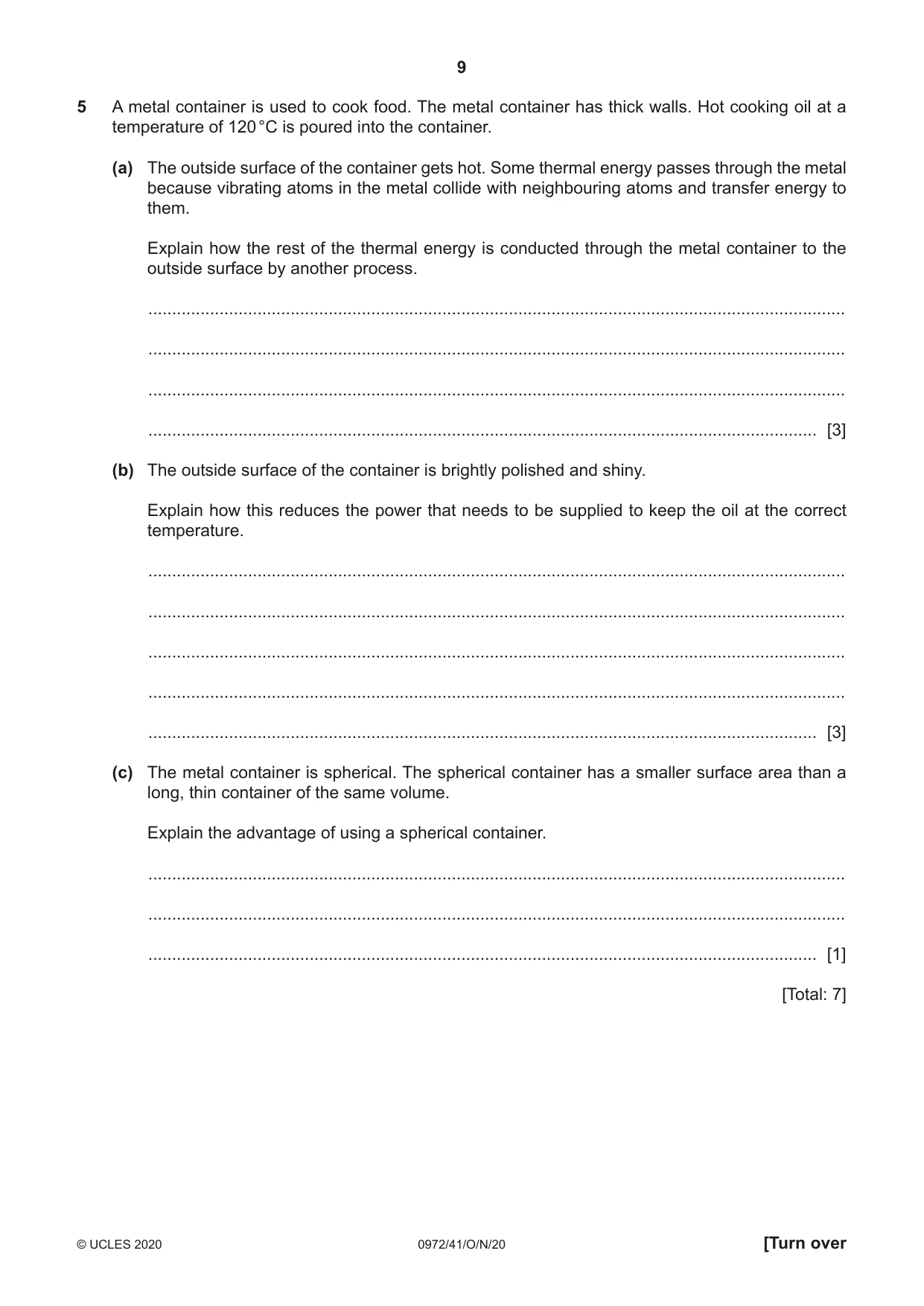
5 A metal container is used to cook food. The metal container has thick walls. Hot cooking oil at a temperature of 120 °C is poured into the container. (a) The outside surface of the container gets hot. Some thermal energy passes through the metal because vibrating atoms in the metal collide with neighbouring atoms and transfer energy to them. Explain how the rest of the thermal energy is conducted through the metal container to the outside surface by another process. ................................................................................................................................................... ................................................................................................................................................... ................................................................................................................................................... ............................................................................................................................................. [3] (b) The outside surface of the container is brightly polished and shiny. Explain how this reduces the power that needs to be supplied to keep the oil at the correct temperature. ................................................................................................................................................... ................................................................................................................................................... ................................................................................................................................................... ................................................................................................................................................... ............................................................................................................................................. [3] (c) The metal container is spherical. The spherical container has a smaller surface area than a long, thin container of the same volume. Explain the advantage of using a spherical container. ................................................................................................................................................... ................................................................................................................................................... ............................................................................................................................................. [1] [Total: 7]
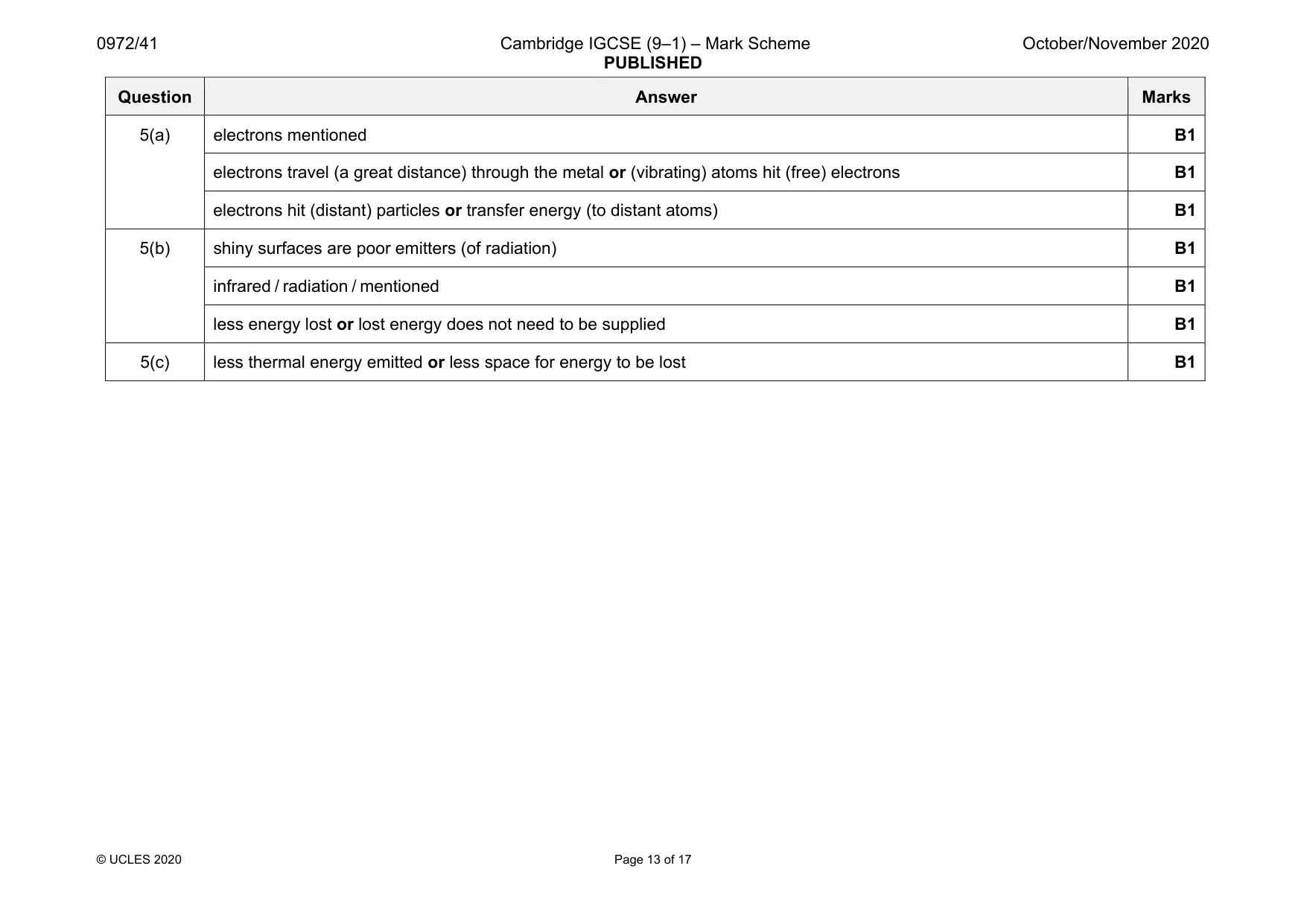
Mark scheme: 5(a) electrons mentioned B1 electrons travel (a great distance) through the metal or (vibrating) atoms hit (free) electrons B1 electrons hit (distant) particles or transfer energy (to distant atoms) B1 5(b) shiny surfaces are poor emitters (of radiation) B1 infrared / radiation / mentioned B1 less energy lost or lost energy does not need to be supplied B1 5(c) less thermal energy emitted or less space for energy to be lost B1
Q6 · A shallow tank viewed from above
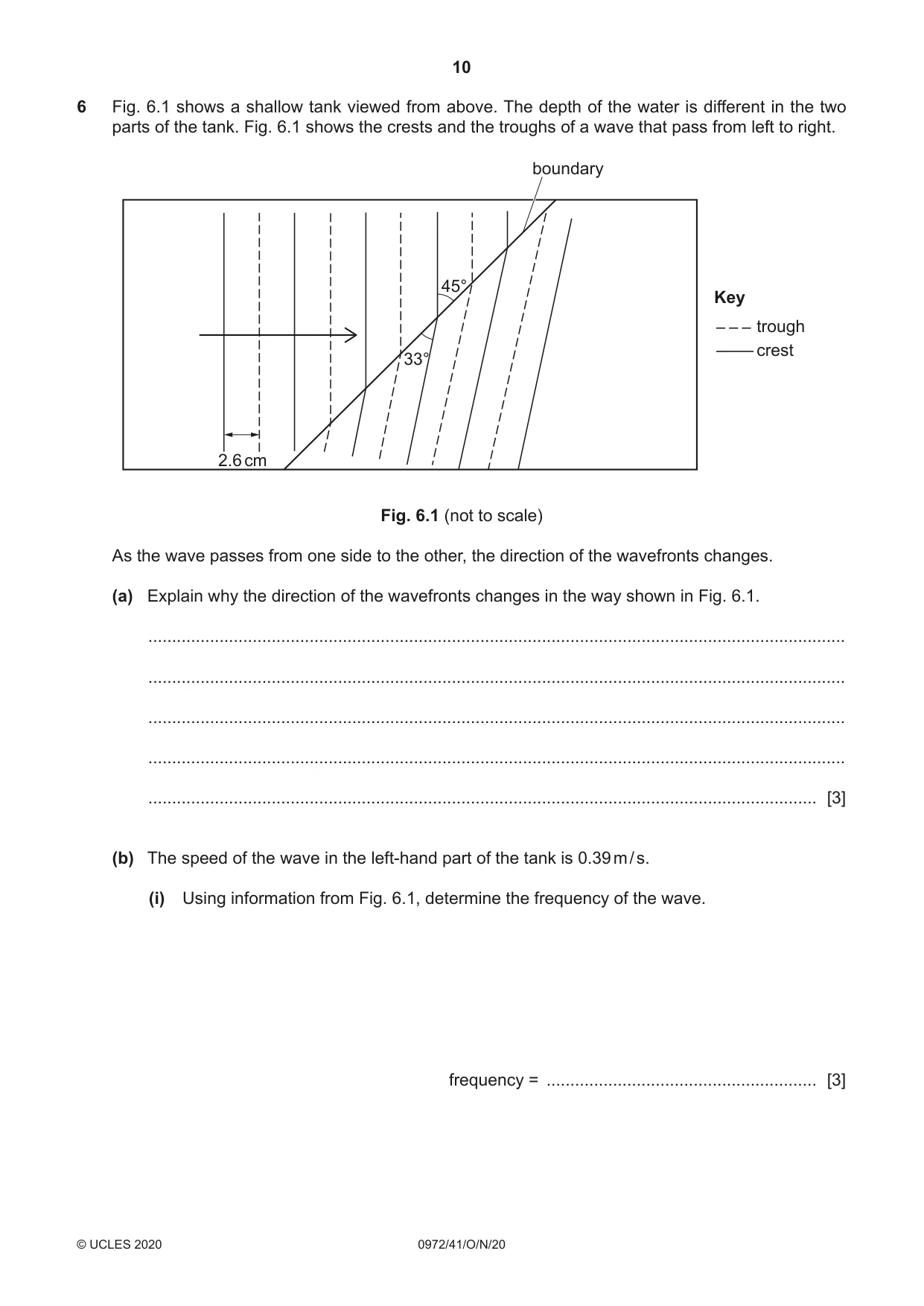
6 Fig. 6.1 shows a shallow tank viewed from above. The depth of the water is different in the two parts of the tank. Fig. 6.1 shows the crests and the troughs of a wave that pass from left to right. boundary 45° Key trough crest 33° 2.6 cm Fig. 6.1 (not to scale) As the wave passes from one side to the other, the direction of the wavefronts changes. (a) Explain why the direction of the wavefronts changes in the way shown in Fig. 6.1. ................................................................................................................................................... ................................................................................................................................................... ................................................................................................................................................... ................................................................................................................................................... ............................................................................................................................................. [3] (b) The speed of the wave in the left-hand part of the tank is 0.39 m / s. (i) Using information from Fig. 6.1, determine the frequency of the wave. frequency = ......................................................... [3] (ii) Determine the speed of the wave in the right-hand side of the tank. speed = ......................................................... [3] [Total: 9]
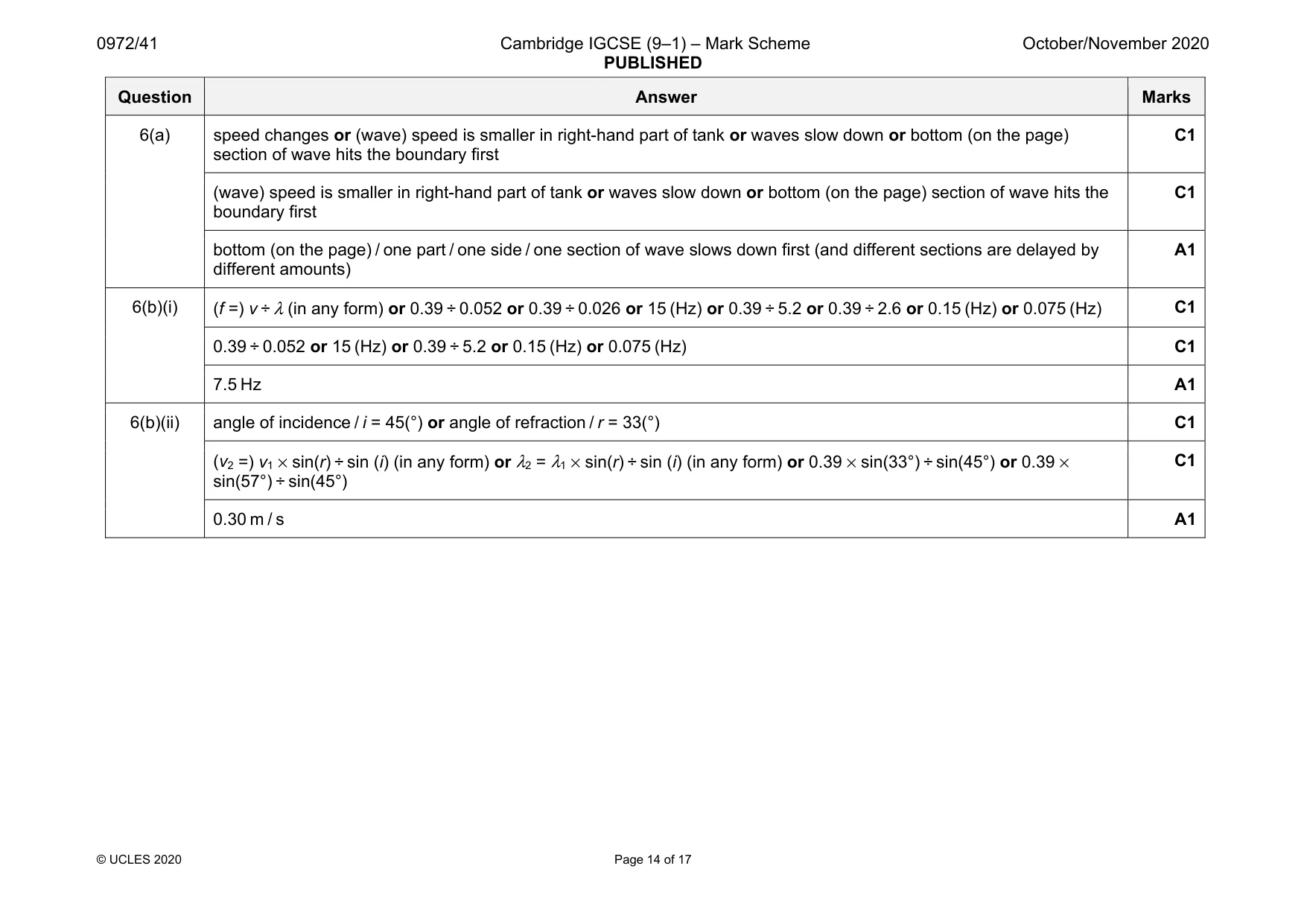
Mark scheme: 6(a) speed changes or (wave) speed is smaller in right-hand part of tank or waves slow down or bottom (on the page) section of wave hits the boundary first C1 (wave) speed is smaller in right-hand part of tank or waves slow down or bottom (on the page) section of wave hits the boundary first C1 bottom (on the page) / one part / one side / one section of wave slows down first (and different sections are delayed by different amounts) A1 6(b)(i) (f =) v ÷ λ (in any form) or 0.39 ÷ 0.052 or 0.39 ÷ 0.026 or 15 (Hz) or 0.39 ÷ 5.2 or 0.39 ÷ 2.6 or 0.15 (Hz) or 0.075 (Hz) C1 0.39 ÷ 0.052 or 15 (Hz) or 0.39 ÷ 5.2 or 0.15 (Hz) or 0.075 (Hz) C1 7.5 Hz A1 6(b)(ii) angle of incidence / i = 45(°) or angle of refraction / r = 33(°) C1 (v2 =) v1 × sin(r) ÷ sin (i) (in any form) or λ2 = λ1 × sin(r) ÷ sin (i) (in any form) or 0.39 × sin(33°) ÷ sin(45°) or 0.39 × sin(57°) ÷ sin(45°) C1 0.30 m / s A1
Q7 · A permanent magnet is made from only one material
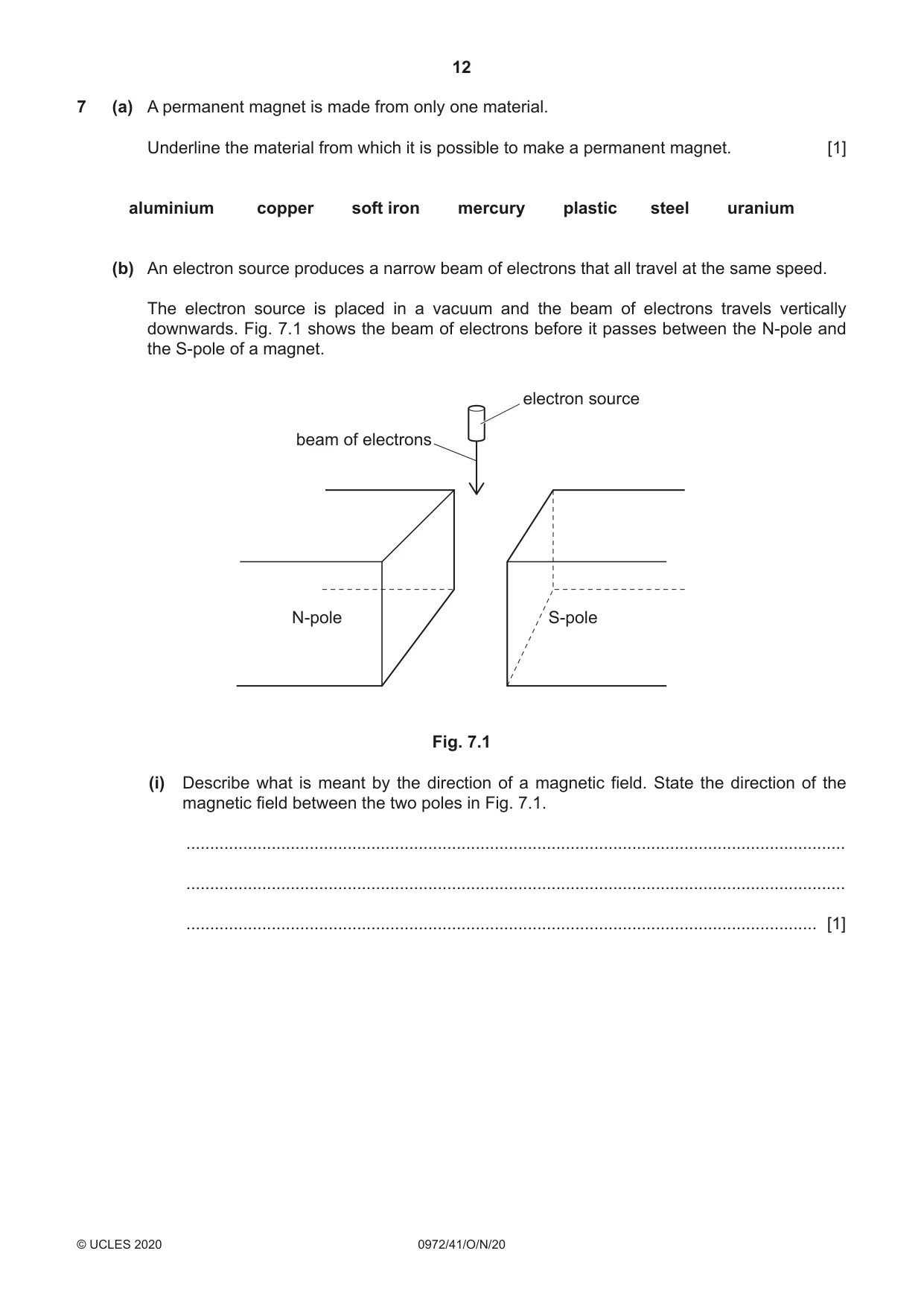
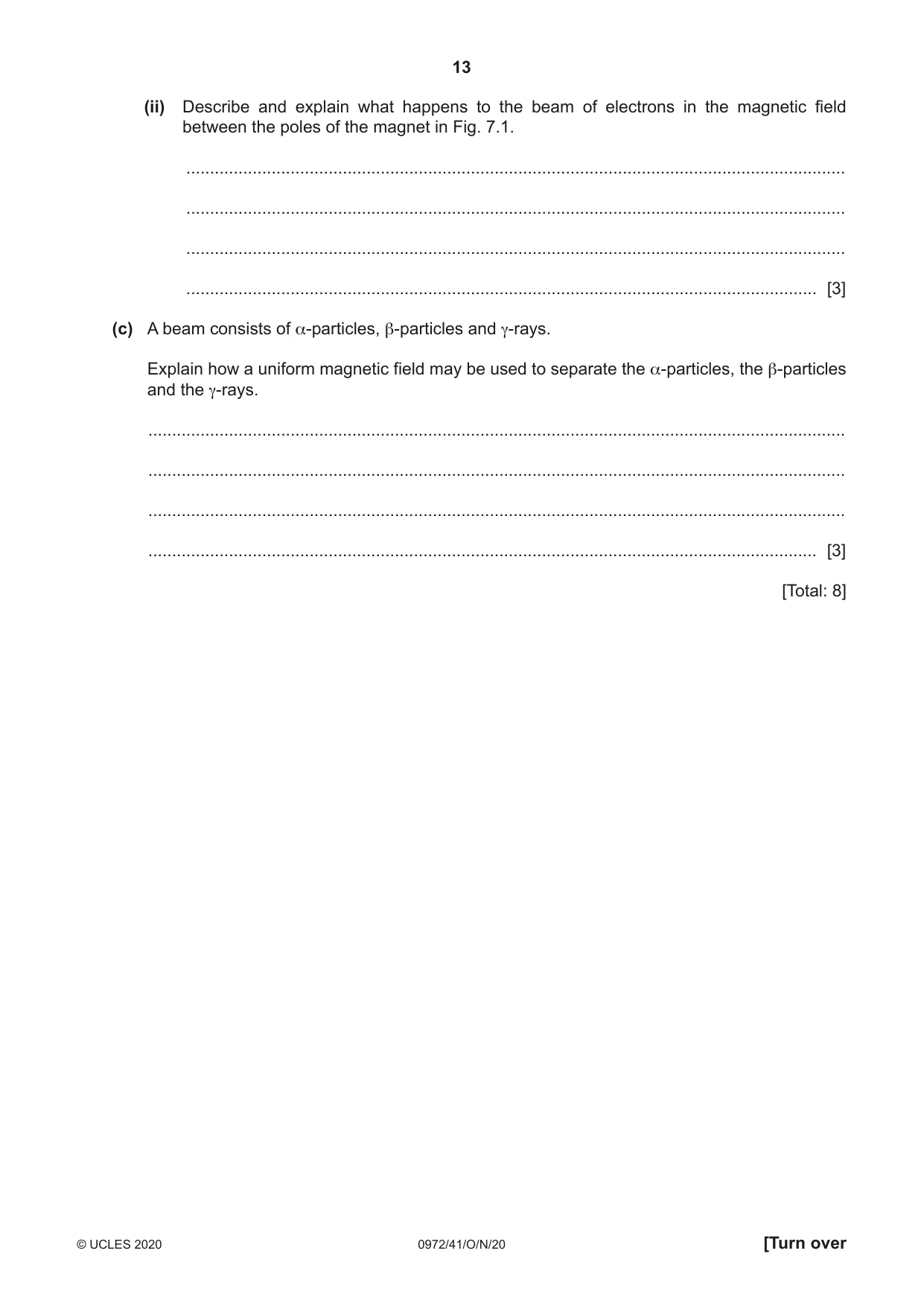
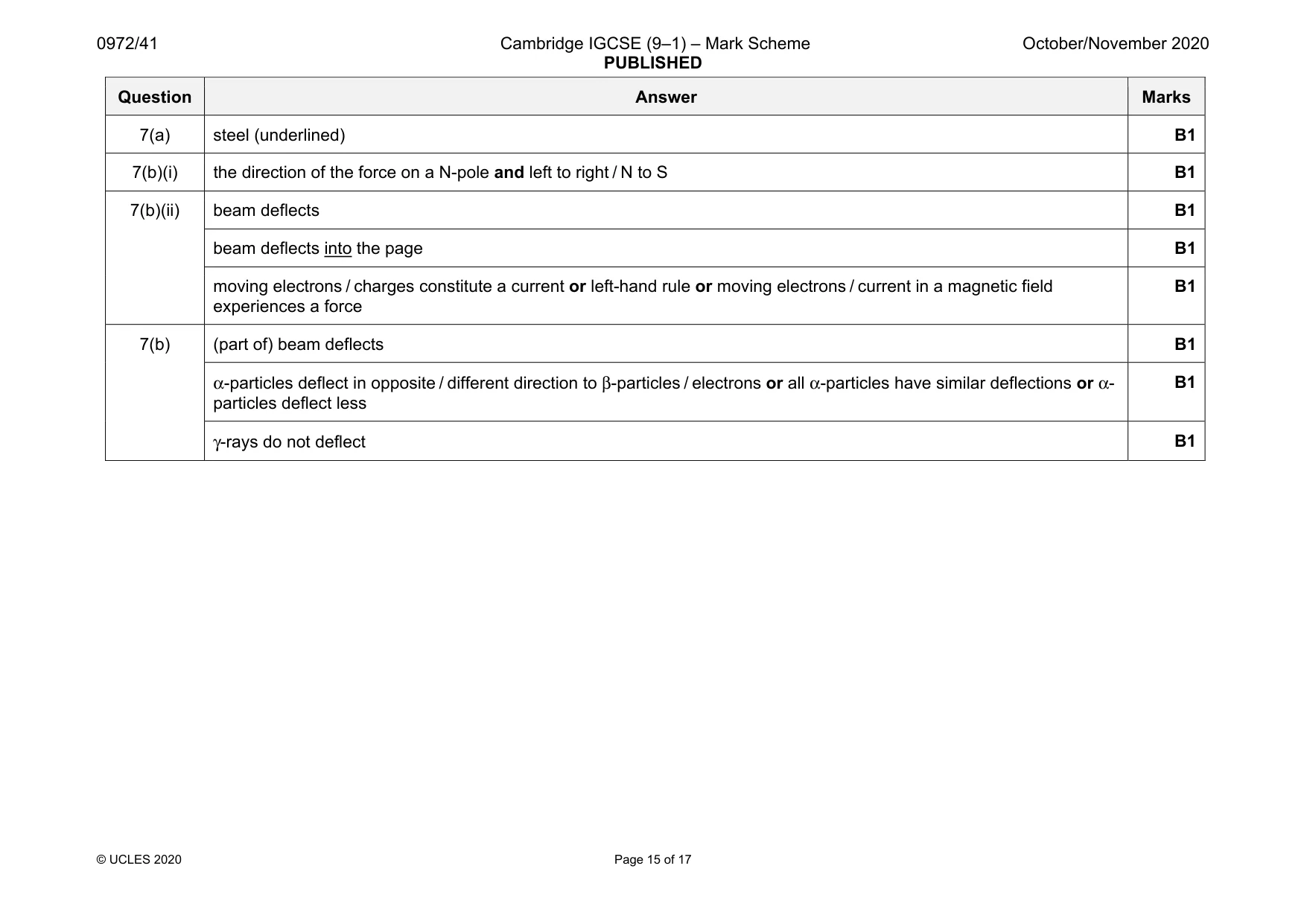
7 (a) A permanent magnet is made from only one material. Underline the material from which it is possible to make a permanent magnet. [1] aluminium copper soft iron mercury plastic steel uranium (b) An electron source produces a narrow beam of electrons that all travel at the same speed. The electron source is placed in a vacuum and the beam of electrons travels vertically downwards. Fig. 7.1 shows the beam of electrons before it passes between the N-pole and the S-pole of a magnet. electron source beam of electrons N-pole S-pole Fig. 7.1 (i) Describe what is meant by the direction of a magnetic field. State the direction of the magnetic field between the two poles in Fig. 7.1. ........................................................................................................................................... ........................................................................................................................................... ..................................................................................................................................... [1] (ii) Describe and explain what happens to the beam of electrons in the magnetic field between the poles of the magnet in Fig. 7.1. ........................................................................................................................................... ........................................................................................................................................... ........................................................................................................................................... ..................................................................................................................................... [3] (c) A beam consists of α-particles, β-particles and γ-rays. Explain how a uniform magnetic field may be used to separate the α-particles, the β-particles and the γ-rays. ................................................................................................................................................... ................................................................................................................................................... ................................................................................................................................................... ............................................................................................................................................. [3] [Total: 8]
Mark scheme: 7(a) steel (underlined) B1 7(b)(i) the direction of the force on a N-pole and left to right / N to S B1 7(b)(ii) beam deflects B1 beam deflects into the page B1 moving electrons / charges constitute a current or left-hand rule or moving electrons / current in a magnetic field experiences a force B1 7(b) (part of) beam deflects B1 α-particles deflect in opposite / different direction to β-particles / electrons or all α-particles have similar deflections or α- particles deflect less B1 γ-rays do not deflect B1
Q8 · Explain what is meant by electromotive force (e.m.f.)
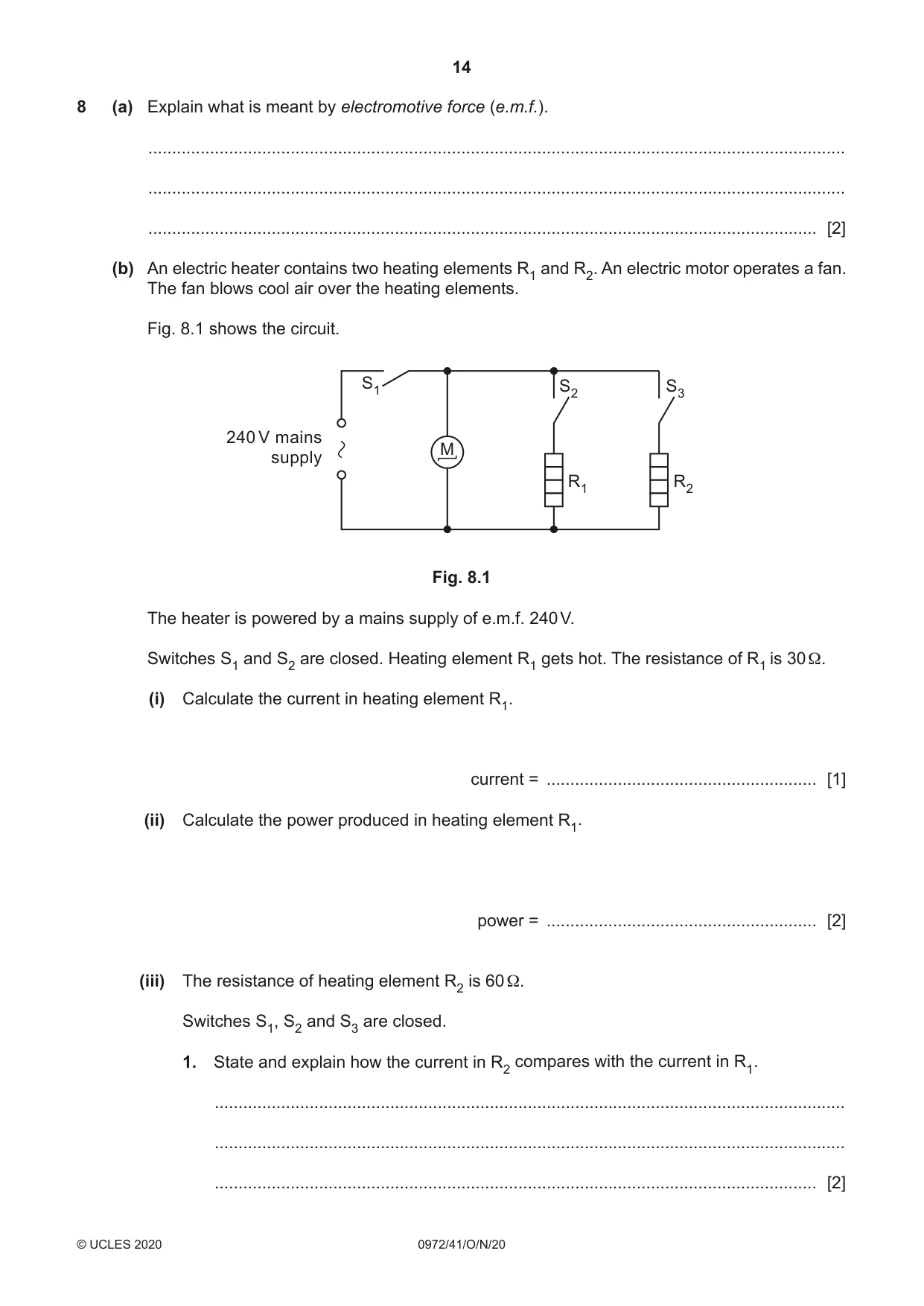
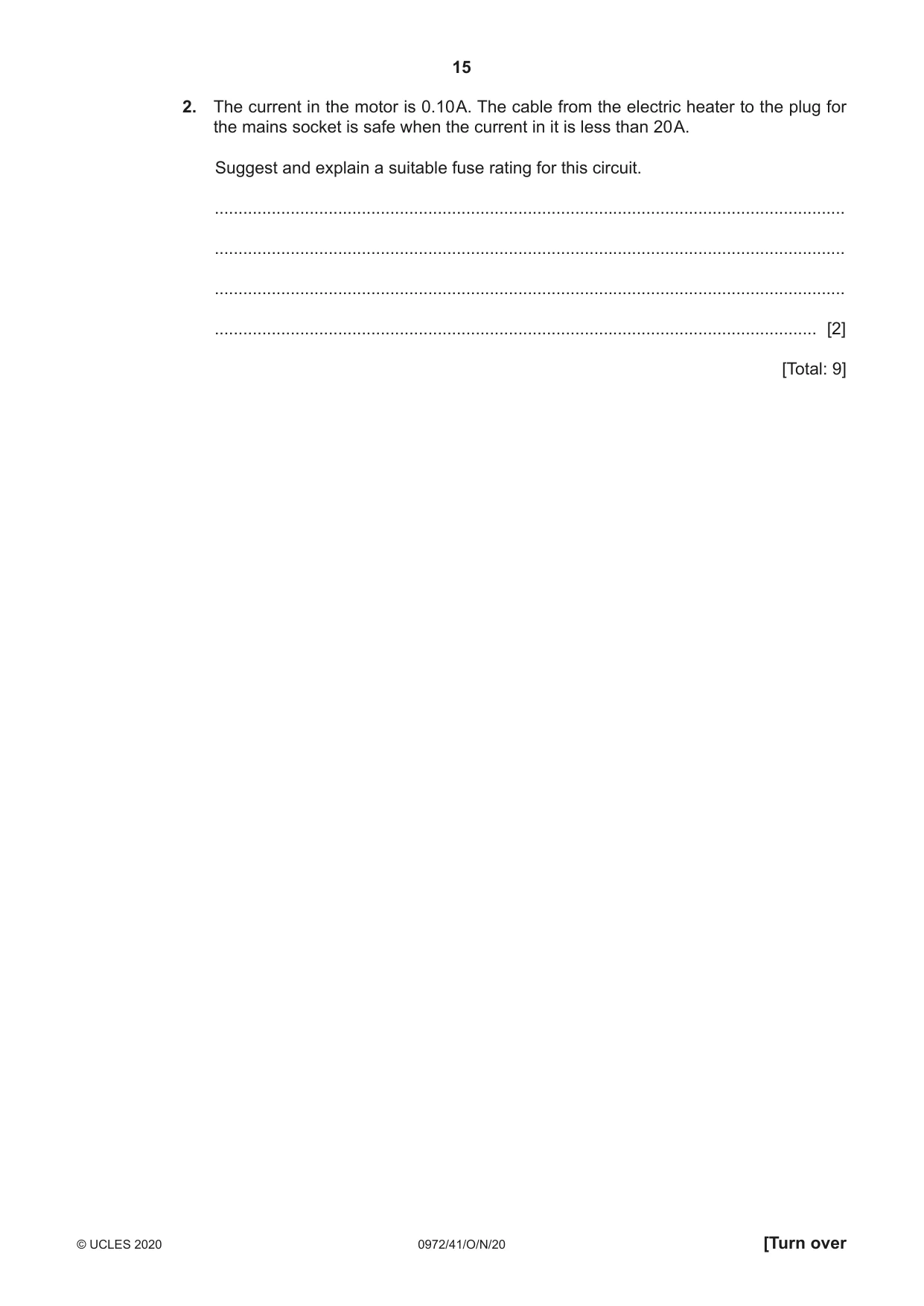
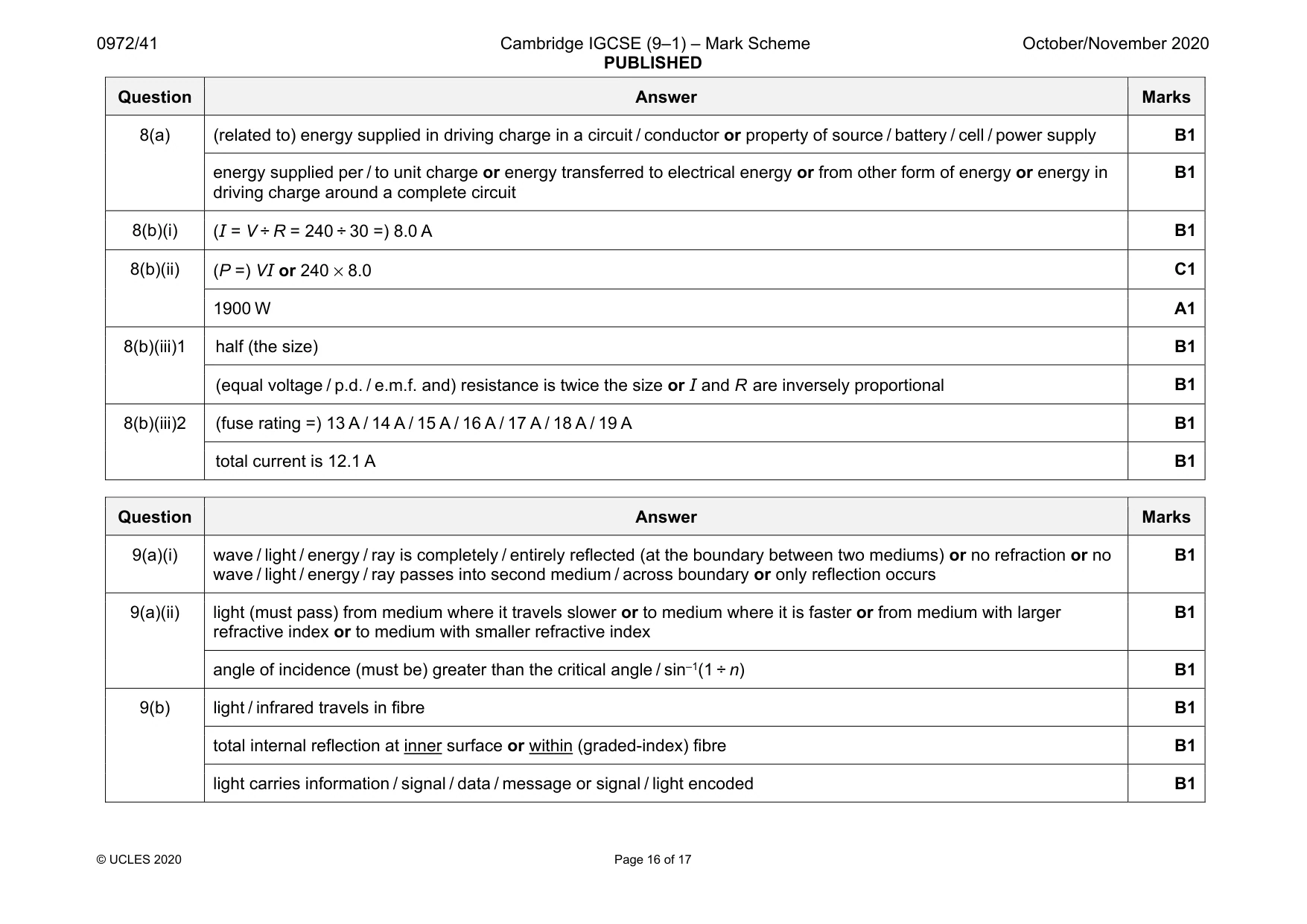
8 (a) Explain what is meant by electromotive force (e.m.f.). ................................................................................................................................................... ................................................................................................................................................... ............................................................................................................................................. [2] (b) An electric heater contains two heating elements R1 and R2. An electric motor operates a fan. The fan blows cool air over the heating elements. Fig. 8.1 shows the circuit. S1 S2 S3 240 V mains M supply R1 R2 Fig. 8.1 The heater is powered by a mains supply of e.m.f. 240 V. Switches S1 and S2 are closed. Heating element R1 gets hot. The resistance of R1 is 30 Ω. (i) Calculate the current in heating element R1. current = ......................................................... [1] (ii) Calculate the power produced in heating element R1. power = ......................................................... [2] (iii) The resistance of heating element R2 is 60 Ω. Switches S1, S2 and S3 are closed. 1. State and explain how the current in R2 compares with the current in R1. ..................................................................................................................................... ..................................................................................................................................... ............................................................................................................................... [2] 2. The current in the motor is 0.10 A. The cable from the electric heater to the plug for the mains socket is safe when the current in it is less than 20 A. Suggest and explain a suitable fuse rating for this circuit. ..................................................................................................................................... ..................................................................................................................................... ..................................................................................................................................... ............................................................................................................................... [2] [Total: 9]
Mark scheme: 8(a) (related to) energy supplied in driving charge in a circuit / conductor or property of source / battery / cell / power supply B1 energy supplied per / to unit charge or energy transferred to electrical energy or from other form of energy or energy in driving charge around a complete circuit B1 8(b)(i) (I = V ÷ R = 240 ÷ 30 =) 8.0 A B1 8(b)(ii) (P =) VI or 240 × 8.0 C1 1900 W A1 8(b)(iii)1 half (the size) B1 (equal voltage / p.d. / e.m.f. and) resistance is twice the size or I and R are inversely proportional B1 8(b)(iii)2 (fuse rating =) 13 A / 14 A / 15 A / 16 A / 17 A / 18 A / 19 A B1 total current is 12.1 A B1
Q9 · Describe what is observed during total internal reflection
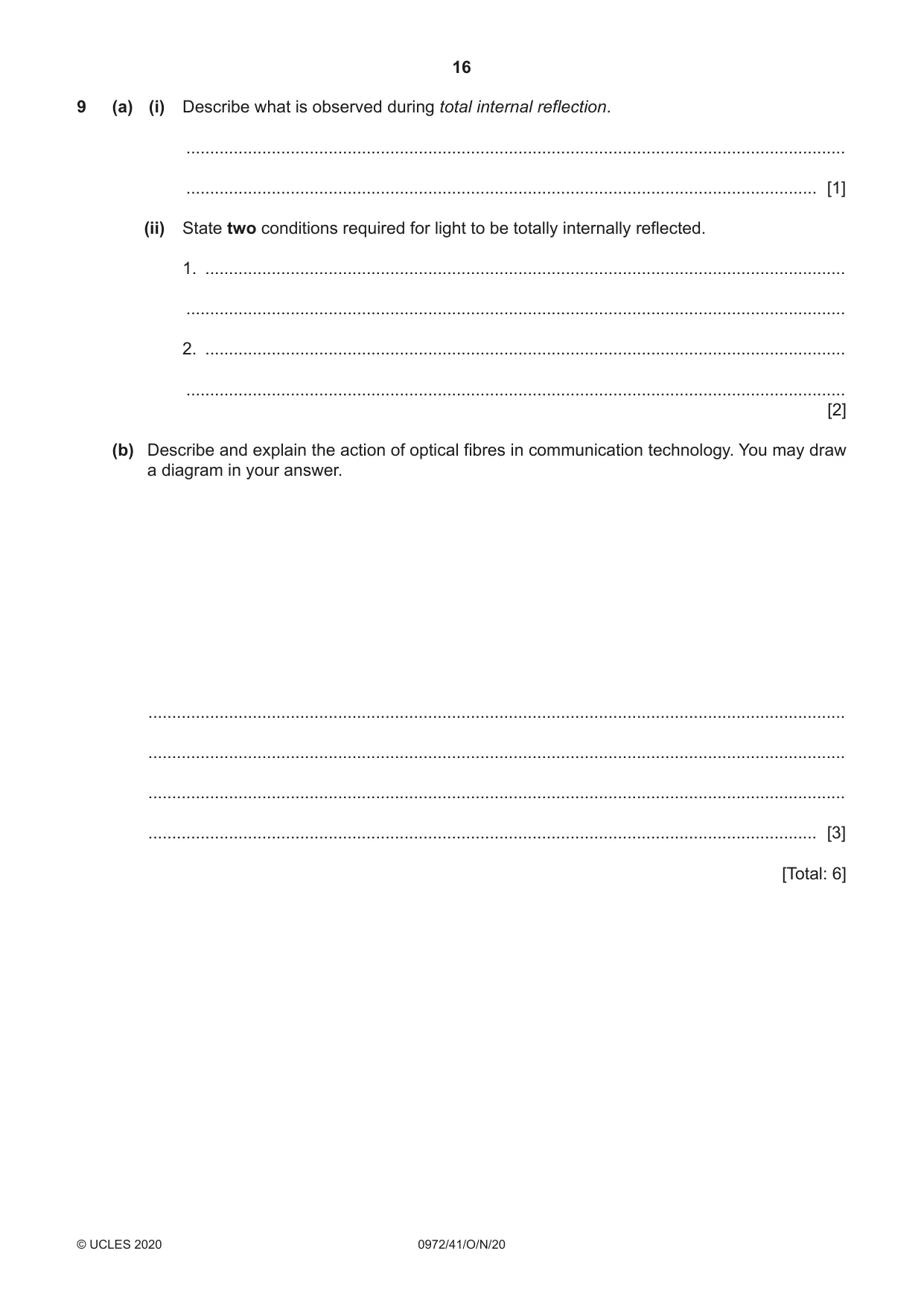
9 (a) (i) Describe what is observed during total internal reflection. ........................................................................................................................................... ..................................................................................................................................... [1] (ii) State two conditions required for light to be totally internally reflected. 1. ....................................................................................................................................... ........................................................................................................................................... 2. ....................................................................................................................................... ........................................................................................................................................... [2] (b) Describe and explain the action of optical fibres in communication technology. You may draw a diagram in your answer. ................................................................................................................................................... ................................................................................................................................................... ................................................................................................................................................... ............................................................................................................................................. [3] [Total: 6]
Mark scheme: 9(a)(i) wave / light / energy / ray is completely / entirely reflected (at the boundary between two mediums) or no refraction or no wave / light / energy / ray passes into second medium / across boundary or only reflection occurs B1 9(a)(ii) light (must pass) from medium where it travels slower or to medium where it is faster or from medium with larger refractive index or to medium with smaller refractive index B1 angle of incidence (must be) greater than the critical angle / sin–1(1 ÷ n) B1 9(b) light / infrared travels in fibre B1 total internal reflection at inner surface or within (graded-index) fibre B1 light carries information / signal / data / message or signal / light encoded B1
Q10 · A radiation detector is placed on the bench in a laboratory
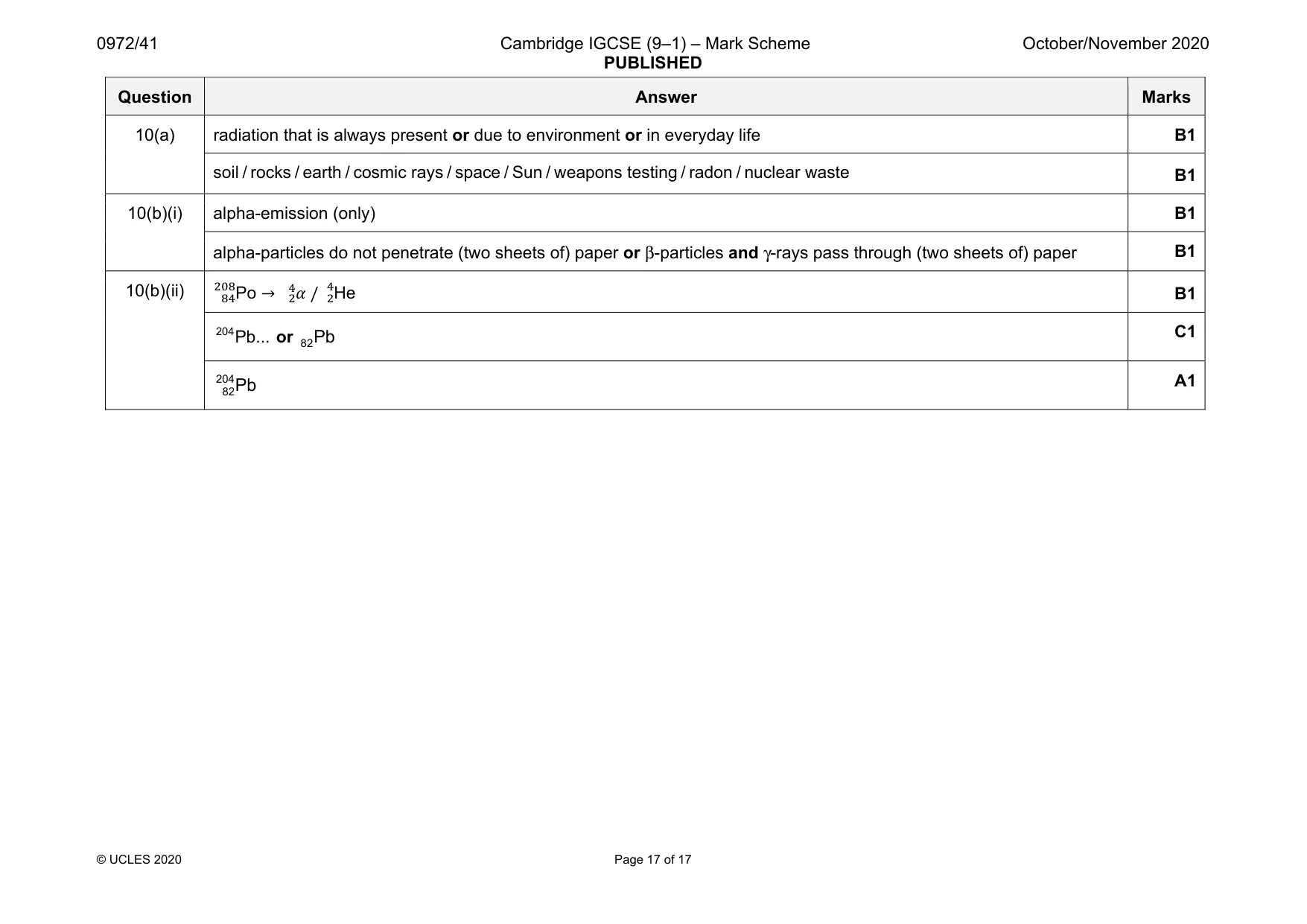
10 A radiation detector is placed on the bench in a laboratory. It detects a background count rate of 40 counts / minute. (a) State what is meant by background radiation. Suggest one source for it. ................................................................................................................................................... ................................................................................................................................................... ............................................................................................................................................. [2] (b) A sample containing atoms of the radioactive isotope polonium-208 is removed from a lead container and brought close to the detector. The average count rate increases to 890 counts / minute. When two sheets of paper are inserted between the sample and the detector, the average count rate returns to 40 counts / minute. Polonium-208 is represented by the symbol 20884Po. It decays to an isotope of lead (Pb). (i) Deduce the type of radiation emitted by polonium-208. Explain your answer. ........................................................................................................................................... ........................................................................................................................................... ........................................................................................................................................... ..................................................................................................................................... [2] (ii) Write down the nuclide equation for the decay of polonium-208. [3] [Total: 7]
Mark scheme: 10(a) radiation that is always present or due to environment or in everyday life B1 soil / rocks / earth / cosmic rays / space / Sun / weapons testing / radon / nuclear waste B1 10(b)(i) alpha-emission (only) B1 alpha-particles do not penetrate (two sheets of) paper or β-particles and γ-rays pass through (two sheets of) paper B1 10(b)(ii) Po ଼ସ ଶ଼ → ߙ ଶ ସ / He ଶ ସ B1 204Pb... or 82Pb C1 204 82Pb A1
What was in this paper
The subtopics covered by these 10 questions, and how many questions each got. Open one in a new tab to see every Cambridge question on it.
What you needed in this session
Cambridge’s own grade thresholds for 2020 Oct/Nov, Paper 4 · Variant 1. A higher threshold means an easier paper — the bar moves with how the cohort did.