Cambridge IGCSE Physics (9-1) 0972 — 2025 Oct/Nov Paper 4 · Variant 1
0972/41/O/N/25 · 10 questions · 80 marks · ≈90 min
The question paper and its mark scheme, free to read here and free to download. This is Cambridge’s own paper, exactly as it was sat.
Question paper16 pages

Mark scheme18 pages
Answers below. Sit the paper first if you are practising.

Questions as text
Q1 · A train travels with a constant velocity of 56 m / s on a horizontal track
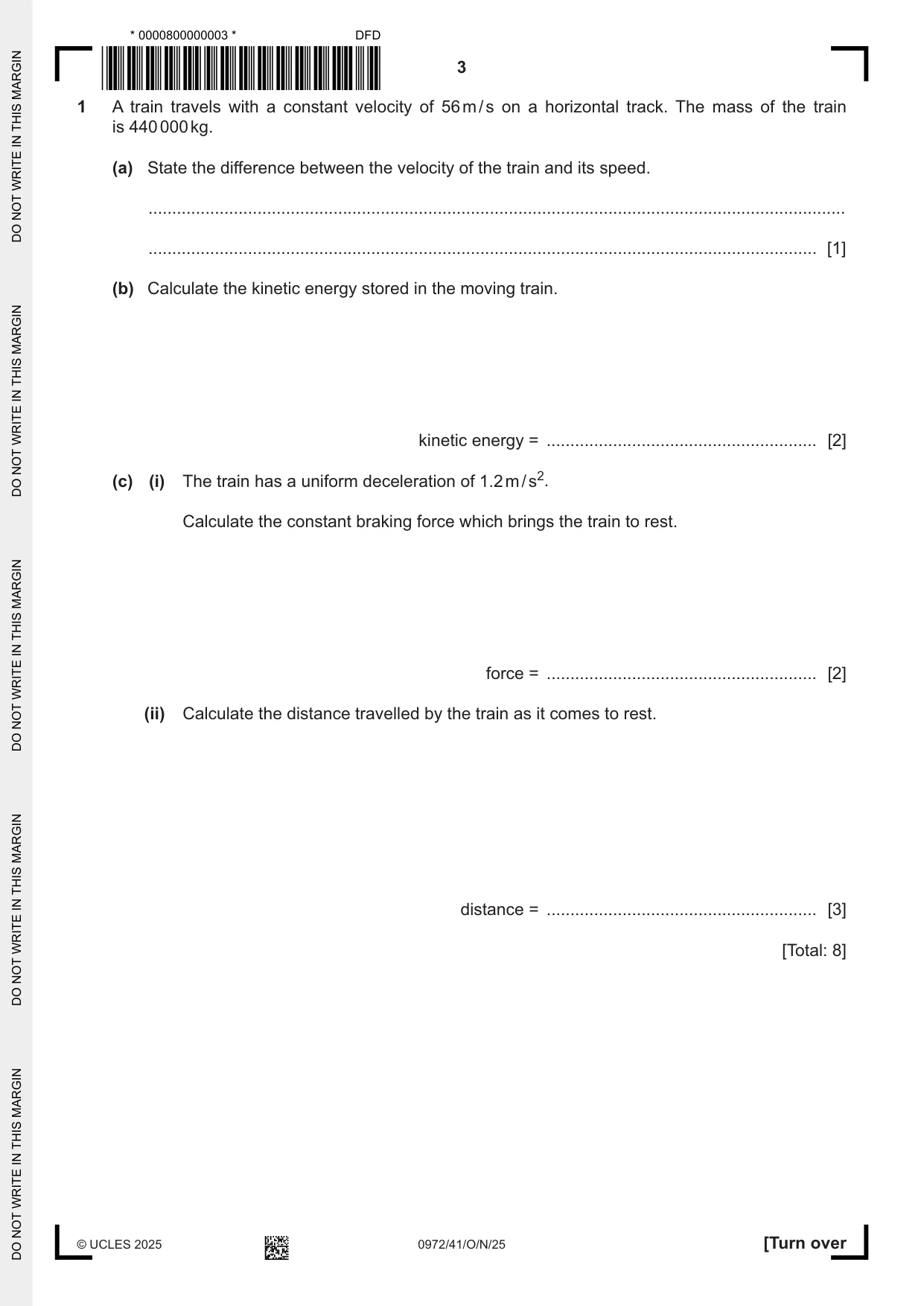
1 A train travels with a constant velocity of 56 m / s on a horizontal track. The mass of the train is 440 000 kg. (a) State the difference between the velocity of the train and its speed. ................................................................................................................................................... ............................................................................................................................................. [1] (b) Calculate the kinetic energy stored in the moving train. kinetic energy = ......................................................... [2] (c) (i) The train has a uniform deceleration of 1.2 m / s2. Calculate the constant braking force which brings the train to rest. force = ......................................................... [2] (ii) Calculate the distance travelled by the train as it comes to rest. distance = ......................................................... [3] [Total: 8]
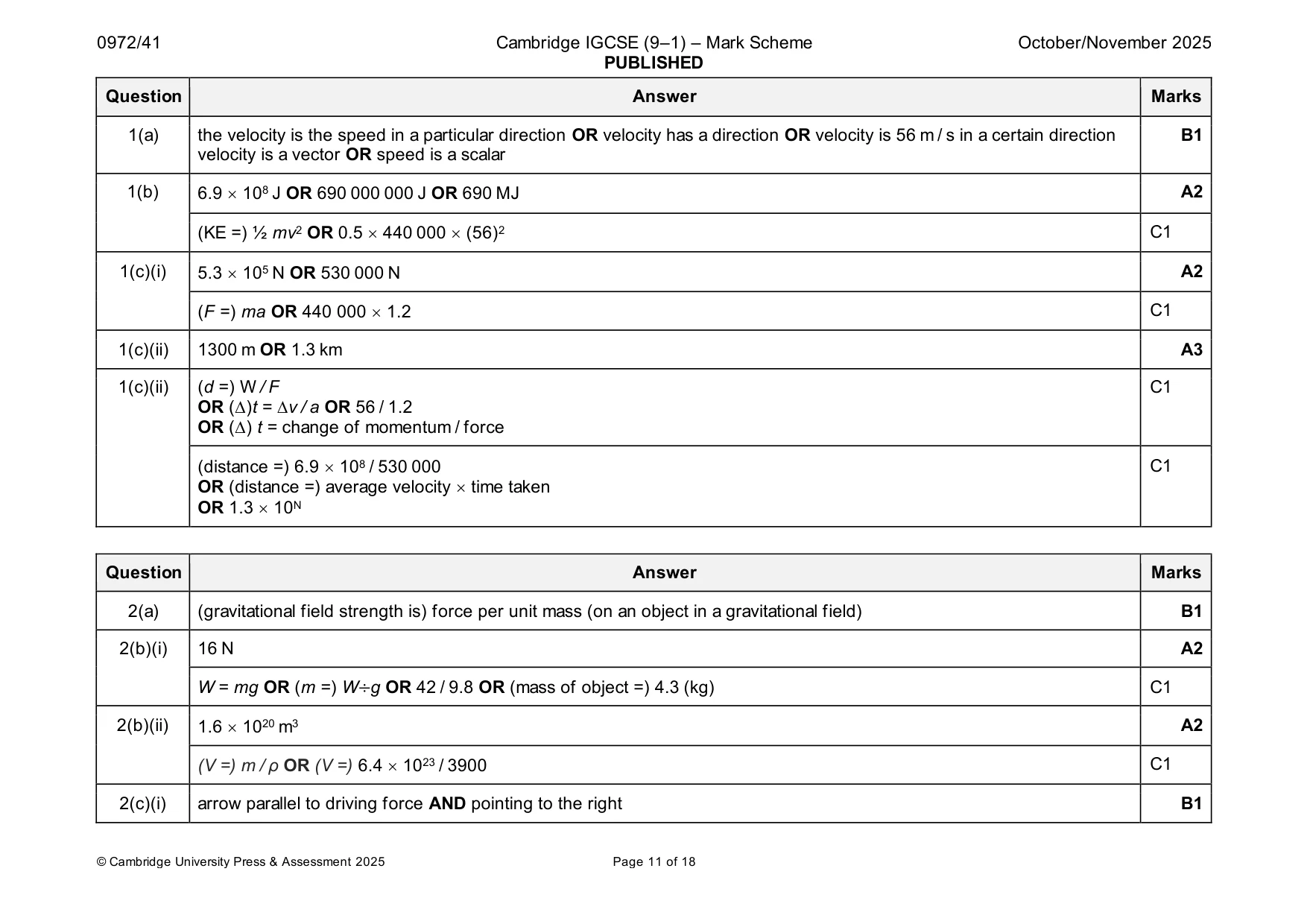
Mark scheme: Question Answer Marks 1(a) the velocity is the speed in a particular direction OR velocity has a direction OR velocity is 56 m / s in a certain direction B1 velocity is a vector OR speed is a scalar 1(b) 6.9 108 J OR 690 000 000 J OR 690 MJ A2 (KE =) ½ mv2 OR 0.5 440 000 (56)2 C1 1(c)(i) 5.3 105 N OR 530 000 N A2 (F =) ma OR 440 000 1.2 C1 1(c)(ii) 1300 m OR 1.3 km A3 1(c)(ii) (d =) W / F C1 OR (∆)t = ∆v / a OR 56 / 1.2 OR (∆) t = change of momentum / force (distance =) 6.9 108 / 530 000 C1 OR (distance =) average velocity time taken OR 1.3 10N
Q2 · Table 2.1 contains information about the planet Mars
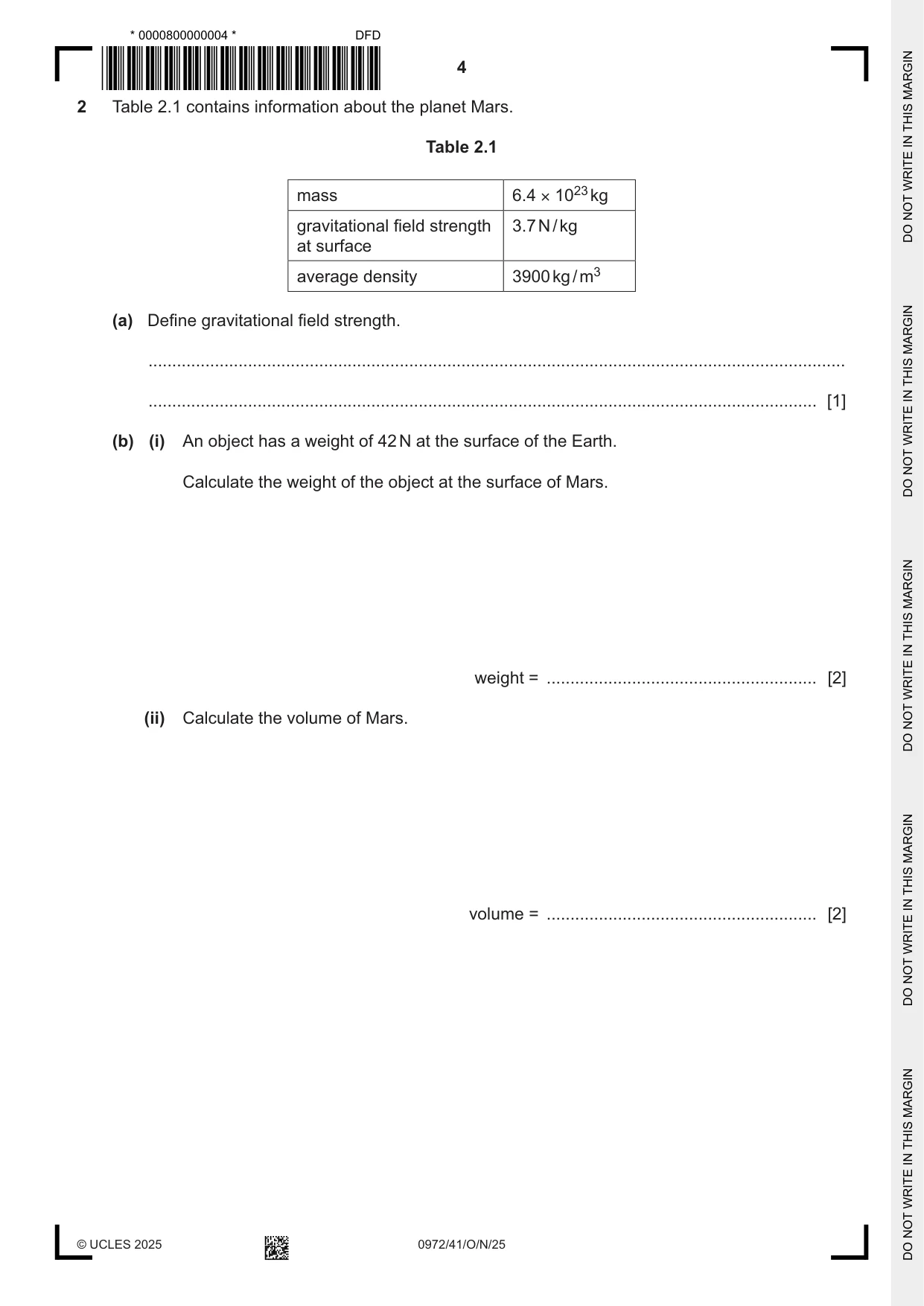
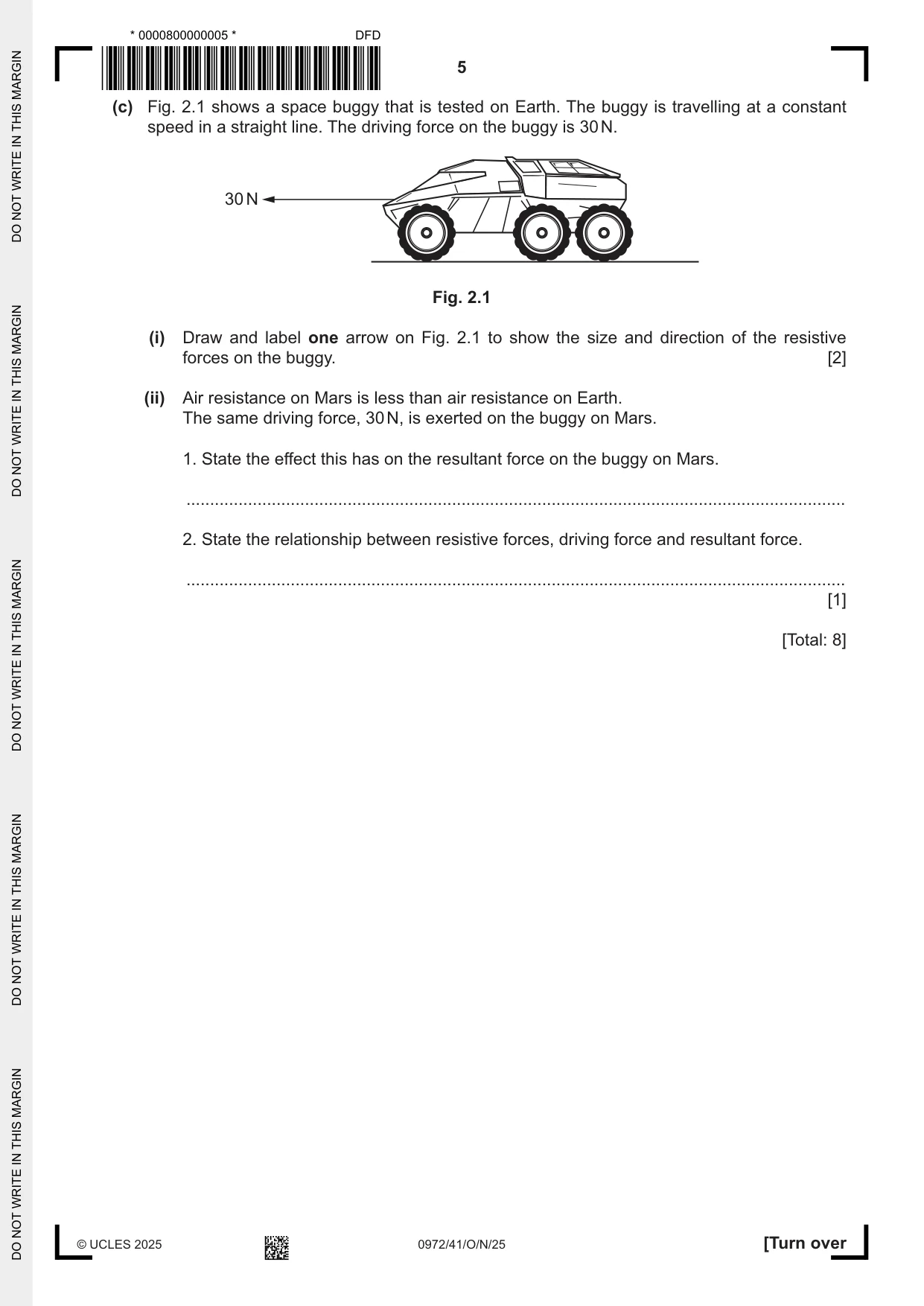
2 Table 2.1 contains information about the planet Mars. Table 2.1 mass 6.4 × 10²³ kg gravitational field strength 3.7 N / kg at surface average density 3900 kg / m3 (a) Define gravitational field strength. ................................................................................................................................................... ............................................................................................................................................. [1] (b) (i) An object has a weight of 42 N at the surface of the Earth. Calculate the weight of the object at the surface of Mars. weight = ......................................................... [2] (ii) Calculate the volume of Mars. volume = ......................................................... [2] (c) Fig. 2.1 shows a space buggy that is tested on Earth. The buggy is travelling at a constant speed in a straight line. The driving force on the buggy is 30 N. 30N Fig. 2.1 (i) Draw and label one arrow on Fig. 2.1 to show the size and direction of the resistive forces on the buggy. [2] (ii) Air resistance on Mars is less than air resistance on Earth. The same driving force, 30 N, is exerted on the buggy on Mars. 1. State the effect this has on the resultant force on the buggy on Mars. ........................................................................................................................................... 2. State the relationship between resistive forces, driving force and resultant force. ........................................................................................................................................... [1] [Total: 8]
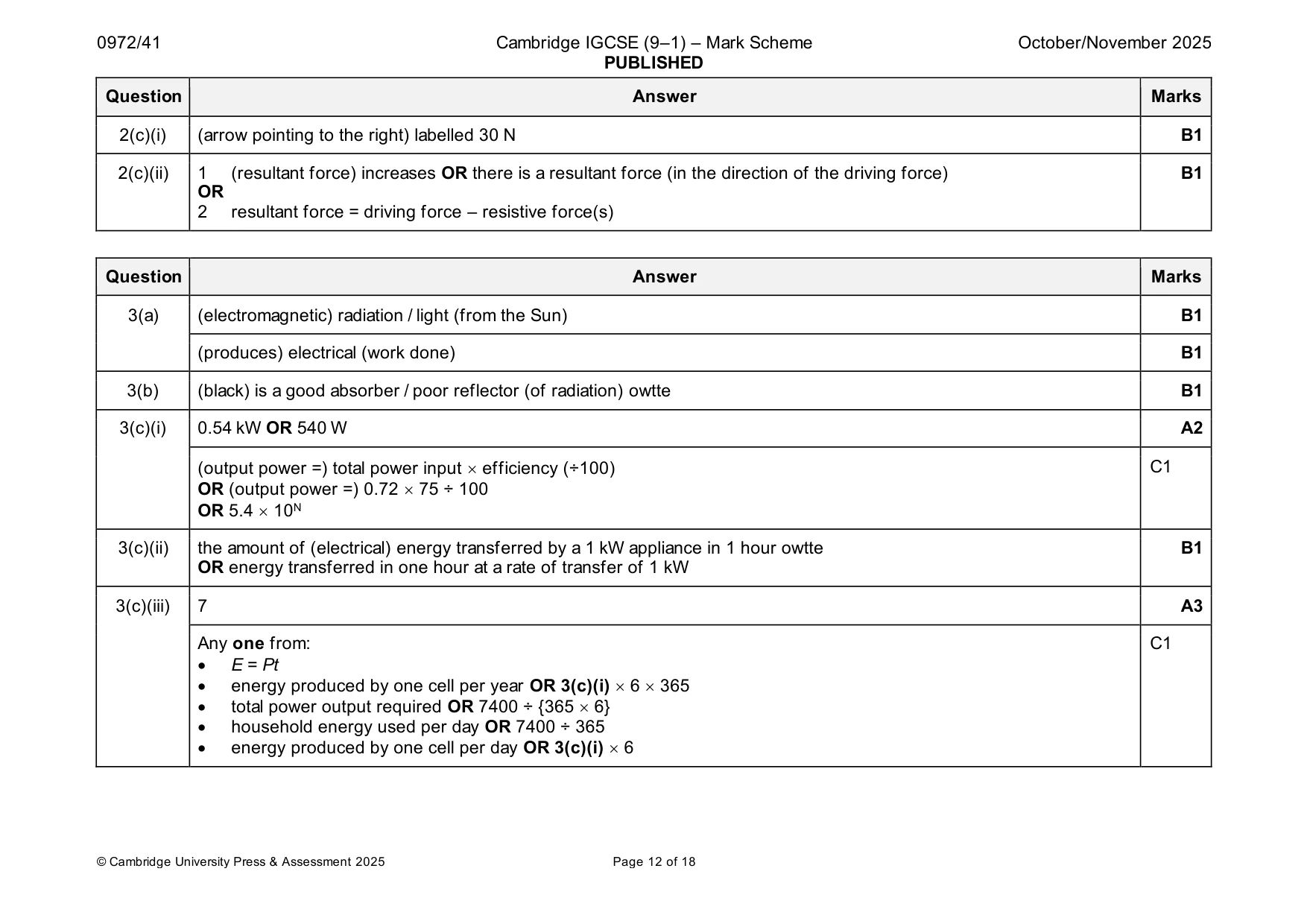
Mark scheme: 2(a) (gravitational field strength is) force per unit mass (on an object in a gravitational field) B1 2(b)(i) 16 N A2 W = mg OR (m =) W÷g OR 42 / 9.8 OR (mass of object =) 4.3 (kg) C1 2(b)(ii) 1.6 1020 m3 A2 (V =) m / ρ OR (V =) 6.4 1023 / 3900 C1 2(c)(i) arrow parallel to driving force AND pointing to the right B1 2(c)(i) (arrow pointing to the right) labelled 30 N B1 2(c)(ii) 1 (resultant force) increases OR there is a resultant force (in the direction of the driving force) B1 OR 2 resultant force = driving force – resistive force(s)
Q3 · A simplified diagram of a solar cell
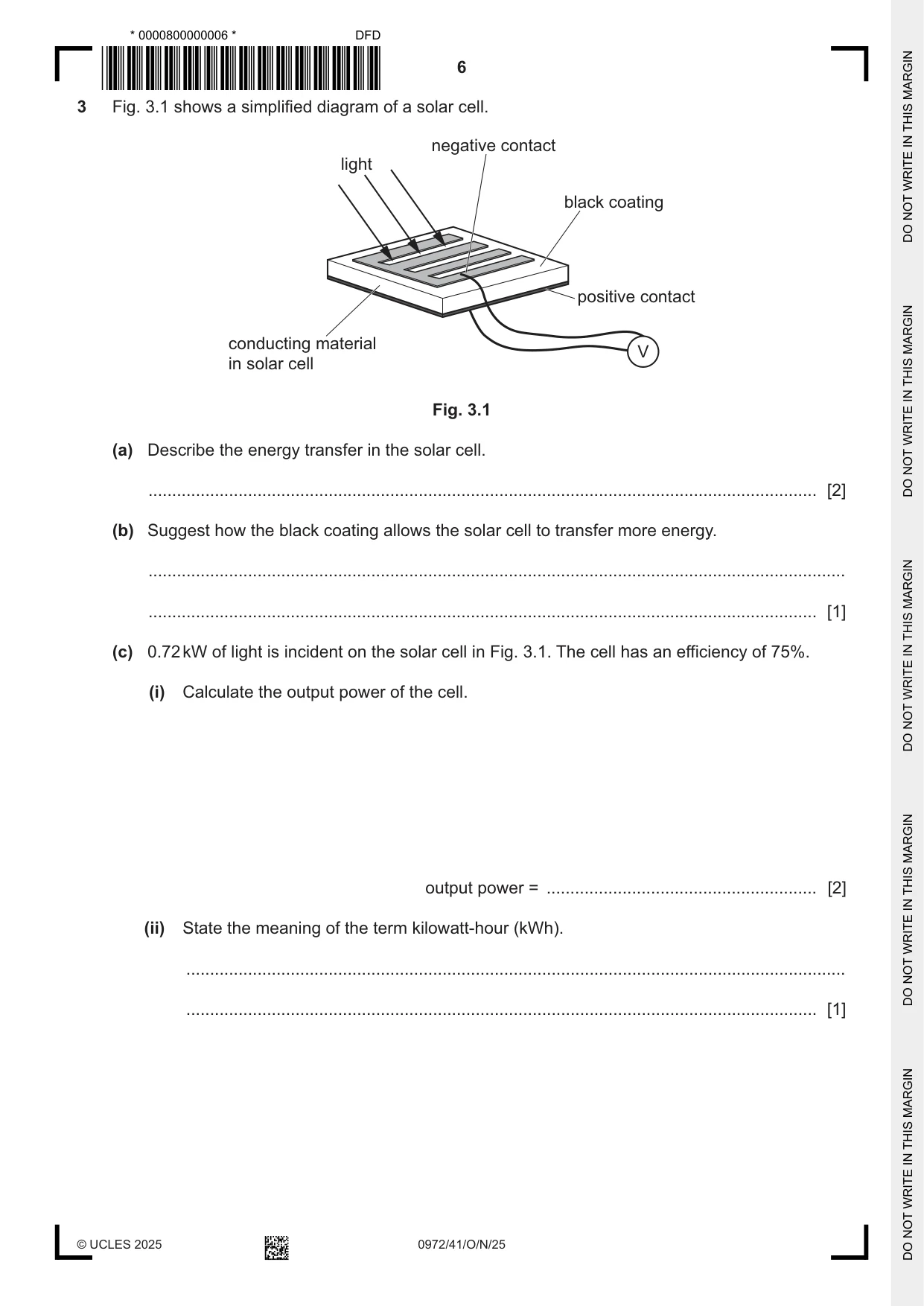
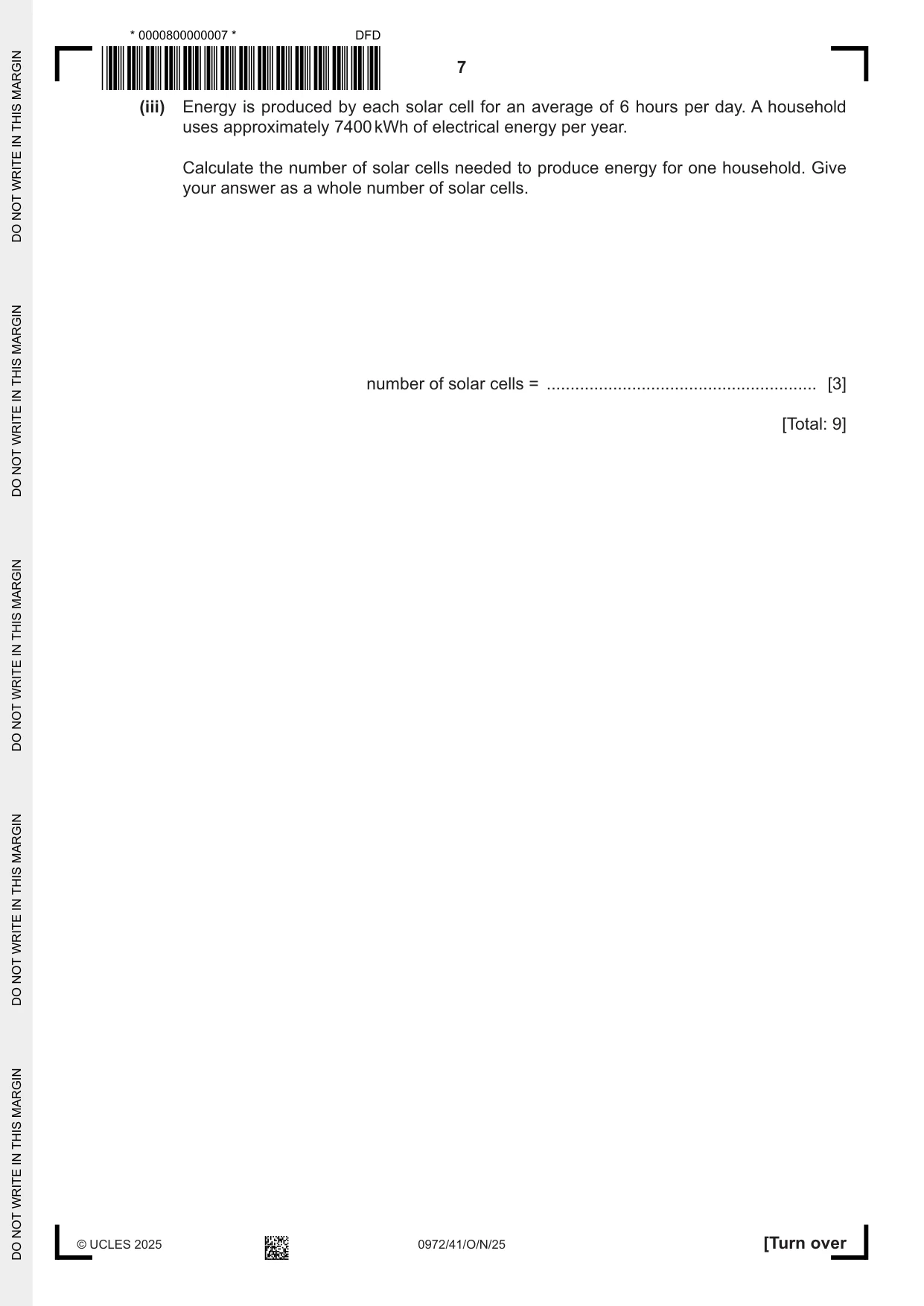
3 Fig. 3.1 shows a simplified diagram of a solar cell. negative contact light black coating positive contact conducting material V in solar cell Fig. 3.1 (a) Describe the energy transfer in the solar cell. ............................................................................................................................................. [2] (b) Suggest how the black coating allows the solar cell to transfer more energy. ................................................................................................................................................... ............................................................................................................................................. [1] (c) 0.72 kW of light is incident on the solar cell in Fig. 3.1. The cell has an efficiency of 75%. (i) Calculate the output power of the cell. output power = ......................................................... [2] (ii) State the meaning of the term kilowatt-hour (kWh). ........................................................................................................................................... ..................................................................................................................................... [1] (iii) Energy is produced by each solar cell for an average of 6 hours per day. A household uses approximately 7400 kWh of electrical energy per year. Calculate the number of solar cells needed to produce energy for one household. Give your answer as a whole number of solar cells. number of solar cells = ......................................................... [3] [Total: 9]
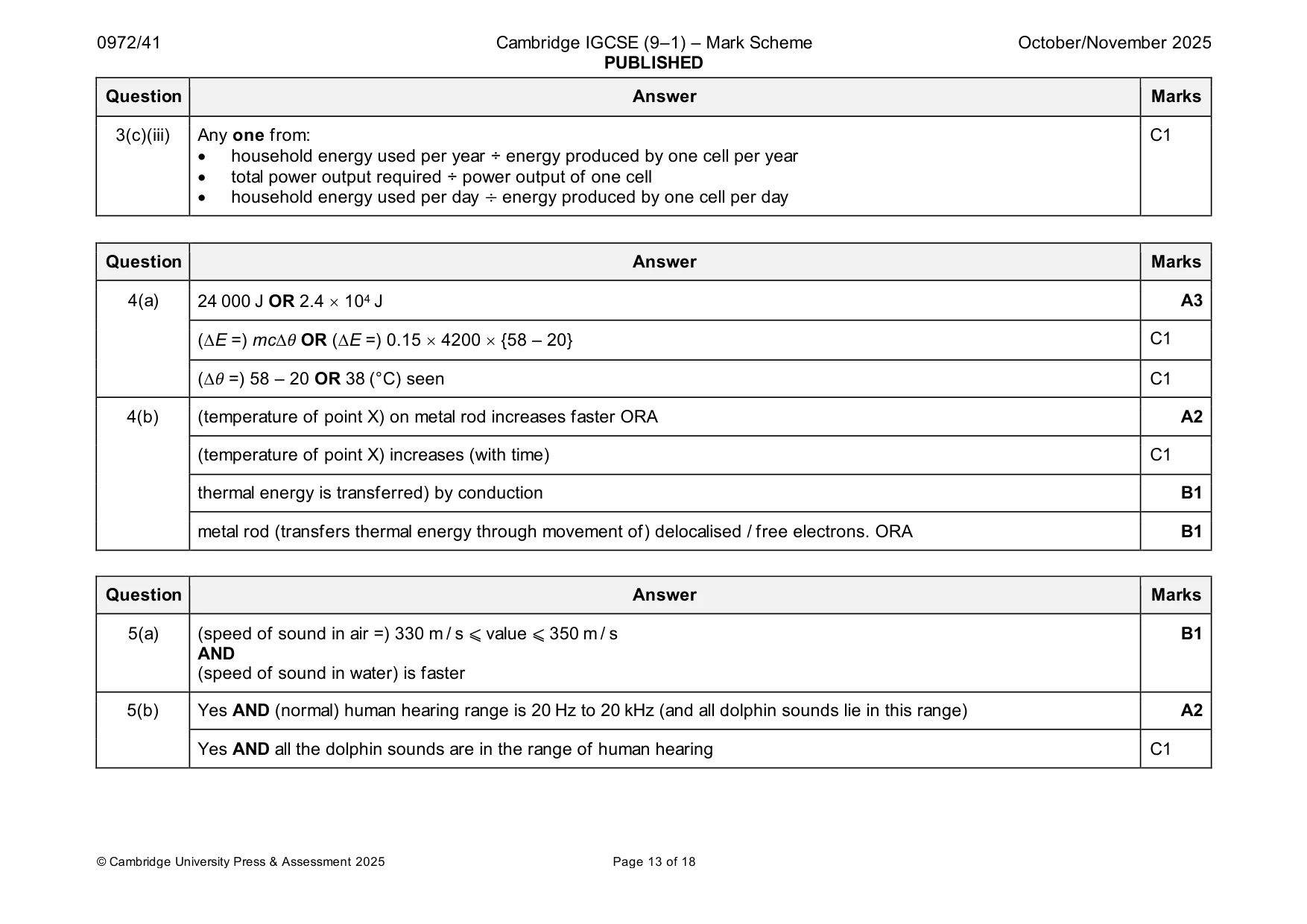
Mark scheme: 3(a) (electromagnetic) radiation / light (from the Sun) B1 (produces) electrical (work done) B1 3(b) (black) is a good absorber / poor reflector (of radiation) owtte B1 3(c)(i) 0.54 kW OR 540 W A2 (output power =) total power input efficiency (÷100) C1 OR (output power =) 0.72 75 ÷ 100 OR 5.4 10N 3(c)(ii) the amount of (electrical) energy transferred by a 1 kW appliance in 1 hour owtte B1 OR energy transferred in one hour at a rate of transfer of 1 kW 3(c)(iii) 7 A3 Any one from: C1 • E = Pt • energy produced by one cell per year OR 3(c)(i) 6 365 • total power output required OR 7400 ÷ {365 6} • household energy used per day OR 7400 ÷ 365 • energy produced by one cell per day OR 3(c)(i) 6 3(c)(iii) Any one from: C1 • household energy used per year ÷ energy produced by one cell per year • total power output required ÷ power output of one cell • household energy used per day ÷ energy produced by one cell per day
Q4 · A 12 V, 50 W immersion heater is used to heat 0.15 kg of water in a beaker
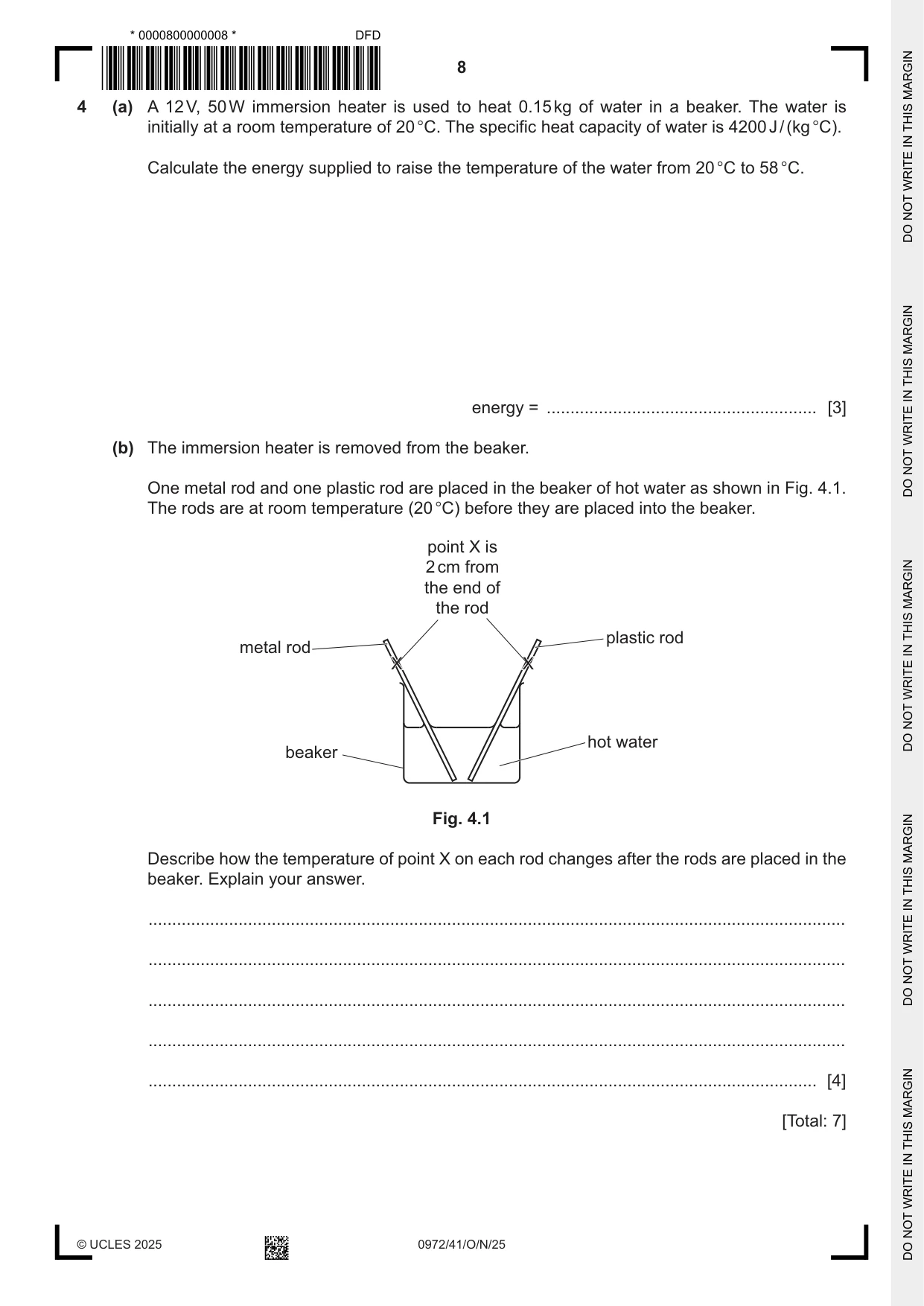
4 (a) A 12 V, 50 W immersion heater is used to heat 0.15 kg of water in a beaker. The water is initially at a room temperature of 20 °C. The specific heat capacity of water is 4200 J / (kg °C). Calculate the energy supplied to raise the temperature of the water from 20 °C to 58 °C. energy = ......................................................... [3] (b) The immersion heater is removed from the beaker. One metal rod and one plastic rod are placed in the beaker of hot water as shown in Fig. 4.1. The rods are at room temperature (20 °C) before they are placed into the beaker. point X is 2 cm from the end of the rod plastic rod metal rod X X hot water beaker Fig. 4.1 Describe how the temperature of point X on each rod changes after the rods are placed in the beaker. Explain your answer. ................................................................................................................................................... ................................................................................................................................................... ................................................................................................................................................... ................................................................................................................................................... ............................................................................................................................................. [4] [Total: 7]
Mark scheme: 4(a) 24 000 J OR 2.4 104 J A3 (∆E =) mc∆𝜃 OR (∆E =) 0.15 4200 {58 – 20} C1 (∆𝜃 =) 58 – 20 OR 38 (°C) seen C1 4(b) (temperature of point X) on metal rod increases faster ORA A2 (temperature of point X) increases (with time) C1 thermal energy is transferred) by conduction B1 metal rod (transfers thermal energy through movement of) delocalised / free electrons. ORA B1
Q5 · A dolphin communicates with other dolphins underwater by emitting sounds in the range…
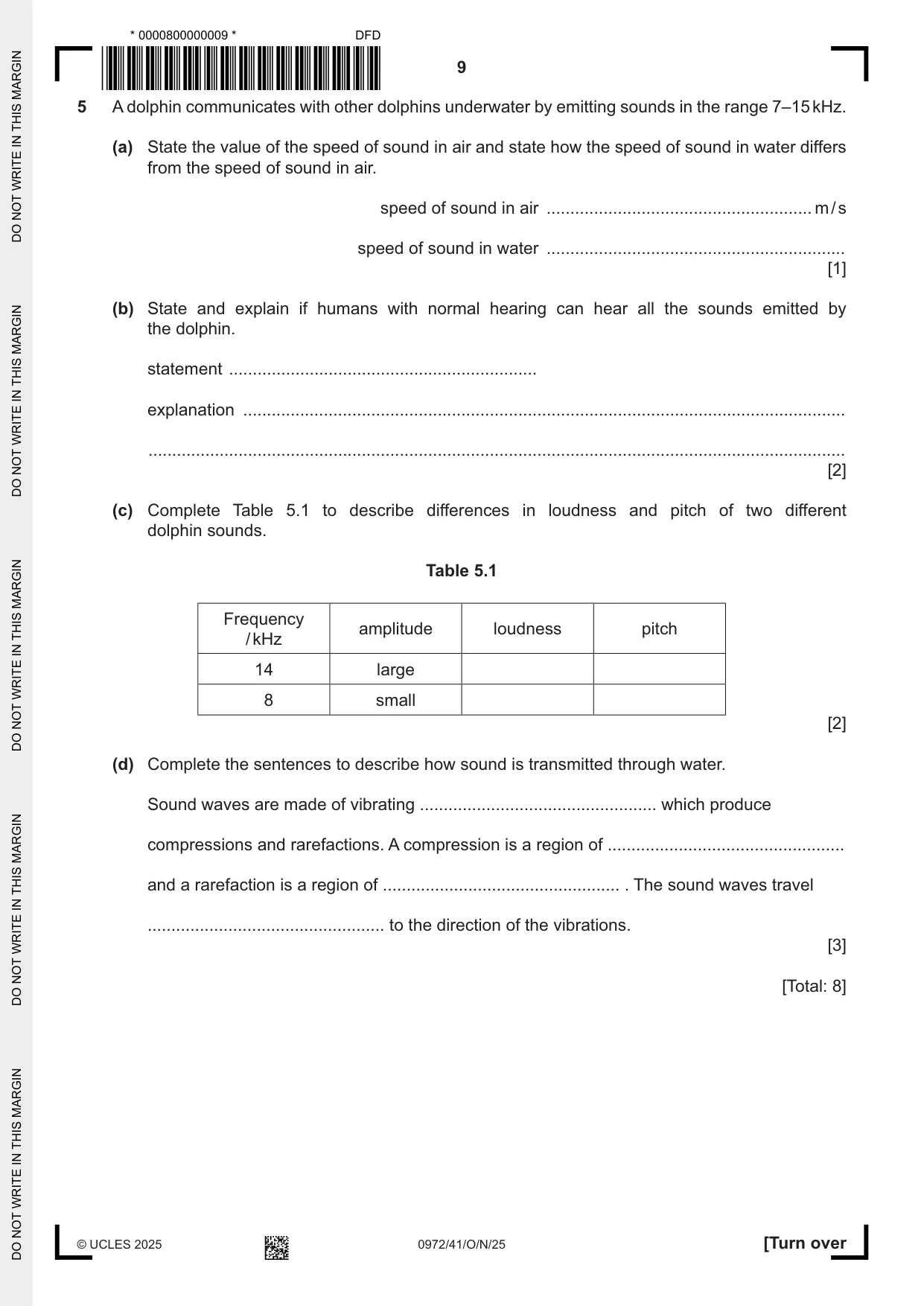
5 A dolphin communicates with other dolphins underwater by emitting sounds in the range 7–15 kHz. (a) State the value of the speed of sound in air and state how the speed of sound in water differs from the speed of sound in air. speed of sound in air ........................................................ m / s speed of sound in water ............................................................... [1] (b) State and explain if humans with normal hearing can hear all the sounds emitted by the dolphin. statement ................................................................. explanation ............................................................................................................................... ................................................................................................................................................... [2] (c) Complete Table 5.1 to describe differences in loudness and pitch of two different dolphin sounds. Table 5.1 Frequency amplitude loudness pitch / kHz 14 large 8 small [2] (d) Complete the sentences to describe how sound is transmitted through water. Sound waves are made of vibrating .................................................. which produce compressions and rarefactions. A compression is a region of .................................................. and a rarefaction is a region of .................................................. . The sound waves travel .................................................. to the direction of the vibrations. [3] [Total: 8]
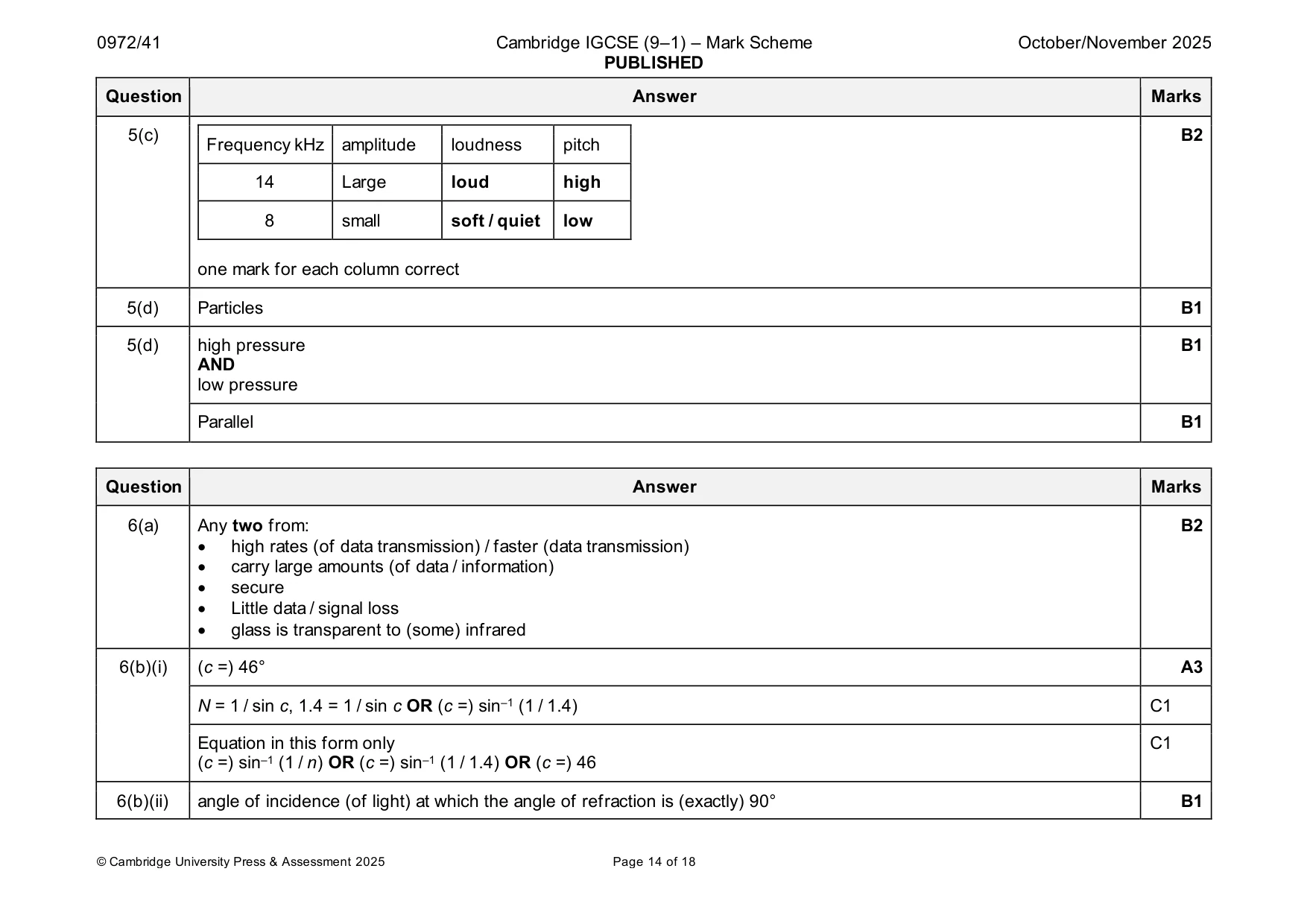
Mark scheme: 5(a) (speed of sound in air =) 330 m / s ⩽ value ⩽ 350 m / s B1 AND (speed of sound in water) is faster 5(b) Yes AND (normal) human hearing range is 20 Hz to 20 kHz (and all dolphin sounds lie in this range) A2 Yes AND all the dolphin sounds are in the range of human hearing C1 5(c) B2 Frequency kHz amplitude loudness pitch 14 Large loud high 8 small soft / quiet low one mark for each column correct 5(d) Particles B1 5(d) high pressure B1 AND low pressure Parallel B1
Q6 · Part of an optical fibre used in high-speed broadband communication
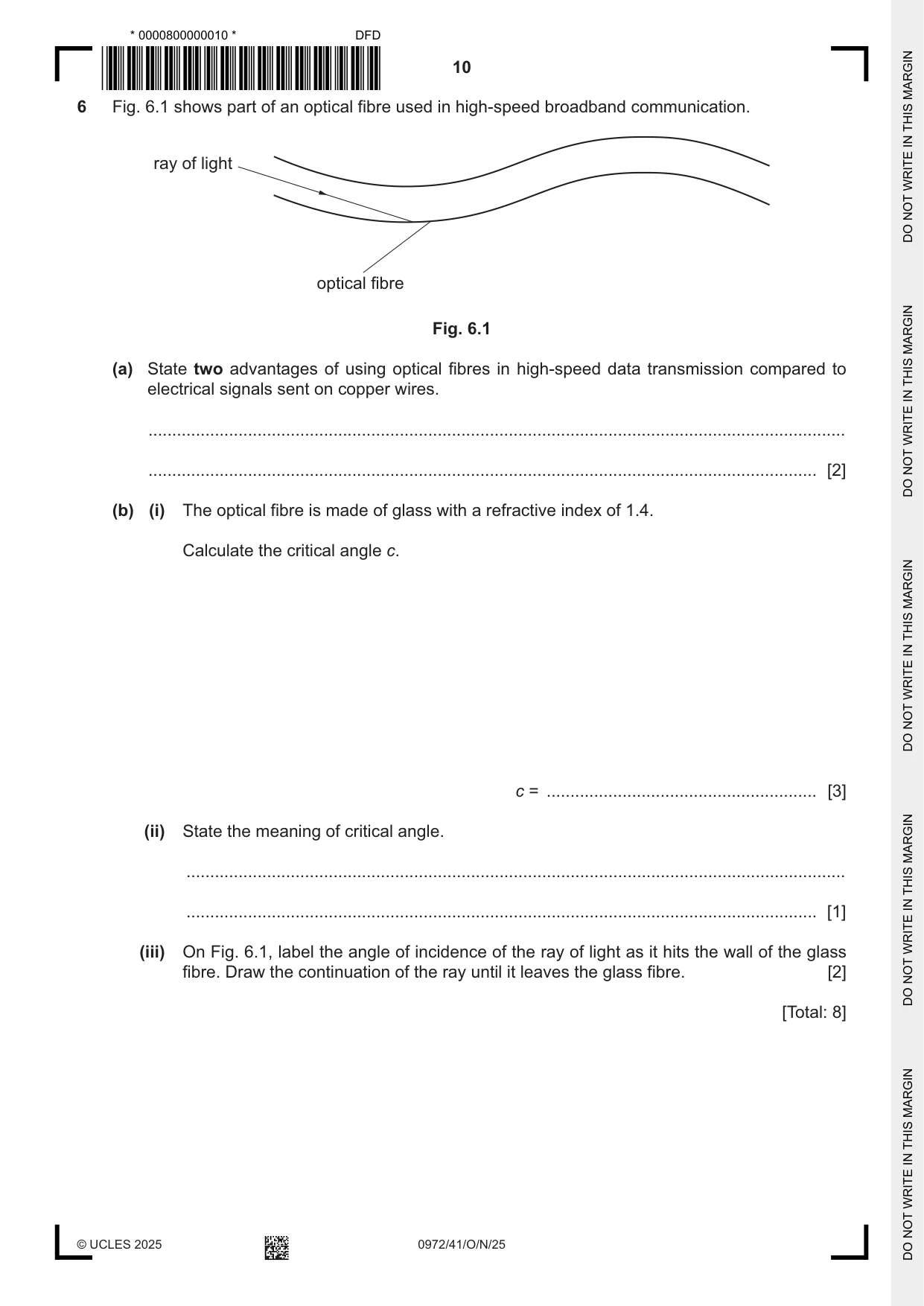
6 Fig. 6.1 shows part of an optical fibre used in high-speed broadband communication. ray of light optical fibre Fig. 6.1 (a) State two advantages of using optical fibres in high-speed data transmission compared to electrical signals sent on copper wires. ................................................................................................................................................... ............................................................................................................................................. [2] (b) (i) The optical fibre is made of glass with a refractive index of 1.4. Calculate the critical angle c. c = ......................................................... [3] (ii) State the meaning of critical angle. ........................................................................................................................................... ..................................................................................................................................... [1] (iii) On Fig. 6.1, label the angle of incidence of the ray of light as it hits the wall of the glass fibre. Draw the continuation of the ray until it leaves the glass fibre. [2] [Total: 8]
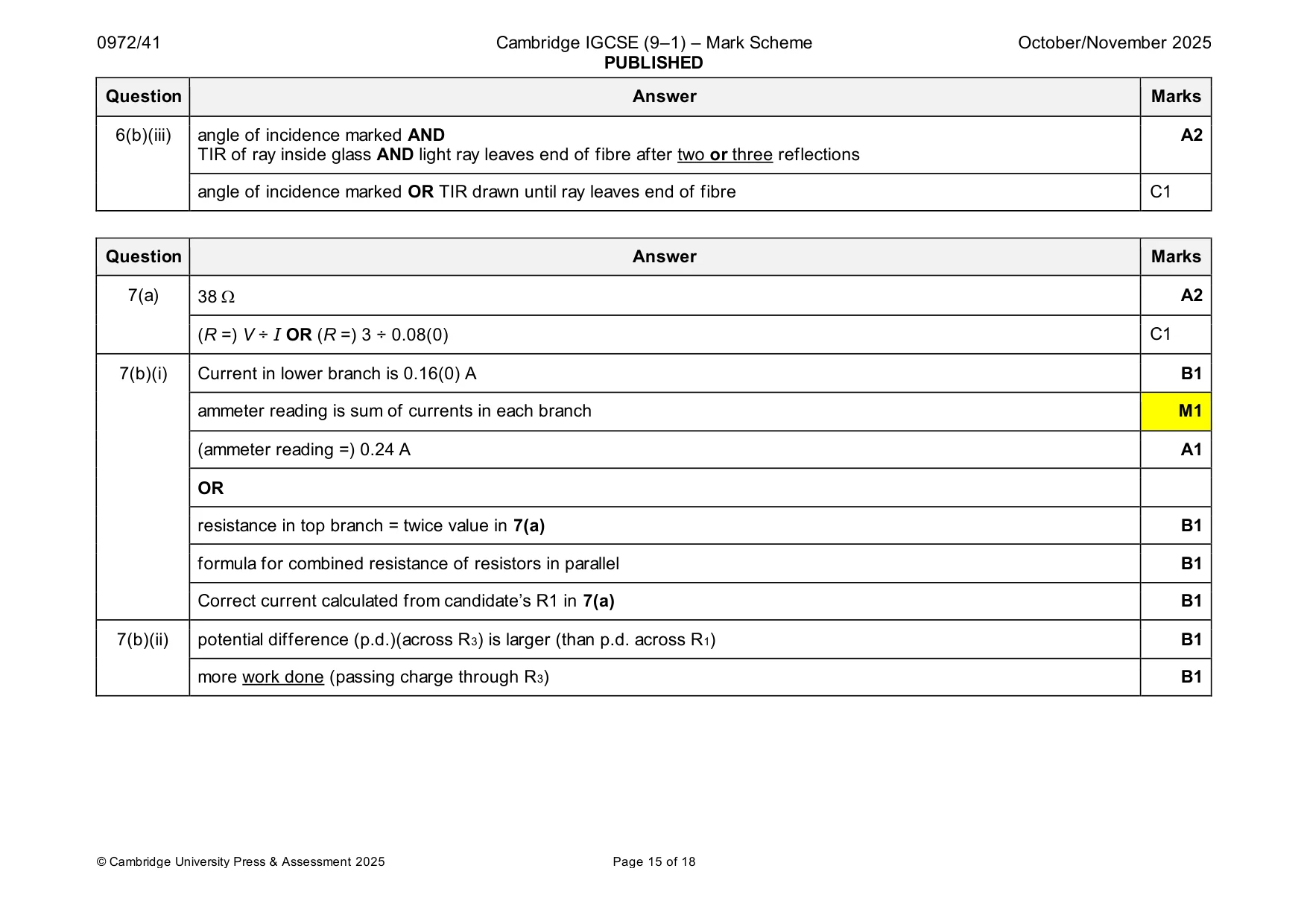
Mark scheme: 6(a) Any two from: B2 • high rates (of data transmission) / faster (data transmission) • carry large amounts (of data / information) • secure • Little data / signal loss • glass is transparent to (some) infrared 6(b)(i) (c =) 46° A3 N = 1 / sin c, 1.4 = 1 / sin c OR (c =) sin–1 (1 / 1.4) C1 Equation in this form only C1 (c =) sin–1 (1 / n) OR (c =) sin–1 (1 / 1.4) OR (c =) 46 6(b)(ii) angle of incidence (of light) at which the angle of refraction is (exactly) 90° B1 6(b)(iii) angle of incidence marked AND A2 TIR of ray inside glass AND light ray leaves end of fibre after two or three reflections angle of incidence marked OR TIR drawn until ray leaves end of fibre C1
Q7 · A circuit containing a 6.0 V battery of cells and three identical resistors
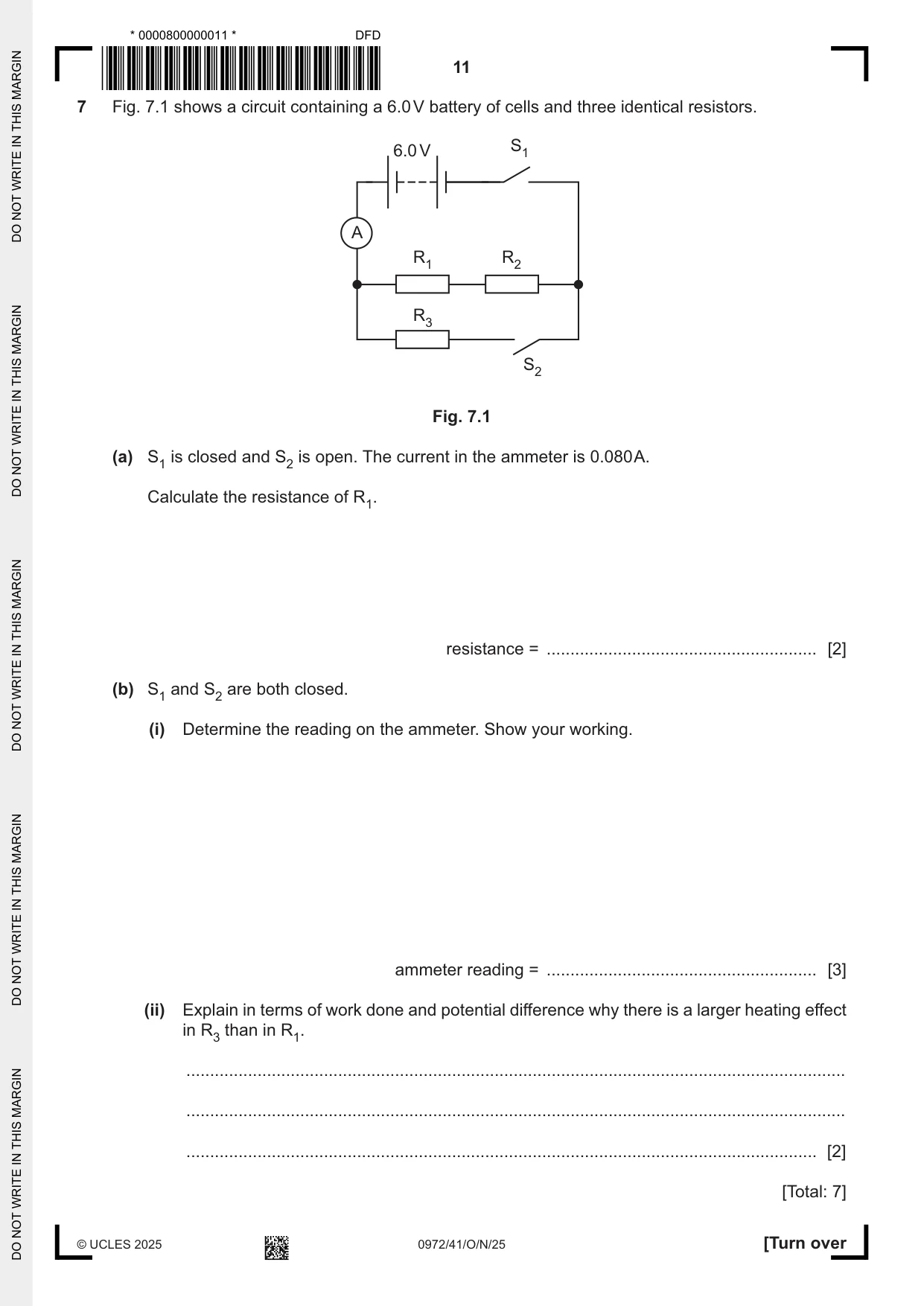
7 Fig. 7.1 shows a circuit containing a 6.0 V battery of cells and three identical resistors. 6.0 V S1 A R1 R2 R3 S2 Fig. 7.1 (a) S1 is closed and S2 is open. The current in the ammeter is 0.080 A. Calculate the resistance of R1. resistance = ......................................................... [2] (b) S1 and S2 are both closed. (i) Determine the reading on the ammeter. Show your working. ammeter reading = ......................................................... [3] (ii) Explain in terms of work done and potential difference why there is a larger heating effect in R3 than in R1. ........................................................................................................................................... ........................................................................................................................................... ..................................................................................................................................... [2] [Total: 7]
Mark scheme: 7(a) 38 A2 (R =) V ÷ I OR (R =) 3 ÷ 0.08(0) C1 7(b)(i) Current in lower branch is 0.16(0) A B1 ammeter reading is sum of currents in each branch M1 (ammeter reading =) 0.24 A A1 OR resistance in top branch = twice value in 7(a) B1 formula for combined resistance of resistors in parallel B1 Correct current calculated from candidate’s R1 in 7(a) B1 7(b)(ii) potential difference (p.d.)(across R3) is larger (than p.d. across R1) B1 more work done (passing charge through R3) B1
Question 8
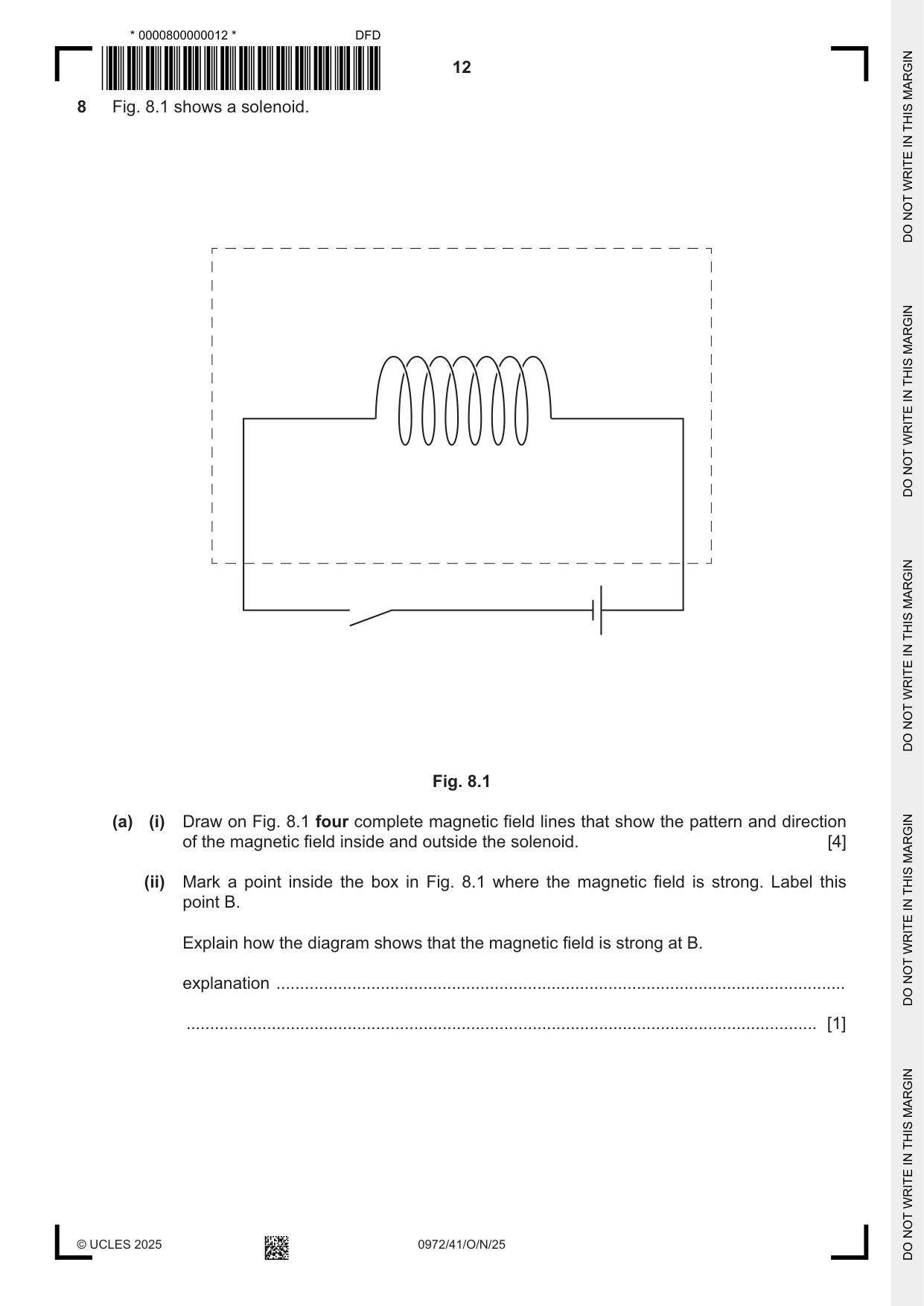
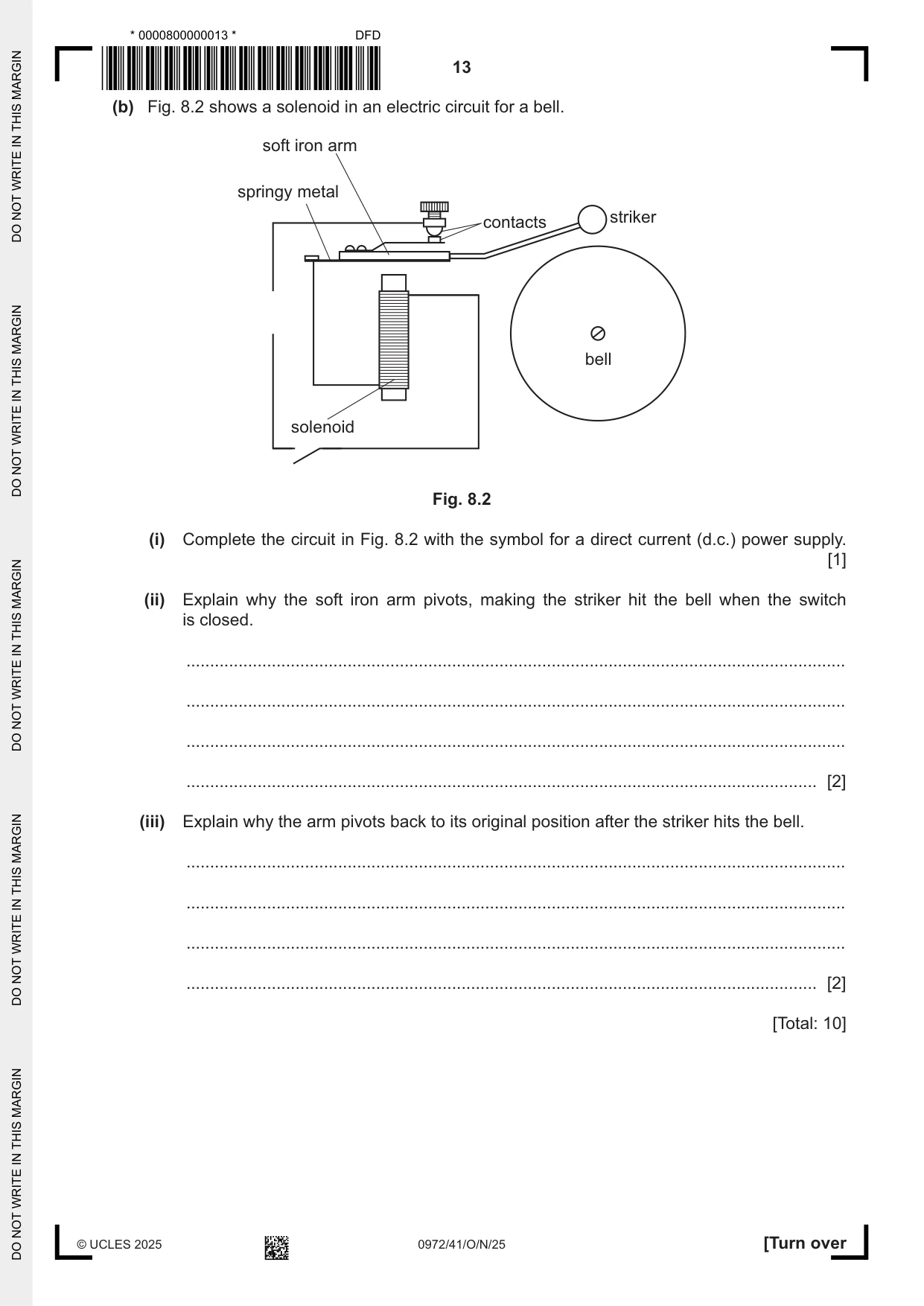
8 Fig. 8.1 shows a solenoid. Fig. 8.1 (a) (i) Draw on Fig. 8.1 four complete magnetic field lines that show the pattern and direction of the magnetic field inside and outside the solenoid. [4] (ii) Mark a point inside the box in Fig. 8.1 where the magnetic field is strong. Label this point B. Explain how the diagram shows that the magnetic field is strong at B. explanation ........................................................................................................................ ..................................................................................................................................... [1] (b) Fig. 8.2 shows a solenoid in an electric circuit for a bell. soft iron arm springy metal striker contacts bell solenoid Fig. 8.2 (i) Complete the circuit in Fig. 8.2 with the symbol for a direct current (d.c.) power supply. [1] (ii) Explain why the soft iron arm pivots, making the striker hit the bell when the switch is closed. ........................................................................................................................................... ........................................................................................................................................... ........................................................................................................................................... ..................................................................................................................................... [2] (iii) Explain why the arm pivots back to its original position after the striker hits the bell. ........................................................................................................................................... ........................................................................................................................................... ........................................................................................................................................... ..................................................................................................................................... [2] [Total: 10]
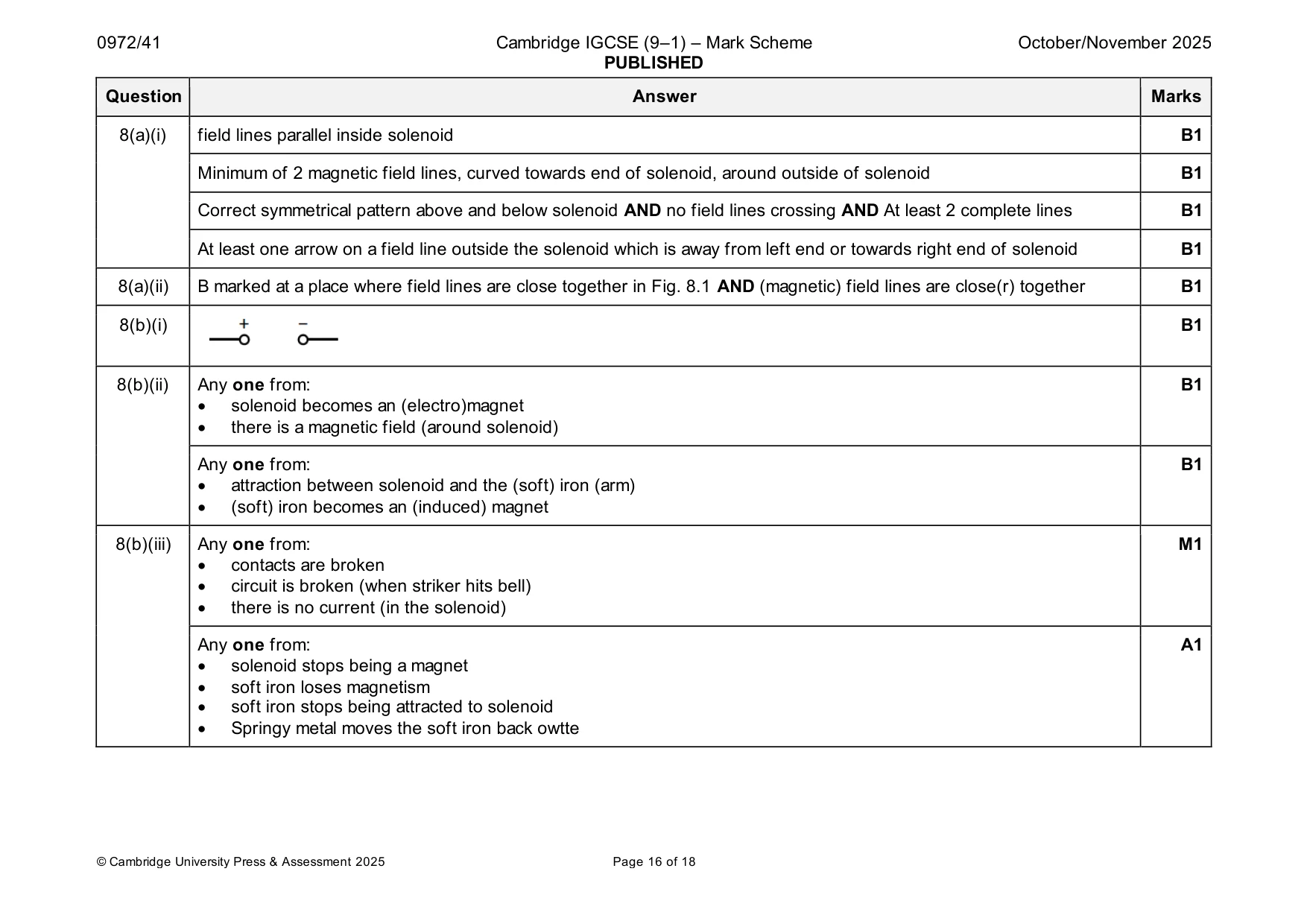
Mark scheme: 8(a)(i) field lines parallel inside solenoid B1 Minimum of 2 magnetic field lines, curved towards end of solenoid, around outside of solenoid B1 Correct symmetrical pattern above and below solenoid AND no field lines crossing AND At least 2 complete lines B1 At least one arrow on a field line outside the solenoid which is away from left end or towards right end of solenoid B1 8(a)(ii) B marked at a place where field lines are close together in Fig. 8.1 AND (magnetic) field lines are close(r) together B1 8(b)(i) B1 8(b)(ii) Any one from: B1 • solenoid becomes an (electro)magnet • there is a magnetic field (around solenoid) Any one from: B1 • attraction between solenoid and the (soft) iron (arm) • (soft) iron becomes an (induced) magnet 8(b)(iii) Any one from: M1 • contacts are broken • circuit is broken (when striker hits bell) • there is no current (in the solenoid) Any one from: A1 • solenoid stops being a magnet • soft iron loses magnetism • soft iron stops being attracted to solenoid • Springy metal moves the soft iron back owtte
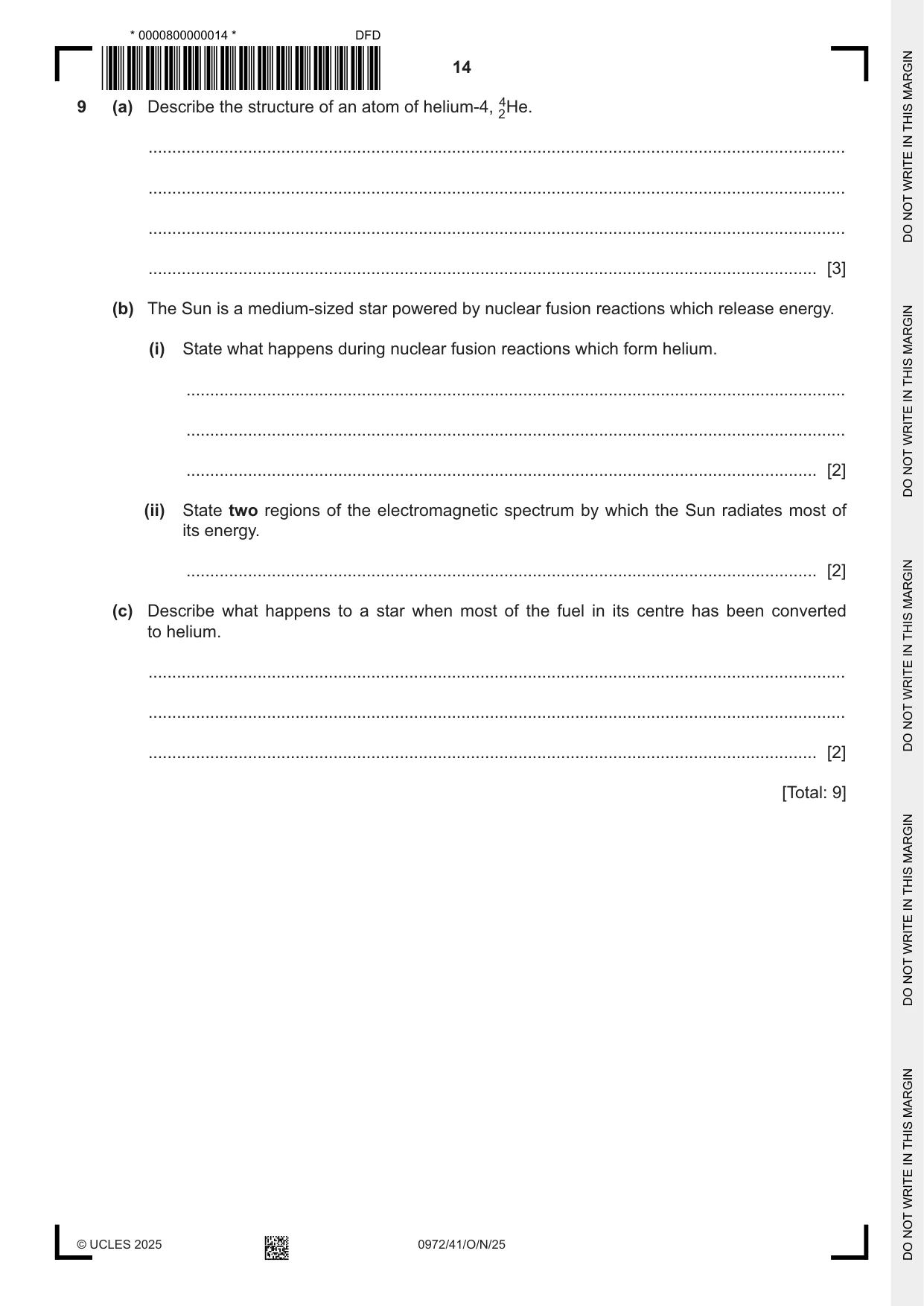
Q9 · Describe the structure of an atom of helium-4, 4He
9 (a) Describe the structure of an atom of helium-4, 4He. 2 ................................................................................................................................................... ................................................................................................................................................... ................................................................................................................................................... ............................................................................................................................................. [3] (b) The Sun is a medium-sized star powered by nuclear fusion reactions which release energy. (i) State what happens during nuclear fusion reactions which form helium. ........................................................................................................................................... ........................................................................................................................................... ..................................................................................................................................... [2] (ii) State two regions of the electromagnetic spectrum by which the Sun radiates most of its energy. ..................................................................................................................................... [2] (c) Describe what happens to a star when most of the fuel in its centre has been converted to helium. ................................................................................................................................................... ................................................................................................................................................... ............................................................................................................................................. [2] [Total: 9]
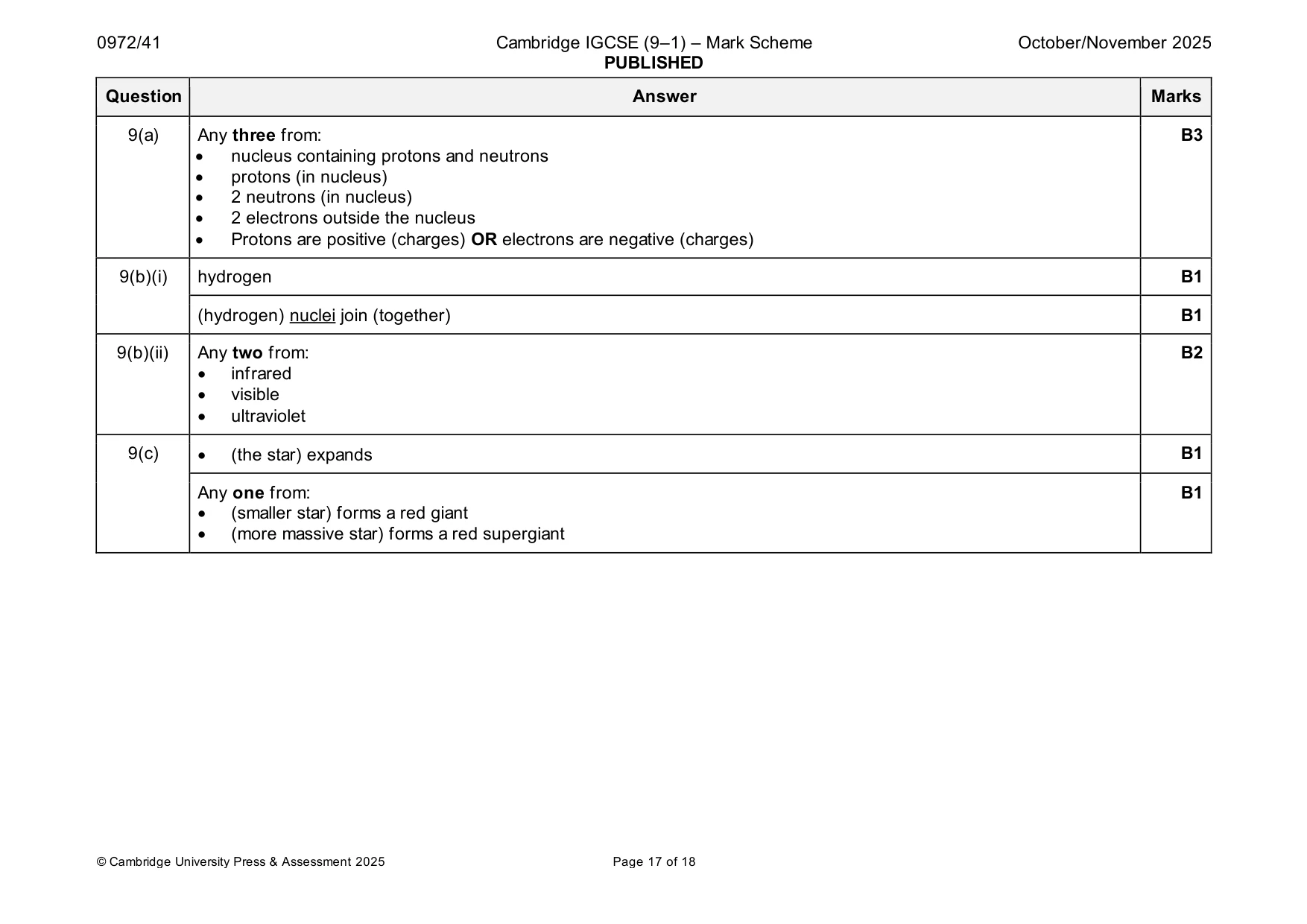
Mark scheme: 9(a) Any three from: B3 • nucleus containing protons and neutrons • protons (in nucleus) • 2 neutrons (in nucleus) • 2 electrons outside the nucleus • Protons are positive (charges) OR electrons are negative (charges) 9(b)(i) hydrogen B1 (hydrogen) nuclei join (together) B1 9(b)(ii) Any two from: B2 • infrared • visible • ultraviolet 9(c) • (the star) expands B1 Any one from: B1 • (smaller star) forms a red giant • (more massive star) forms a red supergiant
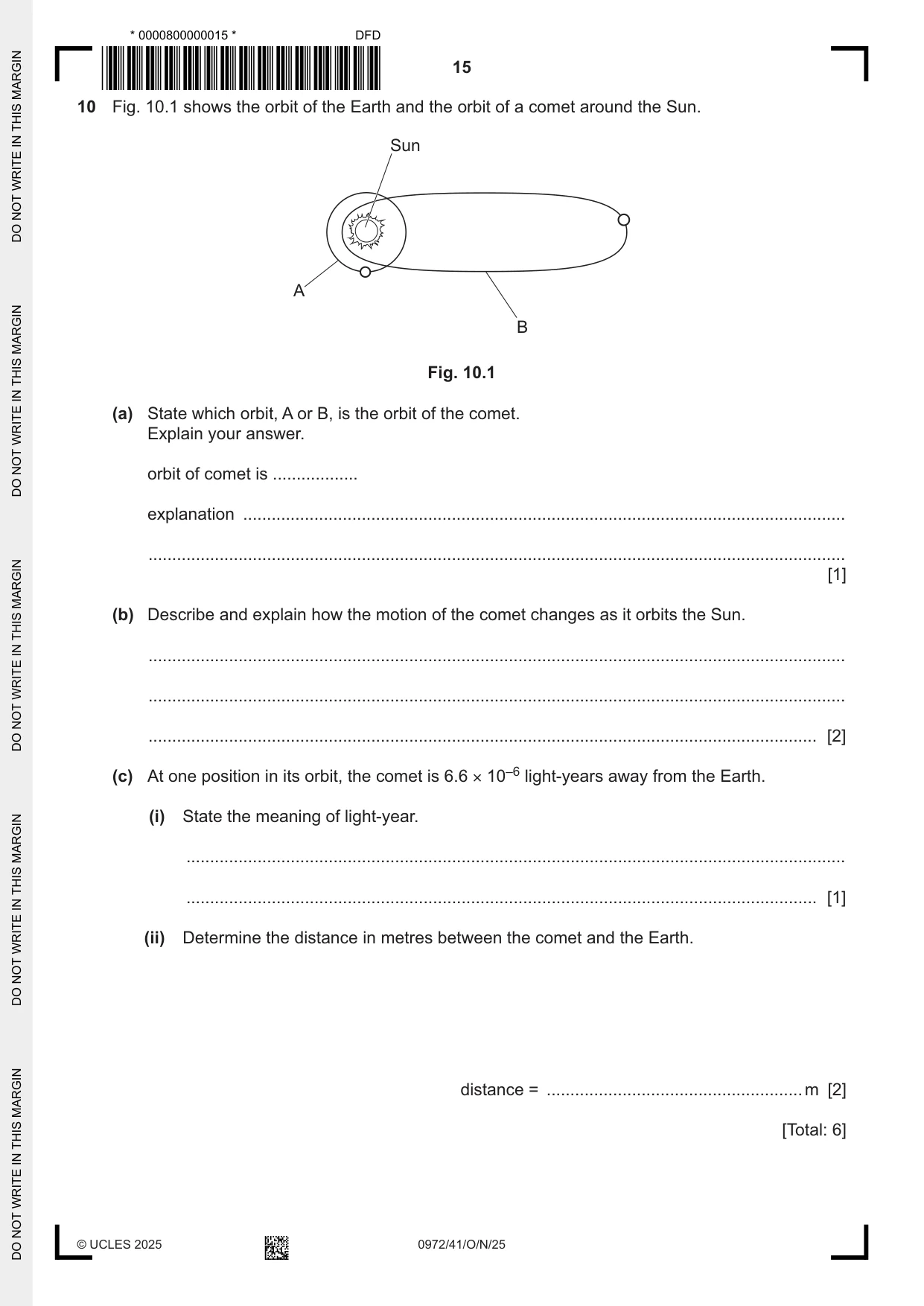
Q10 · The orbit of the Earth and the orbit of a comet around the Sun
10 Fig. 10.1 shows the orbit of the Earth and the orbit of a comet around the Sun. Sun A B Fig. 10.1 (a) State which orbit, A or B, is the orbit of the comet. Explain your answer. orbit of comet is .................. explanation ............................................................................................................................... ................................................................................................................................................... [1] (b) Describe and explain how the motion of the comet changes as it orbits the Sun. ................................................................................................................................................... ................................................................................................................................................... ............................................................................................................................................. [2] (c) At one position in its orbit, the comet is 6.6 × 10⁻⁶ light-years away from the Earth. (i) State the meaning of light-year. ........................................................................................................................................... ..................................................................................................................................... [1] (ii) Determine the distance in metres between the comet and the Earth. distance = ...................................................... m [2] [Total: 6]
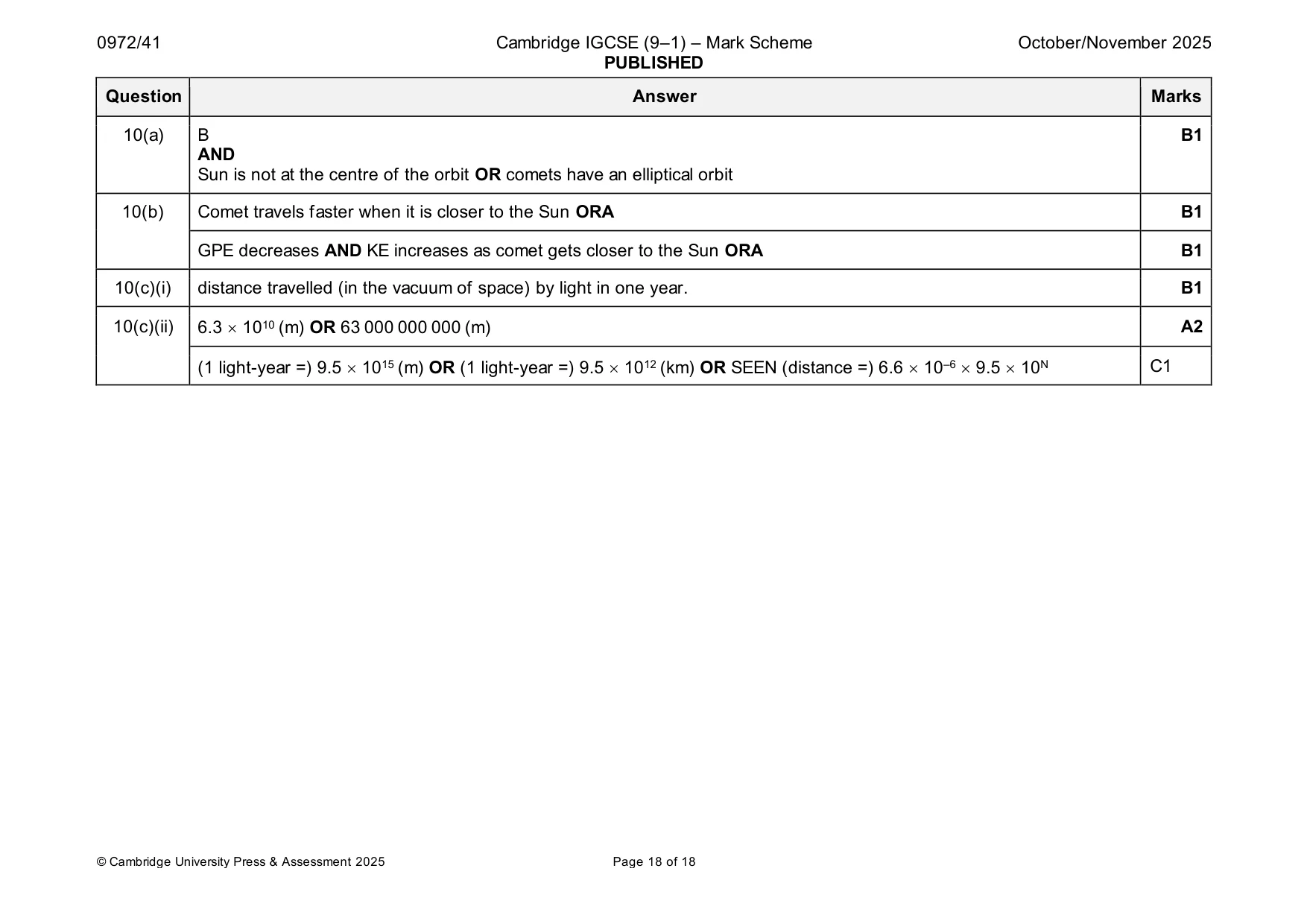
Mark scheme: 10(a) B B1 AND Sun is not at the centre of the orbit OR comets have an elliptical orbit 10(b) Comet travels faster when it is closer to the Sun ORA B1 GPE decreases AND KE increases as comet gets closer to the Sun ORA B1 10(c)(i) distance travelled (in the vacuum of space) by light in one year. B1 10(c)(ii) 6.3 1010 (m) OR 63 000 000 000 (m) A2 (1 light-year =) 9.5 1015 (m) OR (1 light-year =) 9.5 1012 (km) OR SEEN (distance =) 6.6 10–6 9.5 10N C1
What was in this paper
The subtopics covered by these 10 questions, and how many questions each got. Open one in a new tab to see every Cambridge question on it.
What you needed in this session
Cambridge’s own grade thresholds for 2025 Oct/Nov, Paper 4 · Variant 1. A higher threshold means an easier paper — the bar moves with how the cohort did.