Cambridge IGCSE Physics (9-1) 0972 — 2020 May/June Paper 4 · Variant 2
0972/42/M/J/20 · 10 questions · 80 marks · ≈90 min
The question paper and its mark scheme, free to read here and free to download. This is Cambridge’s own paper, exactly as it was sat.
Question paper12 pages
Mark scheme9 pages
Answers below. Sit the paper first if you are practising.
Questions as text
Q1 · The speed–time graph of a person on a journey
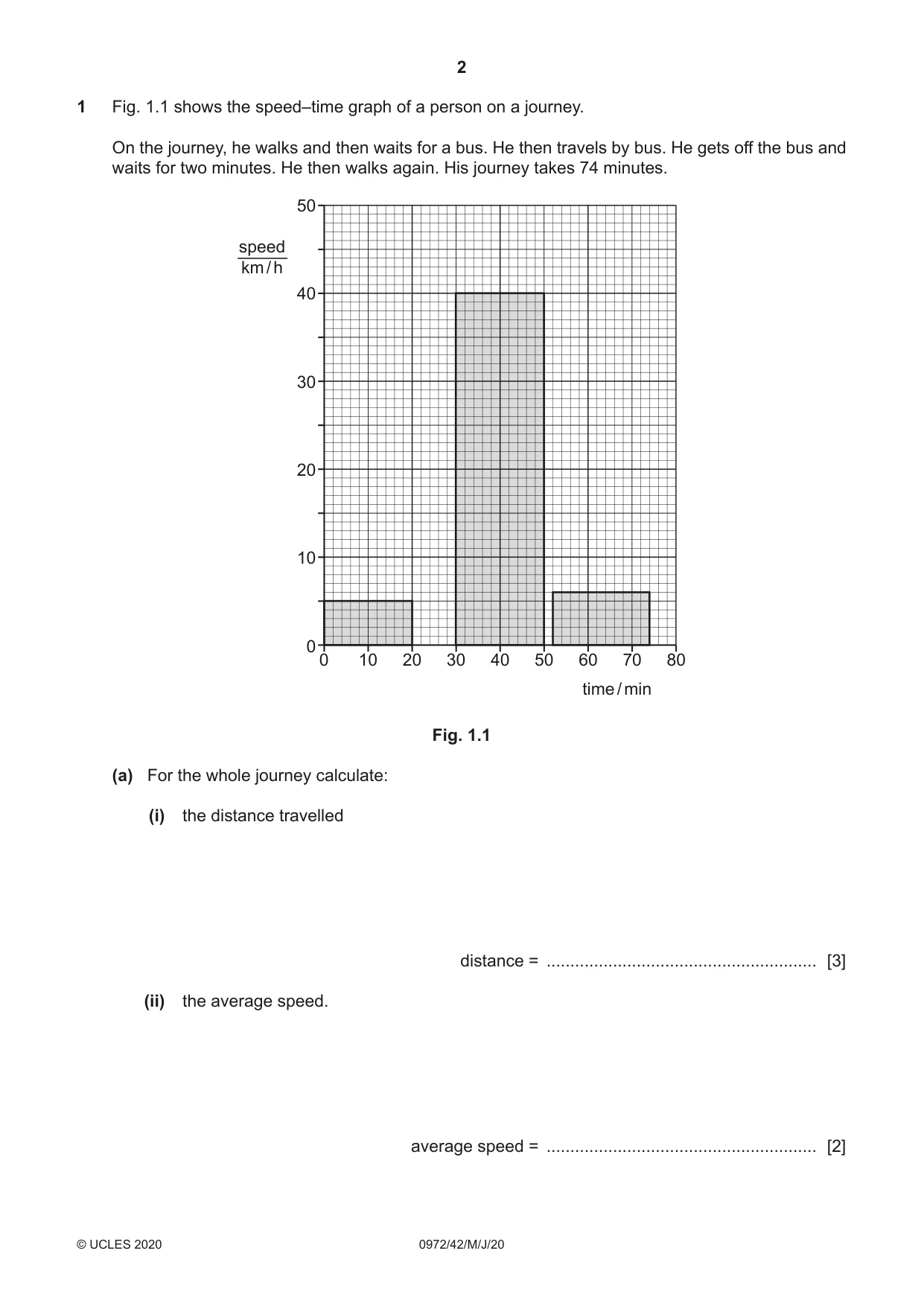
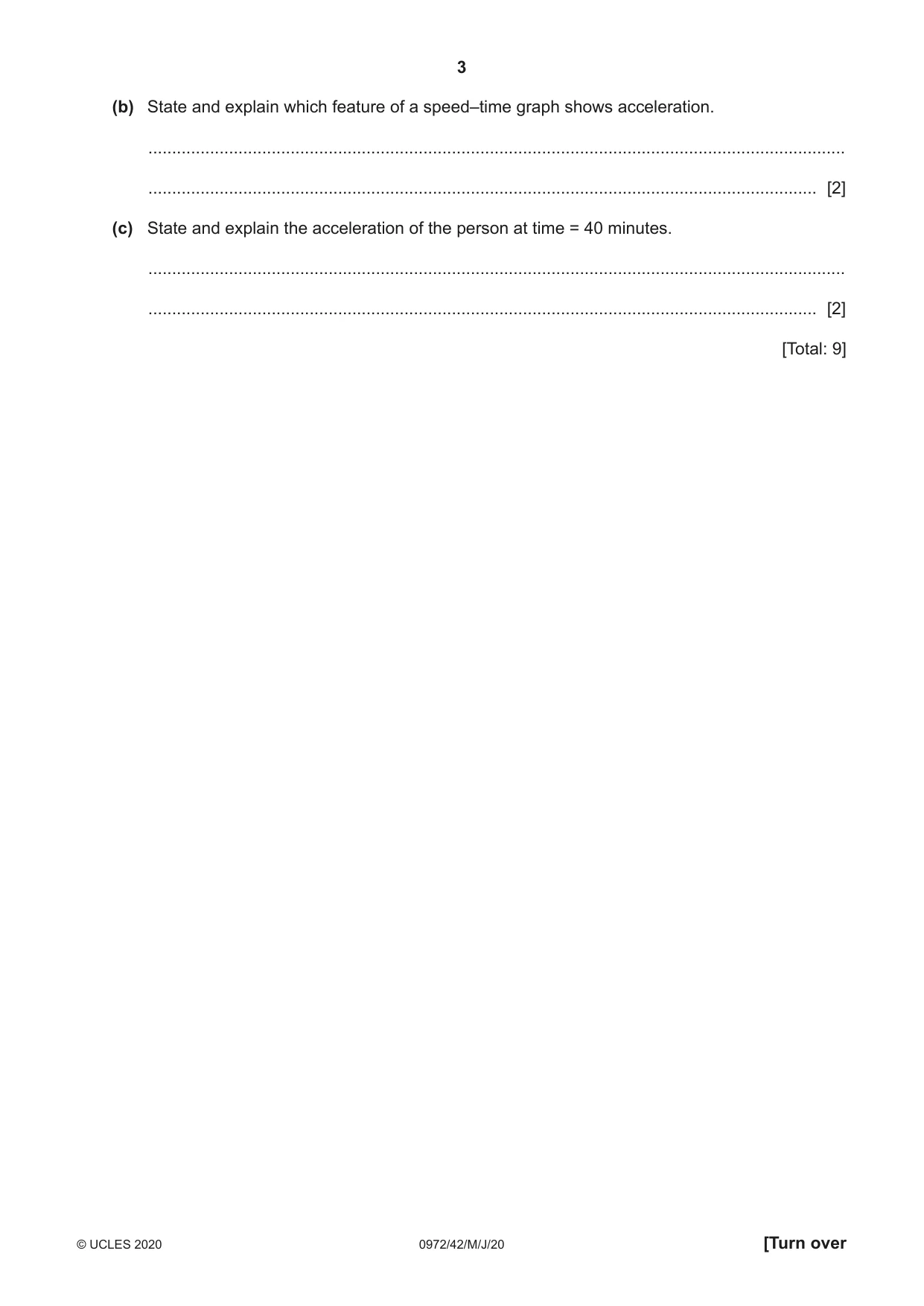
1 Fig. 1.1 shows the speed–time graph of a person on a journey. On the journey, he walks and then waits for a bus. He then travels by bus. He gets off the bus and waits for two minutes. He then walks again. His journey takes 74 minutes. 50 speed km / h 40 30 20 10 0 0 10 20 30 40 50 60 70 80 time / min Fig. 1.1 (a) For the whole journey calculate: (i) the distance travelled distance = ......................................................... [3] (ii) the average speed. average speed = ......................................................... [2] (b) State and explain which feature of a speed–time graph shows acceleration. ................................................................................................................................................... ............................................................................................................................................. [2] (c) State and explain the acceleration of the person at time = 40 minutes. ................................................................................................................................................... ............................................................................................................................................. [2] [Total: 9]
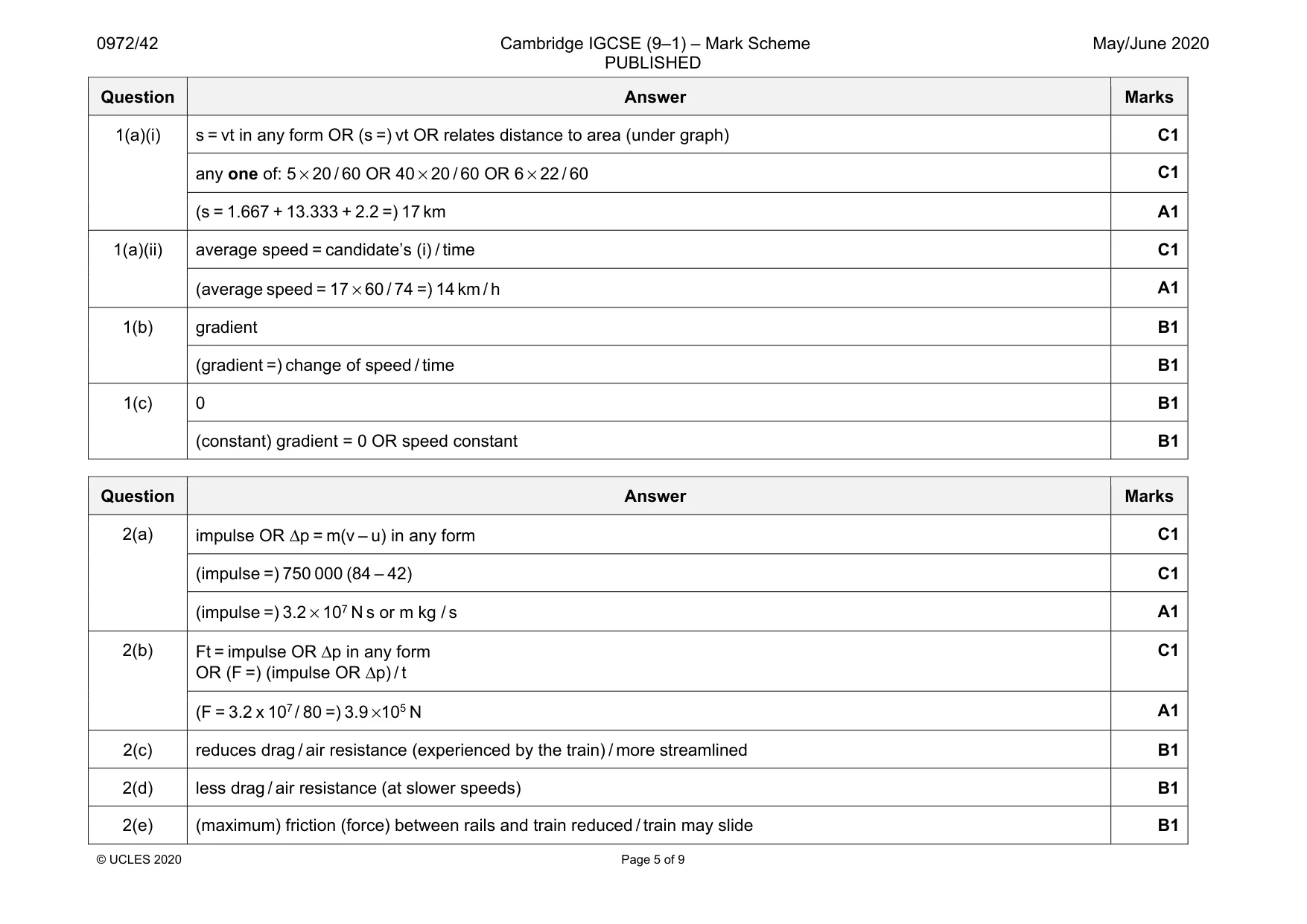
Mark scheme: 1(a)(i) s = vt in any form OR (s =) vt OR relates distance to area (under graph) C1 any one of: 5 × 20 / 60 OR 40 × 20 / 60 OR 6 × 22 / 60 C1 (s = 1.667 + 13.333 + 2.2 =) 17 km A1 1(a)(ii) average speed = candidate’s (i) / time C1 (average speed = 17 × 60 / 74 =) 14 km / h A1 1(b) gradient B1 (gradient =) change of speed / time B1 1(c) 0 B1 (constant) gradient = 0 OR speed constant B1
Question 2
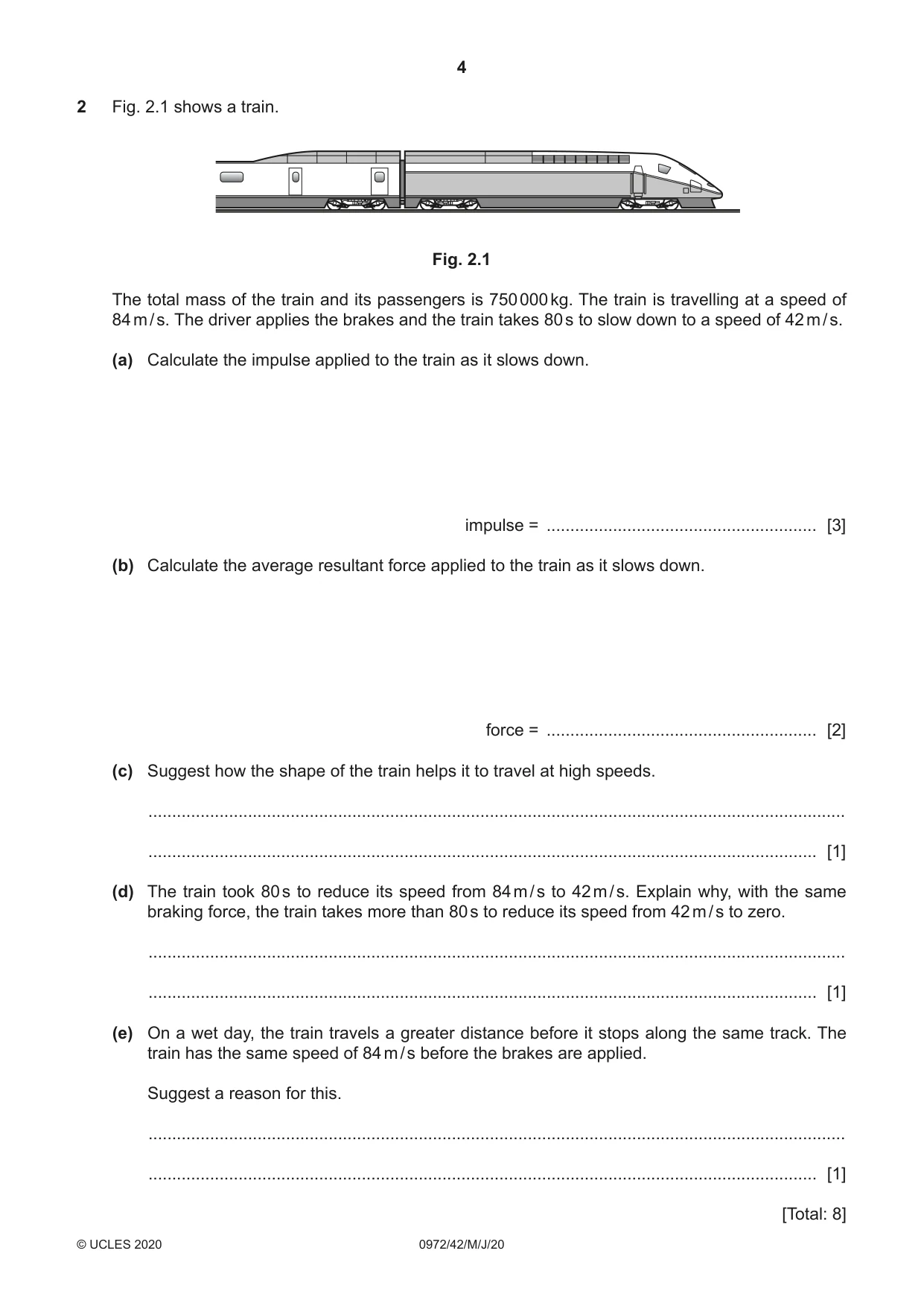
2 Fig. 2.1 shows a train. Fig. 2.1 The total mass of the train and its passengers is 750 000 kg. The train is travelling at a speed of 84 m / s. The driver applies the brakes and the train takes 80 s to slow down to a speed of 42 m / s. (a) Calculate the impulse applied to the train as it slows down. impulse = ......................................................... [3] (b) Calculate the average resultant force applied to the train as it slows down. force = ......................................................... [2] (c) Suggest how the shape of the train helps it to travel at high speeds. ................................................................................................................................................... ............................................................................................................................................. [1] (d) The train took 80 s to reduce its speed from 84 m / s to 42 m / s. Explain why, with the same braking force, the train takes more than 80 s to reduce its speed from 42 m / s to zero. ................................................................................................................................................... ............................................................................................................................................. [1] (e) On a wet day, the train travels a greater distance before it stops along the same track. The train has the same speed of 84 m / s before the brakes are applied. Suggest a reason for this. ................................................................................................................................................... ............................................................................................................................................. [1] [Total: 8]
Mark scheme: 2(a) impulse OR Δp = m(v – u) in any form C1 (impulse =) 750 000 (84 – 42) C1 (impulse =) 3.2 × 10⁷ N s or m kg / s A1 2(b) Ft = impulse OR Δp in any form OR (F =) (impulse OR Δp) / t C1 (F = 3.2 x 10⁷ / 80 =) 3.9 ×10⁵ N A1 2(c) reduces drag / air resistance (experienced by the train) / more streamlined B1 2(d) less drag / air resistance (at slower speeds) B1 2(e) (maximum) friction (force) between rails and train reduced / train may slide B1
Q3 · A solar panel receives energy from the Sun at a rate of 5.0 kW
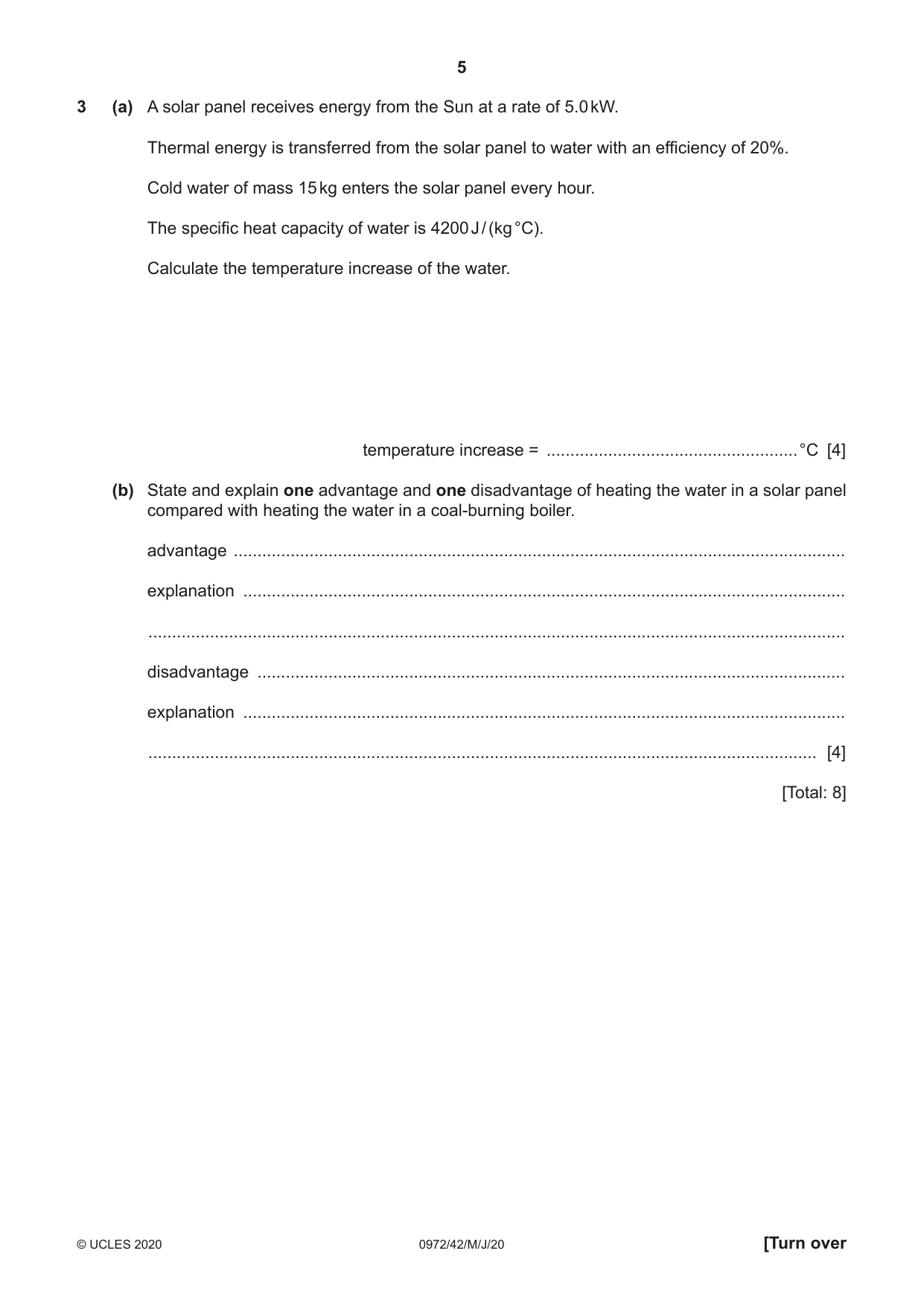
3 (a) A solar panel receives energy from the Sun at a rate of 5.0 kW. Thermal energy is transferred from the solar panel to water with an efficiency of 20%. Cold water of mass 15 kg enters the solar panel every hour. The specific heat capacity of water is 4200 J / (kg °C). Calculate the temperature increase of the water. temperature increase = .....................................................°C [4] (b) State and explain one advantage and one disadvantage of heating the water in a solar panel compared with heating the water in a coal-burning boiler. advantage ................................................................................................................................. explanation ............................................................................................................................... ................................................................................................................................................... disadvantage ............................................................................................................................ explanation ............................................................................................................................... ............................................................................................................................................. [4] [Total: 8]
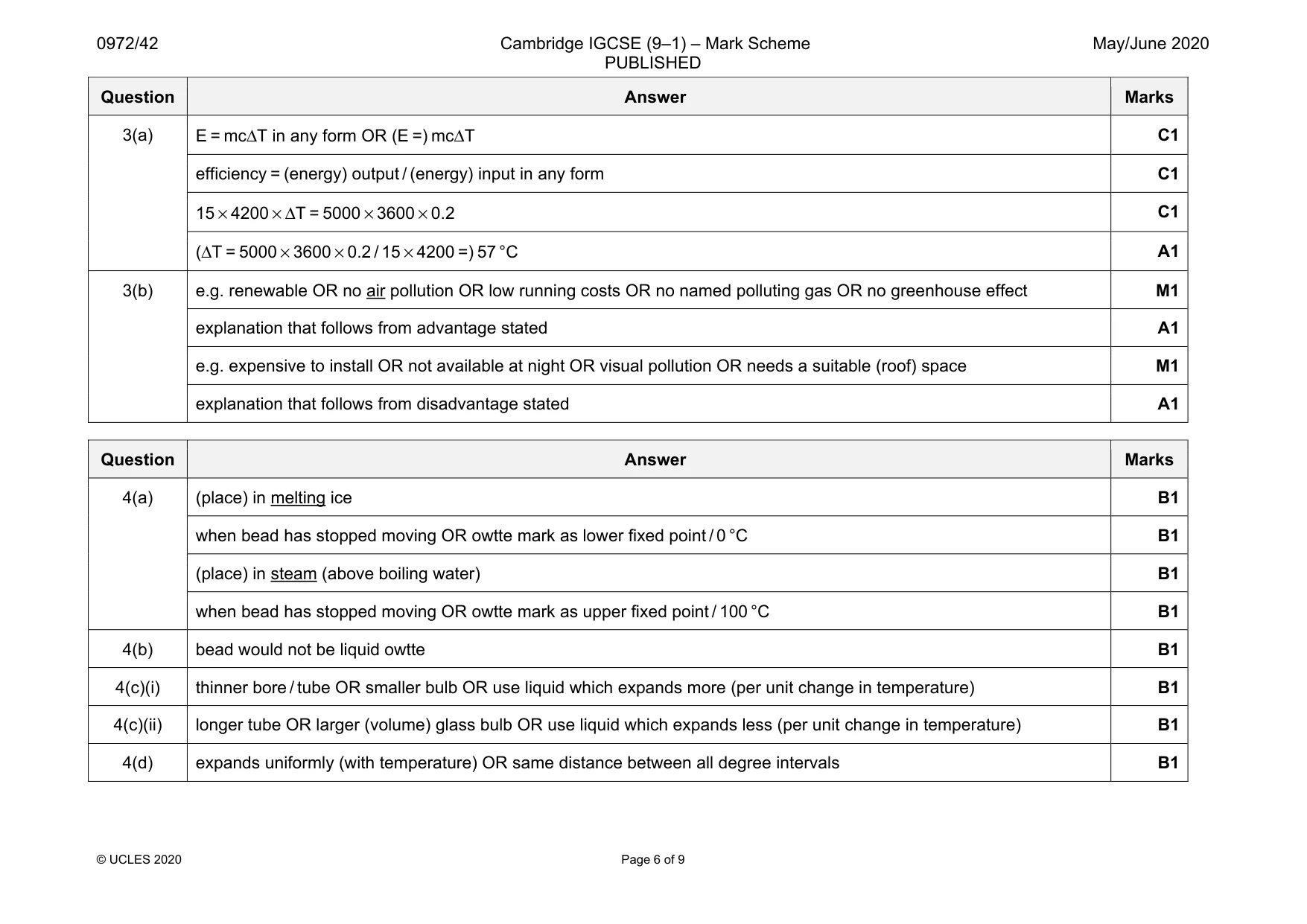
Mark scheme: 3(a) E = mcΔT in any form OR (E =) mcΔT C1 efficiency = (energy) output / (energy) input in any form C1 15 × 4200 × ΔT = 5000 × 3600 × 0.2 C1 (ΔT = 5000 × 3600 × 0.2 / 15 × 4200 =) 57 °C A1 3(b) e.g. renewable OR no air pollution OR low running costs OR no named polluting gas OR no greenhouse effect M1 explanation that follows from advantage stated A1 e.g. expensive to install OR not available at night OR visual pollution OR needs a suitable (roof) space M1 explanation that follows from disadvantage stated A1
Q4 · A liquid-in-glass thermometer without a temperature scale
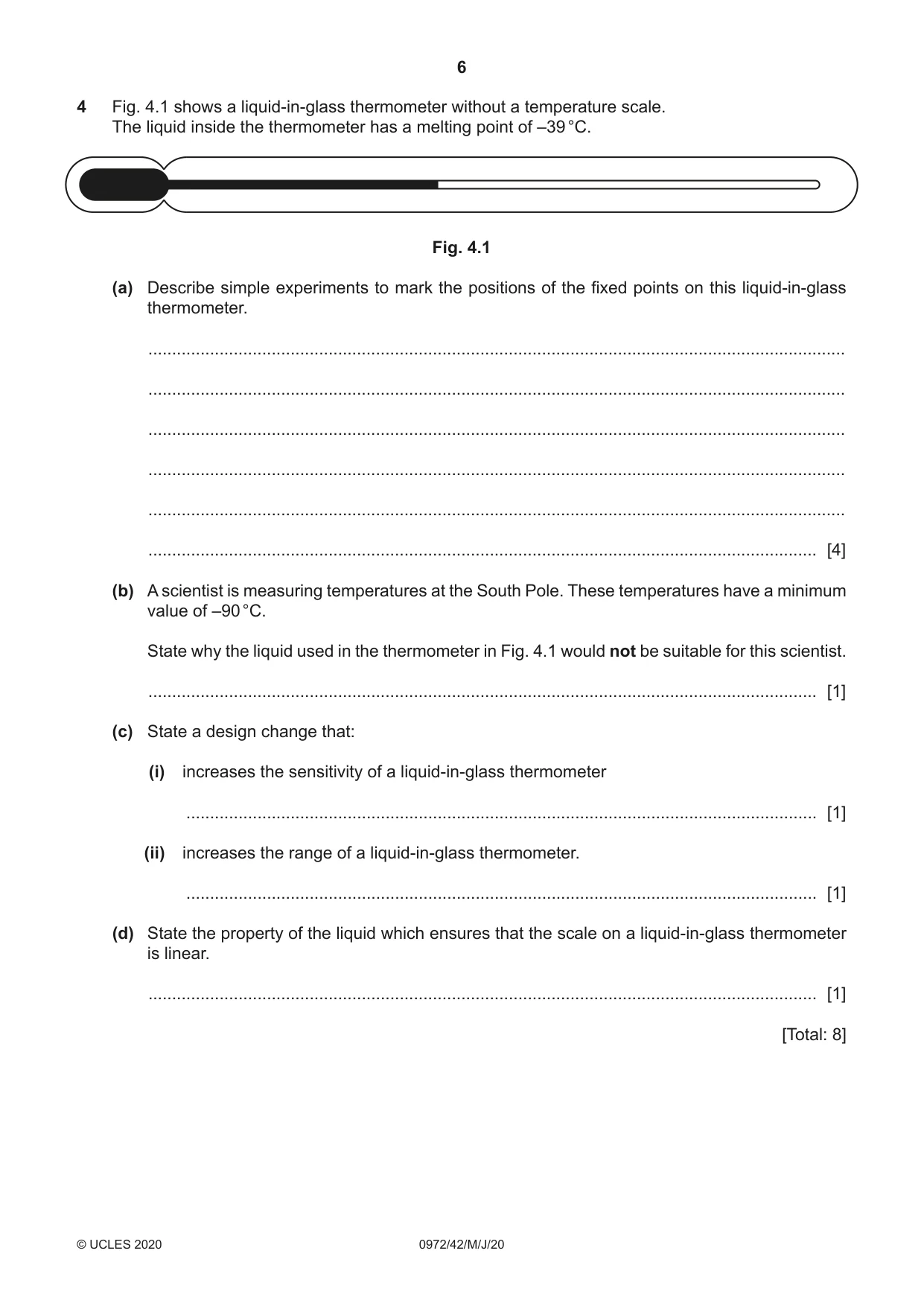
4 Fig. 4.1 shows a liquid-in-glass thermometer without a temperature scale. The liquid inside the thermometer has a melting point of –39 °C. Fig. 4.1 (a) Describe simple experiments to mark the positions of the fixed points on this liquid-in-glass thermometer. ................................................................................................................................................... ................................................................................................................................................... ................................................................................................................................................... ................................................................................................................................................... ................................................................................................................................................... ............................................................................................................................................. [4] (b) A scientist is measuring temperatures at the South Pole. These temperatures have a minimum value of –90 °C. State why the liquid used in the thermometer in Fig. 4.1 would not be suitable for this scientist. ............................................................................................................................................. [1] (c) State a design change that: (i) increases the sensitivity of a liquid-in-glass thermometer ..................................................................................................................................... [1] (ii) increases the range of a liquid-in-glass thermometer. ..................................................................................................................................... [1] (d) State the property of the liquid which ensures that the scale on a liquid-in-glass thermometer is linear. ............................................................................................................................................. [1] [Total: 8]
Mark scheme: 4(a) (place) in melting ice B1 when bead has stopped moving OR owtte mark as lower fixed point / 0 °C B1 (place) in steam (above boiling water) B1 when bead has stopped moving OR owtte mark as upper fixed point / 100 °C B1 4(b) bead would not be liquid owtte B1 4(c)(i) thinner bore / tube OR smaller bulb OR use liquid which expands more (per unit change in temperature) B1 4(c)(ii) longer tube OR larger (volume) glass bulb OR use liquid which expands less (per unit change in temperature) B1 4(d) expands uniformly (with temperature) OR same distance between all degree intervals B1
Q5 · Crests of a wave approaching a barrier where the wave is reflected
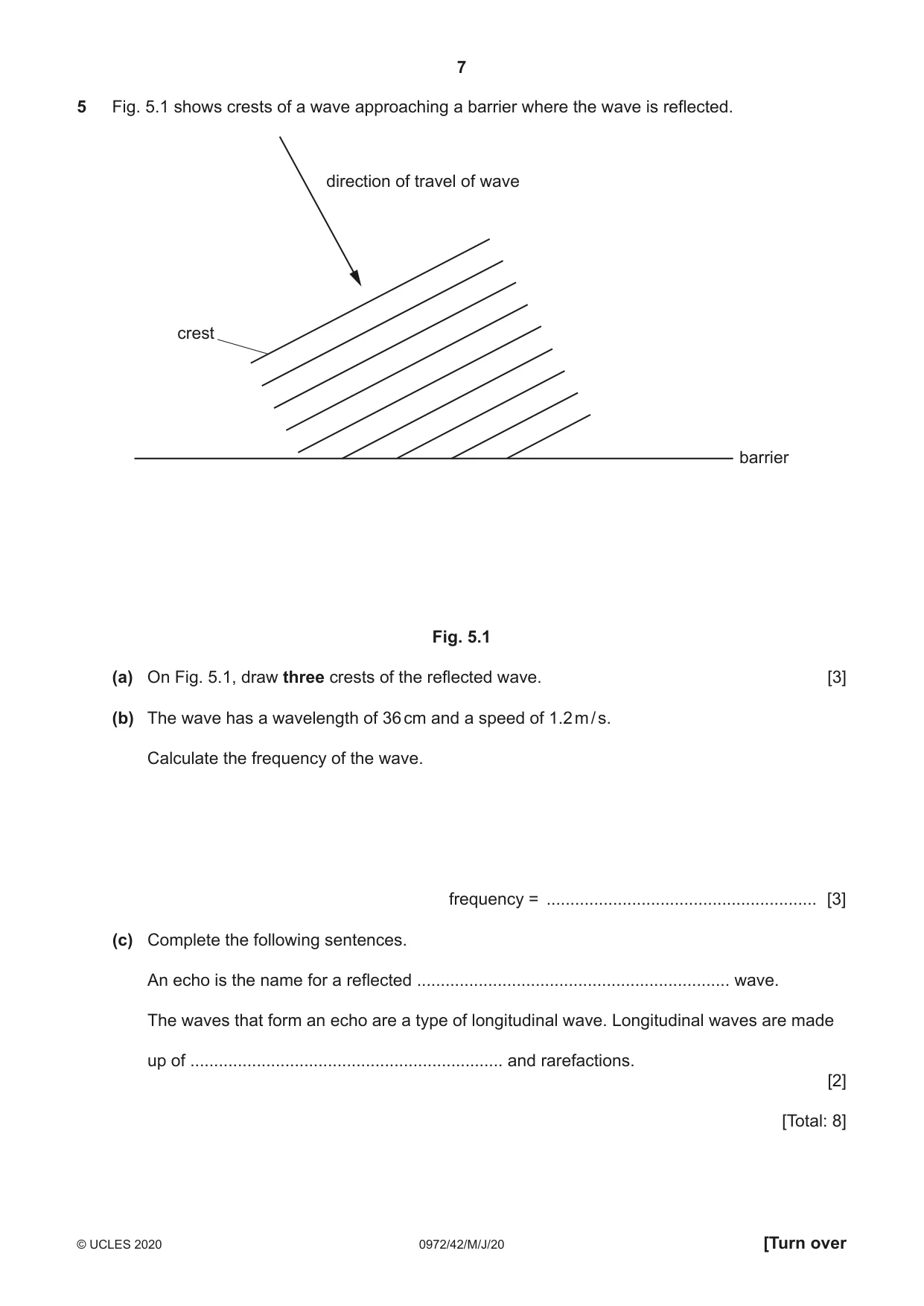
5 Fig. 5.1 shows crests of a wave approaching a barrier where the wave is reflected. direction of travel of wave crest barrier Fig. 5.1 (a) On Fig. 5.1, draw three crests of the reflected wave. [3] (b) The wave has a wavelength of 36 cm and a speed of 1.2 m / s. Calculate the frequency of the wave. frequency = ......................................................... [3] (c) Complete the following sentences. An echo is the name for a reflected .................................................................. wave. The waves that form an echo are a type of longitudinal wave. Longitudinal waves are made up of .................................................................. and rarefactions. [2] [Total: 8]
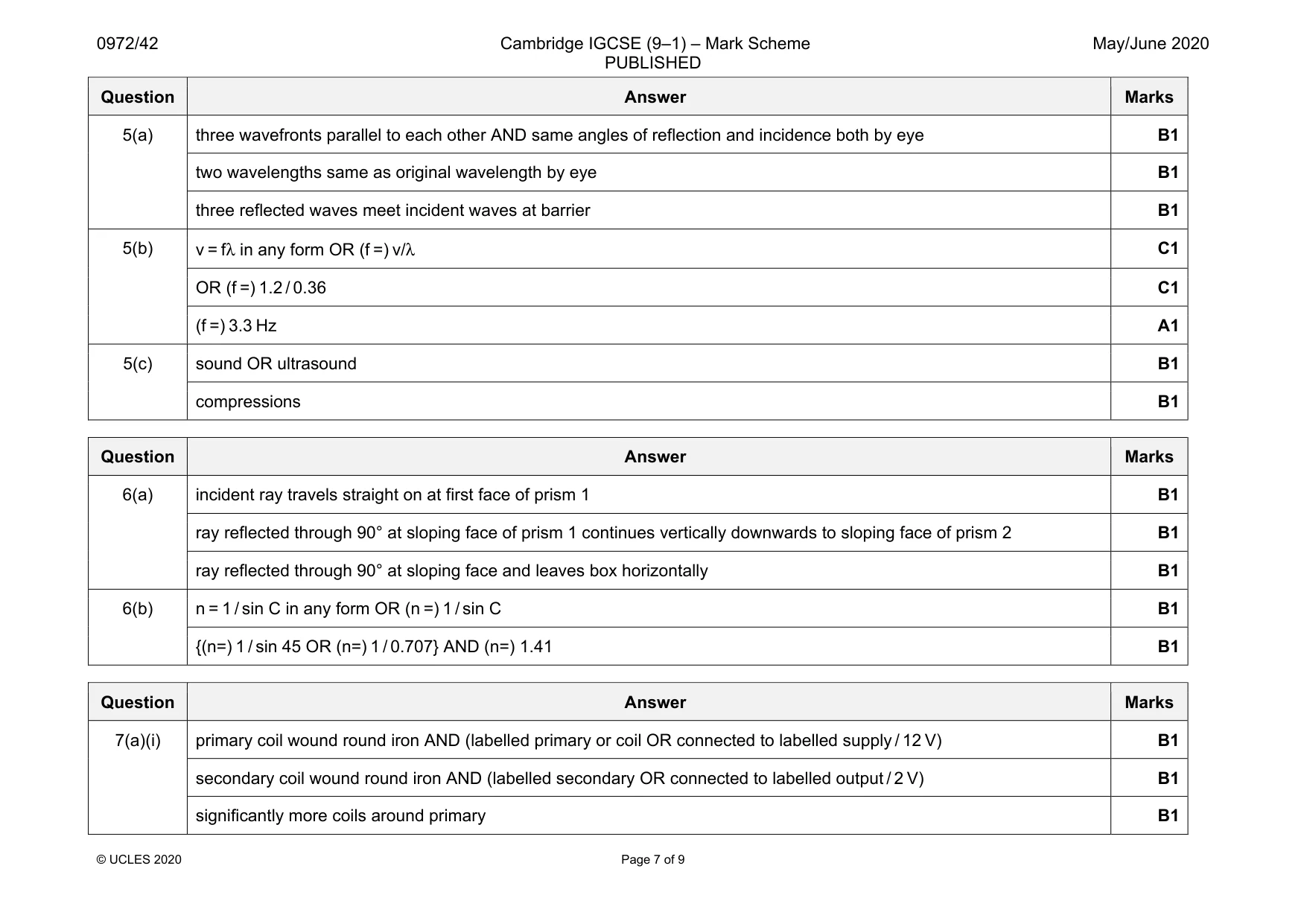
Mark scheme: 5(a) three wavefronts parallel to each other AND same angles of reflection and incidence both by eye B1 two wavelengths same as original wavelength by eye B1 three reflected waves meet incident waves at barrier B1 5(b) v = fλ in any form OR (f =) v/λ C1 OR (f =) 1.2 / 0.36 C1 (f =) 3.3 Hz A1 5(c) sound OR ultrasound B1 compressions B1
Q6 · An arrangement of glass prisms inside a box
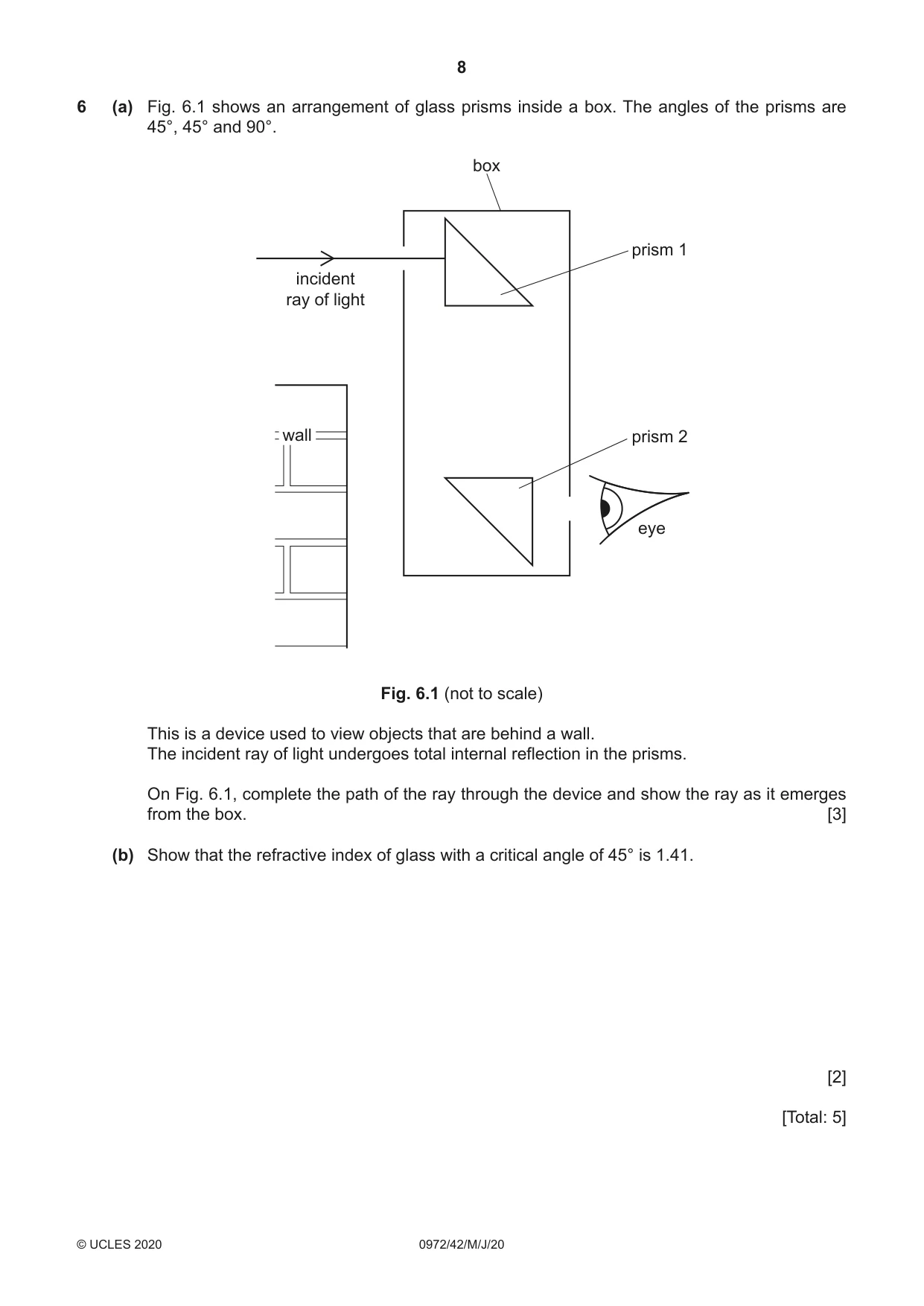
6 (a) Fig. 6.1 shows an arrangement of glass prisms inside a box. The angles of the prisms are 45°, 45° and 90°. box prism 1 incident ray of light wall prism 2 eye Fig. 6.1 (not to scale) This is a device used to view objects that are behind a wall. The incident ray of light undergoes total internal reflection in the prisms. On Fig. 6.1, complete the path of the ray through the device and show the ray as it emerges from the box. [3] (b) Show that the refractive index of glass with a critical angle of 45° is 1.41. [2] [Total: 5]
Mark scheme: 6(a) incident ray travels straight on at first face of prism 1 B1 ray reflected through 90° at sloping face of prism 1 continues vertically downwards to sloping face of prism 2 B1 ray reflected through 90° at sloping face and leaves box horizontally B1 6(b) n = 1 / sin C in any form OR (n =) 1 / sin C B1 {(n=) 1 / sin 45 OR (n=) 1 / 0.707} AND (n=) 1.41 B1
Q7 · A student makes a transformer that uses an alternating current (a.c.) supply with an…
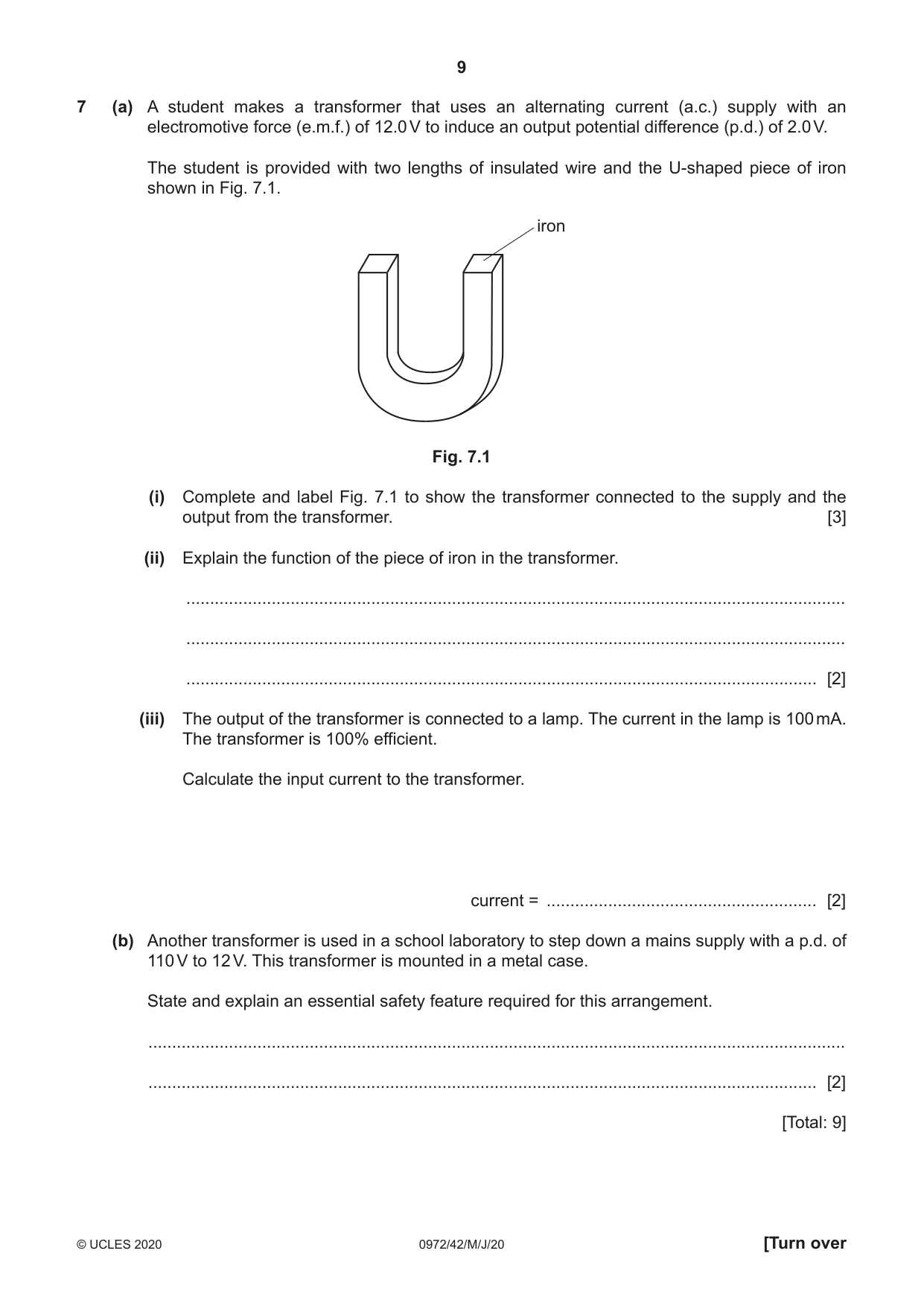
7 (a) A student makes a transformer that uses an alternating current (a.c.) supply with an electromotive force (e.m.f.) of 12.0 V to induce an output potential difference (p.d.) of 2.0 V. The student is provided with two lengths of insulated wire and the U-shaped piece of iron shown in Fig. 7.1. iron Fig. 7.1 (i) Complete and label Fig. 7.1 to show the transformer connected to the supply and the output from the transformer. [3] (ii) Explain the function of the piece of iron in the transformer. ........................................................................................................................................... ........................................................................................................................................... ..................................................................................................................................... [2] (iii) The output of the transformer is connected to a lamp. The current in the lamp is 100 mA. The transformer is 100% efficient. Calculate the input current to the transformer. current = ......................................................... [2] (b) Another transformer is used in a school laboratory to step down a mains supply with a p.d. of 110 V to 12 V. This transformer is mounted in a metal case. State and explain an essential safety feature required for this arrangement. ................................................................................................................................................... ............................................................................................................................................. [2] [Total: 9]
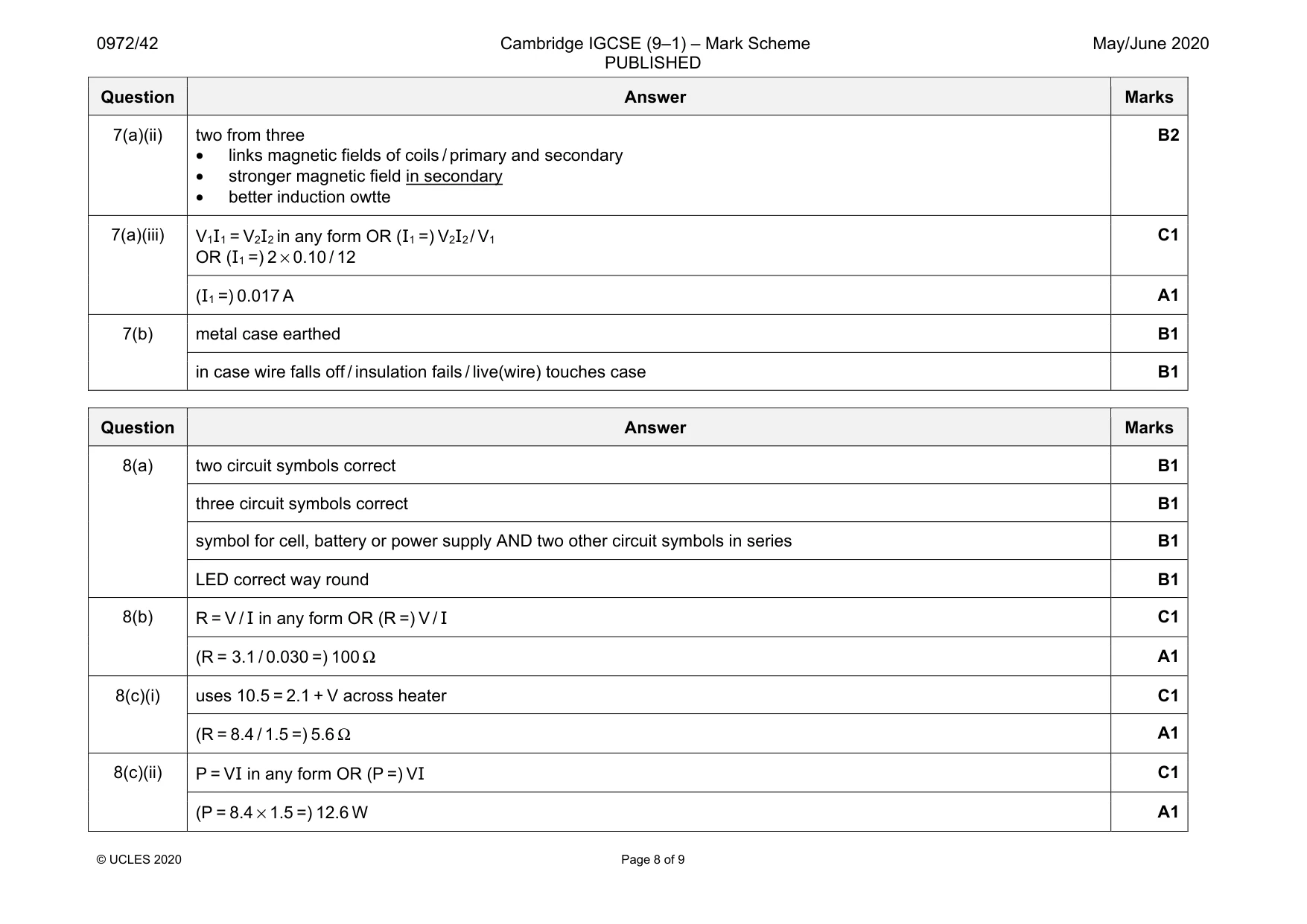
Mark scheme: 7(a)(i) primary coil wound round iron AND (labelled primary or coil OR connected to labelled supply / 12 V) B1 secondary coil wound round iron AND (labelled secondary OR connected to labelled output / 2 V) B1 significantly more coils around primary B1 Question Answer Marks 7(a)(ii) two from three • links magnetic fields of coils / primary and secondary • stronger magnetic field in secondary • better induction owtte B2 7(a)(iii) V1I1 = V2I2 in any form OR (I1 =) V2I2 / V1 OR (I1 =) 2 × 0.10 / 12 C1 (I1 =) 0.017 A A1 7(b) metal case earthed B1 in case wire falls off / insulation fails / live(wire) touches case B1
Q8 · A light-emitting diode (LED) is a diode that emits light when there is a current in it
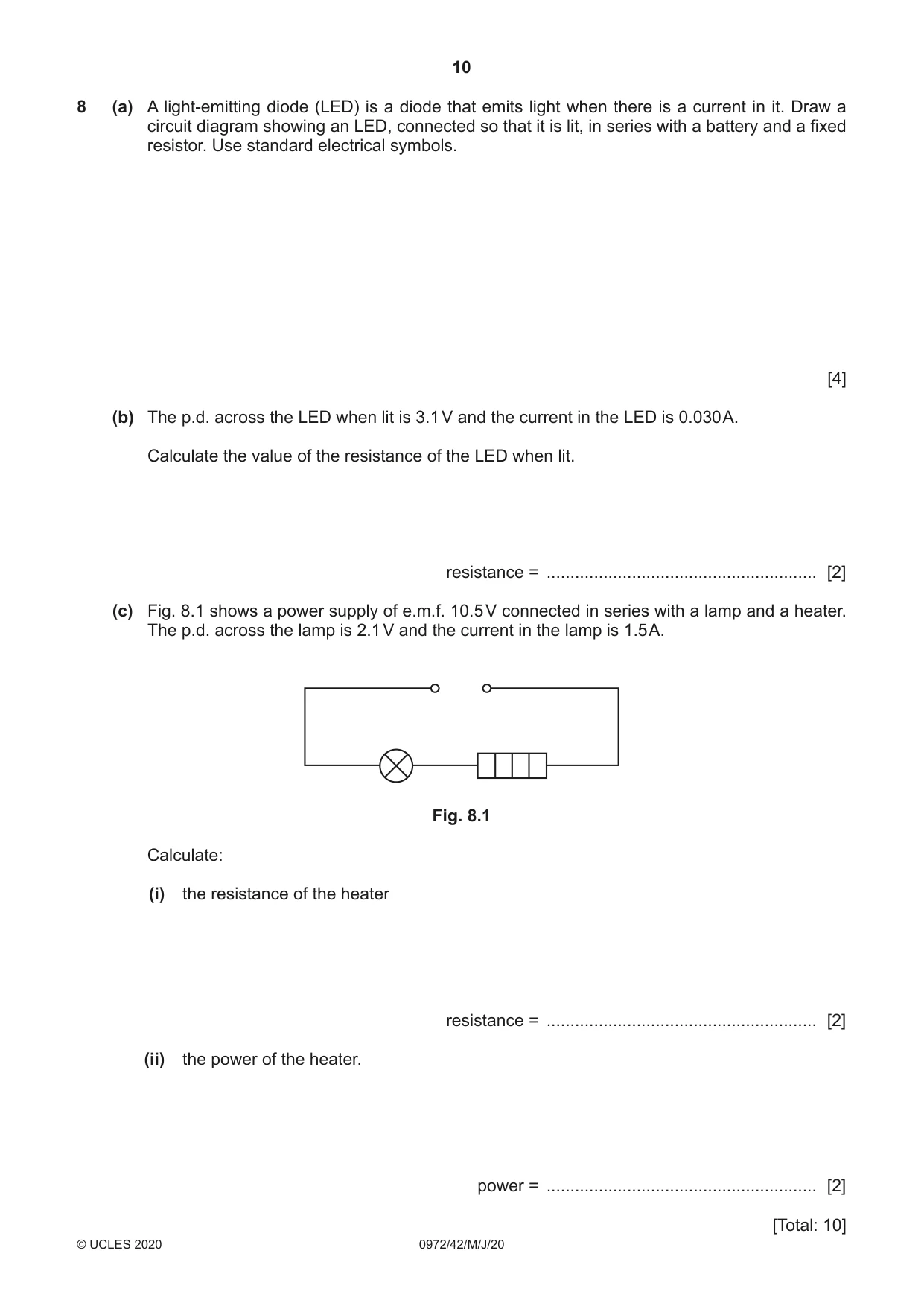
8 (a) A light-emitting diode (LED) is a diode that emits light when there is a current in it. Draw a circuit diagram showing an LED, connected so that it is lit, in series with a battery and a fixed resistor. Use standard electrical symbols. [4] (b) The p.d. across the LED when lit is 3.1 V and the current in the LED is 0.030 A. Calculate the value of the resistance of the LED when lit. resistance = ......................................................... [2] (c) Fig. 8.1 shows a power supply of e.m.f. 10.5 V connected in series with a lamp and a heater. The p.d. across the lamp is 2.1 V and the current in the lamp is 1.5 A. Fig. 8.1 Calculate: (i) the resistance of the heater resistance = ......................................................... [2] (ii) the power of the heater. power = ......................................................... [2] [Total: 10]
Mark scheme: 8(a) two circuit symbols correct B1 three circuit symbols correct B1 symbol for cell, battery or power supply AND two other circuit symbols in series B1 LED correct way round B1 8(b) R = V / I in any form OR (R =) V / I C1 (R = 3.1 / 0.030 =) 100 Ω A1 8(c)(i) uses 10.5 = 2.1 + V across heater C1 (R = 8.4 / 1.5 =) 5.6 Ω A1 8(c)(ii) P = VI in any form OR (P =) VI C1 (P = 8.4 × 1.5 =) 12.6 W A1
Q9 · Complete the truth table shown in Table 9.1 for a NAND gate
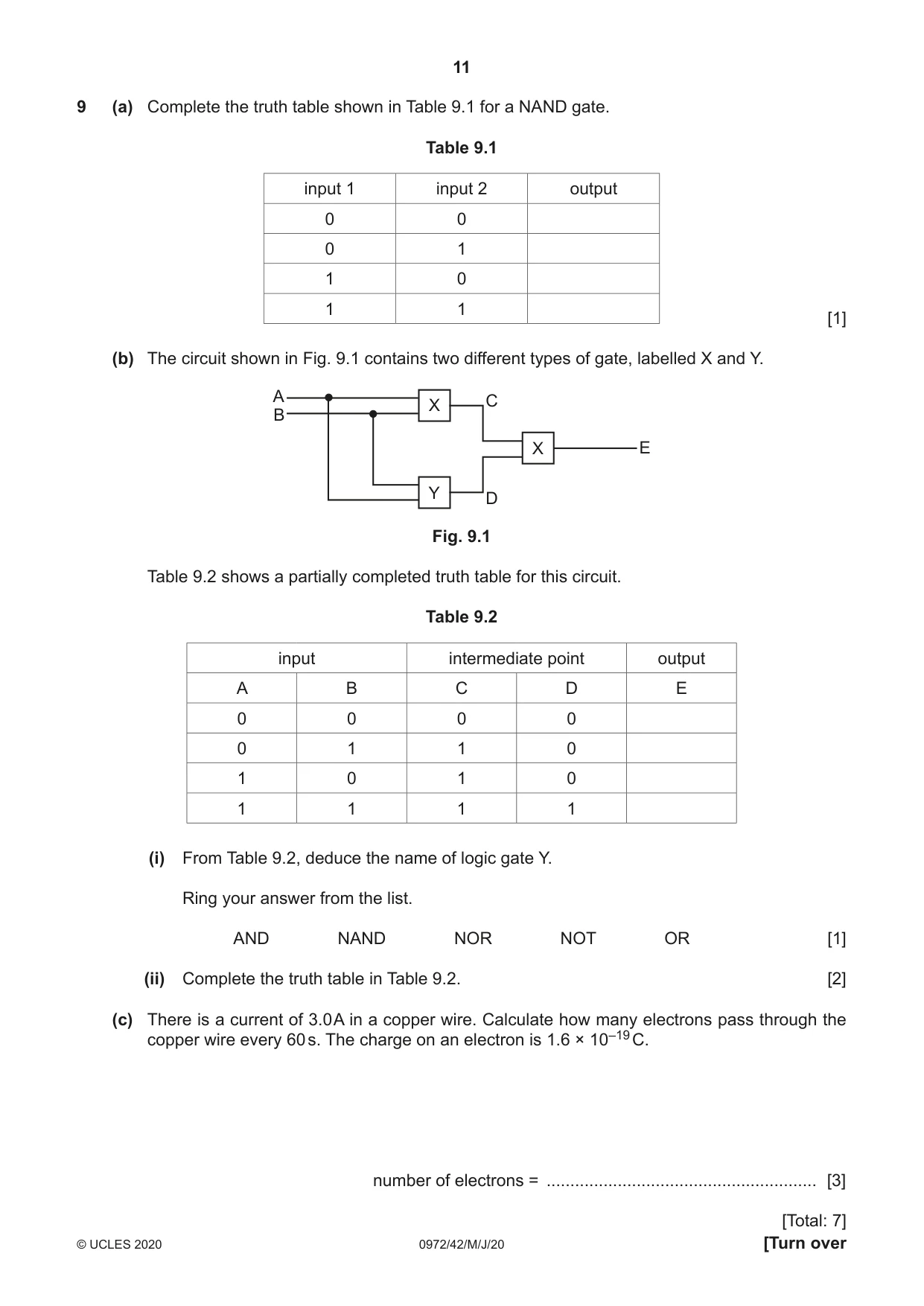
9 (a) Complete the truth table shown in Table 9.1 for a NAND gate. Table 9.1 input 1 input 2 output 0 0 0 1 1 0 1 1 [1] (b) The circuit shown in Fig. 9.1 contains two different types of gate, labelled X and Y. A X C B X E Y D Fig. 9.1 Table 9.2 shows a partially completed truth table for this circuit. Table 9.2 input intermediate point output A B C D E 0 0 0 0 0 1 1 0 1 0 1 0 1 1 1 1 (i) From Table 9.2, deduce the name of logic gate Y. Ring your answer from the list. AND NAND NOR NOT OR [1] (ii) Complete the truth table in Table 9.2. [2] (c) There is a current of 3.0 A in a copper wire. Calculate how many electrons pass through the copper wire every 60 s. The charge on an electron is 1.6 × 10⁻¹⁹ C. number of electrons = ......................................................... [3] [Total: 7]
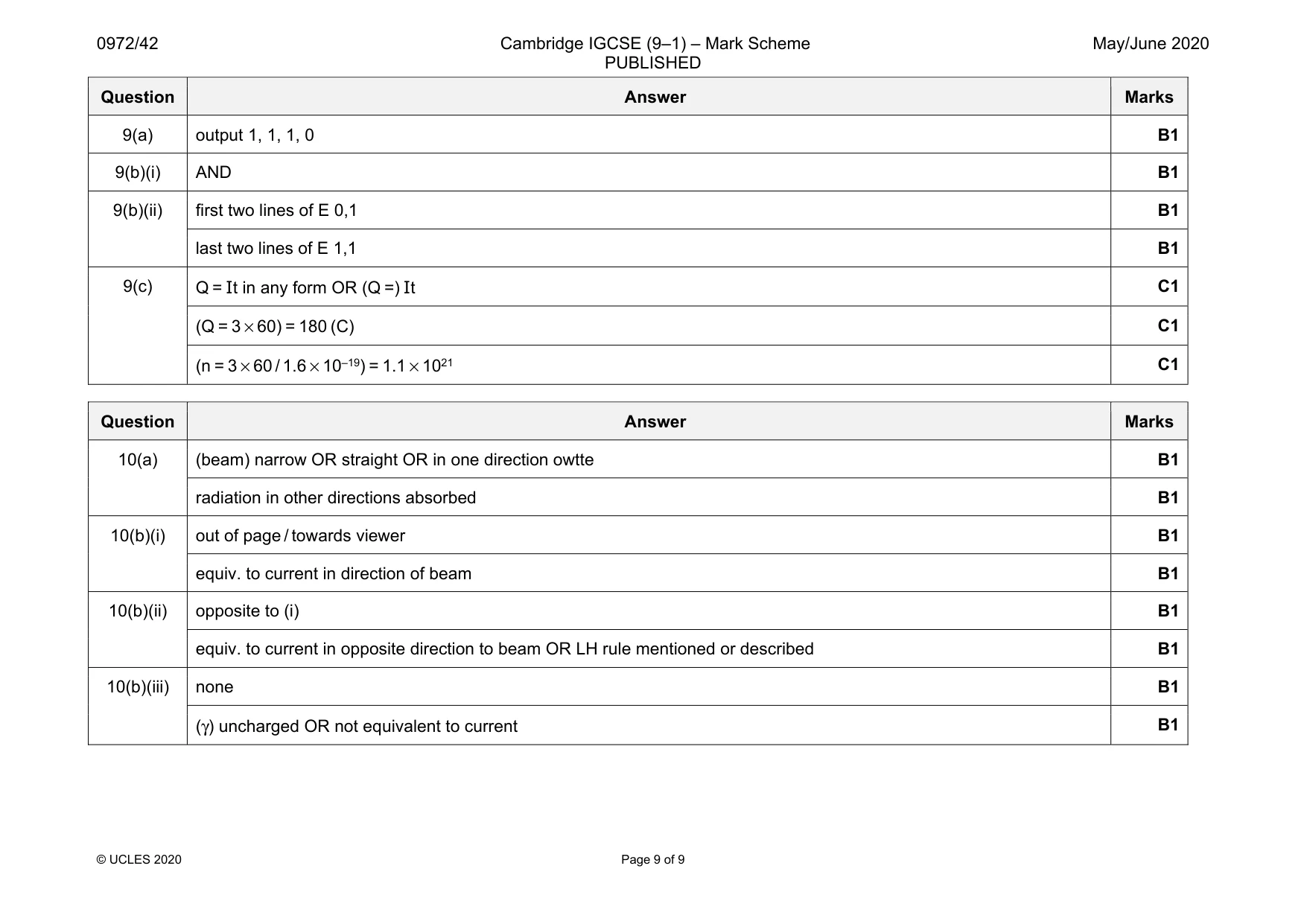
Mark scheme: 9(a) output 1, 1, 1, 0 B1 9(b)(i) AND B1 9(b)(ii) first two lines of E 0,1 B1 last two lines of E 1,1 B1 9(c) Q = It in any form OR (Q =) It C1 (Q = 3 × 60) = 180 (C) C1 (n = 3 × 60 / 1.6 × 10⁻¹⁹) = 1.1 × 10²¹ C1
Q10 · A vacuum tube with a radioactive source
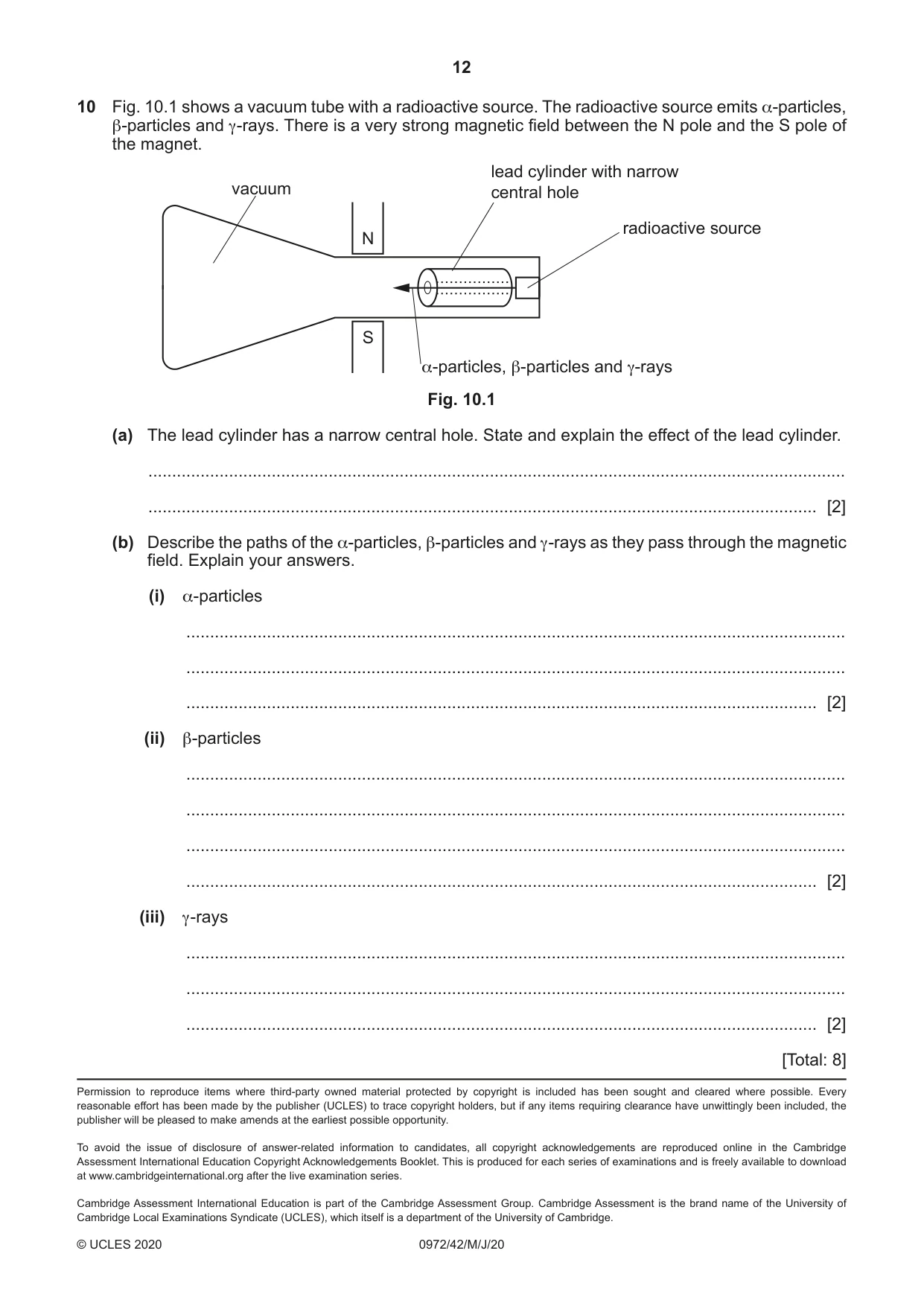
10 Fig. 10.1 shows a vacuum tube with a radioactive source. The radioactive source emits α-particles, β-particles and γ -rays. There is a very strong magnetic field between the N pole and the S pole of the magnet. lead cylinder with narrow vacuum central hole radioactive source N S α-particles, β-particles and γ-rays Fig. 10.1 (a) The lead cylinder has a narrow central hole. State and explain the effect of the lead cylinder. ................................................................................................................................................... ............................................................................................................................................. [2] (b) Describe the paths of the α-particles, β-particles and γ -rays as they pass through the magnetic field. Explain your answers. (i) α-particles ........................................................................................................................................... ........................................................................................................................................... ..................................................................................................................................... [2] (ii) β-particles ........................................................................................................................................... ........................................................................................................................................... ........................................................................................................................................... ..................................................................................................................................... [2] (iii) γ -rays ........................................................................................................................................... ........................................................................................................................................... ..................................................................................................................................... [2] [Total: 8]
Mark scheme: 10(a) (beam) narrow OR straight OR in one direction owtte B1 radiation in other directions absorbed B1 10(b)(i) out of page / towards viewer B1 equiv. to current in direction of beam B1 10(b)(ii) opposite to (i) B1 equiv. to current in opposite direction to beam OR LH rule mentioned or described B1 10(b)(iii) none B1 (γ) uncharged OR not equivalent to current B1
What was in this paper
The subtopics covered by these 10 questions, and how many questions each got. Open one in a new tab to see every Cambridge question on it.