Cambridge IGCSE Physics (9-1) 0972 — 2023 May/June Paper 4 · Variant 2
0972/42/M/J/23 · 10 questions · 80 marks · ≈90 min
The question paper and its mark scheme, free to read here and free to download. This is Cambridge’s own paper, exactly as it was sat.
Question paper16 pages
Mark scheme12 pages
Answers below. Sit the paper first if you are practising.
Questions as text
Q1 · A helicopter which is stationary at a height of 1500 m above the ground
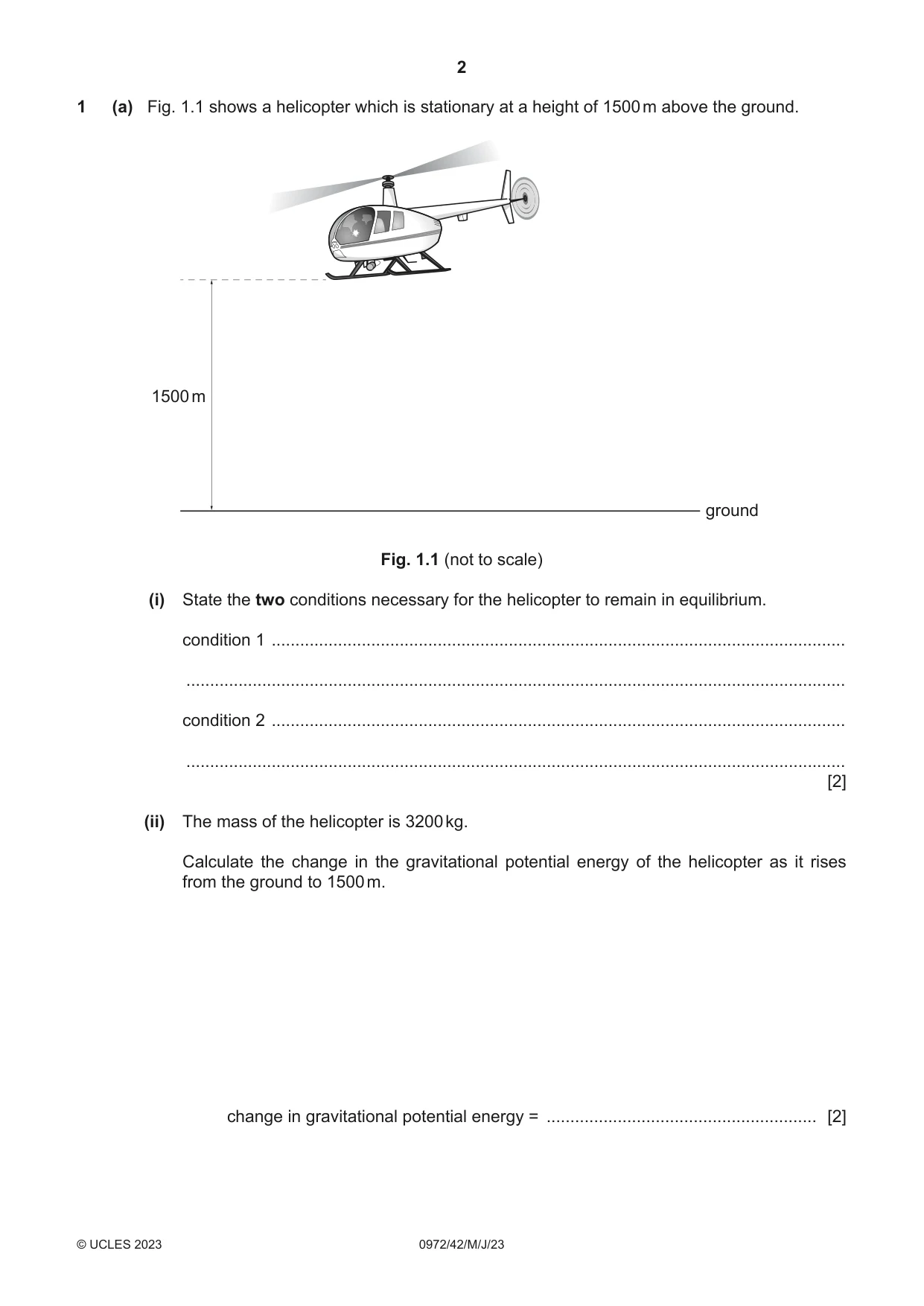
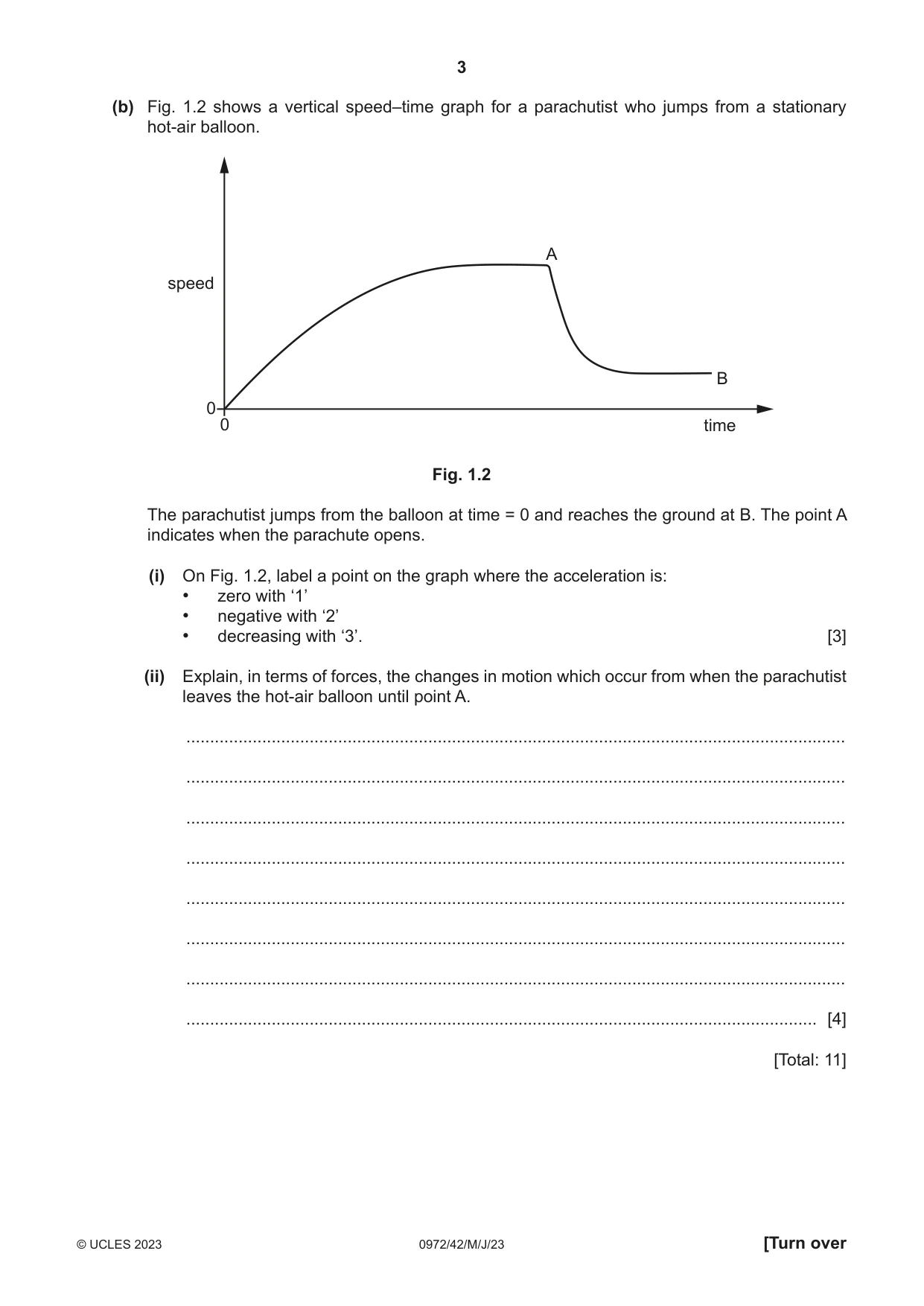
1 (a) Fig. 1.1 shows a helicopter which is stationary at a height of 1500 m above the ground. 1500 m ground Fig. 1.1 (not to scale) (i) State the two conditions necessary for the helicopter to remain in equilibrium. condition 1 ......................................................................................................................... ........................................................................................................................................... condition 2 ......................................................................................................................... ........................................................................................................................................... [2] (ii) The mass of the helicopter is 3200 kg. Calculate the change in the gravitational potential energy of the helicopter as it rises from the ground to 1500 m. change in gravitational potential energy = ......................................................... [2] (b) Fig. 1.2 shows a vertical speed–time graph for a parachutist who jumps from a stationary hot-air balloon. A speed B 0 0 time Fig. 1.2 The parachutist jumps from the balloon at time = 0 and reaches the ground at B. The point A indicates when the parachute opens. (i) On Fig. 1.2, label a point on the graph where the acceleration is: • zero with ‘1’ • negative with ‘2’ • decreasing with ‘3’. [3] (ii) Explain, in terms of forces, the changes in motion which occur from when the parachutist leaves the hot-air balloon until point A. ........................................................................................................................................... ........................................................................................................................................... ........................................................................................................................................... ........................................................................................................................................... ........................................................................................................................................... ........................................................................................................................................... ........................................................................................................................................... ..................................................................................................................................... [4] [Total: 11]
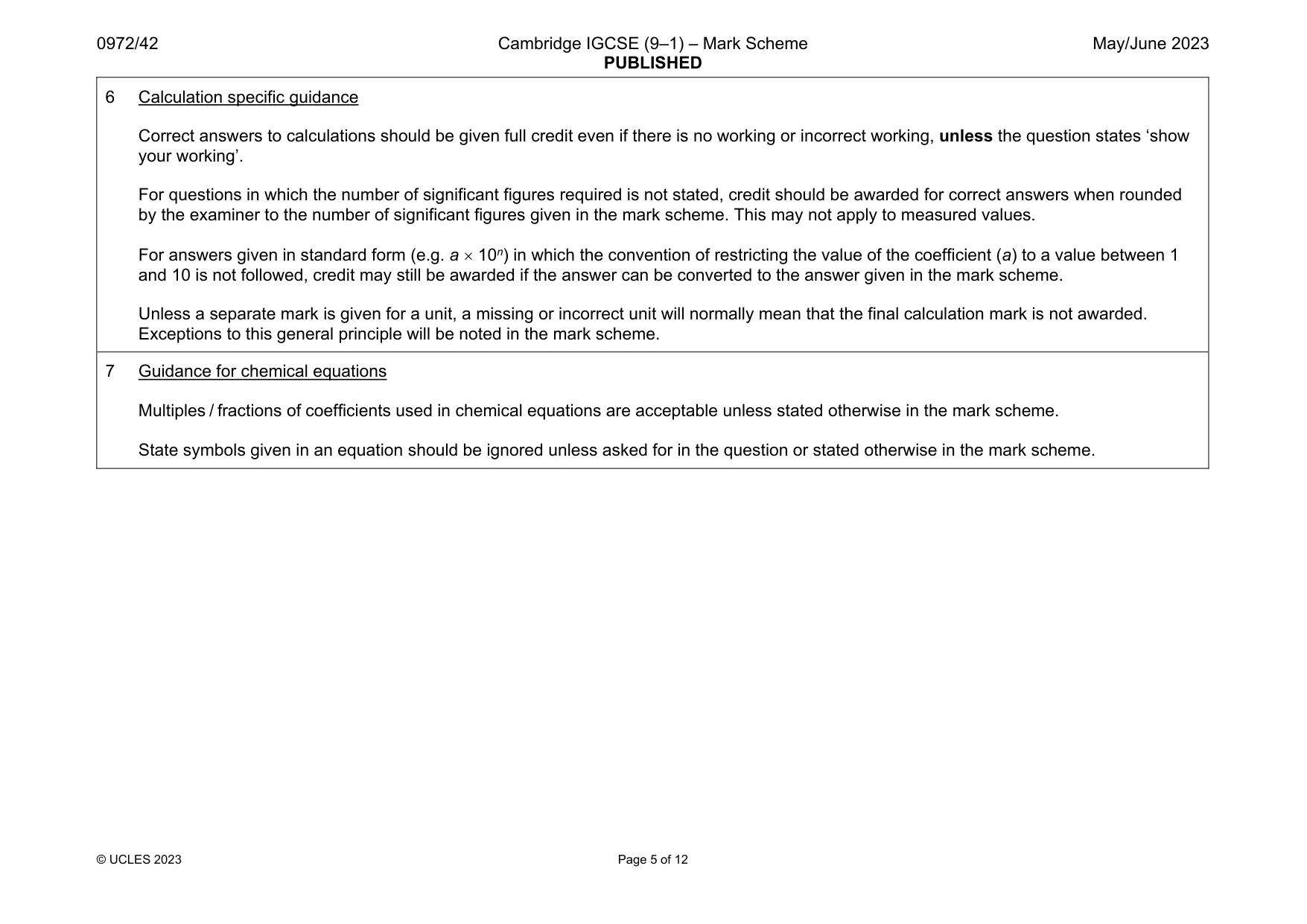
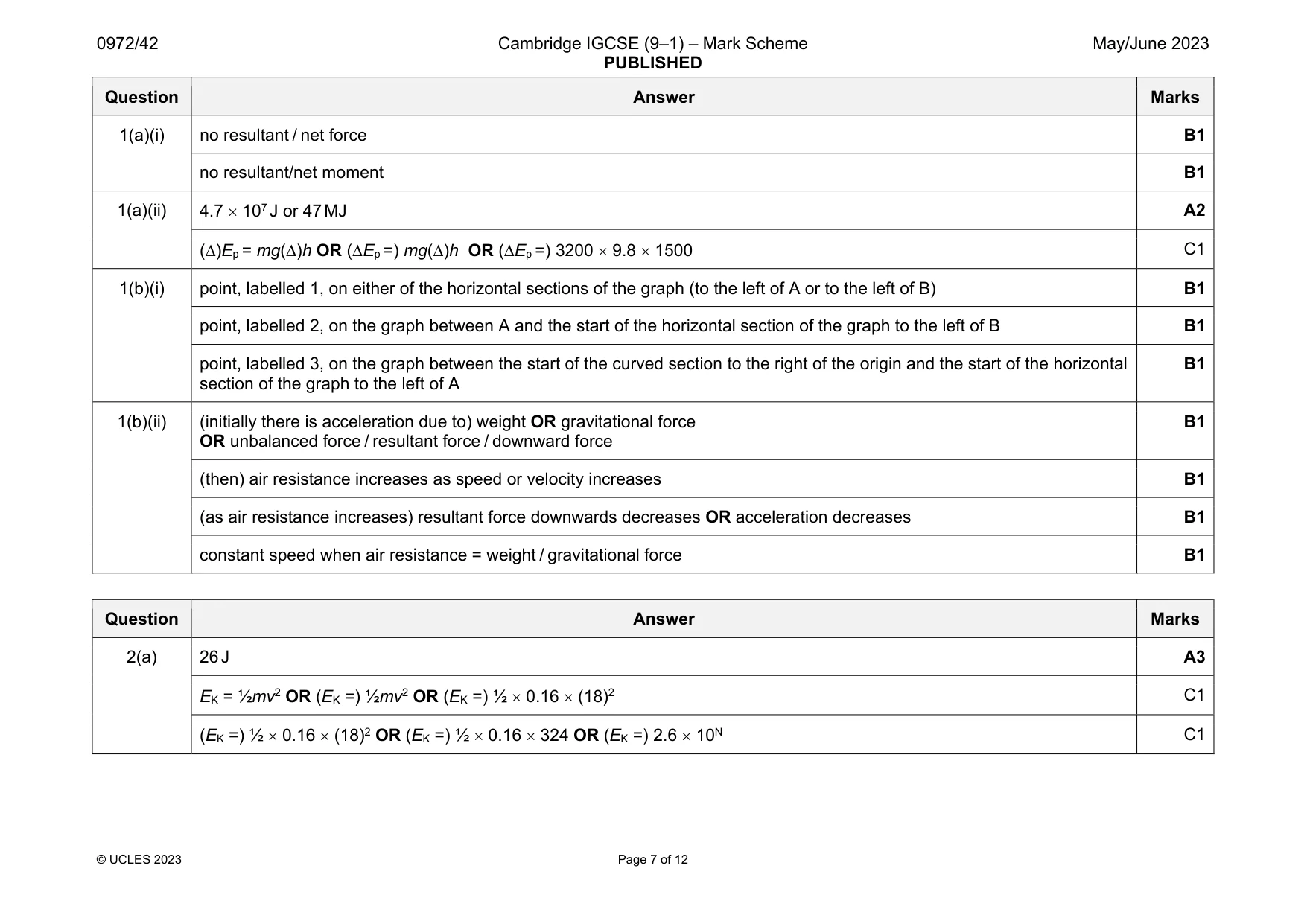
Mark scheme: 1(a)(i) no resultant / net force B1 no resultant/net moment B1 1(a)(ii) 4.7 107 J or 47 MJ A2 (∆)Ep = mg(∆)h OR (∆Ep =) mg(∆)h OR (∆Ep =) 3200 9.8 1500 C1 1(b)(i) point, labelled 1, on either of the horizontal sections of the graph (to the left of A or to the left of B) B1 point, labelled 2, on the graph between A and the start of the horizontal section of the graph to the left of B B1 point, labelled 3, on the graph between the start of the curved section to the right of the origin and the start of the horizontal section of the graph to the left of A B1 1(b)(ii) (initially there is acceleration due to) weight OR gravitational force OR unbalanced force / resultant force / downward force B1 (then) air resistance increases as speed or velocity increases B1 (as air resistance increases) resultant force downwards decreases OR acceleration decreases B1 constant speed when air resistance = weight / gravitational force B1
Q2 · A student catches a cricket ball
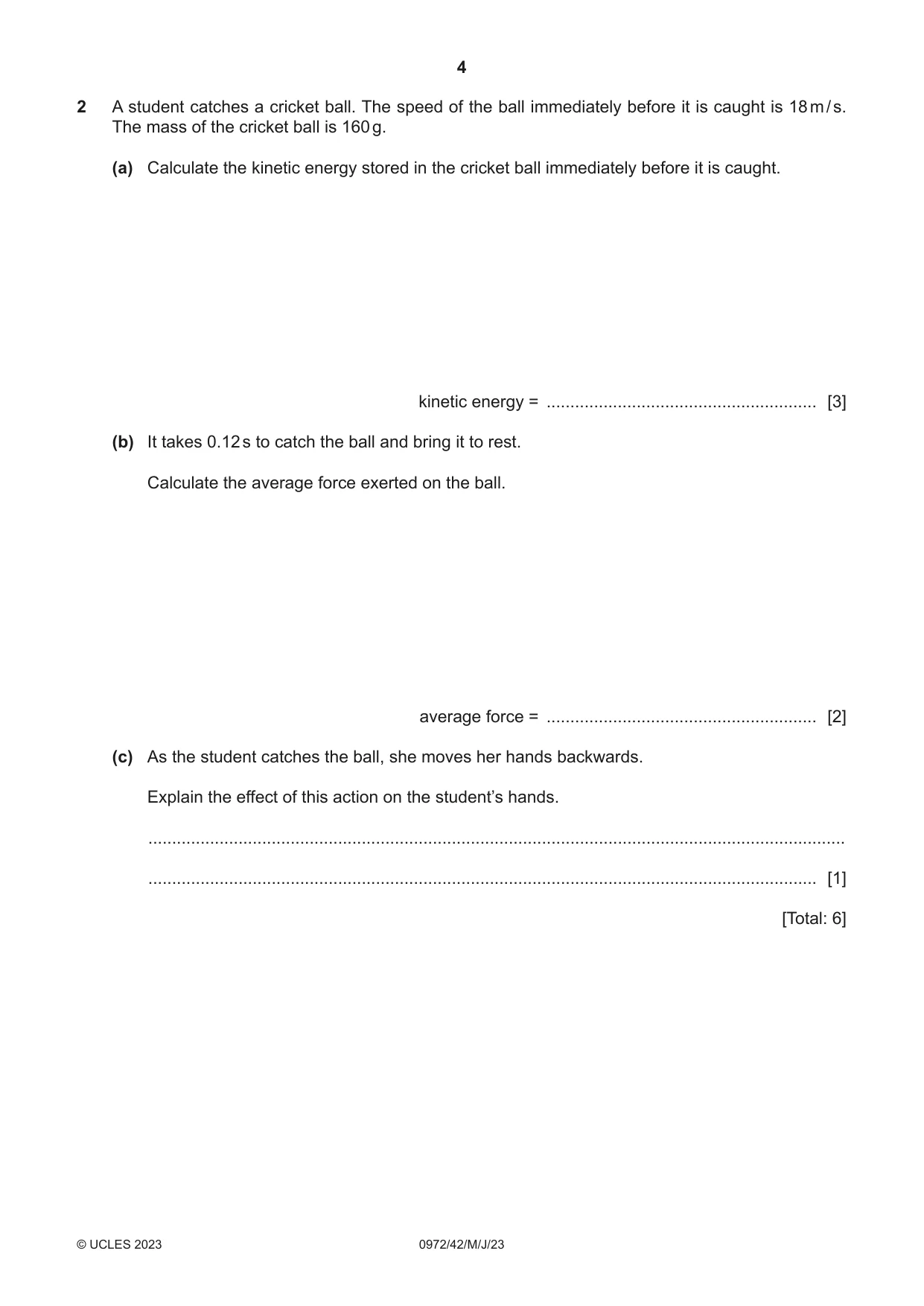
2 A student catches a cricket ball. The speed of the ball immediately before it is caught is 18 m / s. The mass of the cricket ball is 160 g. (a) Calculate the kinetic energy stored in the cricket ball immediately before it is caught. kinetic energy = ......................................................... [3] (b) It takes 0.12 s to catch the ball and bring it to rest. Calculate the average force exerted on the ball. average force = ......................................................... [2] (c) As the student catches the ball, she moves her hands backwards. Explain the effect of this action on the student’s hands. ................................................................................................................................................... ............................................................................................................................................. [1] [Total: 6]
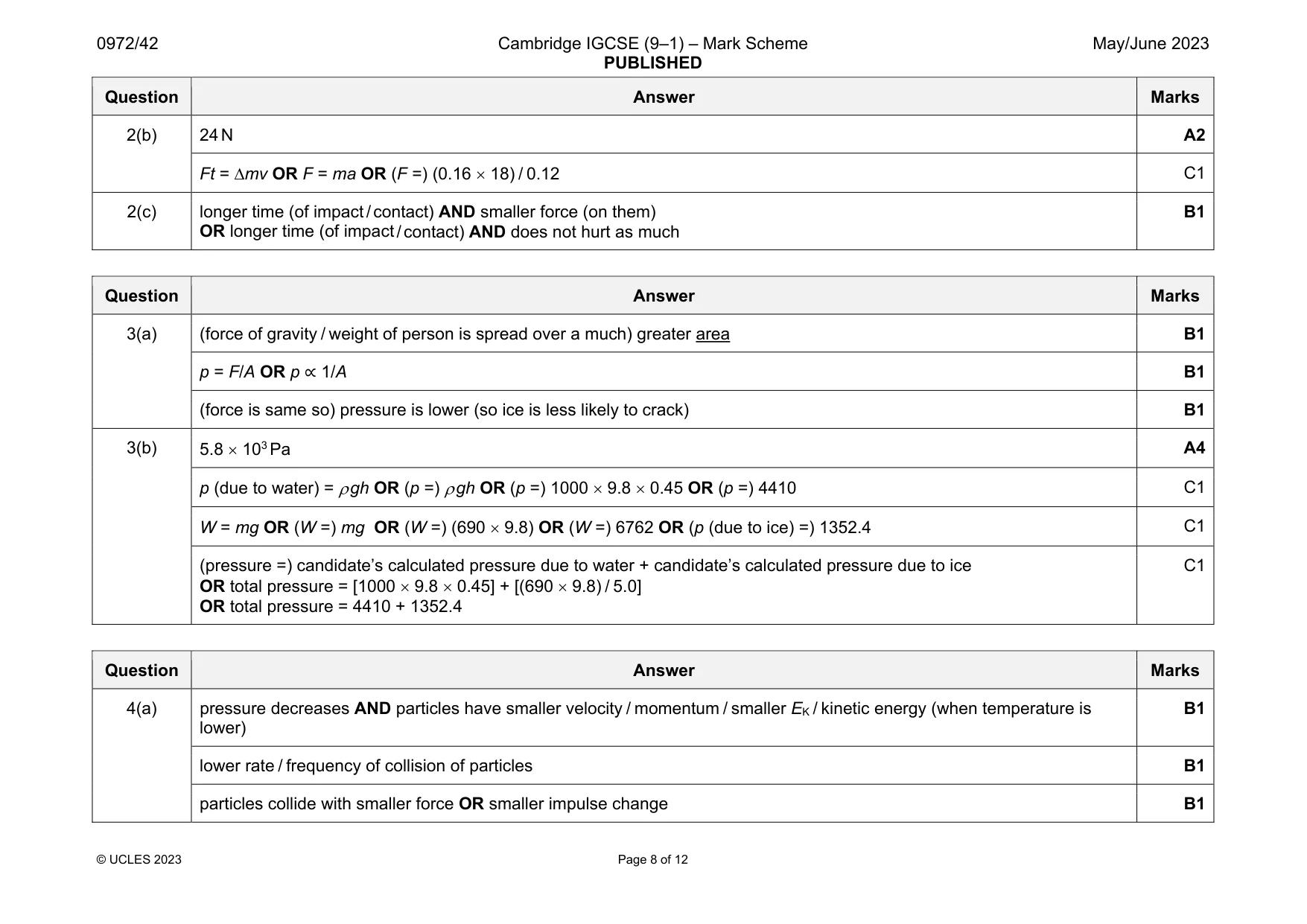
Mark scheme: 2(a) 26 J A3 EK = ½mv2 OR (EK =) ½mv2 OR (EK =) ½ 0.16 (18)2 C1 (EK =) ½ 0.16 (18)2 OR (EK =) ½ 0.16 324 OR (EK =) 2.6 10N C1 Question Answer Marks 2(b) 24 N A2 Ft = ∆mv OR F = ma OR (F =) (0.16 18) / 0.12 C1 2(c) longer time (of impact / contact) AND smaller force (on them) OR longer time (of impact / contact) AND does not hurt as much B1
Q3 · A person moving across an ice-covered pond to reach a ball on the ice
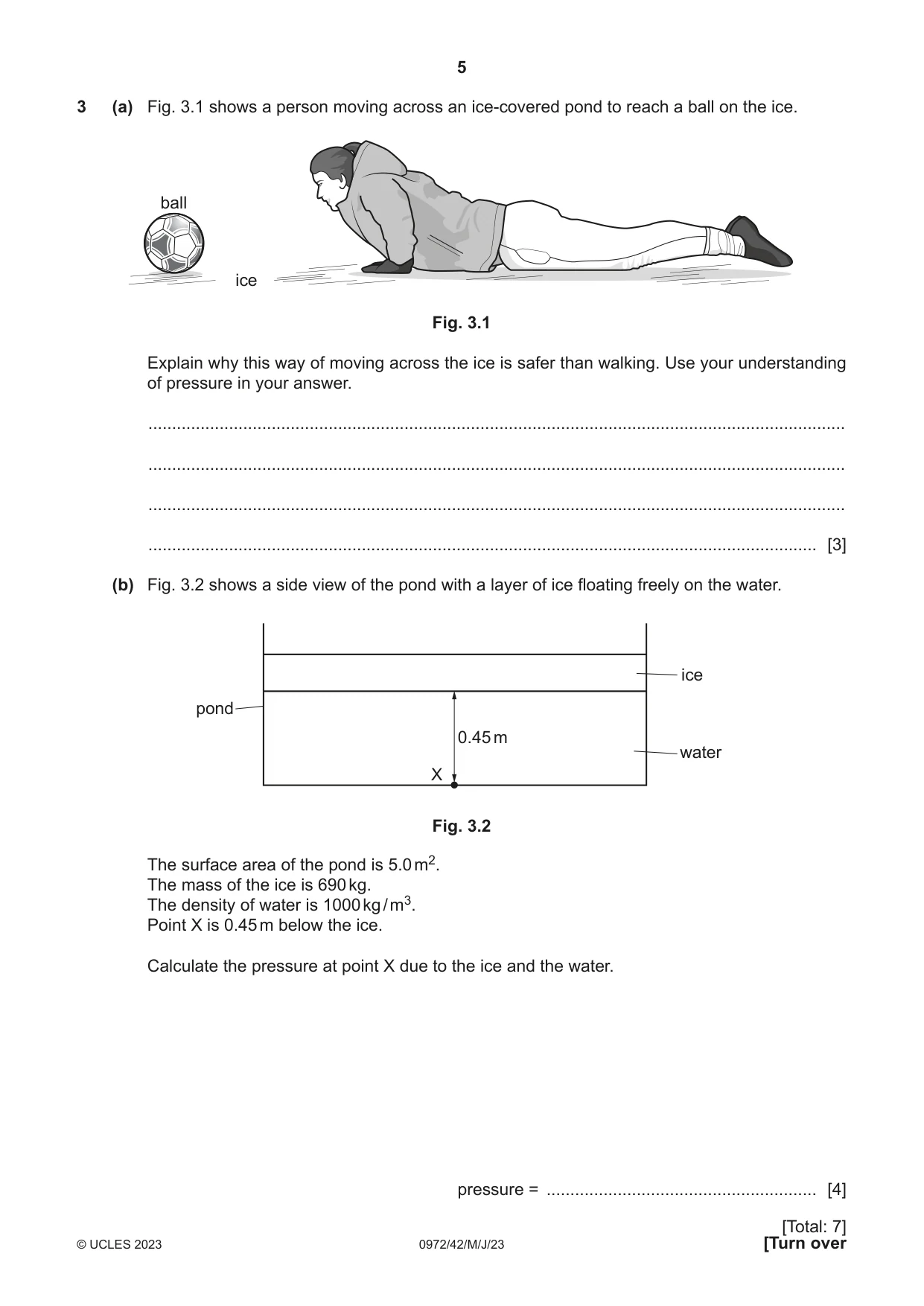
3 (a) Fig. 3.1 shows a person moving across an ice-covered pond to reach a ball on the ice. ball ice Fig. 3.1 Explain why this way of moving across the ice is safer than walking. Use your understanding of pressure in your answer. ................................................................................................................................................... ................................................................................................................................................... ................................................................................................................................................... ............................................................................................................................................. [3] (b) Fig. 3.2 shows a side view of the pond with a layer of ice floating freely on the water. ice pond 0.45 m water X Fig. 3.2 The surface area of the pond is 5.0 m2. The mass of the ice is 690 kg. The density of water is 1000 kg / m3. Point X is 0.45 m below the ice. Calculate the pressure at point X due to the ice and the water. pressure = ......................................................... [4]
Mark scheme: 3(a) (force of gravity / weight of person is spread over a much) greater area B1 p = F/A OR p ∝ 1/A B1 (force is same so) pressure is lower (so ice is less likely to crack) B1 3(b) 5.8 103 Pa A4 p (due to water) = gh OR (p =) gh OR (p =) 1000 9.8 0.45 OR (p =) 4410 C1 W = mg OR (W =) mg OR (W =) (690 9.8) OR (W =) 6762 OR (p (due to ice) =) 1352.4 C1 (pressure =) candidate’s calculated pressure due to water + candidate’s calculated pressure due to ice OR total pressure = [1000 9.8 0.45] + [(690 9.8) / 5.0] OR total pressure = 4410 + 1352.4 C1
Q4 · The temperature of a fixed mass of gas at constant volume is decreased
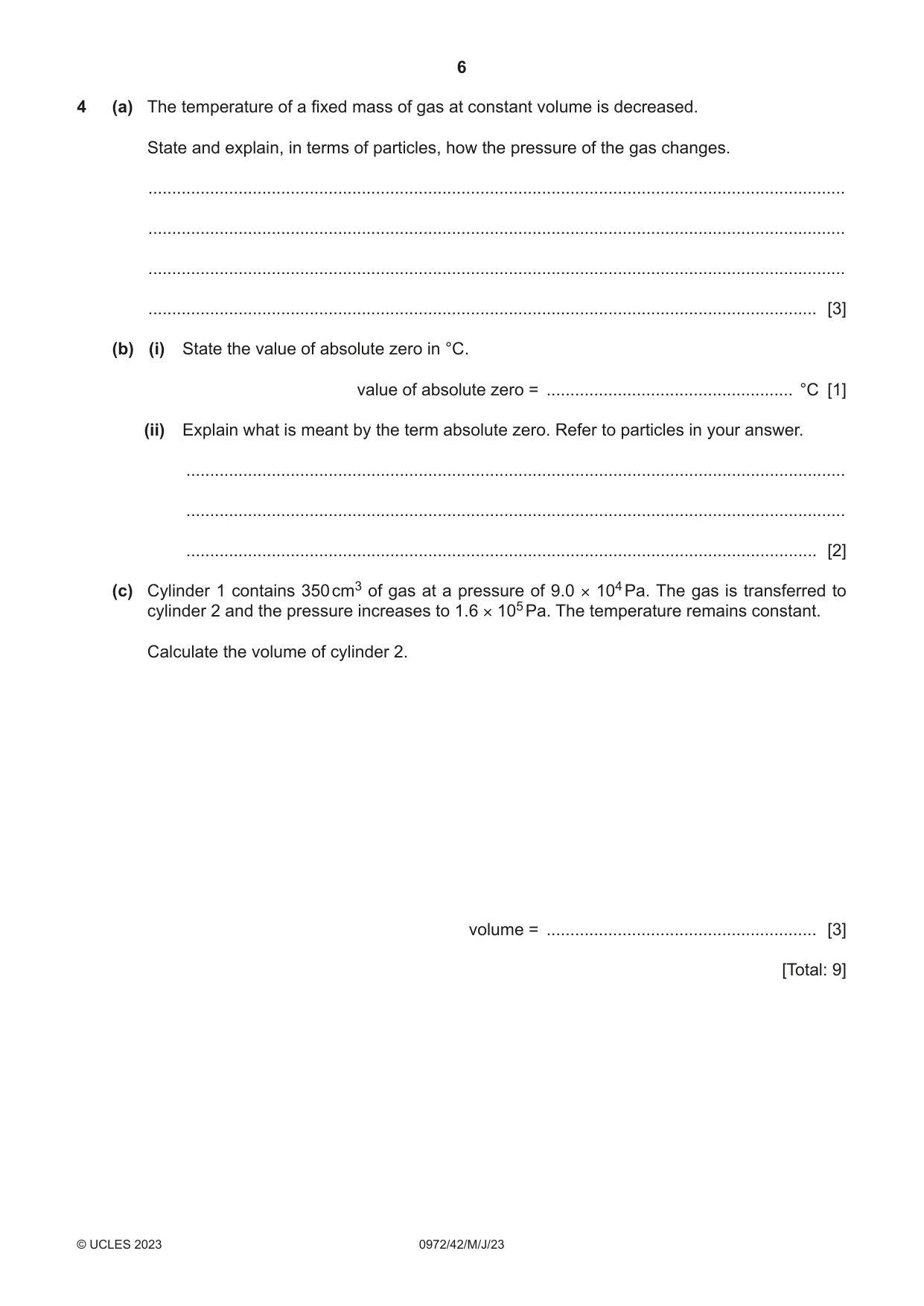
4 (a) The temperature of a fixed mass of gas at constant volume is decreased. State and explain, in terms of particles, how the pressure of the gas changes. ................................................................................................................................................... ................................................................................................................................................... ................................................................................................................................................... ............................................................................................................................................. [3] (b) (i) State the value of absolute zero in °C. value of absolute zero = .................................................... °C [1] (ii) Explain what is meant by the term absolute zero. Refer to particles in your answer. ........................................................................................................................................... ........................................................................................................................................... ..................................................................................................................................... [2] (c) Cylinder 1 contains 350 cm3 of gas at a pressure of 9.0 × 10⁴ Pa. The gas is transferred to cylinder 2 and the pressure increases to 1.6 × 10⁵ Pa. The temperature remains constant. Calculate the volume of cylinder 2. volume = ......................................................... [3] [Total: 9]
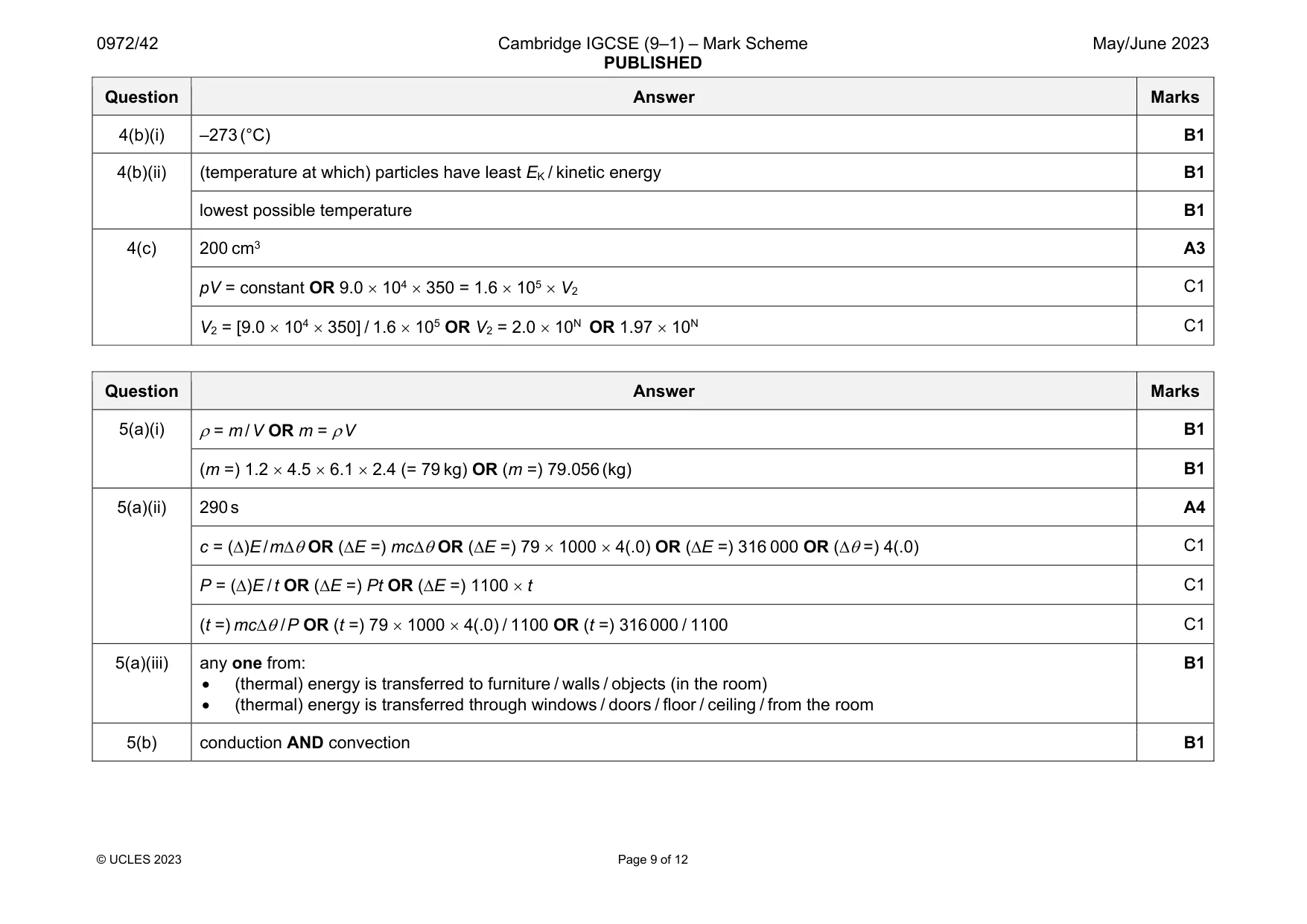
Mark scheme: 4(a) pressure decreases AND particles have smaller velocity / momentum / smaller EK / kinetic energy (when temperature is lower) B1 lower rate / frequency of collision of particles B1 particles collide with smaller force OR smaller impulse change B1 Question Answer Marks 4(b)(i) –273 (°C) B1 4(b)(ii) (temperature at which) particles have least EK / kinetic energy B1 lowest possible temperature B1 4(c) 200 cm3 A3 pV = constant OR 9.0 104 350 = 1.6 105 V2 C1 V2 = [9.0 104 350] / 1.6 105 OR V2 = 2.0 10N OR 1.97 10N C1
Q5 · An electric heater used to heat a room
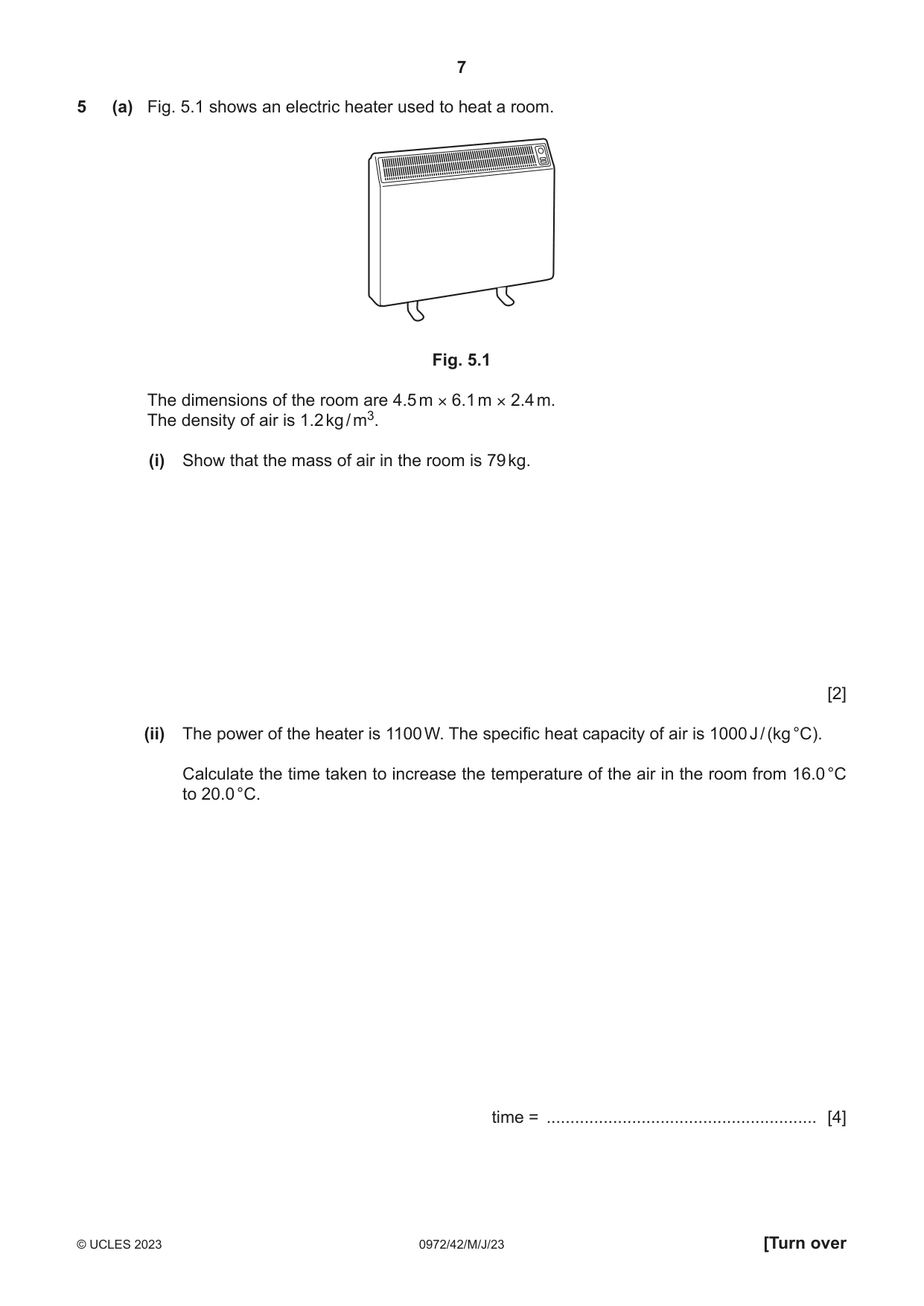
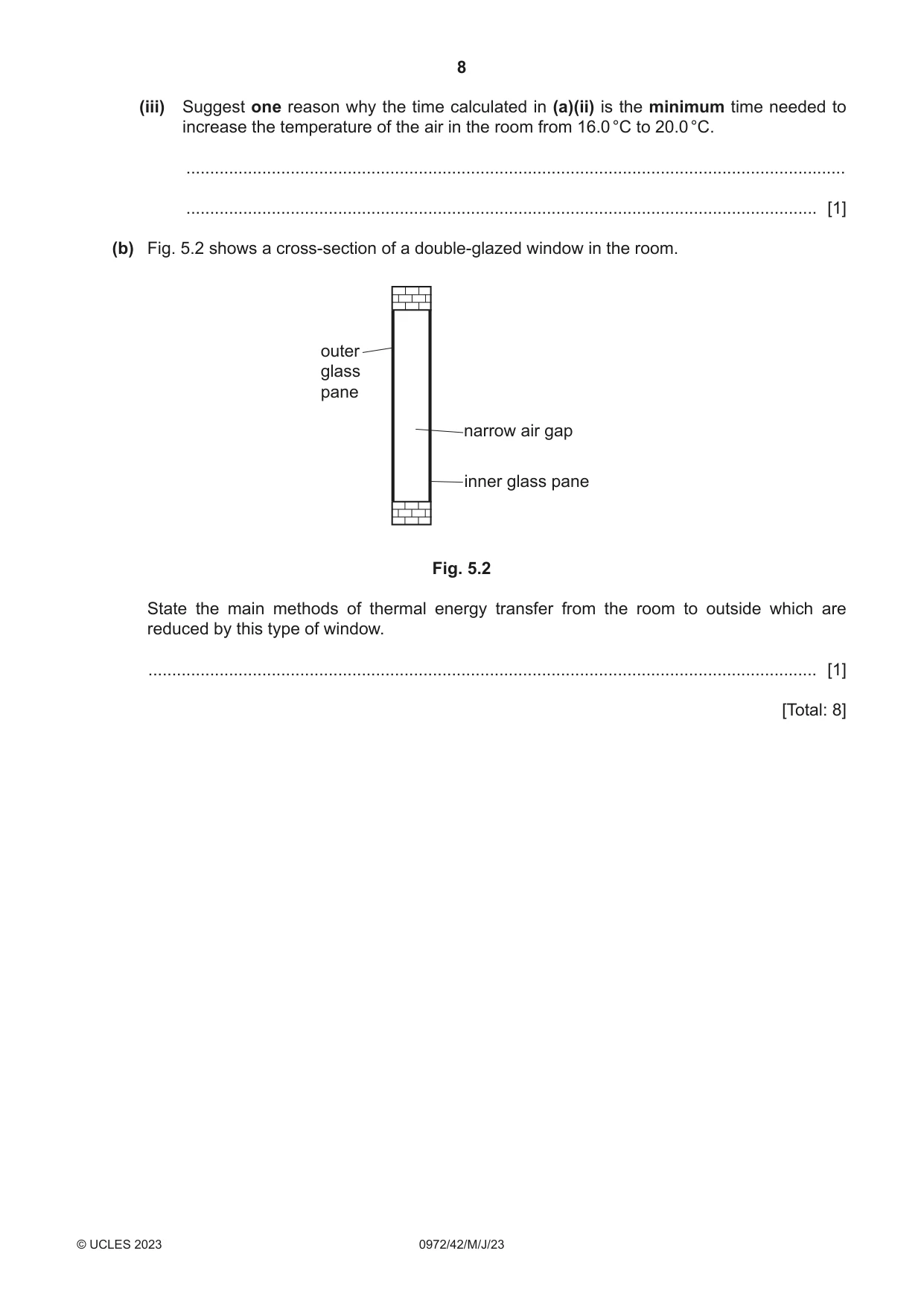
5 (a) Fig. 5.1 shows an electric heater used to heat a room. Fig. 5.1 The dimensions of the room are 4.5 m × 6.1 m × 2.4 m. The density of air is 1.2 kg / m3. (i) Show that the mass of air in the room is 79 kg. [2] (ii) The power of the heater is 1100 W. The specific heat capacity of air is 1000 J / (kg °C). Calculate the time taken to increase the temperature of the air in the room from 16.0 °C to 20.0 °C. time = ......................................................... [4] (iii) Suggest one reason why the time calculated in (a)(ii) is the minimum time needed to increase the temperature of the air in the room from 16.0 °C to 20.0 °C. ........................................................................................................................................... ..................................................................................................................................... [1] (b) Fig. 5.2 shows a cross-section of a double-glazed window in the room. outer glass pane narrow air gap inner glass pane Fig. 5.2 State the main methods of thermal energy transfer from the room to outside which are reduced by this type of window. ............................................................................................................................................. [1] [Total: 8]
Mark scheme: 5(a)(i) B1 (m =) 1.2 4.5 6.1 2.4 (= 79 kg) OR (m =) 79.056 (kg) B1 5(a)(ii) 290 s A4 c = (∆)E / m∆ OR (∆E =) mc∆ OR (∆E =) 79 1000 4(.0) OR (∆E =) 316 000 OR (∆ =) 4(.0) C1 P = (∆)E / t OR (∆E =) Pt OR (∆E =) 1100 t C1 (t =) mc∆ / P OR (t =) 79 1000 4(.0) / 1100 OR (t =) 316 000 / 1100 C1 5(a)(iii) any one from: (thermal) energy is transferred to furniture / walls / objects (in the room) (thermal) energy is transferred through windows / doors / floor / ceiling / from the room B1 5(b) conduction AND convection B1
Q6 · Two types of seismic waves are P-waves and S-waves
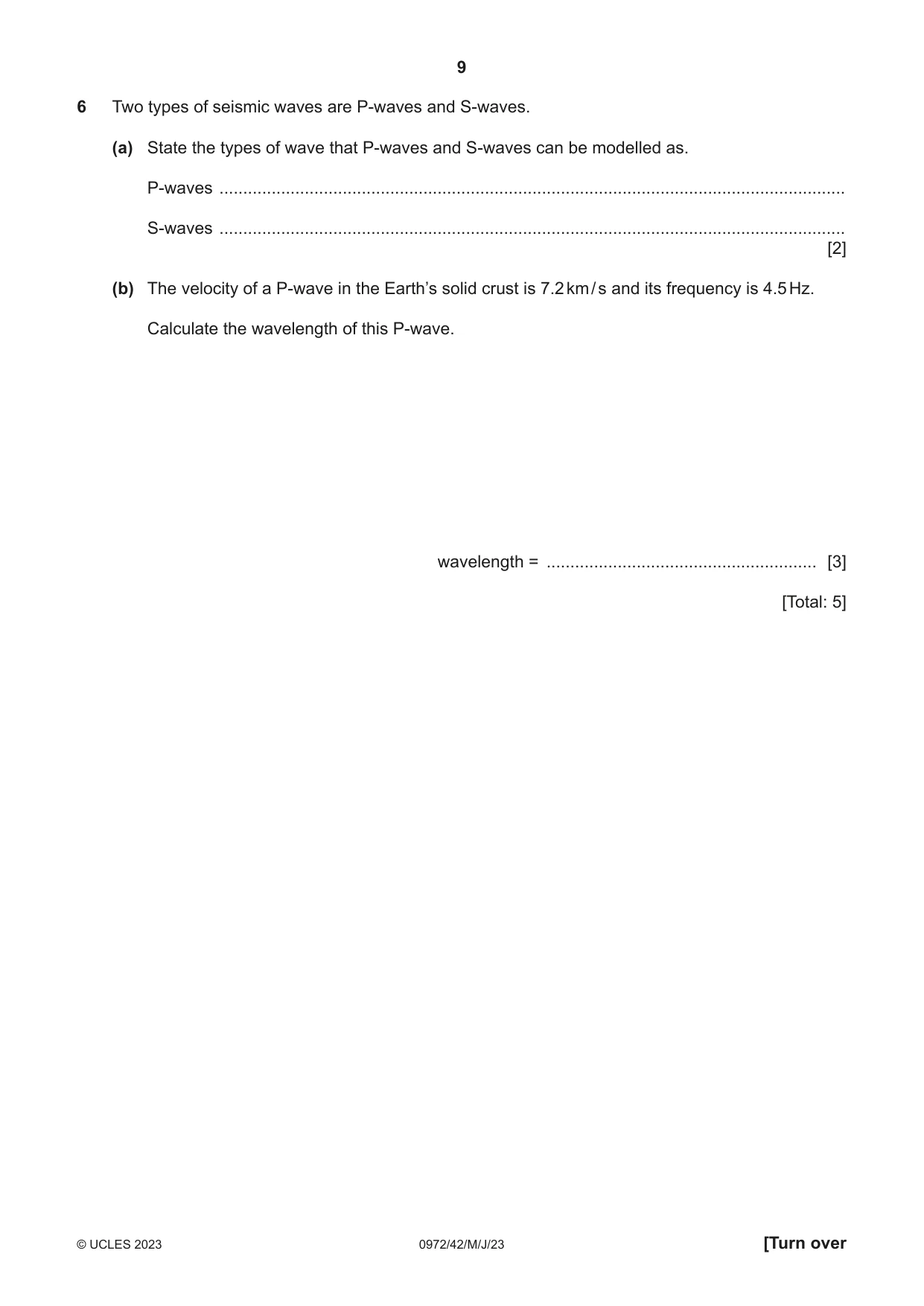
6 Two types of seismic waves are P-waves and S-waves. (a) State the types of wave that P-waves and S-waves can be modelled as. P-waves .................................................................................................................................... S-waves .................................................................................................................................... [2] (b) The velocity of a P-wave in the Earth’s solid crust is 7.2 km / s and its frequency is 4.5 Hz. Calculate the wavelength of this P-wave. wavelength = ......................................................... [3] [Total: 5]
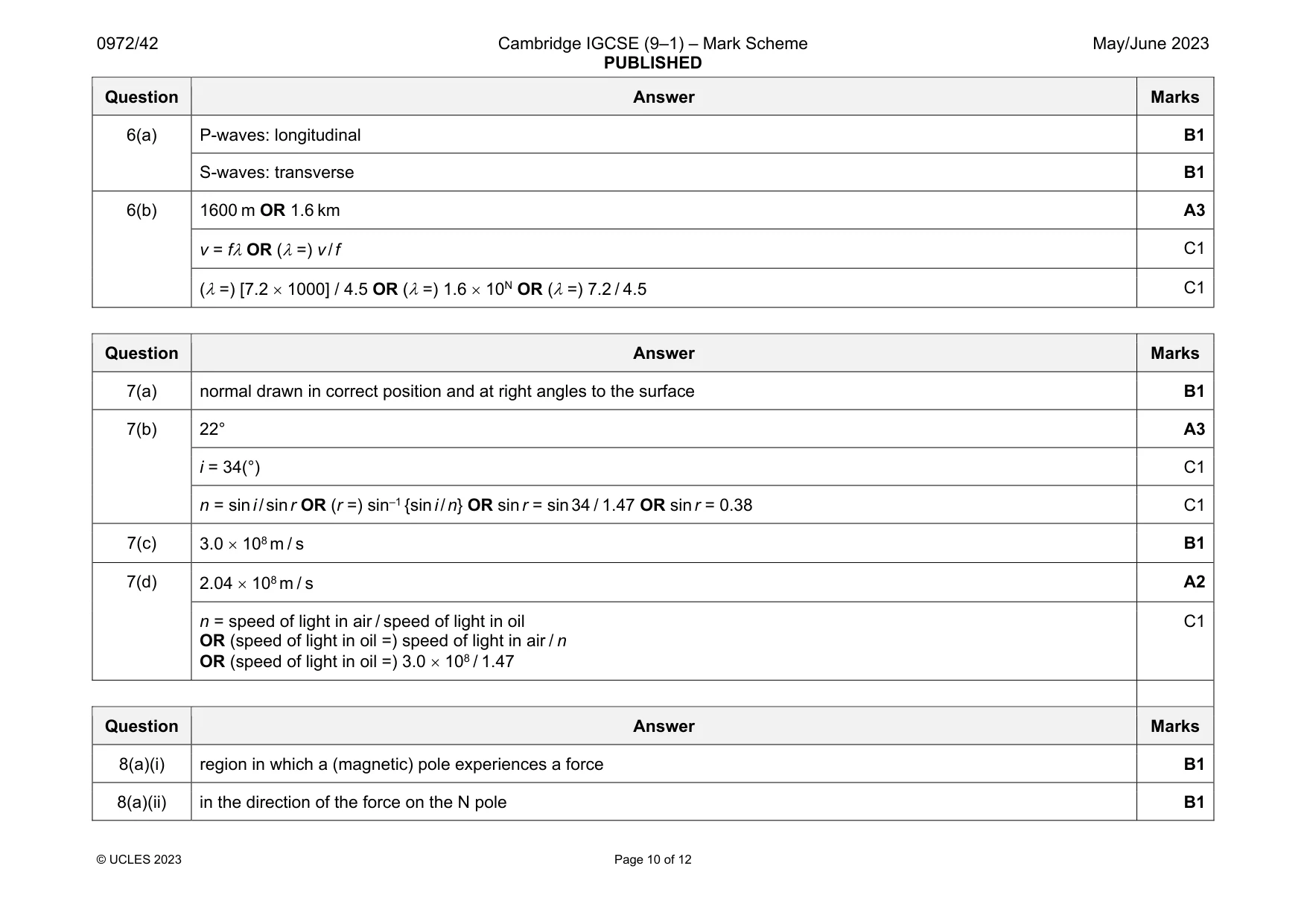
Mark scheme: 6(a) P-waves: longitudinal B1 S-waves: transverse B1 6(b) 1600 m OR 1.6 km A3 v = f OR ( =) v / f C1 ( =) [7.2 1000] / 4.5 OR ( =) 1.6 10N OR ( =) 7.2 / 4.5 C1
Q7 · A container of oil
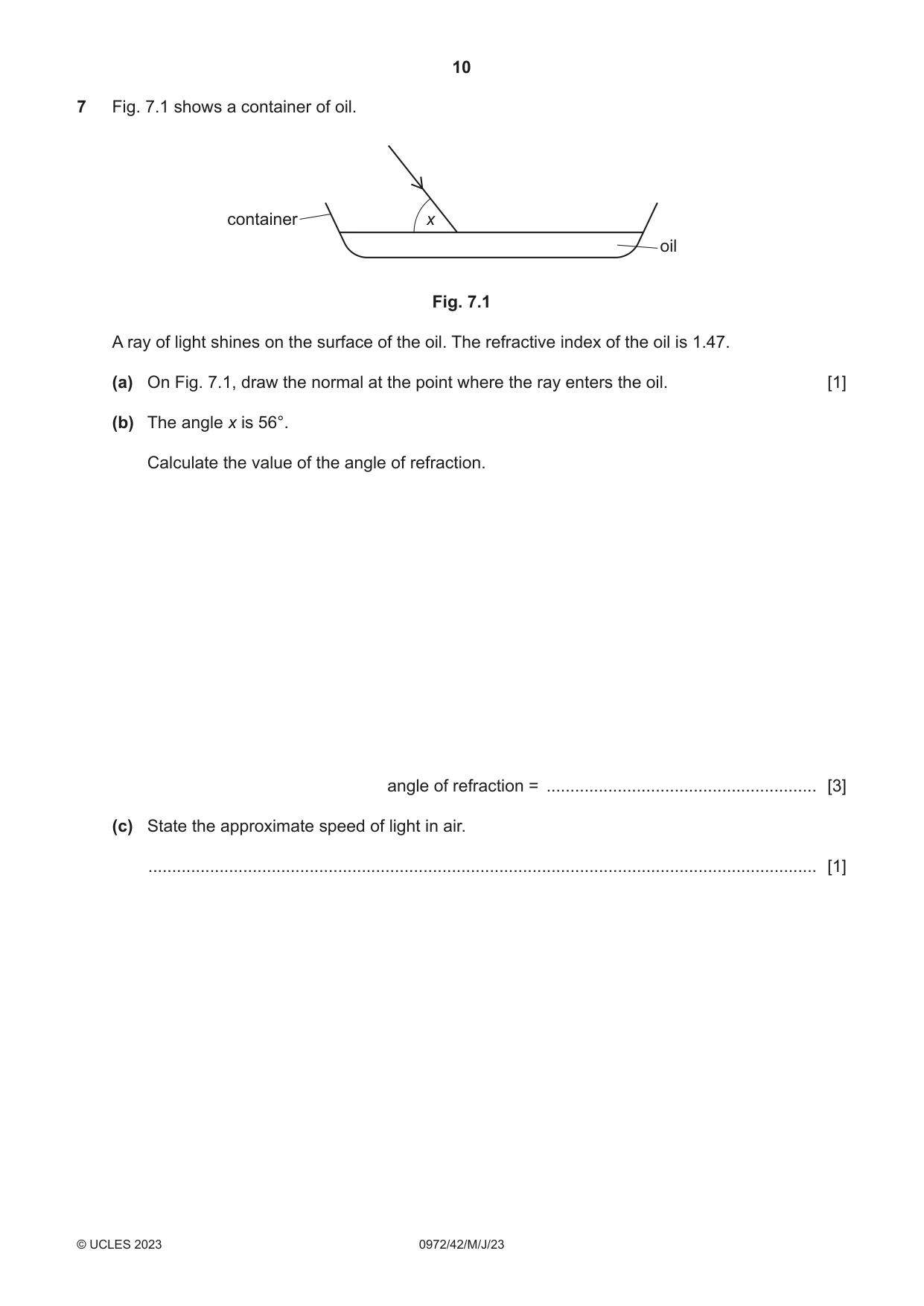
7 Fig. 7.1 shows a container of oil. container x oil Fig. 7.1 A ray of light shines on the surface of the oil. The refractive index of the oil is 1.47. (a) On Fig. 7.1, draw the normal at the point where the ray enters the oil. [1] (b) The angle x is 56°. Calculate the value of the angle of refraction. angle of refraction = ......................................................... [3] (c) State the approximate speed of light in air. ............................................................................................................................................. [1] (d) Calculate the speed of light in the oil. Give your answer to three significant figures. speed = ......................................................... [2] [Total: 7]
Mark scheme: 7(a) normal drawn in correct position and at right angles to the surface B1 7(b) 22° A3 i = 34(°) C1 n = sin i / sin r OR (r =) sin–1 {sin i / n} OR sin r = sin 34 / 1.47 OR sin r = 0.38 C1 7(c) 3.0 108 m / s B1 7(d) 2.04 108 m / s A2 n = speed of light in air / speed of light in oil OR (speed of light in oil =) speed of light in air / n OR (speed of light in oil =) 3.0 108 / 1.47 C1
Q8 · State what is meant by a magnetic field
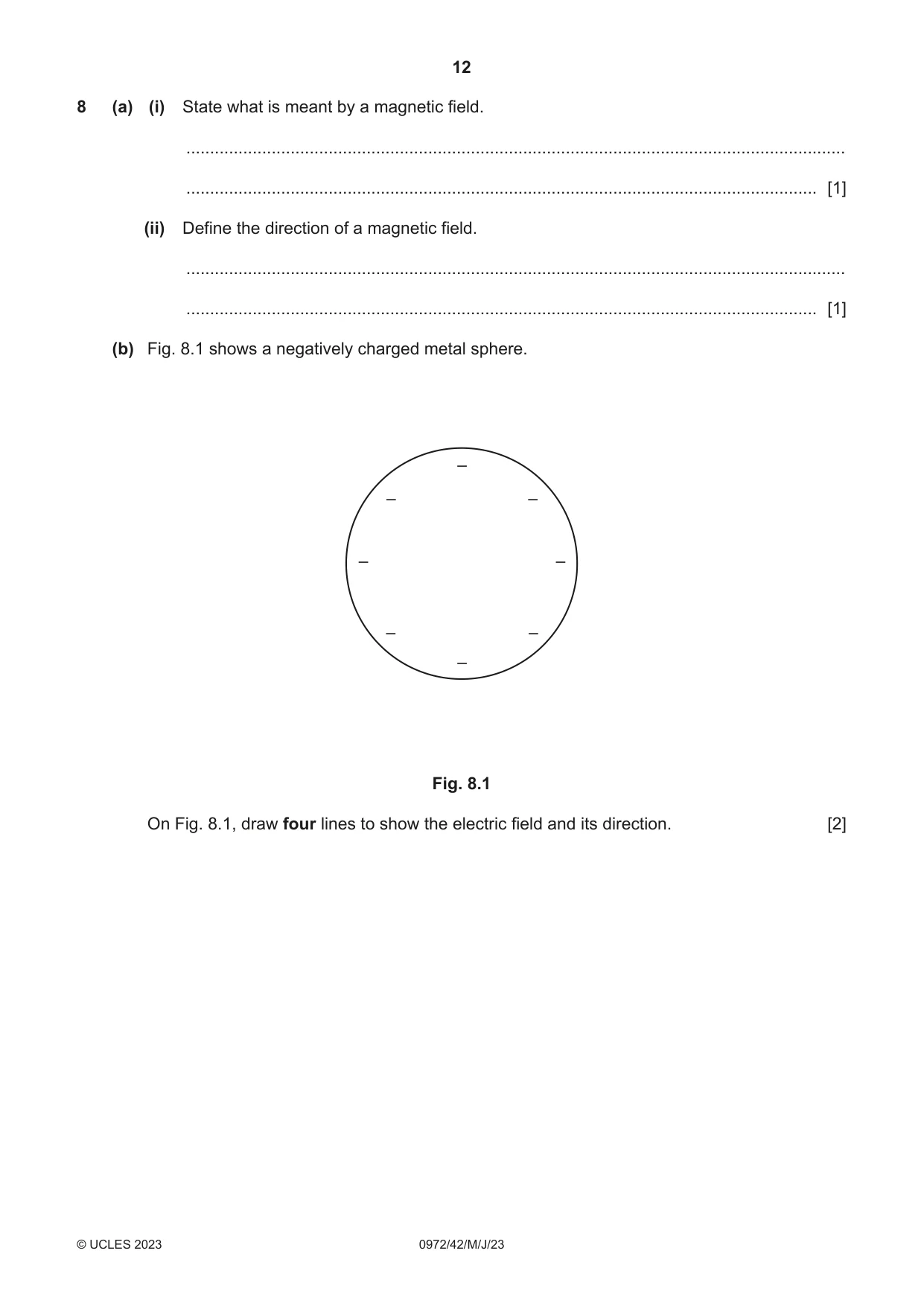
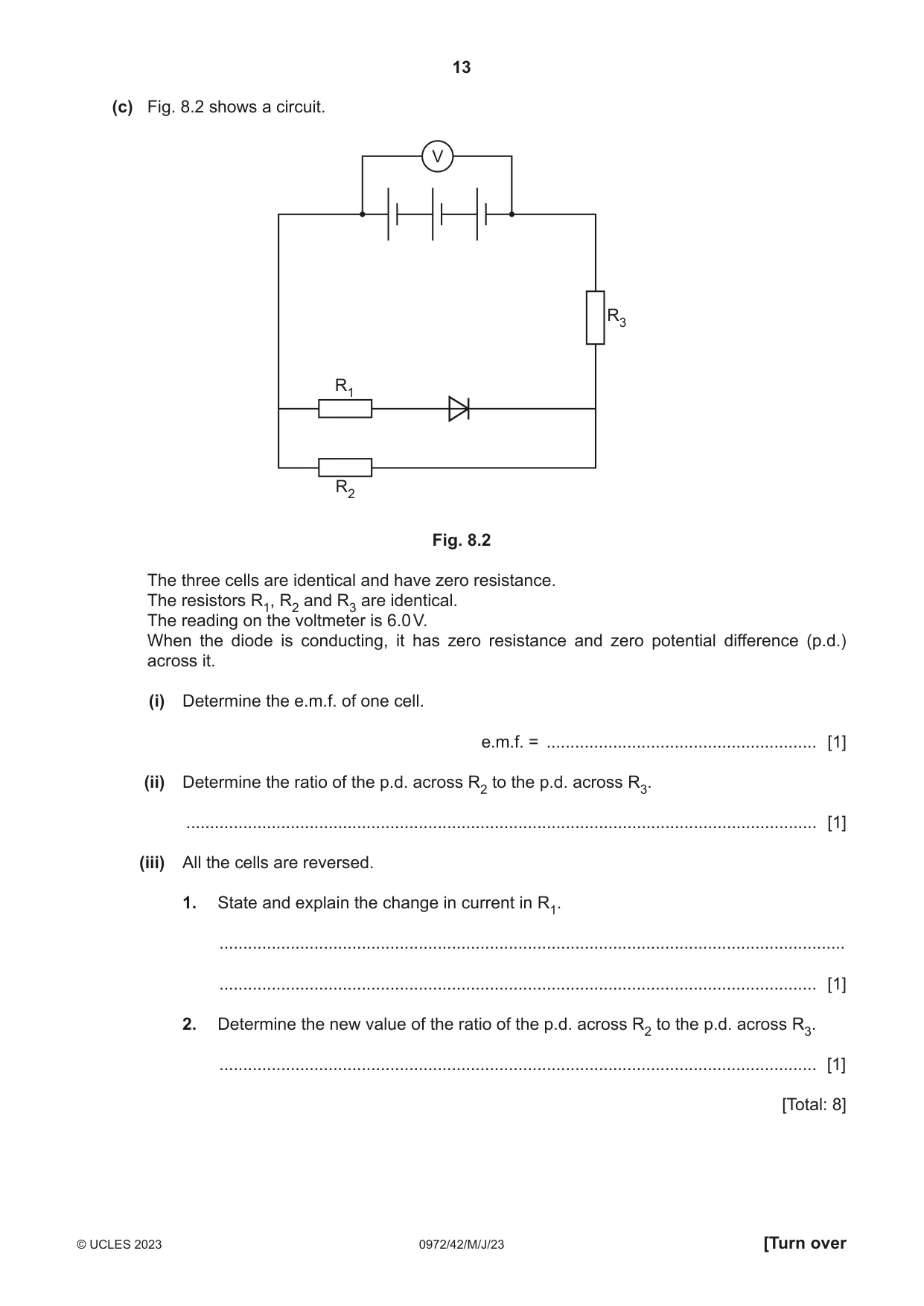
8 (a) (i) State what is meant by a magnetic field. ........................................................................................................................................... ..................................................................................................................................... [1] (ii) Define the direction of a magnetic field. ........................................................................................................................................... ..................................................................................................................................... [1] (b) Fig. 8.1 shows a negatively charged metal sphere. – – – – – – – – Fig. 8.1 On Fig. 8.1, draw four lines to show the electric field and its direction. [2] (c) Fig. 8.2 shows a circuit. V R3 R1 R2 Fig. 8.2 The three cells are identical and have zero resistance. The resistors R1, R2 and R3 are identical. The reading on the voltmeter is 6.0 V. When the diode is conducting, it has zero resistance and zero potential difference (p.d.) across it. (i) Determine the e.m.f. of one cell. e.m.f. = ......................................................... [1] (ii) Determine the ratio of the p.d. across R2 to the p.d. across R3. ..................................................................................................................................... [1] (iii) All the cells are reversed. 1. State and explain the change in current in R1. .................................................................................................................................... .............................................................................................................................. [1] 2. Determine the new value of the ratio of the p.d. across R2 to the p.d. across R3. .............................................................................................................................. [1] [Total: 8]
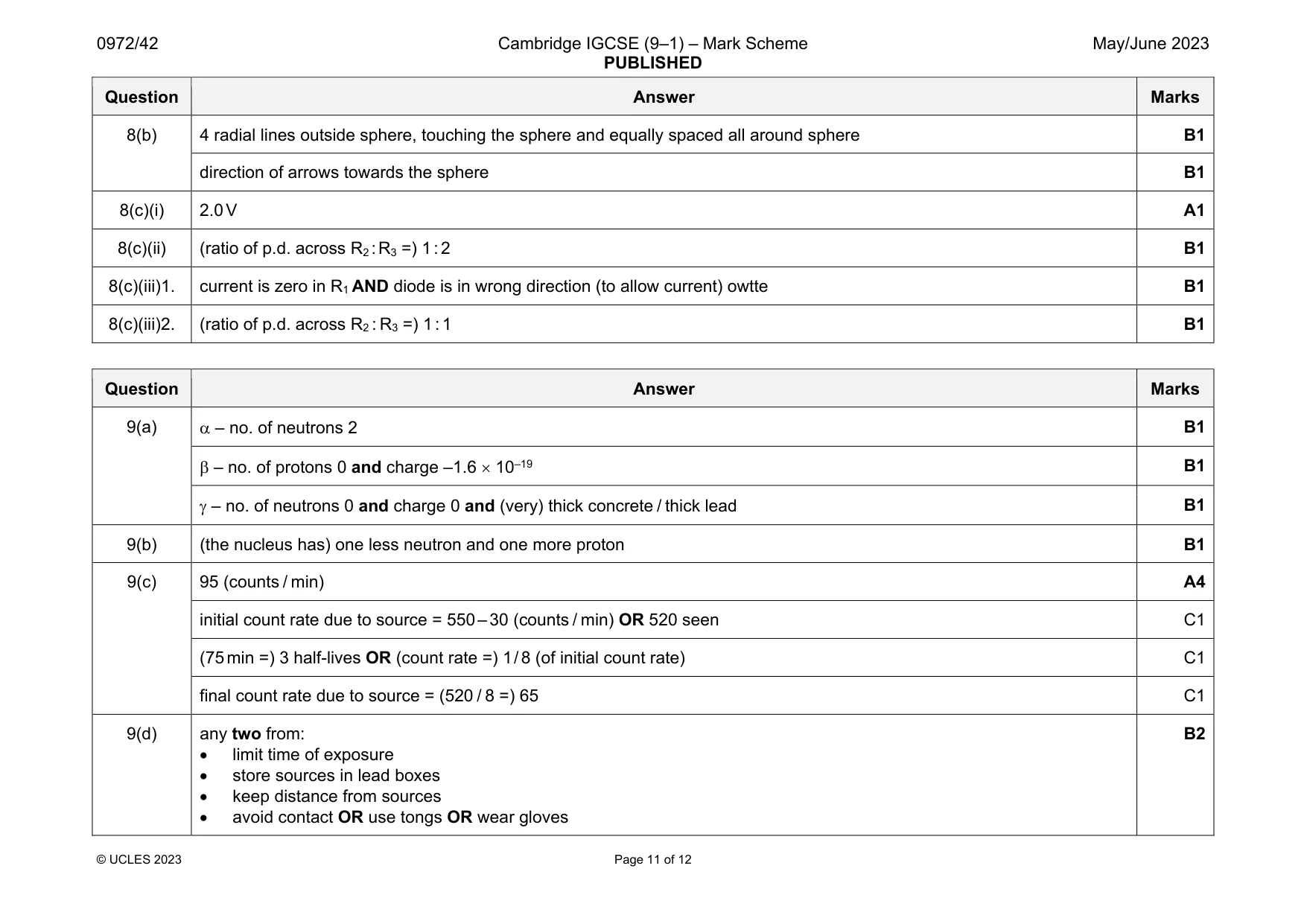
Mark scheme: 8(a)(i) region in which a (magnetic) pole experiences a force B1 8(a)(ii) in the direction of the force on the N pole B1 Question Answer Marks 8(b) 4 radial lines outside sphere, touching the sphere and equally spaced all around sphere B1 direction of arrows towards the sphere B1 8(c)(i) 2.0 V A1 8(c)(ii) (ratio of p.d. across R2 : R3 =) 1 : 2 B1 8(c)(iii)1. current is zero in R1 AND diode is in wrong direction (to allow current) owtte B1 8(c)(iii)2. (ratio of p.d. across R2 : R3 =) 1 : 1 B1
Q9 · Some properties and values for α-particles, β-particles and γ-radiation
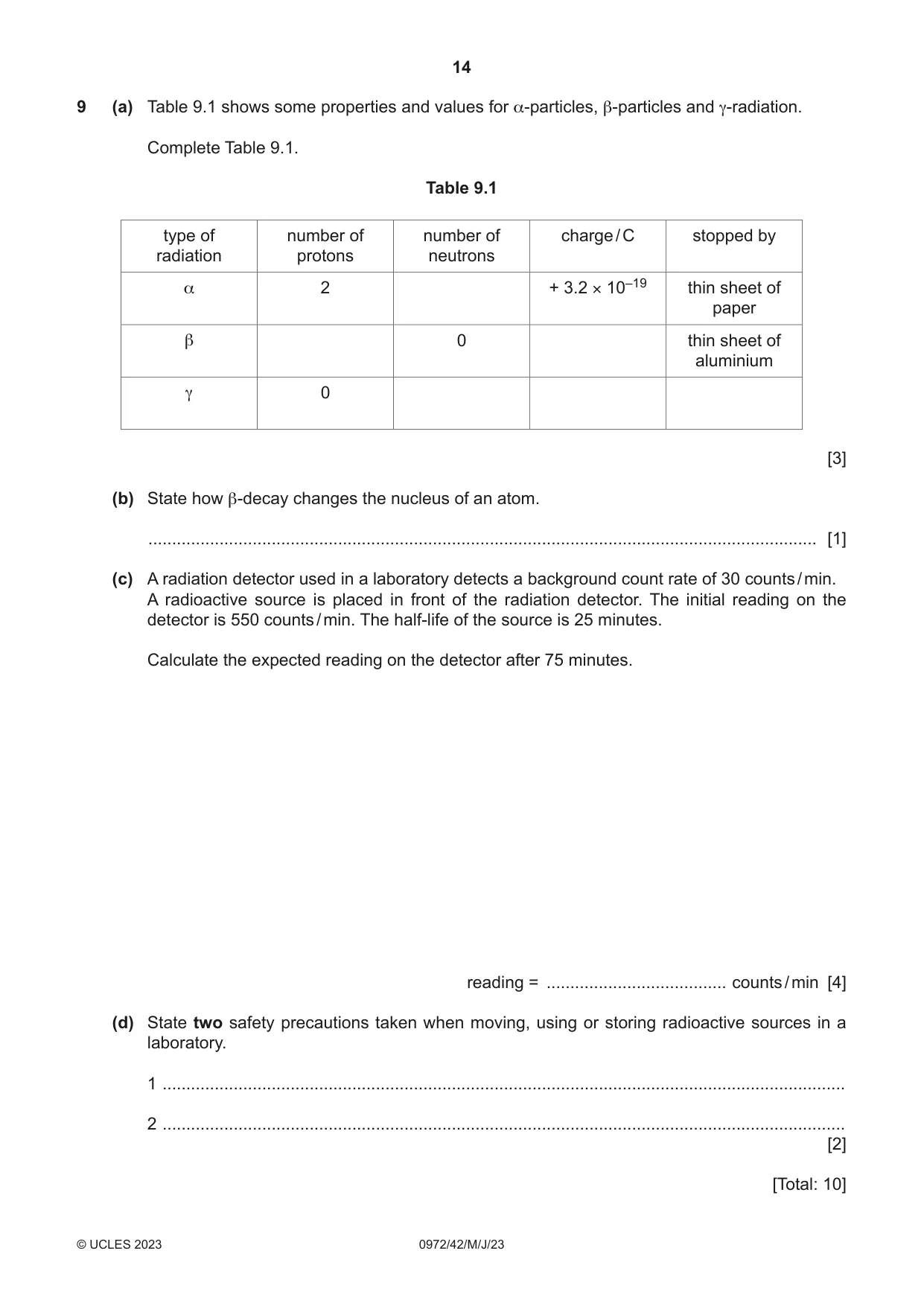
9 (a) Table 9.1 shows some properties and values for α-particles, β-particles and γ-radiation. Complete Table 9.1. Table 9.1 type of number of number of charge / C stopped by radiation protons neutrons α 2 + 3.2 × 10⁻¹⁹ thin sheet of paper β 0 thin sheet of aluminium γ 0 [3] (b) State how β-decay changes the nucleus of an atom. ............................................................................................................................................. [1] (c) A radiation detector used in a laboratory detects a background count rate of 30 counts / min. A radioactive source is placed in front of the radiation detector. The initial reading on the detector is 550 counts / min. The half-life of the source is 25 minutes. Calculate the expected reading on the detector after 75 minutes. reading = ...................................... counts / min [4] (d) State two safety precautions taken when moving, using or storing radioactive sources in a laboratory. 1 ................................................................................................................................................ 2 ................................................................................................................................................ [2] [Total: 10]
Mark scheme: 9(a) B1 – no. of protons 0 and charge –1.6 10–19 B1 – no. of neutrons 0 and charge 0 and (very) thick concrete / thick lead B1 9(b) (the nucleus has) one less neutron and one more proton B1 9(c) 95 (counts / min) A4 initial count rate due to source = 550 – 30 (counts / min) OR 520 seen C1 (75 min =) 3 half-lives OR (count rate =) 1 / 8 (of initial count rate) C1 final count rate due to source = (520 / 8 =) 65 C1 9(d) any two from: limit time of exposure store sources in lead boxes keep distance from sources avoid contact OR use tongs OR wear gloves B2
Q10 · State the equation that defines the average orbital speed v of a planet
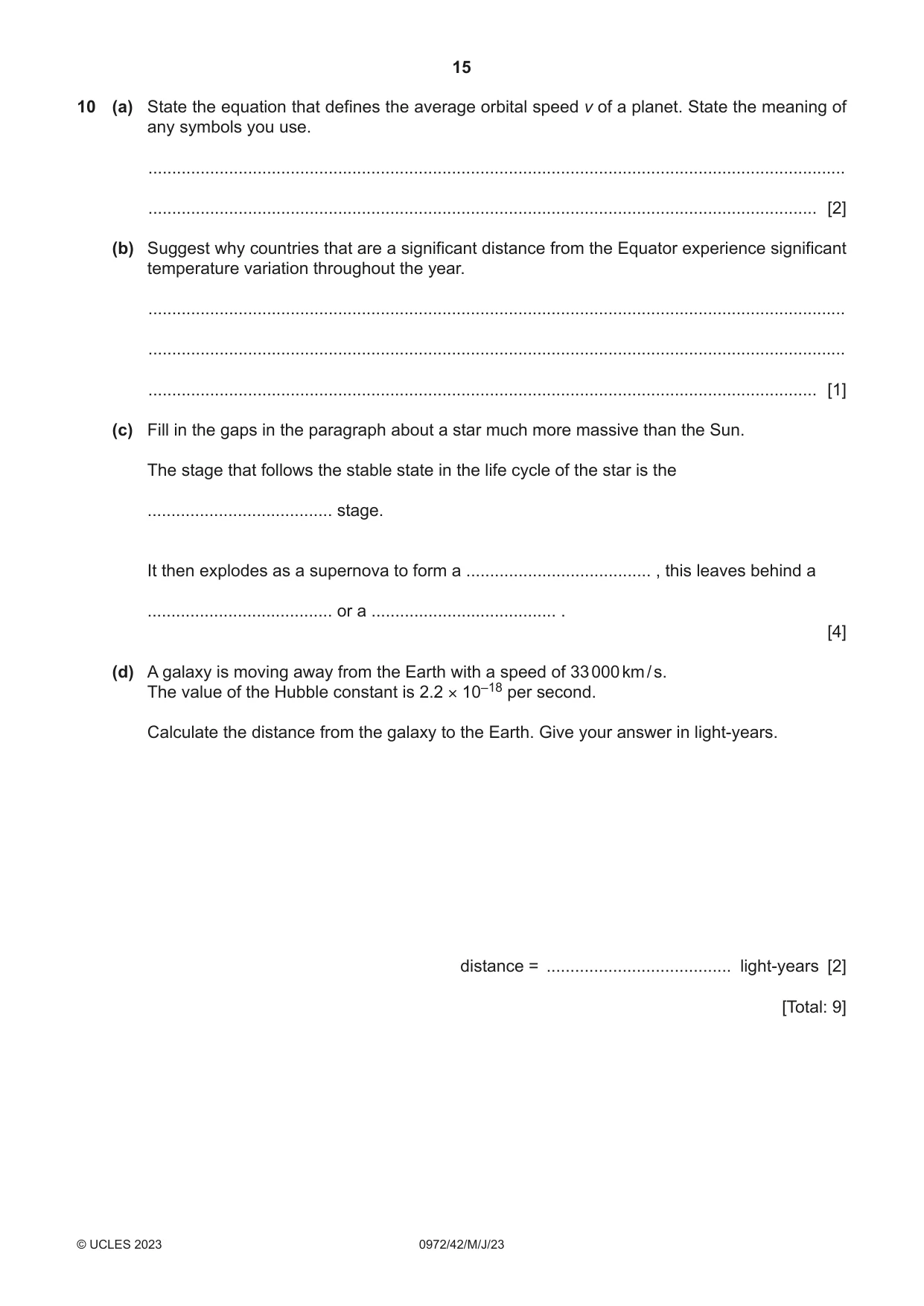
10 (a) State the equation that defines the average orbital speed v of a planet. State the meaning of any symbols you use. ................................................................................................................................................... ............................................................................................................................................. [2] (b) Suggest why countries that are a significant distance from the Equator experience significant temperature variation throughout the year. ................................................................................................................................................... ................................................................................................................................................... ............................................................................................................................................. [1] (c) Fill in the gaps in the paragraph about a star much more massive than the Sun. The stage that follows the stable state in the life cycle of the star is the ....................................... stage. It then explodes as a supernova to form a ....................................... , this leaves behind a ....................................... or a ....................................... . [4] (d) A galaxy is moving away from the Earth with a speed of 33 000 km / s. The value of the Hubble constant is 2.2 × 10⁻¹⁸ per second. Calculate the distance from the galaxy to the Earth. Give your answer in light-years. distance = ....................................... light-years [2] [Total: 9]
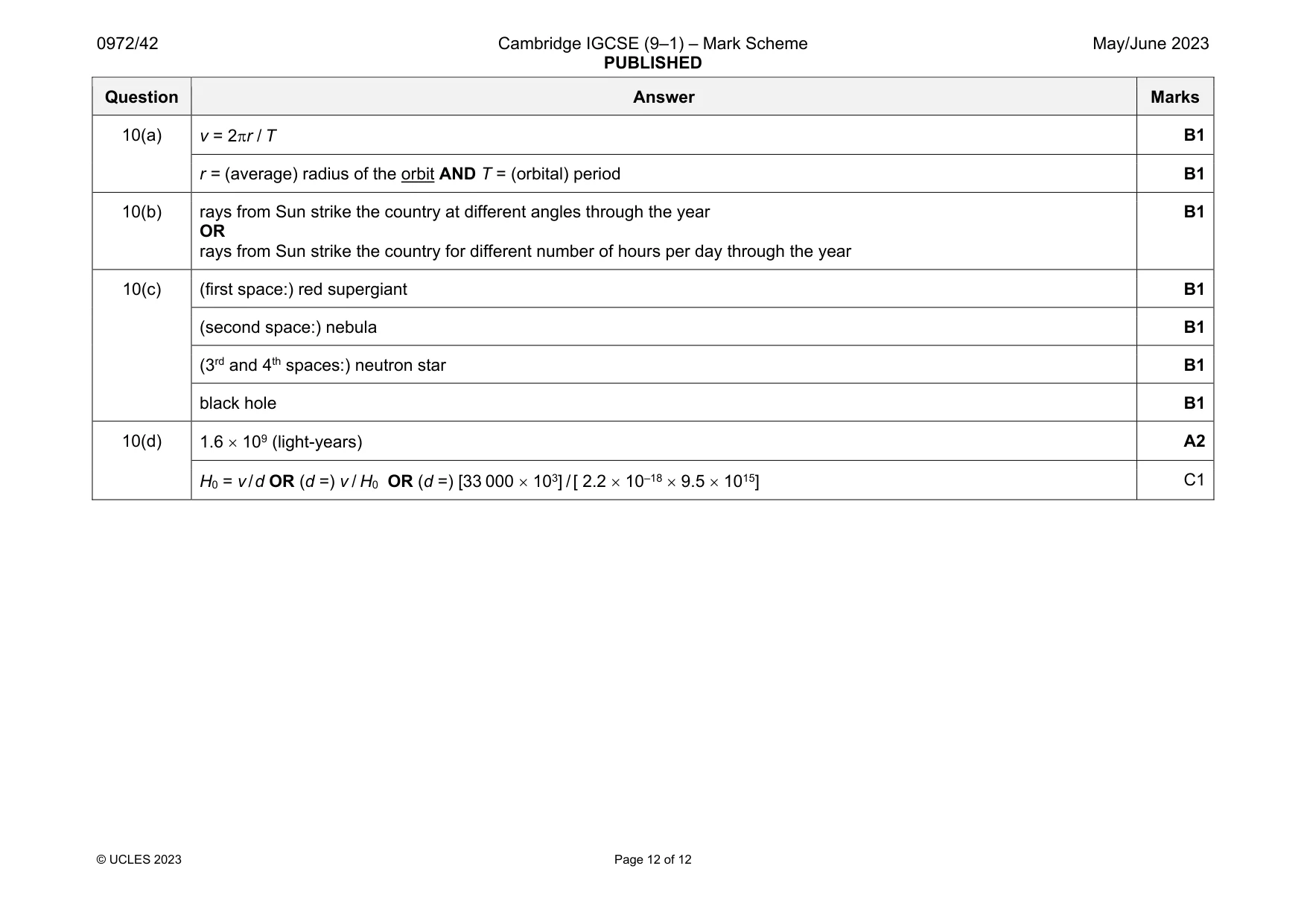
Mark scheme: 10(a) B1 r = (average) radius of the orbit AND T = (orbital) period B1 10(b) rays from Sun strike the country at different angles through the year OR rays from Sun strike the country for different number of hours per day through the year B1 10(c) (first space:) red supergiant B1 (second space:) nebula B1 (3rd and 4th spaces:) neutron star B1 black hole B1 10(d) 1.6 109 (light-years) A2 H0 = v / d OR (d =) v / H0 OR (d =) [33 000 103] / [ 2.2 10–18 9.5 1015] C1
What was in this paper
The subtopics covered by these 10 questions, and how many questions each got. Open one in a new tab to see every Cambridge question on it.
What you needed in this session
Cambridge’s own grade thresholds for 2023 May/June, Paper 4 · Variant 2. A higher threshold means an easier paper — the bar moves with how the cohort did.