Cambridge IGCSE Physics (9-1) 0972 — 2019 Oct/Nov Paper 4 · Variant 1
0972/41/O/N/19 · 9 questions · 80 marks · ≈90 min
The question paper and its mark scheme, free to read here and free to download. This is Cambridge’s own paper, exactly as it was sat.
Question paper20 pages

Mark scheme11 pages
Answers below. Sit the paper first if you are practising.
Questions as text
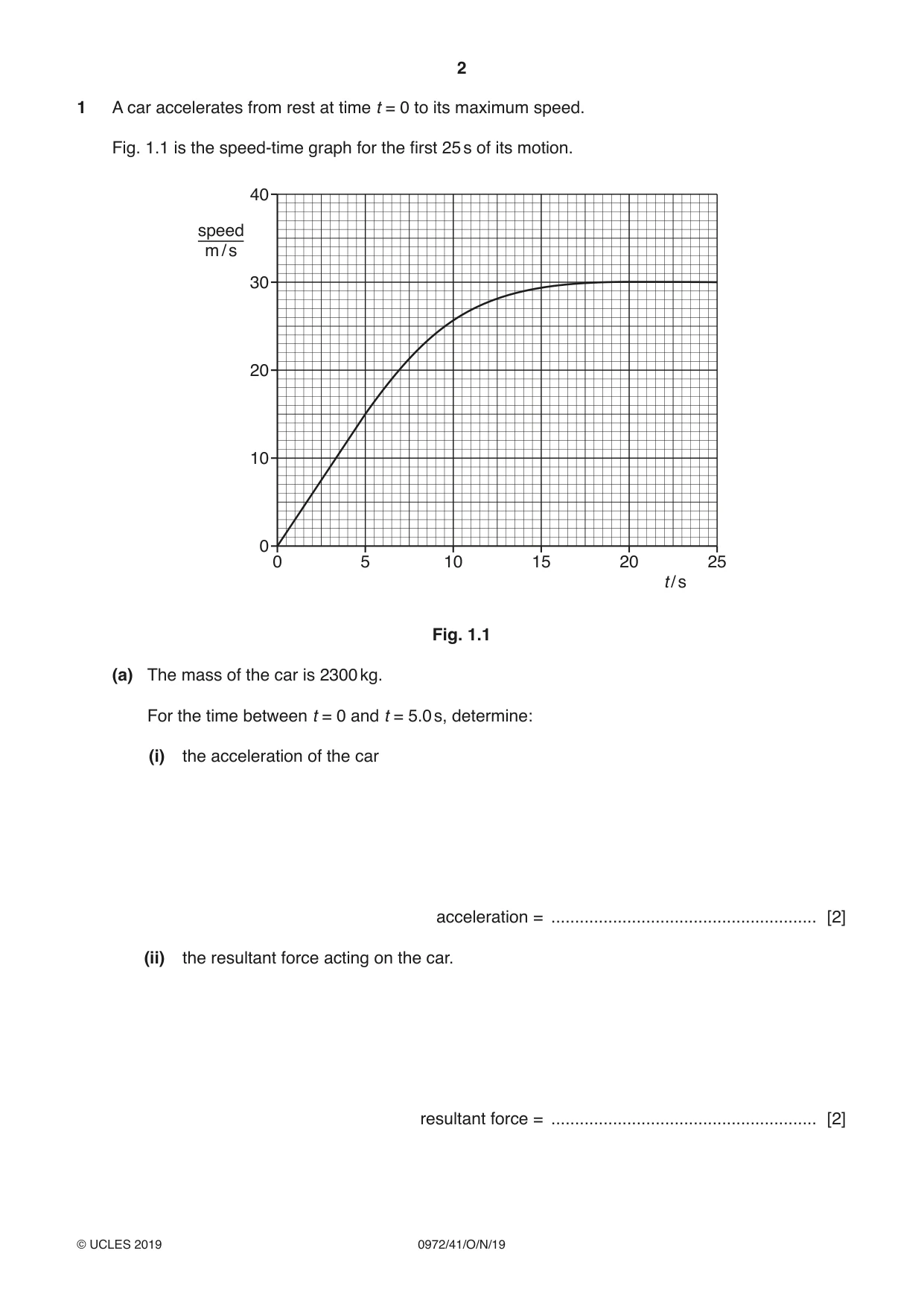
Q1 · A car accelerates from rest at time t = 0 to its maximum speed
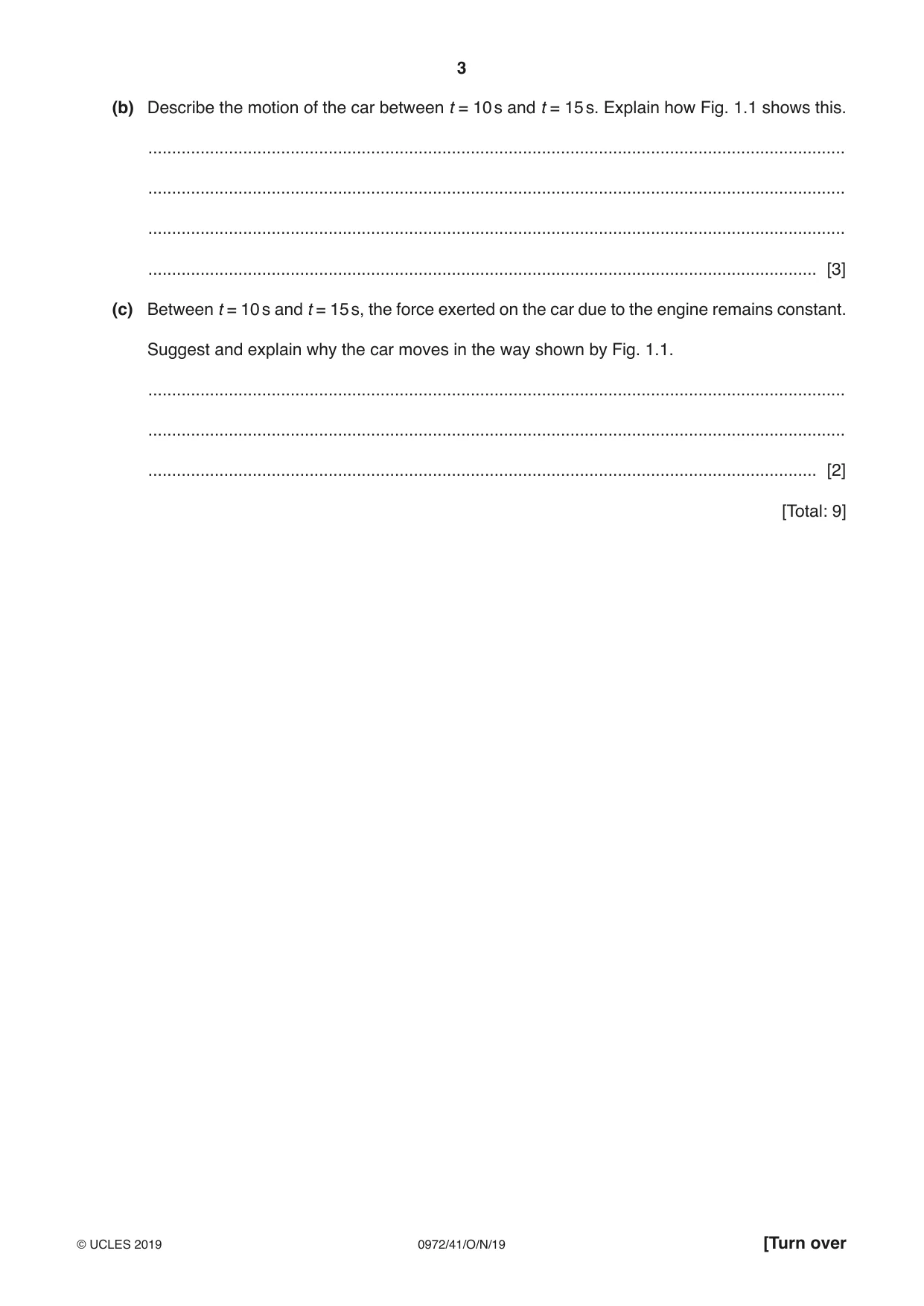
1 A car accelerates from rest at time t = 0 to its maximum speed. Fig. 1.1 is the speed-time graph for the first 25 s of its motion. 40 speed m / s 30 20 10 0 0 5 10 15 20 25 t / s Fig. 1.1 (a) The mass of the car is 2300 kg. For the time between t = 0 and t = 5.0 s, determine: (i) the acceleration of the car acceleration = ........................................................ [2] (ii) the resultant force acting on the car. resultant force = ........................................................ [2] (b) Describe the motion of the car between t = 10 s and t = 15 s. Explain how Fig. 1.1 shows this. ................................................................................................................................................... ................................................................................................................................................... ................................................................................................................................................... ............................................................................................................................................. [3] (c) Between t = 10 s and t = 15 s, the force exerted on the car due to the engine remains constant. Suggest and explain why the car moves in the way shown by Fig. 1.1. ................................................................................................................................................... ................................................................................................................................................... ............................................................................................................................................. [2] [Total: 9]
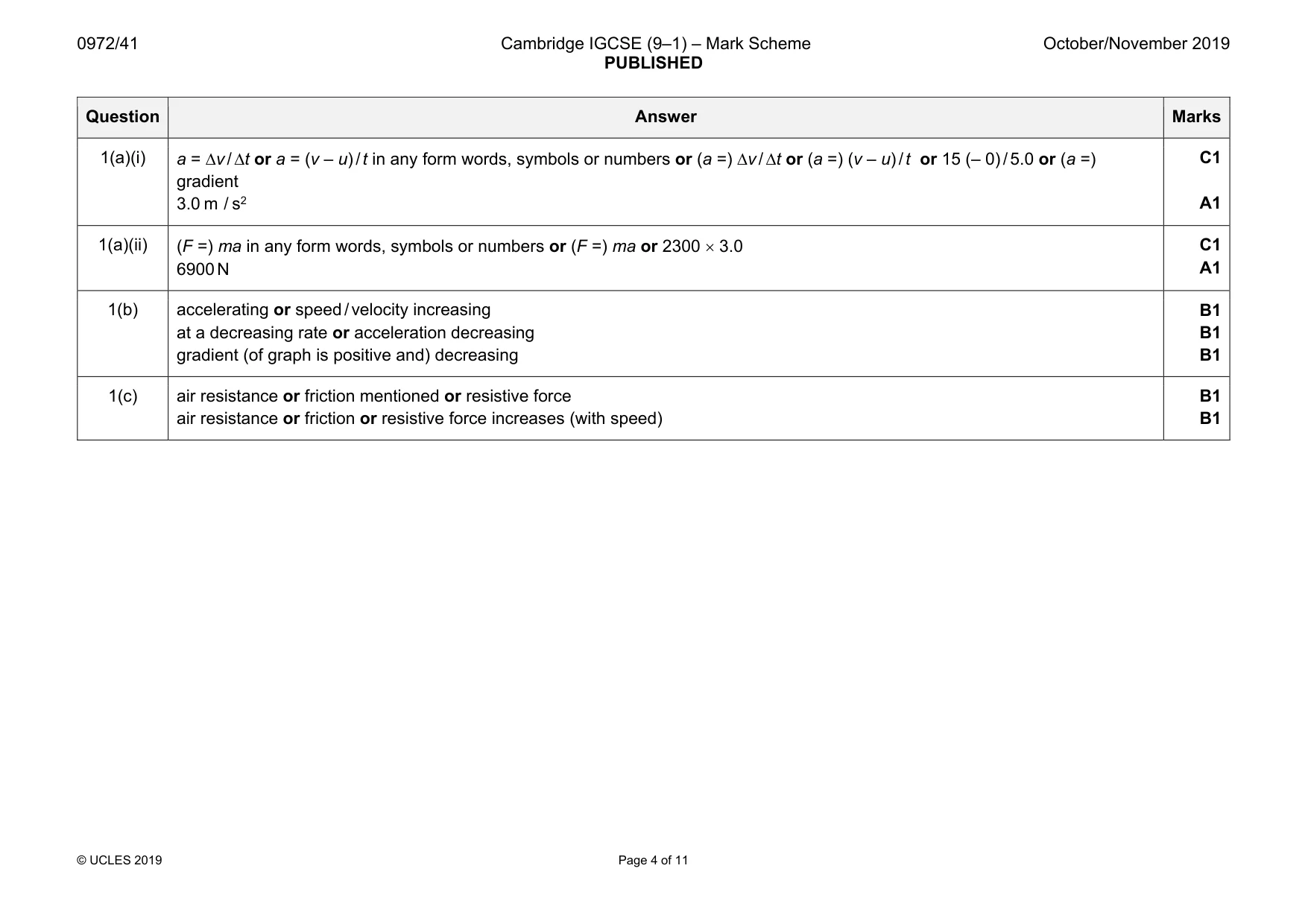
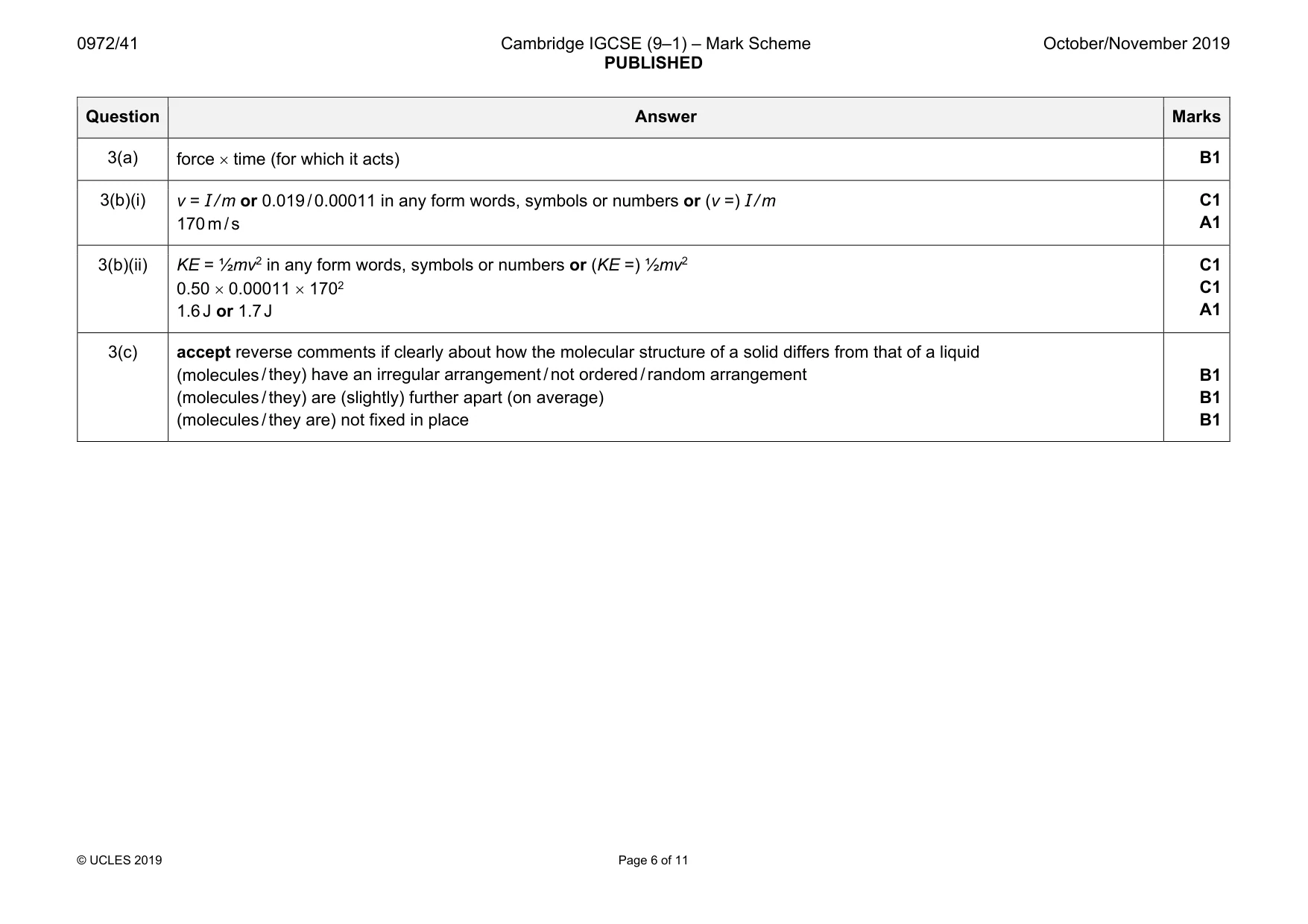
Mark scheme: 1(a)(i) gradient 3.0 m / s2 C1 A1 1(a)(ii) (F =) ma in any form words, symbols or numbers or (F =) ma or 2300 × 3.0 6900 N C1 A1 1(b) accelerating or speed / velocity increasing at a decreasing rate or acceleration decreasing gradient (of graph is positive and) decreasing B1 B1 B1 1(c) air resistance or friction mentioned or resistive force air resistance or friction or resistive force increases (with speed) B1 B1
Q2 · State two properties of an object that may be changed by the action of forces
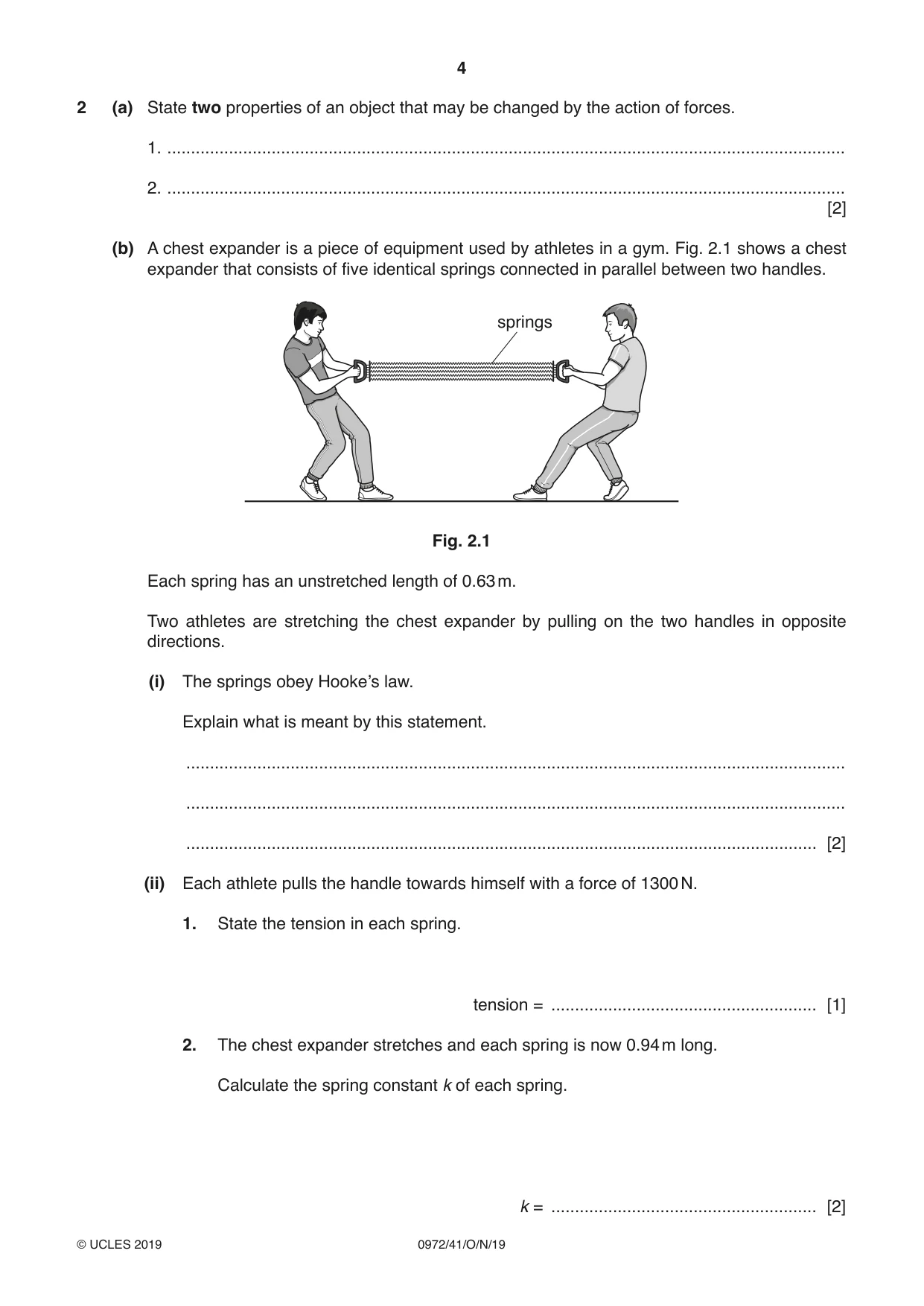
2 (a) State two properties of an object that may be changed by the action of forces. 1. ............................................................................................................................................... 2. ............................................................................................................................................... [2] (b) A chest expander is a piece of equipment used by athletes in a gym. Fig. 2.1 shows a chest expander that consists of five identical springs connected in parallel between two handles. springs Fig. 2.1 Each spring has an unstretched length of 0.63 m. Two athletes are stretching the chest expander by pulling on the two handles in opposite directions. (i) The springs obey Hooke’s law. Explain what is meant by this statement. ........................................................................................................................................... ........................................................................................................................................... ..................................................................................................................................... [2] (ii) Each athlete pulls the handle towards himself with a force of 1300 N. 1. State the tension in each spring. tension = ........................................................ [1] 2. The chest expander stretches and each spring is now 0.94 m long. Calculate the spring constant k of each spring. k = ........................................................ [2] (iii) State the energy changes taking place as the two athletes use their muscles to stretch the chest expander. ........................................................................................................................................... ........................................................................................................................................... ..................................................................................................................................... [2] [Total: 9]
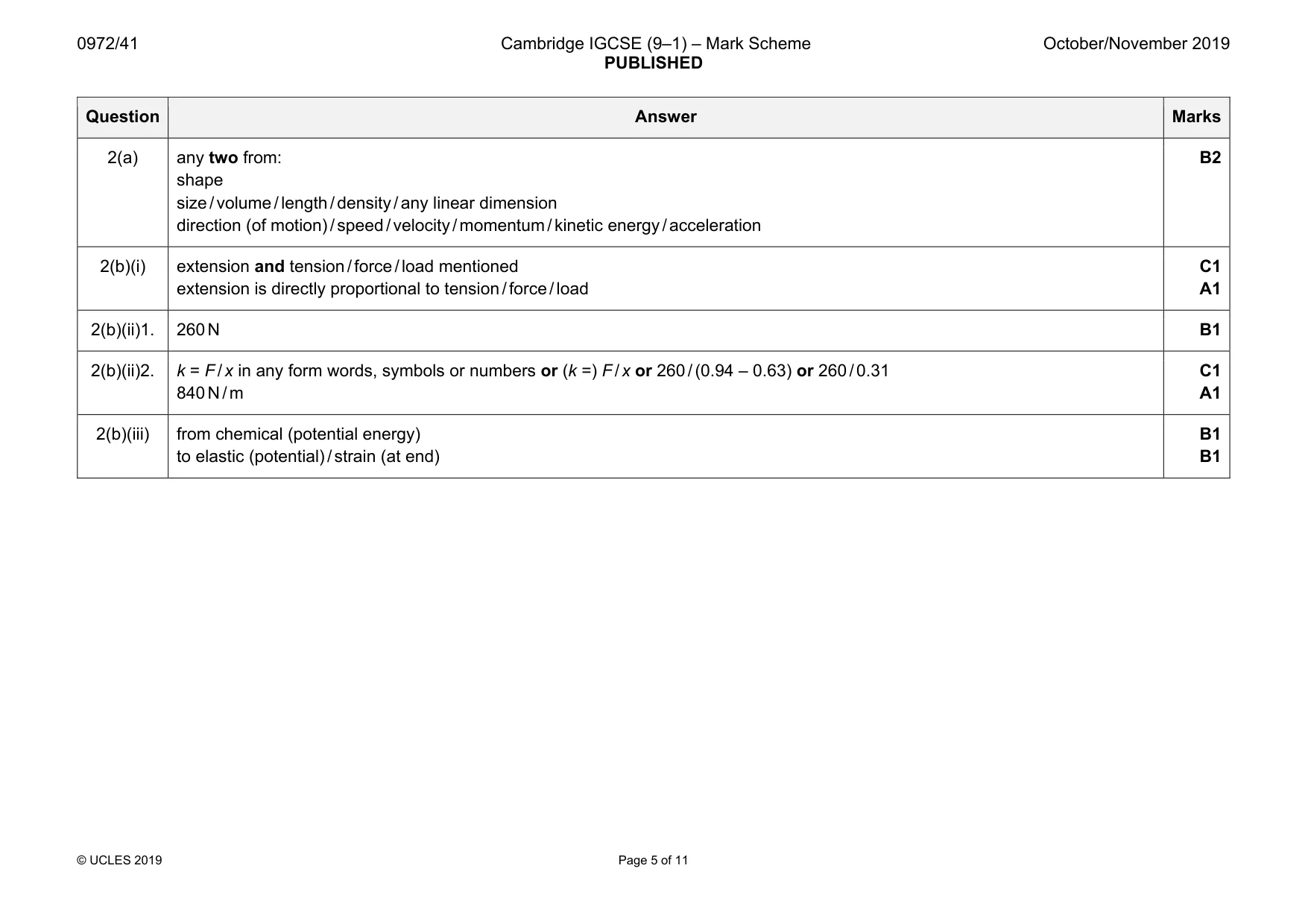
Mark scheme: 2(a) any two from: shape size / volume / length / density / any linear dimension direction (of motion) / speed / velocity / momentum / kinetic energy / acceleration B2 2(b)(i) extension and tension / force / load mentioned extension is directly proportional to tension / force / load C1 A1 2(b)(ii)1. 260 N B1 2(b)(ii)2. k = F / x in any form words, symbols or numbers or (k =) F / x or 260 / (0.94 – 0.63) or 260 / 0.31 840 N / m C1 A1 2(b)(iii) from chemical (potential energy) to elastic (potential) / strain (at end) B1 B1
Q3 · A shooting competition, where air rifles fire soft metal pellets at distant targets
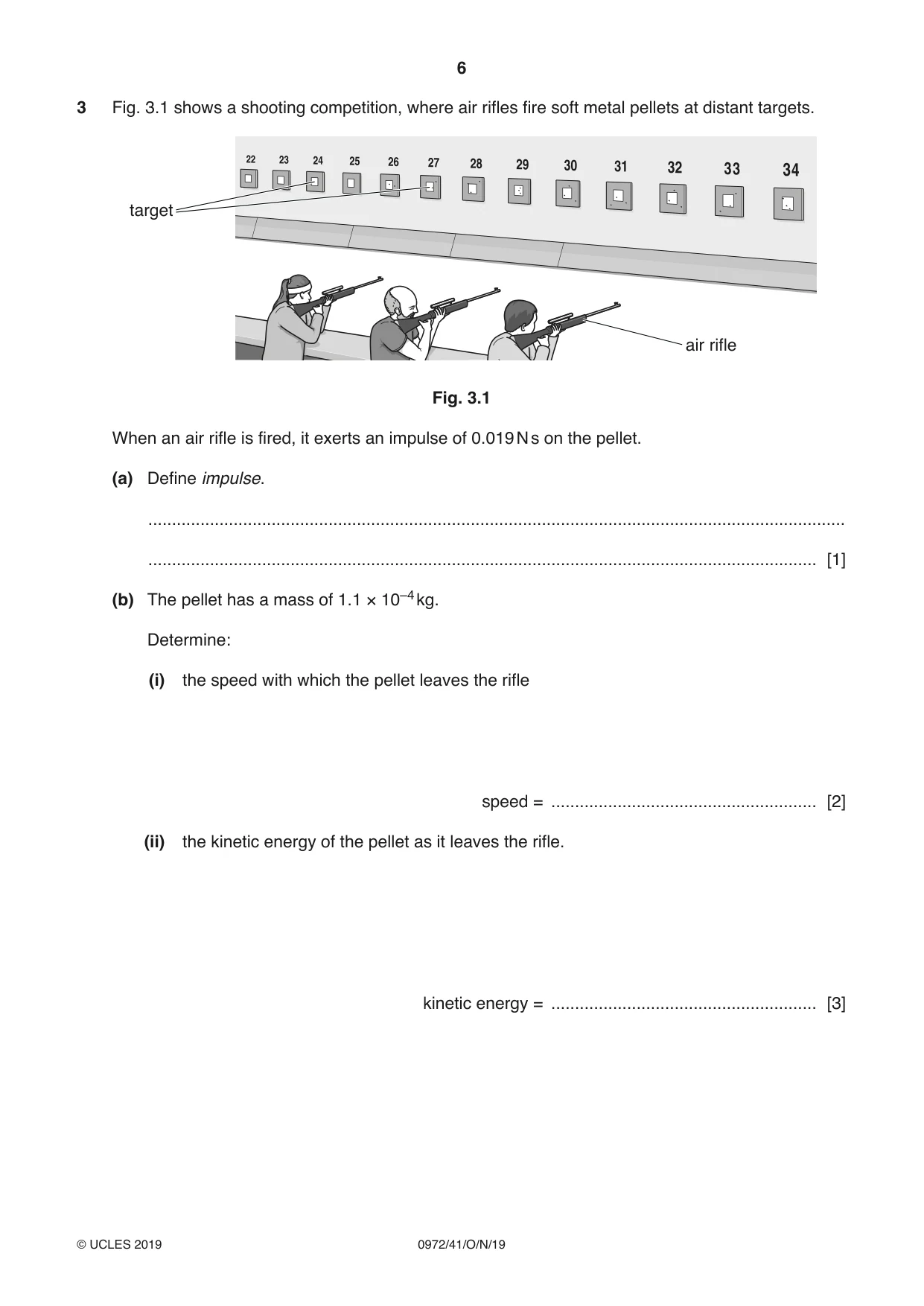
3 Fig. 3.1 shows a shooting competition, where air rifles fire soft metal pellets at distant targets. target air rifle Fig. 3.1 When an air rifle is fired, it exerts an impulse of 0.019 N s on the pellet. (a) Define impulse. ................................................................................................................................................... ............................................................................................................................................. [1] (b) The pellet has a mass of 1.1 × 10⁻⁴ kg. Determine: (i) the speed with which the pellet leaves the rifle speed = ........................................................ [2] (ii) the kinetic energy of the pellet as it leaves the rifle. kinetic energy = ........................................................ [3] (c) The pellet melts when it strikes the target. Describe how the molecular structure of the liquid metal differs from that of the solid metal. ................................................................................................................................................... ................................................................................................................................................... ................................................................................................................................................... ............................................................................................................................................. [3] [Total: 9]
Mark scheme: 3(a) B1 3(b)(i) v = I / m or 0.019 / 0.00011 in any form words, symbols or numbers or (v =) I / m 170 m / s C1 A1 3(b)(ii) KE = ½mv2 in any form words, symbols or numbers or (KE =) ½mv2 0.50 × 0.00011 × 1702 1.6 J or 1.7 J C1 C1 A1 3(c) accept reverse comments if clearly about how the molecular structure of a solid differs from that of a liquid (molecules / they) have an irregular arrangement / not ordered / random arrangement (molecules / they) are (slightly) further apart (on average) (molecules / they are) not fixed in place B1 B1 B1
Q4 · A loudspeaker that is producing a sound wave in air of frequency 15 000 Hz
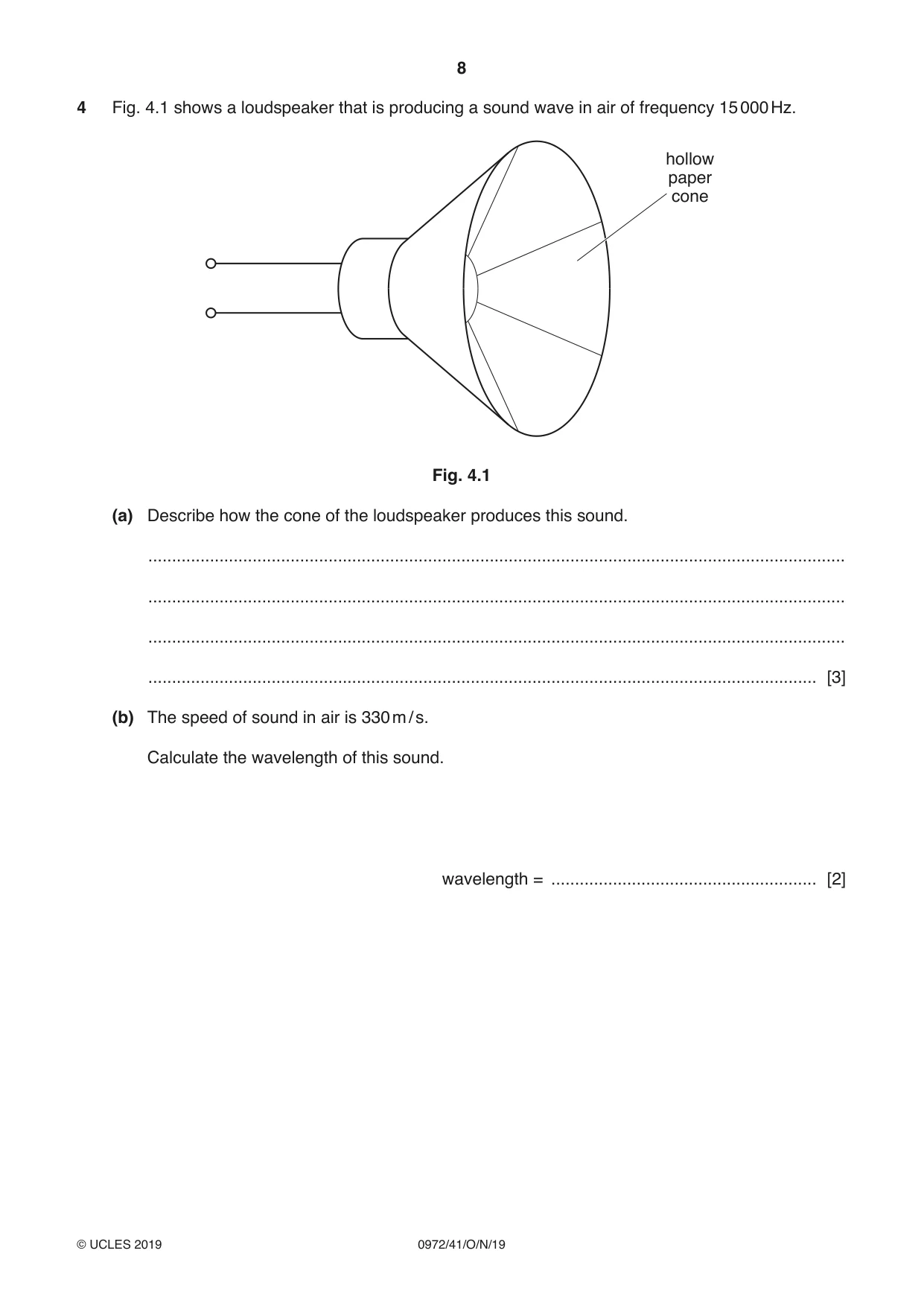
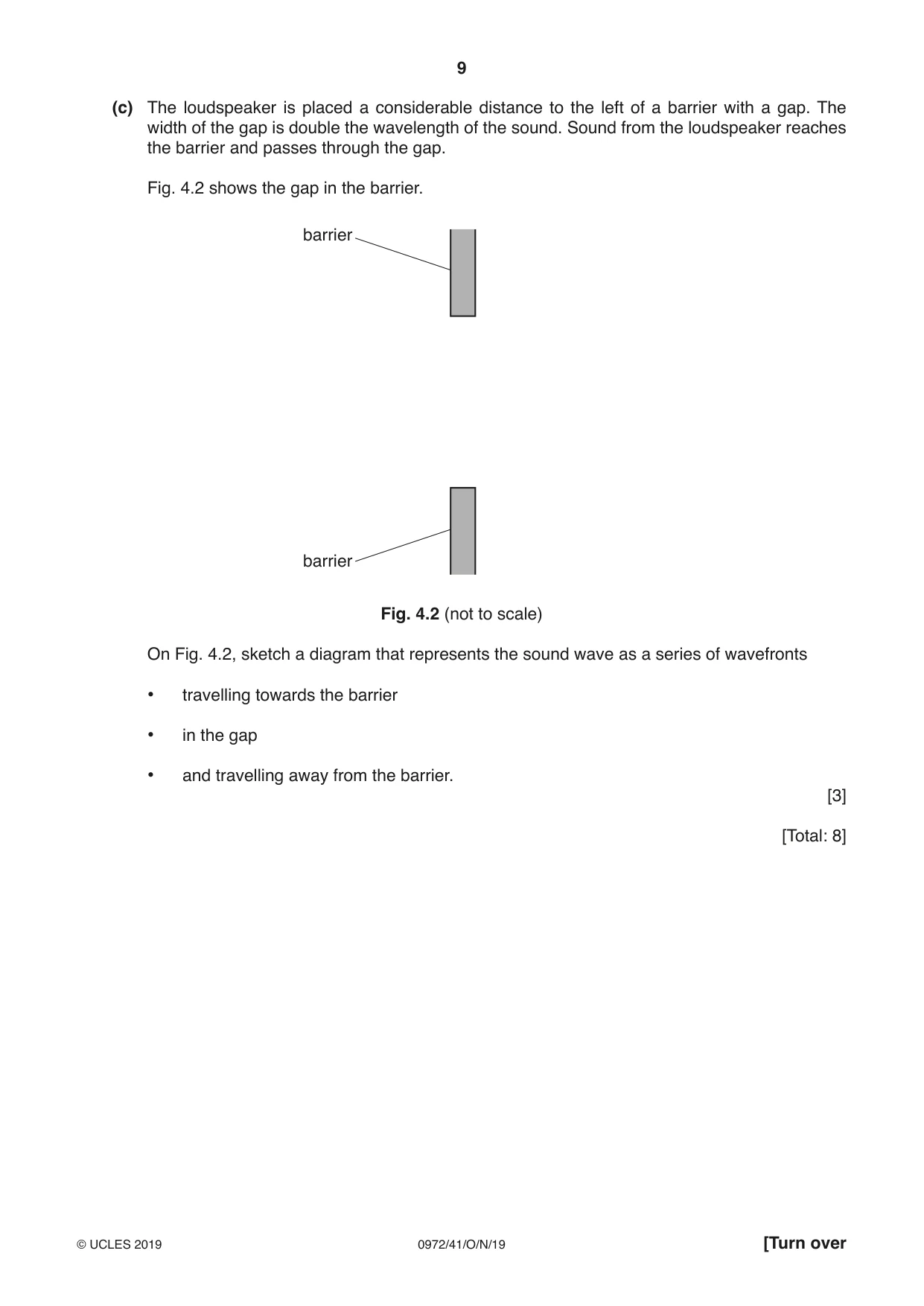
4 Fig. 4.1 shows a loudspeaker that is producing a sound wave in air of frequency 15 000 Hz. hollow paper cone Fig. 4.1 (a) Describe how the cone of the loudspeaker produces this sound. ................................................................................................................................................... ................................................................................................................................................... ................................................................................................................................................... ............................................................................................................................................. [3] (b) The speed of sound in air is 330 m / s. Calculate the wavelength of this sound. wavelength = ........................................................ [2] (c) The loudspeaker is placed a considerable distance to the left of a barrier with a gap. The width of the gap is double the wavelength of the sound. Sound from the loudspeaker reaches the barrier and passes through the gap. Fig. 4.2 shows the gap in the barrier. barrier barrier Fig. 4.2 (not to scale) On Fig. 4.2, sketch a diagram that represents the sound wave as a series of wavefronts • travelling towards the barrier • in the gap • and travelling away from the barrier. [3] [Total: 8]
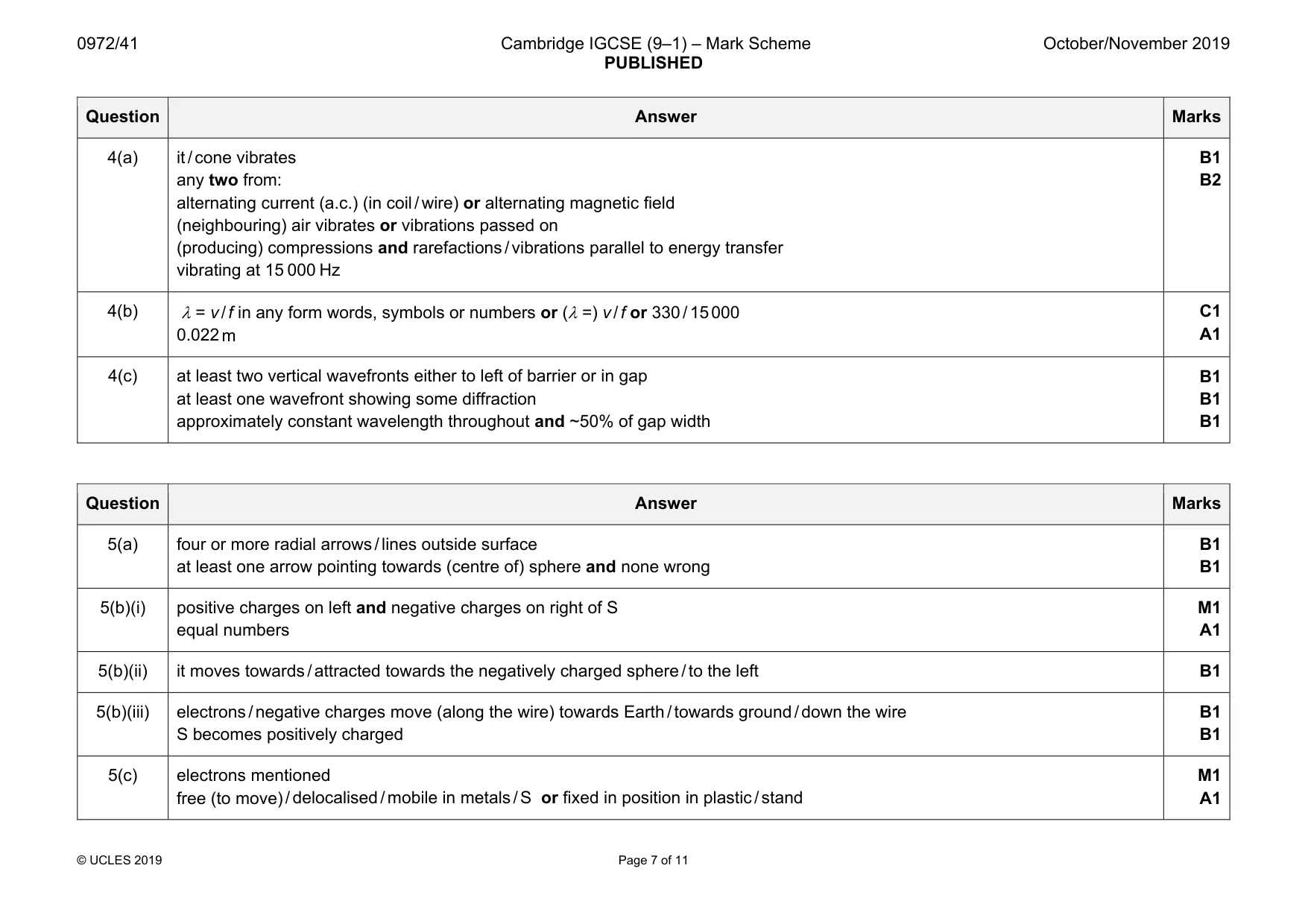
Mark scheme: 4(a) it / cone vibrates any two from: alternating current (a.c.) (in coil / wire) or alternating magnetic field (neighbouring) air vibrates or vibrations passed on (producing) compressions and rarefactions / vibrations parallel to energy transfer vibrating at 15 000 Hz B1 B2 4(b) λ = v / f in any form words, symbols or numbers or (λ =) v / f or 330 / 15 000 0.022 m C1 A1 4(c) at least two vertical wavefronts either to left of barrier or in gap at least one wavefront showing some diffraction approximately constant wavelength throughout and ~50% of gap width B1 B1 B1
Q5 · A sphere that is negatively charged
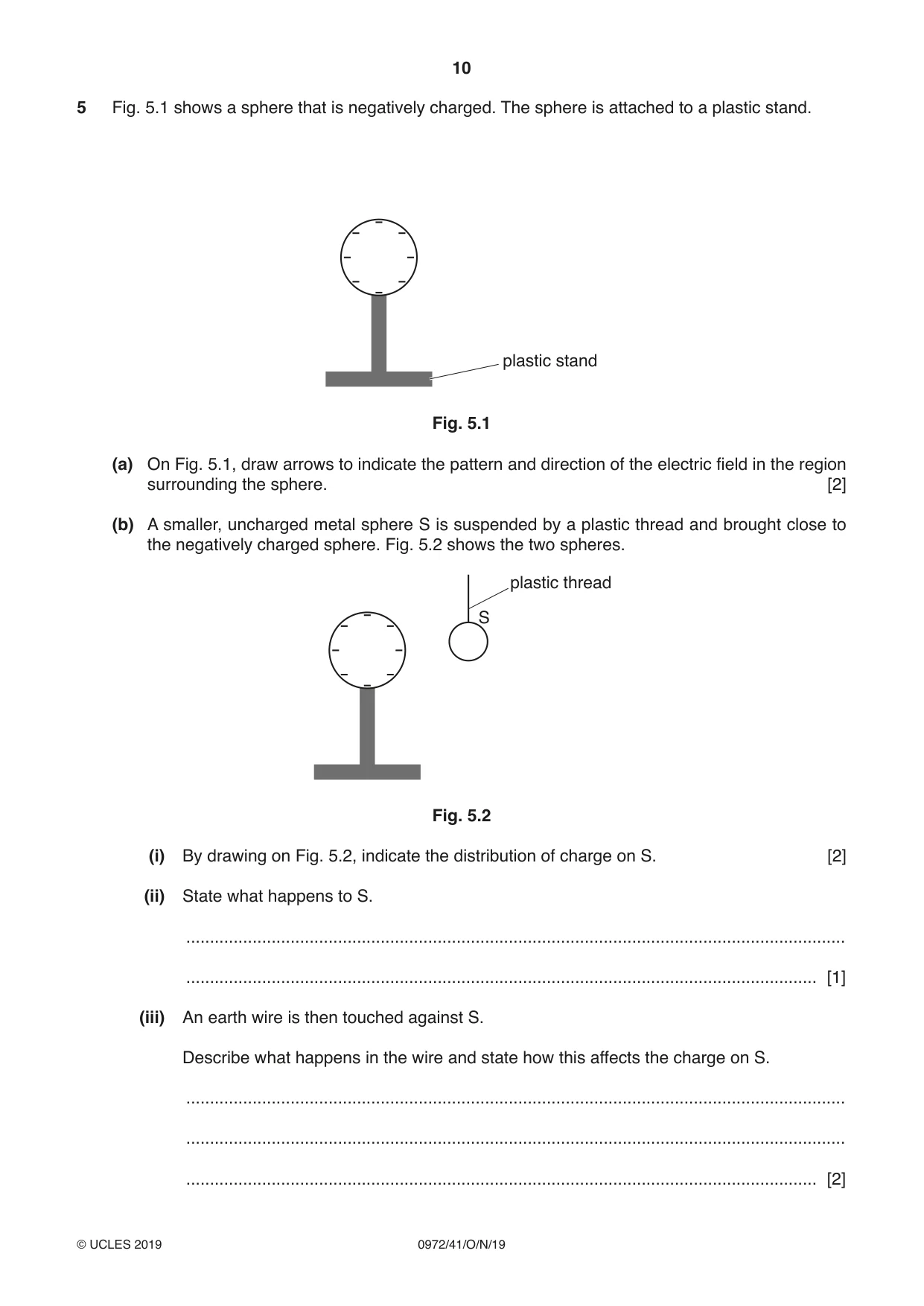
5 Fig. 5.1 shows a sphere that is negatively charged. The sphere is attached to a plastic stand. plastic stand Fig. 5.1 (a) On Fig. 5.1, draw arrows to indicate the pattern and direction of the electric field in the region surrounding the sphere. [2] (b) A smaller, uncharged metal sphere S is suspended by a plastic thread and brought close to the negatively charged sphere. Fig. 5.2 shows the two spheres. plastic thread S Fig. 5.2 (i) By drawing on Fig. 5.2, indicate the distribution of charge on S. [2] (ii) State what happens to S. ........................................................................................................................................... ..................................................................................................................................... [1] (iii) An earth wire is then touched against S. Describe what happens in the wire and state how this affects the charge on S. ........................................................................................................................................... ........................................................................................................................................... ..................................................................................................................................... [2] (c) The metal sphere S is an electrical conductor. The plastic thread is an electrical insulator. Explain this difference by referring to the structures of the two materials. ................................................................................................................................................... ................................................................................................................................................... ............................................................................................................................................. [2] [Total: 9]
Mark scheme: 5(a) four or more radial arrows / lines outside surface at least one arrow pointing towards (centre of) sphere and none wrong B1 B1 5(b)(i) positive charges on left and negative charges on right of S equal numbers M1 A1 5(b)(ii) it moves towards / attracted towards the negatively charged sphere / to the left B1 5(b)(iii) electrons / negative charges move (along the wire) towards Earth / towards ground / down the wire S becomes positively charged B1 B1 5(c) electrons mentioned free (to move) / delocalised / mobile in metals / S or fixed in position in plastic / stand M1 A1
Q6 · A shower that takes in cold water
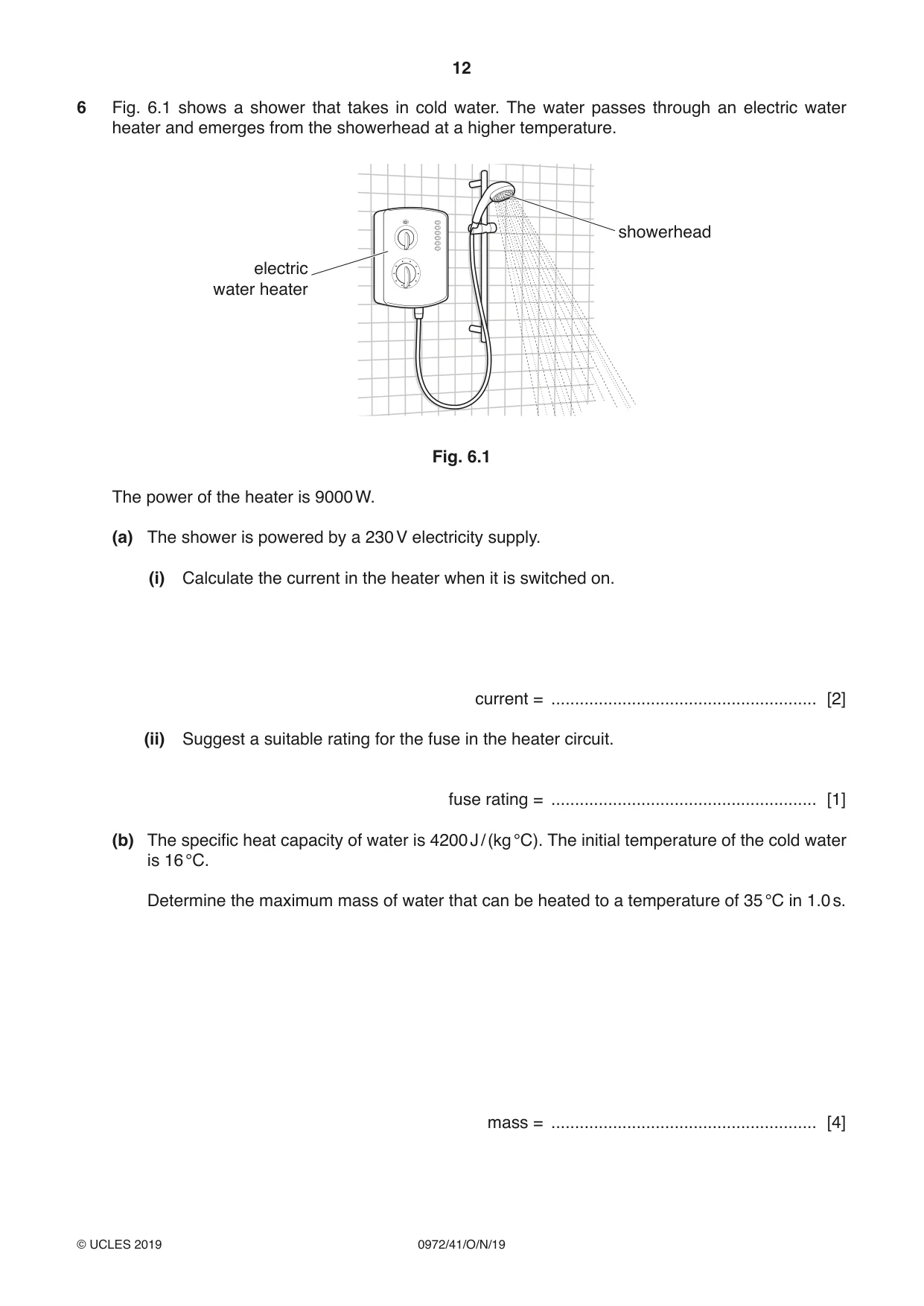
6 Fig. 6.1 shows a shower that takes in cold water. The water passes through an electric water heater and emerges from the showerhead at a higher temperature. showerhead electric water heater Fig. 6.1 The power of the heater is 9000 W. (a) The shower is powered by a 230 V electricity supply. (i) Calculate the current in the heater when it is switched on. current = ........................................................ [2] (ii) Suggest a suitable rating for the fuse in the heater circuit. fuse rating = ........................................................ [1] (b) The specific heat capacity of water is 4200 J / (kg °C). The initial temperature of the cold water is 16 °C. Determine the maximum mass of water that can be heated to a temperature of 35 °C in 1.0 s. mass = ........................................................ [4] (c) A safety control in the shower switches off the shower when the water becomes dangerously hot. The control uses a thermocouple thermometer to measure the temperature of the heated water. (i) Describe the structure of a thermocouple thermometer. Include a diagram in your answer. ........................................................................................................................................... ........................................................................................................................................... ..................................................................................................................................... [2] (ii) Suggest one reason why a thermocouple thermometer is suitable for this purpose. ........................................................................................................................................... ..................................................................................................................................... [1] [Total: 10]
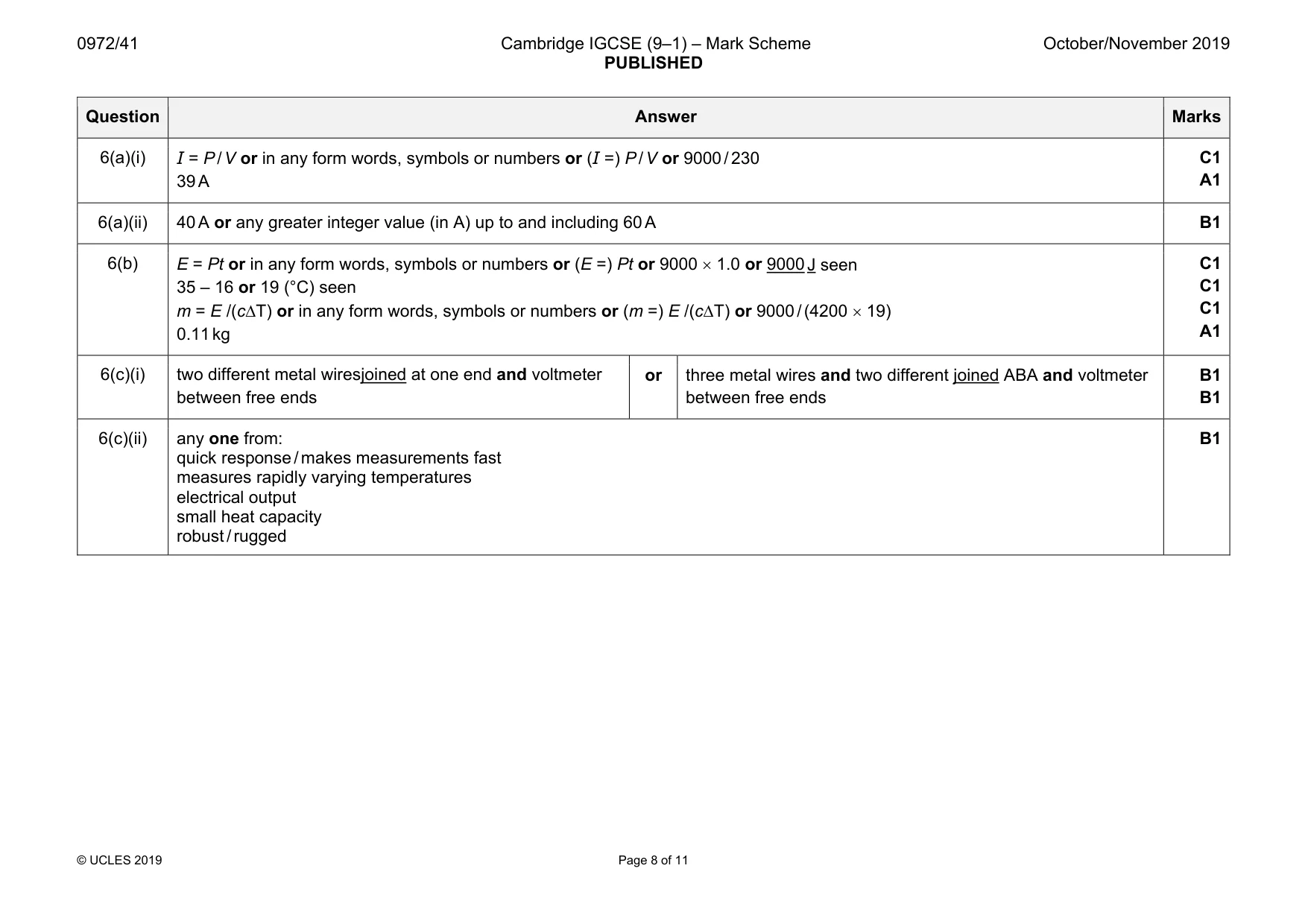
Mark scheme: 6(a)(i) 39 A C1 A1 6(a)(ii) 40 A or any greater integer value (in A) up to and including 60 A B1 6(b) E = Pt or in any form words, symbols or numbers or (E =) Pt or 9000 × 1.0 or 9000 J seen 35 – 16 or 19 (°C) seen m = E /(c∆T) or in any form words, symbols or numbers or (m =) E /(c∆T) or 9000 / (4200 × 19) 0.11 kg C1 C1 C1 A1 6(c)(i) two different metal wiresjoined at one end and voltmeter between free ends or three metal wires and two different joined ABA and voltmeter between free ends B1 B1 6(c)(ii) any one from: quick response / makes measurements fast measures rapidly varying temperatures electrical output small heat capacity robust / rugged B1
Q7 · The resistance of a 1.0 m length of resistance wire is 7.6 Ω
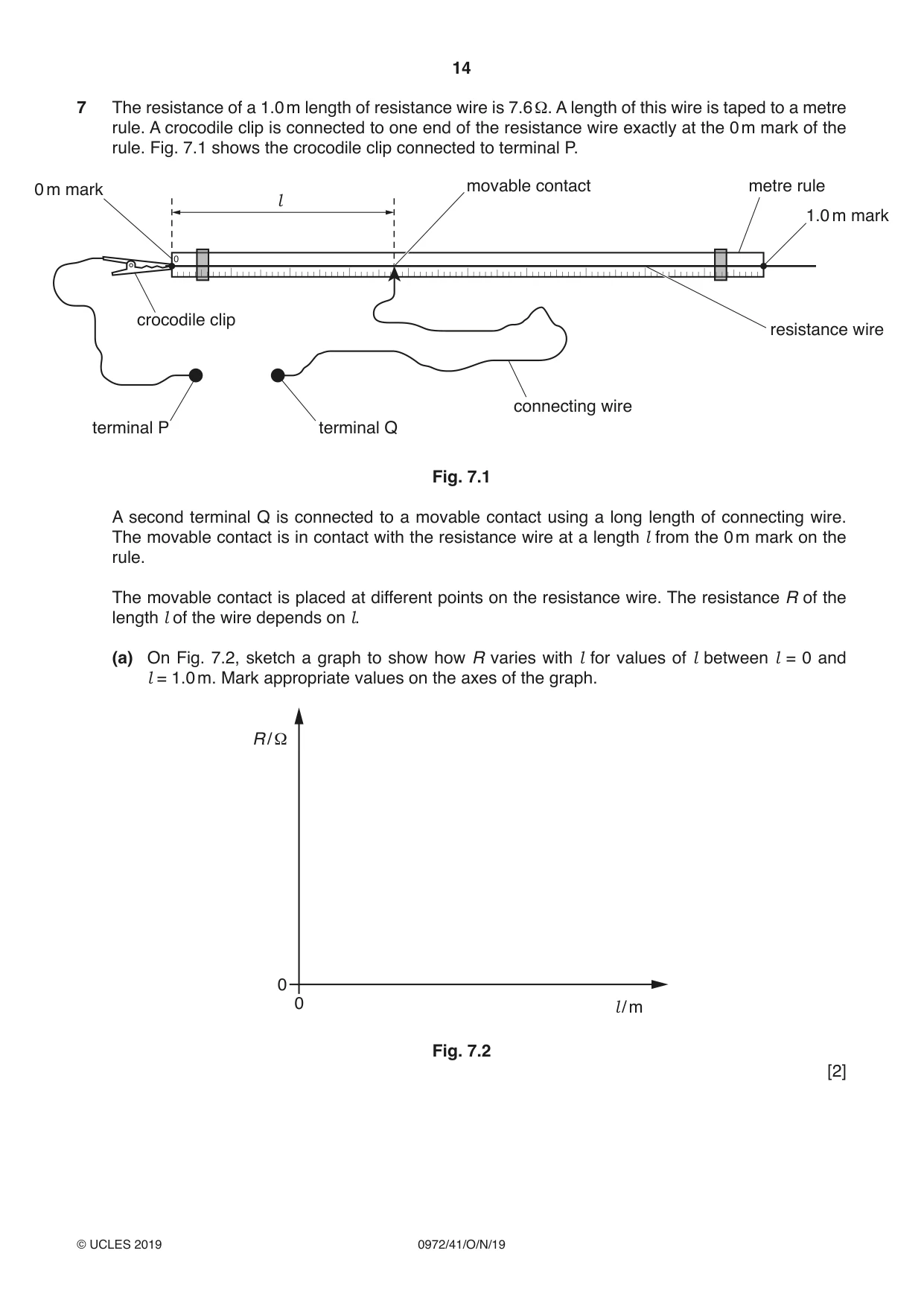
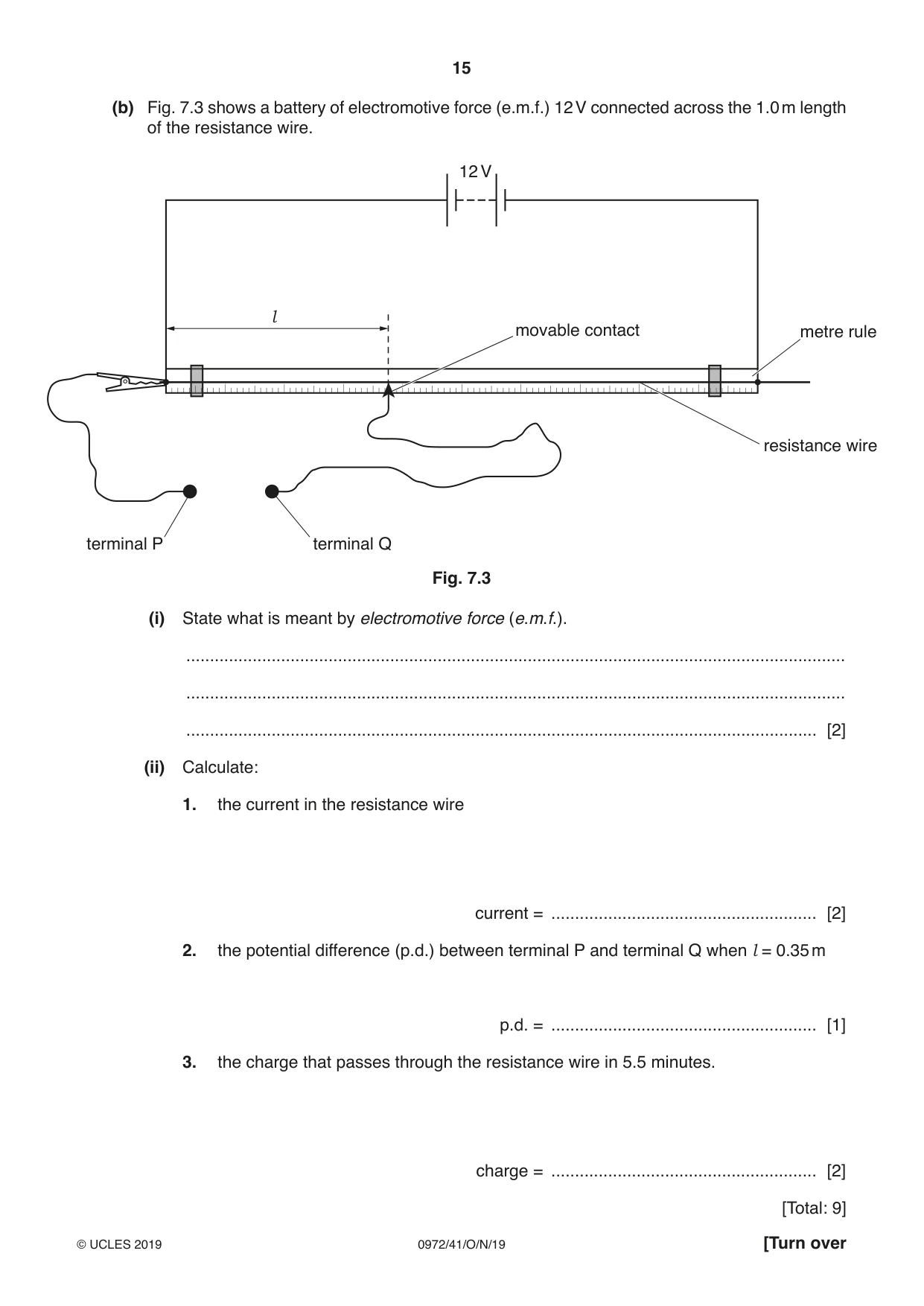
7 The resistance of a 1.0 m length of resistance wire is 7.6 Ω. A length of this wire is taped to a metre rule. A crocodile clip is connected to one end of the resistance wire exactly at the 0 m mark of the rule. Fig. 7.1 shows the crocodile clip connected to terminal P. 0 m mark movable contact metre rule l 1.0 m mark 0 crocodile clip resistance wire connecting wire terminal P terminal Q Fig. 7.1 A second terminal Q is connected to a movable contact using a long length of connecting wire. The movable contact is in contact with the resistance wire at a length l from the 0 m mark on the rule. The movable contact is placed at different points on the resistance wire. The resistance R of the length l of the wire depends on l. (a) On Fig. 7.2, sketch a graph to show how R varies with l for values of l between l = 0 and l = 1.0 m. Mark appropriate values on the axes of the graph. R / Ω 0 0 l / m Fig. 7.2 [2] (b) Fig. 7.3 shows a battery of electromotive force (e.m.f.) 12 V connected across the 1.0 m length of the resistance wire. 12 V l movable contact metre rule resistance wire terminal P terminal Q Fig. 7.3 (i) State what is meant by electromotive force (e.m.f.). ........................................................................................................................................... ........................................................................................................................................... ..................................................................................................................................... [2] (ii) Calculate: 1. the current in the resistance wire current = ........................................................ [2] 2. the potential difference (p.d.) between terminal P and terminal Q when l = 0.35 m p.d. = ........................................................ [1] 3. the charge that passes through the resistance wire in 5.5 minutes. charge = ........................................................ [2] [Total: 9]
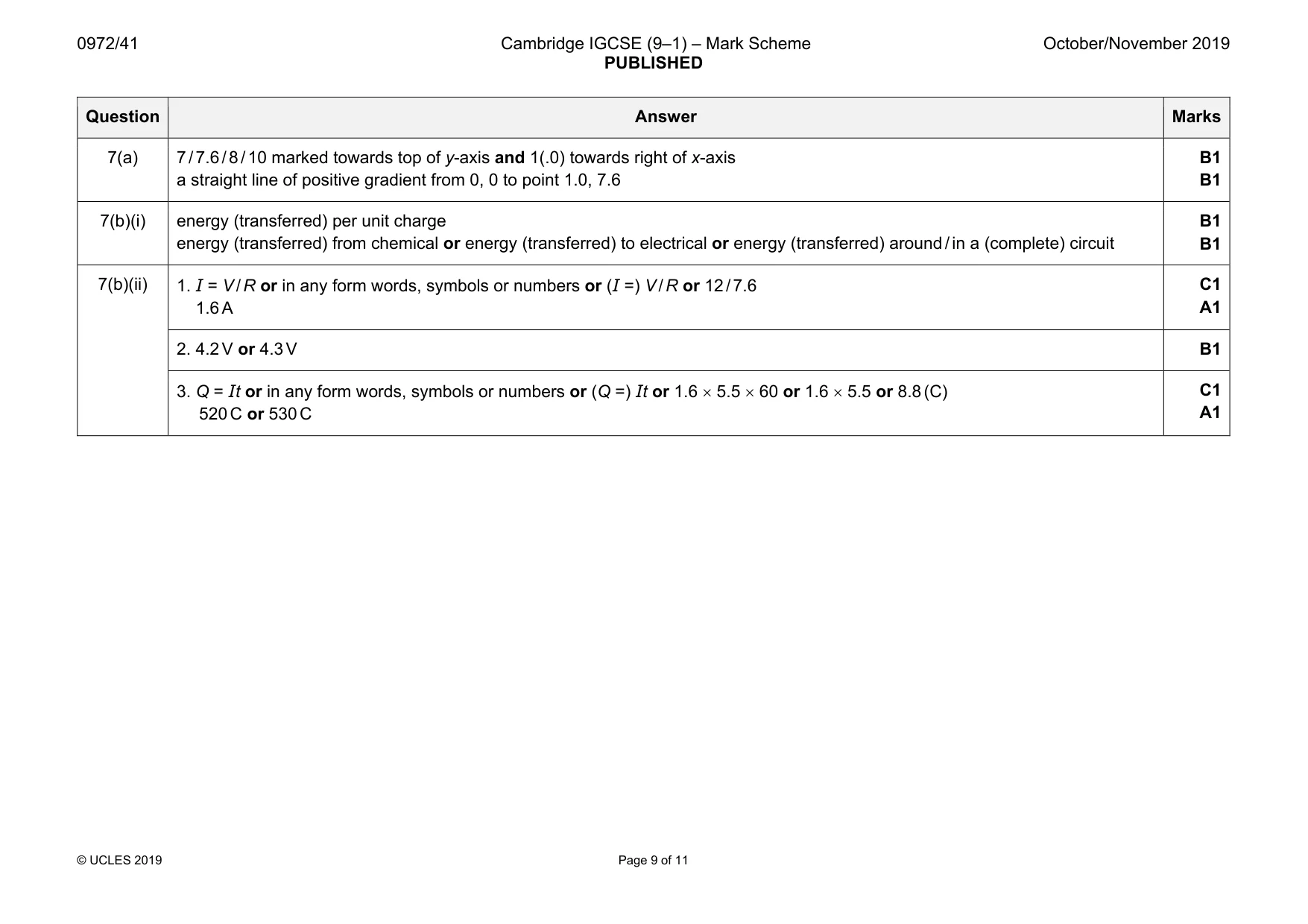
Mark scheme: 7(a) 7 / 7.6 / 8 / 10 marked towards top of y-axis and 1(.0) towards right of x-axis a straight line of positive gradient from 0, 0 to point 1.0, 7.6 B1 B1 7(b)(i) energy (transferred) per unit charge energy (transferred) from chemical or energy (transferred) to electrical or energy (transferred) around / in a (complete) circuit B1 B1 7(b)(ii) 1. I = V / R or in any form words, symbols or numbers or (I =) V / R or 12 / 7.6 1.6 A C1 A1 2. 4.2 V or 4.3 V B1 3. Q = It or in any form words, symbols or numbers or (Q =) It or 1.6 × 5.5 × 60 or 1.6 × 5.5 or 8.8 (C) 520 C or 530 C C1 A1
Q8 · A ray of red light incident on one side of a glass prism in air
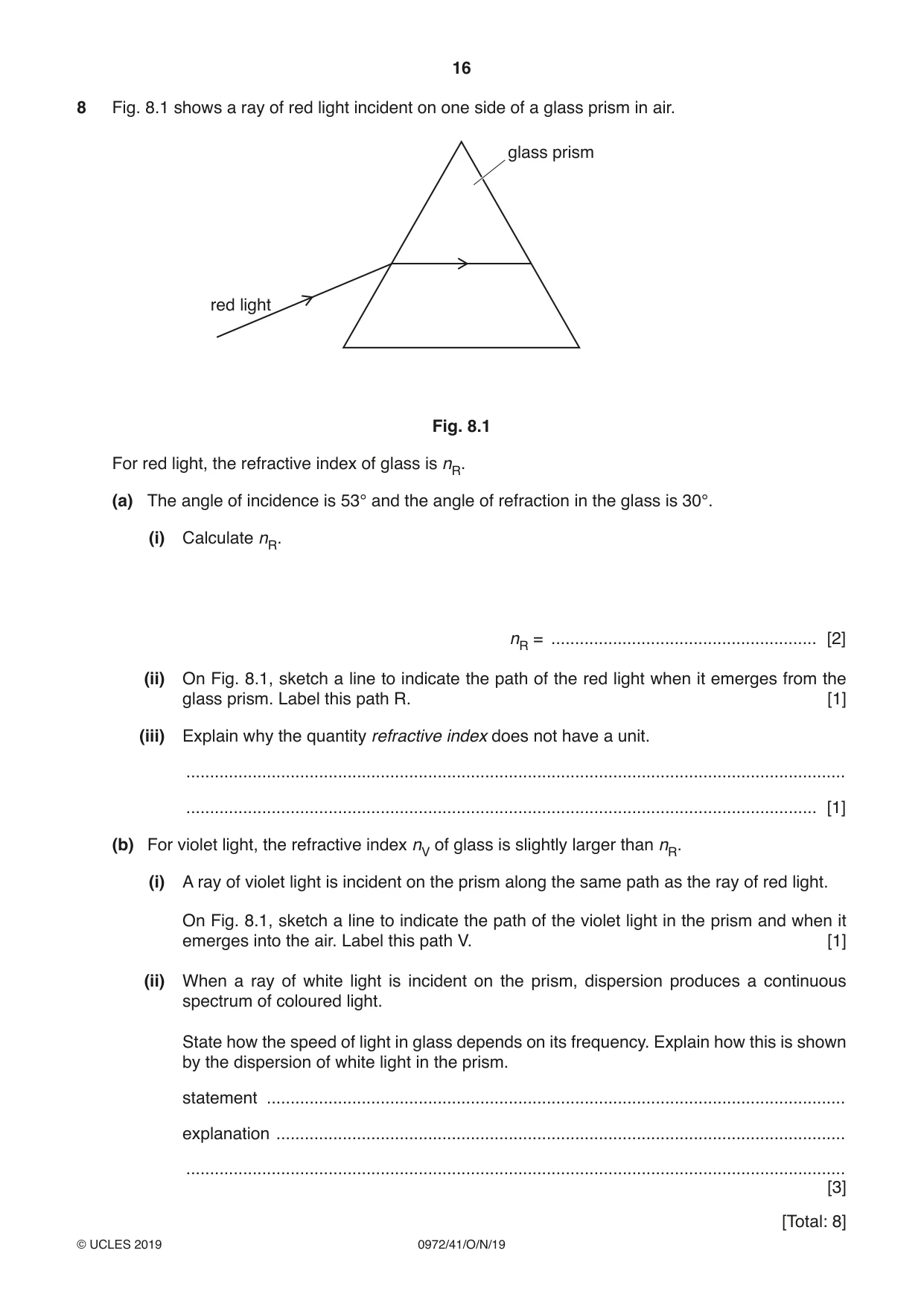
8 Fig. 8.1 shows a ray of red light incident on one side of a glass prism in air. glass prism red light Fig. 8.1 For red light, the refractive index of glass is nR. (a) The angle of incidence is 53° and the angle of refraction in the glass is 30°. (i) Calculate nR. nR = ........................................................ [2] (ii) On Fig. 8.1, sketch a line to indicate the path of the red light when it emerges from the glass prism. Label this path R. [1] (iii) Explain why the quantity refractive index does not have a unit. ........................................................................................................................................... ..................................................................................................................................... [1] (b) For violet light, the refractive index nV of glass is slightly larger than nR. (i) A ray of violet light is incident on the prism along the same path as the ray of red light. On Fig. 8.1, sketch a line to indicate the path of the violet light in the prism and when it emerges into the air. Label this path V. [1] (ii) When a ray of white light is incident on the prism, dispersion produces a continuous spectrum of coloured light. State how the speed of light in glass depends on its frequency. Explain how this is shown by the dispersion of white light in the prism. statement .......................................................................................................................... explanation ........................................................................................................................ ........................................................................................................................................... [3] [Total: 8]
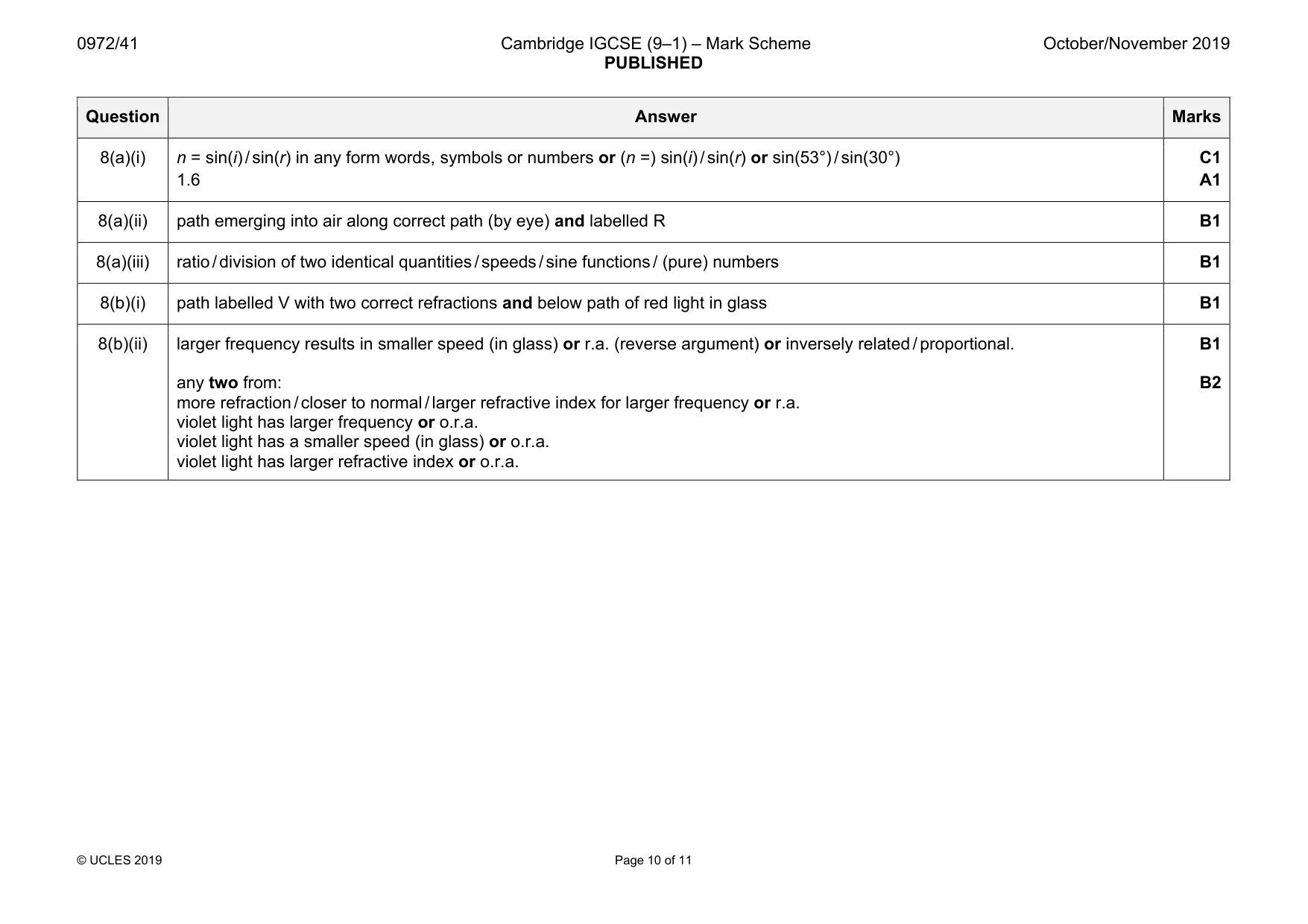
Mark scheme: 8(a)(i) n = sin(i) / sin(r) in any form words, symbols or numbers or (n =) sin(i) / sin(r) or sin(53°) / sin(30°) 1.6 C1 A1 8(a)(ii) path emerging into air along correct path (by eye) and labelled R B1 8(a)(iii) ratio / division of two identical quantities / speeds / sine functions / (pure) numbers B1 8(b)(i) path labelled V with two correct refractions and below path of red light in glass B1 8(b)(ii) larger frequency results in smaller speed (in glass) or r.a. (reverse argument) or inversely related / proportional. any two from: more refraction / closer to normal / larger refractive index for larger frequency or r.a. violet light has larger frequency or o.r.a. violet light has a smaller speed (in glass) or o.r.a. violet light has larger refractive index or o.r.a. B1 B2
Q9 · The chemical symbol of the element lithium is Li
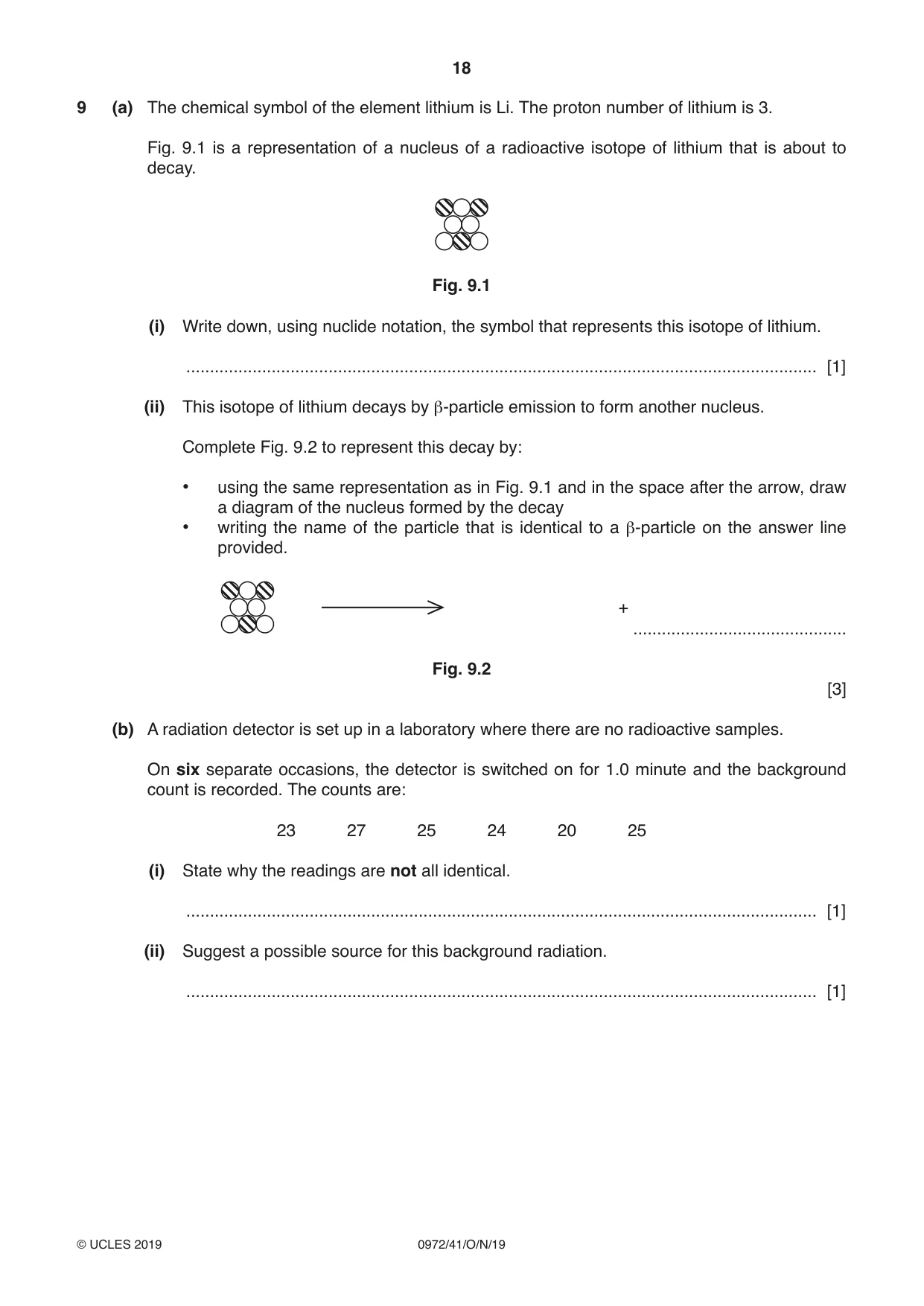
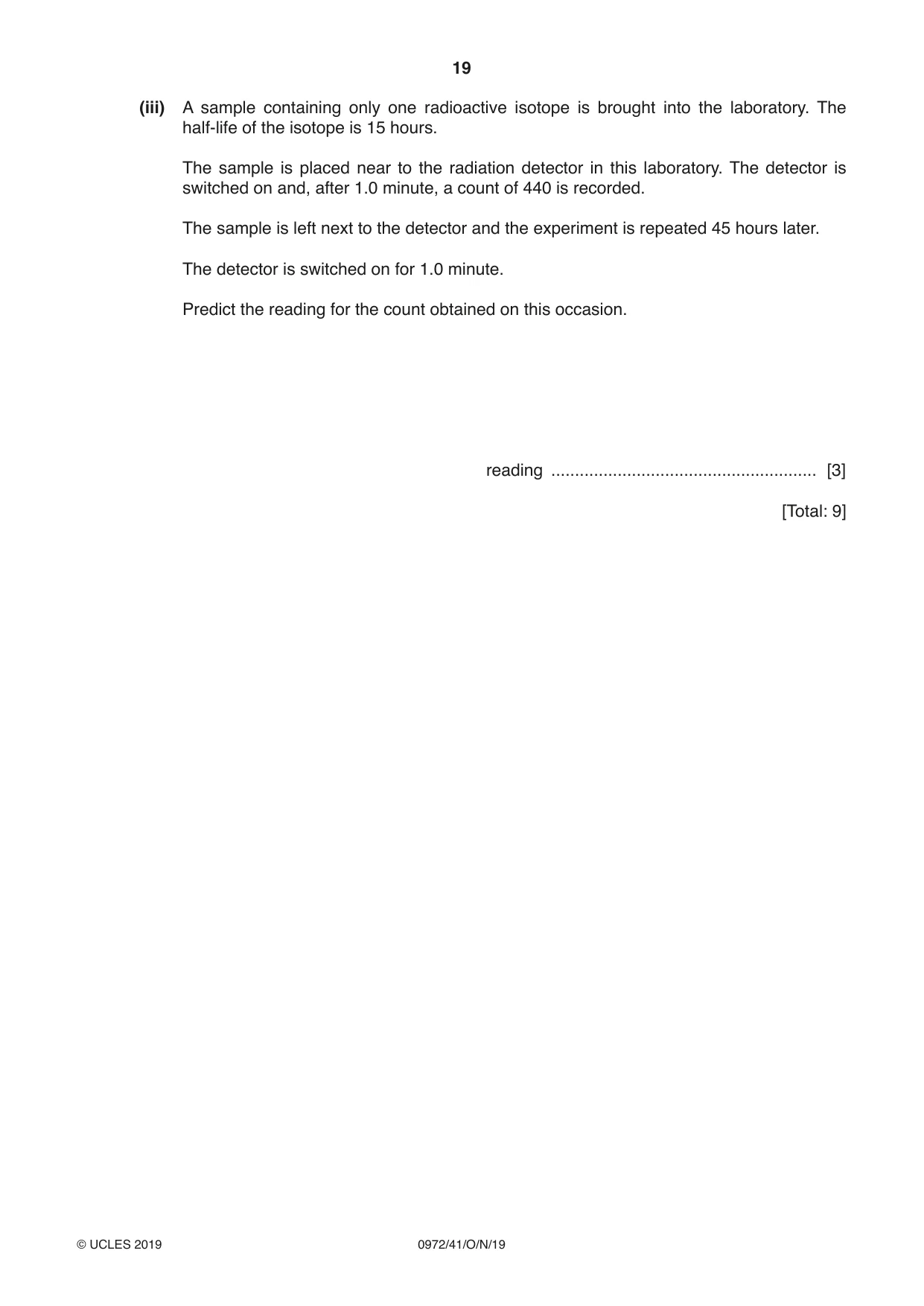
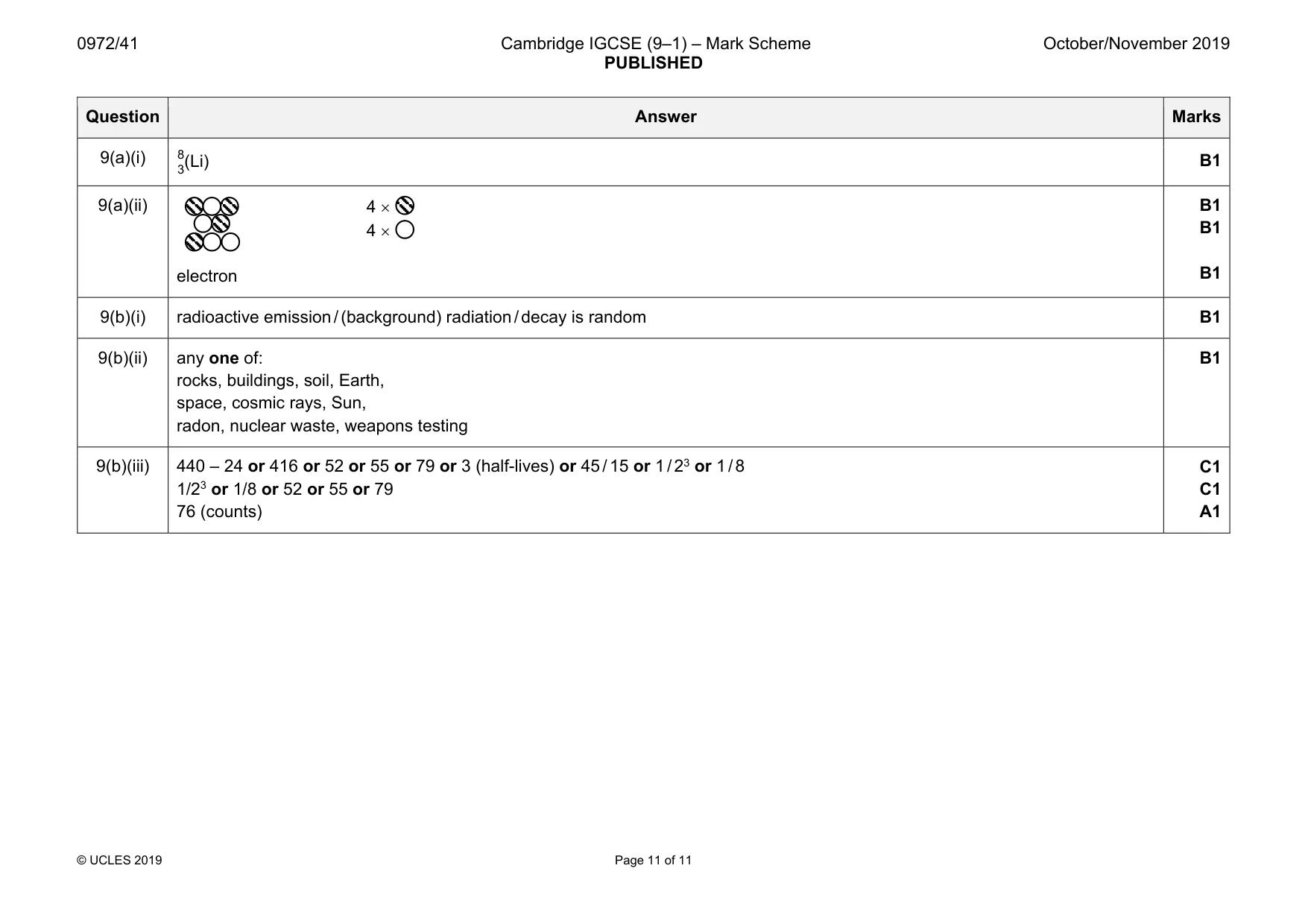
9 (a) The chemical symbol of the element lithium is Li. The proton number of lithium is 3. Fig. 9.1 is a representation of a nucleus of a radioactive isotope of lithium that is about to decay. Fig. 9.1 (i) Write down, using nuclide notation, the symbol that represents this isotope of lithium. ..................................................................................................................................... [1] (ii) This isotope of lithium decays by β-particle emission to form another nucleus. Complete Fig. 9.2 to represent this decay by: • using the same representation as in Fig. 9.1 and in the space after the arrow, draw a diagram of the nucleus formed by the decay • writing the name of the particle that is identical to a β-particle on the answer line provided. + ............................................. Fig. 9.2 [3] (b) A radiation detector is set up in a laboratory where there are no radioactive samples. On six separate occasions, the detector is switched on for 1.0 minute and the background count is recorded. The counts are: 23 27 25 24 20 25 (i) State why the readings are not all identical. ..................................................................................................................................... [1] (ii) Suggest a possible source for this background radiation. ..................................................................................................................................... [1] (iii) A sample containing only one radioactive isotope is brought into the laboratory. The half-life of the isotope is 15 hours. The sample is placed near to the radiation detector in this laboratory. The detector is switched on and, after 1.0 minute, a count of 440 is recorded. The sample is left next to the detector and the experiment is repeated 45 hours later. The detector is switched on for 1.0 minute. Predict the reading for the count obtained on this occasion. reading ........................................................ [3] [Total: 9]
Mark scheme: 9(a)(i) (Li) 3 B1 9(a)(ii) 4 × 4 × electron B1 B1 B1 9(b)(i) radioactive emission / (background) radiation / decay is random B1 9(b)(ii) any one of: rocks, buildings, soil, Earth, space, cosmic rays, Sun, radon, nuclear waste, weapons testing B1 9(b)(iii) 440 – 24 or 416 or 52 or 55 or 79 or 3 (half-lives) or 45 / 15 or 1 / 23 or 1 / 8 1/23 or 1/8 or 52 or 55 or 79 76 (counts) C1 C1 A1
What was in this paper
The subtopics covered by these 9 questions, and how many questions each got. Open one in a new tab to see every Cambridge question on it.
What you needed in this session
Cambridge’s own grade thresholds for 2019 Oct/Nov, Paper 4 · Variant 1. A higher threshold means an easier paper — the bar moves with how the cohort did.