Cambridge IGCSE Physics (9-1) 0972 — 2019 May/June Paper 4 · Variant 1
0972/41/M/J/19 · 9 questions · 80 marks · ≈90 min
The question paper and its mark scheme, free to read here and free to download. This is Cambridge’s own paper, exactly as it was sat.
Question paper20 pages

Mark scheme12 pages
Answers below. Sit the paper first if you are practising.
Questions as text
Q1 · A rocket is stationary on the launchpad
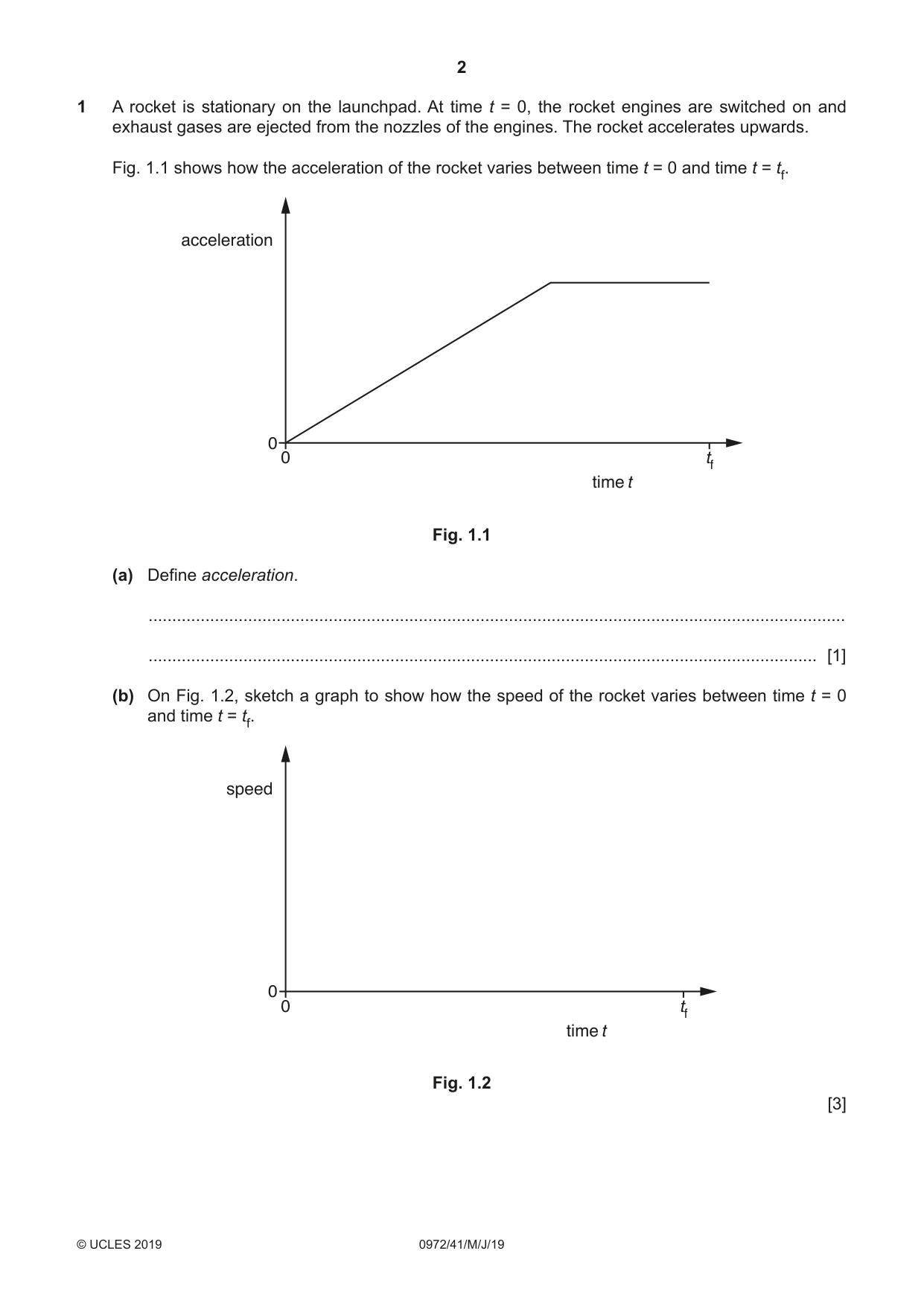
1 A rocket is stationary on the launchpad. At time t = 0, the rocket engines are switched on and exhaust gases are ejected from the nozzles of the engines. The rocket accelerates upwards. Fig. 1.1 shows how the acceleration of the rocket varies between time t = 0 and time t = tf. acceleration 0 0 tf time t Fig. 1.1 (a) Define acceleration. ................................................................................................................................................... ............................................................................................................................................. [1] (b) On Fig. 1.2, sketch a graph to show how the speed of the rocket varies between time t = 0 and time t = tf. speed 0 0 tf time t Fig. 1.2 [3] (c) Some time later, the rocket is far from the Earth. The effect of the Earth’s gravity on the motion of the rocket is insignificant. As the rocket accelerates, its momentum increases. (i) State the principle of the conservation of momentum. ........................................................................................................................................... ........................................................................................................................................... ..................................................................................................................................... [2] (ii) Explain how the principle of the conservation of momentum applies to the accelerating rocket and the exhaust gases. ........................................................................................................................................... ........................................................................................................................................... ........................................................................................................................................... ..................................................................................................................................... [2] [Total: 8]
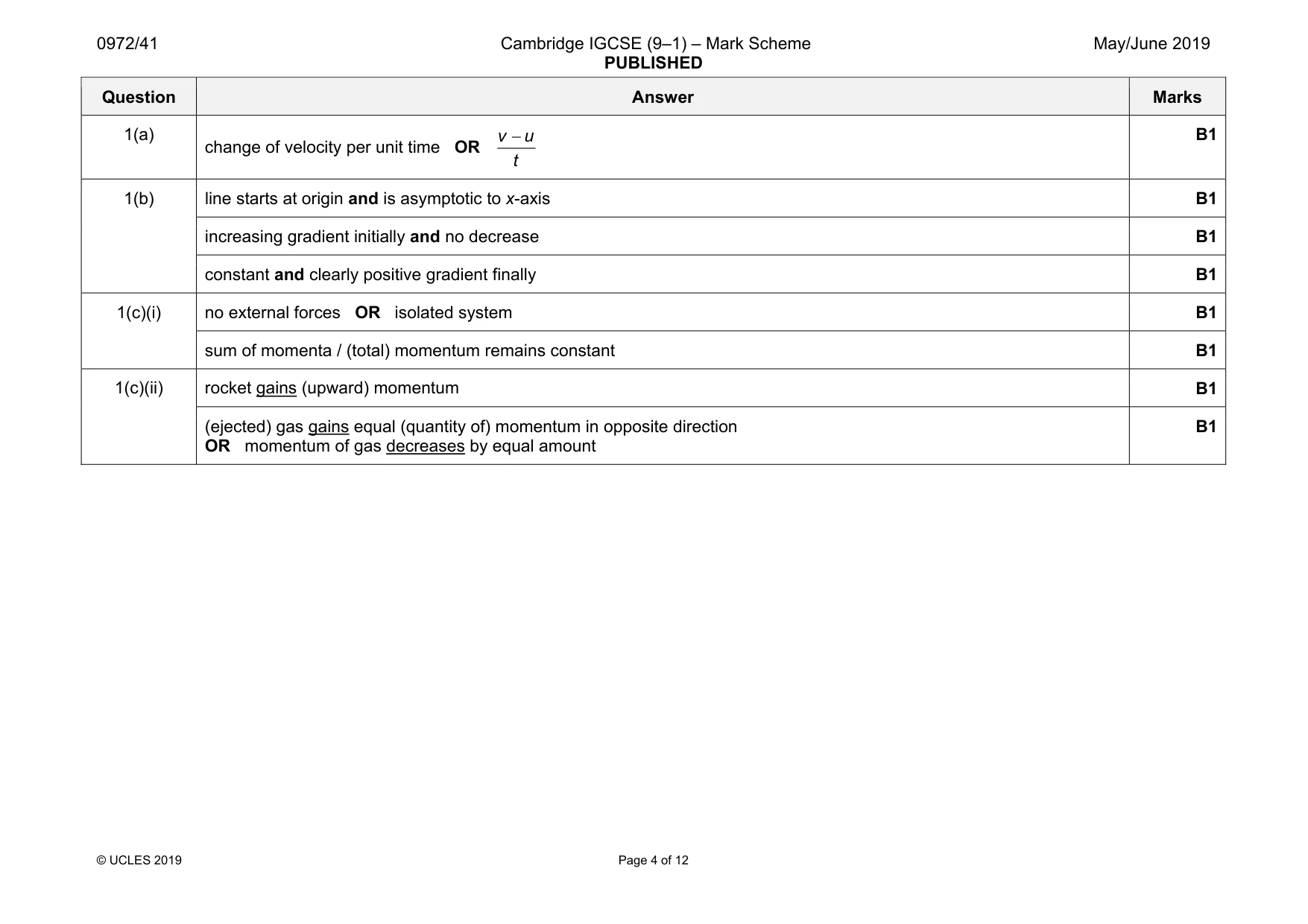
Mark scheme: 1(a) change of velocity per unit time OR v u t B1 1(b) line starts at origin and is asymptotic to x-axis B1 increasing gradient initially and no decrease B1 constant and clearly positive gradient finally B1 1(c)(i) no external forces OR isolated system B1 sum of momenta / (total) momentum remains constant B1 1(c)(ii) rocket gains (upward) momentum B1 (ejected) gas gains equal (quantity of) momentum in opposite direction OR momentum of gas decreases by equal amount B1
Q2 · A sign that extends over a road
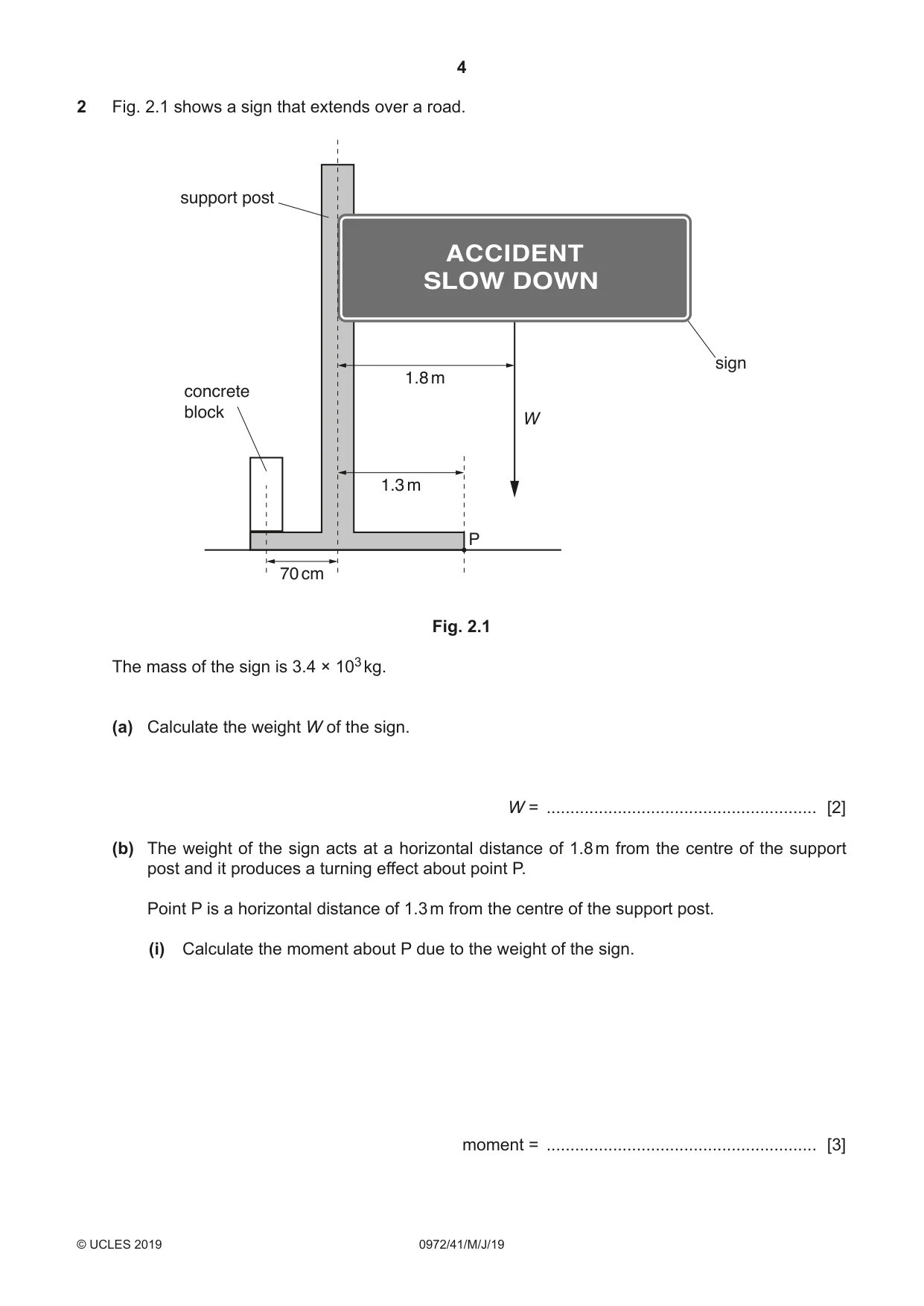
2 Fig. 2.1 shows a sign that extends over a road. support post ACCIDENT SLOW DOWN sign 1.8 m concrete block W 1.3 m P 70 cm Fig. 2.1 The mass of the sign is 3.4 × 10³ kg. (a) Calculate the weight W of the sign. W = ......................................................... [2] (b) The weight of the sign acts at a horizontal distance of 1.8 m from the centre of the support post and it produces a turning effect about point P. Point P is a horizontal distance of 1.3 m from the centre of the support post. (i) Calculate the moment about P due to the weight of the sign. moment = ......................................................... [3] (ii) A concrete block is positioned on the other side of the support post with its centre of mass a horizontal distance of 70 cm from the centre of the support post. 1. State what is meant by centre of mass. .................................................................................................................................... .............................................................................................................................. [1] 2. The weight of the concrete block produces a moment about point P that exactly cancels the moment caused by the weight W. Calculate the weight of the concrete block. weight = ......................................................... [2] (c) The concrete block is removed. The sign and support post rotate about point P in a clockwise direction. State and explain what happens to the moment about point P due to the weight of the sign as it rotates. ................................................................................................................................................... ................................................................................................................................................... ............................................................................................................................................. [2] [Total: 10]
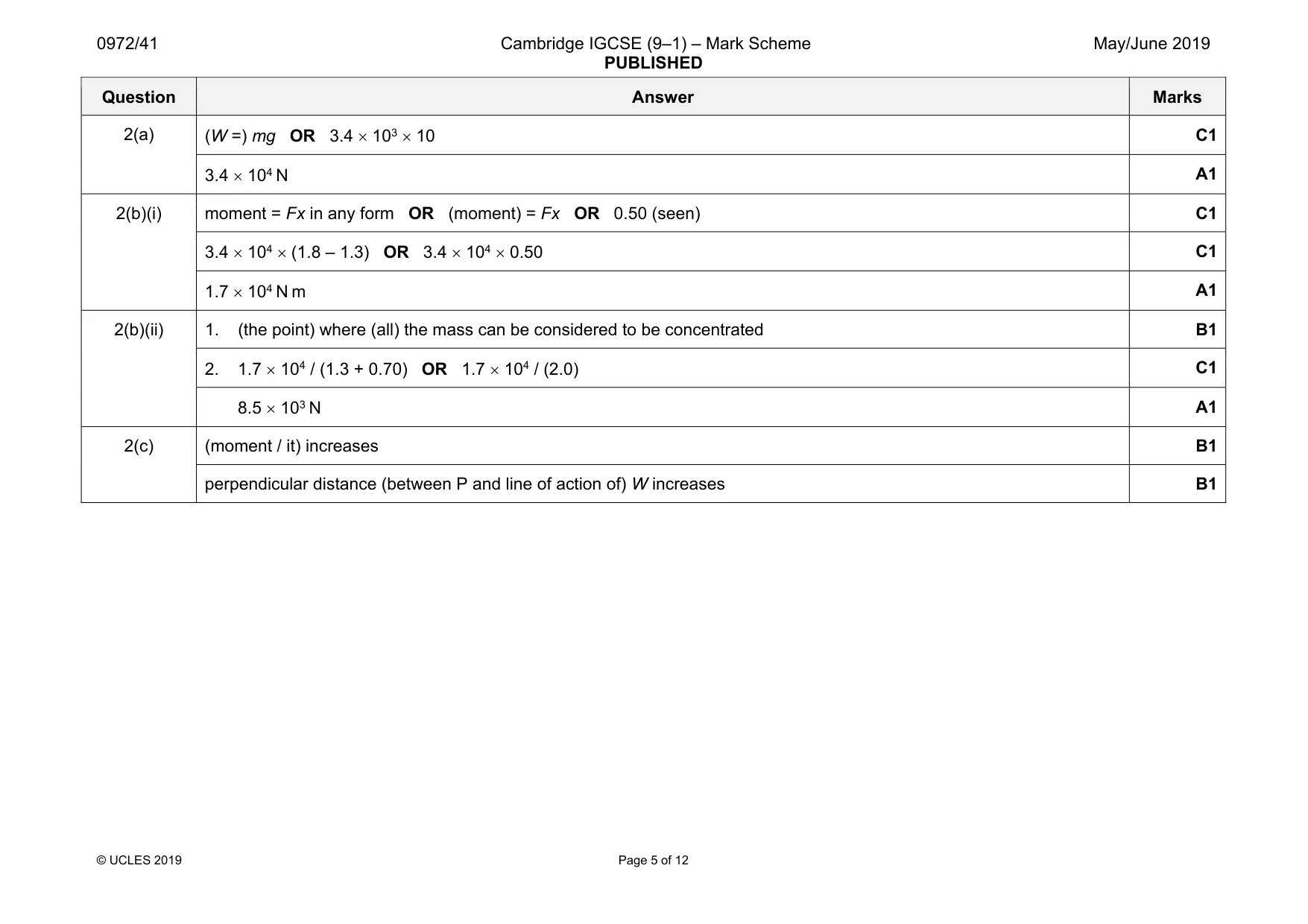
Mark scheme: 2(a) C1 3.4 × 10⁴ N A1 2(b)(i) moment = Fx in any form OR (moment) = Fx OR 0.50 (seen) C1 3.4 × 104 × (1.8 – 1.3) OR 3.4 × 104 × 0.50 C1 1.7 × 10⁴ N m A1 2(b)(ii) 1. (the point) where (all) the mass can be considered to be concentrated B1 2. 1.7 × 10⁴ / (1.3 + 0.70) OR 1.7 × 10⁴ / (2.0) C1 8.5 × 10³ N A1 2(c) (moment / it) increases B1 perpendicular distance (between P and line of action of) W increases B1
Q3 · A cube of side 0.040 m is floating in a container of liquid
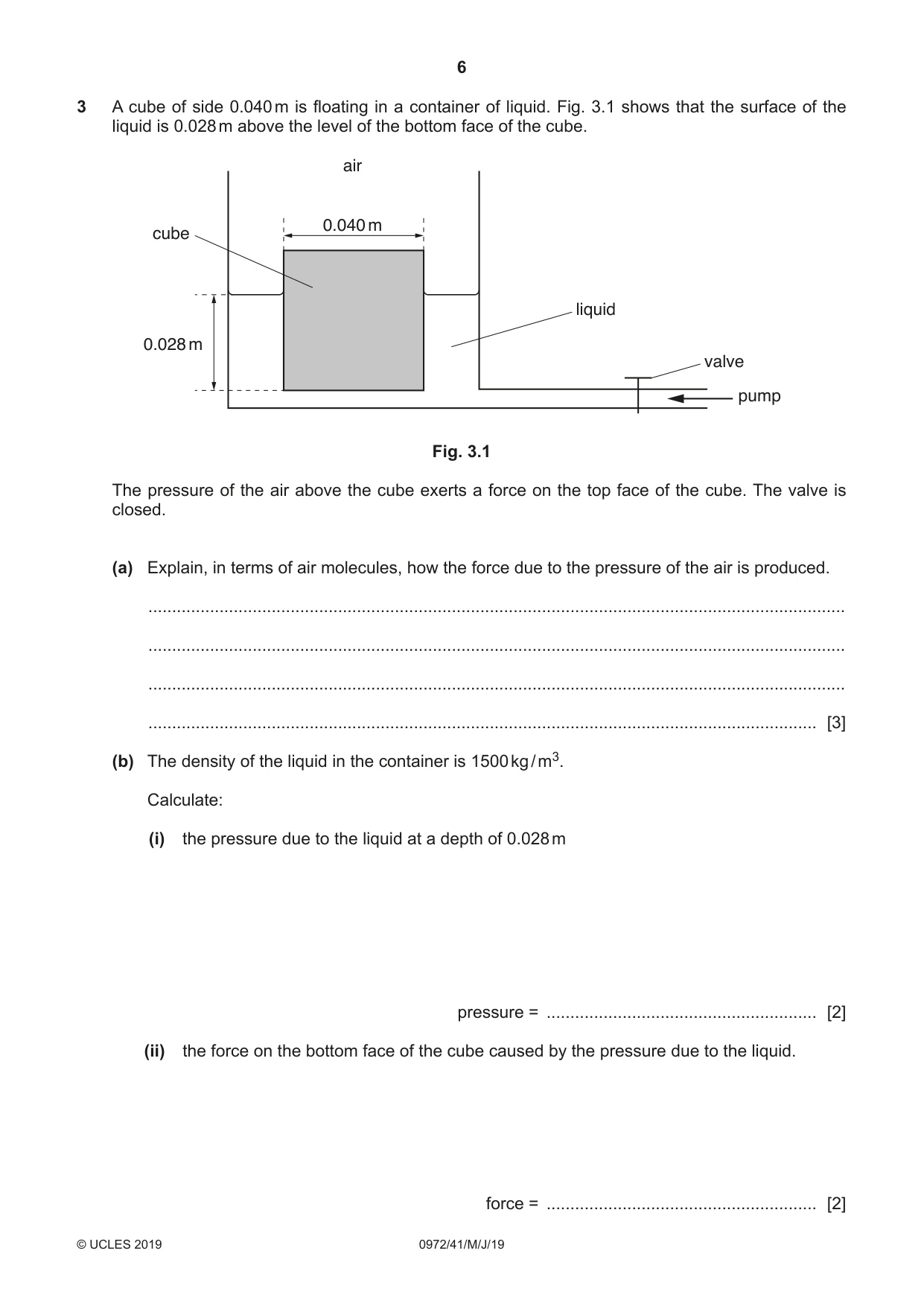
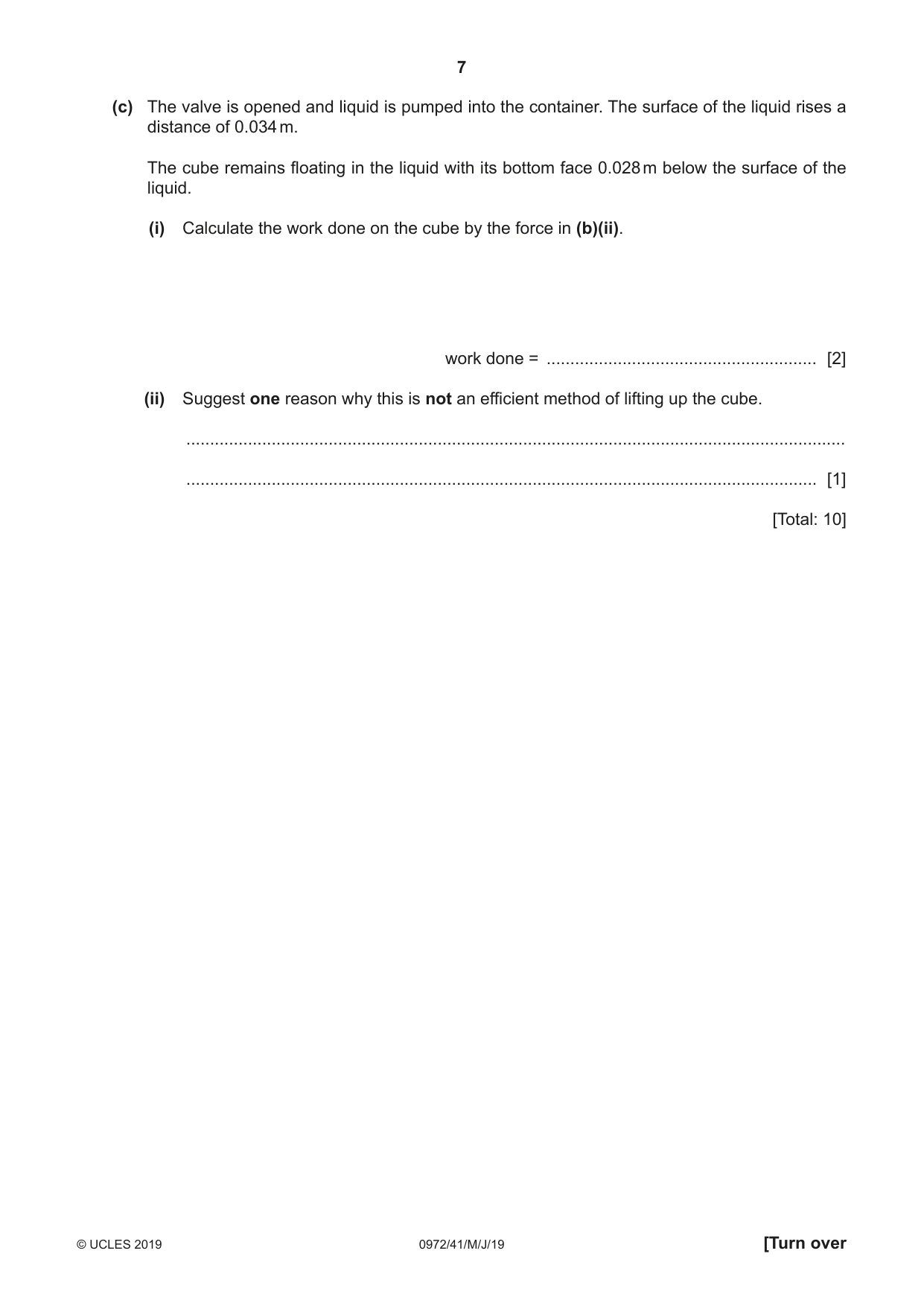
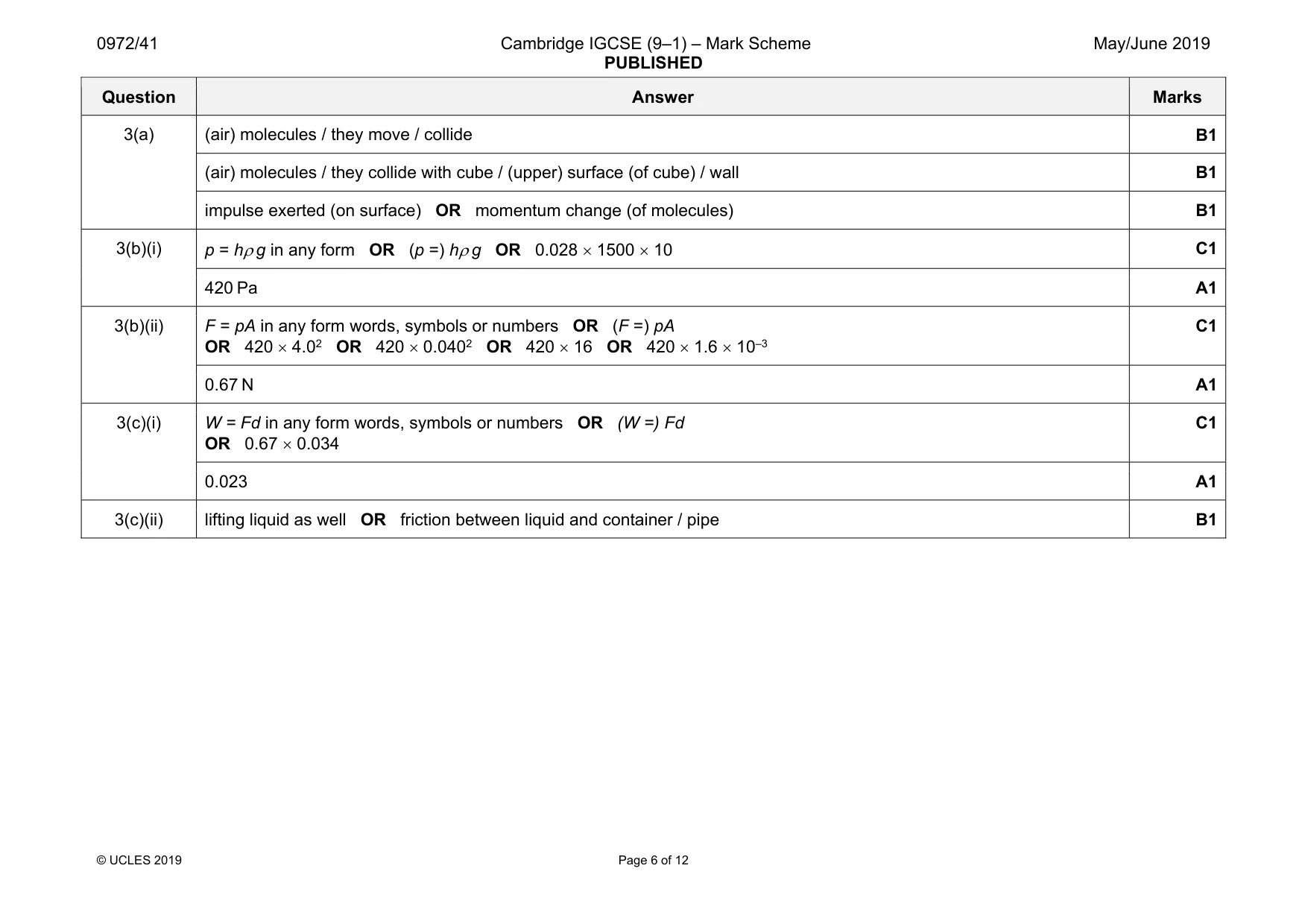
3 A cube of side 0.040 m is floating in a container of liquid. Fig. 3.1 shows that the surface of the liquid is 0.028 m above the level of the bottom face of the cube. air 0.040 m cube liquid 0.028 m valve pump Fig. 3.1 The pressure of the air above the cube exerts a force on the top face of the cube. The valve is closed. (a) Explain, in terms of air molecules, how the force due to the pressure of the air is produced. ................................................................................................................................................... ................................................................................................................................................... ................................................................................................................................................... ............................................................................................................................................. [3] (b) The density of the liquid in the container is 1500 kg / m3. Calculate: (i) the pressure due to the liquid at a depth of 0.028 m pressure = ......................................................... [2] (ii) the force on the bottom face of the cube caused by the pressure due to the liquid. force = ......................................................... [2] (c) The valve is opened and liquid is pumped into the container. The surface of the liquid rises a distance of 0.034 m. The cube remains floating in the liquid with its bottom face 0.028 m below the surface of the liquid. (i) Calculate the work done on the cube by the force in (b)(ii). work done = ......................................................... [2] (ii) Suggest one reason why this is not an efficient method of lifting up the cube. ........................................................................................................................................... ..................................................................................................................................... [1] [Total: 10]
Mark scheme: 3(a) (air) molecules / they move / collide B1 (air) molecules / they collide with cube / (upper) surface (of cube) / wall B1 impulse exerted (on surface) OR momentum change (of molecules) B1 3(b)(i) p = hρ g in any form OR (p =) hρ g OR 0.028 × 1500 × 10 C1 420 Pa A1 3(b)(ii) F = pA in any form words, symbols or numbers OR (F =) pA OR 420 × 4.02 OR 420 × 0.0402 OR 420 × 16 OR 420 × 1.6 × 10–3 C1 0.67 N A1 3(c)(i) W = Fd in any form words, symbols or numbers OR (W =) Fd OR 0.67 × 0.034 C1 0.023 A1 3(c)(ii) lifting liquid as well OR friction between liquid and container / pipe B1
Q4 · Gas of mass 0.23 g is trapped in a cylinder by a piston
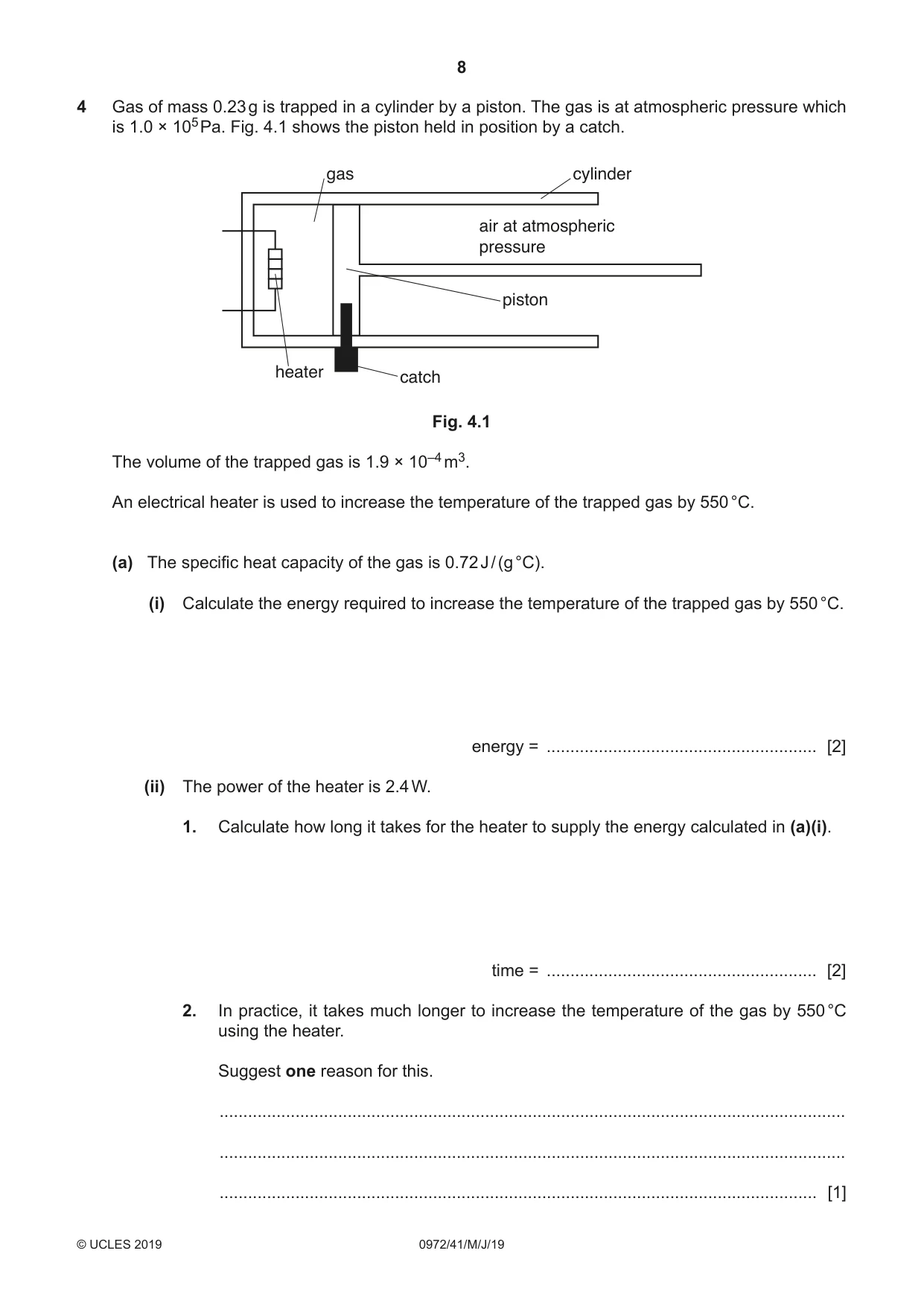
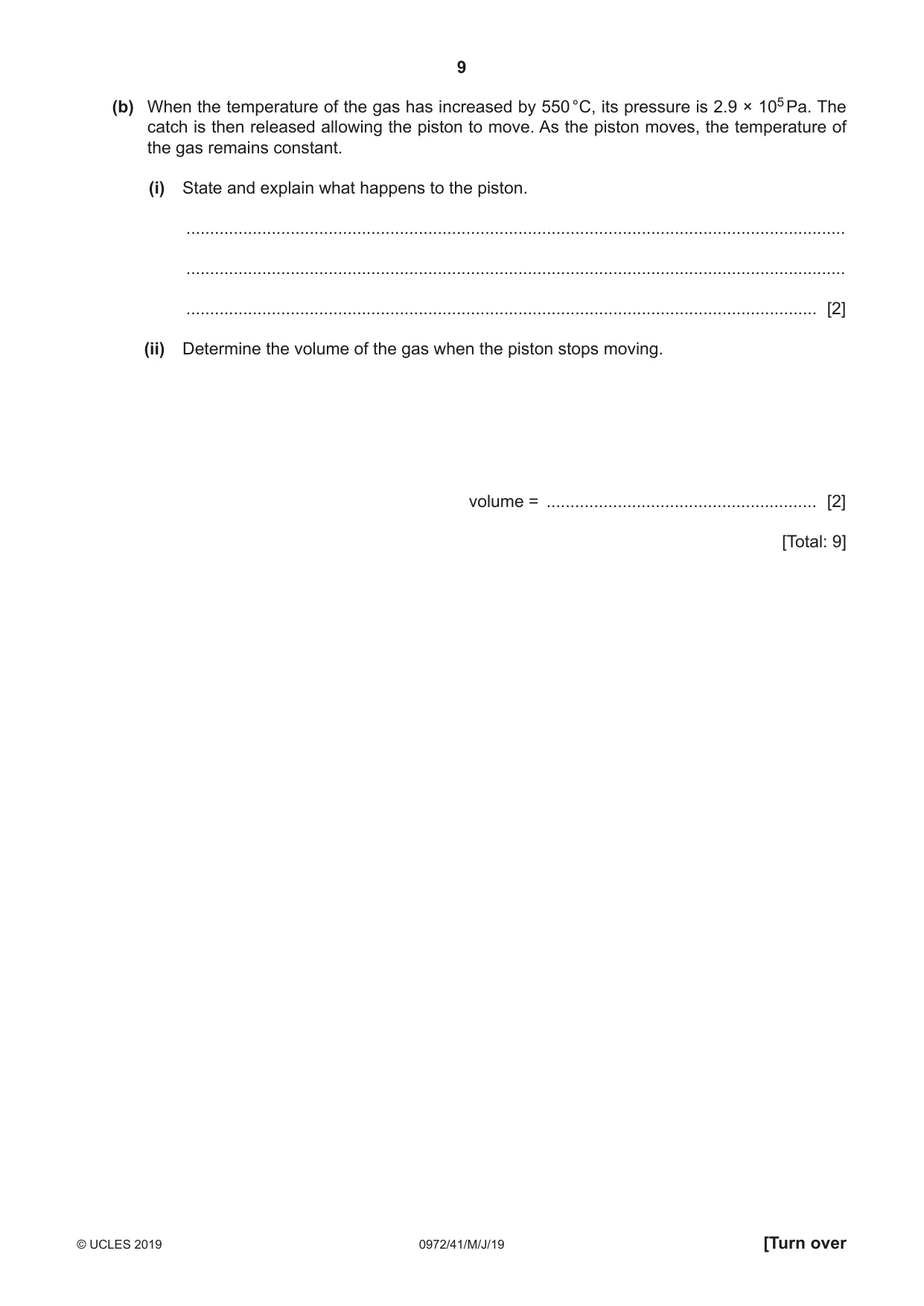
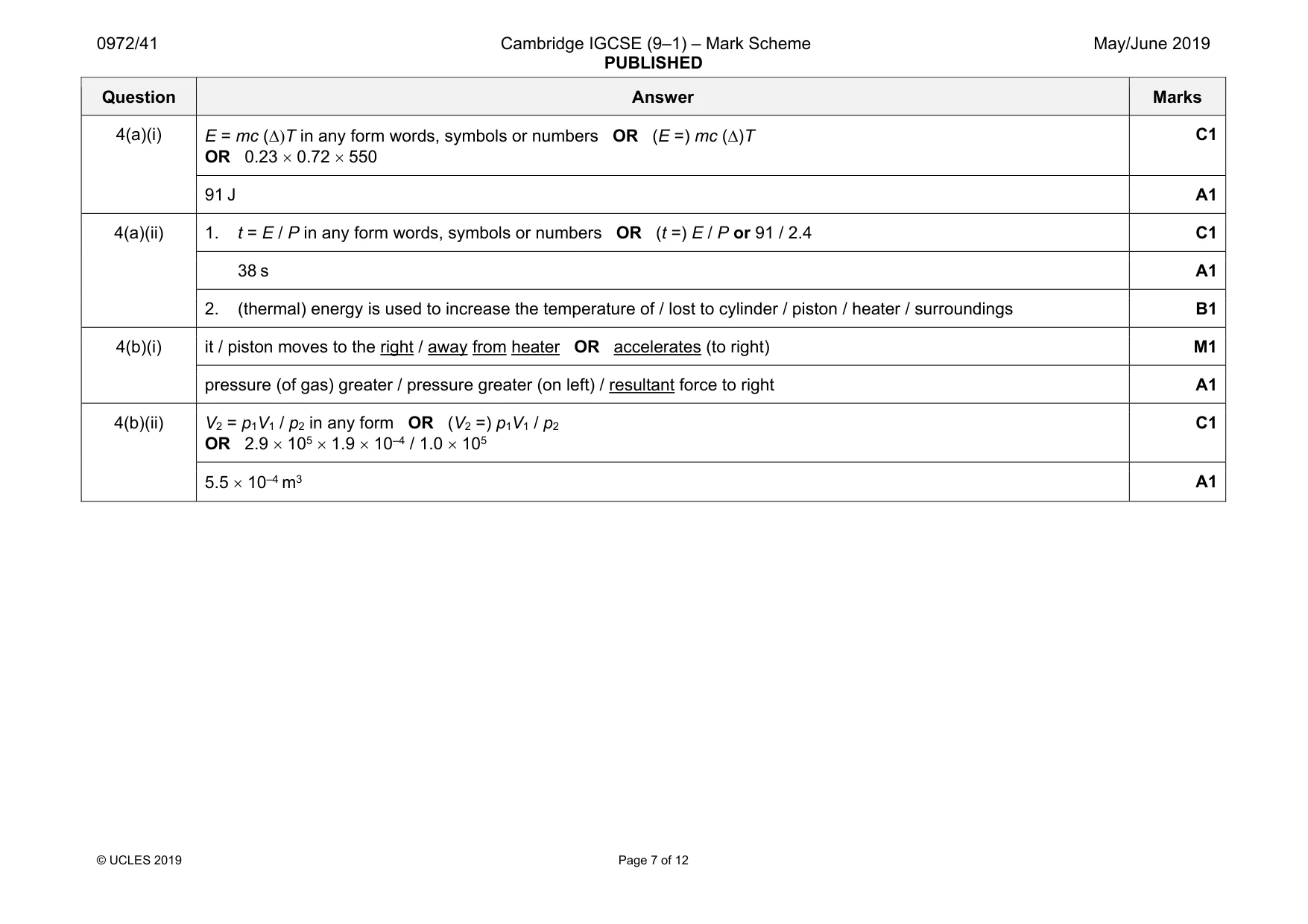
4 Gas of mass 0.23 g is trapped in a cylinder by a piston. The gas is at atmospheric pressure which is 1.0 × 10⁵ Pa. Fig. 4.1 shows the piston held in position by a catch. gas cylinder air at atmospheric pressure piston heater catch Fig. 4.1 The volume of the trapped gas is 1.9 × 10⁻⁴ m3. An electrical heater is used to increase the temperature of the trapped gas by 550 °C. (a) The specific heat capacity of the gas is 0.72 J / (g °C). (i) Calculate the energy required to increase the temperature of the trapped gas by 550 °C. energy = ......................................................... [2] (ii) The power of the heater is 2.4 W. 1. Calculate how long it takes for the heater to supply the energy calculated in (a)(i). time = ......................................................... [2] 2. In practice, it takes much longer to increase the temperature of the gas by 550 °C using the heater. Suggest one reason for this. .................................................................................................................................... .................................................................................................................................... .............................................................................................................................. [1] (b) When the temperature of the gas has increased by 550 °C, its pressure is 2.9 × 10⁵ Pa. The catch is then released allowing the piston to move. As the piston moves, the temperature of the gas remains constant. (i) State and explain what happens to the piston. ........................................................................................................................................... ........................................................................................................................................... ..................................................................................................................................... [2] (ii) Determine the volume of the gas when the piston stops moving. volume = ......................................................... [2] [Total: 9]
Mark scheme: 4(a)(i) OR 0.23 × 0.72 × 550 C1 91 J A1 4(a)(ii) 1. t = E / P in any form words, symbols or numbers OR (t =) E / P or 91 / 2.4 C1 38 s A1 2. (thermal) energy is used to increase the temperature of / lost to cylinder / piston / heater / surroundings B1 4(b)(i) it / piston moves to the right / away from heater OR accelerates (to right) M1 pressure (of gas) greater / pressure greater (on left) / resultant force to right A1 4(b)(ii) V2 = p1V1 / p2 in any form OR (V2 =) p1V1 / p2 OR 2.9 × 105 × 1.9 × 10–4 / 1.0 × 10⁵ C1 5.5 × 10⁻⁴ m3 A1
Q5 · Liquids and gases are two states of matter
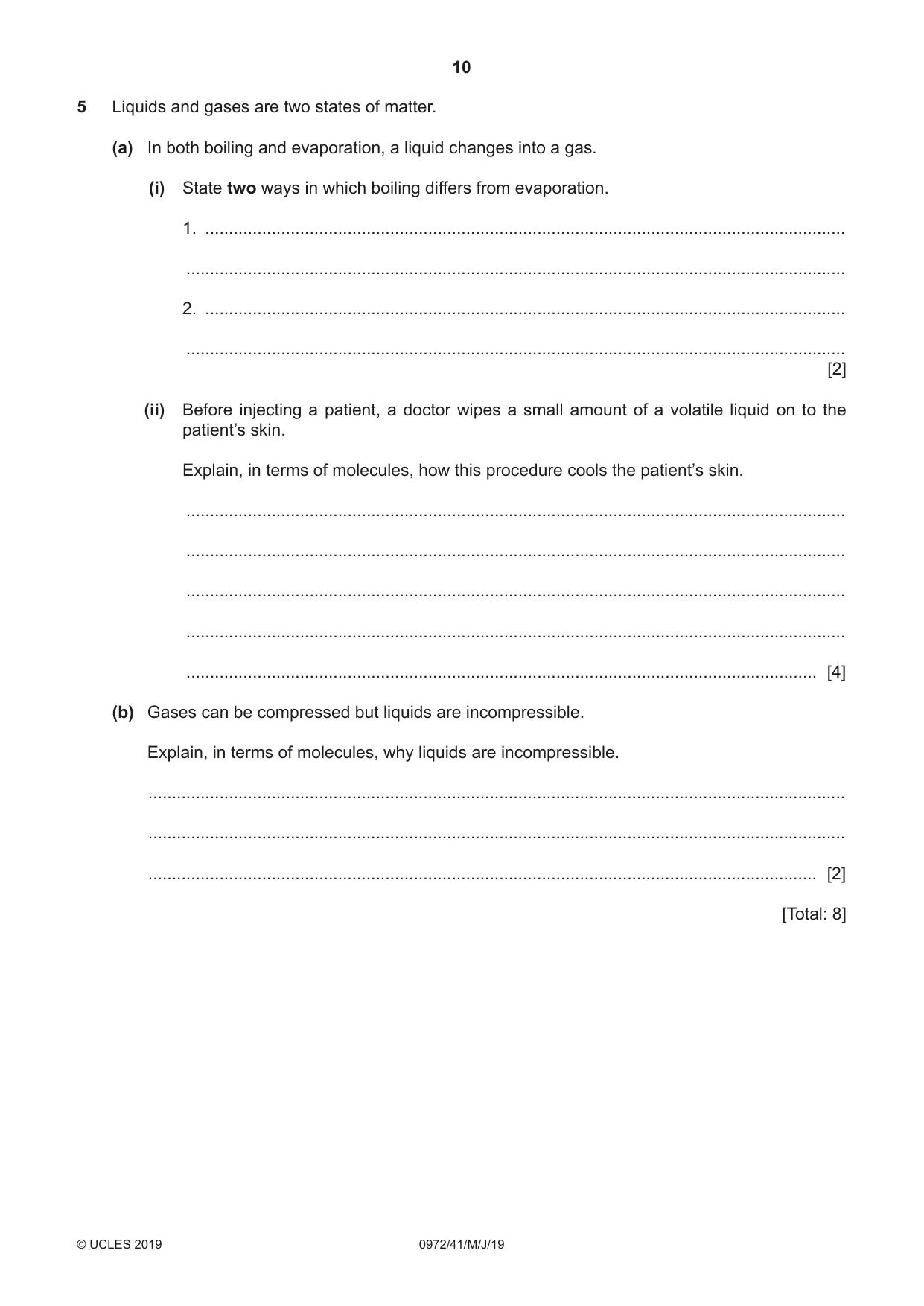
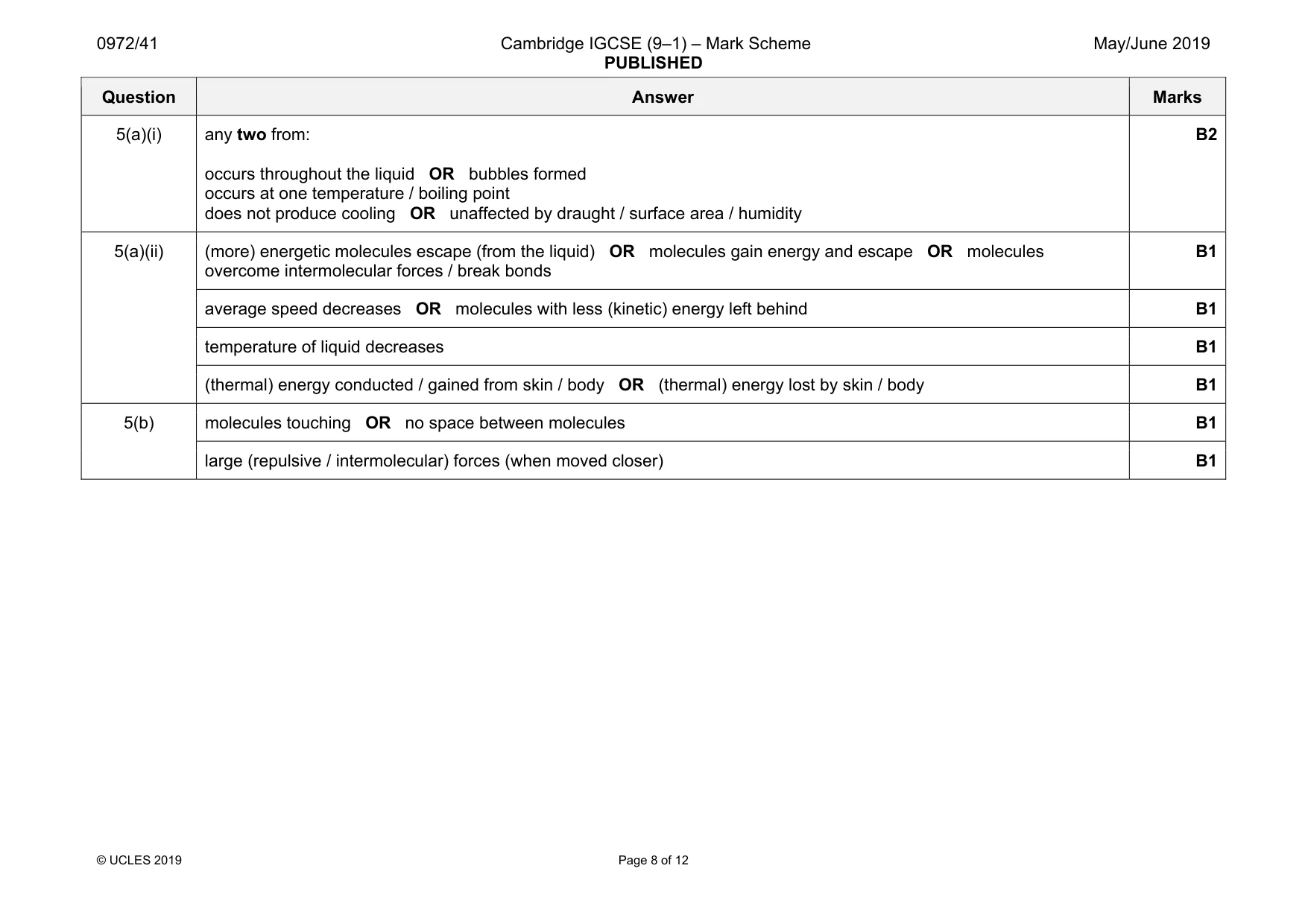
5 Liquids and gases are two states of matter. (a) In both boiling and evaporation, a liquid changes into a gas. (i) State two ways in which boiling differs from evaporation. 1. ....................................................................................................................................... ........................................................................................................................................... 2. ....................................................................................................................................... ........................................................................................................................................... [2] (ii) Before injecting a patient, a doctor wipes a small amount of a volatile liquid on to the patient’s skin. Explain, in terms of molecules, how this procedure cools the patient’s skin. ........................................................................................................................................... ........................................................................................................................................... ........................................................................................................................................... ........................................................................................................................................... ..................................................................................................................................... [4] (b) Gases can be compressed but liquids are incompressible. Explain, in terms of molecules, why liquids are incompressible. ................................................................................................................................................... ................................................................................................................................................... ............................................................................................................................................. [2] [Total: 8]
Mark scheme: 5(a)(i) any two from: occurs throughout the liquid OR bubbles formed occurs at one temperature / boiling point does not produce cooling OR unaffected by draught / surface area / humidity B2 5(a)(ii) (more) energetic molecules escape (from the liquid) OR molecules gain energy and escape OR molecules overcome intermolecular forces / break bonds B1 average speed decreases OR molecules with less (kinetic) energy left behind B1 temperature of liquid decreases B1 (thermal) energy conducted / gained from skin / body OR (thermal) energy lost by skin / body B1 5(b) molecules touching OR no space between molecules B1 large (repulsive / intermolecular) forces (when moved closer) B1
Q6 · Green light of frequency 5.7 × 10¹⁴ Hz is travelling in air at a speed of 3.0 × 10⁸ m / s
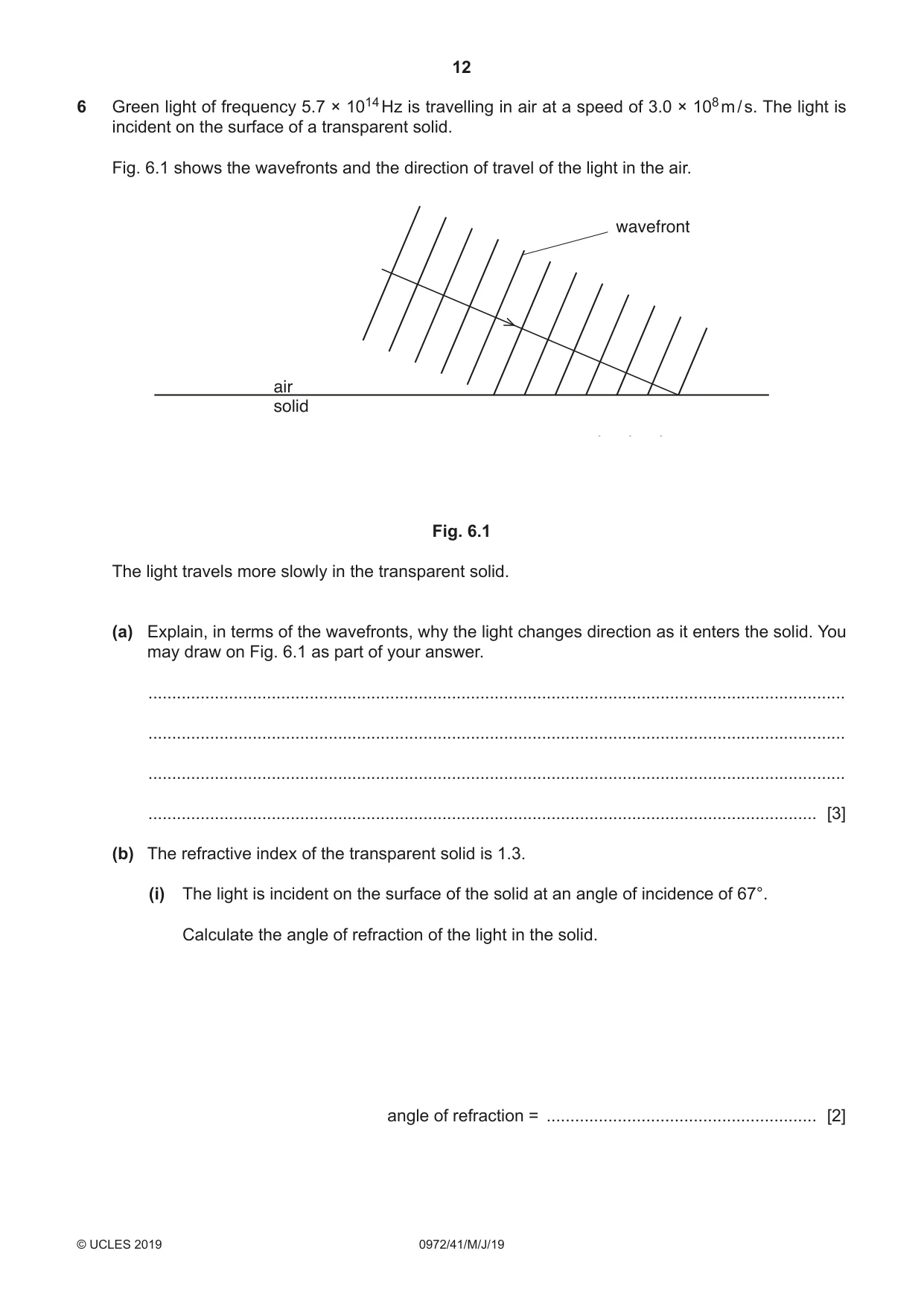
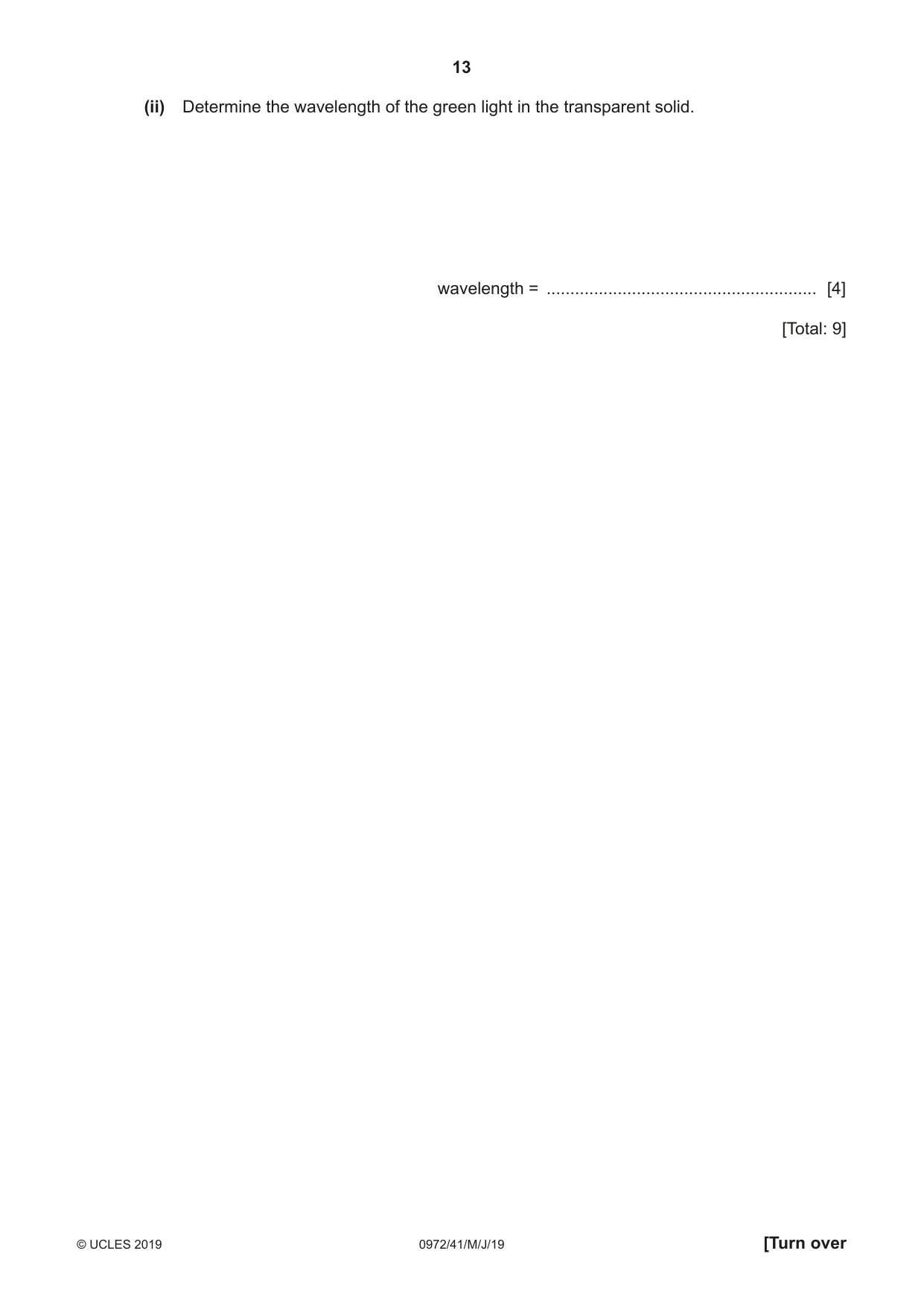
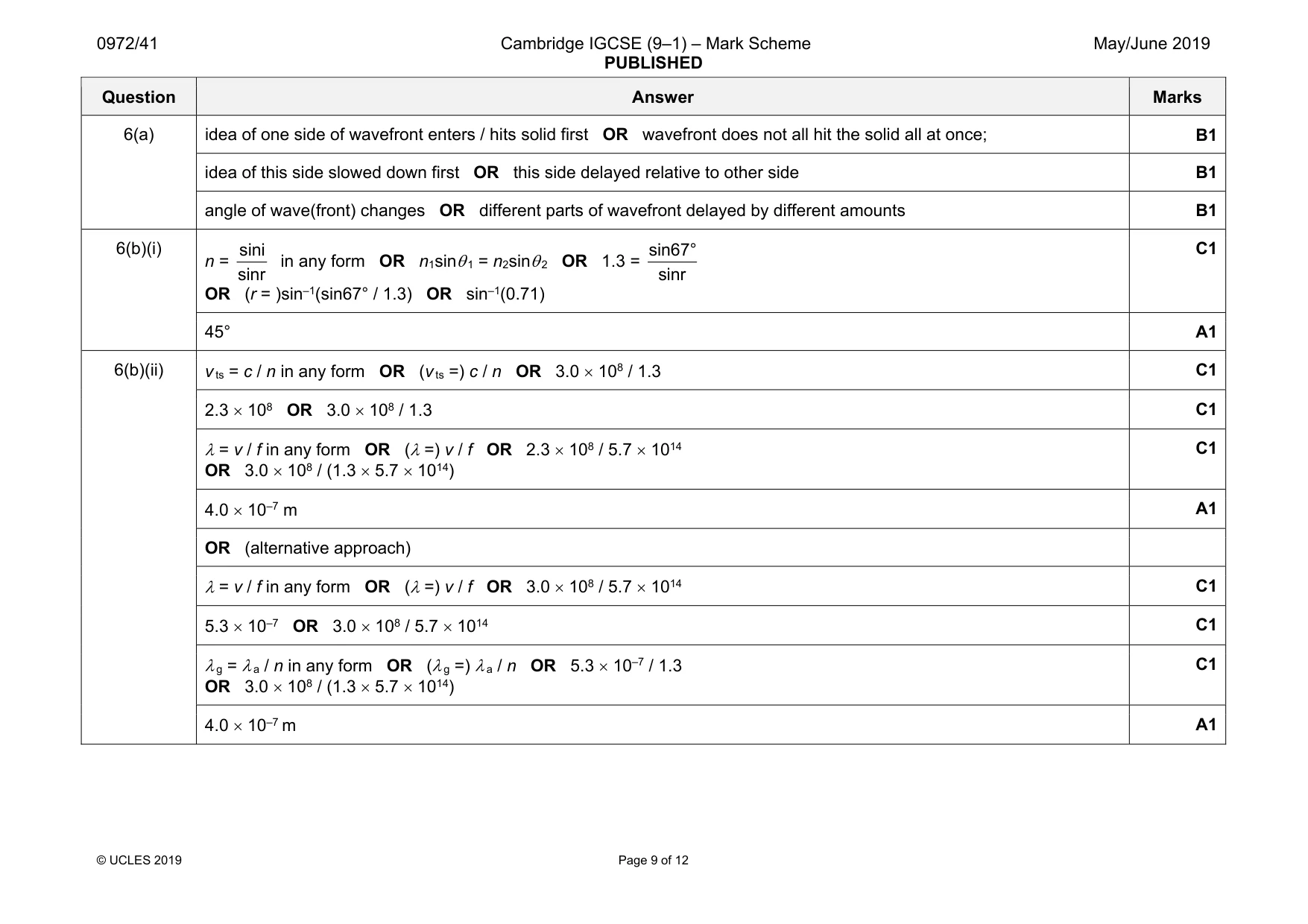
6 Green light of frequency 5.7 × 10¹⁴ Hz is travelling in air at a speed of 3.0 × 10⁸ m / s. The light is incident on the surface of a transparent solid. Fig. 6.1 shows the wavefronts and the direction of travel of the light in the air. wavefront air solid Fig. 6.1 The light travels more slowly in the transparent solid. (a) Explain, in terms of the wavefronts, why the light changes direction as it enters the solid. You may draw on Fig. 6.1 as part of your answer. ................................................................................................................................................... ................................................................................................................................................... ................................................................................................................................................... ............................................................................................................................................. [3] (b) The refractive index of the transparent solid is 1.3. (i) The light is incident on the surface of the solid at an angle of incidence of 67°. Calculate the angle of refraction of the light in the solid. angle of refraction = ......................................................... [2] (ii) Determine the wavelength of the green light in the transparent solid. wavelength = ......................................................... [4] [Total: 9]
Mark scheme: 6(a) idea of one side of wavefront enters / hits solid first OR wavefront does not all hit the solid all at once; B1 idea of this side slowed down first OR this side delayed relative to other side B1 angle of wave(front) changes OR different parts of wavefront delayed by different amounts B1 6(b)(i) n = sini sinr in any form OR n1sinθ 1 = n2sinθ 2 OR 1.3 = sin67° sinr OR (r = )sin–1(sin67° / 1.3) OR sin–1(0.71) C1 45° A1 6(b)(ii) v ts = c / n in any form OR (v ts =) c / n OR 3.0 × 10⁸ / 1.3 C1 2.3 × 10⁸ OR 3.0 × 10⁸ / 1.3 C1 λ = v / f in any form OR (λ =) v / f OR 2.3 × 10⁸ / 5.7 × 10¹⁴ OR 3.0 × 10⁸ / (1.3 × 5.7 × 1014) C1 4.0 × 10⁻⁷ m A1 OR (alternative approach) λ = v / f in any form OR (λ =) v / f OR 3.0 × 10⁸ / 5.7 × 10¹⁴ C1 5.3 × 10⁻⁷ OR 3.0 × 10⁸ / 5.7 × 10¹⁴ C1 λ g = λ a / n in any form OR (λ g =) λ a / n OR 5.3 × 10⁻⁷ / 1.3 OR 3.0 × 10⁸ / (1.3 × 5.7 × 1014) C1 4.0 × 10⁻⁷ m A1
Q7 · A circuit diagram that includes component X
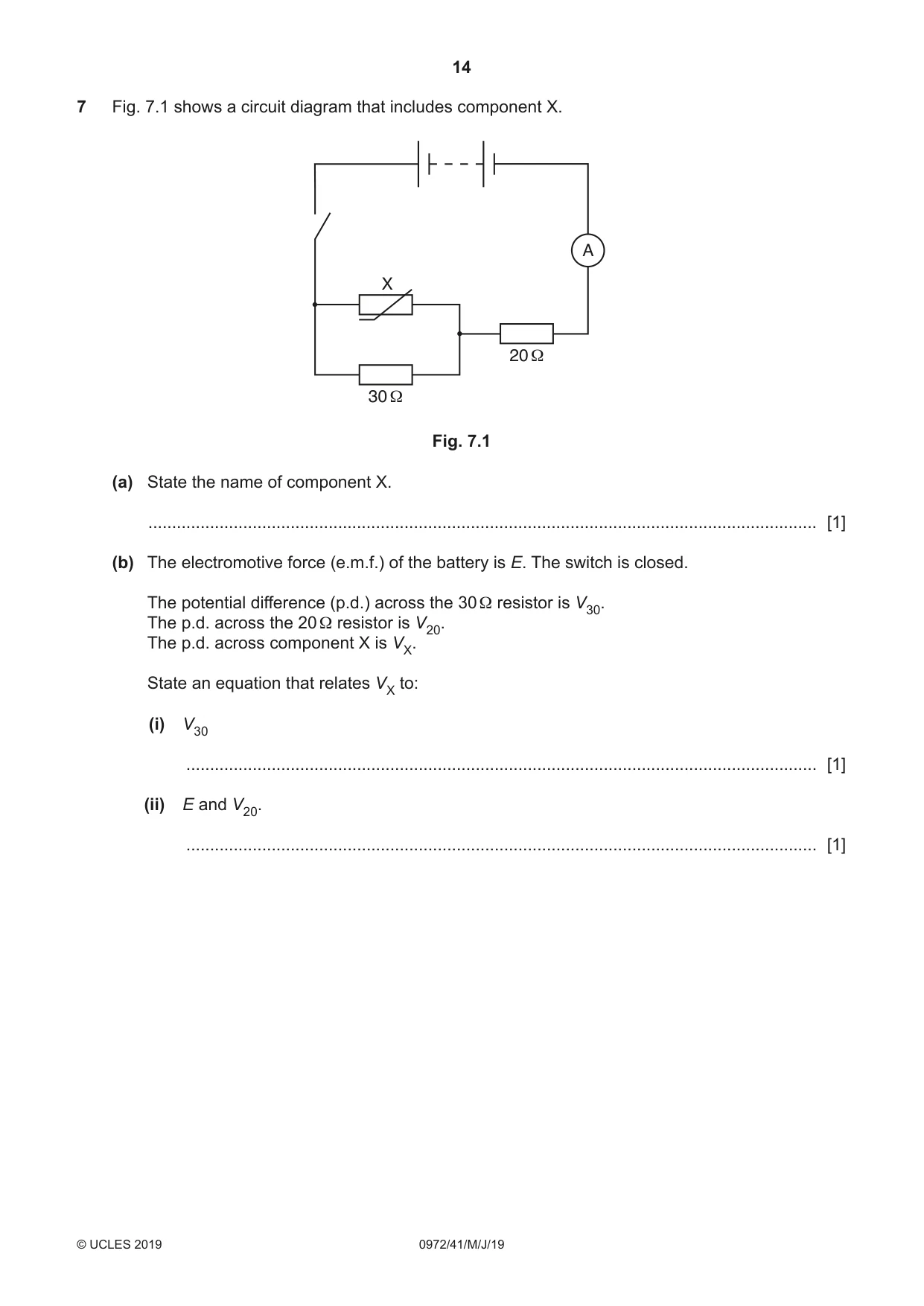
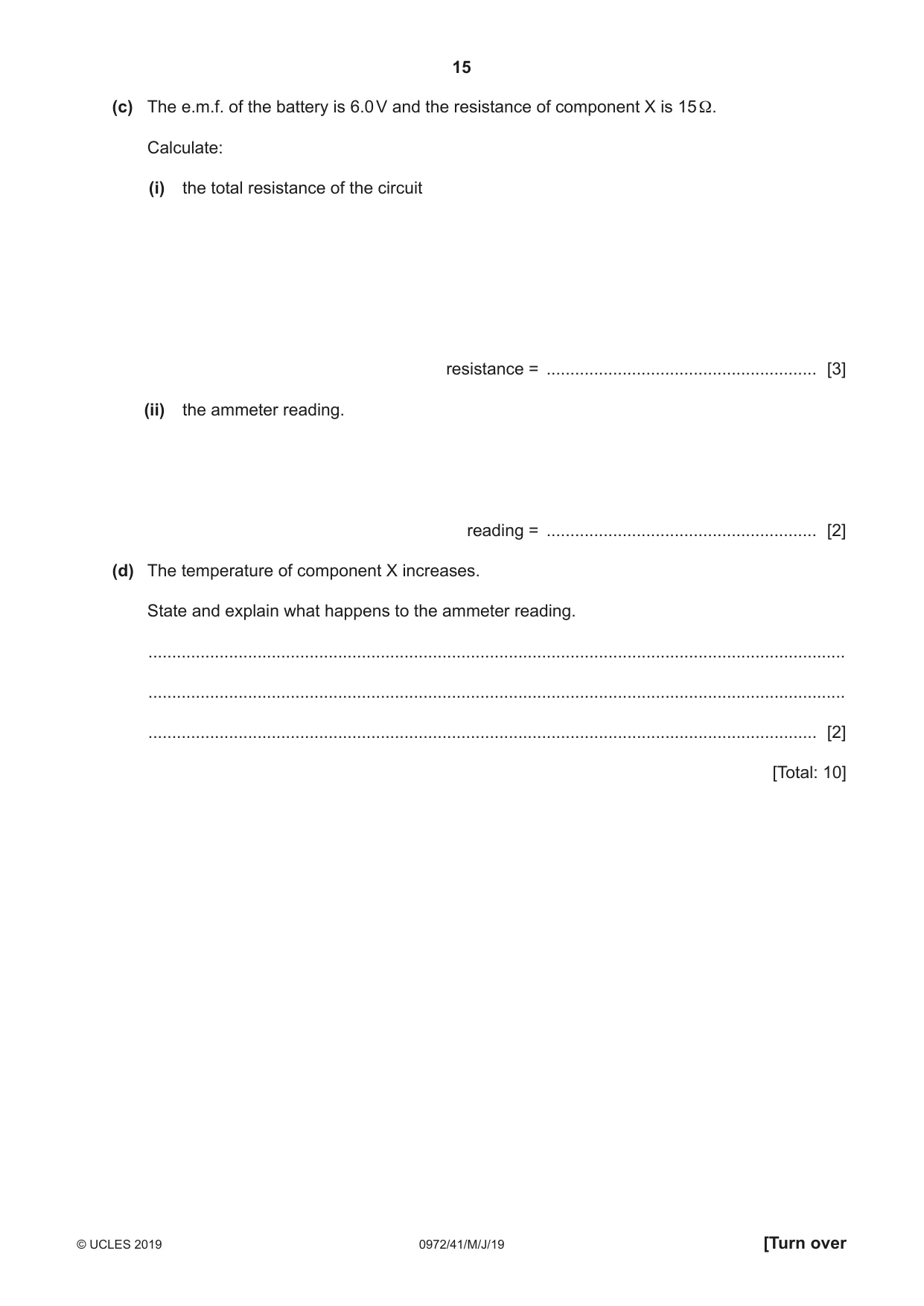
7 Fig. 7.1 shows a circuit diagram that includes component X. A X 20 Ω 30 Ω Fig. 7.1 (a) State the name of component X. ............................................................................................................................................. [1] (b) The electromotive force (e.m.f.) of the battery is E. The switch is closed. The potential difference (p.d.) across the 30 Ω resistor is V30. The p.d. across the 20 Ω resistor is V20. The p.d. across component X is VX. State an equation that relates VX to: (i) V30 ..................................................................................................................................... [1] (ii) E and V20. ..................................................................................................................................... [1] (c) The e.m.f. of the battery is 6.0 V and the resistance of component X is 15 Ω. Calculate: (i) the total resistance of the circuit resistance = ......................................................... [3] (ii) the ammeter reading. reading = ......................................................... [2] (d) The temperature of component X increases. State and explain what happens to the ammeter reading. ................................................................................................................................................... ................................................................................................................................................... ............................................................................................................................................. [2] [Total: 10]
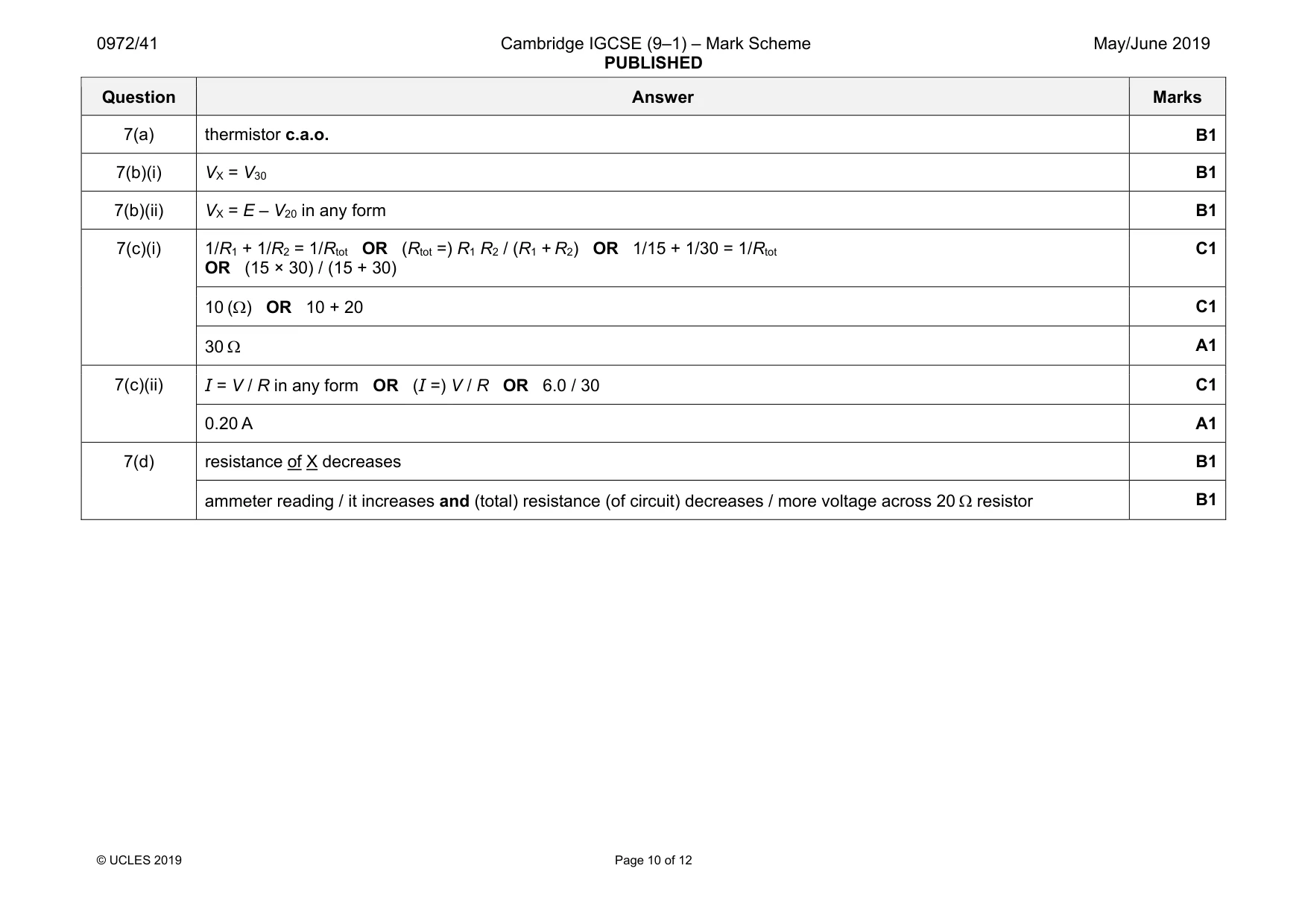
Mark scheme: 7(a) thermistor c.a.o. B1 7(b)(i) VX = V30 B1 7(b)(ii) VX = E – V20 in any form B1 7(c)(i) 1/R1 + 1/R2 = 1/Rtot OR (Rtot =) R1 R2 / (R1 + R2) OR 1/15 + 1/30 = 1/Rtot OR (15 × 30) / (15 + 30) C1 10 (Ω) OR 10 + 20 C1 30 Ω A1 7(c)(ii) I = V / R in any form OR (I =) V / R OR 6.0 / 30 C1 0.20 A A1 7(d) resistance of X decreases B1 ammeter reading / it increases and (total) resistance (of circuit) decreases / more voltage across 20 Ω resistor B1
Q8 · A student turns the handle of an alternating current (a.c.) generator and the coil rotates
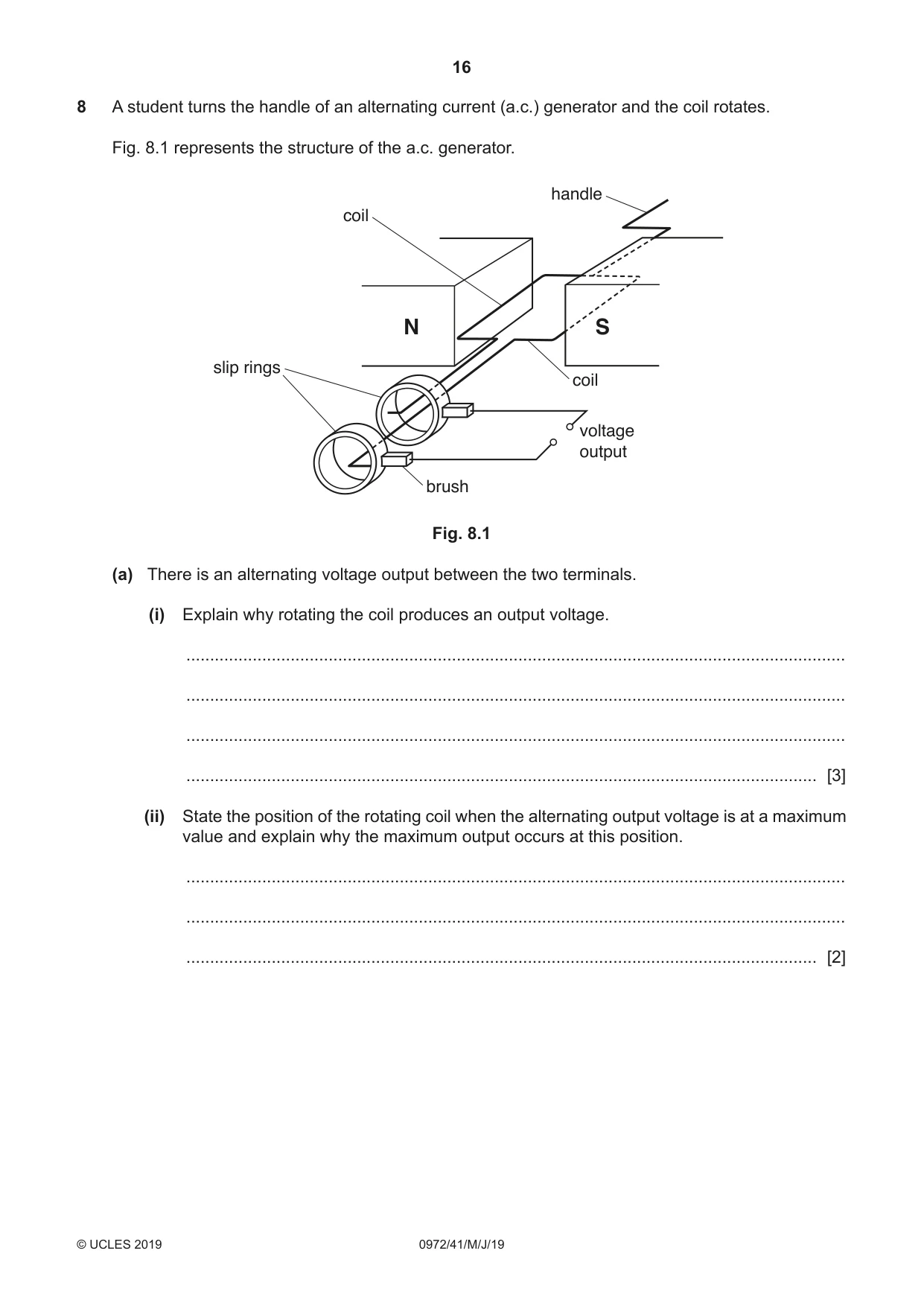
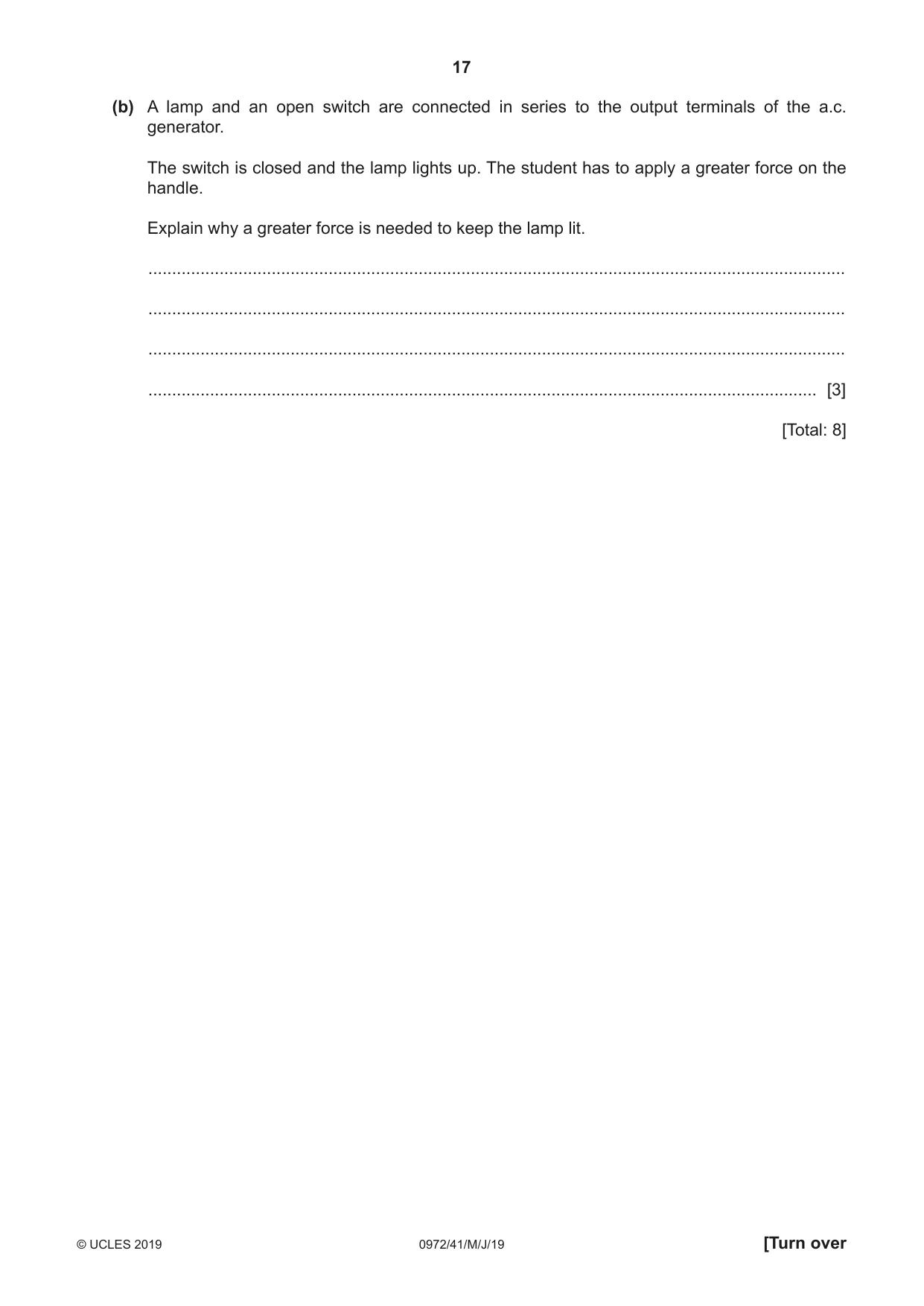
8 A student turns the handle of an alternating current (a.c.) generator and the coil rotates. Fig. 8.1 represents the structure of the a.c. generator. handle coil N S slip rings coil voltage output brush Fig. 8.1 (a) There is an alternating voltage output between the two terminals. (i) Explain why rotating the coil produces an output voltage. ........................................................................................................................................... ........................................................................................................................................... ........................................................................................................................................... ..................................................................................................................................... [3] (ii) State the position of the rotating coil when the alternating output voltage is at a maximum value and explain why the maximum output occurs at this position. ........................................................................................................................................... ........................................................................................................................................... ..................................................................................................................................... [2] (b) A lamp and an open switch are connected in series to the output terminals of the a.c. generator. The switch is closed and the lamp lights up. The student has to apply a greater force on the handle. Explain why a greater force is needed to keep the lamp lit. ................................................................................................................................................... ................................................................................................................................................... ................................................................................................................................................... ............................................................................................................................................. [3] [Total: 8]
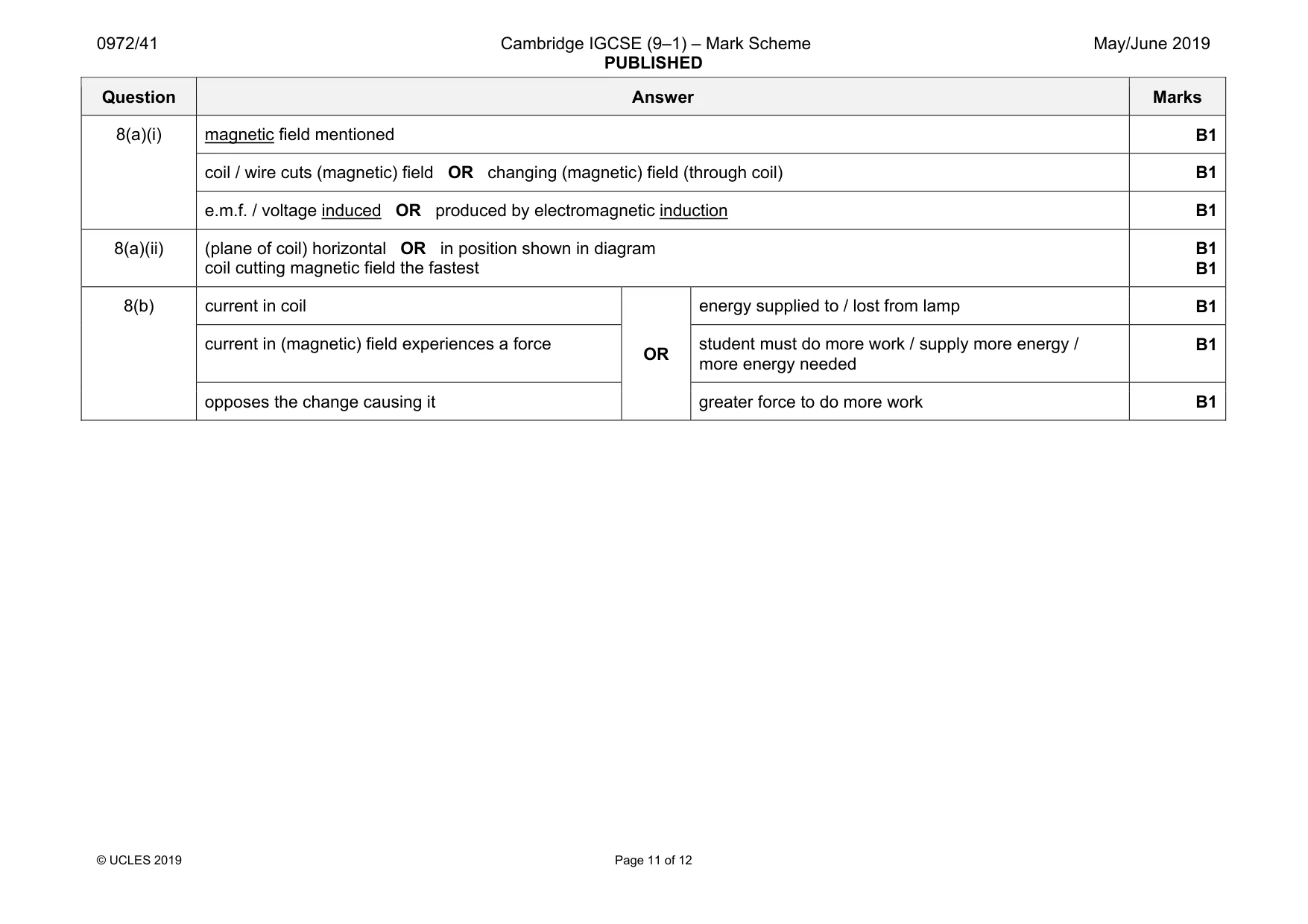
Mark scheme: 8(a)(i) magnetic field mentioned B1 coil / wire cuts (magnetic) field OR changing (magnetic) field (through coil) B1 e.m.f. / voltage induced OR produced by electromagnetic induction B1 8(a)(ii) (plane of coil) horizontal OR in position shown in diagram coil cutting magnetic field the fastest B1 B1 8(b) current in coil OR energy supplied to / lost from lamp B1 current in (magnetic) field experiences a force student must do more work / supply more energy / more energy needed B1 opposes the change causing it greater force to do more work B1
Q9 · A beam of α-particles moving towards a thin sheet of gold in a vacuum
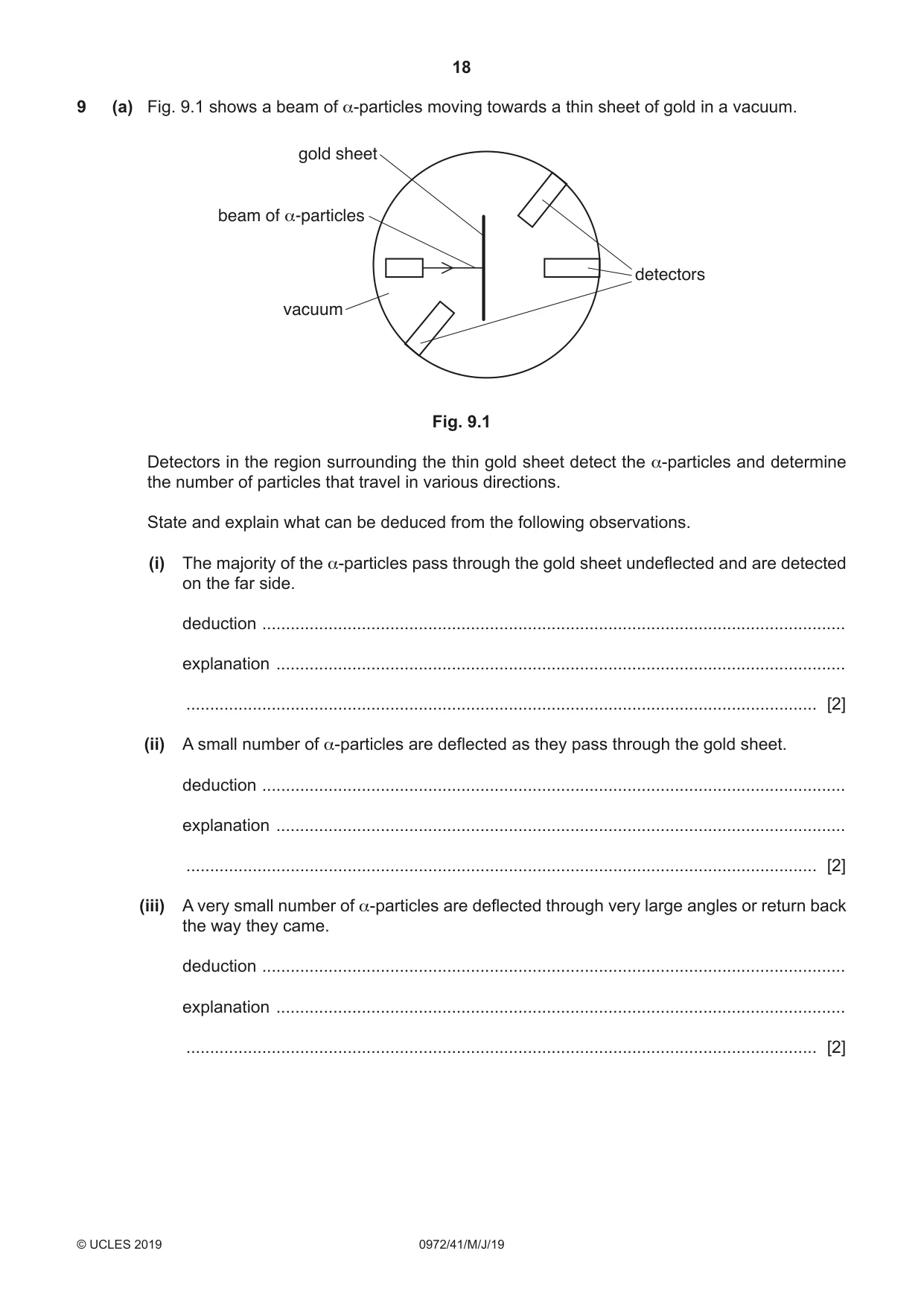
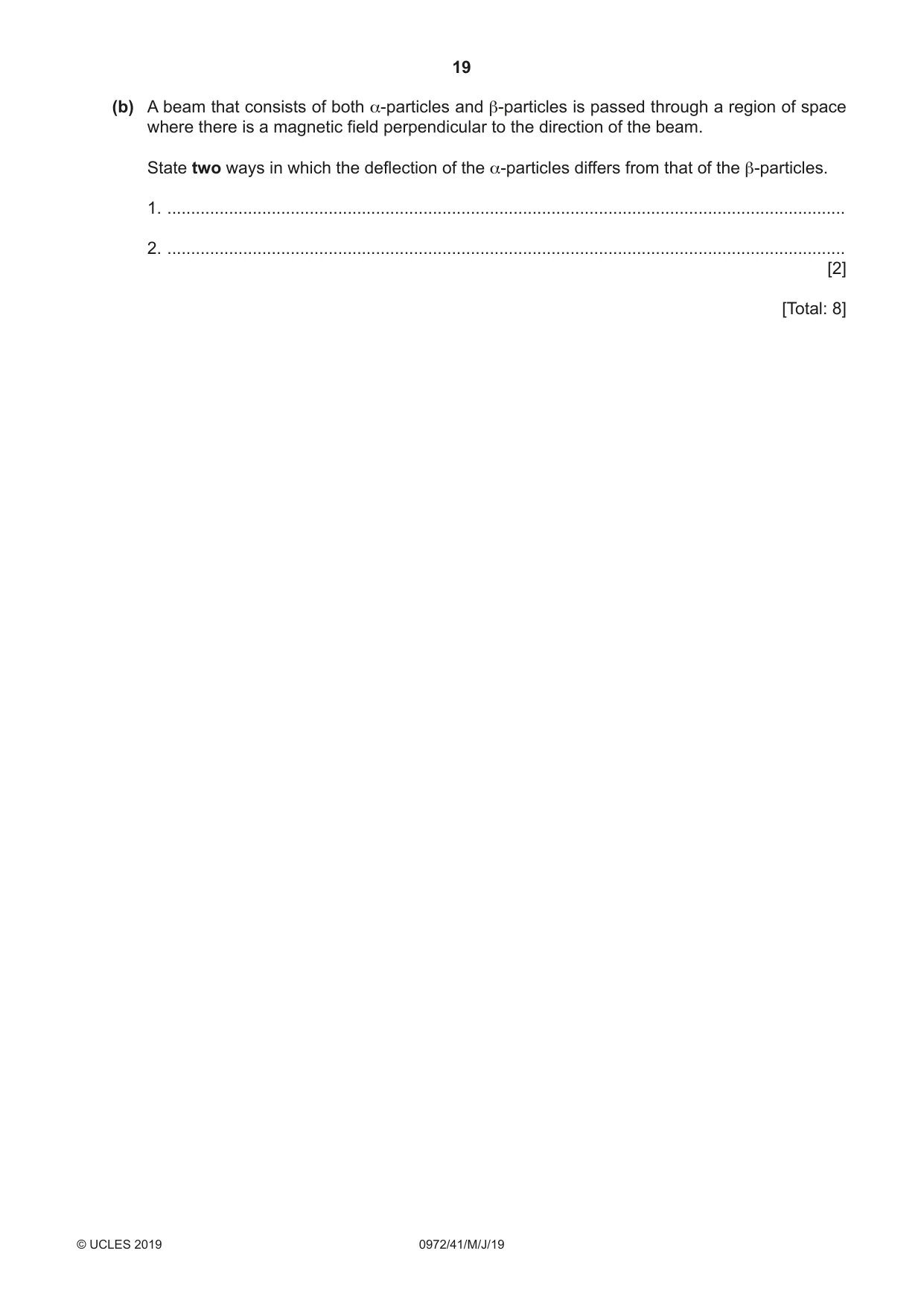
9 (a) Fig. 9.1 shows a beam of α-particles moving towards a thin sheet of gold in a vacuum. gold sheet beam of α-particles detectors vacuum Fig. 9.1 Detectors in the region surrounding the thin gold sheet detect the α-particles and determine the number of particles that travel in various directions. State and explain what can be deduced from the following observations. (i) The majority of the α-particles pass through the gold sheet undeflected and are detected on the far side. deduction ........................................................................................................................... explanation ........................................................................................................................ ..................................................................................................................................... [2] (ii) A small number of α-particles are deflected as they pass through the gold sheet. deduction ........................................................................................................................... explanation ........................................................................................................................ ..................................................................................................................................... [2] (iii) A very small number of α-particles are deflected through very large angles or return back the way they came. deduction ........................................................................................................................... explanation ........................................................................................................................ ..................................................................................................................................... [2] (b) A beam that consists of both α-particles and β-particles is passed through a region of space where there is a magnetic field perpendicular to the direction of the beam. State two ways in which the deflection of the α-particles differs from that of the β-particles. 1. ............................................................................................................................................... 2. ............................................................................................................................................... [2] [Total: 8]
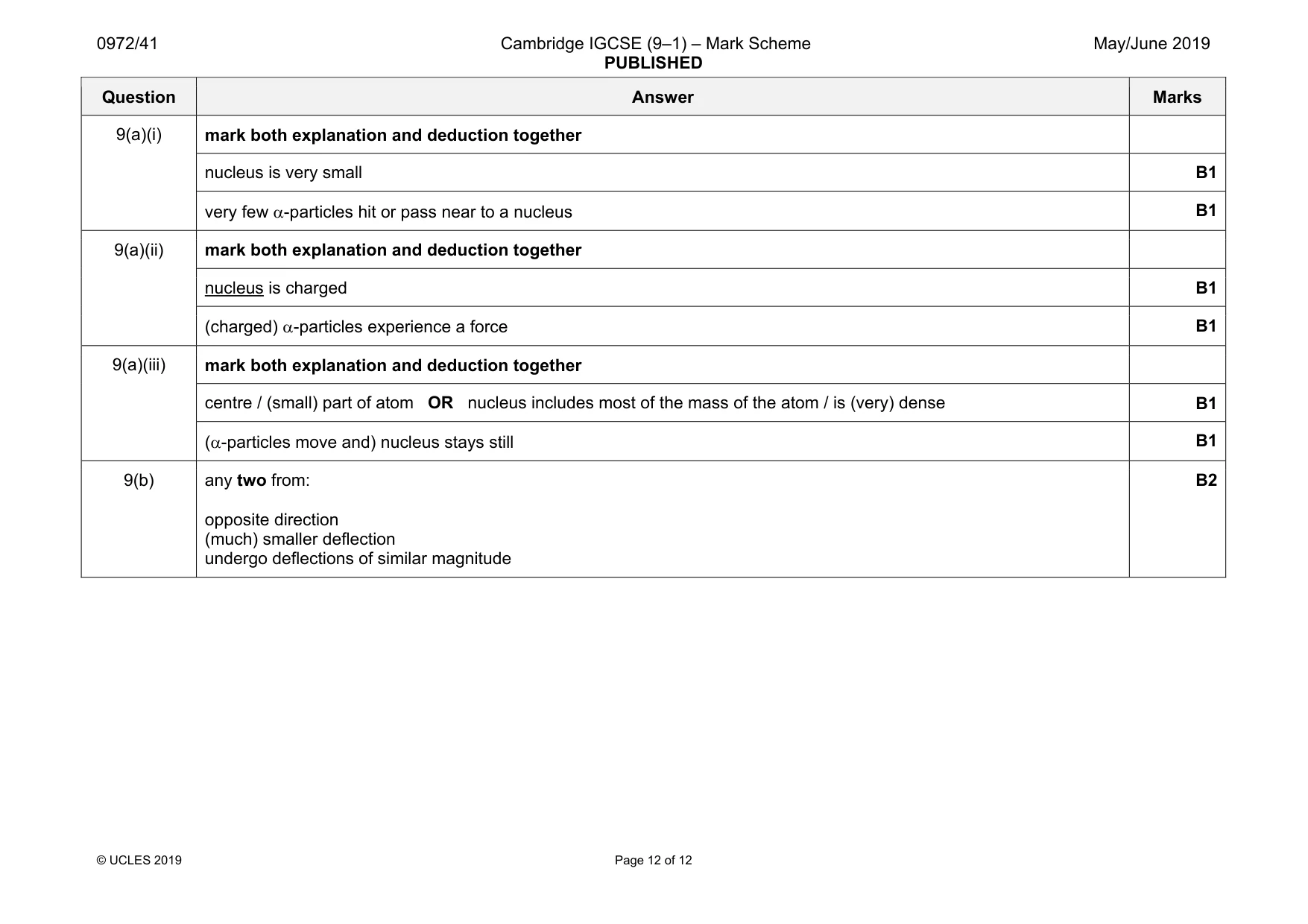
Mark scheme: 9(a)(i) mark both explanation and deduction together nucleus is very small B1 very few α-particles hit or pass near to a nucleus B1 9(a)(ii) mark both explanation and deduction together nucleus is charged B1 (charged) α-particles experience a force B1 9(a)(iii) mark both explanation and deduction together centre / (small) part of atom OR nucleus includes most of the mass of the atom / is (very) dense B1 (α-particles move and) nucleus stays still B1 9(b) any two from: opposite direction (much) smaller deflection undergo deflections of similar magnitude B2
What was in this paper
The subtopics covered by these 9 questions, and how many questions each got. Open one in a new tab to see every Cambridge question on it.
What you needed in this session
Cambridge’s own grade thresholds for 2019 May/June, Paper 4 · Variant 1. A higher threshold means an easier paper — the bar moves with how the cohort did.