Cambridge IGCSE Physics (9-1) 0972 — 2018 May/June Paper 4 · Variant 1
0972/41/M/J/18 · 11 questions · 80 marks · ≈90 min
The question paper and its mark scheme, free to read here and free to download. This is Cambridge’s own paper, exactly as it was sat.
Question paper16 pages
Mark scheme9 pages
Answers below. Sit the paper first if you are practising.
Questions as text
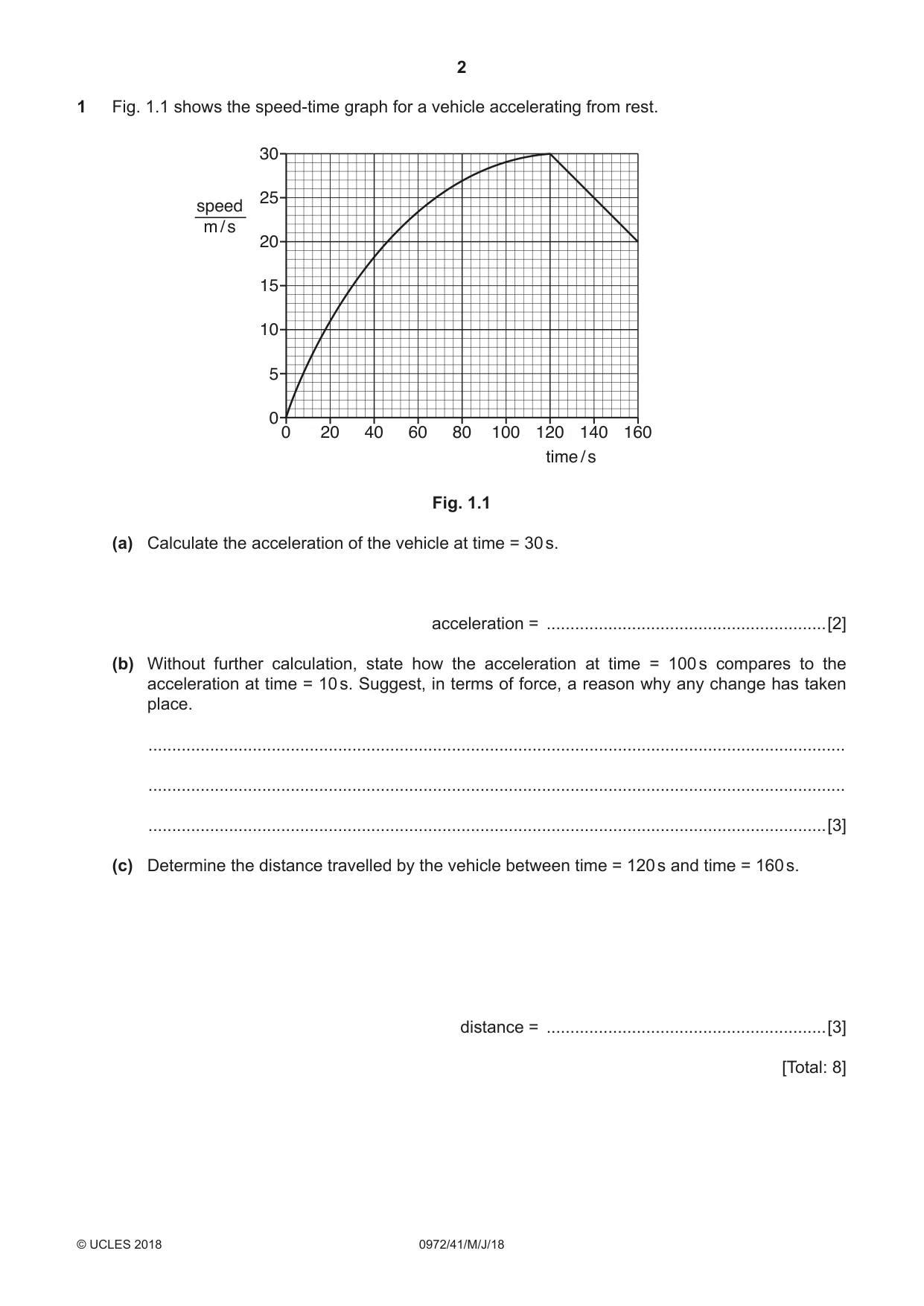
Q1 · The speed-time graph for a vehicle accelerating from rest
1 Fig. 1.1 shows the speed-time graph for a vehicle accelerating from rest. 30 25 speed m / s 20 15 10 5 0 0 20 40 60 80 100 120 140 160 time / s Fig. 1.1 (a) Calculate the acceleration of the vehicle at time = 30 s. acceleration = ...........................................................[2] (b) Without further calculation, state how the acceleration at time = 100 s compares to the acceleration at time = 10 s. Suggest, in terms of force, a reason why any change has taken place. ................................................................................................................................................... ................................................................................................................................................... ...............................................................................................................................................[3] (c) Determine the distance travelled by the vehicle between time = 120 s and time = 160 s. distance = ...........................................................[3] [Total: 8]
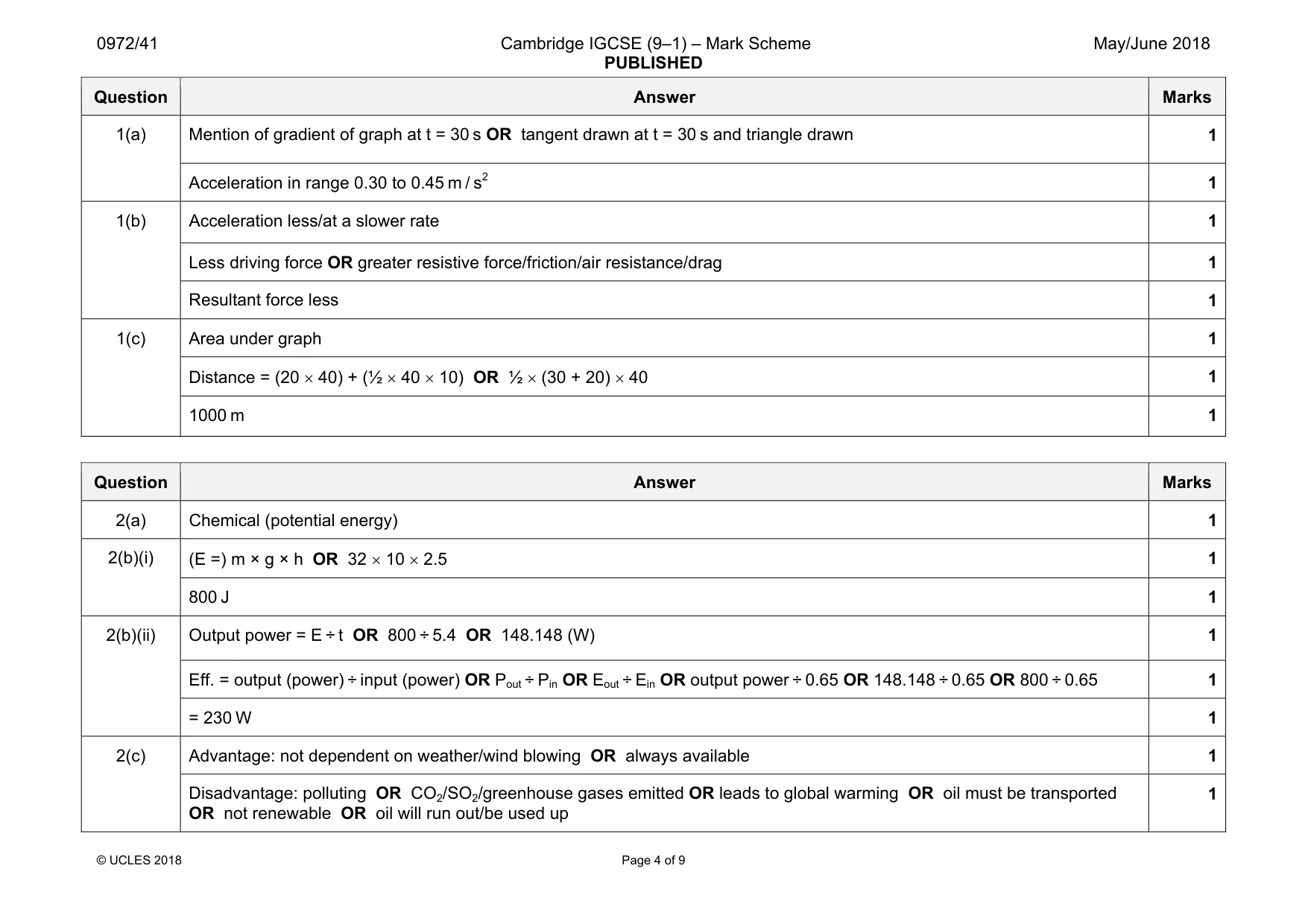
Mark scheme: 1(a) Mention of gradient of graph at t = 30 s OR tangent drawn at t = 30 s and triangle drawn 1 Acceleration in range 0.30 to 0.45 m / s2 1 1(b) Acceleration less/at a slower rate 1 Less driving force OR greater resistive force/friction/air resistance/drag 1 Resultant force less 1 1(c) Area under graph 1 Distance = (20 × 40) + (½ × 40 × 10) OR ½ × (30 + 20) × 40 1 1000 m 1
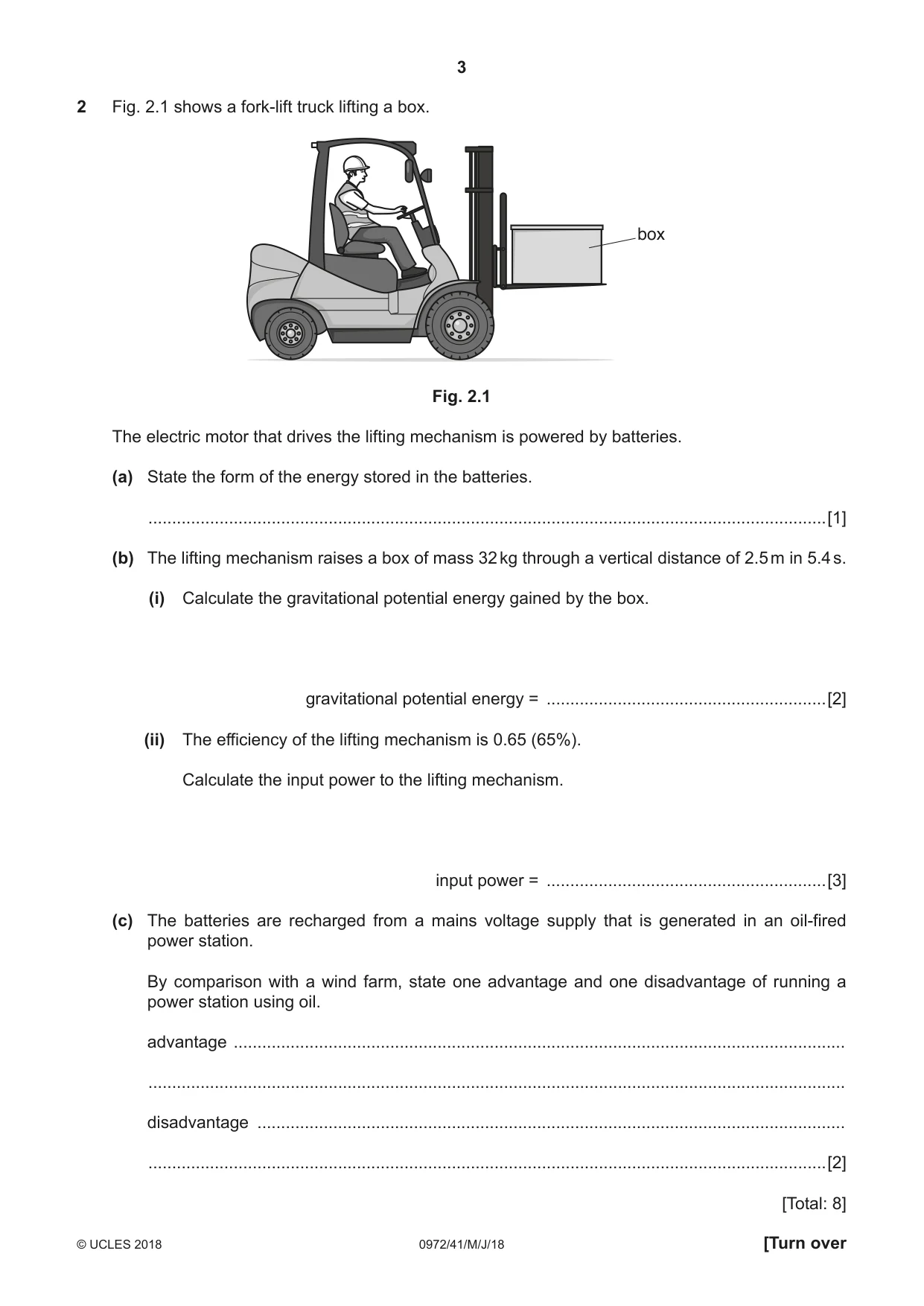
Q2 · A fork-lift truck lifting a box
2 Fig. 2.1 shows a fork-lift truck lifting a box. box Fig. 2.1 The electric motor that drives the lifting mechanism is powered by batteries. (a) State the form of the energy stored in the batteries. ...............................................................................................................................................[1] (b) The lifting mechanism raises a box of mass 32 kg through a vertical distance of 2.5 m in 5.4 s. (i) Calculate the gravitational potential energy gained by the box. gravitational potential energy = ...........................................................[2] (ii) The efficiency of the lifting mechanism is 0.65 (65%). Calculate the input power to the lifting mechanism. input power = ...........................................................[3] (c) The batteries are recharged from a mains voltage supply that is generated in an oil-fired power station. By comparison with a wind farm, state one advantage and one disadvantage of running a power station using oil. advantage ................................................................................................................................. ................................................................................................................................................... disadvantage ............................................................................................................................ ...............................................................................................................................................[2] [Total: 8]
Mark scheme: 2(a) Chemical (potential energy) 1 2(b)(i) (E =) m × g × h OR 32 × 10 × 2.5 1 800 J 1 2(b)(ii) Output power = E ÷ t OR 800 ÷ 5.4 OR 148.148 (W) 1 Eff. = output (power) ÷ input (power) OR Pout ÷ Pin OR Eout ÷ Ein OR output power ÷ 0.65 OR 148.148 ÷ 0.65 OR 800 ÷ 0.65 1 = 230 W 1 2(c) Advantage: not dependent on weather/wind blowing OR always available 1 Disadvantage: polluting OR CO2/SO2/greenhouse gases emitted OR leads to global warming OR oil must be transported OR not renewable OR oil will run out/be used up 1
Q3 · A rectangular container has a base of dimensions 0.12 m × 0.16 m
3 A rectangular container has a base of dimensions 0.12 m × 0.16 m. The container is filled with a liquid. The mass of the liquid in the container is 4.8 kg. (a) Calculate (i) the weight of liquid in the container, weight = ...........................................................[1] (ii) the pressure due to the liquid on the base of the container. pressure = ...........................................................[2] (b) Explain why the total pressure on the base of the container is greater than the value calculated in (a)(ii). ................................................................................................................................................... ...............................................................................................................................................[1] (c) The depth of liquid in the container is 0.32 m. Calculate the density of the liquid. density = ...........................................................[2] [Total: 6]
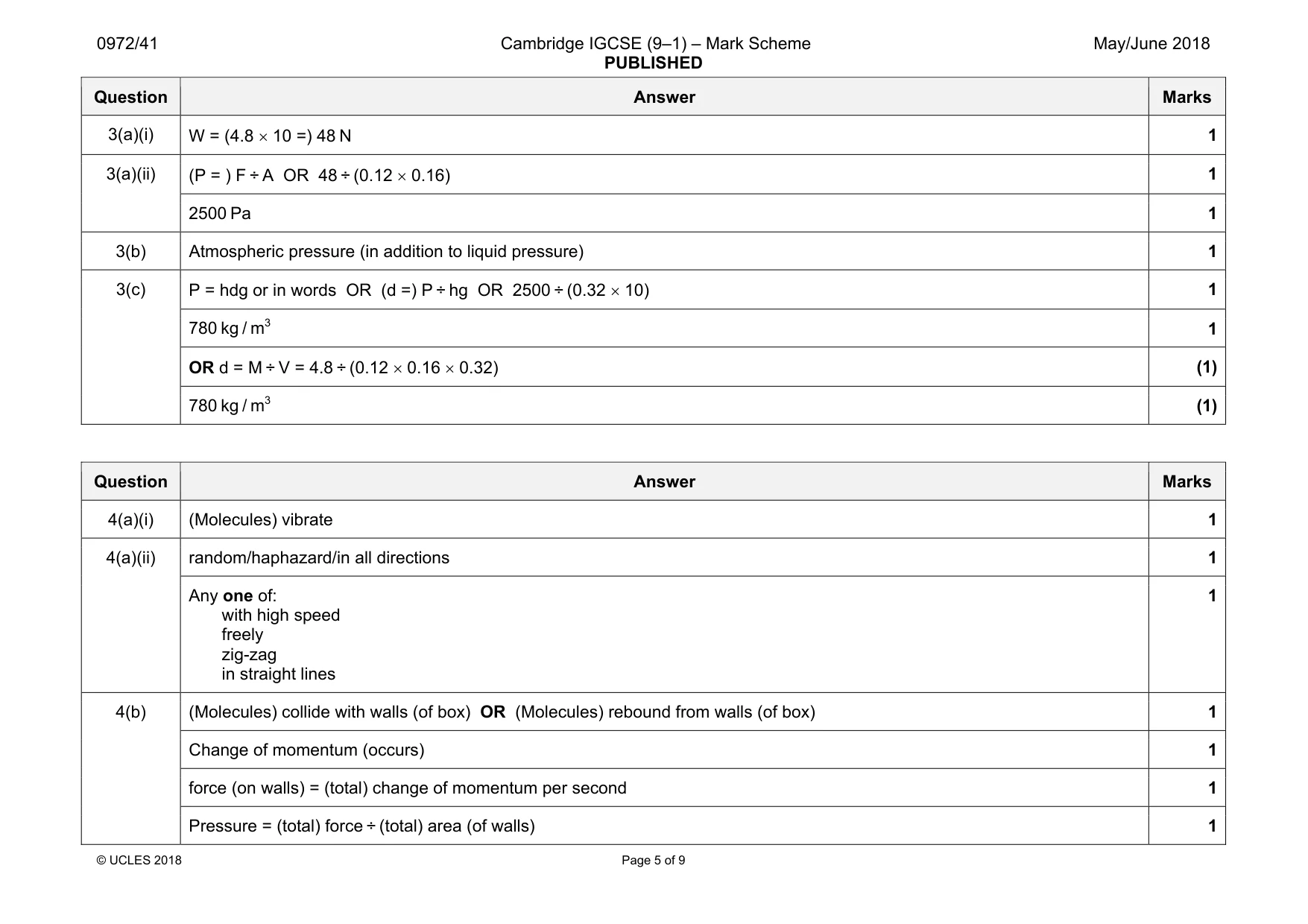
Mark scheme: 3(a)(i) 1 3(a)(ii) (P = ) F ÷ A OR 48 ÷ (0.12 × 0.16) 1 2500 Pa 1 3(b) Atmospheric pressure (in addition to liquid pressure) 1 3(c) P = hdg or in words OR (d =) P ÷ hg OR 2500 ÷ (0.32 × 10) 1 780 kg / m3 1 OR d = M ÷ V = 4.8 ÷ (0.12 × 0.16 × 0.32) (1) 780 kg / m3 (1)
Q4 · Describe the movement of the molecules in (i) a solid…
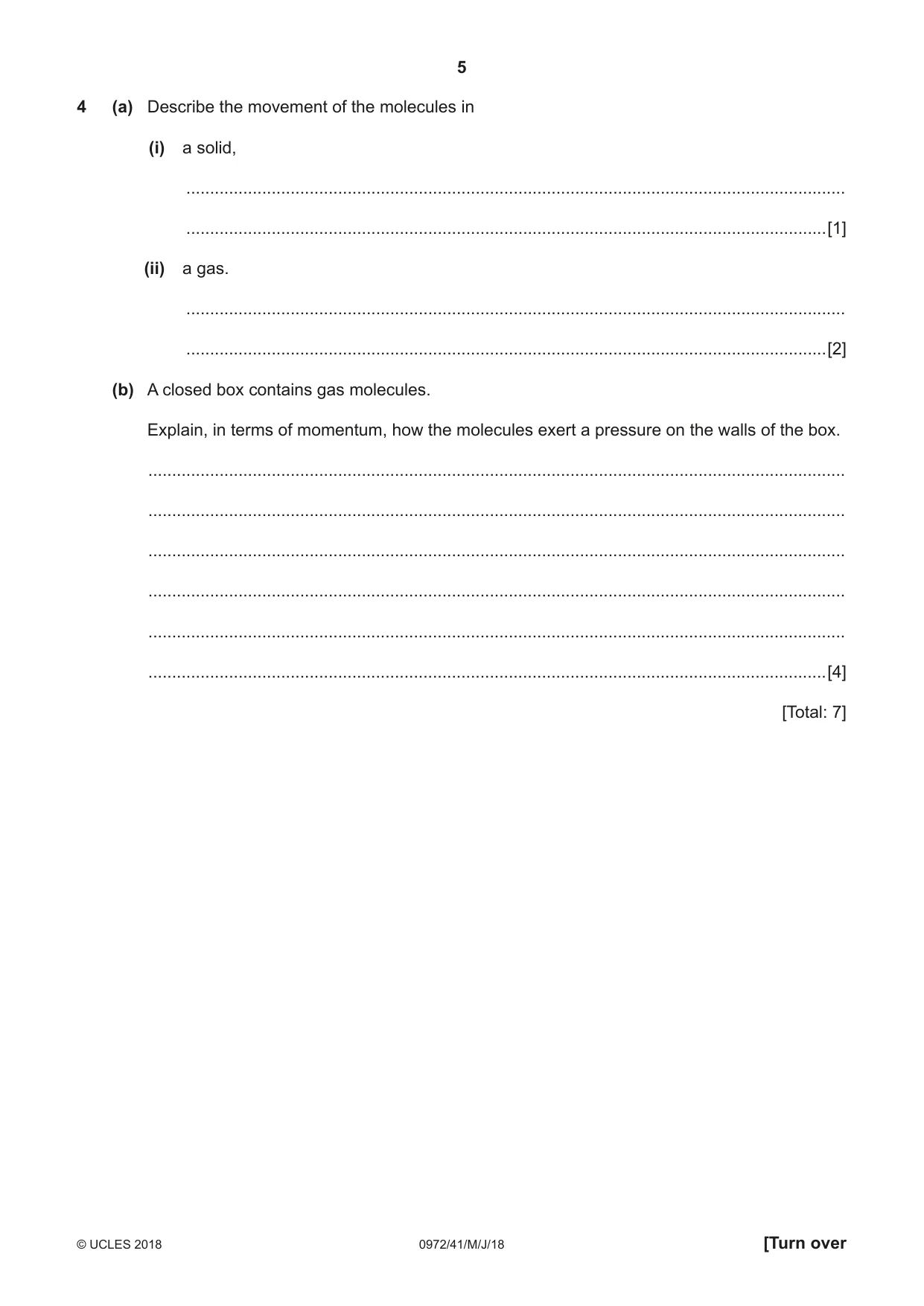
4 (a) Describe the movement of the molecules in (i) a solid, ........................................................................................................................................... .......................................................................................................................................[1] (ii) a gas. ........................................................................................................................................... .......................................................................................................................................[2] (b) A closed box contains gas molecules. Explain, in terms of momentum, how the molecules exert a pressure on the walls of the box. ................................................................................................................................................... ................................................................................................................................................... ................................................................................................................................................... ................................................................................................................................................... ................................................................................................................................................... ...............................................................................................................................................[4] [Total: 7]
Mark scheme: 4(a)(i) (Molecules) vibrate 1 4(a)(ii) random/haphazard/in all directions 1 Any one of: with high speed freely zig-zag in straight lines 1 4(b) (Molecules) collide with walls (of box) OR (Molecules) rebound from walls (of box) 1 Change of momentum (occurs) 1 force (on walls) = (total) change of momentum per second 1 Pressure = (total) force ÷ (total) area (of walls) 1
Q5 · A ray of light in air is incident on a glass block
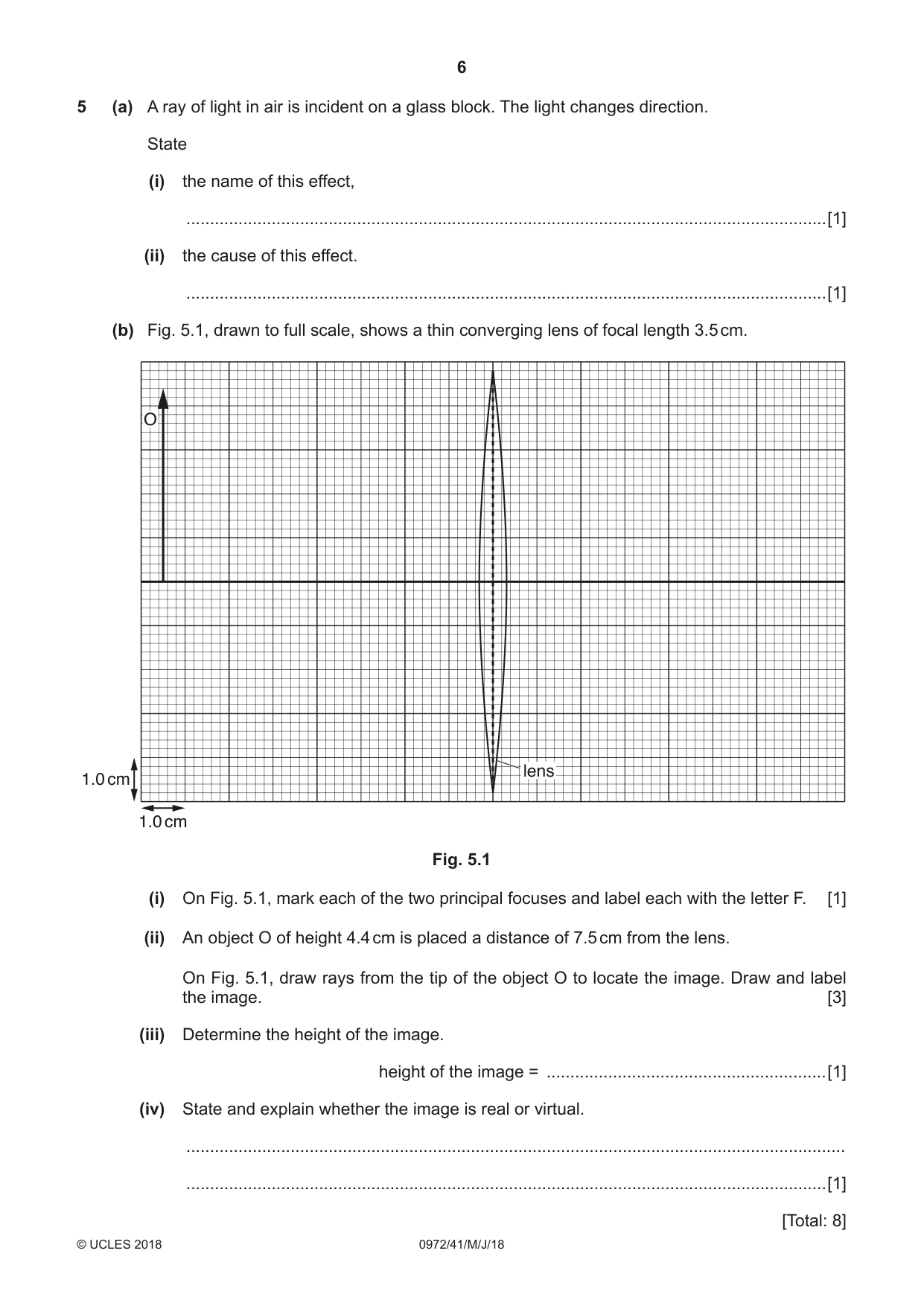
5 (a) A ray of light in air is incident on a glass block. The light changes direction. State (i) the name of this effect, .......................................................................................................................................[1] (ii) the cause of this effect. .......................................................................................................................................[1] (b) Fig. 5.1, drawn to full scale, shows a thin converging lens of focal length 3.5 cm. O lens 1.0 cm 1.0 cm Fig. 5.1 (i) On Fig. 5.1, mark each of the two principal focuses and label each with the letter F. [1] (ii) An object O of height 4.4 cm is placed a distance of 7.5 cm from the lens. On Fig. 5.1, draw rays from the tip of the object O to locate the image. Draw and label the image. [3] (iii) Determine the height of the image. height of the image = ...........................................................[1] (iv) State and explain whether the image is real or virtual. ........................................................................................................................................... .......................................................................................................................................[1] [Total: 8]
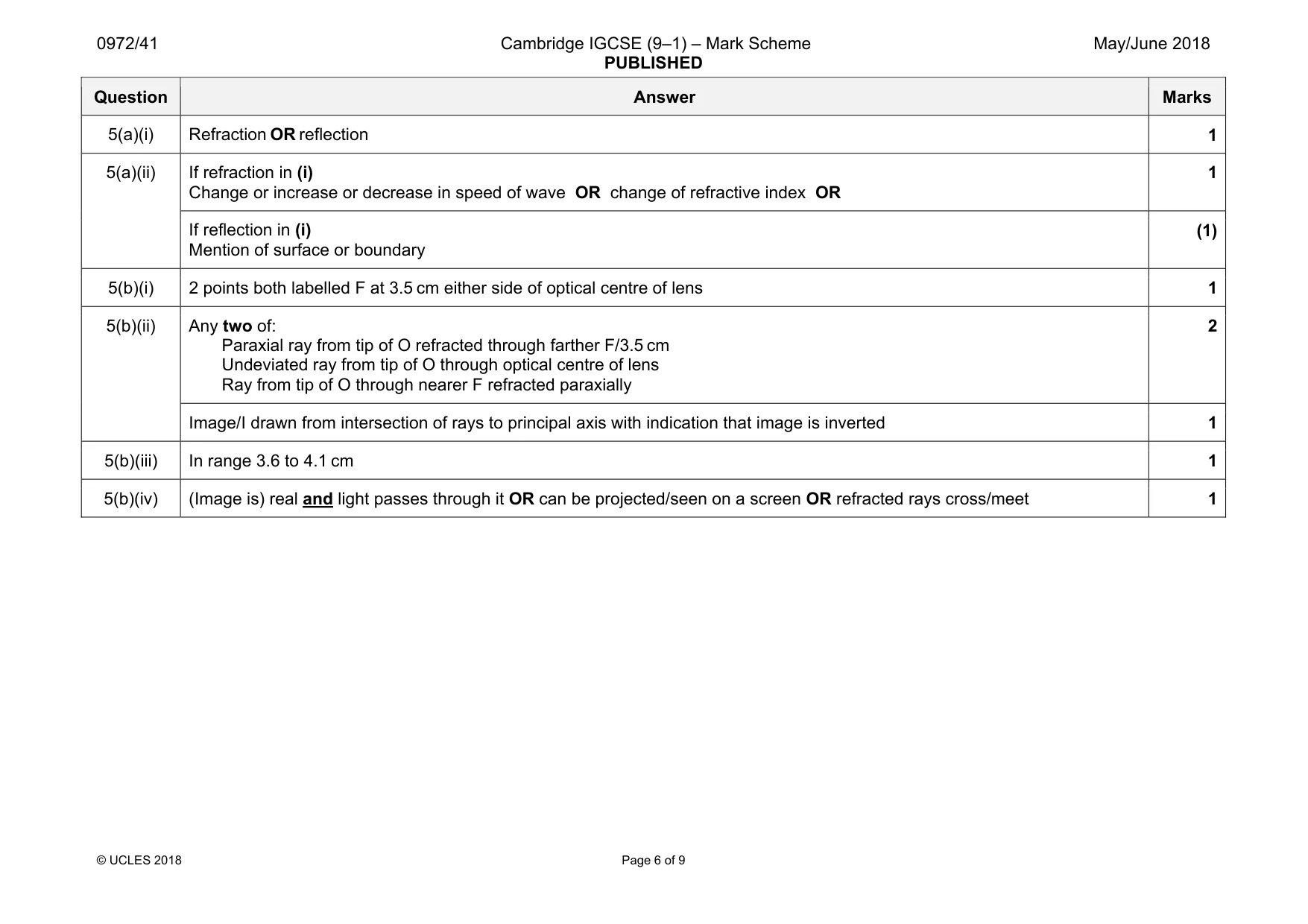
Mark scheme: 5(a)(i) Refraction OR reflection 1 5(a)(ii) If refraction in (i) Change or increase or decrease in speed of wave OR change of refractive index OR 1 If reflection in (i) Mention of surface or boundary (1) 5(b)(i) 2 points both labelled F at 3.5 cm either side of optical centre of lens 1 5(b)(ii) Any two of: Paraxial ray from tip of O refracted through farther F/3.5 cm Undeviated ray from tip of O through optical centre of lens Ray from tip of O through nearer F refracted paraxially 2 Image/I drawn from intersection of rays to principal axis with indication that image is inverted 1 5(b)(iii) In range 3.6 to 4.1 cm 1 5(b)(iv) (Image is) real and light passes through it OR can be projected/seen on a screen OR refracted rays cross/meet 1
Q6 · Wavefronts approaching a gap in a barrier
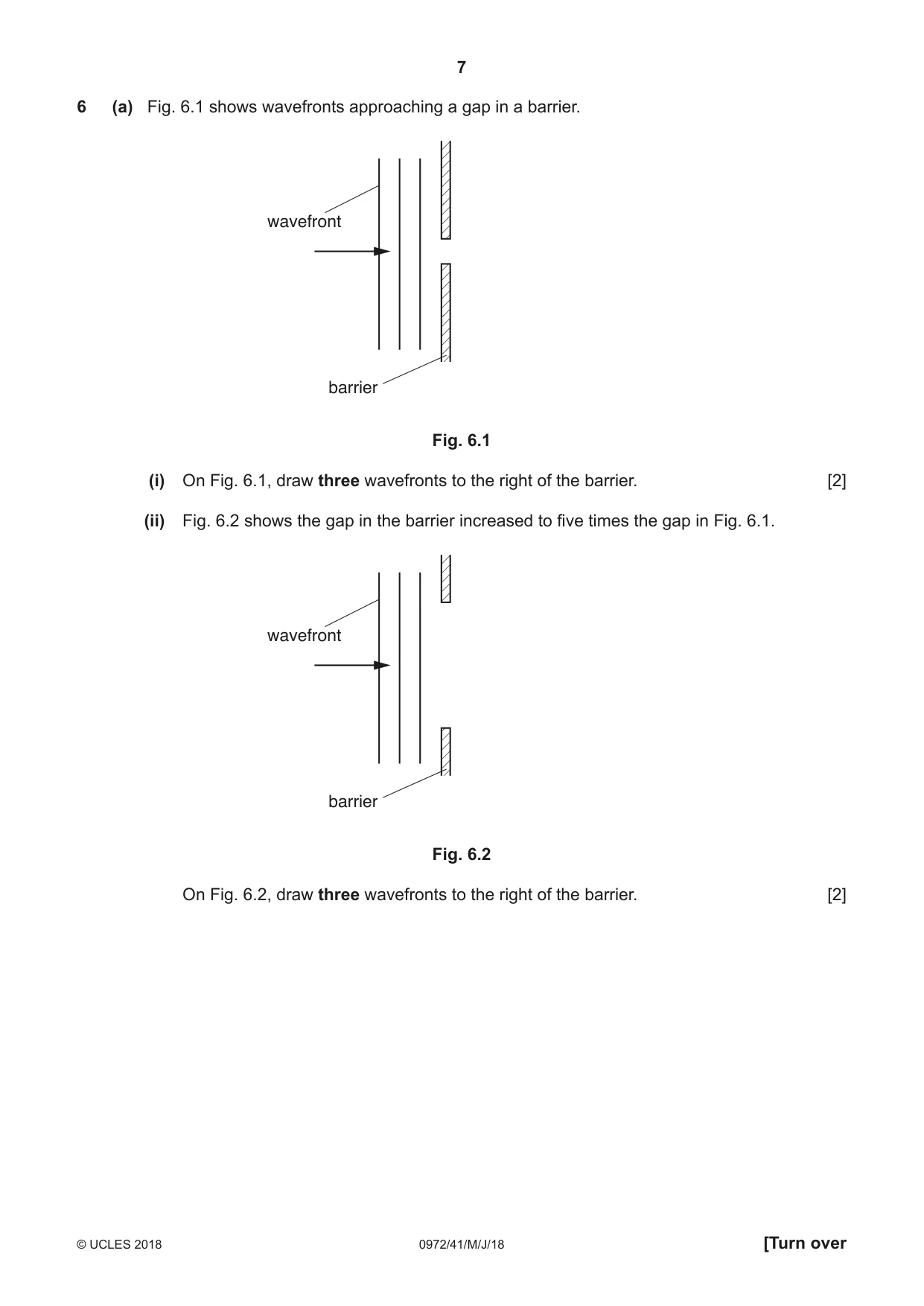
6 (a) Fig. 6.1 shows wavefronts approaching a gap in a barrier. wavefront barrier Fig. 6.1 (i) On Fig. 6.1, draw three wavefronts to the right of the barrier. [2] (ii) Fig. 6.2 shows the gap in the barrier increased to five times the gap in Fig. 6.1. wavefront barrier Fig. 6.2 On Fig. 6.2, draw three wavefronts to the right of the barrier. [2] (b) Describe, with a labelled diagram, an experiment using water waves that shows the reflection of wavefronts that occur at a straight barrier. ................................................................................................................................................... ................................................................................................................................................... ................................................................................................................................................... ................................................................................................................................................... ................................................................................................................................................... ...............................................................................................................................................[4] [Total: 8]
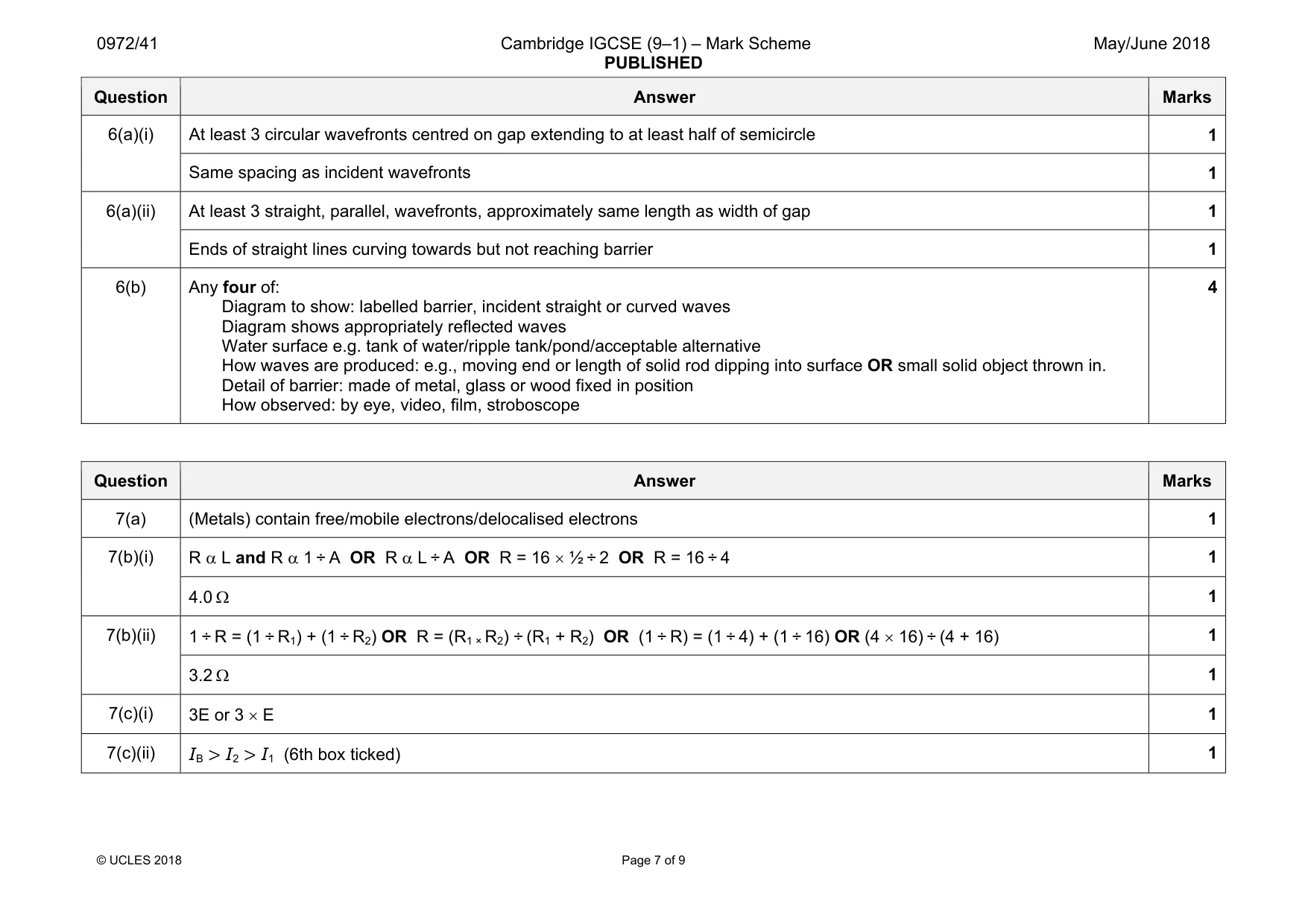
Mark scheme: 6(a)(i) At least 3 circular wavefronts centred on gap extending to at least half of semicircle 1 Same spacing as incident wavefronts 1 6(a)(ii) At least 3 straight, parallel, wavefronts, approximately same length as width of gap 1 Ends of straight lines curving towards but not reaching barrier 1 6(b) Any four of: Diagram to show: labelled barrier, incident straight or curved waves Diagram shows appropriately reflected waves Water surface e.g. tank of water/ripple tank/pond/acceptable alternative How waves are produced: e.g., moving end or length of solid rod dipping into surface OR small solid object thrown in. Detail of barrier: made of metal, glass or wood fixed in position How observed: by eye, video, film, stroboscope 4
Q7 · State, in terms of their structure, why metals are good conductors of electricity
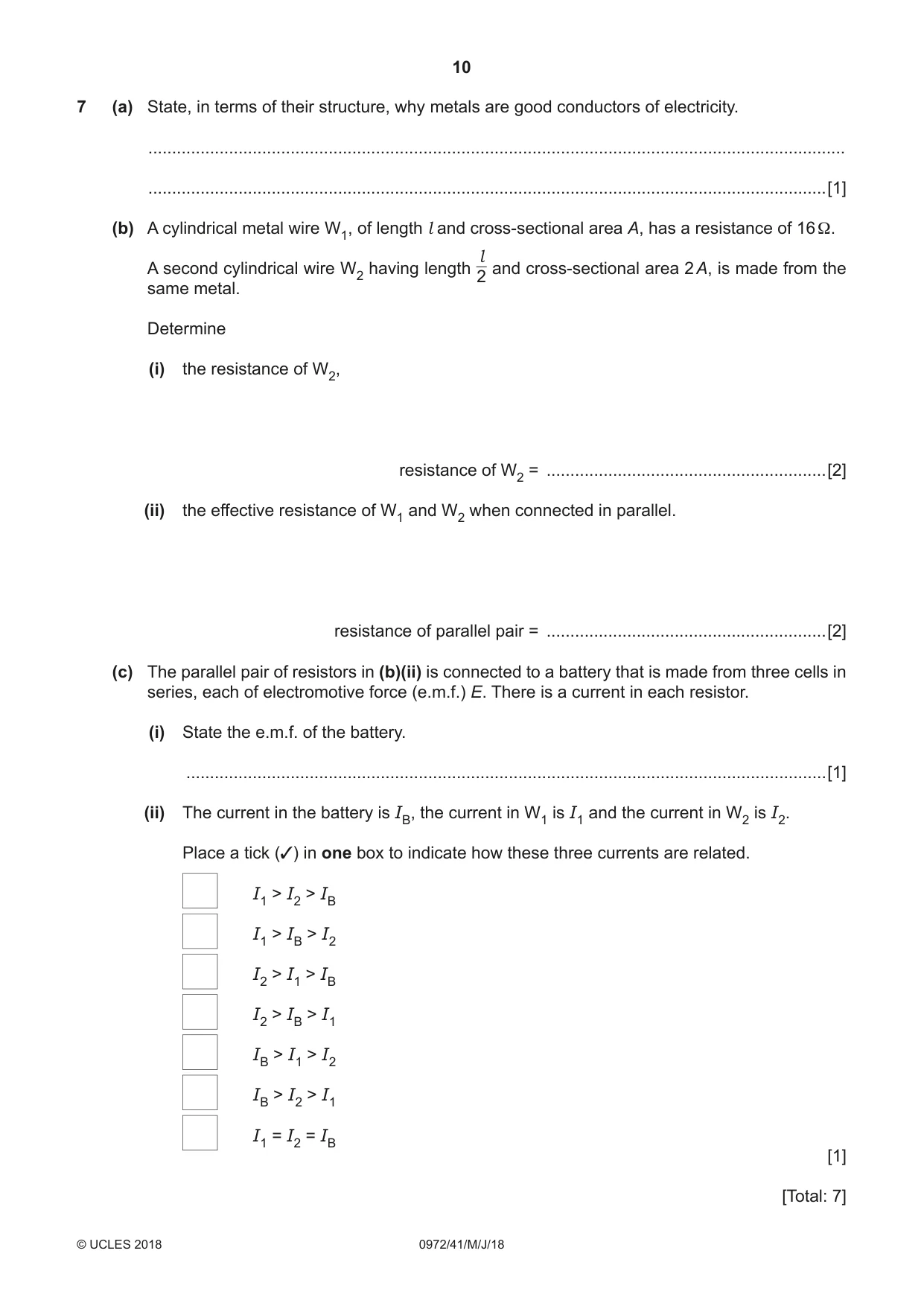
7 (a) State, in terms of their structure, why metals are good conductors of electricity. ................................................................................................................................................... ...............................................................................................................................................[1] (b) A cylindrical metal wire W1, of length l and cross-sectional area A, has a resistance of 16 Ω. l A second cylindrical wire W2 having length 2 and cross-sectional area 2 A, is made from the same metal. Determine (i) the resistance of W2, resistance of W2 = ...........................................................[2] (ii) the effective resistance of W1 and W2 when connected in parallel. resistance of parallel pair = ...........................................................[2] (c) The parallel pair of resistors in (b)(ii) is connected to a battery that is made from three cells in series, each of electromotive force (e.m.f.) E. There is a current in each resistor. (i) State the e.m.f. of the battery. .......................................................................................................................................[1] (ii) The current in the battery is IB, the current in W1 is I1 and the current in W2 is I2. Place a tick (3) in one box to indicate how these three currents are related. I1 > I2 > IB I1 > IB > I2 I2 > I1 > IB I2 > IB > I1 IB > I1 > I2 IB > I2 > I1 I1 = I2 = IB [1] [Total: 7]
Mark scheme: 7(a) (Metals) contain free/mobile electrons/delocalised electrons 1 7(b)(i) R α L and R α 1 ÷ A OR R α L ÷ A OR R = 16 × ½ ÷ 2 OR R = 16 ÷ 4 1 4.0 Ω 1 7(b)(ii) 1 ÷ R = (1 ÷ R1) + (1 ÷ R2) OR R = (R1 × R2) ÷ (R1 + R2) OR (1 ÷ R) = (1 ÷ 4) + (1 ÷ 16) OR (4 × 16) ÷ (4 + 16) 1 3.2 Ω 1 7(c)(i) 3E or 3 × E 1 7(c)(ii) IB > I2 > I1 (6th box ticked) 1
Q8 · In a laboratory at normal room temperature, 200 g of water is poured into a beaker
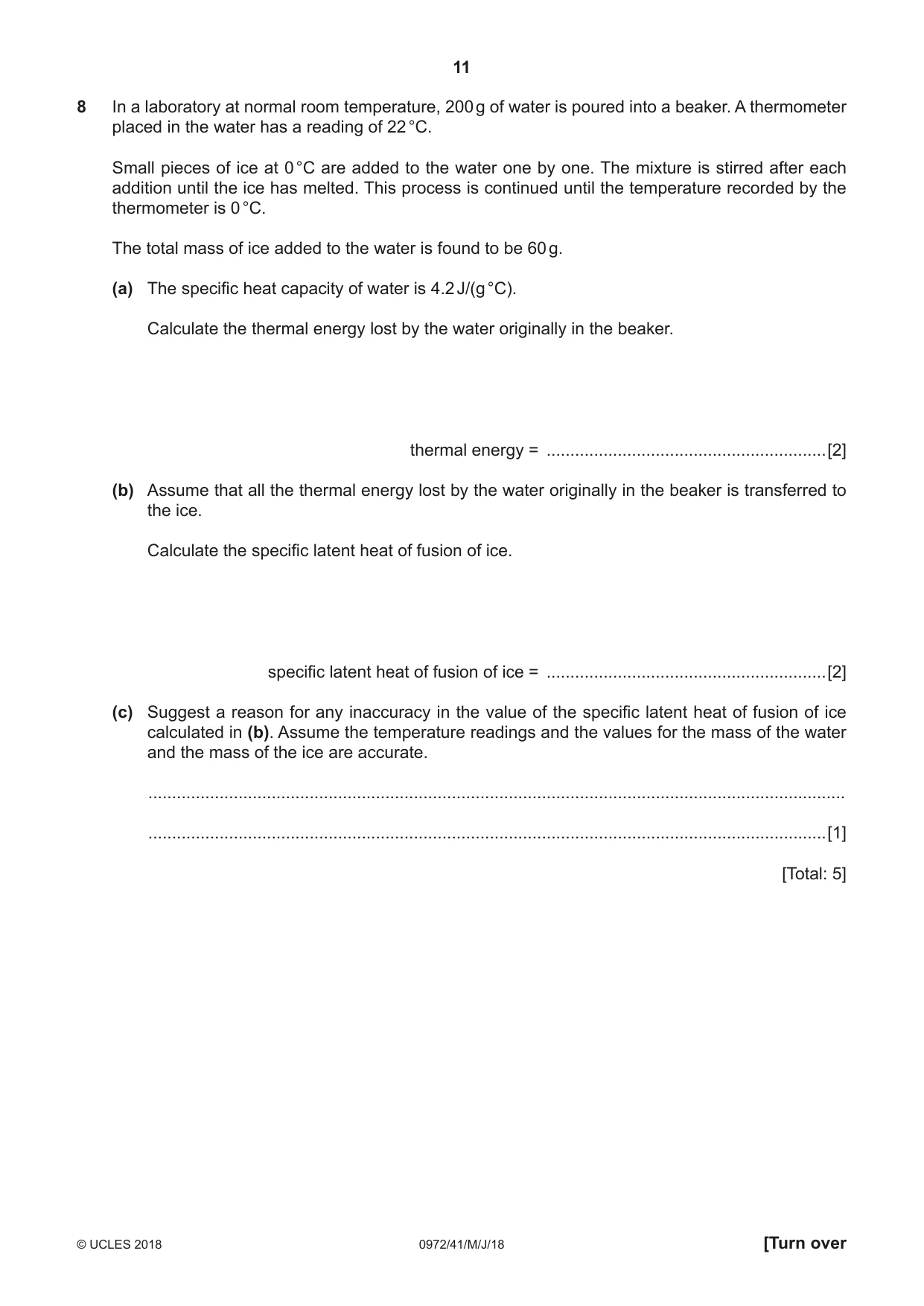
8 In a laboratory at normal room temperature, 200 g of water is poured into a beaker. A thermometer placed in the water has a reading of 22 °C. Small pieces of ice at 0 °C are added to the water one by one. The mixture is stirred after each addition until the ice has melted. This process is continued until the temperature recorded by the thermometer is 0 °C. The total mass of ice added to the water is found to be 60 g. (a) The specific heat capacity of water is 4.2 J/(g °C). Calculate the thermal energy lost by the water originally in the beaker. thermal energy = ...........................................................[2] (b) Assume that all the thermal energy lost by the water originally in the beaker is transferred to the ice. Calculate the specific latent heat of fusion of ice. specific latent heat of fusion of ice = ...........................................................[2] (c) Suggest a reason for any inaccuracy in the value of the specific latent heat of fusion of ice calculated in (b). Assume the temperature readings and the values for the mass of the water and the mass of the ice are accurate. ................................................................................................................................................... ...............................................................................................................................................[1] [Total: 5]
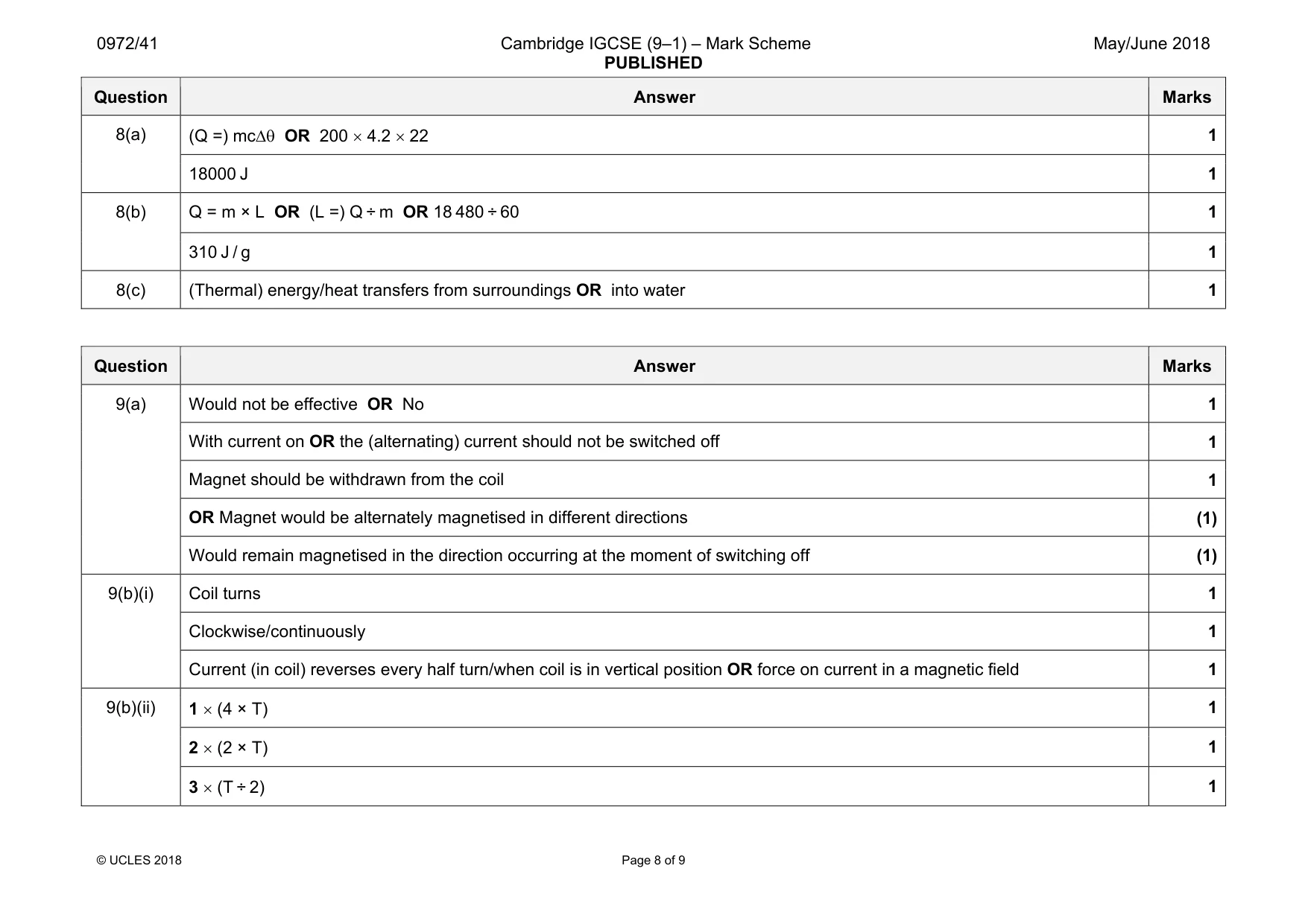
Mark scheme: 8(a) 1 18000 J 1 8(b) Q = m × L OR (L =) Q ÷ m OR 18 480 ÷ 60 1 310 J / g 1 8(c) (Thermal) energy/heat transfers from surroundings OR into water 1
Q9 · A student wants to demagnetise a permanent bar magnet
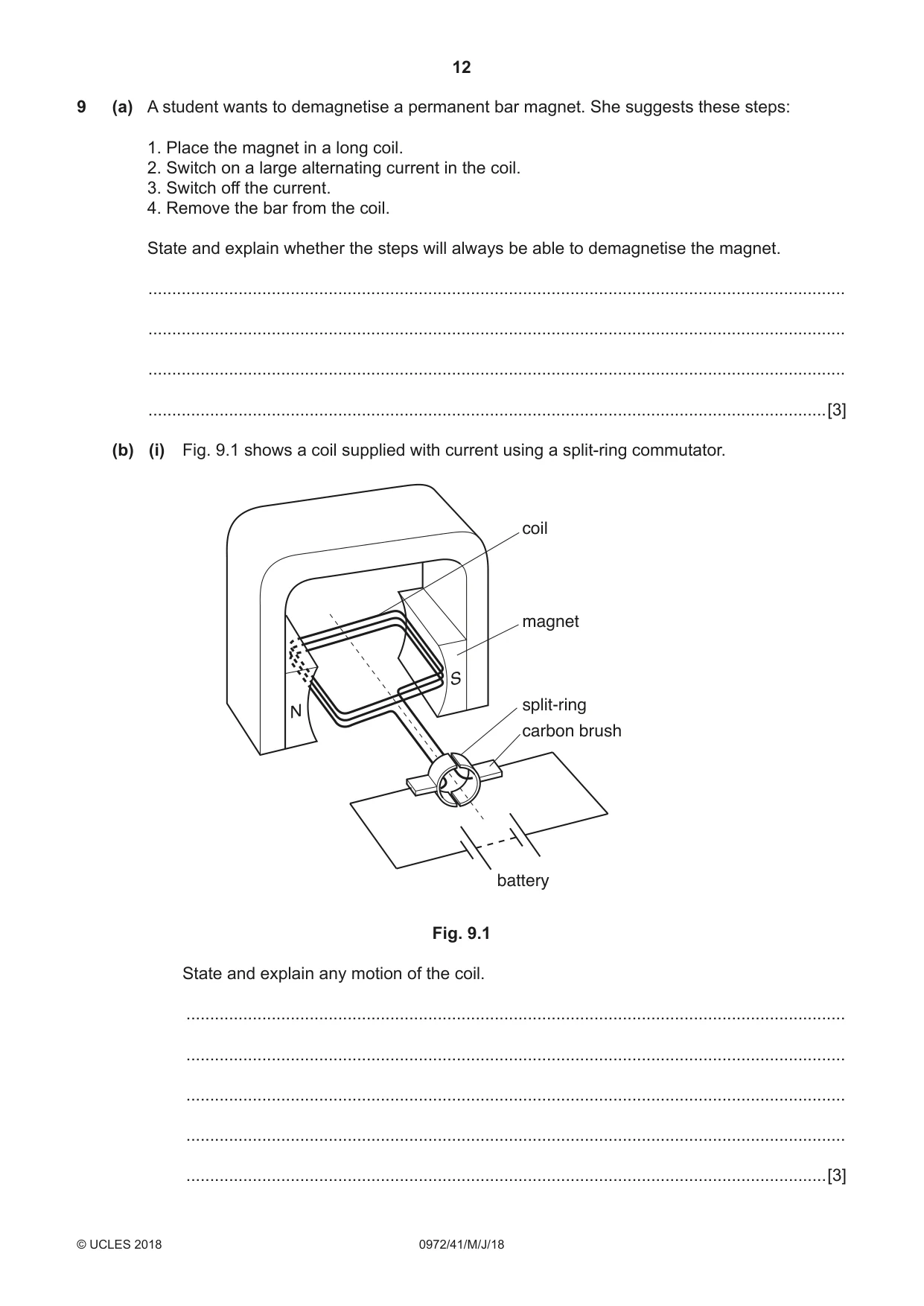
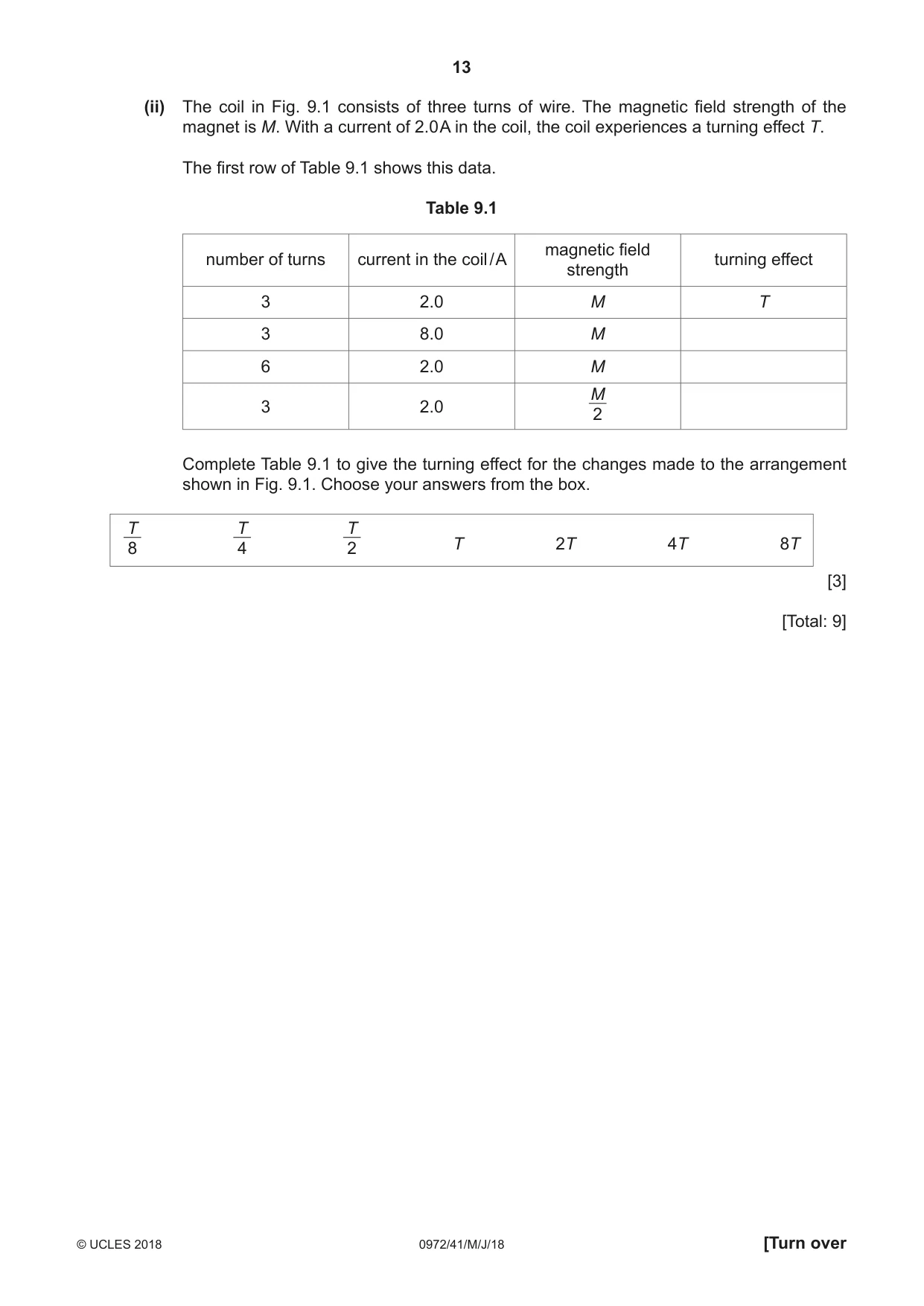
9 (a) A student wants to demagnetise a permanent bar magnet. She suggests these steps: 1. Place the magnet in a long coil. 2. Switch on a large alternating current in the coil. 3. Switch off the current. 4. Remove the bar from the coil. State and explain whether the steps will always be able to demagnetise the magnet. ................................................................................................................................................... ................................................................................................................................................... ................................................................................................................................................... ...............................................................................................................................................[3] (b) (i) Fig. 9.1 shows a coil supplied with current using a split-ring commutator. coil magnet S split-ring N carbon brush battery Fig. 9.1 State and explain any motion of the coil. ........................................................................................................................................... ........................................................................................................................................... ........................................................................................................................................... ........................................................................................................................................... .......................................................................................................................................[3] (ii) The coil in Fig. 9.1 consists of three turns of wire. The magnetic field strength of the magnet is M. With a current of 2.0 A in the coil, the coil experiences a turning effect T. The first row of Table 9.1 shows this data. Table 9.1 magnetic field number of turns current in the coil / A turning effect strength 3 2.0 M T 3 8.0 M 6 2.0 M M 3 2.0 2 Complete Table 9.1 to give the turning effect for the changes made to the arrangement shown in Fig. 9.1. Choose your answers from the box. T T T 8 4 2 T 2T 4T 8T [3] [Total: 9]
Mark scheme: 9(a) Would not be effective OR No 1 With current on OR the (alternating) current should not be switched off 1 Magnet should be withdrawn from the coil 1 OR Magnet would be alternately magnetised in different directions (1) Would remain magnetised in the direction occurring at the moment of switching off (1) 9(b)(i) Coil turns 1 Clockwise/continuously 1 Current (in coil) reverses every half turn/when coil is in vertical position OR force on current in a magnetic field 1 9(b)(ii) 1 × (4 × T) 1 2 × (2 × T) 1 3 × (T ÷ 2) 1
Q10 · Explain why the voltage of the supply to the primary coil of a transformer must be…
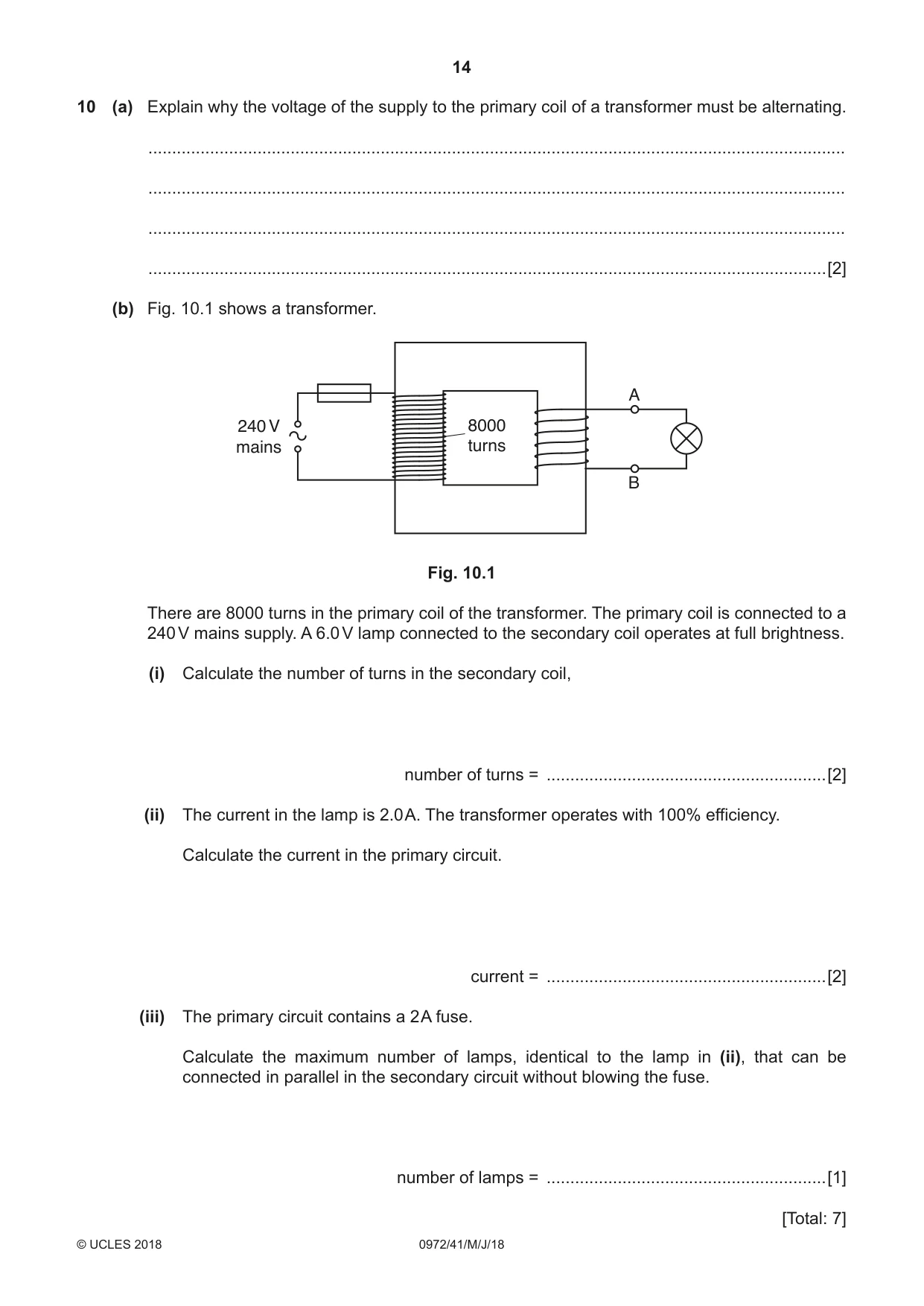
10 (a) Explain why the voltage of the supply to the primary coil of a transformer must be alternating. ................................................................................................................................................... ................................................................................................................................................... ................................................................................................................................................... ...............................................................................................................................................[2] (b) Fig. 10.1 shows a transformer. A 240 V 8000 mains turns B Fig. 10.1 There are 8000 turns in the primary coil of the transformer. The primary coil is connected to a 240 V mains supply. A 6.0 V lamp connected to the secondary coil operates at full brightness. (i) Calculate the number of turns in the secondary coil, number of turns = ...........................................................[2] (ii) The current in the lamp is 2.0 A. The transformer operates with 100% efficiency. Calculate the current in the primary circuit. current = ...........................................................[2] (iii) The primary circuit contains a 2 A fuse. Calculate the maximum number of lamps, identical to the lamp in (ii), that can be connected in parallel in the secondary circuit without blowing the fuse. number of lamps = ...........................................................[1] [Total: 7]
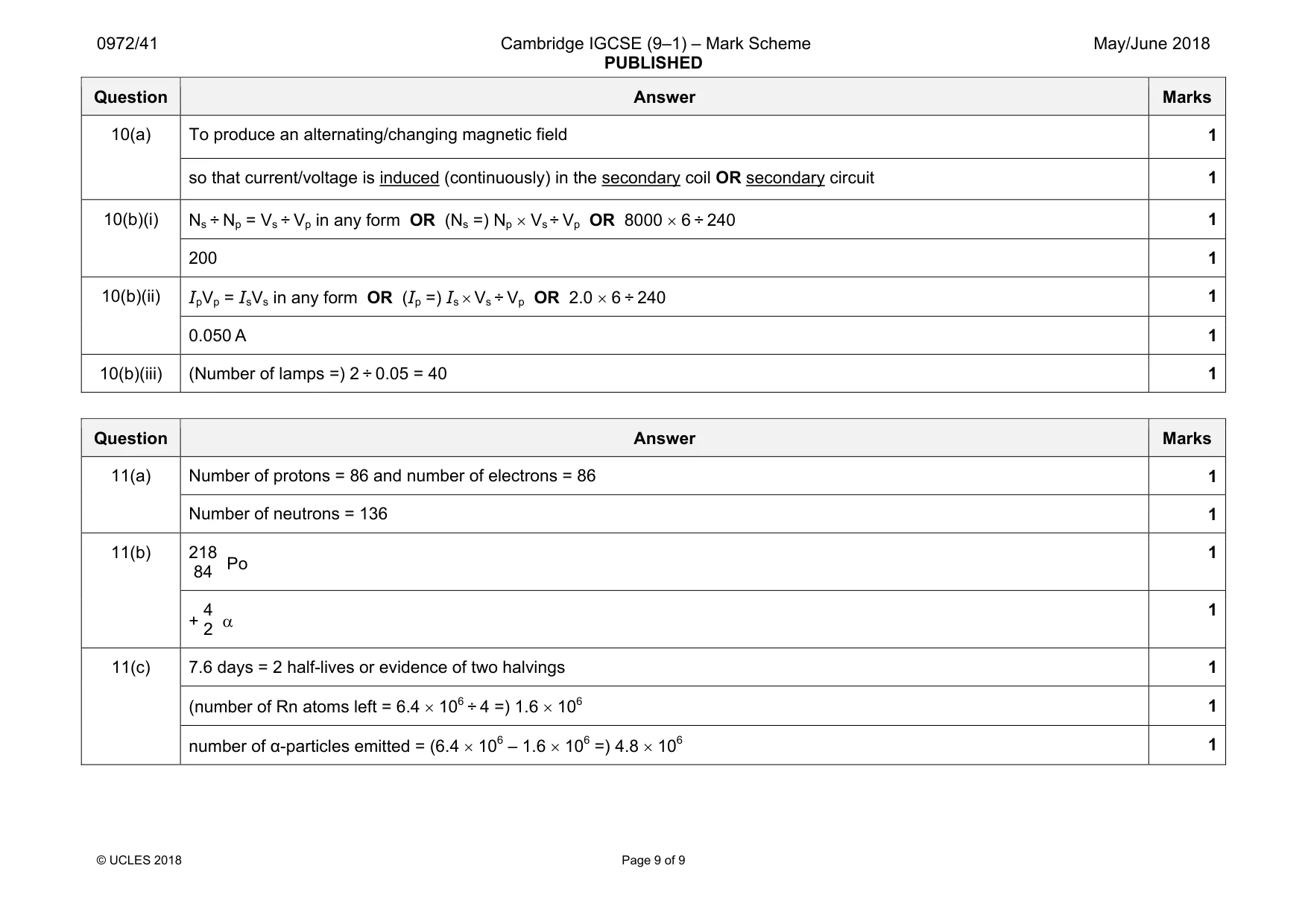
Mark scheme: 10(a) To produce an alternating/changing magnetic field 1 so that current/voltage is induced (continuously) in the secondary coil OR secondary circuit 1 10(b)(i) Ns ÷ Np = Vs ÷ Vp in any form OR (Ns =) Np × Vs÷ Vp OR 8000 × 6 ÷ 240 1 200 1 10(b)(ii) IpVp = IsVs in any form OR (Ip =) Is × Vs ÷ Vp OR 2.0 × 6 ÷ 240 1 0.050 A 1 10(b)(iii) (Number of lamps =) 2 ÷ 0.05 = 40 1
Question 11
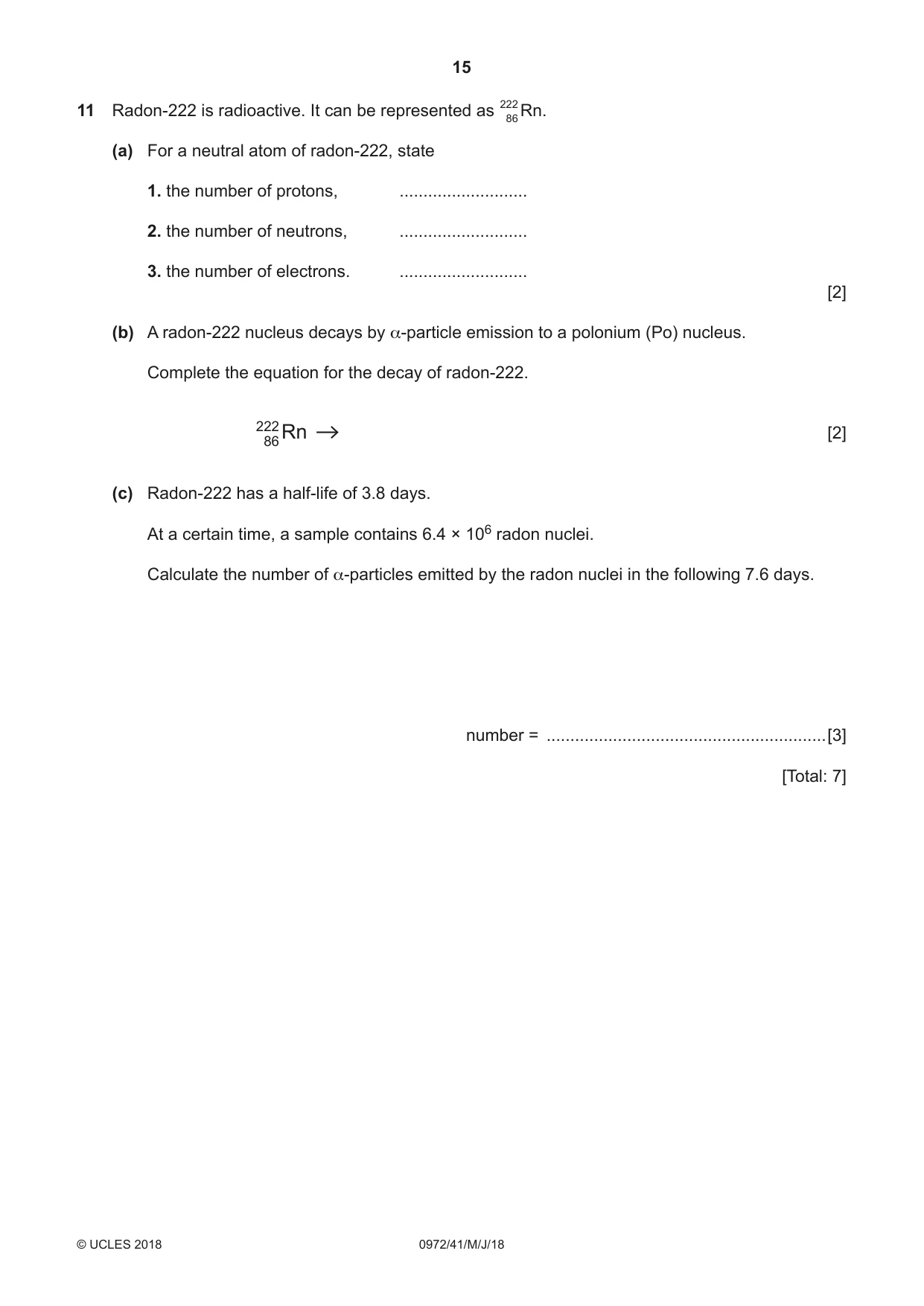
11 Radon-222 is radioactive. It can be represented as 22286 Rn. (a) For a neutral atom of radon-222, state 1. the number of protons, ........................... 2. the number of neutrons, ........................... 3. the number of electrons. ........................... [2] (b) A radon-222 nucleus decays by α-particle emission to a polonium (Po) nucleus. Complete the equation for the decay of radon-222. 222 Rn [2] 86 (c) Radon-222 has a half-life of 3.8 days. At a certain time, a sample contains 6.4 × 10⁶ radon nuclei. Calculate the number of α-particles emitted by the radon nuclei in the following 7.6 days. number = ...........................................................[3] [Total: 7]
Mark scheme: 11(a) Number of protons = 86 and number of electrons = 86 1 Number of neutrons = 136 1 11(b) 218 84 Po 1 + 4 2 α 1 11(c) 7.6 days = 2 half-lives or evidence of two halvings 1 (number of Rn atoms left = 6.4 × 10⁶ ÷ 4 =) 1.6 × 10⁶ 1 number of α-particles emitted = (6.4 × 10⁶ – 1.6 × 106 =) 4.8 × 10⁶ 1
What was in this paper
The subtopics covered by these 11 questions, and how many questions each got. Open one in a new tab to see every Cambridge question on it.
What you needed in this session
Cambridge’s own grade thresholds for 2018 May/June, Paper 4 · Variant 1. A higher threshold means an easier paper — the bar moves with how the cohort did.