Cambridge IGCSE Physics 0625 — 2020 Feb/March Paper 1 · Variant 2
0625/12/F/M/20 · 40 marks · ≈45 min
The question paper and its mark scheme, free to read here and free to download. This is Cambridge’s own paper, exactly as it was sat.
Question paper20 pages
Mark scheme3 pages
Answers below. Sit the paper first if you are practising.
Paper as text
Question paper, page 1
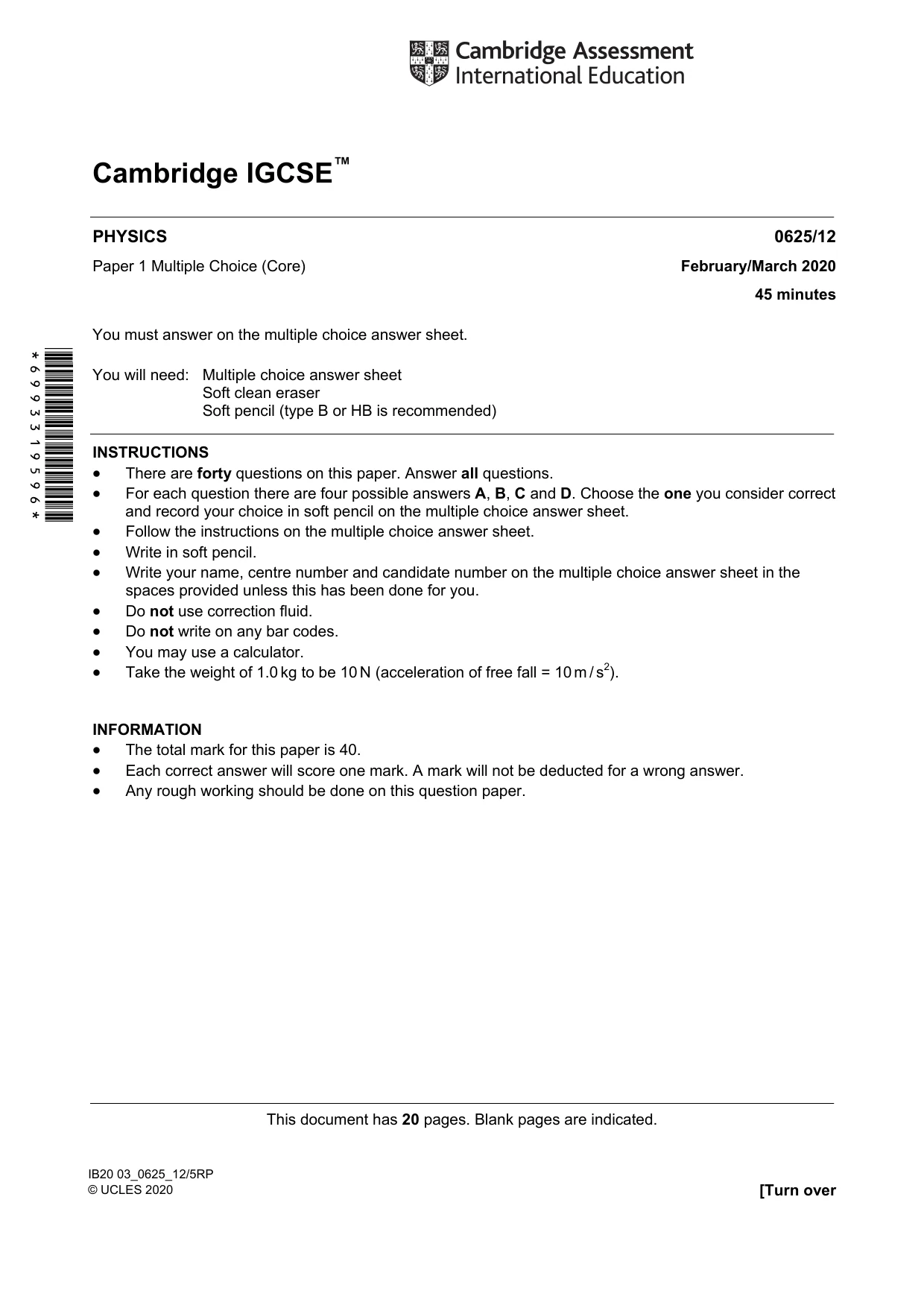
This document has 20 pages. Blank pages are indicated. IB20 03_0625_12/5RP © UCLES 2020 [Turn over *6993319596* Cambridge IGCSE™ PHYSICS 0625/12 Paper 1 Multiple Choice (Core) February/March 2020 45 minutes You must answer on the multiple choice answer sheet. You will need: Multiple choice answer sheet Soft clean eraser Soft pencil (type B or HB is recommended) INSTRUCTIONS • There are forty questions on this paper. Answer all questions. • For each question there are four possible answers A, B, C and D. Choose the one you consider correct and record your choice in soft pencil on the multiple choice answer sheet. • Follow the instructions on the multiple choice answer sheet. • Write in soft pencil. • Write your name, centre number and candidate number on the multiple choice answer sheet in the spaces provided unless this has been done for you. • Do not use correction fluid. • Do not write on any bar codes. • You may use a calculator. • Take the weight of 1.0 kg to be 10 N (acceleration of free fall = 10 m / s2). INFORMATION • The total mark for this paper is 40. • Each correct answer will score one mark. A mark will not be deducted for a wrong answer. • Any rough working should be done on this question paper.
Question paper, page 2
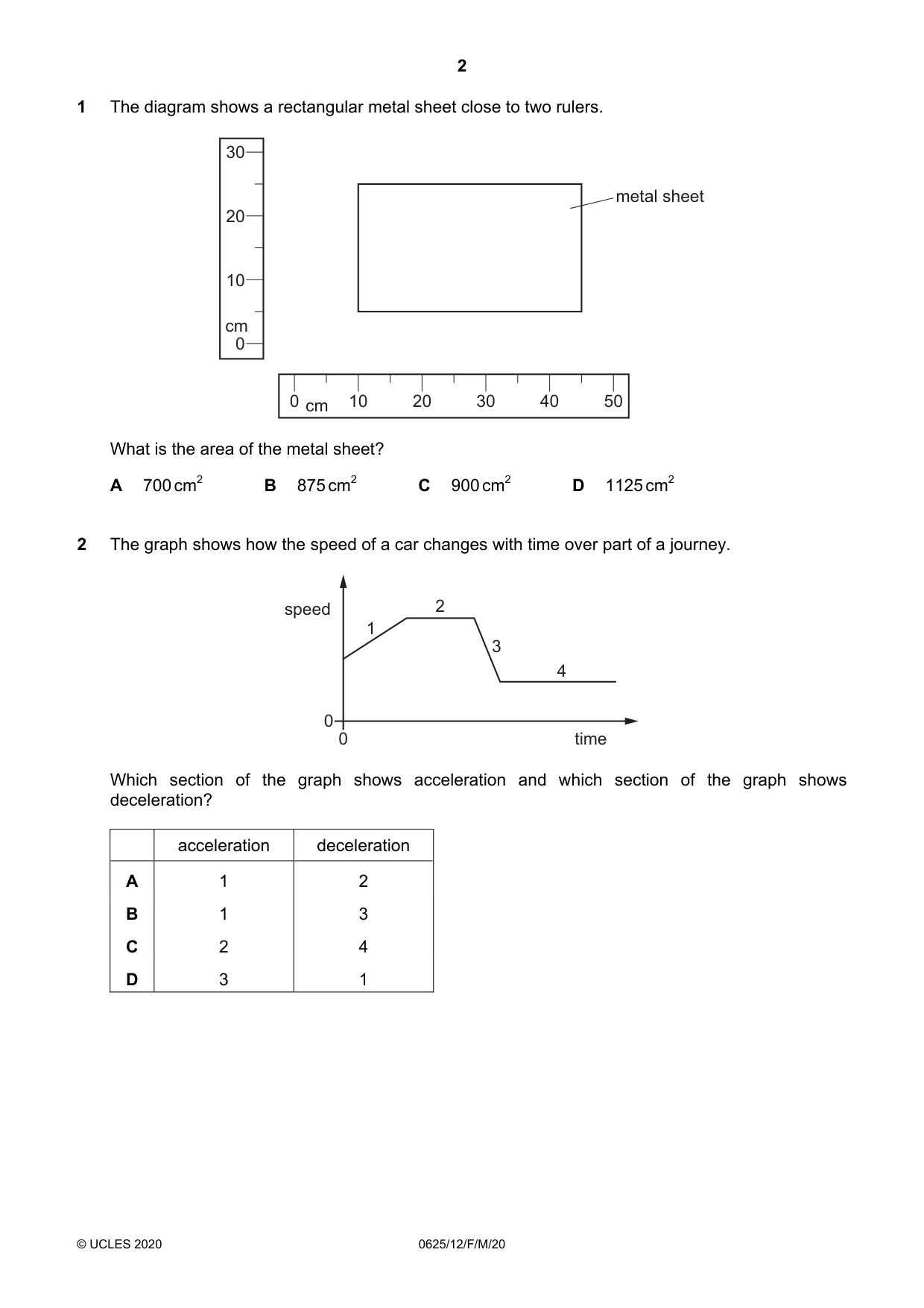
2 © UCLES 2020 0625/12/F/M/20 1 The diagram shows a rectangular metal sheet close to two rulers. 0 0 10 20 30 10 20 30 40 50 cm cm metal sheet What is the area of the metal sheet? A 700 cm2 B 875 cm2 C 900 cm2 D 1125 cm2 2 The graph shows how the speed of a car changes with time over part of a journey. 0 0 speed time 1 2 3 4 Which section of the graph shows acceleration and which section of the graph shows deceleration? acceleration deceleration A 1 2 B 1 3 C 2 4 D 3 1
Question paper, page 3
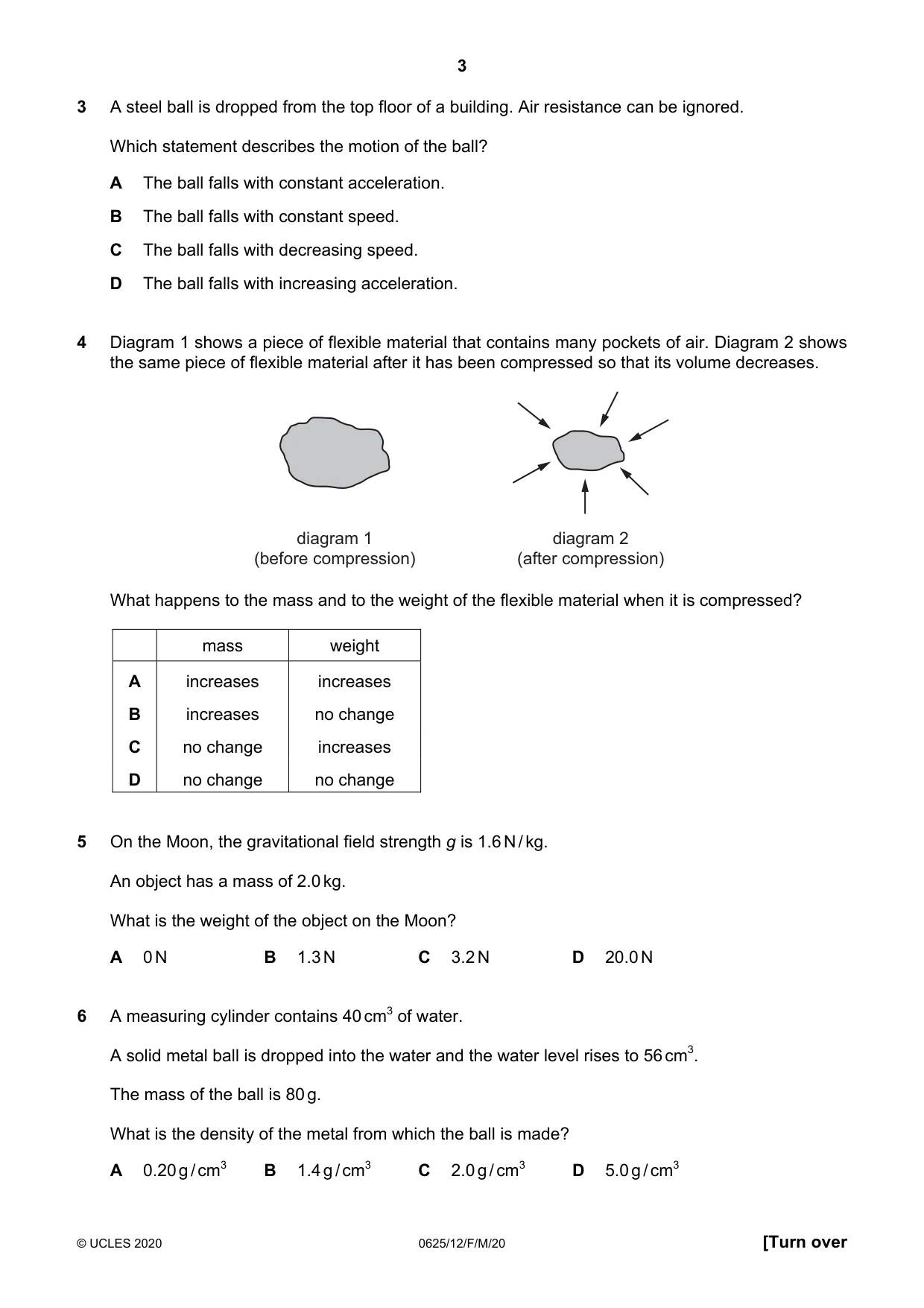
3 © UCLES 2020 0625/12/F/M/20 [Turn over 3 A steel ball is dropped from the top floor of a building. Air resistance can be ignored. Which statement describes the motion of the ball? A The ball falls with constant acceleration. B The ball falls with constant speed. C The ball falls with decreasing speed. D The ball falls with increasing acceleration. 4 Diagram 1 shows a piece of flexible material that contains many pockets of air. Diagram 2 shows the same piece of flexible material after it has been compressed so that its volume decreases. diagram 1 (before compression) diagram 2 (after compression) What happens to the mass and to the weight of the flexible material when it is compressed? mass weight A increases increases B increases no change C no change increases D no change no change 5 On the Moon, the gravitational field strength g is 1.6 N / kg. An object has a mass of 2.0 kg. What is the weight of the object on the Moon? A 0 N B 1.3 N C 3.2 N D 20.0 N 6 A measuring cylinder contains 40 cm3 of water. A solid metal ball is dropped into the water and the water level rises to 56 cm3. The mass of the ball is 80 g. What is the density of the metal from which the ball is made? A 0.20 g / cm3 B 1.4 g / cm3 C 2.0 g / cm3 D 5.0 g / cm3
Question paper, page 4
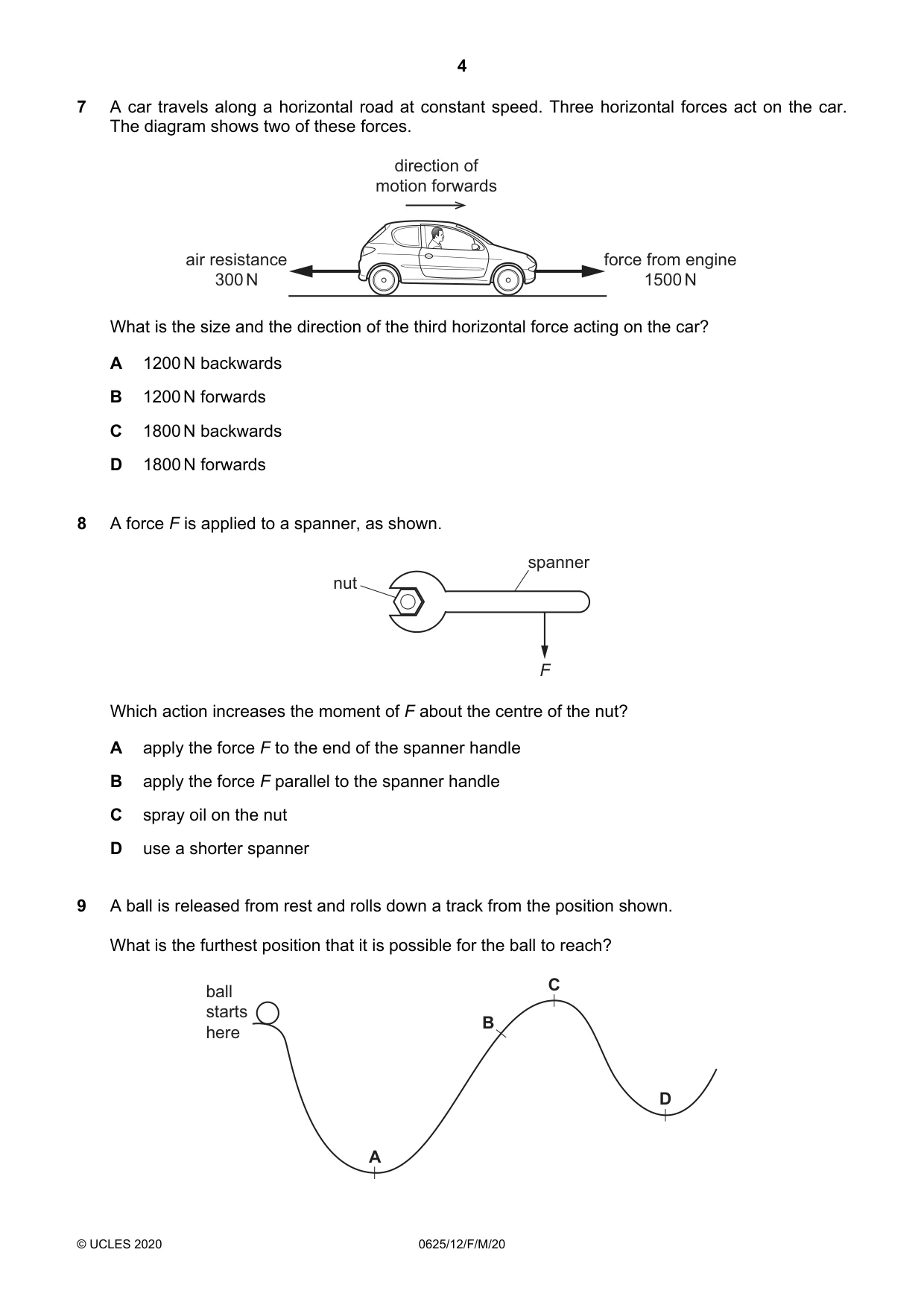
4 © UCLES 2020 0625/12/F/M/20 7 A car travels along a horizontal road at constant speed. Three horizontal forces act on the car. The diagram shows two of these forces. air resistance 300 N force from engine 1500 N direction of motion forwards What is the size and the direction of the third horizontal force acting on the car? A 1200 N backwards B 1200 N forwards C 1800 N backwards D 1800 N forwards 8 A force F is applied to a spanner, as shown. F nut spanner Which action increases the moment of F about the centre of the nut? A apply the force F to the end of the spanner handle B apply the force F parallel to the spanner handle C spray oil on the nut D use a shorter spanner 9 A ball is released from rest and rolls down a track from the position shown. What is the furthest position that it is possible for the ball to reach? ball starts here A C B D
Question paper, page 5
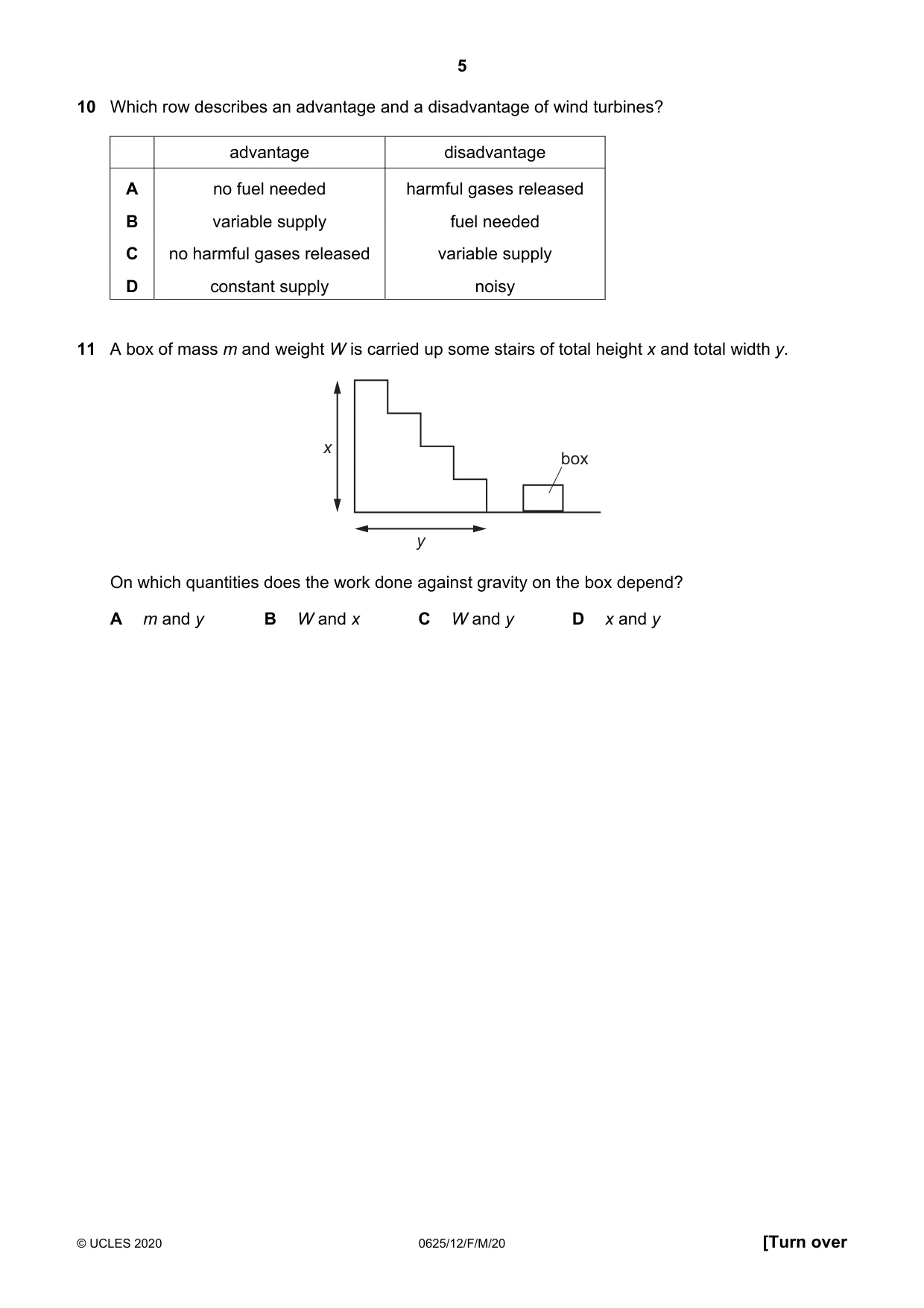
5 © UCLES 2020 0625/12/F/M/20 [Turn over 10 Which row describes an advantage and a disadvantage of wind turbines? advantage disadvantage A no fuel needed harmful gases released B variable supply fuel needed C no harmful gases released variable supply D constant supply noisy 11 A box of mass m and weight W is carried up some stairs of total height x and total width y. y x box On which quantities does the work done against gravity on the box depend? A m and y B W and x C W and y D x and y
Question paper, page 6
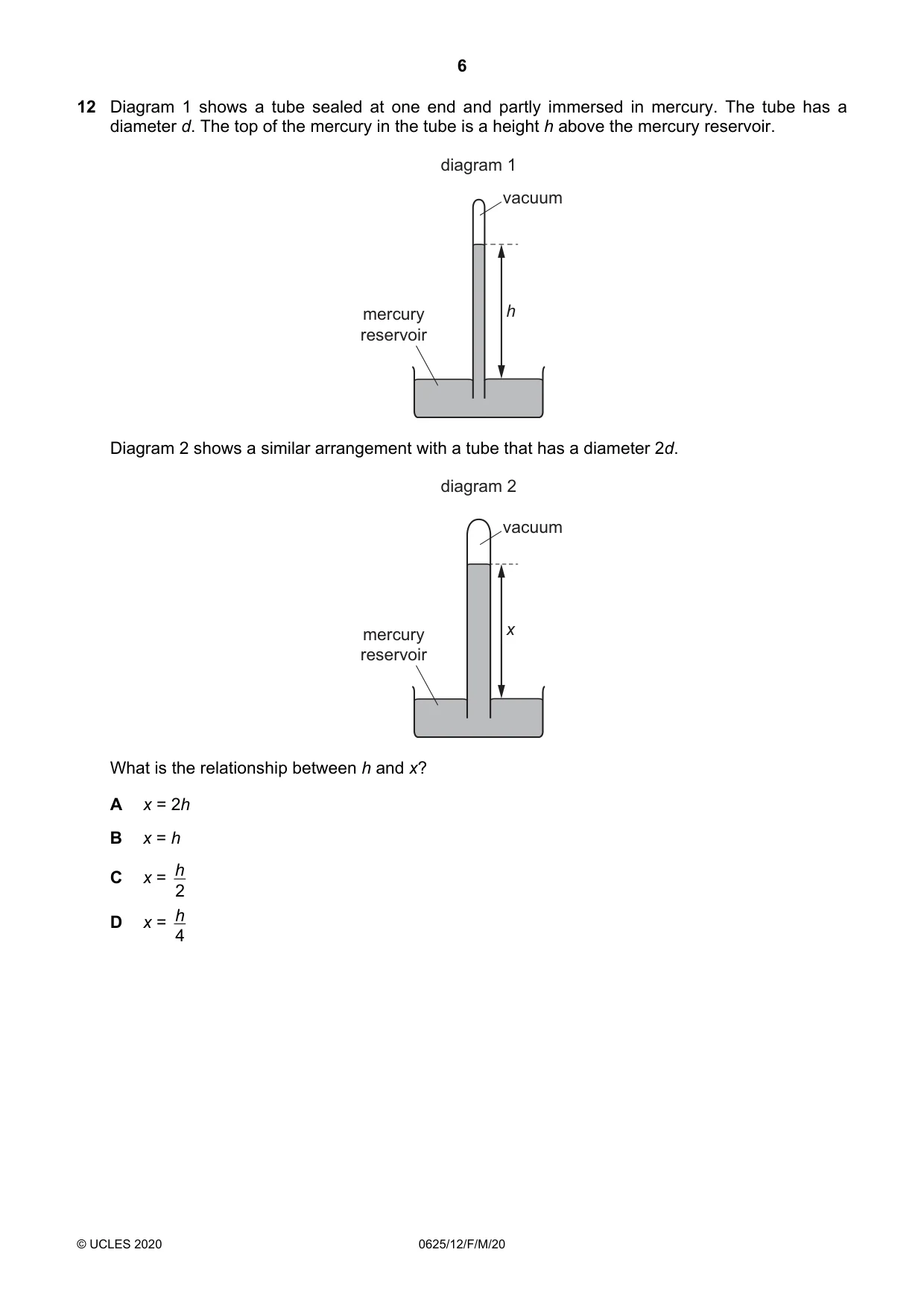
6 © UCLES 2020 0625/12/F/M/20 12 Diagram 1 shows a tube sealed at one end and partly immersed in mercury. The tube has a diameter d. The top of the mercury in the tube is a height h above the mercury reservoir. h vacuum mercury reservoir diagram 1 Diagram 2 shows a similar arrangement with a tube that has a diameter 2d. x vacuum diagram 2 mercury reservoir What is the relationship between h and x? A x = 2h B x = h C x = 2 h D x = 4 h
Question paper, page 7
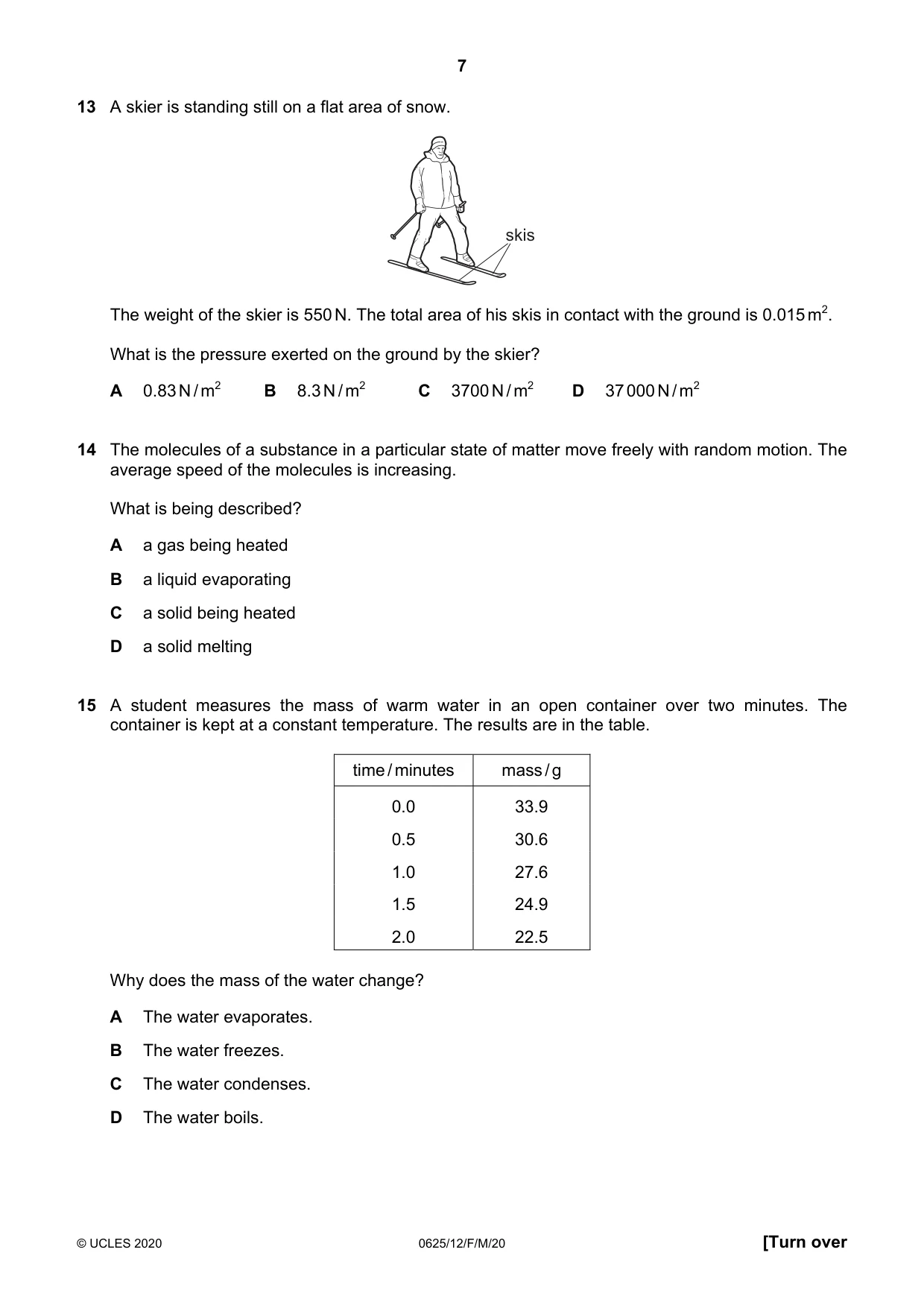
7 © UCLES 2020 0625/12/F/M/20 [Turn over 13 A skier is standing still on a flat area of snow. skis The weight of the skier is 550 N. The total area of his skis in contact with the ground is 0.015 m2. What is the pressure exerted on the ground by the skier? A 0.83 N / m2 B 8.3 N / m2 C 3700 N / m2 D 37 000 N / m2 14 The molecules of a substance in a particular state of matter move freely with random motion. The average speed of the molecules is increasing. What is being described? A a gas being heated B a liquid evaporating C a solid being heated D a solid melting 15 A student measures the mass of warm water in an open container over two minutes. The container is kept at a constant temperature. The results are in the table. time / minutes mass / g 0.0 33.9 0.5 30.6 1.0 27.6 1.5 24.9 2.0 22.5 Why does the mass of the water change? A The water evaporates. B The water freezes. C The water condenses. D The water boils.
Question paper, page 8
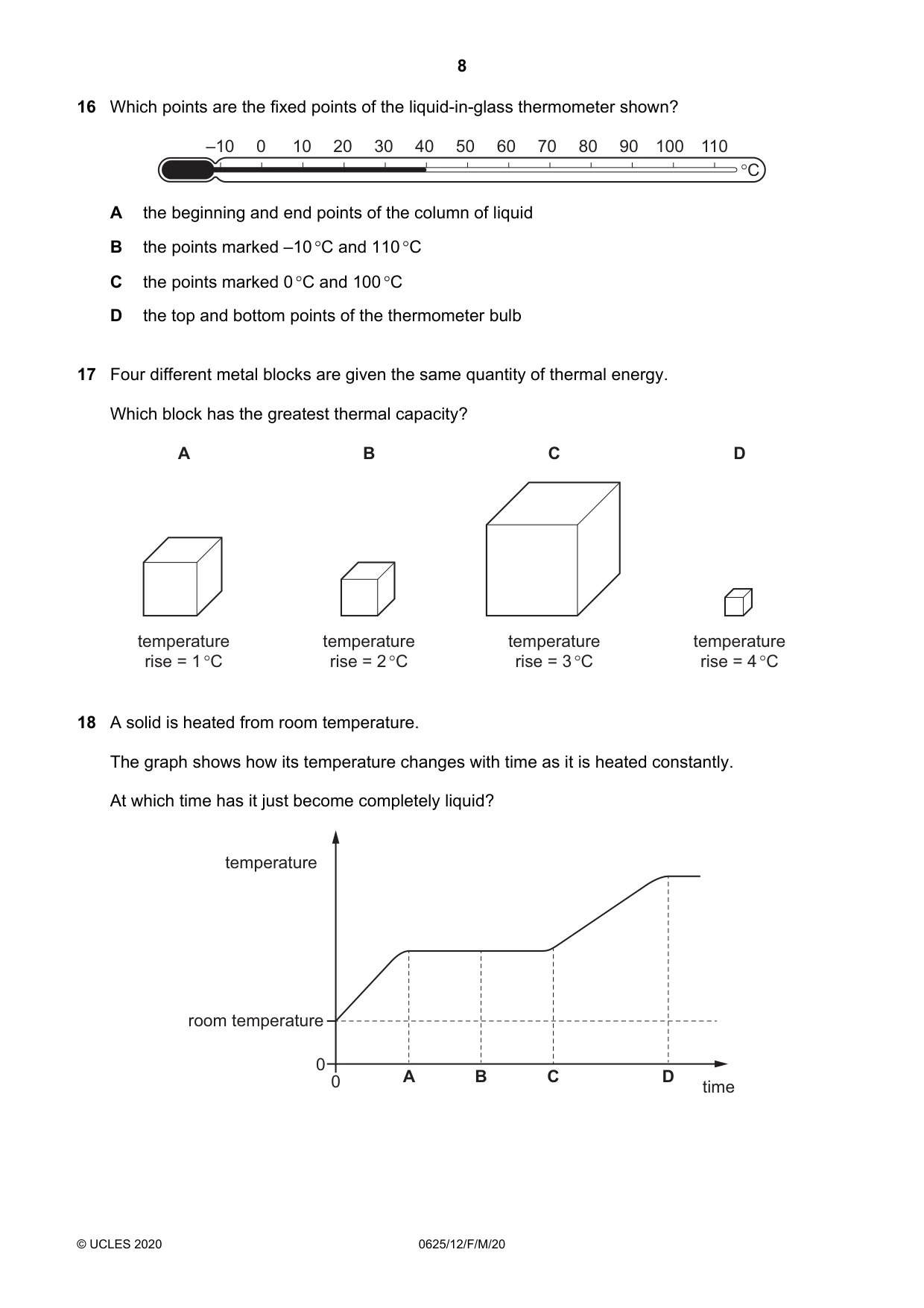
8 © UCLES 2020 0625/12/F/M/20 16 Which points are the fixed points of the liquid-in-glass thermometer shown? –10 0 10 20 30 40 50 60 70 80 90 100 110 °C A the beginning and end points of the column of liquid B the points marked –10 °C and 110 °C C the points marked 0 °C and 100 °C D the top and bottom points of the thermometer bulb 17 Four different metal blocks are given the same quantity of thermal energy. Which block has the greatest thermal capacity? A temperature rise = 1 °C B temperature rise = 2 °C C temperature rise = 3 °C D temperature rise = 4 °C 18 A solid is heated from room temperature. The graph shows how its temperature changes with time as it is heated constantly. At which time has it just become completely liquid? 0 0 A B C D room temperature temperature time
Question paper, page 9
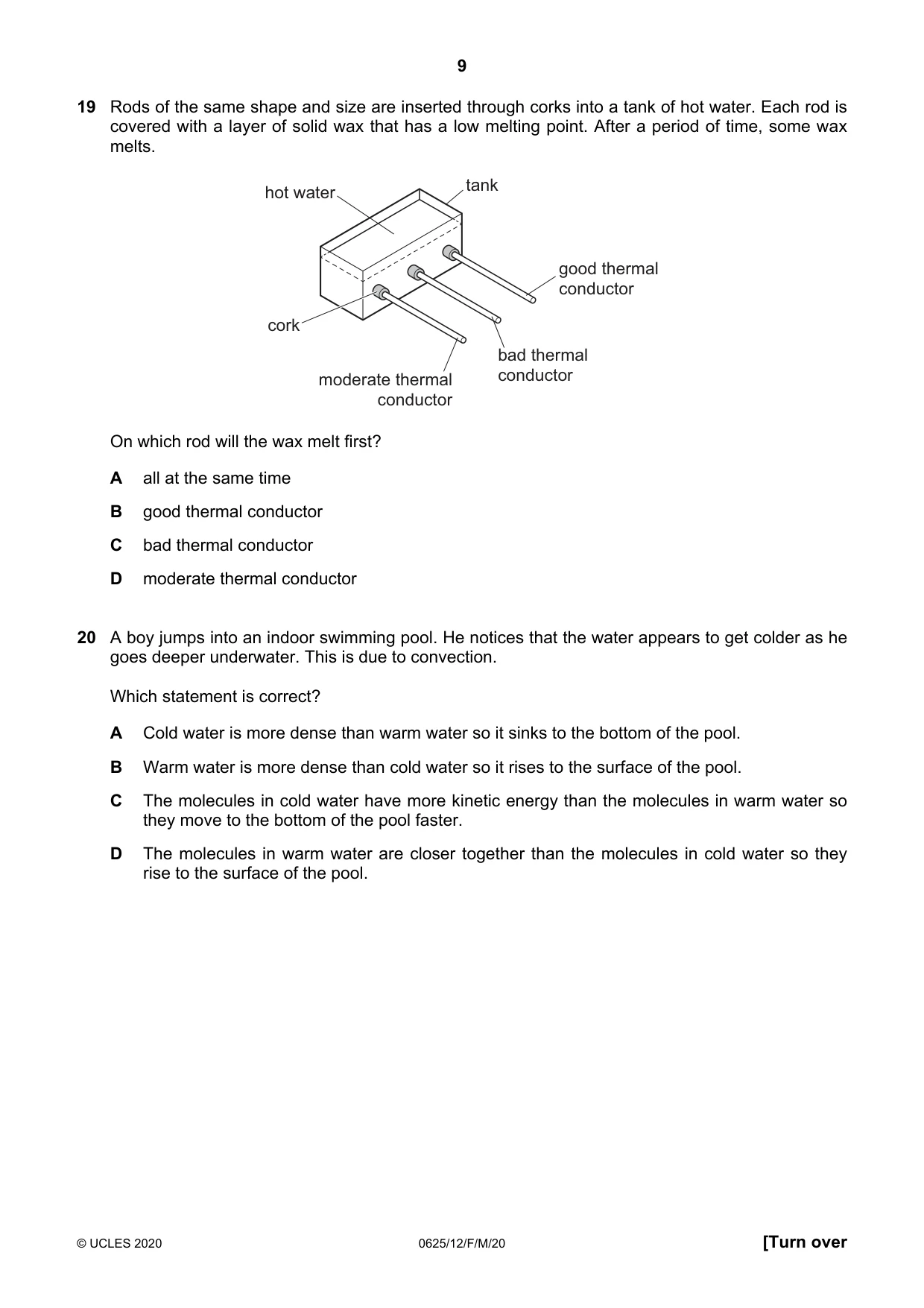
9 © UCLES 2020 0625/12/F/M/20 [Turn over 19 Rods of the same shape and size are inserted through corks into a tank of hot water. Each rod is covered with a layer of solid wax that has a low melting point. After a period of time, some wax melts. hot water tank good thermal conductor bad thermal conductor moderate thermal conductor cork On which rod will the wax melt first? A all at the same time B good thermal conductor C bad thermal conductor D moderate thermal conductor 20 A boy jumps into an indoor swimming pool. He notices that the water appears to get colder as he goes deeper underwater. This is due to convection. Which statement is correct? A Cold water is more dense than warm water so it sinks to the bottom of the pool. B Warm water is more dense than cold water so it rises to the surface of the pool. C The molecules in cold water have more kinetic energy than the molecules in warm water so they move to the bottom of the pool faster. D The molecules in warm water are closer together than the molecules in cold water so they rise to the surface of the pool.
Question paper, page 10
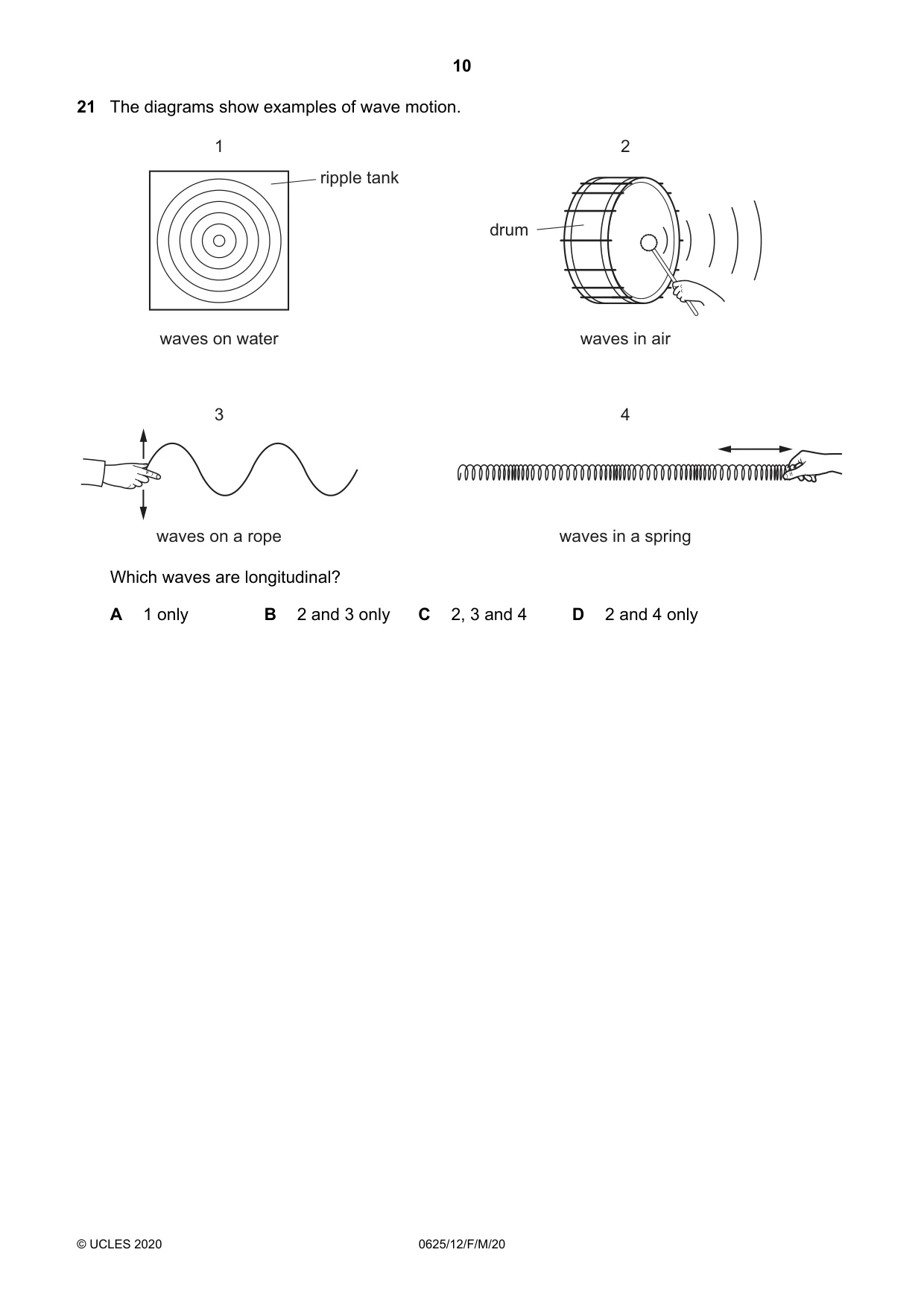
10 © UCLES 2020 0625/12/F/M/20 21 The diagrams show examples of wave motion. 1 2 waves on water waves in air waves on a rope waves in a spring 3 4 ripple tank drum Which waves are longitudinal? A 1 only B 2 and 3 only C 2, 3 and 4 D 2 and 4 only
Question paper, page 11
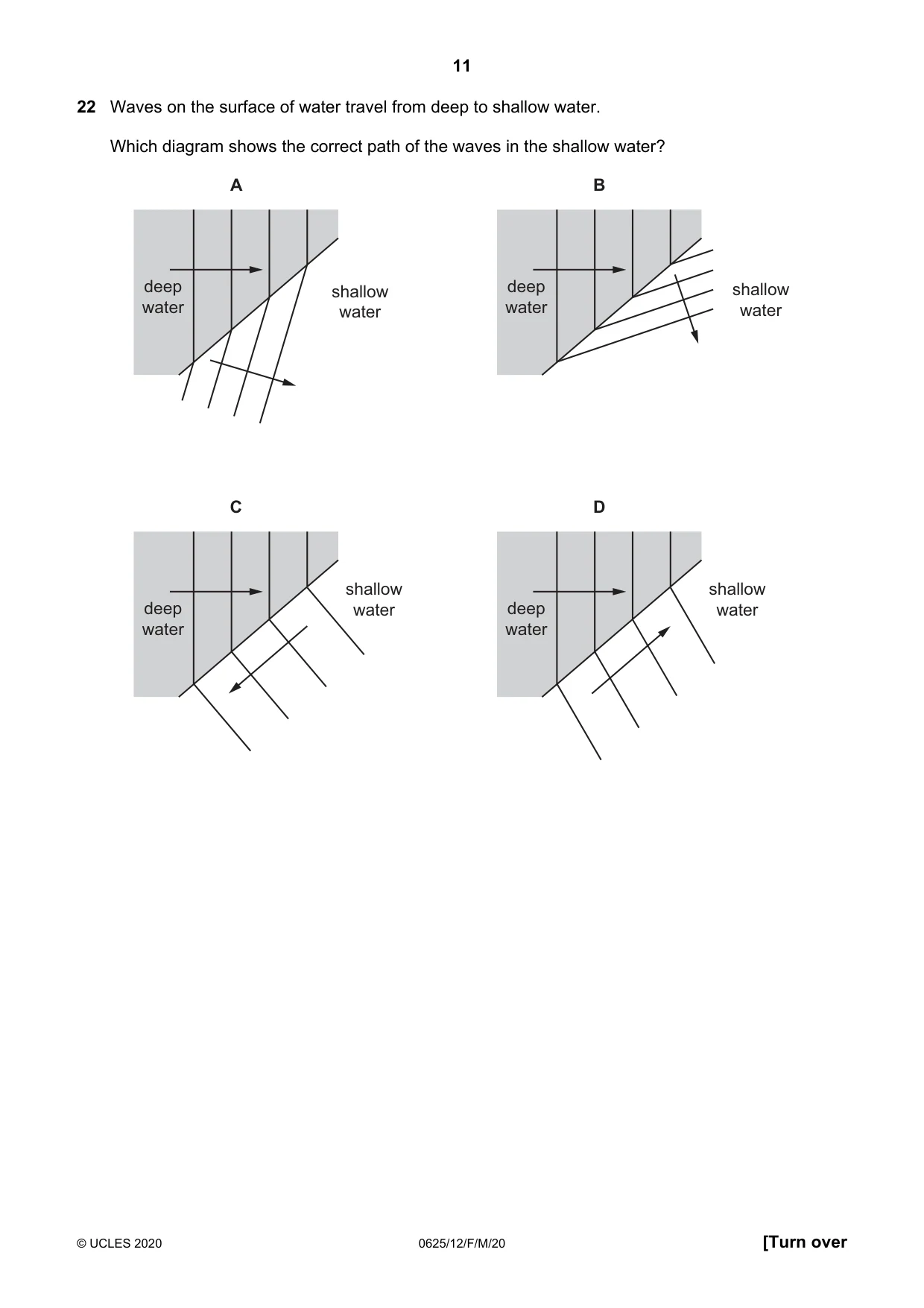
11 © UCLES 2020 0625/12/F/M/20 [Turn over 22 Waves on the surface of water travel from deep to shallow water. Which diagram shows the correct path of the waves in the shallow water? deep water A shallow water deep water B shallow water deep water C shallow water deep water D shallow water
Question paper, page 12
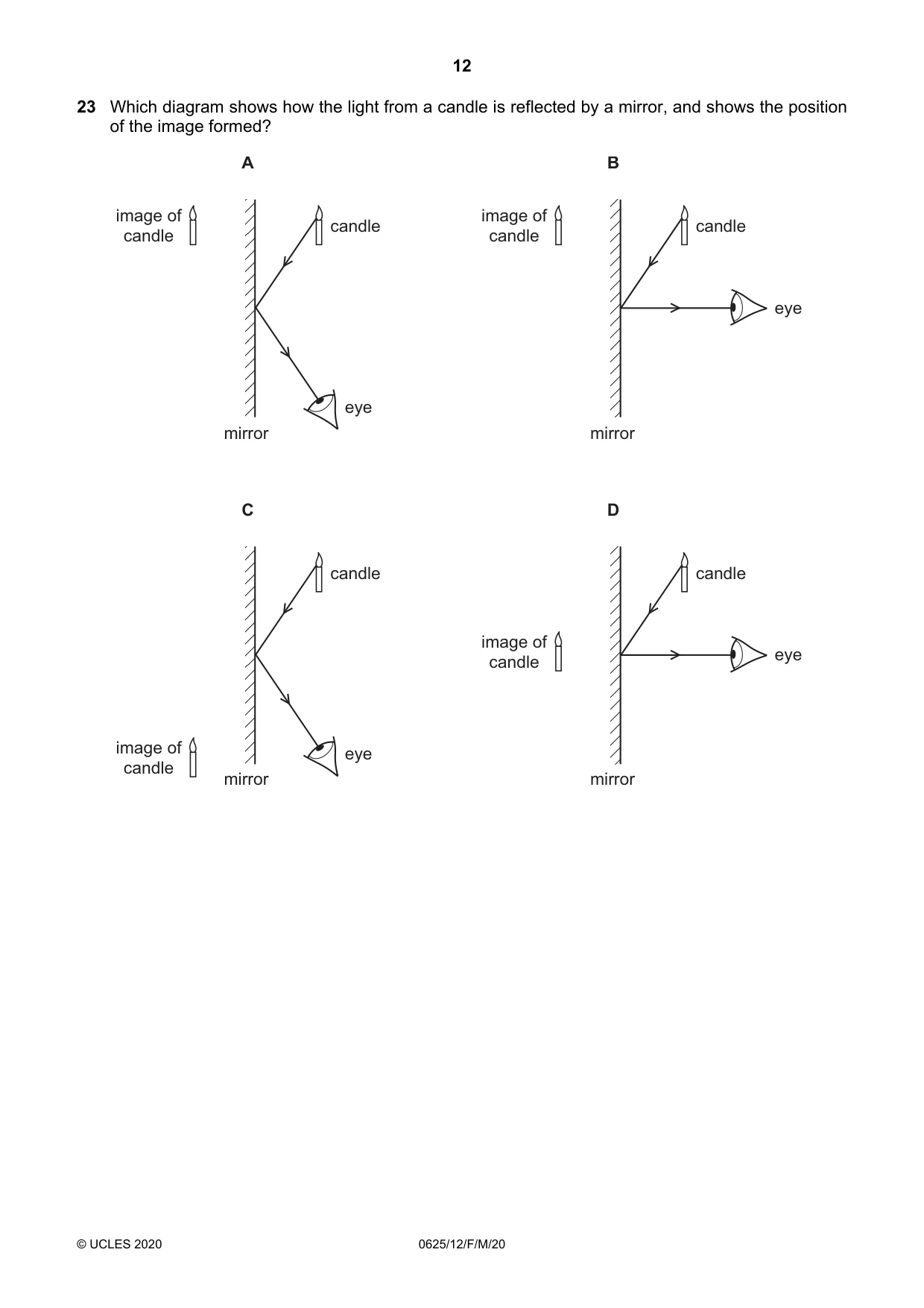
12 © UCLES 2020 0625/12/F/M/20 23 Which diagram shows how the light from a candle is reflected by a mirror, and shows the position of the image formed? eye candle image of candle A eye candle eye candle image of candle B image of candle C D eye candle image of candle mirror mirror mirror mirror
Question paper, page 13
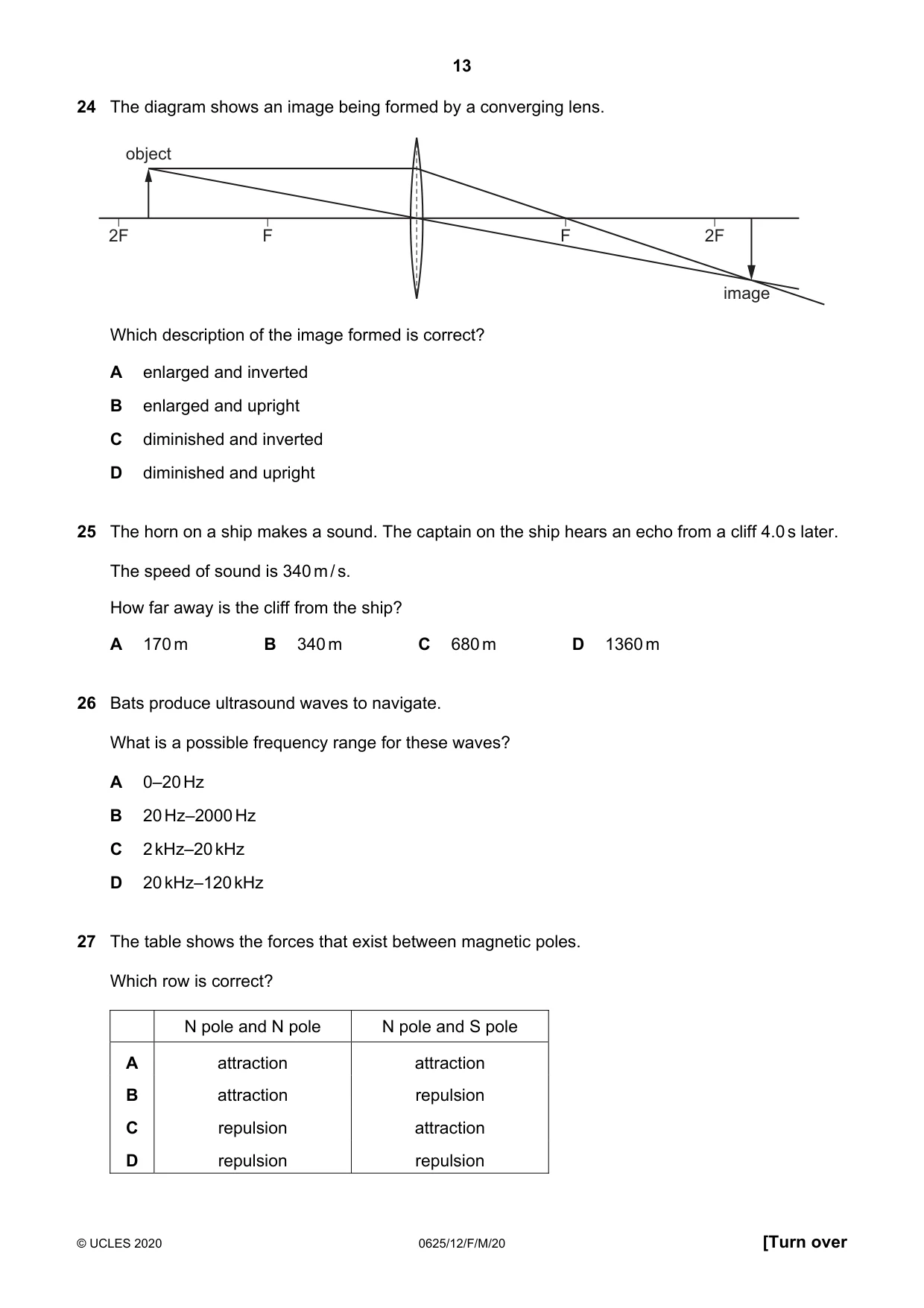
13 © UCLES 2020 0625/12/F/M/20 [Turn over 24 The diagram shows an image being formed by a converging lens. F object image F 2F 2F Which description of the image formed is correct? A enlarged and inverted B enlarged and upright C diminished and inverted D diminished and upright 25 The horn on a ship makes a sound. The captain on the ship hears an echo from a cliff 4.0 s later. The speed of sound is 340 m / s. How far away is the cliff from the ship? A 170 m B 340 m C 680 m D 1360 m 26 Bats produce ultrasound waves to navigate. What is a possible frequency range for these waves? A 0–20 Hz B 20 Hz–2000 Hz C 2 kHz–20 kHz D 20 kHz–120 kHz 27 The table shows the forces that exist between magnetic poles. Which row is correct? N pole and N pole N pole and S pole A attraction attraction B attraction repulsion C repulsion attraction D repulsion repulsion
Question paper, page 14
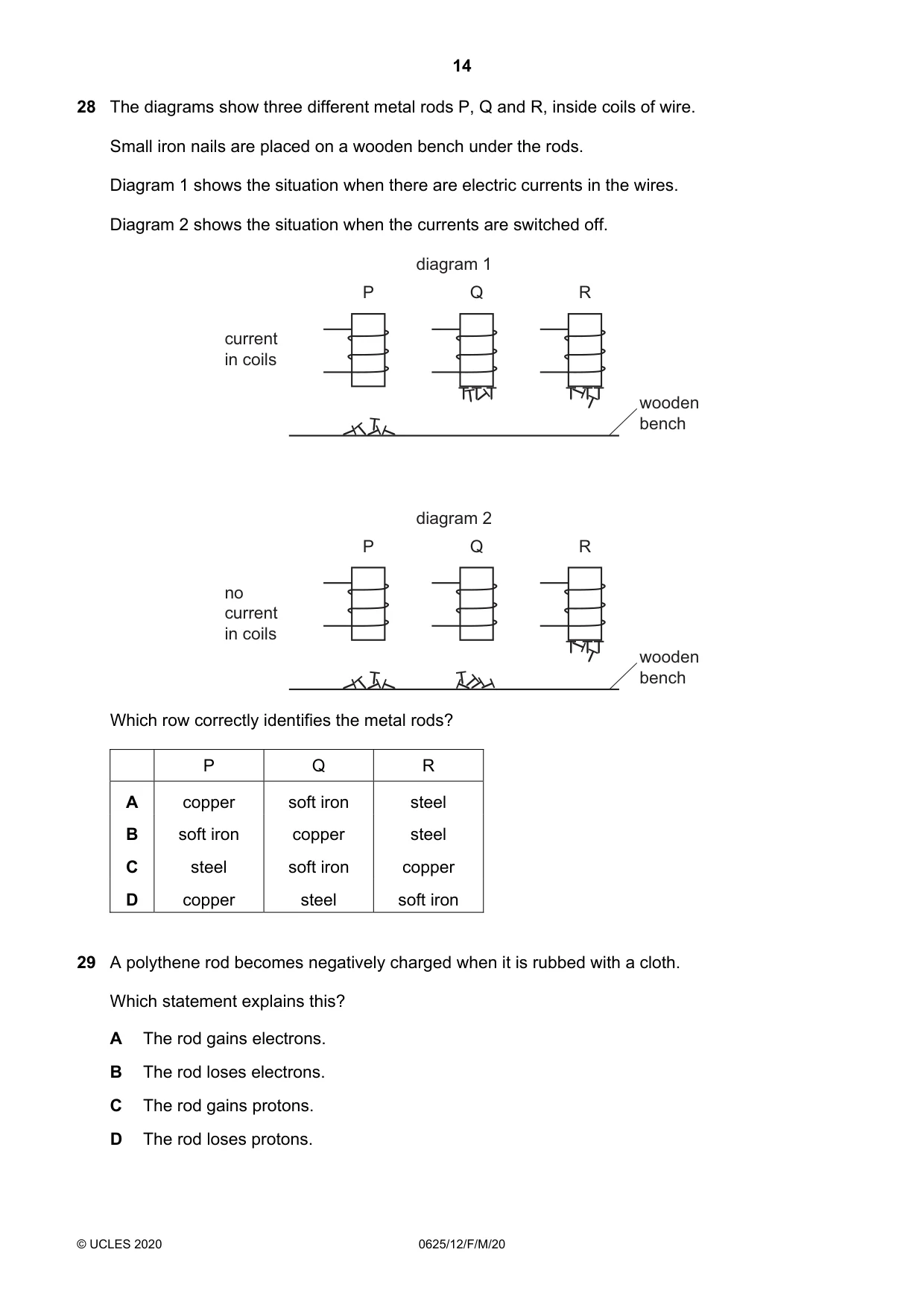
14 © UCLES 2020 0625/12/F/M/20 28 The diagrams show three different metal rods P, Q and R, inside coils of wire. Small iron nails are placed on a wooden bench under the rods. Diagram 1 shows the situation when there are electric currents in the wires. Diagram 2 shows the situation when the currents are switched off. P wooden bench current in coils diagram 1 Q R P no current in coils diagram 2 Q R wooden bench Which row correctly identifies the metal rods? P Q R A copper soft iron steel B soft iron copper steel C steel soft iron copper D copper steel soft iron 29 A polythene rod becomes negatively charged when it is rubbed with a cloth. Which statement explains this? A The rod gains electrons. B The rod loses electrons. C The rod gains protons. D The rod loses protons.
Question paper, page 15
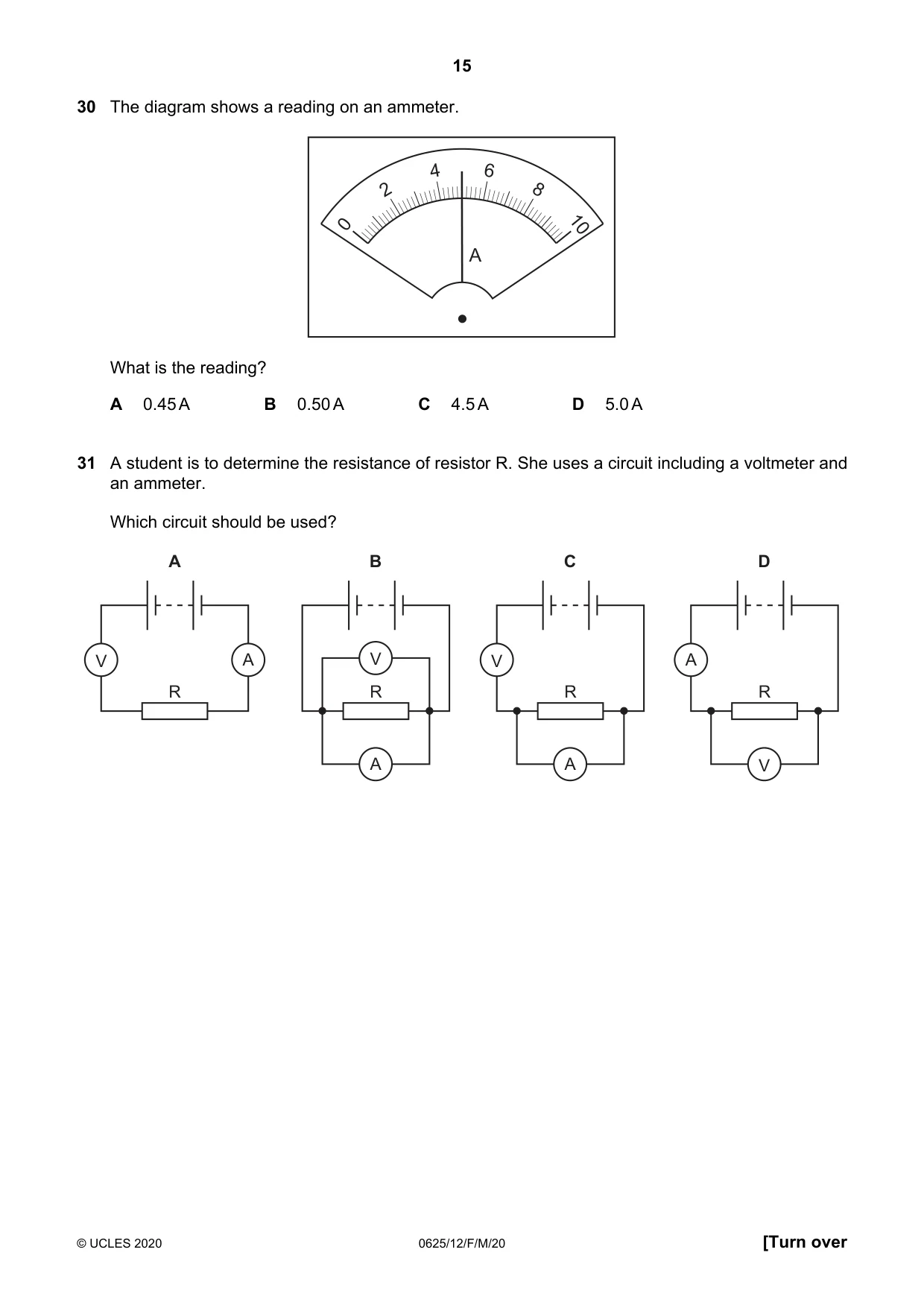
15 © UCLES 2020 0625/12/F/M/20 [Turn over 30 The diagram shows a reading on an ammeter. 6 8 10 4 2 0 A What is the reading? A 0.45 A B 0.50 A C 4.5 A D 5.0 A 31 A student is to determine the resistance of resistor R. She uses a circuit including a voltmeter and an ammeter. Which circuit should be used? A A V R B R A V C R A V D R V A
Question paper, page 16
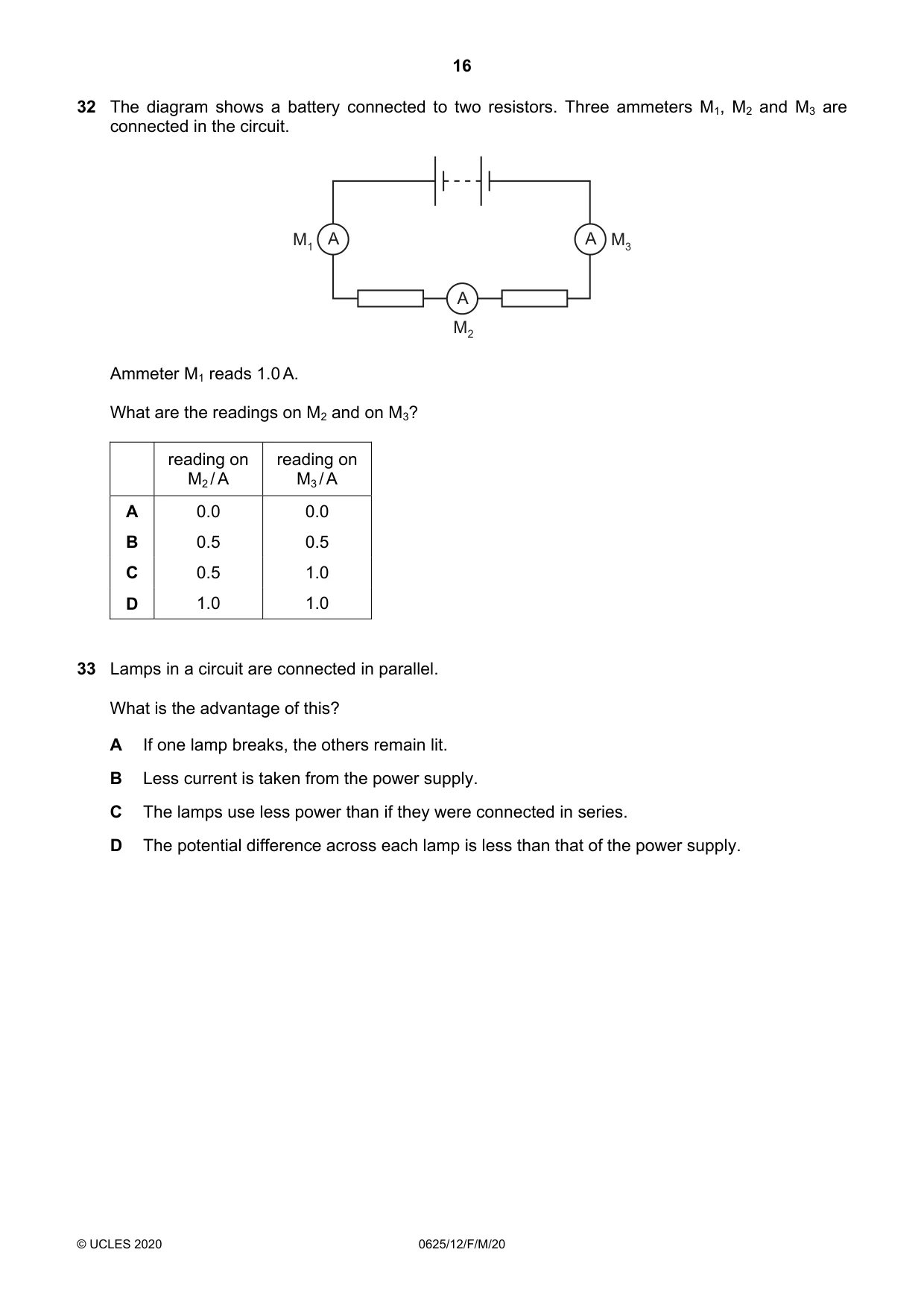
16 © UCLES 2020 0625/12/F/M/20 32 The diagram shows a battery connected to two resistors. Three ammeters M1, M2 and M3 are connected in the circuit. M1 M2 M3 A A A Ammeter M1 reads 1.0 A. What are the readings on M2 and on M3? reading on M2 / A reading on M3 / A A 0.0 0.0 B 0.5 0.5 C 0.5 1.0 D 1.0 1.0 33 Lamps in a circuit are connected in parallel. What is the advantage of this? A If one lamp breaks, the others remain lit. B Less current is taken from the power supply. C The lamps use less power than if they were connected in series. D The potential difference across each lamp is less than that of the power supply.
Question paper, page 17
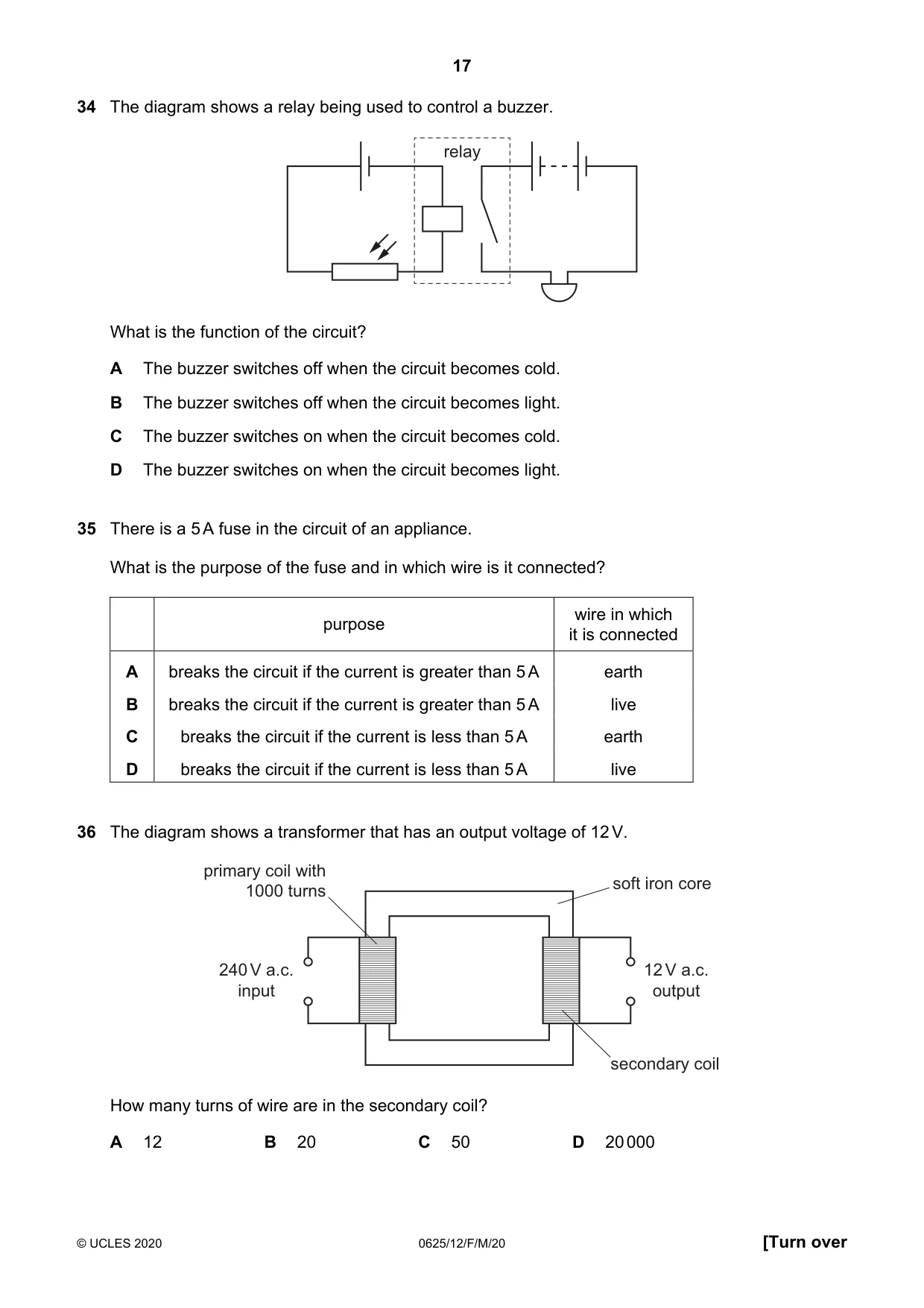
17 © UCLES 2020 0625/12/F/M/20 [Turn over 34 The diagram shows a relay being used to control a buzzer. relay What is the function of the circuit? A The buzzer switches off when the circuit becomes cold. B The buzzer switches off when the circuit becomes light. C The buzzer switches on when the circuit becomes cold. D The buzzer switches on when the circuit becomes light. 35 There is a 5 A fuse in the circuit of an appliance. What is the purpose of the fuse and in which wire is it connected? purpose wire in which it is connected A breaks the circuit if the current is greater than 5 A earth B breaks the circuit if the current is greater than 5 A live C breaks the circuit if the current is less than 5 A earth D breaks the circuit if the current is less than 5 A live 36 The diagram shows a transformer that has an output voltage of 12 V. 240 V a.c. input 12 V a.c. output primary coil with 1000 turns secondary coil soft iron core How many turns of wire are in the secondary coil? A 12 B 20 C 50 D 20 000
Question paper, page 18
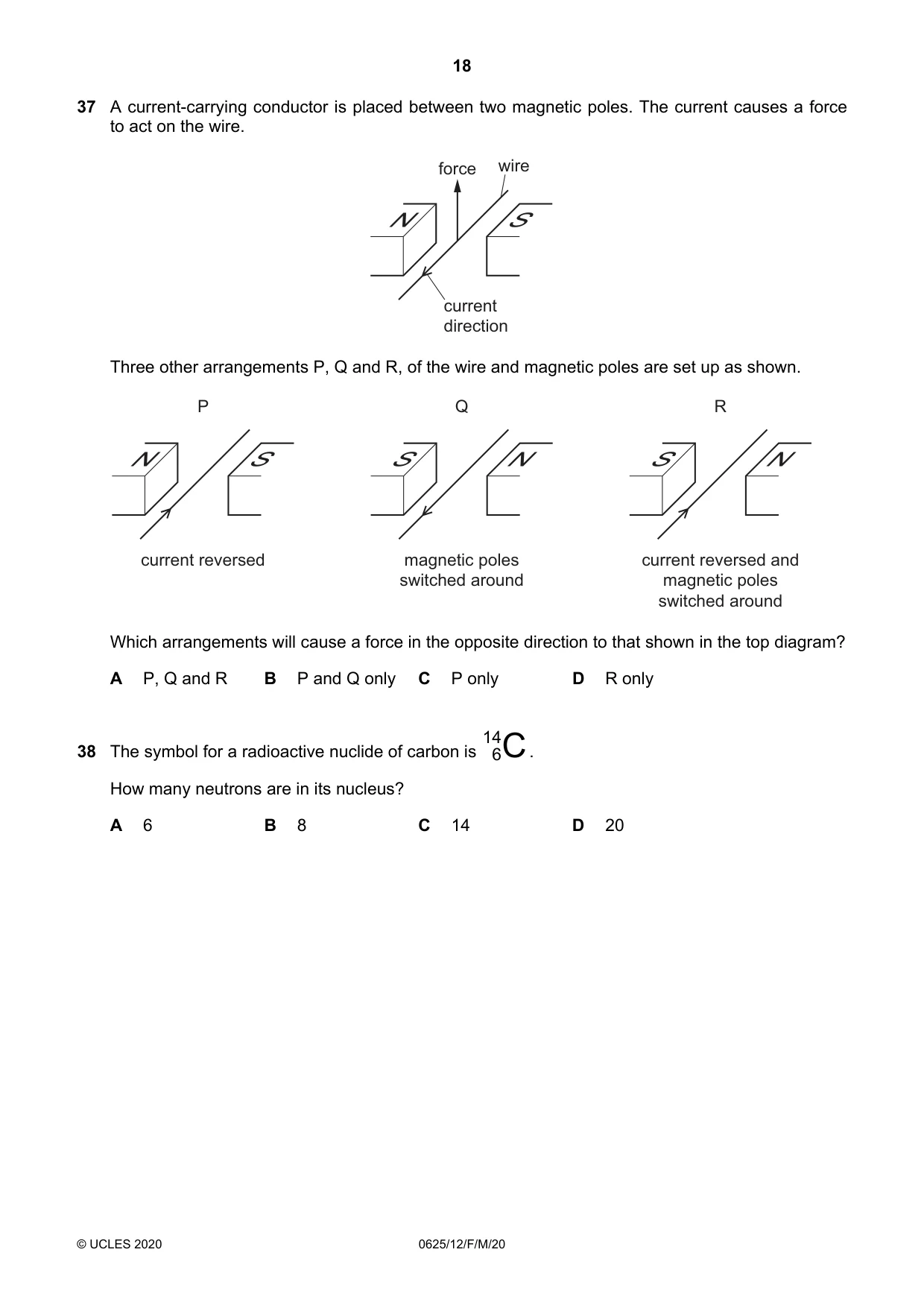
18 © UCLES 2020 0625/12/F/M/20 37 A current-carrying conductor is placed between two magnetic poles. The current causes a force to act on the wire. N S force wire current direction Three other arrangements P, Q and R, of the wire and magnetic poles are set up as shown. N S current reversed P S N magnetic poles switched around Q S N current reversed and magnetic poles switched around R Which arrangements will cause a force in the opposite direction to that shown in the top diagram? A P, Q and R B P and Q only C P only D R only 38 The symbol for a radioactive nuclide of carbon is 14 6C. How many neutrons are in its nucleus? A 6 B 8 C 14 D 20
Question paper, page 19
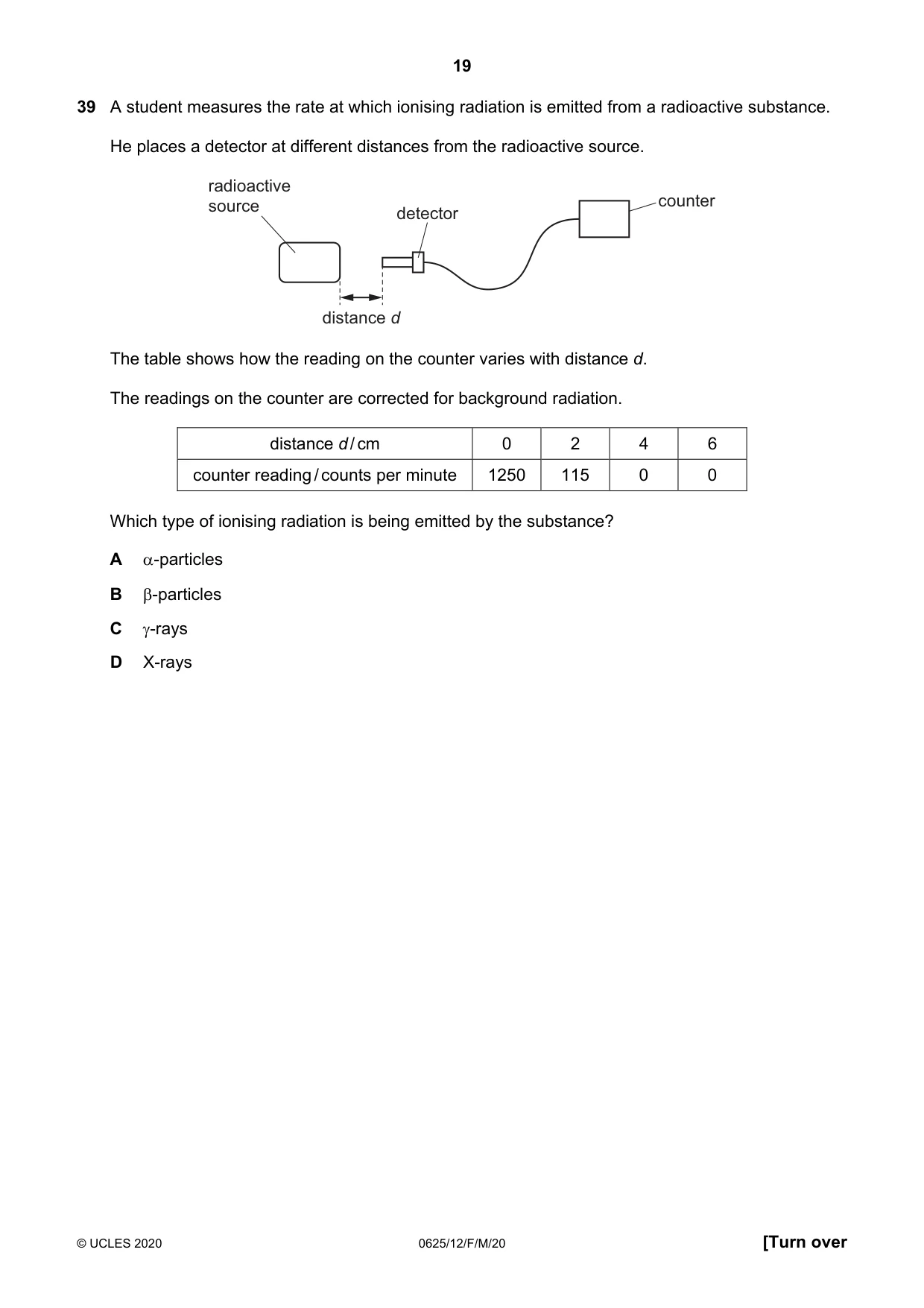
19 © UCLES 2020 0625/12/F/M/20 [Turn over 39 A student measures the rate at which ionising radiation is emitted from a radioactive substance. He places a detector at different distances from the radioactive source. radioactive source detector counter distance d The table shows how the reading on the counter varies with distance d. The readings on the counter are corrected for background radiation. distance d / cm 0 2 4 6 counter reading / counts per minute 1250 115 0 0 Which type of ionising radiation is being emitted by the substance? A α-particles B β-particles C γ-rays D X-rays
Question paper, page 20
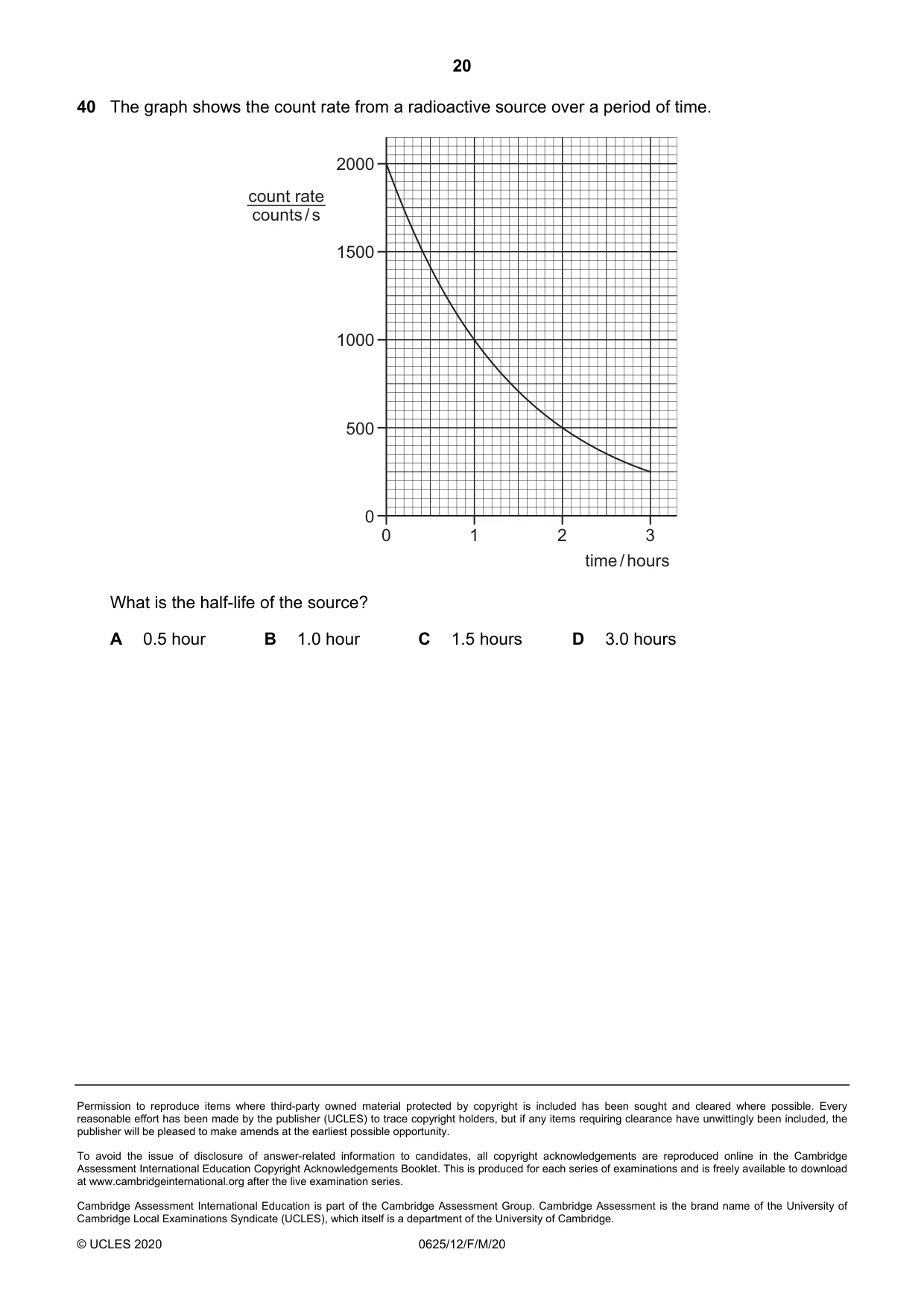
20 Permission to reproduce items where third-party owned material protected by copyright is included has been sought and cleared where possible. Every reasonable effort has been made by the publisher (UCLES) to trace copyright holders, but if any items requiring clearance have unwittingly been included, the publisher will be pleased to make amends at the earliest possible opportunity. To avoid the issue of disclosure of answer-related information to candidates, all copyright acknowledgements are reproduced online in the Cambridge Assessment International Education Copyright Acknowledgements Booklet. This is produced for each series of examinations and is freely available to download at www.cambridgeinternational.org after the live examination series. Cambridge Assessment International Education is part of the Cambridge Assessment Group. Cambridge Assessment is the brand name of the University of Cambridge Local Examinations Syndicate (UCLES), which itself is a department of the University of Cambridge. © UCLES 2020 0625/12/F/M/20 40 The graph shows the count rate from a radioactive source over a period of time. 2000 1500 1000 500 0 0 1 2 3 time / hours count rate counts / s What is the half-life of the source? A 0.5 hour B 1.0 hour C 1.5 hours D 3.0 hours
Mark scheme, page 1
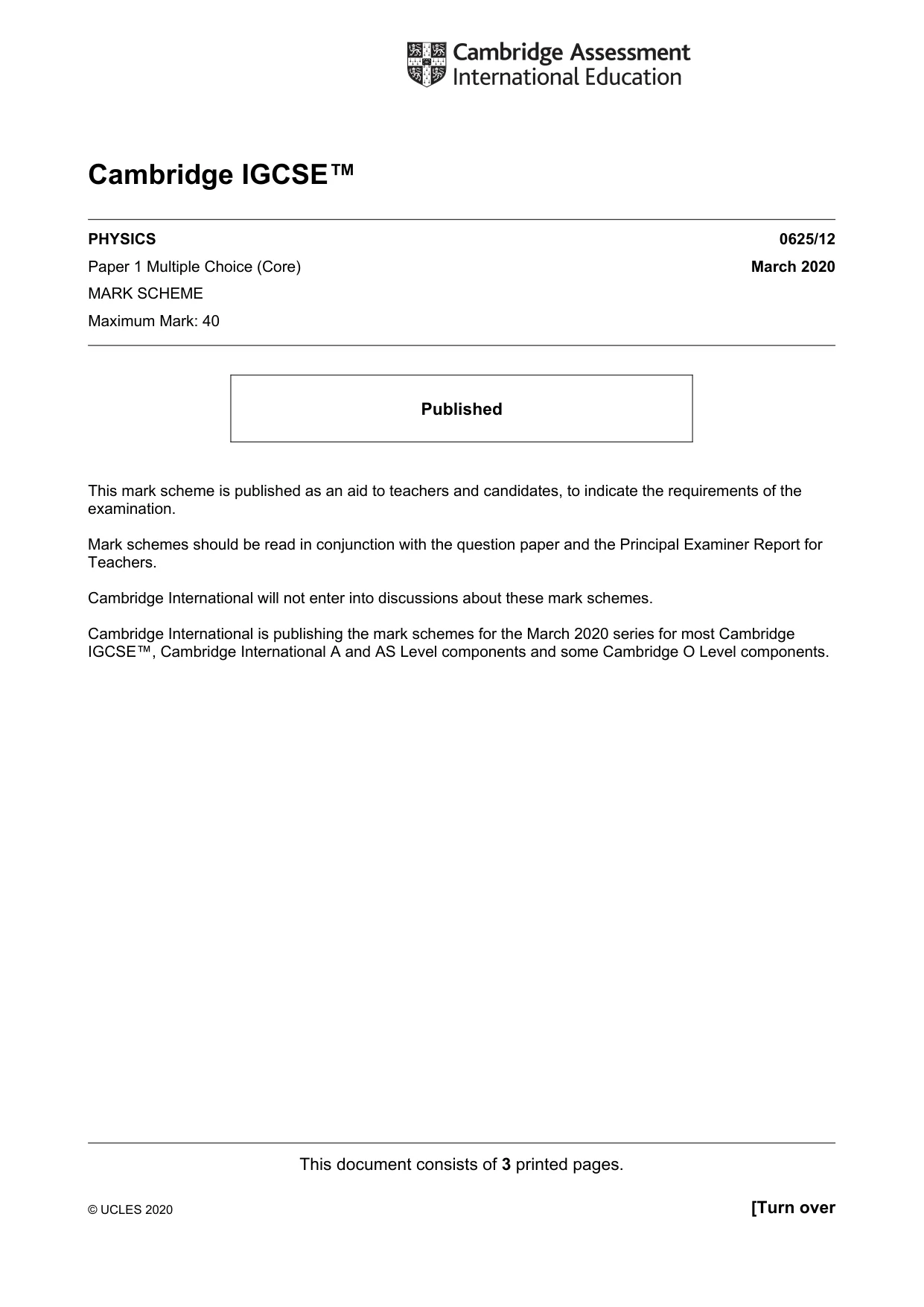
This document consists of 3 printed pages. © UCLES 2020 [Turn over Cambridge IGCSE™ PHYSICS 0625/12 Paper 1 Multiple Choice (Core) March 2020 MARK SCHEME Maximum Mark: 40 Published This mark scheme is published as an aid to teachers and candidates, to indicate the requirements of the examination. Mark schemes should be read in conjunction with the question paper and the Principal Examiner Report for Teachers. Cambridge International will not enter into discussions about these mark schemes. Cambridge International is publishing the mark schemes for the March 2020 series for most Cambridge IGCSE™, Cambridge International A and AS Level components and some Cambridge O Level components.
Mark scheme, page 2
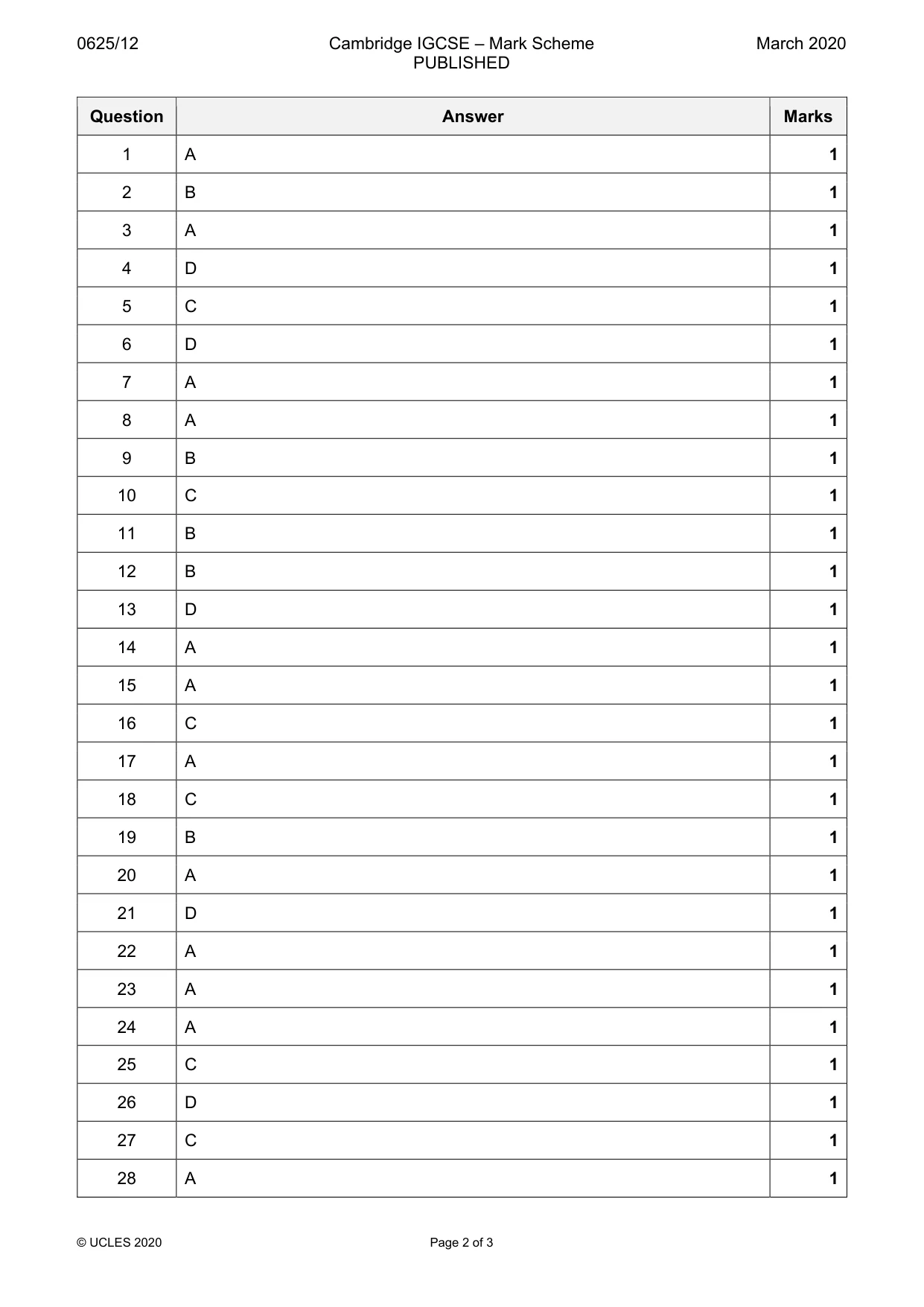
0625/12 Cambridge IGCSE – Mark Scheme PUBLISHED March 2020 © UCLES 2020 Page 2 of 3 Question Answer Marks 1 A 1 2 B 1 3 A 1 4 D 1 5 C 1 6 D 1 7 A 1 8 A 1 9 B 1 10 C 1 11 B 1 12 B 1 13 D 1 14 A 1 15 A 1 16 C 1 17 A 1 18 C 1 19 B 1 20 A 1 21 D 1 22 A 1 23 A 1 24 A 1 25 C 1 26 D 1 27 C 1 28 A 1
Mark scheme, page 3
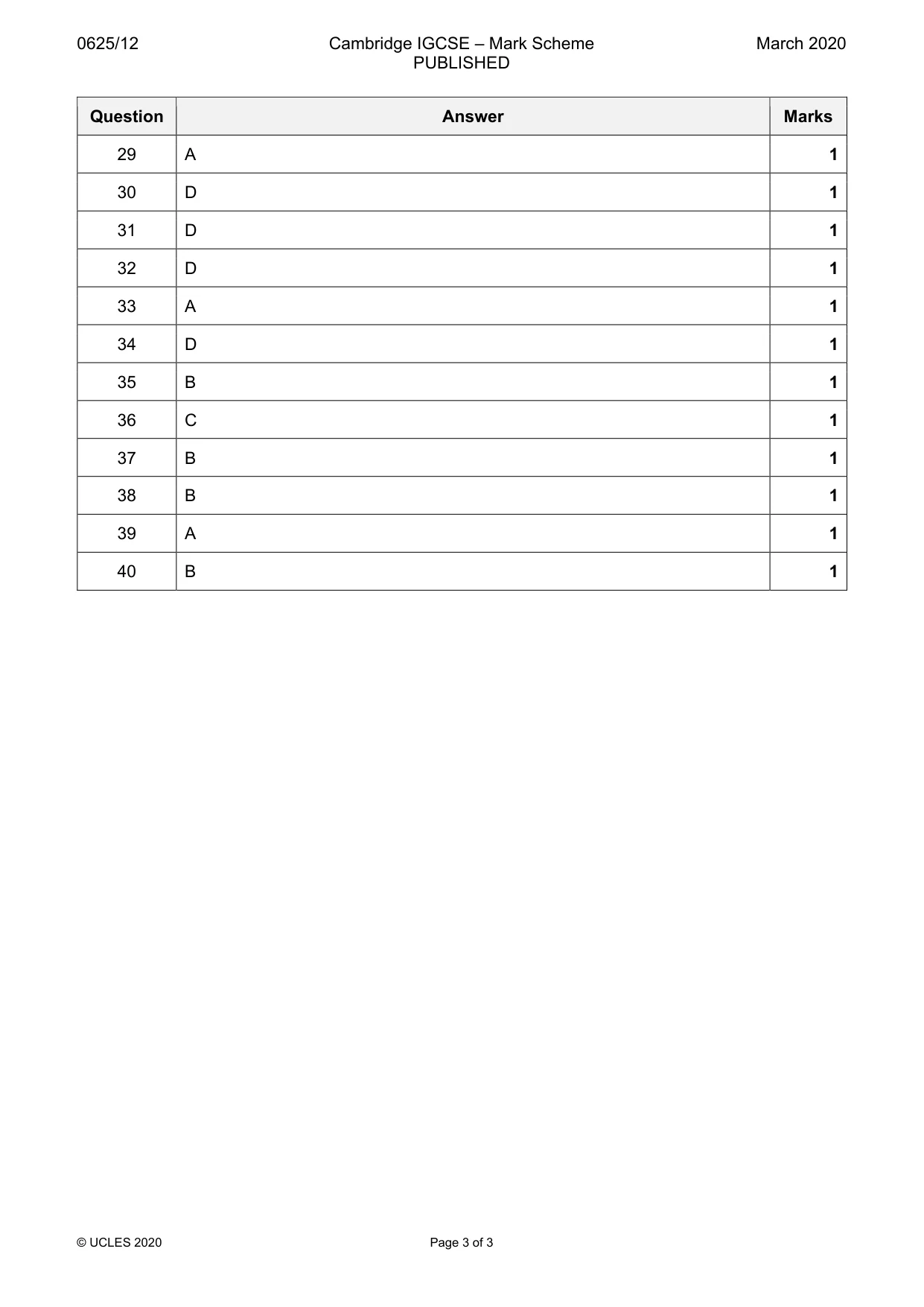
0625/12 Cambridge IGCSE – Mark Scheme PUBLISHED March 2020 © UCLES 2020 Page 3 of 3 Question Answer Marks 29 A 1 30 D 1 31 D 1 32 D 1 33 A 1 34 D 1 35 B 1 36 C 1 37 B 1 38 B 1 39 A 1 40 B 1
What you needed in this session
Cambridge’s own grade thresholds for 2020 Feb/March, Paper 1 · Variant 2. A higher threshold means an easier paper — the bar moves with how the cohort did.