Cambridge IGCSE Physics 0625 — 2016 Oct/Nov Paper 6 · Variant 1
0625/61/O/N/16 · 40 marks · ≈45 min
The question paper and its mark scheme, free to read here and free to download. This is Cambridge’s own paper, exactly as it was sat.
Question paper16 pages
Mark scheme6 pages
Answers below. Sit the paper first if you are practising.
Paper as text
Question paper, page 1
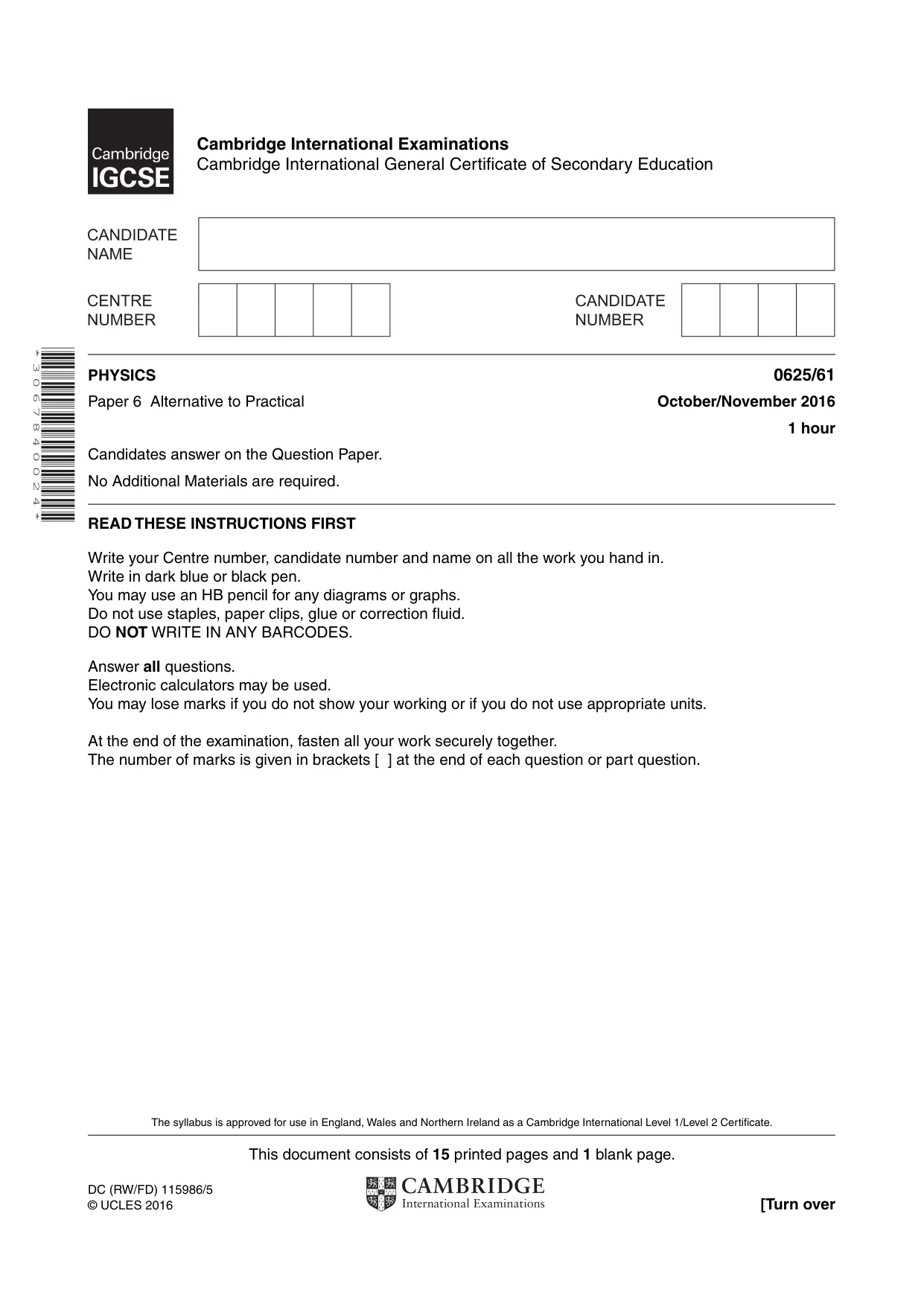
This document consists of 15 printed pages and 1 blank page. DC (RW/FD) 115986/5 © UCLES 2016 [Turn over Cambridge International Examinations Cambridge International General Certificate of Secondary Education * 3 0 6 7 8 4 0 0 2 4 * PHYSICS 0625/61 Paper 6 Alternative to Practical October/November 2016 1 hour Candidates answer on the Question Paper. No Additional Materials are required. READ THESE INSTRUCTIONS FIRST Write your Centre number, candidate number and name on all the work you hand in. Write in dark blue or black pen. You may use an HB pencil for any diagrams or graphs. Do not use staples, paper clips, glue or correction fluid. DO NOT WRITE IN ANY BARCODES. Answer all questions. Electronic calculators may be used. You may lose marks if you do not show your working or if you do not use appropriate units. At the end of the examination, fasten all your work securely together. The number of marks is given in brackets [ ] at the end of each question or part question. The syllabus is approved for use in England, Wales and Northern Ireland as a Cambridge International Level 1/Level 2 Certificate.
Question paper, page 2
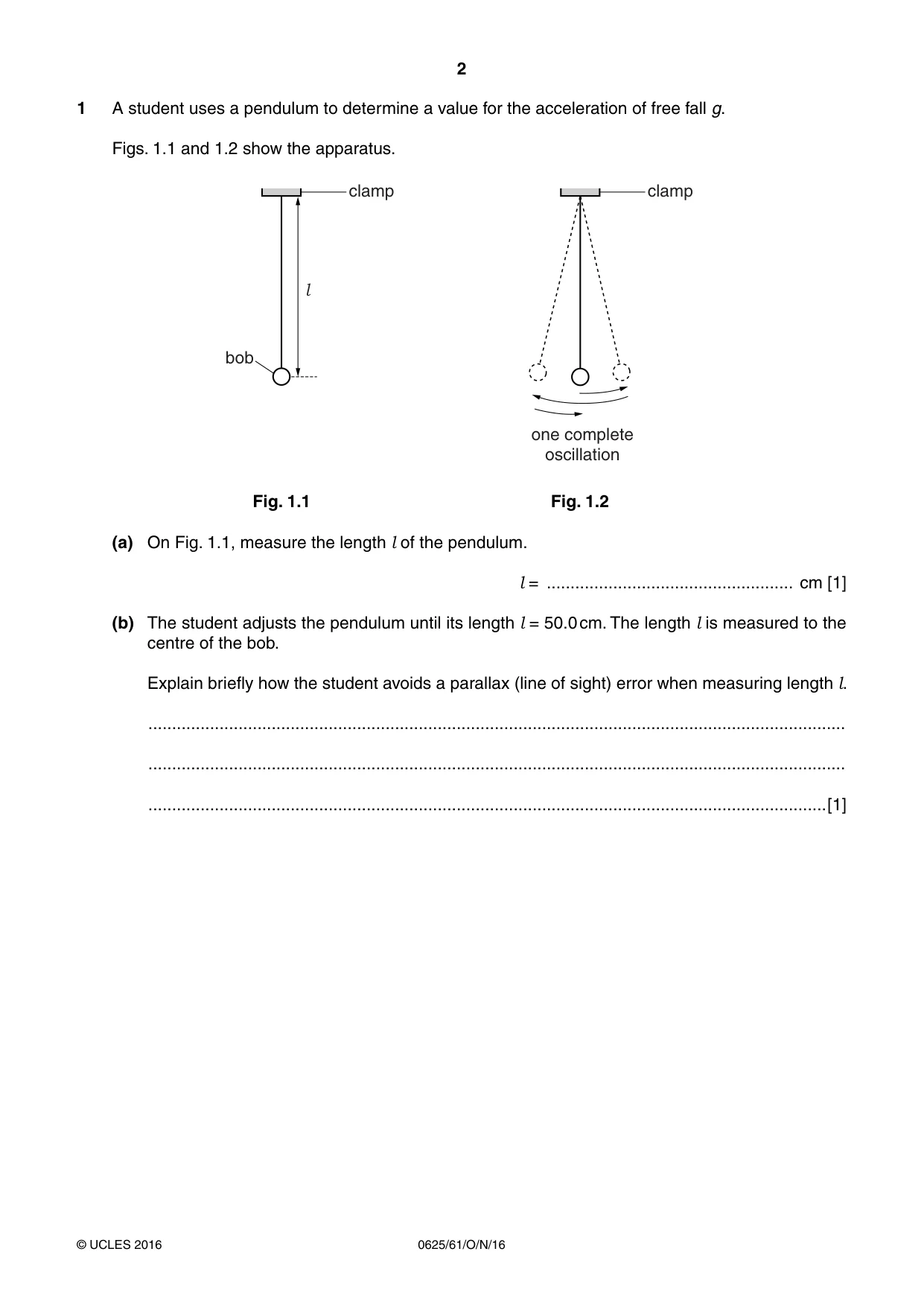
2 0625/61/O/N/16 © UCLES 2016 1 A student uses a pendulum to determine a value for the acceleration of free fall g. Figs. 1.1 and 1.2 show the apparatus. bob clamp l clamp one complete oscillation Fig. 1.1 Fig. 1.2 (a) On Fig. 1.1, measure the length l of the pendulum. l = … cm [1] (b) The student adjusts the pendulum until its length l = 50.0 cm. The length l is measured to the centre of the bob. Explain briefly how the student avoids a parallax (line of sight) error when measuring length l. … … …[1]
Question paper, page 3
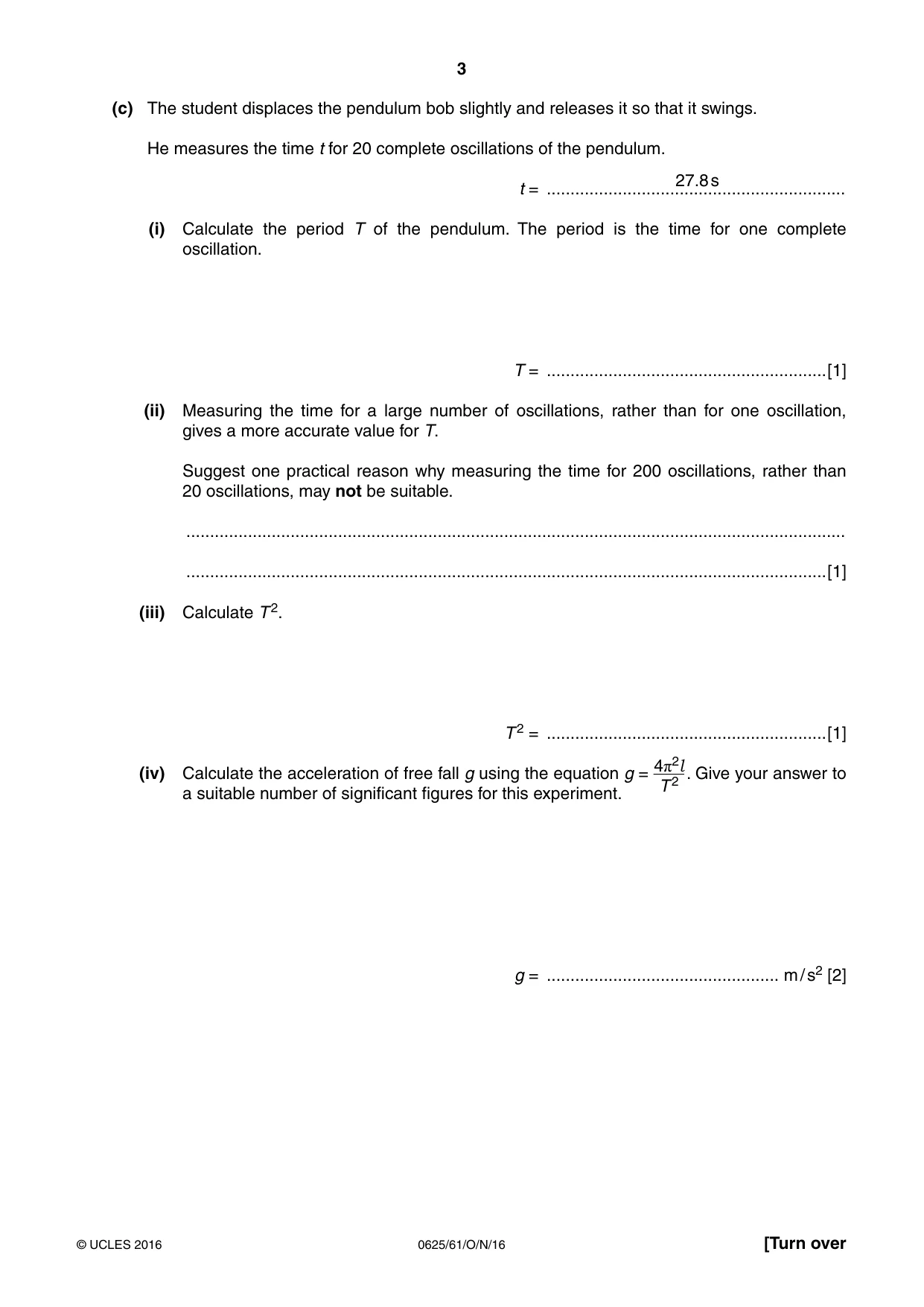
3 0625/61/O/N/16 © UCLES 2016 [Turn over (c) The student displaces the pendulum bob slightly and releases it so that it swings. He measures the time t for 20 complete oscillations of the pendulum. 27.8 s t = … (i) Calculate the period T of the pendulum. The period is the time for one complete oscillation. T = …[1] (ii) Measuring the time for a large number of oscillations, rather than for one oscillation, gives a more accurate value for T. Suggest one practical reason why measuring the time for 200 oscillations, rather than 20 oscillations, may not be suitable. … …[1] (iii) Calculate T 2. T 2 = …[1] (iv) Calculate the acceleration of free fall g using the equation g = 4π2l T 2 . Give your answer to a suitable number of significant figures for this experiment. g = … m / s2 [2]
Question paper, page 4
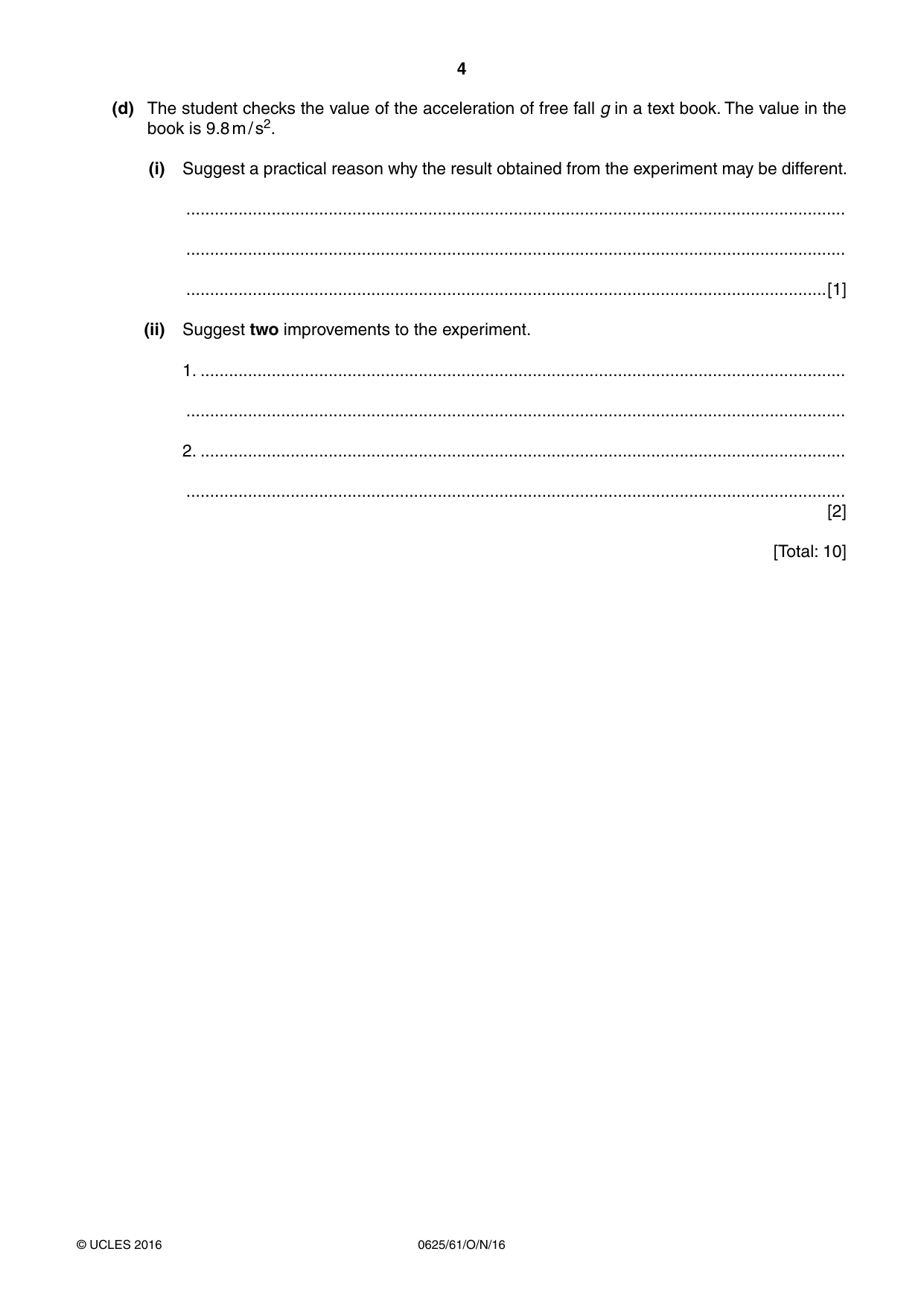
4 0625/61/O/N/16 © UCLES 2016 (d) The student checks the value of the acceleration of free fall g in a text book. The value in the book is 9.8 m / s2. (i) Suggest a practical reason why the result obtained from the experiment may be different. … … …[1] (ii) Suggest two improvements to the experiment. 1. … … 2. … … [2] [Total: 10]
Question paper, page 5
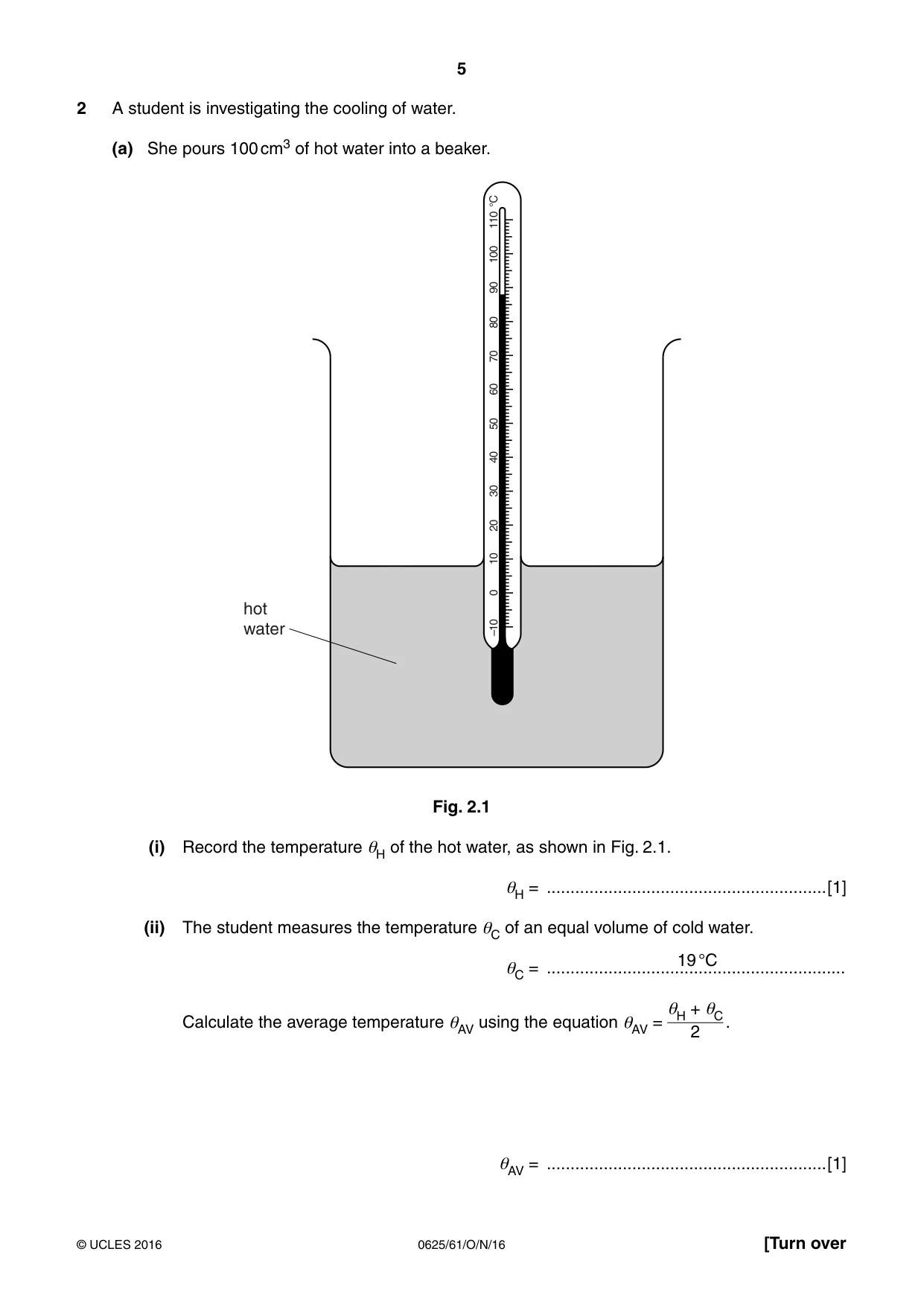
5 0625/61/O/N/16 © UCLES 2016 [Turn over 2 A student is investigating the cooling of water. (a) She pours 100 cm3 of hot water into a beaker. –10 0 10 20 30 40 50 60 70 80 90 100 110 °C hot water Fig. 2.1 (i) Record the temperature θH of the hot water, as shown in Fig. 2.1. θH = …[1] (ii) The student measures the temperature θC of an equal volume of cold water. 19 °C θC = … Calculate the average temperature θAV using the equation θAV = θH + θC 2 . θAV = …[1]
Question paper, page 6
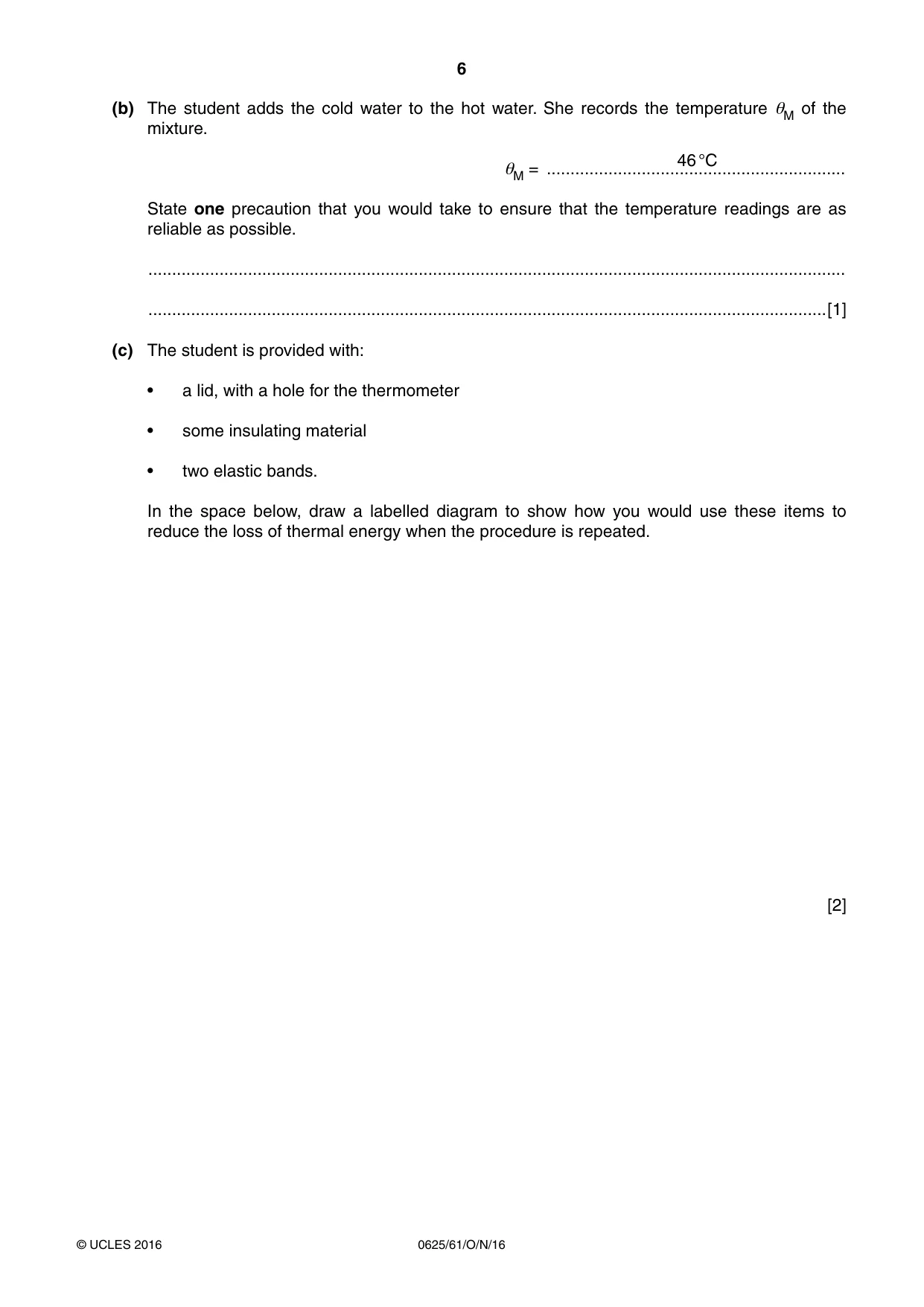
6 0625/61/O/N/16 © UCLES 2016 (b) The student adds the cold water to the hot water. She records the temperature θM of the mixture. 46 °C θM = … State one precaution that you would take to ensure that the temperature readings are as reliable as possible. … …[1] (c) The student is provided with: • a lid, with a hole for the thermometer • some insulating material • two elastic bands. In the space below, draw a labelled diagram to show how you would use these items to reduce the loss of thermal energy when the procedure is repeated. [2]
Question paper, page 7
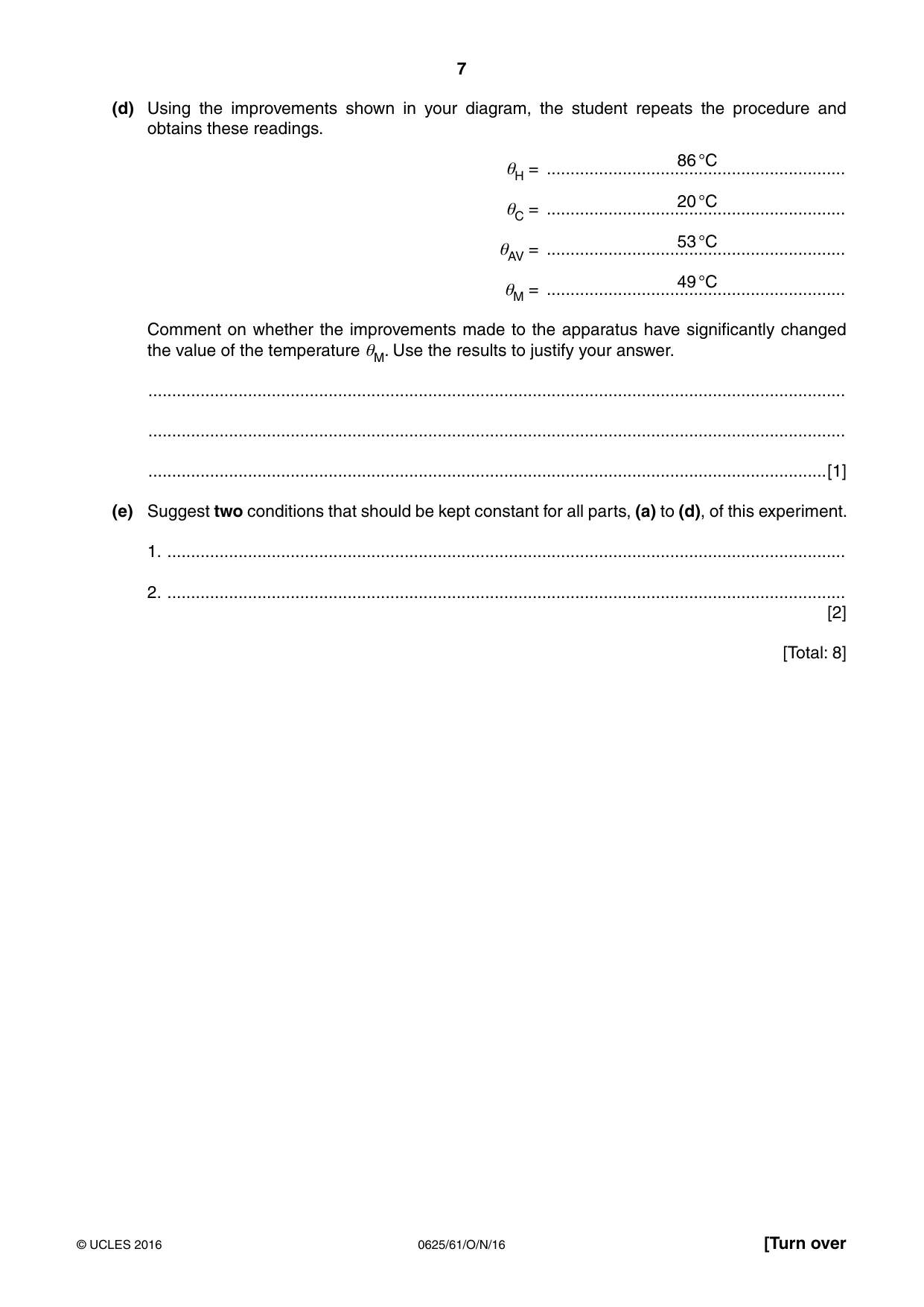
7 0625/61/O/N/16 © UCLES 2016 [Turn over (d) Using the improvements shown in your diagram, the student repeats the procedure and obtains these readings. 86 °C θH = … 20 °C θC = … 53 °C θAV = … 49 °C θM = … Comment on whether the improvements made to the apparatus have significantly changed the value of the temperature θM. Use the results to justify your answer. … … …[1] (e) Suggest two conditions that should be kept constant for all parts, (a) to (d), of this experiment. 1. … 2. … [2] [Total: 8]
Question paper, page 8
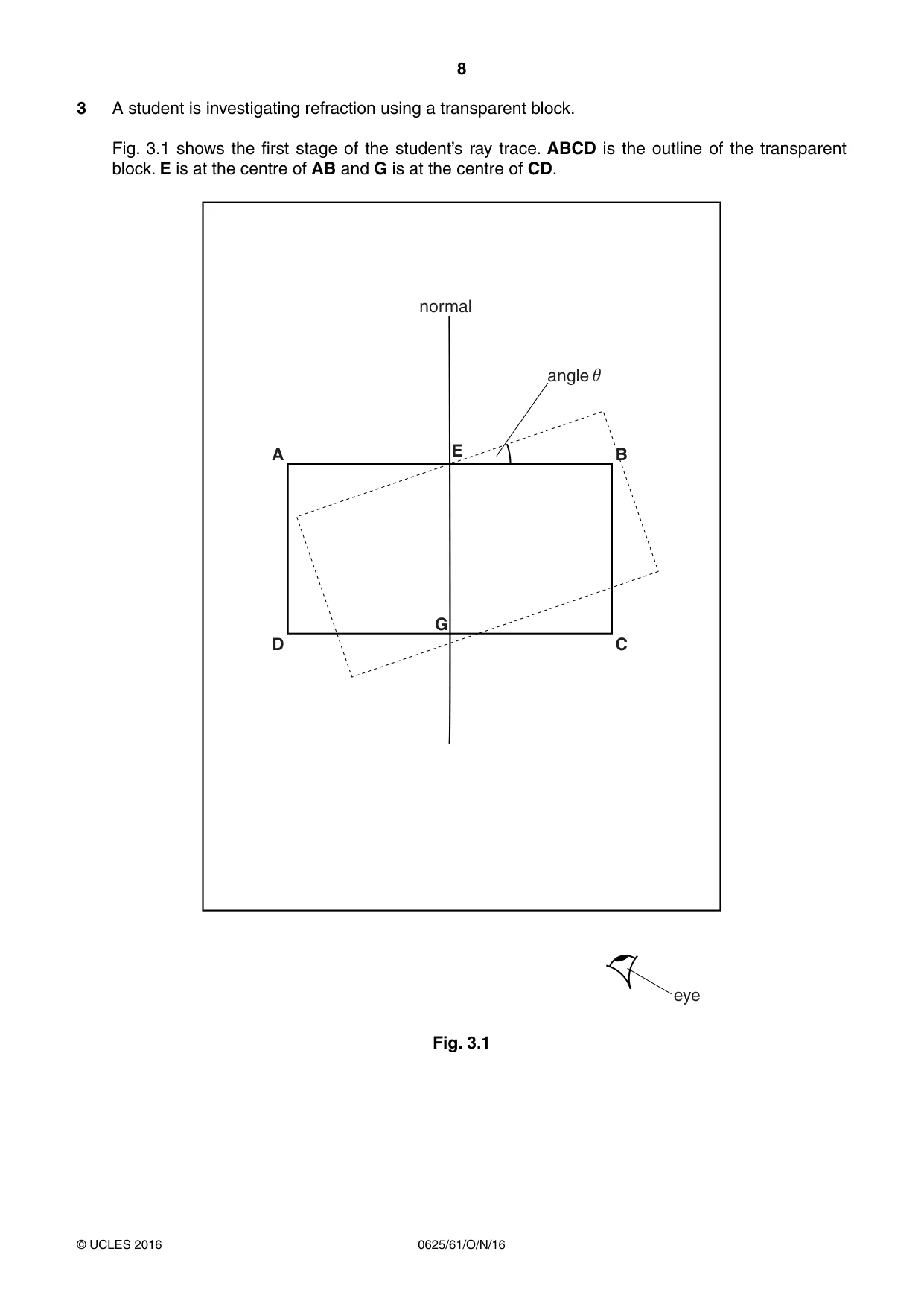
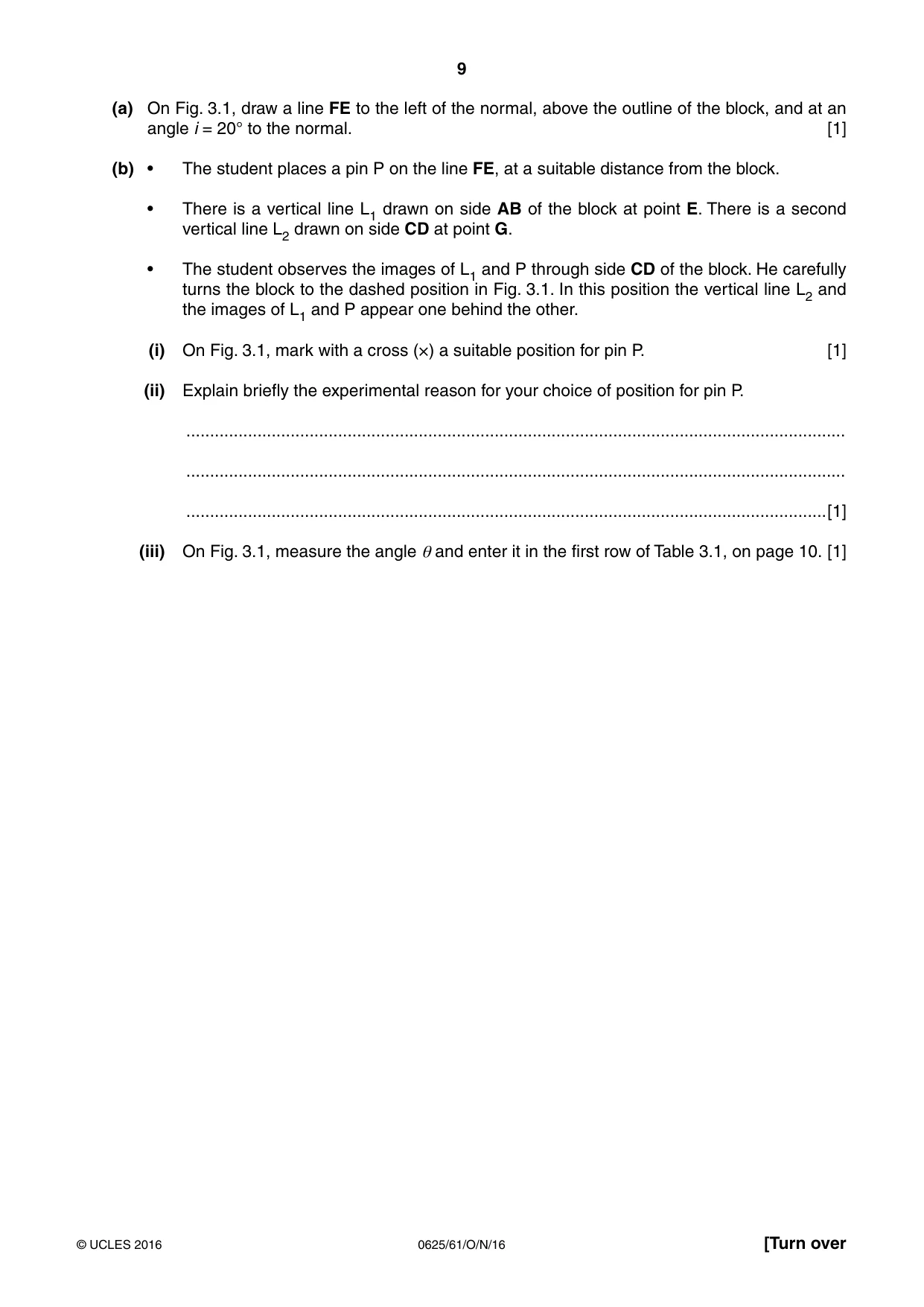
8 0625/61/O/N/16 © UCLES 2016 3 A student is investigating refraction using a transparent block. Fig. 3.1 shows the first stage of the student’s ray trace. ABCD is the outline of the transparent block. E is at the centre of AB and G is at the centre of CD. angle normal eye A D B E G C e Fig. 3.1
Question paper, page 9
9 0625/61/O/N/16 © UCLES 2016 [Turn over (a) On Fig. 3.1, draw a line FE to the left of the normal, above the outline of the block, and at an angle i = 20° to the normal. [1] (b) • The student places a pin P on the line FE, at a suitable distance from the block. • There is a vertical line L1 drawn on side AB of the block at point E. There is a second vertical line L2 drawn on side CD at point G. • The student observes the images of L1 and P through side CD of the block. He carefully turns the block to the dashed position in Fig. 3.1. In this position the vertical line L2 and the images of L1 and P appear one behind the other. (i) On Fig. 3.1, mark with a cross (×) a suitable position for pin P. [1] (ii) Explain briefly the experimental reason for your choice of position for pin P. … … …[1] (iii) On Fig. 3.1, measure the angle θ and enter it in the first row of Table 3.1, on page 10. [1]
Question paper, page 10
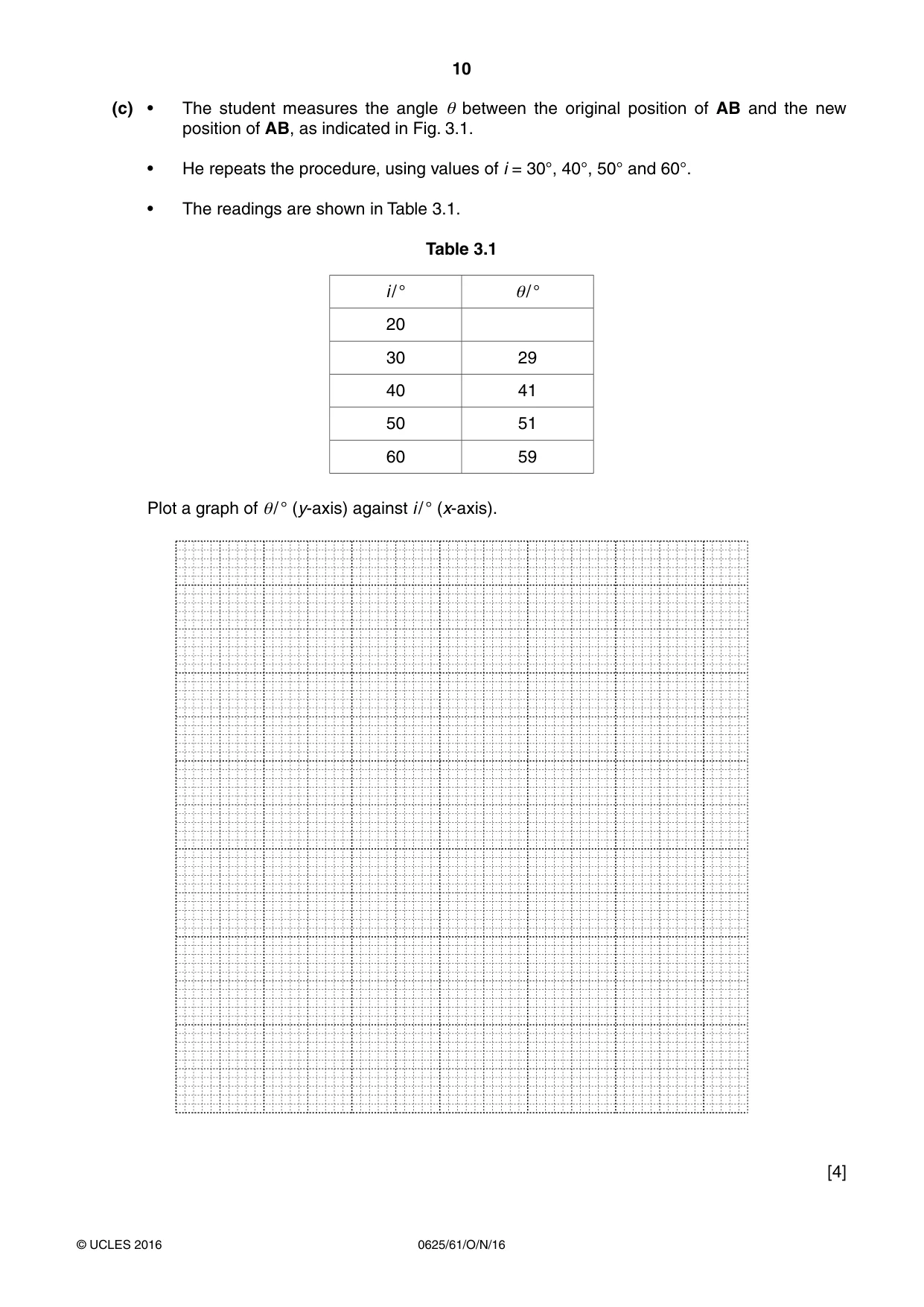
10 0625/61/O/N/16 © UCLES 2016 (c) • The student measures the angle θ between the original position of AB and the new position of AB, as indicated in Fig. 3.1. • He repeats the procedure, using values of i = 30°, 40°, 50° and 60°. • The readings are shown in Table 3.1. Table 3.1 i / ° θ / ° 20 30 29 40 41 50 51 60 59 Plot a graph of θ / ° (y-axis) against i / ° (x-axis). [4]
Question paper, page 11
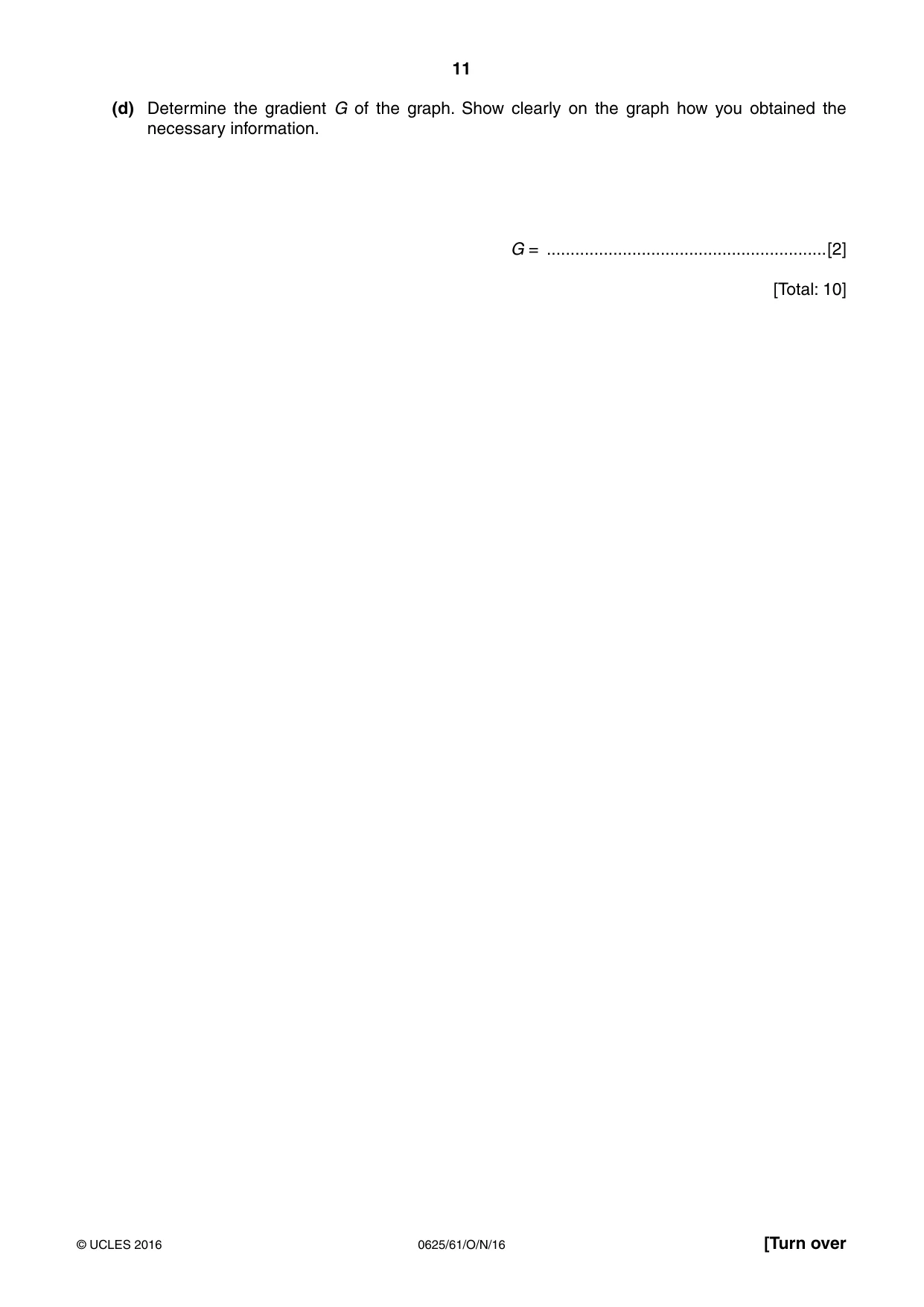
11 0625/61/O/N/16 © UCLES 2016 [Turn over (d) Determine the gradient G of the graph. Show clearly on the graph how you obtained the necessary information. G = …[2] [Total: 10]
Question paper, page 12
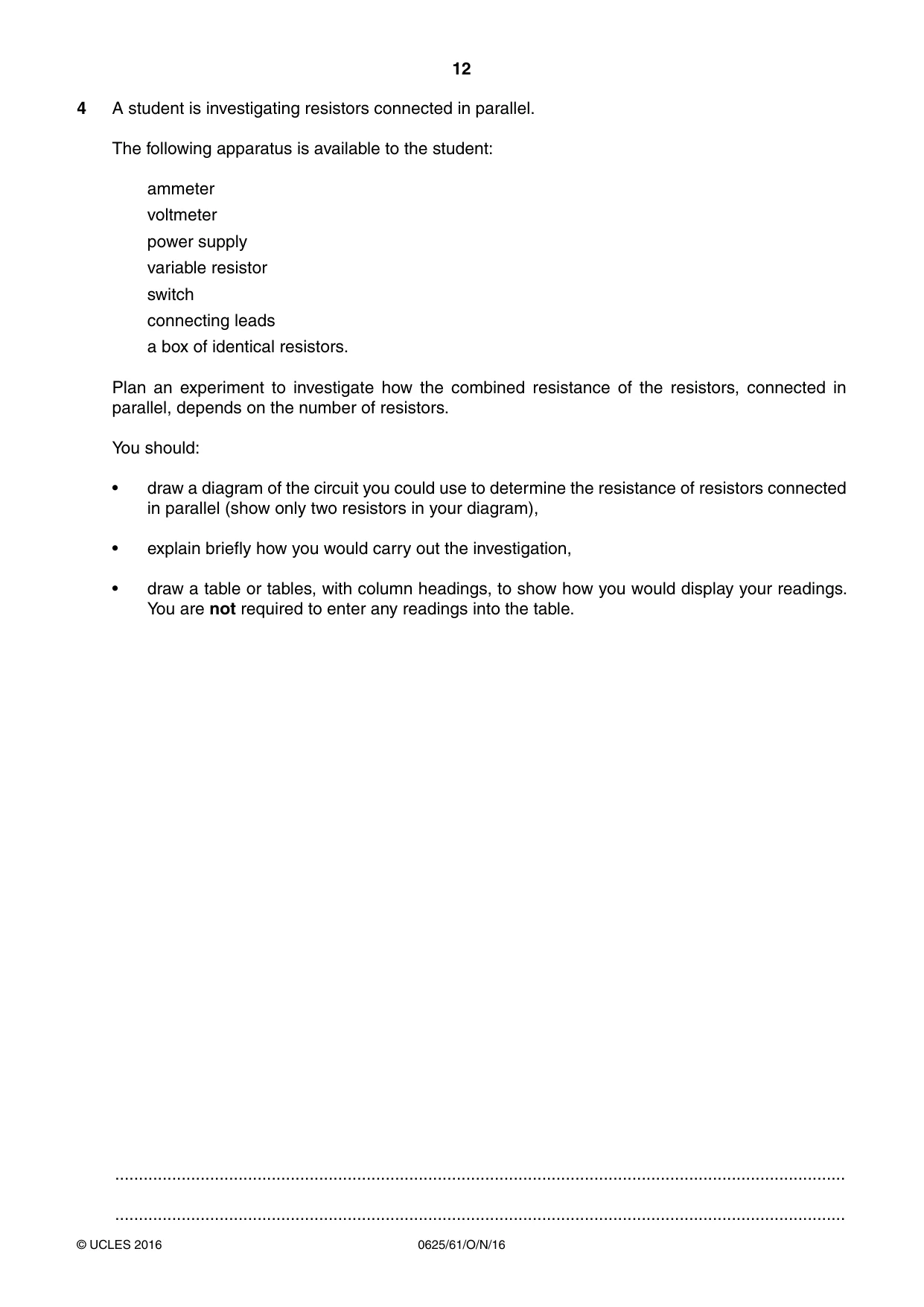
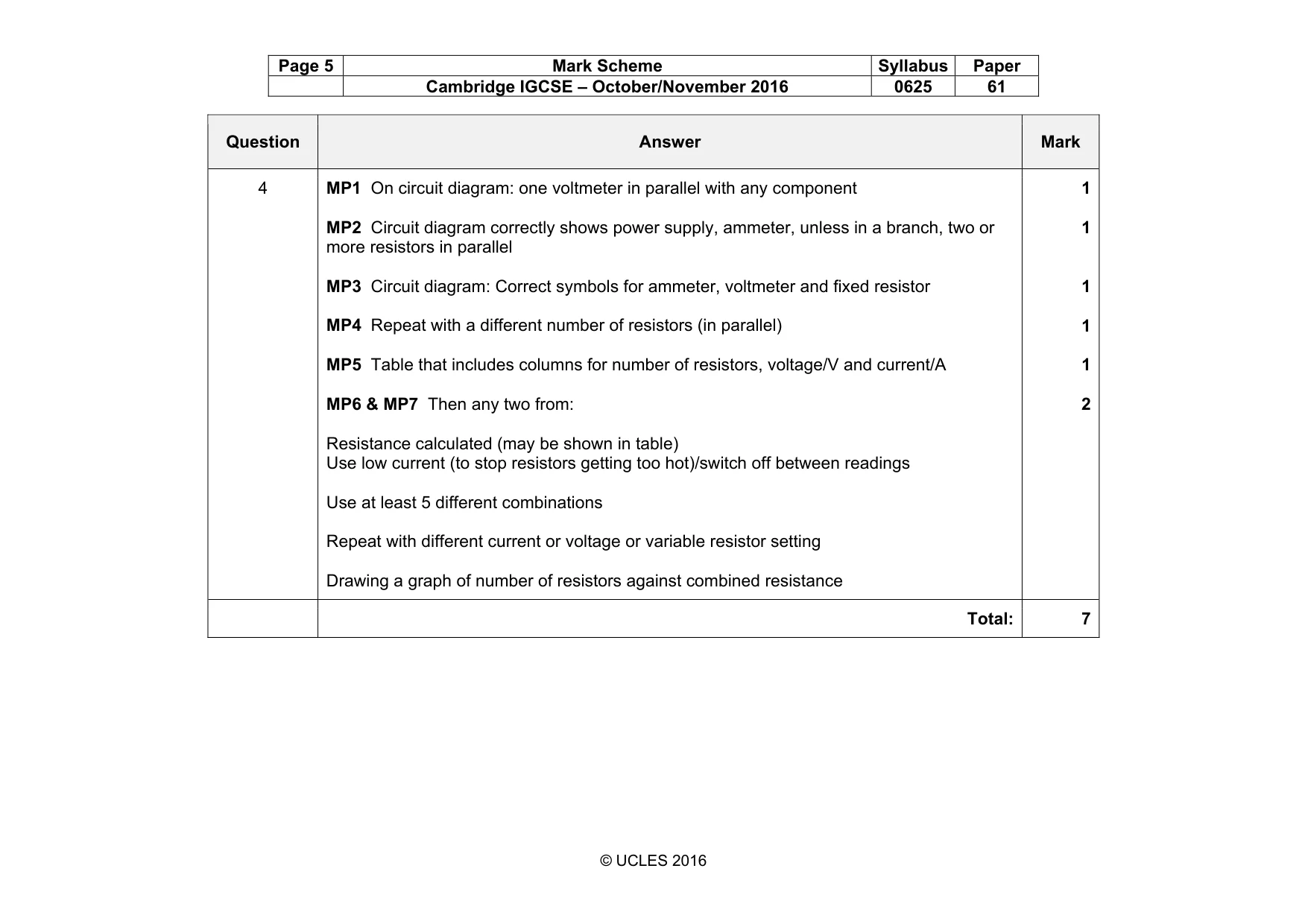
12 0625/61/O/N/16 © UCLES 2016 4 A student is investigating resistors connected in parallel. The following apparatus is available to the student: ammeter voltmeter power supply variable resistor switch connecting leads a box of identical resistors. Plan an experiment to investigate how the combined resistance of the resistors, connected in parallel, depends on the number of resistors. You should: • draw a diagram of the circuit you could use to determine the resistance of resistors connected in parallel (show only two resistors in your diagram), • explain briefly how you would carry out the investigation, • draw a table or tables, with column headings, to show how you would display your readings. You are not required to enter any readings into the table. … …
Question paper, page 13
13 0625/61/O/N/16 © UCLES 2016 [Turn over … … … … … … … … … … … … … … … … … … … … … … … … … … [7] [Total: 7]
Question paper, page 14
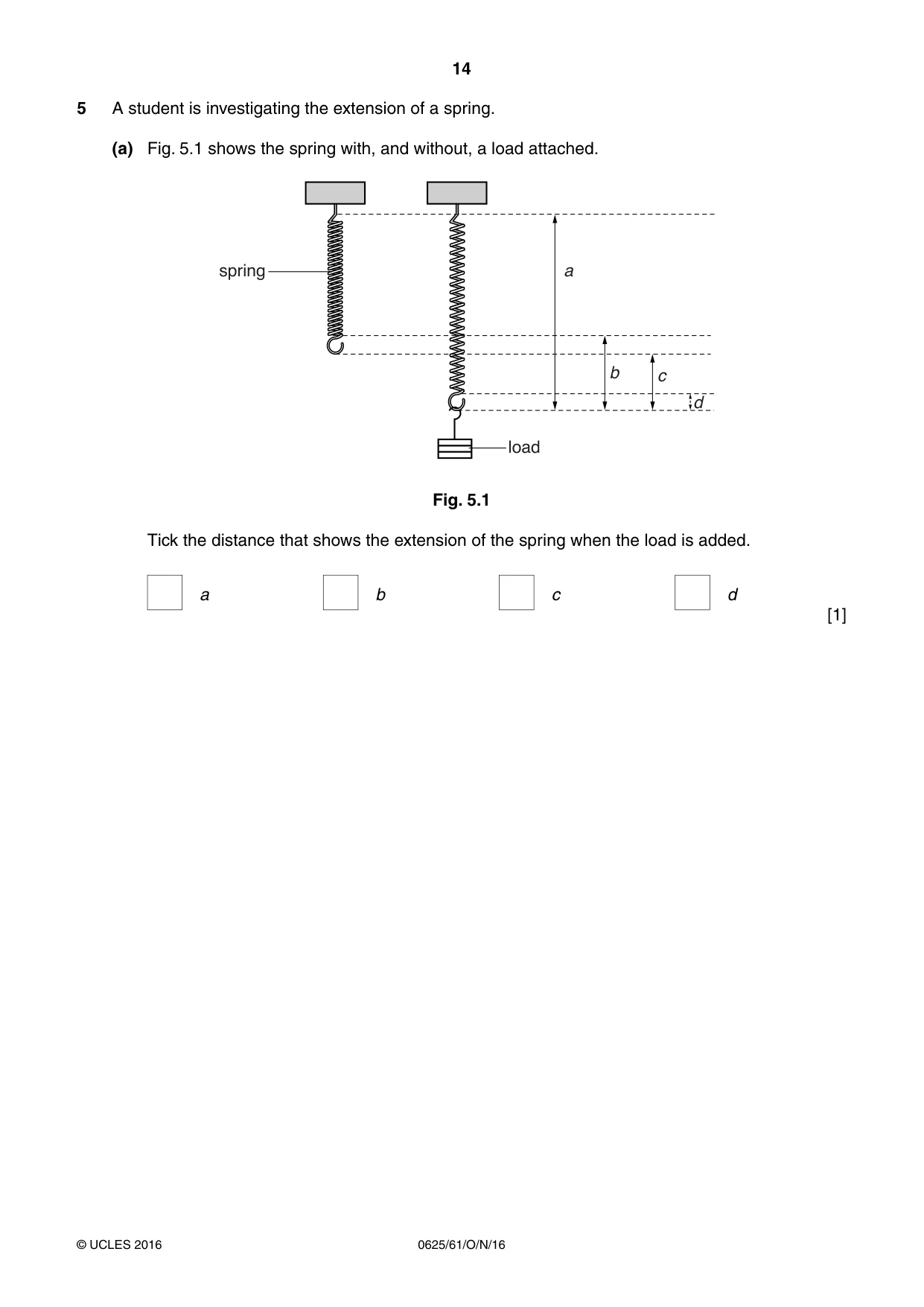
14 0625/61/O/N/16 © UCLES 2016 5 A student is investigating the extension of a spring. (a) Fig. 5.1 shows the spring with, and without, a load attached. spring load a b c d Fig. 5.1 Tick the distance that shows the extension of the spring when the load is added. a b c d [1]
Question paper, page 15
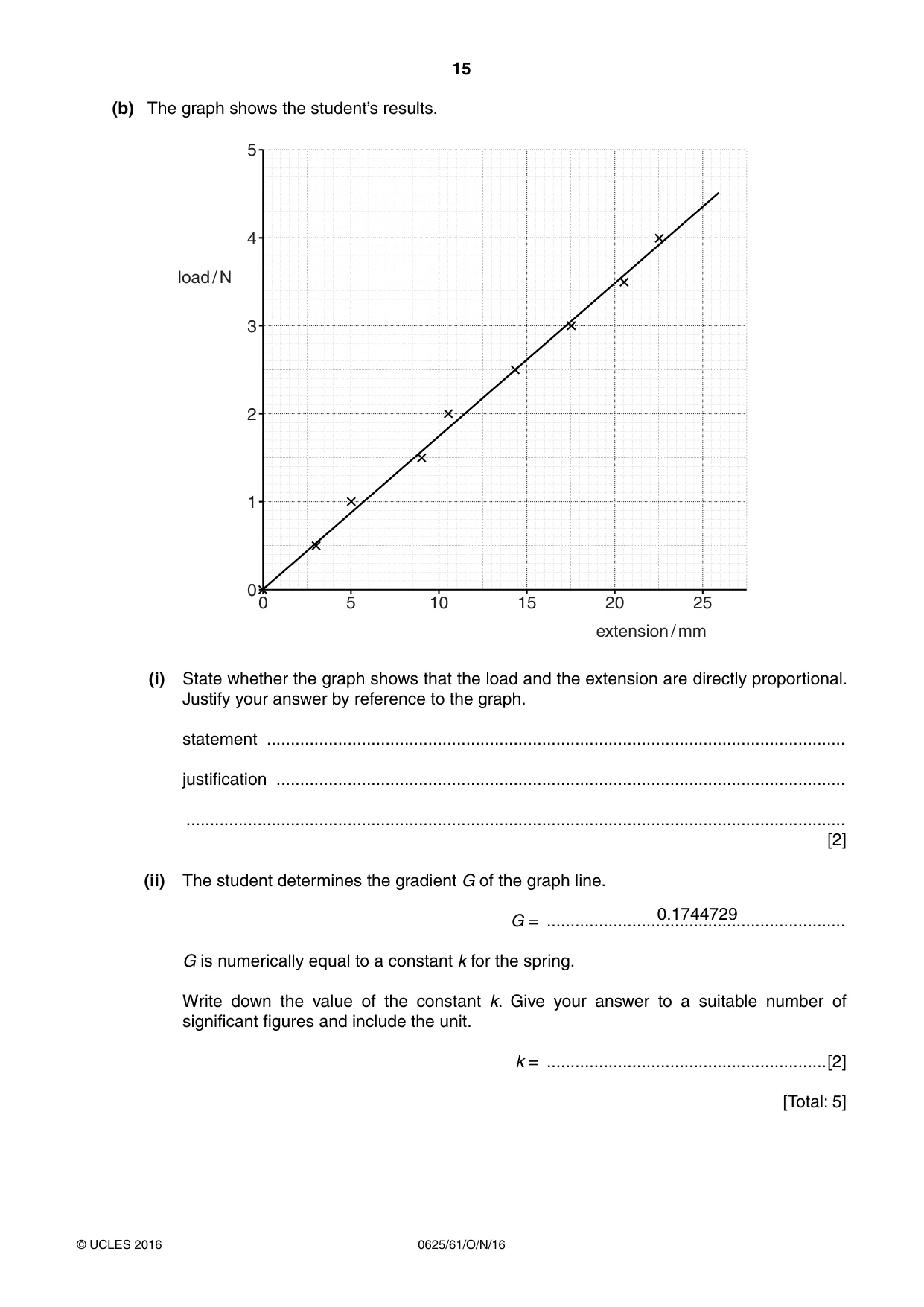
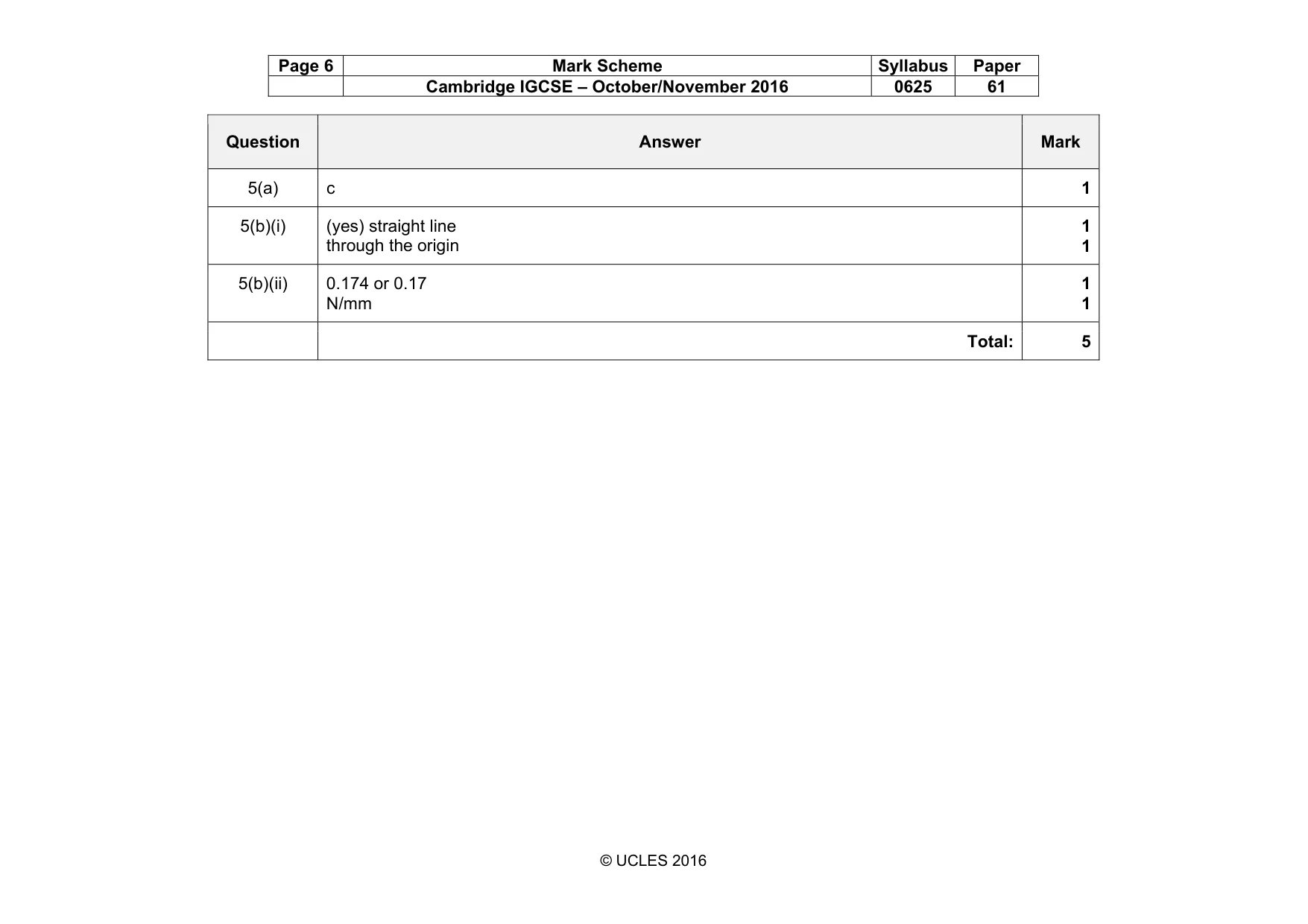
15 0625/61/O/N/16 © UCLES 2016 (b) The graph shows the student’s results. 0 0 1 2 3 4 load / N extension / mm 5 5 10 15 20 25 (i) State whether the graph shows that the load and the extension are directly proportional. Justify your answer by reference to the graph. statement … justification … … [2] (ii) The student determines the gradient G of the graph line. 0.1744729 G = … G is numerically equal to a constant k for the spring. Write down the value of the constant k. Give your answer to a suitable number of significant figures and include the unit. k = …[2] [Total: 5]
Question paper, page 16
16 0625/61/O/N/16 © UCLES 2016 Permission to reproduce items where third-party owned material protected by copyright is included has been sought and cleared where possible. Every reasonable effort has been made by the publisher (UCLES) to trace copyright holders, but if any items requiring clearance have unwittingly been included, the publisher will be pleased to make amends at the earliest possible opportunity. To avoid the issue of disclosure of answer-related information to candidates, all copyright acknowledgements are reproduced online in the Cambridge International Examinations Copyright Acknowledgements Booklet. This is produced for each series of examinations and is freely available to download at www.cie.org.uk after the live examination series. Cambridge International Examinations is part of the Cambridge Assessment Group. Cambridge Assessment is the brand name of University of Cambridge Local Examinations Syndicate (UCLES), which is itself a department of the University of Cambridge. BLANK PAGE
Mark scheme, page 1
® IGCSE is the registered trademark of Cambridge International Examinations. This syllabus is approved for use in England, Wales and Northern Ireland as a Cambridge International Level 1/Level 2 Certificate. This document consists of 6 printed pages. © UCLES 2016 [Turn over Cambridge International Examinations Cambridge International General Certificate of Secondary Education PHYSICS 0625/61 Paper 6 Alternative to Practical October/November 2016 MARK SCHEME Maximum Mark: 40 Published This mark scheme is published as an aid to teachers and candidates, to indicate the requirements of the examination. It shows the basis on which Examiners were instructed to award marks. It does not indicate the details of the discussions that took place at an Examiners’ meeting before marking began, which would have considered the acceptability of alternative answers. Mark schemes should be read in conjunction with the question paper and the Principal Examiner Report for Teachers. Cambridge will not enter into discussions about these mark schemes. Cambridge is publishing the mark schemes for the October/November 2016 series for most Cambridge IGCSE®, Cambridge International A and AS Level components and some Cambridge O Level components.
Mark scheme, page 2
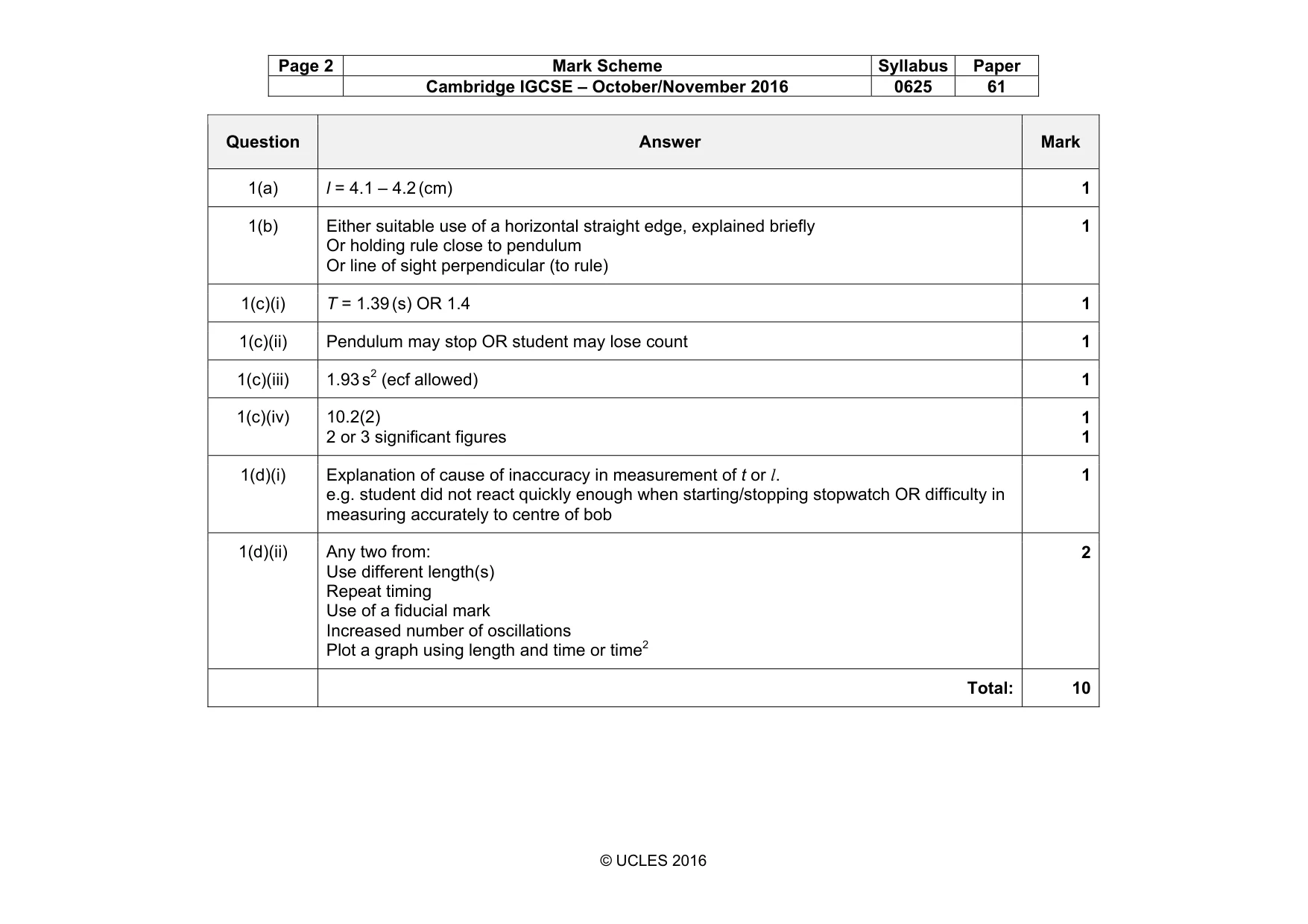
Page 2 Mark Scheme Syllabus Paper Cambridge IGCSE – October/November 2016 0625 61 © UCLES 2016 Question Answer Mark 1(a) l = 4.1 – 4.2 (cm) 1 1(b) Either suitable use of a horizontal straight edge, explained briefly Or holding rule close to pendulum Or line of sight perpendicular (to rule) 1 1(c)(i) T = 1.39 (s) OR 1.4 1 1(c)(ii) Pendulum may stop OR student may lose count 1 1(c)(iii) 1.93 s2 (ecf allowed) 1 1(c)(iv) 10.2(2) 2 or 3 significant figures 1 1 1(d)(i) Explanation of cause of inaccuracy in measurement of t or l. e.g. student did not react quickly enough when starting/stopping stopwatch OR difficulty in measuring accurately to centre of bob 1 1(d)(ii) Any two from: Use different length(s) Repeat timing Use of a fiducial mark Increased number of oscillations Plot a graph using length and time or time2 2 Total: 10
Mark scheme, page 3
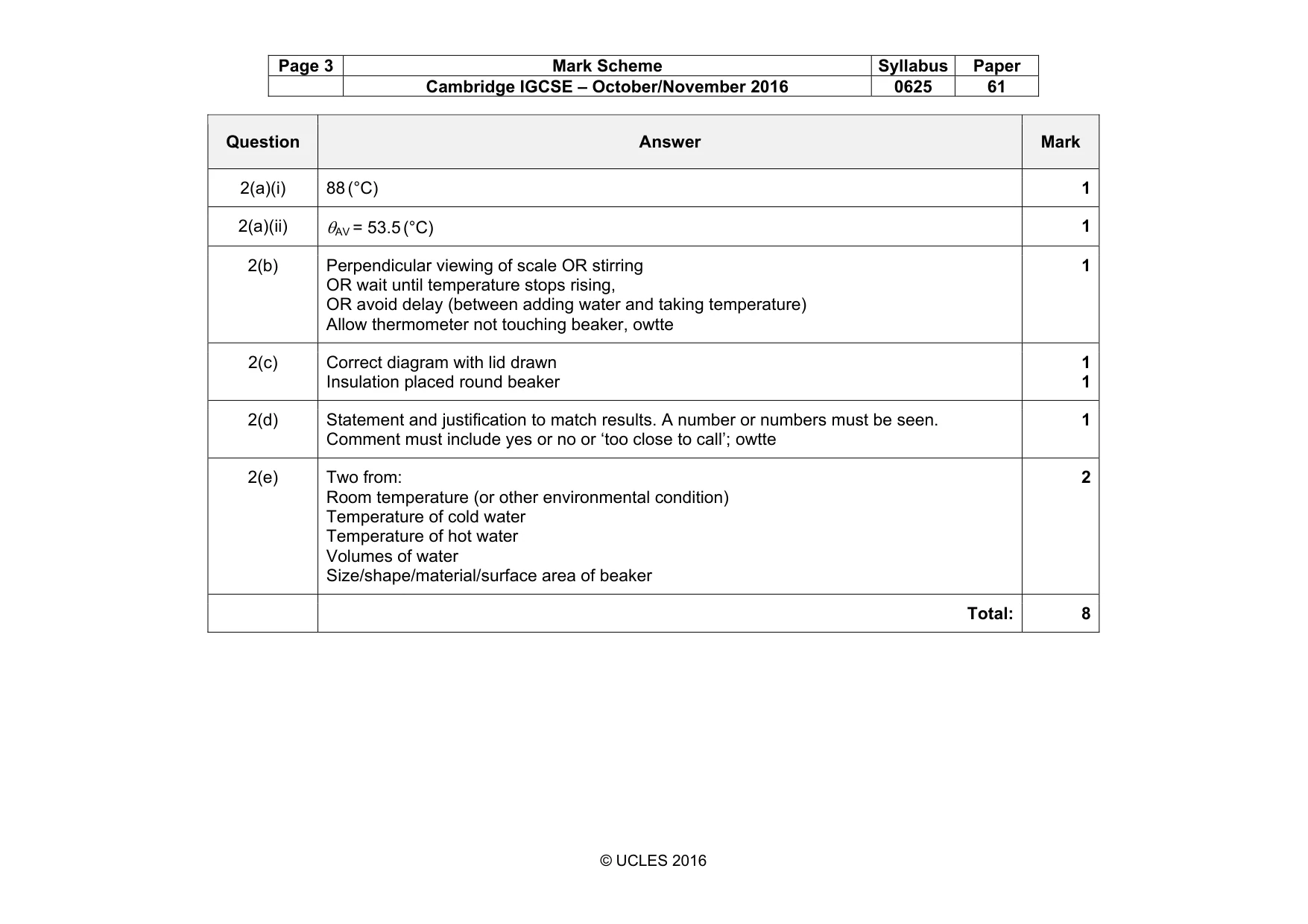
Page 3 Mark Scheme Syllabus Paper Cambridge IGCSE – October/November 2016 0625 61 © UCLES 2016 Question Answer Mark 2(a)(i) 88 (°C) 1 2(a)(ii) θAV = 53.5 (°C) 1 2(b) Perpendicular viewing of scale OR stirring OR wait until temperature stops rising, OR avoid delay (between adding water and taking temperature) Allow thermometer not touching beaker, owtte 1 2(c) Correct diagram with lid drawn Insulation placed round beaker 1 1 2(d) Statement and justification to match results. A number or numbers must be seen. Comment must include yes or no or ‘too close to call’; owtte 1 2(e) Two from: Room temperature (or other environmental condition) Temperature of cold water Temperature of hot water Volumes of water Size/shape/material/surface area of beaker 2 Total: 8
Mark scheme, page 4
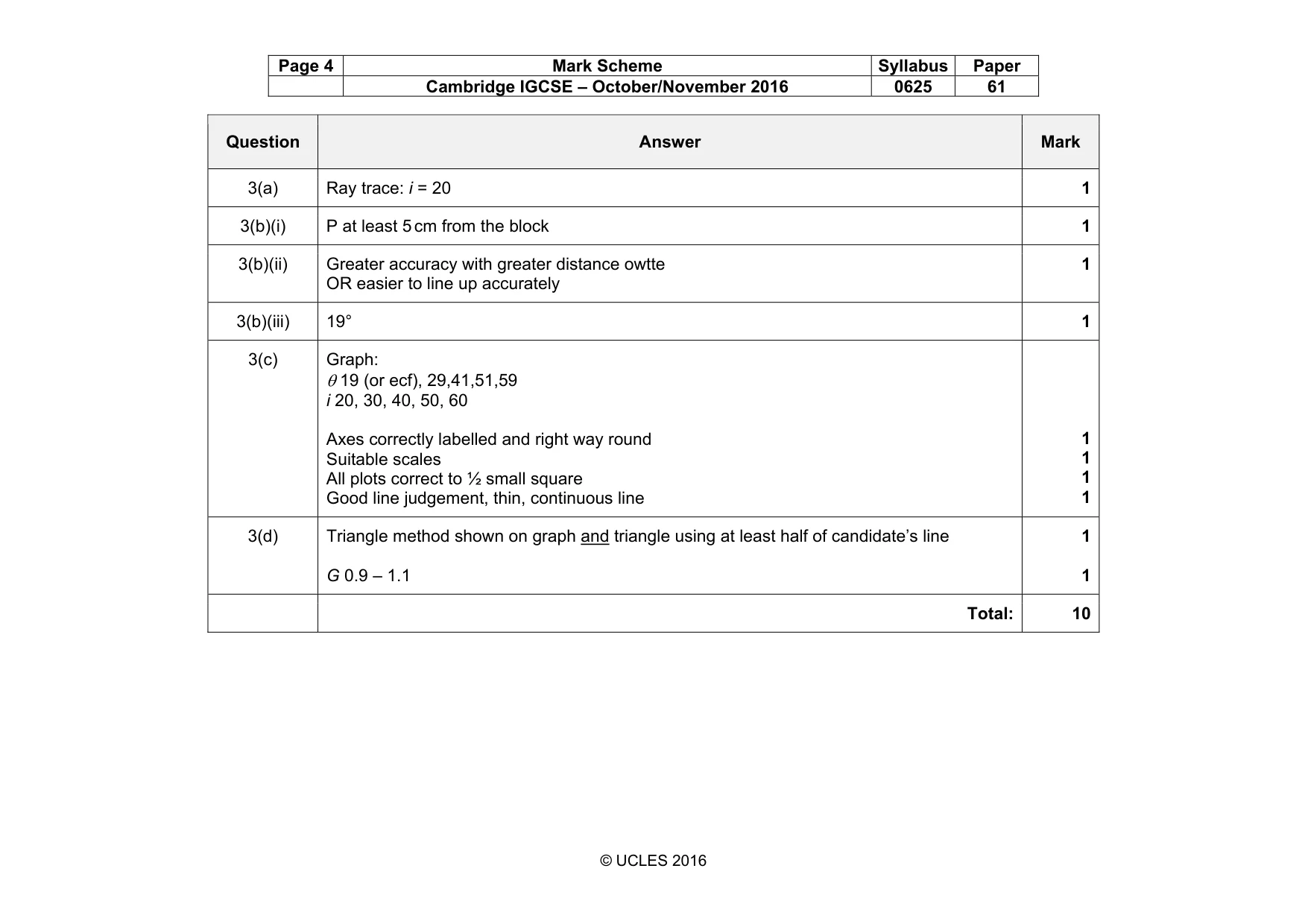
Page 4 Mark Scheme Syllabus Paper Cambridge IGCSE – October/November 2016 0625 61 © UCLES 2016 Question Answer Mark 3(a) Ray trace: i = 20 1 3(b)(i) P at least 5 cm from the block 1 3(b)(ii) Greater accuracy with greater distance owtte OR easier to line up accurately 1 3(b)(iii) 19° 1 3(c) Graph: θ 19 (or ecf), 29,41,51,59 i 20, 30, 40, 50, 60 Axes correctly labelled and right way round Suitable scales All plots correct to ½ small square Good line judgement, thin, continuous line 1 1 1 1 3(d) Triangle method shown on graph and triangle using at least half of candidate’s line G 0.9 – 1.1 1 1 Total: 10
Mark scheme, page 5
Page 5 Mark Scheme Syllabus Paper Cambridge IGCSE – October/November 2016 0625 61 © UCLES 2016 Question Answer Mark 4 MP1 On circuit diagram: one voltmeter in parallel with any component MP2 Circuit diagram correctly shows power supply, ammeter, unless in a branch, two or more resistors in parallel MP3 Circuit diagram: Correct symbols for ammeter, voltmeter and fixed resistor MP4 Repeat with a different number of resistors (in parallel) MP5 Table that includes columns for number of resistors, voltage/V and current/A MP6 & MP7 Then any two from: Resistance calculated (may be shown in table) Use low current (to stop resistors getting too hot)/switch off between readings Use at least 5 different combinations Repeat with different current or voltage or variable resistor setting Drawing a graph of number of resistors against combined resistance 1 1 1 1 1 2 Total: 7
Mark scheme, page 6
Page 6 Mark Scheme Syllabus Paper Cambridge IGCSE – October/November 2016 0625 61 © UCLES 2016 Question Answer Mark 5(a) c 1 5(b)(i) (yes) straight line through the origin 1 1 5(b)(ii) 0.174 or 0.17 N/mm 1 1 Total: 5
What you needed in this session
Cambridge’s own grade thresholds for 2016 Oct/Nov, Paper 6 · Variant 1. A higher threshold means an easier paper — the bar moves with how the cohort did.