Cambridge IGCSE Physics 0625 — 2009 May/June Paper 6 · Variant 1
0625/61/M/J/09 · 4 questions · 40 marks · ≈45 min
The question paper and its mark scheme, free to read here and free to download. This is Cambridge’s own paper, exactly as it was sat.
Question paper12 pages

Mark scheme3 pages
Answers below. Sit the paper first if you are practising.
Questions as text
Q1 · An IGCSE student is making measurements as accurately as possible in order to determine…
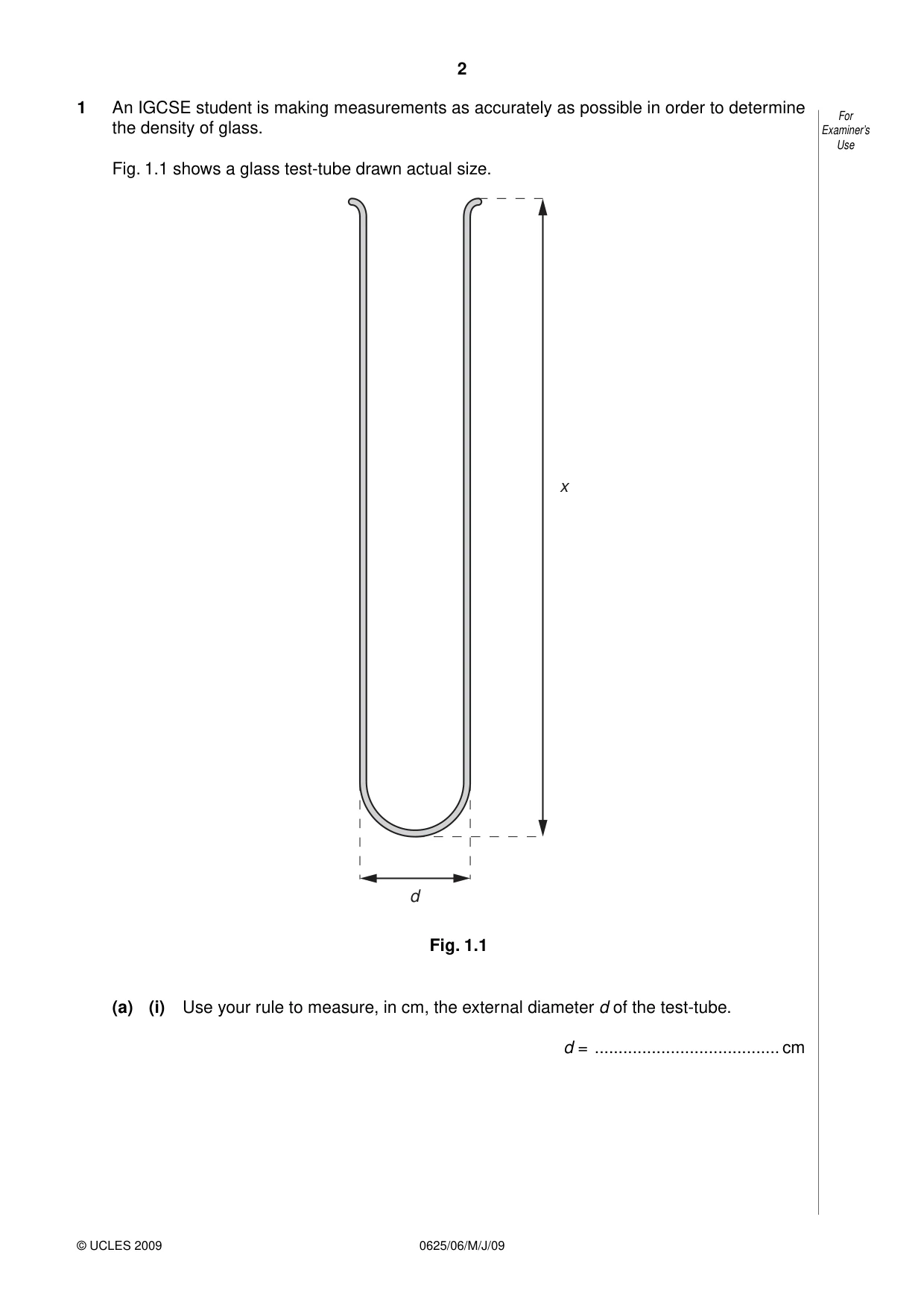
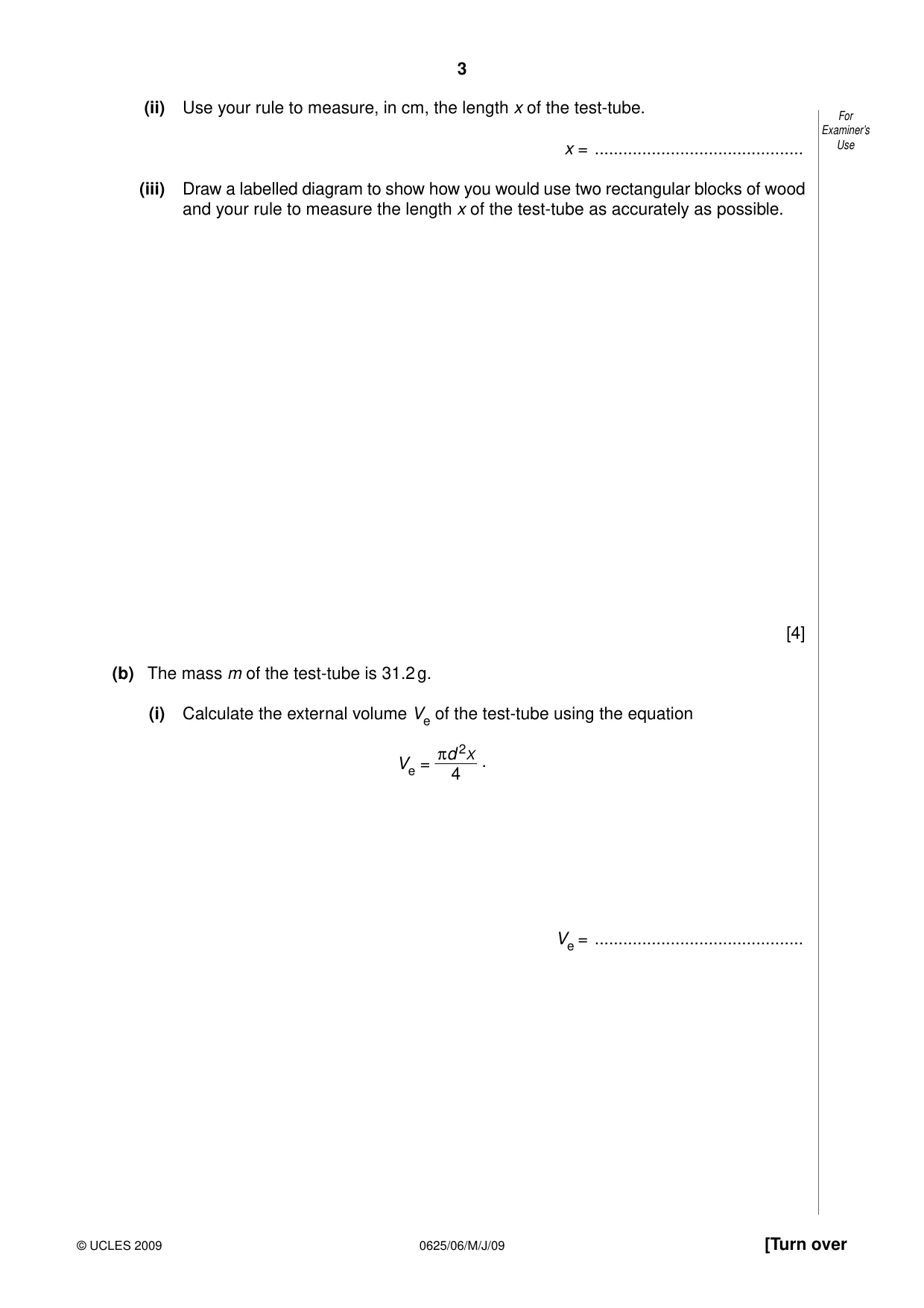
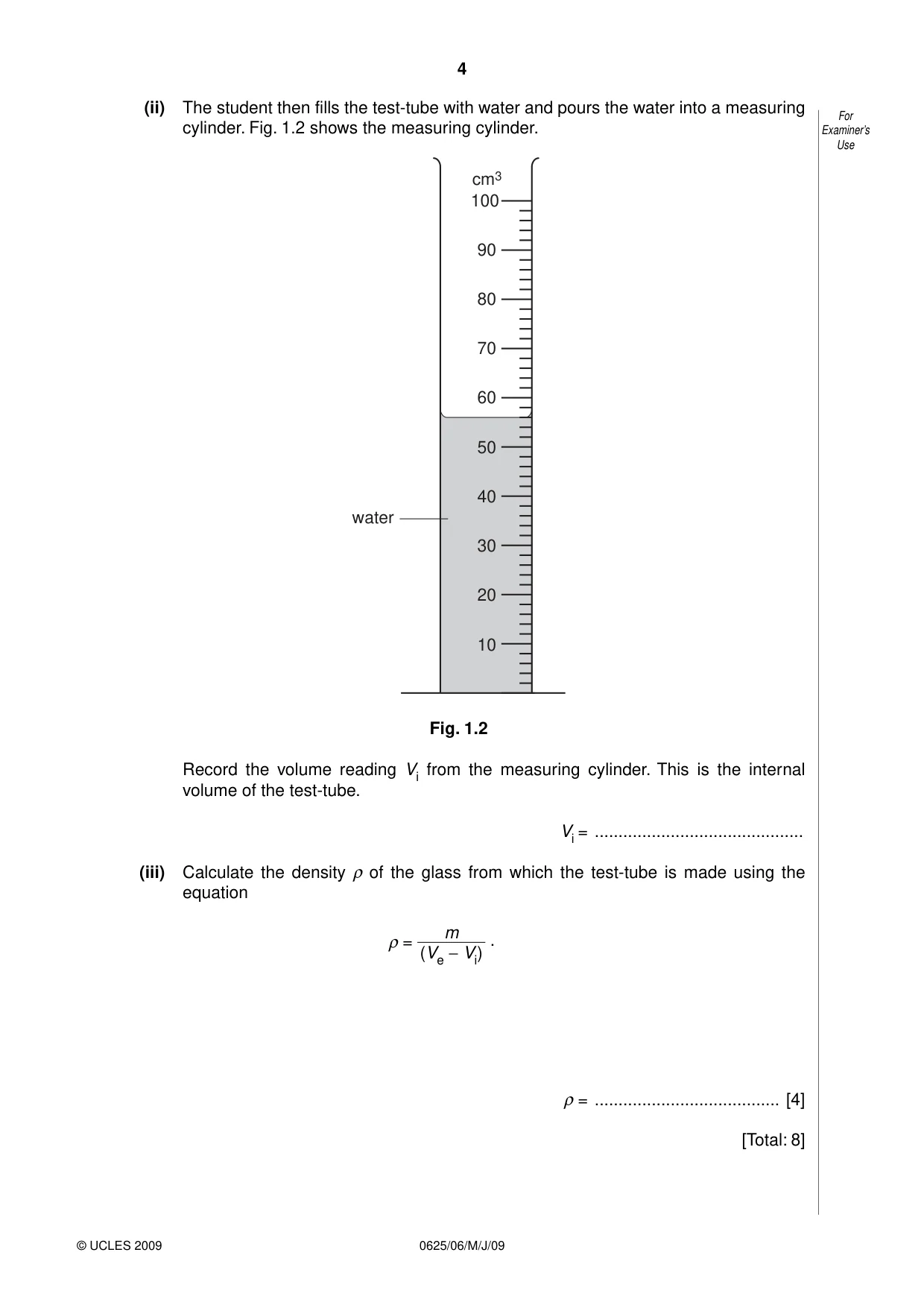
1 An IGCSE student is making measurements as accurately as possible in order to determine For the density of glass. Examiner’s Use Fig. 1.1 shows a glass test-tube drawn actual size. x d Fig. 1.1 (a) (i) Use your rule to measure, in cm, the external diameter d of the test-tube. d = ....................................... cm (ii) Use your rule to measure, in cm, the length x of the test-tube. For Examiner’s x = ............................................ Use (iii) Draw a labelled diagram to show how you would use two rectangular blocks of wood and your rule to measure the length x of the test-tube as accurately as possible. [4] (b) The mass m of the test-tube is 31.2 g. (i) Calculate the external volume Ve of the test-tube using the equation πd 2X Ve = . 4 Ve = ............................................ (ii) The student then fills the test-tube with water and pours the water into a measuring For cylinder. Fig. 1.2 shows the measuring cylinder. Examiner’s Use cm3 100 90 80 70 60 50 40 water 30 20 10 Fig. 1.2 Record the volume reading Vi from the measuring cylinder. This is the internal volume of the test-tube. Vi = ............................................ (iii) Calculate the density ρ of the glass from which the test-tube is made using the equation m ρ = . (Ve − Vi) ρ = ....................................... [4] [Total: 8]
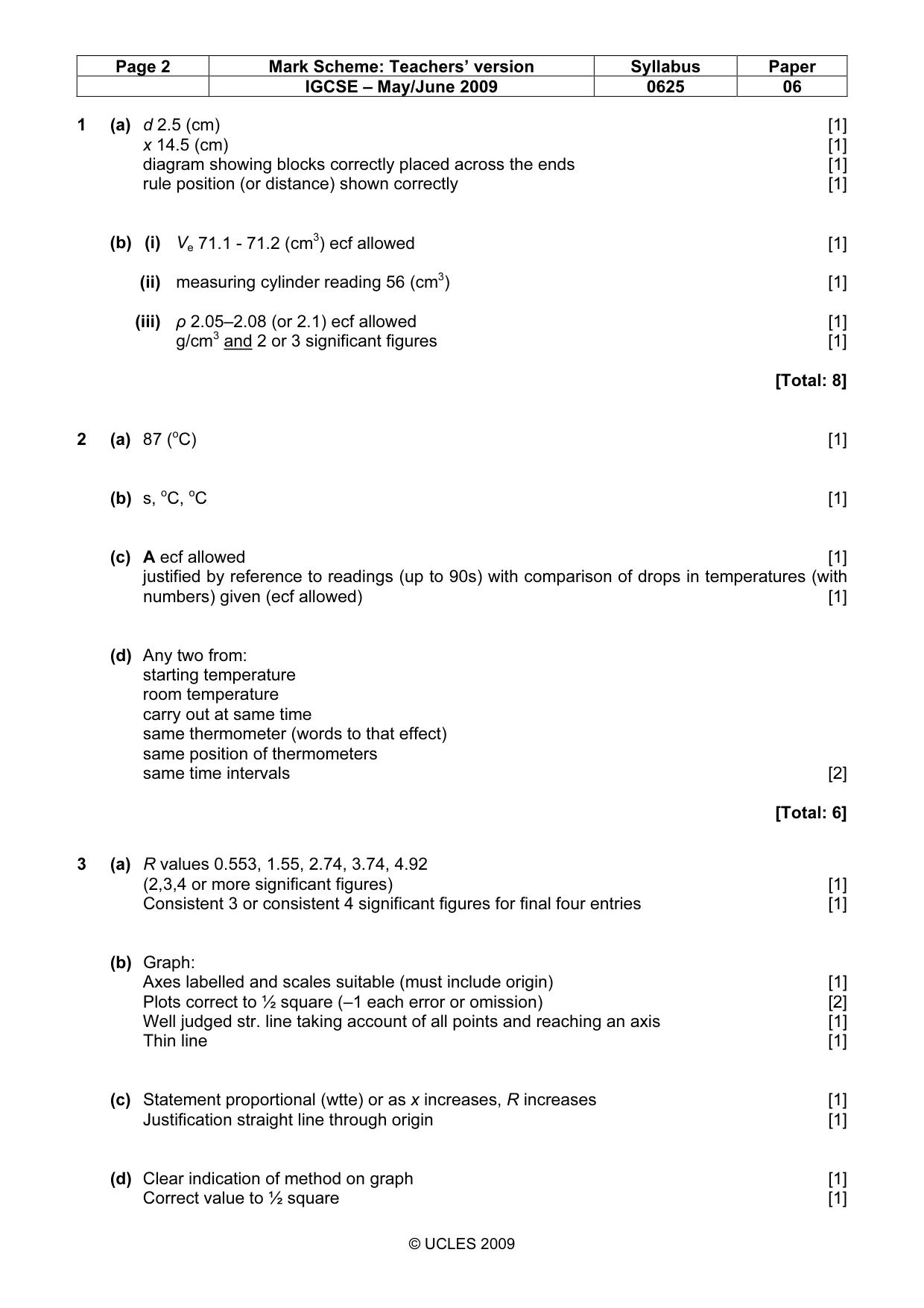
Mark scheme: 1 (a) d 2.5 (cm) [1] x 14.5 (cm) [1] diagram showing blocks correctly placed across the ends [1] rule position (or distance) shown correctly [1] (b) (i) Ve 71.1 - 71.2 (cm3) ecf allowed [1] (ii) measuring cylinder reading 56 (cm3) [1] (iii) ρ 2.05–2.08 (or 2.1) ecf allowed [1] g/cm3 and 2 or 3 significant figures [1] [Total: 8] o
More questions on Physical quantities and measurement techniques
Q2 · The IGCSE class is investigating the cooling of thermometer bulbs under different…
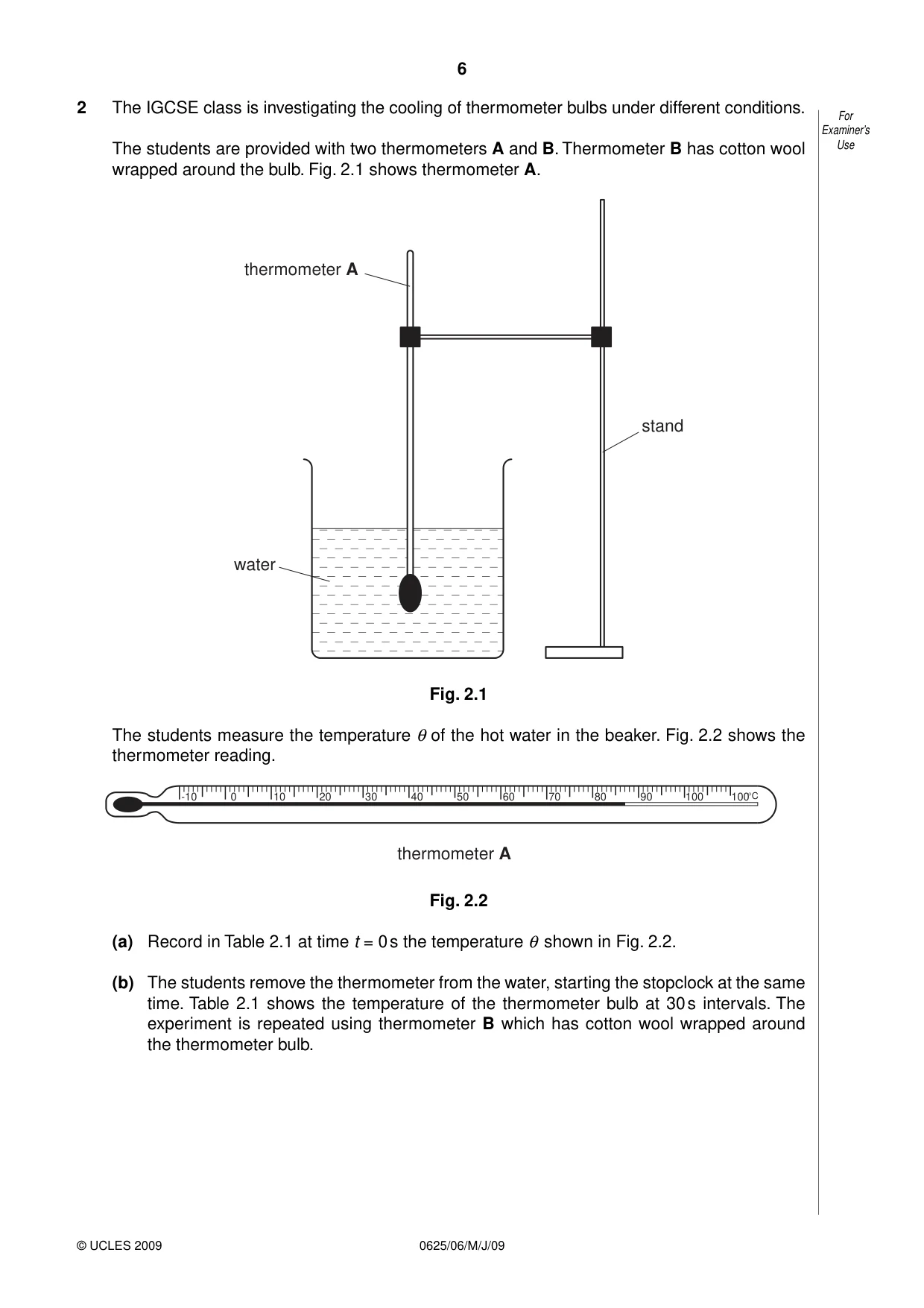
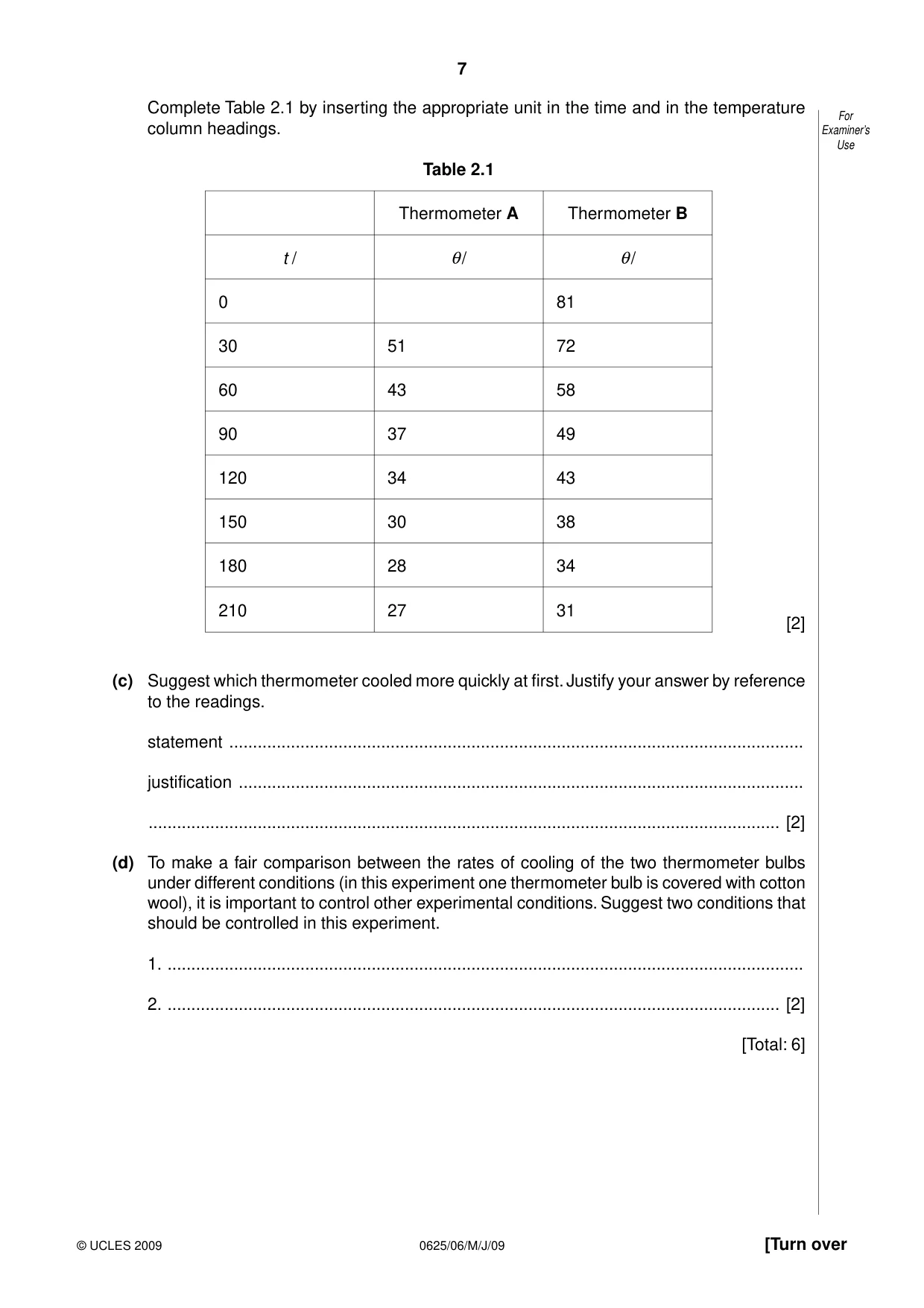
2 The IGCSE class is investigating the cooling of thermometer bulbs under different conditions. For Examiner’s The students are provided with two thermometers A and B. Thermometer B has cotton wool Use wrapped around the bulb. Fig. 2.1 shows thermometer A. thermometer A stand water Fig. 2.1 The students measure the temperature θ of the hot water in the beaker. Fig. 2.2 shows the thermometer reading. -10 0 10 20 30 40 50 60 70 80 90 100 100°C thermometer A Fig. 2.2 (a) Record in Table 2.1 at time t = 0 s the temperature θ shown in Fig. 2.2. (b) The students remove the thermometer from the water, starting the stopclock at the same time. Table 2.1 shows the temperature of the thermometer bulb at 30 s intervals. The experiment is repeated using thermometer B which has cotton wool wrapped around the thermometer bulb. Complete Table 2.1 by inserting the appropriate unit in the time and in the temperature For column headings. Examiner’s Use Table 2.1 Thermometer A Thermometer B t / θ/ θ/ 0 81 30 51 72 60 43 58 90 37 49 120 34 43 150 30 38 180 28 34 210 27 31 [2] (c) Suggest which thermometer cooled more quickly at first. Justify your answer by reference to the readings. statement ......................................................................................................................... justification ....................................................................................................................... ..................................................................................................................................... [2] (d) To make a fair comparison between the rates of cooling of the two thermometer bulbs under different conditions (in this experiment one thermometer bulb is covered with cotton wool), it is important to control other experimental conditions. Suggest two conditions that should be controlled in this experiment. 1. ...................................................................................................................................... 2. ................................................................................................................................. [2] [Total: 6]
Mark scheme: 2 (a) 87 (oC) [1] (b) s, oC, oC [1] (c) A ecf allowed [1] justified by reference to readings (up to 90s) with comparison of drops in temperatures (with numbers) given (ecf allowed) [1] (d) Any two from: starting temperature room temperature carry out at same time same thermometer (words to that effect) same position of thermometers same time intervals [2] [Total: 6]
Q4 · An IGCSE student is determining the focal length of a lens
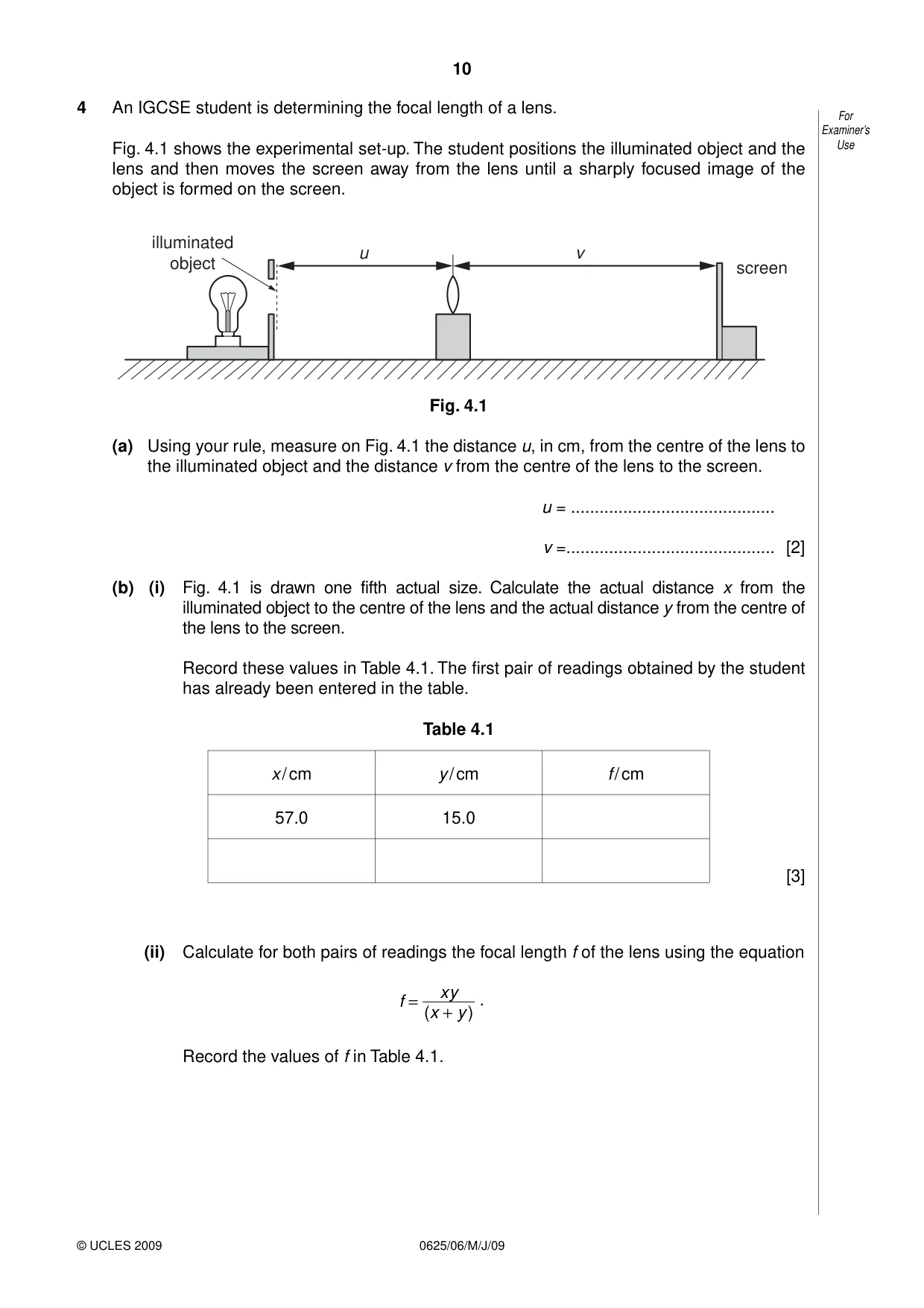
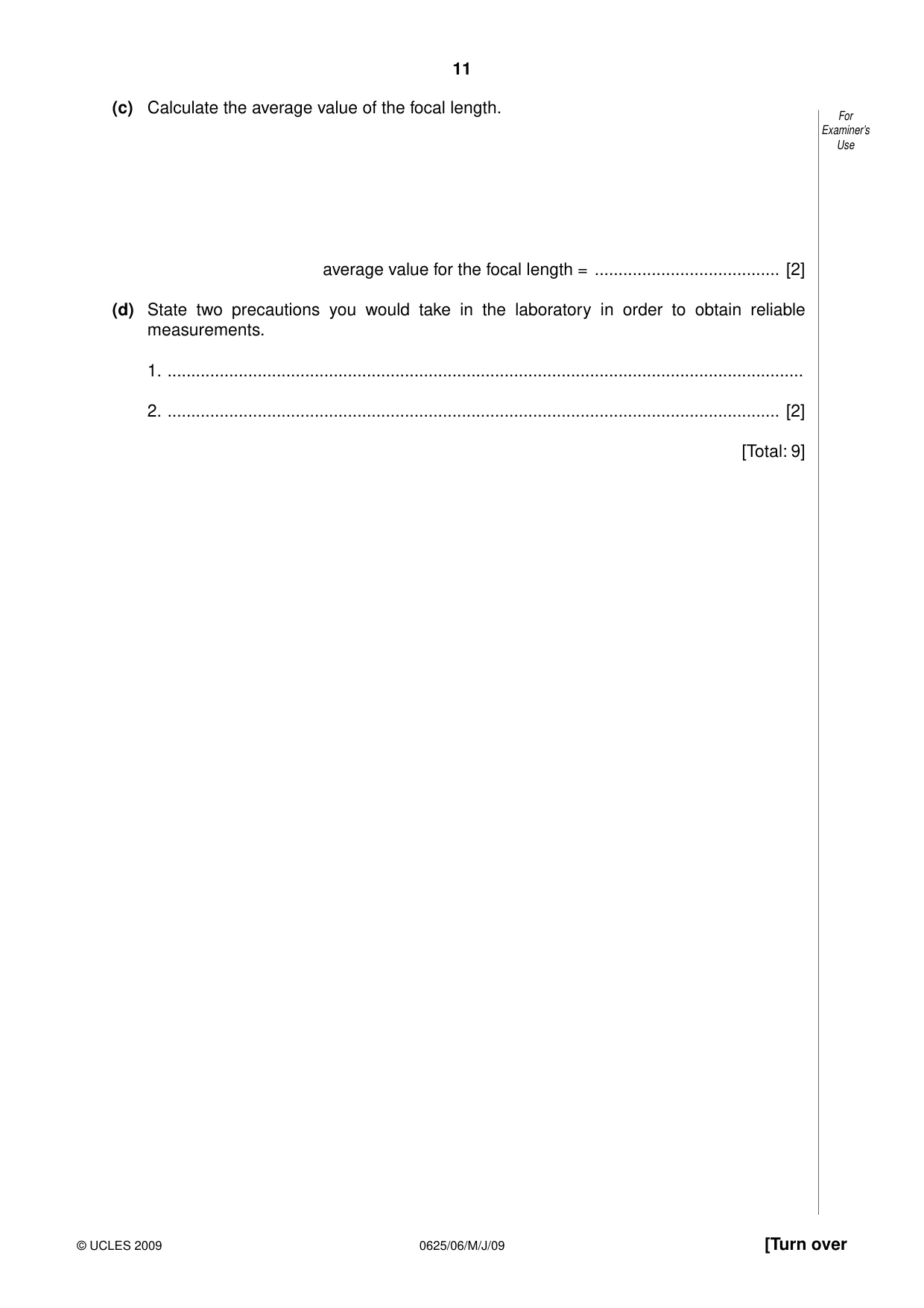
4 An IGCSE student is determining the focal length of a lens. For Examiner’s Fig. 4.1 shows the experimental set-up. The student positions the illuminated object and the Use lens and then moves the screen away from the lens until a sharply focused image of the object is formed on the screen. illuminated u v object screen Fig. 4.1 (a) Using your rule, measure on Fig. 4.1 the distance u, in cm, from the centre of the lens to the illuminated object and the distance v from the centre of the lens to the screen. u = ........................................... v =............................................ [2] (b) (i) Fig. 4.1 is drawn one fifth actual size. Calculate the actual distance x from the illuminated object to the centre of the lens and the actual distance y from the centre of the lens to the screen. Record these values in Table 4.1. The first pair of readings obtained by the student has already been entered in the table. Table 4.1 x / cm y / cm f / cm 57.0 15.0 [3] (ii) Calculate for both pairs of readings the focal length f of the lens using the equation x y f = . (x + y ) Record the values of f in Table 4.1. (c) Calculate the average value of the focal length. For Examiner’s Use average value for the focal length = ....................................... [2] (d) State two precautions you would take in the laboratory in order to obtain reliable measurements. 1. ...................................................................................................................................... 2. ................................................................................................................................. [2] [Total: 9]
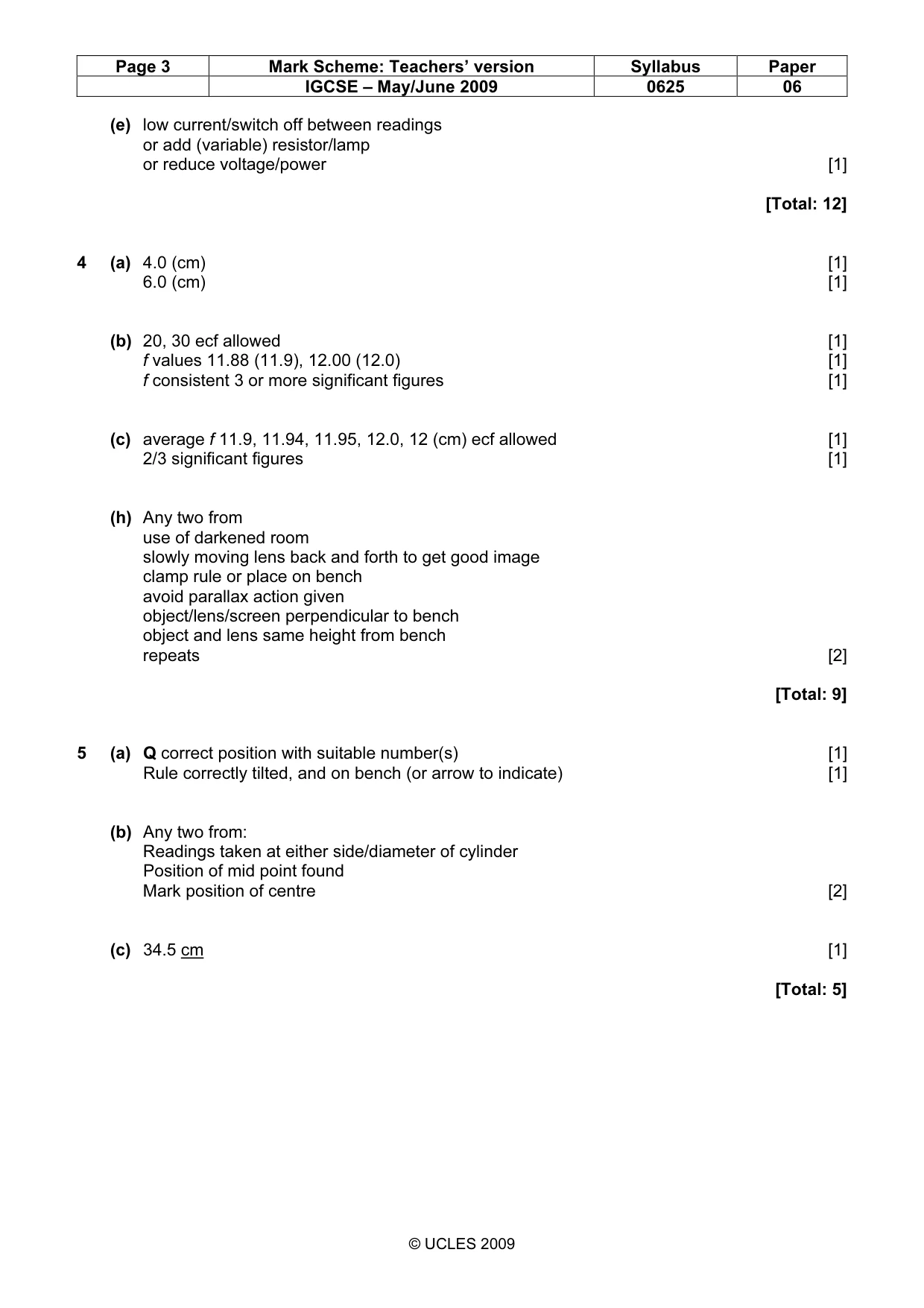
Mark scheme: 4 (a) 4.0 (cm) [1] 6.0 (cm) [1] (b) 20, 30 ecf allowed [1] f values 11.88 (11.9), 12.00 (12.0) [1] f consistent 3 or more significant figures [1] (c) average f 11.9, 11.94, 11.95, 12.0, 12 (cm) ecf allowed [1] 2/3 significant figures [1] (h) Any two from use of darkened room slowly moving lens back and forth to get good image clamp rule or place on bench avoid parallax action given object/lens/screen perpendicular to bench object and lens same height from bench repeats [2] [Total: 9]
Q5 · An IGCSE student is investigating moments using a simple balancing experiment
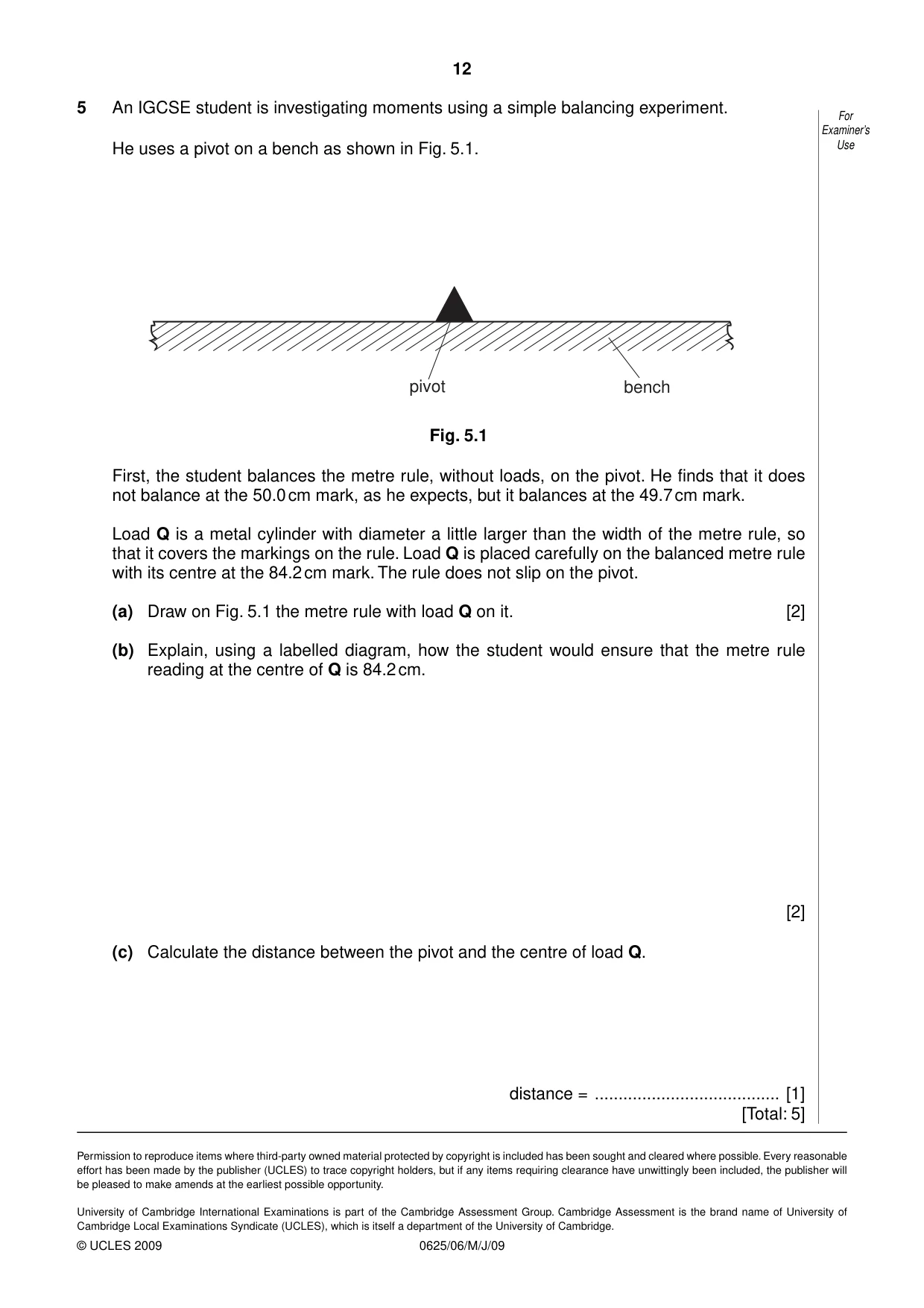
5 An IGCSE student is investigating moments using a simple balancing experiment. For Examiner’s He uses a pivot on a bench as shown in Fig. 5.1. Use pivot bench Fig. 5.1 First, the student balances the metre rule, without loads, on the pivot. He finds that it does not balance at the 50.0 cm mark, as he expects, but it balances at the 49.7 cm mark. Load Q is a metal cylinder with diameter a little larger than the width of the metre rule, so that it covers the markings on the rule. Load Q is placed carefully on the balanced metre rule with its centre at the 84.2 cm mark. The rule does not slip on the pivot. (a) Draw on Fig. 5.1 the metre rule with load Q on it. [2] (b) Explain, using a labelled diagram, how the student would ensure that the metre rule reading at the centre of Q is 84.2 cm. [2] (c) Calculate the distance between the pivot and the centre of load Q. distance = ....................................... [1] [Total: 5]
Mark scheme: 5 (a) Q correct position with suitable number(s) [1] Rule correctly tilted, and on bench (or arrow to indicate) [1] (b) Any two from: Readings taken at either side/diameter of cylinder Position of mid point found Mark position of centre [2] (c) 34.5 cm [1] [Total: 5]
What was in this paper
The subtopics covered by these 4 questions, and how many questions each got. Open one in a new tab to see every Cambridge question on it.
What you needed in this session
Cambridge’s own grade thresholds for 2009 May/June, Paper 6 · Variant 1. A higher threshold means an easier paper — the bar moves with how the cohort did.