Cambridge IGCSE Physics 0625 — 2007 Oct/Nov Paper 6 · Variant 1
0625/61/O/N/07 · 5 questions · 40 marks · ≈45 min
The question paper and its mark scheme, free to read here and free to download. This is Cambridge’s own paper, exactly as it was sat.
Question paper12 pages
Mark scheme3 pages
Answers below. Sit the paper first if you are practising.
Questions as text
Q1 · The IGCSE class is investigating the rate of cooling of hot water
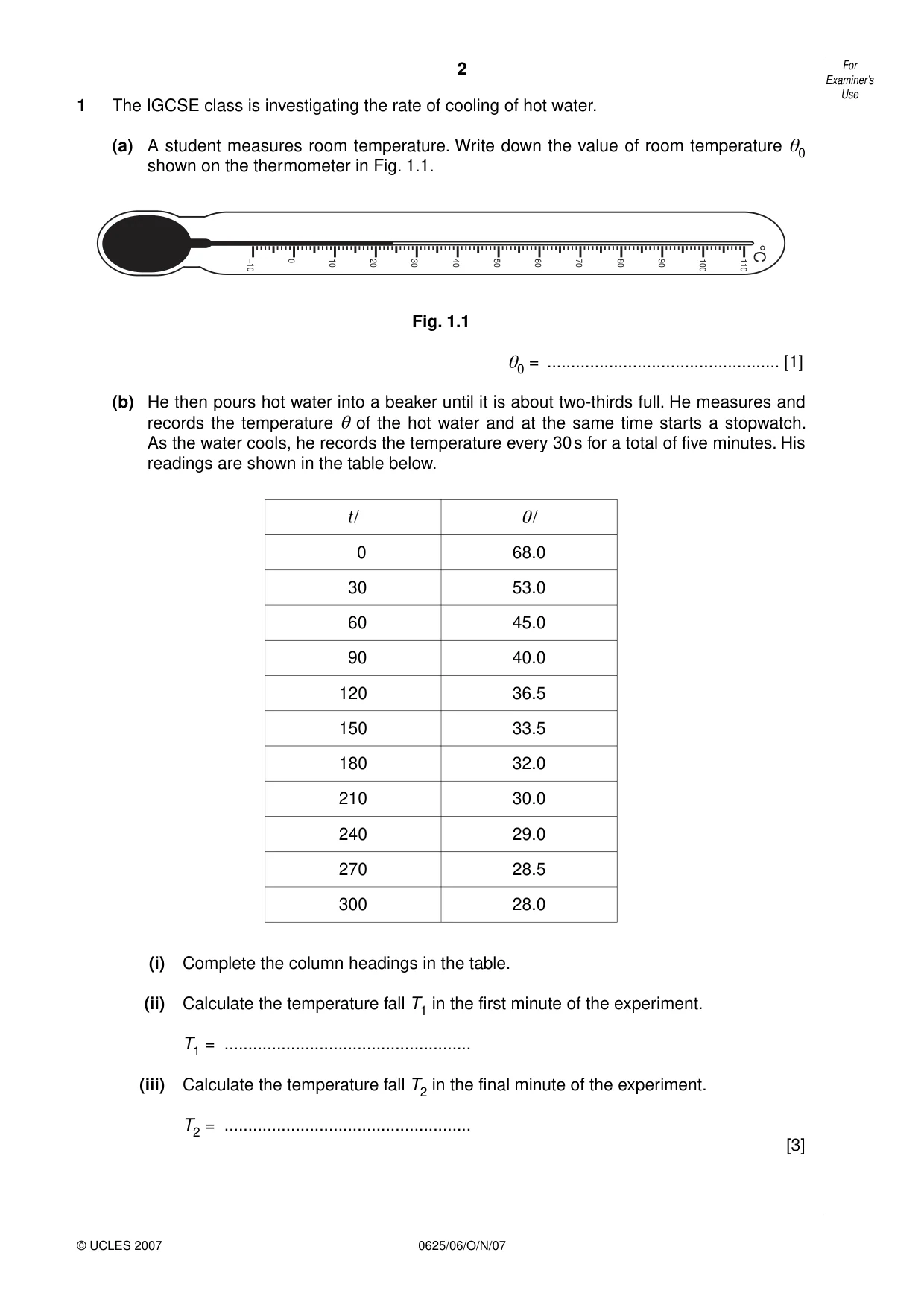
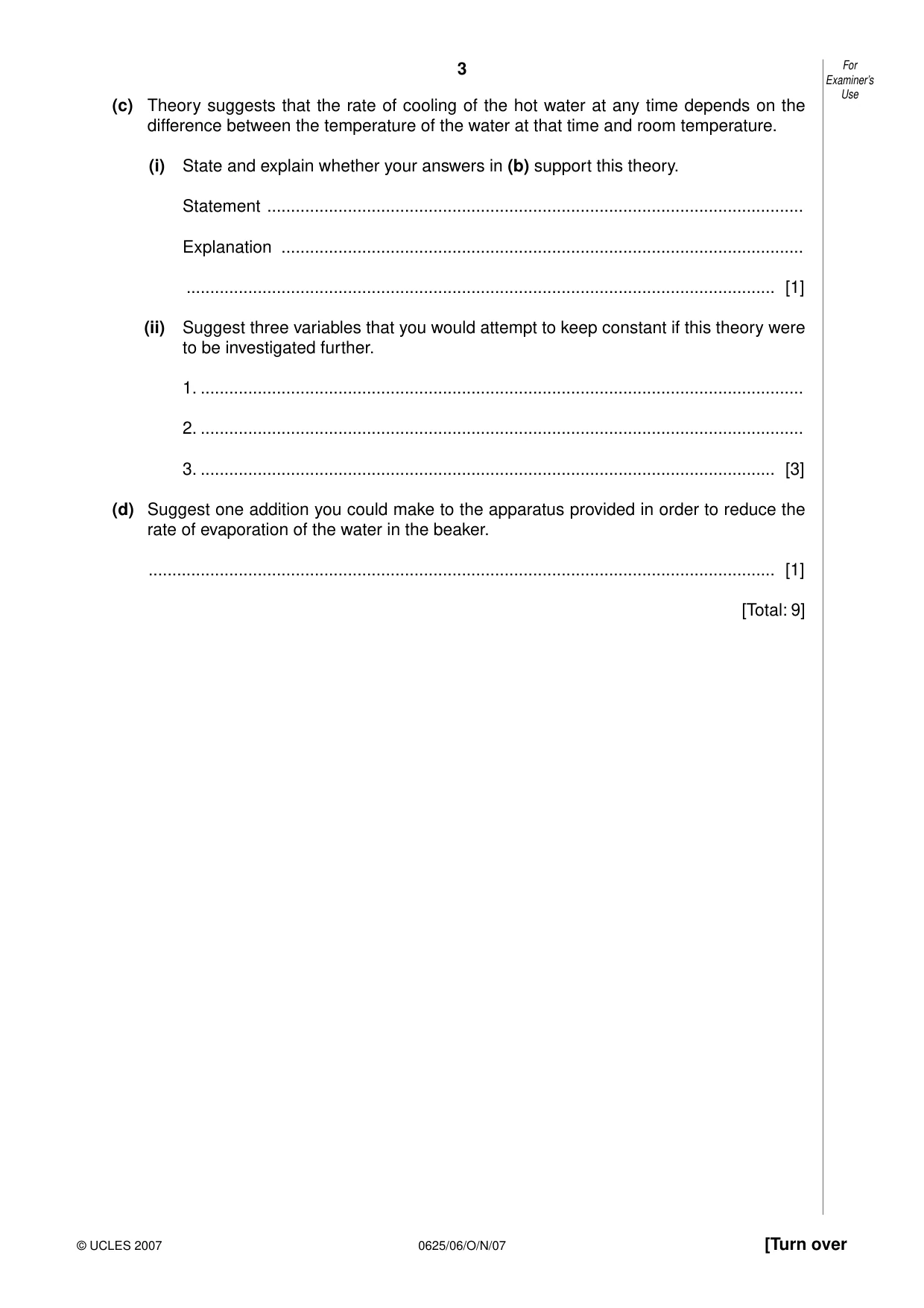
1 The IGCSE class is investigating the rate of cooling of hot water. (a) A student measures room temperature. Write down the value of room temperature θ0 shown on the thermometer in Fig. 1.1. °C –10 0 10 20 30 40 50 60 70 80 90 100 110 Fig. 1.1 θ0 = ................................................. [1] (b) He then pours hot water into a beaker until it is about two-thirds full. He measures and records the temperature θ of the hot water and at the same time starts a stopwatch. As the water cools, he records the temperature every 30 s for a total of five minutes. His readings are shown in the table below. t / θ/ 0 68.0 30 53.0 60 45.0 90 40.0 120 36.5 150 33.5 180 32.0 210 30.0 240 29.0 270 28.5 300 28.0 (i) Complete the column headings in the table. (ii) Calculate the temperature fall T1 in the first minute of the experiment. T1 = .................................................... (iii) Calculate the temperature fall T2 in the final minute of the experiment. T2 = .................................................... [3] Examiner’s Use (c) Theory suggests that the rate of cooling of the hot water at any time depends on the difference between the temperature of the water at that time and room temperature. (i) State and explain whether your answers in (b) support this theory. Statement ................................................................................................................. Explanation .............................................................................................................. ............................................................................................................................ [1] (ii) Suggest three variables that you would attempt to keep constant if this theory were to be investigated further. 1. ............................................................................................................................... 2. ............................................................................................................................... 3. ......................................................................................................................... [3] (d) Suggest one addition you could make to the apparatus provided in order to reduce the rate of evaporation of the water in the beaker. .................................................................................................................................... [1] [Total: 9]
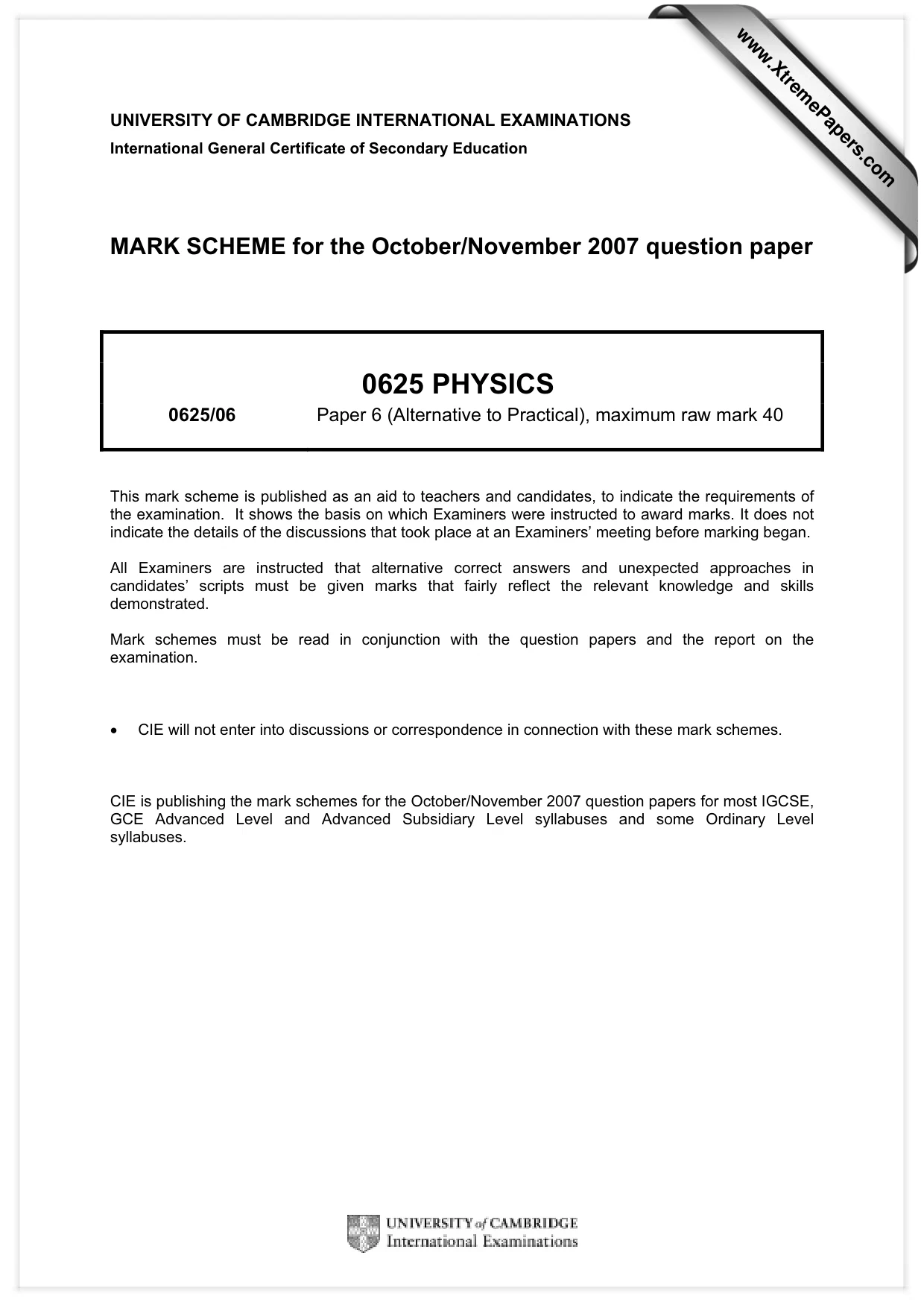
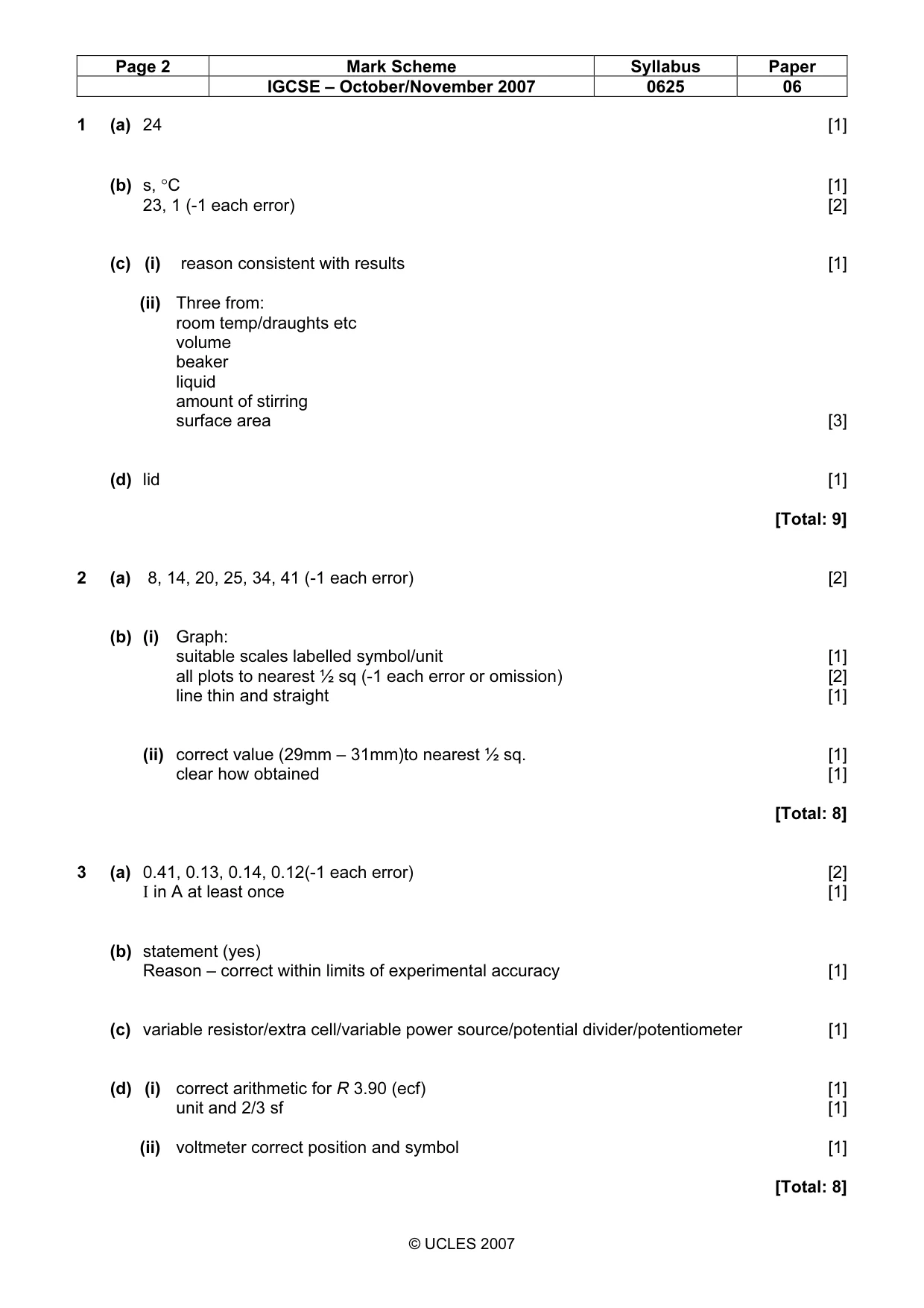
Mark scheme: 1 (a) 24 [1] (b) s, °C [1] 23, 1 (-1 each error) [2] (c) (i) reason consistent with results [1] (ii) Three from: room temp/draughts etc volume beaker liquid amount of stirring surface area [3] (d) lid [1] [Total: 9]
Q2 · The IGCSE class is investigating a simple balance
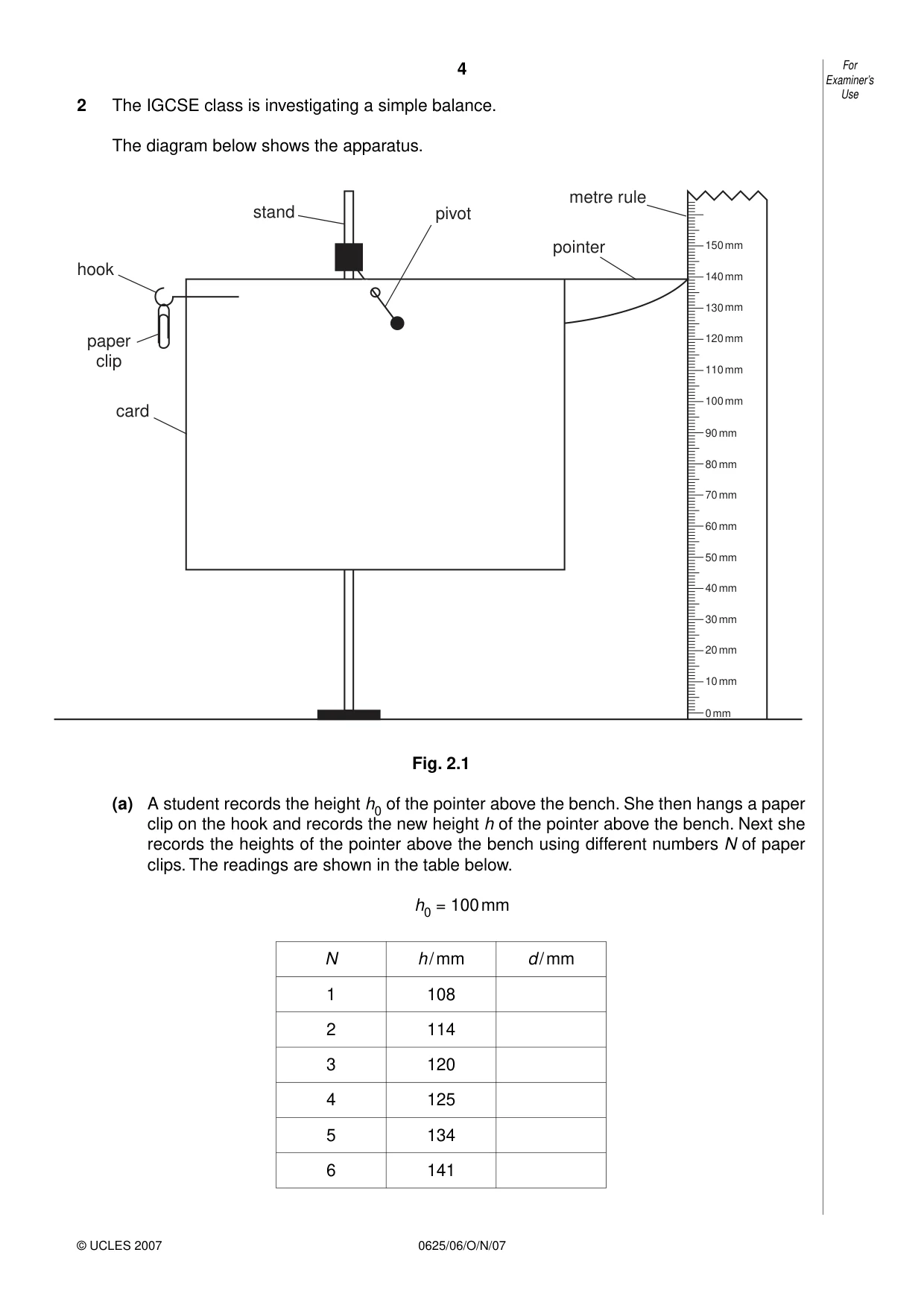
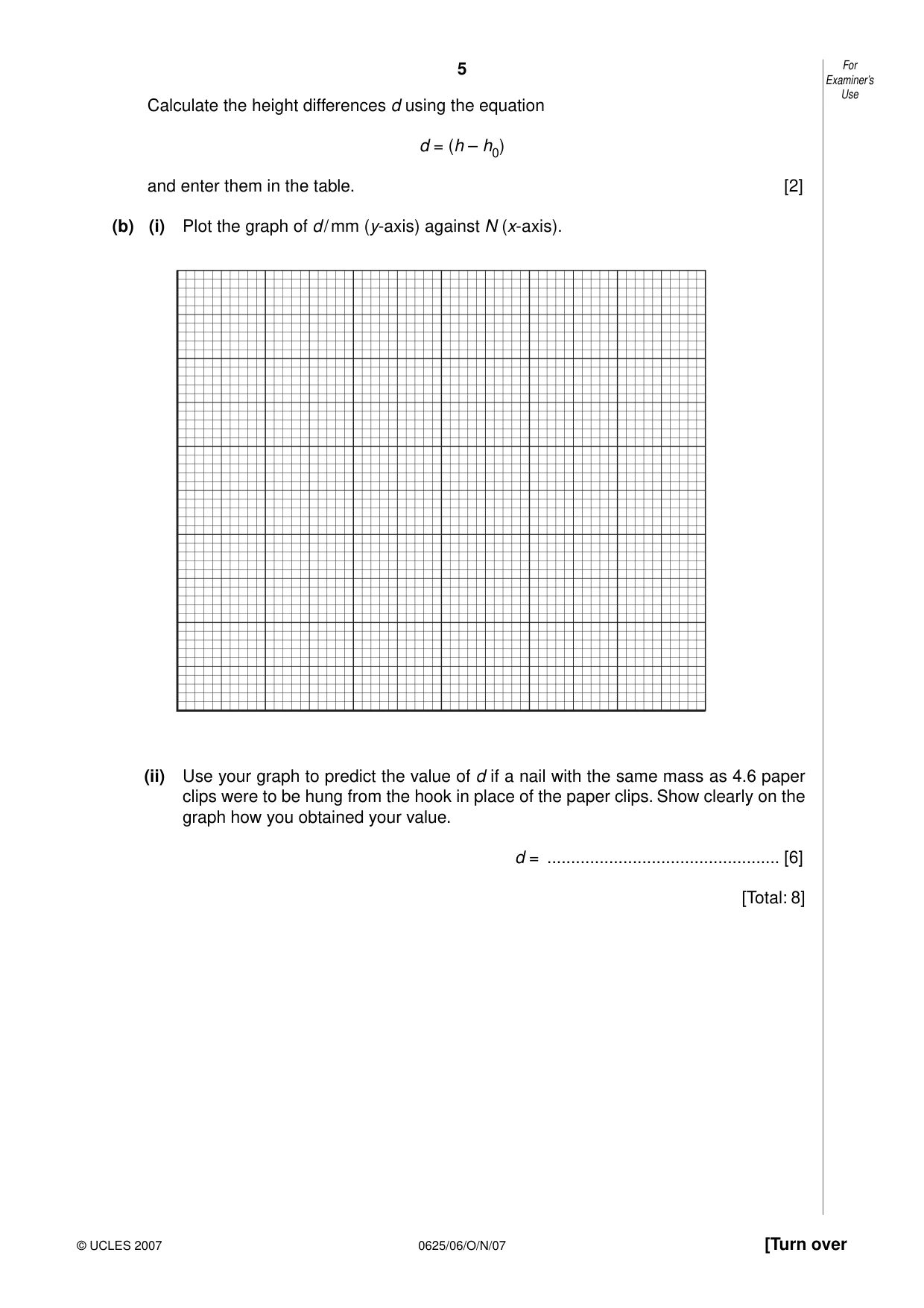
2 The IGCSE class is investigating a simple balance. The diagram below shows the apparatus. metre rule stand pivot pointer 150 mm hook 140 mm 130 mm paper 120 mm clip 110 mm 100 mm card 90 mm 80 mm 70 mm 60 mm 50 mm 40 mm 30 mm 20 mm 10 mm 0 mm Fig. 2.1 (a) A student records the height h0 of the pointer above the bench. She then hangs a paper clip on the hook and records the new height h of the pointer above the bench. Next she records the heights of the pointer above the bench using different numbers N of paper clips. The readings are shown in the table below. h0 = 100 mm N h / mm d / mm 1 108 2 114 3 120 4 125 5 134 6 141 Examiner’s Use Calculate the height differences d using the equation d = (h – h0) and enter them in the table. [2] (b) (i) Plot the graph of d / mm (y-axis) against N (x-axis). (ii) Use your graph to predict the value of d if a nail with the same mass as 4.6 paper clips were to be hung from the hook in place of the paper clips. Show clearly on the graph how you obtained your value. d = ................................................. [6] [Total: 8]
Mark scheme: 2 (a) 8, 14, 20, 25, 34, 41 (-1 each error) [2] (b) (i) Graph: suitable scales labelled symbol/unit [1] all plots to nearest ½ sq (-1 each error or omission) [2] line thin and straight [1] (ii) correct value (29mm – 31mm)to nearest ½ sq. [1] clear how obtained [1] [Total: 8]
More questions on Physical quantities and measurement techniques
Q3 · The IGCSE class is investigating the potential difference across lamps and the currents…
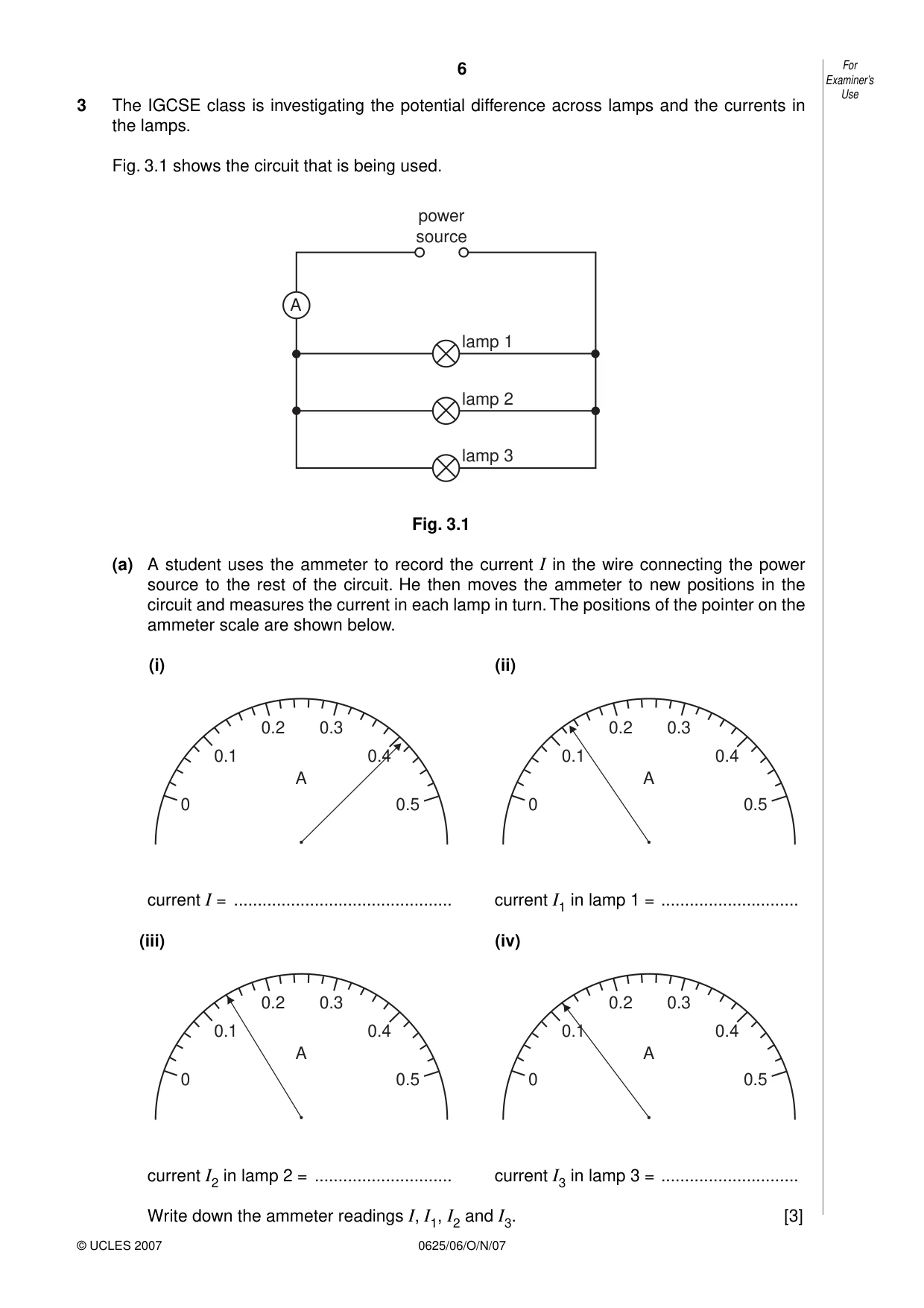
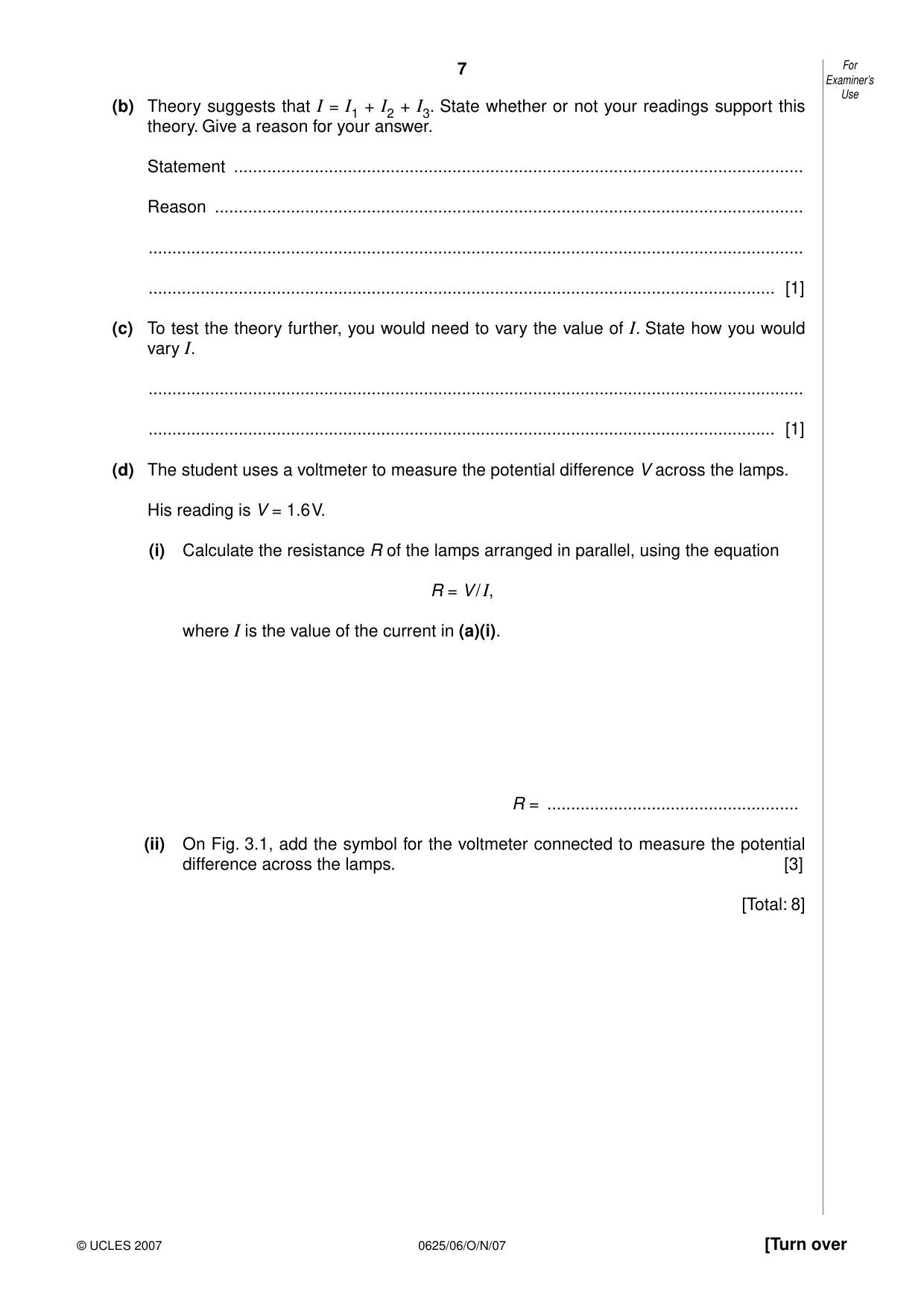
3 The IGCSE class is investigating the potential difference across lamps and the currents in the lamps. Fig. 3.1 shows the circuit that is being used. power source A lamp 1 lamp 2 lamp 3 Fig. 3.1 (a) A student uses the ammeter to record the current I in the wire connecting the power source to the rest of the circuit. He then moves the ammeter to new positions in the circuit and measures the current in each lamp in turn. The positions of the pointer on the ammeter scale are shown below. (i) (ii) 0.2 0.3 0.2 0.3 0.1 0.4 0.1 0.4 A A 0 0.5 0 0.5 current I = .............................................. current I1 in lamp 1 = ............................. (iii) (iv) 0.2 0.3 0.2 0.3 0.1 0.4 0.1 0.4 A A 0 0.5 0 0.5 current I2 in lamp 2 = ............................. current I3 in lamp 3 = ............................. Write down the ammeter readings I, I1, I2 and I3. [3] Examiner’s Use (b) Theory suggests that I = I1 + I2 + I3. State whether or not your readings support this theory. Give a reason for your answer. Statement ........................................................................................................................ Reason ............................................................................................................................ .......................................................................................................................................... .................................................................................................................................... [1] (c) To test the theory further, you would need to vary the value of I. State how you would vary I. .......................................................................................................................................... .................................................................................................................................... [1] (d) The student uses a voltmeter to measure the potential difference V across the lamps. His reading is V = 1.6 V. (i) Calculate the resistance R of the lamps arranged in parallel, using the equation R = V / I, where I is the value of the current in (a)(i). R = ..................................................... (ii) On Fig. 3.1, add the symbol for the voltmeter connected to measure the potential difference across the lamps. [3] [Total: 8]
Mark scheme: 3 (a) 0.41, 0.13, 0.14, 0.12(-1 each error) [2] I in A at least once [1] (b) statement (yes) Reason – correct within limits of experimental accuracy [1] (c) variable resistor/extra cell/variable power source/potential divider/potentiometer [1] (d) (i) correct arithmetic for R 3.90 (ecf) [1] unit and 2/3 sf [1] (ii) voltmeter correct position and symbol [1] [Total: 8] IGCSE – October/November 2007 0625 06
Q4 · The IGCSE class is investigating the refraction of light through a transparent block
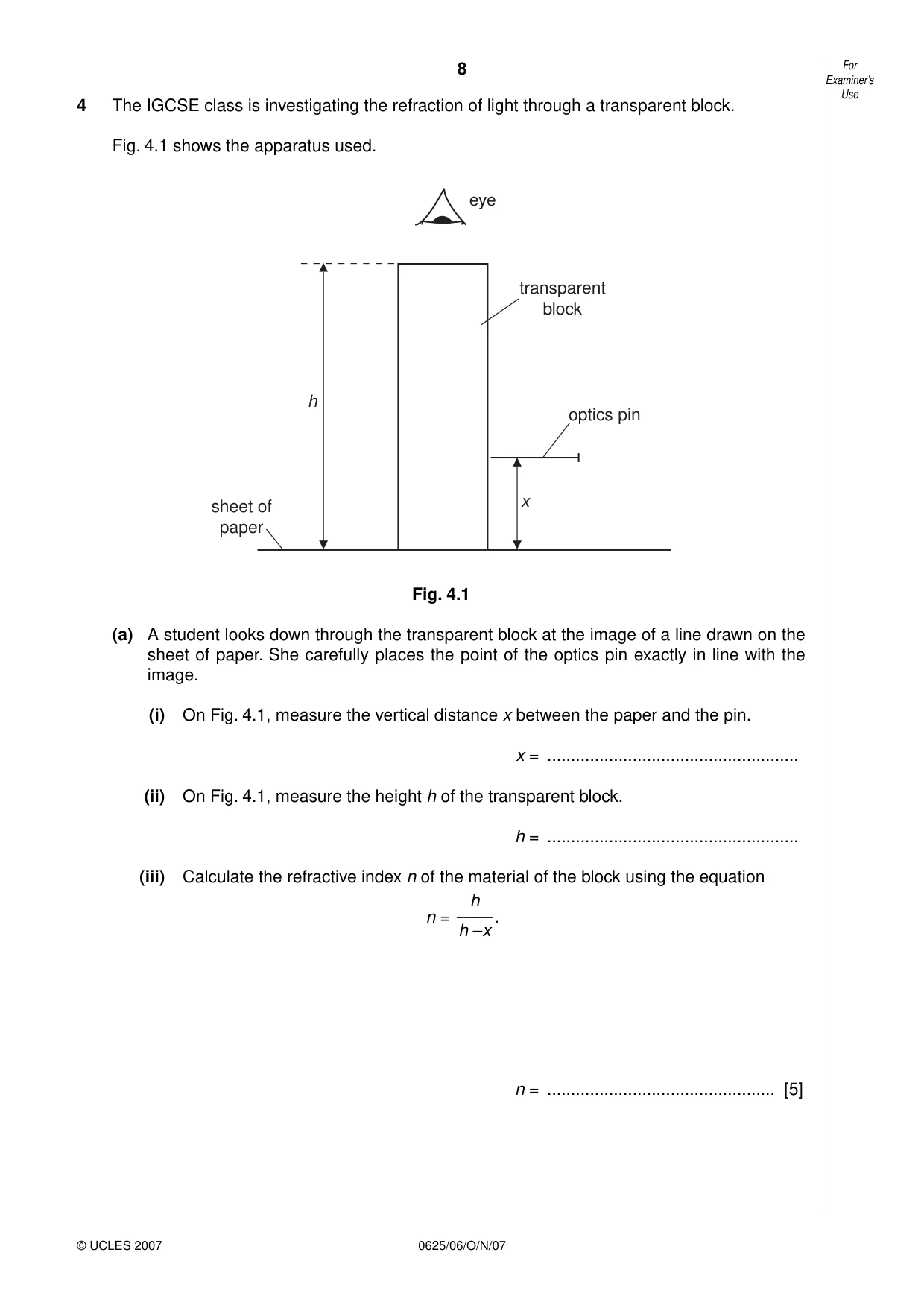
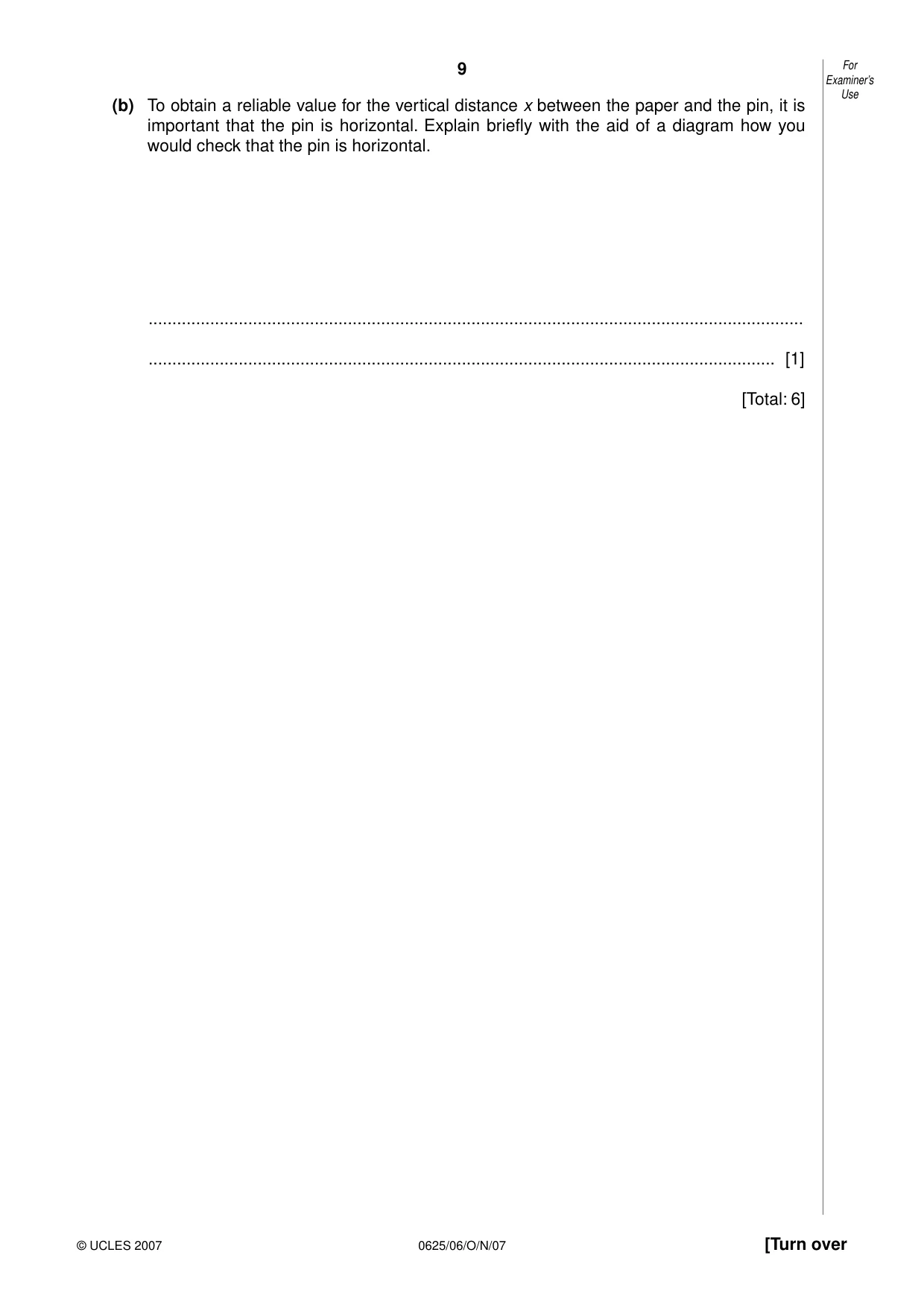
4 The IGCSE class is investigating the refraction of light through a transparent block. Fig. 4.1 shows the apparatus used. eye transparent block h optics pin x sheet of paper Fig. 4.1 (a) A student looks down through the transparent block at the image of a line drawn on the sheet of paper. She carefully places the point of the optics pin exactly in line with the image. (i) On Fig. 4.1, measure the vertical distance x between the paper and the pin. x = ..................................................... (ii) On Fig. 4.1, measure the height h of the transparent block. h = ..................................................... (iii) Calculate the refractive index n of the material of the block using the equation h n = ––––– . h –x n = ................................................ [5] Examiner’s Use (b) To obtain a reliable value for the vertical distance x between the paper and the pin, it is important that the pin is horizontal. Explain briefly with the aid of a diagram how you would check that the pin is horizontal. .......................................................................................................................................... .................................................................................................................................... [1] [Total: 6]
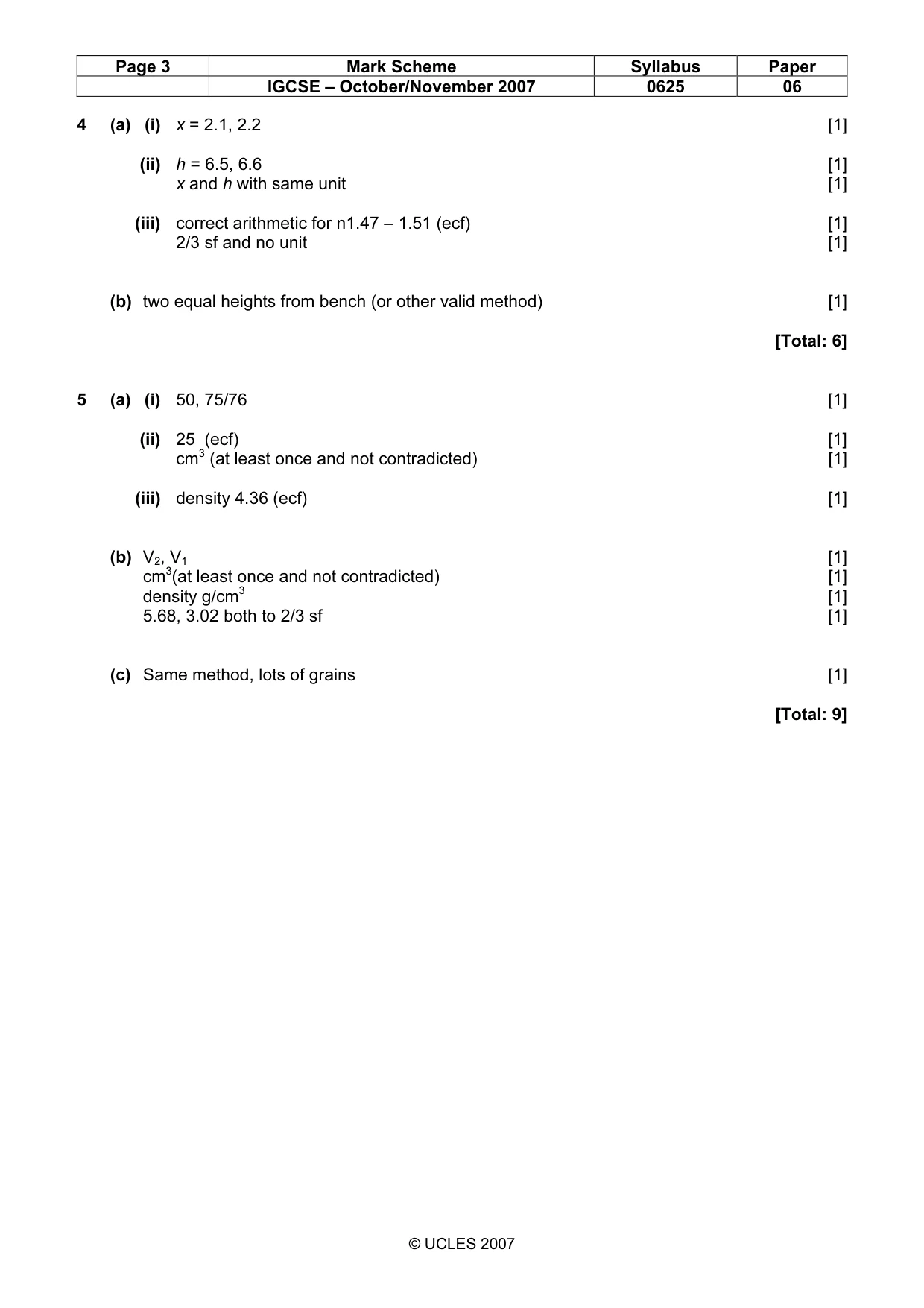
Mark scheme: 4 (a) (i) x = 2.1, 2.2 [1] (ii) h = 6.5, 6.6 [1] x and h with same unit [1] (iii) correct arithmetic for n1.47 – 1.51 (ecf) [1] 2/3 sf and no unit [1] (b) two equal heights from bench (or other valid method) [1] [Total: 6]
Q5 · An IGCSE student is investigating the differences in density of small pieces of different…
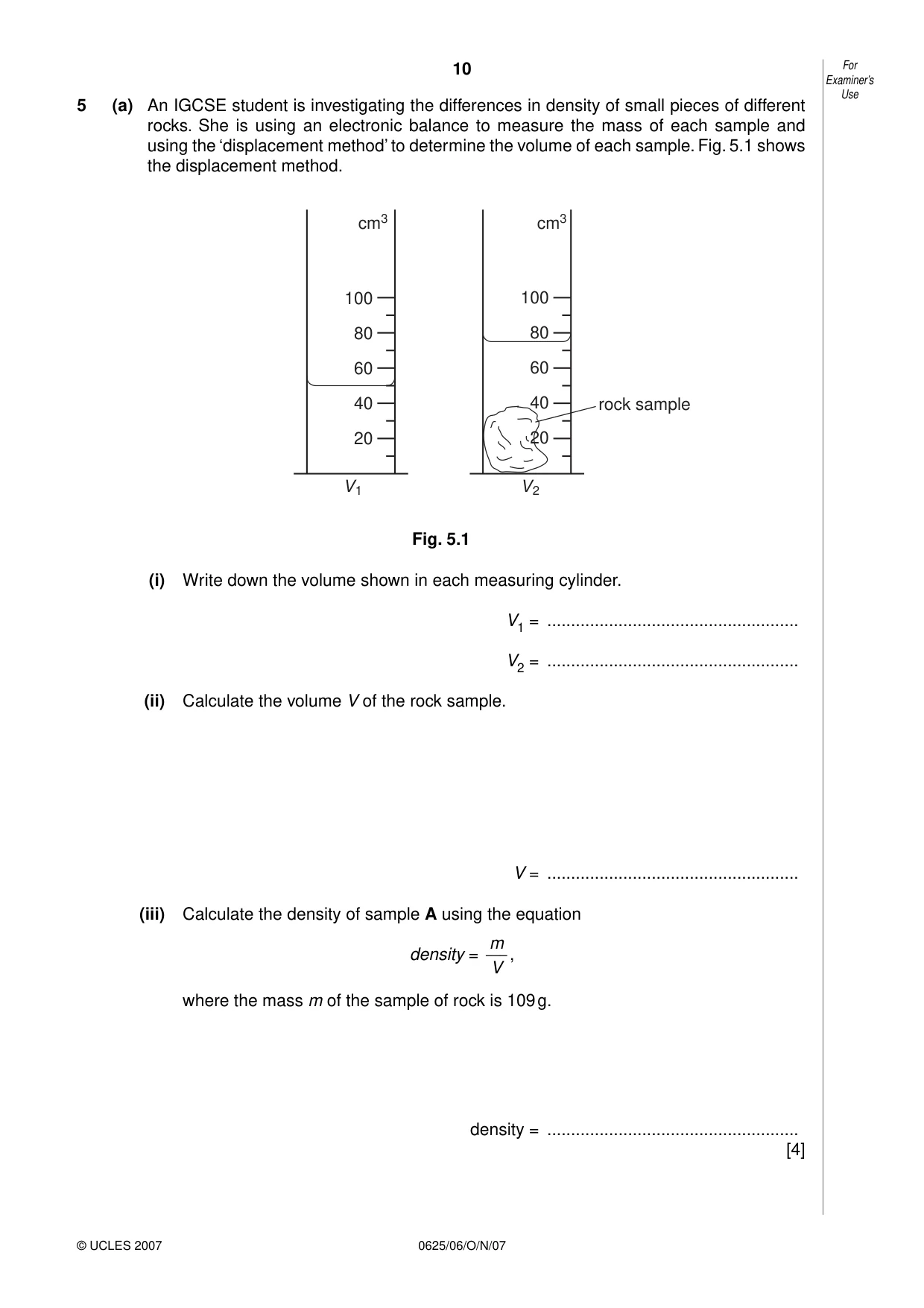
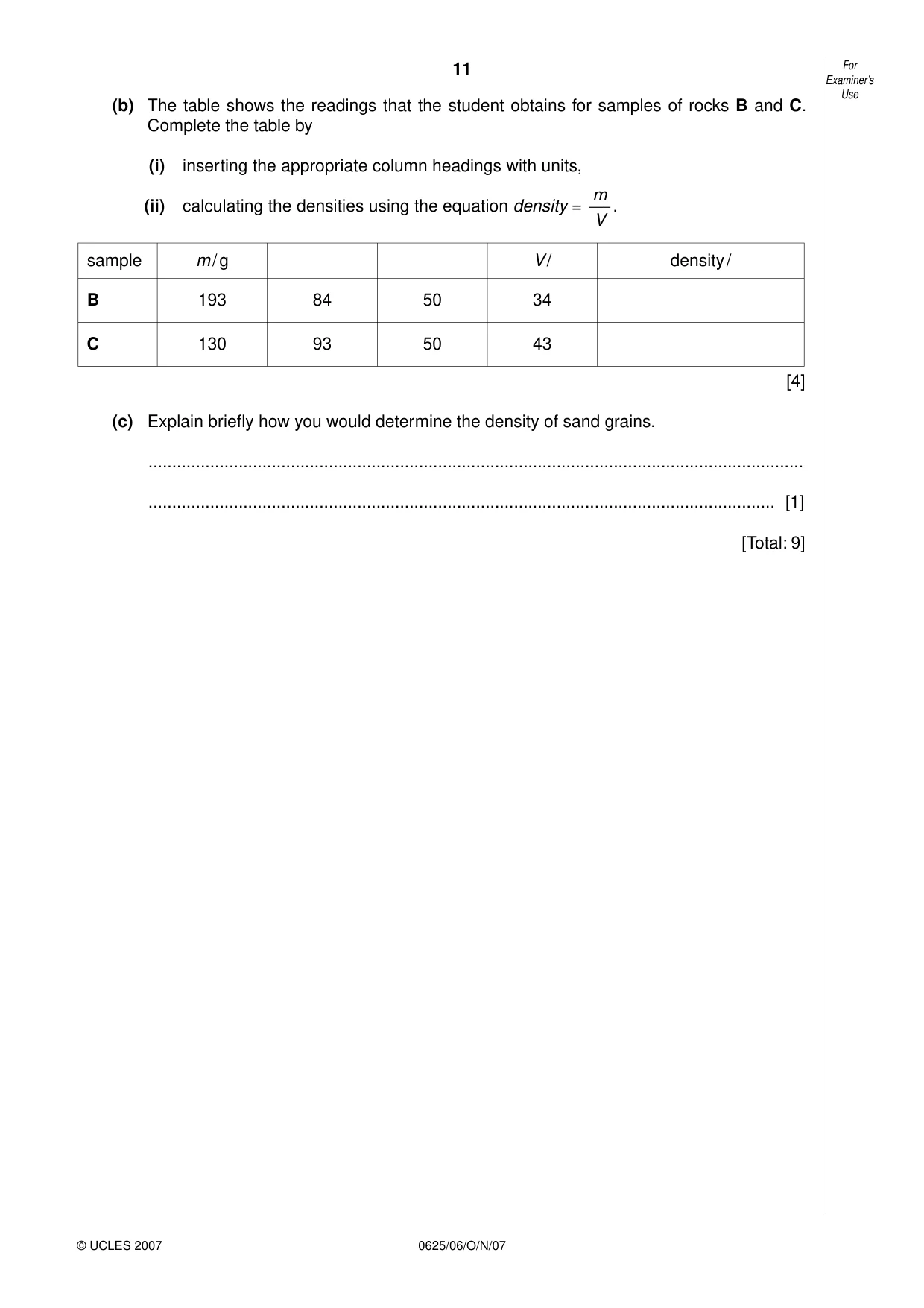
5 (a) An IGCSE student is investigating the differences in density of small pieces of different rocks. She is using an electronic balance to measure the mass of each sample and using the ‘displacement method’ to determine the volume of each sample. Fig. 5.1 shows the displacement method. cm3 cm3 100 100 80 80 60 60 40 40 rock sample 20 20 V1 V2 Fig. 5.1 (i) Write down the volume shown in each measuring cylinder. V1 = ..................................................... V2 = ..................................................... (ii) Calculate the volume V of the rock sample. V = ..................................................... (iii) Calculate the density of sample A using the equation m density = ––– , V where the mass m of the sample of rock is 109 g. density = ..................................................... [4] Examiner’s Use (b) The table shows the readings that the student obtains for samples of rocks B and C. Complete the table by (i) inserting the appropriate column headings with units, m (ii) calculating the densities using the equation density = ––– . V sample m / g V / density / B 193 84 50 34 C 130 93 50 43 [4] (c) Explain briefly how you would determine the density of sand grains. .......................................................................................................................................... .................................................................................................................................... [1] [Total: 9]
Mark scheme: 5 (a) (i) 50, 75/76 [1] (ii) 25 (ecf) [1] cm3 (at least once and not contradicted) [1] (iii) density 4.36 (ecf) [1] (b) V2, V1 [1] cm3(at least once and not contradicted) [1] density g/cm3 [1] 5.68, 3.02 both to 2/3 sf [1] (c) Same method, lots of grains [1] [Total: 9]
More questions on Physical quantities and measurement techniques
What was in this paper
The subtopics covered by these 5 questions, and how many questions each got. Open one in a new tab to see every Cambridge question on it.
What you needed in this session
Cambridge’s own grade thresholds for 2007 Oct/Nov, Paper 6 · Variant 1. A higher threshold means an easier paper — the bar moves with how the cohort did.