Cambridge IGCSE Physical Science 0652 — 2019 Oct/Nov Paper 3 · Variant 2
0652/32/O/N/19 · 11 questions · 80 marks · ≈90 min
The question paper and its mark scheme, free to read here and free to download. This is Cambridge’s own paper, exactly as it was sat.
Question paper16 pages
Mark scheme10 pages
Answers below. Sit the paper first if you are practising.
Questions as text
Q1 · Three cars travel along the same straight track in a race
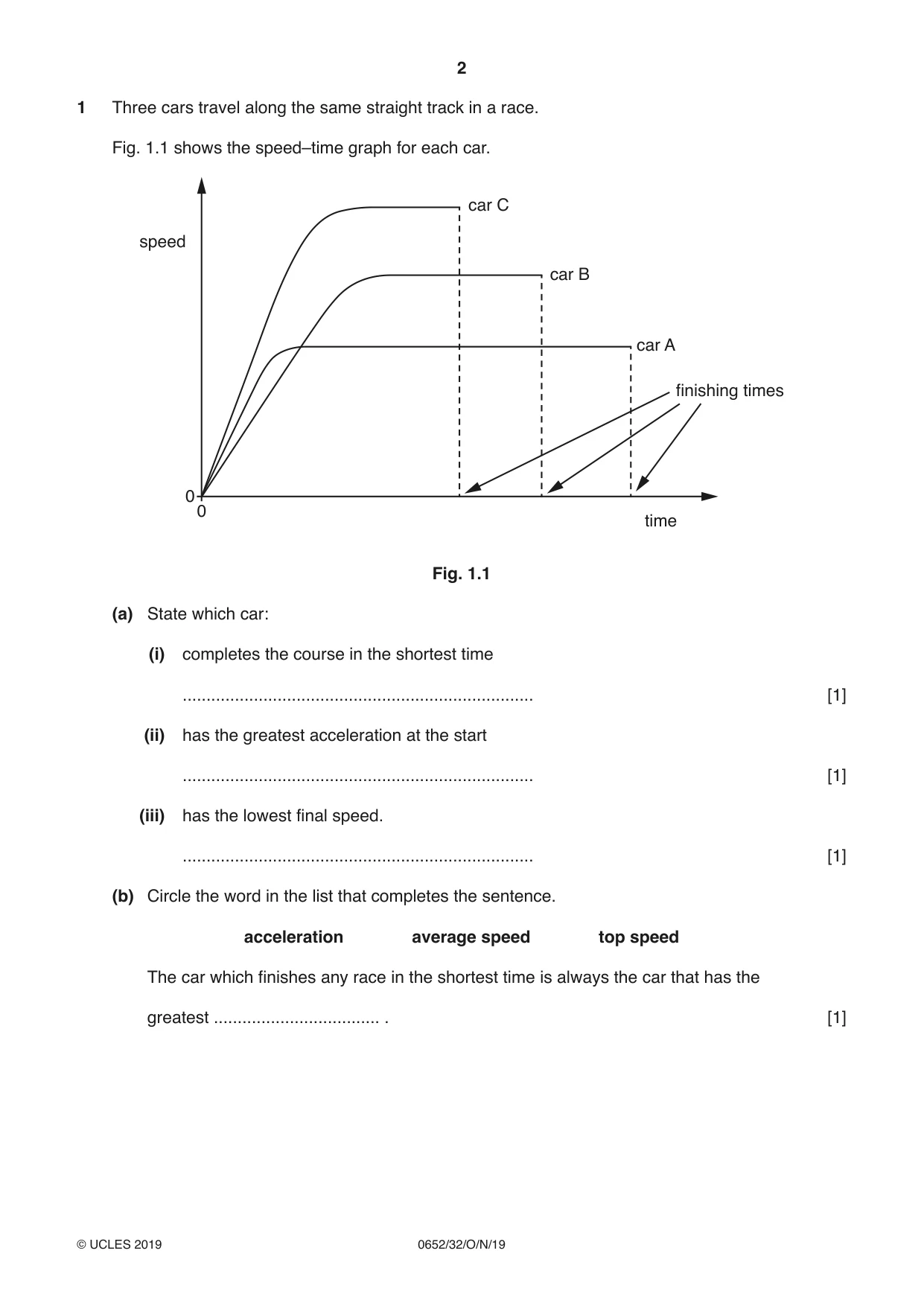
1 Three cars travel along the same straight track in a race. Fig. 1.1 shows the speed–time graph for each car. car C speed car B car A finishing times 0 0 time Fig. 1.1 (a) State which car: (i) completes the course in the shortest time .......................................................................... [1] (ii) has the greatest acceleration at the start .......................................................................... [1] (iii) has the lowest final speed. .......................................................................... [1] (b) Circle the word in the list that completes the sentence. acceleration average speed top speed The car which finishes any race in the shortest time is always the car that has the greatest ................................... . [1] (c) Each car in a race travels the same distance. Describe how this is shown by the speed–time graph in Fig. 1.1. ................................................................................................................................................... ................................................................................................................................................... ............................................................................................................................................. [1] [Total: 5]
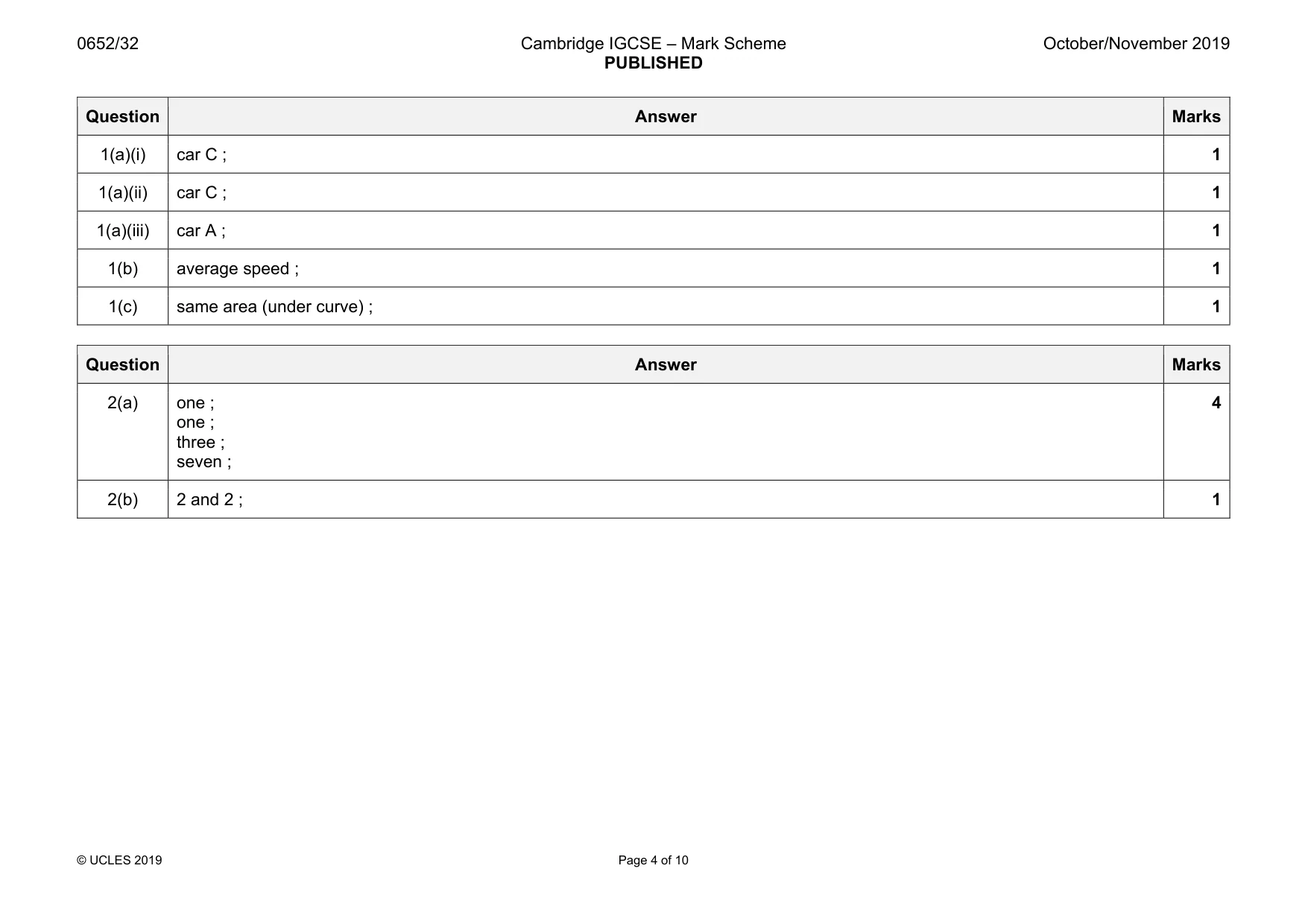
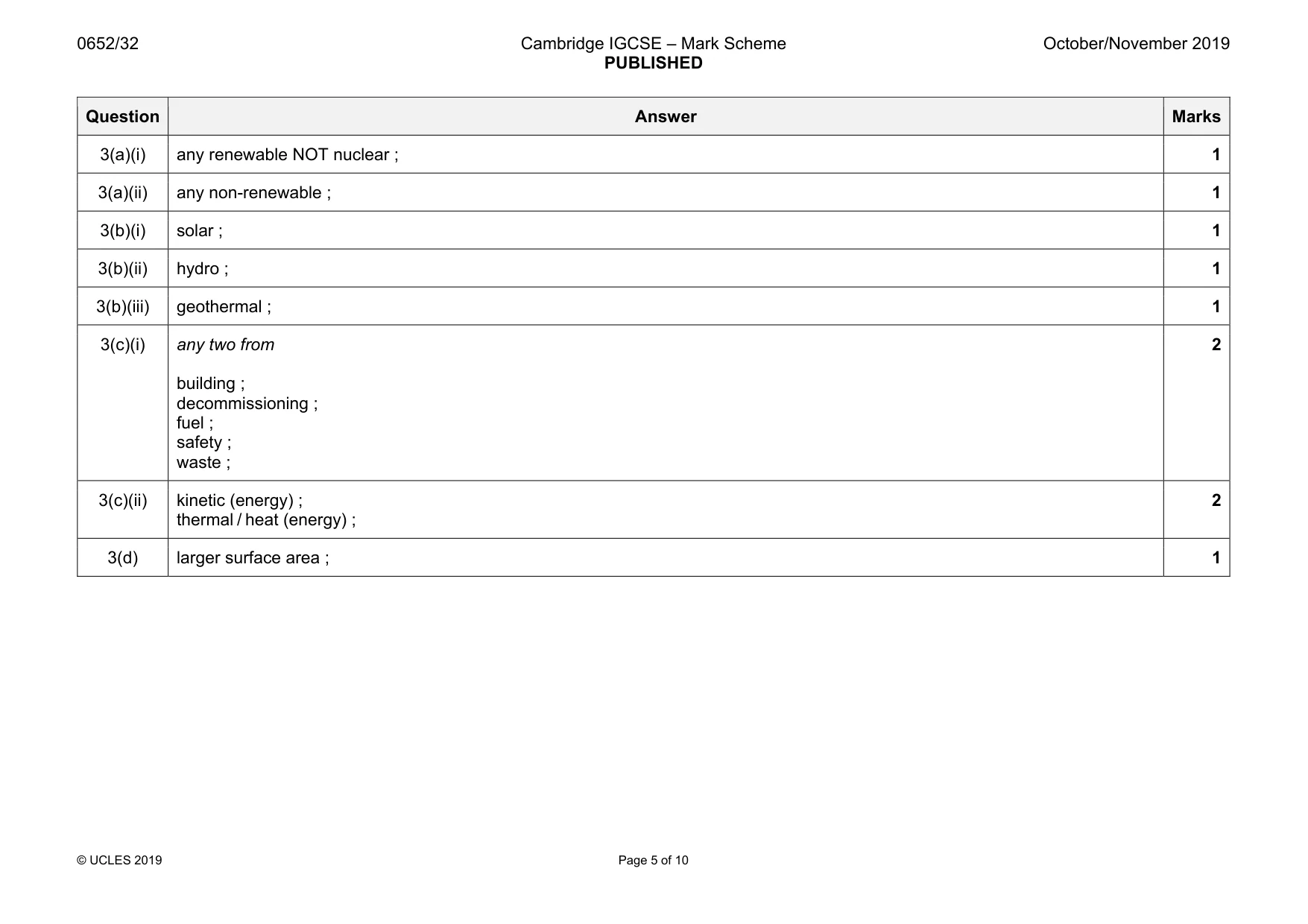
Mark scheme: 1(a)(i) car C ; 1 1(a)(ii) car C ; 1 1(a)(iii) car A ; 1 1(b) average speed ; 1 1(c) same area (under curve) ; 1
Q2 · Lithium is an element in the Periodic Table
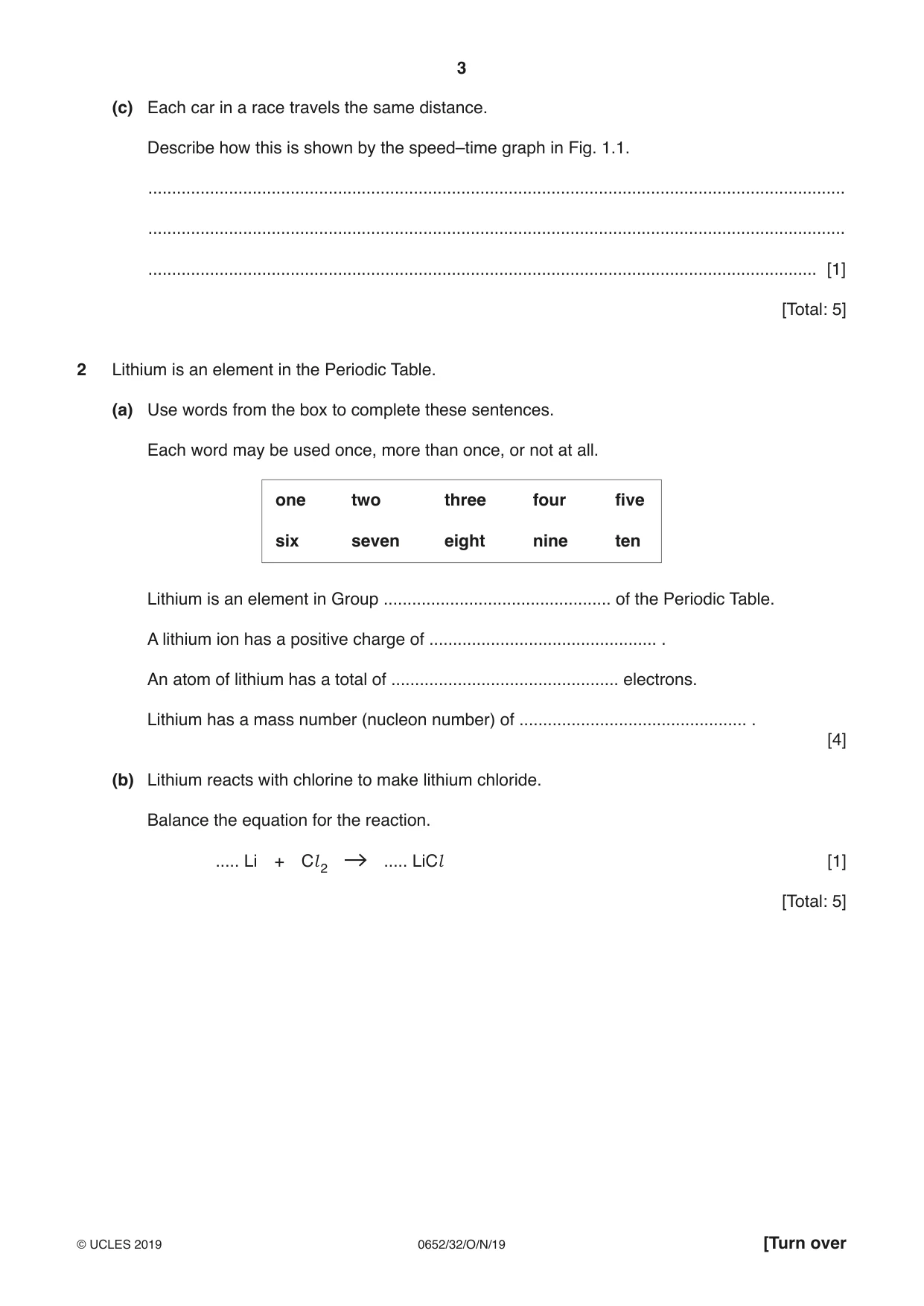
2 Lithium is an element in the Periodic Table. (a) Use words from the box to complete these sentences. Each word may be used once, more than once, or not at all. one two three four five six seven eight nine ten Lithium is an element in Group ................................................ of the Periodic Table. A lithium ion has a positive charge of ................................................ . An atom of lithium has a total of ................................................ electrons. Lithium has a mass number (nucleon number) of ................................................ . [4] (b) Lithium reacts with chlorine to make lithium chloride. Balance the equation for the reaction. ..... Li + Cl 2 ..... LiCl [1] [Total: 5]
Mark scheme: 2(a) one ; one ; three ; seven ; 4 2(b) 2 and 2 ; 1
Q3 · Methods of generating electricity
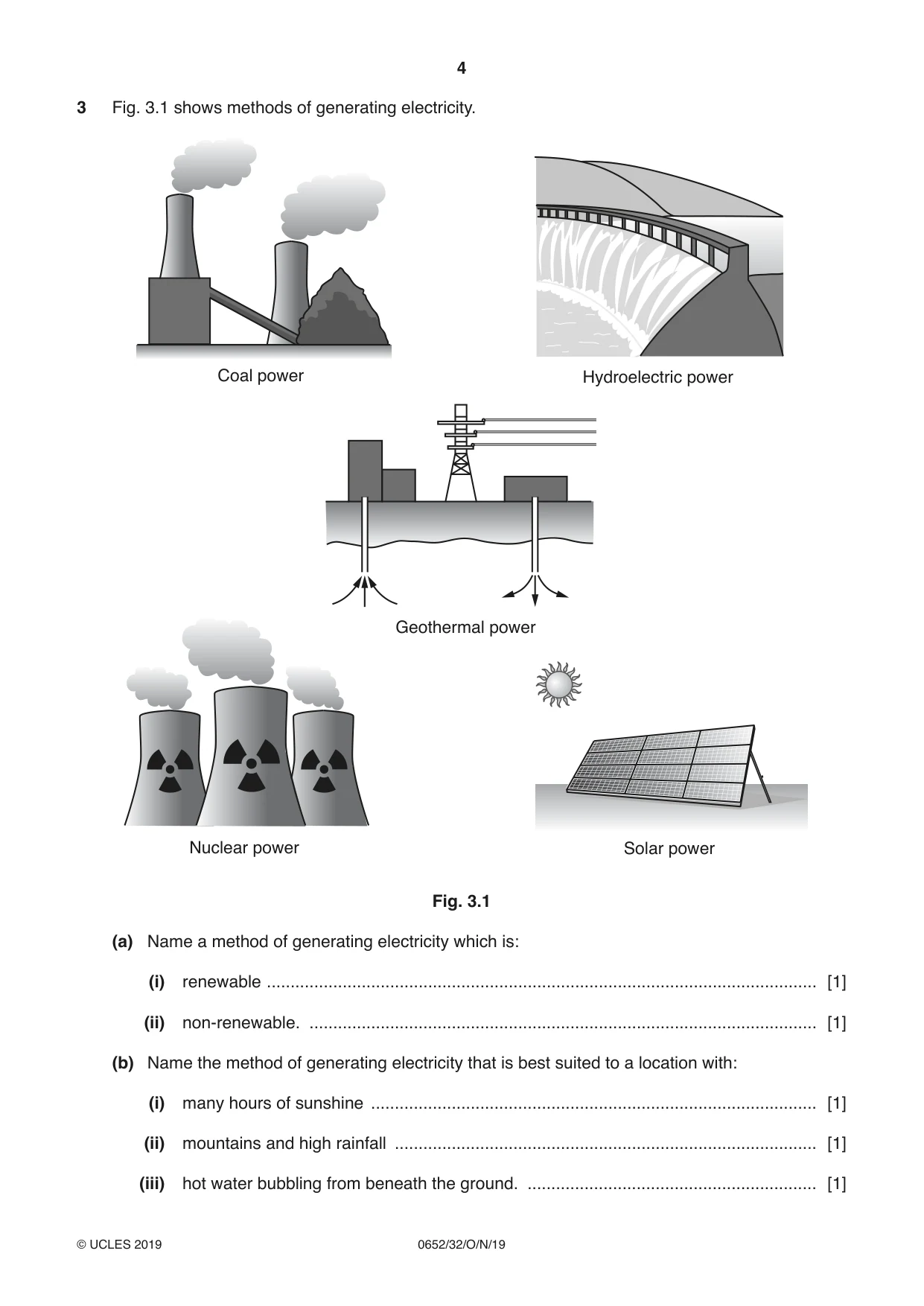
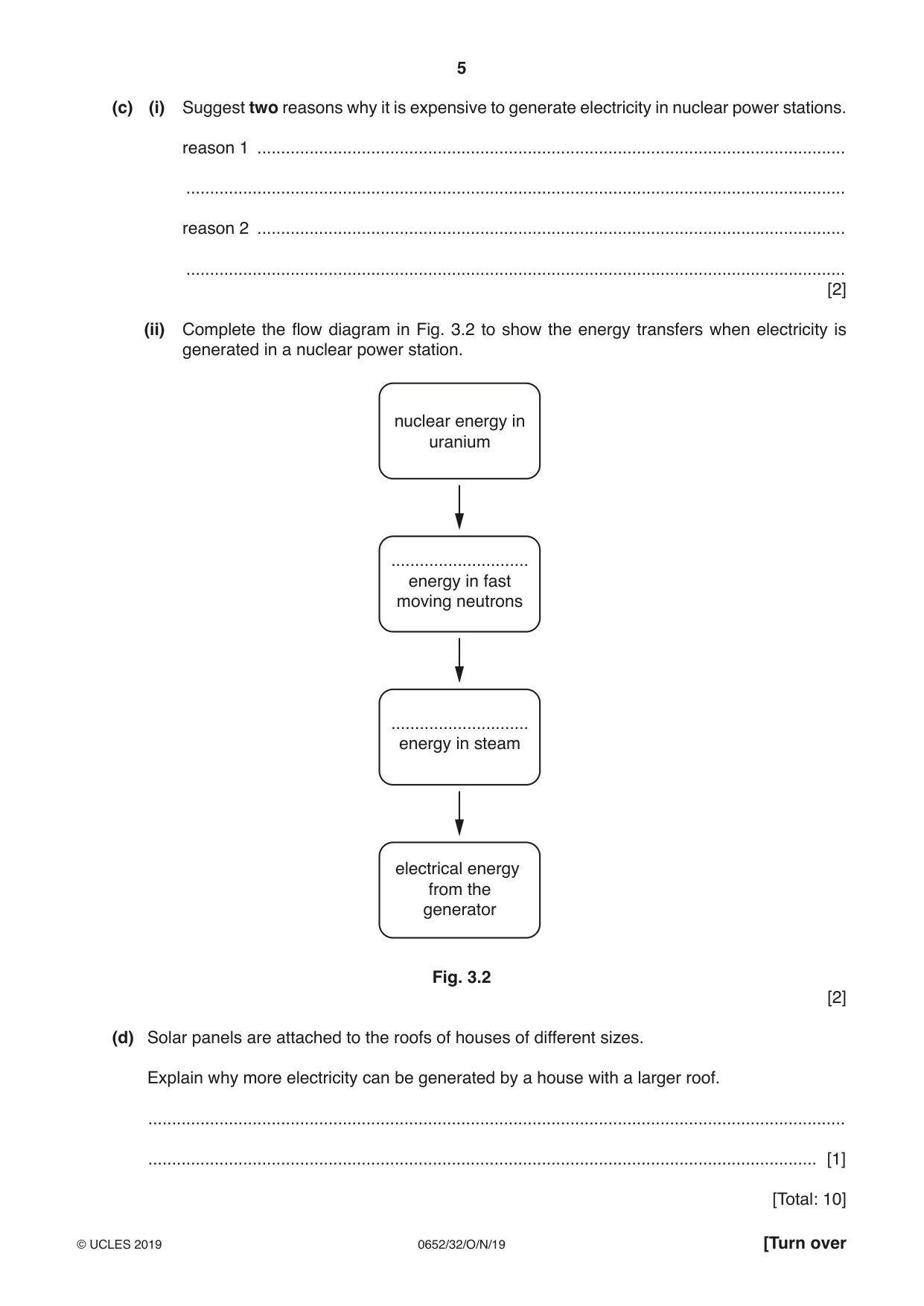
3 Fig. 3.1 shows methods of generating electricity. Coal power Hydroelectric power Geothermal power Nuclear power Solar power Fig. 3.1 (a) Name a method of generating electricity which is: (i) renewable .................................................................................................................... [1] (ii) non-renewable. ........................................................................................................... [1] (b) Name the method of generating electricity that is best suited to a location with: (i) many hours of sunshine .............................................................................................. [1] (ii) mountains and high rainfall ......................................................................................... [1] (iii) hot water bubbling from beneath the ground. ............................................................. [1] (c) (i) Suggest two reasons why it is expensive to generate electricity in nuclear power stations. reason 1 ............................................................................................................................ ........................................................................................................................................... reason 2 ............................................................................................................................ ........................................................................................................................................... [2] (ii) Complete the flow diagram in Fig. 3.2 to show the energy transfers when electricity is generated in a nuclear power station. nuclear energy in uranium ............................. energy in fast moving neutrons ............................. energy in steam electrical energy from the generator Fig. 3.2 [2] (d) Solar panels are attached to the roofs of houses of different sizes. Explain why more electricity can be generated by a house with a larger roof. ................................................................................................................................................... ............................................................................................................................................. [1] [Total: 10]
Mark scheme: 3(a)(i) any renewable NOT nuclear ; 1 3(a)(ii) any non-renewable ; 1 3(b)(i) solar ; 1 3(b)(ii) hydro ; 1 3(b)(iii) geothermal ; 1 3(c)(i) any two from building ; decommissioning ; fuel ; safety ; waste ; 2 3(c)(ii) kinetic (energy) ; thermal / heat (energy) ; 2 3(d) larger surface area ; 1
Q4 · Apparatus used to react hydrogen with copper(II) oxide
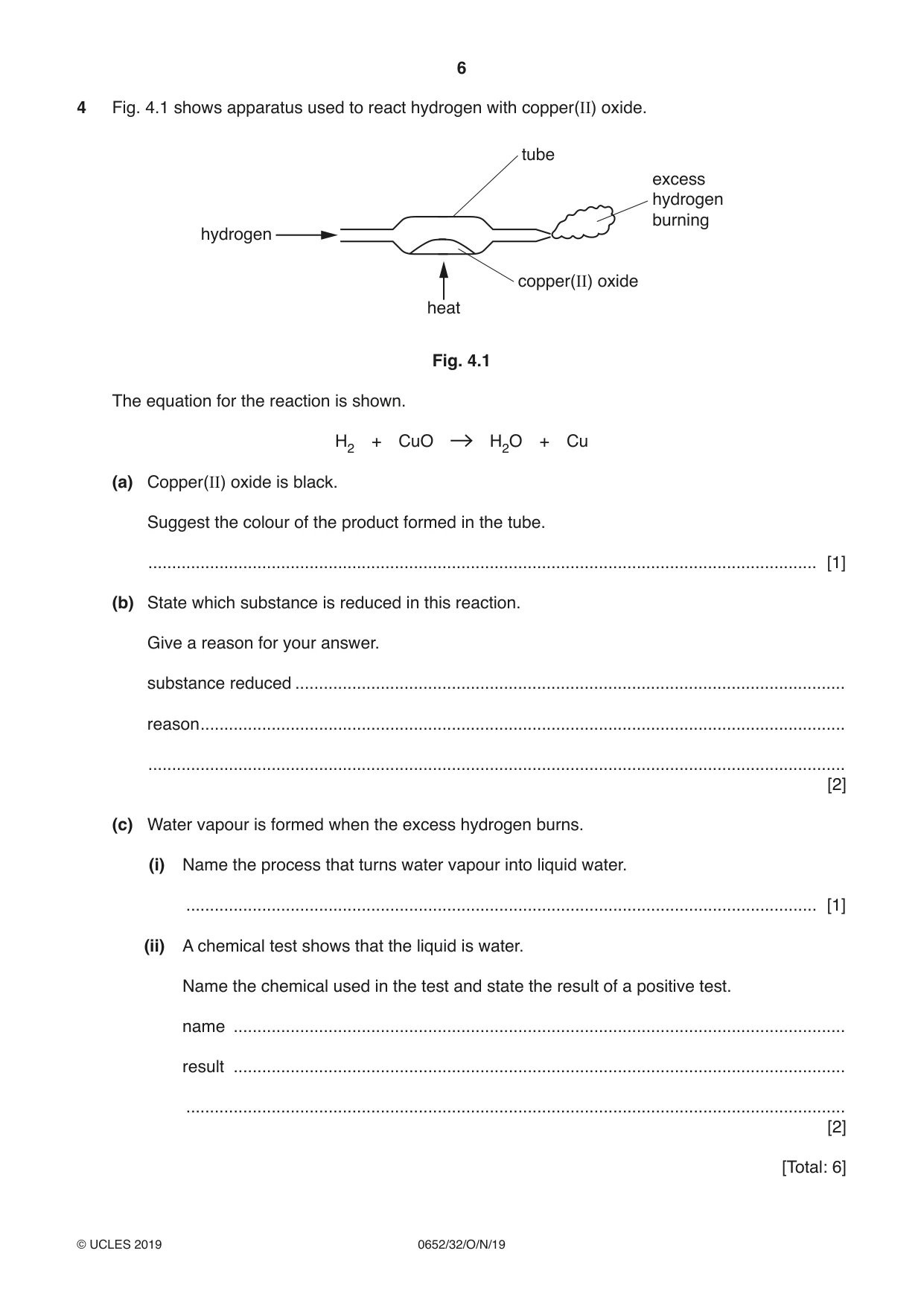
4 Fig. 4.1 shows apparatus used to react hydrogen with copper(II) oxide. tube excess hydrogen burning hydrogen copper(II) oxide heat Fig. 4.1 The equation for the reaction is shown. H2 + CuO H2O + Cu (a) Copper(II) oxide is black. Suggest the colour of the product formed in the tube. ............................................................................................................................................. [1] (b) State which substance is reduced in this reaction. Give a reason for your answer. substance reduced .................................................................................................................... reason ........................................................................................................................................ ................................................................................................................................................... [2] (c) Water vapour is formed when the excess hydrogen burns. (i) Name the process that turns water vapour into liquid water. ..................................................................................................................................... [1] (ii) A chemical test shows that the liquid is water. Name the chemical used in the test and state the result of a positive test. name ................................................................................................................................. result ................................................................................................................................. ........................................................................................................................................... [2] [Total: 6]
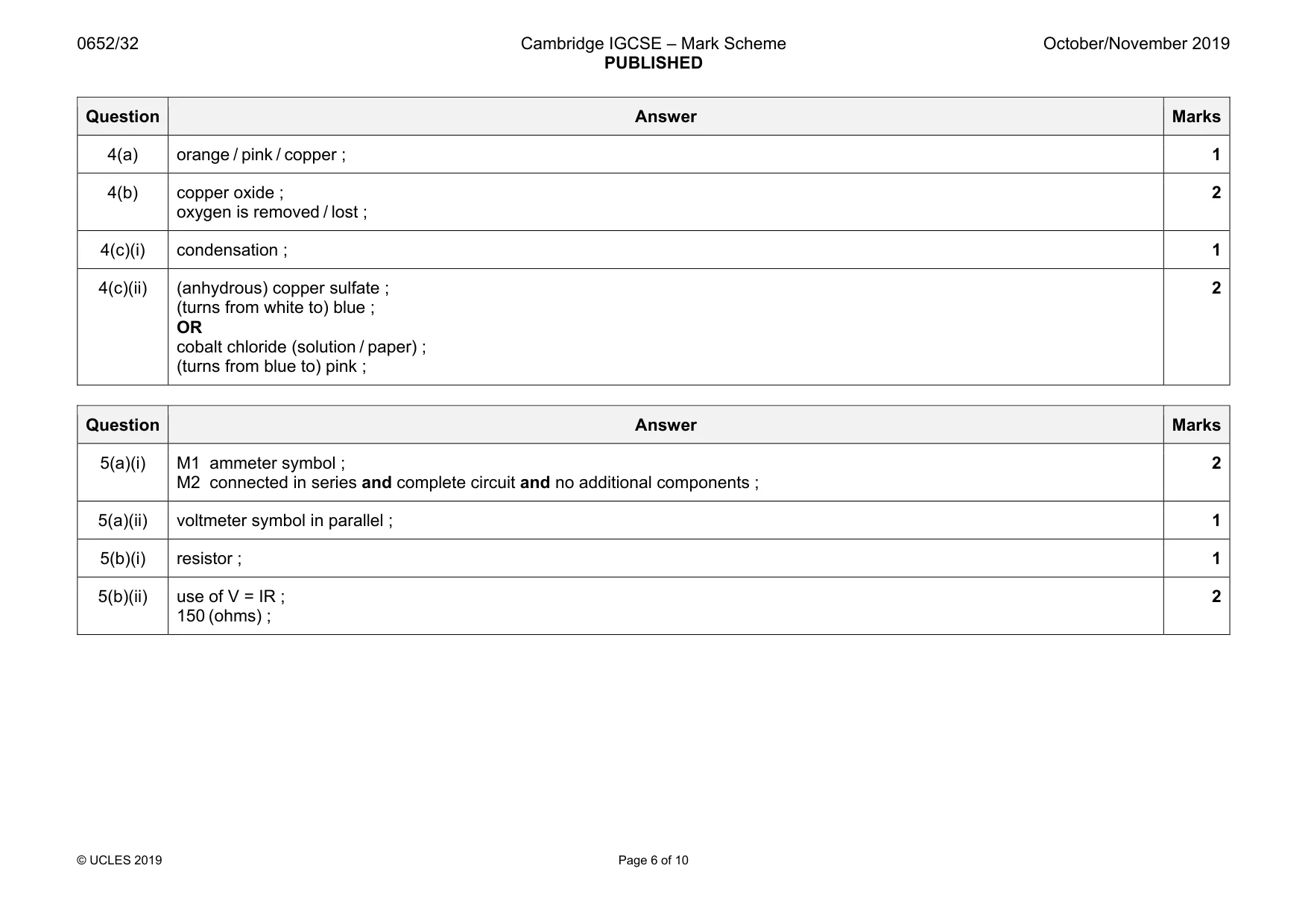
Mark scheme: 4(a) orange / pink / copper ; 1 4(b) copper oxide ; oxygen is removed / lost ; 2 4(c)(i) condensation ; 1 4(c)(ii) (anhydrous) copper sulfate ; (turns from white to) blue ; OR cobalt chloride (solution / paper) ; (turns from blue to) pink ; 2
Q5 · A student builds a circuit to measure resistance
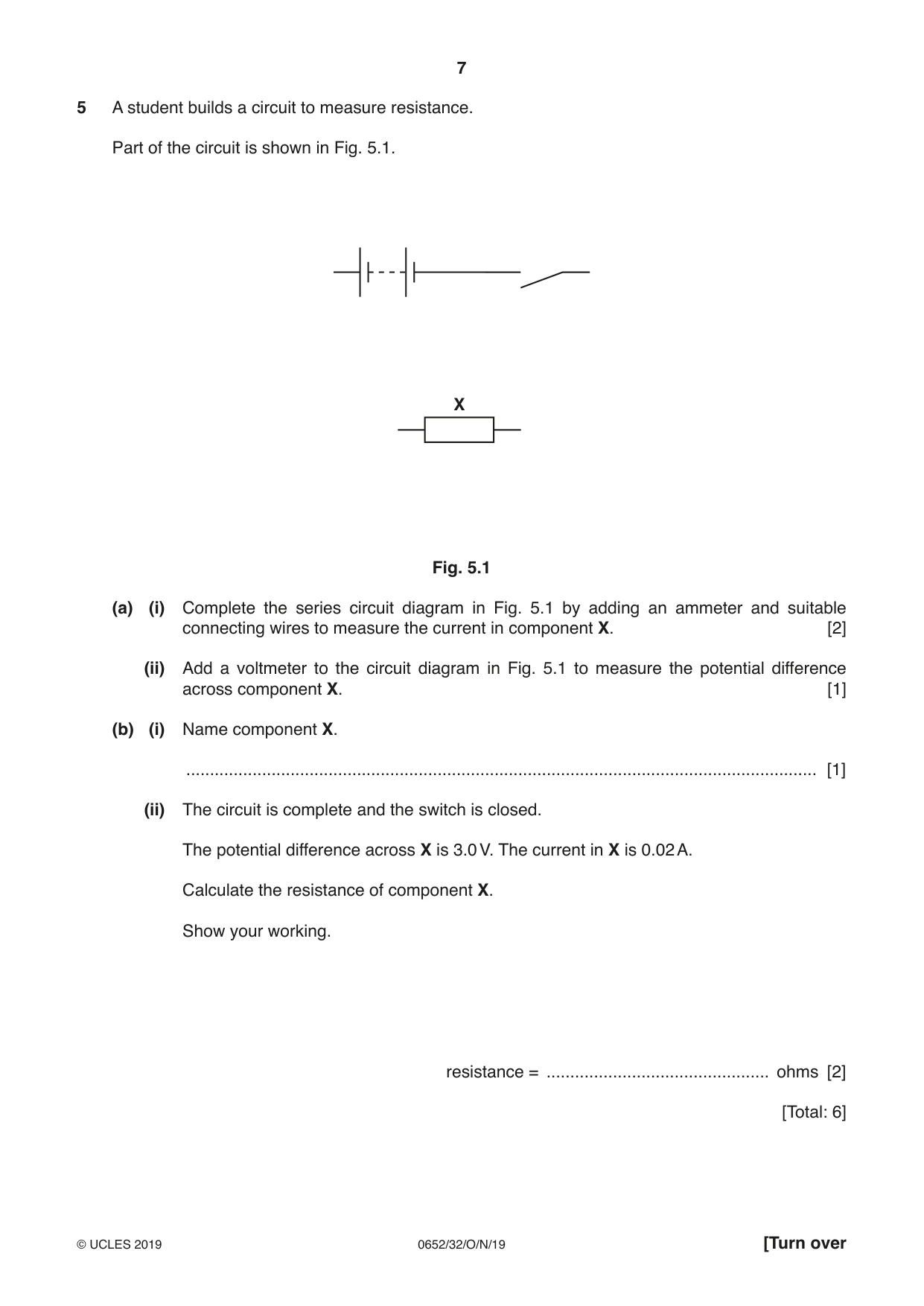
5 A student builds a circuit to measure resistance. Part of the circuit is shown in Fig. 5.1. X Fig. 5.1 (a) (i) Complete the series circuit diagram in Fig. 5.1 by adding an ammeter and suitable connecting wires to measure the current in component X. [2] (ii) Add a voltmeter to the circuit diagram in Fig. 5.1 to measure the potential difference across component X. [1] (b) (i) Name component X. ..................................................................................................................................... [1] (ii) The circuit is complete and the switch is closed. The potential difference across X is 3.0 V. The current in X is 0.02 A. Calculate the resistance of component X. Show your working. resistance = ............................................... ohms [2] [Total: 6]
Mark scheme: 5(a)(i) M1 ammeter symbol ; M2 connected in series and complete circuit and no additional components ; 2 5(a)(ii) voltmeter symbol in parallel ; 1 5(b)(i) resistor ; 1 5(b)(ii) use of V = IR ; 150 (ohms) ; 2
Q6 · The apparatus used for the electrolysis of molten lead(II) bromide
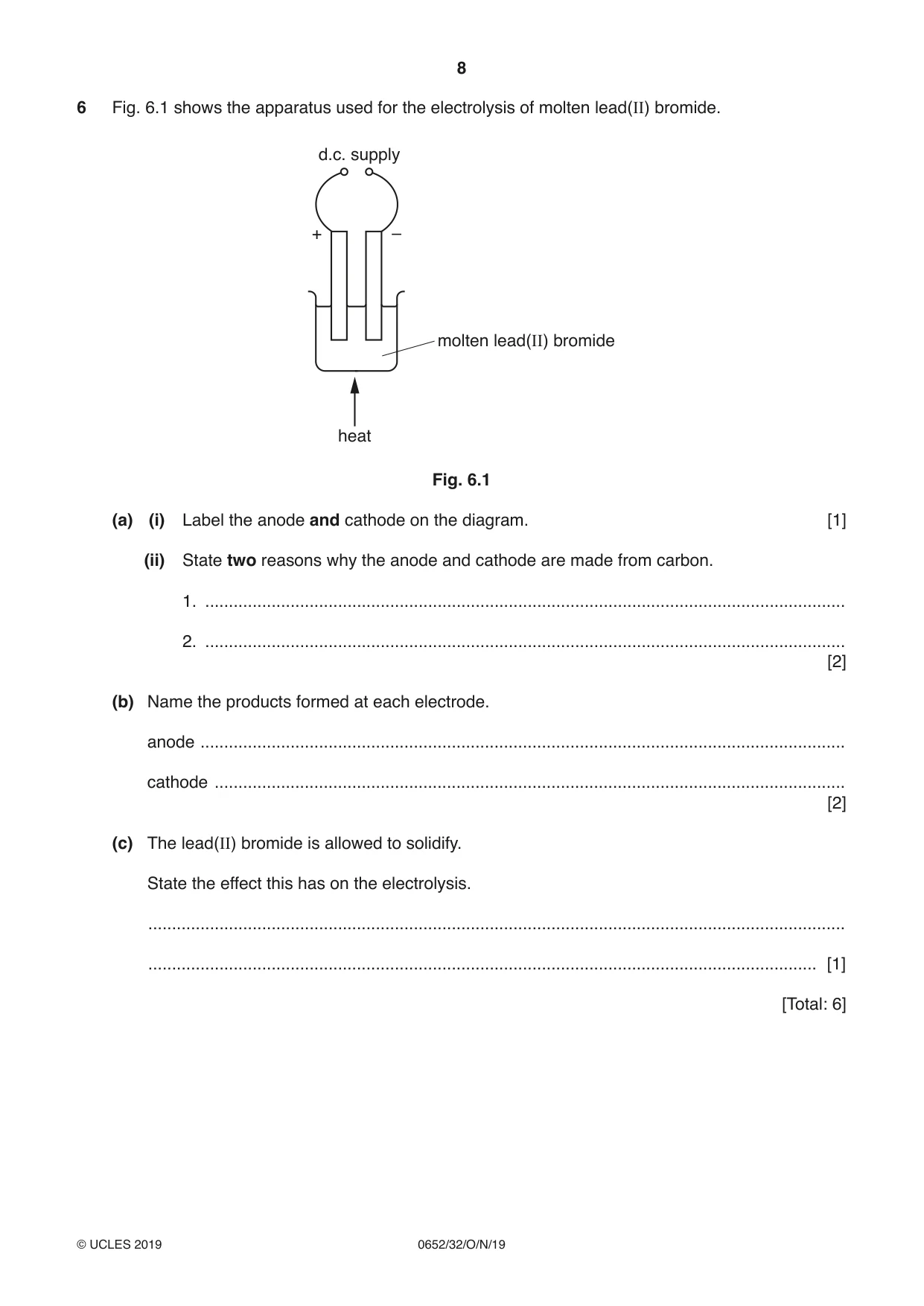
6 Fig. 6.1 shows the apparatus used for the electrolysis of molten lead(II) bromide. d.c. supply + – molten lead(II) bromide heat Fig. 6.1 (a) (i) Label the anode and cathode on the diagram. [1] (ii) State two reasons why the anode and cathode are made from carbon. 1. ....................................................................................................................................... 2. ....................................................................................................................................... [2] (b) Name the products formed at each electrode. anode ........................................................................................................................................ cathode ..................................................................................................................................... [2] (c) The lead(II) bromide is allowed to solidify. State the effect this has on the electrolysis. ................................................................................................................................................... ............................................................................................................................................. [1] [Total: 6]
Mark scheme: 6(a)(i) cathode negative and anode positive ; 1 6(a)(ii) (good) conductor ; inert ; 2 6(b) anode: bromine ; cathode: lead ; 2 6(c) no more products / electrolysis stops / stops conducting ; 1
Q7 · Information about different organic compounds is shown in Table 7.1
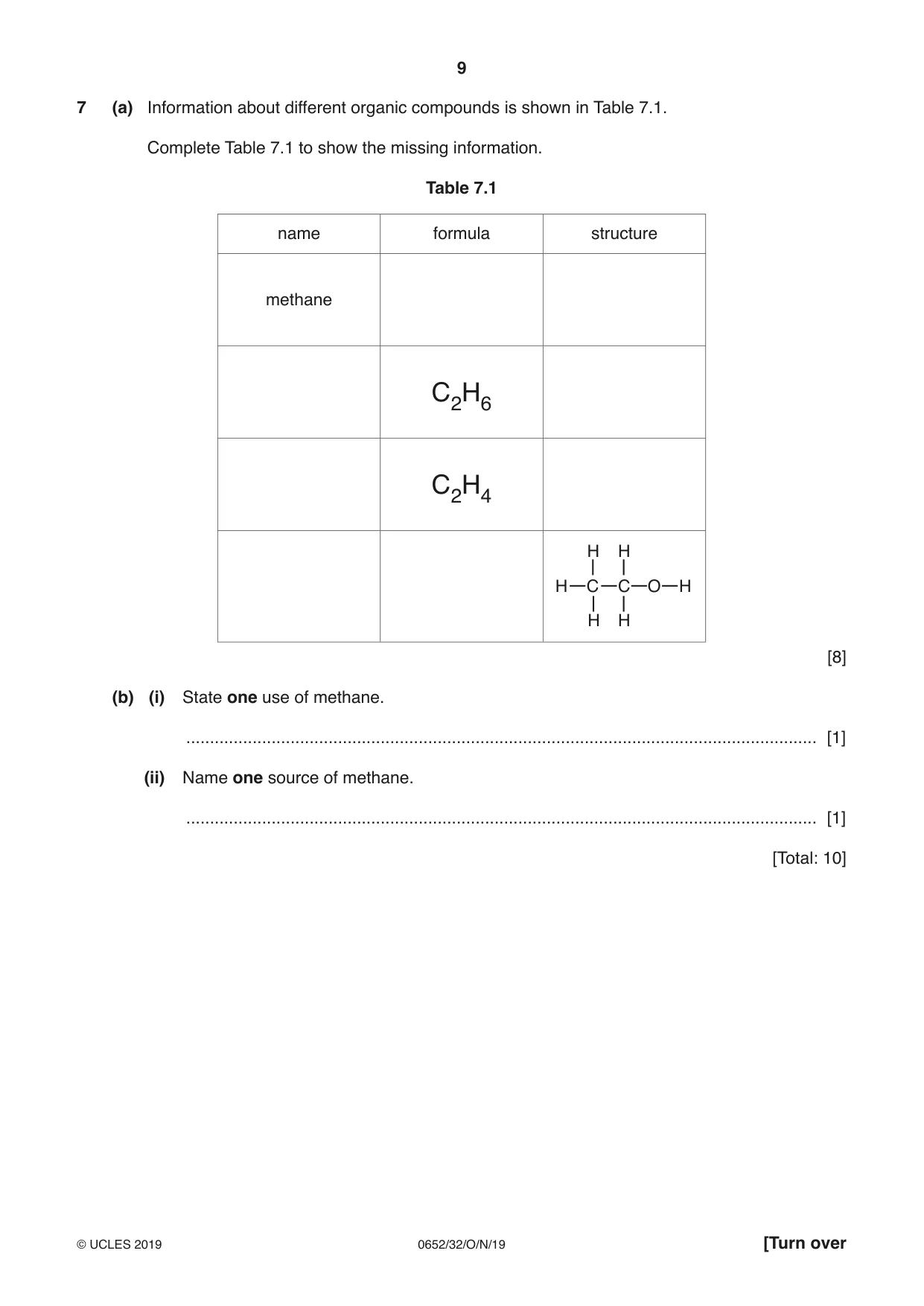
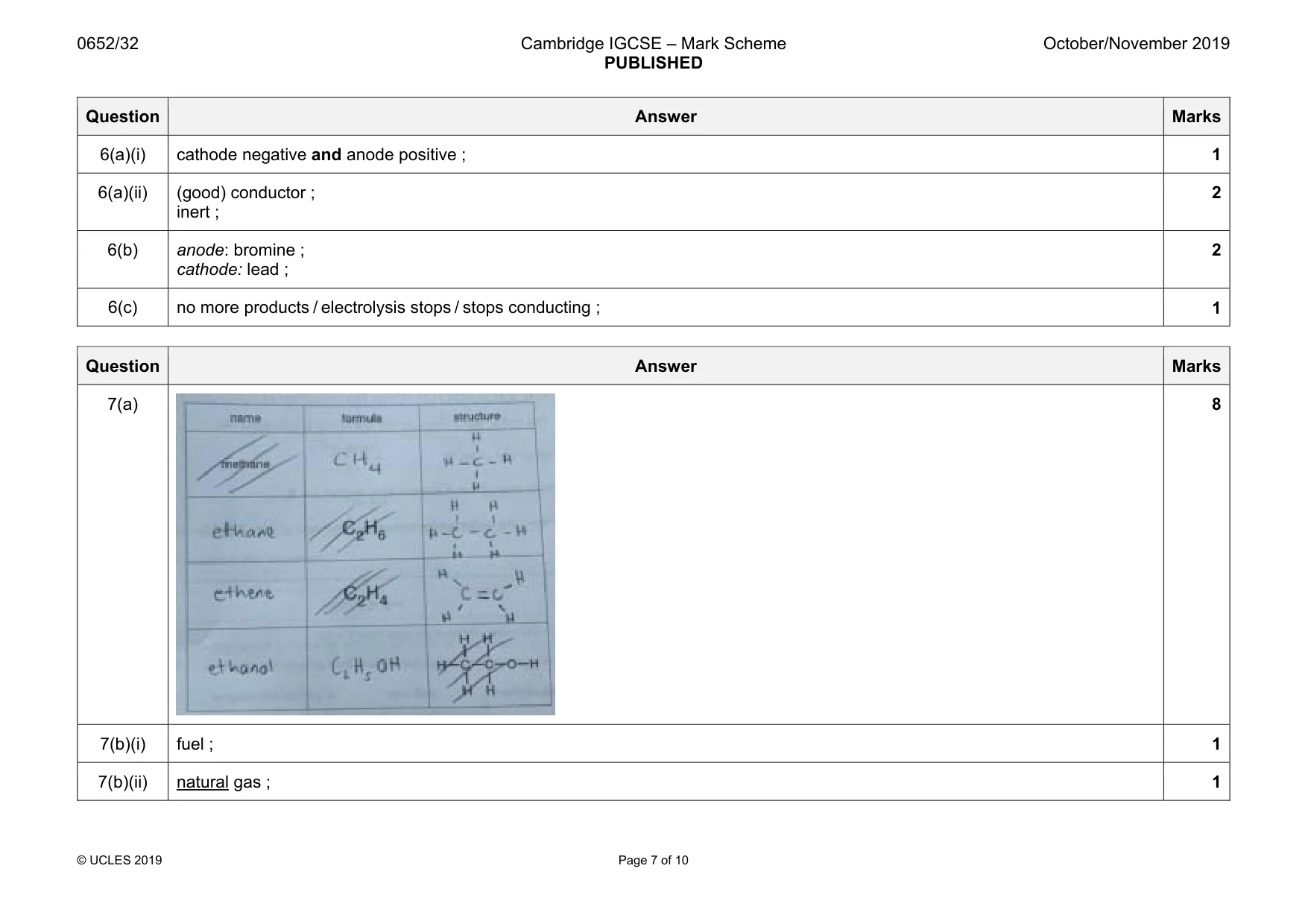
7 (a) Information about different organic compounds is shown in Table 7.1. Complete Table 7.1 to show the missing information. Table 7.1 name formula structure methane C2H6 C2H4 H H H C C O H H H [8] (b) (i) State one use of methane. ..................................................................................................................................... [1] (ii) Name one source of methane. ..................................................................................................................................... [1] [Total: 10]
Mark scheme: 7(a) 8 7(b)(i) fuel ; 1 7(b)(ii) natural gas ; 1
Q8 · A student investigates magnetic and non-magnetic materials
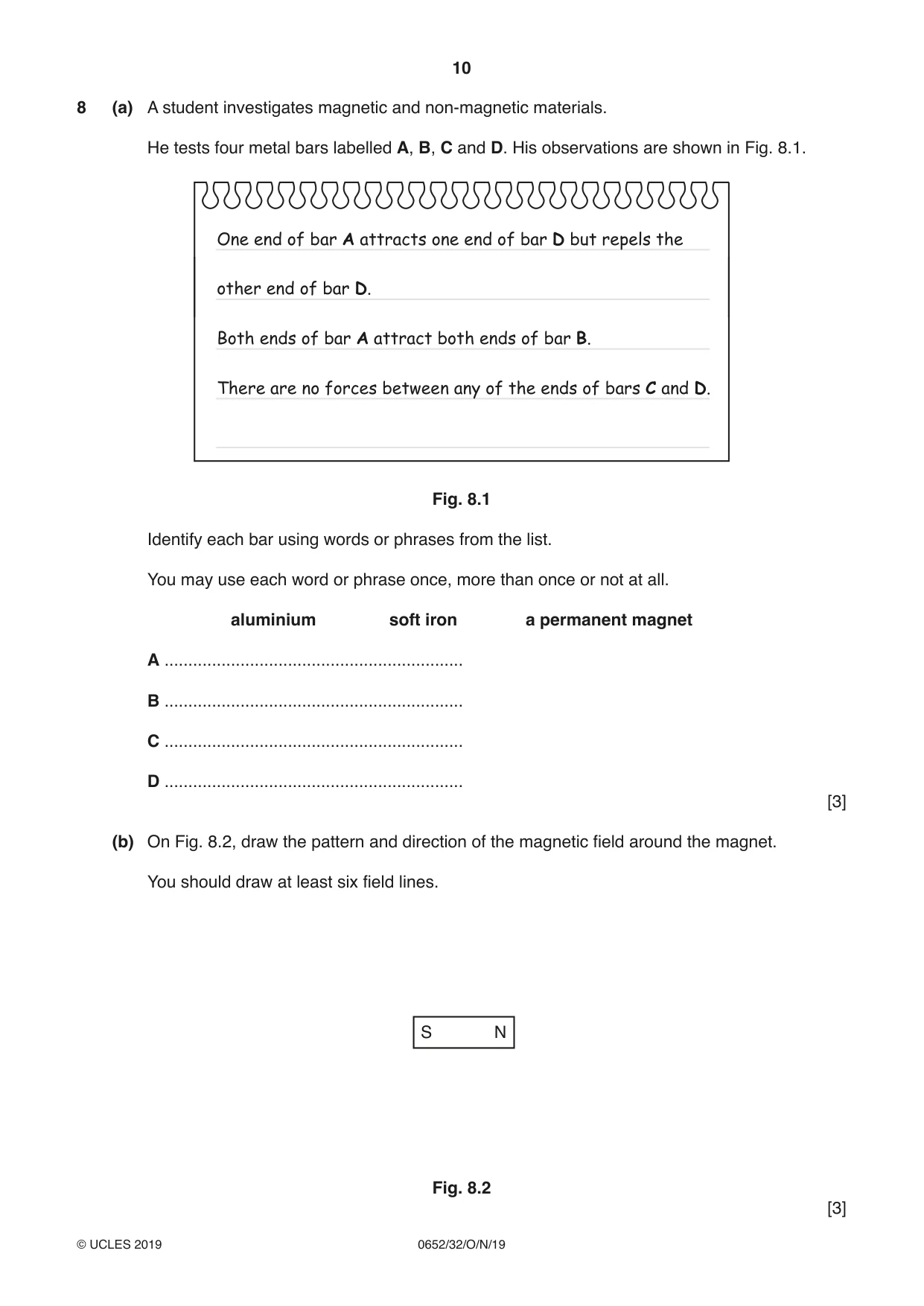
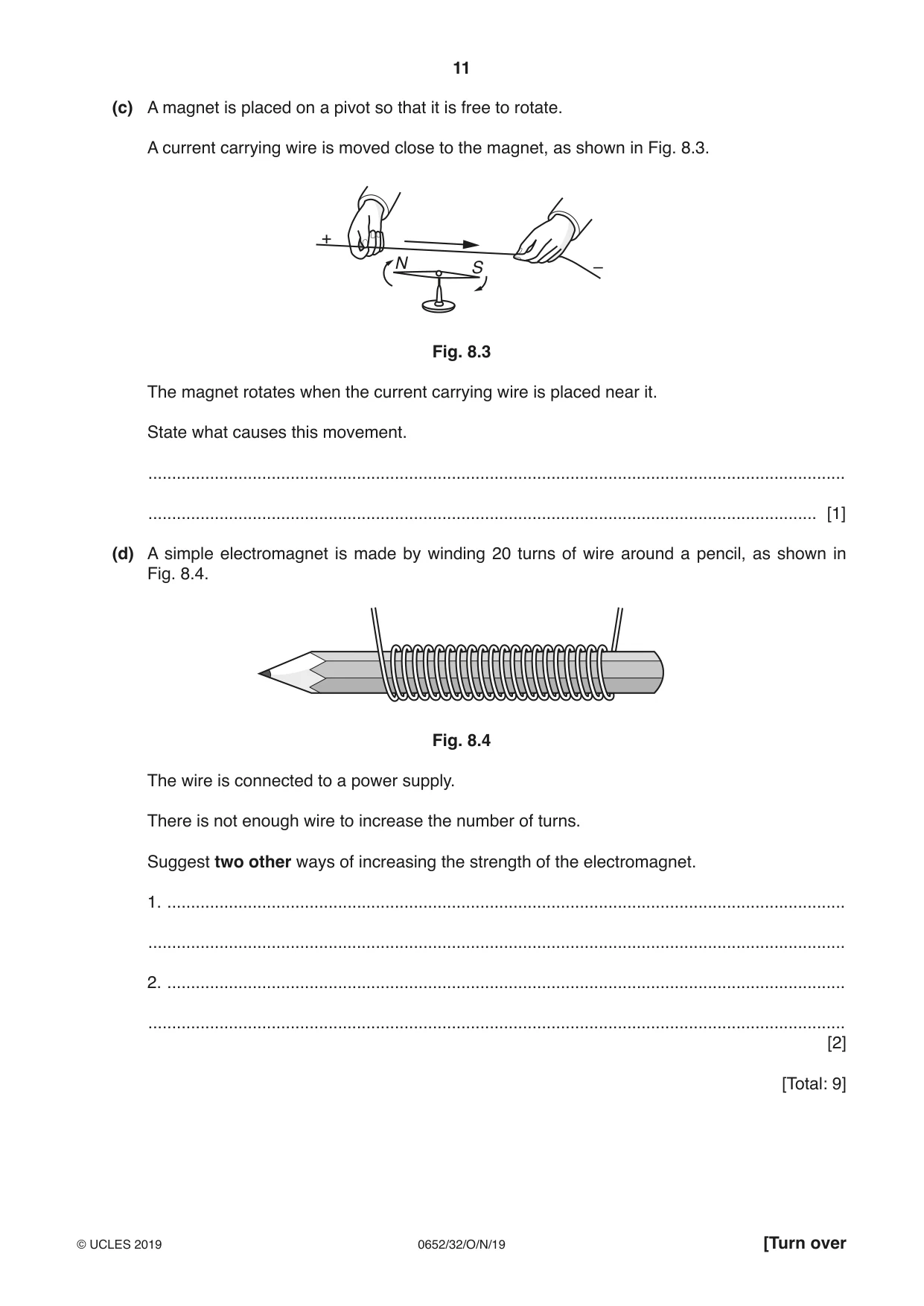
8 (a) A student investigates magnetic and non-magnetic materials. He tests four metal bars labelled A, B, C and D. His observations are shown in Fig. 8.1. One end of bar A attracts one end of bar D but repels the other end of bar D. Both ends of bar A attract both ends of bar B. There are no forces between any of the ends of bars C and D. Fig. 8.1 Identify each bar using words or phrases from the list. You may use each word or phrase once, more than once or not at all. aluminium soft iron a permanent magnet A ............................................................... B ............................................................... C ............................................................... D ............................................................... [3] (b) On Fig. 8.2, draw the pattern and direction of the magnetic field around the magnet. You should draw at least six field lines. S N Fig. 8.2 [3] (c) A magnet is placed on a pivot so that it is free to rotate. A current carrying wire is moved close to the magnet, as shown in Fig. 8.3. + N S – Fig. 8.3 The magnet rotates when the current carrying wire is placed near it. State what causes this movement. ................................................................................................................................................... ............................................................................................................................................. [1] (d) A simple electromagnet is made by winding 20 turns of wire around a pencil, as shown in Fig. 8.4. Fig. 8.4 The wire is connected to a power supply. There is not enough wire to increase the number of turns. Suggest two other ways of increasing the strength of the electromagnet. 1. ............................................................................................................................................... ................................................................................................................................................... 2. ............................................................................................................................................... ................................................................................................................................................... [2] [Total: 9]
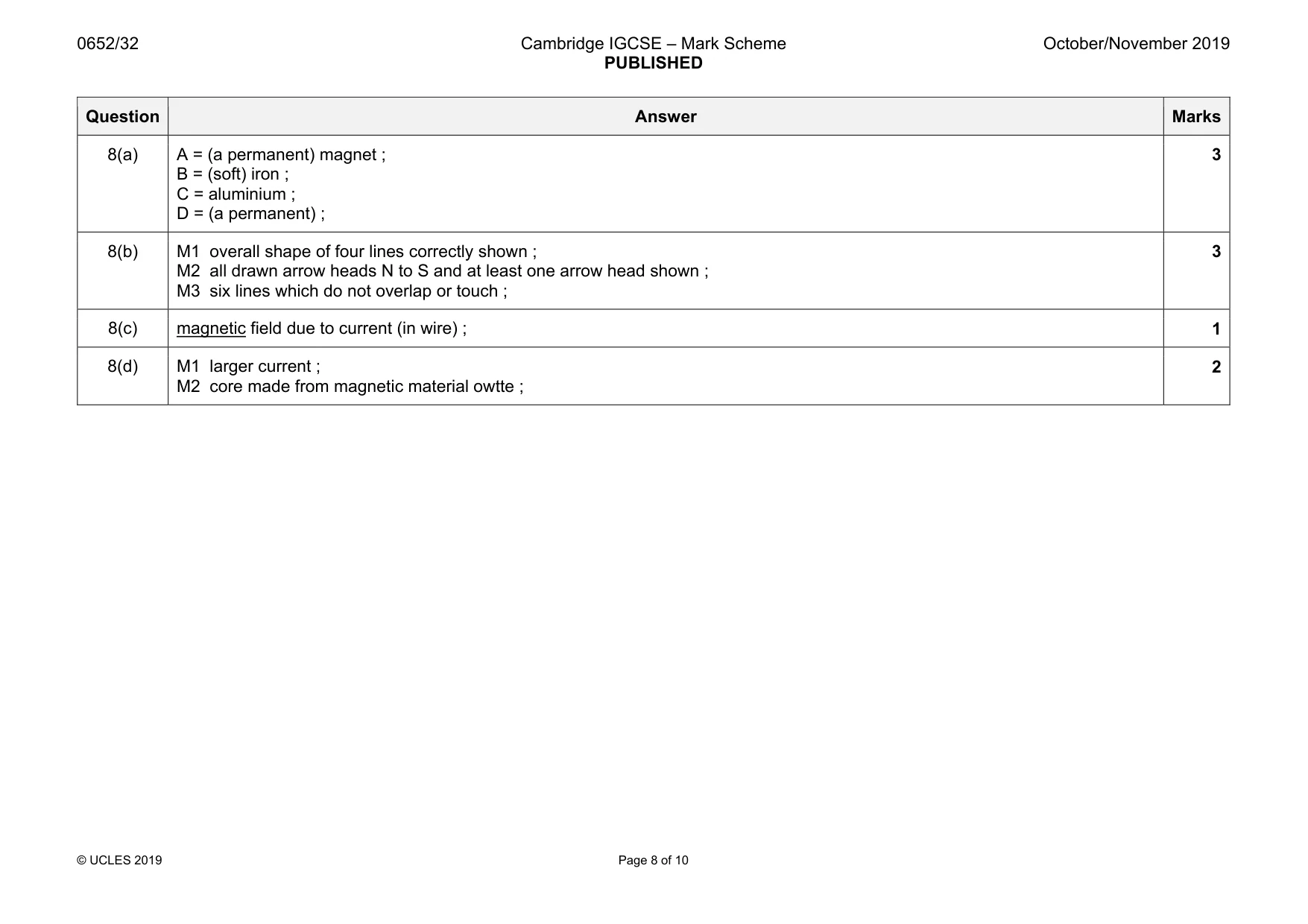
Mark scheme: 8(a) A = (a permanent) magnet ; B = (soft) iron ; C = aluminium ; D = (a permanent) ; 3 8(b) M1 overall shape of four lines correctly shown ; M2 all drawn arrow heads N to S and at least one arrow head shown ; M3 six lines which do not overlap or touch ; 3 8(c) magnetic field due to current (in wire) ; 1 8(d) M1 larger current ; M2 core made from magnetic material owtte ; 2
Q9 · Background radiation is present all the time
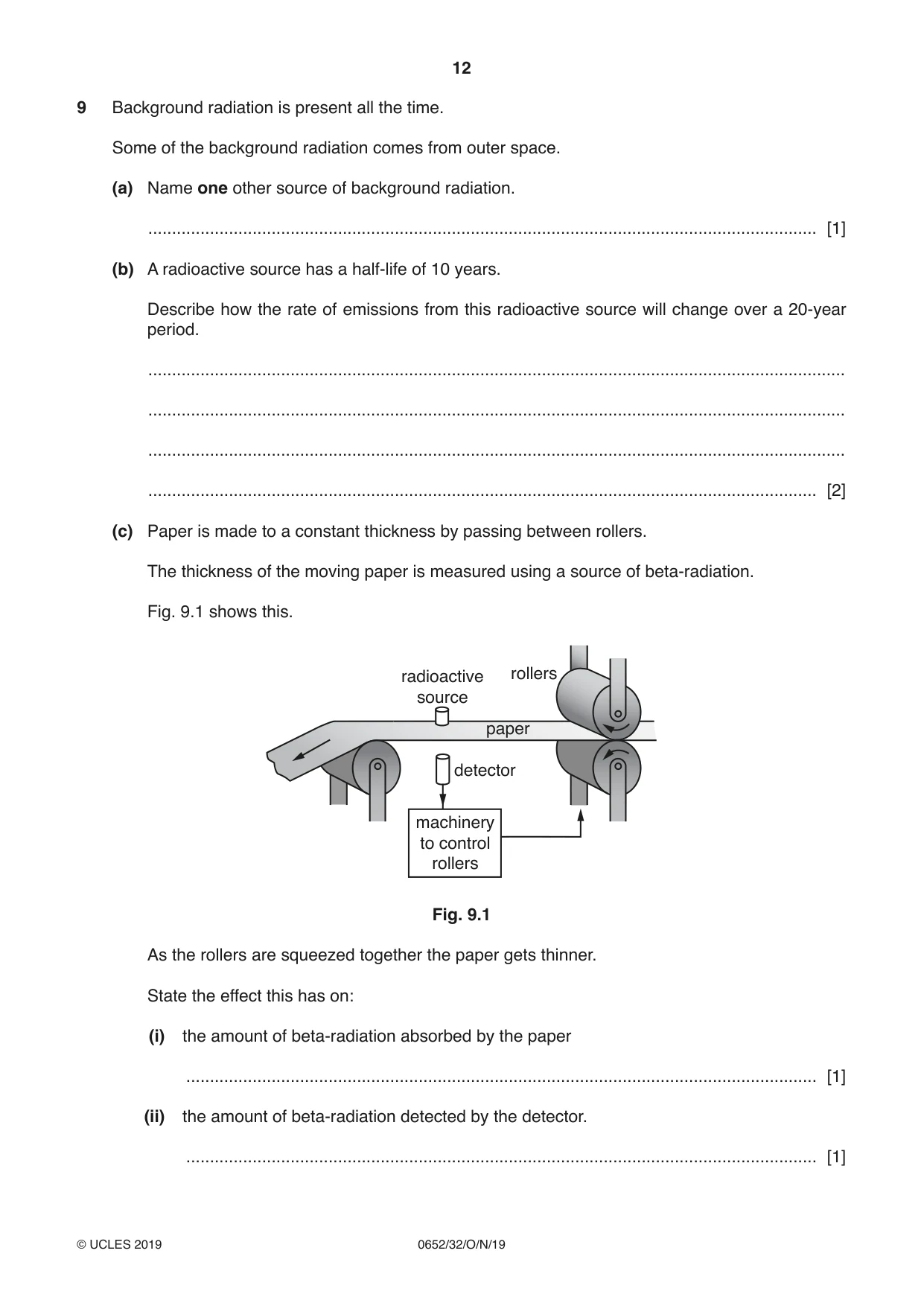
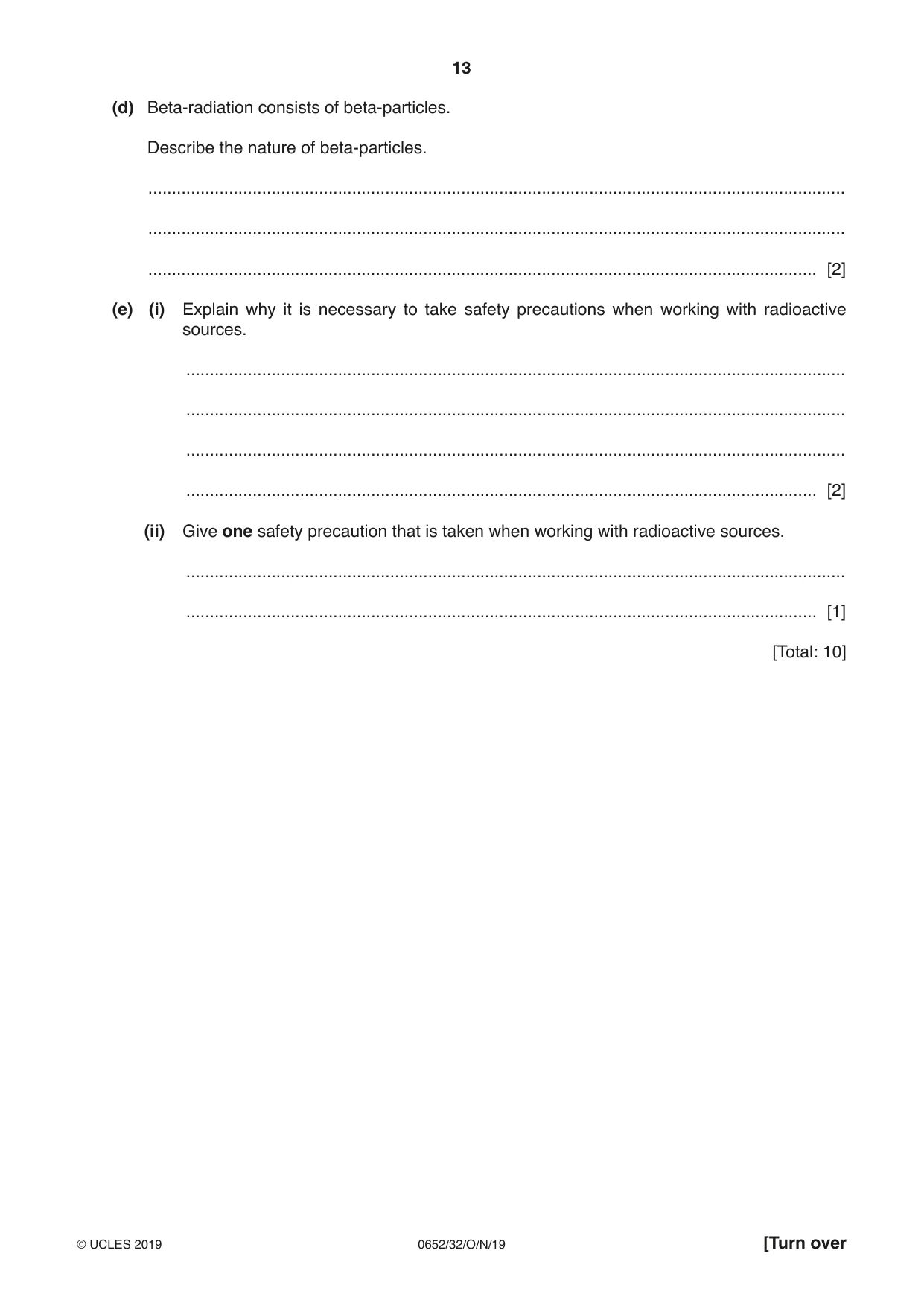
9 Background radiation is present all the time. Some of the background radiation comes from outer space. (a) Name one other source of background radiation. ............................................................................................................................................. [1] (b) A radioactive source has a half-life of 10 years. Describe how the rate of emissions from this radioactive source will change over a 20-year period. ................................................................................................................................................... ................................................................................................................................................... ................................................................................................................................................... ............................................................................................................................................. [2] (c) Paper is made to a constant thickness by passing between rollers. The thickness of the moving paper is measured using a source of beta-radiation. Fig. 9.1 shows this. radioactive rollers source paper detector machinery to control rollers Fig. 9.1 As the rollers are squeezed together the paper gets thinner. State the effect this has on: (i) the amount of beta-radiation absorbed by the paper ..................................................................................................................................... [1] (ii) the amount of beta-radiation detected by the detector. ..................................................................................................................................... [1] (d) Beta-radiation consists of beta-particles. Describe the nature of beta-particles. ................................................................................................................................................... ................................................................................................................................................... ............................................................................................................................................. [2] (e) (i) Explain why it is necessary to take safety precautions when working with radioactive sources. ........................................................................................................................................... ........................................................................................................................................... ........................................................................................................................................... ..................................................................................................................................... [2] (ii) Give one safety precaution that is taken when working with radioactive sources. ........................................................................................................................................... ..................................................................................................................................... [1] [Total: 10]
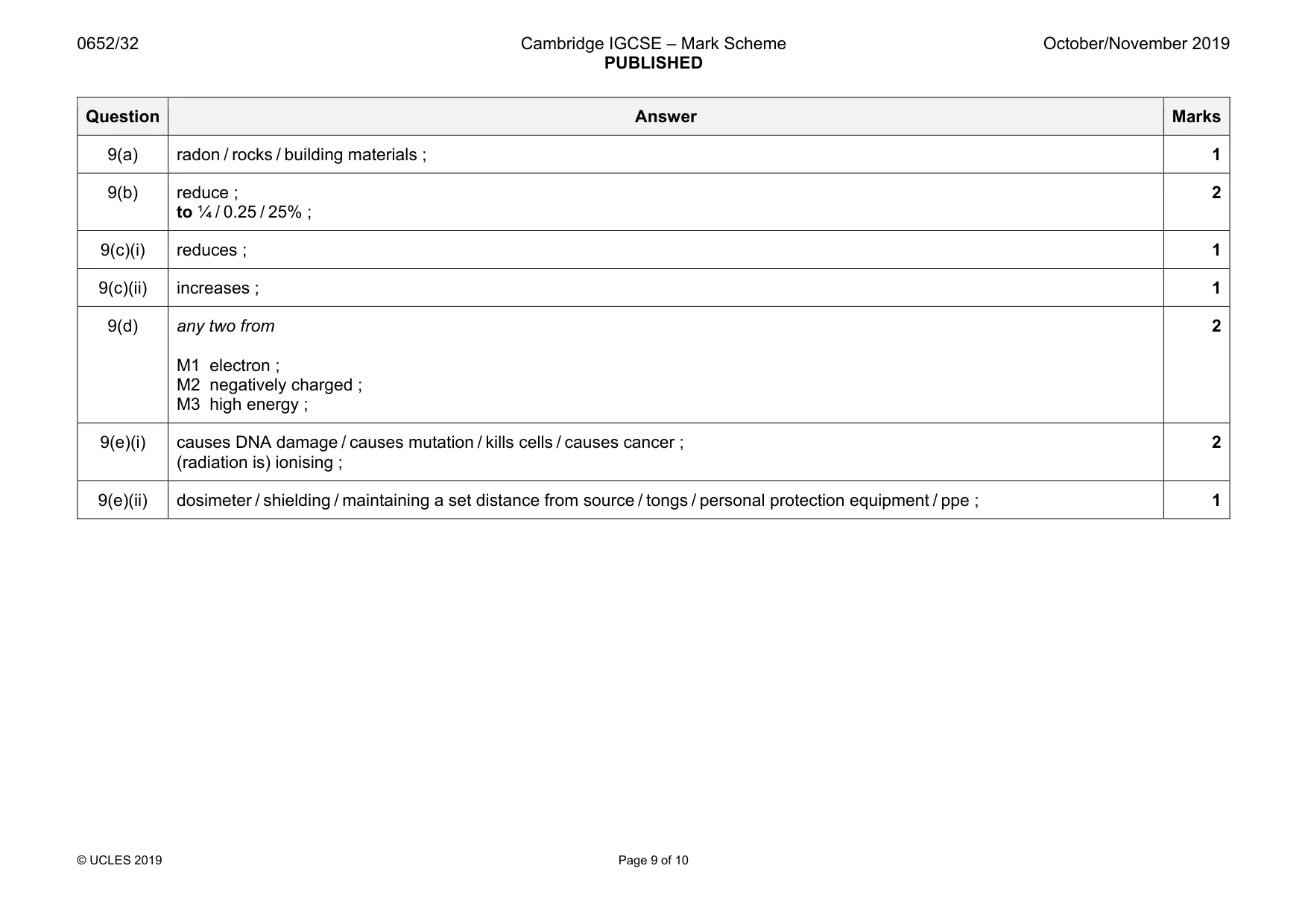
Mark scheme: 9(a) radon / rocks / building materials ; 1 9(b) reduce ; to ¼ / 0.25 / 25% ; 2 9(c)(i) reduces ; 1 9(c)(ii) increases ; 1 9(d) any two from M1 electron ; M2 negatively charged ; M3 high energy ; 2 9(e)(i) causes DNA damage / causes mutation / kills cells / causes cancer ; (radiation is) ionising ; 2 9(e)(ii) dosimeter / shielding / maintaining a set distance from source / tongs / personal protection equipment / ppe ; 1
Q10 · Ammonia, NH3, is made by reacting nitrogen with hydrogen
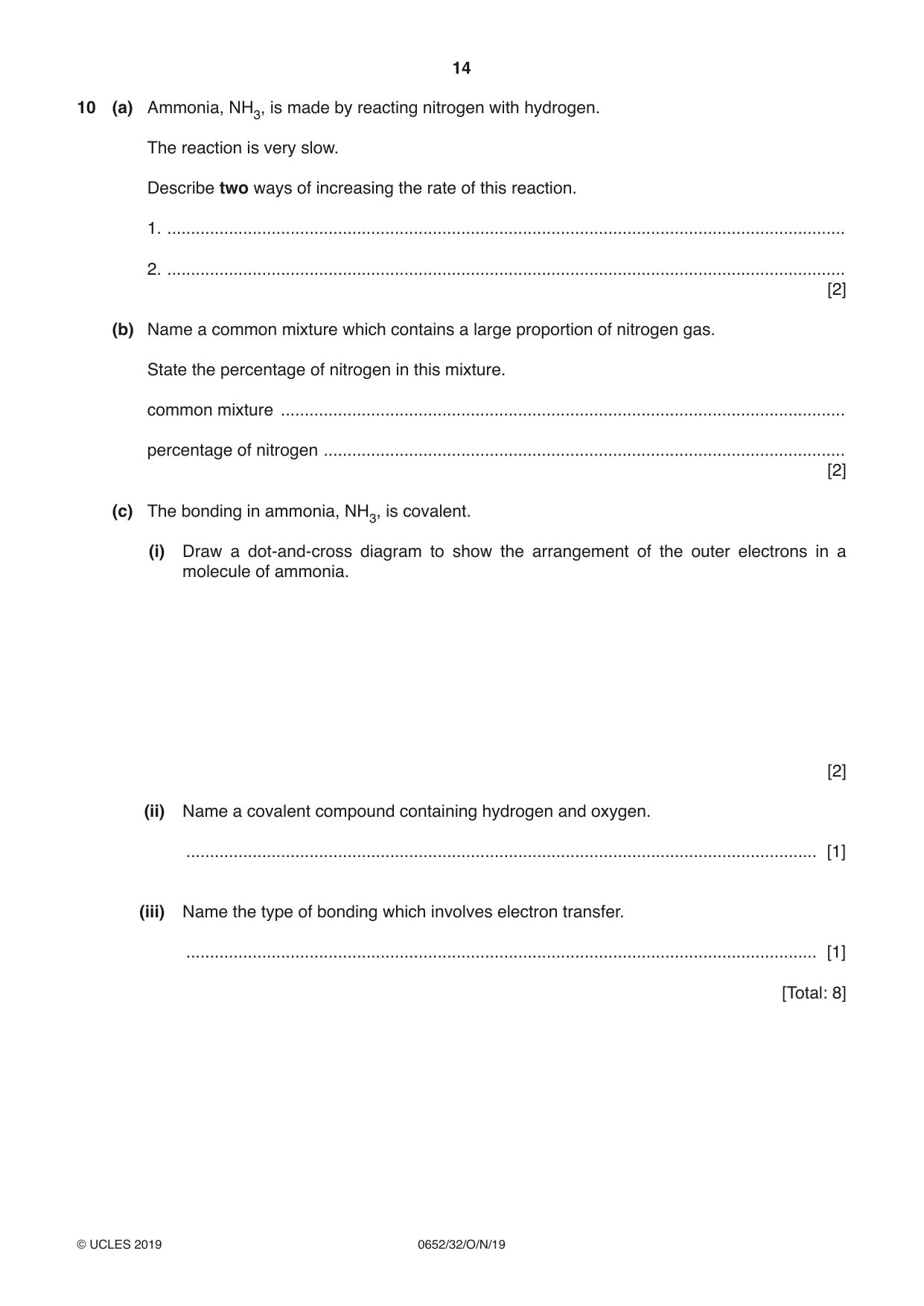
10 (a) Ammonia, NH3, is made by reacting nitrogen with hydrogen. The reaction is very slow. Describe two ways of increasing the rate of this reaction. 1. ............................................................................................................................................... 2. ............................................................................................................................................... [2] (b) Name a common mixture which contains a large proportion of nitrogen gas. State the percentage of nitrogen in this mixture. common mixture ....................................................................................................................... percentage of nitrogen .............................................................................................................. [2] (c) The bonding in ammonia, NH3, is covalent. (i) Draw a dot-and-cross diagram to show the arrangement of the outer electrons in a molecule of ammonia. [2] (ii) Name a covalent compound containing hydrogen and oxygen. ..................................................................................................................................... [1] (iii) Name the type of bonding which involves electron transfer. ..................................................................................................................................... [1] [Total: 8]
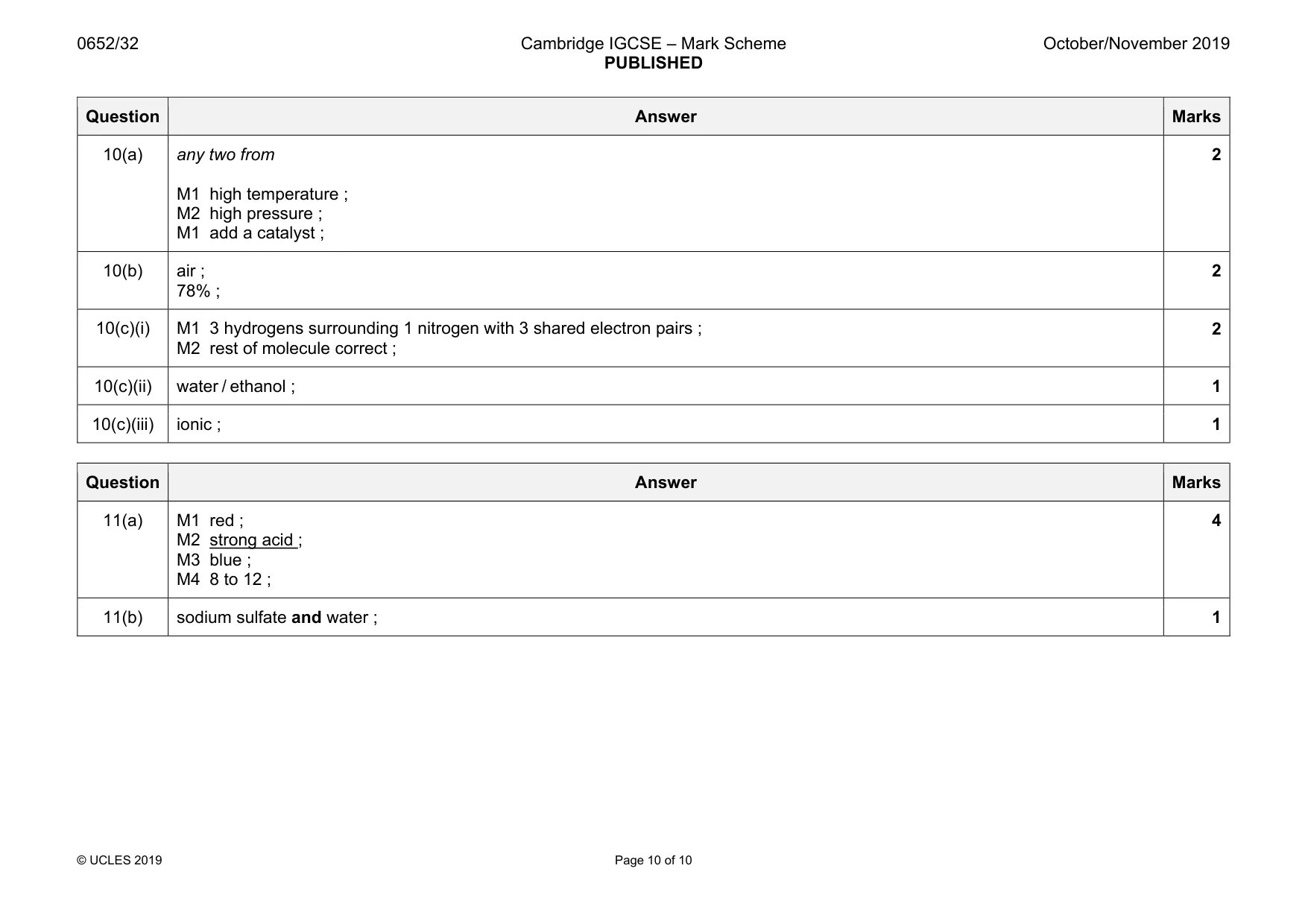
Mark scheme: 10(a) any two from M1 high temperature ; M2 high pressure ; M1 add a catalyst ; 2 10(b) air ; 78% ; 2 10(c)(i) M1 3 hydrogens surrounding 1 nitrogen with 3 shared electron pairs ; M2 rest of molecule correct ; 2 10(c)(ii) water / ethanol ; 1 10(c)(iii) ionic ; 1
Q11 · Information about some acids and bases is shown in Table 11.1
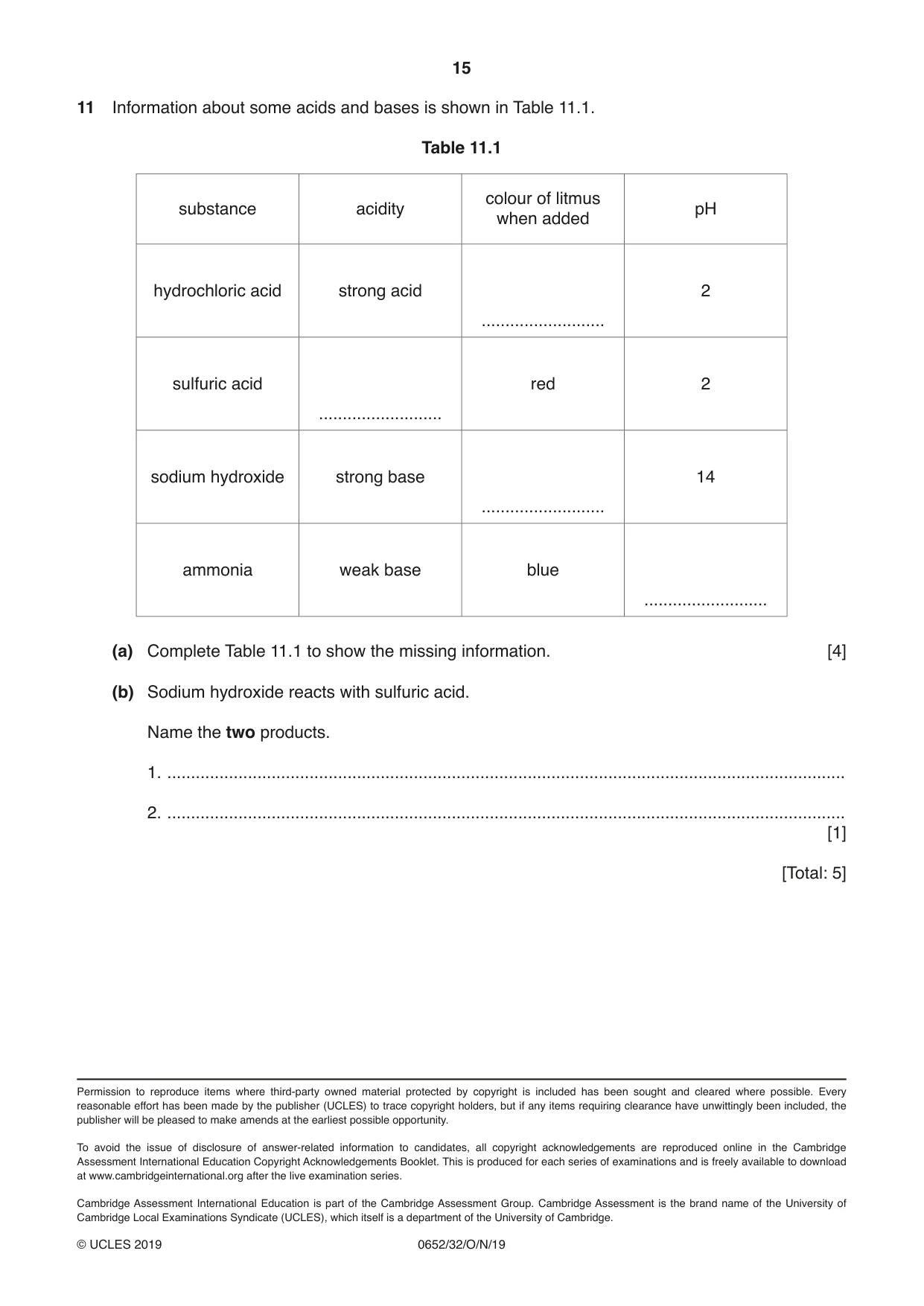
11 Information about some acids and bases is shown in Table 11.1. Table 11.1 colour of litmus substance acidity pH when added hydrochloric acid strong acid 2 .......................... sulfuric acid red 2 .......................... sodium hydroxide strong base 14 .......................... ammonia weak base blue .......................... (a) Complete Table 11.1 to show the missing information. [4] (b) Sodium hydroxide reacts with sulfuric acid. Name the two products. 1. ............................................................................................................................................... 2. ............................................................................................................................................... [1] [Total: 5]
Mark scheme: 11(a) M1 red ; M2 strong acid ; M3 blue ; M4 8 to 12 ; 4 11(b) sodium sulfate and water ; 1
More questions on The characteristic properties of acids and bases
What was in this paper
The subtopics covered by these 11 questions, and how many questions each got. Open one in a new tab to see every Cambridge question on it.
What you needed in this session
Cambridge’s own grade thresholds for 2019 Oct/Nov, Paper 3 · Variant 2. A higher threshold means an easier paper — the bar moves with how the cohort did.