Cambridge IGCSE Physical Education (9-1) 0995 — 2023 Oct/Nov Paper 1 · Variant 1
0995/11/O/N/23 · 100 marks · ≈113 min
The question paper and its mark scheme, free to read here and free to download. This is Cambridge’s own paper, exactly as it was sat.
Question paper16 pages

Mark scheme17 pages
Answers below. Sit the paper first if you are practising.
Paper as text
Question paper, page 1
This document has 16 pages. Any blank pages are indicated. [Turn over Cambridge IGCSE™(9–1) PHYSICAL EDUCATION 0995/11 Paper 1 Theory October/November 2023 1 hour 45 minutes You must answer on the question paper. No additional materials are needed. INSTRUCTIONS ● Answer all questions. ● Use a black or dark blue pen. You may use an HB pencil for any diagrams or graphs. ● Write your name, centre number and candidate number in the boxes at the top of the page. ● Write your answer to each question in the space provided. ● Do not use an erasable pen or correction fluid. ● Do not write on any bar codes. ● You may use a calculator. ● You should show all your working and use appropriate units. INFORMATION ● The total mark for this paper is 100. ● The number of marks for each question or part question is shown in brackets [ ]. * 9 4 8 9 6 9 9 2 9 5 * DC (SL) 334460 © UCLES 2023
Question paper, page 2
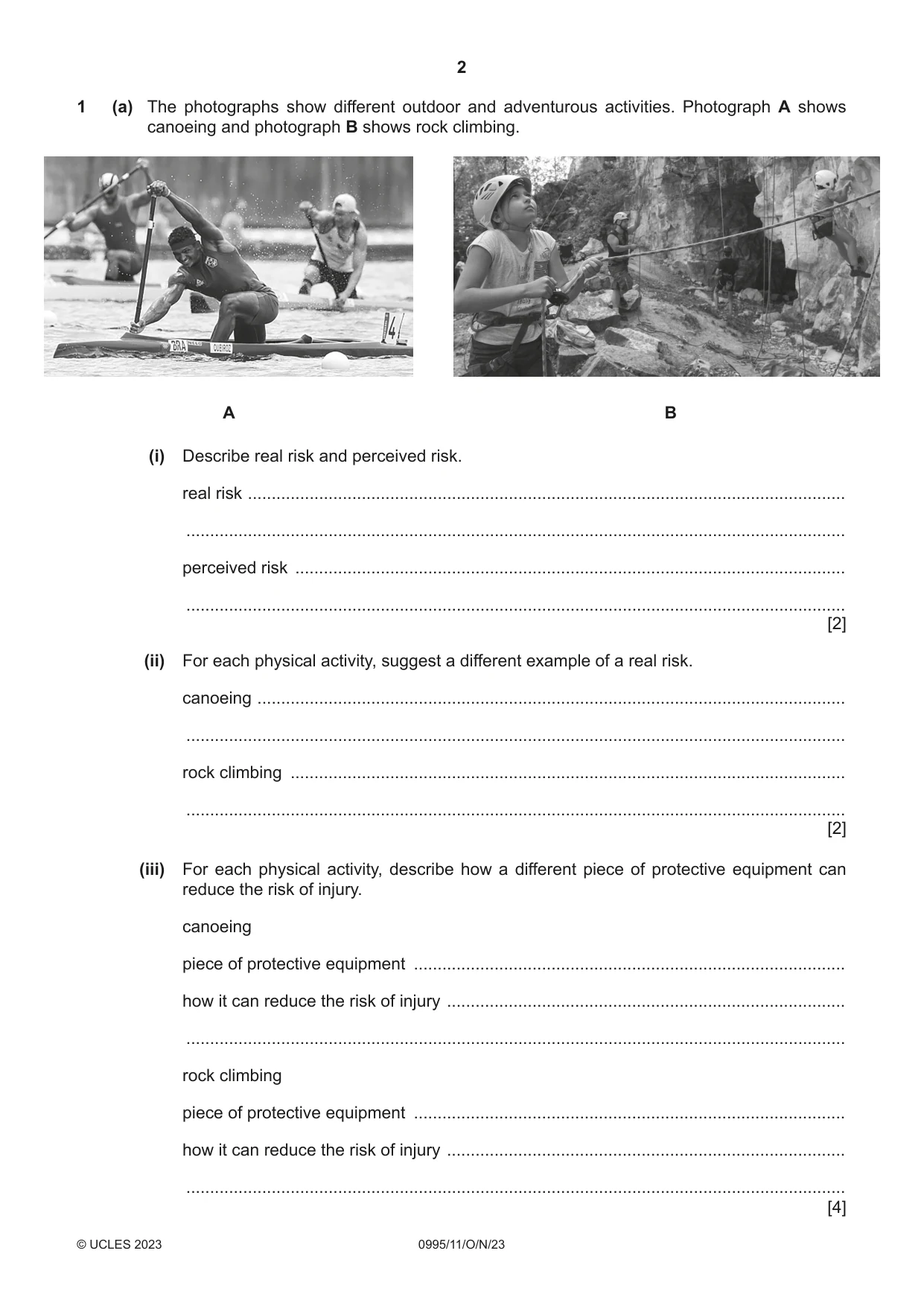
2 0995/11/O/N/23 © UCLES 2023 1 (a) The photographs show different outdoor and adventurous activities. Photograph A shows canoeing and photograph B shows rock climbing. A B (i) Describe real risk and perceived risk. real risk … … perceived risk … … [2] (ii) For each physical activity, suggest a different example of a real risk. canoeing … … rock climbing … … [2] (iii) For each physical activity, describe how a different piece of protective equipment can reduce the risk of injury. canoeing piece of protective equipment … how it can reduce the risk of injury … … rock climbing piece of protective equipment … how it can reduce the risk of injury … … [4]
Question paper, page 3
3 0995/11/O/N/23 © UCLES 2023 [Turn over (b) Other than the use of protective equipment, suggest four strategies that can be used to reduce the risk of injury in physical activities. 1 … 2 … 3 … 4 … [4] [Total: 12] 2 There are three different aspects of health and well-being. (a) Identify one aspect of health and well-being that may be difficult to improve while participating in an individual sport. Justify your answer. aspect of health and well-being … justification … … [2] (b) Complete the following definition of fitness. The ability to cope with (or meet) the demands of the … . [1] (c) Explain how ill health can affect fitness. … … … … [2] [Total: 5] 3 Identify the personality type that is associated with being shy. Other than being shy, describe a characteristic of this personality type. personality type … characteristic … … [2]
Question paper, page 4
4 0995/11/O/N/23 © UCLES 2023 4 (a) Identify the main muscle fibre type that is used throughout a long-distance running race. Describe three different characteristics of this muscle fibre type. muscle fibre type … characteristic 1 … … characteristic 2 … … characteristic 3 … … [4] (b) Some long-distance runners use high-altitude training in preparation for a competition. (i) Describe why long-distance runners may use high-altitude training. … … … … … … [3] (ii) Suggest three reasons why some long-distance runners may find it difficult to use high-altitude training. 1 … 2 … 3 … [3] [Total: 10]
Question paper, page 5
5 0995/11/O/N/23 © UCLES 2023 [Turn over 5 (a) When training a swimmer may complete many lengths of a swimming pool at the same intensity without rest. Identify this method of training. … [1] (b) Identify the principle of training that can make it difficult for a swimmer to maintain motivation when completing many lengths. … [1] (c) Identify the two main types of motivation. Give a practical example of how each type of motivation can be used by a swimmer during a training programme. type of motivation 1 … example … … type of motivation 2 … example … … [4] [Total: 6]
Question paper, page 6
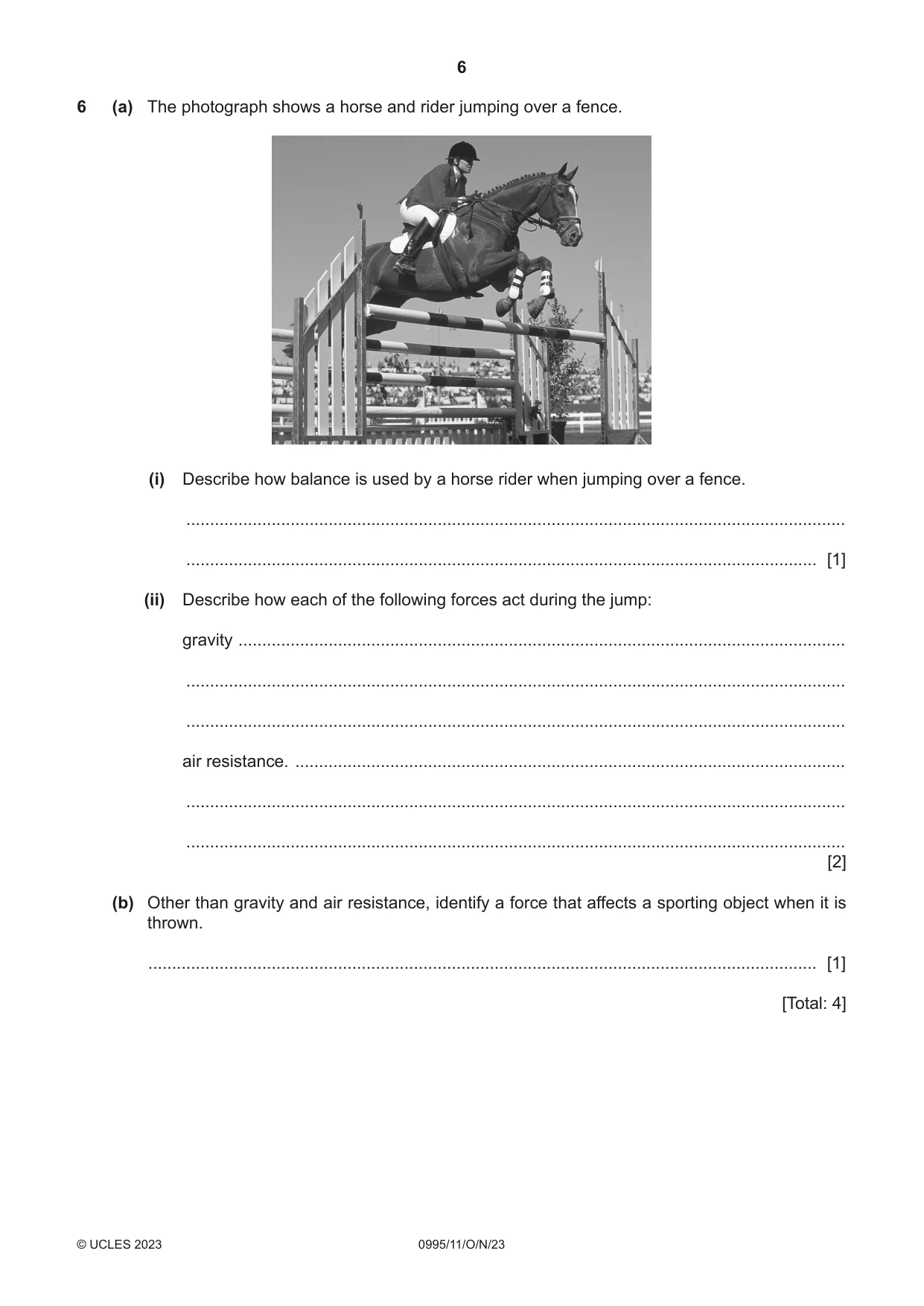
6 0995/11/O/N/23 © UCLES 2023 6 (a) The photograph shows a horse and rider jumping over a fence. (i) Describe how balance is used by a horse rider when jumping over a fence. … … [1] (ii) Describe how each of the following forces act during the jump: gravity … … … air resistance. … … … [2] (b) Other than gravity and air resistance, identify a force that affects a sporting object when it is thrown. … [1] [Total: 4]
Question paper, page 7
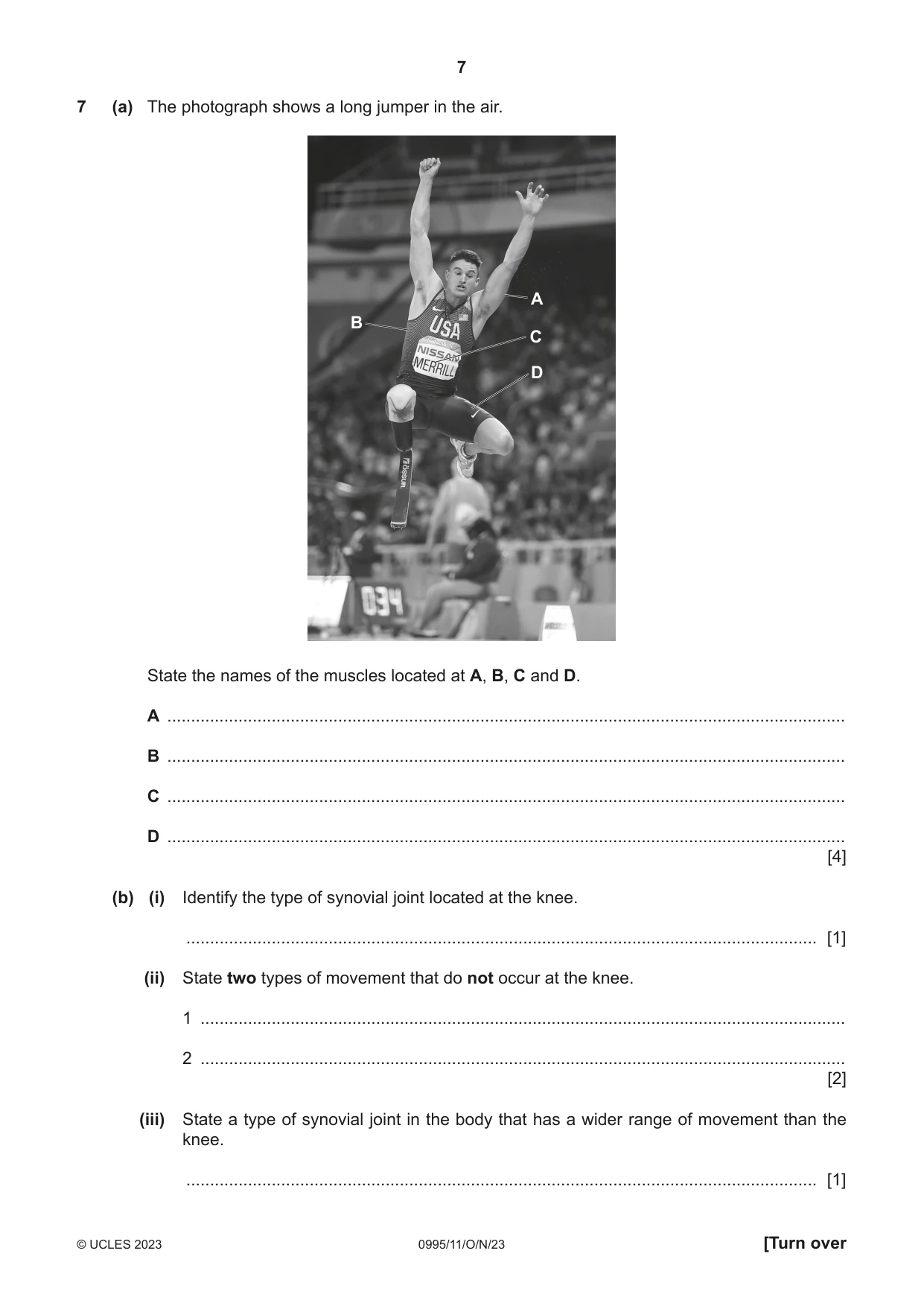
7 0995/11/O/N/23 © UCLES 2023 [Turn over 7 (a) The photograph shows a long jumper in the air. A B C D State the names of the muscles located at A, B, C and D. A … B … C … D … [4] (b) (i) Identify the type of synovial joint located at the knee. … [1] (ii) State two types of movement that do not occur at the knee. 1 … 2 … [2] (iii) State a type of synovial joint in the body that has a wider range of movement than the knee. … [1]
Question paper, page 8
8 0995/11/O/N/23 © UCLES 2023 (c) Cartilage absorbs shock when landing in the long jump. Other than cartilage, identify three components of a synovial joint. Describe a different role of each component. component 1 … description of role … … component 2 … description of role … … component 3 … description of role … … [6] [Total: 14]
Question paper, page 9
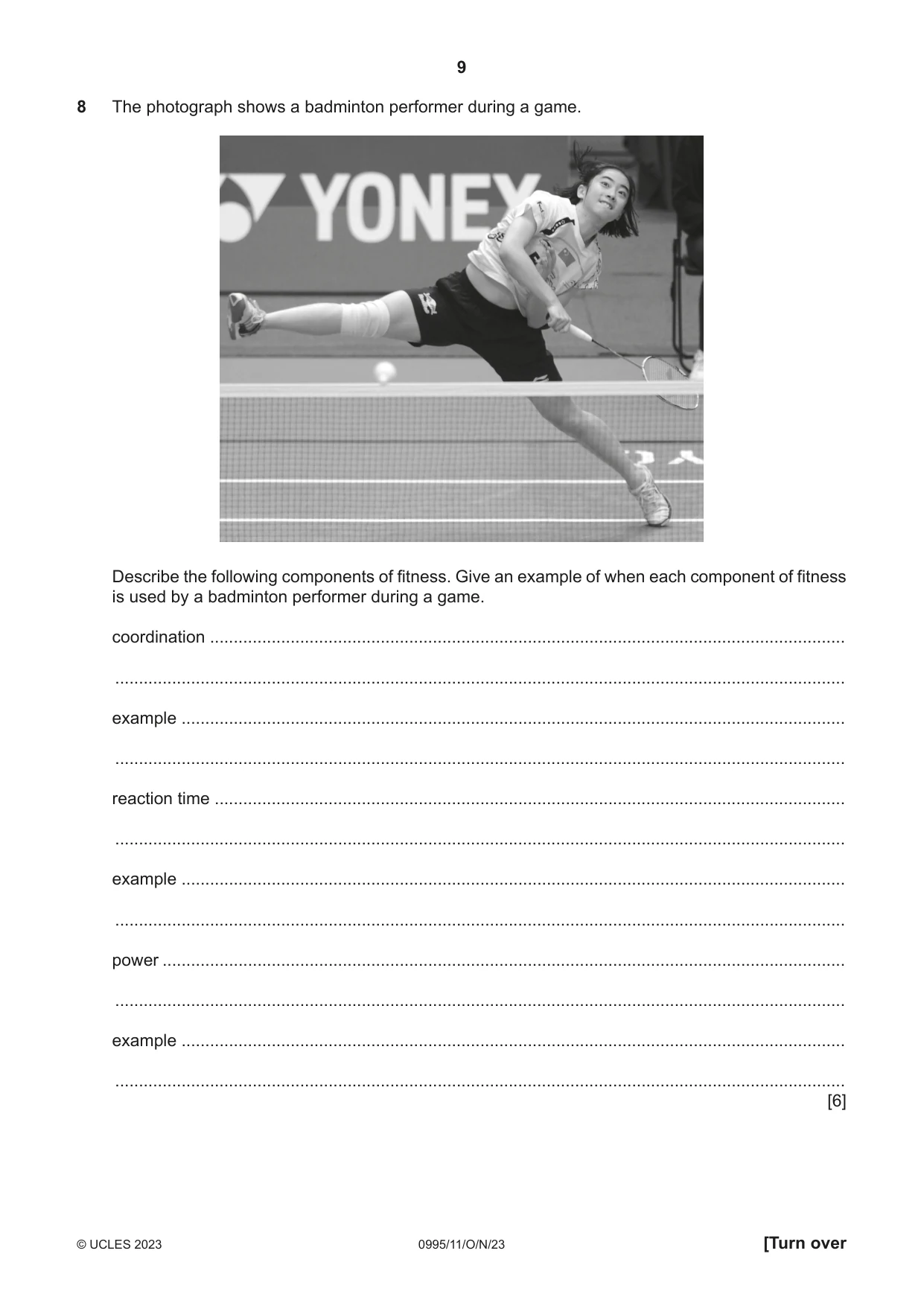
9 0995/11/O/N/23 © UCLES 2023 [Turn over 8 The photograph shows a badminton performer during a game. Describe the following components of fitness. Give an example of when each component of fitness is used by a badminton performer during a game. coordination … … example … … reaction time … … example … … power … … example … … [6]
Question paper, page 10
10 0995/11/O/N/23 © UCLES 2023 9 Artistic gymnastics is an activity in the Olympic Games. (a) (i) Suggest why performers such as gymnasts should avoid overtraining when preparing for the Olympic Games. … … … … … … [3] (ii) Other than for physiological benefits, suggest why performers such as gymnasts may use performance-enhancing drugs (PEDs) during their preparation for the Olympic Games. … … … … … … [2] (b) Suggest three disadvantages of being caught using PEDs for a performer at the Olympic Games. 1 … … 2 … … 3 … … [3]
Question paper, page 11
11 0995/11/O/N/23 © UCLES 2023 [Turn over (c) Improved tourism is one advantage of being the host nation of a major sporting event, such as the Olympic Games. Describe four other advantages. 1 … … 2 … … 3 … … 4 … … [4] [Total: 12]
Question paper, page 12
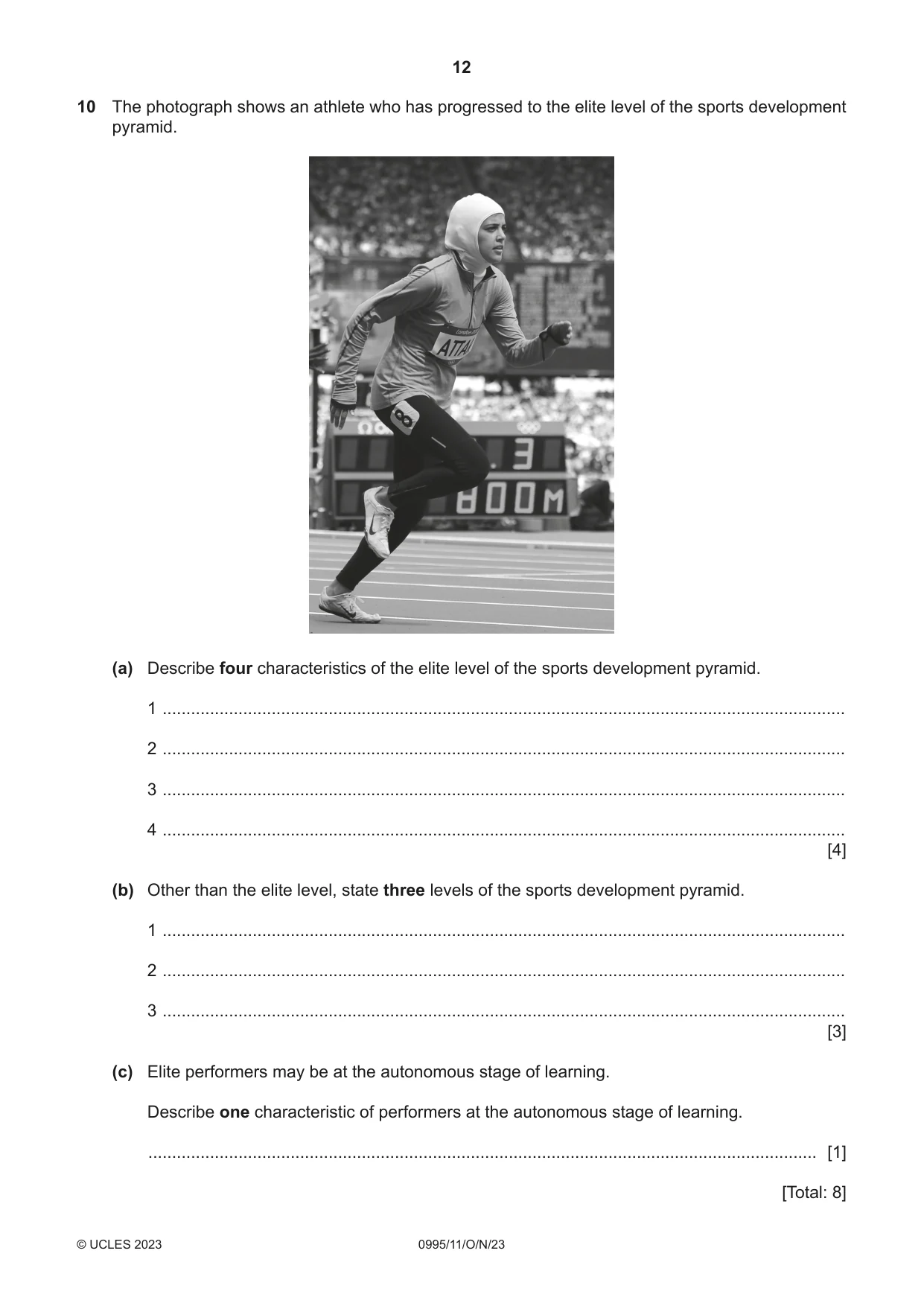
12 0995/11/O/N/23 © UCLES 2023 10 The photograph shows an athlete who has progressed to the elite level of the sports development pyramid. (a) Describe four characteristics of the elite level of the sports development pyramid. 1 … 2 … 3 … 4 … [4] (b) Other than the elite level, state three levels of the sports development pyramid. 1 … 2 … 3 … [3] (c) Elite performers may be at the autonomous stage of learning. Describe one characteristic of performers at the autonomous stage of learning. … [1] [Total: 8]
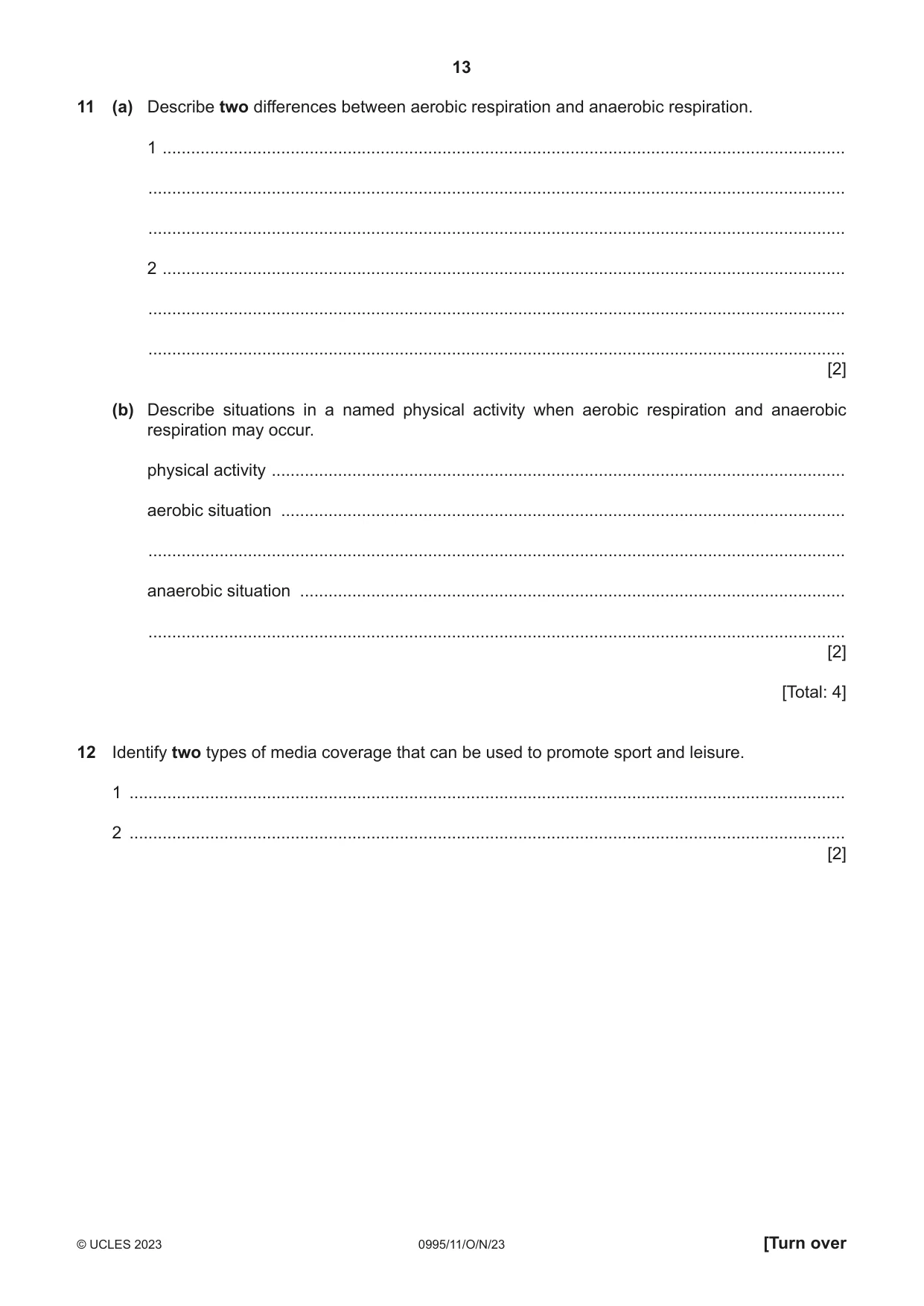
Question paper, page 13
13 0995/11/O/N/23 © UCLES 2023 [Turn over 11 (a) Describe two differences between aerobic respiration and anaerobic respiration. 1 … … … 2 … … … [2] (b) Describe situations in a named physical activity when aerobic respiration and anaerobic respiration may occur. physical activity … aerobic situation … … anaerobic situation … … [2] [Total: 4] 12 Identify two types of media coverage that can be used to promote sport and leisure. 1 … 2 … [2]
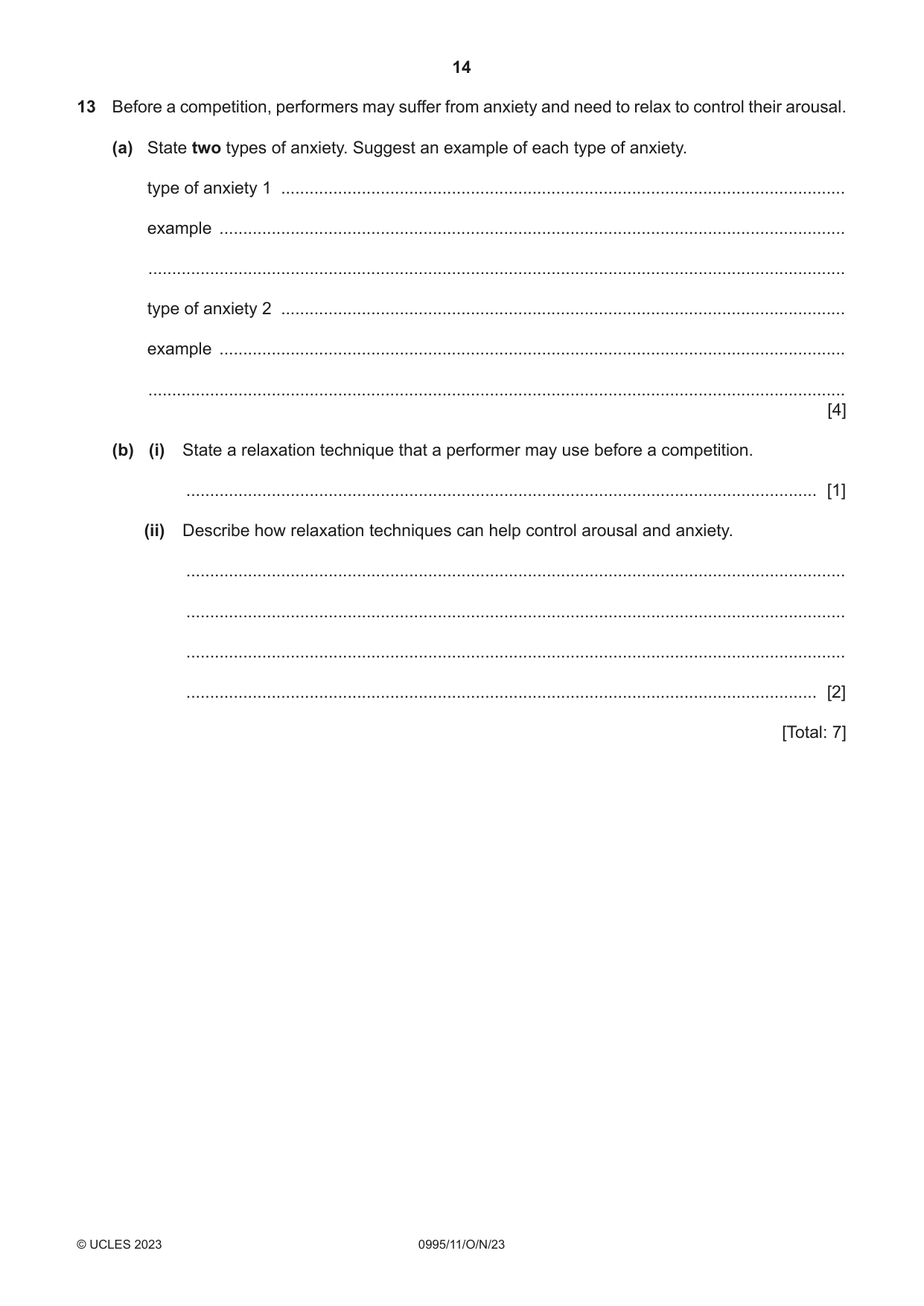
Question paper, page 14
14 0995/11/O/N/23 © UCLES 2023 13 Before a competition, performers may suffer from anxiety and need to relax to control their arousal. (a) State two types of anxiety. Suggest an example of each type of anxiety. type of anxiety 1 … example … … type of anxiety 2 … example … … [4] (b) (i) State a relaxation technique that a performer may use before a competition. … [1] (ii) Describe how relaxation techniques can help control arousal and anxiety. … … … … [2] [Total: 7]
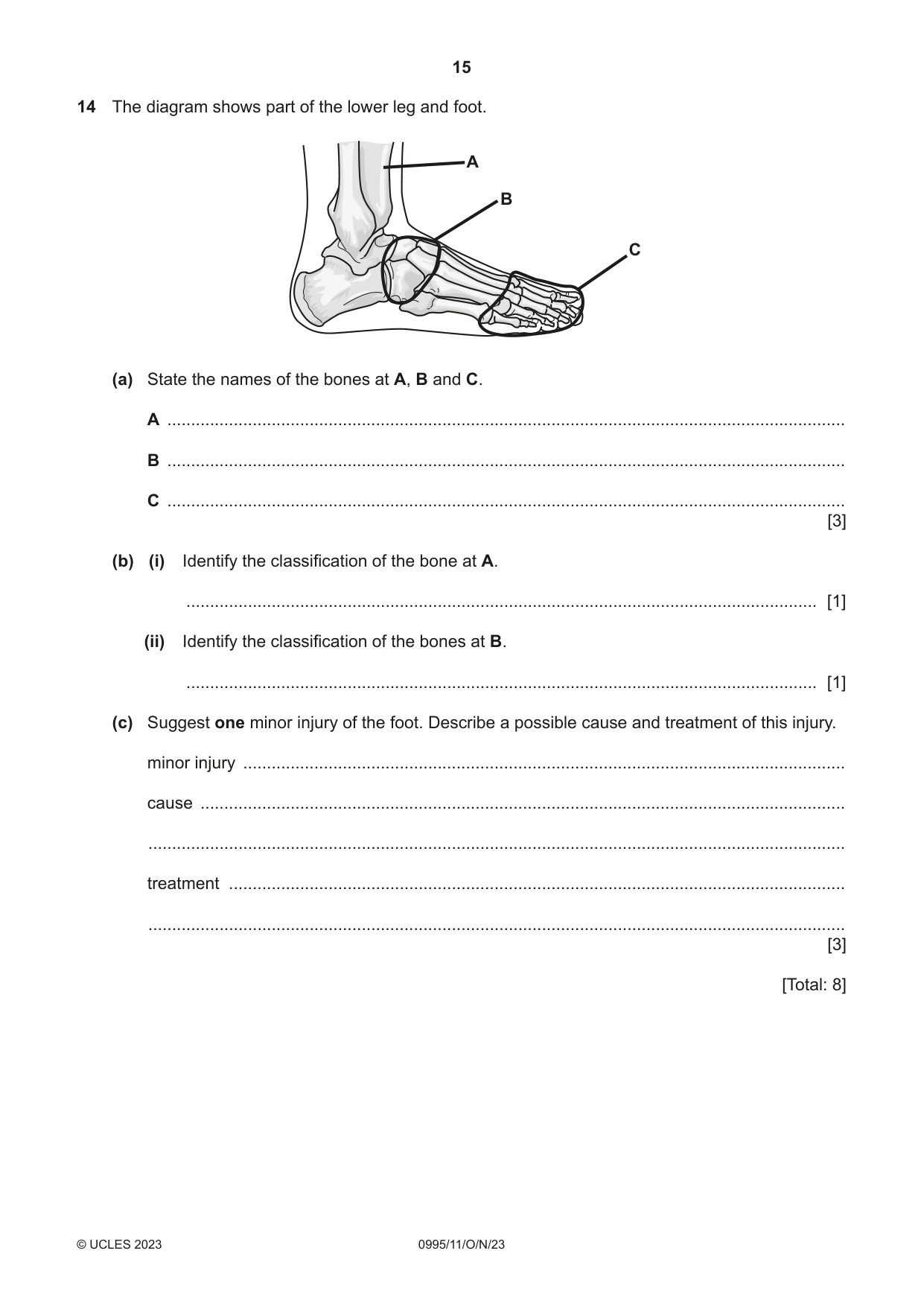
Question paper, page 15
15 0995/11/O/N/23 © UCLES 2023 14 The diagram shows part of the lower leg and foot. A C B (a) State the names of the bones at A, B and C. A … B … C … [3] (b) (i) Identify the classification of the bone at A. … [1] (ii) Identify the classification of the bones at B. … [1] (c) Suggest one minor injury of the foot. Describe a possible cause and treatment of this injury. minor injury … cause … … treatment … … [3] [Total: 8]
Question paper, page 16
16 0995/11/O/N/23 © UCLES 2023 Permission to reproduce items where third-party owned material protected by copyright is included has been sought and cleared where possible. Every reasonable effort has been made by the publisher (UCLES) to trace copyright holders, but if any items requiring clearance have unwittingly been included, the publisher will be pleased to make amends at the earliest possible opportunity. To avoid the issue of disclosure of answer-related information to candidates, all copyright acknowledgements are reproduced online in the Cambridge Assessment International Education Copyright Acknowledgements Booklet. This is produced for each series of examinations and is freely available to download at www.cambridgeinternational.org after the live examination series. Cambridge Assessment International Education is part of Cambridge Assessment. Cambridge Assessment is the brand name of the University of Cambridge Local Examinations Syndicate (UCLES), which is a department of the University of Cambridge. BLANK PAGE
Mark scheme, page 1
This document consists of 17 printed pages. © UCLES 2023 [Turn over Cambridge IGCSE™ (9–1) PHYSICAL EDUCATION 0995/11 Paper 1 Theory October/November 2023 MARK SCHEME Maximum Mark: 100 Published This mark scheme is published as an aid to teachers and candidates, to indicate the requirements of the examination. It shows the basis on which Examiners were instructed to award marks. It does not indicate the details of the discussions that took place at an Examiners’ meeting before marking began, which would have considered the acceptability of alternative answers. Mark schemes should be read in conjunction with the question paper and the Principal Examiner Report for Teachers. Cambridge International will not enter into discussions about these mark schemes. Cambridge International is publishing the mark schemes for the October/November 2023 series for most Cambridge IGCSE, Cambridge International A and AS Level components, and some Cambridge O Level components.
Mark scheme, page 2
0995/11 Cambridge IGCSE (9–1) – Mark Scheme PUBLISHED October/November 2023 © UCLES 2023 Page 2 of 17 Generic Marking Principles These general marking principles must be applied by all examiners when marking candidate answers. They should be applied alongside the specific content of the mark scheme or generic level descriptors for a question. Each question paper and mark scheme will also comply with these marking principles. GENERIC MARKING PRINCIPLE 1: Marks must be awarded in line with: • the specific content of the mark scheme or the generic level descriptors for the question • the specific skills defined in the mark scheme or in the generic level descriptors for the question • the standard of response required by a candidate as exemplified by the standardisation scripts. GENERIC MARKING PRINCIPLE 2: Marks awarded are always whole marks (not half marks, or other fractions). GENERIC MARKING PRINCIPLE 3: Marks must be awarded positively: • marks are awarded for correct/valid answers, as defined in the mark scheme. However, credit is given for valid answers which go beyond the scope of the syllabus and mark scheme, referring to your Team Leader as appropriate • marks are awarded when candidates clearly demonstrate what they know and can do • marks are not deducted for errors • marks are not deducted for omissions • answers should only be judged on the quality of spelling, punctuation and grammar when these features are specifically assessed by the question as indicated by the mark scheme. The meaning, however, should be unambiguous. GENERIC MARKING PRINCIPLE 4: Rules must be applied consistently, e.g. in situations where candidates have not followed instructions or in the application of generic level descriptors.
Mark scheme, page 3
0995/11 Cambridge IGCSE (9–1) – Mark Scheme PUBLISHED October/November 2023 © UCLES 2023 Page 3 of 17 GENERIC MARKING PRINCIPLE 5: Marks should be awarded using the full range of marks defined in the mark scheme for the question (however; the use of the full mark range may be limited according to the quality of the candidate responses seen). GENERIC MARKING PRINCIPLE 6: Marks awarded are based solely on the requirements as defined in the mark scheme. Marks should not be awarded with grade thresholds or grade descriptors in mind. Science-Specific Marking Principles 1 Examiners should consider the context and scientific use of any keywords when awarding marks. Although keywords may be present, marks should not be awarded if the keywords are used incorrectly. 2 The examiner should not choose between contradictory statements given in the same question part, and credit should not be awarded for any correct statement that is contradicted within the same question part. Wrong science that is irrelevant to the question should be ignored. 3 Although spellings do not have to be correct, spellings of syllabus terms must allow for clear and unambiguous separation from other syllabus terms with which they may be confused (e.g. ethane / ethene, glucagon / glycogen, refraction / reflection). 4 The error carried forward (ecf) principle should be applied, where appropriate. If an incorrect answer is subsequently used in a scientifically correct way, the candidate should be awarded these subsequent marking points. Further guidance will be included in the mark scheme where necessary and any exceptions to this general principle will be noted. 5 ‘List rule’ guidance For questions that require n responses (e.g. State two reasons …): • The response should be read as continuous prose, even when numbered answer spaces are provided. • Any response marked ignore in the mark scheme should not count towards n. • Incorrect responses should not be awarded credit but will still count towards n. • Read the entire response to check for any responses that contradict those that would otherwise be credited. Credit should not be awarded for any responses that are contradicted within the rest of the response. Where two responses contradict one another, this should be treated as a single incorrect response. • Non-contradictory responses after the first n responses may be ignored even if they include incorrect science.
Mark scheme, page 4
0995/11 Cambridge IGCSE (9–1) – Mark Scheme PUBLISHED October/November 2023 © UCLES 2023 Page 4 of 17 6 Calculation specific guidance Correct answers to calculations should be given full credit even if there is no working or incorrect working, unless the question states ‘show your working’. For questions in which the number of significant figures required is not stated, credit should be awarded for correct answers when rounded by the examiner to the number of significant figures given in the mark scheme. This may not apply to measured values. For answers given in standard form (e.g. a 10n) in which the convention of restricting the value of the coefficient (a) to a value between 1 and 10 is not followed, credit may still be awarded if the answer can be converted to the answer given in the mark scheme. Unless a separate mark is given for a unit, a missing or incorrect unit will normally mean that the final calculation mark is not awarded. Exceptions to this general principle will be noted in the mark scheme. 7 Guidance for chemical equations Multiples / fractions of coefficients used in chemical equations are acceptable unless stated otherwise in the mark scheme. State symbols given in an equation should be ignored unless asked for in the question or stated otherwise in the mark scheme.
Mark scheme, page 5
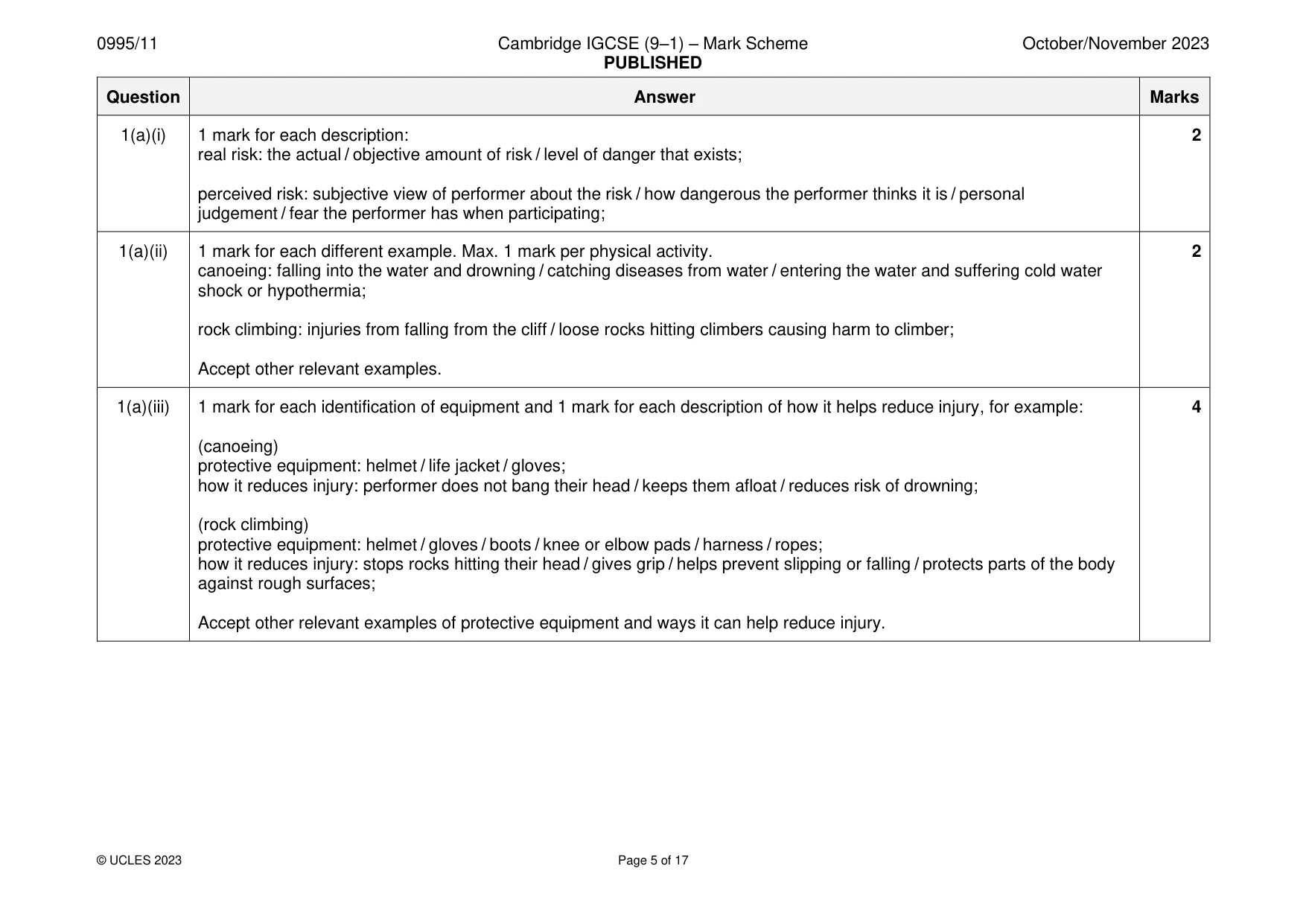
0995/11 Cambridge IGCSE (9–1) – Mark Scheme PUBLISHED October/November 2023 © UCLES 2023 Page 5 of 17 Question Answer Marks 1(a)(i) 1 mark for each description: real risk: the actual / objective amount of risk / level of danger that exists; perceived risk: subjective view of performer about the risk / how dangerous the performer thinks it is / personal judgement / fear the performer has when participating; 2 1(a)(ii) 1 mark for each different example. Max. 1 mark per physical activity. canoeing: falling into the water and drowning / catching diseases from water / entering the water and suffering cold water shock or hypothermia; rock climbing: injuries from falling from the cliff / loose rocks hitting climbers causing harm to climber; Accept other relevant examples. 2 1(a)(iii) 1 mark for each identification of equipment and 1 mark for each description of how it helps reduce injury, for example: (canoeing) protective equipment: helmet / life jacket / gloves; how it reduces injury: performer does not bang their head / keeps them afloat / reduces risk of drowning; (rock climbing) protective equipment: helmet / gloves / boots / knee or elbow pads / harness / ropes; how it reduces injury: stops rocks hitting their head / gives grip / helps prevent slipping or falling / protects parts of the body against rough surfaces; Accept other relevant examples of protective equipment and ways it can help reduce injury. 4
Mark scheme, page 6
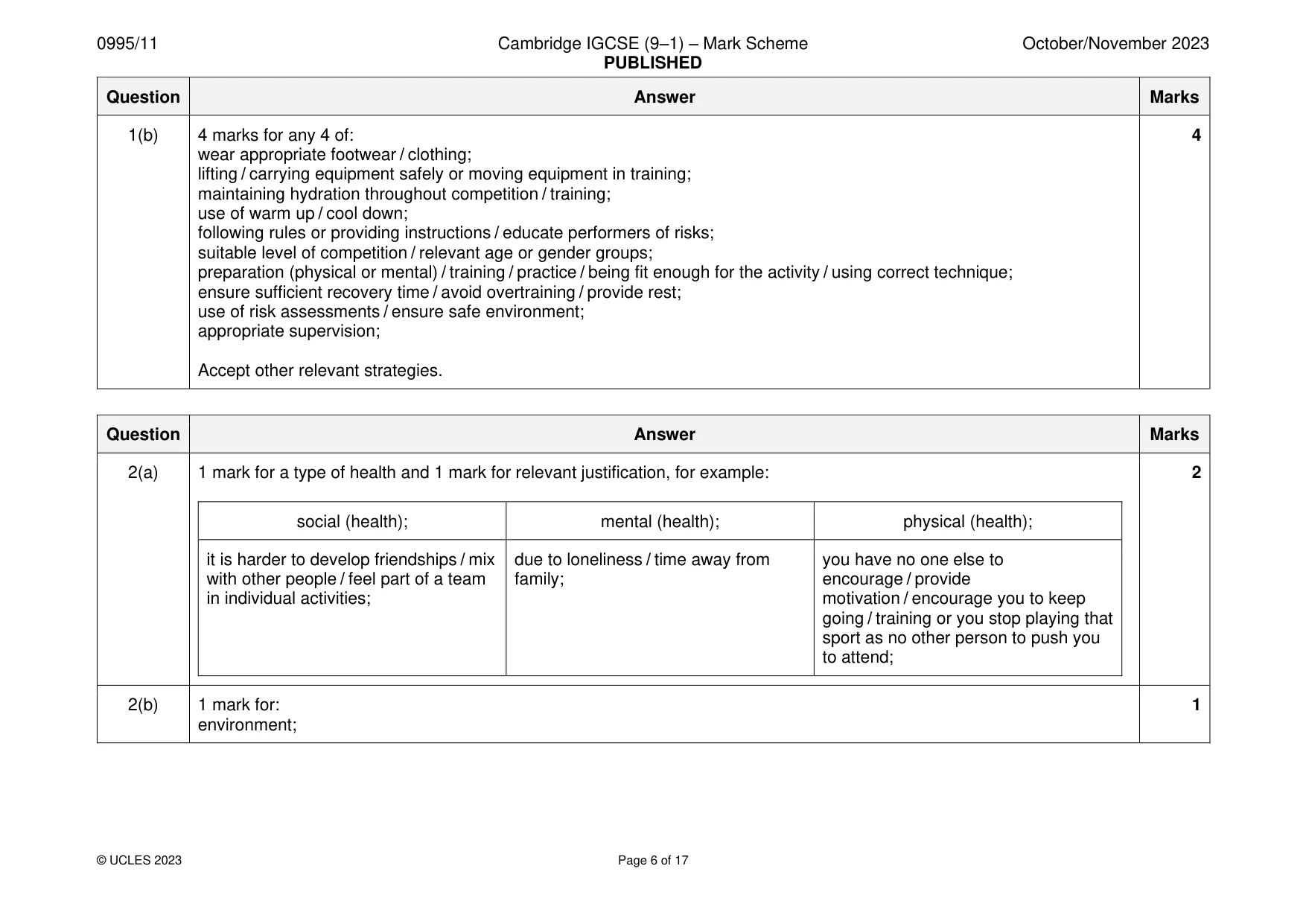
0995/11 Cambridge IGCSE (9–1) – Mark Scheme PUBLISHED October/November 2023 © UCLES 2023 Page 6 of 17 Question Answer Marks 1(b) 4 marks for any 4 of: wear appropriate footwear / clothing; lifting / carrying equipment safely or moving equipment in training; maintaining hydration throughout competition / training; use of warm up / cool down; following rules or providing instructions / educate performers of risks; suitable level of competition / relevant age or gender groups; preparation (physical or mental) / training / practice / being fit enough for the activity / using correct technique; ensure sufficient recovery time / avoid overtraining / provide rest; use of risk assessments / ensure safe environment; appropriate supervision; Accept other relevant strategies. 4 Question Answer Marks 2(a) 1 mark for a type of health and 1 mark for relevant justification, for example: social (health); mental (health); physical (health); it is harder to develop friendships / mix with other people / feel part of a team in individual activities; due to loneliness / time away from family; you have no one else to encourage / provide motivation / encourage you to keep going / training or you stop playing that sport as no other person to push you to attend; 2 2(b) 1 mark for: environment; 1
Mark scheme, page 7
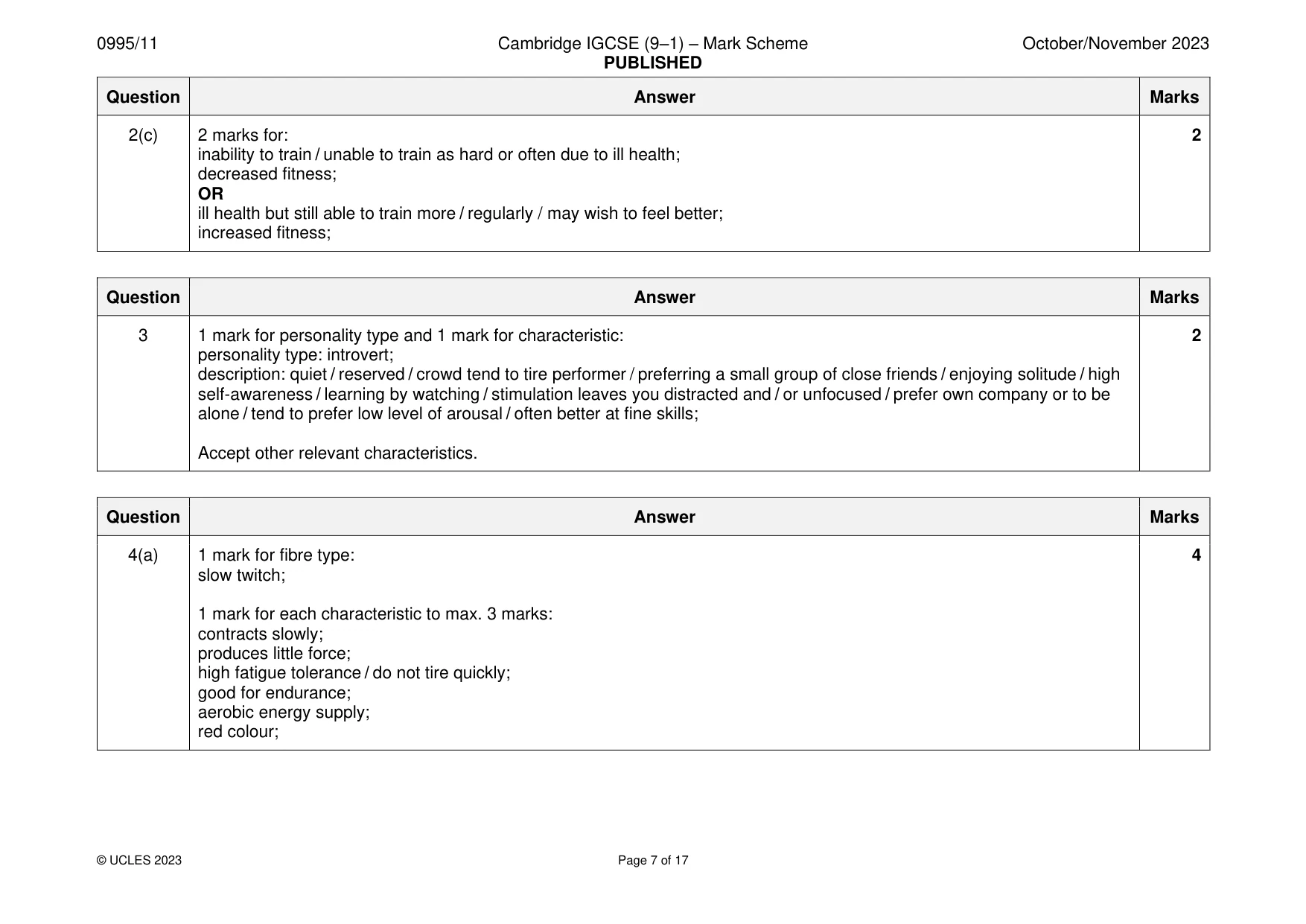
0995/11 Cambridge IGCSE (9–1) – Mark Scheme PUBLISHED October/November 2023 © UCLES 2023 Page 7 of 17 Question Answer Marks 2(c) 2 marks for: inability to train / unable to train as hard or often due to ill health; decreased fitness; OR ill health but still able to train more / regularly / may wish to feel better; increased fitness; 2 Question Answer Marks 3 1 mark for personality type and 1 mark for characteristic: personality type: introvert; description: quiet / reserved / crowd tend to tire performer / preferring a small group of close friends / enjoying solitude / high self-awareness / learning by watching / stimulation leaves you distracted and / or unfocused / prefer own company or to be alone / tend to prefer low level of arousal / often better at fine skills; Accept other relevant characteristics. 2 Question Answer Marks 4(a) 1 mark for fibre type: slow twitch; 1 mark for each characteristic to max. 3 marks: contracts slowly; produces little force; high fatigue tolerance / do not tire quickly; good for endurance; aerobic energy supply; red colour; 4
Mark scheme, page 8
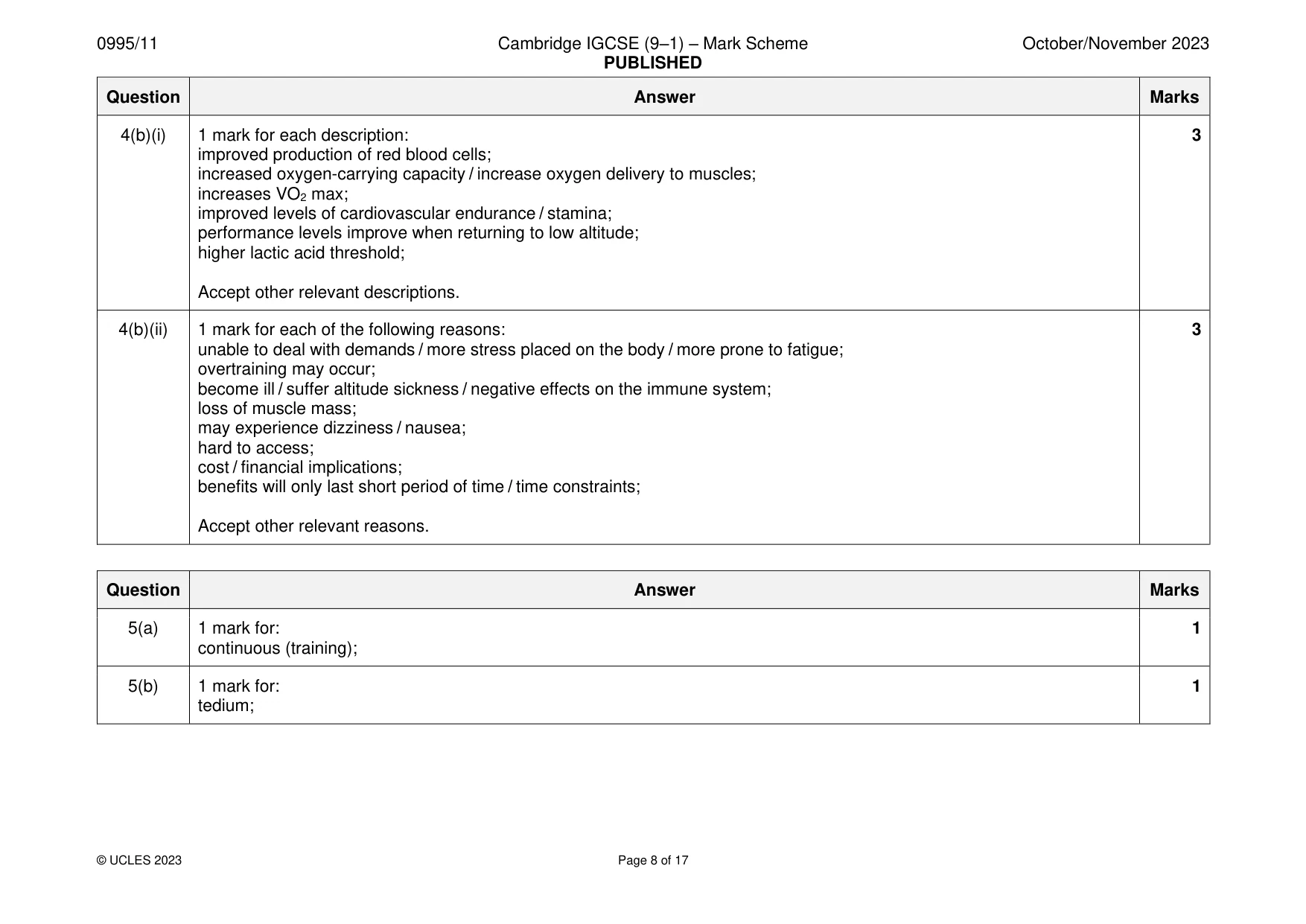
0995/11 Cambridge IGCSE (9–1) – Mark Scheme PUBLISHED October/November 2023 © UCLES 2023 Page 8 of 17 Question Answer Marks 4(b)(i) 1 mark for each description: improved production of red blood cells; increased oxygen-carrying capacity / increase oxygen delivery to muscles; increases VO2 max; improved levels of cardiovascular endurance / stamina; performance levels improve when returning to low altitude; higher lactic acid threshold; Accept other relevant descriptions. 3 4(b)(ii) 1 mark for each of the following reasons: unable to deal with demands / more stress placed on the body / more prone to fatigue; overtraining may occur; become ill / suffer altitude sickness / negative effects on the immune system; loss of muscle mass; may experience dizziness / nausea; hard to access; cost / financial implications; benefits will only last short period of time / time constraints; Accept other relevant reasons. 3 Question Answer Marks 5(a) 1 mark for: continuous (training); 1 5(b) 1 mark for: tedium; 1
Mark scheme, page 9
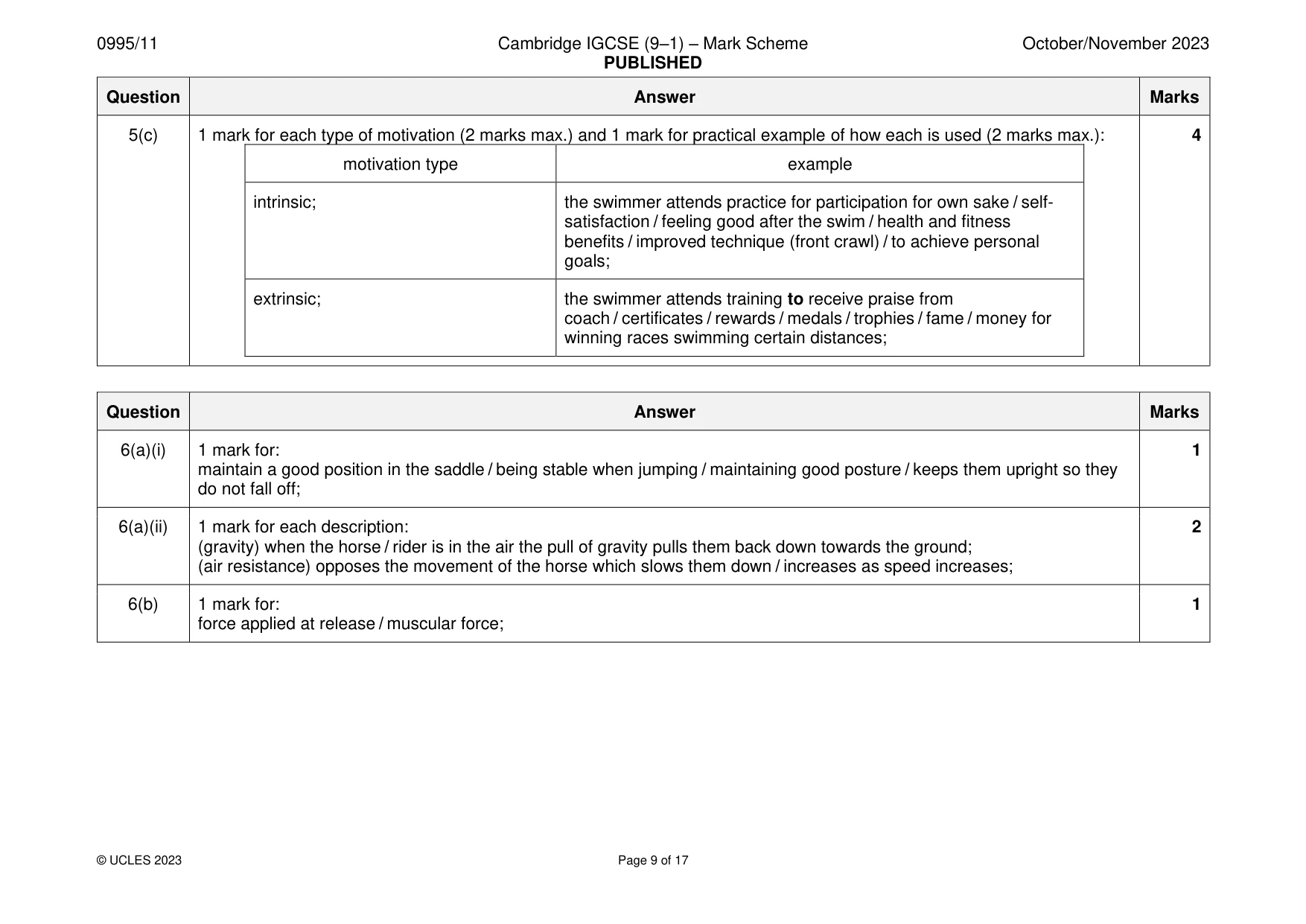
0995/11 Cambridge IGCSE (9–1) – Mark Scheme PUBLISHED October/November 2023 © UCLES 2023 Page 9 of 17 Question Answer Marks 5(c) 1 mark for each type of motivation (2 marks max.) and 1 mark for practical example of how each is used (2 marks max.): motivation type example intrinsic; the swimmer attends practice for participation for own sake / self- satisfaction / feeling good after the swim / health and fitness benefits / improved technique (front crawl) / to achieve personal goals; extrinsic; the swimmer attends training to receive praise from coach / certificates / rewards / medals / trophies / fame / money for winning races swimming certain distances; 4 Question Answer Marks 6(a)(i) 1 mark for: maintain a good position in the saddle / being stable when jumping / maintaining good posture / keeps them upright so they do not fall off; 1 6(a)(ii) 1 mark for each description: (gravity) when the horse / rider is in the air the pull of gravity pulls them back down towards the ground; (air resistance) opposes the movement of the horse which slows them down / increases as speed increases; 2 6(b) 1 mark for: force applied at release / muscular force; 1
Mark scheme, page 10
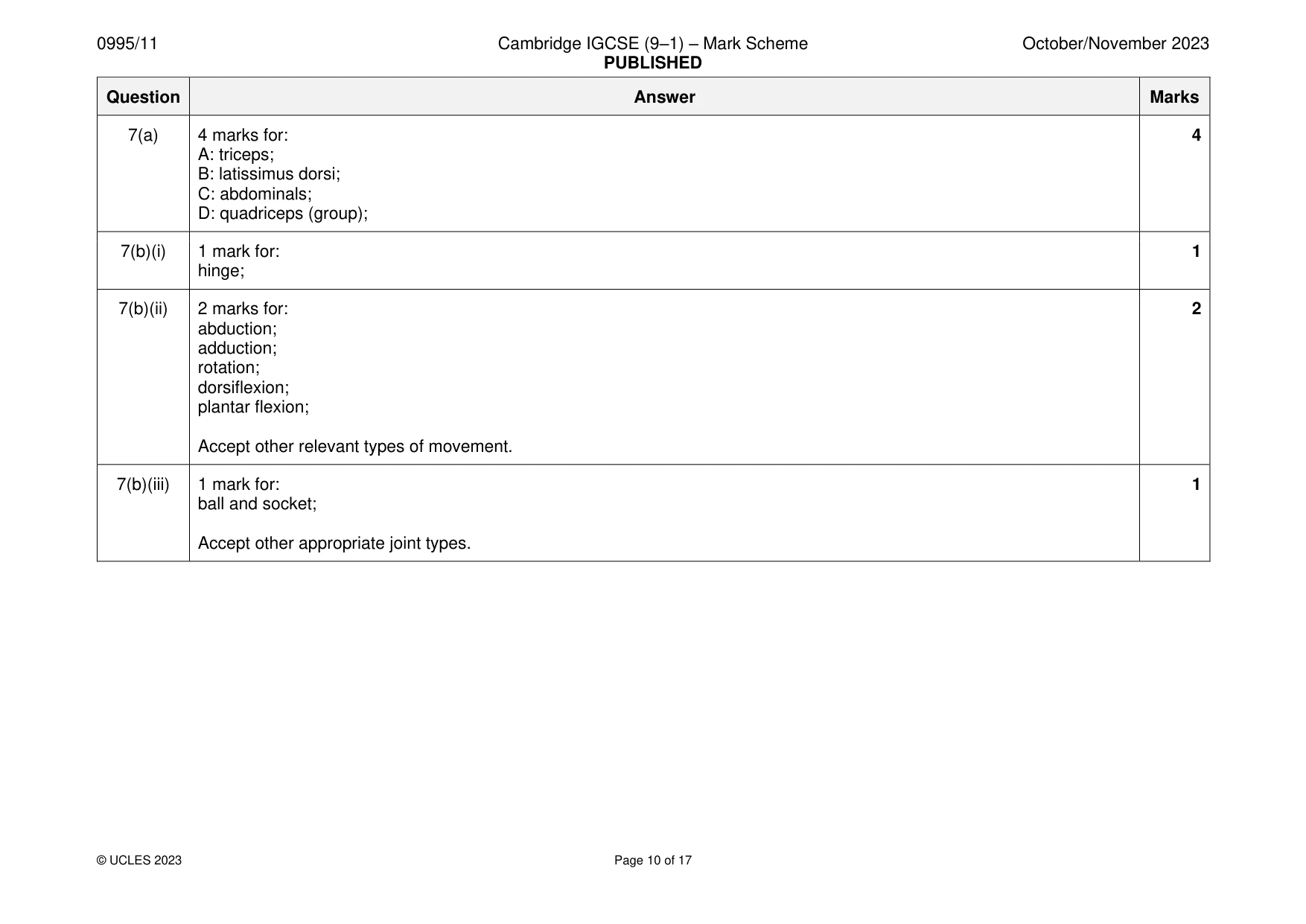
0995/11 Cambridge IGCSE (9–1) – Mark Scheme PUBLISHED October/November 2023 © UCLES 2023 Page 10 of 17 Question Answer Marks 7(a) 4 marks for: A: triceps; B: latissimus dorsi; C: abdominals; D: quadriceps (group); 4 7(b)(i) 1 mark for: hinge; 1 7(b)(ii) 2 marks for: abduction; adduction; rotation; dorsiflexion; plantar flexion; Accept other relevant types of movement. 2 7(b)(iii) 1 mark for: ball and socket; Accept other appropriate joint types. 1
Mark scheme, page 11
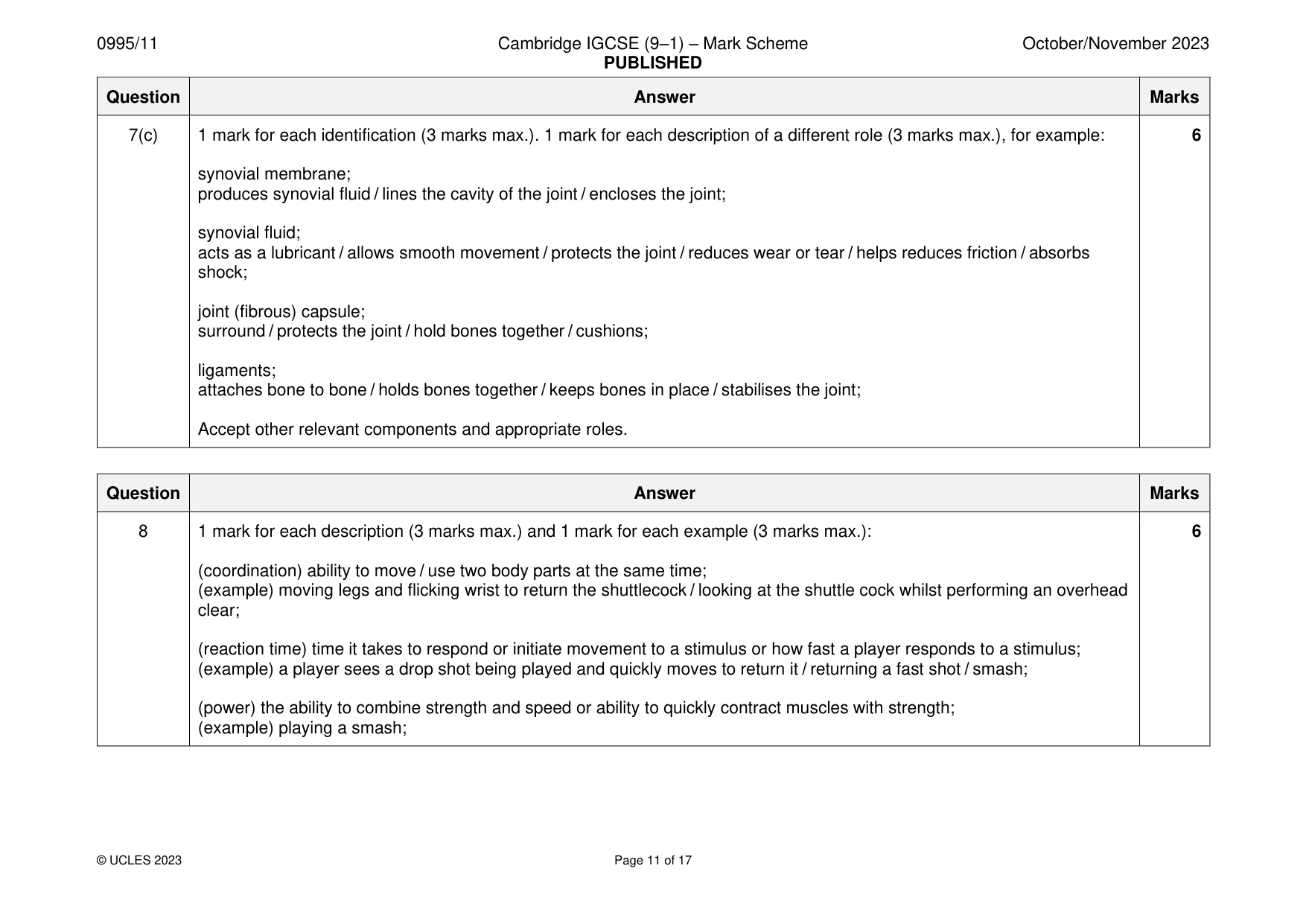
0995/11 Cambridge IGCSE (9–1) – Mark Scheme PUBLISHED October/November 2023 © UCLES 2023 Page 11 of 17 Question Answer Marks 7(c) 1 mark for each identification (3 marks max.). 1 mark for each description of a different role (3 marks max.), for example: synovial membrane; produces synovial fluid / lines the cavity of the joint / encloses the joint; synovial fluid; acts as a lubricant / allows smooth movement / protects the joint / reduces wear or tear / helps reduces friction / absorbs shock; joint (fibrous) capsule; surround / protects the joint / hold bones together / cushions; ligaments; attaches bone to bone / holds bones together / keeps bones in place / stabilises the joint; Accept other relevant components and appropriate roles. 6 Question Answer Marks 8 1 mark for each description (3 marks max.) and 1 mark for each example (3 marks max.): (coordination) ability to move / use two body parts at the same time; (example) moving legs and flicking wrist to return the shuttlecock / looking at the shuttle cock whilst performing an overhead clear; (reaction time) time it takes to respond or initiate movement to a stimulus or how fast a player responds to a stimulus; (example) a player sees a drop shot being played and quickly moves to return it / returning a fast shot / smash; (power) the ability to combine strength and speed or ability to quickly contract muscles with strength; (example) playing a smash; 6
Mark scheme, page 12
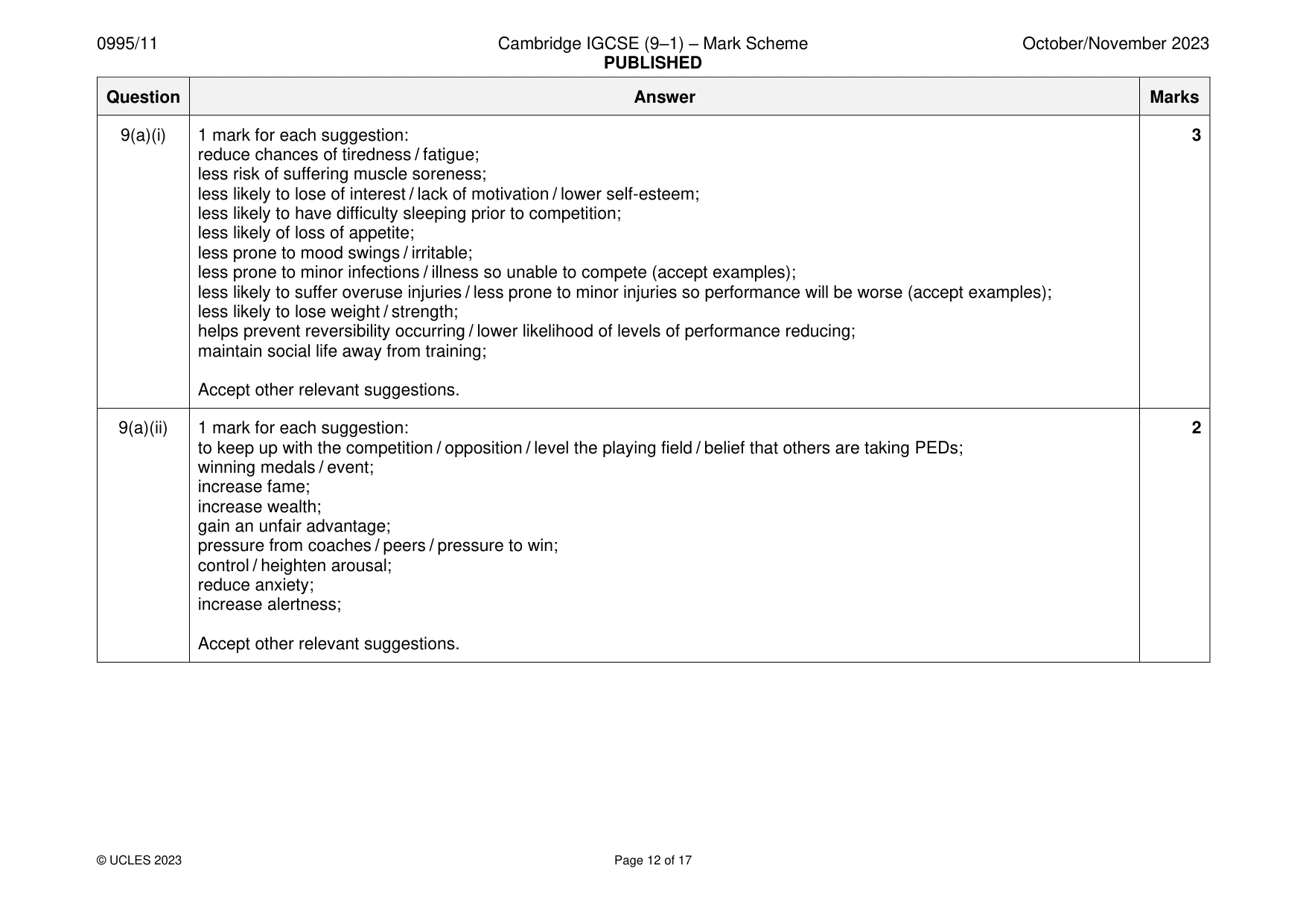
0995/11 Cambridge IGCSE (9–1) – Mark Scheme PUBLISHED October/November 2023 © UCLES 2023 Page 12 of 17 Question Answer Marks 9(a)(i) 1 mark for each suggestion: reduce chances of tiredness / fatigue; less risk of suffering muscle soreness; less likely to lose of interest / lack of motivation / lower self-esteem; less likely to have difficulty sleeping prior to competition; less likely of loss of appetite; less prone to mood swings / irritable; less prone to minor infections / illness so unable to compete (accept examples); less likely to suffer overuse injuries / less prone to minor injuries so performance will be worse (accept examples); less likely to lose weight / strength; helps prevent reversibility occurring / lower likelihood of levels of performance reducing; maintain social life away from training; Accept other relevant suggestions. 3 9(a)(ii) 1 mark for each suggestion: to keep up with the competition / opposition / level the playing field / belief that others are taking PEDs; winning medals / event; increase fame; increase wealth; gain an unfair advantage; pressure from coaches / peers / pressure to win; control / heighten arousal; reduce anxiety; increase alertness; Accept other relevant suggestions. 2
Mark scheme, page 13
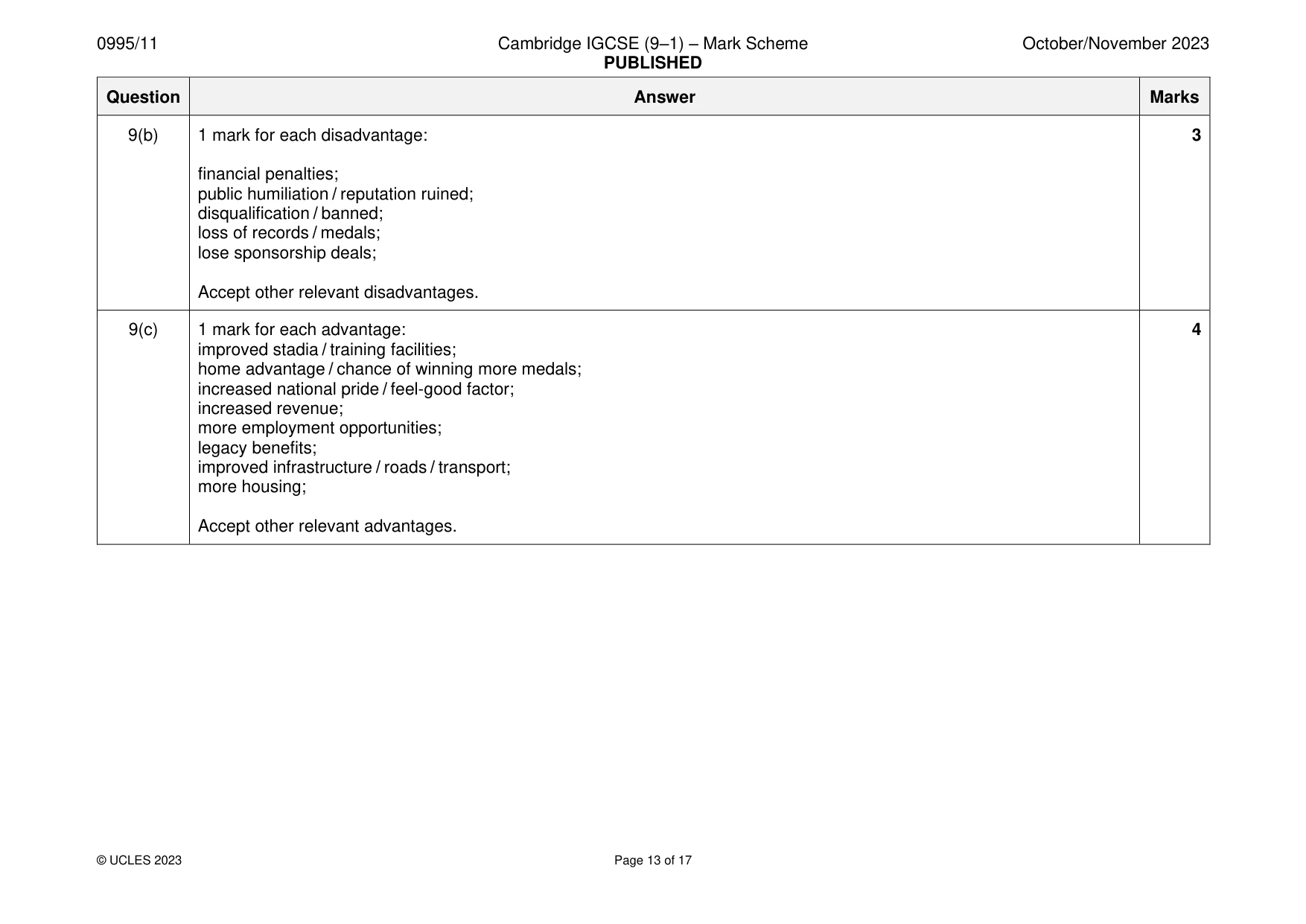
0995/11 Cambridge IGCSE (9–1) – Mark Scheme PUBLISHED October/November 2023 © UCLES 2023 Page 13 of 17 Question Answer Marks 9(b) 1 mark for each disadvantage: financial penalties; public humiliation / reputation ruined; disqualification / banned; loss of records / medals; lose sponsorship deals; Accept other relevant disadvantages. 3 9(c) 1 mark for each advantage: improved stadia / training facilities; home advantage / chance of winning more medals; increased national pride / feel-good factor; increased revenue; more employment opportunities; legacy benefits; improved infrastructure / roads / transport; more housing; Accept other relevant advantages. 4
Mark scheme, page 14
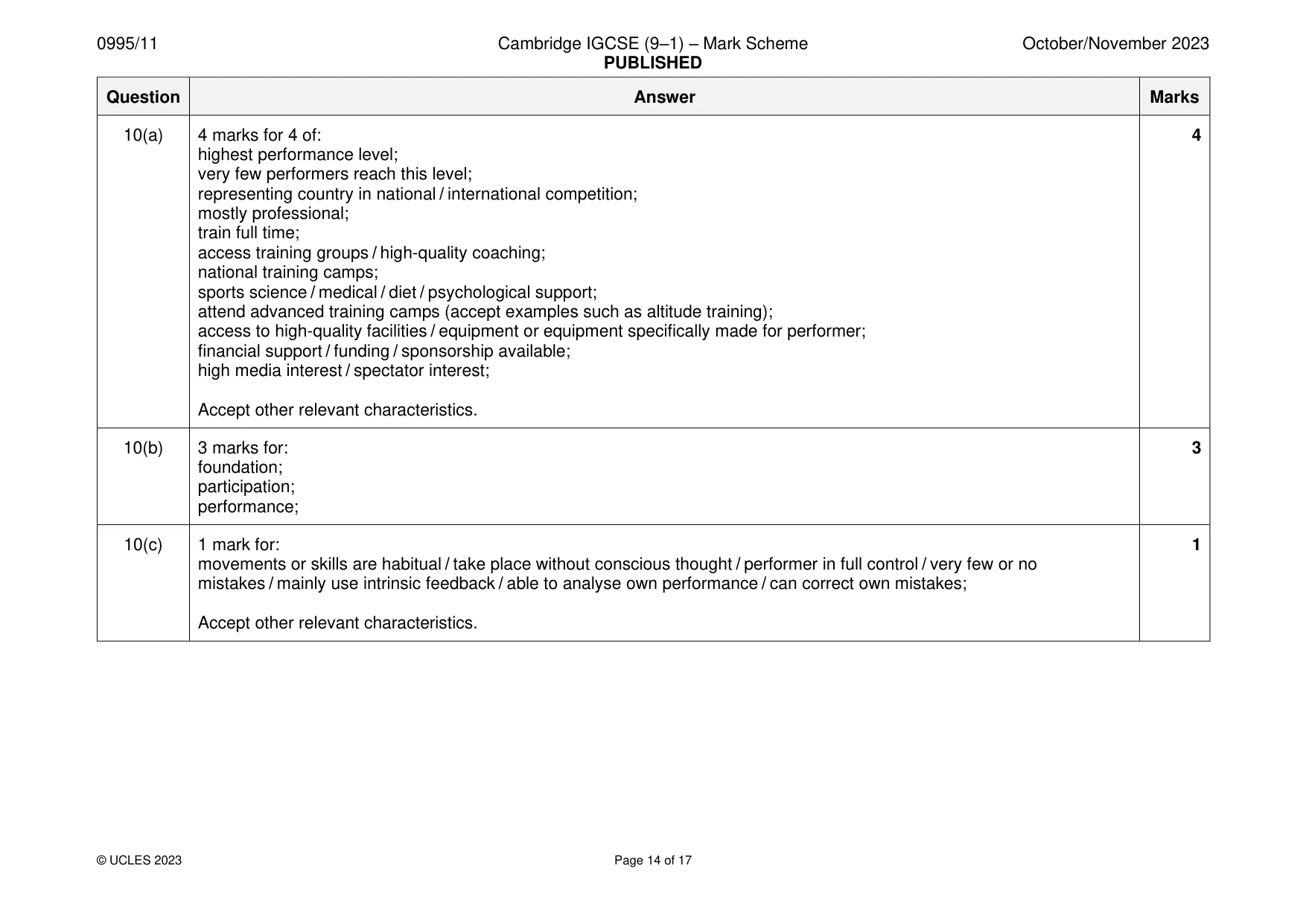
0995/11 Cambridge IGCSE (9–1) – Mark Scheme PUBLISHED October/November 2023 © UCLES 2023 Page 14 of 17 Question Answer Marks 10(a) 4 marks for 4 of: highest performance level; very few performers reach this level; representing country in national / international competition; mostly professional; train full time; access training groups / high-quality coaching; national training camps; sports science / medical / diet / psychological support; attend advanced training camps (accept examples such as altitude training); access to high-quality facilities / equipment or equipment specifically made for performer; financial support / funding / sponsorship available; high media interest / spectator interest; Accept other relevant characteristics. 4 10(b) 3 marks for: foundation; participation; performance; 3 10(c) 1 mark for: movements or skills are habitual / take place without conscious thought / performer in full control / very few or no mistakes / mainly use intrinsic feedback / able to analyse own performance / can correct own mistakes; Accept other relevant characteristics. 1
Mark scheme, page 15
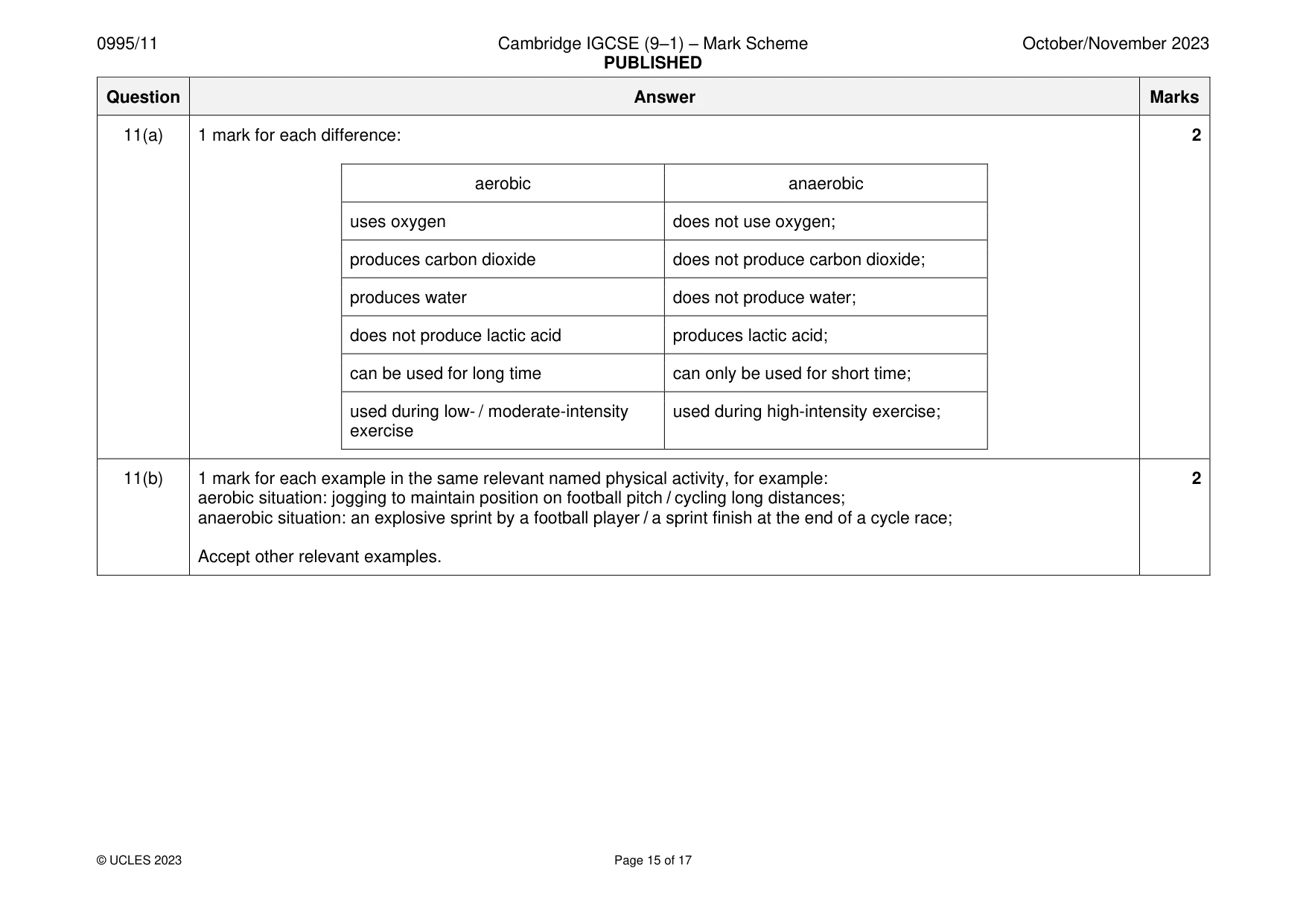
0995/11 Cambridge IGCSE (9–1) – Mark Scheme PUBLISHED October/November 2023 © UCLES 2023 Page 15 of 17 Question Answer Marks 11(a) 1 mark for each difference: aerobic anaerobic uses oxygen does not use oxygen; produces carbon dioxide does not produce carbon dioxide; produces water does not produce water; does not produce lactic acid produces lactic acid; can be used for long time can only be used for short time; used during low- / moderate-intensity exercise used during high-intensity exercise; 2 11(b) 1 mark for each example in the same relevant named physical activity, for example: aerobic situation: jogging to maintain position on football pitch / cycling long distances; anaerobic situation: an explosive sprint by a football player / a sprint finish at the end of a cycle race; Accept other relevant examples. 2
Mark scheme, page 16
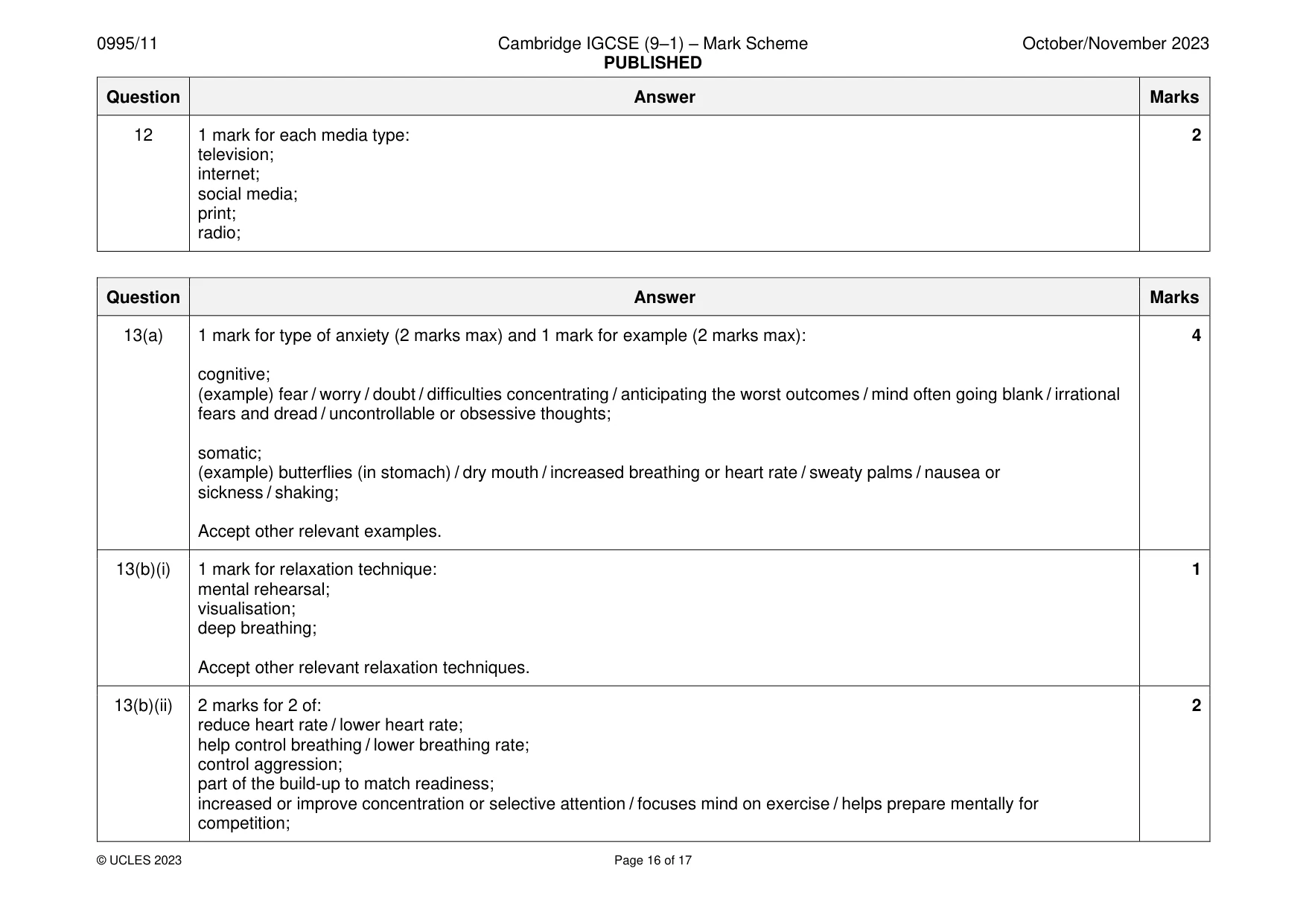
0995/11 Cambridge IGCSE (9–1) – Mark Scheme PUBLISHED October/November 2023 © UCLES 2023 Page 16 of 17 Question Answer Marks 12 1 mark for each media type: television; internet; social media; print; radio; 2 Question Answer Marks 13(a) 1 mark for type of anxiety (2 marks max) and 1 mark for example (2 marks max): cognitive; (example) fear / worry / doubt / difficulties concentrating / anticipating the worst outcomes / mind often going blank / irrational fears and dread / uncontrollable or obsessive thoughts; somatic; (example) butterflies (in stomach) / dry mouth / increased breathing or heart rate / sweaty palms / nausea or sickness / shaking; Accept other relevant examples. 4 13(b)(i) 1 mark for relaxation technique: mental rehearsal; visualisation; deep breathing; Accept other relevant relaxation techniques. 1 13(b)(ii) 2 marks for 2 of: reduce heart rate / lower heart rate; help control breathing / lower breathing rate; control aggression; part of the build-up to match readiness; increased or improve concentration or selective attention / focuses mind on exercise / helps prepare mentally for competition; 2
Mark scheme, page 17
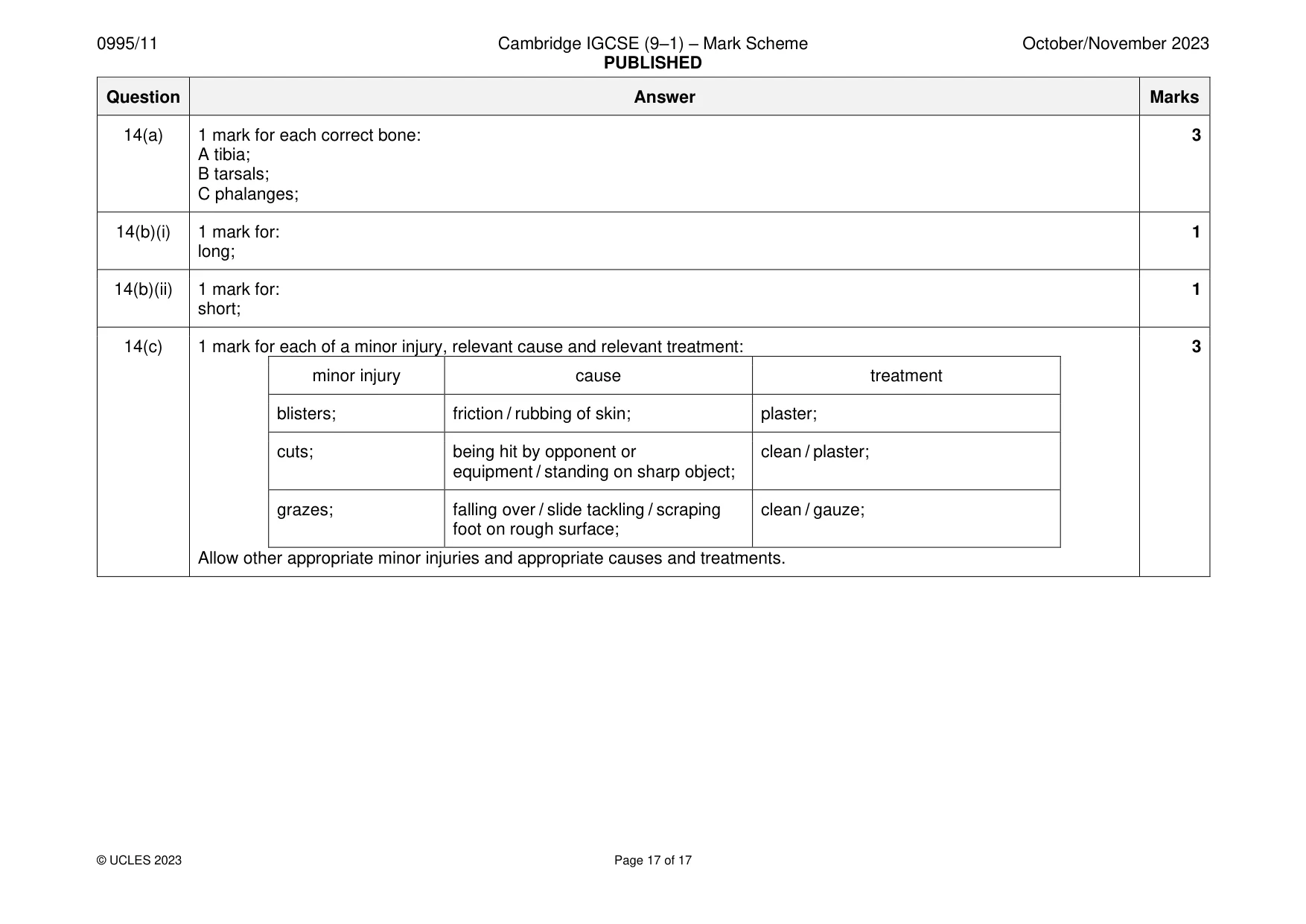
0995/11 Cambridge IGCSE (9–1) – Mark Scheme PUBLISHED October/November 2023 © UCLES 2023 Page 17 of 17 Question Answer Marks 14(a) 1 mark for each correct bone: A tibia; B tarsals; C phalanges; 3 14(b)(i) 1 mark for: long; 1 14(b)(ii) 1 mark for: short; 1 14(c) 1 mark for each of a minor injury, relevant cause and relevant treatment: minor injury cause treatment blisters; friction / rubbing of skin; plaster; cuts; being hit by opponent or equipment / standing on sharp object; clean / plaster; grazes; falling over / slide tackling / scraping foot on rough surface; clean / gauze; Allow other appropriate minor injuries and appropriate causes and treatments. 3
What you needed in this session
Cambridge’s own grade thresholds for 2023 Oct/Nov, Paper 1 · Variant 1. A higher threshold means an easier paper — the bar moves with how the cohort did.