Cambridge IGCSE Physical Education (9-1) 0995 — 2021 Oct/Nov Paper 1 · Variant 1
0995/11/O/N/21 · 100 marks · ≈113 min
The question paper and its mark scheme, free to read here and free to download. This is Cambridge’s own paper, exactly as it was sat.
Question paper16 pages

Mark scheme17 pages
Answers below. Sit the paper first if you are practising.
Paper as text
Question paper, page 1
This document has 16 pages. Any blank pages are indicated. Cambridge IGCSE™(9–1) * 5 5 8 1 3 2 3 6 6 4 * DC (CE/CGW) 221006 © UCLES 2021 [Turn over PHYSICAL EDUCATION 0995/11 Paper 1 Theory October/November 2021 1 hour 45 minutes You must answer on the question paper. No additional materials are needed. INSTRUCTIONS ● Answer all questions. ● Use a black or dark blue pen. You may use an HB pencil for any diagrams or graphs. ● Write your name, centre number and candidate number in the boxes at the top of the page. ● Write your answer to each question in the space provided. ● Do not use an erasable pen or correction fluid. ● Do not write on any bar codes. ● You may use a calculator. ● You should show all your working and use appropriate units. INFORMATION ● The total mark for this paper is 100. ● The number of marks for each question or part question is shown in brackets [ ].
Question paper, page 2
2 0995/11/O/N/21 © UCLES 2021 1 One function of the skeleton is protection. Identify two other functions of the skeleton. 1 … 2 … [2] 2 (a) (i) Identify two components of fitness, other than speed, that may be required by a 100‑metre sprinter during a race. Justify each of your answers. component of fitness 1 … justification … … component of fitness 2 … justification … … [2] (ii) Describe how to carry out a named test of speed. name of test … description … … … … … … [4] (iii) Suggest three reasons for carrying out a fitness test. 1 … … 2 … … 3 … … [3]
Question paper, page 3
3 0995/11/O/N/21 © UCLES 2021 [Turn over (b) High‑Intensity Interval Training (HIIT) is a method of training that could benefit a 100‑metre sprinter. Describe two advantages and two disadvantages of using this method of training. advantages 1 … … 2 … … disadvantages 1 … … 2 … … [4] [Total: 13]
Question paper, page 4
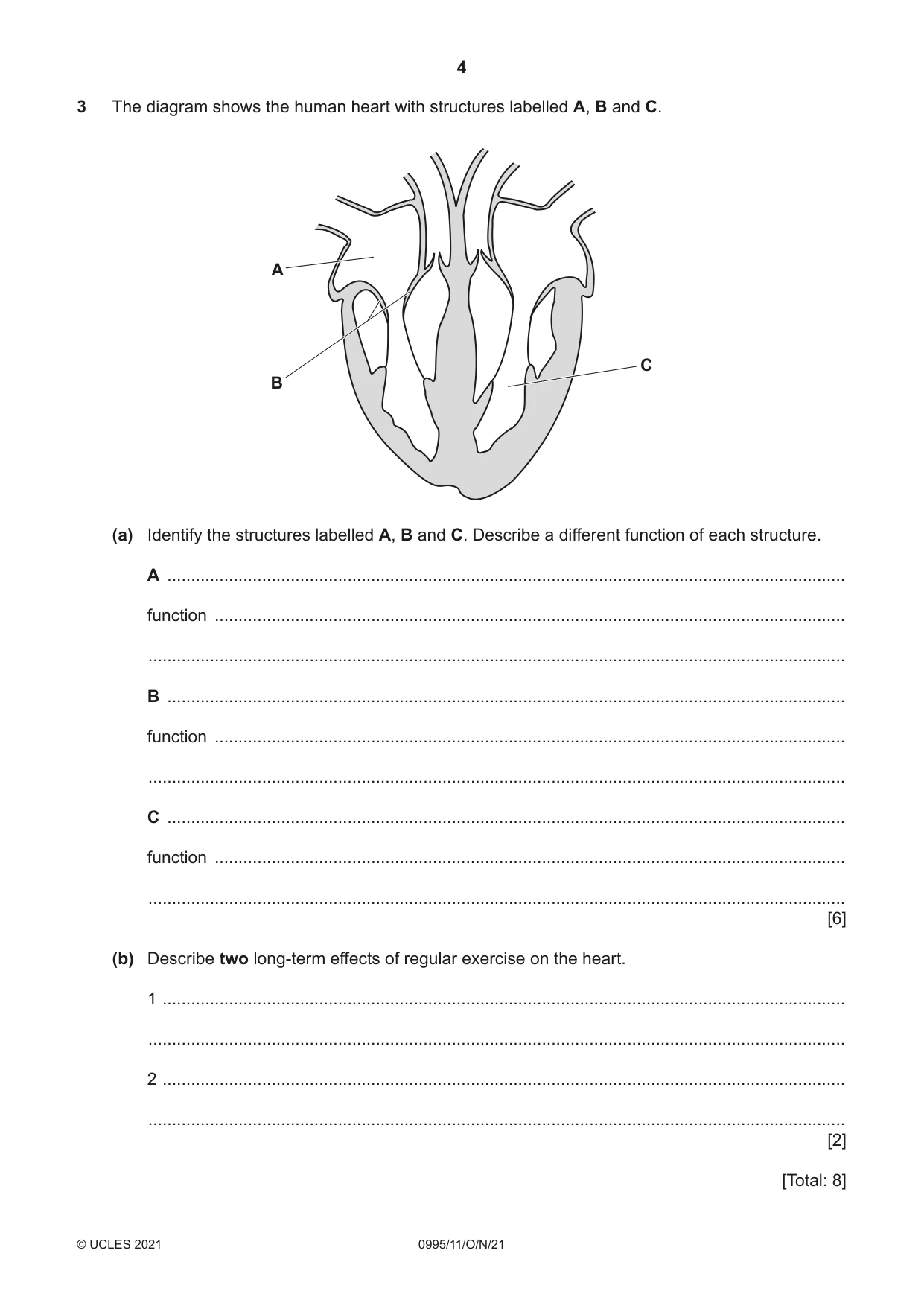
4 0995/11/O/N/21 © UCLES 2021 3 The diagram shows the human heart with structures labelled A, B and C. C A B (a) Identify the structures labelled A, B and C. Describe a different function of each structure. A … function … … B … function … … C … function … … [6] (b) Describe two long‑term effects of regular exercise on the heart. 1 … … 2 … … [2] [Total: 8]
Question paper, page 5
5 0995/11/O/N/21 © UCLES 2021 [Turn over 4 (a) Define the term fitness. … … [1] (b) Suggest two lifestyle choices that can benefit health and fitness. 1 … … 2 … … [2] (c) Explain how exercise and fitness can have two positive effects on each of the following: physical health and well‑being 1 … … 2 … … mental health and well‑being. 1 … … 2 … … [4] [Total: 7]
Question paper, page 6
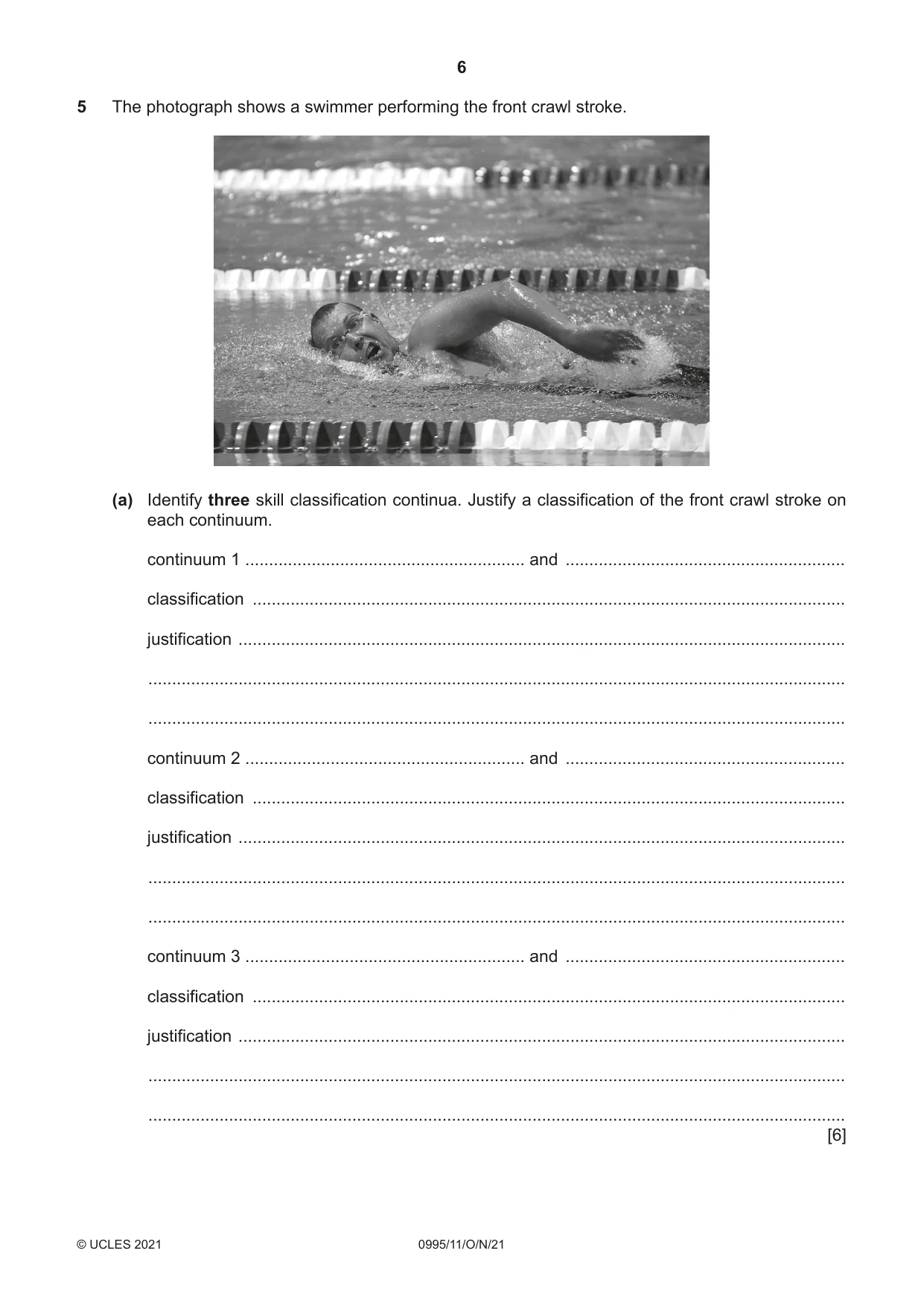
6 0995/11/O/N/21 © UCLES 2021 5 The photograph shows a swimmer performing the front crawl stroke. (a) Identify three skill classification continua. Justify a classification of the front crawl stroke on each continuum. continuum 1 … and … classification … justification … … … continuum 2 … and … classification … justification … … … continuum 3 … and … classification … justification … … … [6]
Question paper, page 7
7 0995/11/O/N/21 © UCLES 2021 [Turn over (b) Describe an example of each of the following characteristics of a skilled performance in a named physical activity. physical activity … aesthetically pleasing … … coordinated … … goal‑directed … … [3] [Total: 9] 6 (a) Suggest two possible causes of a ligament injury in a named games activity. games activity … 1 … … 2 … … [2] (b) The RICE method can be used to treat ligament injuries. Identify two components of the RICE method. Suggest a different benefit of each component. component of RICE method 1 … benefit … … component of RICE method 2 … benefit … … [4] [Total: 6]
Question paper, page 8
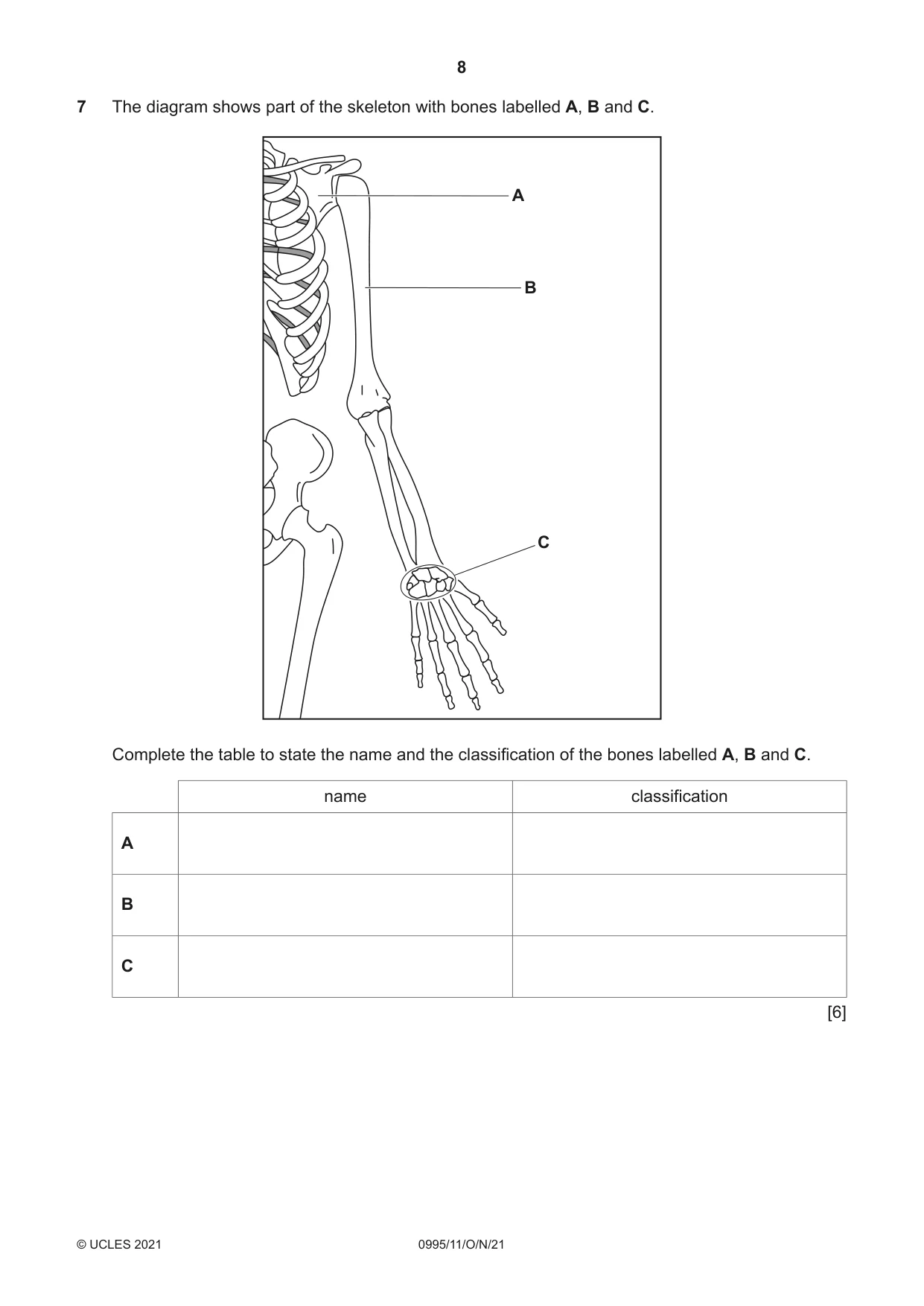
8 0995/11/O/N/21 © UCLES 2021 7 The diagram shows part of the skeleton with bones labelled A, B and C. A B C Complete the table to state the name and the classification of the bones labelled A, B and C. name classification A B C [6]
Question paper, page 9
9 0995/11/O/N/21 © UCLES 2021 [Turn over 8 (a) Identify the main type of respiration that would release energy throughout an endurance activity. State an equation for this type of respiration. main type of respiration … equation [3] (b) Explain why a performer can only sprint for short distances. … … … … [2] (c) Explain how two factors, other than a cool down, can affect the recovery time of a performer. 1 … … 2 … … [2] [Total: 7]
Question paper, page 10
10 0995/11/O/N/21 © UCLES 2021 9 Identify two forces that act on a ball when it is kicked and moves through the air. Describe how each force acts on the ball. force 1 … description … … force 2 … description … … [4] 10 Describe, using a named physical activity, an exercise that would be appropriate for each of the following phases of a warm up. physical activity … pulse raiser … … … … stretches … … … … familiarisation / skill‑related activities … … … … [3]
Question paper, page 11
11 0995/11/O/N/21 © UCLES 2021 [Turn over BLANK PAGE
Question paper, page 12
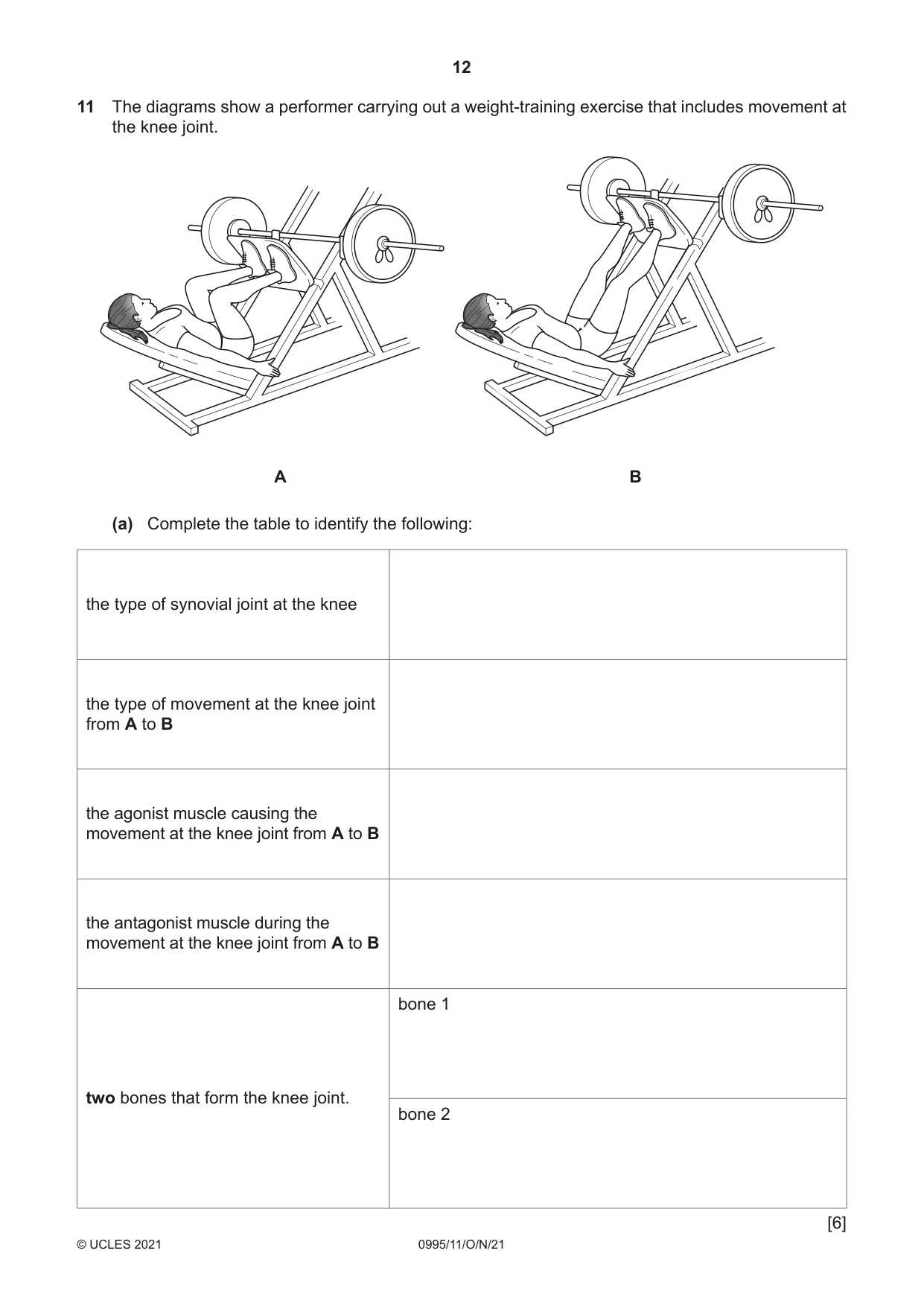
12 0995/11/O/N/21 © UCLES 2021 11 The diagrams show a performer carrying out a weight‑training exercise that includes movement at the knee joint. A B (a) Complete the table to identify the following: the type of synovial joint at the knee the type of movement at the knee joint from A to B the agonist muscle causing the movement at the knee joint from A to B the antagonist muscle during the movement at the knee joint from A to B two bones that form the knee joint. bone 1 bone 2 [6]
Question paper, page 13
13 0995/11/O/N/21 © UCLES 2021 [Turn over (b) Suggest why a protein‑rich diet is important when weight training. … … … … [2] (c) Fats are another component of a performer’s diet. Describe one function of fats. … … [1] [Total: 9]
Question paper, page 14
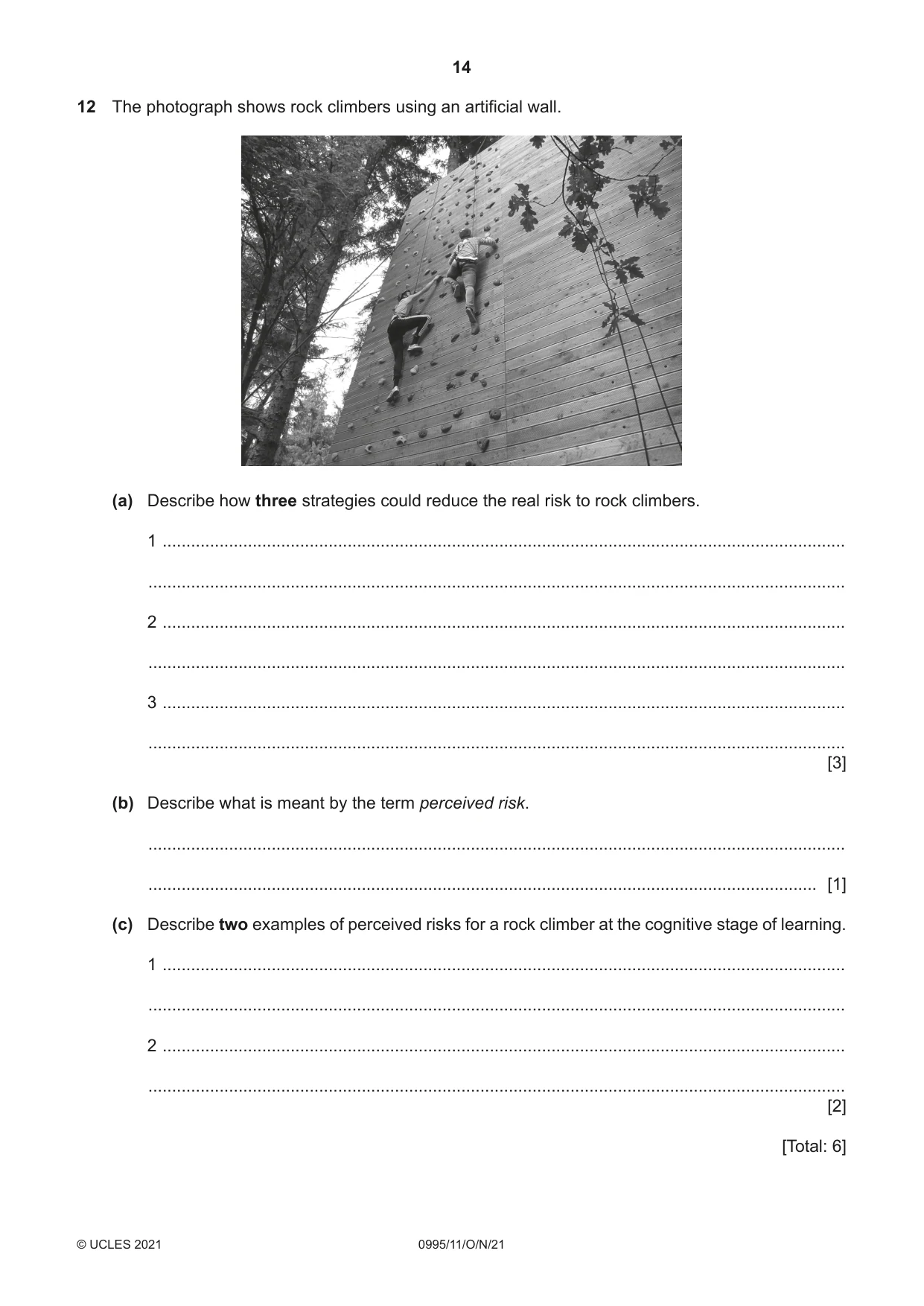
14 0995/11/O/N/21 © UCLES 2021 12 The photograph shows rock climbers using an artificial wall. (a) Describe how three strategies could reduce the real risk to rock climbers. 1 … … 2 … … 3 … … [3] (b) Describe what is meant by the term perceived risk. … … [1] (c) Describe two examples of perceived risks for a rock climber at the cognitive stage of learning. 1 … … 2 … … [2] [Total: 6]
Question paper, page 15
15 0995/11/O/N/21 © UCLES 2021 [Turn over 13 (a) Describe a difference between skill and ability. … … [1] (b) Explain how two named factors can affect variations in skill level. factor 1 … explanation … … factor 2 … explanation … … [4] (c) Output is one stage of a basic information processing model. Describe how two other named stages of a basic information processing model are used in a named physical activity. physical activity … stage 1 … description … … stage 2 … description … … [4] (d) Performance of skills depends on memory. Describe differences between short‑term memory and long‑term memory. … … … … [2] [Total: 11]
Question paper, page 16
16 0995/11/O/N/21 © UCLES 2021 14 (a) Describe each of the following: tidal volume … … minute ventilation … … vital capacity. … … [3] (b) Describe the mechanics of breathing during inhalation. … … … … … … … … [4] [Total: 7] 15 As part of their education, school children may receive different forms of extrinsic motivation to encourage participation in physical activity. Suggest two examples of this type of motivation that schools may provide. 1 … 2 … [2] Permission to reproduce items where third‑party owned material protected by copyright is included has been sought and cleared where possible. Every reasonable effort has been made by the publisher (UCLES) to trace copyright holders, but if any items requiring clearance have unwittingly been included, the publisher will be pleased to make amends at the earliest possible opportunity. To avoid the issue of disclosure of answer‑related information to candidates, all copyright acknowledgements are reproduced online in the Cambridge Assessment International Education Copyright Acknowledgements Booklet. This is produced for each series of examinations and is freely available to download at www.cambridgeinternational.org after the live examination series. Cambridge Assessment International Education is part of the Cambridge Assessment Group. Cambridge Assessment is the brand name of the University of Cambridge Local Examinations Syndicate (UCLES), which itself is a department of the University of Cambridge.
Mark scheme, page 1
This document consists of 17 printed pages. © UCLES 2021 [Turn over Cambridge IGCSE™ (9–1) PHYSICAL EDUCATION 0995/11 Paper 1 Theory October/November 2021 MARK SCHEME Maximum Mark: 100 Published This mark scheme is published as an aid to teachers and candidates, to indicate the requirements of the examination. It shows the basis on which Examiners were instructed to award marks. It does not indicate the details of the discussions that took place at an Examiners’ meeting before marking began, which would have considered the acceptability of alternative answers. Mark schemes should be read in conjunction with the question paper and the Principal Examiner Report for Teachers. Cambridge International will not enter into discussions about these mark schemes. Cambridge International is publishing the mark schemes for the October/November 2021 series for most Cambridge IGCSE™, Cambridge International A and AS Level components and some Cambridge O Level components.
Mark scheme, page 2
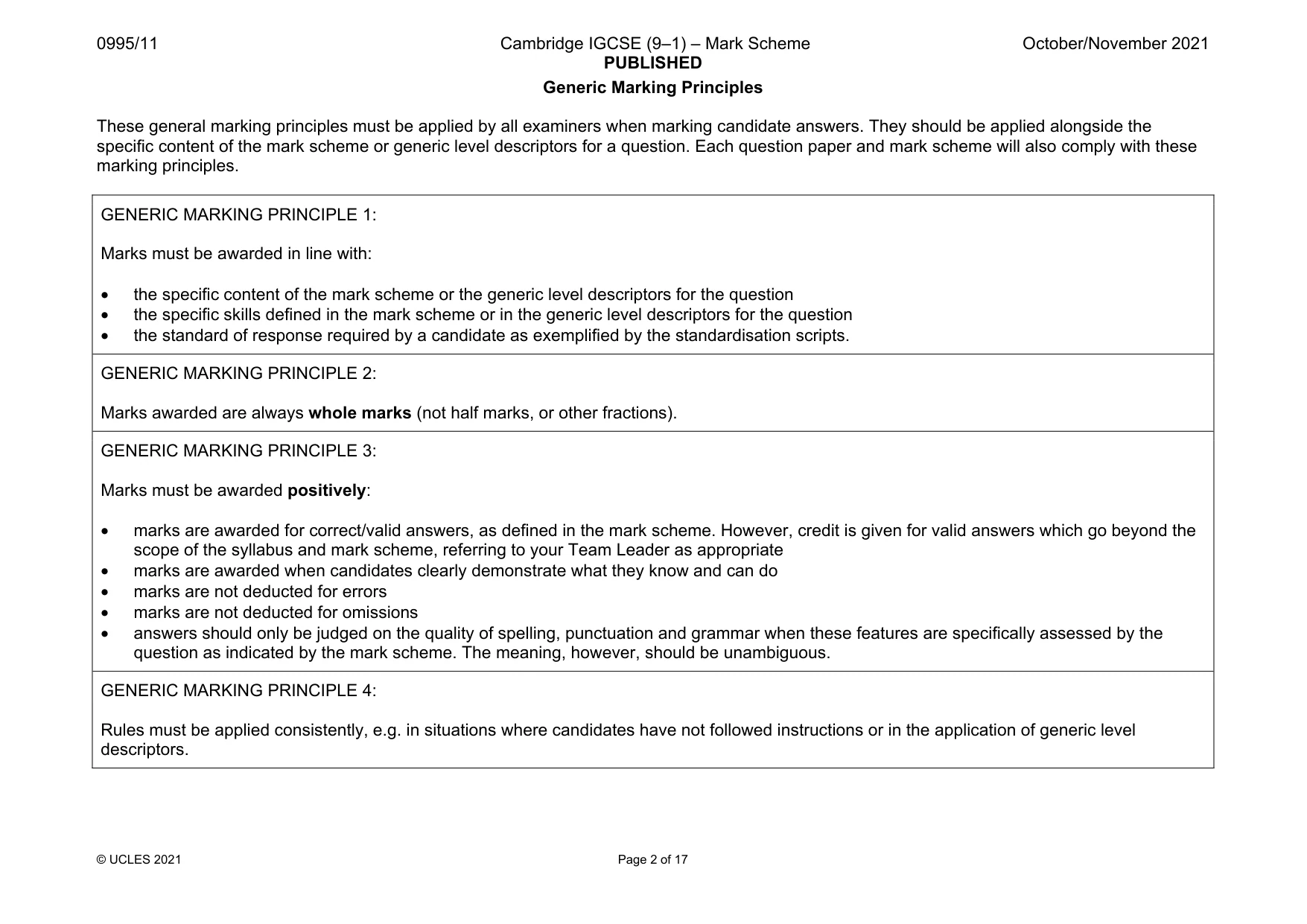
0995/11 Cambridge IGCSE (9–1) – Mark Scheme PUBLISHED October/November 2021 © UCLES 2021 Page 2 of 17 Generic Marking Principles These general marking principles must be applied by all examiners when marking candidate answers. They should be applied alongside the specific content of the mark scheme or generic level descriptors for a question. Each question paper and mark scheme will also comply with these marking principles. GENERIC MARKING PRINCIPLE 1: Marks must be awarded in line with: • the specific content of the mark scheme or the generic level descriptors for the question • the specific skills defined in the mark scheme or in the generic level descriptors for the question • the standard of response required by a candidate as exemplified by the standardisation scripts. GENERIC MARKING PRINCIPLE 2: Marks awarded are always whole marks (not half marks, or other fractions). GENERIC MARKING PRINCIPLE 3: Marks must be awarded positively: • marks are awarded for correct/valid answers, as defined in the mark scheme. However, credit is given for valid answers which go beyond the scope of the syllabus and mark scheme, referring to your Team Leader as appropriate • marks are awarded when candidates clearly demonstrate what they know and can do • marks are not deducted for errors • marks are not deducted for omissions • answers should only be judged on the quality of spelling, punctuation and grammar when these features are specifically assessed by the question as indicated by the mark scheme. The meaning, however, should be unambiguous. GENERIC MARKING PRINCIPLE 4: Rules must be applied consistently, e.g. in situations where candidates have not followed instructions or in the application of generic level descriptors.
Mark scheme, page 3
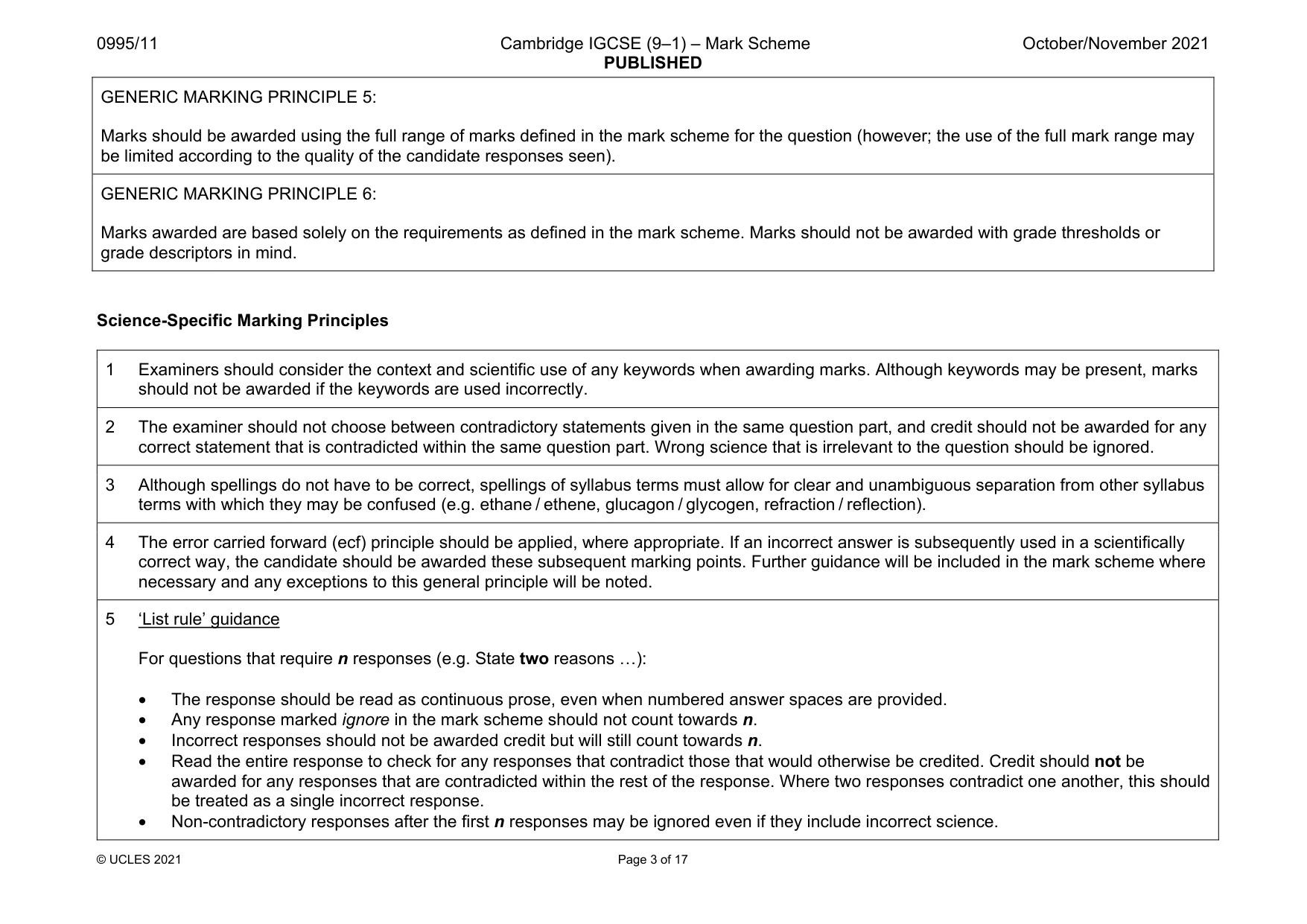
0995/11 Cambridge IGCSE (9–1) – Mark Scheme PUBLISHED October/November 2021 © UCLES 2021 Page 3 of 17 GENERIC MARKING PRINCIPLE 5: Marks should be awarded using the full range of marks defined in the mark scheme for the question (however; the use of the full mark range may be limited according to the quality of the candidate responses seen). GENERIC MARKING PRINCIPLE 6: Marks awarded are based solely on the requirements as defined in the mark scheme. Marks should not be awarded with grade thresholds or grade descriptors in mind. Science-Specific Marking Principles 1 Examiners should consider the context and scientific use of any keywords when awarding marks. Although keywords may be present, marks should not be awarded if the keywords are used incorrectly. 2 The examiner should not choose between contradictory statements given in the same question part, and credit should not be awarded for any correct statement that is contradicted within the same question part. Wrong science that is irrelevant to the question should be ignored. 3 Although spellings do not have to be correct, spellings of syllabus terms must allow for clear and unambiguous separation from other syllabus terms with which they may be confused (e.g. ethane / ethene, glucagon / glycogen, refraction / reflection). 4 The error carried forward (ecf) principle should be applied, where appropriate. If an incorrect answer is subsequently used in a scientifically correct way, the candidate should be awarded these subsequent marking points. Further guidance will be included in the mark scheme where necessary and any exceptions to this general principle will be noted. 5 ‘List rule’ guidance For questions that require n responses (e.g. State two reasons …): • The response should be read as continuous prose, even when numbered answer spaces are provided. • Any response marked ignore in the mark scheme should not count towards n. • Incorrect responses should not be awarded credit but will still count towards n. • Read the entire response to check for any responses that contradict those that would otherwise be credited. Credit should not be awarded for any responses that are contradicted within the rest of the response. Where two responses contradict one another, this should be treated as a single incorrect response. • Non-contradictory responses after the first n responses may be ignored even if they include incorrect science.
Mark scheme, page 4
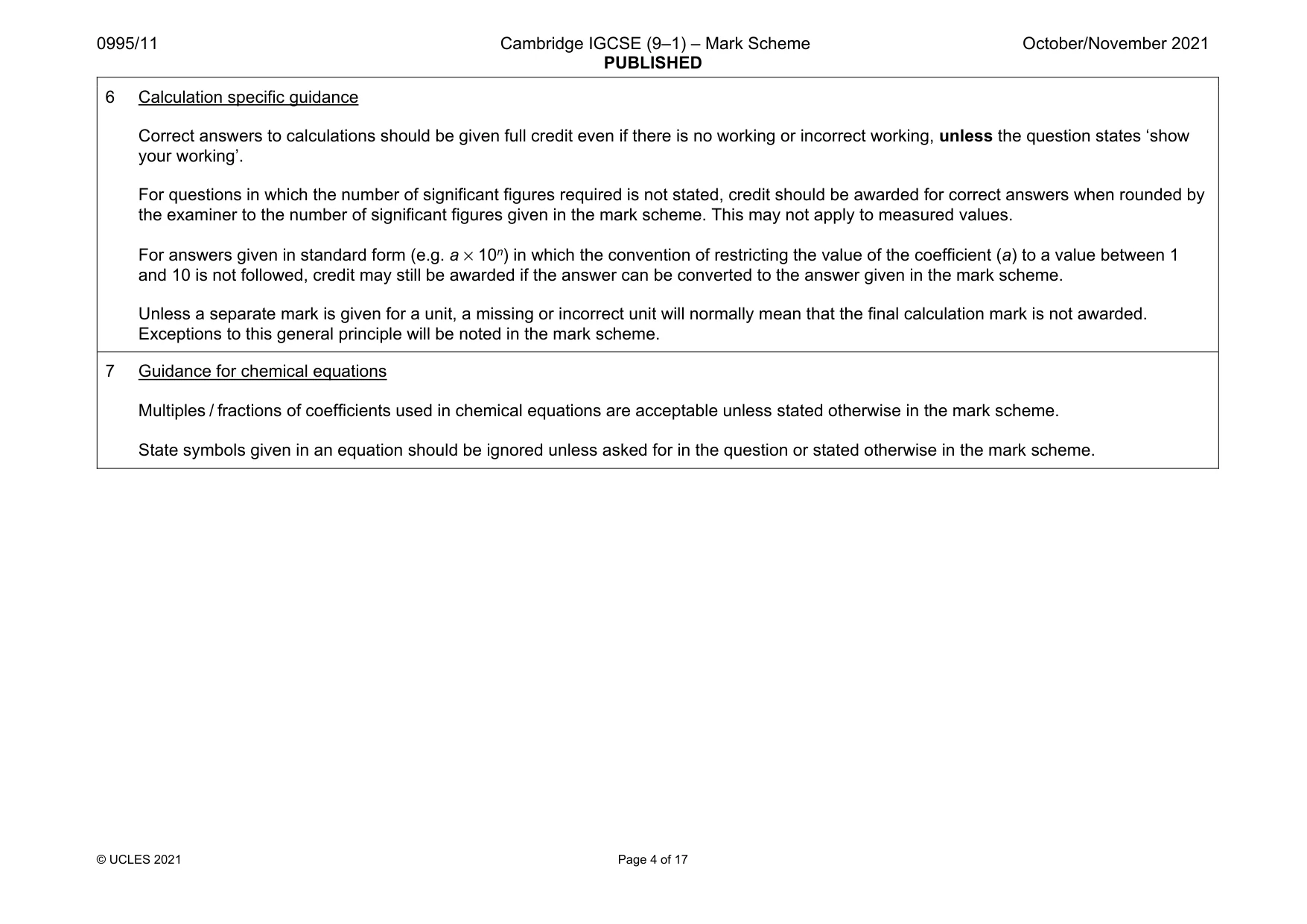
0995/11 Cambridge IGCSE (9–1) – Mark Scheme PUBLISHED October/November 2021 © UCLES 2021 Page 4 of 17 6 Calculation specific guidance Correct answers to calculations should be given full credit even if there is no working or incorrect working, unless the question states ‘show your working’. For questions in which the number of significant figures required is not stated, credit should be awarded for correct answers when rounded by the examiner to the number of significant figures given in the mark scheme. This may not apply to measured values. For answers given in standard form (e.g. a × 10n) in which the convention of restricting the value of the coefficient (a) to a value between 1 and 10 is not followed, credit may still be awarded if the answer can be converted to the answer given in the mark scheme. Unless a separate mark is given for a unit, a missing or incorrect unit will normally mean that the final calculation mark is not awarded. Exceptions to this general principle will be noted in the mark scheme. 7 Guidance for chemical equations Multiples / fractions of coefficients used in chemical equations are acceptable unless stated otherwise in the mark scheme. State symbols given in an equation should be ignored unless asked for in the question or stated otherwise in the mark scheme.
Mark scheme, page 5
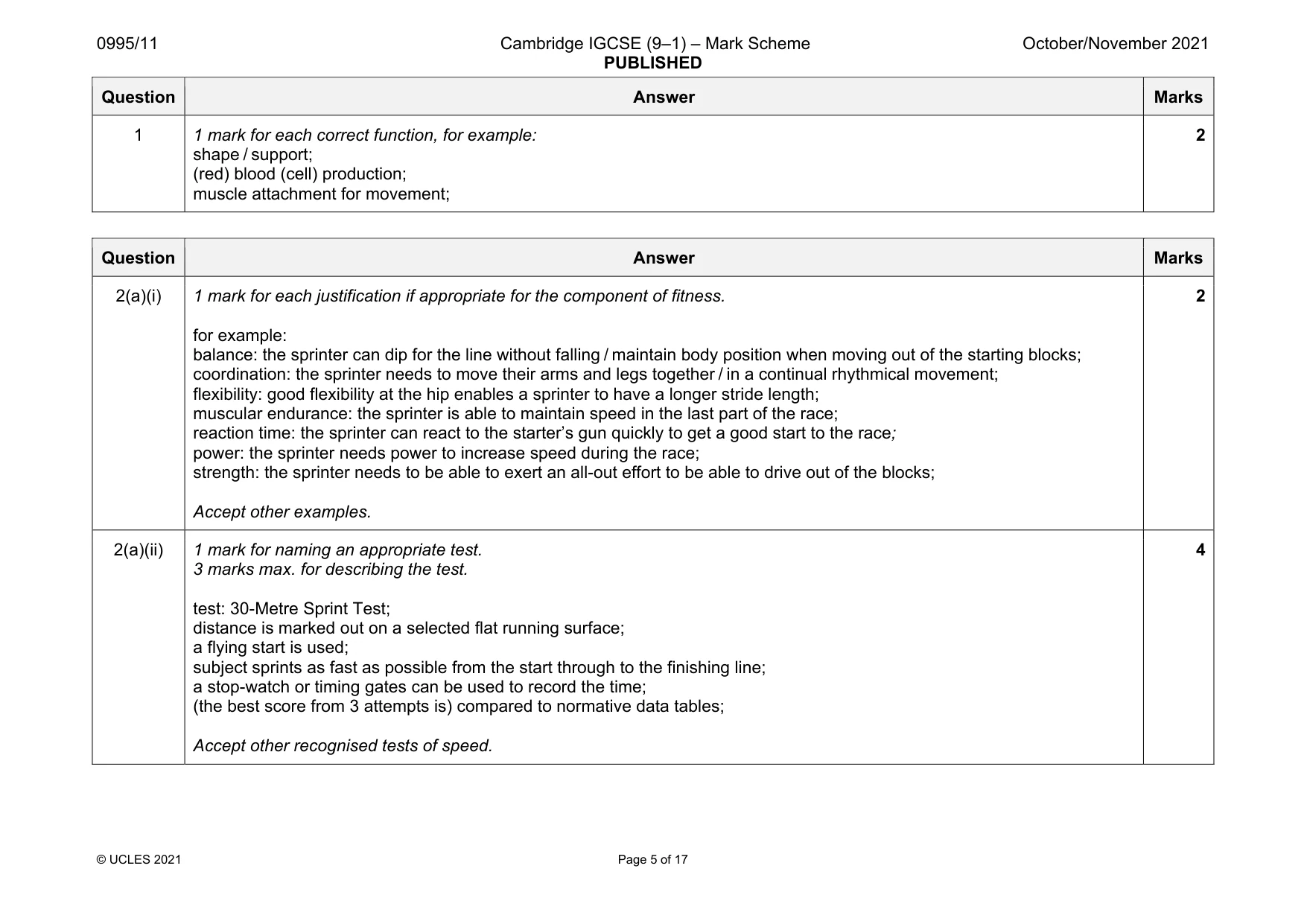
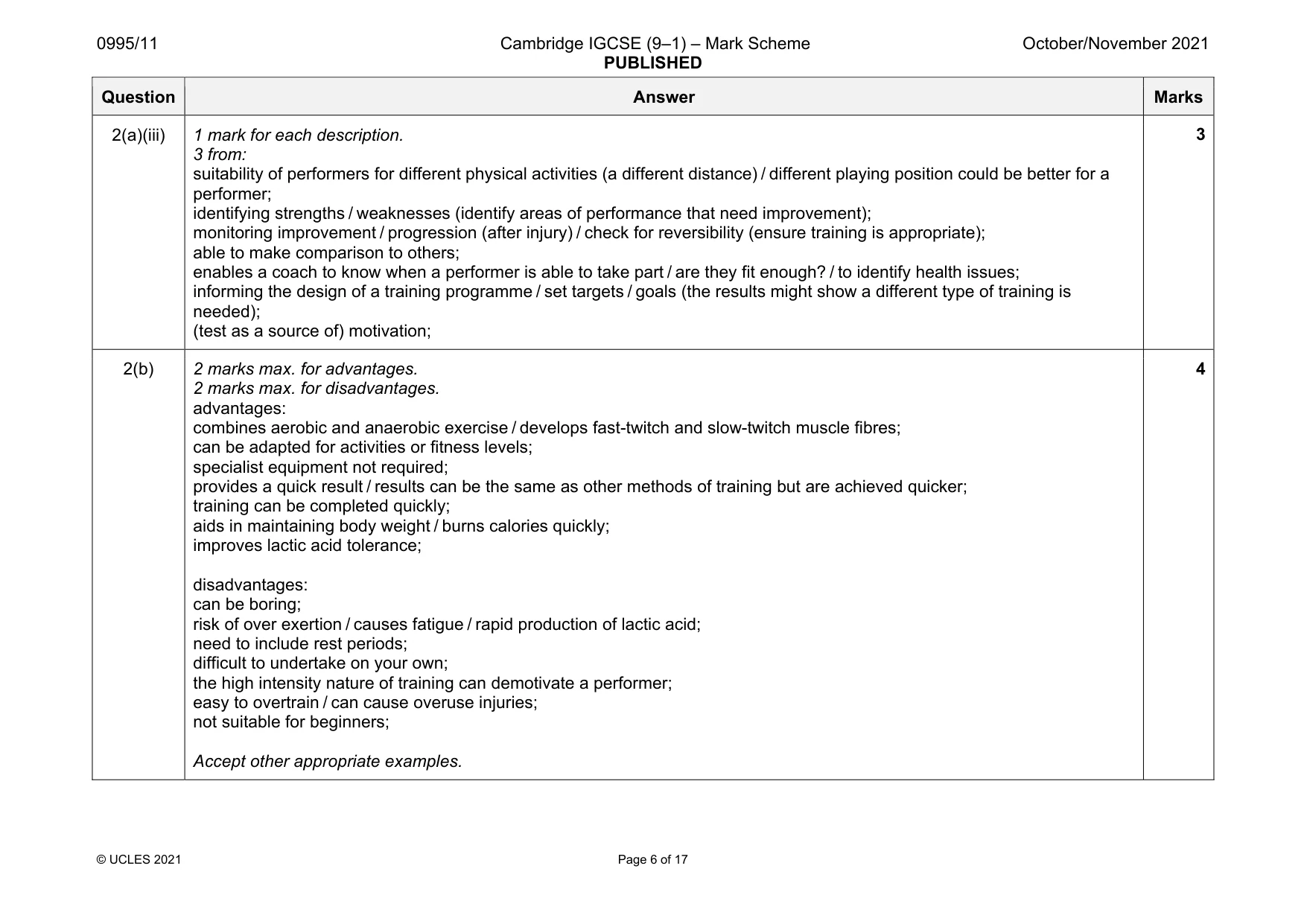
0995/11 Cambridge IGCSE (9–1) – Mark Scheme PUBLISHED October/November 2021 © UCLES 2021 Page 5 of 17 Question Answer Marks 1 1 mark for each correct function, for example: shape / support; (red) blood (cell) production; muscle attachment for movement; 2 Question Answer Marks 2(a)(i) 1 mark for each justification if appropriate for the component of fitness. for example: balance: the sprinter can dip for the line without falling / maintain body position when moving out of the starting blocks; coordination: the sprinter needs to move their arms and legs together / in a continual rhythmical movement; flexibility: good flexibility at the hip enables a sprinter to have a longer stride length; muscular endurance: the sprinter is able to maintain speed in the last part of the race; reaction time: the sprinter can react to the starter’s gun quickly to get a good start to the race; power: the sprinter needs power to increase speed during the race; strength: the sprinter needs to be able to exert an all-out effort to be able to drive out of the blocks; Accept other examples. 2 2(a)(ii) 1 mark for naming an appropriate test. 3 marks max. for describing the test. test: 30-Metre Sprint Test; distance is marked out on a selected flat running surface; a flying start is used; subject sprints as fast as possible from the start through to the finishing line; a stop-watch or timing gates can be used to record the time; (the best score from 3 attempts is) compared to normative data tables; Accept other recognised tests of speed. 4
Mark scheme, page 6
0995/11 Cambridge IGCSE (9–1) – Mark Scheme PUBLISHED October/November 2021 © UCLES 2021 Page 6 of 17 Question Answer Marks 2(a)(iii) 1 mark for each description. 3 from: suitability of performers for different physical activities (a different distance) / different playing position could be better for a performer; identifying strengths / weaknesses (identify areas of performance that need improvement); monitoring improvement / progression (after injury) / check for reversibility (ensure training is appropriate); able to make comparison to others; enables a coach to know when a performer is able to take part / are they fit enough? / to identify health issues; informing the design of a training programme / set targets / goals (the results might show a different type of training is needed); (test as a source of) motivation; 3 2(b) 2 marks max. for advantages. 2 marks max. for disadvantages. advantages: combines aerobic and anaerobic exercise / develops fast-twitch and slow-twitch muscle fibres; can be adapted for activities or fitness levels; specialist equipment not required; provides a quick result / results can be the same as other methods of training but are achieved quicker; training can be completed quickly; aids in maintaining body weight / burns calories quickly; improves lactic acid tolerance; disadvantages: can be boring; risk of over exertion / causes fatigue / rapid production of lactic acid; need to include rest periods; difficult to undertake on your own; the high intensity nature of training can demotivate a performer; easy to overtrain / can cause overuse injuries; not suitable for beginners; Accept other appropriate examples. 4
Mark scheme, page 7
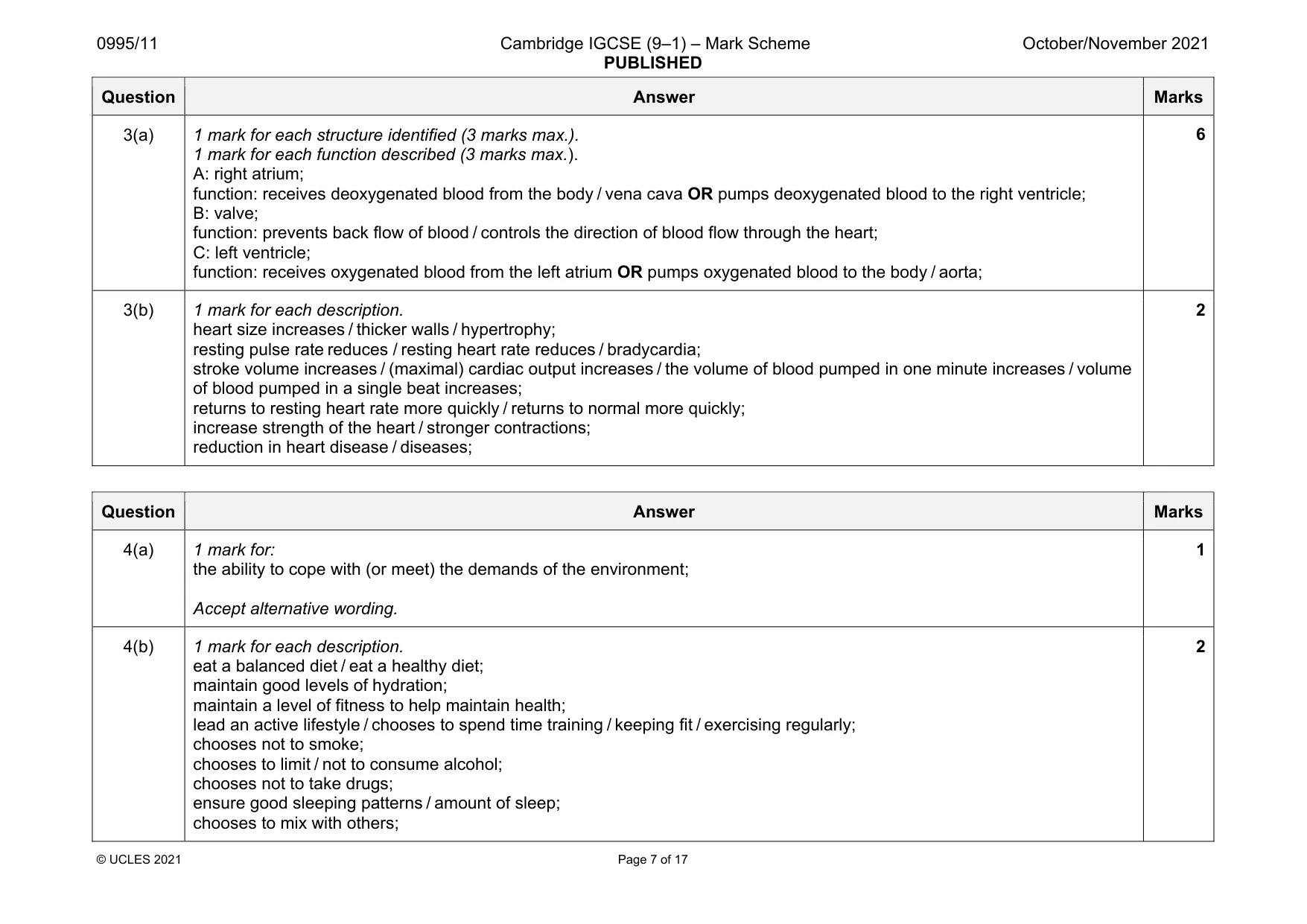
0995/11 Cambridge IGCSE (9–1) – Mark Scheme PUBLISHED October/November 2021 © UCLES 2021 Page 7 of 17 Question Answer Marks 3(a) 1 mark for each structure identified (3 marks max.). 1 mark for each function described (3 marks max.). A: right atrium; function: receives deoxygenated blood from the body / vena cava OR pumps deoxygenated blood to the right ventricle; B: valve; function: prevents back flow of blood / controls the direction of blood flow through the heart; C: left ventricle; function: receives oxygenated blood from the left atrium OR pumps oxygenated blood to the body / aorta; 6 3(b) 1 mark for each description. heart size increases / thicker walls / hypertrophy; resting pulse rate reduces / resting heart rate reduces / bradycardia; stroke volume increases / (maximal) cardiac output increases / the volume of blood pumped in one minute increases / volume of blood pumped in a single beat increases; returns to resting heart rate more quickly / returns to normal more quickly; increase strength of the heart / stronger contractions; reduction in heart disease / diseases; 2 Question Answer Marks 4(a) 1 mark for: the ability to cope with (or meet) the demands of the environment; Accept alternative wording. 1 4(b) 1 mark for each description. eat a balanced diet / eat a healthy diet; maintain good levels of hydration; maintain a level of fitness to help maintain health; lead an active lifestyle / chooses to spend time training / keeping fit / exercising regularly; chooses not to smoke; chooses to limit / not to consume alcohol; chooses not to take drugs; ensure good sleeping patterns / amount of sleep; chooses to mix with others; 2
Mark scheme, page 8
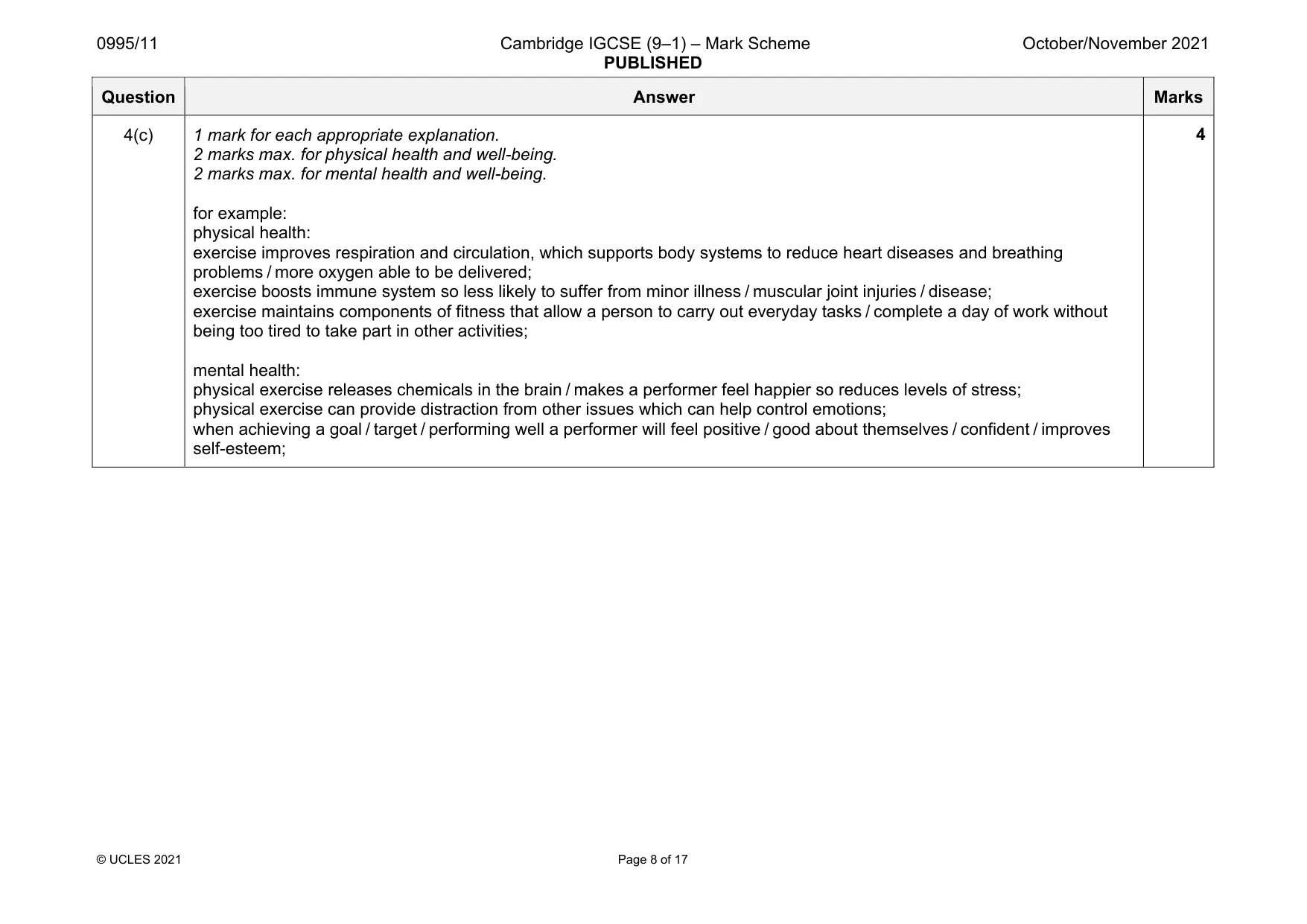
0995/11 Cambridge IGCSE (9–1) – Mark Scheme PUBLISHED October/November 2021 © UCLES 2021 Page 8 of 17 Question Answer Marks 4(c) 1 mark for each appropriate explanation. 2 marks max. for physical health and well-being. 2 marks max. for mental health and well-being. for example: physical health: exercise improves respiration and circulation, which supports body systems to reduce heart diseases and breathing problems / more oxygen able to be delivered; exercise boosts immune system so less likely to suffer from minor illness / muscular joint injuries / disease; exercise maintains components of fitness that allow a person to carry out everyday tasks / complete a day of work without being too tired to take part in other activities; mental health: physical exercise releases chemicals in the brain / makes a performer feel happier so reduces levels of stress; physical exercise can provide distraction from other issues which can help control emotions; when achieving a goal / target / performing well a performer will feel positive / good about themselves / confident / improves self-esteem; 4
Mark scheme, page 9
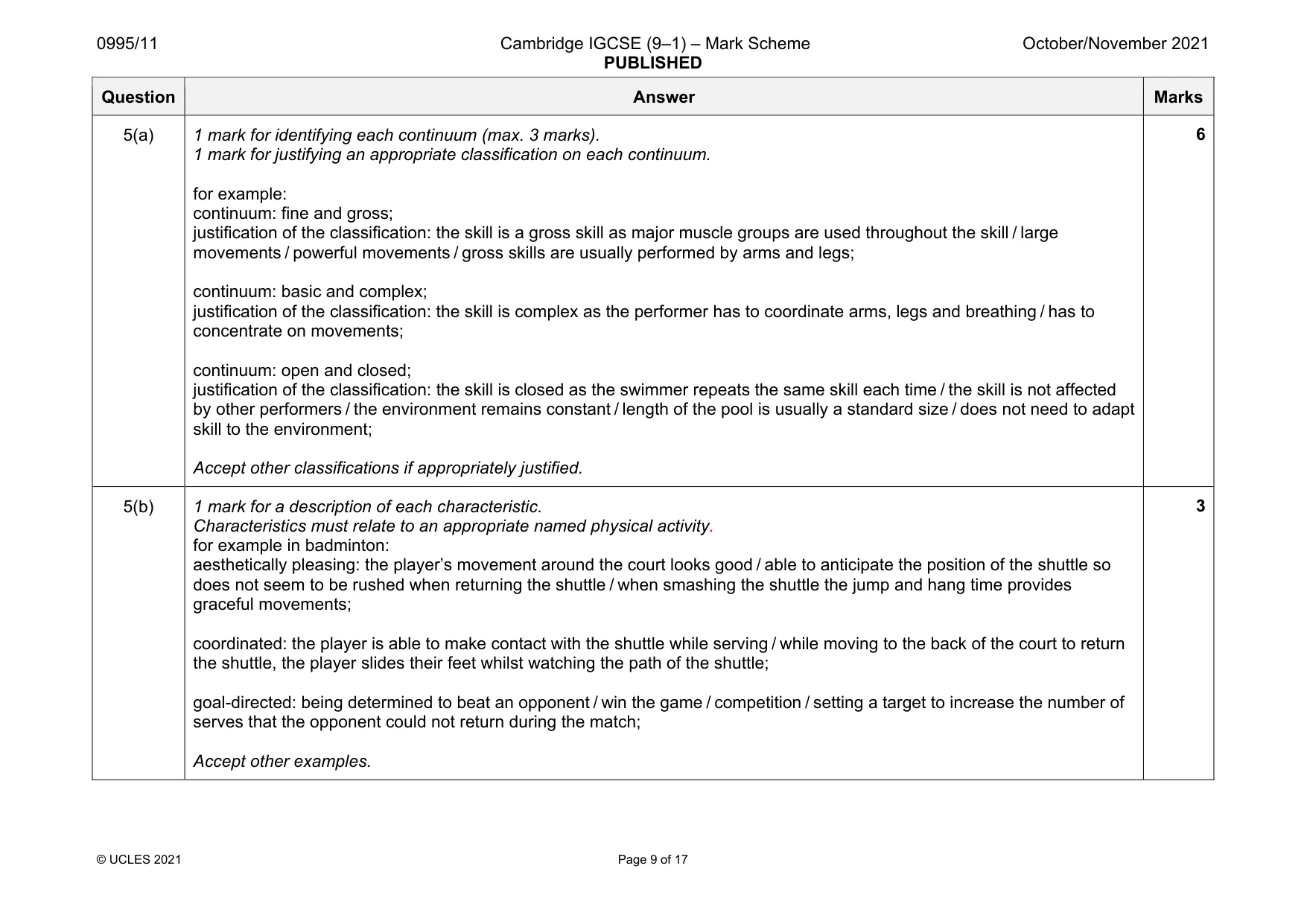
0995/11 Cambridge IGCSE (9–1) – Mark Scheme PUBLISHED October/November 2021 © UCLES 2021 Page 9 of 17 Question Answer Marks 5(a) 1 mark for identifying each continuum (max. 3 marks). 1 mark for justifying an appropriate classification on each continuum. for example: continuum: fine and gross; justification of the classification: the skill is a gross skill as major muscle groups are used throughout the skill / large movements / powerful movements / gross skills are usually performed by arms and legs; continuum: basic and complex; justification of the classification: the skill is complex as the performer has to coordinate arms, legs and breathing / has to concentrate on movements; continuum: open and closed; justification of the classification: the skill is closed as the swimmer repeats the same skill each time / the skill is not affected by other performers / the environment remains constant / length of the pool is usually a standard size / does not need to adapt skill to the environment; Accept other classifications if appropriately justified. 6 5(b) 1 mark for a description of each characteristic. Characteristics must relate to an appropriate named physical activity. for example in badminton: aesthetically pleasing: the player’s movement around the court looks good / able to anticipate the position of the shuttle so does not seem to be rushed when returning the shuttle / when smashing the shuttle the jump and hang time provides graceful movements; coordinated: the player is able to make contact with the shuttle while serving / while moving to the back of the court to return the shuttle, the player slides their feet whilst watching the path of the shuttle; goal-directed: being determined to beat an opponent / win the game / competition / setting a target to increase the number of serves that the opponent could not return during the match; Accept other examples. 3
Mark scheme, page 10
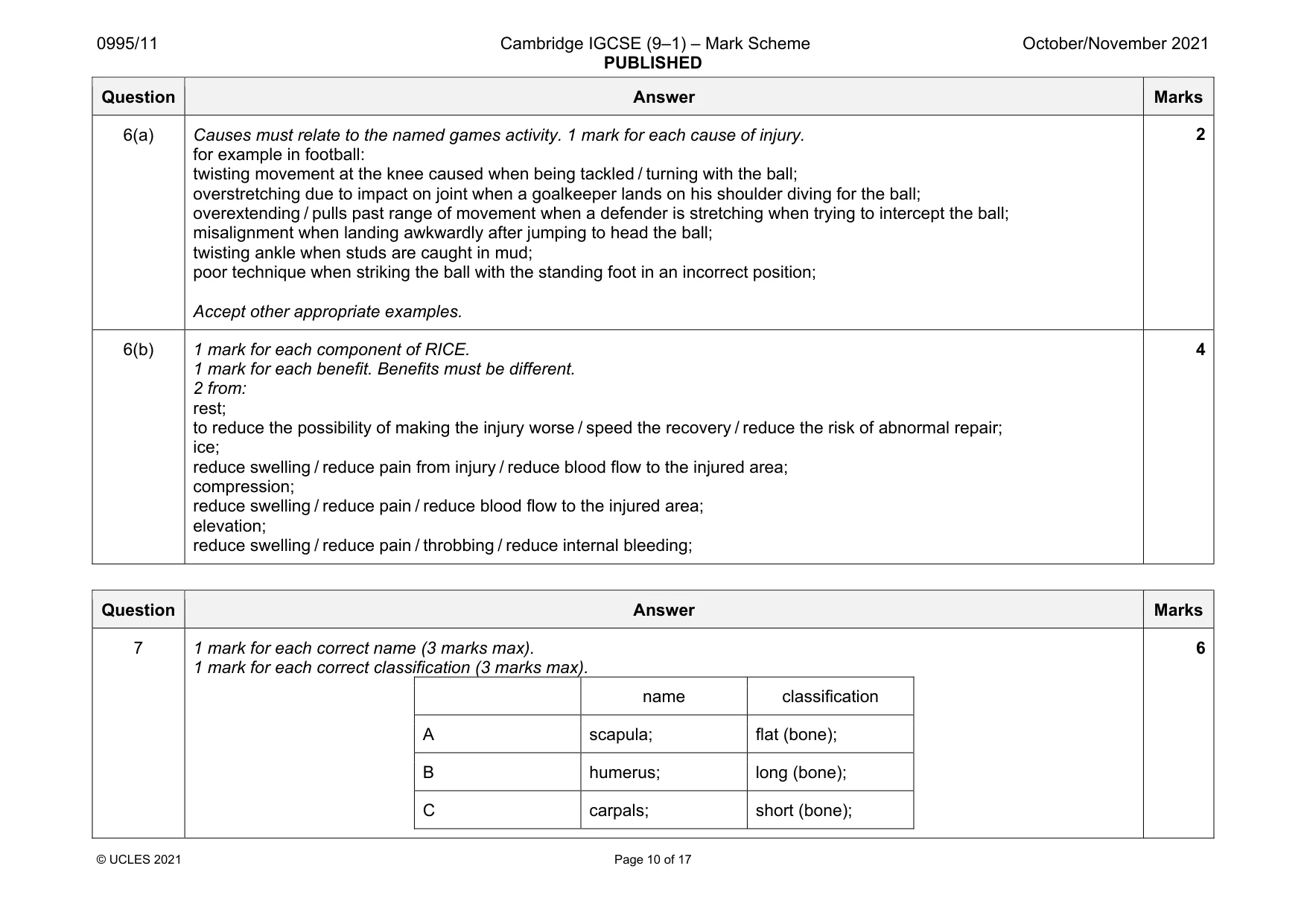
0995/11 Cambridge IGCSE (9–1) – Mark Scheme PUBLISHED October/November 2021 © UCLES 2021 Page 10 of 17 Question Answer Marks 6(a) Causes must relate to the named games activity. 1 mark for each cause of injury. for example in football: twisting movement at the knee caused when being tackled / turning with the ball; overstretching due to impact on joint when a goalkeeper lands on his shoulder diving for the ball; overextending / pulls past range of movement when a defender is stretching when trying to intercept the ball; misalignment when landing awkwardly after jumping to head the ball; twisting ankle when studs are caught in mud; poor technique when striking the ball with the standing foot in an incorrect position; Accept other appropriate examples. 2 6(b) 1 mark for each component of RICE. 1 mark for each benefit. Benefits must be different. 2 from: rest; to reduce the possibility of making the injury worse / speed the recovery / reduce the risk of abnormal repair; ice; reduce swelling / reduce pain from injury / reduce blood flow to the injured area; compression; reduce swelling / reduce pain / reduce blood flow to the injured area; elevation; reduce swelling / reduce pain / throbbing / reduce internal bleeding; 4 Question Answer Marks 7 1 mark for each correct name (3 marks max). 1 mark for each correct classification (3 marks max). name classification A scapula; flat (bone); B humerus; long (bone); C carpals; short (bone); 6
Mark scheme, page 11
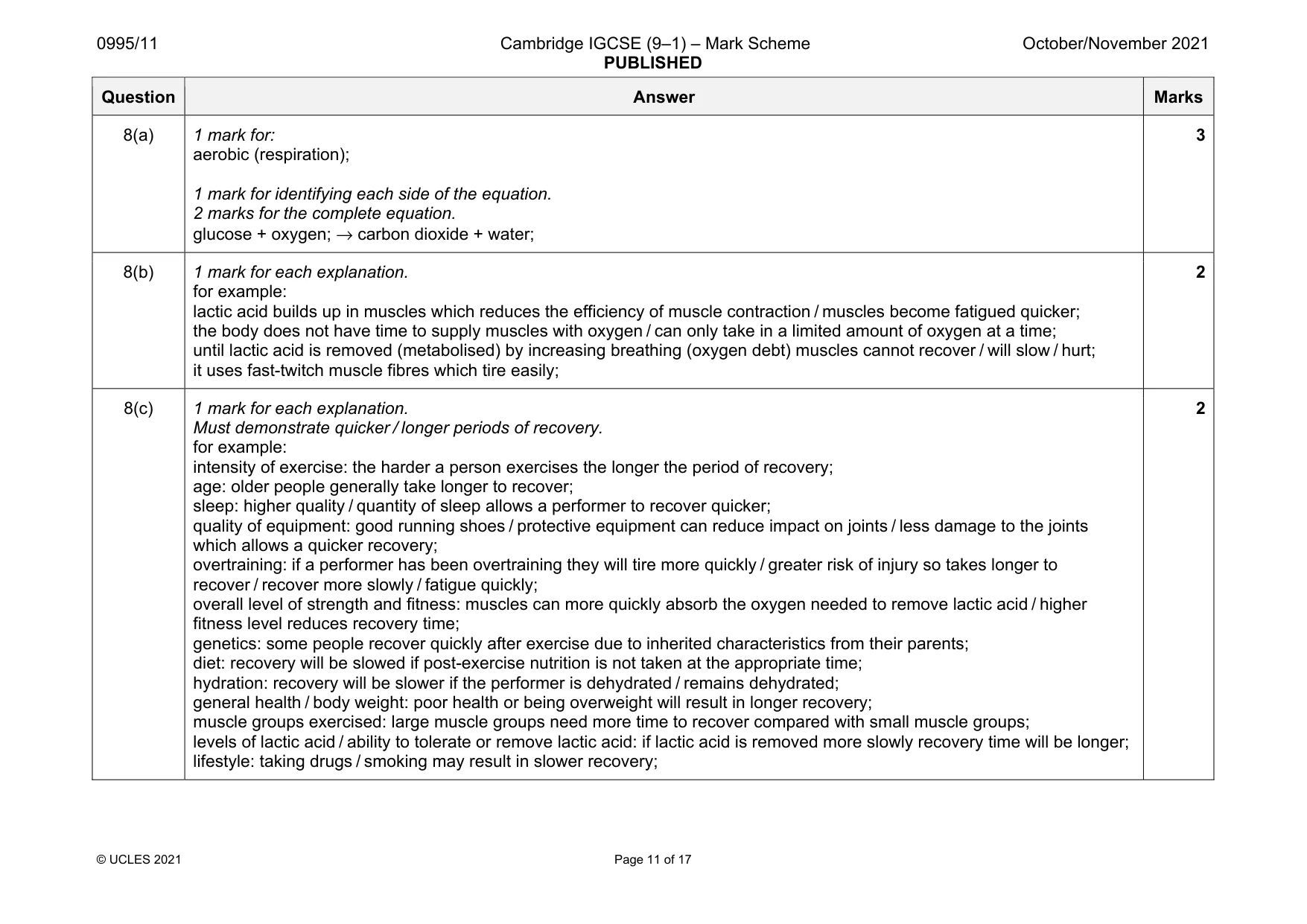
0995/11 Cambridge IGCSE (9–1) – Mark Scheme PUBLISHED October/November 2021 © UCLES 2021 Page 11 of 17 Question Answer Marks 8(a) 1 mark for: aerobic (respiration); 1 mark for identifying each side of the equation. 2 marks for the complete equation. glucose + oxygen; → carbon dioxide + water; 3 8(b) 1 mark for each explanation. for example: lactic acid builds up in muscles which reduces the efficiency of muscle contraction / muscles become fatigued quicker; the body does not have time to supply muscles with oxygen / can only take in a limited amount of oxygen at a time; until lactic acid is removed (metabolised) by increasing breathing (oxygen debt) muscles cannot recover / will slow / hurt; it uses fast-twitch muscle fibres which tire easily; 2 8(c) 1 mark for each explanation. Must demonstrate quicker / longer periods of recovery. for example: intensity of exercise: the harder a person exercises the longer the period of recovery; age: older people generally take longer to recover; sleep: higher quality / quantity of sleep allows a performer to recover quicker; quality of equipment: good running shoes / protective equipment can reduce impact on joints / less damage to the joints which allows a quicker recovery; overtraining: if a performer has been overtraining they will tire more quickly / greater risk of injury so takes longer to recover / recover more slowly / fatigue quickly; overall level of strength and fitness: muscles can more quickly absorb the oxygen needed to remove lactic acid / higher fitness level reduces recovery time; genetics: some people recover quickly after exercise due to inherited characteristics from their parents; diet: recovery will be slowed if post-exercise nutrition is not taken at the appropriate time; hydration: recovery will be slower if the performer is dehydrated / remains dehydrated; general health / body weight: poor health or being overweight will result in longer recovery; muscle groups exercised: large muscle groups need more time to recover compared with small muscle groups; levels of lactic acid / ability to tolerate or remove lactic acid: if lactic acid is removed more slowly recovery time will be longer; lifestyle: taking drugs / smoking may result in slower recovery; 2
Mark scheme, page 12
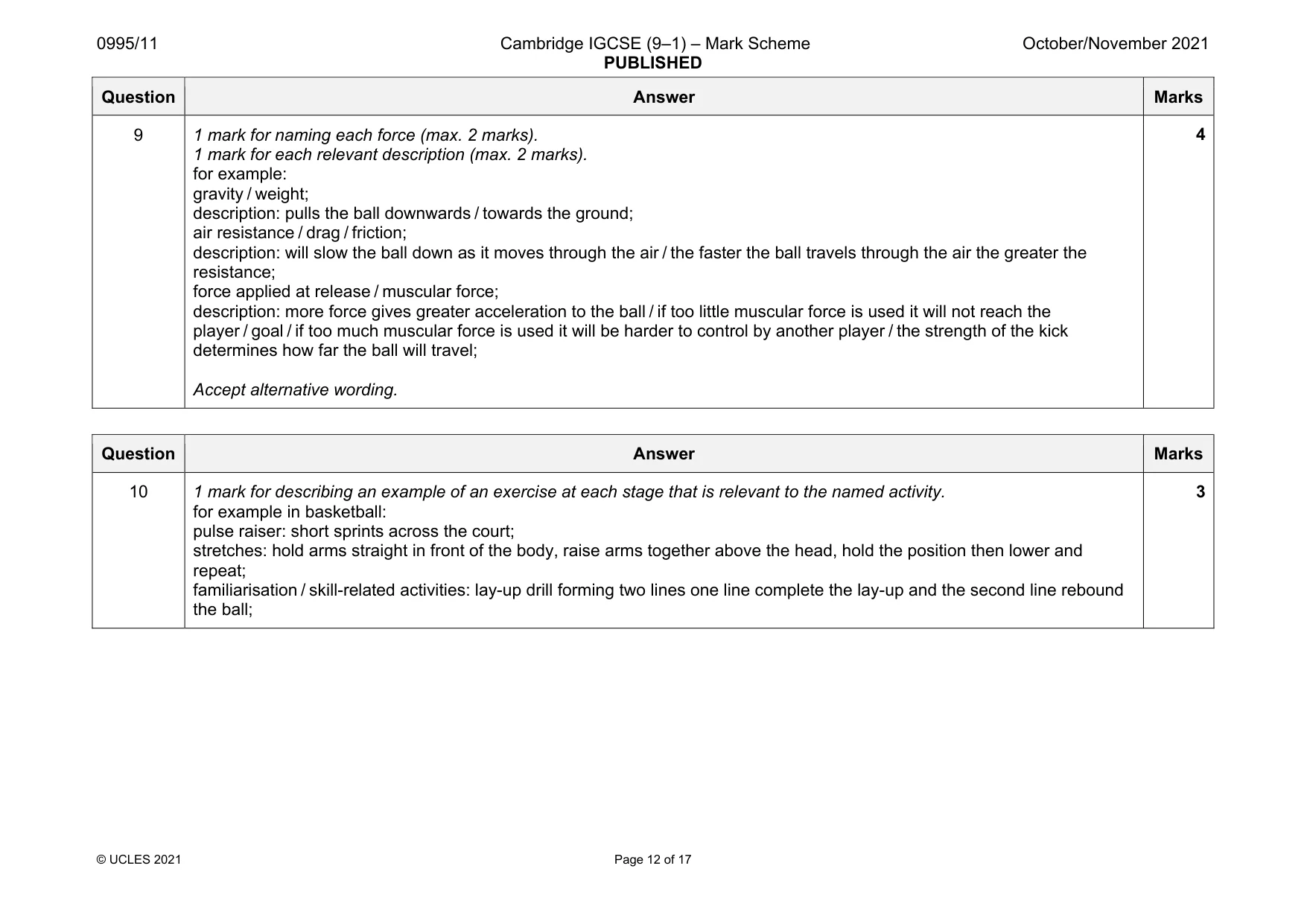
0995/11 Cambridge IGCSE (9–1) – Mark Scheme PUBLISHED October/November 2021 © UCLES 2021 Page 12 of 17 Question Answer Marks 9 1 mark for naming each force (max. 2 marks). 1 mark for each relevant description (max. 2 marks). for example: gravity / weight; description: pulls the ball downwards / towards the ground; air resistance / drag / friction; description: will slow the ball down as it moves through the air / the faster the ball travels through the air the greater the resistance; force applied at release / muscular force; description: more force gives greater acceleration to the ball / if too little muscular force is used it will not reach the player / goal / if too much muscular force is used it will be harder to control by another player / the strength of the kick determines how far the ball will travel; Accept alternative wording. 4 Question Answer Marks 10 1 mark for describing an example of an exercise at each stage that is relevant to the named activity. for example in basketball: pulse raiser: short sprints across the court; stretches: hold arms straight in front of the body, raise arms together above the head, hold the position then lower and repeat; familiarisation / skill-related activities: lay-up drill forming two lines one line complete the lay-up and the second line rebound the ball; 3
Mark scheme, page 13
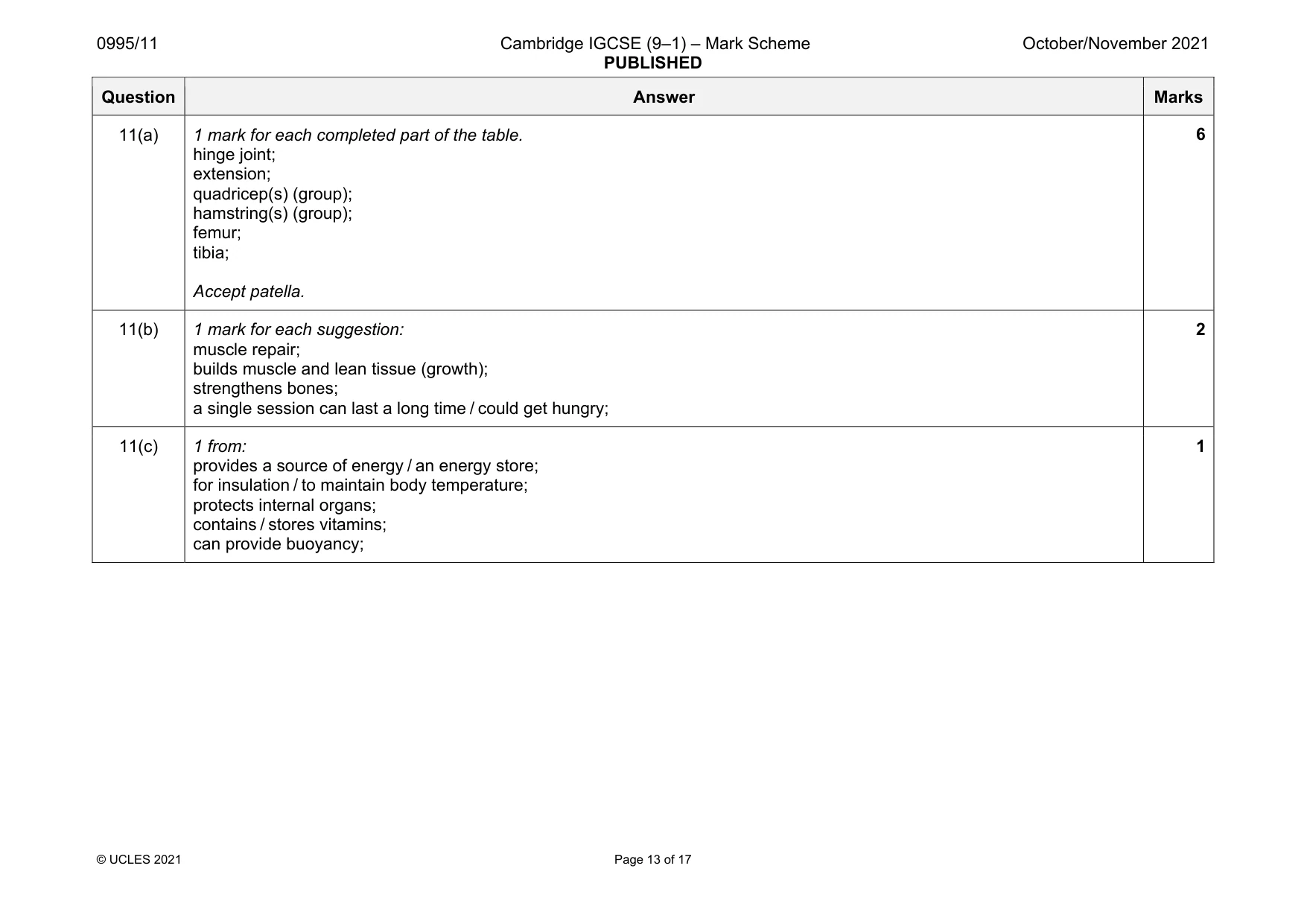
0995/11 Cambridge IGCSE (9–1) – Mark Scheme PUBLISHED October/November 2021 © UCLES 2021 Page 13 of 17 Question Answer Marks 11(a) 1 mark for each completed part of the table. hinge joint; extension; quadricep(s) (group); hamstring(s) (group); femur; tibia; Accept patella. 6 11(b) 1 mark for each suggestion: muscle repair; builds muscle and lean tissue (growth); strengthens bones; a single session can last a long time / could get hungry; 2 11(c) 1 from: provides a source of energy / an energy store; for insulation / to maintain body temperature; protects internal organs; contains / stores vitamins; can provide buoyancy; 1
Mark scheme, page 14
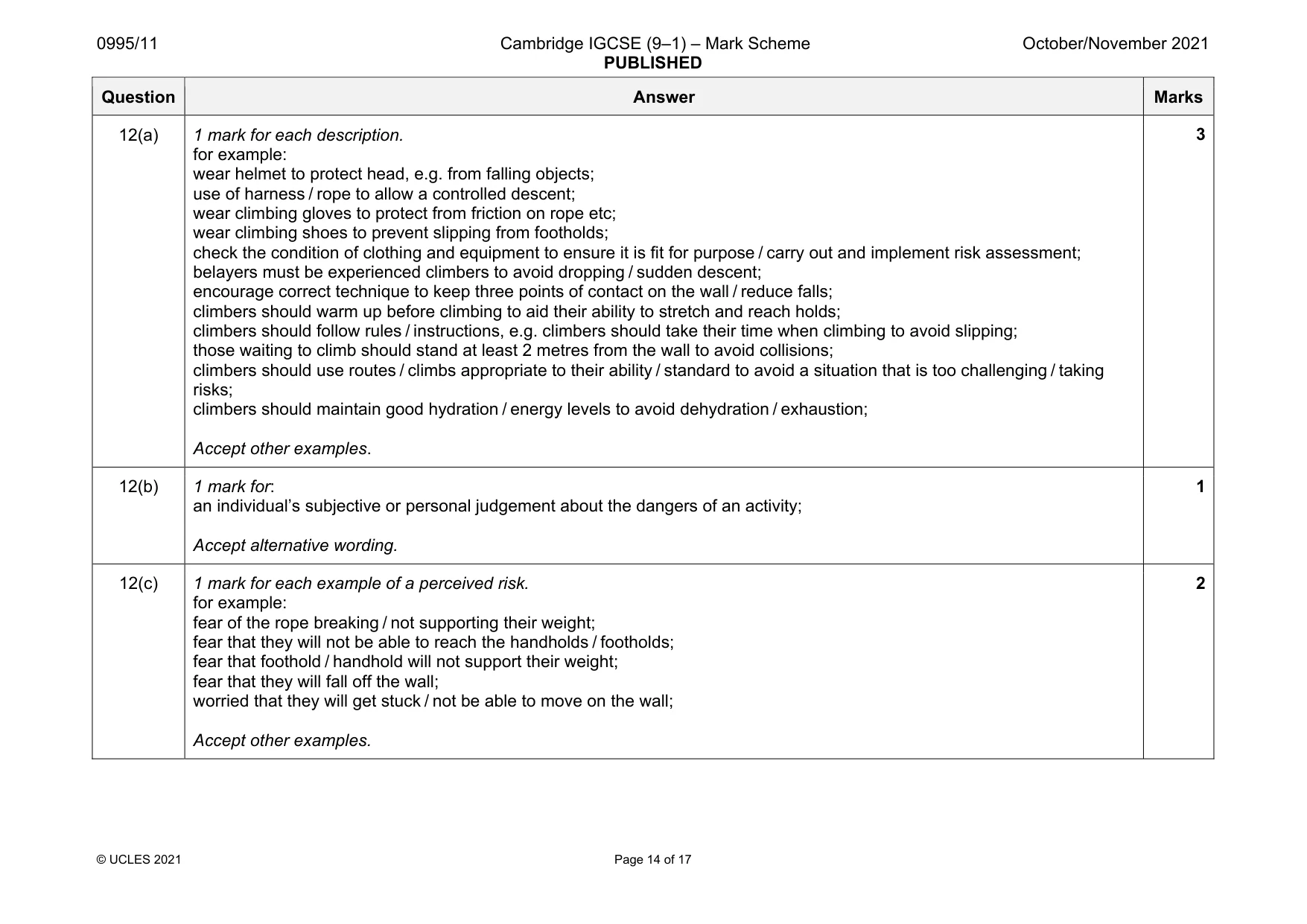
0995/11 Cambridge IGCSE (9–1) – Mark Scheme PUBLISHED October/November 2021 © UCLES 2021 Page 14 of 17 Question Answer Marks 12(a) 1 mark for each description. for example: wear helmet to protect head, e.g. from falling objects; use of harness / rope to allow a controlled descent; wear climbing gloves to protect from friction on rope etc; wear climbing shoes to prevent slipping from footholds; check the condition of clothing and equipment to ensure it is fit for purpose / carry out and implement risk assessment; belayers must be experienced climbers to avoid dropping / sudden descent; encourage correct technique to keep three points of contact on the wall / reduce falls; climbers should warm up before climbing to aid their ability to stretch and reach holds; climbers should follow rules / instructions, e.g. climbers should take their time when climbing to avoid slipping; those waiting to climb should stand at least 2 metres from the wall to avoid collisions; climbers should use routes / climbs appropriate to their ability / standard to avoid a situation that is too challenging / taking risks; climbers should maintain good hydration / energy levels to avoid dehydration / exhaustion; Accept other examples. 3 12(b) 1 mark for: an individual’s subjective or personal judgement about the dangers of an activity; Accept alternative wording. 1 12(c) 1 mark for each example of a perceived risk. for example: fear of the rope breaking / not supporting their weight; fear that they will not be able to reach the handholds / footholds; fear that foothold / handhold will not support their weight; fear that they will fall off the wall; worried that they will get stuck / not be able to move on the wall; Accept other examples. 2
Mark scheme, page 15
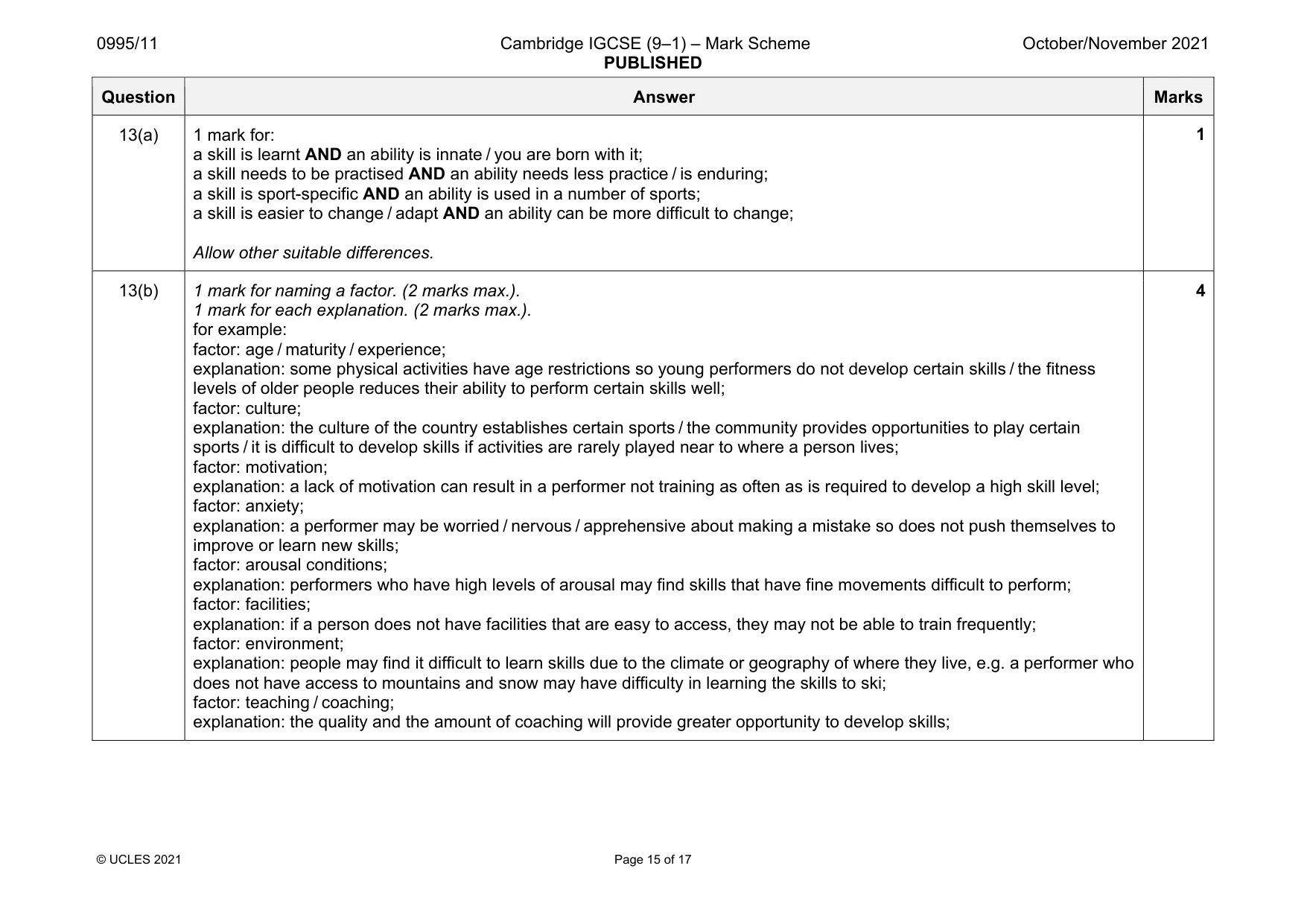
0995/11 Cambridge IGCSE (9–1) – Mark Scheme PUBLISHED October/November 2021 © UCLES 2021 Page 15 of 17 Question Answer Marks 13(a) 1 mark for: a skill is learnt AND an ability is innate / you are born with it; a skill needs to be practised AND an ability needs less practice / is enduring; a skill is sport-specific AND an ability is used in a number of sports; a skill is easier to change / adapt AND an ability can be more difficult to change; Allow other suitable differences. 1 13(b) 1 mark for naming a factor. (2 marks max.). 1 mark for each explanation. (2 marks max.). for example: factor: age / maturity / experience; explanation: some physical activities have age restrictions so young performers do not develop certain skills / the fitness levels of older people reduces their ability to perform certain skills well; factor: culture; explanation: the culture of the country establishes certain sports / the community provides opportunities to play certain sports / it is difficult to develop skills if activities are rarely played near to where a person lives; factor: motivation; explanation: a lack of motivation can result in a performer not training as often as is required to develop a high skill level; factor: anxiety; explanation: a performer may be worried / nervous / apprehensive about making a mistake so does not push themselves to improve or learn new skills; factor: arousal conditions; explanation: performers who have high levels of arousal may find skills that have fine movements difficult to perform; factor: facilities; explanation: if a person does not have facilities that are easy to access, they may not be able to train frequently; factor: environment; explanation: people may find it difficult to learn skills due to the climate or geography of where they live, e.g. a performer who does not have access to mountains and snow may have difficulty in learning the skills to ski; factor: teaching / coaching; explanation: the quality and the amount of coaching will provide greater opportunity to develop skills; 4
Mark scheme, page 16
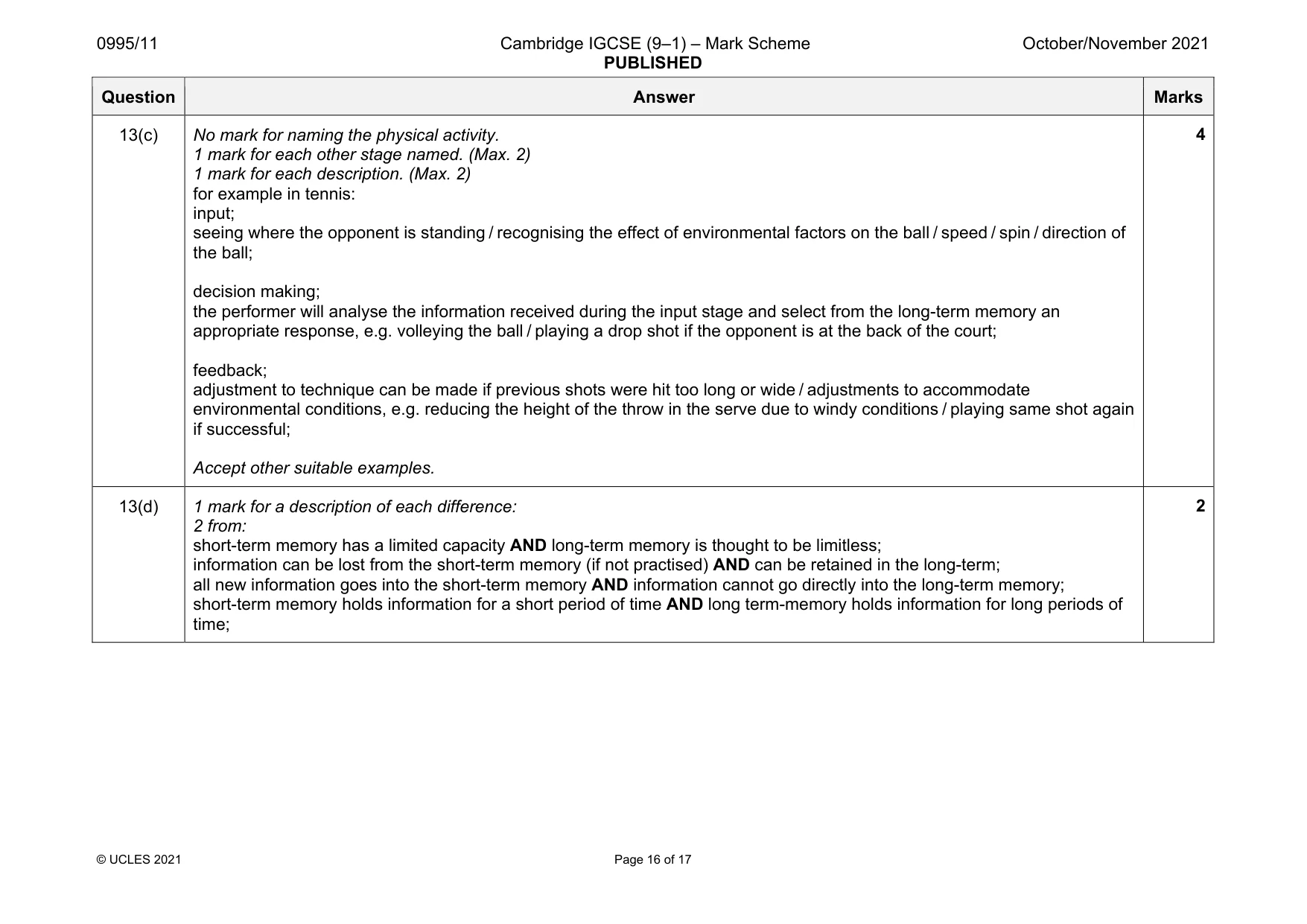
0995/11 Cambridge IGCSE (9–1) – Mark Scheme PUBLISHED October/November 2021 © UCLES 2021 Page 16 of 17 Question Answer Marks 13(c) No mark for naming the physical activity. 1 mark for each other stage named. (Max. 2) 1 mark for each description. (Max. 2) for example in tennis: input; seeing where the opponent is standing / recognising the effect of environmental factors on the ball / speed / spin / direction of the ball; decision making; the performer will analyse the information received during the input stage and select from the long-term memory an appropriate response, e.g. volleying the ball / playing a drop shot if the opponent is at the back of the court; feedback; adjustment to technique can be made if previous shots were hit too long or wide / adjustments to accommodate environmental conditions, e.g. reducing the height of the throw in the serve due to windy conditions / playing same shot again if successful; Accept other suitable examples. 4 13(d) 1 mark for a description of each difference: 2 from: short-term memory has a limited capacity AND long-term memory is thought to be limitless; information can be lost from the short-term memory (if not practised) AND can be retained in the long-term; all new information goes into the short-term memory AND information cannot go directly into the long-term memory; short-term memory holds information for a short period of time AND long term-memory holds information for long periods of time; 2
Mark scheme, page 17
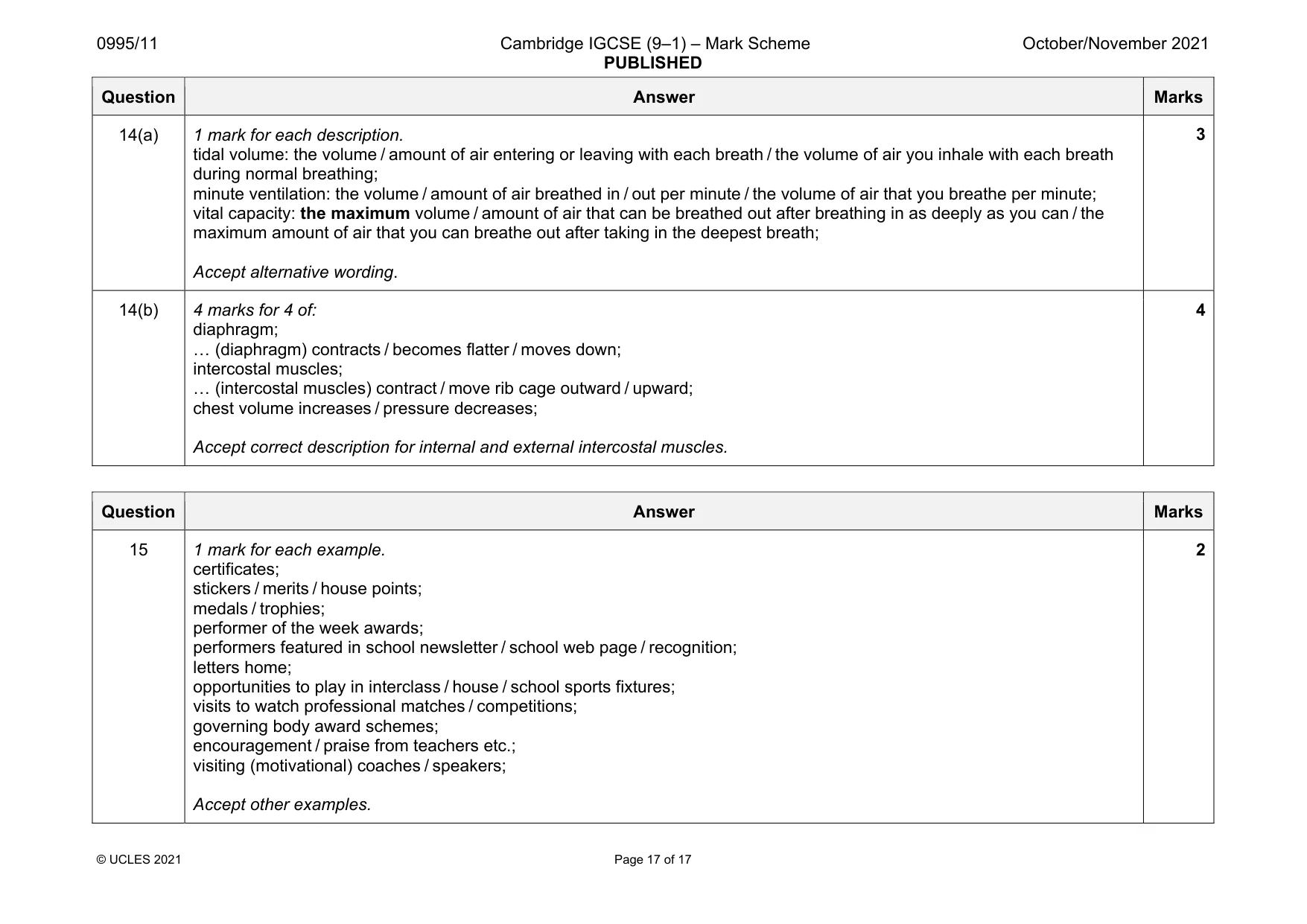
0995/11 Cambridge IGCSE (9–1) – Mark Scheme PUBLISHED October/November 2021 © UCLES 2021 Page 17 of 17 Question Answer Marks 14(a) 1 mark for each description. tidal volume: the volume / amount of air entering or leaving with each breath / the volume of air you inhale with each breath during normal breathing; minute ventilation: the volume / amount of air breathed in / out per minute / the volume of air that you breathe per minute; vital capacity: the maximum volume / amount of air that can be breathed out after breathing in as deeply as you can / the maximum amount of air that you can breathe out after taking in the deepest breath; Accept alternative wording. 3 14(b) 4 marks for 4 of: diaphragm; … (diaphragm) contracts / becomes flatter / moves down; intercostal muscles; … (intercostal muscles) contract / move rib cage outward / upward; chest volume increases / pressure decreases; Accept correct description for internal and external intercostal muscles. 4 Question Answer Marks 15 1 mark for each example. certificates; stickers / merits / house points; medals / trophies; performer of the week awards; performers featured in school newsletter / school web page / recognition; letters home; opportunities to play in interclass / house / school sports fixtures; visits to watch professional matches / competitions; governing body award schemes; encouragement / praise from teachers etc.; visiting (motivational) coaches / speakers; Accept other examples. 2
What you needed in this session
Cambridge’s own grade thresholds for 2021 Oct/Nov, Paper 1 · Variant 1. A higher threshold means an easier paper — the bar moves with how the cohort did.