Cambridge IGCSE Physical Education (9-1) 0995 — 2020 Oct/Nov Paper 1 · Variant 1
0995/11/O/N/20 · 100 marks · ≈113 min
The question paper and its mark scheme, free to read here and free to download. This is Cambridge’s own paper, exactly as it was sat.
Question paper20 pages



Mark scheme17 pages
Answers below. Sit the paper first if you are practising.
Paper as text
Question paper, page 1
DC (MB) 207580 © UCLES 2020 [Turn over This document has 20 pages. Blank pages are indicated. * 2 4 7 3 3 2 9 1 8 2 * PHYSICAL EDUCATION 0995/11 Paper 1 Theory October/November 2020 1 hour 45 minutes You must answer on the question paper. No additional materials are needed. INSTRUCTIONS ● Answer all questions. ● Use a black or dark blue pen. You may use an HB pencil for any diagrams or graphs. ● Write your name, centre number and candidate number in the boxes at the top of the page. ● Write your answer to each question in the space provided. ● Do not use an erasable pen or correction fluid. ● Do not write on any bar codes. ● You may use a calculator. ● You should show all your working and use appropriate units. INFORMATION ● The total mark for this paper is 100. ● The number of marks for each question or part question is shown in brackets [ ]. Cambridge IGCSE™(9–1)
Question paper, page 2
2 0995/11/O/N/20 © UCLES 2020 1 State two muscle fibre types. 1 … 2 … [2] 2 (a) Name a global sporting event. … [1] (b) Describe the advantages of being the host nation of a global event. … … … … … … … … … … [5] [Total: 6]
Question paper, page 3
3 0995/11/O/N/20 © UCLES 2020 [Turn over 3 (a) Describe examples of mechanical guidance in two different physical activities. physical activity 1 … example 1 … … physical activity 2 … example 2 … … [2] (b) (i) Identify the first stage and the final stage of learning. first stage … final stage … [2] (ii) Suggest how the way a coach gives feedback may differ between performers in the first stage of learning and performers in the final stage of learning. … … … … … … [3] (iii) State how intrinsic feedback benefits a performer in the final stage of learning. … … [1] [Total: 8]
Question paper, page 4
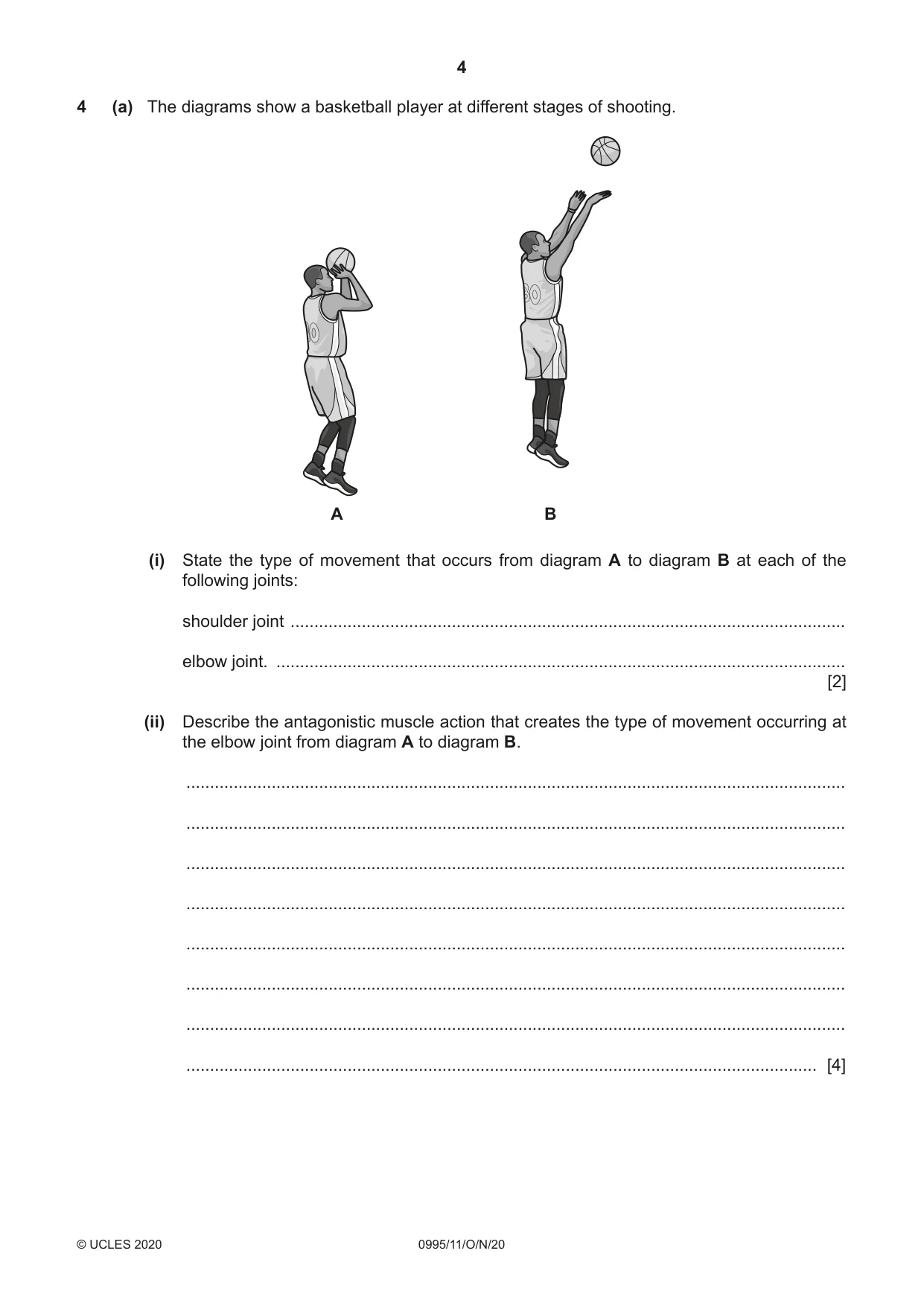
4 0995/11/O/N/20 © UCLES 2020 4 (a) The diagrams show a basketball player at different stages of shooting. A B (i) State the type of movement that occurs from diagram A to diagram B at each of the following joints: shoulder joint … elbow joint. … [2] (ii) Describe the antagonistic muscle action that creates the type of movement occurring at the elbow joint from diagram A to diagram B. … … … … … … … … [4]
Question paper, page 5
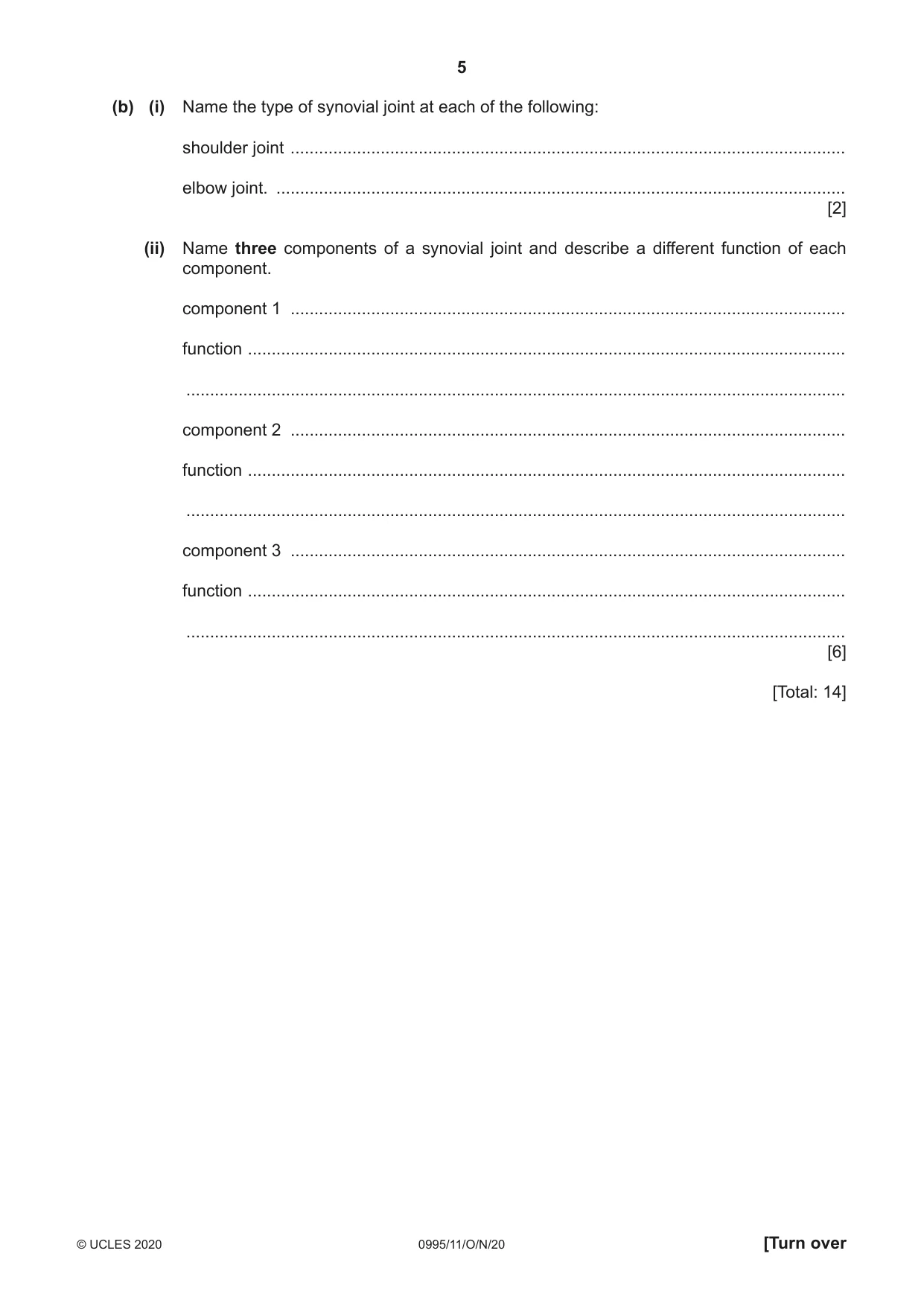
5 0995/11/O/N/20 © UCLES 2020 [Turn over (b) (i) Name the type of synovial joint at each of the following: shoulder joint … elbow joint. … [2] (ii) Name three components of a synovial joint and describe a different function of each component. component 1 … function … … component 2 … function … … component 3 … function … … [6] [Total: 14]
Question paper, page 6
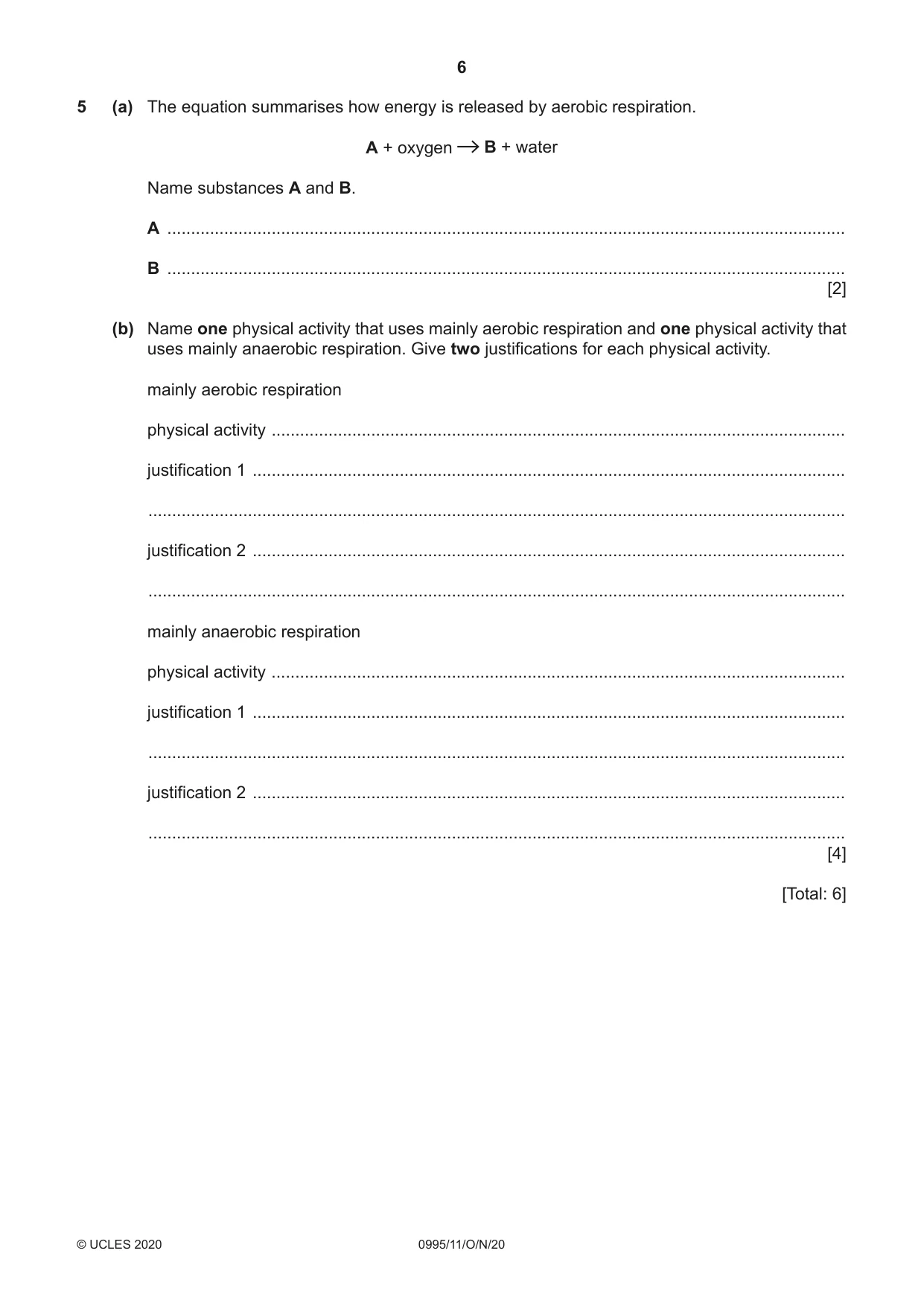
6 0995/11/O/N/20 © UCLES 2020 5 (a) The equation summarises how energy is released by aerobic respiration. A + oxygen B + water Name substances A and B. A … B … [2] (b) Name one physical activity that uses mainly aerobic respiration and one physical activity that uses mainly anaerobic respiration. Give two justifications for each physical activity. mainly aerobic respiration physical activity … justification 1 … … justification 2 … … mainly anaerobic respiration physical activity … justification 1 … … justification 2 … … [4] [Total: 6]
Question paper, page 7
7 0995/11/O/N/20 © UCLES 2020 [Turn over BLANK PAGE
Question paper, page 8
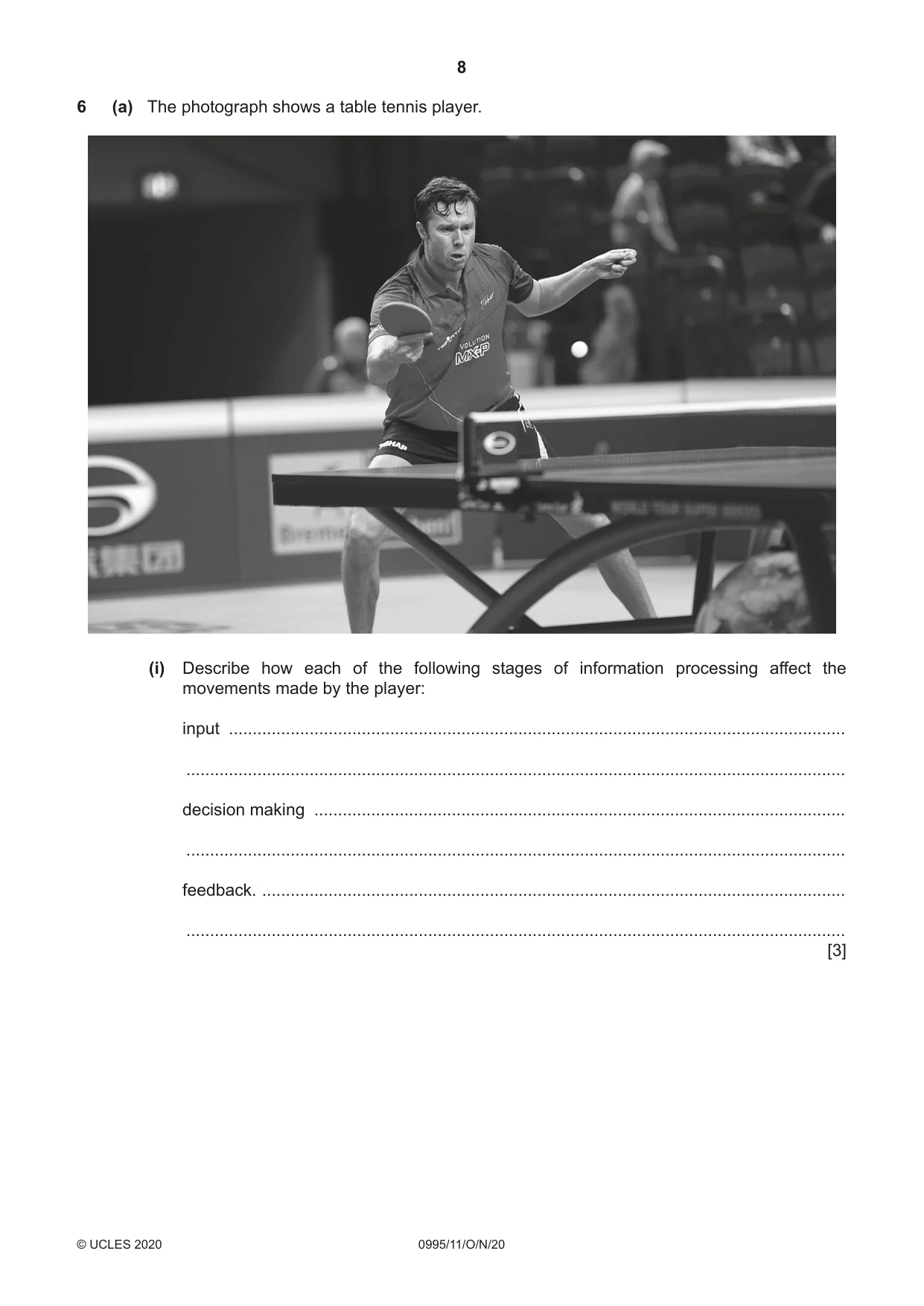
8 0995/11/O/N/20 © UCLES 2020 6 (a) The photograph shows a table tennis player. (i) Describe how each of the following stages of information processing affect the movements made by the player: input … … decision making … … feedback. … … [3]
Question paper, page 9
9 0995/11/O/N/20 © UCLES 2020 [Turn over (ii) Explain the concept of the single-channel hypothesis and how it might affect the table tennis player. … … … … … … [2] (b) Describe two differences between short-term memory and long-term memory. 1 … … 2 … … [2] [Total: 7] 7 Describe three ways the recreational activities a young person takes part in may be influenced by their family. 1 … … 2 … … 3 … … [3]
Question paper, page 10
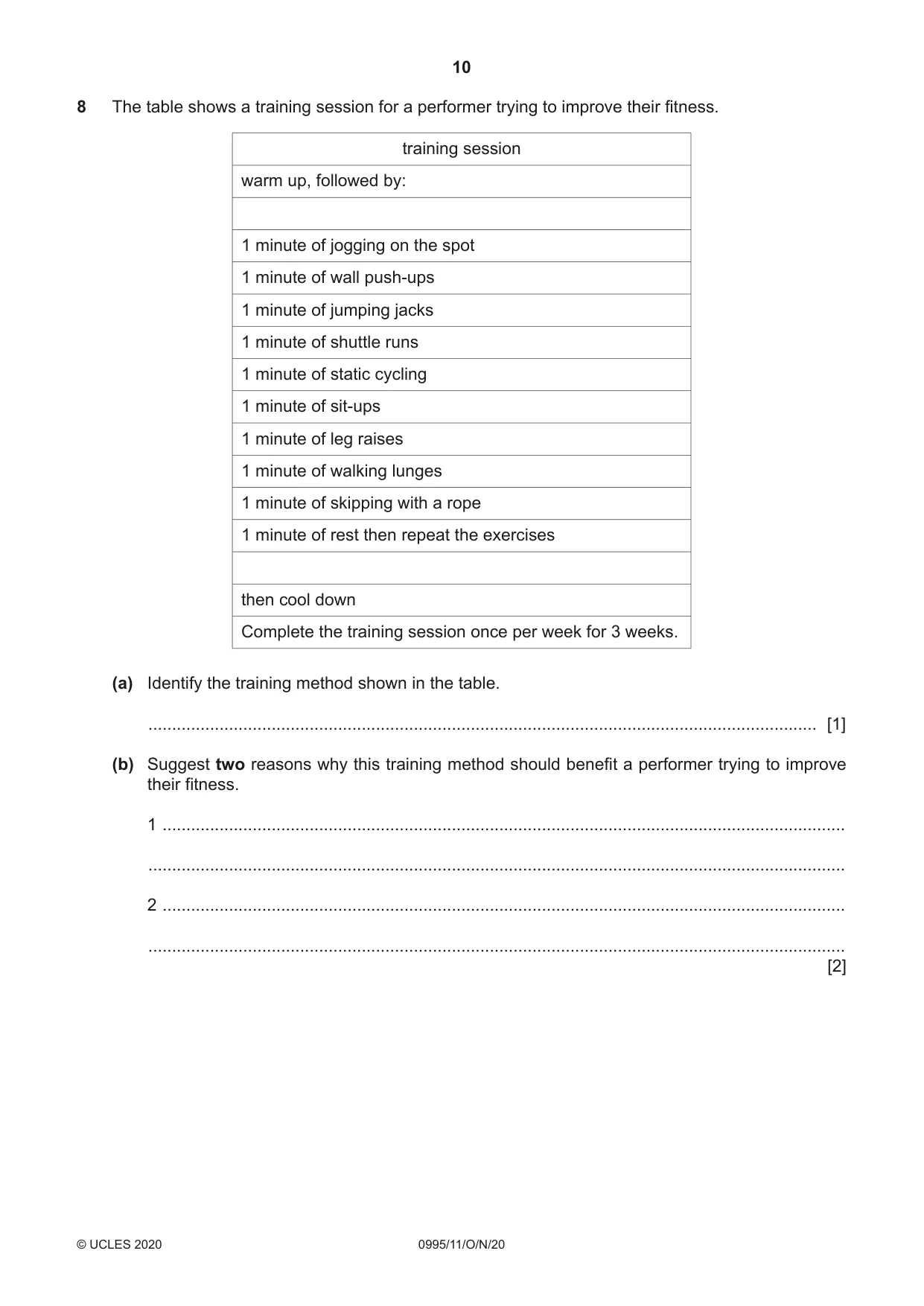
10 0995/11/O/N/20 © UCLES 2020 8 The table shows a training session for a performer trying to improve their fitness. training session warm up, followed by: 1 minute of jogging on the spot 1 minute of wall push-ups 1 minute of jumping jacks 1 minute of shuttle runs 1 minute of static cycling 1 minute of sit-ups 1 minute of leg raises 1 minute of walking lunges 1 minute of skipping with a rope 1 minute of rest then repeat the exercises then cool down Complete the training session once per week for 3 weeks. (a) Identify the training method shown in the table. … [1] (b) Suggest two reasons why this training method should benefit a performer trying to improve their fitness. 1 … … 2 … … [2]
Question paper, page 11
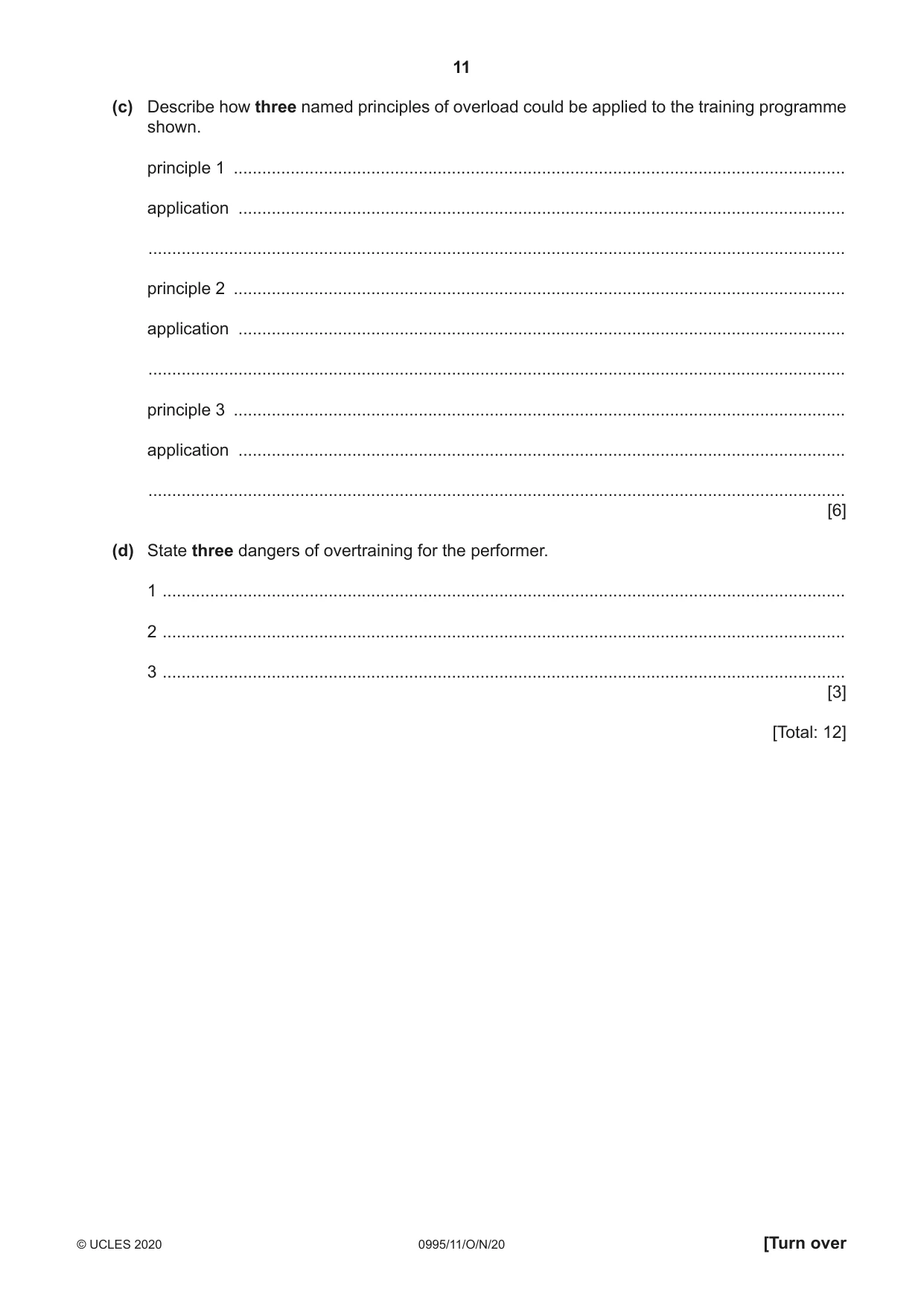
11 0995/11/O/N/20 © UCLES 2020 [Turn over (c) Describe how three named principles of overload could be applied to the training programme shown. principle 1 … application … … principle 2 … application … … principle 3 … application … … [6] (d) State three dangers of overtraining for the performer. 1 … 2 … 3 … [3] [Total: 12]
Question paper, page 12
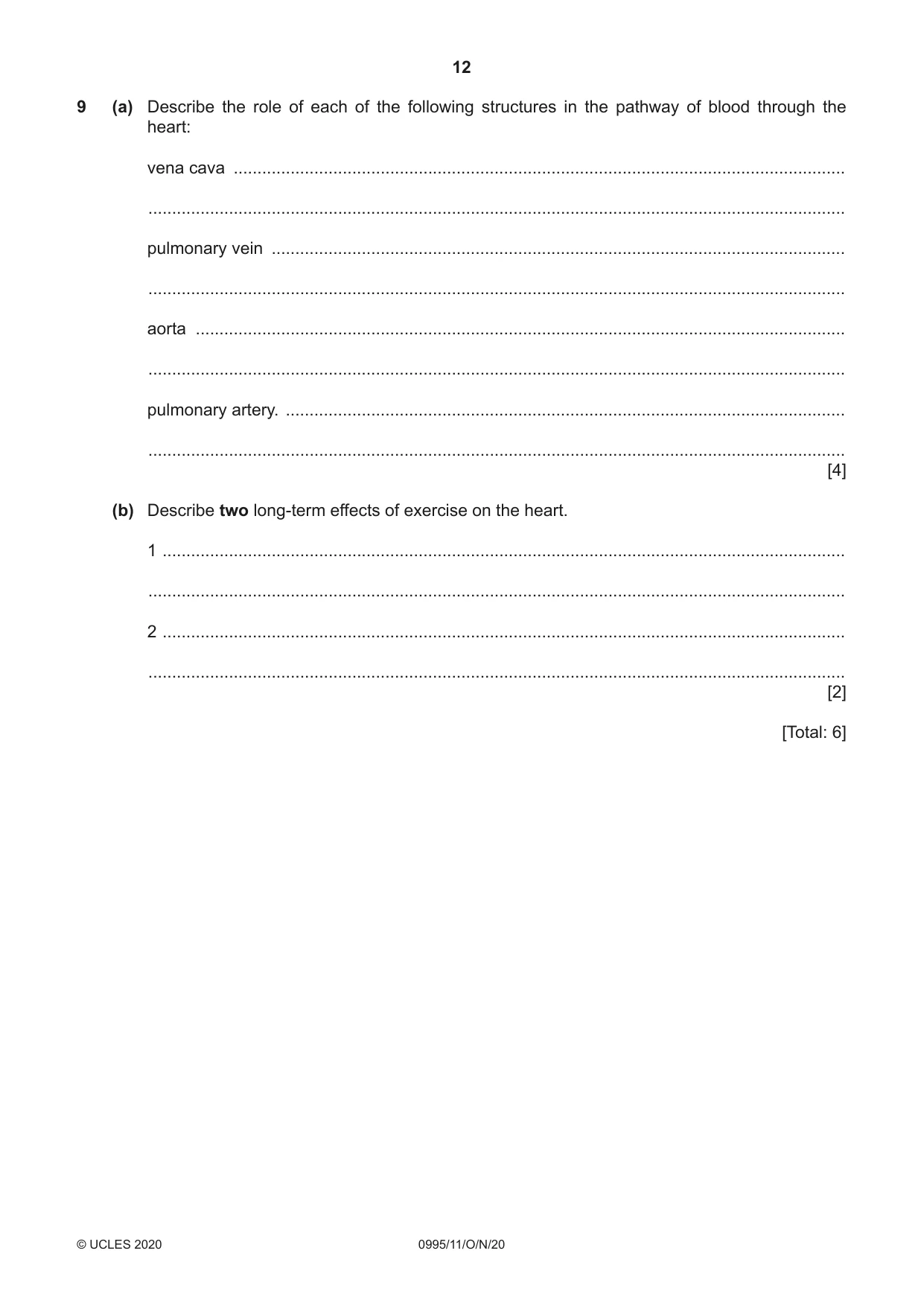
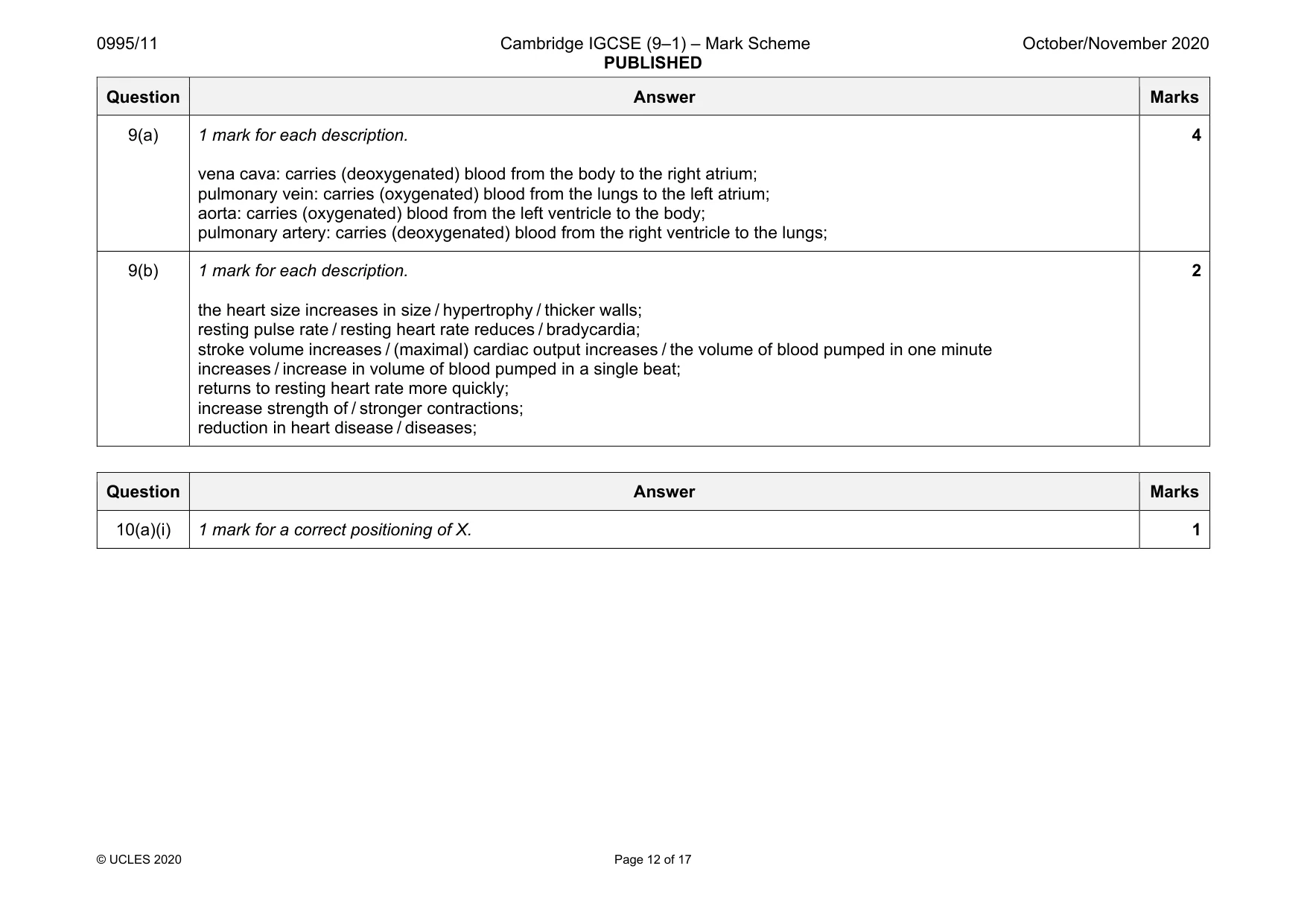
12 0995/11/O/N/20 © UCLES 2020 9 (a) Describe the role of each of the following structures in the pathway of blood through the heart: vena cava … … pulmonary vein … … aorta … … pulmonary artery. … … [4] (b) Describe two long-term effects of exercise on the heart. 1 … … 2 … … [2] [Total: 6]
Question paper, page 13
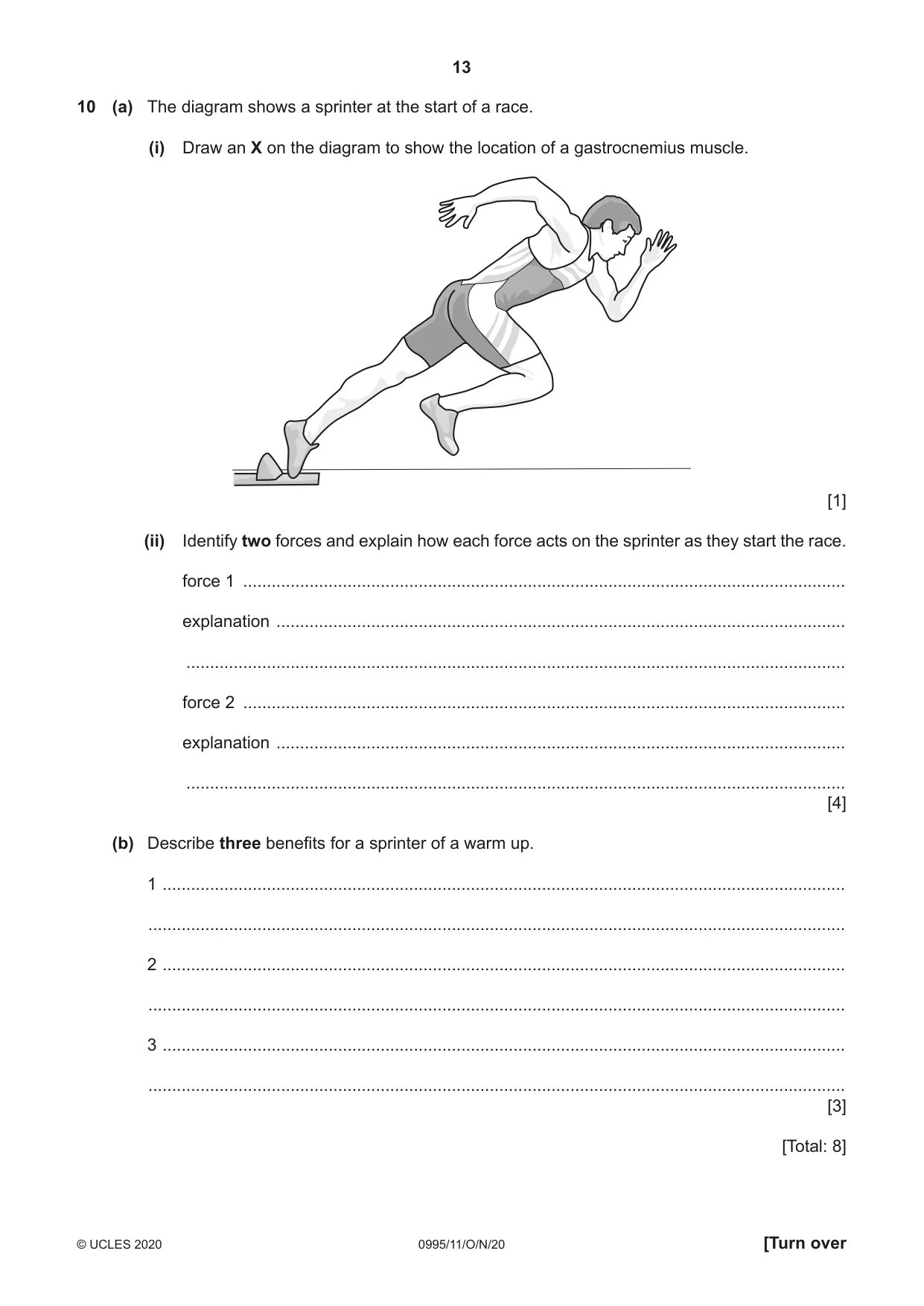
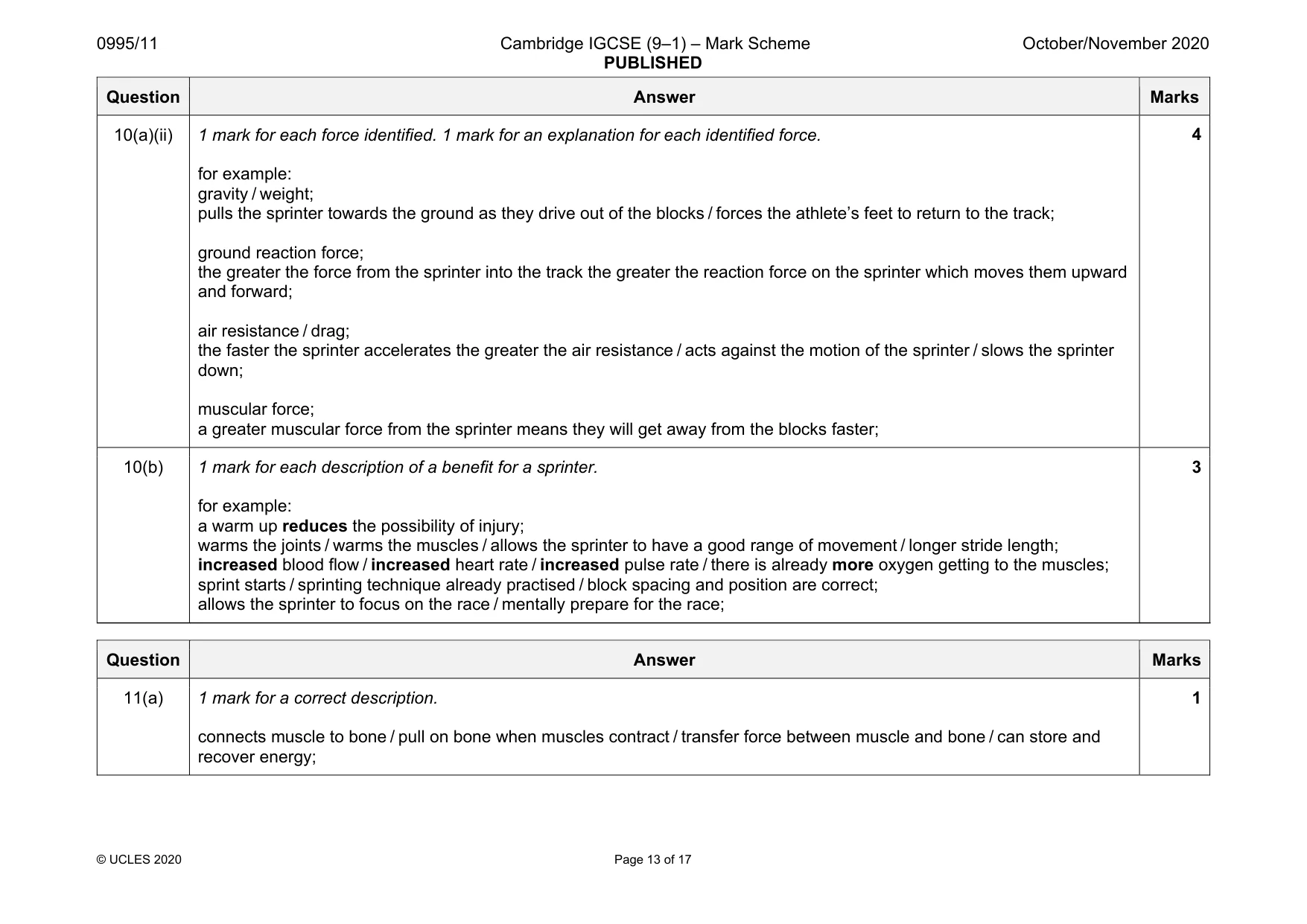
13 0995/11/O/N/20 © UCLES 2020 [Turn over 10 (a) The diagram shows a sprinter at the start of a race. (i) Draw an X on the diagram to show the location of a gastrocnemius muscle. [1] (ii) Identify two forces and explain how each force acts on the sprinter as they start the race. force 1 … explanation … … force 2 … explanation … … [4] (b) Describe three benefits for a sprinter of a warm up. 1 … … 2 … … 3 … … [3] [Total: 8]
Question paper, page 14
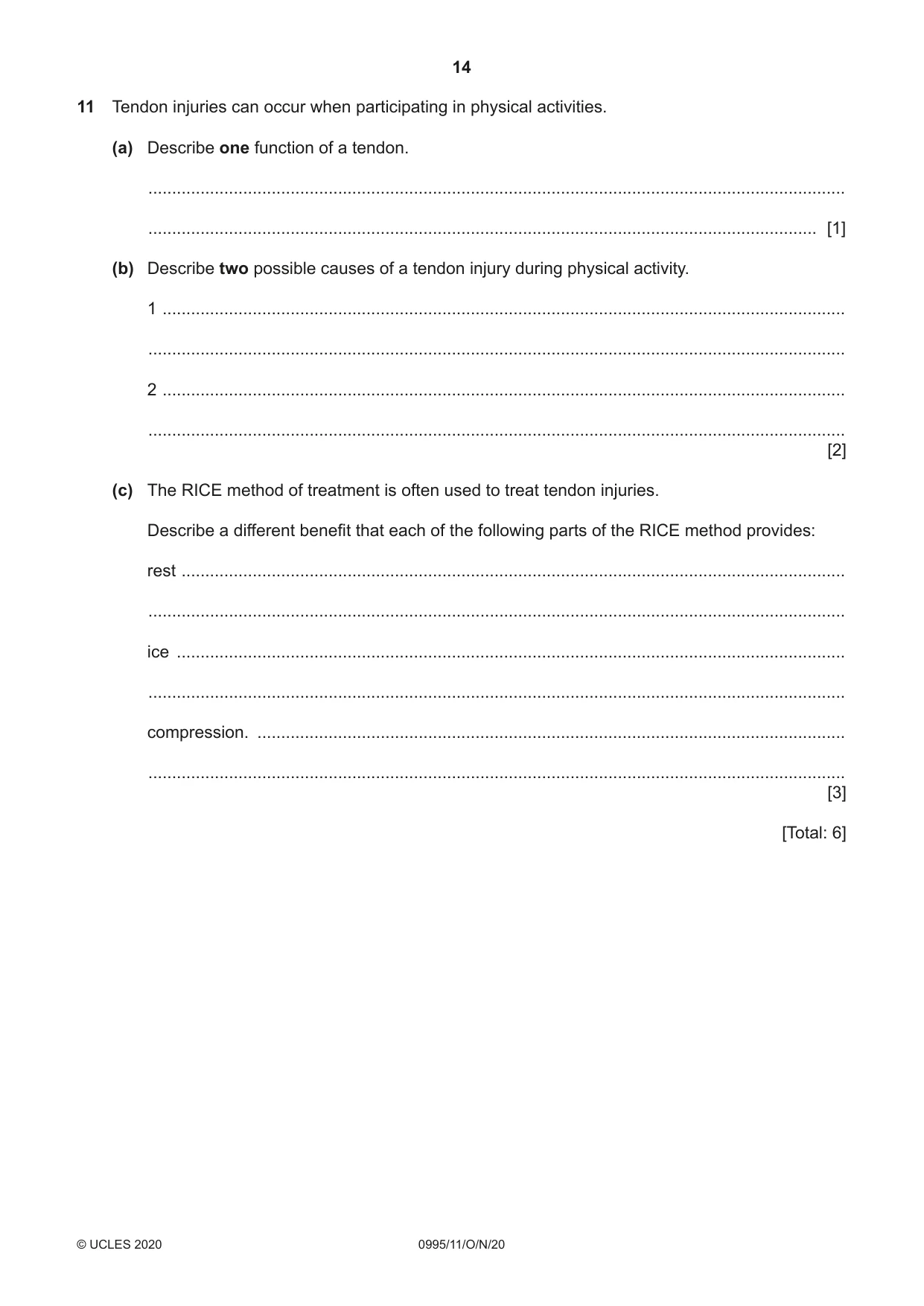
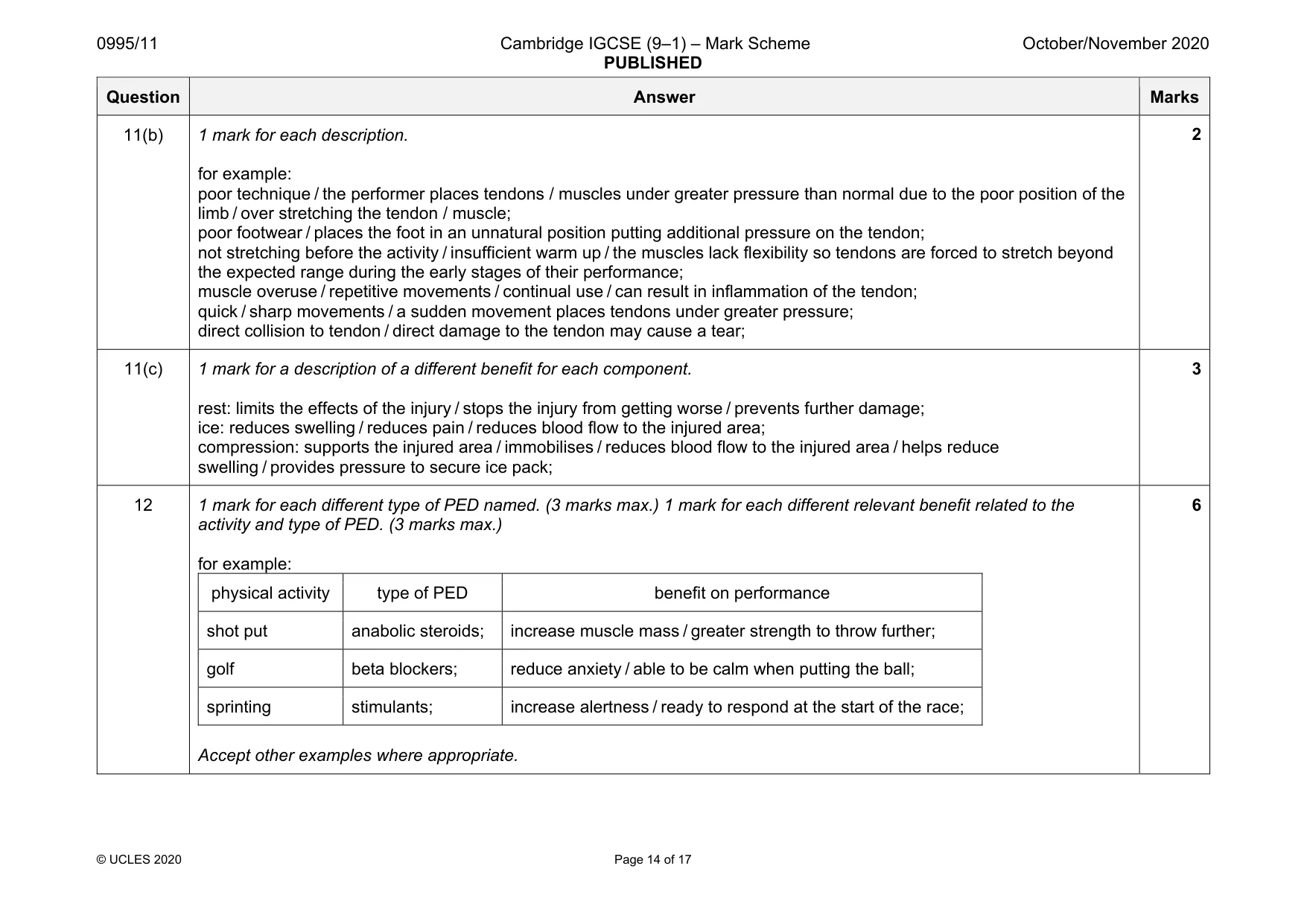
14 0995/11/O/N/20 © UCLES 2020 11 Tendon injuries can occur when participating in physical activities. (a) Describe one function of a tendon. … … [1] (b) Describe two possible causes of a tendon injury during physical activity. 1 … … 2 … … [2] (c) The RICE method of treatment is often used to treat tendon injuries. Describe a different benefit that each of the following parts of the RICE method provides: rest … … ice … … compression. … … [3] [Total: 6]
Question paper, page 15
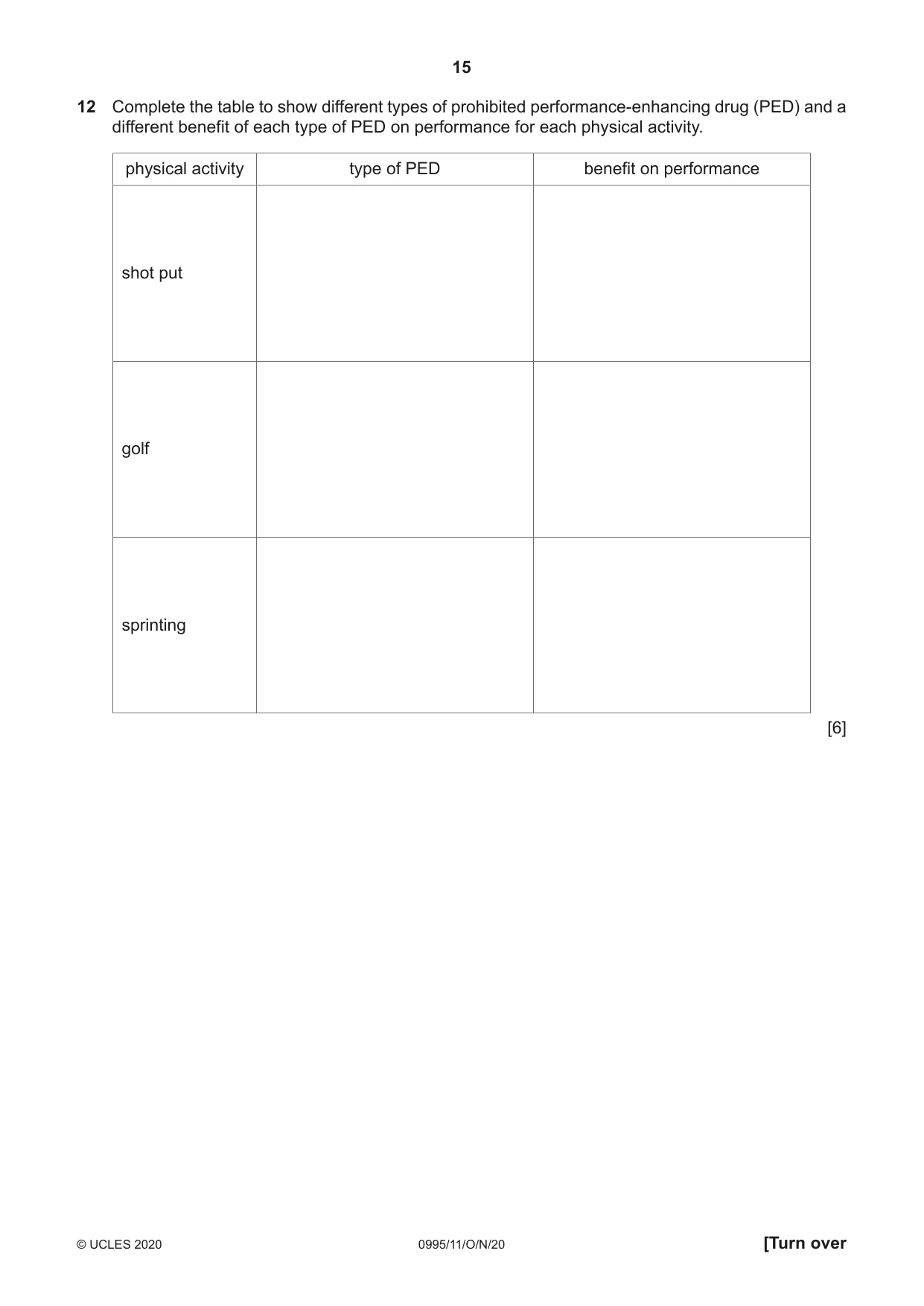
15 0995/11/O/N/20 © UCLES 2020 [Turn over 12 Complete the table to show different types of prohibited performance-enhancing drug (PED) and a different benefit of each type of PED on performance for each physical activity. physical activity type of PED benefit on performance shot put golf sprinting [6]
Question paper, page 16
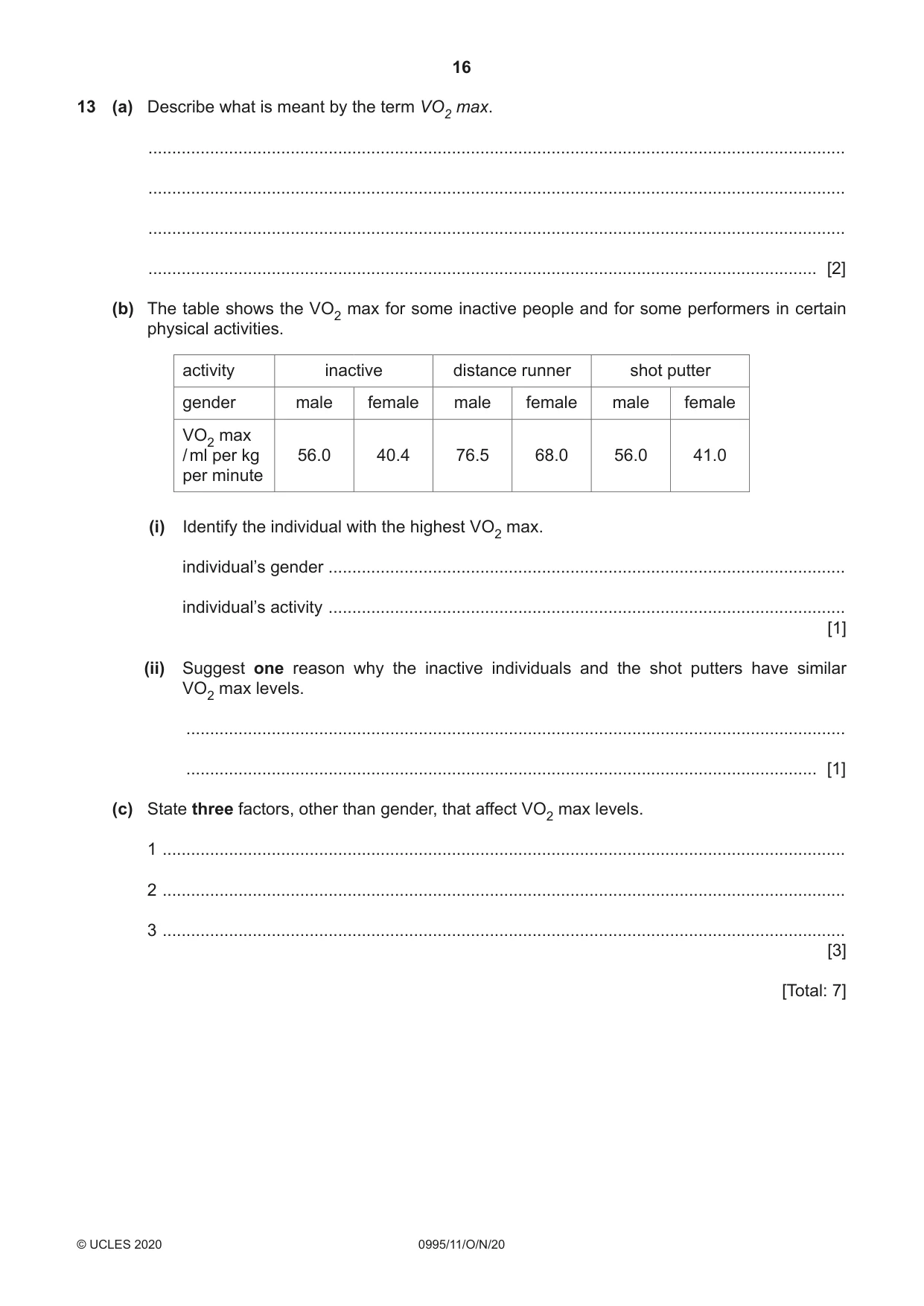
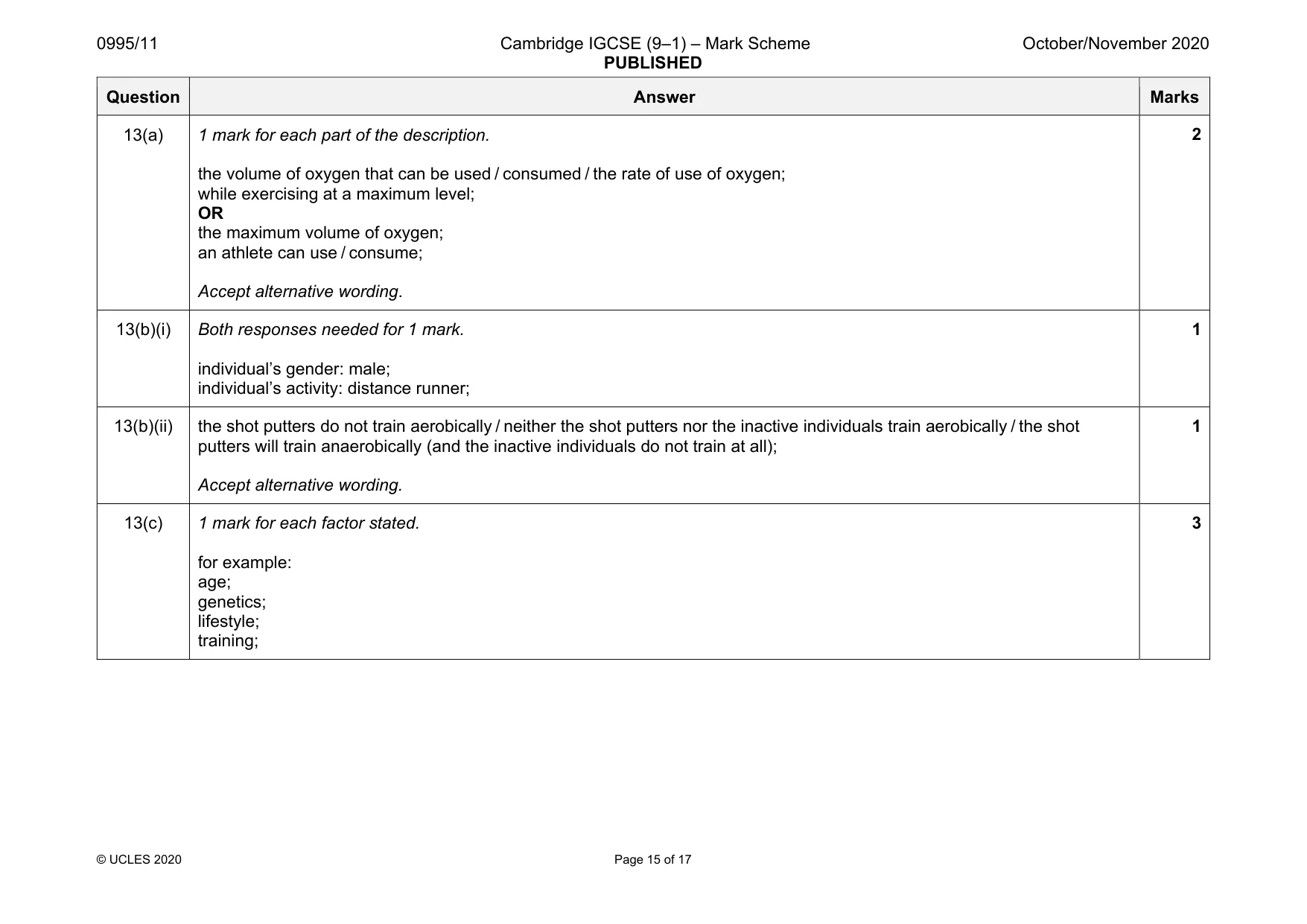
16 0995/11/O/N/20 © UCLES 2020 13 (a) Describe what is meant by the term VO2 max. … … … … [2] (b) The table shows the VO2 max for some inactive people and for some performers in certain physical activities. activity inactive distance runner shot putter gender male female male female male female VO2 max / ml per kg per minute 56.0 40.4 76.5 68.0 56.0 41.0 (i) Identify the individual with the highest VO2 max. individual’s gender … individual’s activity … [1] (ii) Suggest one reason why the inactive individuals and the shot putters have similar VO2 max levels. … … [1] (c) State three factors, other than gender, that affect VO2 max levels. 1 … 2 … 3 … [3] [Total: 7]
Question paper, page 17
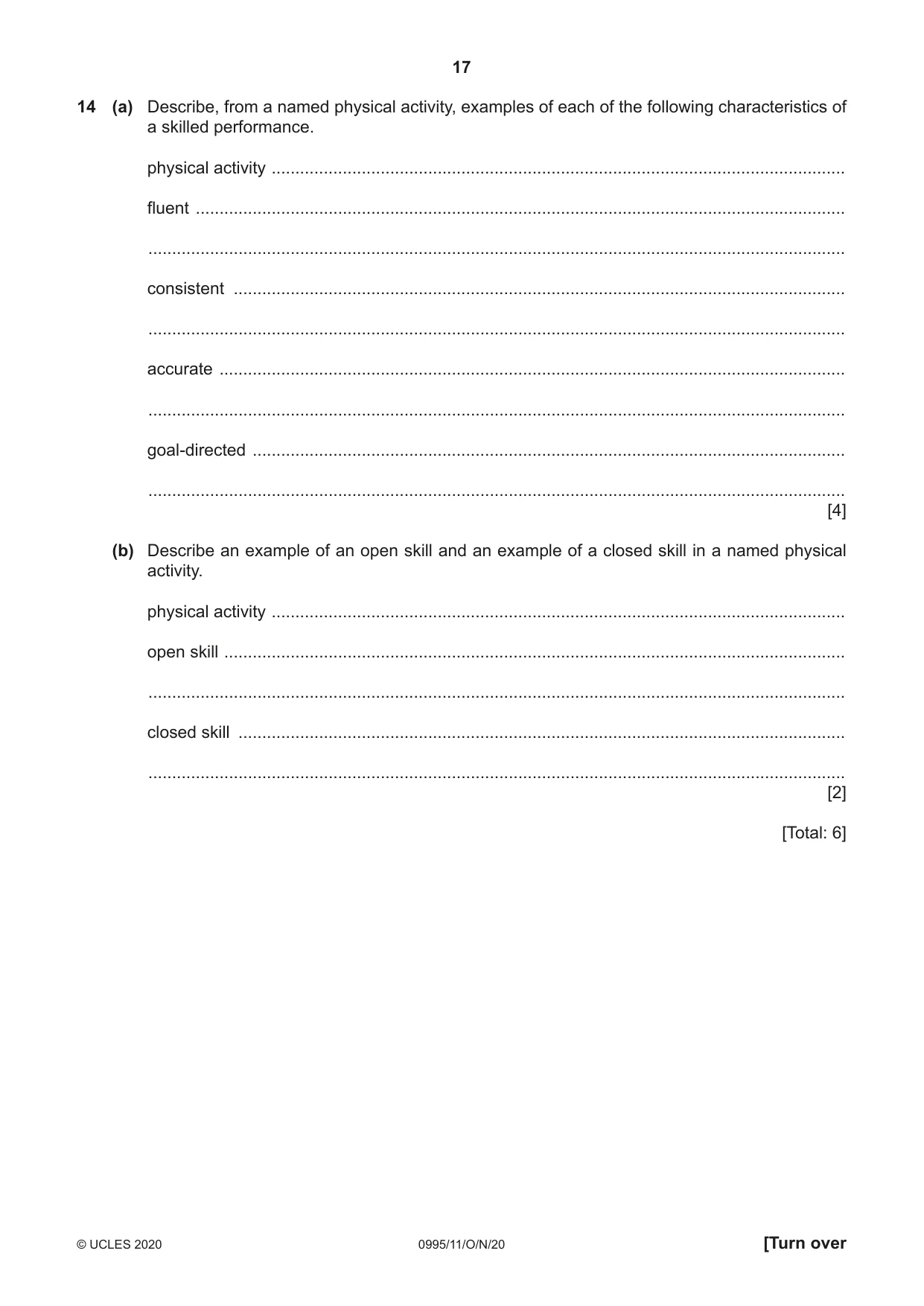
17 0995/11/O/N/20 © UCLES 2020 [Turn over 14 (a) Describe, from a named physical activity, examples of each of the following characteristics of a skilled performance. physical activity … fluent … … consistent … … accurate … … goal-directed … … [4] (b) Describe an example of an open skill and an example of a closed skill in a named physical activity. physical activity … open skill … … closed skill … … [2] [Total: 6]
Question paper, page 18
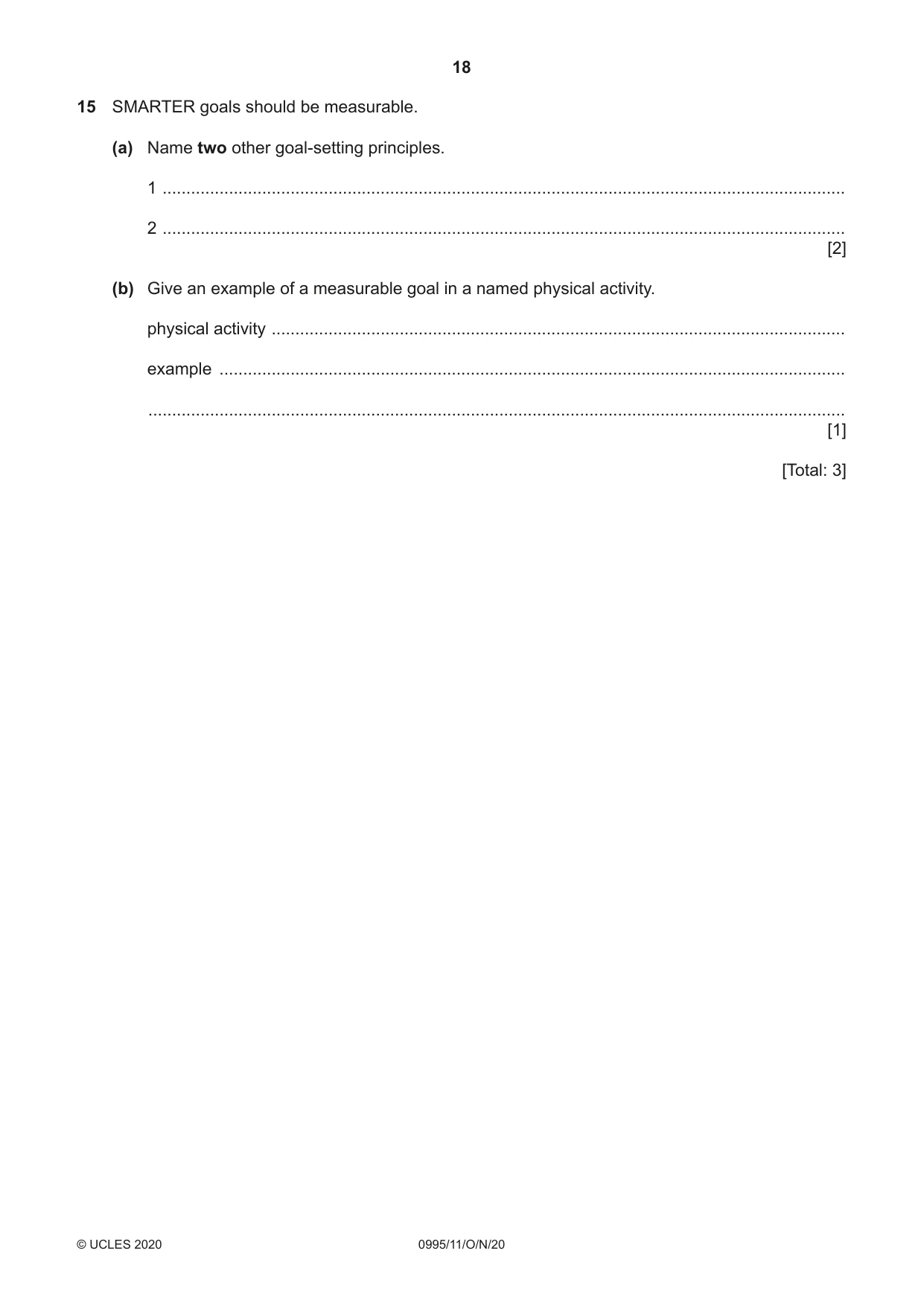
18 0995/11/O/N/20 © UCLES 2020 15 SMARTER goals should be measurable. (a) Name two other goal-setting principles. 1 … 2 … [2] (b) Give an example of a measurable goal in a named physical activity. physical activity … example … … [1] [Total: 3]
Question paper, page 19
19 0995/11/O/N/20 © UCLES 2020 BLANK PAGE
Question paper, page 20
20 0995/11/O/N/20 © UCLES 2020 Permission to reproduce items where third-party owned material protected by copyright is included has been sought and cleared where possible. Every reasonable effort has been made by the publisher (UCLES) to trace copyright holders, but if any items requiring clearance have unwittingly been included, the publisher will be pleased to make amends at the earliest possible opportunity. To avoid the issue of disclosure of answer-related information to candidates, all copyright acknowledgements are reproduced online in the Cambridge Assessment International Education Copyright Acknowledgements Booklet. This is produced for each series of examinations and is freely available to download at www.cambridgeinternational.org after the live examination series. Cambridge Assessment International Education is part of the Cambridge Assessment Group. Cambridge Assessment is the brand name of the University of Cambridge Local Examinations Syndicate (UCLES), which itself is a department of the University of Cambridge. BLANK PAGE
Mark scheme, page 1
This document consists of 17 printed pages. © UCLES 2020 [Turn over Cambridge IGCSE™ (9–1) PHYSICAL EDUCATION 0995/11 Paper 1 Theory October/November 2020 MARK SCHEME Maximum Mark: 100 Published This mark scheme is published as an aid to teachers and candidates, to indicate the requirements of the examination. It shows the basis on which Examiners were instructed to award marks. It does not indicate the details of the discussions that took place at an Examiners’ meeting before marking began, which would have considered the acceptability of alternative answers. Mark schemes should be read in conjunction with the question paper and the Principal Examiner Report for Teachers. Cambridge International will not enter into discussions about these mark schemes. Cambridge International is publishing the mark schemes for the October/November 2020 series for most Cambridge IGCSE™, Cambridge International A and AS Level and Cambridge Pre-U components, and some Cambridge O Level components.
Mark scheme, page 2
0995/11 Cambridge IGCSE (9–1) – Mark Scheme PUBLISHED October/November 2020 © UCLES 2020 Page 2 of 17 Generic Marking Principles These general marking principles must be applied by all examiners when marking candidate answers. They should be applied alongside the specific content of the mark scheme or generic level descriptors for a question. Each question paper and mark scheme will also comply with these marking principles. GENERIC MARKING PRINCIPLE 1: Marks must be awarded in line with: • the specific content of the mark scheme or the generic level descriptors for the question • the specific skills defined in the mark scheme or in the generic level descriptors for the question • the standard of response required by a candidate as exemplified by the standardisation scripts. GENERIC MARKING PRINCIPLE 2: Marks awarded are always whole marks (not half marks, or other fractions). GENERIC MARKING PRINCIPLE 3: Marks must be awarded positively: • marks are awarded for correct/valid answers, as defined in the mark scheme. However, credit is given for valid answers which go beyond the scope of the syllabus and mark scheme, referring to your Team Leader as appropriate • marks are awarded when candidates clearly demonstrate what they know and can do • marks are not deducted for errors • marks are not deducted for omissions • answers should only be judged on the quality of spelling, punctuation and grammar when these features are specifically assessed by the question as indicated by the mark scheme. The meaning, however, should be unambiguous. GENERIC MARKING PRINCIPLE 4: Rules must be applied consistently, e.g. in situations where candidates have not followed instructions or in the application of generic level descriptors.
Mark scheme, page 3
0995/11 Cambridge IGCSE (9–1) – Mark Scheme PUBLISHED October/November 2020 © UCLES 2020 Page 3 of 17 GENERIC MARKING PRINCIPLE 5: Marks should be awarded using the full range of marks defined in the mark scheme for the question (however; the use of the full mark range may be limited according to the quality of the candidate responses seen). GENERIC MARKING PRINCIPLE 6: Marks awarded are based solely on the requirements as defined in the mark scheme. Marks should not be awarded with grade thresholds or grade descriptors in mind. Science-Specific Marking Principles 1 Examiners should consider the context and scientific use of any keywords when awarding marks. Although keywords may be present, marks should not be awarded if the keywords are used incorrectly. 2 The examiner should not choose between contradictory statements given in the same question part, and credit should not be awarded for any correct statement that is contradicted within the same question part. Wrong science that is irrelevant to the question should be ignored. 3 Although spellings do not have to be correct, spellings of syllabus terms must allow for clear and unambiguous separation from other syllabus terms with which they may be confused (e.g. ethane / ethene, glucagon / glycogen, refraction / reflection). 4 The error carried forward (ecf) principle should be applied, where appropriate. If an incorrect answer is subsequently used in a scientifically correct way, the candidate should be awarded these subsequent marking points. Further guidance will be included in the mark scheme where necessary and any exceptions to this general principle will be noted. 5 ‘List rule’ guidance For questions that require n responses (e.g. State two reasons …): • The response should be read as continuous prose, even when numbered answer spaces are provided. • Any response marked ignore in the mark scheme should not count towards n. • Incorrect responses should not be awarded credit but will still count towards n. • Read the entire response to check for any responses that contradict those that would otherwise be credited. Credit should not be awarded for any responses that are contradicted within the rest of the response. Where two responses contradict one another, this should be treated as a single incorrect response. • Non-contradictory responses after the first n responses may be ignored even if they include incorrect science.
Mark scheme, page 4
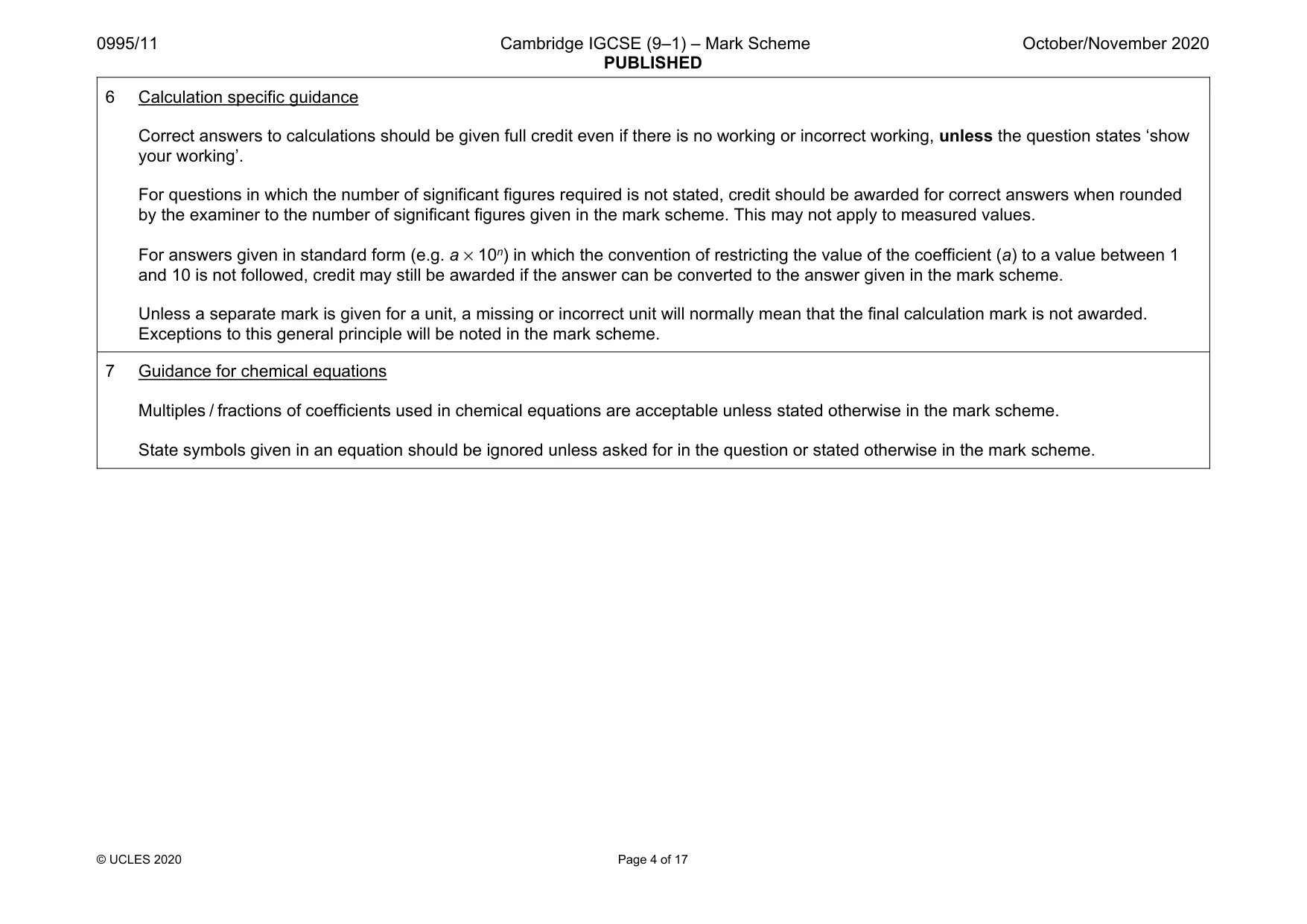
0995/11 Cambridge IGCSE (9–1) – Mark Scheme PUBLISHED October/November 2020 © UCLES 2020 Page 4 of 17 6 Calculation specific guidance Correct answers to calculations should be given full credit even if there is no working or incorrect working, unless the question states ‘show your working’. For questions in which the number of significant figures required is not stated, credit should be awarded for correct answers when rounded by the examiner to the number of significant figures given in the mark scheme. This may not apply to measured values. For answers given in standard form (e.g. a × 10n) in which the convention of restricting the value of the coefficient (a) to a value between 1 and 10 is not followed, credit may still be awarded if the answer can be converted to the answer given in the mark scheme. Unless a separate mark is given for a unit, a missing or incorrect unit will normally mean that the final calculation mark is not awarded. Exceptions to this general principle will be noted in the mark scheme. 7 Guidance for chemical equations Multiples / fractions of coefficients used in chemical equations are acceptable unless stated otherwise in the mark scheme. State symbols given in an equation should be ignored unless asked for in the question or stated otherwise in the mark scheme.
Mark scheme, page 5
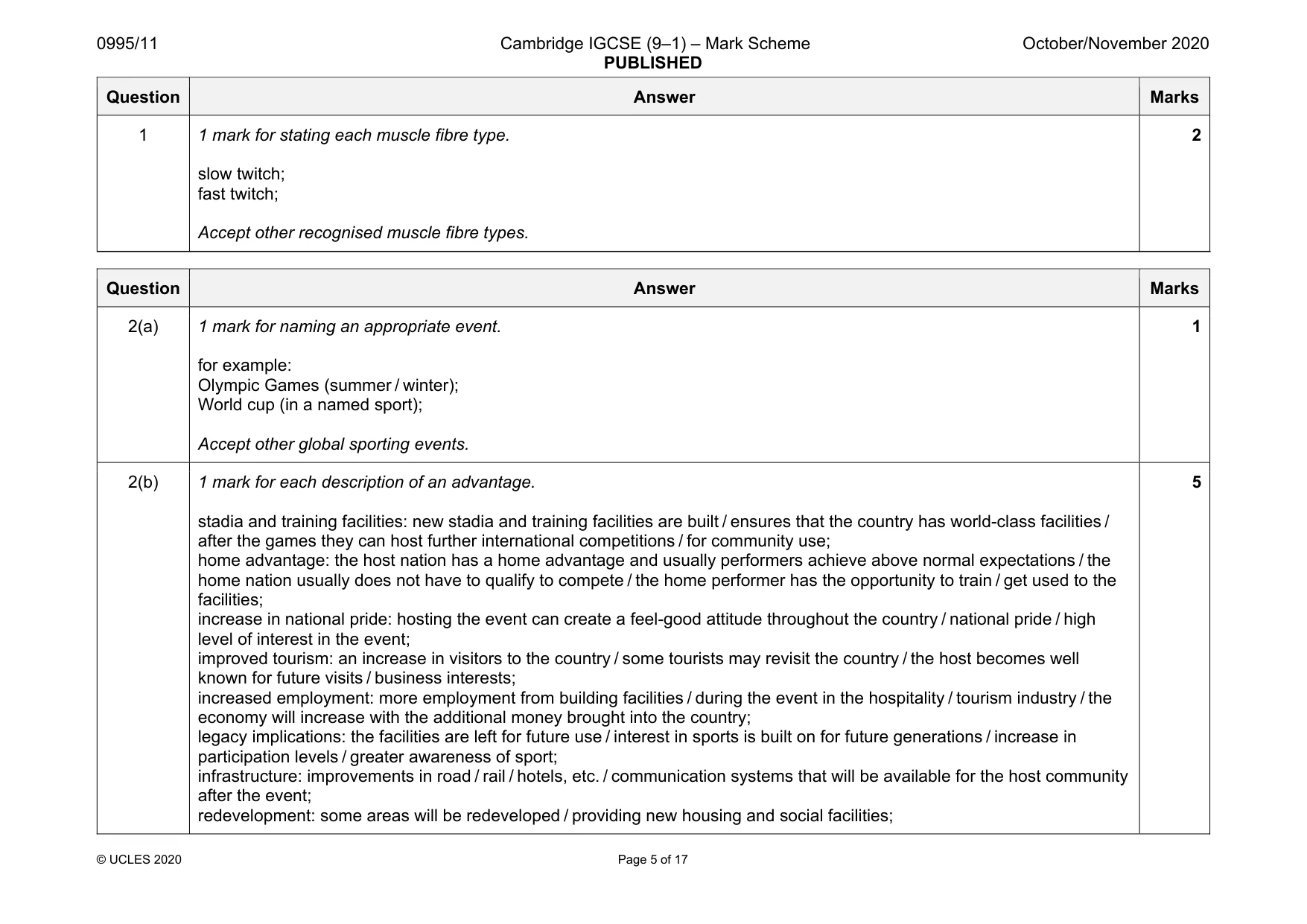
0995/11 Cambridge IGCSE (9–1) – Mark Scheme PUBLISHED October/November 2020 © UCLES 2020 Page 5 of 17 Question Answer Marks 1 1 mark for stating each muscle fibre type. slow twitch; fast twitch; Accept other recognised muscle fibre types. 2 Question Answer Marks 2(a) 1 mark for naming an appropriate event. for example: Olympic Games (summer / winter); World cup (in a named sport); Accept other global sporting events. 1 2(b) 1 mark for each description of an advantage. stadia and training facilities: new stadia and training facilities are built / ensures that the country has world-class facilities / after the games they can host further international competitions / for community use; home advantage: the host nation has a home advantage and usually performers achieve above normal expectations / the home nation usually does not have to qualify to compete / the home performer has the opportunity to train / get used to the facilities; increase in national pride: hosting the event can create a feel-good attitude throughout the country / national pride / high level of interest in the event; improved tourism: an increase in visitors to the country / some tourists may revisit the country / the host becomes well known for future visits / business interests; increased employment: more employment from building facilities / during the event in the hospitality / tourism industry / the economy will increase with the additional money brought into the country; legacy implications: the facilities are left for future use / interest in sports is built on for future generations / increase in participation levels / greater awareness of sport; infrastructure: improvements in road / rail / hotels, etc. / communication systems that will be available for the host community after the event; redevelopment: some areas will be redeveloped / providing new housing and social facilities; 5
Mark scheme, page 6
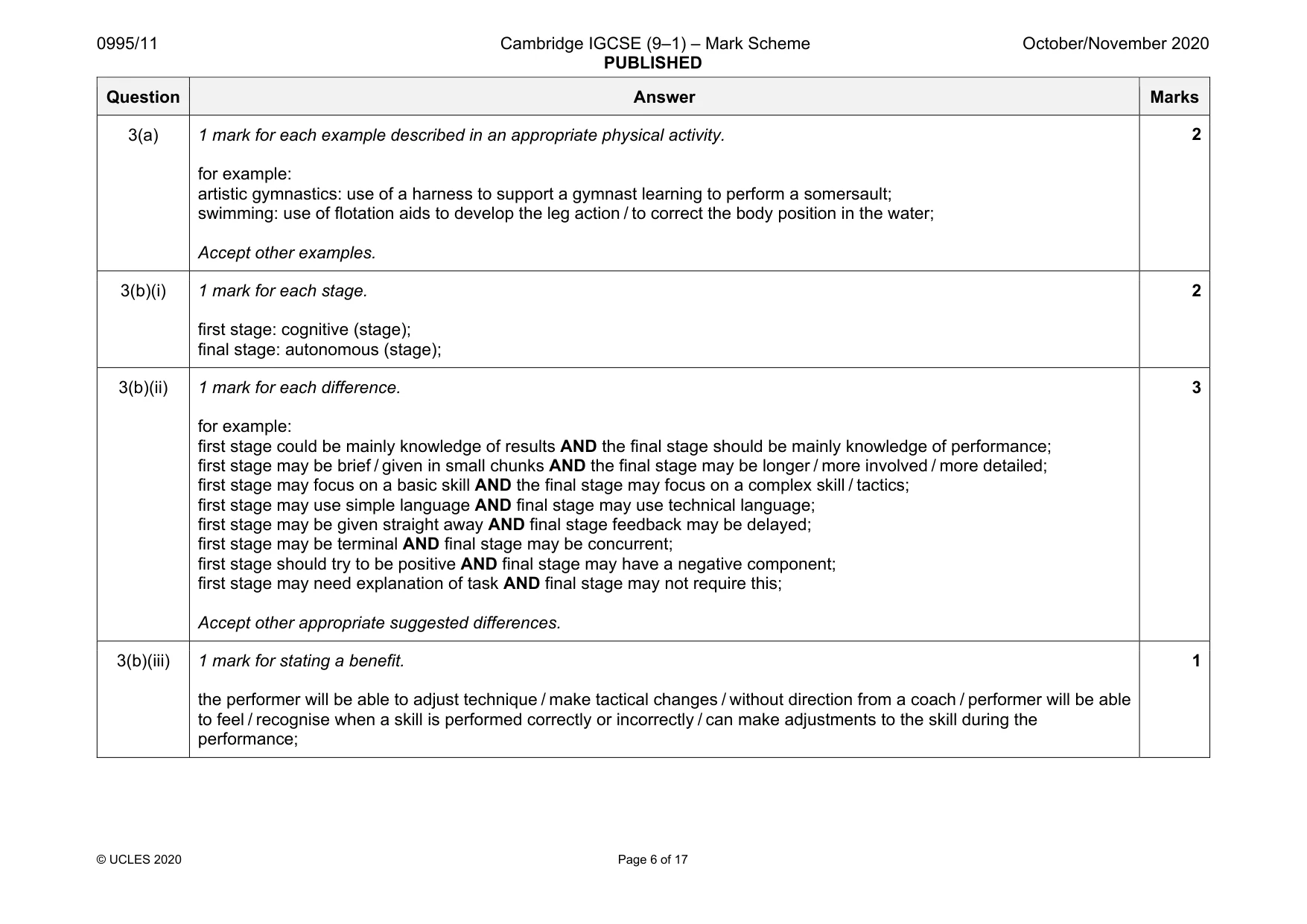
0995/11 Cambridge IGCSE (9–1) – Mark Scheme PUBLISHED October/November 2020 © UCLES 2020 Page 6 of 17 Question Answer Marks 3(a) 1 mark for each example described in an appropriate physical activity. for example: artistic gymnastics: use of a harness to support a gymnast learning to perform a somersault; swimming: use of flotation aids to develop the leg action / to correct the body position in the water; Accept other examples. 2 3(b)(i) 1 mark for each stage. first stage: cognitive (stage); final stage: autonomous (stage); 2 3(b)(ii) 1 mark for each difference. for example: first stage could be mainly knowledge of results AND the final stage should be mainly knowledge of performance; first stage may be brief / given in small chunks AND the final stage may be longer / more involved / more detailed; first stage may focus on a basic skill AND the final stage may focus on a complex skill / tactics; first stage may use simple language AND final stage may use technical language; first stage may be given straight away AND final stage feedback may be delayed; first stage may be terminal AND final stage may be concurrent; first stage should try to be positive AND final stage may have a negative component; first stage may need explanation of task AND final stage may not require this; Accept other appropriate suggested differences. 3 3(b)(iii) 1 mark for stating a benefit. the performer will be able to adjust technique / make tactical changes / without direction from a coach / performer will be able to feel / recognise when a skill is performed correctly or incorrectly / can make adjustments to the skill during the performance; 1
Mark scheme, page 7
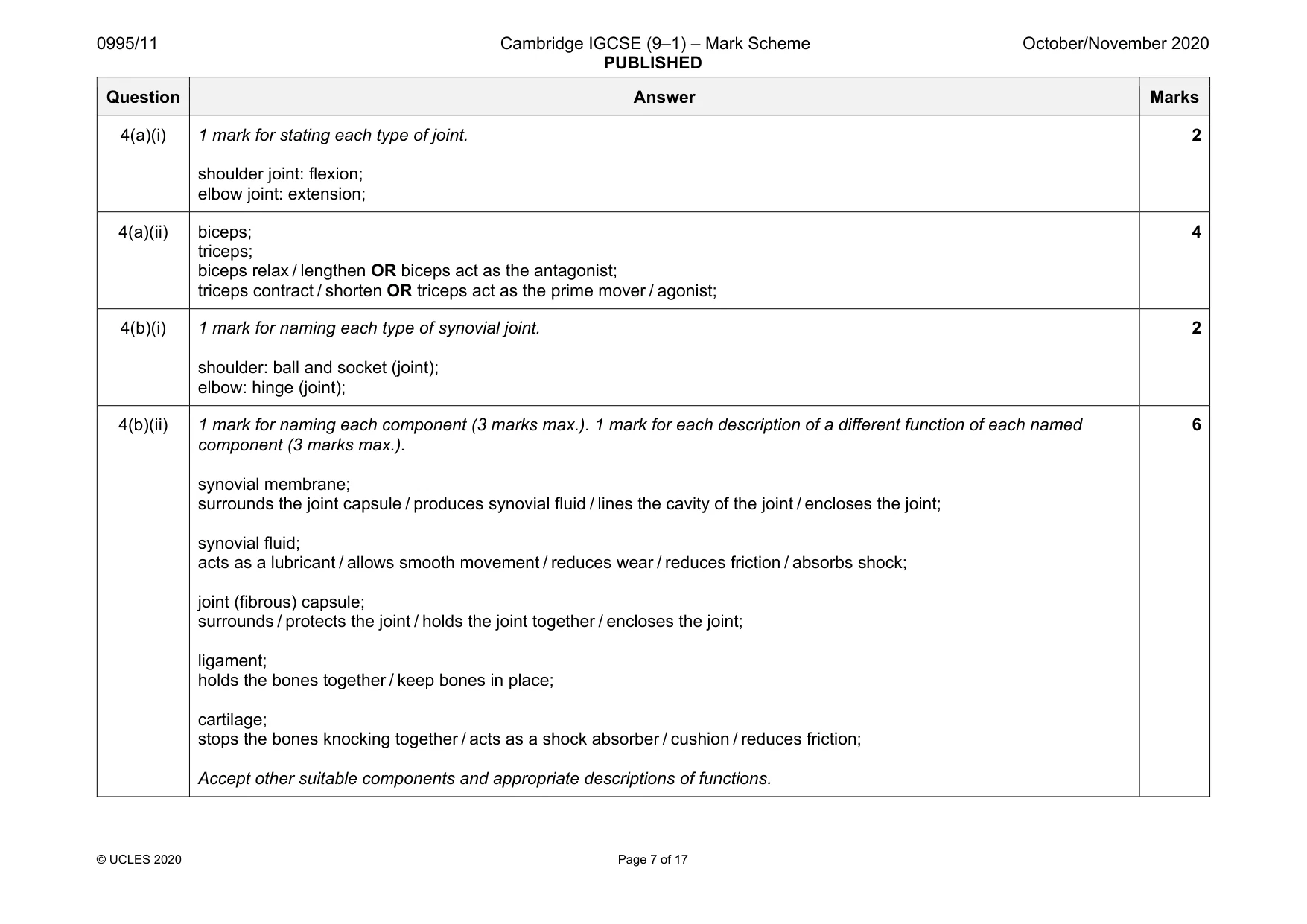
0995/11 Cambridge IGCSE (9–1) – Mark Scheme PUBLISHED October/November 2020 © UCLES 2020 Page 7 of 17 Question Answer Marks 4(a)(i) 1 mark for stating each type of joint. shoulder joint: flexion; elbow joint: extension; 2 4(a)(ii) biceps; triceps; biceps relax / lengthen OR biceps act as the antagonist; triceps contract / shorten OR triceps act as the prime mover / agonist; 4 4(b)(i) 1 mark for naming each type of synovial joint. shoulder: ball and socket (joint); elbow: hinge (joint); 2 4(b)(ii) 1 mark for naming each component (3 marks max.). 1 mark for each description of a different function of each named component (3 marks max.). synovial membrane; surrounds the joint capsule / produces synovial fluid / lines the cavity of the joint / encloses the joint; synovial fluid; acts as a lubricant / allows smooth movement / reduces wear / reduces friction / absorbs shock; joint (fibrous) capsule; surrounds / protects the joint / holds the joint together / encloses the joint; ligament; holds the bones together / keep bones in place; cartilage; stops the bones knocking together / acts as a shock absorber / cushion / reduces friction; Accept other suitable components and appropriate descriptions of functions. 6
Mark scheme, page 8
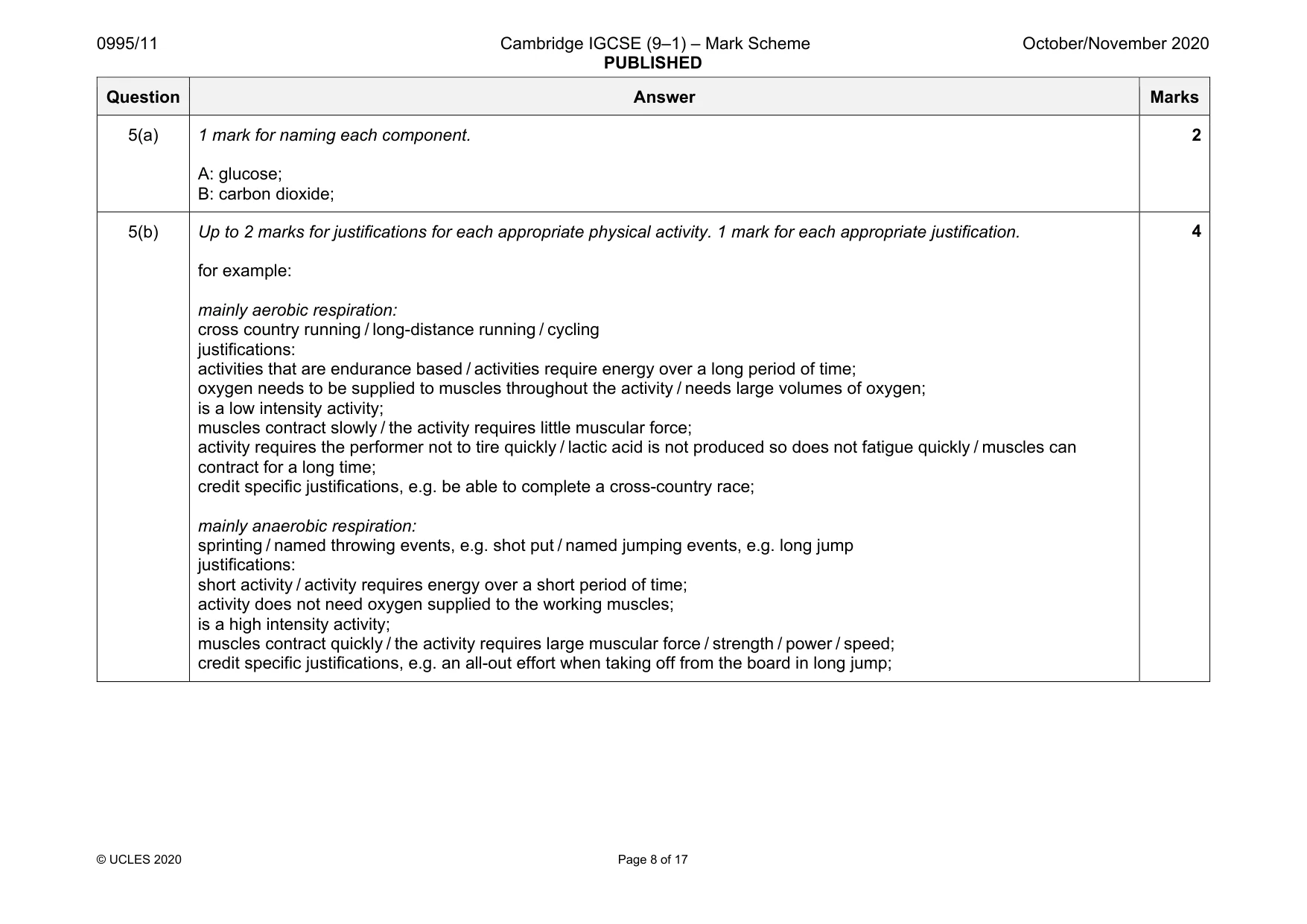
0995/11 Cambridge IGCSE (9–1) – Mark Scheme PUBLISHED October/November 2020 © UCLES 2020 Page 8 of 17 Question Answer Marks 5(a) 1 mark for naming each component. A: glucose; B: carbon dioxide; 2 5(b) Up to 2 marks for justifications for each appropriate physical activity. 1 mark for each appropriate justification. for example: mainly aerobic respiration: cross country running / long-distance running / cycling justifications: activities that are endurance based / activities require energy over a long period of time; oxygen needs to be supplied to muscles throughout the activity / needs large volumes of oxygen; is a low intensity activity; muscles contract slowly / the activity requires little muscular force; activity requires the performer not to tire quickly / lactic acid is not produced so does not fatigue quickly / muscles can contract for a long time; credit specific justifications, e.g. be able to complete a cross-country race; mainly anaerobic respiration: sprinting / named throwing events, e.g. shot put / named jumping events, e.g. long jump justifications: short activity / activity requires energy over a short period of time; activity does not need oxygen supplied to the working muscles; is a high intensity activity; muscles contract quickly / the activity requires large muscular force / strength / power / speed; credit specific justifications, e.g. an all-out effort when taking off from the board in long jump; 4
Mark scheme, page 9
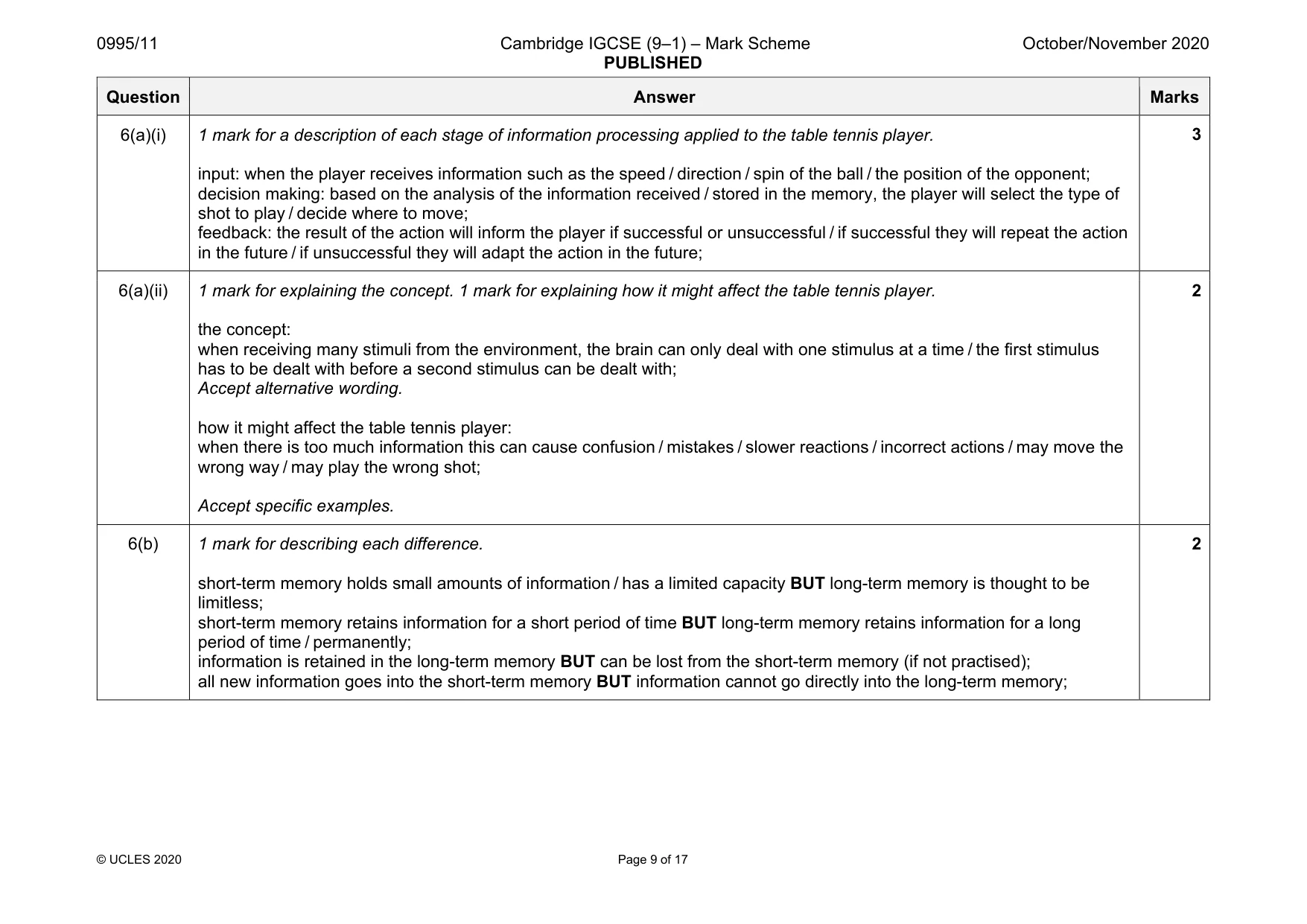
0995/11 Cambridge IGCSE (9–1) – Mark Scheme PUBLISHED October/November 2020 © UCLES 2020 Page 9 of 17 Question Answer Marks 6(a)(i) 1 mark for a description of each stage of information processing applied to the table tennis player. input: when the player receives information such as the speed / direction / spin of the ball / the position of the opponent; decision making: based on the analysis of the information received / stored in the memory, the player will select the type of shot to play / decide where to move; feedback: the result of the action will inform the player if successful or unsuccessful / if successful they will repeat the action in the future / if unsuccessful they will adapt the action in the future; 3 6(a)(ii) 1 mark for explaining the concept. 1 mark for explaining how it might affect the table tennis player. the concept: when receiving many stimuli from the environment, the brain can only deal with one stimulus at a time / the first stimulus has to be dealt with before a second stimulus can be dealt with; Accept alternative wording. how it might affect the table tennis player: when there is too much information this can cause confusion / mistakes / slower reactions / incorrect actions / may move the wrong way / may play the wrong shot; Accept specific examples. 2 6(b) 1 mark for describing each difference. short-term memory holds small amounts of information / has a limited capacity BUT long-term memory is thought to be limitless; short-term memory retains information for a short period of time BUT long-term memory retains information for a long period of time / permanently; information is retained in the long-term memory BUT can be lost from the short-term memory (if not practised); all new information goes into the short-term memory BUT information cannot go directly into the long-term memory; 2
Mark scheme, page 10
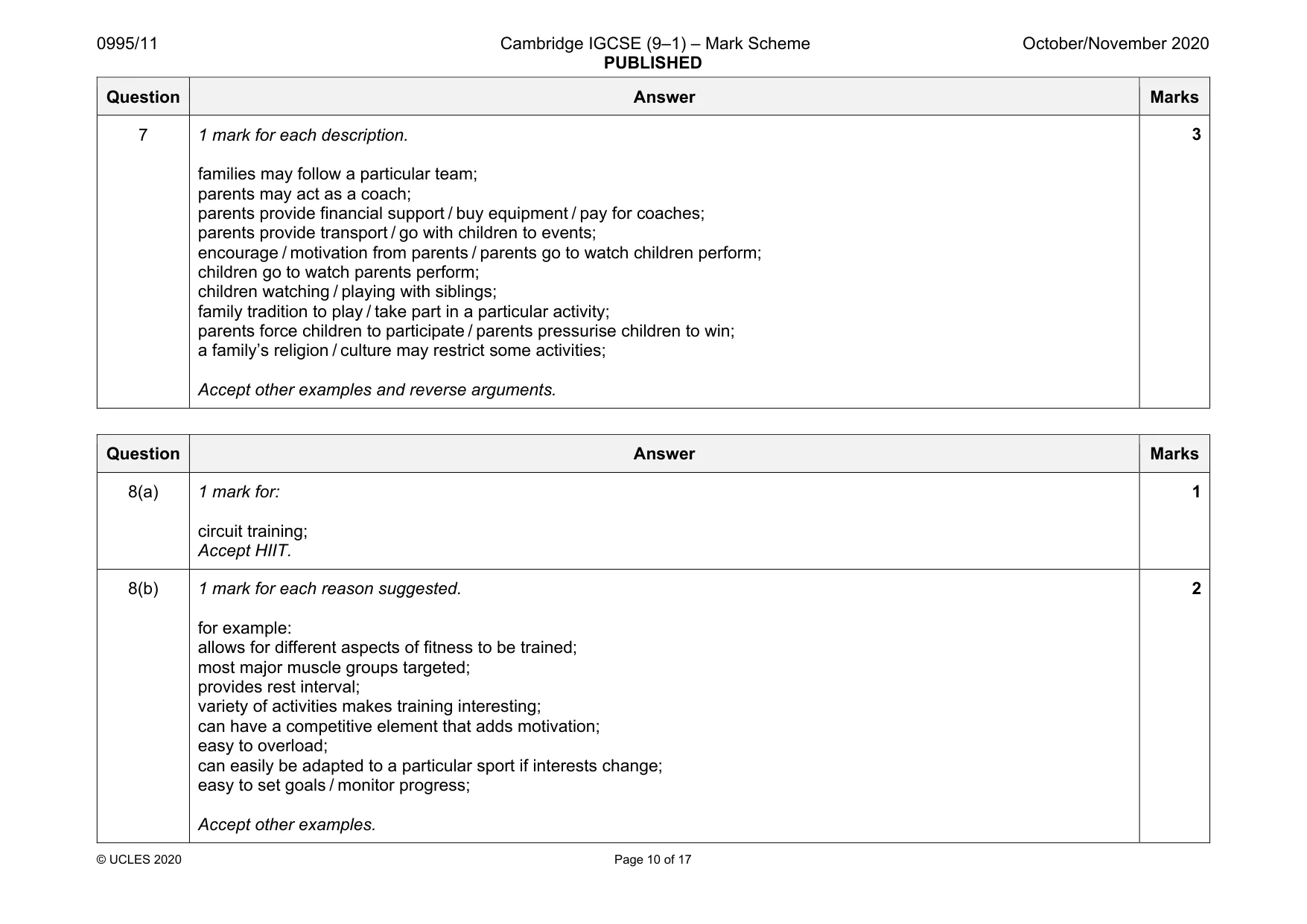
0995/11 Cambridge IGCSE (9–1) – Mark Scheme PUBLISHED October/November 2020 © UCLES 2020 Page 10 of 17 Question Answer Marks 7 1 mark for each description. families may follow a particular team; parents may act as a coach; parents provide financial support / buy equipment / pay for coaches; parents provide transport / go with children to events; encourage / motivation from parents / parents go to watch children perform; children go to watch parents perform; children watching / playing with siblings; family tradition to play / take part in a particular activity; parents force children to participate / parents pressurise children to win; a family’s religion / culture may restrict some activities; Accept other examples and reverse arguments. 3 Question Answer Marks 8(a) 1 mark for: circuit training; Accept HIIT. 1 8(b) 1 mark for each reason suggested. for example: allows for different aspects of fitness to be trained; most major muscle groups targeted; provides rest interval; variety of activities makes training interesting; can have a competitive element that adds motivation; easy to overload; can easily be adapted to a particular sport if interests change; easy to set goals / monitor progress; Accept other examples. 2
Mark scheme, page 11
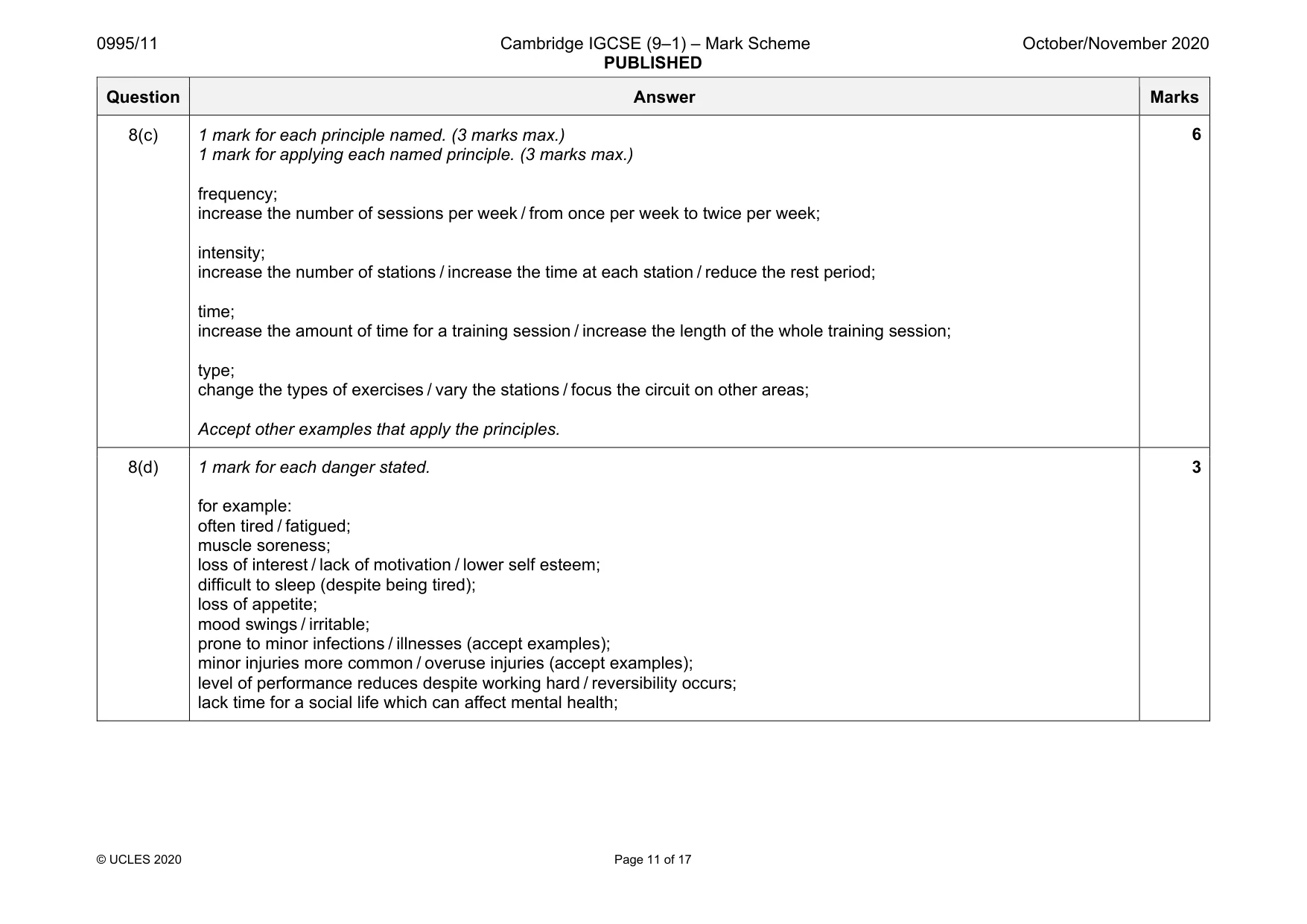
0995/11 Cambridge IGCSE (9–1) – Mark Scheme PUBLISHED October/November 2020 © UCLES 2020 Page 11 of 17 Question Answer Marks 8(c) 1 mark for each principle named. (3 marks max.) 1 mark for applying each named principle. (3 marks max.) frequency; increase the number of sessions per week / from once per week to twice per week; intensity; increase the number of stations / increase the time at each station / reduce the rest period; time; increase the amount of time for a training session / increase the length of the whole training session; type; change the types of exercises / vary the stations / focus the circuit on other areas; Accept other examples that apply the principles. 6 8(d) 1 mark for each danger stated. for example: often tired / fatigued; muscle soreness; loss of interest / lack of motivation / lower self esteem; difficult to sleep (despite being tired); loss of appetite; mood swings / irritable; prone to minor infections / illnesses (accept examples); minor injuries more common / overuse injuries (accept examples); level of performance reduces despite working hard / reversibility occurs; lack time for a social life which can affect mental health; 3
Mark scheme, page 12
0995/11 Cambridge IGCSE (9–1) – Mark Scheme PUBLISHED October/November 2020 © UCLES 2020 Page 12 of 17 Question Answer Marks 9(a) 1 mark for each description. vena cava: carries (deoxygenated) blood from the body to the right atrium; pulmonary vein: carries (oxygenated) blood from the lungs to the left atrium; aorta: carries (oxygenated) blood from the left ventricle to the body; pulmonary artery: carries (deoxygenated) blood from the right ventricle to the lungs; 4 9(b) 1 mark for each description. the heart size increases in size / hypertrophy / thicker walls; resting pulse rate / resting heart rate reduces / bradycardia; stroke volume increases / (maximal) cardiac output increases / the volume of blood pumped in one minute increases / increase in volume of blood pumped in a single beat; returns to resting heart rate more quickly; increase strength of / stronger contractions; reduction in heart disease / diseases; 2 Question Answer Marks 10(a)(i) 1 mark for a correct positioning of X. 1
Mark scheme, page 13
0995/11 Cambridge IGCSE (9–1) – Mark Scheme PUBLISHED October/November 2020 © UCLES 2020 Page 13 of 17 Question Answer Marks 10(a)(ii) 1 mark for each force identified. 1 mark for an explanation for each identified force. for example: gravity / weight; pulls the sprinter towards the ground as they drive out of the blocks / forces the athlete’s feet to return to the track; ground reaction force; the greater the force from the sprinter into the track the greater the reaction force on the sprinter which moves them upward and forward; air resistance / drag; the faster the sprinter accelerates the greater the air resistance / acts against the motion of the sprinter / slows the sprinter down; muscular force; a greater muscular force from the sprinter means they will get away from the blocks faster; 4 10(b) 1 mark for each description of a benefit for a sprinter. for example: a warm up reduces the possibility of injury; warms the joints / warms the muscles / allows the sprinter to have a good range of movement / longer stride length; increased blood flow / increased heart rate / increased pulse rate / there is already more oxygen getting to the muscles; sprint starts / sprinting technique already practised / block spacing and position are correct; allows the sprinter to focus on the race / mentally prepare for the race; 3 Question Answer Marks 11(a) 1 mark for a correct description. connects muscle to bone / pull on bone when muscles contract / transfer force between muscle and bone / can store and recover energy; 1
Mark scheme, page 14
0995/11 Cambridge IGCSE (9–1) – Mark Scheme PUBLISHED October/November 2020 © UCLES 2020 Page 14 of 17 Question Answer Marks 11(b) 1 mark for each description. for example: poor technique / the performer places tendons / muscles under greater pressure than normal due to the poor position of the limb / over stretching the tendon / muscle; poor footwear / places the foot in an unnatural position putting additional pressure on the tendon; not stretching before the activity / insufficient warm up / the muscles lack flexibility so tendons are forced to stretch beyond the expected range during the early stages of their performance; muscle overuse / repetitive movements / continual use / can result in inflammation of the tendon; quick / sharp movements / a sudden movement places tendons under greater pressure; direct collision to tendon / direct damage to the tendon may cause a tear; 2 11(c) 1 mark for a description of a different benefit for each component. rest: limits the effects of the injury / stops the injury from getting worse / prevents further damage; ice: reduces swelling / reduces pain / reduces blood flow to the injured area; compression: supports the injured area / immobilises / reduces blood flow to the injured area / helps reduce swelling / provides pressure to secure ice pack; 3 12 1 mark for each different type of PED named. (3 marks max.) 1 mark for each different relevant benefit related to the activity and type of PED. (3 marks max.) for example: physical activity type of PED benefit on performance shot put anabolic steroids; increase muscle mass / greater strength to throw further; golf beta blockers; reduce anxiety / able to be calm when putting the ball; sprinting stimulants; increase alertness / ready to respond at the start of the race; Accept other examples where appropriate. 6
Mark scheme, page 15
0995/11 Cambridge IGCSE (9–1) – Mark Scheme PUBLISHED October/November 2020 © UCLES 2020 Page 15 of 17 Question Answer Marks 13(a) 1 mark for each part of the description. the volume of oxygen that can be used / consumed / the rate of use of oxygen; while exercising at a maximum level; OR the maximum volume of oxygen; an athlete can use / consume; Accept alternative wording. 2 13(b)(i) Both responses needed for 1 mark. individual’s gender: male; individual’s activity: distance runner; 1 13(b)(ii) the shot putters do not train aerobically / neither the shot putters nor the inactive individuals train aerobically / the shot putters will train anaerobically (and the inactive individuals do not train at all); Accept alternative wording. 1 13(c) 1 mark for each factor stated. for example: age; genetics; lifestyle; training; 3
Mark scheme, page 16
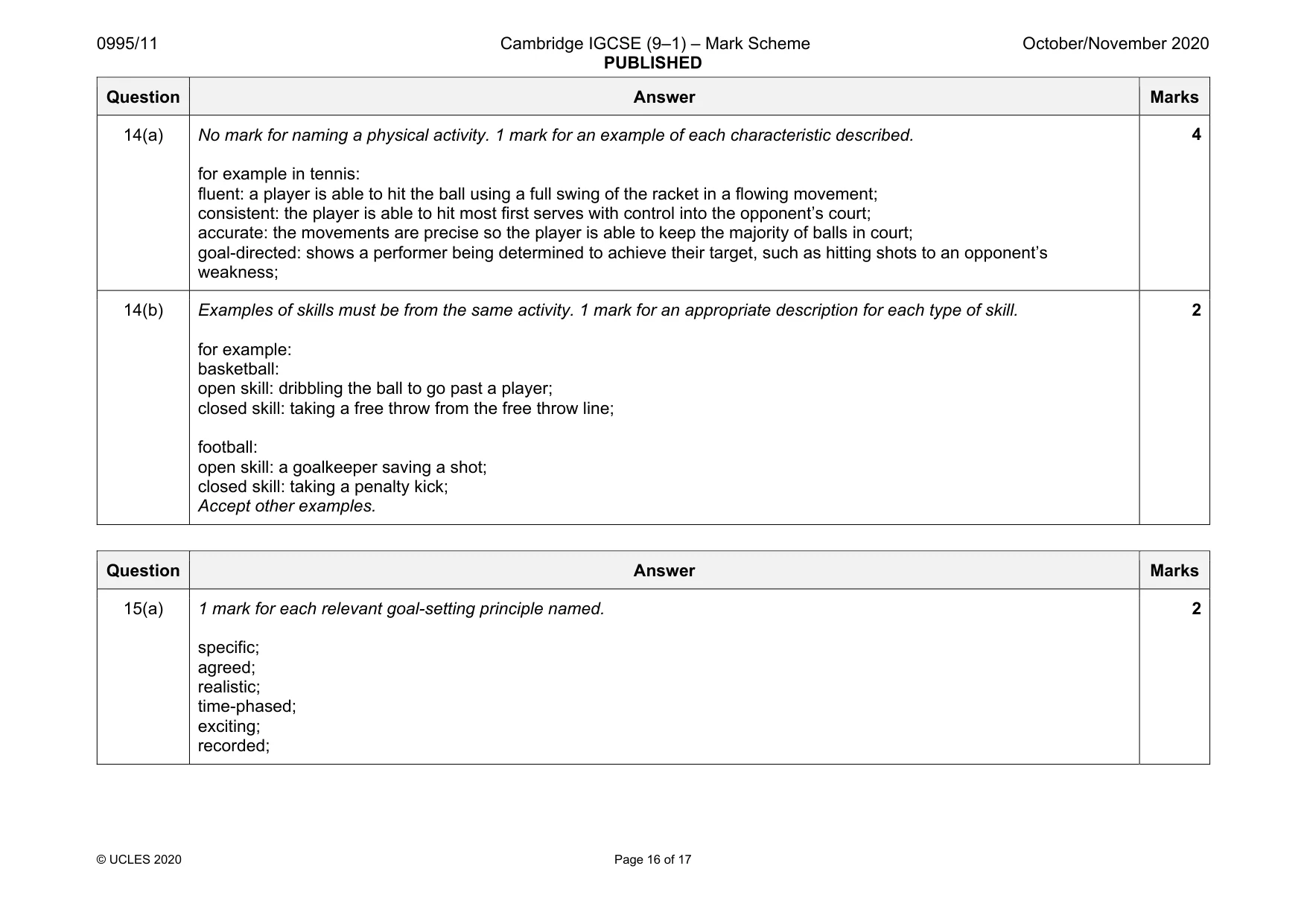
0995/11 Cambridge IGCSE (9–1) – Mark Scheme PUBLISHED October/November 2020 © UCLES 2020 Page 16 of 17 Question Answer Marks 14(a) No mark for naming a physical activity. 1 mark for an example of each characteristic described. for example in tennis: fluent: a player is able to hit the ball using a full swing of the racket in a flowing movement; consistent: the player is able to hit most first serves with control into the opponent’s court; accurate: the movements are precise so the player is able to keep the majority of balls in court; goal-directed: shows a performer being determined to achieve their target, such as hitting shots to an opponent’s weakness; 4 14(b) Examples of skills must be from the same activity. 1 mark for an appropriate description for each type of skill. for example: basketball: open skill: dribbling the ball to go past a player; closed skill: taking a free throw from the free throw line; football: open skill: a goalkeeper saving a shot; closed skill: taking a penalty kick; Accept other examples. 2 Question Answer Marks 15(a) 1 mark for each relevant goal-setting principle named. specific; agreed; realistic; time-phased; exciting; recorded; 2
Mark scheme, page 17
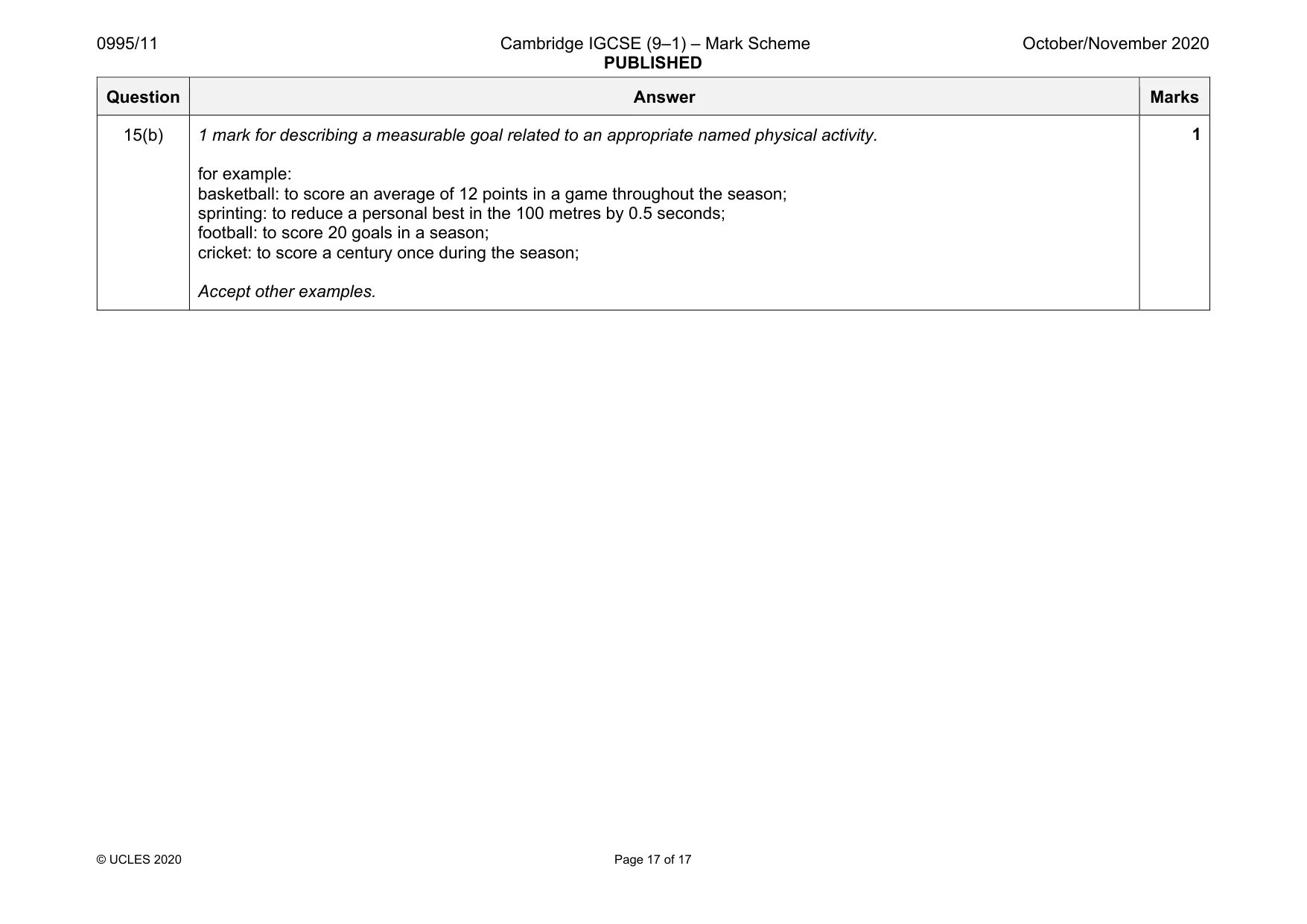
0995/11 Cambridge IGCSE (9–1) – Mark Scheme PUBLISHED October/November 2020 © UCLES 2020 Page 17 of 17 Question Answer Marks 15(b) 1 mark for describing a measurable goal related to an appropriate named physical activity. for example: basketball: to score an average of 12 points in a game throughout the season; sprinting: to reduce a personal best in the 100 metres by 0.5 seconds; football: to score 20 goals in a season; cricket: to score a century once during the season; Accept other examples. 1
What you needed in this session
Cambridge’s own grade thresholds for 2020 Oct/Nov, Paper 1 · Variant 1. A higher threshold means an easier paper — the bar moves with how the cohort did.