Cambridge IGCSE Mathematics (with coursework) 0581 — 2013 Oct/Nov Paper 1 · Variant 2
0581/12/O/N/13
The question paper and its mark scheme, free to read here and free to download. This is Cambridge’s own paper, exactly as it was sat.
Question paper12 pages
Mark scheme3 pages
Answers below. Sit the paper first if you are practising.
Paper as text
Question paper, page 1
READ THESE INSTRUCTIONS FIRST Write your Centre number, candidate number and name on all the work you hand in. Write in dark blue or black pen. You may use a pencil for any diagrams or graphs. Do not use staples, paper clips, highlighters, glue or correction fl uid. DO NOT WRITE IN ANY BARCODES. Answer all questions. If working is needed for any question it must be shown below that question. Electronic calculators should be used. If the degree of accuracy is not specifi ed in the question, and if the answer is not exact, give the answer to three signifi cant fi gures. Give answers in degrees to one decimal place. For π, use either your calculator value or 3.142. At the end of the examination, fasten all your work securely together. The number of marks is given in brackets [ ] at the end of each question or part question. The total of the marks for this paper is 56. MATHEMATICS 0581/12 Paper 1 (Core) October/November 2013 1 hour Candidates answer on the Question Paper. Additional Materials: Electronic calculator Geometrical instruments Tracing paper (optional) UNIVERSITY OF CAMBRIDGE INTERNATIONAL EXAMINATIONS International General Certifi cate of Secondary Education This document consists of 11 printed pages and 1 blank page. [Turn over IB13 11_0581_12/FP © UCLES 2013 *1814956085* www.XtremePapers.com
Question paper, page 2
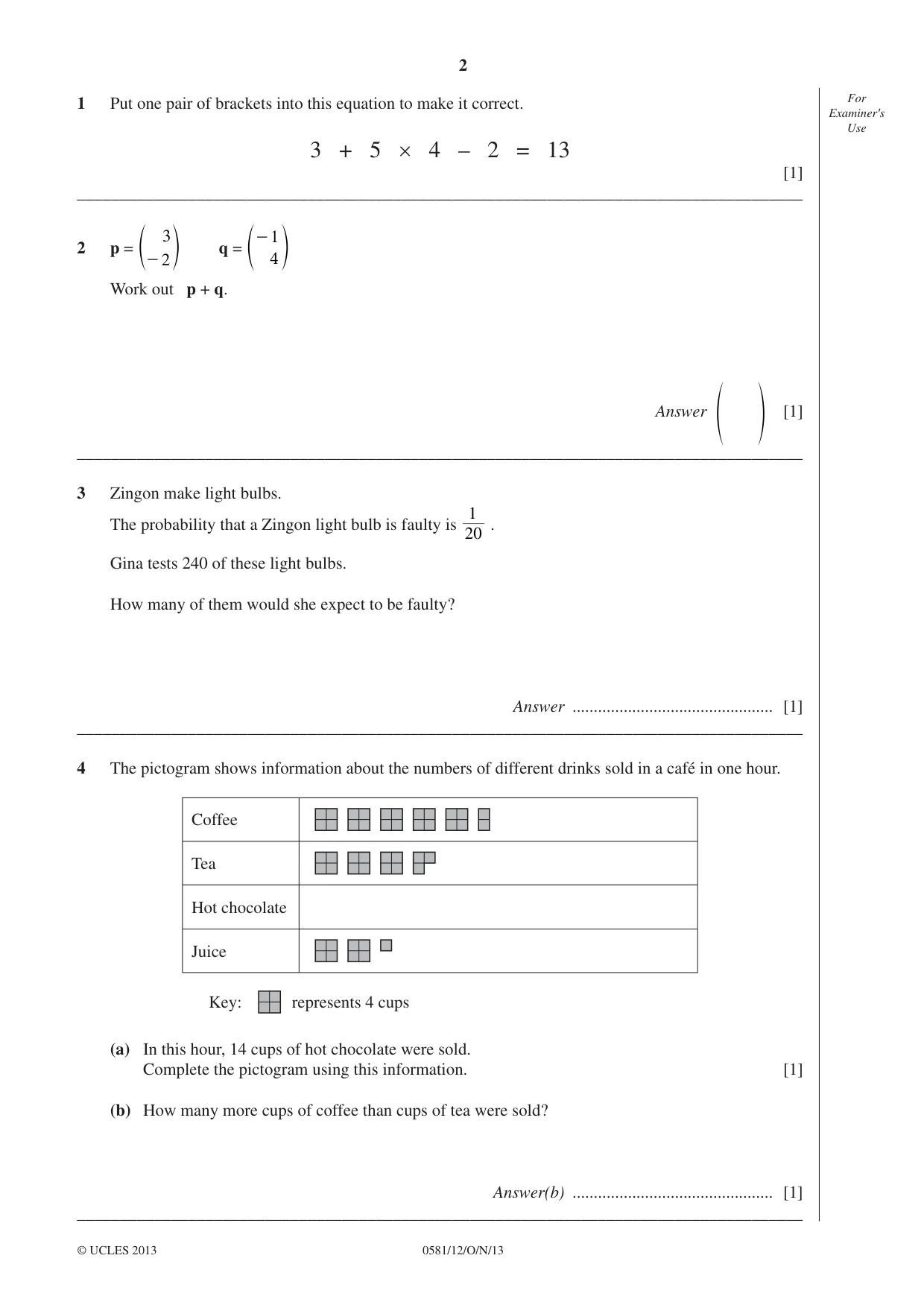
2 0581/12/O/N/13 © UCLES 2013 For Examiner′s Use 1 Put one pair of brackets into this equation to make it correct. 3 + 5 × 4 – 2 = 13 [1] _____________________________________________________________________________________ 2 p = 3 2 - e o q = 4 1 - e o Work out p + q. Answer f p [1] _____________________________________________________________________________________ 3 Zingon make light bulbs. The probability that a Zingon light bulb is faulty is 20 1 . Gina tests 240 of these light bulbs. How many of them would she expect to be faulty? Answer … [1] _____________________________________________________________________________________ 4 The pictogram shows information about the numbers of different drinks sold in a café in one hour. Coffee Tea Hot chocolate Juice Key: represents 4 cups (a) In this hour, 14 cups of hot chocolate were sold. Complete the pictogram using this information. [1] (b) How many more cups of coffee than cups of tea were sold? Answer(b) … [1] _____________________________________________________________________________________
Question paper, page 3
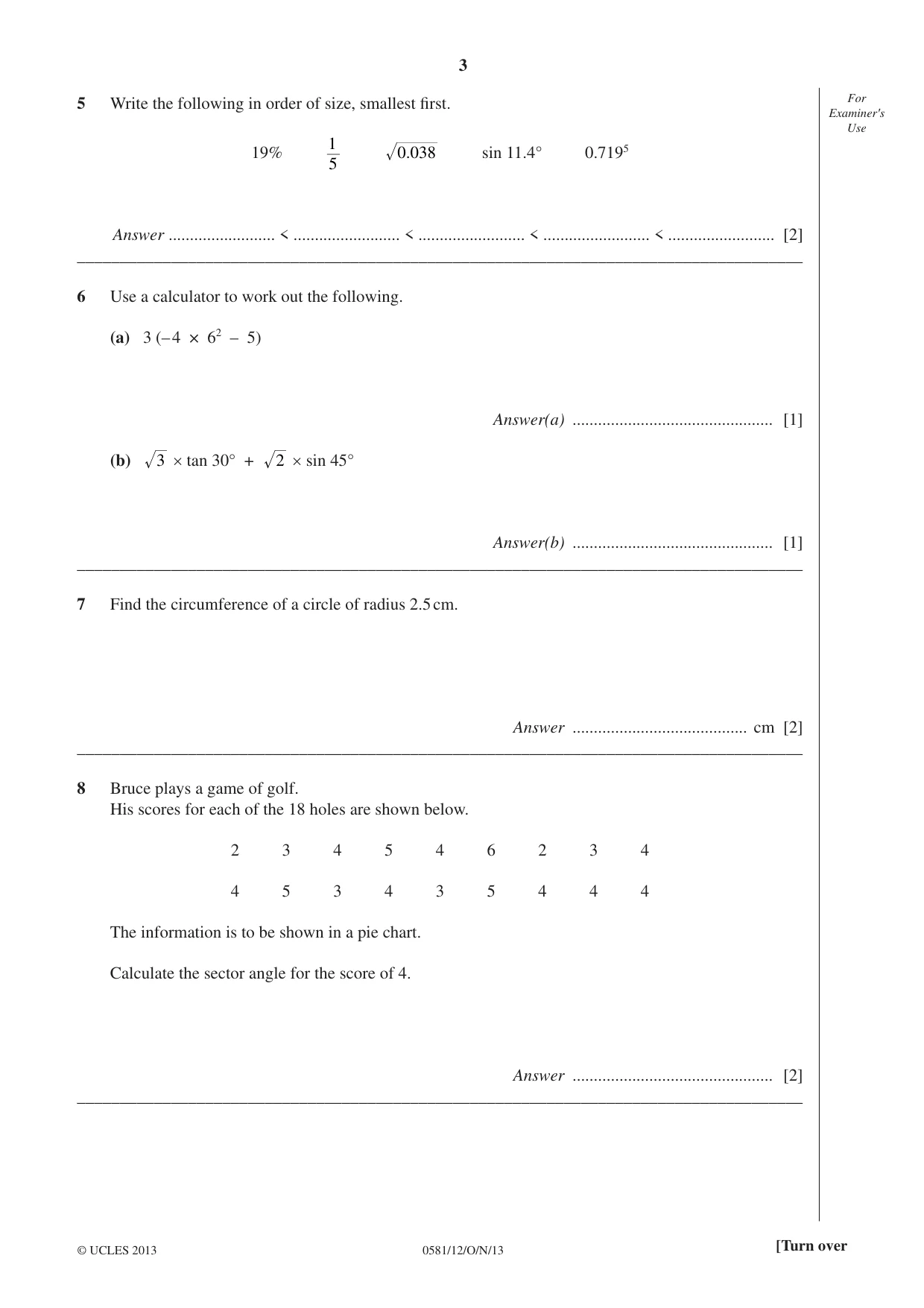
3 0581/12/O/N/13 © UCLES 2013 [Turn over For Examiner′s Use 5 Write the following in order of size, smallest fi rst. 19% 5 1 .0 038 sin 11.4° 0.7195 Answer … < … < … < … < … [2] _____________________________________________________________________________________ 6 Use a calculator to work out the following. (a) 3 (– 4 × 62 – 5) Answer(a) … [1] (b) 3 × tan 30° + 2 × sin 45° Answer(b) … [1] _____________________________________________________________________________________ 7 Find the circumference of a circle of radius 2.5 cm. Answer … cm [2] _____________________________________________________________________________________ 8 Bruce plays a game of golf. His scores for each of the 18 holes are shown below. 2 3 4 5 4 6 2 3 4 4 5 3 4 3 5 4 4 4 The information is to be shown in a pie chart. Calculate the sector angle for the score of 4. Answer … [2] _____________________________________________________________________________________
Question paper, page 4
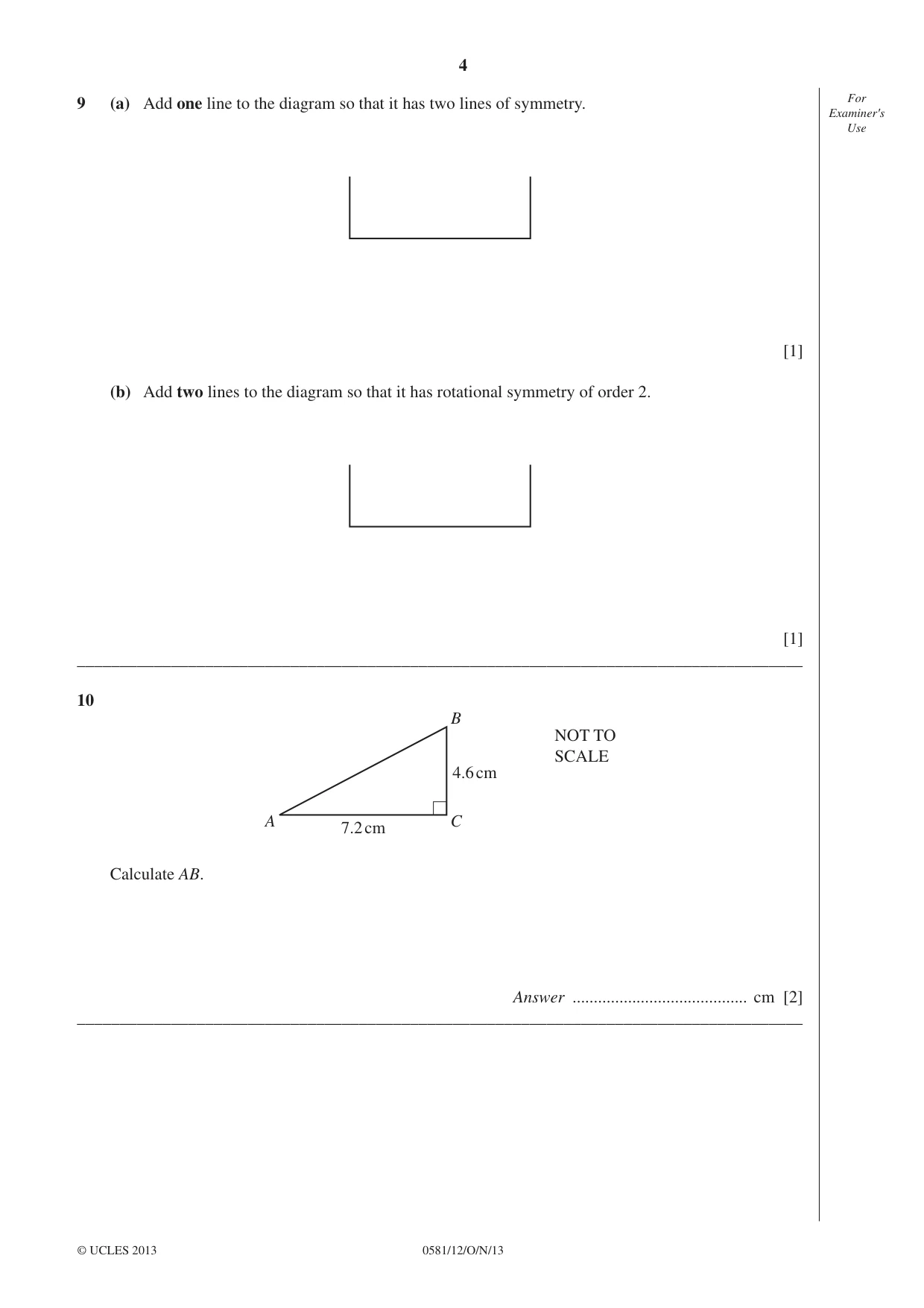
4 0581/12/O/N/13 © UCLES 2013 For Examiner′s Use 9 (a) Add one line to the diagram so that it has two lines of symmetry. [1] (b) Add two lines to the diagram so that it has rotational symmetry of order 2. [1] _____________________________________________________________________________________ 10 4.6 cm 7.2 cm A C B NOT TO SCALE Calculate AB. Answer … cm [2] _____________________________________________________________________________________
Question paper, page 5
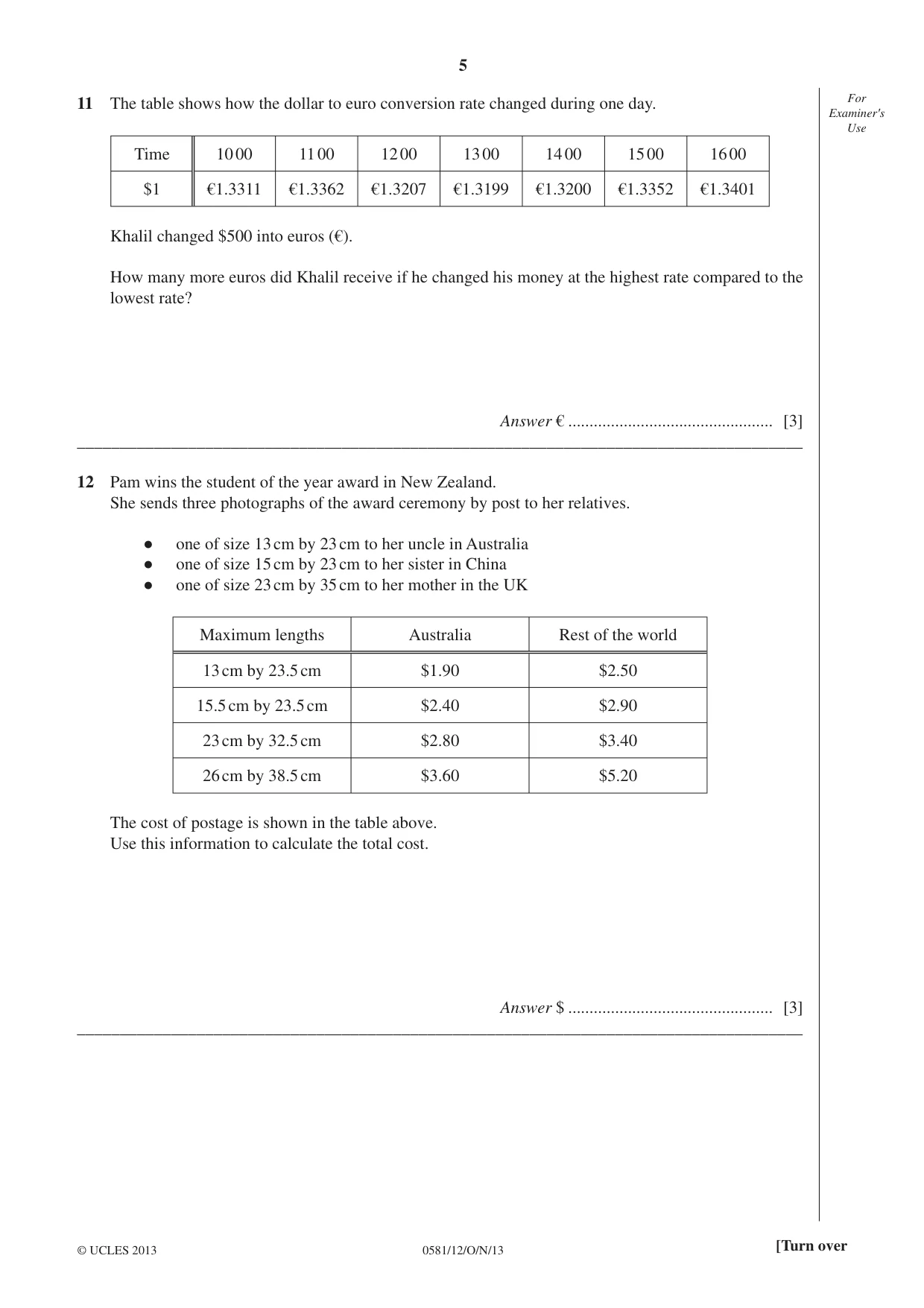
5 0581/12/O/N/13 © UCLES 2013 [Turn over For Examiner′s Use 11 The table shows how the dollar to euro conversion rate changed during one day. Time 10 00 11 00 12 00 13 00 14 00 15 00 16 00 $1 €1.3311 €1.3362 €1.3207 €1.3199 €1.3200 €1.3352 €1.3401 Khalil changed $500 into euros (€). How many more euros did Khalil receive if he changed his money at the highest rate compared to the lowest rate? Answer € … [3] _____________________________________________________________________________________ 12 Pam wins the student of the year award in New Zealand. She sends three photographs of the award ceremony by post to her relatives. ● one of size 13 cm by 23 cm to her uncle in Australia ● one of size 15 cm by 23 cm to her sister in China ● one of size 23 cm by 35 cm to her mother in the UK Maximum lengths Australia Rest of the world 13 cm by 23.5 cm $1.90 $2.50 15.5 cm by 23.5 cm $2.40 $2.90 23 cm by 32.5 cm $2.80 $3.40 26 cm by 38.5 cm $3.60 $5.20 The cost of postage is shown in the table above. Use this information to calculate the total cost. Answer $ … [3] _____________________________________________________________________________________
Question paper, page 6
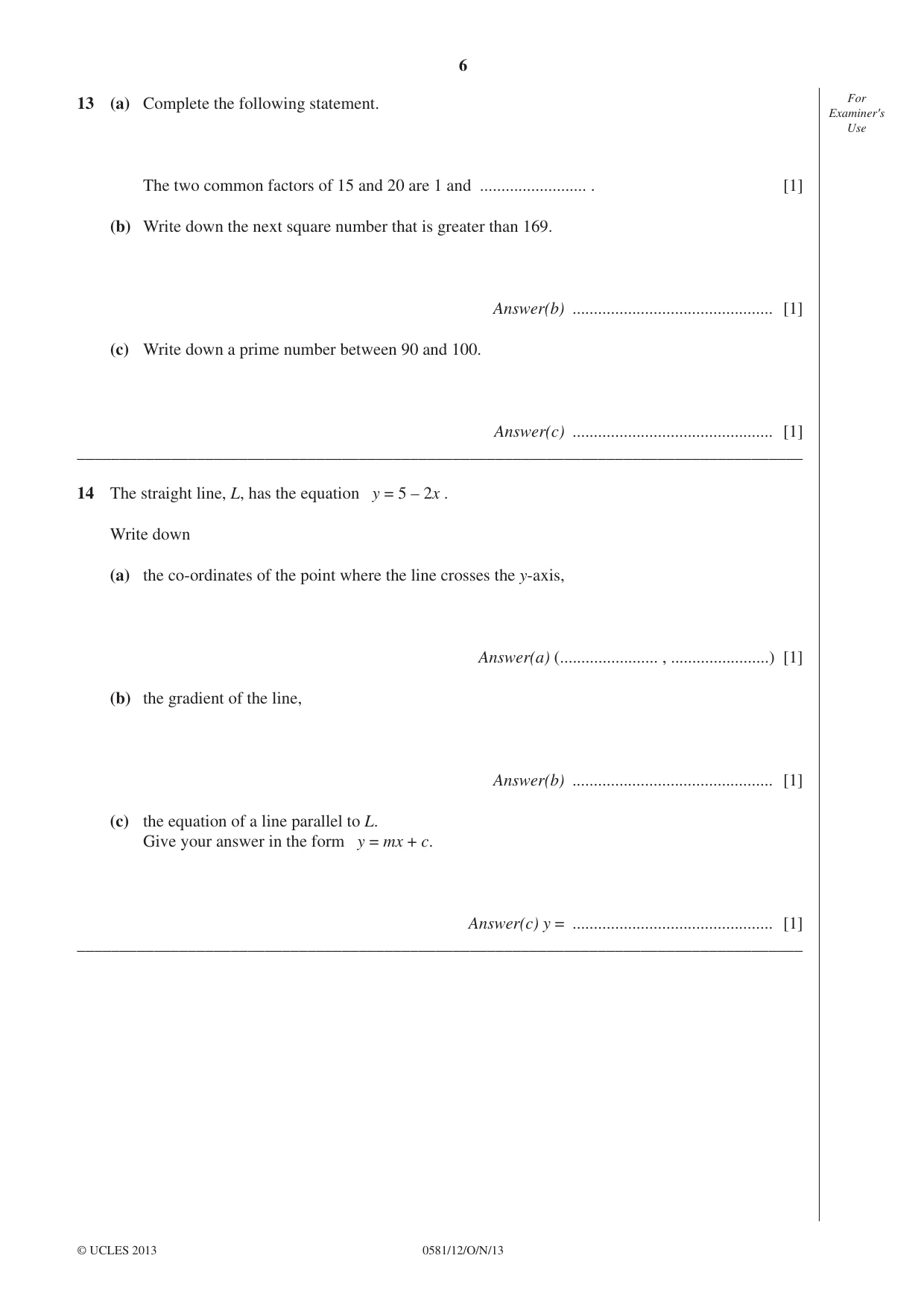
6 0581/12/O/N/13 © UCLES 2013 For Examiner′s Use 13 (a) Complete the following statement. The two common factors of 15 and 20 are 1 and … . [1] (b) Write down the next square number that is greater than 169. Answer(b) … [1] (c) Write down a prime number between 90 and 100. Answer(c) … [1] _____________________________________________________________________________________ 14 The straight line, L, has the equation y = 5 – 2x . Write down (a) the co-ordinates of the point where the line crosses the y-axis, Answer(a) (… , …) [1] (b) the gradient of the line, Answer(b) … [1] (c) the equation of a line parallel to L. Give your answer in the form y = mx + c. Answer(c) y = … [1] _____________________________________________________________________________________
Question paper, page 7
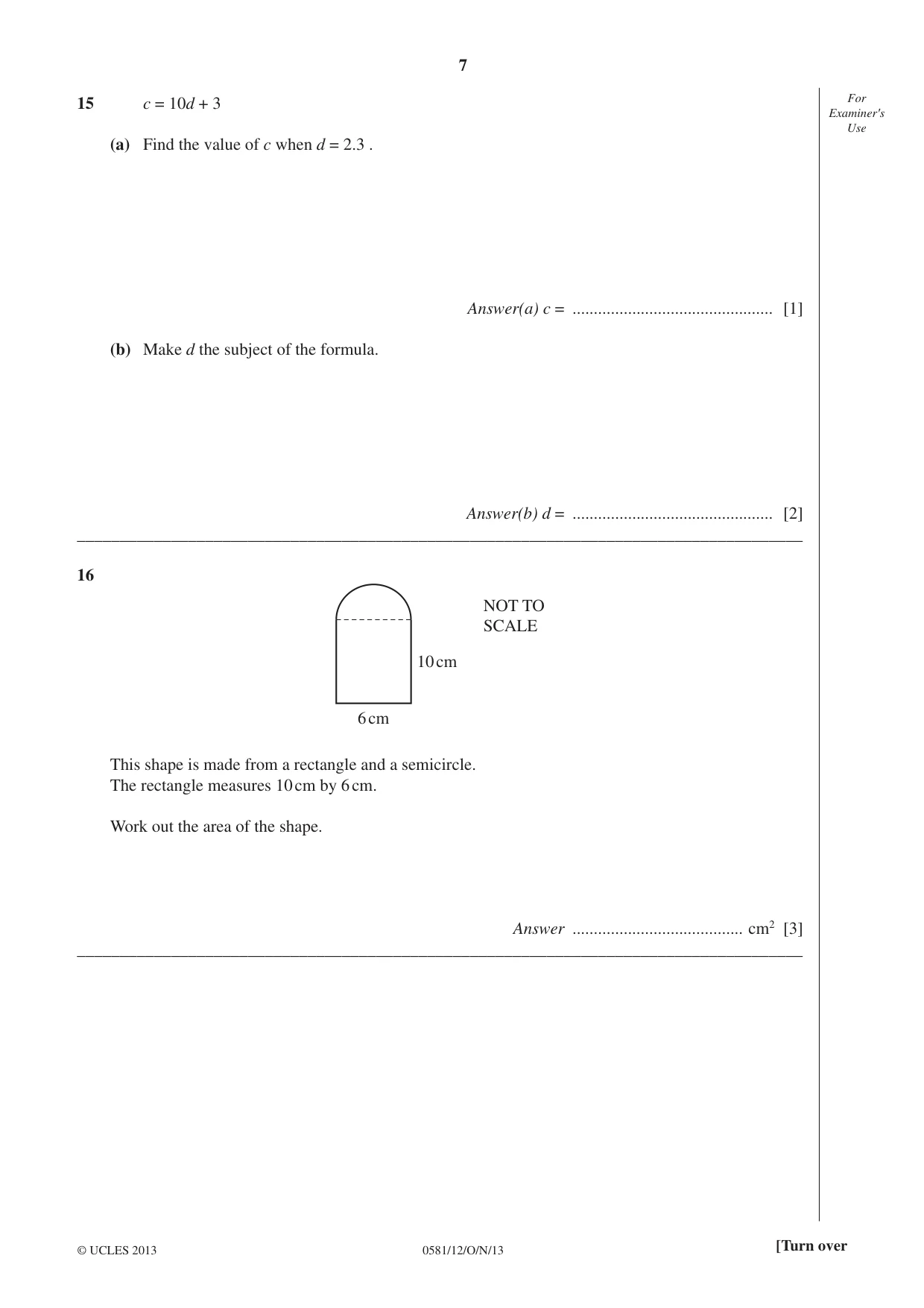
7 0581/12/O/N/13 © UCLES 2013 [Turn over For Examiner′s Use 15 c = 10d + 3 (a) Find the value of c when d = 2.3 . Answer(a) c = … [1] (b) Make d the subject of the formula. Answer(b) d = … [2] _____________________________________________________________________________________ 16 10 cm 6 cm NOT TO SCALE This shape is made from a rectangle and a semicircle. The rectangle measures 10 cm by 6 cm. Work out the area of the shape. Answer … cm2 [3] _____________________________________________________________________________________
Question paper, page 8
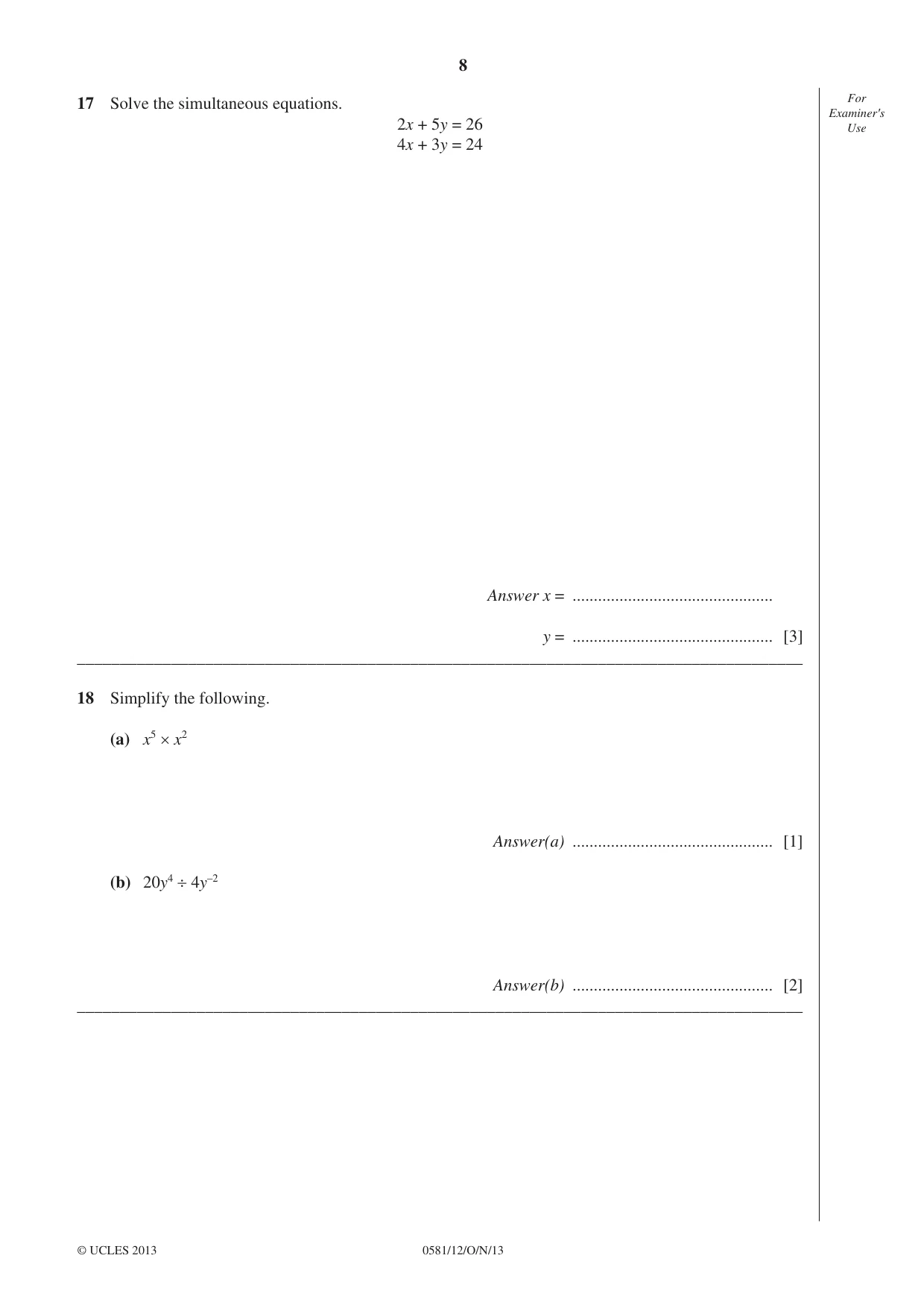
8 0581/12/O/N/13 © UCLES 2013 For Examiner′s Use 17 Solve the simultaneous equations. 2x + 5y = 26 4x + 3y = 24 Answer x = … y = … [3] _____________________________________________________________________________________ 18 Simplify the following. (a) x5 × x2 Answer(a) … [1] (b) 20y4 ÷ 4y–2 Answer(b) … [2] _____________________________________________________________________________________
Question paper, page 9
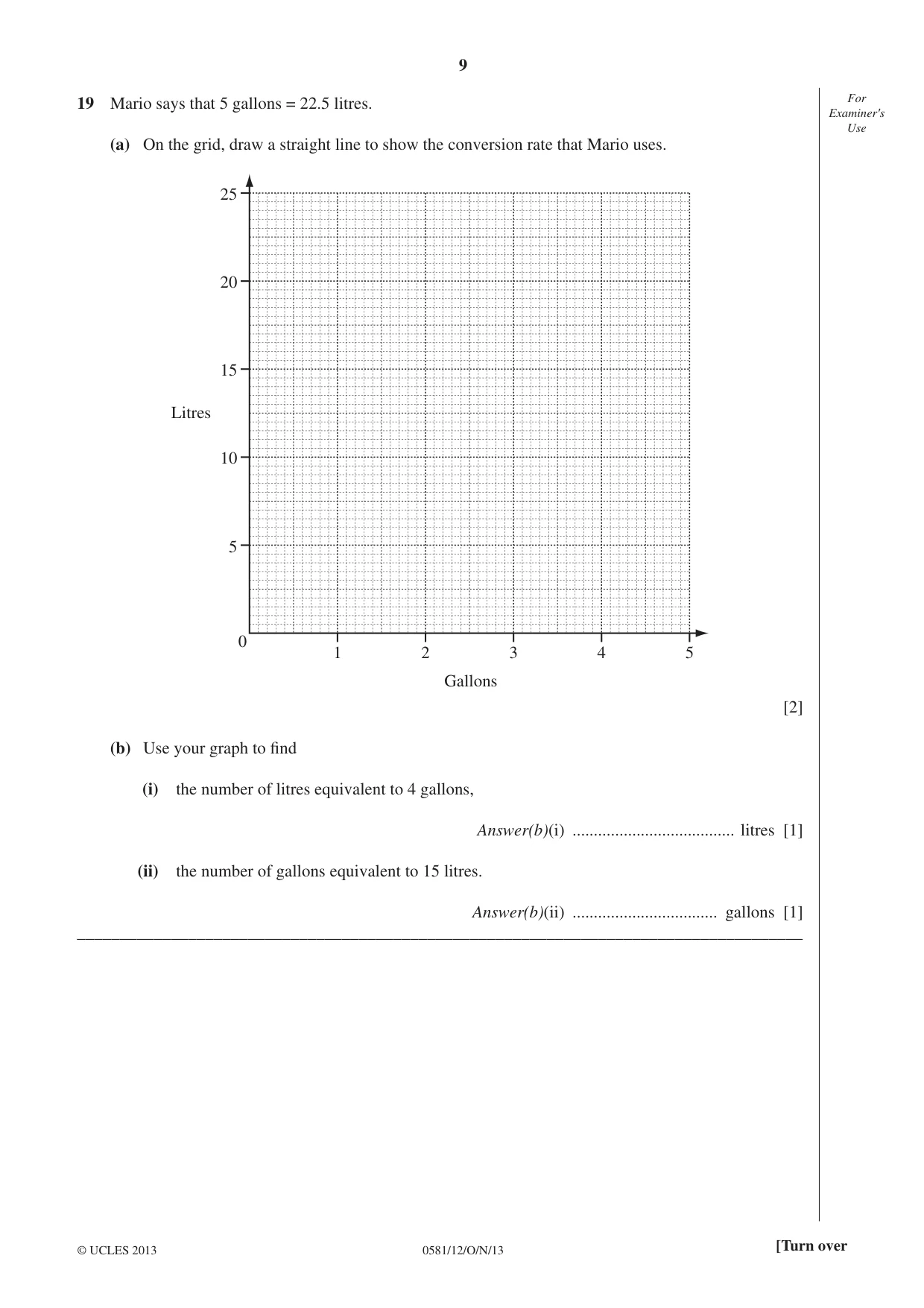
9 0581/12/O/N/13 © UCLES 2013 [Turn over For Examiner′s Use 19 Mario says that 5 gallons = 22.5 litres. (a) On the grid, draw a straight line to show the conversion rate that Mario uses. 25 20 15 10 5 0 1 2 3 Gallons Litres 4 5 [2] (b) Use your graph to fi nd (i) the number of litres equivalent to 4 gallons, Answer(b)(i) … litres [1] (ii) the number of gallons equivalent to 15 litres. Answer(b)(ii) … gallons [1] _____________________________________________________________________________________
Question paper, page 10
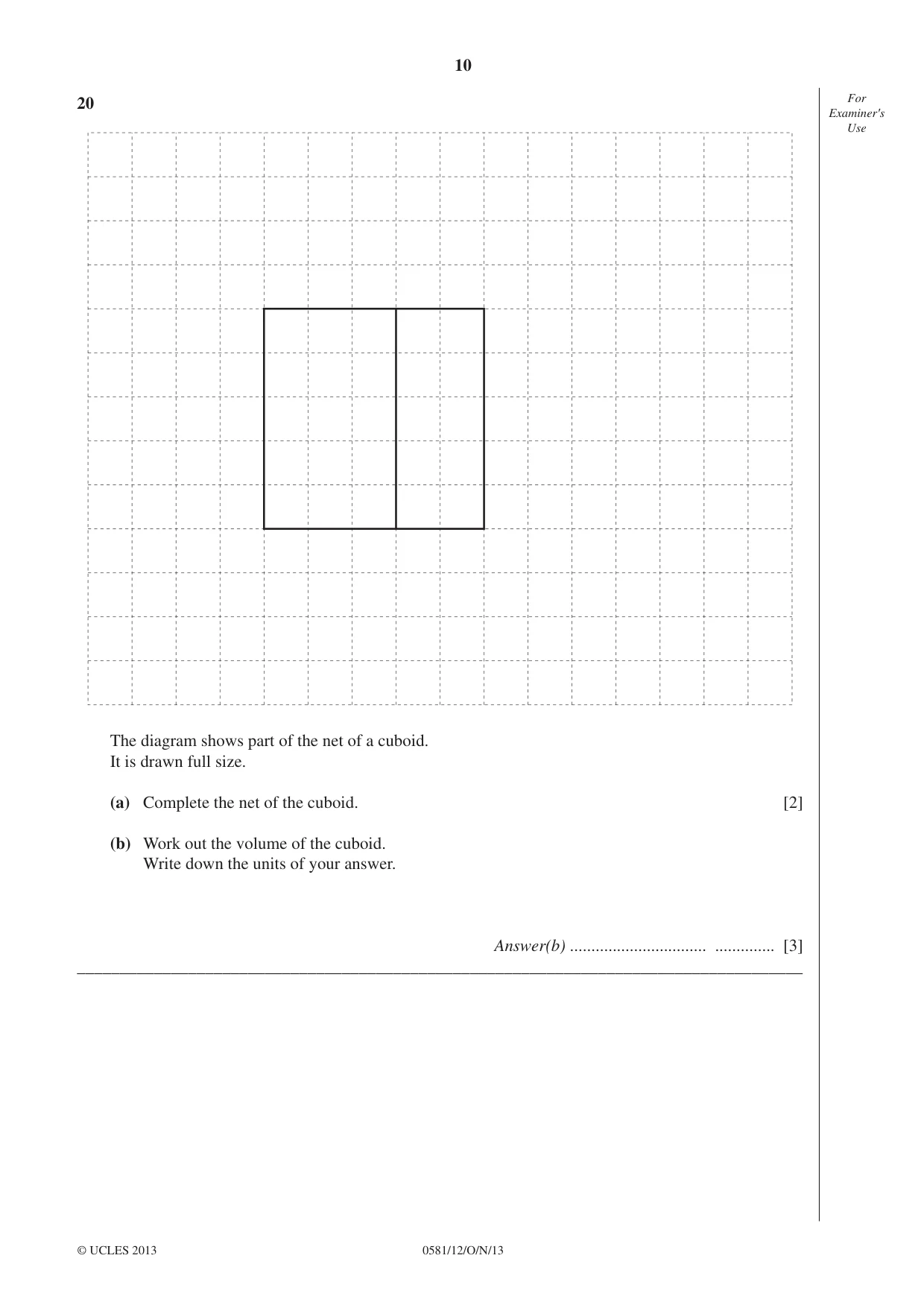
10 0581/12/O/N/13 © UCLES 2013 For Examiner′s Use 20 The diagram shows part of the net of a cuboid. It is drawn full size. (a) Complete the net of the cuboid. [2] (b) Work out the volume of the cuboid. Write down the units of your answer. Answer(b) … … [3] _____________________________________________________________________________________
Question paper, page 11
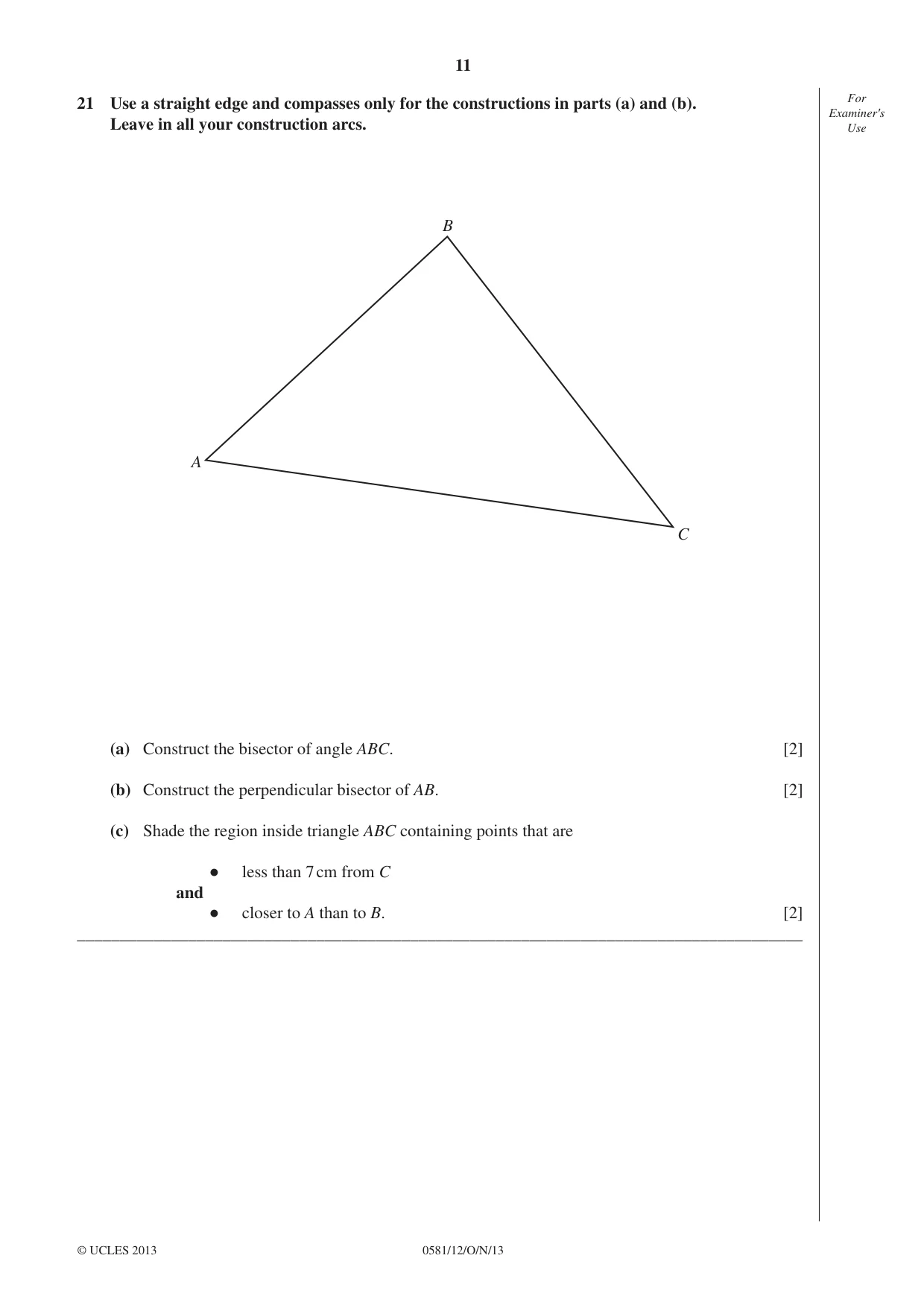
11 0581/12/O/N/13 © UCLES 2013 [Turn over For Examiner′s Use 21 Use a straight edge and compasses only for the constructions in parts (a) and (b). Leave in all your construction arcs. A B C (a) Construct the bisector of angle ABC. [2] (b) Construct the perpendicular bisector of AB. [2] (c) Shade the region inside triangle ABC containing points that are ● less than 7 cm from C and ● closer to A than to B. [2] _____________________________________________________________________________________
Question paper, page 12
12 0581/12/O/N/13 Permission to reproduce items where third-party owned material protected by copyright is included has been sought and cleared where possible. Every reasonable effort has been made by the publisher (UCLES) to trace copyright holders, but if any items requiring clearance have unwittingly been included the publisher will be pleased to make amends at the earliest possible opportunity. University of Cambridge International Examinations is part of the Cambridge Assessment Group. Cambridge Assessment is the brand name of University of Cambridge Local Examinations Syndicate (UCLES), which is itself a department of the University of Cambridge. BLANK PAGE © UCLES 2013
Mark scheme, page 1
CAMBRIDGE INTERNATIONAL EXAMINATIONS International General Certificate of Secondary Education MARK SCHEME for the October/November 2013 series 0581 MATHEMATICS 0581/12 Paper 1 (Core), maximum raw mark 56 This mark scheme is published as an aid to teachers and candidates, to indicate the requirements of the examination. It shows the basis on which Examiners were instructed to award marks. It does not indicate the details of the discussions that took place at an Examiners’ meeting before marking began, which would have considered the acceptability of alternative answers. Mark schemes should be read in conjunction with the question paper and the Principal Examiner Report for Teachers. Cambridge will not enter into discussions about these mark schemes. Cambridge is publishing the mark schemes for the October/November 2013 series for most IGCSE, GCE Advanced Level and Advanced Subsidiary Level components and some Ordinary Level components. www.XtremePapers.com
Mark scheme, page 2
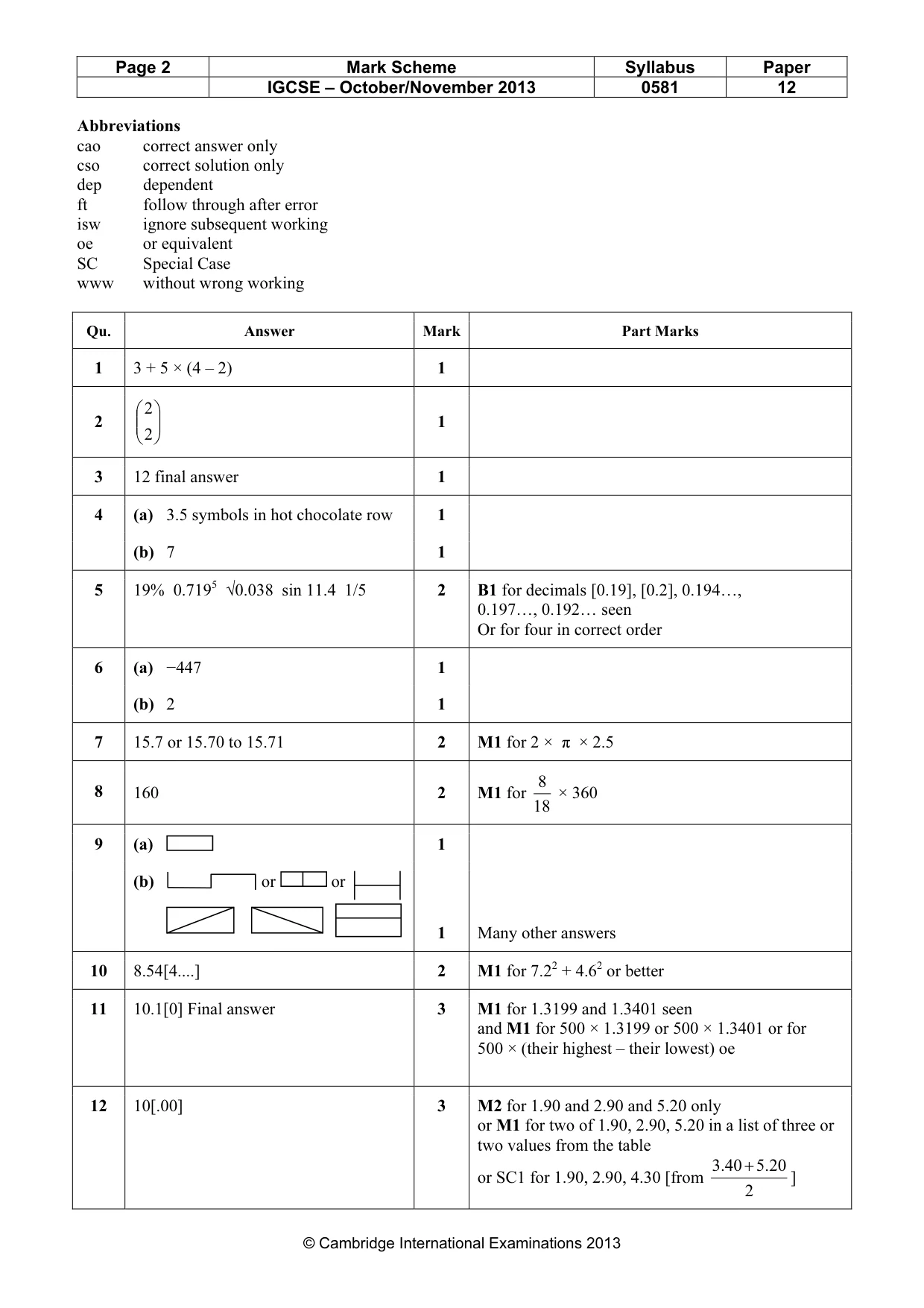
Page 2 Mark Scheme Syllabus Paper IGCSE – October/November 2013 0581 12 © Cambridge International Examinations 2013 Abbreviations cao correct answer only cso correct solution only dep dependent ft follow through after error isw ignore subsequent working oe or equivalent SC Special Case www without wrong working Qu. Answer Mark Part Marks 1 3 + 5 × (4 – 2) 1 2 2 2 1 3 12 final answer 1 4 (a) 3.5 symbols in hot chocolate row 1 (b) 7 1 5 19% 0.7195 √0.038 sin 11.4 1/5 2 B1 for decimals [0.19], [0.2], 0.194…, 0.197…, 0.192… seen Or for four in correct order 6 (a) −447 1 (b) 2 1 7 15.7 or 15.70 to 15.71 2 M1 for 2 × π × 2.5 8 160 2 M1 for 18 8 × 360 9 (a) 1 (b) or or 1 Many other answers 10 8.54[4…] 2 M1 for 7.22 + 4.62 or better 11 10.1[0] Final answer 3 M1 for 1.3199 and 1.3401 seen and M1 for 500 × 1.3199 or 500 × 1.3401 or for 500 × (their highest – their lowest) oe 12 10[.00] 3 M2 for 1.90 and 2.90 and 5.20 only or M1 for two of 1.90, 2.90, 5.20 in a list of three or two values from the table or SC1 for 1.90, 2.90, 4.30 [from 2 20 .5 40 .3 + ]
Mark scheme, page 3
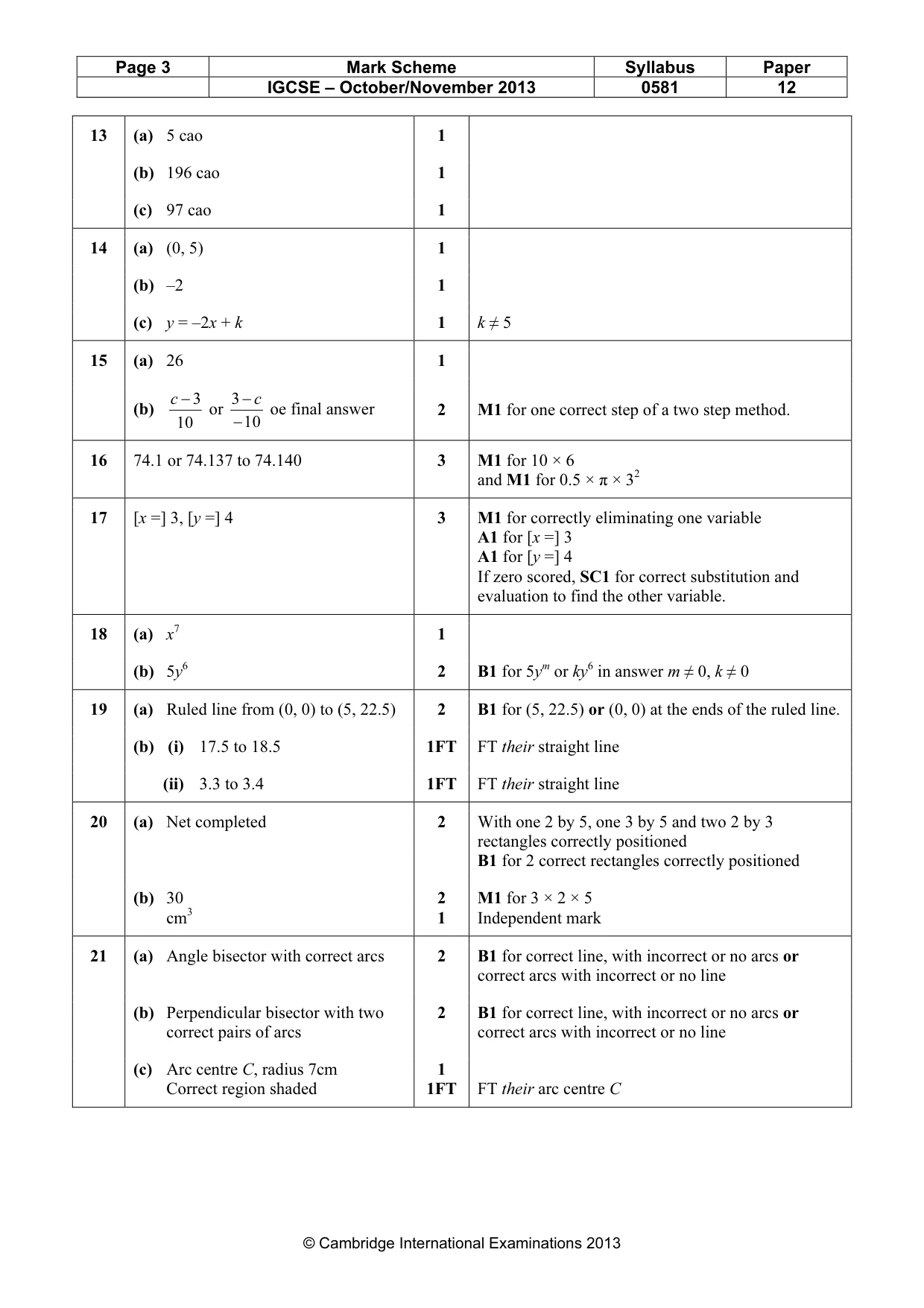
Page 3 Mark Scheme Syllabus Paper IGCSE – October/November 2013 0581 12 © Cambridge International Examinations 2013 13 (a) 5 cao 1 (b) 196 cao 1 (c) 97 cao 1 14 (a) (0, 5) 1 (b) –2 1 (c) y = –2x + k 1 k ≠ 5 15 (a) 26 1 (b) 10 3 − c or 10 3 − −c oe final answer 2 M1 for one correct step of a two step method. 16 74.1 or 74.137 to 74.140 3 M1 for 10 × 6 and M1 for 0.5 × π × 32 17 [x =] 3, [y =] 4 3 M1 for correctly eliminating one variable A1 for [x =] 3 A1 for [y =] 4 If zero scored, SC1 for correct substitution and evaluation to find the other variable. 18 (a) x7 1 (b) 5y6 2 B1 for 5ym or ky6 in answer m ≠ 0, k ≠ 0 19 (a) Ruled line from (0, 0) to (5, 22.5) 2 B1 for (5, 22.5) or (0, 0) at the ends of the ruled line. (b) (i) 17.5 to 18.5 1FT FT their straight line (ii) 3.3 to 3.4 1FT FT their straight line 20 (a) Net completed 2 With one 2 by 5, one 3 by 5 and two 2 by 3 rectangles correctly positioned B1 for 2 correct rectangles correctly positioned (b) 30 cm3 2 1 M1 for 3 × 2 × 5 Independent mark 21 (a) Angle bisector with correct arcs 2 B1 for correct line, with incorrect or no arcs or correct arcs with incorrect or no line (b) Perpendicular bisector with two correct pairs of arcs 2 B1 for correct line, with incorrect or no arcs or correct arcs with incorrect or no line (c) Arc centre C, radius 7cm Correct region shaded 1 1FT FT their arc centre C