Cambridge IGCSE Mathematics (with coursework) 0581 — 2013 Oct/Nov Paper 1 · Variant 3
0581/13/O/N/13
The question paper and its mark scheme, free to read here and free to download. This is Cambridge’s own paper, exactly as it was sat.
Question paper12 pages
Mark scheme4 pages
Answers below. Sit the paper first if you are practising.
Paper as text
Question paper, page 1
READ THESE INSTRUCTIONS FIRST Write your Centre number, candidate number and name on all the work you hand in. Write in dark blue or black pen. You may use a pencil for any diagrams or graphs. Do not use staples, paper clips, highlighters, glue or correction fl uid. DO NOT WRITE IN ANY BARCODES. Answer all questions. If working is needed for any question it must be shown below that question. Electronic calculators should be used. If the degree of accuracy is not specifi ed in the question, and if the answer is not exact, give the answer to three signifi cant fi gures. Give answers in degrees to one decimal place. For π, use either your calculator value or 3.142. At the end of the examination, fasten all your work securely together. The number of marks is given in brackets [ ] at the end of each question or part question. The total of the marks for this paper is 56. MATHEMATICS 0581/13 Paper 1 (Core) October/November 2013 1 hour Candidates answer on the Question Paper. Additional Materials: Electronic calculator Geometrical instruments Tracing paper (optional) UNIVERSITY OF CAMBRIDGE INTERNATIONAL EXAMINATIONS International General Certifi cate of Secondary Education This document consists of 11 printed pages and 1 blank page. [Turn over IB13 11_0581_13/FP © UCLES 2013 *3882123200* www.XtremePapers.com
Question paper, page 2
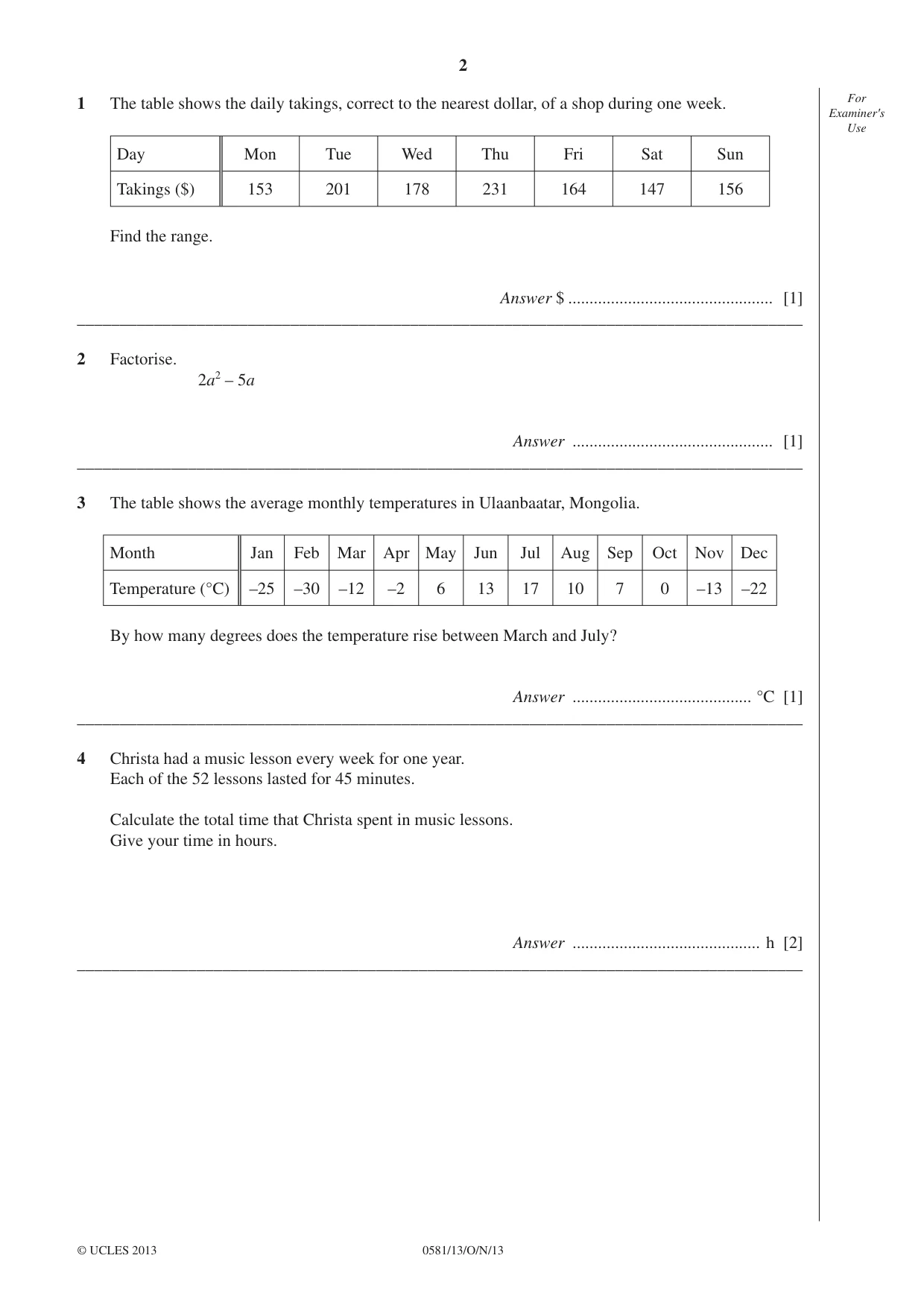
2 0581/13/O/N/13 © UCLES 2013 For Examiner′s Use 1 The table shows the daily takings, correct to the nearest dollar, of a shop during one week. Day Mon Tue Wed Thu Fri Sat Sun Takings ($) 153 201 178 231 164 147 156 Find the range. Answer $ … [1] _____________________________________________________________________________________ 2 Factorise. 2a2 – 5a Answer … [1] _____________________________________________________________________________________ 3 The table shows the average monthly temperatures in Ulaanbaatar, Mongolia. Month Jan Feb Mar Apr May Jun Jul Aug Sep Oct Nov Dec Temperature (°C) –25 –30 –12 –2 6 13 17 10 7 0 –13 –22 By how many degrees does the temperature rise between March and July? Answer … °C [1] _____________________________________________________________________________________ 4 Christa had a music lesson every week for one year. Each of the 52 lessons lasted for 45 minutes. Calculate the total time that Christa spent in music lessons. Give your time in hours. Answer … h [2] _____________________________________________________________________________________
Question paper, page 3
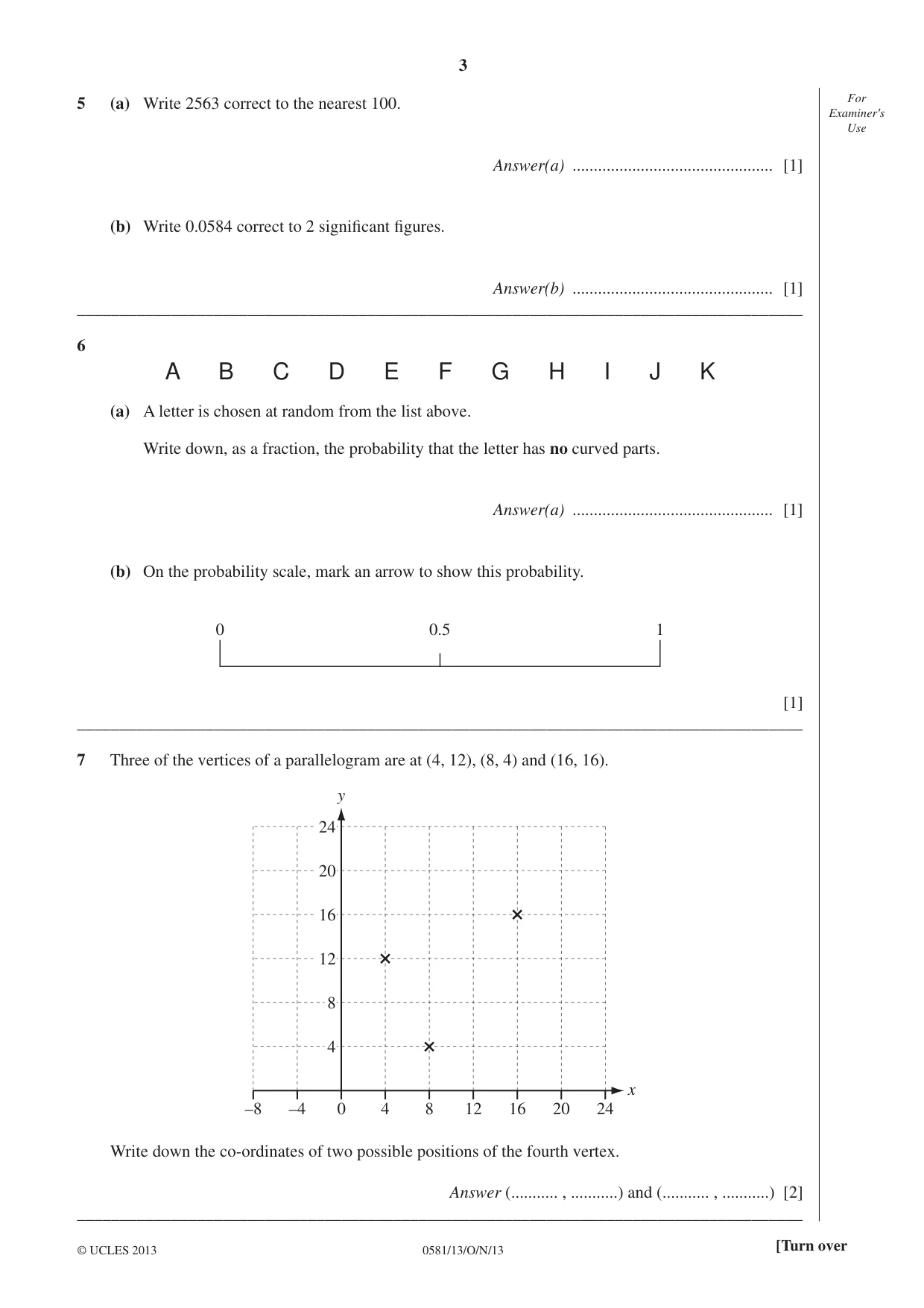
3 0581/13/O/N/13 © UCLES 2013 [Turn over For Examiner′s Use 5 (a) Write 2563 correct to the nearest 100. Answer(a) … [1] (b) Write 0.0584 correct to 2 signifi cant fi gures. Answer(b) … [1] _____________________________________________________________________________________ 6 A B C D E F G H I J K (a) A letter is chosen at random from the list above. Write down, as a fraction, the probability that the letter has no curved parts. Answer(a) … [1] (b) On the probability scale, mark an arrow to show this probability. 0 0.5 1 [1] _____________________________________________________________________________________ 7 Three of the vertices of a parallelogram are at (4, 12), (8, 4) and (16, 16). 4 8 –8 –4 12 16 20 24 0 y x 24 20 16 12 8 4 Write down the co-ordinates of two possible positions of the fourth vertex. Answer (… , …) and (… , …) [2] _____________________________________________________________________________________
Question paper, page 4
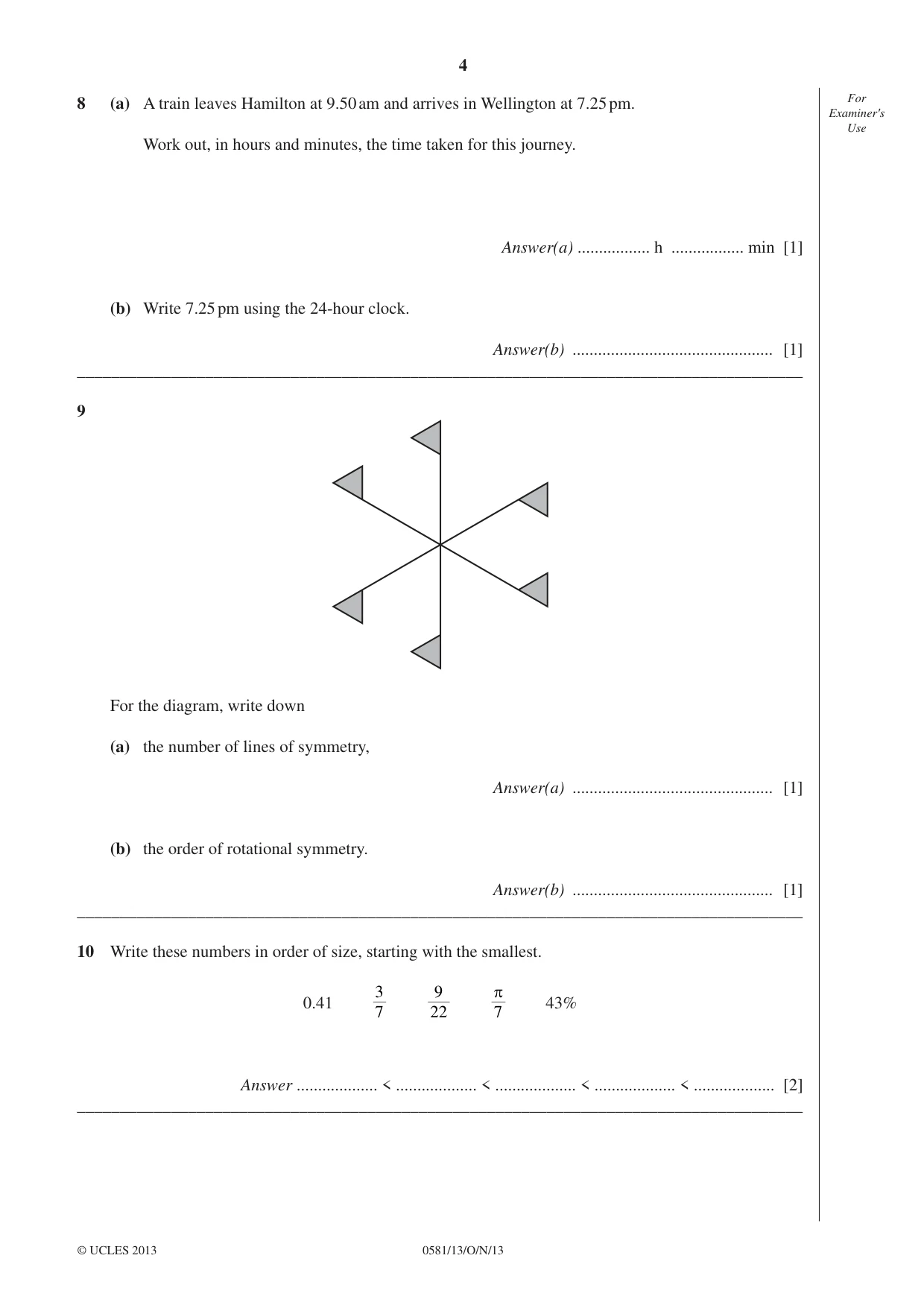
4 0581/13/O/N/13 © UCLES 2013 For Examiner′s Use 8 (a) A train leaves Hamilton at 9.50 am and arrives in Wellington at 7.25 pm. Work out, in hours and minutes, the time taken for this journey. Answer(a) … h … min [1] (b) Write 7.25 pm using the 24-hour clock. Answer(b) … [1] _____________________________________________________________________________________ 9 For the diagram, write down (a) the number of lines of symmetry, Answer(a) … [1] (b) the order of rotational symmetry. Answer(b) … [1] _____________________________________________________________________________________ 10 Write these numbers in order of size, starting with the smallest. 0.41 7 3 22 9 π 7 43% Answer … < … < … < … < … [2] _____________________________________________________________________________________
Question paper, page 5
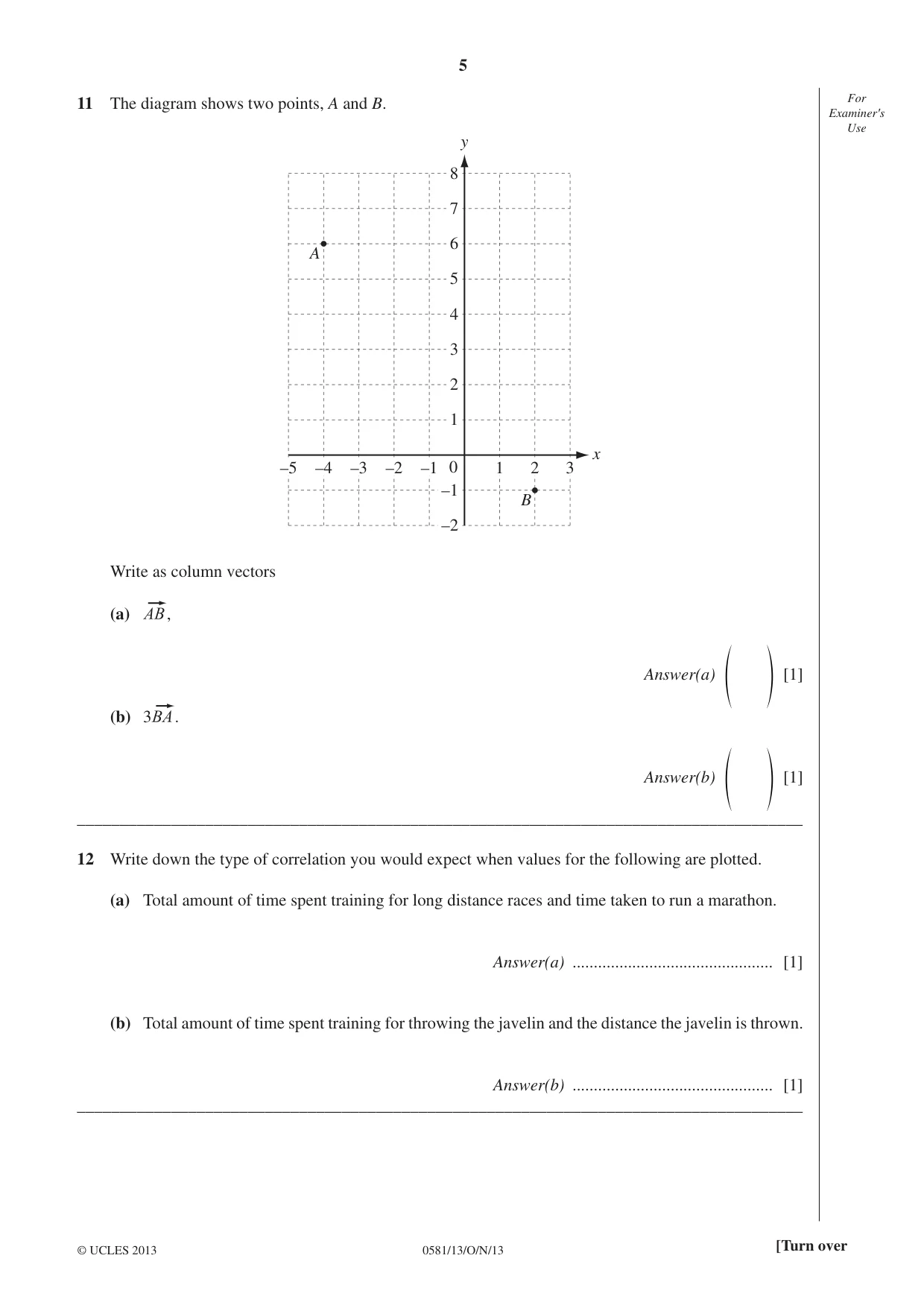
5 0581/13/O/N/13 © UCLES 2013 [Turn over For Examiner′s Use 11 The diagram shows two points, A and B. 8 7 6 5 4 3 2 1 –1 –2 –5 –4 –3 –2 –1 1 0 2 3 y x B A Write as column vectors (a) , Answer(a) f p [1] (b) 3 . Answer(b) f p [1] _____________________________________________________________________________________ 12 Write down the type of correlation you would expect when values for the following are plotted. (a) Total amount of time spent training for long distance races and time taken to run a marathon. Answer(a) … [1] (b) Total amount of time spent training for throwing the javelin and the distance the javelin is thrown. Answer(b) … [1] _____________________________________________________________________________________
Question paper, page 6
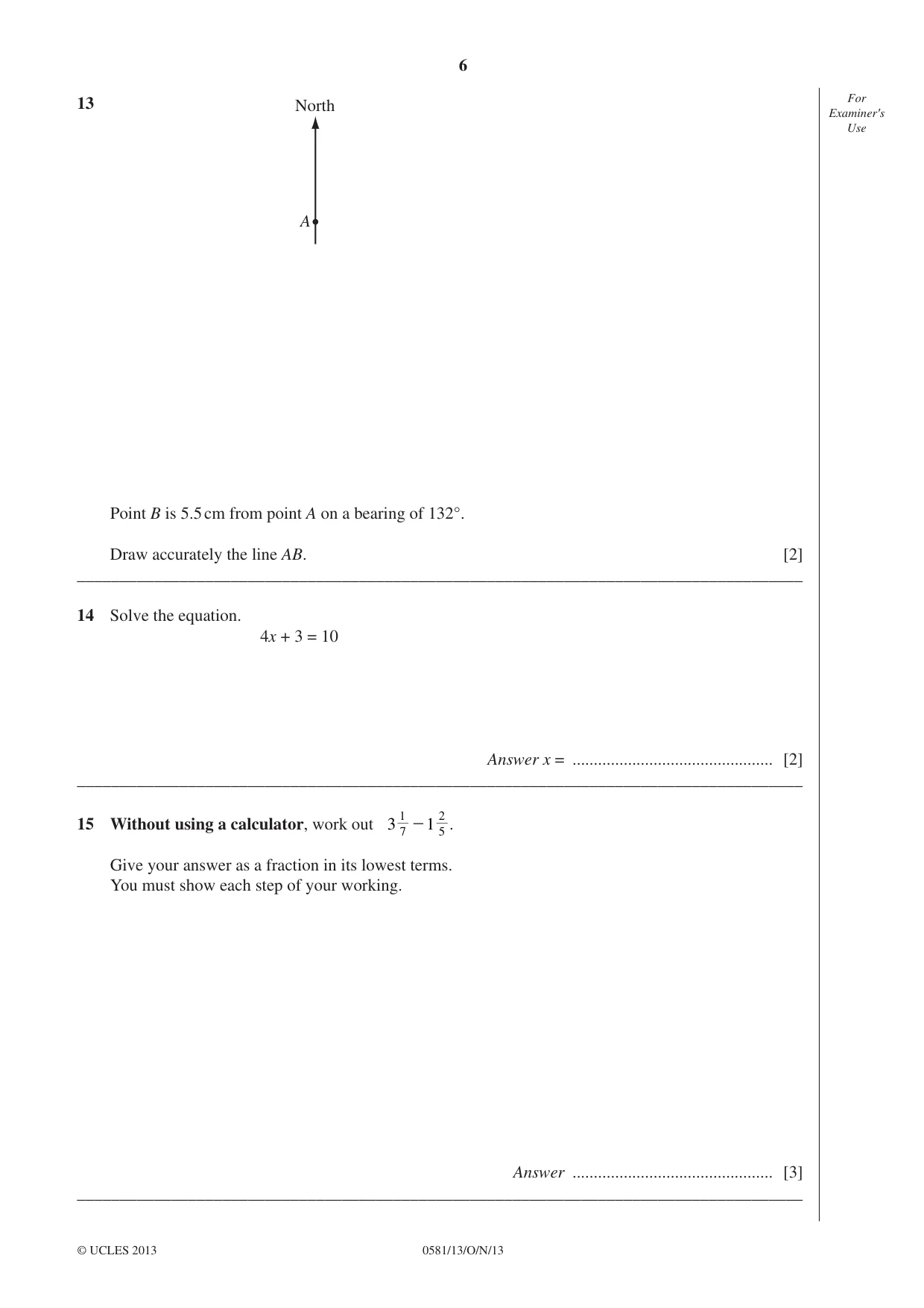
6 0581/13/O/N/13 © UCLES 2013 For Examiner′s Use 13 Point B is 5.5 cm from point A on a bearing of 132°. Draw accurately the line AB. [2] _____________________________________________________________________________________ 14 Solve the equation. 4x + 3 = 10 Answer x = … [2] _____________________________________________________________________________________ 15 Without using a calculator, work out 3 1 7 1 5 2 - . Give your answer as a fraction in its lowest terms. You must show each step of your working. Answer … [3] _____________________________________________________________________________________ A North
Question paper, page 7
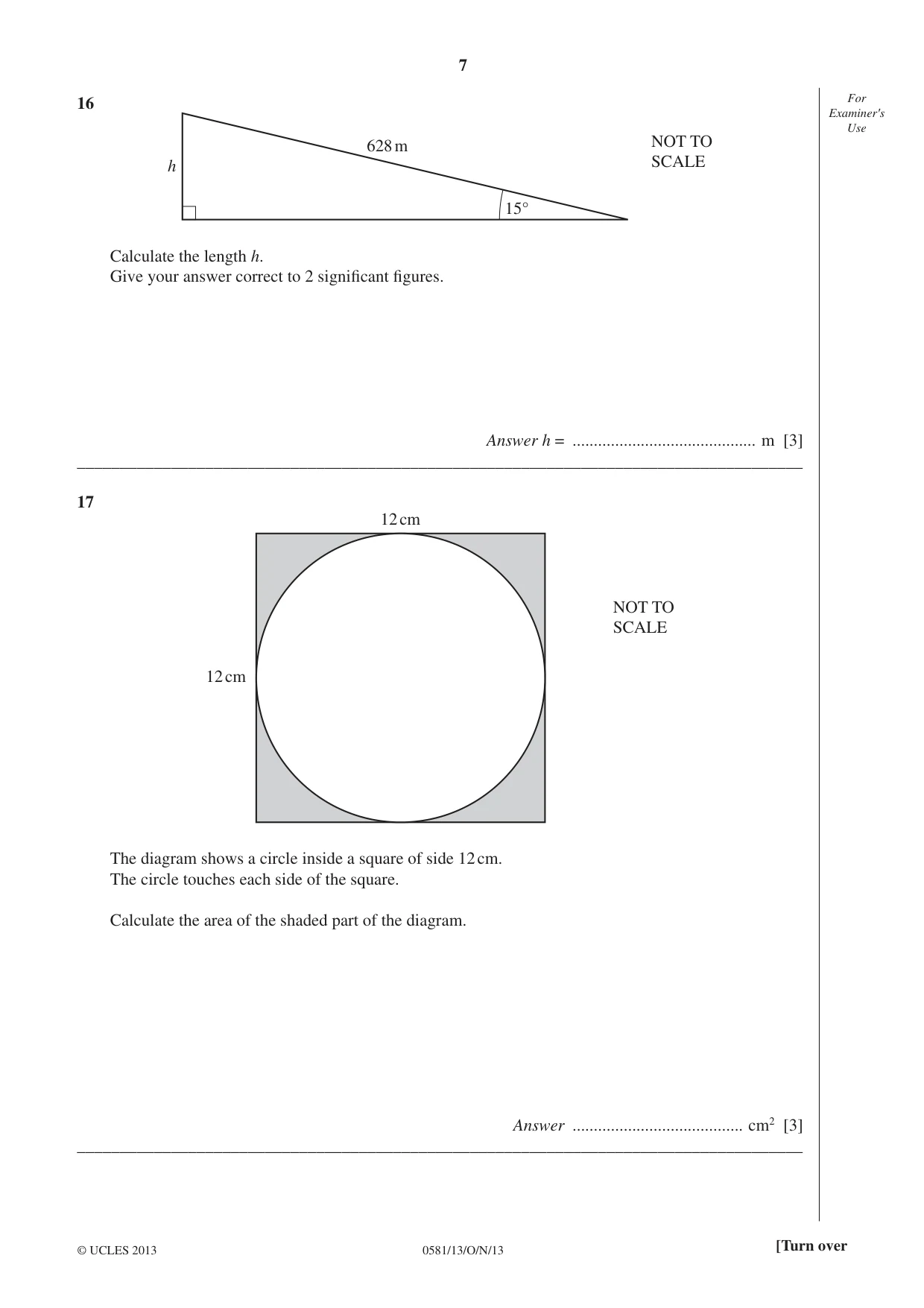
7 0581/13/O/N/13 © UCLES 2013 [Turn over For Examiner′s Use 16 15° h 628 m NOT TO SCALE Calculate the length h. Give your answer correct to 2 signifi cant fi gures. Answer h = … m [3] _____________________________________________________________________________________ 17 12 cm 12 cm NOT TO SCALE The diagram shows a circle inside a square of side 12 cm. The circle touches each side of the square. Calculate the area of the shaded part of the diagram. Answer … cm2 [3] _____________________________________________________________________________________
Question paper, page 8
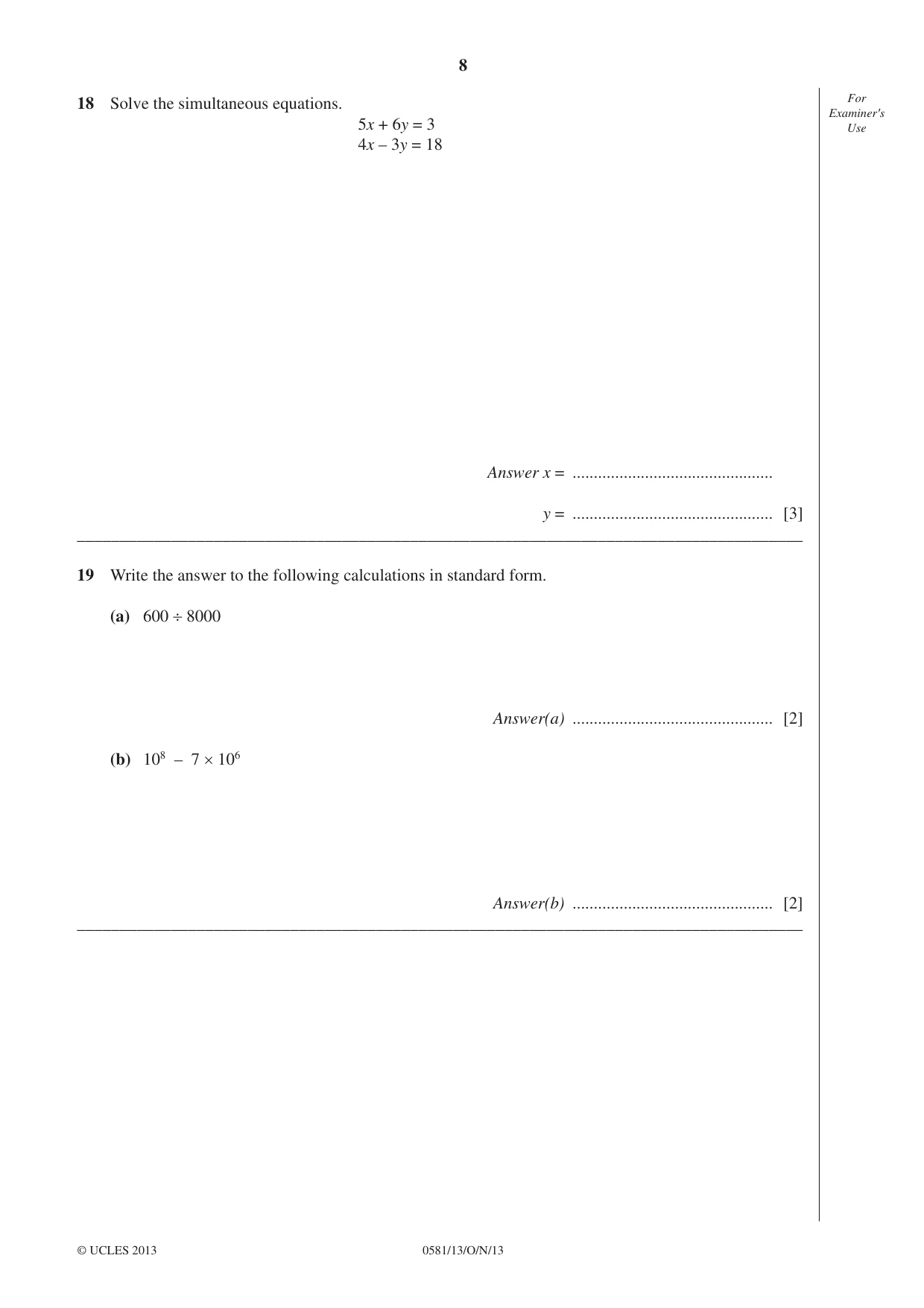
8 0581/13/O/N/13 © UCLES 2013 For Examiner′s Use 18 Solve the simultaneous equations. 5x + 6y = 3 4x – 3y = 18 Answer x = … y = … [3] _____________________________________________________________________________________ 19 Write the answer to the following calculations in standard form. (a) 600 ÷ 8000 Answer(a) … [2] (b) 108 – 7 × 10⁶ Answer(b) … [2] _____________________________________________________________________________________
Question paper, page 9
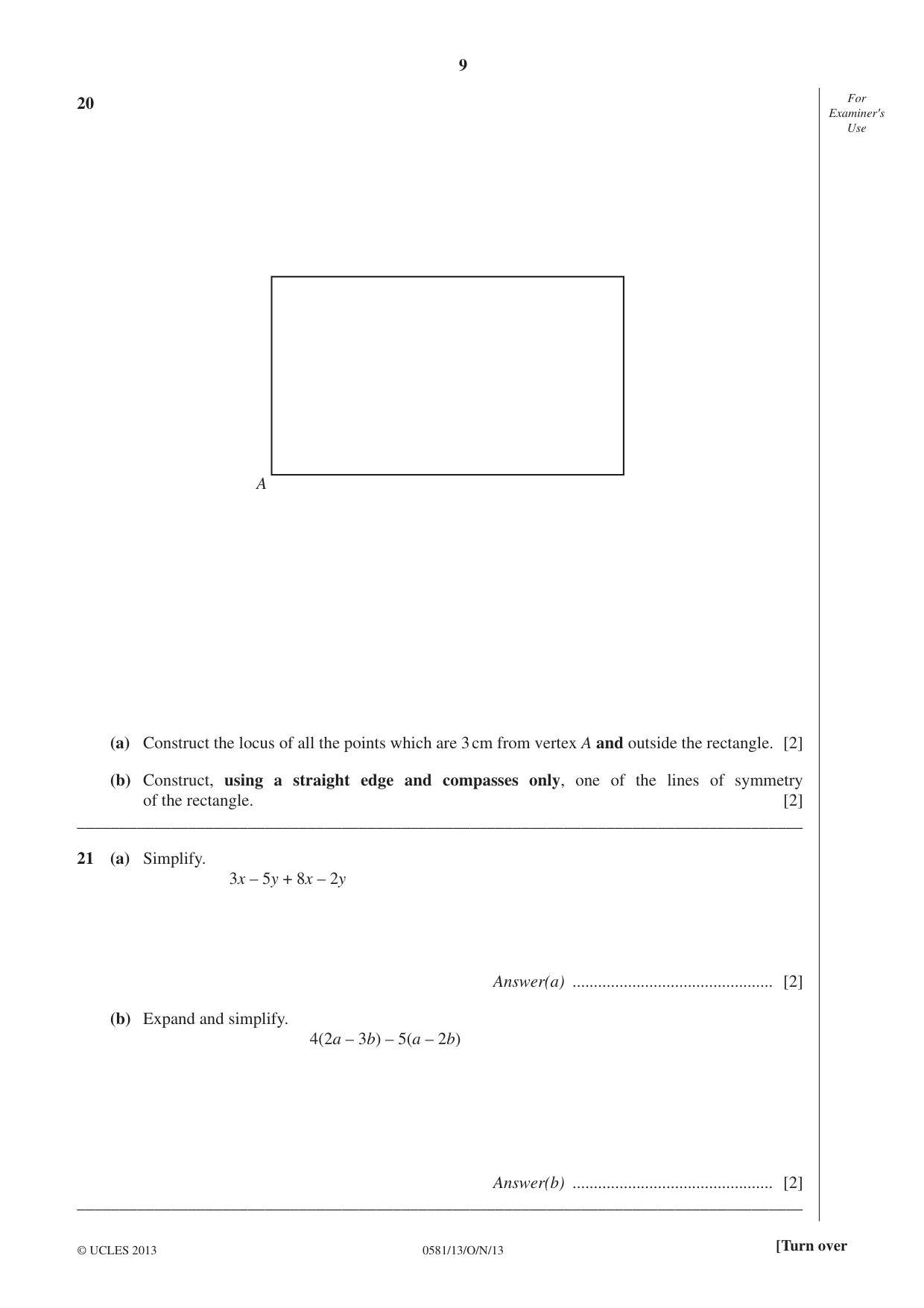
9 0581/13/O/N/13 © UCLES 2013 [Turn over For Examiner′s Use 20 A (a) Construct the locus of all the points which are 3 cm from vertex A and outside the rectangle. [2] (b) Construct, using a straight edge and compasses only, one of the lines of symmetry of the rectangle. [2] _____________________________________________________________________________________ 21 (a) Simplify. 3x – 5y + 8x – 2y Answer(a) … [2] (b) Expand and simplify. 4(2a – 3b) – 5(a – 2b) Answer(b) … [2] _____________________________________________________________________________________
Question paper, page 10
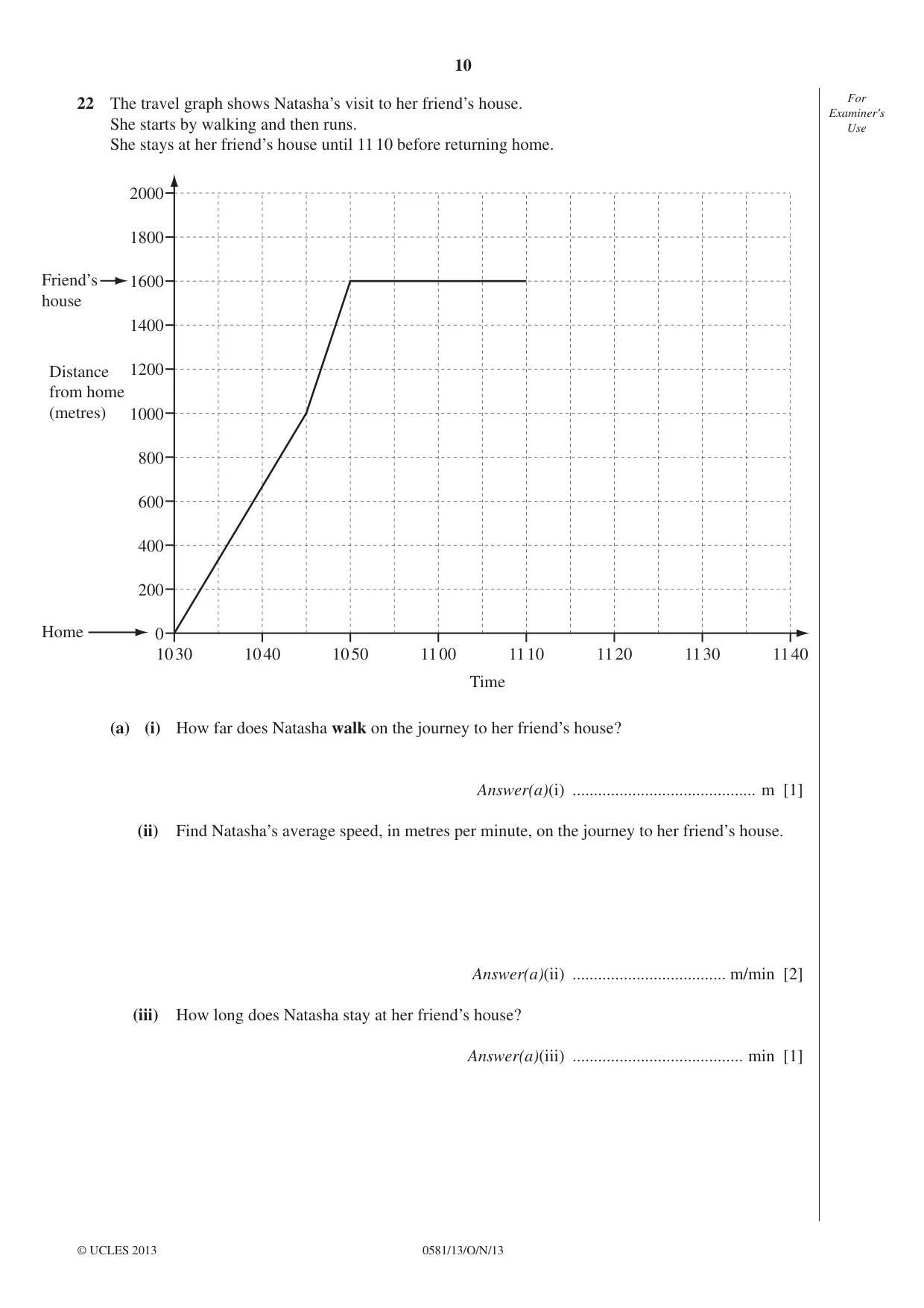
10 0581/13/O/N/13 © UCLES 2013 For Examiner′s Use 22 The travel graph shows Natasha’s visit to her friend’s house. She starts by walking and then runs. She stays at her friend’s house until 11 10 before returning home. 2000 1800 1600 1400 1200 1000 800 600 400 200 0 10 30 10 40 10 50 11 00 11 10 Time Distance from home (metres) 11 20 11 30 11 40 Friend’s house Home (a) (i) How far does Natasha walk on the journey to her friend’s house? Answer(a)(i) … m [1] (ii) Find Natasha’s average speed, in metres per minute, on the journey to her friend’s house. Answer(a)(ii) … m/min [2] (iii) How long does Natasha stay at her friend’s house? Answer(a)(iii) … min [1]
Question paper, page 11
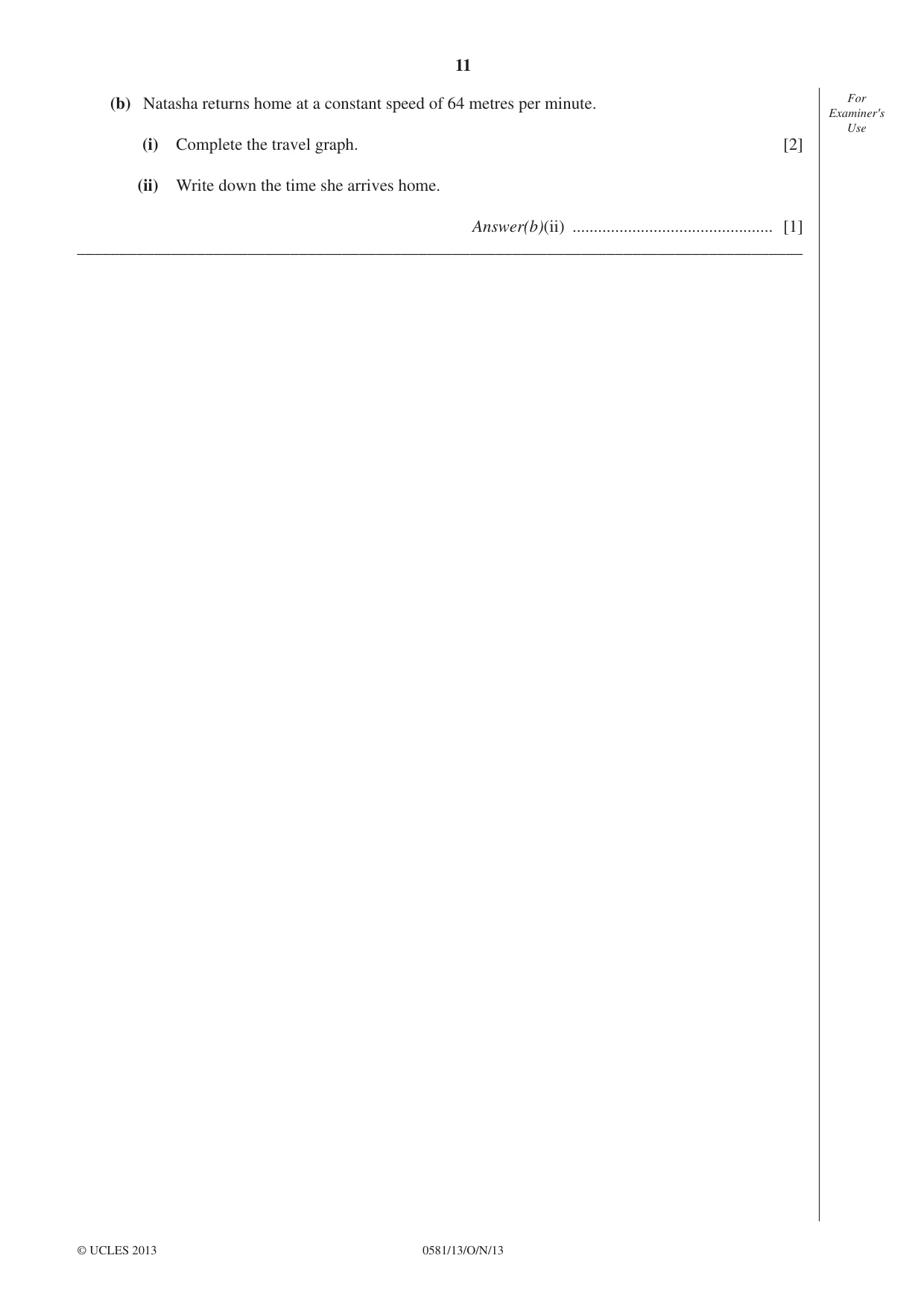
11 0581/13/O/N/13 © UCLES 2013 [Turn over For Examiner′s Use (b) Natasha returns home at a constant speed of 64 metres per minute. (i) Complete the travel graph. [2] (ii) Write down the time she arrives home. Answer(b)(ii) … [1] _____________________________________________________________________________________
Question paper, page 12
12 0581/13/O/N/13 Permission to reproduce items where third-party owned material protected by copyright is included has been sought and cleared where possible. Every reasonable effort has been made by the publisher (UCLES) to trace copyright holders, but if any items requiring clearance have unwittingly been included the publisher will be pleased to make amends at the earliest possible opportunity. University of Cambridge International Examinations is part of the Cambridge Assessment Group. Cambridge Assessment is the brand name of University of Cambridge Local Examinations Syndicate (UCLES), which is itself a department of the University of Cambridge. BLANK PAGE © UCLES 2013
Mark scheme, page 1
CAMBRIDGE INTERNATIONAL EXAMINATIONS International General Certificate of Secondary Education MARK SCHEME for the October/November 2013 series 0581 MATHEMATICS 0581/13 Paper 1 (Core), maximum raw mark 56 This mark scheme is published as an aid to teachers and candidates, to indicate the requirements of the examination. It shows the basis on which Examiners were instructed to award marks. It does not indicate the details of the discussions that took place at an Examiners’ meeting before marking began, which would have considered the acceptability of alternative answers. Mark schemes should be read in conjunction with the question paper and the Principal Examiner Report for Teachers. Cambridge will not enter into discussions about these mark schemes. Cambridge is publishing the mark schemes for the October/November 2013 series for most IGCSE, GCE Advanced Level and Advanced Subsidiary Level components and some Ordinary Level components. www.XtremePapers.com
Mark scheme, page 2
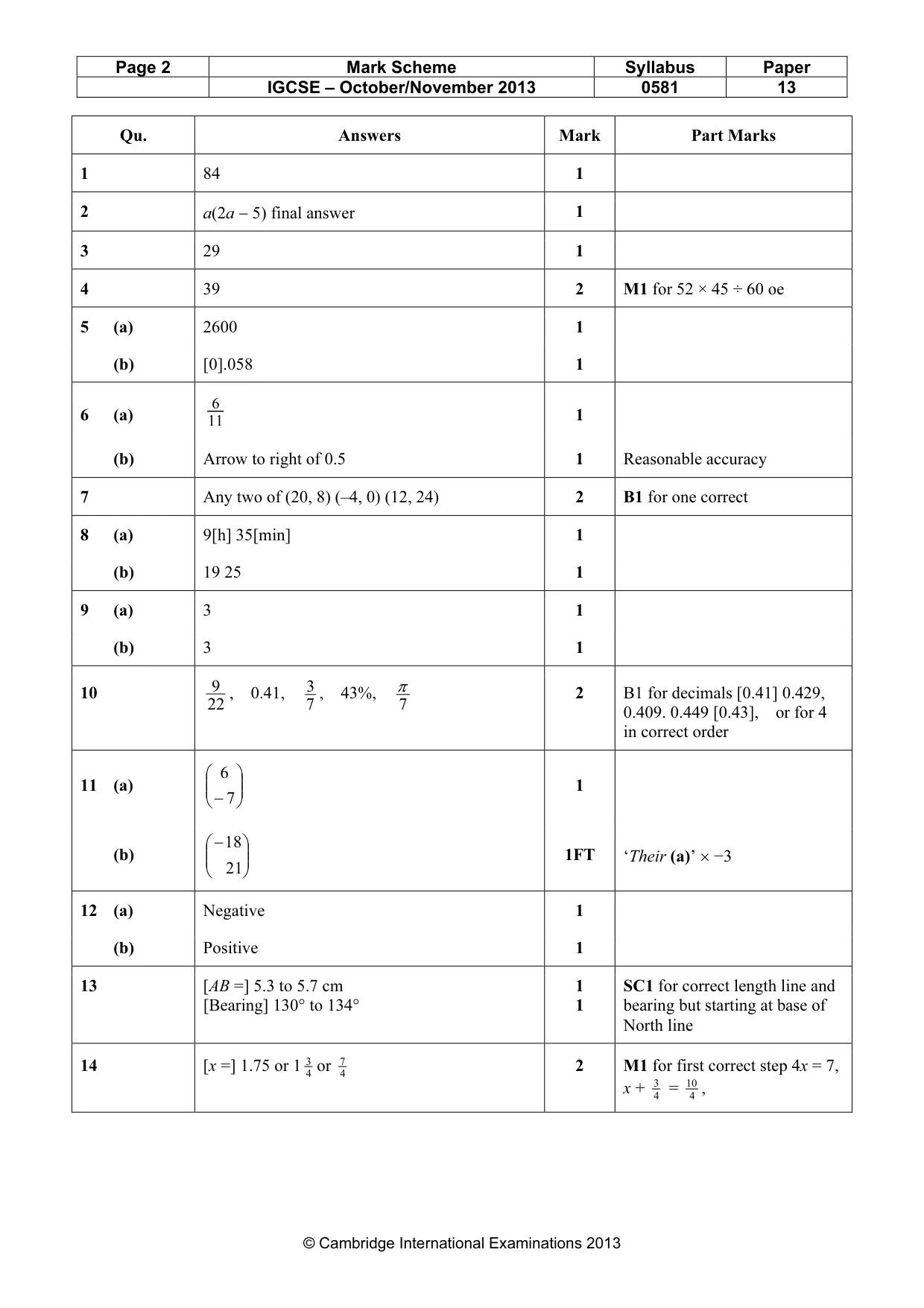
Page 2 Mark Scheme Syllabus Paper IGCSE – October/November 2013 0581 13 © Cambridge International Examinations 2013 Qu. Answers Mark Part Marks 1 84 1 2 a(2a − 5) final answer 1 3 29 1 4 39 2 M1 for 52 × 45 ÷ 60 oe 5 (a) 2600 1 (b) [0].058 1 6 (a) 11 6 1 (b) Arrow to right of 0.5 1 Reasonable accuracy 7 Any two of (20, 8) (–4, 0) (12, 24) 2 B1 for one correct 8 (a) 9[h] 35[min] 1 (b) 19 25 1 9 (a) 3 1 (b) 3 1 10 22 9 , 0.41, 7 3 , 43%, 7 π 2 B1 for decimals [0.41] 0.429, 0.409. 0.449 [0.43], or for 4 in correct order 11 (a) −7 6 1 (b) − 21 18 1FT ‘Their (a)’ × −3 12 (a) Negative 1 (b) Positive 1 13 [AB =] 5.3 to 5.7 cm [Bearing] 130° to 134° 1 1 SC1 for correct length line and bearing but starting at base of North line 14 [x =] 1.75 or 1 4 3 or 4 7 2 M1 for first correct step 4x = 7, x + 4 3 = 4 10 ,
Mark scheme, page 3
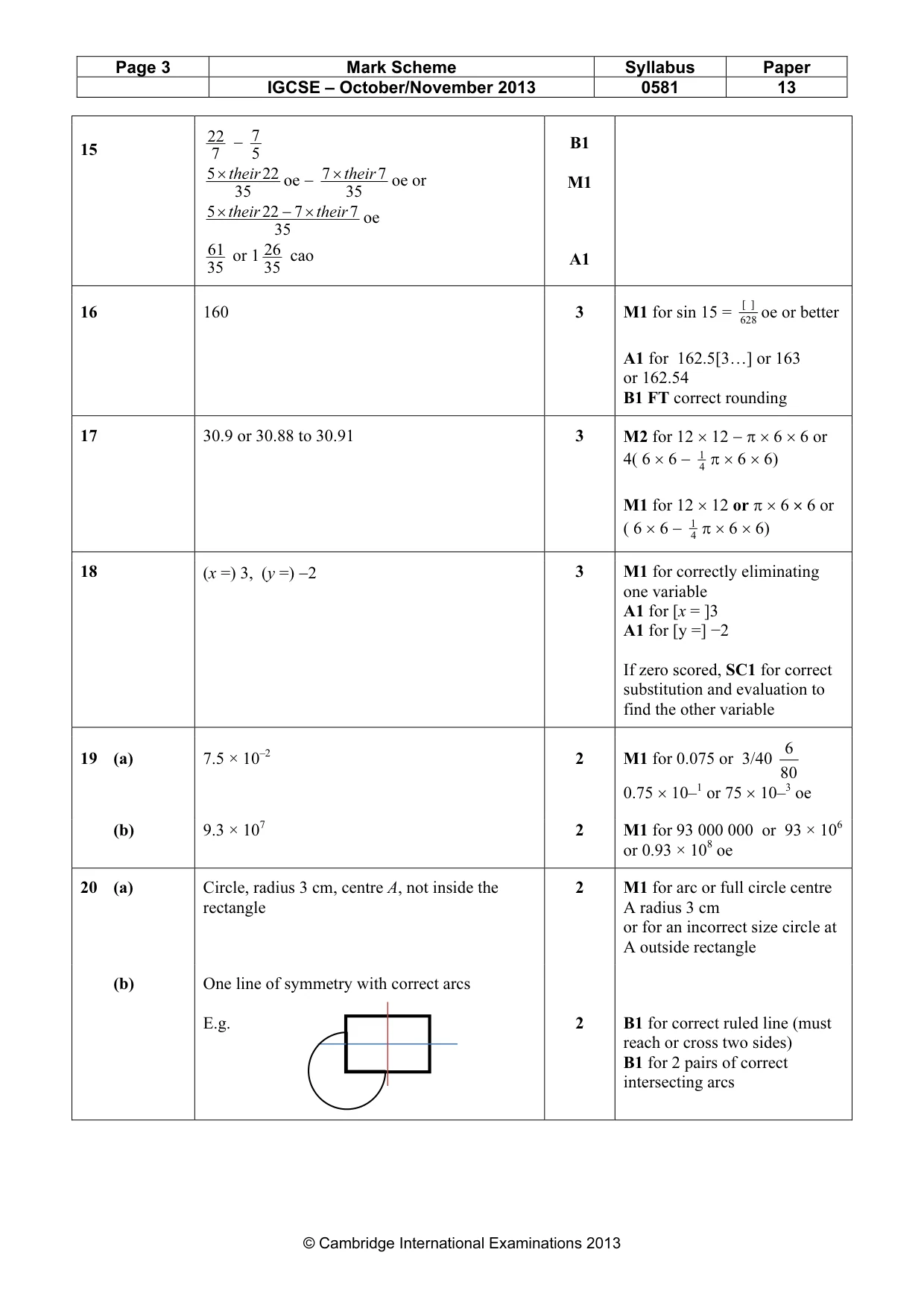
Page 3 Mark Scheme Syllabus Paper IGCSE – October/November 2013 0581 13 © Cambridge International Examinations 2013 15 7 22 − 5 7 35 22 5 their × oe − 35 7 7 their × oe or 35 7 7 22 5 their their × − × oe 35 61 or 1 35 26 cao B1 M1 A1 16 160 3 M1 for sin 15 = 628 ] [ oe or better A1 for 162.5[3…] or 163 or 162.54 B1 FT correct rounding 17 30.9 or 30.88 to 30.91 3 M2 for 12 × 12 − π × 6 × 6 or 4( 6 × 6 − 4 1 π × 6 × 6) M1 for 12 × 12 or π × 6 × 6 or ( 6 × 6 − 4 1 π × 6 × 6) 18 (x =) 3, (y =) −2 3 M1 for correctly eliminating one variable A1 for [x = ]3 A1 for [y =] −2 If zero scored, SC1 for correct substitution and evaluation to find the other variable 19 (a) 7.5 × 10⁻² 2 M1 for 0.075 or 3/40 80 6 0.75 × 10⁻¹ or 75 × 10–3 oe (b) 9.3 × 10⁷ 2 M1 for 93 000 000 or 93 × 106 or 0.93 × 10⁸ oe 20 (a) Circle, radius 3 cm, centre A, not inside the rectangle 2 M1 for arc or full circle centre A radius 3 cm or for an incorrect size circle at A outside rectangle (b) One line of symmetry with correct arcs E.g. 2 B1 for correct ruled line (must reach or cross two sides) B1 for 2 pairs of correct intersecting arcs
Mark scheme, page 4
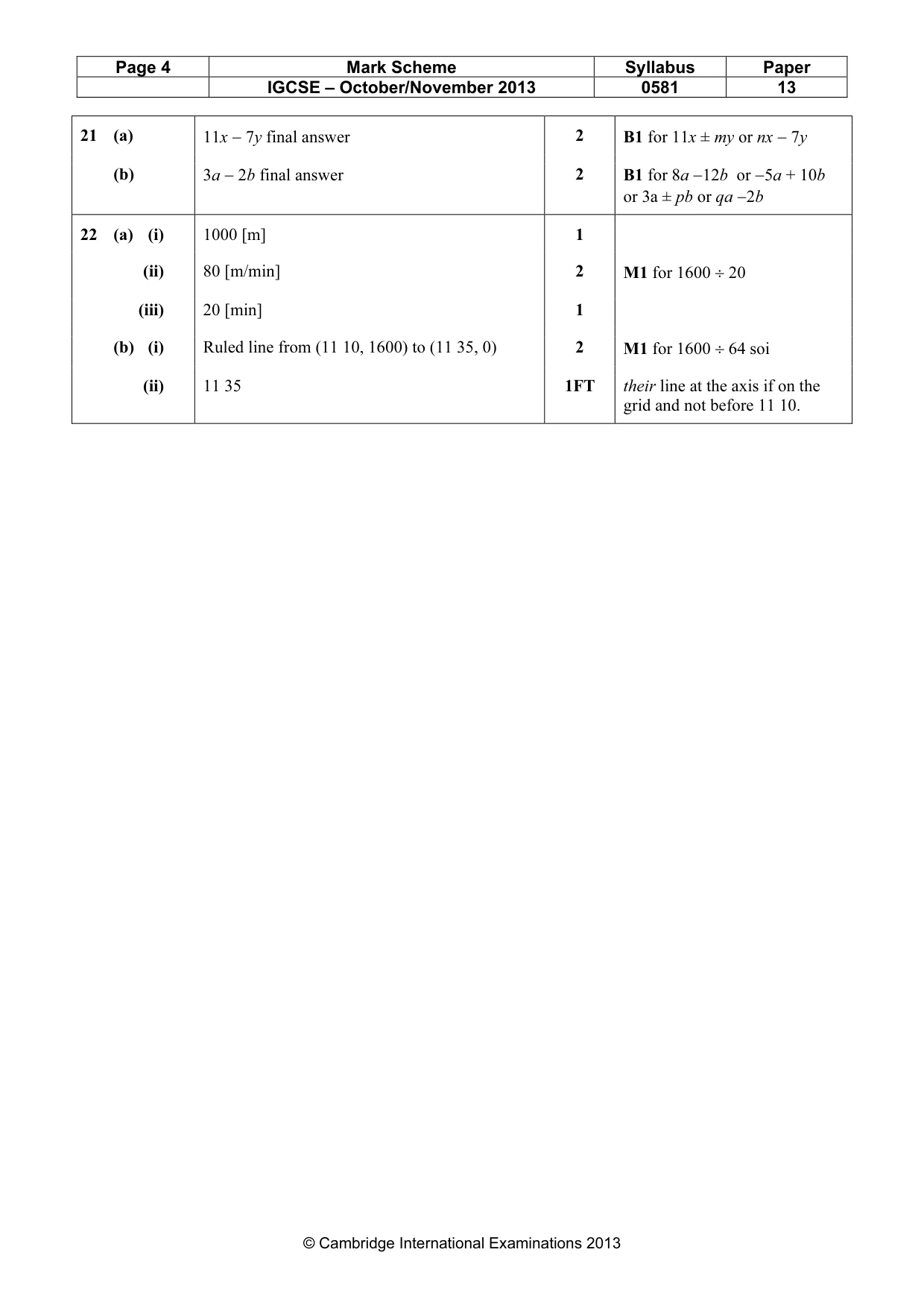
Page 4 Mark Scheme Syllabus Paper IGCSE – October/November 2013 0581 13 © Cambridge International Examinations 2013 21 (a) 11x − 7y final answer 2 B1 for 11x ± my or nx − 7y (b) 3a − 2b final answer 2 B1 for 8a −12b or −5a + 10b or 3a ± pb or qa −2b 22 (a) (i) 1000 [m] 1 (ii) 80 [m/min] 2 M1 for 1600 ÷ 20 (iii) 20 [min] 1 (b) (i) Ruled line from (11 10, 1600) to (11 35, 0) 2 M1 for 1600 ÷ 64 soi (ii) 11 35 1FT their line at the axis if on the grid and not before 11 10.