Cambridge IGCSE Mathematics (with coursework) 0581 — 2011 May/June Paper 1 · Variant 2
0581/12/M/J/11 · 56 marks · ≈63 min
The question paper and its mark scheme, free to read here and free to download. This is Cambridge’s own paper, exactly as it was sat.
Question paper12 pages
Mark scheme4 pages
Answers below. Sit the paper first if you are practising.
Paper as text
Question paper, page 1
This document consists of 11 printed pages and 1 blank page. IB11 06_0581_12/FP © UCLES 2011 [Turn over *5734818013* UNIVERSITY OF CAMBRIDGE INTERNATIONAL EXAMINATIONS International General Certificate of Secondary Education MATHEMATICS 0581/12 Paper 1 (Core) May/June 2011 1 hour Candidates answer on the Question Paper. Additional Materials: Electronic calculator Geometrical instruments Mathematical tables (optional) Tracing paper (optional) READ THESE INSTRUCTIONS FIRST Write your Centre number, candidate number and name on all the work you hand in. Write in dark blue or black pen. You may use a pencil for any diagrams or graphs. Do not use staples, paper clips, highlighters, glue or correction fluid. DO NOT WRITE IN ANY BARCODES. Answer all questions. If working is needed for any question it must be shown below that question. Electronic calculators should be used. If the degree of accuracy is not specified in the question, and if the answer is not exact, give the answer to three significant figures. Give answers in degrees to one decimal place. For π, use either your calculator value or 3.142. At the end of the examination, fasten all your work securely together. The number of marks is given in brackets [ ] at the end of each question or part question. The total of the marks for this paper is 56. www.XtremePapers.com
Question paper, page 2
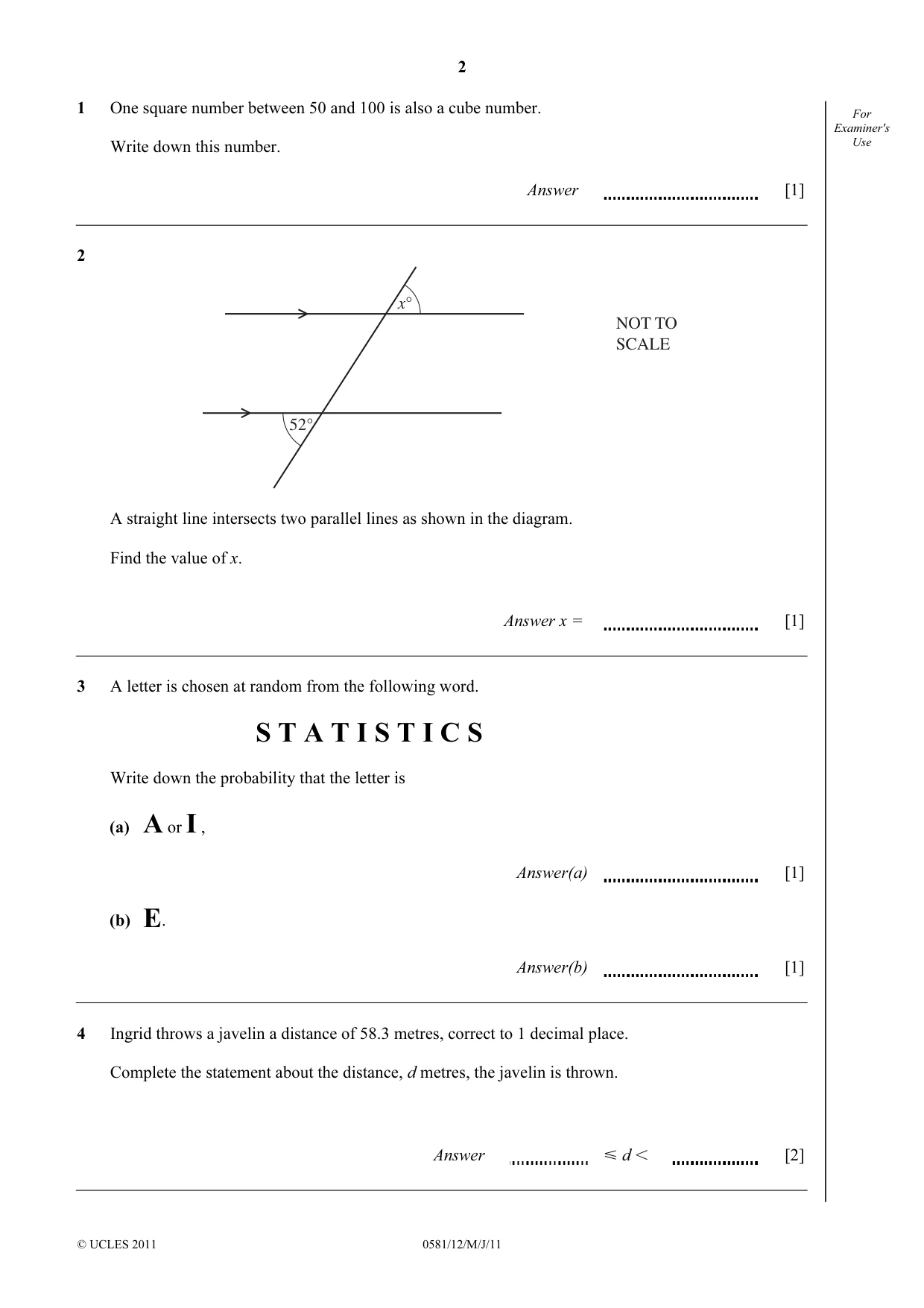
2 © UCLES 2011 0581/12/M/J/11 For Examiner's Use 1 One square number between 50 and 100 is also a cube number. Write down this number. Answer [1] 2 52° x° NOT TO SCALE A straight line intersects two parallel lines as shown in the diagram. Find the value of x. Answer x = [1] 3 A letter is chosen at random from the following word. S T A T I S T I C S Write down the probability that the letter is (a) A or I , Answer(a) [1] (b) E. Answer(b) [1] 4 Ingrid throws a javelin a distance of 58.3 metres, correct to 1 decimal place. Complete the statement about the distance, d metres, the javelin is thrown. Answer Y d I [2]
Question paper, page 3
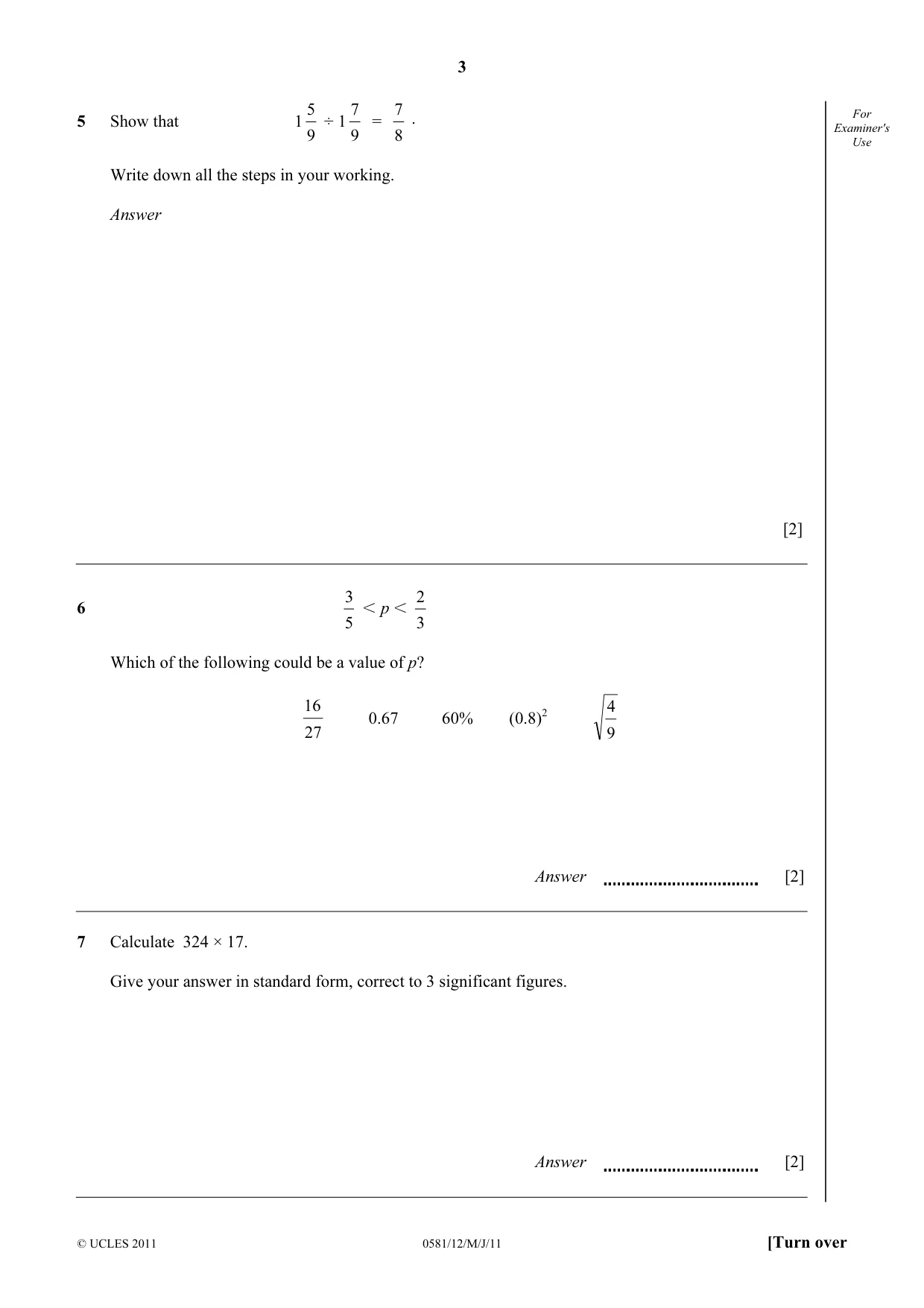
3 © UCLES 2011 0581/12/M/J/11 [Turn over For Examiner's Use 5 Show that 1 9 5 ÷ 1 9 7 = 8 7 . Write down all the steps in your working. Answer [2] 6 5 3 I p I 3 2 Which of the following could be a value of p? 27 16 0.67 60% (0.8)2 9 4 Answer [2] 7 Calculate 324 × 17. Give your answer in standard form, correct to 3 significant figures. Answer [2]
Question paper, page 4
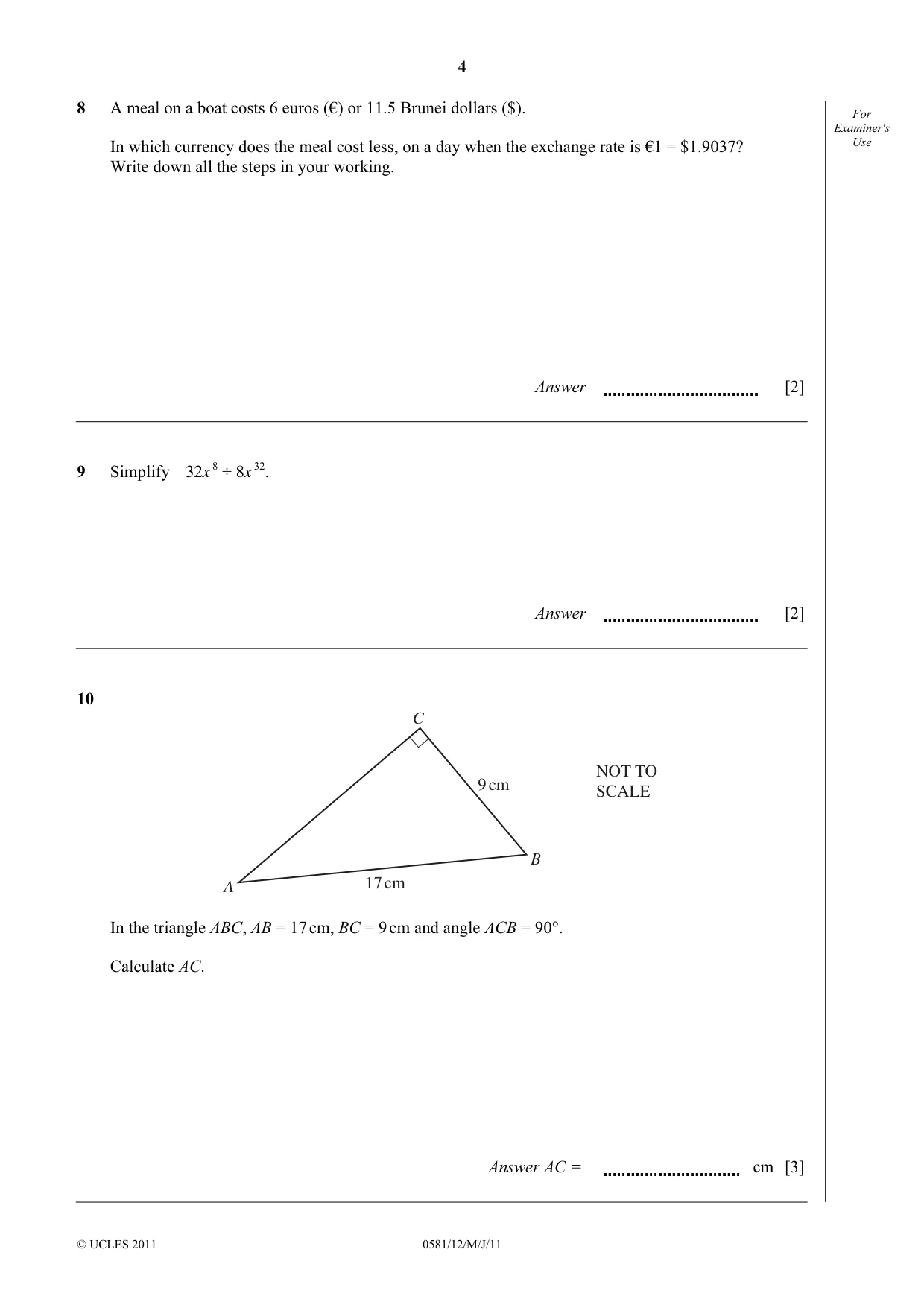
4 © UCLES 2011 0581/12/M/J/11 For Examiner's Use 8 A meal on a boat costs 6 euros (€) or 11.5 Brunei dollars ($). In which currency does the meal cost less, on a day when the exchange rate is €1 = $1.9037? Write down all the steps in your working. Answer [2] 9 Simplify 32x 8 ÷ 8x 32. Answer [2] 10 C B A 17 cm 9 cm NOT TO SCALE In the triangle ABC, AB = 17 cm, BC = 9 cm and angle ACB = 90°. Calculate AC. Answer AC = cm [3]
Question paper, page 5
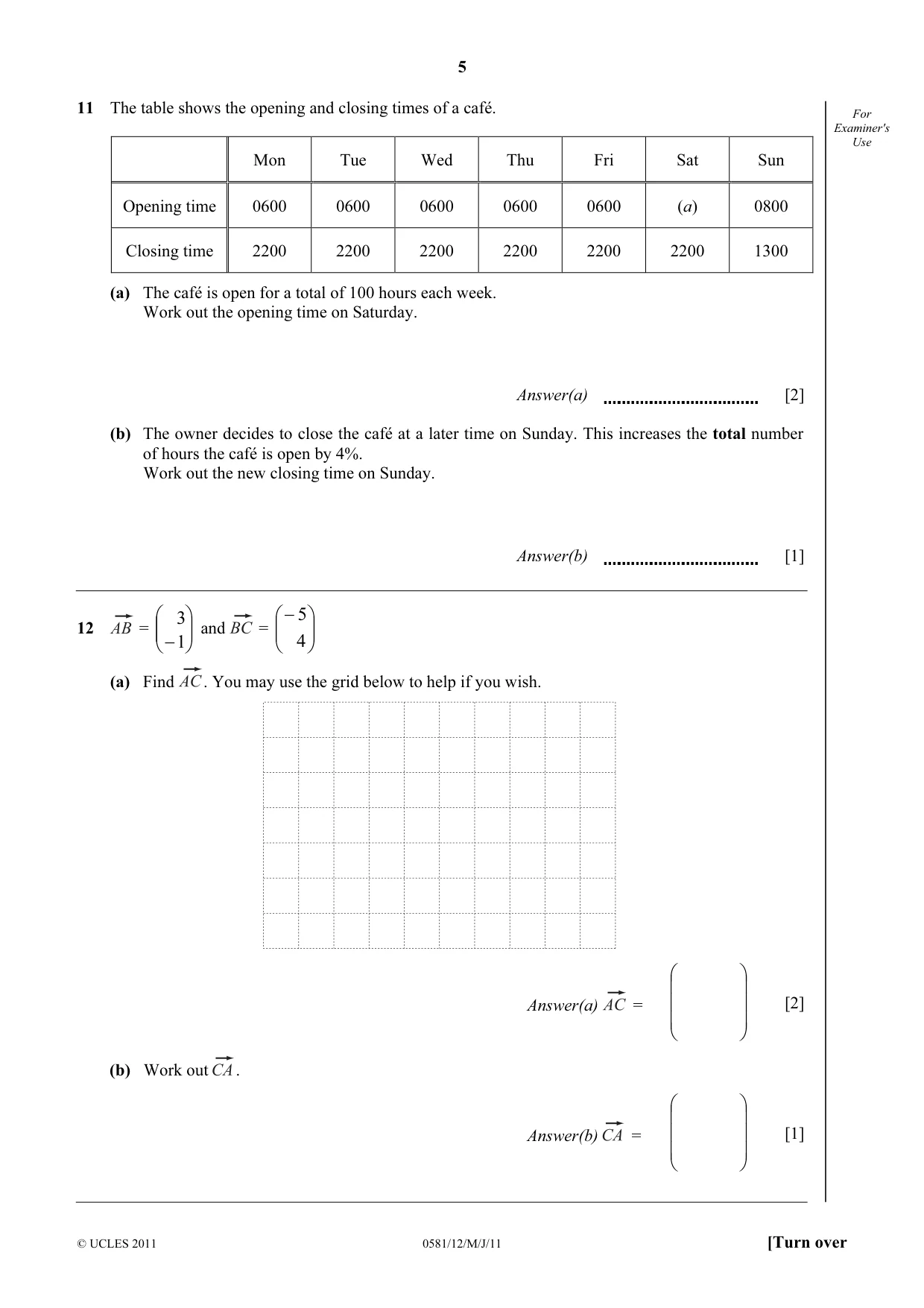
5 © UCLES 2011 0581/12/M/J/11 [Turn over For Examiner's Use 11 The table shows the opening and closing times of a café. Mon Tue Wed Thu Fri Sat Sun Opening time 0600 0600 0600 0600 0600 (a) 0800 Closing time 2200 2200 2200 2200 2200 2200 1300 (a) The café is open for a total of 100 hours each week. Work out the opening time on Saturday. Answer(a) [2] (b) The owner decides to close the café at a later time on Sunday. This increases the total number of hours the café is open by 4%. Work out the new closing time on Sunday. Answer(b) [1] 12 = −1 3 and = − 4 5 (a) Find . You may use the grid below to help if you wish. Answer(a) = [2] (b) Work out . Answer(b) = [1]
Question paper, page 6
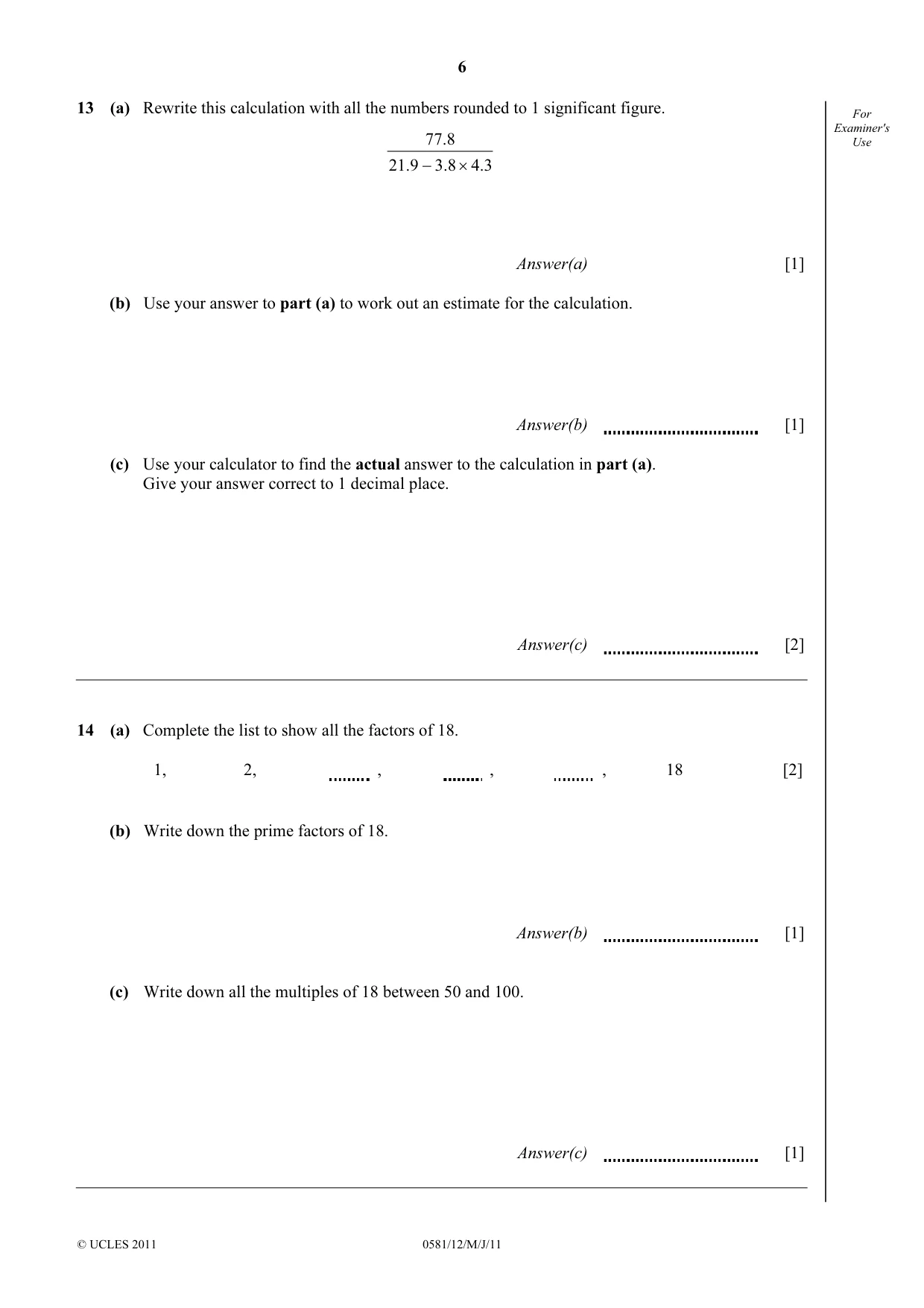
6 © UCLES 2011 0581/12/M/J/11 For Examiner's Use 13 (a) Rewrite this calculation with all the numbers rounded to 1 significant figure. 4.3 3.8 21.9 77.8 × − Answer(a) [1] (b) Use your answer to part (a) to work out an estimate for the calculation. Answer(b) [1] (c) Use your calculator to find the actual answer to the calculation in part (a). Give your answer correct to 1 decimal place. Answer(c) [2] 14 (a) Complete the list to show all the factors of 18. 1, 2, , , , 18 [2] (b) Write down the prime factors of 18. Answer(b) [1] (c) Write down all the multiples of 18 between 50 and 100. Answer(c) [1]
Question paper, page 7
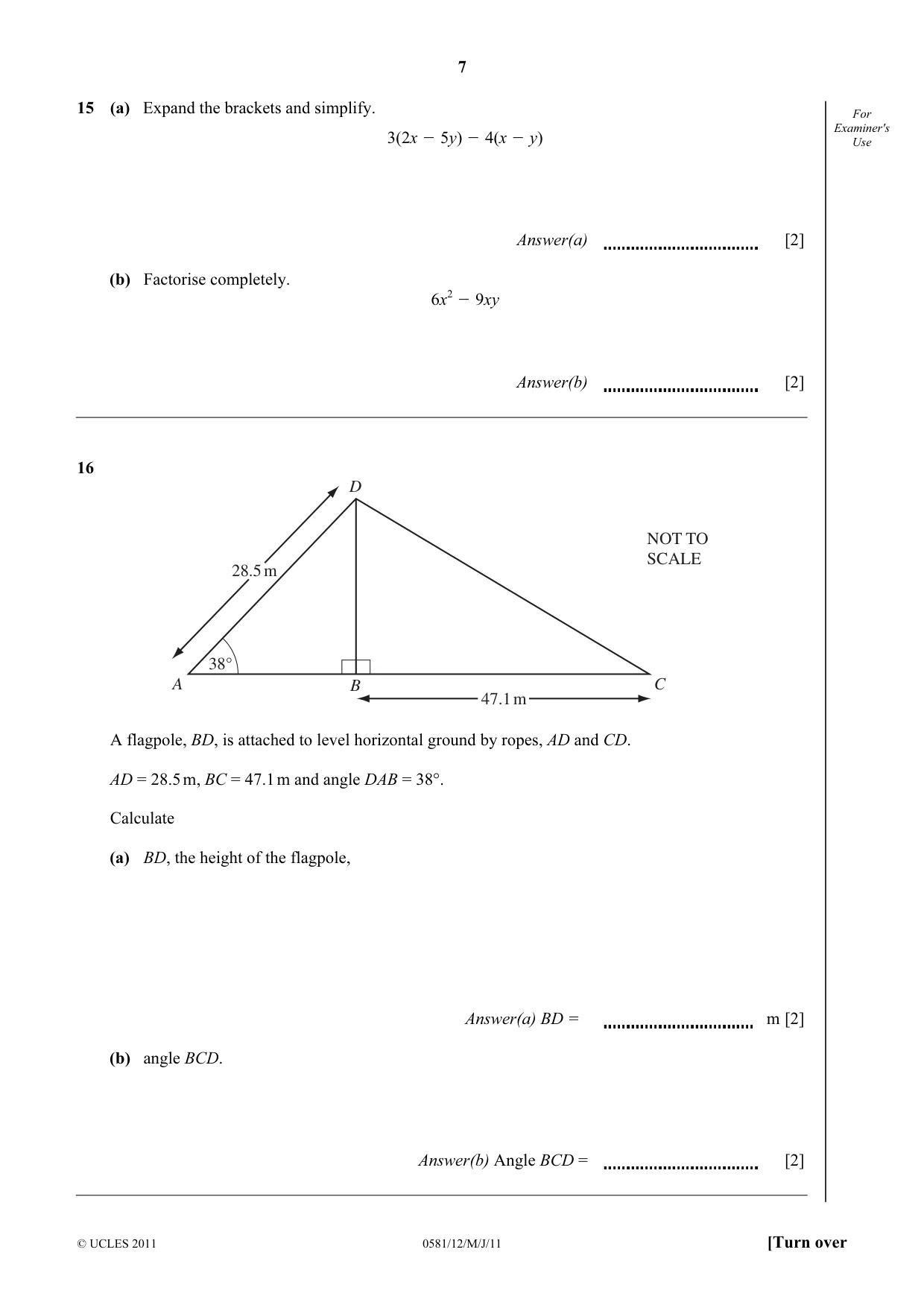
7 © UCLES 2011 0581/12/M/J/11 [Turn over For Examiner's Use 15 (a) Expand the brackets and simplify. 3(2x O 5y) O 4(x O y) Answer(a) [2] (b) Factorise completely. 6x2 O 9xy Answer(b) [2] 16 38° D B A C 47.1 m 28.5 m NOT TO SCALE A flagpole, BD, is attached to level horizontal ground by ropes, AD and CD. AD = 28.5 m, BC = 47.1 m and angle DAB = 38°. Calculate (a) BD, the height of the flagpole, Answer(a) BD = m [2] (b) angle BCD. Answer(b) Angle BCD = [2]
Question paper, page 8
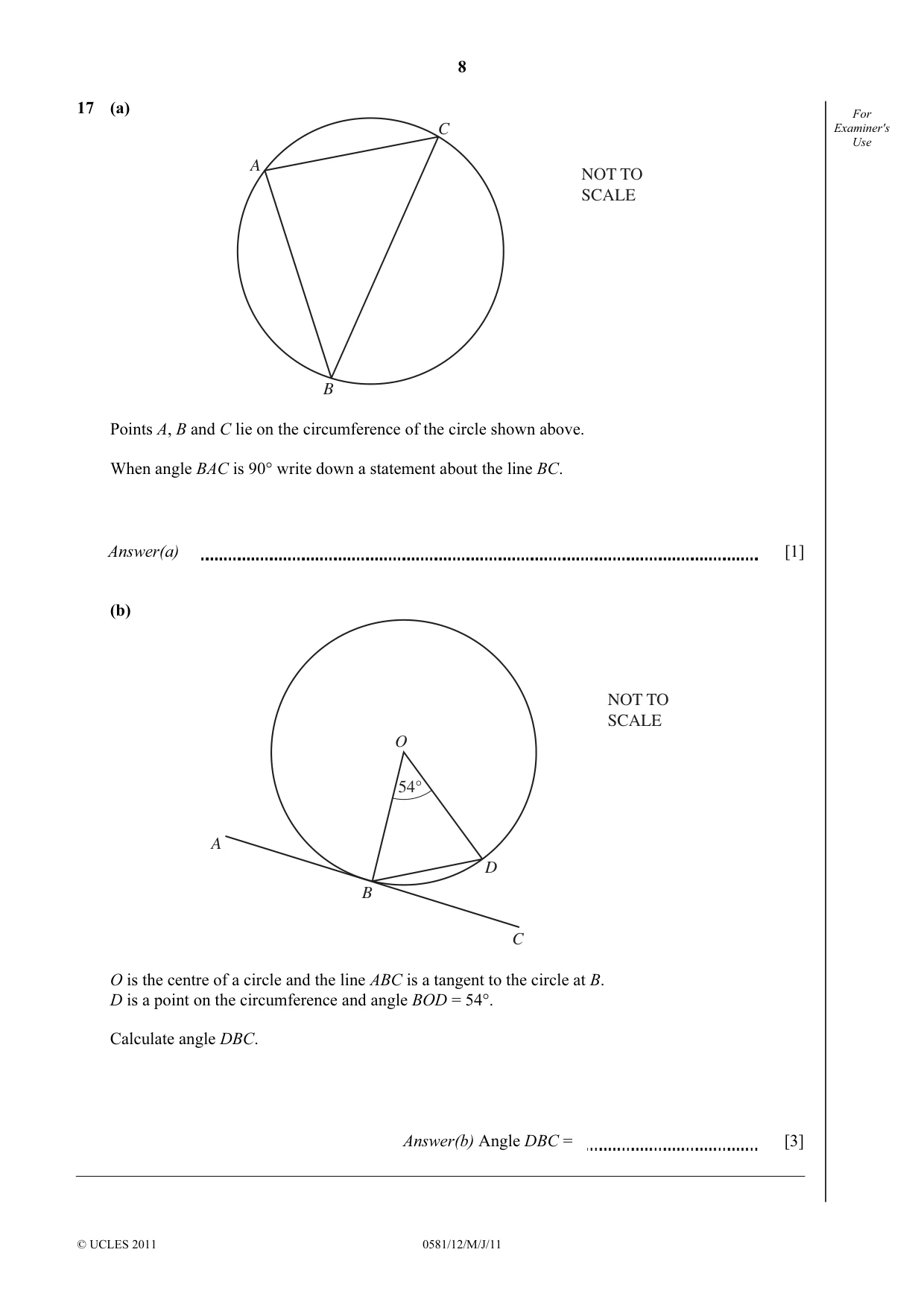
8 © UCLES 2011 0581/12/M/J/11 For Examiner's Use 17 (a) A C B NOT TO SCALE Points A, B and C lie on the circumference of the circle shown above. When angle BAC is 90° write down a statement about the line BC. Answer(a) [1] (b) 54° D O B A C NOT TO SCALE O is the centre of a circle and the line ABC is a tangent to the circle at B. D is a point on the circumference and angle BOD = 54°. Calculate angle DBC. Answer(b) Angle DBC = [3]
Question paper, page 9
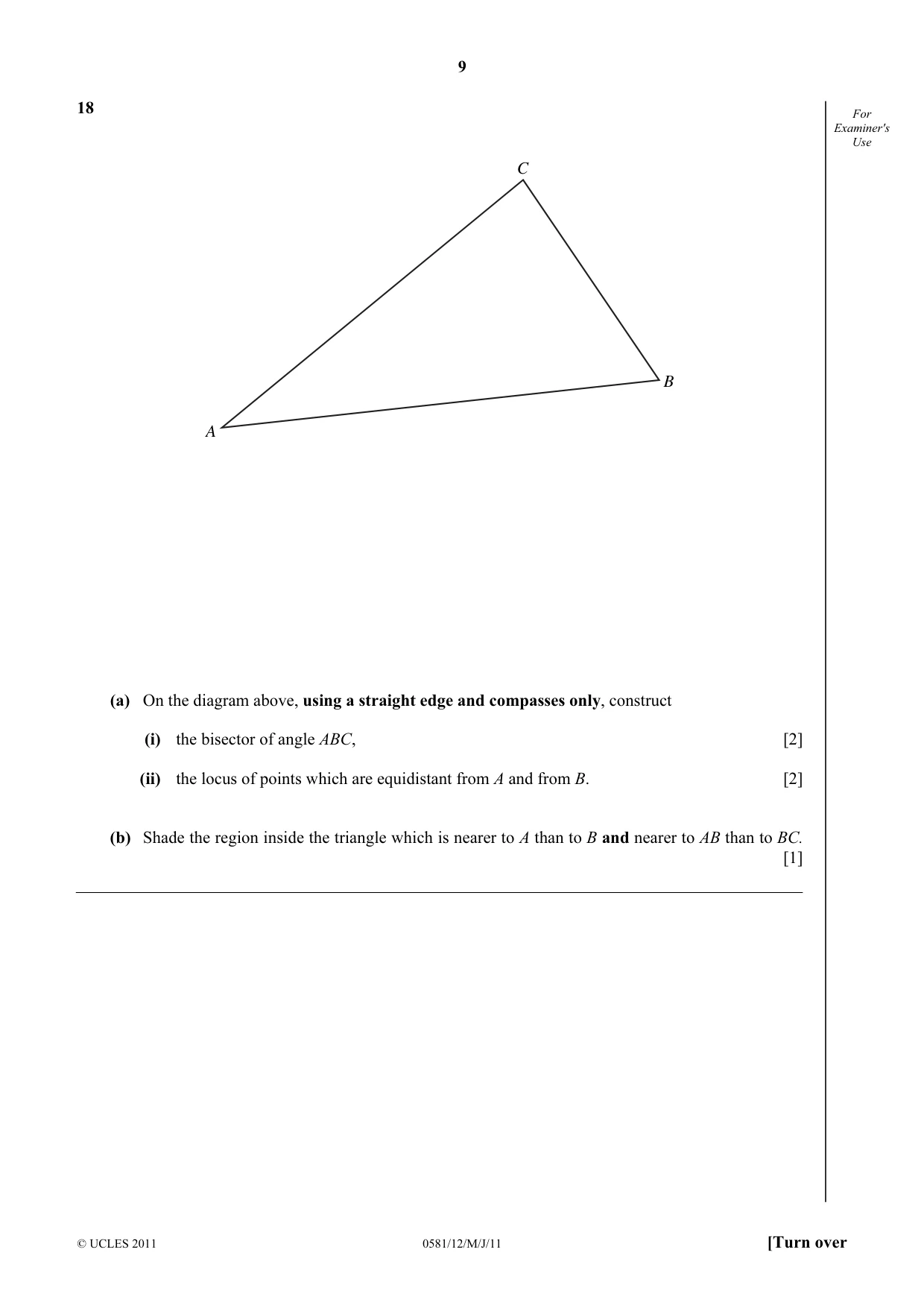
9 © UCLES 2011 0581/12/M/J/11 [Turn over For Examiner's Use 18 A B C (a) On the diagram above, using a straight edge and compasses only, construct (i) the bisector of angle ABC, [2] (ii) the locus of points which are equidistant from A and from B. [2] (b) Shade the region inside the triangle which is nearer to A than to B and nearer to AB than to BC. [1]
Question paper, page 10
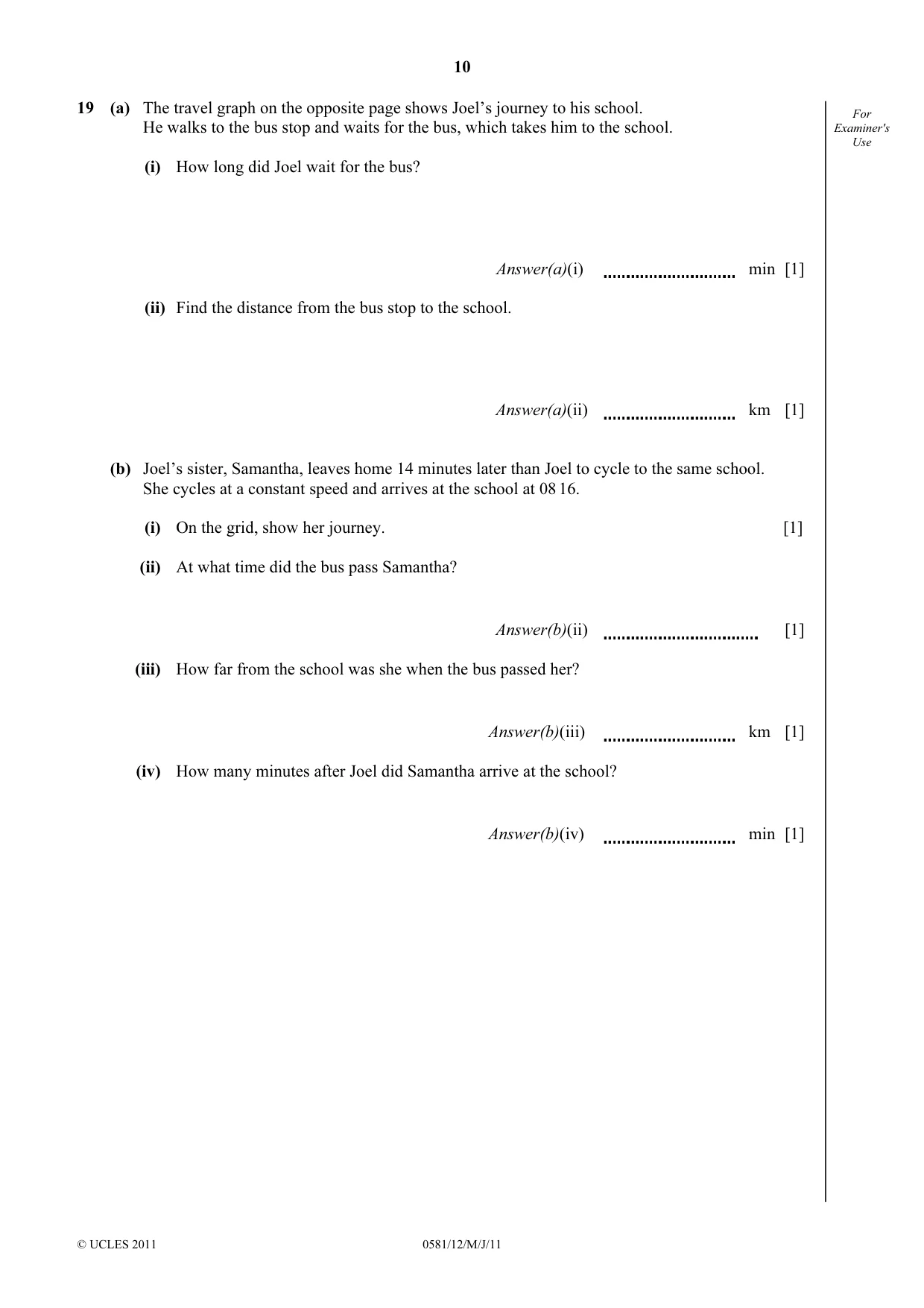
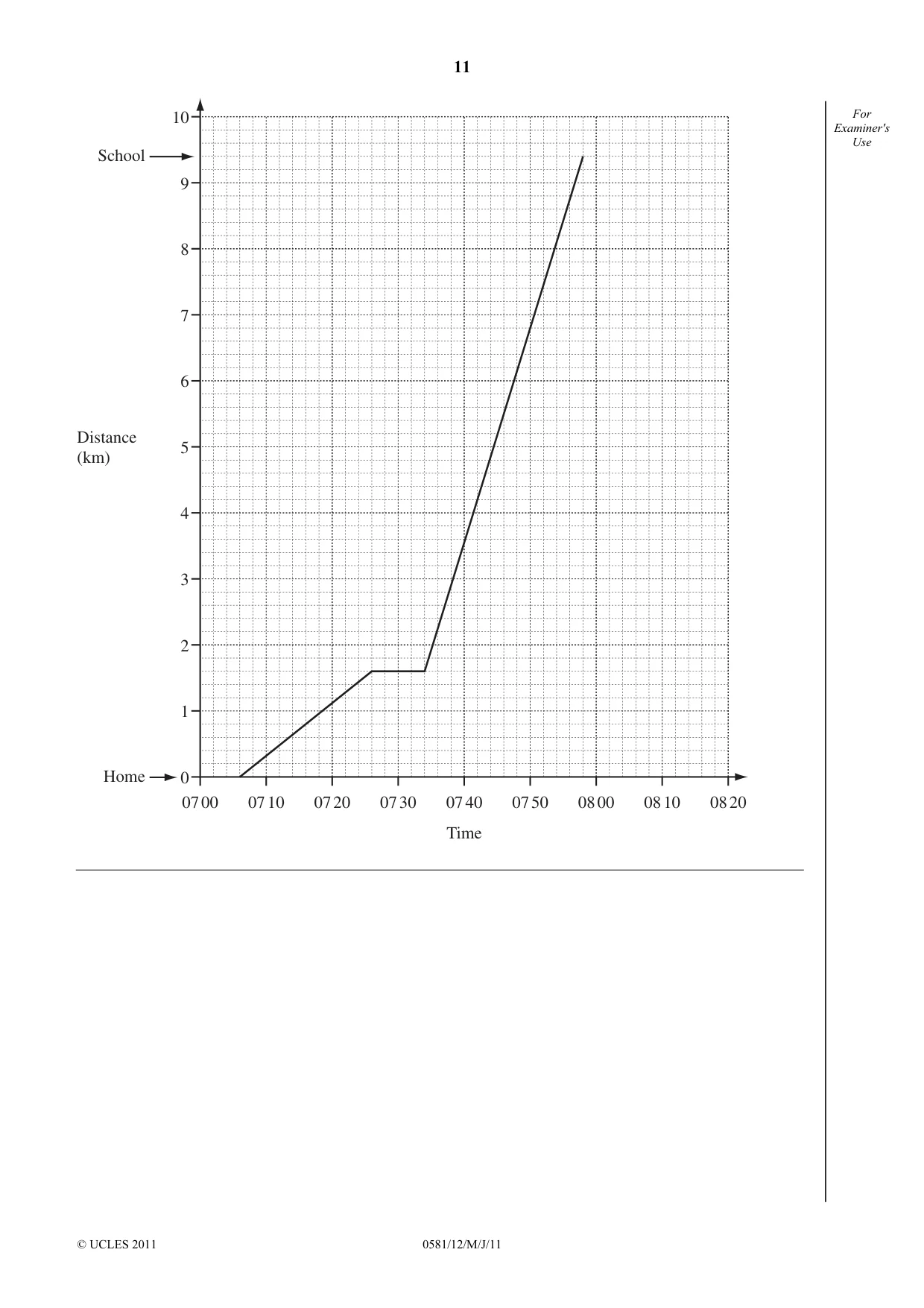
10 © UCLES 2011 0581/12/M/J/11 For Examiner's Use 19 (a) The travel graph on the opposite page shows Joel’s journey to his school. He walks to the bus stop and waits for the bus, which takes him to the school. (i) How long did Joel wait for the bus? Answer(a)(i) min [1] (ii) Find the distance from the bus stop to the school. Answer(a)(ii) km [1] (b) Joel’s sister, Samantha, leaves home 14 minutes later than Joel to cycle to the same school. She cycles at a constant speed and arrives at the school at 08 16. (i) On the grid, show her journey. [1] (ii) At what time did the bus pass Samantha? Answer(b)(ii) [1] (iii) How far from the school was she when the bus passed her? Answer(b)(iii) km [1] (iv) How many minutes after Joel did Samantha arrive at the school? Answer(b)(iv) min [1]
Question paper, page 11
11 © UCLES 2011 0581/12/M/J/11 For Examiner's Use 10 9 8 7 6 5 4 3 2 1 0 Home School 07 00 07 10 07 20 07 30 07 40 Time 07 50 08 00 08 10 08 20 Distance (km)
Question paper, page 12
12 Permission to reproduce items where third-party owned material protected by copyright is included has been sought and cleared where possible. Every reasonable effort has been made by the publisher (UCLES) to trace copyright holders, but if any items requiring clearance have unwittingly been included, the publisher will be pleased to make amends at the earliest possible opportunity. University of Cambridge International Examinations is part of the Cambridge Assessment Group. Cambridge Assessment is the brand name of University of Cambridge Local Examinations Syndicate (UCLES), which is itself a department of the University of Cambridge. © UCLES 2011 0581/12/M/J/11 BLANK PAGE
Mark scheme, page 1
UNIVERSITY OF CAMBRIDGE INTERNATIONAL EXAMINATIONS International General Certificate of Secondary Education MARK SCHEME for the May/June 2011 question paper for the guidance of teachers 0581 MATHEMATICS 0581/12 Paper 1 (Core), maximum raw mark 56 This mark scheme is published as an aid to teachers and candidates, to indicate the requirements of the examination. It shows the basis on which Examiners were instructed to award marks. It does not indicate the details of the discussions that took place at an Examiners’ meeting before marking began, which would have considered the acceptability of alternative answers. Mark schemes must be read in conjunction with the question papers and the report on the examination. • Cambridge will not enter into discussions or correspondence in connection with these mark schemes. Cambridge is publishing the mark schemes for the May/June 2011 question papers for most IGCSE, GCE Advanced Level and Advanced Subsidiary Level syllabuses and some Ordinary Level syllabuses. www.XtremePapers.com
Mark scheme, page 2
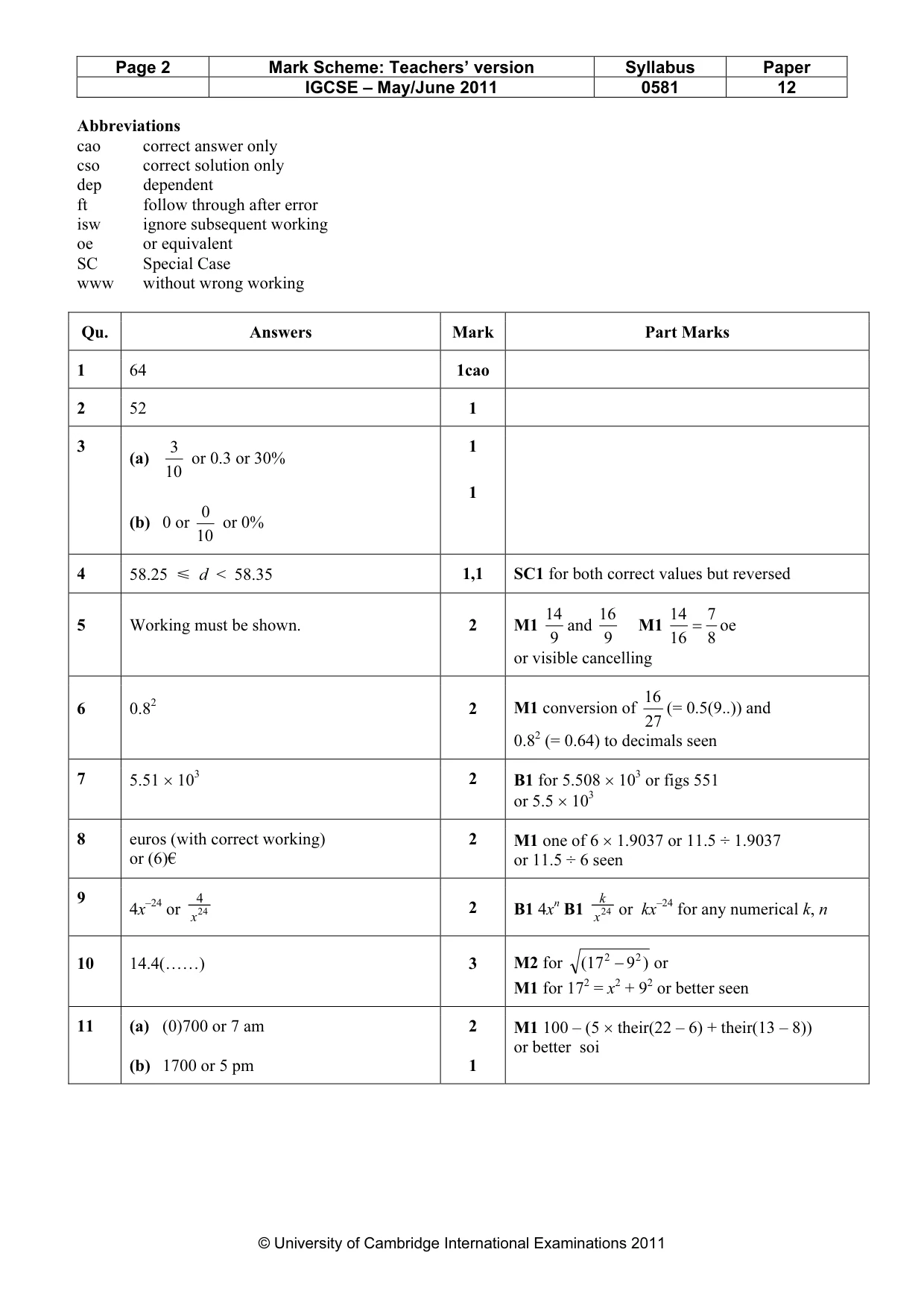
Page 2 Mark Scheme: Teachers’ version Syllabus Paper IGCSE – May/June 2011 0581 12 © University of Cambridge International Examinations 2011 Abbreviations cao correct answer only cso correct solution only dep dependent ft follow through after error isw ignore subsequent working oe or equivalent SC Special Case www without wrong working Qu. Answers Mark Part Marks 1 64 1cao 2 52 1 3 (a) 10 3 or 0.3 or 30% (b) 0 or 10 0 or 0% 1 1 4 58.25 Y d < 58.35 1,1 SC1 for both correct values but reversed 5 Working must be shown. 2 M1 9 14 and 9 16 M1 8 7 16 14 = oe or visible cancelling 6 0.82 2 M1 conversion of 27 16 (= 0.5(9..)) and 0.82 (= 0.64) to decimals seen 7 5.51 × 10³ 2 B1 for 5.508 × 10³ or figs 551 or 5.5 × 10³ 8 euros (with correct working) or (6)€ 2 M1 one of 6 × 1.9037 or 11.5 ÷ 1.9037 or 11.5 ÷ 6 seen 9 4x–24 or 24 4 x 2 B1 4xn B1 24 x k or kx–24 for any numerical k, n 10 14.4(……) 3 M2 for ) 9 (17 2 2 − or M1 for 172 = x2 + 92 or better seen 11 (a) (0)700 or 7 am (b) 1700 or 5 pm 2 1 M1 100 – (5 × their(22 – 6) + their(13 – 8)) or better soi
Mark scheme, page 3
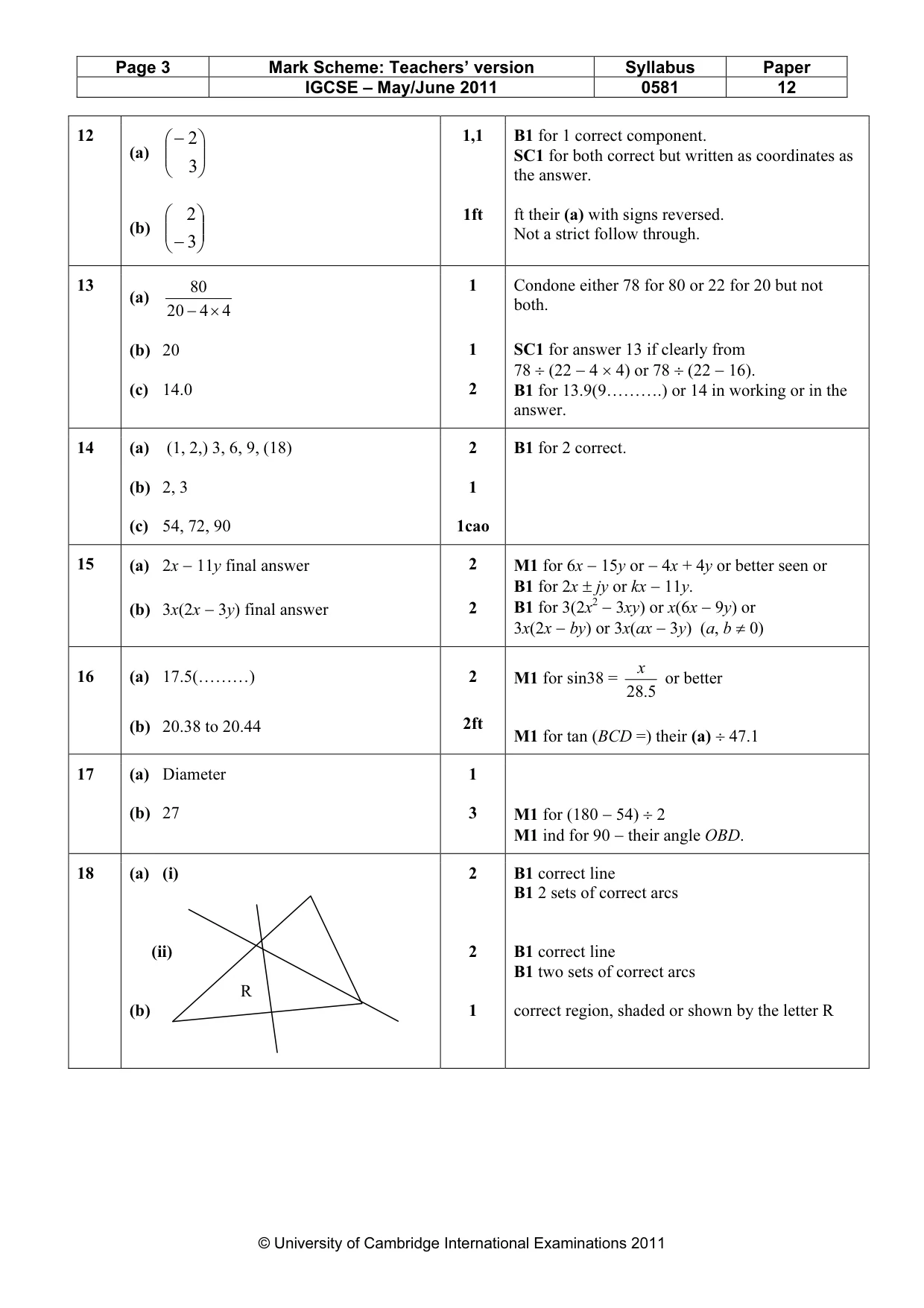
Page 3 Mark Scheme: Teachers’ version Syllabus Paper IGCSE – May/June 2011 0581 12 © University of Cambridge International Examinations 2011 12 (a) − 3 2 (b) −3 2 1,1 1ft B1 for 1 correct component. SC1 for both correct but written as coordinates as the answer. ft their (a) with signs reversed. Not a strict follow through. 13 (a) 4 4 20 80 × − (b) 20 (c) 14.0 1 1 2 Condone either 78 for 80 or 22 for 20 but not both. SC1 for answer 13 if clearly from 78 ÷ (22 − 4 × 4) or 78 ÷ (22 − 16). B1 for 13.9(9……….) or 14 in working or in the answer. 14 (a) (1, 2,) 3, 6, 9, (18) (b) 2, 3 (c) 54, 72, 90 2 1 1cao B1 for 2 correct. 15 (a) 2x − 11y final answer (b) 3x(2x − 3y) final answer 2 2 M1 for 6x − 15y or − 4x + 4y or better seen or B1 for 2x ± jy or kx − 11y. B1 for 3(2x2 − 3xy) or x(6x − 9y) or 3x(2x − by) or 3x(ax − 3y) (a, b ≠ 0) 16 (a) 17.5(………) (b) 20.38 to 20.44 2 2ft M1 for sin38 = 5. 28 x or better M1 for tan (BCD =) their (a) ÷ 47.1 17 (a) Diameter (b) 27 1 3 M1 for (180 − 54) ÷ 2 M1 ind for 90 − their angle OBD. 18 (a) (i) (ii) R (b) 2 2 1 B1 correct line B1 2 sets of correct arcs B1 correct line B1 two sets of correct arcs correct region, shaded or shown by the letter R
Mark scheme, page 4
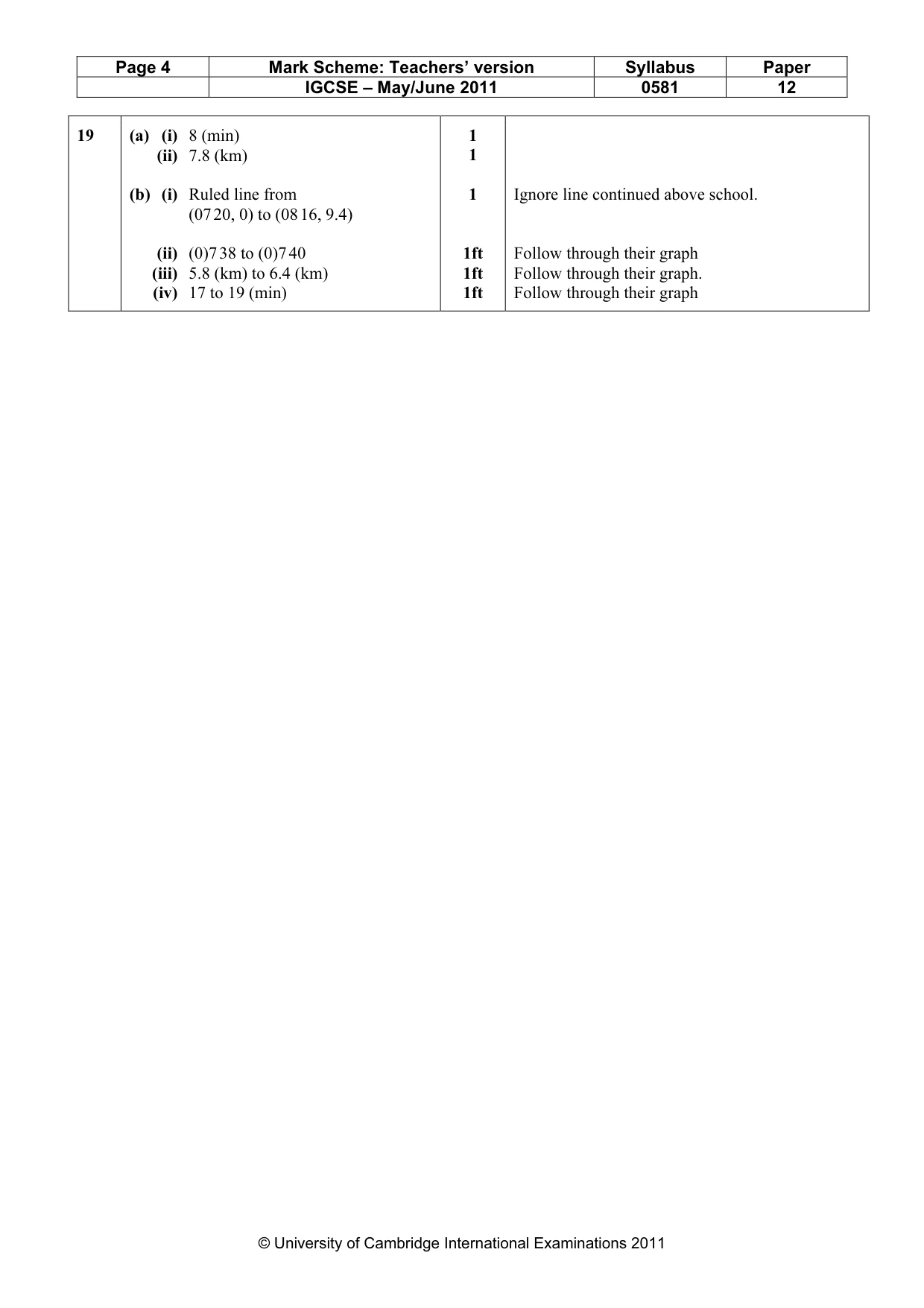
Page 4 Mark Scheme: Teachers’ version Syllabus Paper IGCSE – May/June 2011 0581 12 © University of Cambridge International Examinations 2011 19 (a) (i) 8 (min) (ii) 7.8 (km) (b) (i) Ruled line from (07 20, 0) to (08 16, 9.4) (ii) (0)7 38 to (0)7 40 (iii) 5.8 (km) to 6.4 (km) (iv) 17 to 19 (min) 1 1 1 1ft 1ft 1ft Ignore line continued above school. Follow through their graph Follow through their graph. Follow through their graph
What you needed in this session
Cambridge’s own grade thresholds for 2011 May/June, Paper 1 · Variant 2. A higher threshold means an easier paper — the bar moves with how the cohort did.