Cambridge IGCSE Mathematics (with coursework) 0581 — 2010 May/June Paper 1 · Variant 2
0581/12/M/J/10
The question paper and its mark scheme, free to read here and free to download. This is Cambridge’s own paper, exactly as it was sat.
Question paper12 pages
Mark scheme3 pages
Answers below. Sit the paper first if you are practising.
Paper as text
Question paper, page 1
This document consists of 12 printed pages. IB10 06_0581_12/RP © UCLES 2010 [Turn over *1808192629* UNIVERSITY OF CAMBRIDGE INTERNATIONAL EXAMINATIONS International General Certificate of Secondary Education MATHEMATICS 0581/12 Paper 1 (Core) May/June 2010 1 hour Candidates answer on the Question Paper. Additional Materials: Electronic Calculator Mathematical tables (optional) Geometrical Instruments Tracing paper (optional) READ THESE INSTRUCTIONS FIRST Write your Centre number, candidate number and name on all the work you hand in. Write in dark blue or black pen. You may use a pencil for any diagrams or graphs. Do not use staples, paper clips, highlighters, glue or correction fluid. DO NOT WRITE IN ANY BARCODES. Answer all questions. If working is needed for any question it must be shown below that question. Electronic calculators should be used. If the degree of accuracy is not specified in the question, and if the answer is not exact, give the answer to three significant figures. Give answers in degrees to one decimal place. For π, use either your calculator value or 3.142. At the end of the examination, fasten all your work securely together. The number of marks is given in brackets [ ] at the end of each question or part question. The total of the marks for this paper is 56. www.XtremePapers.com
Question paper, page 2
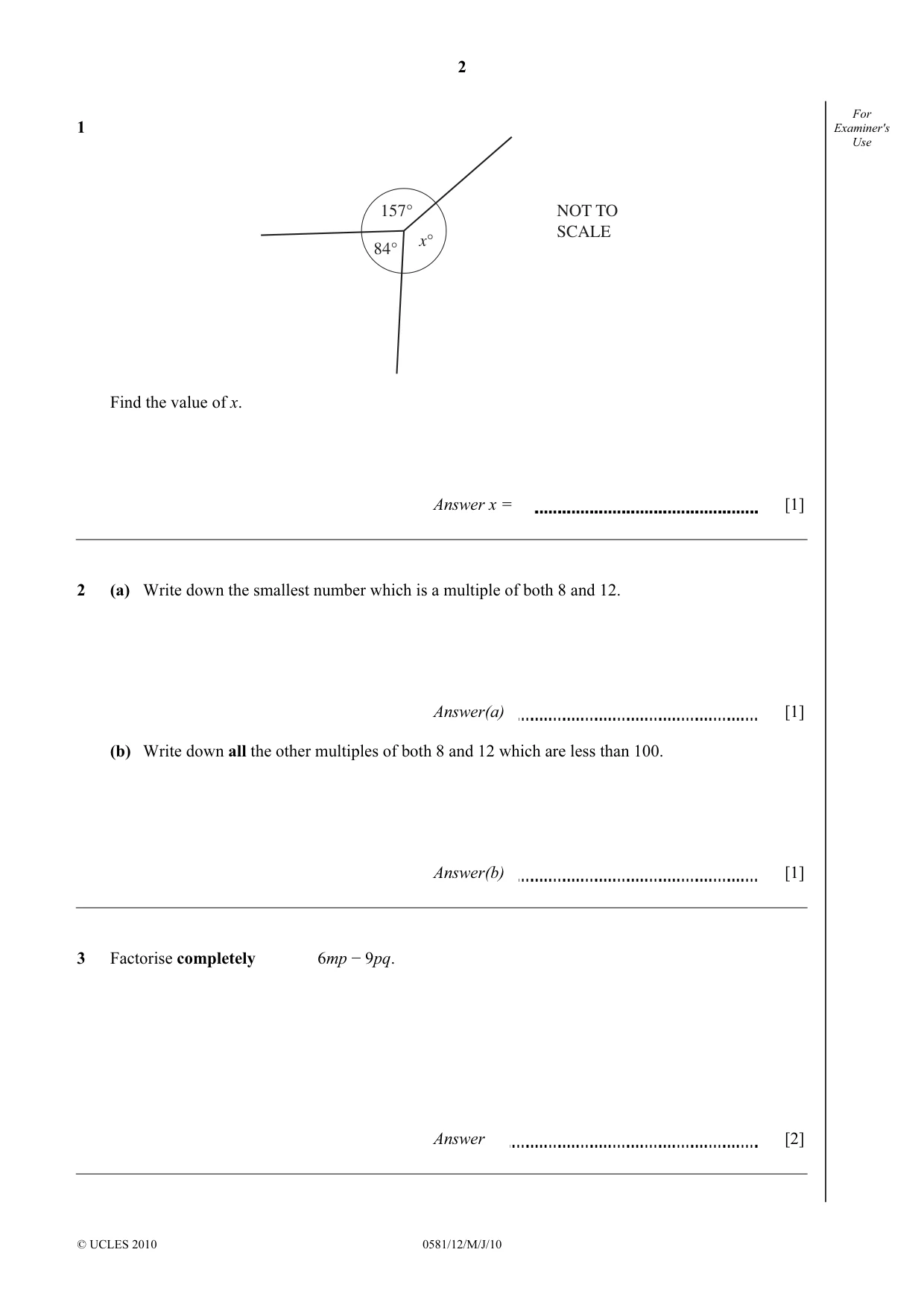
2 © UCLES 2010 0581/12/M/J/10 For Examiner's Use 1 157° 84° x° NOT TO SCALE Find the value of x. Answer x = [1] 2 (a) Write down the smallest number which is a multiple of both 8 and 12. Answer(a) [1] (b) Write down all the other multiples of both 8 and 12 which are less than 100. Answer(b) [1] 3 Factorise completely 6mp − 9pq. Answer [2]
Question paper, page 3
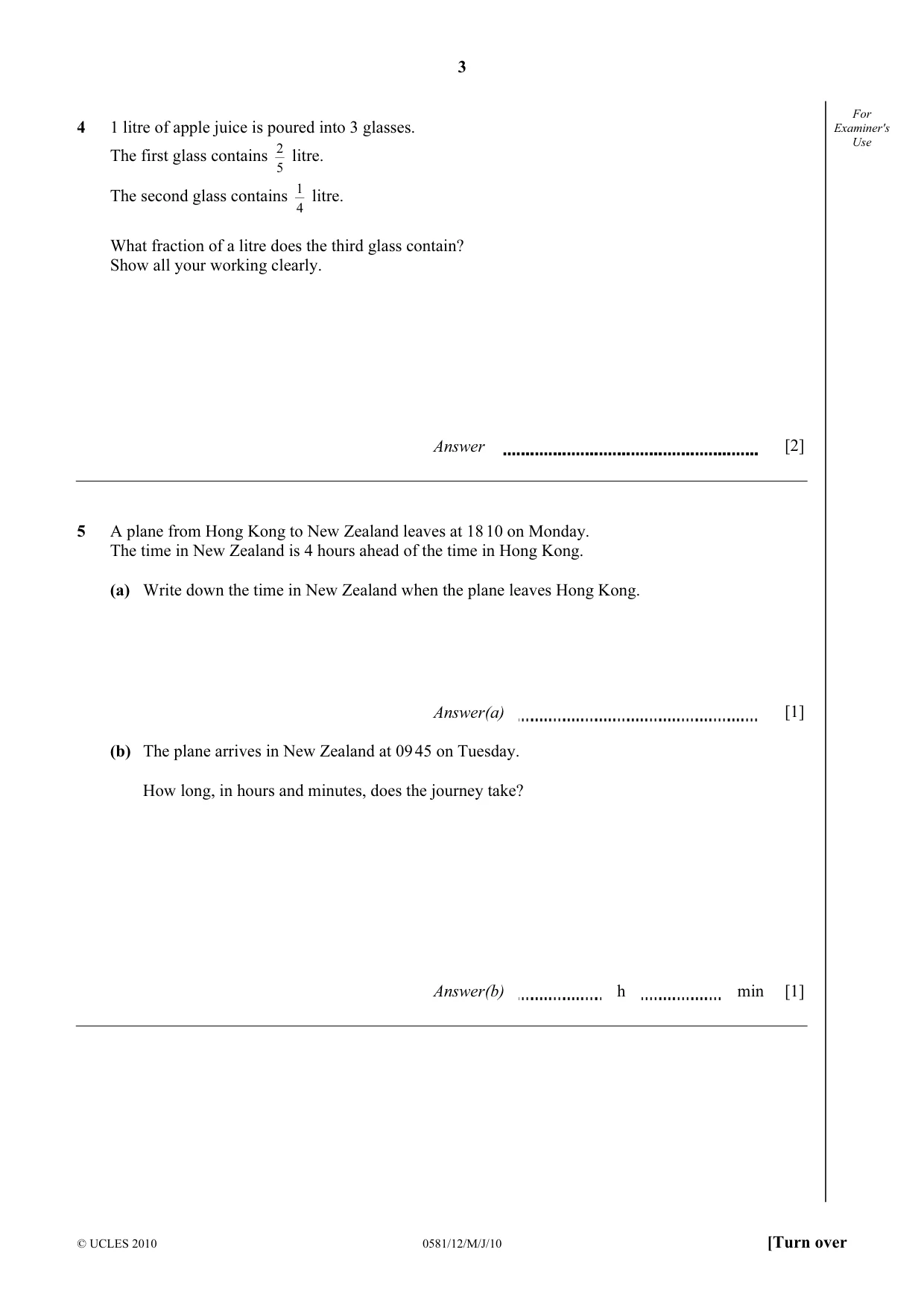
3 © UCLES 2010 0581/12/M/J/10 [Turn over For Examiner's Use 4 1 litre of apple juice is poured into 3 glasses. The first glass contains 2 5 litre. The second glass contains 1 4 litre. What fraction of a litre does the third glass contain? Show all your working clearly. Answer [2] 5 A plane from Hong Kong to New Zealand leaves at 18 10 on Monday. The time in New Zealand is 4 hours ahead of the time in Hong Kong. (a) Write down the time in New Zealand when the plane leaves Hong Kong. Answer(a) [1] (b) The plane arrives in New Zealand at 09 45 on Tuesday. How long, in hours and minutes, does the journey take? Answer(b) h min [1]
Question paper, page 4
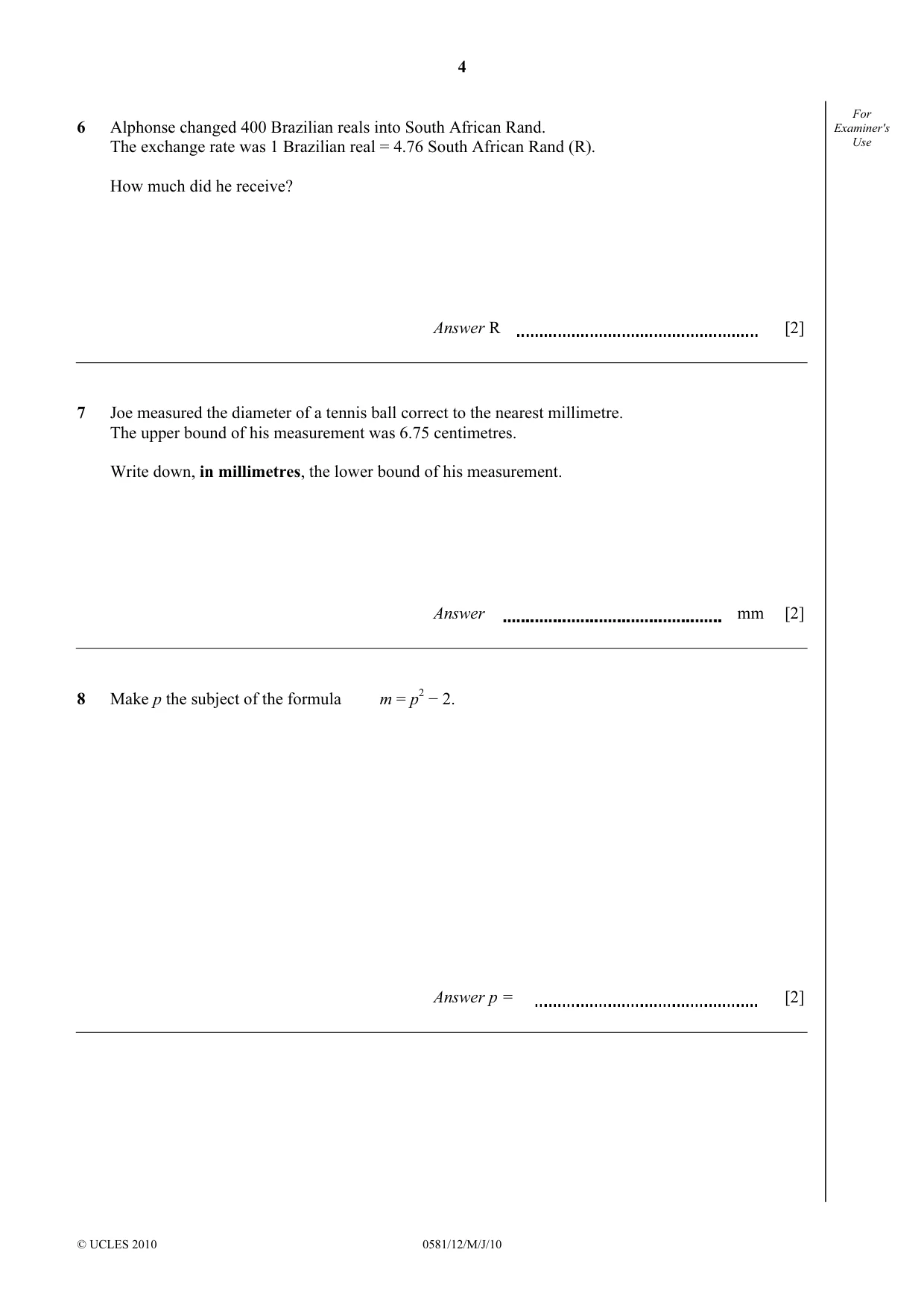
4 © UCLES 2010 0581/12/M/J/10 For Examiner's Use 6 Alphonse changed 400 Brazilian reals into South African Rand. The exchange rate was 1 Brazilian real = 4.76 South African Rand (R). How much did he receive? Answer R [2] 7 Joe measured the diameter of a tennis ball correct to the nearest millimetre. The upper bound of his measurement was 6.75 centimetres. Write down, in millimetres, the lower bound of his measurement. Answer mm [2] 8 Make p the subject of the formula m = p2 − 2. Answer p = [2]
Question paper, page 5
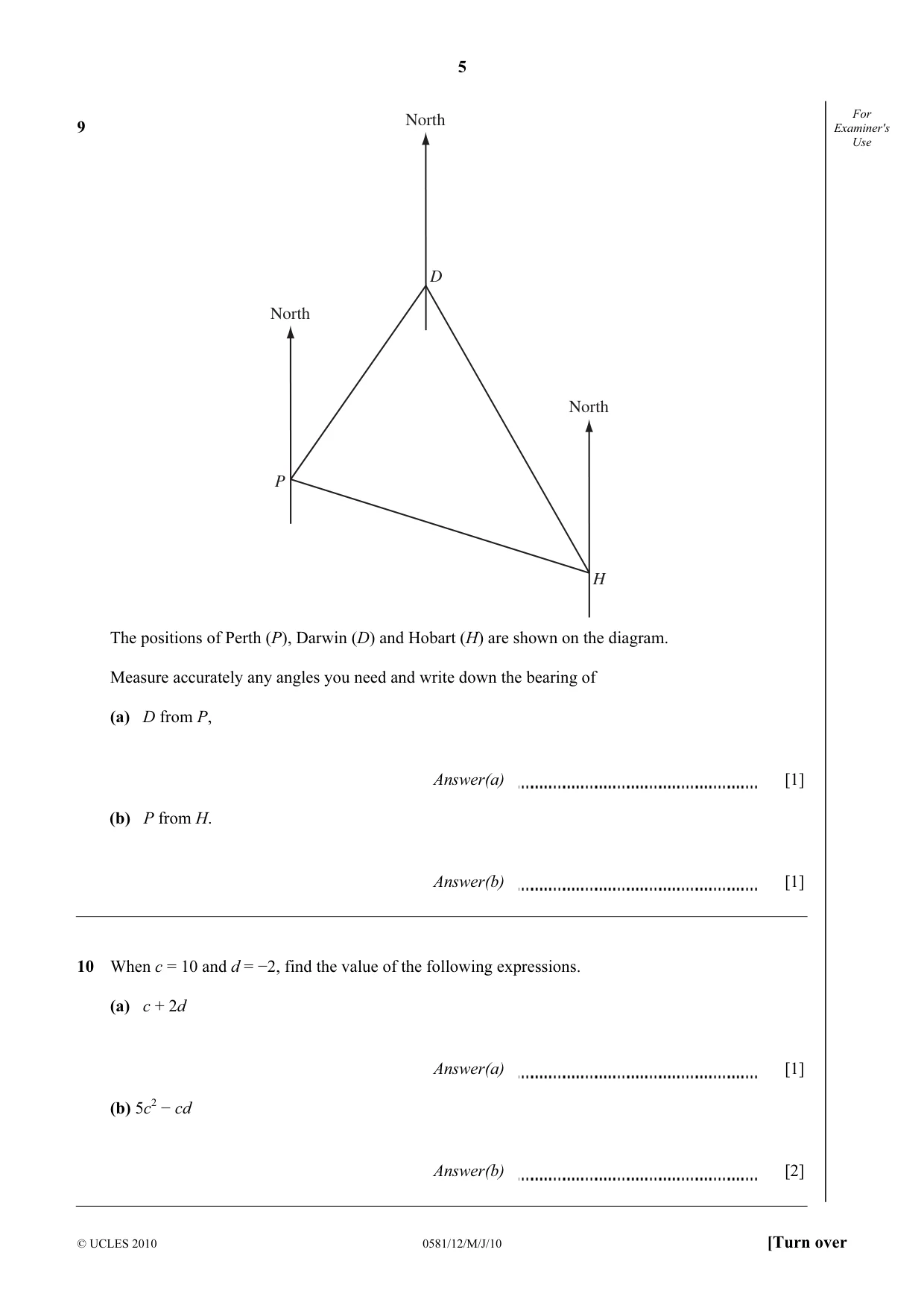
5 © UCLES 2010 0581/12/M/J/10 [Turn over For Examiner's Use 9 The positions of Perth (P), Darwin (D) and Hobart (H) are shown on the diagram. Measure accurately any angles you need and write down the bearing of (a) D from P, Answer(a) [1] (b) P from H. Answer(b) [1] 10 When c = 10 and d = −2, find the value of the following expressions. (a) c + 2d Answer(a) [1] (b) 5c2 − cd Answer(b) [2] North North North P D H
Question paper, page 6
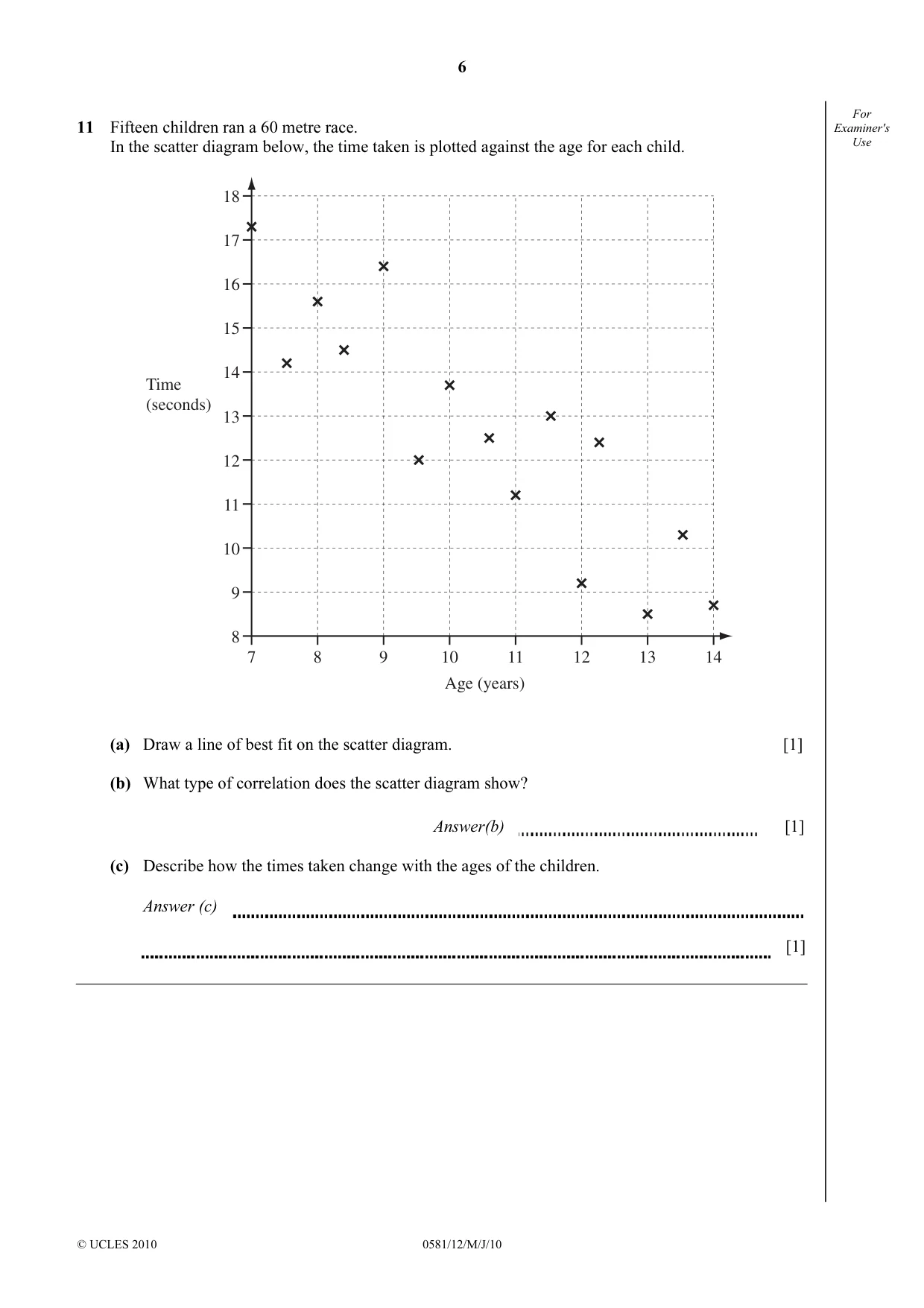
6 © UCLES 2010 0581/12/M/J/10 For Examiner's Use 11 Fifteen children ran a 60 metre race. In the scatter diagram below, the time taken is plotted against the age for each child. 18 17 16 15 14 13 12 11 10 9 8 7 8 9 10 11 12 13 14 Time (seconds) Age (years) (a) Draw a line of best fit on the scatter diagram. [1] (b) What type of correlation does the scatter diagram show? Answer(b) [1] (c) Describe how the times taken change with the ages of the children. Answer (c) [1]
Question paper, page 7
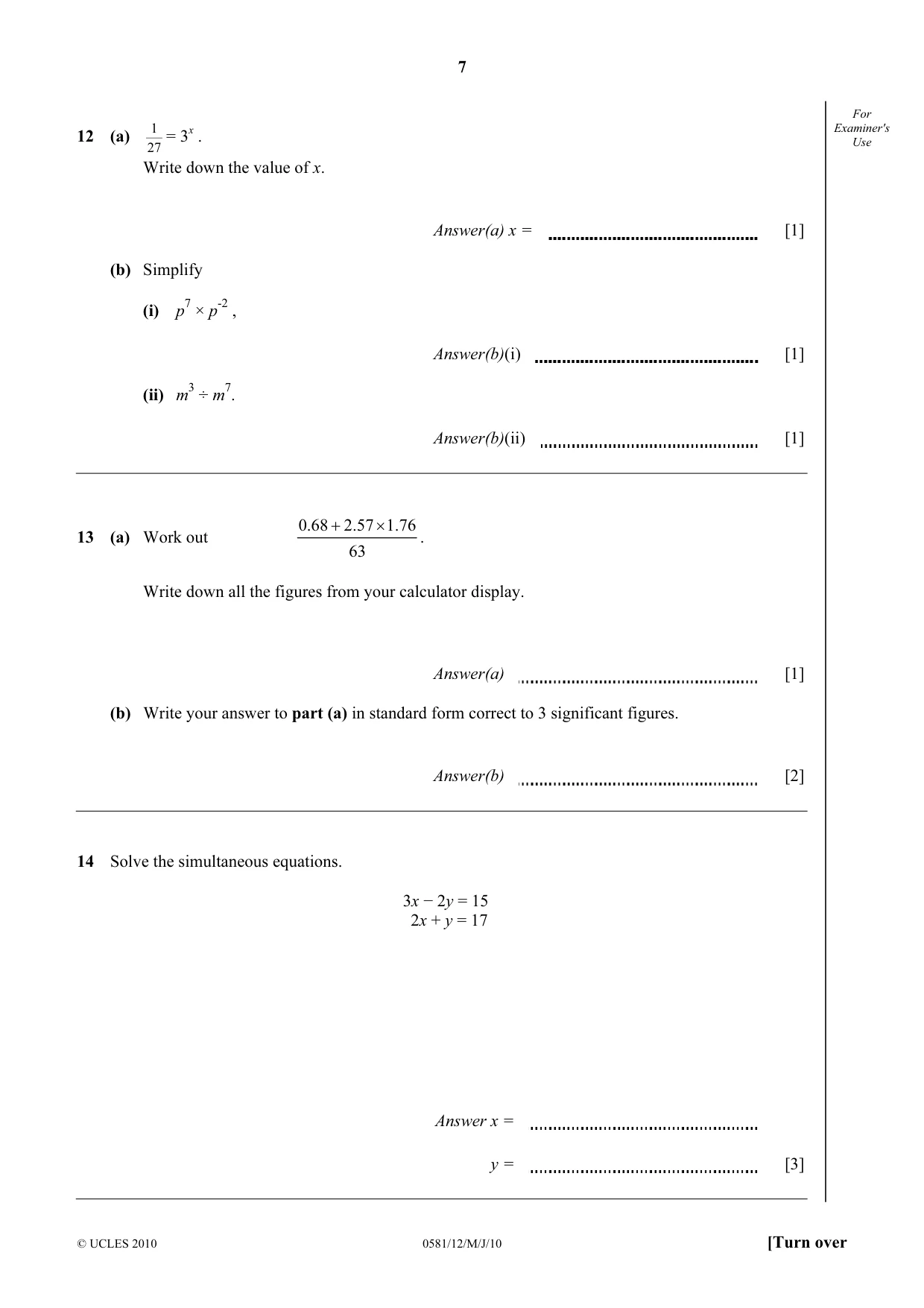
7 © UCLES 2010 0581/12/M/J/10 [Turn over For Examiner's Use 12 (a) 1 27 = 3x . Write down the value of x. Answer(a) x = [1] (b) Simplify (i) p7 × p-2 , Answer(b)(i) [1] (ii) m3 ÷ m7. Answer(b)(ii) [1] 13 (a) Work out 0.68 2.57 1.76 63 + × . Write down all the figures from your calculator display. Answer(a) [1] (b) Write your answer to part (a) in standard form correct to 3 significant figures. Answer(b) [2] 14 Solve the simultaneous equations. 3x − 2y = 15 2x + y = 17 Answer x = y = [3]
Question paper, page 8
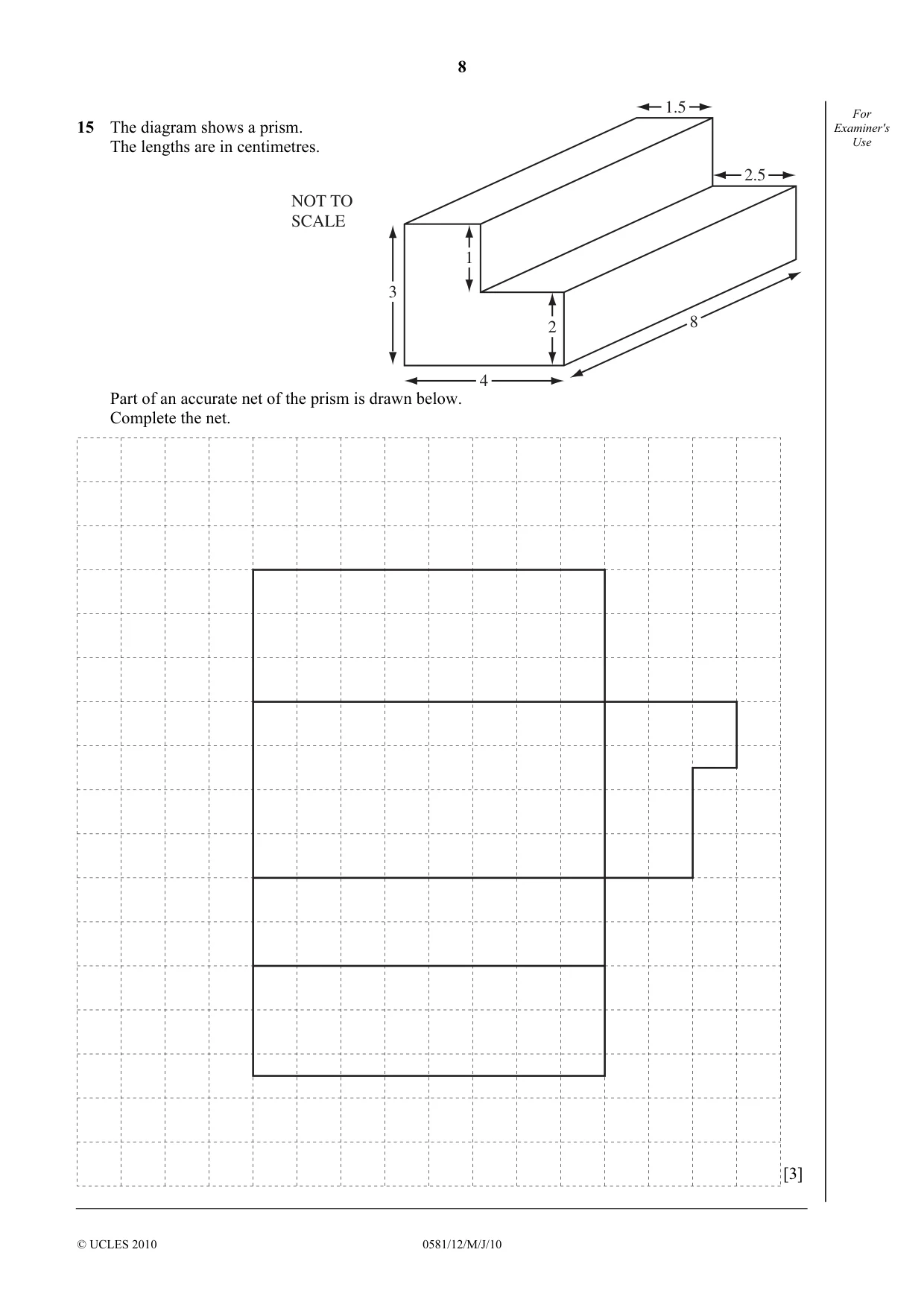
8 © UCLES 2010 0581/12/M/J/10 For Examiner's Use 15 The diagram shows a prism. The lengths are in centimetres. Part of an accurate net of the prism is drawn below. Complete the net. [3] 1 2 1.5 2.5 4 8 3 NOT TO SCALE
Question paper, page 9
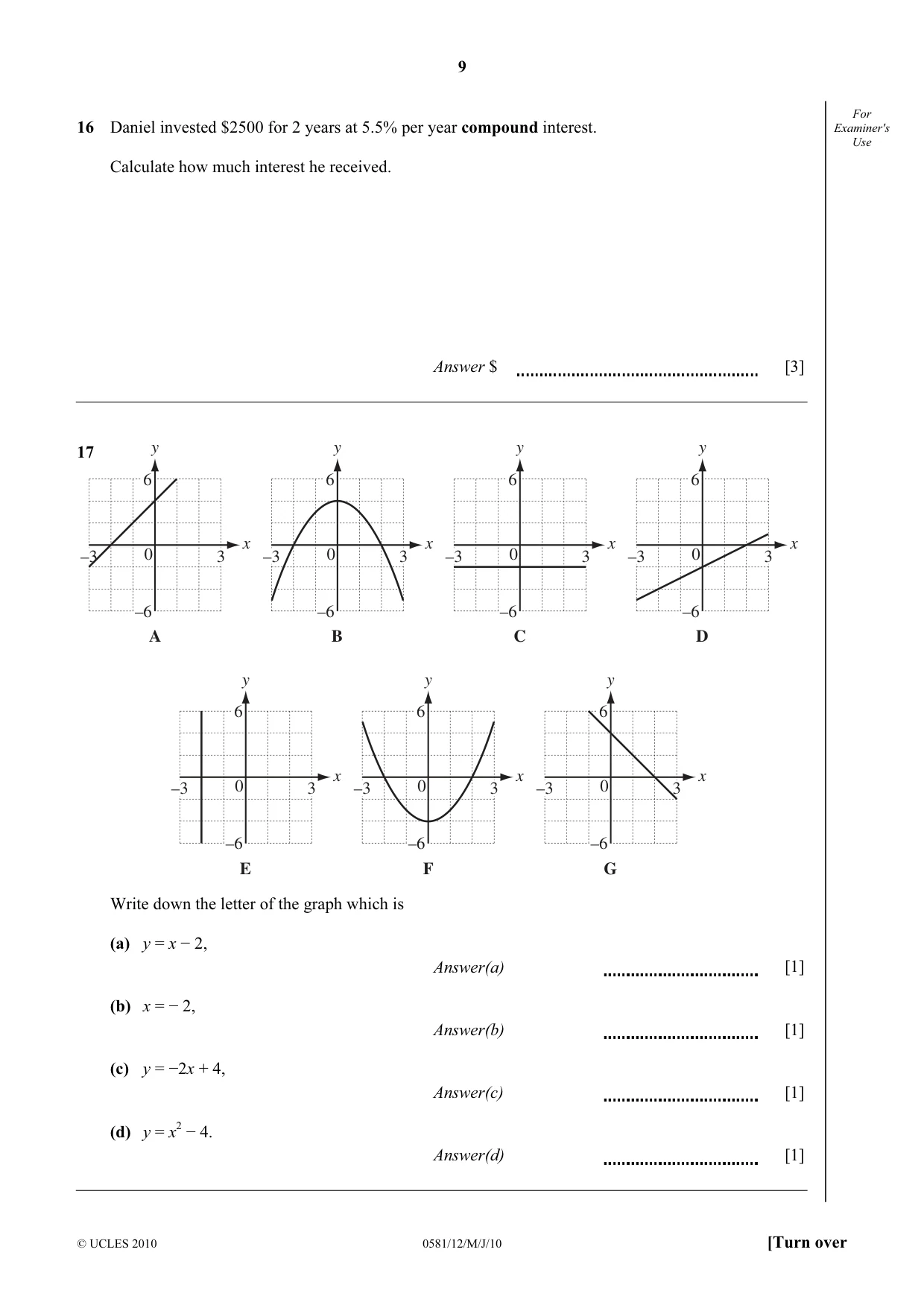
9 © UCLES 2010 0581/12/M/J/10 [Turn over For Examiner's Use 16 Daniel invested $2500 for 2 years at 5.5% per year compound interest. Calculate how much interest he received. Answer $ [3] 17 Write down the letter of the graph which is (a) y = x − 2, Answer(a) [1] (b) x = − 2, Answer(b) [1] (c) y = −2x + 4, Answer(c) [1] (d) y = x2 − 4. Answer(d) [1] y x 6 –6 –3 3 0 A y x 6 –6 –3 3 0 B y x 6 –6 –3 3 0 C y x 6 –6 –3 3 0 E y x 6 –6 –3 3 0 F y x 6 –6 –3 3 0 G y x 6 –6 –3 3 0 D
Question paper, page 10
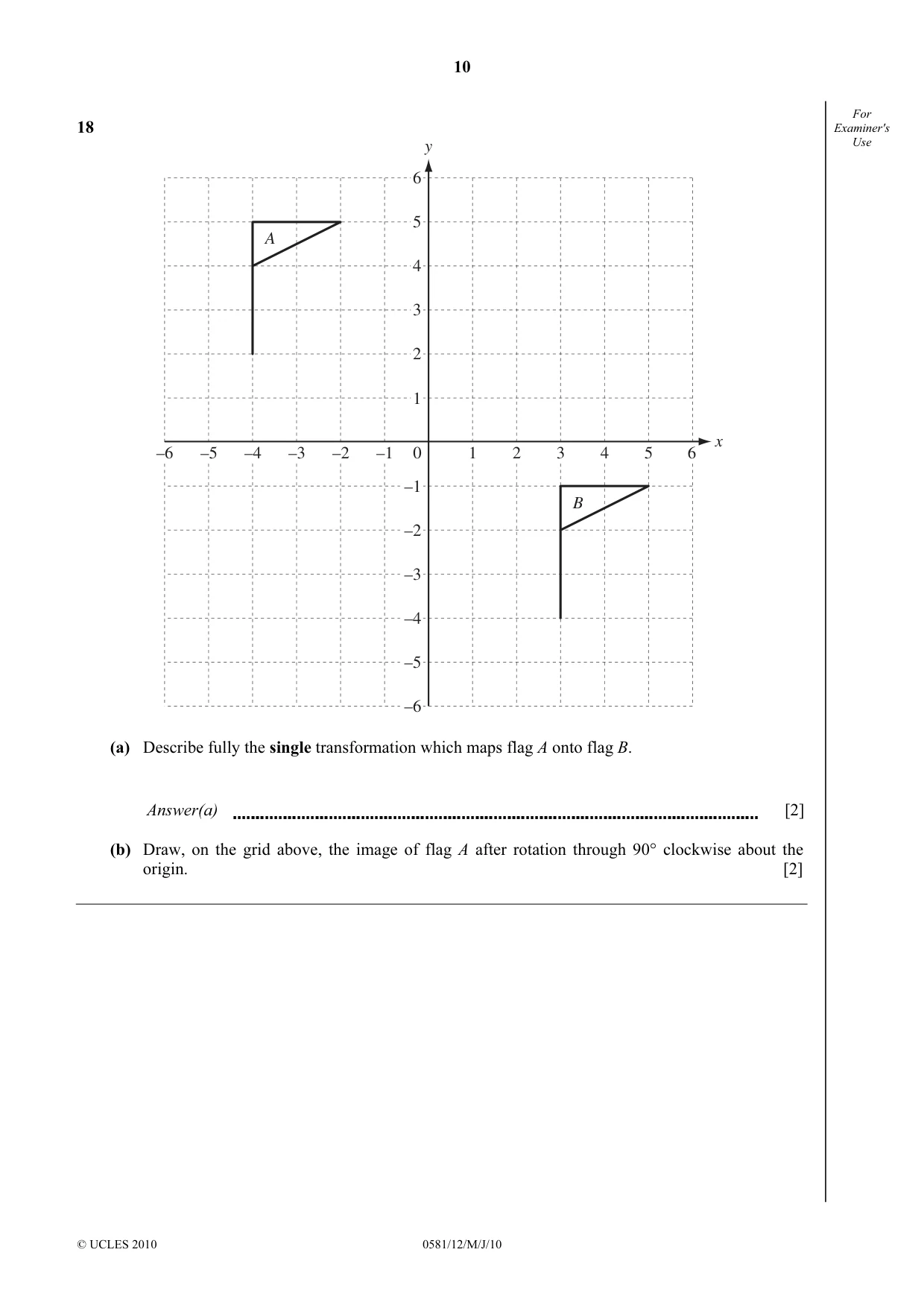
10 © UCLES 2010 0581/12/M/J/10 For Examiner's Use 18 y x 6 5 4 3 2 1 –1 –2 –3 –4 –5 –6 0 –1 –2 –3 –4 –5 –6 5 6 4 3 2 1 A B (a) Describe fully the single transformation which maps flag A onto flag B. Answer(a) [2] (b) Draw, on the grid above, the image of flag A after rotation through 90° clockwise about the origin. [2]
Question paper, page 11
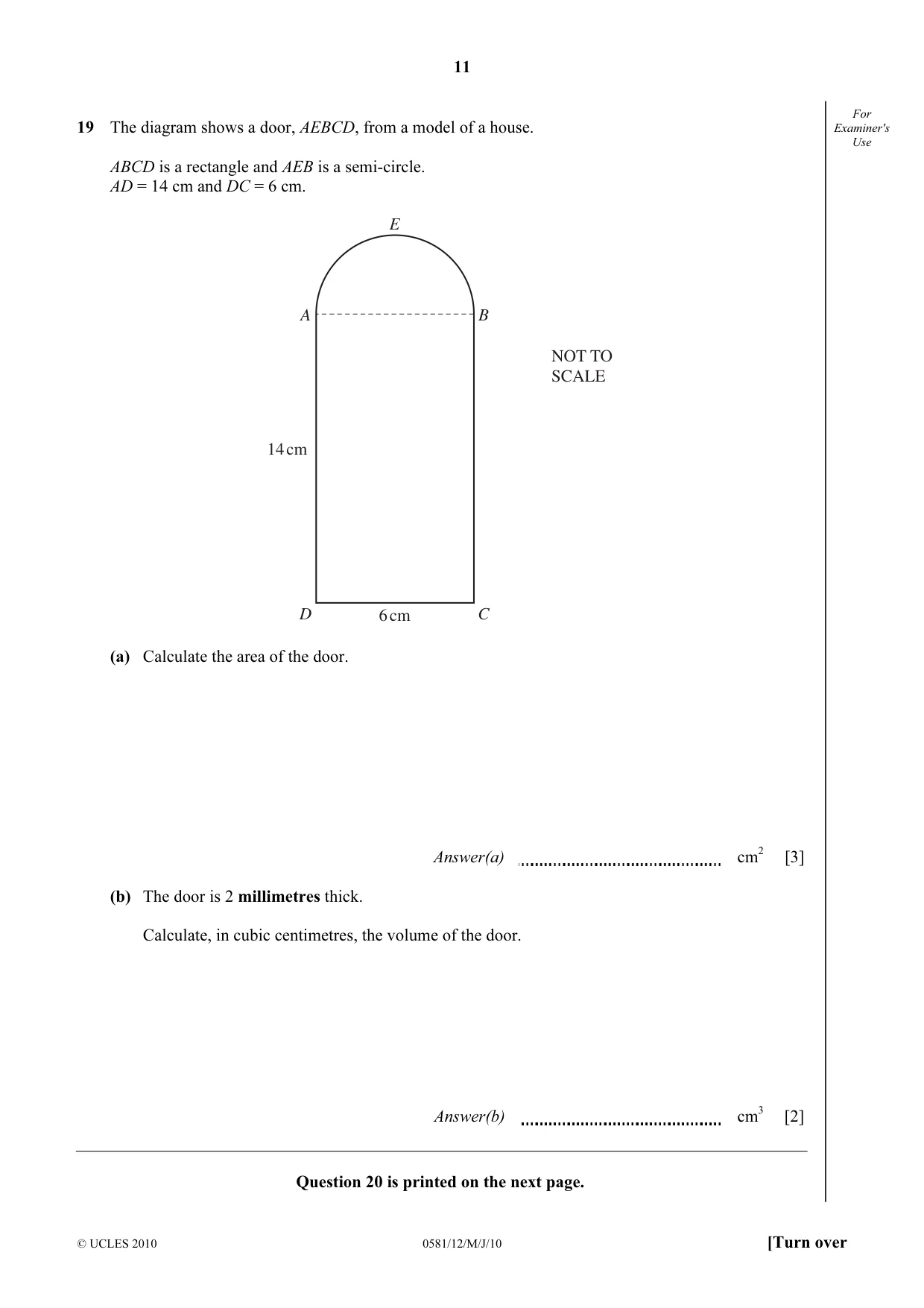
11 © UCLES 2010 0581/12/M/J/10 [Turn over For Examiner's Use 19 The diagram shows a door, AEBCD, from a model of a house. ABCD is a rectangle and AEB is a semi-circle. AD = 14 cm and DC = 6 cm. E 6 cm 14 cm A B D C NOT TO SCALE (a) Calculate the area of the door. Answer(a) cm2 [3] (b) The door is 2 millimetres thick. Calculate, in cubic centimetres, the volume of the door. Answer(b) cm3 [2] Question 20 is printed on the next page.
Question paper, page 12
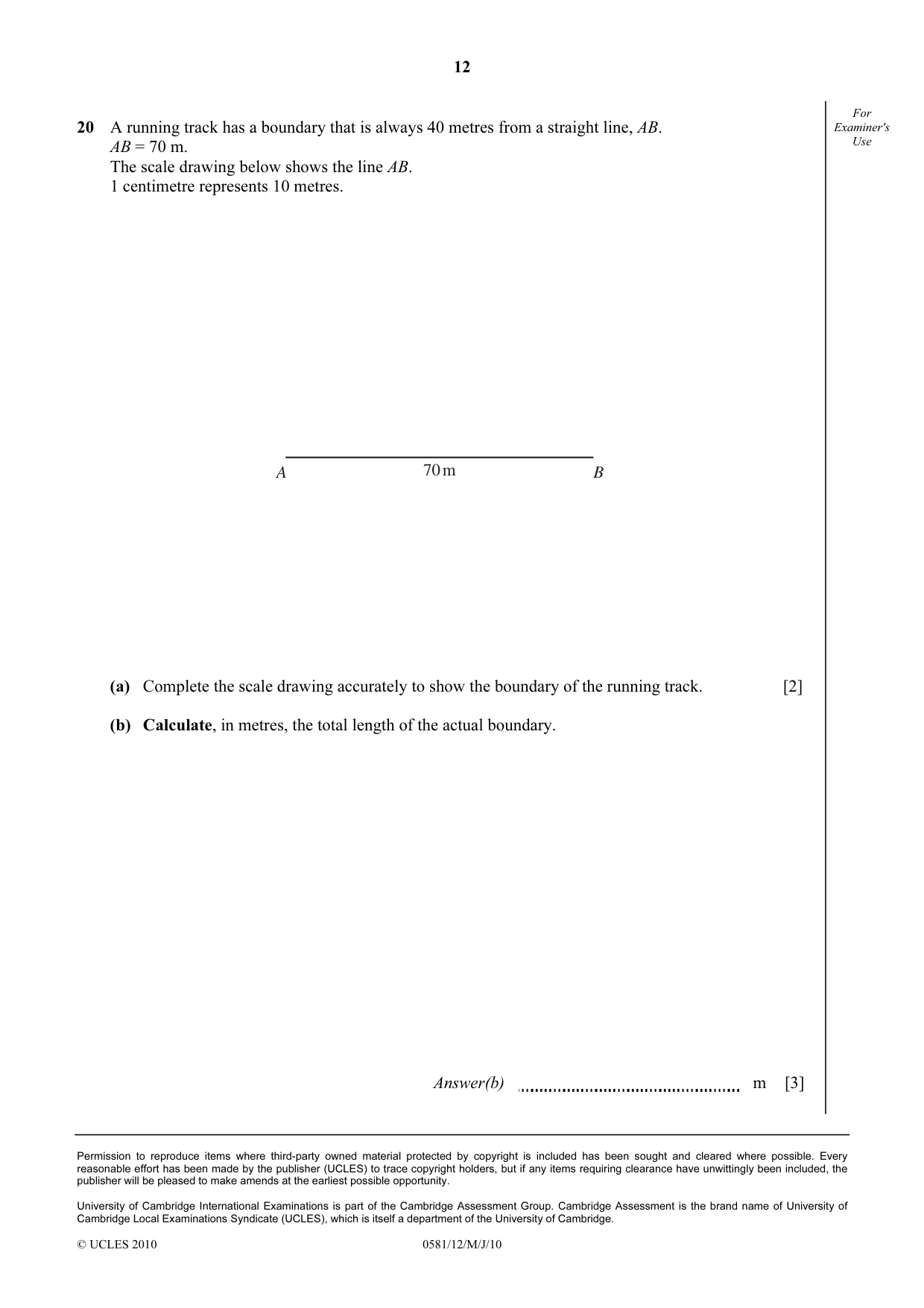
12 Permission to reproduce items where third-party owned material protected by copyright is included has been sought and cleared where possible. Every reasonable effort has been made by the publisher (UCLES) to trace copyright holders, but if any items requiring clearance have unwittingly been included, the publisher will be pleased to make amends at the earliest possible opportunity. University of Cambridge International Examinations is part of the Cambridge Assessment Group. Cambridge Assessment is the brand name of University of Cambridge Local Examinations Syndicate (UCLES), which is itself a department of the University of Cambridge. © UCLES 2010 0581/12/M/J/10 For Examiner's Use 20 A running track has a boundary that is always 40 metres from a straight line, AB. AB = 70 m. The scale drawing below shows the line AB. 1 centimetre represents 10 metres. A B 70 m (a) Complete the scale drawing accurately to show the boundary of the running track. [2] (b) Calculate, in metres, the total length of the actual boundary. Answer(b) m [3]
Mark scheme, page 1
UNIVERSITY OF CAMBRIDGE INTERNATIONAL EXAMINATIONS International General Certificate of Secondary Education MARK SCHEME for the May/June 2010 question paper for the guidance of teachers 0581 MATHEMATICS 0581/12 Paper 12 (Core), maximum raw mark 56 This mark scheme is published as an aid to teachers and candidates, to indicate the requirements of the examination. It shows the basis on which Examiners were instructed to award marks. It does not indicate the details of the discussions that took place at an Examiners’ meeting before marking began, which would have considered the acceptability of alternative answers. Mark schemes must be read in conjunction with the question papers and the report on the examination. • CIE will not enter into discussions or correspondence in connection with these mark schemes. CIE is publishing the mark schemes for the May/June 2010 question papers for most IGCSE, GCE Advanced Level and Advanced Subsidiary Level syllabuses and some Ordinary Level syllabuses. www.XtremePapers.com
Mark scheme, page 2
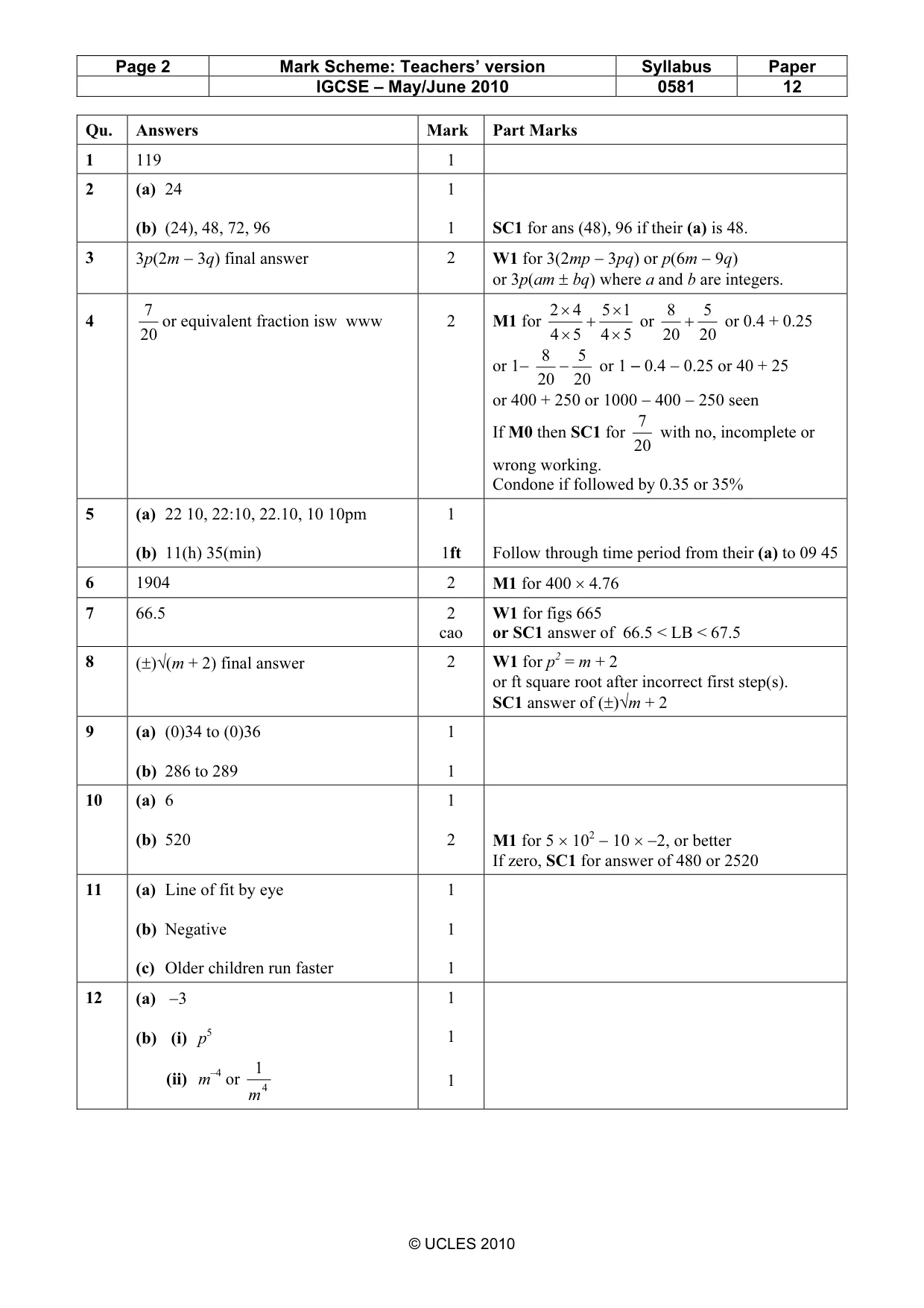
Page 2 Mark Scheme: Teachers’ version Syllabus Paper IGCSE – May/June 2010 0581 12 © UCLES 2010 Qu. Answers Mark Part Marks 1 119 1 2 (a) 24 (b) (24), 48, 72, 96 1 1 SC1 for ans (48), 96 if their (a) is 48. 3 3p(2m − 3q) final answer 2 W1 for 3(2mp − 3pq) or p(6m − 9q) or 3p(am ± bq) where a and b are integers. 4 20 7 or equivalent fraction isw www 2 M1 for 5 4 1 5 5 4 4 2 × × + × × or 20 5 20 8 + or 0.4 + 0.25 or 1− 20 5 20 8 − or 1 − 0.4 − 0.25 or 40 + 25 or 400 + 250 or 1000 − 400 − 250 seen If M0 then SC1 for 20 7 with no, incomplete or wrong working. Condone if followed by 0.35 or 35% 5 (a) 22 10, 22:10, 22.10, 10 10pm (b) 11(h) 35(min) 1 1ft Follow through time period from their (a) to 09 45 6 1904 2 M1 for 400 × 4.76 7 66.5 2 cao W1 for figs 665 or SC1 answer of 66.5 < LB < 67.5 8 (±)√(m + 2) final answer 2 W1 for p2 = m + 2 or ft square root after incorrect first step(s). SC1 answer of (±)√m + 2 9 (a) (0)34 to (0)36 (b) 286 to 289 1 1 10 (a) 6 (b) 520 1 2 M1 for 5 × 10² − 10 × −2, or better If zero, SC1 for answer of 480 or 2520 11 (a) Line of fit by eye (b) Negative (c) Older children run faster 1 1 1 12 (a) −3 (b) (i) p5 1 1 (ii) m–4 or 4 1 m 1
Mark scheme, page 3
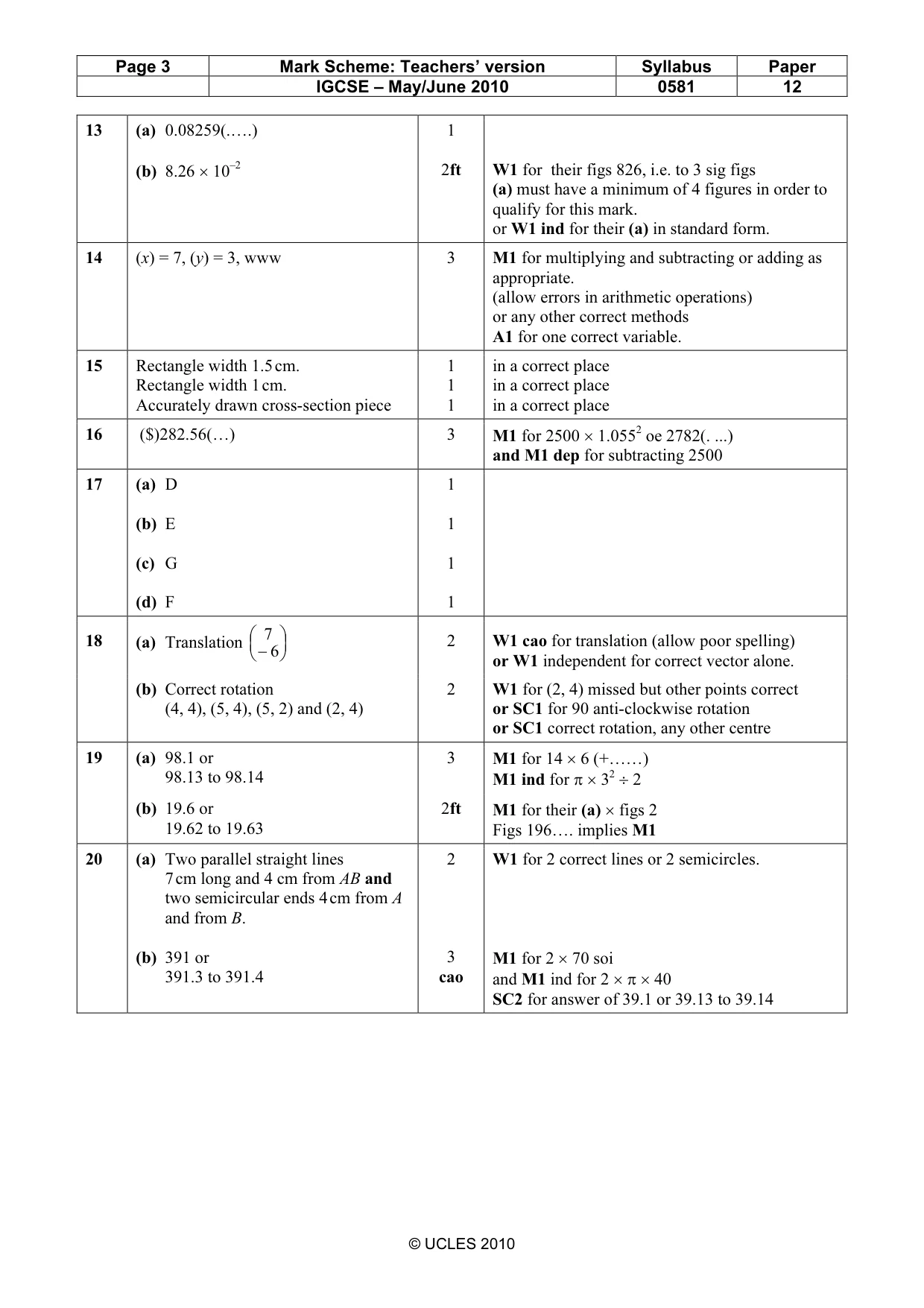
Page 3 Mark Scheme: Teachers’ version Syllabus Paper IGCSE – May/June 2010 0581 12 © UCLES 2010 13 (a) 0.08259(.….) (b) 8.26 × 10⁻² 1 2ft W1 for their figs 826, i.e. to 3 sig figs (a) must have a minimum of 4 figures in order to qualify for this mark. or W1 ind for their (a) in standard form. 14 (x) = 7, (y) = 3, www 3 M1 for multiplying and subtracting or adding as appropriate. (allow errors in arithmetic operations) or any other correct methods A1 for one correct variable. 15 Rectangle width 1.5 cm. Rectangle width 1 cm. Accurately drawn cross-section piece 1 1 1 in a correct place in a correct place in a correct place 16 ($)282.56(…) 3 M1 for 2500 × 1.0552 oe 2782(. ...) and M1 dep for subtracting 2500 17 (a) D (b) E (c) G (d) F 1 1 1 1 18 (a) Translation −6 7 2 W1 cao for translation (allow poor spelling) or W1 independent for correct vector alone. (b) Correct rotation (4, 4), (5, 4), (5, 2) and (2, 4) 2 W1 for (2, 4) missed but other points correct or SC1 for 90 anti-clockwise rotation or SC1 correct rotation, any other centre 19 (a) 98.1 or 98.13 to 98.14 3 M1 for 14 × 6 (+……) M1 ind for π × 32 ÷ 2 (b) 19.6 or 19.62 to 19.63 2ft M1 for their (a) × figs 2 Figs 196…. implies M1 20 (a) Two parallel straight lines 7 cm long and 4 cm from AB and two semicircular ends 4 cm from A and from B. (b) 391 or 391.3 to 391.4 2 3 cao W1 for 2 correct lines or 2 semicircles. M1 for 2 × 70 soi and M1 ind for 2 × π × 40 SC2 for answer of 39.1 or 39.13 to 39.14