Cambridge IGCSE Mathematics (with coursework) 0581 — 2009 May/June Paper 4 · Variant 1
0581/41/M/J/09 · 130 marks · ≈146 min
The question paper and its mark scheme, free to read here and free to download. This is Cambridge’s own paper, exactly as it was sat.
Question paper20 pages
Mark scheme7 pages
Answers below. Sit the paper first if you are practising.
Paper as text
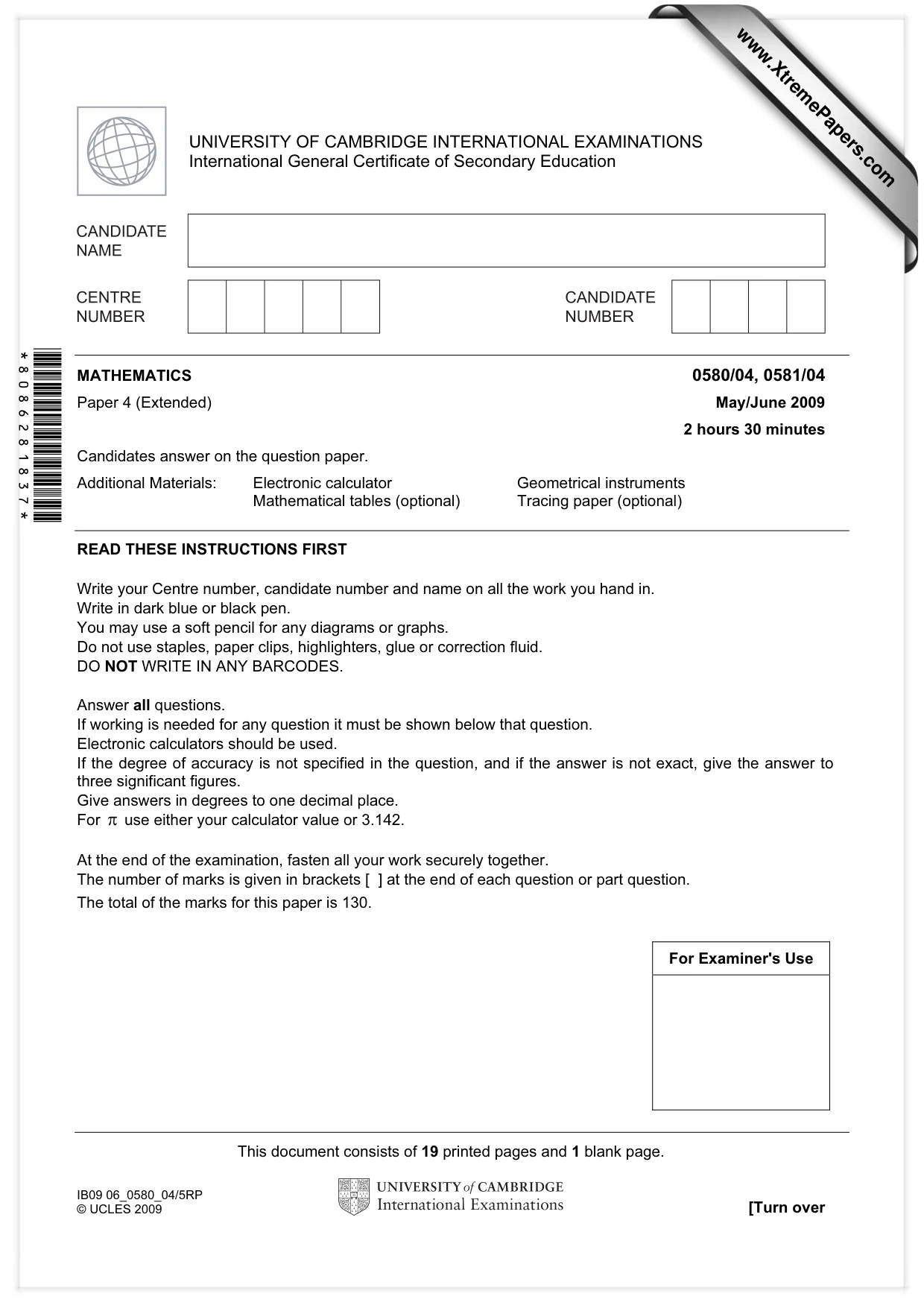
Question paper, page 1
This document consists of 19 printed pages and 1 blank page. IB09 06_0580_04/5RP © UCLES 2009 [Turn over *8086281837* For Examiner's Use UNIVERSITY OF CAMBRIDGE INTERNATIONAL EXAMINATIONS International General Certificate of Secondary Education MATHEMATICS 0580/04, 0581/04 Paper 4 (Extended) May/June 2009 2 hours 30 minutes Candidates answer on the question paper. Additional Materials: Electronic calculator Geometrical instruments Mathematical tables (optional) Tracing paper (optional) READ THESE INSTRUCTIONS FIRST Write your Centre number, candidate number and name on all the work you hand in. Write in dark blue or black pen. You may use a soft pencil for any diagrams or graphs. Do not use staples, paper clips, highlighters, glue or correction fluid. DO NOT WRITE IN ANY BARCODES. Answer all questions. If working is needed for any question it must be shown below that question. Electronic calculators should be used. If the degree of accuracy is not specified in the question, and if the answer is not exact, give the answer to three significant figures. Give answers in degrees to one decimal place. For π use either your calculator value or 3.142. At the end of the examination, fasten all your work securely together. The number of marks is given in brackets [ ] at the end of each question or part question. The total of the marks for this paper is 130. www.XtremePapers.com
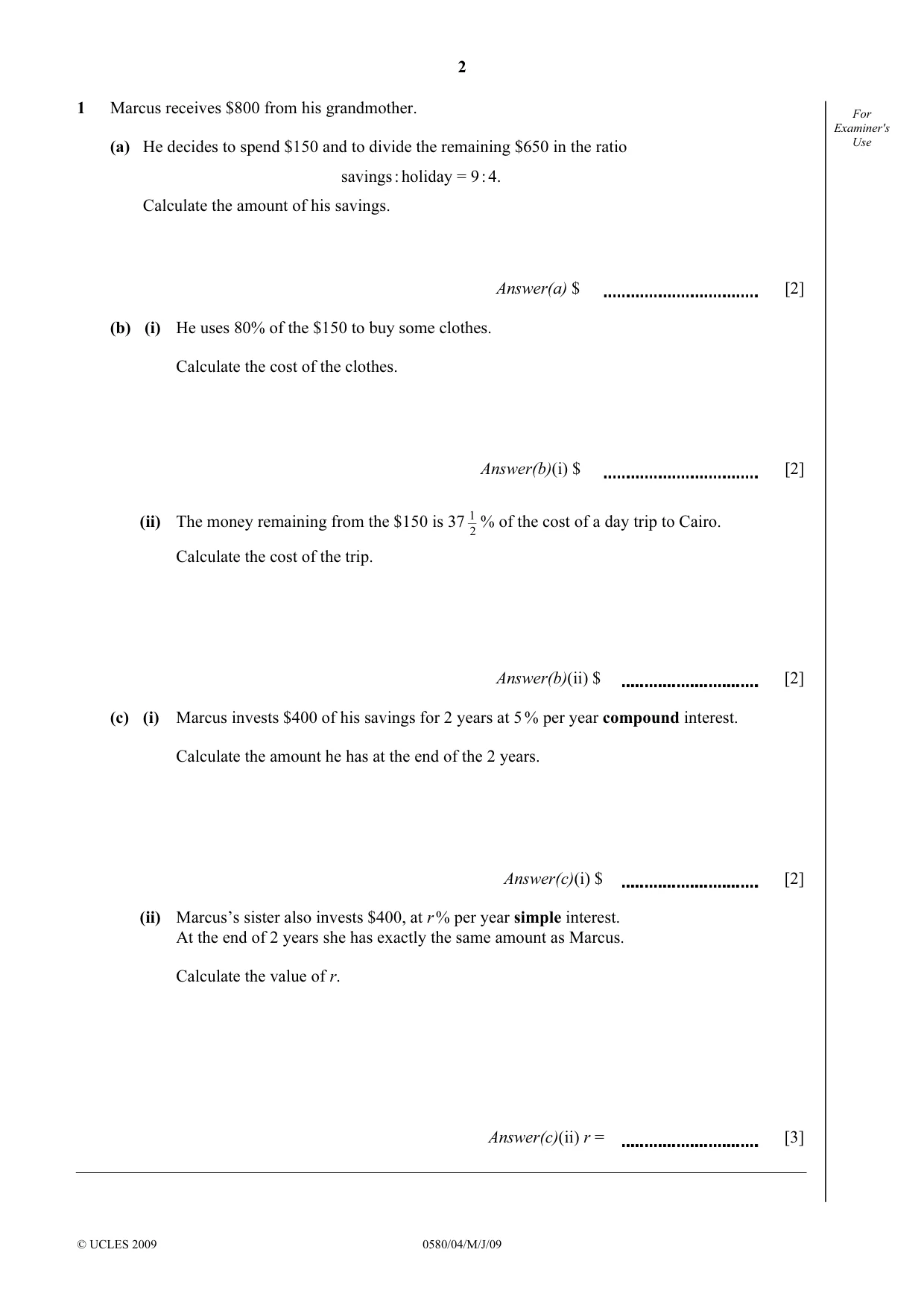
Question paper, page 2
2 © UCLES 2009 0580/04/M/J/09 For Examiner's Use 1 Marcus receives $800 from his grandmother. (a) He decides to spend $150 and to divide the remaining $650 in the ratio savings : holiday = 9 : 4. Calculate the amount of his savings. Answer(a) $ [2] (b) (i) He uses 80% of the $150 to buy some clothes. Calculate the cost of the clothes. Answer(b)(i) $ [2] (ii) The money remaining from the $150 is 37 1 2 % of the cost of a day trip to Cairo. Calculate the cost of the trip. Answer(b)(ii) $ [2] (c) (i) Marcus invests $400 of his savings for 2 years at 5 % per year compound interest. Calculate the amount he has at the end of the 2 years. Answer(c)(i) $ [2] (ii) Marcus’s sister also invests $400, at r % per year simple interest. At the end of 2 years she has exactly the same amount as Marcus. Calculate the value of r. Answer(c)(ii) r = [3]
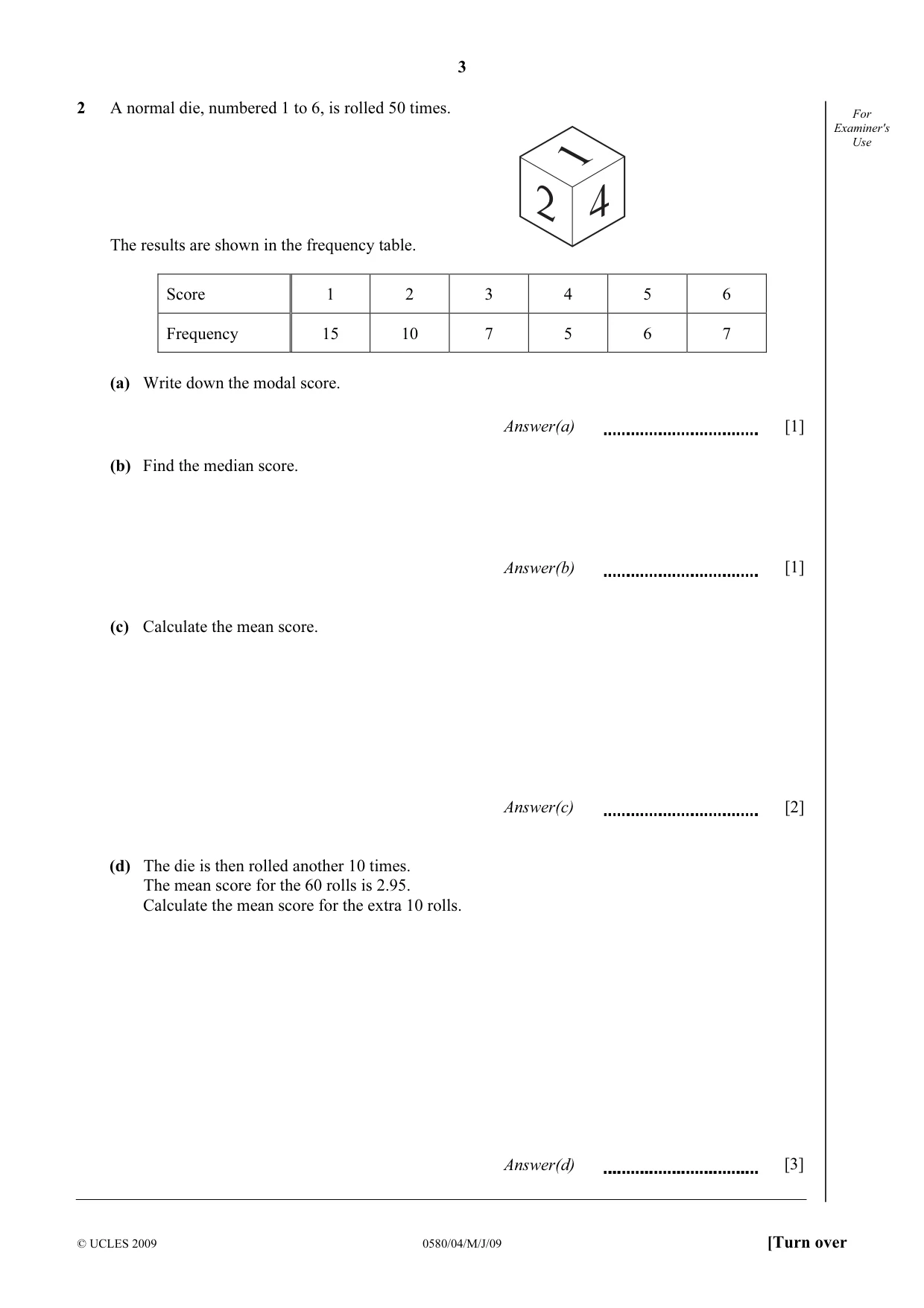
Question paper, page 3
3 © UCLES 2009 0580/04/M/J/09 [Turn over For Examiner's Use 2 A normal die, numbered 1 to 6, is rolled 50 times. The results are shown in the frequency table. Score 1 2 3 4 5 6 Frequency 15 10 7 5 6 7 (a) Write down the modal score. Answer(a) [1] (b) Find the median score. Answer(b) [1] (c) Calculate the mean score. Answer(c) [2] (d) The die is then rolled another 10 times. The mean score for the 60 rolls is 2.95. Calculate the mean score for the extra 10 rolls. Answer(d) [3] 1 4 2
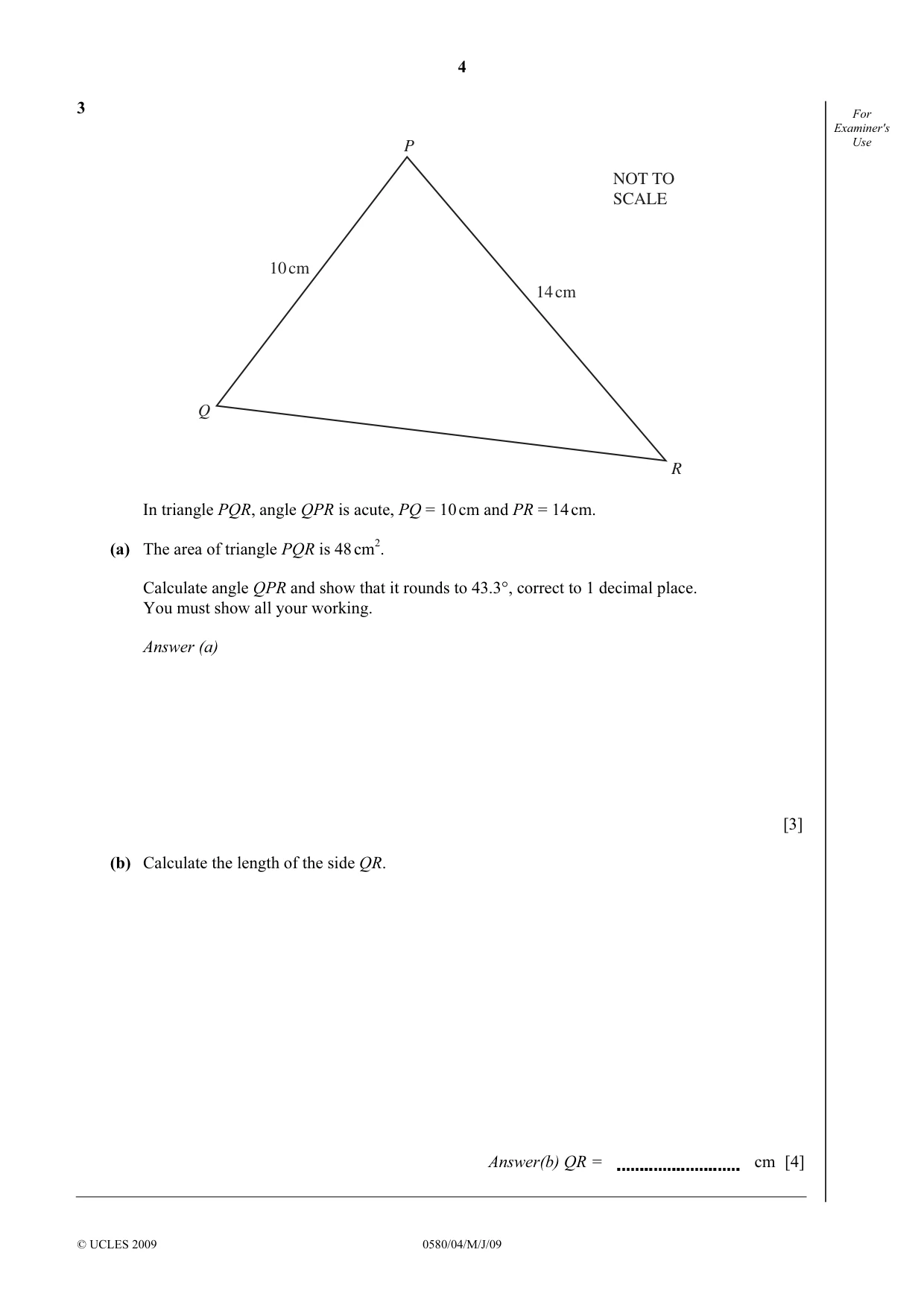
Question paper, page 4
4 © UCLES 2009 0580/04/M/J/09 For Examiner's Use 3 P Q R 14 cm 10 cm NOT TO SCALE In triangle PQR, angle QPR is acute, PQ = 10 cm and PR = 14 cm. (a) The area of triangle PQR is 48 cm2. Calculate angle QPR and show that it rounds to 43.3°, correct to 1 decimal place. You must show all your working. Answer (a) [3] (b) Calculate the length of the side QR. Answer(b) QR = cm [4]
Question paper, page 5
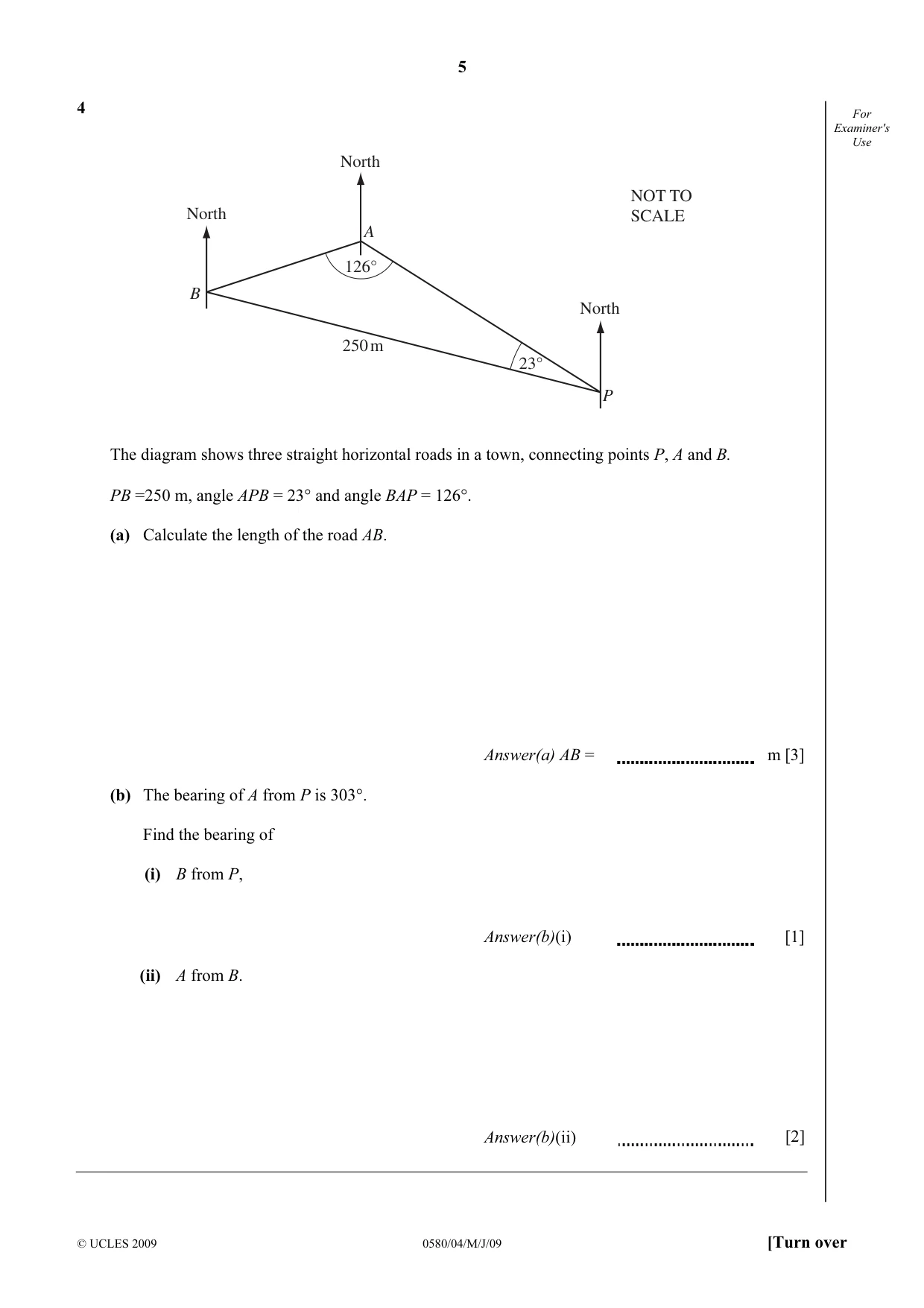
5 © UCLES 2009 0580/04/M/J/09 [Turn over For Examiner's Use 4 North North North 23° 126° B A P 250 m NOT TO SCALE The diagram shows three straight horizontal roads in a town, connecting points P, A and B. PB =250 m, angle APB = 23° and angle BAP = 126°. (a) Calculate the length of the road AB. Answer(a) AB = m [3] (b) The bearing of A from P is 303°. Find the bearing of (i) B from P, Answer(b)(i) [1] (ii) A from B. Answer(b)(ii) [2]
Question paper, page 6
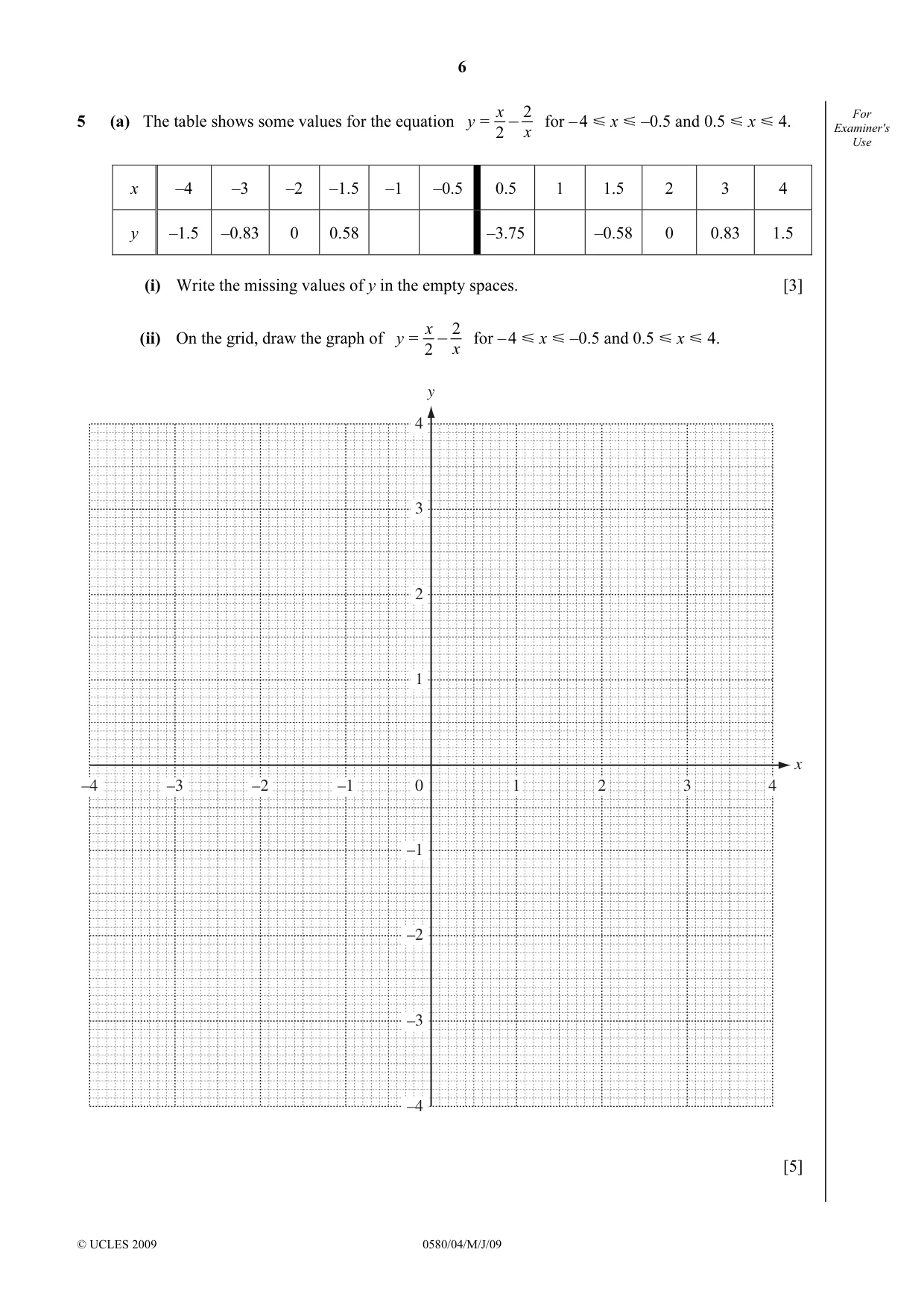
6 © UCLES 2009 0580/04/M/J/09 For Examiner's Use 5 (a) The table shows some values for the equation 2 = 2 _ x y x for – 4 Y x Y=–0.5 and 0.5 Y x Y 4. x –4 –3 –2 –1.5 –1 –0.5 0.5 1 1.5 2 3 4 y –1.5 –0.83 0 0.58 –3.75 –0.58 0 0.83 1.5 (i) Write the missing values of y in the empty spaces. [3] (ii) On the grid, draw the graph of 2 = 2 _ x y x for – 4 Y x Y=–0.5 and 0.5 Y x Y 4. y x –4 –3 –2 –1 0 –1 –2 –3 –4 4 3 2 1 1 2 3 4 [5]
Question paper, page 7
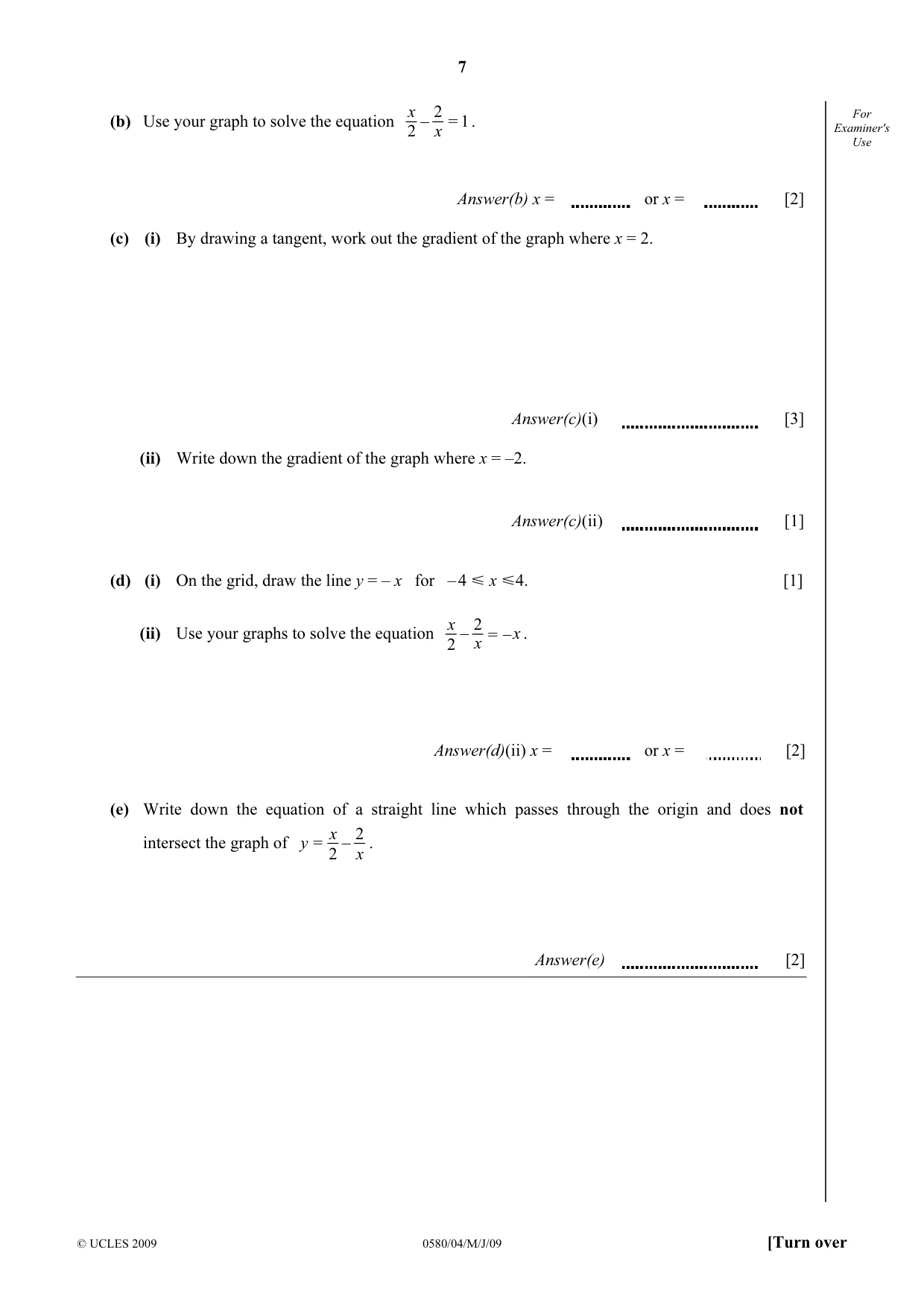
7 © UCLES 2009 0580/04/M/J/09 [Turn over For Examiner's Use (b) Use your graph to solve the equation 2 _ = 1 2 x x . Answer(b) x = or x = [2] (c) (i) By drawing a tangent, work out the gradient of the graph where x = 2. Answer(c)(i) [3] (ii) Write down the gradient of the graph where x = –2. Answer(c)(ii) [1] (d) (i) On the grid, draw the line y = – x for – 4 Y x Y4. [1] (ii) Use your graphs to solve the equation 2 _ _ = 2 x x x . Answer(d)(ii) x = or x = [2] (e) Write down the equation of a straight line which passes through the origin and does not intersect the graph of 2 _ = 2 x y x . Answer(e) [2]
Question paper, page 8
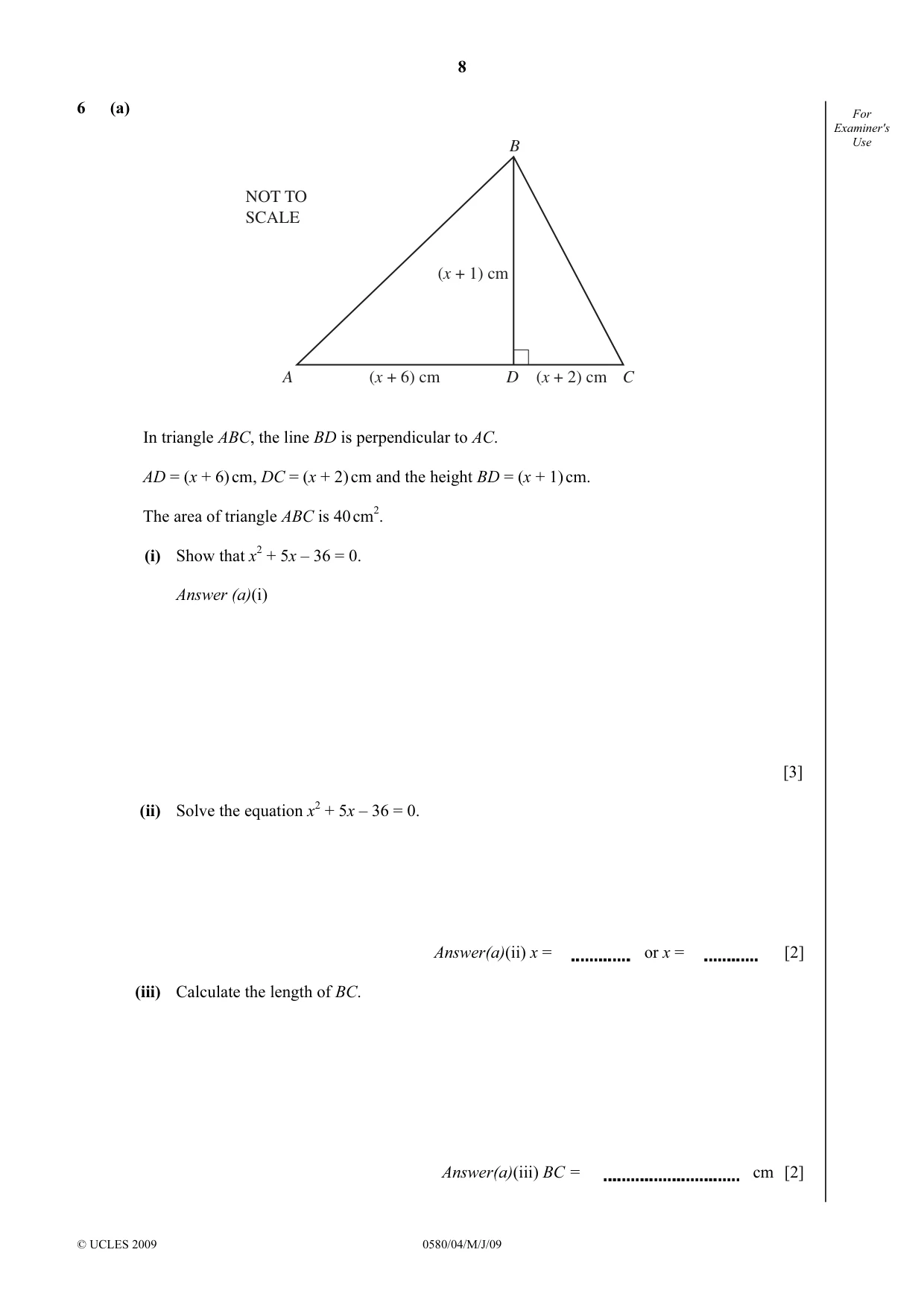
8 © UCLES 2009 0580/04/M/J/09 For Examiner's Use 6 (a) B A C D (x + 1) cm (x + 6) cm (x + 2) cm NOT TO SCALE In triangle ABC, the line BD is perpendicular to AC. AD = (x + 6) cm, DC = (x + 2) cm and the height BD = (x + 1) cm. The area of triangle ABC is 40 cm2. (i) Show that x2 + 5x – 36 = 0. Answer (a)(i) [3] (ii) Solve the equation x2 + 5x – 36 = 0. Answer(a)(ii) x = or x = [2] (iii) Calculate the length of BC. Answer(a)(iii) BC = cm [2]
Question paper, page 9
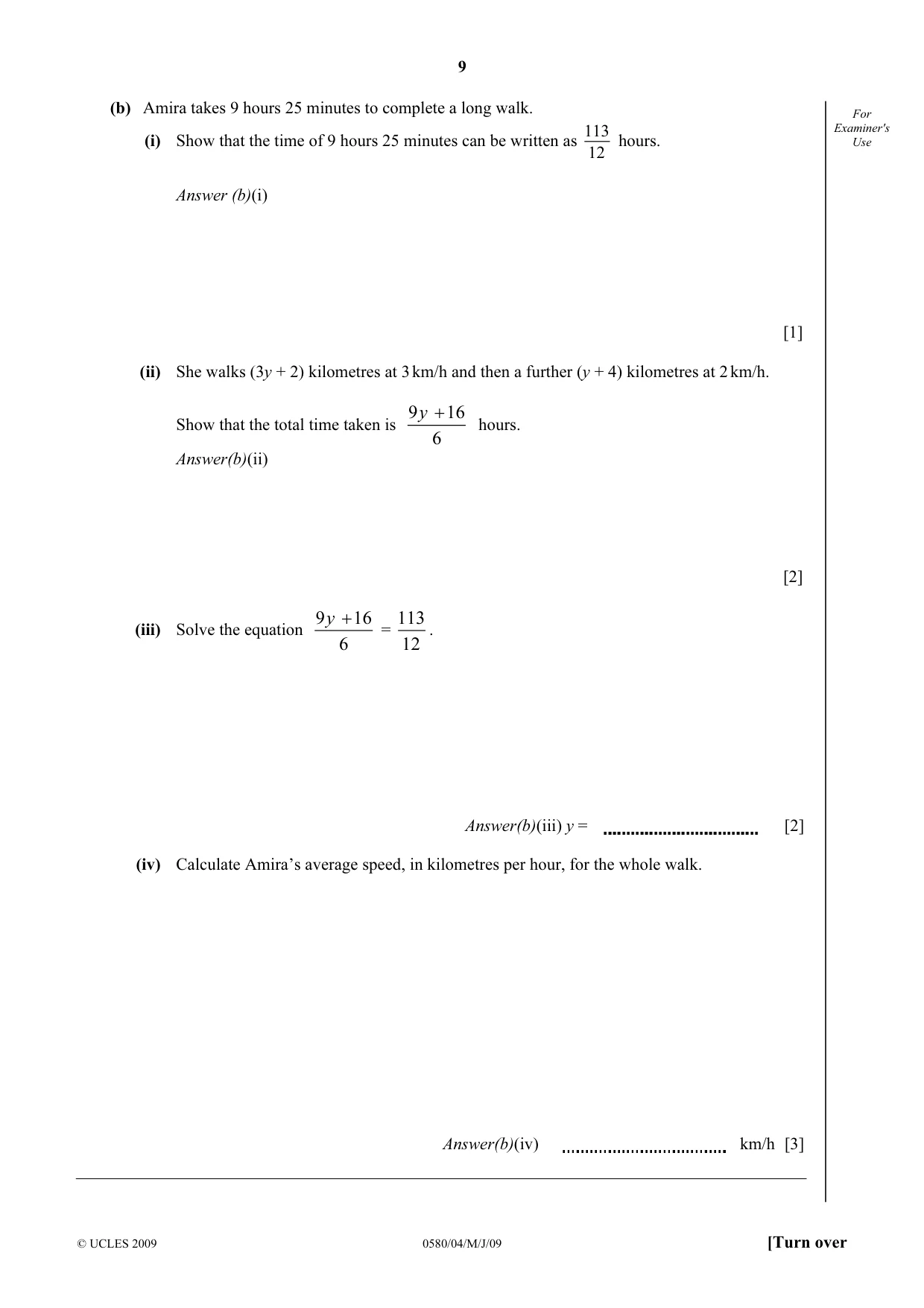
9 © UCLES 2009 0580/04/M/J/09 [Turn over For Examiner's Use (b) Amira takes 9 hours 25 minutes to complete a long walk. (i) Show that the time of 9 hours 25 minutes can be written as 113 12 hours. Answer (b)(i) [1] (ii) She walks (3y + 2) kilometres at 3 km/h and then a further (y + 4) kilometres at 2 km/h. Show that the total time taken is 9 16 6 y + hours. Answer(b)(ii) [2] (iii) Solve the equation 9 16 6 y + = 113 12 . Answer(b)(iii) y = [2] (iv) Calculate Amira’s average speed, in kilometres per hour, for the whole walk. Answer(b)(iv) km/h [3]
Question paper, page 10
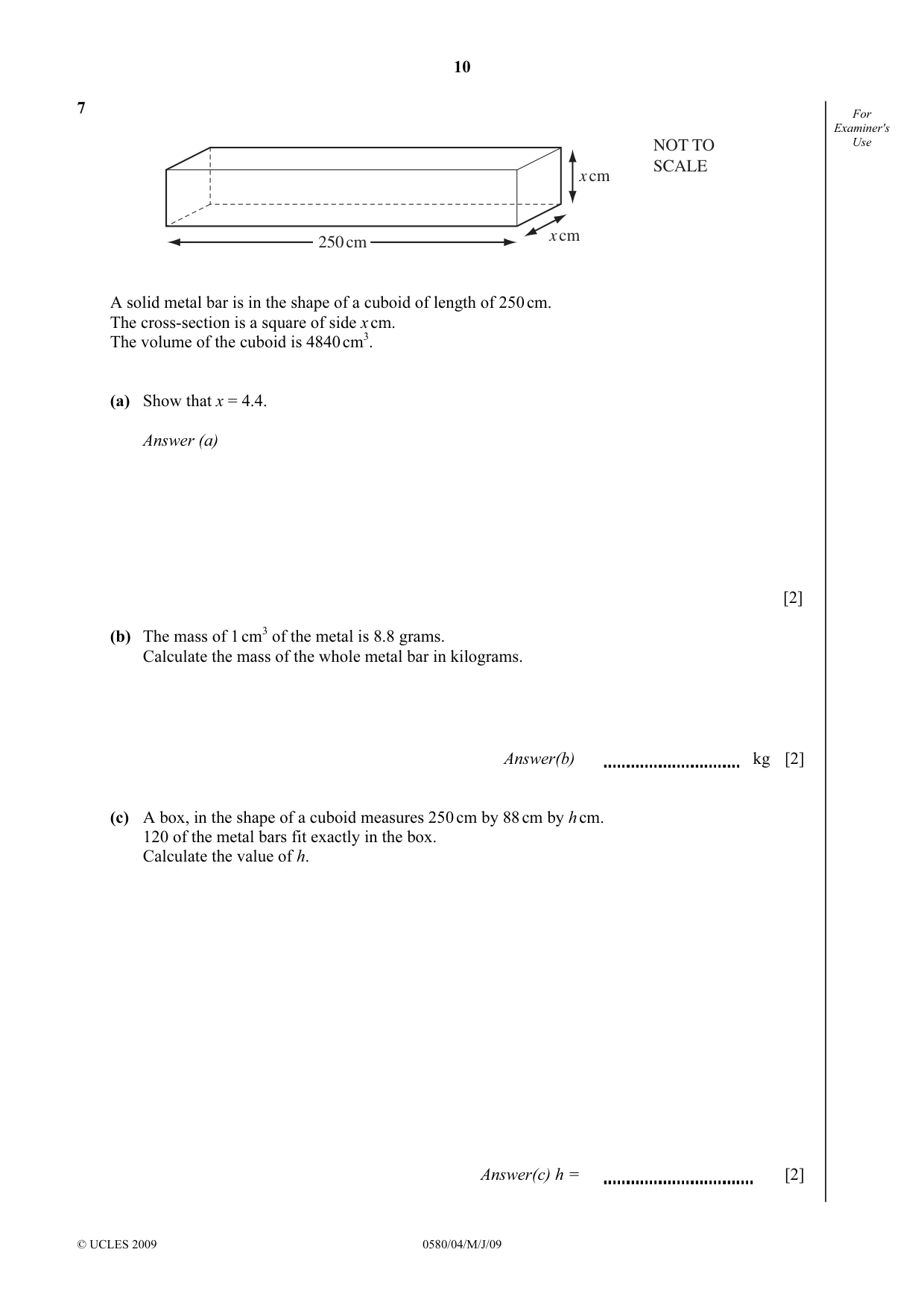
10 © UCLES 2009 0580/04/M/J/09 For Examiner's Use 7 250 cm x cm x cm NOT TO SCALE A solid metal bar is in the shape of a cuboid of length of 250 cm. The cross-section is a square of side x cm. The volume of the cuboid is 4840 cm3. (a) Show that x = 4.4. Answer (a) [2] (b) The mass of 1 cm3 of the metal is 8.8 grams. Calculate the mass of the whole metal bar in kilograms. Answer(b) kg [2] (c) A box, in the shape of a cuboid measures 250 cm by 88 cm by h cm. 120 of the metal bars fit exactly in the box. Calculate the value of h. Answer(c) h = [2]
Question paper, page 11
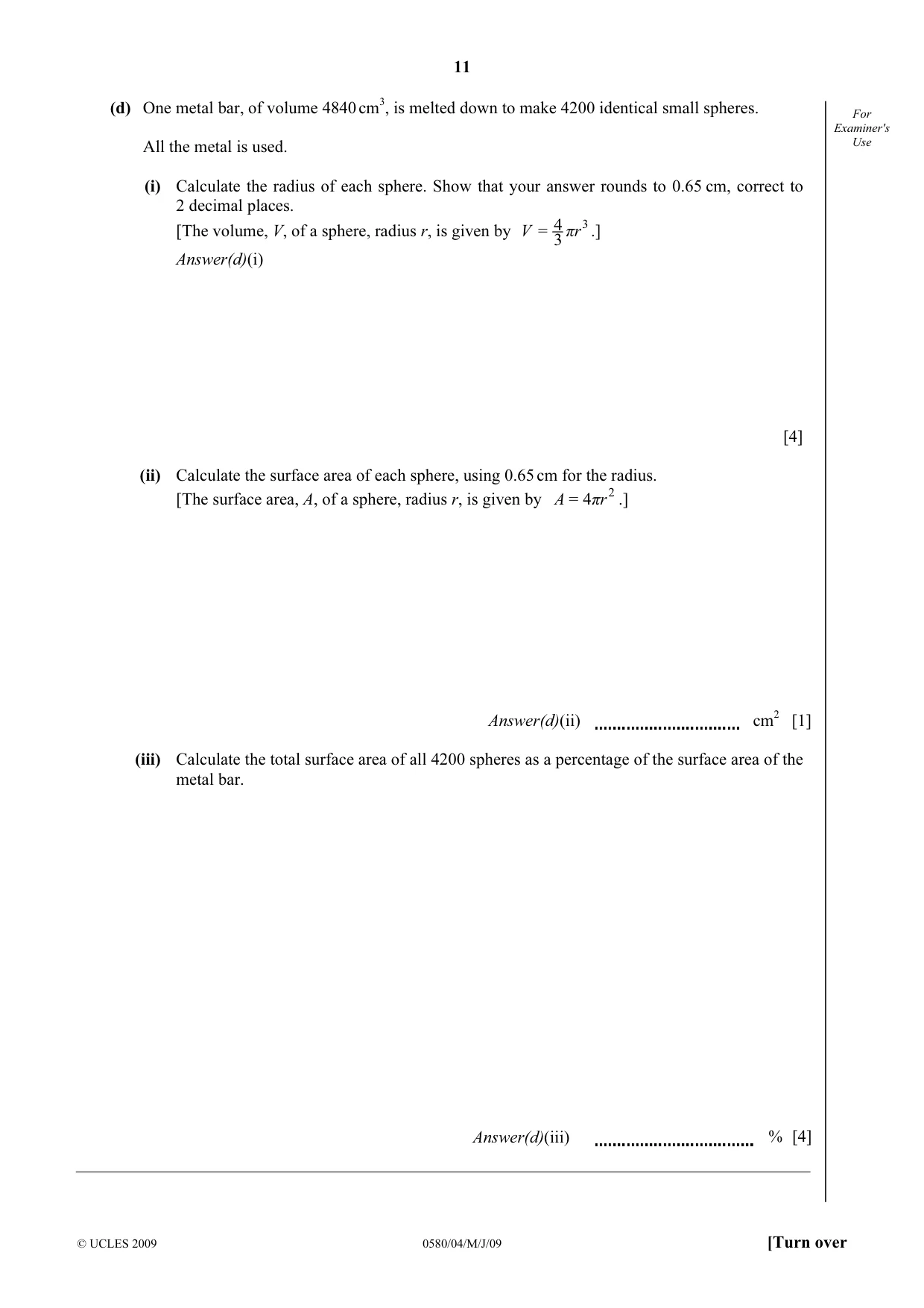
11 © UCLES 2009 0580/04/M/J/09 [Turn over For Examiner's Use (d) One metal bar, of volume 4840 cm3, is melted down to make 4200 identical small spheres. All the metal is used. (i) Calculate the radius of each sphere. Show that your answer rounds to 0.65 cm, correct to 2 decimal places. [The volume, V, of a sphere, radius r, is given by 3 4 = 3 V πr .] Answer(d)(i) [4] (ii) Calculate the surface area of each sphere, using 0.65 cm for the radius. [The surface area, A, of a sphere, radius r, is given by 2 = 4 A πr .] Answer(d)(ii) cm2 [1] (iii) Calculate the total surface area of all 4200 spheres as a percentage of the surface area of the metal bar. Answer(d)(iii) % [4]
Question paper, page 12
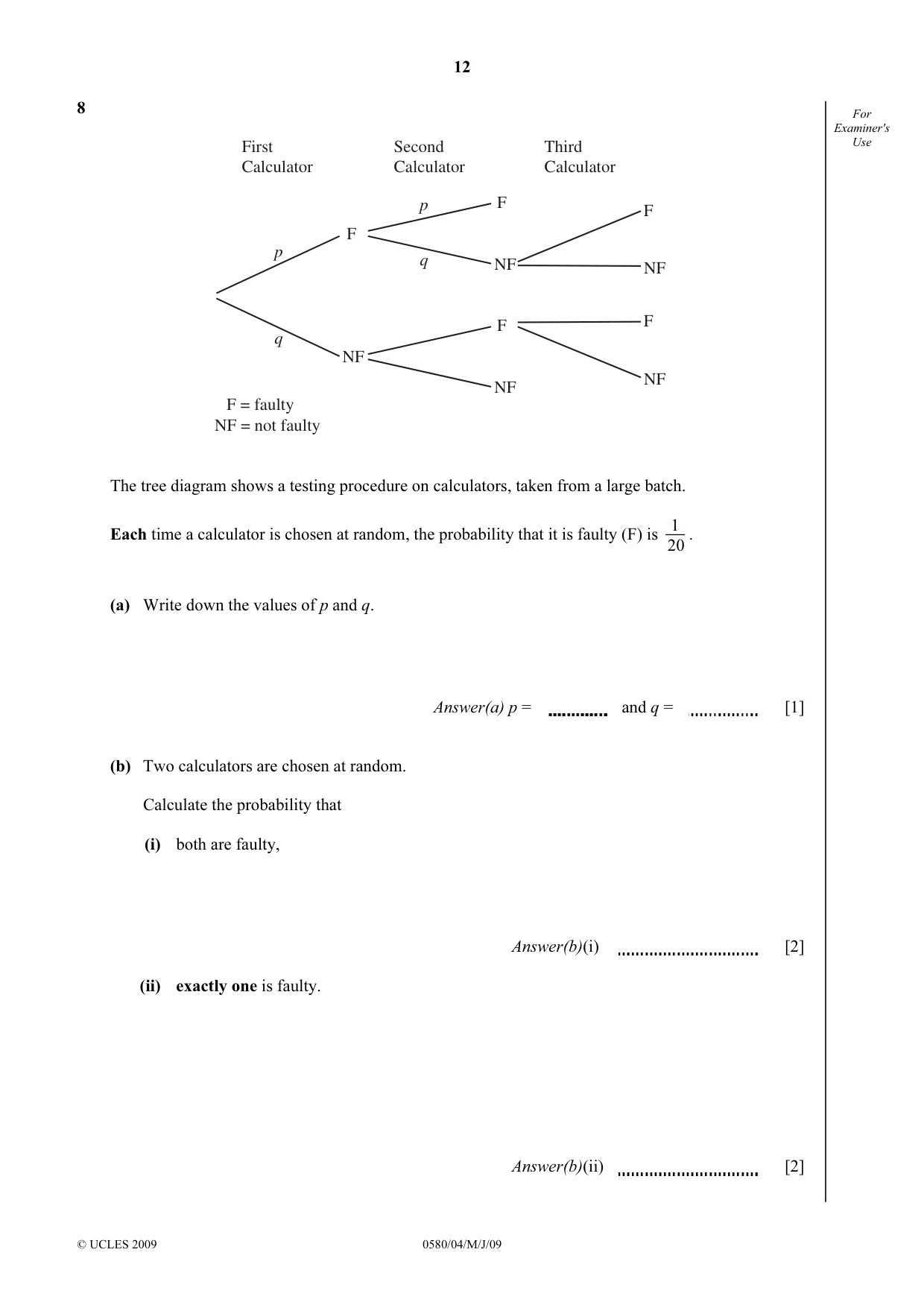
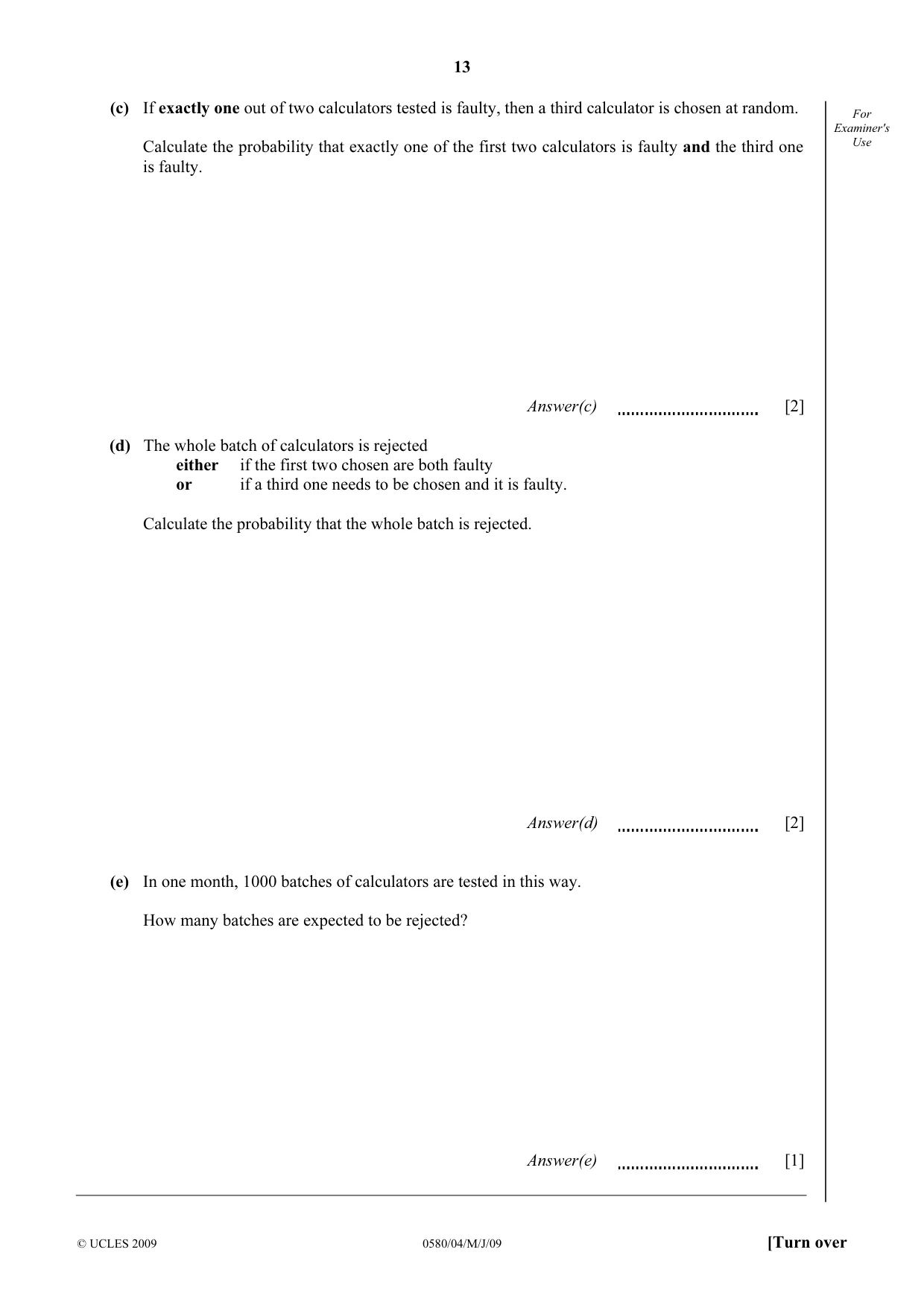
12 © UCLES 2009 0580/04/M/J/09 For Examiner's Use 8 F NF F NF F F = faulty NF = not faulty NF F NF F NF p q p q First Calculator Second Calculator Third Calculator The tree diagram shows a testing procedure on calculators, taken from a large batch. Each time a calculator is chosen at random, the probability that it is faulty (F) is 1 20 . (a) Write down the values of p and q. Answer(a) p = and q = [1] (b) Two calculators are chosen at random. Calculate the probability that (i) both are faulty, Answer(b)(i) [2] (ii) exactly one is faulty. Answer(b)(ii) [2]
Question paper, page 13
13 © UCLES 2009 0580/04/M/J/09 [Turn over For Examiner's Use (c) If exactly one out of two calculators tested is faulty, then a third calculator is chosen at random. Calculate the probability that exactly one of the first two calculators is faulty and the third one is faulty. Answer(c) [2] (d) The whole batch of calculators is rejected either if the first two chosen are both faulty or if a third one needs to be chosen and it is faulty. Calculate the probability that the whole batch is rejected. Answer(d) [2] (e) In one month, 1000 batches of calculators are tested in this way. How many batches are expected to be rejected? Answer(e) [1]
Question paper, page 14
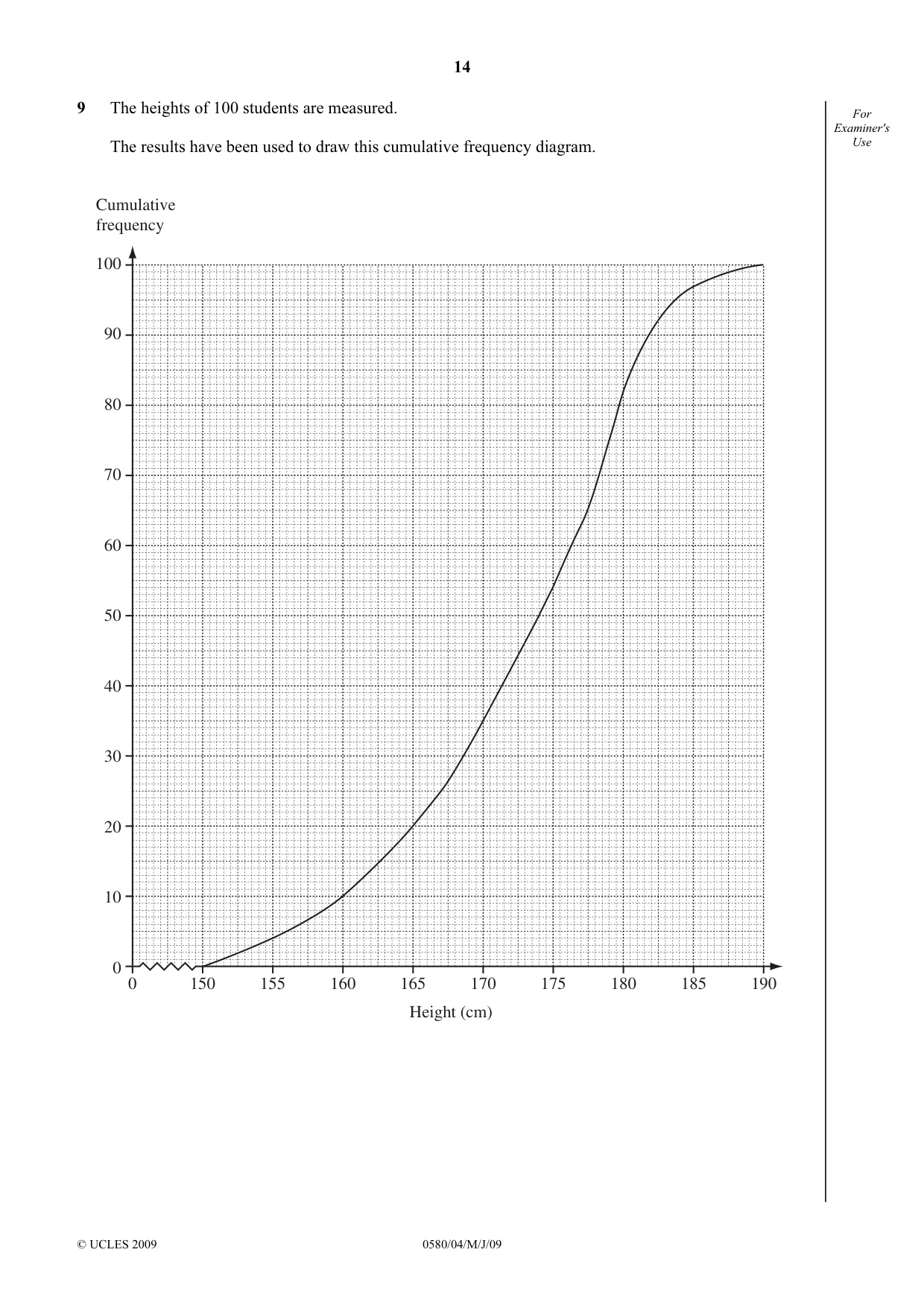
14 © UCLES 2009 0580/04/M/J/09 For Examiner's Use 9 The heights of 100 students are measured. The results have been used to draw this cumulative frequency diagram. 0 150 155 160 165 170 175 180 185 190 100 90 80 70 60 50 40 30 20 10 0 Height (cm) Cumulative frequency
Question paper, page 15
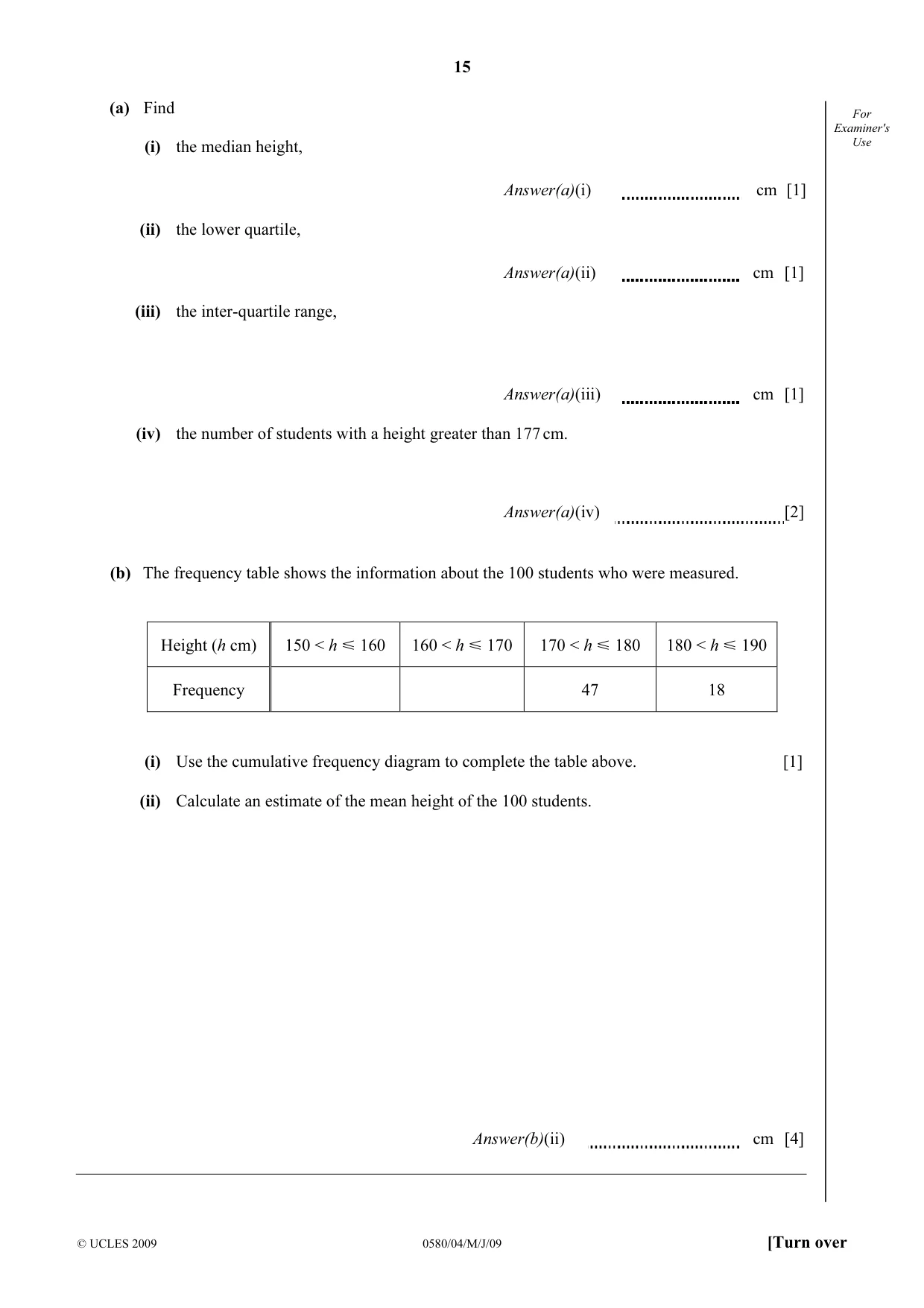
15 © UCLES 2009 0580/04/M/J/09 [Turn over For Examiner's Use (a) Find (i) the median height, Answer(a)(i) cm [1] (ii) the lower quartile, Answer(a)(ii) cm [1] (iii) the inter-quartile range, Answer(a)(iii) cm [1] (iv) the number of students with a height greater than 177 cm. Answer(a)(iv) [2] (b) The frequency table shows the information about the 100 students who were measured. Height (h cm) 150 < h Y=160 160 < h Y=170 170 < h Y=180 180 < h Y=190 Frequency 47 18 (i) Use the cumulative frequency diagram to complete the table above. [1] (ii) Calculate an estimate of the mean height of the 100 students. Answer(b)(ii) cm [4]
Question paper, page 16
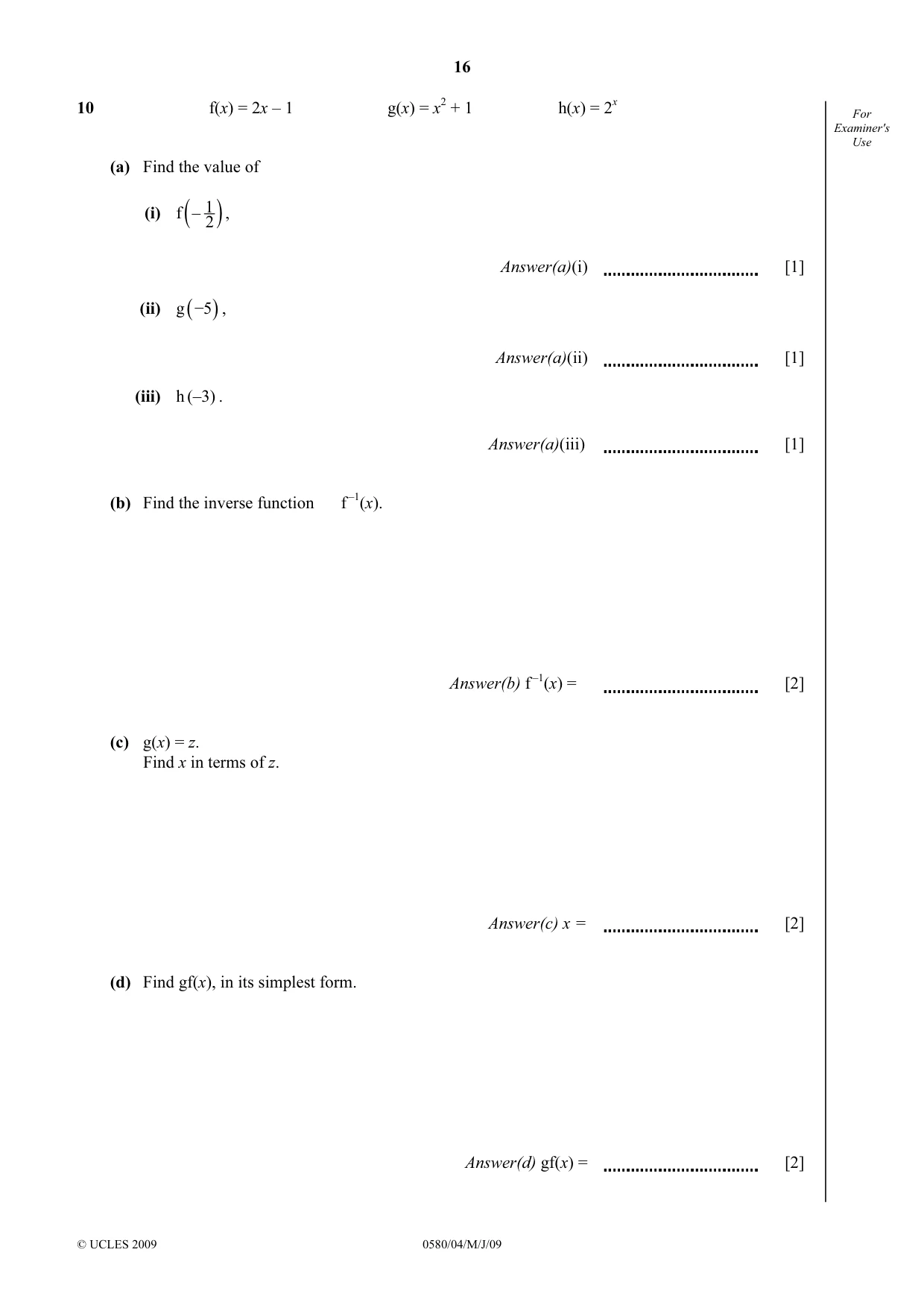
16 © UCLES 2009 0580/04/M/J/09 For Examiner's Use 10 f(x) = 2x – 1 g(x) = x2 + 1 h(x) = 2x (a) Find the value of (i) f( ) _ 1 2 , Answer(a)(i) [1] (ii) g( ) _5 , Answer(a)(ii) [1] (iii) h _ ( 3) . Answer(a)(iii) [1] (b) Find the inverse function f –1(x). Answer(b) f –1(x) = [2] (c) g(x) = z. Find x in terms of z. Answer(c) x = [2] (d) Find gf(x), in its simplest form. Answer(d) gf(x) = [2]
Question paper, page 17
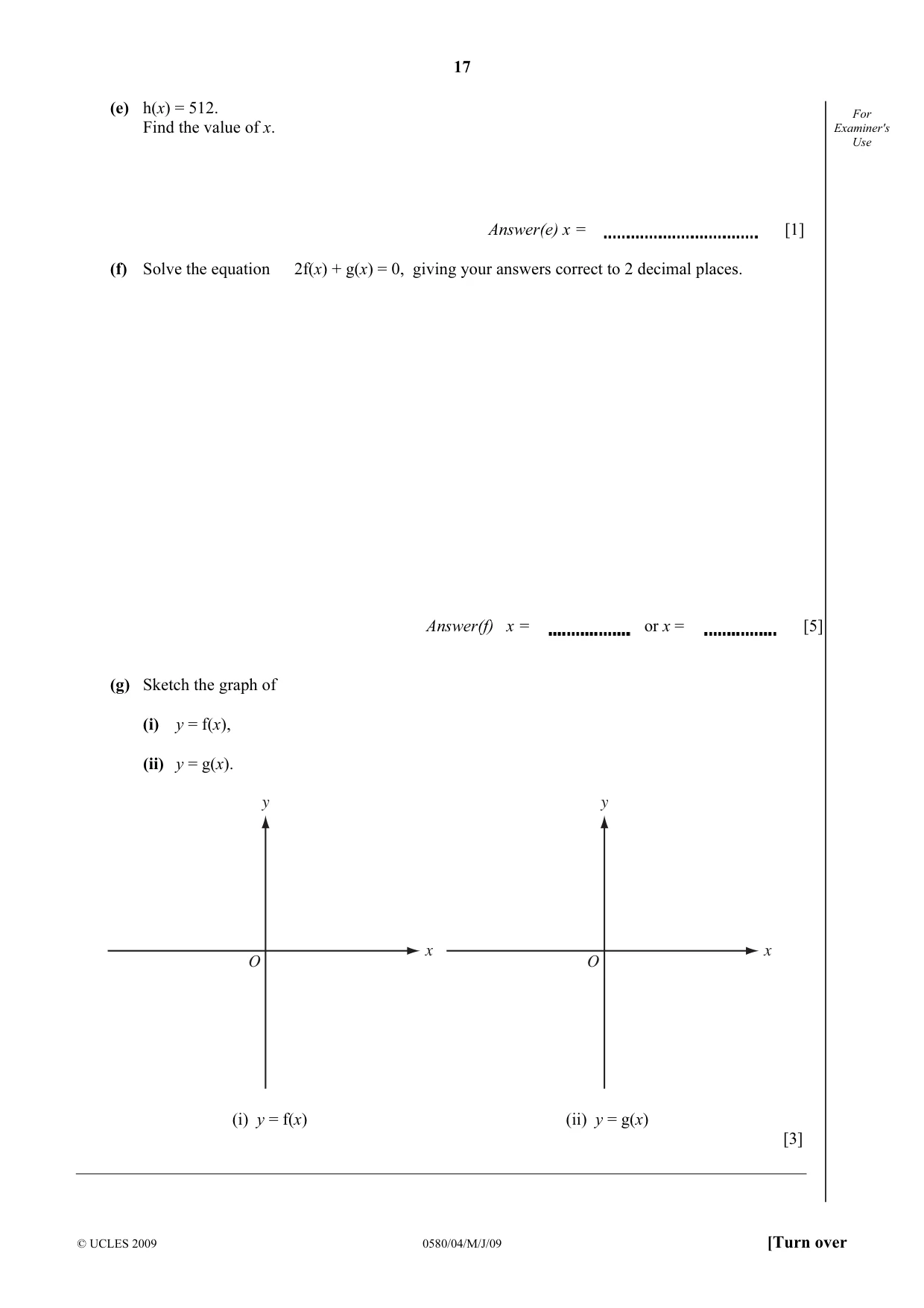
17 © UCLES 2009 0580/04/M/J/09 [Turn over For Examiner's Use (e) h(x) = 512. Find the value of x. Answer(e) x = [1] (f) Solve the equation 2f(x) + g(x) = 0, giving your answers correct to 2 decimal places. Answer(f) x = or x = [5] (g) Sketch the graph of (i) y = f(x), (ii) y = g(x). y x O y x O (i) y = f(x) (ii) y = g(x) [3]
Question paper, page 18
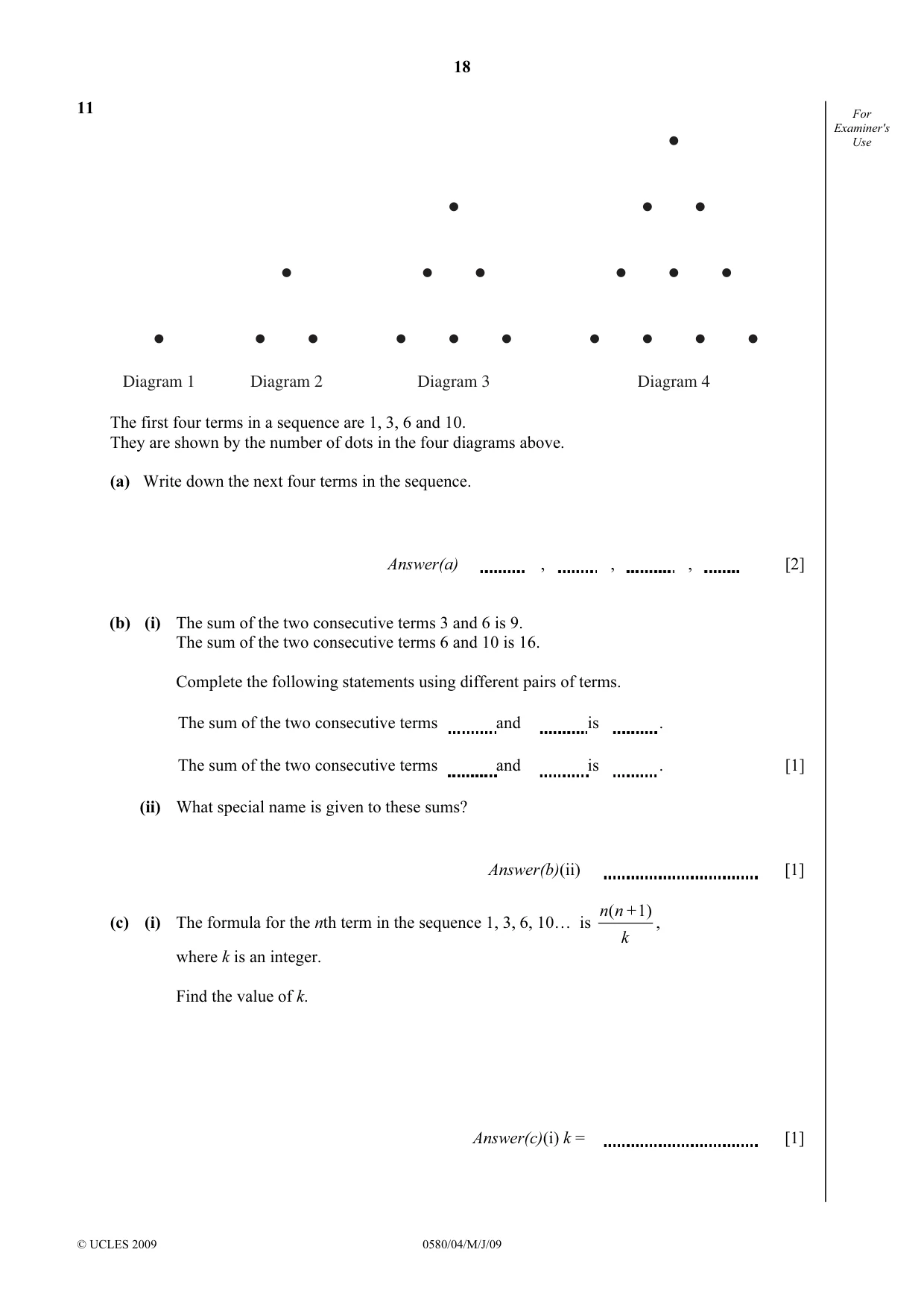
18 © UCLES 2009 0580/04/M/J/09 For Examiner's Use 11 Diagram 1 Diagram 2 Diagram 3 Diagram 4 The first four terms in a sequence are 1, 3, 6 and 10. They are shown by the number of dots in the four diagrams above. (a) Write down the next four terms in the sequence. Answer(a) , , , [2] (b) (i) The sum of the two consecutive terms 3 and 6 is 9. The sum of the two consecutive terms 6 and 10 is 16. Complete the following statements using different pairs of terms. The sum of the two consecutive terms and is . The sum of the two consecutive terms and is . [1] (ii) What special name is given to these sums? Answer(b)(ii) [1] (c) (i) The formula for the nth term in the sequence 1, 3, 6, 10… is ( +1) n n k , where k is an integer. Find the value of k. Answer(c)(i) k = [1]
Question paper, page 19
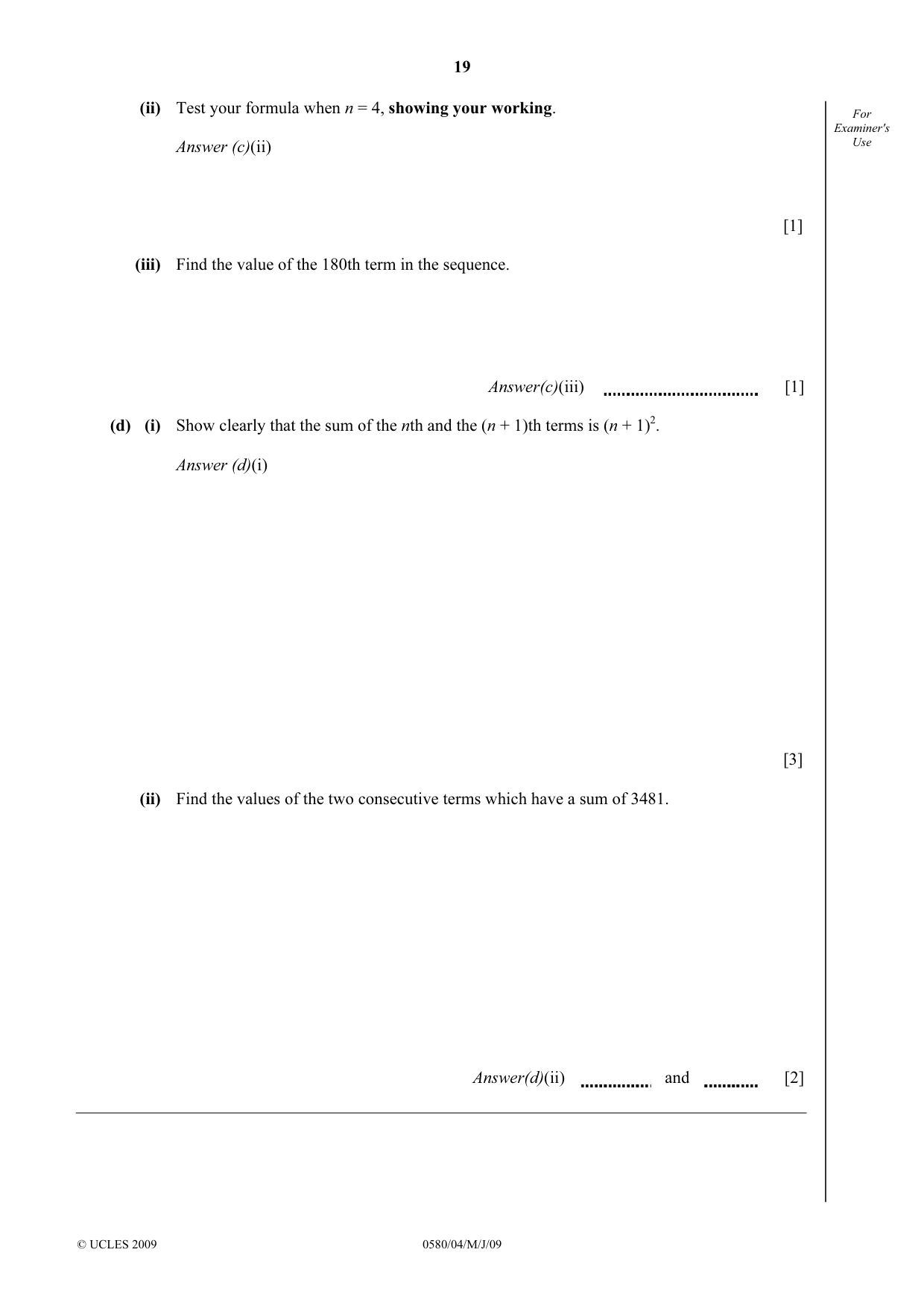
19 © UCLES 2009 0580/04/M/J/09 For Examiner's Use (ii) Test your formula when n = 4, showing your working. Answer (c)(ii) [1] (iii) Find the value of the 180th term in the sequence. Answer(c)(iii) [1] (d) (i) Show clearly that the sum of the nth and the (n + 1)th terms is (n + 1)2. Answer (d)(i) [3] (ii) Find the values of the two consecutive terms which have a sum of 3481. Answer(d)(ii) and [2]
Question paper, page 20
20 Permission to reproduce items where third-party owned material protected by copyright is included has been sought and cleared where possible. Every reasonable effort has been made by the publisher (UCLES) to trace copyright holders, but if any items requiring clearance have unwittingly been included, the publisher will be pleased to make amends at the earliest possible opportunity. University of Cambridge International Examinations is part of the Cambridge Assessment Group. Cambridge Assessment is the brand name of University of Cambridge Local Examinations Syndicate (UCLES), which is itself a department of the University of Cambridge. 0580/04/M/J/09 BLANK PAGE
Mark scheme, page 1
UNIVERSITY OF CAMBRIDGE INTERNATIONAL EXAMINATIONS International General Certificate of Secondary Education MARK SCHEME for the May/June 2009 question paper for the guidance of teachers 0580, 0581 MATHEMATICS 0580/04, 0581/04 Paper 4 (Extended), maximum raw mark 130 This mark scheme is published as an aid to teachers and candidates, to indicate the requirements of the examination. It shows the basis on which Examiners were instructed to award marks. It does not indicate the details of the discussions that took place at an Examiners’ meeting before marking began, which would have considered the acceptability of alternative answers. Mark schemes must be read in conjunction with the question papers and the report on the examination. • CIE will not enter into discussions or correspondence in connection with these mark schemes. CIE is publishing the mark schemes for the May/June 2009 question papers for most IGCSE, GCE Advanced Level and Advanced Subsidiary Level syllabuses and some Ordinary Level syllabuses. www.XtremePapers.com
Mark scheme, page 2
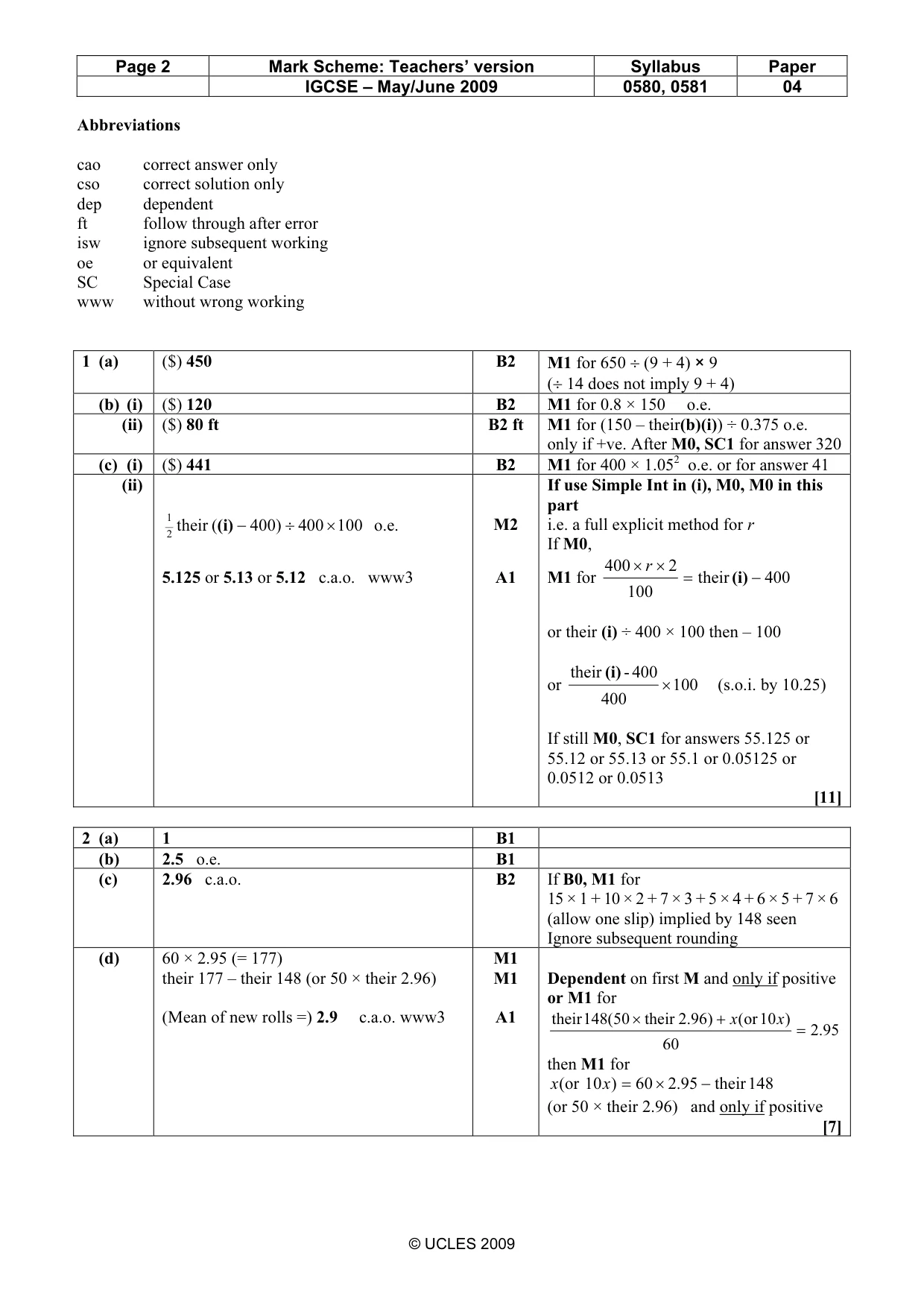
Page 2 Mark Scheme: Teachers’ version Syllabus Paper IGCSE – May/June 2009 0580, 0581 04 © UCLES 2009 Abbreviations cao correct answer only cso correct solution only dep dependent ft follow through after error isw ignore subsequent working oe or equivalent SC Special Case www without wrong working 1 (a) ($) 450 B2 M1 for 650 ÷ (9 + 4) × 9 (÷ 14 does not imply 9 + 4) (b) (i) ($) 120 B2 M1 for 0.8 × 150 o.e. (ii) ($) 80 ft B2 ft M1 for (150 – their(b)(i)) ÷ 0.375 o.e. only if +ve. After M0, SC1 for answer 320 (c) (i) ($) 441 B2 M1 for 400 × 1.052 o.e. or for answer 41 (ii) 100 400 ) 400 ( their 2 1 × ÷ − (i) o.e. 5.125 or 5.13 or 5.12 c.a.o. www3 M2 A1 If use Simple Int in (i), M0, M0 in this part i.e. a full explicit method for r If M0, M1 for 400 their 100 2 400 − = × × (i) r or their (i) ÷ 400 × 100 then – 100 or 100 400 400 - their × (i) (s.o.i. by 10.25) If still M0, SC1 for answers 55.125 or 55.12 or 55.13 or 55.1 or 0.05125 or 0.0512 or 0.0513 [11] 2 (a) 1 B1 (b) 2.5 o.e. B1 (c) 2.96 c.a.o. B2 If B0, M1 for 15 × 1 + 10 × 2 + 7 × 3 + 5 × 4 + 6 × 5 + 7 × 6 (allow one slip) implied by 148 seen Ignore subsequent rounding (d) 60 × 2.95 (= 177) their 177 – their 148 (or 50 × their 2.96) (Mean of new rolls =) 2.9 c.a.o. www3 M1 M1 A1 Dependent on first M and only if positive or M1 for 95 .2 60 ) 10 or ( ) 96 .2 their 50 ( 148 their = + × x x then M1 for 148 their 95 .2 60 ) 10 or ( − × = x x (or 50 × their 2.96) and only if positive [7]
Mark scheme, page 3
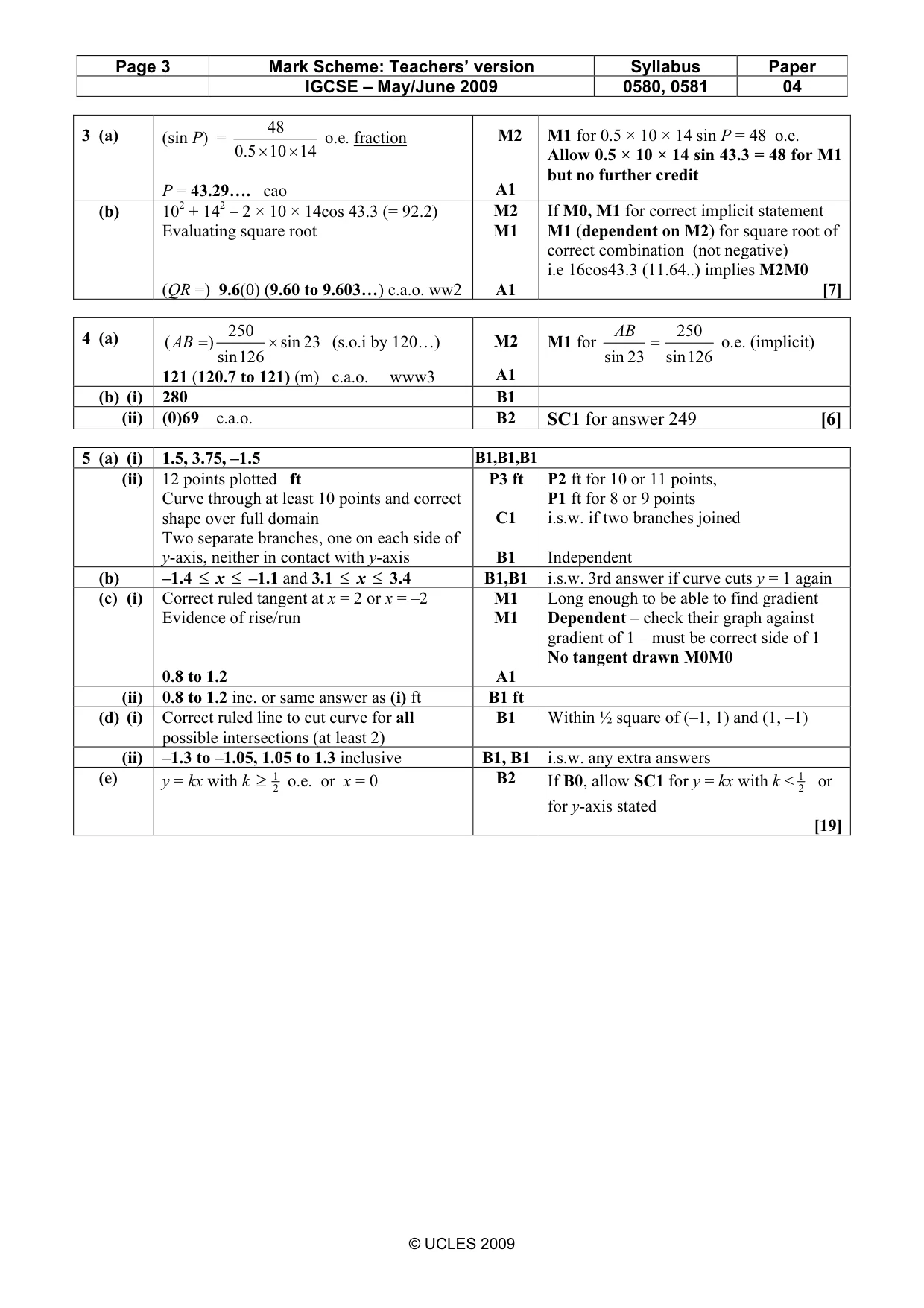
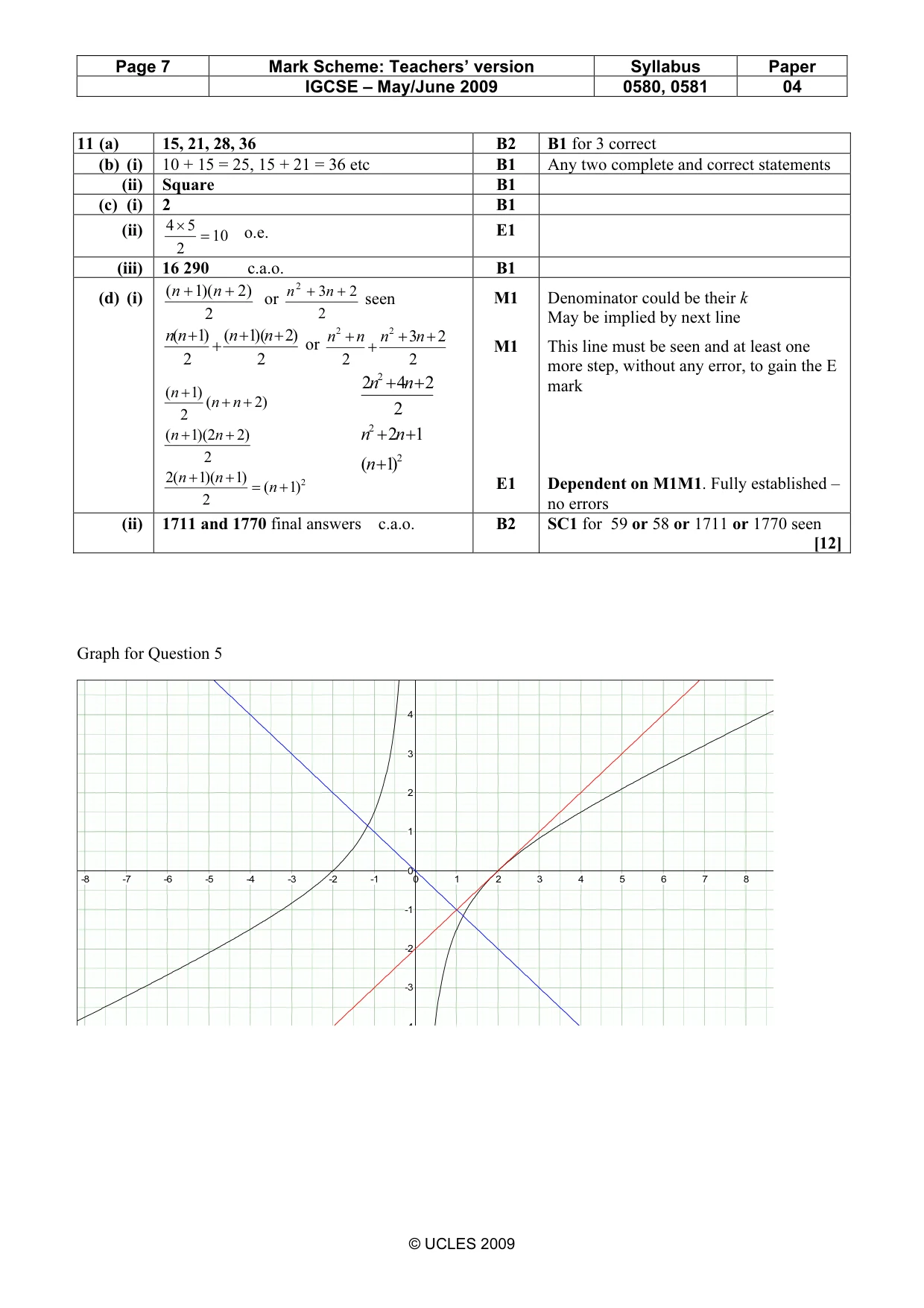
Page 3 Mark Scheme: Teachers’ version Syllabus Paper IGCSE – May/June 2009 0580, 0581 04 © UCLES 2009 3 (a) (sin P) = 14 10 5.0 48 × × o.e. fraction P = 43.29…. cao M2 A1 M1 for 0.5 × 10 × 14 sin P = 48 o.e. Allow 0.5 × 10 × 14 sin 43.3 = 48 for M1 but no further credit (b) 102 + 142 – 2 × 10 × 14cos 43.3 (= 92.2) Evaluating square root (QR =) 9.6(0) (9.60 to 9.603…) c.a.o. ww2 M2 M1 A1 If M0, M1 for correct implicit statement M1 (dependent on M2) for square root of correct combination (not negative) i.e 16cos43.3 (11.64..) implies M2M0 [7] 4 (a) 23 sin 126 sin 250 ) ( × = AB (s.o.i by 120…) 121 (120.7 to 121) (m) c.a.o. www3 M2 A1 M1 for 126 sin 250 23 sin = AB o.e. (implicit) (b) (i) 280 B1 (ii) (0)69 c.a.o. B2 SC1 for answer 249 [6] 5 (a) (i) 1.5, 3.75, –1.5 B1,B1,B1 (ii) 12 points plotted ft Curve through at least 10 points and correct shape over full domain Two separate branches, one on each side of y-axis, neither in contact with y-axis P3 ft C1 B1 P2 ft for 10 or 11 points, P1 ft for 8 or 9 points i.s.w. if two branches joined Independent (b) –1.4 ≤ x ≤ –1.1 and 3.1 ≤ x ≤ 3.4 B1,B1 i.s.w. 3rd answer if curve cuts y = 1 again (c) (i) Correct ruled tangent at x = 2 or x = –2 Evidence of rise/run 0.8 to 1.2 M1 M1 A1 Long enough to be able to find gradient Dependent – check their graph against gradient of 1 – must be correct side of 1 No tangent drawn M0M0 (ii) 0.8 to 1.2 inc. or same answer as (i) ft B1 ft (d) (i) Correct ruled line to cut curve for all possible intersections (at least 2) B1 Within ½ square of (–1, 1) and (1, –1) (ii) –1.3 to –1.05, 1.05 to 1.3 inclusive B1, B1 i.s.w. any extra answers (e) y = kx with k 2 1 ≥ o.e. or x = 0 B2 If B0, allow SC1 for y = kx with k < 2 1 or for y-axis stated [19]
Mark scheme, page 4
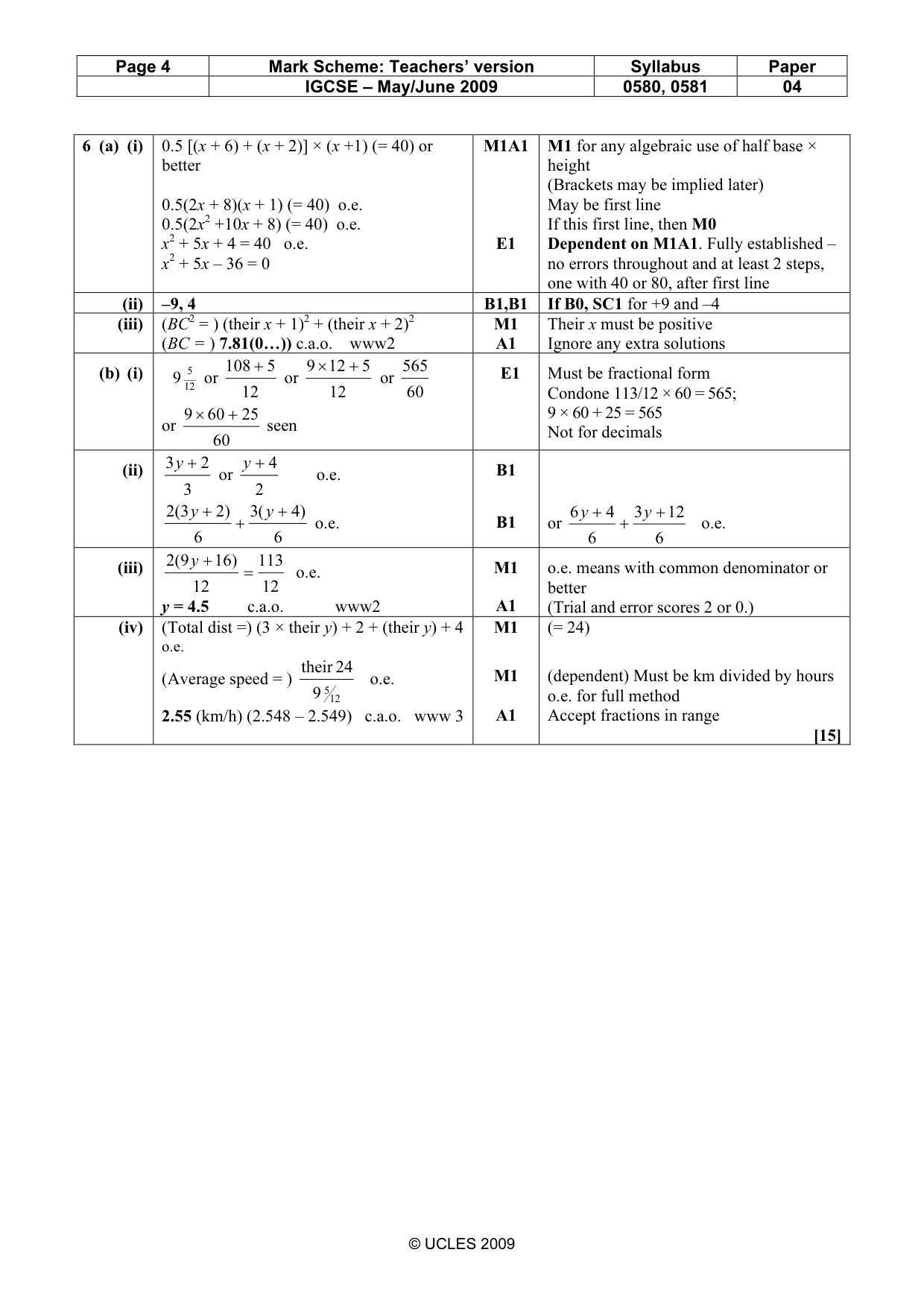
Page 4 Mark Scheme: Teachers’ version Syllabus Paper IGCSE – May/June 2009 0580, 0581 04 © UCLES 2009 6 (a) (i) 0.5 [(x + 6) + (x + 2)] × (x +1) (= 40) or better 0.5(2x + 8)(x + 1) (= 40) o.e. 0.5(2x2 +10x + 8) (= 40) o.e. x2 + 5x + 4 = 40 o.e. x2 + 5x – 36 = 0 M1A1 E1 M1 for any algebraic use of half base × height (Brackets may be implied later) May be first line If this first line, then M0 Dependent on M1A1. Fully established – no errors throughout and at least 2 steps, one with 40 or 80, after first line (ii) –9, 4 B1,B1 If B0, SC1 for +9 and –4 (iii) (BC2 = ) (their x + 1)2 + (their x + 2)2 (BC = ) 7.81(0…)) c.a.o. www2 M1 A1 Their x must be positive Ignore any extra solutions (b) (i) 12 5 9 or 12 5 108 + or 12 5 12 9 + × or 60 565 or 60 25 60 9 + × seen E1 Must be fractional form Condone 113/12 × 60 = 565; 9 × 60 + 25 = 565 Not for decimals (ii) 3 2 3 + y or 2 4 + y o.e. 6 ) 4 ( 3 6 ) 2 3 ( 2 + + + y y o.e. B1 B1 or 6 12 3 6 4 6 + + + y y o.e. (iii) 12 113 12 ) 16 9 ( 2 = + y o.e. y = 4.5 c.a.o. www2 M1 A1 o.e. means with common denominator or better (Trial and error scores 2 or 0.) (iv) (Total dist =) (3 × their y) + 2 + (their y) + 4 o.e. (Average speed = ) 12 5 9 24 their o.e. 2.55 (km/h) (2.548 – 2.549) c.a.o. www 3 M1 M1 A1 (= 24) (dependent) Must be km divided by hours o.e. for full method Accept fractions in range [15]
Mark scheme, page 5
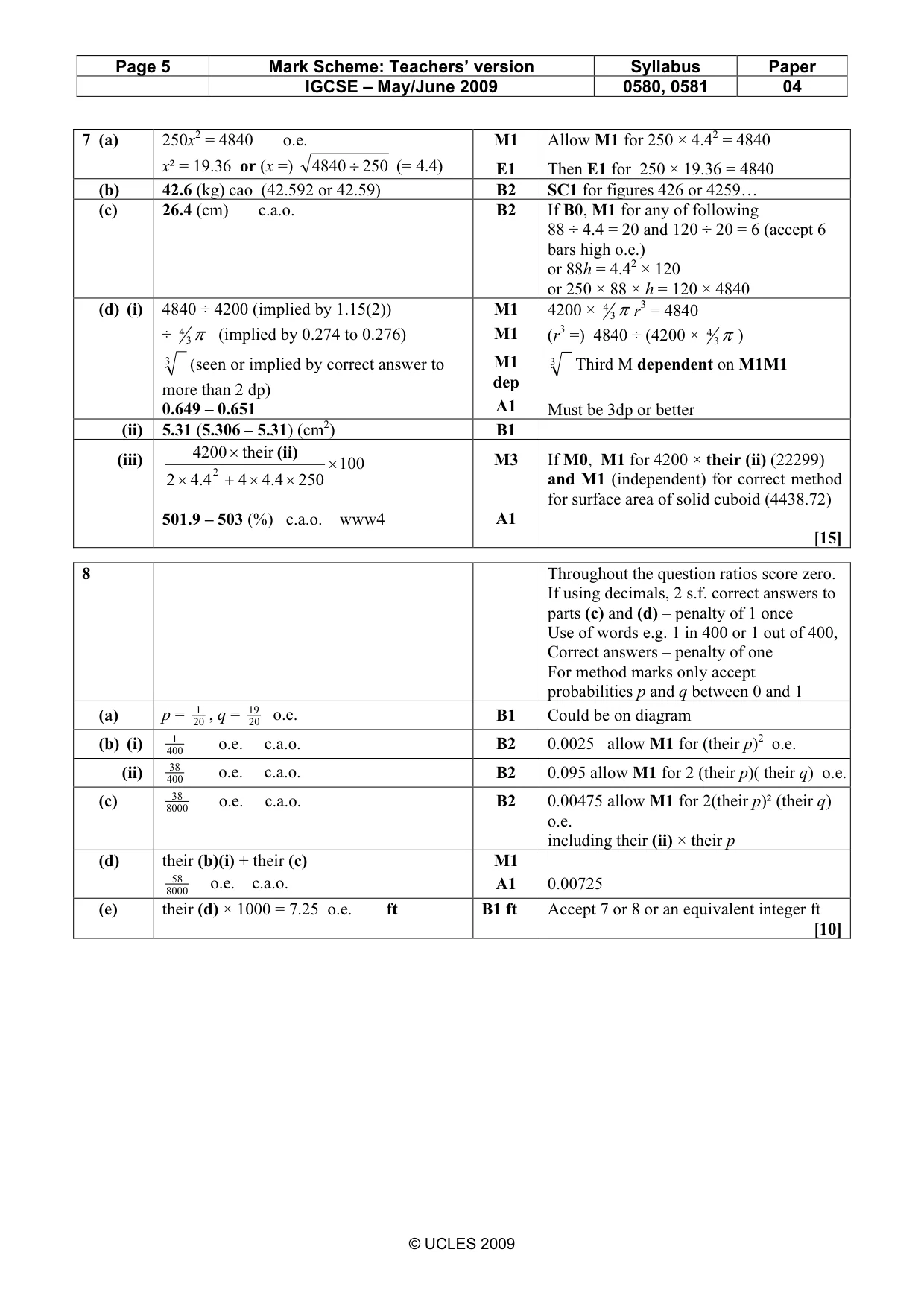
Page 5 Mark Scheme: Teachers’ version Syllabus Paper IGCSE – May/June 2009 0580, 0581 04 © UCLES 2009 7 (a) 250x2 = 4840 o.e. x² = 19.36 or (x =) 250 4840 ÷ (= 4.4) M1 E1 Allow M1 for 250 × 4.42 = 4840 Then E1 for 250 × 19.36 = 4840 (b) 42.6 (kg) cao (42.592 or 42.59) B2 SC1 for figures 426 or 4259… (c) 26.4 (cm) c.a.o. B2 If B0, M1 for any of following 88 ÷ 4.4 = 20 and 120 ÷ 20 = 6 (accept 6 bars high o.e.) or 88h = 4.42 × 120 or 250 × 88 × h = 120 × 4840 (d) (i) 4840 ÷ 4200 (implied by 1.15(2)) ÷ π 3 4 (implied by 0.274 to 0.276) 3 (seen or implied by correct answer to more than 2 dp) 0.649 – 0.651 M1 M1 M1 dep A1 4200 × π 3 4 r3 = 4840 (r3 =) 4840 ÷ (4200 × π 3 4 ) 3 Third M dependent on M1M1 Must be 3dp or better (ii) 5.31 (5.306 – 5.31) (cm2) B1 (iii) 100 250 4.4 4 4.4 2 their 4200 2 × × × + × × (ii) 501.9 – 503 (%) c.a.o. www4 M3 A1 If M0, M1 for 4200 × their (ii) (22299) and M1 (independent) for correct method for surface area of solid cuboid (4438.72) [15] 8 Throughout the question ratios score zero. If using decimals, 2 s.f. correct answers to parts (c) and (d) – penalty of 1 once Use of words e.g. 1 in 400 or 1 out of 400, Correct answers – penalty of one For method marks only accept probabilities p and q between 0 and 1 (a) p = 20 1 , q = 20 19 o.e. B1 Could be on diagram (b) (i) 400 1 o.e. c.a.o. B2 0.0025 allow M1 for (their p)2 o.e. (ii) 400 38 o.e. c.a.o. B2 0.095 allow M1 for 2 (their p)( their q) o.e. (c) 8000 38 o.e. c.a.o. B2 0.00475 allow M1 for 2(their p)² (their q) o.e. including their (ii) × their p (d) their (b)(i) + their (c) 8000 58 o.e. c.a.o. M1 A1 0.00725 (e) their (d) × 1000 = 7.25 o.e. ft B1 ft Accept 7 or 8 or an equivalent integer ft [10]
Mark scheme, page 6
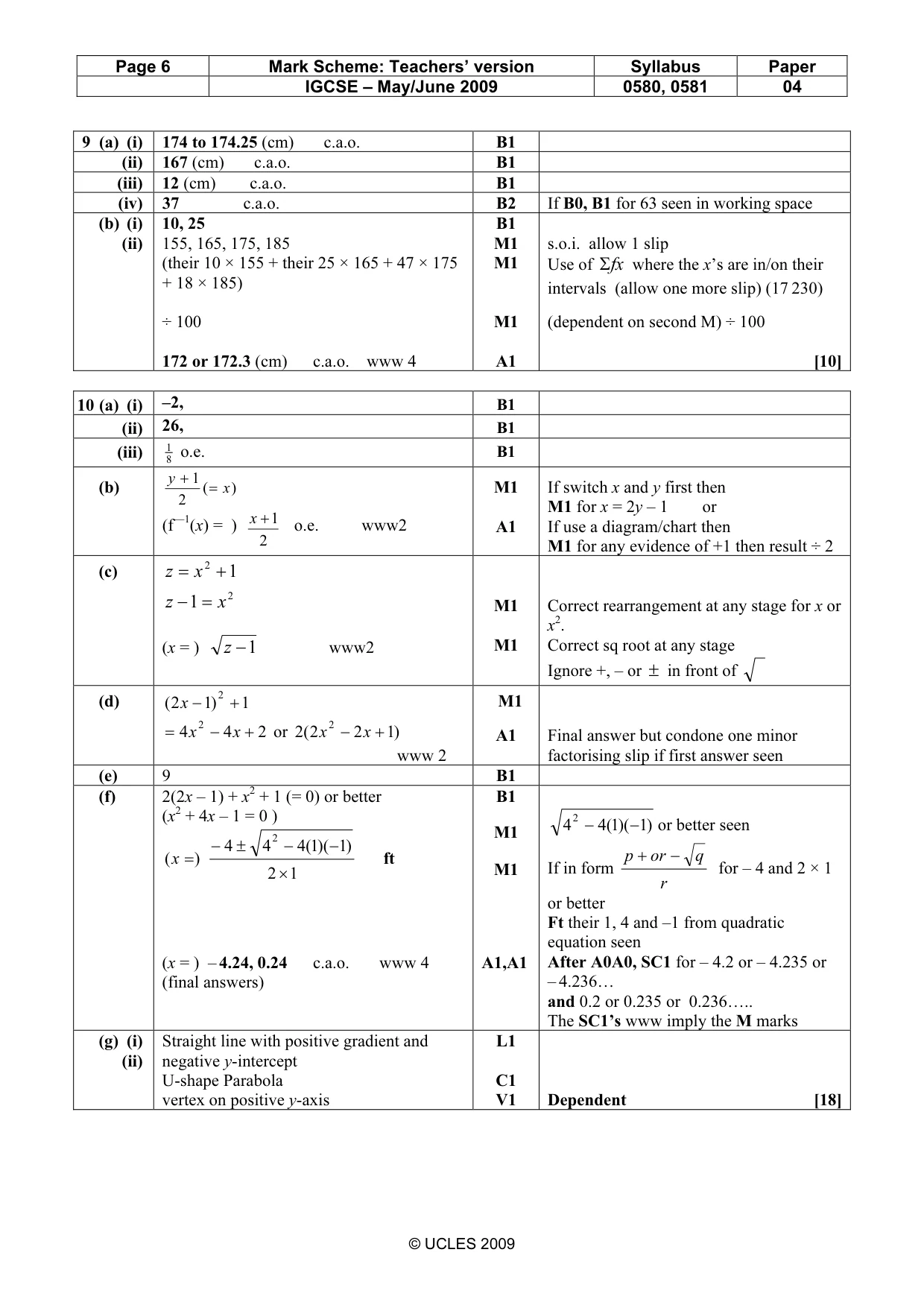
Page 6 Mark Scheme: Teachers’ version Syllabus Paper IGCSE – May/June 2009 0580, 0581 04 © UCLES 2009 9 (a) (i) 174 to 174.25 (cm) c.a.o. B1 (ii) 167 (cm) c.a.o. B1 (iii) 12 (cm) c.a.o. B1 (iv) 37 c.a.o. B2 If B0, B1 for 63 seen in working space (b) (i) (ii) 10, 25 155, 165, 175, 185 (their 10 × 155 + their 25 × 165 + 47 × 175 + 18 × 185) ÷ 100 172 or 172.3 (cm) c.a.o. www 4 B1 M1 M1 M1 A1 s.o.i. allow 1 slip Use of fx Σ where the x’s are in/on their intervals (allow one more slip) (17 230) (dependent on second M) ÷ 100 [10] 10 (a) (i) –2, B1 (ii) 26, B1 (iii) 8 1 o.e. B1 (b) ) ( 2 1 x y = + (f—1(x) = ) 2 1 + x o.e. www2 M1 A1 If switch x and y first then M1 for x = 2y – 1 or If use a diagram/chart then M1 for any evidence of +1 then result ÷ 2 (c) 2 2 1 1 x z x z = − + = (x = ) 1 − z www2 M1 M1 Correct rearrangement at any stage for x or x2. Correct sq root at any stage Ignore +, – or ± in front of (d) 1 )1 2 ( 2 + − x 2 4 4 2 + − = x x or )1 2 2 ( 2 2 + −x x www 2 M1 A1 Final answer but condone one minor factorising slip if first answer seen (e) 9 B1 (f) 2(2x – 1) + x2 + 1 (= 0) or better (x2 + 4x – 1 = 0 ) 1 2 )1 )( 1( 4 4 4 ) ( 2 × − − ± − = x ft (x = ) – 4.24, 0.24 c.a.o. www 4 (final answers) B1 M1 M1 A1,A1 )1 )( 1( 4 4 2 − − or better seen If in form r q or p − + for – 4 and 2 × 1 or better Ft their 1, 4 and –1 from quadratic equation seen After A0A0, SC1 for – 4.2 or – 4.235 or – 4.236… and 0.2 or 0.235 or 0.236….. The SC1’s www imply the M marks (g) (i) (ii) Straight line with positive gradient and negative y-intercept U-shape Parabola vertex on positive y-axis L1 C1 V1 Dependent [18]
Mark scheme, page 7
Page 7 Mark Scheme: Teachers’ version Syllabus Paper IGCSE – May/June 2009 0580, 0581 04 © UCLES 2009 11 (a) 15, 21, 28, 36 B2 B1 for 3 correct (b) (i) 10 + 15 = 25, 15 + 21 = 36 etc B1 Any two complete and correct statements (ii) Square B1 (c) (i) 2 B1 (ii) 10 2 5 4 = × o.e. E1 (iii) 16 290 c.a.o. B1 (d) (i) 2 ) 2 )( 1 ( + + n n or 2 2 3 2 + + n n seen 2 )2 )( 1 ( 2 )1 ( + + + + n n n n or 2 2 3 2 2 2 + + + + n n n n 2)1 ( 2 )1 )( 1 ( 2 2 ) 2 2 )( 1 ( ) 2 ( 2 )1 ( + = + + + + + + + n n n n n n n n 2 2 2 )1 ( 1 2 2 2 4 2 + + + + + n n n n n M1 M1 E1 Denominator could be their k May be implied by next line This line must be seen and at least one more step, without any error, to gain the E mark Dependent on M1M1. Fully established – no errors (ii) 1711 and 1770 final answers c.a.o. B2 SC1 for 59 or 58 or 1711 or 1770 seen [12] Graph for Question 5 8 7 6 5 4 3 2 1 0 -1 -2 -3 -4 -5 -6 -7 -8 4 3 2 1 0 -1 -2 -3 4 8 7 6 5 4 3 2 1 0 -1 -2 -3 -4 -5 -6 -7 -8 4 3 2 1 0 -1 -2 -3 4 8 7 6 5 4 3 2 1 0 -1 -2 -3 -4 -5 -6 -7 -8 4 3 2 1 0 -1 -2 -3 4 8 7 6 5 4 3 2 1 0 -1 -2 -3 -4 -5 -6 -7 -8 4 3 2 1 0 -1 -2 -3 4
What you needed in this session
Cambridge’s own grade thresholds for 2009 May/June, Paper 4 · Variant 1. A higher threshold means an easier paper — the bar moves with how the cohort did.