Cambridge IGCSE Mathematics (with coursework) 0581 — 2009 May/June Paper 3 · Variant 1
0581/31/M/J/09 · 104 marks · ≈117 min
The question paper and its mark scheme, free to read here and free to download. This is Cambridge’s own paper, exactly as it was sat.
Question paper16 pages
Mark scheme6 pages
Answers below. Sit the paper first if you are practising.
Paper as text
Question paper, page 1
This document consists of 16 printed pages. IB09 06_0580_03/4RP © UCLES 2009 [Turn over *6159588306* For Examiner's Use UNIVERSITY OF CAMBRIDGE INTERNATIONAL EXAMINATIONS International General Certificate of Secondary Education MATHEMATICS 0580/03, 0581/03 Paper 3 (Core) May/June 2009 2 hours Candidates answer on the Question Paper. Additional Materials: Electronic calculator Geometrical instruments Mathematical tables (optional) Tracing paper (optional) READ THESE INSTRUCTIONS FIRST Write your Centre number, candidate number and name on all the work you hand in. Write in dark blue or black pen. You may use a soft pencil for any diagrams or graphs. Do not use staples, paper clips, highlighters, glue or correction fluid. DO NOT WRITE ON ANY BARCODES. Answer all questions. If working is needed for any question it must be shown below that question. Electronic calculators should be used. If the degree of accuracy is not specified in the question, and if the answer is not exact, give the answer to three significant figures. Give answers in degrees to one decimal place. For π , use either your calculator value or 3.142. At the end of the examination, fasten all your work securely together. The number of marks is given in brackets [ ] at the end of each question or part question. The total of the marks for this paper is 104. www.XtremePapers.com
Question paper, page 2
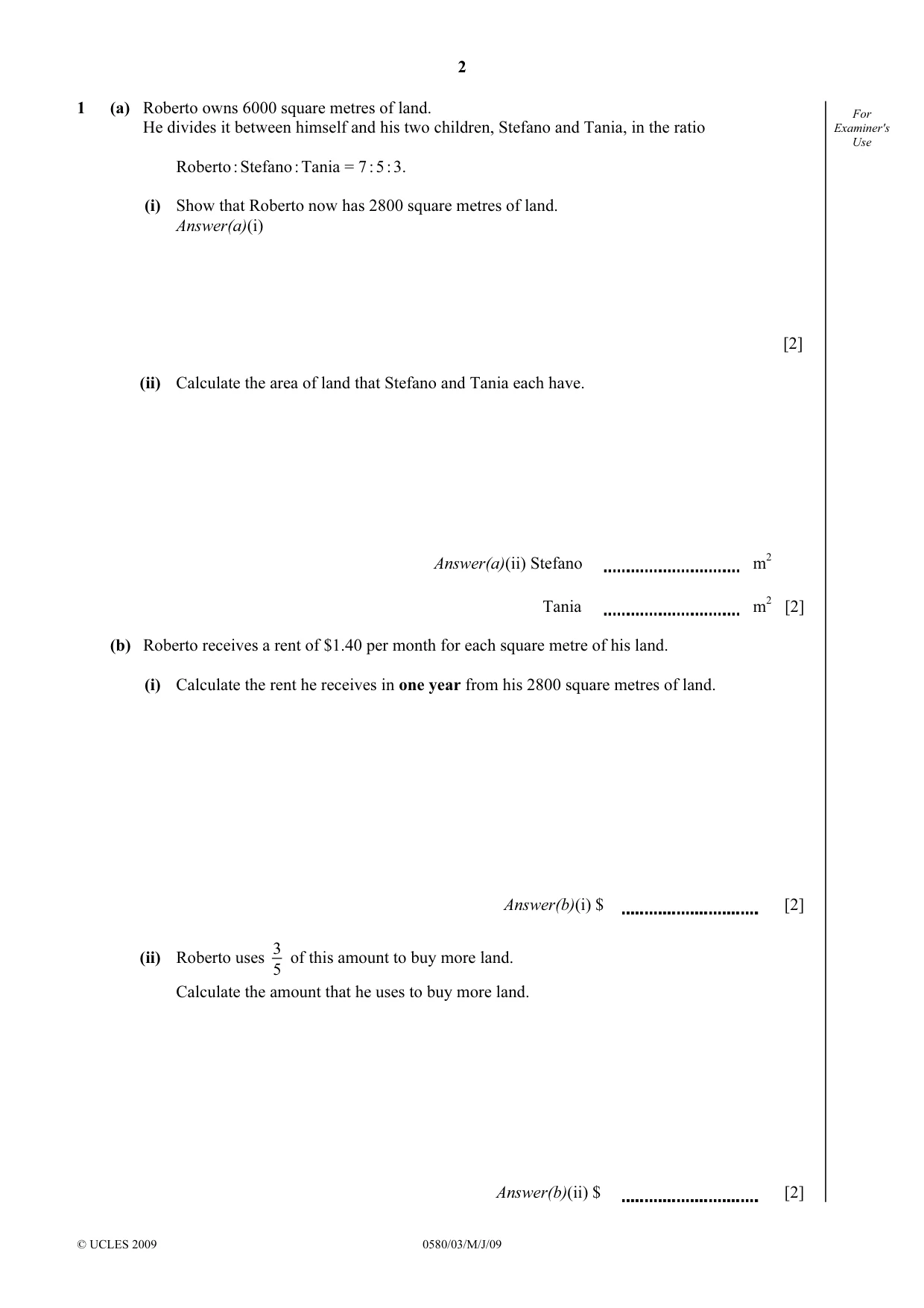
2 © UCLES 2009 0580/03/M/J/09 For Examiner's Use 1 (a) Roberto owns 6000 square metres of land. He divides it between himself and his two children, Stefano and Tania, in the ratio Roberto : Stefano : Tania = 7 : 5 : 3. (i) Show that Roberto now has 2800 square metres of land. Answer(a)(i) [2] (ii) Calculate the area of land that Stefano and Tania each have. Answer(a)(ii) Stefano m2 Tania m2 [2] (b) Roberto receives a rent of $1.40 per month for each square metre of his land. (i) Calculate the rent he receives in one year from his 2800 square metres of land. Answer(b)(i) $ [2] (ii) Roberto uses 3 5 of this amount to buy more land. Calculate the amount that he uses to buy more land. Answer(b)(ii) $ [2]
Question paper, page 3
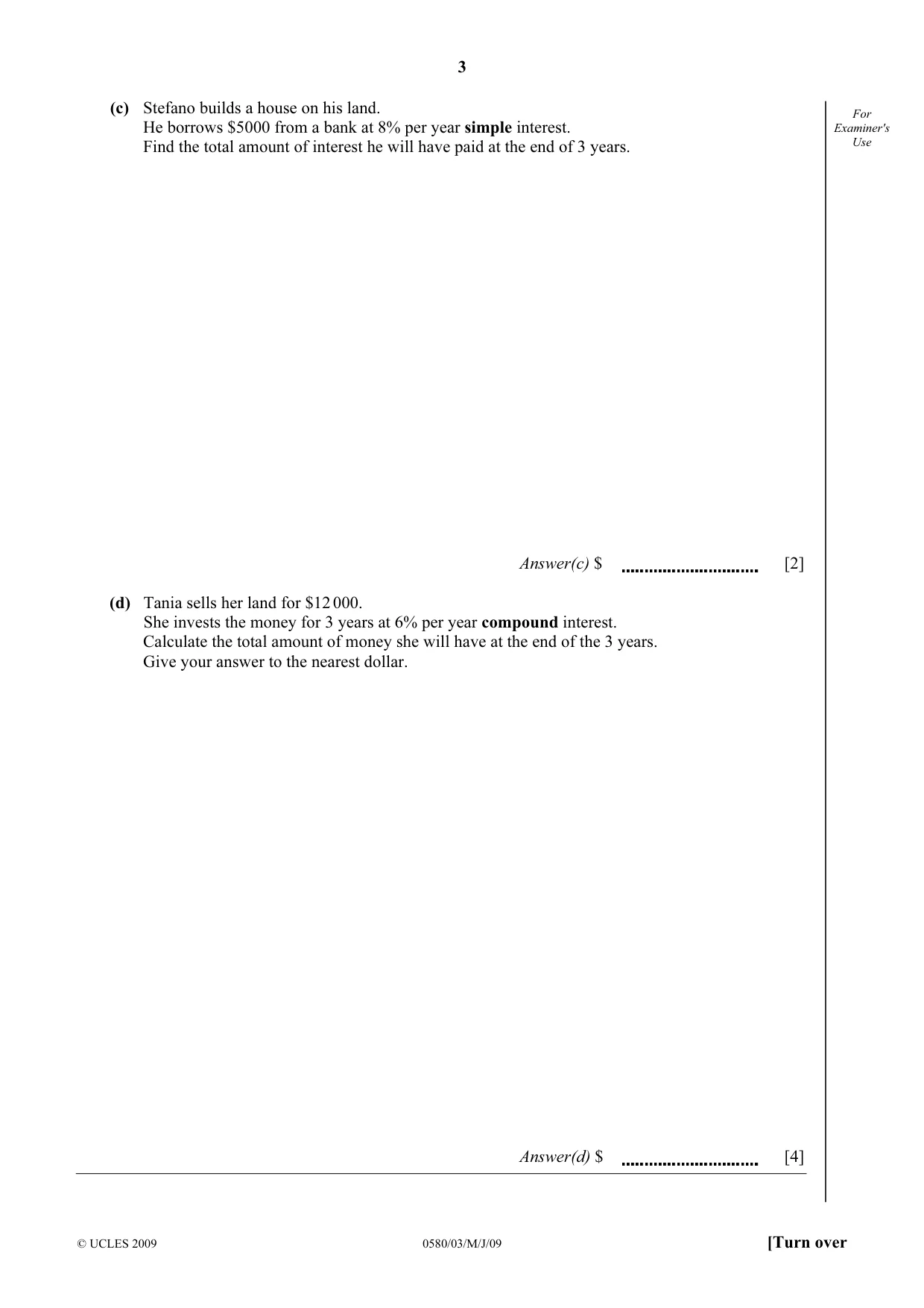
3 © UCLES 2009 0580/03/M/J/09 [Turn over For Examiner's Use (c) Stefano builds a house on his land. He borrows $5000 from a bank at 8% per year simple interest. Find the total amount of interest he will have paid at the end of 3 years. Answer(c) $ [2] (d) Tania sells her land for $12 000. She invests the money for 3 years at 6% per year compound interest. Calculate the total amount of money she will have at the end of the 3 years. Give your answer to the nearest dollar. Answer(d) $ [4]
Question paper, page 4
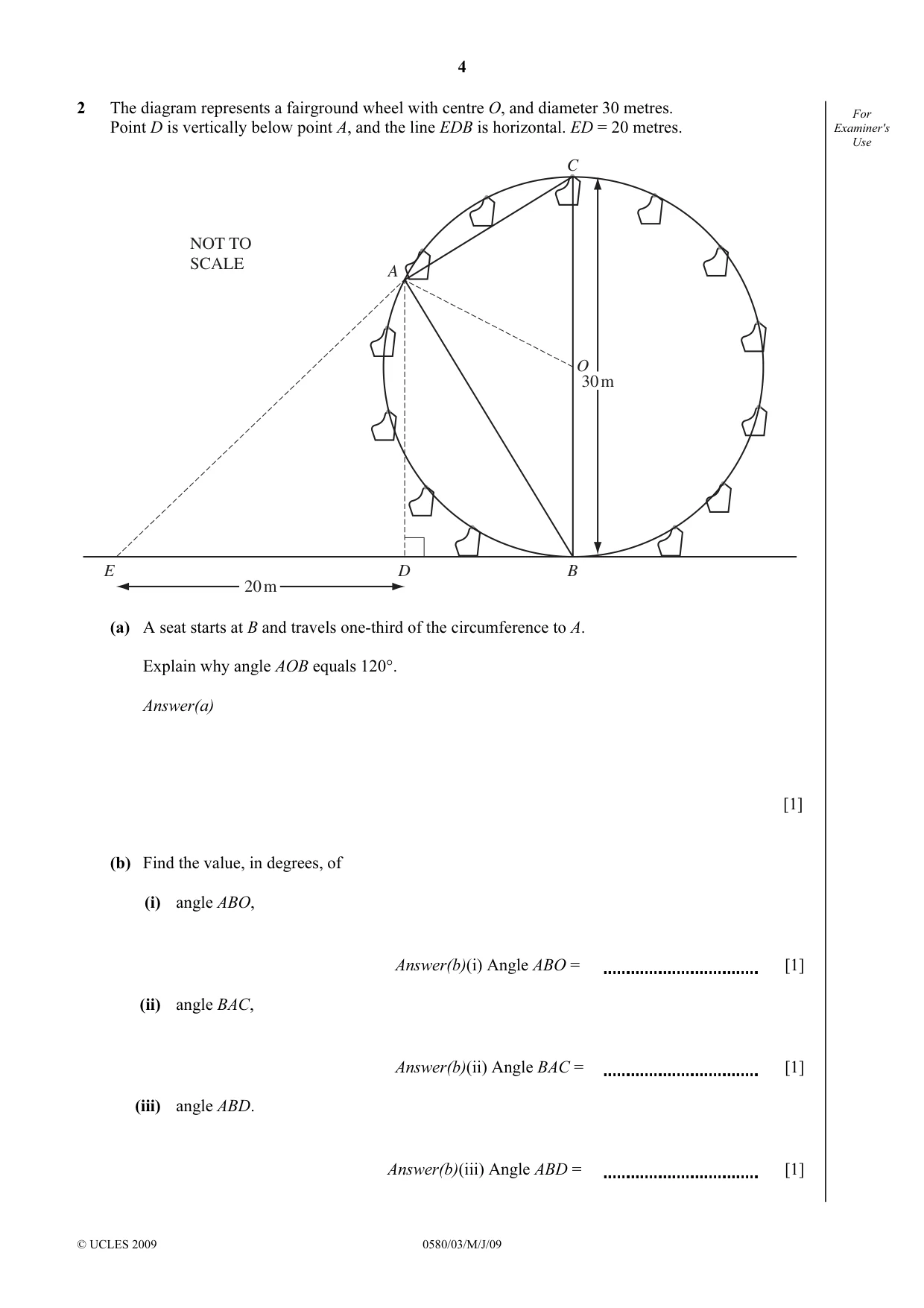
4 © UCLES 2009 0580/03/M/J/09 For Examiner's Use 2 The diagram represents a fairground wheel with centre O, and diameter 30 metres. Point D is vertically below point A, and the line EDB is horizontal. ED = 20 metres. O C A B D E NOT TO SCALE 30 m 20 m (a) A seat starts at B and travels one-third of the circumference to A. Explain why angle AOB equals 120°. Answer(a) [1] (b) Find the value, in degrees, of (i) angle ABO, Answer(b)(i) Angle ABO = [1] (ii) angle BAC, Answer(b)(ii) Angle BAC = [1] (iii) angle ABD. Answer(b)(iii) Angle ABD = [1]
Question paper, page 5
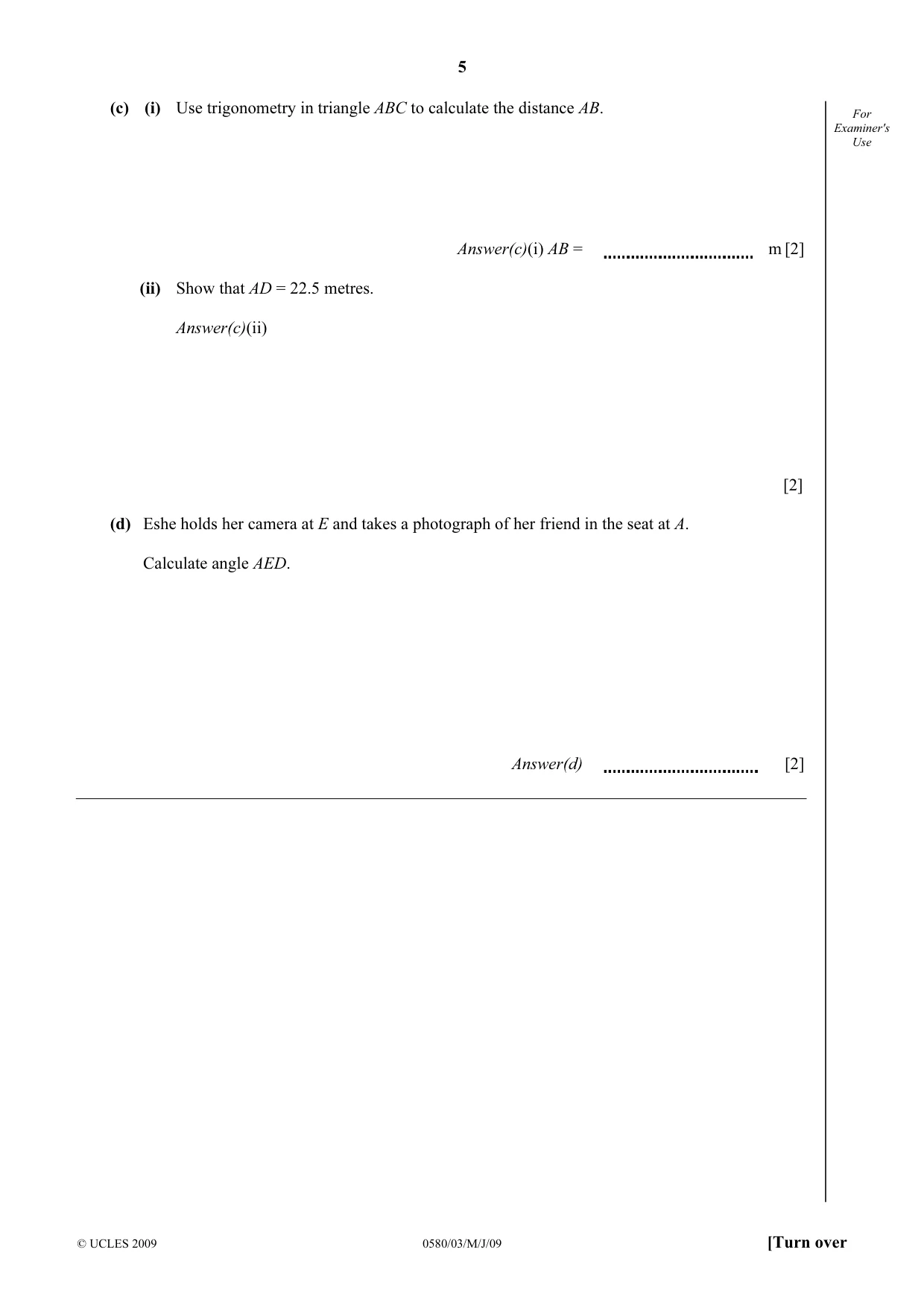
5 © UCLES 2009 0580/03/M/J/09 [Turn over For Examiner's Use (c) (i) Use trigonometry in triangle ABC to calculate the distance AB. Answer(c)(i) AB = m [2] (ii) Show that AD = 22.5 metres. Answer(c)(ii) [2] (d) Eshe holds her camera at E and takes a photograph of her friend in the seat at A. Calculate angle AED. Answer(d) [2]
Question paper, page 6
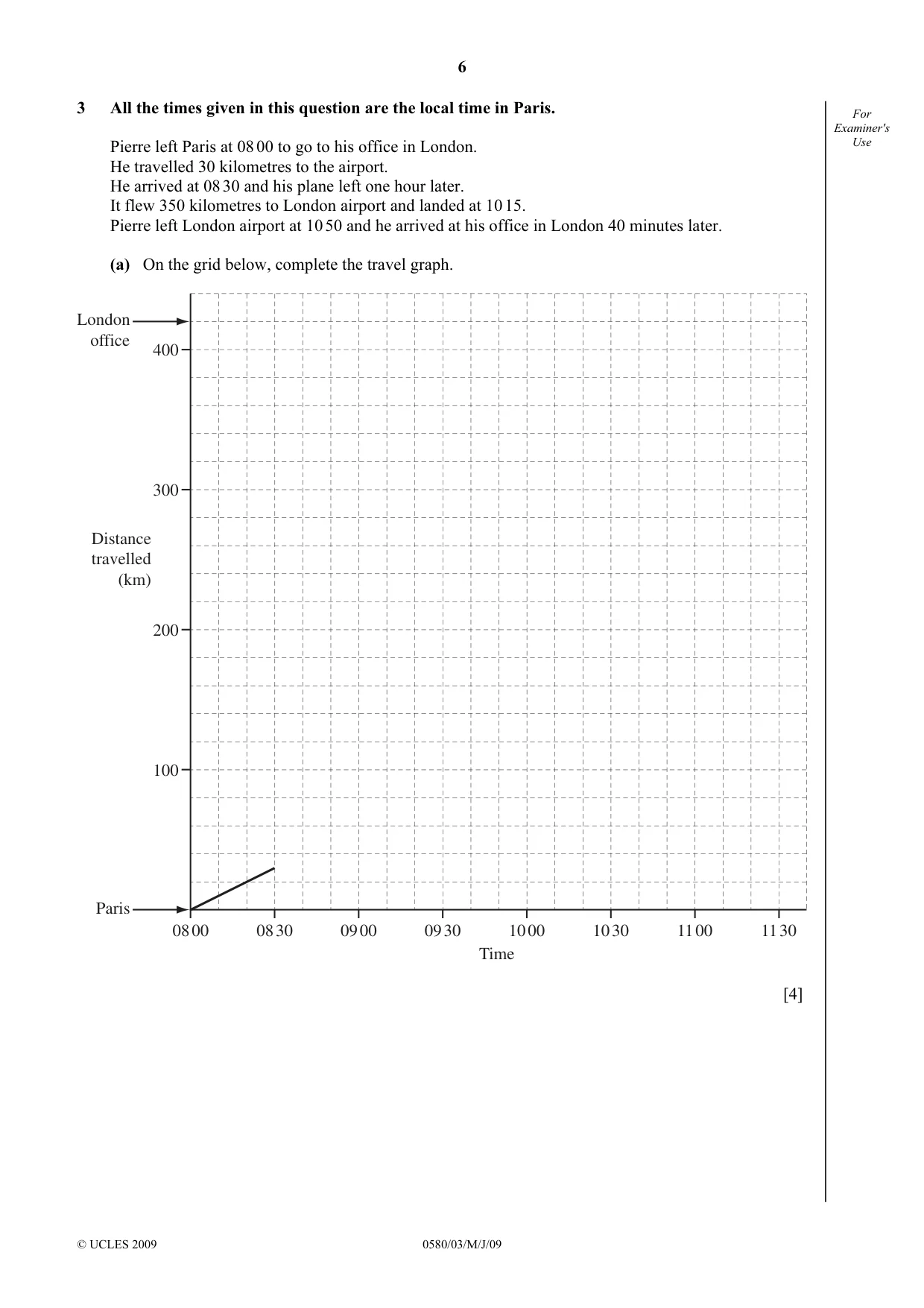
6 © UCLES 2009 0580/03/M/J/09 For Examiner's Use 3 All the times given in this question are the local time in Paris. Pierre left Paris at 08 00 to go to his office in London. He travelled 30 kilometres to the airport. He arrived at 08 30 and his plane left one hour later. It flew 350 kilometres to London airport and landed at 10 15. Pierre left London airport at 10 50 and he arrived at his office in London 40 minutes later. (a) On the grid below, complete the travel graph. 400 300 200 100 Distance travelled (km) London office Paris 08 00 08 30 09 00 09 30 10 00 10 30 11 00 11 30 Time [4]
Question paper, page 7
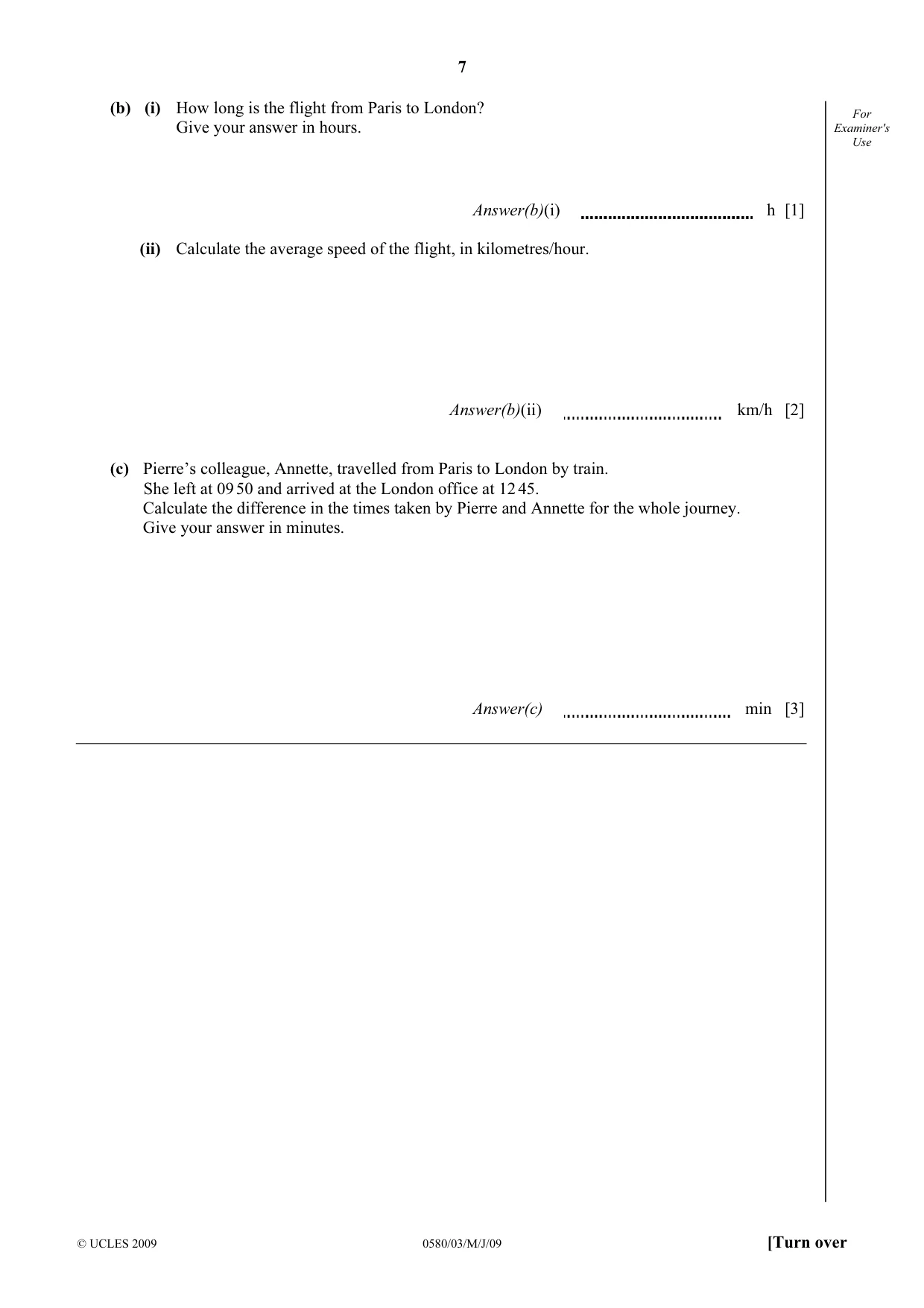
7 © UCLES 2009 0580/03/M/J/09 [Turn over For Examiner's Use (b) (i) How long is the flight from Paris to London? Give your answer in hours. Answer(b)(i) h [1] (ii) Calculate the average speed of the flight, in kilometres/hour. Answer(b)(ii) km/h [2] (c) Pierre’s colleague, Annette, travelled from Paris to London by train. She left at 09 50 and arrived at the London office at 12 45. Calculate the difference in the times taken by Pierre and Annette for the whole journey. Give your answer in minutes. Answer(c) min [3]
Question paper, page 8
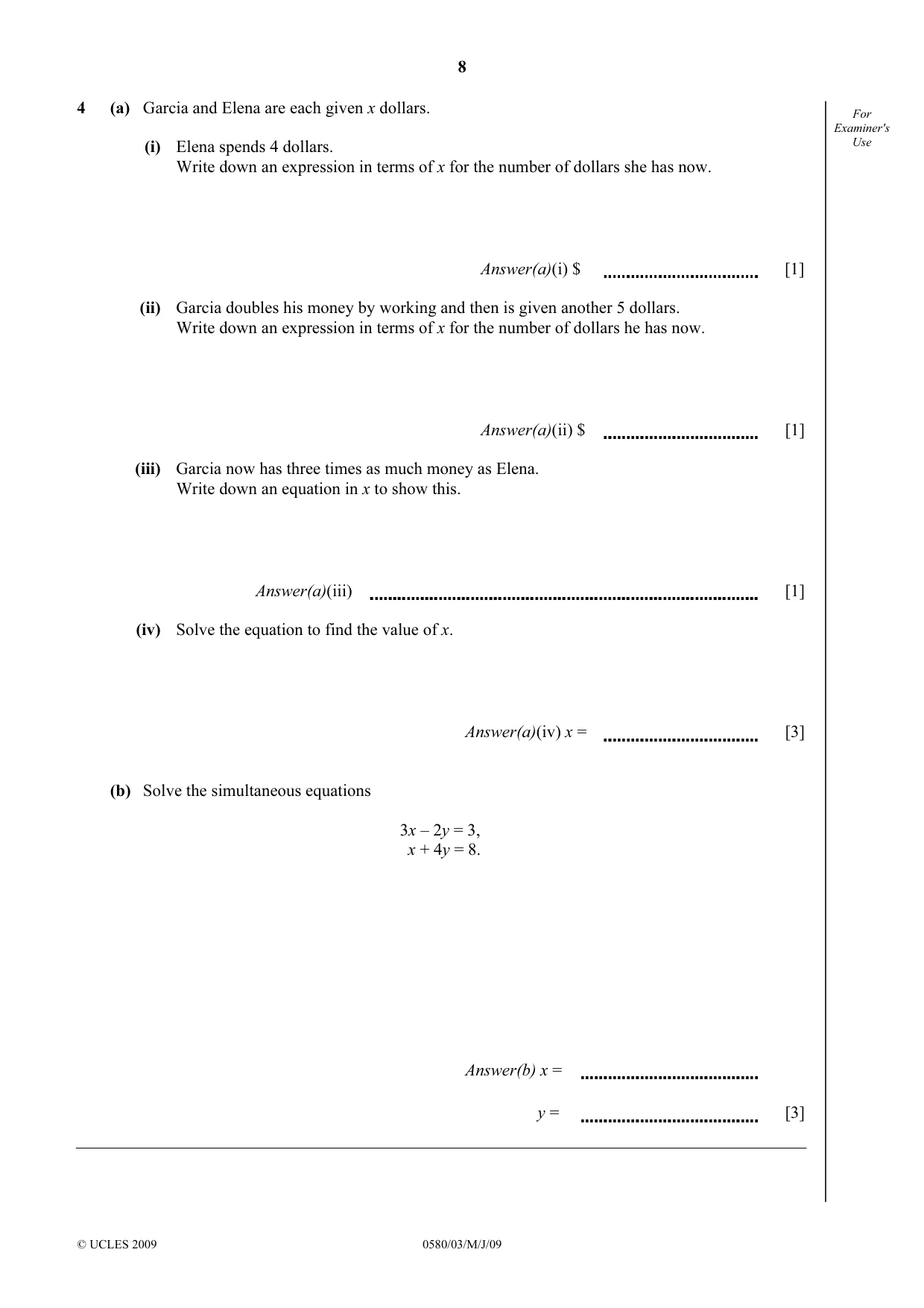
8 © UCLES 2009 0580/03/M/J/09 For Examiner's Use 4 (a) Garcia and Elena are each given x dollars. (i) Elena spends 4 dollars. Write down an expression in terms of x for the number of dollars she has now. Answer(a)(i) $ [1] (ii) Garcia doubles his money by working and then is given another 5 dollars. Write down an expression in terms of x for the number of dollars he has now. Answer(a)(ii) $ [1] (iii) Garcia now has three times as much money as Elena. Write down an equation in x to show this. Answer(a)(iii) [1] (iv) Solve the equation to find the value of x. Answer(a)(iv) x = [3] (b) Solve the simultaneous equations 3x – 2y = 3, x + 4y = 8. Answer(b) x = y = [3]
Question paper, page 9
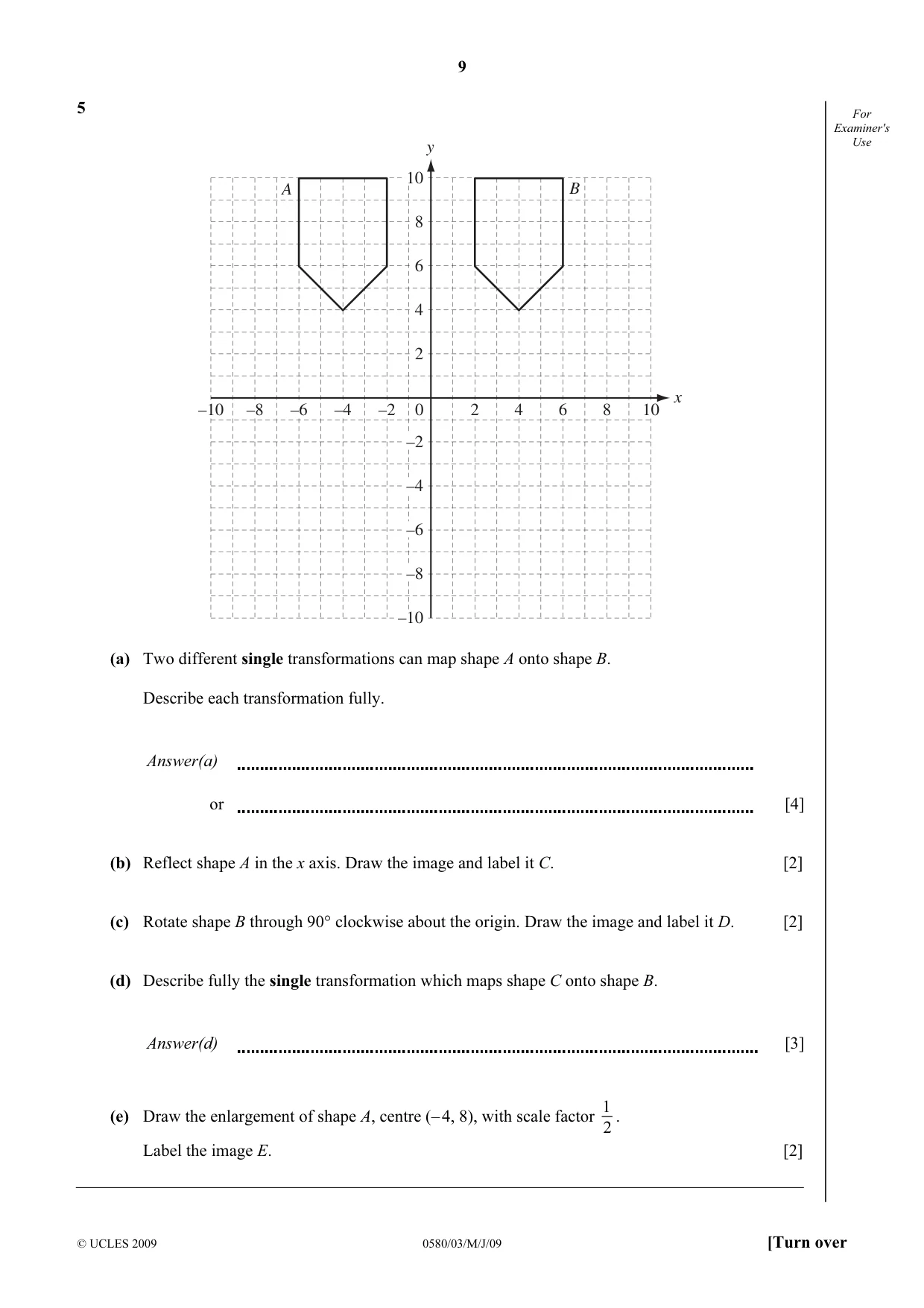
9 © UCLES 2009 0580/03/M/J/09 [Turn over For Examiner's Use 5 10 8 6 4 2 –2 –4 –6 –8 –10 0 –2 –4 –6 –8 –10 10 8 6 4 2 y x A B (a) Two different single transformations can map shape A onto shape B. Describe each transformation fully. Answer(a) or [4] (b) Reflect shape A in the x axis. Draw the image and label it C. [2] (c) Rotate shape B through 90° clockwise about the origin. Draw the image and label it D. [2] (d) Describe fully the single transformation which maps shape C onto shape B. Answer(d) [3] (e) Draw the enlargement of shape A, centre (– 4, 8), with scale factor 1 2 . Label the image E. [2]
Question paper, page 10
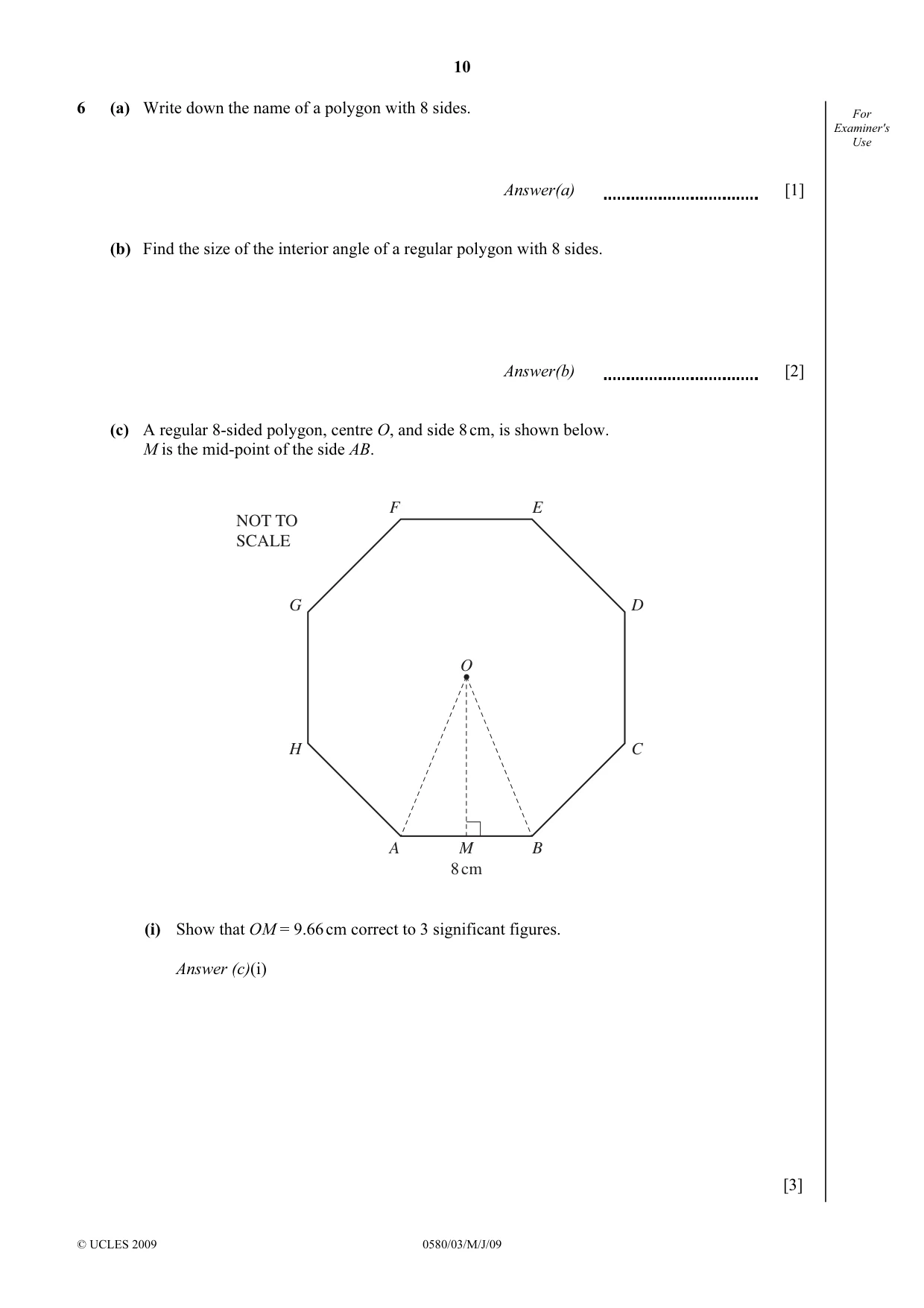
10 © UCLES 2009 0580/03/M/J/09 For Examiner's Use 6 (a) Write down the name of a polygon with 8 sides. Answer(a) [1] (b) Find the size of the interior angle of a regular polygon with 8 sides. Answer(b) [2] (c) A regular 8-sided polygon, centre O, and side 8 cm, is shown below. M is the mid-point of the side AB. O A M 8 cm B F E C D H G NOT TO SCALE (i) Show that OM = 9.66 cm correct to 3 significant figures. Answer (c)(i) [3]
Question paper, page 11
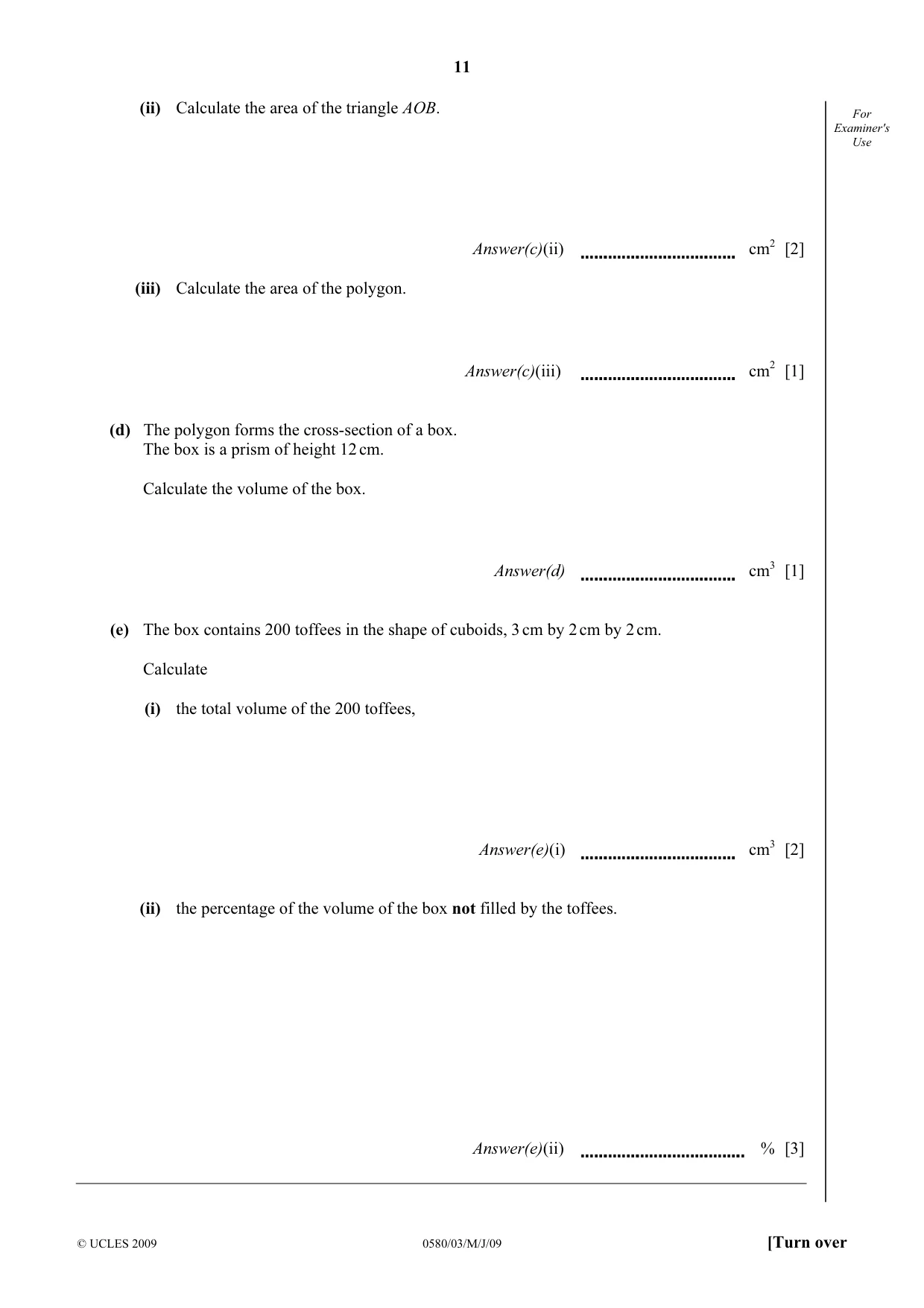
11 © UCLES 2009 0580/03/M/J/09 [Turn over For Examiner's Use (ii) Calculate the area of the triangle AOB. Answer(c)(ii) cm2 [2] (iii) Calculate the area of the polygon. Answer(c)(iii) cm2 [1] (d) The polygon forms the cross-section of a box. The box is a prism of height 12 cm. Calculate the volume of the box. Answer(d) cm3 [1] (e) The box contains 200 toffees in the shape of cuboids, 3 cm by 2 cm by 2 cm. Calculate (i) the total volume of the 200 toffees, Answer(e)(i) cm3 [2] (ii) the percentage of the volume of the box not filled by the toffees. Answer(e)(ii) % [3]
Question paper, page 12
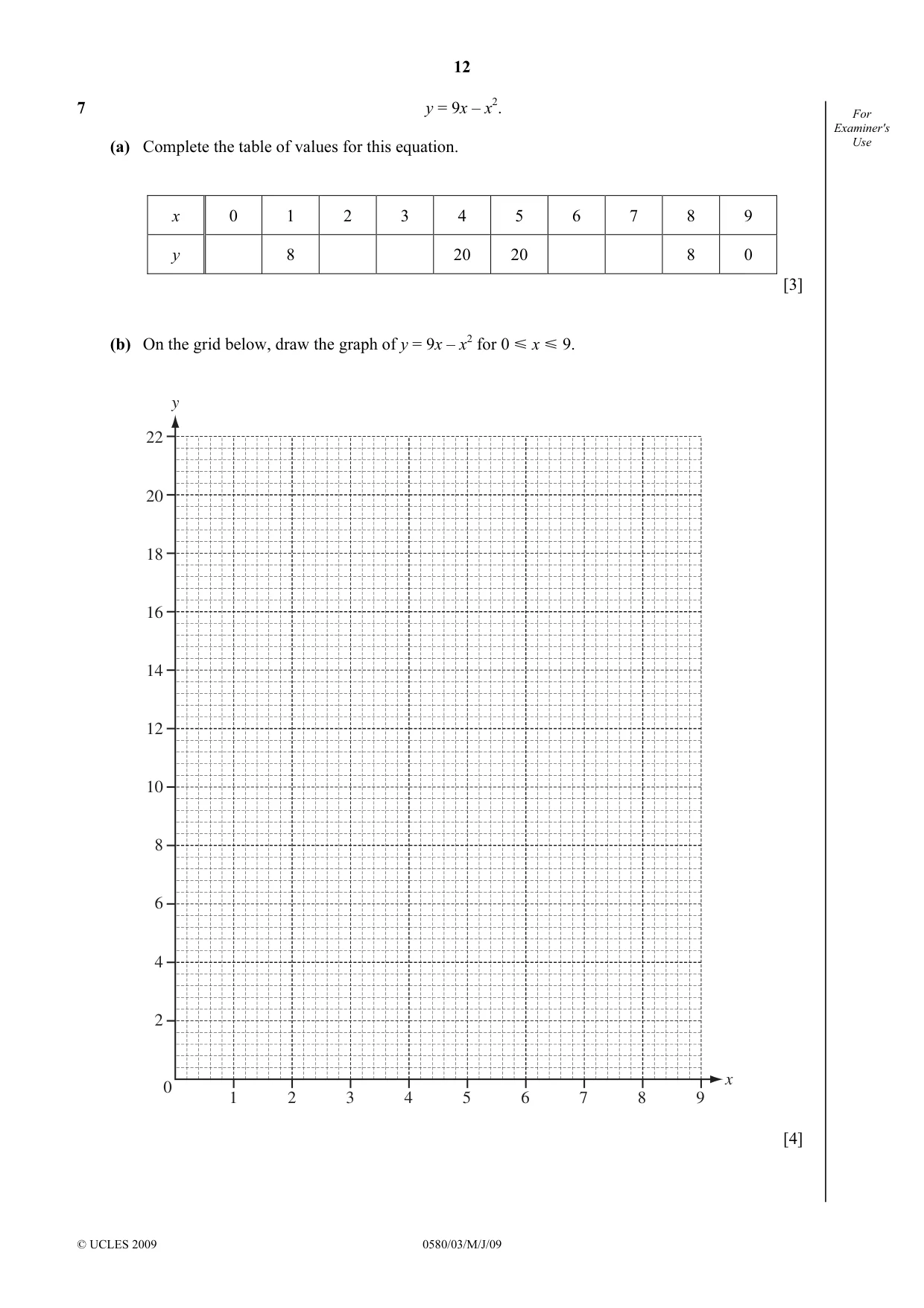
12 © UCLES 2009 0580/03/M/J/09 For Examiner's Use 7 y = 9x – x2. (a) Complete the table of values for this equation. x 0 1 2 3 4 5 6 7 8 9 y 8 20 20 8 0 [3] (b) On the grid below, draw the graph of y = 9x – x2 for 0 Y x Y 9. 22 20 18 16 14 12 10 8 6 4 2 1 2 3 4 5 6 7 8 9 y x 0 [4]
Question paper, page 13
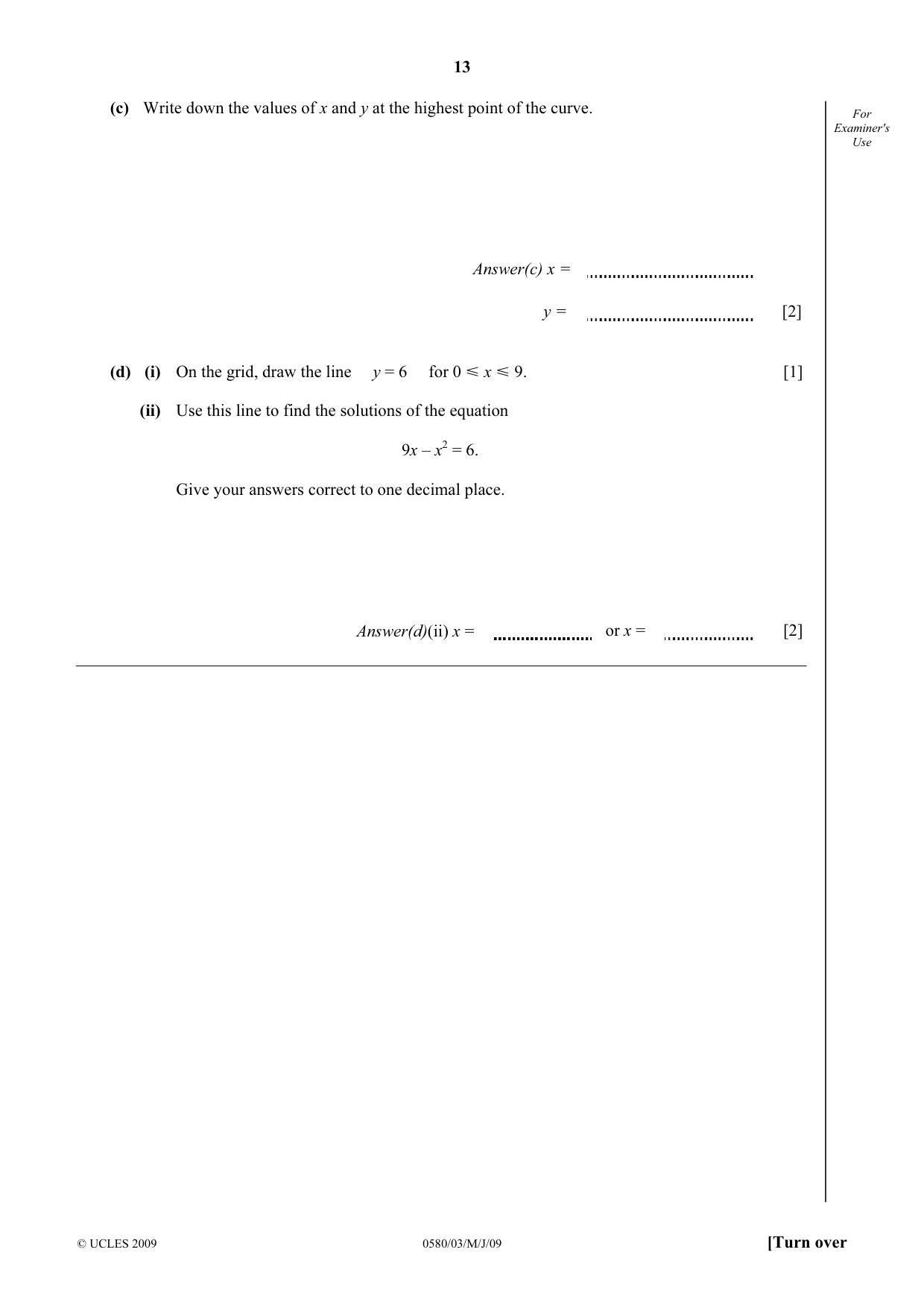
13 © UCLES 2009 0580/03/M/J/09 [Turn over For Examiner's Use (c) Write down the values of x and y at the highest point of the curve. Answer(c) x = y = [2] (d) (i) On the grid, draw the line y = 6 for 0 Y x Y 9. [1] (ii) Use this line to find the solutions of the equation 9x – x2 = 6. Give your answers correct to one decimal place. Answer(d)(ii) x = or x = [2]
Question paper, page 14
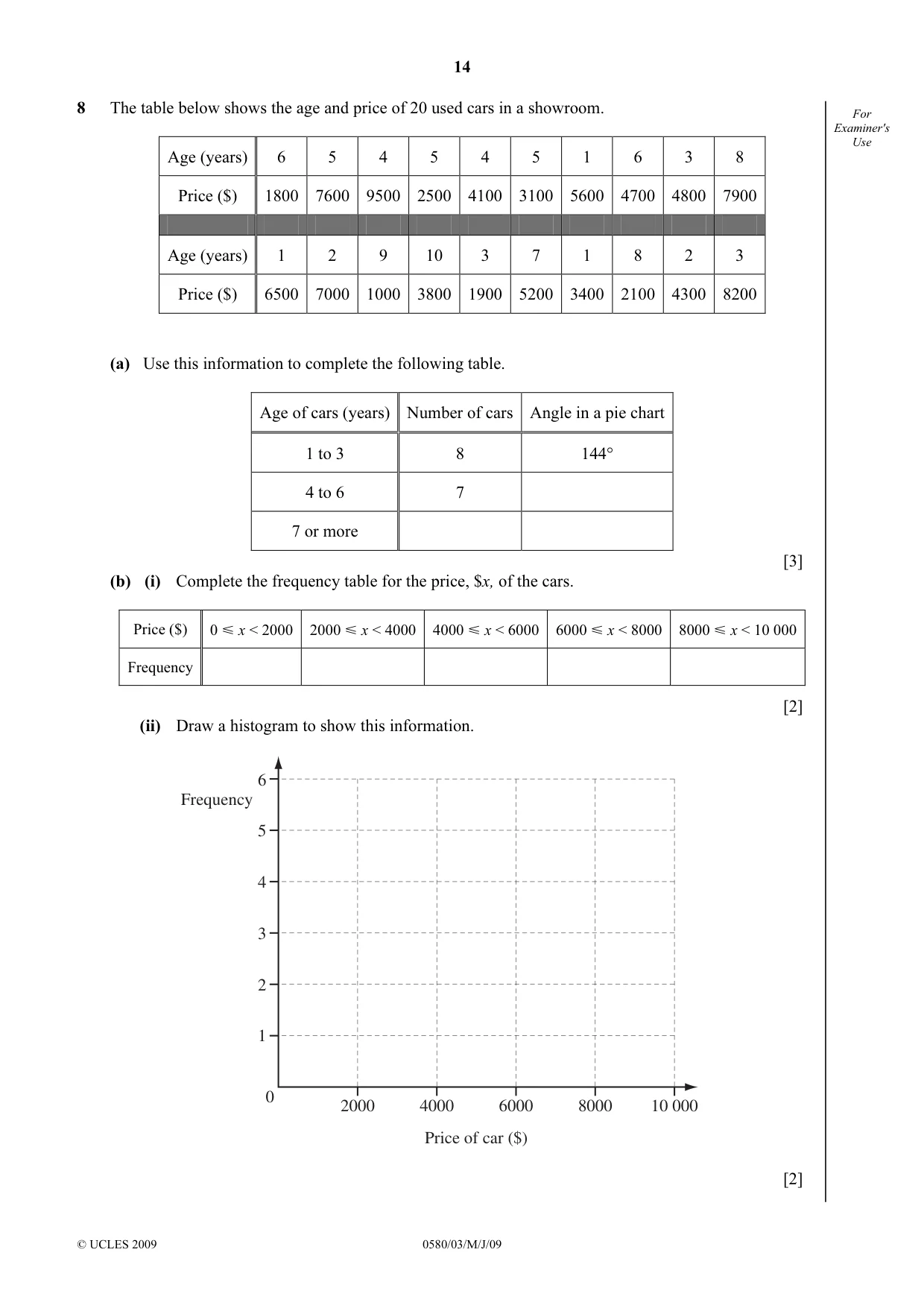
14 © UCLES 2009 0580/03/M/J/09 For Examiner's Use 8 The table below shows the age and price of 20 used cars in a showroom. Age (years) 6 5 4 5 4 5 1 6 3 8 Price ($) 1800 7600 9500 2500 4100 3100 5600 4700 4800 7900 Age (years) 1 2 9 10 3 7 1 8 2 3 Price ($) 6500 7000 1000 3800 1900 5200 3400 2100 4300 8200 (a) Use this information to complete the following table. Age of cars (years) Number of cars Angle in a pie chart 1 to 3 8 144° 4 to 6 7 7 or more [3] (b) (i) Complete the frequency table for the price, $x, of the cars. Price ($) 0 Y x < 2000 2000 Y x < 4000 4000 Y x < 6000 6000 Y x < 8000 8000 Y x < 10 000 Frequency [2] (ii) Draw a histogram to show this information. 6 5 4 3 2 1 0 2000 4000 6000 8000 10 000 Price of car ($) Frequency [2]
Question paper, page 15
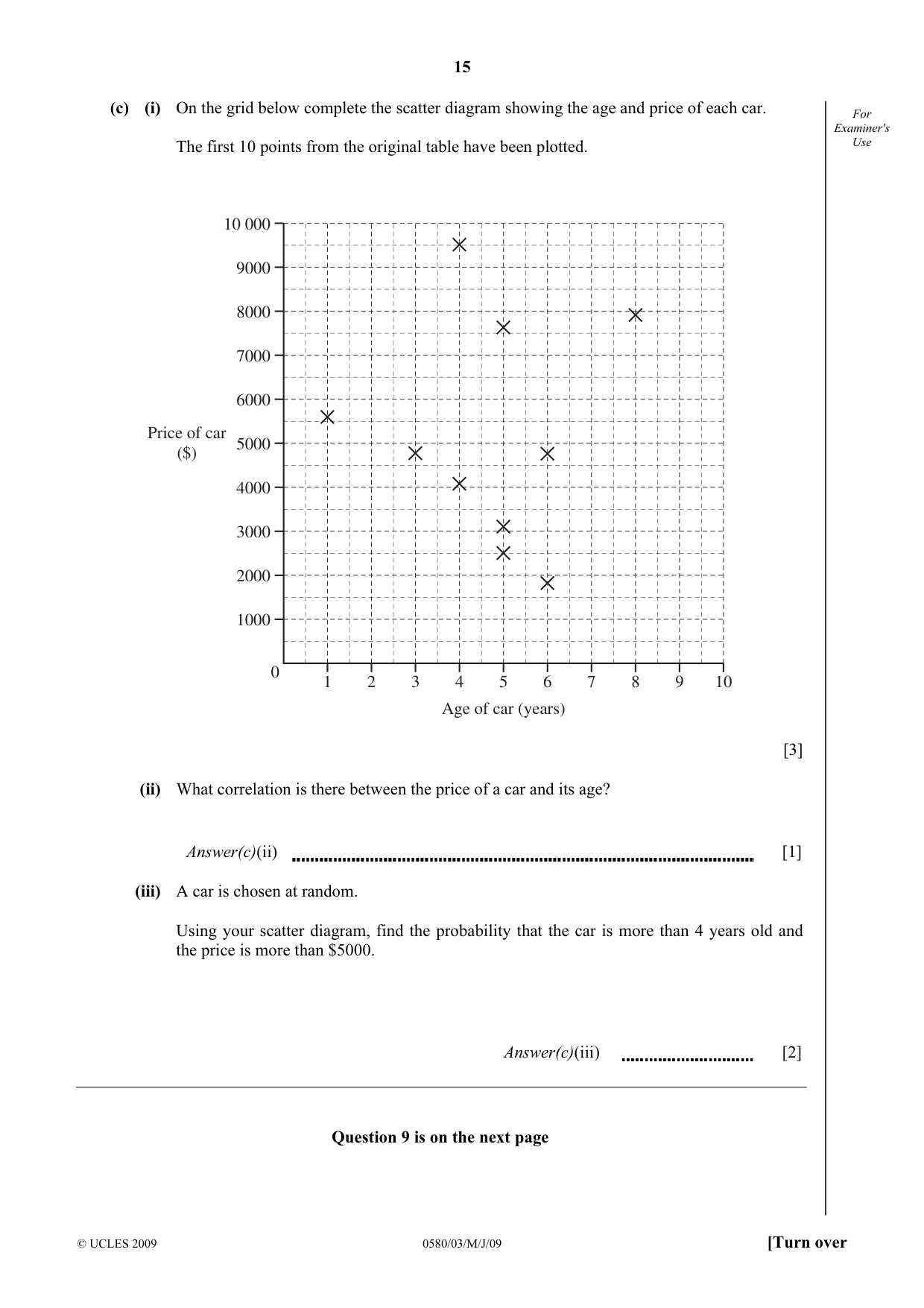
15 © UCLES 2009 0580/03/M/J/09 [Turn over For Examiner's Use (c) (i) On the grid below complete the scatter diagram showing the age and price of each car. The first 10 points from the original table have been plotted. 0 1 2 3 4 5 Age of car (years) 6 7 8 9 10 10 000 9000 8000 7000 6000 5000 4000 3000 2000 1000 Price of car ($) [3] (ii) What correlation is there between the price of a car and its age? Answer(c)(ii) [1] (iii) A car is chosen at random. Using your scatter diagram, find the probability that the car is more than 4 years old and the price is more than $5000. Answer(c)(iii) [2] Question 9 is on the next page
Question paper, page 16
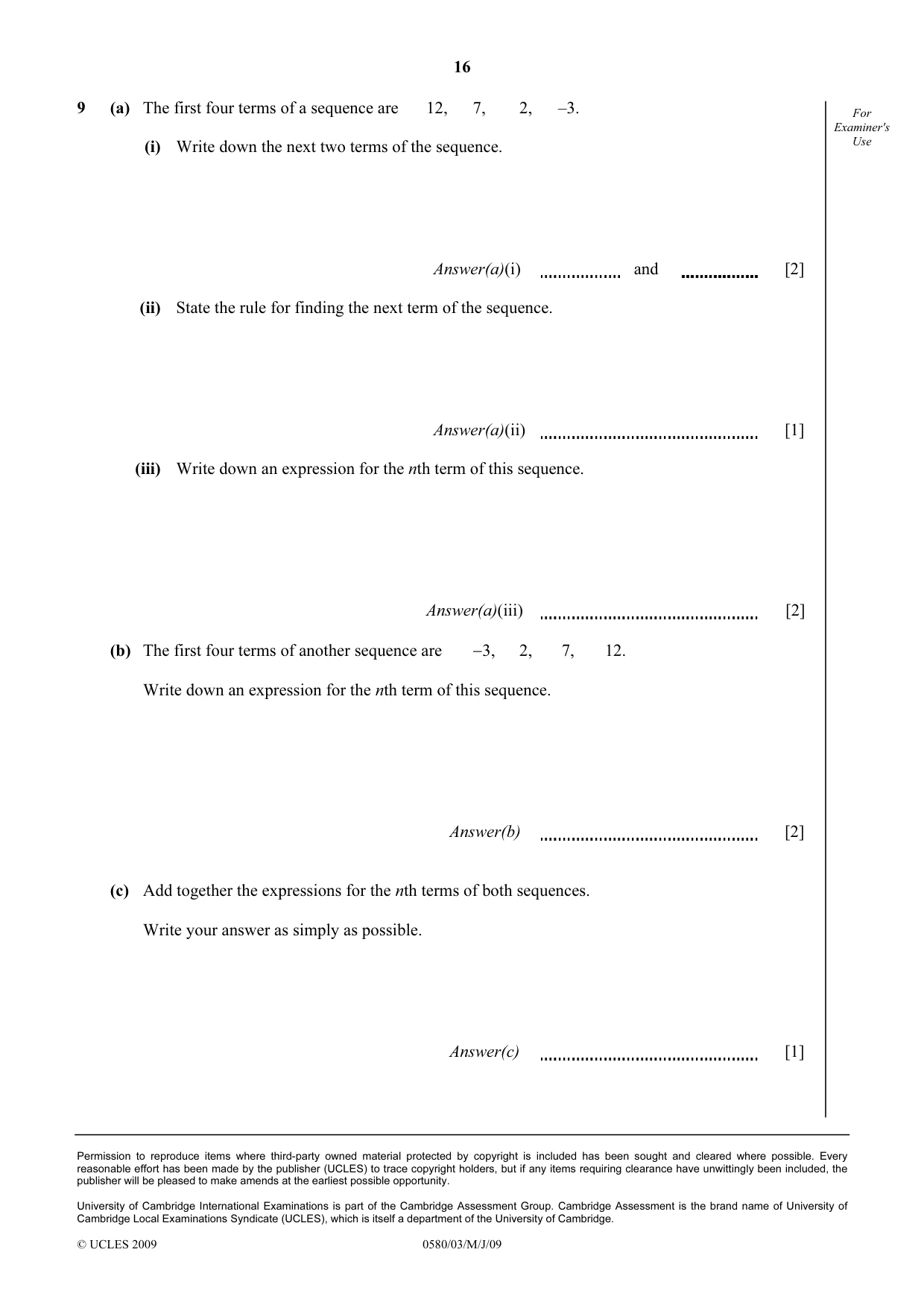
16 Permission to reproduce items where third-party owned material protected by copyright is included has been sought and cleared where possible. Every reasonable effort has been made by the publisher (UCLES) to trace copyright holders, but if any items requiring clearance have unwittingly been included, the publisher will be pleased to make amends at the earliest possible opportunity. University of Cambridge International Examinations is part of the Cambridge Assessment Group. Cambridge Assessment is the brand name of University of Cambridge Local Examinations Syndicate (UCLES), which is itself a department of the University of Cambridge. © UCLES 2009 0580/03/M/J/09 For Examiner's Use 9 (a) The first four terms of a sequence are 12, 7, 2, –3. (i) Write down the next two terms of the sequence. Answer(a)(i) and [2] (ii) State the rule for finding the next term of the sequence. Answer(a)(ii) [1] (iii) Write down an expression for the nth term of this sequence. Answer(a)(iii) [2] (b) The first four terms of another sequence are −3, 2, 7, 12. Write down an expression for the nth term of this sequence. Answer(b) [2] (c) Add together the expressions for the nth terms of both sequences. Write your answer as simply as possible. Answer(c) [1]
Mark scheme, page 1
UNIVERSITY OF CAMBRIDGE INTERNATIONAL EXAMINATIONS International General Certificate of Secondary Education MARK SCHEME for the May/June 2009 question paper for the guidance of teachers 0580, 0581 MATHEMATICS 0580/03, 0581/03 Paper 3 (Core), maximum raw mark 104 This mark scheme is published as an aid to teachers and candidates, to indicate the requirements of the examination. It shows the basis on which Examiners were instructed to award marks. It does not indicate the details of the discussions that took place at an Examiners’ meeting before marking began, which would have considered the acceptability of alternative answers. Mark schemes must be read in conjunction with the question papers and the report on the examination. • CIE will not enter into discussions or correspondence in connection with these mark schemes. CIE is publishing the mark schemes for the May/June 2009 question papers for most IGCSE, GCE Advanced Level and Advanced Subsidiary Level syllabuses and some Ordinary Level syllabuses. www.XtremePapers.com
Mark scheme, page 2
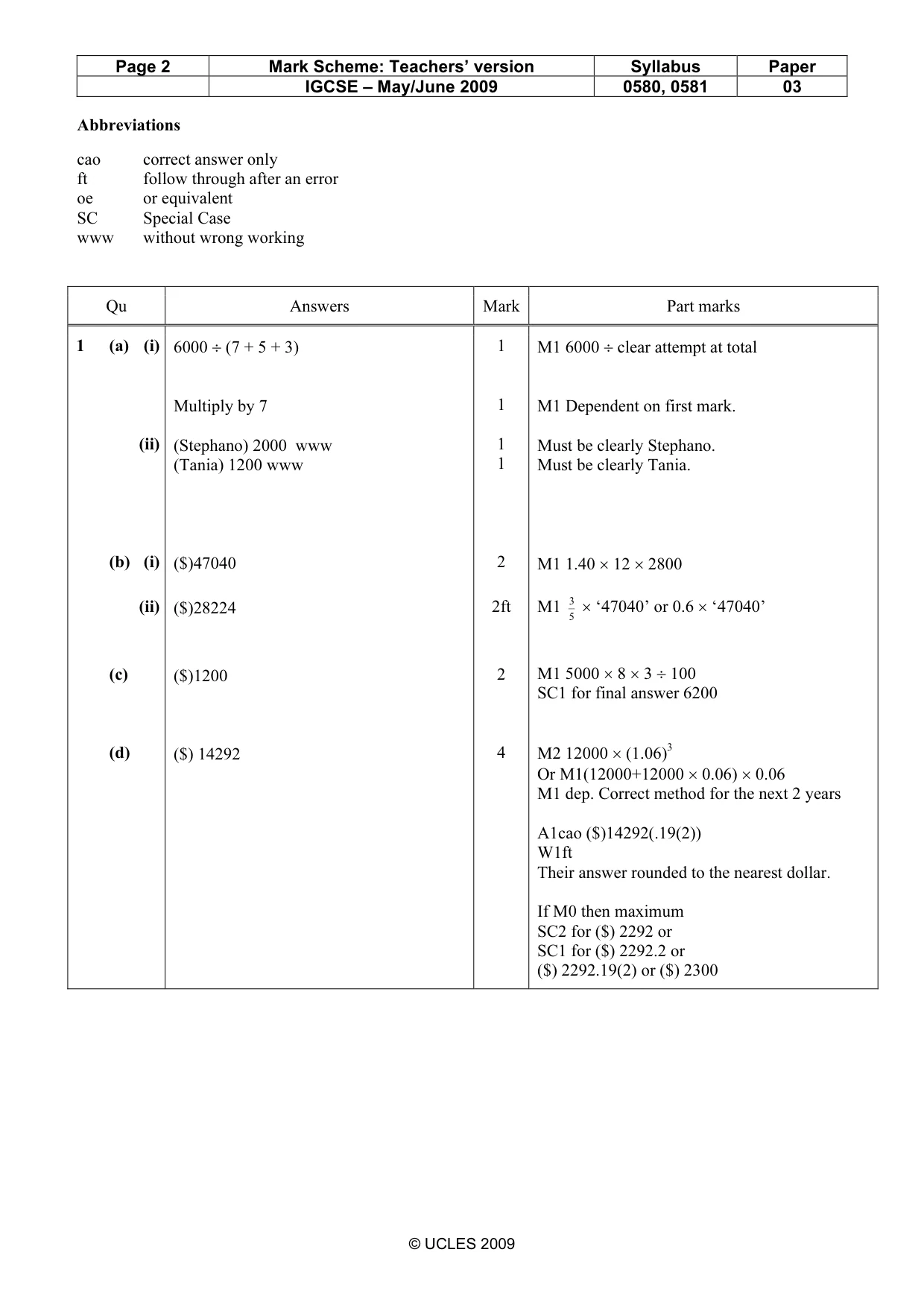
Page 2 Mark Scheme: Teachers’ version Syllabus Paper IGCSE – May/June 2009 0580, 0581 03 © UCLES 2009 Abbreviations cao correct answer only ft follow through after an error oe or equivalent SC Special Case www without wrong working Qu Answers Mark Part marks 1 (a) (i) (ii) (b) (i) (ii) (c) (d) 6000 ÷ (7 + 5 + 3) Multiply by 7 (Stephano) 2000 www (Tania) 1200 www ($)47040 ($)28224 ($)1200 ($) 14292 1 1 1 1 2 2ft 2 4 M1 6000 ÷ clear attempt at total M1 Dependent on first mark. Must be clearly Stephano. Must be clearly Tania. M1 1.40 × 12 × 2800 M1 5 3 × ‘47040’ or 0.6 × ‘47040’ M1 5000 × 8 × 3 ÷ 100 SC1 for final answer 6200 M2 12000 × (1.06)3 Or M1(12000+12000 × 0.06) × 0.06 M1 dep. Correct method for the next 2 years A1cao ($)14292(.19(2)) W1ft Their answer rounded to the nearest dollar. If M0 then maximum SC2 for ($) 2292 or SC1 for ($) 2292.2 or ($) 2292.19(2) or ($) 2300
Mark scheme, page 3
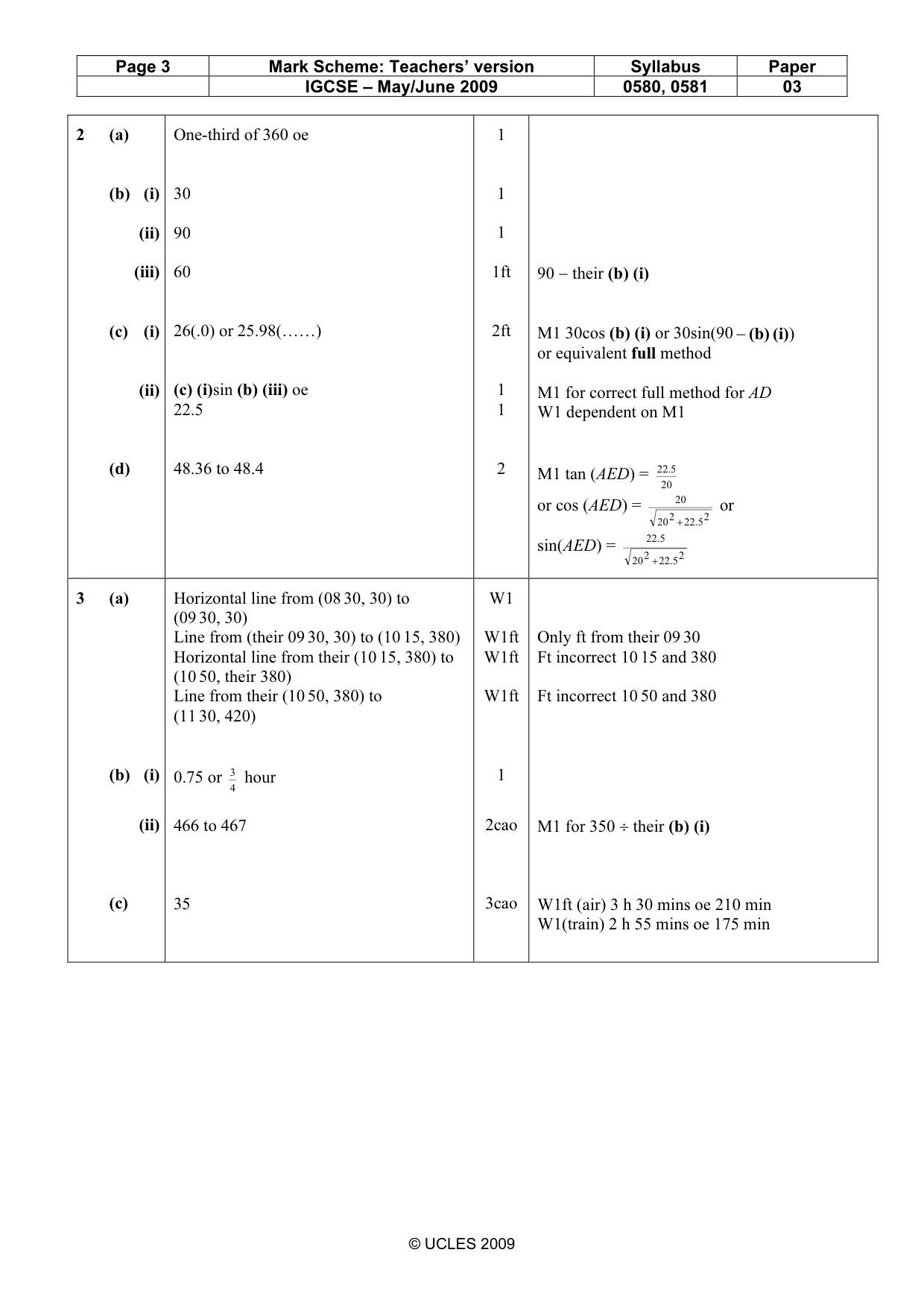
Page 3 Mark Scheme: Teachers’ version Syllabus Paper IGCSE – May/June 2009 0580, 0581 03 © UCLES 2009 2 (a) (b) (i) (ii) (iii) (c) (i) (ii) (d) One-third of 360 oe 30 90 60 26(.0) or 25.98(……) (c) (i)sin (b) (iii) oe 22.5 48.36 to 48.4 1 1 1 1ft 2ft 1 1 2 90 − their (b) (i) M1 30cos (b) (i) or 30sin(90 − (b) (i)) or equivalent full method M1 for correct full method for AD W1 dependent on M1 M1 tan (AED) = 20 5. 22 or cos (AED) = 2 5. 22 2 20 20 + or sin(AED) = 2 5. 22 2 20 5. 22 + 3 (a) (b) (i) (ii) (c) Horizontal line from (08 30, 30) to (09 30, 30) Line from (their 09 30, 30) to (10 15, 380) Horizontal line from their (10 15, 380) to (10 50, their 380) Line from their (10 50, 380) to (11 30, 420) 0.75 or 4 3 hour 466 to 467 35 W1 W1ft W1ft W1ft 1 2cao 3cao Only ft from their 09 30 Ft incorrect 10 15 and 380 Ft incorrect 10 50 and 380 M1 for 350 ÷ their (b) (i) W1ft (air) 3 h 30 mins oe 210 min W1(train) 2 h 55 mins oe 175 min
Mark scheme, page 4
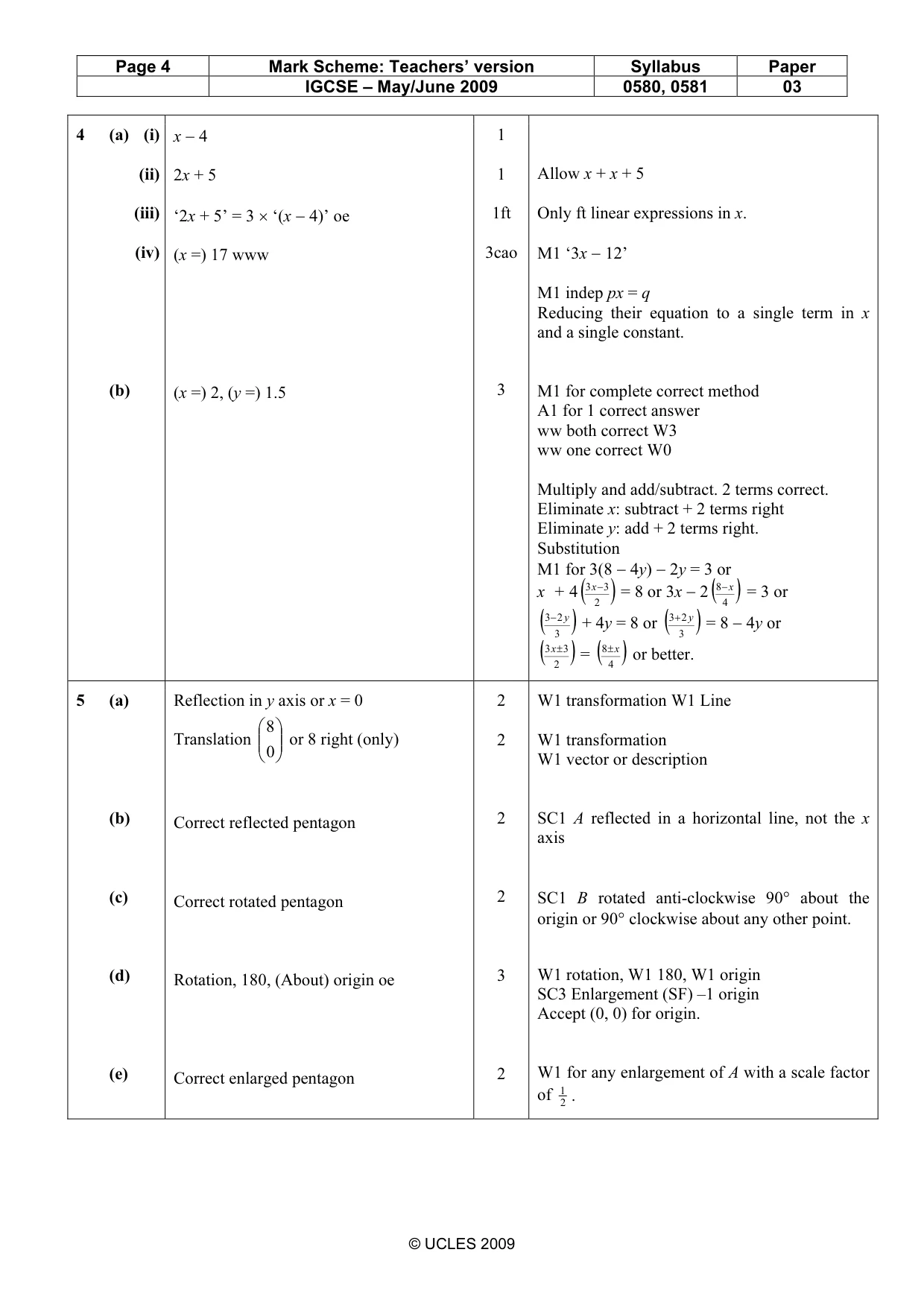
Page 4 Mark Scheme: Teachers’ version Syllabus Paper IGCSE – May/June 2009 0580, 0581 03 © UCLES 2009 4 (a) (i) (ii) (iii) (iv) (b) x − 4 2x + 5 ‘2x + 5’ = 3 × ‘(x − 4)’ oe (x =) 17 www (x =) 2, (y =) 1.5 1 1 1ft 3cao 3 Allow x + x + 5 Only ft linear expressions in x. M1 ‘3x − 12’ M1 indep px = q Reducing their equation to a single term in x and a single constant. M1 for complete correct method A1 for 1 correct answer ww both correct W3 ww one correct W0 Multiply and add/subtract. 2 terms correct. Eliminate x: subtract + 2 terms right Eliminate y: add + 2 terms right. Substitution M1 for 3(8 − 4y) − 2y = 3 or x + 4( ) 2 3 3 − x = 8 or 3x − 2( ) 4 8 x − = 3 or ( ) 3 2 3 y − + 4y = 8 or ( ) 3 2 3 y + = 8 − 4y or ( ) 2 3 3 ± x = ( ) 4 8 x ± or better. 5 (a) (b) (c) (d) (e) Reflection in y axis or x = 0 Translation 0 8 or 8 right (only) Correct reflected pentagon Correct rotated pentagon Rotation, 180, (About) origin oe Correct enlarged pentagon 2 2 2 2 3 2 W1 transformation W1 Line W1 transformation W1 vector or description SC1 A reflected in a horizontal line, not the x axis SC1 B rotated anti-clockwise 90° about the origin or 90° clockwise about any other point. W1 rotation, W1 180, W1 origin SC3 Enlargement (SF) –1 origin Accept (0, 0) for origin. W1 for any enlargement of A with a scale factor of 2 1 .
Mark scheme, page 5
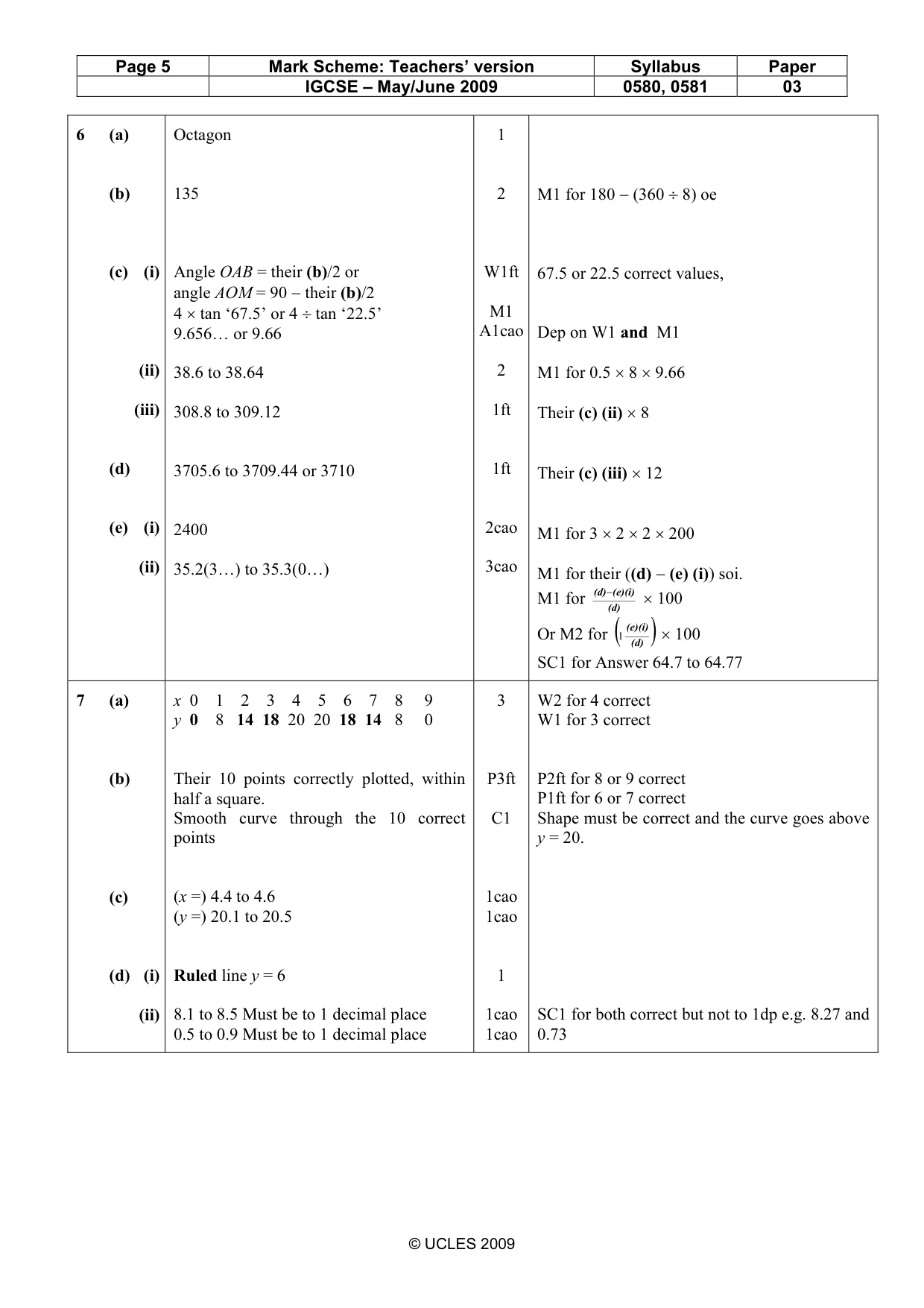
Page 5 Mark Scheme: Teachers’ version Syllabus Paper IGCSE – May/June 2009 0580, 0581 03 © UCLES 2009 6 (a) (b) (c) (i) (ii) (iii) (d) (e) (i) (ii) Octagon 135 Angle OAB = their (b)/2 or angle AOM = 90 − their (b)/2 4 × tan ‘67.5’ or 4 ÷ tan ‘22.5’ 9.656… or 9.66 38.6 to 38.64 308.8 to 309.12 3705.6 to 3709.44 or 3710 2400 35.2(3…) to 35.3(0…) 1 2 W1ft M1 A1cao 2 1ft 1ft 2cao 3cao M1 for 180 − (360 ÷ 8) oe 67.5 or 22.5 correct values, Dep on W1 and M1 M1 for 0.5 × 8 × 9.66 Their (c) (ii) × 8 Their (c) (iii) × 12 M1 for 3 × 2 × 2 × 200 M1 for their ((d) − (e) (i)) soi. M1 for (d) (e)(i) (d)− × 100 Or M2 for ( ) (d) (e)(i) 1 × 100 SC1 for Answer 64.7 to 64.77 7 (a) (b) (c) (d) (i) (ii) x 0 1 2 3 4 5 6 7 8 9 y 0 8 14 18 20 20 18 14 8 0 Their 10 points correctly plotted, within half a square. Smooth curve through the 10 correct points (x =) 4.4 to 4.6 (y =) 20.1 to 20.5 Ruled line y = 6 8.1 to 8.5 Must be to 1 decimal place 0.5 to 0.9 Must be to 1 decimal place 3 P3ft C1 1cao 1cao 1 1cao 1cao W2 for 4 correct W1 for 3 correct P2ft for 8 or 9 correct P1ft for 6 or 7 correct Shape must be correct and the curve goes above y = 20. SC1 for both correct but not to 1dp e.g. 8.27 and 0.73
Mark scheme, page 6
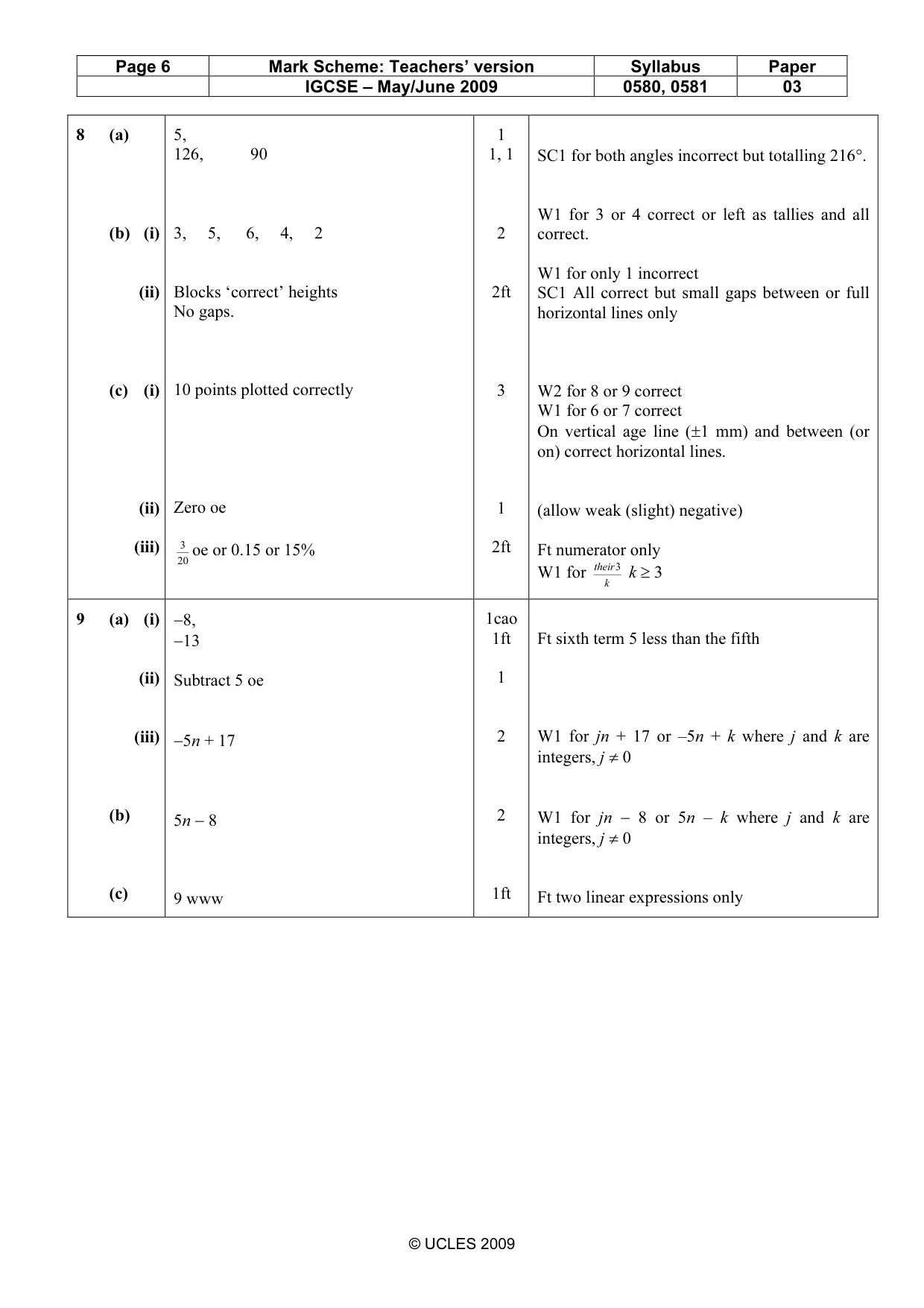
Page 6 Mark Scheme: Teachers’ version Syllabus Paper IGCSE – May/June 2009 0580, 0581 03 © UCLES 2009 8 (a) (b) (i) (ii) (c) (i) (ii) (iii) 5, 126, 90 3, 5, 6, 4, 2 Blocks ‘correct’ heights No gaps. 10 points plotted correctly Zero oe 20 3 oe or 0.15 or 15% 1 1, 1 2 2ft 3 1 2ft SC1 for both angles incorrect but totalling 216°. W1 for 3 or 4 correct or left as tallies and all correct. W1 for only 1 incorrect SC1 All correct but small gaps between or full horizontal lines only W2 for 8 or 9 correct W1 for 6 or 7 correct On vertical age line (±1 mm) and between (or on) correct horizontal lines. (allow weak (slight) negative) Ft numerator only W1 for k their3 k ≥ 3 9 (a) (i) (ii) (iii) (b) (c) −8, −13 Subtract 5 oe −5n + 17 5n − 8 9 www 1cao 1ft 1 2 2 1ft Ft sixth term 5 less than the fifth W1 for jn + 17 or –5n + k where j and k are integers, j ≠ 0 W1 for jn − 8 or 5n – k where j and k are integers, j ≠ 0 Ft two linear expressions only
What you needed in this session
Cambridge’s own grade thresholds for 2009 May/June, Paper 3 · Variant 1. A higher threshold means an easier paper — the bar moves with how the cohort did.