Cambridge IGCSE Mathematics (with coursework) 0581 — 2008 Oct/Nov Paper 3 · Variant 1
0581/31/O/N/08 · 104 marks · ≈117 min
The question paper and its mark scheme, free to read here and free to download. This is Cambridge’s own paper, exactly as it was sat.
Question paper12 pages
Mark scheme5 pages
Answers below. Sit the paper first if you are practising.
Paper as text
Question paper, page 1
This document consists of 11 printed pages and 1 blank page. IB08 11_0580_03/3RP © UCLES 2008 [Turn over *9276915310* For Examiner's Use UNIVERSITY OF CAMBRIDGE INTERNATIONAL EXAMINATIONS International General Certificate of Secondary Education MATHEMATICS 0580/03, 0581/03 Paper 3 (Core) October/November 2008 2 hours Candidates answer on the Question Paper. Additional Materials: Electronic calculator Geometrical instruments Mathematical tables (optional) Tracing paper (optional) READ THESE INSTRUCTIONS FIRST Write your Centre number, candidate number and name on all the work you hand in. Write in dark blue or black pen. You may use a soft pencil for any diagrams or graphs. Do not use staples, paper clips, highlighters, glue or correction fluid. Answer all questions. If working is needed for any question it must be shown below that question. Electronic calculators should be used. If the degree of accuracy is not specified in the question, and if the answer is not exact, give the answer to three significant figures. Give answers in degrees to one decimal place. For π , use either your calculator value or 3.142. At the end of the examination, fasten all your work securely together. The number of marks is given in brackets [ ] at the end of each question or part question. The total of the marks for this paper is 104. www.XtremePapers.com
Question paper, page 2
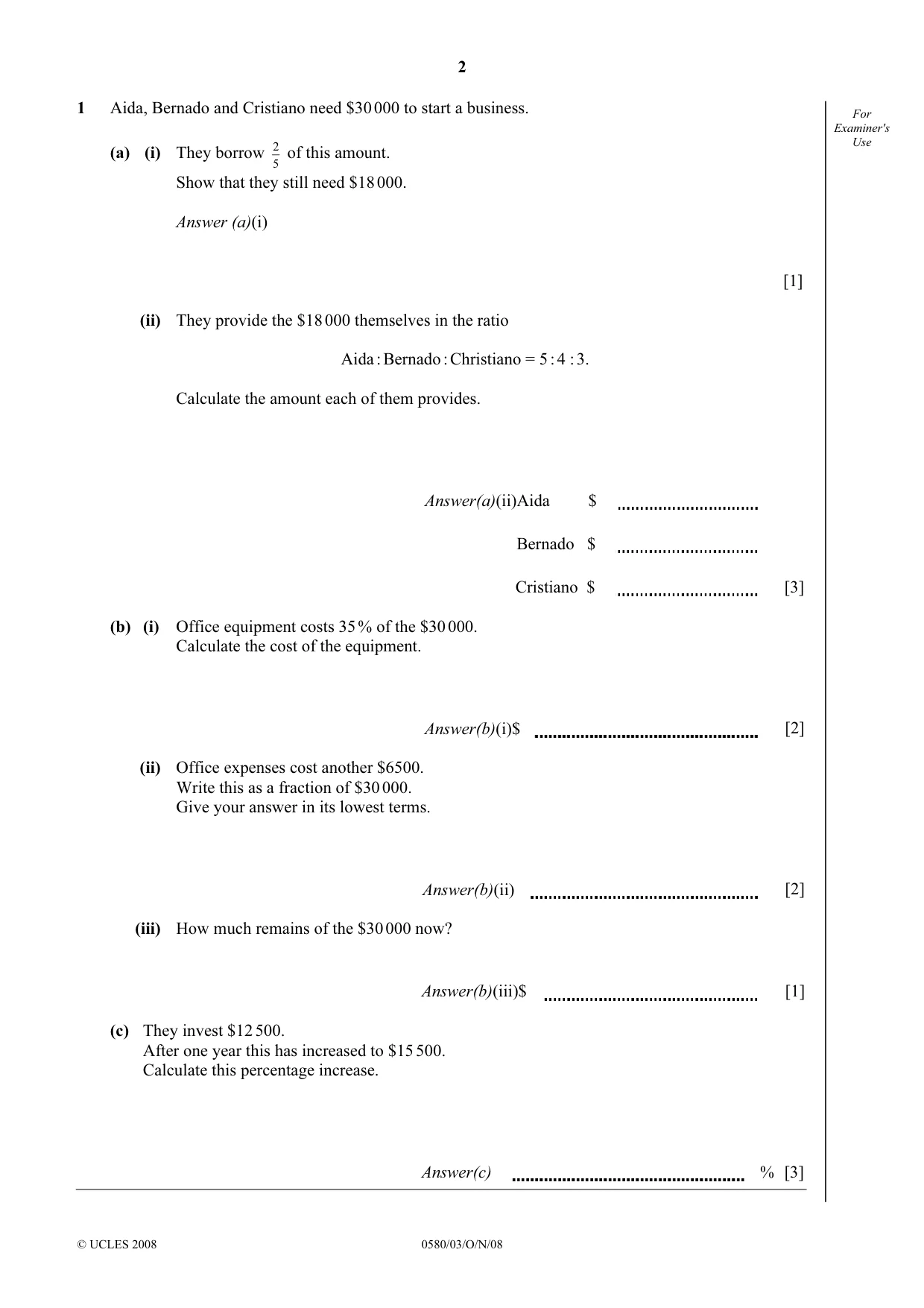
2 © UCLES 2008 0580/03/O/N/08 For Examiner's Use 1 Aida, Bernado and Cristiano need $30 000 to start a business. (a) (i) They borrow 2 5 of this amount. Show that they still need $18 000. Answer (a)(i) [1] (ii) They provide the $18 000 themselves in the ratio Aida : Bernado : Christiano = 5 : 4 : 3. Calculate the amount each of them provides. Answer(a)(ii)Aida $ Bernado $ Cristiano $ [3] (b) (i) Office equipment costs 35 % of the $30 000. Calculate the cost of the equipment. Answer(b)(i)$ [2] (ii) Office expenses cost another $6500. Write this as a fraction of $30 000. Give your answer in its lowest terms. Answer(b)(ii) [2] (iii) How much remains of the $30 000 now? Answer(b)(iii)$ [1] (c) They invest $12 500. After one year this has increased to $15 500. Calculate this percentage increase. Answer(c) % [3]
Question paper, page 3
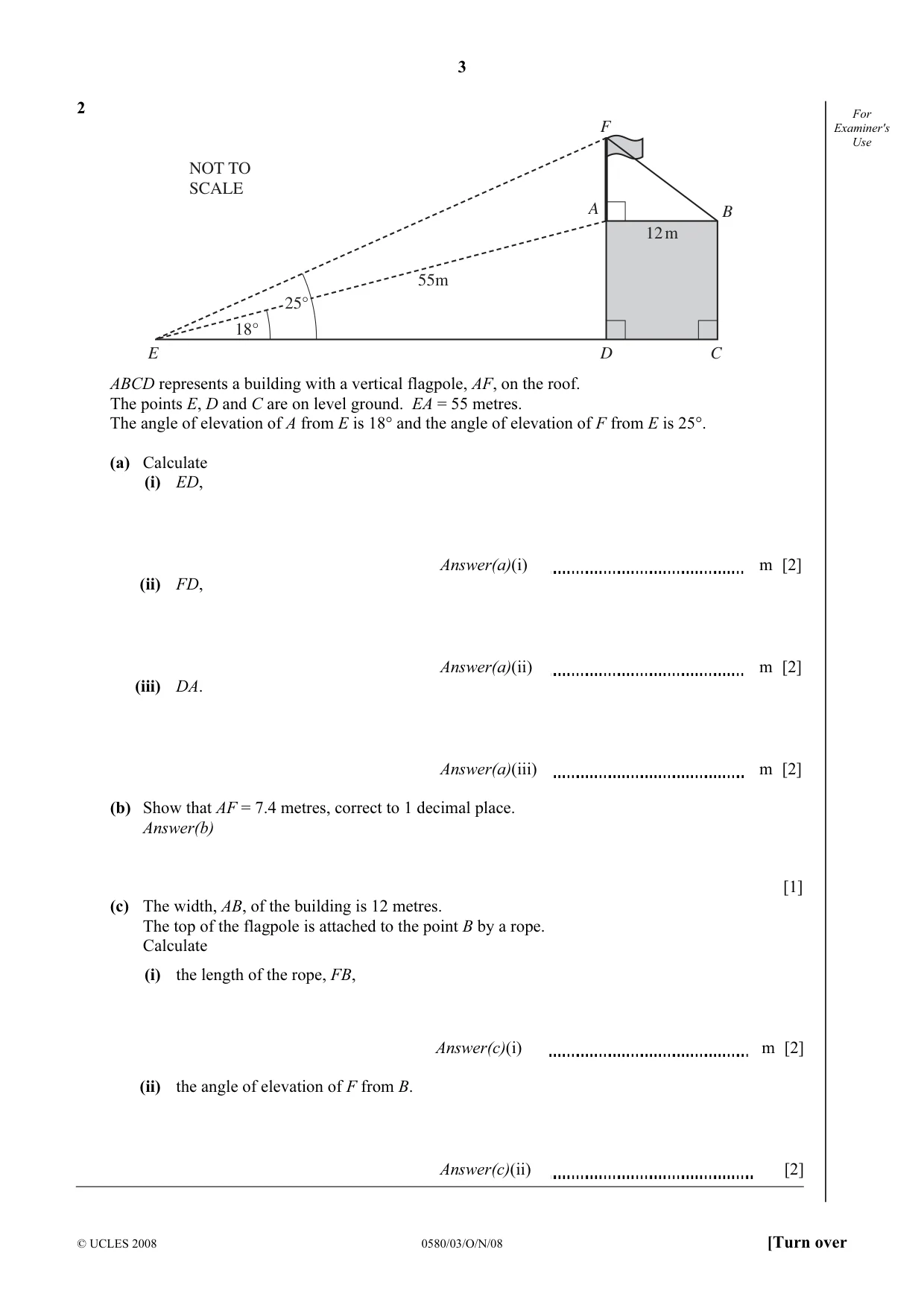
3 © UCLES 2008 0580/03/O/N/08 [Turn over For Examiner's Use 2 NOT TO SCALE E D F C B 18° 25° 12 m 55m A ABCD represents a building with a vertical flagpole, AF, on the roof. The points E, D and C are on level ground. EA = 55 metres. The angle of elevation of A from E is 18° and the angle of elevation of F from E is 25°. (a) Calculate (i) ED, Answer(a)(i) m [2] (ii) FD, Answer(a)(ii) m [2] (iii) DA. Answer(a)(iii) m [2] (b) Show that AF = 7.4 metres, correct to 1 decimal place. Answer(b) [1] (c) The width, AB, of the building is 12 metres. The top of the flagpole is attached to the point B by a rope. Calculate (i) the length of the rope, FB, Answer(c)(i) m [2] (ii) the angle of elevation of F from B. Answer(c)(ii) [2]
Question paper, page 4
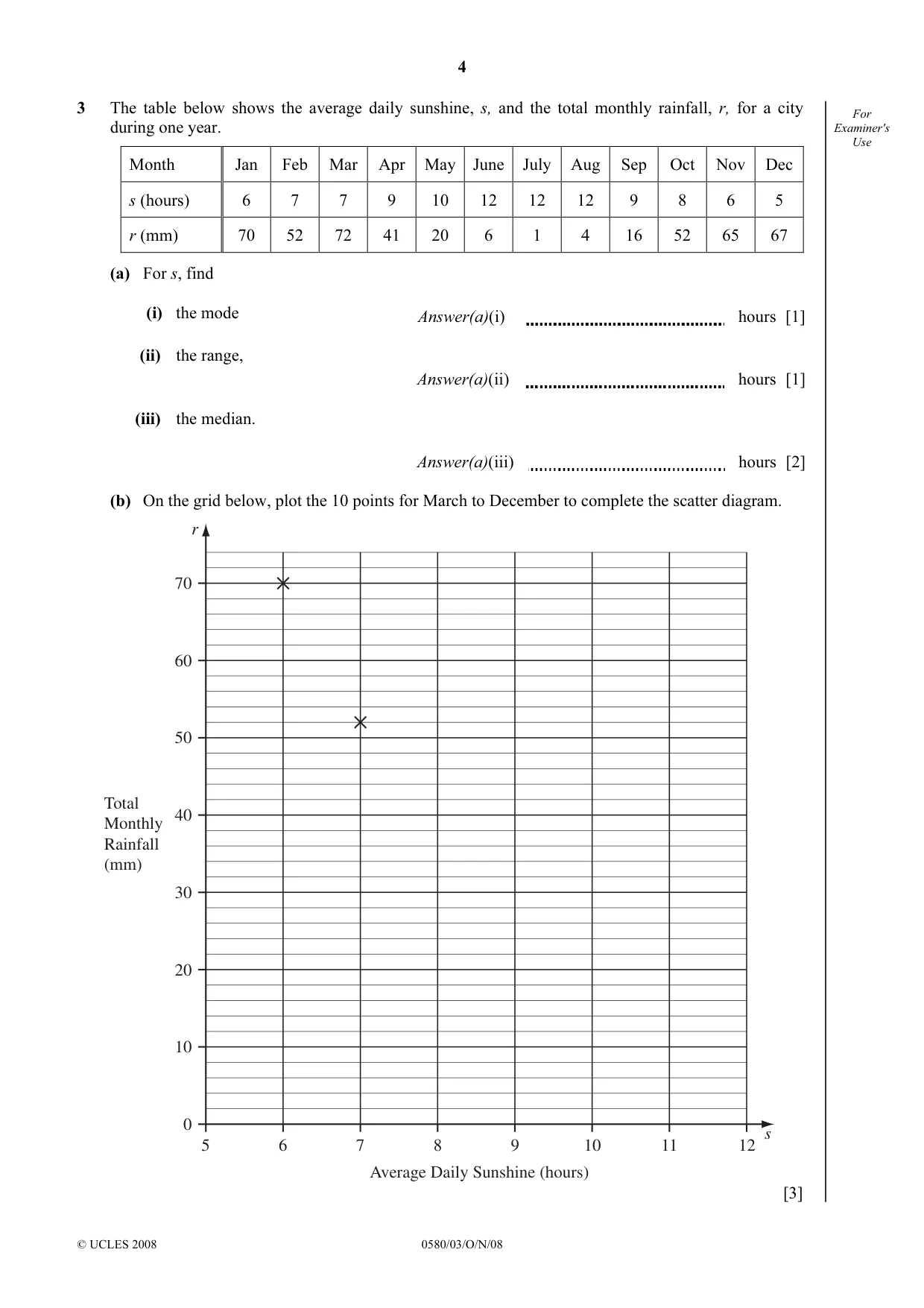
4 © UCLES 2008 0580/03/O/N/08 For Examiner's Use 3 The table below shows the average daily sunshine, s, and the total monthly rainfall, r, for a city during one year. Month Jan Feb Mar Apr May June July Aug Sep Oct Nov Dec s (hours) 6 7 7 9 10 12 12 12 9 8 6 5 r (mm) 70 52 72 41 20 6 1 4 16 52 65 67 (a) For s, find (i) the mode Answer(a)(i) hours [1] (ii) the range, Answer(a)(ii) hours [1] (iii) the median. Answer(a)(iii) hours [2] (b) On the grid below, plot the 10 points for March to December to complete the scatter diagram. 70 60 50 40 30 20 10 0 5 6 7 8 9 10 11 12 Average Daily Sunshine (hours) Total Monthly Rainfall (mm) s r [3]
Question paper, page 5
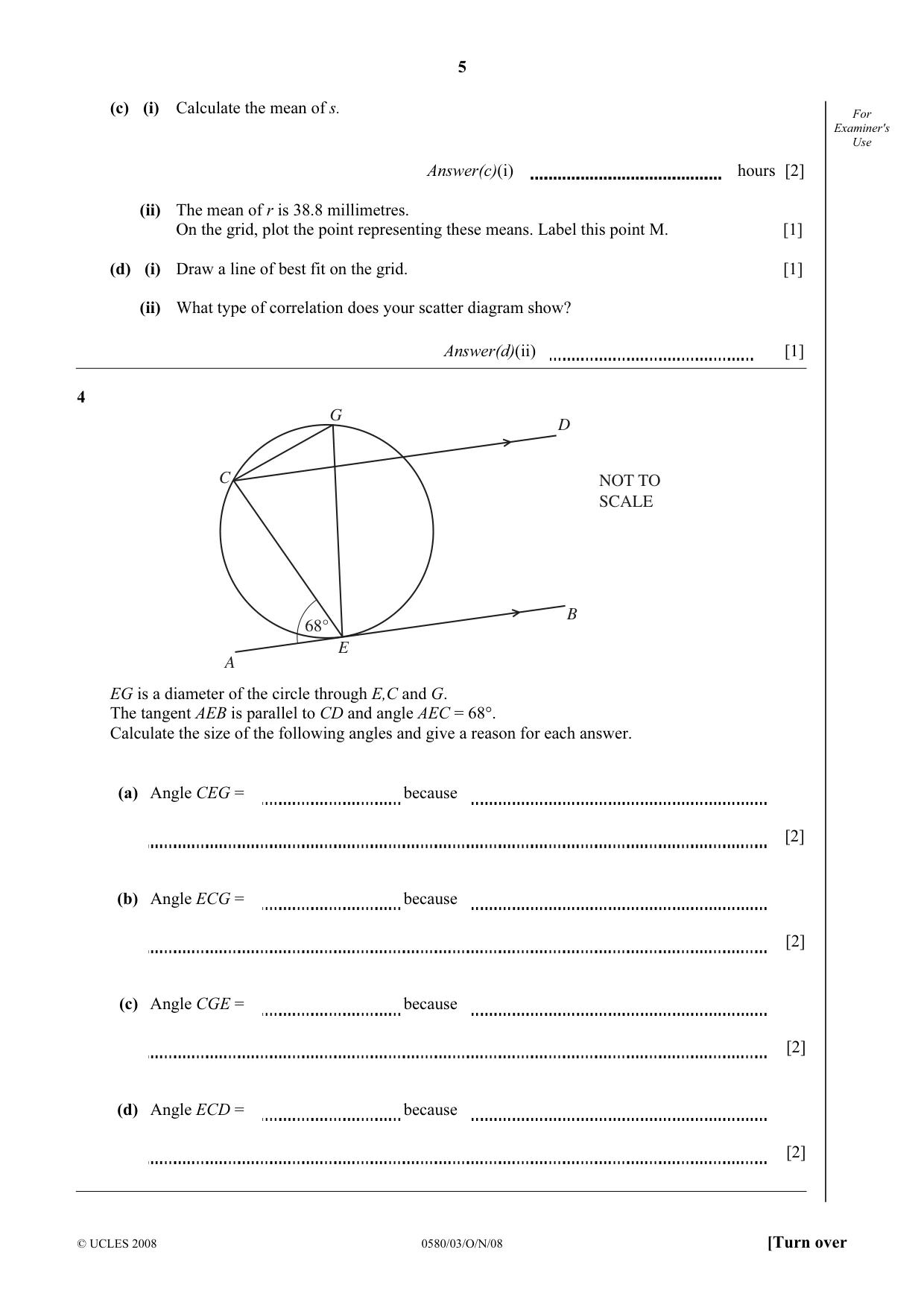
5 © UCLES 2008 0580/03/O/N/08 [Turn over For Examiner's Use (c) (i) Calculate the mean of s. Answer(c)(i) hours [2] (ii) The mean of r is 38.8 millimetres. On the grid, plot the point representing these means. Label this point M. [1] (d) (i) Draw a line of best fit on the grid. [1] (ii) What type of correlation does your scatter diagram show? Answer(d)(ii) [1] 4 68° A E B D C G NOT TO SCALE EG is a diameter of the circle through E,C and G. The tangent AEB is parallel to CD and angle AEC = 68°. Calculate the size of the following angles and give a reason for each answer. (a) Angle CEG = because [2] (b) Angle ECG = because [2] (c) Angle CGE = because [2] (d) Angle ECD = because [2]
Question paper, page 6
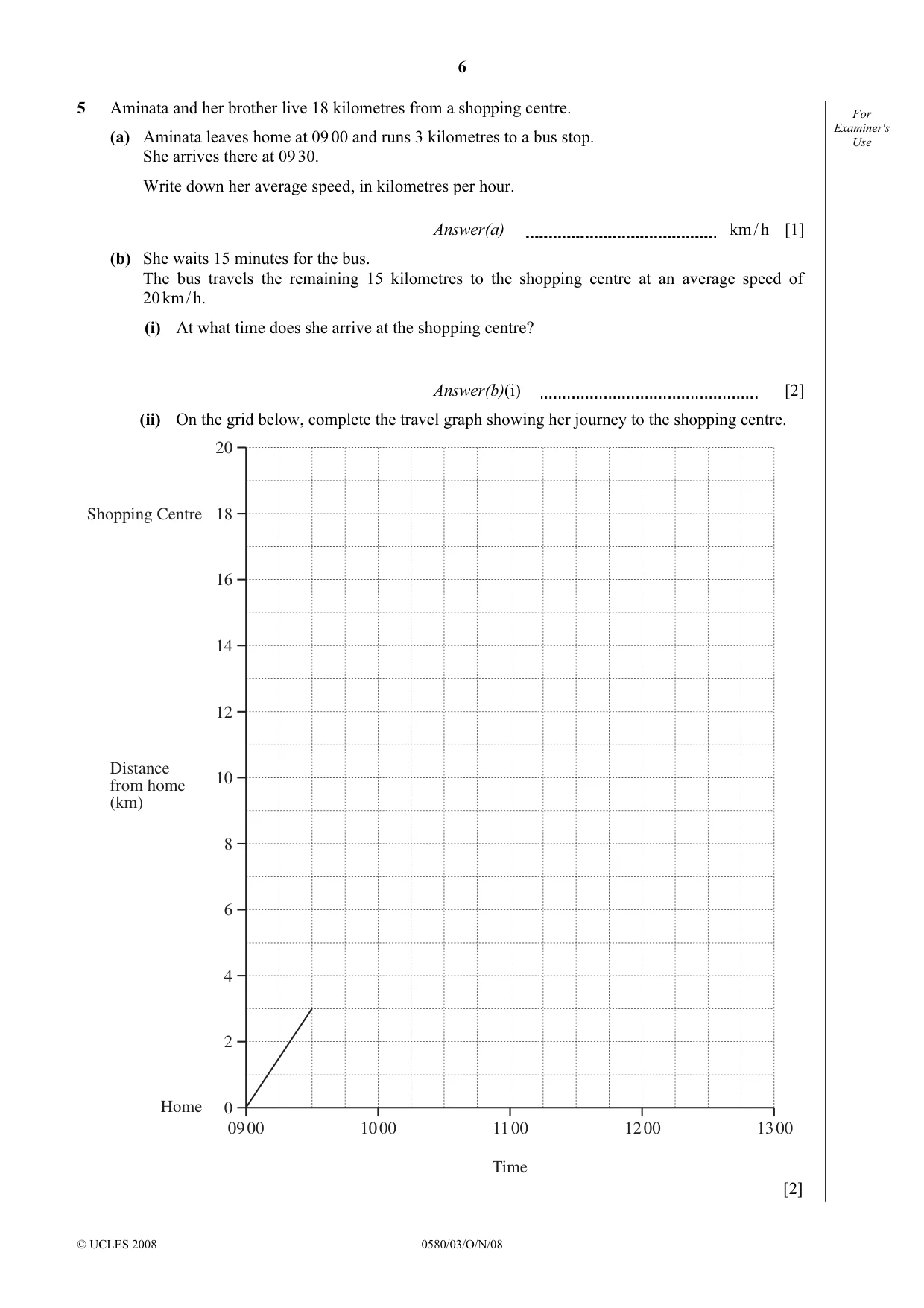
6 © UCLES 2008 0580/03/O/N/08 For Examiner's Use 5 Aminata and her brother live 18 kilometres from a shopping centre. (a) Aminata leaves home at 09 00 and runs 3 kilometres to a bus stop. She arrives there at 09 30. Write down her average speed, in kilometres per hour. Answer(a) km / h [1] (b) She waits 15 minutes for the bus. The bus travels the remaining 15 kilometres to the shopping centre at an average speed of 20 km / h. (i) At what time does she arrive at the shopping centre? Answer(b)(i) [2] (ii) On the grid below, complete the travel graph showing her journey to the shopping centre. 20 18 16 14 12 10 8 6 4 2 0 09 00 10 00 11 00 12 00 13 00 Time Home Shopping Centre Distance from home (km) [2]
Question paper, page 7
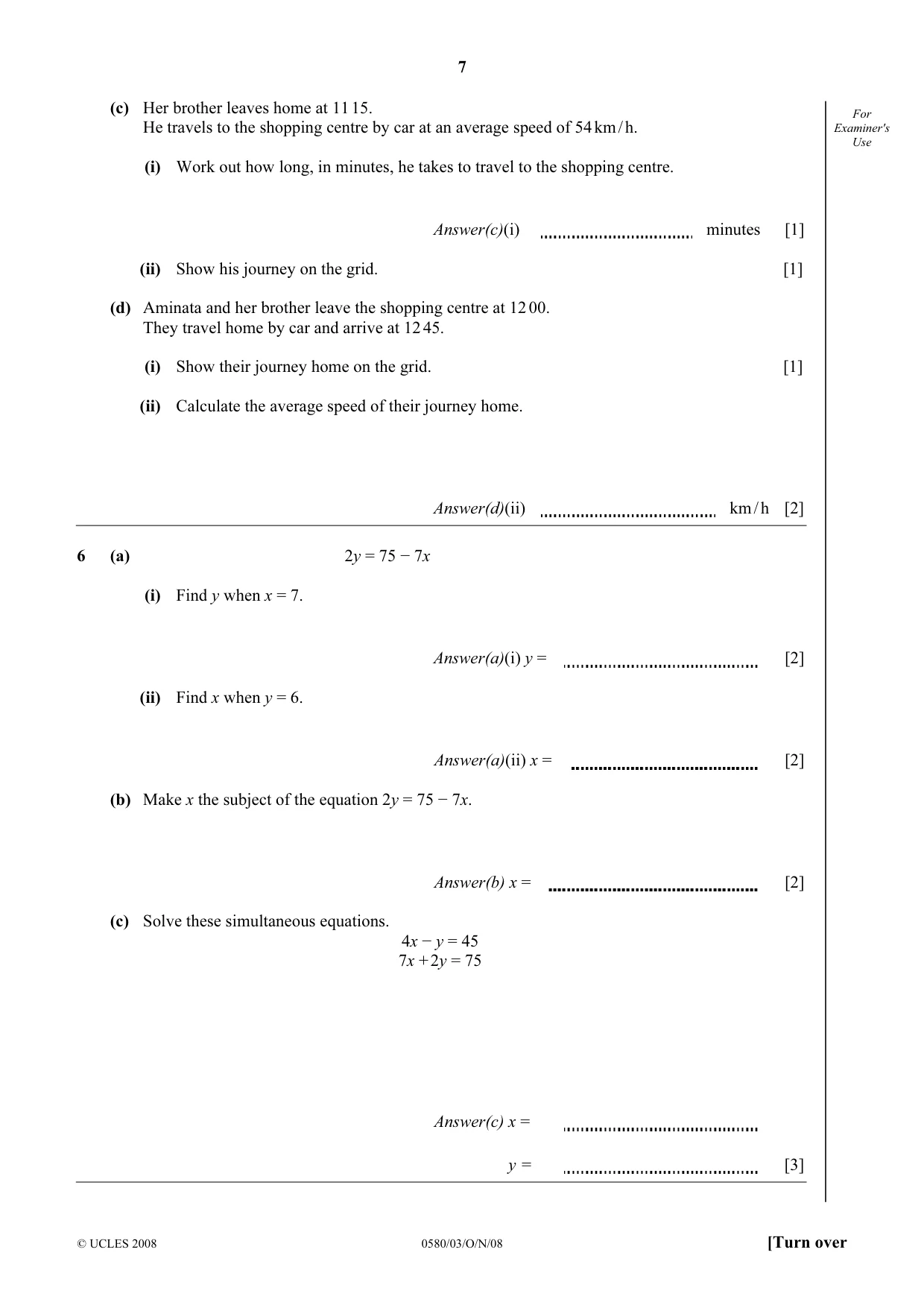
7 © UCLES 2008 0580/03/O/N/08 [Turn over For Examiner's Use (c) Her brother leaves home at 11 15. He travels to the shopping centre by car at an average speed of 54 km / h. (i) Work out how long, in minutes, he takes to travel to the shopping centre. Answer(c)(i) minutes [1] (ii) Show his journey on the grid. [1] (d) Aminata and her brother leave the shopping centre at 12 00. They travel home by car and arrive at 12 45. (i) Show their journey home on the grid. [1] (ii) Calculate the average speed of their journey home. Answer(d)(ii) km / h [2] 6 (a) 2y = 75 − 7x (i) Find y when x = 7. Answer(a)(i) y = [2] (ii) Find x when y = 6. Answer(a)(ii) x = [2] (b) Make x the subject of the equation 2y = 75 − 7x. Answer(b) x = [2] (c) Solve these simultaneous equations. 4x − y = 45 7x + 2y = 75 Answer(c) x = y = [3]
Question paper, page 8
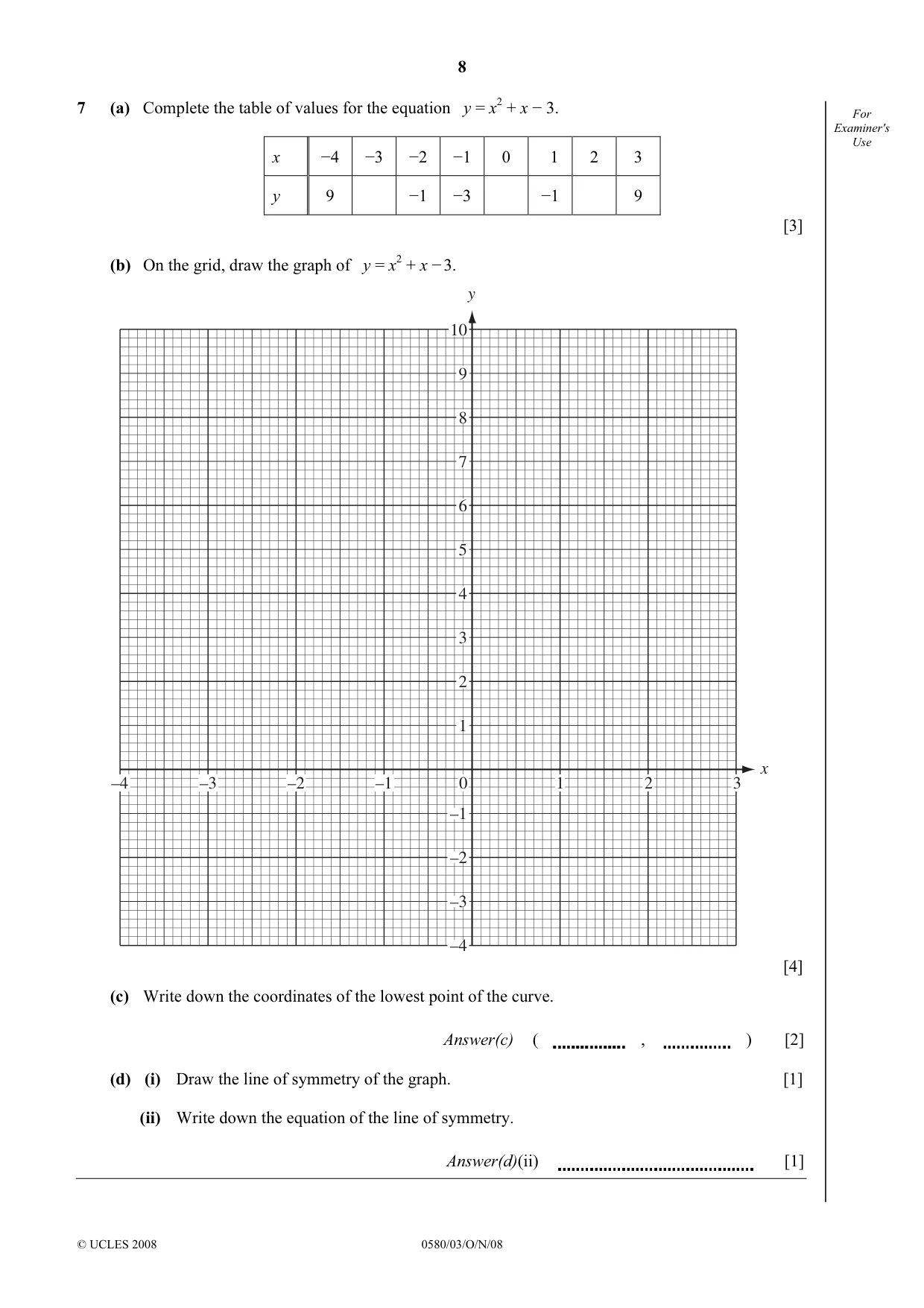
8 © UCLES 2008 0580/03/O/N/08 For Examiner's Use 7 (a) Complete the table of values for the equation y = x2 + x − 3. x −4 −3 −2 −1 0 1 2 3 y 9 −1 −3 −1 9 [3] (b) On the grid, draw the graph of y = x2 + x − 3. y x 10 9 8 7 6 5 4 3 2 1 –1 –2 –3 –4 –4 –3 –2 –1 0 1 2 3 [4] (c) Write down the coordinates of the lowest point of the curve. Answer(c) ( , ) [2] (d) (i) Draw the line of symmetry of the graph. [1] (ii) Write down the equation of the line of symmetry. Answer(d)(ii) [1]
Question paper, page 9
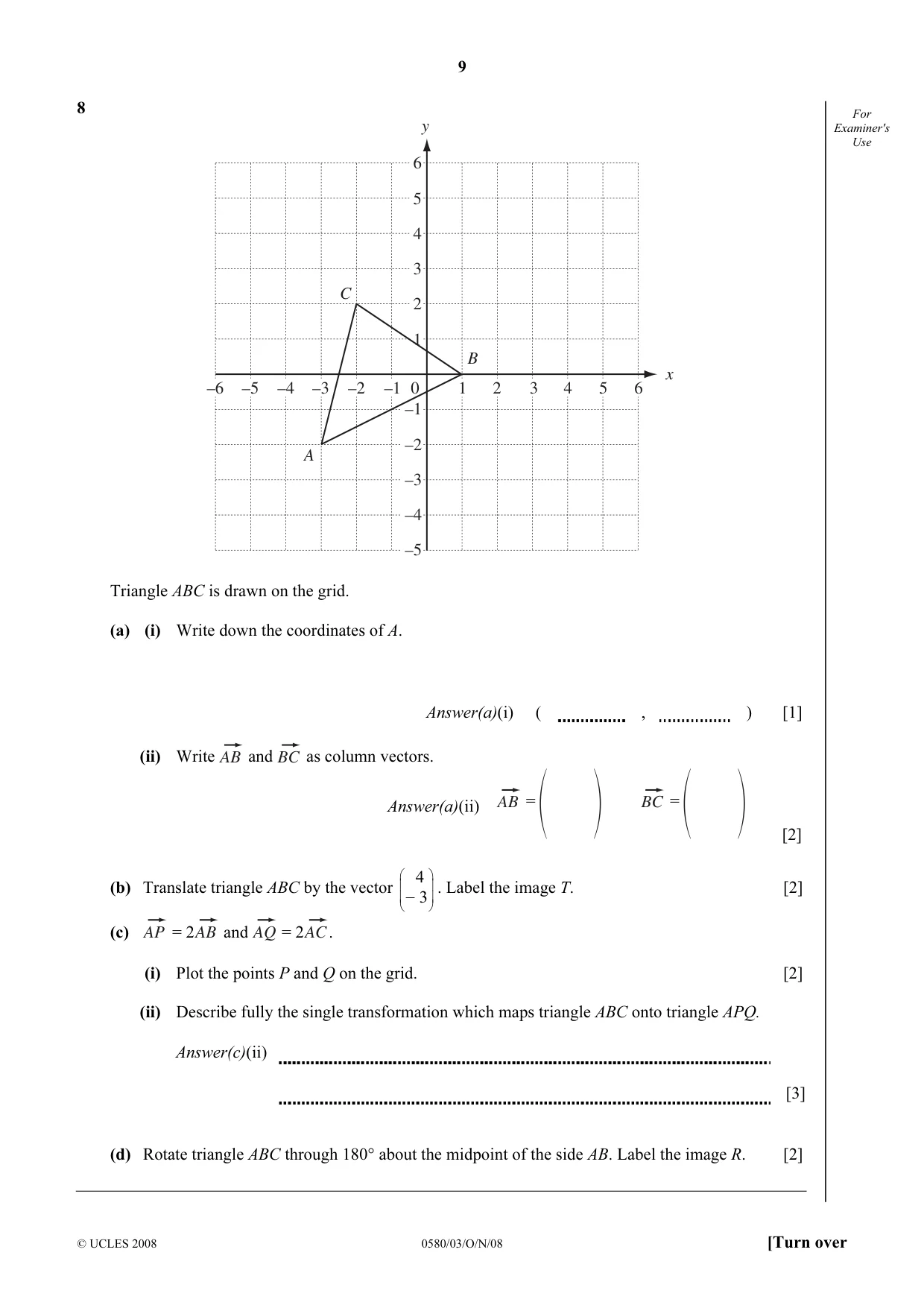
9 © UCLES 2008 0580/03/O/N/08 [Turn over For Examiner's Use 8 A y x C B 6 5 4 3 2 1 –1 –2 –3 –4 –5 –4 –5 –6 –3 –2 –1 0 1 2 3 4 5 6 Triangle ABC is drawn on the grid. (a) (i) Write down the coordinates of A. Answer(a)(i) ( , ) [1] (ii) Write AB and BC as column vectors. Answer(a)(ii) AB = BC = [2] (b) Translate triangle ABC by the vector 4 _ 3 . Label the image T. [2] (c) AP = 2AB and AQ = 2AC. (i) Plot the points P and Q on the grid. [2] (ii) Describe fully the single transformation which maps triangle ABC onto triangle APQ. Answer(c)(ii) [3] (d) Rotate triangle ABC through 180° about the midpoint of the side AB. Label the image R. [2]
Question paper, page 10
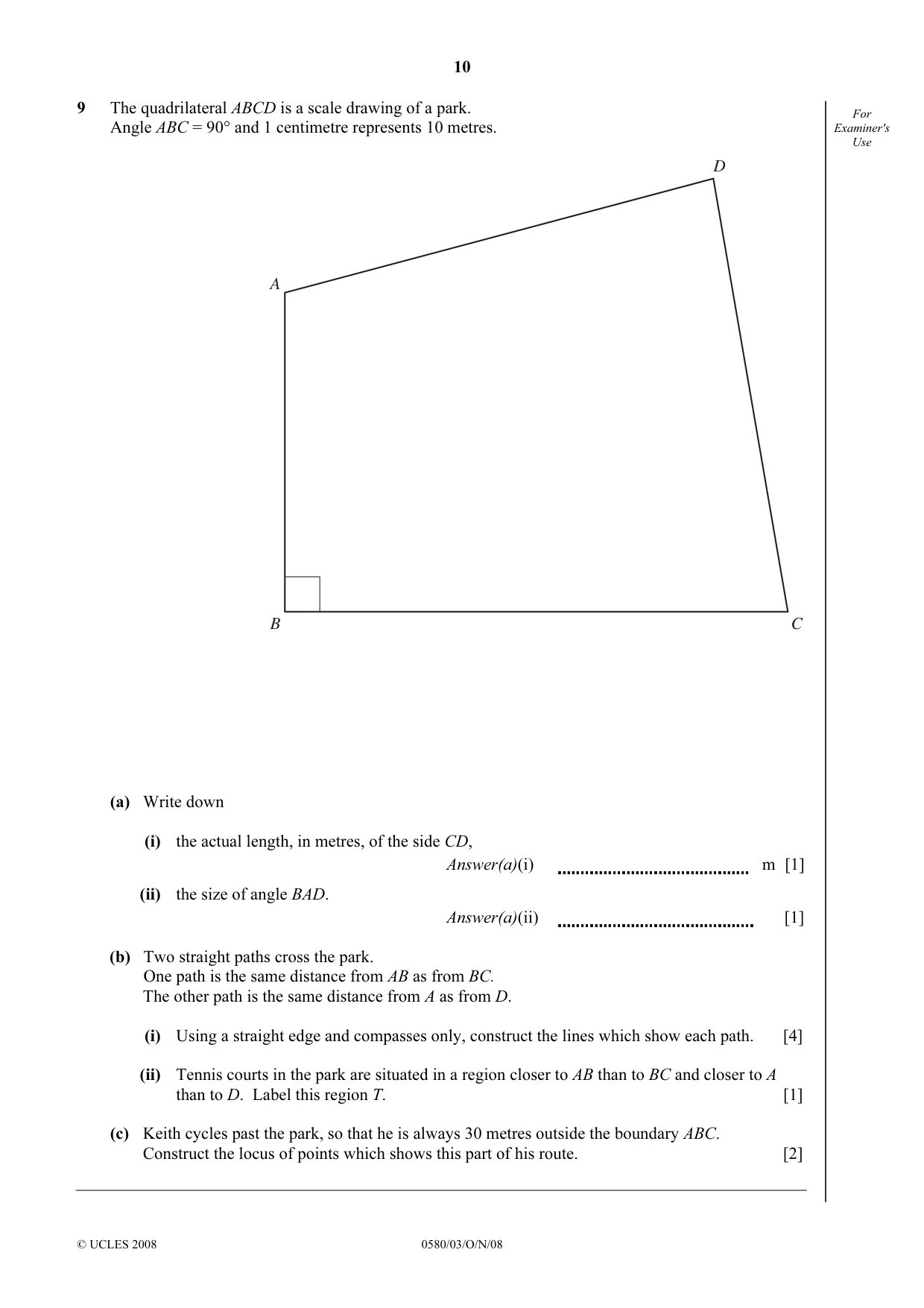
10 © UCLES 2008 0580/03/O/N/08 For Examiner's Use 9 The quadrilateral ABCD is a scale drawing of a park. Angle ABC = 90° and 1 centimetre represents 10 metres. A B C D (a) Write down (i) the actual length, in metres, of the side CD, Answer(a)(i) m [1] (ii) the size of angle BAD. Answer(a)(ii) [1] (b) Two straight paths cross the park. One path is the same distance from AB as from BC. The other path is the same distance from A as from D. (i) Using a straight edge and compasses only, construct the lines which show each path. [4] (ii) Tennis courts in the park are situated in a region closer to AB than to BC and closer to A than to D. Label this region T. [1] (c) Keith cycles past the park, so that he is always 30 metres outside the boundary ABC. Construct the locus of points which shows this part of his route. [2]
Question paper, page 11
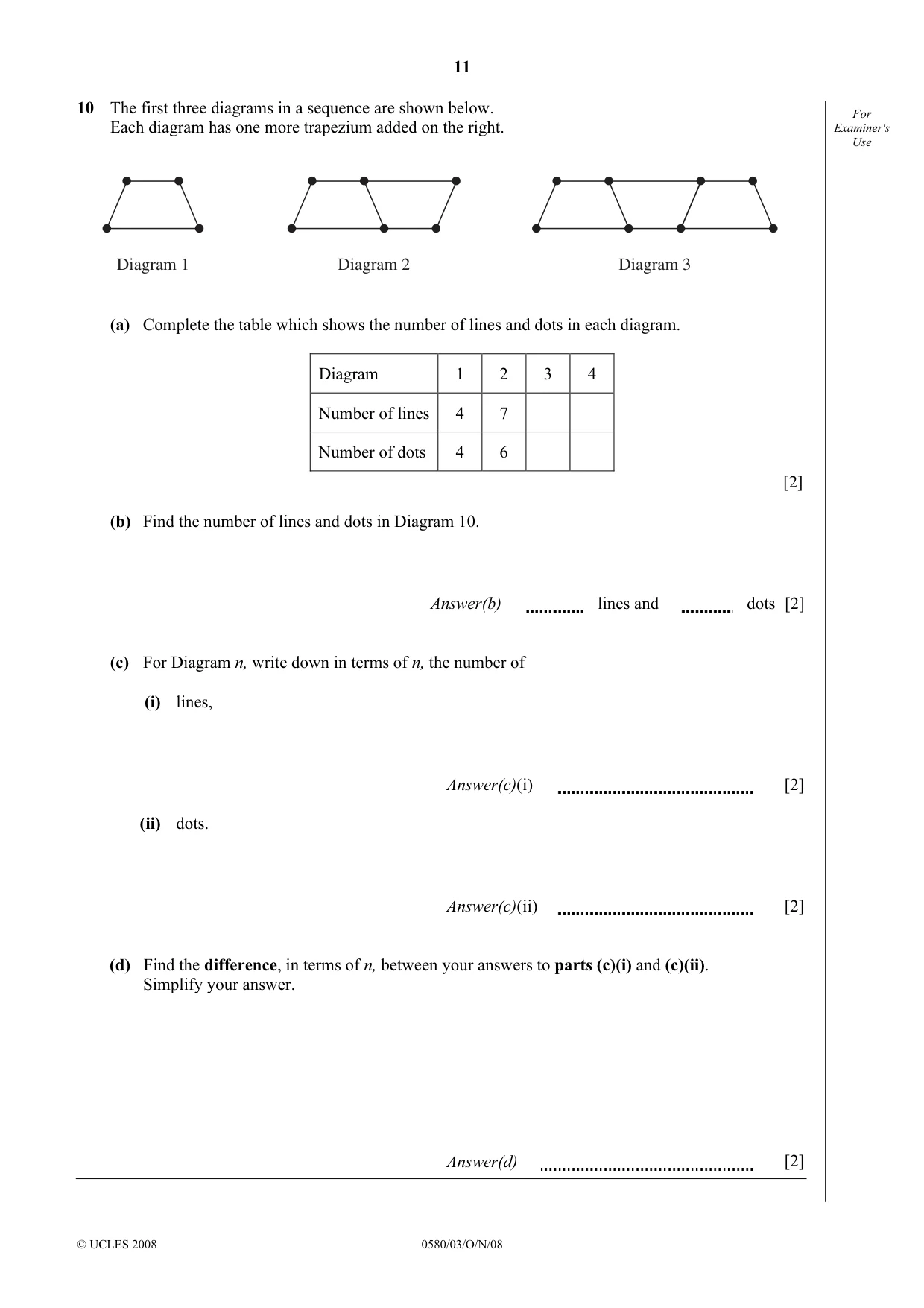
11 © UCLES 2008 0580/03/O/N/08 For Examiner's Use 10 The first three diagrams in a sequence are shown below. Each diagram has one more trapezium added on the right. Diagram 1 Diagram 2 Diagram 3 (a) Complete the table which shows the number of lines and dots in each diagram. Diagram 1 2 3 4 Number of lines 4 7 Number of dots 4 6 [2] (b) Find the number of lines and dots in Diagram 10. Answer(b) lines and dots [2] (c) For Diagram n, write down in terms of n, the number of (i) lines, Answer(c)(i) [2] (ii) dots. Answer(c)(ii) [2] (d) Find the difference, in terms of n, between your answers to parts (c)(i) and (c)(ii). Simplify your answer. Answer(d) [2]
Question paper, page 12
12 Permission to reproduce items where third-party owned material protected by copyright is included has been sought and cleared where possible. Every reasonable effort has been made by the publisher (UCLES) to trace copyright holders, but if any items requiring clearance have unwittingly been included, the publisher will be pleased to make amends at the earliest possible opportunity. University of Cambridge International Examinations is part of the Cambridge Assessment Group. Cambridge Assessment is the brand name of University of Cambridge Local Examinations Syndicate (UCLES), which is itself a department of the University of Cambridge. 0580/03/O/N/08 BLANK PAGE
Mark scheme, page 1
UNIVERSITY OF CAMBRIDGE INTERNATIONAL EXAMINATIONS International General Certificate of Secondary Education MARK SCHEME for the October/November 2008 question paper 0580 and 0581 MATHEMATICS 0580/03 and 0581/03 Paper 3 (Core), maximum raw mark 104 This mark scheme is published as an aid to teachers and candidates, to indicate the requirements of the examination. It shows the basis on which Examiners were instructed to award marks. It does not indicate the details of the discussions that took place at an Examiners’ meeting before marking began. All Examiners are instructed that alternative correct answers and unexpected approaches in candidates’ scripts must be given marks that fairly reflect the relevant knowledge and skills demonstrated. Mark schemes must be read in conjunction with the question papers and the report on the examination. • CIE will not enter into discussions or correspondence in connection with these mark schemes. CIE is publishing the mark schemes for the October/November 2008 question papers for most IGCSE, GCE Advanced Level and Advanced Subsidiary Level syllabuses and some Ordinary Level syllabuses. www.XtremePapers.com
Mark scheme, page 2
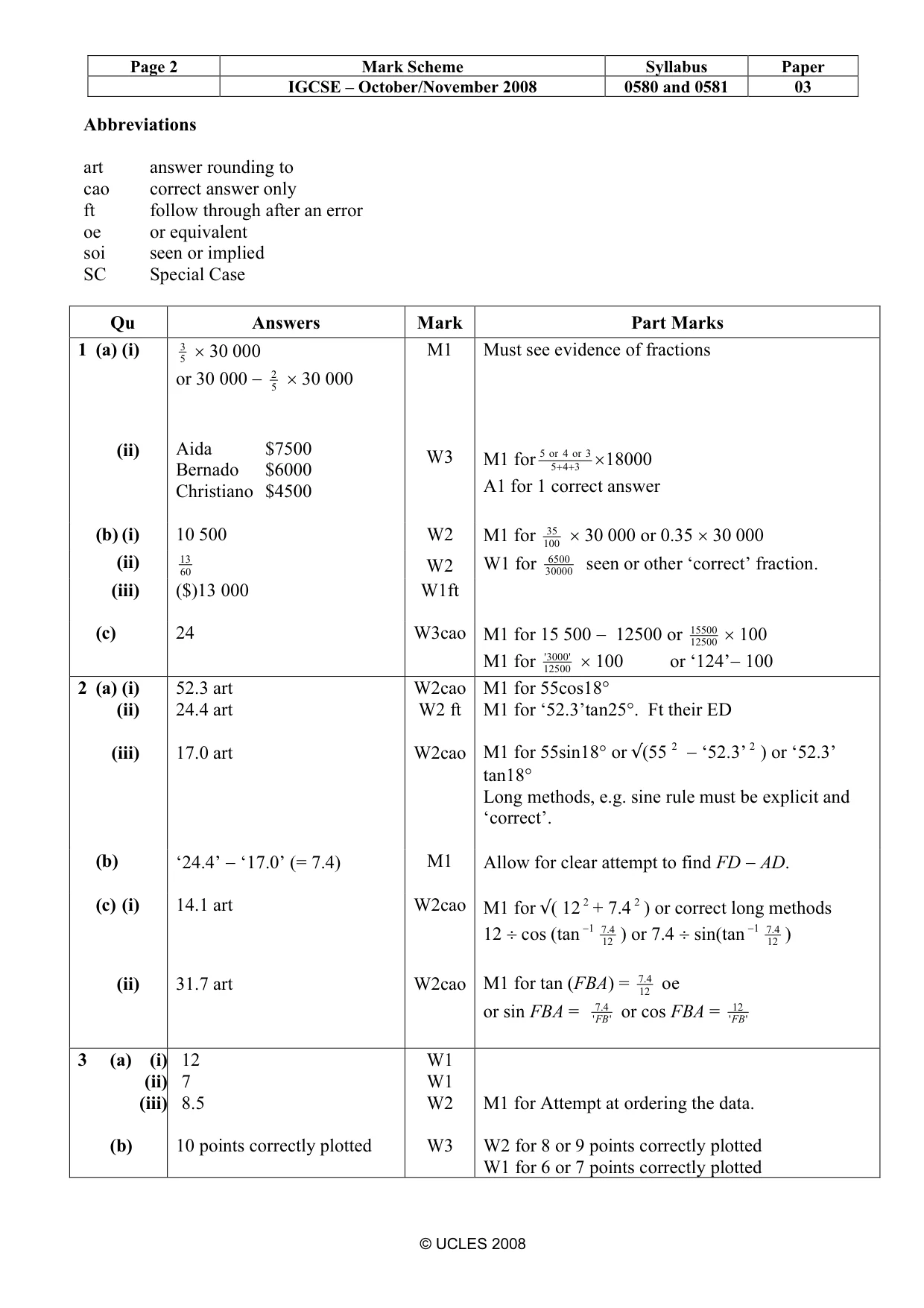
Page 2 Mark Scheme Syllabus Paper IGCSE – October/November 2008 0580 and 0581 03 © UCLES 2008 Abbreviations art answer rounding to cao correct answer only ft follow through after an error oe or equivalent soi seen or implied SC Special Case Qu Answers Mark Part Marks 1 (a) (i) (ii) 5 3 × 30 000 or 30 000 − 5 2 × 30 000 Aida $7500 Bernado $6000 Christiano $4500 M1 W3 Must see evidence of fractions M1 for 18000 3 4 5 3 or 4 or 5 × + + A1 for 1 correct answer (b) (i) 10 500 W2 M1 for 100 35 × 30 000 or 0.35 × 30 000 (ii) 60 13 W2 W1 for 30000 6500 seen or other ‘correct’ fraction. (iii) ($)13 000 W1ft (c) 24 W3cao M1 for 15 500 − 12500 or 15500 12500 × 100 M1 for 12500 ' 3000 ' × 100 or ‘124’− 100 2 (a) (i) (ii) (iii) 52.3 art 24.4 art 17.0 art W2cao W2 ft W2cao M1 for 55cos18° M1 for ‘52.3’tan25°. Ft their ED M1 for 55sin18° or √(55 2 − ‘52.3’ 2 ) or ‘52.3’ tan18° Long methods, e.g. sine rule must be explicit and ‘correct’. (b) ‘24.4’ − ‘17.0’ (= 7.4) M1 Allow for clear attempt to find FD − AD. (c) (i) (ii) 14.1 art 31.7 art W2cao W2cao M1 for √( 12 2 + 7.4 2 ) or correct long methods 12 ÷ cos (tan 1 − 12 4.7 ) or 7.4 ÷ sin(tan 1 − 12 4.7 ) M1 for tan (FBA) = 12 4.7 oe or sin FBA = ' ' 4.7 FB or cos FBA = ' ' 12 FB 3 (a) (i) (ii) (iii) (b) 12 7 8.5 10 points correctly plotted W1 W1 W2 W3 M1 for Attempt at ordering the data. W2 for 8 or 9 points correctly plotted W1 for 6 or 7 points correctly plotted
Mark scheme, page 3
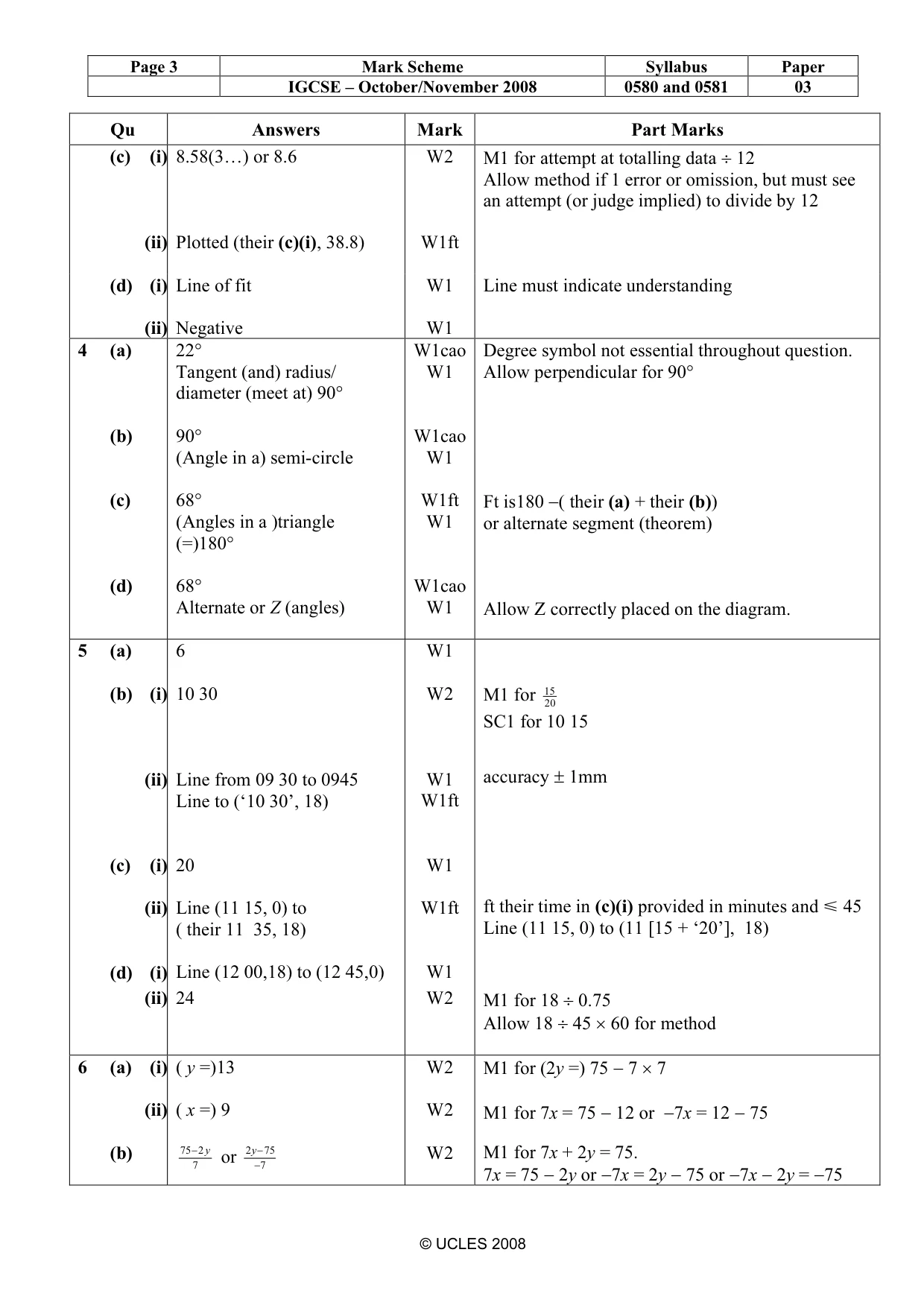
Page 3 Mark Scheme Syllabus Paper IGCSE – October/November 2008 0580 and 0581 03 © UCLES 2008 Qu Answers Mark Part Marks (c) (i) (ii) 8.58(3…) or 8.6 Plotted (their (c)(i), 38.8) W2 W1ft M1 for attempt at totalling data ÷ 12 Allow method if 1 error or omission, but must see an attempt (or judge implied) to divide by 12 (d) (i) (ii) Line of fit Negative W1 W1 Line must indicate understanding 4 (a) (b) (c) (d) 22° Tangent (and) radius/ diameter (meet at) 90° 90° (Angle in a) semi-circle 68° (Angles in a )triangle (=)180° 68° Alternate or Z (angles) W1cao W1 W1cao W1 W1ft W1 W1cao W1 Degree symbol not essential throughout question. Allow perpendicular for 90° Ft is180 −( their (a) + their (b)) or alternate segment (theorem) Allow Z correctly placed on the diagram. 5 (a) (b) (i) (ii) (c) (i) (ii) (d) (i) (ii) 6 10 30 Line from 09 30 to 0945 Line to (‘10 30’, 18) 20 Line (11 15, 0) to ( their 11 35, 18) Line (12 00,18) to (12 45,0) 24 W1 W2 W1 W1ft W1 W1ft W1 W2 M1 for 20 15 SC1 for 10 15 accuracy ± 1mm ft their time in (c)(i) provided in minutes and Y 45 Line (11 15, 0) to (11 [15 + ‘20’], 18) M1 for 18 ÷ 0.75 Allow 18 ÷ 45 × 60 for method 6 (a) (i) (ii) (b) ( y =)13 ( x =) 9 7 2 75 y − or 2y−75 −7 W2 W2 W2 M1 for (2y =) 75 − 7 × 7 M1 for 7x = 75 − 12 or −7x = 12 − 75 M1 for 7x + 2y = 75. 7x = 75 − 2y or −7x = 2y − 75 or −7x − 2y = −75
Mark scheme, page 4
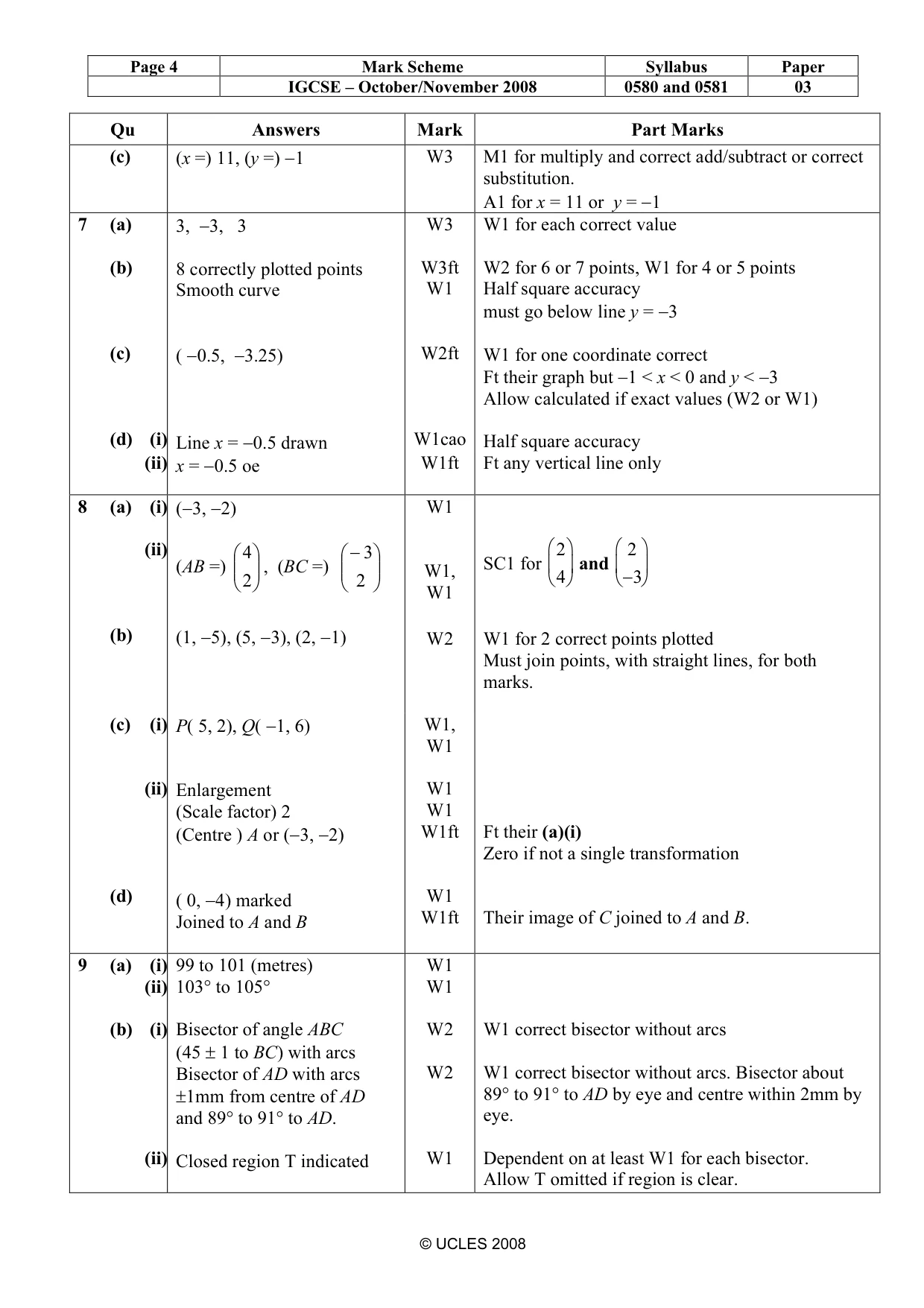
Page 4 Mark Scheme Syllabus Paper IGCSE – October/November 2008 0580 and 0581 03 © UCLES 2008 Qu Answers Mark Part Marks (c) (x =) 11, (y =) −1 W3 M1 for multiply and correct add/subtract or correct substitution. A1 for x = 11 or y = −1 7 (a) (b) (c) (d) (i) (ii) 3, −3, 3 8 correctly plotted points Smooth curve ( −0.5, −3.25) Line x = −0.5 drawn x = −0.5 oe W3 W3ft W1 W2ft W1cao W1ft W1 for each correct value W2 for 6 or 7 points, W1 for 4 or 5 points Half square accuracy must go below line y = −3 W1 for one coordinate correct Ft their graph but −1 < x < 0 and y < −3 Allow calculated if exact values (W2 or W1) Half square accuracy Ft any vertical line only 8 (a) (i) (ii) (b) (−3, −2) (AB =) 2 4 , (BC =) − 2 3 (1, −5), (5, −3), (2, −1) W1 W1, W1 W2 SC1 for 2 4 and 2 −3 W1 for 2 correct points plotted Must join points, with straight lines, for both marks. (c) (i) (ii) (d) P( 5, 2), Q( −1, 6) Enlargement (Scale factor) 2 (Centre ) A or (−3, −2) ( 0, −4) marked Joined to A and B W1, W1 W1 W1 W1ft W1 W1ft Ft their (a)(i) Zero if not a single transformation Their image of C joined to A and B. 9 (a) (i) (ii) (b) (i) (ii) 99 to 101 (metres) 103° to 105° Bisector of angle ABC (45 ± 1 to BC) with arcs Bisector of AD with arcs ±1mm from centre of AD and 89° to 91° to AD. Closed region T indicated W1 W1 W2 W2 W1 W1 correct bisector without arcs W1 correct bisector without arcs. Bisector about 89° to 91° to AD by eye and centre within 2mm by eye. Dependent on at least W1 for each bisector. Allow T omitted if region is clear.
Mark scheme, page 5
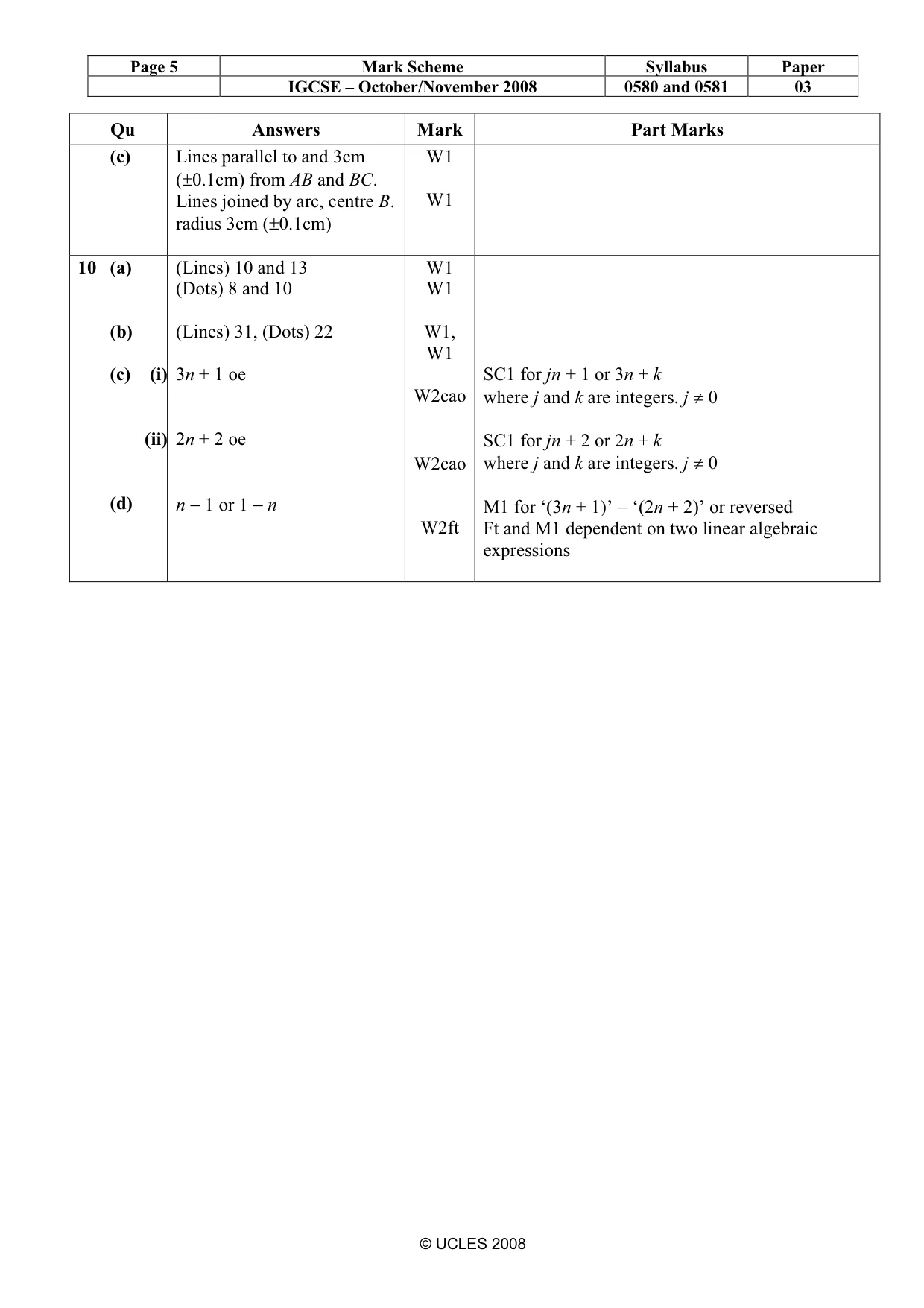
Page 5 Mark Scheme Syllabus Paper IGCSE – October/November 2008 0580 and 0581 03 © UCLES 2008 Qu Answers Mark Part Marks (c) Lines parallel to and 3cm (±0.1cm) from AB and BC. Lines joined by arc, centre B. radius 3cm (±0.1cm) W1 W1 10 (a) (b) (c) (i) (ii) (d) (Lines) 10 and 13 (Dots) 8 and 10 (Lines) 31, (Dots) 22 3n + 1 oe 2n + 2 oe n − 1 or 1 − n W1 W1 W1, W1 W2cao W2cao W2ft SC1 for jn + 1 or 3n + k where j and k are integers. j ≠ 0 SC1 for jn + 2 or 2n + k where j and k are integers. j ≠ 0 M1 for ‘(3n + 1)’ − ‘(2n + 2)’ or reversed Ft and M1 dependent on two linear algebraic expressions
What you needed in this session
Cambridge’s own grade thresholds for 2008 Oct/Nov, Paper 3 · Variant 1. A higher threshold means an easier paper — the bar moves with how the cohort did.