Cambridge IGCSE Mathematics (with coursework) 0581 — 2008 May/June Paper 3 · Variant 1
0581/31/M/J/08 · 104 marks · ≈117 min
The question paper and its mark scheme, free to read here and free to download. This is Cambridge’s own paper, exactly as it was sat.
Question paper16 pages
Mark scheme5 pages
Answers below. Sit the paper first if you are practising.
Paper as text
Question paper, page 1
This document consists of 15 printed pages and 1 blank page. IB08 06_0580_03/4RP © UCLES 2008 [Turn over *7626748314* For Examiner's Use UNIVERSITY OF CAMBRIDGE INTERNATIONAL EXAMINATIONS International General Certificate of Secondary Education MATHEMATICS 0580/03, 0581/03 Paper 3 (Core) May/June 2008 2 hours Candidates answer on the Question Paper. Additional Materials: Electronic calculator Geometrical instruments Mathematical tables (optional) Tracing paper (optional) READ THESE INSTRUCTIONS FIRST Write your Centre number, candidate number and name on all the work you hand in. Write in dark blue or black pen. You may use a soft pencil for any diagrams or graphs. Do not use staples, paper clips, highlighters, glue or correction fluid. DO NOT WRITE IN ANY BARCODES. Answer all questions. If working is needed for any question it must be shown below that question. Electronic calculators should be used. If the degree of accuracy is not specified in the question, and if the answer is not exact, give the answer to three significant figures. Give answers in degrees to one decimal place. For π , use either your calculator value or 3.142. At the end of the examination, fasten all your work securely together. The number of marks is given in brackets [ ] at the end of each question or part question. The total of the marks for this paper is 104. www.XtremePapers.com
Question paper, page 2
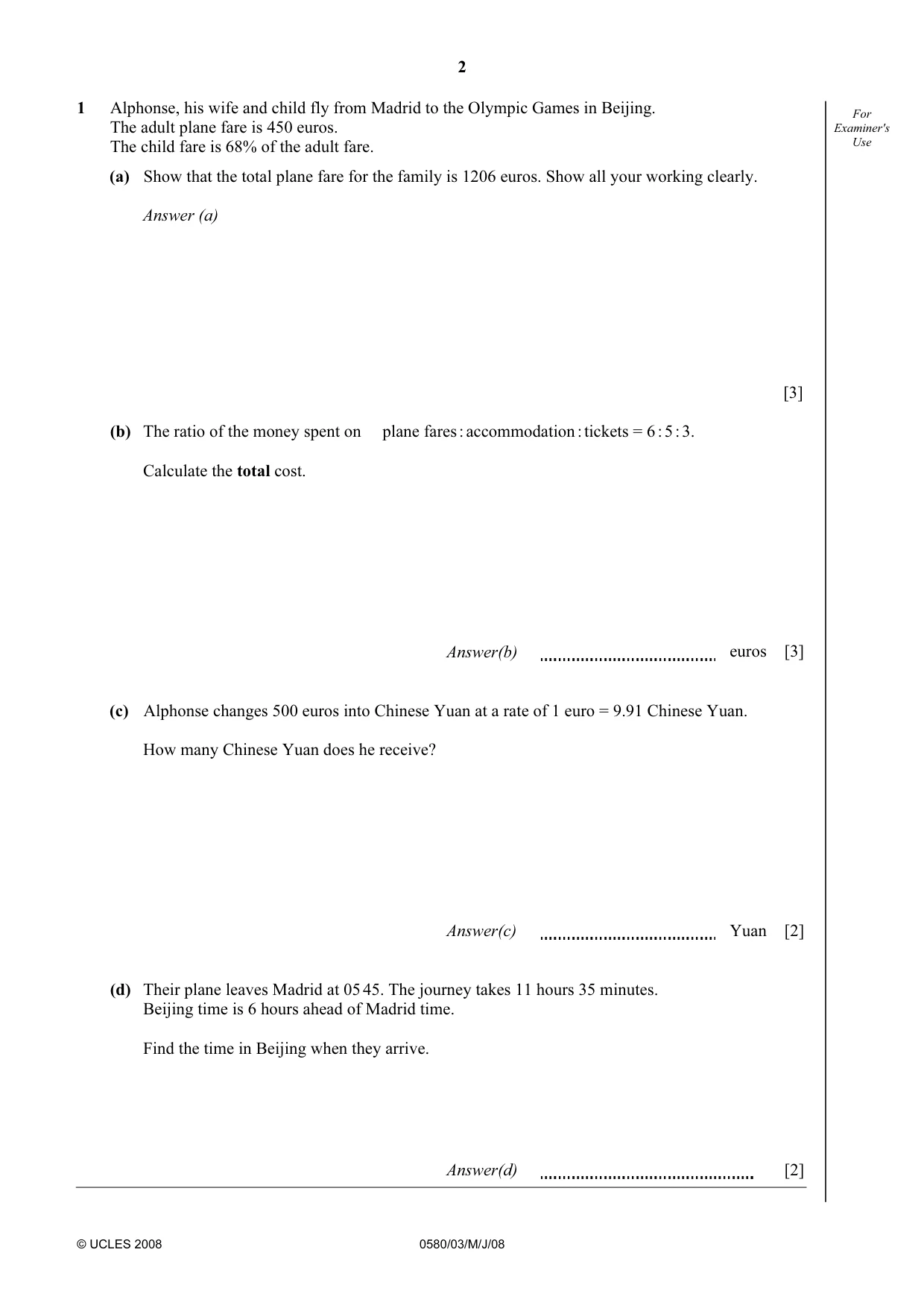
2 © UCLES 2008 0580/03/M/J/08 For Examiner's Use 1 Alphonse, his wife and child fly from Madrid to the Olympic Games in Beijing. The adult plane fare is 450 euros. The child fare is 68% of the adult fare. (a) Show that the total plane fare for the family is 1206 euros. Show all your working clearly. Answer (a) [3] (b) The ratio of the money spent on plane fares : accommodation : tickets = 6 : 5 : 3. Calculate the total cost. Answer(b) euros [3] (c) Alphonse changes 500 euros into Chinese Yuan at a rate of 1 euro = 9.91 Chinese Yuan. How many Chinese Yuan does he receive? Answer(c) Yuan [2] (d) Their plane leaves Madrid at 05 45. The journey takes 11 hours 35 minutes. Beijing time is 6 hours ahead of Madrid time. Find the time in Beijing when they arrive. Answer(d) [2]
Question paper, page 3
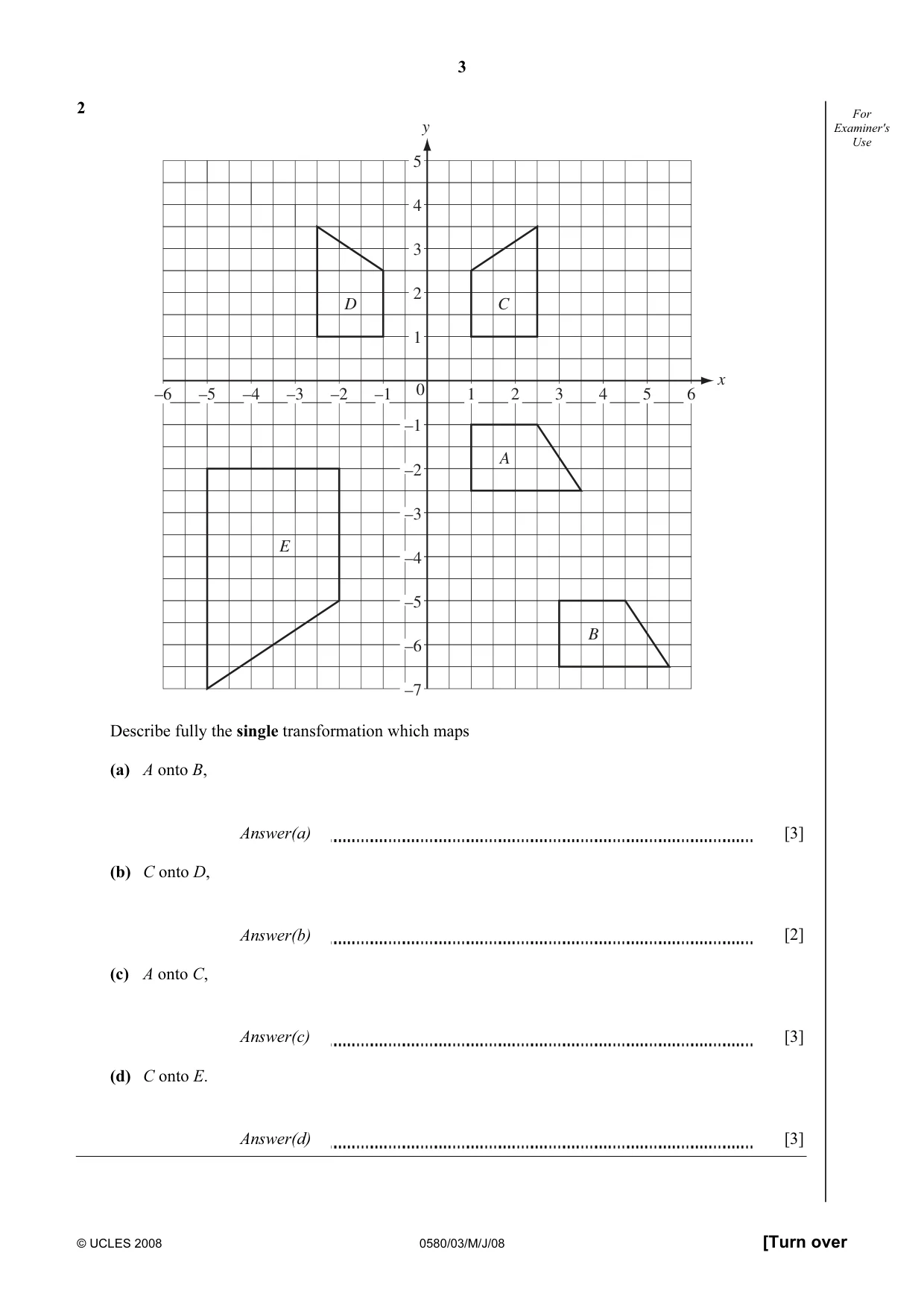
3 © UCLES 2008 0580/03/M/J/08 [Turn over For Examiner's Use 2 5 4 3 2 1 –1 –2 –3 –4 –5 –6 –7 –6 –5 –4 –3 –2 –1 1 2 3 4 5 6 0 A B C D E y x Describe fully the single transformation which maps (a) A onto B, Answer(a) [3] (b) C onto D, Answer(b) [2] (c) A onto C, Answer(c) [3] (d) C onto E. Answer(d) [3]
Question paper, page 4
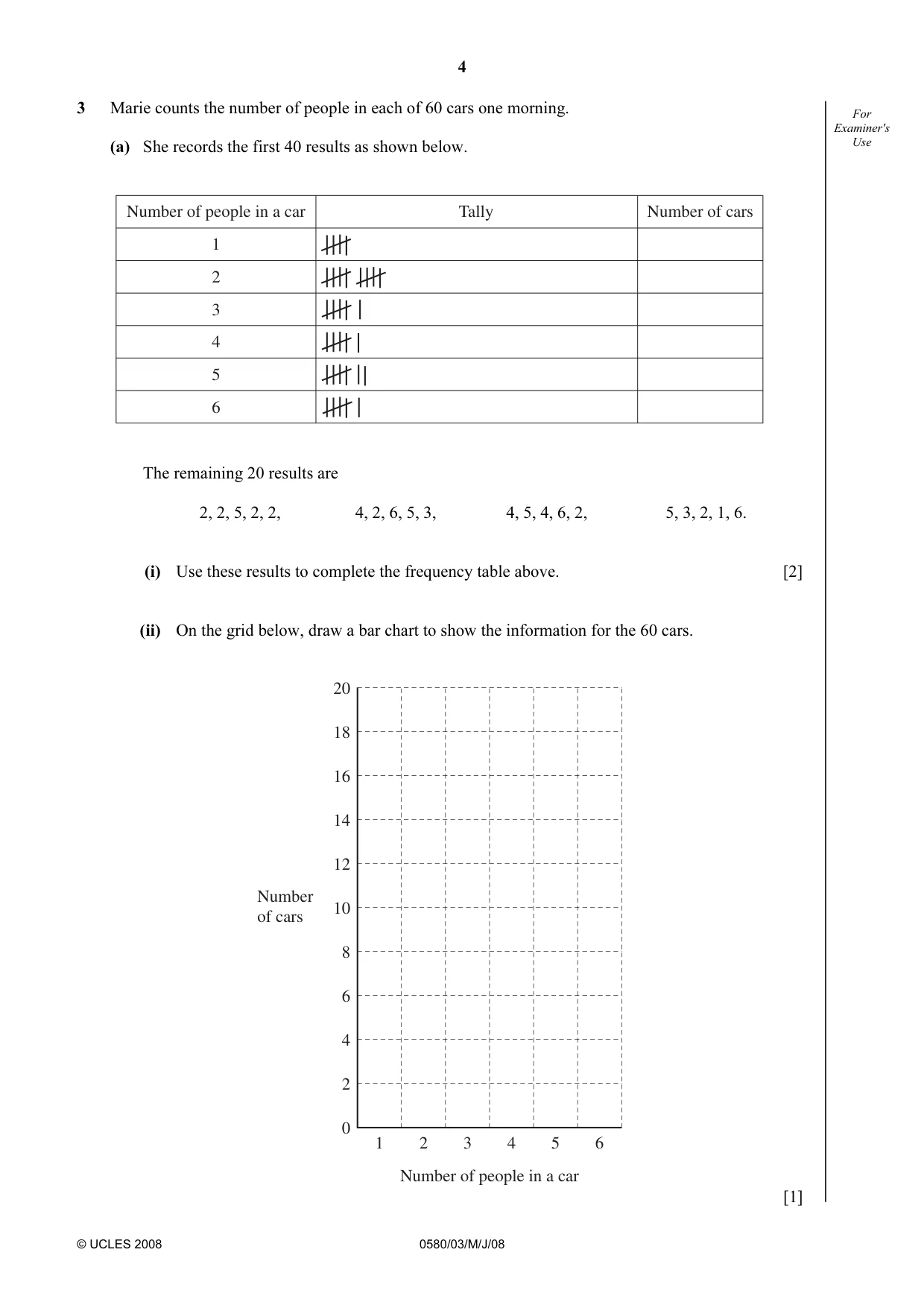
4 © UCLES 2008 0580/03/M/J/08 For Examiner's Use 3 Marie counts the number of people in each of 60 cars one morning. (a) She records the first 40 results as shown below. Number of people in a car 1 2 3 4 5 6 Tally Number of cars The remaining 20 results are 2, 2, 5, 2, 2, 4, 2, 6, 5, 3, 4, 5, 4, 6, 2, 5, 3, 2, 1, 6. (i) Use these results to complete the frequency table above. [2] (ii) On the grid below, draw a bar chart to show the information for the 60 cars. 1 2 3 4 5 6 Number of people in a car 20 18 16 14 12 10 8 6 4 2 0 Number of cars [1]
Question paper, page 5
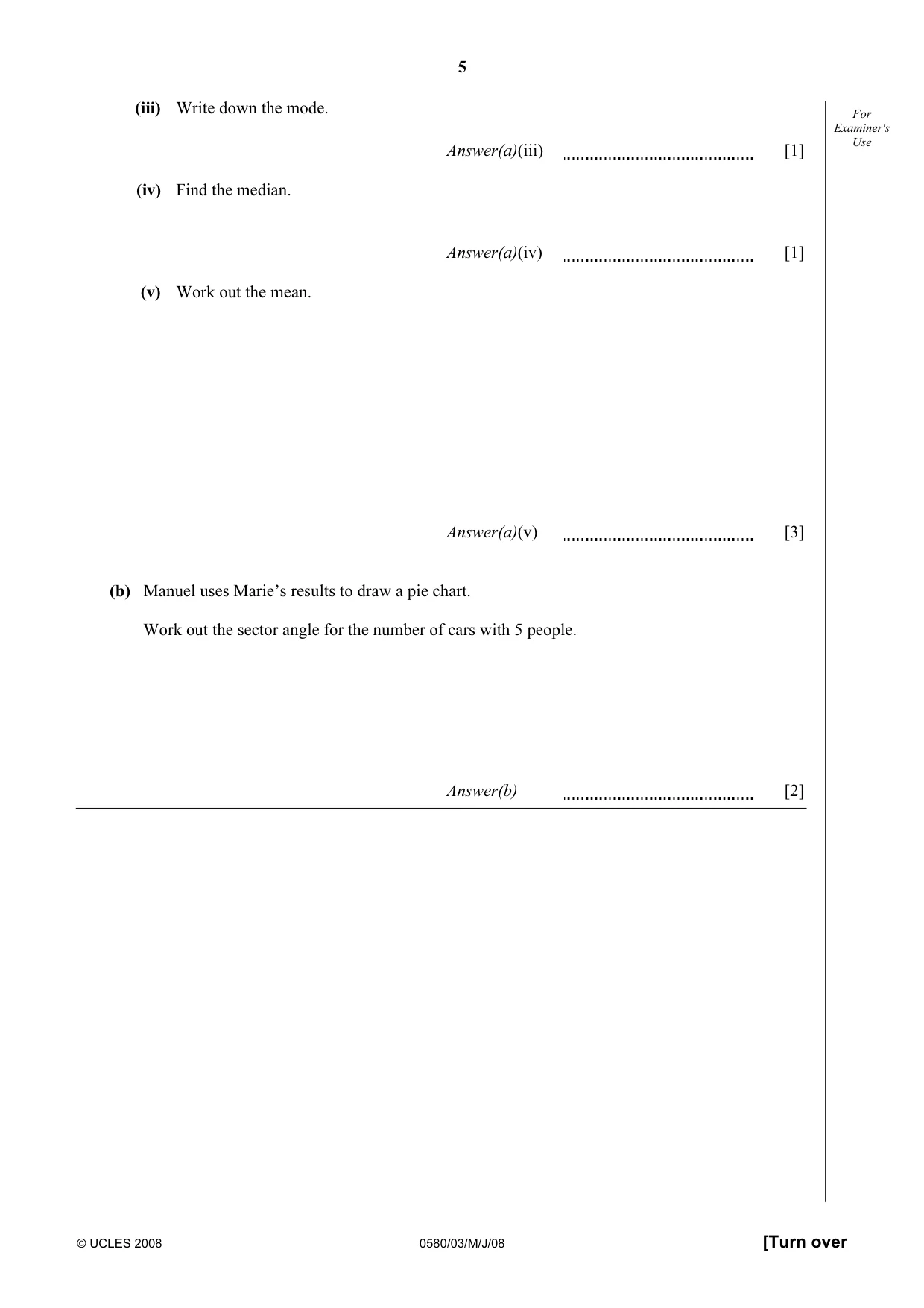
5 © UCLES 2008 0580/03/M/J/08 [Turn over For Examiner's Use (iii) Write down the mode. Answer(a)(iii) [1] (iv) Find the median. Answer(a)(iv) [1] (v) Work out the mean. Answer(a)(v) [3] (b) Manuel uses Marie’s results to draw a pie chart. Work out the sector angle for the number of cars with 5 people. Answer(b) [2]
Question paper, page 6
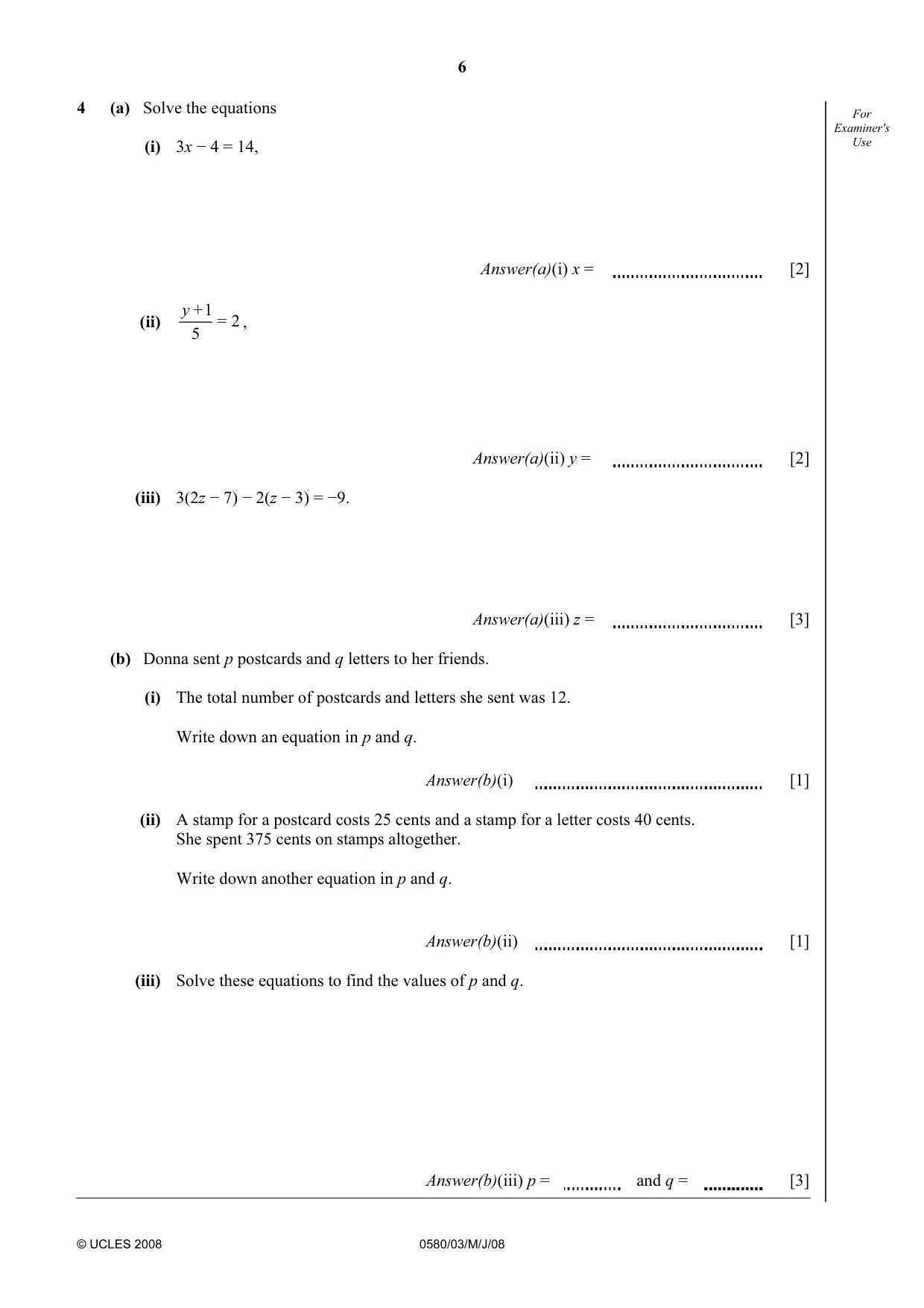
6 © UCLES 2008 0580/03/M/J/08 For Examiner's Use 4 (a) Solve the equations (i) 3x − 4 = 14, Answer(a)(i) x = [2] (ii) +1 = 2 5 y , Answer(a)(ii) y = [2] (iii) 3(2z − 7) − 2(z − 3) = −9. Answer(a)(iii) z = [3] (b) Donna sent p postcards and q letters to her friends. (i) The total number of postcards and letters she sent was 12. Write down an equation in p and q. Answer(b)(i) [1] (ii) A stamp for a postcard costs 25 cents and a stamp for a letter costs 40 cents. She spent 375 cents on stamps altogether. Write down another equation in p and q. Answer(b)(ii) [1] (iii) Solve these equations to find the values of p and q. Answer(b)(iii) p = and q = [3]
Question paper, page 7
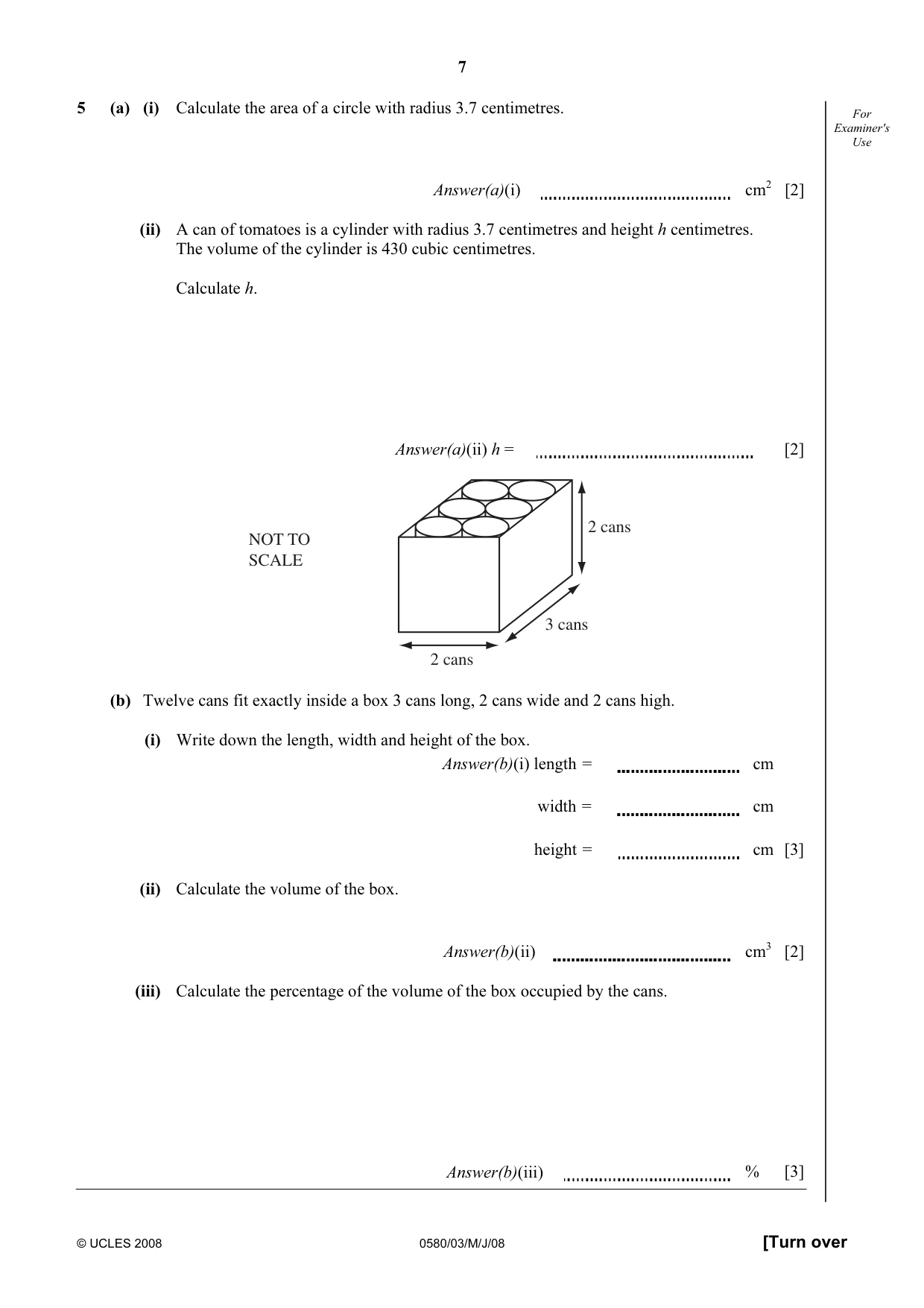
7 © UCLES 2008 0580/03/M/J/08 [Turn over For Examiner's Use 5 (a) (i) Calculate the area of a circle with radius 3.7 centimetres. Answer(a)(i) cm2 [2] (ii) A can of tomatoes is a cylinder with radius 3.7 centimetres and height h centimetres. The volume of the cylinder is 430 cubic centimetres. Calculate h. Answer(a)(ii) h = [2] 2 cans 2 cans 3 cans NOT TO SCALE (b) Twelve cans fit exactly inside a box 3 cans long, 2 cans wide and 2 cans high. (i) Write down the length, width and height of the box. Answer(b)(i) length = cm width = cm height = cm [3] (ii) Calculate the volume of the box. Answer(b)(ii) cm3 [2] (iii) Calculate the percentage of the volume of the box occupied by the cans. Answer(b)(iii) % [3]
Question paper, page 8
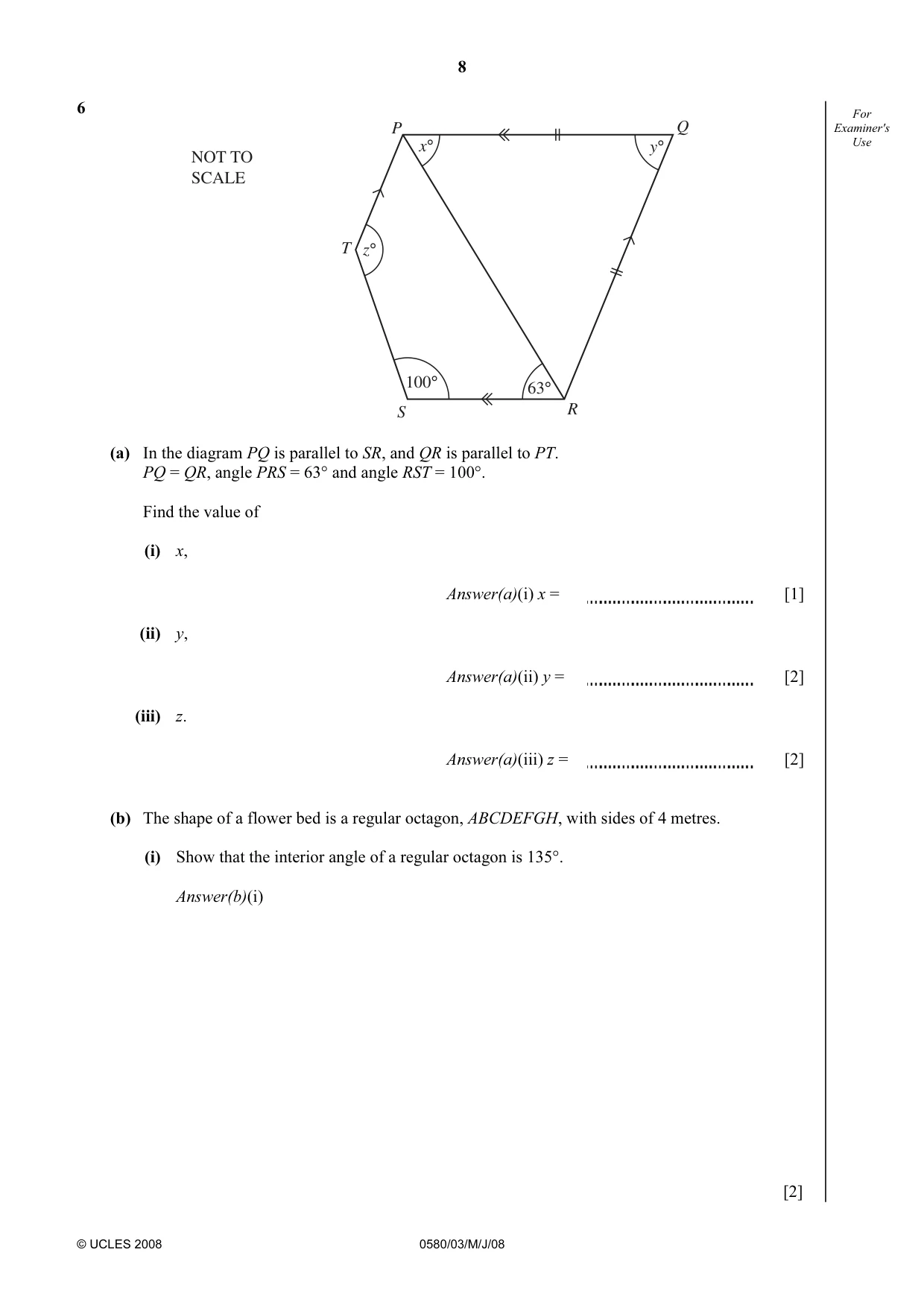
8 © UCLES 2008 0580/03/M/J/08 For Examiner's Use 6 63° 100° z° y° x° P T S R Q NOT TO SCALE (a) In the diagram PQ is parallel to SR, and QR is parallel to PT. PQ = QR, angle PRS = 63° and angle RST = 100°. Find the value of (i) x, Answer(a)(i) x = [1] (ii) y, Answer(a)(ii) y = [2] (iii) z. Answer(a)(iii) z = [2] (b) The shape of a flower bed is a regular octagon, ABCDEFGH, with sides of 4 metres. (i) Show that the interior angle of a regular octagon is 135°. Answer(b)(i) [2]
Question paper, page 9
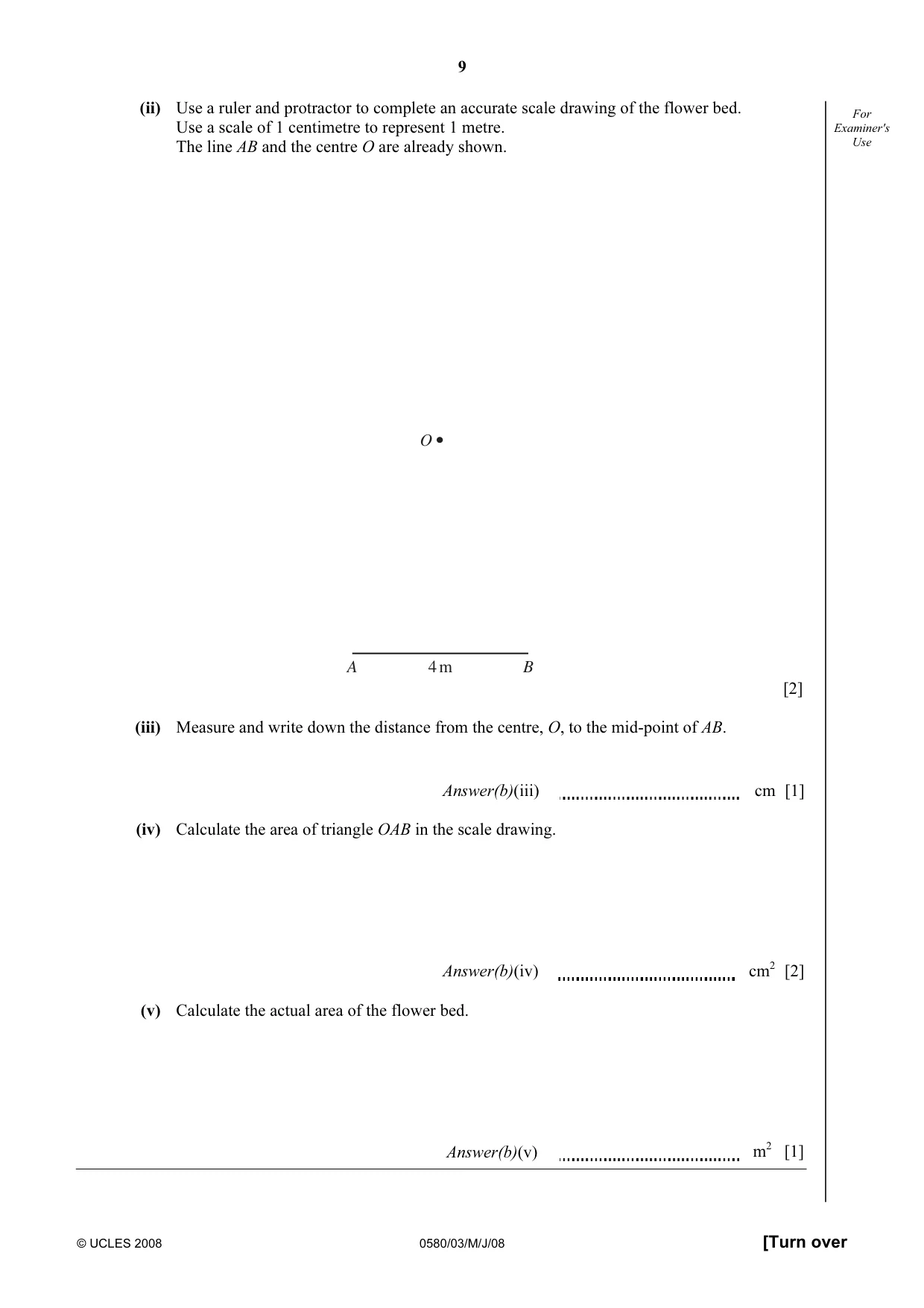
9 © UCLES 2008 0580/03/M/J/08 [Turn over For Examiner's Use (ii) Use a ruler and protractor to complete an accurate scale drawing of the flower bed. Use a scale of 1 centimetre to represent 1 metre. The line AB and the centre O are already shown. A B 4 m O [2] (iii) Measure and write down the distance from the centre, O, to the mid-point of AB. Answer(b)(iii) cm [1] (iv) Calculate the area of triangle OAB in the scale drawing. Answer(b)(iv) cm2 [2] (v) Calculate the actual area of the flower bed. Answer(b)(v) m2 [1]
Question paper, page 10
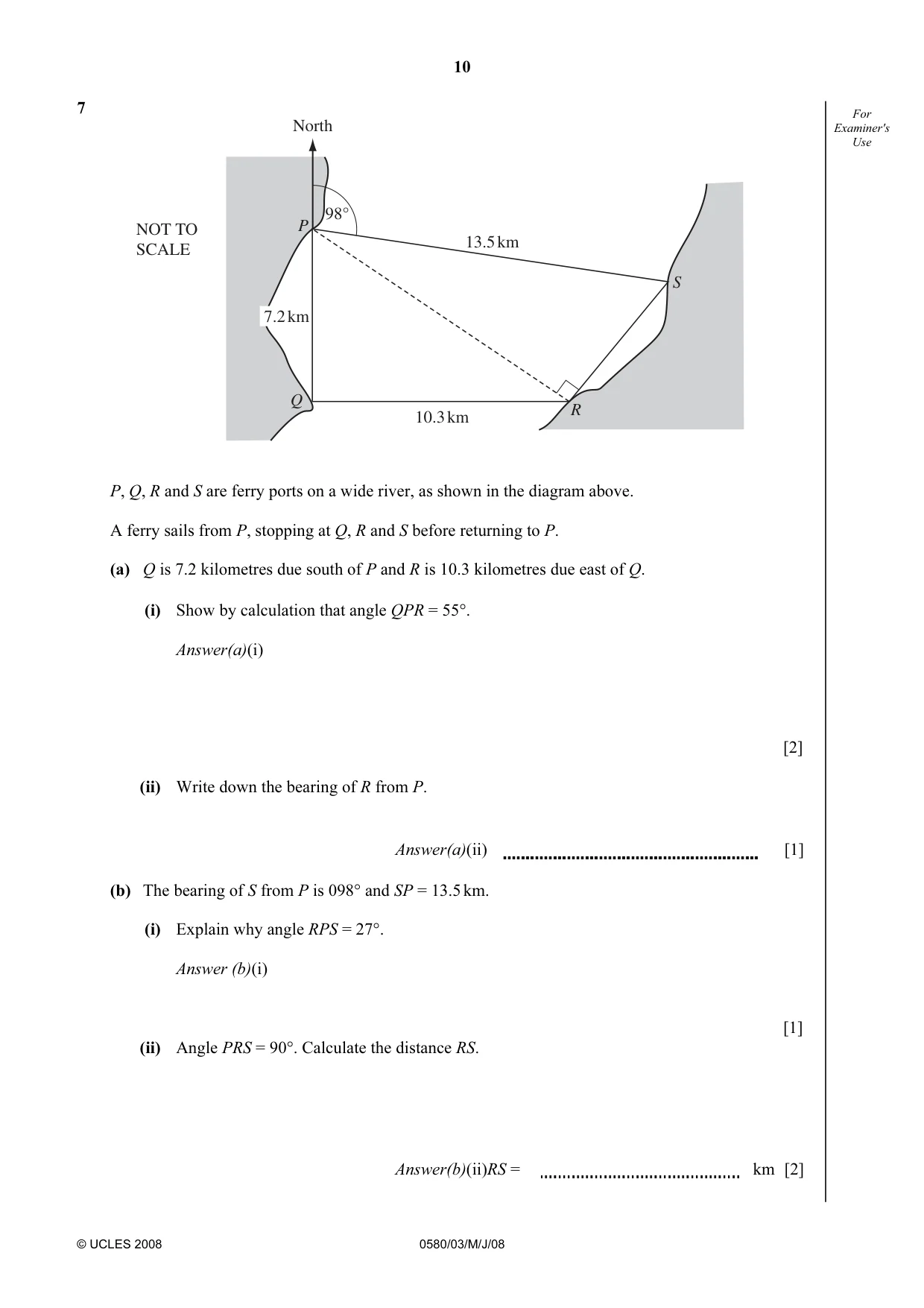
10 © UCLES 2008 0580/03/M/J/08 For Examiner's Use 7 98° Q R S P 13.5 km 10.3 km 7.2 km NOT TO SCALE North P, Q, R and S are ferry ports on a wide river, as shown in the diagram above. A ferry sails from P, stopping at Q, R and S before returning to P. (a) Q is 7.2 kilometres due south of P and R is 10.3 kilometres due east of Q. (i) Show by calculation that angle QPR = 55°. Answer(a)(i) [2] (ii) Write down the bearing of R from P. Answer(a)(ii) [1] (b) The bearing of S from P is 098° and SP = 13.5 km. (i) Explain why angle RPS = 27°. Answer (b)(i) [1] (ii) Angle PRS = 90°. Calculate the distance RS. Answer(b)(ii)RS = km [2]
Question paper, page 11
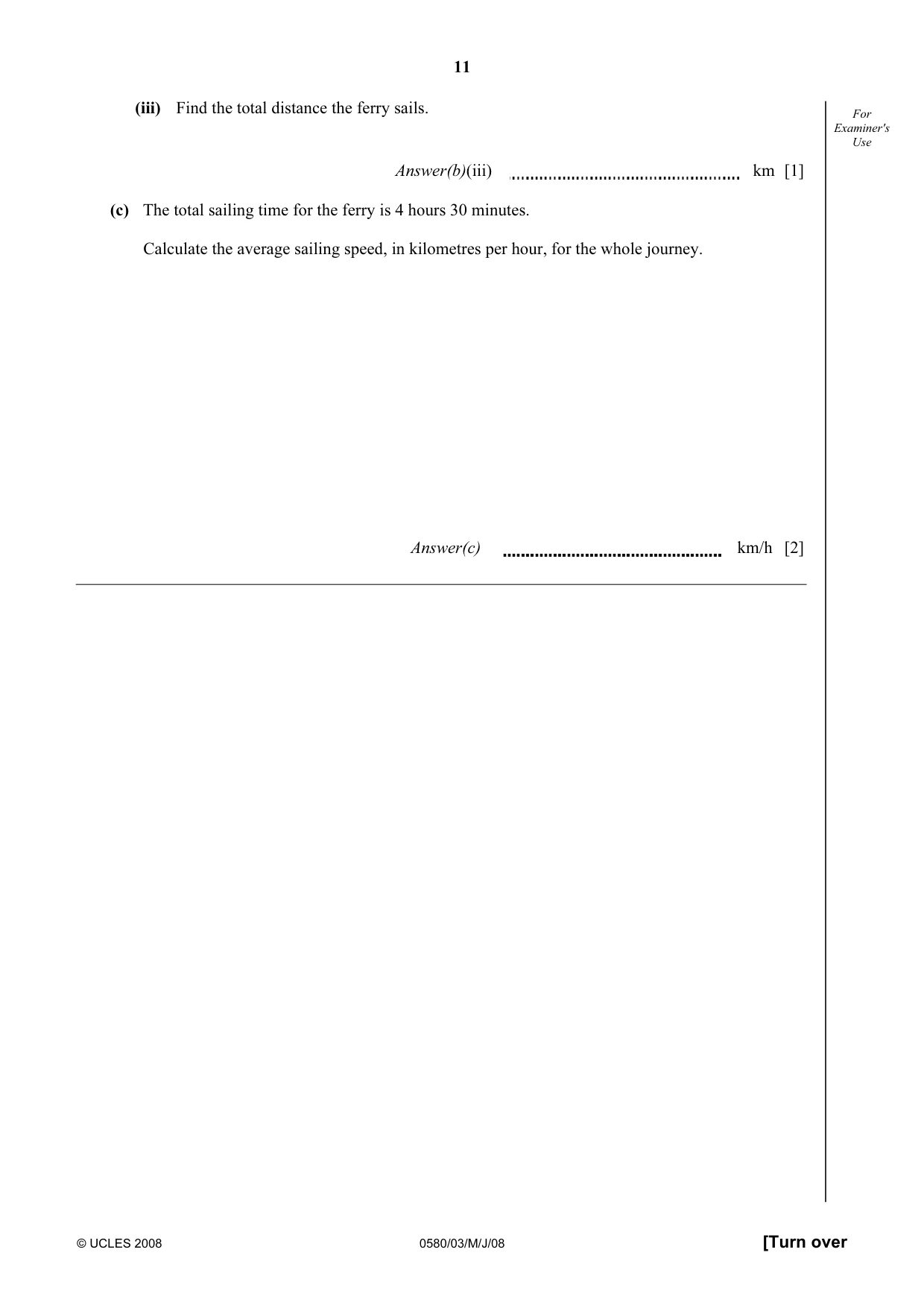
11 © UCLES 2008 0580/03/M/J/08 [Turn over For Examiner's Use (iii) Find the total distance the ferry sails. Answer(b)(iii) km [1] (c) The total sailing time for the ferry is 4 hours 30 minutes. Calculate the average sailing speed, in kilometres per hour, for the whole journey. Answer(c) km/h [2]
Question paper, page 12
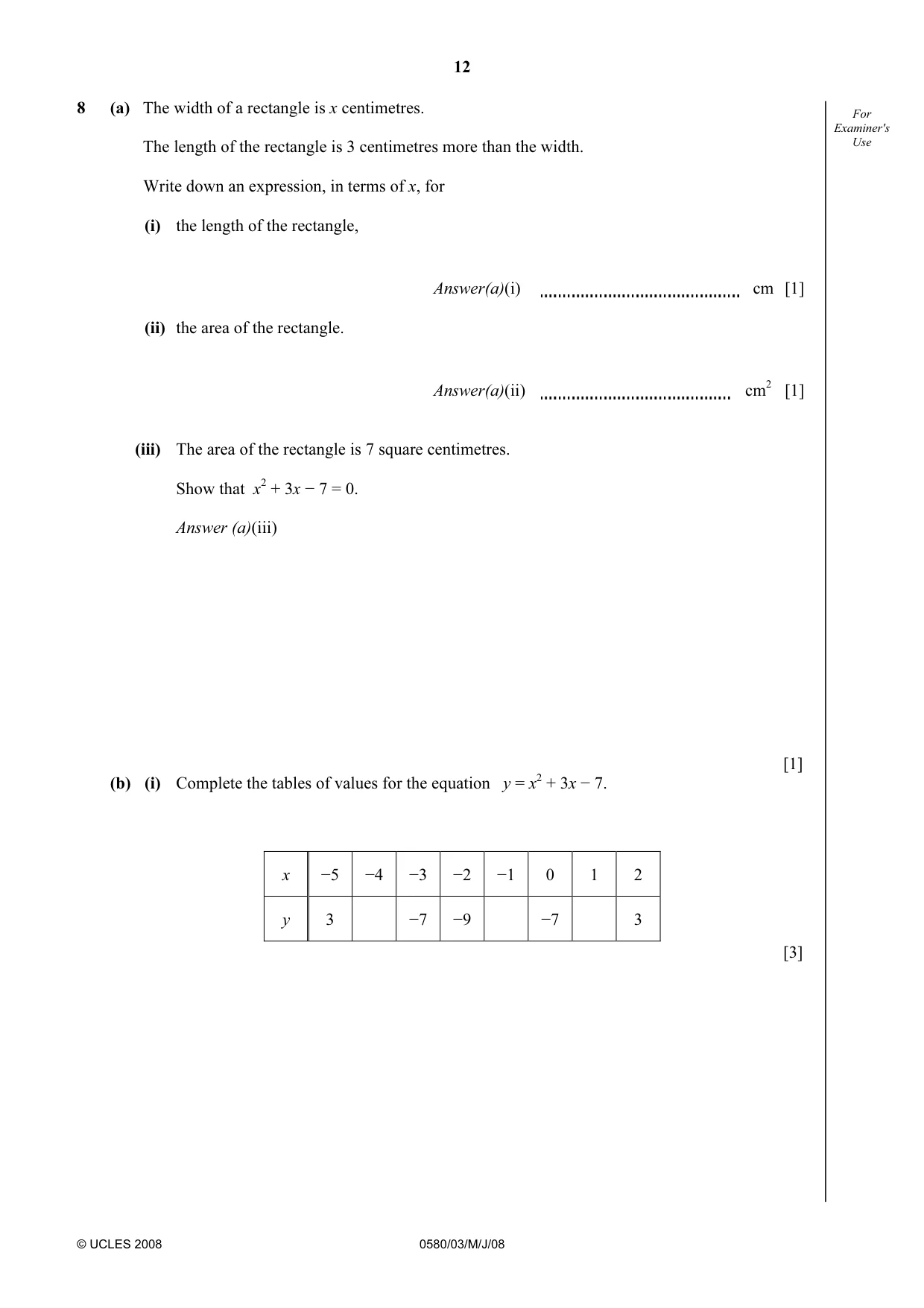
12 © UCLES 2008 0580/03/M/J/08 For Examiner's Use 8 (a) The width of a rectangle is x centimetres. The length of the rectangle is 3 centimetres more than the width. Write down an expression, in terms of x, for (i) the length of the rectangle, Answer(a)(i) cm [1] (ii) the area of the rectangle. Answer(a)(ii) cm2 [1] (iii) The area of the rectangle is 7 square centimetres. Show that x2 + 3x − 7 = 0. Answer (a)(iii) [1] (b) (i) Complete the tables of values for the equation y = x2 + 3x − 7. x −5 −4 −3 −2 −1 0 1 2 y 3 −7 −9 −7 3 [3]
Question paper, page 13
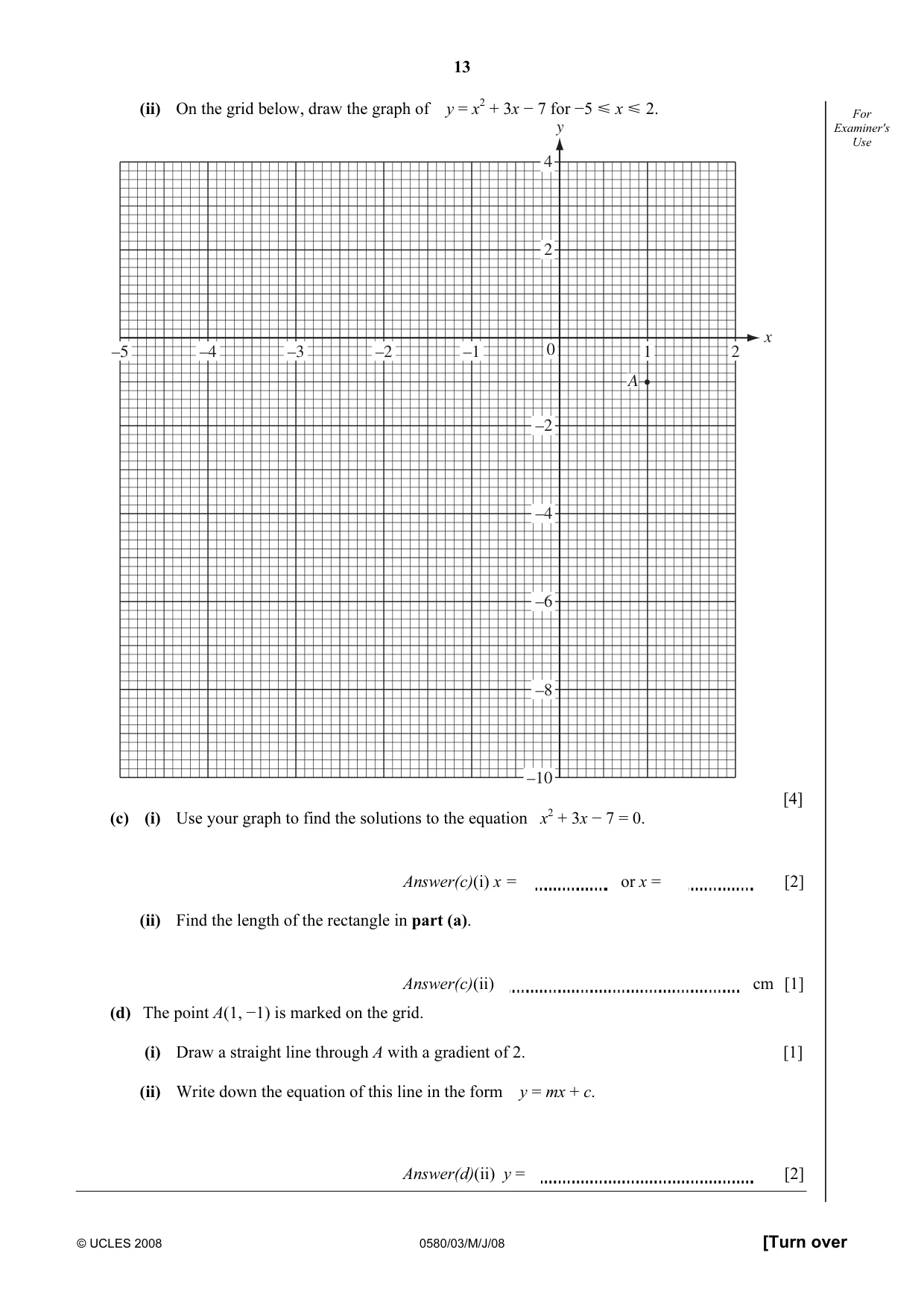
13 © UCLES 2008 0580/03/M/J/08 [Turn over For Examiner's Use (ii) On the grid below, draw the graph of y = x2 + 3x − 7 for −5 Y x Y 2. y x –5 2 1 –4 –3 –2 –1 0 4 2 –2 –4 –6 –8 –10 A [4] (c) (i) Use your graph to find the solutions to the equation x2 + 3x − 7 = 0. Answer(c)(i) x = or x = [2] (ii) Find the length of the rectangle in part (a). Answer(c)(ii) cm [1] (d) The point A(1, −1) is marked on the grid. (i) Draw a straight line through A with a gradient of 2. [1] (ii) Write down the equation of this line in the form y = mx + c. Answer(d)(ii) y = [2]
Question paper, page 14
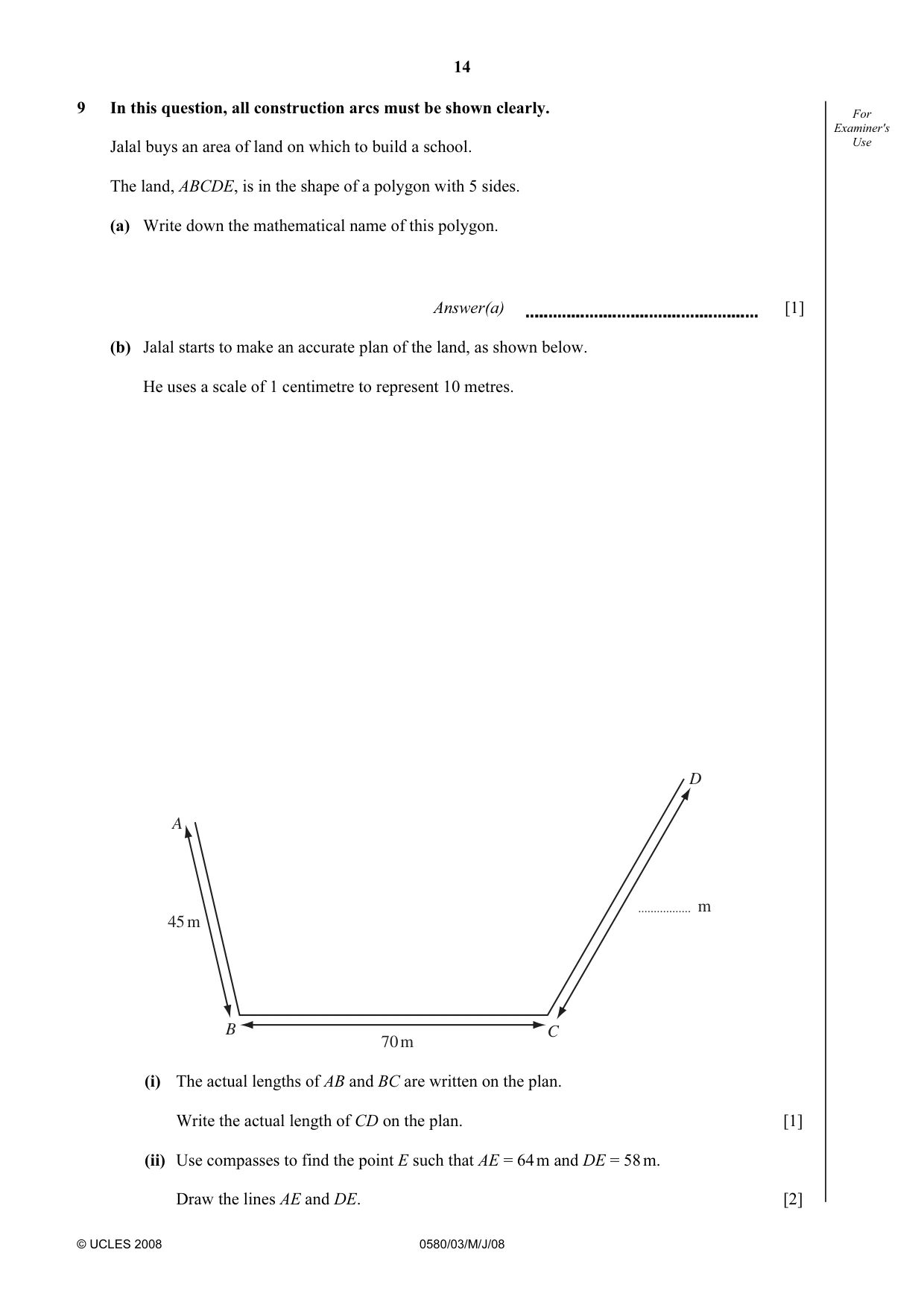
14 © UCLES 2008 0580/03/M/J/08 For Examiner's Use 9 In this question, all construction arcs must be shown clearly. Jalal buys an area of land on which to build a school. The land, ABCDE, is in the shape of a polygon with 5 sides. (a) Write down the mathematical name of this polygon. Answer(a) [1] (b) Jalal starts to make an accurate plan of the land, as shown below. He uses a scale of 1 centimetre to represent 10 metres. A B C D 45 m 70 m m (i) The actual lengths of AB and BC are written on the plan. Write the actual length of CD on the plan. [1] (ii) Use compasses to find the point E such that AE = 64 m and DE = 58 m. Draw the lines AE and DE. [2]
Question paper, page 15
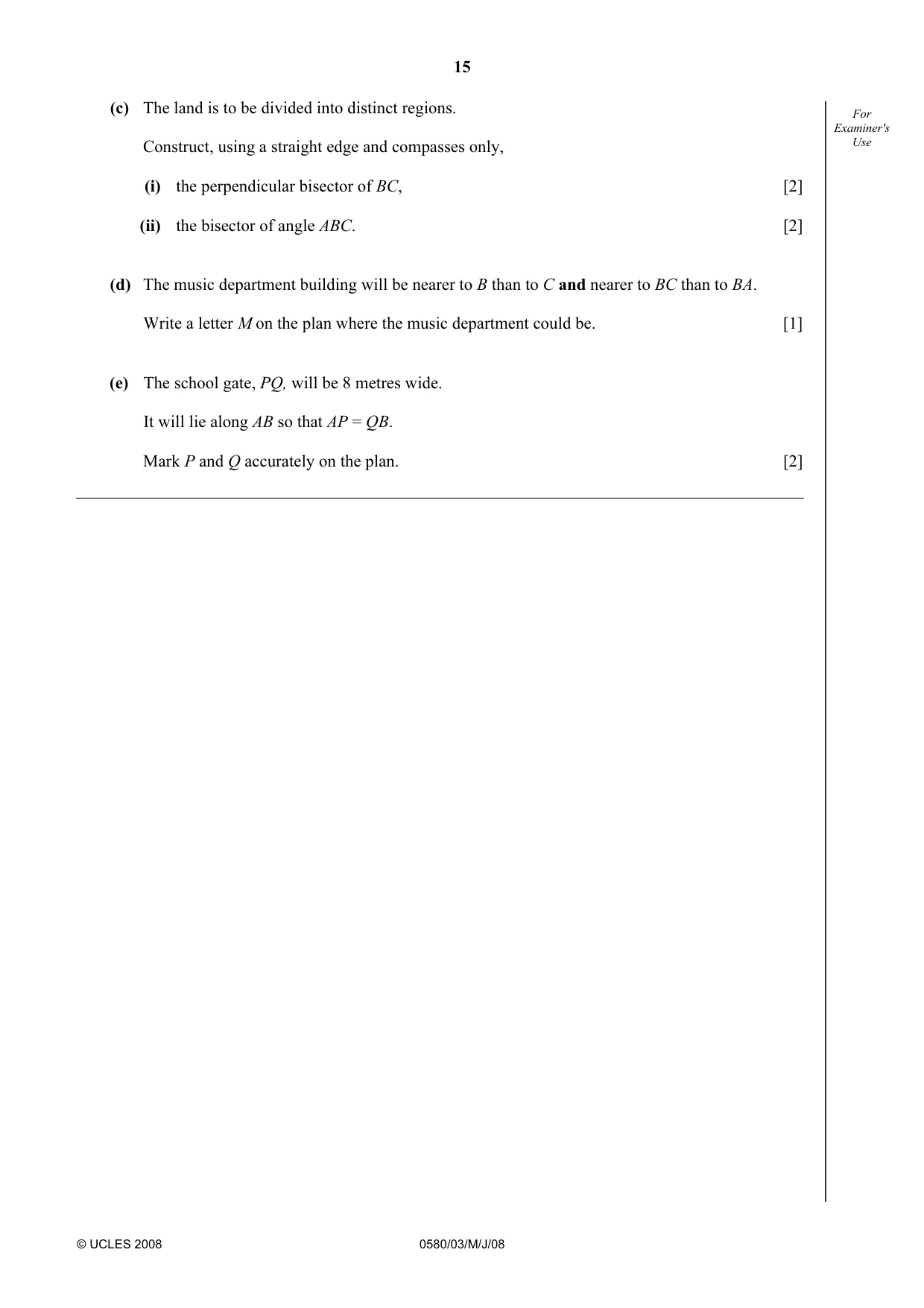
15 © UCLES 2008 0580/03/M/J/08 For Examiner's Use (c) The land is to be divided into distinct regions. Construct, using a straight edge and compasses only, (i) the perpendicular bisector of BC, [2] (ii) the bisector of angle ABC. [2] (d) The music department building will be nearer to B than to C and nearer to BC than to BA. Write a letter M on the plan where the music department could be. [1] (e) The school gate, PQ, will be 8 metres wide. It will lie along AB so that AP = QB. Mark P and Q accurately on the plan. [2]
Question paper, page 16
16 Permission to reproduce items where third-party owned material protected by copyright is included has been sought and cleared where possible. Every reasonable effort has been made by the publisher (UCLES) to trace copyright holders, but if any items requiring clearance have unwittingly been included, the publisher will be pleased to make amends at the earliest possible opportunity. University of Cambridge International Examinations is part of the Cambridge Assessment Group. Cambridge Assessment is the brand name of University of Cambridge Local Examinations Syndicate (UCLES), which is itself a department of the University of Cambridge. 0580/03/M/J/08
Mark scheme, page 1
UNIVERSITY OF CAMBRIDGE INTERNATIONAL EXAMINATIONS International General Certificate of Secondary Education MARK SCHEME for the May/June 2008 question paper 0580 and 0581 MATHEMATICS 0580/03 and 0581/03 Paper 3 (Core), maximum raw mark 104 This mark scheme is published as an aid to teachers and candidates, to indicate the requirements of the examination. It shows the basis on which Examiners were instructed to award marks. It does not indicate the details of the discussions that took place at an Examiners’ meeting before marking began. All Examiners are instructed that alternative correct answers and unexpected approaches in candidates’ scripts must be given marks that fairly reflect the relevant knowledge and skills demonstrated. Mark schemes must be read in conjunction with the question papers and the report on the examination. • CIE will not enter into discussions or correspondence in connection with these mark schemes. CIE is publishing the mark schemes for the May/June 2008 question papers for most IGCSE, GCE Advanced Level and Advanced Subsidiary Level syllabuses and some Ordinary Level syllabuses. www.XtremePapers.com
Mark scheme, page 2
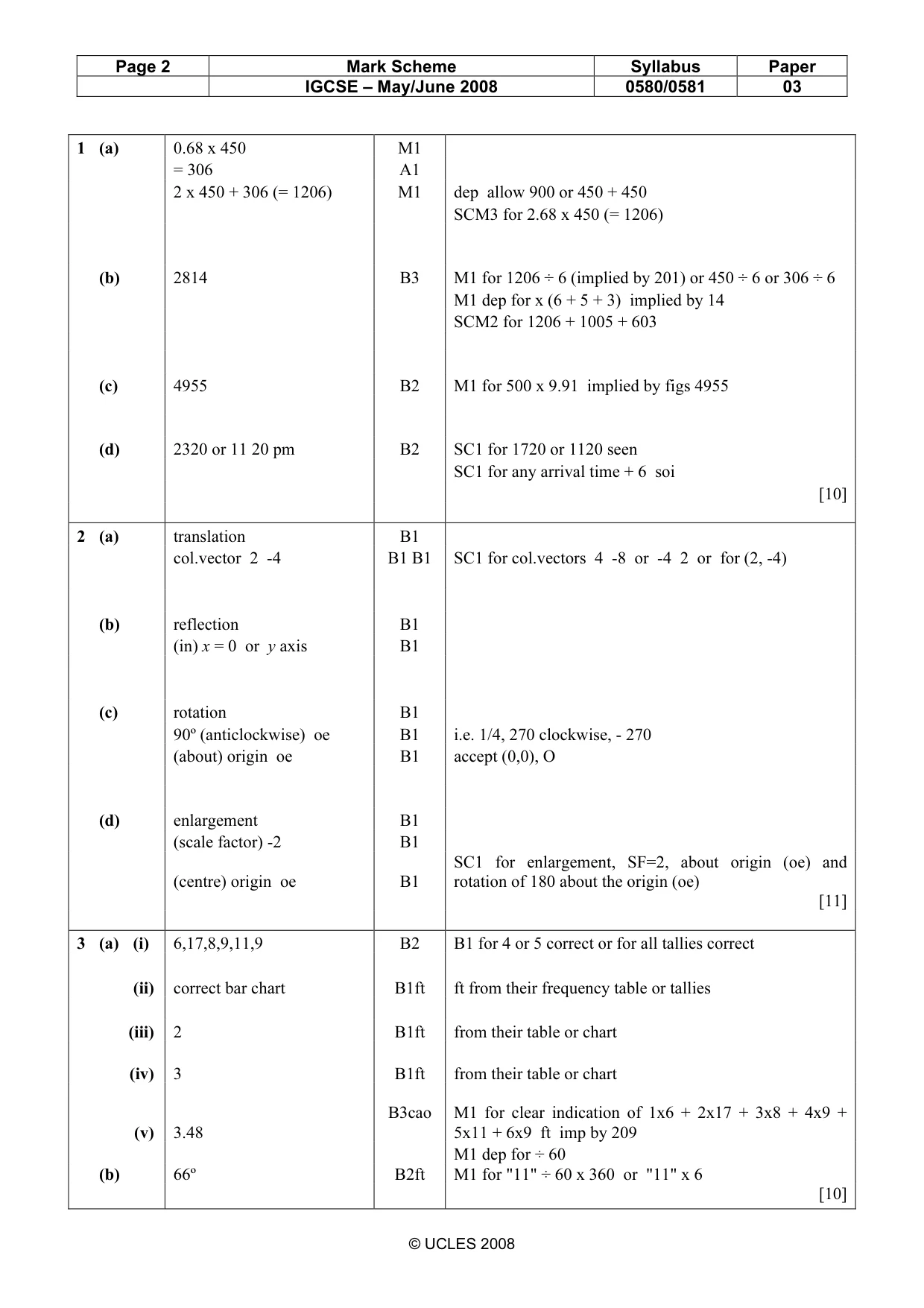
Page 2 Mark Scheme Syllabus Paper IGCSE – May/June 2008 0580/0581 03 © UCLES 2008 1 (a) 0.68 x 450 M1 = 306 A1 2 x 450 + 306 (= 1206) M1 dep allow 900 or 450 + 450 SCM3 for 2.68 x 450 (= 1206) (b) 2814 B3 M1 for 1206 ÷ 6 (implied by 201) or 450 ÷ 6 or 306 ÷ 6 M1 dep for x (6 + 5 + 3) implied by 14 SCM2 for 1206 + 1005 + 603 (c) 4955 B2 M1 for 500 x 9.91 implied by figs 4955 (d) 2320 or 11 20 pm B2 SC1 for 1720 or 1120 seen SC1 for any arrival time + 6 soi [10] 2 (a) translation B1 col.vector 2 -4 B1 B1 SC1 for col.vectors 4 -8 or -4 2 or for (2, -4) (b) reflection B1 (in) x = 0 or y axis B1 (c) rotation B1 90º (anticlockwise) oe B1 i.e. 1/4, 270 clockwise, - 270 (about) origin oe B1 accept (0,0), O (d) enlargement B1 (scale factor) -2 B1 (centre) origin oe B1 SC1 for enlargement, SF=2, about origin (oe) and rotation of 180 about the origin (oe) [11] 3 (a) (i) 6,17,8,9,11,9 B2 B1 for 4 or 5 correct or for all tallies correct (ii) correct bar chart B1ft ft from their frequency table or tallies (iii) 2 B1ft from their table or chart (iv) 3 B1ft from their table or chart (v) 3.48 B3cao M1 for clear indication of 1x6 + 2x17 + 3x8 + 4x9 + 5x11 + 6x9 ft imp by 209 M1 dep for ÷ 60 (b) 66º B2ft M1 for "11" ÷ 60 x 360 or "11" x 6 [10]
Mark scheme, page 3
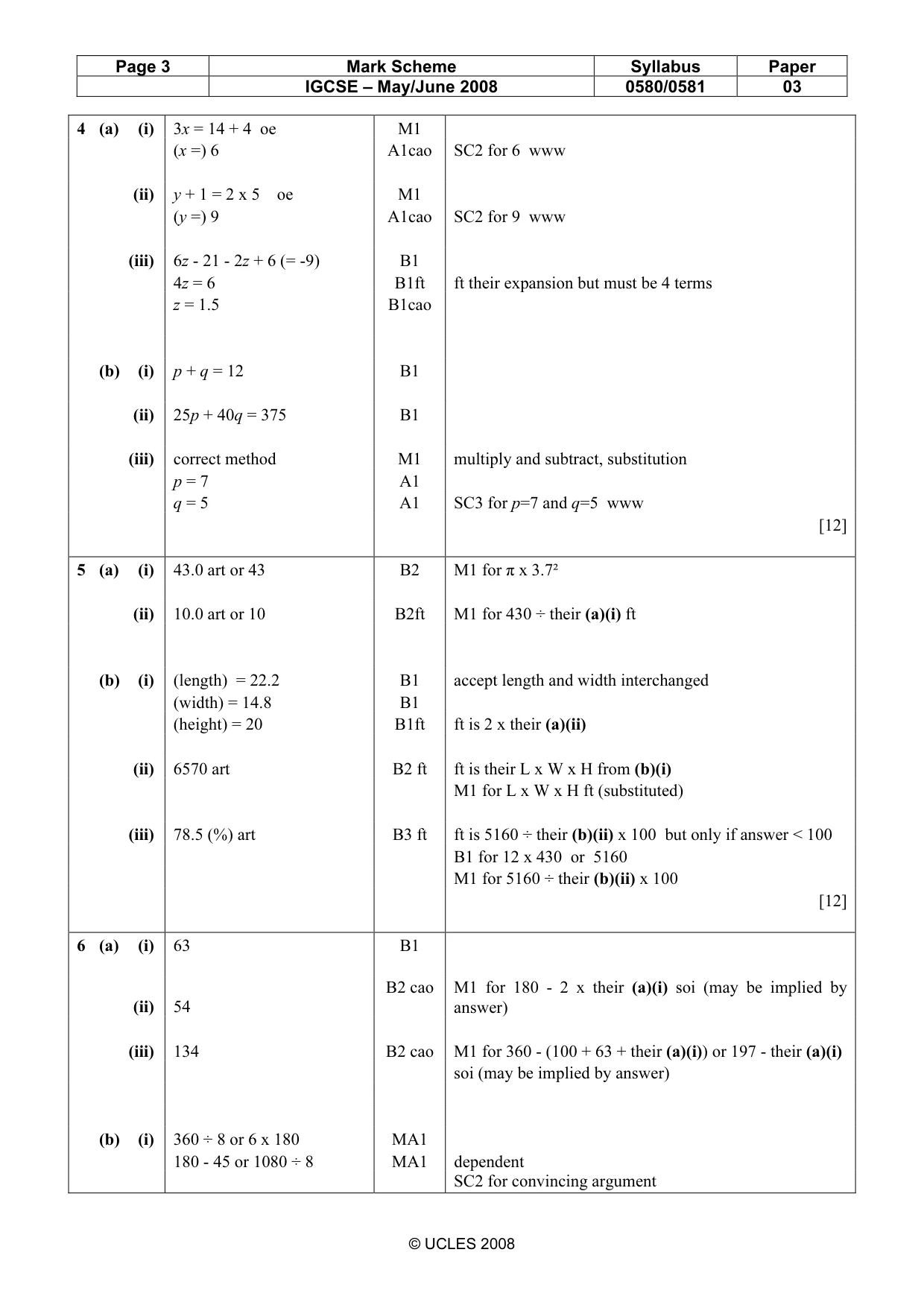
Page 3 Mark Scheme Syllabus Paper IGCSE – May/June 2008 0580/0581 03 © UCLES 2008 4 (a) (i) 3x = 14 + 4 oe M1 (x =) 6 A1cao SC2 for 6 www (ii) y + 1 = 2 x 5 oe M1 (y =) 9 A1cao SC2 for 9 www (iii) 6z - 21 - 2z + 6 (= -9) B1 4z = 6 B1ft ft their expansion but must be 4 terms z = 1.5 B1cao (b) (i) p + q = 12 B1 (ii) 25p + 40q = 375 B1 (iii) correct method M1 multiply and subtract, substitution p = 7 A1 q = 5 A1 SC3 for p=7 and q=5 www [12] 5 (a) (i) 43.0 art or 43 B2 M1 for π x 3.7² (ii) 10.0 art or 10 B2ft M1 for 430 ÷ their (a)(i) ft (b) (i) (length) = 22.2 B1 accept length and width interchanged (width) = 14.8 B1 (height) = 20 B1ft ft is 2 x their (a)(ii) (ii) 6570 art B2 ft ft is their L x W x H from (b)(i) M1 for L x W x H ft (substituted) (iii) 78.5 (%) art B3 ft ft is 5160 ÷ their (b)(ii) x 100 but only if answer < 100 B1 for 12 x 430 or 5160 M1 for 5160 ÷ their (b)(ii) x 100 [12] 6 (a) (i) 63 B1 (ii) 54 B2 cao M1 for 180 - 2 x their (a)(i) soi (may be implied by answer) (iii) 134 B2 cao M1 for 360 - (100 + 63 + their (a)(i)) or 197 - their (a)(i) soi (may be implied by answer) (b) (i) 360 ÷ 8 or 6 x 180 MA1 180 - 45 or 1080 ÷ 8 MA1 dependent SC2 for convincing argument
Mark scheme, page 4
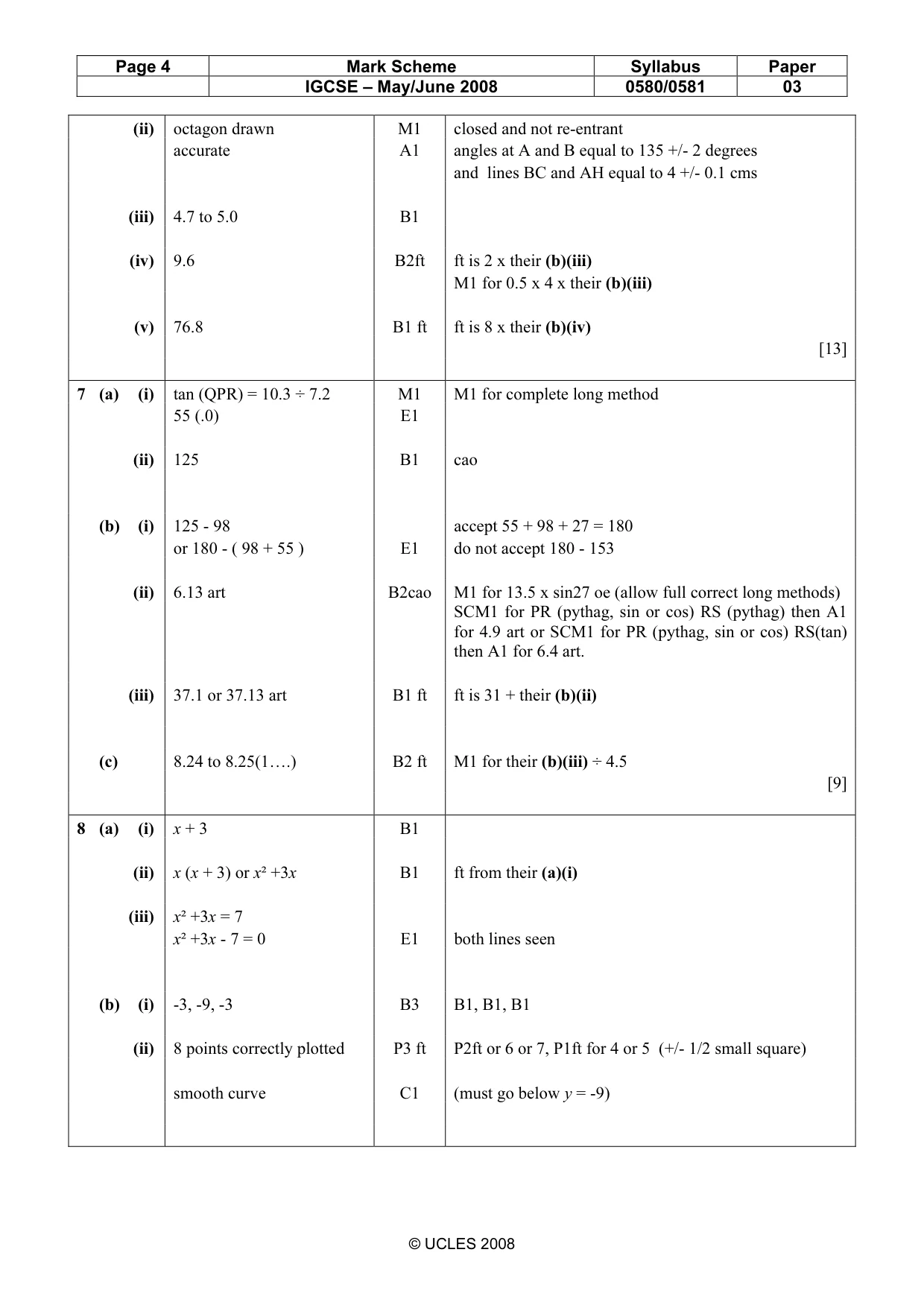
Page 4 Mark Scheme Syllabus Paper IGCSE – May/June 2008 0580/0581 03 © UCLES 2008 (ii) octagon drawn M1 closed and not re-entrant accurate A1 angles at A and B equal to 135 +/- 2 degrees and lines BC and AH equal to 4 +/- 0.1 cms (iii) 4.7 to 5.0 B1 (iv) 9.6 B2ft ft is 2 x their (b)(iii) M1 for 0.5 x 4 x their (b)(iii) (v) 76.8 B1 ft ft is 8 x their (b)(iv) [13] 7 (a) (i) tan (QPR) = 10.3 ÷ 7.2 M1 M1 for complete long method 55 (.0) E1 (ii) 125 B1 cao (b) (i) 125 - 98 accept 55 + 98 + 27 = 180 or 180 - ( 98 + 55 ) E1 do not accept 180 - 153 (ii) 6.13 art B2cao M1 for 13.5 x sin27 oe (allow full correct long methods) SCM1 for PR (pythag, sin or cos) RS (pythag) then A1 for 4.9 art or SCM1 for PR (pythag, sin or cos) RS(tan) then A1 for 6.4 art. (iii) 37.1 or 37.13 art B1 ft ft is 31 + their (b)(ii) (c) 8.24 to 8.25(1….) B2 ft M1 for their (b)(iii) ÷ 4.5 [9] 8 (a) (i) x + 3 B1 (ii) x (x + 3) or x² +3x B1 ft from their (a)(i) (iii) x² +3x = 7 x² +3x - 7 = 0 E1 both lines seen (b) (i) -3, -9, -3 B3 B1, B1, B1 (ii) 8 points correctly plotted P3 ft P2ft or 6 or 7, P1ft for 4 or 5 (+/- 1/2 small square) smooth curve C1 (must go below y = -9)
Mark scheme, page 5
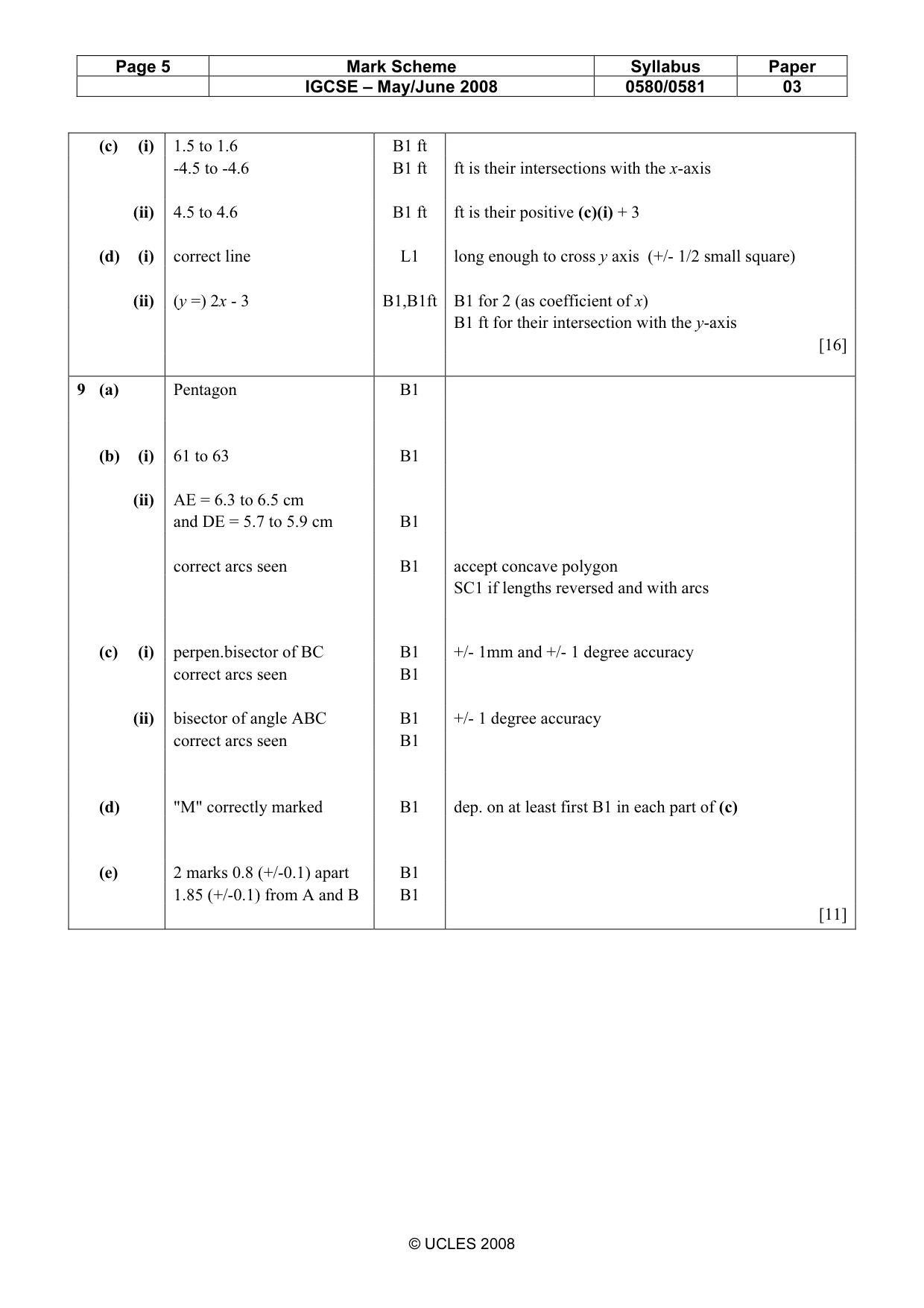
Page 5 Mark Scheme Syllabus Paper IGCSE – May/June 2008 0580/0581 03 © UCLES 2008 (c) (i) 1.5 to 1.6 B1 ft -4.5 to -4.6 B1 ft ft is their intersections with the x-axis (ii) 4.5 to 4.6 B1 ft ft is their positive (c)(i) + 3 (d) (i) correct line L1 long enough to cross y axis (+/- 1/2 small square) (ii) (y =) 2x - 3 B1,B1ft B1 for 2 (as coefficient of x) B1 ft for their intersection with the y-axis [16] 9 (a) Pentagon B1 (b) (i) 61 to 63 B1 (ii) AE = 6.3 to 6.5 cm and DE = 5.7 to 5.9 cm B1 correct arcs seen B1 accept concave polygon SC1 if lengths reversed and with arcs (c) (i) perpen.bisector of BC B1 +/- 1mm and +/- 1 degree accuracy correct arcs seen B1 (ii) bisector of angle ABC B1 +/- 1 degree accuracy correct arcs seen B1 (d) "M" correctly marked B1 dep. on at least first B1 in each part of (c) (e) 2 marks 0.8 (+/-0.1) apart B1 1.85 (+/-0.1) from A and B B1 [11]
What you needed in this session
Cambridge’s own grade thresholds for 2008 May/June, Paper 3 · Variant 1. A higher threshold means an easier paper — the bar moves with how the cohort did.