Cambridge IGCSE Mathematics (with coursework) 0581 — 2007 Oct/Nov Paper 4 · Variant 1
0581/41/O/N/07 · 130 marks · ≈146 min
The question paper and its mark scheme, free to read here and free to download. This is Cambridge’s own paper, exactly as it was sat.
Question paper12 pages
Mark scheme7 pages
Answers below. Sit the paper first if you are practising.
Paper as text
Question paper, page 1
This document consists of 10 printed pages and 2 blank pages. IB07 11_0580_04/3RP © UCLES 2007 [Turn over *0356263045* UNIVERSITY OF CAMBRIDGE INTERNATIONAL EXAMINATIONS International General Certificate of Secondary Education MATHEMATICS 0580/04, 0581/04 Paper 4 (Extended) October/November 2007 2 hours 30 minutes Additional Materials: Answer Booklet/Paper Electronic calculator Geometrical instruments Graph paper (1 sheet) Mathematical tables (optional) Tracing paper (optional) READ THESE INSTRUCTIONS FIRST If you have been given an Answer Booklet, follow the instructions on the front cover of the Booklet. Write your Centre number, candidate number and name on all the work you hand in. Write in dark blue or black pen. You may use a soft pencil for any diagrams or graphs. Do not use staples, paper clips, highlighters, glue or correction fluid. Answer all questions. All working must be clearly shown. It should be done on the same sheet as the rest of the answer. Marks will be given for working which shows that you know how to solve the problem even if you get the answer wrong. Electronic calculators should be used. If the degree of accuracy is not specified in the question, and if the answer is not exact, give the answer to three significant figures. Give answers in degrees to one decimal place. For π use either your calculator value or 3.142. At the end of the examination, fasten all your work securely together. The number of marks is given in brackets [ ] at the end of each question or part question. The total of the marks for this paper is 130. www.XtremePapers.com
Question paper, page 2
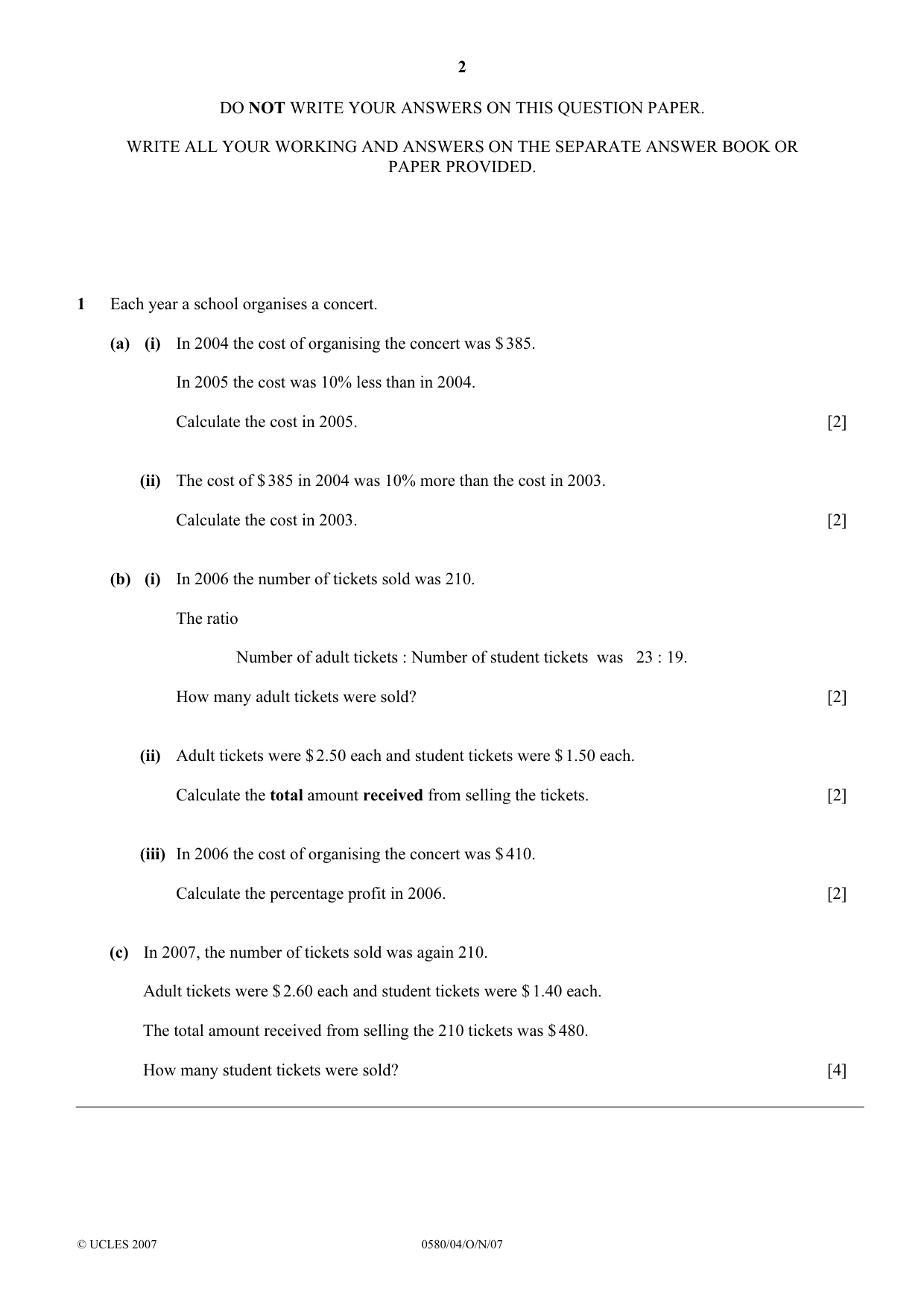
2 © UCLES 2007 0580/04/O/N/07 DO NOT WRITE YOUR ANSWERS ON THIS QUESTION PAPER. WRITE ALL YOUR WORKING AND ANSWERS ON THE SEPARATE ANSWER BOOK OR PAPER PROVIDED. 1 Each year a school organises a concert. (a) (i) In 2004 the cost of organising the concert was $ 385. In 2005 the cost was 10% less than in 2004. Calculate the cost in 2005. [2] (ii) The cost of $ 385 in 2004 was 10% more than the cost in 2003. Calculate the cost in 2003. [2] (b) (i) In 2006 the number of tickets sold was 210. The ratio Number of adult tickets : Number of student tickets was 23 : 19. How many adult tickets were sold? [2] (ii) Adult tickets were $ 2.50 each and student tickets were $ 1.50 each. Calculate the total amount received from selling the tickets. [2] (iii) In 2006 the cost of organising the concert was $ 410. Calculate the percentage profit in 2006. [2] (c) In 2007, the number of tickets sold was again 210. Adult tickets were $ 2.60 each and student tickets were $ 1.40 each. The total amount received from selling the 210 tickets was $ 480. How many student tickets were sold? [4]
Question paper, page 3
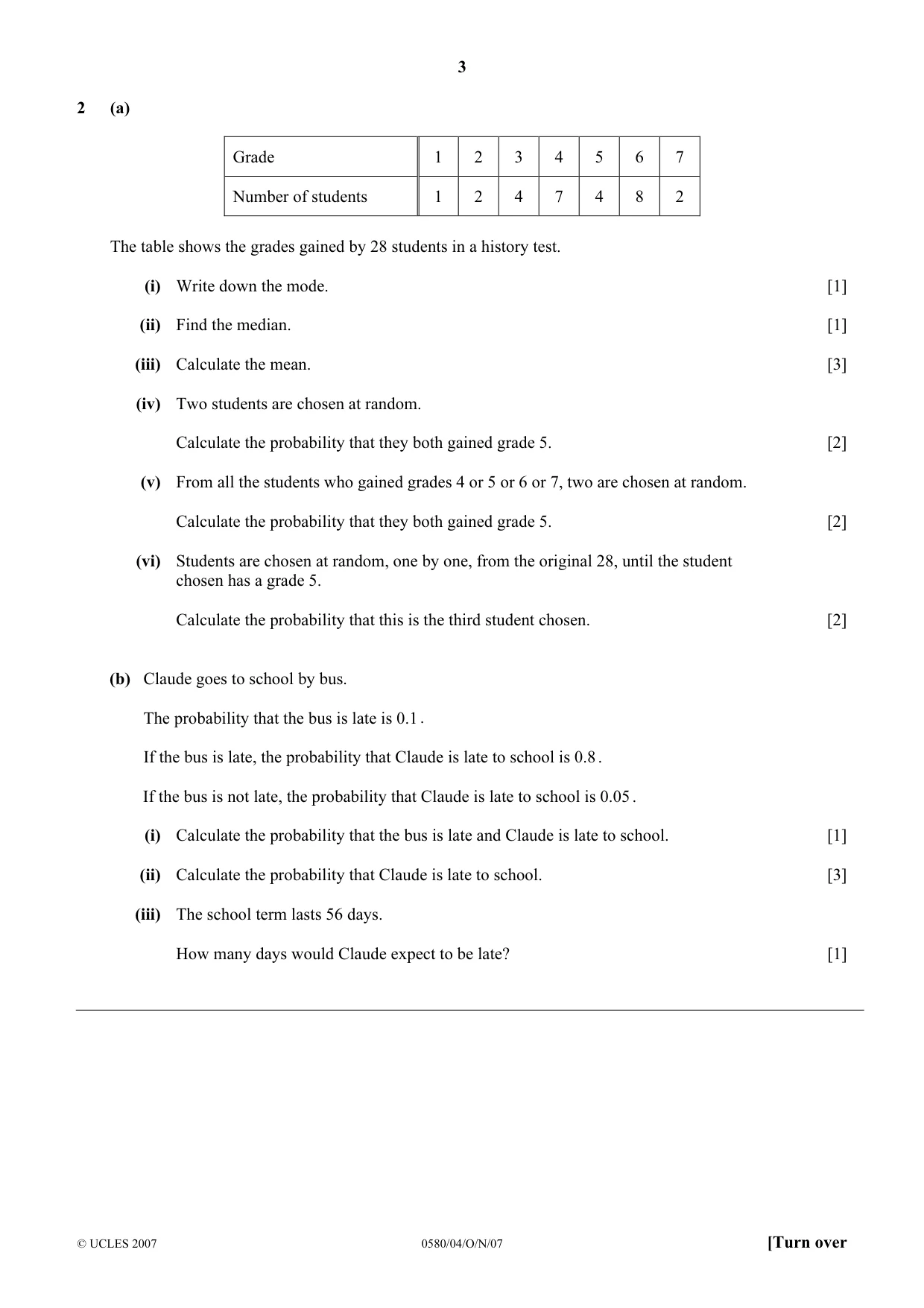
3 © UCLES 2007 0580/04/O/N/07 [Turn over 2 (a) Grade 1 2 3 4 5 6 7 Number of students 1 2 4 7 4 8 2 The table shows the grades gained by 28 students in a history test. (i) Write down the mode. [1] (ii) Find the median. [1] (iii) Calculate the mean. [3] (iv) Two students are chosen at random. Calculate the probability that they both gained grade 5. [2] (v) From all the students who gained grades 4 or 5 or 6 or 7, two are chosen at random. Calculate the probability that they both gained grade 5. [2] (vi) Students are chosen at random, one by one, from the original 28, until the student chosen has a grade 5. Calculate the probability that this is the third student chosen. [2] (b) Claude goes to school by bus. The probability that the bus is late is 0.1 . If the bus is late, the probability that Claude is late to school is 0.8 . If the bus is not late, the probability that Claude is late to school is 0.05 . (i) Calculate the probability that the bus is late and Claude is late to school. [1] (ii) Calculate the probability that Claude is late to school. [3] (iii) The school term lasts 56 days. How many days would Claude expect to be late? [1]
Question paper, page 4
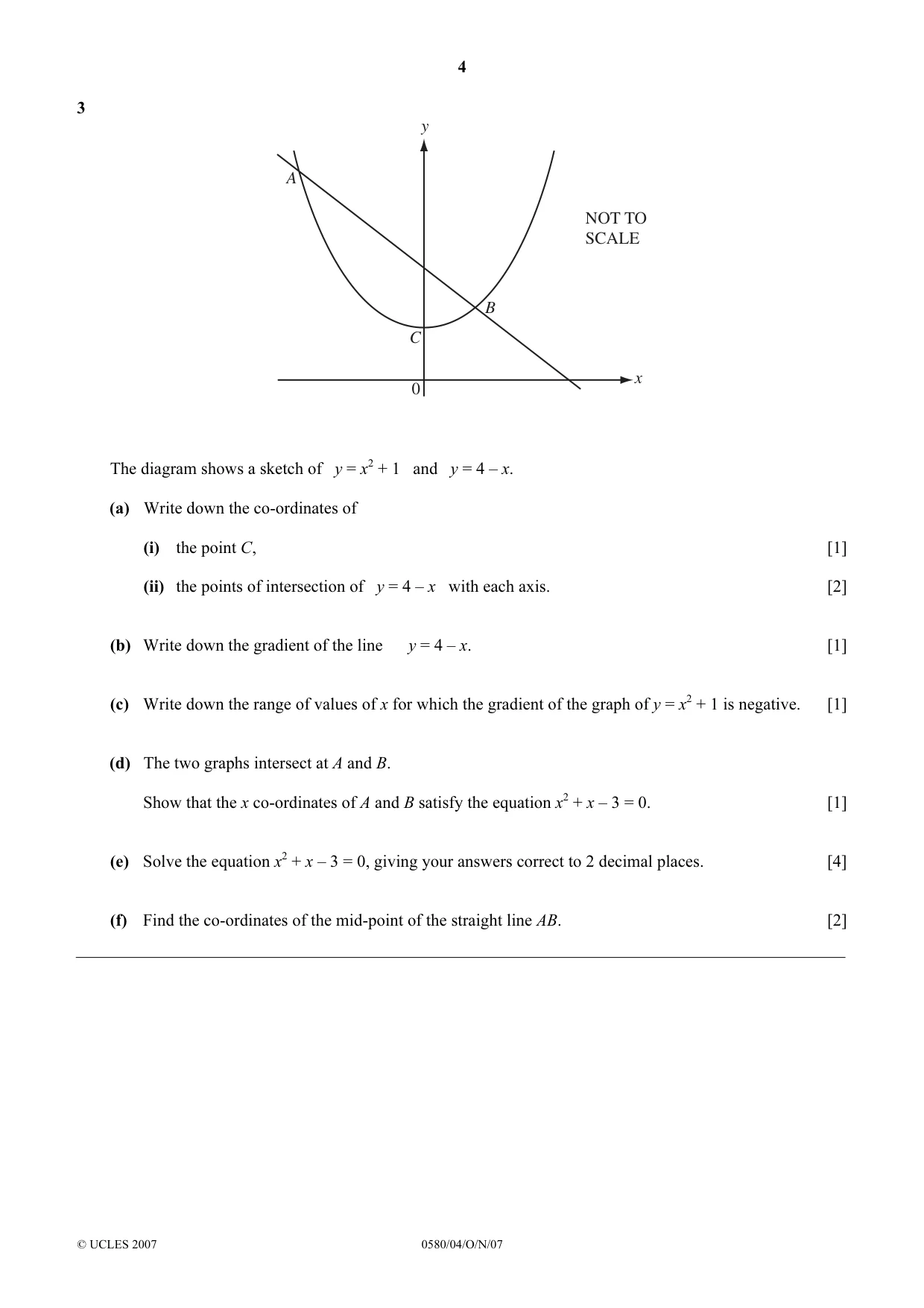
4 © UCLES 2007 0580/04/O/N/07 3 0 y x A C B NOT TO SCALE The diagram shows a sketch of y = x2 + 1 and y = 4 – x. (a) Write down the co-ordinates of (i) the point C, [1] (ii) the points of intersection of y = 4 – x with each axis. [2] (b) Write down the gradient of the line y = 4 – x. [1] (c) Write down the range of values of x for which the gradient of the graph of y = x2 + 1 is negative. [1] (d) The two graphs intersect at A and B. Show that the x co-ordinates of A and B satisfy the equation x2 + x – 3 = 0. [1] (e) Solve the equation x2 + x – 3 = 0, giving your answers correct to 2 decimal places. [4] (f) Find the co-ordinates of the mid-point of the straight line AB. [2]
Question paper, page 5
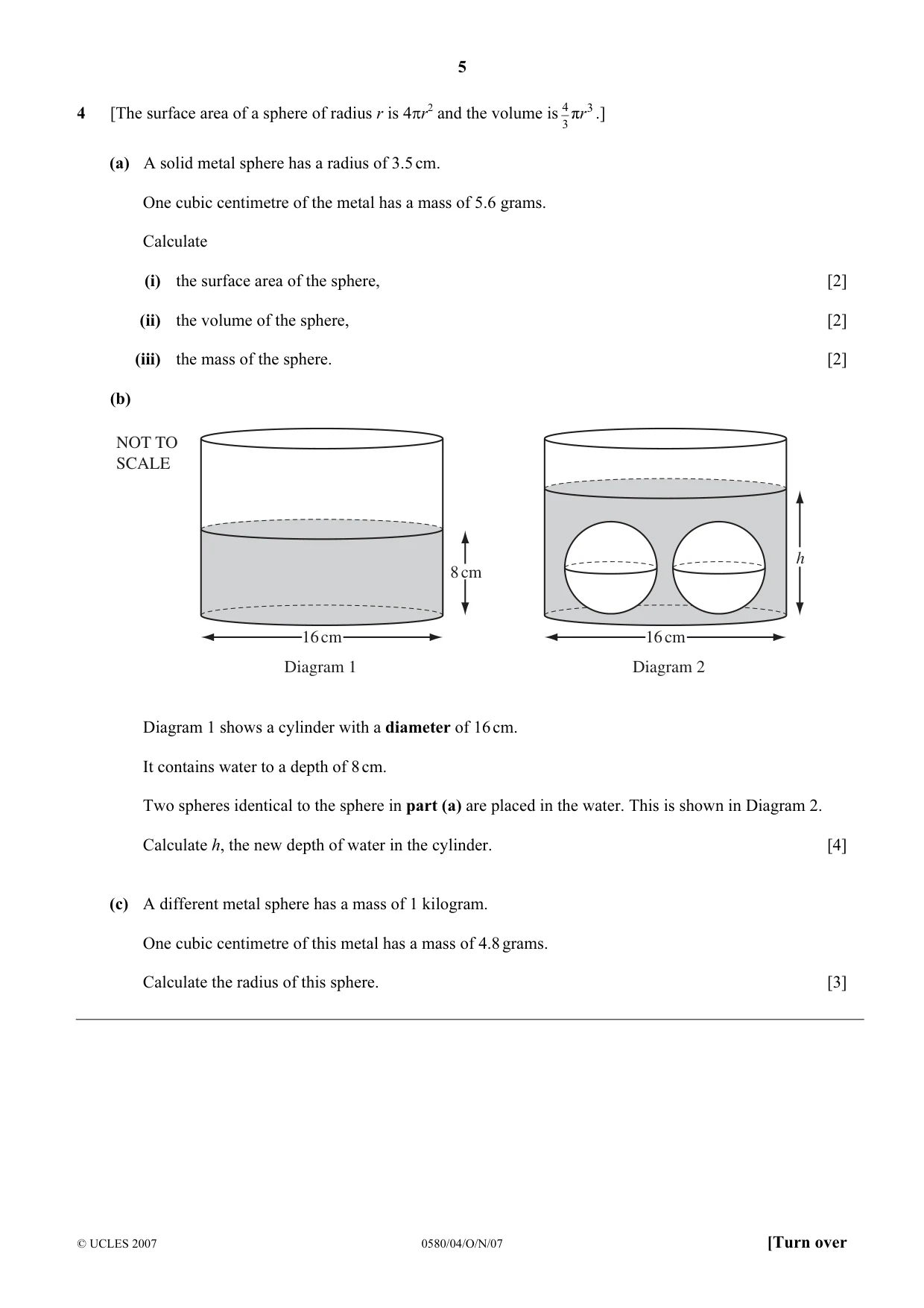
5 © UCLES 2007 0580/04/O/N/07 [Turn over 4 [The surface area of a sphere of radius r is 4πr2 and the volume is 4 3 3 πr .] (a) A solid metal sphere has a radius of 3.5 cm. One cubic centimetre of the metal has a mass of 5.6 grams. Calculate (i) the surface area of the sphere, [2] (ii) the volume of the sphere, [2] (iii) the mass of the sphere. [2] (b) NOT TO SCALE 16 cm 8 cm 16 cm h Diagram 1 Diagram 2 Diagram 1 shows a cylinder with a diameter of 16 cm. It contains water to a depth of 8 cm. Two spheres identical to the sphere in part (a) are placed in the water. This is shown in Diagram 2. Calculate h, the new depth of water in the cylinder. [4] (c) A different metal sphere has a mass of 1 kilogram. One cubic centimetre of this metal has a mass of 4.8 grams. Calculate the radius of this sphere. [3]
Question paper, page 6
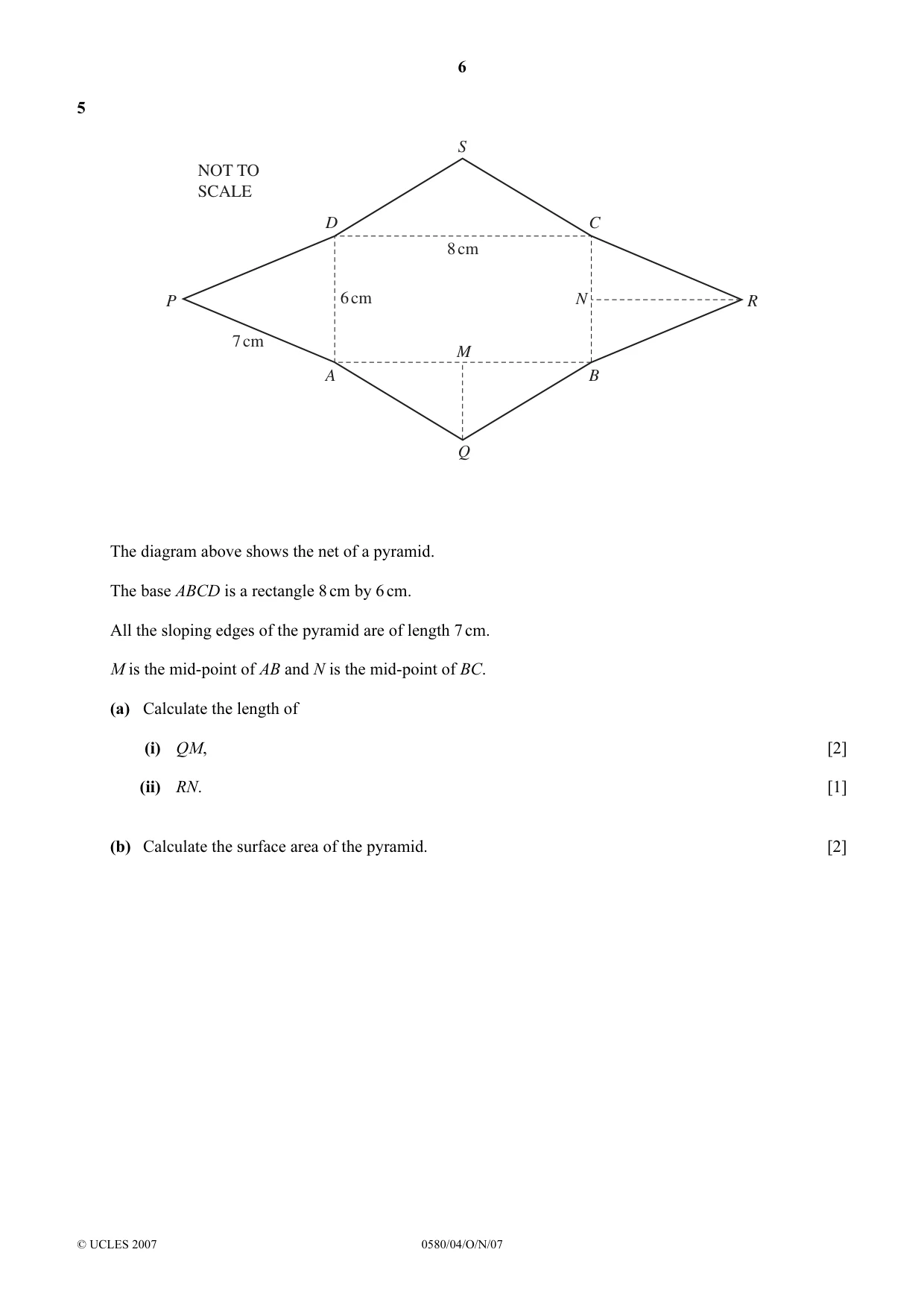
6 © UCLES 2007 0580/04/O/N/07 5 A B D C S Q R P M N 8 cm 6 cm NOT TO SCALE 7 cm The diagram above shows the net of a pyramid. The base ABCD is a rectangle 8 cm by 6 cm. All the sloping edges of the pyramid are of length 7 cm. M is the mid-point of AB and N is the mid-point of BC. (a) Calculate the length of (i) QM, [2] (ii) RN. [1] (b) Calculate the surface area of the pyramid. [2]
Question paper, page 7
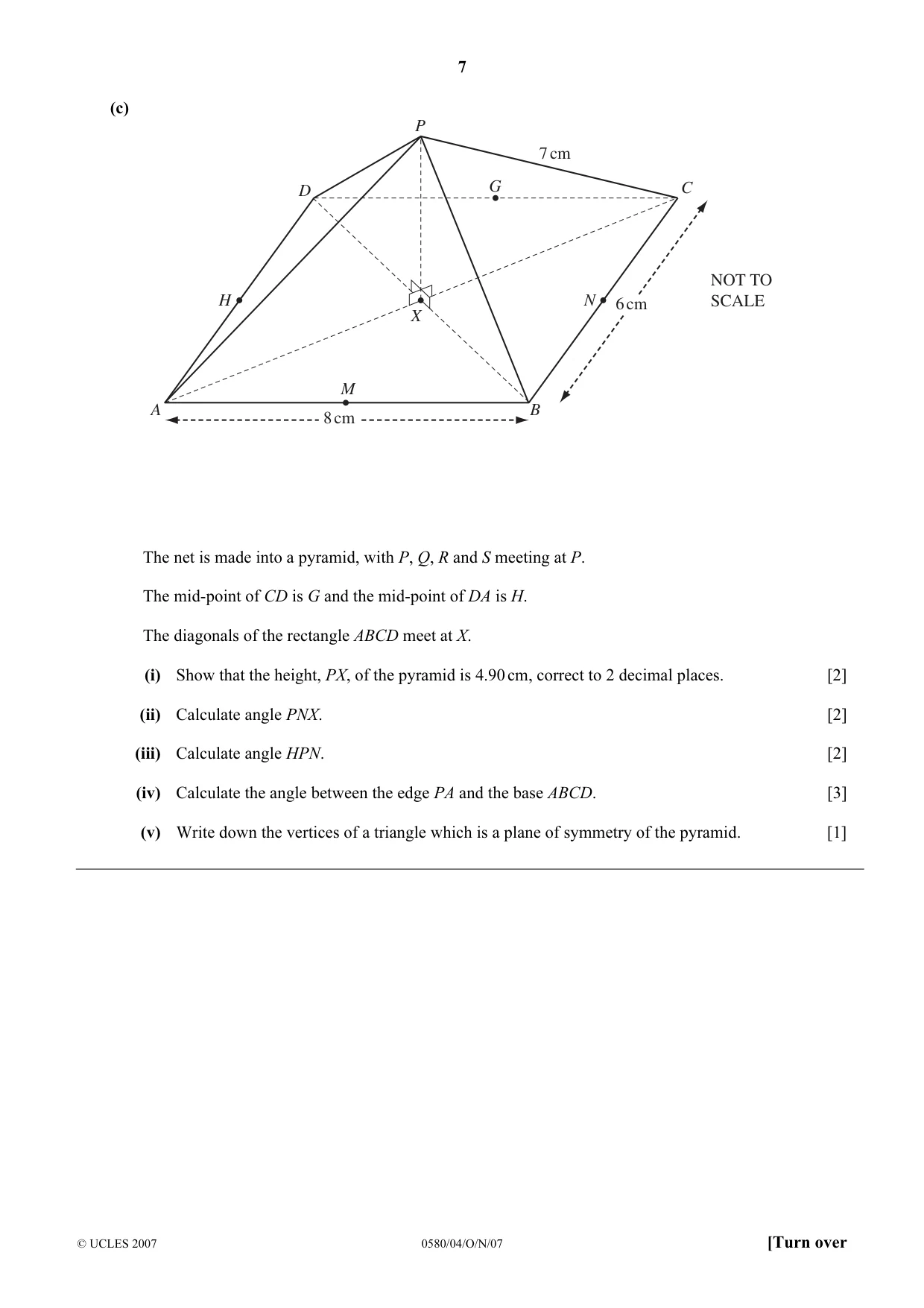
7 © UCLES 2007 0580/04/O/N/07 [Turn over (c) A B D C P X G N M H 8 cm 6 cm 7 cm NOT TO SCALE The net is made into a pyramid, with P, Q, R and S meeting at P. The mid-point of CD is G and the mid-point of DA is H. The diagonals of the rectangle ABCD meet at X. (i) Show that the height, PX, of the pyramid is 4.90 cm, correct to 2 decimal places. [2] (ii) Calculate angle PNX. [2] (iii) Calculate angle HPN. [2] (iv) Calculate the angle between the edge PA and the base ABCD. [3] (v) Write down the vertices of a triangle which is a plane of symmetry of the pyramid. [1]
Question paper, page 8
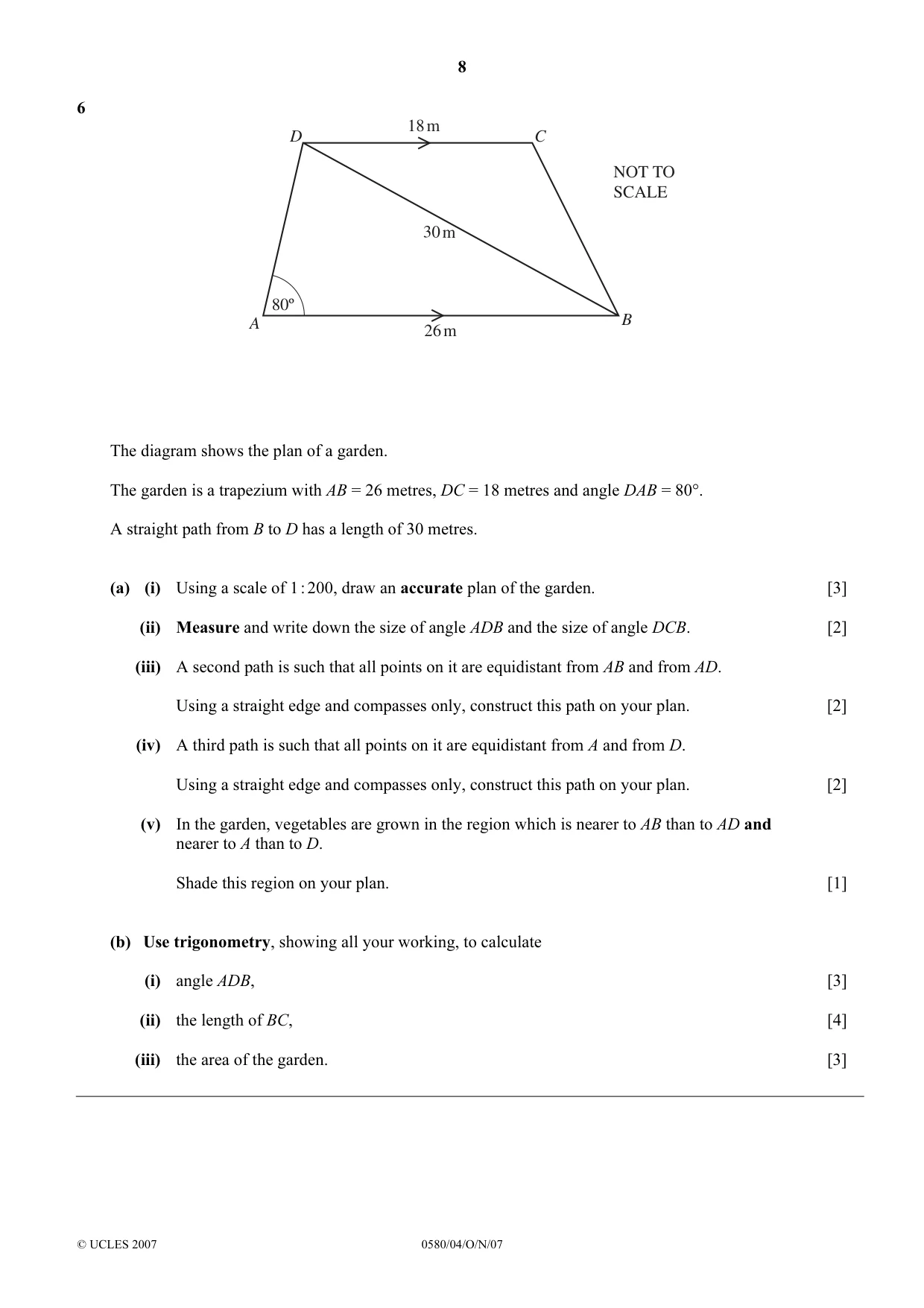
8 © UCLES 2007 0580/04/O/N/07 6 80º D C B A 26 m 30 m 18 m NOT TO SCALE The diagram shows the plan of a garden. The garden is a trapezium with AB = 26 metres, DC = 18 metres and angle DAB = 80°. A straight path from B to D has a length of 30 metres. (a) (i) Using a scale of 1 : 200, draw an accurate plan of the garden. [3] (ii) Measure and write down the size of angle ADB and the size of angle DCB. [2] (iii) A second path is such that all points on it are equidistant from AB and from AD. Using a straight edge and compasses only, construct this path on your plan. [2] (iv) A third path is such that all points on it are equidistant from A and from D. Using a straight edge and compasses only, construct this path on your plan. [2] (v) In the garden, vegetables are grown in the region which is nearer to AB than to AD and nearer to A than to D. Shade this region on your plan. [1] (b) Use trigonometry, showing all your working, to calculate (i) angle ADB, [3] (ii) the length of BC, [4] (iii) the area of the garden. [3]
Question paper, page 9
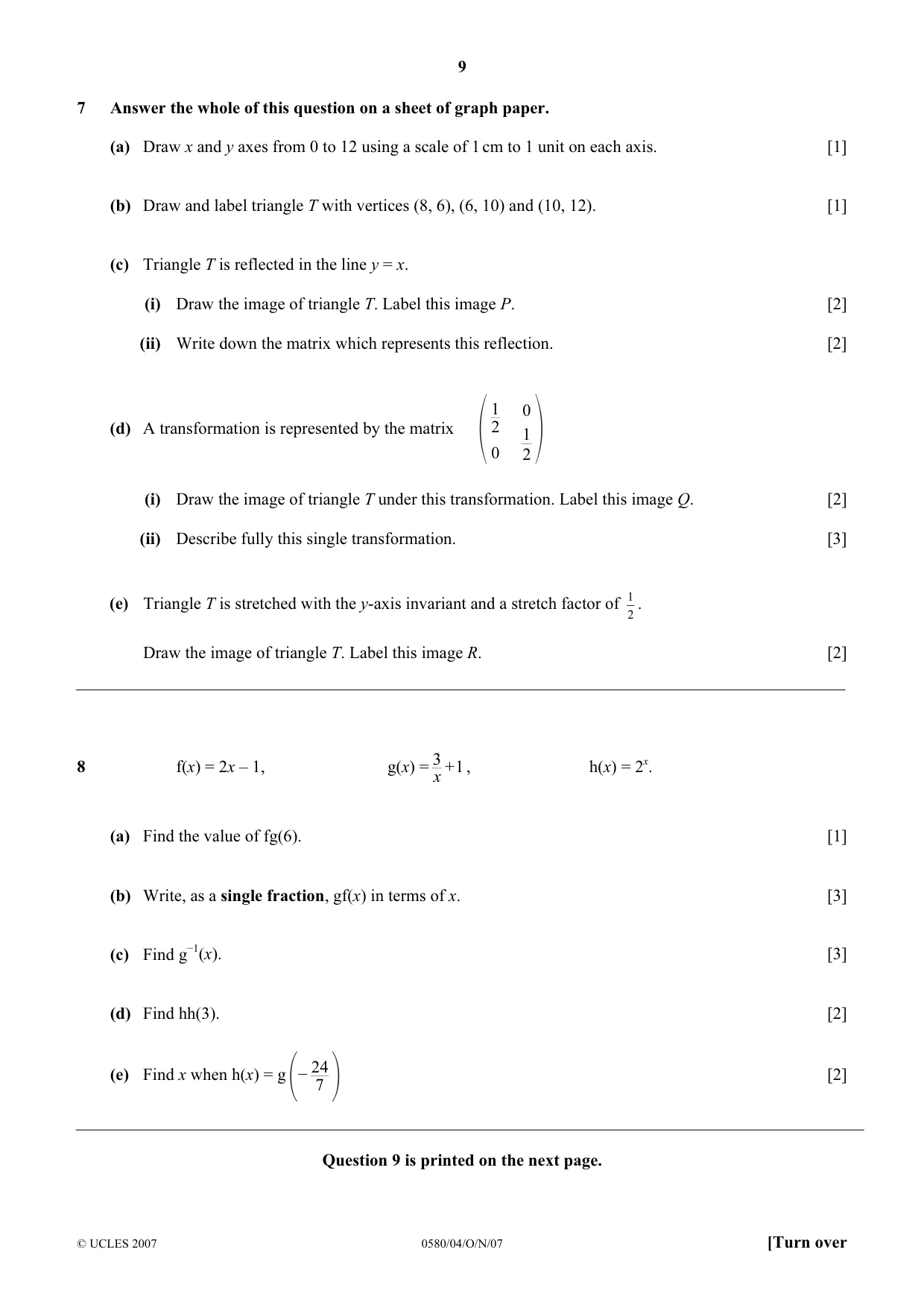
9 © UCLES 2007 0580/04/O/N/07 [Turn over 7 Answer the whole of this question on a sheet of graph paper. (a) Draw x and y axes from 0 to 12 using a scale of 1 cm to 1 unit on each axis. [1] (b) Draw and label triangle T with vertices (8, 6), (6, 10) and (10, 12). [1] (c) Triangle T is reflected in the line y = x. (i) Draw the image of triangle T. Label this image P. [2] (ii) Write down the matrix which represents this reflection. [2] (d) A transformation is represented by the matrix 1 0 2 1 0 2 (i) Draw the image of triangle T under this transformation. Label this image Q. [2] (ii) Describe fully this single transformation. [3] (e) Triangle T is stretched with the y-axis invariant and a stretch factor of 1 2 . Draw the image of triangle T. Label this image R. [2] 8 f(x) = 2x – 1, g(x) = 3 +1 x , h(x) = 2x. (a) Find the value of fg(6). [1] (b) Write, as a single fraction, gf(x) in terms of x. [3] (c) Find g−1(x). [3] (d) Find hh(3). [2] (e) Find x when h(x) = g −24 7 [2] Question 9 is printed on the next page.
Question paper, page 10
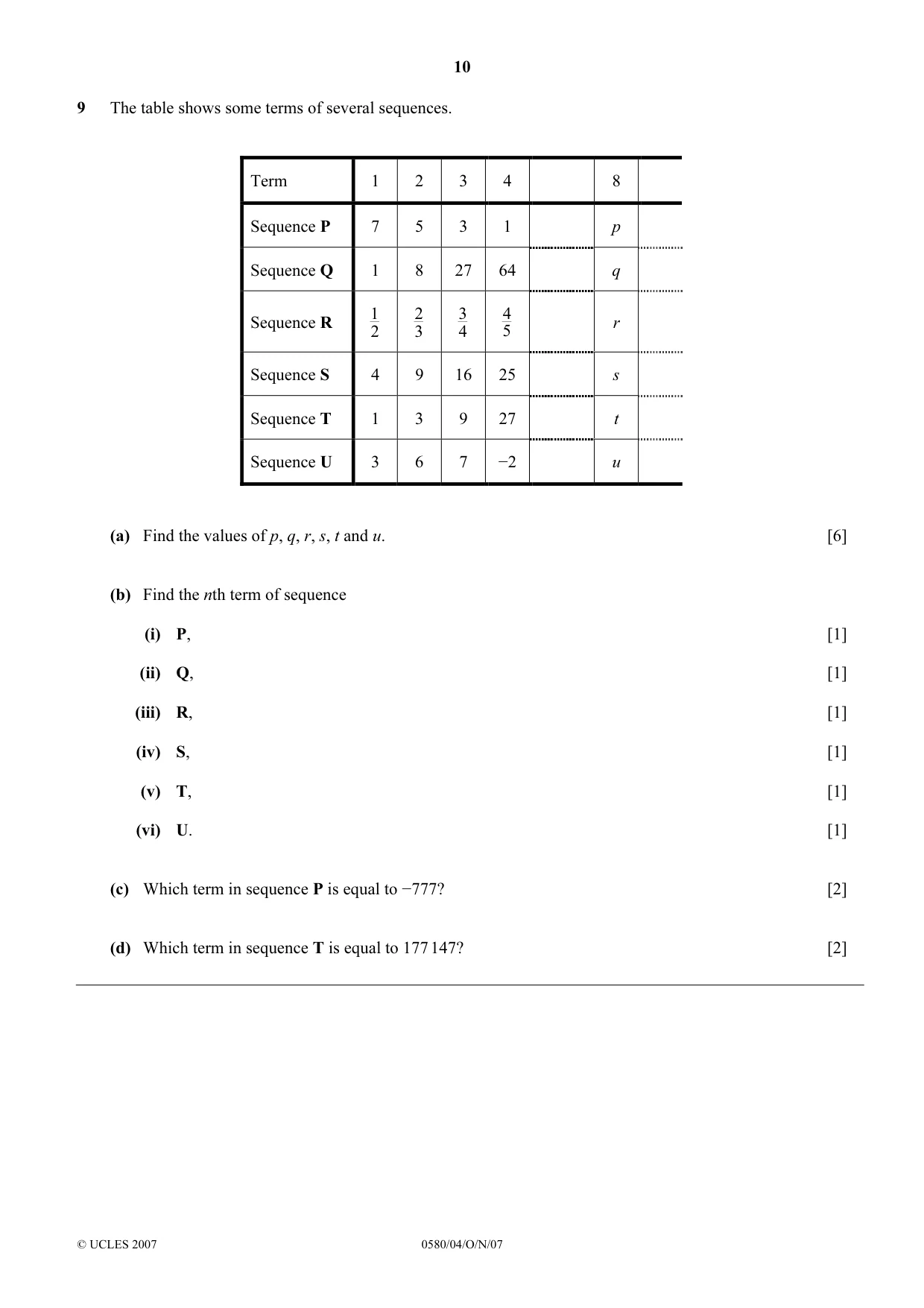
10 © UCLES 2007 0580/04/O/N/07 9 The table shows some terms of several sequences. Term 1 2 3 4 8 Sequence P 7 5 3 1 p Sequence Q 1 8 27 64 q Sequence R 1 2 2 3 3 4 4 5 r Sequence S 4 9 16 25 s Sequence T 1 3 9 27 t Sequence U 3 6 7 −2 u (a) Find the values of p, q, r, s, t and u. [6] (b) Find the nth term of sequence (i) P, [1] (ii) Q, [1] (iii) R, [1] (iv) S, [1] (v) T, [1] (vi) U. [1] (c) Which term in sequence P is equal to −777? [2] (d) Which term in sequence T is equal to 177 147? [2]
Question paper, page 11
11 © UCLES 2007 0580/04/O/N/07 BLANK PAGE
Question paper, page 12
12 Permission to reproduce items where third-party owned material protected by copyright is included has been sought and cleared where possible. Every reasonable effort has been made by the publisher (UCLES) to trace copyright holders, but if any items requiring clearance have unwittingly been included, the publisher will be pleased to make amends at the earliest possible opportunity. University of Cambridge International Examinations is part of the Cambridge Assessment Group. Cambridge Assessment is the brand name of University of Cambridge Local Examinations Syndicate (UCLES), which is itself a department of the University of Cambridge. © UCLES 2007 0580/04/O/N/07 BLANK PAGE
Mark scheme, page 1
UNIVERSITY OF CAMBRIDGE INTERNATIONAL EXAMINATIONS International General Certificate of Secondary Education MARK SCHEME for the October/November 2007 question paper 0580 and 0581 MATHEMATICS 0580/04 and 0581/04 Paper 4 (Extended), maximum raw mark 130 This mark scheme is published as an aid to teachers and candidates, to indicate the requirements of the examination. It shows the basis on which Examiners were instructed to award marks. It does not indicate the details of the discussions that took place at an Examiners’ meeting before marking began. All Examiners are instructed that alternative correct answers and unexpected approaches in candidates’ scripts must be given marks that fairly reflect the relevant knowledge and skills demonstrated. Mark schemes must be read in conjunction with the question papers and the report on the examination. • CIE will not enter into discussions or correspondence in connection with these mark schemes. CIE is publishing the mark schemes for the October/November 2007 question papers for most IGCSE, GCE Advanced Level and Advanced Subsidiary Level syllabuses and some Ordinary Level syllabuses. www.XtremePapers.com
Mark scheme, page 2
Page 2 Mark Scheme Syllabus Paper IGCSE – October/November 2007 0580/0581 04 © UCLES 2007 Abbreviations In addition to those already seen the following may crop up. cao – correct answer only ww – without working www – without wrong working oe – or equivalent soi – seen or implied bod – benefit of doubt art – anything rounding to isw – ignore subsequent working ft – follow through oor – out of range isr – ignore subsequent rounding rot – rounded or truncated mog – marks on graph
Mark scheme, page 3
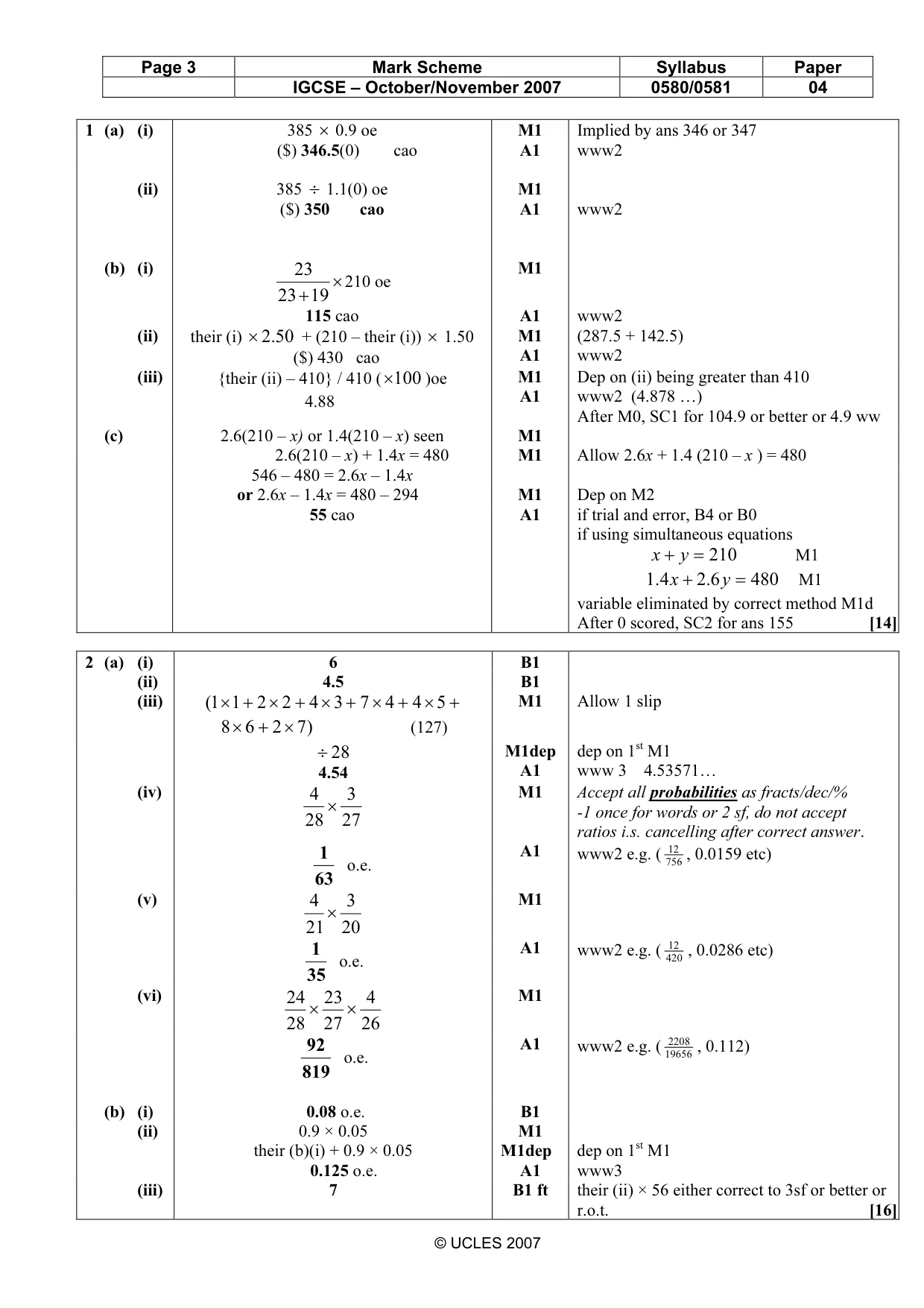
Page 3 Mark Scheme Syllabus Paper IGCSE – October/November 2007 0580/0581 04 © UCLES 2007 1 (a) (i) 385 × 0.9 oe M1 Implied by ans 346 or 347 ($) 346.5(0) cao A1 www2 (ii) 385 ÷ 1.1(0) oe ($) 350 cao M1 A1 www2 (b) (i) × +19 23 23 210 oe M1 115 cao A1 www2 (ii) their (i) 50 .2 × + (210 – their (i)) × 1.50 ($) 430 cao M1 A1 (287.5 + 142.5) www2 (iii) {their (ii) – 410} / 410 ( 100 × )oe 4.88 M1 A1 Dep on (ii) being greater than 410 www2 (4.878 …) After M0, SC1 for 104.9 or better or 4.9 ww (c) 2.6(210 – x) or 1.4(210 – x) seen M1 2.6(210 – x) + 1.4x = 480 M1 Allow 2.6x + 1.4 (210 – x ) = 480 546 – 480 = 2.6x – 1.4x or 2.6x – 1.4x = 480 – 294 M1 Dep on M2 55 cao A1 if trial and error, B4 or B0 if using simultaneous equations 210 = + y x M1 480 6.2 4.1 = + y x M1 variable eliminated by correct method M1d After 0 scored, SC2 for ans 155 [14] 2 (a) (i) 6 B1 (ii) 4.5 B1 (iii) + × + × + × + × + × 5 4 4 7 3 4 2 2 1 1( ) 7 2 6 8 × + × (127) M1 Allow 1 slip 28 ÷ 4.54 M1dep A1 dep on 1st M1 www 3 4.53571… (iv) 27 3 28 4 × M1 Accept all probabilities as fracts/dec/% -1 once for words or 2 sf, do not accept ratios i.s. cancelling after correct answer. 63 1 o.e. A1 www2 e.g. ( 756 12 , 0.0159 etc) (v) 20 3 21 4 × M1 35 1 o.e. A1 www2 e.g. ( 420 12 , 0.0286 etc) (vi) 26 4 27 23 28 24 × × M1 819 92 o.e. A1 www2 e.g. ( 19656 2208 , 0.112) (b) (i) 0.08 o.e. B1 (ii) 0.9 × 0.05 their (b)(i) + 0.9 × 0.05 0.125 o.e. M1 M1dep A1 dep on 1st M1 www3 (iii) 7 B1 ft their (ii) × 56 either correct to 3sf or better or r.o.t. [16]
Mark scheme, page 4
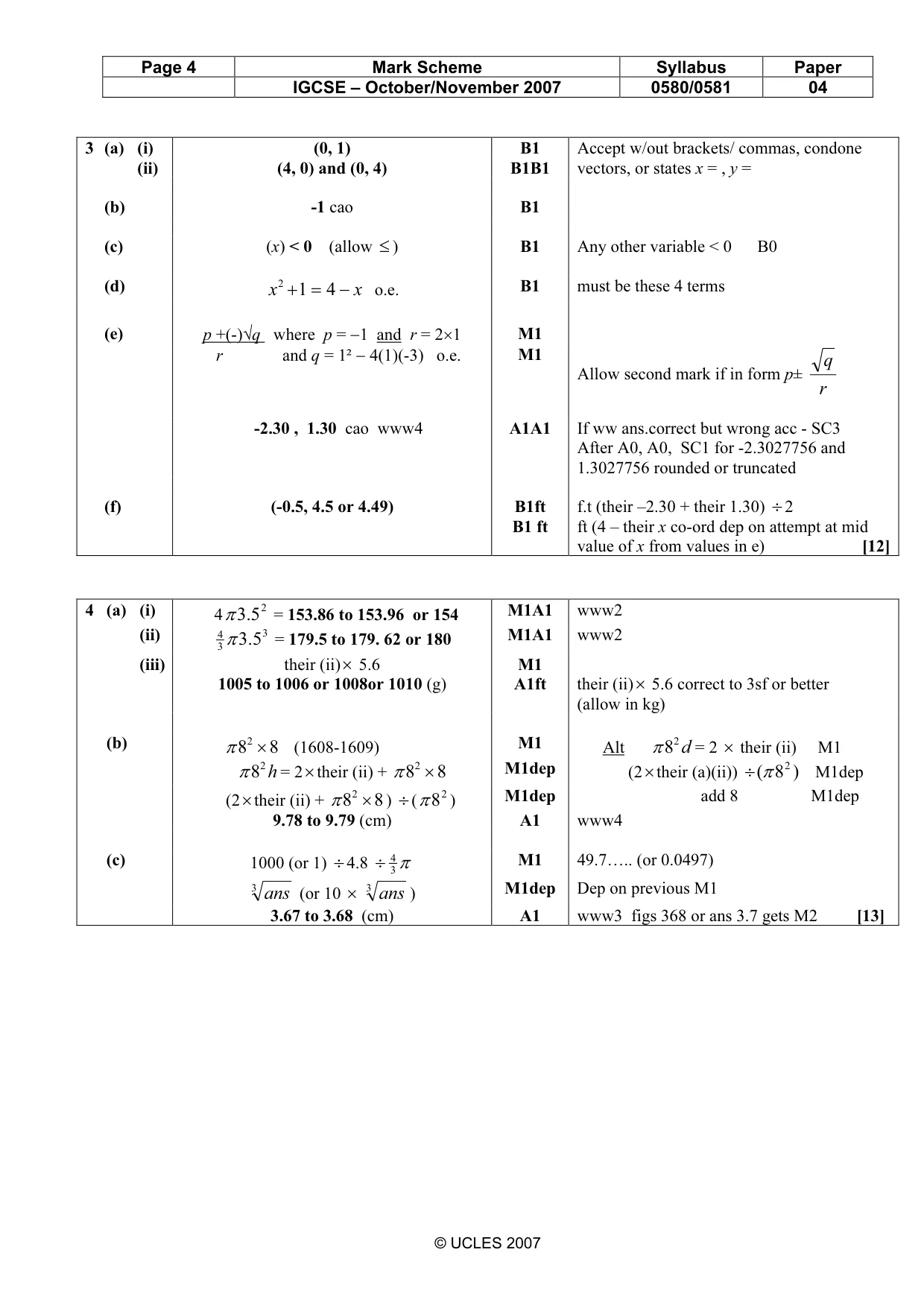
Page 4 Mark Scheme Syllabus Paper IGCSE – October/November 2007 0580/0581 04 © UCLES 2007 3 (a) (i) (0, 1) B1 Accept w/out brackets/ commas, condone (ii) (4, 0) and (0, 4) B1B1 vectors, or states x = , y = (b) -1 cao B1 (c) (x) < 0 (allow ≤) B1 Any other variable < 0 B0 (d) x x − = + 4 1 2 o.e. B1 must be these 4 terms (e) p +(-)√q where p = −1 and r = 2×1 M1 r and q = 1² − 4(1)(-3) o.e. M1 Allow second mark if in form p± r q -2.30 , 1.30 cao www4 A1A1 If ww ans.correct but wrong acc - SC3 After A0, A0, SC1 for -2.3027756 and 1.3027756 rounded or truncated (f) (-0.5, 4.5 or 4.49) B1ft f.t (their –2.30 + their 1.30) ÷2 B1 ft ft (4 – their x co-ord dep on attempt at mid value of x from values in e) [12] 4 (a) (i) 4 2 5.3 π = 153.86 to 153.96 or 154 M1A1 www2 (ii) 3 3 4 5.3 π = 179.5 to 179. 62 or 180 M1A1 www2 (iii) their (ii)× 5.6 1005 to 1006 or 1008or 1010 (g) M1 A1ft their (ii)× 5.6 correct to 3sf or better (allow in kg) (b) 8 82 × π (1608-1609) M1 Alt d 2 8 π = 2 × their (ii) M1 h 2 8 π = 2×their (ii) + 8 82 × π M1dep (2×their (a)(ii)) ) 8 ( 2 π ÷ M1dep (2×their (ii) + 8 82 × π ) ÷( 2 8 π ) M1dep add 8 M1dep 9.78 to 9.79 (cm) A1 www4 (c) 1000 (or 1) ÷4.8 π 3 4 ÷ M1 49.7….. (or 0.0497) 3 ans (or 10 × 3 ans ) M1dep Dep on previous M1 3.67 to 3.68 (cm) A1 www3 figs 368 or ans 3.7 gets M2 [13]
Mark scheme, page 5
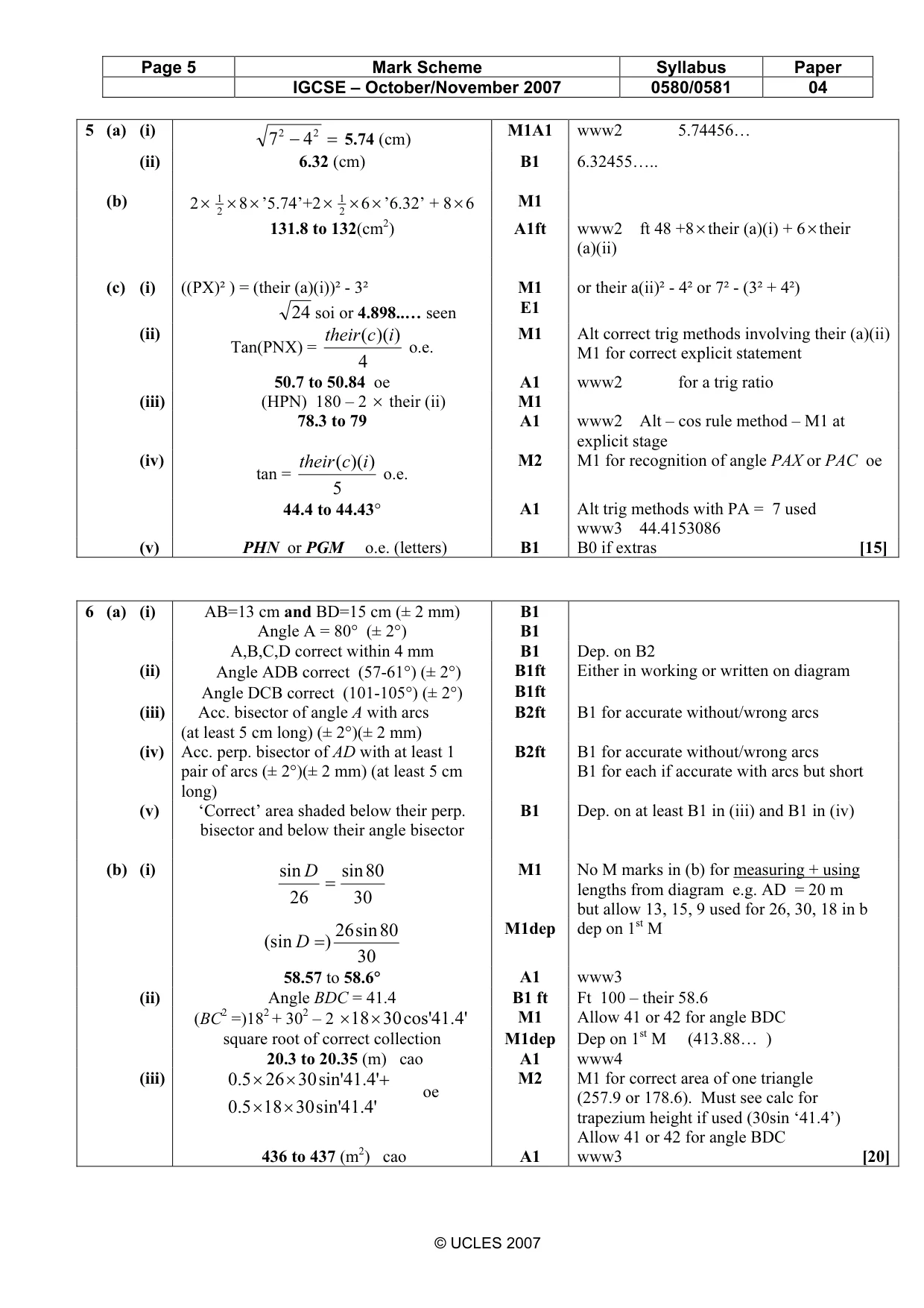
Page 5 Mark Scheme Syllabus Paper IGCSE – October/November 2007 0580/0581 04 © UCLES 2007 5 (a) (i) = − 2 2 4 7 5.74 (cm) M1A1 www2 5.74456… (ii) 6.32 (cm) B1 6.32455….. (b) 2× × 2 1 8×’5.74’+2× × 2 1 6×’6.32’ + 8×6 M1 131.8 to 132(cm2) A1ft www2 ft 48 +8×their (a)(i) + 6×their (a)(ii) (c) (i) ((PX)² ) = (their (a)(i))² - 3² M1 or their a(ii)² - 4² or 7² - (3² + 4²) 24 soi or 4.898..… seen E1 (ii) Tan(PNX) = 4 ) )( ( i c their o.e. M1 Alt correct trig methods involving their (a)(ii) M1 for correct explicit statement 50.7 to 50.84 oe A1 www2 for a trig ratio (iii) (HPN) 180 – 2 × their (ii) M1 78.3 to 79 A1 www2 Alt – cos rule method – M1 at explicit stage (iv) tan = 5 ) )( ( i c their o.e. M2 M1 for recognition of angle PAX or PAC oe 44.4 to 44.43° A1 Alt trig methods with PA = 7 used www3 44.4153086 (v) PHN or PGM o.e. (letters) B1 B0 if extras [15] 6 (a) (i) AB=13 cm and BD=15 cm (± 2 mm) B1 Angle A = 80° (± 2°) B1 A,B,C,D correct within 4 mm B1 Dep. on B2 (ii) Angle ADB correct (57-61°) (± 2°) B1ft Either in working or written on diagram Angle DCB correct (101-105°) (± 2°) B1ft (iii) Acc. bisector of angle A with arcs B2ft B1 for accurate without/wrong arcs (at least 5 cm long) (± 2°)(± 2 mm) (iv) Acc. perp. bisector of AD with at least 1 B2ft B1 for accurate without/wrong arcs pair of arcs (± 2°)(± 2 mm) (at least 5 cm long) B1 for each if accurate with arcs but short (v) ‘Correct’ area shaded below their perp. B1 Dep. on at least B1 in (iii) and B1 in (iv) bisector and below their angle bisector (b) (i) 30 80 sin 26 sin = D M1 No M marks in (b) for measuring + using lengths from diagram e.g. AD = 20 m but allow 13, 15, 9 used for 26, 30, 18 in b 30 80 sin 26 ) (sin = D M1dep dep on 1st M 58.57 to 58.6° A1 www3 (ii) Angle BDC = 41.4 B1 ft Ft 100 – their 58.6 (BC2 =)182 + 302 – 2 '4. 41 cos' 30 18× × M1 Allow 41 or 42 for angle BDC square root of correct collection M1dep Dep on 1st M (413.88… ) 20.3 to 20.35 (m) cao A1 www4 (iii) '4. 41 sin' 30 18 5.0 '4. 41 sin' 30 26 5.0 × × + × × oe M2 M1 for correct area of one triangle (257.9 or 178.6). Must see calc for trapezium height if used (30sin ‘41.4’) Allow 41 or 42 for angle BDC 436 to 437 (m2) cao A1 www3 [20]
Mark scheme, page 6
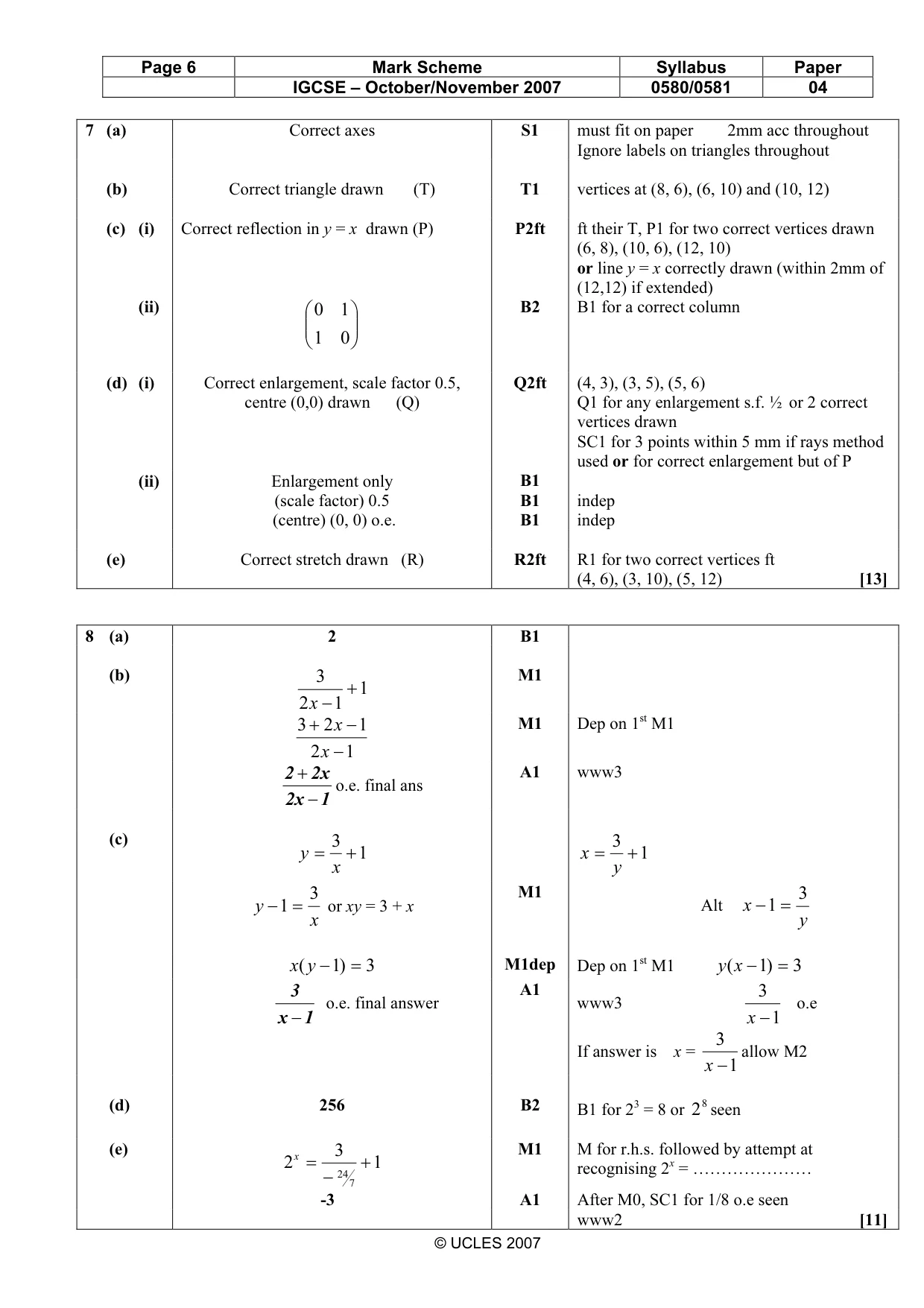
Page 6 Mark Scheme Syllabus Paper IGCSE – October/November 2007 0580/0581 04 © UCLES 2007 7 (a) Correct axes S1 must fit on paper 2mm acc throughout Ignore labels on triangles throughout (b) Correct triangle drawn (T) T1 vertices at (8, 6), (6, 10) and (10, 12) (c) (i) Correct reflection in y = x drawn (P) P2ft ft their T, P1 for two correct vertices drawn (6, 8), (10, 6), (12, 10) or line y = x correctly drawn (within 2mm of (12,12) if extended) (ii) 0 1 1 0 B2 B1 for a correct column (d) (i) Correct enlargement, scale factor 0.5, centre (0,0) drawn (Q) Q2ft (4, 3), (3, 5), (5, 6) Q1 for any enlargement s.f. ½ or 2 correct vertices drawn SC1 for 3 points within 5 mm if rays method used or for correct enlargement but of P (ii) Enlargement only (scale factor) 0.5 (centre) (0, 0) o.e. B1 B1 B1 indep indep (e) Correct stretch drawn (R) R2ft R1 for two correct vertices ft (4, 6), (3, 10), (5, 12) [13] 8 (a) 2 B1 (b) 1 1 2 3 + − x M1 1 2 1 2 3 − − + x x M1 Dep on 1st M1 1 2x 2x 2 − + o.e. final ans A1 www3 (c) 1 3 + = x y 1 3 + = y x x y 3 1 = − or xy = 3 + x M1 Alt y x 3 1 = − 3 )1 ( = − y x M1dep Dep on 1st M1 3 )1 ( = − x y 1 x 3 − o.e. final answer A1 www3 1 3 − x o.e If answer is x = 1 3 − x allow M2 (d) 256 B2 B1 for 23 = 8 or 8 2 seen (e) 1 3 2 7 24 + − = x M1 M for r.h.s. followed by attempt at recognising 2x = ………………… -3 A1 After M0, SC1 for 1/8 o.e seen www2 [11]
Mark scheme, page 7
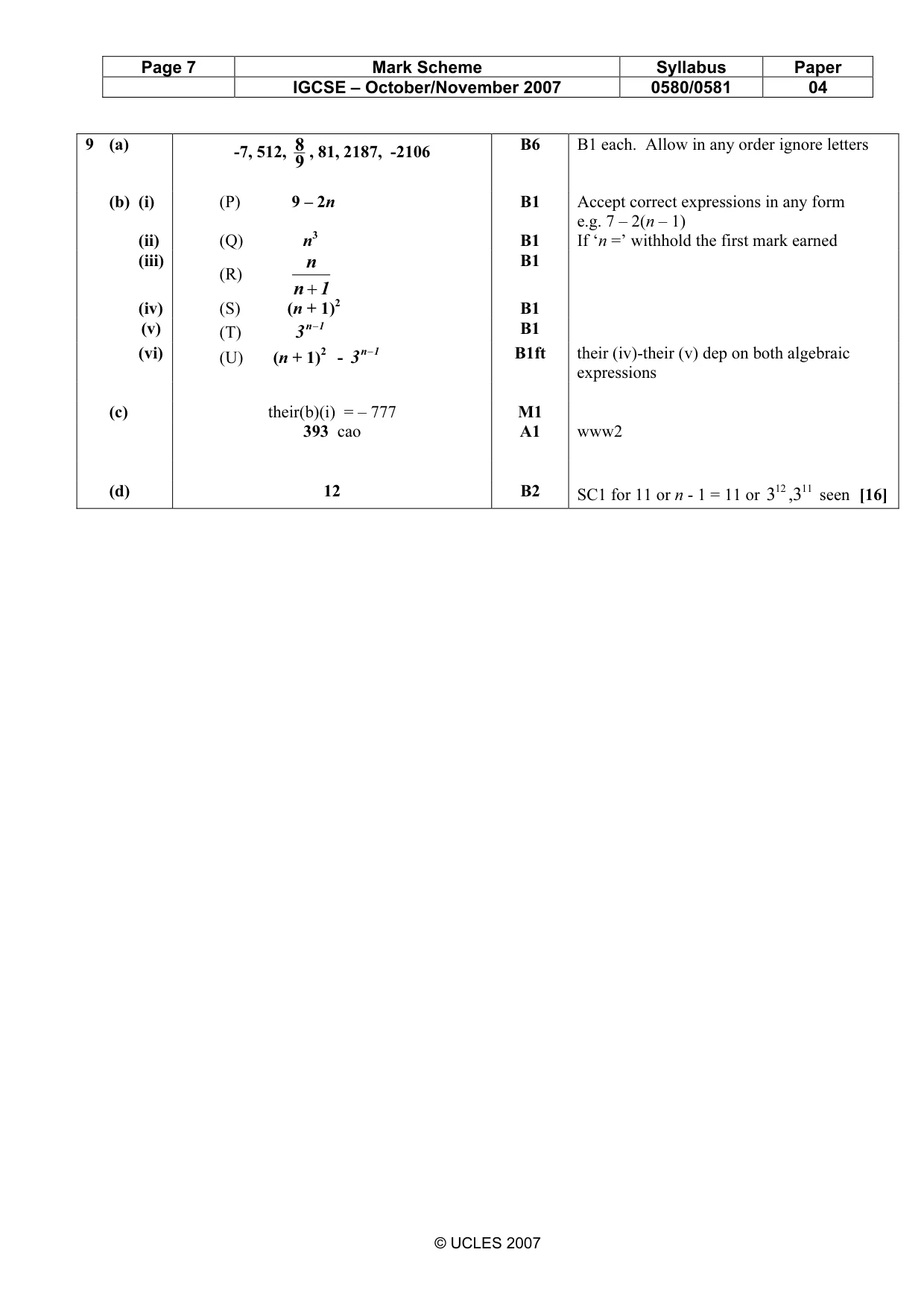
Page 7 Mark Scheme Syllabus Paper IGCSE – October/November 2007 0580/0581 04 © UCLES 2007 9 (a) -7, 512, 9 8 , 81, 2187, -2106 B6 B1 each. Allow in any order ignore letters (b) (i) (P) 9 – 2n B1 Accept correct expressions in any form e.g. 7 – 2(n – 1) (ii) (Q) n3 B1 If ‘n =’ withhold the first mark earned (iii) (R) 1 n n + B1 (iv) (S) (n + 1)2 B1 (v) (T) 1 n 3 − B1 (vi) (U) (n + 1)2 - 1 n 3 − B1ft their (iv)-their (v) dep on both algebraic expressions (c) their(b)(i) = – 777 M1 393 cao A1 www2 (d) 12 B2 SC1 for 11 or n - 1 = 11 or 11 12 3, 3 seen [16]
What you needed in this session
Cambridge’s own grade thresholds for 2007 Oct/Nov, Paper 4 · Variant 1. A higher threshold means an easier paper — the bar moves with how the cohort did.